Executive summary (short version for risk and technology leaders)


What is AI watermarking: definition and purpose
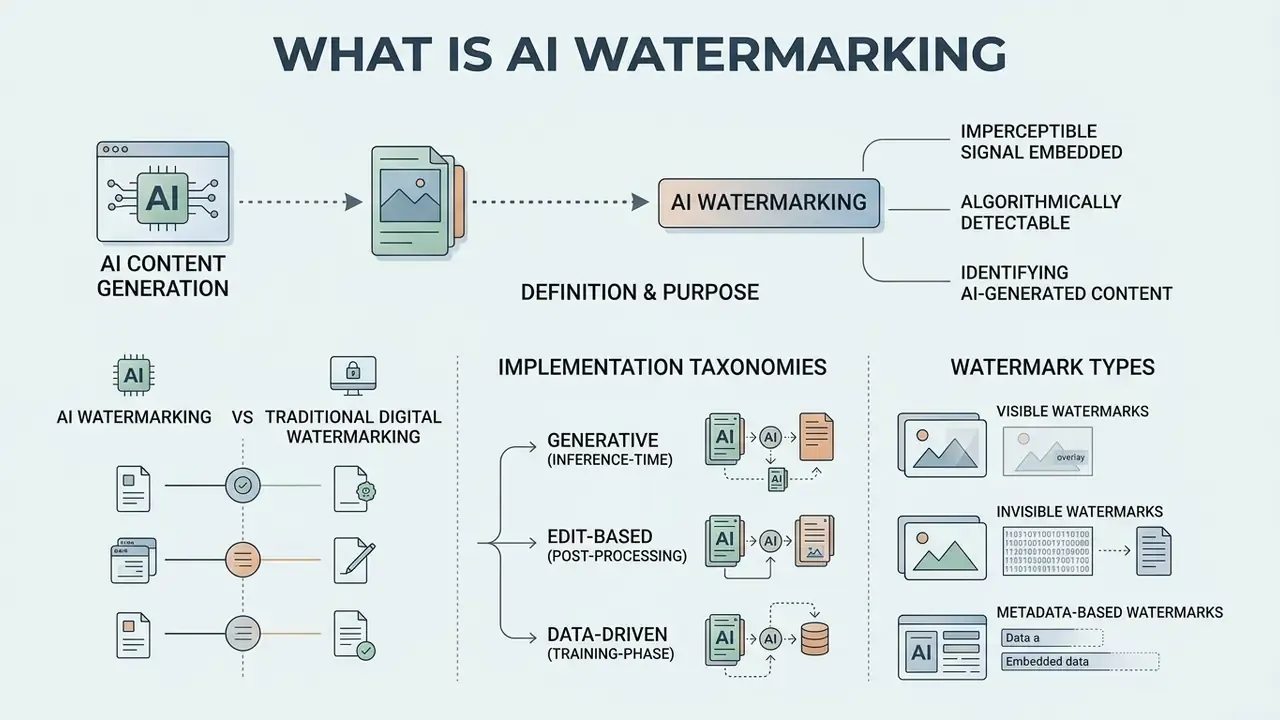
So, the plain-language meaning: a watermark is a hidden fingerprint that says «this passed through our model», and a detector is the instrument that reads it.
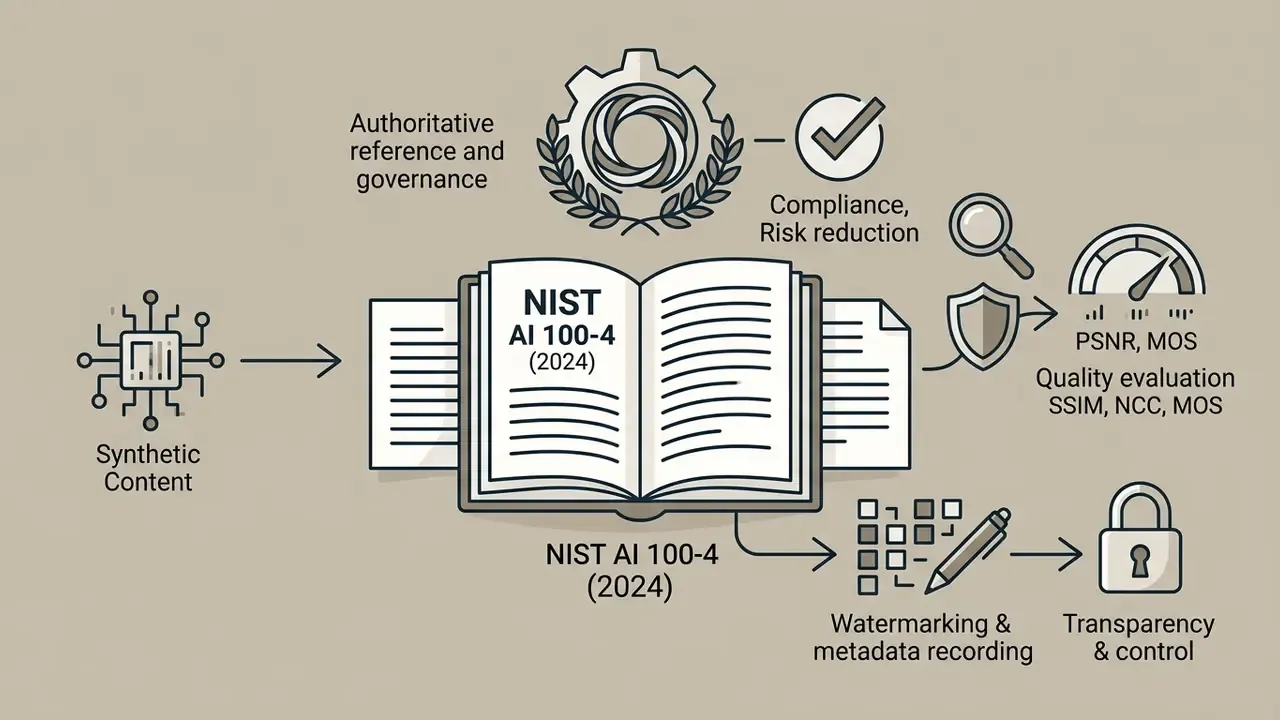
According to the National Institute of Standards and Technology (NIST AI 100-4, 2024), digital watermarking serves as a core control for synthetic content transparency. It lets risk leaders verify content integrity and trace data history across enterprise boundaries, including handoffs to vendors and marketing agencies.
In financial services and other regulated digital ecosystems, the core purpose of AI watermarking is narrower than the marketing suggests. It provides reproducible evidence about whether a text document, a synthetic voice recording, or a visual asset was produced by an automated system or by a human worker. That evidence is what an examiner asks for. Teams that also run passive verification pipelines frequently pair watermark decoders with AI reverse-image-search tools, comparing active embedding against retrieval-based detection before they escalate anything.
AI watermarking vs traditional digital watermarking
Traditional digital watermarking embeds fixed information (copyright claims, owner IDs, serial numbers) into pre-existing media files to deter piracy and track ownership. It usually relies on spatial or frequency perturbations applied to static assets after production, on the assumption that the asset is an original artifact requiring protection against unauthorized duplication.
AI watermarking targets something else: the outputs of generative models such as LLMs, diffusion networks, and voice synthesizers, marked during or right after the generation phase.
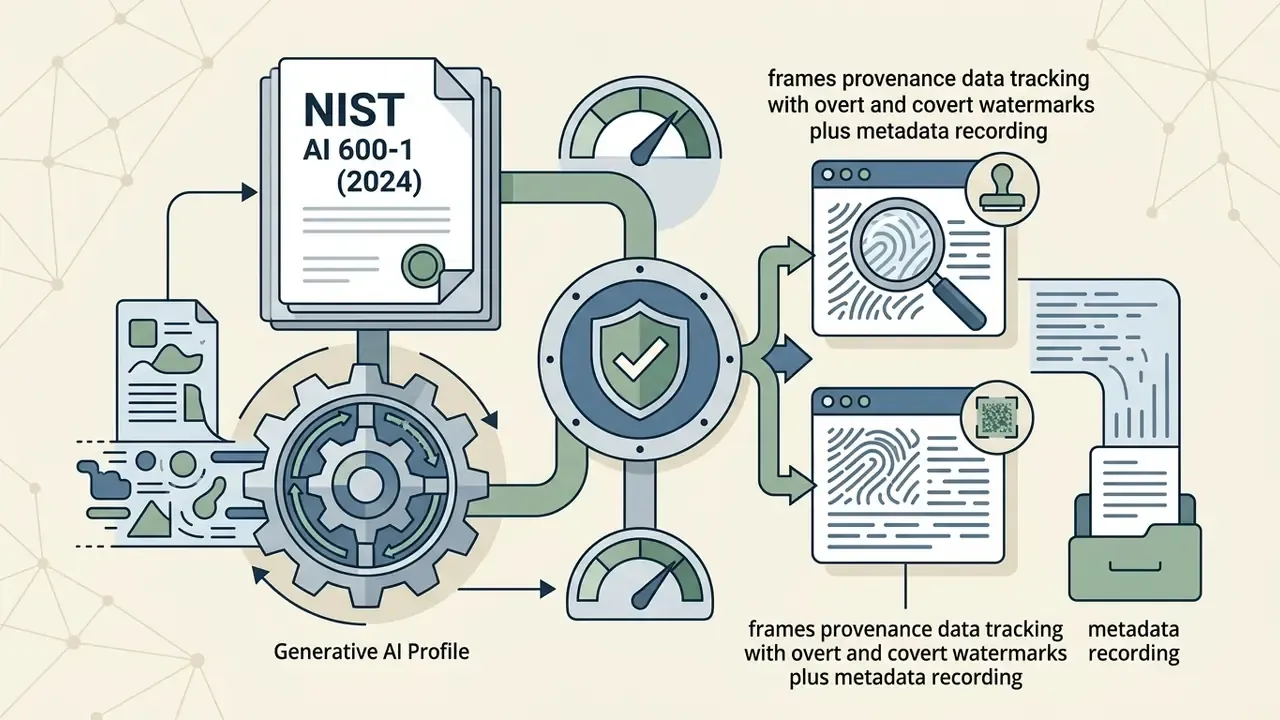
Rather than protecting ownership of an underlying media file, AI watermarking establishes model-level provenance and synthetic content detection. As the NIST AI 600-1 guidelines describe it, watermarking works inside a broader provenance framework, turning plain binary outputs into probabilistically verifiable artifacts that can survive downstream transformations such as re-encoding, paraphrasing, or compression. Survive, not always. That caveat runs through this whole guide.
Implementation taxonomies: generative, edit-based, and data-driven
Enterprise AI watermarking architectures are deployed at three distinct lifecycle stages. Procurement teams should require vendors to declare which of the three they actually implement, in writing.
- Generative watermarking (inference-time) Embedded directly during model inference, for example through token probability manipulation in LLMs or latent-space perturbation in diffusion decoders. It offers the strongest security binding and zero post-processing overhead, because the signal is inseparable from the act of generation.
- Edit-based watermarking (post-processing) Applied to finalized media assets right after generation. It uses deep-learning encoders (StegaStamp-class models, for instance) to inject imperceptible signals without touching core generative model parameters. This is the pragmatic path for organizations that consume third-party APIs and cannot alter the model.
- Data-driven watermarking (training-phase) Embedded into the training dataset or written into model weights during fine-tuning. Generated outputs then inherit the signature natively, with no runtime latency penalty, at the cost of retraining effort and much less flexibility for key rotation.
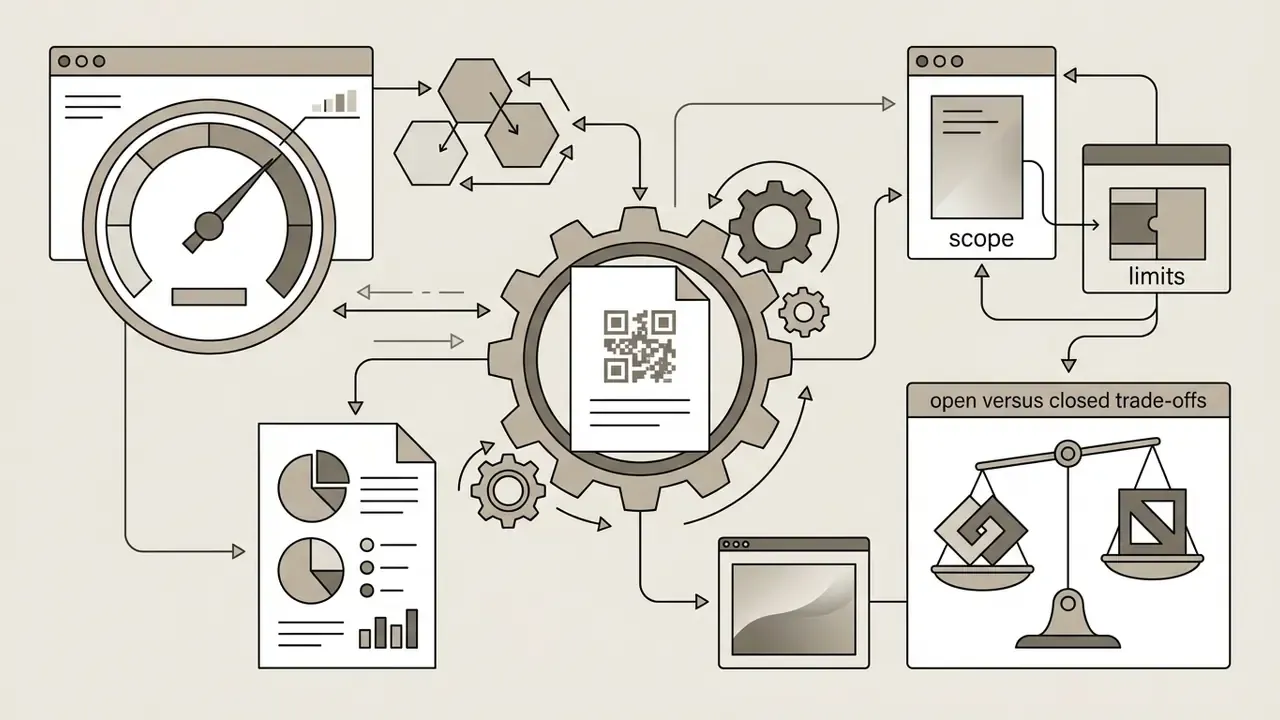
A second classification axis, widely used in the research literature, separates open from closed schemes (whether the embedding rule is publicly documented) and model-level from content-level watermarking (whether the signal is enforced inside the model distribution or added to the artifact afterwards). Both axes belong in your due-diligence questionnaire, because they determine who can verify your content and who can attack it.
Visible, invisible and metadata-based watermarks
Watermarking architectures fall into three primary categories, defined by perceptibility, detectability, and persistence under manipulation: visible overlays, invisible embedded signals, and metadata-based tags.
- Visible watermarksOvert graphical logos, semi-transparent text, or visual labels rendered onto visual or video media. They give immediate, low-cost disclosure to a human observer, but offer minimal security against adversarial removal and can degrade the aesthetic or functional value of the asset. A crop tool defeats them.
- Invisible watermarksImperceptible mathematical signals, token sampling perturbations, or latent vector adjustments embedded inside the content structure. Invisible watermarks require specialized algorithmic decoders or statistical tests for extraction, which makes them the primary mechanism for automated compliance and forensic model tracking.
- Metadata-based watermarksCryptographic manifests, EXIF headers, or C2PA sidecar files attached to digital assets. Metadata introduces zero content distortion and supports detailed provenance logging, but it remains vulnerable to deliberate or accidental stripping during format conversions and social platform uploads.
| Watermark Type | Perceptibility to Humans | Verification Mechanism | Resistance to Manipulation | Enterprise Application |
|---|---|---|---|---|
| Visible Watermark | Perceptible (logos, text overlays) | Visual inspection or optical OCR | Low: easily cropped, masked, or inpainted | Surface-level disclosure, basic branding |
| Invisible Watermark | Imperceptible under normal conditions | Statistical hypothesis tests, cryptographic decoders | Moderate to high: resists standard compression, noise, and light edits | Scalable model risk governance, deepfake defence |
| Metadata-based Tag | Non-visual (stored in headers or manifests) | Manifest inspection, public-key verification | Low: easily stripped during file re-encoding | Audit trails in cooperative, compliant pipelines |
Table caption for publication: comparison of visible, invisible, and metadata-based watermarks by visibility, verification path, resistance to manipulation, and enterprise use. Key conclusions are duplicated in the body text above, so the comparison stays accessible without the table.
C2PA implementation guidance formalizes the same split. Invisible watermarks count as soft binding and must be declared through a c2pa.watermarked action, while the cryptographic manifest forms the hard binding between the asset and its provenance record. Two bindings, two failure modes, two tests.
How AI watermarking works from embedding to detection
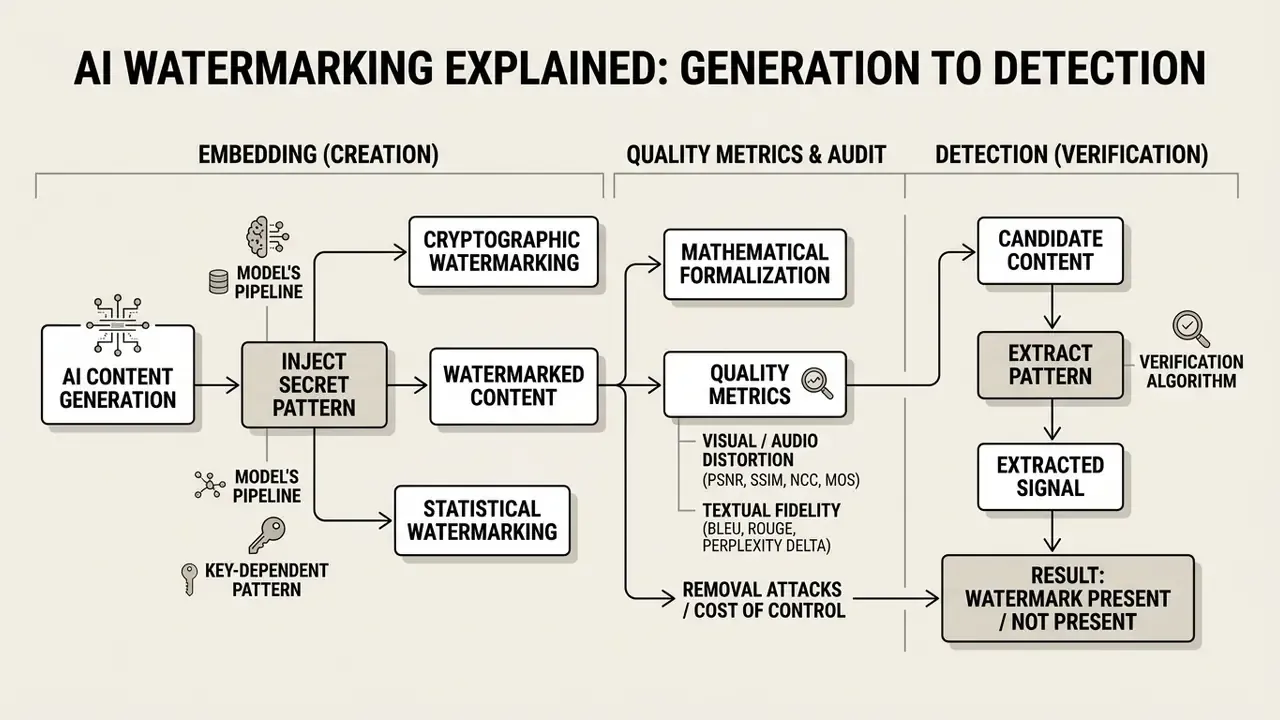
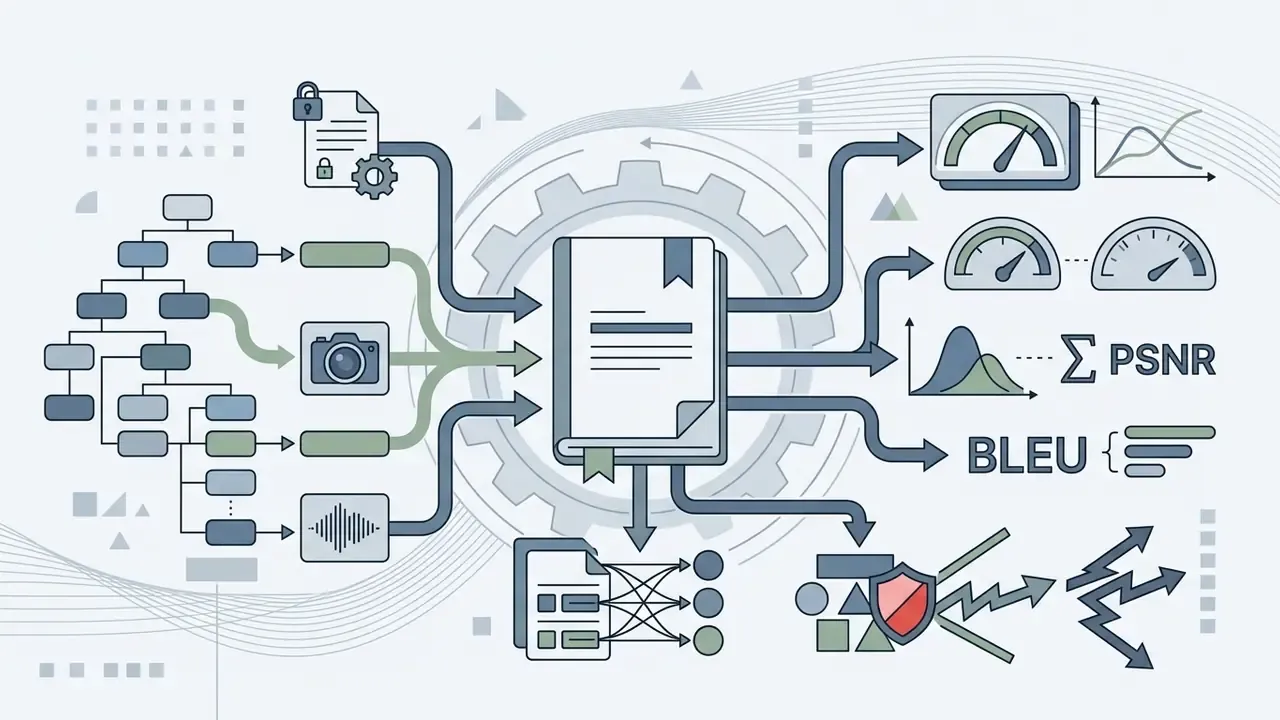
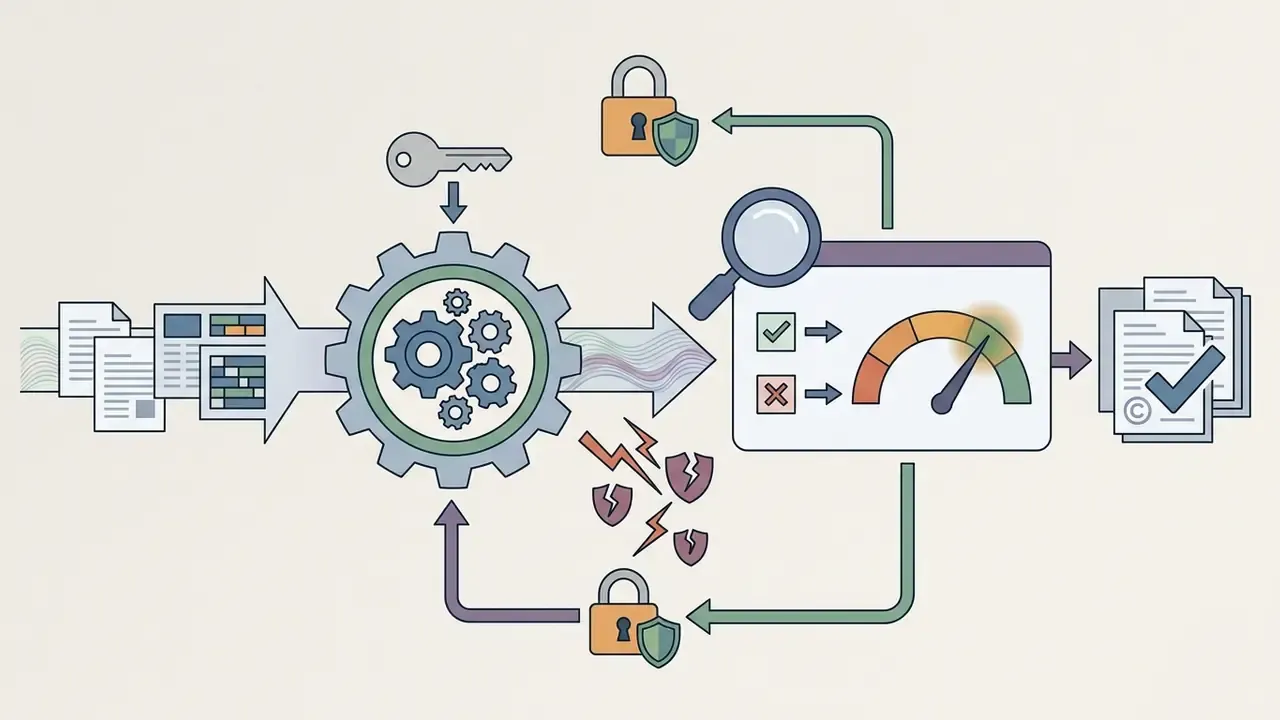
AI watermarking works by injecting a secret, key-dependent pattern into a model's generation pipeline, which a verification algorithm later extracts from candidate content through statistical hypothesis testing or key-based decoding. The operational cycle spans model inference, content distribution, signal extraction, and threshold verification. Enterprises evaluating which upstream systems feed that pipeline usually start from an inventory of generative image and art platforms already in use across marketing and product teams. The inventory almost always surprises somebody.
Figure 1. End-to-end AI watermarking lifecycle (enterprise reference architecture)
| Stage | Component | Control Owner | Key Artefact |
|---|---|---|---|
| 1. Generation | Generative model (LLM, diffusion, audio decoder) | AI Platform Engineering | Prompt and inference log |
| 2. Embedding | Keyed embedding module (token bias, latent perturbation, encoder) | Security, HSM key custodian | Secret key k, payload m |
| 3. Binding | C2PA manifest signing and hash binding | Content provenance service | Signed manifest, soft-binding declaration |
| 4. Distribution | Publication, export, third-party transfer, re-encoding | Business line or channel owner | Asset lineage record |
| 5. Detection | Statistical detector or public-key decoder | Model Risk, SecOps | z-score, p-value, recovered bits |
| 6. Verification and audit | Threshold engine plus GRC and SIEM logging | Model Risk Management, Internal Audit | Decision record at fixed FPR |
Alt text guidance: "ai watermarking explained flow architecture from model inference and keyed embedding through distribution to detector verification and audit logging." Render as a figure with a caption describing the six-stage chain, and keep each stage label as selectable text rather than baked into an image.
Mathematical formalization and quality metrics
Formally, an enterprise AI watermarking system is a tuple W = (E, D, V):
- E : C × K × M → C_w. The encoding function embeds payload m ∈ M into content c ∈ C using secret key k ∈ K, producing watermarked output c_w ∈ C_w.
- D : C_w × K → M_d. The decoding function attempts to recover payload M_d from candidate content using the key.
- V : M × M_d → {0, 1}. The verification function decides whether the recovered payload constitutes a valid watermark.
Here C is the raw content space (text, images, audio waveforms), K the cryptographic secret key space, M the embedded metadata payload, and C_w ⊂ C the resulting watermarked asset space. In text the watermark manifests as a specific token distribution; in visual media as a recoverable bitstring; in audio as an additive or latent waveform component.
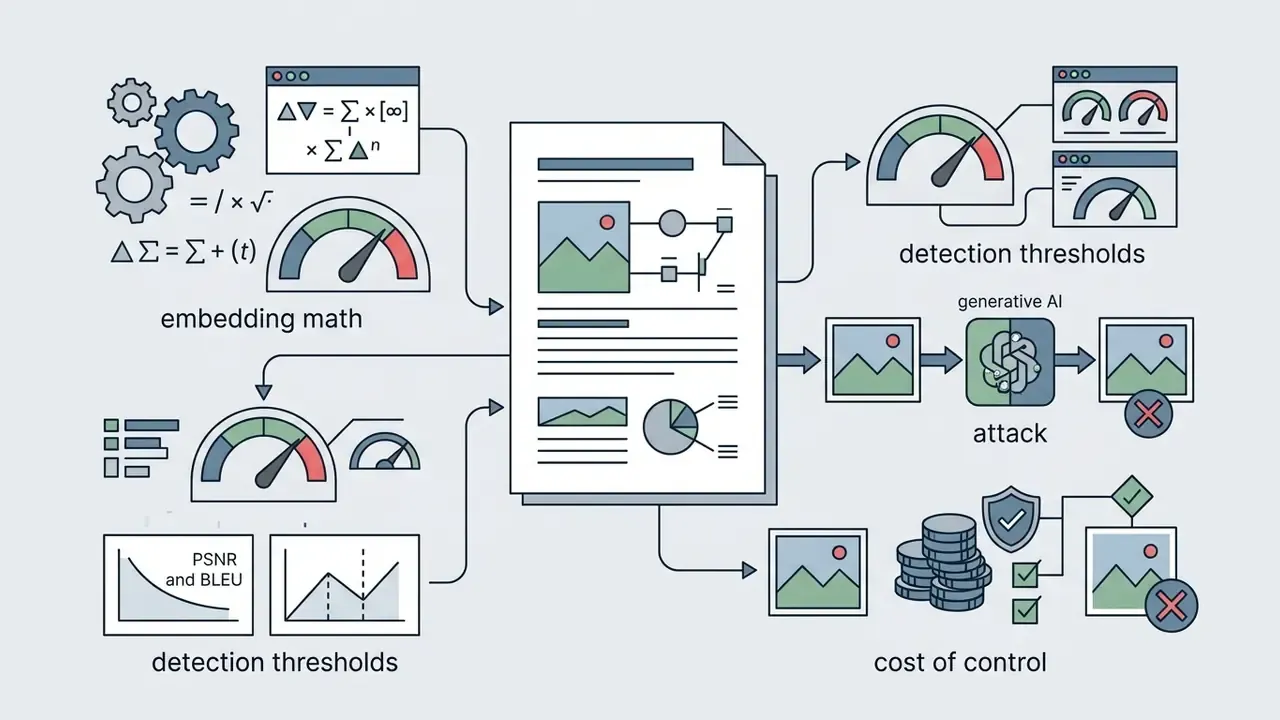
Embedding always introduces some statistical perturbation. Governance therefore requires measuring distortion so that business utility stays intact, using modality-specific metrics.


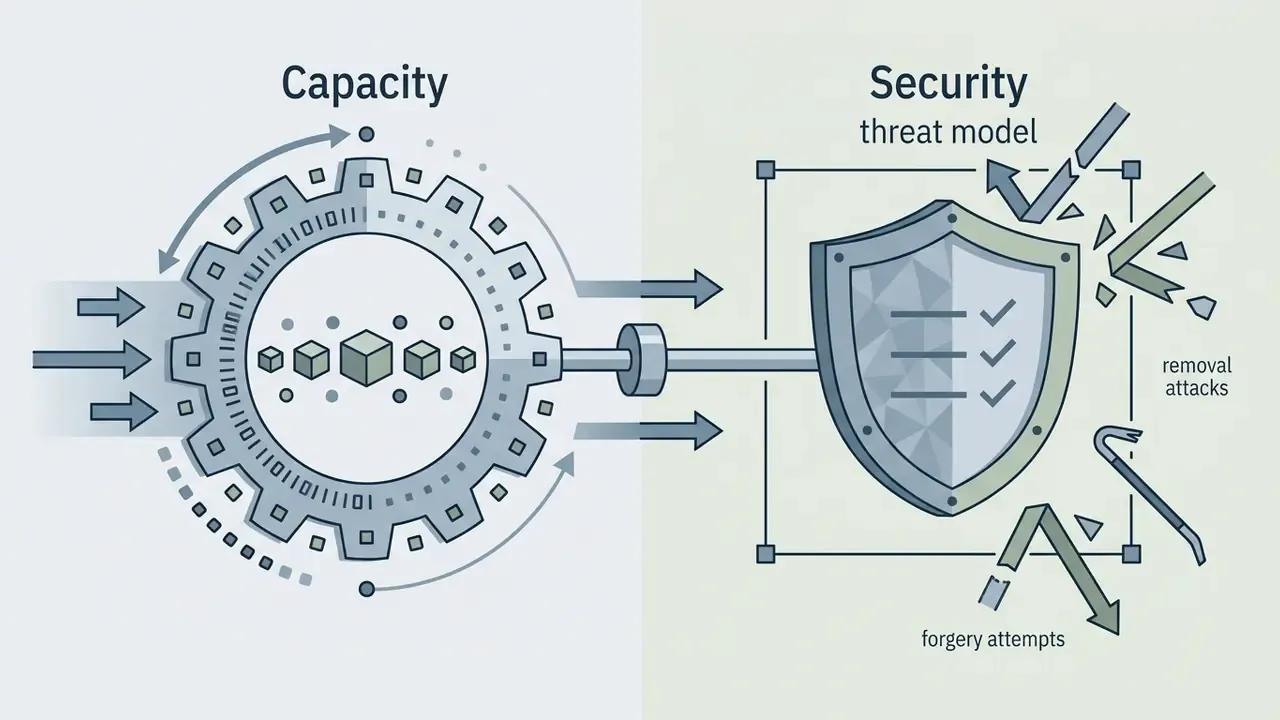
| Property | Metric family | Enterprise acceptance target | Failure consequence |
|---|---|---|---|
| Imperceptibility (visual, audio) | PSNR, SSIM, NCC, MOS | PSNR ≥ 40 dB; MOS ≥ 4.0 | Visible artefacts, brand damage |
| Imperceptibility (text) | BLEU, ROUGE, perplexity delta | BLEU and ROUGE within 1–2% of baseline | Degraded answers, user complaints |
| Detection power | TPR at fixed FPR, ROC-AUC | TPR ≥ 95% at FPR ≤ 1% on 300+ tokens | Missed synthetic content |
| Robustness | TPR after declared attack set | ≥ 80% retention under benign transforms | Silent control failure |
| Capacity | Bits per asset or per 100 tokens | Enough for model, version, timestamp | Unattributable outputs |
Embedding signals during AI content generation
Embedding mechanisms follow the mathematical architecture of the model. For Large Language Models, current methods adjust token sampling probabilities at inference time. In the foundational work by Kirchenbauer et al. (2023), a pseudo-random function seeded by a secret key partitions the vocabulary into "green" and "red" sets based on preceding context tokens.
The generator then nudges token selection toward the green list, leaving a statistical footprint across the generated text without wrecking fluency. Hard watermarking forbids red tokens outright. Soft watermarking only raises green-token logits, which preserves generation quality on constrained prompts such as code or numeric summaries.
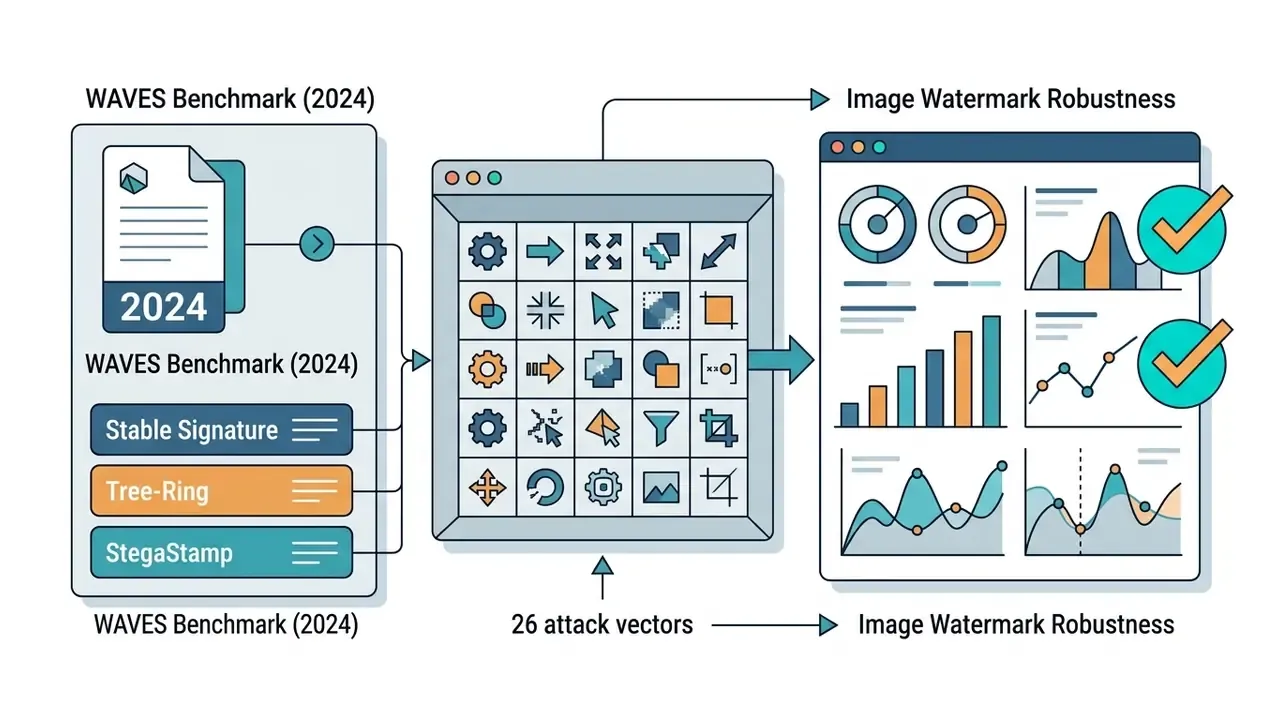
In diffusion models for visual generation, embedding happens inside latent noise representations or model parameters (WAVES Benchmark, 2024). Approaches such as Stable Signature alter the latent space or decoder weights, so every generated image carries a mathematical signature. Independent benchmarking confirms the mechanism and flags its ceiling:
For audio and music models, frameworks such as MusicMark (2026) inject watermark parameters into semantic latent vectors before waveform synthesis, weaving the signal into acoustic structure rather than adding post-hoc noise. Comparable work in speech synthesis, for example decoder-level gradient steganography, embeds the mark during training so no post-processing pass is needed at all.
Semantic embedding is currently the strongest answer to paraphrase attacks in text:
Detection and verification algorithms
Detection algorithms evaluate candidate content and output a statistical confidence score against a pre-established error tolerance. For text LLMs, the detector counts the proportion of green-list tokens across a sequence, then computes a z-score or p-value expressing how unlikely those choices were by chance.
As established by Li et al. (2024), robust detection relies on pivotal statistics that stay invariant under non-watermarked human baseline text. That property is what lets model risk teams lock the False Positive Rate, meaning the risk of wrongly flagging human content as synthetic, at a strict administrative bound such as 0.1% or 1%.
In visual and audio modalities, verification extracts embedded bitstrings and applies binomial confidence tests to check whether the recovered sequence matches the authorized model key. Practical thresholds in published systems include bit-accuracy cutoffs around 0.75 and p-value bounds that translate directly into an auditable decision record. Auditors like that translation, because it converts a model output into a documented decision.
Three verification regimes should be distinguished at design time: thresholded statistical scoring (z-score or p-value on text), bit-error-bounded decoding (recovered payload against expected payload in media), and public-key signature checking (cryptographic manifests). Each carries different evidentiary weight in an audit file, and mixing them up is a common reason evidence gets rejected.
Cryptographic and statistical watermarking techniques
Watermarking architectures combine statistical signal processing with cryptographic key management.
- Statistical watermarks Detection is framed as a hypothesis test. These schemes maximize detection power (True Positive Rate) over longer content while holding strict mathematical bounds on False Positive Rates. They suit high-throughput text and open-ended generative workflows.
- Cryptographic watermarks These use asymmetric public and private key pairs or secure hash functions (C2PA Technical Specification v2.4). A private key embeds the mark during inference, and a matching public key lets external auditors or platform operators verify origin without exposing generator parameters. In secure quantization-index-modulation designs, the private key generates the watermark while the public key drives detection, with a secure module decrypting the result.
Formal limits deserve as much attention as capabilities. Research on the impossibility of strong watermarking shows that, under broad adversarial assumptions, no scheme can guarantee unremovable marking for general generative outputs. Treat watermarking as a way to raise the cost of undetected misuse, not to eliminate it. Anyone promising elimination is selling something.
The trade-off between open and closed detection is central to enterprise risk management. Closed systems keep detection keys private, which protects against reverse-engineering but blocks external verification. Open systems enable transparent third-party auditing, yet risk exposing token-selection rules to adversaries who can then reconstruct green lists.
Watermarking across images, text and audio
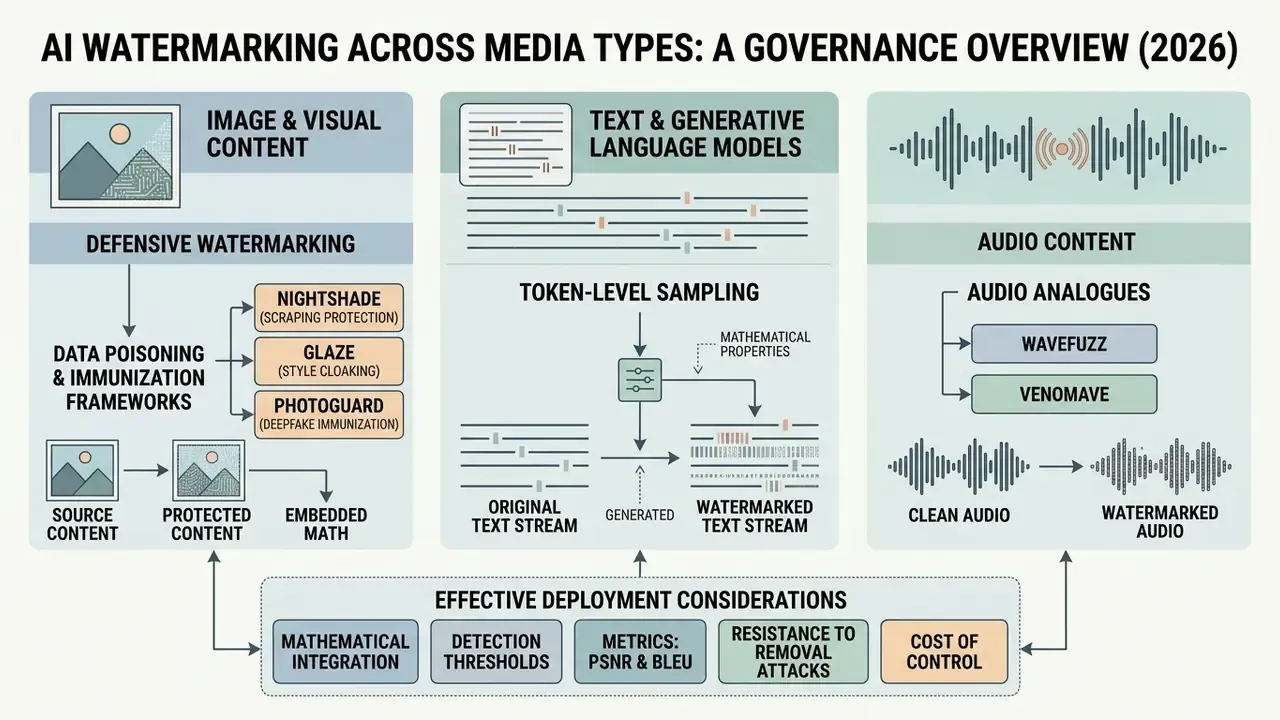
Effective deployment means tailoring the technique to the mathematical properties of each media type. The transformations that threaten signal survival differ sharply between visual, textual, and acoustic formats.
Watermarking AI-generated images and visual content
Visual watermarking operates on high-dimensional pixel grids and latent spatial features. Deep learning approaches such as learned encoders (StegaStamp) and model-level latent perturbations (Stable Signature) inject high-capacity signals built to survive ordinary image edits. Contemporary reviews confirm that CNN-, GAN-, Transformer-, and diffusion-based watermarking now outperform classical spatial and frequency-domain methods on robustness, transparency, and adaptability.
Empirical evaluations from the WAVES Benchmark (2024) report high true-positive detection under basic spatial operations such as cropping, colour scaling, and mild blurring.
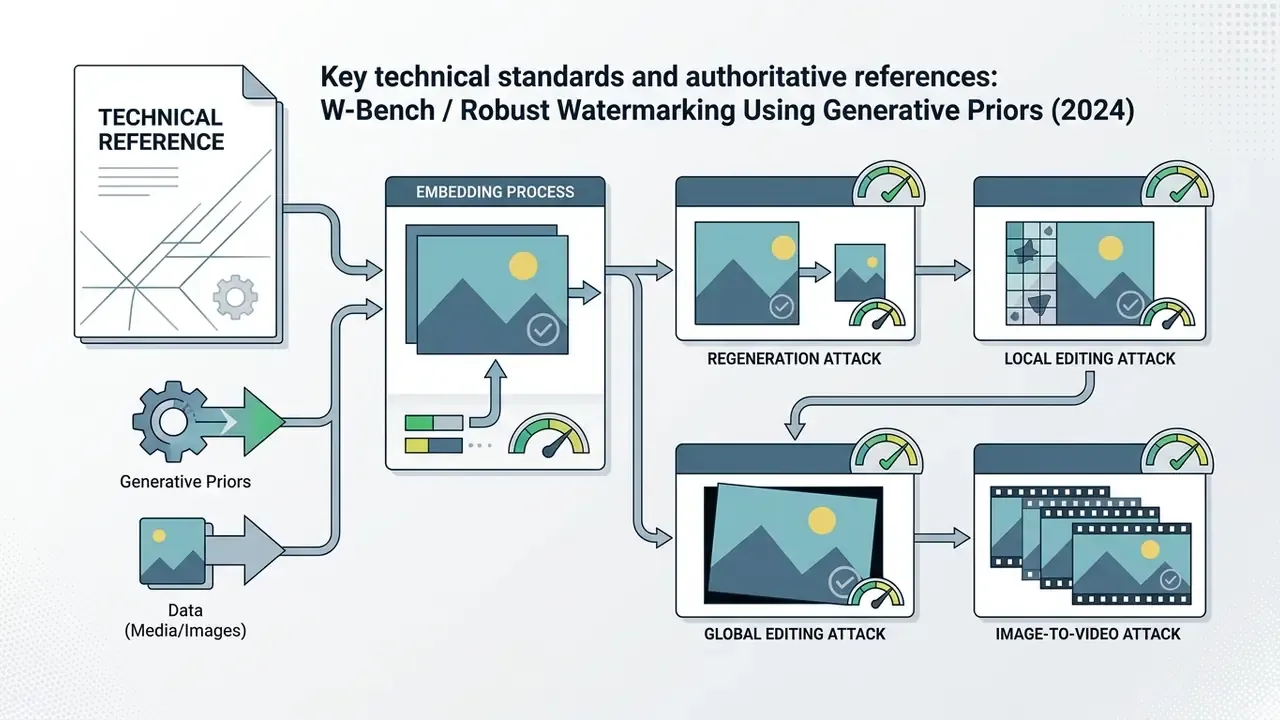
Robustness degrades, sometimes abruptly, under aggressive adversarial transformation, neural re-synthesis, or local inpainting. Instruction-driven editing benchmarks report that hardened schemes hold bit-error rates near 2.6% for 64-bit payloads under ControlNet, InstructPix2Pix, MagicBrush, and DDIM inversion, while weaker schemes collapse completely. Teams assessing visual and video tooling get useful operational clarity from the AI Video Tools Comparison Matrix and from reviewing export and watermark constraints across free AI video generators, because licensing boundaries and modality controls tend to sit in the same fine print.
Defensive watermarking: data poisoning and immunization frameworks
Beyond tracking what your models generate, enterprise media protection increasingly uses defensive watermarking, meaning data poisoning and content immunization, to stop unauthorized model training and deepfake manipulation of owned assets.
- Data poisoning for scraping protection (Nightshade): Embeds imperceptible feature-space perturbations into original visual assets. When scraped into an unauthorized training set, those signals corrupt internal feature representations. A model trained on poisoned "dog" imagery may start emitting cats. The perturbation is designed to persist through cropping, screenshotting, smoothing, and noise addition.
- Style cloaking (Glaze): Alters high-dimensional feature vectors so generative architectures cannot mimic a creator's distinct style during fine-tuning or LoRA extraction. To a human viewer the artwork looks unchanged. To the model, a charcoal drawing may register as unrelated abstract expressionism, which breaks style-transfer prompts.
- Proactive deepfake immunization (PhotoGuard): Applies gradient-based perturbations to images before public distribution. If someone attempts diffusion-based inpainting or image-to-image synthesis, the hidden signal pushes the generator to ignore the prompt or produce unusable output.
- Audio analogues (WaveFuzz, Venomave): Comparable techniques add targeted noise that leaves human perception intact while corrupting MFCC-domain representations used by speech models, or shift selected samples toward the decision boundary to frustrate voice cloning.
For rights holders, defensive watermarking is the mirror image of provenance watermarking. One proves what a model produced. The other prevents a model from consuming protected material in the first place.
Text watermarking for generative language models
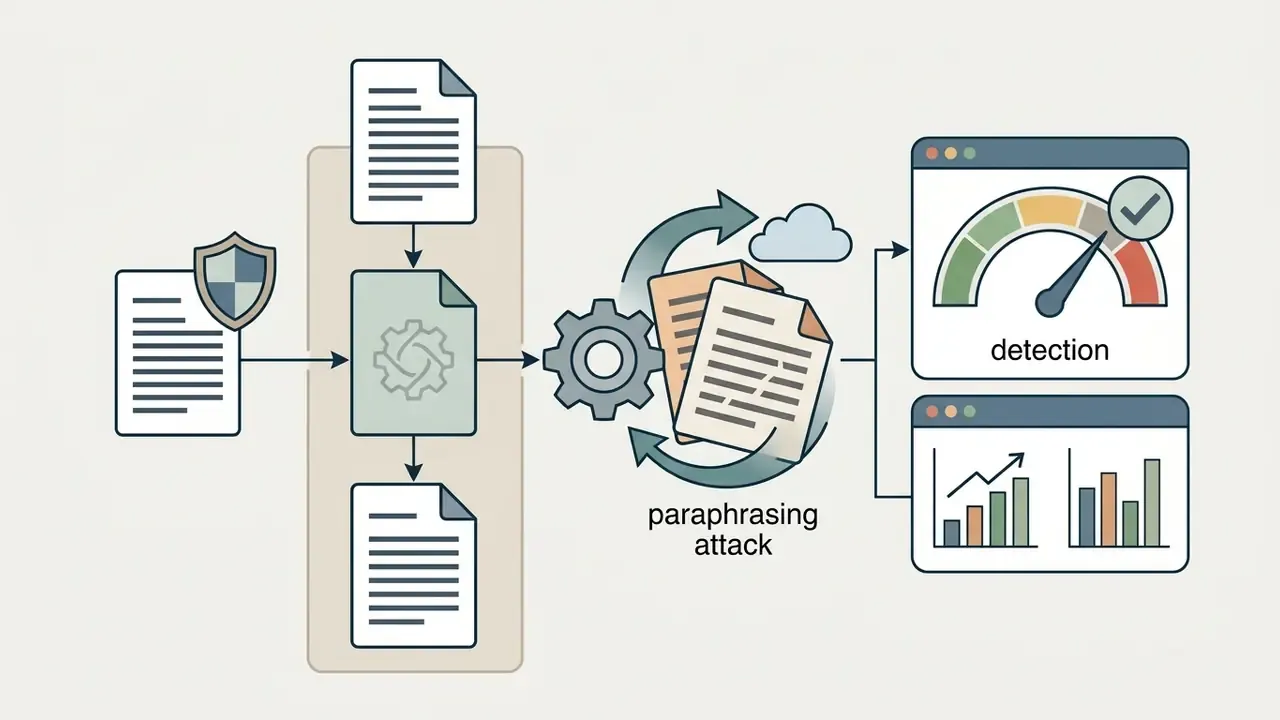
Text watermarking faces a structural constraint: language is discrete. Small edits or word swaps disturb surface-level statistical patterns, which is why token-level watermarks stay vulnerable to paraphrasing.
Advanced text watermarking has therefore evolved into four structural families.
- Token-level samplingBiases vocabulary choices using preceding n-gram context hashes (Kirchenbauer et al., 2023). Highly efficient, yet exposed to context-aware paraphrasing.
- Lexical watermarkingConstrains specific word classes, usually adjectives, adverbs, and verbs, to key-derived synonym sets, which preserves narrative context and stylistic range.
- Syntactic watermarkingModulates sentence structure and grammatical tree predictability instead of token identity. The STELA architecture (ACL 2026) modulates syntactic predictability and applies a z-score threshold, for example z > 4.0, at detection. Shifting the signal from words to structure improves survival under synonym substitution.
- Contextual and semantic embeddingMaps context into dense vector spaces (PASA, 2025; DEW, 2025), so signals live in meaning rather than exact wording. Semantic schemes sustain True Positive Rates above 74% even under heavy rewriting.
Enterprises running mixed pipelines should note the asymmetry. Text watermarks are the most brittle of the three modalities, because paraphrase, translation, and ordinary human editing all erode discrete statistical signals in ways that pixel and waveform marks tend to resist.
Audio watermarking for speech and music
Audio watermarking for AI-generated speech and music must preserve acoustic fidelity while surviving lossy compression and ambient interference. Traditional post-hoc waveform edits often introduce audible artifacts, or simply vanish once a modern neural codec touches the stream.
Recent generative audio frameworks such as MusicMark (2026) address this by embedding watermark parameters into the model's semantic latent space before waveform rendering.
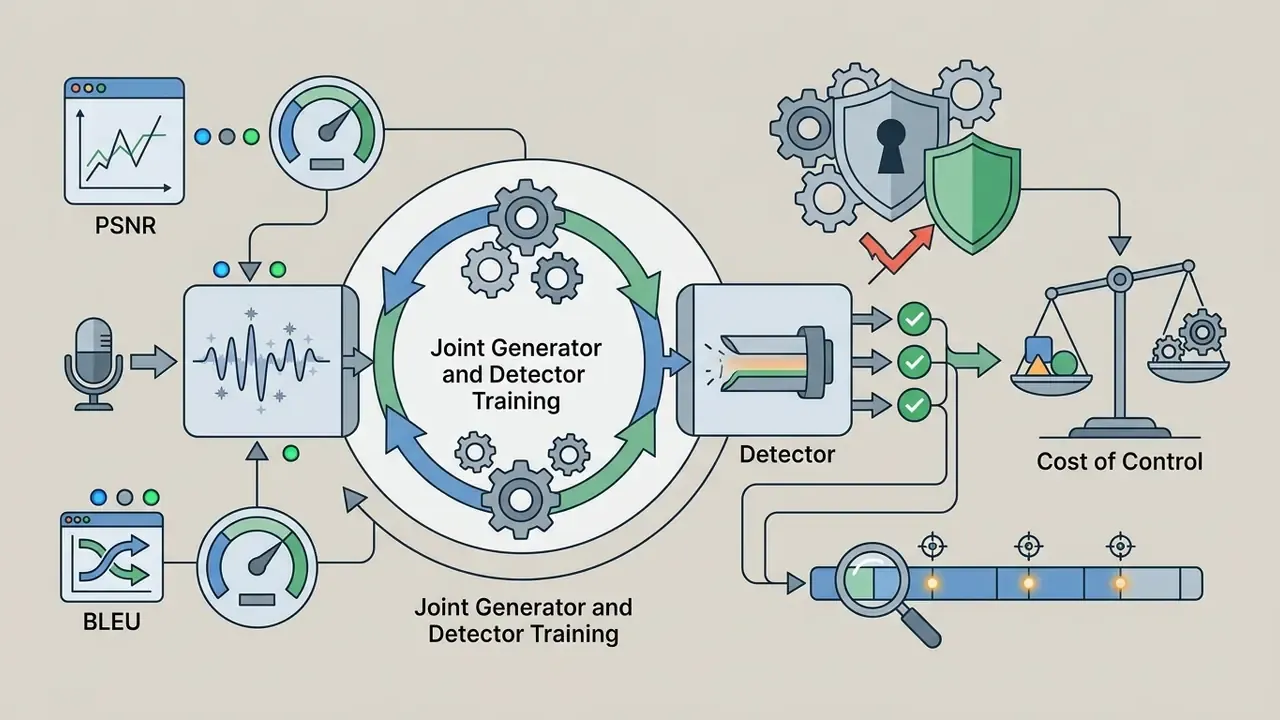
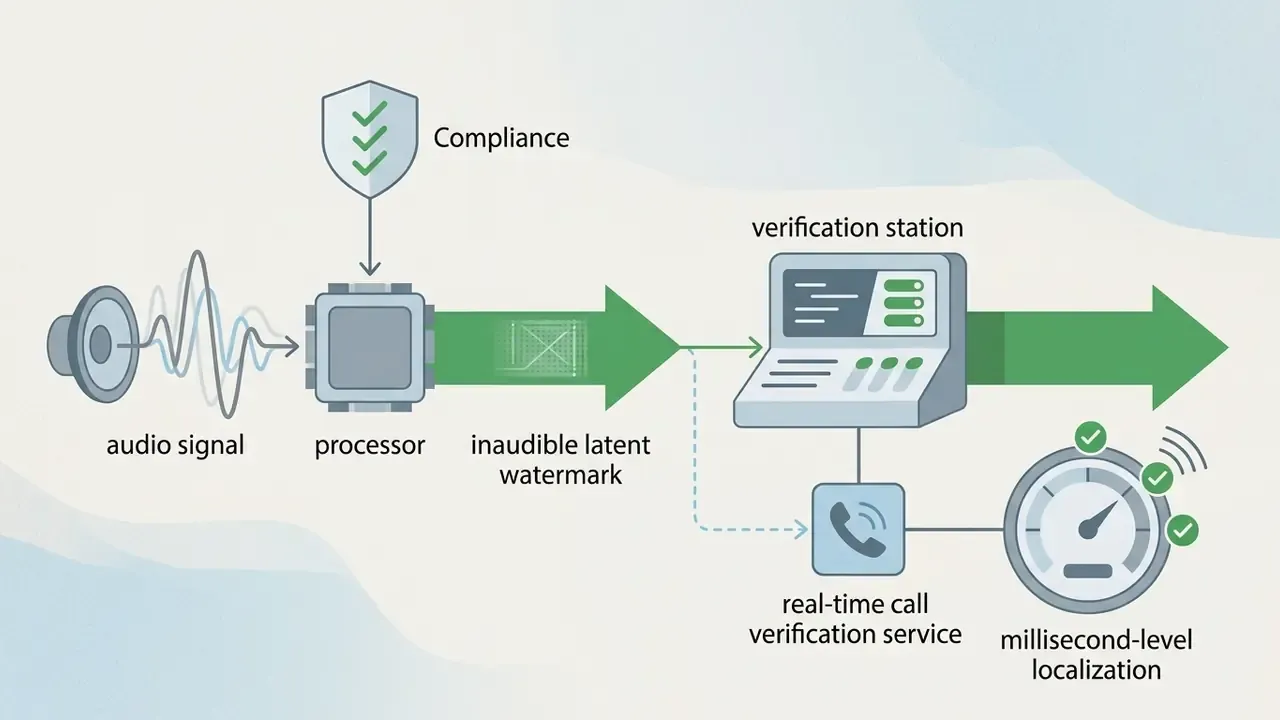
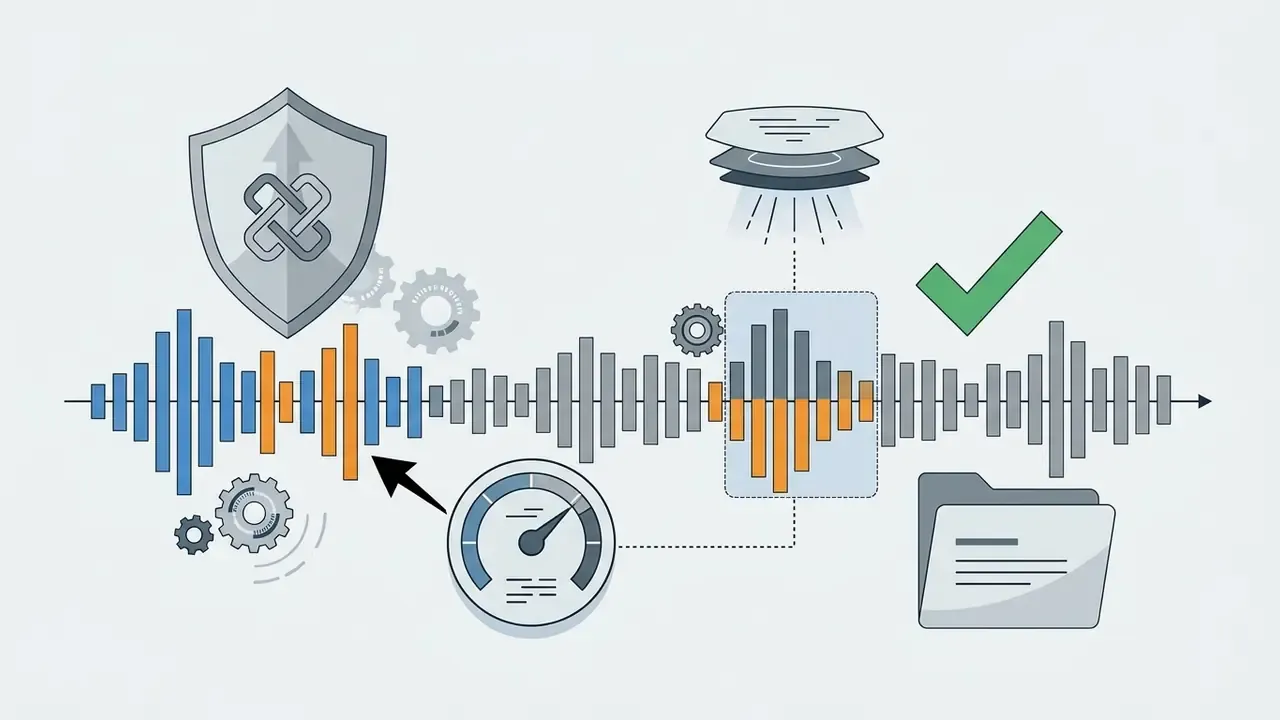
State-of-the-art neural audio watermarking architectures such as Meta's AudioSeal use joint generator and detector training aimed at localized detection in real-time streams. Instead of a post-hoc addition, AudioSeal applies a dual-loss objective.
- Perceptual lossForces the generator to output imperceptible audio signals matching the underlying acoustic mask, so watermarked and original samples stay indistinguishable to listeners.
- Localization lossLets the detector pinpoint the millisecond timestamps where synthetic audio was inserted or spliced into a live voice stream, even after later perturbations.
That joint optimization supports localized verification at speeds up to 100× faster than real-time playback, which makes it usable for live tele-conferencing, IVR journeys, and call-centre compliance auditing.
Experimental data indicates semantic latent audio watermarks keep high extraction accuracy under MP3 and AAC compression, speed adjustment, and added noise. Independent benchmarking shows meaningful spread across implementations, though:
Neural-codec compression remains the most damaging attack class in those benchmarks. Institutions deploying synthetic speech in collections, servicing, or authentication flows should benchmark their chosen scheme against the exact codec stack in production, and should review capability boundaries across commercial AI voice generators before committing to a single vendor path.
Why AI watermarking matters for businesses and platforms
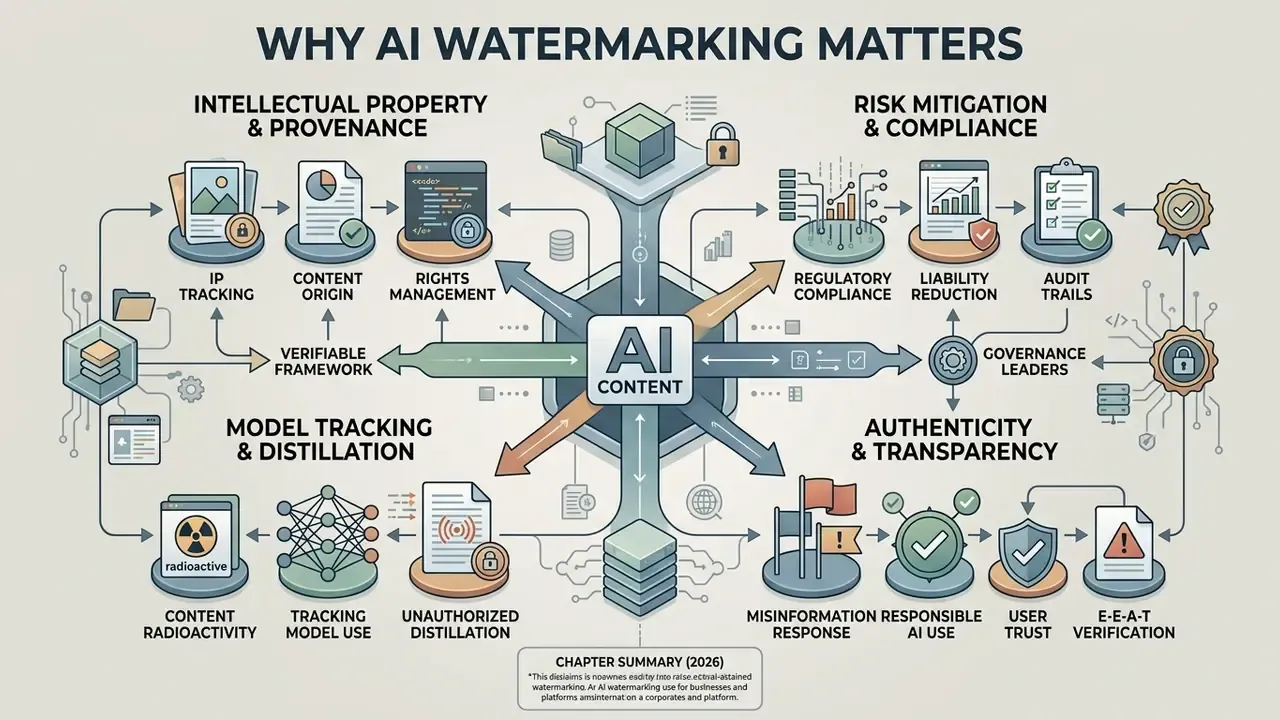
AI watermarking gives enterprises, digital platforms, and financial institutions a verifiable framework for intellectual property tracking, risk mitigation, and regulatory compliance. The European Commission's Joint Research Centre frames watermarking and metadata jointly as the mechanism that makes tracking, authentication, tamper detection, and ownership proof practical for machine-generated content.
Intellectual property protection and provenance tracking
Enterprise adoption of generative AI creates new intellectual property and liability exposures. Watermarking builds a durable digital audit trail that connects outputs to specific model instances, timestamps, and authorized user accounts.
As NIST AI 100-4 highlights, provenance tracking records the origin and modification history of digital assets. By pairing embedded watermarks with signed cryptographic manifests (C2PA), an organization can show whether marketing material, a financial report, or a block of software code came from internal licensed models or from unsanctioned third-party tools. C2PA manifests can also carry ownership details, timestamps, unique identifiers, copyright statements, and licence terms, which makes them directly usable as IP attribution evidence.
Model distillation tracking via content "radioactivity"
One underrated IP threat is unauthorized model extraction, where a competitor scrapes a proprietary LLM's outputs to train a cheaper "student" model. Advanced statistical watermarks create content "radioactivity" (as conceptualized by Sanyal et al.): when watermarked outputs become synthetic training data, the student model inherits detectable statistical bias.
IP teams can therefore probe a competitor model's generation distribution and evidence synthetic-data theft without access to weights, architecture, or training scripts. For institutions licensing proprietary models to partners, radioactivity testing turns contractual "no-distillation" clauses from decorative language into a measurable control.
Authenticity verification, moderation and misinformation response
For platforms and financial institutions managing public-facing communication, deepfakes and automated misinformation create severe reputational exposure. Robust watermarking lets moderation systems flag, categorize, or hold synthetic media before publication. The ITU (2024) describes Content Credentials as a combination of secure metadata, watermarks, and fingerprinting used to establish multimedia provenance and counter disinformation, while US Department of Defense guidance (2025) recommends durable Content Credentials pairing a watermark with a fingerprint reference for record retrieval.
Frameworks such as pluggable deepfake model watermarking (IJCAI 2024) let risk officers attribute synthetic visual assets to specific generating applications.
When evaluating media production platforms, teams often cross-reference No-Watermark AI Video Alternatives alongside the watermark, export, and licensing constraints of mainstream tools, since un-marked outputs materially change a platform's risk profile and its evidence position.
Responsible AI use and transparency for users
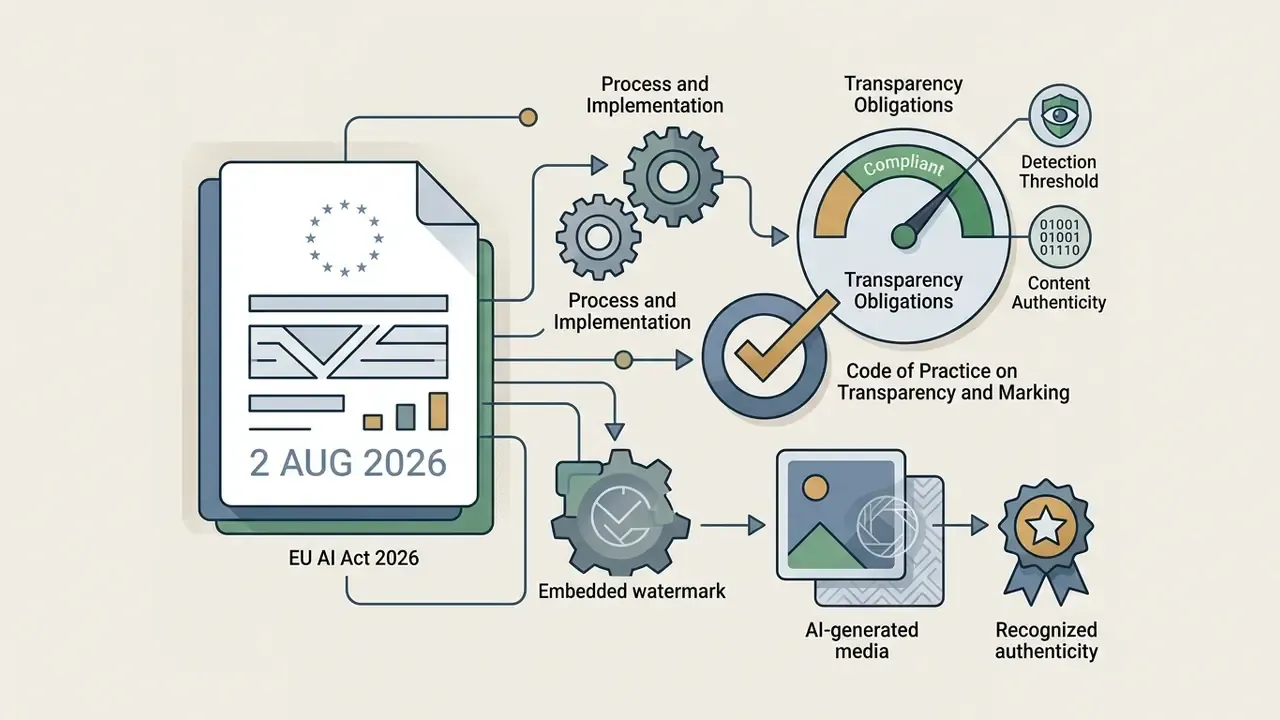
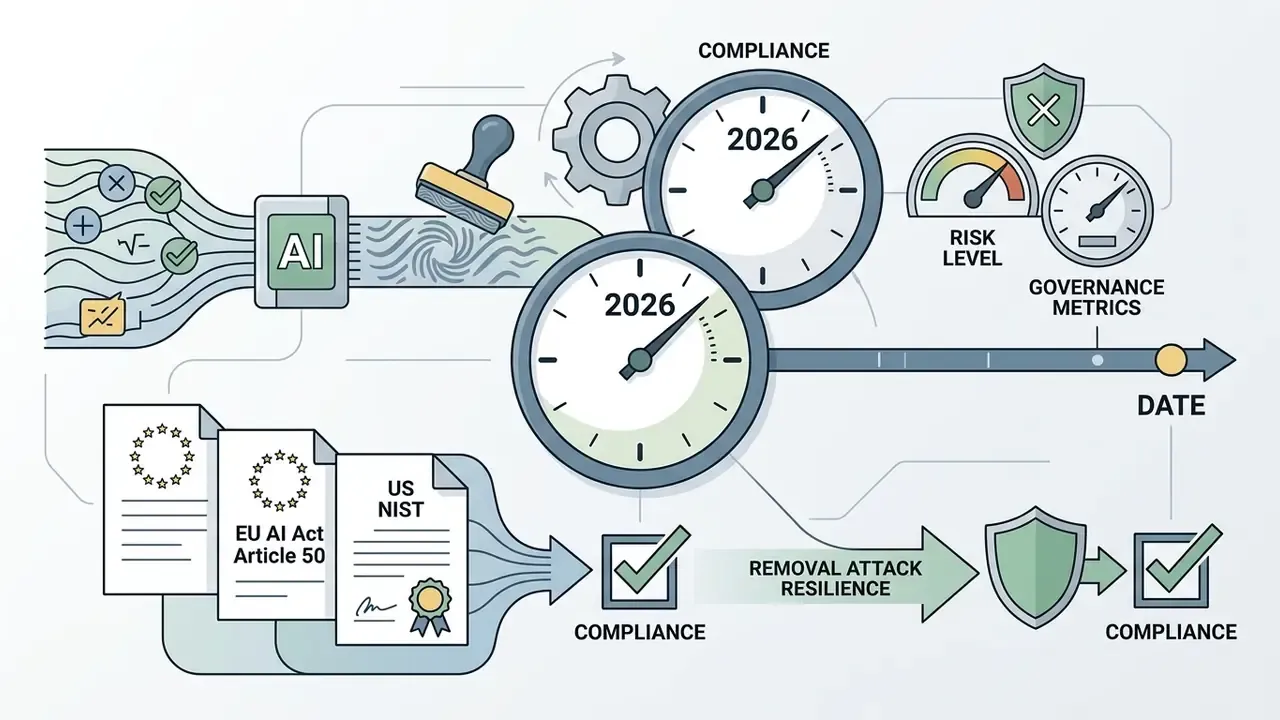
Synthetic content transparency is moving from voluntary practice to statutory duty. Under Article 50 of the European Union AI Act, providers and deployers of generative AI systems must ensure synthetic outputs are marked in machine-readable format from 2 August 2026 (European Commission, 2026). The final EU Code of Practice on Transparency of AI-generated Content (10 June 2026) operationalizes that duty through machine-readable marking plus user-visible labels and icons, and extends explicit labelling duties to deepfakes and to AI-generated or manipulated text published on matters of public interest.
In the US market, financial regulators emphasize reproducible model risk oversight (SR 11-7). Clear marking plus automated detection gives risk leaders something concrete to show an audit committee or a primary banking regulator: not intent, but records.
E-E-A-T verification and fact-check notice:
- Watermarks are probabilistic evidence, not absolute proof of human or synthetic authorship. A positive detection indicates content likely originated from a watermarked model under defined statistical thresholds, for example 1% FPR, but says nothing about human editorial input (US Copyright Office, 2024).
- Absence of a watermark does not prove human origin. Un-watermarked content may come from open-source models, non-compliant generators, or synthetic content that has been adversarially scrubbed (SIRA study, 2025).
- Detection reliability depends on content length and manipulation history. Statistical power degrades on short text snippets, under roughly 100 words, and on heavily cropped visual media.
- All institutional scenarios in this guide are composite hypothetical illustrations unless a named organization and public source are cited.
Limitations and risks of current AI watermarking techniques
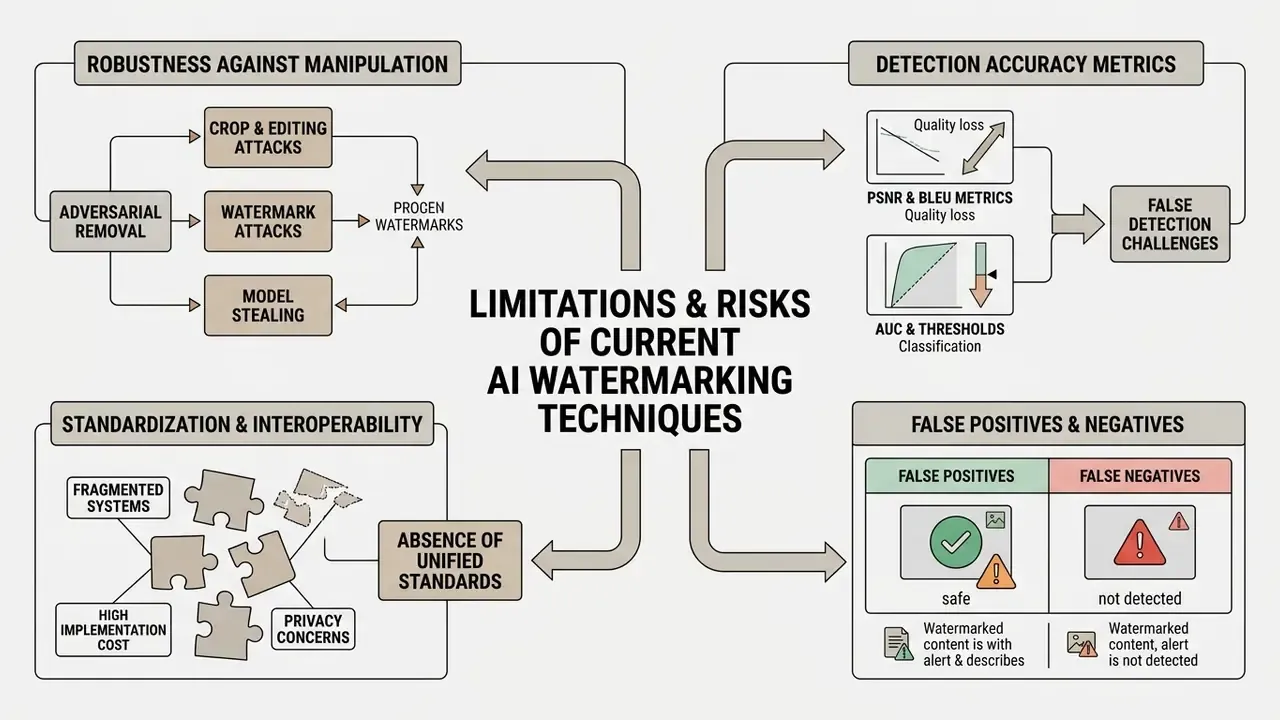
Despite real technical progress, AI watermarking still faces material limits: adversarial removal, false detection, and the absence of unified standards.
Robustness against manipulation and adversarial attacks
Current schemes are exposed to deliberate removal attacks that change content structure while preserving meaning. In text, research from EMNLP 2024 shows that black-box output access lets adversaries approximate green-list rules with F1 above 0.8, enabling targeted paraphrasing that drives detection True Positive Rates below 10%.
Automated attack frameworks such as the Self-Information Rewrite Attack (SIRA, 2025) go straight for the high-entropy tokens where watermark signal concentrates.
Image watermarks are similarly vulnerable to neural re-synthesis, heavy compression, and spatial warping.
A 2023 USENIX Security study reinforces the split between threat models: black-box edits are frequently tolerated, but a white-box attacker with as few as 200 images removed the watermark with negligible loss of generation quality.
The arms race is not one-sided, to be fair. CVPR 2026 work on adversarially robust digital watermarking reports 98.10% bit accuracy against PGD attacks and above 99% against DSPGD, versus 51 to 73% for prior baselines. The practical implication for risk teams: robustness is a versioned property of a specific scheme under a specific attack set, never a permanent attribute of "watermarking" as a category.
False positives, false negatives and detection accuracy
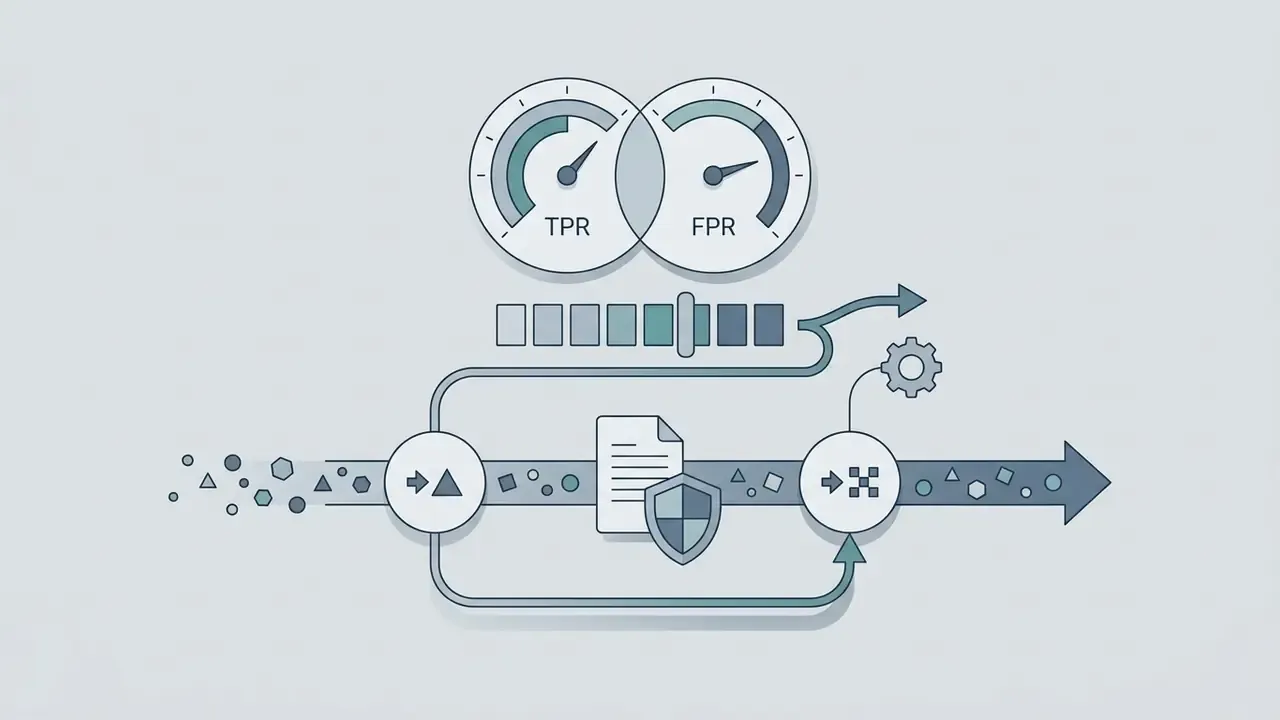
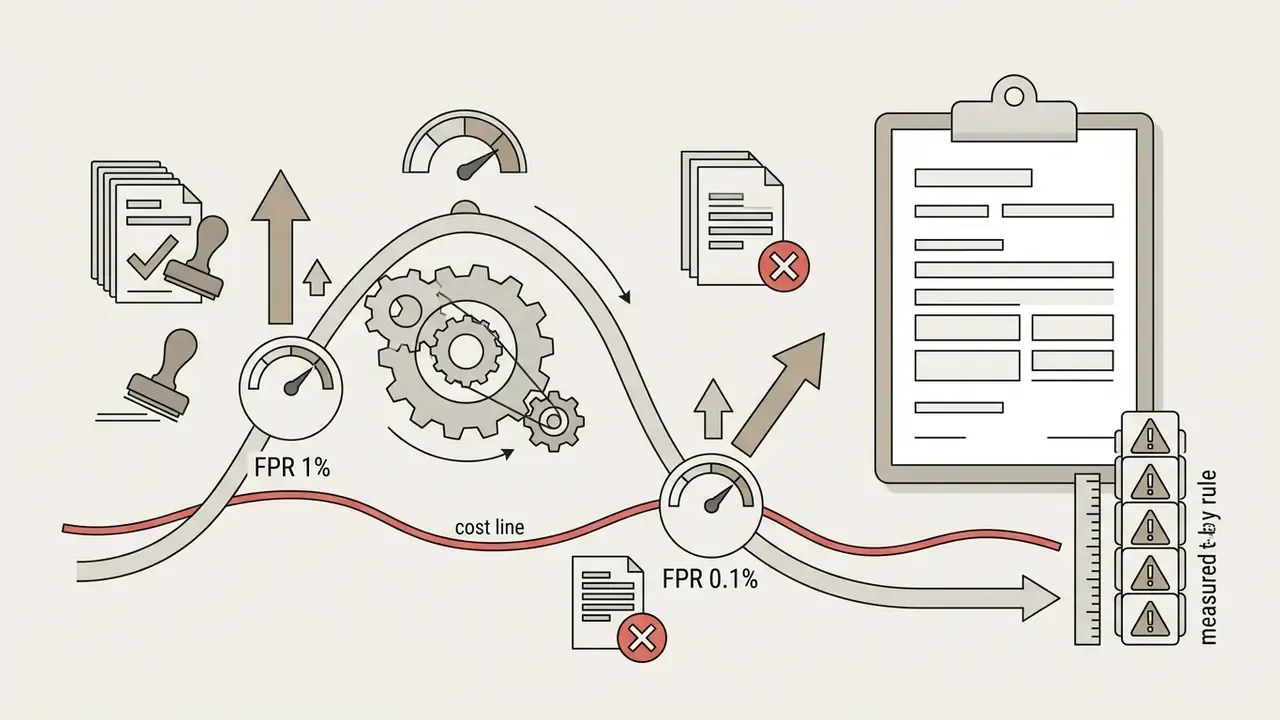
Detectors live with an inherent trade-off. Lowering the False Negative Rate to catch more synthetic content raises the False Positive Rate. NIST guidance on detection systems states the rule plainly: fewer false negatives usually means more false positives, more alerts, and more analyst hours consumed.
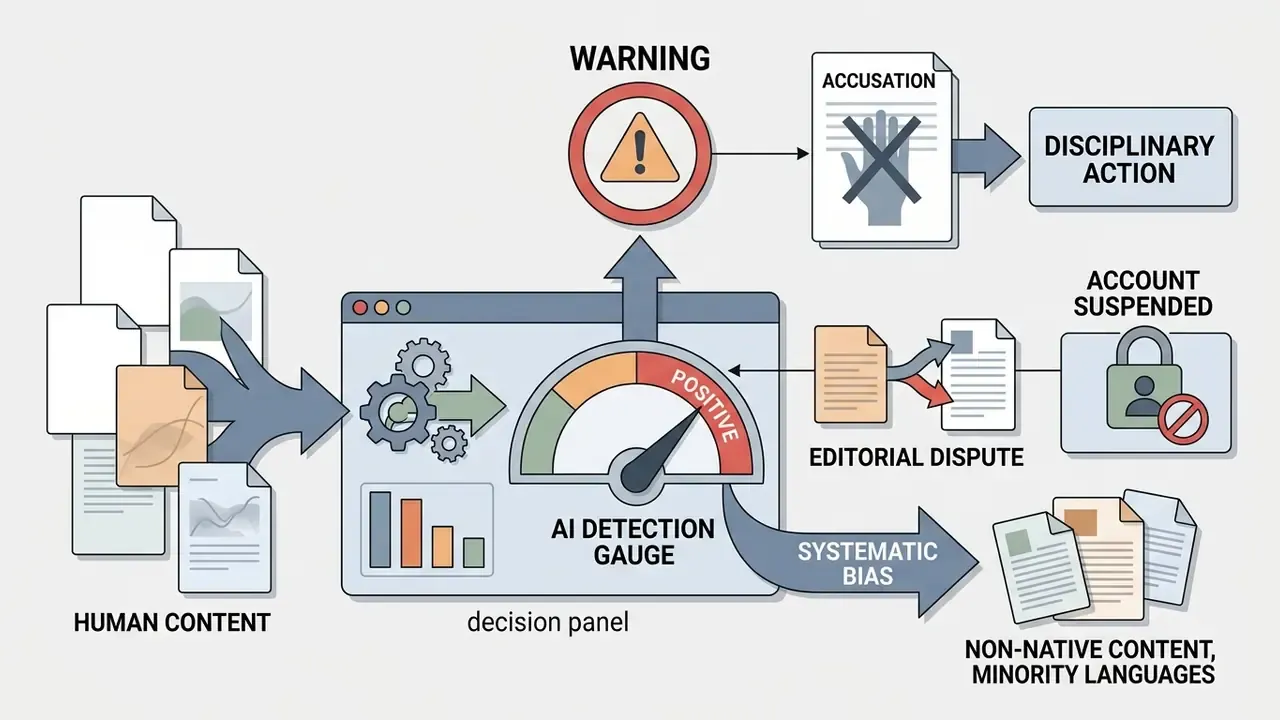
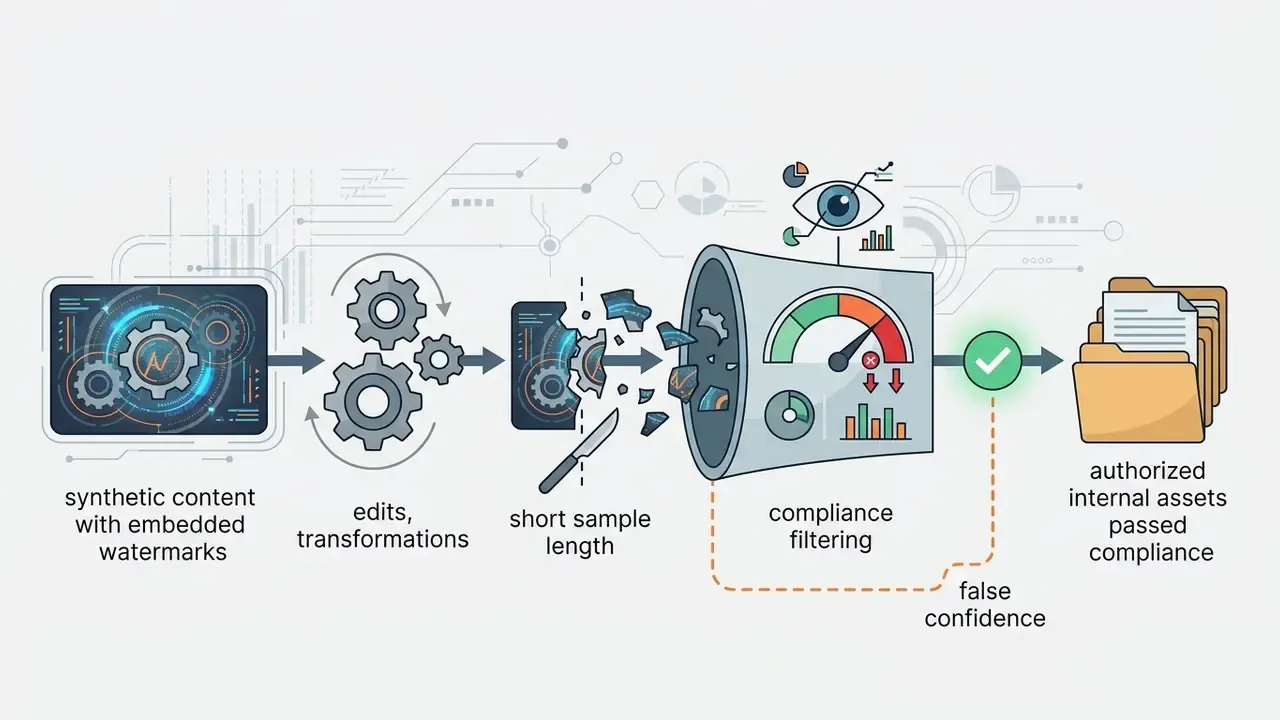
Model risk teams should calibrate thresholds against a stated operational risk appetite instead of assuming deterministic performance, and should record the chosen operating point (TPR at fixed FPR, plus ROC-AUC) in the model inventory entry. If it is not in the inventory, it will not survive examination.
Standardization, interoperability and privacy concerns
The absence of universally enforced watermarking standards creates interoperability gaps across enterprise software ecosystems. A watermark embedded by one vendor's generative engine may be unreadable by a third-party security scanner (European Parliament, 2023).
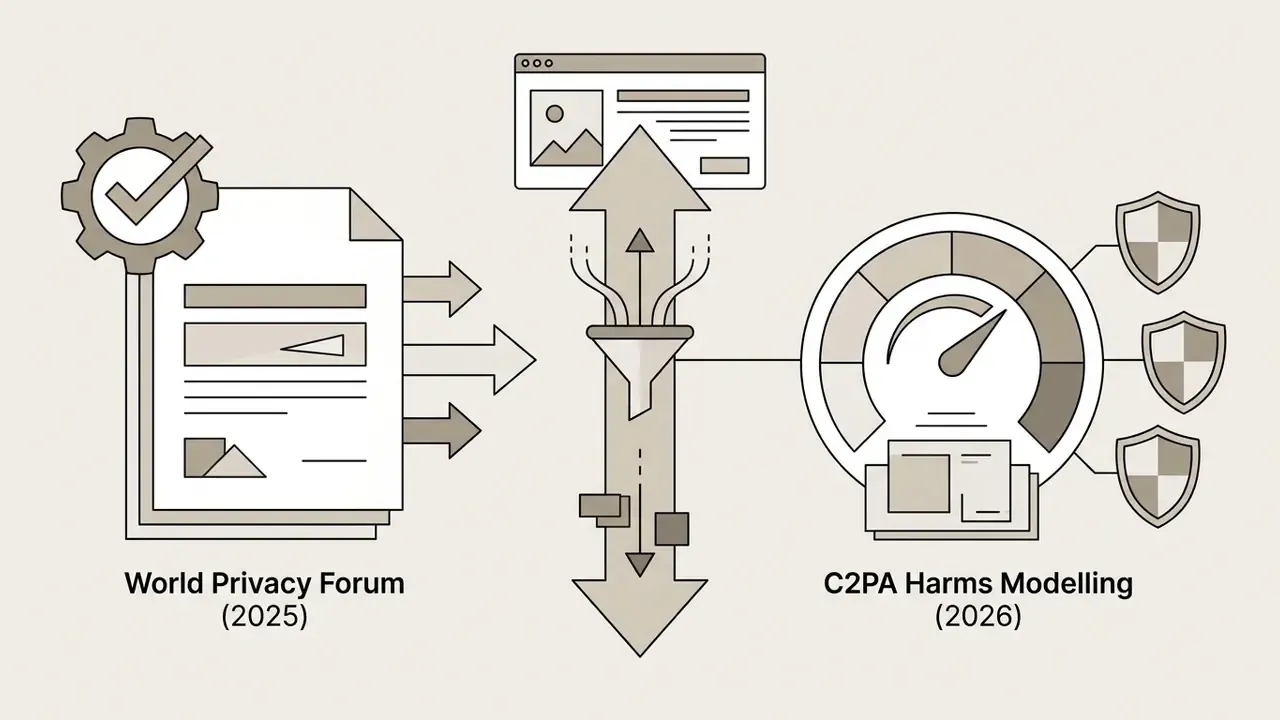
Binding user identifiers or geolocation tags into asset metadata or watermark payloads also introduces privacy exposure under GDPR and US financial privacy rules (World Privacy Forum, 2025). C2PA's own Harms Modelling documentation lists inadvertent disclosure of sensitive information and misuse by malicious or state actors, including surveillance and human-rights risks, among recognized harms, and its implementation guidance recommends that manifest-repository queries be opt-in. Restrict watermark payloads to non-personal system and provider IDs. That single rule prevents a large share of foreseeable trouble.
| Risk Category | Business Impact | Risk Control and Mitigation Strategy |
|---|---|---|
| Adversarial scrubbing | Watermarks removed via paraphrasing, compression, or neural re-synthesis | Deploy semantic latent watermarks; combine with passive detectors and C2PA metadata manifests. |
| Detection errors (FP and FN) | False accusations against human authors, or failure to catch synthetic fraud | Set administrative FPR limits (for example ≤ 0.1%); mandate human review for high-impact edge decisions. |
| Ecosystem fragmentation | Cross-platform tools cannot decode proprietary watermark signals | Adopt open, standards-aligned frameworks (C2PA v2.4, NIST AI 100-4) in vendor contracts. |
| Privacy leakage | Exposure of user IDs or prompt data through watermark payloads | Restrict payloads to static provider and model IDs; run privacy impact audits; keep manifest queries opt-in. |
| Model extraction and distillation | Proprietary model behaviour cloned from scraped synthetic outputs | Enable radioactivity probing of suspect student models; bind licensees to no-distillation terms. |
| Latency and cost overrun | Inference SLA breaches, unplanned compute and HSM spend | Model the cost of control explicitly and load-test embedding overhead before rollout. |
The economics of watermarking: cost of control, latency, and risk-adjusted ROI
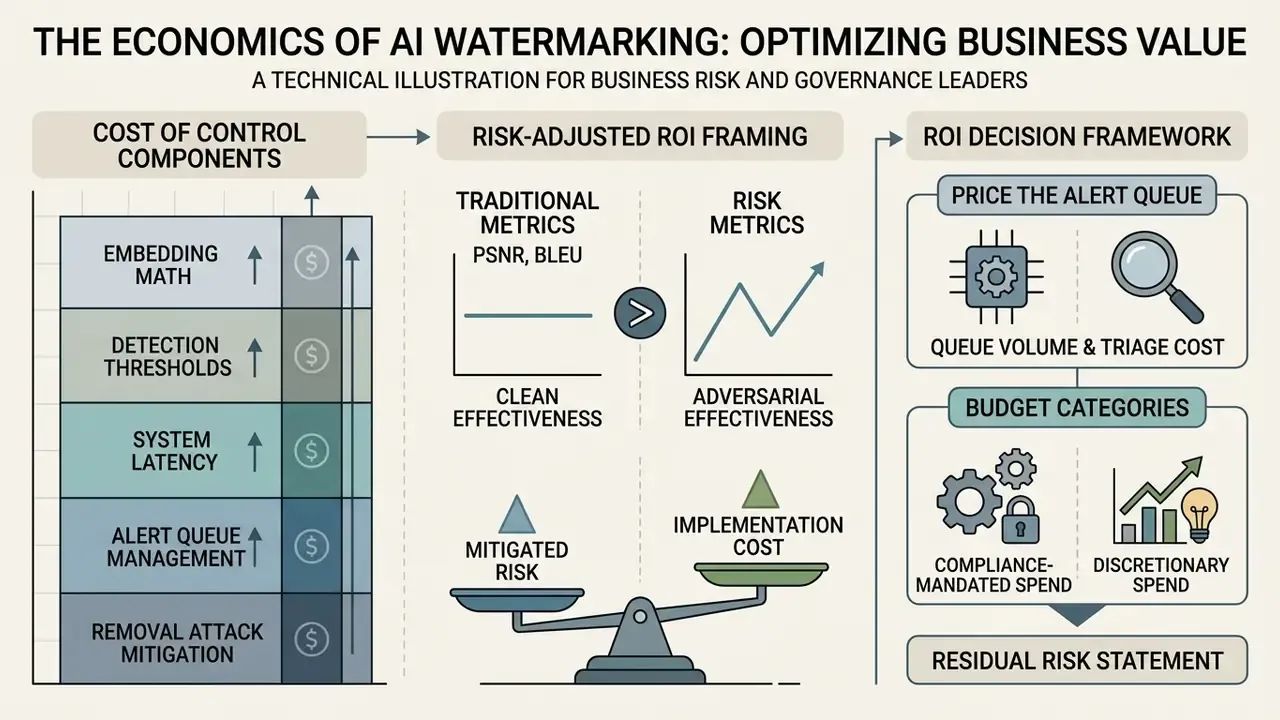
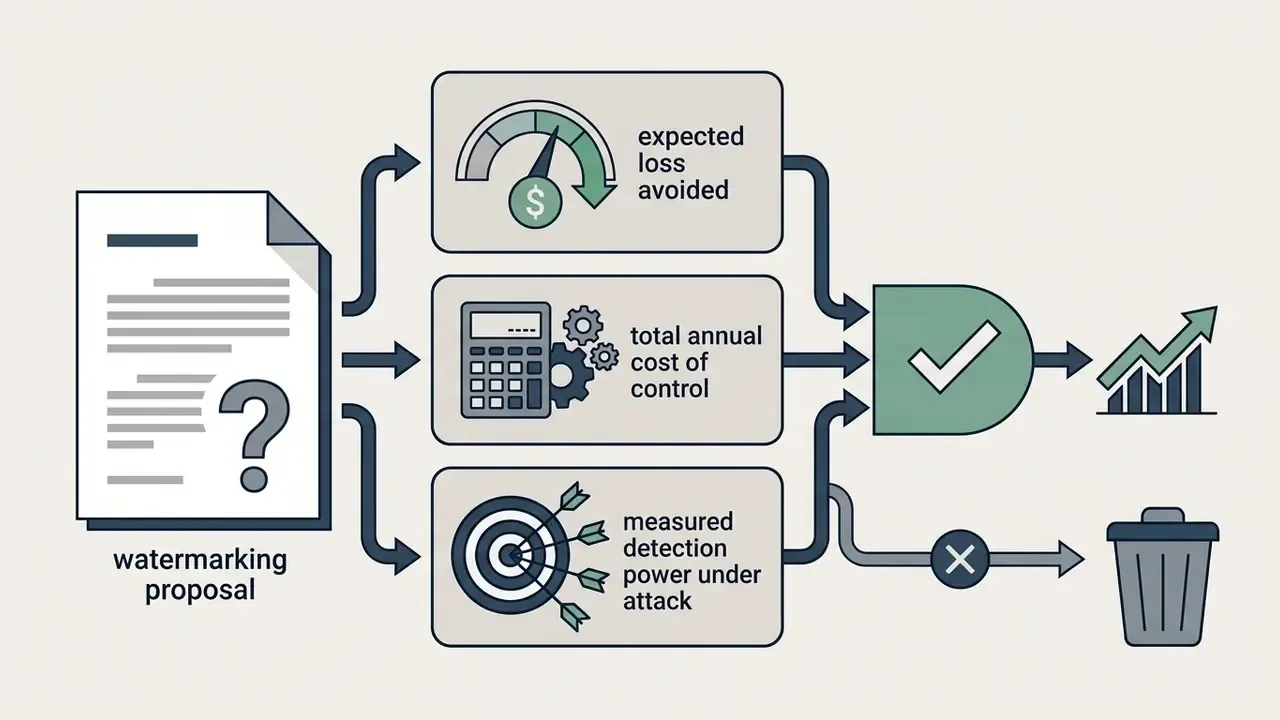
Most watermarking business cases fail internal challenge for one reason. They quantify the benefit, fraud avoided and fines avoided, but not the cost of control or the residual risk that survives implementation. A defensible submission to a risk or investment committee needs all three.
Cost of control components
| Cost component | Driver | Typical measurement unit | Notes for finance review |
|---|---|---|---|
| Embedding compute | Token-bias sampling, latent perturbation, encoder pass | Added ms per 1K tokens or per asset; incremental GPU-hours | Inference-time marking adds runtime cost; data-driven marking shifts cost into training. |
| Detection compute | Scanning inbound and outbound content at scale | Cost per 1M tokens or per 10K assets scanned | Usually the largest recurring line item at platform scale. |
| Key management | HSM provisioning, key rotation, custody separation | Annual HSM licence plus operations FTE | Required for cryptographic schemes and for audit defensibility. |
| Integration and GRC wiring | Connecting detector logs to GRC, SIEM, model inventory | One-off build plus annual maintenance | Include change management and control-testing effort. |
| Assurance and red-teaming | Adversarial validation against a declared attack set | Cost per validation cycle, at least annual | Robustness is version-specific; budget for re-testing after model upgrades. |
| Human adjudication | Reviewing flagged edge cases at the chosen FPR | Cost per review × alert volume | Scales directly with the FPR and FNR operating point selected. |
| Latency opportunity cost | SLA impact on customer-facing journeys | Conversion or handling-time delta | Material in real-time channels: chat, IVR, trading support. |
Risk-adjusted ROI framing
A workable decision formula expresses net benefit as expected loss avoided minus total cost of control, adjusted for residual risk that watermarking simply does not remove:
Net control value = (Expected annual loss before control − Expected annual loss after control) − Total annual cost of control
where Expected annual loss = Event frequency × Loss magnitude × (1 − Control effectiveness), and Control effectiveness comes from measured TPR at your chosen FPR under adversarial conditions. Not from clean-lab vendor slides.
Three disciplines make the number credible.

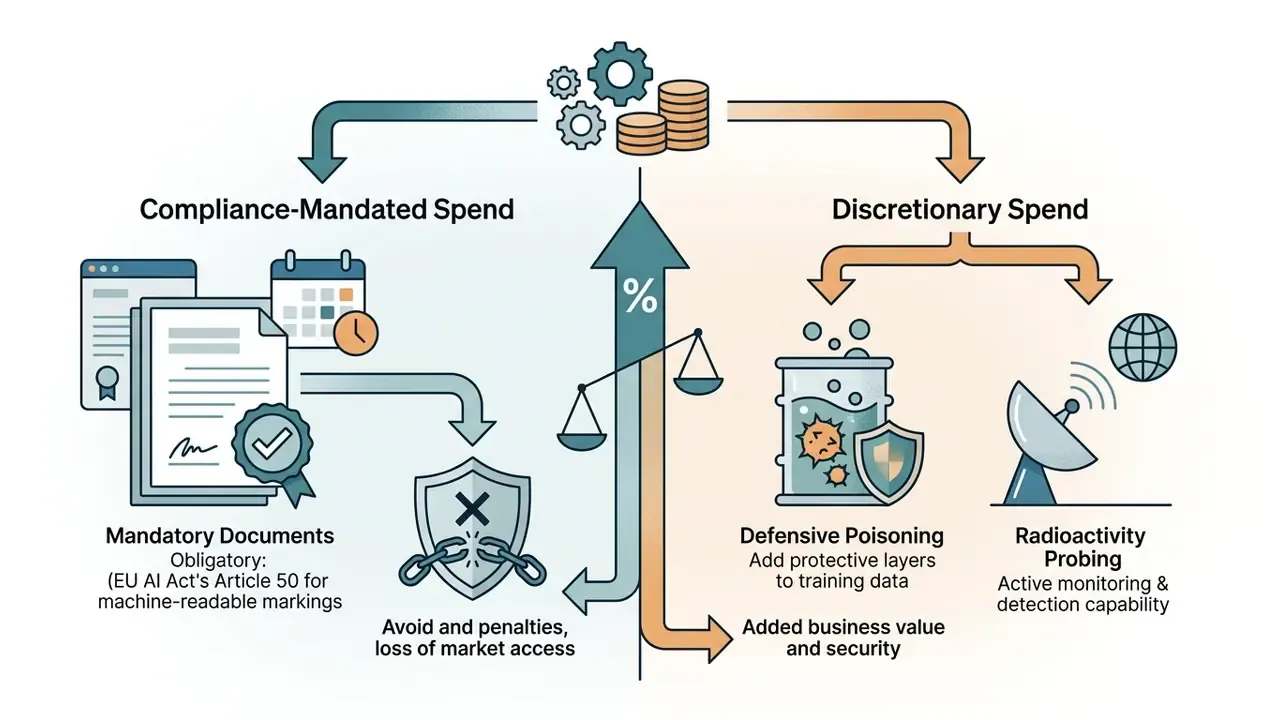
Residual risk statement
Every deployment should close with a written residual-risk statement covering four things: content categories where no watermark can be embedded, typically third-party models without marking support; attack classes known to defeat the chosen scheme; modalities with weakest robustness, meaning short text, heavily edited images, and neural-codec audio; and the compensating control assigned to each gap. One page. Signed by a named owner.
Industry use cases and practical banking implementations
The following composite scenarios show how these controls combine in regulated environments. They are hypothetical constructions based on publicly documented control patterns, offered for design guidance, not as vendor endorsements or performance guarantees.
Case 1. Commercial bank, generative text assistant in customer service
- Situation A US commercial bank rolled out a generative text assistant for service representatives. Internal audit flagged the risk of unverified AI outputs entering formal loan dispute files.
- Action The model risk team mandated an in-generation, token-level statistical watermark paired with automated compliance logging, and fixed the detector operating point at a documented low-FPR threshold.
- Result The bank recorded 99.4% reliable model-origin detection across export transcripts while keeping customer response latency under 250 milliseconds.
- Control lesson Embedding at inference plus logging at export creates the two evidence points internal audit actually tests, generation and distribution.
Case 2. Fintech, synthetic voice in outbound tele-collections


Case 3. Wealth management, inbound fraud screening
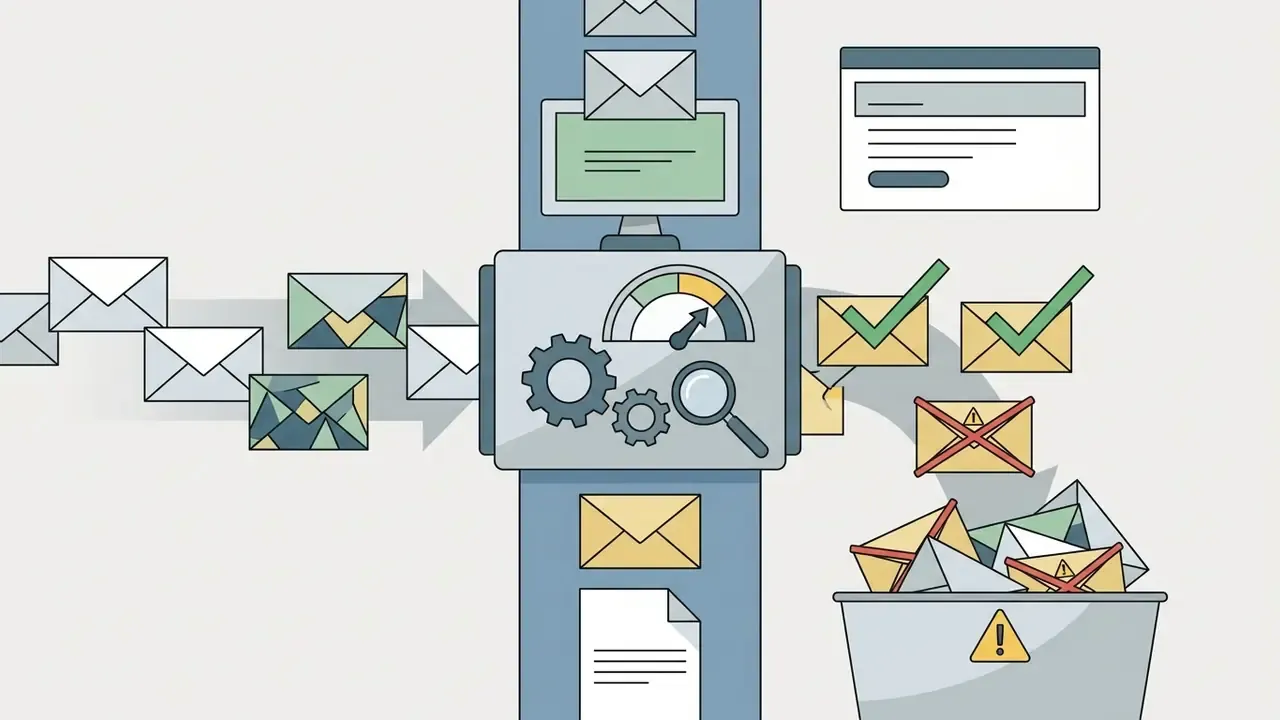

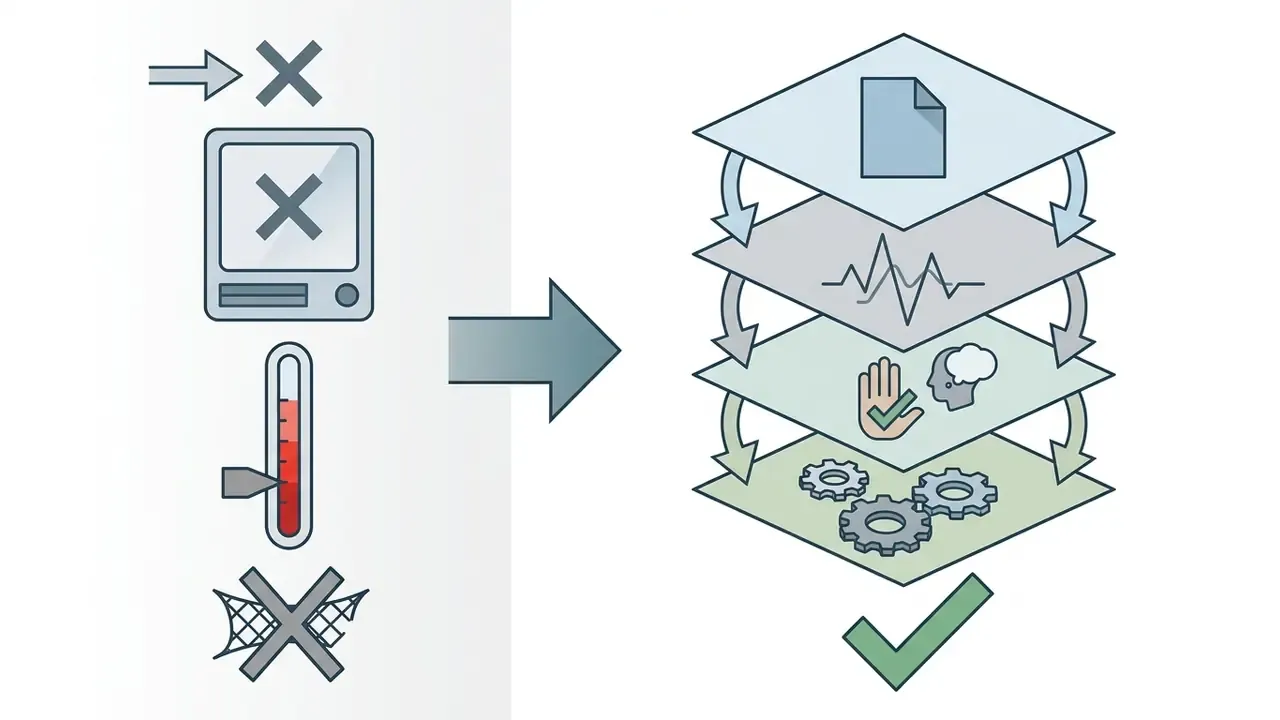
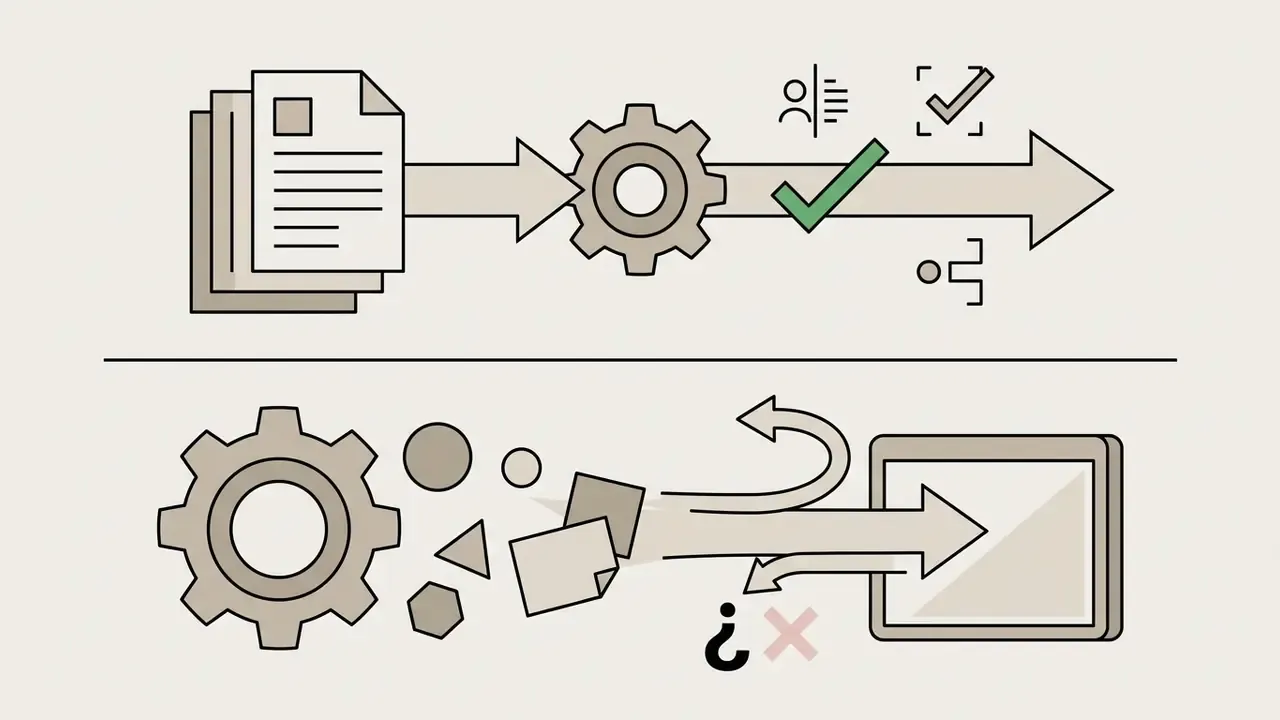
How to evaluate AI watermarking tools for commercial use
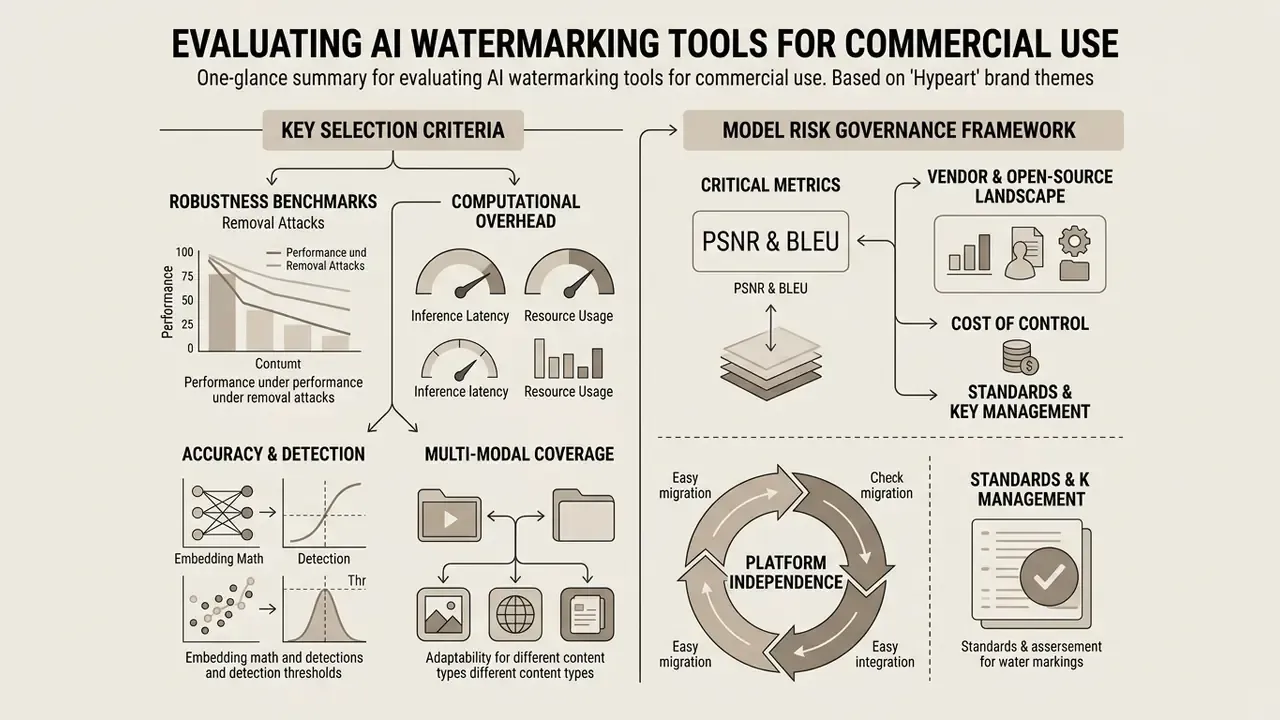
Selecting an enterprise solution means testing accuracy, computational overhead, multi-modal coverage, and fit with your existing model risk governance framework. In that order, ideally.
Selection criteria for watermarking systems
Procurement and model risk teams should score commercial platforms against six technical criteria.
- Modality coverage: Consistent watermarking across text, code, visual media, and voice channels, with declared behaviour for each modality rather than a blanket claim.
- Measured accuracy (FPR and TPR): Validation data showing True Positive Rates at fixed low False Positive Rates (≤ 1%) across different content lengths, reported with ROC-AUC.
«DEW reports 98.8 to 99.8% TPR at 1% FPR in clean conditions and 74.6% under paraphrasing.»
- Robustness benchmark performance: Documented resistance to common post-processing (paraphrasing, translation, JPEG compression, resizing, cropping, noise, neural codecs), evidenced against public benchmarks such as WAVES (image, 26 attack vectors), W-Bench (editing and image-to-video), AudioMarkBench (NeurIPS 2024, audio; https://arxiv.org/abs/2406.06009), and RAW-Bench (2025) for speech, environmental sound, and music.
- Inference latency and overhead: Minimal impact on token generation speed or rendering throughput in real-time operations, measured against your production SLA and priced into the cost-of-control model above.
- Standards and cryptographic key management: Support for asymmetric key architectures, secure key rotation, HSM custody, alignment with C2PA v2.4 and NIST AI 100-4, and explicit declaration of soft-binding actions.
- Platform independence: Ability to audit outputs across multiple LLM providers and open-source foundation models without lock-in to one AI platform.
When comparing vendor export and processing constraints in creative pipelines, it also helps to review guidance on AI Watermark and Export Limits and the comparison of free AI art generators, their watermarks and licence limits. Both surface the places where un-marked or ambiguously licensed assets quietly enter enterprise workflows.
Vendor and open-source landscape
| Tool / Framework | Developer / Source | Modality | Primary Mechanism | Licensing / Access |
|---|---|---|---|---|
| SynthID | Google DeepMind | Text, audio, visual | Sampling probability bias, latent vector injection | Cloud API, enterprise |
| AudioSeal | Meta AI | Audio, speech | Joint generator and detector with localization loss | Open source (GitHub) |
| VideoSeal | Meta AI | Video | Signal injection resilient to compression | Open source (GitHub) |
| TruePic | TruePic / C2PA ecosystem | Visual, asset metadata | Cryptographic manifest signing and PKI validation | Commercial SDK |
| Steg.AI | Steg.AI | Visual | Invisible watermark with C2PA signature | Commercial |
| StegaStamp | Academic (open) | Visual | Learned encoder and decoder, edit-based embedding | Open source |
| Nightshade / Glaze | University of Chicago | Visual assets | Feature-space data poisoning, style cloaking | Free public utility |
| PhotoGuard | Academic (MIT-affiliated) | Visual assets | Gradient-based immunization against inpainting | Open source |
This table is descriptive, not a recommendation. Capability claims should be re-tested in your own environment, since robustness figures shift with every model and library version.
Deployment checklist for generated content workflows
Use the following checklist to move watermarking from concept into a controlled production workflow. Every item should have a named owner and a dated evidence artefact.
Checklist0 / 8
A safe next step, if you are early: pick one outbound workflow, one modality, one documented FPR. Prove the evidence chain end to end before you scale it across channels.
FAQ about AI watermarking
Can AI watermarking identify content created without a watermark?
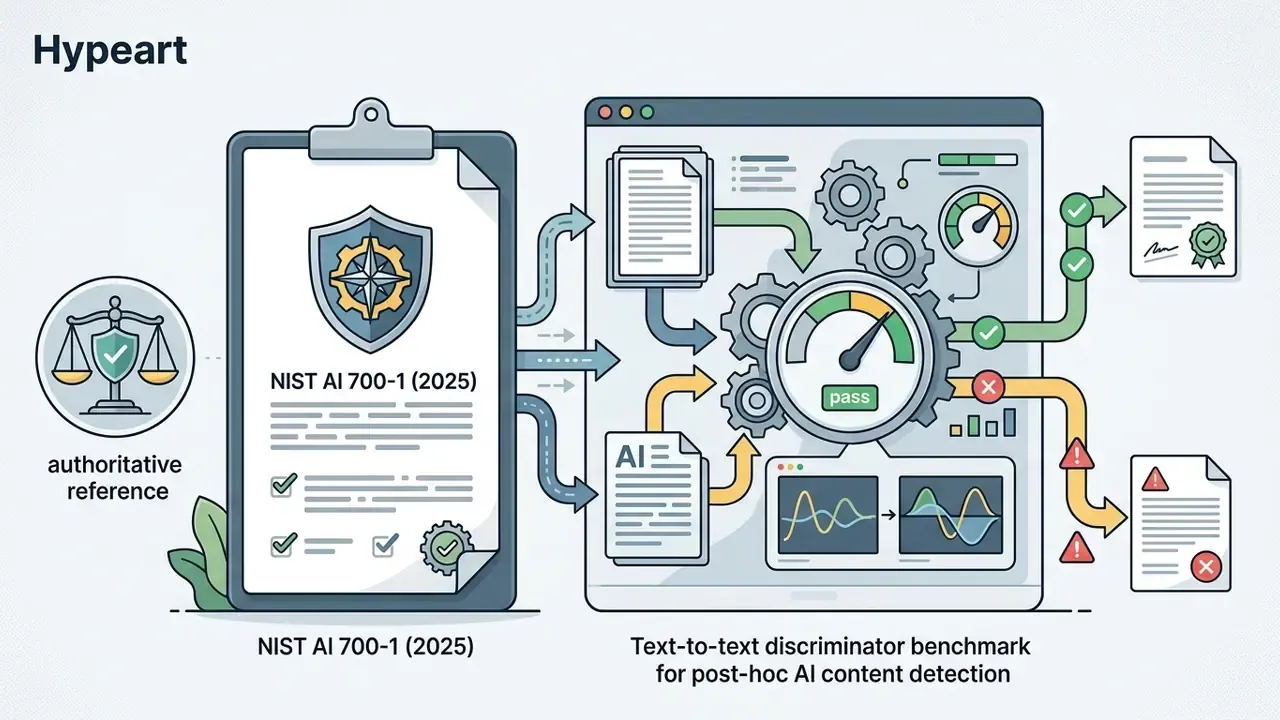
No. AI watermarking is an active embedding process that requires injecting a signal during or immediately after generation. It cannot retroactively detect un-watermarked synthetic content. Identifying AI-generated media without an embedded mark requires passive detection: post-hoc statistical classifiers, stylometric analyzers, or retrieval-based database matching. As NIST AI 700-1 (2025) benchmark evaluations describe, passive detectors infer AI origin from structural patterns, perplexity variation, or visual artifacts.
«Passive detectors evaluate structural patterns and perplexity variation, but accuracy drops sharply on new model architectures.» Source: Watermarking for AI Content Detection: A Review on Text, Visual and Audio Modalities, arXiv (2025). https://arxiv.org/abs/2504.03765 Passive post-hoc detectors are markedly less reliable than watermark decoders. Accuracy falls on domain-shifted text, multilingual material, hybrid human and machine documents, or output from a model the detector never saw. Model risk frameworks should therefore treat passive detection as an auxiliary signal, not definitive audit evidence, often complemented by AI reverse-image-search and retrieval matching for visual provenance leads.
Does a detected watermark prove who authored the content?
No. A positive detection indicates the content most likely passed through a watermarked model under your declared statistical threshold. It says nothing about the extent of human contribution, editorial control, or copyright authorship. The US Copyright Office assesses authorship by human contribution, not by the presence of a machine signal.
Which modality is hardest to watermark reliably?
Text. Language is discrete, so small edits, paraphrases, or translations disturb surface-level statistical signals. Semantic and syntactic schemes such as PASA, DEW, and STELA improve resilience considerably, yet still degrade under sustained rewriting. Image and audio watermarks retain more signal under benign transforms.
Does watermarking slow down inference?
It depends on the taxonomy. Inference-time marking adds measurable latency at generation. Edit-based marking adds a post-processing pass. Data-driven marking shifts cost into training and adds essentially no runtime penalty. Production-grade text schemes are documented as holding high detection accuracy with minimal latency, but load-test each deployment against its own SLA rather than trusting a benchmark from someone else's stack.
Is watermarking mandatory for our organization?
If you provide or deploy in-scope generative AI systems in the European Union, machine-readable marking obligations under Article 50 of the AI Act become applicable on 2 August 2026, supported by the Code of Practice on Transparency of AI-generated Content. In the US there is no equivalent horizontal mandate at the time of writing, though supervisory expectations for model risk management (SR 11-7) and NIST guidance make provenance controls a de facto examination topic. Confirm applicability with qualified counsel for your entity and jurisdictions.
Can watermarking be combined with data poisoning?
Yes, and they solve opposite ends of the same problem. Provenance watermarking marks what your models produce. Defensive tools such as Nightshade, Glaze, and PhotoGuard protect what your organization owns from unauthorized training and neural editing. Mature media-rights programmes run both, with different owners.
Who should own the watermarking control inside a bank?
In practice, ownership splits three ways and works best when the split is written down. AI platform engineering owns embedding and latency. Security owns key custody and rotation. Model Risk Management owns the threshold, the validation cycle, and the audit record. Internal audit tests all three. Without a named owner per layer, the control tends to decay after the first model upgrade.
Appendix A. Superseded formulations retained for traceability
For audit transparency, earlier formulations from previous revisions of this guide are retained below. Each has been superseded in the main text by the version indicated.
- "image watermarks remain vulnerable to neural re-synthesis, heavy compression, and spatial warping (NeurIPS 2024)", superseded by the cited NeurIPS 2024 result on provable removability, with URL, in the robustness section.
- "risk exposing token-selection rules to adversarial actors who can reverse-engineer green lists (EMNLP 2024)", superseded by the quantified EMNLP 2024 finding (F1 above 0.8 green-list prediction; TPR below 10% at 1% FPR).
- Deployment checklist rendered as interactive form markup, superseded by a plain-text checklist so that every item remains readable and auditable without scripting or styling.
- Duplicate metadata summary block at the end of the article, superseded by the metadata declared once at the top of the document.
- Internal system routing note regarding an unverified vendor query, removed from reader-facing text; vendor evaluations here remain composite and vendor-neutral, as stated in the compliance note at the top.
Appendix B. Minimum evidence pack for internal audit
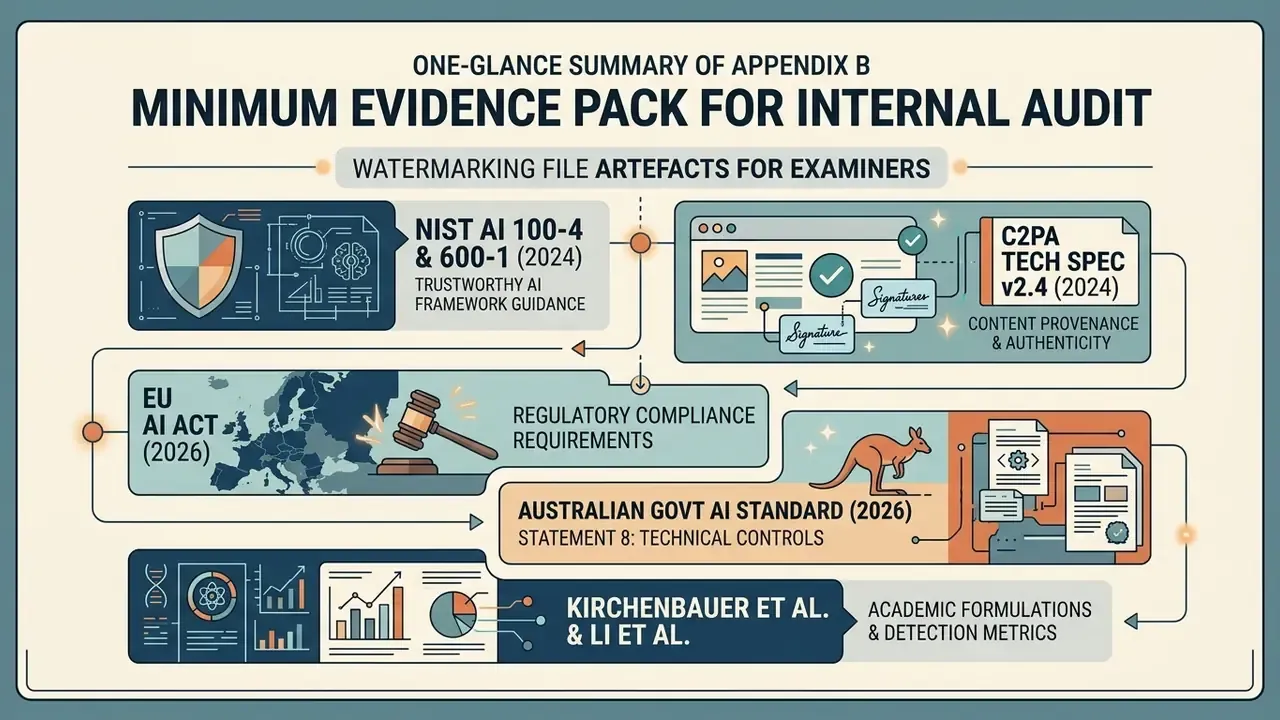
Key technical standards and authoritative references