Last updated: August 2026 · Reviewed by the AI Governance & Model Risk editorial desk.
Executive Summary for Risk, Finance and Governance Leaders
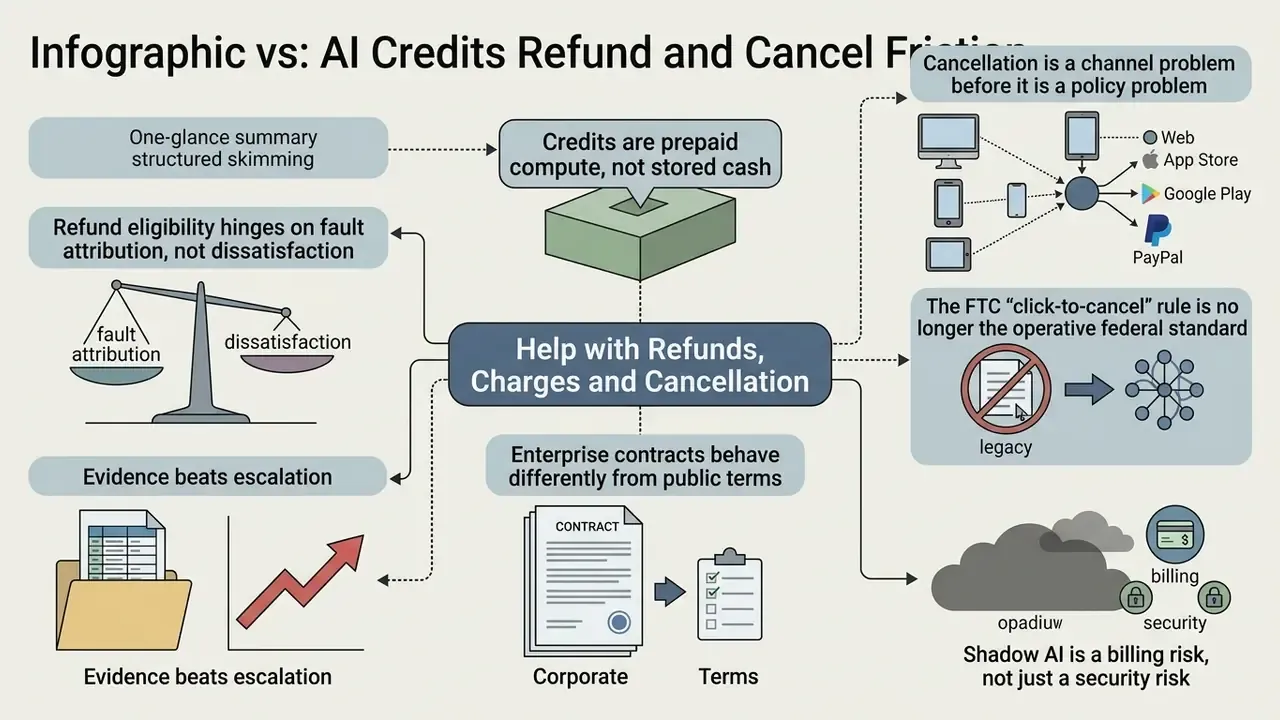
Fast Triage: Three Questions Before You File Anything
Most rejected claims fail on the first minute of analysis, not on the last paragraph of the ticket. Before drafting anything, answer three questions in writing:
- Was compute actually consumed?If the account ledger shows a deduction and a delivered artifact, you are arguing quality, not fault, and the odds drop sharply.
- Who is the merchant of record?Read the descriptor on the card statement. If it says Apple or Google, the AI developer cannot reverse the charge at all.
- Which clock is running?Cooling-off windows (7, 14, 30 days), SLA claim deadlines, and the 60-day Regulation Z billing-error notice period run in parallel and expire independently.
Two minutes of triage routinely saves two weeks of ticket ping-pong. Worth it.
When AI Credits Can Be Refunded: Refund Policy and Eligibility
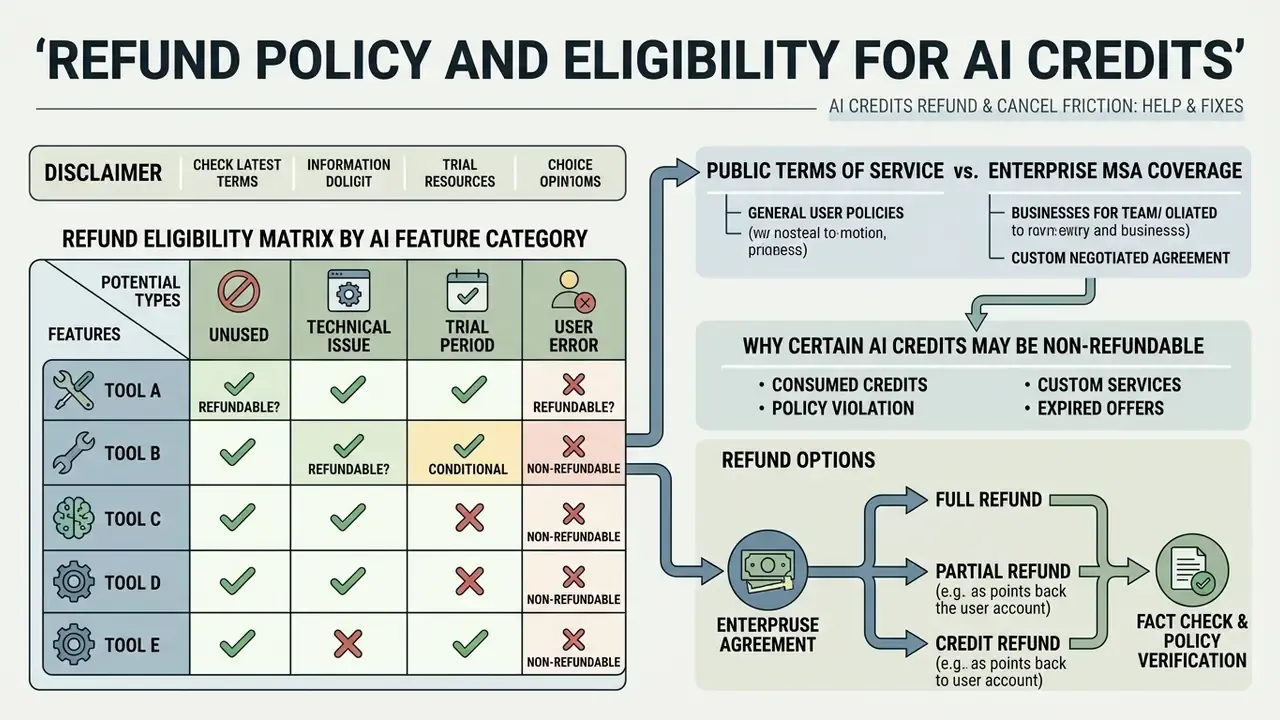
AI credits are eligible for a refund when platform-side execution errors occur, when billing statements contain verified technical errors, or when statutory cooling-off rights apply. Most commercial AI platforms treat used credits as non-refundable prepaid digital assets unless regional consumer laws or provider service level agreement (SLA) breaches mandate a return. Determining refund eligibility means reviewing consumption timestamps against the vendor's published terms of service, line by line.
The table below outlines common refund scenarios, policy criteria, and the documentation required to substantiate a request.
| Scenario | Policy Elements to Review | Required Documentation |
|---|---|---|
| Unused AI Credits | Check for cooling-off provisions (e.g., EU/UK 14-day rules) and standalone credit pack return windows. | Purchase invoice, Transaction ID, and verified account dashboard screenshot showing zero consumption. |
| Generation Failure (Execution Error) | Review terms governing technical outages, platform timeouts, and automatic system re-crediting. | Timestamped error logs, API response payloads, Task IDs, and deduction records. |
| Accidental Purchase | Check grace period terms, immediate contact requirements, and pre-checked auto-renewal disclosures. | Narrative of purchase events, immediate timestamped support ticket reference, and statement of non-use. |
| Billing Errors & Duplicate Charges | Review payment dispute procedures, double-invoicing clauses, and credit card billing error protections. | Bank/card billing statements showing duplicate merchant entries, invoice numbers, and charge dates. |
| Partially Used Credit Packages | Check whether partial refunds apply to remaining balances or if consumption voids refund rights entirely. | Account ledger showing original balance, consumed units, remaining balance, and date of purchase. |
Refund Eligibility Matrix by AI Feature Category
Refund adjudication is rarely uniform inside a single product. Platforms segment eligibility by compute intensity, because a lightweight background removal and an asynchronous text-to-video render impose radically different infrastructure costs. Photoroom, for example, publicly excludes AI Backgrounds, AI Shadows, Image Enhancer, AI Expand, Retouch and Studio Shot from credit refunds while keeping its Video Generator, Edit with AI and Fashion Models features refund-eligible (Photoroom Help Center, 2026). Use the matrix below to predict where a claim will land before writing the ticket.
| AI Feature Category | Execution Type | Credit Refund Eligibility | Policy Justification |
|---|---|---|---|
| Text-to-Video / Async Models | High GPU inference | Manual review / logs required | High unrecoverable compute cost; refunds normally require a proven 5xx or gateway failure. |
| Real-Time Image Generation | Single inference | Eligible on technical failure | Auto-refunded when the API returns an error code; manual request for artifacted output. |
| Batch Upscaling & Editing | Multi-task pipeline | Partial / conditional | Failed individual items inside a batch are re-credited; completed items stand. |
| Background Removal / Retouch | Lightweight processing | Non-refundable on output quality | Low compute threshold; output governed by "as is" quality terms. |
| Fine-Tuning / Custom Training | Dedicated compute | Strictly non-refundable | Allocates dedicated GPU cluster time regardless of final model loss metrics. |
Public Terms of Service vs. Enterprise MSA Coverage
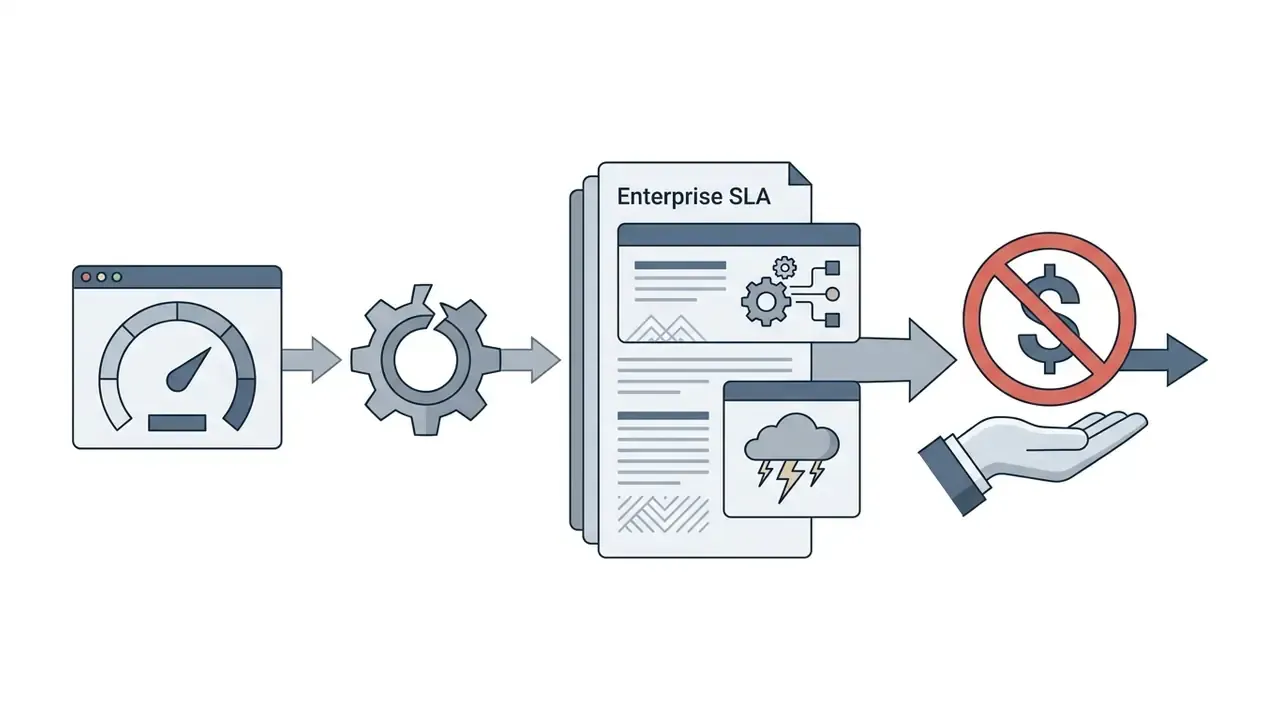
Regulated buyers should not benchmark their entitlements against public help-center pages. Consumer-facing refund policies describe the vendor's standard offer; negotiated enterprise agreements describe the vendor's obligation. In an MSA, prepaid credit pools are typically structured as annual drawdown commitments with minimum spend floors, and the contractual remedy for downtime is a service credit percentage against the next invoice rather than cash. Model risk teams should confirm four MSA clauses before onboarding any generative vendor: (1) uptime definition and measurement window, (2) service-credit calculation and claim deadline, (3) expiry treatment of unconsumed committed credits at renewal, and (4) whether upstream third-party dependencies are carved out of the SLA. Where the MSA is silent, the public terms of service govern by default, which is precisely the position enterprises want to avoid.
Why Certain AI Credits May Be Non-Refundable
AI credits are non-refundable primarily because providers incur immediate, unrecoverable GPU infrastructure costs when they process inference requests. Token-metered pricing makes that consumption economically explicit rather than notional.
«Providers charge on the order of 5 USD per million input tokens, turning computation into a measurable, expendable resource.»
Terms of service classify credits as prepaid usage rights that hold no cash value once consumed. OpenAI's Service Credit Terms specify that service credits are "not refundable except where required by law," and that prepaid service sales are final (OpenAI, 2026). JetBrains classifies AI credits as non-refundable prepaid service value tied to rolling 12-month access windows (JetBrains, 2026). GoDaddy applies the same logic at the packaging layer: separately purchased AI Credit packs are non-refundable outright, while annual plans containing credits are refundable within 30 days and monthly plans within 48 hours, but only where zero credits were consumed and no AI-generated asset was downloaded or exported (GoDaddy Refund Policy, 2026). Promotional or courtesy credits are universally non-refundable because they are granted without cash consideration. Buyers comparing consumption economics across platforms can review how credit metering differs among AI video generators before committing budget.
Full Refund, Partial Refund, and Credit Refund Options
A full refund returns 100% of the transaction amount to the original payment method, and it is typically restricted to statutory cooling-off periods or confirmed unauthorized account compromise. A partial refund applies to subscription cancellations inside regulatory windows, where charges are prorated on elapsed time rather than on remaining credit counts (OpenAI EU Terms, 2026). An internal credit refund works differently: it restores digital tokens to the platform account balance instead of disbursing money back to a credit card. Merchant payment frameworks documented by platforms like Stripe and Shopify let vendors issue store credit, original payment reversals, or split adjustments depending on dispute resolution rules (Shopify Docs, 2026). Comparing credit models across AI platforms helps finance teams anticipate whether a vendor's refund system defaults to cash reversal or balance re-crediting.
Common Issues Behind AI Credits Refund and Cancel Friction
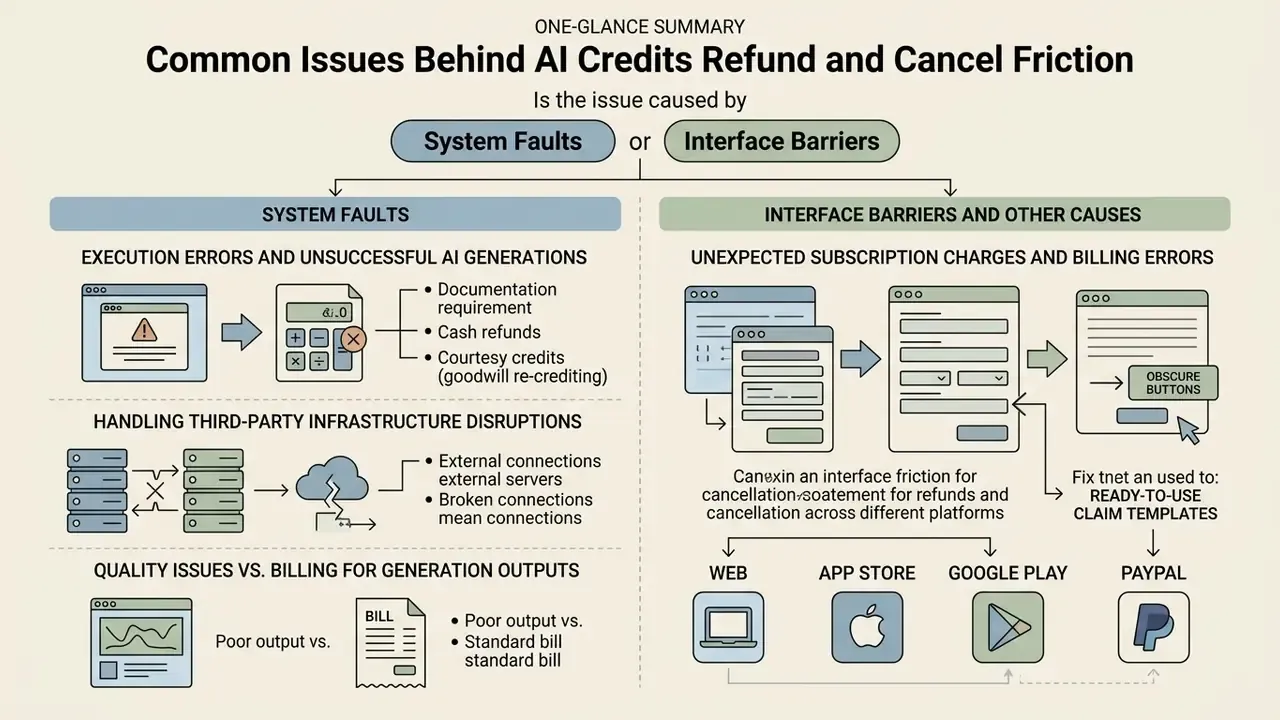
Managing ai credits refund and cancel friction common issues starts with one distinction: is the financial loss caused by a system fault, an interface design barrier, or an administrative misunderstanding? Friction increases when platform cancellation pathways are obscure, or when support teams demand extensive proof before they will even investigate recurring charges. A cross-country review led by consumer protection authorities screened 642 subscription websites and mobile apps and quantified how systemic that design pattern has become.
European enforcement sweeps found the same structural problem in retail subscription funnels.
Execution Errors and Unsuccessful AI Generations
Execution errors occur when API timeouts, model infrastructure failures, or gateway interruptions abort a request after credits have already been deducted from the balance. System-side 5xx errors and provider gateway timeouts (such as a 504 Gateway Timeout reaching 475 seconds) typically trigger automated re-crediting where the vendor documents that behavior explicitly (LandingAI Docs, 2026; Wavespeed Refund Policy, 2026). Obtained/Updated: automatic reversal is a vendor-documented courtesy, not an independently verified industry guarantee. Where the balance does not self-correct, the deduction must be escalated manually with the Task ID, because no cross-industry standard compels automated re-crediting.
Client-side behaviour muddies this further. Proxy delays or browser network disconnections often leave the prediction running on the backend, so credits are deducted without a visible result ever reaching the user (Wavespeed Refund Policy, 2026). Those deductions almost always need manual support intervention supported by engineering log extracts.
One enterprise risk team hit a recurring API timeout that drained 1,500 credits without producing outputs. The team pulled raw gateway log timestamps, filed a structured incident report with vendor support, and secured 100% balance re-crediting within 24 hours. The decisive factor was not the tone of the complaint but the completeness of the evidence chain: request ID, dispatch timestamp in UTC, error payload, and the matching ledger deduction line. Tone helps; documentation decides.
Organizations hedging against volatile consumption models often evaluate Pay-As-You-Go AI Video Alternatives to keep cost boundaries flexible.
Handling Third-Party Infrastructure Disruptions
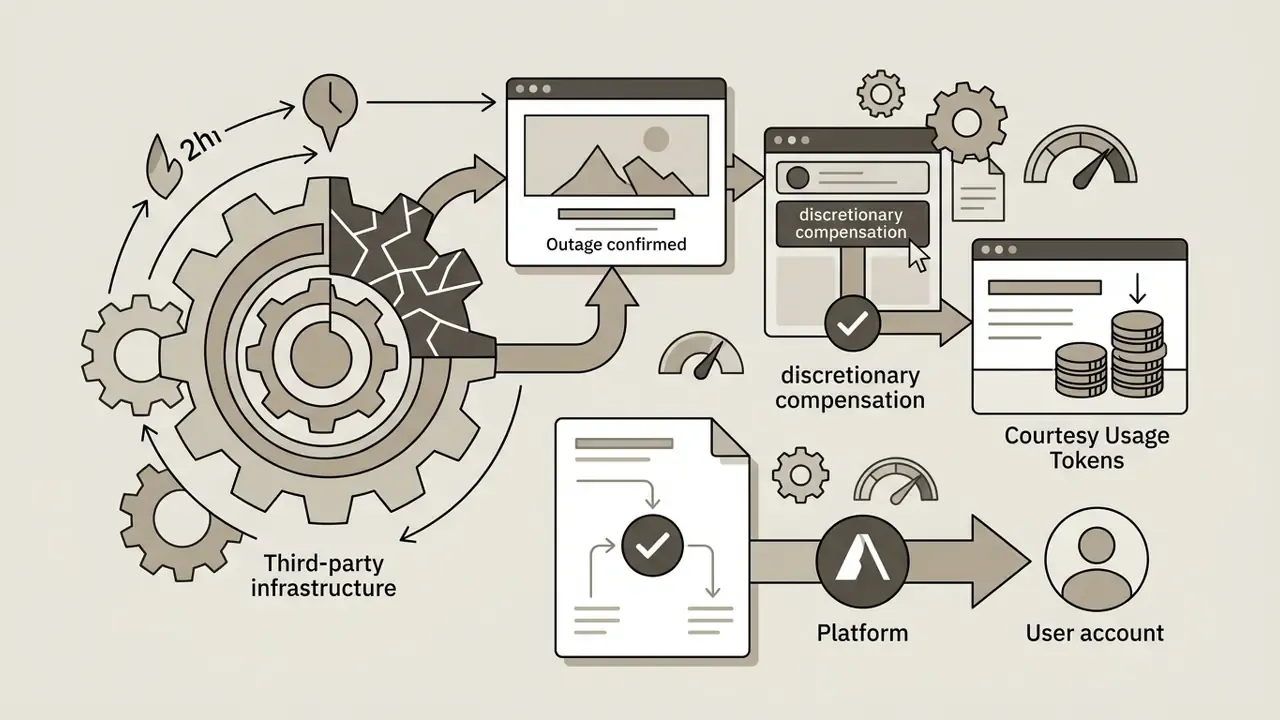
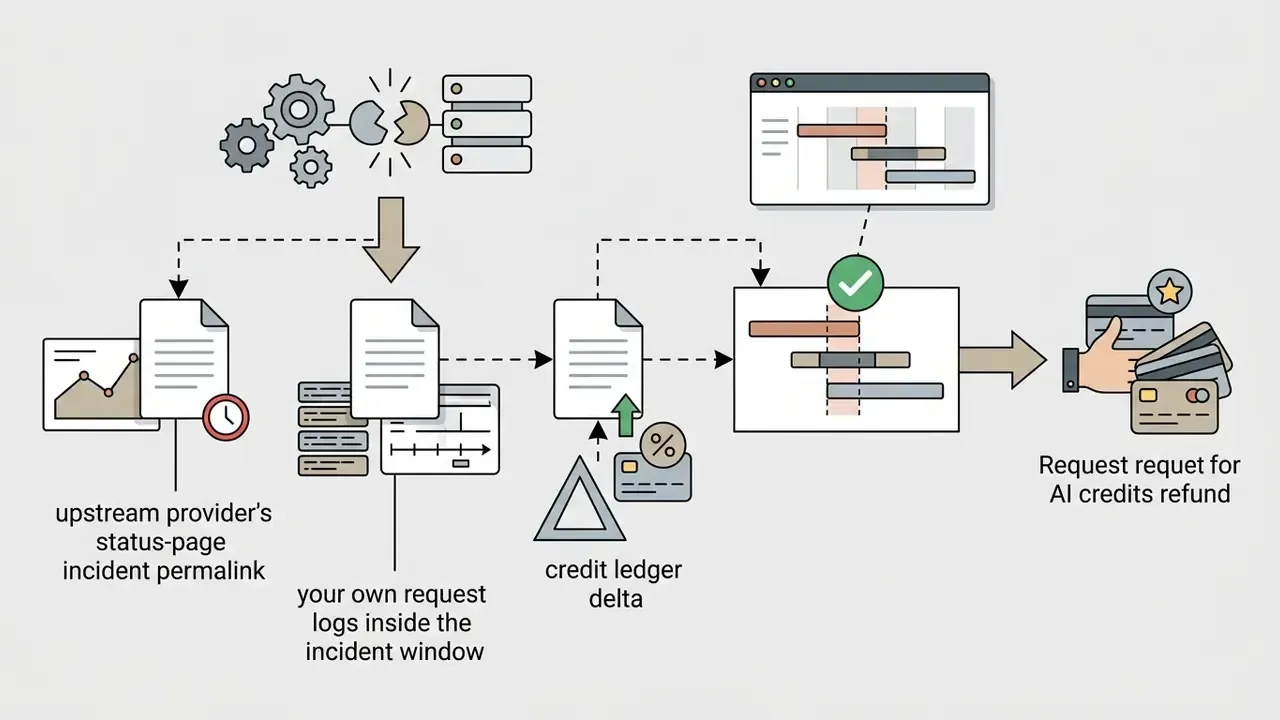
Commercial AI tools frequently depend on upstream provider APIs (OpenAI, AWS Bedrock, Azure OpenAI or Anthropic, for example). When an upstream outage degrades performance without throwing an explicit local platform error, credit refund policies diverge sharply from ordinary failure handling:
Governance teams should therefore treat upstream dependency as a contractual variable. If an MSA excludes third-party outages from the SLA, availability risk sits entirely with the customer, and only courtesy credits remain as a remedy.
Quality Issues vs. Billing for Generation Outputs
Quality issues involve dissatisfaction with generated content: hallucinations, stylistic variance, minor artifacts. Platforms separate that from objective technical failure. Commercial AI terms explicitly provide services and outputs on an "as is" and "as available" basis, waiving warranties on output accuracy or fitness for purpose (Anthropic Terms of Use, 2024; OpenAI Terms of Use, 2026). When a generation request completes successfully from an infrastructure standpoint, the spent credits are non-refundable. Providers handle temporary generation glitches, such as widespread model drift, as system incidents requiring root-cause analysis rather than individual user refunds (xAI Grok Incident Reports, 2026).
Some vendors still operate a bounded quality-refund channel. Photoroom lets users flag a generation as a "Bad result" within a short reporting window, and refunds credits only where the output is judged "clearly unusable," with duplicate reports on the same asset rejected (Photoroom Help Center, 2026). The operational lesson for enterprises: define an internal quality-floor threshold, whether measurable artifact rate, hallucination rate, or benchmark miss, so that quality claims are filed as auditable service conditions rather than as opinions.
Unexpected Subscription Charges and Billing Errors
Unexpected subscription charges appear when trial allocations convert into recurring auto-renewals, or when billing software processes renewals in Coordinated Universal Time (UTC) rather than the subscriber's local timezone. Payment infrastructure providers like Stripe execute subscription timestamps in UTC, so a renewal charge can land up to a day earlier than the local interface suggested (Stripe Developer Docs, 2026). Worse, changing the display timezone in billing platforms like Chargebee alters the rendered date without shifting the underlying billing execution cycle (Chargebee Documentation, 2026). Enterprise resource platforms have moved the other way: Oracle now derives subscription start and end dates from the sales order time zone specifically to eliminate invoicing and partial-period discrepancies (Oracle Docs, 2026).
How to Cancel a Subscription and Prevent Future Charges
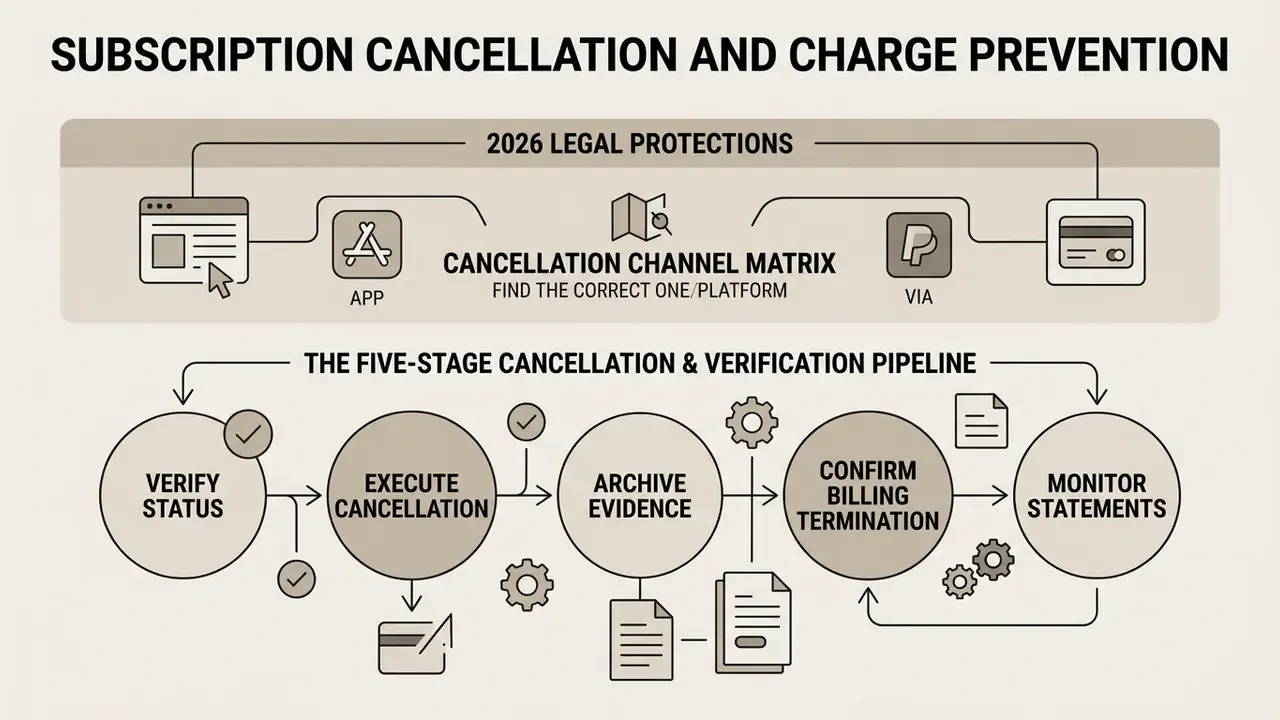
Stopping recurring subscription charges requires completing formal cancellation inside the correct billing channel, archiving written proof, and verifying payment authority status. If interface barriers block online cancellation, immediate written notice to the vendor establishes a legal foundation to dispute every subsequent billing entry.
Legal Standing in 2026: What Actually Protects You Now
Regulatory guidance treats obstruction as an actionable practice in its own right, which is why the CFPB has warned that unreasonable cancellation barriers may violate the prohibition on unfair, deceptive or abusive acts and practices (CFPB Circular 2023-01).
Cancellation Channel Matrix: Cancel Where the Subscription Actually Lives
Canceling in the account dashboard achieves nothing if the subscription was purchased through a mobile store or a wallet billing agreement. Identify the billing channel from the merchant descriptor on the statement, then execute in the matching pathway.
| Subscription Channel | Execution Pathway | Proof to Capture | Escalation Route |
|---|---|---|---|
| Direct Web (Stripe / Chargebee) | Account Dashboard → Billing → Cancel Plan | Timestamped "Cancels at period end" UI screenshot | Credit card billing dispute (Regulation Z) |
| Apple App Store (iOS / iPadOS) | Apple ID Settings → Subscriptions → Select App → Cancel | Apple purchase history PDF receipt showing status | reportaproblem.apple.com |
| Google Play Store (Android) | Play Store Profile → Payments & Subscriptions → Cancel | Google Play order record showing expiration date | support.google.com/googleplay |
| PayPal Automatic Payments | Settings → Payments → Manage Automatic Payments → Cancel | Billing agreement status changed to "INACTIVE" | PayPal Resolution Center dispute |
| Reseller / Enterprise Distributor | Procurement contact or partner portal termination notice | Countersigned termination notice with effective date | MSA notice clause + purchase order cancellation |
Where the purchase went through a store, the store, not the AI developer, is the merchant of record. Apple states that App Store refunds are processed by Apple at Apple's discretion under Apple's policies, and that a vendor's own refund terms do not override that process. Google Play similarly confirms that cancellation stops billing from the next period and that past subscription periods can be refunded only under Play's stated exceptions (Apple Support, 2026; Google Play Help, 2026).
The Five-Stage Cancellation and Verification Pipeline
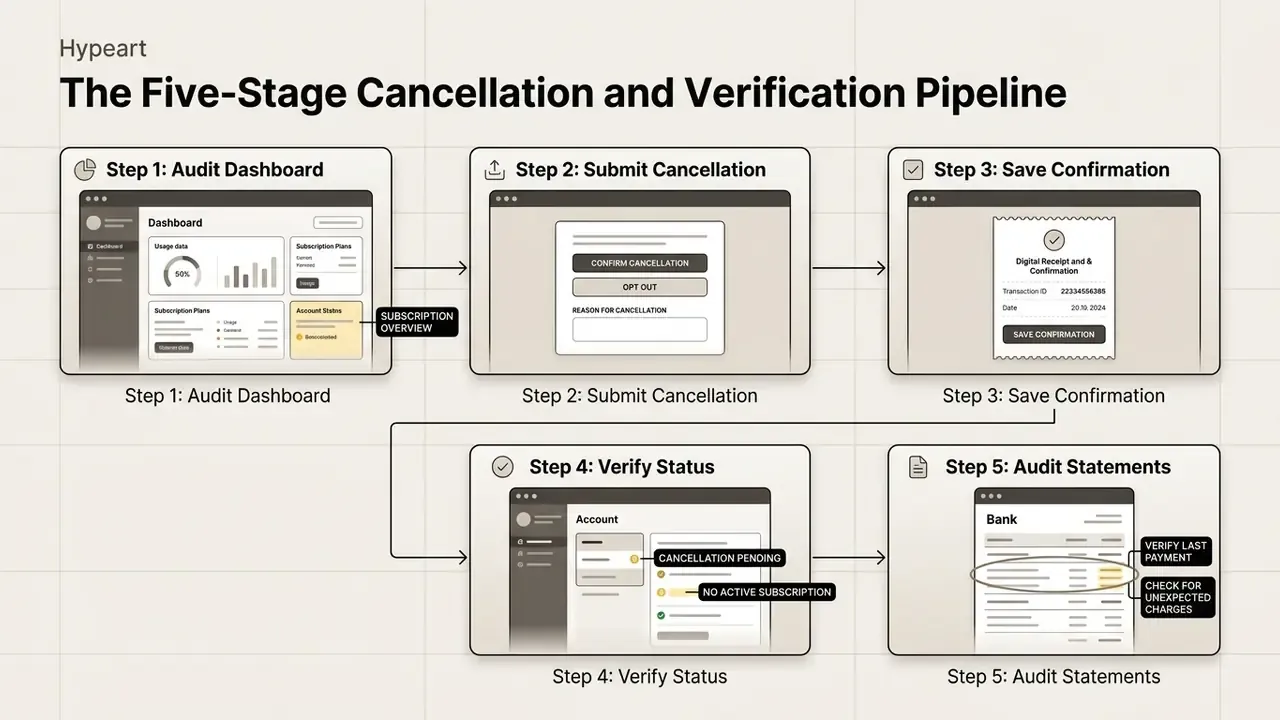
The operational workflow for terminating an AI subscription securely runs through five sequential validation stages:
- Verify Subscription StatusOpen the account billing dashboard and confirm the active plan tier, upcoming billing date, and credit rollover rules.
- Execute In-Account CancellationFollow the platform's published cancellation pathway before the cutoff threshold, typically 24 hours ahead of the renewal timestamp.
- Archive Cancellation EvidenceSave the final confirmation screen, email receipt, or timestamped system notice showing plan termination.
- Confirm Billing Anchor TerminationRe-check the dashboard to ensure account status reads "Cancels at period end" or "Canceled."
- Monitor Banking StatementsInspect credit card and bank statements during the next billing cycle to verify that no further charges occur.
What to Verify Before Confirming Subscription Cancellation
Before confirming, check three parameters: the next billing cycle date, the remaining balance of AI credits, and the service's access-retention rules. Unused credits may be forfeited immediately upon cancellation, or reset at the start of the next calendar month at 00:00 UTC (GitHub Docs, 2026). Other platforms let subscribers keep both feature access and credit balances until the end of the current billing cycle (Fireflies Guide, 2026). Verifying these details prevents the premature loss of purchased computational capacity. Note the asymmetry in annual contracts too: some vendors permit a partial refund only if cancellation lands within 7 days of purchase, after which access continues to term end with no prorated credit (LockedIn AI Refund Policy, 2026).
Organizational Control: Preventing Shadow AI Renewals
Individual cancellation hygiene does not scale across a bank or fintech where hundreds of teams experiment with generative tools. Three controls materially reduce unauthorized recurring spend:
- Virtual card controls issue single-merchant virtual cards with hard monthly caps and fixed expiry dates, so an unapproved AI subscription cannot silently renew past its pilot window.
- Merchant descriptor monitoring feed card statement descriptors into the expense platform and alert on any new AI-category merchant absent from the approved vendor register.
- Centralized credit pooling consolidate departmental credit purchases into one MSA drawdown, so consumption, rollover and expiry sit in a single auditable ledger instead of scattered across personal corporate cards.
What to Do If You Can't Cancel Through the Account Dashboard
When dashboards throw technical errors, render broken interfaces, or bury the cancellation toggle ("Roach Motel" patterns), send a direct cancellation request to customer support immediately. Keep detailed notes, copies of all correspondence, and screenshots of the UI errors (FTC Consumer Advice, 2024). If the provider keeps executing recurring charges after receiving written notice, contact the credit card issuer to revoke payment consent formally and open a billing error dispute (Citizens Advice, 2026; CFPB Reg Z, 12 C.F.R. § 1026.13). Persistent interface barriers deserve a report to regulatory databases such as ReportFraud.ftc.gov and to the relevant state attorney general.
That finding matters operationally. No amount of internal training fully immunizes staff against manipulative flows, so procedural friction on the payment side (approval gates, virtual card caps, dual authorization) is a more reliable control than user vigilance.
How to Change Plans Without Extra Charges or Credit Loss
Addressing ai credits refund and cancel friction help also means managing upgrades and downgrades deliberately. Changing subscription tiers can trigger immediate prorated charges or reset credit rollover allowances. Auditing plan transition mechanics before confirmation prevents double billing and unexpected balance forfeitures. Teams benchmarking entry-level tiers can compare quotas across free AI video generators before committing to a paid anchor date.
Review the following operational checks before executing a tier change:
Checklist0 / 4
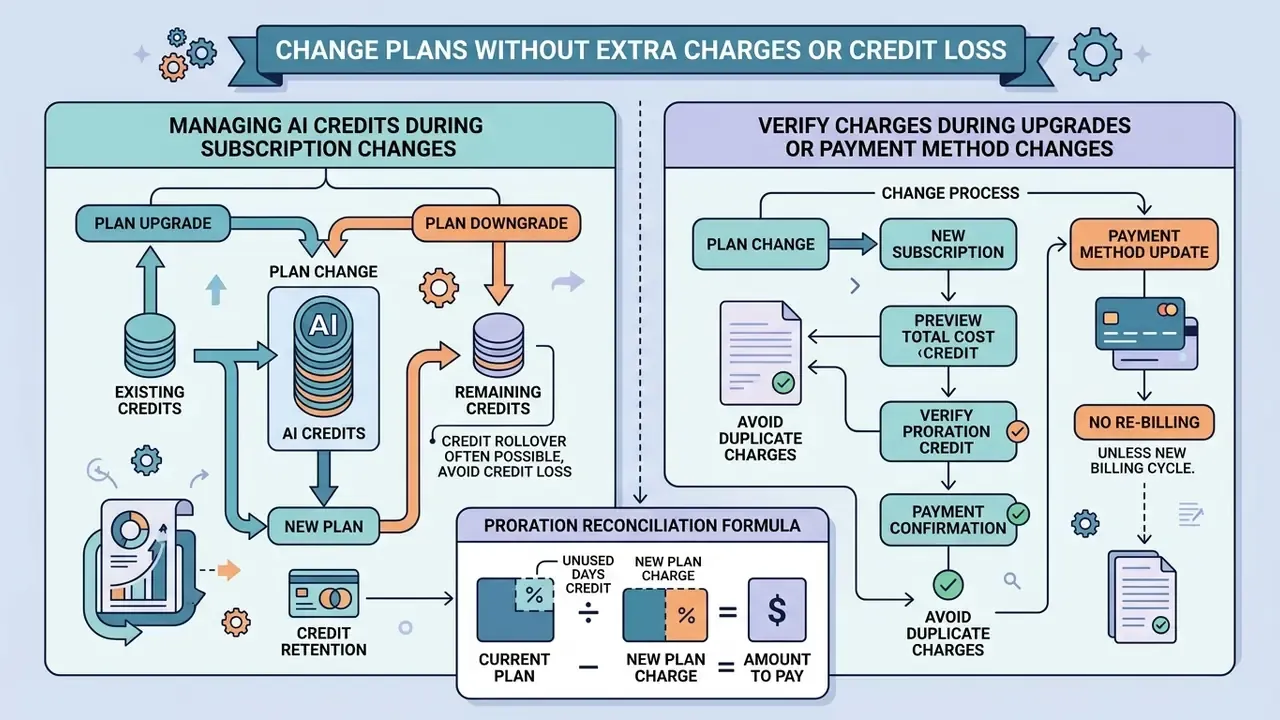
What Happens to AI Credits When Changing Subscriptions
Credit handling during plan transitions depends heavily on provider-specific rules. On upgrade, platforms typically retain existing unused credits and append the new plan's allowance to the total balance (Captions Help Center, 2026; ElevenLabs Help Center, 2025). On downgrade, some providers immediately truncate the account credit balance to the lower tier's cap, forfeiting excess unspent credits (Captions Help Center, 2026). Others preserve accumulated credits until the current billing cycle ends before resetting allowances (Kive Help Center, 2026).
| Transition Type | Credit Balance Behaviour | Timing of Price Change | Documented Example |
|---|---|---|---|
| Upgrade (higher tier) | Existing unused credits retained; new allowance added on top | Immediate, with prorated debit | ElevenLabs, Kive, Captions (2025–2026) |
| Downgrade, cap reset | Balance immediately truncated to new tier cap; excess forfeited | New lower price applies next cycle | Captions Help Center (2026) |
| Downgrade, cycle-end reset | Accumulated credits preserved until current cycle ends | New tier and quota begin at next anchor | Kive Help Center (2026) |
| Downgrade, prorated credit | Unused time converted to account credit for future invoices | Applied against future payments, no cash back | Plus AI plan-change documentation |
| Cancellation (no tier change) | Credits forfeited at period end or at 00:00 UTC monthly reset | Access to term end | GitHub Docs (2026); Fireflies Guide (2026) |
How to Verify Charges During Upgrades or Payment Method Changes
To verify upgrade charges accurately, read the line-item proration logic. When a plan price changes mid-cycle, subscription engines like Stripe default to calculating a credit for the unused portion of the old plan and a debit for the remaining time on the new plan (Stripe Billing Docs, 2026). Depending on configuration (always_invoice versus create_prorations), the system may attempt immediate credit card collection for the prorated net difference, or hold the adjustment line items for the next regular billing invoice (Stripe Billing Docs, 2026).
Proration reconciliation formula. To validate a mid-cycle invoice before disputing it, compute:
Unused credit  = Old plan price × (Remaining days ÷ Days in cycle)
New plan debit = New plan price × (Remaining days ÷ Days in cycle)
Net amount due = New plan debit − Unused credit
Worked example: a $200/month plan upgraded to $500/month on day 20 of a 30-day cycle leaves 10 remaining days. Unused credit = 200 × (10/30) = $66.67. New plan debit = 500 × (10/30) = $166.67. Net amount due = $100.00. If the invoice shows the full $500 with no offsetting credit line, either the proration configuration or the billing anchor was reset. Capture the invoice PDF and raise it as a billing error rather than accepting it as policy. Where the billing interval itself changes (monthly to annual), Stripe resets the billing anchor to the change date, whereas simple price switches inside the same interval preserve the original anchor (Stripe Billing Docs, 2026). Mobile billing systems behave differently again: an INSTANT_PRORATED_CHARGE mode collects the difference immediately while keeping the original renewal date unchanged (Samsung Billing Docs, 2026).
How to Submit a Refund Request for AI Credits
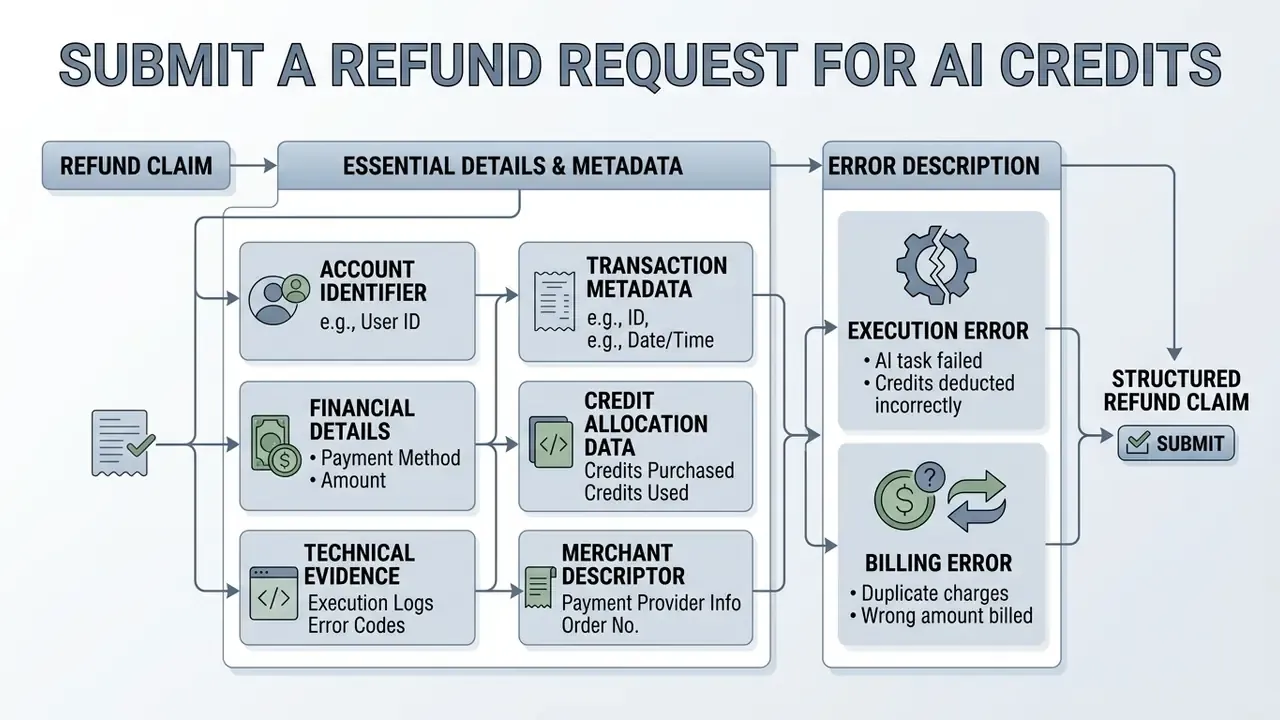
Knowing ai credits refund and cancel friction how to fix comes down to submitting a precise, structured claim with complete transaction metadata and technical logs. Informal or vague complaints get filtered out by automated support triage long before a human reads them. Attaching verifiable transaction identifiers and demonstrating non-consumption speeds up administrative review noticeably.
Essential Transaction Details and Metadata to Attach
A complete refund application gives the vendor's billing team definitive verification data. Include these parameters in the initial ticket:
- Account Identifier Registered user account email address and Organization ID.
- Transaction Metadata Transaction ID, order number, and payment receipt reference.
- Financial Details Exact charge date, total currency amount, and payment method identifier (for example, last four digits of the credit card).
- Credit Allocation Data Total credits purchased, credits consumed, and exact credit balance remaining.
- Technical Evidence Task IDs, timestamped API execution logs, and full-screen error captures showing system failures.
- Merchant Descriptor The exact string as it appears on the bank or card statement, which identifies the correct billing channel and merchant of record.
How to Describe an Execution Error or Billing Error
When drafting the narrative, structure the description chronologically and cite specific technical facts. For execution errors, state the exact date and time of the request, quote the system error code (500 Internal Server Error, 504 Gateway Timeout), and describe the unrendered output next to the credit deduction. For billing errors, cite the duplicate charge dates, transaction reference numbers, and the discrepancy between advertised pricing and invoiced amounts. Close by stating the requested remedy explicitly: a full refund to the payment method, or a credit adjustment to the account balance. Don't leave that choice to the agent.
«Regulation Z (12 C.F.R. § 1026.13) requires issuers to investigate billing errors and reverse amounts charged in error.»
Under that framework, a billing-error notice should reach the issuer's billing-inquiries address within 60 days of the first statement showing the error. Issuers must acknowledge within 30 days and resolve within two billing cycles, not exceeding 90 days. Attach copies, never originals, of receipts and correspondence, and retain a copy of the dispute letter itself (FTC Consumer Advice, 2024).
Ready-to-Use Refund Application Templates
Template 1: Technical Execution Error (API Timeout / 5xx)
Template 2: Billing Dispute (Post-Cancellation Charge)
Template 3: Upstream Outage Courtesy Credit Request
Why a Refund Request Is Rejected and How to Fix the Application
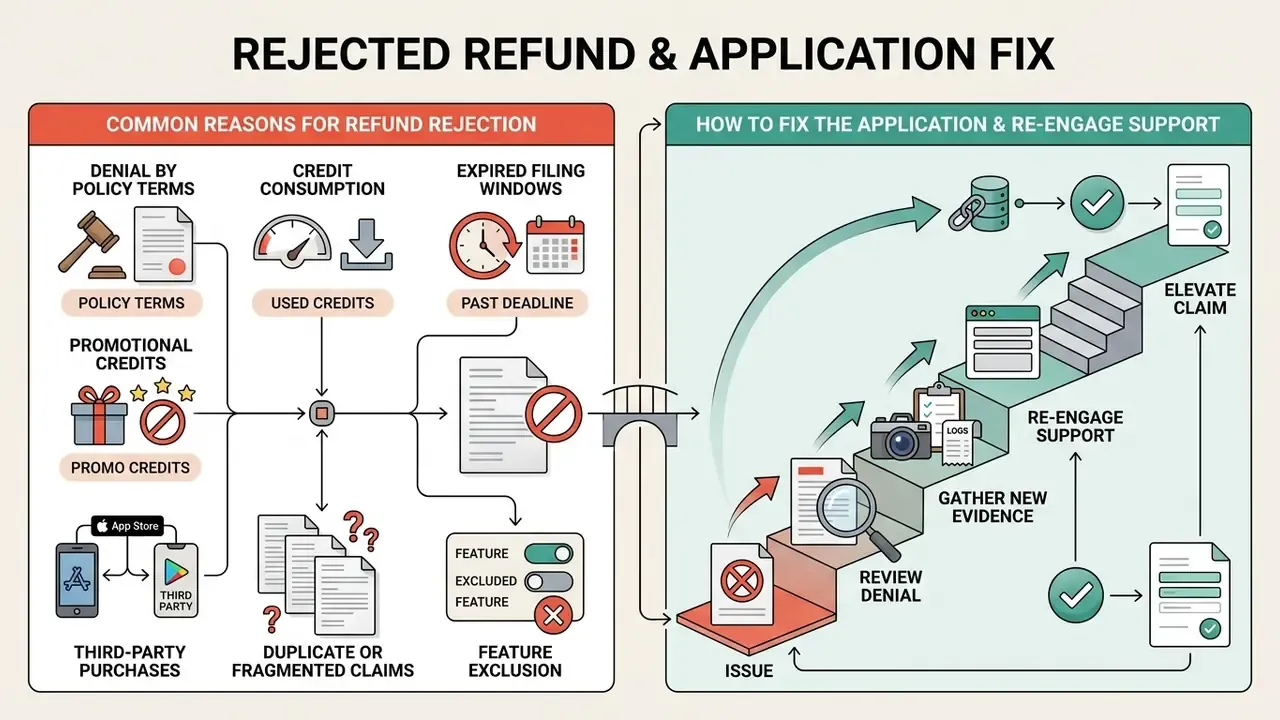
Finding an ai credits refund and cancel friction solution means understanding why support operations reject claims, and how to re-engage through official escalation channels. Applications fail mostly on four grounds: consumed credit balances, expired filing windows, missing metadata, or purchase terms governed by third-party app stores. Fixing a rejection requires fresh technical evidence inside the existing ticket thread, not a brand-new ticket.
Rejections premised on an obstructive cancellation flow deserve separate treatment, because the barrier itself is a regulatory exposure for the vendor.
Denial Based on Refund Policy Terms
Support teams enforce policy boundaries strictly. Standard refusal grounds include:
- Credit Consumption Any consumption of purchased credit packs voids standard return rights (GoDaddy Refund Policy, 2026).
- Expired Filing Windows Submissions made outside stated policy windows, such as 7-day or 14-day grace limits, are automatically disqualified (IndexGraph Policy, 2026).
- Promotional Credits Bonus, courtesy, or trial credits carry zero cash value and are strictly excluded from cash or balance refunds (Google Workspace Terms, 2026).
- Third-Party Purchases Purchases executed through mobile app stores or software distributors must be adjudicated under the reseller's specific refund rules (Apple Support, 2026; Google Play Help, 2026).
- Duplicate or Fragmented Claims Multiple refund requests filed against the same asset or the same charge are treated as misuse safeguards and dismissed without review (Photoroom Help Center, 2026).
- Feature Exclusion Some tools are excluded from credit refunds by category, particularly lightweight processing features and AI tools invoked inside batch or catalog pipelines (Photoroom Help Center, 2026).
Re-Engaging Support with Additional Evidence
When appealing a rejection, do not open a new support ticket. Duplicate tickets fragment documentation and delay processing (Delta / Airline Incident Handling Rules, 2026). Reply directly to the closed or rejected thread instead, attach additional technical evidence such as full-screen logs, HAR files, or server timestamp captures, and request senior support escalation (AGB Technical Ticket Rules, 2025; MSPB e-Appeal Guidelines, 2024). Point to specific platform SLA breaches or technical outages that caused the generation failure directly.
If the vendor still refuses and the facts support you, meaning charged after documented cancellation, service not delivered as represented, or a cancellation flow that demonstrably does not function, escalate to the payment channel: a card-issuer billing dispute, a PayPal Resolution Center case, or an Apple/Google store refund request, matched to the channel identified in the cancellation matrix above.
FAQ: AI Credits Refund and Cancellation Assistance
When Will Money Back Arrive on the Payment Method?
Once a merchant approves a cash refund, processor-side execution and card-network posting are two separate stages, so treat timelines as ranges rather than guarantees. Obtained/Updated: processor documentation indicates card credits are typically executed on the merchant side within about one business day, but that reflects vendor-published operational guidance rather than an independently audited standard (2Checkout Docs, 2026). The final posting date on consumer statements depends on issuing bank networks, usually 3 to 5 business days for credit cards and 7 to 10 business days for eCheck/ACH transfers (Authorize.net, 2026). Obtained/Updated: end-to-end clearing is documented by the card network itself as generally appearing within 2 to 30 days after the merchant issues the refund, with the exact posting date determined by the issuing bank rather than the merchant (Visa Acceptance Solutions, 2026). Where a refund stalls beyond those windows, the regulatory complaint channel is measurable and responsive.
«Over 12 months the CFPB handled approximately 2.6 million consumer complaints; companies responded to 99.4% of complaints sent to them.» CFPB Semi-Annual Report, Fall 2024. https://www.consumerfinance.gov/data-research/research-reports/cfpb-semi-annual-report-fall-2024/
Who to Contact for Purchases Made Through Third-Party Channels?
For AI credits or subscriptions bought through third-party marketplaces, including the Apple App Store, Google Play Store, or enterprise resellers, refund and cancellation requests must be processed through the reseller's platform (Apple Support, 2026; Google Play Help, 2026). Buyers who prefer to avoid split merchant-of-record chains can compare direct-billing options among leading AI video generators before purchasing through a store. Direct AI developers lack the administrative visibility and merchant authority to modify billing records, process card chargebacks, or issue cash refunds for transactions executed in external store channels.
Does Cancelling a Subscription Refund Credits Already Purchased?
Generally no. Cancellation stops future billing; it does not reverse charges already accrued or restore consumed credits. Usage-based API billing follows the same rule, since closing a paid account does not refund charges already accrued for the current period (OpenAI Help Center, 2026). Separately purchased credit packs may persist indefinitely or expire on a fixed schedule, so read the expiry clause before cancelling.
Do EU, UK or Israeli Customers Have Stronger Refund Rights?
Yes, inside a narrow window. OpenAI's Europe terms allow cancellation and a prorated refund within 14 days of purchase, calculated from the cancellation date to the end of the paid period; after that window, no refund or service credit is issued (OpenAI EU Terms, 2026). Google applies a comparable 14-day cancellation right to Top-Up AI Credits in Israel, with a prorated refund where credits were used during that period (Google Help, 2026). These are statutory cooling-off mechanisms tied to the subscription, not to leftover credit counts.
What Evidence Should Be Kept Even If No Dispute Is Expected?
Keep one dated folder containing: the statement line item with the merchant descriptor, the trial-start and subscription-confirmation emails, the account status page screenshot, the cancellation confirmation screen, and any capture of a broken or missing cancellation control. That package supports a merchant refund request, a card dispute, and a regulatory complaint without further reconstruction. Five minutes now, hours saved later.
Can Annual Enterprise Commitments Be Refunded Mid-Term?
Rarely as cash. Annual commitments are typically refundable only inside a short post-purchase window, and some vendors publish 7 days for annual plans, after which access continues to term end without prorated credit (LockedIn AI Refund Policy, 2026). Enterprise remedies for downtime are usually SLA service credits applied to a future invoice, which is why the service-credit clause and its claim deadline should be negotiated before signature.
Appendix A: Superseded and Retained Reference Notes
Retained for audit continuity and version transparency:
- Previous legal framing (superseded)
- an earlier version of this guidance cited the FTC Negative Option Rule (2024) alongside CFPB Circular 2023-01 as the operative requirement that "cancellation mechanisms must be as simple and accessible as the initial sign-up pathway." That framing remains directionally accurate as regulatory intent, but the 2024 updated rule was vacated by the Eighth Circuit on July 8, 2025. The operative bases are now ROSCA, applicable state automatic-renewal statutes including the amended California ARL (effective July 1, 2025), and Regulation Z billing-error rights. CFPB Circular 2023-01 remains valid supervisory guidance on negative-option marketing.
- Automated re-crediting claim
- the statement that server-side 5xx errors and gateway timeouts "typically trigger automated re-crediting" is supported only by individual vendor documentation (LandingAI, Wavespeed, Photoroom, 2026) and should be treated as vendor-specific behaviour rather than a cross-industry guarantee. Independent verification data is not available.
- Refund timing ranges
- the 1-business-day processor execution figure and the 2 to 30 day end-to-end clearing range derive from processor and card-network documentation, not from regulator-audited statistics. Posting dates are ultimately controlled by the issuing bank.
- Removed placeholder
- an unverified product-availability footnote referencing third-party corporate integration specifications has been withdrawn as non-informative.
- Audience assumptions
- statements about buyer priorities in US banks and fintechs remain hypotheses until supported by analytics, interviews, CRM data, or verified customer research.