For a risk or finance leader the question is narrower than "which video ai tool looks best". It is this: which billing model gives you predictable spend, clean attribution, and evidence you can show an auditor?
Last updated: August 2026. Editorially independent: this comparison has no affiliation, referral agreement, or paid placement with any platform named below, including vidflux ai, Seedance, Runway, FAL.AI, OpenAI, or Google.
Executive summary for decision-makers
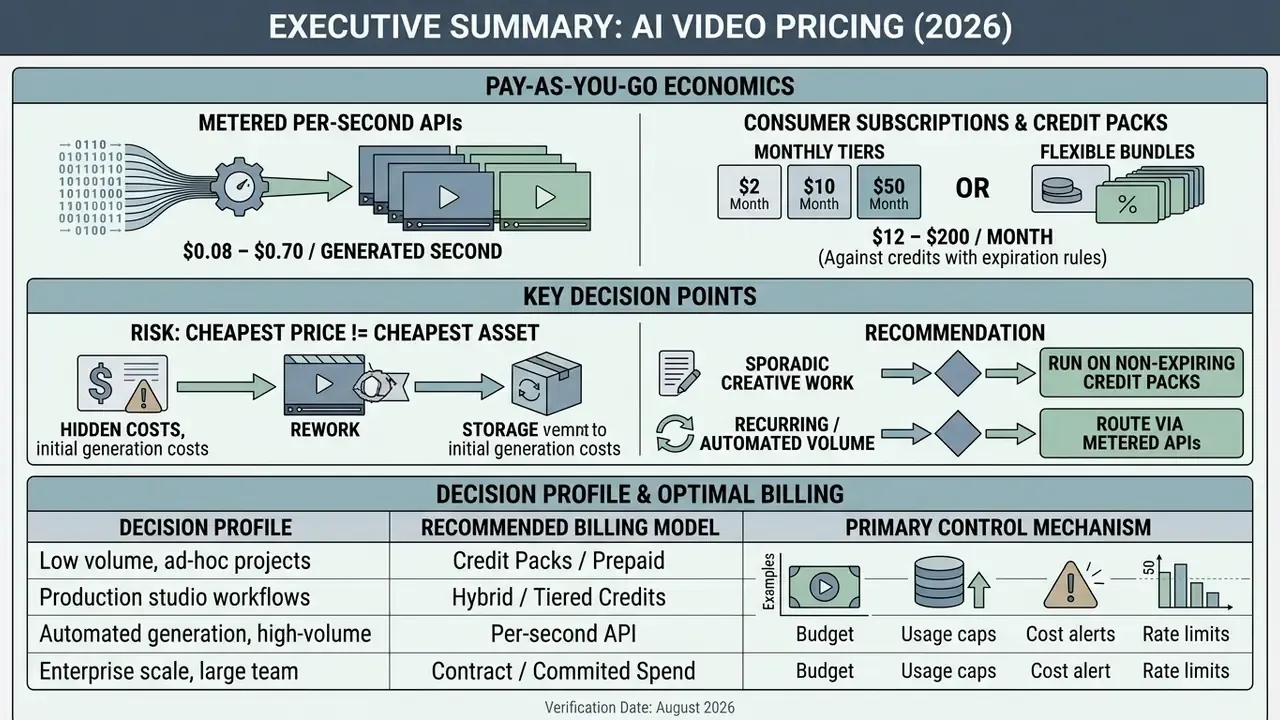
- Economics: Metered per-second APIs price video between $0.08 and $0.70 per generated second in 2026, while consumer subscriptions charge $12–$200 per month against credits that usually expire every 30 days. Below the break-even volume of , pay-as-you-go is mathematically cheaper, which in practice means roughly 70 clips per month on a $35 plan.
- Risk: The cheapest sticker price is rarely the cheapest asset. Retries, quality rejections, compliance screening, and consumer-tier data-retention defaults move the true cost per approved clip by a factor of 2x to 4x. Credit packs bought on corporate cards are also the single most common entry point for Shadow AI in regulated organizations.
- Recommendation: Run sporadic creative work on non-expiring credit packs, route recurring or automated volume through a centralized API gateway with per-team keys, and reserve monthly subscriptions strictly for teams whose validated output consistently exceeds the calculated break-even threshold.
| Decision profile | Recommended billing model | Primary control mechanism |
|---|---|---|
| Sporadic creative work, 1–3 campaigns per quarter | Non-expiring prepaid credit packs | Prepaid balance cap |
| Continuous daily publishing above break-even volume | Tiered subscription (with sprint-and-cancel fallback) | Fixed monthly ceiling |
| Automated pipelines, regulated or enterprise use | Direct API metering behind an internal gateway | IAM roles, per-key budgets, audit logs |
Why creators look for pay-as-you-go AI video alternatives
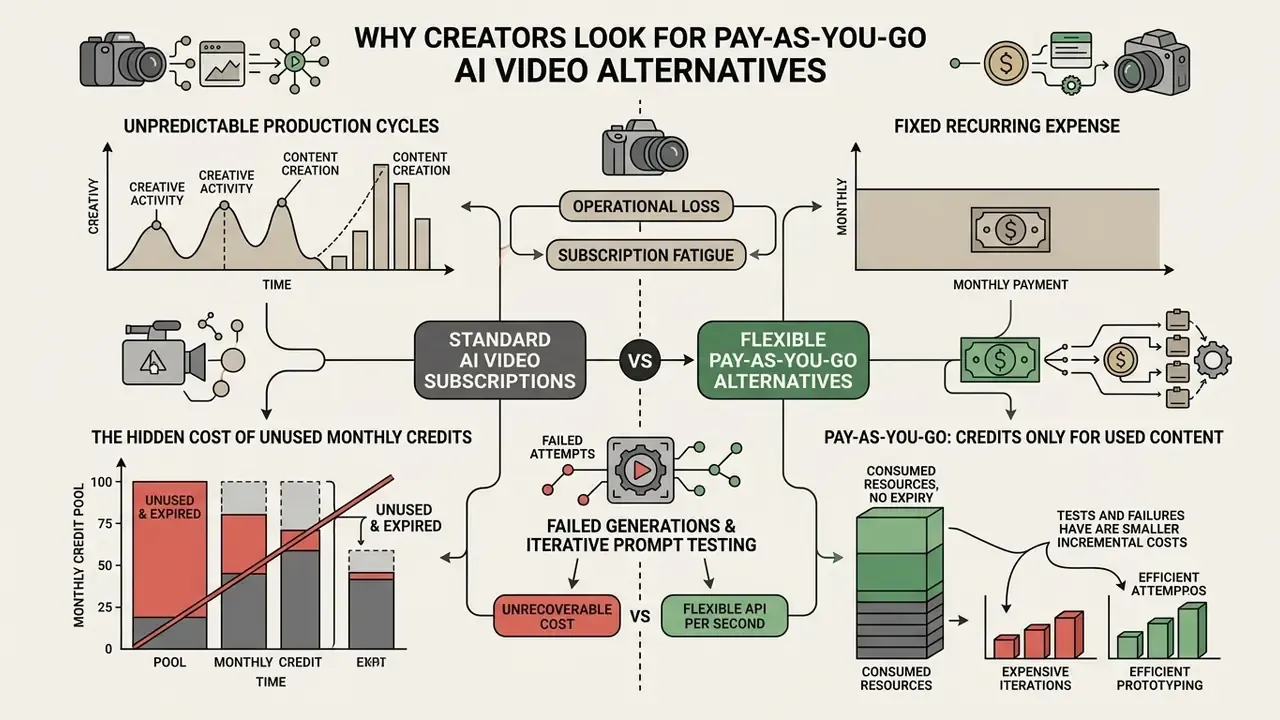
Creators and enterprise video teams migrate to pay-as-you-go AI video alternatives to strip out fixed recurring software expense during unpredictable production cycles. A traditional monthly subscription charges a flat fee whether the seat renders 400 clips or none, so low-volume months turn into direct financial waste. Flexible pricing realigns software spend with active project delivery, which is why buyers now read billing terms as carefully as model quality when shortlisting AI video generators.
A primary catalyst is plain subscription fatigue across digital creation workflows. Updated: empirical work on recurring billing shows that automatic renewal structures raise vendor revenues by 14% to more than 200% purely through consumer inertia and forgotten accounts, and the authors isolate the mechanism through a natural experiment on payment-card replacement.
«Renewal rates fall sharply in the month a payment card must be replaced, roughly four times the typical monthly churn rate.»
Independent consumer research points the same way. A 2024 subscription-economy analysis found that more than 85% of subscribers had at least one paid subscription they did not use in the previous month, with an average of 3.3 dormant subscriptions per US consumer (BRG, Combating Subscription Fatigue: A Data-Driven Approach for Streamers, 2024).
When flexible pricing is better than a subscription
Flexible pricing wins during non-linear production schedules, multi-model evaluation phases, and one-off specialized asset work. When volume swings between heavy project deadlines and weeks of silence, metered structures hold spend at zero during idle periods.
In a recent campaign assessment for a commercial client, a digital agency needed ten stylized background clips inside a 48-hour window, followed by three months of zero video output. A high-tier $76 monthly subscription would have produced four months of recurring charges ($304 total) for two days of real generation. Using an API-based pay-as-you-go tool at $0.10 per second, the agency produced 100 seconds of finished assets for exactly $10.00, a 96% reduction in platform expenditure.
Metered billing is similarly superior when benchmarking multiple neural video engines. Production teams testing visual consistency across Runway Gen-4, OpenAI Sora 2, and Google Veo 3.1 can allocate one pay-per-use budget across all three engines via API keys or credit packs. No need to hold three separate $20–$30 subscriptions simultaneously just to run initial concept validation.
Metered billing also changes behaviour, not only invoices. Field evidence from usage-based pricing experiments supports the asymmetry:
Translated into video production: metered billing rewards teams that generate rarely and deliberately, and it penalizes unbounded experimentation. Which is exactly why prompt discipline and draft-first workflows, covered further down, matter more here than under a flat plan.
Pricing models for AI video generation: credits, API and subscriptions
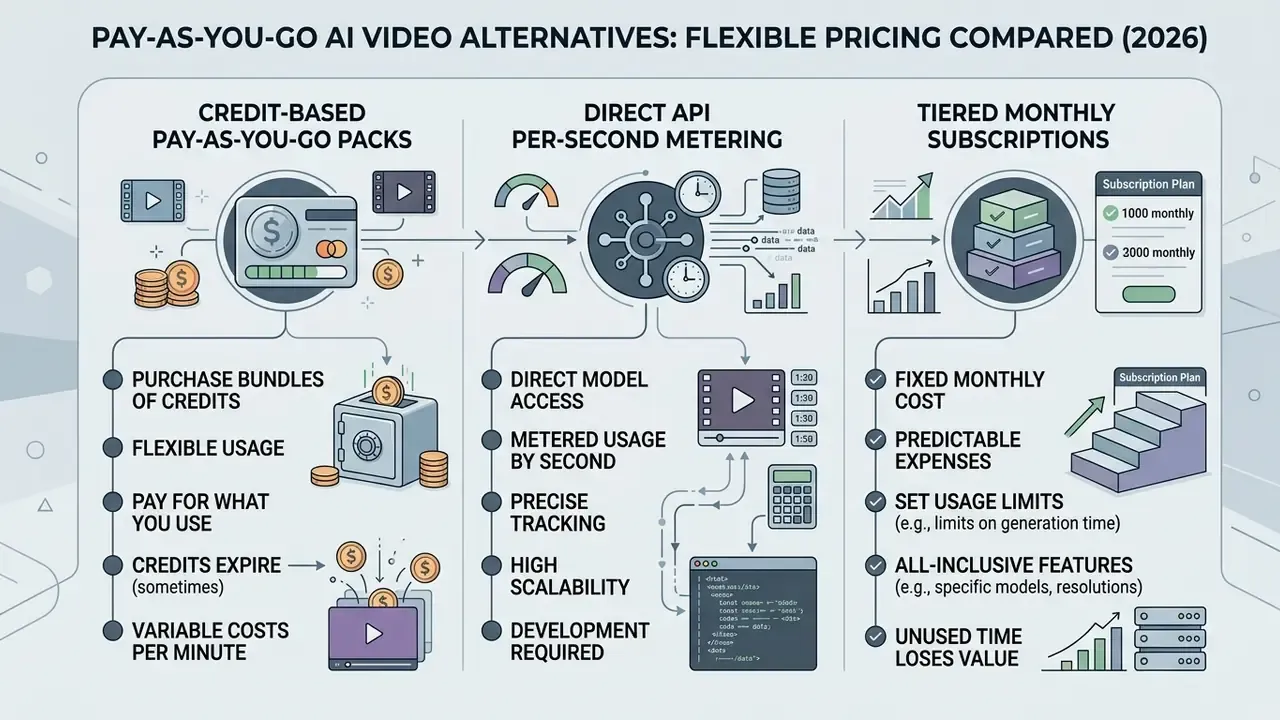
AI video generation platforms operate under three primary pricing architectures: credit-based pay-as-you-go packs, direct API per-second metering, and tiered monthly subscriptions. Understanding the structural differences is the practical core of any pay-as-you-go AI video alternatives comparison, and it prevents hidden platform markups from surfacing later in the budget.
The software industry has shifted heavily toward consumption-aligned pricing. Updated:
«By early 2023 roughly 63% of SaaS companies had adopted some form of usage-based pricing, up from 45% in 2021.»
That shift reflects customer demand for operational transparency and payment tied directly to delivered computing value.
Credit-based pay-as-you-go platforms
Credit-based platforms sell non-recurring credit packages that work as internal digital currency for rendering clips. Credits are deducted per job according to clip duration, resolution, frame rate, and model complexity.
Platforms like Seedance AI Video publish transparent credit schedules where higher resolutions (1080p or 4K) and advanced camera controls consume more credits per second than low-resolution draft renders. Runway's developer portal documents the same logic in raw numbers: credits sell at $0.01 each, Gen-4 Turbo bills 5 credits per second, Gen-4 bills 12 credits per second, and Veo 3.1 bills 20 credits per second without audio or 40 with synchronized audio. Some newer engines change the billing unit entirely. Runway documents seedance2_5 as billed per output frame, at 68 credits per second of 1080p output plus 34 credits per second of input or reference video.
The key operational advantage of pure credit packs is the absence of a recurring billing date. Purchased credits sit in the balance until consumed, so there is no monthly expiry pressure. Policies still differ sharply by vendor and need verifying before purchase: AIVeed states that credits never expire, Vidoly states that subscription credits are valid for 30 days, and Dzine AI states that remaining credits do not roll over after cancellation.
Leading credit-based providers also publish automatic refund policies for failed job executions. If a server error or platform crash interrupts rendering, the system restores consumed credits automatically. That protects creators from paying for someone else's infrastructure fault during a complex render.
API pricing for direct model access
Direct API pricing gives raw programmatic access to video generation models, billing on exact execution metrics such as generated output seconds or processed input frames. Skipping the consumer web interface lets developers and studios pay closer to wholesale compute rates.
The OpenAI API charges Sora 2 at a metered $0.10 per generated second, while Sora 2 Pro scales from $0.30 per second at 720p through $0.50 at 1024p to $0.70 per second at 1080p. Google Cloud's Gemini API bills Veo 3.1 Fast at $0.10 per second, with Veo 3.1 Standard published at $0.40 per generation and Veo 3.1 Lite at $0.05, giving direct access to enterprise-grade synthesis without recurring overhead. FAL.AI states the general principle plainly: video models charge per second of generated video, or a flat rate per video.
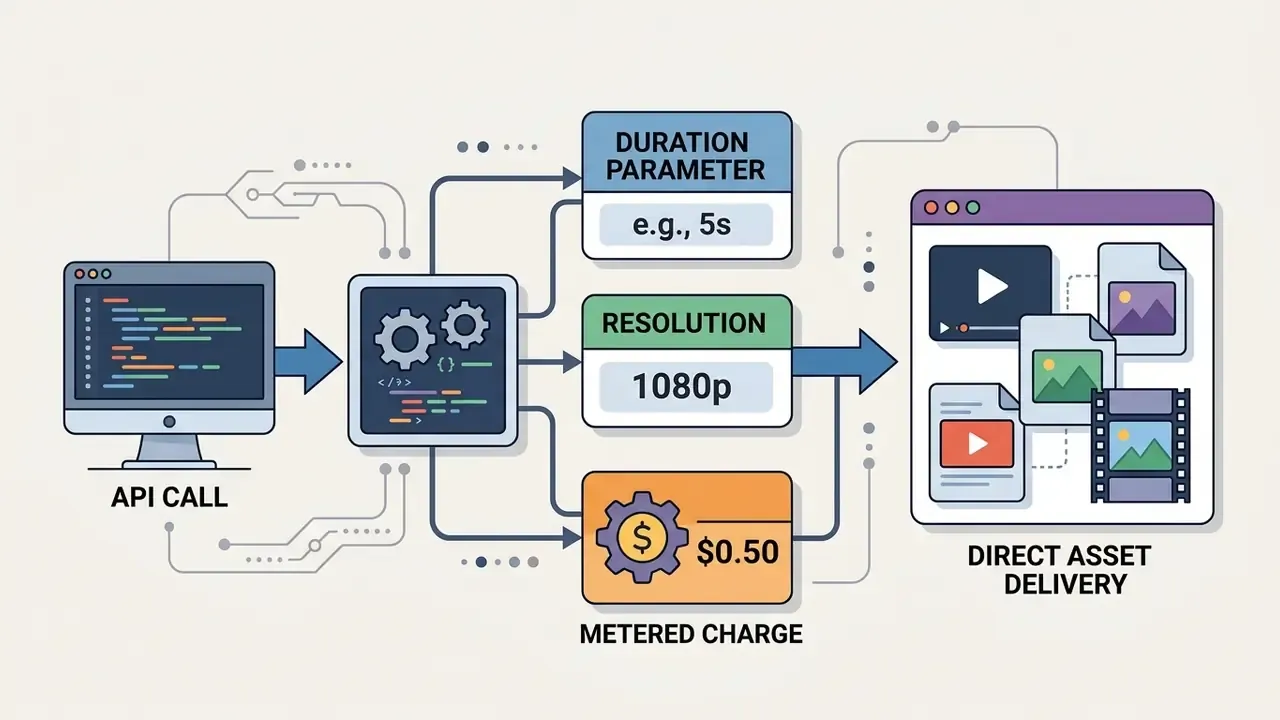
API access offers the lowest per-unit cost, but it demands technical proficiency: API keys, JSON request payloads, asset storage. This layered structure is a deliberate market strategy, not an accident of engineering:
«Leading AI providers combine free tiers, subscriptions and usage-based APIs as a multi-part tariff to segment heterogeneous users under competition.»
So organizations weigh lower marginal asset costs against engineering effort: custom front-end interfaces, integration scripts, and duration accounting for credit conversion.
Subscription plans and their usage limits
Subscription plans package a fixed allotment of monthly credits, rendering priority, and interface features into a recurring fee. Tiered plans suit predictable, high-volume schedules where usage stays steady month over month.
Standard consumer tiers run from entry-level options ($12–$15 per month for around 600 credits) to professional tiers ($35–$76 per month for 2,200–6,000 credits), with frontier access sold at $20 per month (ChatGPT Plus) and $200 per month (ChatGPT Pro). Higher tiers usually add concurrent generation channels, faster queue placement, and expanded storage. OpenAI's Sora billing documentation quantifies the ceilings: Plus and Business accounts allow up to two concurrent generations at up to 5 seconds in 720p or 10 seconds in 480p, while Pro allows five concurrent generations, 1080p output, and 20-second clips. Higgsfield's Seedance monthly plans similarly cap resolution at 480p/720p and duration at 8 seconds on Plus or 15 seconds on Ultra.
To explore options tailored to specific team sizes and output volumes, creators can consult our interactive plan selector for a structural breakdown by tier.
| Pricing Dimension | Credit-Based Pay-As-You-Go | API Direct Metering | Tiered Subscription Plan |
|---|---|---|---|
| Payment Mechanism | One-time prepaid credit packs | Billed per second or request via API key | Fixed monthly or annual recurring charge |
| Cost Control | High; strict limit based on prepaid balance | Absolute; metered to exact usage milliseconds | Moderate; fixed floor price regardless of usage |
| Access Complexity | Low; web UI point-and-click interface | High; requires API integration or developer tools | Low; web UI point-and-click interface |
| Credit Expiry Risk | Zero to low (platform dependent) | Zero; no credits involved | High; unused monthly balance expires every 30 days |
| Data Retention Posture | Consumer defaults; retention and training terms vary by vendor | Enterprise-grade options: zero-data-retention flags, regional processing, DPAs | Consumer defaults; prompts and uploads may be retained for abuse review |
| Auditability | Weak; per-seat purchases, often on personal or corporate cards | Strong; per-key logs, budgets, and request-level attribution | Moderate; seat-level activity only |
| Ideal User Profile | Sporadic creators, campaign projects | Developers, high-volume automation pipelines | Continuous daily producers, agencies with stable work |
How to calculate the real cost of AI video generation
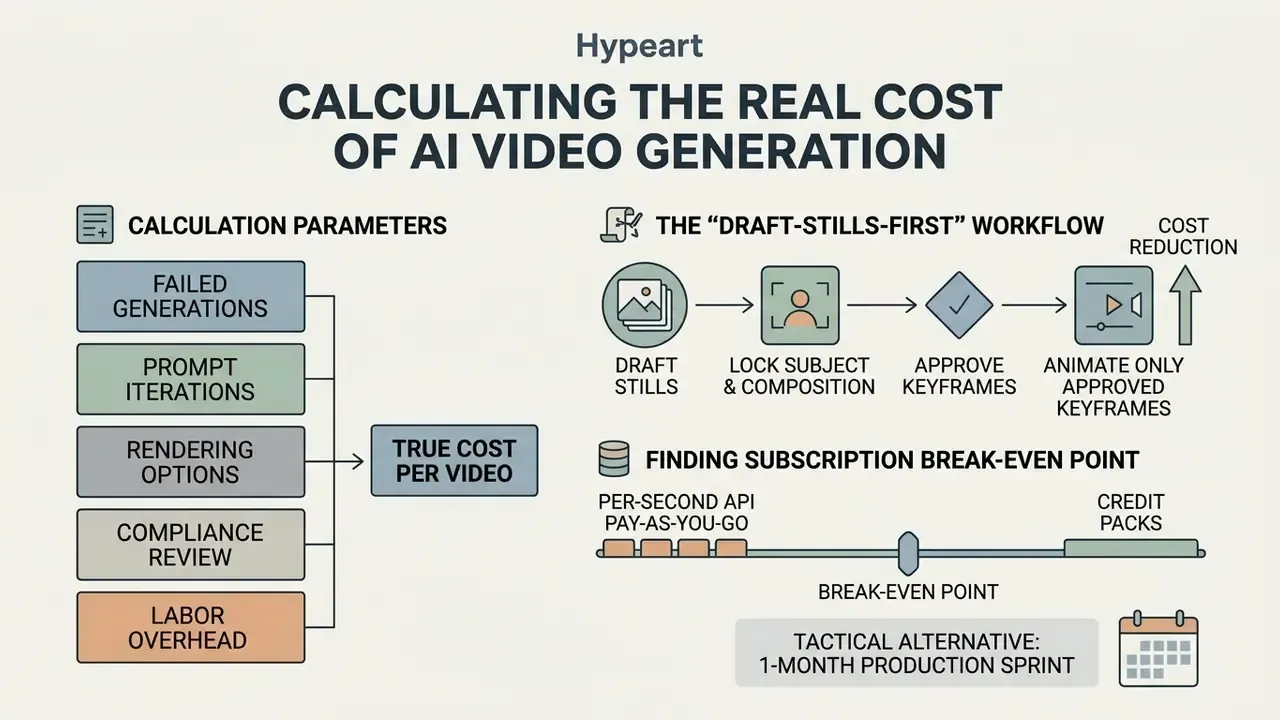
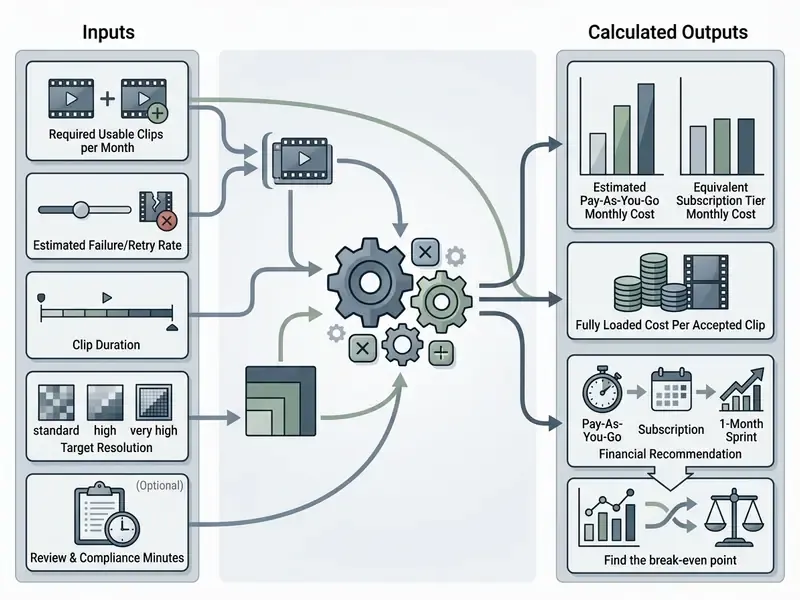
Calculating the true cost of AI video assets means accounting for generation failure rates, prompt iteration cycles, rendering parameters, compliance review, and labor overhead. The sticker price on a landing page rarely reflects the final cost per usable, production-ready clip. Fixing this methodology before shortlisting platforms prevents the classic mistake: choosing an engine on advertised per-second price alone.
Dividing a monthly fee by a nominal credit quota yields a misleading unit cost. A rigorous method has to carry retry frequency and quality rejection rates into the arithmetic.
Cost per successful clip, not cost per generation
«Automatic credit restoration for interrupted or server-side failed renders means users are not charged for infrastructure faults.»
The "Draft-Stills-First" cost-reduction workflow
Prompting straight into video means high rejection rates at full video rates, roughly $0.50 to $2.00 per attempt. Moving iteration to image endpoints collapses the cost of being wrong:
- Draft still images first.Generate and iterate initial frames on low-cost image endpoints. Published rates run from roughly $0.03 per image (Z Image Turbo class) through $0.10 (Seedream v5 Lite) to $0.14 (Flux 2 Pro) and $0.25–$0.49 for 1K to 4K Nano Banana 2 output.
- Lock subject and composition.Refine prompt vectors, lighting, wardrobe, and character detail on static stills until whoever approves the final asset signs off on the frame.
- Animate approved keyframes only.Feed the finalized high-resolution image into an image-to-video pipeline (LTX-2.5 Pro, Veo 3.1, Seedance 2.5) and spend video credits exclusively on the winning frame.
Financial impact: because failures now happen at image prices instead of video prices, video-side retries drop by up to 75%, moving effective cost per usable clip from roughly $2.00 down to about $0.45. Platforms that share one credit balance across image and video models amplify the saving, since drafting and animating no longer require two separate purchases.
A related trick belongs to the same family. FLUX 3 Video maintains a reusable draft cache, so a team can generate a cheap preview and then promote that exact draft to full quality instead of regenerating from scratch. Same economic logic, implemented at the model level.
Finding the subscription break-even point
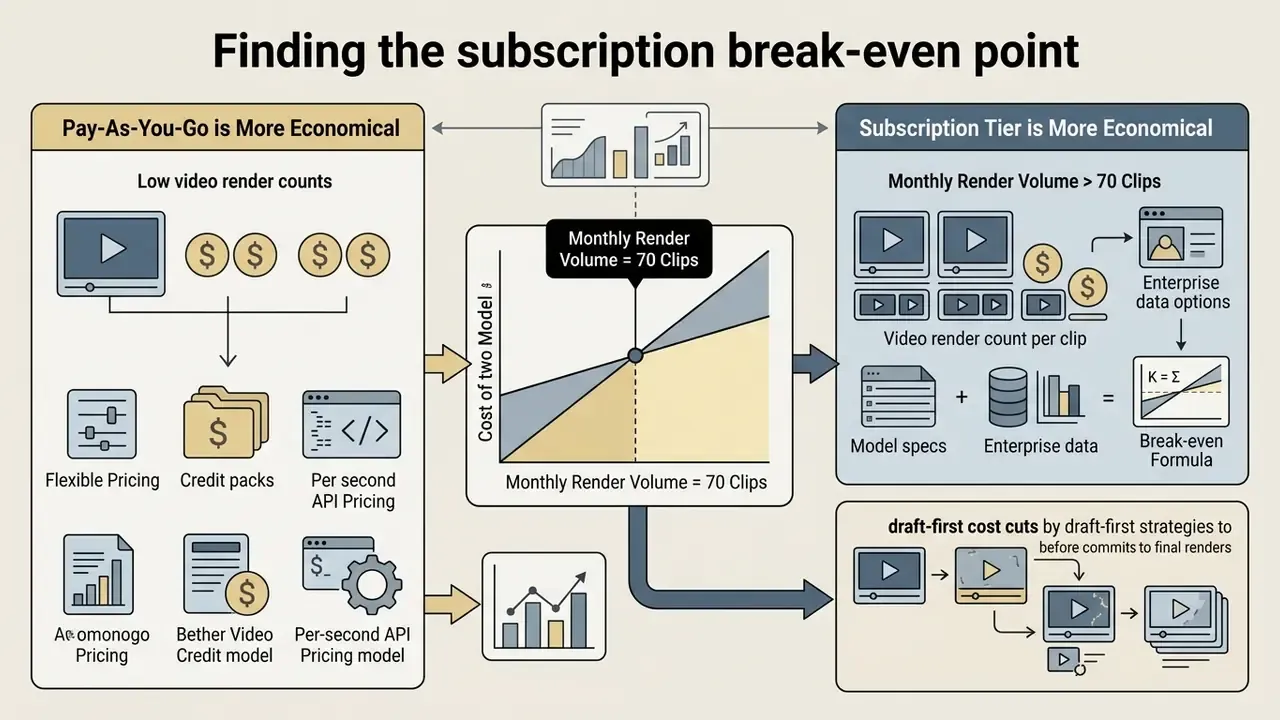
The subscription break-even point is the monthly render volume at which a recurring plan becomes cheaper than metered billing. Below that threshold, pay-as-you-go is the mathematically superior choice.
To find break-even render volume (), divide the fixed monthly subscription cost () by the metered cost per generation ():
If a professional subscription costs $35.00 per month and metered API rendering costs $0.50 per 5-second video, break-even sits at 70 successful videos per month ($35.00 / 0.50$).
Enterprise control: data retention, licensing exposure and Shadow AI
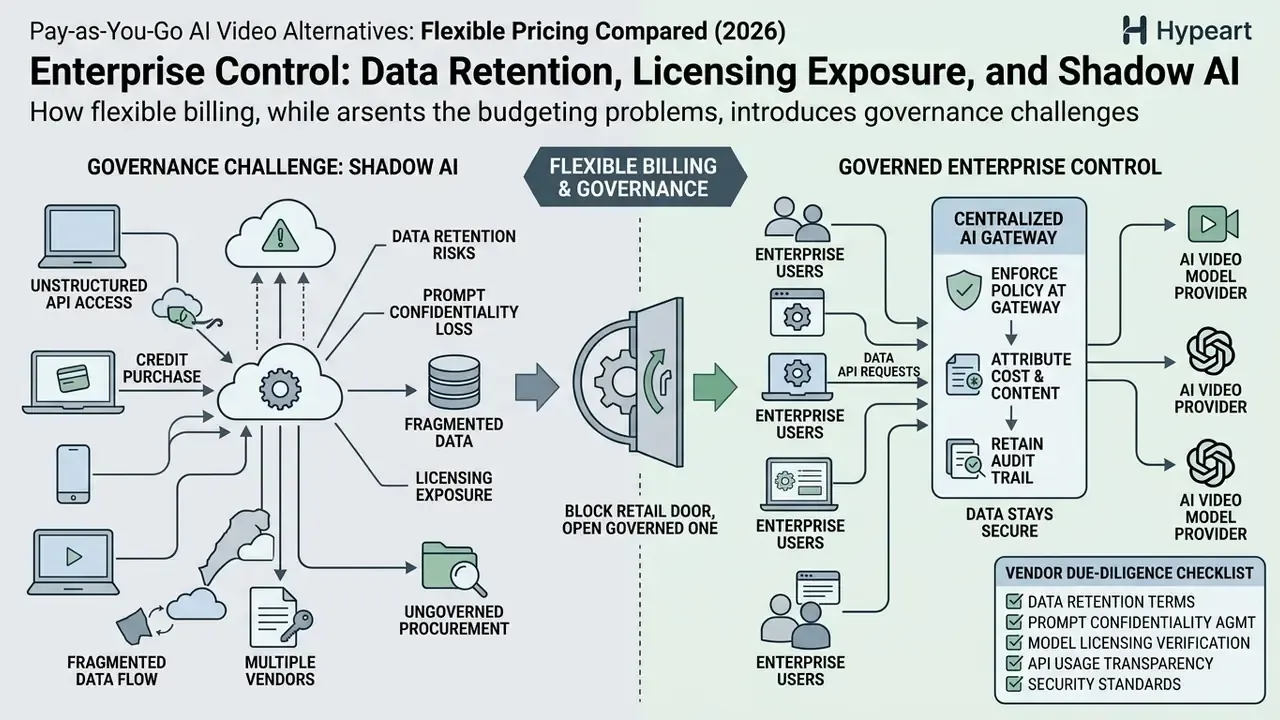
Flexible billing solves a budgeting problem and introduces a governance one. A subscription concentrates usage in one auditable contract. Credit packs distribute purchasing power across individual employees, which is why risk, compliance, and procurement should read the pricing page as a control document.
This section describes general risk-management practice and is not legal advice. Verify current vendor terms, certifications, and data-processing agreements directly with each provider.
Data retention and prompt confidentiality
Consumer web interfaces and developer APIs often operate under different data terms for the same underlying model. Before uploading a script, a reference photograph, an unreleased product render, or a customer likeness, confirm four points in writing:
| Verification item | Why it matters | Where to confirm |
|---|---|---|
| Training on customer inputs | Consumer tiers may permit model improvement using prompts and uploads; enterprise API terms typically exclude it | Terms of service + DPA |
| Retention window / zero-data-retention flag | Determines whether prompts persist for abuse review and for how long | API documentation, enterprise addendum |
| Processing region and sub-processors | Drives cross-border transfer exposure | DPA, sub-processor list |
| Security certifications (ISO/IEC 27001, SOC 2 Type II) | Evidence for vendor due diligence files | Trust centre / audit reports |
Vendor ownership is a legitimate part of the assessment. Public reviews of ByteDance-owned and Kuaishou-owned tooling repeatedly flag data-jurisdiction concerns for client-facing and regulated work, even where output quality is excellent. That is a distinction between creative fitness and contractual fitness, and risk owners should document it rather than argue it informally over Slack.
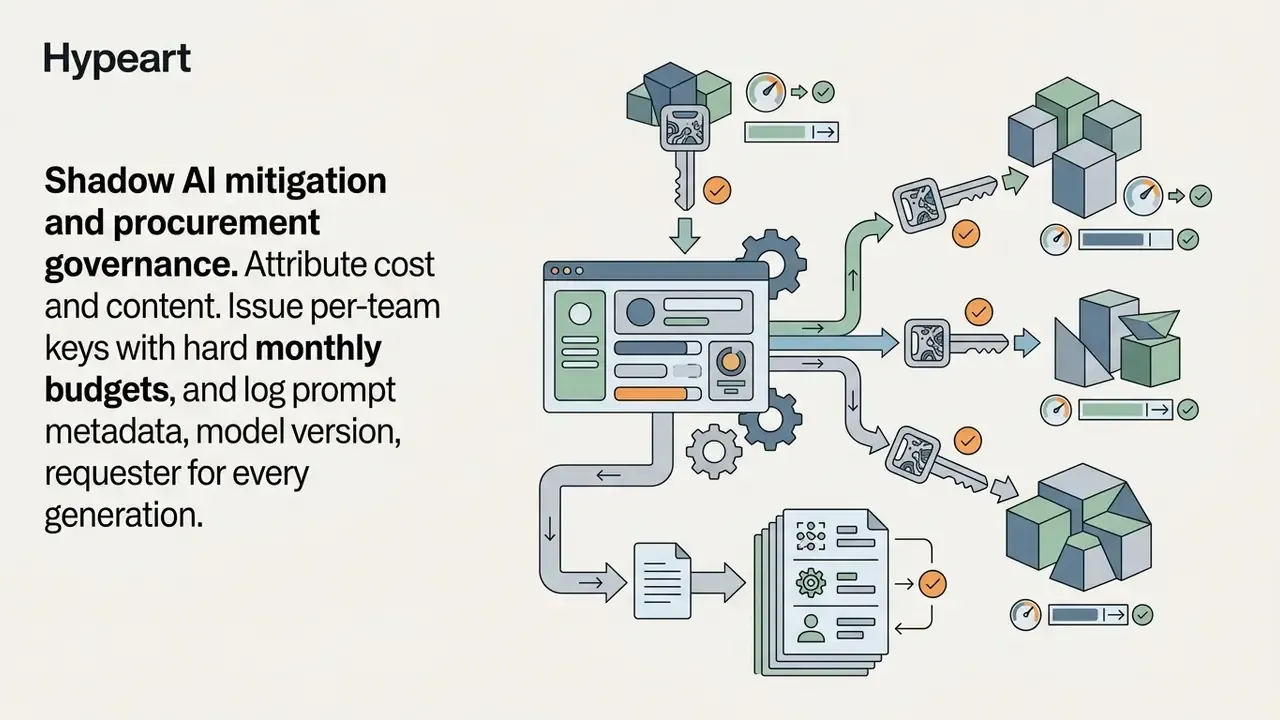
Shadow AI mitigation and procurement governance
A $4.98 credit pack triggers no procurement review, no security assessment, and no data-processing agreement. That is precisely the problem. Low-friction purchases are the fastest route to unmanaged generative tooling inside an organization.
A workable control pattern:

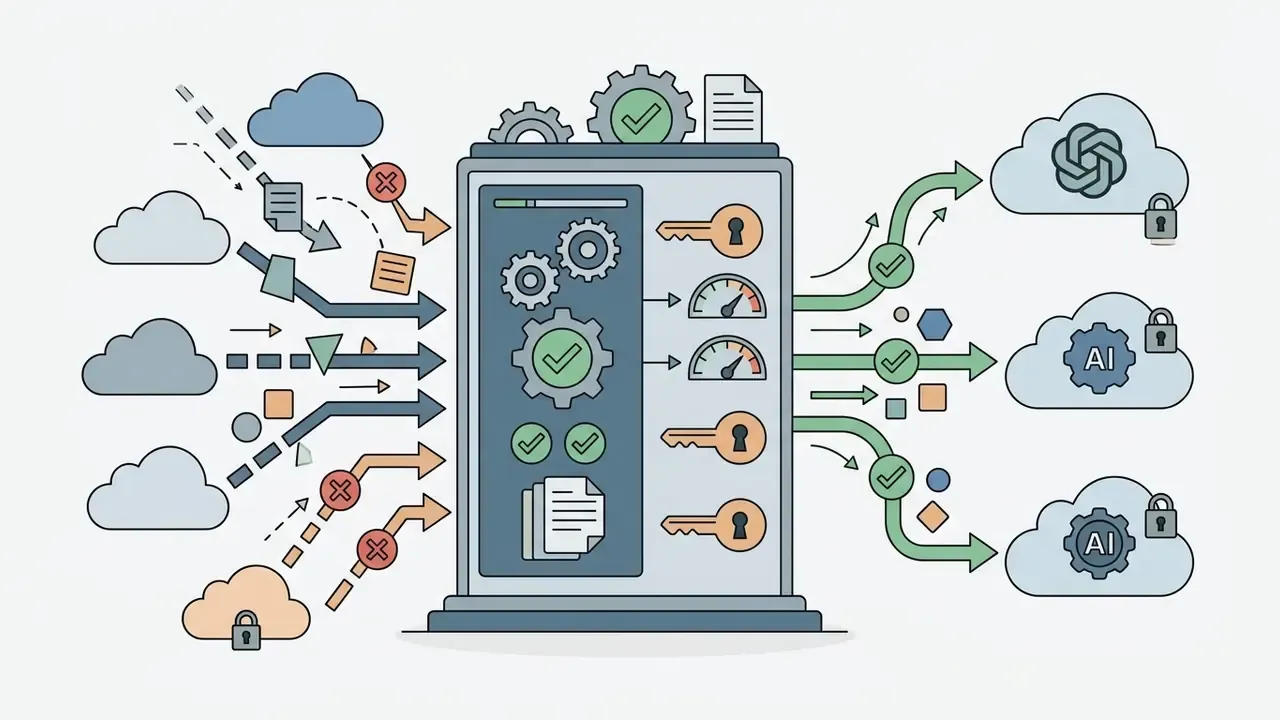
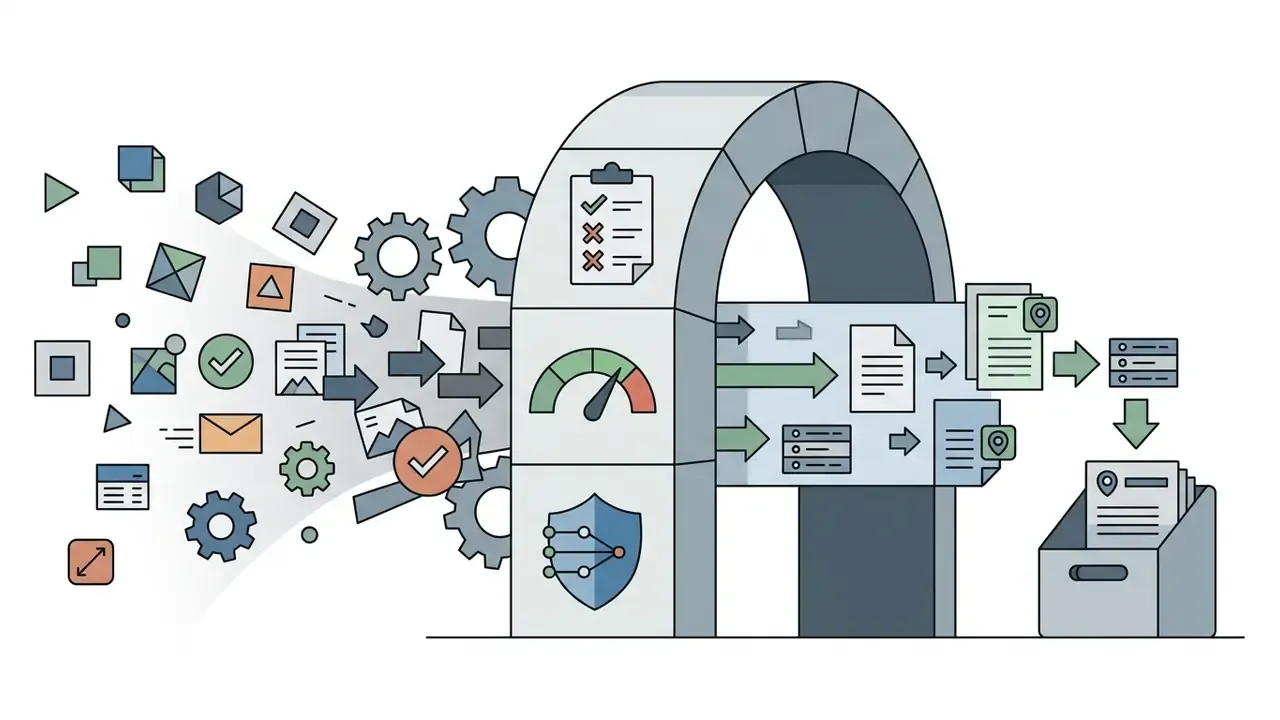

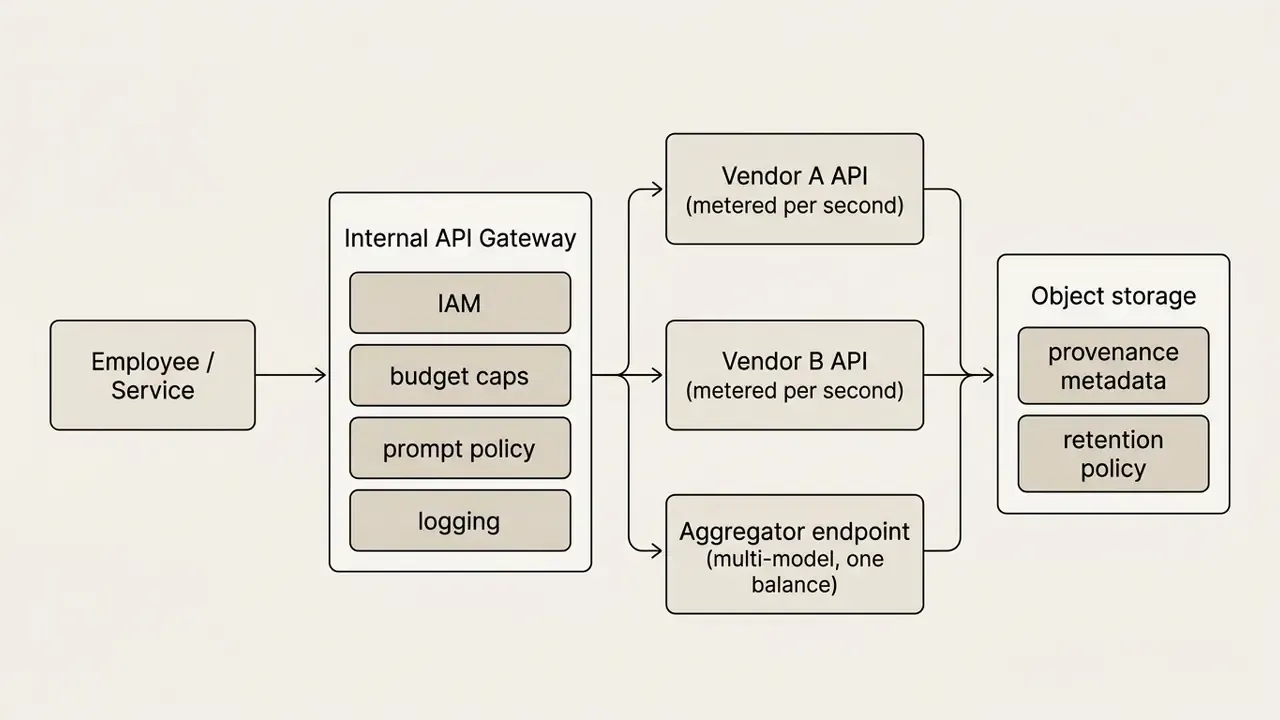
Availability risk belongs in the same review. Aggregators reduce vendor lock-in, since switching engines becomes a configuration change rather than a rebuild, but they add a dependency layer too. Confirm published uptime commitments, queue behaviour under load, and whether the aggregator or the upstream provider owns the SLA.
Vendor due-diligence checklist before buying credits
Checklist0 / 7
What to compare before choosing a flexible AI video tool
Selecting a flexible video generator means evaluating technical output metrics, not just price per credit. Cost efficiency is meaningless if rendered assets show severe artifacts, temporal flickering, or inconsistent camera movement that makes them unusable commercially.
Technical evaluation balances visual quality against generation speed, maximum clip limits, editing flexibility, and native audio synchronization. A thorough platform review keeps budget from draining into a low-quality engine.
Output quality, motion and temporal consistency
Generation speed, clip length and resolution
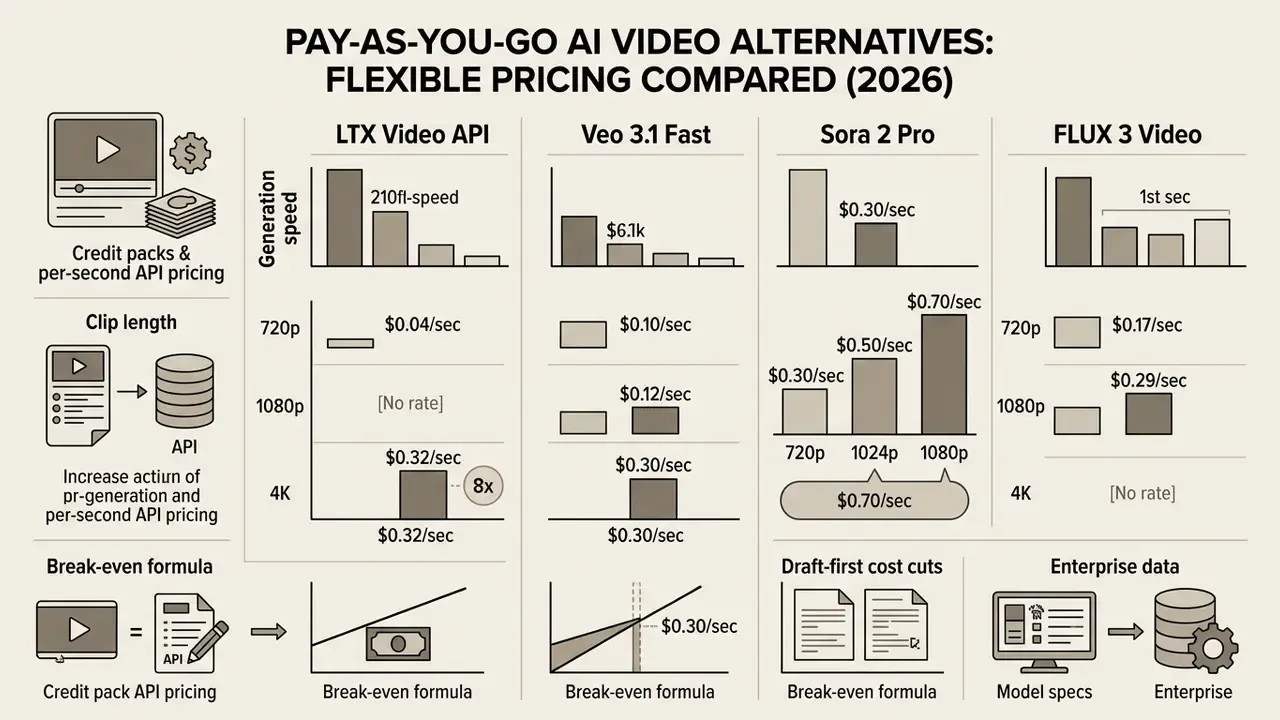
Resolution therefore hits both visual clarity and rendering cost, with billed rates scaling two- to eight-fold between draft output and native 4K. Choosing a platform that permits low-cost 480p or 720p preview runs before committing compute to final 1080p or 4K rendering optimizes overall spend. One practical corollary: paying for a 1080p tier on content viewed at 720p inside a social feed is money spent on resolution nobody sees.
Editing, audio and creative control options
Advanced creative controls decide how cleanly a tool slots into a professional pipeline: camera motion vectors, seed pinning, lip-synchronization, multi-track audio layering. Raw generation without fine-grained control pushes editors toward external video editing tools for every correction.
Leading platforms expose precise camera parameters, letting creators specify pan, tilt, zoom, and roll velocities through UI sliders or explicit prompt descriptors. Several 2026 endpoints treat these as request parameters rather than prose: LTX-2.5 Pro accepts eight named camera moves including dolly_in, dolly_left, jib_up, and focus_shift, which removes the ambiguity of describing movement in natural language. Seed pinning ensures that re-running a prompt with small text edits preserves the underlying visual layout, which makes iterative shot refinement realistic instead of random.
Audio capability has moved well past silent rendering. Integrated tools such as Pika's performance features and ElevenLabs AI voice synthesis offer native lip-sync alignment, automated sound effects, and ambient audio matching inside the web workspace. Documented feature sets differ: Magnific's clip editor combines lip-sync with a video upscaler covering 720p through 4K, ElevenLabs pairs lip-sync with 4K upscaling in one workspace, and Runway's lip-sync guidance recommends generating a short test before committing to a full render. Skipping manual audio alignment shortens publishing cycles for social and marketing teams considerably.
Best pay-as-you-go AI video alternatives by platform type
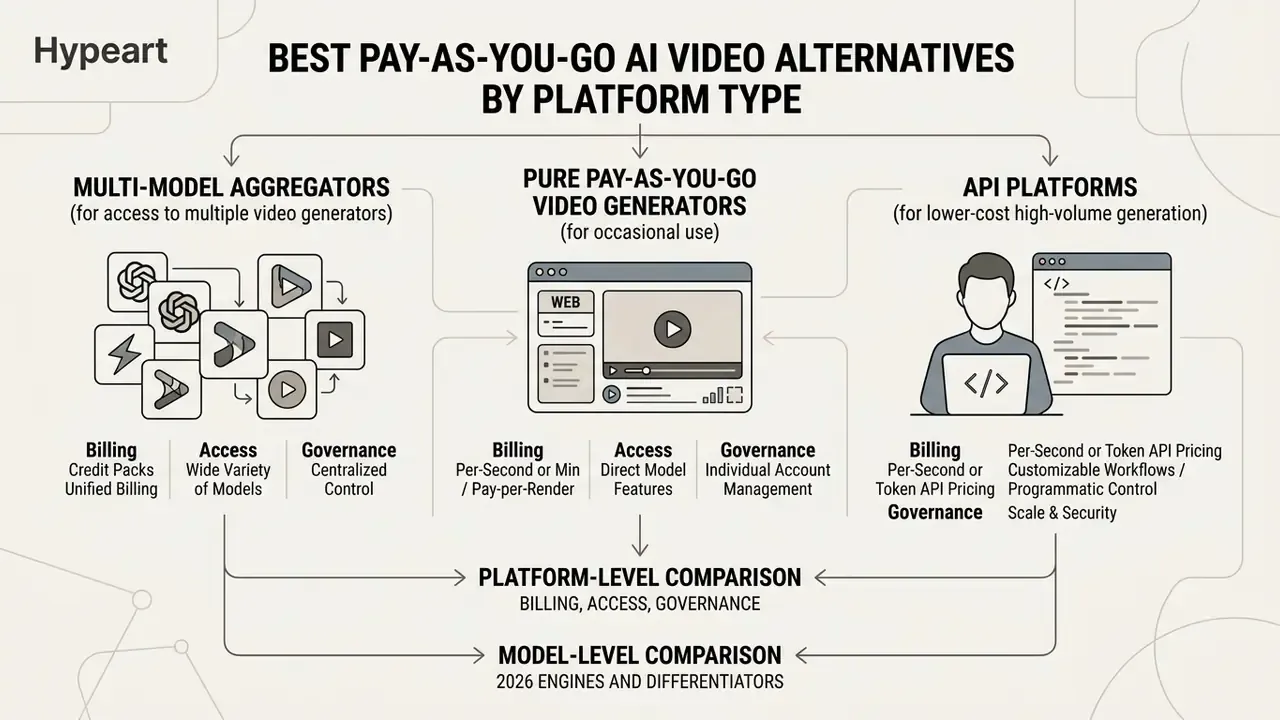
The landscape of flexible AI video generation splits into three operational categories: multi-model aggregators, dedicated pay-as-you-go web services, and developer API infrastructure. Each type suits a different technical capability and volume profile. These categories differ not only in convenience but in security class. An enterprise API endpoint governed by a data-processing agreement and a consumer web UI selling a $4.98 credit pack are not interchangeable procurement objects.
Platform-level comparison: billing, access and governance
| Platform / Service | Primary Category | Pricing Structure | Entry Minimum | Key Strengths & Model Access | Governance Notes | Verified Documentation Source |
|---|---|---|---|---|---|---|
| Runway Dev API | Developer API | Credits at $0.01 each; Gen-4 Turbo 5 credits/sec ($0.05/s), Gen-4 12 credits/sec | Pay-as-you-go usage | Gen-4, Gen-4 Turbo, Aleph, 4K export, strong camera control | Developer-portal billing separate from consumer plans; per-key attribution | Runway Developer Docs, 2026 |
| OpenAI Sora API | Developer API | $0.10/s Sora 2; $0.30–$0.70/s Sora 2 Pro | Usage-based billing | High photorealism, Sora 2 physics, 1080p native output | Enterprise data terms differ from ChatGPT consumer tiers | OpenAI API Pricing Page, 2026 |
| Google Veo 3.1 API | Developer API | $0.10/s Veo 3.1 Fast; $0.40 per generation Standard; $0.05 Lite | Google Cloud meter | Native audio sync, high prompt adherence, 4K tier | Cloud-native IAM, project-level budgets, regional controls | Google Gemini API Pricing, 2026 |
| FAL.AI / Replicate | Model Aggregator | Pure pay-per-second / pay-per-run across external models | $0 minimum (metered) | LTX, Seedance, Wan, Hunyuan, Veo behind one endpoint | One key, many upstream providers; confirm sub-processor chain | FAL.AI Model Registry, 2026 |
| Seedance AI Video | Dedicated Web UI | One-time credit packs; auto-refunds on server-side failure | ~$20 one-time credit pack | Seedance 2.0 / 2.5 models, priority render controls, 4K export | Consumer terms; verify plan-level commercial grant | Seedance Official Pricing, 2026 |
| vidflux ai | Dedicated Web UI | Pure pay-as-you-go credit packages | $4.98 for 500 credits | Fast entry point, zero recurring subscription required | Low-friction purchase equals highest Shadow AI exposure | Vidflux Platform Docs, 2026 |
| HeyGen API | Avatar / Niche API | Usage-based balance top-ups | $5 balance charge | Professional AI avatars, automated multilingual lip-sync in 175+ languages | Likeness consent policies critical for avatar use | HeyGen API Developer Portal, 2026 |
Model-level comparison: 2026 engines and their differentiators
| Platform / Model | Primary Category | Pricing Structure | Native Specs & Audio | Key Technical Differentiator |
|---|---|---|---|---|
| MiniMax Hailuo H3 | Model API / Aggregator | $0.08 / sec (768p) | Up to 2K/4K, native audio | Lowest entry rate for high-fidelity 2K video; subject-reference and camera-direction control |
| FLUX 3 Video | Aggregator / API | $0.17 / sec (720p); $0.29 / sec (1080p) | 1080p, multimodal audio, up to 20s | Reusable draft cache promotes a cheap preview to full quality; text, image, and frame-to-frame input |
| LTX-2.5 Pro | Open Weights / API | $0.12 / sec (720p, Pro) | 1080p (Pro), up to 4K and 20s (Fast), lip-sync | Open weights with LoRA fine-tuning; native multi-shot cuts; eight explicit camera-motion parameters |
| Seedance 2.5 | Multi-shot Engine | ~$0.30–$0.47 / sec | 30s single take, native audio, 50 reference inputs | Up to 30 continuous seconds in one forward pass, no stitching; audio co-generated at no token premium |
| Kling O3 4K | Web UI / API | $0.42 / sec (4K) | Native 4K export, 3–15s | Delivery-ready 4K rendering with no separate upscaling stage |
| Happy Horse 1.1 | Model API | $0.14 / sec (720p) | 720–1080p, native audio | Fluid lifelike motion with multilingual lip-sync straight from text |
| Veo 3.1 | Developer API | $0.10–$0.40 / sec by tier | 720p/1080p/4K, native audio, clip extension | True 4K with synchronized audio and documented extension passes |
| Gemini Omni Flash | Developer API | ~$0.125 / sec (720p) | 3–10s, synchronized audio | Physics-grounded short clips at low cost for rapid iteration |
Two structural points deserve emphasis for commercial teams. First, open weights change the ownership equation. LTX-2.5 ships a raw pretrained checkpoint alongside the production model, so studios can train LoRAs on proprietary characters, sets, or brand styling and reuse them across projects. No closed API offers that, and it shifts spend from per-second inference toward one-time fine-tuning. Its Pro endpoints also concentrate compute on complex scenes instead of spreading it evenly across frames, which is why crowds and fast motion hold together better than the per-second price suggests. Second, draft caching and native multi-shot generation are cost features dressed as quality features. Promoting a cached FLUX 3 draft, or letting Seedance 2.5 handle its own cuts internally, removes entire re-render cycles from the budget.
Model aggregators for access to multiple video generators
Model aggregators consolidate several independent neural video models, among them Kling, Veo, Seedance, Wan, and LTX Video, into a single web interface or API ecosystem with one unified credit balance. That removes the overhead of separate accounts and billing profiles across multiple AI vendors.
Platforms like FAL.AI, Replicate, and Mobbi AI expose dozens of state-of-the-art video, image, and audio models under pay-per-generation pricing, and comparable aggregators advertise 30 to more than 100 models behind one balance. Users hold one dollar or credit balance and pick an engine per project requirement. A creator can use LTX Video for fast, low-cost draft storyboard clips ($0.04 per second) and switch instantly to Google Veo 3.1 ($0.40 per second) for a final cinematic hero shot inside the same dashboard, then reach for other AI video model alternatives when a specific aesthetic or aspect ratio calls for it.
Unified aggregators also streamline comparative prompt engineering. Running identical image prompts across three underlying models at once lets a production team pick the visually superior output without manual cross-platform asset transfers. Because the code path barely changes between models, usually a single string edit, aggregators double as an anti-lock-in layer: moving a project from one engine to another is configuration, not reconstruction.
Pure pay-as-you-go video generators for occasional use
Pure pay-as-you-go web generators serve non-technical creators who need occasional assets through a browser, without a recurring plan. These platforms sell one-time top-ups that neither auto-renew nor expire at month-end.
Services like vidflux ai offer entry-level credit packages ($4.98 for 500 credits), enough for small batches on demand. Seedance AI Video provides non-subscription credit packs with automatic refund protection for interrupted renders. Unused credits sit in the account indefinitely on platforms that publish a no-expiry policy, a genuine financial safe harbor for irregular schedules. Verify it per vendor though, since some services that market themselves as flexible still expire credits after 30 days.
Creators looking for free introductory options can review our evaluation of the best free AI video generators to test core model performance before buying credit packs.
API platforms for lower-cost high-volume generation
API platforms are the most cost-effective route for high-volume production, automated social content pipelines, and developers embedding generative video into commercial applications. Skipping consumer UI overhead yields real marginal savings per rendered clip.
Developer documentation from OpenAI, Runway, and Google Cloud sets out precise per-second metering:
- OpenAI Sora 2: $0.10 per second for standard output and $0.30–$0.70 per second for Sora 2 Pro high-resolution rendering.
- Runway Dev API: 5 credits per second for Gen-4 Turbo ($0.05 per second equivalent at $0.01 per credit), 12 credits per second for Gen-4, and up to 40 credits per second for Veo 3.1 with full audio synthesis; reference-video input is billed separately per second.
- Google Veo 3.1 via Gemini API: $0.10 per second for Veo 3.1 Fast (720p), $0.12 per second at 1080p, and $0.30 per second at 4K, with Standard and Lite generation tiers published separately.
{
  "model": "sora-2",
  "prompt": "Cinematic wide shot of a futuristic bank vault, dramatic lighting, 8k resolution",
  "duration_seconds": 5,
  "resolution": "1080p",
  "billing_mode": "pay_as_you_go"
}
For implementation guidelines, code samples, and API rate limits, technical teams can consult our dedicated Google Veo API integration guide.
Which pay-as-you-go AI video option fits your workflow
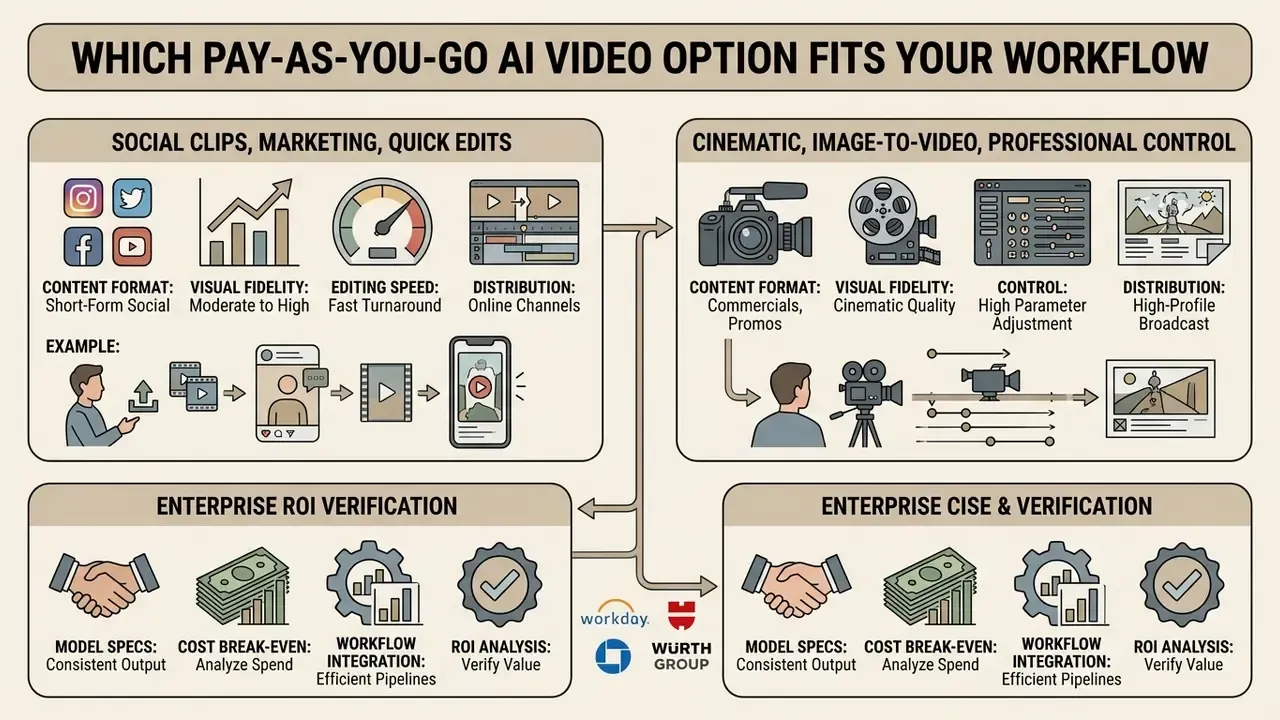
Matching a tool to a pipeline depends on content format, required visual fidelity, editing speed, and distribution channel. Different creative workflows demand distinct features and distinct pricing alignment.
Rapid social assets or high-end cinematic sequences: the right billing model differs, and picking it correctly is what keeps capital efficiency intact.
Options for cinematic, image-to-video and professional control
Cinematic production, commercial filmmaking, and premium brand assets demand maximum frame consistency, photorealistic physics, 4K output, and precise camera control.
Here, direct API access to OpenAI Sora 2 Pro ($0.30–$0.70 per second) or Google Veo 3.1 ($0.40 per second) delivers the strongest visual realism and motion fidelity. Where a single unbroken take is required, Seedance 2.5 generates up to 30 native seconds with joint audio. Where 4K must be delivery-ready without an upscaling stage, Kling O3 4K renders natively at $0.42 per second. When programmatic access is impractical, credit-based platforms like Seedance 2.5 or Runway Dev offer granular parameter control (seed pinning, motion vectors, structural conditioning) on a pay-per-use basis, and LTX-2.5 Pro adds explicit camera-move parameters plus LoRA fine-tuning for recurring characters.
Using high-tier models through credit packs lets indie filmmakers and agencies buy studio-grade effects for specific scenes without carrying enterprise software overhead all year. The same logic extends to adjacent animation tools used for stylized sequences and motion graphics.
Enterprise ROI verification. Usage-based video pipelines show measurable outcomes at corporate scale, not only at indie scale:
- Workday implemented API-driven avatar and localization pipelines, compressing international video deployment from weeks of vendor coordination to minutes per clip across 10 to 15 languages per asset.
- Würth Group shifted local marketing production to automated pay-per-use avatar and B-roll workflows, reporting an 80% reduction in translation and localization costs.
Both cases share one structural cause. Replacing per-project agency fees and per-language reshoots with metered generation converts a step-function cost curve into a linear one. Teams modelling a similar program should amortize the switching cost, meaning pipeline engineering, review workflow, and brand-safety screening, across the first ten to twenty videos rather than charging it all to campaign one.
FAQ about pay-as-you-go AI video alternatives
Are free AI video credits enough to test a tool?
Free starter credits are enough for interface orientation, prompt testing, and a first read on motion quality. They are rarely enough for complete commercial production.
Most major platforms grant a limited free welcome allocation at registration. Runway provides 125 one-time credits (around 25 seconds of Gen-4 Turbo), Pika offers 80 monthly credits restricted to 480p, Kling grants 66 watermarked credits per day, Hailuo AI offers a one-time 200-credit trial capped at 720p with a watermark, and Google Cloud provides $300 in free trial credits valid for 90 days across all cloud services, including Gemini and Veo API endpoints. Daily-refill models are structurally more useful than one-time grants: 100 credits refreshed every 24 hours accumulate to roughly 3,000 per month, enough for continuous draft-tier work.
These allocations let creators test prompt responsiveness and temporal stability, but output restrictions such as low resolution (480p or 720p), forced brand watermarks, and non-commercial licensing push serious work onto paid credit packs or metered APIs. Rule of thumb: free tiers validate prompt adherence and interface fit, and they are too small to validate motion quality across a full shot list.
Can pay-as-you-go tools be used for commercial video production?
This information is general and does not replace legal advice. Commercial licensing terms for AI platforms change frequently, so verify the current Terms of Service on each provider's official site before delivering client work.
Yes. Assets generated through paid credit packages or metered developer APIs generally include full commercial usage rights, so they can be monetized, broadcast, or delivered to client projects.
Commercial licensing terms hinge on the payment tier rather than the interface. Free trial tiers frequently restrict commercial exploitation or force platform watermarks, while paid credit packs and API endpoints grant non-exclusive or exclusive commercial rights under standard vendor terms. Vendor language varies materially: some providers state explicitly that free starter credits carry full commercial rights, others permit commercial use of AI-generated output while forbidding commercial use of bundled stock assets on free plans.
One distinction gets missed in procurement more often than it should. A usage license is not a commercial exploitation right. Some API terms grant a revocable, non-transferable license "for internal business purposes" while confirming that customers retain ownership of their content, wording that does not automatically authorize resale, sublicensing, or client delivery. Agencies producing client deliverables or monetized advertising must verify that their specific account tier provides commercial clearance, watermark-free exports, and an explicit right to sublicense to end clients.
Who owns the output, and who is liable if it infringes?
Most vendors assign ownership of generated output to the paying account holder while retaining an operational license to host, cache, and display the content in order to run the service. Liability is the harder question. Indemnification for third-party intellectual-property claims is typically offered, if at all, only on enterprise agreements and not on consumer credit packs.
Before publishing generated video in advertising or regulated communications, confirm three things in writing: whether the vendor indemnifies IP claims for the purchased tier, what restrictions apply to real-person likeness and voice cloning, and whether provenance metadata or synthetic-media disclosure is required in your jurisdiction and industry. Financial-services, healthcare, and legal marketing teams should treat generated video as regulated marketing material, subject to the same review and record-keeping obligations as any other advertisement.
Do pay-as-you-go credits expire?
It depends entirely on the vendor, and the answer materially changes unit economics. Published policies in 2026 range from "credits never expire" (AIVeed) through 30-day validity on subscription credits (Vidoly) to forfeiture of remaining balances after cancellation (Dzine AI). A practical test: if credits reset monthly, the product is a subscription regardless of how the pricing page is labelled. Confirm expiry, refund-on-failure, and post-cancellation terms before buying any large pack.
Key actionable takeaway and recommended next steps
To cut software spend and remove hidden platform costs across generative media workflows, content teams can follow a structured evaluation method. Treat this as the shortlist of pay-as-you-go AI video alternatives recommendations rather than a rigid procedure:
- Audit monthly generation volume. Calculate total rendered seconds required over a 90-day period to identify production peaks and idle weeks.
- Benchmark cost per usable clip. Measure your own rejection rate over the first twenty clips, then load review and compliance labor into the denominator to compare effective asset costs honestly.
- Adopt draft-stills-first iteration. Move prompt experimentation to image endpoints at $0.03 to $0.14 per frame and spend video credits only on approved keyframes.
- Deploy metered APIs for high volume. Shift automated or batch pipelines to direct endpoints (OpenAI Sora 2, Google Veo 3.1, Runway Dev, MiniMax H3) behind a centralized gateway to secure wholesale per-second pricing and per-team auditability.
- Use credit packs for sporadic work. Buy non-expiring one-time packs with automatic failure refund protection for irregular client campaigns.
- Reserve subscriptions for validated volume, or sprint. Subscribe only above the calculated break-even threshold, or run a 30-day production sprint and cancel before renewal.
- Close the governance gap before scaling. Verify retention terms, commercial grants, and indemnification per tier, and block untracked retail credit purchases on corporate cards.
For guidance on selecting flexible software tiers across generative media tools, see our Pay-As-You-Go AI Video Guide to compare current pricing updates and platform limits.
Appendix A: superseded source annotations (retained for transparency)
The following earlier formulations were revised in this update for source precision. They are preserved verbatim so readers can trace the editorial change:
- Original citation form
- "A 2024 empirical study on recurring billing inattention by Einav, Klopack, and Mahoney (Selling Subscriptions, NBER) revealed that automatic renewal structures increase vendor revenues by 14% to over 200% purely due to consumer inertia and forgotten accounts. When payment details require manual updates, monthly renewal rates drop drastically, confirming that many users pay for services they no longer actively utilize." Superseded by the direct quotation and NBER URL in the section above.
- Original citation form
- "According to the OpenView SaaS Benchmark Report, over 63% of digital software providers have integrated usage-based or hybrid billing structures." Superseded by the dated Chargebee/OpenView figure with URL.
- Original compute-scaling estimate
- "720p Render -> 1.0x Base Compute Cost; 1080p Render -> 2.2x Base Compute Cost; 4K Upscale -> 4.5x Base Compute Cost." Superseded by verified published per-second rates, which show resolution multipliers between roughly 1.2x and 8x depending on vendor rather than one industry constant.
- Original rejection-rate phrasing
- "creators experience a rejection rate between 30% and 60% depending on prompt complexity and temporal stability requirements," and "creators must budget for an average retry multiplier of 2.5x to 3.5x per final asset." Retained as directional production observations, now explicitly labelled as lacking a vendor-independent public benchmark.