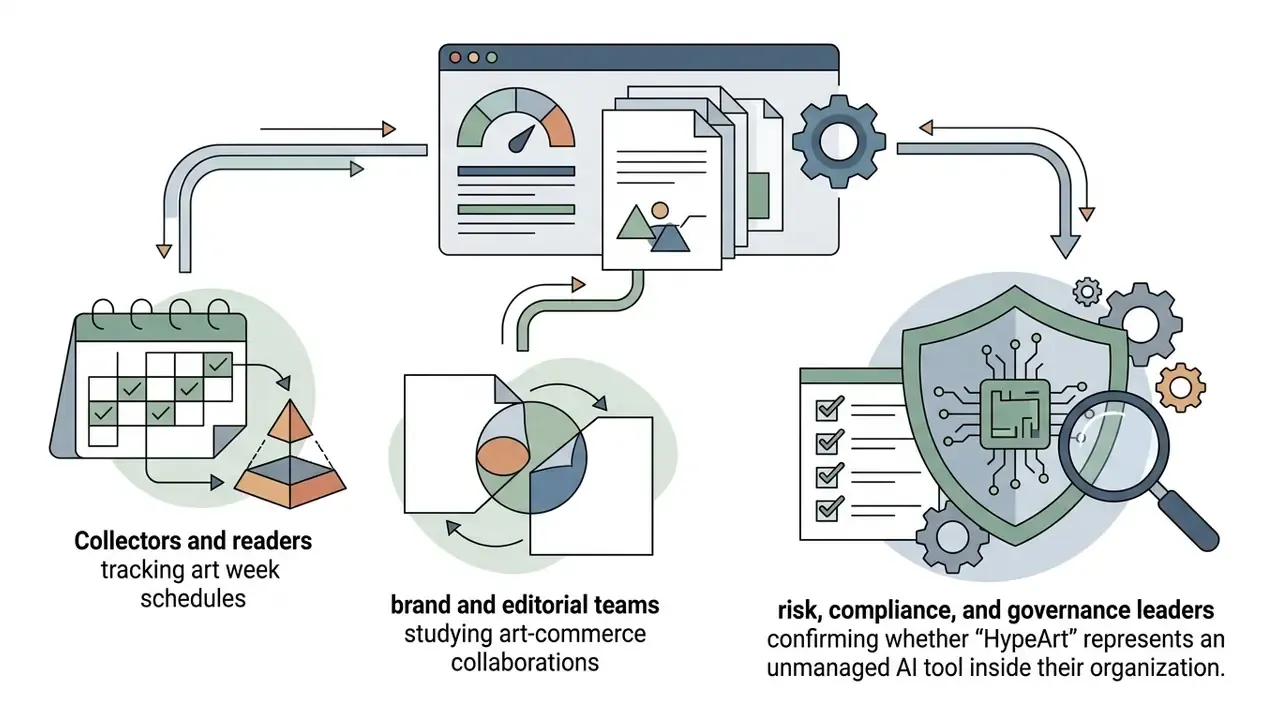
There is a second audience here, and it is less obvious. Risk and compliance teams sometimes encounter the name "HypeArt" in traffic logs or vendor lists and need to know whether it is a media brand or an unmanaged AI tool. That question gets a direct answer below.
Executive Summary at a Glance
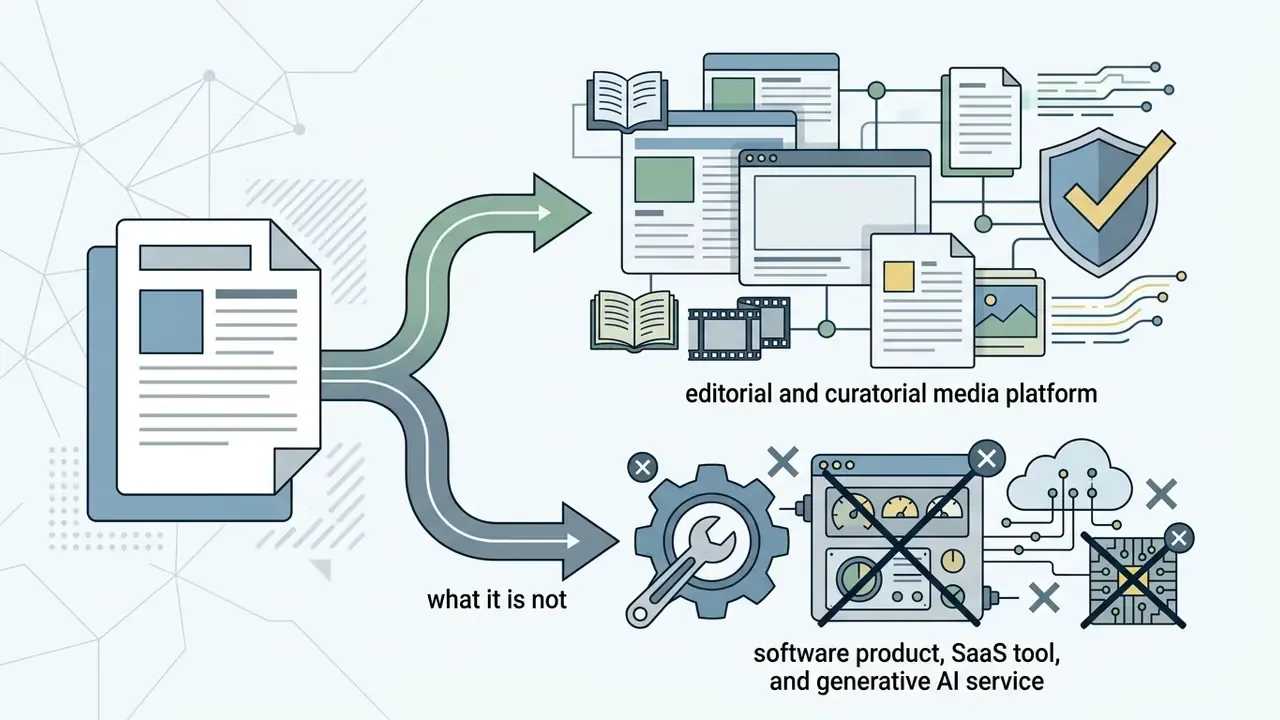
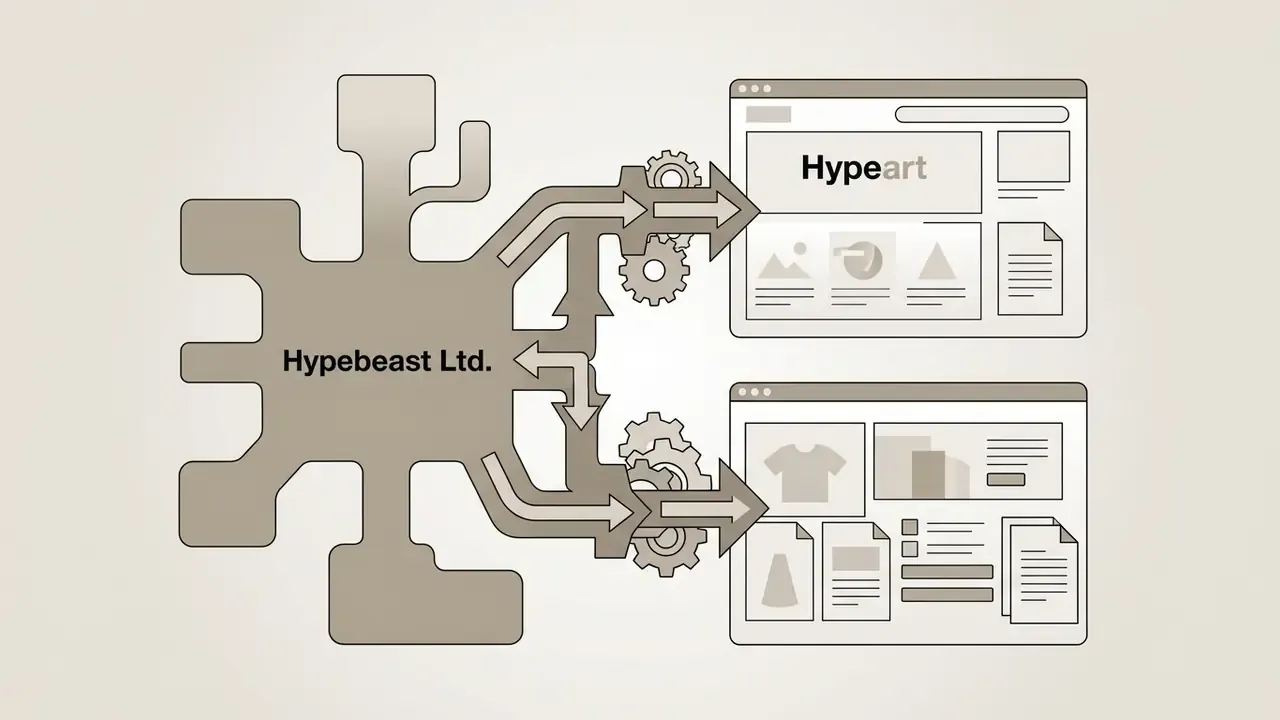
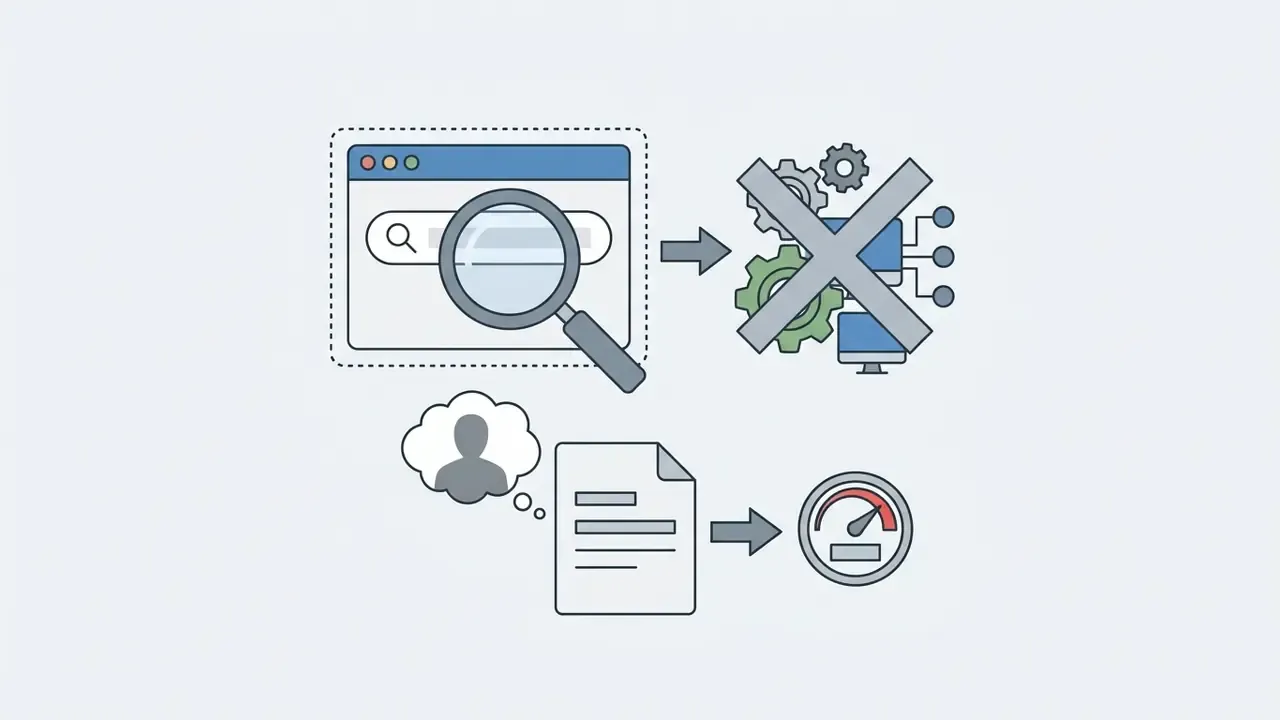
hypeart.ai does not resolve via DNS records and hosts no verified product, API, or enterprise offering. There is no evidence of a commercial AI service operating under the HypeArt name.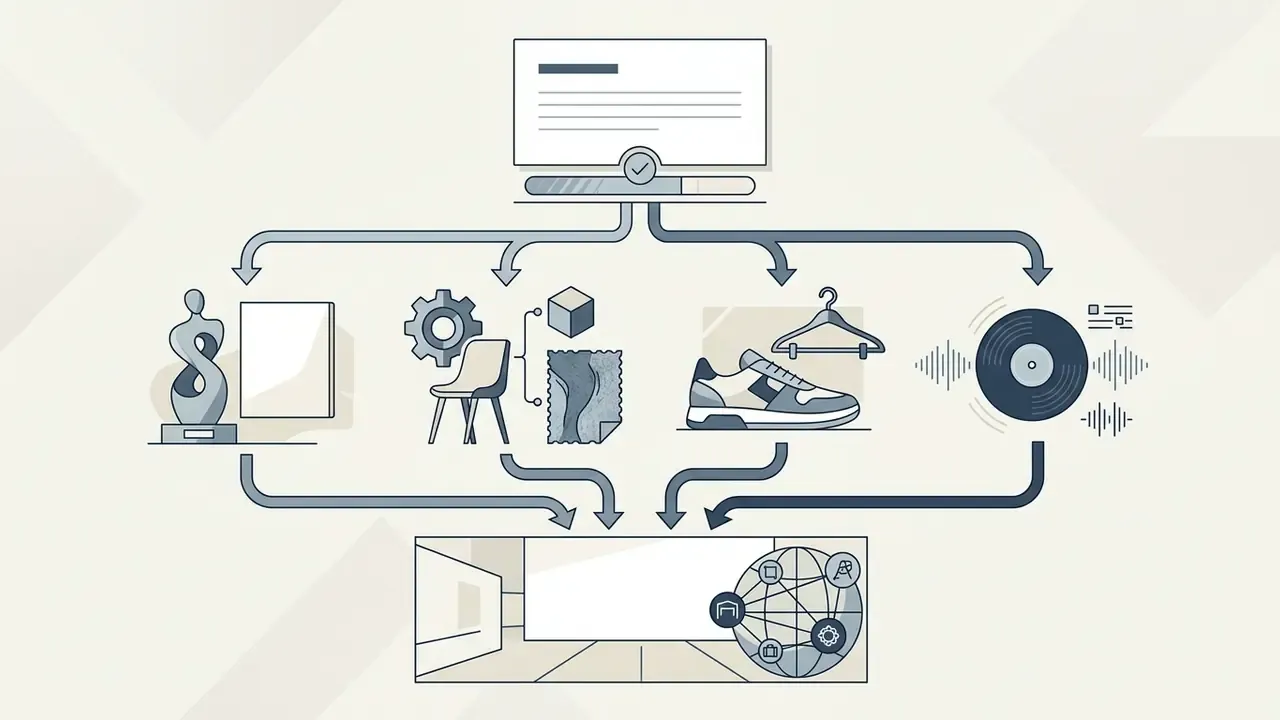
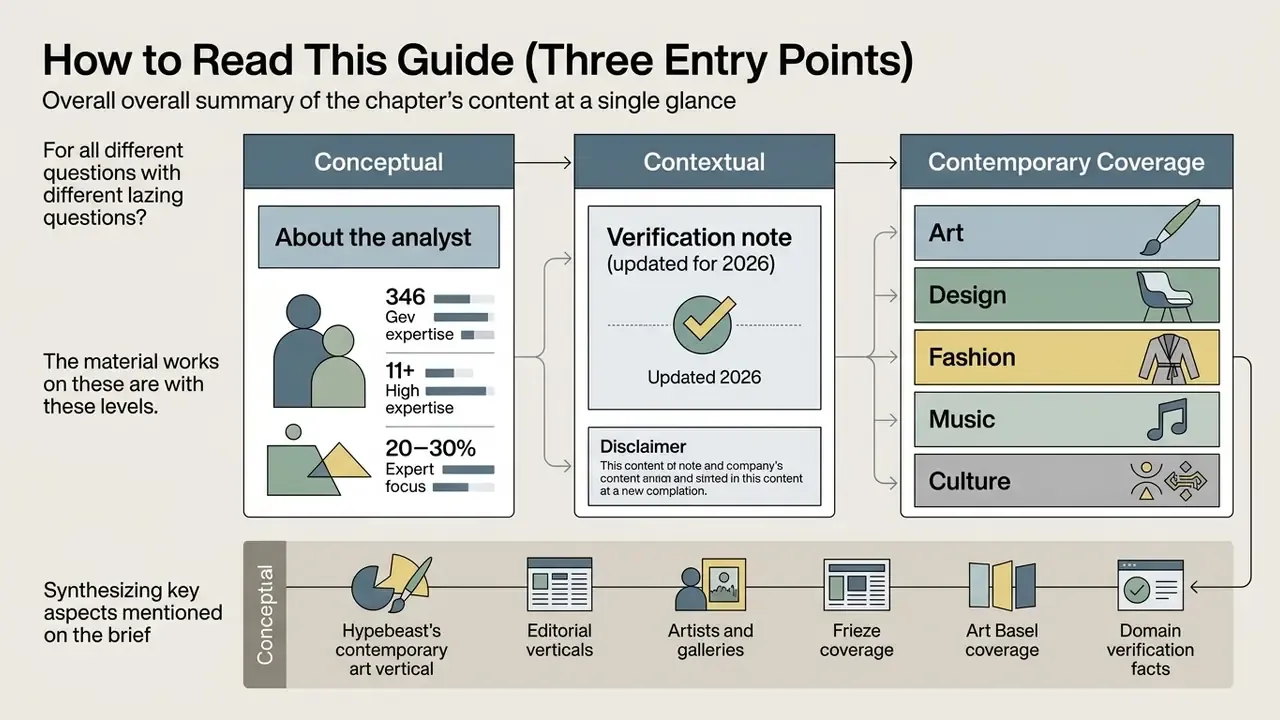
How to Read This Guide (Three Entry Points)
What Is HypeArt: Platform Overview
- Art Contemporary art, painting, sculpture, digital art, artist profiles.
- Design Product design, object profiles, upcycled material studies, architectural activations.
- Fashion Apparel collections, sneaker collaborations, footwear art design.
- Music Audiovisual archives, sound installations, record collections.
- Culture Streetwear heritage, urban trends, global lifestyle.
- Exhibitions Gallery listings, art week guides, museum shows.
- News Time-stamped editorial updates, breaking culture reports.
Purpose of the visual: the mind map lets a reader grasp HypeArt's thematic footprint in seconds when arriving with a navigational query. The text fallback keeps that taxonomy accessible when the graphic fails to load.
Contemporary Art and Cultural Context
Within the platform's editorial framework, art works as the primary lens for reading broader social, political, and technological shifts. Coverage spans traditional painting and sculpture alongside digital installations, mixed-media projects, and works produced with AI art generators and other computational tools. HypeArt regularly profiles individual practitioners, among them Yoshitomo Nara, Tavares Strachan, Amy Bravo, KAWS, Javier Calleja, and Gao Hang, examining how their output reflects internet culture, family history, migration, and contemporary politics.
The cultural value of screen-based art engagement is not only anecdotal. A four-week randomized study of virtual art galleries found that repeated digital viewing of curated artwork increased user immersion, positive aesthetic emotion, and overall well-being compared with text-only controls.
"Participants in virtual gallery conditions showed significantly higher immersion and aesthetic emotion than controls (n=890)."
A later longitudinal trial showed that virtual art experiences built around social connection produced emotional benefits that lasted across five weeks.
"Participants in the social-connection condition (n=381) reported higher well-being sustained across five weeks compared with other conditions."
That helps explain something otherwise easy to dismiss. An art vertical designed for reading on a phone and sharing through social feeds can still deliver a real cultural experience, without pretending to replace a gallery visit.
The Strategic Synergy Between HypeArt and Hypebeast
Hypebeast launched in 2005 as a digital publication covering men's contemporary fashion, footwear, and streetwear culture. HypeArt arrived in 2019 with a narrower brief: fine art. The split lets Hypebeast keep its focus on consumer product releases and fast news, while HypeArt handles longer storytelling, gallery previews, artist interviews, and curatorial projects.
Physical programming sits alongside the digital reporting. In 2022, HypeArt organized group exhibitions in New York and Hong Kong, building a direct bridge between online readers, gallery spaces, and private collectors (Hypebeast Ltd. Annual Report, 2024). The 2023 "Hypeart Project (#HAP)" social series extended that logic online, spotlighting prompt-specific work from established and emerging artists. In 2026, the "State of Art" series convened artists, curators, and collectors to debate structural shifts in the field.
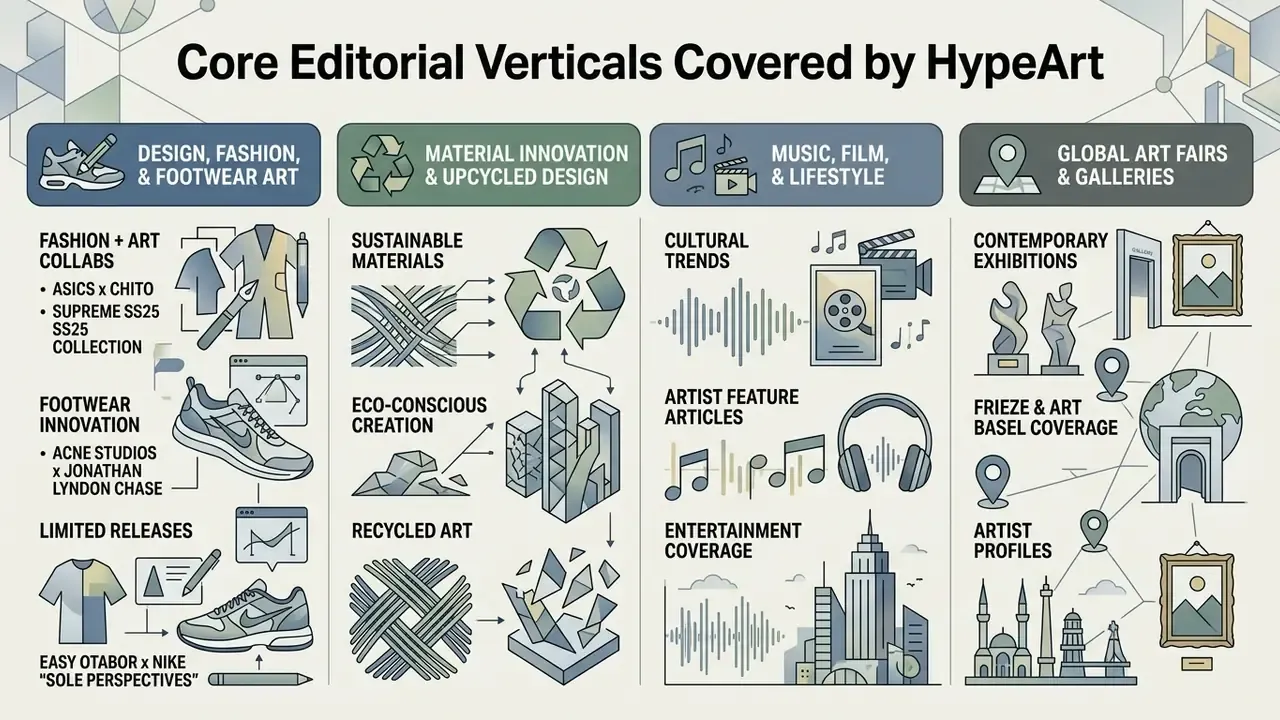
Core Editorial Verticals Covered by HypeArt
The editorial scope reaches well beyond conventional gallery reviews. Cross-disciplinary projects get the most attention, especially where fine art meets product design, apparel, sound, and digital media.
| Coverage Vertical | Primary Focus Areas | Example Projects & Collaborations |
|---|---|---|
| Art & Sculpture | Contemporary painting, sculpture, installations, digital art | Group show "NOISY REALITY" (SoHo, NY), Tavares Strachan retrospectives |
| Design & Footwear | Product design, footwear art design, limited apparel capsules, digital art assets | ASICS x CHITO GEL-KINETIC FLUENT™, Supreme SS25 fine art decks, Easy Otabor x Nike "Sole Perspectives" |
| Material Innovation & Upcycling | Recycled-material objects, craft heritage, 3D-printed textiles | Gyuhan Lee "Hanji" McDonald's paper-bag lamps (Arts Kowloon, Hong Kong); Travis Fitch 3D-printed photopolymer textiles |
| Fashion & Lifestyle | Storefront activations, luxury brand crossovers | Acne Studios x Jonathan Lyndon Chase "Heart Beat Rose", Takashi Murakami x Vans |
| Music & Sound | Audiovisual archives, sound installations, record collections | Ryuichi Sakamoto seeing sound, hearing time, Yoshitomo Nara record collection, Manga Corps techno archive |
| Exhibitions & Events | Global art week previews, major international art fairs | Frieze London, Frieze New York, Frieze LA, Frieze Seoul, Art Basel Switzerland |
That same matrix shapes how the platform handles computational image-making. Generative work is treated as a cultural phenomenon with a measurable footprint rather than a passing novelty, and the scale of prompt-driven production is now documented in open research datasets.
"DiffusionDB contains 14 million images and 1.8 million unique prompts collected over two weeks in August 2022."
Publishing at that pace across multiple platforms takes discipline. HypeArt relies on structured visual content management protocols, which enforce copyright compliance, artist licensing agreements, credit lines for photographers and studios, and high-resolution asset delivery for both digital interfaces and print.
Design, Fashion, and Footwear Art
The convergence of art design and fashion is a standing theme in HypeArt's reporting. The platform frequently covers fashion footwear art, from limited-edition sneakers to custom footwear built as sculptural objects. Because these drops are commercial products resting on authored imagery, licensing clarity, including the commercial use of AI-generated images, has become a permanent question for brands and artists alike.
Notable examples covered by HypeArt include:
- ASICS x CHITOA gallery presentation at SCOPE Miami showcasing custom spray-painted artworks, with contributions referenced from Stickymonger, UFO907, and KATSU, alongside a custom GEL-KINETIC FLUENT™ release and bespoke packaging.
- Supreme SS25 CollectionEditorial coverage of skate decks and apparel featuring fine art by Damien Hirst, Mario Ayala, Ernie Barnes, and MF DOOM, with further references to Aphex Twin and Twyla Tharp. Art, music, fashion, and skate culture in one release.
- Acne Studios x Jonathan Lyndon ChaseA storefront takeover and exhibition titled "Heart Beat Rose" at Green Street, launched together with an exclusive denim capsule collection.
- Material Innovation & Upcycled DesignCoverage of progressive studio practices, such as Seoul-based designer Gyuhan Lee's sculptural lighting collection made for Arts Kowloon in Hong Kong from recycled McDonald's paper bags merged with traditional Korean Hanji paper, plus textile artist Travis Fitch's 3D printing of intricate photopolymer textures directly onto fabric.
- Easy Otabor x Nike "Sole Perspectives"A 2023 exhibition honouring the Air Force 1 that gathered roughly 20 artists working in photography, painting, collage, sculpture, and video. Probably the clearest case of footwear treated as an art-historical object.
Readers using site search often navigate these stories through interface labels such as comments save fashion or save art, which cluster apparel-and-art crossovers into a single reading queue.
Music, Film, and Lifestyle
HypeArt regularly explores the intersection of art design music and visual media, treating sound archives and cinematic projects as gallery-grade material. That territory now sits next to AI video generators used in installation and screening contexts. The overlap of design music lifestyle topics reflects a wider move toward multi-sensory work, where a record collection can explain a painting better than a wall label.
Key coverage examples include:
- Ryuichi Sakamoto (Tokyo): The 2024 to 2025 exhibition seeing sound, hearing time, with large-scale environmental installations connecting acoustic frequencies, physical space, and temporal perception, on view from 21 December 2024 to 30 March 2025. Audiovisual works of this type increasingly intersect with production toolchains covered in our comparison of AI video generators.
- Manga Corps Archive (2025): A 200-page visual history of Japan's underground hardcore techno scene told through handbills, flyers, and graphic artifacts from the early 1990s onward.
- Yoshitomo Nara (London): A major retrospective that used the artist's personal vinyl collection to show how folk and punk music shaped his painting and sculpture.
- SCOPE Miami presentation (2024): A HypeArt-curated showcase combining spray paint, mixed media, and an immersive sound-and-visual installation.
How far does this cross-media material travel? The Global YouTube Trending Dataset gives a sense of the distribution layer that carries music, film, and visual culture through algorithmic discovery.
"The dataset covers 78.4 million video records across 726,627 unique videos from 104 countries between 2022 and 2025."
All editorial citations in this overview follow our published Sourcing Policy.
Exhibitions, Galleries, and Global Art Fairs
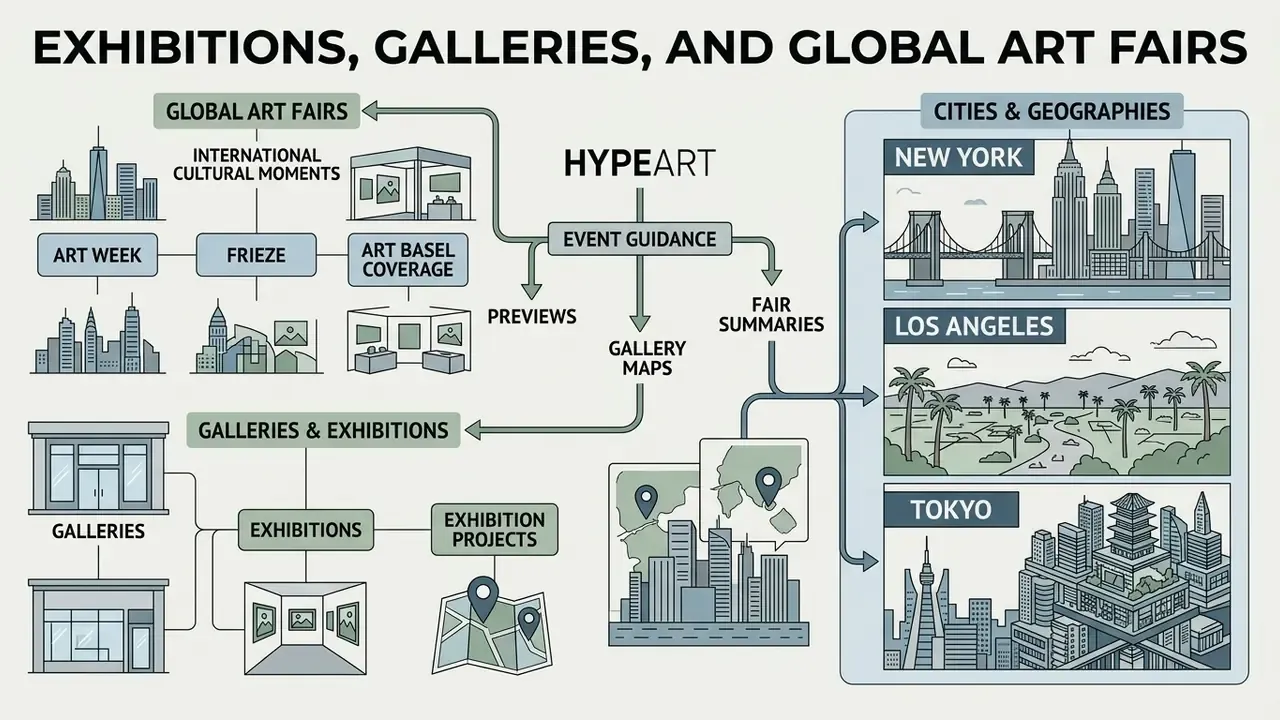
A core operational role of HypeArt is event guidance: previews, gallery maps, and fair summaries for international cultural moments. Coverage is event-centered rather than region-fixed. The same city may appear as an art-week roundup, a single gallery spotlight, or an auction-linked preview.
- Cities New York (SoHo, Chelsea, Bowery), Los Angeles (West Hollywood, Santa Monica), Tokyo (Motoazabu, Azabudai Hills).
- Formats Gallery exhibitions, museum retrospectives, art fairs, auction previews.
- Collections Frieze Week, Art Basel, local gallery circuit.
Purpose of the map: it resolves the navigational task of finding international art events by city, venue, and format, with every filter value mirrored in text.
| Event / Fair Name | Edition & Frequency | Primary Location | Key Coverage Statistics & Highlights |
|---|---|---|---|
| Frieze London | Annual (October) | Regent's Park, London, UK | 160+ galleries from 46 countries (2023 guide); 21st edition, 9 to 13 October (2024 guide) |
| Frieze New York | Annual (May) | The Shed, New York, USA | 12th edition (2024), 2 to 5 May, 68 participating exhibitors |
| Frieze Los Angeles | Annual (Feb/March) | Santa Monica Airport, LA, USA | 2024 edition 29 February to 3 March; Bonhams partnership preview "Under the Same Sky" (2026) |
| Art Basel Switzerland | Annual (June) | Messe Basel, Basel, Switzerland | 55th edition (2025), 19 to 22 June, 291 premier galleries from 42 countries |
| Frieze Seoul | Annual (September) | COEX, Gangnam, Seoul, South Korea | 2025 guide published 3 September; "UnHouse" exhibition exploring identity and domestic space |
| New York Art Week | Annual (May) | Multiple venues, New York, USA | 2023 HypeArt roundup covering TEFAF New York, Future Fair, NADA New York, Frieze New York |
| Hong Kong Art Week | Annual (March) | Multiple venues, Hong Kong | 2022 HypeArt spotlight on Asia-based galleries and platforms |
Art Week, Frieze, and Exhibition Projects
During major international art week cycles, HypeArt publishes structured city guides that help visitors survive crowded schedules. Its coverage of the Frieze franchise breaks down gallery participants, curated sections, and concurrent satellite shows (HypeArt Guides, 2023 to 2025).
In early 2026, HypeArt worked with auction house Bonhams on "Under the Same Sky," a co-curated exhibition presented alongside live auction previews during Frieze LA 2026. The format shows how editorial platforms partner with commercial institutions to create physical viewing moments during fair weeks. It also marks a quieter shift: a media brand moving from reporting on the market to appearing inside its primary sales calendar. Each new edition of these guides tends to arrive within days of the fair opening, which is why the latest news around participants often lands before official directories update.
New York, Los Angeles, and Tokyo
Geographic reporting concentrates on three art capitals, with named galleries, artist studios, and cultural hubs in each.
- New York Coverage follows the gallery corridors of SoHo, Chelsea, and the Bowery. Recurring venues include Plato Gallery (Bowery), Lisson Gallery (508 W 24th St), Yancey Richardson (525 W 22nd St), and Hauser & Wirth. In SoHo, HypeArt staged its U.S. group show "NOISY REALITY" at 89 Crosby St., featuring New York-based artists Meguru Yamaguchi, Heather Benjamin, Eny Lee Parker, and B. Thom Stevenson. Later features widened the city frame to Anicka Yi, Josh Kline, Huma Bhabha, and Tschabalala Self.
- Los Angeles Reporting highlights Hauser & Wirth (8980 Santa Monica Blvd, West Hollywood), Bonhams LA (7601 W Sunset Blvd), and SIZED STUDIO (East Hollywood), with West Coast artists David Hockney, Mark Bradford, Catherine Opie, Patrick Martinez, Shepard Fairey, and Javier Ramirez.
- Tokyo Editorial features centre on Kaikai Kiki Gallery in Motoazabu, Azabudai Hills Gallery, New Gallery, JPS Gallery, and CREATIVE MUSEUM TOKYO. Coverage also includes dedicated cultural spaces such as Space Un, an African contemporary art hub led by Edna Dumas in Tokyo. Compared with New York and Los Angeles, Tokyo coverage is more institution-centered than circuit-wide, so the city often appears through one platform or venue rather than a multi-gallery roundup.
Venue naming for Tokyo varies by host site and building level, for example Kaikai Kiki Gallery Motoazabu versus Azabudai Hills Gallery. That reflects distinct locations and exhibitions rather than contradictory reporting.
Content Formats and Platform Navigation
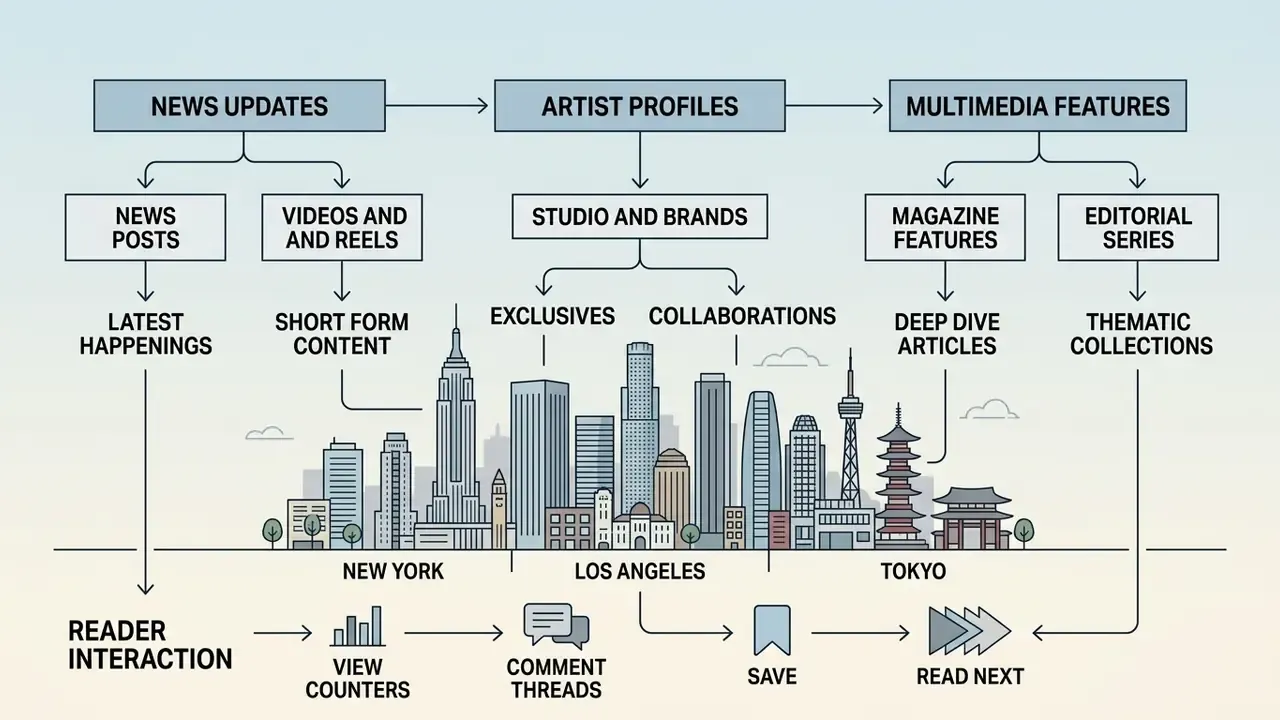
News, Videos, and Brand Projects
HypeArt publishes in four primary operational formats.
- News postsTime-stamped articles on exhibition announcements, auction results, and project launches. Examples include a May 2024 item on CASETiFY's Earth Month art installations and a May 2025 report on Jonathan Lyndon Chase and Acne Studios. Editor Keith Estiler and contributing writers cover many of the major gallery openings and studio releases, and a Keith Estiler byline is one of the quickest signals that a story sits inside the core art vertical rather than the wider culture feed.
- Video and ReelsShort-form features distributed across social channels, including studio tours and behind-the-scenes event footage. Post-production usually involves colour, crop, and retouch passes of the kind handled by modern AI photo editors and video toolchains.
- Studio and brands magazine featuresCo-branded editorial produced with commercial sponsors, covering brand-led design installations and artistic activations. In site navigation these appear near the videos brands magazine grouping, which keeps sponsored work visually separate from newsroom output.
- Editorial seriesRecurring thematic formats, such as the 2026 "State of Art" series, which invites curators, collectors, and artists to debate shifts in contemporary art, and the "Hypeart Project (#HAP)" social prompt series launched in 2023.
Across all four, the binding constraint is rights management rather than volume. Exhibition photography, artist-supplied imagery, and brand assets each carry their own usage windows, territory limits, and credit obligations. Brand-linked specials, including the Bonhams "Under the Same Sky" presentation, therefore combine editorial copy with asset delivery terms negotiated project by project.
Reader Interaction: Views, Comments, Save, and Read Next
Article interfaces across the Hypebeast network use a familiar set of engagement and navigation controls.
- View counters A numeric display of cumulative reader visits. Values range from
0k viewson fresh posts through1k views,2k views,3k views, and4k viewson steady features, up to5k views,6k views,7k views,8k views,9k views, and occasionally14.2K Viewson a viral fair report. - Comment threads Public response sections showing totals such as
0 Comments,5 Comments, or the compactviews 0 commentslabel used in listing views. - Bookmark and save actions Buttons rendered as
save art,comments save, orsave art hypeart, letting registered users with a unified Hype account store items for later. The art hypeart label also functions as an informal tag inside saved collections. - Read next recommendations Contextual link modules at the end of articles that push internal hypeart visits toward related artist profiles or exhibition guides. No official documentation explains how read next items are generated, ranked, or personalized. Until that changes, the mechanism will be treated as observed interface behaviour rather than a disclosed algorithm.
Why does any of this matter beyond usability? Because engagement mechanics now shape careers, not just sessions.
"Social media significantly increases artist visibility, drives direct-to-collector sales, and reduces dependence on traditional gallery representation."
For an emerging based artist building visibility through hashtags such as #DigitalArt before securing gallery representation, production tools matter about as much as distribution. Our comparison of free AI art generators documents the output limits, watermarking rules, and licensing terms that apply at that stage.
Visual Tooling, Licensing, and Content Governance in Digital Media
Editorial resources section. The comparisons linked below come from our own review team and carry no affiliation with, endorsement by, or commission from Hypebeast Ltd. or HypeArt. Some links are commercial-investigation resources.
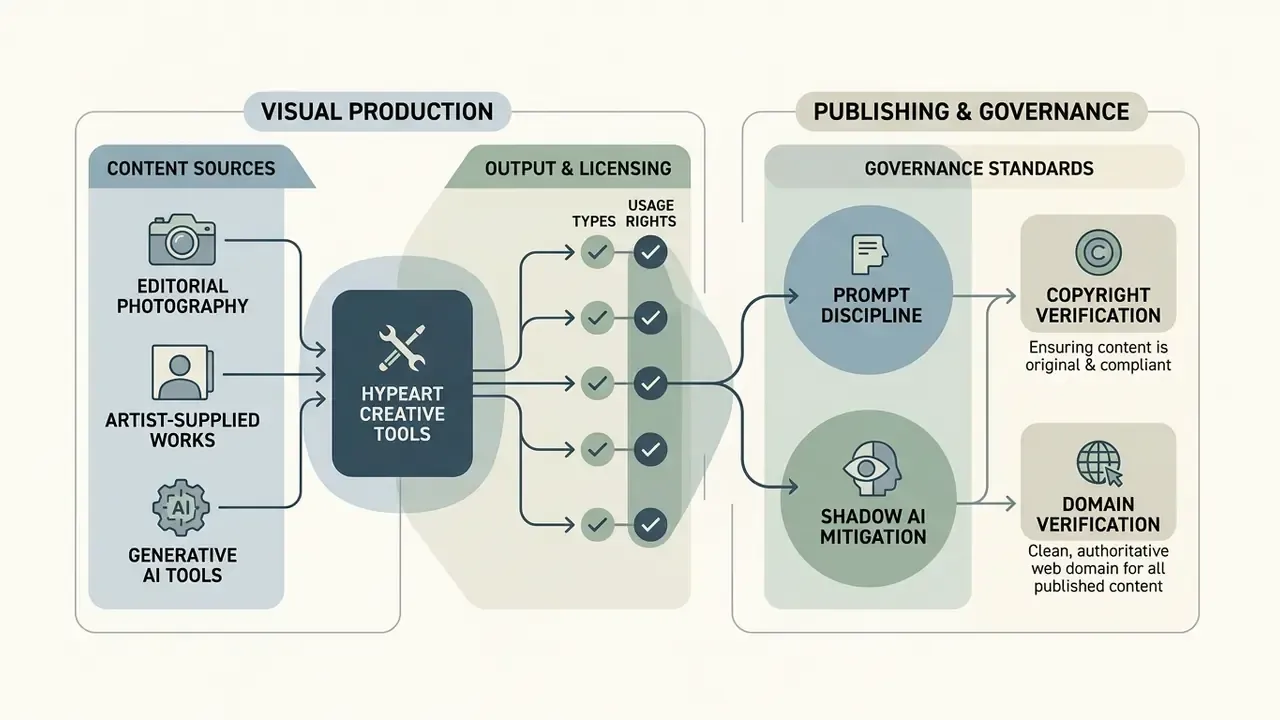
Art media platforms and brand studios now publish visual assets that mix photography, artist-supplied works, and synthetic imagery. That mix raises three practical governance questions. They sit outside HypeArt's editorial coverage, yet they hit anyone reusing its subject matter commercially.
1. Tool selection and output rights. Teams handling visual content in art, design, or branding should compare image tools on output quality, style-control precision, and commercial usage rights before standardising a workflow. Our benchmark of the best AI art generators and our broader comparison of AI image generators assess resolution, controllability, and licence scope for exactly that decision.
2. Prompt discipline and copyright verification. Editorial groups working with synthetic visual media usually need written prompt guidelines plus a copyright-verification step before publication. Our evaluation of Midjourney versus alternative image generators covers prompt responsiveness, licensing risk, and verification standards. Read it as a template for internal policy, not as a purchase recommendation.
3. Shadow AI and domain verification. Art and design brands get spoofed on .ai domains often enough that security teams need a repeatable routine. A short checklist:
| Check | What to confirm | Why it matters |
|---|---|---|
| DNS resolution | Does the domain resolve to a live host? | Non-resolving domains (for example hypeart.ai) cannot host a product or API. |
| Corporate registry | Is there a registered legal entity behind the brand? | Distinguishes an editorial vertical from a vendor. |
| Product surface | Are there documented sign-up, API, or pricing pages? | No product surface means no data-processing pathway. |
| Terms and DPA | Are terms of service and a data-processing agreement published? | Required before any corporate data is submitted. |
| Trademark alignment | Does the brand match the verified parent company's assets? | Detects squatting and phishing look-alikes. |
| Traffic evidence | Do employee logs show uploads to the domain? | Confirms or rules out actual Shadow AI usage. |
Applied to HypeArt, all six checks land in the same place. An editorial media vertical of a listed publisher, with no product surface, no processing terms, and no AI service to govern. Document the finding once, and the next internal escalation about "that HypeArt tool" takes minutes instead of a week.
FAQ: About HypeArt Explained
Is HypeArt a generative AI service?
No. HypeArt is a contemporary art editorial and curatorial platform launched in 2019 within Hypebeast Ltd. There is no verified generative AI product, API, or enterprise offering under the HypeArt name.
Does hypeart.ai belong to HypeArt?
hypeart.ai belong to HypeArt?Per current DNS registry records, hypeart.ai does not resolve and hosts no verified product or business registration. Treat any tool marketed under that domain as unverified until independently confirmed.
Who owns HypeArt?
Hypebeast Ltd., a Hong Kong-listed global media and commerce company that also runs the Hypebeast flagship publication (founded 2005).
How is HypeArt different from Hypebeast?
Hypebeast covers men's contemporary fashion, footwear, streetwear, and product releases. HypeArt focuses on fine art: artist profiles, exhibition previews, gallery and fair guides, and curated physical shows.
Which art fairs does HypeArt cover most consistently?
Frieze London, Frieze New York, Frieze Los Angeles, Frieze Seoul, and Art Basel Switzerland, plus regional art weeks in New York and Hong Kong.
What are the access requirements for reading HypeArt?
Readers searching for about HypeArt requirements are usually asking about access. Articles are freely readable on the web. A unified Hype account is needed only for interaction features such as save art hypeart bookmarks and comment posting.
Can I reuse HypeArt images or artwork photography commercially?
Not by default. Exhibition photography and artist-supplied imagery carry separate rights holders, territories, and credit requirements. Get written permission from the rights holder before any commercial reuse.
Does HypeArt publish standalone traffic figures?
No. Only parent-company metrics are disclosed: 18.8 million monthly unique visitors on a 12-month average and 34.0 million aggregated social followers as of 31 March 2023.
How should a compliance team classify HypeArt?
As an external media source, not a processor or vendor. No data-processing relationship exists, so no DPA or model-risk assessment is required for reading published content.
Fact Check and Source Verification (E-E-A-T)
Primary documentation and verification references:
Known limitations. No standalone HypeArt traffic data is publicly disclosed. Audience figures date to FY2023, while financial figures reflect the most recent reported fiscal period. The "read next" recommendation logic remains undocumented. Tokyo coverage is narrower and more institution-centered than New York or Los Angeles reporting. Gallery and venue lists shift between editions, so treat any single roundup as a snapshot rather than a directory.
Independence statement. This guide is an independent editorial analysis. Its author persona and publisher hold no commercial relationship with Hypebeast Ltd., HypeArt, the galleries, auction houses, or art fairs named above, or with any developer of the image and video tools referenced in the resources section.
- Hypebeast Ltd. corporate disclosures
- Annual Report 2023 to 2024 and Annual Results Announcements confirming HypeArt's 2019 establishment, segment revenue of HK$450.3 million, total reported revenue of HK$582.2 million, and audience metrics as of 31 March 2023.
- HypeArt Frieze event guides
- "The Hypeart Guide to Frieze London 2023," published 11 October 2023 (hypebeast.com/2023/10/hypeart-guide-frieze-london-2023); "The Hypeart Guide to Frieze London 2024," published 4 October 2024 (hypebeast.com/2024/10/hypeart-guide-2024-frieze-london); "The Hypeart Guide to Frieze Seoul 2025," published 3 September 2025 (hypebeast.com/2025/9/hypeart-guide-frieze-seoul-2025).
- Official art fair directories
- Frieze official site (frieze.com) and Art Basel official site (artbasel.com), used to cross-verify event dates, venues, and participating gallery counts.
- Empirical academic studies
- Cotter et al. (2024), https://doi.org/10.1037/aca0000600; Cotter et al. (2025), https://doi.org/10.1037/aca0000650; Wang et al., Prompt Analysis of Generative AI Art, arXiv (2023); Global YouTube Trending Dataset, arXiv (2025); Meng, Social Media Influencers and Contemporary Art, Boston University MA Thesis (2025), https://open.bu.edu.
- Domain and entity verification
- DNS resolution checks for
hypeart.aiand corporate registry review of Hypebeast Ltd. subsidiaries.