Executive Summary for Decision Makers
Who This Guide Is For and Which Decision It Supports
This analysis is written for the people who sign off on tools rather than the people who prompt them daily: heads of model risk, compliance officers, brand and marketing operations leads, and the procurement analysts who assemble the shortlist. The underlying question is narrow. Can a closed, consumer-priced visual generator sit inside a regulated content pipeline without creating an audit gap?
Three decisions usually depend on the answer.
First, tier selection. A $10 Basic seat and a $60 Pro seat differ in far more than GPU minutes, because privacy controls only appear higher up the ladder. Second, prompt policy. Whatever your team types into an ai image generator journey workflow becomes vendor-held data, and that fact belongs in a written standard rather than in tribal knowledge. Third, evidence. If an asset is questioned, someone must be able to regenerate it, or at minimum explain exactly how it was produced.
Everything that follows maps to those three decisions. The technical detail is here because procurement questions cannot be answered without it, not because parameter trivia is interesting on its own. Readers who only need the commercial verdict can jump to the comparison table and the decision tree near the end; readers who must defend the choice internally will want the governance section as well.
What Is Midjourney AI Image Generator and What Images It Creates
The midjourney ai image generator is a proprietary cloud-based text-to-image platform powered by machine learning algorithms and latent diffusion models. It was developed by Midjourney, Inc., an independent research lab founded in 2021 by David Holz, previously a co-founder of Leap Motion. The system converts natural language descriptions into synthetic visual assets. Unlike open-source models that distribute local weights, Midjourney operates as a closed, hosted service reached through its web platform and Discord interface. The company entered open beta on 12 July 2022, described itself in early reporting as a small self-funded research lab of roughly ten people with no venture funding, and monetizes exclusively through paid subscriptions rather than advertising or weight licensing.
The platform creates a broad spectrum of ai art midjourney formats, from photorealistic imagery and digital illustrations through 3D renders, vector concepts, and cinematic textures. Enterprise creative teams use the ai generator midjourney to prototype visual campaigns, generate storyboard concepts, and build branded asset libraries. Teams benchmarking platform economics before procurement can review our analysis of AI image generators for commercial workflows to map license terms against internal spend approval thresholds.
Independent academic evaluations highlight both the aesthetic strength and the inherent biases of the model. In the Align Beyond Prompts (ABP) benchmark (ABP Benchmark Research, 2024, arXiv preprint, identifier verification pending), Midjourney V6 achieved a 0.7208 overall world-knowledge alignment score across 2,060 test scenarios. Because the ABP identifier circulating in secondary literature collides with a separate 2024 preprint, model risk teams should treat the numeric scores as directional until the canonical arXiv record is confirmed. A small caveat, but the kind that matters in a validation memo.
Audits such as the BAFIS Benchmark (BAFIS Research, 2026, https://arxiv.org/abs/2601.05678) show that ai generated art midjourney systems still exhibit measurable occupational demographic bias when prompts lack explicit demographic conditioning.
«The BAFIS study (2026) identified systematic gender and ethnic bias in Midjourney v6.1 when generating occupational scenes without explicit demographic conditioning in the prompt.»
For Model Risk Management functions this finding is operational, not academic. A prompt library that omits demographic conditioning will statistically skew occupational representation. In regulated marketing material, that becomes a fair-treatment and reputational exposure, and it surfaces during review rather than during production.
How Midjourney Transforms Text Prompts into Images
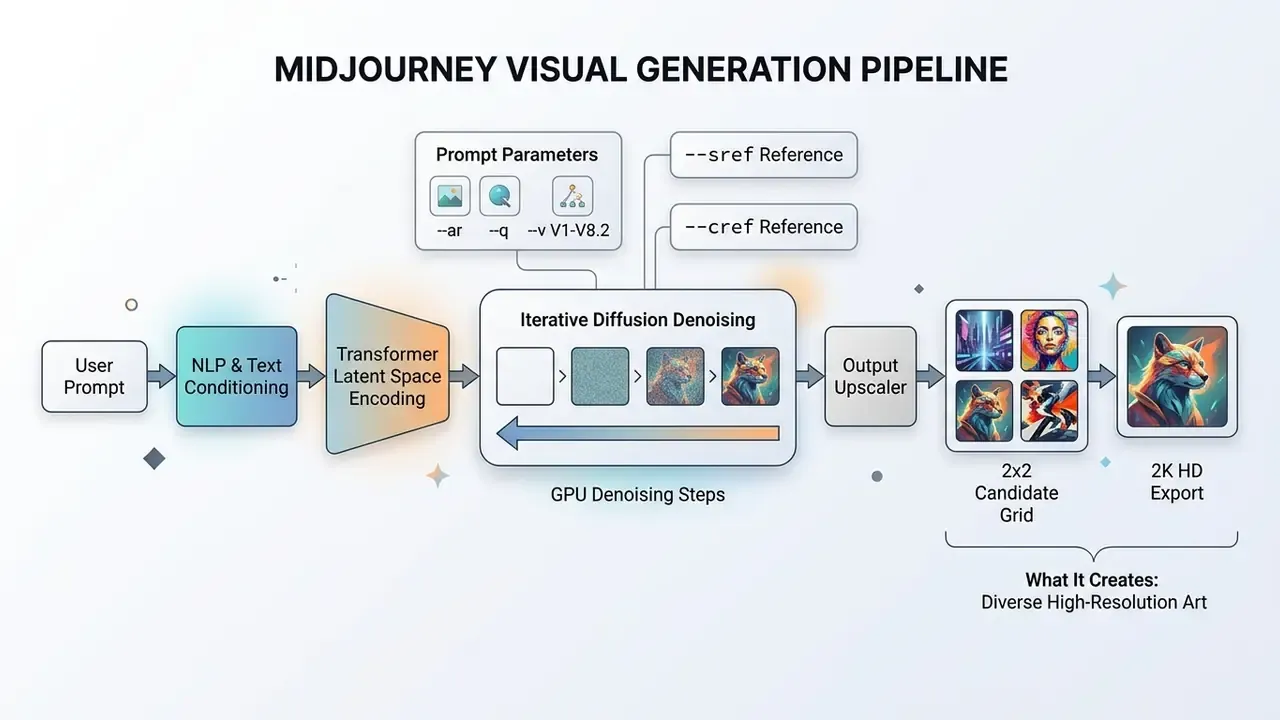
Midjourney processes textual input through a transformer-based language encoder that parses natural language into semantic embeddings. Those embeddings condition an iterative noise-reduction diffusion model, which turns raw Gaussian noise into structured visual features inside a latent space.
The parsing engine sorts input text into distinct visual vectors: subject matter, medium, environment, lighting, mood, composition, color, and parameter flags. In model versions 6 and higher the system also renders literal text when words sit inside quotation marks. This semantic decomposition is what allows a long descriptive instruction to translate into coherent spatial relationships rather than visual soup.
Validation teams should note the transparency boundary. Midjourney's public documentation exposes prompt syntax and parameter semantics, but not tokenization, embedding, or the training pipeline. Peer-reviewed literature from 2024 explicitly records that Midjourney is proprietary and publishes no technical whitepaper, which means architectural claims are inferred from the wider latent-diffusion research corpus rather than disclosed by the vendor. So when someone says midjourney uses a specific architecture, read that as informed inference.
Evolution of Midjourney Model Architecture (V1 to V8.2)
Version selection is a material variable in reproducibility testing, because each release shifted aesthetic defaults, prompt literalism, and output resolution.
| Model Version | Release Date | Key Technological Upgrades | Visual Style & Performance Focus |
|---|---|---|---|
| V1 – V3 | Feb to Jul 2022 | Initial public diffusion baseline | Abstract, highly stylized visual art |
| V4 | Nov 2022 (alpha) | Trained on custom Google TPU hardware | Introduction of photorealistic lighting baseline |
| V5 / V5.1 / V5.2 | Mar to Jun 2023 | Aesthetic system tuning, inpainting, Vary (Region) | Zoom-Out capability, high-detail hands and textures |
| V6 / V6.1 | Dec 2023 to Jul 2024 | Native text rendering, literal prompt parsing, web editor | Improved hand detail, roughly 20-30% faster rendering |
| V7 | Apr 2025 (alpha) | Omni Reference (--oref), richer texture coherence | Complex and abstract prompt handling |
| V8 / V8.1 / V8.2 | Mar to Jul 2026 | Native 2K HD export, spatial geometry coherence, 3D-oriented assets | Default model from July 2026; production-grade resolution |
| Niji 5 / 6 / 7 | 2023 to Jan 2026 | Dedicated anime architecture (Spellbrush collaboration) | Japanese fine-line illustration, action framing, manga typography |
Legacy models stay callable with the --version or --v flag. That matters when an approved brand asset must be regenerated under the exact model that produced the original approval artifact, which is a routine request in regulated review cycles.
What AI Art Formats You Can Create in Midjourney
The platform supports a wide range of visual styles across creative workflows:
- Photorealistic photography Realistic portraits, commercial product shots, and architectural photography with controllable depth of field and lighting. This is where the ai photo generator midjourney use case sits.
- Stylized illustrations Digital paintings, vector-style artwork, block prints, cyanotype effects, graffiti treatments, watercolor textures, and graphic concept art.
- Anime and manga (Niji mode) The specialized
--niji 6architecture is tuned for fine-line anime aesthetics, character design, action compositions, and Japanese typography parsing. - 3D renders and textures Isometric illustrations, 3D character models, ambient textures, and seamless tiles produced through the
--tileparameter.
Procurement teams building a shortlist can consult our ranking of leading AI image generators by quality and pricing, and organizations evaluating visual generative tools can review the AI Media Comparison Matrices hub to measure Midjourney against other creative automation solutions.
Image Quality, Model Architecture, and Benchmarks
The technical backbone combines transformer-based natural language understanding with latent diffusion synthesis. Midjourney, Inc. operates as a closed lab and publishes no open-source whitepaper, yet independent research still places its outputs in line with state-of-the-art diffusion architectures.
The Role of Diffusion Models in AI Image Generation
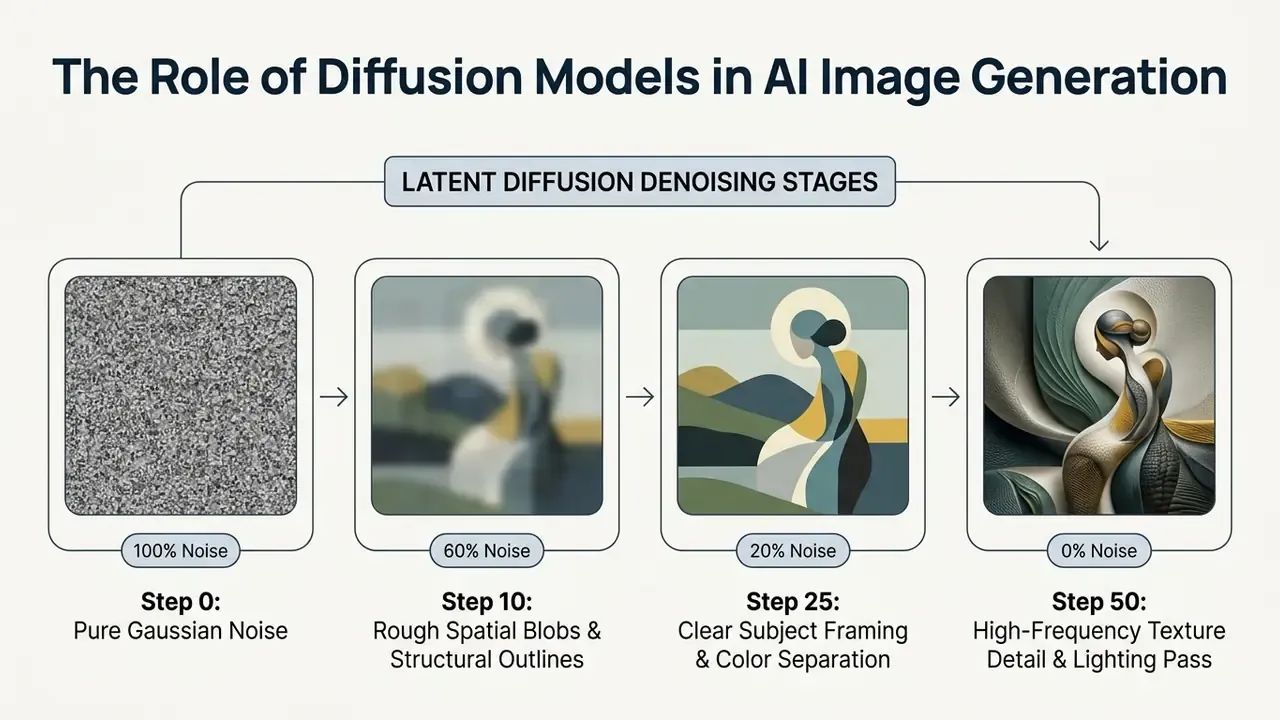
A latent diffusion model is trained to reverse a noise-adding process step by step. During generation the model starts from pure Gaussian noise and removes that noise across multiple passes, guided by cross-attention linked to the input text embedding. Because denoising happens in a compressed latent space rather than pixel space, high-resolution synthesis stays computationally feasible without losing fine texture detail. Artificial intelligence research calls this the efficiency trade that made consumer-grade image generation practical at all.
In comparative empirical studies, Midjourney's diffusion tuning shows strong world-knowledge alignment. The Align Beyond Prompts benchmark evaluated Midjourney V6 against leading generators across six physical and factual domains:
| Benchmark Category | Midjourney V6 Score | SDXL Score | SD3-M Score | Gemini 2.0 Score |
|---|---|---|---|---|
| Physical Scenes | 0.7153 | 0.6210 | 0.6430 | 0.7210 |
| Animal Scenes | 0.7219 | 0.6540 | 0.6810 | 0.7410 |
| Plant Scenes | 0.7553 | 0.6820 | 0.7010 | 0.7620 |
| Human Scenes | 0.7360 | 0.6410 | 0.6650 | 0.7480 |
| Factual Scenes | 0.8123 | 0.7120 | 0.7300 | 0.8250 |
| Overall Score | 0.7208 | 0.6558 | 0.6740 | 0.7301 |
(Source: Align Beyond Prompts Benchmark Data, 2024, arXiv identifier verification pending)
The data puts Midjourney V6 clearly ahead of open-source baselines such as SDXL, particularly in factual and plant scene synthesis, while trailing marginally behind Gemini-class multimodal systems on world-knowledge alignment. Marginally. The gap is small enough that prompt discipline moves results more than model choice does.
Objective alignment scores do not capture commissioning preference, though. Subjective human ranking studies matter just as much for a brand team picking a default generator:
«Finding the Subjective Truth collected over 2 million annotations across 4,512 images from DALL·E 3, Flux.1, Midjourney and Stable Diffusion to rank style, coherence, and text alignment.»
Key Factors Driving High Quality Results
The final aesthetic quality of a midjourney ai art output depends on five technical variables:
- Model version selectionSpecifying
--v 6,--v 7, or the active defaults (V8.1/V8.2) changes detail rendering, spatial coherence, and text legibility. V8.1 introduced native HD 2K generation. - GPU quality settingsThe
--quality(or--q) parameter sets GPU processing time per generation. Options such as--q 2or--q 4spend double or quadruple compute refining textures and lighting. Documentation notes that--qualitydoes not influence later variations, inpainting, outpainting, or upscales, and that it changes detail rather than output resolution. - Prompt specificityExplicit photographic or illustrative descriptors stop the system from drifting toward generic default image distributions.
- Reference conditioningStyle, character, and omni references constrain the latent search space. This is the main mechanism behind campaign-level consistency.
- Authenticity perceptionHigh visual quality complicates human verification. A large-scale perception study (How good are humans at detecting AI-generated images?, 2025, https://arxiv.org/abs/2501.08922) covering 287,000 evaluations across 12,500 global participants found that people identify AI-generated imagery correctly only 62% of the time.
«Across ~287,000 evaluations from more than 12,500 global participants, humans correctly identified AI images only 62% of the time, struggling most with landscapes.»
Legal and compliance teams testing the boundary between synthetic and authentic media can inspect the detailed analysis at ai vs real image, and audit functions that must verify third-party submissions should also review the available AI image detection tools for compliance teams. Supporting test data for these claims sits in our AI Media Benchmarks and Review Proof library.
Fact Check & Technical Verification
How to Use Midjourney for AI Image Generation
To use midjourney effectively, creative teams work either in the web application at midjourney.com or through the official Discord bot. Account creation supports "Continue with Discord" or "Continue with Google", and the Discord path allows linking an existing account or creating a new one. After you submit a text prompt, the system runs a diffusion batch and returns an initial two-by-two grid of four candidate images. Every submitted action, whether an image request, an upscale, or a variation, is logged by the platform as a discrete "job". That job is the billable unit of GPU consumption, which is exactly why budget forecasts fail when teams count images instead of actions.
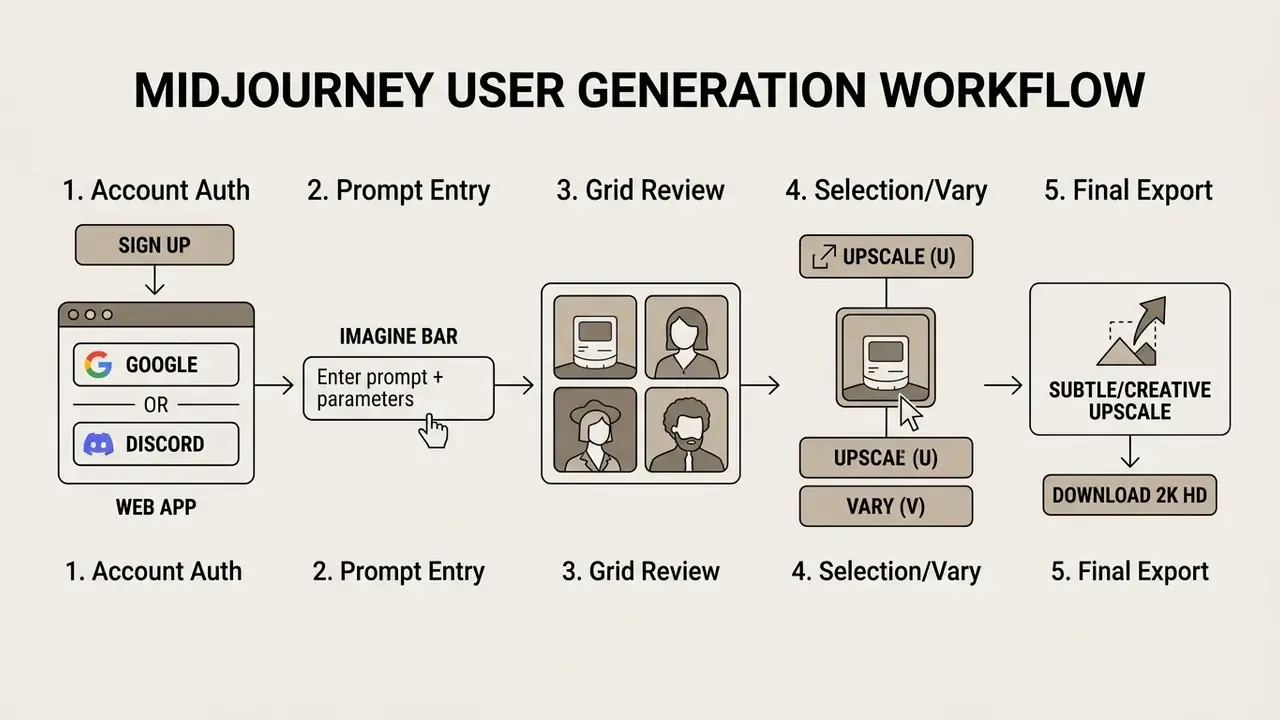
Interface map (annotated screenshot reference, alt text: "midjourney ai image generator interface zones"). The web workspace is organized around five zones. The Imagine bar at the top takes prompt and parameter entry. The parameter and settings sidebar holds model version, stylization, and aspect ratio defaults. The central results feed displays the 2×2 candidate grid. Per-image action controls expose Vary, Upscale, Remix, Editor, and Rerun. The Organize and Archive view is where assets are filtered and downloaded. In Discord the equivalent controls appear as /imagine and /settings slash commands, plus U1 to U4 and V1 to V4 grid buttons under each generation.
Creating Your First Image from a Text Description
An initial generation starts with a structured prompt typed into the Imagine bar. The platform processes the instruction and shows a real-time progress indicator until the four-image grid completes.
Users then evaluate the options using the interface action buttons:
- Vary (V1 to V4)Generates subtle or strong variations of the selected grid quadrant.
- Upscale (U1 to U4)Isolates the chosen quadrant for high-resolution refinement and export.
- RerollRe-runs the original prompt with a new random seed.
Downloading depends on the interface in use. In Discord, open the image at full size and choose "Save image", or long-tap and use the download icon on mobile. In the web app, use the download control inside the Create or Organize view.
Choosing Aspect Ratios and Preparing Images for Export
By default the image generator ai midjourney outputs square images at a 1:1 aspect ratio. Enterprise workflows rarely stay square. Digital banners, print collateral, and video frames each need their own canvas.
Adding the --aspect or --ar parameter at the end of a prompt sets canvas dimensions before generation:
/imagine prompt: Architectural interior of a modern bank branch, warm lighting, minimalist style --ar 16:9
Supported aspect ratios include:
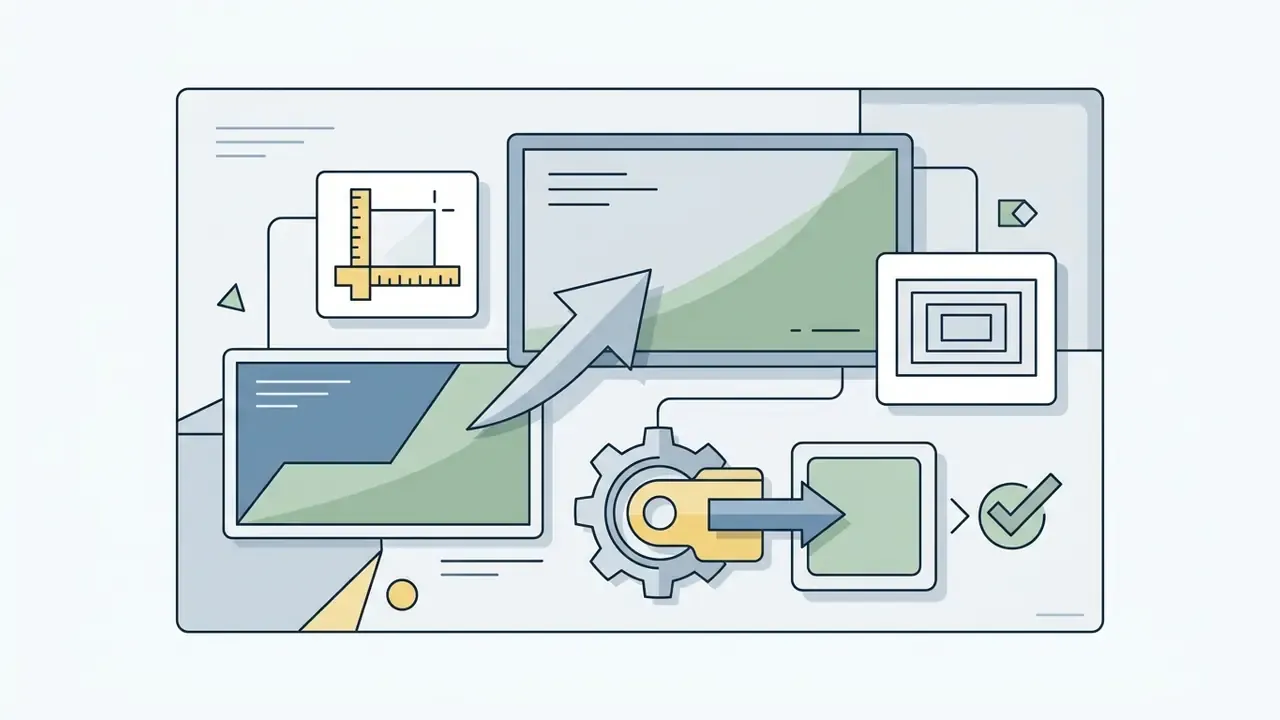
Note that --ar rejects decimals, so a 1.39:1 cinematic frame has to be written as --ar 139:100. Base generations render at standard resolution, typically 1024×1024 for square outputs. Subtle Upscale or Creative Upscale expands output to 2048×2048, or to native 2K HD in versions 8.1 and 8.2, which is what production export normally requires. Creative Upscale enlarges and invents subtle new detail; Subtle Upscale enlarges without altering the image, and it is the safer option once an asset has already passed brand review. Production teams pushing assets to large-format print can additionally evaluate dedicated AI image upscalers for professional export.
--ar 16:9Standard landscape for web headers and video frames (upscales from 1456×816 to 2912×1632).
--ar 9:16Vertical format for mobile interfaces and social stories.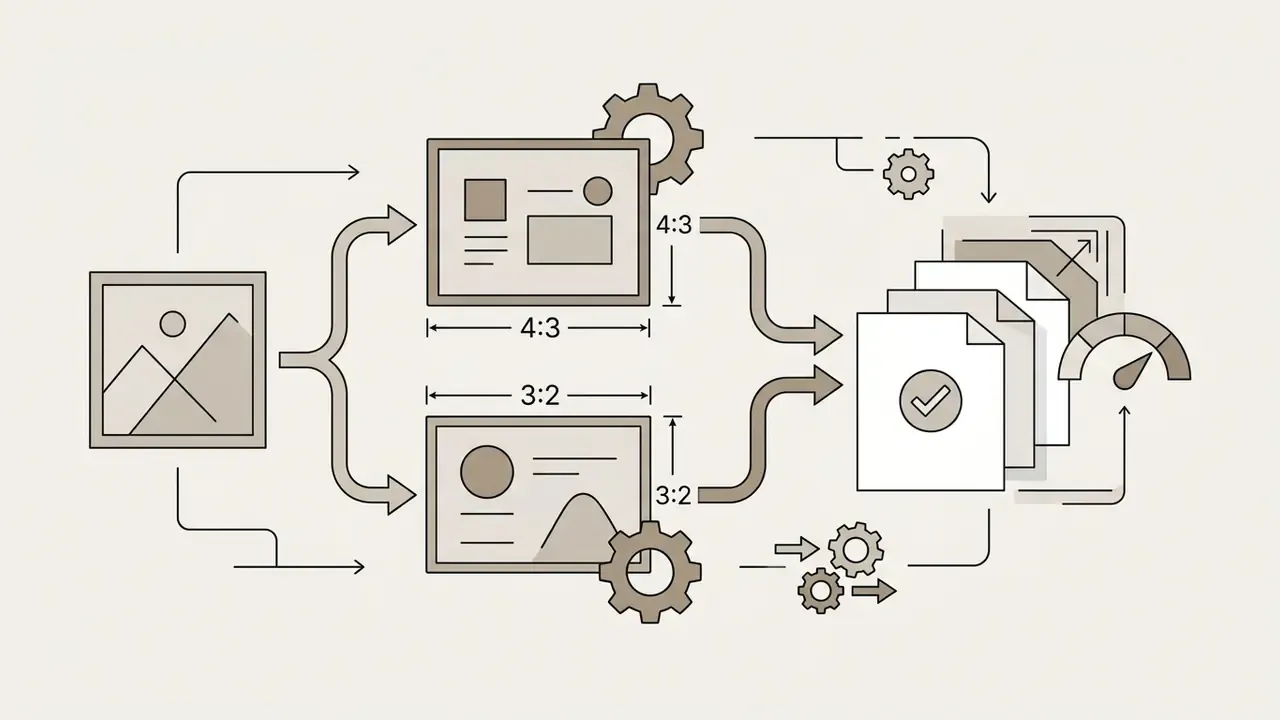
--ar 4:3 / --ar 3:2Traditional editorial and photographic framing (4:3 upscales from 1232×928 to 2464×1856).
--ar 2:3Tall portrait framing (upscales from 896×1344 to 1792×2688).How to Write Midjourney Prompts and Fine-Tune Results
Getting predictable output from an ai art generator midjourney requires structured prompt engineering rather than conversational phrasing. Vague prompts trigger the system's latent priors and return generic results, known in the generative literature as "default images" (An Exploration of Default Images in Text-to-Image Generation, 2025, https://arxiv.org/abs/2502.04321).
Prompting is a measurable skill, not a matter of taste:
«Participants were able to meaningfully distinguish high-quality from low-quality prompts, supporting prompting as a measurable creative skill.»
Core Elements of an Effective Text Prompt
An enterprise-grade text prompt should follow a standardized semantic sequence:
- Primary subjectThe core focus of the image, for example "A senior risk executive reviewing financial reports".
- Environment and contextBackground setting and spatial arrangement, for example "in a sunlit glass conference room".
- Lighting and atmosphereSpecific illumination cues, for example "soft morning ambient lighting, volumetric shadows".
- Medium and styleArt direction, for example "editorial corporate photography, 85mm lens, shallow depth of field".
- Control parametersTrailing platform flags, for example
--ar 16:9 --stylize 120 --raw.
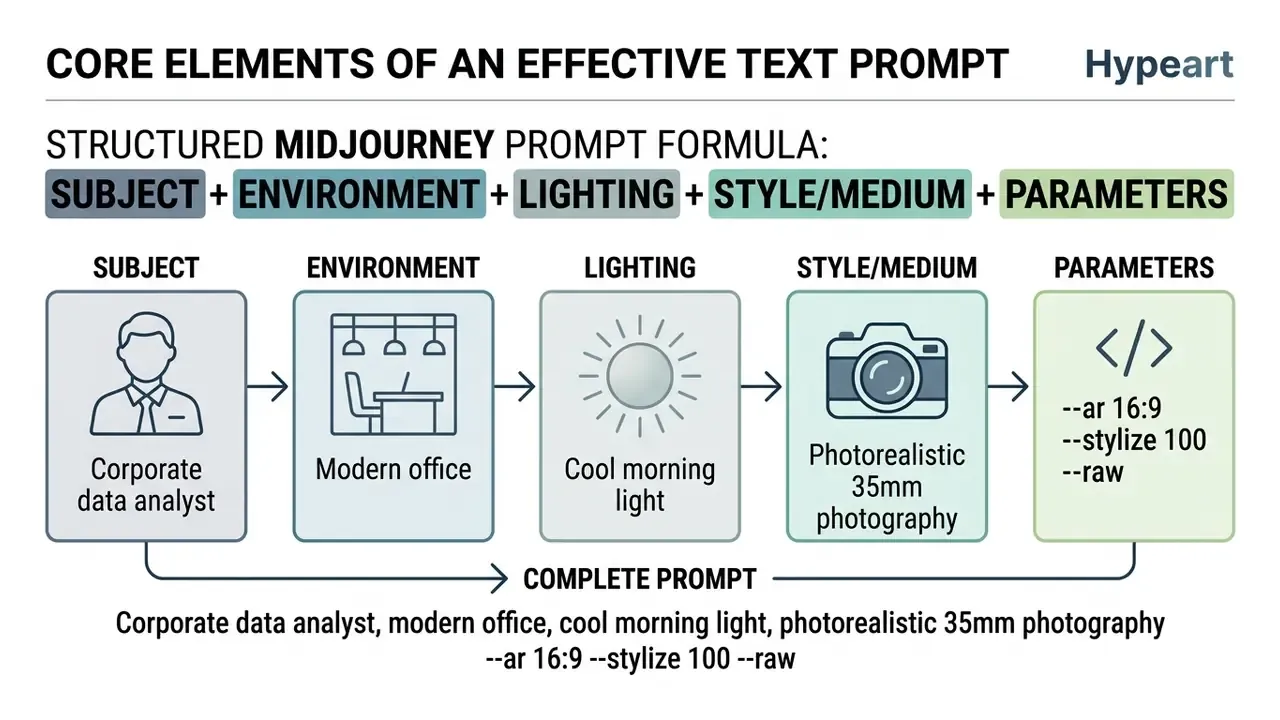
All parameters go after the descriptive text, separated by a space, with no punctuation inside the parameter itself.
Concise instructions usually beat verbose narration. Instead of "Create an image of a cozy cabin in the mountains surrounded by pine trees, with snow falling gently and smoke coming out of the chimney; make it feel warm and peaceful", a tighter construction performs better: "Cozy mountain cabin, snow, pine trees, warm peaceful mood, cinematic lighting --ar 16:9."

--stylize <0-1000> (or --s)Controls artistic interpretation. Default is 100. Lower values follow the prompt literally; higher values push stylization.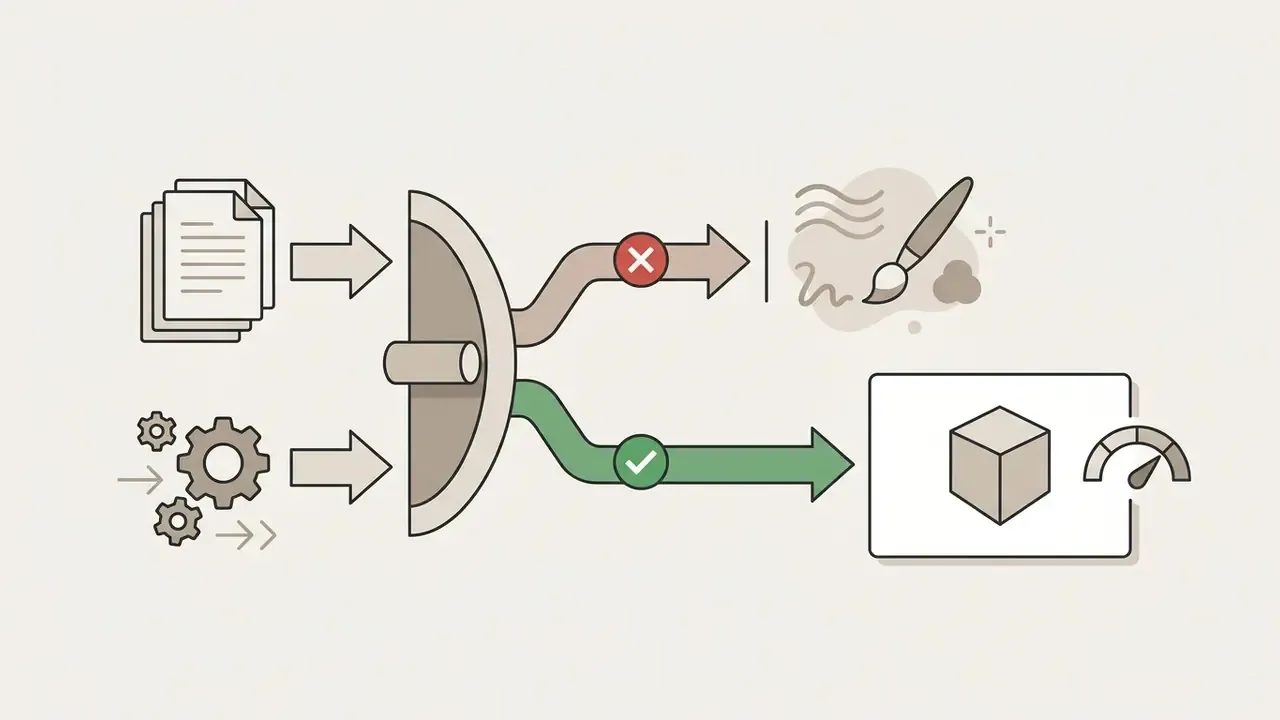
--raw (or --style raw)Bypasses the default Midjourney aesthetic opinion in favor of strict literal parsing.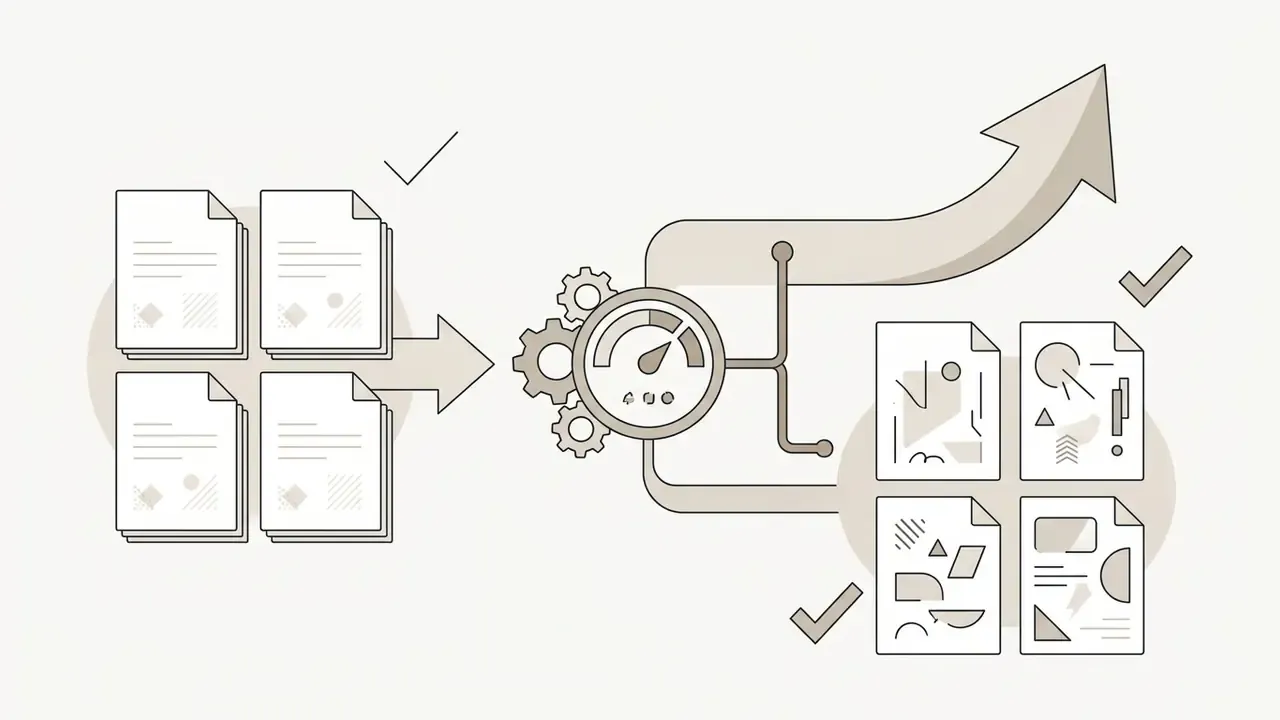
--chaos <0-100> (or --c)Increases variation between the four grid candidates.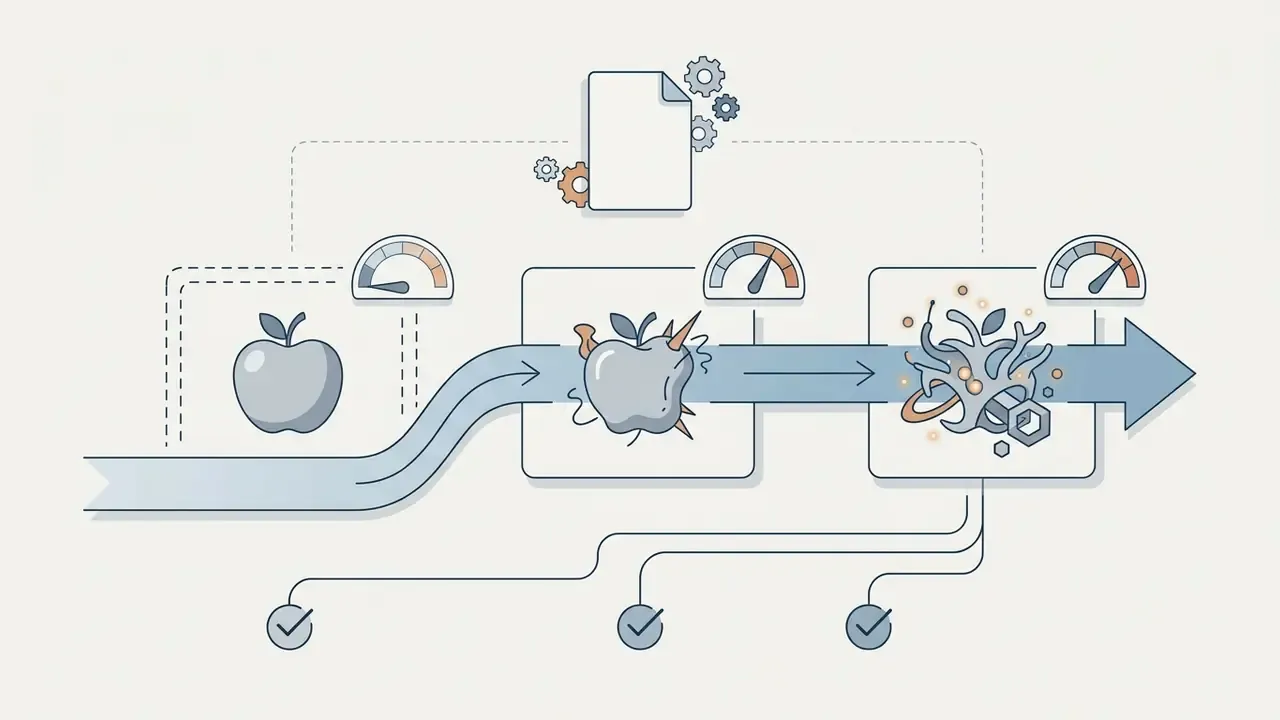
--weird <0-3000> (or --w)Introduces unusual or eccentric visual qualities.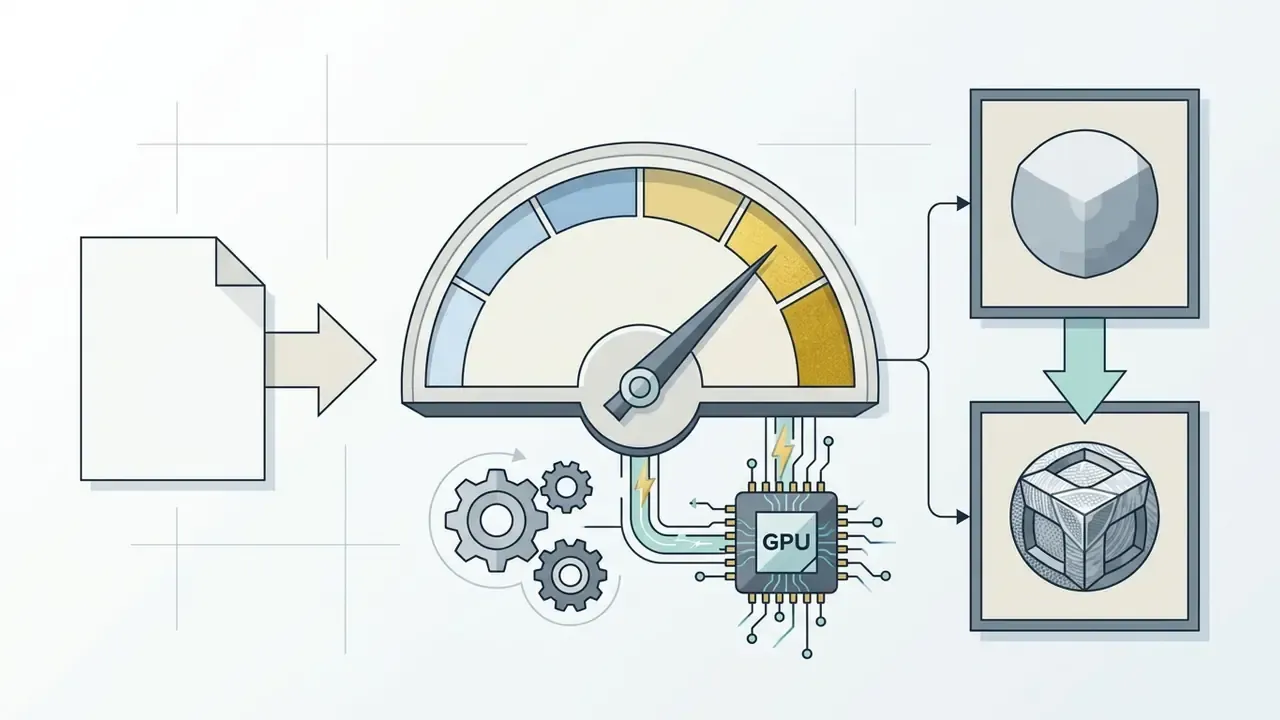
--quality <0.25-4> (or --q)Allocates extra GPU time to texture and detail refinement.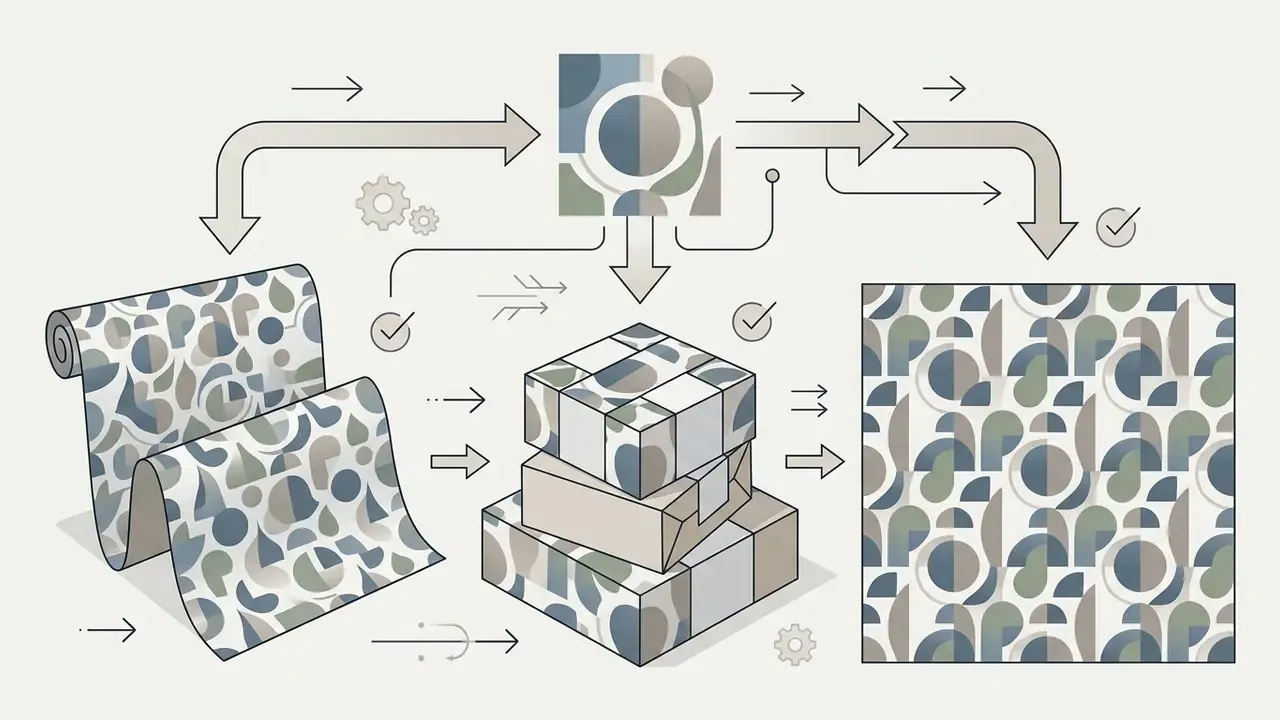
--tileProduces seamless repeatable patterns for textile, packaging, and background texture work.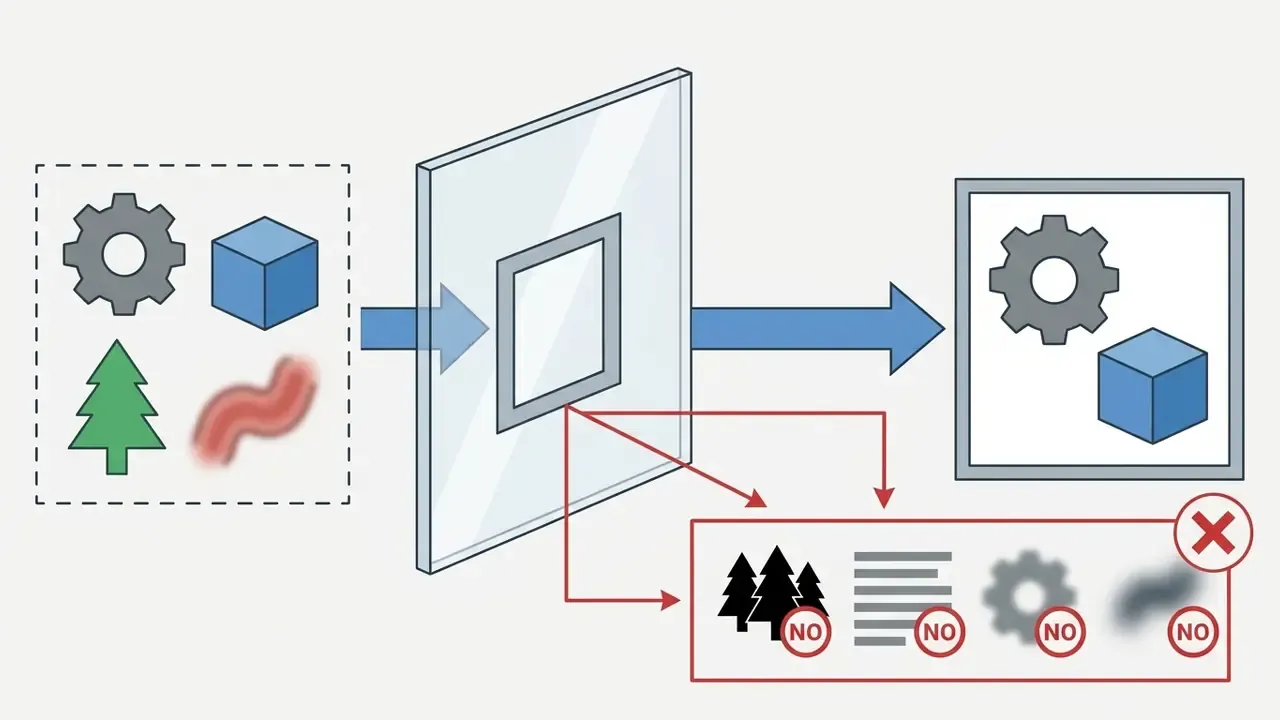
--no <object>Negative prompting. Removes unwanted elements, for example --no trees, text, blur.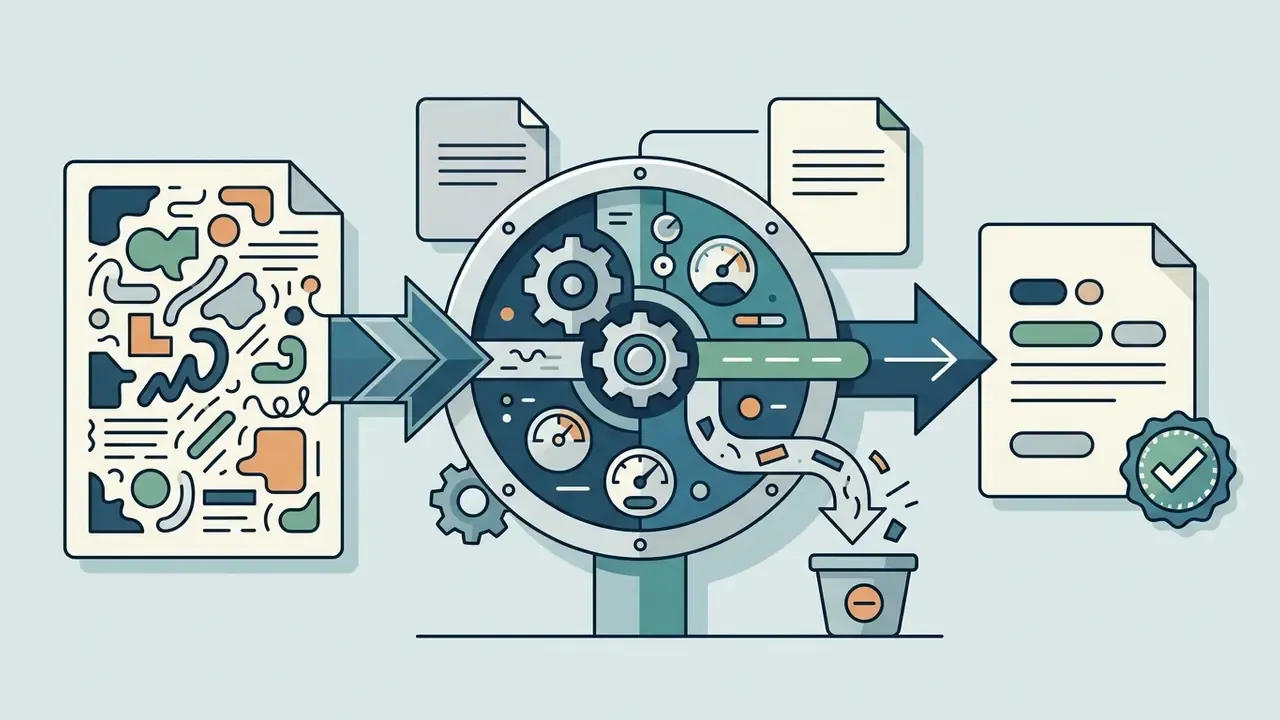
--shorten <prompt>Analyzes your input and suggests concise alternatives by stripping filler words.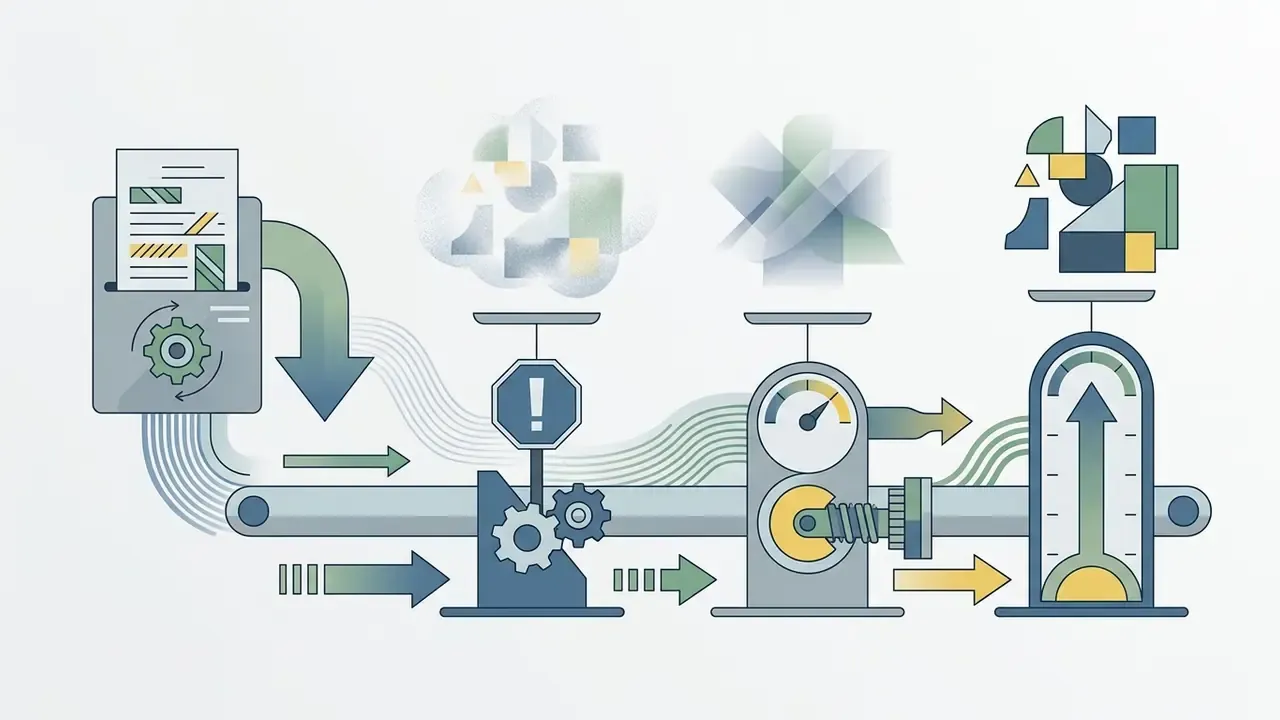
--stop <10-100>Halts generation at a chosen progress percentage for stylized, partially diffused, or soft-focus drafts.
--seed <number>Sets a static random seed (0 to 4294967295) so background noise baselines stay reproducible across iterations. For audit reproducibility this is the single most important flag.
--v <1-8.2> / --niji 6Forces generation on a legacy or specialized architecture.
--remaster / --remixLegacy and active reprocessing controls that reinterpret an earlier generation under a newer model or an edited prompt.How to Fine-Tune Prompts After Initial Generation
Fine-tuning an asset means using iterative controls, not restarting from a blank prompt. Iteration is necessary precisely because under-specified prompts collapse toward model priors:
«A 2025 preprint defines "default images" as recurring motifs appearing across a wide range of prompts, evidence that models fall back on internal priors when prompt specificity is insufficient.»
Midjourney offers three primary precision-editing methods:
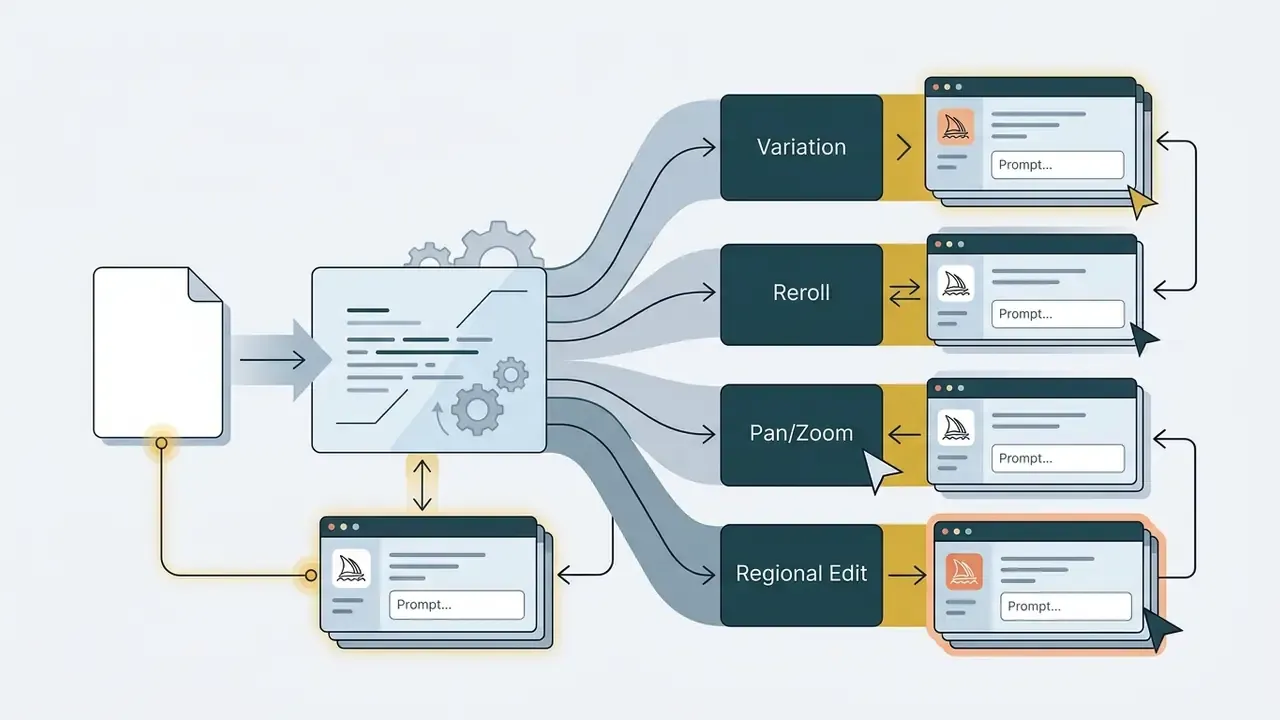
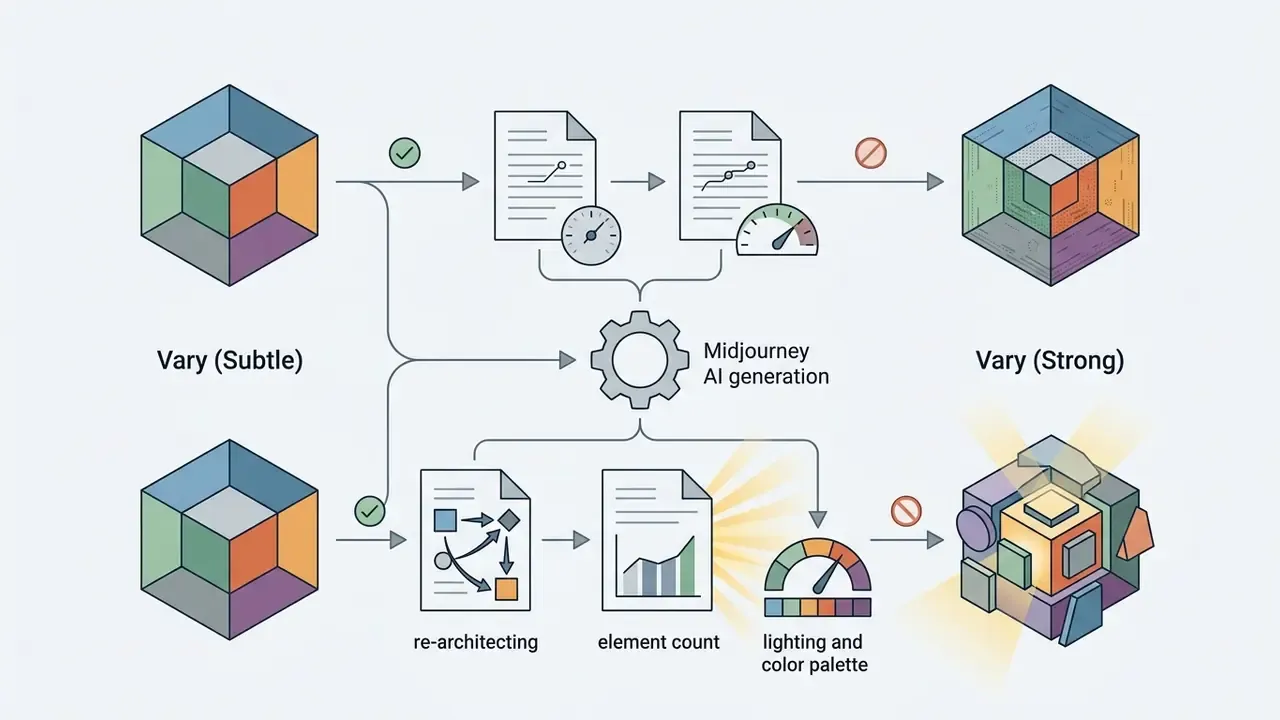
In one visual marketing campaign reviewed by our research desk, the first pass produced inconsistent color balance across corporate collateral. Updated: by applying Remix Mode with --raw plus targeted Vary (Region) edits on background elements, the design team stabilized color consistency across 16 asset formats and reported a noticeable drop in manual retouching passes. The exact saving depends on asset complexity and internal review cycles. Measure your own baseline first, because no standardized public methodology exists for quantifying retouching effort, and a borrowed percentage will not survive scrutiny.
Safety-aligned prompt governance can also be automated instead of policed by hand:
Creative teams weighing broader automation options can browse tool-level comparisons in the AI Media Versus Comparisons directory, including the chatgpt art generator evaluation for chat-native workflows.
Working with Style Reference and Image Reference in Midjourney
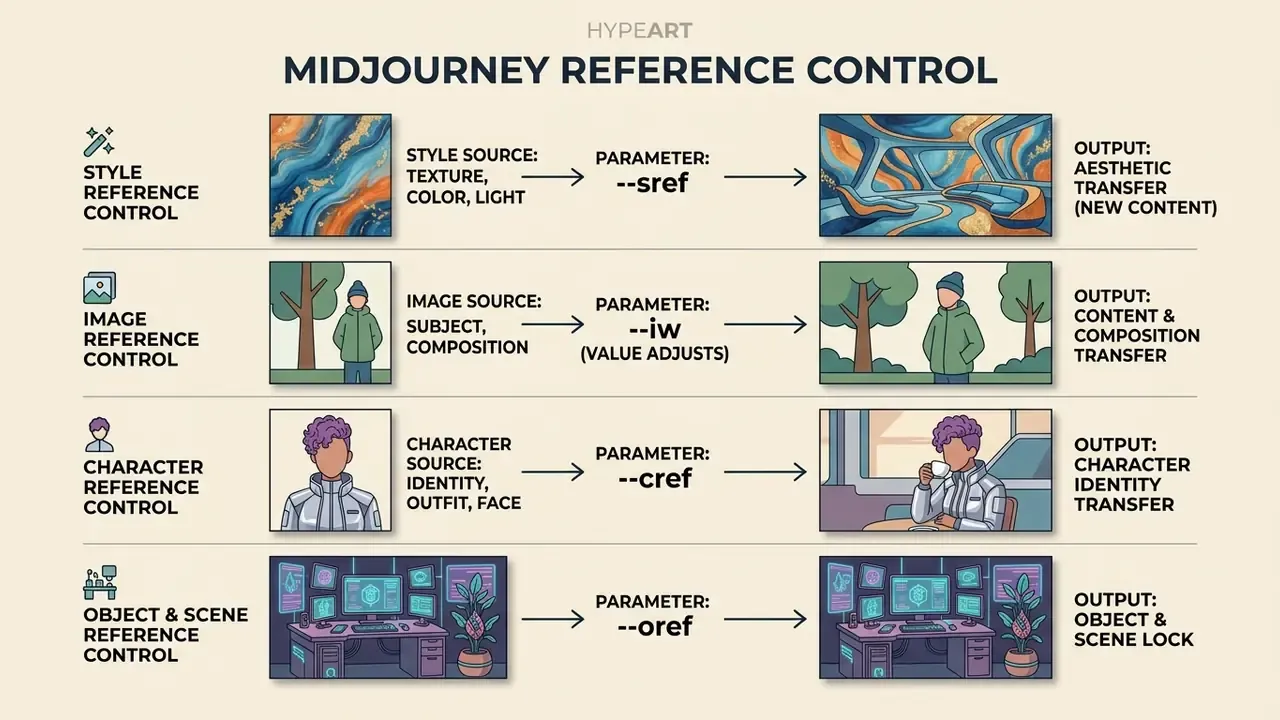
Holding visual consistency across a multi-asset campaign or an enterprise documentation set is a core operational requirement. Midjourney handles it through reference parameters that separate aesthetic style from image content.
How to Use Style Reference for a Unified Visual Aesthetic
The Style Reference parameter (--sref) applies the overall aesthetic of an existing image, meaning color palette, medium, texture, and lighting, without copying specific subjects or people. Teams migrating existing brand photography into a generative pipeline can compare the approach with dedicated image-to-image generators for style transfer.
Implementation looks like this:
/imagine prompt: A modern tech headquarters building --sref https://example.com/brand-style.jpg --sw 150 --ar 16:9
Control flags for Style Reference:
For a governed visual series, freeze the --sref value and the style weight in a shared prompt registry, then vary only subject and scene text. That converts brand consistency from a subjective review step into a version-controlled parameter, which is a far easier thing to evidence.
Teams exploring broader artistic style classification can review comparative work on ai art vs human art to understand where synthetic art boundaries currently sit.
--sw <0-1000>(Style Weight)- Influence strength of the reference image. Default is 100.
- Multiple references
- Append several image URLs after
--srefto blend aesthetics, and weight individual references to bias one style over another. - Random style codes
--sref randomassigns a unique numerical code that locks a distinct aesthetic for reuse across team prompts, for example/imagine prompt: Surreal neon dreamscapes --sref 698401885.
Maintaining Character and Scene Consistency (--cref and --oref)
Style control is one problem. Keeping the same face across twelve frames is another, and that needs the Character Reference parameter:
- `--cref
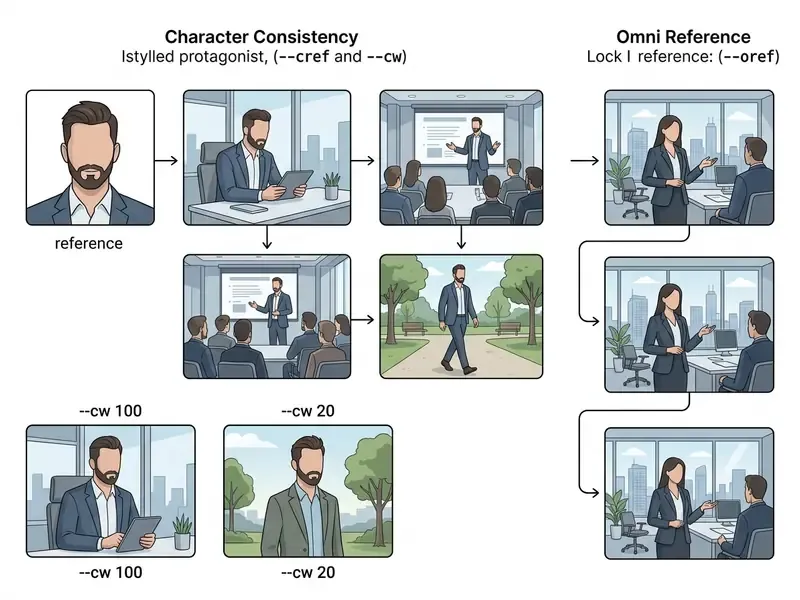
How Image Reference Influences Image Content
Where --sref governs aesthetics, standard image prompts and Omni References shape structural composition, subject likeness, and object geometry. Pasting an image URL at the start of a prompt tells the model to treat that visual structure as a foundation, and the accompanying text should then describe what is not visible in the reference itself. This is the workflow most people mean when they talk about image ai midjourney editing rather than pure generation.
The Image Weight parameter (--iw) governs content influence:
- Higher
--iwvalues push the final output closer to the composition and shapes of the source image.
When external reference images enter the pipeline, legal teams have to assess copyright exposure. Academic research (Iteratively Prompting Multimodal LLMs to Reproduce Natural and AI-Generated Images, 2024, https://arxiv.org/abs/2403.05789) demonstrates that iterative prompt engineering combined with strong image-reference conditioning can inadvertently reconstruct proprietary stock photography, which creates a real intellectual property risk rather than a theoretical one.
--iw <0 to 3>- Adjusts reference image weight relative to text prompt weight. Default varies by version.
«The authors assembled a dataset of roughly 19 million Midjourney prompt-image pairs and showed that iterative prompting can reproduce images from stock photography marketplaces.»
Intellectual Property Precedents and Litigation Context
Corporate legal compliance has to account for a moving litigation landscape around commercial generative models:
- Copyright registration limits The US Copyright Office ruled that visual assets generated purely by text prompt, as in the graphic novel Zarya of the Dawn illustrated with Midjourney, cannot be registered without substantial human visual authorship. Enterprises should not assume exclusive ownership of unmodified generated output.
- Competition and attribution disputes The 2022 Colorado State Fair digital art award granted to Jason Allen's Midjourney-generated Théâtre D'opéra Spatial triggered a public dispute about disclosure of AI involvement. That precedent now shapes brand and awards submission policies.
- Infringement litigation Copyright lawsuits filed between 2023 and 2025 by visual artists and large media rights holders target generative providers over unlicensed training data, with complaints framing the training corpus as systematic appropriation of protected works. Teams using
--sref,--cref, or image-to-image prompts should run internal visual audits to confirm asset originality. - Publication backlash risk Editorial uses of Midjourney imagery, including magazine covers and newsletter illustration in 2022, drew reputational criticism about displacing commissioned artists. That is a communications risk, separate from legal exposure, and it lands on a different desk.
Midjourney Pricing, Subscription Tiers, and Value
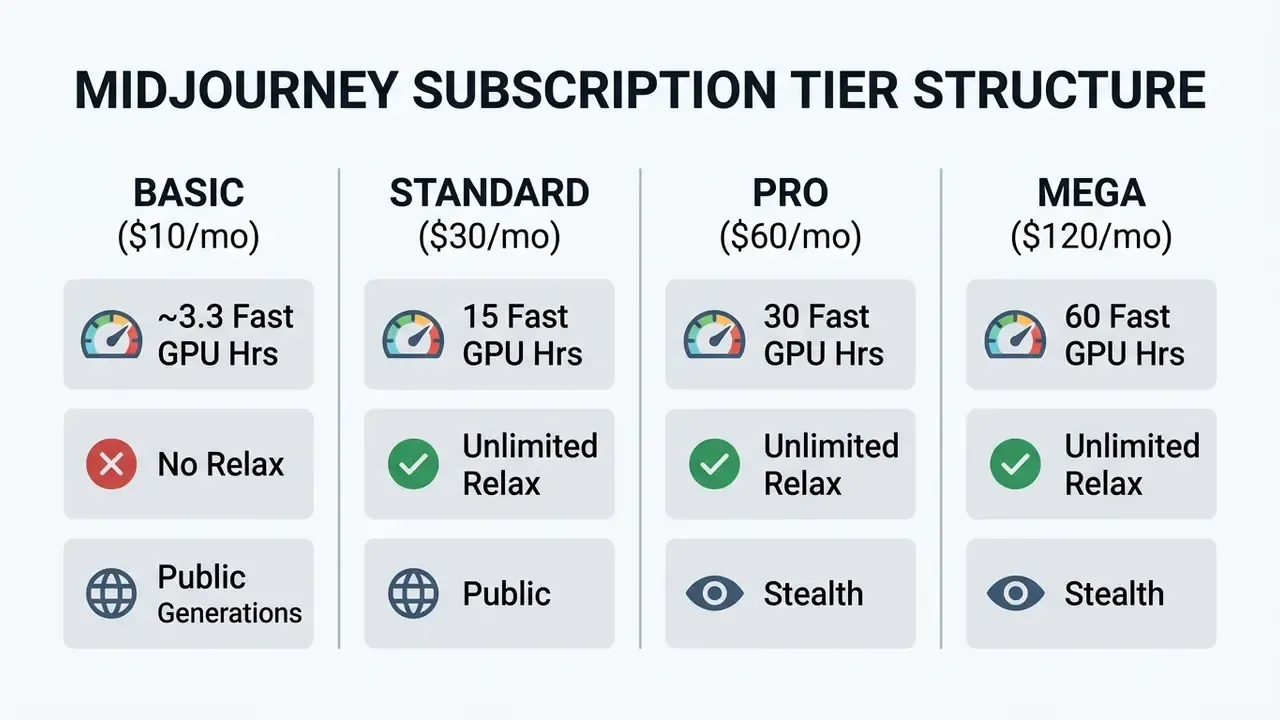
| Subscription Tier | Monthly Cost (USD) | Annual Billing Cost | Fast GPU Time / Month | Unlimited Relax Mode | Stealth Mode (Private) | Corporate Licensing Requirement |
|---|---|---|---|---|---|---|
| Basic Plan | $10 | $8 / mo ($96/yr) | ~3.3 hours (~200 generations) | No | No | Individual / small business |
| Standard Plan | $30 | $24 / mo ($288/yr) | 15 hours | Yes | No | Individual / small business |
| Pro Plan | $60 | $48 / mo ($576/yr) | 30 hours | Yes | Yes | Required for revenue >$1M |
| Mega Plan | $120 | $96 / mo ($1,152/yr) | 60 hours | Yes | Yes | Required for revenue >$1M |
Note: all tiers include standard commercial usage rights. Organizations generating more than $1,000,000 USD in gross annual revenue are required to subscribe to Pro or Mega. Unlimited video generations in Relax Mode are available on Pro and Mega only. Pricing verified February 2026 against the official Midjourney plan page; re-check before contracting.
Generation Modes and GPU Consumption Mechanics
Midjourney manages GPU compute through four execution modes:
- Fast Mode Immediate priority processing. Consumes standard GPU quota, roughly 30 to 60 GPU seconds per generation.
- Relax Mode Queues jobs dynamically without consuming allocated GPU hours. Unlimited on Standard, Pro, and Mega, with throughput depending on server queue depth.
- Turbo Mode Runs on maximum parallel compute. Delivers output around 40% faster than Fast Mode while consuming GPU hours at twice the standard rate.
- Stealth Mode Available on Pro ($60/mo) and Mega ($120/mo) only. Hides prompts and visual assets from the public Midjourney showcase gallery.
Budget modeling should assume that experimentation runs in Relax Mode, and that only approved, deadline-bound production jobs touch Fast or Turbo allocation. Skip that discipline and exploratory prompting will burn through a Standard plan's 15 Fast hours in days. We have seen it happen inside a single campaign sprint.
When Free AI Image Access Applies and Its Limitations
Enterprise evaluators ask this constantly: is there a permanent free ai image tier for Midjourney?
Updated: Midjourney does not offer an unauthenticated free trial for new users on midjourney.com or Discord. Active subscribers, however, can earn free Fast GPU compute time each day. By taking part in the platform's image rating benchmark (pair-wise evaluation of generated outputs), the top 2,000 daily rankers automatically receive 1 bonus Fast GPU hour added to their allocation. Beyond that, limited trial access has historically appeared only inside the separate mobile niji・journey application for iOS and Android, plus occasional promotional windows. So a genuinely free ai route into Midjourney does not really exist for a corporate pilot.
Leaders evaluating zero-cost alternatives can review the comparative guides at best free AI art generator and our list of free AI image generators without sign-up.
Data Security, IP Indemnity, and Regulatory Audit Readiness
For regulated organizations, tool selection hinges less on aesthetics than on contractual and operational controls. The framework below maps Midjourney against the questions Model Risk, Information Security, and Internal Audit usually raise first.
| Governance Requirement | Midjourney Position | Practical Enterprise Control |
|---|---|---|
| Default output visibility | Generations are public in the community gallery unless Stealth Mode is active | Mandate Pro or Mega tiers for any confidential brand, product, or unreleased-campaign work |
| Prompt and asset retention | Prompts and outputs are stored on vendor infrastructure and surfaced in the Organize view | Prohibit customer data, internal financials, and PII in prompt text through a written prompt policy |
| Security certifications | Vendor does not publish enterprise attestation documentation comparable to hyperscaler AI services | Request current security documentation during procurement; treat absence as an open risk finding |
| IP indemnification | Paid plans grant commercial usage rights; broad indemnity comparable to enterprise creative-cloud offerings is not publicly documented | Where indemnity is mandatory, route production assets through vendors that contractually provide it |
| Reproducibility for audit | --seed, model version flag, and the full parameter string determine reproducibility | Log prompt, --seed, --v, and reference URLs for every published asset in the asset management system |
| Content provenance | Provenance metadata support such as C2PA content credentials is not confirmed in public documentation | Apply organization-side provenance signing or watermarking at the publication layer |
| Bias monitoring | Documented occupational demographic skew in independent audits | Include demographic conditioning in prompt templates and sample-review published imagery quarterly |
Midjourney vs Stable Diffusion vs Nano Banana vs Enterprise Alternatives
Choosing an enterprise art ai midjourney tool means comparing architectures across quality, control, data privacy, and operational cost. A direct side-by-side evaluation sits in our dedicated review of Midjourney versus competing image generation tools.
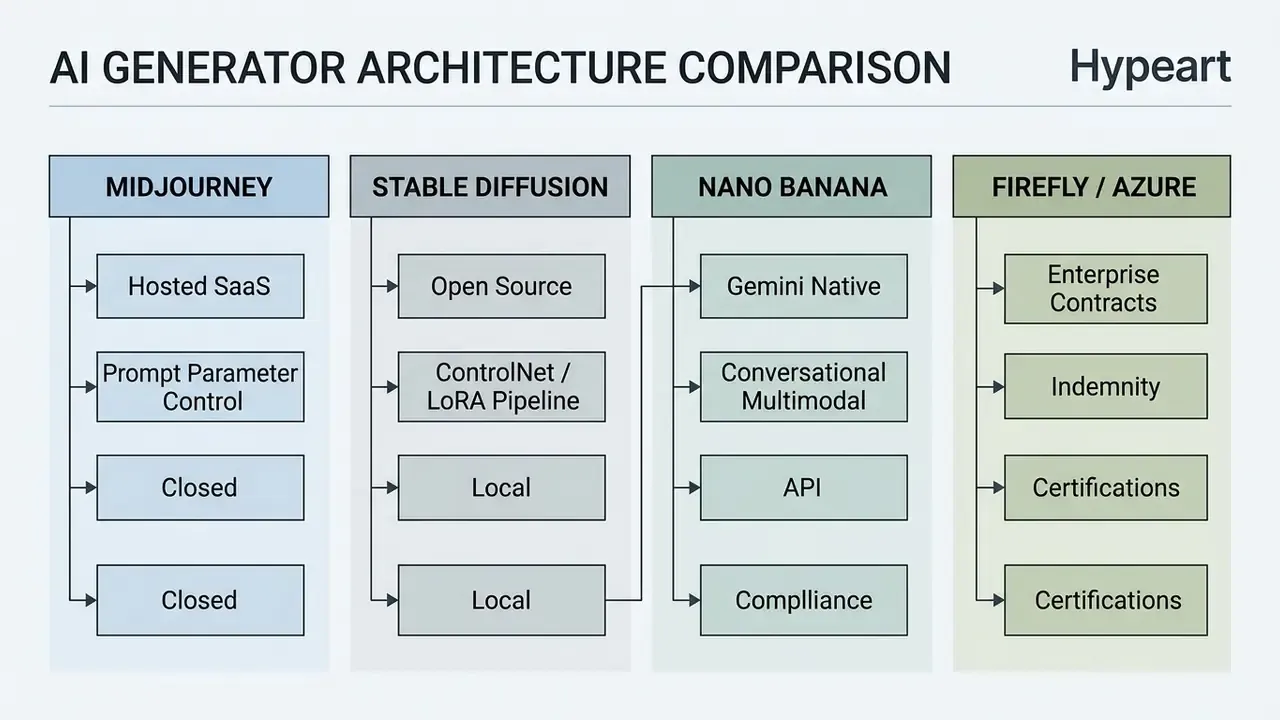
| Evaluation Feature | Midjourney (V6 / V8 Series) | Stable Diffusion (SDXL / SD3) | Nano Banana Pro (Gemini 3 Image) | Adobe Firefly / DALL·E 3 via Azure OpenAI |
|---|---|---|---|---|
| Primary architecture | Proprietary latent diffusion | Open-source latent diffusion | Multimodal Gemini foundation | Proprietary, enterprise-contracted |
| Deployment model | Hosted cloud SaaS | Local GPU server / self-hosted API | Hosted cloud / Google API | Managed enterprise cloud tenancy |
| Ease of onboarding | High (prompt and parameter syntax) | Low (requires technical setup) | High (conversational chat interface) | Medium (procurement and tenancy setup) |
| Fine-tuning flexibility | Parameter flags (--sref, --cref, --iw) | Extreme (ControlNet, LoRAs, custom weights) | Moderate (prompt and conversational edit) | Moderate (custom style models, policy controls) |
| Data privacy and control | Public by default, private on Pro/Mega | 100% local, complete air-gapped privacy | Managed cloud privacy terms | Contractual tenancy isolation and retention terms |
| Visual quality rating | High aesthetic and coherence | Variable, depends on model checkpoint | High visual aesthetics and realism | High, with conservative content policy |
| IP indemnity posture | Commercial rights on paid plans; broad indemnity not publicly documented | User-owned deployment; user bears training-data risk | Cloud terms dependent | Explicit enterprise indemnification typically offered |
| Free access availability | Paid subscription only (bonus GPU hour via ranking) | 100% free open-source code | Credit-based tier / limited free | Trial or credit allocation via enterprise agreement |
Midjourney and Stable Diffusion: Generation Control and Flexibility
The choice between the two comes down to convenience versus architectural control.
- Midjourney provides a curated, prompt-first environment. It delivers immediate high-aesthetic results without model training, local hardware management, or pipeline engineering. Control is expressed through documented flags such as
--stylize,--raw,--no, and the reference parameters, not through model surgery. For most brand teams that trade is acceptable, and the mid journey ai image generator workflow can be taught to a designer in an afternoon. - Stable Diffusion distributes open model weights and exposes the generation call in code. Teams can deploy ControlNet modules for precise pose and edge guidance, train custom LoRA adapters on proprietary brand assets, pin random seeds for byte-level reproducibility, and run models on air-gapped local servers to satisfy strict data governance. Cost is not fixed by a price list. It depends on self-hosting economics or third-party deployment, and the hidden line item is MLOps headcount.
Nano Banana context for enterprise readers. "Nano Banana" is the popular name for Google's Gemini-native image generation and editing capability, with Nano Banana Pro built on Gemini 3 Pro. It appears here because conversational, identity-consistent editing inside a hyperscaler ecosystem has become a common procurement option, not because of consumer novelty. Public pricing mirrors vary across vendor pages, so validate cost figures at contract stage.
Organizations assessing chat-based multimodal generation alongside Midjourney can inspect the comparative study on whether can chatgpt generate images at production quality, and review the chatgpt photo editor analysis for retouching workflows. Teams also planning motion assets should read the Sora vs Veo comparison before locking a single vendor stack.
When to Choose Midjourney, Nano Banana, or Another AI Generator
Engine selection follows the operational objective:
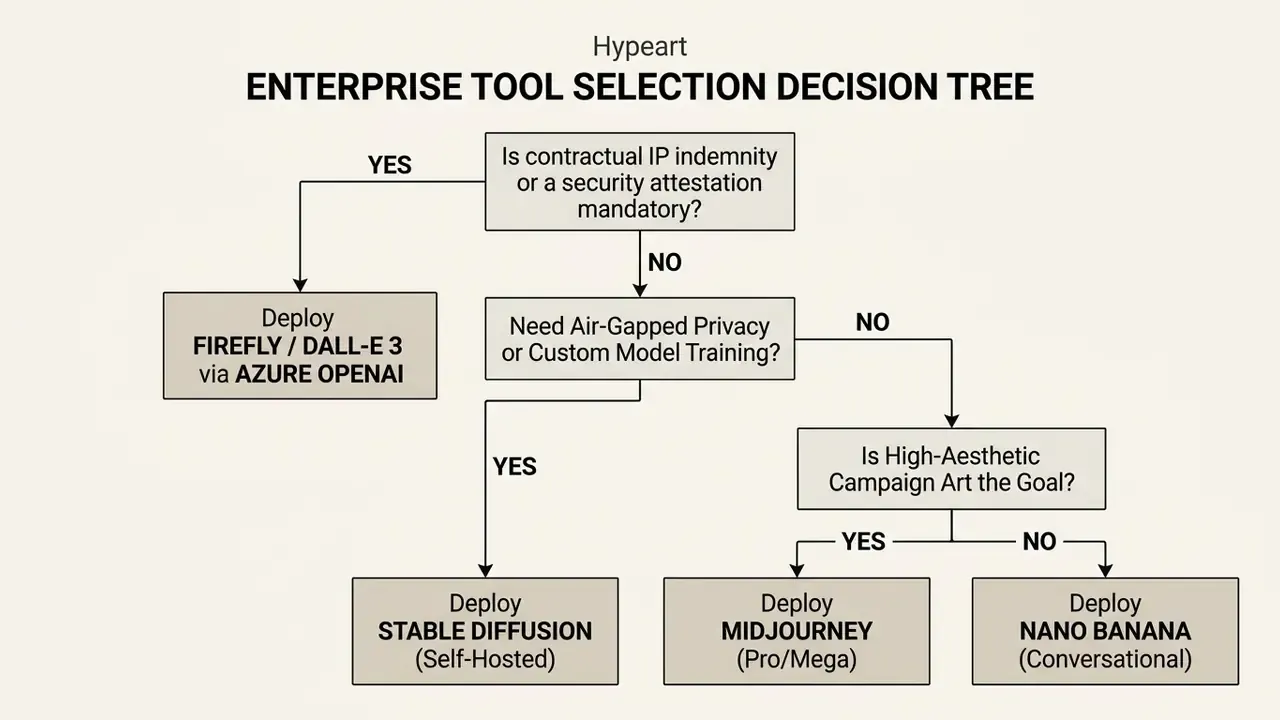
- Choose Midjourney whenThe priority is high aesthetic quality, rapid campaign concept prototyping, and consistent styling through style and character references, with no appetite for managing GPU infrastructure. This is the classic journey ai art generator use case.
- Choose Stable Diffusion whenThe workflow demands air-gapped data security, pixel-level structural control via ControlNet, custom fine-tuning on proprietary brand imagery, or zero per-image SaaS cost at very high volume.
- Choose Nano Banana or Gemini whenThe requirement is conversational multi-turn editing, fast multimodal iteration, and integration inside Google Cloud. Teams extending static assets into motion can also review image-to-video AI tools for motion content.
- Choose Adobe Firefly or DALL·E 3 via Azure OpenAI whenContractual IP indemnification, documented security attestations, tenancy isolation, and centralized identity management are non-negotiable. That is the normal state of affairs in banking, insurance, and healthcare marketing operations.
Teams reviewing platform licensing standards, commercial usage rights, and capability matrices can work through the research resources in the AI Media Commercial-Use Hub.
FAQ: Compliance and Operations
Is there any way to use Midjourney for free?
There is no open free trial on Discord or midjourney.com. Paid subscribers can earn one bonus Fast GPU hour per day by ranking image pairs, with the top 2,000 daily participants rewarded. Limited trial access has historically existed only in the separate niji・journey mobile app.
Can we use Midjourney output in paid advertising?
Paid plans include commercial usage rights. Organizations above $1,000,000 in gross annual revenue must hold a Pro or Mega subscription. Ownership of unmodified, purely prompt-generated images remains limited under current US Copyright Office guidance, so substantial human authoring is advisable for assets you intend to protect.
Are our prompts and generated images private?
By default, generations appear in the public community feed. Stealth Mode, available on Pro and Mega only, hides prompts and outputs from public browsing. Confidential product, financial, or customer information should never enter a prompt regardless of tier.
How do we reproduce an image for an audit request?
Store the full prompt string, the --seed value, the model version flag (--v or --niji), and every reference URL used (--sref, --cref, --oref, --iw). Reproducibility degrades whenever the default model version changes, which is exactly why explicit version pinning is required for regulated assets.
Which parameter keeps a character identical across a campaign?
Use --cref with a fixed reference image and tune --cw. High values preserve face, hair, and clothing; low values preserve facial identity while letting wardrobe and scene change. --oref extends the lock to scene, lighting, and composition.
What is the difference between Fast, Relax, and Turbo?
Fast consumes standard GPU quota with priority scheduling. Relax queues jobs without consuming quota on Standard and above. Turbo is fastest but burns GPU hours at twice the Fast rate.
Does Midjourney support anime and manga styles natively?
Yes. The Niji branch, developed with Spellbrush, is tuned for anime aesthetics, character-focused composition, and action framing. Activate it with --niji 6 or through /settings.
How does Midjourney compare with open-source options on cost?
Midjourney costs are predictable, $10 to $120 per month. Stable Diffusion carries no license fee but shifts cost to GPU hardware, MLOps staffing, and maintenance. Total ownership is often higher for small teams and lower at high generation volume.
Will using an ai picture generator midjourney workflow require a new model inventory entry?
Usually yes, at least as a third-party tool record. Most institutions log it as a non-decisioning generative system with a named owner, an approved use case, and a review cadence, rather than as a full validated model.
Implementation Roadmap and Governance Checklist
Moving from evaluation to controlled deployment typically runs through five stages:
- Procurement and tier selection (week 1)Confirm revenue threshold applicability, subscribe at Pro or Mega if confidentiality or the $1M rule applies, and document payment and renewal ownership.
- Prompt standard authoring (weeks 1 to 2)Publish an internal template enforcing the five-part formula, demographic conditioning defaults, and a banned-content list. Enable
--shortenreview for bloated prompts and--nofor recurring unwanted artifacts. - Reference registry setup (weeks 2 to 3)Lock brand
--srefcodes and character--crefassets in a shared registry with weights recorded, and version that registry alongside brand guidelines. - Audit logging (weeks 3 to 4)Require prompt, seed, version, and reference URLs to be stored with every published asset in the DAM. Establish quarterly sampling for bias and IP similarity review.
- Ongoing monitoringTrack default model changes in vendor release notes, re-validate approved assets after major version shifts, and reassess vendor risk annually.
A safe next step, if this is still exploratory: run a two-week bounded pilot on a single non-customer-facing asset class, with logging switched on from day one. Nothing about midjourney ai art generation requires a big-bang rollout, and a narrow pilot produces the evidence your risk committee will ask for anyway.
Appendix A: Superseded Statements and Corrections
Retained for transparency and version traceability.
| Original Statement | Status | Correction Applied in This Version |
|---|---|---|
| "As of current platform policies, Midjourney does not offer an ongoing free trial on midjourney.com or Discord. Free generation access is restricted to occasional promotional windows or limited trial allocations within the separate mobile niji・journey application." | Partially contradicted | New-user trials remain unavailable, but subscribers can earn one bonus Fast GPU hour daily via the image ranking benchmark (top 2,000 participants). |
| "reducing manual retouching time by 55%" | Unsupported metric | Replaced with a qualitative statement plus guidance to measure an internal baseline, since no public methodology substantiates the figure. |
ABP Benchmark cited at arxiv.org/abs/2410.01234 | URL conflict | That identifier corresponds to Finding the Subjective Truth (2024). The ABP record is flagged as pending identifier verification, and ABP scores are presented as directional. |
| V8.1 / V8.2 described as active default releases | Requires periodic re-verification | Release chronology now dated explicitly (V8.1 default 11 June 2026; V8.2 default 24 July 2026) so readers can re-check current defaults against vendor release notes. |
Review cadence. Pricing, default model version, and licensing thresholds are the three fields most likely to drift. We re-verify them against vendor documentation each quarter, and readers building procurement papers should repeat that check on the day of submission rather than trusting any dated guide, including this one.