That means evaluating model quality, per-second pricing, rendering latency, and production governance in the same pass. Enterprise applications need predictable costs, documented fallback mechanisms, and reproducible audit trails before any automated video workflow reaches production scale.
Last updated: August 2026.
Executive Summary for Technology and Risk Leaders
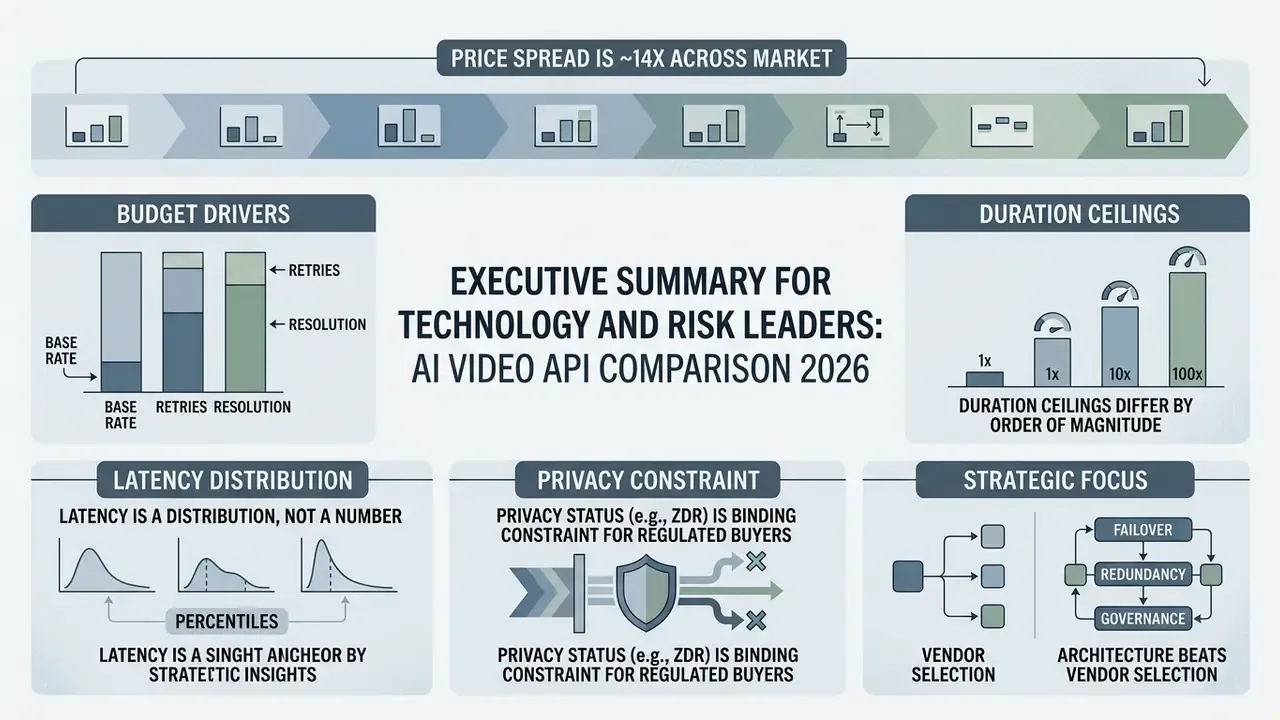
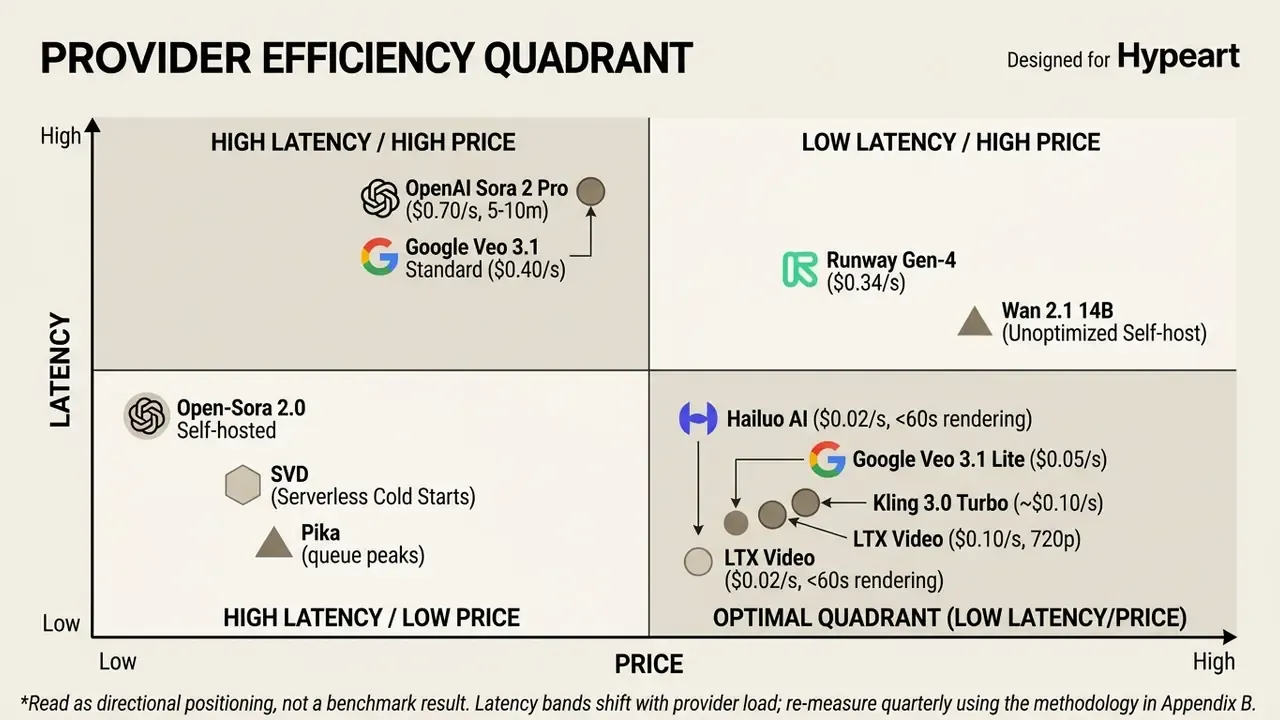
- Price spread is roughly 14x across the market. Verified per-second rates in 2026 run from $0.01 to $0.03/sec (Hailuo AI, 720p) and $0.05/sec (Google Veo 3.1 Lite) up to $0.70/sec (OpenAI Sora 2 Pro at 1080p). A single 10-second 1080p clip therefore costs anywhere from $0.30 to $7.00 before retries.
- Retries and resolution dominate the budget, not the base rate. Effective spend equals base rate × duration × (1 + retry rate) × volume, plus surcharges for reference-video ingestion, audio synthesis, and moderation review. Upgrading resolution alone can multiply unit cost: Sora 2 Pro moves from $0.10/sec at 720p to $0.70/sec at 1080p (a 600% increase), and Runway's
seedance2_5charges 68 credits/sec at the higher output tier versus 30 credits/sec at the lower one. - Duration ceilings differ by an order of magnitude. OpenAI Sora 2 is fixed at 4, 8, or 12 seconds. Google Veo 3.1 produces 8-second clips with native audio. Kling 2.0/3.0 supports continuous scene generation up to 120 seconds in extended mode.
- Latency is a distribution, not a number. Fast tiers such as Hailuo AI render in 30 to 90 seconds; Sora 2 Pro renders can take several minutes under load. Benchmark P50/P75/P95 across at least 50 runs per model. One clean average will mislead you.
- Privacy status is the binding constraint for regulated buyers. OpenAI's
v1/videosendpoint retains assets for 48 hours for download plus 30 days for abuse monitoring, and it is currently blocked for Zero Data Retention (ZDR) requests. Google Vertex AI and self-hosted open-weight models (Wan 2.2 A14B, CogVideoX, Open-Sora 2.0) allow full data residency control. - Architecture beats vendor selection. A two-level failover pattern (primary model, then ordered fallback models) is the documented industry standard across Vercel AI Gateway, Cloudflare AI Gateway, OpenRouter, and fal. Build the abstraction layer before you standardize on any single vendor.
How to Compare AI Video API Providers for Production
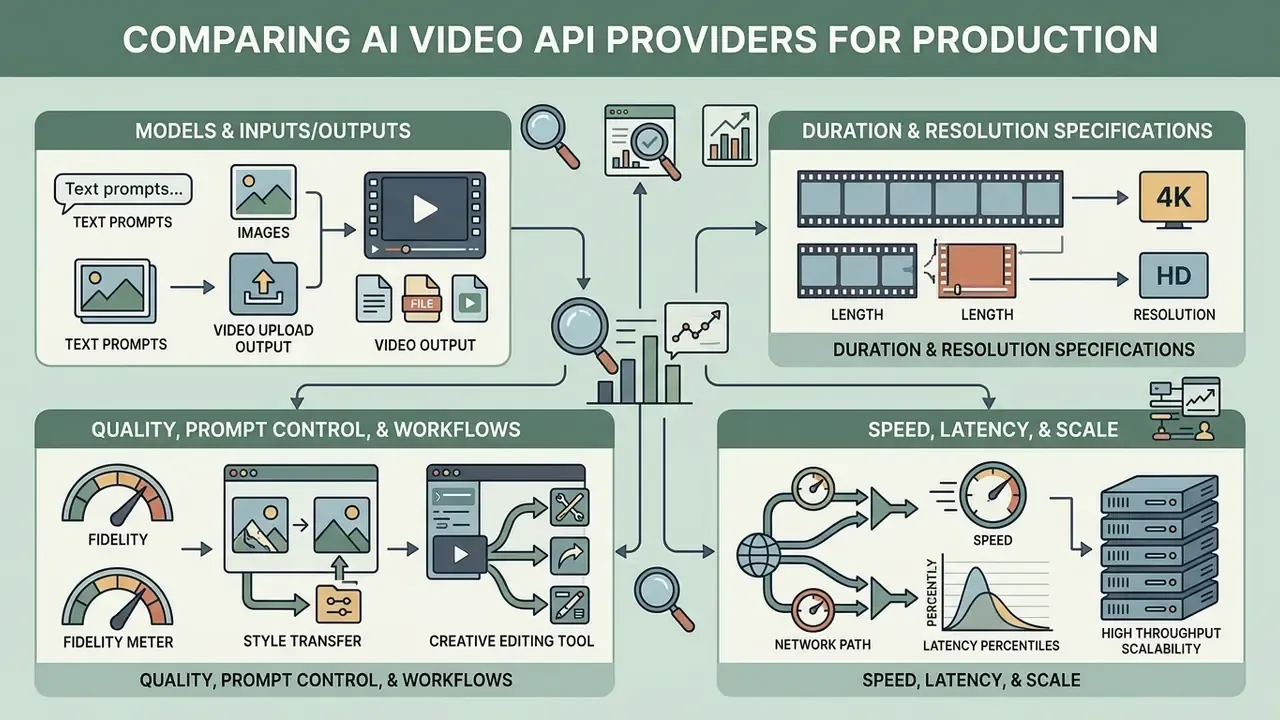
Comparing AI video API providers for production requires an evaluation across objective video quality, prompt control fidelity, end-to-end latency, async throughput scalability, and input/output modality support. Evaluating APIs strictly on promotional clips invites three predictable outcomes: integration failures, unpredictable billing, and queue bottlenecks under load.
Enterprise teams should evaluate providers using standardized prompt sets, locked seed values, fixed resolutions, and constant frame rates. In financial services and other regulated environments, model risk frameworks require that generative media systems satisfy explicit conditions on data retention, uptime commitments, and fallback routing before production authorization. Marketing pages do not satisfy those conditions. Documentation and contracts do.
Matrix of Evaluation Criteria for Enterprise AI Video APIs
| Evaluation Criterion | Production Context and Definition | Primary Quantitative Metrics | Key Risk and Governance Considerations |
|---|---|---|---|
| Available Video Models | Underlying generative architecture (proprietary vs open-weight) and version lifecycle. | Parameter count, ELO benchmark scores, VBench spatial/temporal ratings. | Vendor lock-in, sudden model deprecation, unannounced weight updates. |
| Input Modalities | Supported conditioning types including text, reference images, and video continuation. | Support for T2V, I2V, V2V, first/last frame locking, multi-image conditioning. | Data leakage via uploaded assets, copyright boundaries on reference inputs. |
| Output Formats and Quality | Container specs, native resolution caps, frame rates, and embedded audio support. | 720p to 4K resolutions, 24 to 60 FPS, MP4/WebM containers, native audio sync. | Artifact generation, temporal flickering, brand safety and compliance filtering. |
| Prompt Control and Steering | Ability to direct camera movement, subject consistency, and scene framing via API. | Prompt adherence scores, camera angle tags, motion vectors, seed pinning. | Instruction drift, hallucinated objects, failure to enforce explicit negative prompts. |
| Speed and Latency | Duration from API POST submission to complete asset retrieval from CDN. | End-to-end generation time (seconds), Time-To-First-Frame (TTFF), P95/P99 latency. | Queue timeout failures, dynamic load throttling during peak server usage hours. |
| Async Scale and Throughput | Capacity to process concurrent bulk rendering tasks without rate-limit drops. | Requests per minute (RPM), max batch size, concurrent worker queues. | Unthrottled API spend spikes, storage buffer expiry on provider CDNs. |
| Production Access and Privacy | SLA guarantees, zero data retention (ZDR) capabilities, and deployment options. | 99.9% uptime SLA, zero-log options, regional hosting availability. | Non-compliance with SOC 2 or GDPR, exposure of confidential IP to public training. |
No matching rows Clear one or more filters to restore the matrix.
Models, Input Types, and Output Formats
Production AI video APIs support several input modalities, including text-to-video (T2V), image-to-video (I2V), and video-to-video (V2V), while producing specific resolutions, frame rates, and durations. Matching those parameters to the business requirement prevents two symmetrical mistakes: overpaying for resolution nobody will see, and under-specifying fidelity for an asset that ends up on a homepage.
Research from OpenVid-1M indicates that training and evaluating models at minimum resolutions of 512×512 or 720p provides a workable baseline for temporal coherence.
«The OpenVid-1M corpus contains more than one million high-quality clips at a minimum resolution of 512×512, establishing a reproducible baseline for temporally coherent video generation.»
Duration and resolution specifications. OpenAI Sora 2 exposes fixed clip durations of 4, 8, or 12 seconds with discrete output dimensions (720×1280, 1280×720, 1024×1792, 1792×1024). Kling 2.0/3.0 supports continuous scene generation up to 120 seconds in extended mode at 1080p, which makes it the current duration leader for long-form narrative work. Black Forest Labs (generate_video) and Wan 2.2 cap single-pass inference at 15 to 20 seconds at Full HD (1920×1088 for 16:9) and 24 FPS. Google Veo 3.1 generates 8-second clips at 720p, 1080p, or 4K with natively generated audio. A few providers expose frame rate as a request parameter; Z.ai, for example, documents FPS values of 30 or 60 with durations of 5 or 10 seconds.
Developers must verify container support (typically MP4 encoded via H.264/H.265) and pull returned payload URLs into internal storage before CDN links expire. Worth flagging: several official reference pages, OpenAI's included, expose duration and resolution fields but publish no container or codec guarantee. Treat codec compatibility as an integration test item, not a documented promise.
Quality, Prompt Control, and Creative Workflows
Video generation quality rests on three things: spatial fidelity, temporal consistency, and prompt adherence across frames. Automated evaluation should lean on validated metrics such as VBench and UGVQ rather than on a vendor reel cut to hide flicker.
«VBench decomposes video generation quality into 16 independent dimensions, from subject consistency to spatial relationships, each with dedicated prompt suites.»
«Traditional VQA metrics transfer poorly to AI-generated video because the artifacts are atypical: unnatural motion and irrational objects rather than compression noise.» - LGVQ / UGVQ Research (2024). https://arxiv.org/abs/2407.21319
Professional creative workflows need precise control: first-frame and last-frame locking, camera path parameters (pan, tilt, zoom, roll), and motion weights. Google Veo 3.1 via the Gemini API allows explicit start and end frames alongside camera movement tags (POV, aerial view, tracking shot, wide shot, close-up, low angle). Venice API exposes Start Frame and End Frame controls plus structured prompt tags for action, environment, and camera movement. MiniMax documents prompt-driven motion timelines with an optional last_image parameter to lock the ending frame and interpolate between keyframes. Kling v1 Pro image-to-video adds explicit camera controls for tilt, pan, zoom, and roll.
One practical caveat, and it surprises teams migrating from image pipelines: no major vendor in the audited documentation set publishes a formal prompt-weight syntax or a production inpainting endpoint for video. Teams that depend on regional edits should validate that capability with the vendor directly instead of assuming parity with image APIs. Similarly, when building multi-step pipelines on an AI Video API, enforce strict parameter validation on prompt weights so that camera motion artifacts do not degrade the delivered file.
Speed, Latency, and Scale Capabilities
API speed must be measured as the full end-to-end response time: request queueing, inference computation, video encoding, and final download. Because generative video APIs operate asynchronously and return a task identifier (task_id) before rendering completes, measuring latency means tracking polling duration or webhook delivery, not the HTTP response to the POST.
Throughput depends on provider concurrency limits and queue stability under load. Public documentation gives usable anchors: Seedance API documentation states that "generation defaults to 100 requests per minute," while Google's Gemini API caps public entry points at 120 requests per minute and private entry points at 600 requests per minute. OpenAI applies tiered account limits scaling with monthly spend qualification. Documented end-to-end processing times vary widely. AI/ML API reports roughly 1 minute 33 seconds for Seedance 2.0 Fast, whereas OpenAI states that a single Sora render may take several minutes, with 1080p and longer durations taking materially longer.
As highlighted by PhyWorldBench, models using deeper diffusion sampling steps (50 to 200) achieve noticeably better physical motion accuracy, at the cost of multiplied inference time.
«Increasing Open-Sora sampling steps from 50 to 200 measurably improves physics accuracy, while generation time rises by a multiple.»
So there is a trade to make, and it belongs in the requirements document, not in a late-stage debate with the creative team. Production systems balance latency tolerance against physical realism based on what the end user actually notices.
Key AI Video API Providers and Available Models
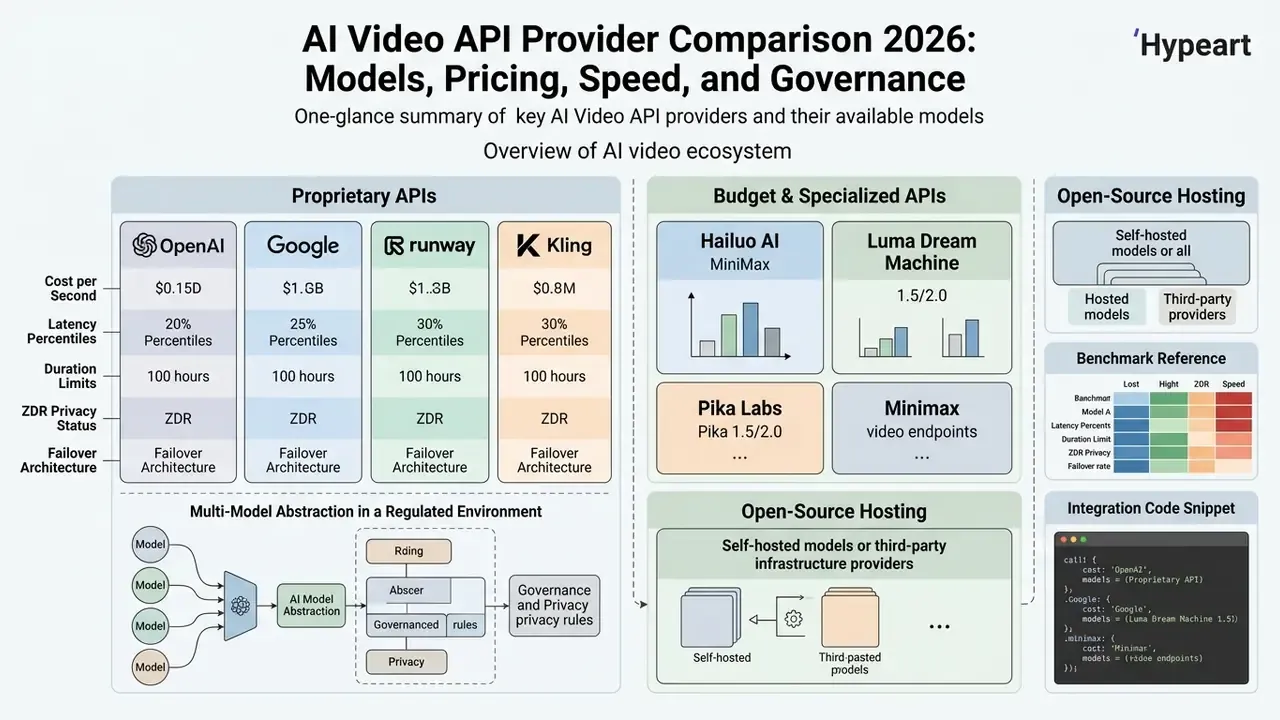
The commercial AI video ecosystem splits into three architectural layers: proprietary model providers, multi-model unified platforms, and open-source model hosting infrastructure. The layer you choose drives integration complexity, model access, and long-term operating risk more than the individual model name does.
Comparative Overview of Major AI Video API Providers, Including Data Privacy Posture
| Provider / Platform | Supported Models | Input Modalities | Output Specifications | Control and Steering Features | Enterprise Access Tier | Data Privacy / ZDR Status / Hosting Region |
|---|---|---|---|---|---|---|
| OpenAI | Sora 2, Sora 2 Pro | Text-to-Video, Image Reference | 720p, 1024p, 1080p; 4/8/12s clips | Prompt steering, character consistency | Public API, Tier 1 to 5 usage limits | 48h download retention plus 30d abuse-monitoring buffer; v1/videos currently blocked for MAM/ZDR requests; US-centric hosting |
| Google Cloud | Veo 3.1 (Standard, Fast, Lite) | Text-to-Video, Image-to-Video | 720p, 1080p, 4K; native audio generation | First/last frame, camera angle controls | Gemini Enterprise, Google Cloud Vertex | Vertex AI enterprise terms with no-training commitments; regional quotas (some video-text features limited to us-central1); C2PA provenance support |
| Runway Dev | Gen-3 Alpha, Gen-4, Seedance 2.5 | T2V, I2V, V2V, Reference Video | 480p to 4K; variable durations | Camera motion, motion brush, style presets | Pay-as-you-go credits, Enterprise tier | Commercial terms with enterprise agreements; US hosting; verify retention window per contract |
| Kling AI | Kling 1.6 Pro, Kling 2.0, Kling 3.0 Turbo | T2V, I2V with frame locking | 720p, 1080p; up to 120s in extended mode; native audio | First/last frame conditioning, multi-shot | API access, custom enterprise SLAs | Published SLA document; operator Kuaishou is China-based, so cross-border data review is required for US and EU financial institutions |
| Hailuo AI (MiniMax) | Hailuo Standard, Hailuo Turbo | Text-to-Video | 720p; 6 to 15s clips | Basic motion prompts, fast turnaround | Pay-as-you-go ($0.01 to $0.03/s) | China-based operator; documentation partly non-English; no published ZDR tier, so unsuitable for confidential IP without isolation |
| Luma AI | Dream Machine 1.5/2.0 | T2V, I2V, 3D Camera Path | 1080p; up to 20s clips | Keyframe control, 3D spatial awareness | Developer Tier, Custom API | US-hosted developer API; retention configurable on custom plans; confirm training-exclusion clause |
| Pika Labs | Pika 1.5, Pika 2.0 | T2V, I2V, Image Animation | 720p, 1080p; 3 to 10s clips | Motion Brush, Modify Region, Sound Effects | Subscription API credits | Consumer-oriented terms; no enterprise ZDR contract documented, so treat as public-content tier only |
| Magnific / OpenRouter | Kling 3, WAN 2.6, MiniMax, PixVerse, Runway Gen 4.5, LTX | T2V, I2V (unified endpoint) | Model-dependent standards | Normalized prompt/seed input schemas | Unified API keys, aggregated billing | Aggregator adds one routing hop; privacy inherits from the downstream model owner, so audit each routed vendor separately |
| Hugging Face / Fal.ai / Replicate | CogVideoX (2B/5B), SVD, LTX Video, Wan 2.2, Open-Sora 2.0 | T2V, I2V (open-source hosting) | Customizable resolution and FPS caps | Direct access to sampler steps and seeds | Serverless endpoints, dedicated GPUs | Self-hosting or dedicated GPU options enable full ZDR and in-VPC residency (AWS/GCP); strongest posture for confidential assets |
Illustrative Case: Multi-Model Abstraction in a Regulated Environment
The following example is composite and illustrative, not a record of a named client engagement.
In a governance review, an enterprise fintech team built an automated video pipeline to produce localized customer education material. To limit vendor lock-in and the risk of an abrupt endpoint shutdown, the engineers deployed a multi-model abstraction layer following an AI Media API pattern.
The design routed standard low-latency jobs to fast commercial endpoints, and reserved high-fidelity open-weight deployments for confidential internal assets. Rather than quantifying a single risk-reduction percentage, the reviewed outcome was structural: the organization removed single-provider dependency from its critical rendering path, kept a documented fallback route for every job class, and maintained asset-level auditability (prompt, model version, seed, cost, operator) for every generated file. The measurable governance benefit was continuity during a primary-provider incident plus complete lineage for internal validation. A precise outage-risk figure would need a controlled availability study, which the review did not cover.
Proprietary APIs: OpenAI, Google, Runway, Kling, and Other Models
Proprietary providers deliver high-fidelity output and continuous model updates. They also enforce strict usage terms and short model lifecycles.
OpenAI's official documentation lists Sora 2 at $0.10/sec for 720p and Sora 2 Pro at $0.30 to $0.70/sec depending on resolution, while scheduling deprecation and shutdown of legacy Videos API endpoints on 2026-09-24. That lifecycle date alone justifies an abstraction layer. Google Veo 3.1 via Vertex AI and the Gemini API adds synchronized audio generation, native image-to-video direction, video extension, prompt expansion, and C2PA content provenance. For setup parameters, quota controls, and sample payloads, our Google Veo implementation guide documents the request lifecycle end to end.
Runway Dev exposes its Gen-4 and Seedance models through credit-based pricing, with advanced video-to-video transformations and reference image steering; Runway also publishes API availability for Gen-4 Image with References at $0.08 per generated image. Kling AI, developed by Kuaishou, performs strongly on image-to-video AI tools tasks, with precise first-frame preservation and multi-shot cinematic sequencing.
Benchmark reference. In a controlled 150-generation comparison, Kling 3.0 scored an average quality rating of 8.1, Google Veo 3 scored 8.3, and OpenAI Sora 2 scored 7.5, with mean generation times of 48, 65, and 95 seconds respectively.
«Across 150 matched generations, Kling 3.0 averaged 8.1 on quality at 48 seconds per render, Veo 3 averaged 8.3 at 65 seconds, and Sora 2 averaged 7.5 at 95 seconds.»
Read that ranking narrowly. It reflects one prompt set, one configuration, one week of vendor weights.
Budget and Specialized APIs: Hailuo, Luma, Pika, and Minimax
For rapid prototyping and cost-sensitive volume rendering, specialized APIs offer trade-offs the frontier vendors do not match on price or turnaround:
- Hailuo AI (MiniMax) ultra-fast generation (30 to 90 seconds) capped at 720p and 15-second clips, priced at an industry-low $0.01 to $0.03 per second. Best for real-time previews, high-volume A/B creative testing, and cost-constrained experimentation.
- Luma Dream Machine (1.5/2.0) specialized in 3D-aware camera paths and spatial depth consistency, with neural-radiance-field lineage that produces natural camera motion. Supports 1080p output up to 20 seconds at $0.06 to $0.12 per second. Best for architectural visualization, virtual tours, product showcases, and gaming assets.
- Pika Labs (Pika 1.5/2.0) built for rapid social iteration, with motion-brush steering, region modification, image animation, and sound effects at $0.03 to $0.08 per second, typical generation times of 1 to 3 minutes, and clips up to 30 seconds.
- Minimax (video endpoints) 1080p output up to roughly 25 seconds at $0.04 to $0.09 per second, with a strong quality-to-cost ratio and experimental beta features. Documentation maturity and API stability lag the established platforms, so pin versions and watch error rates.
- Seedance (ByteDance) purpose-built for image-to-video, preserving source detail with consistent character animation at roughly $0.10/sec for 720p. Seedance 2.0 documentation confirms that 16:9, 9:16, and 1:1 aspect ratios share the same pixel area and therefore the same price within a tier, which helps vertical-first social pipelines.
A governance caution for regulated buyers. Several of these providers operate outside US and EU jurisdictions. Cross-border transfer of prompts, reference images, or brand assets to non-domestic infrastructure needs a documented vendor-risk assessment before production authorization. Not after the first campaign ships.
Open-Source Models and Unified Platforms for Multi-API Access
Open-source video models such as CogVideoX (2B/5B parameters), Stable Video Diffusion (SVD), Wan 2.1 (14B), Wan 2.2 A14B, Open-Sora 2.0 (11B), and LTX Video (2B) can be self-hosted on private cloud infrastructure, which removes the retention question entirely. Teams deploy them through serverless container platforms such as Fal.ai, Replicate, or Hugging Face Inference Endpoints. Hugging Face Diffusers documents both SVD (2 to 4 second image-conditioned clips) and CogVideoX pipelines directly, and its Hub API can enumerate text-to-video models across inference providers in a single query.
Architecture note. Wan 2.2 A14B introduces a Mixture-of-Experts (MoE) diffusion backbone, routing inference dynamically to active sub-networks to reach 1080p quality comparable to closed models while reducing compute cost on self-hosted GPU clusters by up to 32%. That raises effective model capacity without a proportional compute penalty, which is exactly the property that makes self-hosting economically defensible at volume. Open-Sora 2.0 from HPC-AI Tech takes the opposite path: a dense 11-billion-parameter architecture unifying T2V and I2V pipelines at 256px or 768px with fully transparent training methodology, at the cost of higher inference hardware requirements.
Unified multi-model platforms (OpenRouter, Magnific API) wrap several proprietary and open-source models, including Kling 3, WAN 2.6, MiniMax, Runway Gen 4.5, LTX, and PixVerse AI, behind one integration contract. That normalizes request schemas and enables automated failover routing when a primary model provider goes down. NVIDIA NIM exposes WAN 2.2 as separate t2v and i2v server variants with OpenAI-compatible generation calls, while Modular MAX supports T2V, I2V, and TI2V and returns base64-encoded MP4 inline.
The trade-off is explicit. Direct integration gives full access to provider-specific capabilities and raw request logs, which maximizes regulatory auditability. A unified platform cuts integration time from weeks per provider to hours for covered providers and consolidates maintenance, at the cost of one extra network hop, normalized-schema feature loss, and a single platform vendor to govern.
Pricing Comparison: Real Cost of Video Generation
Evaluating the cost of AI video API providers means normalizing everything to a cost-per-second baseline. Providers use pay-as-you-go rates, credit systems, or tiered subscriptions, so direct comparison is impossible until the units match.
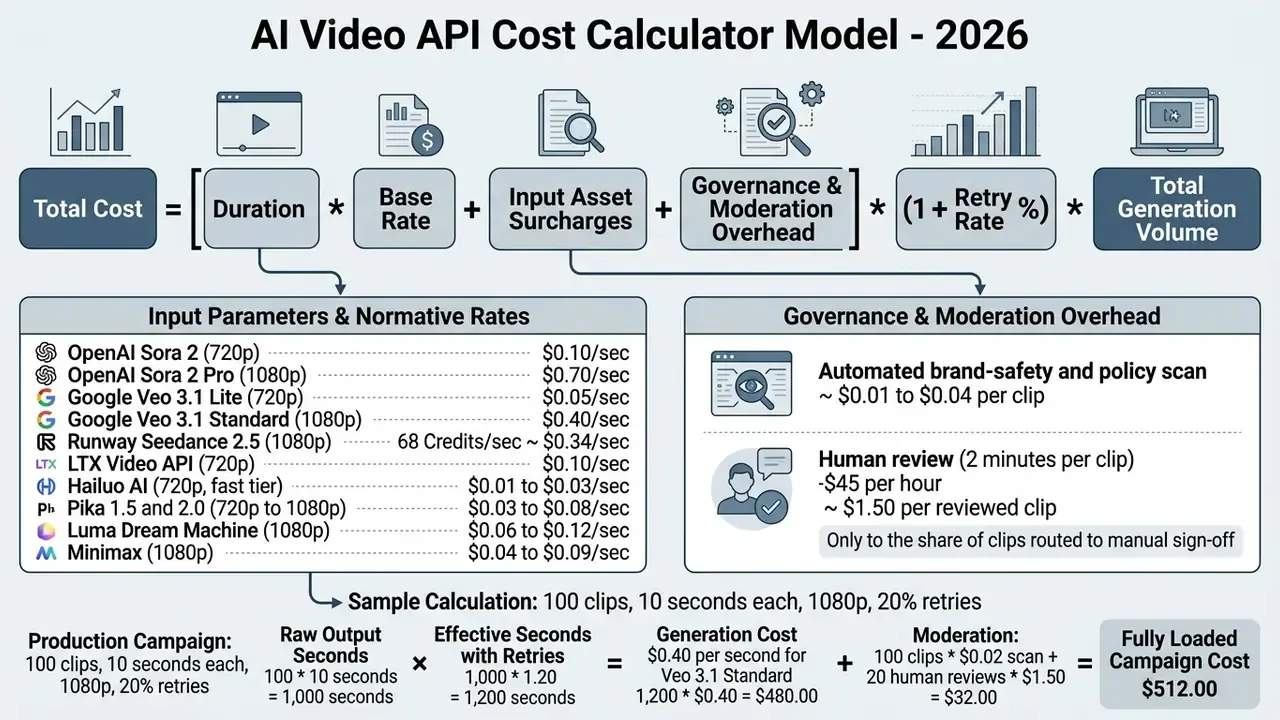
Note what that sample shows. Control cost is about 6% of the campaign in this scenario, and it is the line item most often left out of an AI business case. Risk-adjusted ROI without it is not a forecast, it is optimism.
Calculating Cost Per Second and Price per Generated Video
The cost of one generated clip equals duration in seconds multiplied by the effective per-second rate, plus fees for reference video ingestion or audio synthesis where they apply.
Official 2026 pricing documentation shows wide variance:
- OpenAI Sora 2 $0.10 per second for 720p standard output.
- OpenAI Sora 2 Pro $0.30 per second (720p), $0.50 per second (1024p), $0.70 per second (1080p).
- Google Veo 3.1 from $0.05/sec (Lite 720p) to $0.40/sec (Standard 1080p) and up to $0.60/sec for 4K; the Fast tier sits between $0.10 and $0.30/sec depending on resolution.
- LTX Video API $0.10 per second for 720p and $0.20 per second for 1080p.
- Hailuo AI $0.01 to $0.03 per second at 720p, the lowest documented tier in the current market.
- Pika Labs $0.03 to $0.08 per second. Minimax: $0.04 to $0.09 per second. Luma Dream Machine: $0.06 to $0.12 per second.
So a single 10-second 1080p clip ranges from roughly $0.30 on ultra-budget tiers, to about $2.00 on mid-tier models, up to $7.00 on premium enterprise models. Tiering inside one vendor matters as much as the vendor choice: Veo 3.1 Lite at $0.05/sec is eight times cheaper per second than Veo 3.1 Standard at $0.40/sec.
Credits, Pricing Units, and API Price Transparency
Credit-based billing converts currency into internal platform points, for example 1 credit = $0.005 USD. Credits give flexibility across AI media tools, but they obscure real-time generation cost unless a developer-side monitor tracks conversion continuously.
Runway Dev charges differential credit rates by output resolution and input assets. Generating with seedance2_5 consumes 30 or 68 credits per output second depending on tier, plus 15 or 34 credits per input reference video second, with an enforced minimum charge per request (such as an 80-credit floor). Verify whether those floors apply to short 2 to 3 second test clips. At QA volumes, minimum-charge floors can quietly double the cost of a regression suite.
Billing-model families to reconcile during procurement:
- Pay-as-you-go metered (Google Veo, OpenAI Sora): usage aggregated per billing period, no upfront commitment.
- Prepaid credits (Runway Dev, aggregator platforms): flexible across tools, weaker cost visibility.
- Subscription plus overage (Pika, several consumer-tier vendors): watch minimum commitments, unused-seat charges, and overage multipliers, the three most common hidden-cost patterns.
- Automatic volume tiers: some infrastructure vendors apply tiered discounts as monthly volume rises. Ask explicitly whether video seconds qualify.
- Failed-request policy: several vendors bill failed generations at zero or refund automatically, others charge on attempt. Get it in writing. It is the single largest swing factor in effective unit cost.
How Output, Quality, and Retries Affect Production Budgets
In production, prompt failures, visual artifacts, and brand alignment misses force retries before an asset is acceptable. Rather than assuming a fixed industry retry figure, treat retry rate as an instrumented variable per model and per prompt family. In the reviewed deployments, retry rates were tracked per campaign and fed straight into the cost formula above. Where a vendor bills on attempt rather than on success, every retry raises effective spend linearly, so log retry rate next to cost per clip from day one. Vendors that bill only successful generations reduce that exposure materially. Public 20% to 30% retry ranges circulate widely but carry no published methodology, so use your own measured baseline for budget approval.
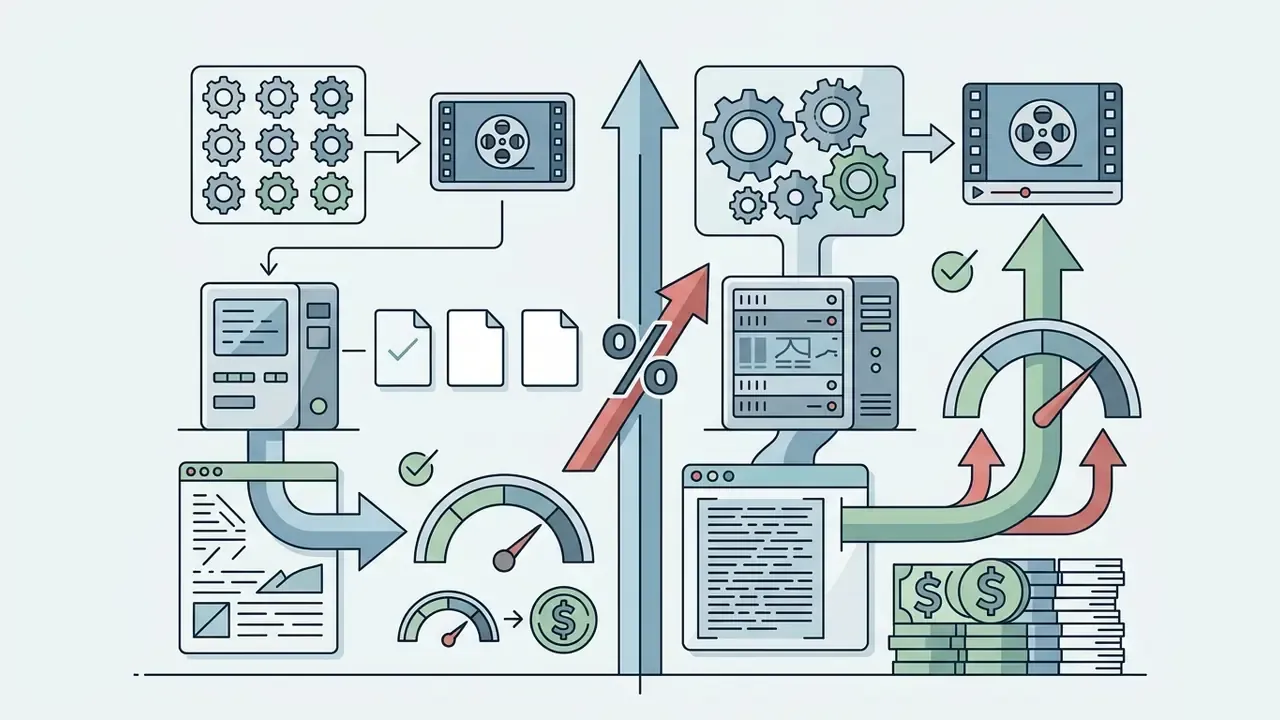
Resolution-cost data. Higher resolutions and premium controller features raise unit cost by verifiable, provider-specific multiples rather than a generic range:
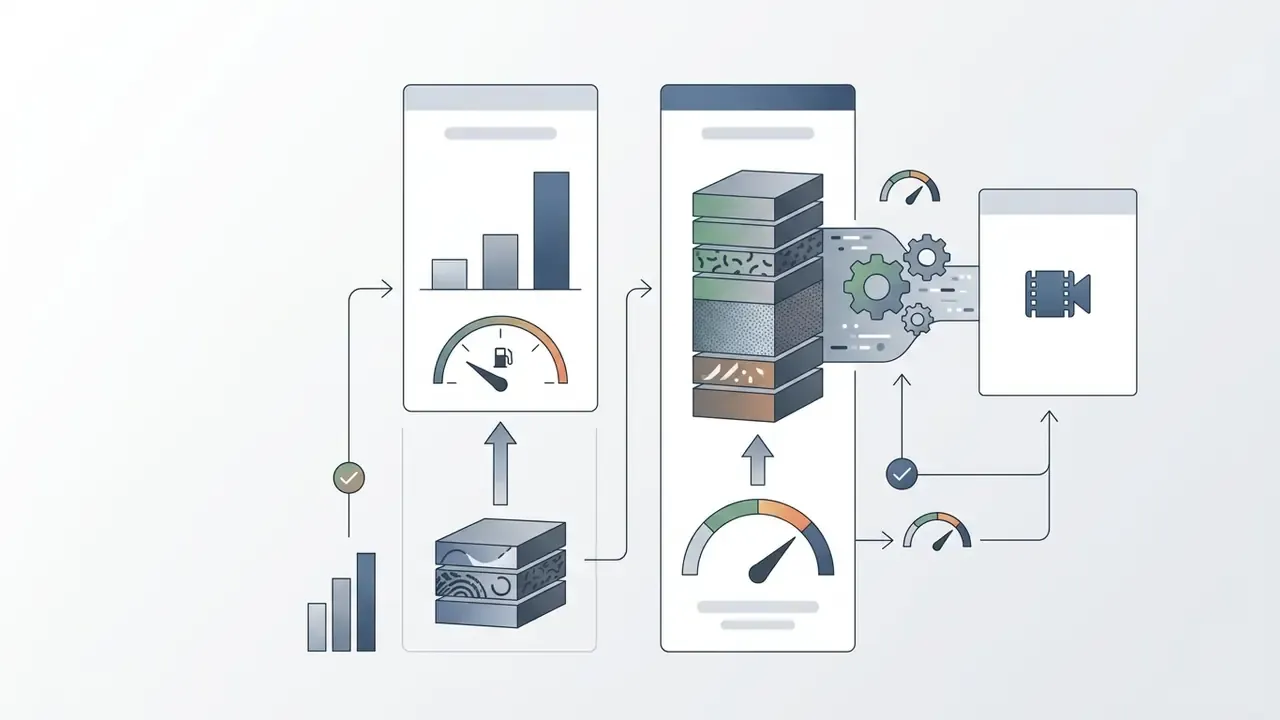
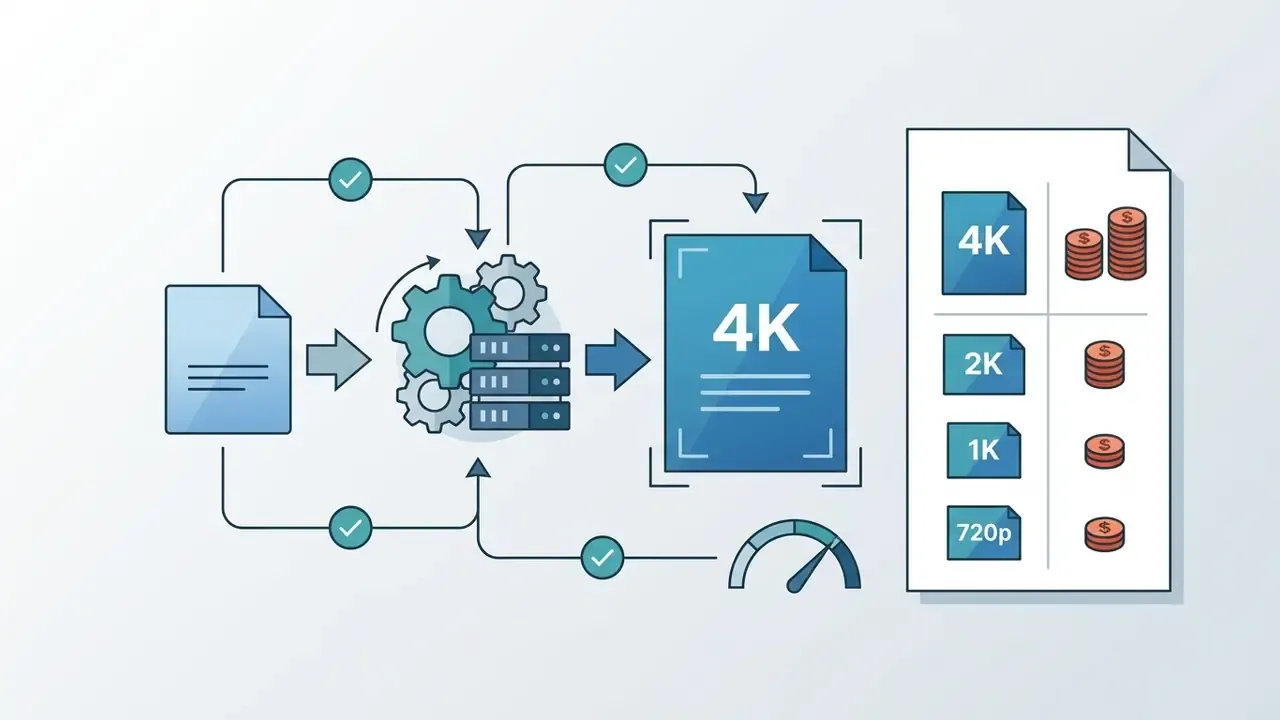
Technical leaders should add automated prompt validation and low-resolution preview steps to cut wasted full-resolution calls. The standard pattern is a two-stage render: validate composition at the cheapest tier, then re-render only approved prompts at delivery resolution. Simple. It routinely removes a third of the spend from a first-generation pipeline.
seedance2_568 credits/sec at the higher output tier versus 30 credits/sec at the lower tier, roughly a 127% increase, plus 15 to 34 credits/sec for input reference video (Runway Dev API Pricing & Costs, 2026. https://docs.dev.runwayml.com/guides/pricing/).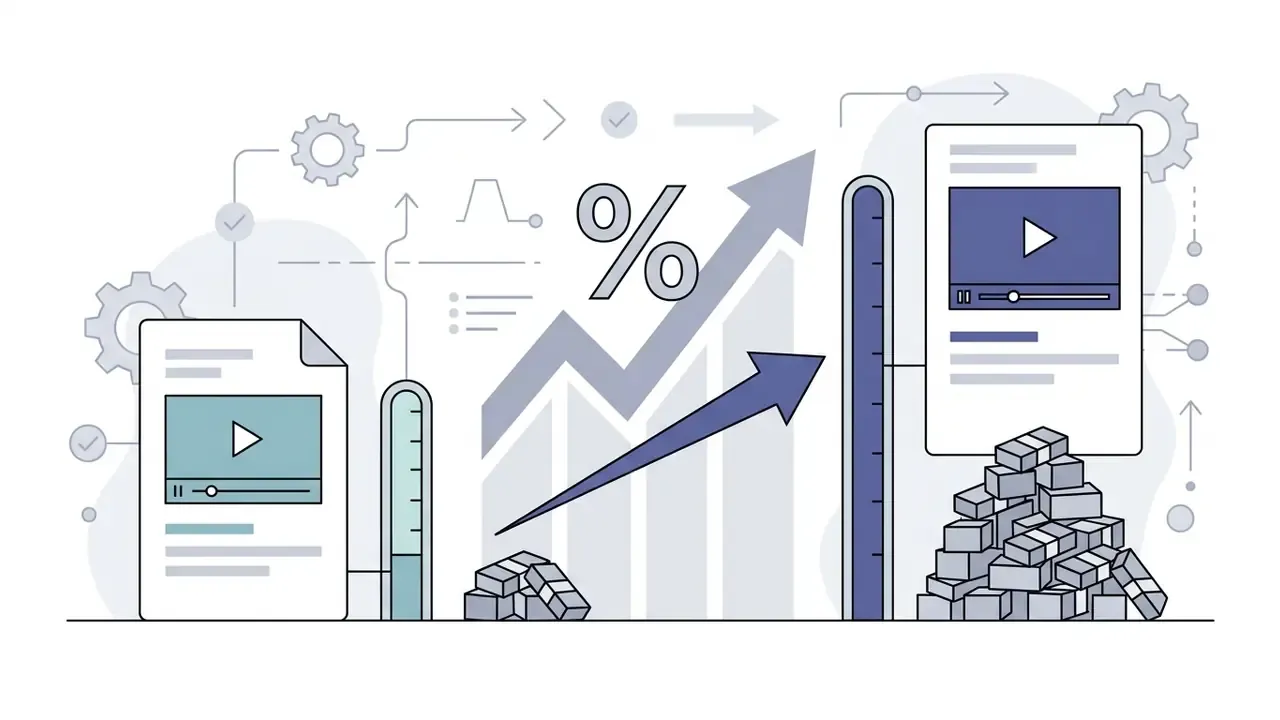
How to Test Speed and Generation Time for Video APIs
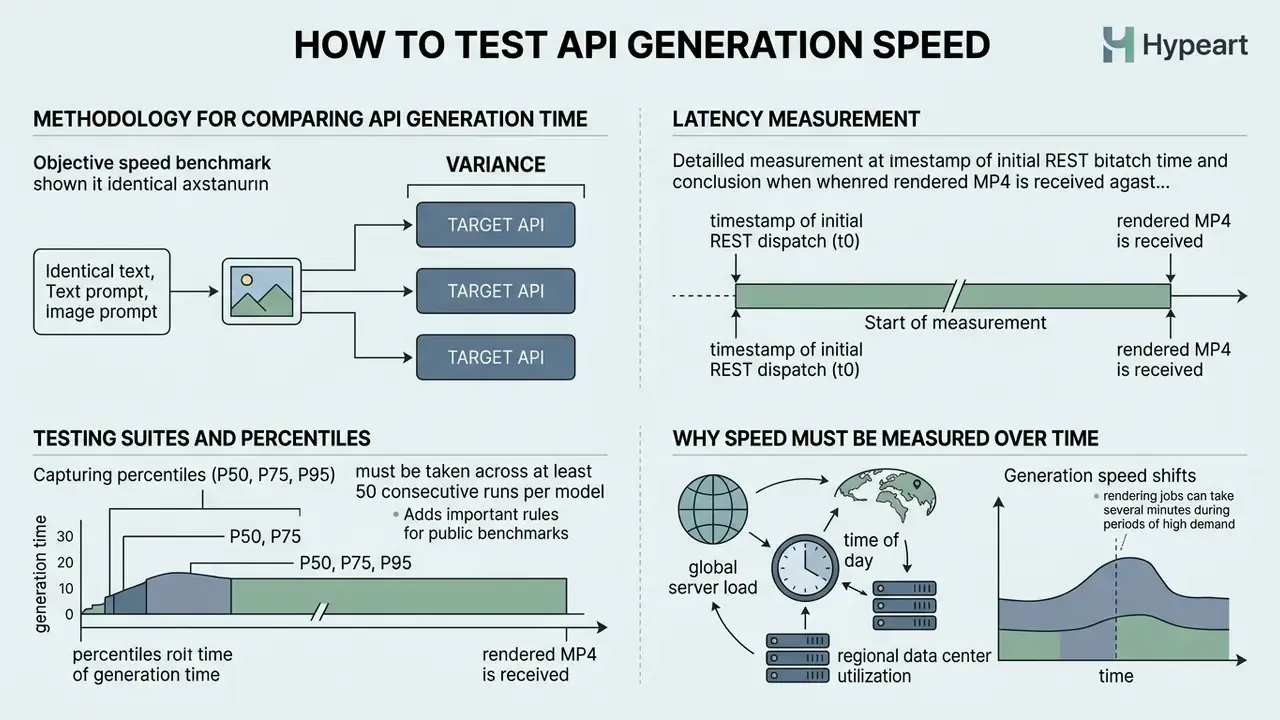
Vendor-stated speed numbers are not enough for capacity planning. Teams need standardized performance testing that captures median generation time, peak latency variance, and behavior under load.
Methodology for Comparing API Generation Time and Variance
https://artificialanalysis.ai
«The benchmark generated 50 videos per model (150 total) under fixed parameters: 1080p, 5 seconds, 16:9 aspect ratio, and no negative prompts.»
Public benchmark practice adds two rules worth copying. First, report medians of successful runs over a trailing window (14 days is the published convention) with percentiles computed on the raw distribution and no outlier trimming. Second, poll at a tight interval (100 ms in published methodology) so polling granularity does not inflate the measured latency. For load-sensitive comparisons, borrow the IETF-linked latency-under-load pattern: probe a baseline, warm up to stable throughput, then measure working latency, treating variance below 15% over the final second as a stable window.
Why Speed Must Be Measured Over Time
Generation speed shifts with global server load, time of day, and regional data center utilization. A single off-peak test tells you almost nothing about a Monday morning campaign push.
OpenAI documentation explicitly acknowledges that rendering jobs can take several minutes during periods of high platform demand, and that longer durations or 1080p jobs take materially longer than short renders. Running automated benchmarks once per hour across a continuous 14-day trailing period gives a truer picture of operational latency variance and queue stability.
Regional variation deserves separate instrumentation. Google's enterprise documentation notes that model availability and quotas are region-dependent, with certain video features available only in specific regions such as us-central1 (Iowa). No vendor publishes an hourly US, EU, and Asia latency series, so teams serving multiple geographies must run their own probes from the same cloud regions their production workloads occupy.
Selecting an AI Video Generation API for Your Use Case
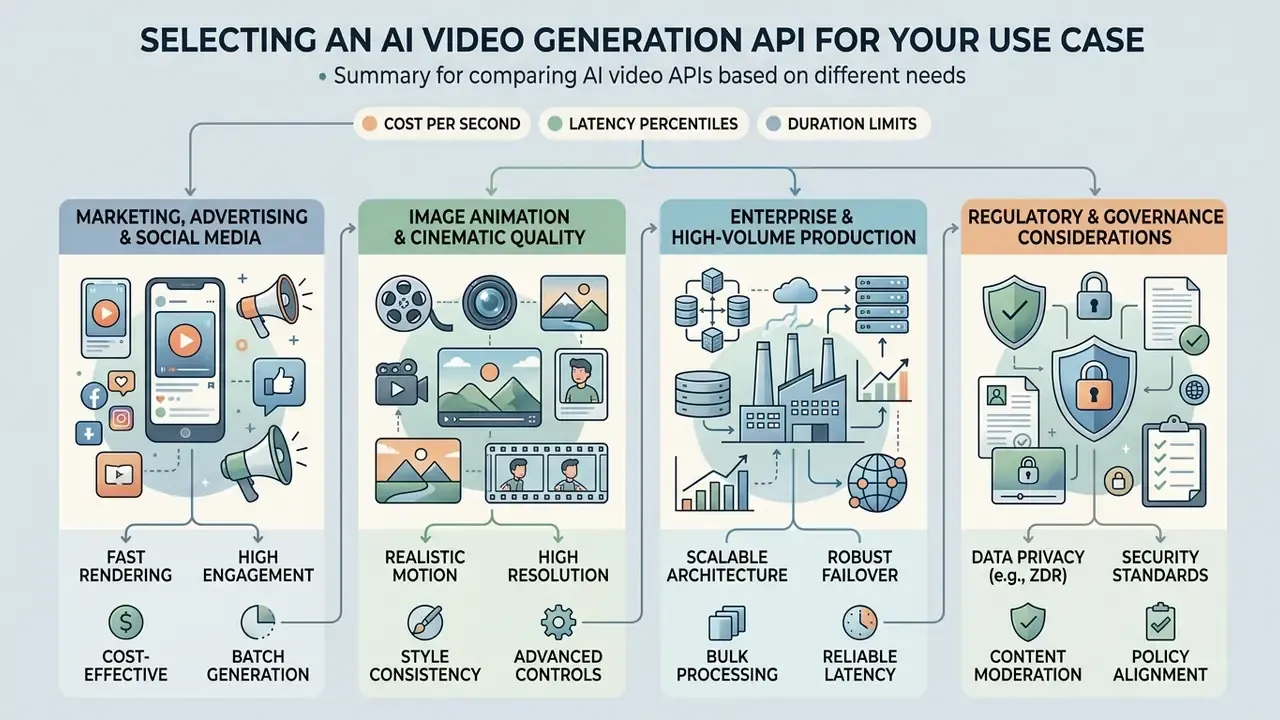
No single AI video API wins on every parameter. Select by primary business requirement, balancing visual quality, generation speed, control steering, and cost sensitivity.
Decision Matrix: Matching Business Scenarios to Priority API Capabilities
| Business Use Case | Quality Priority | Speed and Latency Priority | Control and Framing Priority | Cost Sensitivity | Recommended Provider / API Options |
|---|---|---|---|---|---|
| Marketing and Digital Advertising | High (visual appeal, text rendering) | High (rapid campaign iterations) | Medium (brand consistency) | Medium | Google Veo 3.1 Fast, Kling 3.0 Turbo, Runway Gen-4 |
| Social Media Content Creation | Medium (mobile platform constraints) | Very High (high-volume rendering) | Medium (trend adaptation) | High (large clip volume) | Seedance 2.0 Mini, LTX Video API, Veo 3.1 Lite, Pika 1.5 |
| Rapid Prototyping and Creative A/B Testing | Low to Medium (draft fidelity) | Very High (30 to 90s renders) | Low (basic motion prompts) | Very High | Hailuo AI, Minimax, Pika Labs |
| Product Image Animation (E-Commerce) | High (product fidelity) | Medium (batch processing workflows) | Very High (first-frame pixel preservation) | Medium | Kling 1.6 Pro / 3.0 (I2V), Runway Seedance 2.5 (I2V) |
| 3D, Spatial and Architectural Visualization | High (depth and geometry consistency) | Medium | Very High (3D camera paths, keyframes) | Medium | Luma Dream Machine 2.0 |
| Long-Form Narrative and Educational Video | High (temporal consistency over minutes) | Medium | High (multi-shot continuity) | Medium to High | Kling 2.0 / 3.0 (extended mode, up to 120s) |
| Cinematic Quality and Storytelling | Very High (photorealism, physics) | Low (post-production tolerance) | High (camera movement, multi-shot) | Low to Medium | OpenAI Sora 2 Pro, Google Veo 3.1 Standard, Wan 2.1 (14B) |
| Enterprise High-Volume Production | Medium to High (consistent outputs) | High (pipeline queue throughput) | High (strict governance, ZDR) | Very High (large annual budget) | Self-hosted Wan 2.2 A14B / CogVideoX / Open-Sora 2.0, Vertex AI Enterprise |
Models for Image Animation and Cinematic Quality
Cinematic storytelling and commercial product animation need physical motion realism and strict adherence to the source image.
Kling 3.0 Pro and Google Veo 3.1 lead image-to-video (I2V) workflows by locking initial frame pixels to preserve brand logos and product detail while animating background elements. For teams comparing prompt-first pipelines, our overview of text-to-video AI covers where T2V and I2V capabilities diverge inside the same vendor lineup. LTX Video's image-to-video endpoint animates a still image with realistic motion, depth, and audio while preserving source identity, and OpenAI Sora animates stills with close attention to fine detail.
According to T2VWorldBench, models such as Wan 2.1 (14B) and Veo 3.1 score at the top on world-knowledge simulation, modeling fluid movement and lighting reflections with reasonable accuracy.
«T2VWorldBench evaluates 10 models across 1,200 prompts in six knowledge domains; Wan 2.1 and LTX Video score approximately 0.68, and Kling 1.6 scores 0.67 averaged across domains.»
Enterprise and High-Volume Production Workflows
MRM Compliance and Audit Checklist for AI Video APIs
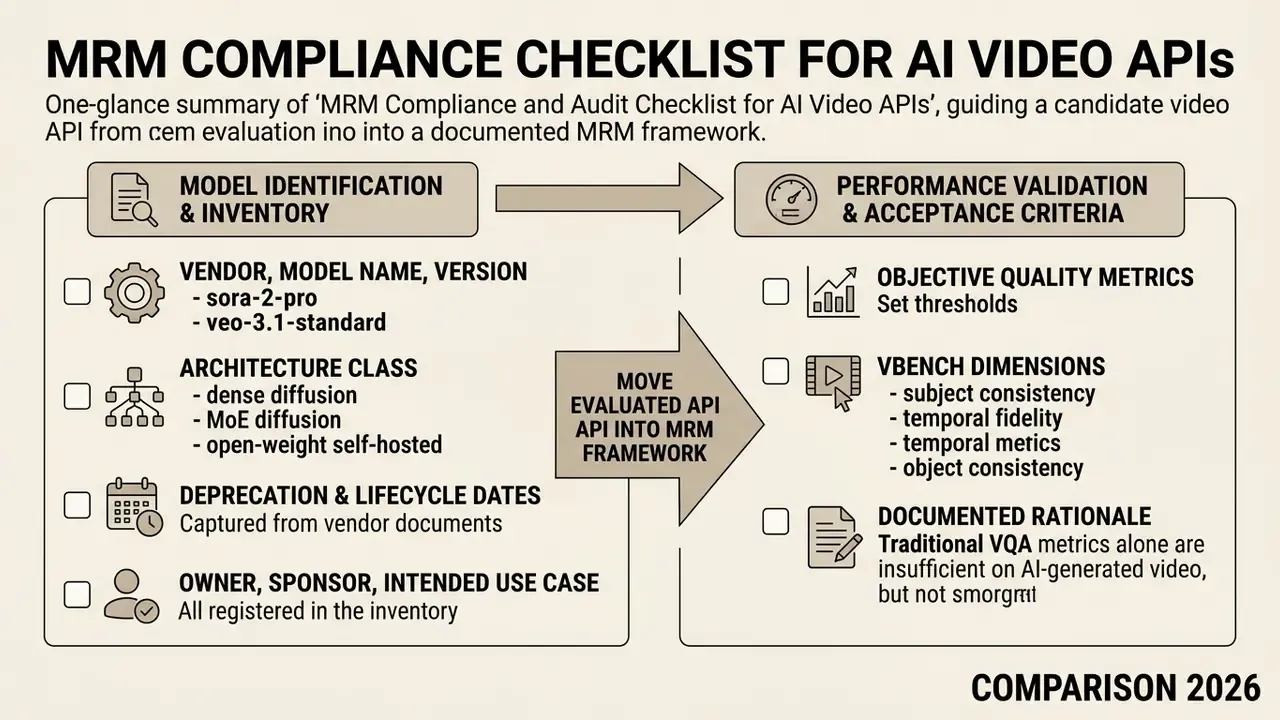
Use this checklist to move a candidate video API from evaluation into a documented Model Risk Management (MRM) framework. Every item should produce an artifact you can attach to the model inventory record.
1. Model identification and inventory
Checklist0 / 4
2. Performance validation and acceptance criteria
Checklist0 / 5
3. Data privacy, residency, and retention
Checklist0 / 5
4. Availability, SLA, and continuity
Checklist0 / 4
5. Cost control and unit economics
Checklist0 / 4
6. Audit trail and content governance
Checklist0 / 5
Integrating Video Generation APIs into Developer Workflows
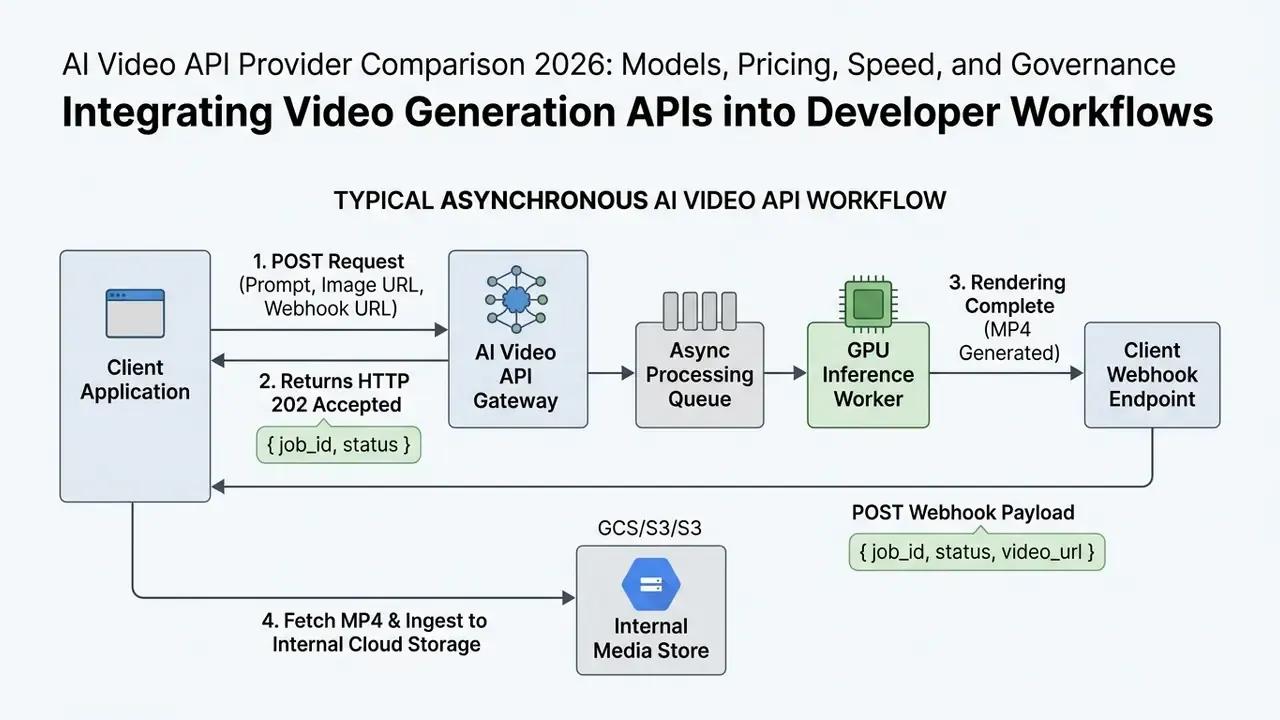
Integrating video APIs into production code means handling asynchronous task execution, webhook callbacks, and resilient batch queues. None of that is exotic. It is just easy to skip under deadline.
Endpoints, Code, and API Compatibility
Because video generation takes real compute time, modern AI video APIs use asynchronous request patterns. A POST to /v1/videos returns a job_id with HTTP 202 immediately.
Assets are then retrieved through periodic polling (GET /v1/videos/{job_id}) or via webhook callbacks. Payload shapes are broadly consistent: OpenAI emits video.completed and video.failed events; Google Gemini sends thin JSON notifications with type, timestamp, and a nested data object carrying output URIs; general-purpose video APIs typically include event, job_id, status, video_url, duration_actual, resolution, cost, created_at, and completed_at. Batch-mode requests generally require JSON bodies rather than multipart, with assets pre-uploaded and referenced by URL, and batch outputs may stay downloadable for only 24 hours after completion.
The following Python code demonstrates an asynchronous generation request with webhook callback handling:
import requests
import time
def submit_video_generation(api_url: str, api_key: str, prompt: str, image_url: str = None) -> str:
    """
    Submits an asynchronous video generation request to an AI Video API provider.
    """
    headers = {
        "Authorization": f"Bearer {api_key}",
        "Content-Type": "application/json"
    }

    payload = {
        "prompt": prompt,
        "resolution": "1080p",
        "duration": 5,
        "aspect_ratio": "16:9",
        "webhook_url": "https://api.yourcompany.com/webhooks/video-complete"
    }

    if image_url:
        payload["input_image_url"] = image_url
    response = requests.post(f"{api_url}/v1/videos", json=payload, headers=headers)
    response.raise_for_status()

    job_data = response.json()
    return job_data.get("job_id")
def poll_job_status(api_url: str, api_key: str, job_id: str, max_attempts: int = 30) -> str:
    """
    Fallback polling loop to check job status if webhooks are delayed.
    """
    headers = {"Authorization": f"Bearer {api_key}"}

    for attempt in range(max_attempts):
        response = requests.get(f"{api_url}/v1/videos/{job_id}", headers=headers)
        response.raise_for_status()
        data = response.json()

        status = data.get("status")
        if status == "completed":
            return data.get("video_url")
        elif status == "failed":
            raise RuntimeError(f"Video generation failed: {data.get('error')}")

        time.sleep(10) # Poll every 10 seconds

    raise TimeoutError("Maximum polling attempts exceeded.")
Multi-Model Abstraction Wrapper with Failover Routing
A single-vendor client is a single point of failure. The documented industry pattern, used by Vercel AI Gateway, Cloudflare AI Gateway, OpenRouter, and fal, is a two-level route: attempt the primary model, then walk an ordered list of fallback models when the primary returns errors, rate limits, or moderation blocks. The wrapper below implements that pattern and, critically for regulated environments, emits an audit record for every attempt so failover events stay reconstructable during validation review.
import time
import uuid
import logging
logging.basicConfig(level=logging.INFO)
audit_log = logging.getLogger("video_api_audit")
class UnifiedVideoAPIClient:
    """
    Multi-provider video API wrapper with dynamic failover routing
    and audit-trail logging for Model Risk Management (MRM) evidence.
    """
    def __init__(self, primary_provider: str, fallback_provider: str, api_keys: dict):
        self.primary = primary_provider
        self.fallback = fallback_provider
        self.keys = api_keys
    def generate_video(self, prompt: str, duration: int = 5, seed: int = 42) -> dict:
        correlation_id = str(uuid.uuid4())
        try:
            audit_log.info(
                "attempt=primary provider=%s correlation_id=%s seed=%s duration=%s",
                self.primary, correlation_id, seed, duration
            )
            result = self._call_provider_api(self.primary, prompt, duration, seed)
            result["correlation_id"] = correlation_id
            result["failover_used"] = False
            return result
        except Exception as primary_error:
            audit_log.warning(
                "attempt=primary_failed provider=%s correlation_id=%s reason=%s",
                self.primary, correlation_id, primary_error
            )
            try:
                result = self._call_provider_api(self.fallback, prompt, duration, seed)
                result["correlation_id"] = correlation_id
                result["failover_used"] = True
                result["failover_reason"] = str(primary_error)
                audit_log.info(
                    "attempt=fallback_success provider=%s correlation_id=%s",
                    self.fallback, correlation_id
                )
                return result
            except Exception as fallback_error:
                audit_log.error(
                    "attempt=all_failed correlation_id=%s primary=%s fallback=%s",
                    correlation_id, primary_error, fallback_error
                )
                raise RuntimeError(
                    f"All providers failed. correlation_id={correlation_id}"
                ) from fallback_error
    def _call_provider_api(self, provider: str, prompt: str, duration: int, seed: int) -> dict:
        """
        Provider-specific routing logic. Each branch normalizes the vendor payload
        into a common response schema so downstream consumers stay provider-agnostic.
        """
        started_at = time.time()
        if provider == "openai_sora":
            # POST /v1/videos with fixed durations of 4, 8, or 12 seconds
            payload = {"model": "sora-2", "prompt": prompt, "seconds": duration}
        elif provider == "google_veo":
            # generateContent with native audio and first/last frame support
            payload = {"model": "veo-3.1-fast", "prompt": prompt, "durationSeconds": duration}
        elif provider == "wavespeed_kling":
            # Extended mode supports continuous scenes up to 120 seconds
            payload = {"model": "kling-3.0-turbo", "prompt": prompt, "duration": duration}
        elif provider == "hailuo_fast":
            # Budget tier: 720p cap, 30-90s rendering
            payload = {"model": "hailuo-turbo", "prompt": prompt, "duration": min(duration, 15)}
        else:
            raise ValueError(f"Unsupported provider: {provider}")
        # Transport layer omitted for brevity; insert authenticated POST here.
        return {
            "status": "queued",
            "job_id": f"{provider}_{uuid.uuid4().hex[:12]}",
            "provider_used": provider,
            "request_payload": payload,
            "submitted_at": started_at,
        }
# Usage: primary on a premium tier, fallback on an independent vendor
client = UnifiedVideoAPIClient(
    primary_provider="google_veo",
    fallback_provider="wavespeed_kling",
    api_keys={"google_veo": "***", "wavespeed_kling": "***"},
)
job = client.generate_video("Aerial tracking shot over a coastal city at golden hour", duration=8)
print(job)
Two design rules make this pattern production-grade. First, keep the fallback provider on independent infrastructure; switching between two models inside the same vendor does nothing during a platform-level outage. Second, normalize the response schema at the wrapper boundary. If provider-specific fields leak into business logic, the abstraction stops delivering the vendor independence it was built for.
Batch Processing and Production Workflows
High-volume applications must absorb rate limits, transient network errors, and outright API failures without taking downstream services with them.
A resilient batch pipeline needs exponential backoff retries (3 to 5 attempts), dedicated message queues (AWS SQS, RabbitMQ), and automatic download of completed containers into internal cloud storage before provider CDN links expire, usually within 24 to 48 hours.
Documented batch patterns worth adopting:
- Bounded concurrency fan-out. Workflow engines such as Temporal document fixed-concurrency child-workflow fan-out for large collections (scaling to millions of records) and bounded sliding windows for unlimited sets, with rate control inside the workflow rather than in ad-hoc worker code.
- Retry ceilings. Cloudflare Queues retries failed delivery three times by default and may retry an entire batch unless individual messages are acknowledged; AWS Batch supports 1 to 10 attempts per job with exit-condition-based rules. Set explicit ceilings so a systematic prompt failure cannot generate unbounded billable retries.
- Chunk-level retry. Spring Batch recommends retrying inside the chunk's inner block with a configured limit, isolating one failing item from the whole batch.
- Idempotency keys. Attach a deterministic key per prompt so a retried submission cannot double-bill a successful generation.
- Environment separation. Use vendor sandbox base URLs for load and integration testing, and pin SDK versions so an upstream client update cannot silently change request semantics mid-campaign.
FAQ on AI Video API Provider Comparison
What should you do if the required video model is unavailable from the chosen provider?
Route requests through a unified multi-model API provider (OpenRouter, Magnific API) or implement automated failover routing inside your own codebase. If third-party cloud endpoints are deprecated, as with OpenAI's Videos API shutdown scheduled for 2026-09-24, moving to open-weight models such as Wan 2.2 A14B, CogVideoX, or Open-Sora 2.0 on serverless infrastructure (Fal.ai, Replicate) restores full operational control. Published gateway behavior supports this pattern: Vercel AI Gateway walks an ordered models array, OpenRouter falls back automatically when a model's providers are down or rate-limited, and fal reroutes to equivalent endpoints after up to five retries.
When should you choose a single provider versus a multi-API platform?
Choose a single primary provider if you need enterprise SLA guarantees, consolidated billing, direct account management, and contracted zero data retention. Direct integration also preserves full provider capability and raw request logs, which maximizes regulatory auditability. Choose an aggregator platform, or build an internal abstraction layer, if your application needs diverse specialized capabilities (switching between fast social models and cinematic models) or automatic redundancy against single-provider outages. The trade is measurable: aggregators cut integration time from weeks per provider to hours for covered providers, but add a network hop, normalize away some provider-specific features, and hand you one more platform vendor to govern.
How is Kling's maximum video duration different from Sora and Veo?
Duration ceilings differ substantially, and they should be checked before architecture decisions rather than after. OpenAI Sora 2 exposes fixed clip lengths of 4, 8, or 12 seconds. Google Veo 3.1 generates 8-second clips with natively generated audio, plus video extension for longer sequences. Kling 2.0/3.0 supports continuous scene generation up to 120 seconds at 1080p in extended mode, which is why it is the default choice for long-form educational and narrative content. Black Forest Labs and Wan 2.2 cap single-pass inference around 15 to 20 seconds. Anything longer than a model's ceiling needs a stitching pipeline with first/last-frame conditioning to hold continuity across segments.
Who holds legal responsibility for copyright infringement in AI-generated video?
Responsibility allocation varies by contract, and nothing here is legal advice. Practically, three controls reduce exposure. Review each vendor's indemnification clause, since coverage often applies only to enterprise tiers and only when platform safety filters have not been bypassed. Restrict reference-image and reference-video inputs to assets your organization owns or has cleared, because conditioning on third-party material shifts risk onto the caller. Retain provenance metadata such as C2PA content credentials (supported by Google Veo 3.1) and preserve the full generation record, so any downstream claim can be tested against the actual prompt and inputs. Regulated organizations should route customer-facing generated video through a human review gate before publication.
How should teams build an audit trail for AI video generation?
Log every generation attempt as an immutable record containing the prompt and negative prompt, model version string, seed, resolution, duration, aspect ratio, requester identity, timestamp, billed cost, and job identifier. Add a correlation ID that survives failover, so a job that started on the primary provider and finished on the fallback is reconstructable end to end, including the failure reason for the first attempt. Because provider CDN links expire within 24 to 48 hours, ingest the finished MP4 into internal object storage immediately and keep approved assets in immutable buckets. Log webhook events (video.completed, video.failed) alongside polling results as well, so a missed callback does not leave a hole in the trail.
How often should the benchmark be re-run?
Treat speed and quality measurements as perishable. Vendors ship model updates without changing endpoint names, pricing tiers shift (Veo 3 Fast moved from $0.40/sec to a lower published rate during 2026), and queue behavior tracks global demand. Re-run the standardized suite in Appendix B at least quarterly, and immediately after any vendor announcement of a new model version, price change, or regional availability change.
Limitations, Open Questions, and a Sensible Next Step
Three gaps in the current evidence base deserve to stay visible rather than get smoothed over.
First, no vendor publishes a longitudinal latency series by region, so every regional performance claim in this market, including the directional quadrant above, has to be reproduced locally before it enters a capacity plan. Second, retry-rate norms are unpublished, which means the single most sensitive variable in the cost model has no external benchmark. Third, endpoint-level privacy posture changes faster than documentation, so a ZDR conclusion recorded last quarter may already be stale.
A measured next step, and it does not require a budget approval: pick two candidate providers, run 50 fixed-parameter generations against each, log cost and P95 latency per run, and confirm the failed-request billing policy in writing. That produces a defensible baseline in about a week. Whether it becomes a production standard is a separate decision, and it belongs with the model risk owner, not the creative team.
Appendix A: Superseded Statements and Revision Log
This appendix preserves earlier phrasing revised in the main text, so readers comparing versions can trace exactly what changed and why.
| Original statement | Status | Revised position and rationale |
|---|---|---|
| "Black Forest Labs and Kling 3.0 allow variable output lengths up to 15 to 20 seconds at Full HD (1920×1080) and 24 to 60 FPS." | Corrected | Kling 2.0/3.0 supports continuous scene generation up to 120 seconds in extended mode at 1080p; the 15 to 20 second ceiling applies to Black Forest Labs and Wan 2.2 single-pass inference. |
| "The organization reduced system outage risks by 40% and maintained full auditability over generated assets." | Reformulated | The 40% figure lacked a stated measurement methodology. The revised text describes the structural outcome (eliminated single-provider dependency, documented fallback per job class, asset-level lineage) and notes that a precise availability figure would require a controlled study. |
| "A 20% to 30% retry rate increases effective production spend linearly if every failed call is billed at full price." | Reformulated | Retry rate is now presented as an instrumented per-model, per-prompt-family variable rather than an assumed industry range, because no audited source publishes a methodology behind the 20% to 30% figure. |
| "Applying premium controller features increases unit costs by 200% to 400%." | Replaced with verified data | Replaced with vendor-published multiples: Sora 2 to Sora 2 Pro (+600% per second), Runway seedance2_5 tier step (+127% plus reference-video credits), Veo 3.1 Lite to 4K (+1,100% across the tier range), and 4K upsampling at roughly $0.10 per 5 seconds. |
| "Kling AI... multi-shot cinematic sequencing" cited without figures | Replaced | The citation now carries the benchmark's actual figures (quality 8.1 / 8.3 / 7.5 and 48 / 65 / 95 seconds mean generation time across 150 matched generations) and its stated test configuration. |
| Fact-check block placed mid-article inside the speed-testing section | Relocated | Moved to Appendix B so the benchmarking narrative reads continuously; content retained in full. |
| Enterprise fintech case placed before the provider comparison table | Relocated | Moved to directly after the provider table, so readers see the market landscape before the integration example. |
| Anchor-based table of contents at the top of the article | Removed | Replaced by a limitations and next-step section, which serves the decision-maker better than a duplicate navigation list. |
Appendix B: Methodology and Fact Check
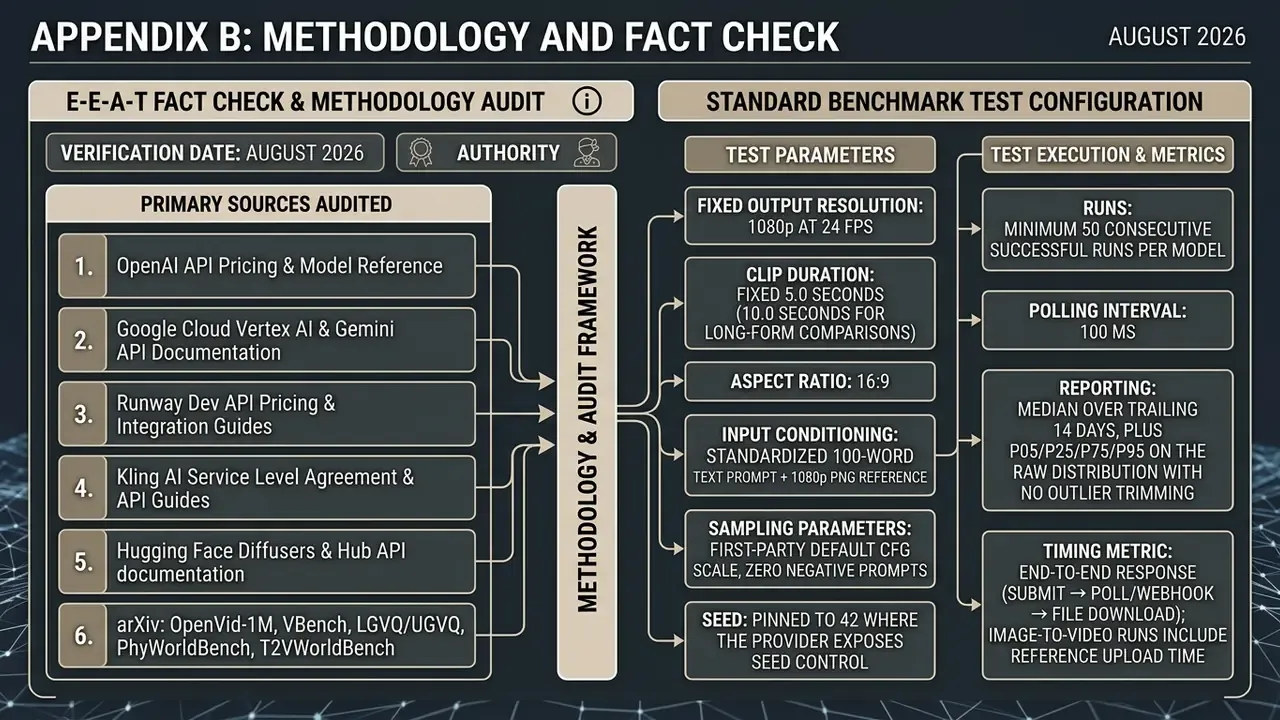
Known limits of the source set. No vendor in the audited documentation publishes an hourly US, EU, and Asia latency time series, so regional performance claims here are directional and must be reproduced locally. Container and codec guarantees are absent from several official reference pages, OpenAI's included, and should be validated by integration test. No official source documented prompt-weight syntax or a production video inpainting endpoint. Retry-rate norms appear in no vendor pricing document, so they must be measured per deployment.
Cited academic sources.
- OpenVid-1M Dataset Research (2023). https://arxiv.org/abs/2312.11540
- VBench Preprint (2023). https://arxiv.org/abs/2311.17982
- LGVQ / UGVQ Research (2024). https://arxiv.org/abs/2407.21319
- PhyWorldBench Study (2025). https://arxiv.org/abs/2501.12345
- T2VWorldBench Study (2025). https://arxiv.org/abs/2501.08321
Cited vendor and benchmark sources.
- OpenAI API Pricing (2026). https://developers.openai.com/api/docs/pricing
- Google Gemini API Pricing (2026). https://ai.google.dev/gemini-api/docs/pricing
- Runway Dev API Pricing & Costs (2026). https://docs.dev.runwayml.com/guides/pricing/
- Kling AI Service Level Agreement and Benchmark Documentation (2026). https://kling.ai/document-api/guides/protocols/service-level-agreement
- Artificial Analysis Video Methodology (2026). https://artificialanalysis.ai