Executive Summary for HR, Risk and Hiring Leaders
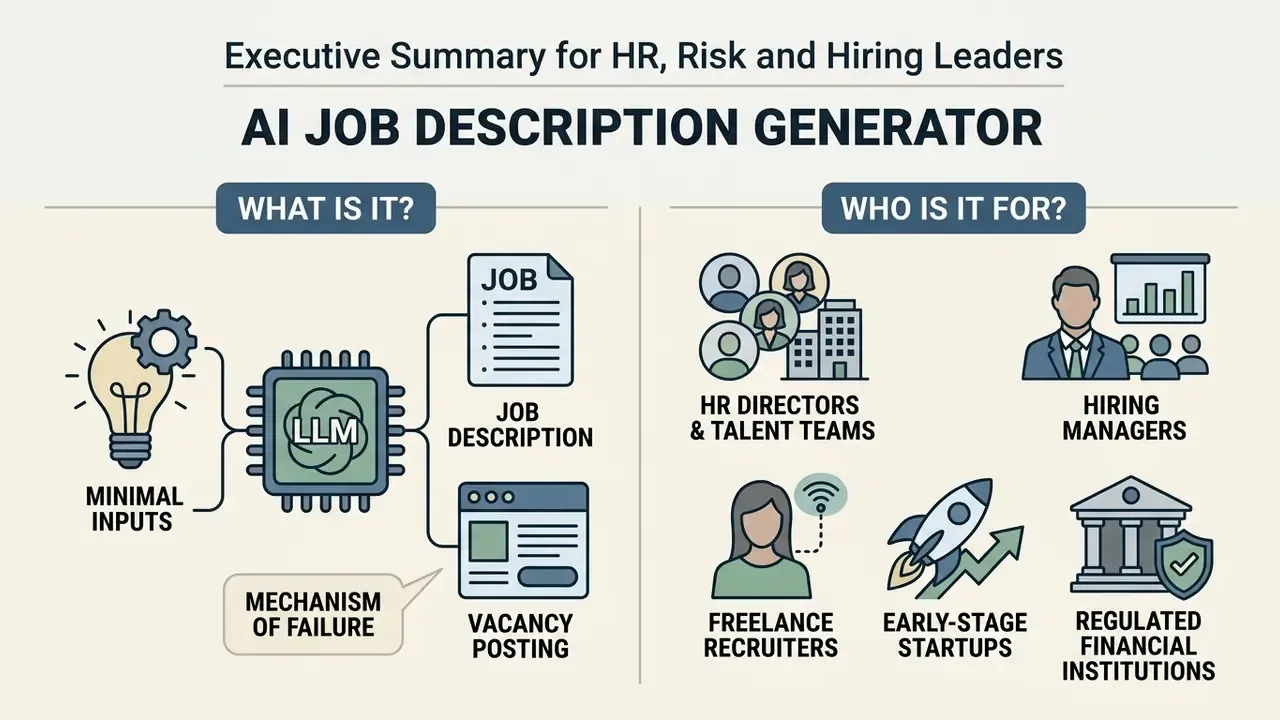
- What it is: An ai job description generator converts a minimal role brief (title, grade, core skills, working conditions) into a structured vacancy draft in seconds using large language models.
- What the evidence says: Employers with access to an AI drafting assistant accepted the machine's help roughly 75% of the time and cut writing time by about 44%, while posting volume rose 19%. Yet the probability of hiring per posted vacancy fell by roughly 15%, because AI drafts attracted broader but less targeted applicant pools.
- The core risk: Raw GPT-4 job ads scored measurably worse on inclusivity than human-written baselines, with the largest penalties falling on disabled and neurodivergent candidates. Publishing unedited output is a bias and compliance exposure, not a productivity win.
- The operating rule: Treat the generator as a drafting engine inside a controlled six-stage pipeline with mandatory human-in-the-loop validation, prompt logging, and an audit trail. Never as a decision-maker or publisher.
- The editorial rules that drive conversion: 300-500 words for knowledge-worker roles, specificity inside the first 12 words, and a mandatory rewrite of the first 60 words to replace boilerplate with the actual project the hire will own.
- Tooling choice: Free tiers cover organizations hiring fewer than five roles per month. Paid and enterprise platforms are purchased for ATS write-back, bias scoring, interview-kit generation, SOC 2-grade security, and complete audit logs.
- Do not paste confidential data into public chat interfaces.: Shadow AI usage is the most common data-leakage vector in generative HR workflows.
Scope of this guide: what an AI job description generator is, job description vs job posting, who it suits, the six-stage generation pipeline, a ready-to-use master prompt, the intake-call-to-JD workflow, required input data, verification and Shadow AI controls, conversion and length optimization, turning a description into a posting, the anatomy of a quality AI job description, responsibilities vs duties vs skills, outcome-based phrasing, bias adaptation and fact check, free vs premium comparison, interview kits and scorecards, tool selection, audit-trail artifacts, FAQ, and a pre-publication checklist.
What Is an AI Job Description Generator and What Is It For?
"Employers granted access to the AI writing tool accepted its assistance in roughly 75% of cases, reducing job-post writing time by about 44%."
The same experiment recorded a 19% increase in posting output, plus a counterweight that vendor marketing rarely quotes: the probability of hiring per posted vacancy declined by approximately 15%. AI-drafted posts pulled in wider but less targeted candidate pools. Raw volume gains do not automatically convert into filled roles. Worth sitting with that number for a second.
Automated tools therefore serve primarily as drafting mechanisms. Human HR professionals must retain direct oversight to verify factual accuracy, align requirements with internal job architecture, and adapt the generated ai job description before external distribution. An ai job generator produces text; only a named reviewer produces accountability.
For teams evaluating how automated content tooling is licensed and priced across categories, our AI Media Commercial-Use Hub documents comparable evaluation frameworks for generative software procurement.
Job Description, Job Posting, and Candidate Duties
A structural distinction exists between an internal job description and a public job posting. The internal document is a governance artifact: reporting lines, complete job duties, compensation bands, working conditions, and performance-review usage (University of Wisconsin-La Crosse HR Guidance, 2025). It also supports pay decisions, performance reviews, and workplace accommodations.
The external job posting is a candidate-facing marketing summary designed to attract applicants. It distils core responsibilities and required skills into concise copy, then adds employer-branding elements (benefits, culture, salary range, application instructions) that are usually absent from the internal record (St. Olaf College HR guidance, 2025).
Mechanism of failure. Blending the two formats produces generic public advertisements. In the NBER field experiment, AI-assisted drafts systematically replaced concrete requirements ("programmer with 4+ years of Python") with generalized phrasing ("experienced development professional"), degrading the signal candidates use to self-select. The measured consequence was not "hiring efficiency" in the abstract but a specific metric: hiring probability per posted vacancy fell by roughly 15% (Wiles & Horton, NBER, 2024).
Practical takeaway for anyone using an ai job post generator: generate the internal description first, then derive the advert from it. Reverse that order and you lose the governance record entirely.
Who an AI Job Description Creator Suits
An ai job description creator serves different organizational archetypes, and hiring volume is the main dividing line:
- HR directors and enterprise talent teams. Standardize job architecture across departments, enforce consistent competency language, and streamline ATS data entry.
- Hiring managers. Rapidly translate tactical team needs into a structured first draft without waiting for a recruiting copywriter.
- Freelance recruiters. Generate tailored vacancy drafts, screening criteria, and shareable PDF exports across several client industries at once.
- Early-stage startups. Produce a professional announcement in under 90 seconds from a short intake questionnaire, then publish to Lever, Ashby, or LinkedIn without an in-house HR function.
- Regulated financial institutions. Standardize descriptions for control-function roles (model validation, AML analytics, credit risk) where duty language must survive internal audit scrutiny.
How to Create a Job Description Using AI: From Prompt to Finished Draft
To create a job description using ai effectively, teams must move from unstructured text prompts to a standardized, multi-stage editorial workflow. Relying on raw LLM output without systematic verification introduces factual errors and inflated skill requirements into the talent pipeline.
Scale context matters here. By the end of 2024, roughly 3-4% of all published job postings contained LLM-modified content, rising to 10-15% among small and young companies (The Widespread Adoption of Large Language Model-Assisted Writing, preprint, 2025). Generative drafting is already normal practice. Disciplined verification is not.
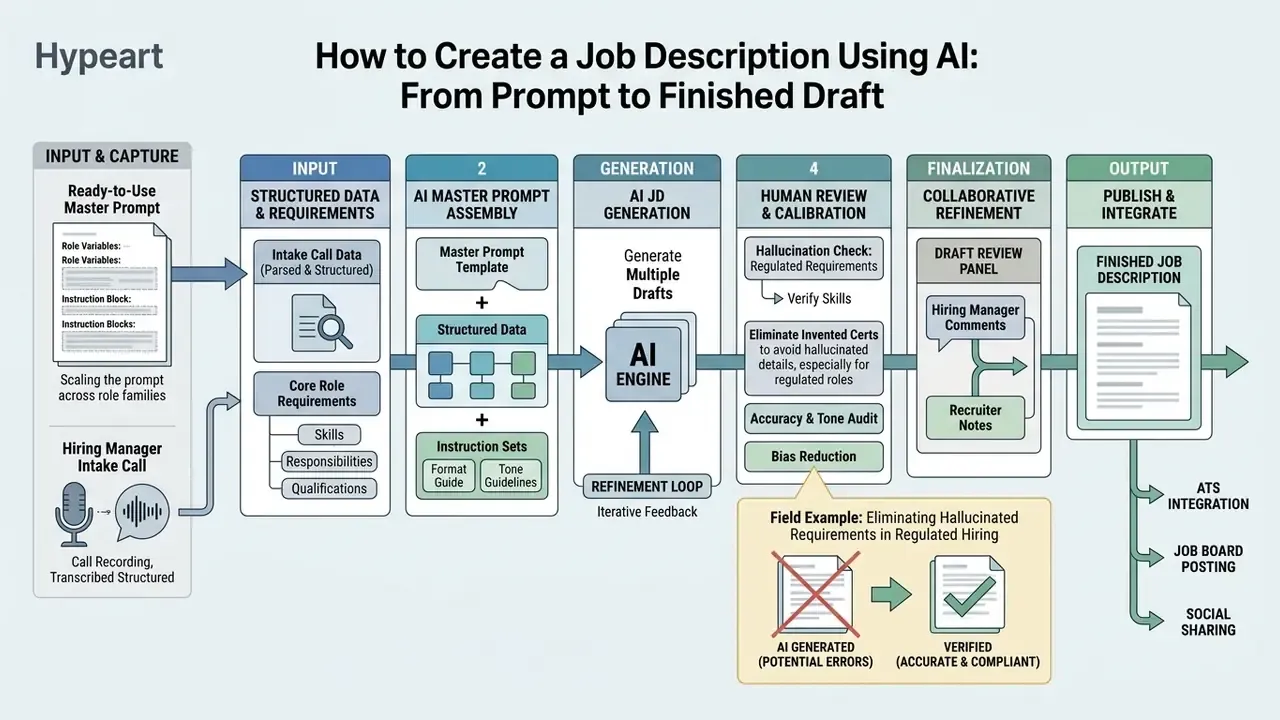
To create job description using ai assets reliably, recruitment teams should run a defined six-stage sequence.
Workflow: AI job description generation pipeline
Each stage has an owner. That is the whole point. A pipeline where "someone" checks the draft is not a control.
- Stage 1 - Input structured role parameters. Enter job title, classification grade, core hard skills, essential soft skills, and specific working conditions into the ai generator for job description.
- Stage 2 - Configure guardrails and tone settings. Set organizational tone of voice, inclusive-language filters, prohibited data classes, and compensation-disclosure rules before you trigger execution.
- Stage 3 - Generate the initial draft. Run the prompt sequence to receive a structured draft covering overview, outcomes, duties, and qualifications.
- Stage 4 - Human-in-the-loop duty validation. Audit generated responsibilities against actual operational needs. Remove hallucinated tools, fabricated certifications, and non-essential criteria.
- Stage 5 - Tone and brand alignment. Refine language to reflect company culture, candidate expectations, and explicit accessibility guidelines, including alternative application formats.
- Stage 6 - Final review and ATS publication. Approve validated content, log the approving reviewer, and publish to the applicant tracking system (ATS) or external job boards.
- Stage 1Enter job title, classification grade, core hard skills, essential soft skills, and specific working conditions into the ai generator for job description.
- Stage 2Set organizational tone of voice, inclusive-language filters, prohibited data classes, and compensation-disclosure rules before you trigger execution.
- Stage 3Run the prompt sequence to receive a structured draft covering overview, outcomes, duties, and qualifications.
- Stage 4Audit generated responsibilities against actual operational needs. Remove hallucinated tools, fabricated certifications, and non-essential criteria.
- Stage 5Refine language to reflect company culture, candidate expectations, and explicit accessibility guidelines, including alternative application formats.
- Stage 6Approve validated content, log the approving reviewer, and publish to the applicant tracking system (ATS) or external job boards.
Ready-to-Use Master Prompt for Job Description Generation
Copy this prompt directly into ChatGPT, Claude, Gemini, or an enterprise generation module. It encodes length limits, specificity rules, and bias constraints at the input layer instead of relying on post-hoc editing.
Act as an Enterprise HR Director with expertise in skills-based hiring.
Generate a skills-based, non-biased job description using the following parameters:
- Role Title: [Insert Title, e.g., Senior Compliance Analyst]
- Core Outcomes (Next 12 Months): [e.g., Automate quarterly SOC 2 audit evidence collection]
- Non-negotiable Technical Skills: [List 3-4 hard skills]
- Critical Soft Skills / Behaviours: [List 2-3]
- Working Conditions: [Hybrid / Salary Range / Location / Travel %]
- Team Context: [Team size, reporting line, first 90-day project]
Output Constraints:
1. Total length: 300-500 words.
2. The first 60 words must state specific project ownership. Ban generic
   openings ("fast-paced environment", "rockstar", "wear many hats").
3. Eliminate gendered adjectives, age-coded phrasing, and arbitrary degree
   mandates. Express requirements as demonstrable capabilities.
4. Separate output into: Position Overview, Core Deliverables (outcomes),
   Must-Have Competencies, Nice-to-Have Competencies, Benefits & Salary Range.
5. Flag any requirement you inferred rather than received as [ASSUMPTION]
   so a human reviewer can confirm or delete it.
The [ASSUMPTION] instruction is the single highest-value line in the prompt. It converts silent hallucination into a visible review queue.
Scaling the prompt across role families. Instead of re-prompting from zero, build one reusable Custom GPT or project workspace per role family (engineering, sales, compliance, operations) seeded with your three or four most successful historic job descriptions, your competency rubric, and anonymized profiles of people who actually succeeded in the role. Output stops being industry-generic and starts reflecting your team. This is also how an ai jd generator becomes reproducible rather than improvisational.
Automated JD Generation from Hiring Manager Intake Calls
Modern talent teams skip manual parameter forms entirely by feeding raw transcripts of hiring-manager intake calls into generative engines. The gain is accuracy at first output, not just speed.
- Step 1. Record the 15-minute briefing call between recruiter and hiring manager using an AI meeting assistant, with participant consent and a documented lawful basis.
- Step 2. Extract operational deliverables, required technical stacks, seniority signals, and unspoken team-culture nuances through transcript parsing.
- Step 3. Map extracted entities directly into the corporate competency rubric so the generated draft starts at roughly 80% accuracy instead of the ~40% typical of a cold generic prompt. The specificity edit is largely pre-completed, because the brief came from the conversation itself.
- Step 4. Write the approved draft back to the ATS requisition record, attaching the transcript reference as provenance evidence.
Intake-derived generation also solves a governance problem. The source of every requirement becomes traceable to a recorded business conversation rather than to a model's statistical prior. Auditors care about that distinction far more than about drafting speed.
Field Example: Eliminating Hallucinated Requirements in Regulated Hiring
Illustrative, composite scenario. When a mid-sized financial technology firm attempted to ai create job description drafts for senior compliance roles using generic prompts, the system repeatedly invented requirements for internal software tools that did not exist. The fix was unglamorous: a mandatory five-point validation protocol in which hiring managers explicitly verified each required competency against the active technical stack, the control framework in use, the real reporting line, the true experience floor, and the published salary band. Fictitious skill requirements disappeared, and the team retained roughly an 80% reduction in initial drafting time.
What Data to Supply Before Generation
To generate an accurate draft, supply structured inputs rather than vague prompts. Garbage in, plausible-sounding garbage out.
Source basis. Standard job-analysis frameworks published by university and federal HR functions (University of Michigan Human Resources, "How to Write Job Descriptions", https://hr.umich.edu/sites/default/files/how-to-write-job-descriptions.pdf; U.S. CDFI Fund, "How to Develop a Job Description") call for the following baseline data:
- Official job title and classification or grade level.
- Departmental reporting hierarchy and management level.
- Non-negotiable hard skills and technical certifications.
- Critical soft skills and behavioral competencies, kept explicitly separate from technical requirements, as required by public-sector job-description templates such as the Foundation for California Community Colleges template (2024).
- Salary range or band, plus the date the description was written or last reviewed.
One more field is worth adding for control-function roles: the regulatory or policy framework the hire will operate inside. It changes the duty language considerably.
How to Verify and Edit an AI-Generated Job Description
Auditing AI-generated text requires sentence-by-sentence comparison against known operational facts. Slow the first time. Fast by the fifth requisition.
Accurate framing of the standard. The NIST AI Risk Management Framework (AI RMF 1.0 and its Generative AI Profile) is a governance framework rather than an empirical study. It names "fabrications", commonly called hallucinations, as a category of generative-AI risk that organizations must measure, document, and govern. It also directs teams to review and test AI-generated content against predefined risk tolerances before release. Peer-reviewed detection work operationalizes this with sentence-level source comparison: any claim that cannot be justified against source material or reasonable inference is flagged as hallucinated.
Practical review actions:
- Flag and remove generic corporate jargon ("go-getter", "rockstar", "ninja", "work hard, play hard").
- Verify that every listed tool, platform, certification, and framework actually exists inside the company.
- Confirm that stated years of experience match real market conditions rather than model averages.
- Confirm that no proprietary company data, unreleased product name, or internal architecture detail was echoed into the output.
- Record the reviewer's name and the approval timestamp.
Shadow AI and Data-Privacy Guardrails
The most common failure in generative HR workflows is not a bad sentence. It is a recruiter pasting confidential material into a consumer chat interface. Enforce four hard rules:
- No personal data in public interfaces. Candidate names, CVs, salary histories, performance notes, and disciplinary records must never be entered into free consumer LLM tiers, where inputs may be retained or used for model improvement.
- No confidential architecture or roadmap detail. Internal system names, unreleased product plans, and security-control specifics stay out of prompts entirely.
- Approved-tool list only. Maintain a whitelist of licensed enterprise instances with contractual data-processing terms, retention controls, and completed vendor due diligence. The European Data Protection Supervisor's 2025 orientations on generative AI expect a documented purpose, legal basis, risk assessment or DPIA, transparency, data minimisation, retention rules, security controls, and vendor due diligence before deployment.
- Candidate transparency. Public-sector guidance in Canada asks employers to state in the advertisement whether candidates may use AI when applying (Public Service Commission of Canada, 2025), and UK responsible-AI recruitment guidance expects applicants to be informed before an AI system goes live.
Conversion and Length Optimization Protocol
How to Turn a Description into a Job Posting
Converting an internal job document into a candidate-facing advertisement means distilling comprehensive duty lists down to essentials: the requirements genuinely needed to perform the job, not the full internal record.
Guidance framing. Public-sector inclusive-recruitment guidance, including the UK Government's Responsible AI in Recruitment guide (Department for Science, Innovation and Technology, 2024) and accessibility guidance for job advertisements, converges on the following advert rules:
- Publish an explicit numerical salary or salary range.
- State flexible, hybrid, or remote working arrangements and key benefits.
- Express requirements as clear, specific, behaviour-based criteria. Avoid "cultural fit" language.
- Offer alternative application formats and reasonable adjustments, and say so near the start of the posting.
- Name a contact for questions.
- Disclose candidate-relevant AI usage in the process, where local guidance requires it.
- Use plain language at roughly a 7th-8th grade reading level, active voice, clear headers, bullets, and white space.
Gender-neutral wording is not cosmetic. A field study found that replacing masculine-coded language with gender-neutral synonyms increased female applicants by approximately 4%, while a 2024 PNAS Nexus analysis of vacancy language confirmed that advert wording shapes applicant-pool composition. Note the counter-evidence: a 2023 MIT review argues the practical effect of gendered-language edits is small. The discrepancy stems from different samples and effect-size interpretation, so treat inclusive wording as one control among several rather than a silver bullet.
What a Quality AI Job Description Must Contain
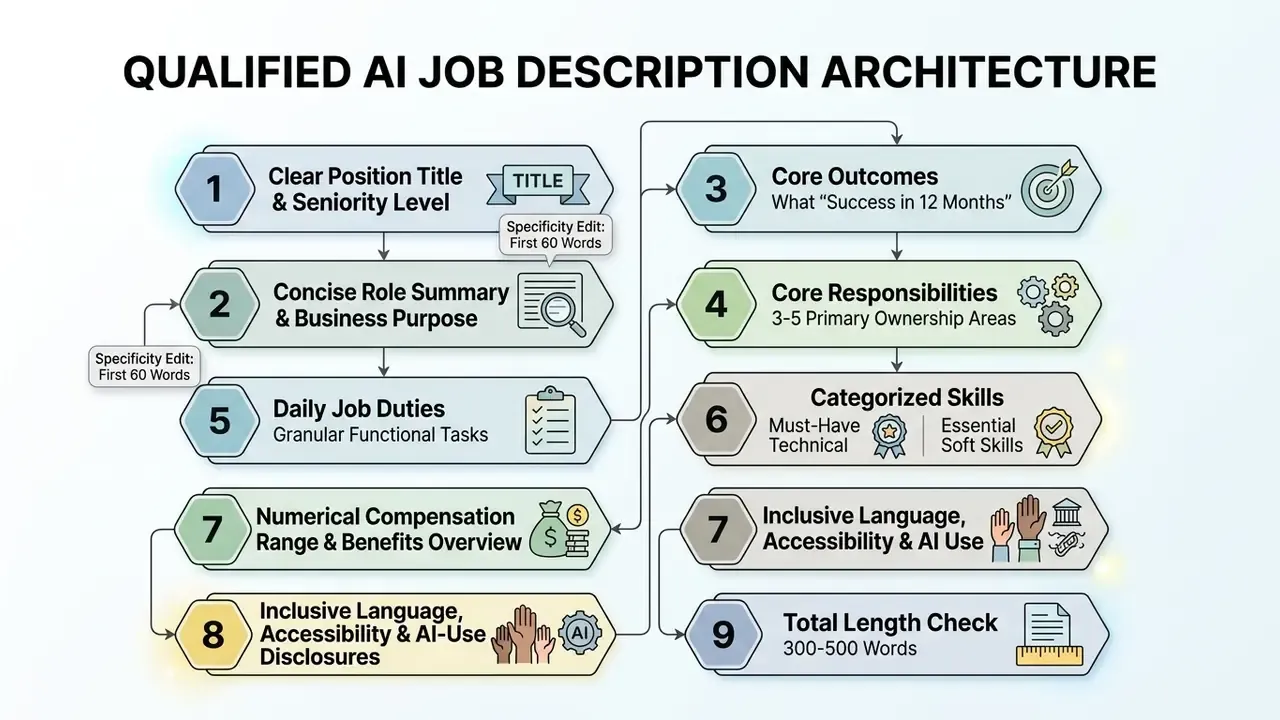
A high-quality vacancy description balances clarity, regulatory compliance, and brand positioning. An ai job responsibilities generator or an ai job duties generator helps structure prose, but human editors must verify that the content reflects daily operational reality.
Responsibilities, Duties, and Skill Requirements
Effective job design separates core responsibilities from daily tasks and required competencies (U.S. Department of Defense job analysis guidance). Key framework rules:
- Responsibilities. Group high-level accountabilities into 3 to 5 primary focus areas, for example "Manage model risk validation pipelines". DoD guidance suggests each critical duty should typically account for at least 25% of working time.
- Duties. List specific daily operational actions, for example "Execute quarterly stress-testing scripts". Order them from most to least important, and group minor or occasional tasks last.
- Skills. Map each critical duty to the knowledge, skills, abilities, and competencies actually required at minimum level. Distinguish non-negotiable technical requirements from broad behavioral attributes, and avoid arbitrary degree mandates that artificially restrict the talent pool.
Prompting the model to deprioritize degree requirements and rigid year counts in favor of demonstrable capabilities is the fastest structural route to a skills-based organization. It also widens the funnel to qualified candidates with non-linear career paths, which matters in scarce fields such as AML analytics and model validation.
Shift from credential-based to outcome-based skill phrasing
| Legacy / biased phrasing | Modern outcome-based AI alternative |
|---|---|
| "Must be a sales rockstar with 8+ years experience" | "Track record of increasing qualified sales pipeline by 15% annually" |
| "Bachelor's degree in Computer Science required" | "Demonstrated proficiency in Python, AWS infrastructure, and CI/CD pipelines" |
| "Thrives in a fast-paced environment; wears many hats" | "Owns two concurrent product launches per quarter with a two-person team" |
| "Young, energetic team player" | "Collaborates across engineering and compliance to close audit findings" |
| "Native English speaker" | "Writes clear customer-facing documentation in English" |
Read the right-hand column aloud. It is harder to write and much easier to assess.
Adapting Copy to the Company and the Candidate
Generative models frequently introduce implicit bias into job copy when nobody is watching.
Full methodology. A 2024 controlled analysis of 1,439 job adverts found that raw GPT-4-generated job ads were 29.3% more biased overall than human-written baselines:
"GPT-4-generated adverts averaged 40.9 on the inclusivity scale versus 57.9 for human-written ads, with the widest gaps recorded for disabled and neurodivergent candidates."
Semantic vector research confirms the mechanism runs deeper than adjectives:
"Even minor pronoun changes in a job posting shift the perceived gender fit of the role; pretrained models show high pronoun sensitivity."
The practical implication for tone-of-voice work: adapt register deliberately instead of accepting the model's default. Recruitment copy guidance recommends language that is informal but not casual, intelligent but not arrogant, written in short words, active voice, and second person ("you will own..."), with channel-specific variants for the career site, LinkedIn, and niche boards.
Fact check and human-in-the-loop requirement. Unedited AI-generated job ads risk pushing systemic bias and non-compliant requirement language into recruitment pipelines. HR leaders and hiring managers must review every draft to verify that requirements reflect essential job functions and conform to institutional diversity, equity, and inclusion standards before external distribution. AI is a drafting tool, not a decision-maker. No evidence, no autonomy.
Free vs Paid AI Job Description Generator: What to Choose
Choosing between a free ai job description generator and an enterprise-grade paid tool depends on recruitment volume, compliance requirements, and software ecosystem integration.
Comparison of free vs premium AI job description generators
| Feature / criterion | Free AI job description generator | Premium AI hiring platform or tool |
|---|---|---|
| Generation limits | Capped: about 3-5 drafts per day, ~10 messages per 5-hour window, or 3 JDs total on some plans | Unlimited or high-volume enterprise quotas; unlimited re-rolls |
| Prompt customization | Basic text inputs; fixed prompt templates | Custom brand voice, role-family context, guardrails and DEI rules |
| Intake-call ingestion | Manual retyping of the brief | Transcript-to-JD generation tied to a competency rubric |
| ATS / HRIS integration | Manual copy-paste, PDF or DOCX export | Native bidirectional ATS sync, field mapping, workflow triggers |
| Bias and inclusive-language scoring | Absent or rudimentary keyword checks | Algorithmic bias detection, inclusivity scoring, rewrite suggestions |
| Interview kit / scorecard output | None | Structured interview kit and rubric generated alongside the JD |
| Data security and audit logs | Consumer terms; possible training on inputs; no enterprise logging | SOC 2 compliance, encryption, retention controls, full audit trails |
| Pricing model | $0, often with no registration required | Roughly $10/month entry tiers up to $400+/month or $4,900+/year enterprise licensing |
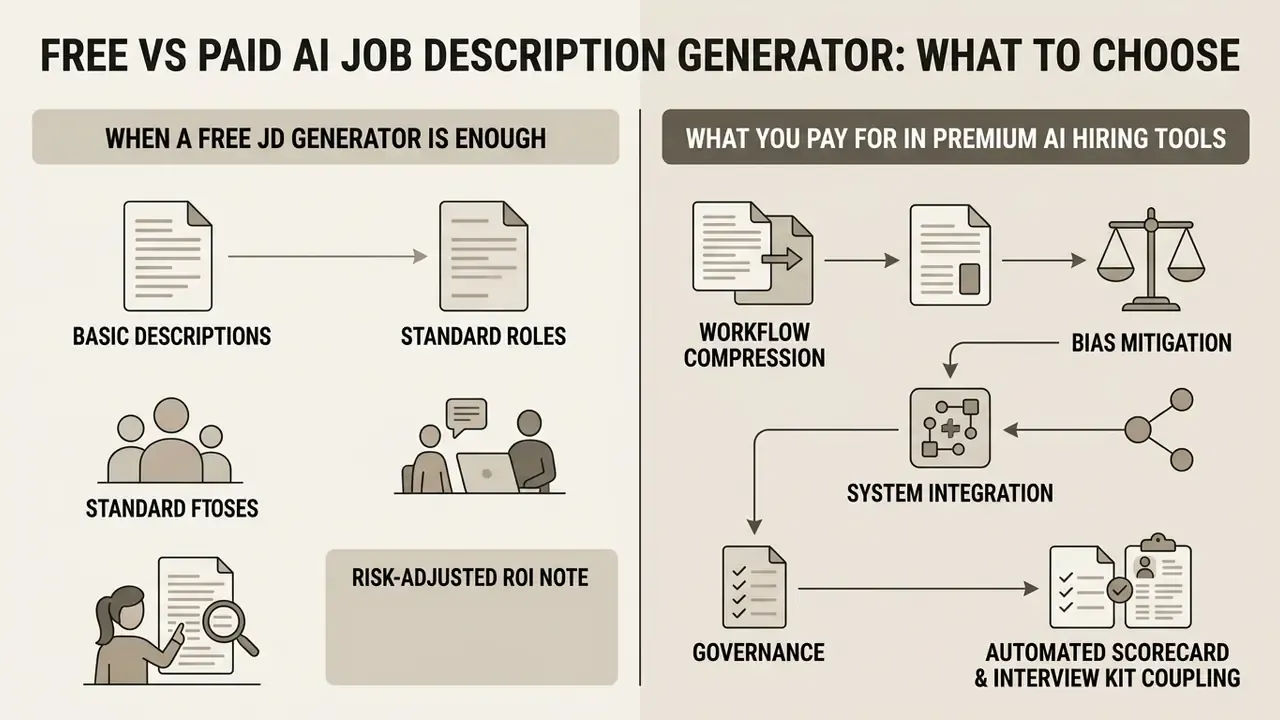
Reading the table in plain text: free tools give you sentences, paid tools give you a controlled process. Generation caps are the first ceiling you hit, integration and audit logging are the reasons finance signs the purchase order, and pricing scales with governance depth rather than with word count. Teams weighing subscription structures across generative categories can compare options before committing to an annual licence.
When a Free Job Description Generator Is Enough
A job description ai generator free tier or a standalone free job description utility is sufficient for small businesses, early-stage startups, or teams with infrequent hiring needs. When vacancy creation happens fewer than five times per month, recruiters can use standard free models for basic drafts and rely on manual editing to enforce tone, bias control, and accuracy.
Free tiers are constrained by design. Published consumer limits sit around 10 messages per rolling 5-hour window on some assistants, and as low as five prompts per day on premium models inside entry plans. That capacity supports occasional drafting, not a requisition pipeline. If the AI delivers a 70% draft and your edit is faster than starting from a blank page, the free tier has done its job.
Risk-adjusted ROI note. The 44% drafting-time saving is a gross figure. Net value must absorb the cost of human-in-the-loop validation, bias review, prompt logging, and reviewer sign-off. A realistic model: net saving = drafting hours saved minus (verification minutes × requisitions) minus governance overhead. For low-volume hiring, verification can eat most of the saving. For high-volume standardized roles, the saving compounds, because validation becomes template-driven. Our AI Media Calculators show comparable usage-estimation logic for other generative workflows.
What You Pay For in Premium AI Hiring Tools
Enterprise subscriptions for specialized hiring tools provide capabilities well beyond raw text generation:
- Workflow compression. Automated conversion of approved job descriptions into interview rubrics, screening criteria, and offer templates within one record. Vendor documentation from in-ATS generators (SkillSauce, 100Hires, RecruitHorizon) shows the JD becoming a shared hiring artifact rather than a standalone file.
- Bias mitigation. Automated checking against inclusive-language patterns to remove coded gendered, age-related, or ableist phrasing. Independent bias research (Develop Diverse, 2024) explains why this layer exists; scoring tools supply the mechanism.
- System integration. Direct API-based pushing of finalized copy into platforms such as Lever, Greenhouse, Ashby, or Workday, with field mapping and error handling.
- Governance. Role-based permissions, approval chains, prompt and version logging, exportable audit evidence.
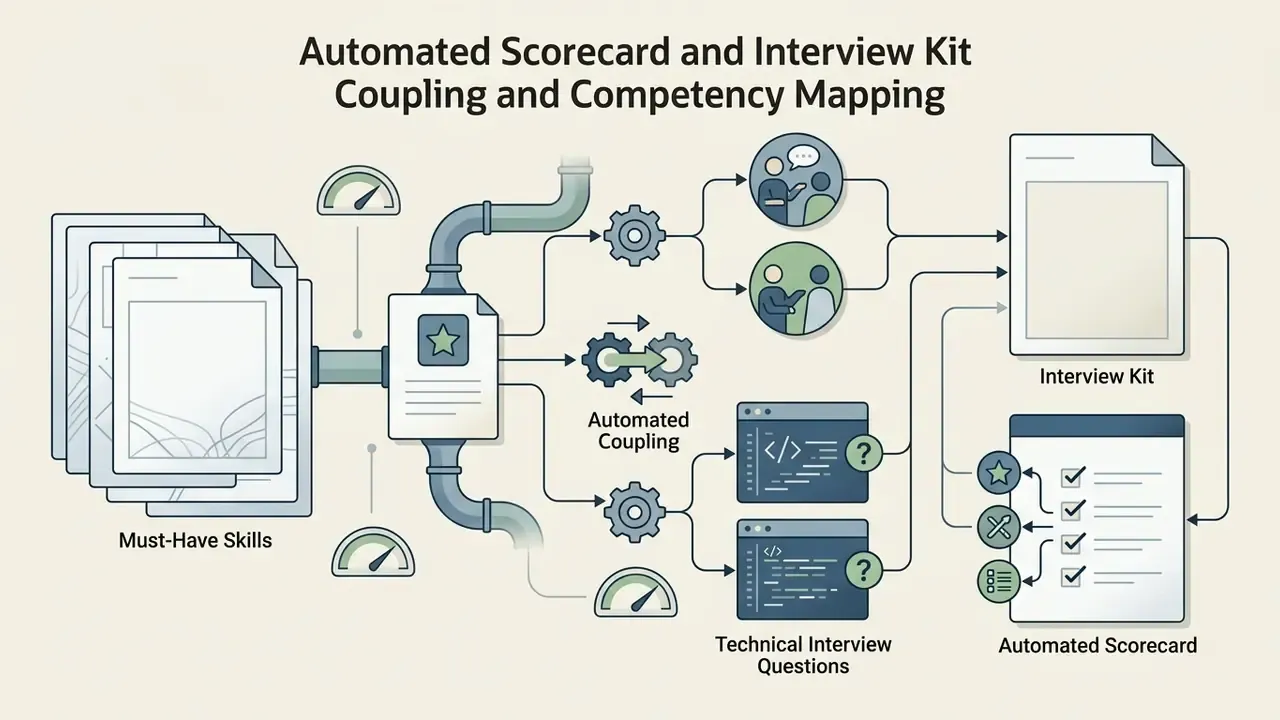
Automated Scorecard and Interview Kit Coupling
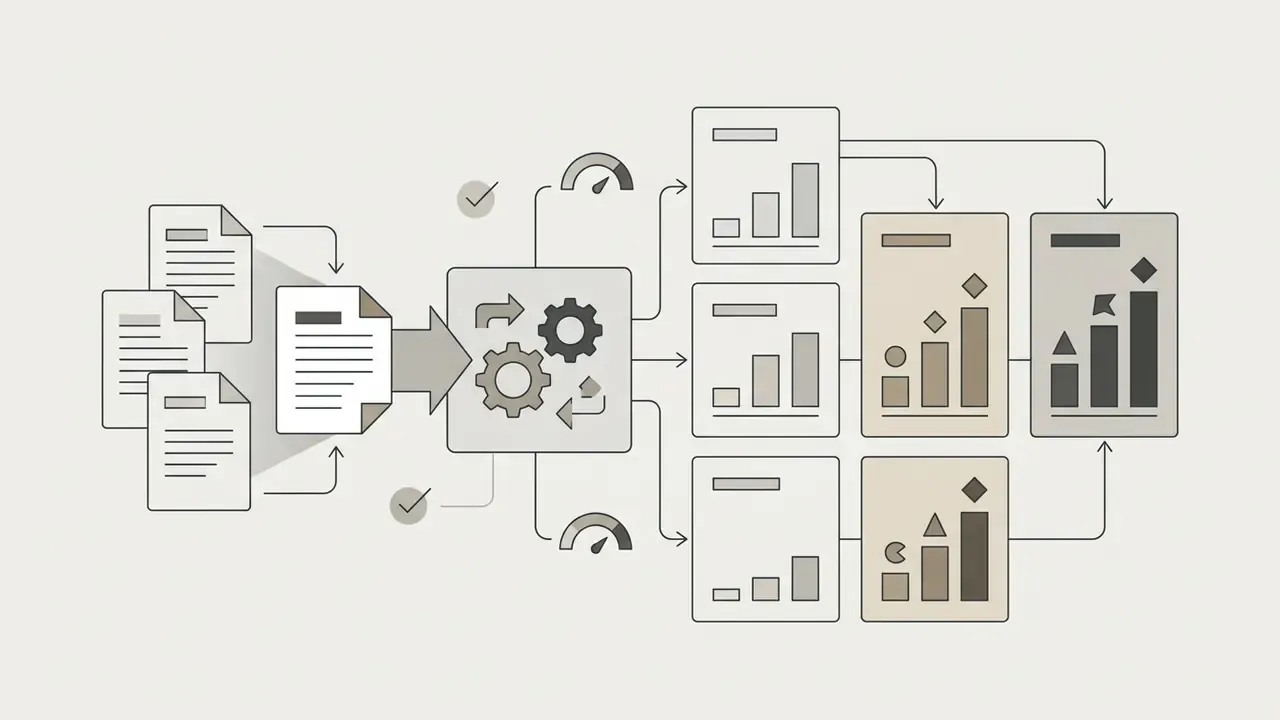
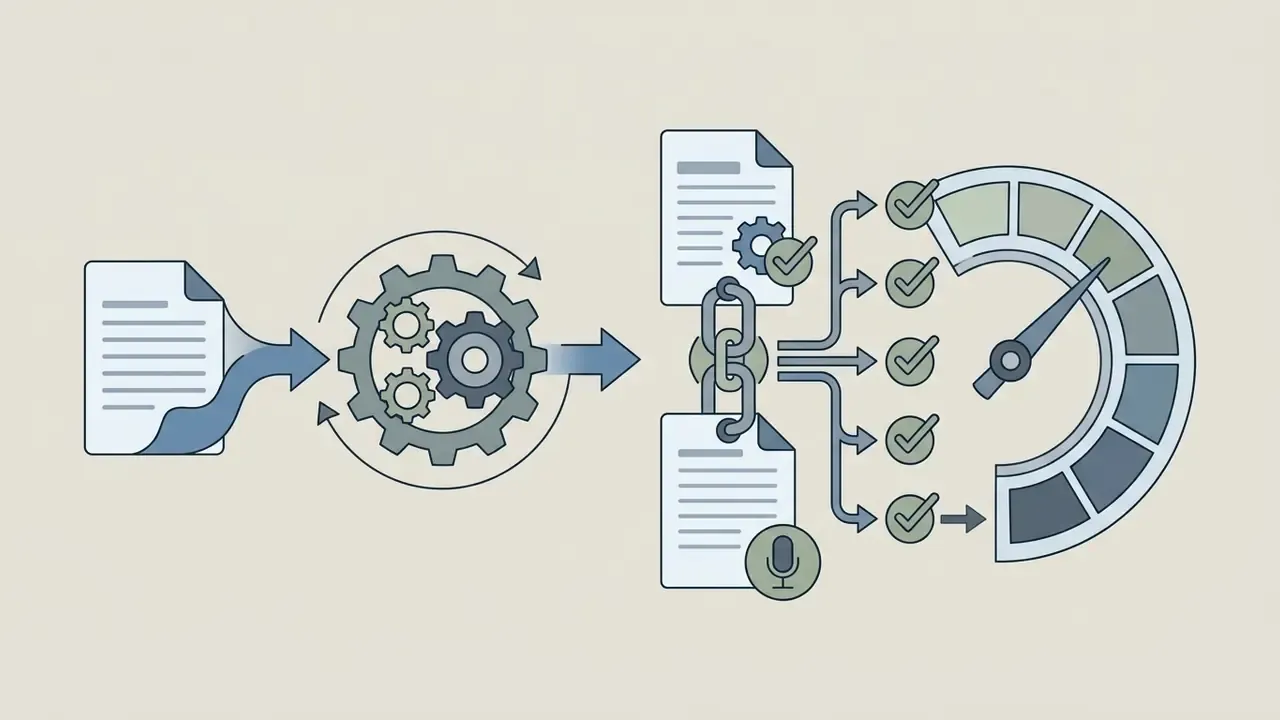
Premium AI hiring architectures do not stop at draft generation. They convert defined responsibilities into evaluation instruments inside the same workflow:
Coupling matters for compliance as much as for quality. SIOP's guidance for AI-based assessments (2023-2024) requires job-related content, consistent scoring, evidence of predictive validity, and documentation sufficient for verification and audit. A scorecard generated from the same rubric as the JD is the cleanest way to produce that evidence.

How to Choose the Best AI Job Description Generator Tool
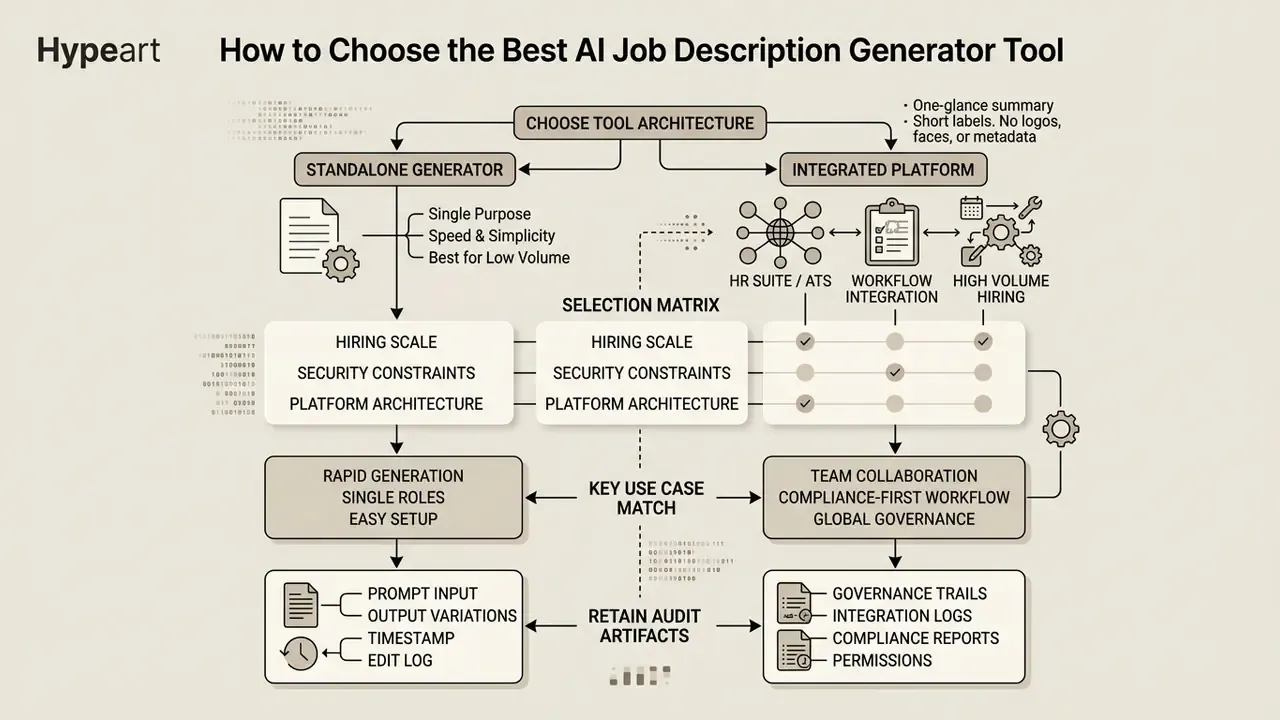
Identifying the best ai job description generator requires evaluating hiring scale, security constraints, and platform architecture. Feature lists rarely decide this. Evidence requirements do.
Standalone Generator or Full Hiring Platform
Tool Selection Criteria for Your Company
HR leadership should assess candidate AI utilities against a strict institutional criteria matrix. Five checks recur across public-sector guidance from 2022 to 2026: job-relatedness, transparency, privacy and security compliance, bias testing across diversity groups, and documented validation. Add two commercial ones: quality of generated output for your specific role families, and transparent pricing that survives a three-year TCO model.
Selection matrix: matching hiring use case to tool architecture
| Hiring scenario and scale | Primary need | Recommended tool type | Key compliance focus |
|---|---|---|---|
| Ad-hoc / small business (fewer than 5 roles per year) | Rapid drafting with zero software cost | Standalone free AI generator | Manual check for non-inclusive terms and factual accuracy; no PII in prompts |
| Scaling tech startup (10-50 roles per year) | Speed and consistent tech role phrasing | Paid standalone or ATS extension; one Custom GPT per role family | Prompt customization and market salary alignment |
| Mid-market enterprise (50-200 roles per year) | Standardized job architecture and team collaboration | Integrated ATS module with intake-call ingestion | Role-based permissions and bidirectional ATS sync |
| Regulated enterprise / banking (200+ roles per year) | Auditability, bias elimination, data privacy | Enterprise GRC-compliant HR platform | SOC 2, EU AI Act high-risk obligations, DPIA, complete audit logs |
Two hard constraints for EU-exposed organizations: AI systems used for recruitment and selection are classified as high-risk under the EU AI Act, and emotion-recognition AI in recruitment is prohibited (European Commission / AI Act Service Desk, 2025). In the United States, the Department of Labor's AI & Inclusive Hiring Framework (2024) sets expectations for employers using AI hiring technology, particularly regarding disabled job seekers. https://www.dol.gov/newsroom/releases/odep/odep20240924
Audit-Trail Artifacts to Retain
For model-risk management and internal audit, retain the following per requisition:
- The exact prompt text and the prompt template version used.
- The raw model output as generated, before human editing.
- The final published version, with a diff or change log.
- Model name and version, plus the tool instance (enterprise or consumer).
- Reviewer identity, role, and approval timestamp.
- Bias-scan result and any flagged terms with resolution notes.
- The intake-call transcript reference or requisition brief that sourced the requirements.
- Candidate-facing AI disclosure text, where applicable.
This artifact set maps directly to NIST AI RMF expectations around documentation, provenance, and test-evaluation-verification-validation (TEVV) of generative outputs, and to human-in-the-loop documentation practice requiring named reviewer accountability plus verification of facts that could cause harm if wrong.
One caveat worth stating plainly: none of this proves the description produced better hires. It proves the process was controlled and reproducible. Hiring quality still needs its own outcome metrics, tracked over quarters, not weeks.
FAQ: Frequently Asked Questions About AI Job Description Generators
Understanding operational edge cases helps recruitment teams adopt generative tools without compromising policy or data standards.
Can You Use an AI Resume Job Description Generator for a CV?
Yes. Candidates frequently use an ai resume job description generator or an ai resume job description generator free tool to analyze target job postings and rewrite their experience bullets to match required competencies. Typical vendor workflows accept an uploaded resume plus a pasted job description, then return tailored summary, skills, and experience suggestions with PDF or DOCX export. An ai job description generator for resume solves a mirror-image problem: matching language, not inventing it. Evidence and mechanism.
"Across nearly 500,000 job seekers, algorithmic resume-writing assistance reduced errors and improved readability, helping employers assess candidate-role fit more accurately." Wiles, resume writing assistance field experiment (2024) The measured outcomes were an 8% increase in hiring rates and roughly 10% higher starting wages, driven by clearer communication rather than inflated claims. Candidates must keep rewritten experience strictly factual. Fabricated capability claims surface immediately in structured interviews built from the same rubric as the job description.
Can You Create Multiple Versions of the Same Role Description?
Yes. Recruitment teams often generate several variants of a single ai job description creator output to A/B test messaging across channels: a formal, detail-heavy version for the corporate careers portal, and a concise, culture-forward variant for social channels and niche boards. Status of the method. Split-testing job ad copy lets teams measure application conversion rates and candidate quality per channel. Published split-testing procedures for job descriptions, including platform-based splits, apply-rate as the primary metric, and minimum sample-size requirements, come from commercial marketing guidance (PeoplePilot, 2025) rather than from a standards body. Treat them as practice, not regulation. Keep one variable per test (headline, opening 60 words, or requirement list), otherwise attribution collapses.
Can You Connect a Generator to an ATS and Other HR Tools?
Modern generative engines link directly to applicant tracking systems, CV parsing tools, and interview scheduling platforms through REST APIs. Source framing. Vendor documentation shows a spectrum of integration depth. Some tools stop at PDF or DOCX export for manual upload (Harmate, UNU). Others generate inside the ATS itself and pass structured role parameters into requisitions, screening criteria, and interview questions (SkillSauce, 100Hires, RecruitHorizon). Parsing platforms such as Textkernel standardize skills between job and resume records. There is no universal interchange format, so integration remains vendor-specific. Adoption patterns reinforce this. LLM-assisted vacancy content appears most frequently among young and smaller companies, which are typically first to plug generative tools into cloud ATS systems (The Widespread Adoption of Large Language Model-Assisted Writing, preprint, 2025). Technical teams can browse the hub for automated content workflow specifications.
Is Text Produced by an AI Job Generator Legally Compliant?
Not automatically. AI-generated copy must be audited by human HR staff for compliance with equal employment opportunity laws, state-level salary transparency mandates, and regional accessibility guidelines. In the EU, recruitment AI is treated as high-risk, and emotion-recognition tools are prohibited.
Does Using AI to Write Job Postings Hurt SEO or Candidate Reach?
Search engines and job boards prioritize clarity, structure, and relevance. Generic AI copy with repetitive jargon lowers engagement, while well-edited, specific AI drafts perform effectively across job search engines. The differentiator is the specificity edit, not the drafting method.
How Long Should an AI-Generated Job Description Be?
300-500 words for a typical knowledge-worker role. Longer postings lose readers on the second screen. Shorter ones fail to give candidates enough context to self-select. The internal job description can be far longer, because it is a governance document rather than an advertisement.
Should I Publish the First AI Draft Directly?
No. The first 60 words always need a specificity edit covering actual role outcomes, team context, and the first project the hire will own. Without it, the posting reads like every other generic listing and loses clicks in the opening sentence.
How Do Enterprise Hiring Tools Prevent AI Hallucinations in Job Requirements?
They constrain LLMs using pre-approved role libraries, structured input fields, competency rubrics, and retrieval-augmented generation (RAG) grounded in official company job architecture. Then they require named human sign-off before publication.
What Audit Trail Should We Keep for Internal Model-Risk Reviews?
Retain the prompt and template version, raw model output, final published text with change log, model name and version, reviewer identity and timestamp, bias-scan results, and the source brief or intake transcript. This set satisfies documentation, provenance, and human-review expectations in NIST AI RMF-aligned governance programs.
Can We Use Free Consumer AI Tools for Hiring Documents?
For generic drafting with no confidential or personal data, yes. For anything containing candidate data, salary specifics, internal system names, or unreleased plans, use a licensed enterprise instance with contractual data-processing terms. Unmanaged consumer usage, Shadow AI, is the primary data-leakage vector in HR workflows.
Disclaimer: The FAQ above is general information and does not replace legal counsel on equal employment opportunity compliance, salary-transparency obligations, data-protection duties, or regional accessibility requirements.
Pre-Publication Checklist (Copy Into Your Requisition Template)
Checklist0 / 15
Editorial Standards and Verification Note
This guide is compiled from peer-reviewed research, working papers, and published public-sector AI guidance. Quantitative claims are attributed to the specific study or framework that produced them: the NBER field experiment on generative AI and labor-market matching (Wiles & Horton, 2024), the 1,439-advert bias analysis (Develop Diverse, 2024), semantic gender-bias research (Nomelini & Marcolin, 2024), and governance material from NIST, the European Commission's AI Act resources, the U.S. Department of Labor, the U.S. Office of Personnel Management, and UK and Canadian recruitment guidance. Vendor performance claims such as "hire 67% faster" or "screen 90% faster", which circulate widely in the tooling market, are excluded because they are unaudited commercial statements rather than verified research. Where a claim rests on commercial guidance rather than a standard, that status is stated explicitly in the text.
Audience assumptions in this article, including which roles evaluate and approve AI hiring tooling, remain working hypotheses until validated through analytics, interviews, CRM data, or documented customer research.
Supplemental Resources and Navigation
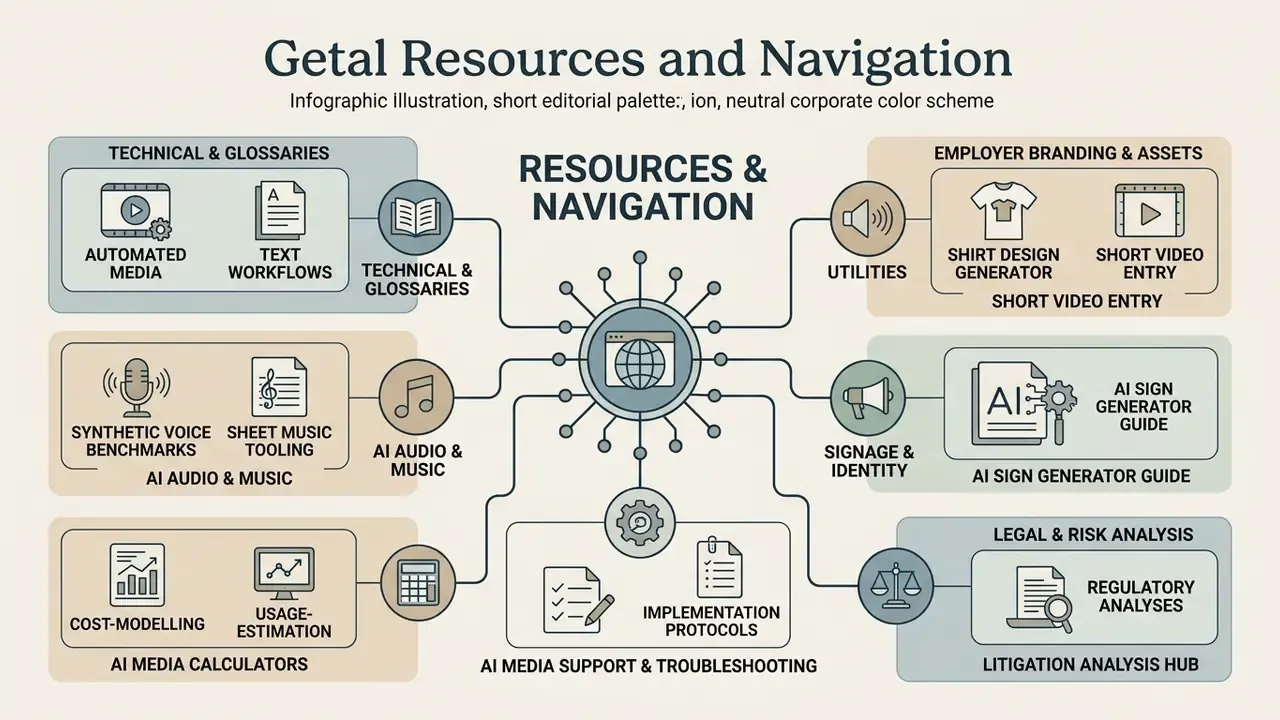
For additional technical references and domain glossaries covering automated media and text workflows, view the guide.
- Explore synthetic audio generation benchmarks, licensing terms, and quality criteria in our AI voice generators guide.
- Compare notation-focused generative tooling in our ai sheet music reference.
- Review employer-branding asset workflows with our ai shirt design generator overview.
- See how recruitment marketing clips are produced in the ai short video entry.
- Check signage and visual-identity automation in our ai sign generator guide.
- Access cost-modelling and usage-estimation utilities via our AI Media Calculators.
- Consult implementation and resolution protocols on our AI Media Support and Troubleshooting page.
- Examine legal and regulatory risk analyses of automated generation platforms in our litigation analysis hub.
- Compare licensing and subscription structures for generative tooling on our pricing and plans overview.
- Review platform-level evaluation frameworks in the tool comparison hub.