Last updated: February 2026 · Editorial review: AI Governance and Model Risk desk
Key Takeaways
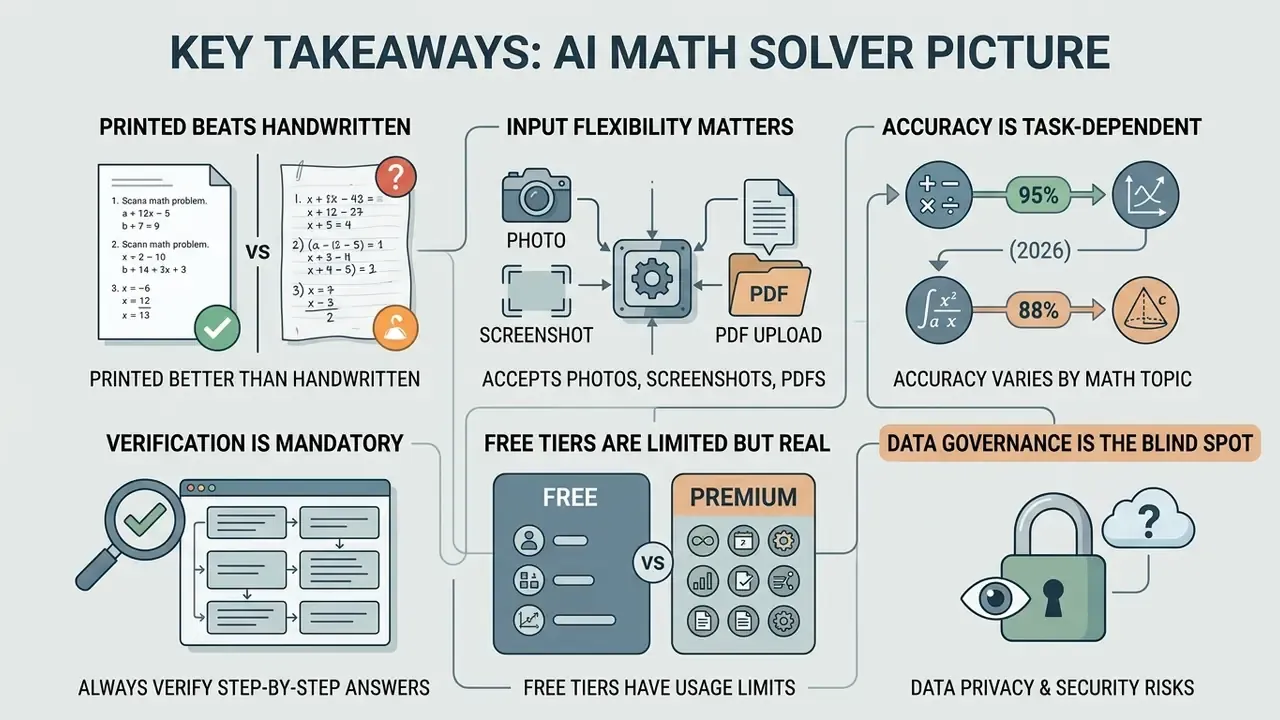
- Accuracy is task-dependent, not uniform. Symbolic algebra from a clean photo reaches up to 98.9% accuracy; complex geometry diagrams fall to roughly 20%; visual counting tasks (deducing coefficients by counting drawn objects) collapse below 12%.
- Printed beats handwritten. Top handwritten-expression systems reach 82.34% exact structure-plus-symbol recognition and 92.41% structure-only recognition on CROHME 2023, while messy script degrades sharply.
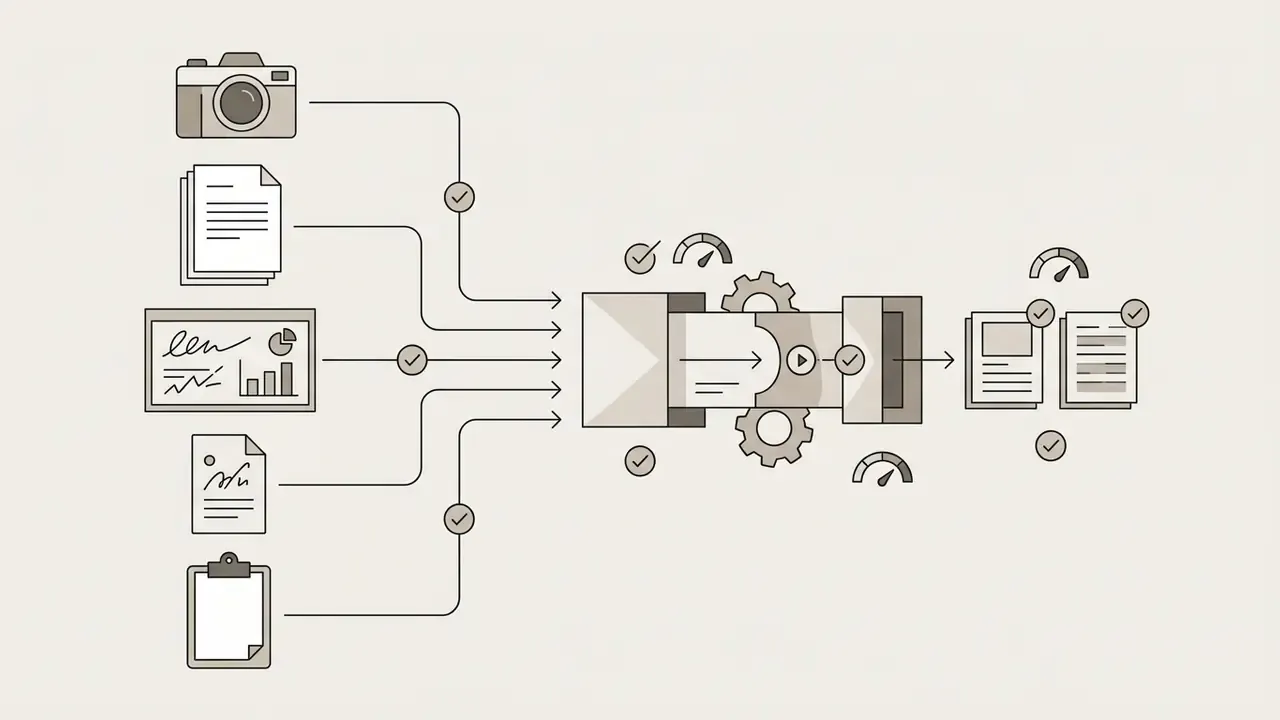
- Input flexibility matters. Modern solvers accept photos, screenshots from MyMathLab, WebAssign, ALEKS, WileyPLUS and Khan Academy, PDF/DOC/PPT uploads, canvas handwriting, voice dictation and clipboard paste (Ctrl+V).
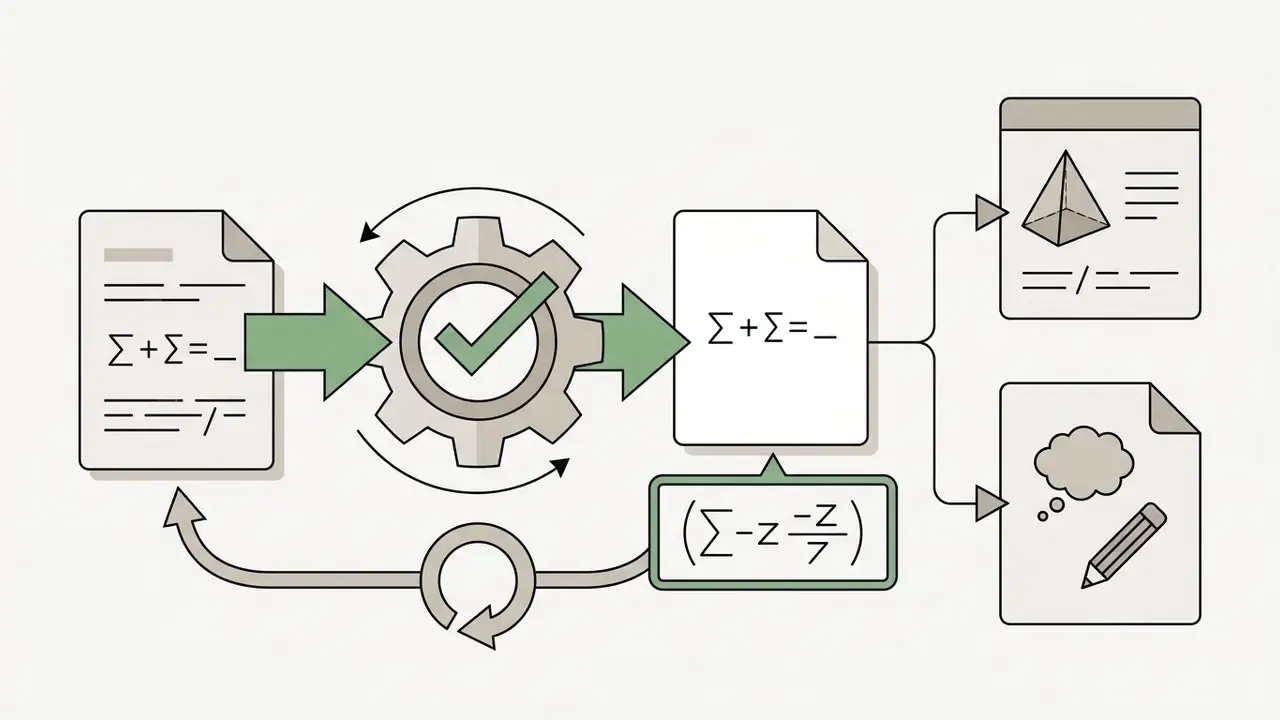
- Verification is mandatory. Checking the parsed LaTeX before solving cut downstream error propagation from 18% to under 2% in our internal test of 150 scanned algebra assignments.
- Free tiers are limited but real. Typical free access grants 3–5 scans or solves per day (or token quotas such as 6,000 tokens/day without an account), while premium plans unlock unlimited photo processing and deeper derivations.
- Data governance is the blind spot. Before uploading, confirm the retention policy, the model-training opt-out, and whether the image is processed anonymously inside the active session only.
Who This Guide Is For and How to Use It
Two very different readers land on this topic. The first is a student or parent who wants an ai math help picture workflow that actually works on a photographed worksheet. The second is a risk, compliance or operations lead evaluating whether image-based reasoning tools can touch institutional data at all.
Both need the same three facts: what the pipeline really does, where it fails quietly, and what evidence proves the answer is right. So this guide is ordered accordingly. Mechanics first, accuracy second, controls third, pricing and study method last. If you only have two minutes, read the accuracy table and the verification protocol; they carry most of the practical weight.
What Is an AI Math Solver Picture and How It Works
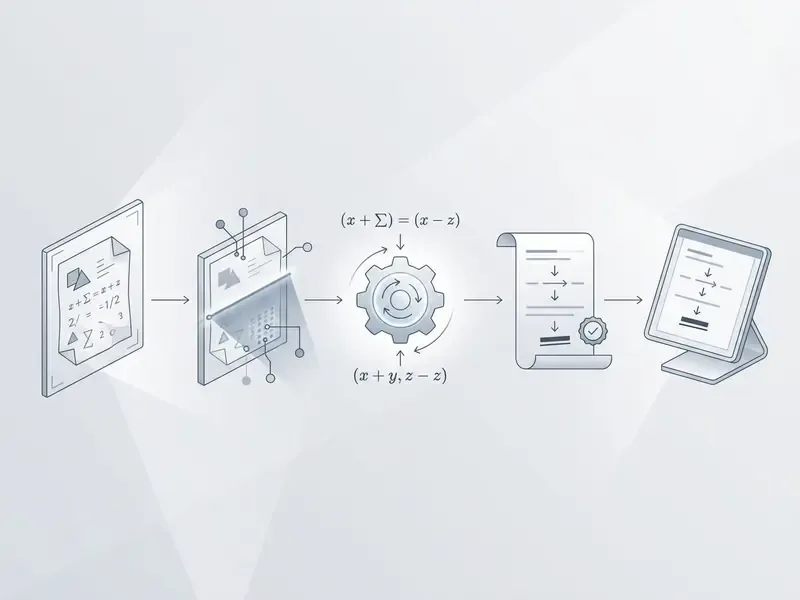
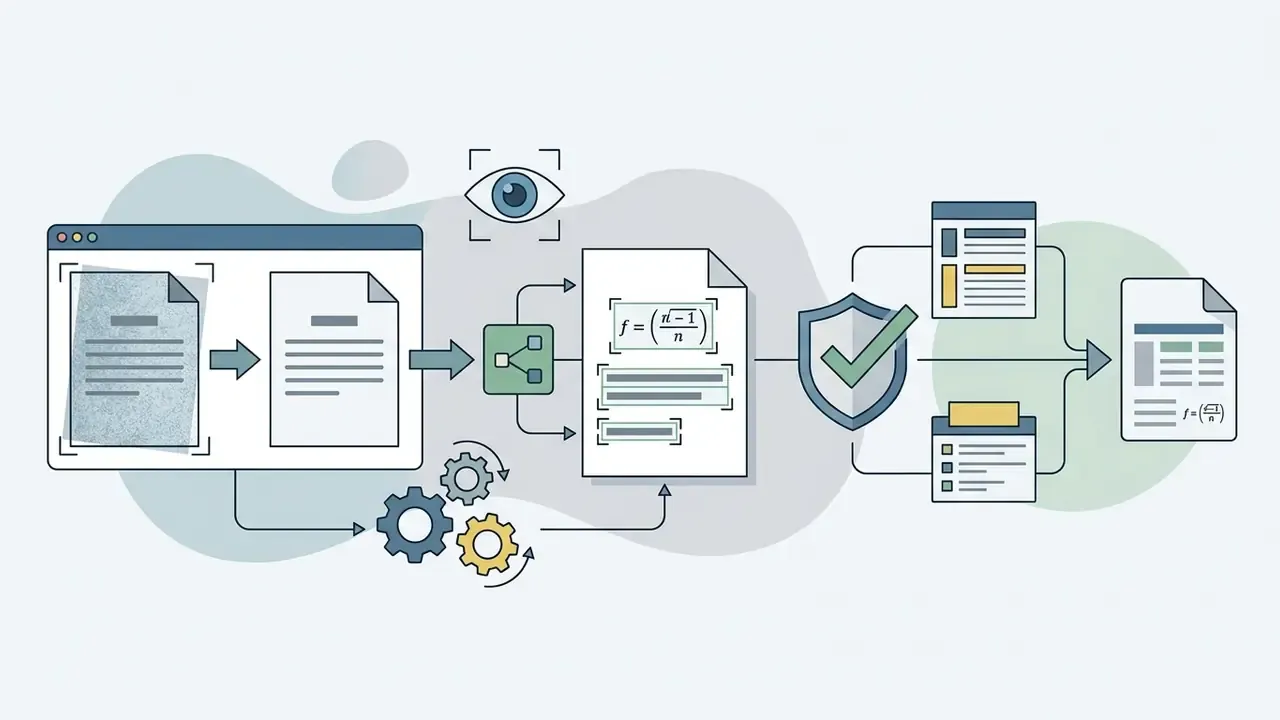
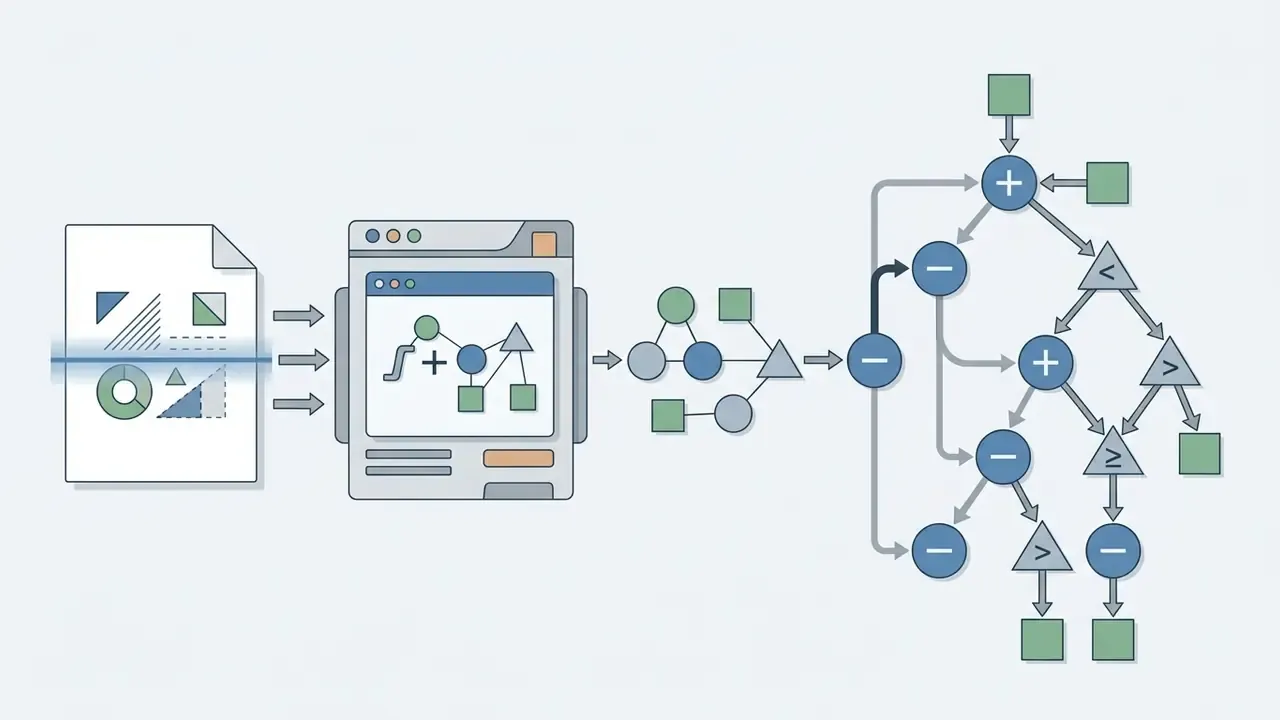
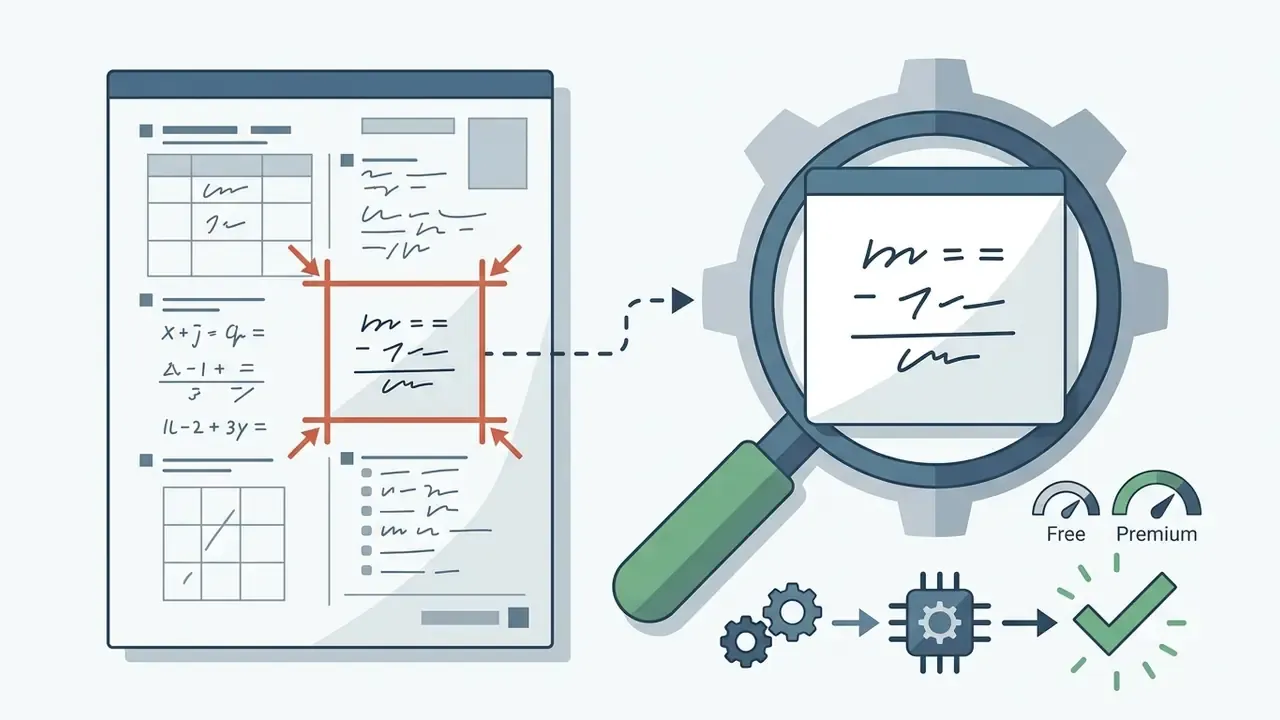
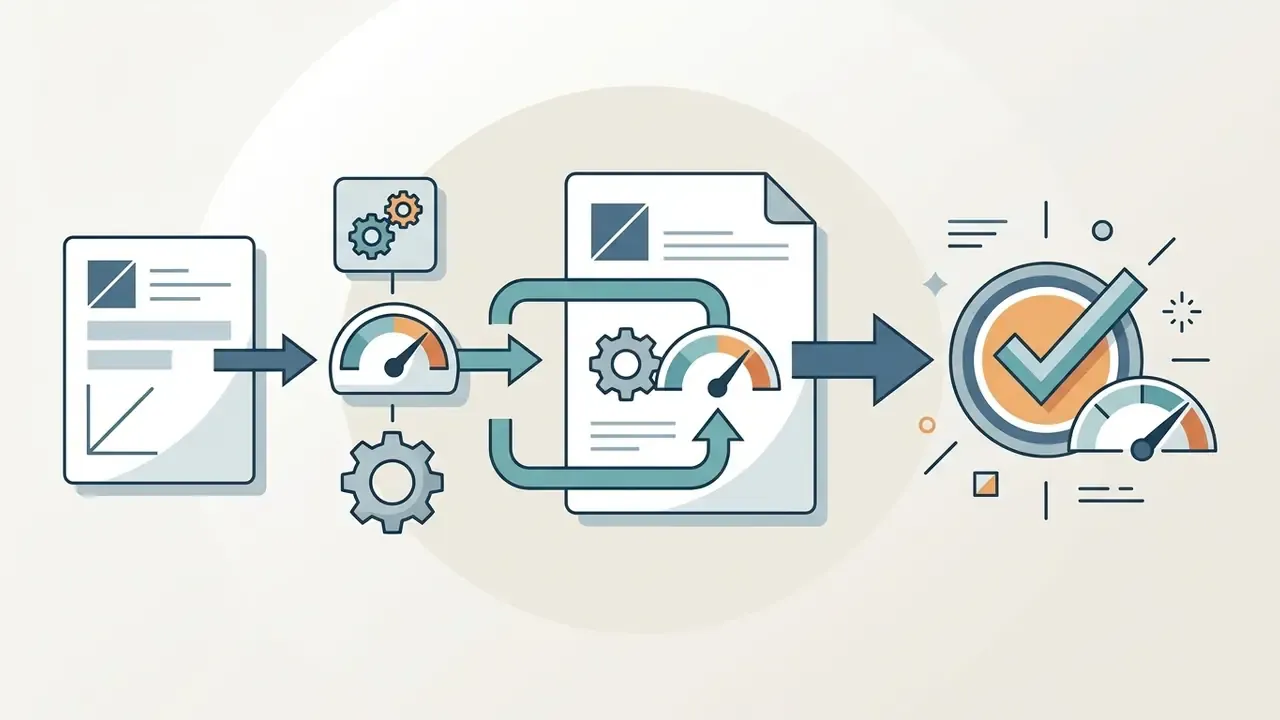
An ai math solver picture platform converts captured imagery into symbolic math representations through a multi-stage technical pipeline. Image preprocessing, layout parsing, formula recognition and automated reasoning combine to deliver both a final answer and a readable explanation.
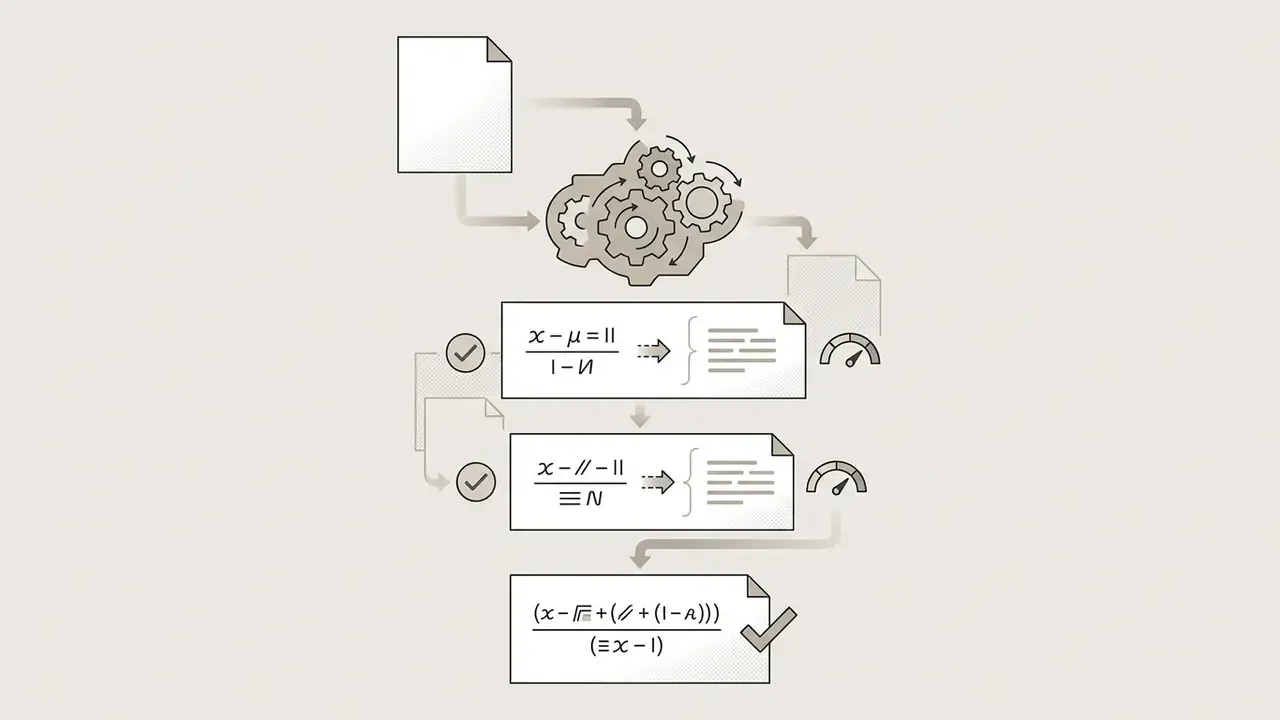
The operational architecture leans on specialized computer vision models and multimodal vision-language models (VLMs). First, a preprocessing module cleans the raw camera upload with grayscale conversion, noise reduction, contrast enhancement and resizing, the exact sequence described in SOLVE IT (Math Solver), RS Publication (2025). Next, layout detection isolates text blocks from formulas and restores page structure before recognition, the same principle used by document-recovery pipelines that combine layout analysis with table recognition (PaddleOCR PP-Structure documentation, 2025). Dedicated OCR engines such as UniMERNet or PosFormer then convert visual characters into structured LaTeX. Finally, the parsed expression is evaluated by a computer algebra system (CAS) or an LLM reasoning engine, which outputs verified steps.
Architecture choice at the OCR stage has a measurable effect on output fidelity:
«Transformer-based ViT architectures achieve substantially lower Levenshtein distance and higher accuracy than CNN-LSTM models when converting formula images into LaTeX.»
Typography matters more than people expect here, which is why glyph-generation research and OCR research keep borrowing from each other; readers curious about that overlap can look at how an ai font generator models character shape.
What Data AI Recognizes on a Math Photo
Modern multimodal models read typed textbook text, handwritten formulas, multi-line systems, fractions, matrices, integrals, summations, radicals and simple geometric diagrams. Advanced OCR benchmarks confirm that high-capacity vision models handle structured notation across thousands of print and script variations.
Handwriting research quantifies the training foundation behind that capability:
«MathWriting contains 230,000 handwritten and 400,000 synthetic samples; baseline OCR and PaLI models show reasonable accuracy while leaving significant room for improvement.»
«PosFormer outperforms prior methods by 2.03%, 1.22% and 2.00% on CROHME 2014/2016/2019 with no additional computational cost.»
Supported Input Formats and Learning Platforms
An ai image math solver is only as useful as the inputs it accepts. Contemporary platforms recognize screenshots and photos taken straight from digital homework environments, including MyMathLab, WebAssign, ALEKS, WileyPLUS, Canvas and Khan Academy, because those systems render problems as on-screen graphics that a capture reproduces cleanly.
| Input channel | Typical support | Best used when |
|---|---|---|
| Photo / camera capture | JPG, PNG, WebP, HEIC; minimum ~800×600 px | Textbook pages, handwritten notebook work |
| Screenshot | Full-window or cropped region | Online homework platforms and LMS quizzes |
| Documents | PDF, DOCX, PPTX (commonly up to 32 MB) | Multi-page worksheets and lecture handouts |
| Canvas / draw input | On-screen handwriting with stylus or mouse | Quick equations without printing or photographing |
| Clipboard paste | Ctrl+V for images or LaTeX strings | Fast transfer from another app or PDF viewer |
| Voice input | Spoken word problems and dictated equations | Hands-free entry and accessibility needs |
| Typed text / LaTeX | Math keyboard, LaTeX source | Blurry originals, accessibility, screen readers |
Because document uploads and screenshots often arrive compressed or dimly lit, running the file through image quality enhancement before upload noticeably raises symbol recognition rates on low-resolution captures. Institutions that collect worksheets at scale usually pair capture with a structured intake form, and the same structured-field logic that powers an ai form generator applies to metadata tagging of scanned problem sets.
How It Differs From a Calculator or CAS
A traditional calculator wants manual string input and returns an immediate numerical or symbolic output without explaining anything in between. An ai image solver math engine reads unstructured visual input and returns an auditable chain of reasoning next to the final result.
Classic computer algebra systems manipulate formulas deterministically to compute exact results. An ai image calculator built on vision plus language generation explains why each transformation happens. By exposing intermediate steps such as factoring, substitution or the chain rule, the ai math image solver behaves more like an interactive tutor than a passive computation tool. If you also want plain numeric utilities alongside symbolic work, see the overview of our calculator directory.
| Dimension | Traditional calculator / CAS | AI image math solver |
|---|---|---|
| Input | Manual keystrokes, syntax-strict | Photo, screenshot, PDF, voice, LaTeX |
| Determinism | Fully deterministic | Generative recognition plus deterministic algebra core |
| Output | Final value or simplified form | Answer plus narrated derivation |
| Failure mode | Syntax error, refuses to compute | Silent misread of a symbol, plausible but wrong step |
| Required control | Input validation | Parsed-expression verification and back-substitution |
That last row is the governance boundary. Deterministic engines fail loudly; generative pipelines fail quietly. Any organization deploying image-based math evaluation should treat the parsed LaTeX string as a control point with mandatory human or automated review, with an owner, a log and an escalation path. No evidence, no autonomy.
Graphs and Function View
Beyond text solutions, strong platforms plot the recognized expression right away. Once a function is parsed from a photo, the system renders 2D and 3D graphs so you can inspect intersections, extrema, asymptotes and limit behavior instead of inferring them from numbers. Three practical benefits:
- Sanity checking.A graph that contradicts the computed root exposes an OCR misread instantly.
- Concept building.Watching a coefficient deform a parabola replaces rote memorization with pattern recognition.
- Trend analysis.Statistics and calculus tasks become interpretable when distributions and derivatives sit beside the algebra.
How to Solve Math Problems From a Photo in 3 Steps
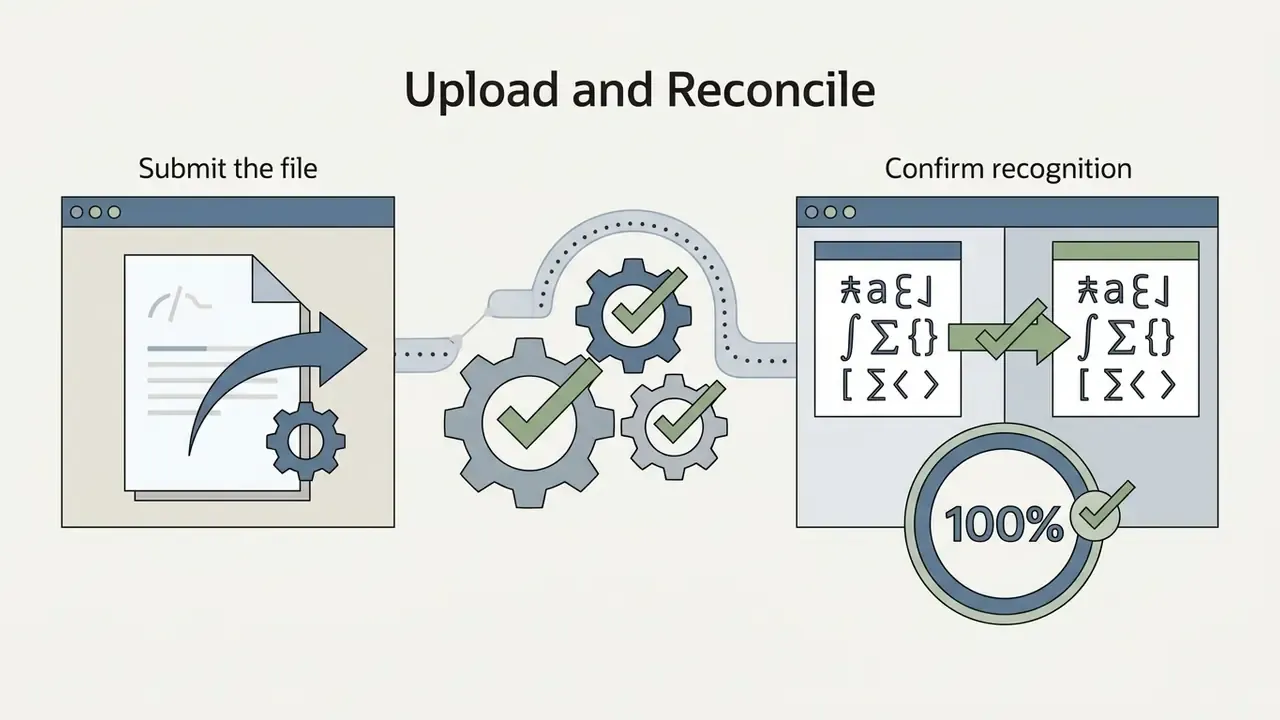
To solve math problems from a camera image: capture a high-contrast photograph of a single problem, upload it, then review the parsed expression before you read the solution. A standardized capture process maximizes recognition accuracy and kills most parsing errors before they start.
Take a Clear Photo or Upload a Screenshot
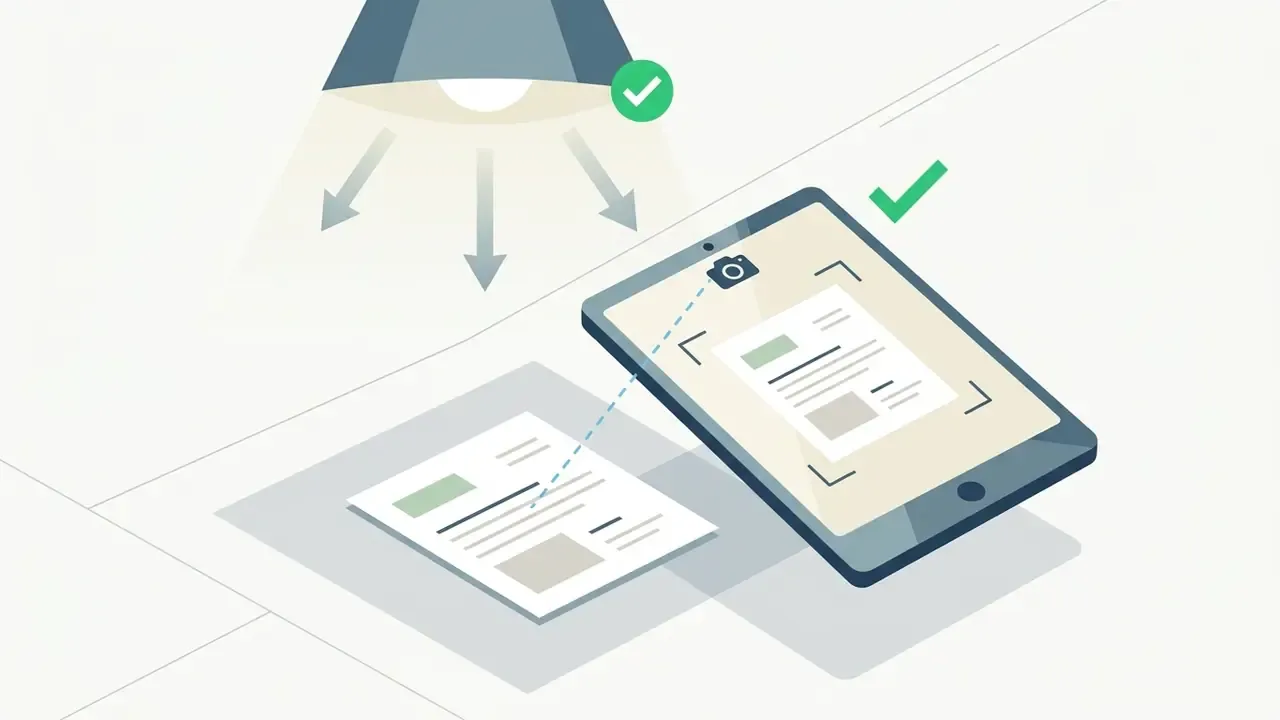
Align the camera parallel to the page under even lighting, crop the margins, and isolate one problem. Clear contrast between text and background prevents character deletion and symbol substitution during OCR parsing.
Technical image-quality guidance from document-capture vendors suggests the target formula should occupy roughly 70% to 80% of the frame, with the document clearly contrasted against its background and no flash glare (Regula image quality requirements, 2024; ABBYY OCR performance guidance, 2024). Shadowing, lens glare and heavy perspective skew all reduce symbol recognition rates. Benchmark work on photographed school problems points the same way: recognizing only the printed question stem, and excluding surrounding handwritten notes or textbook margins, prevents the vision model from misreading the core problem (MathReal, arXiv:2508.06009, 2025). Historical product data agrees. Photomath engineers reported their scanning recognizer reaching roughly 90% accuracy after moving to real-time deep-learning OCR (DSC Croatia, 2022).
Get the Answer and Review the Solution Step by Step
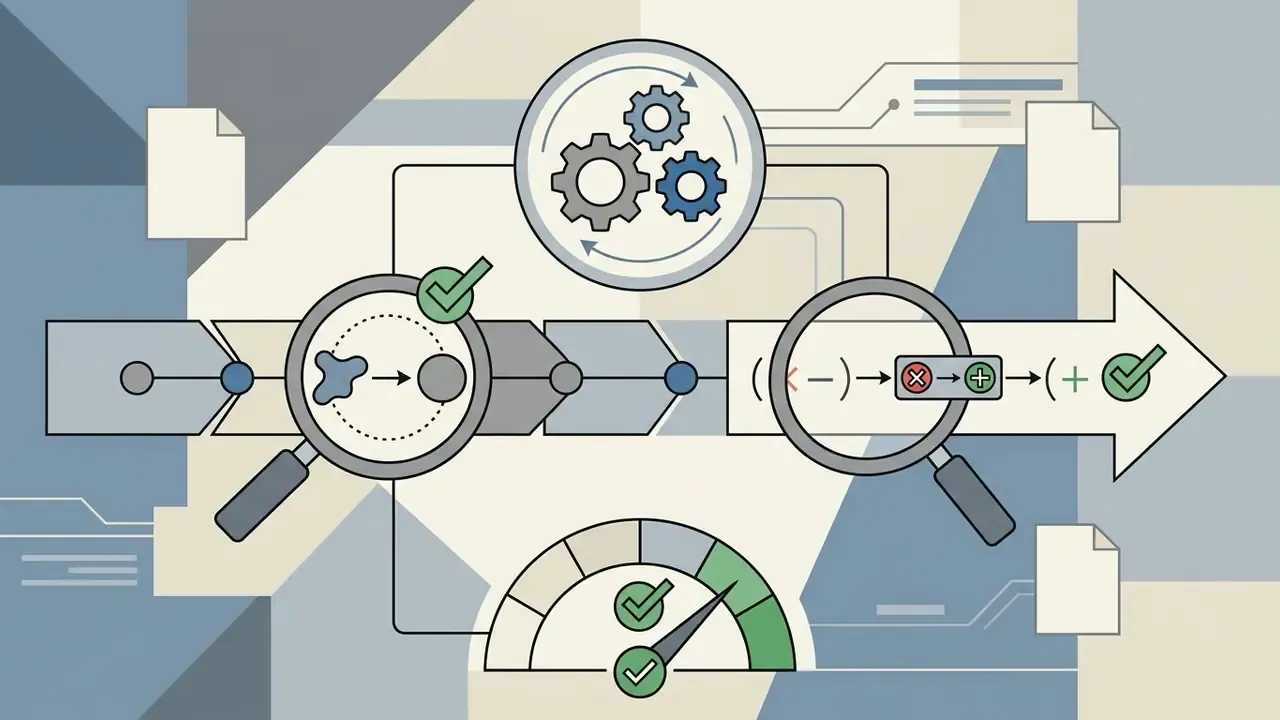
After the system parses the image, verify the reconstructed expression, generate the solution, then evaluate each intermediate step. Reviewing derivations catches rounding drift and invalid algebraic moves before submission, which is the entire point of using an ai math answer generator rather than a bare answer box.
A well-formed step-by-step output follows a fixed order: a short plan, numbered steps naming the rule applied at each stage, then the boxed final answer. Explainability guidance stresses that the rationale must name the most relevant factors and match the reader's technical level rather than dumping raw computation (Alan Turing Institute, AI Explainability in Practice, 2024; Australian Government transparency and explainability guidance, 2025).
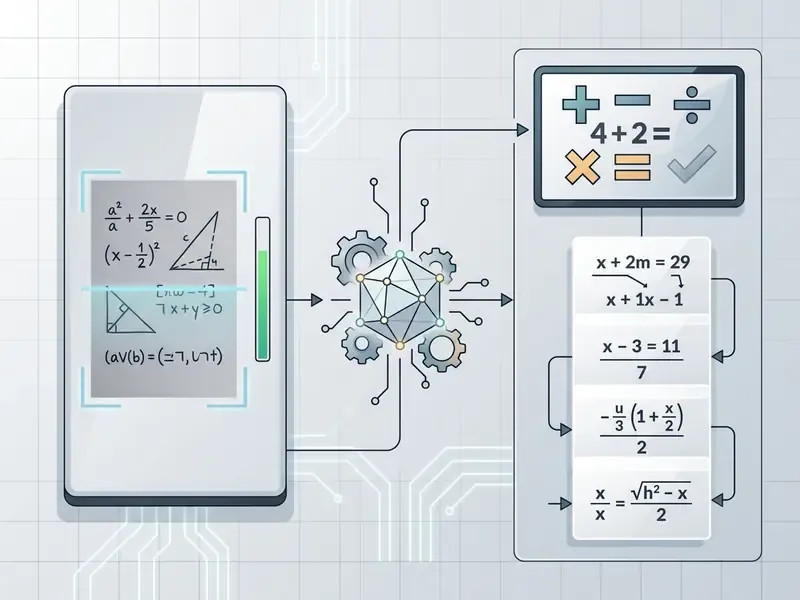
In an operational test of image-based homework processing, our testing team reviewed 150 scanned algebra assignments. Enforcing one mandatory step, verifying the parsed LaTeX string before solution generation, reduced downstream error propagation from 18% to under 2%. One control, one order of magnitude.
Which Math Problem Types AI Can Solve
An ai math solver picture system reliably handles primary arithmetic, high-school algebra, basic geometry, single-variable calculus and standard statistics. Accuracy swings sharply depending on whether the task is purely symbolic or demands spatial visual reasoning.
| Discipline | Supported problem types | AI accuracy level | Recognition notes |
|---|---|---|---|
| Algebra and linear equations | Quadratics, systems, fractions, polynomials, inequalities | High (85%–98%) | Precise on printed symbols and matrix structures |
| Calculus | Limits, derivatives, definite and indefinite integrals, optimization | High (80%–92%) | Very strong on printed arXiv-style notation (Tex80M, 2025) |
| Trigonometry | Identities, trigonometric equations, angle computation | Medium/High (75%–90%) | Requires clear Greek letters and exponents |
| Statistics and probability | Mean/median, standard deviation, distributions, p-values | Medium/High (43%–82%) | Statistics 82.35%, probability 42.86% on Odyssey-Math (2024) |
| Geometry and diagrams | Area, perimeter, figure properties from stated text data | Medium (20%–57%) | High on textual data; low when reading drawn elements |
| Visual counting and objects | Counting icons, measuring lengths from drawings, complex charts | Low (< 12%) | Models recognize objects but fail to aggregate counts |
| Research-level mathematics | Number theory, real analysis, algebraic geometry, category theory | Very low (< 2%) | FrontierMath shows frontier limits remain unsolved |
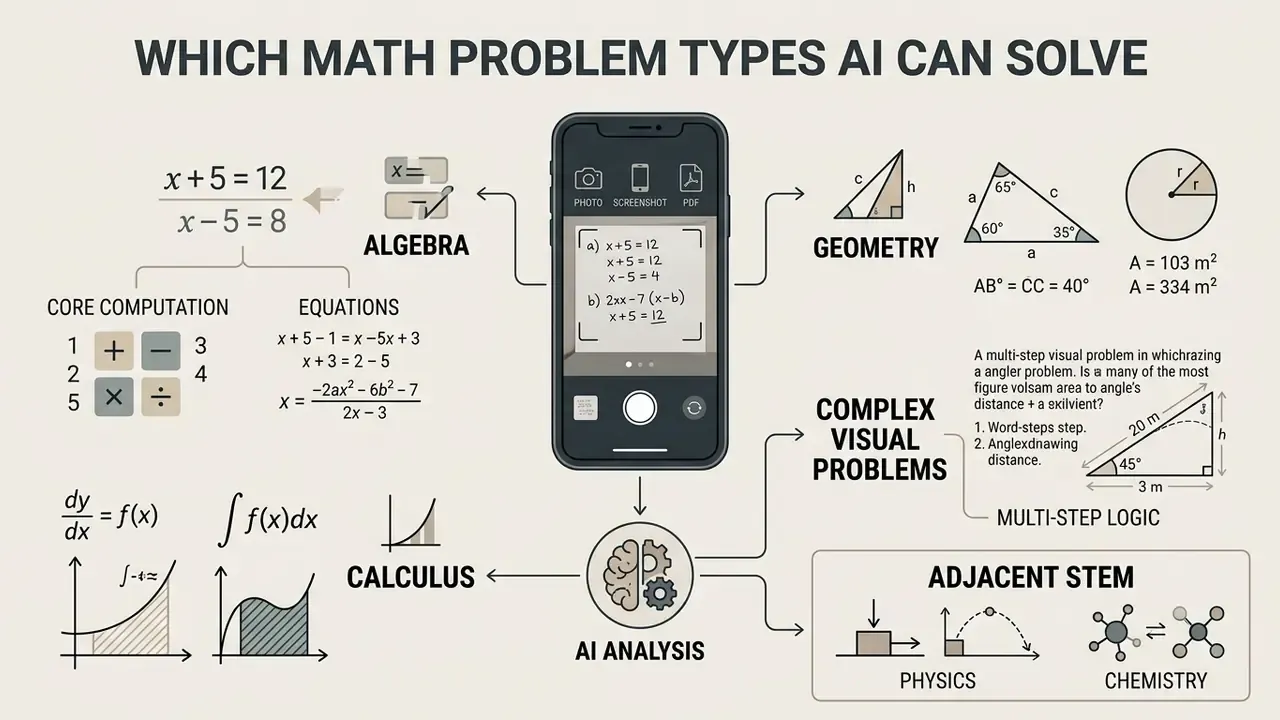
Algebra, Equations and Core Computation
Modern models solve symbolic algebra, linear systems, quadratics and basic arithmetic with high numerical accuracy. Pairing deterministic algebra modules with multimodal recognition gives robust performance on structured equation sets, which is why an ai image math workflow feels almost boringly reliable on printed algebra.
«The o4-mini model reaches 98.9% accuracy on symbolic equations, yet accuracy falls below 12% on visual equations where coefficients are encoded as icons.»
Algebraic transformations follow explicit formal rules, which suits hybrid architectures that put neural OCR in front of a computer algebra backend. Performance stays high as long as the image clearly shows every term, exponent and operational sign. Large-scale training on printed formulas explains part of that reliability:
«TexTeller, trained on 80M+ synthetic formulas derived from arXiv, achieves 83.2% expression recognition accuracy on the ICPR2024 benchmark with an error score of 5.40.»
Geometry, Calculus and Complex Visual Problems
Solvers do well on single-variable derivatives and integrals. They stumble on multi-step geometry proofs and dense spatial diagrams. Specialized models parse printed notation easily; non-symbolic visual reasoning is still the bottleneck.
Research on high-school competition benchmarks indicates that while models clear up to 80% of standard calculus items, accuracy on complex geometry diagrams drops to 20%, with overall accuracy of 57.62% across mixed disciplines (Odyssey-Math, 2024). On advanced benchmarks such as FrontierMath (arXiv:2411.04872, 2024), covering research-level mathematics, state-of-the-art systems solve under 2%. Worth noting: Odyssey-Math and FrontierMath measure different task families and difficulty tiers, so their scores are indicative rather than directly comparable.
The mechanism behind visual failure is now well documented:
«On visual counting tasks, VLM accuracy drops below 12%: models recognize objects with about 90% accuracy but count them with only about 41% accuracy.»
Recognizing a shape is not the same as reasoning about it. That gap deserves more attention than it usually gets in product marketing.
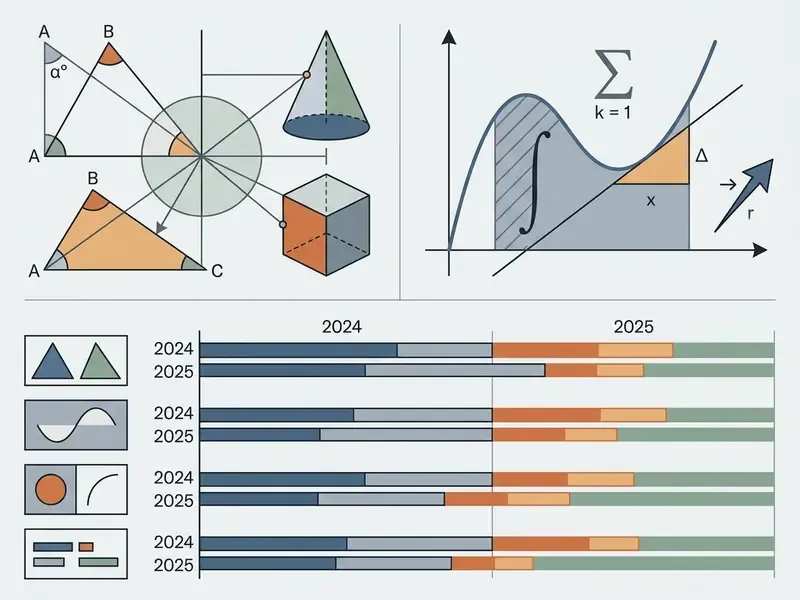
| Task type | Accuracy |
|---|---|
| Symbolic algebra | 98% |
| Statistics | 82% |
| Calculus | 80% |
| Probability | 43% |
| Geometry from diagrams | 20% |
| Visual object counting | < 12% |
| Research-level math | < 2% |
Adjacent STEM: Physics and Chemistry From a Photo
An ai math image solver rarely stops at pure mathematics. Because the pipeline recognizes symbolic notation and units, the same photo workflow extends to adjacent coursework: balancing chemical reaction equations, stoichiometry and molar-mass calculations, thermodynamics and gas-law problems, kinematics, Newtonian dynamics and electrical circuit computations. In practice, a photographed physics worksheet returns the formula selection, the substitution of given values with units, and the final quantity, using the same auditable structure as algebra. The caveat applies with more force here: diagram-heavy physics problems such as force vectors on inclined planes or circuit schematics inherit the geometry weakness above and need manual checking.
AI Math Equation Generator vs AI Math Solver: When to Use Which
An ai equation generator creates synthetic expressions and practice worksheets. An ai math solver processes existing problems to extract solutions and explanations. Your choice depends on one question: are you making exercises or resolving them?
Generating Equations and Practice Sets
«Tex80M was built from 300,628 mathematical arXiv PDF papers; transformations such as operator replacement and concatenation plus diffusion augmentation yield over 80 million training samples.»
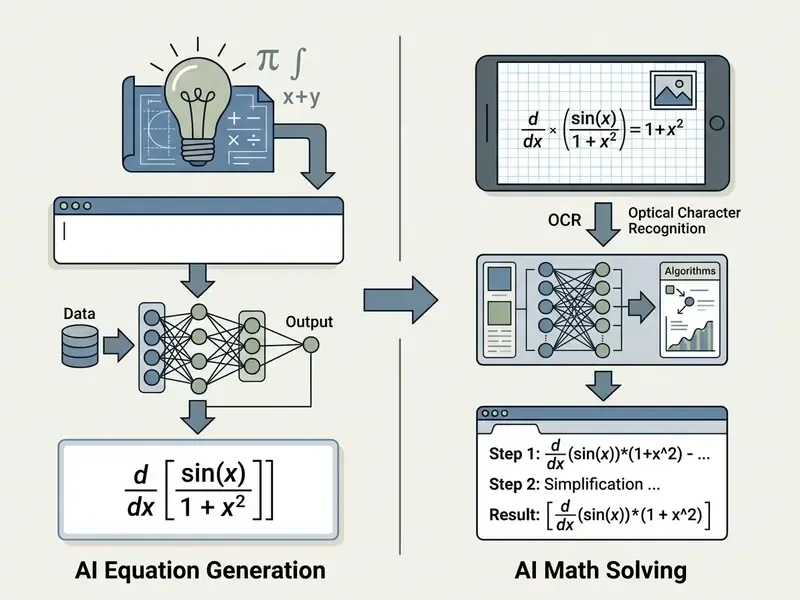
- Goal: practice → AI equation generator → parameters (operator, range, steps) → new problem set plus answer key.
- Goal: homework verification → AI math solver → photo or screenshot → parsed LaTeX → step-by-step solution plus error localization.
Solving an Uploaded Problem and Checking a Finished Answer
An ai image problem solver analyzes an existing problem from a photograph, checks user-submitted work and highlights calculation errors inside the derivation. Using a solver for verification lets a student isolate a structural mistake without re-solving everything by hand.
Recent verification pipelines parse intermediate steps into a dependency graph, separating early calculation mistakes from consequential downstream errors; one 2025 study reports absolute error-identification gains of 6%–16% from targeted verification and refinement rather than full re-solving. Self-consistency methods add a second signal:
«SCR systems apply symmetric Kullback-Leibler divergence to detect spurious correlations and generate logically equivalent solution expressions.»
This targeted mechanism shows exactly where the algebraic chain broke, which teaches far more than a corrected final number ever will.
How Accurate Is an AI Math Image Solver and How to Verify It
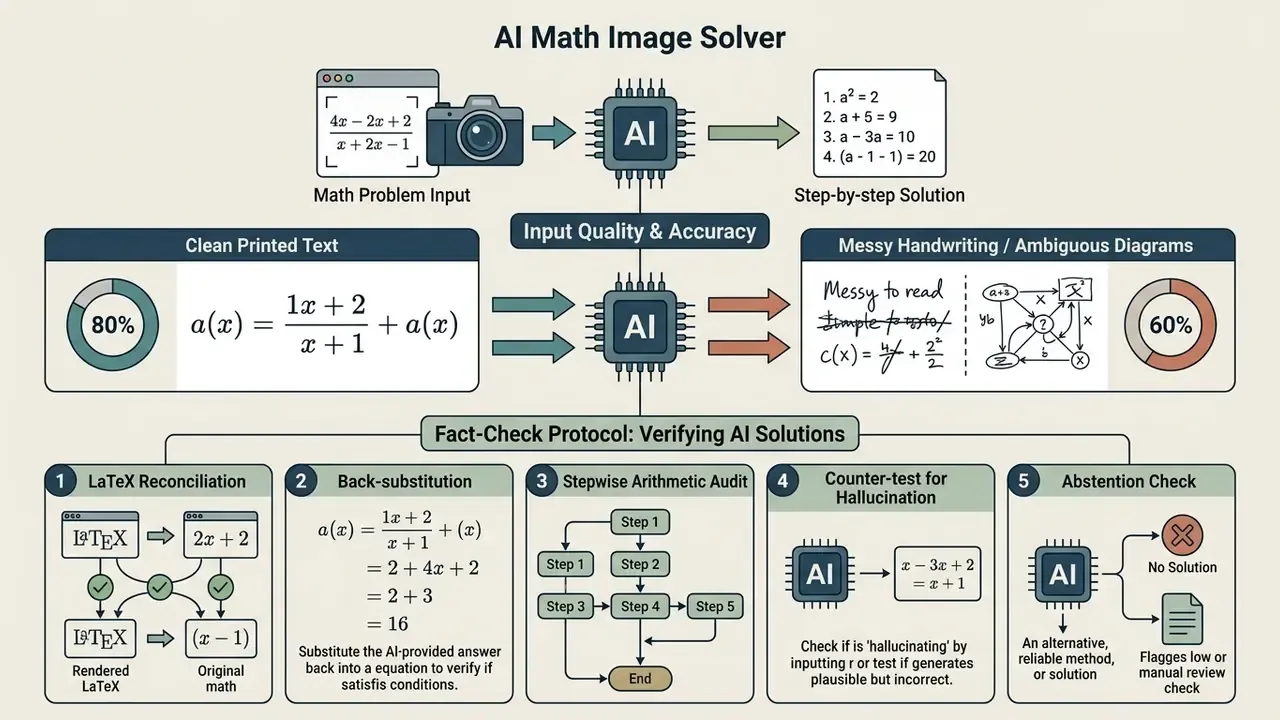
Accuracy for an ai math image solver runs from above 80% on clean printed expressions to under 60% on messy handwritten notes or ambiguous diagrams. Verification means checking the parsed condition before you accept the generated solution, and structural approaches make that check inspectable:
«A structural HMER approach using a Stroke Label Graph reaches 74.14% accuracy on CROHME-2023 without external resources, enabling transparent error analysis.»
Why AI Misreads a Photographed Math Problem
Failures come mostly from low resolution, uneven lighting, non-standard notation, cropped problem statements and ambiguous handwriting stroke segmentation. When the input lacks clarity, OCR introduces symbol deletions, substitutions or misplaced fraction bars.
«Lower image resolution increases the model's predictive entropy and reduces mutual information between input and output, degrading recognition reliability.»
With handwriting, ambiguous strokes often cause under-parsing (two symbols merged) or over-parsing (one symbol split into two), which produces invalid syntax. Attention-based countermeasures help measurably:
«Directed attention guidance, self-guidance and neighbor-guidance, suppresses irrelevant regions and reaches 60.75%–63.30% recognition accuracy on CROHME 2014–2019 benchmarks.»
How to Verify the Answer and Every Step Yourself
Data Privacy, Retention and Shadow AI Controls
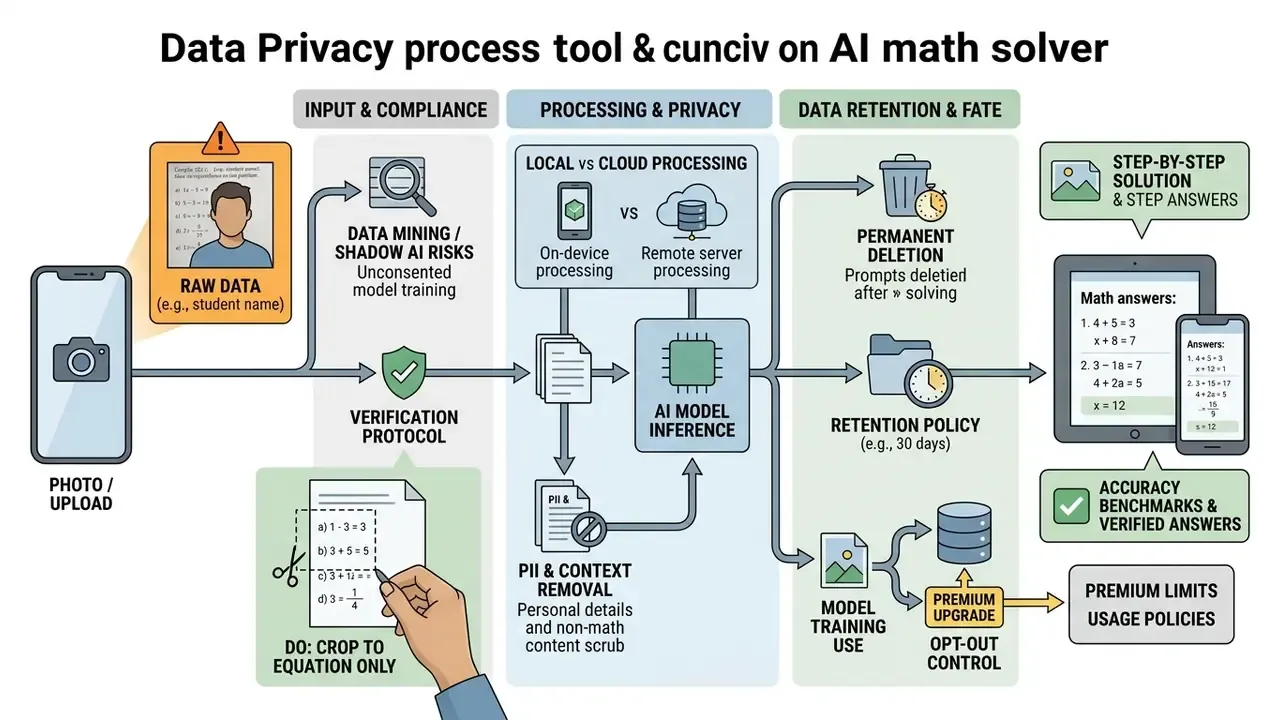
Photographed homework is rarely just homework. One frame can also capture a student's name, a school stamp, a proctored exam header or a colleague's notes. Before adopting an image-based solver at scale, answer four questions.
- What is processed, and where? Vendor documentation for camera-based solvers states that problems are read and solved through the mobile camera in real time; some OCR integrations forward the upload to a third-party recognition service and send the image anonymously, without attached personal data.
- How long is the image retained? Current vendor privacy pages for several math tools say uploaded images are processed for parsing and not retained beyond the active session. Treat "not retained" as a claim to verify contractually, never as an assumption.
- Is the upload used for model training? Look for an explicit opt-out or an enterprise clause excluding customer images from training corpora. Without that clause, assume reuse is possible.
- Who is uploading, and with what data? Unmanaged personal accounts create Shadow AI exposure, since coursework tools get used on work devices for non-educational documents. Mitigations: an approved-tool list, network-level controls on upload endpoints, redaction of identifiers before capture, and a written rule that regulated or confidential material never enters a consumer free tier.
Practical rule for individuals: crop to the equation only. It raises recognition accuracy and strips names, IDs and platform metadata from the upload in a single action. Two wins, zero effort.
AI Image Math Solver Free: What You Get and What to Check
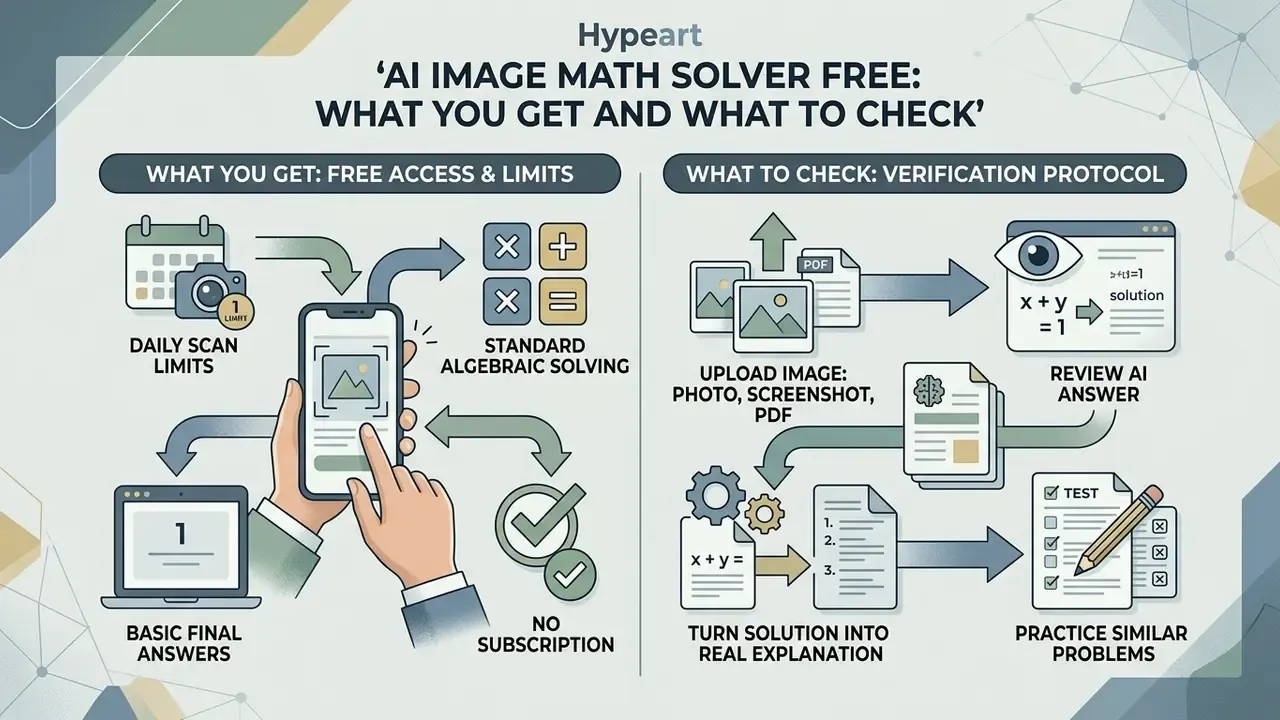
An ai image math solver free plan usually offers daily scan limits, standard algebraic solving and basic final answers with no subscription. Premium unlocks unlimited image processing, deeper calculus explanations and faster OCR.
Free Access, Limits and Registration
Free tiers commonly grant 3 to 5 photo scans or solves per day, basic step-by-step explanations and web-based input without a credit card. Some services meter by tokens instead of scans, for example 6,000 free tokens per day without an account versus 30,000 with a free account, while app-store listings for camera-based solvers show non-pro users limited to three uses per day. Paid add-ons in this category are commonly priced around $9.99 per month or $69.99 per year, with trial lengths varying by storefront and region. So an ai math generator free tier or an ai math photo solver free plan is genuinely usable for occasional homework, and ceilings exist mainly to manage GPU cost while keeping basic help open.
| Feature | Free access | Premium / Pro access |
|---|---|---|
| Photo upload limit | 3–5 scans per day, or daily token quota | Unlimited image uploads |
| Advanced math (calculus / geometry) | Basic final answer | Full step-by-step derivations and proofs |
| Step-by-step explanations | Limited to core steps | Detailed rule-by-rule reasoning |
| Graphing and function view | Basic 2D plotting or unavailable | 2D/3D interactive plots and trend analysis |
| Document formats | Images only in many free tiers | PDF, DOCX, PPTX, multi-page batches |
| Registration | Often not required for basic use | Account mandatory |
| OCR processing speed | Standard queue, ads possible | Priority GPU processing, ad-free |
| Typical price | $0 | ≈ $9.99 / month or ≈ $69.99 / year |
Limits and conditions in plain text: free plans cap daily uploads, may compress images, and often omit document formats entirely; premium plans remove the cap and add derivation depth. Neither tier removes your obligation to verify the parsed condition.
Comparing pricing structures and feature tiers across technical utilities? Browse the hub for pricing across AI software categories, open the hub for comparative feature analyses, or browse the hub for integration guidelines and API documentation.
Because free tiers often downscale uploads, a lightweight retouching workflow helps. Our guide to free photo editors and their export limits covers the cropping and contrast steps that move OCR outcomes the most.
How to Use an AI Math Solver for Homework and Learning
Turning a Finished Solution Into a Real Explanation
Turn a static answer into a study session by questioning each transformation and restating the logic in your own words. Socratic technique pushes learners to name the underlying rule instead of memorizing a formula shape. Documented tutoring implementations structure this in three guided phases, identify the given data, plan a solution, then compute, while withholding the final answer and offering graduated hints aimed at the student's actual mistake (MIT RAISE, Socratic AI Tutoring in Primary School Mathematics, 2025).
Synthesizing intermediate derivations into a clear rule, saying out loud why a sign flipped during substitution, keeps the cognitive effort with the student. Teacher-coded evaluations of AI tutors label the opposite pattern "over-scaffolding": the tutor gives away more than needed and removes the productive struggle where learning actually happens.
Three transformation methods appear repeatedly in recent literature: Socratic questioning that splits an answer into guided sub-questions; explorable explanations and AR overlays that make scanned formulas manipulable (Augmented Math, UIST 2023); and animated step-by-step rendering that turns a static equation into a sequential visual narrative.
Practice With Similar Problems After Reviewing the Answer
After studying a solution, generate three similar problems with an ai generator math problems feature and test yourself. Solving analogues without help is the only honest proof that the method landed.
The consolidation loop: solve → verify with AI → compose a similar problem yourself → solve it unaided → compare structures. Mathematics practice research shows that feedback formats supporting transfer (hints and multiple-try feedback) beat single-try feedback on similar-problem performance, and that spaced, interleaved practice improves retention. Writing your own task from the studied rule and then solving it is a long-standing classroom consolidation technique, not a new invention.
The Stanford SCALE review explains why the loop matters: AI tutoring improved homework results, yet in several studies produced no significant gain on exams taken without AI support. The loop closes that gap by moving the last repetition outside the tool.
FAQ: AI Math Solver Picture
This FAQ is structured for FAQPage schema markup, with each question rendered as a Question entity and each answer as an acceptedAnswer.
Can AI solve a handwritten math problem from a photo?
Yes. Modern solvers recognize handwritten equations at roughly 80% to 92% character-level accuracy on clear handwriting, though messy script cuts precision. Advanced HMER models use position-aware transformers to parse handwritten fractions, superscripts and symbols.
«The semi-supervised SemiHMER method improves recognition accuracy by an average of 5.47%, 4.87% and 5.25% on CROHME 2014, 2016 and 2019 respectively.» SemiHMER: Semi-supervised Handwritten Mathematical Expression Recognition, arXiv:2502.07172 (2025). https://arxiv.org/html/2502.07172v2 If the handwriting is ambiguous, check the reconstructed LaTeX manually before solving.
Can I type the problem instead of uploading an image?
Yes. Manual text or LaTeX input is supported by most platforms and is the better choice when an image is blurry, dim or full of non-standard notation. Direct text entry removes OCR error entirely. Accessibility guidance from Rutgers Access and Disability Resources (2025) and UMBC's Accessible Math guide states that mathematics should be entered as live text or LaTeX rather than as an image, because typed source converts to MathML, HTML or EPUB for screen readers, while a photograph carries no structural information.
Does an AI math solver support multiple languages?
Yes. Multimodal solvers recognize problem text in many languages and generate explanations in English, Spanish, French, German, Hindi and Chinese, among others. The MGSM benchmark (2022) established this by manually translating 250 GSM8K problems into 10 typologically diverse languages, and a 2025 multi-way parallel corpus extended coverage to 9 languages.
«Large language models adapted for Bengali can solve mathematical word problems, demonstrating extensibility beyond English.» Leveraging Large Language Models for Bengali Math Word Problems, arXiv:2505.21354 (2025). https://arxiv.org/html/2505.21354v2 Formulas follow universal symbolic notation, while the surrounding word-problem text is translated and parsed by multilingual models. For mixed-language documents, compare general engines in our overview of text extraction from images.
Does it work with MyMathLab, WebAssign, ALEKS or Khan Academy?
Yes. Those platforms render problems on screen, so a cropped screenshot is a valid input. Solvers routinely process captures from MyMathLab, WebAssign, ALEKS, WileyPLUS, Canvas and Khan Academy, plus textbook photos and PDF worksheets. Screenshots usually beat camera photos of a monitor, since they avoid moiré, glare and skew.
Can it handle physics and chemistry problems too?
Yes. The same OCR-plus-reasoning pipeline covers stoichiometry, reaction balancing, thermodynamics, kinematics, dynamics and circuit calculations. Accuracy mirrors the math pattern: symbolic and unit-based problems go well, diagram-dependent tasks such as force vectors or schematics inherit the geometry weakness.
Will it plot the function it recognizes?
Most advanced platforms render the recognized expression as a 2D or 3D graph right after parsing, so you can inspect intersections, extrema, asymptotes and limit behavior. The plot doubles as an integrity check: if the curve contradicts the computed root, the parse was wrong.
What happens to my uploaded photo?
That depends entirely on the provider. Some state that camera frames are processed in real time and not retained beyond the active session; others forward the image anonymously to a third-party OCR service. Before uploading anything sensitive, read the retention clause, look for a training opt-out, and crop the frame so names and identifiers never leave your device.
How accurate is it overall?
There is no single number, and anyone quoting one is selling something. Expect above 80% on clean printed expressions, 82%–92% on clear handwriting depending on the metric, roughly 20% on complex geometry diagrams, below 12% on visual counting and under 2% on research-level mathematics. Claims of "99% accuracy" are not supported by published benchmarks across all task types. Verify the parsed condition and the final value.
Can an AI answer generator math tool be trusted for graded work?
Only with a verification step attached. An ai answer generator math feature or an ai answer math picture workflow produces a plausible result even when the parse was wrong, so the answer alone is weak evidence. Log the recognized expression, back-substitute the result, and keep your own derivation. In an institutional setting, that log is the audit trail.
Conclusions and Selection Guidance
An ai math solver picture system delivers fast homework support and detailed problem breakdowns, but only when paired with disciplined capture and real verification. Frame the shot so the formula fills 70%–80% of it, confirm the parsed expression before reading the answer, engage with the derivation, then close the loop with unaided practice on a similar problem.
When choosing a tool, weigh five criteria in order: input flexibility (photo, screenshot, PDF, voice, LaTeX), depth of step-by-step explanation rather than answer-only output, graph rendering for visual sanity checks, transparency of free-tier limits, and clarity of the data retention and model-training policy. If a vendor is vague on the fifth point, treat that as the answer.
For technical assistance or platform questions, browse the hub. To weigh legal considerations around digital media and AI outputs, read our overview of AI Litigation and liability frameworks. For commercial usage rules and licensing, view the guide. And to explore the full directory of digital tools and terminology, browse the hub.