AI proposal generators are changing how B2B organizations, sales teams, and consulting firms draft, refine, and deliver client-facing commercial documents. By combining large language models (LLMs) with retrieval-augmented generation (RAG) and central content libraries, these tools cut manual writing time while holding brand consistency and regulatory alignment in place.
That principle is the operating constraint for every recommendation below. For a supervised institution (a bank, an insurer, a broker-dealer, or any vendor selling into them) a proposal is not marketing copy. It is a pre-contractual document that creates pricing, scope, and compliance commitments. So automation has to travel with verification, logging, and named decision ownership, not just speed.
Executive snapshot: what decision-makers need in 60 seconds
- What it is an AI proposal generator is an LLM plus a retrieval layer over your approved content (past bids, rate cards, case studies, certifications) that assembles a client-ready proposal draft in seconds instead of hours.
- Measured impact documented deployments report RFP completion time falling from 4–5 hours to 20–30 minutes per 100-question questionnaire, 20% faster proposal development, and win-rate gains in the 10–40 percentage-point range depending on baseline maturity.
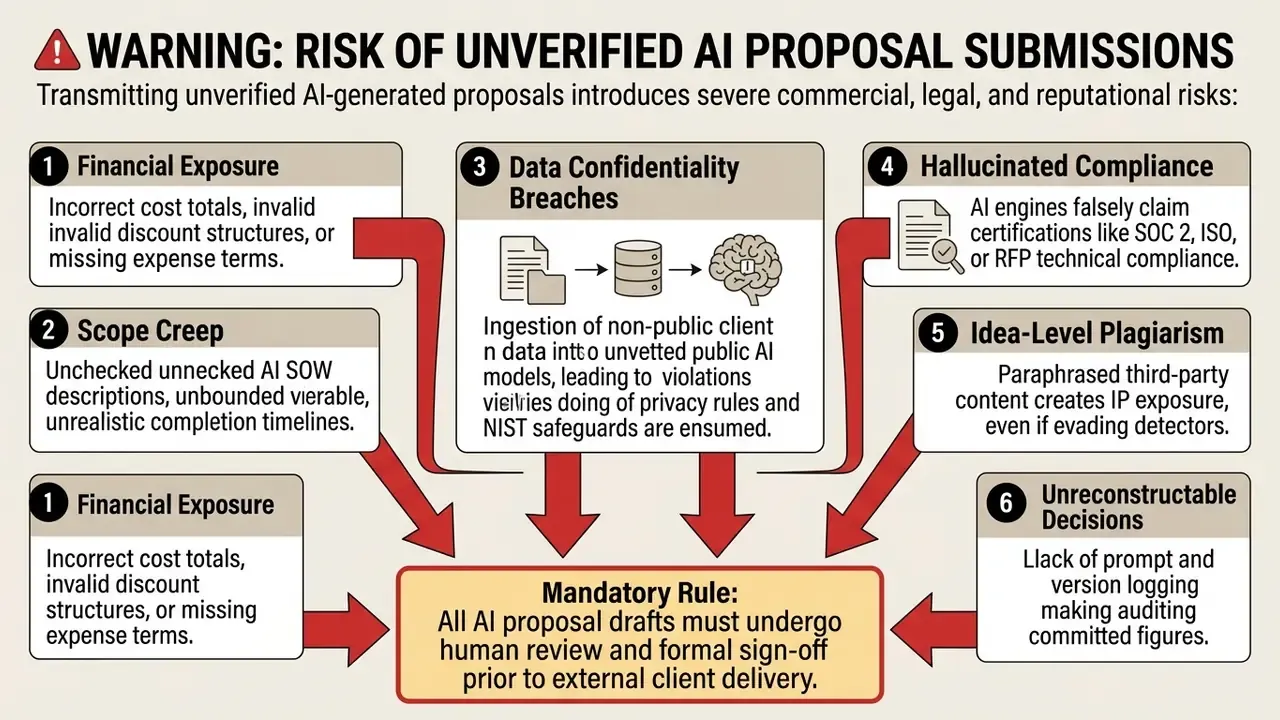
- Where the risk sits hallucinated pricing, unbounded scope-of-work language, falsely claimed certifications (SOC 2, ISO 27001), plagiarised third-party content, and confidential client data leaking into public models.
- Non-negotiable controls human-in-the-loop sign-off before transmission, per-claim verification against primary records, prompt/version/output logging for audit reconstruction, and explicit decision ownership across Sales, Legal, Finance, and Model Risk.
- Cost reality free tiers cap generations (typically 2–3 per month) and paywall PDF/DOCX export; paid seats run $10–$49 per month, mid-market platforms $299–$599 per month with payback often under two months at 20+ RFPs a year, and enterprise deployments exceed $2,000 per month.
- Choose the tool before you choose the workflow match export formats, intake modalities, CRM integration, and audit capabilities to your document mix first; only then standardise the drafting process.
Why this matters now for US financial-services buyers
Two things changed in the last eighteen months. Generative drafting became good enough that sales teams adopted it without asking anyone, and supervisory attention moved from model accuracy to model governance. Those two curves crossed inside the proposal function, which almost nobody had mapped as a risk surface.
Think about what a proposal actually is inside a bank or a bank vendor. It fixes price. It defines scope. It asserts certifications. It sometimes states data-processing terms that Legal never saw. When an LLM writes any of those lines without an evidence trail, the institution has created a commitment it cannot reconstruct. That is a governance defect, not a writing problem.
There is also a quieter driver: shadow AI. Representatives paste client information into consumer chatbots because the sanctioned path is slower. A well-configured proposal engine is, oddly enough, one of the more effective shadow-AI controls available, because it competes on convenience rather than on policy language. If you are sizing the internal cost of that competition, the calculators hub is a reasonable starting point for a first-pass estimate.
One caution before the detail. Everything below assumes an approved content library exists. If your approved language lives in seven SharePoint folders and two personal drives, retrieval quality (not model quality) will be your ceiling.
What is an AI proposal generator and how does it work?
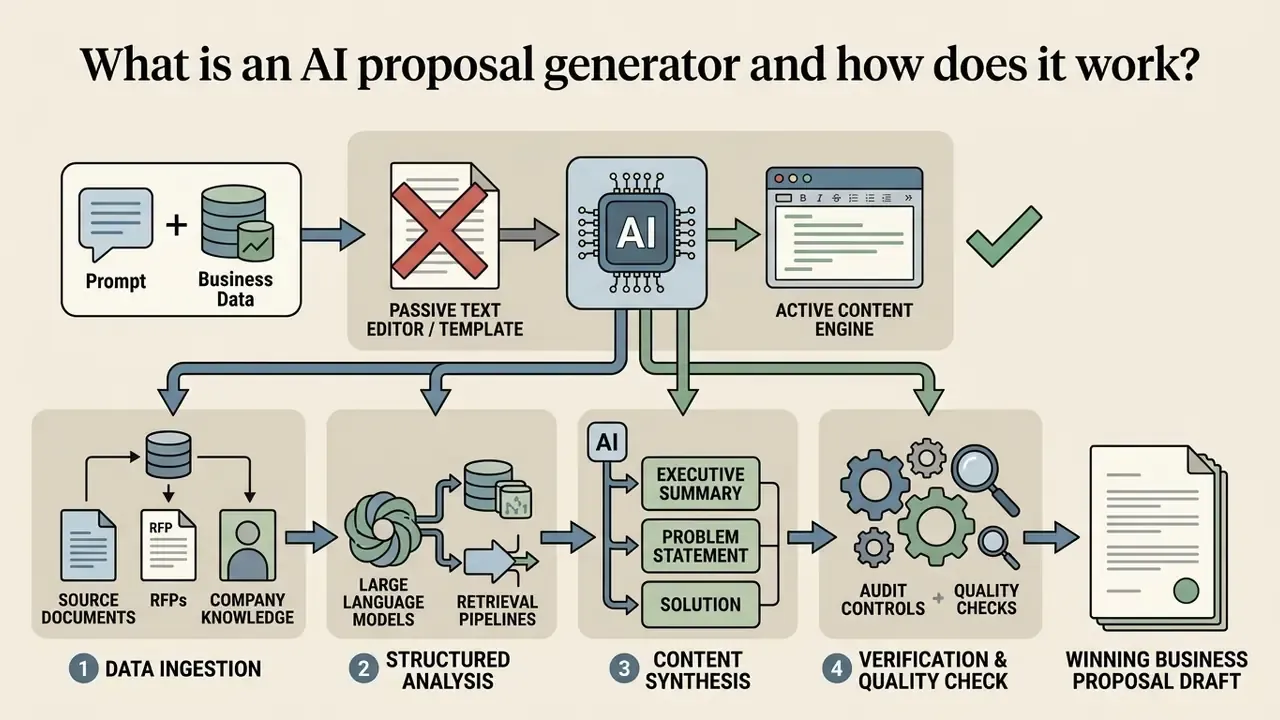
An AI proposal generator is a software tool that uses large language models and structured retrieval pipelines to automate the creation of business proposals, RFPs (Requests for Proposal), and sales pitches. Unlike a static document template, an AI proposal engine ingests real-time project prompts, CRM (customer relationship management) data, and verified content libraries, then renders customized, client-ready proposals in seconds.
Modern proposal generation systems operate as active content engines rather than passive text editors. By connecting the underlying AI models with internal repositories of past bids, product specifications, and pricing rate cards, these tools construct coherent proposal drafts that respect enterprise formatting standards. According to a 2025 study on procurement automation by Responsive, pairing LLMs with centralized content libraries lets organizations draft fully compliant proposal responses while keeping complete control over the underlying data security posture.
"Large language models can interpret unstructured text, extract relevant information, and generate coherent drafts for tasks including contract and policy drafting."
The distinction between "generation" and "assembly" matters operationally. A well-governed proposal engine does far less free composition than users assume: it retrieves approved language, maps it to the client's stated requirements, and writes only the connective narrative. That architecture is what makes the output auditable. Every substantive claim should trace back to a library artefact, a CRM field, or a rate card line.
From a prompt to a complete proposal draft
Turning a short prompt into a complete proposal draft follows a four-stage ingestion and synthesis pipeline. First, the user inputs essential client context, project goals, and pricing parameters, or uploads an existing Request for Proposal file. Next, the AI system parses these inputs, extracts key requirements, and queries an internal knowledge base to match relevant case studies, compliance certifications, and scope descriptions.
Once the source data is retrieved, the language model constructs structured proposal sections: executive summaries, technical methodologies, milestone schedules. Documented enterprise deployments quantify both the time and the revenue effect of that pipeline.
"After deploying AI agents, Insider cut completion time for a 100-question RFP from 4–5 hours to 20–30 minutes, while win rates moved from roughly 30% to 50–70%."
Earlier industry summaries reported the time dimension alone, with automated agent workflows reducing RFP completion times by up to 90% and converting multi-hour manual drafting into brief 20-minute review cycles. They omitted the conversion effect, which is the figure that actually justifies budget. The output in either case arrives as an editable draft, so sales managers can adjust tone, verify figures, and export the final document.
AI proposal generator vs proposal templates and chatbots
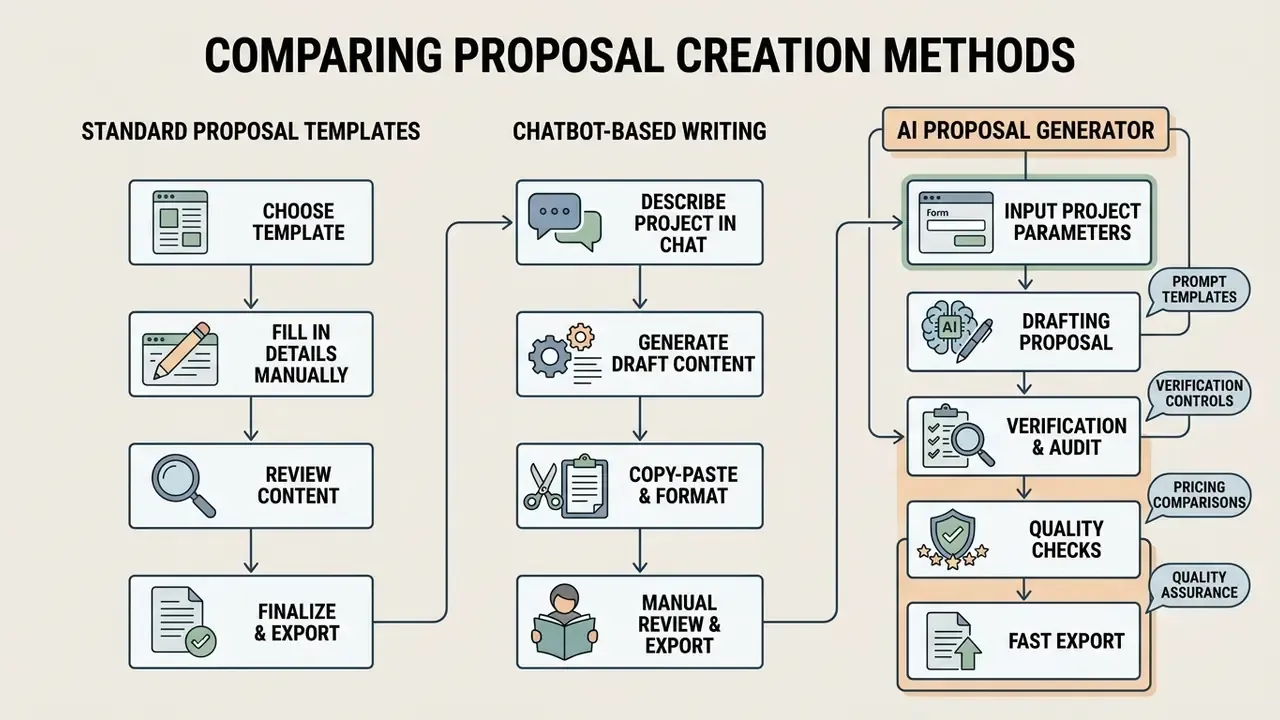
Purpose-built AI proposal generators combine the structural layout control of static templates with the dynamic content generation of conversational chatbots, and add mandatory enterprise risk controls. Static templates offer consistent formatting, but they demand labour-intensive manual text insertion for every new client engagement. Consumer chatbots generate flexible copy, yet they lack integration with internal content repositories, schema validation, and secure data boundaries.
Unlike consumer chatbot applications built for open-ended conversation, an enterprise proposal creator enforces strict domain boundaries, schema validation, and retrieval-augmented control over which sentences may appear in a client-facing document. In an evaluation conducted by Lohfeld Consulting Group (2024), specialized, domain-aware proposal engines consistently outperformed general-purpose chatbots across eight core proposal creation tasks, with higher accuracy in technical responses and compliance alignment.
"Public platforms demonstrate enormous capability, but performance varies substantially; domain-aware systems provide more reliable, contextually accurate assistance on specialised proposal tasks."
Organizations building a dedicated internal drafting tool need explicit governance guardrails (retrieval scoping, schema enforcement, refusal behaviour on unsupported claims) so generated proposals align with ground-truth source materials rather than plausible-sounding invention.
Practical benchmarks for the three approaches:
| Dimension | AI proposal generator | Static template | General-purpose chatbot |
|---|---|---|---|
| Time to first draft | Seconds to about 60 seconds | 15–30 minutes of manual filling | 5–10 minutes of prompting and cleanup |
| Personalisation depth | Medium-high, prompt- and retrieval-dependent | High, but only if a human rewrites every block | High but unstructured |
| Layout and brand fidelity | Good, template-constrained | Highest, pre-designed | Lowest; needs markdown-to-doc cleanup |
| Data-boundary control | Configurable, enterprise-grade in paid tiers | Complete (no model involved) | Weak on consumer tiers |
| Auditability | Retrieval logs and version history available | Manual only | Effectively none |
Which proposals can AI generate?
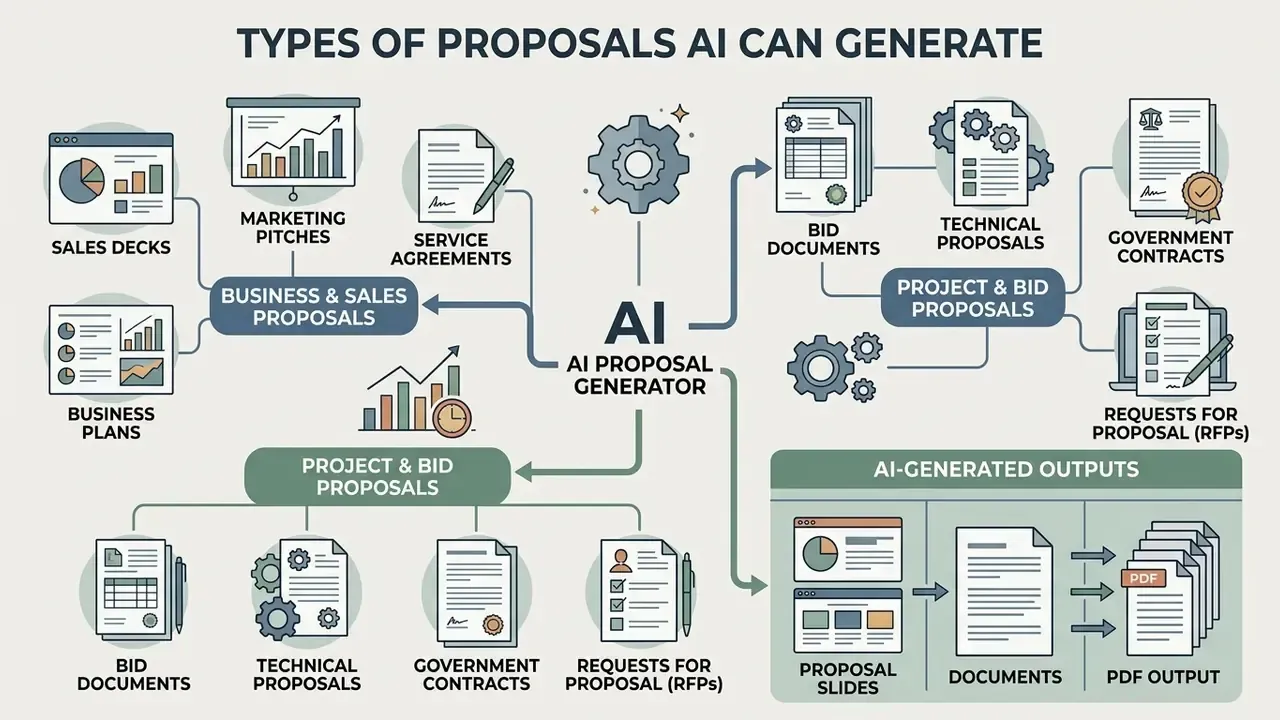
AI proposal generators support a wide variety of commercial documents, from concise sales decks and marketing pitches to complex, highly regulated technical bid proposals. By adjusting prompting constraints and content source libraries, organizations can configure an AI proposal maker to draft specialized formats tailored to specific buyer expectations.
Business, sales and marketing proposals
Commercial B2B, sales, and marketing proposals use AI generation to synthesize client pain points, value propositions, and service packages into persuasive, client-centric narratives. In B2B sales environments, response velocity correlates directly with deal conversion. A 2024 study on B2B sales automation published in the International Journal of Computer Applications Technology (IJCRT) found that using generative AI for proposal creation and pricing optimization reduced development time by 20% while lifting overall win rates by 10%.
"Among 117 B2B sales professionals surveyed, 78.6% already use AI in their work, and 30.8% apply it specifically to proposal creation, naming time savings as the primary benefit."
An AI sales proposal generator (or an ai marketing proposal generator, if that is the shape of your pipeline) pulls CRM records, recent call transcripts, and account histories to personalize the narrative. To protect enterprise assets, governance policy must stop sales representatives from feeding sensitive, unverified customer data into public AI engines. McKinsey's commercial GenAI guidance (2023) sets one hard rule for sales teams: no sensitive customer data into general-purpose gen AI tools, and strong verification for anything externally facing.
The same IJCRT research recommends audit trails for AI pricing suggestions, validation of every algorithmic price recommendation, and pilot periods of at least three months before scaling a proposal engine across a distributed sales organisation. Three months feels slow. It is also the interval in which most pricing errors surface.
Project and bid proposals
Project and bid proposals require the engine to parse intricate technical specifications and match them against organizational capabilities, compliance controls, and past performance records. Public sector and enterprise procurement guidelines, such as the Government of the District of Columbia AI Procurement Handbook (2026), specify that technical proposals must provide explicit compliance statements, structured architectures, and validation evidence. Evaluation turns on three factors: technical capability, system management and oversight, and experience and past performance.
Advanced AI tender generation systems, such as the RAG framework developed by Zhao and Li (2024), use memory networks to verify semantic coherence between retrieved past bids, current policy constraints, and new procurement requirements.
"The framework applies a three-stage process: retrieval of a similar document, coherence verification through a memory network, and refinement against the project knowledge base."
This keeps the generated project proposal inside the required technical task boundaries and lowers the risk of disqualification for missing compliance statements. Institutional templates reinforce the point: LIC India's 2026 proposal response format for agentic AI and GenAI platforms requires a single consolidated PDF containing pre-qualification documents, the technical proposal, specifications, architectures, compliance statements, and annexures. AI assembly handles that structure well precisely because it is deterministic.
Proposal slides, documents and PDF output
Modern proposal software outputs content in several formats: editable DOCX documents, interactive slide decks, and read-only PDF files. Editable text documents let legal and commercial teams redline in detail, while an ai business proposal slide generator serves executive reviews and formal client pitches. Live web links add a fourth mode: reviewers comment inline on a single current version, which eliminates the "final_v4" reconciliation problem, and view analytics reveal which sections buyers actually read.
Research on computational presentation tools, such as OutlineSpark (2024), shows that converting structured outlines directly into slide formats maintains logical flow while preserving user control over final visual elements.
"Users write the slide structure, after which the tool automatically retrieves relevant data and converts it into slide content."
When assembling multimodal pitch materials, route media production through enterprise-grade, licensed tooling rather than ad-hoc consumer utilities. Uncalibrated visual models produce layout artefacts, distorted typography, and off-brand imagery, and they do it at exactly the moment credibility matters. Where a pitch needs original graphics, brand assets, or motion content, check the licensing terms first: our comparison of the best AI art generators covers output quality and usage rights, while the guides to animation makers and AI voice generators cover export formats and commercial licensing for narrated proposal walkthroughs.
How to choose the best AI proposal generator
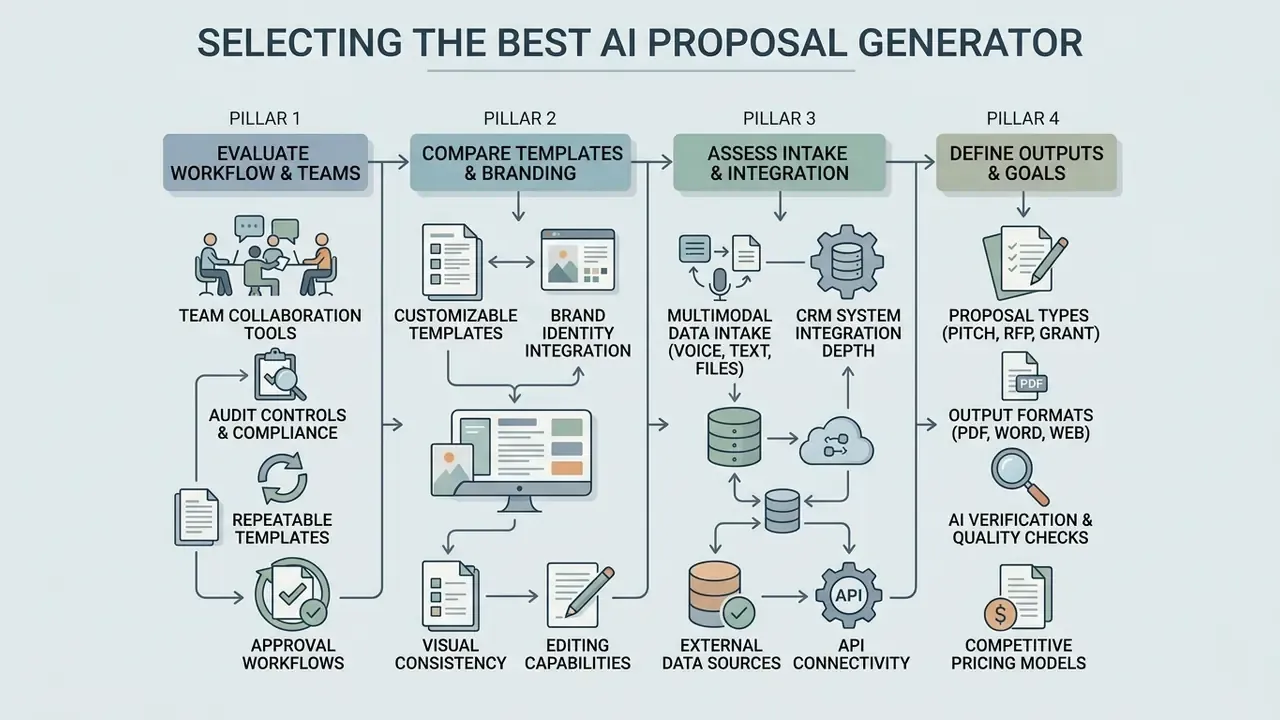
Selecting the right AI proposal generator tool means evaluating platforms against governance risk standards, template customization, CRM integration depth, and team collaboration features. Organizations in regulated industries should prioritise vendors that can demonstrate verifiable security controls, auditability, and data isolation.
Two procurement standards frame this decision. IEEE 3119-2025 directs procurement teams to apply tailored risk-management practices when purchasing AI systems, which makes documented vendor risk evidence a scoring criterion rather than a footnote. U.S. OMB guidance on AI procurement requires risk-aware solicitation requirements and explicit assessment of risk inside each proposal, meaning buyers should score controls, not marketing claims.
Choose by proposal type and output format
Align tool selection with the document types and export formats your client base actually demands. B2B sales teams handling frequent RFP requests benefit from dedicated response automation platforms, whereas consulting practices need systems with serious pricing logic.
Evaluation teams should review input versatility (parsing uploaded RFP documents, CRM records, or web URLs) against required deliverable standards such as DOCX, PDF, or presentation decks.
"Proposal teams spend an average of 34 hours writing each bid, yet only 34% use generative AI anywhere in the RFP response process."
That gap is the business case. The constraint is rarely model quality; it is whether the tool ingests the formats your pipeline produces. Verify four input patterns before committing (topic/prompt, structured outline, uploaded file in PDF, DOCX or XLSX, and URL) and four output patterns (editable DOCX, PPTX or Google Slides, read-only PDF, and a live shareable web link). For teams producing visual collateral alongside document platforms, our comparison of the best AI art generators and the Canva AI Generator commercial-use overview cover the licensing constraints proposal branding depends on. If you need the wider category view, the AI Media Comparison index maps adjacent tooling.
Multimodal intake: how modern engines collect source material
Modern AI proposal engines support multimodal intake. Sales representatives can feed raw call-audio transcripts, photographs of whiteboard sessions, pasted email threads, dictated voice notes, or discovery-call summaries straight into the retrieval layer, and the system extracts the parties, dates, scope items, and commercial terms automatically. Portant's flow ("describe, paste, speak or snap") and Proposify's approach of pasting call notes and meeting transcripts into the editor before prompting both illustrate the pattern.
Two governance caveats apply. First, transcripts and photographs frequently contain personal data and third-party confidential information, so intake channels must be scoped to approved processing environments. Second, unstructured intake raises the model's interpretive burden; normalise it into named fields before generation wherever the deal size justifies the extra step.
Compare templates, editing and brand customization
Enterprise proposal generators need robust administrative control over visual branding assets, template libraries, and tone of voice settings. Brand customization features let organizations enforce exact font styling, colour palettes, logo placement, and messaging guidelines across every outbound client document.
Templafy offers centralized administrator controls over tone of voice and approved brand language, keeping generated text inside corporate editorial standards. Notably, Templafy is one of the few vendors where tone is an admin-level control rather than a user-level slider. Visme and Venngage expose brand kits (palette, fonts, logo, asset library) that apply to generated layouts, while Piktochart combines template selection with editor-level font, colour, and element customization. Drag-and-drop editors and inline AI rewriting tools let sales managers polish proposal templates quickly without breaking the visual document structure.
Evaluate workflow features for teams and repeatable proposals
Team-oriented proposal software needs real-time co-authoring, central content repositories, automated review routing, and CRM event triggers. Automated systems can start proposal drafting directly from a CRM stage update, pulling relevant case studies and rate cards from approved knowledge libraries.
QorusDocs and Storydoc both allow multi-user collaboration with full audit trails, access permission management, and expiration settings for client links. QorusDocs supports real-time co-authoring, task assignment, and edit tracking inside a Microsoft 365 workspace; Storydoc adds comment threads, version history, and link-expiry controls; CodeWords documents the CRM-triggered pattern where a deal-stage change starts generation, pulls CRM fields plus library case studies, and routes the draft for review.
"IFS moved from an internal GPT prototype to an enterprise Strategic Response Management platform through a four-stage path: experiment, proof of concept, strategic evaluation, platform optimisation."
That trajectory is the realistic adoption roadmap. Teams that jump straight from a chatbot experiment to enterprise rollout usually discover the gap in governance, not in generation quality. Before licensing, request the vendor's data-residency documentation, sub-processor list, retention policy, SOC 2 Type II report and, critically for supervised institutions, written confirmation of whether prompts and outputs are retained for model training. Integration questions belong in the same package; the API documentation tells you more about real interoperability than a feature grid does.
Tool selection matrix: platform-by-platform comparison
The market is fragmented. A 2026 comparison catalogued 17 or more dedicated AI proposal platforms with pricing from $49 per month to $2,000+ per month, which points to distinct SMB and enterprise segments rather than one competitive field. The matrix below maps the most frequently shortlisted platforms against the four criteria that actually determine fit: primary use case, intake modality, workflow integration, and export options.
| Platform | Primary best use case | Key input modalities | CRM / workflow integration | Export options |
|---|---|---|---|---|
| Portant | Automated HubSpot and Google Docs assembly for repeat proposals | Typed brief, pasted email, voice note, photo attachment | HubSpot, Google Workspace, Microsoft Office; built-in e-sign and send | Editable .docx, one-click PDF |
| Proposify | Interactive sales quotes with e-signature and engagement tracking | Call notes, meeting transcripts, project requirements, prompts | Salesforce (managed package plus SSO), HubSpot, Zapier, Aspire | Interactive web link, PDF export matching the digital version |
| Taskade | Proposal drafting that converts into live project management | Plain-text briefs, one-sentence prompts | Integrated 7-view project stack (List, Board, Gantt, Table, Mind Map, Org Chart, Action) | Live web page, shareable link, Markdown, PDF |
| Kimi Docs | Research-backed, evidence-supported proposals and reports | Unstructured research materials, plans, pricing sheets, case studies | Multi-format export engine; conversational refinement | Word, PDF, PPTX, Excel, interactive HTML |
| QorusDocs | Enterprise RFP response inside Microsoft 365 | Content library, RFP documents, co-authored sections | Microsoft 365, task assignment, edit tracking | Word, PDF, portal submission |
| Venngage | Visually designed proposals and pitch decks | Prompt plus scope, deliverables and timeline inputs | Brand kit, AI writing assistant | PNG on free tier; PDF, PPTX, HTML on paid tiers |
| Storydoc | Client-facing interactive proposal experiences | Prompt, uploaded content, brand assets | Permission tiers, link expiry, engagement analytics | Web-native deck, PDF |
Read that matrix against the platform-class table below: RFP response platforms optimise for questionnaire compliance, B2B pricing systems optimise for commercial accuracy, tender generators optimise for policy coherence, and slide-based tools optimise for executive presentation. Most organisations end up running two, one document engine and one deck engine, rather than forcing a single tool across incompatible output requirements.
| Capability dimension | RFP response platforms (Strategic Response Management) | B2B proposal and pricing optimization systems | Tender and procurement document generators | Slide-based proposal generators |
|---|---|---|---|---|
| Template and content libraries | Central repositories of approved past Q&A pairs and historical RFPs | Custom commercial templates integrated with dynamic pricing models | Policy-compliant procurement templates and knowledge bases | Visual deck templates with slide layout controls |
| AI generation engine | RAG-driven drafting focused on questionnaire compliance | Generative copy combined with algorithmic cost optimization | Retrieval-augmented text generation with policy coherence checks | Outline-to-slide rendering and automated formatting |
| Export format versatility | Read-only PDF, formatted Word documents, online portals | Standard business DOCX, PDF, interactive web links | Semi-structured tender files and compliance matrices | Editable PPTX, Google Slides, web presentation links |
| Client review and approval | Multi-stage review routing with role-based permissions | Pricing verification checkpoints and sign-off blocks | Strict compliance auditing and legal sign-off gates | Collaborative slide review and client presentation modes |
| Team workflow integration | Enterprise CRM, Slack, Microsoft 365, Google Workspace | Pipeline stage automation and CRM quote synchronization | Cross-functional procurement and legal review workflows | Real-time co-authoring and visual asset sharing |
How to create a proposal with AI step by step
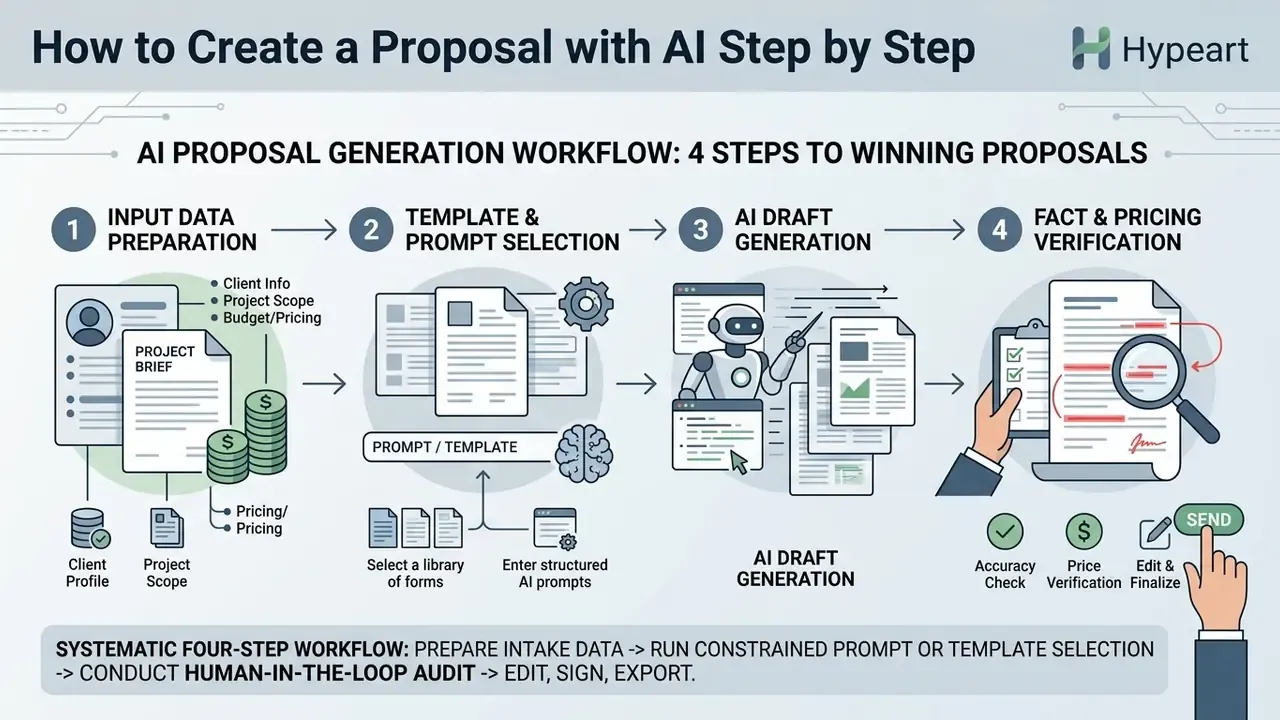
To create a proposal with AI you need a systematic four-step workflow: prepare intake data, run a constrained prompt or template selection, conduct human-in-the-loop proofreading, and export the finalized document. Following that sequence is what prevents hallucination from reaching a commercial term.
Documented 2026 workflows converge on the same order: extract client requirements from email, PDF, or free-form input; match them against SKU, service catalogue, prior expertise, and current CRM/ERP records; verify live prices, availability, discounts, and constraints; then assemble, validate, and export.
Prepare client, project and pricing data
Generation quality depends on the structure of the initial input data far more than on the model. Managers must gather client information first: organizational identity, operational challenges, project scope boundaries, delivery milestones, and approved rate cards.
Systems like Lindy AI and DeepRFP use normalized data fields rather than unstructured free text to ground the pipeline. Lindy normalises imported notes into scope, goals, deliverables, budget, timeline, and contact fields before drafting, while DeepRFP works from explicit sources of truth (the RFP, the scope, the client brief, the content library) and surfaces pricing assumptions and compliance checks alongside the first draft. Structured fields stop the AI inventing non-standard pricing tiers or fantasy timelines during assembly.
A five-field intake standard covers most engagements: client identity (legal entity, industry, decision-maker), project goals (measurable outcomes), scope and deliverables (with exclusions), constraints (deadlines, regulatory requirements, integration dependencies), and pricing rules (rate card, discount authority, expense caps, currency, validity period).
Use a prompt or start with a proposal template
You can start generation either by supplying a comprehensive text prompt or by picking a pre-configured template inside the software. Prompts must specify the target audience, tone of voice, section requirements, and concrete performance metrics to anchor the generated text.
Pre-built templates supply a defined structural outline: executive summary, scope of work blocks, payment terms. Look closely at how a platform configures and locks those templates. Which sections are mandatory? Which fields are admin-controlled? Which blocks pull from the content library? Locked structure is what stops an individual representative from quietly deleting a legal or compliance section on a Friday afternoon.
Review, edit and send the completed proposal
The final stage demands rigorous human oversight before client delivery. Supervisors must confirm that every pricing figure, deliverable date, and legal commitment matches internal operational guidelines exactly.
"Generated outputs must be assessed against known primary ground truth through continuous human oversight combined with automated evaluation."
Once validation is complete, export the document to PDF or DOCX and transmit through secure channels. NIST guidance on AI assurance also stresses continuous verification: if material changes happen after the first review, re-check the draft rather than leaning on the earlier sign-off. Small point, frequently ignored.
Proposal preparation and verification checklist
- Input data preparation.Normalize client identity, project objectives, scope parameters, and rate card pricing into structured data fields. Owner: Sales / Bid Manager.
- Template and prompt selection.Select an approved structural template or configure a detailed prompt specifying target audience, tone, and required sections. Owner: Bid Manager; template library controlled by Marketing/Enablement.
- AI draft generation.Run the engine to assemble the initial multi-section proposal draft from curated content libraries. Owner: Bid Manager; model and retrieval configuration owned by IT/AI platform team.
- Fact and pricing verification.Review generated figures, cost structures, and deliverable commitments against internal rate cards and operational boundaries. Owner: Finance / Pricing desk.
- Legal and compliance audit.Verify contractual terms, data privacy conditions, certification claims, and intellectual property statements. Owner: Legal & Compliance; second-line review by Model Risk where AI-generated commitments are material.
- Format export and transmission.Export the validated document to read-only PDF or DOCX and send it via secure CRM workflows, logging the final version hash. Owner: Deal owner / Account Executive with named sign-off authority.
Disclaimer: this material is general information, not a substitute for legal or financial advice. Proposals create contractual and pricing obligations, so have qualified counsel review commitments before transmission. Where disputes over AI-generated commitments are a live concern, the AI Litigation and risk overview is worth reading alongside this section.
Production-ready AI proposal prompt templates
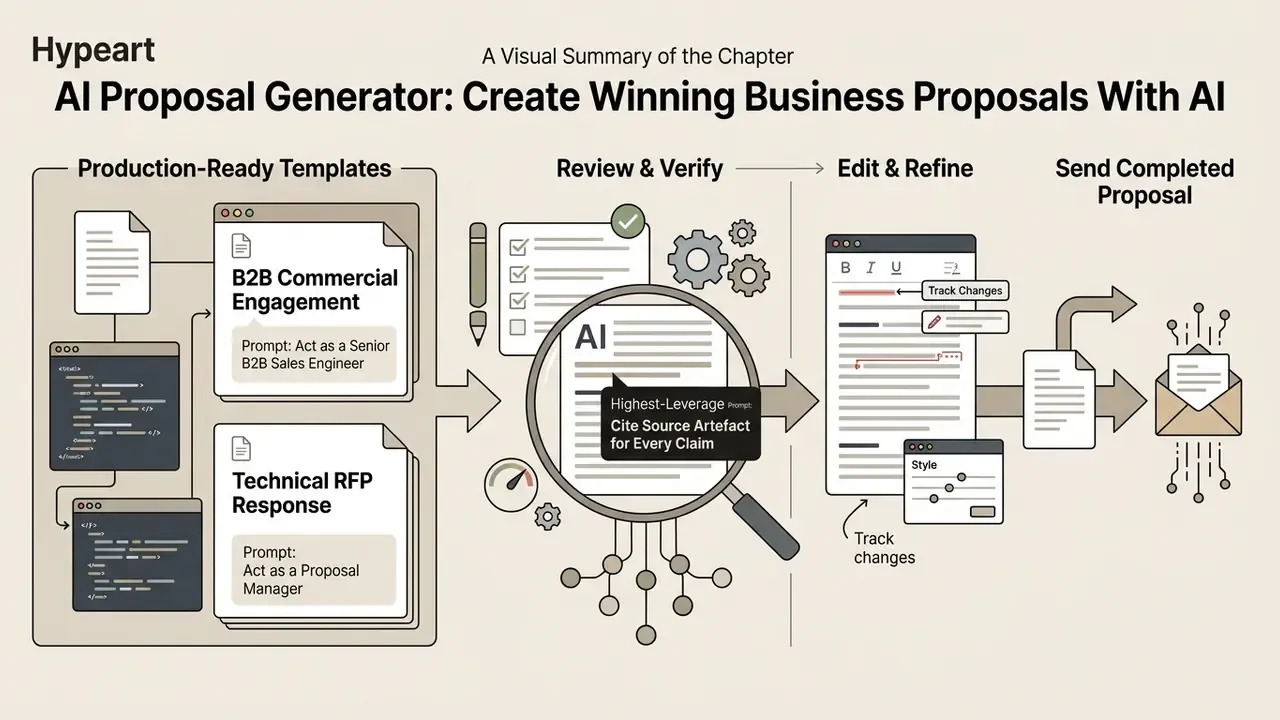
Template 1: B2B commercial engagement
Act as a Senior B2B Sales Engineer. Draft a comprehensive commercial proposal
using ONLY the structured inputs below. If a required fact is missing, insert
[MISSING: <field name>] instead of inventing a value.
- Client Name & Industry: [Insert Client Name / Industry]
- Decision-Maker & Role: [Insert Name / Title]
- Core Operational Problem: [Insert Brief Description of Client Pain Point]
- Quantified Cost of Inaction: [Insert Metric, e.g. hours lost, revenue leakage]
- Proposed Solution & Scope: [Insert Deliverables & Implementation Methodology]
- Explicit Exclusions: [Insert What Is NOT Included]
- Pricing Tiers & Commercial Terms: [Insert Rate Card / Total Value / Currency /
  Price Validity Period]
- Payment Schedule: [Insert Milestones and Percentages]
- Required Compliance & Certifications: [e.g., SOC 2 Type II, ISO 27001, GDPR]
- Proof Points: [Insert 2 Case Studies or References From Approved Library]
Format Requirements: Executive Summary (max 200 words, standalone), Problem
Statement in the client's language, Proposed Solution with methodology,
Scope of Work (SOW) table, Milestone Schedule with acceptance criteria and
due dates, Itemised Pricing table with total, Risks and Mitigation, Sign-off
Block with one explicit call to action.
Tone: professional, authoritative, direct. No superlatives. No claims about
certifications not listed above.
Template 2: technical RFP or tender response
Act as a Proposal Manager responding to a public-sector RFP. Use the attached
RFP document as the compliance baseline and the attached content library as the
only permitted source of substantive claims.
- Solicitation Number & Issuing Authority: [Insert]
- Mandatory Requirements List: [Paste requirement IDs or attach matrix]
- Our Relevant Past Performance: [Insert contract references]
- Proposed Technical Architecture: [Insert system design summary]
- AI/Model Components (if applicable): [Insert model type, validation method,
  prerequisites]
- Key Personnel & Qualifications: [Insert names, roles, certifications]
- Pricing Basis: [Catalog price / rate card / comparable documentation]
Output Requirements:
1. A compliance matrix mapping each requirement ID to the responding section.
2. Technical capability narrative addressing system management and oversight.
3. Experience and past performance section with verifiable references.
4. Explicit compliance statements; flag any requirement we cannot meet as
   [GAP: requirement ID] rather than answering ambiguously.
5. Cite the library artefact ID next to every substantive factual claim.
That final instruction, cite the source artefact for every claim, is the single highest-leverage prompt constraint available. It turns review from re-reading prose into checking references, which is faster and materially more reliable.
What should an AI-generated proposal include?
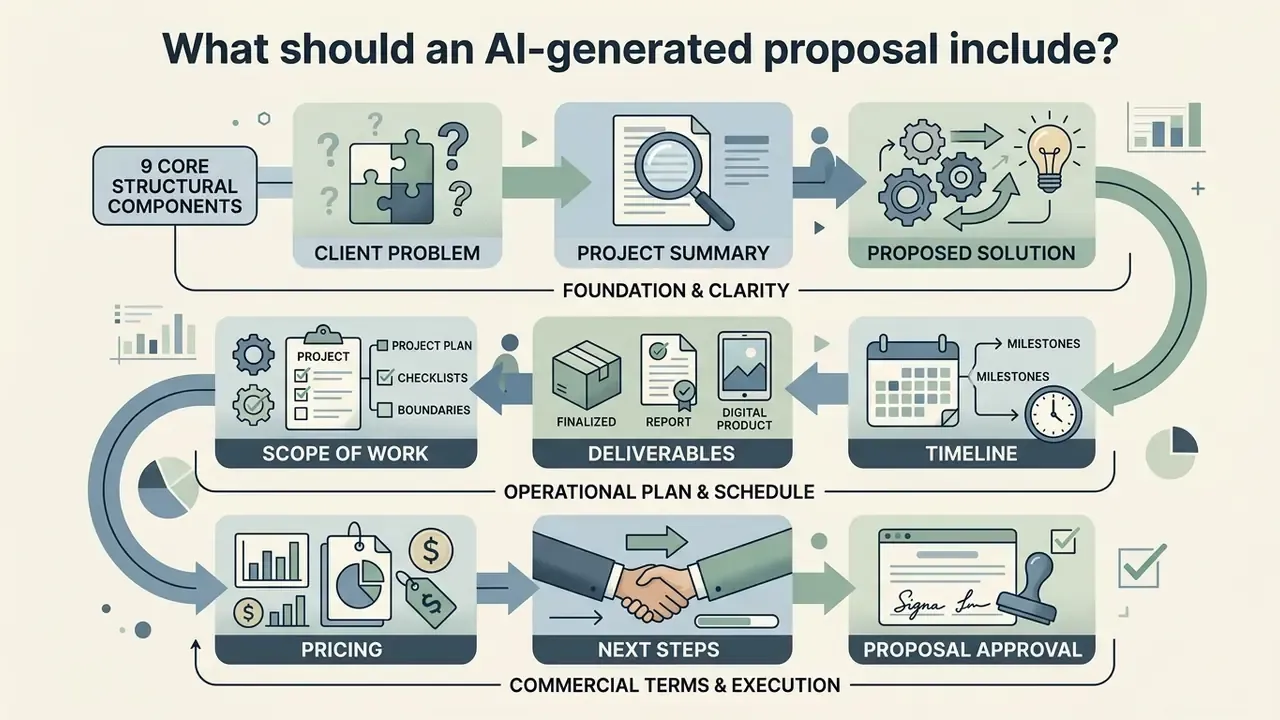
A complete AI-generated business proposal needs nine core structural components to deliver operational clarity, legal enforceability, and commercial persuasion. Missing sections produce scope ambiguity, delayed approvals, and financial exposure for the service provider.
Reviewers concentrate their scepticism in three places: the timeline, the budget, and the risk section. They assume optimism in dates and vagueness in numbers, so specificity in those three rows is what separates approval from "come back next quarter."
Client problem, project summary and proposed solution
The opening sections establish commercial alignment by defining the client's operational challenges in clear, buyer-centric language. The executive summary compresses the whole proposal narrative into a short overview of objectives, interventions, and expected outcomes. It should stand alone in under 200 words, because it is often the only section a senior approver reads before forwarding a yes or a no.
Academic guidance from San José State University stresses that proposals must articulate the customer's problem before presenting the technical solution. Harvard Kennedy School describes the executive summary as a concise document conveying the problem, the findings, and the recommendation of the longer report.
"Organisations use generative AI most often to write executive summaries and copy blocks, precisely the sections that frame the client problem and the proposed solution narrative."
The proposed solution section sets out methodology, implementation framework, and core value proposition, and shows explicitly how the approach resolves the identified pain points. University of Arkansas guidance requires a brief methodology summary plus the bottom line, cost and time frame, and recommendations. Features alone are not enough.
Scope of work, deliverables and timeline
Pricing, next steps and proposal approval
The commercial section gives an itemized breakdown of costs, fee structures, payment schedules, and price validity windows. Institutional procurement standards such as the General Services Administration (GSA 2026) instructions require commercial pricing to be supported by catalog rate cards or documented market references. The U.S. Department of Defense Guidebook for Acquiring Commercial Items (2018) similarly grounds price analysis in market research before a negotiation position is set.
A complete pricing block states total cost, day or unit rates, travel and expenses, currency, exchange-rate basis where relevant, tax treatment, expense caps, and the price validity period. Interactive quoting, where the buyer adjusts quantities or selects optional add-ons, increases engagement but requires discount logic validated against approval thresholds before the link is shared. For a view of how tiered commercial packaging is usually presented to buyers, open the hub and compare structures.
The proposal must close with a dedicated sign-off block and a single, explicit call to action: execute an e-signature, approve a statement of work, schedule an onboarding meeting. Clear approval blocks convert the proposal into a binding operational agreement.
"AI-enabled proposal management tools are associated with an average $21 million addition to gross revenue, with organisations reporting productivity gains of 50% or more."
| Proposal section | Primary functional purpose | Common drafting errors |
|---|---|---|
| Title / cover page | Identifies document, client, vendor, and submission date | Omitting version tracking or formal client entity names |
| Executive summary | Synthesizes problem, proposed solution, and strategic ROI | Running past a single page, or listing vendor features instead of client value |
| Client needs statement | Outlines buyer operational challenges in client language | Generic boilerplate that ignores actual client intake data |
| Proposed solution | Details methodology, technical architecture, execution strategy | Abstract capabilities without actionable implementation steps |
| Scope of work (SOW) | Defines precise project boundaries and task breakdowns | Ambiguous work boundaries, leading to scope creep and cost overruns |
| Deliverables and milestones | Lists tangible outputs, acceptance criteria, schedules | Missing delivery dates or measurable acceptance criteria |
| Pricing and commercial terms | Itemizes fees, rate cards, payment schedules, price validity | No tax conditions, expense caps, or price expiration dates |
| Vendor credentials and case studies | Establishes past performance, team expertise, references | Generic company history instead of targeted case evidence |
| Sign-off and approval block | Provides legal acceptance fields and explicit next steps | Missing e-signature lines or any clear call to action |
Free AI proposal generators, pricing and commercial-use limits
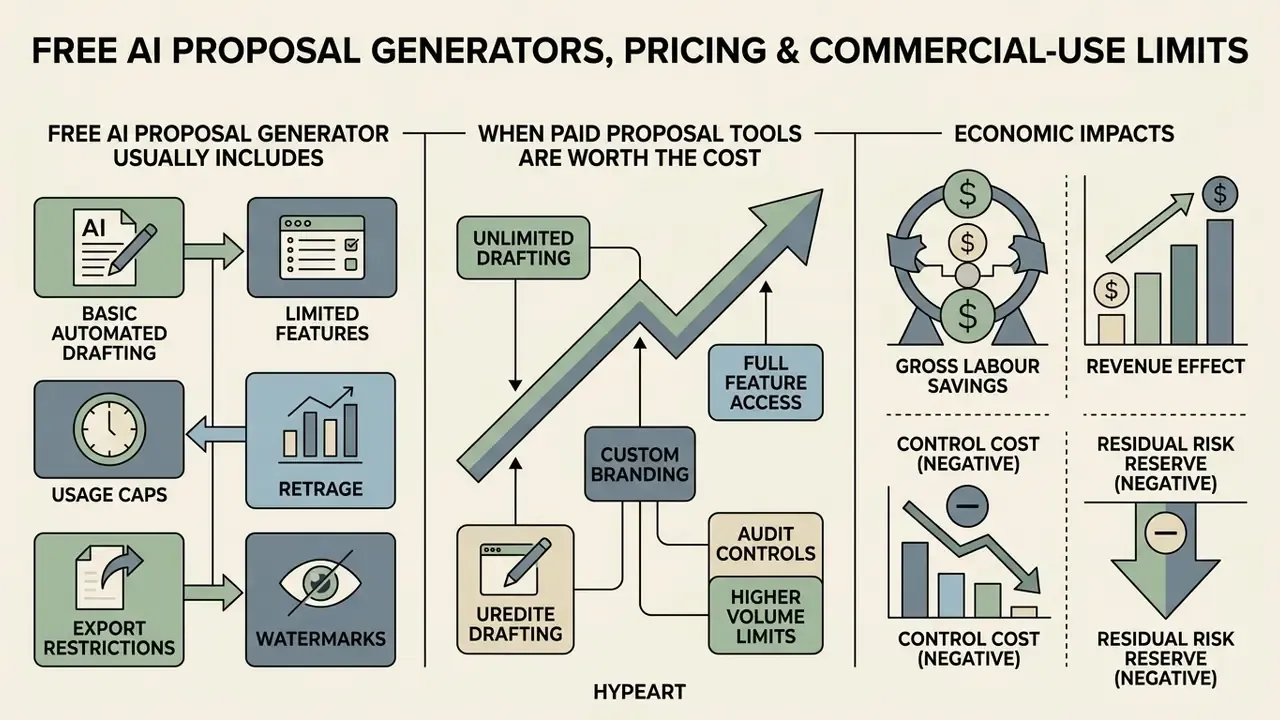
A free AI proposal generator lets small teams and individual practitioners test basic automated drafting, but usage caps, export restrictions, and watermarks usually arrive with it. Understanding the commercial terms of free tiers is how you work out when upgrading becomes necessary.
The 2026 market splits into three models: permanent free tiers with usage caps, 14-day trials with mandatory upgrade, and paid plans starting around $10–$50 per user per month. Most vendors do not keep a permanent free tier. Free-forever options are the exception, not the norm, which is worth remembering when someone asks for the best free ai proposal generator by name.
What a free AI proposal generator usually includes
Entry-level free plans typically offer a restricted monthly quota of AI generation credits or document drafts, often two or three proposals per month. Those tiers give access to basic drafting templates, but automated CRM data synchronization and custom brand kits are usually locked.
"Among early adopters of AI in RFP processes, 44% use it to create first drafts and 43% for editing."
Those two use cases, first draft and editing, map almost exactly onto what free tiers can actually do, which is why a free plan is a legitimate evaluation vehicle even for teams that will eventually buy. Free tiers also frequently restrict export: basic web link sharing, raw copy-paste extraction, or PNG downloads only. So a request for a free ai proposal generator pdf export often ends at the paywall. Teams running free tooling across their whole content stack may find our comparisons of free AI art generators and free AI video generators useful for the visual assets that accompany a proposal, since watermark and licensing limits follow the same freemium logic.
When paid proposal tools are worth the cost
Upgrading to a paid commercial proposal generator becomes economically justified above roughly 15 to 20 complex RFPs a year, because labour savings outpace subscription overhead quickly. According to ROI benchmarks from Bidara (2026), mid-market sales teams handling frequent bids can reach full platform payback within two months on recovered engineering and drafting hours alone. At 20+ RFPs a year at roughly 25 hours each, flat-rate tooling at $299–$599 per month pays back on labour by itself.
"Organisations deploying generative AI for proposal management expect productivity gains of 50% or more, and 32% expect higher win rates and revenue."
A related data point from adjacent document-heavy workflows: a 2025 study on grant application automation reported preparation time falling from 30–50 days to 3–5 days after structured LLM adoption, which confirms that deadline-driven, high-volume document production is where paid automation compounds fastest.
Paid subscriptions unlock unrestricted PDF and DOCX exports, custom domain branding, centralized content library management, real-time collaboration, and SOC 2 compliant data protection. Commercial plan pricing runs from entry-level seats at $15 to $49 per month up to enterprise platforms at $2,000+ per month with dedicated CRM integrations and custom model fine-tuning. Teams assessing licensing exposure for AI-generated visual assets should review our Canva AI Generator commercial-use overview, which covers export options and usage rights under comparable freemium structures; the broader commercial-use guide collects the same questions for other tool categories.
Risk-adjusted ROI: what the standard calculation omits
How to improve AI proposal quality before sending it to a client
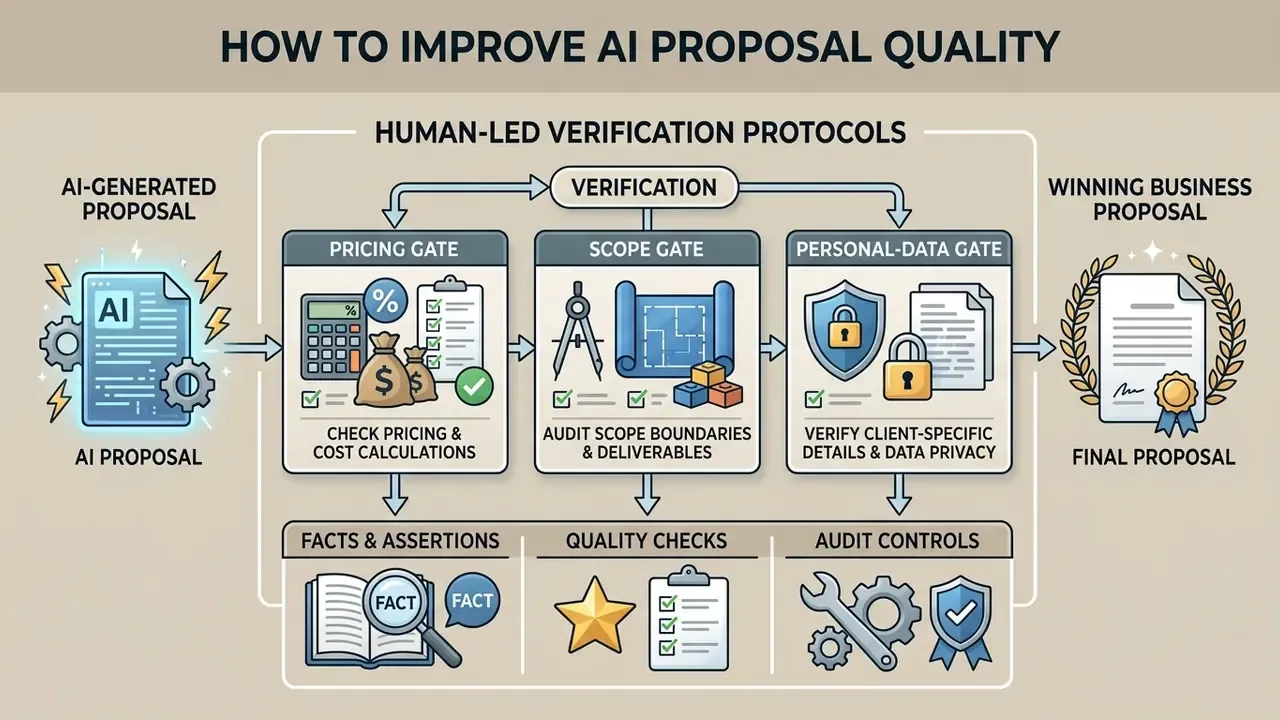
Improving the quality of an AI generated proposal means establishing strict, human-led verification protocols to audit factual assertions, cost calculations, scope boundaries, and client details before external submission. Systematic quality control is what prevents financial miscalculation, legal disputes, and brand damage.
Contemporary methodology converges on four controls: restrict the retrieval context to permissioned sources, require per-claim evidence, run adversarial evaluation sets (absent facts, conflicting documents, obsolete policies, injected instructions), and block release until commercial and legal approval is recorded. NIST's Proxy Validation and Verification for Critical AI Systems (2024) frames validation around verifying output against authoritative proxies rather than trusting model fluency, which is precisely the posture pricing and terms checks require.
Check facts, pricing and client-specific details
Fact-checking protocols must independently validate every price quote, discount structure, deliverable date, and client reference against primary ground-truth records. Official research guidelines from TÜBİTAK (2025) state that organizations retain sole legal and scientific responsibility for all submitted proposal content, which requires manual verification of synthetic text whenever dates, figures, or contractual terms are involved. The same guideline prohibits entering non-public, confidential, trade-secret, unpublished, or personal data into generative AI tools.
"Controlled experiments show automated plagiarism detectors fail to identify deliberately paraphrased idea-level borrowing in LLM-generated text, requiring careful manual originality review."
Review teams must also inspect drafts for inadvertent inclusion of third-party intellectual property or confidential client data. NIST's 2024 generative AI risk guidance recommends detecting personally identifiable information and sensitive data in generated text, image, video, or audio output, and documenting how provenance data is tracked.
"Evaluations in legal practice show models perform well at document drafting but frequently hallucinate on specialised legal research, making expert oversight mandatory."
The National Science Foundation (2023) adds a reputational dimension that applies equally to commercial bids: proposers remain responsible for the accuracy and authenticity of submissions, and uploading proposal content to non-approved generative AI tools can make that content public, eroding trust and creating legal liability. For teams weighing whether AI-produced assets may be used in client-facing commercial materials at all, our Canva AI Generator commercial-use analysis sets out the licensing questions to ask any vendor before deployment.
Pre-send verification gates
NIST Privacy Framework guidance supports three mandatory gates before any proposal leaves the building.
- Pricing gate. Total cost, day or unit rates, travel and expenses, currency, exchange-rate basis, tax treatment, and price validity period are all present and reconciled to the approved rate card. Any discount above delegated authority carries recorded approval.
- Scope gate. Deliverables, roles, person-days, total duration, assumptions, and the exact work boundary are stated, with explicit exclusions. No open-ended obligation language ("as required", "including but not limited to") survives review.
- Personal-data gate. Where CVs or staff details appear, personal information is treated as confidential and securely stored; processing is mapped and privacy requirements defined before release. Client-side personal data is redacted from anything sent to an external model.
Governance, audit trail and model risk boundaries
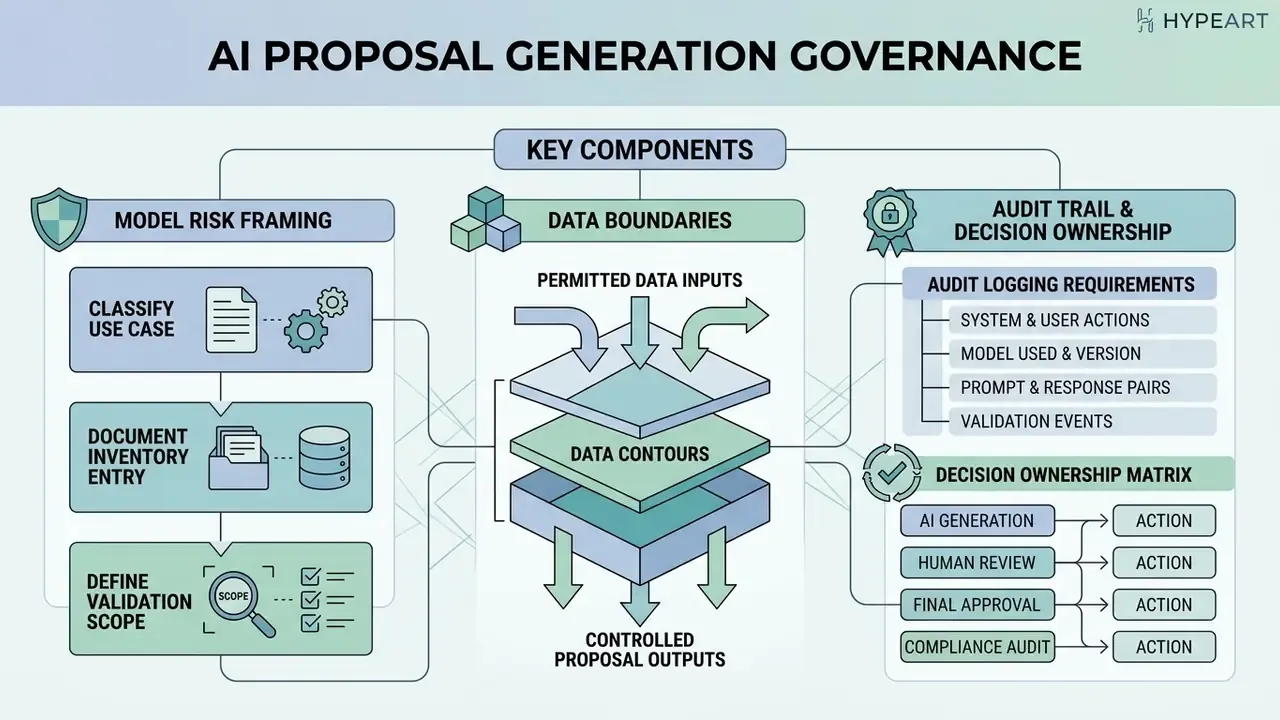
For a regulated institution, the question is not whether an AI proposal generator writes well. It is whether the institution can reconstruct, months later, how a specific commitment appeared in a specific document, and show that a competent human owned the decision.
Model risk framing for proposal generation
Supervisory model risk management expectations (Federal Reserve SR 11-7 and OCC Bulletin 2011-12 in the U.S., plus equivalent frameworks elsewhere) apply to quantitative tools whose output informs business decisions. A proposal engine that produces pricing recommendations, discount logic, or risk-scored bid/no-bid guidance sits closer to that perimeter than a pure text assistant does. Practical consequences:
- Classify the use case. Separate narrative drafting (lower inherent risk) from price generation, discount optimisation, and eligibility or compliance determination (materially higher).
- Document the inventory entry. Record purpose, inputs, model provider and version, retrieval sources, known limitations, and compensating controls.
- Define the validation scope. Where the tool influences pricing, validation should cover input data quality, output stability across reruns, and outcome analysis against realised margins.
- Set data boundaries per contour. Specify which client data classifications may enter which environment (internal RAG, vendor-hosted, or public model) and enforce it technically, not by policy memo alone.
IEEE 3119-2025 and OMB AI procurement guidance both push in the same direction: risk evidence belongs in the procurement file, and each vendor proposal should be assessed for the risks it introduces.
Audit trail requirements: what to log
Reproducibility is the control most proposal deployments miss. To make an AI-assisted proposal auditable, capture and retain the following for each generated document:
| Log element | Why an auditor needs it |
|---|---|
| Prompt text and template version ID | Demonstrates the instruction set that produced the draft |
| Retrieval set snapshot / content library version | Shows which approved source artefacts were available at generation time |
| Model provider, model name, and version | Establishes which system produced the text; supports reproduction attempts |
| Input data lineage (CRM record IDs, rate card version) | Ties committed figures to authoritative sources |
| Output hash of every draft version | Detects post-review alteration |
| Reviewer identity, role, timestamp, and comments | Evidences human oversight rather than rubber-stamping |
| Approval record for out-of-policy terms | Proves discount and scope exceptions were authorised |
| Final transmitted document hash and delivery channel | Establishes what the client actually received |
Retain these records for at least the contract limitation period applicable in your jurisdiction, and confirm in writing whether the vendor keeps prompts or outputs for training. That single answer determines whether logging alone is sufficient or whether the deployment model itself has to change.
Decision ownership matrix
Ambiguous ownership is the most common failure mode in proposal automation: everyone reviews, nobody is accountable.
| Activity | Responsible | Accountable | Consulted | Informed |
|---|---|---|---|---|
| Prompt and template design | Bid Manager | Sales Enablement lead | Legal, Brand | Sales team |
| Retrieval library curation | Content Manager | Sales Enablement lead | SMEs, Compliance | Bid team |
| Draft generation | Bid Manager | Bid Manager | n/a | Deal owner |
| Pricing verification | Pricing analyst | Finance lead | Deal owner | Bid Manager |
| Legal and certification review | Legal counsel | General Counsel | Security, Compliance | Deal owner |
| AI-specific control review | Model Risk analyst | Head of Model Risk | IT/AI platform | Audit |
| Final external transmission | Deal owner | Deal owner's manager | n/a | Legal, Finance |
Publishing this matrix internally also closes the shadow-AI gap. When representatives know which channel is sanctioned and who signs off, the temptation to paste client data into an unapproved consumer chatbot drops sharply. Pair it with technical controls: blocked domains, DLP rules on outbound prompts, an approved-tools list, and a clear escalation route through support for edge cases the policy did not anticipate.
From proposal to project execution
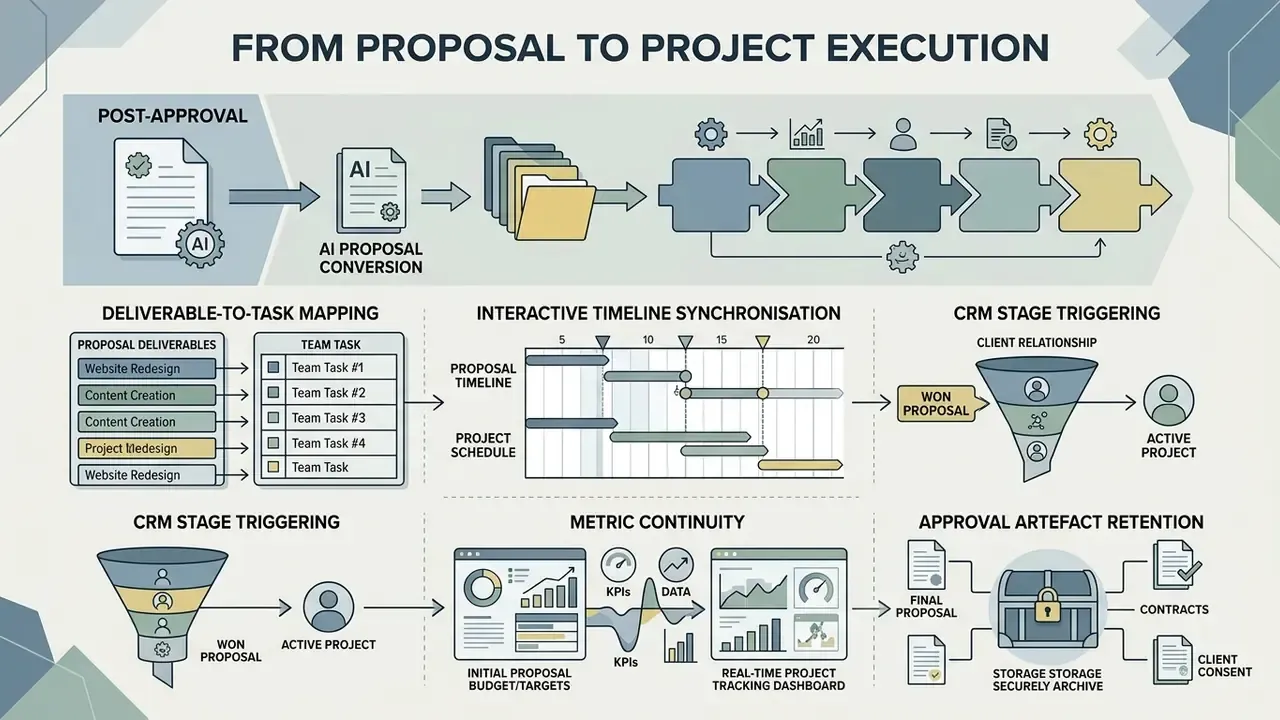
Winning the proposal is only the first phase of the client lifecycle. Most proposal generators hand back a document and stop; the operational cost then reappears as someone manually retyping the scope of work into a project plan. Advanced document platforms bridge commercial approval and project execution directly.
Post-approval: converting AI proposals into active project workflows
- Deliverable-to-task mapping. Convert Scope of Work line items into assigned project tasks with owners, due dates, and subtasks, preserving the acceptance criteria written into the proposal. What you promised becomes what is tracked.
- Interactive timeline synchronisation. Turn static milestone schedules into dynamic Gantt charts with dependencies, Kanban boards sorted by owner, or table views tracking budget lines against the itemised pricing block.
- CRM stage triggering. Update deal status automatically on e-signature detection in Salesforce or HubSpot, triggering onboarding workflows, resource allocation requests, and revenue recognition checkpoints.
- Metric continuity. Report against the exact success metrics stated in the proposal's objectives section instead of inventing new KPIs after kickoff. Cheapest available defence against expectation drift.
- Approval artefact retention. Archive the signed version, its hash, and the associated audit log alongside the project record, so scope disputes are settled against the executed document rather than recollection.
Taskade illustrates the pattern most directly: approved deliverables convert into tasks with owners and dates inside the same document, and the content then renders across seven project views including a Gantt timeline with dependencies. The practical test when evaluating any platform is simple. Ask what exists on day two after signature. A generator that leaves you with a dead PDF has transferred the work, not eliminated it.
Limitations and open questions
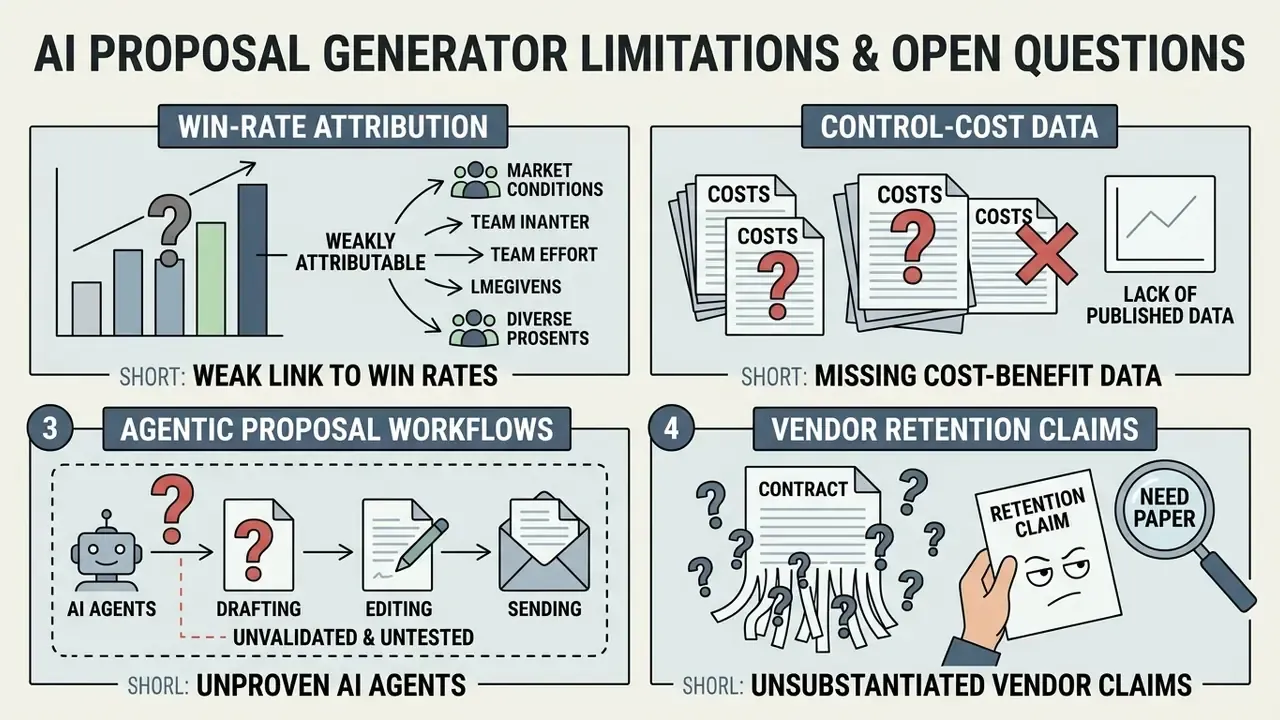
Honest caveats, because the evidence base here is thinner than vendor decks suggest.
Win-rate figures are weakly attributable. The 30% to 50–70% improvement reported in the Insider case study coincided with other changes in that sales organisation. Treat published conversion gains as directional, not as a forecast for your own pipeline.
Nobody has published control-cost data. We could find no independent study quantifying the incremental verification effort an AI proposal engine creates in a supervised institution. Until someone does, line 3 of the ROI model rests on internal estimates.
Agentic proposal workflows are largely unvalidated. Tools that fetch CRM data, choose a discount, and send a link without a human step exist. Their behaviour under conflicting instructions or prompt injection is not well characterised in public literature. Keep a named owner, a defined role, access limits, an escalation path, and a shutdown mechanism for any such agent. No evidence, no autonomy.
Vendor retention claims need paper. Several platforms state that prompts are not used for training. Verify in the contract, not in the marketing page.
FAQ
Is a free AI proposal generator enough for a small consultancy?
For fewer than about a dozen proposals a year, yes, provided the free tier's export format is acceptable. The usual breaking points are PDF/DOCX export paywalls, watermarks, generation caps of two to three documents per month, and the absence of a shared content library. Once several people need to reuse approved language, a paid tier becomes cheaper than the coordination overhead.
Can AI write the whole proposal?
It should not. The reliable division of labour: AI assembles structure and retrieves approved language; humans supply pricing authority, legal terms, certification claims, and the judgment call on whether to bid at all. Vendor claims that a tool "never invents clauses" describe an intended design constraint, not a guarantee. Any LLM processing free text retains a non-zero hallucination probability, which is exactly why human-in-the-loop sign-off is mandatory rather than optional.
How long should a proposal be?
Match the decision, not a page count. An internal project under $10,000 usually needs two pages; a client engagement or grant application often runs eight to fifteen pages with appendices. The executive summary should stand alone in under 200 words regardless of total length.
What formats should we insist on?
Editable DOCX for redlining, read-only PDF for formal submission, PPTX or Google Slides for executive presentation, and a live link for collaborative review. Procurement portals frequently require a single consolidated PDF, so confirm that before choosing a web-only tool.
How do we prevent shadow AI in the sales team?
Three moves in combination: publish an approved-tools list and the decision ownership matrix, make the sanctioned tool faster than the unsanctioned one (this is the real driver of compliance), and apply DLP controls to outbound prompts. Policy without a usable alternative reliably fails.
Does the audit trail requirement apply if AI only wrote the executive summary?
Log proportionately to materiality. Narrative sections carry lower inherent risk than pricing or compliance statements. But if the tool touched a document that created a binding commitment, you should be able to identify the model, the template version, and the reviewer who approved it.
Who owns the output of an ai business proposal creator inside a bank?
Ownership sits with the named deal owner, not with the platform team and not with the model. That is the point of the matrix above: a generated document without a human signature is a draft, whatever the tool calls it.
Pre-publication checklist for proposal owners
Checklist0 / 9
Next step: map your current proposal workflow against the decision ownership matrix above, identify which of the eight audit-trail elements you cannot currently produce, and close those gaps before scaling generation volume. Speed without reconstructability is the one configuration that fails both the client and the auditor.
To review adjacent terminology and compare options across enterprise document automation and AI tooling, see the comparison of leading AI art generators and the guide to AI voice generators and commercial licensing.