Synthetic media disclosure explained, in one line: it is the practice of systematically identifying, labeling, and cryptographically verifying content that artificial intelligence created or modified. For US financial institutions, that is not a branding question. Clear disclosure reduces model risk, protects brand equity, and answers regulatory expectations that now carry dates and dollar figures.
Why should a CRO care about a caption on a marketing image? Because the caption is the visible end of a control chain that runs back through your model inventory.
Executive Summary (Key Takeaways for CRO, CCO and Model Risk Leaders)
- Disclosure is now a dated legal obligation, not a best practice.EU AI Act Article 50 transparency duties apply from 2 August 2026, with a limited transition for pre-existing systems until 2 December 2026.
- Financial penalties are quantifiable.New York's synthetic performer statute (N.Y. Gen. Bus. Law § 396-b, effective 9 June 2026) carries civil penalties of $1,000 for a first violation and $5,000 for each subsequent violation.
- Four disclosure layers must operate togetherhuman-readable labels, embedded metadata (XMP/EXIF/IPTC), cryptographic provenance (C2PA Content Credentials 2.2/2.4), and watermarking (for example SynthID).
- Not every AI touch triggers a label.Assistive editing, audio-only ads in some states, AI translation, expressive works and mere publishers are statutorily or contextually exempt.
- Governance must be cross-functional and treated as model risk.Map synthetic media controls to Federal Reserve SR 11-7 / OCC Bulletin 2011-12 expectations, with escalation to Model Risk Management (MRM) for High and Critical materiality assets.
- Endpoint control is part of disclosure.Without Shadow AI suppression on managed devices and out-of-band verification protocols, labeling policy stays on paper.
How to Use This Guide (Reading Paths by Role)
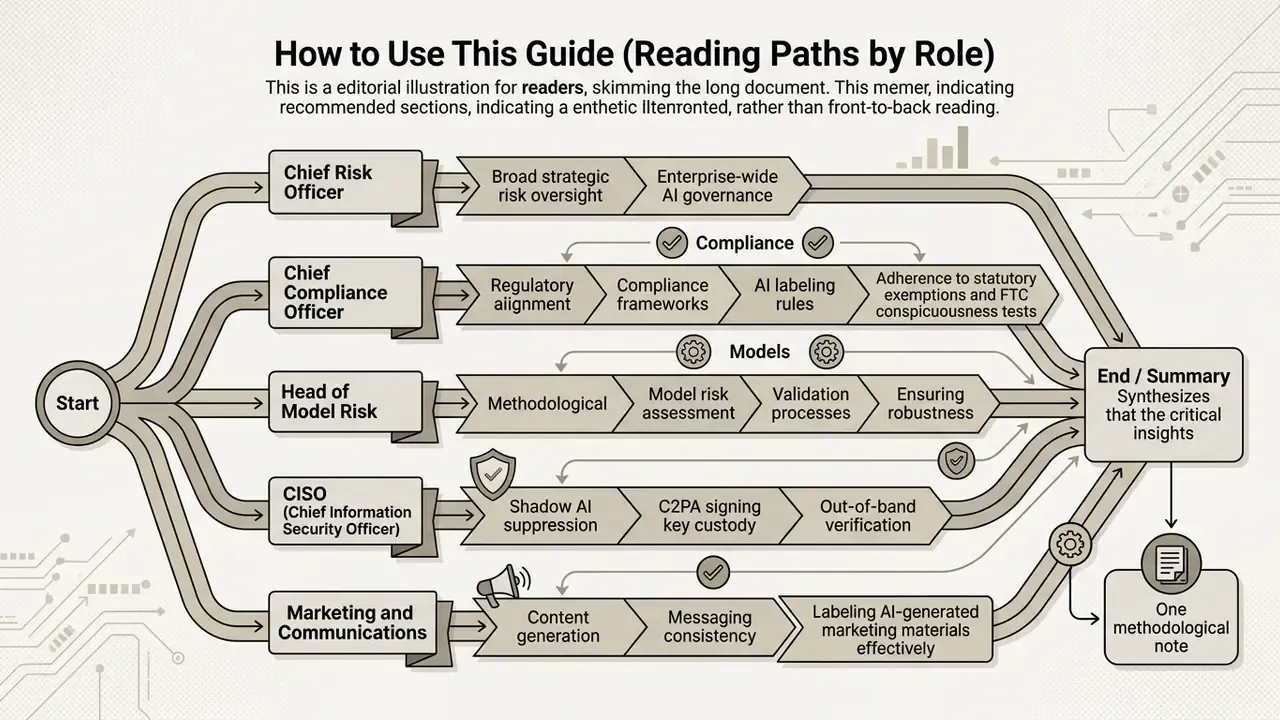
This is a long document, so read it by role rather than front to back.
Chief Risk Officer. Start with the materiality taxonomy and the escalation owners, then read the penalties section. Your practical question is narrow: which synthetic assets reach a client, and who signed them off?
Chief Compliance Officer. The statutory exemptions and the FTC "clear and conspicuous" test carry most of your workload. Document the exemption reasoning; an undocumented exemption looks identical to a control gap in an examination.
Head of Model Risk. Focus on the provenance manifest, the audit-logging checklist row, and the FAQ case about automated client summaries. Generative outputs published to clients are model outputs, full stop.
CISO. Shadow AI suppression, C2PA signing key custody, and out-of-band verification. Metadata survival after compression is a security control, not a marketing detail.
Marketing and Communications. Label wording, placement, duration, and likeness releases. One caution worth repeating: consumer-grade generators strip provenance on export more often than teams expect.
One methodological note. The audience needs described above should be treated as working hypotheses until validated through interviews, analytics, or documented client research.
What Synthetic Media Disclosure Means
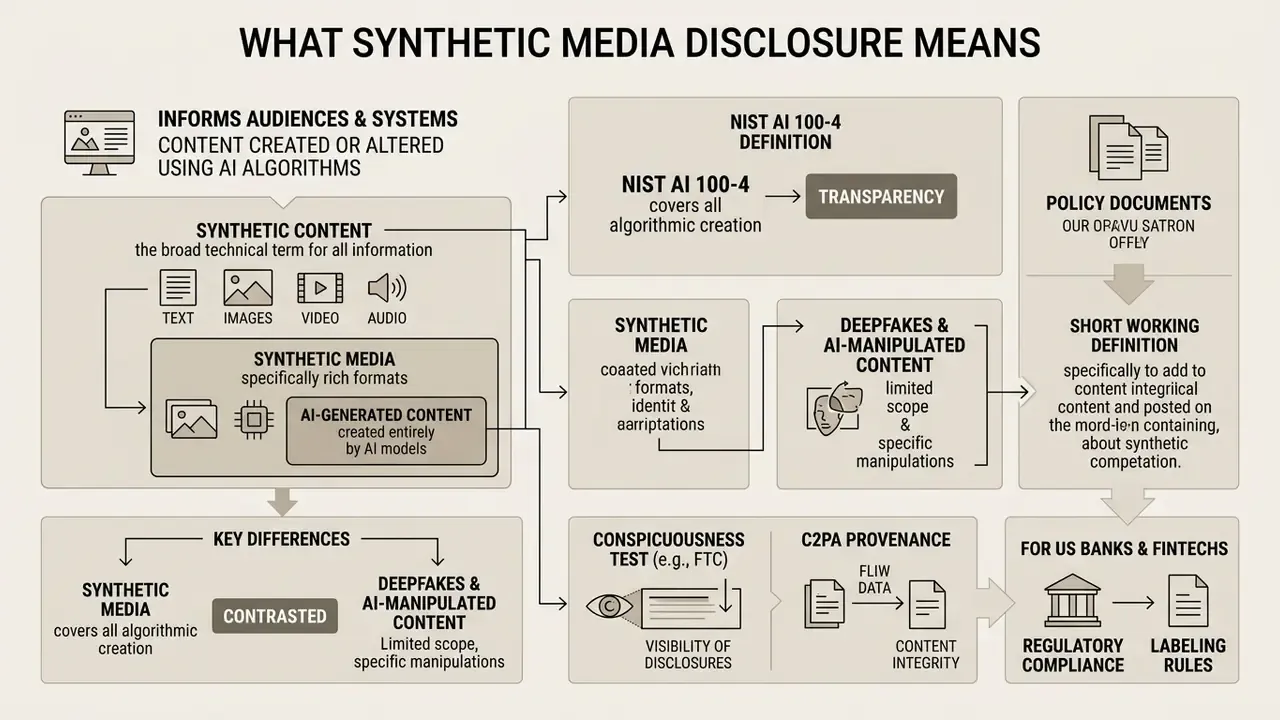
Synthetic media disclosure is the practice of informing audiences and systems that digital content was created, altered, or synthesized using artificial intelligence algorithms. The term covers visible visual labels, audible statements, embedded metadata, and machine-readable cryptographic provenance records.
Understanding the synthetic media disclosure explained meaning requires looking at two layers at once: what a human sees, and what a machine can verify. Skip either layer and the control leaks.
«Synthetic media is visual, audio, or multimodal content generated or modified by AI with realistic outputs that an average person cannot distinguish from real.»
The National Institute of Standards and Technology (NIST AI 100-4) defines synthetic content transparency as an integrated system of authentication, labeling, detection, and provenance tracking. Inside corporate AI governance, disclosure keeps machine-generated assets traceable, auditable, and accountable across every distribution channel. For US banks and broker-dealers, that maps cleanly onto existing model risk expectations. SR 11-7 and OCC Bulletin 2011-12 require documented model inventories, effective challenge, and reproducible evidence of validation, and generative outputs published to clients are model outputs.
A short working definition for policy documents: the synthetic media disclosure explained definition is a layered control that binds an audience-facing notice to a machine-verifiable record of origin, model, and human approval.
Synthetic Media, Synthetic Content and AI-Generated Content
Synthetic content is the broad technical term for information, including text, images, video, and audio, that algorithms or artificial intelligence models have generated or significantly altered. Generative AI is the narrower class of models built to emulate statistical patterns in training data and produce derived digital outputs.
«Generative AI is the class of models that emulate the structure of input data to produce derived synthetic content: images, video, audio, text.»
Synthetic media sits inside synthetic content and refers specifically to rich formats: visual graphics, synthetic audio, video recordings. Content that is produced entirely by generative AI models, without any underlying physical recording, is fully synthetic. When financial institutions or enterprise teams deploy generative AI tools, including AI-based image generators used by marketing departments, precise internal definitions come first. Inventory follows definitions, never the other way round.
How Synthetic Media Differs From Deepfakes and AI-Manipulated Content
Synthetic media covers all algorithmic content creation. A deepfake is a specific, high-risk subset built to realistically replace or simulate a real person's voice or physical likeness. AI-manipulated content is the broadest bucket: existing human-captured media altered in whole or in part by human-directed software or AI algorithms.
According to NIST AI RMF 600-1, deepfakes carry distinct identity-spoofing and impersonation risks, because they depict individuals saying or doing things that never occurred.
«The EU AI Act defines a deepfake as AI-generated or manipulated content resembling real persons or events and falsely appearing authentic.»
Standard synthetic media, by contrast, includes product renders, automated data charts, or generic marketing backgrounds that simulate nobody. That distinction is operationally useful. It lets risk managers apply proportional controls and route deepfake-class assets to Legal and MRM instead of leaving them inside a marketing workflow, where the review depth was never designed for identity risk.
Fact Check and Regulatory Verification Baseline
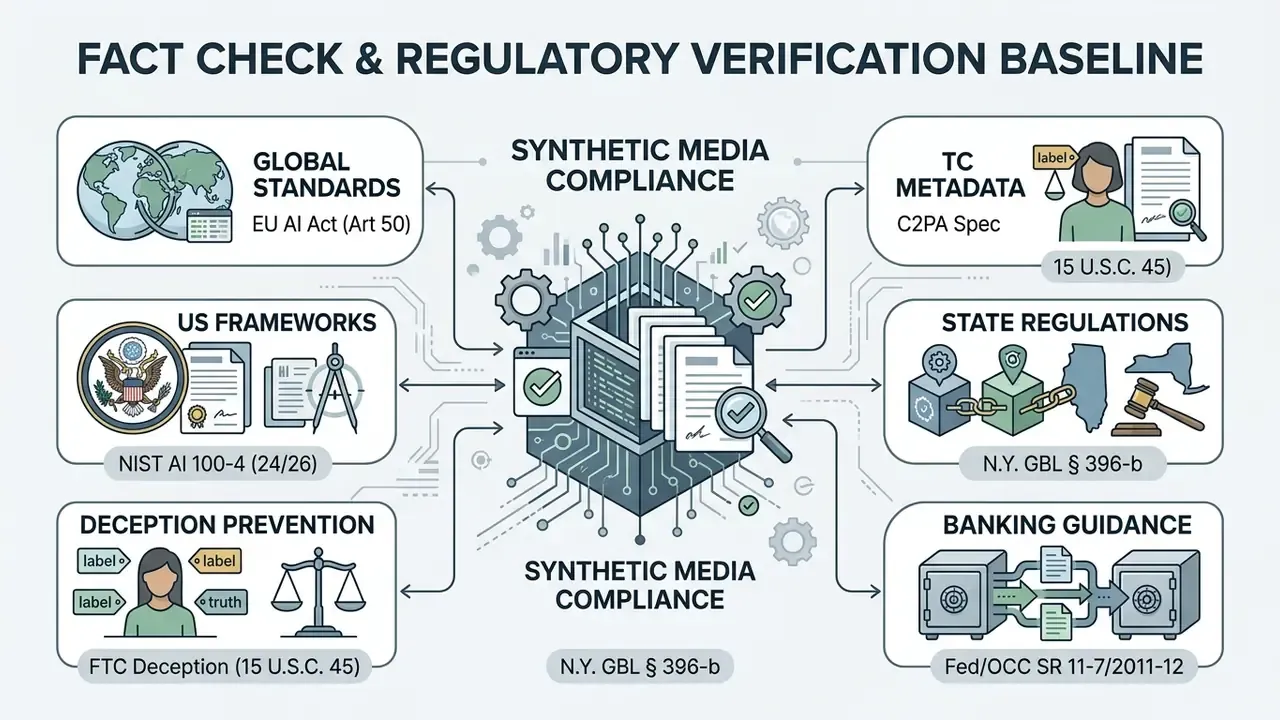
Which Types of AI-Generated Media Require Clear Disclosure
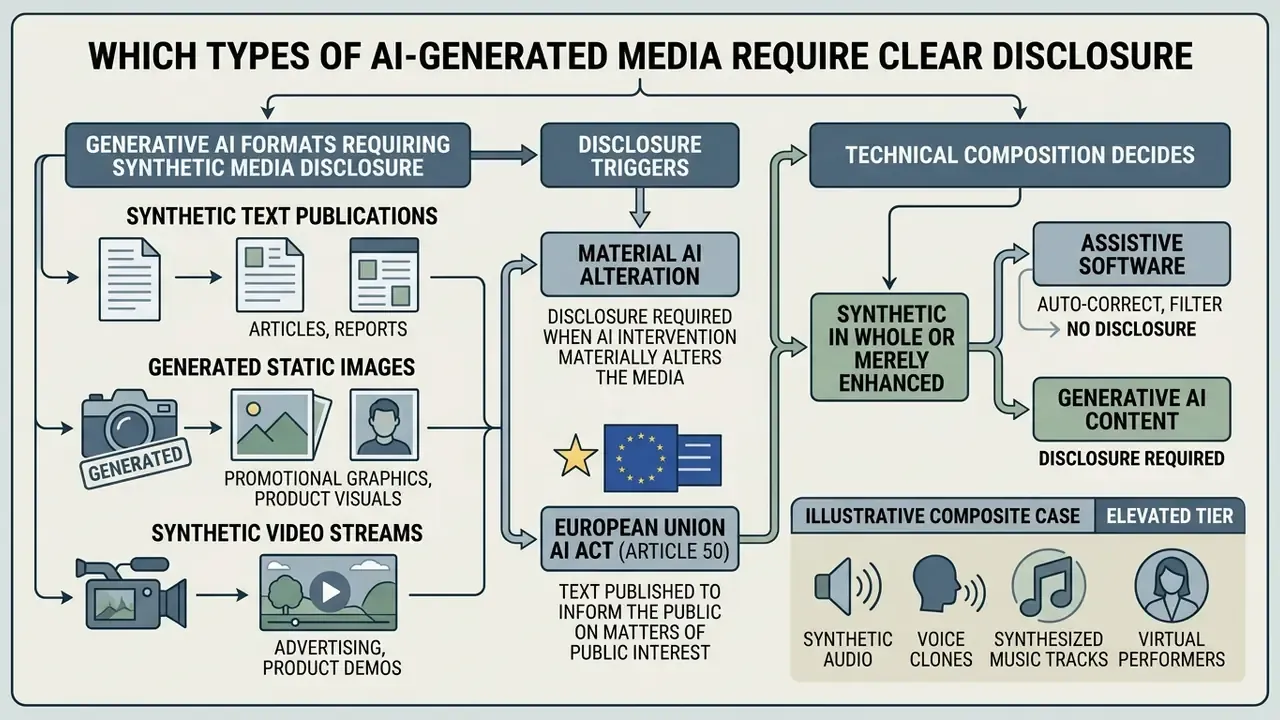
Generative AI formats requiring synthetic media disclosure include synthetic text publications, generated static images, synthetic video streams, cloned human audio, and interactive digital avatars. Regulators and platforms weigh three factors: realism, potential for consumer deception, and public interest impact.
Technical composition decides whether media is synthetic in whole or merely enhanced by assistive software. Verification workflows increasingly lean on detection and AI reverse-image-search tooling to confirm whether an inbound asset is synthetic before it enters a production pipeline. The media is synthetic when core semantic claims, visual representations, or auditory components originate from machine models rather than physical recordings.
Comparative taxonomy of synthetic media types and disclosure requirements
| Media Format | Production Mode | AI Materiality Level | Recommended Disclosure Mechanism | Escalation Owner |
|---|---|---|---|---|
| Text publications | Fully AI-generated | High (public interest / external) | Visible header disclaimer plus C2PA machine-readable AI disclosure assertion | Compliance + MRM sign-off |
| Text copy | Human-written with AI editing | Low (assistive editing) | Internal workflow log; external label generally exempt | Content owner |
| Static images | Fully AI-generated | High (commercial / media) | Visible corner icon or watermark plus embedded IPTC/C2PA metadata | Marketing review board |
| Photographs | AI-altered (object swap, face retouch) | Medium-High (material alteration) | Contextual caption notice plus technical provenance tracking | Marketing + Legal |
| Video clips | Fully AI-generated or deepfake | Critical (deception risk) | Persistent visible overlay, opening disclosure, C2PA cryptographic signature | Legal + Head of Model Risk |
| Audio and voice | Cloned voice or synthetic voice | Critical (identity / replica) | Spoken disclaimer at start and end plus invisible watermarking | Legal + CISO |
| Digital avatars | Interactive AI performer | High (human likeness) | Initial interaction notification plus persistent visual badge | Legal + Compliance |
Read the table as an escalation map, not a style guide. Two rows deserve attention in most banks: cloned audio, because identity risk is highest there, and fully generated text, because volume is highest there.
AI-Generated Text, Images and Video
Synthetic text, images, and video require formal disclosure whenever AI intervention materially alters the substance, authenticity, or origin of the final asset. Content that is created from text prompts, with no underlying human photography, is a fully synthetic asset and needs both a visual marker and technical metadata. Teams comparing production stacks often start with AI art and image generator comparisons before locking a governed toolchain.
Under the European Union AI Act (Article 50), text published to inform the public on matters of public interest must carry clear disclosure if it lacked meaningful human editorial responsibility.
«Across two large experiments with more than 7,500 US participants, labeling AI images significantly reduced belief in false claims and willingness to share.»
An illustrative composite case. A large US bank reviewed its customer communication workflows after rolling out automated market summary generators. The compliance team built a metadata pipeline that tagged every generated commentary block, keeping public-facing reports inside internal risk thresholds and cross-border disclosure mandates. The detail that mattered most was mundane: model version, prompt, reviewer and approver were logged into the GRC platform, so MRM validators could reproduce any published artifact on request. Same evidentiary standard SR 11-7 applies to quantitative models. No exceptions for prose.
AI-Generated Audio, Music and Virtual Performers
Synthetic audio, voice clones, synthesized music tracks, and virtual performers sit in an elevated tier, because they emulate human vocal traits and physical likeness directly. The US Copyright Office classifies voice clones and hyper-realistic facial avatars as digital replicas.
When media uses synthetic performers or cloned voices in commercial or customer-facing channels, clear disclosure prevents deceptive presentation. California SB 1050 and New York advertising rules require explicit visual or spoken disclaimers for commercial media featuring synthetic digital performers. Teams deploying AI voice generators for IVR, narration or localization should treat every cloned voice as a likeness-rights asset rather than a production shortcut.
«Disclosure increased perceived ethicality (β = 0.323) but reduced trust by 37% and increased irritation (β = 0.448) among 198 study participants.»
Protecting privacy and likeness rights takes verified consent records alongside the public label. And note what that behavioral finding does not say. It is not an argument against disclosure; it is an argument for calibrated wording, where transparency arrives together with an explanation of human oversight instead of a bare warning.
Why You Should Disclose Generative AI Use
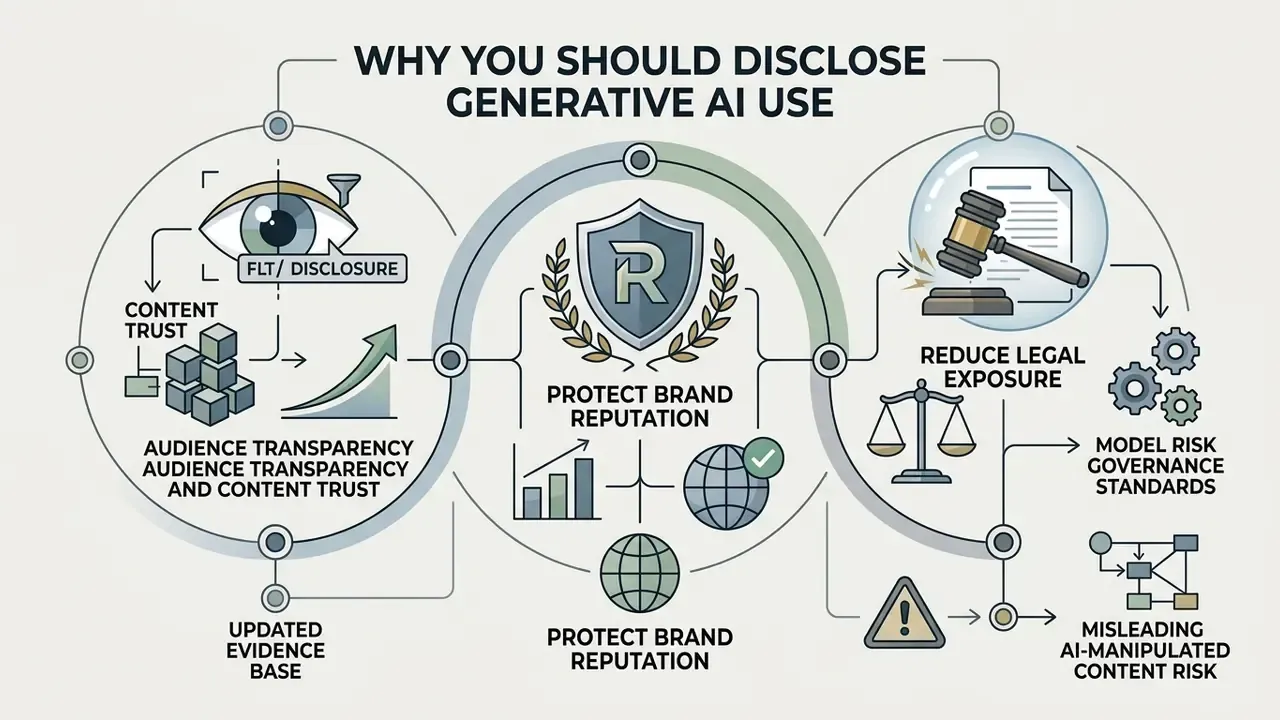
Disclosing generative AI protects brand reputation, keeps audience trust intact, and reduces legal exposure under consumer protection and model risk governance standards. Unlabeled synthetic assets create severe operational risk the moment a consumer or a regulator mistakes manipulated media for a real event.
Any serious synthetic media disclosure explained guide has to answer the commercial objection head-on: does labeling destroy conversion? Evidence suggests not, provided the framing is precise. When an organization explains how generative AI tools run under human oversight, confidence in brand authenticity holds up.
Audience Transparency and Content Trust
«A 105-participant experiment showed that granular AI labels increased perceived transparency and trust without reducing audience engagement.»
«Participants intuitively associated the phrasings "AI-generated", "Generated with an AI tool" and "AI-manipulated" with synthetic origin, independent of content veracity.» Source: MIT Schwarzman College of Computing, policy review (2024). https://computing.mit.edu/
When content has clear provenance markers, consumers read institutional accountability behind the communication. Enterprise teams building customer-facing creative should pair label wording with a plain statement of the human review step, as documented in our B2B AI Media Trust Checklist.
The Risk of Misleading AI-Manipulated Content
Undisclosed AI-manipulated content damages reputation fast, especially where the media conceals material alterations or misrepresents real events. When manipulated media blurs the line between physical reality and algorithmic synthesis, institutions face enforcement exposure from agencies including the Federal Trade Commission.
Updated evidence base. Large randomized experiments confirm that text and visual GenAI misinformation is persuasive when distributed without contextual labels.
«Labeling AI content reduced belief in false claims and sharing intent, particularly when the label communicated both provenance and potential misleadingness.»
Clear disclosure standards prevent accidental deception, protect legal standing, and keep brand channels usable as sources of truth. For a bank the exposure compounds. An unlabeled synthetic client video is three failures at once: marketing compliance, model documentation, and a plausible fraud vector for whoever copies the format.
When You Must Disclose AI Use in Content
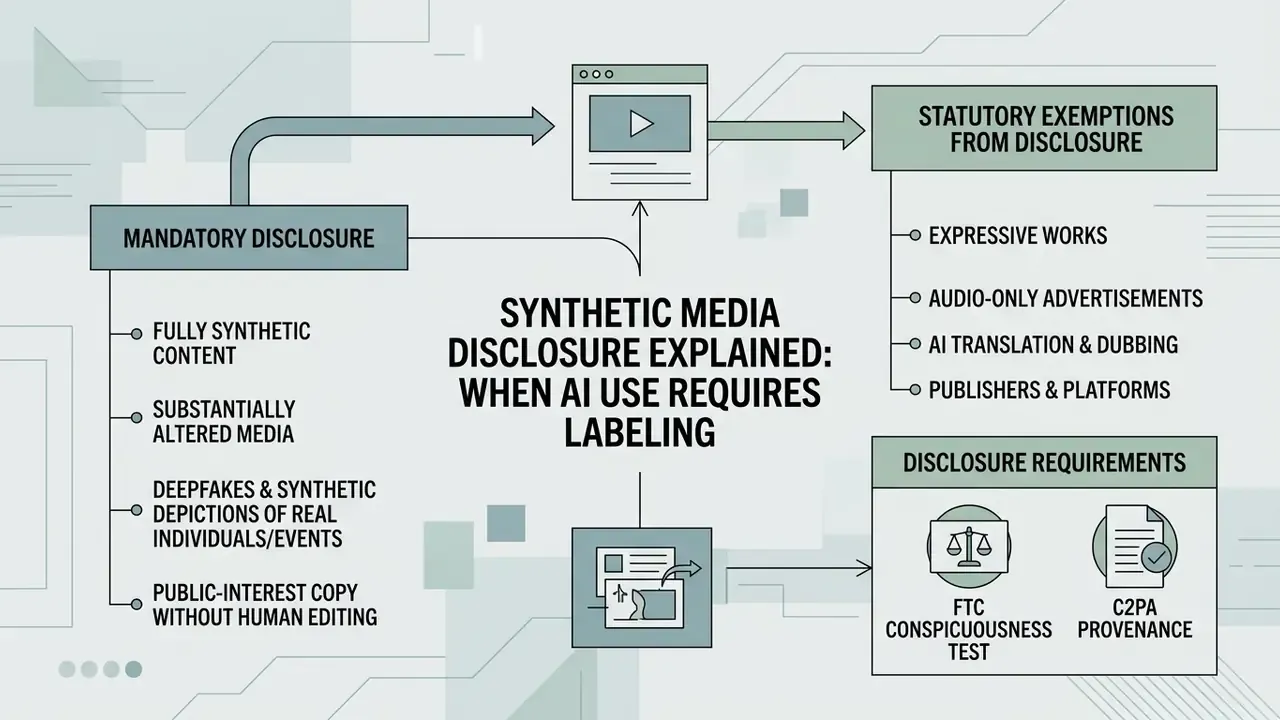
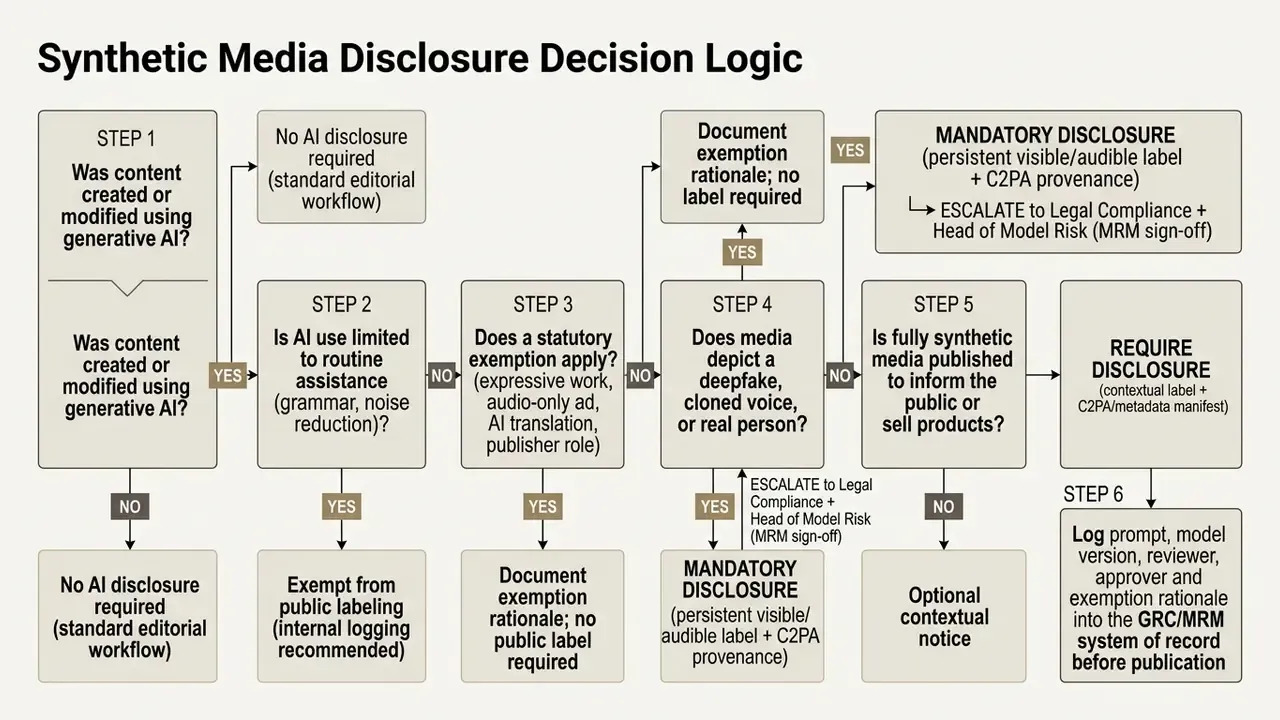
Disclosure is mandatory whenever AI generates deepfakes, creates synthetic media depicting real individuals or events, or produces public-interest copy without human editorial oversight. Routine administrative software and basic editorial enhancement generally do not trigger a public-facing label.
The practical test enterprise teams use: would undisclosed AI use mislead a reasonable person about the asset's underlying reality or authorship? Tooling matters here too. Production stacks that include AI video generators or model-level video APIs such as Google Veo belong in the inventory before any campaign approval cycle opens.
Fully Synthetic Content and Substantially Altered Media
Fully synthetic assets and substantially altered media require visual, auditory, or technical disclosure. Content synthesized entirely by algorithms has no underlying physical recording, which is exactly why the label carries weight.
Substantial alteration happens when AI tools change core semantic claims, modify facial expressions, clone human voices, or swap critical visual elements. The California Fair Political Practices Commission (FPPC 2026) treats media as substantially altered when AI edits would leave a reasonable viewer with a fundamentally different understanding of the recorded event.
«The EU AI Act separates AI-generated from AI-manipulated content: the former is fully machine-created, the latter is real recording altered by AI to distort the original event.»
Human-Created Content Using AI Tools
Human-created content that uses AI tools for internal research, spellchecking, draft brainstorming, or noise reduction does not require a public AI disclosure tag. Where human authors keep full editorial responsibility over the final text, the media stays human-authored. The same logic covers routine retouching in a conventional photo editor, where colour correction or cropping changes nothing factual.
The European Commission's guidance on AI Act implementation explicitly exempts assistive productivity tools from public deepfake labeling duties.
«Routine post-production, standard audio enhancement and obviously fantastical imagery should not require disclosure where audiences cannot be misled.»
As long as human judgment dictates the core message, internal AI assistance is a workflow efficiency, not a synthetic media trigger. Log it anyway. Logs cost little and settle arguments later.
Statutory Exemptions From Disclosure Requirements
Applicable rules, including FTC standards and N.Y. Gen. Bus. Law § 396-b, recognize four principal categories of content exempt from mandatory public-facing disclosure:
- Expressive works.Advertising and promotional materials for motion pictures, television programs, streaming content, documentaries and video games, provided the synthetic performer's use in the promotion is consistent with its use in the underlying work.
- Audio-only advertisements.Purely auditory commercial spots fall outside visual labeling duties under several US state statutes, provided no real person's voice is imitated without consent.
- AI translation and dubbing.Using generative systems solely to translate or localize the speech of a real human performer into another language.
- Publishers and platforms.Newspapers, magazines, television networks, streaming services, billboard operators, transit advertisers and ad brokers that merely publish or disseminate third-party advertising, consistent with Section 230 of the Communications Decency Act protections.
Document every exemption decision. An undocumented exemption is functionally indistinguishable from a control failure during an audit or an attorney general inquiry. That single habit, a two-line written rationale in the asset record, is probably the cheapest control in this entire document.
How to Disclose Synthetic Media: Labels, Provenance and Watermarking
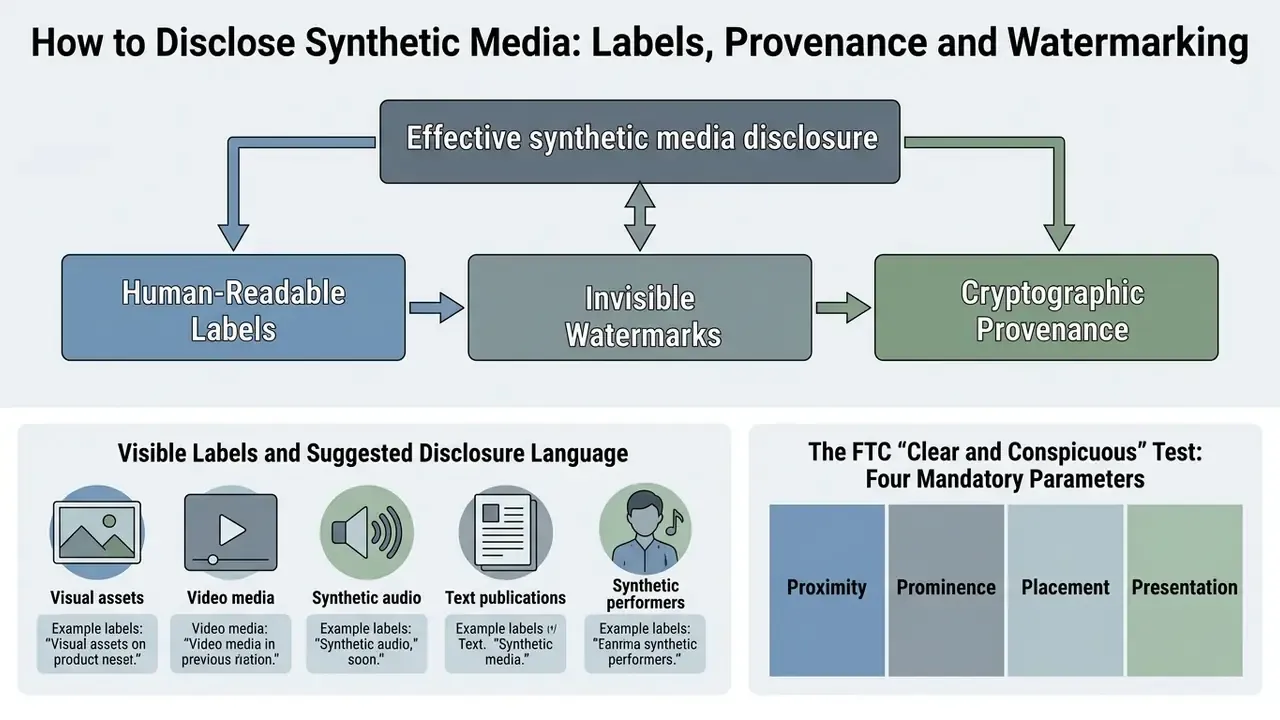
Effective synthetic media disclosure combines direct human-readable labels, invisible technical watermarks, and verifiable cryptographic provenance. Layer them, and transparency survives downloading, re-sharing, and cross-platform distribution.
Enterprise governance frameworks set unified standards for disclosure language, UI icon placement, and metadata tagging across every digital asset management system. Each tool in the pipeline, from an AI photo editor to a video compressor that may strip metadata on export, needs assessment for provenance preservation. Compression is where good policies quietly die.
Visible Labels and Suggested Disclosure Language
Visible labels give immediate, plain-language disclosure on the asset itself. They must be conspicuous, clearly formatted, and sized and contrasted so consumers cannot skim past them.
Recommended standard disclosure language:
- Visual assets "Created with AI" or "This image was generated using AI."
- Video media "Contains AI-generated video and synthetic elements."
- Synthetic audio "This audio recording contains AI-generated voice synthesis."
- Text publications "Drafted with AI assistance and reviewed by human editorial staff."
- Synthetic performers "AI-Generated Performer Notice: the person appearing in this advertisement was digitally created using artificial intelligence and does not represent any actual individual."
FTC guidance stresses that visual disclosures must stay on screen long enough to be read, and spoken disclosures must keep audible volume and a normal cadence. Fast-talking fine print is not disclosure.
The FTC "Clear and Conspicuous" Test: Four Mandatory Parameters
For a disclosure to count as conspicuous, regulators apply four criteria:
- Proximity. The notice sits immediately next to the AI-generated element or the claim it qualifies, never in a site footer.
- Prominence. Font size, contrast and colour keep it readable on any screen size.
- Duration. In video and audio, the disclaimer runs long enough to be read or heard and processed in full.
- No hiding. AI use may not be buried behind hyperlinks, collapsible menus, hover states, or dense legal fine print.
Citation Standards for Academic and B2B Documents
When preparing analyst reports, research notes, or corporate publications, cite AI-generated contributions using the relevant formal style guide, whether APA, MLA, Chicago, or AP Style, naming the model and describing the prompt or task where the guide requires it.
Extended corporate disclaimer template with sign-off:
The named approver field is not cosmetic. Under SR 11-7-aligned documentation practice, an artifact without a named human owner is hard to defend in validation and harder in an examination.
Provenance, Certification and Watermarking
Technical provenance supplies cryptographic proof of an asset's creation history, toolchain, and edit chain. The Coalition for Content Provenance and Authenticity (C2PA) publishes open specifications for binding tamper-evident Content Credentials into file headers. A Content Credential is assembled from one or more assertions, a single claim, and a claim signature. The c2pa.ai-disclosure assertion records AI involvement, model provenance, and the presence of human oversight.
Illustrative manifest structure (simplified):
{
  "claim_generator": "EnterpriseDAM/3.2 c2pa-rs/0.34",
  "assertions": [
    { "label": "c2pa.ai-disclosure",
      "data": { "ai_involvement": "fullyGenerated",
                "model": "vendor-model-name v2.1",
                "human_oversight": "reviewed_and_approved" } },
    { "label": "c2pa.actions",
      "data": { "actions": [ { "action": "c2pa.created" },
                             { "action": "c2pa.edited" } ] } }
  ],
  "signature": "<claim signature / trust list certificate>"
}
Archive the manifest hash next to the prompt, model version and approver identity in the GRC system of record. Internal audit and MRM validators then get reproducible evidence without re-running generation, which also removes the temptation to regenerate an "equivalent" asset months later.
Digital watermarking tools, such as Google DeepMind's SynthID, embed imperceptible signals into image pixels or audio frequencies for algorithmic detection, and they pair well with reverse-image and AI-detection tooling during inbound verification. Useful, yes. Sufficient, no. Combining watermarks with C2PA manifests creates the evidence chain a risk function can defend, precisely because watermarks are fragile:
«The W-Bench benchmark showed most watermarking methods fail to survive common image editing techniques, including regeneration and local editing.»
«WaterPark evaluated 10 LLM watermarking methods: RDF and GO resisted paraphrasing, while UPV and SIR were substantially vulnerable to lexical change.» Source: "Watermark under Fire: A Robustness Evaluation of LLM Watermarking", preprint (2025). https://arxiv.org/abs/2501.00000
The governance conclusion is blunt. Never treat a watermark as a single control. Watermarking is a detection aid; C2PA signatures plus GRC logging carry the evidentiary weight.
Pre-publication synthetic media disclosure checklist
| Verification Domain | Check Item | Compliance Requirement | Status |
|---|---|---|---|
| Asset identification | Identify all AI-generated or manipulated elements | Document text, audio, image, and video components | [ ] Pass |
| Materiality assessment | Evaluate degree of semantic or visual alteration | Determine whether changes alter consumer understanding | [ ] Pass |
| Exemption review | Test against the four statutory exemptions | Record written rationale for any exemption claimed | [ ] Pass |
| Human-facing label | Apply clear visual or audible disclosure tag | Meets FTC proximity, prominence, duration, no-hiding tests | [ ] Pass |
| Technical metadata | Embed C2PA manifest and IPTC metadata | Include c2pa.ai-disclosure assertion in header; verify survival after export and compression | [ ] Pass |
| Rights and privacy | Verify voice cloning and likeness consent records | Confirm signed releases for synthetic performers | [ ] Pass |
| MRM / compliance escalation | Route High and Critical materiality assets for sign-off | Named approver recorded per SR 11-7 / OCC 2011-12 documentation practice | [ ] Pass |
| Audit logging | Archive creation prompt, model version, and approver | Maintain reproducible record in the GRC database (for example ServiceNow, MetricStream, Archer) | [ ] Pass |
IT Infrastructure, Shadow AI and Out-of-Band Verification
Commercial Disclosure Requirements, Penalties and Risks
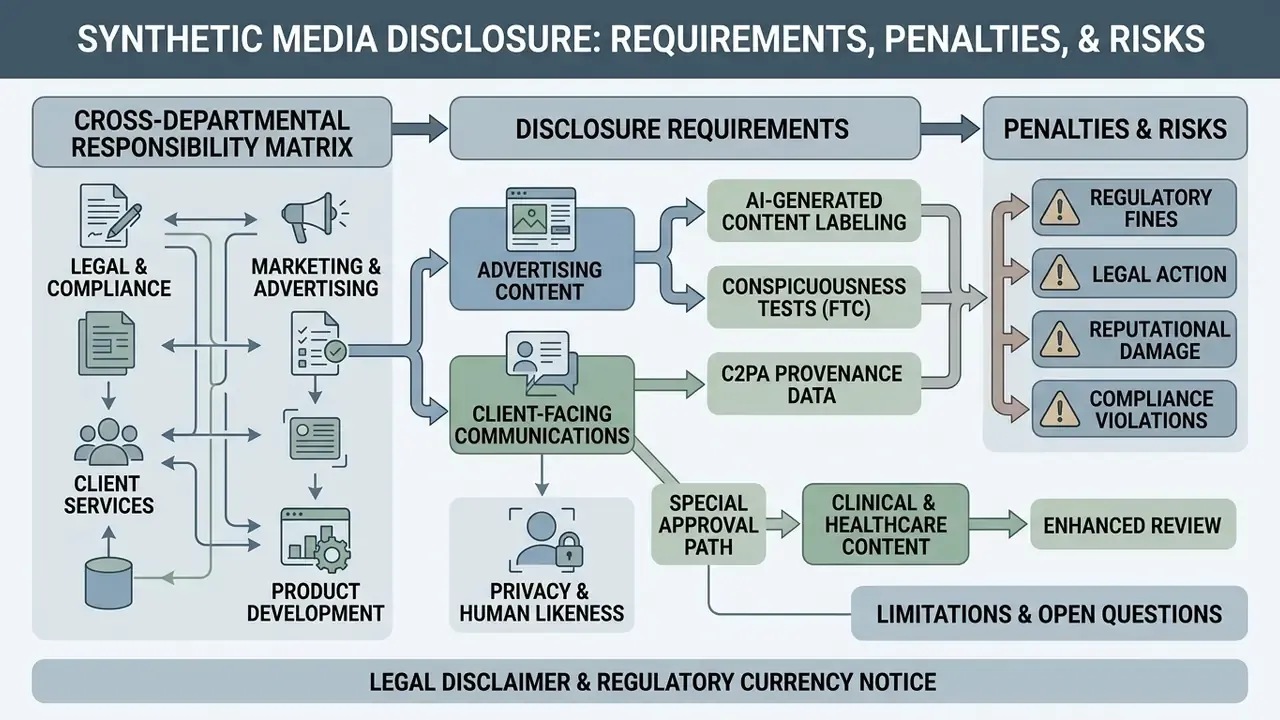
Commercial deployment of undisclosed synthetic media exposes businesses to regulatory fines, copyright uncertainty, and breach-of-contract claims from enterprise clients. Regulators in the US and EU already penalize deceptive commercial representations built on synthetic media.
For advertisers, ignoring synthetic performer labeling moves from reputational risk into direct financial loss. Under N.Y. Gen. Bus. Law § 396-b (effective 9 June 2026), using AI avatars or synthetic actors in commercial advertising without conspicuous disclosure carries civil penalties of $1,000 for a first violation and $5,000 for each subsequent violation. The statute does not expressly create a private right of action, so enforcement is expected to rest with the New York attorney general or another state authority, testing disclosures against a "conspicuous" standard. Per-asset penalties look small on paper. Multiply by a campaign flight with dozens of creative variants, and the arithmetic changes.
«Yahoo research found 77% of advertisers view AI in advertising positively, versus only 38% of consumers, while 53% did not know brands were using AI.»
That gap between advertiser enthusiasm and consumer awareness is the whole risk, compressed into two numbers.
An illustrative composite case. A financial services firm audited its digital marketing assets before a product launch. Three video advertisements turned out to feature synthetic background voices with no consent documentation and no disclosure tags. Marketing had sourced the voices through an unmanaged consumer tool, and metadata was stripped during compression for social distribution. The firm paused the campaign, regenerated assets in an approved environment, embedded C2PA metadata alongside explicit audio disclosures, and logged approvals into the enterprise GRC platform. Exposure under state synthetic performer laws closed before filing. Model Risk Management then added synthetic media assets to the model inventory and applied the same effective-challenge standard used for quantitative models.
Cross-departmental responsibility matrix for AI content disclosure
| Department | Responsibility in the Disclosure Process | Key Control Output |
|---|---|---|
| Legal / Compliance | Monitor legislation (EU AI Act, N.Y. Gen. Bus. Law § 396-b, DPDPA), assess legal risk | Current disclaimer wording and executed likeness releases |
| Model Risk Management | Inventory generative models, validate outputs, apply effective challenge per SR 11-7 / OCC 2011-12 | Documented validation and named sign-off for High and Critical assets |
| Information Security (CISO) | Shadow AI control, C2PA signing key management, MDM configuration | Technical impossibility of exporting media without an embedded C2PA manifest |
| Marketing and Comms | Visual and textual placement of labels on final creative | FTC "clear and conspicuous" compliance across all channels |
| HR and Talent Management | Staff training and internal AI tool usage rules | Signed Acceptable Use Policy (AUP) for AI across all employees |
Disclosure Requirements for Advertising and Client-Facing Content
Advertising standards require that commercial claims made through synthetic media stay non-deceptive, truthful, and substantiated. Under FTC guidance, synthetic testimonials, fabricated consumer reviews, and undisclosed AI spokespersons amount to unfair and deceptive trade practice.
«A YouGov survey found roughly 67% of respondents believe brands should disclose the use of AI when creating product images.»
State laws such as Utah Code 20A-11-1104 mandate explicit visual disclaimers throughout synthetic political and commercial advertisements, and require tamper-evident digital provenance for certain online audio and visual ads, including the initial author and subsequent editors. International deployments serving European clients must meet EU AI Act Article 50 deployer duties from August 2026.
«IAB recommends disclosure where AI materially affects authenticity, identity or representation, including synthetic voices, avatars and digital twins of real people.»
Failing to disclose synthetic media in commercial channels puts both corporate standing and client trust at stake. Teams evaluating production tooling for regulated campaigns should check the licensing and provenance behaviour of commercial AI video generators before contracting, ideally with security in the room.
Privacy and Human Likeness in AI Media
Creating synthetic performers or cloning human voices without verified authorization violates publicity rights, privacy protections, and biometric data regulations. Laws such as the Indian Digital Personal Data Protection Act (DPDPA 2023) treat voice biometric data as personal data requiring explicit consent.
Legal counsel should confirm that every synthetic media workflow touching human likeness holds documented, legally binding releases.
«Organizations should disclose how they obtain informed consent from subjects of synthetic content and publish accessible synthetic media policies.»
Securing explicit rights for digital replicas is cheap insurance against right-of-publicity litigation and enforcement claims. It applies to seemingly low-risk assets too, including AI headshot and avatar generation used for employee profiles or spokesperson imagery. Employee-facing does not mean consent-free.
Special Approval Path: Clinical and Healthcare Content
Any use of AI-generated or AI-modified imagery touching clinical settings, patient care areas, or medical equipment in marketing materials requires prior written clearance from the General Counsel's office, coordinated with the Compliance Office. Departmental guidelines must stay consistent with enterprise-level responsible AI principles.
Limitations and Open Questions
Honest caveats belong in a governance document. Three remain unresolved.
First, watermark robustness is improving but still weak against regeneration attacks, so detection rates should not be presented to a board as assurance. Second, "conspicuous" has no settled operational definition for short-form vertical video, where three seconds of attention is normal. Third, the trust effects of disclosure vary by audience and wording; the studies cited here use modest samples and different stimuli, so directional findings should not be read as calibrated coefficients for your customer base.
Legal Disclaimer and Regulatory Currency Notice
FAQ: Borderline Banking and Enterprise Cases
Does a bank need to label an AI-translated version of a research report?
Generally no, where generative AI only translates or localizes human-authored text and no substantive claim changes. Log the translation step internally and record the human reviewer who confirmed accuracy. If the translation altered substance or added commentary, disclosure applies.
Is a synthetic voice used in an IVR menu a deepfake risk?
Not if the voice is fully synthetic and not modelled on an identifiable person. Announce at first interaction that the caller is speaking with an automated AI system. If the voice was cloned from a real employee or spokesperson, treat it as a digital replica requiring an executed release and explicit disclosure.
Do automatically generated portfolio or market summaries sent to clients need a label?
Yes, where the output reaches clients without meaningful human editorial review. Add a visible notice, embed machine-readable provenance, and route the generator into the model inventory for validation under SR 11-7 and OCC 2011-12 expectations.
Do AI-assisted internal slide decks and pitch presentations require disclosure?
Internal documents rely on discretion, though transparency is encouraged and the audit log should still capture model and prompt. The moment the deck turns client-facing and carries fully synthetic imagery or claims, external labeling and named approver sign-off apply.
Is synthetic media always malicious?
No. It supports accessibility narration, localization, simulation, synthetic training datasets, product mockups and design prototypes. Risk comes from deception, weak disclosure, absent provenance, and misuse of sensitive data, not from the technique itself.
How should employees verify a suspicious audio or video instruction?
Use out-of-band confirmation through a known channel, inspect available metadata and Content Credentials, and escalate any urgent financial or access request before acting. Speed pressure is the attack, not the message.
Appendix A: Superseded Claims and Source Updates
For transparency and auditability, the following statements from earlier editions of this guide have been superseded by verified sources. They are retained in full, with the reason for replacement:
- *"Note
- In accordance with company verification guidelines, no verified commercial information is available for external product integration for hypeart.ai."* Removed from the body. This was an internal verification annotation with no editorial relevance to the taxonomy table; the table now carries an escalation-owner column in its place.
- "Recent behavioral research published in DiVA Portal (2026) indicates that while generic 'AI-generated' tags can initially lower perceived authenticity, nuanced role-based disclosures, such as 'Human-authored, AI-enhanced', preserve brand trust." Updated. The directional finding stands, but the citation lacked a resolvable URL, a sample size and a stated methodology. Replaced with the 105-participant label-granularity preprint and the MIT policy review of Wittenberg et al. randomized experiments.
- "A 2026 meta-analysis by the International Panel on the Information Environment (IPIE) confirmed that text and visual GenAI misinformation carries high persuasive risk when distributed without contextual labels." Updated. The IPIE reference could not be independently verified. Replaced with the verified randomized-experiment evidence cited in the MIT Schwarzman College of Computing policy review (2024).