Executive Summary
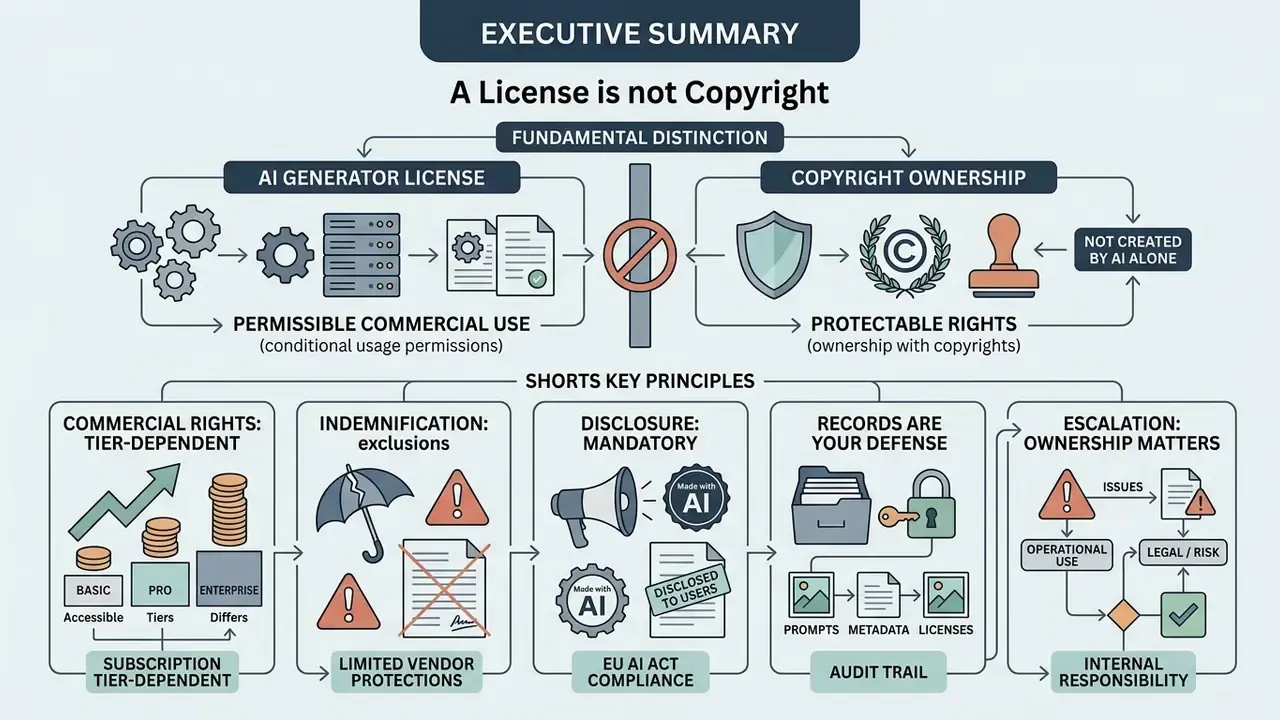
- A license is not copyright. A vendor's end-user license agreement grants you contractual permission to publish and monetize an image. It does not create statutory copyright ownership. Under the U.S. Copyright Office's 2025 Copyrightability Report, output where the machine determines the expressive elements is not registrable.
- Commercial rights are tier-dependent. Stability AI gates free commercial use at $1M in annual gross revenue; Midjourney requires Pro or Mega above the same threshold; Adobe Firefly permits commercial use across tiers, but IP indemnification is an enterprise-contract feature only.
- Indemnification has exclusions. Vendor indemnities generally do not cover willful infringement or negligent prompting. If your team prompted a trademarked character, the coverage evaporates.
- Disclosure becomes mandatory. Article 50 of the EU AI Act (Regulation EU 2024/1689) requires machine-readable marking of synthetic image content, applicable from 2 August 2026.
- Records are your defense. Archive prompts, negative prompts, seeds, model versions, subscription receipts, sign-offs, and C2PA provenance metadata for every commercially published asset.
- Escalation ownership matters. Define in advance who decides at the boundary: Legal for IP and trade dress, Risk/CRO for residual exposure, Creative Lead for brand fit.
How to Use This Guide
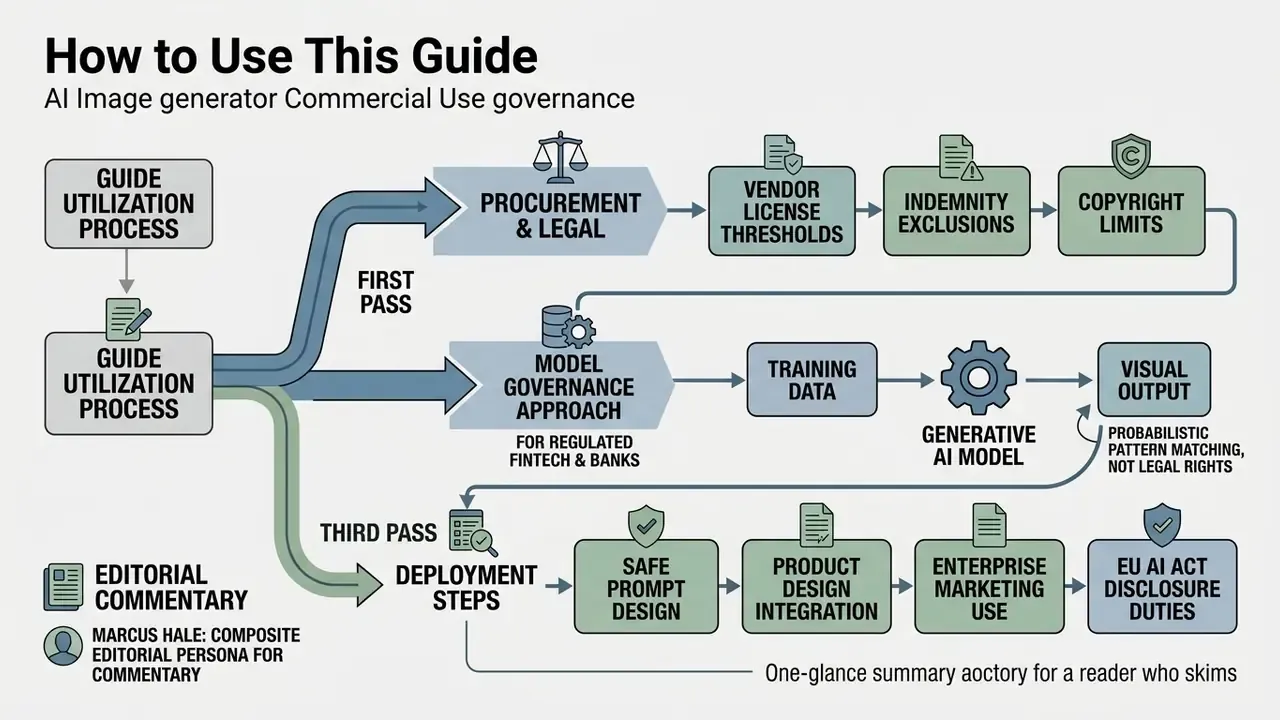
This is a decision document, not an inspiration piece. It assumes you already run a marketing or product function, and that someone senior has asked an uncomfortable question: can I use this image in a paid campaign without inheriting a legal problem?
Read it in three passes.
First pass, procurement and legal: sections on licensing, indemnity exclusions, and copyright. That is where the money and the exposure sit. Second pass, creative and brand teams: the prompt library, the asset job protocol, and the brand-consistency controls. Third pass, governance and internal audit: the verification checklist, the audit log template, and retention guidance.
If you own model risk at a bank or a regulated fintech, treat the image pipeline as a model. Not a toy. It has inputs, a version, an owner, and an output that reaches customers.
Can You Legally Use AI-Generated Images for Commercial Purposes?
What Counts as Commercial Use for AI Images
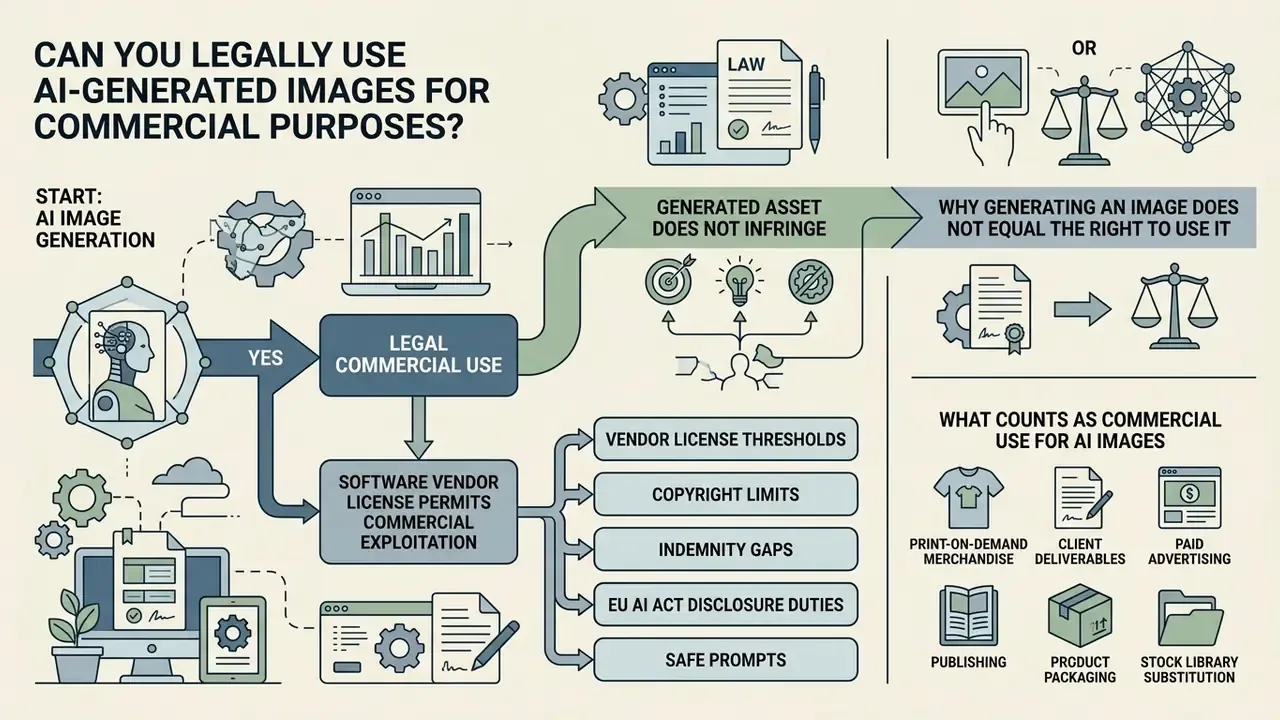
Commercial use covers any deployment of synthetic visual assets tied, directly or indirectly, to business revenue, brand promotion, or trade. Digital marketing campaigns. Social media advertisements. E-commerce product listings. Print-on-demand merchandise. Corporate websites, mobile application interfaces, client-facing promotional materials.
In practical terms, commercial deployment breaks into these operational categories:
- Print-on-demand merchandise T-shirts, mugs, posters, phone cases, tote bags, and stickers listed on Redbubble, Merch by Amazon, Printful, Etsy, or a proprietary Shopify storefront.
- Client deliverables Freelance designers and agencies embedding synthetic assets in client presentations, websites, marketing materials, and brand systems.
- Paid advertising Meta ads, Google Display, Instagram promoted posts, TikTok creatives, and programmatic advertising inventory.
- Publishing Book covers, interior illustrations, magazine layouts, brochures, billboards, and promotional collateral.
- Product packaging Labels, boxes, wrapping, and physical retail displays.
- Stock library substitution Replacing paid stock photography subscriptions with in-house generation pipelines.
The line between non-commercial evaluation and commercial exploitation runs through intent and market impact. An image created for personal research becomes a commercial asset the moment it enters a promotional workflow or a monetized product line. Worth noting: the U.S. Copyright Office confirms that fair-use analysis explicitly weighs whether a use is "of a commercial nature" versus for "nonprofit educational purposes," which makes commercial character legally material in any dispute. Enterprise teams can use the framework for Commercial Use for AI Media to classify digital assets by deployment context and risk exposure.
Why Generating an Image Does Not Equal the Right to Use It
Technical image generation produces a digital pixel array from probabilistic model calculations. That is all it produces. No copyright ownership, no immunity from third-party claims.
"Purely machine-generated results without meaningful human creative contribution are generally not protected by copyright, even though they may infringe existing rights."
A platform may let users generate an asset, and the output can still violate trademark rights, publicity rights, or underlying copyright protections if it reproduces protected training data.
According to the U.S. Copyright Office Part 2 Report on Copyrightability (2025), machine-generated output created when an AI determines the expressive elements lacks human authorship and cannot be registered for statutory copyright protection. The National Institute of Standards and Technology (NIST AI RMF 1.0) makes a parallel point from the risk side: generative AI outputs carry inherent intellectual property risk when training sets contain protected works or when the model memorizes proprietary data. Generation grants operational possession. Legal usage rights require contractual licensing plus IP clearance.
What Determines Usage Rights for AI-Generated Images
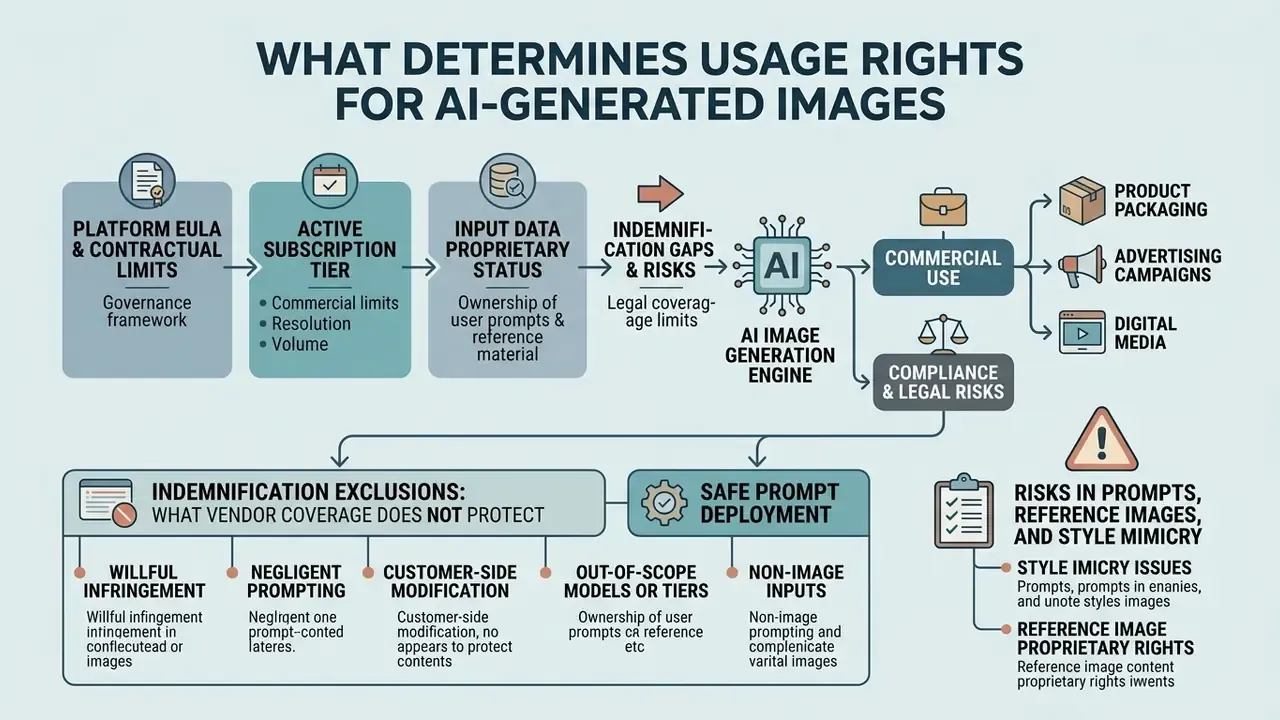
Usage rights for AI-generated images depend on four factors: the platform's contractual end-user license agreement (EULA), the active subscription tier, the proprietary status of prompt inputs, and the presence of third-party rights inside the final visual output.
Evaluate those four systematically. Skipping one is how a campaign gets pulled two days after launch.
AI Image Generator Licenses and Subscription Tier Limits
Platform terms of service set the contractual boundary for commercial deployment, and they frequently split permissions by subscription tier. Many vendors restrict free access plans to personal, non-commercial evaluation, then unlock commercial usage rights only on paid professional or enterprise plans.
Stability AI's Community License, for example, grants free commercial usage rights for core models only to individuals and organizations generating under $1 million USD in annual gross revenue.
"The Community License permits research, non-commercial, and commercial use of core models for organizations with annual revenue below USD 1 million."
Entities above that $1 million threshold need a paid Enterprise License to deploy derivative assets commercially. Midjourney applies a structurally similar rule: its documentation requires businesses above $1 million in annual gross revenue to hold a Pro or Mega subscription for commercial usage of generated images and videos.
Adobe Firefly takes a different route, permitting commercial utilization across both free and paid tiers, though corporate indemnification stays exclusive to enterprise contracts.
Enterprise risk officers should verify vendor revenue thresholds and licensing boundaries in writing before authorizing production workflows. Verbal assurance from a sales contact is not a license grant.
Indemnification Exclusions: What Vendor Coverage Does Not Protect
Contractual IP indemnification is often read as blanket immunity. It is not. Enterprise indemnities from major vendors carve out whole categories of behavior:
- Willful infringement. If a team knowingly prompts a protected character, a trademarked logo, or a named living artist, coverage is voided.
- Negligent prompting. Prompts engineered to produce output substantially similar to a specific copyrighted work fall outside indemnity scope. Adobe's generative AI product terms explicitly forbid prompts aimed at producing substantially similar copyrighted output and require the user to hold all rights to uploaded inputs.
- Customer-side modification. Post-generation compositing that introduces third-party assets shifts liability back to the customer.
- Out-of-scope models or tiers. Indemnity typically applies only to designated model versions on designated commercial plans, not to experimental or beta endpoints.
- Non-image inputs. Reference photography, uploaded logos, and third-party stock brought into the pipeline are the customer's rights problem, not the vendor's.
For financial institutions and other regulated deployers, generation logs belong in the enterprise model inventory alongside other model artifacts, consistent with model risk management expectations under SR 11-7 and comparable OCC guidance. Treat the image pipeline as a model with documented inputs, validation evidence, and named approvers. Not as an unmanaged creative tool sitting on someone's laptop.
Risks in Prompts, Reference Images, and Style Mimicry
Prompts or reference uploads that carry third-party trademarks, copyrighted characters, proprietary photography, or the distinct style of a living artist create real liability. Feeding protected assets into a generative model can support claims of direct or contributory copyright infringement.
One illustrative model-risk assessment, composite and anonymized, involved a regional commercial banking campaign. The creative team submitted reference photography containing proprietary architectural structures and trademarked interior decor. Internal review flagged the inputs and forced a full prompt redesign around royalty-free corporate assets. The intervention removed a plausible trade-dress claim before the ad ever ran. Cost of the fix: about four working days. Cost of the alternative: unknown, and that is exactly the point.
Major generative platforms prohibit infringing inputs upstream. Adobe's contributor and user terms forbid prompts designed to mimic specific living artists or real-world proprietary designs, and require users to hold all necessary rights for any uploaded reference image.
Negative prompt hygiene as a control. Enterprise prompt templates should embed standardized exclusion parameters at the pipeline level rather than relying on individual operator discipline. A minimum baseline exclusion string:
--no logos, brand names, trademarks, watermarks, signatures, text overlays,

recognizable celebrity faces, copyrighted characters, artist signatures
Store this string as a locked prefix or suffix in the shared prompt template library, so every generation request inherits it automatically. Any deviation should require documented sign-off from Legal.
Third-Party Rights in the Finished Image Output
Even with completely clean inputs, generative models can emit images containing recognizable brand logos, protected trade dress, or identifiable human faces. Publishing those commercially opens the door to trademark dilution, unfair competition, and right-of-publicity claims.
The U.S. Copyright Office Digital Replicas Report (2026) notes that unauthorized digital representations of real individuals, whether generated from scratch or synthesized from existing photos, violate state and federal publicity standards. The report defines "likeness" as an image "readily identifiable as the individual." NIST AI 600-1 guidelines point in the same direction operationally: audit visual output for unauthorized reproductions of licensed logos, patented product designs, and facial likenesses before assets enter commercial distribution, and track policy violations plus takedown requests as metrics.
The International Chamber of Commerce guidance (2026) adds a consent layer. Where AI generates or materially alters the image of a real, identifiable person for marketing purposes, permission should ordinarily be obtained, and marketing must not imply personal endorsement without prior permission.
Legal Readiness Decision Flow
| Stage | Gate | Decision Owner | Pass Condition |
|---|---|---|---|
| 1 | Business objective definition: determine commercial intent (marketing, product, advertising) | Creative Lead | Asset job stated in one sentence |
| 2 | Platform license verification: confirm paid tier and revenue threshold compliance | Procurement | Written license grant covers the intended channel |
| 3 | Upstream input audit: check prompts and reference images for third-party IP and trademarks | Legal | Zero protected terms; negative prompts applied |
| 4 | Downstream output clearance: audit the generated image for logos, trade dress, likeness | Legal + Brand | No recognizable third-party elements |
| 5 | Record retention and governance: archive prompts, seeds, terms, approval logs | AI Governance | Complete audit trail bound to asset ID |
| 6 | Safe commercial publication: deploy with appropriate synthetic media disclosure | Marketing Ops | Disclosure and C2PA metadata embedded |
Escalation path. When gate 3 or gate 4 returns a borderline result, say a partial trade-dress match, an ambiguous facial likeness, or style adjacency to a living artist, the asset does not proceed on creative discretion. Escalation order: Brand Lead, then Legal Counsel, then Chief Risk Officer. Legal holds veto authority over IP and publicity exposure. The CRO signs off on accepted residual risk. The Creative Lead may approve brand-fit questions only where no legal component exists.
Copyright: Who Owns AI-Generated Images
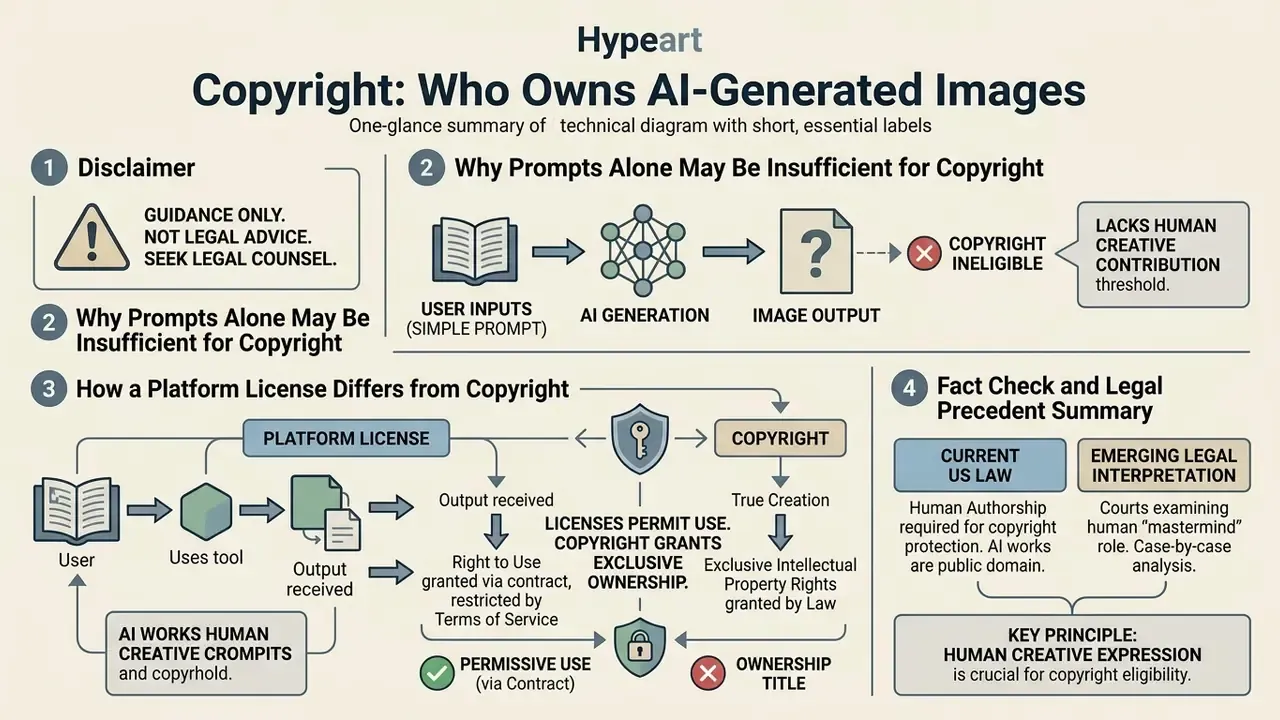
Under current U.S. and European frameworks, purely AI-generated images belong to no one and effectively enter the public domain on creation, because copyright law requires human authorship. A platform license can grant contractual permission to use an asset. It cannot manufacture statutory copyright where human creative control is absent.
The distinction between licensed usage rights and statutory ownership drives corporate IP strategy. Conflating them is the most common error I see in brand asset registers.
"When works were described as AI-created, participants were significantly more likely to recommend filing suit and to find copyright infringement."
That experimental finding has a blunt commercial consequence. Disclosure of AI provenance, while increasingly mandatory, statistically raises litigation appetite among decision-makers. The mitigation is not concealment. It is documented human authorship plus a clean provenance record that holds up under scrutiny.
Why Prompts Alone May Be Insufficient for Copyright
Text prompts convey ideas, stylistic parameters, and high-level instruction. They do not exert direct expressive control over the specific visual execution. Copyright protects original expression rather than the idea behind it, so typing a prompt does not make you the legal author of the render.
The U.S. Copyright Office reaffirmed in its 2025 Copyrightability Report that prompts alone do not provide sufficient human control over the final expressive elements.
"Merely supplying a prompt to an AI model does not constitute authorship, since the originality threshold requires free and creative choices reflected in the final work."
Two independent regulators, two doctrinal starting points, one conclusion. Protection becomes available where a human author exercises creative control through substantial selection, arrangement, or direct digital manipulation of the visual elements. The Copyright Office recognizes protection for human-authored portions, including a minimally creative selection, coordination, arrangement, or human modification of AI-generated material. Where the software autonomously determines composition, shading, and expressive detail, that material must be disclaimed in registration filings.
How a Platform License Differs from Copyright
A platform license is a private contract between vendor and user, governing how the tool and its output may be used. It grants permission to publish, modify, or sell an asset without the vendor suing for breach. OpenAI's service terms, for instance, grant a limited non-exclusive license whose scope depends entirely on the agreement and its term.
Copyright is different in kind. It is a statutory exclusive property right created by federal law, letting the owner stop any third party from copying, distributing, or modifying the work. So when a platform's terms say the user "owns" the output, that sentence is contract language, not statute. If the work lacks human authorship, third parties may copy the asset without infringing statutory copyright. Uncomfortable, but true.
"Study participants most frequently attributed authorship to AI users (mean = 0.508) and to the authors of training data (mean = 0.579), but not to the AI systems themselves."
Several major platforms also reserve broad rights over inputs and outputs. Midjourney's Terms of Service grant the company a perpetual, worldwide, royalty-free license to user inputs and generated assets. Adobe's Generative AI Product Specific Terms state that output submitted to an Adobe-hosted gallery may be used by Adobe under a perpetual, royalty-free license for marketing and model-use purposes. Contract review therefore has to examine both sides of the ledger: what you receive, and what you quietly surrender.
Fact Check and Legal Precedent Summary
| Authority | Instrument | Operative Rule |
|---|---|---|
| U.S. Copyright Office | 2025 Copyrightability Report; 2023 Registration Guidance (updated 2026) | Works generated solely by machine capabilities lack human authorship. Human authors may register only their original contributions: creative selection, arrangement, or post-generation editing. AI-generated portions exceeding de minimis thresholds must be explicitly disclaimed. |
| European Union | AI Act, Regulation (EU) 2024/1689 | Statutory copyright requires human intellectual creation. Purely autonomous outputs fall outside traditional IP protection. Providers and deployers face transparency and machine-readable tagging duties for synthetic content. GPAI providers must respect EU copyright law and publish a training-data summary. |
| NIST | AI RMF 1.0; AI 600-1 GenAI Profile (2024) | GenAI risk includes eased replication of copyrighted, trademarked, or licensed content without authorization, plus leakage of personally identifiable information including facial likenesses. |
| Platform EULAs | Midjourney, Adobe, OpenAI (current terms) | Contractual grants convey usage permissions but do not create statutory copyright enforceable against third-party copying. |
How to Choose an AI Image Generator for Commercial Use
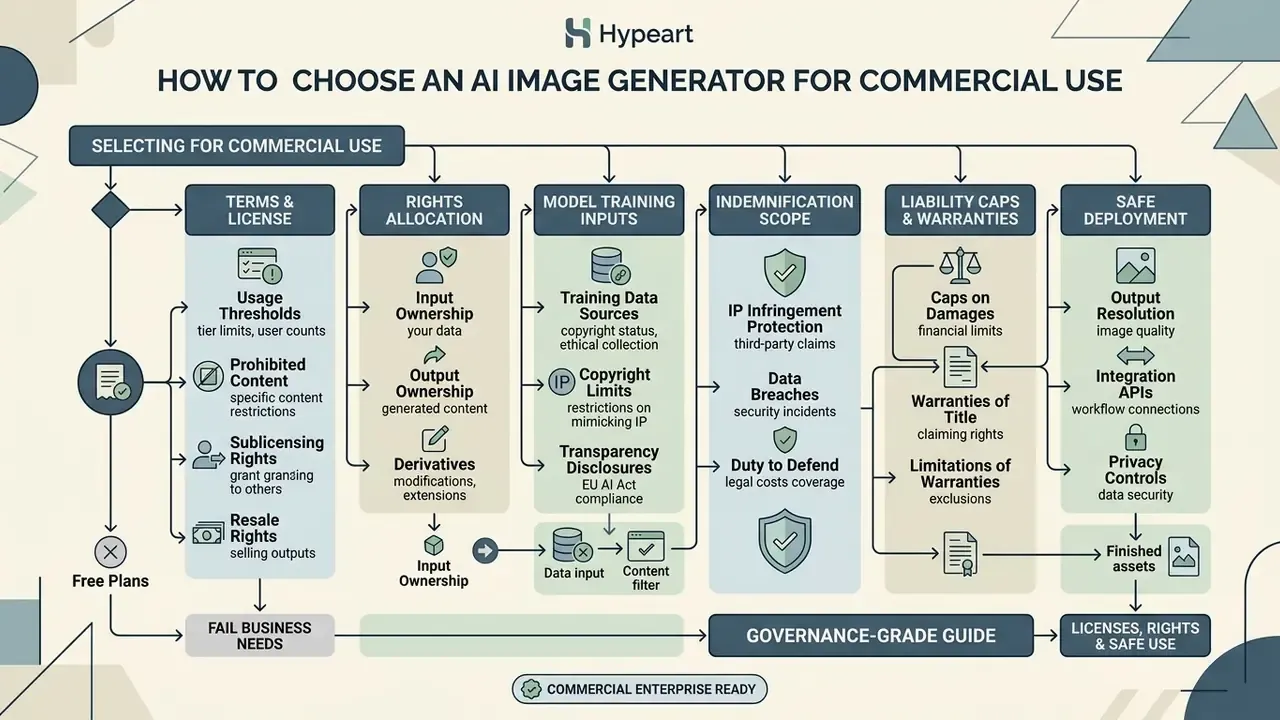
Selecting an AI image generator for commercial enterprise use means weighing licensing parameters, output resolution, privacy controls, indemnification options, and integration capability. Those are the same axes covered in our comparison of the best AI art generators. For regulated deployers, legal protection and data confidentiality outrank creative feature breadth. Every time.
| AI Image Generator | Commercial Use Rights | Free Tier Restrictions | Paid Tier Capabilities | Data Privacy & Model Training | Enterprise IP Indemnification |
|---|---|---|---|---|---|
| Adobe Firefly | Allowed on all plans (subject to terms) | Watermarked / credit limits | Full commercial rights; high-res export | Customer content not used for model training | Available for eligible enterprise accounts; excludes customer-caused infringement |
| Midjourney | Restricted on free; allowed on paid | Personal use only (where free credits offered) | Commercial rights granted (Pro/Mega required above $1M revenue) | Generations public by default; Stealth mode on higher paid tiers | Not provided under standard terms |
| DALL·E 3 (OpenAI) | Allowed for paid API and ChatGPT Plus | N/A (paid access) | Full commercial usage rights granted | Opt-out available for model training | Covered under enterprise business terms |
| Stable Diffusion / Flux (Stability AI) | Revenue-gated (free under $1M gross revenue) | Non-commercial or revenue-capped | Enterprise license required above $1M revenue | Local deployment ensures complete data privacy | Available via custom enterprise contracts |
| Ideogram | Allowed on paid plans | Non-commercial; public generations | Commercial usage granted; private generation | Public generation on free; private on paid | Not provided under standard terms |
| Canva AI Generator | Allowed for commercial design | Feature-limited credit allocation | Full commercial design deployment | Governed by Canva Pro privacy policies | Standard commercial platform terms |
Verify current vendor terms before procurement. Thresholds and indemnity scopes change without notice, and they have changed more than once in the past eighteen months.
Which Terms and License Clauses to Check Before Paying
Before buying subscription tiers or wiring up APIs, legal and procurement should read four clauses closely:
- Output Rights AllocationConfirm the vendor waives claims to customer outputs and grants commercial usage rights. Watch for gallery-submission clauses that quietly convert your output into vendor marketing material.
- Model Training InputsConfirm that customer prompts, seed images, and generated outputs are excluded from future foundation model training datasets. Adobe's terms state customer content is used for creative output, not model training. Other vendors default to opt-out rather than opt-in, which is a meaningful difference for a bank.
- Indemnification ScopeVerify whether the vendor offers IP indemnification against third-party copyright, trademark, or privacy claims arising from output usage, and whether coverage reaches training-data claims or stops at output claims.
- Liability Caps and WarrantiesAssess liability limits and warranty disclaimers on output originality and legal compliance. Most AI SaaS terms exclude accuracy and fitness warranties and cap damages at trailing subscription fees, which for a mid-size account may be a rounding error against a single infringement claim.
Teams evaluating multi-tool deployments can review the detailed commercial use ai tools matrix to compare governance controls across current generative software platforms.
Free AI Image Generators: When the Free Plan Fails a Business
Free tiers introduce operational, legal, and privacy risk that usually disqualifies them for corporate deployment. That pattern shows up consistently in our review of free AI art generators. Free plans routinely restrict output usage to personal evaluation, enforce public gallery indexing, reserve broad vendor rights to re-use customer inputs, and offer no contractual IP indemnification.
Using a free generative tier for corporate marketing or product development also creates trade-secret leakage risk, since prompts and uploads may enter public training pipelines. A product roadmap described in a prompt is still a product roadmap. Counter-examples exist, though: some vendors, including Fotor, explicitly permit commercial use of AI outputs on free access. So the rule is per-product, not universal, which is exactly why written verification rather than assumption must gate approval. Enterprise risk governance should mandate paid or local deployments with explicit contractual confidentiality and commercial clearance.
Be skeptical, too, of marketing claims that a "free commercial license" removes risk. A vendor granting free commercial rights to every user on every plan cannot also grant exclusivity. Identical or near-identical outputs may appear in a competitor's campaign, and no vendor license can confer statutory copyright where human authorship is missing.
Using AI Images in Marketing, Advertising, and Product Visuals
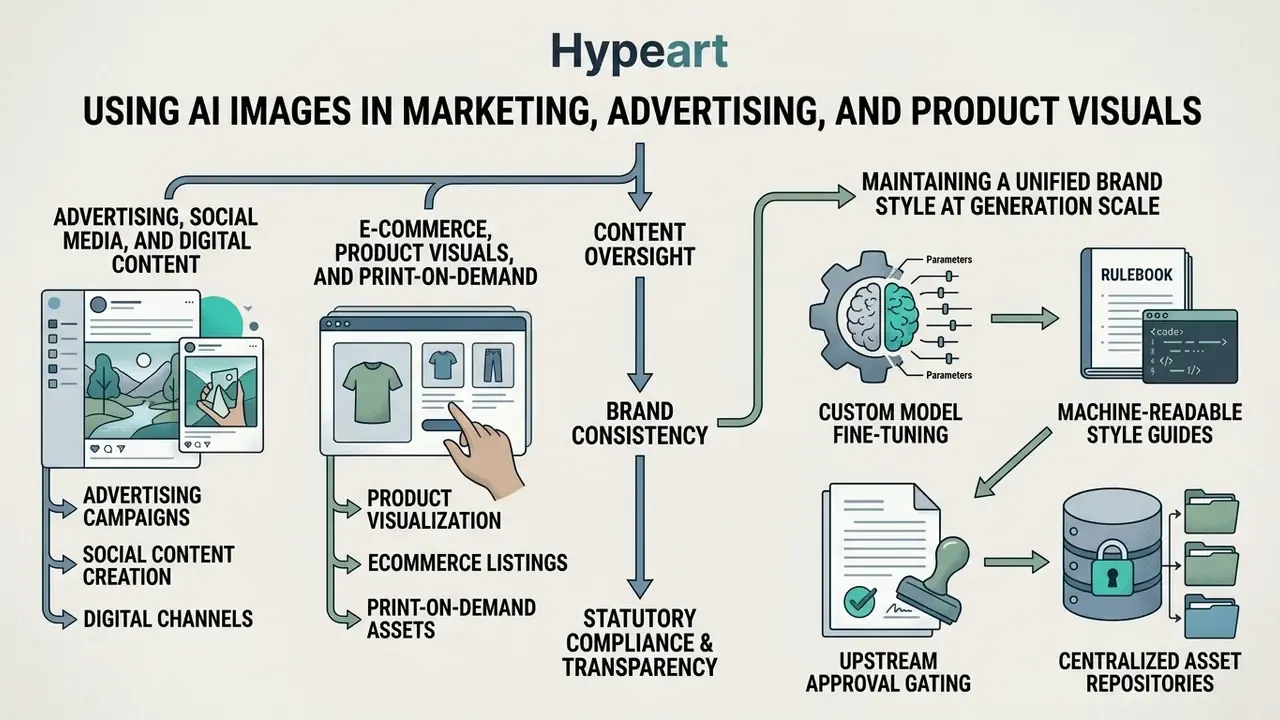
Integrating synthetic imagery into commercial marketing workflows takes three things: content oversight, brand consistency, and compliance with statutory transparency mandates. In that order of difficulty, roughly.
E-commerce, Product Visuals, and Print-on-Demand
Synthetic visuals in e-commerce listings or print-on-demand merchandise attract heightened scrutiny on consumer deception. If an AI-generated product visualization misrepresents physical merchandise, the business faces exposure under consumer protection statutes prohibiting deceptive advertising. The HKMA's 2024 consumer protection circular links generative AI consumer harms directly to misleading or deceptive representations, which is precisely the failure mode when product visuals diverge from shipped goods.
Across marketplaces, meaning Etsy, Merch by Amazon, Redbubble, Shopify, Printful, WooCommerce, vendors need to verify both platform-specific synthetic media disclosure rules and print resolution standards (minimum 300 DPI at physical output dimensions). Print-on-demand carries the sharpest IP exposure of any channel. The IAB's Legal Issues and Business Considerations When Using Generative AI white paper (2024) names copyright, trademark, and rights-of-publicity claims as the primary commercial risks, and merchandise designs drift toward recognizable characters, band logos, sports insignia, and celebrity likeness faster than any other category.
During one e-commerce catalog expansion, a retail team used AI outpainting tools to generate lifestyle backgrounds for physical products. Automated compliance review caught that the generation had altered actual product colors and shifted logo placement. Distribution was halted, the pipeline was re-cut to mask physical goods during background generation, and the deceptive-discrepancy exposure disappeared. The structural lesson is short. Never let the model touch the product. Mask the physical good, generate only the environment, then composite.
Under Article 50 of the European Union AI Act, commercial operators distributing synthetic media must ensure outputs are marked in a machine-readable format and labeled as artificially generated, with particular attention to public e-commerce channels.
Maintaining a Unified Brand Style at Generation Scale
Brand consistency across high-volume AI generation is won upstream, inside the technical workflow, not in a final review meeting. Unstructured prompting produces visual drift: inconsistent palettes, off-brand compositions, a catalog that looks like six agencies worked on it. Adobe's 2026 brand guidance argues the same case, placing brand checks inside creation and adaptation, evaluating tone, hierarchy, image choice, and channel fit before publication rather than after.
Four technical governance controls carry most of the weight:
Rules decay. Review the prompt template library, the negative prompt baseline, and the approved model list every quarter, because vendors deprecate and replace models on their own schedule, not yours.
- Custom Model Fine-Tuning
- Train custom Low-Rank Adaptation (LoRA) weights or ControlNet pipelines on cleared, brand-owned visual assets only. Never fine-tune on scraped competitor imagery.
- Machine-Readable Style Guides
- Convert static corporate brand guidelines into standardized negative prompts, fixed color hex-code inputs, locked aspect ratios, and structured prompt templates. A PDF cannot enforce anything at scale.
- Upstream Approval Gating
- Implement automated brand compliance checks for logo integrity, color accuracy, and composition rules before publication, with a documented writer, reviewer, approver chain and channel-specific publishing permissions.
- Centralized Asset Repositories
- Store validated prompts, seed values, and model versions in centralized asset management so generation is reproducible across global teams. Post-generation AI image enhancement steps should be versioned in the same record, so the published file traces back to its source generation.
Ready-to-Use Commercial Prompt Library
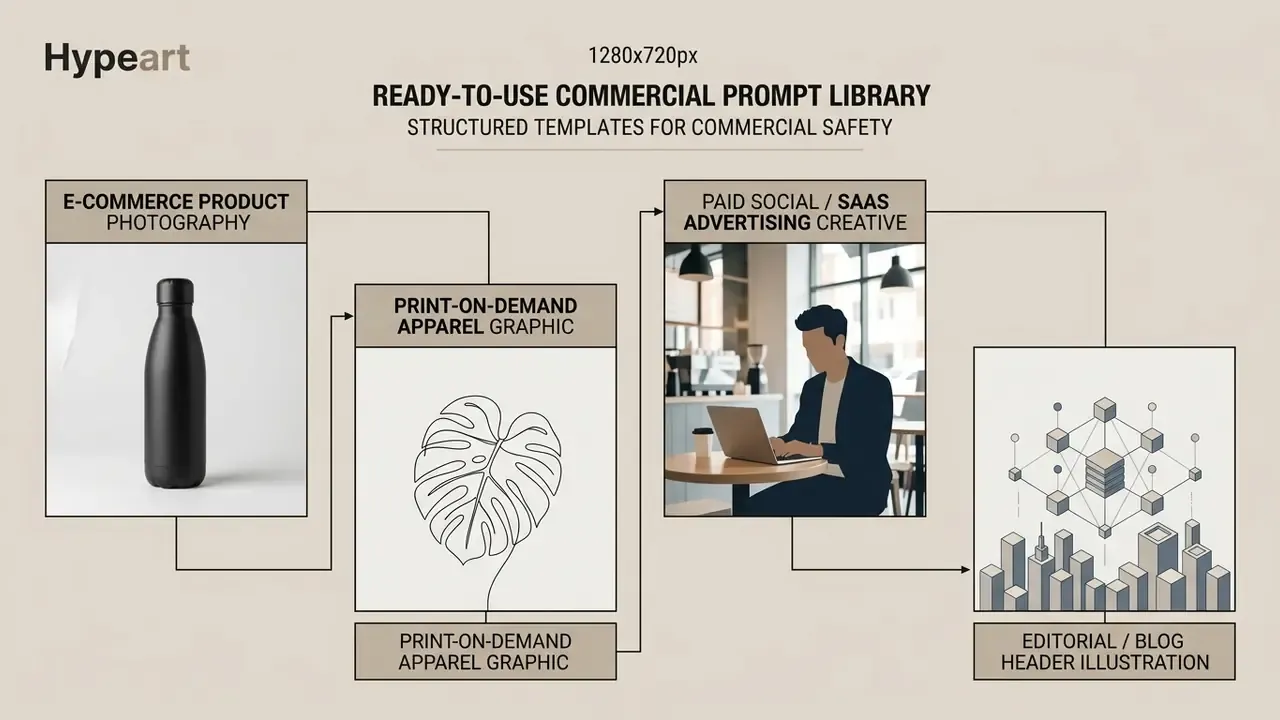
The following templates are structured for commercial safety. Each one specifies subject, lighting, composition, output specification, and an explicit exclusion string. Adapt the subject and palette; keep the exclusion parameters intact.
1. E-commerce product photography
Studio shot of a matte black stainless steel water bottle, clean neutral
seamless background, soft softbox lighting from upper left, subtle contact
shadow, centered composition, 8k resolution, commercial product photography
style
--no brand logos, text, watermarks, reflections of people, trademarks
2. Print-on-demand apparel graphic
Continuous single-line art illustration of a botanical monstera leaf,
minimalist vector aesthetic, pure black linework on transparent background,
balanced negative space, print-ready at 300 DPI
--no text, signatures, artist marks, gradients, copyrighted characters
3. Paid social / SaaS advertising creative
Bright authentic lifestyle photograph of a young professional working on a
laptop in a modern coffee shop, natural window lighting, warm neutral tones,
shallow depth of field with bokeh background, candid documentary feel,
4:5 vertical crop with clear negative space in upper third for headline overlay
--no legible screen content, brand logos, coffee shop signage, recognizable
celebrity likeness, text
4. Editorial / blog header illustration
Conceptual isometric illustration of interconnected data nodes above a city
skyline, flat vector style, restricted palette of #0B3D91 and #F2F2F2 with
single amber accent, generous left-side negative space, 16:9 aspect ratio
--no text, logos, national flags, real building trademarks, artist style
references
5. Product packaging concept
Front-facing mockup of a minimalist cylindrical cosmetic jar with brushed
aluminum lid, soft studio gradient background, even diffused lighting,
straight-on eye-level camera, high detail material rendering, 4k
--no printed text, barcodes, brand names, existing packaging designs,
trademarks
6. Lifestyle background for compositing (product masked)
Empty modern kitchen countertop in morning light, marble surface, blurred
plants in background, no objects on the counter surface, soft natural
side lighting, 3:2 aspect ratio
--no products, packaging, appliances with visible brands, text, people
Log every approved template with its seed range and the campaign it was cleared for. Reusable, pre-cleared prompts are the single largest efficiency gain available to a governed creative team, because the review cost is paid once instead of per asset.
The 5-Step Commercial Asset Job Protocol
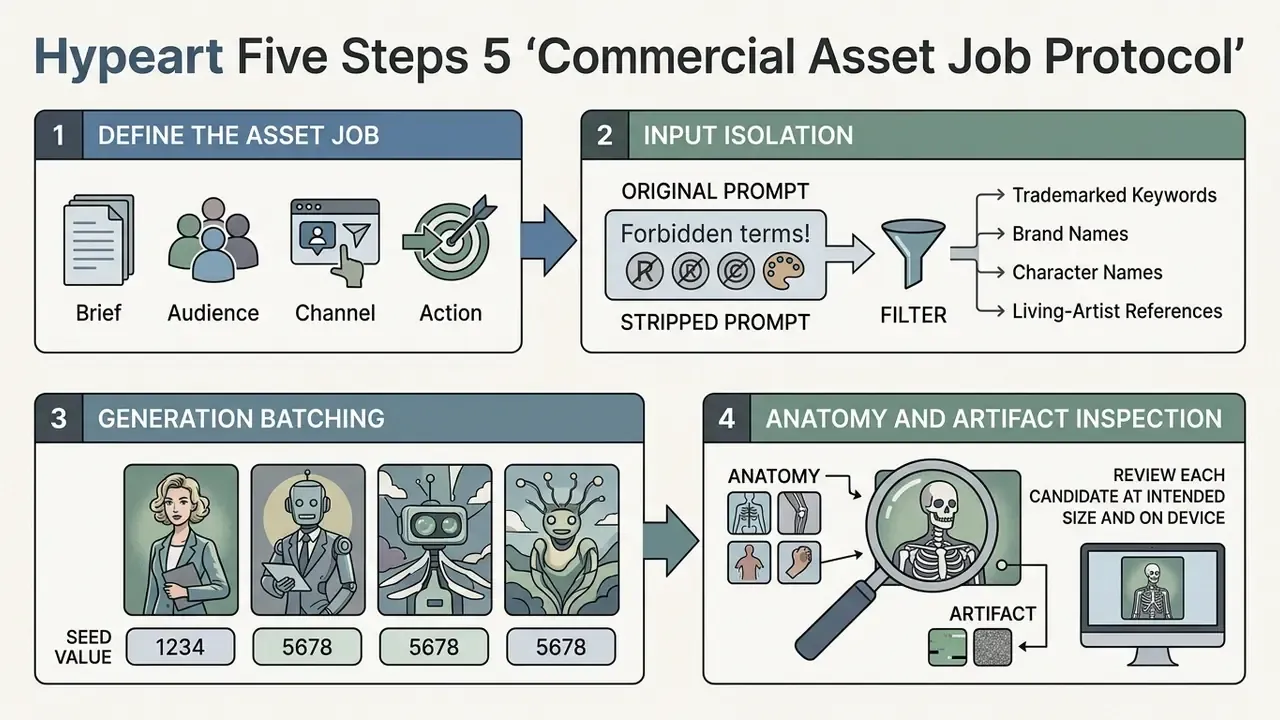
Pre-Publication Verification Checklist
Use this as a working checklist, ideally rendered as interactive checkboxes with the full text list preserved for accessibility and audit export. Each block has a named owner. Unresolved items escalate; they do not pass.
1. Commercial License Verification (Owner: Procurement)
- Was the asset generated under a paid plan or an approved enterprise contract?
- Does annual corporate revenue fall within the platform's permitted threshold?
2. Upstream Input Audit (Owner: Legal)
- Were all text prompts free of third-party artist names, brand trademarks, and protected characters?
- Was the standardized negative prompt baseline applied?
- Were uploaded reference photos fully owned by the company or explicitly cleared for commercial use?
3. Downstream Visual Clearance (Owner: Legal + Brand)
- Has the output been inspected for accidental reproduction of proprietary logos, trade dress, or products? Automated screening with AI image detection tools and reverse image search supports this step by surfacing near-duplicates of existing protected works.
- Does the image avoid unauthorized digital replicas or recognizable likenesses of real individuals?
- If an identifiable person appears, is written permission on file, and does the placement avoid implying endorsement?
4. Quality and Brand Alignment Review (Owner: Brand)
- Does the image accurately represent physical products without misleading consumer expectations?
- Does the visual style conform to corporate brand guidelines and color standards?
- At final display size, are hands, text areas, edges, and reflections free of artifacts?
5. Provenance and Record Retention (Owner: AI Governance)
- Are prompt histories, model seed numbers, software versions, and approval records archived in internal logs?
- Has C2PA metadata or appropriate synthetic media disclosure been embedded in the final file?
- Is the record bound into the enterprise model and asset inventory for audit retrieval?
6. Escalation (Owner: CRO)
- Any item flagged in blocks 2 or 3 escalates to Legal. Accepted residual risk requires CRO sign-off with a dated note in the asset record.
Prompt & Governance Audit Log Template
Copy the structure below into your DAM, GRC platform, or a version-controlled CSV. One row per published asset. No asset publishes without a completed row.
| Date | Asset ID | Campaign / Channel | Tool | Model + Version | Subscription Tier | Prompt (full) | Negative Prompt | Seed # | Reference Inputs + Clearance Ref | Human Edits Applied | Reviewed By | Approved By | Escalated? (Y/N + Owner) | C2PA Hash | Disclosure Method |
|---|---|---|---|---|---|---|---|---|---|---|---|---|---|---|---|
Retention guidance. EU AI Act provisions require providers to retain automatically generated logs under their control for at least six months, unless other law requires longer. Public-sector records guidance from Australia, Queensland, and the U.S. National Archives goes further, treating prompts, source data, processing steps, audit trails, and outputs as records subject to retention. For commercial deployers, align retention with the longest applicable statute of limitations for IP claims in your operating jurisdictions rather than with the six-month regulatory floor. Six months is a floor, not a policy.
Limitations and Open Questions
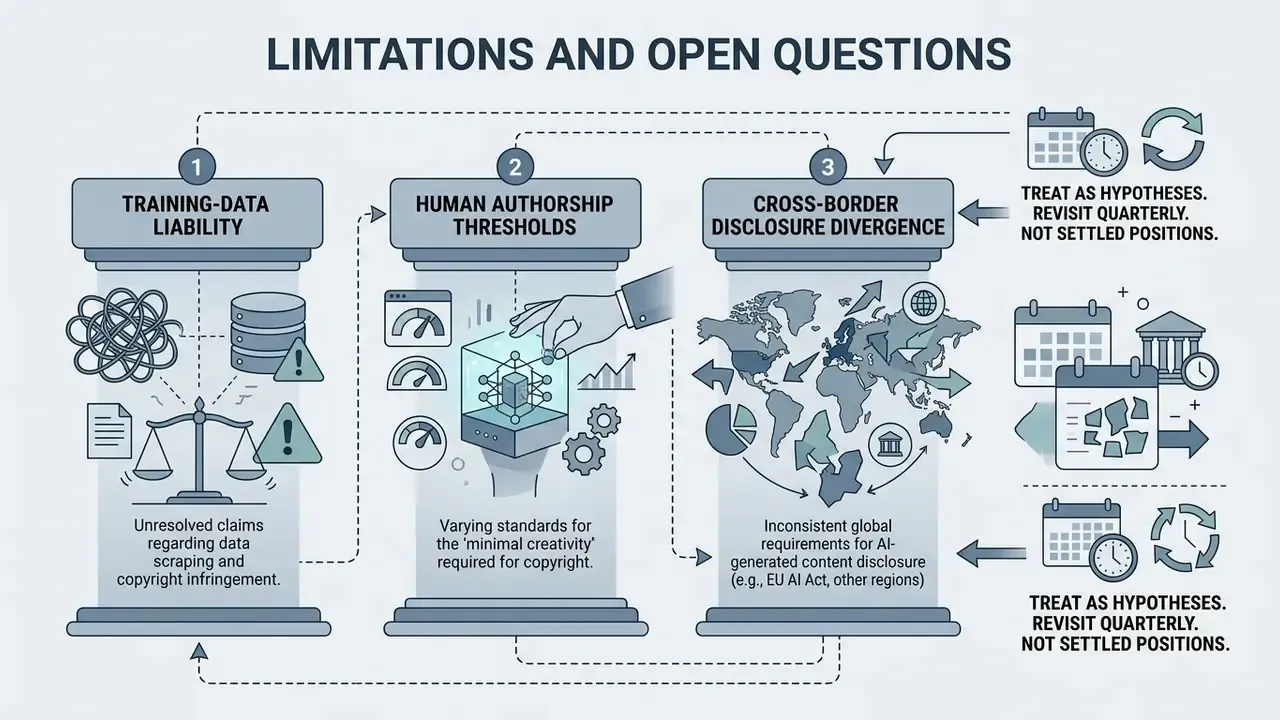
Three areas remain genuinely unsettled, and any guide that pretends otherwise is overselling.
Training-data liability. Litigation over whether model training on protected works constitutes infringement is active and unresolved in multiple jurisdictions. Vendor indemnities that cover output claims but exclude training-data claims leave that residual with you. Price it explicitly rather than assuming it away.
Human authorship thresholds. The Copyright Office recognizes protectable human contribution, but the boundary between "creative selection and arrangement" and "de minimis editing" has not been tested at volume. For asset classes where ownership matters commercially, such as flagship brand imagery, document the human editing steps in detail.
Cross-border disclosure divergence. EU marking duties, U.S. state publicity statutes, and industry codes in Canada and Australia do not align perfectly. A single global campaign may need channel-specific disclosure variants, which is an operational cost most ROI models omit.
Treat all three as hypotheses to be revisited quarterly, not as settled positions.
A Safe Next Step
If you are starting from scratch, do not begin with tool selection. Begin with one inventory question: which published assets in the last twelve months were generated or materially altered by AI, and can you prove the license and inputs for each? Most institutions cannot answer that in the first week. That answer, or its absence, sets the priority order for everything above.
Then run one governed pilot: one vendor, one paid enterprise tier, one written asset job, the locked negative prompt baseline, a populated audit log. Expand only after that pipeline survives a complete internal review cycle.
FAQ on AI Image Generator Commercial Use
Do you have to tell the audience an image was AI-generated?
Increasingly, yes, driven by both regulation and consumer expectation. Article 50 of the EU AI Act sets mandatory transparency requirements for synthetic media, requiring businesses to ensure generated images are machine-readable and visibly tagged as AI-generated, with obligations applicable from 2 August 2026. Advertising bodies such as IAB Canada recommend consumer-facing disclosure whenever synthetic visual alterations materially affect content authenticity or identity representation. The Partnership on AI's synthetic media framework offers the practical test: disclose synthetic elements when not knowing about the synthesis would change how the content is perceived, and distinguish viewer-facing labels from embedded provenance such as C2PA metadata. Standardized captions, C2PA tags, or visible watermarks protect brand reputation and keep compliance evidence intact.
What records should a business keep for commercial AI content?
Keep comprehensive, time-stamped generation logs, so an audit trail exists before anyone asks for it. Retention should cover:
- Complete text prompt histories and negative prompt parameters.
- Model names, software version numbers, and seed values.
- Source licenses and provenance records for any uploaded reference images.
- Software subscription invoices and terms of service active at the time of generation.
- Internal approval sign-offs from legal, brand, and compliance reviewers.
- Immutable C2PA provenance metadata embedded in published final image files. In one illustrative internal audit at an institutional fintech provider, risk officers found hundreds of promotional visuals with no provenance documentation at all. Compliance built an automated logging pipeline that bound generation parameters, subscription receipts, and sign-off logs to every asset record, and registered the pipeline in the firm's model inventory. Subsequent model risk management reviews cleared without a finding. The fix was unglamorous and it worked.
Are AI-generated images copyrightable?
Only in part, and only where a human contributed protectable expression. Purely machine-determined output is not registrable in the United States and sits outside ordinary copyright protection in the EU. Where a human performs creative selection, arrangement, compositing, or substantial digital modification, those contributions can be registered, with the AI-generated portions explicitly disclaimed. Mixed human-AI artwork in print-on-demand contexts is especially prone to contested ownership, because the human contribution is often thin.
Can an AI image generator replace a designer in business?
No. AI image generators act as productivity accelerants, not replacements for professional commercial designers. Generative tools shift the designer's role from manual asset production toward analytical, instructional, evaluative, and curatorial work: defining the problem, structuring prompts, judging outputs, holding coherence across a system of assets.
"Advanced AI-Bayesian pipelines achieve a mean CTR of 0.98% versus 0.87% under purely aesthetic optimization, demonstrating the value of human oversight." Leveraging Generative AI for Visual Content in Digital Advertising, University of Alberta (2024) Research on design automation for complex products frames generative AI as an "assistance layer" that orchestrates inputs and outputs rather than replacing a practitioner's workflow. Generative models compress ideation, iteration, and background expansion. Human designers remain essential for strategic brand stewardship, emotional storytelling, complex composition, and compliance validation. ROI peaks when the generator runs as a supervised assistance layer, not as an autonomous publisher.
How many variations should be generated before selecting one?
Four to six controlled variations per asset job, with recorded seeds. Fewer than four rarely surfaces a genuinely better direction. More than six usually signals an underspecified brief. Change one variable per iteration so the selection rationale is documentable later.
Can AI images be used for client deliverables and agency work?
Yes, provided the license permits sublicensing or transfer to the client and the agency has completed input and output clearance. Confirm explicitly whether the vendor license travels with the file. Some do, some grant rights only to the account holder. Where transfer is unclear, deliver under a written agency warranty that scopes what has and has not been verified.
What is the safest starting point for a team new to commercial AI imagery?
One vendor, one paid enterprise tier, one written asset job, the locked negative prompt baseline, and a populated audit log. Do not run parallel free-tier experiments with company data. Expand tooling only after the first pipeline survives a full internal review cycle. This article is general informational analysis based on established U.S. and EU legal doctrines, published regulatory guidance, and current vendor terms as of April 2026. Licensing terms, revenue thresholds, and indemnification scopes change frequently, so verify current vendor documentation before procurement. Nothing here constitutes legal advice. Consult qualified intellectual property counsel for jurisdiction-specific guidance. Audience descriptions and illustrative cases in this guide should be treated as hypotheses until confirmed by your own analytics, interviews, or customer research.
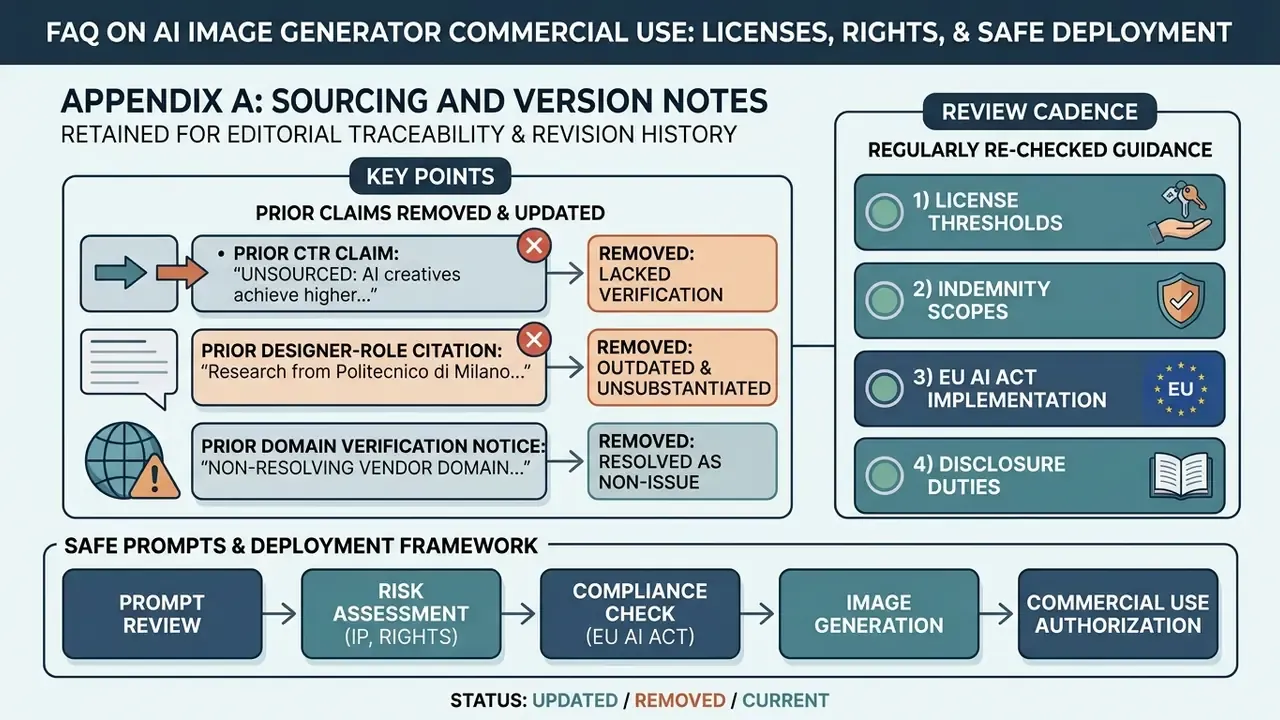
Appendix A. Sourcing and Version Notes