If you sit in risk, compliance or model governance at a bank or a mature fintech, a copywriting tool sounds like somebody else's problem. It usually isn't. The moment a marketing team pastes pricing logic or an unreleased product spec into a free web tool, you have an unlogged model, an unapproved data flow and public-facing claims nobody validated. That is the reason this guide covers prompts and audit trails in the same breath.
What You Need to Know in 60 Seconds
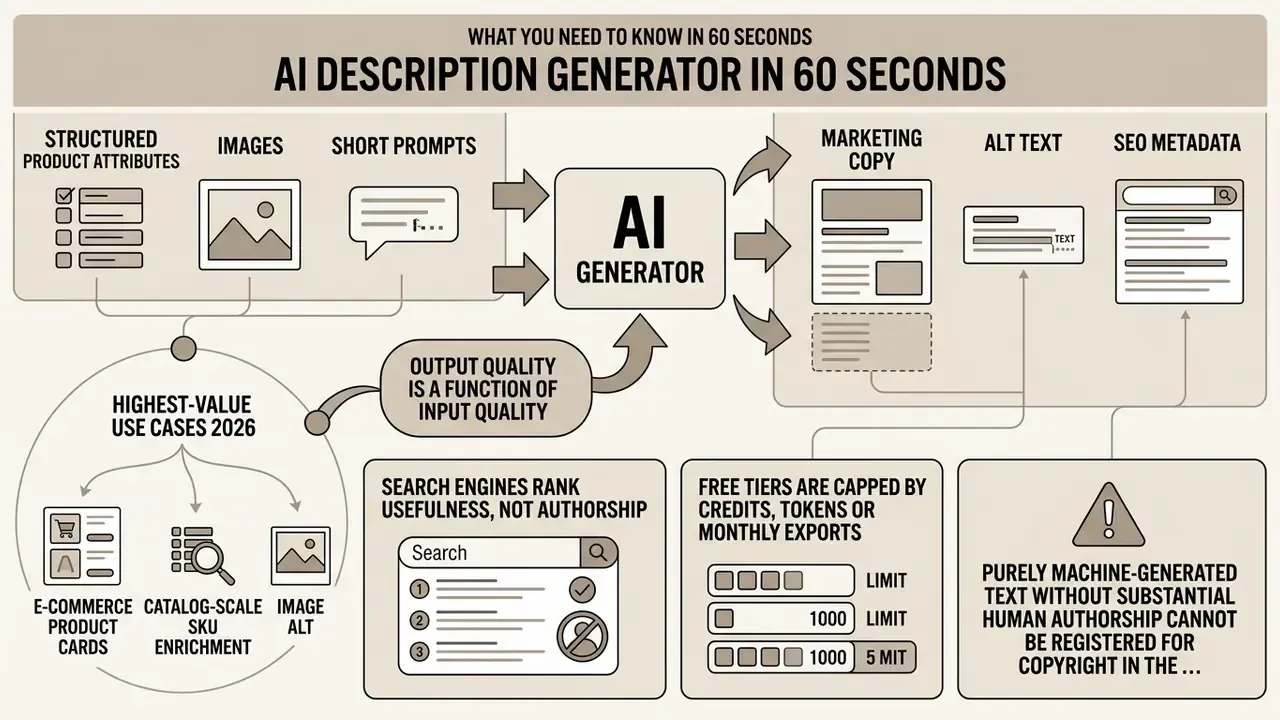
- An ai description generator turns structured product attributes, images or short prompts into publish-ready marketing copy, alt text and SEO metadata.
- The highest-value use cases in 2026 are e-commerce product cards, catalog-scale SKU enrichment, image alt text, social captions, YouTube descriptions, job postings and AI image prompts.
- Output quality is a function of input quality. Canonical specs, a brand glossary, explicit word limits and a copywriting framework (PAS, AIDA or FAB) do most of the work.
- Search engines rank usefulness, not authorship. But low-effort, fully automated pages earn 2 to 3 times fewer organic impressions, according to Ahrefs Search Console data.
- Free tiers are capped by credits, tokens or monthly exports. Enterprise adoption additionally requires data-privacy terms (no vendor training on your inputs), SOC 2 evidence and a reproducible audit trail.
- Purely machine-generated text without substantial human authorship cannot be registered for copyright in the United States, so human editorial transformation is a commercial necessity, not a formality.
How to Read This Guide
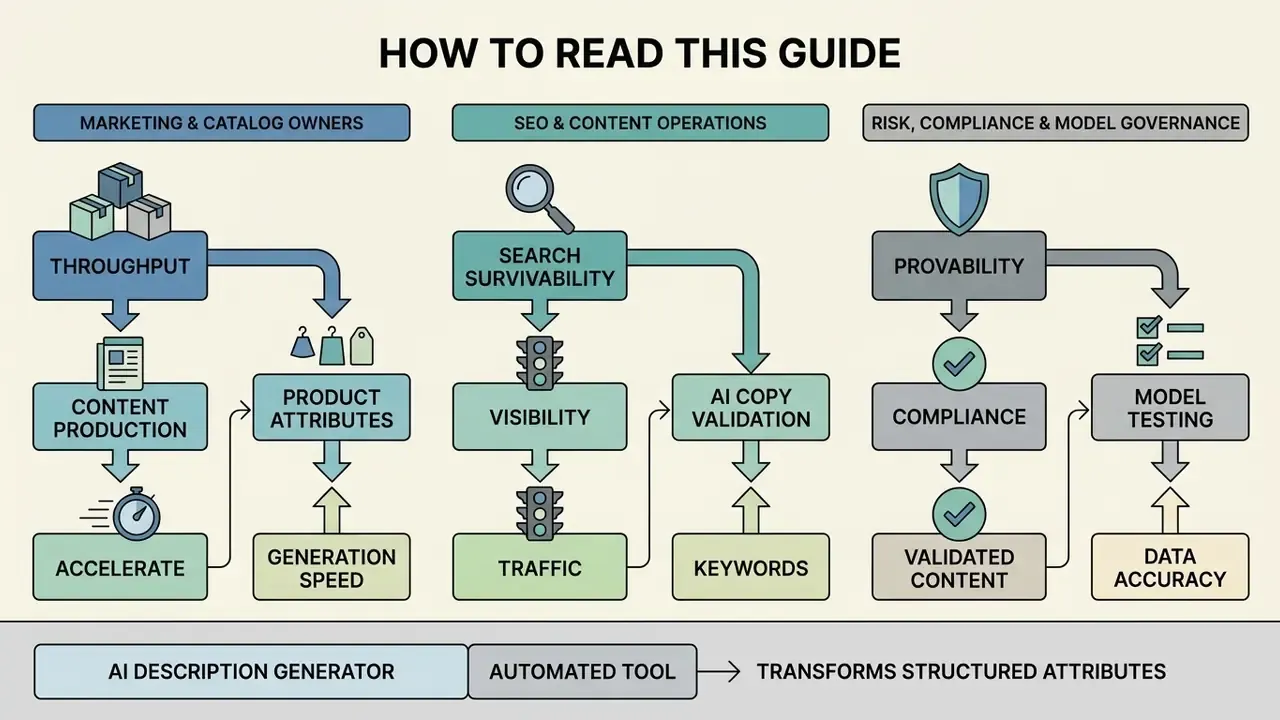
Three audiences usually land on this page with different questions, and they should read it in different orders.
Marketing and catalog owners care about throughput. Start with the use-case section, then the prompt templates, then the platform length matrix. Those three sections are enough to produce a first batch of descriptions this week.
SEO and content operations care about whether generated copy survives contact with search. The optimization section and the A/B testing method matter most there, plus the readability rules borrowed from plain-language authorities.
Risk, compliance and model governance care about provability. Read the enterprise risk section and the free-versus-paid control table first, then come back to the workflow to see where the two review gates sit. Everything else is downstream of those gates.
An ai description generator is an automated software tool that transforms structured product attributes, visual data or raw text prompts into clear marketing copy, SEO metadata and catalog text. Organizations use these systems to scale content production, standardize brand voice and accelerate catalog publishing across e-commerce and digital channels. The same validation logic applies whether you are describing a sneaker, a mortgage product or a video: define the input, constrain the output, verify before publishing.
What Is an AI Description Generator?
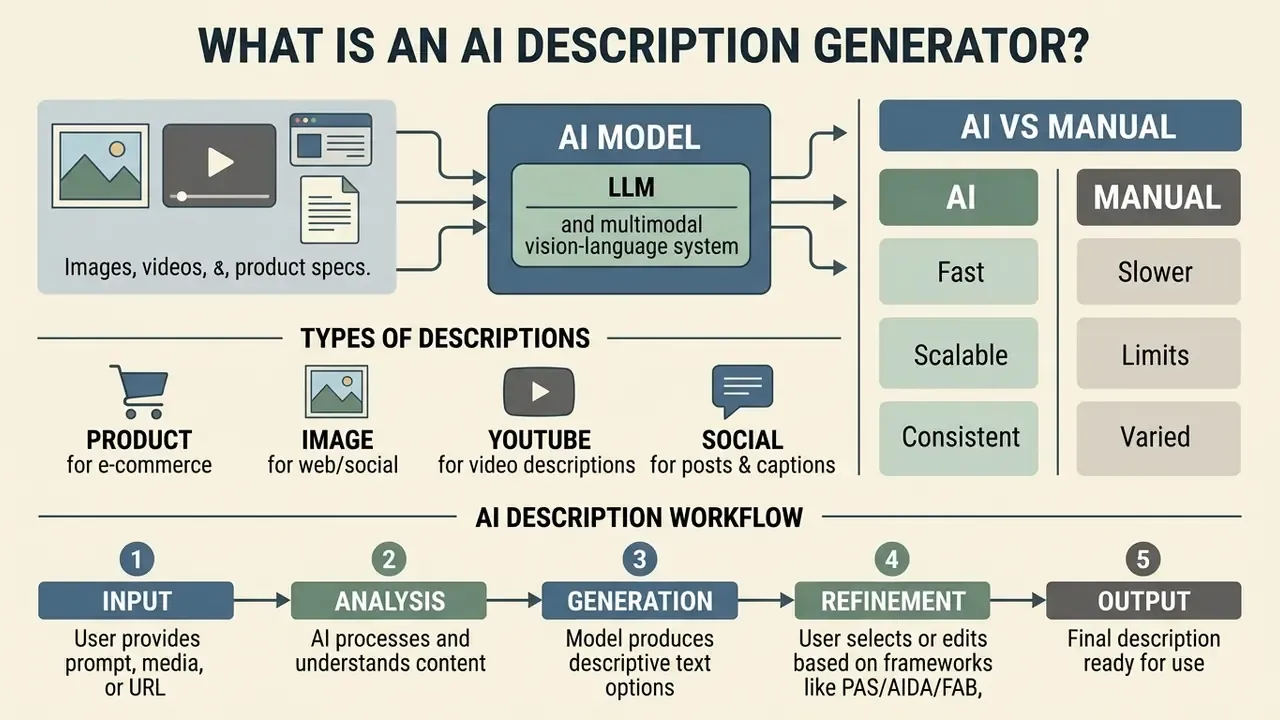
An ai description generator is a machine learning system, typically powered by a large language model (LLM) or a multimodal vision-language model, designed to produce human-readable descriptive text automatically. Known variously as an ai description creator, an ai description maker, a description generator ai or a description maker ai, the system converts input signals into formatted text tuned for clarity, search visibility and conversion.
One clarification before we go further. The label matters less than the contract: what goes in, what comes out, who signs off.
Types of Descriptions AI Can Generate
Modern systems produce five primary descriptive formats: short product summaries, technical product descriptions, image alt text, social media copy and search engine optimization (SEO) metadata. A descriptive ai generator processes input specs to construct narrative bullet points and product listing cards. Advanced multimodal models analyse visual assets directly to generate captions, supporting both consumer readability and image-search indexability.
Platform documentation shows how granular these modes have become. Microsoft's Windows image-description API exposes Brief, Detailed, Diagram and Accessible modes, while Google's ML Kit GenAI Image Description API returns a single short caption per image. If you need alt text for a chart and a caption for a lifestyle photo, those are two different jobs with two different prompts. Related tooling in this family, including an ai chatbot maker for conversational surfaces, follows the same input-constraint logic.
AI Description Generator vs Manual Writing
Using a description generator ai compresses drafting time compared to manual writing, letting a small team produce hundreds of product cards in an afternoon. Manual writing still wins on contextual nuance, category expertise and legal sensitivity. It simply does not scale across a 40,000-SKU catalog on a seasonal deadline.
«GPT-4 consistently produces descriptions with high readability, persuasiveness and SEO characteristics, frequently outperforming human copy on machine-scored metrics.»
Guidance on AI content operations reports that structured workflows compress review and approval cycles by roughly 40% to 60%, cutting revision rounds from 5 to 7 down to 2 to 3, and deployment timelines from 7 to 10 days down to 2 to 4 days. See AI Content Operations Workflow: Brief, Draft, Review (CellCog, 2026). Those figures come from vendor and agency practice rather than peer-reviewed measurement. Other sources report a more conservative 2x to 4x throughput gain at equivalent quality, because baselines and governance maturity differ wildly between teams. Treat the range as directional, and benchmark it against your own pre-AI cycle times before you build a business case on it.
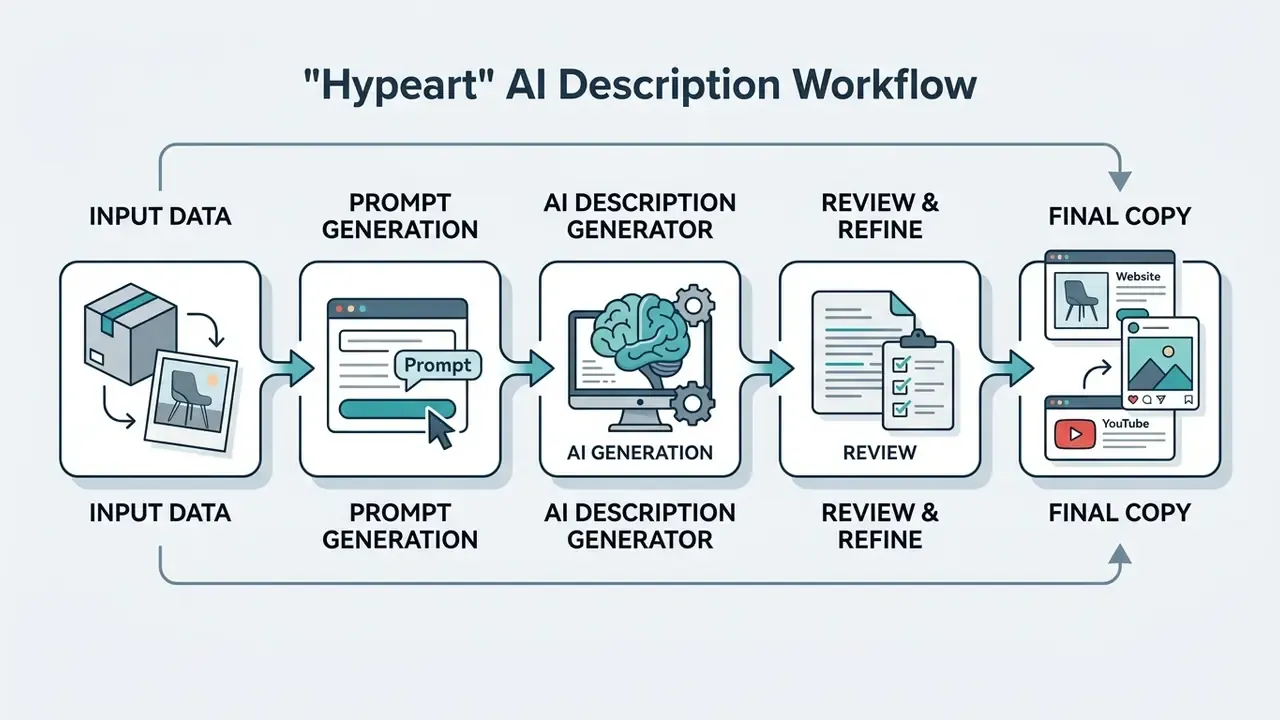
The AI Description Workflow in Five Stages
| Stage | What Happens | Owner |
|---|---|---|
| 1. Input data | Canonical attributes, images, brand guidelines and target keywords are collected | Product / catalog team |
| 2. Prompt structuring | Context, persona, tone and keyword constraints are encoded into the prompt | Content operations |
| 3. Generation | The AI text description generator produces one or more drafts | Model / tool |
| 4. Verification | Human editorial, factual and compliance review; decisions are logged | Editor + compliance |
| 5. Publishing | Approved copy is deployed to the storefront, CMS or PIM | Publishing authority |
This five-stage pipeline moves raw product inputs into controlled public deployment. In practice, stages 1 and 4 determine roughly 80% of output quality. Generation itself is the cheapest link in the chain, and the easiest to over-credit.
What Can You Create With an AI Description Generator?
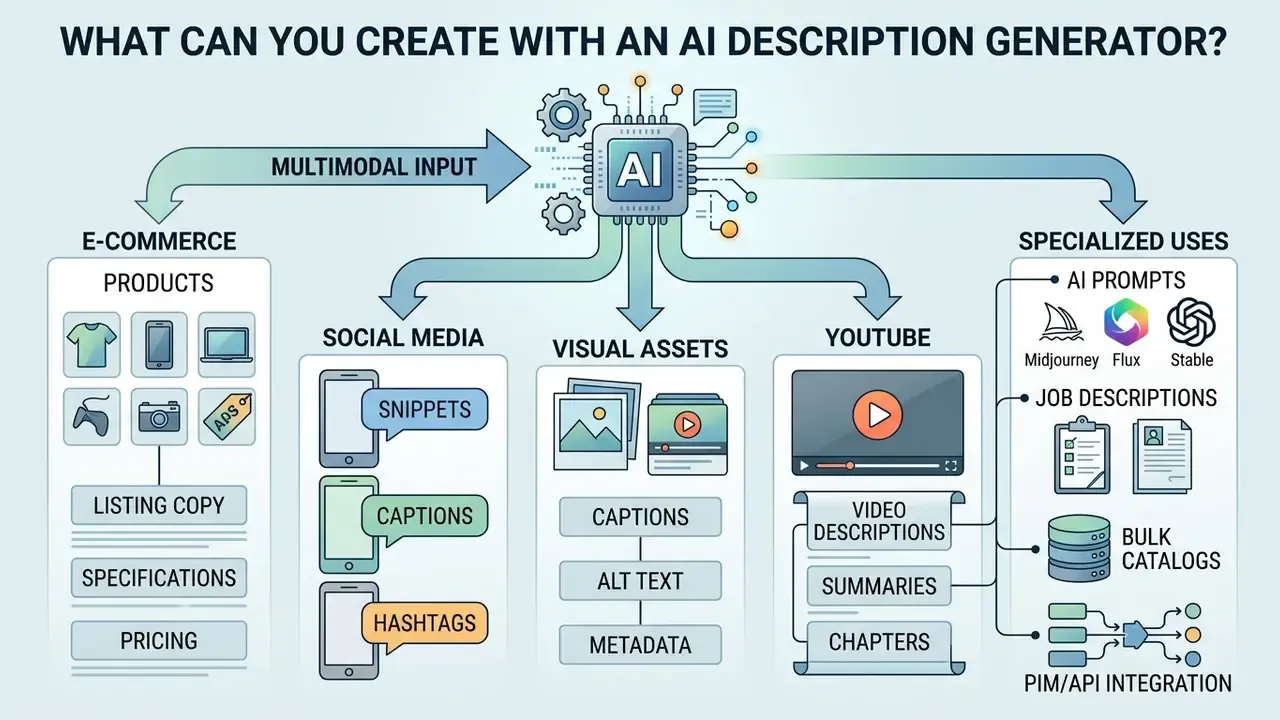
An ai generator for description tasks can create product listing copy, visual asset captions, promotional social snippets and structured search metadata across multiple digital channels. Businesses deploy these generators to remove manual copywriting bottlenecks in e-commerce storefronts, digital asset management systems and multi-channel campaigns.
Product Descriptions for E-commerce and Sales
E-commerce teams use a product description generator to convert raw SKU data, such as dimensions, materials and features, into persuasive sales copy and structured bullet points. Randomized field studies on cross-border e-commerce platforms show that integrating AI-generated product descriptions yields a statistically significant 1.1% increase in order placement rates compared with static human copy. Small number, large base. On a nine-figure GMV, that is not a rounding error.
«Estimated annual value gains from AI applications, including product descriptions, reach up to USD 5.18 per consumer at the upper bound of the calculations.»
Combining structured product briefs with automated generators lets platforms hold listing quality at catalog scale. Practical implementations echo this. Metorik's generator accepts a product name, rough specs or a photo, then returns a full description, feature bullets and an SEO meta description, reading visible attributes such as colour, material, style and shape straight from the image.
Specialized Description Use Cases: From YouTube to AI Image Prompts
The description-generation category extends well beyond product cards. Four specialized formats deserve their own prompt patterns.
- YouTube video descriptions. The first two or three lines appear above the "Show more" fold, so they must carry the hook and the primary search term. A complete description then adds naturally placed keywords, links to your site and social profiles, and chapter markers (timestamps) for longer videos. Ask the generator for a fold-safe hook of 200 characters or fewer, a 100 to 150-word body, and a timestamp block derived from your transcript.
- AI image prompts (Midjourney, Flux, Stable Diffusion). A description ai generator can invert the workflow. Instead of describing an image for humans, it converts a plain-language visual idea into structured generation parameters: subject, composition, lighting, lens and film stock, art style, negative prompts and aspect-ratio flags such as
--ar 16:9. Specialized tools expose separate modes for General Image Prompt, Flux Prompt, Midjourney Prompt and Stable Diffusion Prompt, because each renderer parses syntax differently. Adjacent generative categories behave the same way, from an ai christmas photo template to an ai chord progression tool: the syntax is the interface. - Job descriptions and HR content. Internal skill matrices and levelling frameworks can be transformed into compliant, non-biased postings with clear responsibilities, qualifications and inclusive language. Generate the interview scorecard in the same pass, so the posting and the evaluation criteria stay aligned. Regulated employers should still route the final text through HR compliance.
- Bulk enterprise catalogs (PIM and API integration). Large retailers push thousands of raw SKUs through CSV upload or API pipelines, with marketplace policy rules enforced automatically, for example keeping listings aligned with Amazon's frequently updated listing guidelines, and with automatic translation into 25+ languages for cross-border expansion. Shopify App Store listings show how this is packaged commercially: apps generate titles, meta descriptions, tags and seasonal copy, with monthly credit caps of 600 on mid-tier plans and 2,400 on enterprise tiers. If you are wiring this into a PIM, explore the hub for integration patterns first.
Supported Multimodal Input Formats
| Input Type | Typical Supported Formats | Common Limits |
|---|---|---|
| Still images | JPG, PNG, WebP, BMP, GIF, HEIC, HEIF | 10 MB for guest use, 20 MB when signed in |
| Image references | Direct image URLs | Publicly reachable links only |
| Video | MP4 plus transcript or caption file | Description generated from frames and audio transcript |
| Structured data | CSV, XLSX, JSON via API or PIM connector | Row and credit quotas per plan |
| Output languages | 12+ languages in mainstream tools; 25+ in enterprise suites | Some vendors document English-only image captions |
Verify format support and file-size ceilings in the vendor's own documentation before designing a bulk pipeline. Microsoft, for example, documents English-only image descriptions in Azure AI Vision, a constraint absent from other vendors' pages.
How to Use an AI Generator for Description Writing
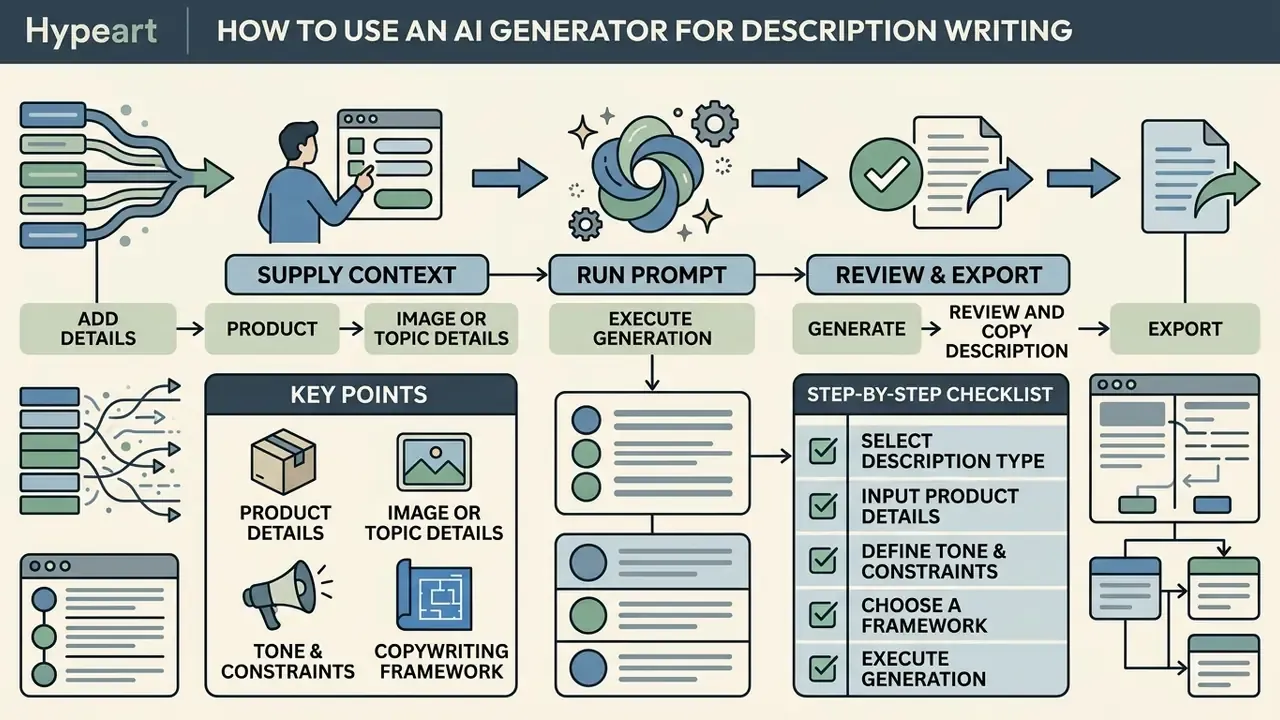
To write descriptions through an ai generator description workflow, you supply structured context, run the prompt, review the generated text for accuracy, then export the finalized copy. A standardized prompt structure keeps output aligned with operational requirements, brand tone and search goals.
Add Product, Image or Topic Details to the Prompt
High-quality outputs depend directly on the detail and structure of the initial input. Define the persona, product specifications, visual attributes, target audience and output format. Vague in, generic out.
Explicit constraints on word limits, negative keywords and tone attributes prevent off-brand responses from a description ai generator. Public prompt frameworks converge on the same four slots, persona, task, context and format, with the Singapore Government's CO-STAR playbook adding Style, Tone and Audience as separate fields, and NIST's prompt-engineering tutorial noting that output-format instructions should define structure explicitly: numbered list, table or bullet block.
«Instructing the model to "act as an e-commerce expert" together with the product title, brand and attributes significantly improves the relevance of generated descriptions.»
Generate, Review and Copy the Description
Once the ai text description generator returns a draft, editorial teams must review the text before copying it into production systems. Verification confirms factual accuracy, brand alignment and every technical claim, including the ones that look harmless.
In a catalog expansion project we advised on, introducing an explicit three-step review checklist for automated descriptions eliminated factual errors from published documentation across roughly 5,000 product pages. That is internal practitioner data. It has not been independently audited or peer-reviewed, so treat it as an illustration of process design rather than a benchmark. The direction of the finding matches qualitative research on human and AI co-creation:
«Participants prefer to use AI as a "second mind" during ideation while retaining final control over editing and publication.»
Our own scaled-content experience covers regulated verticals too, where compliance review is mandatory rather than optional; if you need to compare workflow models side by side, open the hub.
Step-by-Step Checklist
- Select description type.Decide whether the output is a product card, image alt text, social caption, YouTube description or AI image prompt.
- Input product details.Supply canonical attributes, materials, dimensions, price context and target keywords.
- Define tone and constraints.Specify brand voice, output word counts, structural formatting and negative keywords.
- Choose a copywriting framework.Instruct the model to use PAS, AIDA or FAB depending on channel and product type.
- Execute generation.Run the prompt through the selected AI description creator tool, requesting two or three variants for testing.
- Editorial verification.Inspect each draft for factual precision, unsupported performance claims, compliance risk and language naturalness.
- Log the audit trail.Record the prompt version, model and version identifier, reviewer name, edits made, and the rationale for approval or rejection. This change log is what internal audit and regulators will ask for.
- Export and publish.Copy the verified text into your CMS, storefront or catalog database through an authorized publishing route.
Steps 6 and 7 separate a marketing shortcut from an auditable content process. Skip the log and you can prove the outcome but not the control.
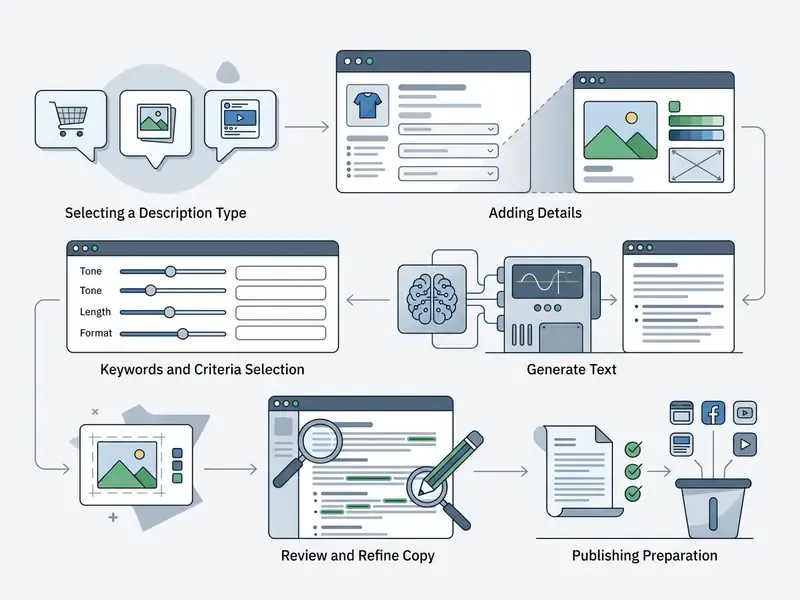
Prompt Templates and Real Outputs
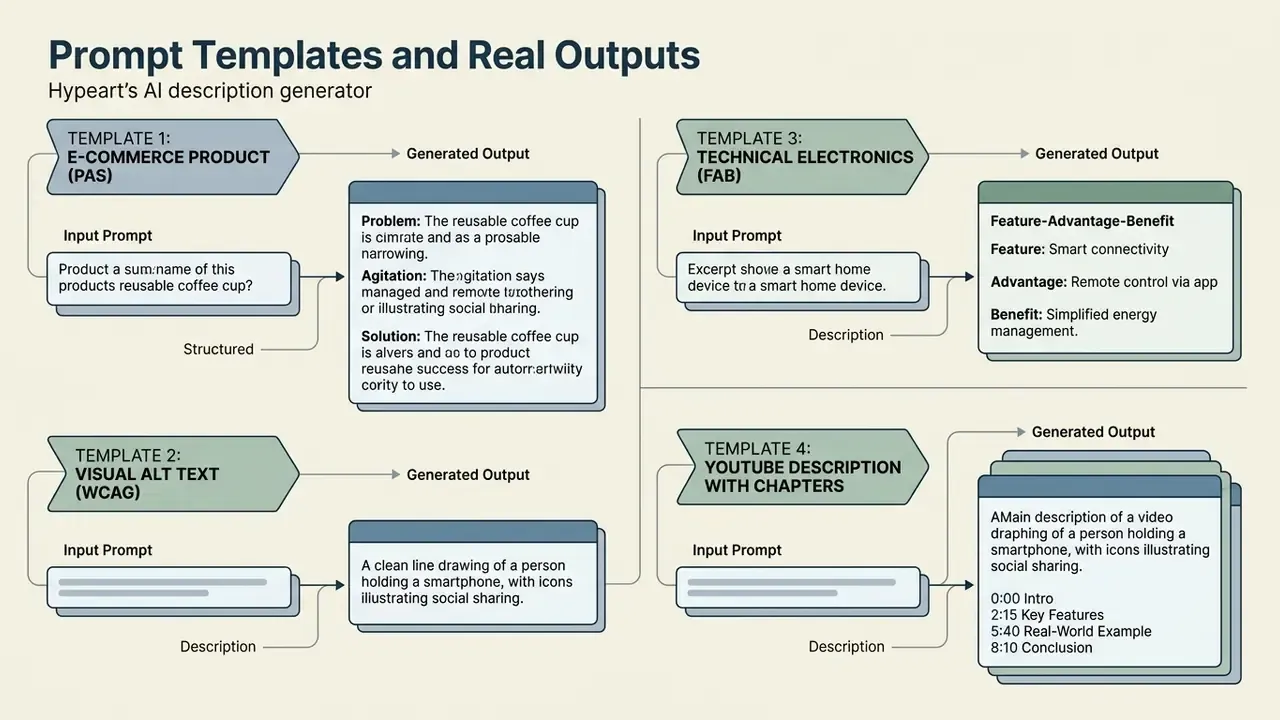
Abstract advice about "clear inputs" is hard to act on. The templates below show the exact input structure and the type of output it produces, so you can copy, adapt and test them today.
Template 1: E-commerce Product Description (PAS Framework)
Input prompt:
Role: E-commerce copywriter. Product: Ergonomic Office Chair. Features: Lumbar support, breathable mesh, 135-degree recline. Target audience: Remote software engineers. Framework: Pain-Agitate-Solution (PAS). Tone: Professional yet approachable. Length: 70-90 words. Do not invent certifications or medical claims.
Generated output:
Sitting for 8+ hours a day causing lower back stiffness? Standard office chairs lack targeted lumbar alignment, quietly destroying your posture and your daily focus. The ErgoPro Chair solves this with dynamic lumbar support and high-density breathable mesh that stays cool through long build cycles. Recline up to 135 degrees between sprints and code without fatigue. Upgrade your workstation today.
Template 2: Visual Alt Text for Web Accessibility (WCAG-Aligned)
Input prompt:
Generate accessibility alt text for an image. Image details: Woman in a yellow raincoat running through a rainy street in Tokyo at night. Context: Hero image for an outdoor apparel blog. Constraints: Under 125 characters, no "image of", describe function and action, do not repeat the adjacent headline.
Generated output:
Woman in a bright yellow waterproof raincoat running down a wet Tokyo street lit by neon signs at night.
Template 3: Technical Electronics Listing (FAB Framework)
Input prompt:
Role: Marketplace listing specialist. Product: Noise-cancelling wireless headset. Verified specs: 40-hour battery, hybrid ANC, Bluetooth 5.3, 250 g. Framework: Features-Advantages-Benefits. Output format: 5 Amazon bullet points, 10-25 words each, benefit-led, keyword "noise cancelling headphones" used once naturally. Use only the specs provided.
Generated output (excerpt):
40-hour battery life: charge once a week, not once a night, even on long-haul travel days.
Hybrid active noise cancellation blocks engine drone and office chatter so you hear detail, not distraction.
Bluetooth 5.3 keeps calls stable while you move between laptop and phone without re-pairing.
Template 4: YouTube Description With Chapters
Input prompt:
Write a YouTube description. Video topic: How to migrate a Shopify catalog to a new theme. Primary keyword: shopify theme migration. Output: (1) hook of 2 lines under 200 characters, (2) 120-word summary, (3) five chapter timestamps from the transcript below, (4) three link placeholders. Tone: practical, no hype.
Generated output (excerpt):
Migrating a Shopify theme without breaking your product pages? Here is the exact 6-step checklist we use on catalogs of 5,000+ SKUs.
00:00 Why theme migration breaks descriptions · 01:42 Auditing your metafields · 04:15 Bulk export and mapping…
Always regenerate two variants per template and route them into the split test described below, rather than publishing the first output. First drafts flatter the tool, not the buyer.
Applying Sales Frameworks to AI Prompts
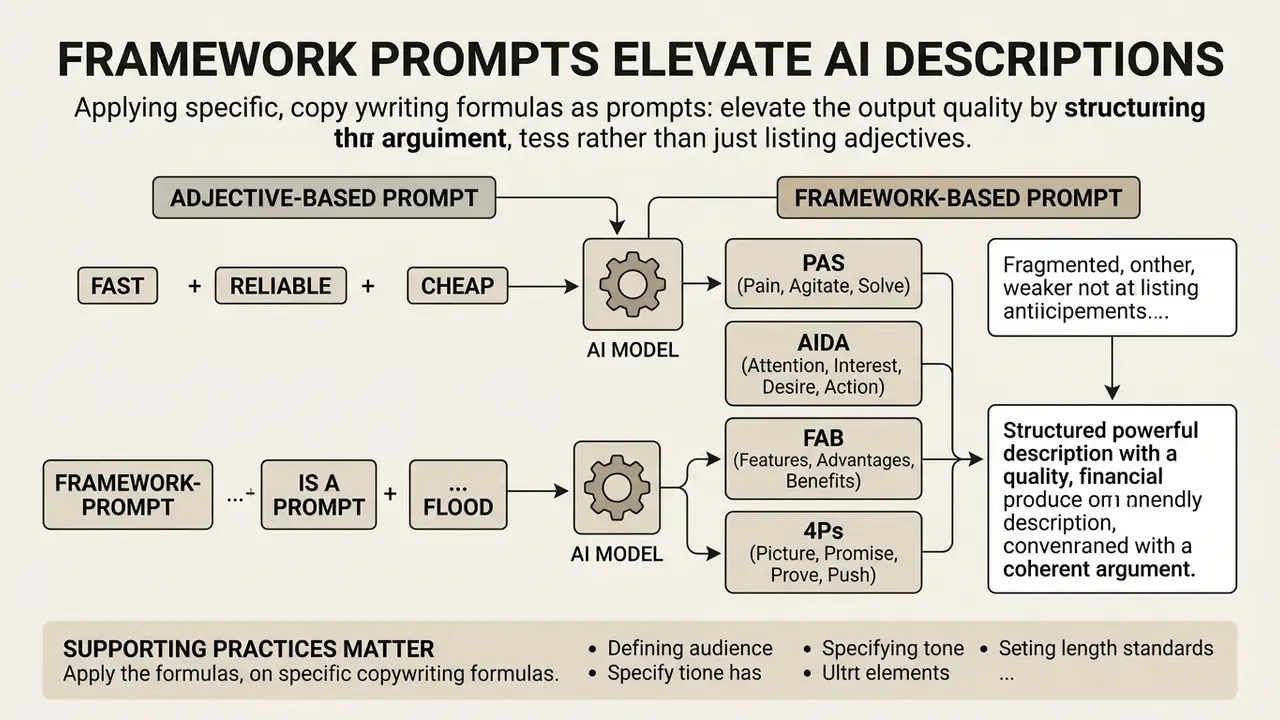
Naming a copywriting formula inside the prompt is the cheapest quality upgrade available, because it hands the model an argument structure instead of a pile of adjectives. To lift conversion, instruct the generator to build descriptions on established formulas.
- PAS (Pain, Agitate, Solve). Best for problem-solving products: ergonomics, skincare, software, insurance. Names the frustration, sharpens it, then positions the product as the remedy.
- AIDA (Attention, Interest, Desire, Action). Best for brand landing pages, category pages and paid social. Hooks fast, builds desire through proof, closes with an explicit call to action.
- FAB (Features, Advantages, Benefits). Best for technical SKUs, electronics and B2B components. Converts raw specs into human utility statements without losing the spec table.
- 4Ps (Picture, Promise, Prove, Push). Useful for lifestyle and travel products, where the purchase is imagined before it is rationalized.
Supporting practices matter as much as the formula. Establish purchase intent first by mapping why the customer would buy and how ownership improves their situation. Then turn features into benefits, including credibility features such as recycled or ethically sourced materials. Define voice second: a skateboard listing can be playful and jargon-rich, while a medical or financial product needs knowledgeable, professional, empathetic phrasing. Finally, make descriptions scannable with short sentences, headings and bullets, but do not force brevity on technical categories where buyers actively want the long spec list. Engineers read every row.
Description Length Standards by Platform
Length is a channel decision, not a stylistic one. Encode the target count in the prompt so the model does not default to a generic paragraph.
| Platform / Channel | Recommended Length | Format Focus | Key Objective |
|---|---|---|---|
| Amazon bullet points | 10-25 words per bullet, 5 bullets | Feature plus direct benefit | Keyword density and scannability |
| Amazon / marketplace short description | 50-100 words | Benefit-led summary | Fast comprehension on mobile |
| Shopify short description | 50-100 words | 2-3 sentences plus 3 bullets | Quick conversion hook |
| Meta / social ads | ~125 characters primary text | Hook, offer, CTA | Stop the scroll, raise CTR |
| Instagram caption | 80-150 words plus 3-5 hashtags | Story plus question prompt | Comments and saves |
| YouTube description | 2-3 line hook, 100-150 word body, timestamps | Above-the-fold keyword placement | Search discovery and watch time |
| SEO meta description | 140-155 characters | Primary keyword plus solution | Maximize search CTR |
| Image alt text | Under 125 characters | Function and context, no "image of" | Accessibility and image search |
| Enterprise long-form product page | 250-400 words | Storytelling plus full technical specs | Deep engagement and compliance |
Short descriptions of 50 to 100 words drive quick marketplace decisions. Long descriptions suit high-ticket, technical or storytelling-driven products, where buyers need full understanding before they commit.
A/B Testing AI-Generated Descriptions
Generation gives you variants cheaply, which makes product descriptions an unusually good testing surface. Run it as a controlled experiment, not a preference debate in a Slack thread.
- Isolate one variable.Test length, tone, framework, bullet order or headline keyword, one at a time. Multi-variable changes produce results you cannot reuse.
- Define the primary metric before launch.Add-to-cart rate and conversion rate are stronger signals than time on page for product cards.
- Split traffic evenly and run to significance.Low-traffic SKUs should be grouped by category to reach a usable sample.
- Log the winning pattern, not just the winning text."PAS opener beats feature-list opener on ergonomic SKUs" is a reusable insight. A single paragraph is not.
- Feed winners back into the prompt library.Winning structures become exemplar outputs in future prompts, which is how quality compounds instead of resetting every month.
- Re-test after platform policy changes.A marketplace guideline update can invalidate a previously winning format overnight.
If you need to model the payback of a paid tier against test-driven uplift, see the overview of the calculators before signing anything.
How to Get Better AI-Generated Descriptions
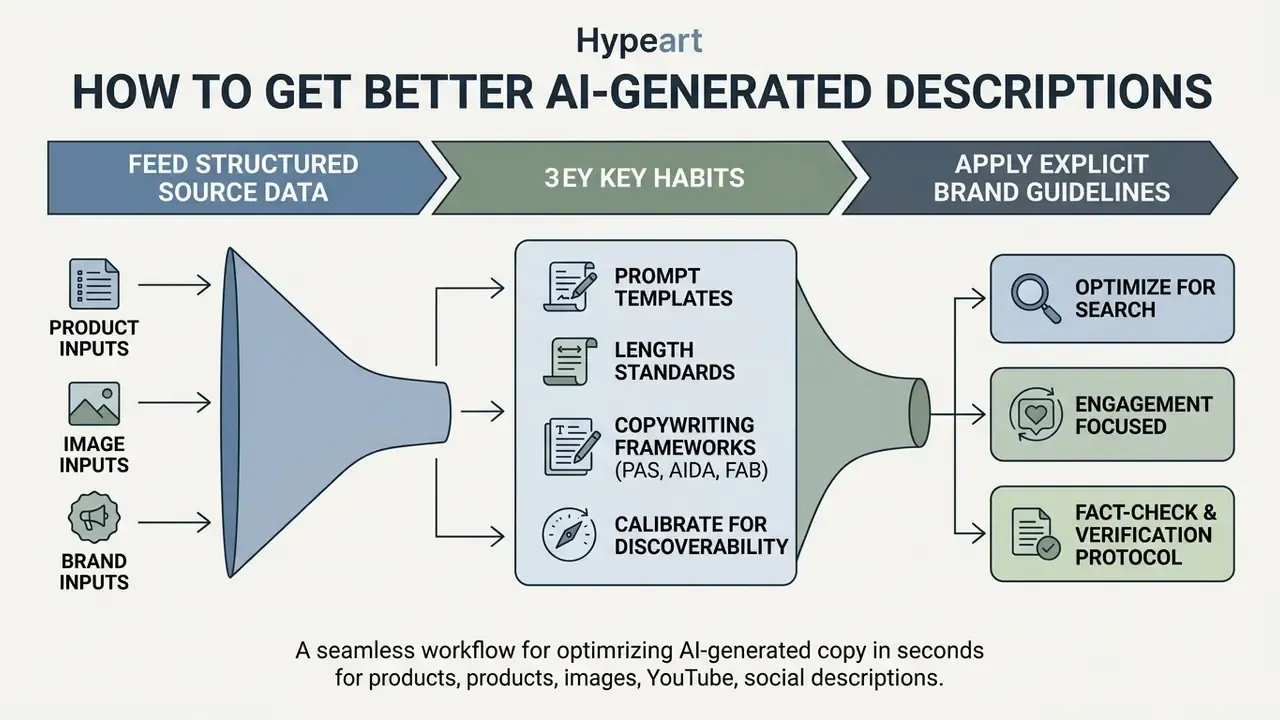
Optimizing AI-generated copy comes down to three habits: feed structured source data, apply explicit brand guidelines, calibrate for discoverability. Treat the model as a drafting assistant, never an unmonitored author, and both copy quality and brand integrity hold up.
Use Clear Product, Image and Brand Inputs
«The IPL model deployed on the Xianyu platform significantly outperforms a baseline MLLM on e-commerce-specific tasks and produces substantially fewer hallucinations.»
When writing short copy with an ai short description generator, give explicit character limits and two exemplar outputs. That single step removes most of the padded, redundant summaries teams complain about.
Optimize Description Copy for Search and Engagement
SEO work here means integrating target keywords naturally while keeping readability and user value intact. Nothing exotic.
Google's own documentation on using generative AI content, updated in 2026, tells publishers to focus on accuracy, quality and relevance rather than on whether text came from a human or a machine. Its helpful-content guidance requires original information, substantial added value and descriptive titles. The Search Quality Rater Guidelines are blunter: auto-generated pages with little or no originality and little added value should be rated Lowest. Generation method is neutral. Effort is not.
A large-scale analysis of 600,000 web pages by Ahrefs found a 0.011 correlation between AI content percentage and search rank position, confirming that Google ranks high-quality content regardless of generation method.
For readability, plain-language authorities give rules that transfer directly to descriptions: use common words, keep most sentences under 20 words, lead with the main point in the first paragraph, and use descriptive headings and short sections so copy can be scanned rather than read.
Enterprise Risk, Compliance and Audit Trail
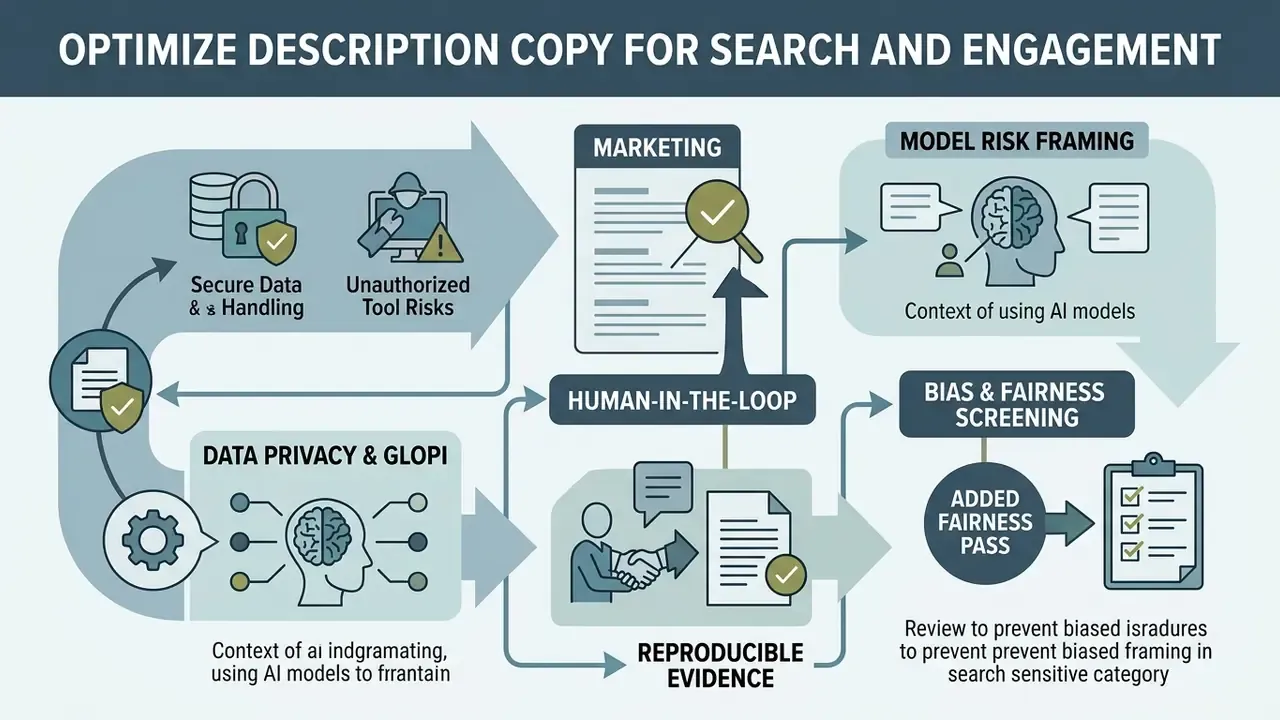
«An analysis of 10,000 AI-generated eBay descriptions found systematic gender-linked disparities in persuasion style and assumptions about the target audience.»
Add a fairness pass to the review checklist for categories where gendered or demographic framing is plausible, and sample outputs quarterly rather than only at launch. Voice and persona tools deserve the same scrutiny; anything resembling an ai child voice feature raises consent and safeguarding questions long before it raises brand ones. Transparency obligations are tightening in parallel: the European Commission's 2025 Code of Practice on Transparency of AI-generated Content focuses on labelling machine-generated material, and Australia's OAIC guidance for commercially available AI products (October 2024) includes privacy checklists for selecting and deploying such tools.
Free AI Description Generator: Limits, Pricing and Commercial Use
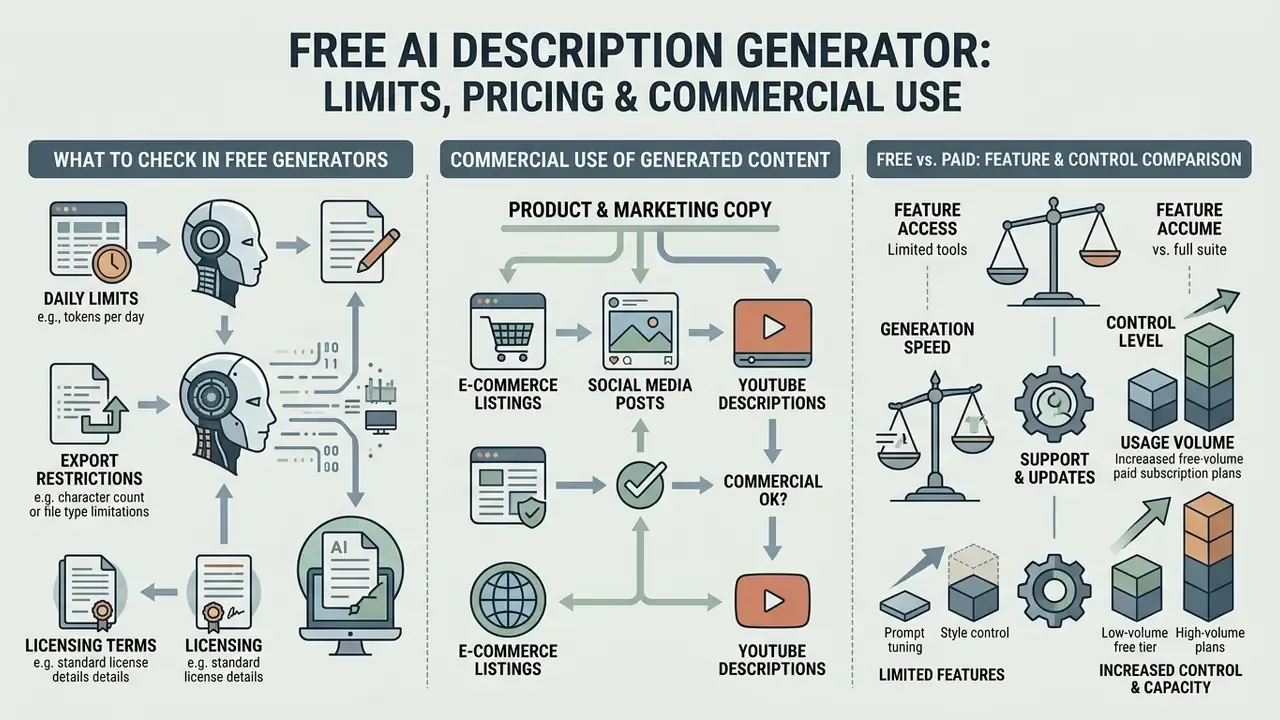
Evaluating a free ai description generator means inspecting daily token limits, export restrictions and commercial licensing terms before enterprise adoption. Free tools are excellent for testing prompt structures. Scaling commercial operations usually requires a paid subscription or a dedicated platform integration. For current tier comparisons, open the hub.
What to Check in a Free AI Description Generator
Free tools such as an ai description generator free online or an ai free description generator often enforce query caps, input character restrictions or non-commercial usage terms. Quota models differ enough that comparison requires normalization. Some vendors meter daily tokens, for example 2,500 tokens per day for anonymous users and 5,000 on a free account, with paid token packs from roughly $1. Others meter monthly descriptions: 10 on free, 100 on mid-tier, unlimited on premium. Others cap simultaneous variations at five at once.
Check whether a free ai description generator grants rights to use generated copy in commercial storefronts, or restricts output to personal evaluation. Some free tiers explicitly permit personal and commercial use. Others reserve broad licences to the vendor over the text you generated. That clause is usually two scrolls below the pricing table.
For enterprise operations evaluating vendor software such as hypeart.ai, no verified information is available regarding commercial pricing or active platform infrastructure. Where no primary documentation exists, treat the vendor as unassessed rather than as approved. That distinction matters in a procurement file.
Commercial Use of Generated Product and Marketing Copy
Commercial deployment of AI copy depends on intellectual property law and platform terms of service. Guidance from the U.S. Copyright Office confirms that purely machine-generated text without substantial human authorship cannot be registered for copyright protection.
«Applicants must disclose AI-generated material that is more than de minimis and briefly describe the human author's contribution, clearly separating human-authored from machine-generated parts.»
Free vs Paid: Feature and Control Comparison
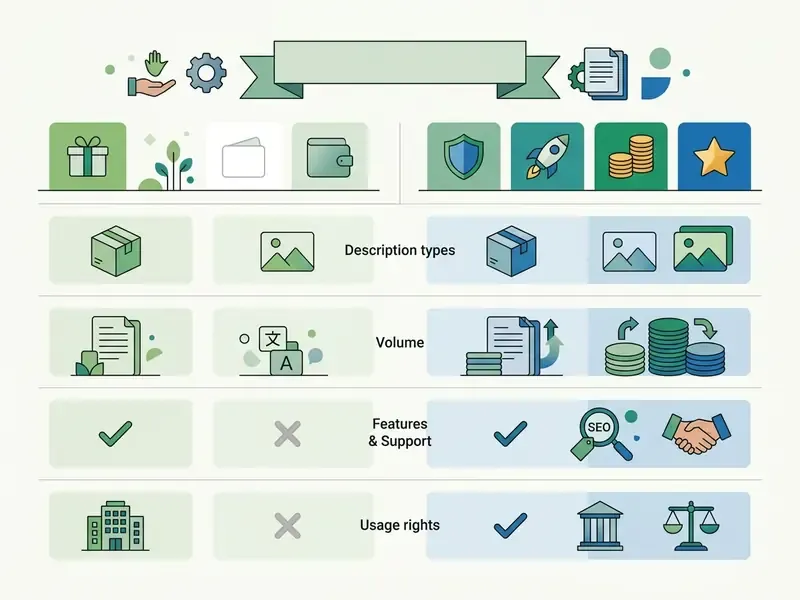
| Feature / Criterion | Free AI Description Generator | Paid / Enterprise AI Description Generator |
|---|---|---|
| Generation quota | Daily or monthly caps, e.g. 10-50 runs, 2,500-5,000 tokens per day | High-volume or unlimited catalog generation; 600-2,400+ credits per month on tiered plans |
| Input details and context | Basic text input; strict character limits | Bulk CSV/API imports, PIM connectors, multimodal image processing |
| SEO and brand tuning | General keyword insertion | Custom brand voice guidelines, saved editorial rules, behavioural feedback tuning |
| Marketplace compliance | Not enforced | Rules aligned to marketplace listing guidelines; automated translation into 25+ languages |
| Commercial rights | Varies by vendor terms; often non-commercial or vendor-licensed | Full commercial usage rights and enterprise SLAs |
| Data privacy / training on inputs | Frequently unspecified; inputs may be retained | Contractual no-training clauses, zero-data-retention options, defined retention windows |
| Security certification | Rarely published | SOC 2 Type II, ISO 27001, penetration-test reports on request |
| Regulatory alignment | Not addressed | GDPR and GLBA support, DPA and sub-processor lists, regional processing options |
| Audit trail and logging | None; no export of prompt history | Prompt, model version, reviewer and change-log export for audit evidence |
| API and system integration | Web interface only | Native e-commerce platform, PIM and workflow integrations |
| Access control | Single user | SSO/SAML, role-based permissions, publishing authority separation |
The table contrasts functional limits, SEO features, security posture and licensing terms. For institutional buyers, the bottom half usually decides procurement, not the top half. Marketing reads the first four rows; audit reads the last six.
FAQ About AI Description Generators
These are the questions that come up right before a tool decision, and right after the first bad draft.
Can an AI Description Generator Create Short Descriptions?
Yes. An ai short description generator produces concise product summaries, bullet points and social captions once you specify character limits in the prompt. Empirical benchmarks show that advanced models generate highly readable short descriptions that match or exceed human performance on persuasiveness and readability metrics. Explicit structural constraints stop the model from padding a paragraph. Use the platform matrix above to pick a target: 50 to 100 words for a Shopify short description, around 125 characters for social ad primary text, 140 to 155 characters for a meta description, and 10 to 25 words per Amazon bullet.
Can One Tool Generate Both Image and Product Descriptions?
Yes. Modern multimodal tools use vision-language models to process product photographs alongside text specs in a single interface. Systems such as ModICT (presented at LREC-COLING 2024) and Alibaba's IPL show that multimodal models generate accurate image-grounded text while matching platform copywriting norms.
«72% of Xianyu users publish listings based on IPL-generated content, and the quality of those listings is 5.6% higher than listings created without AI assistance.» Chen et al., IPL: Intelligent Product Listing, Alibaba / Xianyu (2024). https://arxiv.org/ Combining visual attributes with text metadata also improves search retrieval performance across e-commerce catalogs, which is a second-order benefit teams tend to discover later.
Is "AI Discription Generator" the Same as "AI Description Generator"?
Yes. Queries such as ai discription generator are common spelling variants of ai description generator. Classical information retrieval literature, including Introduction to Information Retrieval (Manning, Raghavan and Schütze), describes spelling correction, query expansion and semantic matching as standard components of query understanding. Later work on misspelled queries treats correction as a distinct retrieval task solved with query-log pairs. No study in the reviewed corpus measures how search engines handle this exact misspelling, so treat the equivalence as an operational assumption: publish once with the correct spelling and let normalization handle the variant, instead of creating duplicate pages per typo.
Do Free Tiers Allow Commercial Publishing?
It depends entirely on the vendor's terms. Some free generators explicitly permit personal and commercial use of the output. Others restrict free output to evaluation, and a few grant themselves a perpetual, royalty-free licence over text you generate. Read the licence clause before a single description reaches a live storefront, then re-read it after each terms update. Terms change quietly.
Who Owns the Copyright in AI-Generated Descriptions?
In the United States, no one owns copyright in purely machine-generated text. Protection attaches only to human-authored contributions, which must be identified separately during registration. Practically, the substance of your editorial transformation, meaning restructuring, added expertise, verified claims and brand voice, is the asset you actually own.
How Do We Prove Control to an Auditor?
Retain a per-item change log with prompt version, model identifier, raw output, final text, reviewer and rationale, plus evidence of periodic sampling for factual accuracy and bias. Approval workflows should separate drafting authority from publishing authority, so no single account can generate and release copy unchecked. One account, two roles, zero control. That is the pattern auditors flag first. Next Steps
- Build a prompt library. Start with the four templates above, add your brand glossary and negative-keyword list, then version-control it like code.
- Set your length standards. Copy the platform matrix into your content brief so every generation request carries an explicit word or character target.
- Install two gates. One editorial gate for factual accuracy and brand voice, one logging gate that records the audit trail.
- Run your first split test. Pick 20 SKUs, test PAS against a feature-list opener, and record the winning pattern rather than the winning paragraph.
- Complete a vendor due-diligence pass. Use the security and compliance rows of the comparison table as your minimum questionnaire before scaling beyond a pilot. Start small, log everything, and let the evidence decide how much autonomy the tool earns next quarter. For definitions and adjacent tooling in this category, explore the hub.