Updated: February 2026 · Reviewed for acoustic accuracy, licensing terms, and child-data compliance.
«Evaluating synthetic voice systems requires separating marketing claims from measurable acoustic and legal reality. For child and baby AI voices, institutional deployment hinges on zero-shot model stability, verified training data lineage, and explicit guardian consent frameworks.»
— Marcus Hale, author
Executive Summary: What You Need to Decide Before You Generate
This guide serves two audiences at once, and both are served in a single workflow. Content creators need the fastest path from script to downloadable MP3. Governance, compliance, and model-risk owners need to know whether that same tool can enter an organisational perimeter without triggering privacy, licensing, or biometric-spoofing exposure. So the article moves from acoustics, to prototyping workflow, to naturalness tuning, to deployment scenarios, and finally to biometric and legal risk.
| Decision Area | Key Metric or Control Point | How to Verify It |
|---|---|---|
| Acoustic realism | Fundamental frequency () band matches target age; MOS ≥ 3.8 | Render a 30-second sample; compare against the category table below |
| Age fidelity of instructions | Instruction-guided models often default to adult timbre | Blind-listen test; do not trust the "child" label alone |
| Free-tier boundaries | Character caps, watermarking, attribution, licence class | Read the plan's terms of service before publishing |
| Voice cloning input quality | Duration, noise floor, sample rate, single-speaker isolation | Pre-flight audio checklist (see cloning section) |
| Child-data compliance | Verifiable parental consent, data lineage, retention policy | COPPA / GDPR documentation and written authorisation |
| Biometric abuse risk | Voice-ID spoofing, unlabelled synthetic audio, Shadow AI usage | Vendor screening plus an internal usage register |
One sentence for the impatient reader: free tiers are excellent for prototyping and poor for anything you intend to monetise or defend in an audit.
What Is an AI Child Voice Generator Free?
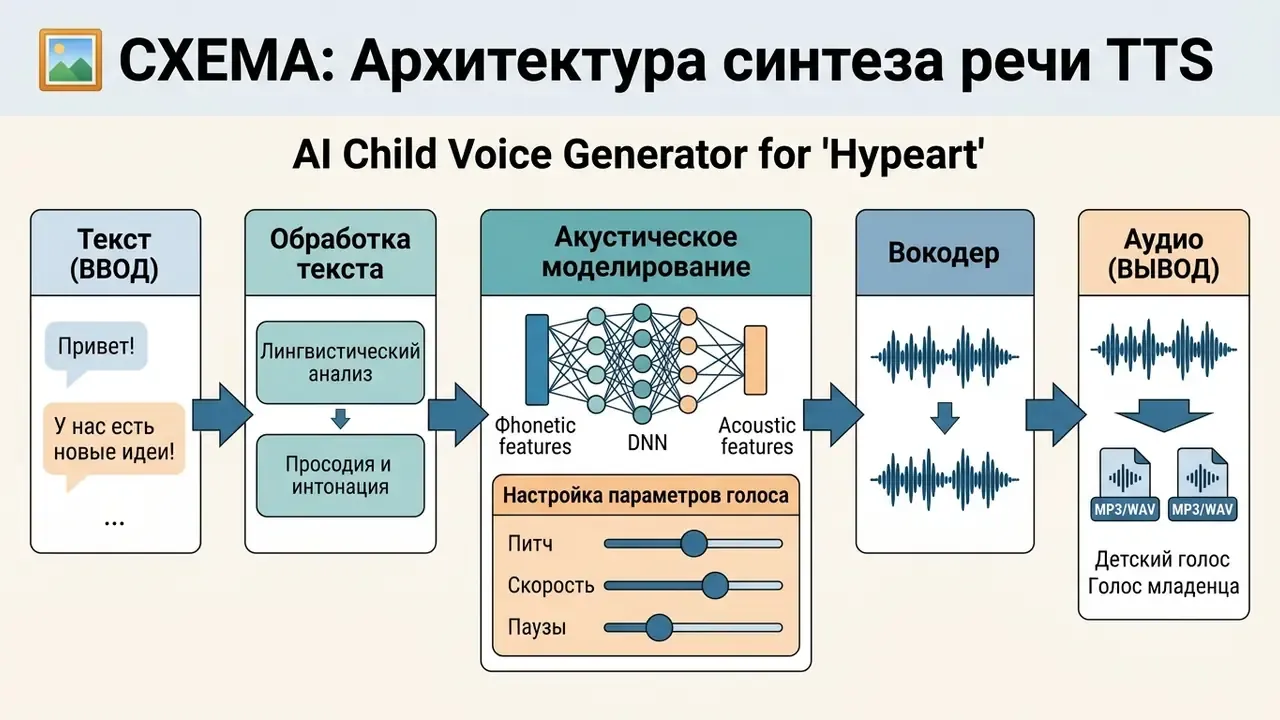
An AI child voice generator free is a browser-based text-to-speech application designed to synthesize speech with the acoustic frequency, pitch, and intonation of a young speaker. Unlike generic adult TTS tools, child voice engines rely on age-adapted neural models or specialized speech datasets to replicate young vocal characteristics.
These platforms accept text scripts, run them through acoustic pipelines and vocoders, and generate downloadable digital audio without requiring live voice actors. No booking, no studio, no chaperone.
Vendor transparency is itself a selection criterion. Some services publish corporate identity, licence terms, and model provenance; others publish nothing verifiable. For example, no verified information is available regarding the platform features, legal entity status, or voice generation capabilities of hypeart.ai, a profile that should fail any structured vendor-intake screening, because unverifiable operators cannot evidence training-data lineage or consent chains. For a broader taxonomy of engines, quality tiers, and licence classes, compare options across AI voice generators before committing a project to one vendor.
Child, Kid and Baby AI Voices: What Is the Difference?
The primary differences between baby, child, and kid AI voices center on fundamental frequency (), formant distribution, and prosodic expressiveness.
Baby voices replicate infant vocalizations (ages 0 to 3). Clinical bioacoustic literature reports newborn crying in the region of 400 to 600 Hz, and describes infant-directed speech as higher in pitch with a sing-song contour and a widened pitch range. So a "baby voice" preset is best understood as an approximation of that register, not a validated newborn model.
Child voices reflect pre-pubertal speakers (ages 4 to 8), with pitch averages around 215 Hz to 320 Hz for five-to-seven-year-olds, based on acoustic speech studies indexed in PubMed (2018; 2025). Four-to-six-year-old female voices cluster near 257 Hz, male voices near 245 Hz. Kid voices generally refer to late childhood or early adolescent tones (ages 9 to 14), characterized by lowering fundamental frequency, stabilized phonetic articulation, and cadence approaching adult speech.
Research from the E-VOC Corpus study evaluated instruction-guided expressive TTS systems across age categories and exposed a measurable instruction-perception gap for child voices (ages 4 to 12).
| Voice Category | Estimated Age Range | Acoustic Pitch () Range | Primary Use Cases | Technical Characteristics |
|---|---|---|---|---|
| Baby Voice | 0 to 3 years | ≈400 Hz to 600 Hz (cry / infant register) | Short character sound effects, animations, comedic clips | Highly variable pitch contours; non-standard phonetic structures |
| Child Voice | 4 to 8 years | 215 Hz to 320 Hz | Children's audiobooks, educational apps, interactive story narration | Elevated formants; wider pitch range during emotional affect |
| Kid Voice | 9 to 14 years | 180 Hz to 260 Hz | YouTube videos, video game dialogue, e-learning content | Stabilized articulation; moderate pitch flexibility; near-adult cadence |
Read the table this way: pick the age band first, the emotional style second, the vendor third. Choosing a vendor before an age band is how projects end up re-rendering everything twice.
What "Free" Means for an AI Voice Generator
A "free" AI voice generator tier typically grants access to basic text-to-speech features under specific character caps, quota limits, and licensing restrictions.
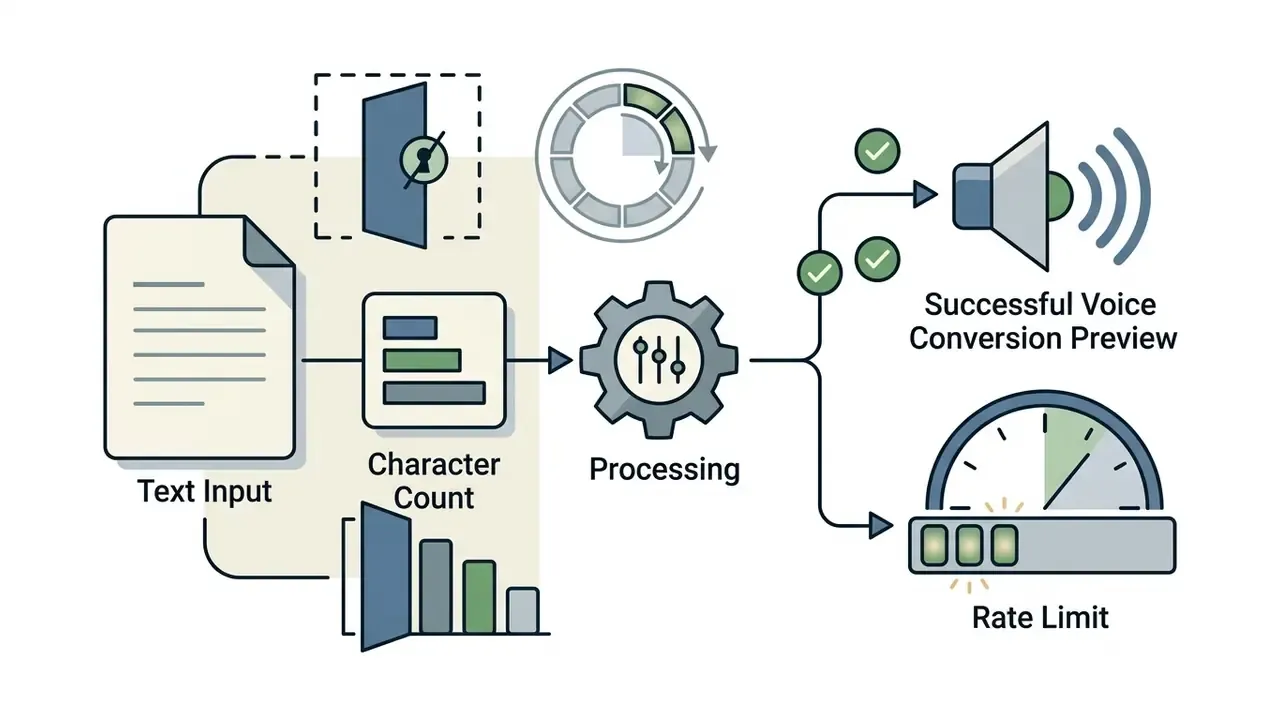
Reported free plans commonly sit in the range of roughly 5,000 to 15,000 characters per month or per generation, offer standard MP3 export, and grant non-commercial usage rights only. Exact figures change often, so treat published numbers as indicative and confirm them on the vendor's pricing page. Some vendors, and FreeTTS is a frequently cited example, cap guest sessions at around 5,000 characters per generation while requiring personal-use attribution or applying an audio watermark. Higher-tier capabilities, including high-bitrate WAV exports, zero-shot voice cloning, and full commercial usage rights, are reserved for paid subscription tiers.
Typical free-tier boundaries across current platforms:
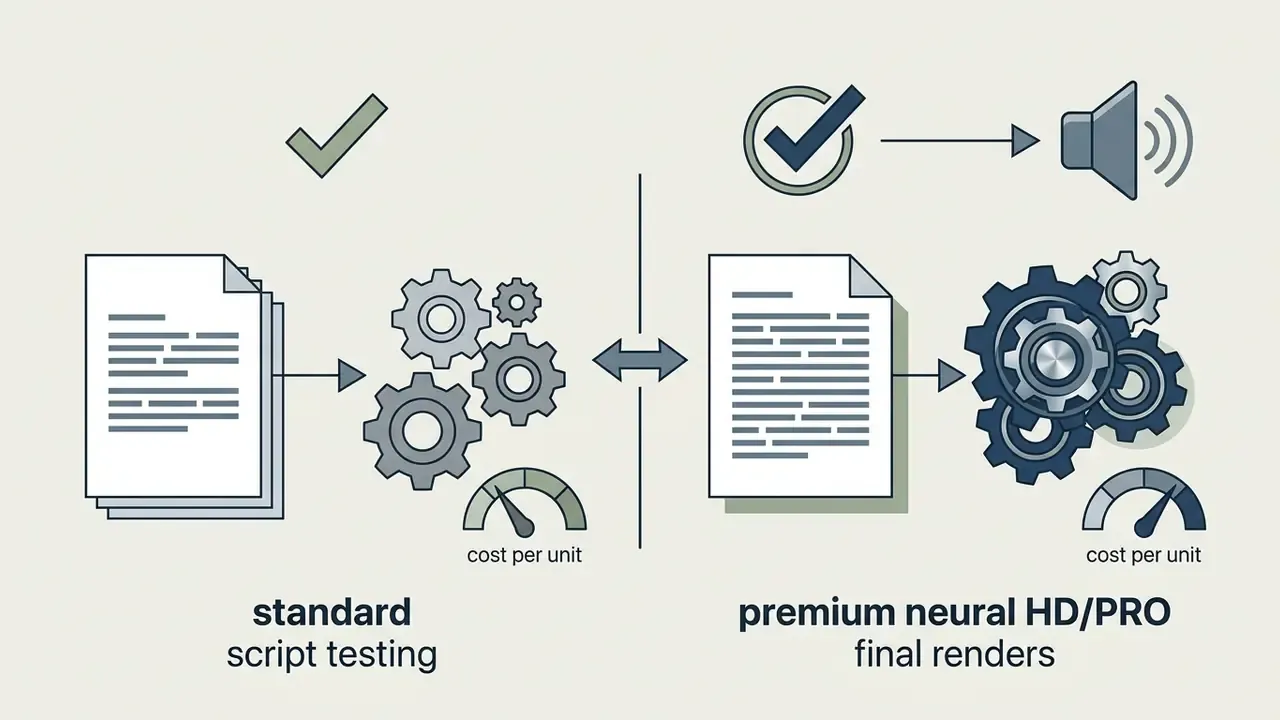
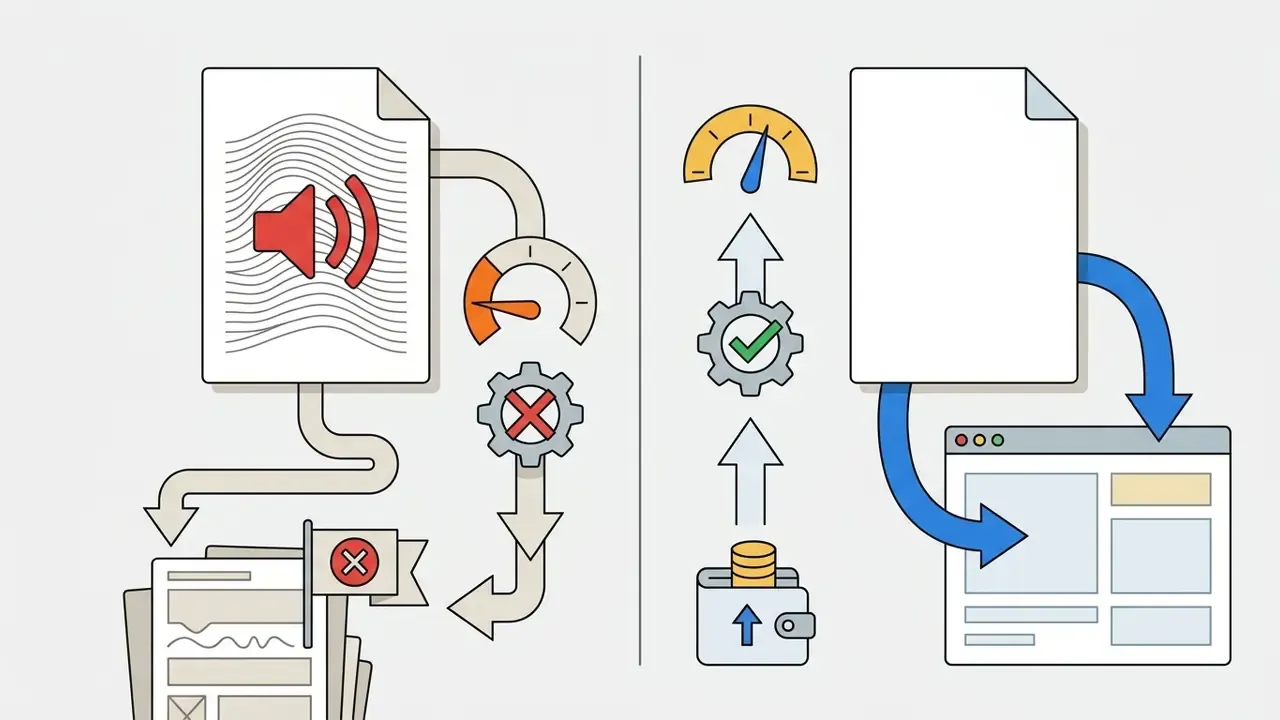
Hidden total-cost note for institutional buyers. The sticker price of a free tier excludes the real cost drivers: legal review of the licence, consent documentation, provenance verification, and re-rendering at higher fidelity when the free-tier codec proves inadequate. Budget those items before comparing "free" against an enterprise API line item. In one illustrative internal estimate we have seen quoted informally, licence review and evidence capture cost more than a year of paid API credits. Free was, in effect, the expensive option.
How to Generate a Child Voice from Text Online (Prototyping Workflow)
Generating a child voice online involves entering clean script text, selecting an age-specific voice profile, rendering the audio stream, and exporting the final media file. Treat this as a sandbox prototyping loop: cheap voices for script iteration, premium voices for the final master, and a documented record of which model produced which asset.
Users can complete the whole process inside a web browser, without installing local software or configuring specialized code environments.
Step-by-step process for online child voice generation
- Enter scripttype or paste formatted text into the text-to-speech editor field.
- Select voice profilefilter the library by age group, gender, and delivery style to pick a child voice.
- Adjust parametersfine-tune pitch, speech rate, and SSML pause tags if supported.
- Preview audiorun in-browser audio synthesis to review prosody and pronunciation.
- Export fileselect a format (MP3 or WAV) and download the audio file to your local device.
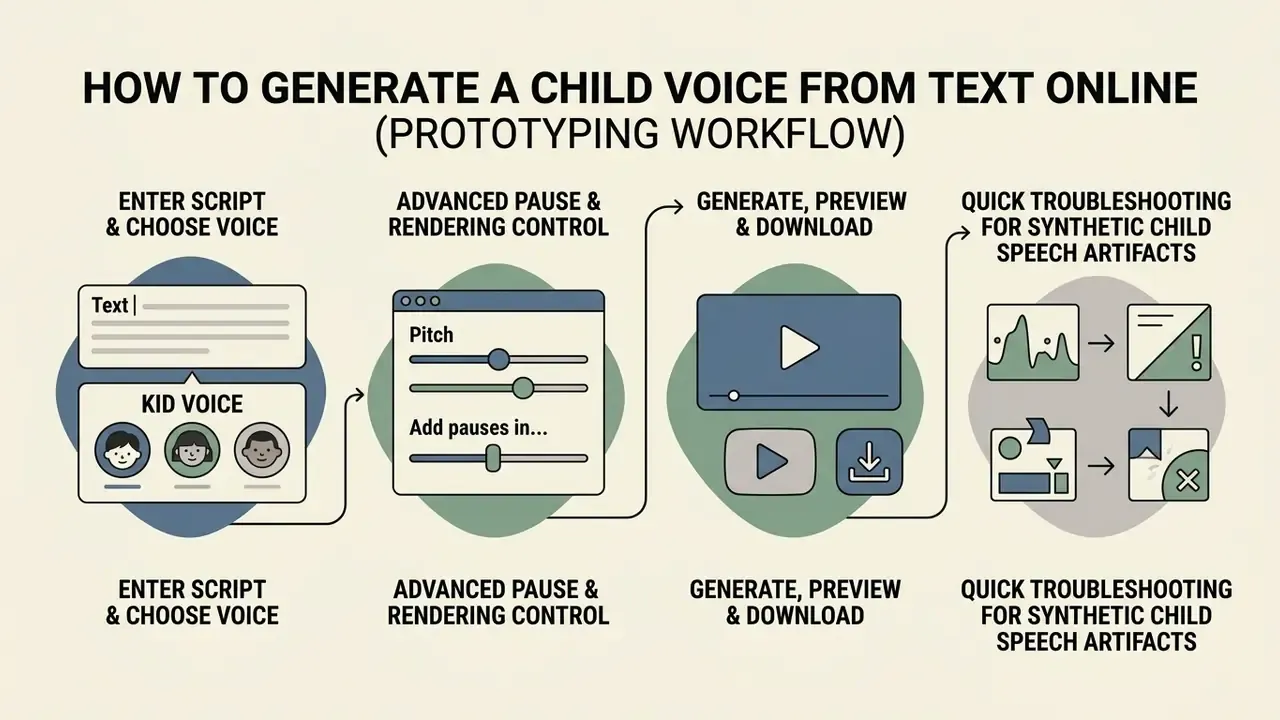
Enter a Script and Choose a Kid Voice
To start generating speech, paste your written content into the generator input box and choose an appropriate child or kid voice profile from the library.
Preparing clean input text means removing unneeded abbreviations and ensuring proper punctuation. Updated: the child-speech pipeline work originating at the University of Galway, published as Jain et al., Child Speech Synthesis Pipeline, documents text normalization, abbreviation expansion, and whitespace normalization prior to synthesis as standard preprocessing that lowers word error rates (WER).
«Cleaning and segmenting child-speech training data is critical: even 19 hours of high-quality recordings is enough to fine-tune a multi-speaker TTS model.»
Commas create short pauses, periods insert natural sentence breaks. Selecting the right character model depends on your scenario. Educational apps benefit from clear, moderate-tempo child voices, whereas dynamic animations may require energetic kid character voices. If your script itself was drafted with a word ai generator, read it aloud once before synthesis; machine-drafted sentences tend to run long, and long clauses are exactly where child prosody breaks.
Advanced Pause and Rendering Control
For natural cadence, configure silence intervals inside your TTS dashboard or directly in SSML markup, rather than relying on default engine spacing:
- Clause and comma pause: 150 ms to 250 ms
- Sentence-boundary pause: 400 ms to 600 ms
- Paragraph and scene transition: 800 ms to 1200 ms
- Dramatic beat inside dialogue: insert
- Export specs: choose 24 kHz / 16-bit WAV (or
LINEAR16via API) for master editing, or MP3 at 128 to 320 kbps for web deployment. Mid-range options (48 to 96 kbps) suit long-form e-learning where file size matters; low-bitrate options (8 to 48 kbps) should be reserved for telephony and IVR pipelines. - Channels and sample rate: mono at 44.1 kHz or 48 kHz is enough for narration; stereo only adds weight unless you are placing the voice in a spatial mix.
Engines that expose selectable pause presets (150 ms, 200 ms, 300 ms, 500 ms, 1000 ms and longer) let you separate paragraph spacing from sentence spacing. A small control, an outsized effect on whether synthetic child speech sounds rushed or stilted.
Generate, Preview and Download Audio
Click the generate button to process the script through the neural TTS engine, listen to the preview playback, then download the resulting file.
Synthesis engines convert text into mel-spectrograms before rendering raw audio. Standard web workflows support immediate browser playback, so creators can evaluate pacing and intonation before spending character credits.
Streaming architectures have made this preview loop close to instantaneous.
«Qwen3-TTS delivers first-packet latency from 97 ms and supports streaming input/output.»
Export options generally include MP3 and WAV. API-driven systems such as Google Cloud TTS deliver MP3 or 16-bit linear PCM (LINEAR16) files, while standalone generators offer selectable bitrates from 8 kbps to 320 kbps, plus container choices such as OGG, Opus, FLAC, M4A, and µ-law/A-law WAV for telephony.
If your audio project requires post-production trimming or video alignment, pair the generated voice tracks with a windows video editor, align narration to timeline markers using YouTube video editing workflows, cut vertical teasers with 2short ai, or shrink oversized masters with a video compressor before upload.
Quick Troubleshooting for Synthetic Child Speech Artifacts
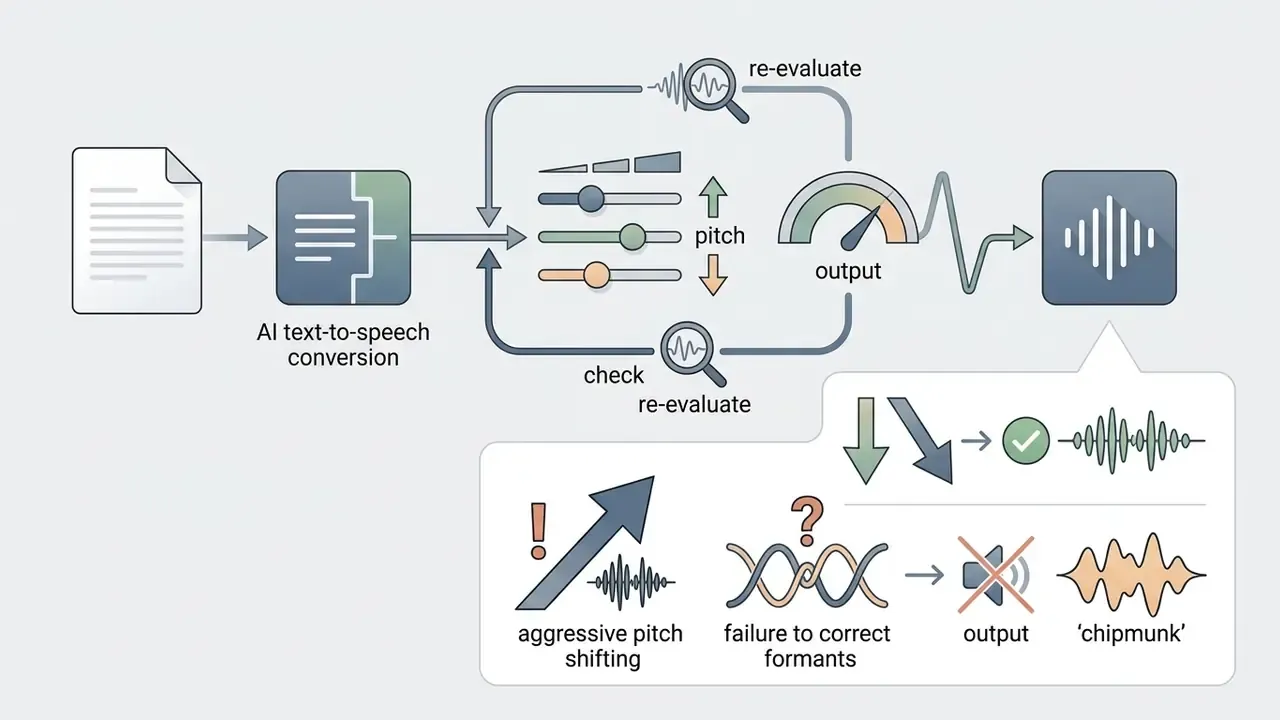
- Robotic or metallic pitch: reduce the pitch shift below +40% and switch from a STANDARD tier voice to a Neural/HD vocoder.
- Words running together: insert explicit punctuation or
- Mispronounced child slang or brand names: use phonetic spellings ("kiddos" becomes "kid-ohs") or an SSML
- Flat, affect-free delivery: add question marks for rising intonation, exclamation marks for pitch accent, and shorten sentences. Child speech carries fewer words per breath group.
- Buzzy sibilance on export: re-render at 24 kHz/16-bit WAV and encode to MP3 once, at 192 kbps or higher. Repeated lossy re-encoding is the usual culprit.
- Age drifts upward across a long script: split the script into shorter blocks and re-verify each block, because instruction-following degrades over long inputs.
How to Choose a Natural AI Kid Voice
Selecting a natural AI kid voice requires evaluating gender presentation, age suitability, pitch modulation, and prosodic delivery against your content goals.
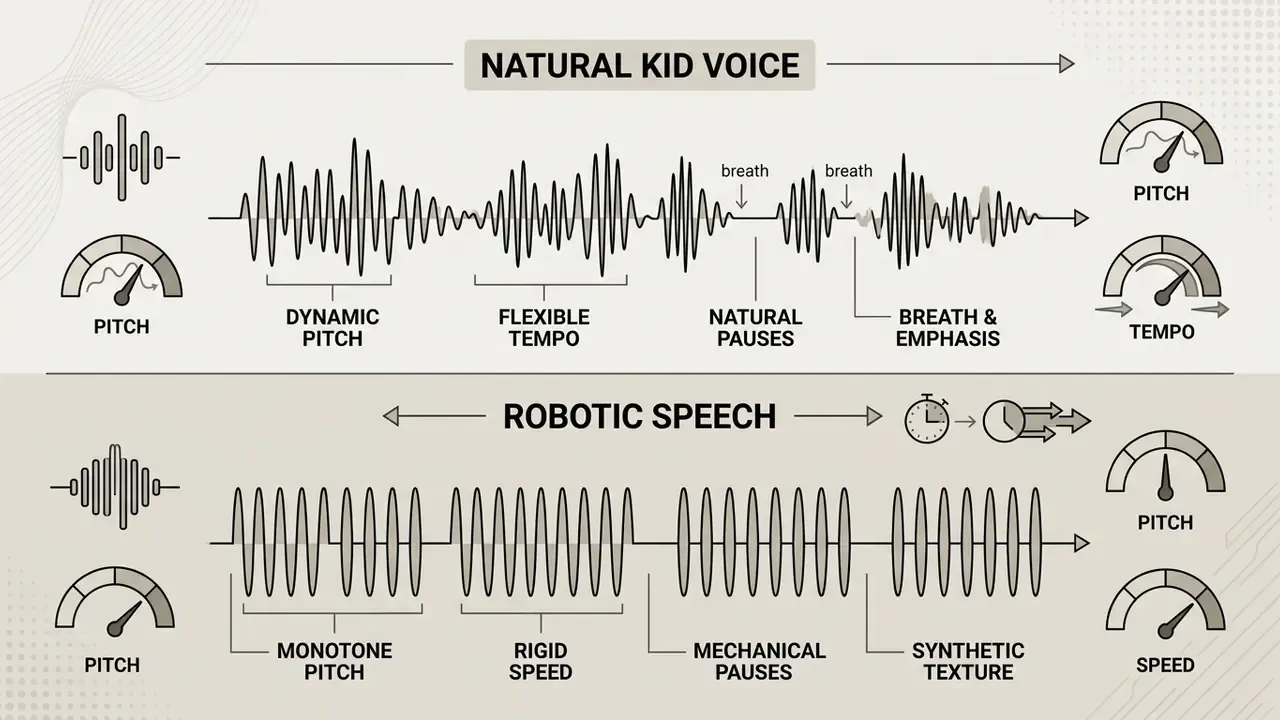
Natural-sounding synthetic speech depends heavily on accurate fundamental frequency modeling, natural pause structures, and appropriate emotional inflection. A 2025 systematic review of prosody in speech synthesis identified fundamental frequency, duration, and intensity as the three governing parameters, with the most studied of the three across 95 reviewed studies. Later work adds that the location and magnitude of pitch events and phrasal pauses predict perceived naturalness better than word-level duration or intensity.
Girl Voices, Boy Voices and Character Voices
Girl, boy, and character AI voices are built from distinct acoustic embeddings and pitch profiles tailored to specific media scenarios.
Female child voice profiles generally emphasize soft, warm intonation patterns suitable for bedtime stories, lullabies, and early-childhood learning. Male child profiles often employ dynamic, higher-energy delivery tuned for adventure stories, gaming narration, and instructional clips.
Character voices incorporate stylized emotional prosody, which makes them useful for cartoons and interactive toys. Vendor libraries increasingly expose this as emotional tagging rather than gender alone. Typecast publishes tagged personas such as a sweet, delighted birthday boy or a grumpy, low-energy pre-teen, while SpeechGen ships named profiles like Anny (soft, storytelling), Pixie (light cartoon timbre), and Riley (sporty, adventure). Filtering by age, style, and emotion is therefore more predictive of fit than filtering by gender.
| Persona Archetype | Age Profile | Emotional Delivery & Tags | Best Application |
|---|---|---|---|
| Toddler Reader | 3 to 5 yrs | #soft #breathy #innocent | Bedtime stories, lullaby apps |
| Energetic Kid | 6 to 8 yrs | #bright #cheerful #playful | Animated shorts, toy dialogue |
| Cartoon Sidekick | 6 to 9 yrs | #squeaky #comic #exaggerated | Cartoons, comedic short-form clips |
| Curious Scholar | 9 to 11 yrs | #clear #confident #articulate | E-learning modules, tutorials |
| Adventure Lead | 10 to 12 yrs | #sporty #determined #expressive | Game NPCs, action narration |
| Moody Teen | 12 to 14 yrs | #low-energy #reluctant #flat | Game NPCs, character drama |
When you are building on-screen titles, thumbnails, or supporting graphics for youth media, creators frequently combine these voice tools with an animation maker for motion assets, a word art generator for kinetic titles, or a design suite such as Canva's AI generator for licence-checked visual elements.
Script, Pitch and Delivery for Natural Speech
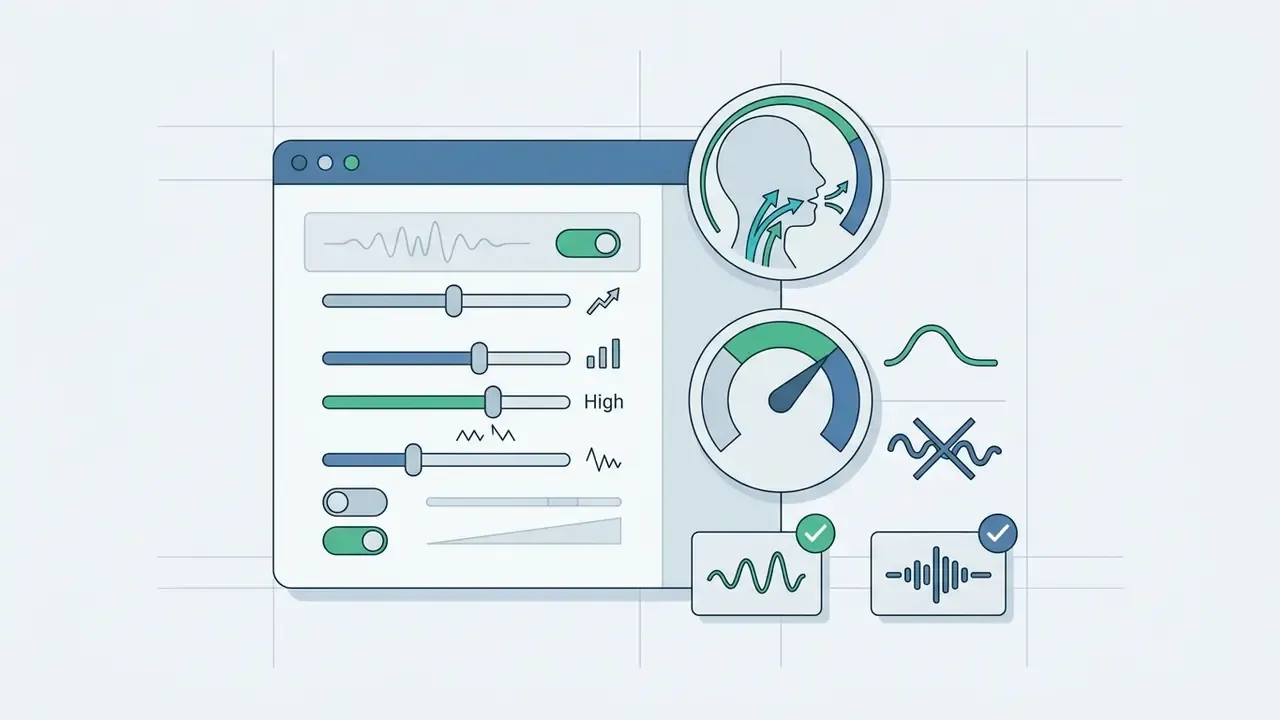
Achieving natural synthetic child speech means balancing pitch shift settings, speech rate, and punctuation cues to eliminate robotic artifacts.
Research by Jain and Corcoran (2023) shows that FastPitch-based transfer learning architectures significantly improve synthetic child speech quality. Trained on 55 hours of cleaned child speech datasets such as MyST, FastPitch explicitly controls pitch contours and duration, reaching mean opinion scores (MOS) near 3.89 out of 5.0 for naturalness.
«FastPitch fine-tuned on 55 hours of child speech (MyST) showed high MOSNet correlation between real and synthetic speech, with WER comparable to real recordings.»
«Subjective evaluation of synthetic child speech scored 3.95 for intelligibility, 3.89 for naturalness, and 3.96 for voice consistency on a five-point MOS scale.» — Jain et al., Child Speech Synthesis Pipeline (2022/2023).
To avoid flat delivery, structure your text with explicit punctuation rules:
- Use commas for brief breath pauses (100 to 200 ms).
- Use question marks to trigger rising intonation at the end of queries.
- Use exclamation points to increase pitch accent and volume emphasis.
- Insert explicit SSML
<break time="300ms"/>tags for deliberate dramatic pauses. - Keep sentences short. Child-directed and child-produced speech both favour compact breath groups, and long clauses are where synthetic prosody collapses first.
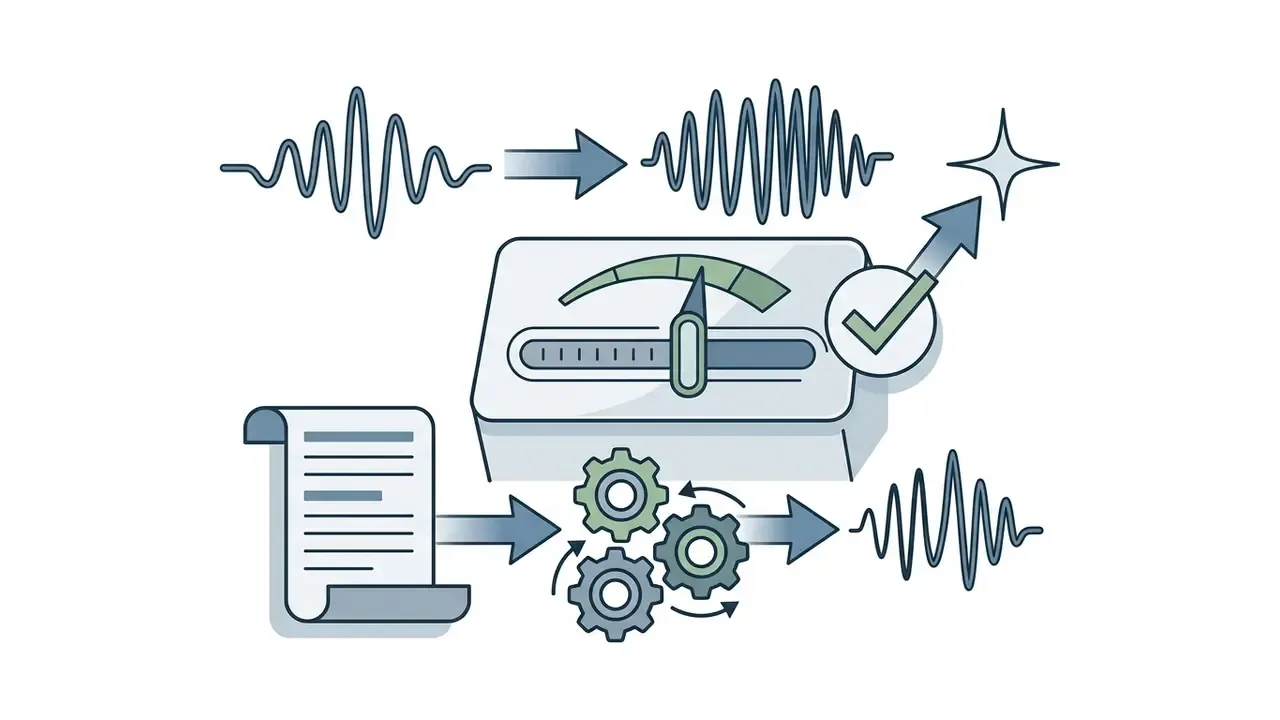
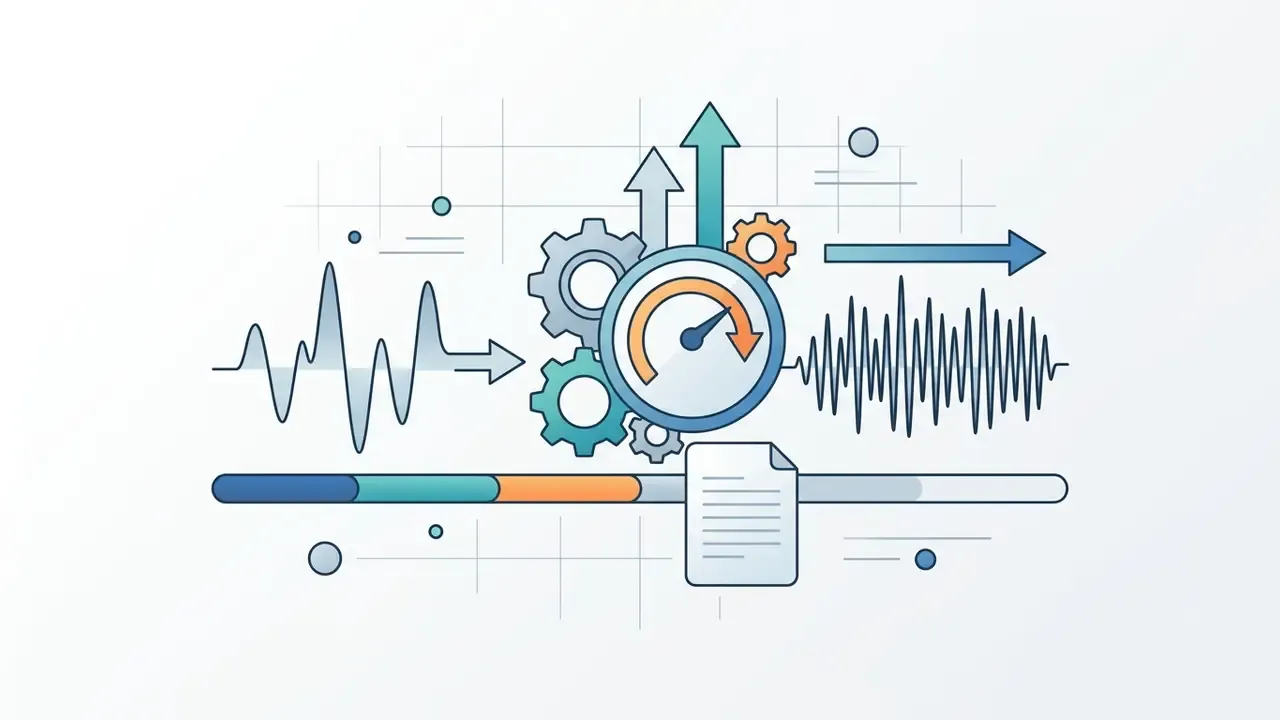
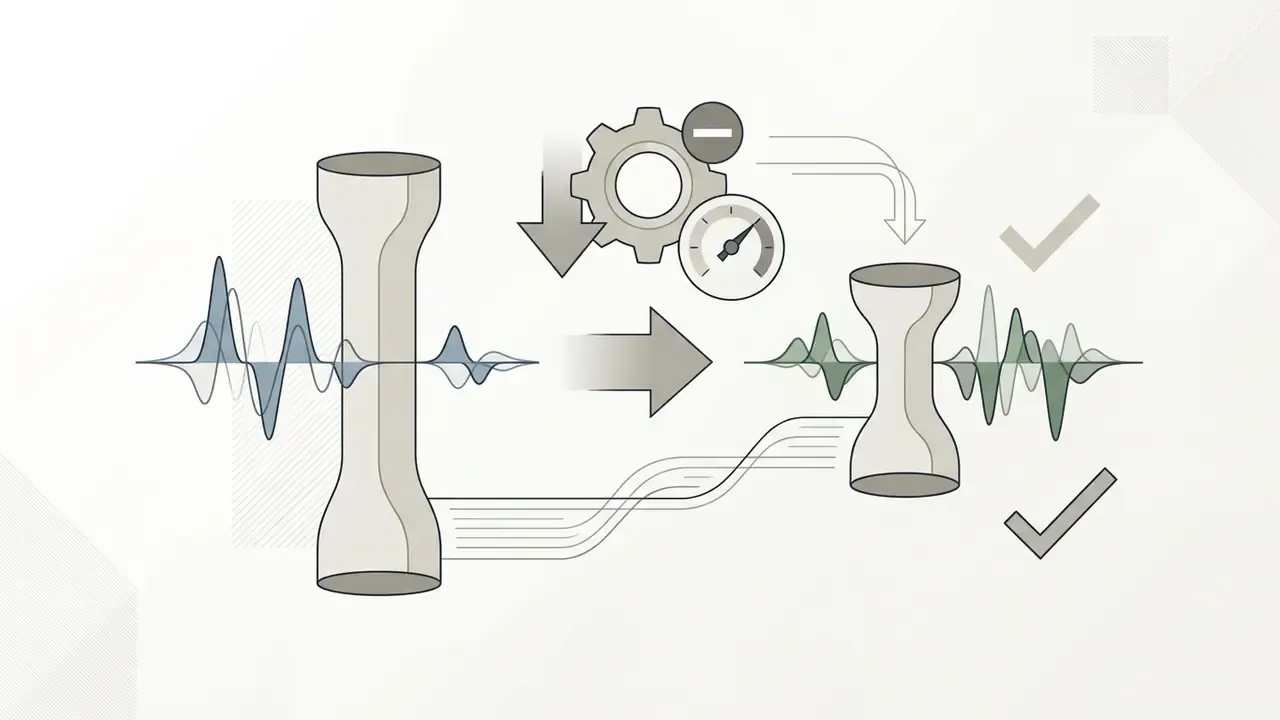
Transforming adult voices into kid voices (manual pitch shift). If your TTS provider lacks dedicated child models, a common situation outside English, German, and Spanish, convert a neutral adult female voice into a pre-pubertal tone with these parameters:
During an early-literacy application pilot (illustrative, composite example), synthetic story narration initially suffered from flat prosody and low user engagement. Engineers fine-tuned a FastPitch acoustic model on a 55-hour child speech dataset and inserted semantic pause markers into the scripts. The adjustment reduced speech recognition processing errors and increased student listening times during classroom trials. Modest change, measurable effect.
Where to Use AI Child and Baby Voice Audio
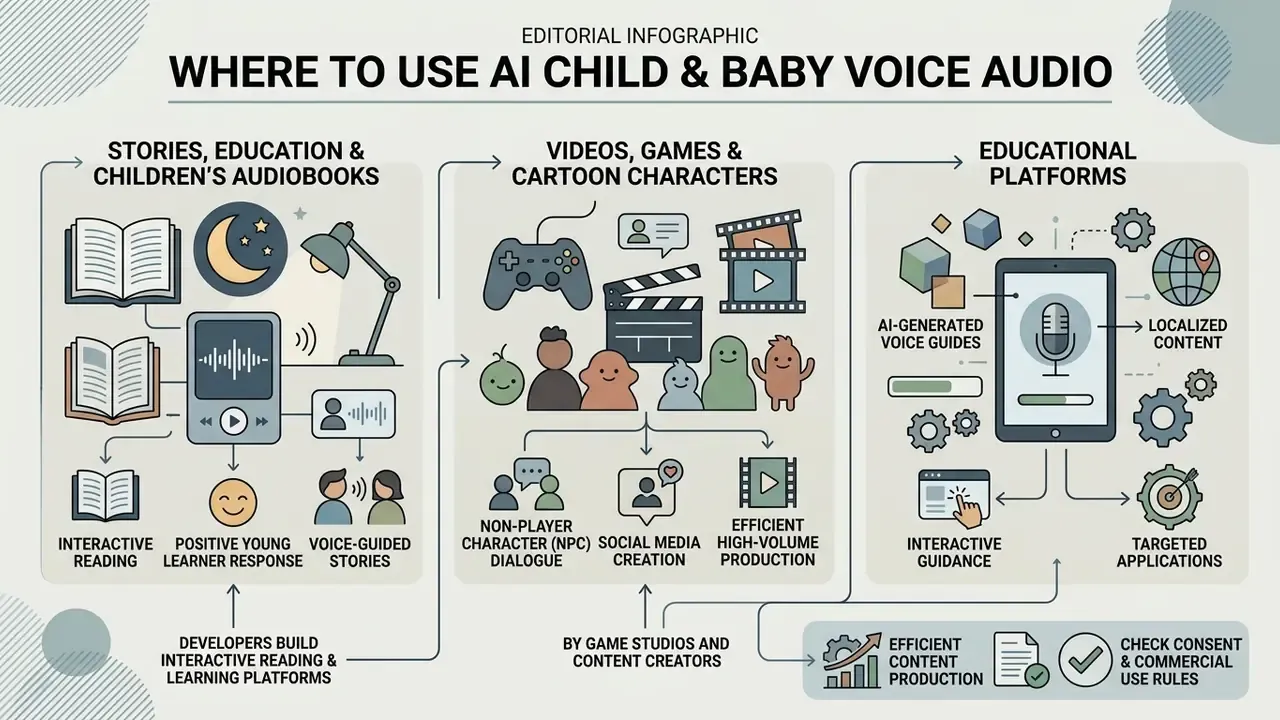
AI child and baby voices are used across educational technology, digital publishing, video game development, and short-form video creation.
Synthetic voices let developers and creators produce localized, high-volume audio content without forcing real children into repetitive recording studio environments. That is an ethical argument as much as a budget one.
Stories, Education and Children's Audiobooks
Educational platforms and digital publishers use synthetic child voices to build interactive reading coaches, language learning applications, and audiobooks.
In educational settings, young learners respond positively to child-like synthetic voices. Systems such as SingaKids (2025) use multilingual, kid-friendly speech generators to assist elementary students with language acquisition through picture description exercises.
«SingaKids combines four components: dense image captioning, multilingual dialogue, child speech recognition, and child-friendly speech generation to raise learner engagement.»
Similarly, platforms like Ask ABC Mouse deploy AI-generated child voices to guide children through interactive literacy lessons, and 2026 sandbox programmes documented by the Joan Ganz Cooney Center describe AI reading coaches and audio games built around children's oral-language development.
Expectation setting matters here. A 2023 audiobook study found listeners preferred human narration on mental imagery, engagement, attention, emotion, and recall, and a 2024 classroom study found human voices out-scored TTS on perceived quality. Synthetic child voices are strongest for scale, iteration, and localisation. They are not, on current evidence, a claimed replacement for a skilled human narrator in premium long-form work.
Videos, Games and Cartoon Characters
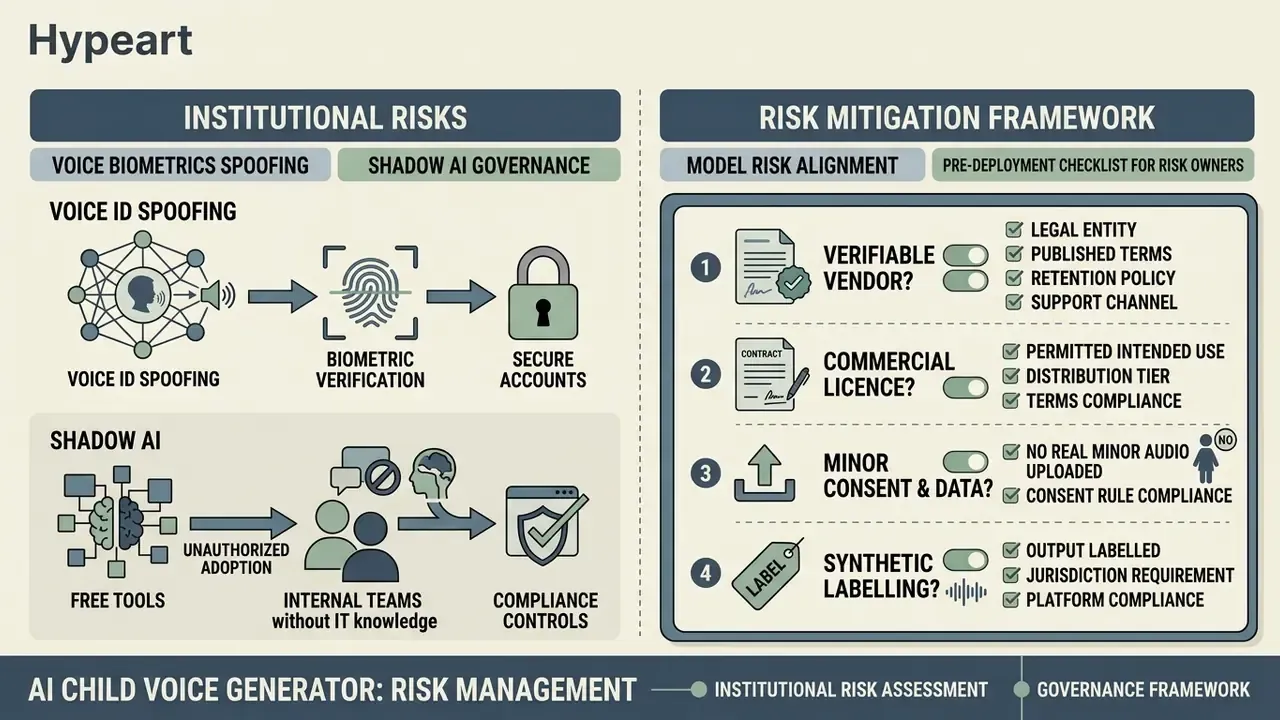
Voice Biometrics, Spoofing and Shadow AI Governance
Free Plan, Commercial Use and Responsible Creation
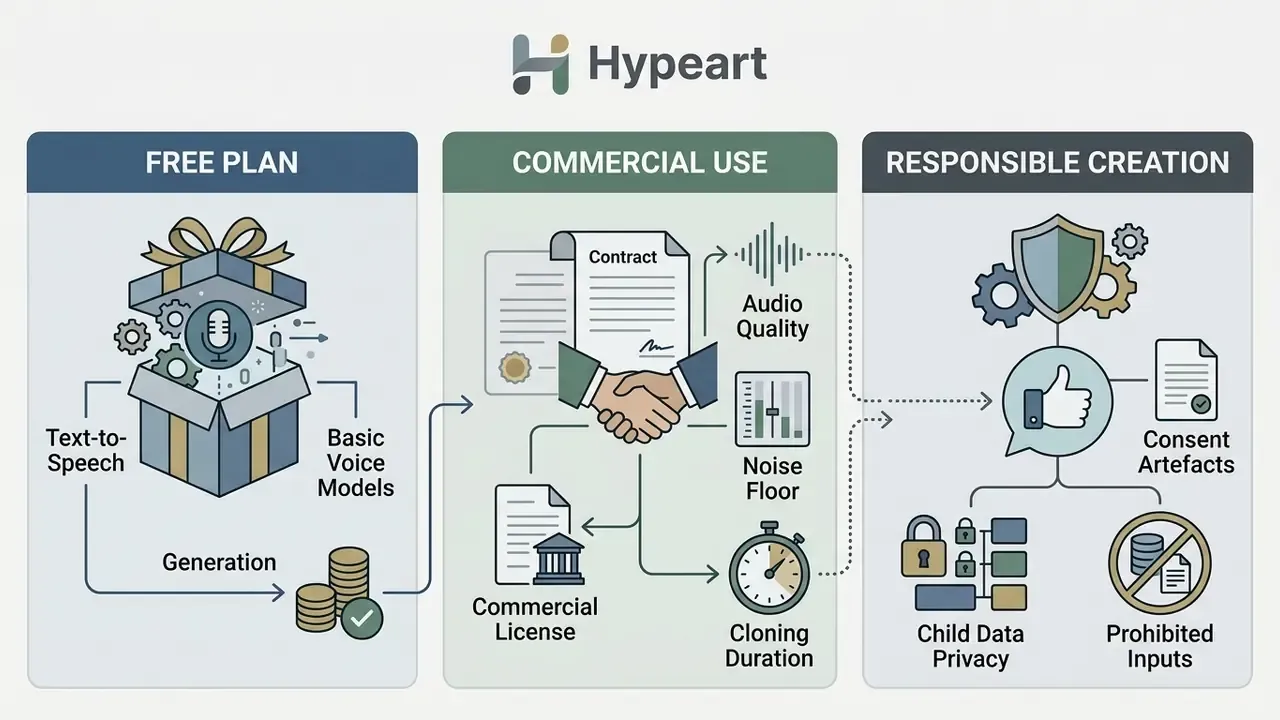
Deploying synthetic child voices in commercial projects requires navigating legal usage rights, copyright regulations, and child data privacy protections.
This section is general information and does not replace advice from a qualified lawyer on copyright, children's data protection, or commercial licensing in your jurisdiction.
Legal and ethical compliance check
Before publishing or monetizing audio produced by an AI child voice generator, review the terms of service governing your plan tier and confirm the scope of commercial licensing for AI-generated content. Free plans frequently restrict commercial exploitation, mandate public attribution, or prohibit monetization outright.
Never perform voice cloning on real children or identifiable minors without explicit, verifiable written consent from a legal parent or guardian. Research frameworks such as "Not My Voice!" (Hutiri et al., 2024) and the V.O.I.C.E taxonomy (2026) highlight rising safety hazards tied to unconsented synthetic voices, including identity theft, impersonation, and child-targeted exploitation.
The U.S. Copyright Office (2025 Report on Digital Voice Replicas) emphasizes that agreements involving a minor's digital voice replica require court or parental authorization under applicable state laws. Under the FTC COPPA rule, collecting or processing biometric voice identifiers from children under 13 for AI training mandates verifiable parental consent, and FTC commentary treats AI training as a separate purpose requiring its own consent, not an activity "integral" to the service. Under GDPR and UK GDPR, a child's voice is personal data, and consent must be given or authorised by a parent below the national age threshold of 13 to 16.
«Since March 2023, the OECD AI Incidents database has recorded a sharp rise in synthetic-voice abuse: identity theft, impersonation, and unauthorised use of children's voices.»
«Generative voice models increasingly use performers' voices without permission, opening the door to large-scale fraud and exploitation.» — V.O.I.C.E Taxonomy (2026).
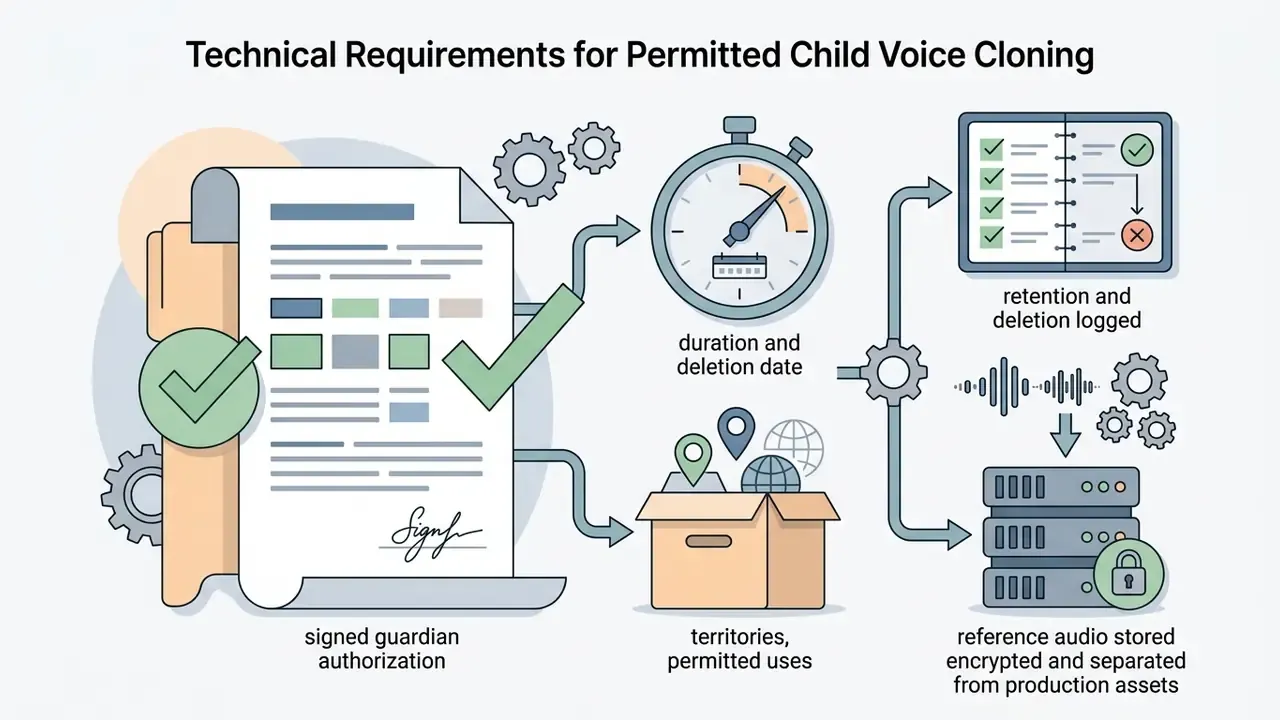
Technical Requirements for Permitted Child Voice Cloning
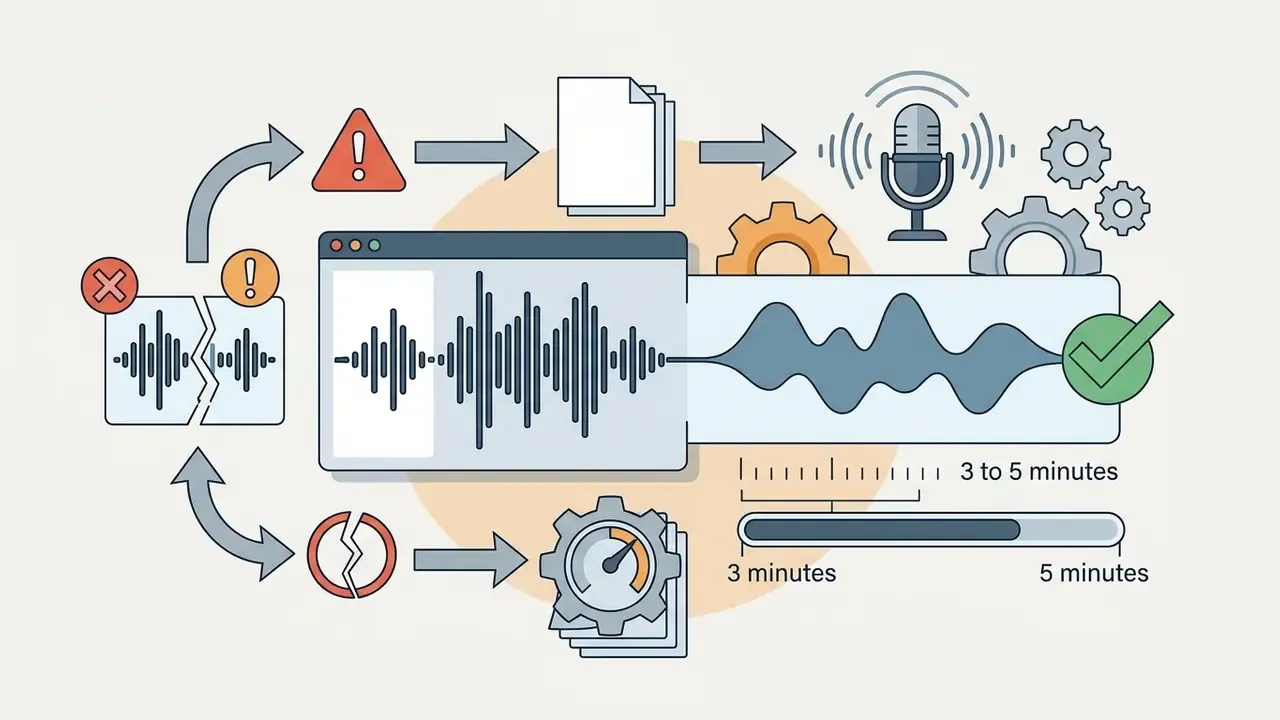
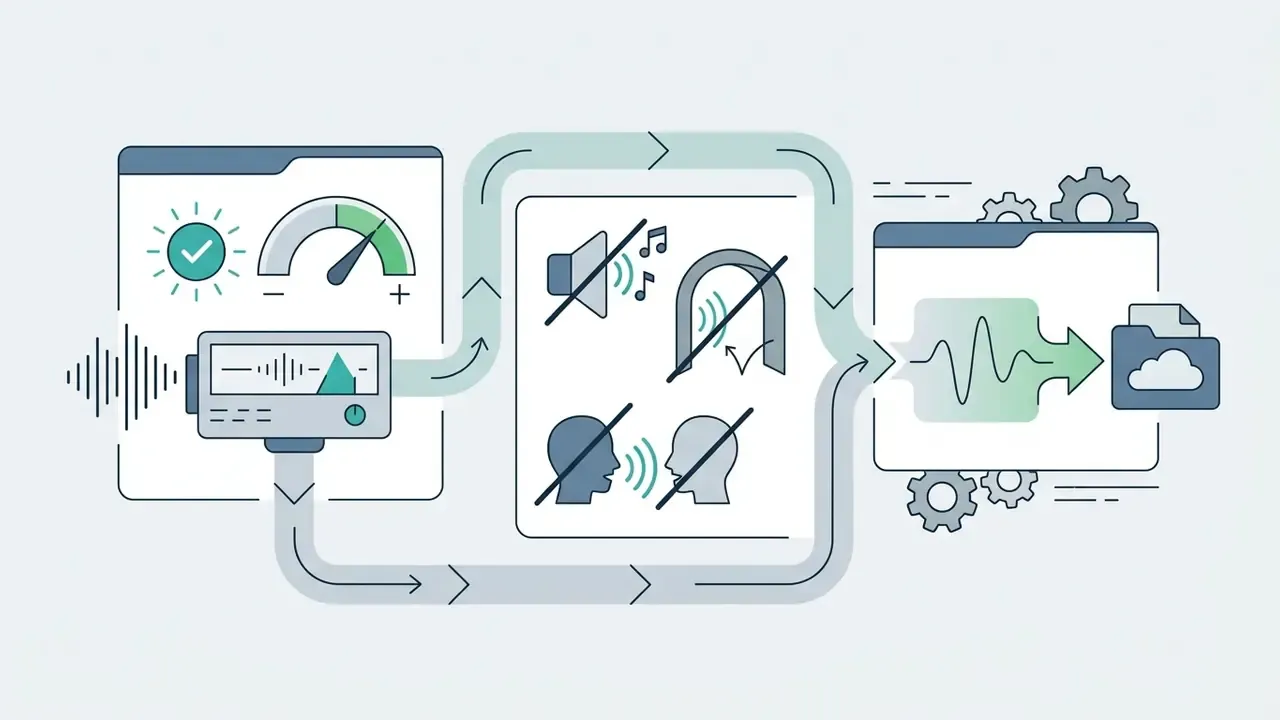
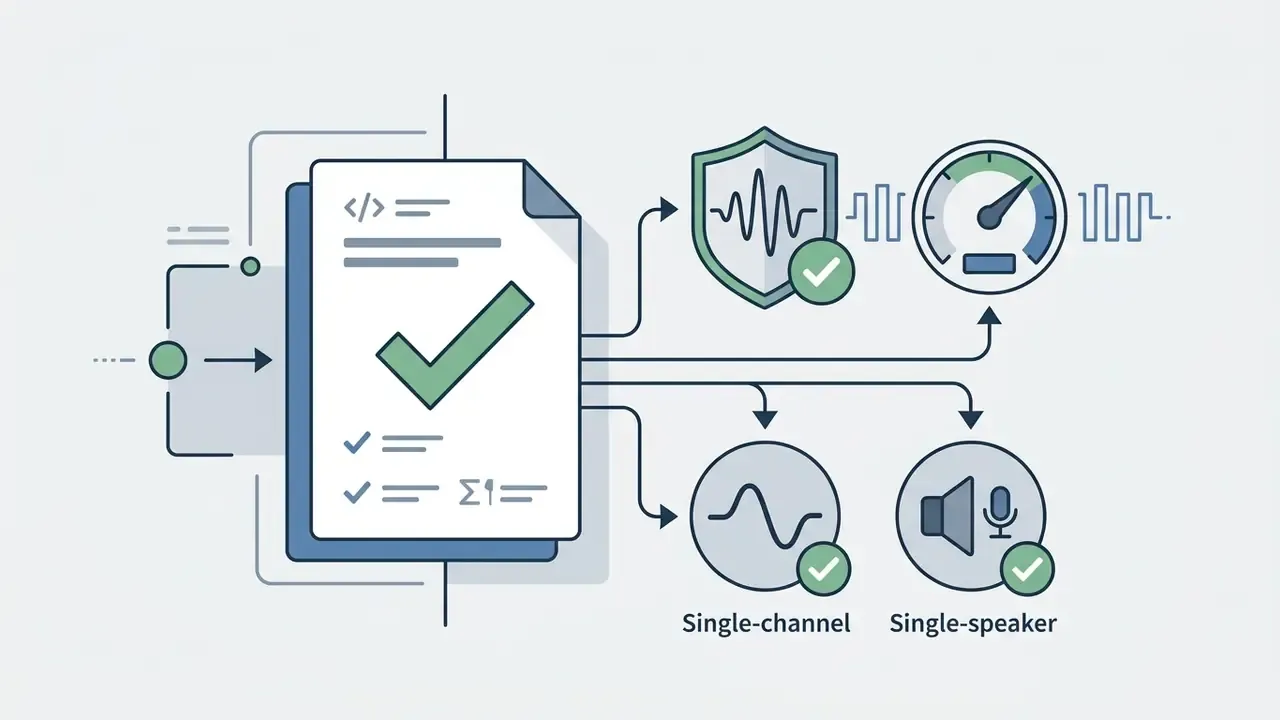
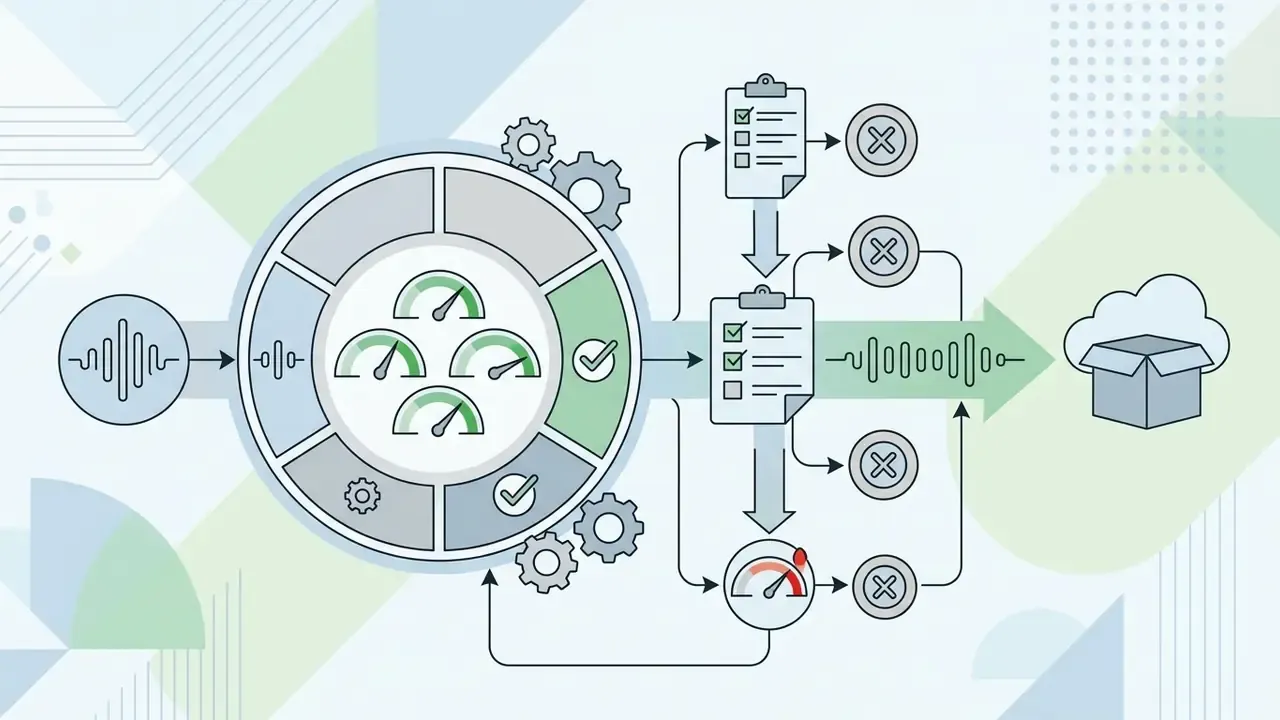
When uploading reference audio for a custom child voice, and only where parents or guardians have given written, verifiable authorisation:
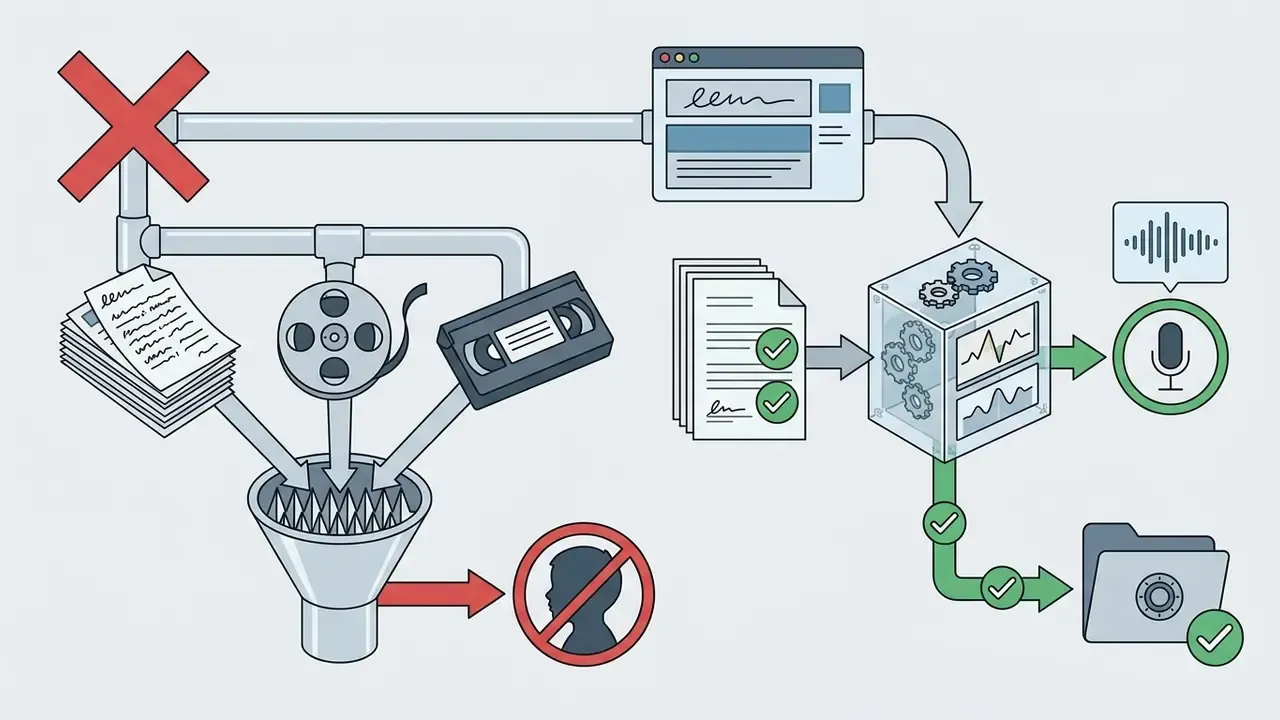
A financial media team evaluated synthetic child narration for a financial literacy app aimed at teenagers (illustrative example). The compliance department audited the system against FTC COPPA standards and confirmed that using generic, non-cloned voice models eliminated minor privacy liabilities. That verification let the app launch on schedule without parental media releases for child performers. To review governance policies, you can view the guide on commercial licensing or open the hub for compliance documentation.
Languages, Voice Styles and AI Voice Samples
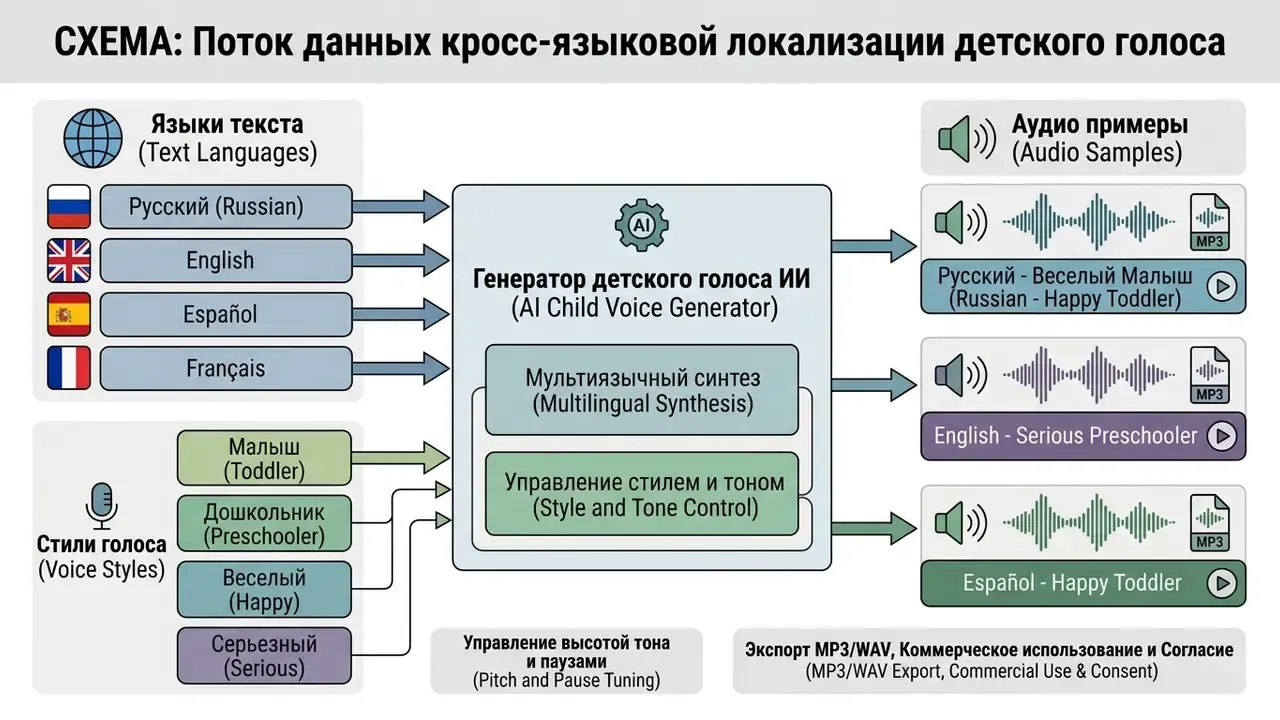
Modern neural speech engines support multilingual child voice generation, enabling global content localization across dozens of languages.
Multilingual models preserve age-specific vocal timbre while rendering scripts in non-native languages. In theory. In practice, coverage is uneven, and the gap shows up first in child voices.
Multilingual Child Voices for Global Content
Cross-lingual child voice synthesis lets creators generate localized voiceovers in languages such as Spanish, Mandarin, German, French, and Tamil without changing the core voice character.
Advanced models such as Qwen3-TTS (2026) are trained on over 5 million hours of multilingual speech data across more than 10 languages, offering zero-shot voice cloning and low-latency streaming. The MultiGen system (2025) uses specialized language models to generate child-friendly speech in low-resource languages, including Malay, Tamil, and Singaporean-accented Mandarin.
«MultiGen applies culturally relevant training strategies to generate child speech in low-resource languages using large language model architectures.»
Large-scale datasets such as Emilia supply the foundational audio training data required for cross-lingual speech stability.
«Emilia is assembled from in-the-wild sources, podcasts and video platforms, covering English, Chinese, German, French, Japanese and Korean at a 24 kHz sampling rate, with over 101,000 hours of speech.»
Reality check on coverage claims. Dedicated child voice inventories are much narrower than general TTS inventories. Commercial libraries commonly ship child characters in English (US, UK, Australian), German, and Spanish variants, with 10 to 30+ languages available in specialised kid-voice products. Academic child-speech synthesis is validated on even fewer languages, English and Hungarian in one 2023 multilingual multispeaker study. For unsupported languages, most vendors recommend pitching up an adult voice, which returns you to the manual pitch-shift procedure above and its artifact trade-offs.
Developers implementing these capabilities via software endpoints can view the guide to inspect API parameters or explore the hub to evaluate model architectures. Teams costing out a full localisation pipeline may also want the reference implementation notes in the Google Veo API guide.
FAQ About Free AI Child Voice Generators
Can I Try a Child or Baby Voice Before Downloading?
Yes. Most web-based voice generators let users play a short audio preview inside the browser before exporting the media file.
Practices differ by vendor. Some platforms offer account-free sample previews capped at roughly 200 to 500 characters and rate-limited per session; others state explicitly that previews cannot be produced without consuming account credits, with only a limited number of free regenerations available on the website. Confirm the preview policy before pasting a long script, and prototype on the cheapest voice tier.
Can I Create Different Kid Voice Styles for One Project?
Yes. Multi-speaker voice frameworks let creators assign different child, kid, and adult voices to individual characters within a single dialogue script.
API systems such as Google Cloud TTS support multi-speaker configurations (MultiSpeakerVoiceConfig), which allows seamless character switching within one audio file. The Gemini API caps multi-speaker audio at two speakers, some conversational platforms permit dynamic voice switching inside a single response using tag markup, and web editors such as SpeechGen render several voices sequentially into one file. For system tools and usage cost tiers, open the hub for estimation tools, open the hub for tier breakdowns, or open the hub for assistance.
Is It Safe and Legal to Use an AI Child Voice for Monetized Content?
Generally yes, when the voice is fully synthetic, no real minor's audio was used as a reference, the licence tier permits commercial use, and platform labelling requirements for synthetic media are met. It becomes high-risk the moment an identifiable child's voice is cloned without documented guardian authorisation.
How Many Child Voices Do Free Tools Actually Offer?
Dedicated inventories are modest. Published libraries range from roughly 14 to 18 child characters on pay-as-you-go engines, to around 30 in-house child voices on kid-specialised platforms, up to 66 child voice styles on multilingual kid-voice services. Age labels usually start near 5 or 6 years. Literal newborn models are effectively unavailable, and "baby voice" presets are soft, high-pitched toddler approximations.
Why Does My "Child" Voice Still Sound Like an Adult?
Because instruction-guided models default to adult acoustic signatures unless fine-tuned on child speech: age-classification accuracy for instruction-only child voices has been measured at 28.9%. Choose a purpose-built child model, or apply the manual pitch and formant procedure above, then verify by listening rather than by label.
Can I Use a Free Child Voice for a Client Project?
Usually not without upgrading. Free tiers typically grant personal, non-commercial rights, and may add watermarks or attribution requirements. Move to a paid tier that explicitly grants commercial rights, then archive the licence terms alongside the delivered asset.
What Is a Safe Next Step If My Team Is Already Using These Tools?
Start with discovery, not enforcement. Ask teams to self-report which voice generators they use, on which tier, and for which published assets. Then register the approved tools, log the outputs, and set a review date. A short, honest inventory beats an unenforceable policy.
About this guide. Written and maintained by the editorial research team, with governance and model-risk review attributed to Marcus Hale, author. Acoustic claims are sourced from peer-reviewed and PubMed-indexed speech studies; legal points from the U.S. Copyright Office (2025), FTC COPPA guidance, NIST synthetic-content publications (2026), and GDPR/ICO child-data guidance. Product limits, character caps, and pricing tiers change frequently, so verify current vendor terms before publishing. Nothing here constitutes legal advice.
To inspect additional platform tools, voice models, and editing software, compare options across our resource hubs, including the free photo editor guide and the wider glossary.