For a US financial institution the stakes are narrower and sharper. One substituted verb inside a disclosure can convert an obligation into a suggestion. That is the whole risk, in a sentence.
«In automated text transformation, output autonomy without semantic verification introduces unquantified operational risk. Every AI-assisted rewrite must maintain an evidence chain connecting the source passage to the final output.»
Last updated: 2026. Reviewed for factual accuracy against published paraphrase-evaluation research, publisher AI policies, and vendor documentation.
Executive Summary for Decision-Makers
| Question | Short answer |
|---|---|
| What does the tool do? | Rewrites text at word, sentence, and paragraph level while holding semantic content stable; output length typically stays at 90–110% of the source. |
| Where is the main risk? | Semantic drift: vocabulary substitution that converts mandatory language into optional guidance, or that corrupts numeric, legal, and clinical terms. |
| How is quality measured? | Three independent dimensions: meaning preservation (semantic scoring), fluency and grammaticality, and dissimilarity from the source. Lexical change alone proves nothing. |
| What controls matter most? | Freeze-word lists, diff-view verification, human-in-the-loop approval, PII/MNPI sanitization, and immutable audit logging of prompt, model version, and reviewer verdict. |
| Free vs paid? | Free tiers cap output at roughly 125–600 words per request and 2–3 modes; paid consumer plans run about $8.33–$24.90 per month; regulated environments require enterprise tiers with SOC 2 Type II, zero data retention, SSO/SAML, and VPC or self-hosted deployment. |
| Is it allowed? | Yes, when disclosed, cited, and human-reviewed. AI tools cannot be listed as authors, and undisclosed AI paraphrasing of a source is treated as plagiarism. |
This guide moves from definition to workflow, then to modes, verification metrics, pricing tiers, responsible use, and selection criteria. Readers who only need the buying decision can jump to the consumer-versus-enterprise matrix and the risk-adjusted ROI model; readers building a control framework will find the governance workflow and audit-log schema more useful. Cost modelling for volume rollouts sits in our calculator collection, where you can browse the hub and adapt the inputs to your own review labour rates.
What Is an AI Paraphrase Generator?
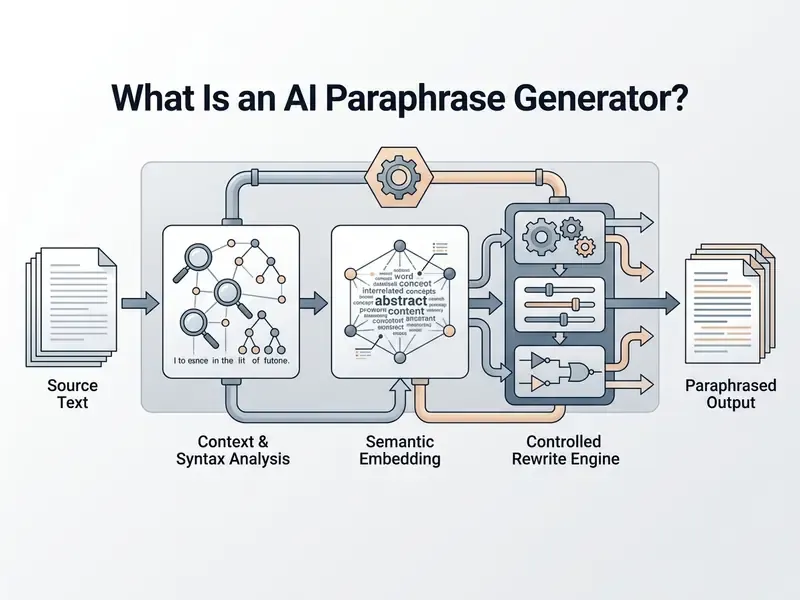
An ai paraphrase generator is a natural language processing system that restates source text across word, sentence, and paragraph levels while preserving its core semantic meaning. These systems parse input syntax, weigh contextual relationships between terms, and reconstruct sentences using alternative vocabulary and grammatical patterns.
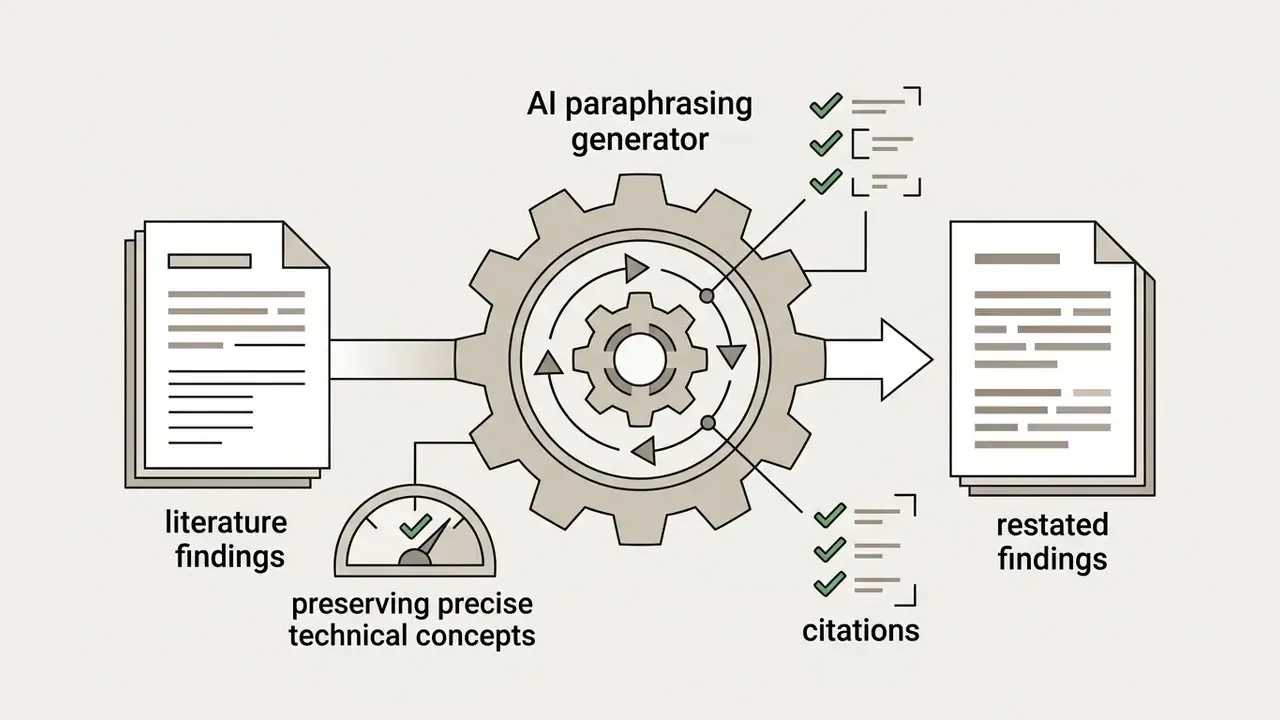
Academic definitions establish that paraphrasing expresses the same underlying idea in different words within the same language, keeping semantic content stable while altering surface representation (Callison-Burch, Paraphrasing and Translation, University of Pennsylvania, 2008). Modern tools powered by large language models (LLMs) operate across granularities, from a single phrase to a complete document, to improve readability, repair awkward phrasing, or adapt text for a different audience.
«Automatically generated paraphrases can substantially increase lexical and syntactic diversity without lowering semantic similarity scores.»
Enterprise documentation from vendor platforms such as Adobe Acrobat AI Assistant indicates that an ai paraphraser generator replaces specific words with contextual synonyms and alters syntactic ordering while retaining original intent and readability (Adobe, How to paraphrase with Acrobat AI Assistant, 2026. https://www.adobe.com/acrobat/how-to/paraphrase-ai.html). Document-processing teams that combine rewriting with extraction pipelines frequently pair a paraphraser with reverse image search and provenance tooling when verifying that supporting assets in a document are also original.
Here is a composite, illustrative example. In a hypothetical model risk assessment for a financial services compliance team, an unverified automated rewriter altered risk disclaimers during a bulk document update, turning mandatory regulatory language into optional guidance. Deploying an ai paraphrase generator with strict freeze-word parameters blocked substitution on regulated terms while keeping sentence restructuring available. The same review surfaced a second, quieter problem: analysts had been pasting draft disclosures into a public freemium rewriter. Shadow AI, with no procurement record behind it.
Paraphrase, Rephrase and Summarize: What Is the Difference?
Paraphrasing and rephrasing restate specific passages in different words while preserving length and core meaning. Summarizing condenses source text into a much shorter overview of main points. The terms ai generator paraphrase and ai generator rephrase describe equivalent transformation processes that re-express ideas without reducing information density.
| Dimension | Paraphrasing / Rephrasing | Summarizing |
|---|---|---|
| Primary Objective | Restate ideas in alternative words and sentence structures | Compress lengthy content into essential takeaways |
| Output Length | Approximately 90% to 110% of source length | Approximately 20% to 50% of source length |
| Information Scope | Preserves all details, nuances, and supporting points | Retains main concepts while omitting supporting details |
| Evaluation Focus | Semantic equivalence and structural diversity | Content coverage and compression efficiency |
| Typical Risk | Semantic drift on regulated or technical terms | Omission of a material condition or exception |
«Paraphrase generation targets semantically equivalent sentences in diverse linguistic forms, whereas summarization deliberately alters information density.»
University writing guidance treats rephrase as a near-synonym of paraphrase: both mean restating ideas in different words and structures without changing meaning, while a summary keeps only main ideas and often shrinks to one-half or one-third of the source. A paraphrase generator ai therefore optimizes for equivalence; a summarizer optimizes for compression. Mixing the two by accident is a common cause of dropped exceptions.
Who Can Use an AI Paraphrasing Tool?
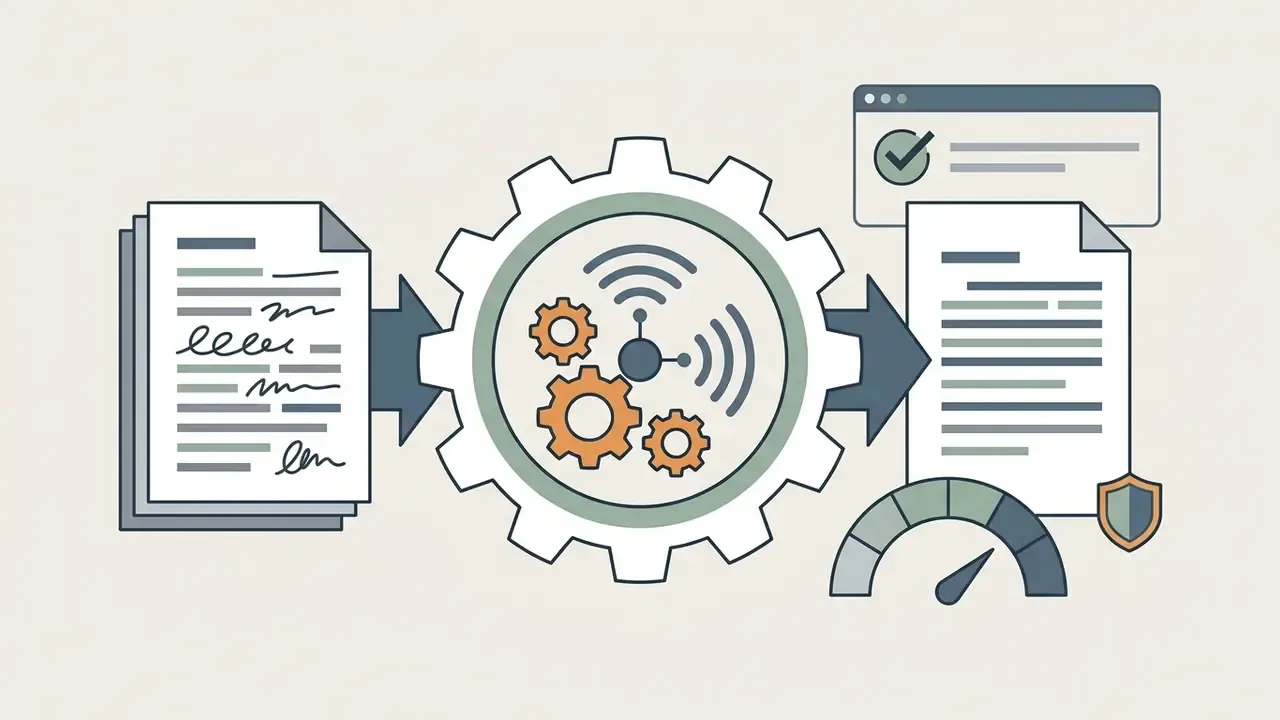
An ai paraphrasing tool serves two fairly different populations: individual writers who need clarity and tone control, and regulated organizations that need controlled, auditable text transformation at volume.
Enterprise and regulated roles
- Compliance Analysts and CCO Teams Adapt approved regulatory language for different channels while freezing obligation verbs ("must", "shall", "is required to") so mandatory conditions cannot quietly degrade into recommendations.
- Legal Operations Convert contract clauses and privacy notices into plain-language customer summaries, retaining a diff view as evidence of exactly what changed.
- Model Risk Management (MRM) and Validation Teams Treat the rewriter as a model in scope for validation, benchmarking semantic preservation before production release.
- Content Operations and Localization Managers Standardize brand voice across thousands of product descriptions and knowledge-base articles without rewriting each asset by hand.
- Finance Transformation Leads Cut manual editing hours in reporting cycles while pricing in the added cost of control and review steps.
- KYC and AML Documentation Teams Restate procedural narratives and case notes for internal training material, with entity names, thresholds, and typology labels locked.
- Enterprise Operations Use controlled text rewriters to adapt internal policy documentation for customer-facing communication channels.
Individual and academic roles
How to Use an AI Paraphrasing Tool
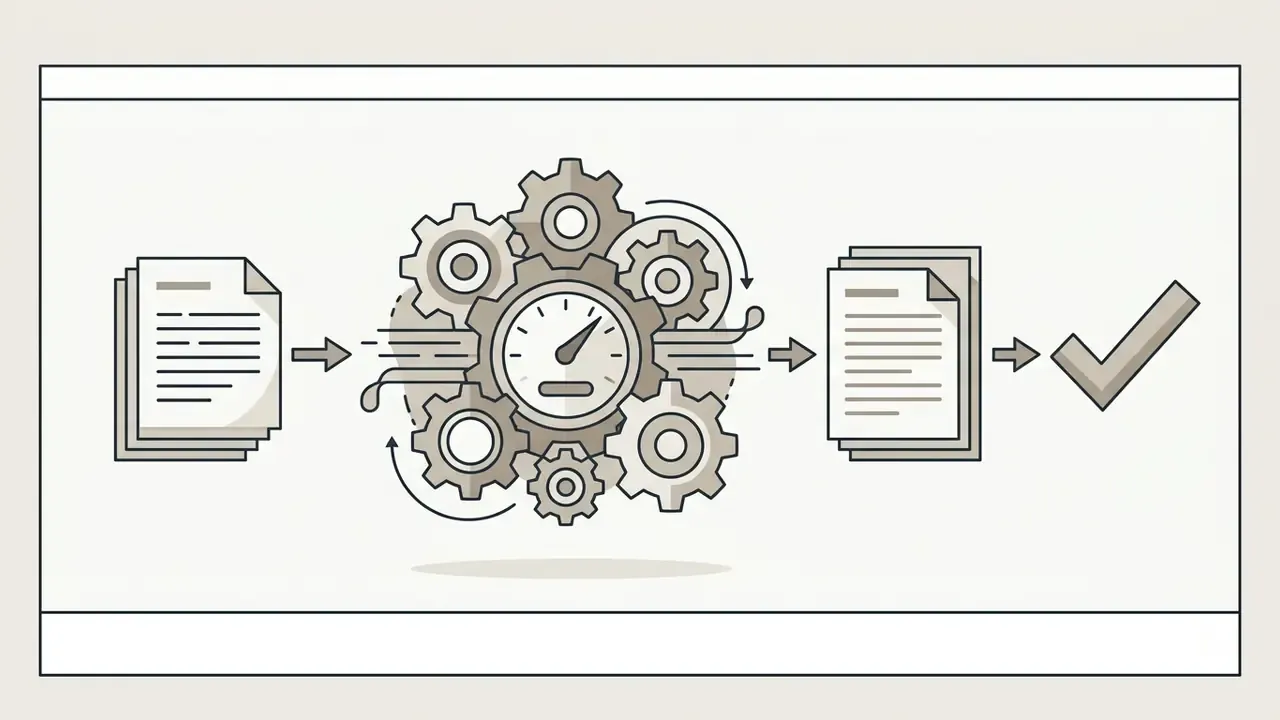
Using an ai paraphrasing tool involves a four-step operational workflow: pasting source content, selecting language and style parameters, running the generation algorithm, and conducting a manual semantic review. Vendor documentation converges on this sequence. Microsoft Copilot, for instance, instructs users to select text, request a paraphrase or tone refinement, review the suggestions, and only then insert the rewritten text back into the document (Microsoft, 2026).
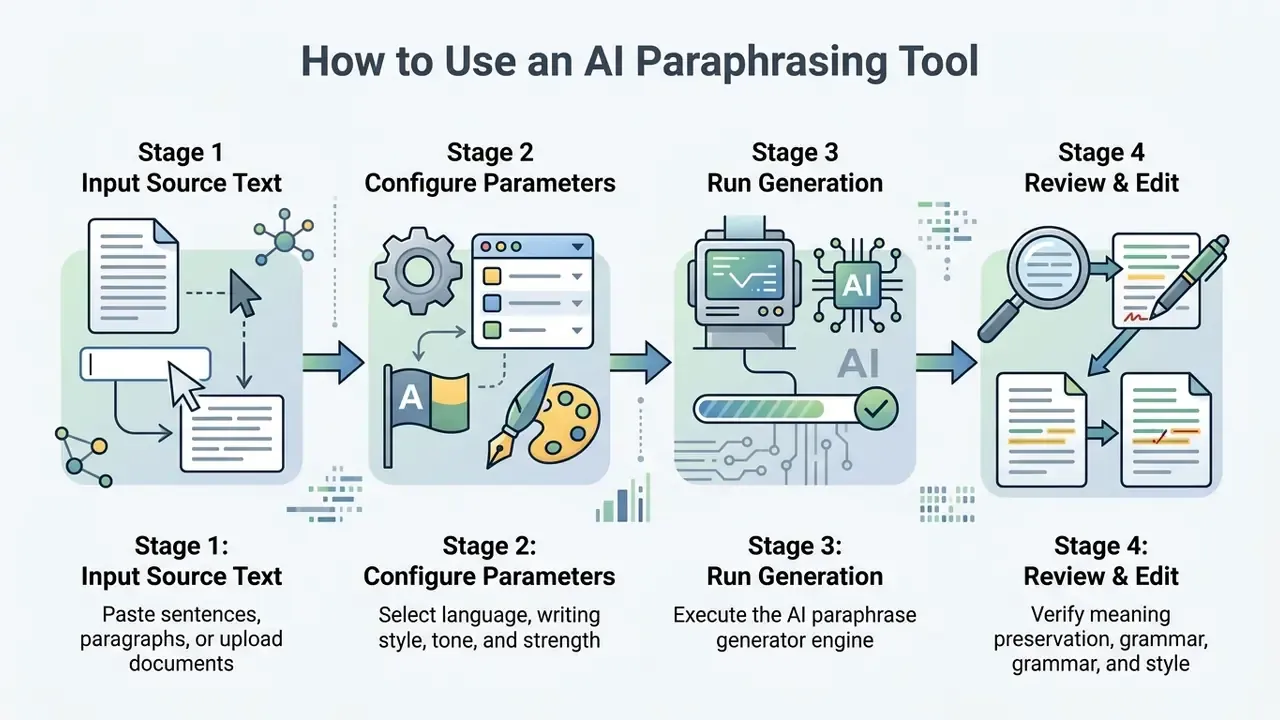
Flowchart: Standard AI Paraphrasing Workflow
Purpose
Visualizes the end-to-end operational sequence for generating paraphrased text safely and effectively.
Visual Description
A step-by-step sequential flowchart displaying five connected nodes:
- Input PhasePaste text or upload DOCX/PDF files.
- Configuration PhaseSelect target language, rewrite mode (for example, Formal or Standard), and tone settings.
- Execution PhaseClick the paraphrase button to run the model.
- Validation PhaseCompare original and generated text using sentence-level diff highlighting.
- Finalization PhaseExport or copy refined text after manual verification.
Semantic Markup Guidelines (text specification for the layout team)
- Reproduce all five steps as an ordered text list in the document flow, not only inside the image, so the sequence stays readable for screen readers and for search crawlers.
- Alt text for any raster or vector version must contain the phrase "ai paraphrase generator" and describe the five-stage sequence.
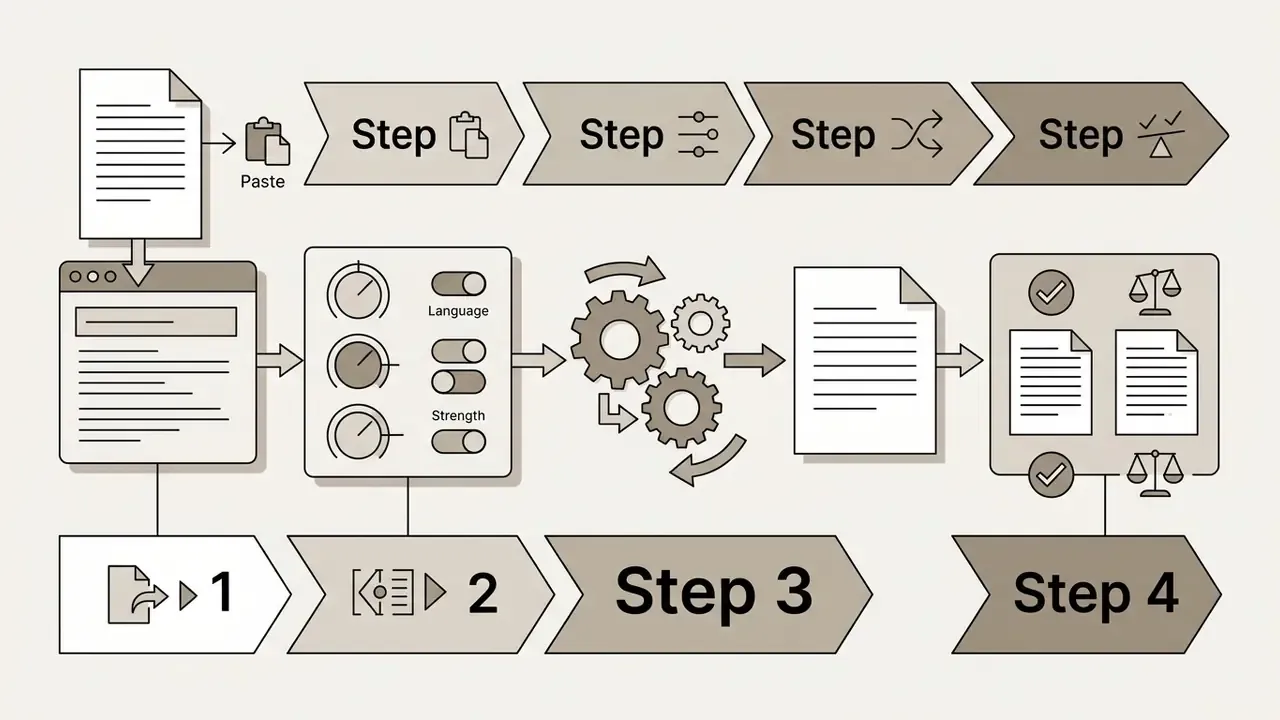
Paste Text and Choose a Writing Style
Start by inserting text into the input field of the paraphrase tool. Most platforms accept sentence-level, paragraph-level, or full-document uploads such as PDF and DOCX, with input caps that typically range from 800 words in free web editors to 3,000 words in mid-tier products.
After pasting the text, pick a style preset that matches your publication goal. Common presets include:
- Standard Balanced rewriting that stays close to the original wording.
- Formal / Academic Sophisticated vocabulary and objective third-person framing.
- Creative Alters sentence structure and vocabulary for varied reading rhythm.
- Simplify Replaces complex terminology with accessible phrasing.
Users can also supply custom prompts or target tones to steer the generation engine. Style selection is implemented as a discrete preset choice in most products. LanguageTool exposes five styles (general, formal, concise, free, informal), while Paperpal exposes five tones (Professional, Persuasive, Conversational, Polite, Creative).
Granular UI Editing: Word Swaps and Sentence Restructuring
Beyond automated paragraph rewriting, modern paraphrasing interfaces provide granular manual controls inside the editor. These controls matter operationally: a reviewer can fix one term without re-running the model and pulling in fresh, unreviewed changes across the whole passage.
- Interactive Synonym Popups Clicking any word in the generated output reveals a drop-down of context-aware synonyms ranked by semantic relevance, allowing instant word-level customization without a new prompt.
- Sentence Splitting and Merging The engine spots complex multi-clause sentences and offers a one-click toggle to split them into concise independent statements, or conversely to merge short, choppy sentences and improve flow.
- Change Highlighting (Diff View) Every substitution is highlighted against the source, so reviewers audit modifications instead of re-reading two full documents side by side.
- Alternative Sentence Variations Advanced tools return two or three candidate rewrites per sentence, letting the editor pick the most natural phrasing rather than accepting a single output.
- Freeze Words Protected vocabulary is locked before generation, so trademarks, statutory phrases, drug names, and numeric thresholds pass through untouched.
Example of sentence splitting mechanics:
- Original complex input: "Although the initial trial produced promising metrics, the evaluation committee delayed rollout because secondary safety protocols had not been fully documented."
- Split output (two sentences): "The initial trial showed promising metrics. However, the evaluation committee delayed the rollout due to incomplete safety documentation."
Example of a word-level swap that must be blocked:
- Source: "Disclosure is required under the policy."
- Unacceptable synonym suggestion: "Disclosure is recommended under the policy." A legitimate-looking swap that turns an obligation into an option. Freeze-word protection on "required" prevents this entire error class.
Review Changes Before Using the Rewritten Text
Before publishing or submitting paraphrased text, run a manual review to confirm the core meaning survived. Automated systems still misread technical jargon and occasionally introduce inaccurate synonyms.
A structured pre-use inspection checklist:
- Semantic FidelityConfirm the rewritten text conveys the exact facts and assertions of the source.
- Grammar and ReadabilityCheck for syntactic errors, awkward phrasing, or punctuation introduced during generation.
- Contextual AccuracyEnsure domain-specific terminology has not been swapped for an incorrect synonym.
- Tone ConsistencyVerify the output keeps a voice appropriate to the target audience.
- Numeric and Reference IntegrityRe-check figures, dates, percentages, citation markers, and cross-references, which paraphrasers often reposition or reformat.
- Substitution Error ClassificationFlag meaning-changing substitutions, invented non-words, wrong word class, and broken co-reference. Synonym-replacement research treats these categories as unambiguously invalid.
Enterprise Governance and Deployment Workflow
The four-step consumer flow is not enough in a bank, insurer, hospital, or listed company. Regulated deployments wrap the same engine in a controlled pipeline with explicit gates and recorded evidence.
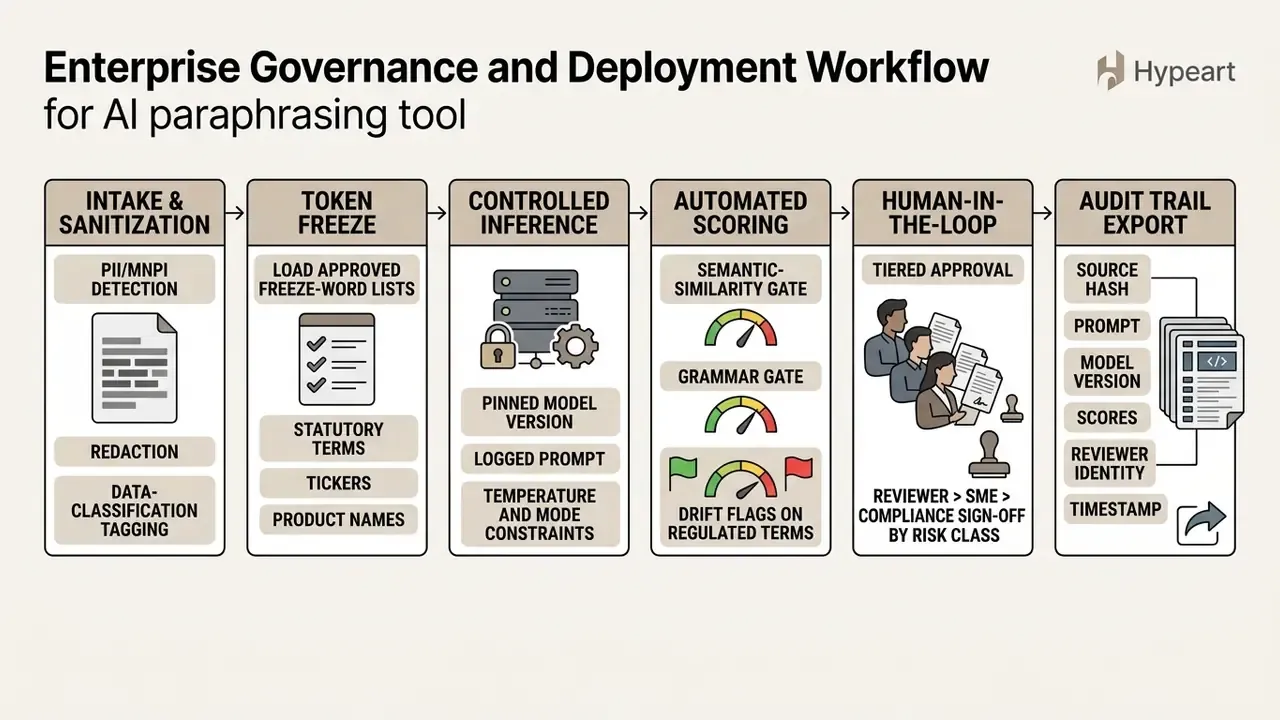
Escalation tiers by content risk class:
| Risk class | Example content | Required gate |
|---|---|---|
| Low | Internal newsletters, event copy | Automated scoring plus single editor review |
| Medium | Marketing collateral, knowledge base | Editor review plus brand or legal spot check |
| High | Regulatory disclosures, contract summaries, clinical or financial risk language | Full SME review, compliance sign-off, retained diff and audit log |
«Paraphrasing tools generally score low in AI-detection programs, allowing their changes to remain largely unnoticed.»
That finding carries a governance consequence. Detection tooling is not a control. If your only defence against uncontrolled rewriting is a detector, unlogged shadow-AI usage will slip past unnoticed. Controls belong at intake and approval, not at detection. Where disputes over authorship or licensing may follow, teams can compare options for documenting evidence before an issue escalates.
AI Rephrase Generator Modes and Controls
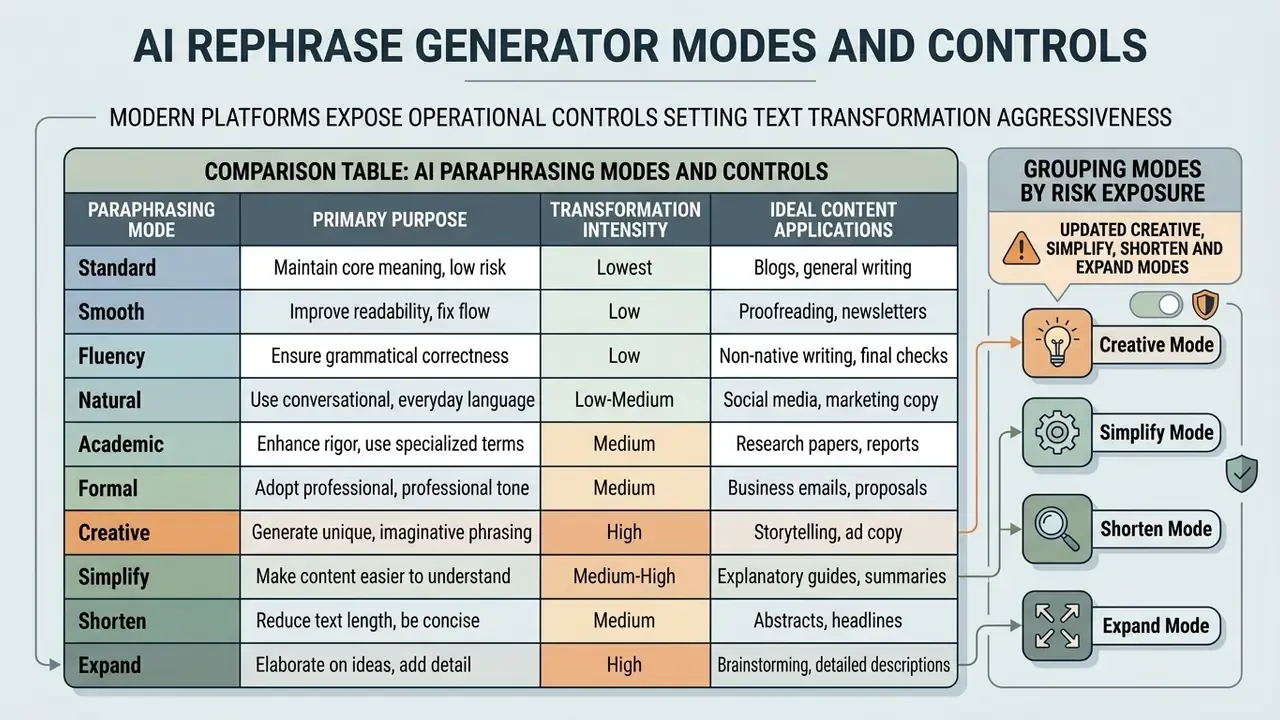
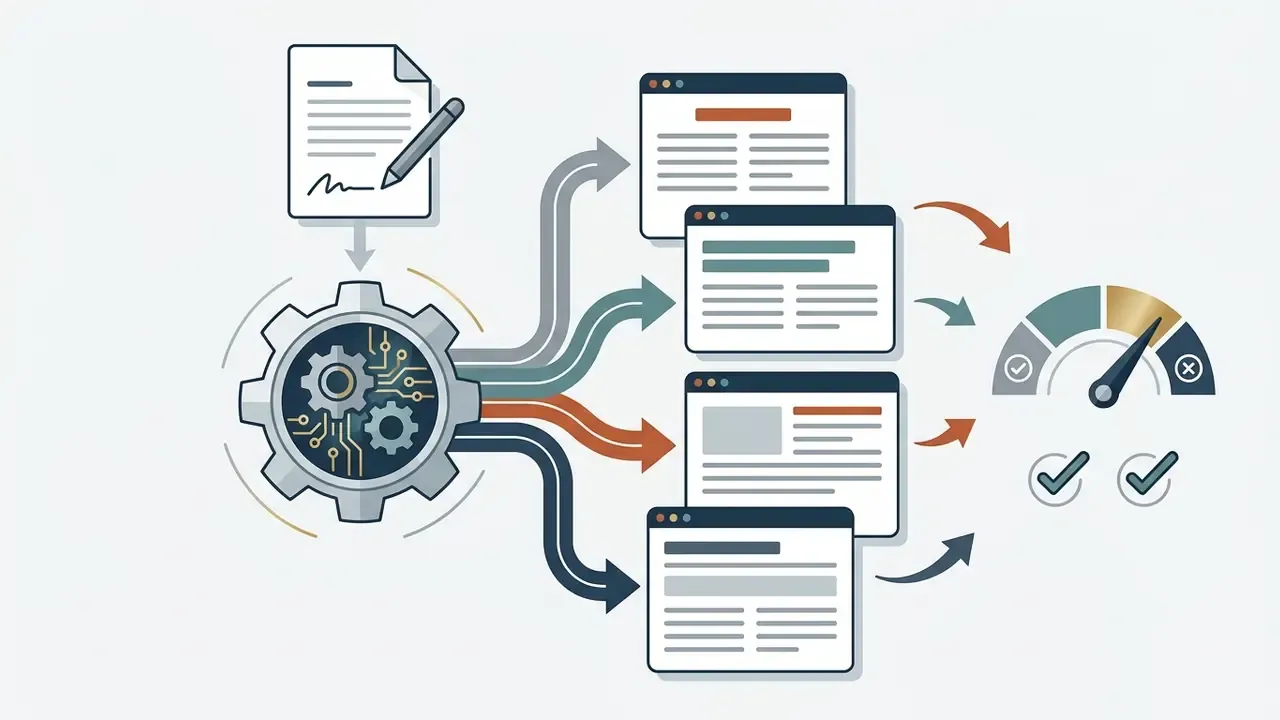
Modern rephrase ai generator platforms expose operational controls that set how aggressively the system transforms source text. Rewrite strength, style mode, and tone together decide whether output gets subtle polishing or a full structural rebuild. Vendor scales differ: ReText.AI documents three transformation levels (Low, Middle, High), CleverHumanizer documents four rewrite strengths (Minimal, Medium, Strong, Complete), and PerfectEssayWriter quantifies intensity as 25–35%, 45–55%, and 65–80% of words changed.
| Paraphrasing Mode | Primary Purpose | Transformation Intensity | Ideal Content Types |
|---|---|---|---|
| Standard | Balanced rewording while maintaining source tone | Low to Moderate (25%–35% word change) | General writing, blog drafts, internal communication |
| Smooth | Removes awkward transitions and improves flow without raising vocabulary complexity | Low Shift (15%–25% edit distance) | Rough drafts, quick polish |
| Fluency | Corrects subtle grammatical errors and enhances native-speaker phrasing | Low Shift (20%–30% edit distance) | Non-native English writing, ESL edits |
| Natural | Restructures sentences toward conversational speech patterns | Moderate Shift (35%–50%) | Emails, blog introductions, scripts |
| Academic | Scholarly tone with precise vocabulary | Moderate (45%–55% structural shift) | Research papers, essays, literature reviews |
| Formal | Professional, objective framing without contractions | Moderate (40%–50% shift) | Business reports, executive summaries, emails |
| Creative | Increases vocabulary variation and sentence rhythm | High (65%–80% transformation) | Marketing copy, storytelling, ad variations |
| Simplify | Lowers reading level and untangles complex syntax | Moderate (35%–45% shift) | Plain-language documentation, public guides |
| Shorten | Condenses text by cutting redundant phrasing | High Compression (20%–40% length reduction) | Summaries, social posts, character-limited copy |
| Expand | Adds clarifying context and explanatory detail | High Expansion (30%–50% length increase) | Draft expansion, educational materials |
Comparison Table: AI Paraphrasing Modes and Controls
Purpose
Provides an authoritative comparison of common paraphrasing modes, their technical impact on text, and recommended use cases.
Visual Description
A table detailing ten modes (Standard, Smooth, Fluency, Natural, Academic, Formal, Creative, Simplify, Shorten, Expand), with primary purpose, transformation intensity, and ideal content applications. Mode names and purposes must exist as selectable text, not only inside an image, and the table needs a caption plus proper header row.
Grouping Modes by Risk Exposure
For regulated content, mode selection is a risk decision, not a stylistic preference.
| Risk level | Modes | Reason |
|---|---|---|
| Low risk | Standard, Smooth, Fluency, Formal | Minimal structural change; low probability of altering assertions |
| Medium risk | Natural, Academic, Simplify | Register and syntax shifts can flatten qualifications and hedges |
| High risk | Creative, Expand, Shorten | Creative and Expand can introduce claims absent from the source; Shorten can delete a material condition |
Expand mode deserves particular caution in finance, legal, and medical contexts. Adding "clarifying detail" is functionally an invitation to hallucinate. Where Expand is used, every added clause needs source attribution before approval. No exceptions.
Academic and Formal Modes for Professional Writing
«LingConv provides control over 40 linguistic attributes and reduces attribute error by up to 34% compared with baseline models.»
That level of attribute control is what separates a defensible academic mode from a thesaurus loop. The system gets measured on whether it hit the requested register, not merely on whether words moved.
Informal Input: "We looked at the data and saw a big jump in numbers after the new policy started."

Academic Output: "Analysis of the dataset revealed a statistically significant increase following policy implementation."
Informal Input: "The team thinks the fix probably works, so we're rolling it out soon."

Formal Output: "The engineering team has assessed the remediation as effective, and deployment is scheduled for the next release window."
Creative, Simplify, Shorten and Expand Modes
Specialized transformation modes change information density and stylistic variation:
- Creative Mode Maximizes vocabulary diversity and varies sentence length. Suits campaign concepting, ad variant testing, and narrative content where factual density is low.
- Simplify Mode Replaces multi-syllable terms with accessible synonyms and breaks long compound sentences into shorter independent clauses. Readability diagnostics used in technical evaluation flag long sentences, rare words, multiple negations, deep embedding, and weak pronoun reference as the defects this mode should clear.
- Shorten Mode Identifies redundant adverbs, passive constructions, and filler phrases, then removes them to reduce word count without losing the main facts.
- Expand Mode Elaborates core concepts with transition phrases and clarifying clauses, stretching thin drafts into fuller paragraphs.
«Models such as ChatGPT reliably perform simple addition and deletion operations but struggle with complex changes to subordinate clause structures.»
In practice, deletion-based (Shorten) and addition-based (Expand) operations can be trusted at draft level, while clause subordination changes, exactly the constructions that carry legal conditions, still require human review.
Smooth, Fluency and Natural Modes: Popular Interface Presets
Three presets dominate commercial paraphraser interfaces because they answer the most frequent user complaint, which is "this reads badly" rather than "this needs rewriting".
- Smooth repairs transitions and cadence while leaving vocabulary mostly intact. Best used as a final pass, once the facts are locked.
- Fluency targets grammatical polish and native-speaker phrasing. It is the highest-value mode for ESL authors and translated source material, since it fixes article usage, prepositions, and collocations without restructuring the argument.
- Natural converts stiff, nominalized prose into conversational rhythm. Useful for email, onboarding flows, help-center copy, and video scripts.
Because these three change wording the least, they double as the safest defaults for regulated content that only needs a readability lift.
Tone, Voice and Rewrite Strength
Transformation controls let users calibrate output parameters:
- Rewrite Strength Sets the share of modified vocabulary and syntactic structures. Low strength limits edits to minor word substitutions; maximum strength rebuilds sentence architecture outright.
- Tone Presets Adjust the emotional register of the output (Professional, Persuasive, Conversational, Urgent, Polite).
- Voice Adjustments Hold first-person, second-person, or third-person framing consistent across transformed paragraphs.
- Length Controls Constrain output to a target word or character count, which prevents Expand-style inflation in channels with hard caps.
- Meaning-Preservation Gauges Some tools surface a semantic-similarity indicator plus sentence-level diff highlights, so stronger rewrites can be watched for drift in real time.
Custom Voice Memory and Reader Impression Analytics
Advanced tools let enterprise users build a persistent Voice Profile. By analyzing samples of an author's previous writing, the paraphraser extracts sentence-length preferences, vocabulary density, punctuation habits, and preferred terminology, then applies those rules to future rewrites. This answers the most common objection to automated rewriting, that output sounds generic, and it standardizes brand voice across distributed content teams.
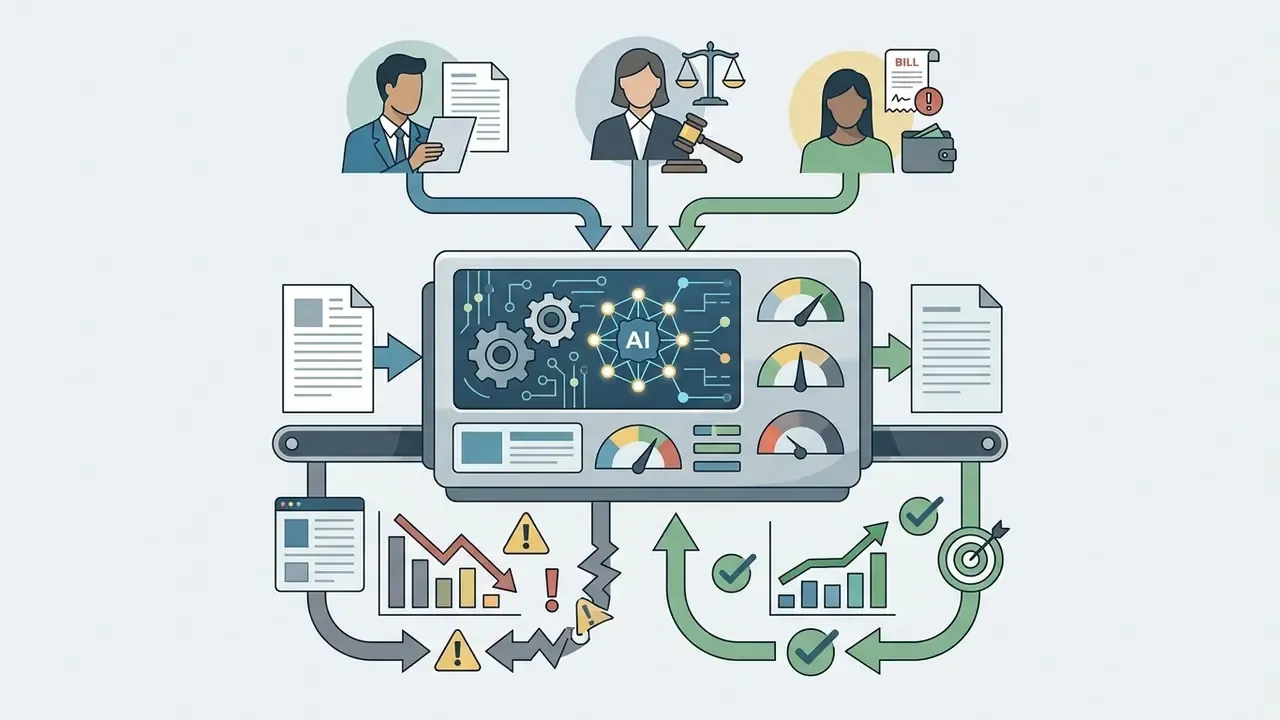
Pre-publication validation increasingly adds Reader Impression Analysis, which estimates how a target audience is likely to perceive the output:
Commercial writing assistants have productized this pattern. Grammarly, for example, markets both a custom-voice capability that learns an author's style and a reader-reaction feature that gauges audience response (Grammarly, 2026. https://www.grammarly.com/ai/ai-writing-tools/rewording-tool).
How to Check AI-Paraphrased Text for Meaning, Grammar and Originality
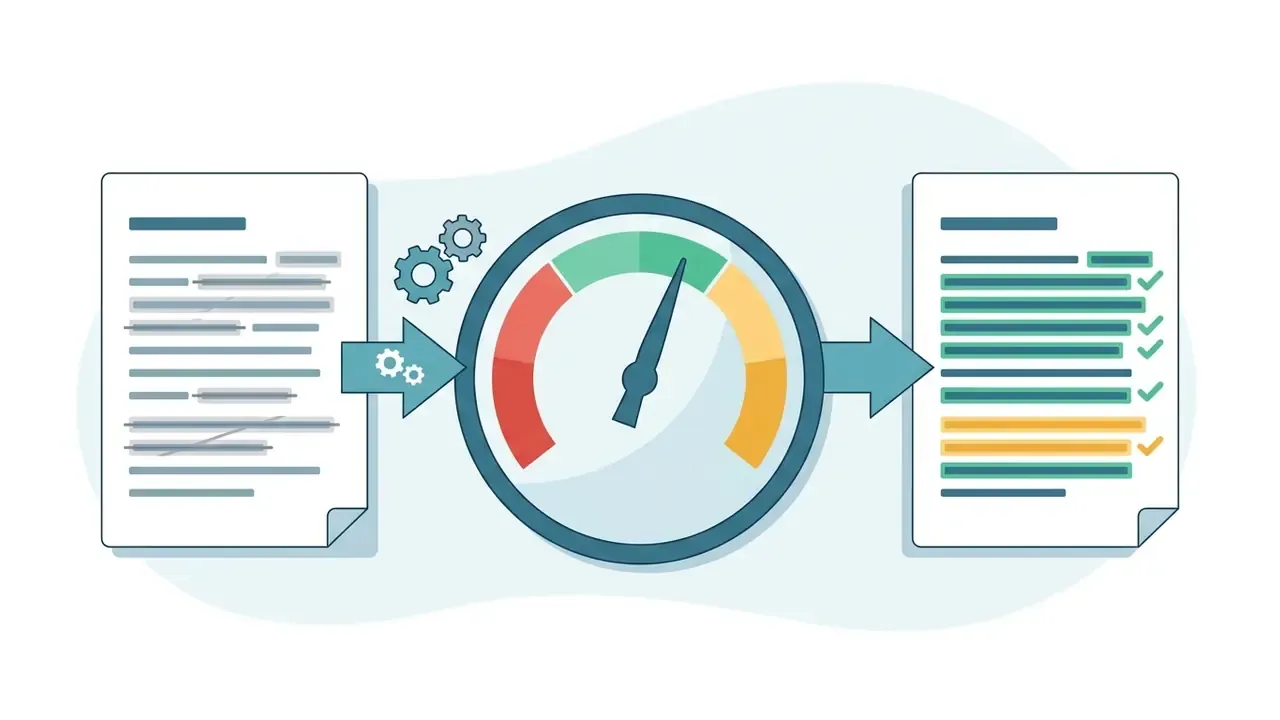
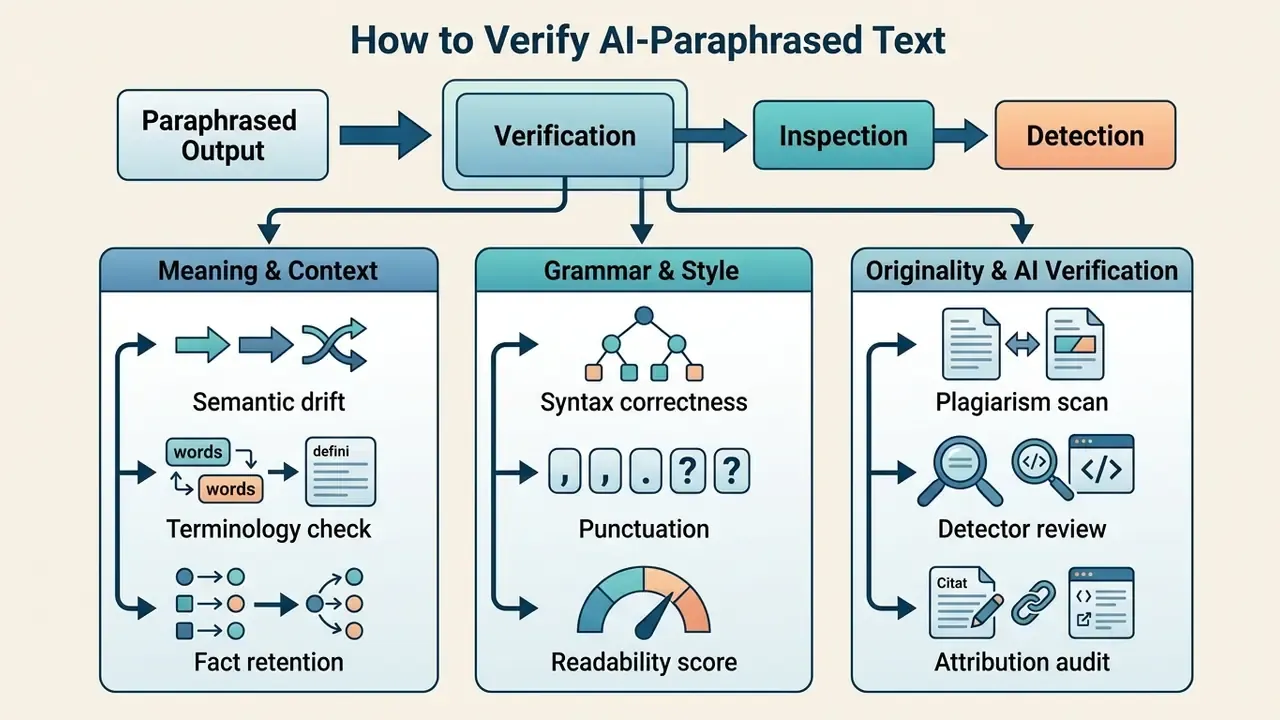
Evaluating rewritten text means verifying three separate dimensions: semantic equivalence (meaning preservation), syntactic correctness (grammar and fluency), and surface dissimilarity (originality). Accepting automated output without systematic verification creates both compliance and quality exposure. Paraphrase-evaluation research from 2025–2026 uses precisely this three-part decomposition, with human annotation scales running alongside automatic similarity metrics.
Meaning and Context Checks After Paraphrasing
Semantic drift happens when an automated rewriter changes vocabulary in a way that subtly alters the original assertion. Replace "required compliance" with "recommended compliance" and a mandatory obligation quietly becomes a suggestion.
To run a structured semantic audit:
- Sentence-by-Sentence ComparisonRead the original passage alongside the generated output and confirm factual alignment.
- Terminology ValidationCheck that key domain terms, legal conditions, and numeric metrics remain uncorrupted.
- Contextual Ambiguity ReviewVerify that pronoun references ("it", "they", "this") still point to their intended antecedents.
- Modality CheckConfirm that obligation verbs, hedges, and conditionals ("must", "may", "unless", "subject to") survived unchanged.
- Completeness CheckConfirm no exception, threshold, or qualifying clause was silently dropped during restructuring.
«Semantic equivalence must be assessed independently of lexical divergence: a high word-replacement rate does not guarantee preserved meaning.»
Grammar, Plagiarism and AI Detector Checks
Publishing paraphrased text calls for a multi-tool verification stack:
- Grammar Checkers Tools such as Grammarly catch punctuation or agreement errors introduced during restructuring.
- Plagiarism Checkers Database scanners confirm the transformed text does not match published web sources or academic repositories.
- AI Detectors Detection tools evaluate perplexity and burstiness to judge whether text carries algorithmic patterns.
«Originality.ai detected 100% of tested AI-rephrased articles, while Turnitin similarity scores fell from 39.22% to 23.16% after automated rephrasing.»
Grammarly's own documented workflow reinforces the point that these tools are complements, not verdicts: the vendor instructs users to rewrite, cite the source, run the plagiarism checker, disclose AI-tool use, and compare the rewritten version against the original before use (Grammarly Support, 2026). Authors and editors still need to perform manual editorial review rather than defer to a score. Independent evaluation sharpens the caution. One 2024 study found paraphrases generated by QuillBot, Grammarly, and ChatGPT were detected at rates from 0% to 100% depending on the detector, which means no single detection score is evidence of originality or of authorship.
Measuring Semantic Drift: Metrics, Thresholds and MRM Validation
Qualitative review does not scale to thousands of documents, and it does not produce numbers a validator or examiner will ask for. Quantitative scoring closes that gap.
| Metric | What it measures | Practical use |
|---|---|---|
| BERTScore | Contextual embedding similarity between source and output tokens | Primary semantic-fidelity gate for batch pipelines |
| P-SP (paraphrastic similarity) | Paraphrase-specific semantic preservation | Used in published evaluations, with acceptance treated as roughly 0.76 or higher |
| SemScore / cosine similarity | Sentence-embedding proximity | Fast pre-screen; flags outliers for human review |
| MSE-based control error | Deviation from the requested linguistic attribute | Confirms the requested register or mode was actually applied |
| ROUGE / BLEU (inverted use) | Surface overlap with the source | Rejects outputs that are too close to the source and therefore not a real paraphrase |
| Human adequacy, fluency, readability scales | Meaning equivalence, syntactic correctness, ease of reading | Authoritative gate for high-risk content classes |
Free AI Paraphrase Generator: Limits, Pricing and Paid Features
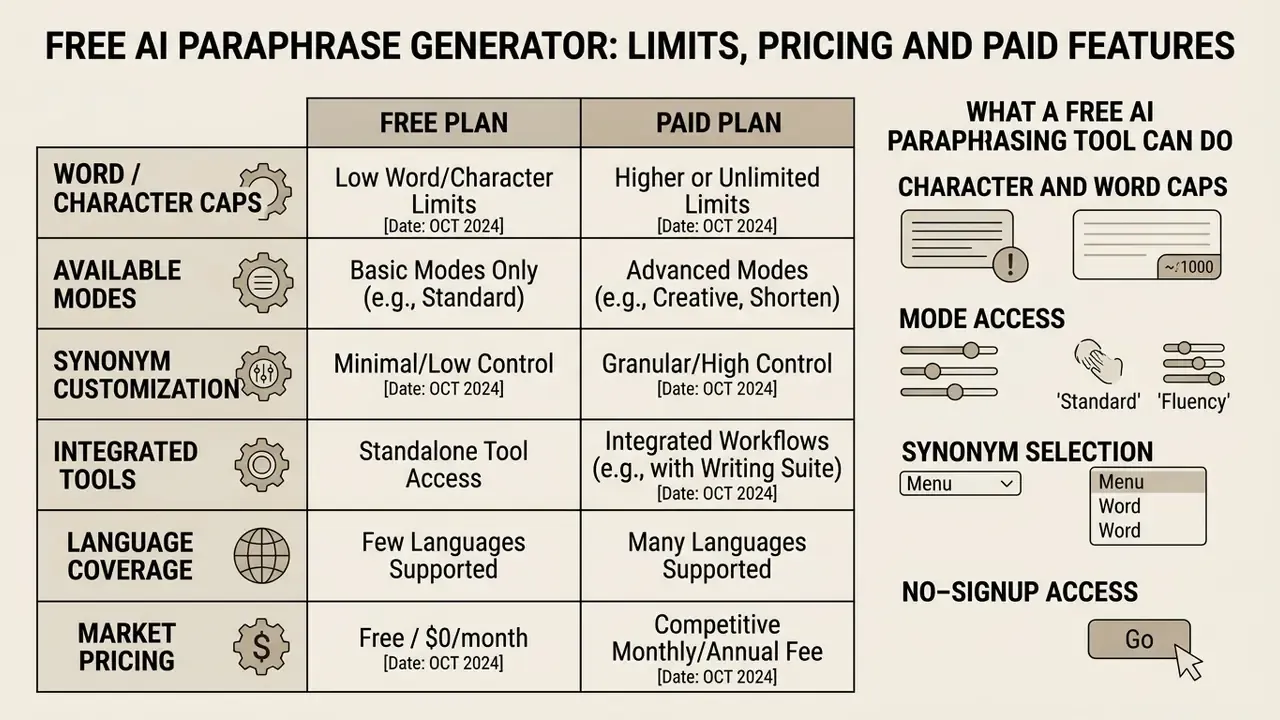
Most commercial rephrasing software runs on a freemium model. A free ai paraphrase generator offers basic editing with word limits, while paid subscriptions unlock higher allowances, advanced style modes, and team governance controls. Buyers searching for an ai paraphrase generator free of charge should read the retention clause before the feature list.
| Feature / Metric | Free Tier Plans | Paid Subscription Tiers |
|---|---|---|
| Word Limit per Request | 125 to 600 words per run | Unlimited or 10,000+ words per request |
| Monthly Character Caps | 10,000 to 20,000 characters | Uncapped or high enterprise limits |
| Available Modes | 2 to 3 basic modes (Standard, Fluency) | All 7 to 10+ modes (Academic, Creative, Natural, Custom) |
| Synonym Control | Basic slider (Low to Medium) | Advanced controls with Freeze Words |
| Integrated Tools | Standard text editor | Plagiarism scanner, AI detector, API access |
| Language Coverage | Limited subset | 30+ languages, 20+ tones on higher tiers |
| Pricing Benchmark | $0 per month | $8.33 to $24.90 per month |
Table: Pricing and Feature Comparison (Free vs Paid)
Purpose
Outlines technical limitations and commercial considerations for free versus paid paraphrasing software.
Visual Description
A comparative table contrasting word caps, available rewriting modes, synonym customization, integrated tool access, language coverage, and market pricing for free and paid plans. Current terms and pricing must appear as text with a verification date rather than only inside an image. For our own plan structure you can see the overview.
What a Free AI Paraphrasing Tool Can Do
A free ai paraphrase generator or ai synonym generator free handles basic sentence rewording, which is enough for short tasks and occasional spot edits:
- Character and Word Caps Based on current vendor documentation, QuillBot caps free transformations at 125 words per request, Paraphraser.io allows roughly 600 words per run, editGPT's free plan provides 10,000 words per month with a 600-word request ceiling, and Rytr limits free usage to 10,000 characters per month. (Figures reflect vendor pricing pages as of 2026 and change frequently. Verify before procurement.)
- Mode Access Free plans usually restrict usage to Standard and Fluency, locking Academic, Natural, or Expand behind paid tiers.
- Synonym Selection Features like an ai synonym generator free let users click individual words to view alternative vocabulary, though automatic replacement strength stays capped.
- No-Signup Access Many free rewriters require no account. Convenient for individuals, and precisely the property that makes them a shadow-AI risk inside a regulated organization.
Because free tiers commonly log inputs for model improvement, they are appropriate for public, non-sensitive text only. Teams verifying originality across mixed-media content can pair text checks with reverse image search and asset provenance tooling to confirm that images accompanying a rewritten article are equally clear of third-party rights issues.
When Paid Paraphrasing Tools Are Worth Considering
Upgrading makes sense for organizations and professionals handling significant content volume:
- Full-Document Rewriting No more chunking long manuscripts into 125-word blocks; entire DOCX or PDF files process in a single pass.
- Enterprise Controls Features such as Freeze Words keep brand terms, legal disclaimers, and product names untouched during rephrasing.
- Integrated Compliance Workflows Paid plans often bundle plagiarism checking, advanced grammar inspection, and API access for automated publishing pipelines. Content teams standardizing a broader production stack often evaluate rewriting alongside adjacent tooling such as an online photo editor with commercial-use terms so licensing rules stay consistent across text and visual assets.
- Throughput and Queue Priority Paid tiers process bulk jobs with fewer interruptions, which matters when publishing cadence is fixed.
- Language Breadth Higher tiers unlock 30+ languages and 20+ tones versus a restricted free subset.
Consumer Freemium versus Enterprise AI Governance Suites
Word caps and monthly price are the wrong axis of comparison for a regulated buyer. The matrix below reflects the criteria that actually decide whether a rewriter can touch customer, employee, or market-sensitive text.
| Criterion | Consumer Freemium | Prosumer Paid | Enterprise AI Governance Suite |
|---|---|---|---|
| Data retention | Inputs commonly retained for model improvement | Configurable, often opt-out | Zero data retention (ZDR) contractual commitment |
| Security attestation | None published | Varies | SOC 2 Type II, ISO 27001, penetration test reports |
| Deployment model | Public multi-tenant SaaS | Multi-tenant SaaS | VPC, private cloud, or self-hosted inference |
| Identity and access | Email login | Team seats | SSO/SAML, SCIM provisioning, RBAC |
| Audit logging | None | Basic history | Immutable logs: prompt, source hash, model version, reviewer, timestamp |
| Freeze-word governance | Absent | Per-user lists | Centrally managed, versioned terminology policies |
| PII/MNPI controls | None | Limited | Pre-inference detection, redaction, and blocking |
| IP and output rights | Ambiguous ToS | Standard commercial license | Negotiated IP assignment and indemnification |
| Integration | Copy and paste | Browser extension, basic API | REST API with SLA, GRC/MRM and DLP integration |
| Model transparency | Undisclosed | Named model family | Pinned versions, change notification, evaluation reports |
| Support and SLA | Community forum | Email support | Named CSM, uptime SLA, incident response commitments |
Selection rule of thumb: if the text you are rewriting would trigger an incident report when leaked, freemium tooling is out of scope regardless of output quality. Side-by-side vendor scorecards live in our AI Media Comparison Matrices, which use the same criteria weighting.
Risk-Adjusted ROI and Total Cost of Ownership
Consumer pricing, $8.33 to $24.90 per seat per month, is a rounding error in enterprise TCO. The real cost structure has four components:
TCO = Licensing + Integration/Engineering + Control & Review Labour + Validation & Audit Overhead
A workable risk-adjusted ROI expression:
Risk-Adjusted ROI = ( Hours Saved x Loaded Hourly Rate )
                  - ( Review Hours x Reviewer Rate )
                  - ( Licensing + Integration + Validation Cost )
                  - ( Expected Loss:  Sum of  Probability of Error x Cost of Error )
Worked illustration (directional, hypothetical, not a benchmark): a documentation team rewriting 2,000 assets per quarter saves an estimated 12 minutes per asset, or 400 hours. At a loaded rate of $60 per hour, gross saving is $24,000. Human review at 4 minutes per asset consumes 133 hours, or $8,000. Licensing, integration, and annual validation amortize at $9,000 per quarter. Net saving before risk is $7,000. If one uncontrolled disclosure error carries an expected cost of $250,000 at a 2% quarterly probability without controls, expected loss is $5,000, which trims net benefit to $2,000 and makes the control investment, not the license, the deciding variable. Cut error probability tenfold through freeze words and mandatory review, and net benefit climbs to roughly $6,500 on identical license spend.
The instructive conclusion: ROI in regulated environments is driven by error-probability reduction, not seat price. A cheaper tool without freeze words, logging, and ZDR is usually the more expensive decision.
Responsible Use for Academic and Commercial Content
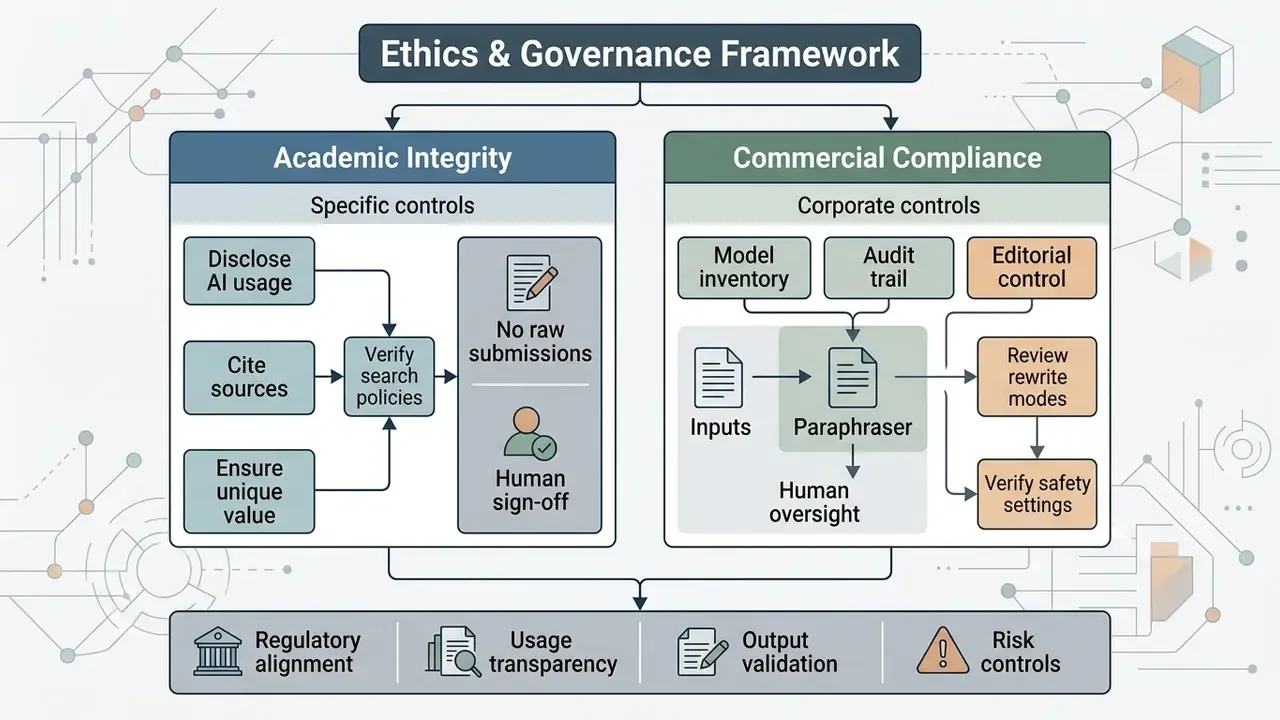
Enterprise Regulatory Compliance and Audit Readiness
Minimum audit-log schema
| Field | Example |
|---|---|
source_hash | SHA-256 of the original passage |
content_class | high_risk_disclosure |
mode / strength | formal / low |
freeze_list_version | reg-terms-v14 |
model_id / version | vendor-model-x / 2026-03 |
semantic_score | 0.91 |
reviewer / verdict / timestamp | j.doe / approved-with-edits / 2026-04-11T09:22Z |
Fact Check and E-E-A-T Verification: Official AI Policies
Verified Institutional Positions
Is Using an AI Paraphraser Considered Cheating?
In academic settings, using an ai paraphraser is cheating when students submit AI-rewritten text as their own unassisted work, or use rephrasing to hide copied sources.
Academic guidelines draw a fairly clear line between writing assistance and dishonesty:
- Permissible Assistance Using an AI rewriter to polish self-authored text for grammar, clarity, or style, provided the institution permits AI writing aids and the tool is disclosed.
- Academic Misconduct Pasting another author's published work into a paraphrase generator no ai detector tool to shuffle vocabulary, then submitting the output without citation.
«AI-assisted plagiarism is defined as the improper use of generative AI to complete academic work, including paraphrasing sources without attribution.»
Institutional policy confirms the boundary. Georgetown's CTLS guidance (2026) treats submitting AI-generated content as one's own unassisted work, and using AI to obscure the origins of scholarly work, as misconduct, while requiring an AI declaration on written submissions. Northwestern's chemistry guidance (2026) permits AI-assisted writing only with disclosure to advisors and attribution inside the document.
Institutions keep repeating one point: rephrasing software cannot substitute for critical thinking, literature synthesis, and original research.
«Sophisticated automatic paraphrasing tools can transform large passages of text and remain undetected by plagiarism-detection software.»
That capability is exactly why disclosure obligations exist independently of detection outcomes. The absence of a detector flag is not evidence of integrity.
Using Rephrased Text in Blogs, Marketing and Web Content
Commercial publishers and marketing teams using rephrased content need to stay aligned with search engine quality guidelines and copyright law.
- Search Engine Quality Guidelines Updated: Google's Search Essentials and SEO Starter Guide state that content should be helpful, reliable, people-first, and unique, and explicitly advise against copying others' content in part or in full or "rehashing" what others have published. Scaled content abuse and site reputation abuse are listed as spam policy violations (Google Search Central, Search Essentials and Spam Policies, 2026. https://developers.google.com/search/docs/essentials). Yandex Webmaster guidance similarly ties search quality to the quality, usefulness, and uniqueness of content.
- Copyright and Derivative Works Research on AI text similarity shows high semantic overlap between LLM outputs and existing sources. Running an article through a reword generator no ai does not remove copyright risk if the underlying structure and proprietary insights were copied without permission. Licensing questions across output types are documented further where you can see the overview.
«Semantic similarity between AI-generated and human text reaches approximately 0.82 by BERTScore, with cosine similarity at 0.76, indicating frequent reproduction of existing source patterns.»
How to Choose the Best AI Paraphrasing Tool
Selecting the best ai paraphrasing tool means weighing transformation accuracy, customization controls, multilingual support, security posture, and integration capability. In that order, usually.
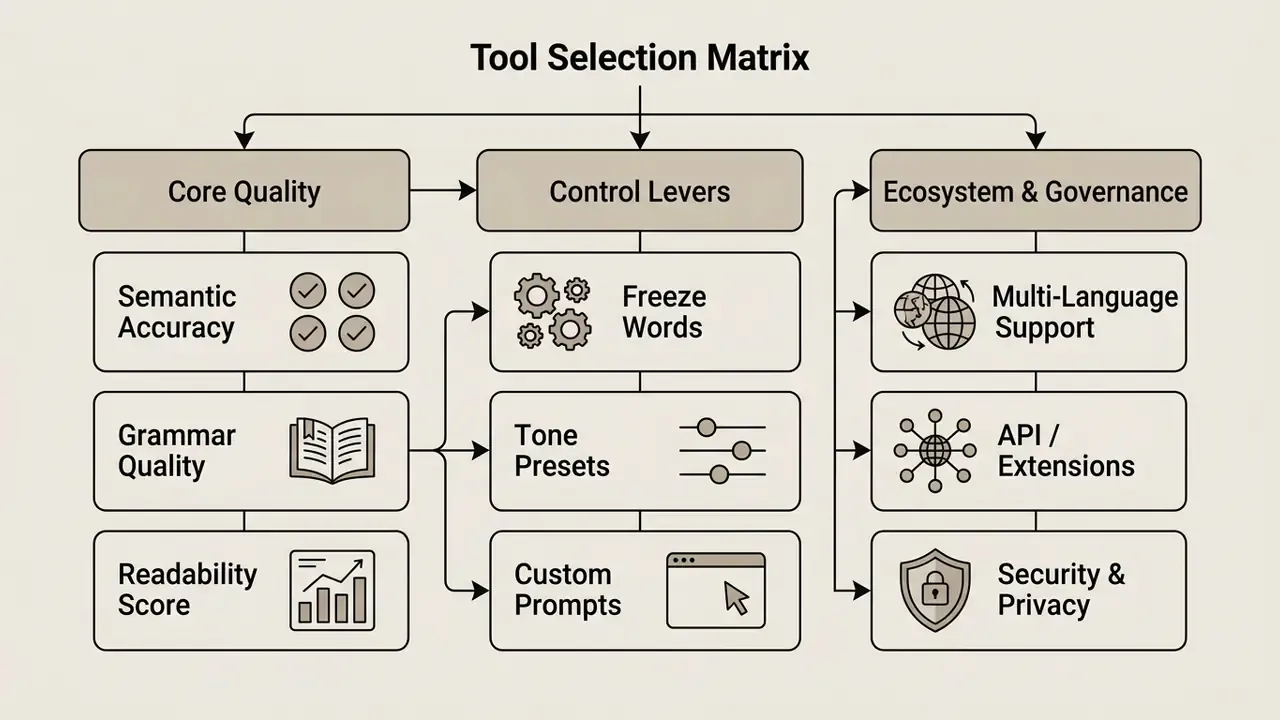
Features That Improve Rephrasing Quality
High-quality rephrasing depends on the underlying architecture plus inference-time quality controls:
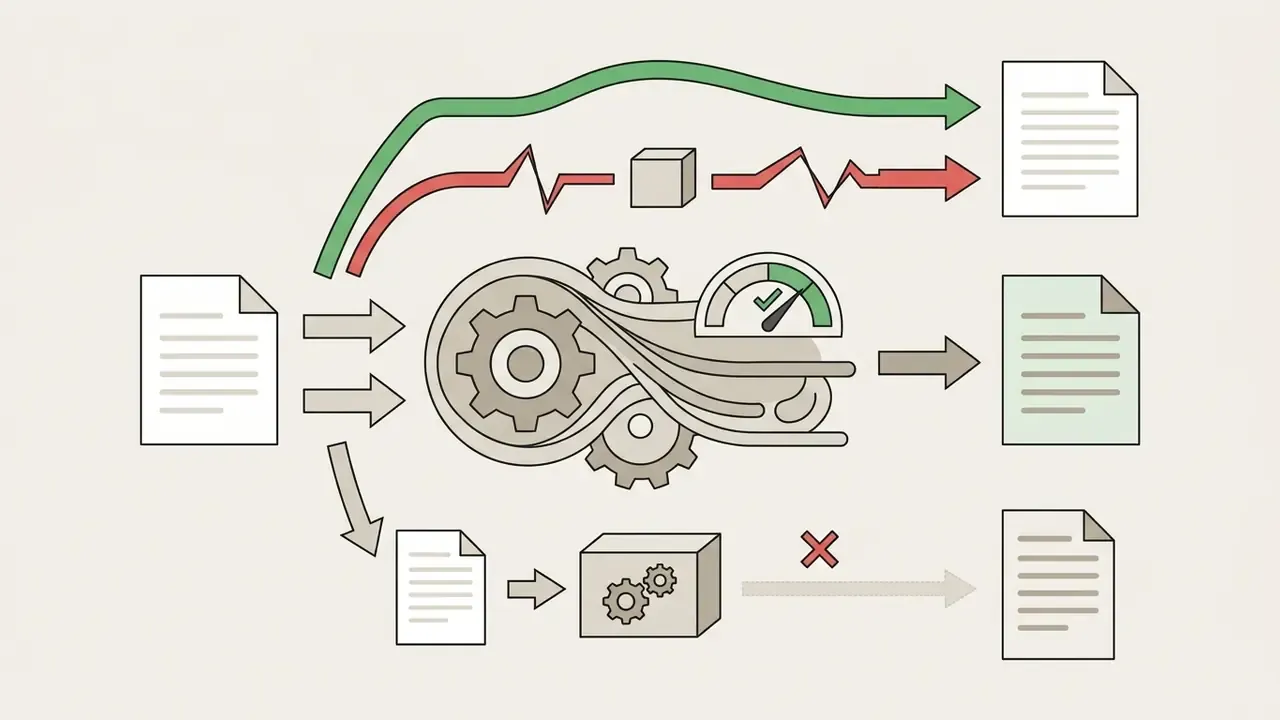
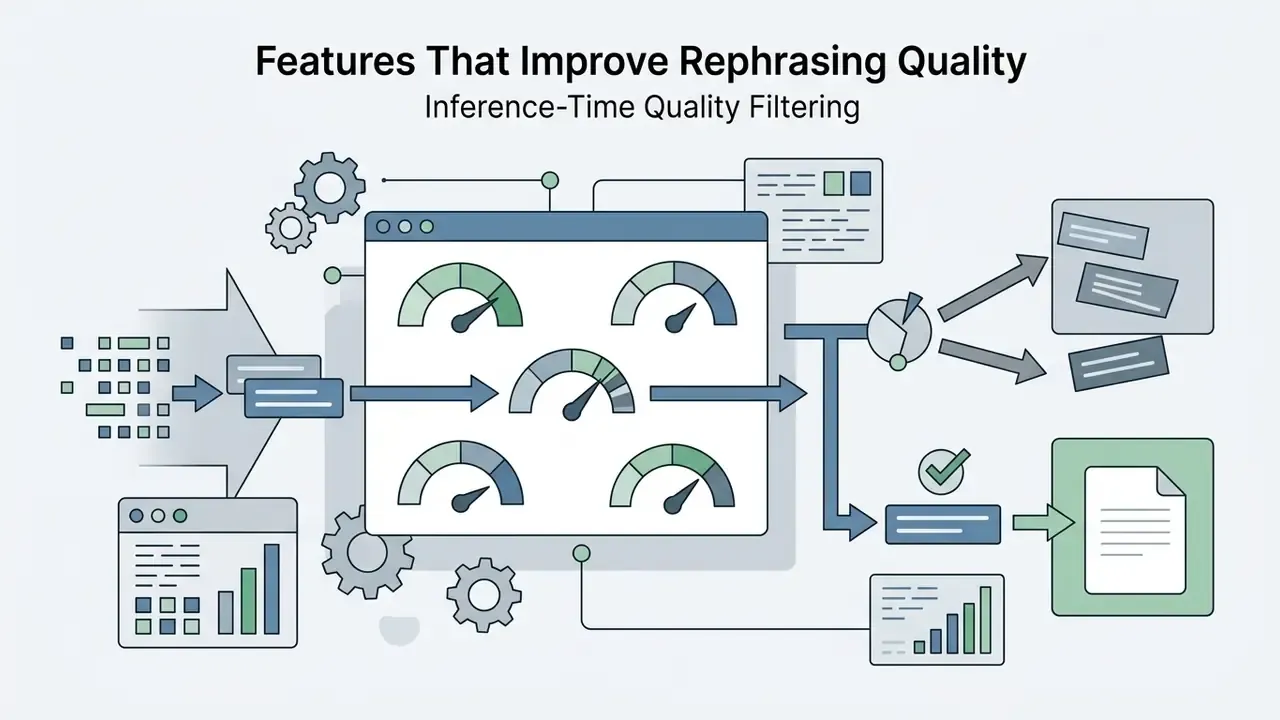
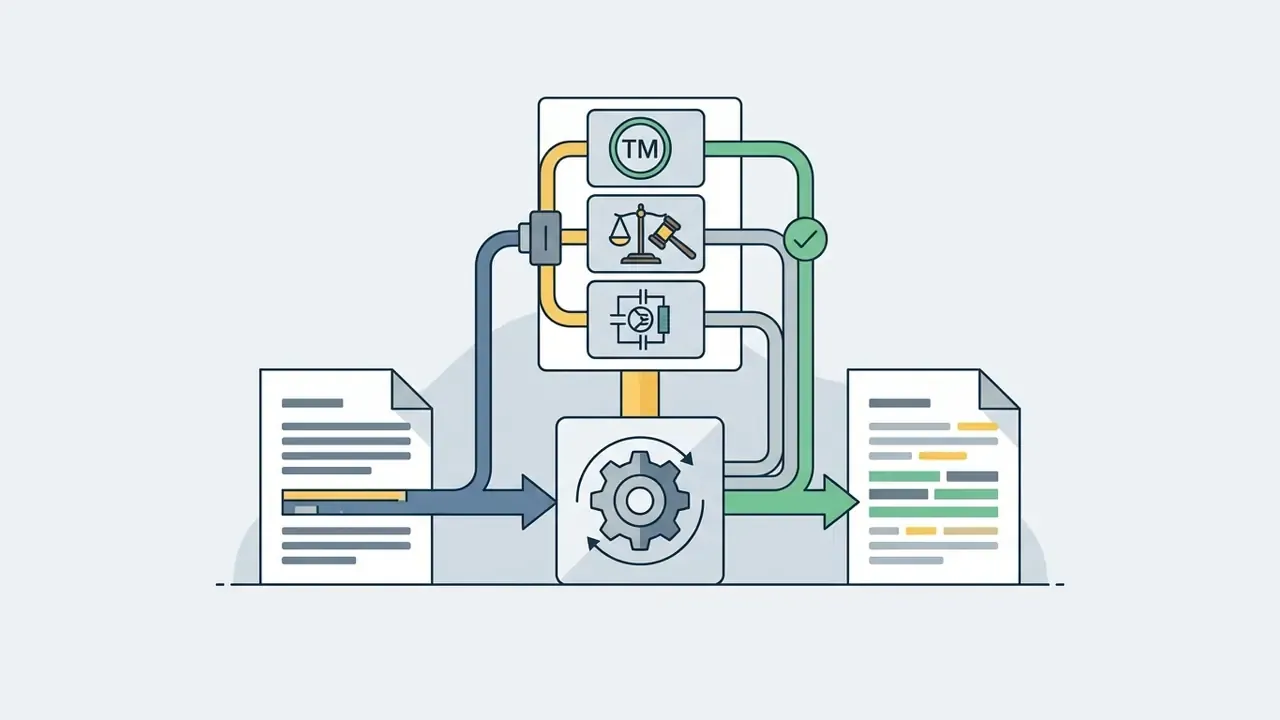

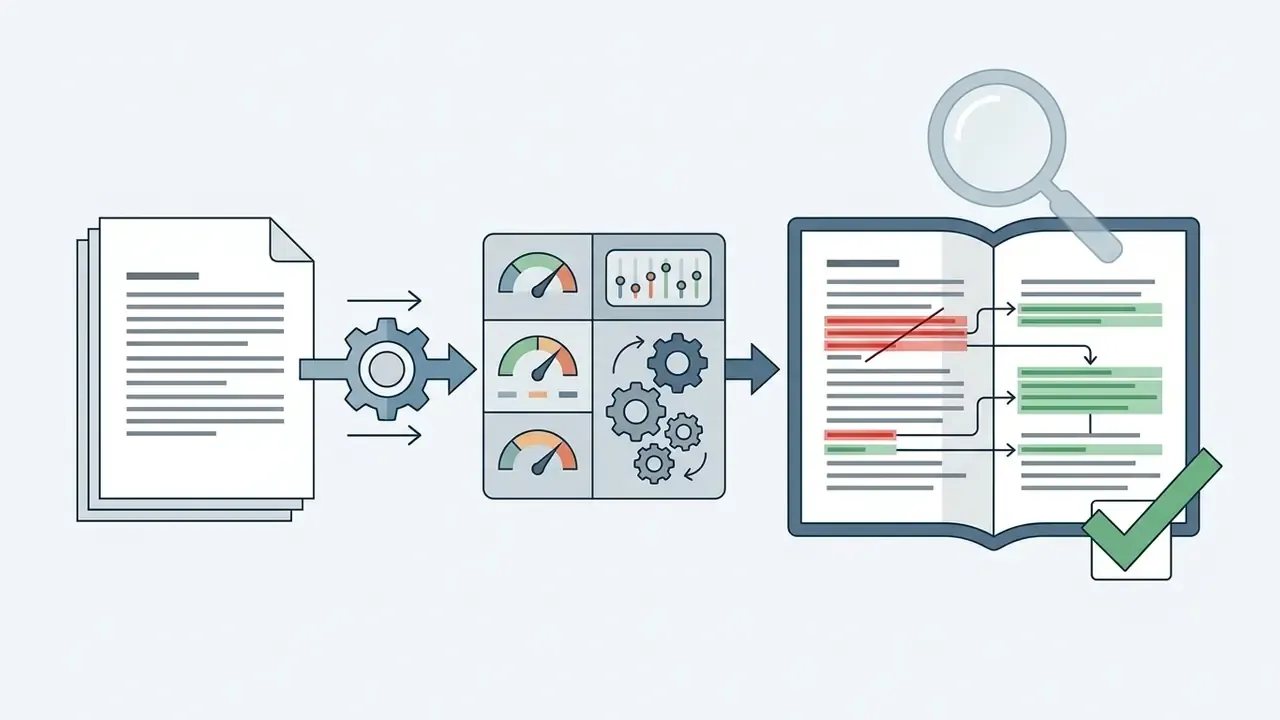
«ParaFusion increased semantic similarity from 4.49 to 4.94, lexical diversity from 1.75 to 3.34, and syntactic diversity from 2.02 to 3.84 after LLM augmentation.»
Weighted tool-selection matrix
| Criterion | Weight | What to test |
|---|---|---|
| Semantic fidelity on your own corpus | 0.25 | Golden-set scoring plus SME spot review |
| Control granularity (freeze words, strength, length) | 0.20 | Attempt to break an obligation clause deliberately |
| Security and data handling | 0.20 | ZDR, SOC 2 Type II, deployment options, DLP integration |
| Auditability | 0.15 | Exportable logs with model version and reviewer trail |
| Language coverage for your markets | 0.10 | Native-speaker review per language pair |
| Integration and throughput | 0.10 | API SLA, batch limits, editor plug-ins |
Content teams comparing broader AI toolchains alongside a rewriter can review our comparison of leading AI generation platforms for the evaluation structure we apply to output quality, control depth, and licensing.
Language Support and Other Writing Tools
Comprehensive writing environments combine rephrasing with complementary text-processing capabilities.
Multilingual Support. Modern AI paraphrasers handle multi-language structural transformation, accepting source text in one language and producing fluency-optimized paraphrases in another. Vendor coverage ranges widely: Grammarly's paraphraser supports six languages, QuillBot's multilingual assistant lists six, Rephrasely advertises 100+ paraphrasing languages, and productivity add-ons commonly claim 30+. Each page is counting a different feature scope, which is worth remembering during procurement. The primary supported language stack across mainstream tools:
| Target Language | Core Optimization Focus | Primary Use Case |
|---|---|---|
| English (US/UK) | Idiomatic smoothness and active-voice conversion | Academic and corporate publishing |
| Spanish | Formal gender agreement and verb conjugation alignment | Global business and localization |
| French | Register adjustment (tu versus vous) and formal syntax | Cross-border legal and marketing |
| German | Compound-word restructuring and clause re-ordering | Technical manuals and research papers |
| Portuguese / Italian | Nuanced synonym swapping and rhythm balancing | Creative writing and web content |
| Dutch, Polish, Japanese, Chinese (extended tiers) | Script- and morphology-specific handling | Regional expansion, support content |
Cross-lingual example: Source (German) "Die Auszahlung erfolgt ausschließlich nach vollständiger Dokumentenprüfung." English paraphrase: "Payment is released only after the document review has been completed in full." Note that "ausschließlich" and its English counterpart "only" are exclusivity markers and belong on the freeze list. A fluency-first rewrite that drops the word changes the contractual condition.
Performance must be validated per language pair rather than inferred from a marketing count. A 2023 German-language evaluation and a 2026 multilingual assessment both found that quality varies materially by language and requires expert linguistic review.
«LLaMA-3-8B fine-tuned on aligned paraphrase pairs reaches parity with LLaMA-3-70B using only 5% of the original dataset.»
Leading Rephrasing Services in 2026
| Service | Positioning | Notable characteristics |
|---|---|---|
| QuillBot | Dedicated paraphraser | Multiple modes plus freeze words; reported at roughly 5.5M monthly visits and over 100 million paraphrasing queries per month in 2026 reporting |
| Grammarly | Broad writing assistant | Paraphrasing as one function among grammar, tone, custom voice, reader reactions, AI detection, and citation finding; six paraphrasing languages |
| Wordtune | Sentence-level rewriting | Focus on natural phrasing per sentence; reported at approximately 665K monthly visits in 2026 traffic data |
| Undetectable AI | Humanization and detection resistance | Marketed primarily around detector avoidance rather than rewriting quality |
| Paraphraser.io / editGPT | Freemium volume tools | 600-word free request caps; broad mode lists including Humanize, Informative, Expand |
Market-share signals in public sources are traffic-based estimates and are not directly comparable across reports, since methodologies and measurement windows differ.
Limitations, Open Questions and a Safe Next Step
A few things remain genuinely unsettled, and pretending otherwise would be dishonest.
- No consensus threshold exists for "acceptable" semantic similarity in regulated text. Published values are dataset-specific.
- Agentic pipelines that chain rewriting with retrieval and publishing are not covered by traditional validation practice; escalation design is still maturing.
- Detector reliability varies so widely across studies that it cannot support a control objective.
- Vendor free-tier terms change quarterly, so any procurement document needs a re-verification date.
A conservative next step: pick one low-risk content class, run a 200-passage golden-set pilot with freeze words and logging enabled, and measure review labour alongside semantic scores. Then decide. If you need help interpreting the pilot output, our support documentation covers escalation paths.
FAQ: AI Paraphrase Generator Questions
Can an AI paraphrase generator bypass AI detectors?
Some advanced rephrasing tools alter structure enough to lower detection scores on certain platforms, but detectors are updated regularly to catch automated patterns. Published testing shows detection rates for tool-generated paraphrases ranging from 0% to 100% depending on the detector. Relying on rephrasing purely to bypass detection is unreliable and breaches content quality policies in both academic and commercial settings.
Will using an AI paraphraser result in plagiarism?
If an ai paraphrase generator restates another author's work without proper citation, the output remains plagiarized. Plagiarism is defined by appropriation of ideas without attribution, not merely by matching word sequences. Teams verifying the originality of accompanying visuals can add reverse image search and provenance checks to the same pre-publication review.
What is the difference between a synonymizer and an AI paraphraser?
A traditional synonymizer uses lookup tables to swap individual words for near-synonyms, which often produces ungrammatical or awkward phrasing. An AI paraphraser uses large language models to read context and restructure whole sentences while holding the logical meaning in place.
Are free AI paraphrase generators safe for confidential company data?
Free online tools frequently log inputs to train future models. Organizations processing confidential financial, legal, or personal data should use paid tiers or enterprise platforms with strict privacy terms, SOC 2 Type II attestation, and zero data-retention policies, ideally deployed in a VPC or self-hosted. Teams building a data-protection posture around AI tooling can reference our documentation on platform-level commercial and usage terms for how vendor data and rights clauses are typically structured.
Does an LLM rewriter count as a "model" for model risk management purposes?
It can. Where output shapes regulated disclosures, customer communications, or filings, institutions commonly assess it against supervisory model-risk expectations (SR 11-7) and structure controls using the NIST AI Risk Management Framework. Scope determination is an institutional decision made with second-line risk and legal input. Where in scope, validation, documentation, and ongoing monitoring obligations follow.
Which metrics should we use to prove meaning was preserved?
Use a combination: an embedding-based semantic metric (BERTScore, P-SP, or cosine similarity) as the automated gate, a surface-overlap metric to reject outputs that are too close to the source, an attribute-control error measure to confirm the requested register, and human adequacy and fluency ratings for high-risk classes. Calibrate thresholds on your own corpus, since automatic metrics correlate imperfectly with expert judgment.
How do we prevent shadow AI usage of free rewriting tools?
Four measures together: an approved-tool register with a genuinely usable sanctioned alternative, DLP rules covering known freemium endpoints, mandatory training that explains the specific data-retention risk, and periodic attestation. Prohibition without a sanctioned substitute reliably pushes usage onto personal devices.
Can a paraphraser preserve citations and technical terminology?
Yes, when freeze-word lists and citation-preserving modes are configured. Academic-oriented tools advertise citation retention explicitly. Always verify numeric values, defined terms, and reference markers manually after generation, because those are the elements most often reformatted.
How do you cite paraphrased text produced with AI assistance?
Cite the original source in your required style (APA 7th, MLA 9th, Chicago), and separately disclose the AI tool according to your institution's or publisher's policy, typically naming the tool, version, purpose, and extent of use in the Methods or Acknowledgments section. AI tools are never listed as authors.
Editorial and Research References
- Callison-Burch, C. (2008).Paraphrasing and Translation. Ph.D. dissertation, University of Pennsylvania.
- LingConv Evaluation Study (2024).Linguistically Controlled Paraphrase Generation with Attribute Error Reduction.
- Latent Diffusion Paraphraser (LDP) Research (2024).Controllable Diffusion Processes for Semantic Paraphrasing.
- ParaFusion Dataset Analysis (2024).Augmenting Paraphrase Diversity and Grammatical Correctness via Large Language Models.
- Atomic Paraphrase Types (APTY) (2024).Towards Human Understanding of Paraphrase Types in Large Language Models.
- PARAPHRASUS (2024).Multi-Dimensional Assessment and Selection of Paraphrase Detection Models.
- ParaAlign Translator Study (2024).Paraphrase-Aligned Fine-Tuning for Translation Fluency.
- The Great Detectives Study (2024).Empirical Performance of Humans vs. AI Detectors in Identifying AI-Generated and Rephrased Text.
- Perkins, M. et al. (2024).Algorithmically Driven Writing Tools and Academic Integrity.
- Preliminary Study on the Impact of AI on Commonly Used Writing Aids (2024).Preliminary Study on the Impact of AI on Commonly Used Writing Aids (2024).
- AI Similarity Analysis Study (2024).BERTScore and Cosine Similarity Between AI-Generated and Human-Authored Text.
- AI-Assisted Plagiarism: Conceptual Analysis (2023).AI-Assisted Plagiarism: Conceptual Analysis (2023).
- APA Journals AI Guidance (2026).Standards for Disclosure, Attribution, and Authorship in Scientific Publishing. https://www.apa.org
- Johns Hopkins University Press (2023).Policy on Generative AI and Authorship.
- HHS Office of Research Integrity (2026).Definition of Research Misconduct and Plagiarism. https://ori.hhs.gov
- Federal Reserve / OCC (SR 11-7).Supervisory Guidance on Model Risk Management. https://www.federalreserve.gov/supervisionreg/srletters/sr1107.htm
- NIST.AI Risk Management Framework. https://www.nist.gov/itl/ai-risk-management-framework
- Google Search Central (2026).Search Essentials and Spam Policies. https://developers.google.com/search/docs/essentials
- Adobe (2026).How to Paraphrase with Acrobat AI Assistant. https://www.adobe.com/acrobat/how-to/paraphrase-ai.html
- Grammarly (2026).Rewording Tool and AI Detector User Guides. https://www.grammarly.com/ai/ai-writing-tools/rewording-tool
- QuillBot (2026).Paraphrasing Tool: Modes and Free-Tier Limits. https://quillbot.com/paraphrasing-tool
Appendix A: Superseded Statements and Source Corrections
Retained for transparency; superseded versions appear in the main text above.
Continue with related definitions and control terminology in the AI Media Glossary.
- Superseded attribution
- "Research from the 2025 NODALIDA evaluation framework highlights that semantic equivalence must be evaluated independently from lexical divergence, as high word replacement does not guarantee meaning retention." Principle retained; attribution corrected to the PARAPHRASUS benchmark (2024). NODALIDA 2025 annotation work does use four-point paraphrase and semantic-equivalency judgments, but it is not the source of the quoted formulation.
- Superseded attribution
- "University style guidance (University of Washington, 2026) specifies that academic text must remain objective, concise, and direct." Principle retained and re-sourced to 2025–2026 university writing guidance (University of Technology Sydney; University of Roehampton), which specifies objectivity, precision, third person, complete sentences, and no contractions.
- Superseded attribution
- "Google's Search Essentials state that content must be helpful, original, and created primarily for people." Retained and expanded with direct reference to Search Essentials, the SEO Starter Guide, and the spam policies covering scaled content abuse.
- Vendor limit figures
- (QuillBot 125 words; Rytr 10,000 characters per month; Paraphraser.io 600 words; editGPT 10,000 words per month) reflect vendor documentation as of 2026 and are commercial terms subject to change rather than peer-reviewed findings.
- Removed cross-links
- references to unrelated media-generation utilities (music, movie-script, and body-image generators) were withdrawn from this guide as non-contextual for a text-transformation topic, and replaced with documentation relevant to content licensing, provenance verification, and API cost structures.