- An AI rap generator converts a text prompt, a topic, or pre-written lyrics into rap bars, instrumental beats, synthetic vocals, or a fully mixed track, exported as MP3, WAV, or separated stems.
- The control surface in 2026 covers subgenre and regional cadence presets (Atlanta melodic trap, New York boom-bap, Chicago and UK drill), BPM, rhyme density, vocal timbre, plus numerical vocal weight / music weight sliders that decide whether the mix favours the voice or the beat.
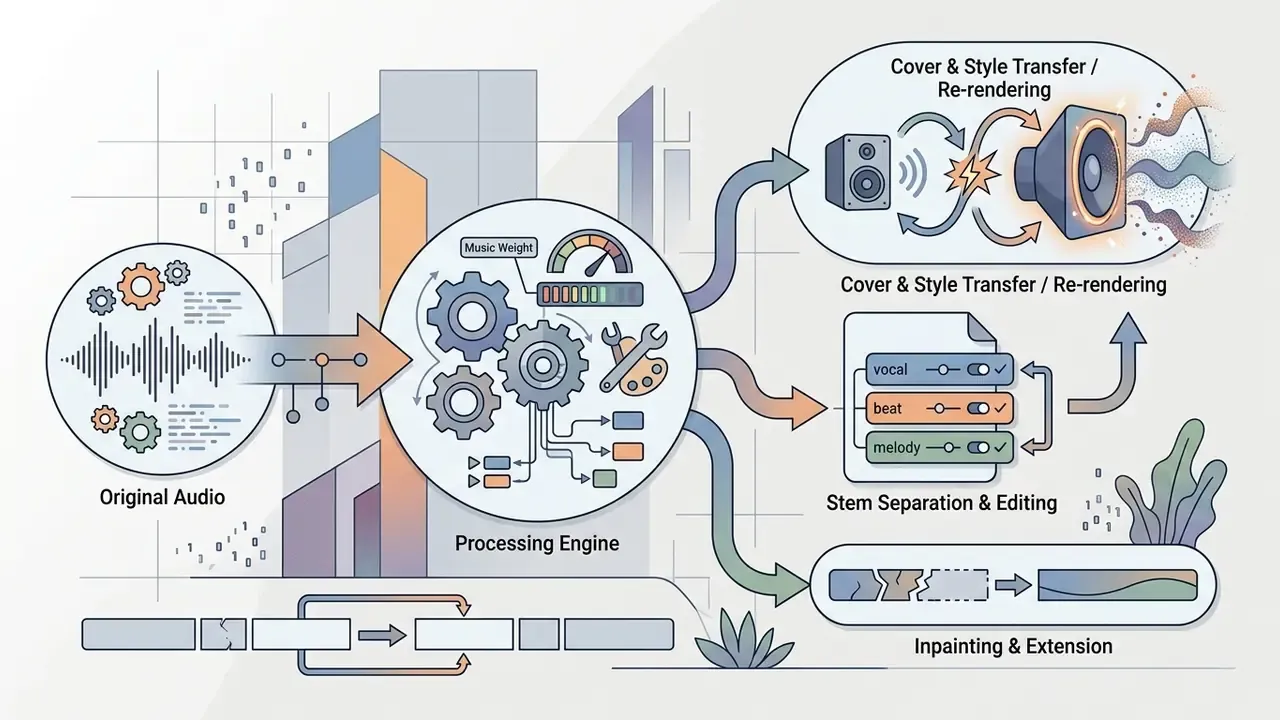
- Post-generation editing now matters as much as first-pass generation. Track extension (inpainting), section replacement, vocal isolation, and stem export are the features that separate demo toys from production tools.
- Legal reality check: under 2025 to 2026 U.S. Copyright Office guidance, purely prompt-generated audio and lyrics are not eligible for copyright protection. Free tiers are almost universally restricted to personal, non-commercial use, and paid tiers ($8 to $40 per month is the typical range) are where commercial licences live.
- For regulated organisations (banking, insurance, fintech marketing), the decisive questions are not creative but operational: prompt privacy, model-training opt-out, SSO/SAML, audit logs, deepfake-voice liability, and reproducibility of generated audio. A dedicated governance checklist sits further down the page.
Who this guide is for, and what it decides
Two very different readers land on this page. The first is a creator who wants bars over a beat by tonight. The second is a marketing or risk owner inside a bank, an insurer, or a mature fintech, who has just discovered that someone on the brand team pasted an unreleased campaign line into a free web form.
Both need the same four answers, in this order:
- What can the tool actually produce: text, a beat, or a finished track?
- Which parameters are measurable, and which are marketing language?
- Who owns the output, and under which licence tier?
- What evidence survives after the file is exported?
That last question is the one procurement and internal audit will ask. Keep it in view.
What Is an AI Rap Generator and What Can It Create?
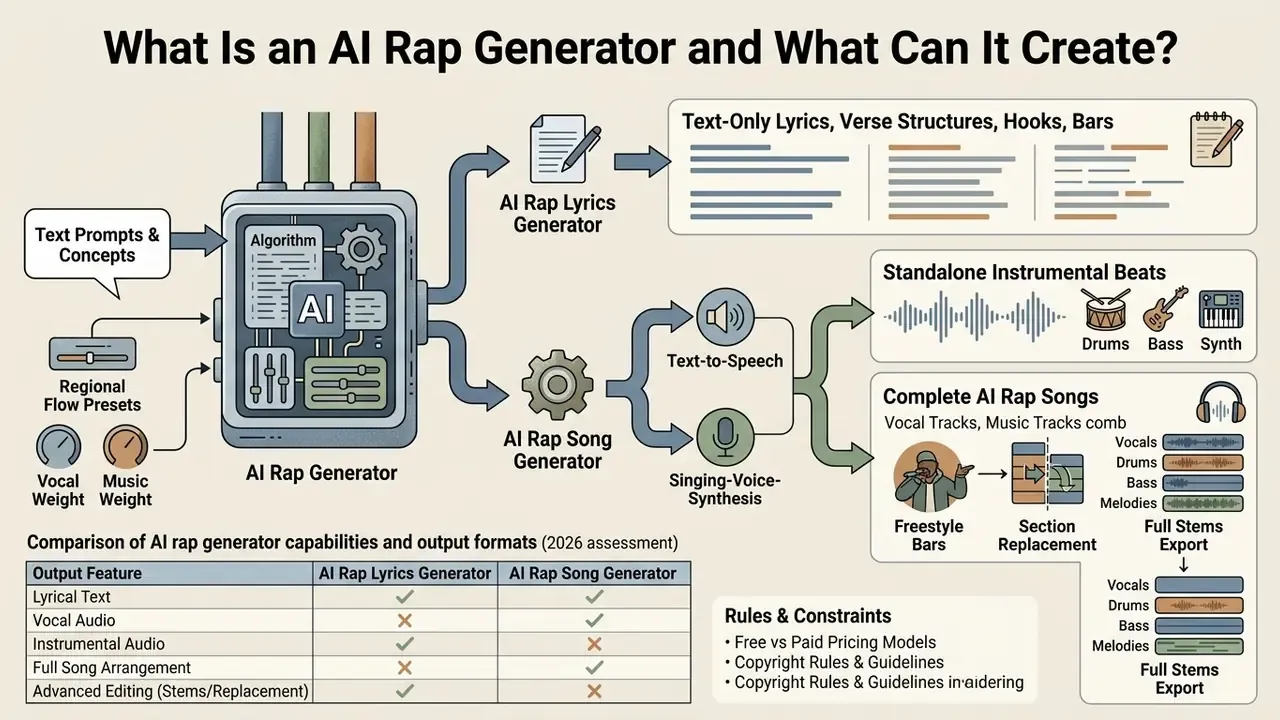
An AI rap generator is a digital software system that uses natural language processing and synthetic audio modeling to create rap lyrics, freestyle bars, instrumental beats, and full vocal tracks. Users can generate structured text, individual audio stems, or complete production-ready tracks from simple text prompts or custom lyrics.
An AI rap generator is a specialized algorithmic tool designed to convert text inputs into hip-hop lyrics, rhythmic cadence models, synthetic vocals, and instrumental arrangements. Unlike general music utilities, these tools apply domain-specific constraints for rhyme density, syllable timing per bar, and beat-matching.
Modern platforms output three distinct asset tiers: text-only lyrics and bars, standalone instrumental beats, and fully rendered audio songs combining vocals and mixing. The practical difference between them is not quality but editability. Text tiers hand you a draft, beat tiers hand you a bed for a human vocalist, and full-song tiers hand you a mastered file you can publish or dismantle into stems.
Table 1. Comparison of AI rap generator capabilities and output formats (2026 assessment)
| Output type | Primary capability | Technical delivery and formats | Commercial and workflow suitability |
|---|---|---|---|
| Rap lyrics and bars | Text generation with rhyme schemes, internal cadence, and section tags. | Raw text, JSON, TXT export; no native audio rendering. | Ideal for drafting, lyric ideation, and human vocal recording references. |
| Freestyle bars | Short-form, high-density rhyming couplets (4 to 16 bars) optimized for rapid iteration. | Text output with configurable syllable and stress constraints. | Used for battle practice, live improvisation prompts, and writing exercises. |
| Instrumental beats | Text-to-audio beat synthesis (boom-bap, trap, drill, lo-fi) without vocals. | MP3 (128 to 320 kbps), lossless WAV (24-bit PCM), or multitrack stems. | Suitable as background tracks for videos, vlogs, and DAW-based song arrangement. |
| Full rap song | End-to-end rendering combining lyrics, synthetic vocal performance, and beat mix. | Mastered stereo MP3/WAV file, complete song audio, or stem export. | Used for content creation, prototype demos, and direct digital publishing. |
In plain terms: the lyrics tier gives you words, the beat tier gives you a bed, and the full-song tier gives you a file. Only the last one is publishable without further studio work, and only under the right licence.
AI Rap Lyrics Generator, Freestyle Bars and Full Songs
An ai rap lyrics generator focuses exclusively on textual composition, outputting verse structures, hooks, and bridges based on topic prompts. An ai freestyle generator restricts line output to short, high-impact units (typically 4 to 8 bars) with strict syllable counts for rapid improvisation. An ai rhyme generator rap mode goes narrower still, returning candidate rhyme chains rather than finished verses.
«The Raply model, trained on 10,748 rap tracks with profanity filtering, preserves high rhyme density while measurably reducing the share of offensive tokens.»
In contrast, an ai rap song generator processes lyrics through text-to-speech and singing-voice-synthesis models, overlaying rendered vocals onto a synchronized beat track. Research-grade lyric models such as DeepRapper go further and model rhyme and rhythm jointly, using reverse-order language modeling, explicit rhyme constraints, and inserted beat symbols. That is precisely the domain knowledge a general-purpose chatbot lacks.
What You Can Control in an AI Rap Song Generator
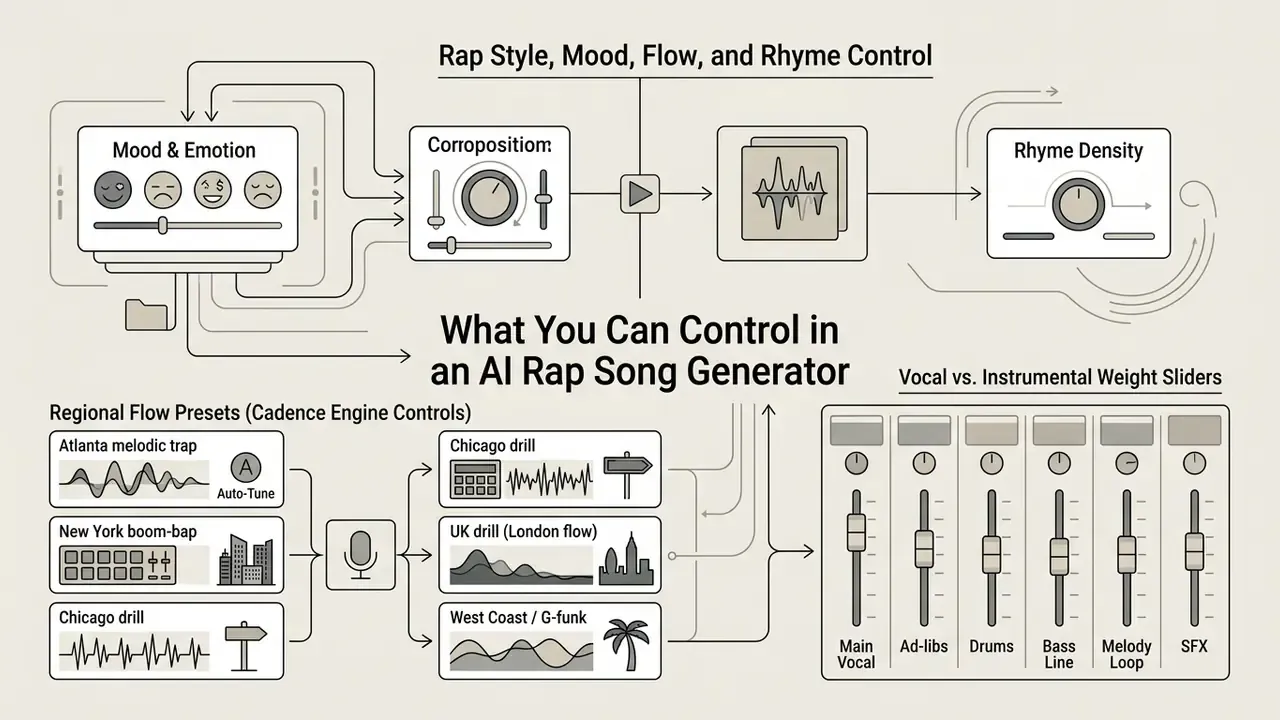
An ai rap song generator online provides user-configurable parameters to govern style, tempo, vocal timbre, and verse structure prior to audio rendering. Controlling these inputs ensures that generated audio aligns with specific creative goals, brand guidelines, or production standards. Google's own prompt guidance for its Lyria music models recommends a fixed prompt order: genre and style, mood, instrumentation, tempo and rhythm, vocal style and language, then lyrics. It explicitly lists "rapping" as a supported vocal style.
«Prompts should specify genre & style, mood, instrumentation, tempo & rhythm, vocal style & language, then lyrics or a theme.»
Rap Style, Mood, Flow and Rhyme Control
Style selection lets users choose subgenres such as trap, boom-bap, drill, cloud rap, or lo-fi hip hop. You can set mood tags (aggressive, introspective, energetic) and adjust rhyme density, which dictates the frequency of end rhymes and internal rhymes across a 16-bar section. In academic flow analysis, rhyme density is operationalised as total rhymed syllables divided by total syllables. That is why a slider labelled "rhyme density" is a measurable parameter rather than marketing language.
Flow parameters control the rhythmic placement of stressed syllables relative to the 4/4 time signature, offering double-time delivery or a laid-back cadence.
Regional Flow Presets (Cadence Engine Controls)
Advanced generative engines accept regional cadence modifiers that reshape syllable stress, vowel length, and micro-timing. Selecting a region is the fastest way to move from "generic rap" to a recognisable pocket:
- Atlanta melodic trap triplet flow, auto-tuned pitch transitions, relaxed off-beat vocal placement, ad-lib layering behind the lead take; typical 130 to 150 BPM half-time feel.
- New York boom-bap strict on-beat 16th-note quantization, hard consonant hits, dense internal rhymes, 85 to 95 BPM, sample-style drum swing.
- Chicago drill syncopated sliding vocal delays, stutter cadences, sparse phrasing over sub-heavy 808 glides.
- UK drill (London flow) high-tempo bar packing (140+ BPM), off-grid triplet skips, British vowel articulation and slang-weighted phrasing.
- West Coast / G-funk laid-back behind-the-beat delivery, longer vowel sustain, melodic hook doubling.
Each regional preset changes two things at once: the lyric generator's syllable-per-bar target, and the vocal synthesiser's phoneme duration model. Queries such as uk drill ai flow, atlanta trap cadence, and ny boom bap rhythm map directly onto these presets.
Vocal vs. Instrumental Weight Sliders
Most modern engines expose numerical weighting rather than a binary "vocals on/off" switch. When configuring generation parameters:
- Vocal weight (0.0 to 1.0) higher values enforce vocal melody dominance and pitch clarity over complex background instrumentation. Values above roughly 0.7 keep bars intelligible in dense drill or trap mixes. Values below 0.3 push the voice into the texture, which is useful for background beds under video narration.
- Style / music weight (0.0 to 1.0) controls how aggressively the engine adheres to genre-specific beat templates versus your literal prompt instructions. High music weight yields idiomatic, "correct" genre output. Low music weight allows hybrid arrangements but increases the chance of rhythmic drift.
- Prompt adherence / creativity balance some platforms add a third slider that trades literal prompt compliance against stylistic invention. For brand work, keep adherence high and regenerate rather than loosening it.
- Seed value where exposed, fixing the seed is the only reliable way to reproduce a specific take. That is a prerequisite for any documented, auditable production workflow.
One small caveat from practice: sliders are not linear across vendors. A vocal weight of 0.6 on one platform can sit closer to 0.4 on another, so calibrate with a fixed test prompt before you trust the numbers.
Voice, Vocal, Beat and Instrumental Options
Vocal options include voice timbre selection (deep baritone, energetic tenor, female vocal profiles), accent adjustments, and delivery aggression. Peer-reviewed timbre analysis divides voice features into source parameters, vocal-tract parameters, and human-hearing parameters. Those are the same three groups that vendor-facing "voice profile" menus abstract into presets. Readers evaluating adjacent tooling can compare capabilities in our guide to AI voice generators, which covers voice quality, language support, and licensing terms in more depth.
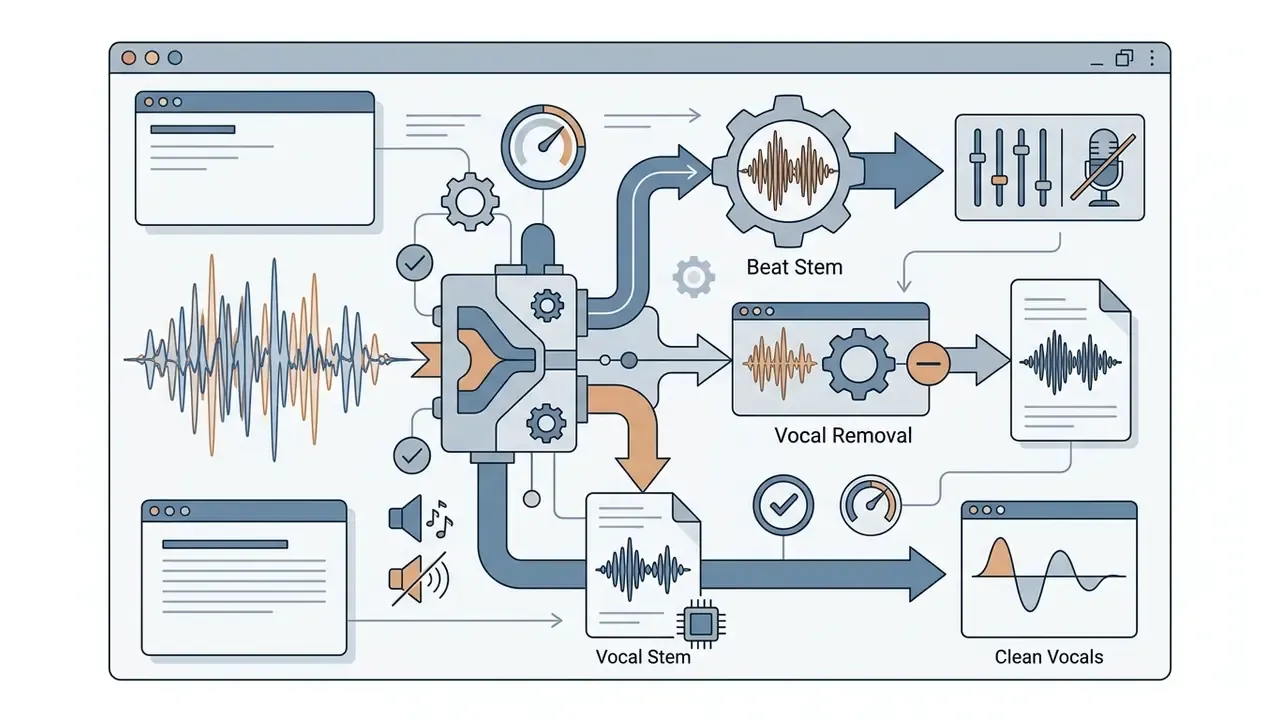
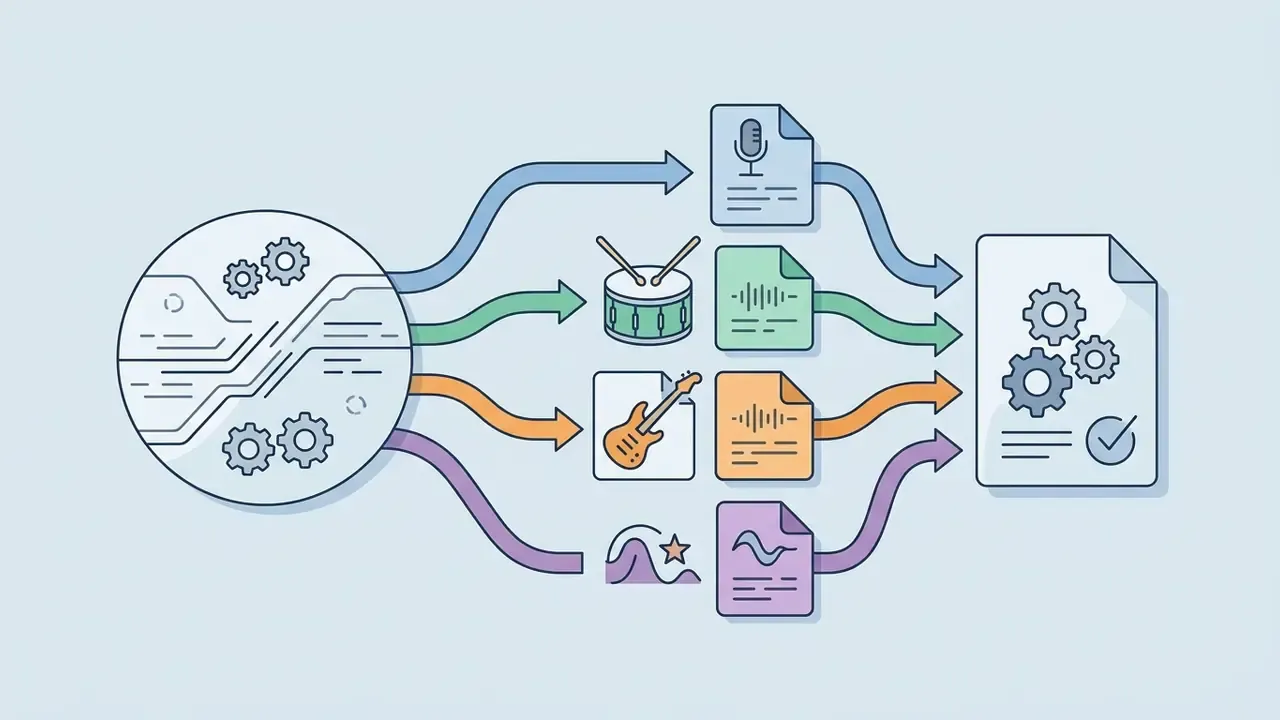
Users can toggle between full song mix outputs or select instrumental-only rendering to generate backing beats. Professional workflows often lean on stem separation to isolate vocals, drums, bass, and synth tracks for independent mixing.
«Stem Separation can extract four stems: Vocals, Drums, Bass, Others.»
«Stem Splitter isolates vocal and instrumental parts; unselected stems are combined into a submix.» Apple, Logic Pro User Guide (2026). https://support.apple.com/guide/logicpro/extract-vocal-instrumental-stems-stem-lgcp61bae908/mac
Topic, Text and Lyrics Input Modes
Platforms support three primary input modes:
- Topic-to-song: natural language prompts describing a concept, story, or visual theme.
- Text-to-song: structured prose or rough notes converted by LLMs into rapped verses.
- Lyrics-to-song: direct user input of pre-written lyrics formatted with structural bracket tags.
Meta-tags like [Intro], [Verse 1], [Chorus], [Bridge], and [Outro] instruct the generative engine on dynamic changes across the track. Tags belong on their own lines inside the lyrics field, not inside the style prompt. Mixing the two is the single most common cause of tags being rapped aloud as words. Yes, it happens more often than anyone admits.
Multi-Emotional Arc Formatting
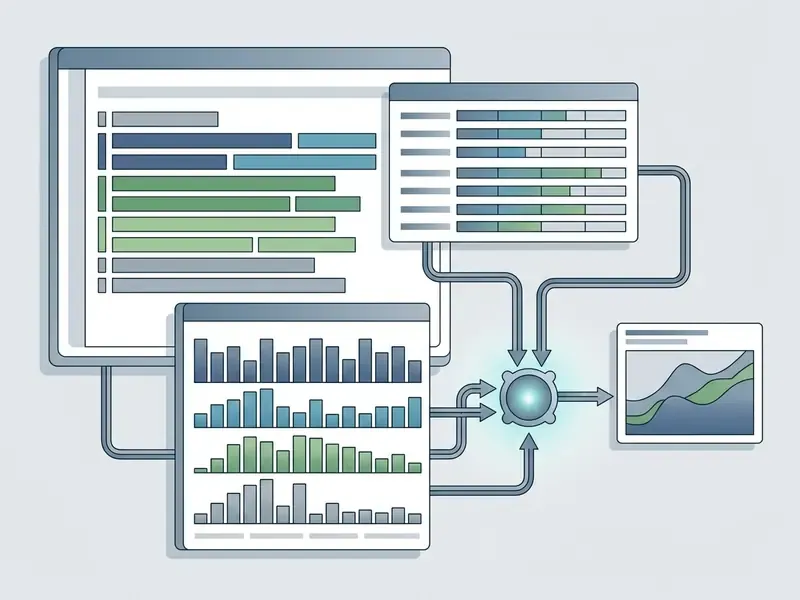
Multi-verse rap tracks need dynamic progression, not a single static mood tag. Tracks that move through an emotional arc, for example angry to determined to triumphant, read as composed songs rather than looped prompts. Format the emotional trajectory section by section:

Practical rule: pick no more than three emotions per track and keep one central metaphor across sections. Otherwise the lyric model drifts thematically between verses, and the second verse starts arguing with the first.
How AI Turns Text into Rap Music (Technical Pipeline)
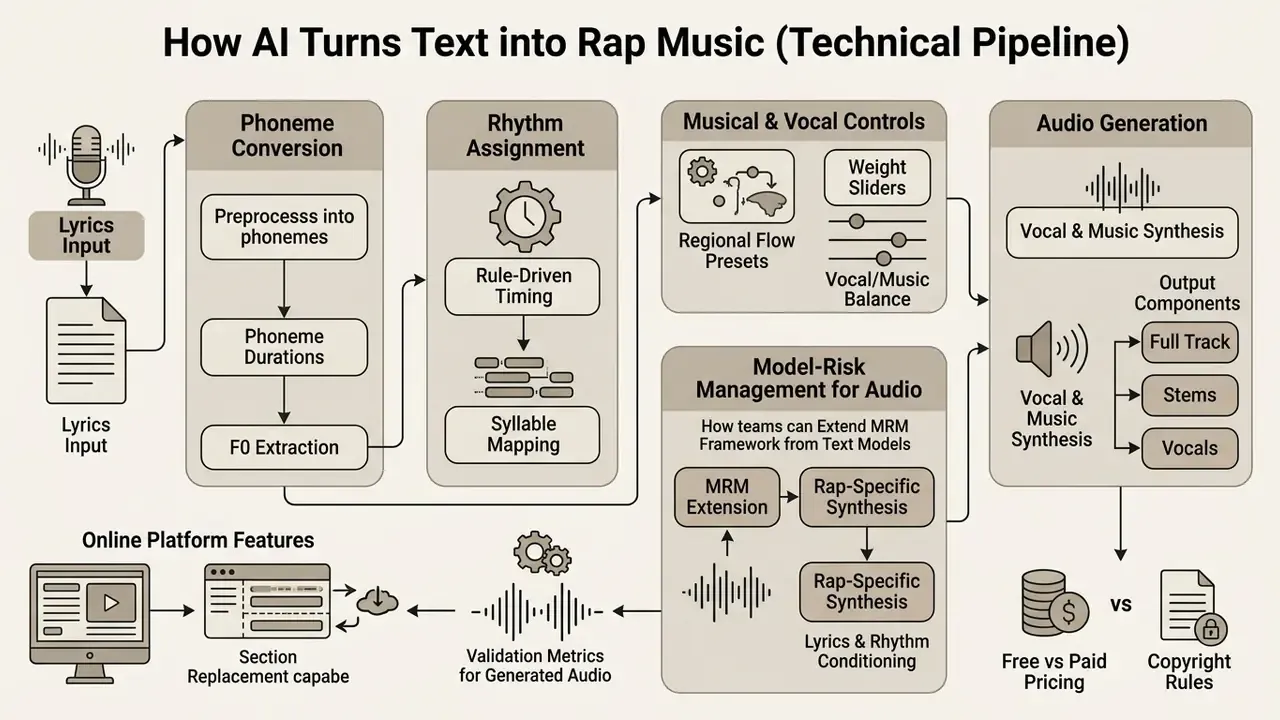
AI turns text into rap music through a multi-stage pipeline. Text preprocessing converts words into phonemes, a duration model assigns timing to each syllable based on target beats per minute (BPM), and an acoustic vocoder synthesizes vocal audio over an instrumental track. The canonical singing-voice-synthesis chain is encoder, duration modeling, acoustic transformation, vocoder, where duration modeling time-aligns text to audio frames.
The strongest current evidence for rap-specific synthesis comes from systems that condition directly on both lyrics and accompaniment.
«Freestyler generates rap vocals directly from lyrics and accompaniment, aligning syllable timing and delivery style with the rhythmic structure of the beat.»
«Lyrics are preprocessed into phonemes; phoneme durations and F0 are extracted, converted into the target speaker's F0 range, then discretized for TTS and mixed with accompaniment.» Markopoulos et al., Rapping-Singing Voice Synthesis, ISCA SSW (2021). https://www.isca-archive.org/ssw_2021/markopoulos21_ssw.pdf
Rhythm assignment is rule-driven in real-time systems: each syllable is assigned a time slot, and supported tempo ranges of roughly 80 to 160 BPM cover the full practical span from boom-bap to UK drill. The resulting audio is then mixed and mastered against pre-rendered or generative instrumental stems.
Validation Metrics for Generated Audio (MRM Extension)
Teams that already run model-risk management for text models can extend the same framework to audio with four measurable checks:
| Validation dimension | Metric or method | What failure looks like |
|---|---|---|
| Intelligibility of lyrics | Phoneme error rate (PER) or word error rate on ASR transcription of the output | Slurred or invented words; tag names rapped aloud |
| Perceptual audio quality | NISQA-style objective MOS estimation; A/B listening panel | Metallic vocoder artefacts, high-frequency ringing |
| Rhythmic alignment | Onset-to-grid deviation in milliseconds against the beat grid | Vocals drifting behind or ahead of the beat |
| Reproducibility | Fixed seed plus logged prompt plus logged model version | Identical prompt yields materially different output, breaking audit trails |
Reproducibility deserves special attention. Several major providers, including Google's current Lyria generation, do not support iterative multi-turn editing of a previous render, so the prompt-plus-seed record is the only durable artefact of how a track was produced. No evidence, no autonomy. That applies to a jingle as much as to a credit model.
AI Rap Generator vs General AI Music Generator
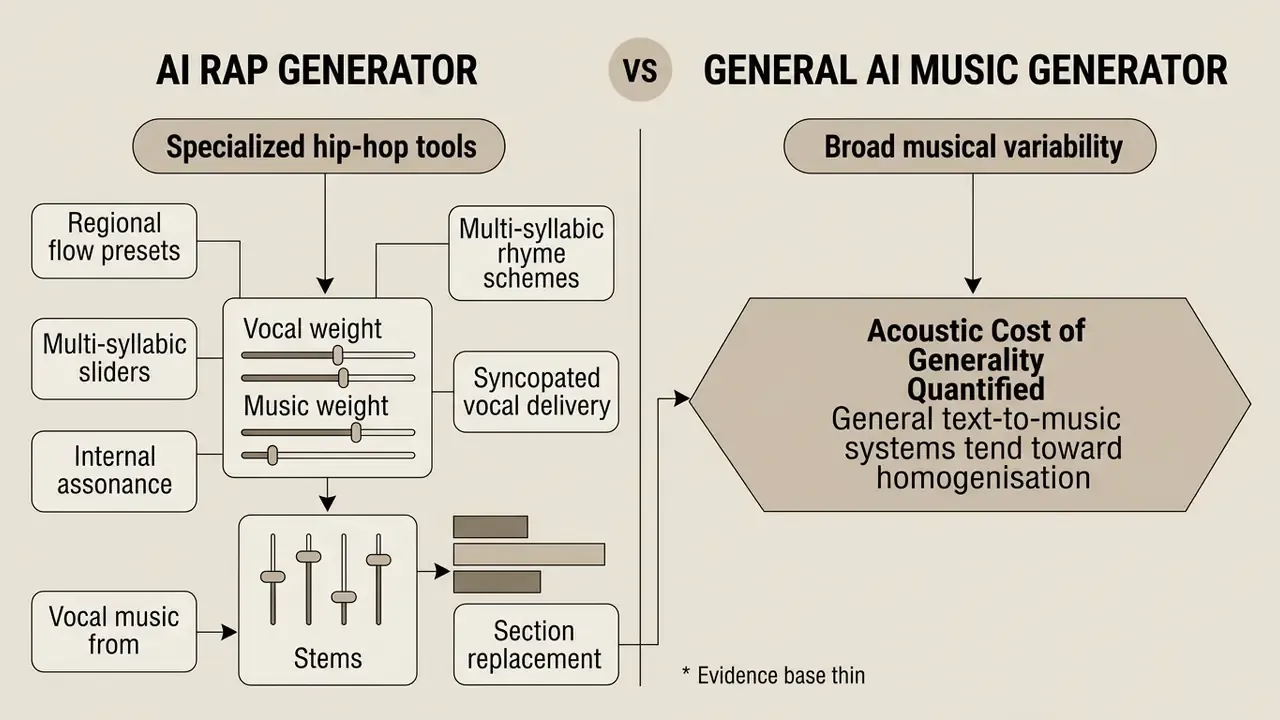
Specialized rap tools prioritize hip-hop-specific features over broad musical variability: multi-syllabic rhyme schemes, internal assonance, syncopated vocal delivery, subgenre-specific drum patterns. While a generic ai song generator or music generator ai creates broad ambient or pop melodies, a dedicated ai generator rap tool exposes explicit controls for rhyme density, cadence, syllables per bar, triplet flow, and bar alignment.
The acoustic cost of generality is now quantified.
«Lyria compresses within-genre acoustic diversity, while Suno erodes boundaries between genres; both deviations are statistically significant under MIR classifiers.»
In other words, general text-to-music systems tend toward homogenisation. Either they flatten variation inside a genre, or they blur the genre borders themselves. Specialized models hold tighter adherence to rhythmic grids and rap-specific structure, which is exactly what you want when a client brief says "New York boom-bap, 90 BPM, dense internals."
A caveat worth stating plainly: this evidence base is thin. Two systems, one study, one metric family. Treat the direction as plausible, not settled.
How to Create a Rap Song with AI in 3 Steps
Creating a complete rap track online involves a structured three-step workflow that moves from prompt formulation to final audio export, with an optional fourth refinement loop for extension, section replacement, and stem export.
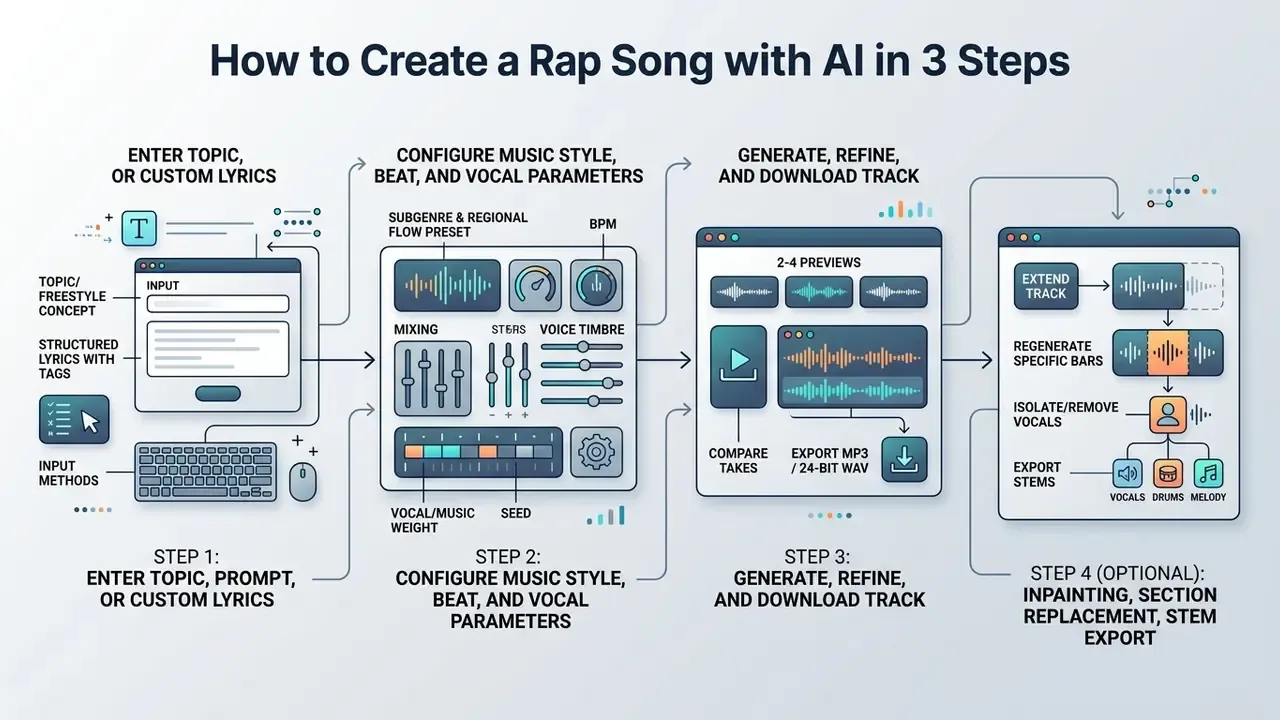
Enter a Rap Topic, Prompt or Existing Lyrics
The creation process begins by defining the core message in an ai rap creator or ai rap generator tool. Users enter a detailed prompt or paste original text into the lyrics workspace. Be specific: "proving the doubters wrong after getting dropped from the label" produces sharper bars than "success." Load in the slang, brand names, and phrases you want woven through the verses, and cap the emotional palette at three states. For precise structural execution, pre-written lyrics should be formatted with standard square-bracket section markers.
Choose the Music Style and Song Structure
After establishing the textual foundation, the user configures stylistic attributes inside an ai hip hop generator. This covers subgenre, regional cadence preset, target tempo (85 BPM for boom-bap, 140 BPM for trap), vocal delivery profile, weight sliders, and instrumental arrangement. Selecting specific style tags prevents acoustic drift during multi-verse rendering.
Structural harmony in hip-hop is largely a function of loop design. Beats typically repeat in one-, two-, or four-measure loops, and can be grouped as repetitive, oscillating, or expansional. Oscillating beats move between tonic and pre-tonic harmonies, creating perceived motion. Rhymed couplets landing on or around beat four tie the vocal pattern to the meter. Sparse intros against fuller hooks create the energy contrast that makes a two-minute track feel arranged rather than looped.
Generate, Refine and Download the Track
Clicking generate rap executes the synthesis pipeline, producing 2 to 4 audio variations. Users evaluate vocal alignment, beat synchronization, and lyric delivery. If revision is needed, regenerate individual sections or adjust prompt parameters, changing one variable at a time so you can attribute the improvement. Once finalized, export the completed audio in MP3 or uncompressed WAV.
For archival and further editing, prefer lossless delivery. NIST speech-collection guidance states that audio should be stored as PCM-WAV or in a format convertible without fidelity loss, and specifically advises against MP3 or WMA because they use lossy compression. Emerging IETF drafts for stem containers (Matroska and OGG stem files, 2026) define a mastered post-mix track plus length-aligned stem tracks. That is a useful spec to cite when negotiating deliverables with an agency or a DAW-based mixing engineer.
Post-Generation Editing: Inpainting, Extension and Stem Work
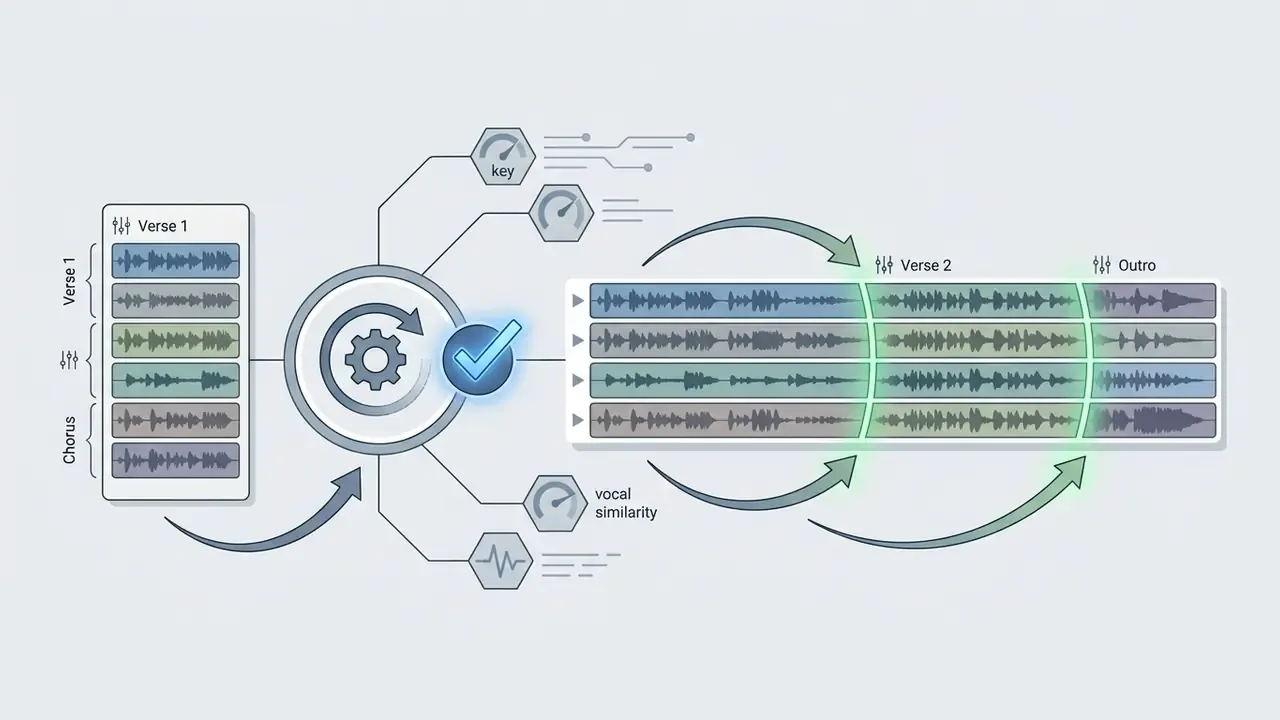
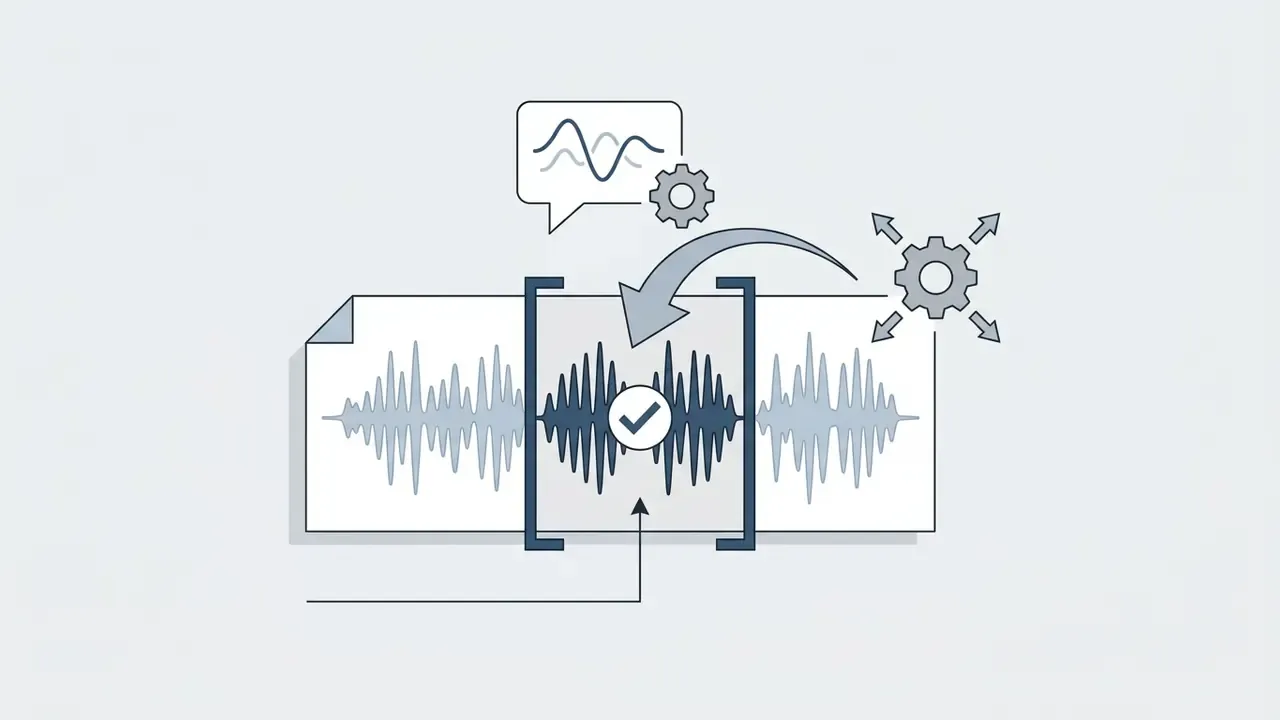
Modern AI audio engines extend well beyond initial track generation. Treat the first render as a seed, not a deliverable:
Commercial platforms increasingly bundle these as named features ("Extend & Cover Song," "Replace Section," "Vocal Remover") and gate them behind paid tiers. When comparing subscriptions, check whether editing consumes the same credit pool as generation. A plan with 150 credits behaves very differently if each section replacement costs three of them.
AI Rap Generator Quality, Originality and Commercial Use
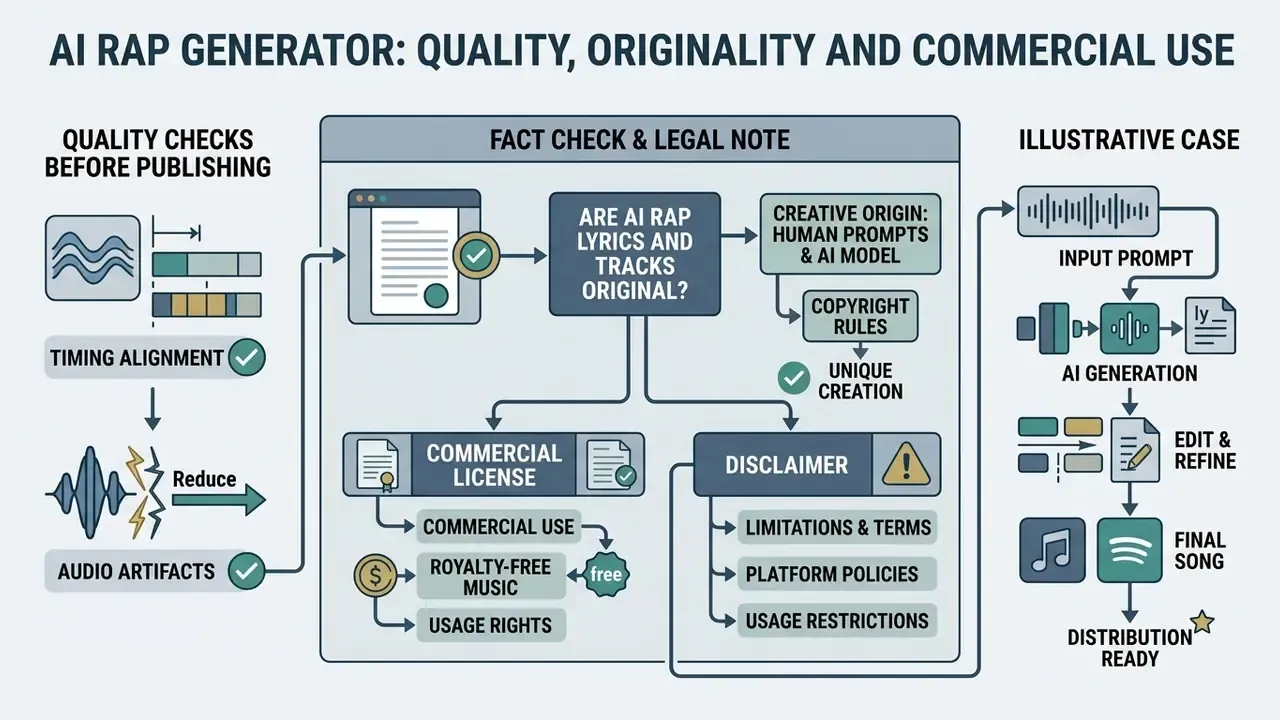
Deploying AI-generated rap music in public, commercial, or branded environments requires evaluating legal risks, copyright standards, and technical output quality.
Are AI Rap Lyrics and Tracks Original?
The practical reading: listeners believe they can tell, even when measured emotional response says otherwise. So disclosure strategy, not sound quality alone, drives audience reaction.
Commercial License, Royalty-Free Music and Usage Rights
A "royalty-free" designation from an ai rap generator website means the user pays no recurring performance royalties to the platform. Commercial distribution rights, however, such as publishing to Spotify, monetization on YouTube, or inclusion in paid advertising, are governed strictly by the platform's subscription terms. Some major AI-music licences explicitly prohibit distribution via Spotify, YouTube Music, and similar DSPs. So "commercial use" and "streaming distribution rights" are not synonyms.
Illustrative case. In an anonymised agency scenario (details withheld at the client's request; figures are indicative rather than independently audited), a media team integrated an ai rap maker into digital campaign production. Working initially on a free plan, the team received copyright claims on social video channels because the free tier's licence covered personal use only. Remediation took three steps: upgrading to a plan with an exportable commercial-use certificate, re-rendering the affected audio under the paid licence, and updating distribution metadata to record model, prompt, seed, and licence reference per asset. Roughly 40 ad variations were then published without further claims. The transferable lesson is procedural. Licence tier must be confirmed before render, not after publication.
An additional risk category is voice likeness. Prompting for the voice of a named artist is blocked by major providers (Google's Lyria refuses artist-voice and copyrighted-lyric prompts and applies SynthID audio watermarking), and the 2023 viral "AI Drake" incident established the reputational and takedown exposure created by synthetic artist impersonation. Treat named-artist voice cloning as a prohibited prompt category in internal policy, alongside copyrighted lyric paste-ins.
Quality Checks Before Publishing an AI Rap Song
Before publishing an AI-generated rap track, run a short technical audit:
- Timing alignment: verify that vocal transients align tightly with beat accents without latency artifacts or off-beat phrasing; check doubles and ad-libs against the lead take.
- Audio artifacts: listen for robotic vocoder distortion, phase issues, clicks, pops, breath noise, or digital clipping in high-frequency ranges.
- Lyric coherence: confirm the text holds logical consistency and one central metaphor, with no unintentional gibberish or repetitive loops.
- Spectral balance: make sure lead vocals sit cleanly above the instrumental mix, using EQ to reduce masking between 1 kHz and 4 kHz; check intelligibility in both verse and hook.
- Detection exposure: assume the track can be identified as synthetic.
Because detection is now reliable at clip length, plan for disclosure rather than concealment. Many distributors and platforms already require AI labelling at upload, and U.S. registration requires disclosure of AI-generated material. Verification workflows for other media follow the same logic; see our overview of AI content detectors for the equivalent tooling on the visual side.
- Rights paperwork: archive the prompt, seed, model version, licence certificate, and plagiarism-check report per released track.
Enterprise Risk, Shadow AI and Data Governance
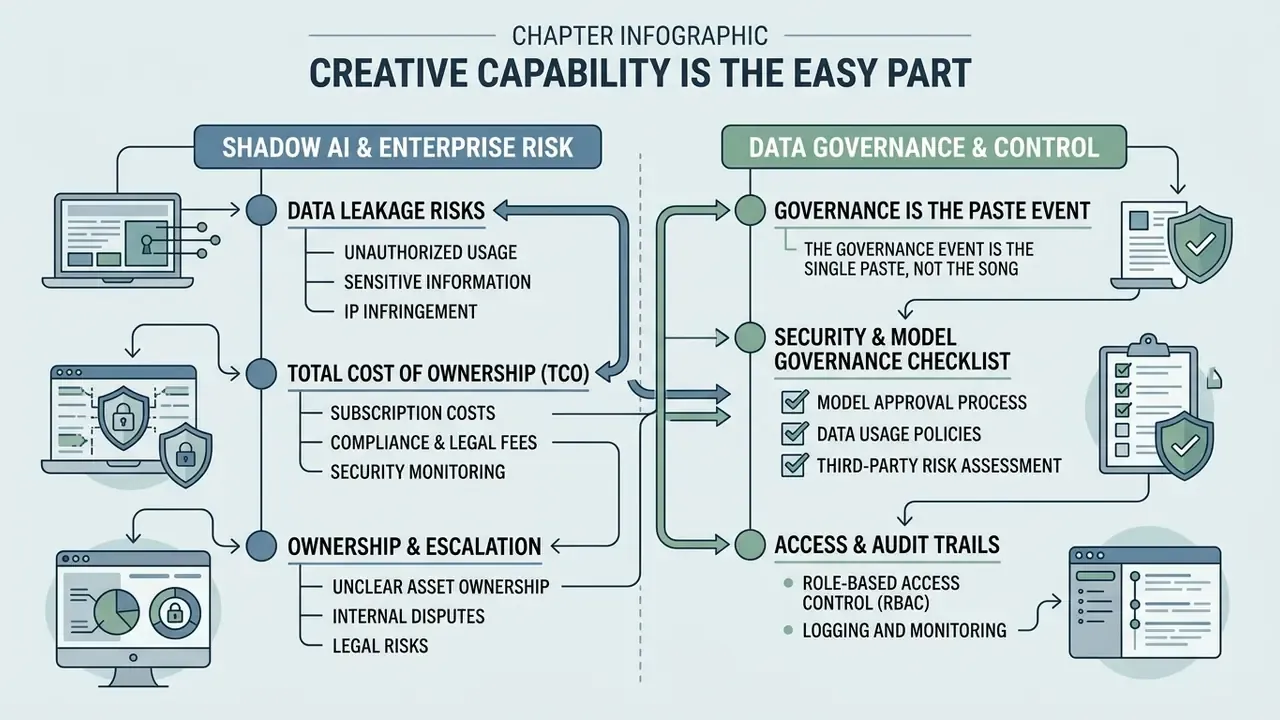
Creative capability is the easy part. For a regulated organisation, whether a bank's marketing department, an insurer's brand team, or a fintech's content studio, the deciding factors are data handling and auditability. Public consumer rap generators are a classic shadow AI vector: an employee pastes an unreleased campaign concept, a product name, or a client detail into a free web form whose terms permit training on submitted content.
That single paste is the governance event, not the song.
Security and model governance checklist
| Control area | Question to ask the vendor | Acceptable evidence |
|---|---|---|
| Prompt confidentiality | Are prompts, lyrics, and uploaded audio used to train or improve models? Is opt-out available and default on paid tiers? | Written DPA clause; documented training opt-out |
| Content licence to vendor | What licence does the platform take over submissions and generated voices? | Terms review; some platforms retain broad, perpetual, royalty-free licences over submissions and voice-model rights |
| Certifications | SOC 2 Type II, ISO 27001, GDPR and UK GDPR posture, sub-processor list, data residency | Current audit report under NDA |
| Access management | SSO/SAML, SCIM provisioning, role-based permissions, seat revocation | Admin console demo |
| Auditability | Immutable logs of prompts, users, model versions, seeds, exports | Exportable audit log or API |
| Output provenance | Watermarking (SynthID-class audio watermarks), content credentials, per-asset licence certificate | Downloadable licence PDF plus watermark documentation |
| Prohibited prompts | Filters for named-artist voices, copyrighted lyrics, hate speech, defamation; prompt-injection resistance in lyric pipelines | Policy documentation plus red-team results |
| Reproducibility | Can a released asset be regenerated from logged parameters? | Seed support plus version pinning |
| Retention and deletion | Storage duration (frequently 365 days on mid tiers), deletion SLA, private-generation mode | Contractual retention schedule |
| Continuity | API deprecation history, SLA, uptime, notice period for model retirement | Public changelog; note that some providers have closed music APIs to new users at short notice |
Ownership and escalation. Treat a generative audio pipeline the way you would treat any other digital worker: a named owner, an approved role, access limits, an escalation path, and a shutdown mechanism. If nobody can say who signs off a released track, the control does not exist. In most institutions the practical split is simple. Brand owns the creative brief, marketing operations owns the render log, and second-line risk reviews the licence and provenance record before publication. Vendor support response times belong in that same conversation, since a stalled ticket during a campaign window is an operational risk, not an inconvenience.
Total cost of ownership beyond the subscription. Budget for control costs, not just seats: legal review of platform terms, plagiarism and similarity screening per release, human mixing and mastering passes, API integration engineering, storage of provenance records, and the residual risk premium of publishing under a licence you did not draft. For teams planning programmatic use, AI Media API specifications provide benchmark data on throughput and cost structures, and you can compare options on a cost-per-released-asset basis rather than cost per seat. Our guide to AI video generators uses a comparable evaluation grid for adjacent media tooling.
Is There a Free AI Rap Generator?
Free options exist across major ai rap generator free online platforms, but they operate under structural capacity limits and licensing constraints.
Table 2. Tier comparison: free vs. paid AI rap generator features and indicative 2026 market pricing
| Feature category | Free tier | Entry paid tier (about $8 to $15 per month) | Standard / premium tier (about $16 to $40 per month) |
|---|---|---|---|
| Generation credits | 12 to 50 credits (daily or monthly caps); roughly 2 to 5 tracks per day; low request rate limits, as low as 3 RPM on some APIs. | About 150 to 600 credits per month (roughly 100 to 200 songs). | About 1,000 to 4,000 credits per month; priority queue; 2 to 4 concurrent jobs. |
| Track duration | 30-second clips or a 2 to 4 minute maximum; some models generate fixed 30s clips only. | Full songs, typically up to 4 minutes. | Extended songs up to 6 to 8 minutes; extension and cover functions. |
| Export formats | Standard MP3 (128 kbps); watermarking or preview-only playback common. | MP3 320 kbps plus lossless WAV download. | 24-bit PCM WAV, stem separation, private generations, long-term or unlimited cloud storage. |
| Commercial rights | Strictly personal and non-commercial; attribution often required; ownership may remain with the platform. | Commercial use for most channels; downloadable licence. | Full commercial licence plus exportable certificate; check DSP distribution carve-outs. |
| Customization and editing | Basic style presets, default voice profiles, no section editing. | Advanced prompt control, voice selection, vocal remover. | Section replacement, extend and cover, multi-stem mixing, custom voice profiles. |
Prices are indicative market ranges observed across mainstream 2026 consumer plans (monthly billing, promotional discounts included) and change frequently. Verify current pricing and credit-to-song ratios directly with each vendor.
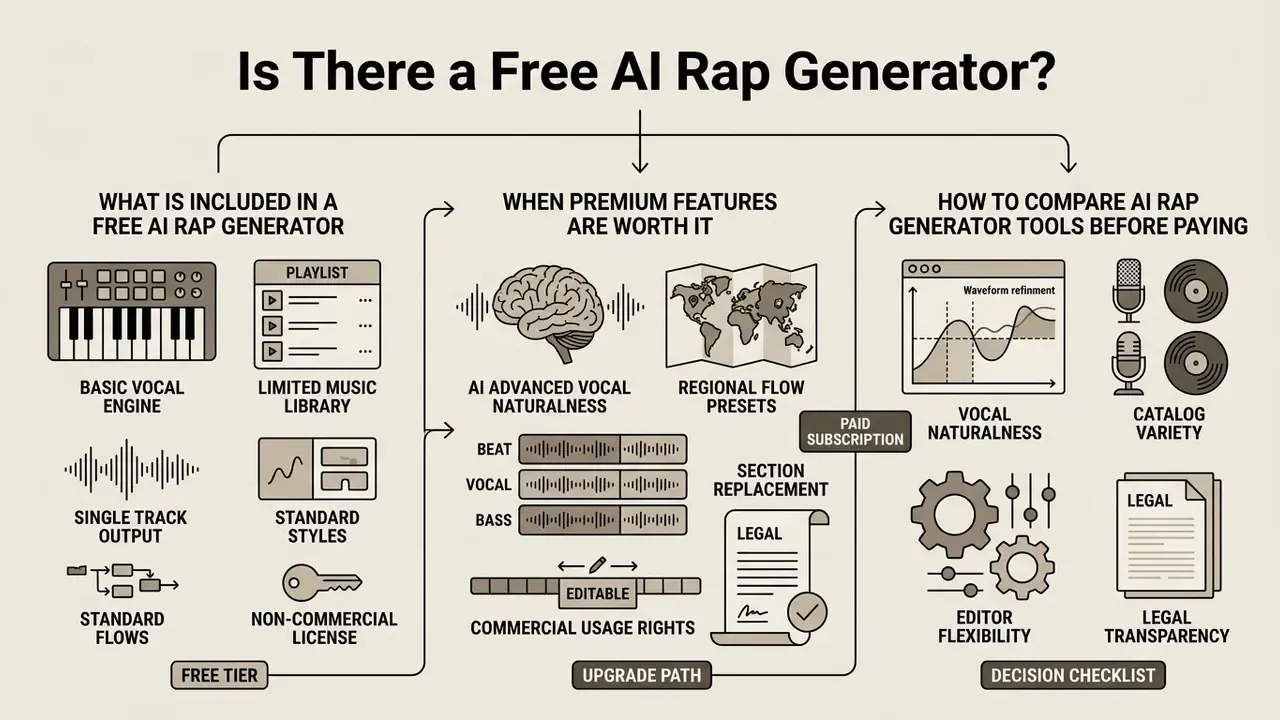
What Is Included in a Free AI Rap Generator
A typical ai rap generator free plan offers basic access to text-to-lyrics or text-to-music engines, letting users test prompt concepts and generate low-bitrate MP3 previews. An ai rap maker free tier is designed for personal experimentation, freestyle practice, and non-monetized sharing. Nothing more.
To test different tool implementations, creators can compare options across platforms before committing capital. The upgrade logic mirrors what we documented for free AI video generators: free tiers are evaluation environments, not production licences.
How to Compare AI Rap Generator Tools Before Paying
When evaluating an ai rap song generator website prior to subscription, compare four measurable criteria:
- Vocal naturalnessjudge whether the vocal engine produces expressive, human-like cadence or robotic monotone. Test the same 8 bars across vendors with identical BPM and flow settings.
- Catalog varietycheck the depth of available subgenres, regional cadence presets, beat templates, and mixing styles.
- Editor flexibilitydetermine whether the system allows section-by-section regeneration, track extension, stem export, and custom lyric tag parsing.
- Legal transparencyconfirm the terms explicitly detail copyright ownership, DSP distribution rights, and provide exportable commercial licences in PDF form.
Add two enterprise criteria if you are buying on behalf of an organisation: documented training opt-out for submitted content, and availability of audit logs on the tier you are actually purchasing, not the enterprise tier you were shown in the demo.
Who Uses an AI Rap Maker?
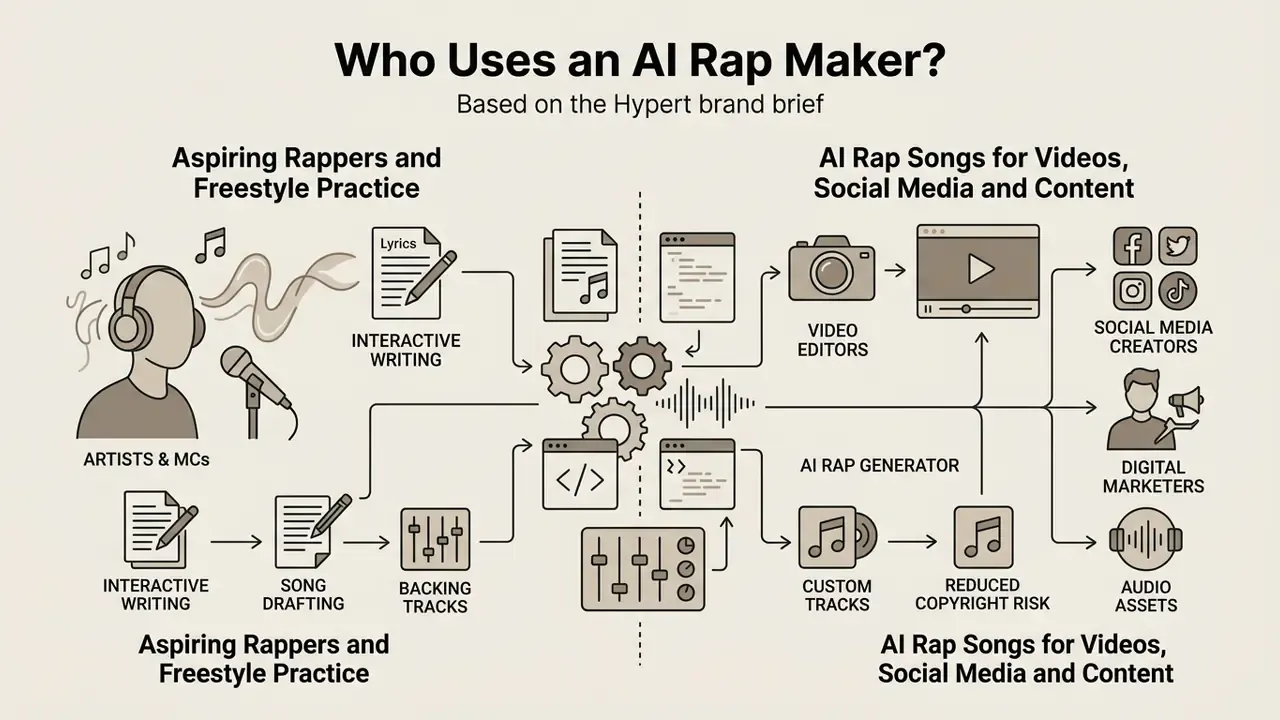
An ai rap maker serves both individual creators and commercial production teams by accelerating song drafting, backing track generation, and audio asset creation. Documented user groups include beginners and hobbyists, professional songwriters and producers, content creators and marketers, and music educators using rhyme-scheme exercises to teach computational creativity.
AI Rap Generator for Aspiring Rappers and Freestyle Practice
Beginner artists and MCs use an ai generator rapper or ai rap rhyme generator as an interactive writing partner. By generating dynamic rhyme couplets and rhythmic variations, artists break writer's block, discover unexpected rhyme schemes, and practise live freestyle delivery against generated beats. Instrumental-only mode is especially useful here: it produces a clean bed to practise over without competing synthetic vocals. For comparative evaluations of creative tools, consult the AI Media Comparison portal.
FAQ About AI Rap Generator Online
How does a specialized AI rap generator differ from ChatGPT for writing lyrics?
General-purpose LLMs produce standardized poetry structures with rigid end-rhymes (AABB) and no domain awareness of cadence, multi-syllabic rhyme, or bar limits. The output reads as prose broken into lines. Specialized rap models enforce musical constraints: syllables per measure, internal assonance, syncopation, rhyme-density targets, and automatic parsing of structural tags such as [Verse] and [Hook]. Research models like DeepRapper make this explicit by modelling rhyme and rhythm jointly and inserting beat symbols into the token stream. A general LLM helps you brainstorm a concept; a specialized ai rapping generator gives you bars that land on the beat.
What licensing, SLA and API questions should a company ask before adopting a tool?
Five essentials. First, does the paid licence cover paid advertising and DSP distribution, or does it carve out streaming platforms? Second, is a per-asset licence certificate downloadable as evidence for ad clearance? Third, are prompts and uploads excluded from model training by default? Fourth, what is the uptime SLA, rate limit, and notice period before a model or API is retired, given that several providers have closed music endpoints to new users on short notice? Fifth, are audit logs, SSO, and data-residency options available on the tier you are buying?
What are the deepfake-voice and prompt-injection risks?
Prompting for the voice or likeness of a named artist creates rights-of-publicity and takedown exposure, and major providers refuse such prompts outright while watermarking generated audio. Prompt injection is a secondary risk in lyric pipelines: instructions hidden in user-supplied text or scraped source material can steer the model toward prohibited content. Mitigations are prompt allowlists, output moderation, watermark verification, and a written policy banning named-artist and copyrighted-lyric prompts.
Can an AI rap generator create a diss track or battle bars?
Yes. Users can enter rival themes, lighthearted comedic prompts, or battle-style lyrics, and short line counts (4 to 8 lines) work best for punch-driven battle bars. Major commercial platforms enforce safety filters that block slurs, hate speech, severe harassment, and explicit defamation. In a corporate context, treat targeted-insult generation as an out-of-policy prompt category regardless of what the filter permits.
Can AI generate rap songs in different languages?
Yes. Modern platforms combine multilingual language models with synthetic voice engines supporting English, Spanish, German, French, Japanese, and other major languages, while retaining regional flow characteristics. Vendor documentation for mainstream music models explicitly lists multilingual lyric and vocal generation, though rhyme quality is usually strongest in English because of training-data distribution.
Can I generate an instrumental beat without vocal lyrics?
Yes. Selecting "Instrumental" mode or omitting vocal prompt parameters disables vocal synthesis and produces pure instrumental hip-hop, trap, drill, or boom-bap beats. Documented behaviour on mainstream models confirms that instrumental toggles suppress vocals entirely, which is the standard route to backing tracks for freestyling or for a human vocalist.
Which audio file formats are supported for download?
Free plans typically export MP3 (128 kbps or 320 kbps). Premium tiers provide uncompressed WAV (16-bit or 24-bit PCM), and advanced tools offer multitrack stem exports (WAV or ZIP) for individual instrument tracks. Some platforms additionally support OGG and FLAC. For archival and mixing, choose lossless PCM-WAV: NIST guidance advises against storing reference audio in lossy formats such as MP3.
Can I extend or partially regenerate an existing AI-generated rap track?
Yes, on most platforms. "Continue," "Extend," or "Replace Section" functions let you append new verses, hooks, or instrumental outros to an existing clip while holding tempo, key, and vocal timbre steady, or regenerate a specific window of bars without touching the surrounding beat. Note that some current-generation models do not support iterative multi-turn editing at all. In that case the workflow is regenerate and reassemble in a DAW.
Do I have to disclose that a track was made with AI?
It depends on both jurisdiction and platform. U.S. copyright registration requires applicants to disclose AI-generated material and describe the human contribution. UK reporting notes that AI developers are not currently obliged under UK law to publicly disclose the copyright works used in model development, which is a separate question from output labelling. Independently of copyright law, several distributors and streaming services require AI labelling at upload, so the same track may face different disclosure rules per channel.
Appendix A: Source Notes and Superseded References
Preserved for transparency and version traceability:
- Original technical citation (superseded in the main text)
- "According to research on Rapping-Singing Voice Synthesis (ISCA SSW, 2021), fundamental frequency (F0) contours are discretized and time-aligned to match target accompaniment tracks." This statement remains scientifically accurate and is retained above with a full URL. It has been supplemented with the Freestyler lyrics-plus-accompaniment system for current-generation relevance.
- Original case wording (superseded in the main text)
- "When a media firm integrated an ai rap maker for digital campaign spots, it initially faced copyright claims on social video channels due to free-plan licensing limits. The team upgraded to an enterprise account with a verified commercial usage certificate, updated their distribution metadata, and successfully monetized over 40 ad variations across video channels without copyright strikes." The anonymised, procedure-focused version in the main text should be treated as illustrative; the figures are not independently audited.
- Verification flag
- the Mitislurs dataset referenced in Raply-related research is a narrow, specialised corpus. Its public-domain and redistribution status requires independent verification before being cited in contractual or compliance documentation.
- Pricing note
- subscription figures in Table 2 reflect indicative consumer market ranges for 2026, including promotional discounts. Credit-to-song ratios differ by model version and by whether editing operations draw on the same credit pool.
- Open questions
- we found no peer-reviewed benchmark that measures rhyme-density fidelity across commercial rap generators under identical prompts. Until one exists, vendor claims about "flow accuracy" should be treated as untested marketing language.
Company and Governance Transparency
Editorial and positioning note: this guide is published as vendor-neutral reference documentation. It does not promote a proprietary rap-generation product, and no commercial claims, certifications, or customer deployments are asserted on behalf of any first-party tool. Where the text describes governance workflows, credit limits, or licence structures, these are drawn from publicly available vendor documentation, regulator publications, and peer-reviewed research cited inline. Any operational framework presented for regulated environments is illustrative and should be validated against your own procurement, security, and legal requirements before adoption. Pricing, model capabilities, and platform terms in this market change monthly; verify current figures with the vendor before purchase.
Legal and financial disclaimer: nothing here constitutes legal advice. Copyright, publicity-rights, and AI-disclosure rules vary by jurisdiction and are actively evolving. Consult qualified counsel before commercial release or distribution.
For comprehensive taxonomy indexes and detailed reference documentation, view the guide in our central hub directory.