Why should a risk or compliance leader care about a consumer localization tool? Because someone in your organization is already using one. Marketing wants a dubbed product clip by Friday. Learning and development needs captions in Spanish for a mandatory policy module. And an analyst may quietly paste a recorded client call into an anonymous web app to get a transcript. That last one is a disclosure event, not a productivity win.
Last updated: 2026. Reviewed by the AI Governance & Model Risk editorial desk.
Key Takeaways: What a Free Video Translator Actually Delivers
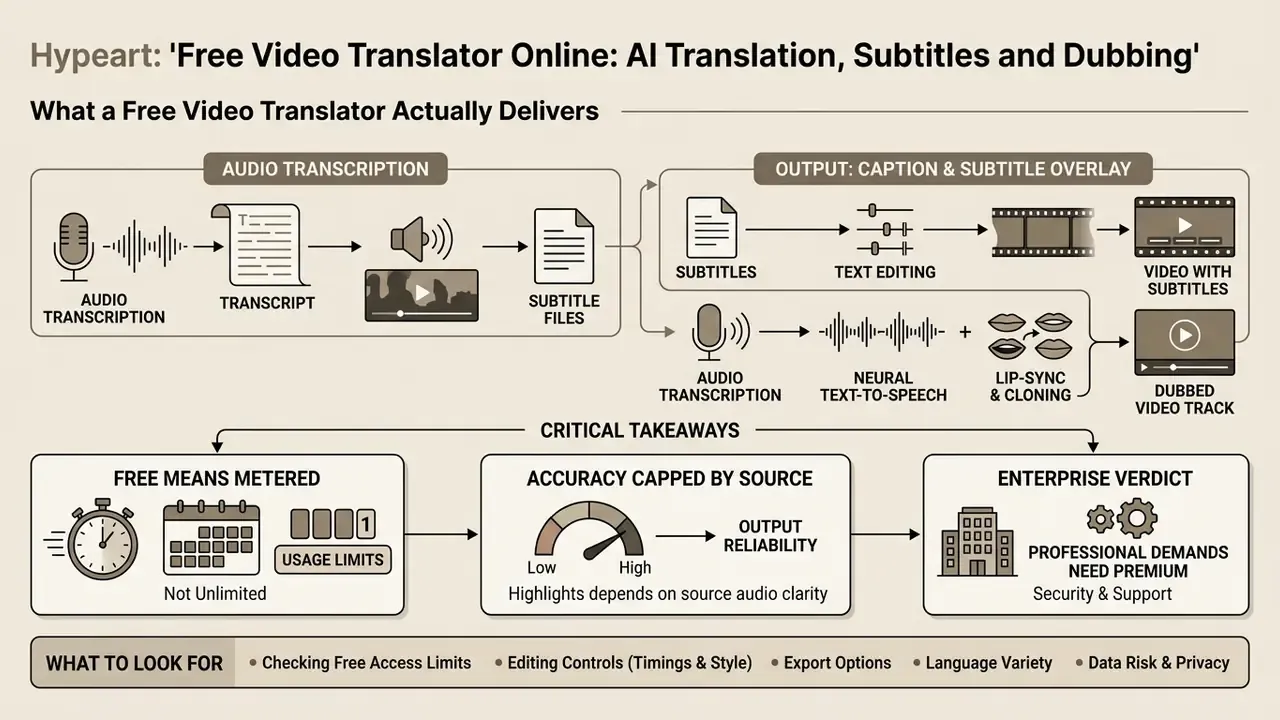
- Three output classes. Free tools split into subtitle translation (timed text only), audio voiceover translation (a single generic narration track), and AI dubbing with voice cloning and optional lip-sync.
- Free means metered, not unlimited. Typical unpaid ceilings are 1 to 10 minutes per video, 100 MB to 8 GB per upload, 720p or 1080p exports, and vendor watermarks. Some platforms bill in 30-second blocks and apply a 2× multiplier when voice cloning and burned-in captions run together.
- Accuracy is capped by the source audio. Errors in automatic speech recognition propagate into translation and synthesis, so human post-editing remains mandatory for legal, medical, financial, and technical video.
- Enterprise verdict. Free tiers are appropriate for pilots, internal drafts, and public marketing clips. They are not appropriate for confidential material: unpaid services may retain uploads for model retraining and rarely commit to SOC 2, HIPAA, or GLBA controls.
- What to look for. Editable transcripts, sidecar
.srtand.vttexport without forced burn-in, custom translation and pronunciation glossaries, vocal stem separation, and written commercial-use rights for synthetic voices.
What Is a Free AI Video Translator?
A free AI video translator is a web-based tool that automatically converts spoken audio and dialogue from a source video into another language. The system extracts speech using neural models, translates the underlying text, and outputs translated subtitles, an audio voiceover, or synthesized AI dubbing.
Using a free video translator online allows content creators, training teams, and enterprise operators to localize video assets without manual transcription. Commercial platforms sell paid tiers, but basic processing stays accessible through the browser with no upfront software installation. That places these utilities in the same evaluation category as free AI video generators, which publish capped credit allowances instead of open-ended access.
Distribution platforms have started to absorb the same capability natively. YouTube made automatic dubbing free for creators in 27 languages in February 2026. So the same workflow, upload, transcribe, translate, render dubbed audio, now exists both inside hosting platforms and inside standalone vendor tools. The governance implication is easy to miss: a "no vendor" path still processes your audio on someone else's infrastructure.
Video Translation: Subtitles, Audio Translation, AI Dubbing, or Lip-Sync
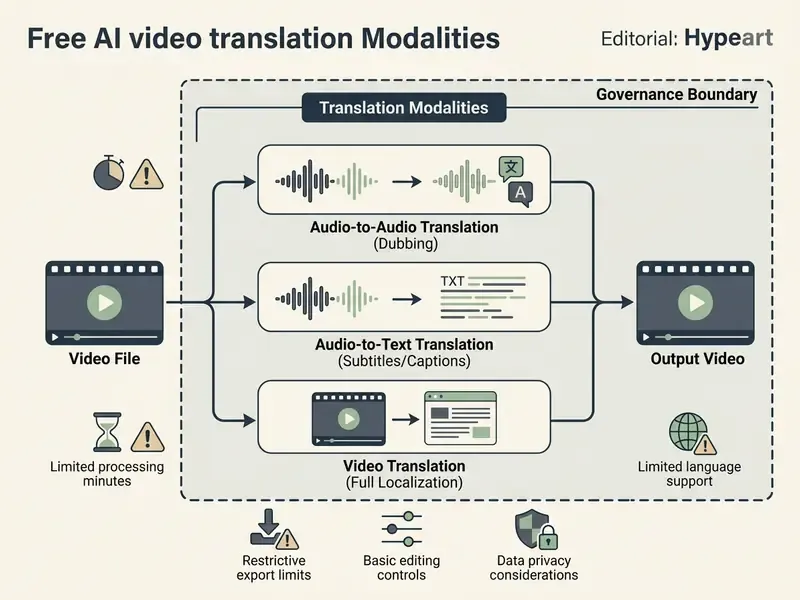
Video translation operates across four distinct output modalities depending on distribution requirements. Confusing them is the most common cause of budget and compliance surprises.
- Subtitle TranslationGenerates timed text overlays (such as SRT or VTT files) while leaving the original audio track intact.
- Audio Translation (Voiceover)Replaces or overlays source dialogue with a translated voiceover narration track in a single generic target voice.
- AI Dubbing with Voice CloningReplaces original speech with synthesized target audio that preserves speaker timbre, tone, pitch, and temporal cadence.
- Automated Lip-Sync DubbingAdds visual modification of the speaker's mouth region so on-screen articulation matches the translated audio stream.
Selecting the appropriate modality depends on localization goals and compliance requirements. For regulated communications, subtitle translation carries lower legal risk, because the original vocal record stays unaltered. Practitioners comparing modality trade-offs alongside adjacent synthesis tooling can review how AI voice generators handle language coverage and licensing before committing to full dubbing.
Timing constraints are not free of cost. Research on isochrony-controlled speech translation quantifies the trade-off directly:
"Isochrony-controlled models reach a speech-overlap score of 0.92 but lose 1.4 BLEU compared with unconstrained baseline translation on CoVoST 2."
In other words, forcing the translated line to fit the original speech envelope measurably degrades linguistic fidelity. That is the exact reason regulated content is usually subtitled rather than lip-synced.
How AI Translates Speech in a Video
Modern AI video translation relies on a sequential cascaded pipeline comprising three foundational machine learning components:
- Automatic Speech Recognition (ASR) Converts acoustic signals from the video audio stream into time-stamped text.
- Neural Machine Translation (NMT) Translates transcribed source text into target language text while applying context glossaries, translation memory, and terminology rules.
- Text-to-Speech (TTS) and Voice Cloning Synthesizes translated text into spoken audio, matching acoustic features when voice cloning is enabled.
Advanced end-to-end models attempt direct speech-to-speech translation without intermediate text steps. Published system reports show the practical cost of that ambition:
"The NAIST simultaneous speech-to-speech system reached ASR-BLEU 12.08 at 2.4 to 3.7 seconds of latency, illustrating the real quality-versus-speed trade-off."
However, modular cascaded pipelines remain the operational standard in commercial tools, because they allow human review between stages. Peer-reviewed comparison of general-purpose AI subtitling against professional human translators points the same way: the machine draft is a starting point, not a deliverable.
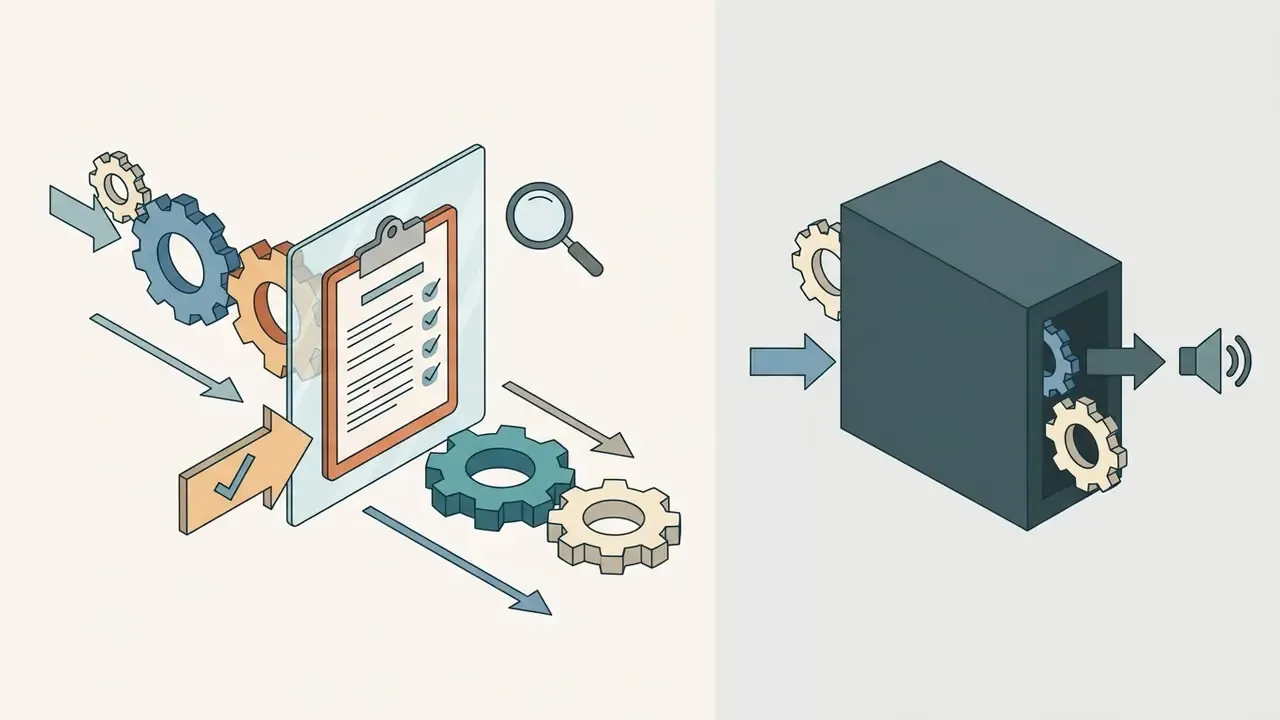
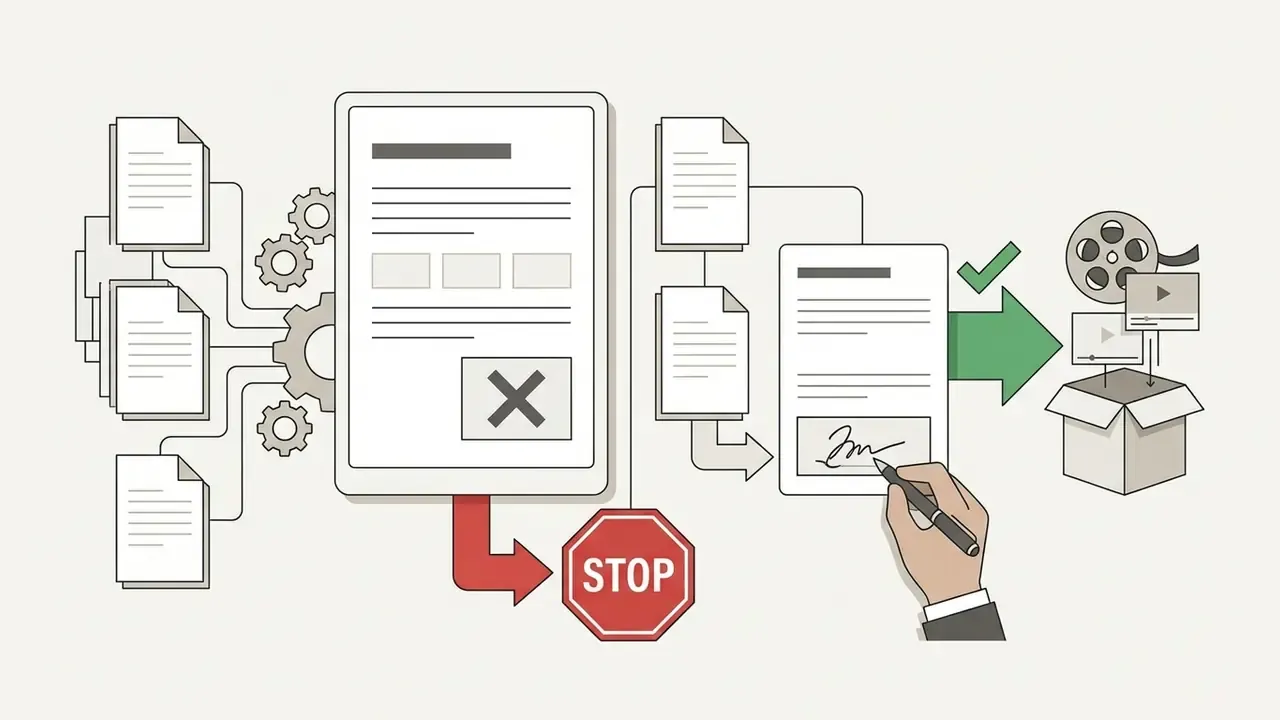
Map that onto a model risk framework and the architecture choice becomes a control decision:
Research-grade pipelines increasingly bolt extra modules onto the cascade, including voice conversion to match speaker identity and dedicated lip-synchronization networks that operate on the rendered frame sequence. Commercial free tiers typically expose only the first three stages. Identity preservation and visual sync usually sit behind paid plans.
How to Translate a Video Online for Free
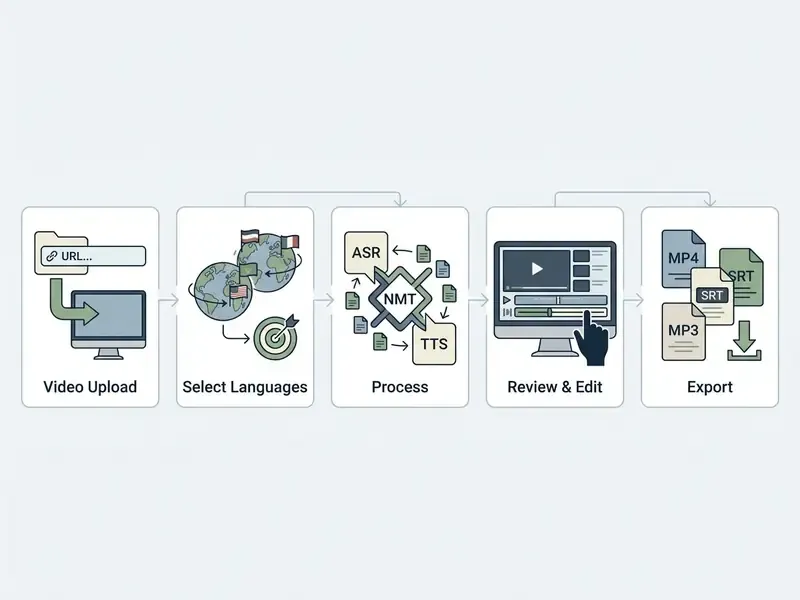
To translate a video online for free, users upload a media file, select source and target languages, execute automated processing, review the generated output, and download the finished asset. Most web tools complete standard conversion within a few minutes.
Upload a Video and Choose the Original Language
The translation process begins when a user uploads a video file or pastes a media URL into the browser interface. Most platforms accept a broad container set: MP4, MOV, WEBM, AVI, WMV, FLV, OGG, OGV, MPEG, MPG, MKV, M4V, 3GPP, MXF, and MP2TS, plus audio containers including MP3, WAV, and M4A.
- File Size Limits Free tiers typically constrain uploads between 100 MB and 8 GB depending on infrastructure rules. Published documentation ranges from roughly 8 GB and two hours of runtime on some research-grade upload endpoints to 30 GB for URL-based ingestion on enterprise media indexing services, while consumer free tiers frequently stop at 200 MB.
- Duration Caps Unpaid conversions often limit processing duration to clips between 1 and 10 minutes. A common non-member ceiling is 10 minutes or 200 MB per file, against 60 minutes or 1 GB on paid tiers.
- Language Detection Platforms feature automated speech detection, yet manually selecting the source language improves ASR accuracy on accented audio.
- Batch Ingestion Some services accept multi-file queues or cloud imports from Google Drive, Dropbox, or a public URL, which matters when a localization backlog is processed in a single session.
Proper source file preparation raises speech recognition precision. Clear single-speaker audio yields fewer transcription errors than multi-speaker tracks recorded with ambient noise. If uploads exceed the size ceiling, transcoding the master before submission is faster than upgrading a plan; the mechanics of quality-preserving size reduction sit in our guide to video compressors.
Translate Video Audio, Subtitles, or Both
After uploading the asset, users choose the target output format and language settings. Users select whether to generate downloadable subtitle tracks, an embedded video with burned-in captions, or a full dubbed audio track.
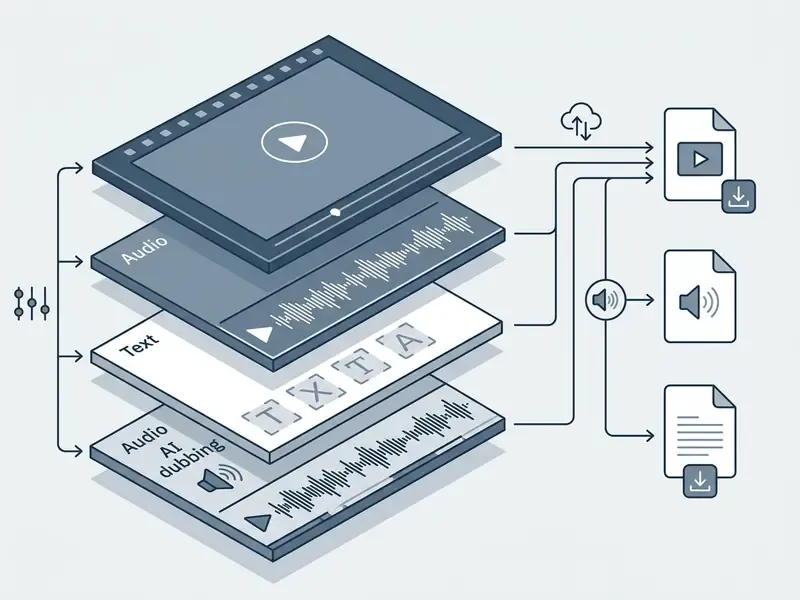
Multi-language projects require selecting target locales from the platform menu. Advanced services allow applying custom voice profiles per target language to match distinct corporate personas. Mature workflows also let a single uploaded source be re-targeted to additional languages from inside the editor, without re-uploading or re-transcribing the original file.
Fix Proper Nouns and Terminology Before Rendering Audio
Automated systems fail most visibly on names, acronyms, product codes, and dosage or currency figures. Three controls solve this before synthesis begins. Skipping them is the main reason a "finished" dub has to be regenerated:
- Search and Replace on the Transcript Correct every instance of a misheard brand or speaker name in one pass before translation runs, rather than editing the translated output line by line.
- Custom Translation Rules Lock brand names, acronyms, and product terminology so the NMT stage leaves them untranslated or maps them to an approved target-language equivalent.
- Pronunciation Overrides Supply phonetic spellings so the TTS engine articulates branded or technical terms correctly. One mispronounced product name undermines an otherwise accurate dub.
Saving these rules at the workspace level, rather than per project, is what makes high-volume localization repeatable across dozens of videos. Small step. Large effect on rework.
Review, Edit, Export, and Download the Translated Video
Before downloading the final file, reviewing the generated translation in an interactive editor is essential. Automated tools occasionally misinterpret proper nouns, technical terminology, and numerical figures.
- Text CorrectionCorrect spelling errors in the interactive transcript editor before audio rendering.
- Timecode AdjustmentAlign subtitle start and end times to match visual shot transitions. Broadcast style guides place in-times on the first audio frame or within one to three frames of speech onset, and hold out-times to the end of speech or a few frames beyond.
- Line SegmentationKeep captions to a maximum of two lines on screen and respect characters-per-line ceilings so text stays readable at mobile scale.
- Export SelectionDownload separate sidecar caption files (.srt, .vtt), a plain-text transcript (.txt), or export a rendered MP4 with synthesized dubbing.
Once edits are confirmed, the system renders the output file for download. Teams that need to finish colour, trims, or thumbnails after localization can route the render into the editing sequence described in our YouTube video editing workflows guide. If a render stalls or a caption track imports out of sync, our AI Media Support and Troubleshooting notes cover the usual culprits.
Is an AI Video Translator Free and Does It Require Sign Up?
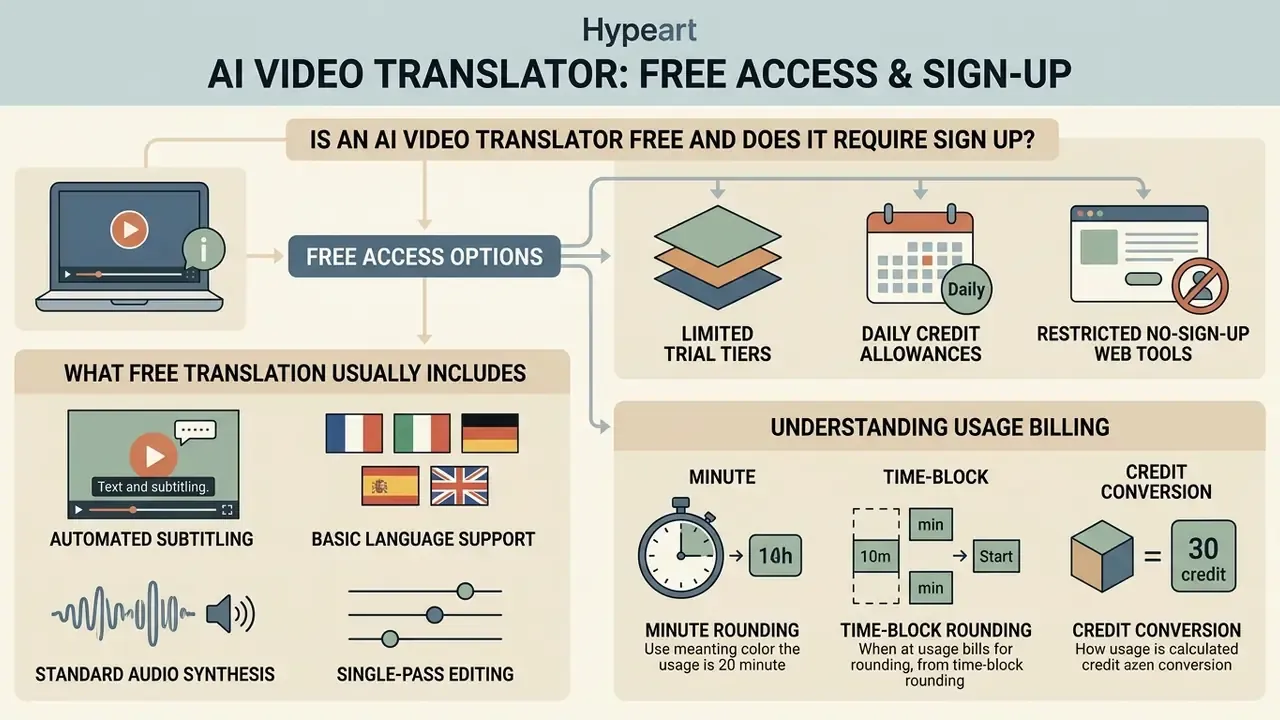
An AI video translator may offer free access through limited trial tiers, daily credit allowances, or restricted no-sign-up web tools. Fully unrestricted free access is rare in commercial software, mostly because GPU rendering costs money on every job.
Many no-sign-up tools allow quick video translation for short clips. Extended exports, though, usually require creating an account, accepting platform terms, or upgrading to a subscription plan.
| Platform Type | Account Required? | Time / Minute Limits | Watermark on Export? | AI Dubbing Included? | Subtitle Export Formats |
|---|---|---|---|---|---|
| No-Sign-Up Tools | No | 1–3 minutes per video | Yes (frequently) | Basic voiceover | Plain text or embedded |
| Freemium Web Apps | Yes | 3–10 minutes per month, or 3 videos × 3 minutes | Optional / Small logo | Synthetic TTS | SRT, VTT, TXT, MP4 |
| API / Developer Tiers | Yes (API Key) | Character quota caps (commonly 0.5–2 million characters per month) | No watermark | Full TTS and lip-sync | JSON, SRT, VTT, Raw Audio |
What Free Video Translation Usually Includes
Free video translation access generally provides entry-level features designed for testing and light consumer use. Understanding these baseline capabilities prevents unexpected operational bottlenecks during localization projects.
- Automated Subtitling Generation of timed text captions for short source videos.
- Basic Language Support Access to major global language pairs such as English, Spanish, French, and German.
- Standard Audio Synthesis Synthetic text-to-speech rendering using stock AI voice profiles.
- Single-Pass Editing One interactive review cycle before render, often without project version history.
Advanced capabilities, such as high-resolution video exports, custom voice cloning, direct lip synchronization, vocal stem separation, and saved terminology glossaries, are typically restricted to paid plans.
Two concrete examples of how these caps block real business work:
- A compliance team generates accurate translated captions on a free tier, then cannot download the sidecar
.srtfile, because the plan only permits burned-in captions. The subtitle asset therefore cannot be uploaded to the learning management system, which requires a separate caption track per language. - A marketing team dubs a 90-second product video successfully, then discovers the free export renders at 720p with a vendor watermark. Unusable for a paid social placement that specifies clean 1080p or 4K masters.
Understanding Usage Billing and Minute Rounding
Free-tier pricing models often use non-linear consumption rules that drain quotas faster than raw video duration:
- Time-Block Rounding Platforms typically charge usage in fixed increments, commonly 30-second billing blocks. A 35-second clip is routinely billed as a full 60-second processing task, and a 65-second clip counts as three blocks rather than two.
- Credit Conversion Some vendors draw video minutes from a shared document-translation balance, for example four "pages" per 30-second block, meaning a three-minute video consumes six blocks, or 24 pages.
- Feature Multipliers Activating advanced options, such as simultaneous voice cloning paired with burned-in captions, frequently applies a 2× cost multiplier to consumed credits compared with baseline subtitle generation. Dubbing without subtitles, or subtitles without dubbing, usually stays at the base rate.
- Upfront Deduction and Refunds Credits are commonly deducted at submission based on full source duration, then refunded if the job fails or is cancelled. A failed render can therefore lock your monthly quota temporarily.
- Resolution Caps Unpaid exports are usually locked at 720p or 1080p at 30 fps. High-definition 4K rendering and uncompressed WAV audio exports require upgraded subscriptions.
Before you commit a localization backlog to a plan, model the real unit cost with our AI Media Calculators; rounded blocks and feature multipliers change per-minute economics more than headline pricing suggests.
What to Check Before Using a Free Export for Commercial Content
Before distributing AI-translated video content commercially, organizations must verify usage rights, licensing terms, and media watermarking policies. Unpaid tiers frequently restrict commercial monetization.
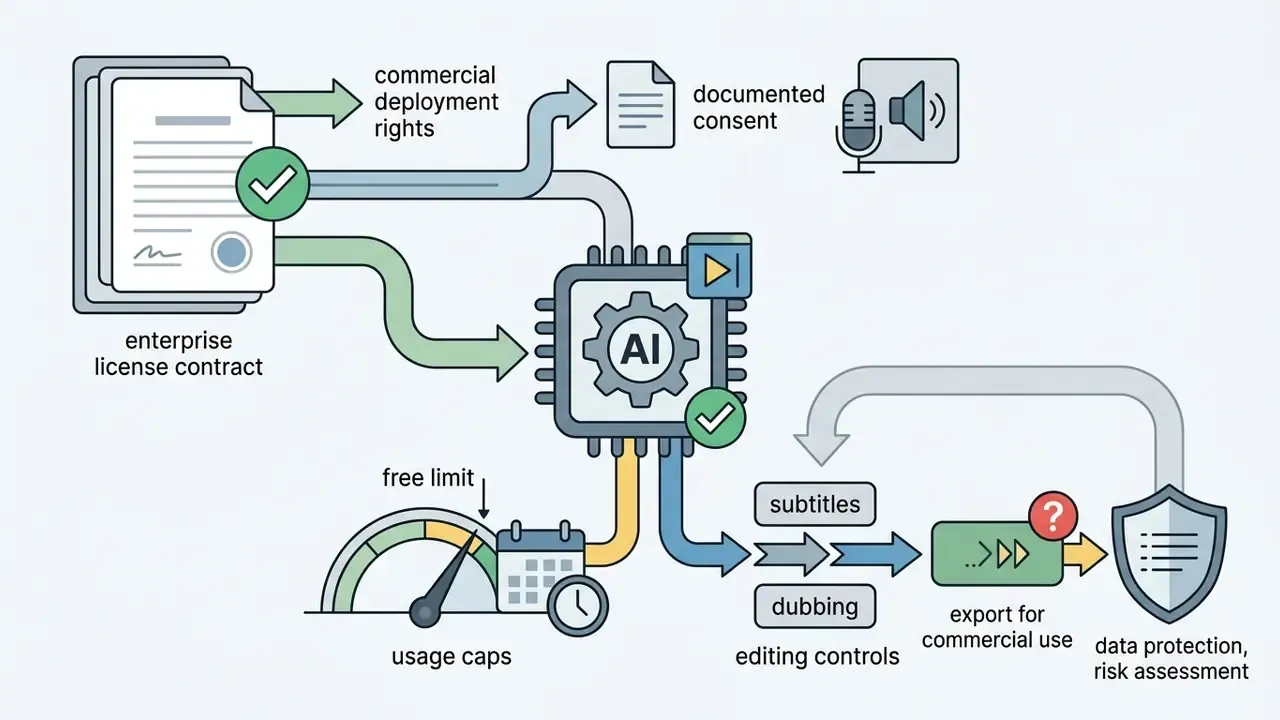
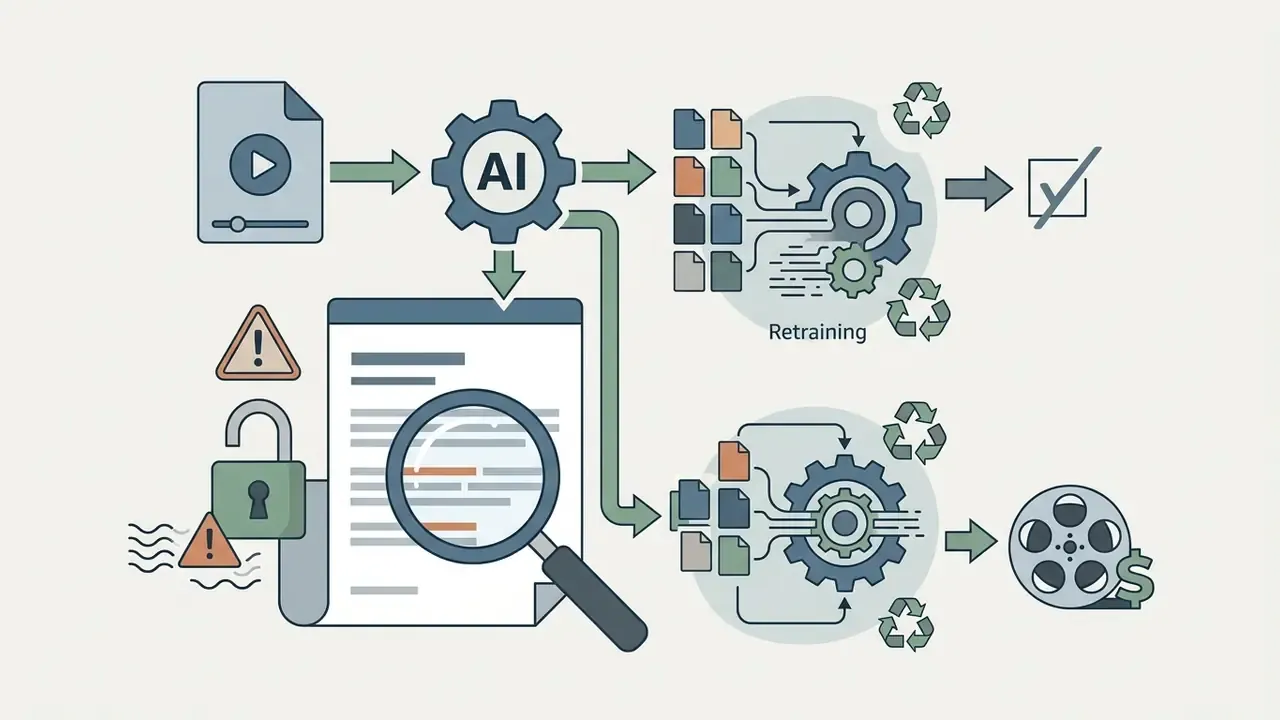
When evaluating vendor offerings, review how licensing language differs across generative media platforms in our analysis of commercial use of AI-generated content, which documents how export rights, watermark policy, and plan tier interact in practice. For unresolved questions on voice likeness and training data, the AI Litigation and Case Timelines tracker follows active disputes that may reshape those terms.
Shadow AI and Data Privacy Risk in Free Translation Tools
For regulated organizations, the dominant risk of a free video translator is not translation error. It is uncontrolled data egress. A single employee pasting an internal all-hands recording, a customer call, or an unreleased earnings walkthrough into an anonymous browser tool creates a disclosure event that no post-editing can reverse.
- Retraining Exposure Consumer free tiers commonly reserve the right to retain uploads and use them to improve models. Confidential audio then persists outside the corporate boundary with no deletion SLA.
- Jurisdiction and Transfer Processing location is frequently undisclosed on free plans, which complicates GDPR transfer assessments and data-residency commitments.
- Voice Biometrics A voice-cloning upload contains biometric identifiers of named employees or executives. Cloned executive audio is also a direct vector for social-engineering and payment-fraud attempts, the kind that bypasses KYC and payment-approval controls by sounding familiar.
- No Audit Trail Free tools rarely expose access logs, retention settings, or admin-level project history, so an incident cannot be reconstructed.
- Control Pattern Practical mitigation is a two-lane policy. Lane one: an approved enterprise tool with a signed data-processing agreement and retraining opt-out for internal and customer material. Lane two: a permitted free-tool lane restricted to content already published publicly.
What Determines AI Video Translation Accuracy?
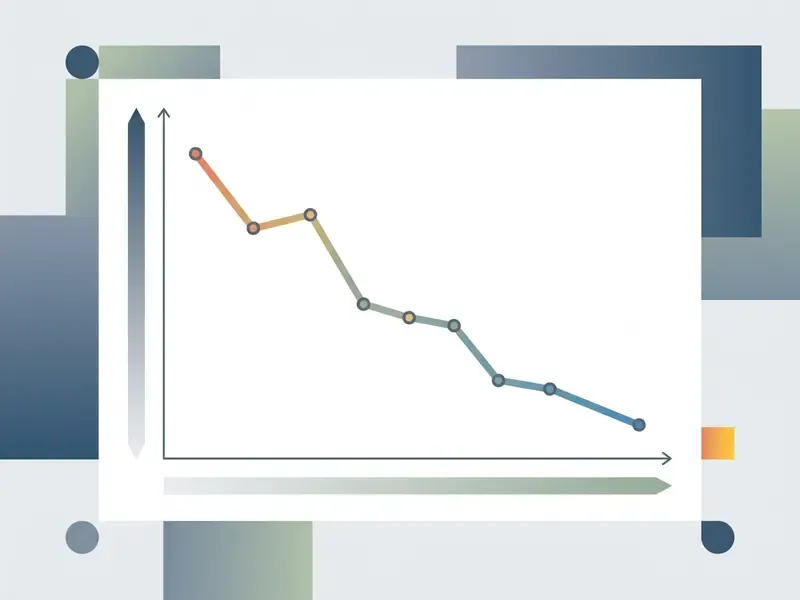
AI video translation accuracy depends on source audio clarity, speech recognition quality, neural machine translation context, and post-translation human review. Background noise and overlapping dialogue significantly increase error rates.
Empirical evaluation shows that automated translation achieves acceptable baseline readability, while domain-specific terminology still requires human oversight. Standards work on speech translation evaluation treats recognition, translation, and speech output as separate assessment stages, which means an error introduced early is compounded rather than corrected downstream.
"Performance evaluation of speech translation systems must assess recognition, translation, and speech output as distinct stages."
Speech Recognition, Audio Quality, and Original Language
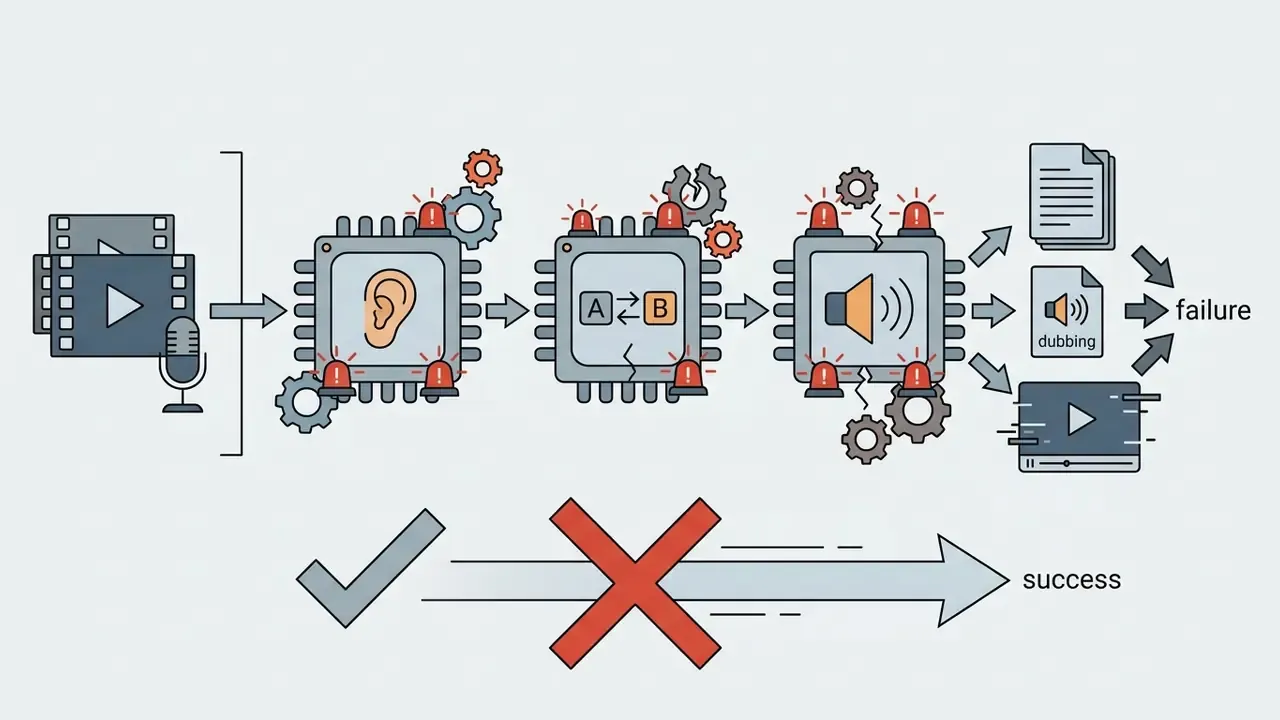
The baseline accuracy of any video audio translator depends on the quality of the initial ASR transcript. Errors in speech recognition compound downstream during machine translation and voice synthesis.
- Signal-to-Noise Ratio Clean studio microphone audio achieves high recognition rates, whereas field recordings with ambient noise cause transcription drops. Evaluation protocols explicitly require documenting speech peak level against steady background noise in dB, because SNR conditions materially change measured performance.
- Accents and Dialects Standardized regional dialects receive higher translation accuracy than accented or non-standard speech. Peer-reviewed testing across diverse English accents found word error rate varying substantially by speaker accent and model family.
- Speaker Overlap Simultaneous multi-speaker dialogue degrades ASR segmentation, leading to missing sentences and mis-attributed lines.
- Music and Effects Beds Dialogue mixed under music is a distinct failure mode from broadband noise. Vocal stem separation before transcription is the standard remedy.
- Language Resource Depth Low-resource language pairs and dialect variants remain the weakest area of machine translation, so accuracy is uneven across a single multi-language project.
Why Subtitles and Dubbed Audio Need Review and Editing
Automated translation systems often fail to preserve context, humor, cultural idioms, and specialized industry terms. Consequently, professional localization workflows incorporate systematic human post-editing.
"Human translators significantly outperformed ChatGPT 3.5 on subtitle accuracy and fluency in statistical t-testing of animated dialogue."
Three failure classes recur across audiovisual research and require a human pass:
When translating regulatory disclaimers, financial reporting, or technical documentation, automated systems can introduce material misstatements. Post-editing thesis work on AI subtitling identifies accuracy and grammar as the dominant residual error types, exactly the class of defect that survives an unreviewed export. Organizations comparing model validation guidelines and platform capabilities can cross-reference feature coverage in our AI Media Comparison Matrices.
- Names and Domain Terminology
- Studies of specialized translation report significant differences in terminological accuracy between machine systems and post-editors, with domain knowledge the decisive variable.
- Wordplay, Humour, and Register
- Idiom and pun transfer degrades sharply in automated pipelines, which flatten register and lose intended effect.
- Segmentation and Timing
- Subtitle quality is not only text quality. Line breaks and cue timing are independent error sources that automated output frequently gets wrong.
Fact Check and EEAT Verification
Languages, Subtitles, and AI Voices for Video Translation
Modern online video translators support anywhere from 29 to over 280 languages depending on the underlying NMT and TTS engines. Published vendor documentation illustrates the spread: some consumer editors list 29 supported languages with original-voice preservation, mid-market dubbing platforms list 90 to 175 languages and dialects, and enterprise localization suites advertise 280+ languages with 35 dedicated voice locales. Dialect handling varies just as widely. One platform exposes 14 distinct English accents and voice cloning into 32 languages, with separate expressiveness, similarity, and accent controls.
"The COMPASS framework evaluated 1,248 speech-translation configurations across 46 metrics in eight dimensions, establishing baseline accuracy and latency standards for AI dubbing."
Translate Video Subtitles Into Another Language
Translating subtitle files (.srt, .vtt, .ass) is the most computationally efficient method to change video language online. Subtitle translation requires no audio rendering, allowing near-instant multi-language output.
- Text Formatting Preserves original timing markers while converting speech into target scripts. VTT files carry the
WEBVTTheader and support cue positioning and basic styling; SRT is plain timed text. - Line Segmentation Adjusts characters-per-line to prevent text from obscuring visual media elements and to match human reading speed.
- Style Control Fonts, colours, sizes, and on-screen positions are configurable per destination platform, since a caption safe area on vertical short-form differs from a 16:9 webinar.
- Multi-Language Export Generates parallel caption tracks for YouTube, Vimeo, or internal LMS platforms, plus
.txttranscript conversion for search indexing and knowledge bases.
Editing subtitle translations ensures that line breaks align naturally with human reading speeds. For high-volume localization budgeting, cross-reference per-minute and per-credit structures in our comparison of AI video tools by features and pricing.
Change Video Language With AI Voices and Dubbing
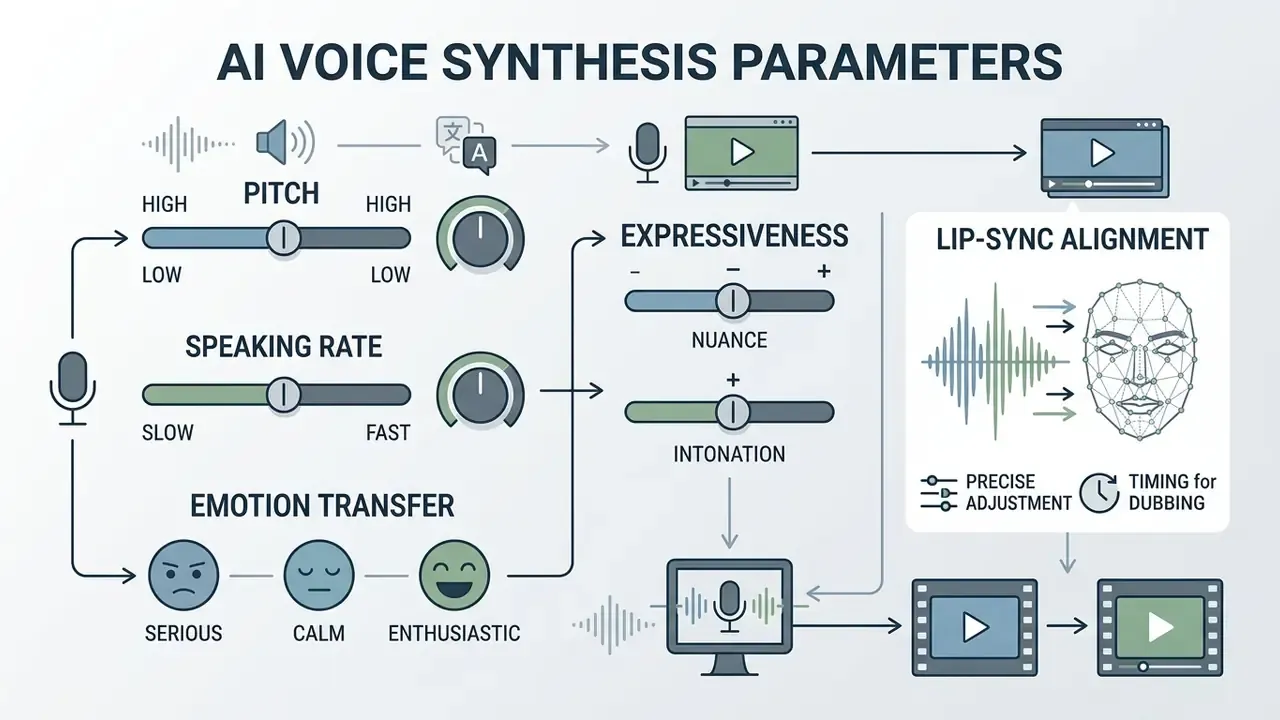
Replacing original video audio with localized speech requires advanced text-to-speech synthesis and voice matching algorithms. Modern AI voices replicate human cadence and inflections, and the underlying capability set sits in our guide to AI voice generators.
Vendors publish dubbing quality claims without standardized benchmark scores. No MOS, WER, or similarity metric is typically disclosed. So users must independently benchmark synthesis naturalness on their own source material before deployment. Research on voice-cloned translation reports the current honest position: cloning achieves the highest naturalness and preserves speaker identity cues, yet emotional dynamics are still not fully transferred.
When building workflows around custom media platforms or programmatic generation, developers can examine integration patterns, quota structures, and cost models in our Google Veo implementation guide and the wider set of AI Media API Guides. Note the platform integration boundary: on YouTube, caption tracks are addressable through the public Data API (list, insert, update, download), while multi-language audio tracks are managed in Studio. Subtitle automation and dubbing automation are separate pipelines.
Business Impact and ROI of Multilingual Video Localization
- Conversion Lift Localization research indicates that 72% of international consumers are more likely to purchase a product when information and marketing media are available in their native language.
- Audience Retention Subtitle overlays are critical for modern mobile consumption, with over 80% of Gen Z viewers preferring videos with captions activated; roughly 61% of teams that localize video also translate their subtitles.
- Corporate Learning Speed Enterprise deployment of localized, bilingual training video has been associated with productivity increases of up to 15% during onboarding and policy rollout.
- Discoverability Translated caption tracks create crawlable text in multiple languages, expanding indexable surface area for video search across international markets.
- Control Cost, Counted Honestly Any ROI figure that excludes review hours, glossary maintenance, and legal sign-off overstates the return. Budget the human post-editing pass as a line item, not as goodwill.
Free Video Translation Use Cases
Free online video translation tools serve diverse content categories, ranging from short-form social clips to long-form educational lectures and corporate communications.
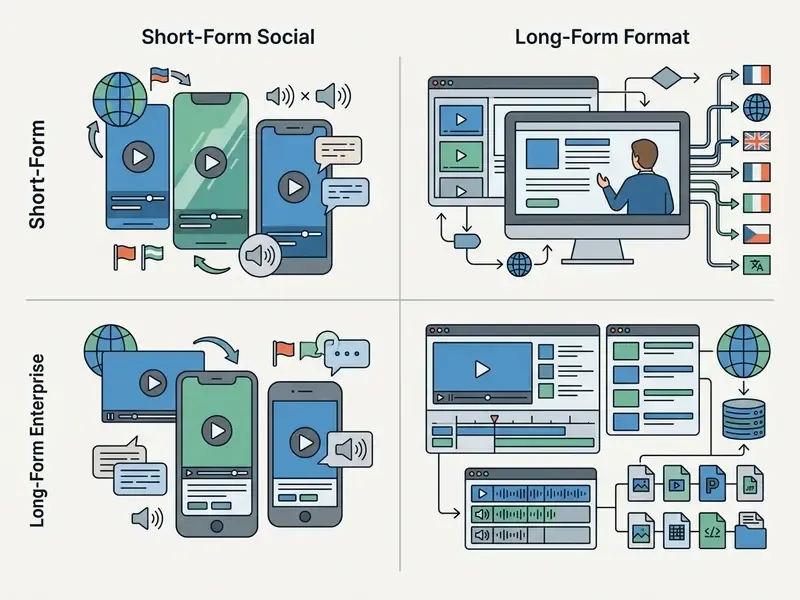
Consider an illustrative case, composite rather than client-specific. An operations team needed to localize quarterly compliance media across six international offices. Automated translation generated preliminary subtitles in under an hour. The team then assigned regional compliance officers to review technical terminology in the interactive editor. First-draft delivery time fell substantially compared with fully manual transcription and translation, while final regulatory sign-off remained a human gate. No automated system can warrant regulatory accuracy on its own output.
Translate Courses, Training Videos, Interviews, and Podcasts
Long-form media localization requires strict adherence to accessibility standards and timing synchronization. Educational content, corporate training, and executive interviews depend on clear dialogue delivery. Note also the conceptual bridge many teams miss: captions exist for accessibility in the language of the audio, while subtitles in another language are a localization feature. A free translator satisfies reach goals; it does not automatically satisfy an accessibility obligation.
- Accessibility Compliance: The Americans with Disabilities Act (ADA) and W3C WAI standards require synchronized, accurate captions for public-facing educational videos.
"Captions must be synchronized with the audio, include all dialogue and important sounds, and remain on screen long enough to be read."
Organizations managing legal exposure around generative media, licensing boundaries, and export rights can review current practice in the AI Media Commercial-Use Hub and our analysis of commercial rights for AI-generated content.
How to Choose a Free Online Video Translator Tool
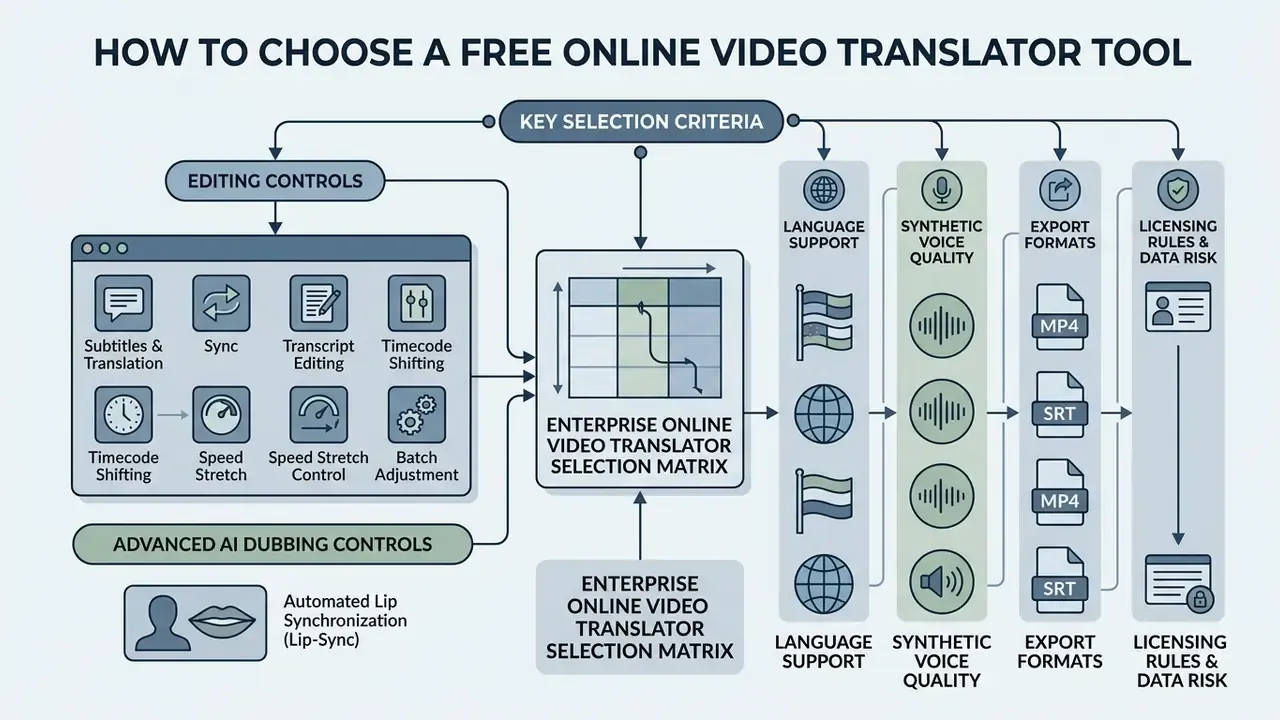
Selecting the best free online video translator requires evaluating language support, transcript editing capabilities, synthetic voice quality, export formats, and licensing rules.
Enterprise Online Video Translator Selection Matrix.
Checklist0 / 10
Editing Controls for Subtitles, Translation, and Sync
A built-in interactive editor is a critical requirement for any video translation tool. Without editing controls, correcting automated ASR and translation errors requires external software.
- Transcript Editing Direct inline modification of translated text lines, ideally in an edit mode that does not require replaying the whole recording.
- Timecode Shifting Global offset adjustments to re-sync captions after frame rate conversions, plus visual and point sync against the waveform.
- Speed Stretch Control Modifying AI speech playback rates (typically between 50% and 300%) to match target scene durations.
- Batch Adjustment Applying a single correction, style, or timing rule across every cue at once instead of line by line.
Advanced AI Dubbing Controls
Modern enterprise video translators include four advanced audio-visual processing controls that separate production-grade tools from basic caption generators:
- Automated Lip Synchronization (Lip-Sync)Modifies the lower-facial movement of speakers in the original video to match the phonetic cadence of the target audio stream.
- Vocal Separation and Stem IsolationAI isolates dialogue tracks from background music and environmental sound effects (SFX), translating only the vocal stem while preserving original ambient audio. Intelligent noise reduction and audio repair additionally suppress hiss, dropouts, and clipping before transcription runs, which raises ASR accuracy at the source.
- Custom Translation and Pronunciation GlossariesAllows operators to define strict replacement rules for acronyms, proper nouns, and brand names. Custom phonetic spelling overrides force TTS engines to pronounce complex corporate terminology correctly, and saved rules carry forward to future projects.
- Side-by-Side Dual Transcript ReviewProvides a synchronized interface displaying the source-language script alongside the machine-translated draft for segment-by-segment human post-editing, with each segment linked to its exact position in the video.
Robust editing interfaces reduce post-production overhead and keep text, speech, and video motion aligned. They also produce the artefact an auditor asks for: a record of what changed, and who changed it. Teams assembling a broader generative stack around these controls can review adjacent capabilities in our guide to animation makers and AI-assisted video creation.
Export Options and Rights for Translated Videos
Understanding export limitations prevents unexpected technical barriers when finalized files are downloaded for commercial distribution.
- Resolution CapUnpaid tiers may restrict video rendering output to 720p or 1080p; 4K masters and high-bitrate WAV audio generally require a paid plan.
- Sidecar CaptionsEnsure the platform permits exporting standalone
.srt,.vtt, or.txtfiles rather than forcing burned-in captions. Professional editing suites document three delivery modes, burn-in, sidecar, and embedded (for example CEA-608 inside the media container), and your destination platform determines which one you need. - Container ChoiceConfirm the tool can render MP4, MOV, and WebM, and can output a dubbed audio-only file (MP3 or WAV) when only the audio bed is being replaced.
- Separate Audio Track DeliverySome workflows require the translated audio as a discrete track for a downstream mix rather than a flattened render.
- Rights TransferVerify that exporting a translated asset grants full commercial distribution rights without ongoing vendor royalties. Export settings describe file outputs, not rights. The licence, not the render dialogue, determines what you may publish.
When evaluating broader media automation platforms, content teams can cross-reference editing capabilities in our YouTube Video Editor Workflow Guide.
Free Video Translator FAQ
Can an AI Translator Translate YouTube Audio and Existing Subtitle Files?
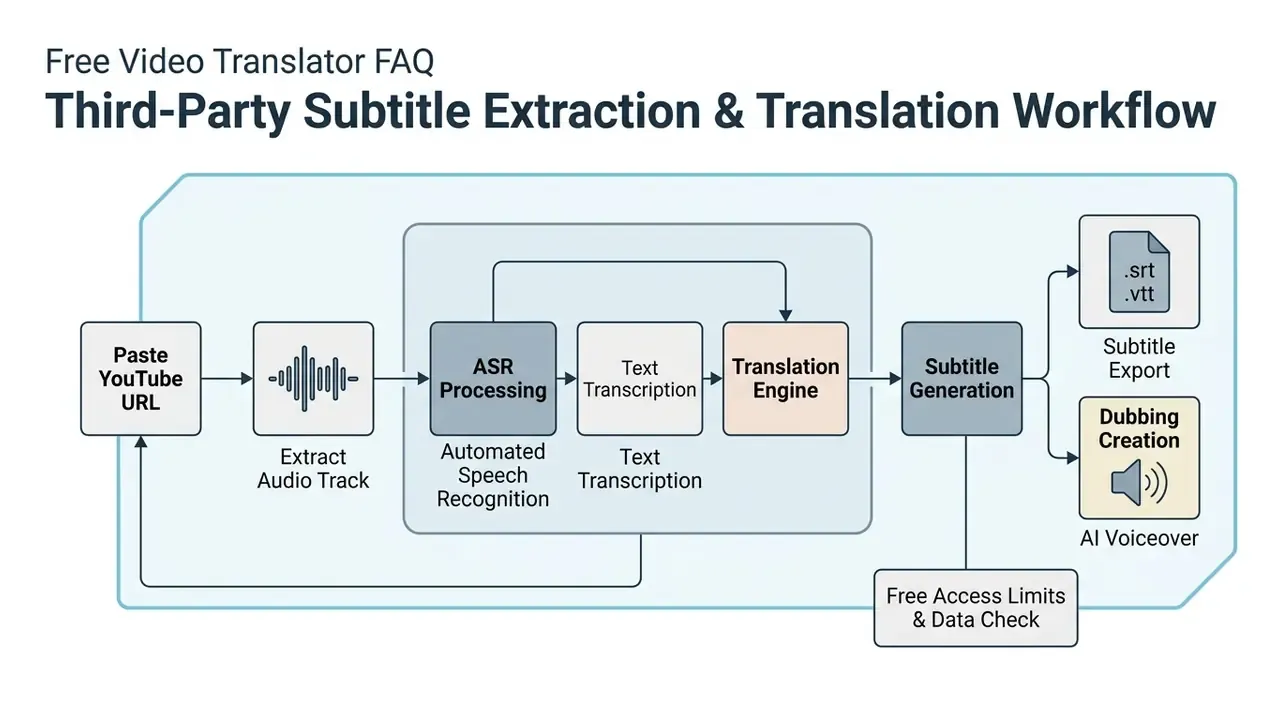
Yes. Many online video translation tools accept direct YouTube URLs to extract audio streams for transcription and translation. Platforms also allow users to upload pre-existing subtitle files (.srt, .vtt) to translate text overlays into new languages without re-processing the video file. YouTube itself accepts SubRip (.srt) and WebVTT uploads; ASS is not a supported native upload format, so styled ASS subtitles are normally converted to SRT first, losing advanced styling. Simultaneous speech translation research continues to close the gap on live audio:
"Hibiki, a simultaneous speech-to-speech translation model, was rated close to professional human interpreters by listeners on the French–English pair." Source: Hibiki simultaneous speech translation, preprint (2025). When ingesting third-party media, operators must ensure that external URLs and uploads comply with host platform terms of service, rights ownership, and automated content filters before publishing a translated derivative.
How Long Does Video Translation Take?
Processing time scales with source duration, target language, output modality, and current queue demand. Subtitle-only jobs on short clips typically complete in a few minutes. Full dubbing with voice cloning and lip-sync takes longer, because audio synthesis and video re-rendering are additional passes. Simultaneous systems designed for live audio report latency in the range of a few seconds per utterance, which is a different engineering target from batch localization.
What Is the Maximum Video Length and File Size?
Free ceilings cluster around 1 to 10 minutes and 100 to 200 MB per upload, with some no-sign-up tools capping at three minutes. Paid tiers commonly extend to 60 minutes and 1 GB, while enterprise ingestion endpoints document limits up to 4 to 8 GB, and URL-based enterprise media indexing can reach 30 GB. Always confirm the per-file limit and the monthly aggregate limit separately. A plan can allow a 10-minute file while capping total monthly throughput at 10 minutes.
Will Translation Reduce Video Quality?
Subtitle translation does not touch the video stream, so source resolution is preserved. Dubbing re-multiplexes the audio and, on free tiers, frequently re-encodes the video at a capped resolution and bitrate, which introduces generational loss. If quality is critical, export the sidecar caption or dubbed audio track and remux against your original master rather than downloading the platform's flattened render.
Will the Exported File Carry a Watermark?
Free exports commonly include a small vendor mark. Vendors frame it as a traceability and responsible-use signal for AI-dubbed media as much as a monetization lever. Paid plans generally remove it. Attempting to strip it from a free export can breach the terms of service and interferes with provenance attribution.
Can I Translate the Same Video Into Additional Languages?
Yes. Most editors let you change the target language on an already-processed project and generate another version without re-uploading or re-transcribing the source. Because the source transcript is reused, correcting names, acronyms, and terminology once, before adding languages, prevents the same error from replicating across every locale.
Can I Dub a Video Into Another Language With an AI Voice?
Yes. Modern platforms generate natural multilingual voiceovers and can clone the original speaker's timbre, so the localized version retains the source delivery. Treat cloning a real person's voice as biometric processing: obtain documented consent, confirm the commercial licence covers your distribution channel, and keep an audit record of who approved the final audio.
Is Free Video Translation Safe for Confidential Corporate Video?
Generally no. Unless the provider contractually commits to retraining opt-out, defined retention, and a disclosed processing region, treat any free upload as public disclosure. Restrict free tooling to material that is already published, and route internal, customer, or pre-release video through an approved enterprise service governed by a data-processing agreement.
Source List and Terms of Service References
- U.S. Copyright Office (2025): Report on Copyright and Artificial Intelligence, Part 2: Copyrightability. Confirms that human post-editing and creative selection are required for AI-generated outputs to claim copyright protection.
- W3C Web Accessibility Initiative (WAI): Captions/Subtitles Standard (2024). Outlines mandatory synchronization, line length, and readability standards for digital video captions, and distinguishes accessibility captions from translated subtitles.
- National Institute of Standards and Technology (2008): Performance Evaluation of Speech Translation Systems. Establishes recognition, translation, and speech output as separate evaluation stages. https://www.nist.gov/publications/performance-evaluation-speech-translation-systems
- Transactions of the ACL (2023): Dubbing in Practice. Finds translation quality and vocal naturalness to be the dominant drivers of perceived dubbing quality. https://aclanthology.org/2023.tacl-1.25.pdf
- Discover Artificial Intelligence (2025): Peer-reviewed comparison of ChatGPT 3.5 subtitling against professional human translators, with statistically significant advantage to human translators on accuracy and fluency.
- Isochrony-Controlled Speech-to-Text Translation (2024, preprint): Reports 0.92 speech-overlap alignment at a cost of 1.4 BLEU on CoVoST 2.
- NAIST IWSLT 2024 System Description: Reports ASR-BLEU 12.08 at 2.4 to 3.7 seconds of latency for simultaneous speech-to-speech translation.
- ANIM-400K (ICASSP 2024): Dataset of 425,000+ aligned Japanese–English animated video segments for automated dubbing research.
- COMPASS S2ST Benchmarking Study (2026): Evaluated 1,248 speech translation configurations across 46 metrics and eight dimensions, establishing baseline accuracy and latency standards for modern AI media translation.
- U.S. DOJ / Bureau of Justice Assistance: General 508 Guidance for Publications and Videos. Requires accurately timed
.srtcaption files, speaker identification, two-line maximum on screen, and prohibits reliance on auto-generated captions. - Platform Terms of Service: Review commercial licensing, watermark policy, retention, and voice-cloning consent rules directly on provider documentation pages before deploying translated media assets publicly. Limitations, Open Questions, and a Safe Next Step Some of this remains unsettled, and it would be dishonest to pretend otherwise. Vendor benchmarks are self-reported. Free-tier terms change between quarters, sometimes between weeks. Emotional transfer in cloned voices is improving, but no public metric tells you how a dubbed apology or a dubbed risk warning will land with a specific audience. A conservative next step, if you own AI governance and someone just asked for dubbing:
- Add every translation tool in active use to the AI inventory, including platform-native dubbing.
- Define the two lanes: public content on free tooling, internal and customer material on a contracted service.
- Require a named human reviewer per language before publication, and keep the edit history.
- Re-measure cost after one quarter, including review hours. Then decide whether to expand. Small pilot. Documented evidence. No autonomy without it.
Navigation and Reference Resources
For terminology definitions, synthesis capabilities, workflow templates, and licensing guidance, continue with our AI Media Glossary, plus focused guides to AI voice generators, video compressors, YouTube video editing workflows, and commercial-use terms for AI-generated media.