«IP indemnification clauses are not merely legal backstops, they are strategic tools for allocating innovation risk.»
An IP indemnification clause is a contractual promise. One party, the indemnifying party, agrees to defend, compensate, and hold harmless another party, the indemnified party, against legal claims brought by third parties alleging that supplied software, technology, or content infringes an intellectual property right. In B2B commercial agreements, that clause moves the financial exposure of third-party infringement from the enterprise buyer to the software vendor or service provider.
Why does this matter to a bank or a mature fintech? Because a single injunction against one component can stop a regulated process. Payments reconciliation, KYC screening, credit decisioning, or the financial close do not pause politely while lawyers argue about claim construction. This guide is written for procurement, legal, model-risk, and AI governance functions negotiating technology contracts in high-consequence environments.
Executive Summary and Key Takeaways
- What it is an IP indemnity is a promise by the licensor to defend the customer against third-party infringement claims and to pay resulting damages, settlements, and legal costs arising from authorized use of the deliverable.
- Legal advantage over a warranty an indemnity claim is treated as a debt recovery obligation, not a breach-of-contract damages claim. The customer generally need not prove foreseeability, and unless the contract says otherwise there is no common-law duty to mitigate.
- Words that decide the money the causation phrase controls exposure. "Related to" and "arising out of" are buyer-friendly. "Caused by", and especially "solely caused by", can erase most vendor liability.
- Where deals break liability caps. If IP indemnity sits inside a standard 12-month-fees cap, a $100,000 subscription buys roughly two weeks of patent litigation. Ask for a carve-out or a super-cap (commonly 2x to 5x annual fees, or a fixed $2M to $5M limit).
- Modern blind spots pending patent applications, standards-essential patents (SEPs), embedded open-source components, and generative AI training data and model outputs, which are routinely excluded or conditioned on guardrail usage.
- Governance requirement indemnity coverage is only as strong as your evidence. Preserve configuration records, version logs, and prompt and output audit trails to prove no carve-out was triggered. That expectation sits squarely inside third-party risk management supervisory guidance.
- Procedural discipline prompt written notice (typically 10 to 30 days), cooperation, vendor control of defense, and a customer veto over non-monetary settlement terms.
One line to remember. An indemnity is a payment mechanism, not a continuity plan.
What Is IP Indemnification?
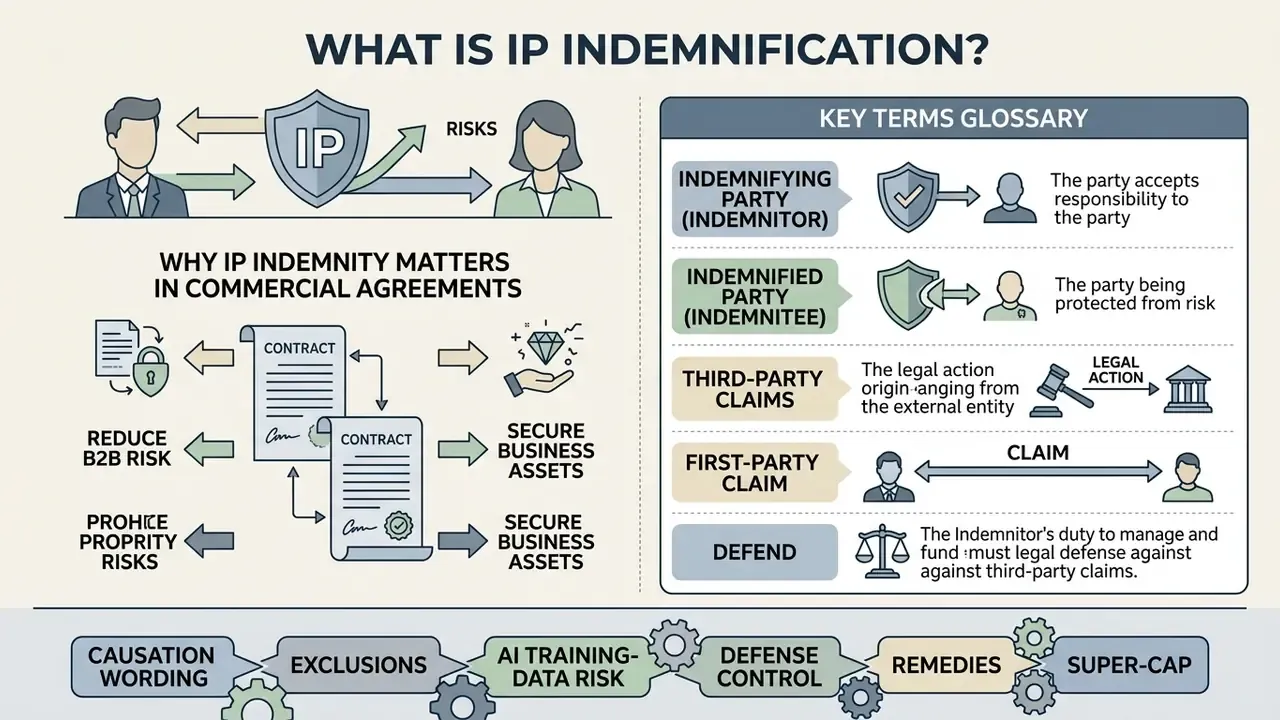
IP indemnification is a specialized contractual risk-shifting mechanism. It protects business buyers when a third party alleges that licensed software, technology, or creative assets infringe a patent, copyright, trademark, or trade secret. Getting to a working definition, that is, what is IP indemnification explained in operational rather than academic terms, means seeing it as a shield with conditions attached: the vendor, who designs and controls the technology, assumes financial responsibility for defending claims that arise from authorized use of its deliverables.
The plain-English ip indemnification explained meaning is narrower than most buyers assume. It covers claims from outsiders, not disputes between you and your vendor. And the formal ip indemnification explained definition in any given contract is only as wide as the definitions of "covered IP", "permitted use", and "deliverable" allow.
«IP indemnification clauses signal risk sharing and reduce moral hazard in licensing contracts, which explains the prevalence of mixed payment schemes.»
That economic framing matters at the table. An indemnity is not charity, it is priced. Vendors that accept broad IP indemnity usually recover the risk premium through licence fees, minimum commitments, or tighter carve-outs elsewhere in the paper. Buyers who understand the trade negotiate better than buyers who treat the clause as boilerplate.
Why IP Indemnity Matters in Commercial Agreements
Enterprise buyers demand intellectual property indemnification in commercial agreements for a simple reason: downstream users cannot independently verify the proprietary origin of every line of vendor code, every model parameter, or every algorithm. Deploy third-party software across regulated operations and you can face strict or vicarious liability for infringement you had no way to detect. The same logic applies to the commercial use of AI image tools, where training-data provenance and output rights are rarely verifiable by the buyer.
«Indemnification appears more frequently where information asymmetry is high and targets are privately held.»
«Roughly 75 to 80% of enterprise SaaS agreements contain an explicit IP indemnification clause; among Fortune 500 customers the figure approaches 100%.» ContractKen, IP Indemnification in Enterprise SaaS Contracts (2024). https://contractken.com/ip-indemnification/
Without robust indemnity provisions, a corporate buyer can face patent litigation, an emergency injunction, and settlement costs for software it did not write. Shifting third-party infringement risk to the supplier builds commercial trust, aligns risk with control, and puts the operational cost of legal challenge on the party that profits from the product's design. There is also a governance benefit that rarely appears in the clause itself: negotiating the indemnity forces both sides to describe, in writing, exactly how the technology will be used.
Key Terms Glossary
IP Indemnification. A contractual commitment where one party compensates and defends another against financial losses, liabilities, and legal costs resulting from third-party intellectual property infringement claims.
Indemnifying Party (Indemnitor). The contract party, typically the software licensor or vendor, that promises to defend the customer and pay court-awarded damages or approved settlements.
Indemnified Party (Indemnitee). The protected beneficiary, typically the enterprise buyer or licensee, receiving defense, coverage, and financial protection under the agreement.
Third-Party Claims. Legal actions, formal lawsuits, or administrative demands initiated by an outside entity that is not a party to the contract, claiming unauthorized use of protected IP.
First-Party Claim. A dispute between the contracting parties themselves. Most IP indemnities deliberately exclude these and route them to warranty and breach remedies.
Defend. The immediate obligation to provide and fund legal counsel for the indemnified party as soon as a covered claim is asserted, whatever the eventual outcome.
Hold Harmless. An undertaking ensuring the protected party does not absorb financial liabilities, legal expenses, or judgment losses tied to the covered dispute.
Carve-Out. An express exception removing specified claims from a limitation of liability cap, for example placing IP indemnity outside the general cap.
Super-Cap. A second, higher liability ceiling applied only to carved-out claims instead of leaving them fully uncapped, commonly expressed as a multiple of annual fees.
Notice Prejudice. The vendor's argument that late notice impaired its ability to defend or settle, used to reduce or defeat recovery.
Indemnity, Indemnification, and "Hold Harmless"
The terms indemnity and indemnification both describe the contractual mechanism of reimbursing or assuming specified financial losses. The phrase hold harmless releases the protected party from bearing responsibility for covered liabilities. In Anglo-American drafting, "shall indemnify, defend, and hold harmless" functions as one integrated obligation, which is why the trio survives every attempt to simplify it.
Some state courts treat "indemnify" and "hold harmless" as duplicative synonyms. Others read "hold harmless" more broadly, as a release from direct claims between the contracting parties. Courts have litigated the phrase in disputes over advancement of legal fees, negligence allocation, scope of liability, and release of future claims. In Kemmeter v. McDaniel Backhoe Service (Ohio Supreme Court, 2000), a hold harmless clause was enforceable precisely because it did not require a party to indemnify the other for its own negligence. Several state statutes go further, for example Missouri Rev. Stat. § 434.100 in construction contracts, which voids promises to indemnify a party against its own wrongdoing. The lesson for technology contracts: "hold harmless" is not decorative filler. Its effect depends on jurisdiction, and on whether the clause expressly addresses the indemnitee's own fault.
The duty to defend is a separate animal. It triggers at the outset of a third-party claim and requires the indemnifying party to fund counsel upfront. The duty to indemnify bites later, once liability, loss, or settlement is established.
How an IP Indemnification Clause Works
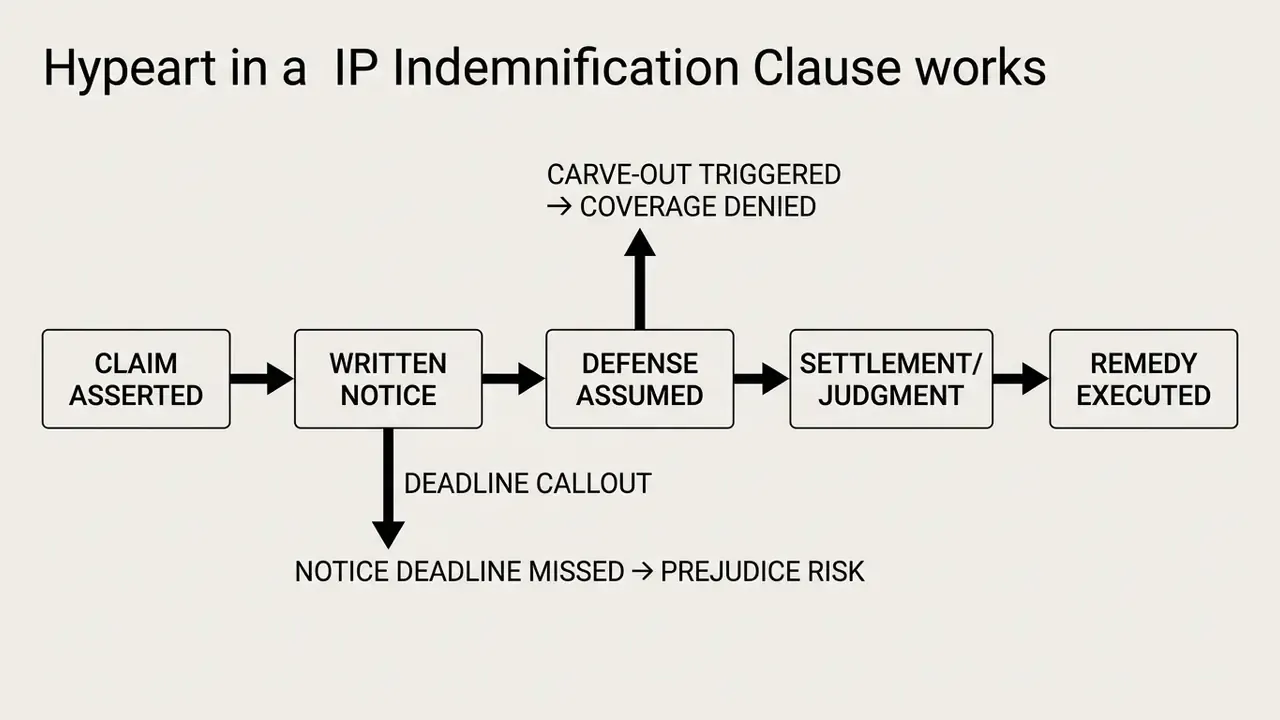
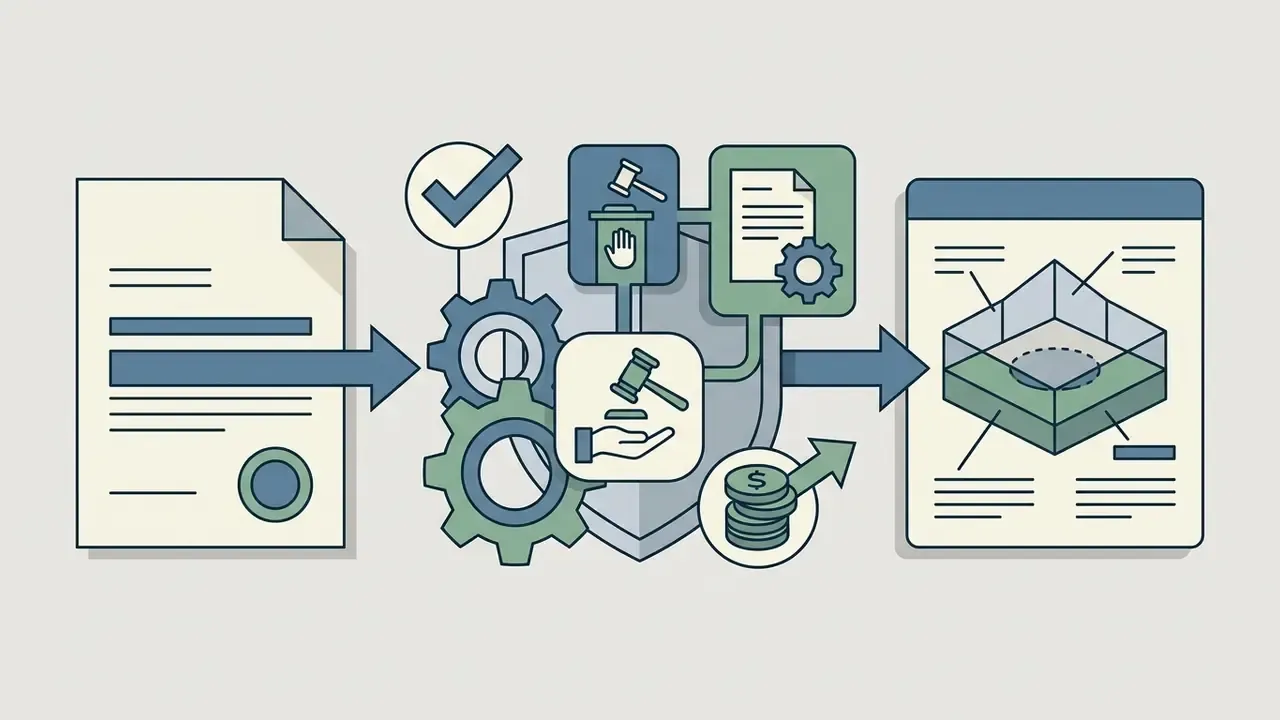
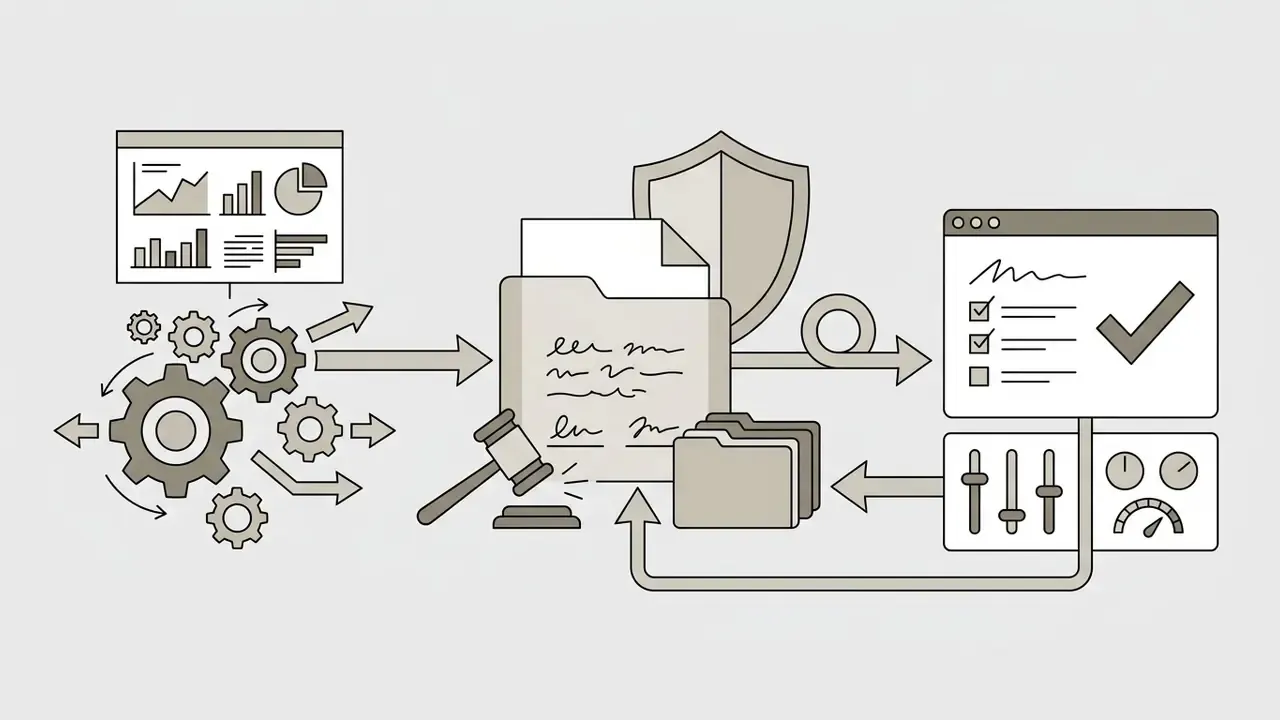
An indemnification clause runs through a defined sequence that moves a lawsuit from the buyer to the software provider once formal notice lands. The flow goes from service of process, to tender of defense, to vendor litigation management, to settlement or judgment, and finally to reimbursement or a remedial fix on the product side.


«Cost and speed are the most important factors when selecting a mechanism for resolving technology disputes, including IP conflicts.»
That finding explains why a clearly drafted duty to defend has commercial value even when the underlying claim looks weak. The clause converts an unbudgeted, slow-moving exposure into a vendor-funded, vendor-managed process. For a CFO, that is a variance-control tool as much as a legal protection.
The Causation Spectrum: Words That Move Millions
Before you assess triggers, read the causal connector. The phrase linking the third-party claim to the vendor's technology is the single most consequential piece of drafting in the provision, because it decides how remote a connection still produces a payment obligation.
| Contract Phrase | Legal Scope and Breadth | Risk Allocation Effect |
|---|---|---|
| "Related to" / "In connection with" | Extremely broad (most buyer-friendly) | Triggers indemnity even on remote or indirect connections between the technology and the alleged infringement. |
| "Arising out of" | Broad (market standard for buyers) | Covers claims directly originating from or flowing out of the delivered software. |
| "Resulting from" / "Caused by" | Narrow to moderate | Requires a direct causal link; the technology must be the immediate cause of the infringement. |
| "Solely caused by" | Highly restrictive (vendor-friendly) | Eliminates indemnity if customer configuration, data, or third-party integration contributed to the claim. |
In practice, swapping "arising out of" for "solely caused by" in an enterprise SaaS agreement can strip out most realistic vendor exposure. Why? Because nearly every modern infringement allegation involves integrated stacks, customer configuration, or blended data. Procurement should treat that substitution as a material commercial change, not a drafting preference, and price it accordingly.
What Triggers the Indemnification Obligation
The indemnification obligation activates when a third party asserts a claim or lawsuit alleging that the customer's use of contracted deliverables violates intellectual property rights. A valid trigger needs a causal connection between the vendor's technology and the alleged infringement, during authorized use, inside the scope of the agreement.
Drafting variations decide whether the clause fires on the mere threat of a claim, on a formal demand letter, or only once a judicial proceeding is filed. Vendors push to limit triggers to formal third-party claims alleging direct infringement caused solely by unmodified software used according to published documentation. Buyers prefer "actual or alleged infringement", which captures demand letters and pre-litigation threats. That earlier stage is exactly where patent assertion entities operate, and where legal spend starts running.
What the Indemnifying Party Must Do
Once triggered, the indemnifying party shall indemnify defend and hold harmless the customer through three concrete actions. First, retain and pay qualified defense counsel. Second, fund defense expenses, court costs, expert witness fees, and approved settlement amounts. Third, satisfy final money judgments or court-awarded damages assessed against the customer.
Illustrative enterprise scenario (composite example, not a named engagement). During a core banking deployment, a mid-sized regional bank received a patent infringement claim about its mobile application interface, which relied on third-party vendor code. The bank tendered defense to the software provider under its standard indemnification terms inside the contractual 15-day window, attaching three categories of evidence: the signed notice memorandum identifying the asserted patent and claim chart; version-control and build records showing that internal engineering had not modified the vendor module; and configuration logs showing the interface ran strictly within the documented integration pattern. That package removed the vendor's two most likely defenses, customer modification and out-of-scope use. The vendor took full defense control, funded expert counsel, and resolved the claim for roughly $450,000 with no operational disruption and no financial loss to the bank.
The generalizable lesson is procedural, not literary. The indemnity did not succeed on drafting alone. It succeeded because the bank could evidence compliance with the permitted-use boundary on the day the claim arrived.
Which IP Claims, Losses, and Damages Are Covered?
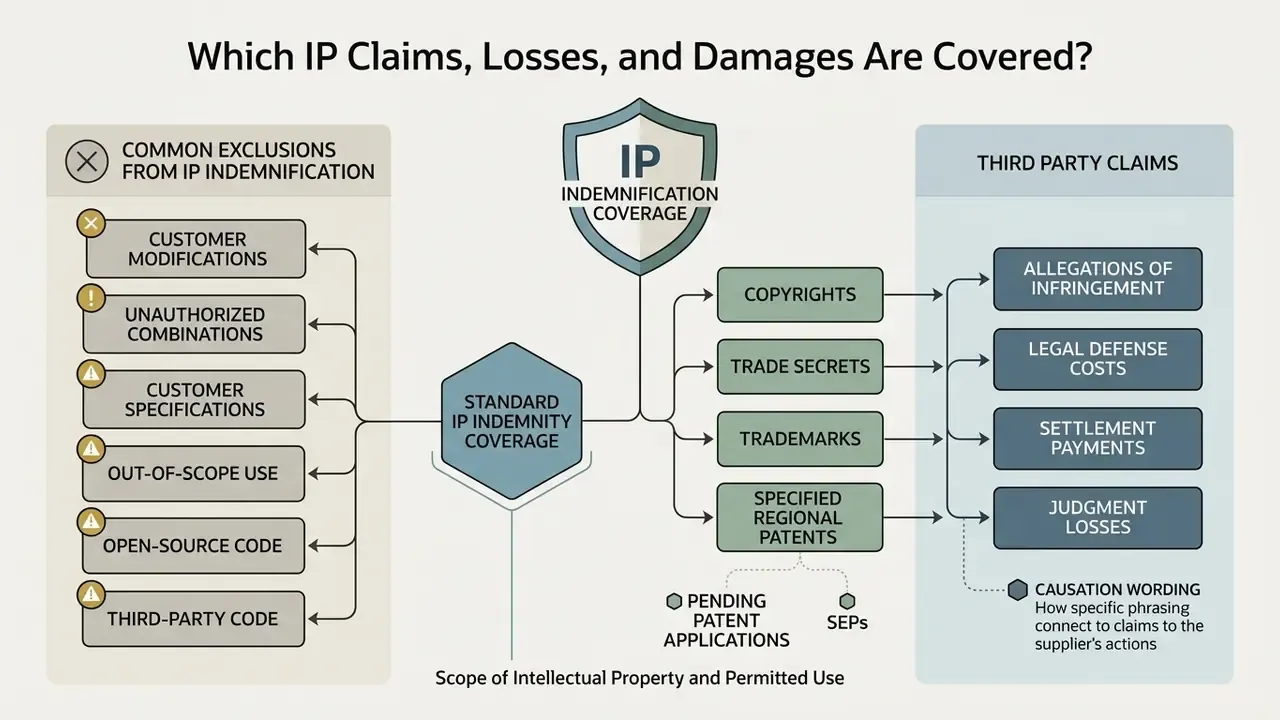
A standard intellectual property indemnity covers third party claims alleging infringement of copyrights, trade secrets, trademarks, and specified regional patents, and reimburses direct damages plus defense costs. The real scope, though, depends on the contractual definition of protected rights and on the exclusions sitting two pages later.
| IP Category | Standard Coverage Scope | Primary Commercial Exposure |
|---|---|---|
| Copyrights | Global coverage standard for original code and software architecture | Unauthorized code replication, embedded open-source libraries, ingested training corpora |
| Trade Secrets | Broad coverage for proprietary algorithms and internal data structures | Misappropriation of confidential schemas by former employees |
| Trademarks | Covered for vendor-branded deliverables and user interfaces | Brand confusion, unauthorized trademark use in software UI; customer-supplied marks are usually excluded |
| Patents | Often limited geographically (for example US, UK, EU), and frequently limited to issued patents in specified jurisdictions, with pending applications routinely excluded | Patent thickets, broad function or process claims, assertion-entity litigation |
| Mask Works and Other Proprietary Rights | Sometimes enumerated in hardware and semiconductor agreements | Layout and design-right claims in embedded systems |
Covered losses in a well-drafted clause usually include finally awarded damages, approved settlements, reasonable attorneys' fees, expert fees, and appeal costs. Many clauses simultaneously exclude consequential, incidental, special, punitive, or exemplary damages. So check whether business-interruption loss caused by an injunction is addressed anywhere in the agreement. Usually it is not.
Scope of Intellectual Property and Permitted Use
Protection is tied to the permitted use defined in the contract. Coverage applies only when the customer operates the software, technology, or services inside the licence terms, designated environments, and operational boundaries set out in the agreements.
If a licence authorizes internal use only, and the customer embeds the code in a white-label product sold to third parties, coverage evaporates. Clear permitted-use definitions protect vendors from open-ended liability created by unauthorized commercial expansion, and they protect buyers from unpleasant surprises during a tender. Teams evaluating creative-technology suppliers can compare how vendors define commercial scope by reviewing usage rights across leading AI image generators before enterprise rollout.
Common Exclusions From IP Indemnification
Standard indemnification clauses carry explicit exclusions, the carve-outs, which release the vendor when external factors cause the claim. The usual list:
- Customer modifications. Unauthorized changes or code alterations by the customer or its contractors.
- Unauthorized combinations. Combining vendor software with third-party hardware, data, or software where the combination itself causes the alleged infringement.
- Customer specifications. Custom deliverables built to designs, code, specifications, or trademarks supplied by the customer.
- Out-of-scope use. Continued use after notice of a claim, use outside published documentation, or failure to install a vendor-supplied update that cures the infringement.
- Pending patent applications and SEPs. Claims based on unissued applications, or on standards-essential patents encumbered by RAND or FRAND commitments.
- Open-source and third-party code. Infringement arising from unmodified open-source components under permissive or copyleft licences, or from third-party components passed through on upstream terms.
- AI training data and output. Claims alleging that generative outputs or training-data ingestion infringe copyrighted datasets, especially where the user prompted the infringing output or disabled vendor guardrails.
«Standard carve-outs include customer modifications, unauthorized combinations, use outside documentation, and continued use after notice of infringement.»
Vendors defend these exclusions on one principle: do not insure risks you do not control. Fair enough. The buyer's job is to test each carve-out against a realistic deployment picture. If the exclusions happen to cover every way the product will actually be used, the indemnity is decorative.
IP Indemnification in the GenAI and Agentic AI Era
Generative and agentic AI break the classical model, because infringement risk no longer lives in a static codebase. It lives in several layers, and most 2025 to 2026 vendor paper treats each layer differently.
| Risk Layer | What the Claim Alleges | Typical Vendor Position |
|---|---|---|
| Training data exposure (input) | The model was trained on copyrighted works, licensed databases, or scraped content without authorization | Often indemnified by large foundation-model providers for their own models; almost never for customer-supplied fine-tuning data |
| Model output infringement | Generated text, images, audio, or code reproduces protected expression or implements a patented method | Conditional indemnity: coverage only if the customer used the vendor's content filters, guardrails, and default safety settings without circumvention |
| User inputs and prompts | The prompt contained infringing material, or steered the model toward a protected work or brand | Excluded; the customer carries prompt-induced infringement risk |
| Agentic actions and tool use | An autonomous agent copied, republished, or transformed third-party content while executing a multi-step task | Emerging area, frequently silent in current contracts, therefore an unallocated risk that defaults to the customer |
| Fine-tuned and derivative models | A customer-tuned checkpoint reproduces protected expression | Excluded as a "customer modification" carve-out unless separately negotiated |
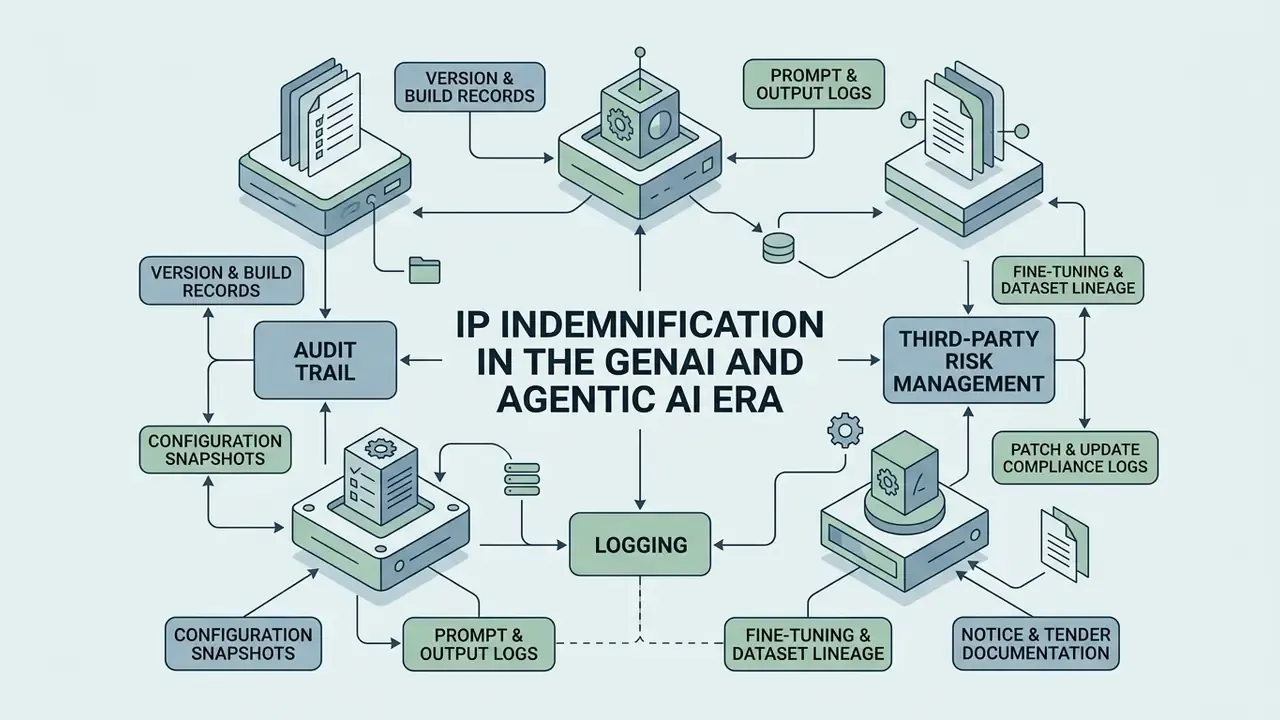
Two contractual conditions deserve slow reading. First, guardrail conditionality. Where a vendor conditions output indemnity on built-in filters, disabling those filters for latency, cost, or product reasons silently voids coverage. And that change is often made by engineering without a single legal review. Second, AI model exclusions hidden inside the definition of covered IP. As Venable notes, clauses that exclude key components such as software libraries or AI models may deliver very little real protection, even when the headline promise sounds generous.
The litigation backdrop is no longer theoretical. Disputes over AI training corpora and code generation, including copyright litigation against legal-research and code-completion model developers, have shown that the ingestion layer, not only the output layer, produces third-party claims. So ask vendors directly: does the indemnity survive a training-data claim asserted against the underlying foundation model, or is that risk passed through under an upstream-terms carve-out?
There is a governance corollary that AI leaders in banking will recognise. An agent without a named owner, an approved role, access limits, and an audit trail is also an agent whose contractual protection cannot be proven. No evidence, no autonomy, and no indemnity either.
Teams building commercial media pipelines should verify tool-level licensing before contracting. Usage boundaries for AI video generation tools and for AI voice generation and synthetic speech rights differ sharply between consumer and enterprise tiers, and consumer tiers frequently offer no indemnity at all.
Audit Trail, Logging, and Third-Party Risk Management
Defense, Settlement, and Remedies for an IP Claim
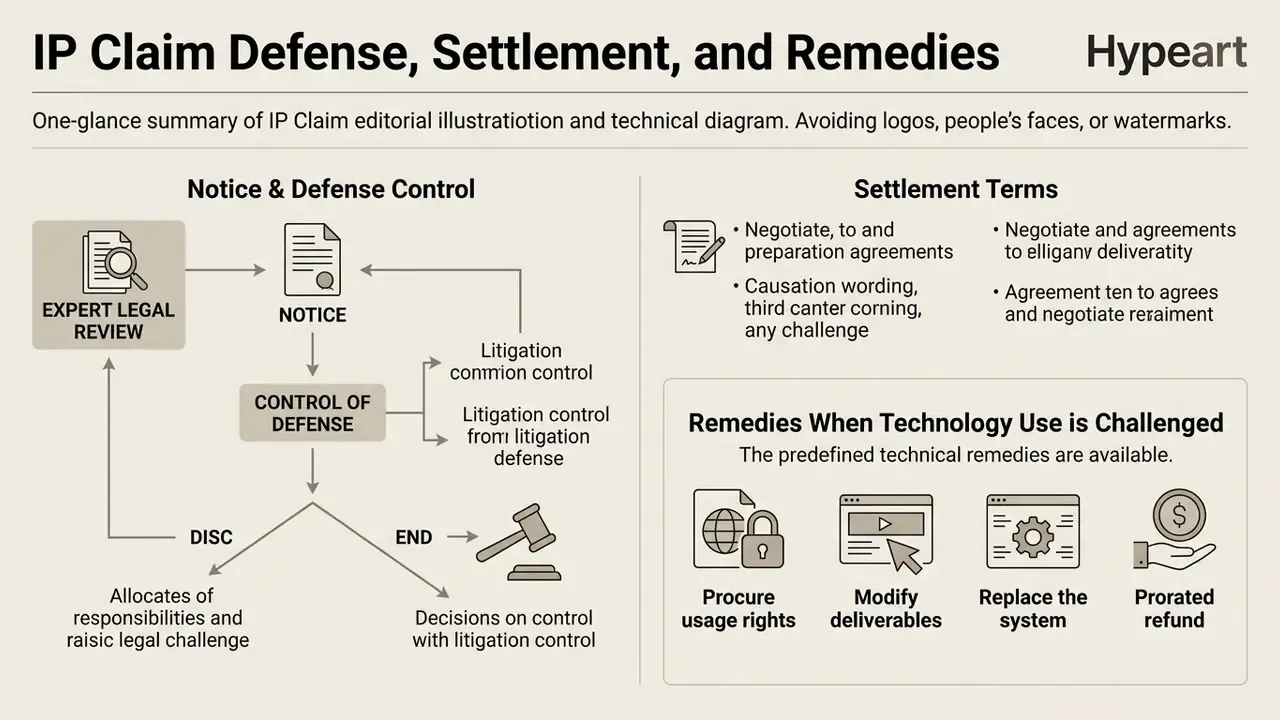
Effective defense management depends on strict notice discipline, clear allocation of litigation control, and predefined technical remedies for the day functionality is legally challenged. These procedural terms decide whether a lawsuit is resolved quietly or becomes an operational event.
Notice, Control of Defense, and Settlement Terms
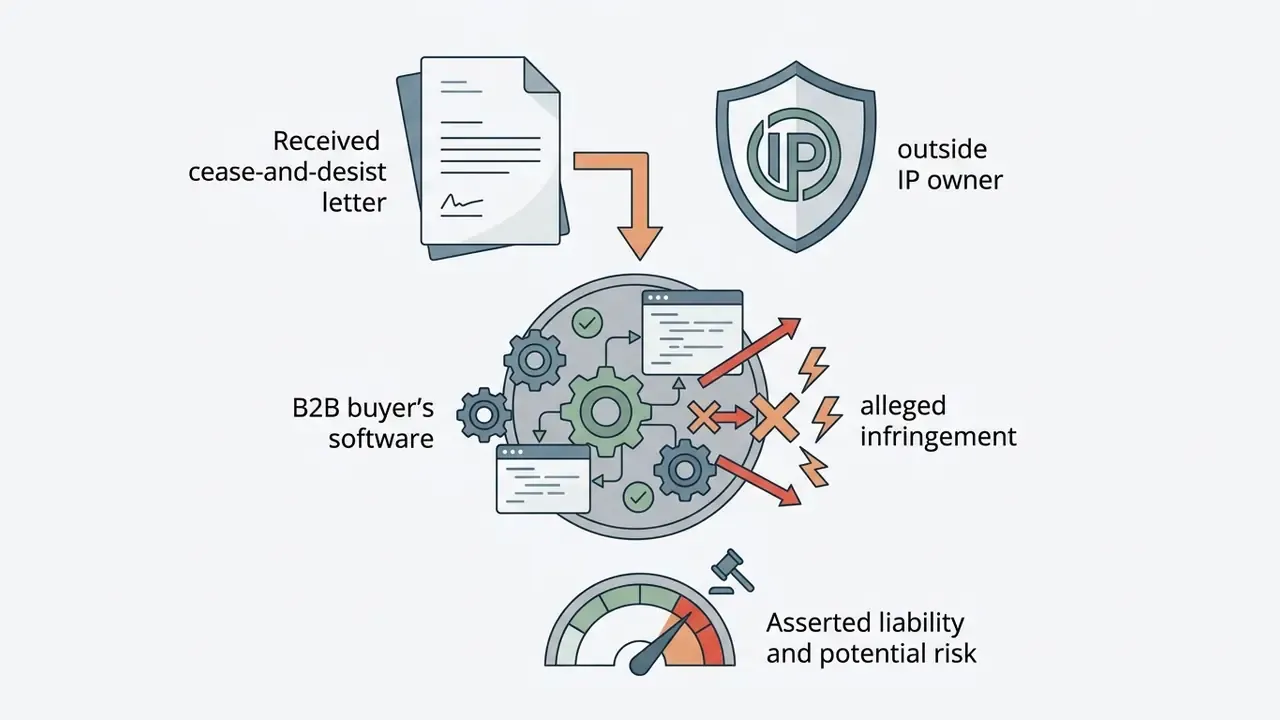
The customer must give prompt written notice of any third-party claim. Unreasonable delay that prejudices the vendor's defense may reduce or forfeit indemnity rights. This is the notice prejudice problem: in most drafting, late notice does not automatically void coverage, but it hands the vendor a defense to the extent the delay impaired its ability to defend or settle. Treat inbound cease-and-desist letters as a mandatory legal-intake trigger with a documented service level, not as routine correspondence for someone to read after the weekend.
In exchange for funding the defense, the vendor takes sole control of litigation strategy, counsel selection, and court arguments. Mainstream drafting guidance supports that structure, provided the customer keeps a right to participate through its own counsel at its own expense.
Settlement authority is where buyers should hold firm. Standard clause guidance, for example Dinsmore's General Contract Clauses: Indemnification (2026), provides that the indemnifying party may not settle, compromise, or consent to judgment without the indemnified party's prior written consent. Applied to technology contracts, the vendor cannot agree a settlement that admits liability for the customer, imposes injunctive restrictions on the customer's business, or requires unindemnified financial contributions. Buyers should also insist that any settlement delivers a full release of the customer, not just of the vendor.
Remedies When Use of Technology Is Challenged
When an injunction lands, or a credible claim threatens continued use, the contract must set out practical remedies. Standard B2B agreements follow a four-tier escalator:
- Procure usage rights.The vendor uses commercially reasonable efforts to obtain a licence so the customer keeps using the technology.
- Modify deliverables.The vendor changes the software to make it non-infringing while preserving equivalent functionality.
- Replace the system.The vendor substitutes a non-infringing alternative of equal operational capability.
- Prorated refund.If the operational remedies fail, the vendor terminates and refunds prepaid, unused subscription fees.
Sequencing and standards are the negotiation. A remedy clause that lets the vendor jump straight to termination and refund converts legal protection into a business continuity failure. Refunding $100,000 is worthless if the module runs payments reconciliation for a regulated entity. Regulated buyers should require functional-equivalence standards, defined replacement timelines, and transition assistance obligations before refund becomes available. Similar remedy logic applies to creative-asset supply chains; see how vendors handle commercial rights in AI logo generation, where brand assets cannot simply be swapped out after launch.
To assess commercial compliance risk across digital platforms and licensing terms, enterprise review teams often consult the Commercial-Use AI Tools matrix and compare vendor usage boundaries and intellectual property rights side by side.
IP Indemnity vs. Warranty and Limitation of Liability
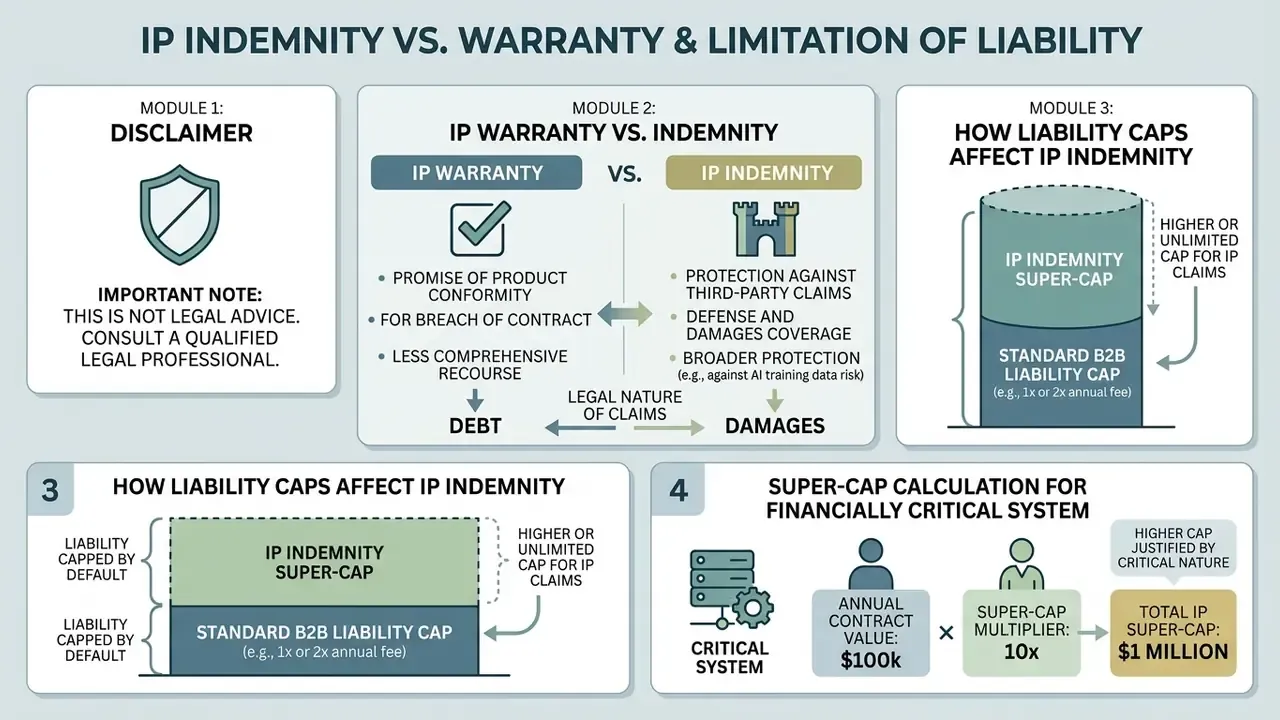
Understanding how IP indemnification interacts with warranties and limitation of liability caps is central to pricing enterprise contract risk. A warranty guarantees product quality. An indemnity supplies a direct reimbursement mechanism for third-party legal claims. They are not interchangeable.
| Contract Mechanism | Trigger Event | Primary Covered Costs | Relationship to Liability Cap |
|---|---|---|---|
| IP indemnification | Third-party infringement claim or lawsuit | Legal defense fees, court damages, approved settlements | Uncapped or subject to an elevated super-cap |
| Warranty claim | False contract representation or product defect | Direct breach damages, repair or replacement costs | Subject to the standard general liability cap |
| Limitation of liability | Overall contractual breach or aggregate dispute | Sets the total financial ceiling on contract claims | Serves as the ceiling unless expressly carved out |
Why an IP Warranty Is Not the Same as an Indemnity
A warranty is an express promise that the software or services do not infringe third-party rights. If it is breached, the customer must sue for breach of contract, prove proximate cause, mitigate damages, and recover limited direct damages under ordinary remedies.
An indemnity claim works differently. It is an independent reimbursement obligation triggered by a third-party lawsuit. It obliges the vendor to fund defense fees upfront, cover settlements, and absorb court-awarded losses, without the customer proving a separate breach between the parties.
Legal Nature of Claims: Debt vs. Damages
Unlike a breach-of-warranty claim, which requires proof of proximate cause, foreseeability, and (at common law) a duty to mitigate, an IP indemnity claim is treated as a debt recovery action. Once a covered claim, judgment, or approved settlement occurs, the indemnifying party owes the amount as a liquidated debt. The buyer need not show that the loss was foreseeable or that it mitigated the damage, unless the contract expressly imposes those conditions.
«An indemnity claim gives rise to a debt. There is no need to show that the loss was caused by any default of the other party or that the loss was foreseeable. There is also no need to mitigate the loss suffered.»
Two practical consequences follow. First, where a warranty and an indemnity cover the same risk, the indemnity can yield a larger recovery, because the limiting doctrines fall away. Second, the warranty adds something the indemnity does not: breach of warranty may support termination, whereas an indemnity claim, being a debt, generally does not. Sophisticated buyers keep both, the indemnity for money and the warranty for exit rights, while vendors resist the pairing for exactly that reason. English drafting practice adds a caution worth repeating: because indemnity claims sidestep remoteness and mitigation, indemnifying breach of contract itself (a US drafting import) transfers far more risk than most vendors intend to accept.
How Liability Caps Affect IP Indemnity
General limitation of liability clauses usually cap total contractual liability at fees paid in the preceding 12 months. Put an IP indemnity inside that cap and a $100,000 annual subscription limits vendor defense coverage to $100,000, a figure that can be exhausted before the first Markman hearing.
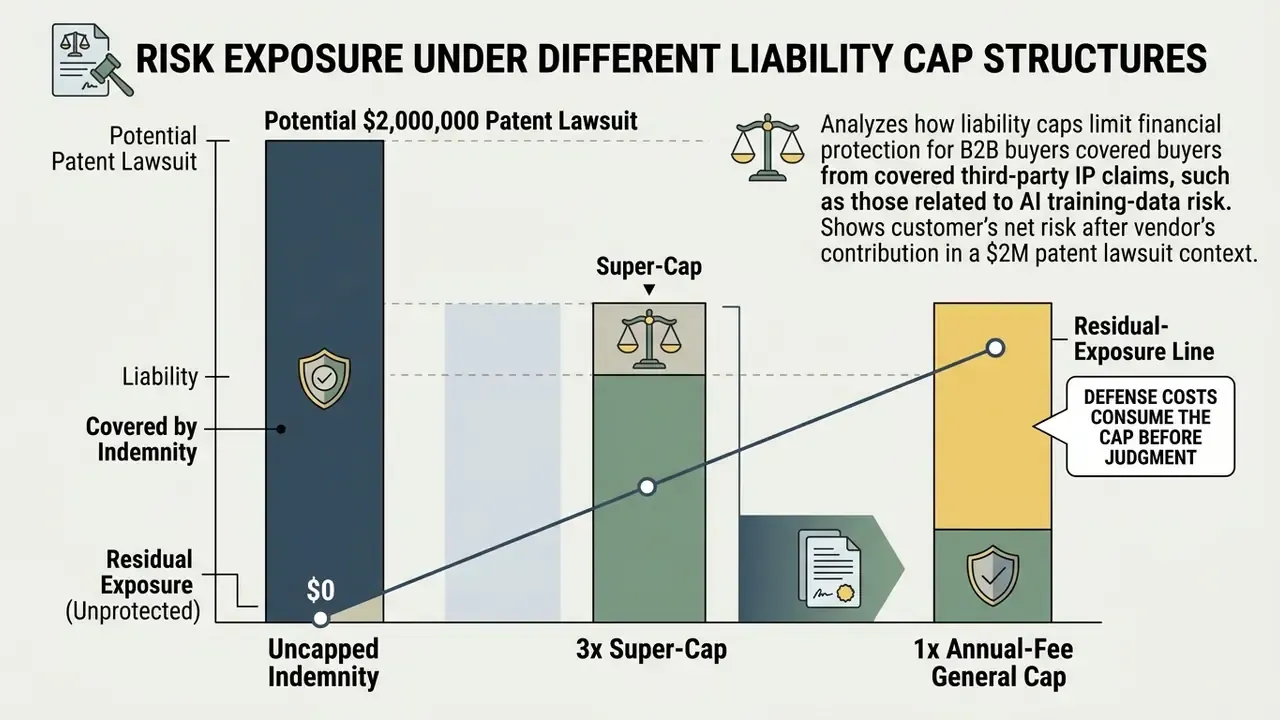
So experienced buyers ask for IP indemnification to sit fully outside general caps, or under a dedicated super-cap. Published clause libraries converge on a narrow band of market practice. ACC model language (Limitation of Liability, Carveout for Intellectual Property Infringement, 2016) excludes IP infringement claims from the cap entirely. ContractKen's clause library (2026) describes IP indemnity as uncapped, super-capped at 2x to 3x annual fees, or subject to the general cap. Venable's 2026 drafting guidance recommends a multiple of fees paid, or a separate IP-specific limit, where a full carve-out is unavailable. Fixed limits of $2M to $5M appear in larger enterprise deals as an alternative anchor.
Worked super-cap calculation for a financially critical system. Assume a core banking reconciliation module at $1.2M in annual fees. The realistic downside is not the licence value but litigation plus replacement: outside counsel and experts through claim construction and summary judgment ($1.5M to $3M), potential damages or settlement ($2M and up), plus internal remediation and re-platforming if an injunction lands. A 1x fee cap ($1.2M) fails before the merits are reached. A 3x super-cap ($3.6M) covers defense plus a mid-range settlement. A 5x super-cap ($6M) approaches full transfer of the modelled exposure. The discipline is to size the cap against the modelled loss scenario, that is defense spend, settlement range, and switching cost, rather than against the contract price. Risk-adjusted ROI for the underlying AI or automation programme should carry the same numbers, since an uncovered residual exposure is a real cost line, not a footnote.
One more drafting trap. Confirm expressly whether indemnity payments count toward the general cap or sit outside it, and whether the exclusion of indirect and consequential loss elsewhere in the agreement quietly cuts the indemnity back. As English drafting commentary notes, a clause limiting "all liability under this agreement" captures indemnities, while one limiting "all damages" may not, and a broad consequential-loss exclusion can reintroduce the very foreseeability test the indemnity was meant to remove.
Reviewing IP Indemnification From the Licensor and Licensee Perspective
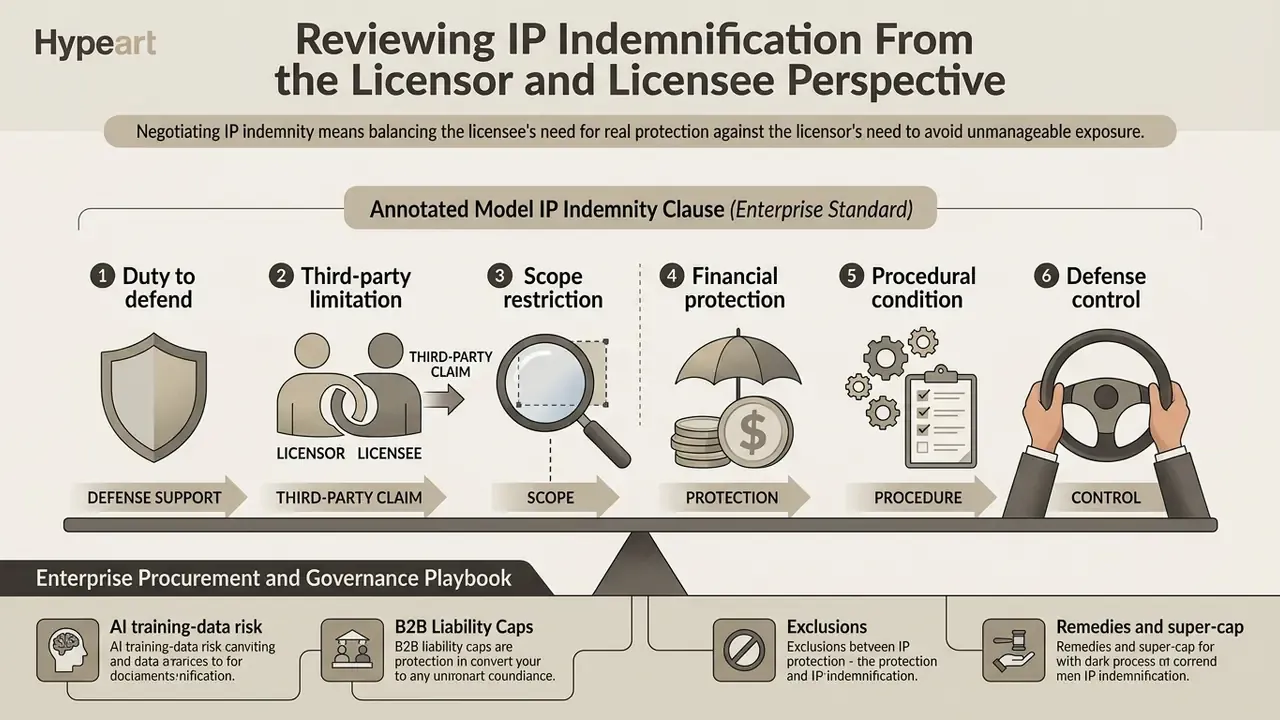
Negotiating IP indemnity means balancing the licensee's need for real protection against the licensor's need to avoid unmanageable exposure. Enterprise review teams work from structured checklists during procurement, and the right posture depends entirely on whether your organisation is assuming or shifting the risk.
«Across 195 contracts from 75 digital platforms, indemnification clauses have become standard, shifting third-party claim risk onto users.»
Read that as a warning. Default platform paper often runs the indemnity against the customer. Enterprise negotiation is frequently about reversing the direction of travel, not merely widening the scope.
Annotated Model IP Indemnity Clause (Enterprise Standard)
- [1] Duty to defend. Triggers immediate upfront funding of counsel, independent of the eventual outcome.
- [2] Third-party limitation. Excludes internal disputes between buyer and vendor, which belong in warranty and breach remedies.
- [3] Scope restriction. Confines patent risk to issued patents in a defined jurisdiction, a vendor protection buyers should test against actual deployment geography.
- [4] Financial protection. Covers final judgments and pre-approved settlements; confirm whether defense costs are additive to any cap or sit inside it.
- [5] Procedural condition. Protects the vendor from prejudice caused by delayed notice. Buyers should soften it to "notice, except to the extent Vendor is materially prejudiced by delay."
- [6] Defense control. Prevents the customer from overspending on outside counsel, while the consent proviso preserves a veto over injunctive or reputational settlement terms.
Enterprise Procurement and Governance Playbook
Checklist0 / 15
When running risk assessments for new software integrations, legal and risk teams can pair this playbook with the B2B AI Media Trust Checklist to verify compliance, data rights, and supplier governance.
Questions for the IP Owner, Licensor, or Service Provider
Bring these questions to the negotiation, ideally in writing, and log the answers in the deal file:
- Does the indemnity cover third-party patent infringement, or only copyrights and trade secrets, and is patent coverage limited to issued patents?
- Is the duty to defend expressly separated from the duty to indemnify, so counsel is funded immediately?
- Are IP indemnification obligations carved out of the general 12-month liability cap, or placed under a stated super-cap?
- What remedies apply if an injunction blocks our use of the technology, and on what timeline?
- How does the vendor handle third-party open-source components embedded in the deliverable? Buyers assessing creative and design toolchains can benchmark disclosure practices against published terms such as those documented for Canva's AI generation features.
- Does the indemnity cover claims asserted against the underlying foundation model's training data, or is that risk passed through under upstream terms?
- Is output-level AI indemnity conditioned on vendor guardrails, and what documentation must we retain to prove compliance?
- Will the vendor accept an audit-cooperation obligation, supplying provenance evidence for training data and third-party components on request?
Critical Questions From the Licensor's Side
Suppliers negotiating the same clause should stress-test four boundaries. Scope: all IP in the deliverable, or only specified components? Carve-outs: are customer specifications, customer trademarks, misuse, and unauthorized modification excluded? Remedy sequence: is licensing or modification the first cure, with refund as the last resort? Cap treatment: is the indemnity inside the general cap, under a separate limit, or uncapped? Unlimited IP indemnity should be the exception, particularly where the contract's economic value is small next to the litigation risk being assumed.
Work through those review points systematically and procurement teams end up with enforceable protections, vendor obligations aligned to institutional risk appetite, and continuity that survives a bad day in court.
FAQ: IP Indemnification Questions Enterprise Buyers Ask
Is IP indemnification the same as insurance?
No. Indemnification is a contractual obligation between the parties, funded from the vendor's balance sheet. Insurance is a third-party risk transfer. A vendor with a beautiful indemnity clause and no capacity to honour it offers thin protection, which is why creditworthiness and evidence of coverage belong in vendor due diligence.
Can a buyer lose indemnity rights by giving late notice?
Often, yes, at least partially. Most clauses condition coverage on prompt written notice, and delay that prejudices the vendor's defense can reduce or forfeit recovery. Negotiate a materiality qualifier, and operationalise a legal-intake service level for cease-and-desist letters.
Does an IP indemnity cover injunctions that shut down our operations?
Only indirectly. The indemnity pays money; the remedy escalator handles continuity. Business-interruption losses are frequently excluded as consequential damages, so continuity protection has to come from the remedy clause, transition assistance, and service-level commitments.
Are patent applications covered?
Usually not. Many licensors limit patent coverage to issued patents in named jurisdictions and exclude pending applications along with standards-essential patents subject to FRAND commitments.
Who controls settlement?
The vendor typically controls defense strategy and counsel selection. Standard drafting still prohibits any settlement that admits customer liability, imposes injunctive or non-monetary obligations, or omits a full release, without the customer's prior written consent.
Does generative AI change the analysis?
Substantially. Risk splits across training data, model output, prompts, fine-tuning, and agentic actions. Coverage is frequently conditional on vendor guardrails, and it usually excludes customer-supplied data and prompt-induced outputs.
Should IP indemnity ever be capped?
From the buyer's side, ideally not. But a well-sized super-cap, commonly 2x to 5x annual fees or a fixed $2M to $5M limit, is the pragmatic compromise when a full carve-out is off the table. Size it against modelled defense, settlement, and switching costs, not against the licence fee.
What is still unresolved in this area?
Two things, honestly. Agentic AI liability allocation remains largely unaddressed in current vendor paper, so the risk defaults to the customer by silence rather than by negotiation. And the case law on training-data claims is still forming, which means today's carve-out language may look either prudent or obsolete within a couple of contract cycles. Treat both as open questions to revisit at renewal.
Appendix A: Notice Memorandum Outline and Editorial Corrections
A1. Tender-of-defense memorandum, minimum contents. Use this as an internal template so nobody drafts a first notice under time pressure:
- Contract reference, effective date, and the specific indemnity clause invoked.
- Identity of the claimant, the asserted right (patent number, registration, or work), and the claim chart if provided.
- Date and method of receipt of the demand or complaint, plus the applicable procedural deadline.
- Description of the deliverable and the exact deployment configuration in use.
- Statement that use fell inside permitted use, with references to the attached evidence.
- Evidence index: build records, configuration snapshots, patch logs, prompt and output logs where relevant.
- Express tender of defense, request for confirmation within a stated number of days, and reservation of rights.
- Named internal owner and escalation path, so the vendor has one accountable contact.
A2. Editorial corrections log (retained for traceability). This ip indemnification explained guide was revised in February 2026, and earlier draft language was replaced as follows. The opening quotation, previously published with unclear author attribution, now carries a verifiable published source and a named review board. The carve-out statistic was reframed with methodology and a direct URL rather than a bare "over 90%" claim. The liability-cap statistic now states its sample framing, enterprise contracts above $5M, with a direct URL. The $450,000 core banking settlement is labelled a composite illustrative scenario and expanded with the evidentiary package that made the tender of defense work.