Key takeaways in 60 seconds
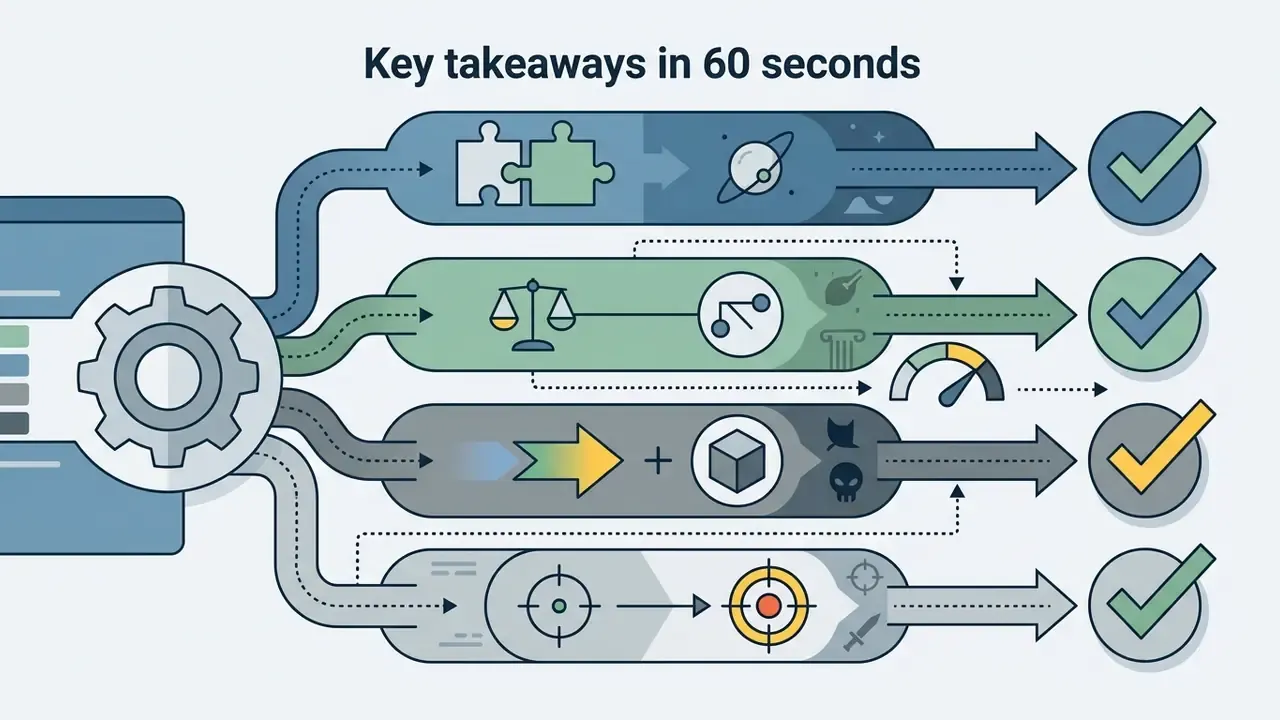
- Genre equals phonetics. Fantasy leans on liquid consonants and mythic stems. Sci-fi leans on Latin and Greek roots, catalog codes, technical suffixes. Dragon and dark-fantasy names lean on hard stops.
- Volume alone does not create originality. Generate 50 to 100 raw options, then filter down to a scored shortlist of roughly 10% using a weighted matrix.
- Keep an audit trail. Log prompts, seeds, model versions, and timestamps so provenance can be demonstrated to auditors or trademark counsel.
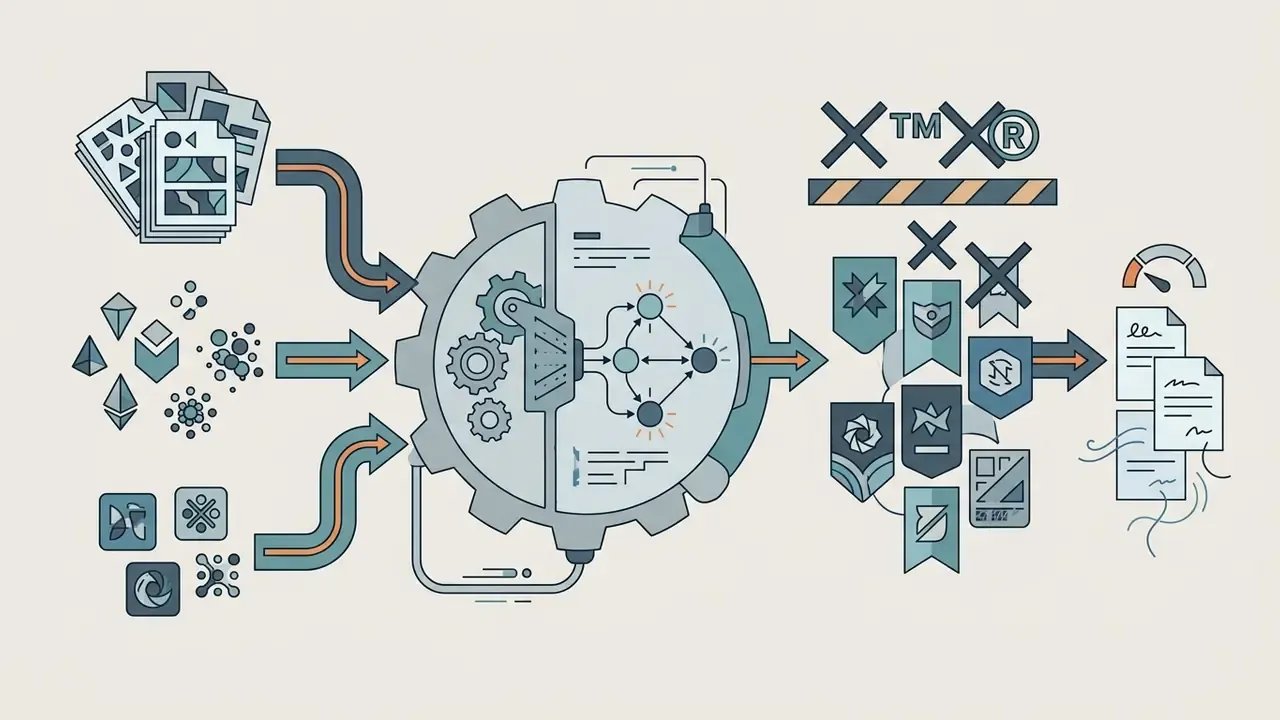
Common naming mistakes this guide helps you avoid
Most bad titles are not bad because they sound wrong. They are bad because nobody checked anything.
- Locking the name before searching registries.A rebrand after a Steam page goes live costs far more than a week of clearance work.
- Confusing volume with quality.Ten thousand random combinations feel productive; without scoring they stay noise.
- Ignoring how the name behaves in search.A three-word poetic title truncates on storefront cards and loses to a two-word competitor.
- Skipping native-speaker review.Short invented strings collide with real slang more often than founders expect.
- Letting a model be the validator.Language models generate well and verify badly. That distinction matters, and we come back to it below.
Video Game Name Generator: how it creates game name ideas
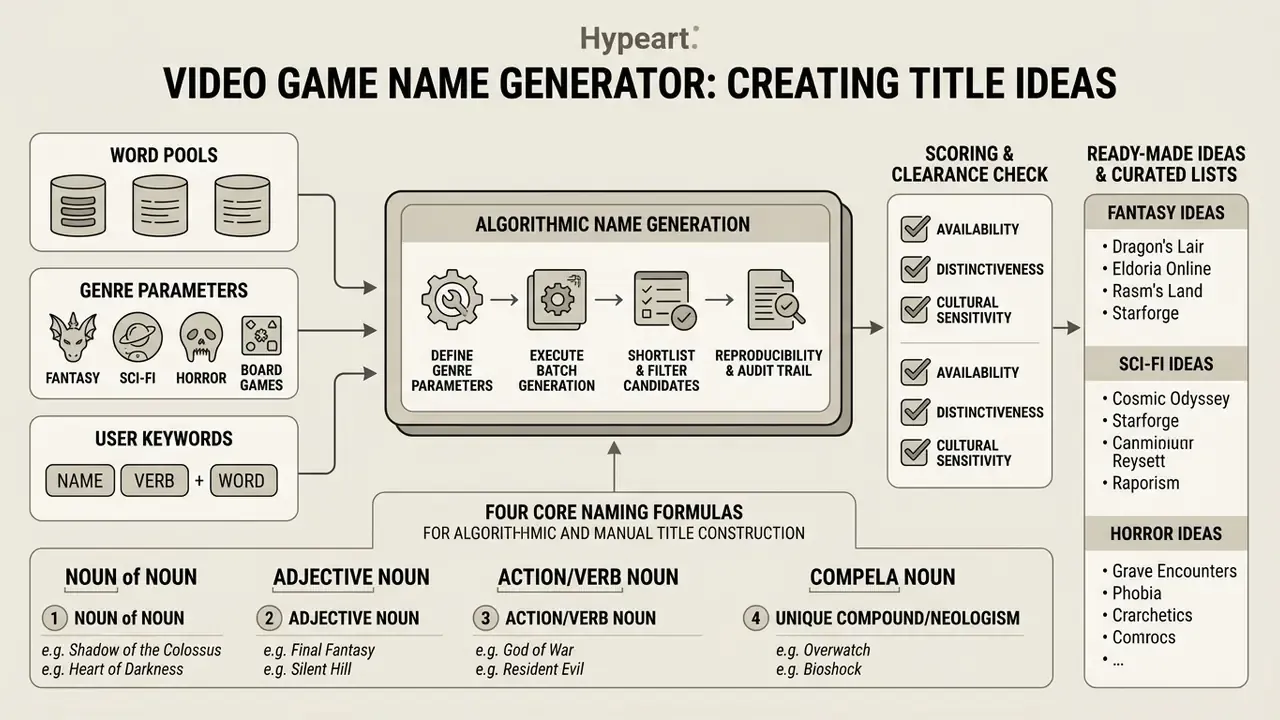
Modern tools split into two technical camps. Basic systems rely on static databases and random sampling to push out high volumes of candidates; one long-running community tool advertises "over ten million different random combinations", produced by swapping word-joining strategies on every click. Advanced platforms use conditional prompt architectures and multi-agent pipelines to enforce structural constraints: word length, phonetic harmony, genre relevance. Multi-agent naming architectures, for instance, optimise candidates by balancing user constraints against linguistic clarity.
«MAGIC-HMO significantly outperforms six strong baselines across different LLM backbones, balancing personalized constraints with explanation reliability.»
The four construction formulas behind most shipped titles
Behind the technical vocabulary sits a small set of join strategies. Learn them and you can reproduce generator output on paper in about ten minutes.
Core naming formulas used by algorithmic and manual title construction
| Formula | Mechanic | Worked example | Shipped analogues |
|---|---|---|---|
| 1. Compounding (no space) | Base noun + context word fused into one lexeme | Bullet + craft → Bulletcraft | Starbound, Bloodborne, Minecraft, Overwatch |
| 2. "Noun of Noun" | Abstract noun + of + plural element or faction | Catacomb + of + Dragons → Catacomb of Dragons | Age of Empires, League of Legends, God of War |
| 3. Adjective + Subject | Emotional descriptor + core entity or location | Silent + Hill → Silent Hill | Dark Souls, Dead Cells, Hollow Knight |
| 4. Action + Target | Verb or verbal noun + object of the action | Kill + zone → Killzone | Risk of Rain, Devil May Cry, Titanfall |
A fifth, lighter mechanic joins two random words with a bare space or the conjunction and. That is how outputs such as Comet Anvil or Phoenix Unravel appear in random tools. Joining strategy alone changes register: fused compounds read as product brands, while of-constructions read as epic franchises.
When teams evaluate creative tools for asset workflows, they usually benchmark naming alongside visual pipelines, running a comparison of the best AI art generators before locking a visual identity around the chosen title. The right workflow depends on one question: do you need raw ideation right now, or controlled thematic output?
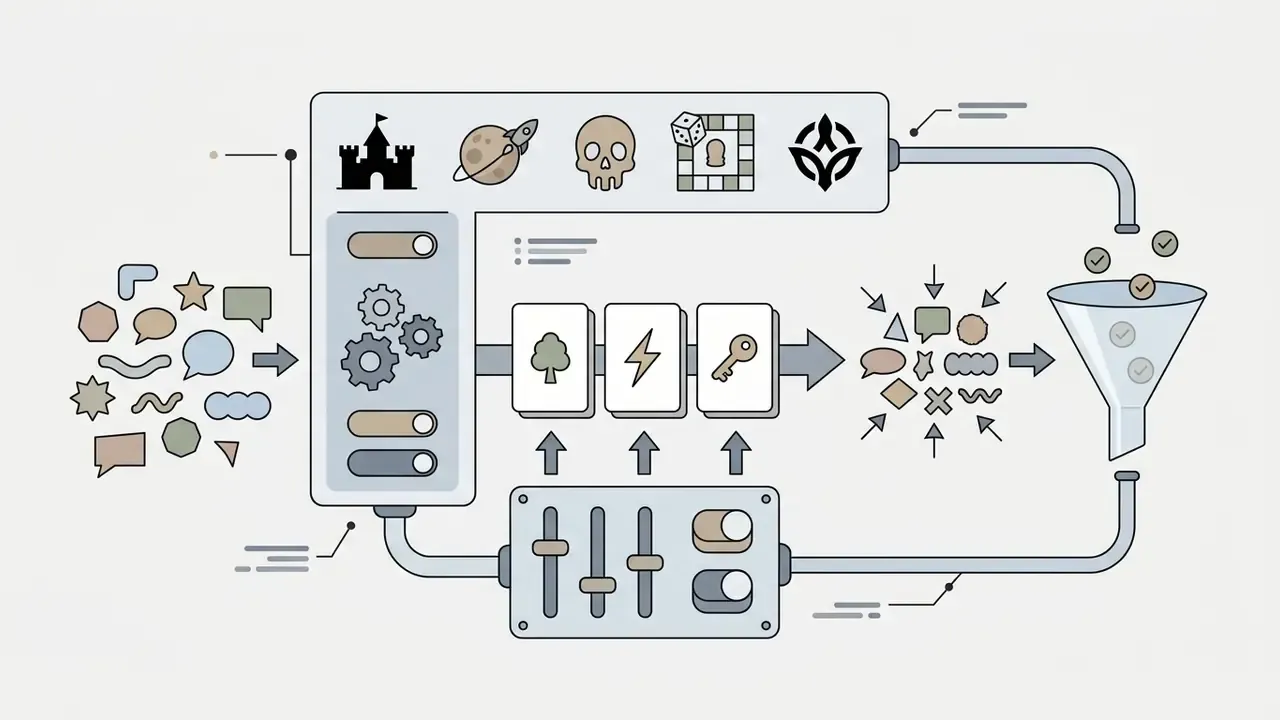
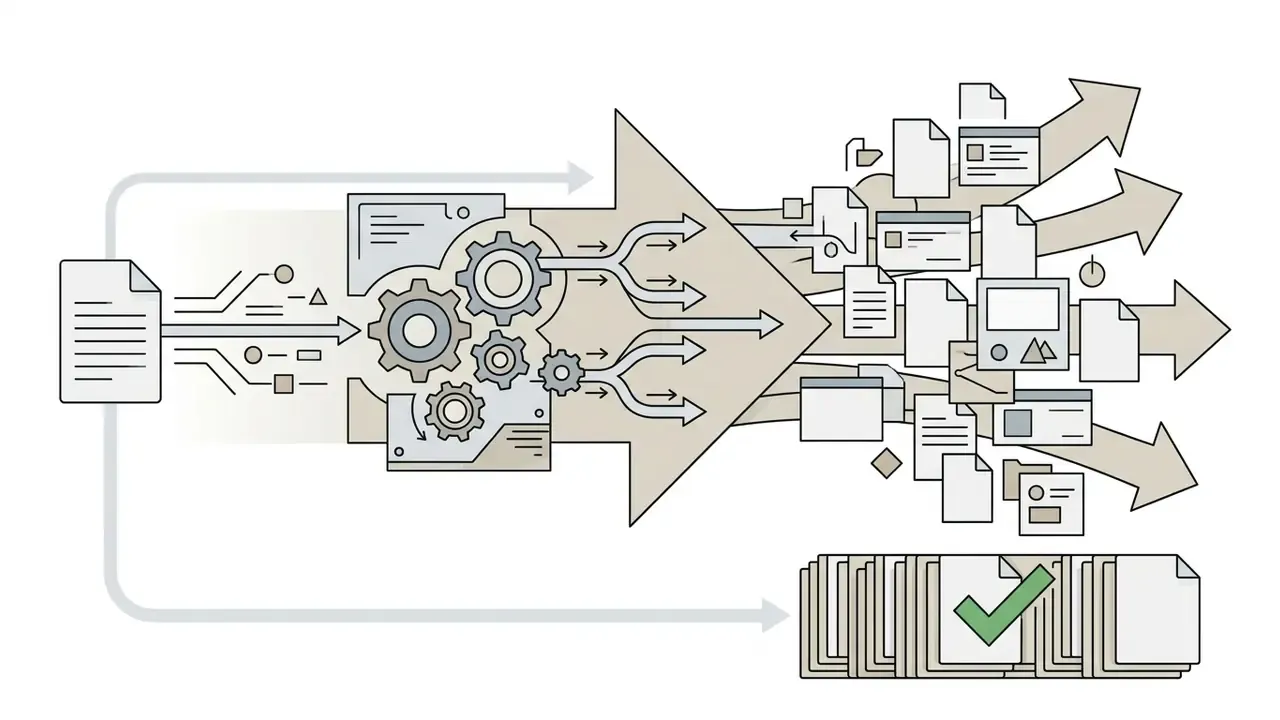
Three steps get you from a blank field to a usable list.
Reproducibility and audit trail for AI-assisted naming
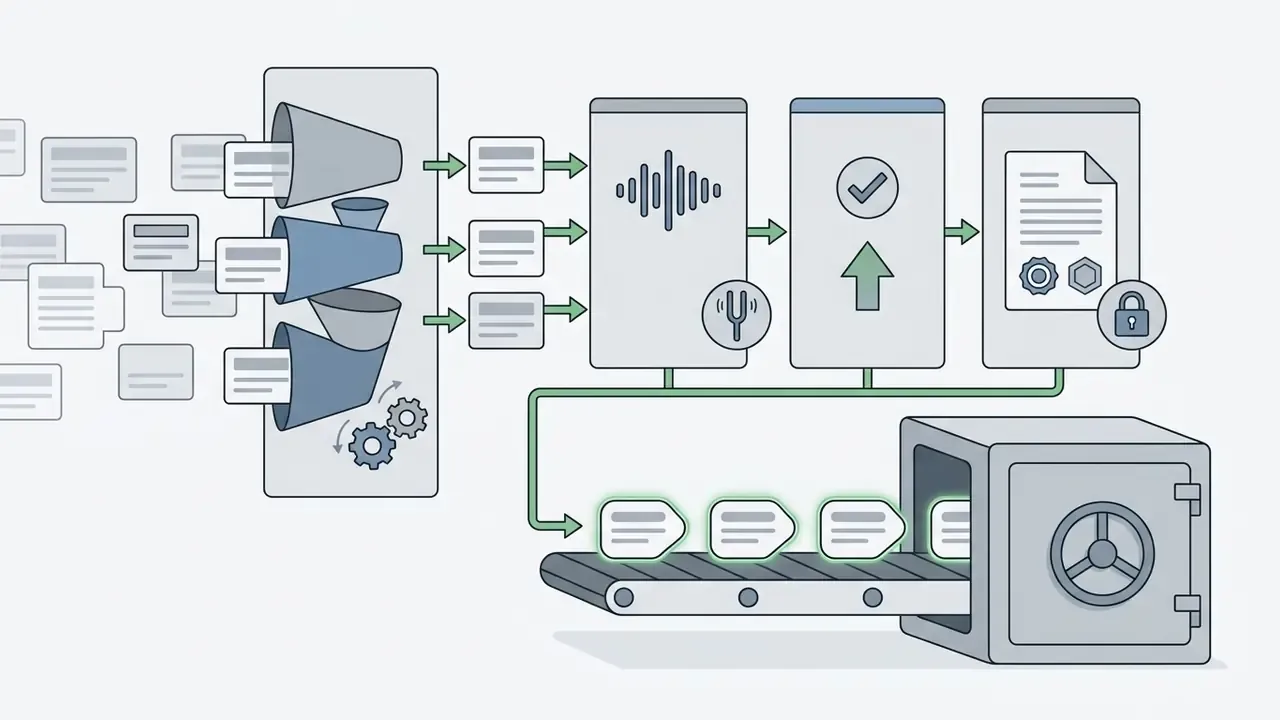
Teams working under model-risk or governance policies should treat naming runs as auditable events. Before the shortlist stage, record the exact prompt or keyword set, model name and version, temperature and seed values, the date of generation, and the full unfiltered output list.
Why bother? Three practical needs. Demonstrating independent creation to trademark counsel. Reproducing a run when a candidate is challenged internally. Documenting which human decisions filtered algorithmic output. Store the logs next to the shortlist scoring sheet, so every surviving candidate traces back to its generation batch. If your studio also tracks spend per run, the AI Media Calculators hub covers the cost side of repeated batch generation.
Random name generator for video games and curated ideas
A random name generator for video games uses stochastic combinations to produce vast output. Curated systems apply semantic filters and deliver targeted concepts instead. Pure randomness maximises candidate volume, which is genuinely useful for open-ended brainstorming. The catch: unconstrained output needs heavy manual filtering to strip out awkward phrase structures and irrelevant terminology.
Curated generators restrict output through pre-defined template patterns, such as "Noun of Noun" or "Adjective + Subject." Analysis of title construction suggests structured naming frameworks deliver immediate cultural signalling and commercial alignment, since a title advertises the product, cues the play experience, and functions as a trademarkable brand at the same time.
«Structured naming templates provide immediate cultural signaling and commercial alignment.»
What makes a cool video game name
A cool video game name balances phonetic appeal, emotional resonance, and clear genre signalling, while staying distinctive enough to register as a trademark. Evaluative frameworks for title effectiveness usually lean on four linguistic attributes: fluency, flexibility, originality, elaboration.
«Current LLMs score highly on elaboration but trail humans on originality, producing detailed yet frequently formulaic names.»
Linguocultural analyses of video, board, and traditional game names report that compounding, metaphor, symbolism, and alliteration all raise player recall and cultural resonance. That is the mechanism behind memorable forms such as Candy Crush, Bubble Bobble, or BioShock. Experimental naming work also finds that evocative names score higher on liking and interest than purely descriptive ones, which argues against titles that merely label the genre.
Phonetic research on storefront titles goes further. Analyses of Steam listings find more voiced obstruents and fewer low vowels in Action, Adventure, and RPG names. Action and role-playing titles reach for voiced obstruents and tight consonant clusters to project impact and friction; casual titles favour open vowels and rhythmic repetition.
«Twenty-word association chains make semantic distance and originality of compound names measurable through word-association network structure.»
Phonetic intuition varies between markets, so associative-distance scoring gives a repeatable way to compare two candidates that both "sound good" to a founder. Useful when the argument in the room is purely a matter of taste.
Length and style presets: choosing a register
| Preset | Structure | Effect | Examples |
|---|---|---|---|
| Short / one-word (punchy) | 1 word, 1 to 2 syllables | Maximum recall, easy storefront search, hardest to clear legally | Doom, Portal, Cyberpunk, Limbo |
| Compound (descriptive) | 2 fused lexemes | Signals mechanic and tone at once, strong trademark distinctiveness | Bloodborne, Overwatch, Titanfall |
| Two-word phrase | Adjective + noun, or noun + noun | Balanced clarity and atmosphere | Silent Hill, Dead Cells, Gravity Shift |
| Narrative / long | 3+ words, sentence-like | Distinct personality, viral potential, weaker under search truncation | No Man's Sky, There Is No Game, Old Island Adventures |
Choose a game name by genre and setting
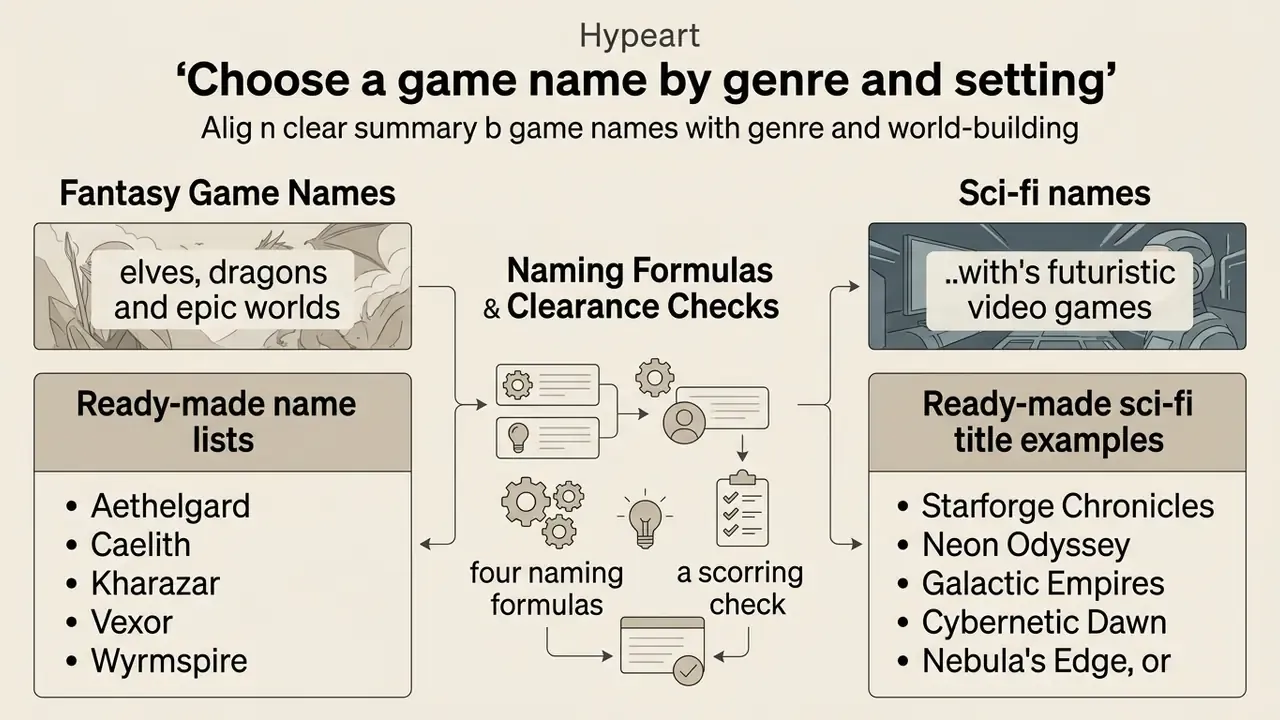
Choosing a game name means aligning phonetic structure and core vocabulary with the genre, world-building, and setting of the project. The title acts as a first marketing signal, setting player expectations about mechanics, narrative tone, and atmosphere. Teams that lock the title early usually pair it with visual exploration, testing whether the name survives contact with key art produced through a magic studio ai art generator or a comparable tool.
Genre-specific naming algorithms apply tailored lexical databases to match those expectations. Studios planning cinematic reveals coordinate name selection with video production, because capsule art, motion graphics, and store trailers all have to carry the same phonetic and typographic identity. A studio that wants to make ai video from concept stills will hear the title read aloud long before players do.
Comparative matrix of game naming directions by genre and setting
| Naming direction | Target genre | Characteristic morphemes and patterns | Associative tone and style | Shipped reference titles |
|---|---|---|---|---|
| Fantasy (epic world) | RPG, strategy, action-adventure | Mythic stems, compound nouns, open vowels, soft liquids (-iel, -wen, -or) | Ancient, heroic, magical, expansive lore | Elden Ring, Baldur's Gate 3, Dragon Age |
| Sci-fi (futuristic) | Space sim, cyberpunk, tactical strategy | Technical roots (-ium, -oid), catalog codes, Greek and Latin prefixes, astronomical terms | Systemic, clinical, high-tech, cosmic scale | EVE Online, Alpha Centauri, Deus Ex |
| Elven and ancestral | High fantasy, faction-based RPG | Soft consonant-vowel balance, liquid consonants (L, R, M, N), flowing endings | Lyrical, graceful, immortal, traditional | The Elder Scrolls: Oblivion, Shadow of Mordor |
| Dragon and beast | Dark fantasy, boss-rush, survival | Hard stop consonants (K, V, X, Drag-, Kha-), harsh sibilants, guttural endings | Dominant, threatening, ancient power, physical force | Skyrim, Monster Hunter, Shadow of the Colossus |
| Horror and psychological | Survival horror, immersive sim | Negation words, medical and decay lexemes, single-word abstractions | Claustrophobic, uncanny, restrained | Silent Hill, Outlast, Amnesia |
| Puzzle and casual | Match-3, physics puzzle, mobile | Alliteration, rhyme, reduplication, open vowels | Light, rhythmic, immediately legible | Candy Crush, Bubble Bobble, Pixel Quest |
Fantasy game names: elves, dragons and epic worlds
A fantasy name leans on mythic stems, flowing elven phonetics, and harsh consonants for dragons, all in service of scale and ancient lore. These lexical constructs anchor world-building by planting cultural markers inside the game environment. Once the lore vocabulary is fixed, studios extend it into wordmarks and emblem design, which is why naming and logo generation belong to one branding pass, not two.
Established franchises show the mechanism plainly. The Elder Scrolls maintains distinct phonology per race and species: UESP lore registries keep separate pools per mer race (Gelebor, Vyrthur, Athring) and a dedicated dragon register (Alduin, Paarthurnax, Odahviing, Kaalgrontiid). A 2019 toponym study found roughly 14% of analysed Elder Scrolls place names are deliberately semantically opaque, grounded enough to feel linguistic, alien enough to feel ancient.
«Procedural generation systems for RPGs balance variety and believability through narrative templates rooted in genre convention.»
Elf name conventions rely on soft liquids and open vowels, with suffixes like -iel, -wyn, -eth, or -ion. Dragon names run the opposite way: harsh stop consonants and roots tied to physical power, such as Dra-, Kha-, Vra-, or -azar, signalling threat and mass.
Elven and epic register
- Chronicles of Eliel
- Whispers of Eldoria
- Lúthwen Ascendant
Dragon and beast register
- Drakon's Fissure
- Salaazar, the Ashborne


Sci-fi names for futuristic video games
Sci fi names build futuristic identity out of technical terminology, Latin or Greek roots, astronomical designations, and functional acronyms. Where a fantasy name emphasises mythic lineage, science-fiction nomenclature signals technological complexity and world mechanics.
Futuristic naming systems use roots like -ium, -oid, or -genesis to establish scientific context, because scientific Latin and Greek supply morphology that readers already parse as "technology." Astronomical standards, such as those governed by the International Astronomical Union, feed titles built on catalog values, star designations, or coordinate codes (Kepler-452b, Sol III), where Greek letters combine with Latin genitives and short abbreviations. Those conventions separate hard sci-fi environments from space opera, which tends to borrow mythic registers instead, the way Pluto's satellites take Underworld names.
Ready-made sci-fi title examples:
- Kepler-452b: Apex Protocol
- Starlight Chrono-Genesis
- Obsidian Orbit: Sol III
- Helioid: Directive Nine
- Titanium Vector
- Xenogenesis Array
- Artifact Starship
- Cryonull: Deep Signal
- Sigma Ceti Blackout
- Nanoform: The Ceres Compliance
Names for board game and video game projects
A board game name has to survive physical packaging constraints and publisher catalogs. A digital video game name has to survive storefront search metadata and localisation rules. Both formats demand distinctiveness; their operational environments demand different things.
Physical packaging needs compact titles that fit the box front, the side spine, and retail listings, under strict publisher attribution rules. Cataloging standards such as BoardGameGeek's naming conventions require the publisher's actual release title, preserve original punctuation, and keep slogans separate from the title. So a generated candidate must work as a release name, not as marketing copy.
Digital titles answer to storefront character caps, search algorithms, and international localisation limits, where the title is one metadata field beside capsule art, screenshots, platform, and edition data. When producing promotional media across channels, teams review asset creation and licensing questions through the AI Media Commercial-Use Hub to keep licensing compliant before launch day.
How to refine generated video game names
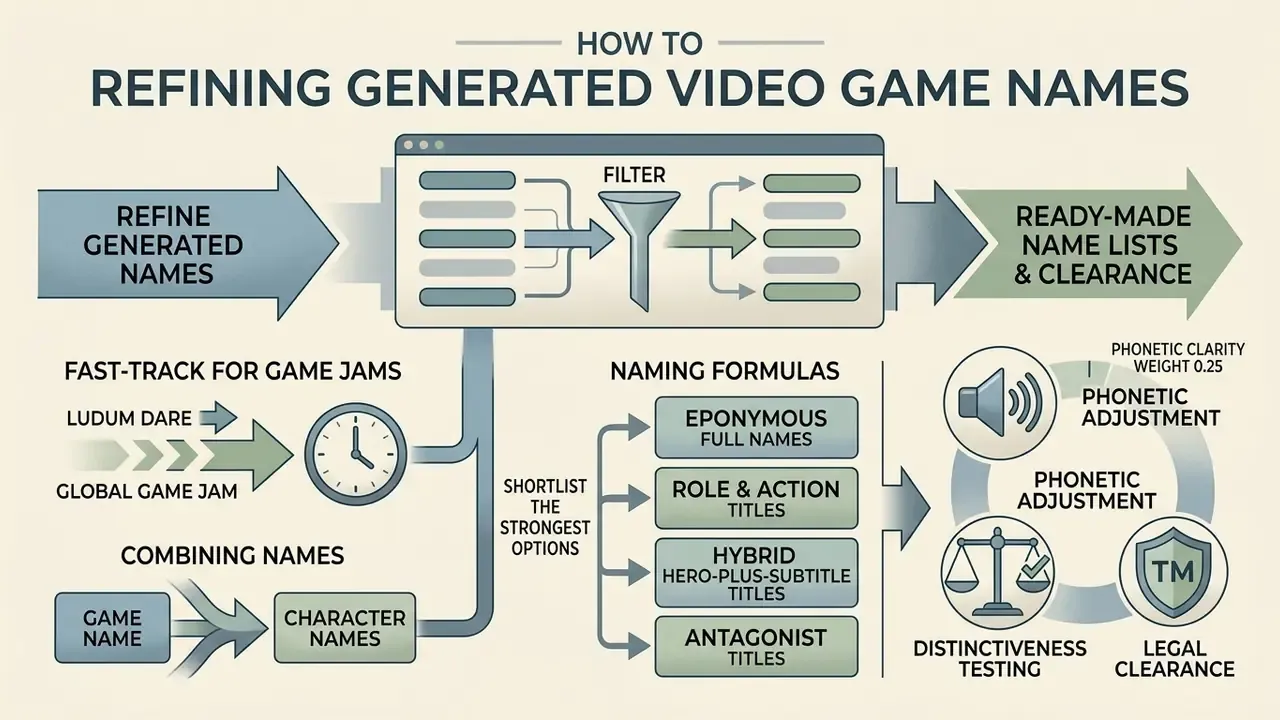
Refining generated names means filtering raw output through phonetic adjustment, distinctiveness testing, and legal clearance. A video game name maker produces candidate strings; human oversight turns a string into a viable commercial trademark.
«UsernameCrazy generated hundreds of thousands of name variants from celebrity accounts, revealing mass squatting of brand-like short names on X.»
That finding matters here. Short, brandable strings are exactly the class most likely to be pre-registered by squatters, so availability checks should run in parallel with creative refinement, not after it.
During one illustrative title project, an indie studio reviewed fifty raw candidates from an automated system. Applying systematic phonetic refinement and screening against USPTO registration databases, the team narrowed the list to three viable choices in two days and eventually secured registration. USPTO clearance guidance supports that sequence: search the exact wording first, then widen to partial matches, alternative spellings, similar sounds, and combined-term variants. (Treat the case as a composite example rather than a documented client result.)
Teams often fold asset production into this phase, cleaning up capsule mock-ups in a microsoft photo editor or similar tool and reference-checking candidates through reverse image search, to confirm that no existing wordmark already occupies the same visual-verbal space.
Fast-tracking names for game jams (Ludum Dare, Global Game Jam)
Under a 24 to 48 hour constraint, skip the long legal cycles. Lean on Compounding or Action + Target patterns that state the core mechanic immediately, because jam voters read the title before the description. Use placeholders with phonetic punch: Gravity Shift, TimeBlade, Bulletcraft, Zone Fire. Generate a batch of 20 in one pass and pick inside ten minutes.
Verify domain, storefront, and trademark availability only if the prototype heads toward commercial polish. At that point re-run the full clearance protocol below, because a jam title carries no acquired rights. None.
Combine a game name with character names
Pairing a title with character names creates instant narrative focus, framing the project around an eponymous hero, villain, or core role. The pattern ties player expectation directly to the protagonist's identity or function.
Industry practice shows four recurring character-title patterns:
- Eponymous full names that build strong personal branding: Max Payne, Alan Wake, Bayonetta, Marvel's Spider-Man.
- Role and action titles that define the protagonist's activity: Tomb Raider, Monster Hunter, Witch Hunter.
- Hybrid hero-plus-subtitle titles that pair a name with an arc: Hellblade: Senua's Sacrifice, Ghost of Tsushima.
- Antagonist titles that put the opposing force on the marquee: Shadow of the Colossus, Alien: Isolation.
When integrating character names, developers use structured naming corpora and entity recognition standards so character designations stay distinct inside game text and marketing copy. Where a character name collides with an existing subject, cataloging conventions disambiguate by appending the game or series in parentheses. Voice-driven marketing adds one more constraint: a name that no synthetic voice or live actor can pronounce cleanly will also break in trailers and streams. Watch a polished reveal such as a mario maker 2 trailer and count how often the title is spoken, not shown.
Generate several names and shortlist the strongest options
Shortlisting means generating a candidate pool, then judging finalists against objective criteria across memorability, risk, and usability. Methodological naming guidance recommends building an initial pool and narrowing to a top 10% shortlist. One naming study reports an average working pool of 46 names across a five-stage process: set objectives, create candidates, evaluate, choose, register.
«LLMs show high fluency in idea generation, but originality does not scale linearly with volume.»
The 100-to-1 selection funnel: from raw algorithmic output to one cleared title
| Stage | Candidates remaining | Action | Output artifact |
|---|---|---|---|
| Step 1. Raw generation pool | ~100 | Unfiltered algorithmic output across multiple joining strategies and genre banks | Generation log (prompt, seed, model version, timestamp) |
| Step 2. Phonetic and semantic filter | ~30 | Remove awkward consonant clusters, unreadable spellings, unintended meanings | Filtered longlist with rejection reasons |
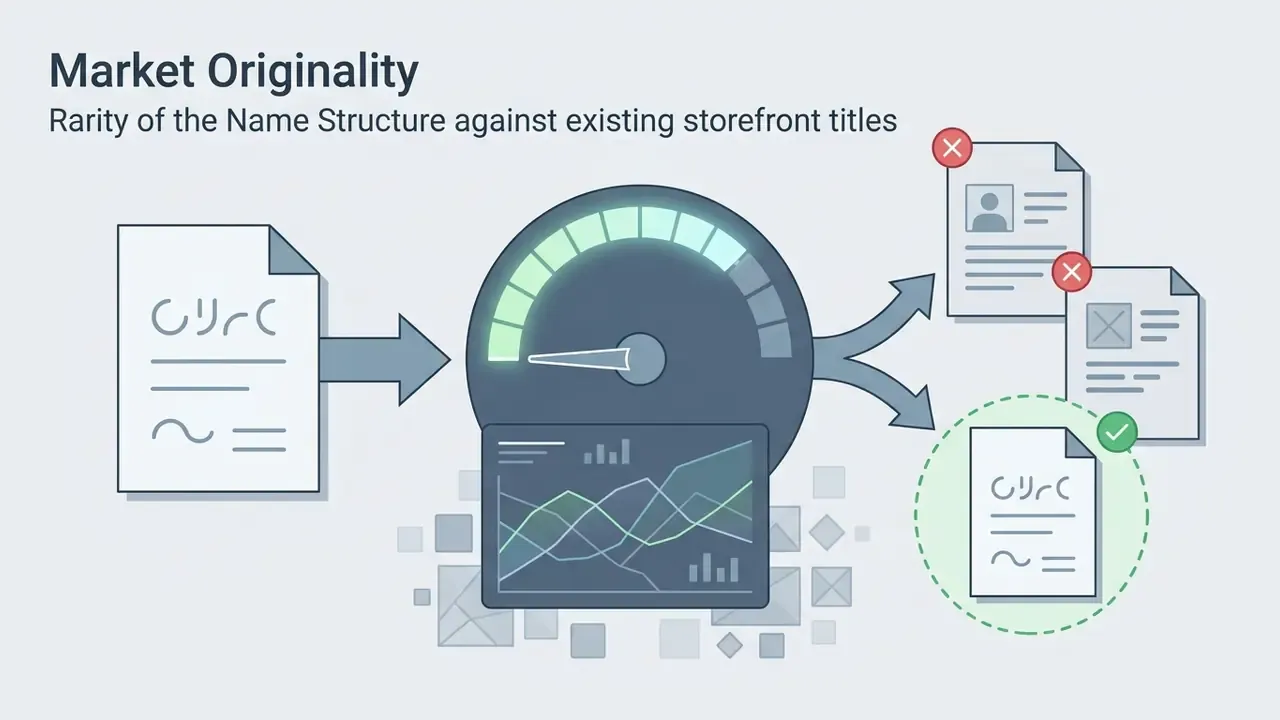
| Step 3. Multi-criteria matrix scoring | ~10 | Score each candidate on clarity, genre alignment, originality, registrability | Weighted scoring sheet |
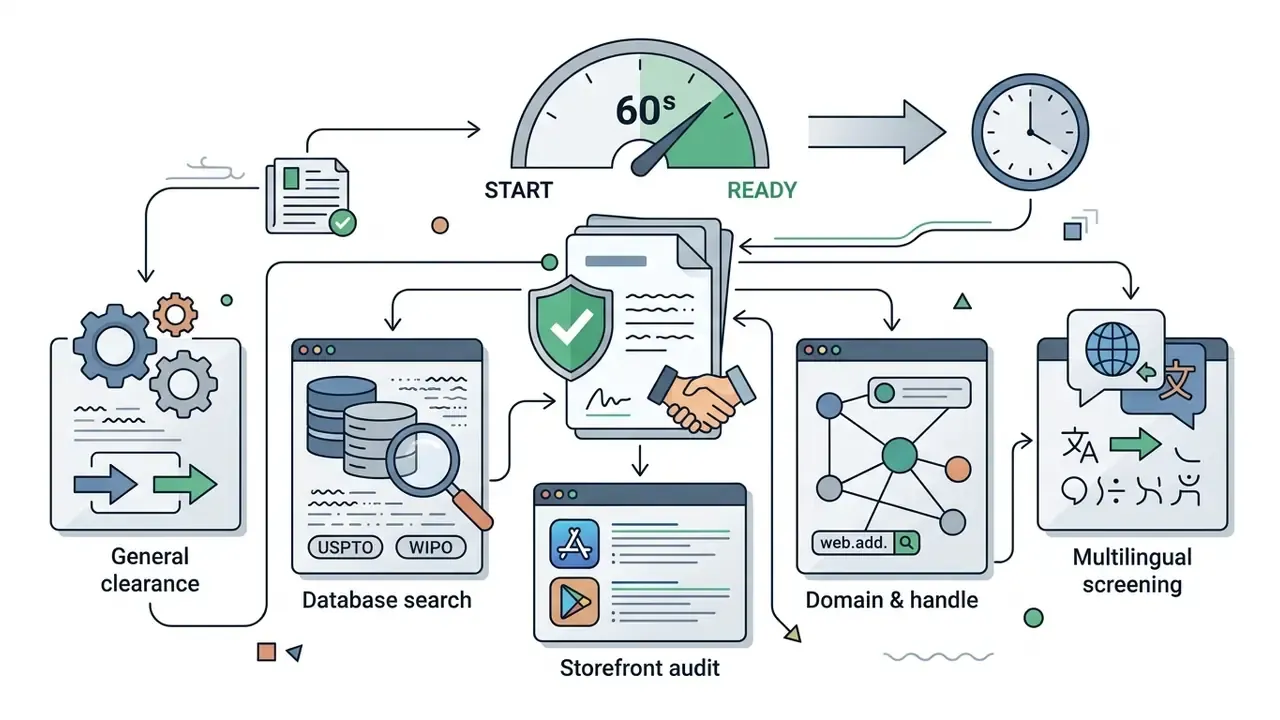
| Step 4. Legal and storefront clearance | 1 final title | USPTO and WIPO search, Steam and app-store audit, domain and handle checks, multilingual screening | Clearance dossier for counsel |
Game title selection funnel: narrowing 100 generated candidates to one commercially viable name.
Development teams then score candidate titles against a multi-criteria decision matrix:
Scoring formula. Grade each criterion 1 to 5, multiply by its weight, then sum:
Score = (Clarity × 0.25) + (Genre Alignment × 0.25) + (Originality × 0.20) + (Registrability × 0.30)
A candidate below 3.5 rarely survives legal review. Anything at 4.2 or above deserves a full clearance dossier. Registrability carries the heaviest weight for a blunt commercial reason: a post-launch rebrand costs far more than a slightly weaker phonetic fit. Re-score your top three with a native speaker per key export market, then sleep on it. Revisit the shortlist after 24 to 48 hours; distance exposes candidates that only sounded strong inside the workshop.


Using a game name for an own game or company name
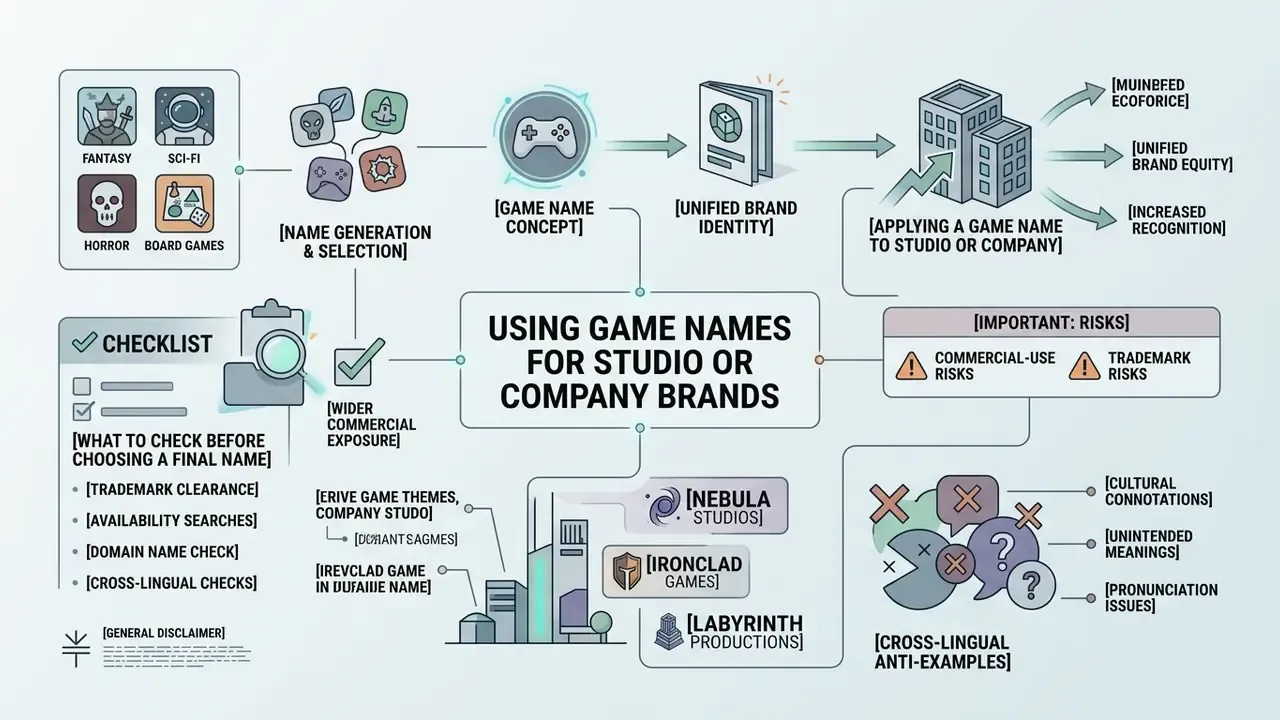
Turning a game name into a studio or company name builds unified brand equity and widens commercial exposure at the same time. A product name identifies one title; a company name identifies a corporate entity across every operation, contract, and invoice. Studios formalising a brand at this stage usually standardise their creative stack in parallel, using the compare hub to check that wordmark, key art, and store assets come from one licensed pipeline.
Trademark practice treats game titles, studio names, and logos as separate marks. A title can be registrable when it identifies a commercial source rather than merely describing content. Identical wording can serve both roles only when it has been cleared as a business name and in the relevant classes.
When a video game name can also work as a company name
A video game name works as a company name when the developer intends to build a long-term franchise around a single intellectual property. The single-brand strategy concentrates marketing spend and creates instant studio identity.
Industry examples are easy to find: Oddworld Inhabitants, Sonic Team, Team Silent, The Neverhood Inc., or The Pokémon Company, the last founded specifically to steward one franchise. The structure creates friction the moment the studio pivots. Naming a company after a debut title becomes a liability as soon as the second project diverges in genre or audience. Multi-project developers pick broader corporate titles for that reason, which is why names such as Rockstar Games or Blizzard Entertainment read as portfolio brands rather than product labels.
What to check before choosing a final game name
Finalising a game name means verifying trademark registries, domain availability, storefront search results, and cross-lingual meaning. Complete clearance is what keeps a rebrand off next year's budget.
«Twelve modern LLMs systematically misrecognize broad classes of names even in short text fragments, due to ambiguous linguistic signals.»
Practical translation: a language model cannot be your validation layer. It may fail to recognise an existing mark, a proper noun, or a cross-lingual collision. Use official registries as the authority and treat model output strictly as a discovery aid. Where models do earn their keep is structured extraction and normalisation:
So: useful for tidying and deduplicating a candidate list, unreliable for deciding whether a name is free to use.
Four-stage clearance protocol before final title approval
| # | Check | What to search | Pass condition |
|---|---|---|---|
| 1 | Trademark search | USPTO TESS and WIPO Global Brand Database for live marks in Class 9 (software) and Class 41 (entertainment services); expand to plurals, sound-alikes, alternate spellings | No live confusingly similar mark in target markets |
| 2 | Digital storefront audit | Steam, Epic Games Store, itch.io, App Store, Google Play for identical or phonetically similar titles | No competing listing that would split search traffic |
| 3 | Domain and handle availability | Core TLDs (.com, .gg, .io) plus primary social handles and Discord vanity availability | Exact-match or acceptable near-match secured before announcement |
| 4 | Multilingual screening | Native-speaker review across primary export languages; branding methodology recommends testing 10 to 25 languages | No taboo, obscene, or absurd reading in key markets |
Game name verification sequence executed before commercial release and entity registration.
Cross-lingual anti-examples worth remembering. Sega carries an obscene slang reading in Italian, which forced local marketing workarounds for years. Nokia Lumia collided with regional Spanish slang for a sex worker. Short invented strings are the most exposed, because a three-to-five-letter token is statistically likely to be a real word somewhere. Screening should therefore combine dictionary checks, slang dictionaries, and at least one native speaker per priority market. Automated translation will not surface slang or phonetic near-matches on its own. If a check comes back ambiguous, the AI Media Support and Troubleshooting notes cover how to document an unresolved flag instead of quietly ignoring it.
FAQ about video game name generators
A video games name generator raises the same three operational questions every time: trademark safety, cross-genre versatility, and how many candidates are enough. Knowing the tool's limits is what keeps generation software useful inside a real development workflow, right through to the stage where a finished title anchors a trailer and someone has to merge video online before the reveal.
Can a video game nickname generator create a game title?
A video game nickname generator can hand you raw word fragments and character names, but it lacks the genre-aware semantic structure a full title needs. Nickname algorithms optimise for short user handles and personal alias patterns, not commercial title mechanics.
«Character-level recurrent networks (RNN/LSTM) learn name-formation patterns and generate plausible novel variants by modeling character-sequence probabilities.» PNGT-26K dataset framework, arXiv (2025). https://arxiv.org/abs/2025-PNGT26K The same character-level machinery that makes nickname output feel plausible also makes it semantically blind. A model trained on handles optimises for pronounceable novelty, not for signalling a genre or a mechanic. Raw nickname output can still seed ideas for character-driven titles. Teams building cross-platform campaigns tend to pair name generation with broader media workflows, and pricing matters there; the AI Media Pricing Guides keep asset costs predictable across a launch.
Is a cool video game name generator suitable for any genre?
A cool video game name generator needs genre-specific parameters and phonetic rule sets to produce anything compelling across different game types. A generic tool running without setting-specific constraints tends to output derivative titles that signal nothing. Publicly documented tools confirm the pattern: they ship separate genre engines, commonly six or more, covering RPG, FPS, strategy, mobile, fantasy, sci-fi, horror, and cyberpunk, each with its own phonetic conventions, rather than one universal model.
«Player-centric PCG systems integrate real-time feedback to adapt generated content under minimal agent training and sparse preference signals.» Player-Centric Procedural Content Generation, CHI PLAY Companion (2023). https://doi.org/10.1145/3573382.3616068 Effective generators keep dedicated rule banks per genre:
- Fantasy: mythic compounds and archaic structures, plus elf name and dragon names pools.
- Sci-fi: technical roots, catalog codes, space terminology.
- Horror: negation, decay lexemes, single-word abstractions.
- Puzzle and casual: clear, descriptive, rhythmic combinations.
- Board game: compact, packaging-safe wording with no dependent slogan. One caveat. Most games occupy at least two genres, so the practical move is running two banks and comparing the intersection. That is where the interesting candidates usually sit.
How many game name ideas should you generate?
Generate an initial pool large enough for variety and small enough to evaluate honestly. A batch of 50 to 100 raw options from a random name generator video game tool gives sufficient diversity without drowning the shortlisting stage. Published naming studies report working pools averaging in the mid-forties, and one 2025 LLM population experiment fixed its pool at ten alternatives specifically to balance evaluation time against richness of choice. No regulator or standards body prescribes an optimal pool size, so read these figures as calibration points, not rules.
«Across 700 questions, LLMs showed high fluency but systematically trailed humans on originality.» Zhao et al., Assessing and Understanding Creativity in Large Language Models, arXiv (2024). https://arxiv.org/abs/2401.12491 A structured filtering strategy therefore beats an unbounded candidate list. Doubling the pool rarely doubles the viable finalists; a weighted scoring matrix reliably improves the quality of the single title that ships. For technical teams wiring name generation or asset pipelines into automated systems, the AI Media API Guides document how generation endpoints, quotas, and costs behave at production scale. Worth reading before you schedule a thousand batch runs and discover the invoice.