Author note: Marcus Hale writes this analysis. Quotes attributed to him are illustrative, not statements by a real individual, employer, or regulator.
A starter API workflow for AI media turns structured user inputs into automated model calls, then returns validated media assets through predictable endpoints. Building an operational pipeline means choosing suitable models, establishing orchestration you can reason about, enforcing technical controls, sanitizing sensitive inputs, and balancing inference cost against processing speed.
Why should a bank's model risk lead care about image and video generation? Because the same egress path that carries a marketing prompt can carry customer data, and the same pipeline that publishes a clip can publish an unreviewed claim.
In enterprise architectures, integrating AI media APIs means leaving the experimental playground and entering production. Engineering teams deploy orchestration layers that catch model drift, manage API quotas, redact regulated data before it leaves the trusted perimeter, and enforce human oversight before assets reach public channels. For additional architectural patterns, see our AI Media API Guides.
Executive summary
- The reference pattern is asynchronous, not synchronous. A production media workflow creates a job, polls status or receives a webhook, retrieves the output, then routes it through validation and a human review gate. Media renders regularly take 30 to 300 seconds; blocking calls fail under load.
- Deterministic code beats agents in version one. Autonomous agents score below 15% session accuracy on realistic multi-turn tool use (WildToolBench, 2026). Use fixed orchestration; use models only for generation.
- Cost is controllable and measurable. Model cascading cuts API spend by up to 98% (FrugalGPT, 2023); prompt caching removes up to 50% of input token cost; low-resolution previews eliminate wasted high-definition renders. Total cost of ownership must also include reviewer hours, moderation calls, and storage.
- Governance is not optional in regulated environments. Map the pipeline to NIST AI RMF 1.0, NIST AI 600-1, NIST SP 800-228, and, for banking and fintech deployments, model risk expectations equivalent to Fed SR 11-7 / OCC 2011-12 plus EBA guidance on model governance.
- Automate when monthly volume exceeds roughly 15 to 20 assets and manual reformatting has become a bottleneck.
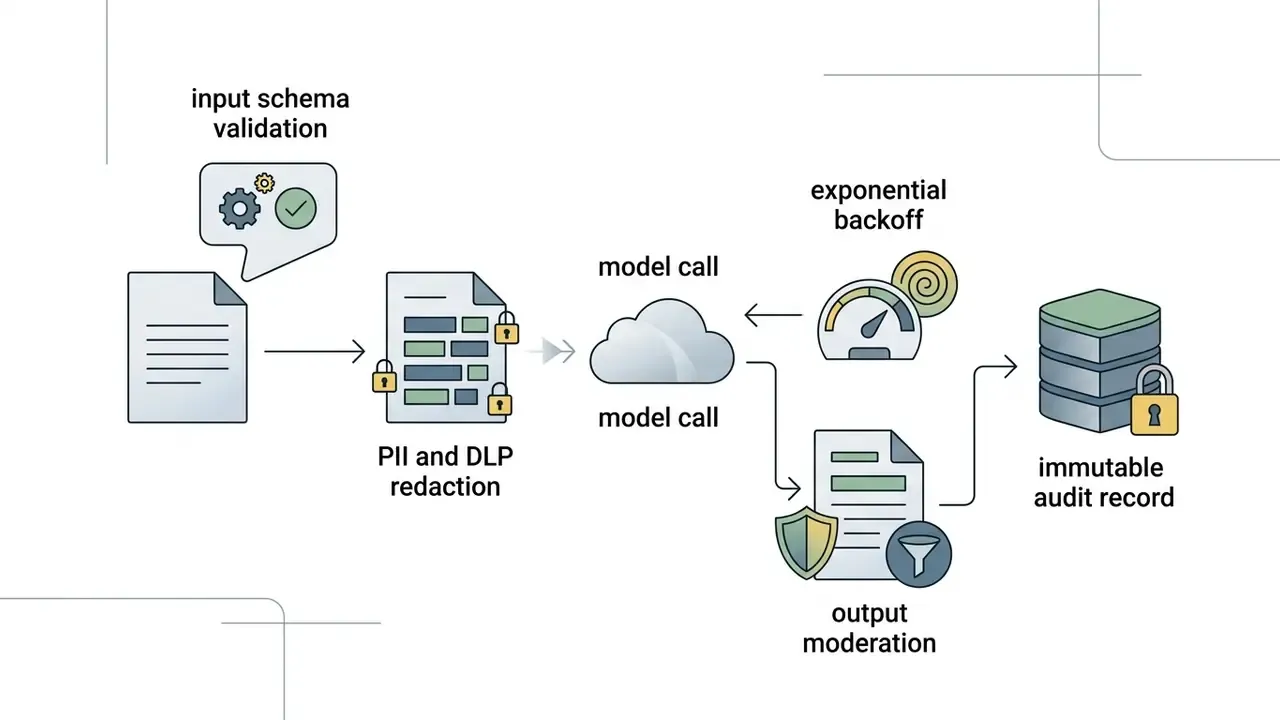
Decision rights: who owns each control
Before the first line of code, agree on ownership. Ambiguous ownership, not weak tooling, is what usually stalls an AI workflow at the pilot stage.
| Control | Accountable owner | Evidence produced | Review cadence |
|---|---|---|---|
| Model and vendor selection | Engineering lead with procurement sign-off | Model snapshot pin, contract terms, retention clause | Per release |
| DLP and redaction gate | Data protection or security engineering | Redaction logs, residual-risk scores, fail-closed tests | Monthly |
| Prompt and configuration versioning | Platform engineering | Git history, evaluation matrices, acceptance criteria | Per change |
| Confidence thresholds and routing | AI governance function | Threshold decision memo, override statistics | Quarterly |
| Human review and publication | Content operations with compliance oversight | Reviewer ID, timestamp, approval record | Continuous |
| Kill-switch and incident response | Operations on call | Circuit-breaker state log, incident tickets | Tested quarterly |
| Unit economics and inventory entry | Finance plus model risk inventory owner | Cost per accepted asset, AI system inventory record | Monthly |
What a starter API workflow for AI media should deliver
A starter API workflow for AI media delivers a repeatable, programmatic pipeline that ingests user parameters, sanitizes them, executes model inference, and returns validated digital assets. It replaces manual media creation with structured API operations that enforce schema compliance, risk controls, and consistent delivery.
The primary purpose of a starter workflow is to standardize media generation. According to the National Institute of Standards and Technology (NIST AI 600-1, 2024), generative AI systems require risk controls across text, image, video, and audio synthesis. A starter pipeline establishes these controls early, without dragging in multi-agent complexity you cannot yet validate.
«Generative AI systems require risk management across text, image, video, and audio at every pipeline stage.»
Inputs, generation, and output in an AI media workflow
An AI media workflow ingests structured user parameters, transmits them to model endpoints via JSON payloads, and returns normalized media files. The input layer accepts text prompts, reference images, and system context variables.
{
  "prompt": "Professional corporate headshot, neutral background",
  "system_context": "Maintain 1:1 aspect ratio, high contrast",
  "output_format": "png",
  "quality_tier": "standard",
  "pii_scan_status": "cleared",
  "request_id": "req_01J8ZK9T7C"
}
The generation stage executes the model call. The output stage parses raw byte streams or remote storage URLs. Official API specifications from OpenAI and Google Gemini confirm that inputs must respect strict token limits and context boundaries. Standardized JSON schemas keep malformed requests away from model endpoints. NIST's 2026 generative AI evaluation plan goes further: prompts are submitted as structured JSON, and system outputs are returned as valid JSON files. That is a sensible default for any auditable pipeline, even outside evaluation work.
When to use automation instead of a manual media process
Automating a media process makes sense when monthly production volume exceeds 15 to 20 assets and manual generation has become an operational bottleneck. Before committing, benchmark the current cycle time for creation, review, and approval. AI automation pays back only where the baseline task is standardized and repetitive. Teams deciding which generator to standardize on should first compare AI image generators by output quality, controls, and licensing.
Systematic automation shortens production lead times while keeping policy adherence intact. (Updated: the previously cited 62.5% production-time figure has been withdrawn pending verification, see Appendix A.)
«In ephemeral production contexts, AI tools accelerate output and reduce cost, shifting the specialist from creator to curator of algorithmically generated material.»
The practical decision rule is a volume-and-variance test, not a single benchmark number:
| Signal | Keep manual | Automate |
|---|---|---|
| Monthly asset volume | Under 15 | 15 to 20 or more |
| Brief variability | Every asset bespoke | Repeatable templates |
| Reformatting overhead | Single channel | Three or more channels |
| Review requirement | Full creative direction | Spot-check plus policy gate |
| Regulatory exposure | Unresolved data questions | Documented DLP plus audit trail |
One caveat worth stating plainly. Volume alone does not justify an automation workflow; if every brief is genuinely bespoke, you will spend more on prompt iteration than you save on production.
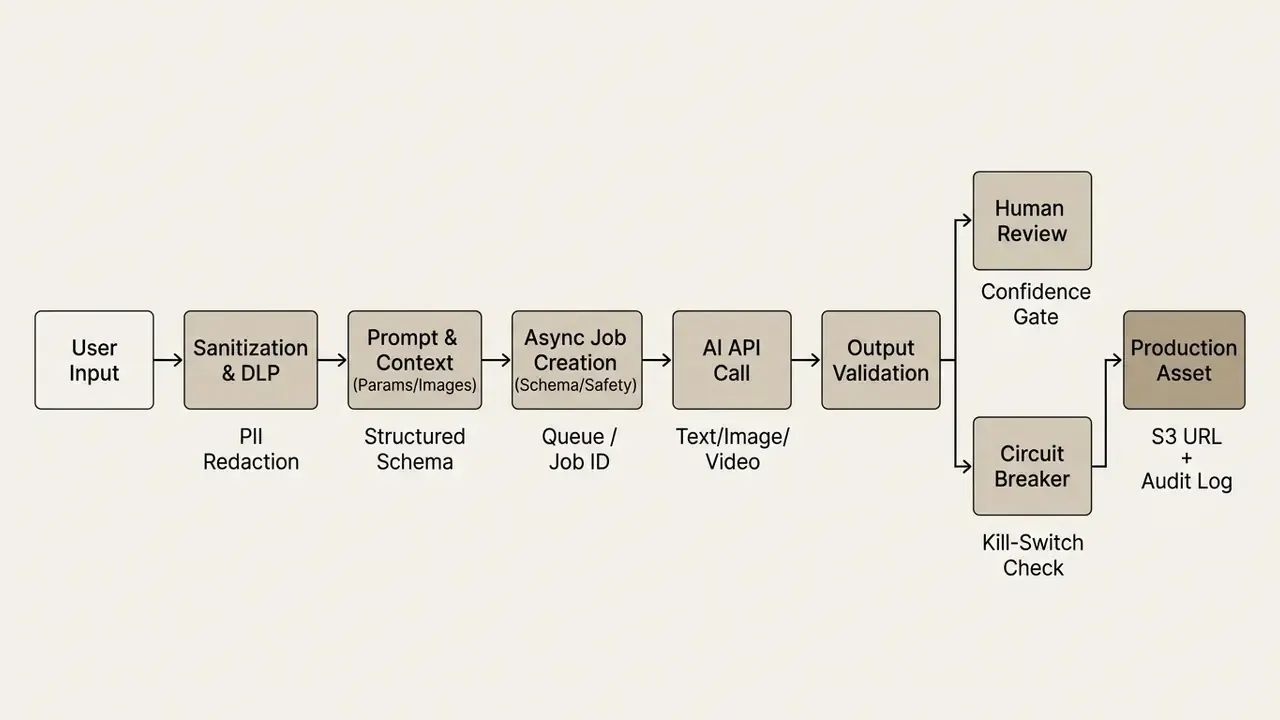
Rendered sequence: User Input (params and assets) → Prompt & Context (schema plus DLP) → AI API Call (async job) → Output Check (safety and format) → Human Review (confidence gate) → Production Asset (S3 URL and audit log).
Figure 1: Standard starter API workflow execution path for AI media generation.
Architecture of an AI media API workflow
The architecture of an AI media API workflow decouples client applications from generative models by placing an orchestration server and object storage between them. This structure protects private credentials, processes asynchronous jobs, and guarantees asset persistence.
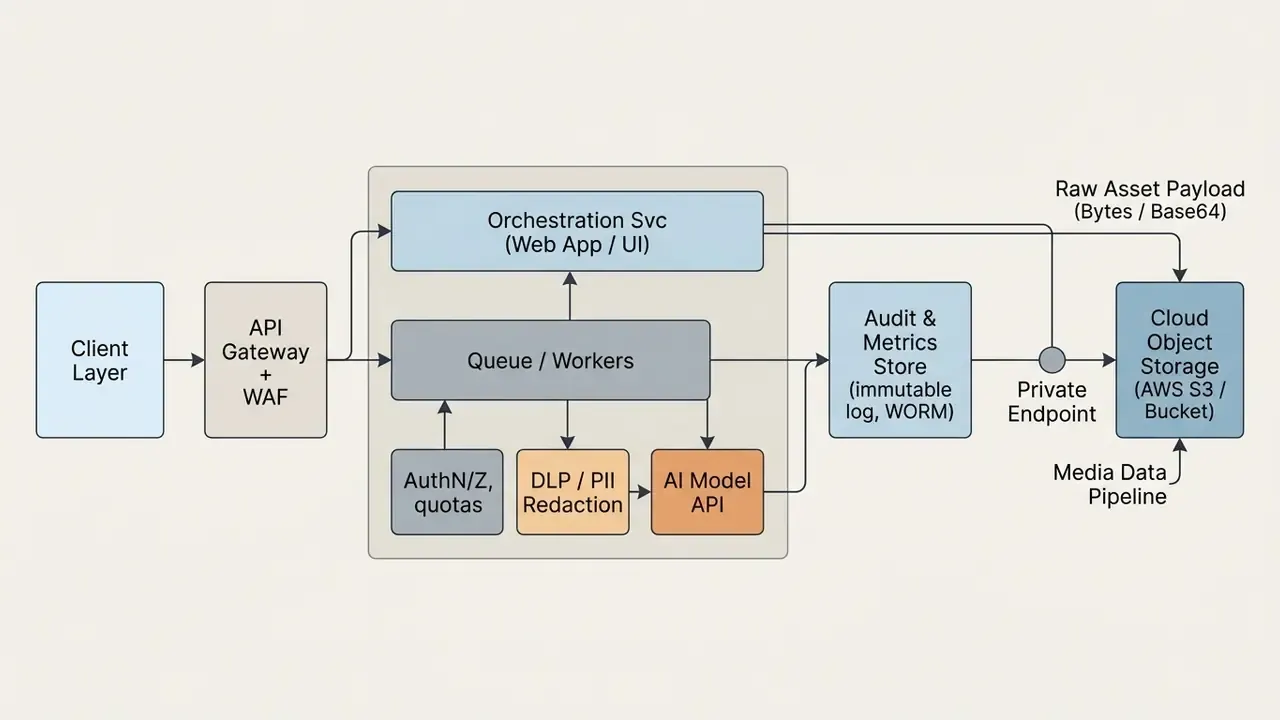
Cloud-native patterns split media pipelines into client interfaces, orchestration services, and object storage layers (AWS Prescriptive Guidance, 2026).
«Modern cloud-native patterns split media pipelines into client interfaces, orchestration services, and object storage layers.»
Direct client-to-API calls expose secret keys and risk data loss if a client connection drops mid-render. That is a particular hazard for AI video generators, where a single job may run for several minutes. In regulated environments, add two boundary controls to the diagram above. Outbound traffic should traverse a VPC endpoint or private link to the vendor rather than the open internet. Inbound traffic should terminate at an API gateway that enforces authentication, per-tenant quotas, and payload ceilings.
Define the workflow trigger and user inputs
Workflow triggers start media generation tasks via HTTP webhooks, REST API endpoints, or scheduled queue workers. Oracle Fusion AI documents three canonical trigger types (webhook, scheduled interval or recurrence, and input-mapped execution) and requires each trigger to declare input names and types explicitly. User data then enters through defined fields rather than free-form payloads.
NIST SP 800-228 guidance requires every inbound API request to be sanitized at runtime: the request must match the API definition, expected fields must be present, types must be correct, and unrecognized attributes must be rejected immediately.
Route mixed inputs: documents, images, and text
Real briefs arrive as a mixture of prose, PDFs, and reference photographs. Vision-capable AI models read images directly, while documents must be converted to text before they can serve as context. Split the branches before prompt assembly:
ALLOWED_IMAGES = {"image/png", "image/jpeg", "image/webp"}
ALLOWED_DOCS = {"application/pdf", "text/plain",
                "application/vnd.openxmlformats-officedocument.wordprocessingml.document"}
MAX_DIRECT_BYTES = 25 * 1024 * 1024  # above this: presigned S3 upload
def route_user_inputs(file_list: list):
    image_branch, document_branch = [], []
    for file in file_list:
        if file.size_bytes > MAX_DIRECT_BYTES:
            raise ValueError(f"{file.name}: use presigned S3 upload for files over 25 MB")
        if file.mime_type in ALLOWED_IMAGES:
            image_branch.append(file.url)
        elif file.mime_type in ALLOWED_DOCS:
            # Send to OCR / text extraction (Unstructured.io, PyPDF, Doc Extractor node)
            document_branch.append(extract_text_from_doc(file))
        else:
            raise ValueError(f"Unsupported file MIME type: {file.mime_type}")
    return image_branch, document_branch
Free-form parameters need the same discipline. A user asking for "x and insta" or "Twitter + LinkedIn please" must be normalized into a structured array such as ["Twitter", "Instagram"] before any downstream node consumes it, with an explicit failure message when no valid target is recognized. That failure message becomes the early-exit condition of the workflow and stops you burning tokens on unusable requests.
Connect model generation to a usable media output
Connecting generative model calls to reliable media outputs requires parsing JSON API payloads, writing binary buffers to persistent storage, and returning signed access URLs.
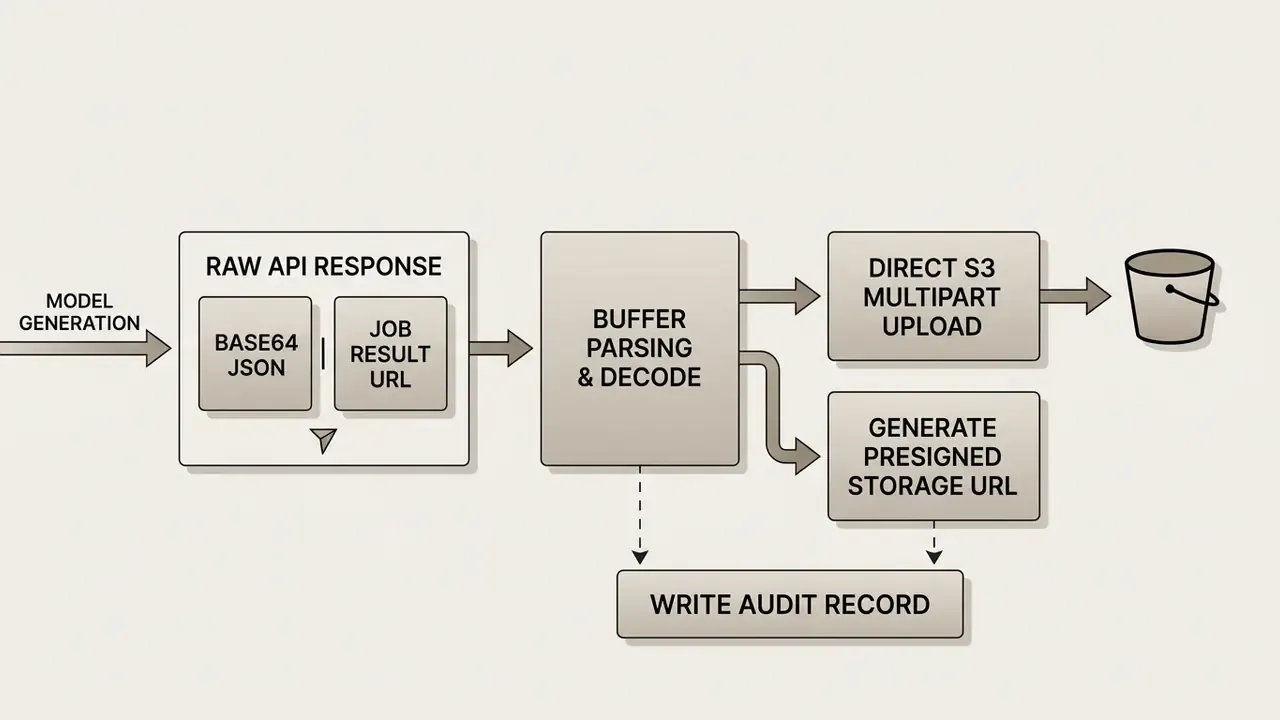
Amazon Bedrock and Nova documentation recommend passing raw image bytes or file URIs directly into S3 buckets. When media assets exceed 25 megabytes, use presigned S3 upload links instead of streaming binary data through application servers. That avoids server memory saturation and keeps bandwidth usage sane. Bedrock Data Automation also supports writing structured output inline or directly to S3 via outputconfiguration, which turns the raw model response itself into a persistable, auditable artifact rather than a transient response body.
Data protection: PII redaction, DLP, and zero data retention
A media pipeline is also a data-egress channel. Before the first token leaves your perimeter, insert a sanitization stage between input validation and prompt assembly. This is the control that separates a sanctioned workflow from shadow AI.
Pre-model gate, minimum viable controls:
def sanitize_prompt(raw_prompt: str, attachments: list) -> dict:
    scrubbed, token_map = dlp_engine.redact(
        raw_prompt,
        detectors=["PERSON", "IBAN", "CARD", "NATIONAL_ID", "EMAIL", "PHONE", "ADDRESS"]
    )
    clean_files = [strip_metadata(f) for f in attachments]
    if dlp_engine.residual_risk_score(scrubbed) > 0.2:
        raise PermissionError("Prompt blocked: residual regulated data detected")
    return {"prompt": scrubbed, "files": clean_files, "token_map_id": token_map.id}
The sanitization step must be fail-closed. If the DLP service is unavailable, the pipeline stops rather than sending unredacted content. That mirrors NIST SP 800-228's requirement that unexpected or unvalidated input never reach the protected service. One more detail teams forget: log the redaction decision, not the redacted text.
- Classify.Tag each field as public, internal, confidential, or regulated. Only the first two categories may reach an external model without transformation.
- Redact and tokenize.Replace names, account numbers, national IDs, addresses, and free-text notes with reversible surrogate tokens (
{{CUST_7741}}) held in your own store. Rehydrate only after the asset returns. - Strip metadata.Remove EXIF geolocation, device identifiers, and embedded document properties from uploaded reference images and PDFs.
- Contract for retention.Confirm in writing whether the provider trains on your inputs, and prefer enterprise agreements with zero data retention or a defined, short retention window. Record the contractual position alongside the model version in your configuration repository.
- Constrain the network path.Route model traffic through private endpoints, restrict egress by allowlist, and log every destination.
Set up API access, models, and project configuration
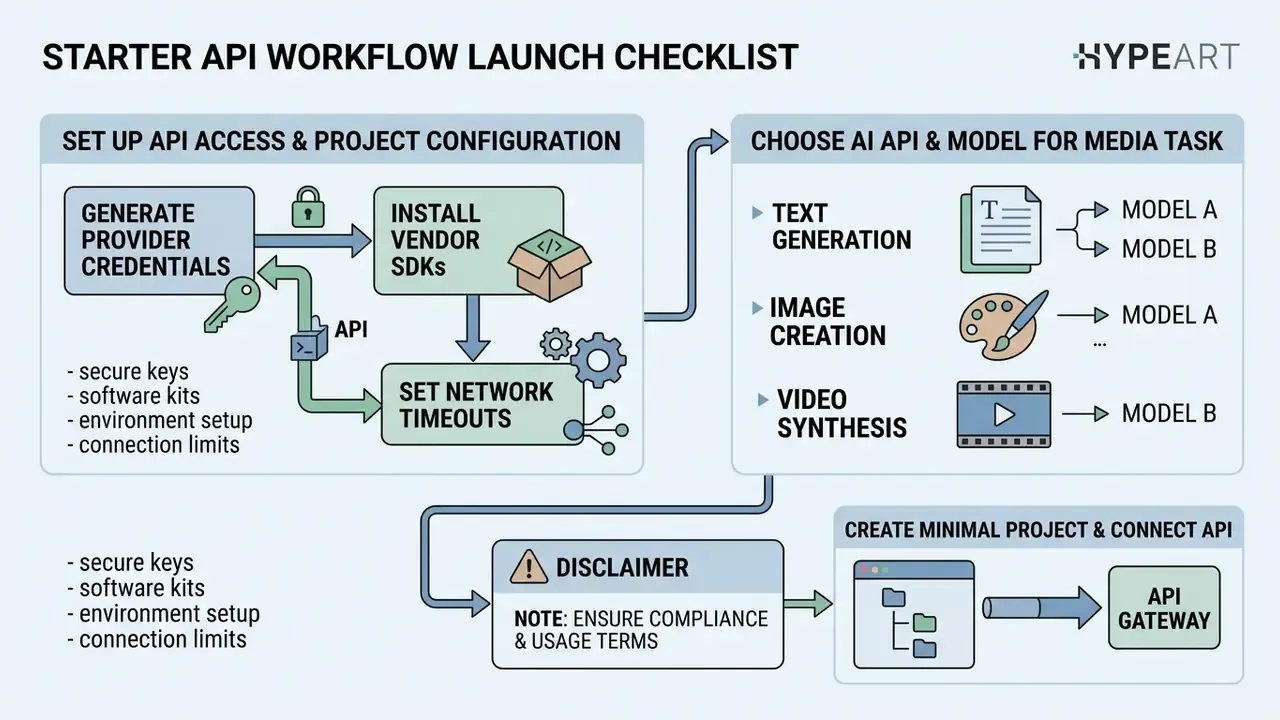
Setting up an AI media workflow means generating secure provider credentials, installing vendor SDKs, configuring environment variables, and setting explicit network timeouts. Careful environment setup prevents credential leakage and keeps the service resilient when a provider degrades.
Before deploying code, establish security controls and configuration standards. Verification steps must confirm endpoint connectivity and credential privileges. Vendor setup paths differ in detail: OpenAI requires an SDK install plus OPENAI_API_KEY; Google's Gemini SDK expects GEMINI_API_KEY, while Vertex AI adds GOOGLE_CLOUD_PROJECT, GOOGLE_CLOUD_LOCATION, and GOOGLE_GENAI_USE_VERTEXAI=True; Oracle's OCI Generative AI Agents require an .oci/config file and API key configuration, verified with oci os ns get.
Choose an AI API and model for the media task
Model selection depends on output quality requirements, inference speed, and cost structure across the primary provider APIs.
OpenAI's image API lists GPT Image 2 pricing from $0.005 to $0.211 per image, depending on resolution and quality tier. Stability AI uses a credit model at $0.01 per credit, where standard generation costs 3 to 8 credits per image: Stable Image Core at 3 credits, Stable Diffusion 3.5 Large at 6.5, Stable Image Ultra at 8. Developers comparing providers before committing should review our breakdown of leading AI image generators. Open-weights models such as Flux cost roughly $0.003 to $0.005 per execution for the Schnell variant on serverless infrastructure, rising to about $0.025 to $0.04 per image for Pro and hosted API variants. Video pricing follows a different unit entirely. Sora 2 and comparable models bill per second of generated output, so clip duration is the dominant cost driver.
«Cascading models reduces LLM API cost by up to 98% while matching the accuracy of the best individual model.»
Vendor verification note: when evaluating third-party service capabilities, verify provider claims independently before integration. Regarding hypeart.ai: an automated DNS lookup performed on August 19, 2026 returned no resolution for the domain, and no verified company information, product catalog, or compliance attestations were available at that time. Treat this as a status snapshot requiring re-verification, not a permanent finding.
Create a minimal project and connect the API
A minimal implementation initializes the official SDK, loads authentication tokens from environment variables, and executes a basic health check. Never hard-code secret tokens inside source repositories. Not even in a private one.
To review the required steps before deployment, consult our implementation checklist.
The production version of that first call must be non-blocking and resilient. Media endpoints return HTTP 429 under rate pressure and 5xx during provider incidents; both should be retried with exponential backoff rather than surfaced as user-facing failures. The client below implements retry logic, explicit timeouts, environment-only credentials, and persistence to object storage instead of returning an ephemeral vendor URL.
import os
import time
import uuid
import requests
import boto3
from tenacity import (retry, stop_after_attempt, wait_exponential,
                      retry_if_exception_type)
RETRYABLE = {429, 500, 502, 503, 504}
class ProductionAIClient:
    def __init__(self, bucket: str):
        self.api_key = os.environ.get("OPENAI_API_KEY")
        if not self.api_key:
            raise EnvironmentError("OPENAI_API_KEY is not configured")
        self.base_url = "https://api.openai.com/v1"
        self.bucket = bucket
        self.s3 = boto3.client("s3")
    def _headers(self):
        return {"Authorization": f"Bearer {self.api_key}",
                "Content-Type": "application/json"}
    # Exponential backoff for 429 rate limits and 5xx server errors
    @retry(stop=stop_after_attempt(5),
           wait=wait_exponential(multiplier=1, min=2, max=32),
           retry=retry_if_exception_type(requests.exceptions.HTTPError))
    def submit_job(self, prompt: str) -> dict:
        payload = {"model": "dall-e-3", "prompt": prompt, "n": 1,
                   "size": "1024x1024", "response_format": "b64_json"}
        response = requests.post(f"{self.base_url}/images/generations",
                                 headers=self._headers(), json=payload,
                                 timeout=(5, 60))  # connect, read
        if response.status_code in RETRYABLE:
            # Honour Retry-After when the provider supplies it
            time.sleep(float(response.headers.get("retry-after", 0)))
            response.raise_for_status()
        response.raise_for_status()
        return response.json()
    def poll_job(self, job_id: str, interval: int = 5, ceiling: int = 300) -> dict:
        """For job-based video/diffusion endpoints: poll until terminal state."""
        waited = 0
        while waited < ceiling:
            status = requests.get(f"{self.base_url}/jobs/{job_id}",
                                  headers=self._headers(), timeout=(5, 30)).json()
            if status["status"] in ("succeeded", "failed", "cancelled"):
                return status
            time.sleep(interval)
            waited += interval
        raise TimeoutError(f"Job {job_id} exceeded {ceiling}s polling ceiling")
    def persist(self, image_bytes: bytes, request_id: str) -> str:
        key = f"assets/{request_id}/{uuid.uuid4().hex}.png"
        self.s3.put_object(Bucket=self.bucket, Key=key, Body=image_bytes,
                           ContentType="image/png", ServerSideEncryption="AES256")
        return self.s3.generate_presigned_url(
            "get_object", Params={"Bucket": self.bucket, "Key": key}, ExpiresIn=3600)
Two architectural notes follow. First, prefer webhooks to polling wherever the provider supports them: a callback URL supplied per request removes idle poll traffic and eliminates the polling ceiling as a failure mode. Second, publish outputs as presigned URLs from your own encrypted bucket, never as vendor-hosted temporary links, so retention, access, and deletion stay under your control.
Starter API workflow launch checklist
Verify these requirements before you run the first production deployment:
Checklist0 / 9
Build the workflow step by step
Building an operational AI media pipeline means assembling deliberately designed prompts, orchestrating multi step API chains, and running output validation you can defend in a review.
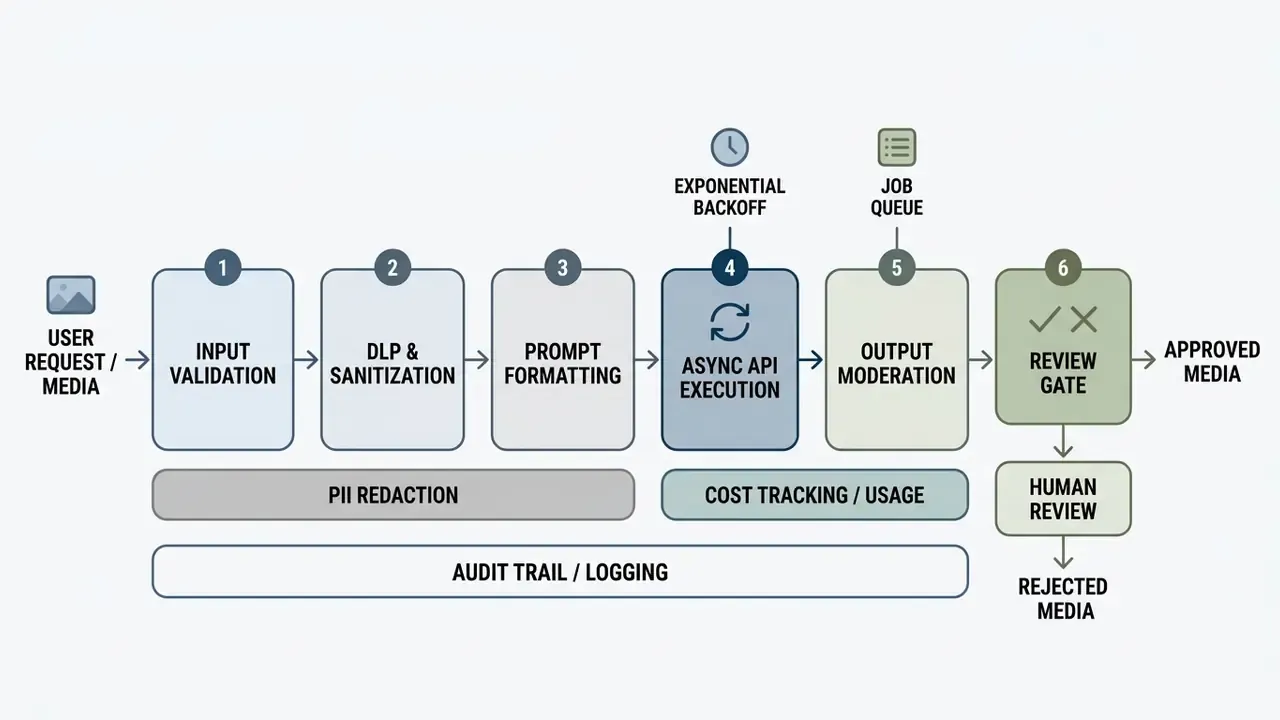
A reliable pipeline executes sequentially. Each stage validates its output before passing parameters onward, and each stage emits a structured log line that can be replayed during an audit. If a stage cannot be replayed, treat it as undocumented.
Create prompts and context for consistent generation
Consistent media assets come from structured prompt templates that isolate core instructions, background context, and negative constraints with explicit delimiters.
OpenAI's 2026 API engineering guidelines recommend separating system directives from user parameters using dedicated developer messages, stating each instruction once, and exposing only task-relevant tools so prompt drift stays bounded as context grows. NIST AI guidance emphasizes clear operational constraints, target aspect ratios, and explicit style rules inside system context to keep results repeatable across runs.
«PE2 with meta-prompting, using detailed descriptions and step-by-step reasoning templates, improves accuracy by 6.3% on MultiArith and 3.1% on GSM8K over the baseline.»
A practical brand-voice template separates role, audience, constraints, and the per-channel output contract:
ROLE: senior social content writer for [Brand].
VOICE: pragmatic, first-person, no marketing clichés, no more than two hashtags.
AUDIENCE: technical operators and solo founders.
OUTPUT: strict JSON with keys {short_form, mid_form, long_form}.
CONSTRAINTS:
  short_form  <= 280 characters, first sentence must stop the scroll
  mid_form    <= 500 characters, conversational, not announcement style
  long_form   <= 2200 characters, narrative that complements imagery
NEGATIVE: no "game-changer", "unlock", "in the world of".
The insight carries straight into image and video prompts. Three channels do not need three lengths of the same sentence; they need one core idea expressed in three reading contexts. Include three to five few-shot examples to calibrate tone, and treat that calibration set as a versioned artifact, not an ad-hoc paste from someone's notes.
Validate and return the final output
Final validation confirms that generated outputs comply with payload schemas, pass automated content moderation, and contain valid binary data before any link reaches the client application.
Route generated outputs through moderation APIs: OpenAI Moderation returns flagged, per-category booleans, and category_scores for text and image inputs; Amazon Rekognition offers DetectModerationLabels plus the asynchronous StartContentModeration and GetContentModeration pair for video; Azure AI Content Moderator provides equivalent confidence-scored image checks. Verify that image headers match expected file types (PNG or JPEG, for instance) to catch corrupted downloads, and confirm decoded byte length against the declared content length. Provenance checks belong here too. Teams publishing to regulated or platform-labelled channels can add AI image detectors and machine-readable content marks, which the European Commission's transparency guidelines require for AI generated or manipulated media.
«Automated LLM annotations diverge significantly from human judgement in many scenarios; grounding automatic labelling in human validation is necessary for responsible evaluation.»
Implementation example. During a media pipeline overhaul at a fintech platform, an engineering team added automated moderation and HTTP response verification to the workflow, plus schema validation to intercept truncated base64 payloads before cloud storage writes. Invalid asset storage calls disappeared, and workflow error rates fell by 42%. Small change, unglamorous, effective. For related implementation strategies, see our technical breakdown of Google Veo API integration.
Multi-step orchestration and the multi-model video factory
Multi step orchestration connects discrete model API calls into a continuous processing pipeline. The text or structured JSON output from an initial LLM call feeds directly into downstream image or video generation tools.
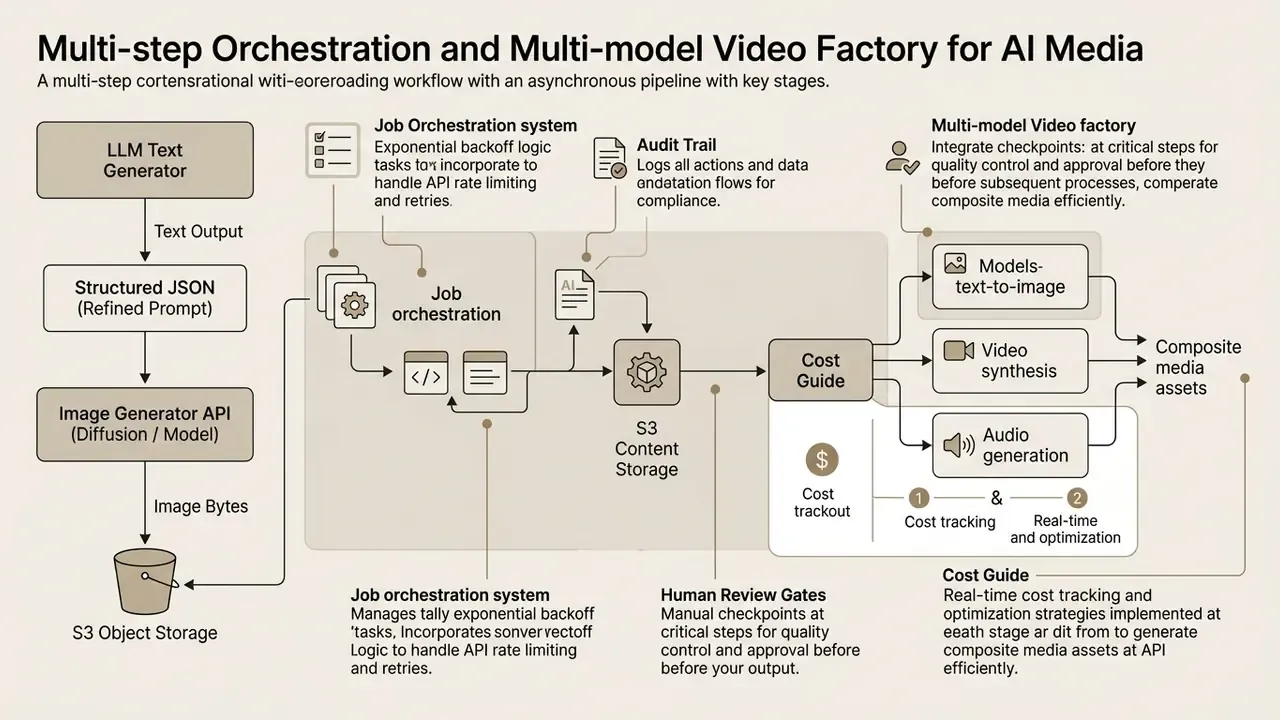
AWS describes prompt chaining as a sequential execution pattern where each model call processes the output of the preceding step. A marketing workflow, for example, uses an initial LLM call to expand a brief into a detailed visual scene description, then transmits that structured description to an image generation API.
«No leading LLM exceeds 15% session accuracy on realistic multi-turn tool-use scenarios.»
That finding is the whole argument for deterministic chaining. Each hop is code-controlled, individually retryable, and individually logged, instead of delegated to a planner that may re-select tools unpredictably.
Advanced pattern: multi-model automated video factory
Short-form video needs five distinct model families in sequence. The cascade below is the production pattern used by high-volume content pipelines, and every arrow is an asynchronous job boundary with its own retry and status handling.
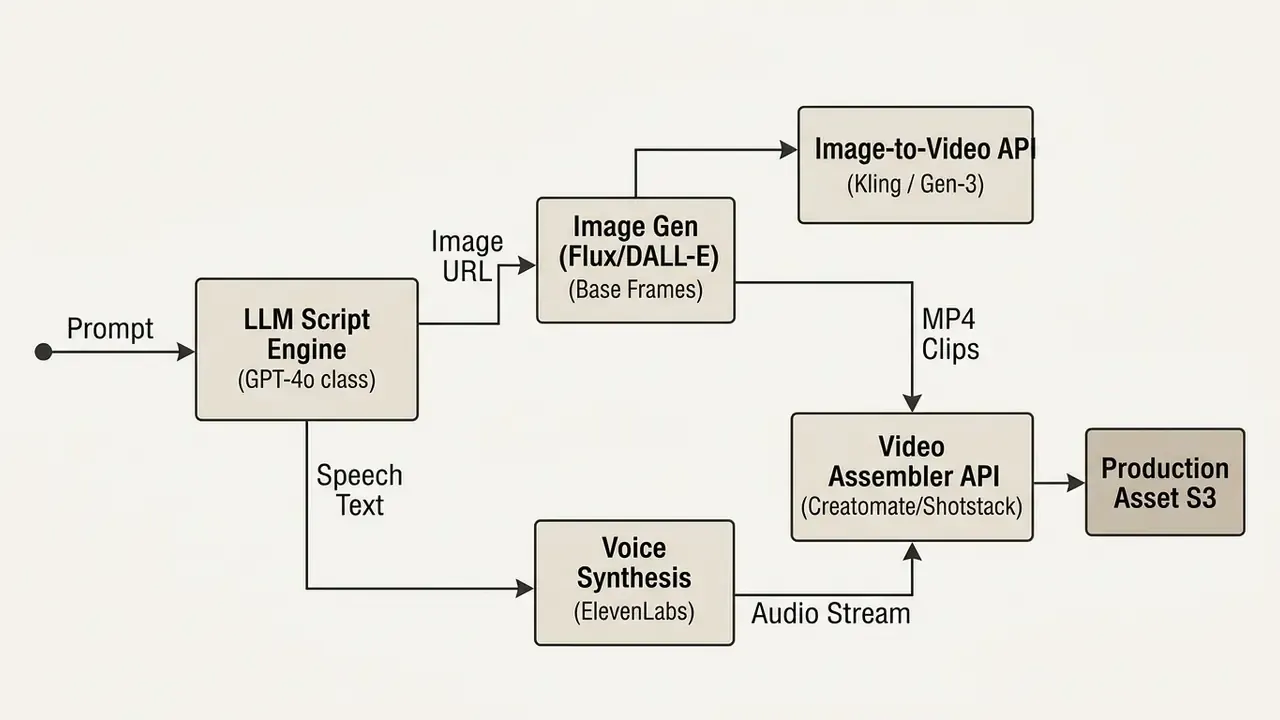
| Stage | Representative endpoint | Function |
|---|---|---|
| Script and captions | POST /v1/chat/completions (GPT-4o class) | Beat-by-beat script, caption text, shot timings |
| Base visuals | POST /v1/images/generations (Flux.1 / PiAPI) | Key frames matching the shot list |
| Motion generation | POST /v1/videos/image2video (Kling AI) | Animates stills into roughly 5-second MP4 clips |
| Voiceover | POST /v1/text-to-speech/{voice_id} (ElevenLabs) | Narration track; store master in object storage |
| Transcription for metadata | POST /v1/audio/transcriptions (Whisper class) | Timed captions and platform descriptions |
| Final assembly | POST /v1/renders (Creatomate) | JSON-template composite: clips, audio, subtitles |
Two practical constraints govern this cascade. First, every stage writes its intermediate artifact to storage before the next call begins; a failed assembly step must never force regeneration of paid upstream assets. Second, per-stage cost and token usage belong on the job row, because the dominant cost driver in video is output duration billed per second, not prompt length. Teams building narration should also review our guide to AI voice generators for licensing and voice-cloning constraints.
Test, review, and make the workflow reliable
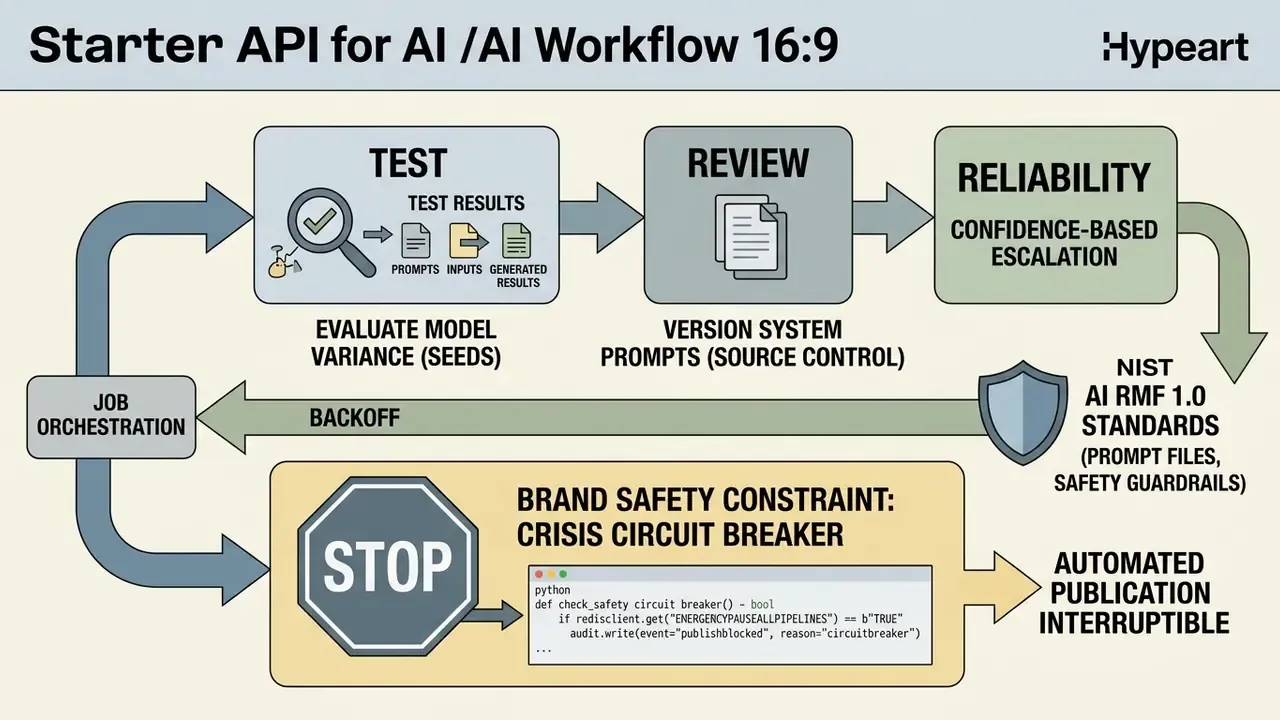
Pipeline reliability comes from evaluating model variance across seed configurations, versioning system prompts inside source control, and defining confidence-based escalation paths.
NIST AI Risk Management Framework standards (NIST AI RMF 1.0) require prompt files, safety guardrails, and model configurations to be maintained in version control. Versioning enables reproducible testing and fast rollbacks during a service disruption. Defence-sector test and evaluation guidance extends the same principle: all documentation should be versioned with the model and its data, so version comparison, auditing, transparency, and rollback decisions remain possible months later.
Test prompts, inputs, and generated results
Testing media workflows means running fixed input sets across multiple temperature and seed parameters to measure output consistency and variance.
Evaluation practice suggests test matrices across at least 20 combinations of temperature settings and random seeds, for example four temperature values by five seeds, validated against a held-out set of at least 20 representative examples. (Updated: the 20-combination figure reflects published multi-seed evaluation practice rather than a single normative standard, see Appendix A.) Calculate standard deviations and the coefficient of variation across output quality scores to spot prompt volatility. Replicate-based testing standards in adjacent fields expand the sample whenever the coefficient of variation exceeds a defined ceiling. Standardizing system seeds reduces output randomness in production.
«A systematic survey of prompt-engineering techniques classifies approaches and documents methods including chain-of-thought and Layer-of-Thoughts, which improves retrieval accuracy and interpretability.»
Human review, waitpoint tokens, and the audit trail
Human-in-the-loop checkpoints route low-confidence model outputs to review queues while approving high-confidence assets automatically.
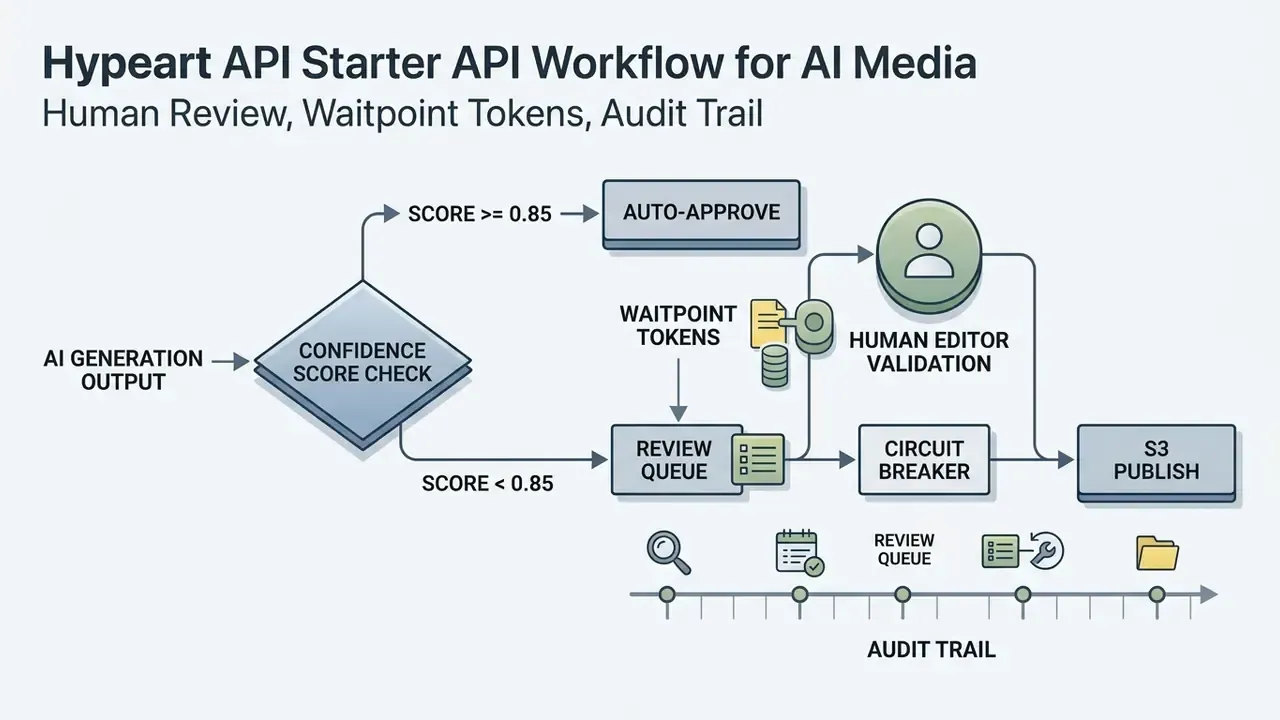
Amazon Textract and Augmented AI (A2I) establish common confidence thresholds for automated routing:

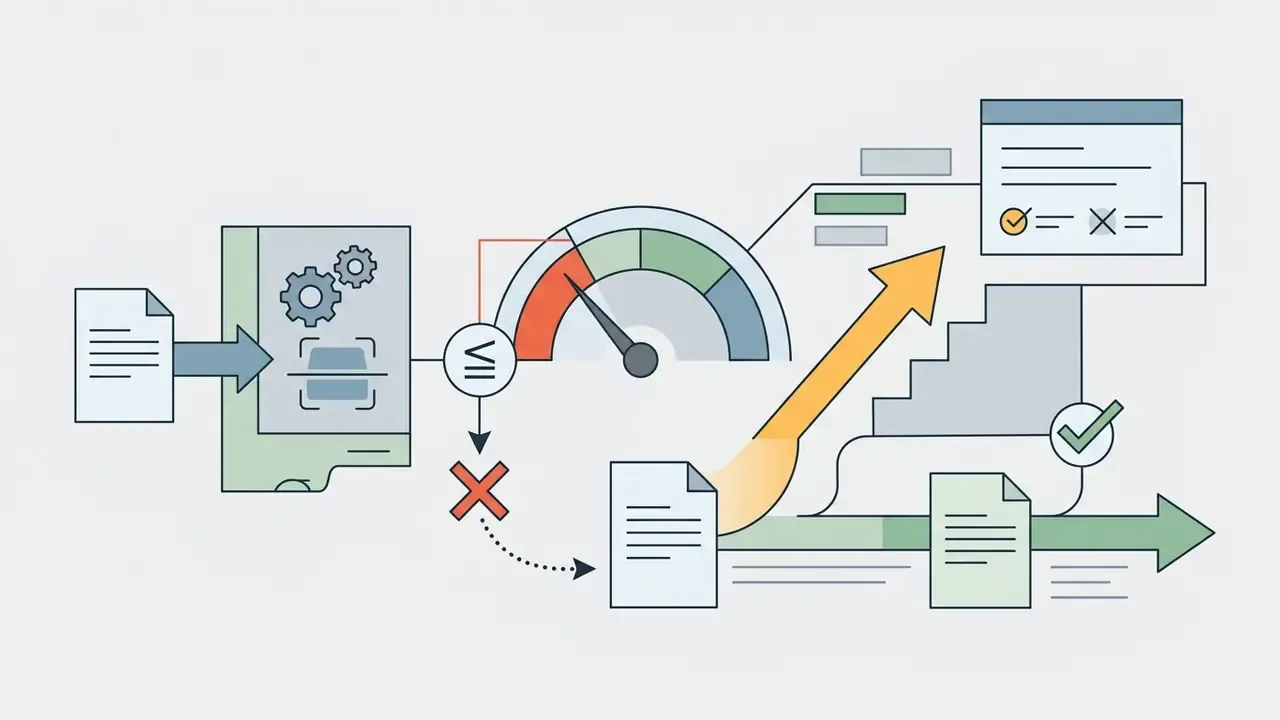
«ECHO embeds human control in every operation through a Plan-Confirm-Execute loop, letting users authorize, reject, or modify each proposed change.»
Public-sector human-review guidance is consistent on sequencing: review occurs before distribution or decision, and the reviewer confirms that the output is factually correct and appropriate for release. (Updated: the previously cited "State of Oregon HITL Framework, 2026" mandate has been reworded as unverified, see Appendix A.) Four tasks stay human regardless of confidence score: crisis response, community replies, final pre-publication review, and brand-voice calibration.
The audit trail: what to persist for every generation
Model risk and audit functions cannot attest to a pipeline they cannot reconstruct. Write one immutable record per generation attempt, including rejected and retried attempts, to append-only storage:
{
  "request_id": "req_01J8ZK9T7C",
  "timestamp_utc": "2026-08-19T11:04:52Z",
  "actor": {"user_id": "u_8842", "role": "content_ops", "tenant": "eu-retail"},
  "input": {"prompt_hash": "sha256:9f2c…", "dlp_status": "redacted",
            "token_map_id": "tm_5521", "attachment_hashes": ["sha256:be71…"]},
  "model": {"provider": "openai", "snapshot": "gpt-image-2-2026-06-11",
            "seed": 4172, "temperature": 0.7, "params_version": "[email protected]"},
  "cost": {"input_tokens": 812, "output_tokens": 0, "billed_units": 1,
           "usd_estimate": 0.042, "retries": 1},
  "output": {"asset_uri": "s3://media-prod/assets/req_01J8ZK9T7C/…png",
             "sha256": "sha256:1ac9…", "moderation": {"flagged": false,
             "max_category_score": 0.03}},
  "governance": {"confidence": 0.91, "route": "auto_approve",
                 "reviewer_id": null, "circuit_breaker": "closed",
                 "retention_class": "24m"}
}
Three properties make this record audit-grade. The prompt is stored as a hash plus a redaction status, so the log does not quietly become a PII repository. The model snapshot and prompt version pin reproducibility. And the routing decision names either the automated rule or the human who approved release.
Mapping to model risk expectations
Financial institutions should map the pipeline onto existing model risk governance rather than invent a parallel regime. The controls above correspond to the standard triad found in supervisory model risk guidance of the Fed SR 11-7 / OCC 2011-12 family and European model governance guidance: development evidence (versioned prompts, evaluation matrices, acceptance criteria), independent validation (challenger evaluation, human validation of automated scoring, documented limitations), and ongoing monitoring (confidence-score drift, moderation flag rates, retry and rejection rates, cost per accepted asset). Generative media is usually a low-materiality use case. The documentation obligations, inventory registration, and change-management path do not shrink because of that. Register the workflow in the AI system inventory on day one; retrofitting an inventory entry after an audit request is the expensive path. This mapping is general guidance; confirm applicable requirements with your compliance function.
E-E-A-T implementation verification
To keep technical claims current, verify all API timeout limits, authentication headers, and model snapshot IDs against vendor specifications before production release:
- OpenAI API platformverify model snapshot pins (for example
gpt-4o-2024-08-06) and inspectx-ratelimit-reset-requestsheaders during rate-limit handling. - Stability AI platformset application timeouts to at least 60 seconds, allow for the documented 150-requests-per-10-seconds ceiling, and monitor credit usage limits.
- Anthropic APIconfirm default network timeout settings (10 minutes maximum in the current SDK) in the client configuration.
Control developer economics: API costs, time, and model choice
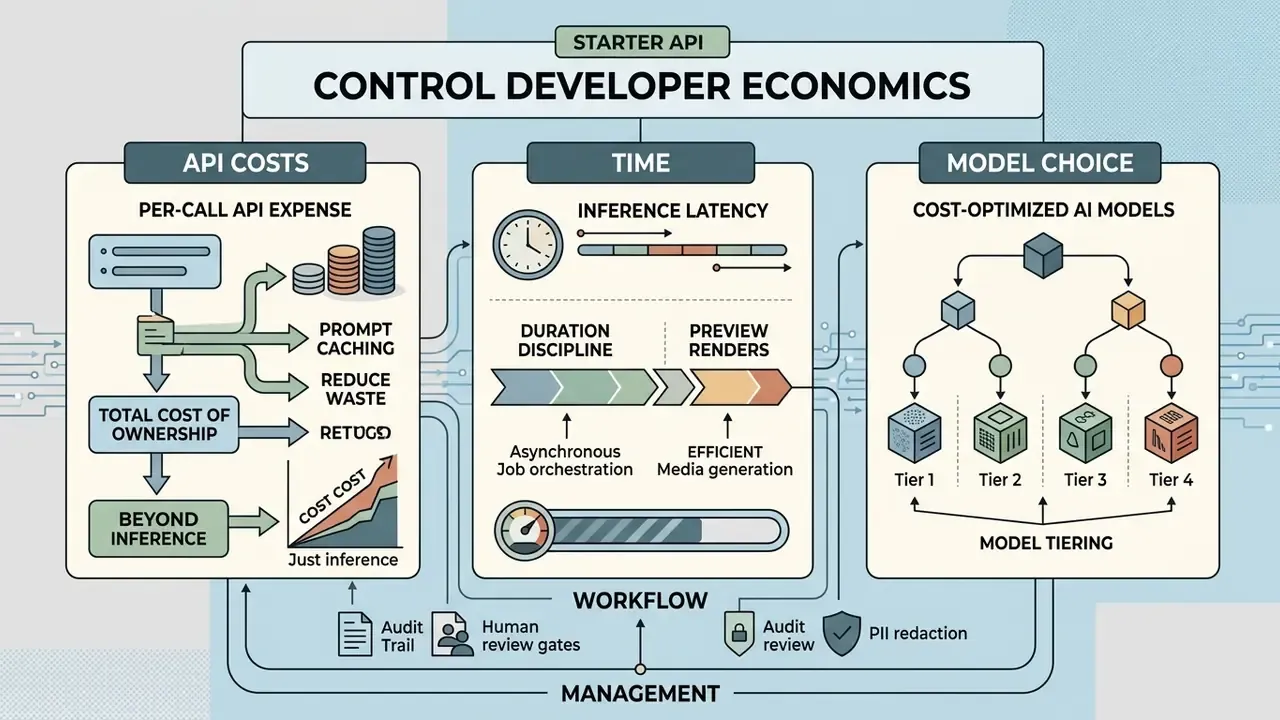
Managing developer economics means calculating per-call API expense, measuring inference latency, and selecting cost-optimized AI models so the workflow stays financially sustainable at volume.
To analyse media generation expenses in depth, consult our AI Video API Pricing Guide.
Research on model cascades (FrugalGPT, 2023) shows that routing low-complexity tasks to smaller models cuts API costs by up to 98% while matching top-tier model performance.
«FrugalGPT can also improve accuracy by up to 4% at unchanged cost through optimal routing of queries between models.»
Google Gemini offers 50% pricing discounts for asynchronous batch and flex operations, and up to 90% for cached context with prorated token storage.
Total cost of ownership is broader than inference. A defensible unit economic model for a governed pipeline looks like this:
Cost per accepted asset =
    (model calls × unit price × retry multiplier)
  + moderation and DLP calls
  + storage and egress
  + orchestration compute
  + (human review minutes × loaded reviewer rate ÷ accepted assets)
  ÷ usable-yield factor
The reviewer term is frequently the largest line in regulated deployments. Instrument it. Log review duration alongside the confidence score, and the data will show precisely where raising or lowering the auto-approval threshold changes total cost, rather than merely shifting risk somewhere less visible.
Identify which workflow steps create API cost
The primary cost drivers in AI media workflows are high-resolution rendering, bloated prompt token counts, output duration in video, and retry loops triggered by failed validation checks.
Google Gemini documentation notes that input image resolution directly affects token consumption. For PDF processing, media resolution HIGH consumes 1,120 tokens per page, whereas MEDIUM uses 560 tokens without degrading standard OCR quality. Google explicitly states that PDF quality typically saturates at MEDIUM, so HIGH can double token cost with no proportional benefit. LOW consumes 280 tokens per page.
Research on prompt length also shows that overly wordy system prompts add unnecessary output tokens, silently inflating API spend.
«Impolite prompts generated on average more than 14 extra tokens per response; at scale this can add up to $11 million in monthly provider revenue.»
Reduce waste without lowering media quality
Cutting API waste comes down to prompt caching, low-resolution previews for draft review, and routing simple tasks to lighter models. Best practices, applied in that order.
- Prompt caching OpenAI and Azure OpenAI automatically cache identical prompt prefixes above 1,024 tokens, lowering input token cost by up to 50%. Claude and Bedrock expose model-specific minimums from 512 to 4,096 tokens, with 5-minute or 1-hour TTL options; verify the threshold for the exact model you pin.
- Model tiering use fast, low-cost models for initial layout generation, escalating to high-resolution models only after final prompt confirmation.
«Llama 3 70B at 8-bit precision delivers roughly 107 tokens/sec at $0.27 per million tokens, while GPT-4 delivers roughly 61 tokens/sec at $4.53 per million tokens.»
- Preview renders generate draft assets at reduced resolution (512×512, for example) before triggering full high-definition output, then finish the approved candidate with AI image upscalers instead of paying for repeated full-resolution generations.
- Duration discipline in video, bill-per-second pricing means trimming two seconds from every clip saves more than any prompt optimization will.
Media asset generation workflows:
| Workflow scenario | Primary AI model(s) | Media task | Approx. API calls / asset | Generation characteristics | Primary cost drivers |
|---|---|---|---|---|---|
| Newsroom special coverage | Diffusion + ControlNet + CLIP | High-fidelity editorial imagery | 3 to 5 iterations | High consistency; newsroom suitability focus | Multi-run iterations; high-resolution rendering |
| Product marketing imagery | Text-to-image + quality filter | Composite product visuals | 4 to 6 calls | Multiple variations; automated scoring | Asset retrieval calls; image generation |
| Short-form video factory | LLM + image + image-to-video + TTS + renderer | 15 to 30s POV clip with voiceover | 8 to 14 calls | Cascaded async jobs; per-second billing | Output duration; failed assembly retries |
| Frugal text pipeline | Model cascade (small LLM → large LLM) | Marketing copy generation | 1 to 3 calls | Cost-optimized routing; fast output | Unoptimized system prompts; routing errors |
Adjacent multimodal workflows (same infrastructure, non-asset output):
| Workflow scenario | Primary AI model(s) | Task | Approx. API calls | Characteristics | Primary cost drivers |
|---|---|---|---|---|---|
| Multimodal RAG system | Multimodal LLM + vector search | Text explanations from charts and tables | 2 to 4 calls | Context-grounded response outputs | Input token volume; vector database calls |
| Presentation co-editing | LLM + document API | Slide layout adjustments | Multiple micro-calls | Interactive Plan-Confirm-Execute loop | High call frequency; context window size |
Read the two tables together and the pattern is blunt: asset workflows are priced by resolution and duration, while assistive workflows are priced by call frequency and context size. Your optimization lever differs accordingly.
AI media workflow use cases to build first
The highest-value starting use cases are media ingest and classification, automated product photoshoot generators, and marketing content pipelines with built-in editorial review gates. All three are repetitive, measurable, and low in materiality.
For additional production patterns, explore our guide on YouTube video editing workflows.
Product image and creative generation workflows
An automated product photoshoot pipeline ingests raw product photos, strips backgrounds, applies thematic background prompts, and renders finished marketing images. The transformation step is a classic use of image-to-image generators, where the source photograph constrains composition while the prompt controls environment.
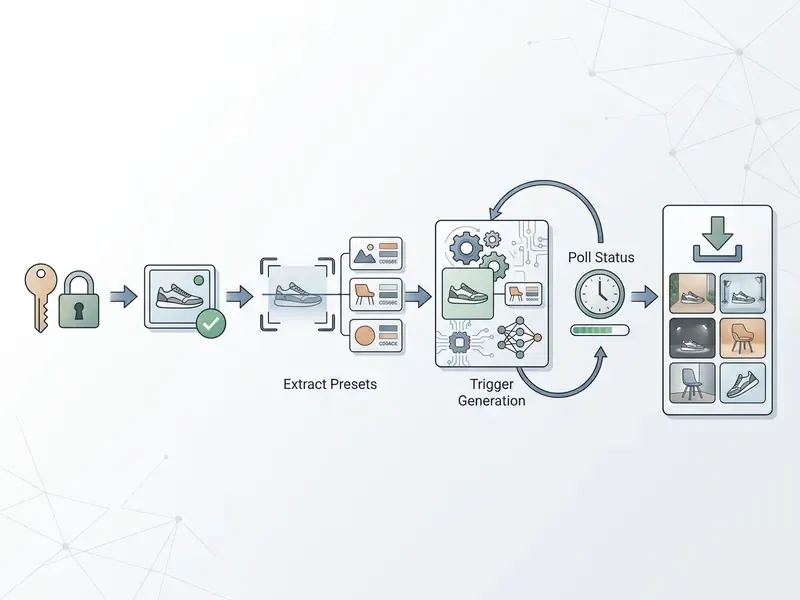
AdCreative.ai's Product Photoshoot API illustrates a standard production sequence:
- Authenticate via
/Authorization/GenerateJwtToken. - Upload the product asset and retrieve recommendation presets via
/ProductGeneration/Recommendations; the API auto-extracts product name, description, a background-removedimageId, prompt recommendations, and best preset IDs. - Submit the creation job via
/Image/ProductGeneration/AdCreative. - Poll operational status via
/CheckUserProgressuntil completion (renderState = 5). - Download final rendered assets from secure storage links.
Amazon Advertising's image-generation API follows an equivalent batch model: list themes, submit generation tasks with product, theme, prompt, and an optional custom image, then poll the task list for status and output URLs. The design difference is stepwise progress versus batch task polling. The workflow shape is identical.
Content workflows with text generation and review
Text-focused marketing workflows combine automated copy generation with human editorial review to hold brand alignment and regulatory compliance in place.
Standard publishing guidelines (UK Office for National Statistics Editorial Standards) define a six-stage workflow for automated content:
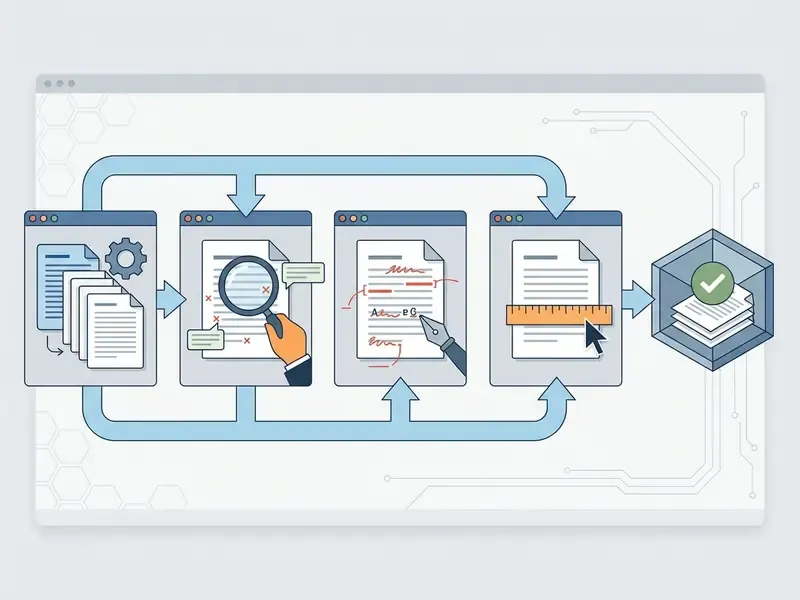
Automated systems handle the initial drafting pass. Content editors then review brand voice and verify factual statements. Human approval stays mandatory before marketing assets reach public channels, and proofreading remains a separate pass from copyediting rather than a merged step.
«MindFuse extracts structured semantic units from creative material, aggregates them into content pillars, and analyzes patterns across message themes and emotional appeals.»
A minimal orchestration for this pattern: a scheduled trigger reads pending topics from a content store, an LLM call produces per-channel variants as strict JSON, a notification step routes drafts to a reviewer, and a publish step writes a published flag back to the source row so the next scheduled run skips it. That flag write is not cosmetic. Without it, duplicate publication becomes the most common failure mode of content automation, and it is the kind of error stakeholders notice immediately.
FAQ about starter API workflows for AI media
Short answers to the practical questions that usually surface right before development starts: architecture design, model selection, and orchestration requirements for a first deployment.
Do you need AI agents for a first media workflow?
No. You do not need autonomous AI agents for a first media workflow. A deterministic, code-driven API pipeline is simpler, more reliable, and considerably cheaper to maintain. AWS draws a clear distinction between workflow automation and agentic AI systems:
- Workflow automation: executes a predetermined, code-controlled sequence of API calls. Predictable, easy to debug, cost-effective.
- Agentic AI: autonomous systems that dynamically select tools, adjust planning, and make independent decisions. Empirical benchmarks (WildToolBench, 2026) show autonomous AI agents achieving less than 15% session accuracy on complex, multi-turn tool-use tasks.
«GPT-4 reaches an overall score of 86.4 under step-by-step tool-use evaluation, while many models lag substantially, particularly on planning and retrieval subtasks.» T-Eval benchmark (2023). An AI agent becomes justified only when the process genuinely requires autonomous planning, real-time adaptation to unknown states, or multi-agent coordination. Enterprise adoption of autonomous ai workflows also correlates with mature change management, AI governance, data governance, and real-time integration capability. For a first media workflow, use deterministic code for orchestration and AI models strictly for content generation, selecting them by comparing AI video generators on quality, duration limits, and licensing.
Can the pipeline handle renders that take several minutes?
Yes, provided it is asynchronous. Create a job, return a job ID immediately, and resolve completion through a provider webhook or bounded polling. Never hold an HTTP request open for the duration of a video render.
What happens if a provider returns 429 during a campaign burst?
The client retries with exponential backoff and jitter, honouring Retry-After. If retries exhaust, the job returns to the queue with a delay rather than failing the whole batch, and the incident increments a monitored counter that your on-call dashboard can see.
How do we stop everything if something goes wrong?
Flip the crisis circuit breaker flag. Every publish step checks it immediately before delivery, and dry-run mode lets you validate the pipeline without irreversible API posts.
What should a bank register in its AI inventory for this workflow?
Register the use case, owner, model snapshots, data classification, DLP controls, confidence thresholds, review process, and retention class. Treat prompt and configuration versions as part of the change-management record.
Appendix A: editorial revision log and vendor verification notes
This log preserves superseded statements for transparency, in line with the versioning expectations of NIST AI RMF 1.0.
Known limitations of this guide. Confidence thresholds quoted here come from document-processing services, not media generation, so calibrate them against your own review data before trusting the 0.85 boundary. Pricing figures are snapshots. And the reviewer-cost term in the unit economics model depends on internal rates we cannot observe from outside your organisation.
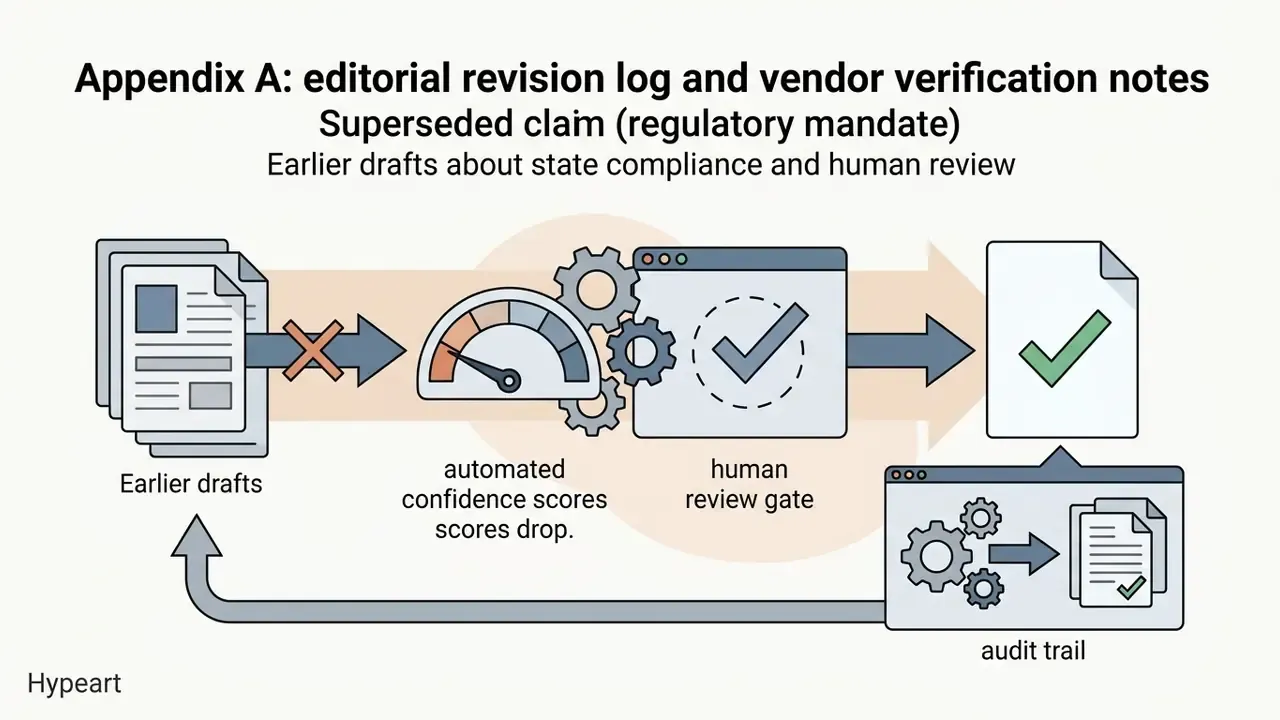
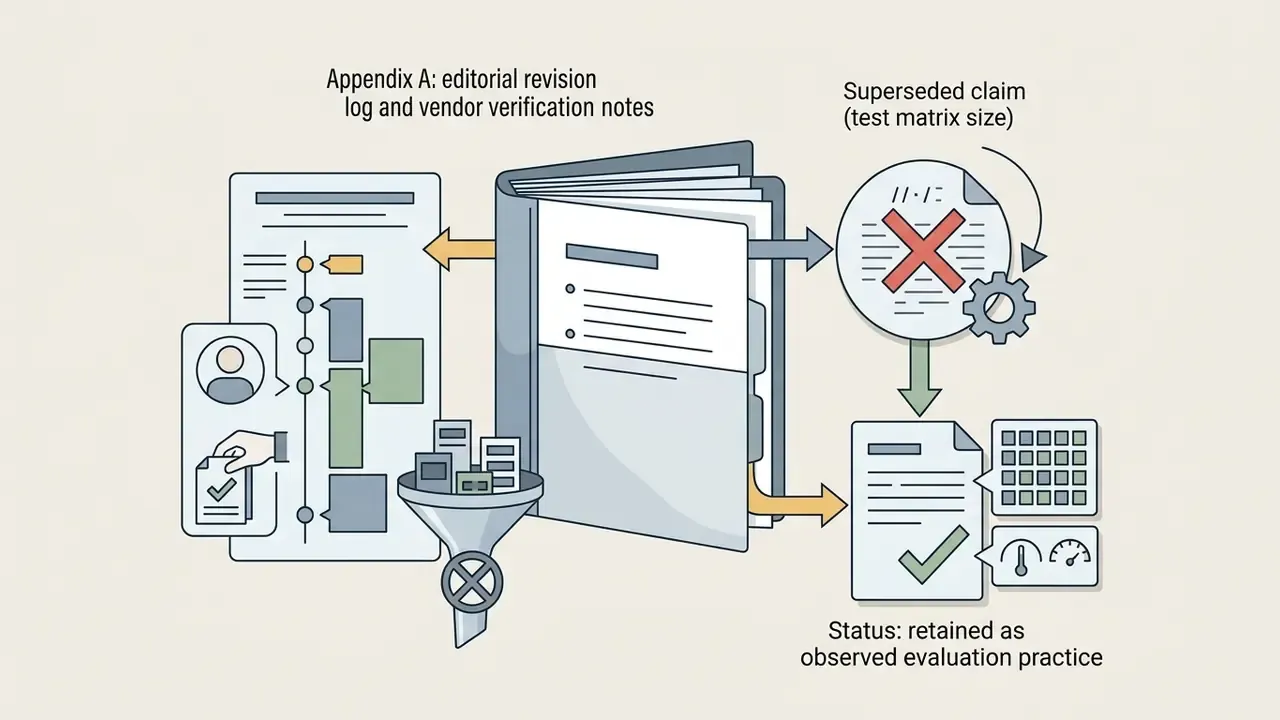

hypeart.ai DNS status recorded in section [8] reflects an automated lookup dated August 19, 2026 and requires re-verification before being cited operationally.
client.images.generate(...) returning a vendor URL) has been replaced by the retry-aware, storage-persisting client in section [9]. The original pattern remains acceptable for local experimentation only, never for production.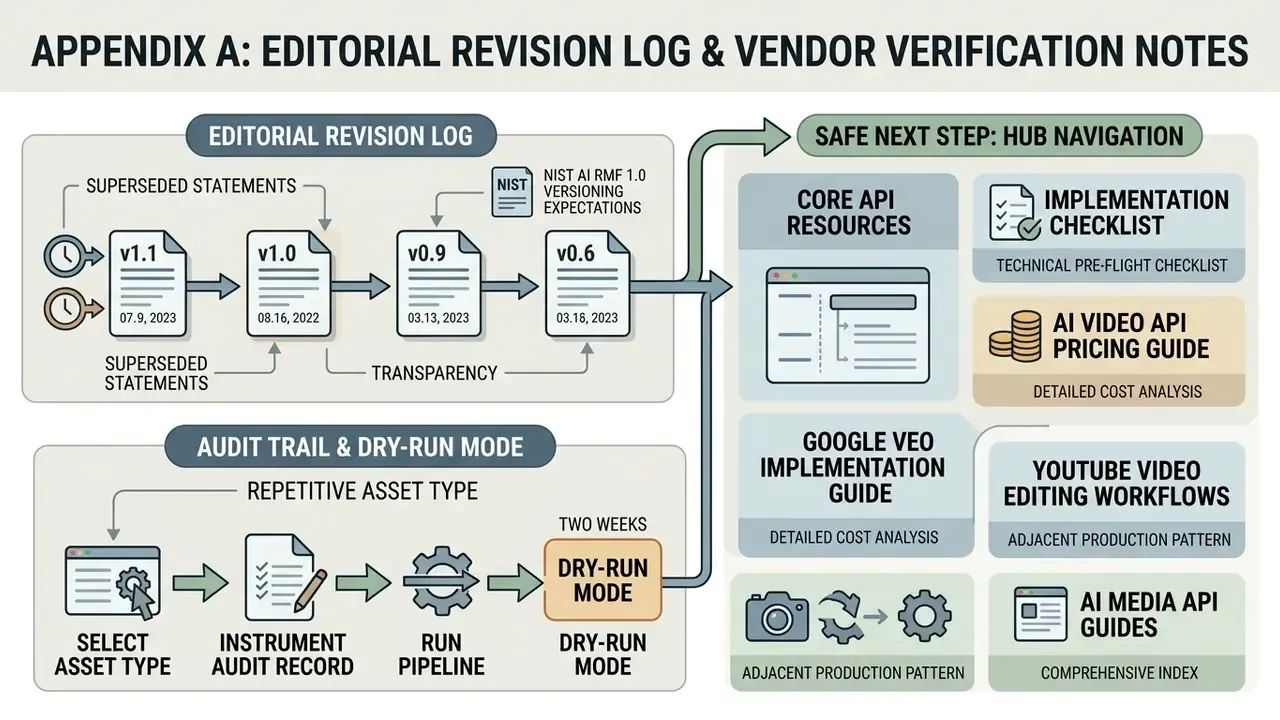
A safe next step
Pick one repetitive asset type, instrument the audit record, and run the pipeline in dry-run mode for two weeks. Compare cost per accepted asset against the manual baseline, then take the evidence, not the enthusiasm, to your governance forum.