If you run model risk or compliance at a US bank, the question is rarely "is the output good enough?" It is "can I evidence how this output was produced, by whom, under which policy, and how fast I can stop it." Enterprise adoption of artificial intelligence in media and content operations therefore requires moving beyond consumer-facing point solutions toward governed, auditable infrastructure. Procurement and model risk teams in regulated industries must evaluate media alternatives through four lenses: data security, compliance frameworks, integration capability, and total cost of ownership.
Executive summary for decision-makers
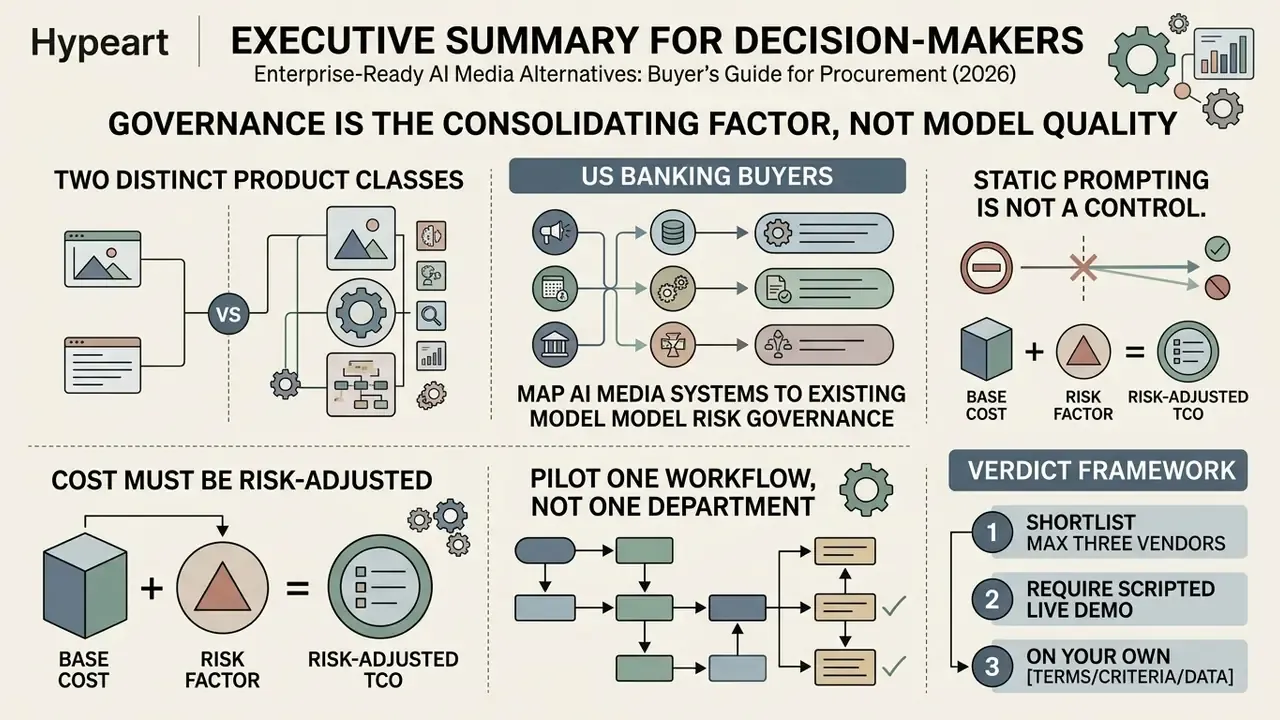
- The market is consolidating around governance, not model quality. Enterprise AI platform spending is projected to grow from roughly $13 billion in 2024 to $50.3 billion by 2030 at a 27.7% CAGR, driven primarily by production deployment controls and workflow integration rather than raw model capability.
- Two distinct product classes are being confused in the market. Specialized enterprise media platforms (Adobe Firefly Enterprise, Synthesia, ElevenLabs, Typeface-class content systems) generate and localize assets under copyright indemnity and provenance controls. Foundation and agent infrastructure (Amazon Bedrock, Azure AI, Vertex AI, Databricks, LangGraph, CrewAI, AutoGen, n8n, IBM watsonx, Kore.ai, Agentforce, Sierra) provides the runtime you build on. Buying the wrong class is the single most common procurement error.
- US banking buyers must map AI media systems to existing model risk governance. Federal Reserve SR 11-7 and OCC Bulletin 2011-12 (Supervisory Guidance on Model Risk Management) already require development documentation, independent validation, and ongoing monitoring. Generative and agentic media systems used in customer communications, disclosures, AML or KYC notices, or marketing claims fall inside that perimeter.
- Static prompting is not a control. Runtime governance research ("Policies on Paths") demonstrates that system prompts cannot prevent policy violations during multi-step agent execution. Only path-aware runtime policy engines, human-on-the-loop approval gates, and hard kill switches qualify as controls.
- Cost must be risk-adjusted. Licence fees are typically 20 to 40% of five-year cost. Use the Risk-Adjusted ROI formula in this guide, which explicitly prices control implementation, human review, and residual risk.
- Pilot one workflow, not one department. Hackett Group (2024) found 49% of procurement teams had piloted generative AI while only 4% reached scaled deployment. Successful deployments delivered up to 10% productivity and cost improvement.
- Verdict framework: shortlist a maximum of three vendors, require a scripted live demonstration on your own test data, and treat the demonstration, not the marketing deck, as the primary validation artifact.
How to use this guide
This is a working document for a procurement file, not a reading list. The sections follow the order a governance committee usually needs them in. Read sections 1, 2 and 6 before you take the first vendor call. The rest can wait until you have a shortlist.
- Definition.What "enterprise-ready" actually means, and the four artifacts that prove it.
- Requirements.The matrix you lock before any vendor contact, plus a reference audit-log schema.
- Objective matching.How to align enterprise-ready AI media alternatives options with a named business goal.
- Comparison.Group A media platforms versus Group B infrastructure, with indicative commercial models.
- Governance architecture.Orchestration, human oversight, drift monitoring, containment.
- Procurement.Fifteen vendor questions, five-year TCO bands, risk-adjusted ROI.
- Implementation.One workflow, defined thresholds, then scale.
- Procurement FAQ.The questions that surface late in committee, answered early.
- Appendix.An evidence pack checklist for independent validation.
What "enterprise-ready" means for AI media alternatives
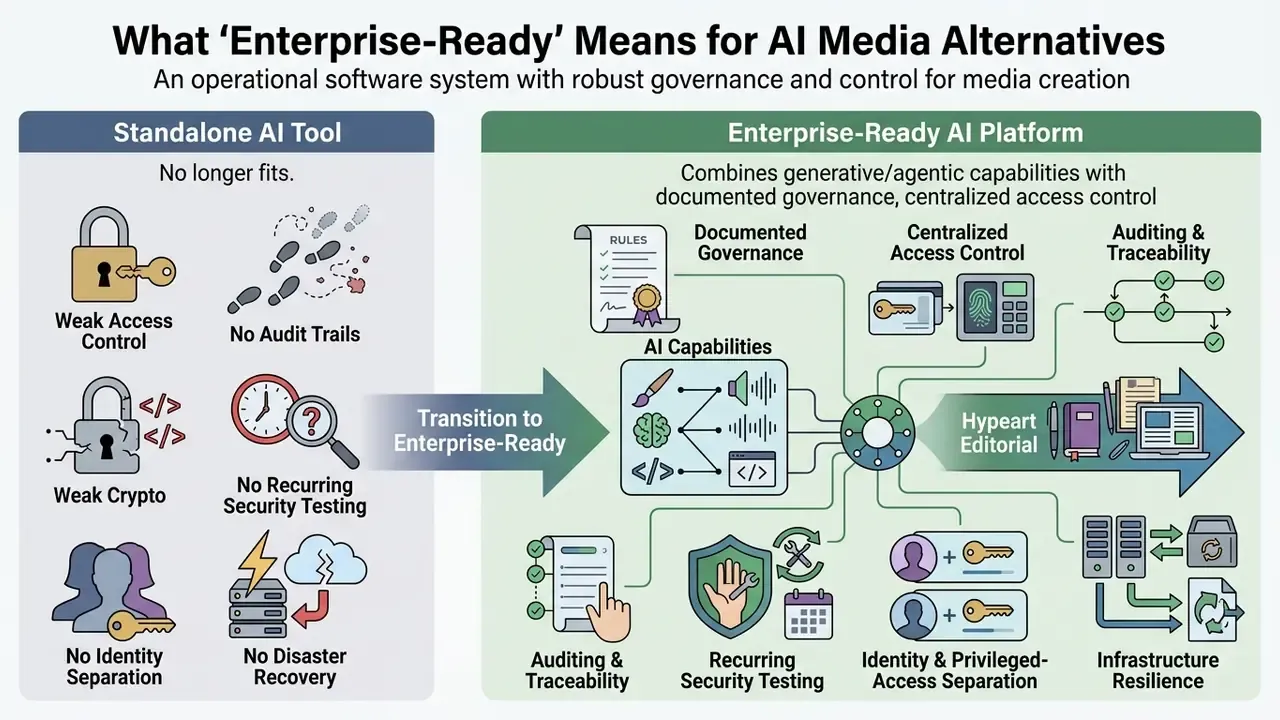
An enterprise-ready AI media platform is an operational software system that combines generative or agentic capabilities with documented governance, centralized access control, deployment isolation, and auditable runtime monitoring. Unlike standalone AI tools designed for single users, enterprise-ready alternatives integrate directly into existing business workflows while enforcing institutional risk management policies.
In practical procurement terms, "enterprise-ready" is not a feature list. It is the presence of four verifiable artifacts: (1) a documented governance policy covering the full AI lifecycle, (2) a separate production environment enforcing segregation of duties, (3) immutable logs exportable to enterprise security and GRC systems, and (4) documented go/no-go deployment thresholds. The NIST AI Risk Management Framework states that organizations should set minimum performance or assurance thresholds and use documented deployment approval decisions before AI systems reach production.
«Organizations should establish minimum performance or assurance thresholds and documented go/no-go deployment approval for AI systems.»
Four artifacts. Nothing more exotic than that. If a vendor cannot produce all four during evaluation, you are buying a tool and building the platform yourself.
From standalone AI tools to governed enterprise platforms
The transition from standalone AI tools to governed enterprise platforms represents a shift from ad hoc experimentation to repeatable, policy-compliant business workflows. Standalone tools operate in isolated environments, lacking centralized logging, role-based access controls, and systemic integration into enterprise data stores.
According to a 2024 global market study by Verdantix, the enterprise AI platform market is projected to grow from $13 billion in 2024 to $50.3 billion by 2030, a compound annual growth rate of approximately 27.7%. The growth is driven primarily by organizational requirements for production deployment controls and deep workflow integration rather than by incremental model performance gains.
«The enterprise AI platform market is projected to grow from $13 billion in 2024 to $50.3 billion by 2030, a CAGR of 27.7%.»
Governed platforms establish a centralized control plane. They enforce governance policies across the complete AI lifecycle: governing inputs, monitoring runtime execution, and recording auditable execution logs for every generated asset or automated decision. The distinguishing criterion is repeatability. Assessment, governance, enforcement, monitoring, and evidence collection must be reproducible across every business process, not reconstructed manually for each audit request.
The control structure most procurement teams inherit is the four-function NIST model: Govern, Map, Measure, Manage. Enterprise frameworks in 2025 and 2026 extend it with an operational workflow layer covering AI inventory, role-based decision rights, policy domains, and approvals embedded directly in lifecycle workflows. Standalone tools provide none of this end-to-end control by default.
One practical test we keep coming back to: ask the platform owner to produce, unassisted, the full lineage of a single asset published six months ago. If that takes more than a few minutes, the control plane is aspirational.
Signals that an existing AI media solution no longer fits
An existing AI media solution requires replacement when its technical architecture creates operational bottlenecks, security vulnerabilities, or regulatory compliance failures. Key red flags include an inability to enforce granular role-based access control (RBAC), missing audit logs for generated outputs, and fragmented integrations that require continuous custom engineering.
Six red flags recur consistently across official 2024 to 2026 guidance:
- No fit with existing infrastructure.Every new use case requires an architecture exception or bespoke integration work.
- Weak cryptographic and access controls.Missing encryption at rest, TLS in transit, hardware security module key storage, MFA, or RBAC/ABAC enforcement.
- Missing audit trails.No logging of timestamps, inputs, outputs, and operating data suitable for compliance analysis.
- No recurring security testing.Absence of periodic audits, risk assessments, or AI red-teaming.
- No identity and privileged-access separation.Administrators and users share effective authority.
- No high availability, immutable backups, or disaster recovery.Operational fragility that cannot be contractually remediated.
The Joint Chiefs of Staff and U.S. Department of Defense, in their 2025 Principles for the Secure Integration of Artificial Intelligence in OT, explicitly classify the lack of immutable audit trails as a primary security failure point. Further baseline requirements, including strong authentication, privileged access workstations for administrators, and immutable backups, appear in the NSA/CISA joint guidance Deploying AI Systems Securely (2024).
«Guidance requires logging of timestamps, inputs, outputs and operating data for analysis and compliance.»
Operational friction also arises when platforms lack real-time cost-containment controls. The 2025 to 2026 VB Pulse survey of 107 enterprise leaders found that 85% of organizations already run two or more AI orchestration platforms in parallel, and that one in five (20%) cannot halt runaway AI agent expenditure in real time. That is a fundamental gap in operational governance, and it usually warrants platform replacement rather than remediation.
Enterprise requirements to evaluate before comparing alternatives
Before evaluating vendor demonstrations or reviewing commercial proposals, procurement teams must establish a standardized matrix of non-negotiable functional, security, and operational requirements. Establishing these baseline criteria keeps vendor evaluations focused on risk-adjusted business value rather than marketing claims.
Public-sector procurement practice reinforces the sequencing: lock the core requirements document, define mandatory minimums, publish the demo script and evaluation criteria, and pre-set negotiation scope and non-price terms before any vendor contact. Technical evaluation, price evaluation, and negotiation must remain separate steps. Demonstrations should be timeboxed, tied to specific requirements, and include end users without conferring advantage on any bidder.
Table: Enterprise Requirements Matrix for Evaluating AI Media Alternatives
| Evaluation Criterion | Mandatory Enterprise Requirement (Must-Have) | Desirable Enhancement (Nice-to-Have) |
|---|---|---|
| Security & Access Control | Granular identity management (single sign-on, multi-factor authentication); least-privilege role-based access control (RBAC) and attribute-based access control (ABAC) for users and AI agents; encryption at rest (AES-256) and in transit (TLS 1.3). | Dynamic path-aware policy engines evaluating real-time risk scores and adaptive tool restrictions during execution. |
| Compliance & Auditability | Immutable, standardized event logging recording prompts, model inputs, outputs, user credentials, and timestamps; compliance mapping to SOC 2 Type II and ISO/IEC 27001; alignment with SR 11-7 and OCC 2011-12 model documentation expectations where outputs inform regulated decisions or disclosures. | Cryptographically verifiable governance receipts binding every action to policy artifacts for automated independent audit replay. |
| System Integration | Native REST and GraphQL APIs; pre-built connectors for enterprise CRM, CMS, digital asset management (DAM), and cloud data warehouses. | Capability-aligned semantic integration mapping multi-agent workflows directly to institutional authority boundaries. |
| Deployment Flexibility | Flexible deployment architectures including multi-tenant cloud, dedicated private cloud (virtual private cloud, VPC), on-premises, or hybrid models. | Multi-cloud orchestration portability allowing agent execution migration across cloud providers without code rewriting. |
| Data Governance | Zero data retention policies for public model training; strict segregation of production and staging environments; configurable tenant isolation; personally identifiable information (PII) detection and redaction. | Data-bound execution memory with automated continuous drift detection and context boundaries. |
| Content Provenance | Asset-level provenance records, C2PA/Content Credentials or equivalent watermarking, and traceability from published asset back to prompt, model version, and approver. | Automated transparency labelling aligned to the EU Code of Practice on Transparency of AI-generated Content. |
| Monitoring & Controls | Real-time administrative dashboards; automated alert thresholds for anomalies; mandatory emergency execution termination ("kill switches"); per-session token and spend caps. | Goal-conditioned drift detection and automated graduated containment protocols operating without human intervention. |
No matching rows Clear one or more filters to restore the matrix.
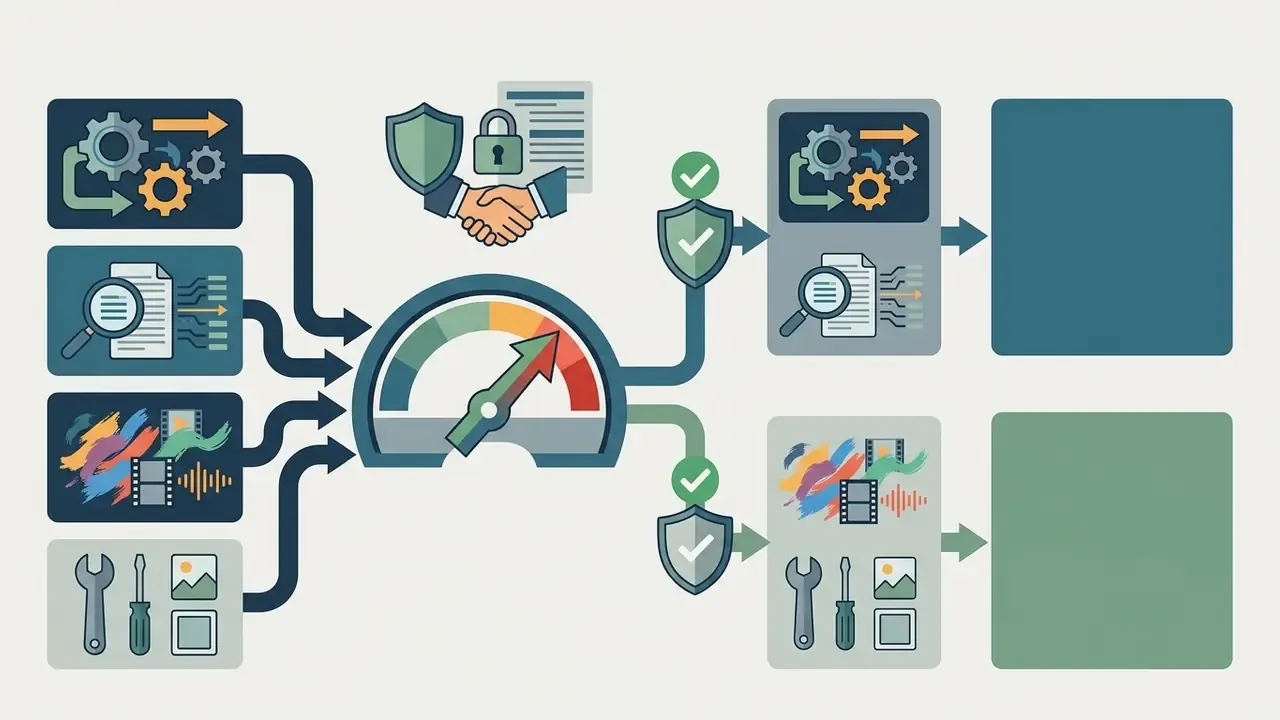
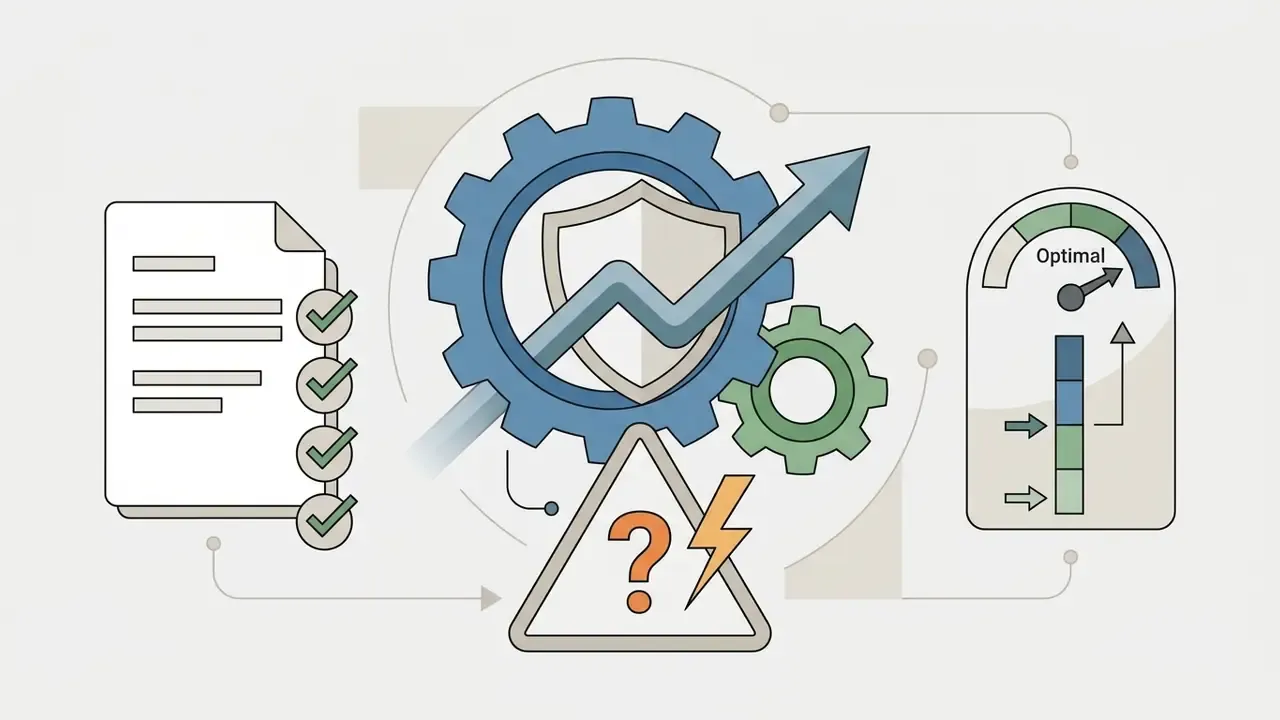
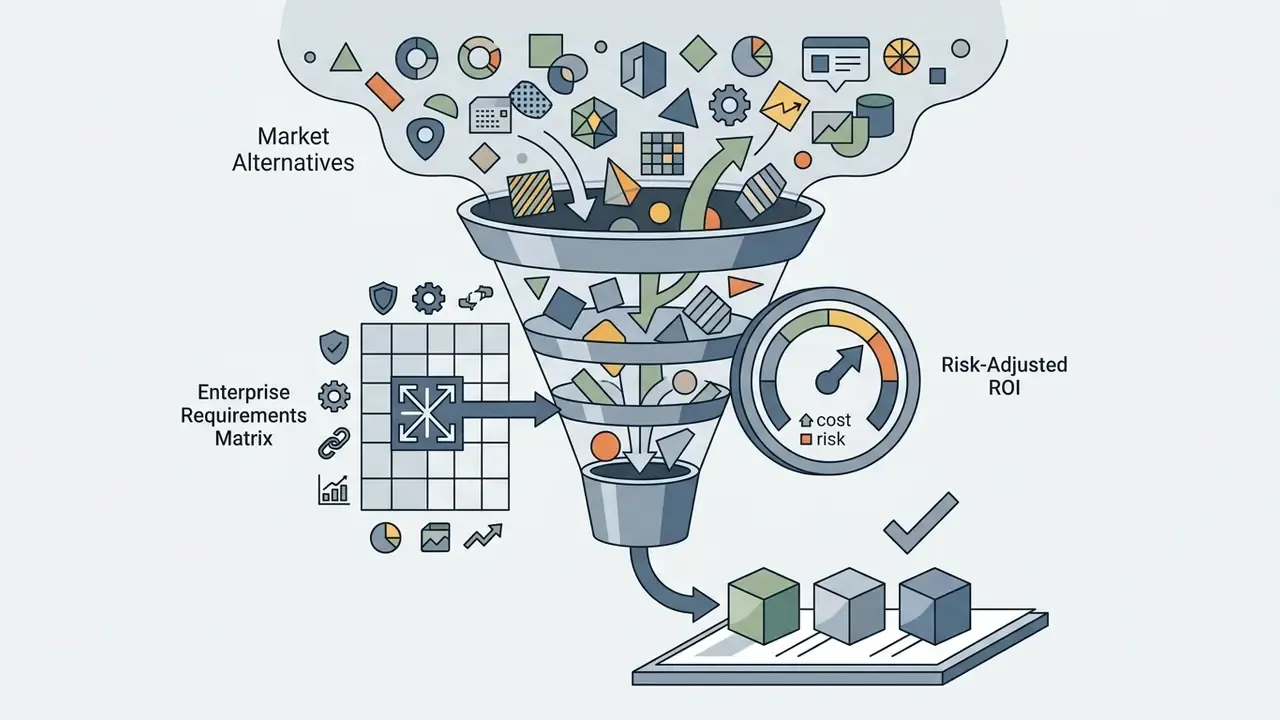
Once the matrix is agreed, the same criteria drive a repeatable seven-phase procurement lifecycle. Publishing this flow to stakeholders before vendor contact prevents scope creep during demonstrations and negotiation:
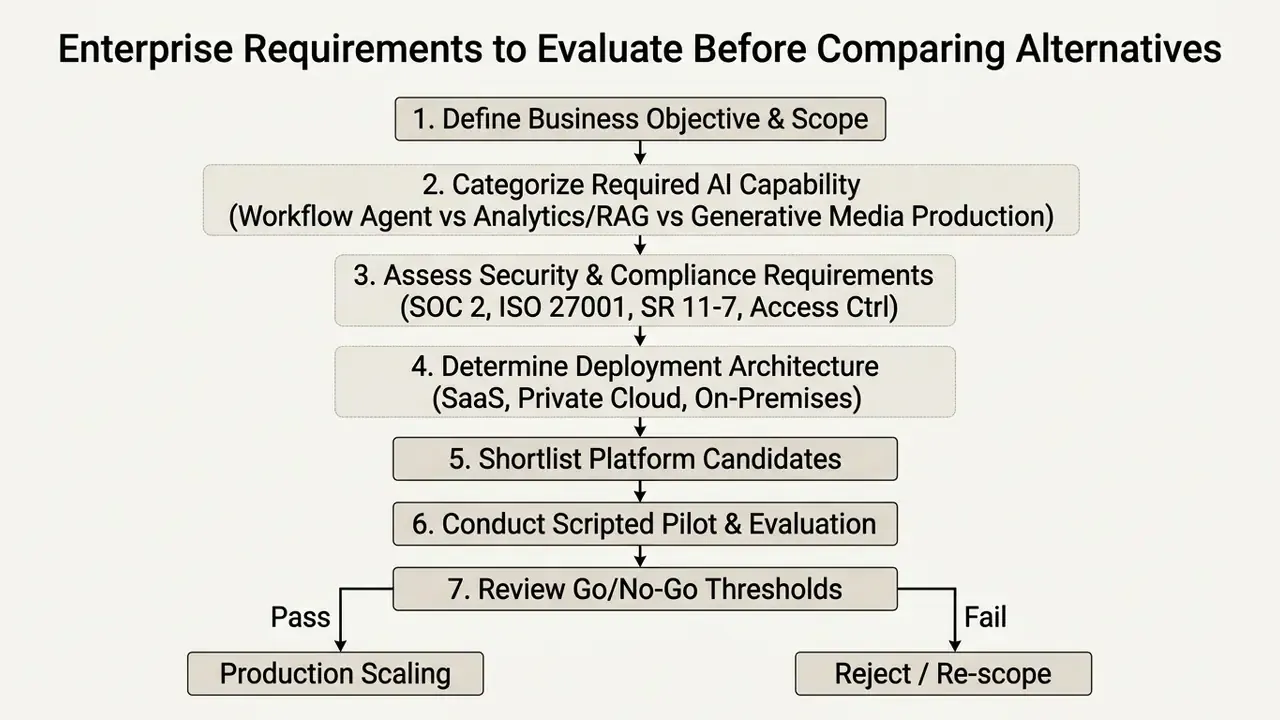
This lifecycle mirrors the NIST cloud procurement sequence: define the service need, identify security and privacy requirements, assess provider competency, select the provider, negotiate service level agreements, then implement, assess, authorize, and continuously monitor.
Security, compliance and access controls
This section summarizes general information and does not substitute for advice from a qualified information security, legal compliance, or regulatory professional.
Enterprise AI media platforms must enforce strict compliance standards, including SOC 2 Type II, ISO/IEC 27001:2022, GDPR, and HIPAA, to safeguard corporate intellectual property and customer data. Data protection requires multi-layered security controls, including zero-trust identity management and attribute-based access control (ABAC). Buyers benchmarking these requirements against real production tooling can cross-check them with published assessments of AI image generators for commercial use before committing to a governance model.
Under NIST SP 800-53 Rev. 5, automated access restrictions and mandatory generation of audit records are required for all system enforcement points (controls AC-2, AU-2, AU-6). Similarly, ISO/IEC 27001:2022 Annex A.8.15 mandates continuous logging and review of user and system activities. GDPR Article 32 requires security "appropriate to the risk," including confidentiality and integrity controls for personal data processing, while the HIPAA Security Rule requires audit-control mechanisms that record and examine activity in systems containing electronic protected health information.
For US banking and financial institutions specifically: where AI media outputs inform customer communications, marketing claims, disclosures, credit or pricing narratives, the underlying models fall within the perimeter of Federal Reserve SR 11-7 and OCC Bulletin 2011-12 (Supervisory Guidance on Model Risk Management). Those documents require development and implementation documentation, effective challenge through independent validation, ongoing monitoring, and a maintained model inventory with clear ownership. Procurement teams should therefore require vendors to supply model documentation packages, version histories, and validation-ready evidence, not only security certificates.
When deploying generative or agentic media tools, platforms must ensure that prompts, training data, and media outputs remain isolated within the enterprise tenant and are never ingested into public foundation models.
Static instructions are insufficient as a control layer. Research on runtime governance shows that system prompts do not prevent policy violations once agents execute multi-step plans against real tools.
«Static system prompts do not prevent policy violations during multi-step agent execution; policy must be enforced on execution paths.»
Complementary work on behavioural governance proposes cryptographic attestation of every agent action:
«Governance receipts cryptographically bind each agent action to its delegation, policy and semantic artifacts, enabling independent audit replay.»
Reference immutable audit log schema for SIEM and GRC ingestion
Procurement teams should specify the audit record structure contractually rather than accepting whatever the vendor emits. A minimum viable event schema for banking-grade GRC and SIEM ingestion looks as follows:
{
  "event_id": "b1f4c2a0-9e3d-4c17-8f21-7a0c5d9e2b44",
  "event_timestamp_utc": "2026-04-14T09:32:11.482Z",
  "tenant_id": "org-northbank-prod",
  "environment": "production",
  "actor": {
    "type": "ai_agent",
    "agent_id": "media-localization-agent-07",
    "delegated_by_user": "[email protected]",
    "authorization_scope": ["dam:read", "cms:write_staging"],
    "autonomy_level_allowed": "AAL-2"
  },
  "model": {
    "provider": "vendor-x",
    "model_id": "media-gen-3.2",
    "model_version_hash": "sha256:4f1c...9ab2",
    "temperature": 0.3
  },
  "request": {
    "prompt_hash": "sha256:7d2e...c091",
    "retrieved_sources": ["dam://brandbook/v9", "cms://disclosures/2026-q1"],
    "pii_detected": false
  },
  "output": {
    "asset_id": "asset-2026-04-14-0093",
    "asset_type": "image/png",
    "content_credentials": "c2pa:signed",
    "provenance_chain_verified": true
  },
  "policy_evaluation": {
    "policy_version": "media-guardrails-v14",
    "decision": "allow_with_human_approval",
    "violations": [],
    "path_risk_score": 0.21
  },
  "human_oversight": {
    "approval_required": true,
    "approver": "[email protected]",
    "approval_timestamp_utc": "2026-04-14T10:04:55.117Z"
  },
  "cost": { "input_tokens": 1840, "output_tokens": 620, "usd_cost": 0.0142 },
  "integrity": { "record_hash": "sha256:aa71...5d3f", "write_mode": "append_only" }
}
Require the vendor to demonstrate live export of this record class to Splunk, Datadog, or the institution's GRC platform during the scripted demonstration. Not a screenshot of a schema. A live export.
Integration with existing systems and workflows
A scalable AI media platform must integrate into an institution's existing technology stack via standardized APIs, enterprise service buses, and native cloud connectors. Siloed media tools create fragmented workflows, forcing manual file transfers and compromising data lineage.
Integration quality has measurable operational value. Empirical research on AI adoption in procurement functions during 2023 and 2024 reported a 21.3% reduction in decision-cycle time and a 15.7% reduction in procurement costs (p<0.01) where AI was integrated into existing systems of record rather than operated alongside them.
NIST SP 800-228, Guidelines for API Protection for Cloud-Native Systems, is the current official baseline for integration surfaces. It requires API risk analysis, pre-runtime controls, and runtime protections for both REST and GraphQL interfaces, including rigid authentication and schema validation.
Enterprise procurement teams evaluating software platforms should consult detailed analysis of Commercial-Use AI Tools to confirm candidate systems align with existing data lakehouse architectures and digital asset management (DAM) repositories. For finance transformation buyers, the same integration test applies to accounts payable, accounts receivable, reconciliation, and close-cycle workflows: if the AI layer cannot write back into the system of record under an audited identity, it stays a demo.
Deployment, scalability and operational support
Deployment architectures must accommodate institutional risk parameters, offering options across multi-tenant cloud, isolated private cloud (VPC), hybrid, and on-premises environments. System resilience requires high-availability infrastructure backed by formal Service Level Agreements (SLAs) guaranteeing system uptime and clear recovery time objectives (RTO), alongside measurable recovery point objectives (RPO) and geographic redundancy.
Financial regulators, such as OSFI in Guideline E-23, require institutions to establish defined performance monitoring standards, breach thresholds, and contingency procedures for AI model unavailability, plus documented escalation paths. ISO/IEC 19086-1 defines resilience and fault tolerance as formal SLA components, which allows procurement to negotiate them as contractual metrics rather than aspirations.
This section summarizes general information and does not substitute for advice from a qualified financial regulation or operational risk management professional.
Scalability must be evaluated based on horizontal processing capacity. Media processing throughput, batch generation, and concurrent agent execution should scale smoothly without performance degradation or unexpected latency spikes.
Enterprise buyer priorities are measurable. The VB Pulse survey of 107 enterprise leaders identified flexibility (29%), security and permissions (17%), production reliability (15%), and control over agent execution (15%) as the leading reasons organizations deliberately adopt multi-platform orchestration strategies rather than single-vendor stacks.
Case example (illustrative, composite): regional financial institution, marketing operations. A regional financial institution reviewed its internal creative operations with one goal, eliminating unvetted consumer image generators. The security committee selected an enterprise media framework featuring automated metadata tagging and isolated VPC deployment. The implementation removed shadow AI usage across marketing teams and established a unified audit trail consistent with internal data governance guidelines. Reported outcomes after two quarters: unapproved tool usage reduced from 31 identified consumer accounts to zero, asset-level provenance coverage at 100% of published creative, and compliance review turnaround reduced from an average of 6 business days to 2. Composite example for illustration; not a verified client result.
Match the AI media alternative to the business objective
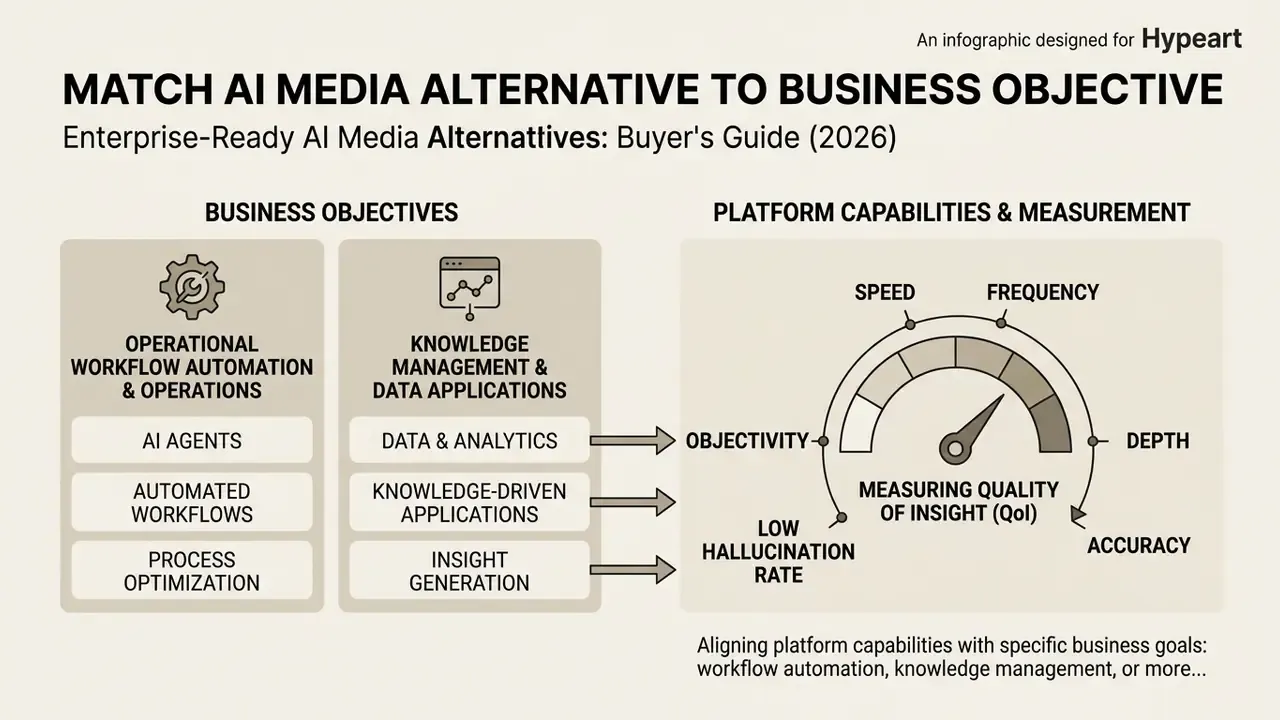
Selecting an enterprise AI media platform requires aligning platform capabilities with specific business goals, such as operational workflow automation, knowledge management, or customer engagement. Procurement teams must categorize solutions based on functional requirements rather than purchasing generic AI tools.
For calibration: Eurostat reported that 19.95% of EU enterprises used AI technologies in 2025. A measurable adoption base, yes, but one where most deployments remain in narrow functional pockets rather than governed enterprise-wide platforms.
AI agents for workflow automation and operations
AI agents used for media workflow automation act as specialized software operators capable of orchestrating multi-step tasks across disparate business systems. Rather than operating autonomously without oversight, enterprise agentic systems require structured orchestration frameworks and human-in-the-loop (HITL) control checkpoints.
NIST Technical Note 2287 stresses that human oversight mechanisms must allow operators to inspect intermediate AI reasoning, alter execution queues, and approve high-impact actions prior to external publishing.
«Human oversight mechanisms must allow operators to inspect intermediate AI analysis, access raw and processed data, and manipulate the execution queue in real time.»
By binding agentic capabilities to explicit authority limits, organizations can automate complex media processes such as automated localization, format adaptation, and compliance routing, while maintaining strict operational accountability. Treat each AI agent as a digital worker: named owner, approved role, access scope, escalation path, audit trail, shutdown mechanism. The 2025 EDPS TechDispatch on human oversight is explicit that oversight is not passive monitoring. It is decision authority at defined boundaries, with logged approval, rejection, delay, or override, plus active monitoring for automation bias.
Data, analytics and knowledge-driven AI applications
Knowledge-driven AI media applications leverage enterprise data assets to power conversational search, automated content generation, and audience analytics. These systems rely on robust data engineering and retrieval-augmented generation (RAG) architectures to prevent hallucinations and ground model outputs in verified enterprise facts.
ISO/IEC 5392:2024 establishes the standard reference architecture for knowledge engineering in AI systems, defining required interactions between data layers, cognitive components, and user interfaces, including roles, activities, layers, components, and relations for building organizational knowledge systems. ISO/IEC 5259-5:2025 adds a governance framework for data quality in analytics and machine learning, aimed explicitly at governing bodies and senior management. ISO/IEC 38507:2022 guides boards on governing AI use so that it remains effective, efficient, and acceptable to the organization.
When deployed for analytical or decision-support tasks, these platforms must preserve data provenance, allowing business leaders to trace every generated report, chart, or text summary directly back to its source data.
Measuring Quality of Insight (QoI) in media intelligence operations
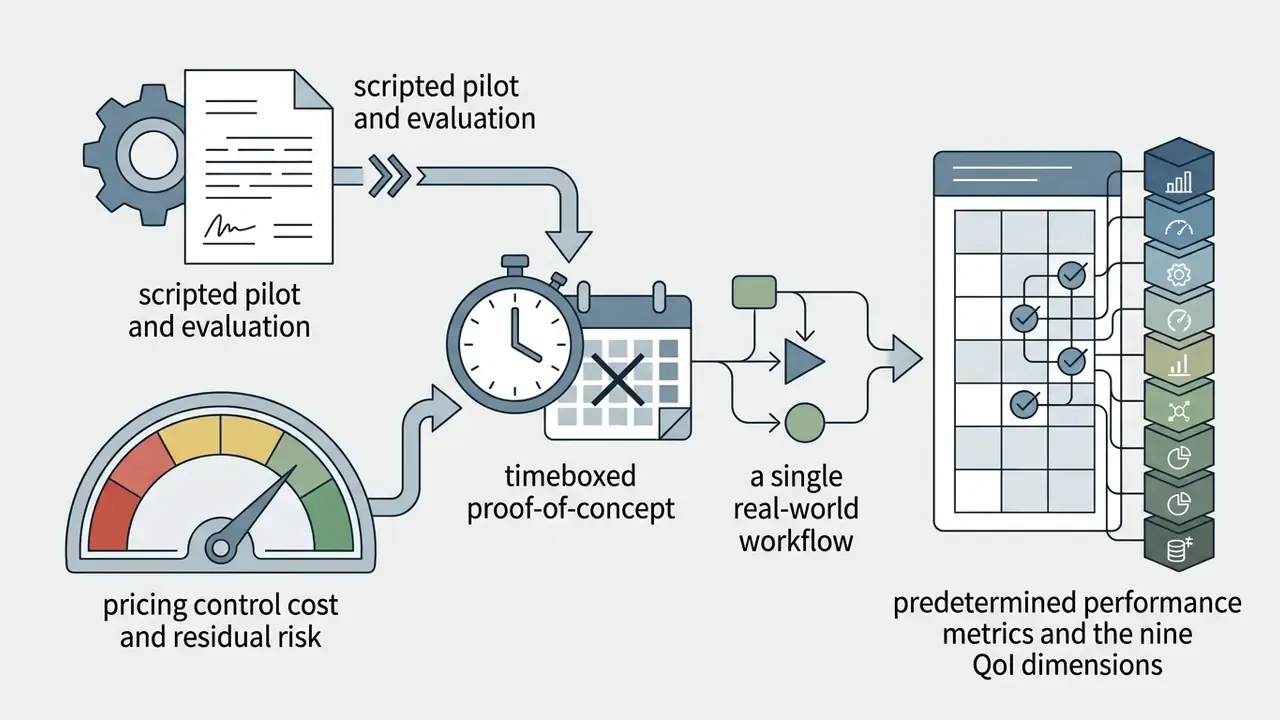
Traditional business intelligence tools improve one dimension of insight at a time. Enterprise AI is only worth its governance overhead if it improves several simultaneously, in real time and at scale. Evaluate candidate platforms against nine standardized dimensions and require the vendor to evidence each during the pilot:
- Speed. Elapsed time from data or asset ingestion to usable insight or approved output.
- Frequency. Whether insight is continuously available or produced in periodic batches.
- Objectivity. Whether human or training-data bias influenced conclusions; documented bias testing required.
- Depth. Proportion of relevant enterprise data actually analyzed versus sampled.
- Accuracy and hallucination rate. Factuality of text and metadata outputs measured against internal enterprise ground truth.
- Relevance and brand linearity. Fidelity to the question asked, and to corporate design systems, tone, and editorial rules.
- Accessibility. Availability to non-technical business users without engineering mediation.
- Explainability and lineage. Ability to trace every generated claim or asset back to source RAG documents, seed prompts, and model version.
- Actionability and latency percentiles (P90/P99). Direct interface compatibility with operational CMS and DAM execution endpoints, plus real-time execution speed for dynamic content generation.
Score each dimension 0 to 5 during the scripted pilot and publish the matrix alongside the TCO calculation. Platforms accessible only to employees with specialist technical expertise systematically fail dimensions 7 and 9, regardless of raw model quality.
Customer, marketing and content use cases
Customer-facing and marketing AI applications require precise alignment with brand guidelines, legal requirements, and regulatory restrictions. AI tools supporting personalized content generation, automated customer interaction, or sales enablement must execute within defined compliance perimeters.
Under the EU AI Act guidance published in 2025, specific AI practices, such as unauthorized emotion recognition or manipulative personalization in public and workplace settings, are strictly prohibited.
«Unauthorized emotion inference and manipulative personalization in workplace and public spaces are prohibited practices.»
Enterprise marketing platforms must therefore provide robust content filtering, guardrails against unauthorized brand representations, and clean integrations with enterprise CRM platforms (for example Salesforce, Adobe Marketo) so that personalized media delivery remains compliant and controlled. Peer-reviewed work on AI in CRM (2024) reports accelerated sales cycles, improved lead qualification, and lower support-call costs where AI is embedded in the CRM record rather than bolted on. Marketing teams assembling a production stack often benchmark platform guardrails against tool-level capabilities documented for AI image generators used in marketing workflows and leading AI voice generators with commercial licensing.
One caution for regulated marketing. Personalization logic that adjusts product or pricing narratives by customer segment can pull the workflow into fair-lending and UDAAP territory. That determination is a legal call, not a marketing one.
Enterprise-ready AI media alternatives compared by platform category
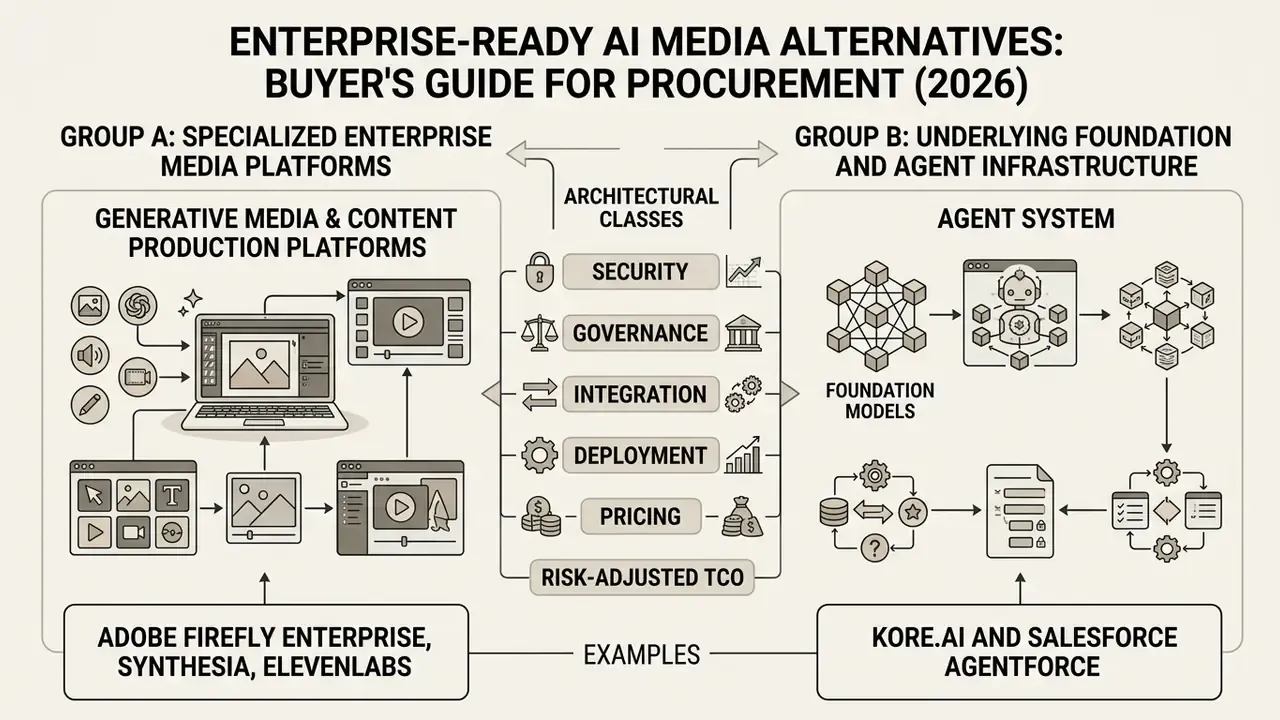
To simplify vendor selection, procurement officers should categorize market alternatives into distinct architectural classes. Independent methodology matters here. A 2026 review assessed 25 agentic AI platforms across five dimensions: time-to-value, enterprise readiness, orchestration depth, ecosystem portability, and TCO realism. That is a usable scoring skeleton for internal shortlisting, and it is close to how an enterprise-ready AI media alternatives comparison should be structured internally.
«Twenty-five agentic AI platforms were assessed across time-to-value, enterprise readiness, orchestration depth, ecosystem portability and TCO realism.»
Critical taxonomy note. The market conflates two fundamentally different purchases:
- Group A: specialized enterprise media platforms. Systems that produce, localize, and govern media assets (image, video, audio, copy) with copyright indemnity, provenance signing, and brand guardrails built in. You configure these.
- Group B: underlying foundation and agent infrastructure. Cloud AI services, foundation-model gateways, data platforms, enterprise agent platforms, developer frameworks, and workflow engines. You build media capability on these.
Buying Group B when the business need is Group A produces multi-quarter engineering programmes for outcomes available at configuration cost. Buying Group A when the business need is deep workflow orchestration produces integration dead ends. Score both groups against the same requirements matrix, but never against each other on price.
Pricing figures below are indicative published list ranges observed across 2025 and 2026 vendor materials and are provided for budget framing only. Confirm current pricing, minimum commitments, and volume tiers directly with the vendor before board submission.
Group A: generative media and content production platforms
Table: specialized enterprise media platforms by capability, governance and indicative commercial model
| Platform | Platform Category | Primary Enterprise Use Cases | Integration & Deployment | Governance & Controls | Indicative Enterprise Pricing / Commercial Model | Technical Effort Required |
|---|---|---|---|---|---|---|
| Adobe Firefly for Enterprise | Generative image and design platform | Commercially safe image and design generation, brand-locked creative variation, campaign asset scaling. | Native Creative Cloud, Adobe Experience Manager and Marketo connectors; REST APIs; cloud tenant. | IP indemnification for enterprise outputs; C2PA Content Credentials provenance; custom brand model training on licensed assets; admin console with SSO and RBAC. | Enterprise seat licensing plus generative credit packs; typically negotiated annually (mid five to low six figures for large creative organizations). | Low to moderate: configuration, brand model training, asset governance setup. |
| Synthesia Enterprise | Synthetic video production platform | Training video generation, multilingual internal communications, product explainers at scale. | SCORM/LMS export, API access, CMS and DAM integration; cloud (SOC 2 Type II). | Consent-verified avatar creation, watermarking, prohibited-content policy enforcement, RBAC, audit logging, deepfake misuse prevention. | Enterprise plans quoted per seat plus minute volume; annual contracts commonly in the low five to six figures. | Low: template and script driven, minimal engineering. |
| ElevenLabs Enterprise | Voice synthesis and audio localization platform | Voice localization, IVR and audio branding, accessibility narration, dubbing at scale. | REST API, SDKs, DAM and post-production pipeline integration; cloud with isolated tenancy options. | Isolated voice model training, voice-consent verification, zero-retention options, watermarking, SOC 2 Type II, granular API key scoping. | Usage-based character or minute pricing with enterprise volume commitments; annual agreements typically five to six figures. | Low to moderate: API integration for automated pipelines. |
| Enterprise content platforms (Typeface / Writer class) | Brand-governed generative content platform | Brand-compliant copy generation, multilingual campaign scaling, regulated-content drafting with review workflow. | CMS, DAM, CRM and marketing automation connectors; cloud, with private deployment options at enterprise tier. | Brand and style rule enforcement, terminology and claim blocklists, approval workflows, retrieval grounding on approved corpora, audit trails. | Platform licence plus seat tiers; enterprise agreements commonly $50k to $250k+ per year depending on brands, locales and seats. | Moderate: brand knowledge base construction and workflow design. |
Generative media and content production platforms: Adobe Firefly Enterprise, Synthesia and ElevenLabs
Enterprise media creation requires specific safeguards around copyright indemnity and asset provenance that general-purpose model access does not provide. Adobe Firefly for Enterprise supplies commercially safe generative models backed by intellectual property indemnification and Content Credentials (C2PA) tracking, so every published asset carries verifiable provenance metadata. For automated video synthesis and audio localization at scale, Synthesia Enterprise and ElevenLabs Enterprise offer SOC 2 Type II compliant synthetic media generation with isolated voice and avatar model training, consent verification, strict RBAC, and automated watermarking to reduce deepfake misuse.
Brand-governed content platforms in the Typeface and Writer class occupy the text and campaign layer. They enforce terminology blocklists, regulated-claim rules, and approval routing before copy reaches a CMS. In regulated industries, those three capabilities (indemnity, provenance, claim control) are the practical difference between a governed media platform and a consumer generator with an enterprise invoice. Teams comparing generation quality across the underlying models can reference published evaluations of leading AI image generators by quality and pricing and AI video generators for content production workflows.
Group B: underlying foundation, agent and automation infrastructure
Table: comparative assessment of enterprise AI and automation infrastructure platforms
| Platform | Platform Category | Primary Enterprise Use Cases | Integration & Deployment | Governance & Controls | Indicative Enterprise Pricing / Commercial Model | Technical Effort Required |
|---|---|---|---|---|---|---|
| Kore.ai | Enterprise agent platform | Omnichannel customer service, automated dialog workflows, employee support. | HTTP, OpenAPI, SDKs, Webhooks, MCP, AWS Lambda; cloud (AWS, Azure, GCP), private VPC, on-prem; dev to staging to production promotion. | SSO, RBAC, KMS/BYOK, PII detection, audit logging, intent management, agent observability. | Enterprise custom licensing, typically $30k to $150k+ per year based on session or conversation volume. | Moderate: requires dialog flow design and systems integration. |
| Salesforce Agentforce | Enterprise agent platform (CRM-native) | Sales automation, customer support case management, CRM-driven actions. | Native Salesforce Data Cloud and Service Cloud integration; Agentforce Python SDK; Salesforce Cloud runtime. | Centralized configuration via DevOps Center, org-level policies, per-session policy application, profile controls. | Consumption-based add-on to existing Salesforce licensing (per-conversation or per-action credits) plus enterprise tier commitments. | Low to moderate: admin-driven configuration with SDK extension options. |
| IBM watsonx | Enterprise AI and data platform | Governance-first automation; HR, procurement and compliance workflows; industry-specific decisioning. | Hybrid cloud, Red Hat OpenShift, REST APIs, pre-built agents and developer tooling. | watsonx.governance for model lineage, risk management, bias detection, documented model factsheets. | Modular subscription by capability plus consumption units; enterprise programmes commonly six figures annually with services attached. | High: requires platform engineering and governance configuration. |
| Sierra | Conversational customer agent platform | Brand-aligned customer service, automated order and CRM actions, high-volume consumer support. | Native CRM/ERP connectors, REST APIs, order-system actions; vendor-managed cloud. | Strict brand guardrails, audit logging, zero-data-retrain policies, escalation-to-human routing. | Outcome-based pricing (per resolved conversation) with enterprise minimum commitments. | Moderate: configuration of brand policy, actions and escalation rules. |
| Microsoft Azure AI | Cloud AI platform | Custom AI media processing, vision and audio analytics, M365 Copilot extension. | Azure cloud, hybrid, REST APIs; managed compute and serverless endpoints; global, data-zone and regional deployment options. | Microsoft Entra ID, Azure AI Content Safety (jailbreak and protected-material detection), Defender for Cloud, VPC Service Controls. | Consumption-based (per 1K tokens or per media unit) plus optional provisioned throughput units shareable across models. | High: demands cloud engineering and software development resources. |
| Google Cloud Vertex AI | Cloud AI platform | Model fine-tuning, media asset analytics, custom generative pipelines. | GCP deployment, BigQuery integration, Google Workspace connectors, Agent Builder tooling. | Customer-Managed Encryption Keys (CMEK), VPC Service Controls, Access Transparency, data residency at rest. | Pay-as-you-go per token, character or media second, plus committed-use discounts at enterprise volume. | High: requires machine learning operations (MLOps) and cloud expertise. Teams scoping media pipelines can compare capabilities against published reviews of AI video generators for enterprise media pipelines and Google Veo API implementation costs. |
| Amazon Bedrock | Foundation model platform | Multi-model foundation access, custom agent construction, secure RAG, fine-tuning and distillation. | AWS native execution, S3 integration, PrivateLink connectivity, JSONL training inputs. | AWS IAM, Guardrails for Bedrock, CloudTrail event logging, KMS encryption, evaluation artifacts. | Pay-as-you-go by processed tokens (roughly $0.0008 to $0.011 per 1,000 tokens depending on model) plus provisioned throughput options. | High: requires AWS solution architecture and engineering capacity. |
| Databricks | Data and lakehouse platform | Large-scale data engineering, media telemetry analytics, fine-tuning foundation models, SQL analytics. | Multi-cloud (AWS, Azure, GCP); lakehouse architecture; AI gateway for model and MCP services. | Unity Catalog fine-grained access, rate limits, spend caps, usage tables, MLflow GenAI lifecycle tracking. | Consumption-based DBU pricing plus cloud infrastructure; enterprise commitments typically six figures annually. | High: requires specialized data engineering and data science teams. |
| LangChain / LangGraph | Developer agent framework | Custom stateful multi-agent orchestration, complex media creation graphs, long-running agents. | Custom hosting (Docker, Kubernetes, cloud); API-driven integration; LangSmith observability. | External governance required; must layer custom policy engines and identity controls. | Open-source core free; LangSmith Developer free tier; Plus approximately $39 per user per month; Enterprise custom (commonly $15k to $50k+ per year) plus infrastructure. | Very high: demands senior software engineering capacity. |
| CrewAI | Developer agent framework | Role-based multi-agent coordination for multi-step content workflows, rapid prototyping. | Python environment, Helm charts, self-hosted or cloud infrastructure; Crew Studio no-code builder. | Framework primitives; relies on infrastructure-level access controls; enterprise controls user-implemented. | Open-source core free; hosted plans from approximately $99 per month (100 executions, 5 seats) scaling to about $1,000 per month (2,000 executions, unlimited seats); enterprise plans from roughly $20k per year. | High: requires Python development and custom control architecture. |
| Microsoft AutoGen | Developer agent framework | Event-driven multi-agent conversation systems and custom tools. | Developer environments, Azure App Service, containerized execution. | Infrastructure-dependent; inherits Azure security when deployed in-cloud. | Open-source (free) plus Azure consumption for models and compute. | Very high: requires software engineering and agent design skills. |
| n8n | Workflow automation engine | Low-code media pipeline automation, cross-app asset routing, AI node orchestration. | Self-hosted (Docker) or cloud; 400+ SaaS application nodes. | Basic RBAC, environmental variables, self-managed backup and security; enterprise tier adds SSO and log streaming. | Community edition free (self-hosted); cloud plans from low double-digit dollars per month scaling to enterprise agreements in the low five figures annually. | Low to moderate: accessible to non-engineers with technical support. |
Enterprise agent platforms: Kore.ai and Salesforce Agentforce
Enterprise agent platforms specialize in managing high-volume conversational interactions and multi-step tasks within managed operational environments. Kore.ai offers a deployment-flexible platform supporting omnichannel virtual assistants across cloud, private VPC, and on-premises environments, featuring integrated PII detection, role-based access control, and comprehensive audit logs. Deployments are bound to explicit environments and channels with one active deployment per environment and a managed dev to staging to production promotion path, a structure that maps cleanly onto segregation-of-duties requirements.
Salesforce Agentforce provides agent capabilities built natively into the Salesforce CRM ecosystem. It leverages Salesforce Data Cloud permissions to enforce security boundaries, enabling sales and service automation directly within existing enterprise CRM workflows, with programmatic agent creation and deployment through the Agentforce SDK. The trade-off is scope. Kore.ai is broader in deployment options and channel coverage; Agentforce is narrower but deeper inside Salesforce-native execution, and extending it across non-Salesforce functions typically requires MuleSoft-class integration.
Governance-first and outcome-priced platforms: IBM watsonx and Sierra
IBM watsonx targets organizations where governance evidence is the primary procurement constraint. Its differentiator is watsonx.governance: model lineage, risk management, bias detection, and factsheet documentation that map directly onto model risk management expectations under SR 11-7 and OSFI E-23. Pre-built agents and developer tooling cover HR, sales, and procurement workflows, and hybrid deployment on Red Hat OpenShift suits institutions with data-residency constraints. Implementation effort is high, and IBM deployments frequently arrive bundled with consulting services, a cost line procurement must model explicitly.
Sierra takes the opposite position: a narrow, vendor-managed conversational agent platform for consumer-facing service, priced on outcomes (resolved conversations) rather than seats or tokens. Brand-aligned agents execute actions inside CRM and order systems under strict guardrails, audit logging, and zero-data-retrain commitments. For institutions whose objective is customer service deflection rather than platform ownership, outcome pricing transfers a meaningful share of performance risk to the vendor. It also caps architectural control, so contract exit and data portability terms deserve close scrutiny.
Cloud AI platforms: Microsoft Azure AI and Google Cloud Vertex AI
Cloud AI platforms deliver the infrastructure, foundation models, and developer tools required to construct custom AI media services. Microsoft Azure AI provides advanced compute options, serverless model endpoints, provisioned throughput shareable across models, and built-in text and image moderation via Azure AI Content Safety filters, including jailbreak and protected-material detection.
Google Cloud Vertex AI emphasizes baseline infrastructure security, offering Customer-Managed Encryption Keys (CMEK), VPC Service Controls, Access Transparency logs, and documented data residency at rest. The documentation focus differs rather than contradicts: Azure materials emphasize deployment flexibility and built-in content filtering, while Google materials emphasize perimeter, key management, and transparency controls. Both provide maximum scalability for media processing, and both require significant internal engineering expertise to build custom governance layers.
Data and foundation-model platforms: Amazon Bedrock and Databricks
Data-centric platforms enable organizations to build custom AI applications directly alongside their enterprise data assets. Amazon Bedrock provides serverless access to leading foundation models, allowing secure model customization through fine-tuning, continued pre-training, distillation, and reinforcement fine-tuning on supported models, using private enterprise datasets stored in AWS S3 without exposing data to third parties, with training and validation metrics produced as evaluation artifacts.
Databricks integrates generative AI development directly into its Lakehouse platform, combining ETL pipeline engineering, foundation model fine-tuning, MLflow-based GenAI prompt lifecycle management, and SQL analytics in a single workspace. By governing both structured media telemetry and generative models through Unity Catalog, Databricks keeps data access policies, spend caps, and usage metrics under one administrative interface. The distinction is scope rather than superiority. Bedrock is stronger on managed foundation-model access and customization mechanics; Databricks on unified data engineering and analytics.
Agent frameworks and automation tools: LangChain, CrewAI, AutoGen and n8n
Developer frameworks and workflow automation engines provide granular flexibility for designing custom multi-agent orchestration pipelines. LangChain (with LangGraph), CrewAI, and Microsoft AutoGen offer open-source code libraries for stateful agent workflows, role delegation, and multi-agent collaboration. LangGraph is explicitly positioned as a low-level orchestration framework and runtime for long-running, stateful agents. CrewAI emphasizes role-based coordination and task delegation with both open-source and Helm-based enterprise deployment paths.
Low-code automation tools like n8n provide visual workflow builders that connect disparate media APIs with minimal development overhead. While these tools offer custom orchestration capability, they lack native enterprise governance features out of the box, requiring engineering teams to build external monitoring, policy enforcement, and identity management controls.
A useful governance concept for framework-based builds separates what an agent can do from what it is allowed to do:
«Agent governance should separate Autonomous Capability Level (ACL) from Allowed Autonomy Level (AAL): high-capability agents are deliberately constrained to lower permitted autonomy based on risk.»
Organizations evaluating software platforms in this space can review the B2B AI Media Trust Checklist to establish baseline verification parameters prior to vendor selection.
Vendor verification methodology for procurement teams
- Compliance documentation. Require the vendor's latest SOC 2 Type II report, ISO/IEC 27001 certificate, independent third-party penetration test summary, information security policies and procedures, and a data flow architecture diagram. For regulated model use, additionally require model documentation sufficient for independent validation under SR 11-7 and OCC 2011-12.
- Scripted live demonstration. Conduct a timeboxed demo using buyer-provided test data and scenarios. Require the vendor to demonstrate live RBAC enforcement, real-time error logging, audit-log export to your SIEM, and system termination via a kill switch. Where functionality claims and demo evidence diverge, treat the demonstration as the primary validation artifact.
- RFP due diligence questionnaire. Mandate detailed pricing disclosures accounting for API call volume, infrastructure usage, professional service fees, and ongoing support SLAs, matching criteria outlined in NIST SP 800-161r1 for supply chain risk management. Normalize all bids to one pricing model before scoring.
- Continuous monitoring commitment. Per NIST SP 1326 (2026), require a due-diligence report template, a concern-rating schema aligned to your risk tolerance, and a scheduled refresh process. Supplier verification is not a one-time gate.
Governance and architecture for production AI agents
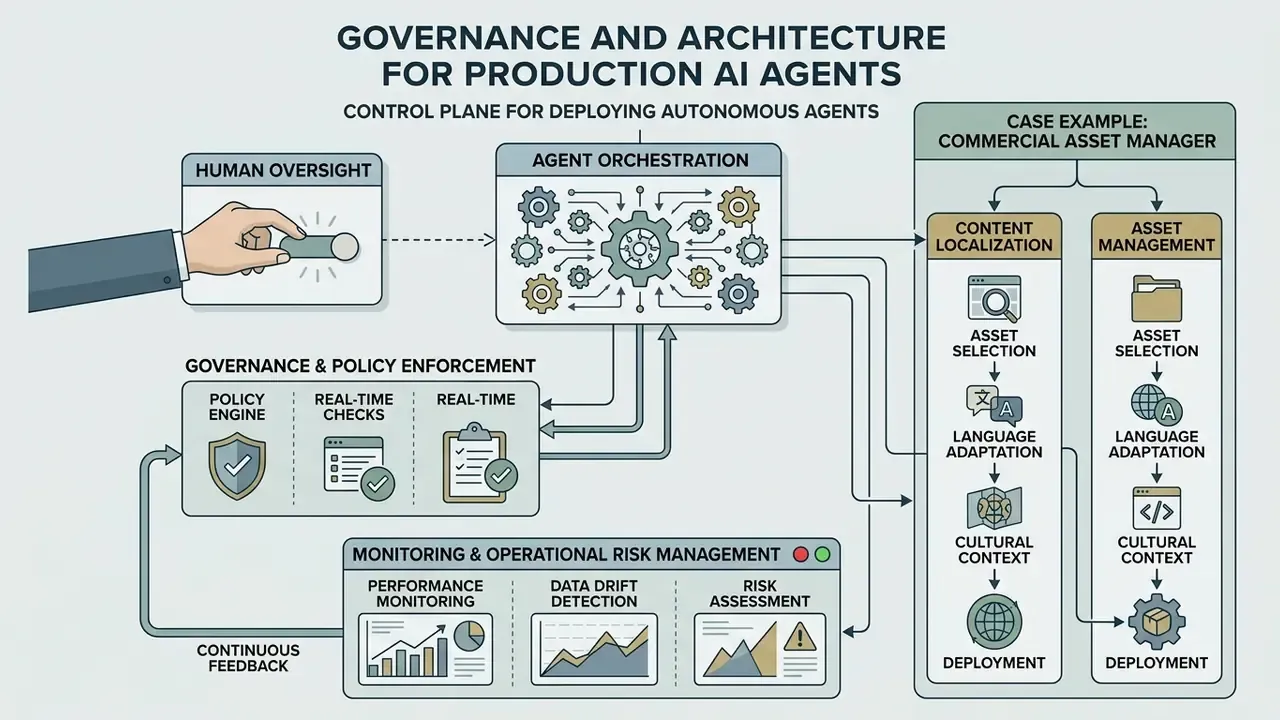
Deploying autonomous or semi-autonomous AI agents into production environments demands a control plane capable of enforcing policy boundaries in real time. Because agentic systems exhibit non-deterministic, multi-step behavior, traditional perimeter security controls must be supplemented by dynamic runtime governance frameworks.
AWS Prescriptive Guidance (2026) describes three viable operating models for agentic AI governance: centralized, federated, and hybrid. The choice should follow the institution's existing model risk governance structure rather than the vendor's default. Public-sector guidance sets a comparable bar. Digital NSW's 2025 AI agent deployment guidance requires senior approval, an updated risk assessment, asset register entry, guardrails, tool-access audit, business-continuity testing, integration review, and quota compliance before production deployment.
Agent orchestration, controls and human oversight
Agent orchestration frameworks must divide agent execution into distinct planning, policy evaluation, state tracking, and tool execution phases. Each system action must pass through an automated policy engine that checks user authorization, validates schema structures, and enforces operational constraints. Each transition needs an accountable owner, an allowed state change, an evidence requirement, and a timeout or cancellation rule.
Research on runtime governance ("Policies on Paths") demonstrates that static system prompts cannot prevent policy violations during complex multi-step execution, and formalizes policy as a deterministic function mapping agent identity, the partial execution path, and the proposed action to a policy-violation probability.
«Policy is formalized as a deterministic function mapping agent identity, partial execution path and proposed action to policy-violation likelihood.»
Technical enforcement complements policy logic. Bind each action to schema and provenance checks, apply authority limits and stop conditions, and constrain execution with sandboxing plus network and filesystem scope limits.
To maintain control, platforms must implement explicit human oversight checkpoints ("human-on-the-loop"). These gates mandate human approval before an agent can execute irreversible actions, such as launching an external advertising campaign or publishing financial communications. Oversight must be a decision authority (approve, reject, delay, or override) with audit logs and monitoring for automation bias. Not a dashboard nobody reads.
Case example (illustrative, composite): commercial asset manager, content localization. A commercial asset manager deployed an automated multi-agent content localization pipeline. To manage compliance risk, the engineering team inserted automated policy checkpoints restricting agents to staging repositories. The system required explicit sign-off from a compliance officer before publishing finalized assets, preventing unauthorized customer disclosures while reducing localization cycle times by 40%. Secondary outcomes reported internally: zero policy-violating publications across the first 1,400 generated assets, average compliance review time per asset reduced from 45 to 12 minutes, and per-language production cost reduced by approximately 30% against prior external vendor rates. Composite example for illustration; treat the figures as hypotheses to test in your own pilot.
Monitoring performance and managing operational risk
Continuous production monitoring requires tracking technical performance metrics alongside model reliability indicators. Procurement and model risk teams must establish continuous monitoring for hallucination frequencies, response latency percentiles (P50, P90, P99), and session-level token costs. Where media outputs are published externally, monitoring should extend to content verification, including automated checking with AI image detectors for content verification and AI reverse-image-search tooling, to catch provenance failures before publication.
AWS Prescriptive Guidance recommends establishing stable-period baseline embeddings to perform statistical drift testing on live production inputs and outputs, with alerting when thresholds are breached. NIST AI RMF 600-1 (2024) requires standardized measurement protocols and risk measurement in the specific context of use, and NIST AI 800-4 (2026) treats monitoring of deployed AI systems as a formal risk-control area rather than an operational nicety. Agent-specific monitoring can be organized as a coordinated protocol:
«MI9 coordinates six agent monitoring components: risk index, semantic telemetry, continuous authorization, conformance engine, drift detection and graduated containment.»
When drift thresholds or cost limits are exceeded, automated alerts must notify administrative leads, or containment protocols must automatically restrict the agent's execution autonomy, reducing the Allowed Autonomy Level without waiting for a human decision cycle. Honest caveat: hallucination rate and drift thresholds for generative media are still immature as measurement disciplines. Set provisional thresholds, review them quarterly, and document the rationale for the number you chose.
Procurement questions, pricing and vendor due diligence
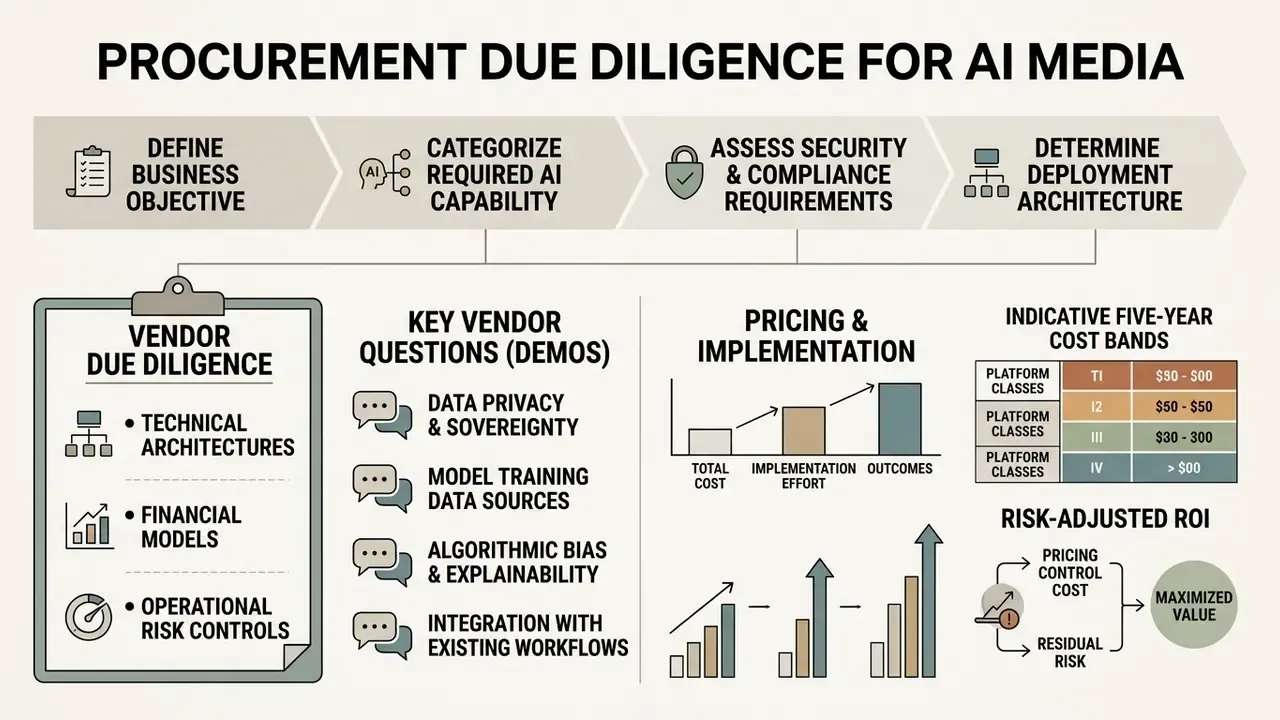
Conducting vendor due diligence requires probing technical architectures, financial models, and operational risk controls. Procurement teams must move past standardized marketing materials to evaluate total cost of ownership (TCO) against risk-adjusted business value. NIST SP 800-161r1-upd1 structures this as a five-part risk process: information gathering and scoping, threat analysis, vulnerability analysis, impact analysis, and risk response analysis.
Questions to ask vendors during demos and technical evaluation
Compare total cost against implementation effort and outcomes
Calculating total cost of ownership requires evaluating software license fees alongside underlying infrastructure costs, integration engineering, and ongoing administrative overhead.
TCO = Annual License Fees + Cloud Infrastructure Costs + Custom Engineering Hours + Maintenance & Support SLAs
Lifecycle cost guidance (GOV.UK) splits costs into cost to create, cost to operate, cost to change, and cost to end or decommission, which maps directly onto licences, infrastructure, engineering, and support. Software-specific TCO methodology additionally requires including training, internal maintenance, incremental hardware, future upgrades, and support in the base figure. Model five years, not one.
Indicative five-year cost bands by platform class (mid-size regulated enterprise, media and content workloads; validate against your own volumes):
| Platform class | Typical five-year cost driver profile | Indicative five-year TCO band |
|---|---|---|
| Specialized enterprise media platform (Group A) | Seats plus generation volume; low engineering; configuration and brand-model setup | $250k to $1.5M |
| Low-code automation engine (n8n class) | Low licence cost; moderate internal maintenance; self-managed security burden | $150k to $600k |
| Enterprise agent platform (Kore.ai, Agentforce, Sierra) | Licence or outcome pricing plus integration and dialog design | $500k to $3M |
| Cloud AI or foundation-model platform (Azure, Vertex, Bedrock) | Consumption dominates; substantial engineering and governance build | $1M to $6M+ |
| Data platform (Databricks, watsonx) | Consumption plus data engineering headcount plus services | $1.5M to $8M+ |
| Open-source agent framework (LangGraph, CrewAI, AutoGen) | Near-zero licence; engineering headcount is 70 to 85% of TCO | $800k to $5M+ |
While initial software licensing may appear modest, platforms lacking pre-built enterprise connectors often incur substantial long-term costs in custom software development and MLOps maintenance. Open-source frameworks appear free, then quietly consume development resources, monitoring tooling, and infrastructure.
Procurement teams must contrast this TCO against quantified operational improvements, such as reductions in media creation cycle times, lower translation expenses, and decreased compliance review backlogs, to calculate true risk-adjusted ROI. Benchmarking asset-level production costs against published tool pricing, for example in comparisons of the best AI art generators by quality and licensing, keeps benefit assumptions defensible.
Reality-check the benefit side against observed adoption rates:
«49% of procurement organizations piloted generative AI, but only 4% achieved scaled deployment; successful deployments delivered up to 10% productivity and cost improvement.»
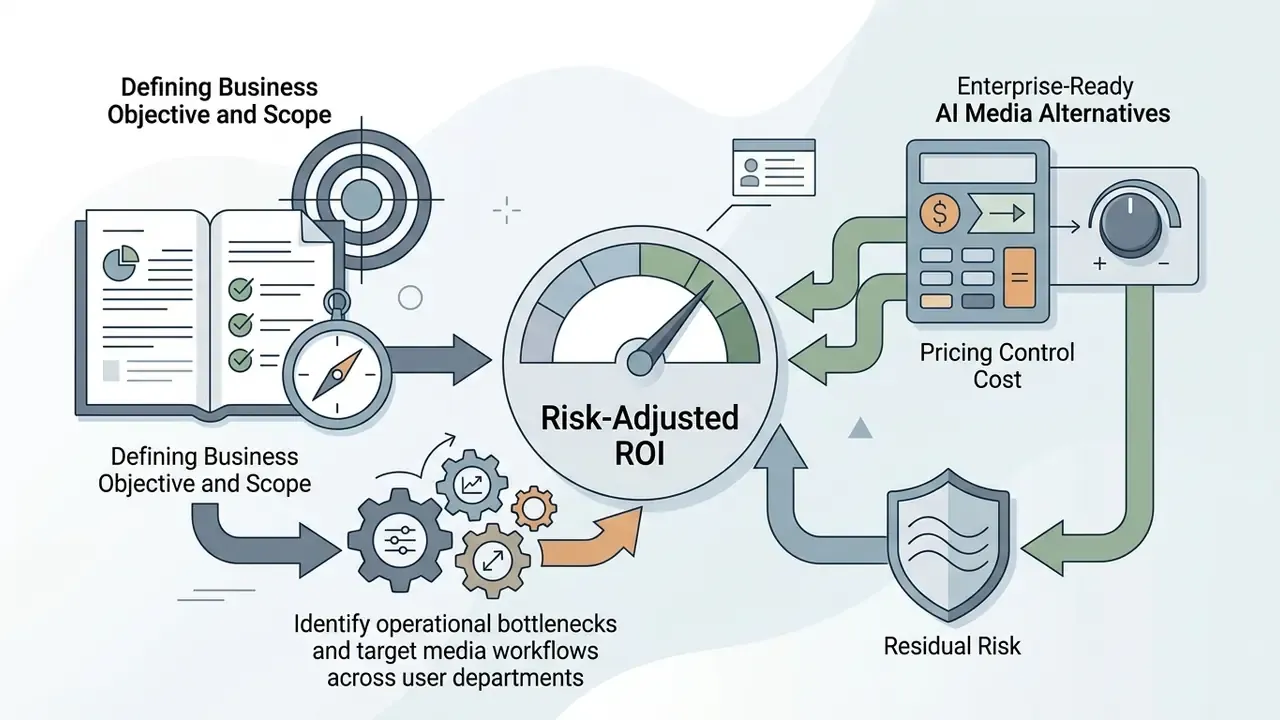
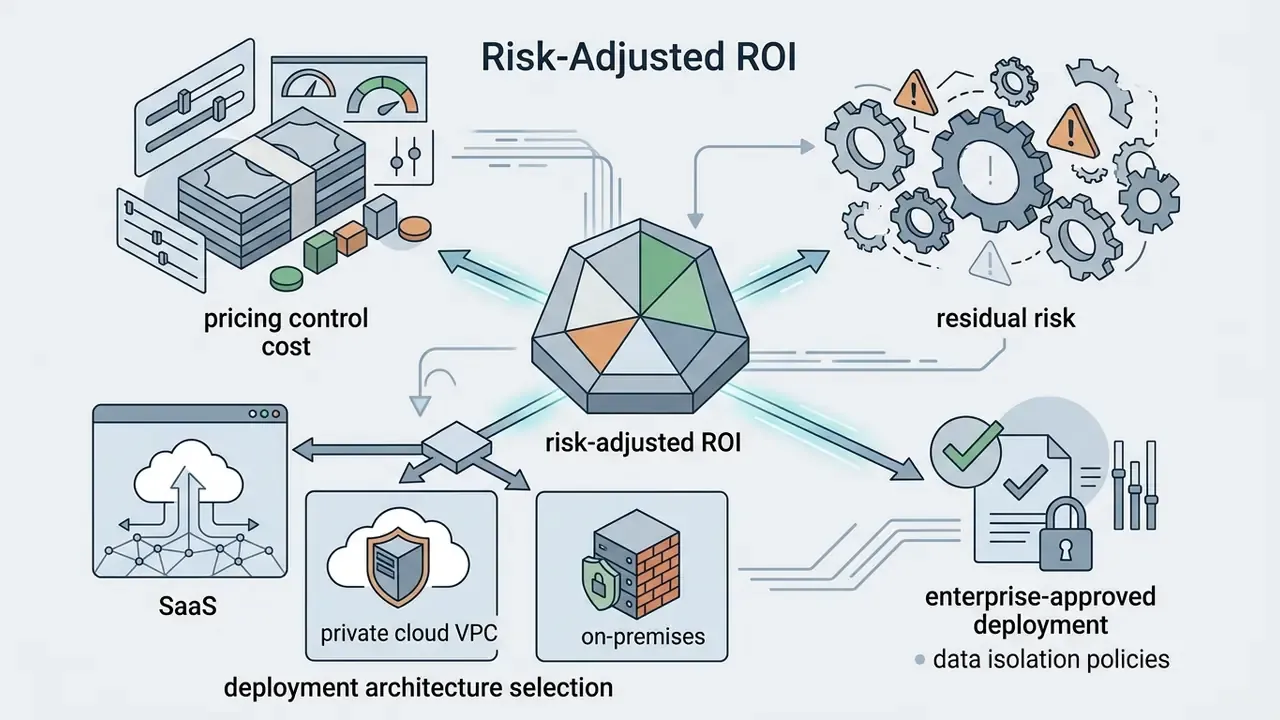
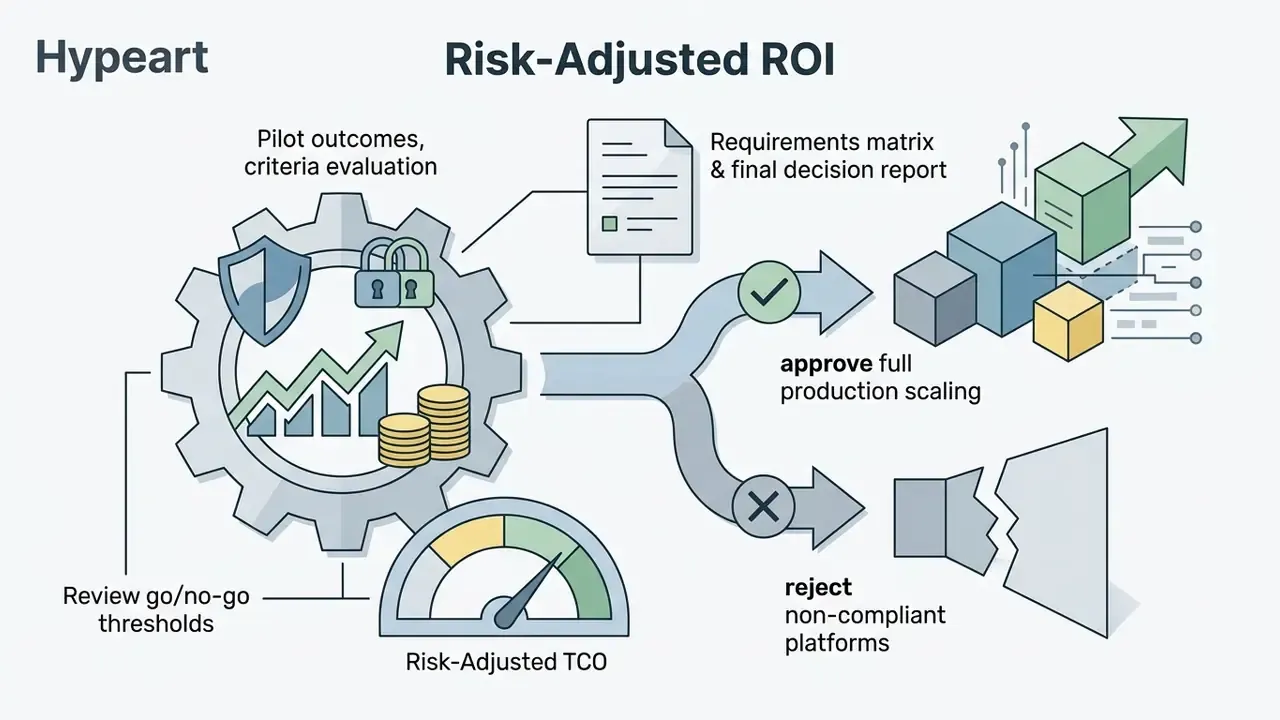
Risk-Adjusted ROI: pricing control cost and residual risk
Base ROI is value delivered minus cost of investment, divided by cost of investment. For governed AI media systems that formula understates cost, because controls, human review, and residual risk are real recurring expenses. Use the extended form:
Risk-Adjusted TCO = TCO
                  + Control Implementation Cost      (policy engines, logging, SIEM/GRC integration, provenance tooling)
                  + Ongoing Assurance Cost           (independent validation, red-teaming, periodic audit, model documentation upkeep)
                  + Human Oversight Cost             (review FTE hours x loaded rate x annual asset volume)
                  + Expected Residual Risk Cost      (sum of [ Probability(event) x Impact(event) ] per year)
Risk-Adjusted ROI = ( Quantified Benefits - Risk-Adjusted TCO ) / Risk-Adjusted TCO
Where:
- Control Implementation Cost. One-time and amortized build cost for the controls the vendor does not provide natively. This line is where Group B platforms lose to Group A platforms in regulated environments.
- Ongoing Assurance Cost. For institutions under SR 11-7, OCC 2011-12, or OSFI E-23, budget independent validation and annual review as a permanent line item, not a project cost.
- Human Oversight Cost. Approval gates are a control, and controls have a unit cost. Model it explicitly: 12 minutes of compliance review per asset at a loaded rate of $95 per hour across 20,000 assets per year is approximately $380k annually.
- Expected Residual Risk Cost. Quantify the residual exposure the controls do not remove: IP infringement claims, disclosure errors, deepfake misuse, regulatory findings. Even coarse probability times impact estimates surface the difference between indemnified and non-indemnified platforms.
Quantified benefits should be expressed with the same discipline: cycle-time reduction times volume times loaded rate, external agency or translation spend displaced, compliance backlog reduction, and revenue attributable to increased campaign throughput. Benefits that cannot be tied to a volume and a rate should be listed as qualitative and excluded from the ratio. That rule alone tends to halve the ROI submitted in first-draft business cases.
The procurement decision lifecycle illustrated in the requirements section follows seven operational phases:
Implementation plan: pilot, deployment and scaling
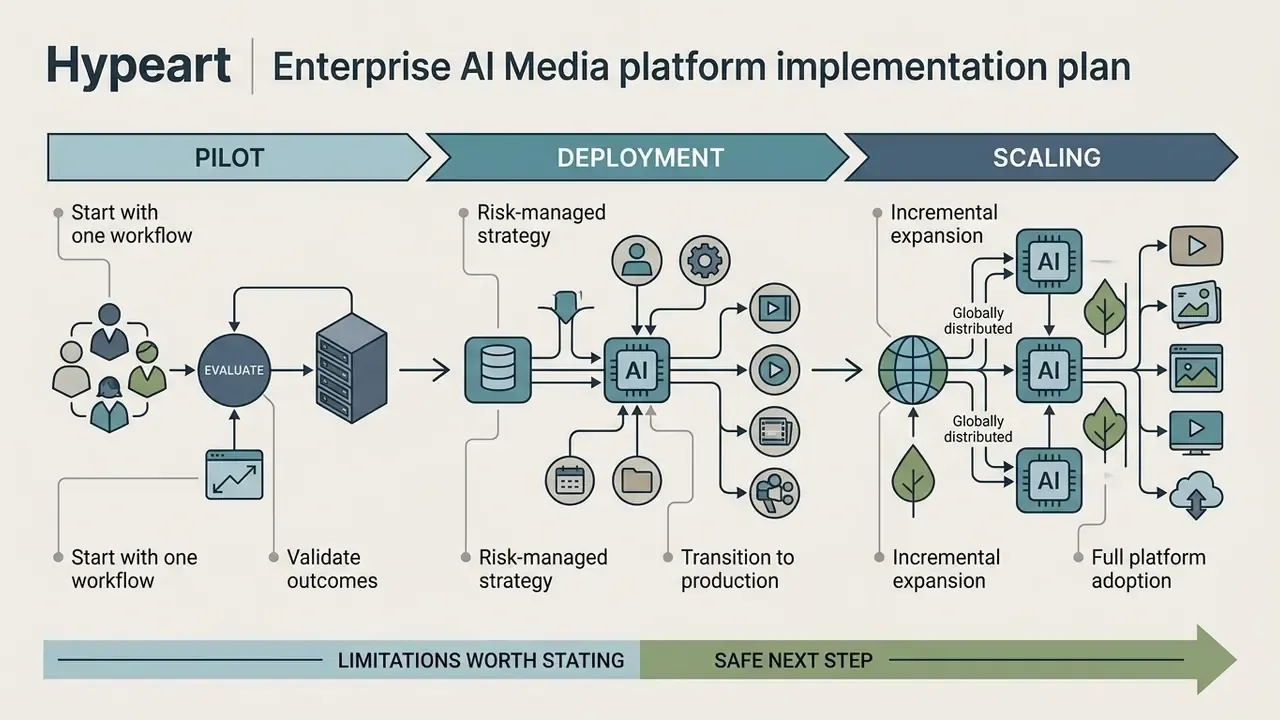
Transitioning an enterprise AI media platform from procurement evaluation into full production requires an incremental, risk-managed deployment strategy. Company-wide rollouts without structured validation phases increase exposure to operational disruption and unmonitored risk.
The sequence supported by NIST and ISO guidance has four phases: (1) establish governance, legal and compliance review, and named owner accountability before any deployment; (2) run a small pilot with defined success criteria, bias checks, and a security review of information flows and assets; (3) approve scaling only after minimum performance or assurance thresholds are met in documented go/no-go policy; and (4) scale with continuous monitoring, periodic reassessment, and management-system controls aligned to ISO/IEC 42001:2023 and ISO/IEC 38507:2022.
Start with one workflow, validate outcomes, then scale
Organizations should initiate implementation by targeting a single, well-defined operational workflow with moderate risk exposure, such as automated creative asset adaptation, AI video generation for content production workflows, or internal documentation search.
Pilot methodology should follow a three-phase structure (preliminary, conduct, test and evaluation) with scope, success criteria, and governance defined before launch, and with baseline, interim, and final evaluation studies supported by an explicit evaluation matrix. Proof-of-concept initiatives must establish baseline performance metrics, define explicit success criteria, and conduct interim evaluations before expanding scope. The pilot concludes with a documented evaluation and a formal decision on whether to scale.
For AI-specific pilots, a minimum viable governance model keeps the exercise honest:
«Select one workflow, identify the riskiest action, assign an owner, add an approval gate with a deadline, and record outcomes.»
Once the pilot validates security controls, integration performance, QoI scores, and user adoption, the implementation team can establish standardized governance playbooks (policy templates, approval matrices, audit log schemas, monitoring thresholds) to scale the platform across additional enterprise departments safely. Scaling without codifying these artifacts reproduces the shadow-AI conditions the platform was procured to eliminate.
Limitations worth stating in the committee paper. Benchmarks for generative media quality remain vendor-defined. Agentic reliability degrades in ways that are hard to predict from pilot data. Provenance standards such as C2PA are maturing, and downstream platforms strip metadata inconsistently. Cost per asset moves with model pricing, which changed several times across 2025 and 2026. None of that argues against buying. It argues for shorter contract terms, portability clauses, and quarterly reassessment.
A safe next step. Pick one workflow with a named owner, run a four-to-six-week scripted pilot with two vendors, and take the evidence pack (not the vendor deck) to your model risk committee. If the evidence pack is thin, that is the finding.
Procurement FAQ: enterprise-ready AI media alternatives
How do enterprise AI media platforms handle IP ownership and public training data?
Enterprise-grade platforms contractually guarantee zero data retention for base model training. Prompt inputs, retrieved context, and media outputs remain the property of the enterprise tenant. Leading generative media platforms additionally provide intellectual property indemnification for outputs generated from licensed training corpora. Require the zero-retention commitment and the indemnity scope in the contract, not in the marketing FAQ.
What is the difference between static system prompts and dynamic runtime governance?
Static prompts attempt to guide model behavior via text instructions, which are vulnerable to prompt injection and degrade across multi-step execution. Dynamic runtime governance ("Policies on Paths") intercepts execution calls through an isolated proxy layer to validate API payloads, RBAC scope, tool permissions, and spending caps in real time, evaluating the path taken rather than only the final action.
Do generative AI media systems fall under SR 11-7 model risk management in a US bank?
Where outputs inform customer communications, disclosures, marketing claims, pricing narratives, or credit-related content, they generally fall within the model risk perimeter defined by Federal Reserve SR 11-7 and OCC Bulletin 2011-12, requiring development documentation, independent validation, ongoing monitoring, and inventory registration. Scope determination should be made jointly by model risk management and legal, not by the procurement team alone.
Should we buy a specialized media platform or build on cloud AI infrastructure?
Buy a specialized platform when the requirement is governed asset production with indemnity, provenance, and brand control, and when time-to-value matters more than architectural ownership. Build on cloud AI or foundation-model infrastructure when media generation is one component of a broader proprietary workflow, you have the MLOps and security engineering capacity, and you accept that 70 to 85% of five-year cost will be internal engineering rather than licence fees.
What should the pilot measure before we approve production scaling?
Six things: security control enforcement observed live (RBAC, logging, kill switch), integration performance against real systems of record, the nine Quality of Insight dimensions scored 0 to 5, actual per-asset cost including human review time, hallucination and policy-violation rates on your own content, and user adoption against a named baseline. Document all six against pre-set go/no-go thresholds before the decision meeting.
How many vendors should reach the demonstration stage?
Two to three. More than three dilutes the quality of scripted testing, makes normalized pricing comparison unmanageable, and stretches the evaluation past the point where the underlying model landscape has shifted. Filter to the shortlist using the requirements matrix on paper.
Which enterprise-ready AI media alternatives recommendations apply to a first purchase?
For a first governed deployment, most institutions are better served by a Group A media platform with native provenance and indemnity, paired with one low-code automation engine for routing. Reserve Group B infrastructure for the second wave, once the governance playbooks exist and the model inventory has absorbed the first system.
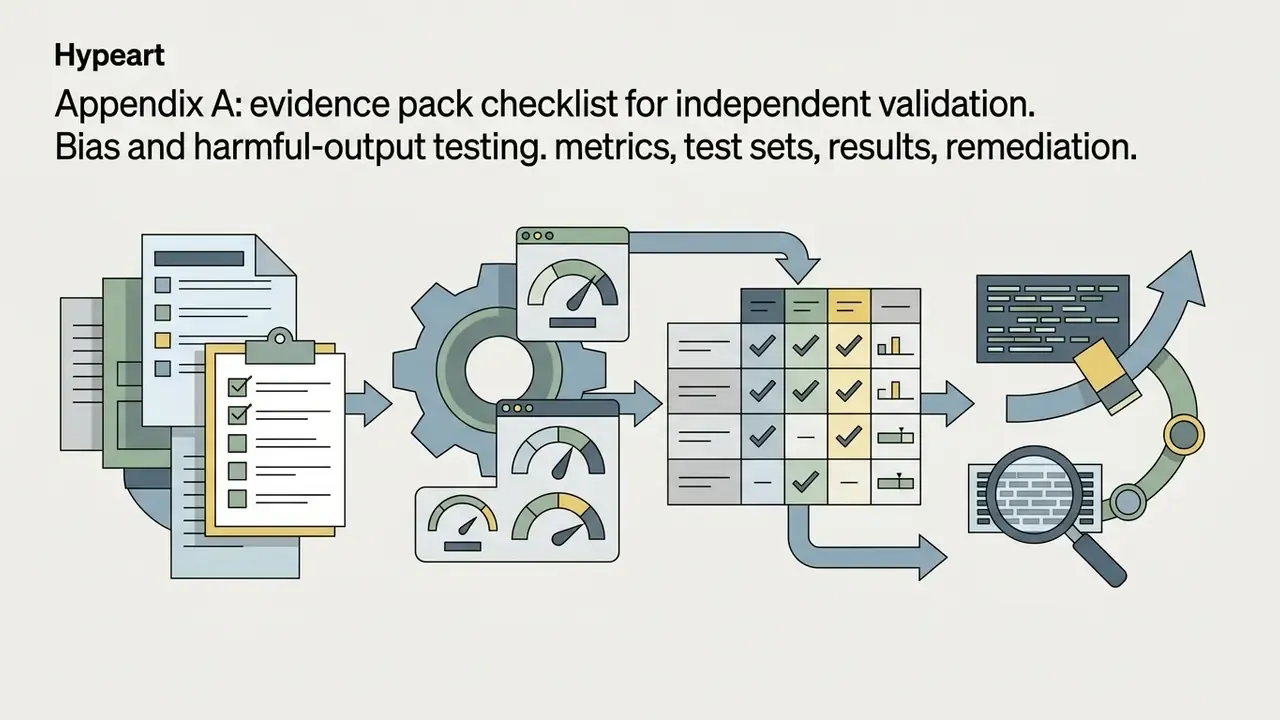
Appendix A: evidence pack checklist for independent validation
Independent validation functions rarely fail a platform on model quality. They fail it on missing evidence. Assemble this pack during the pilot, not after the contract is signed.
1. Inventory and ownership
- AI system entry in the institutional model or AI inventory, with unique identifier.
- Named business owner, technical owner, and validating function.
- Documented intended use, prohibited uses, and materiality rating.
2. Development and vendor documentation
- Vendor model documentation package, including training data provenance statements and known limitations.
- Model and prompt version history, with change dates and approvers.
3. Control evidence
- RBAC and ABAC role matrix as deployed, with segregation-of-duties mapping.
- Sample immutable audit records matching the contracted schema, exported to SIEM and GRC.
- Spend cap and token cap configuration, plus one deliberate breach test result.
4. Performance and reliability
- Hallucination and policy-violation rates measured on institutional content, with sample sizes.
- Latency percentiles P50, P90, P99 under expected peak load.
- Drift baseline definition, threshold values, and the rationale for those values.
5. Human oversight
- Approval matrix showing which actions require which authority level.
- Average and maximum review time per asset, with reviewer roles.
- Automation bias monitoring approach, however simple.
6. Provenance and content integrity
- C2PA or equivalent signing evidence for a sample of published assets.
- Trace of one asset from published artifact back to prompt, model version, retrieved sources, and approver.
- Handling procedure for downstream metadata stripping.
7. Resilience and exit
- SLA text covering uptime, RTO, RPO, and remedies.
- Disaster recovery test record within the last twelve months.
- Data portability and contract exit terms, including export format and retention on termination.
8. Financial evidence
- Normalized pricing comparison across shortlisted vendors on one pricing model.
- Risk-Adjusted TCO calculation with each cost line sourced.
- Quantified benefits with volume and rate assumptions stated, qualitative benefits listed separately.
If a section of this pack is empty at the go/no-go meeting, treat the gap itself as the decision input.
Disclaimer. This guide is provided for general informational and procurement-planning purposes only. It does not constitute legal, regulatory, financial, security, or model risk management advice, and it does not create any vendor endorsement. Pricing figures are indicative published ranges and change frequently. Regulatory obligations, including but not limited to SR 11-7, OCC Bulletin 2011-12, OSFI Guideline E-23, GDPR, HIPAA, and the EU AI Act, depend on jurisdiction, institution type, and specific use case. Audience statements and case examples in this guide should be treated as hypotheses until supported by analytics, interviews, CRM data, or verified customer research. Consult qualified legal, compliance, information security, and model risk professionals before making procurement or deployment decisions.