Methodology last reviewed: Q1 2026 · Scope: retrieval-augmented answer generation, accuracy benchmarking, enterprise governance controls, free-tier access models.
Executive Summary for Risk and Governance Leaders
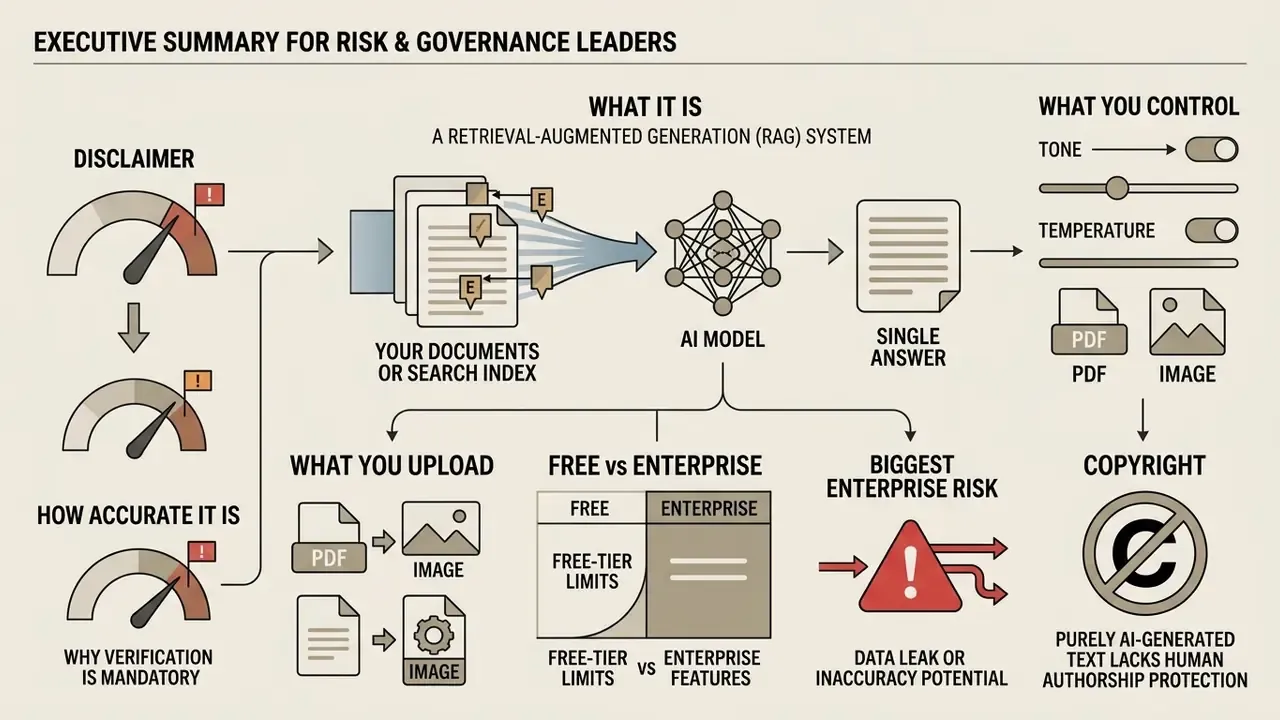
- What it is. An AI answer generator is a retrieval-augmented generation (RAG) system: it retrieves evidence from your documents or a search index first, then writes a single grounded answer instead of returning a list of links.
- How accurate it is. Grounded pipelines outperform closed-book models, but industry-grade RAG still answers only a minority-to-moderate share of complex open-domain questions without error. Naive RAG accuracy sits near 44%. The strongest industrial systems reach roughly 63% hallucination-free answers on the CRAG benchmark.
- Why verification is mandatory. Ungrounded models fabricate precise numeric and temporal facts at rates exceeding 60% on definitive-answer datasets, and repeat-query consistency can drop to 21%. Claim-level fact-checking is a control, not a courtesy.
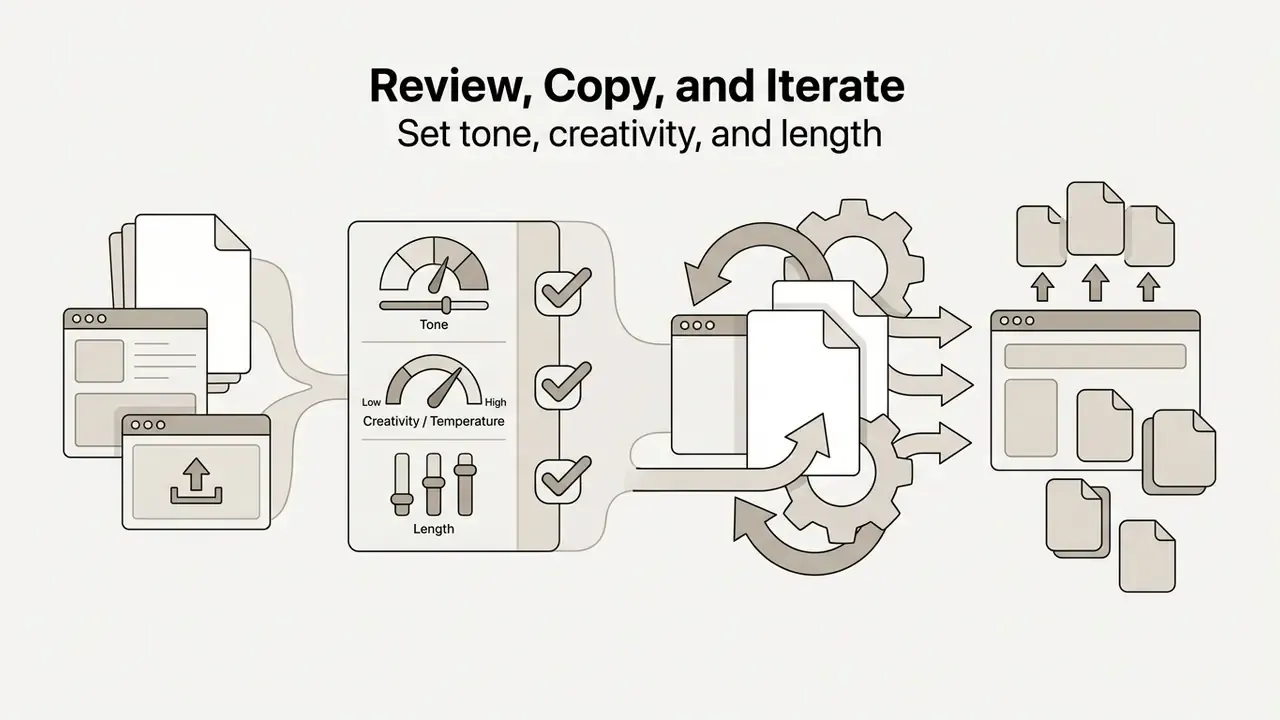
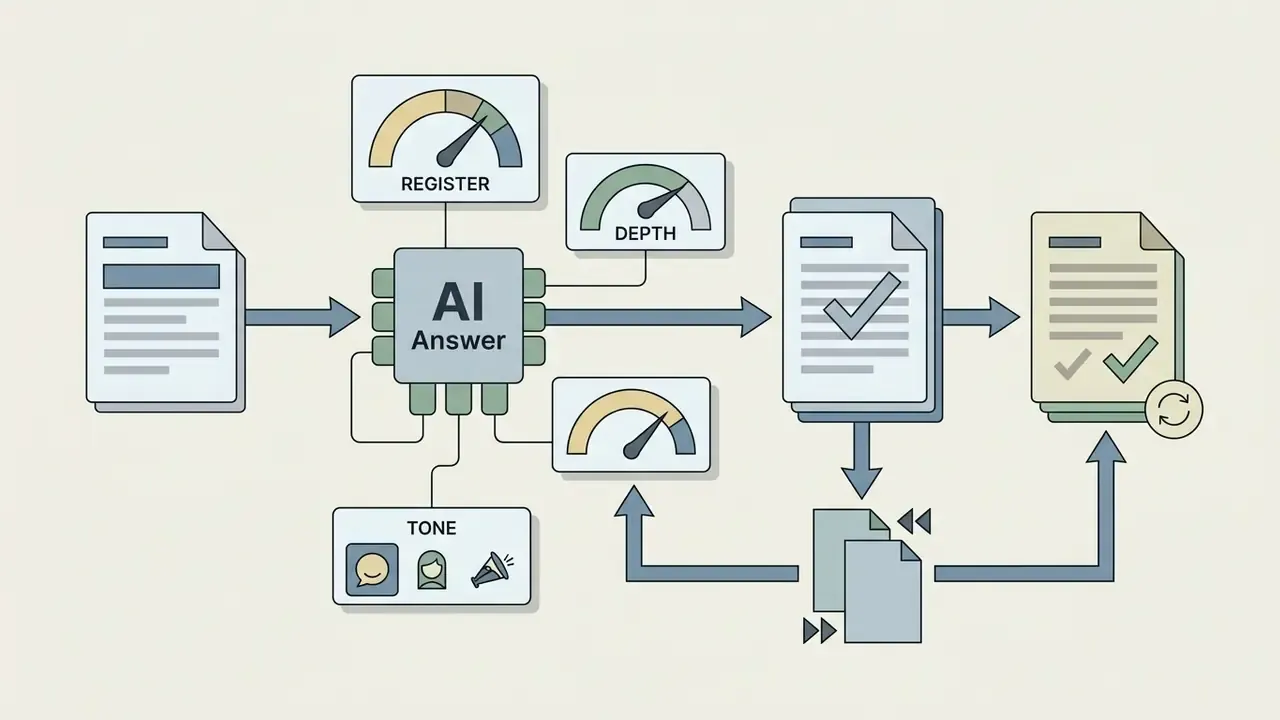
- What you control. Three parameters decide output quality: tone (academic, professional, simple/informal, flowing), creativity/temperature (low, medium, high), and length (short, medium, long).
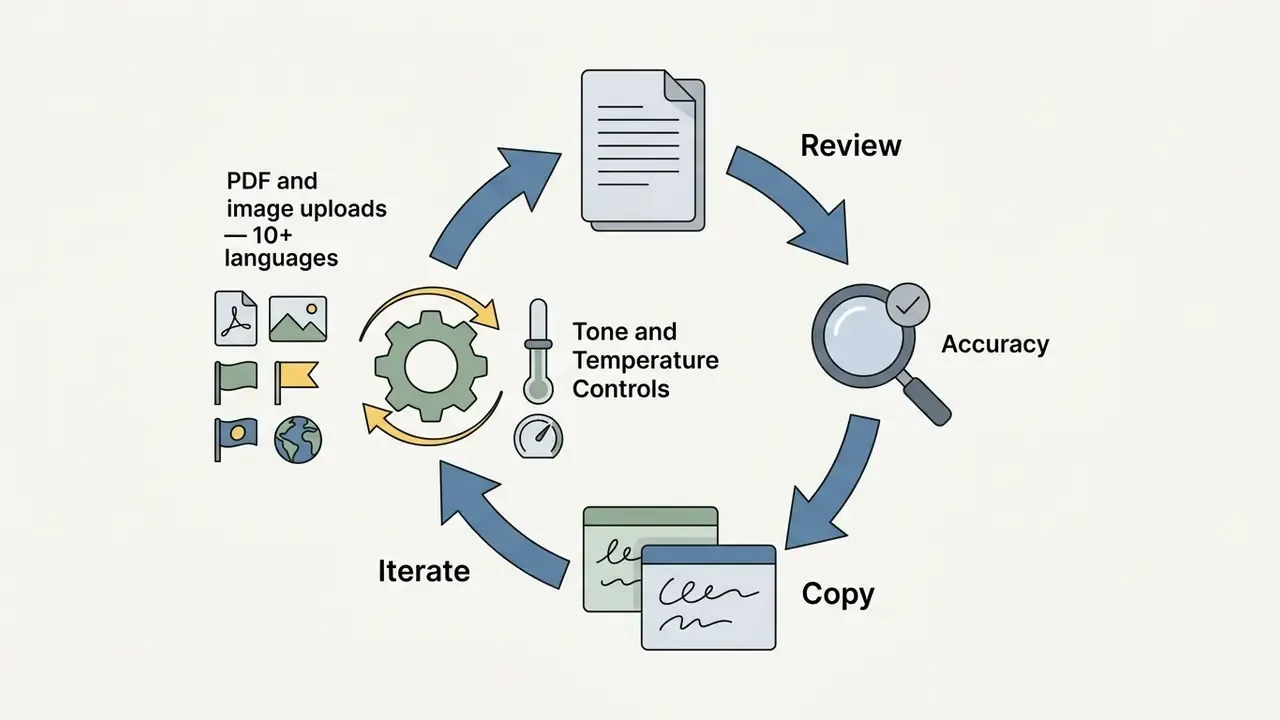
- What you upload. Text, PDFs (native and scanned), images, structured data (CSV/XLSX/JSON/XML), and voice audio.
- Free vs enterprise. Free tiers typically allow around 20 generations per day with no registration, or unlimited text queries with hard file-size caps (commonly 5 MB per PDF). Enterprise tiers add zero-data-retention, SSO/MFA, audit trails, and commercial indemnification.
- Biggest enterprise risk. Shadow AI: employees pasting regulated PII or PHI into consumer tools. Controls are described in the governance section below.
- Copyright. Purely AI-generated text lacks human authorship protection under US Copyright Office guidance. Disclosure and provenance metadata obligations continue to advance through legislation such as the AI Labeling Act.
Who this guide serves. It is written for two overlapping groups. First, risk and control owners in US banks and mature fintechs who must decide whether a grounded answer tool belongs in the model inventory, at which risk tier, and with which compensating controls. Second, operators (analysts, support leads, students, marketers) who simply want a usable prompt and an honest read on accuracy. The guide supports four decisions: whether to allow the tool at all, which data classes may touch it, what evidence to retain for audit, and when a free tier is genuinely enough.
What Is an AI Answer Generator and What Tasks Does It Serve
An AI answer generator is a specialized system that ingests user questions and reference materials to synthesize grounded, natural-language responses. Unlike broad text generation tools, an answer generator uses retrieval-augmented generation (RAG) to constrain outputs to verifiable evidence from documents, databases, or targeted search indices.
Institutions and enterprise teams deploy an ai answer generator to extract structured insights from complex documentation without manual search overhead. By processing user queries alongside contextual files, these systems deliver instant, relevant, and detailed responses across audit, research, and operational workflows. The practical appeal is mundane rather than futuristic: fewer hours spent scrolling a 180-page procedure manual to locate one control owner.
How AI Generates Answers to Questions
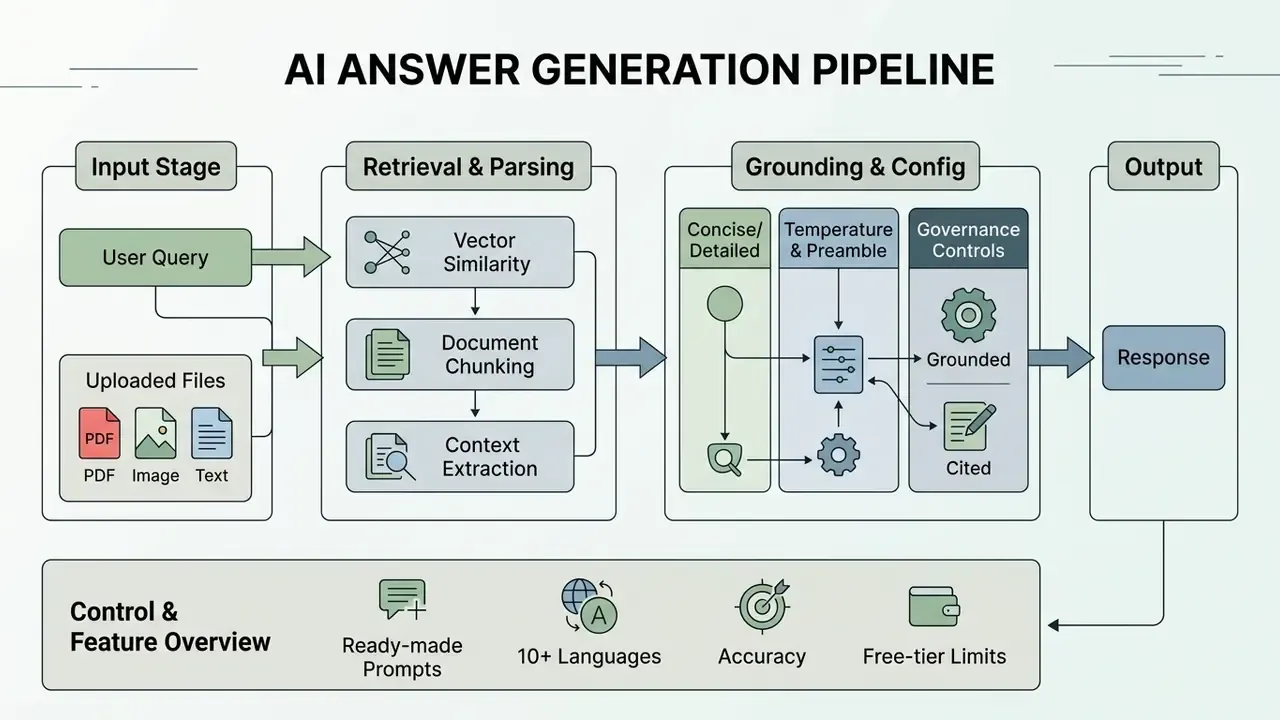
AI generates answers to questions through a multi-stage retrieval and inference pipeline that matches user query embeddings against indexed reference corpora. First, a retriever identifies top-ranked context passages based on semantic similarity. Next, a large language model (LLM) processes the query and retrieved context during the prefill phase, followed by sequential decoding to generate a context-grounded response.
In research benchmark settings, retrieval-augmented pipelines significantly outperform closed-book models by conditioning output generation on retrieved passages. The headroom, though, remains large.
«A straightforward RAG pipeline reaches only 44% accuracy, while state-of-the-art industry RAG solutions answer 63% of questions without hallucination.»
This two-phase architecture ensures that generated answers mirror factual source data rather than ungrounded model weights. And the residual error rate is not an academic detail: it defines the volume of human verification your workflow must absorb, plus the staffing cost that belongs in the business case.
How AI Answer Generator Differs from Search Engines and AI Chat
An AI answer generator differs from a traditional search engine by synthesizing a direct, unified response instead of returning a list of links. It differs from generic AI chat by strictly grounding outputs in retrieved source material. Traditional search engines require manual information extraction across multiple domain URLs, whereas an answer generator automates data synthesis and hands back one reviewable statement.
| Metric / Dimension | Traditional Search Engine | Generic AI Chat | AI Answer Generator |
|---|---|---|---|
| Primary Output | Ranked list of web links | Free-form conversational text | Grounded, direct answer with context |
| Grounding Source | Web crawl index | Parametric model memory | Retrieved documents & vector stores |
| Verification Need | User synthesizes sources | High risk of hallucination | High (claim-level source tracing) |
| Response Speed | Fast link retrieval | Fast text decoding (2–4 sec) | Fast (1–3 sec retrieval + generation) |
| Audit Trail | Browser history only | Usually none | Source-to-claim traceability |
| Model Risk Profile | Low (no generation) | Highest (ungrounded synthesis) | Medium (bounded by evidence quality) |
«Multi-step retrieval raises accuracy from 0.40 to 0.66 on complex questions that require integrating multiple sources.»
Generic chatbots invite open-ended conversation. Specialized answer tools do the opposite: they restrict generation parameters to prevent context drift and suppress speculative claims. For institutions classifying tools inside a model inventory, this distinction carries real weight. An ungrounded chat interface behaves like an unvalidated model with no evidentiary trail, whereas a grounded answer generator can be documented, tested, and audited against a fixed corpus. Adjacent generative tools in the same family, for instance an ai headline generator used by marketing, sit in a lower risk tier because their output rarely informs a customer decision.
Supported Data Types: Text, Images, Files, and Voice
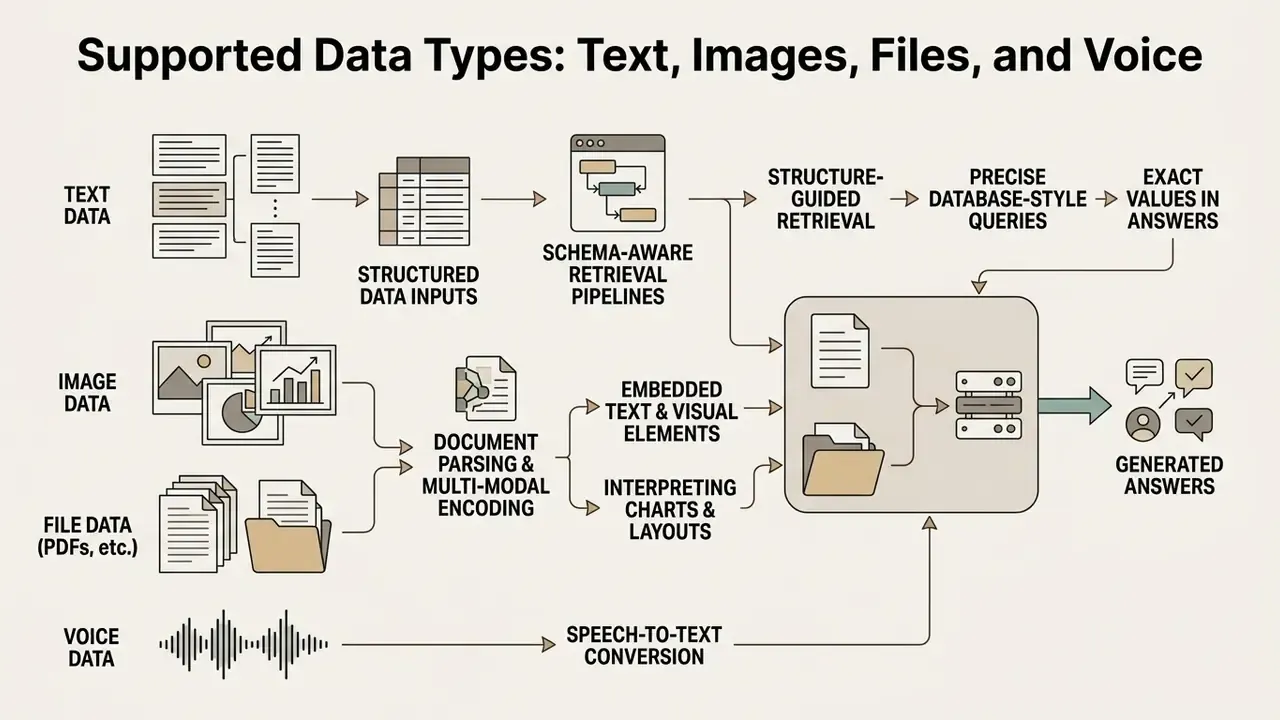
Modern AI answer generators accept text prompts, image OCR scans, PDF documents, structured spreadsheets, and voice audio streams to build comprehensive context profiles. Multimodal processing lets the system extract text, tables, and visual evidence from diverse file formats.
| Input Modality | Supported Formats | Processing Pipeline | Expected Output Format |
|---|---|---|---|
| Text Queries | Plain text, Markdown, JSON | Native language parsing & vector search | Direct text response with inline citations |
| PDF Documents | .pdf (text & scanned) | OCR text extraction + page vision encoding | Structured text summary, Q&A extraction |
| Images & Graphics | .png, .jpg, .webp, .tiff, .bmp | Vision-language OCR & layout parsing | Extracted text data & visual analysis |
| Structured Data | .csv, .xlsx, .xml, .json | Schema-aware retrieval & table parsing | Analytical text summaries & data points |
| Documents & Slides | .docx, .pptx, .md, .html | Layout-aware text extraction | Summaries, extracted Q&A pairs |
| Voice Audio | .mp3, .wav | Multimodal audio transcription & intent parsing | Transcribed Q&A and text responses |
Data handling rules: text-based queries and clean PDF uploads yield the highest factual retrieval accuracy, whereas multi-page scanned documents and complex graphic layouts require rigorous post-generation claim verification.
Answers for Text Questions and Structured Data
Text questions and structured data inputs are processed using schema-aware retrieval pipelines that preserve field relationships and tabular context. When queries involve numerical tables or JSON schemas, structure-guided parsing prevents data misalignment during text generation.
Structure-guided retrieval improves recall and precision on database-style queries because the retriever matches exact fields, tables, and entities rather than merely semantically similar fragments. Interoperability specifications for structured AI data processing (including the ITU-T F.748.52 series) additionally require support for structured inputs and higher match rates against retrieved results, with answer reliability graded against retrieval output. Specific quantitative deltas require product-level testing on your own corpus, and vendor slides are not a substitute for that test.
«Hybrid retrieval models improve nDCG@10 on BEIR from 43.42 (BM25) to 52.59, showing the advantage of structured ranking over baseline lexical search.»
Maintaining strict schema fidelity ensures that generated answers reflect exact values from underlying datasets, not statistical approximations. For financial and audit use, always require the system to echo the source cell, row, or field identifier alongside the numeric answer. A number without a cell reference is a rumour with formatting. Teams that model cost or exposure alongside these answers can view the guide to the calculator set and keep the arithmetic outside the language model.
Image, PDF, and File Upload Processing
Document parsing algorithms extract embedded text, bounding boxes, and visual elements from uploaded PDFs and image files before passing context to the LLM. Optical Character Recognition converts scanned pages into searchable text nodes, enabling question-answering over legacy documentation. Teams comparing extraction engines can review image-to-text and OCR tooling for business use before standardizing an ingestion stack.
Enterprise platforms use multi-modal vision encoders to interpret charts, layout structures, and cross-page references in complex PDF reports, and the measured limits are sobering.
«The best-performing model, GPT-4o, achieves an F1 score of only 42.7% on long documents; 22.8% of questions are deliberately unanswerable to detect hallucination.»
The operational implication is direct. Long, chart-heavy PDFs are the highest-risk input class. Route them through page-level citation requirements and require the model to state "not present in source" when evidence is absent. Photographed pages behave similarly: consumer patterns such as an ai homework helper picture workflow show how quickly a blurred snapshot degrades an otherwise sound answer. Voice-driven Q&A follows the same rule, since transcription quality caps answer quality; teams evaluating speech stacks can consult the guide to AI voice generators and language support for modality trade-offs.
How to Use AI Answer Generator Online
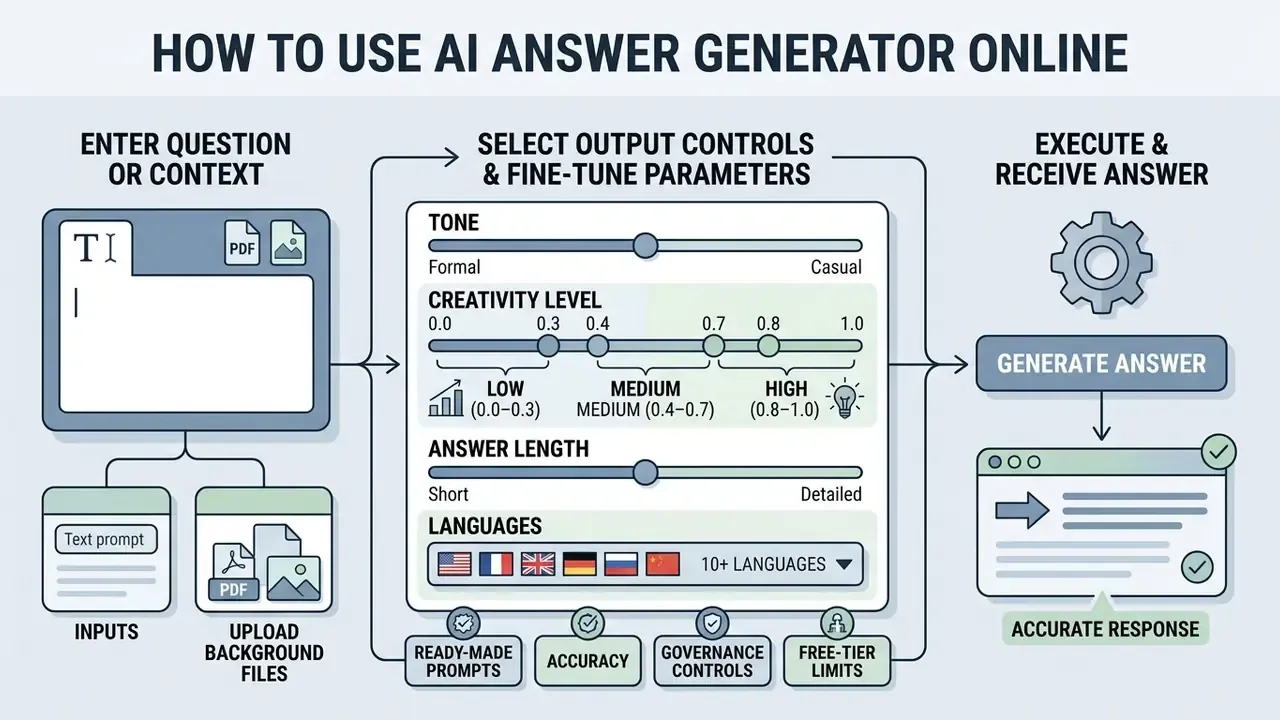
To use an AI answer generator online, users enter a clear prompt, optionally upload supporting background files, select desired output constraints, and execute the generation query. The tool processes the inputs in real time to deliver an instant response tailored to the specified format and depth.
Using an ai answer generator online or an ai answer generator online free interface lets operators bypass manual scanning. Users simply ask a targeted question, click generate, and review the output against primary sources. That last step is where most teams quietly cut corners.
Enter Your Question or Add Contextual Data
To generate precise responses, state the explicit goal and provide structured background context in the input query. Specifying task parameters, target audience, and output constraints prevents ambiguous model interpretations and keeps the answer aligned with operational requirements.
Prompt hygiene, consistent with major vendor documentation: put the instruction first, separate instruction from context with a delimiter such as ### or triple quotes, name the audience and format explicitly, and include only the background that is actually relevant. When complex tasks require specific knowledge bases, users can upload background files, structured tables, or raw text excerpts. Supplying clean, domain-specific data limits retriever noise and improves output precision. One caveat worth repeating: dumping an entire shared drive into the context window usually lowers precision rather than raising it.
Select Output Controls and Fine-Tune Parameters
To receive optimal outputs, operators can adjust three core generation parameters before executing the prompt:
- Response Tone.Choose Academic (literature reviews, audit trails, citation-heavy writing), Professional (enterprise communications, client-ready summaries), Simple / Informal (quick explanations, internal chats), or Flowing (narrative and long-form content). Standard and formal variants sit between the professional and academic registers.
- Creativity Level (Temperature)Creativity Level (Temperature)
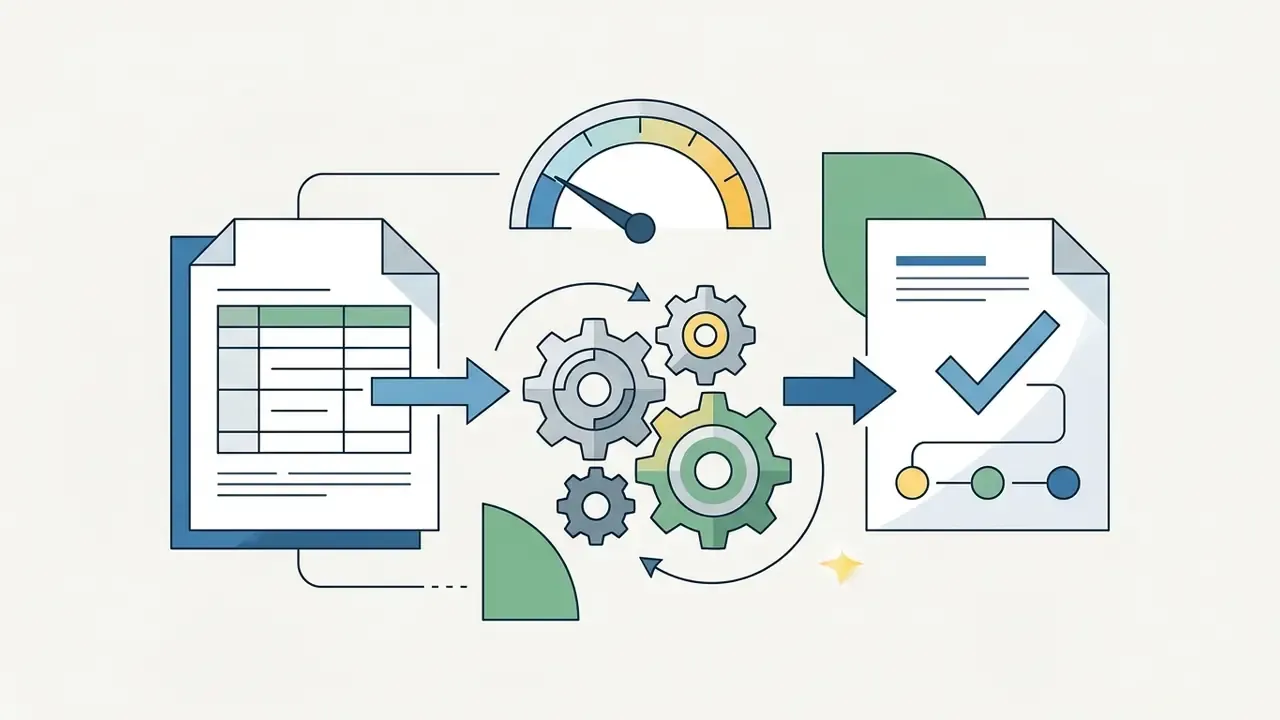
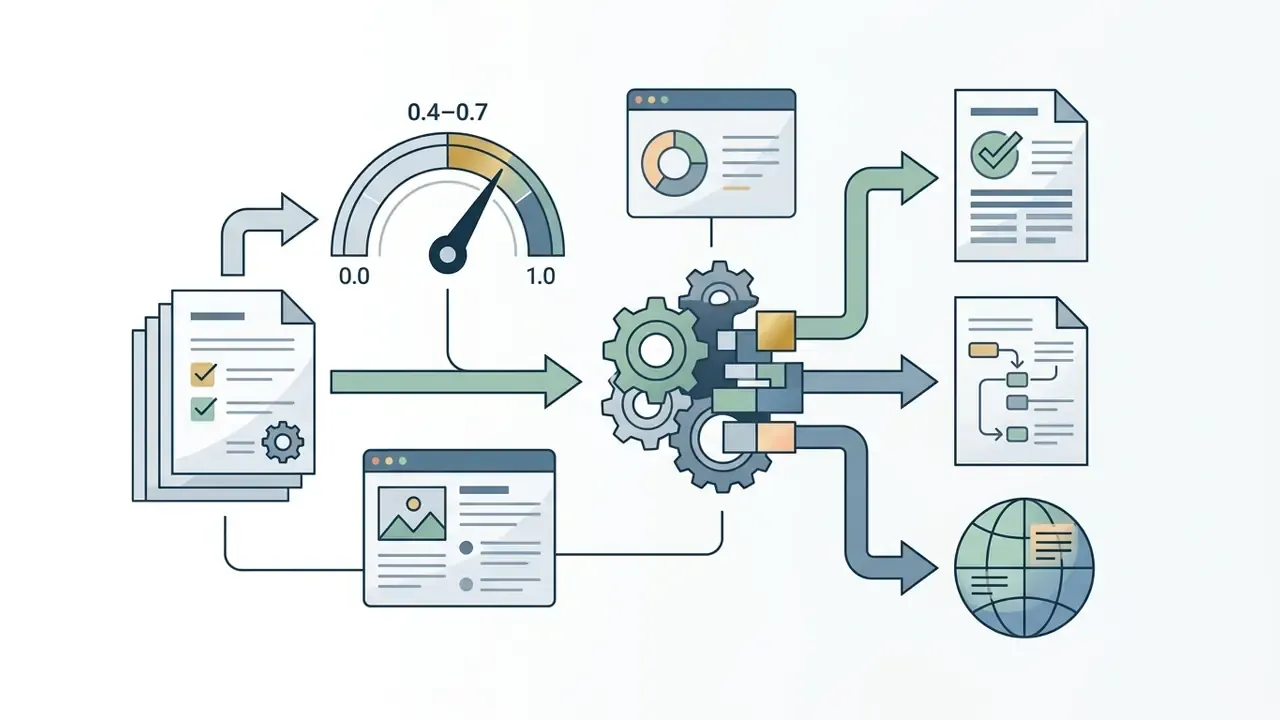

- Answer Length. Select Short (1–2 concise sentences), Medium (structured bullet points), or Long (multi-paragraph breakdown with step-by-step reasoning and supporting evidence).
Concise mode produces direct result statements without conversational preamble. Detailed mode provides chain-of-thought explanations and supporting evidence. Verbosity is exposed either as a UI dropdown or as an API parameter (for example, low / medium / high verbosity levels), and reasoning depth may be toggled separately through system-prompt switches. Teams wiring these controls into their own products can review the AI Media API documentation for parameter naming before hard-coding defaults.
Ready-to-Use Input Query Examples by Subject
Test the generator immediately by copying these pre-validated templates:
- Mathematics "Solve for x: 3x² + 5x − 2 = 0. Show the step-by-step algebraic derivation."
- Physics "Explain the law of conservation of energy using a frictionless pendulum example, then state two real-world deviations."
- Chemistry "Balance the equation for the combustion of propane and explain the stoichiometric ratio in one paragraph."
- Literature "Identify the primary theme and meter of Robert Frost's poem 'The Road Not Taken', and quote the line that carries the central ambiguity."
- Biology "Describe the main function of the eukaryotic cell nucleus and list three organelles it interacts with."
- History "Summarize the economic impact of Queen Victoria's reign (1837–1901) in three key points with dates."
- Job Interview Prep "Draft a STAR-format response to the question: 'Describe a time you managed a project with conflicting deadlines.'"
- Enterprise / Audit "From the attached policy PDF, list every control owner named in Section 4 and cite the page number for each."
Review, Copy, and Iterate
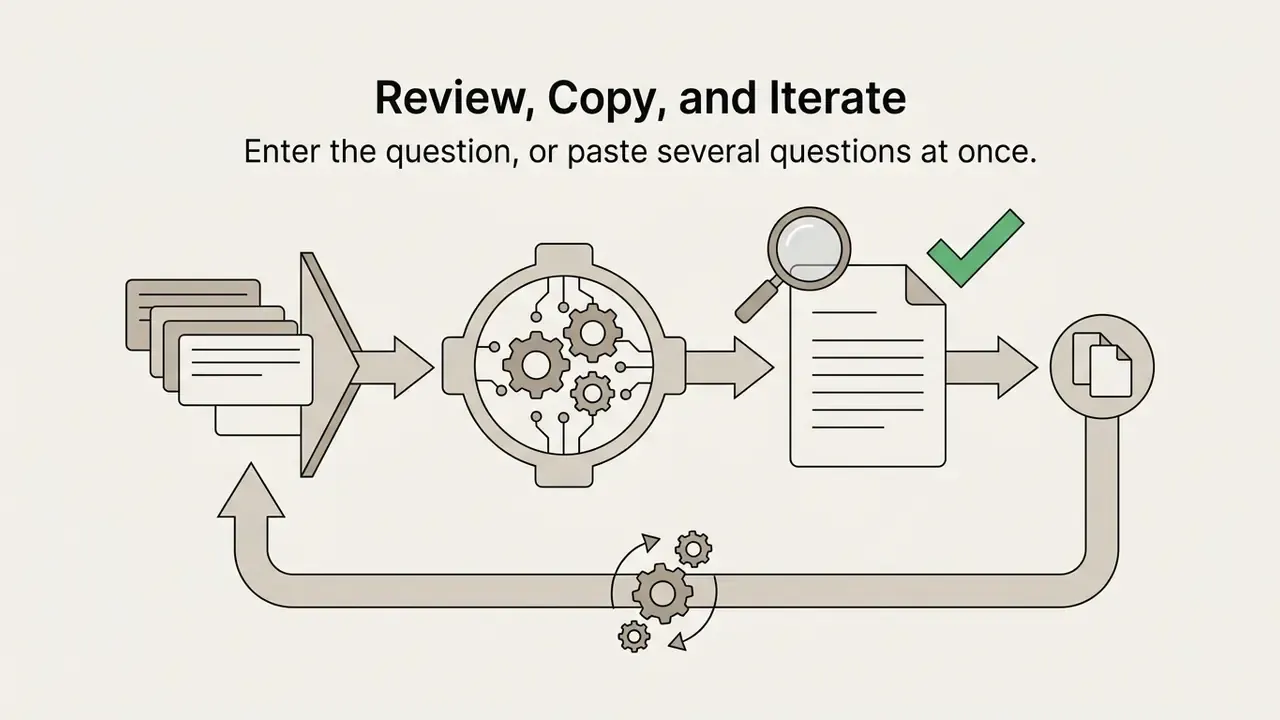
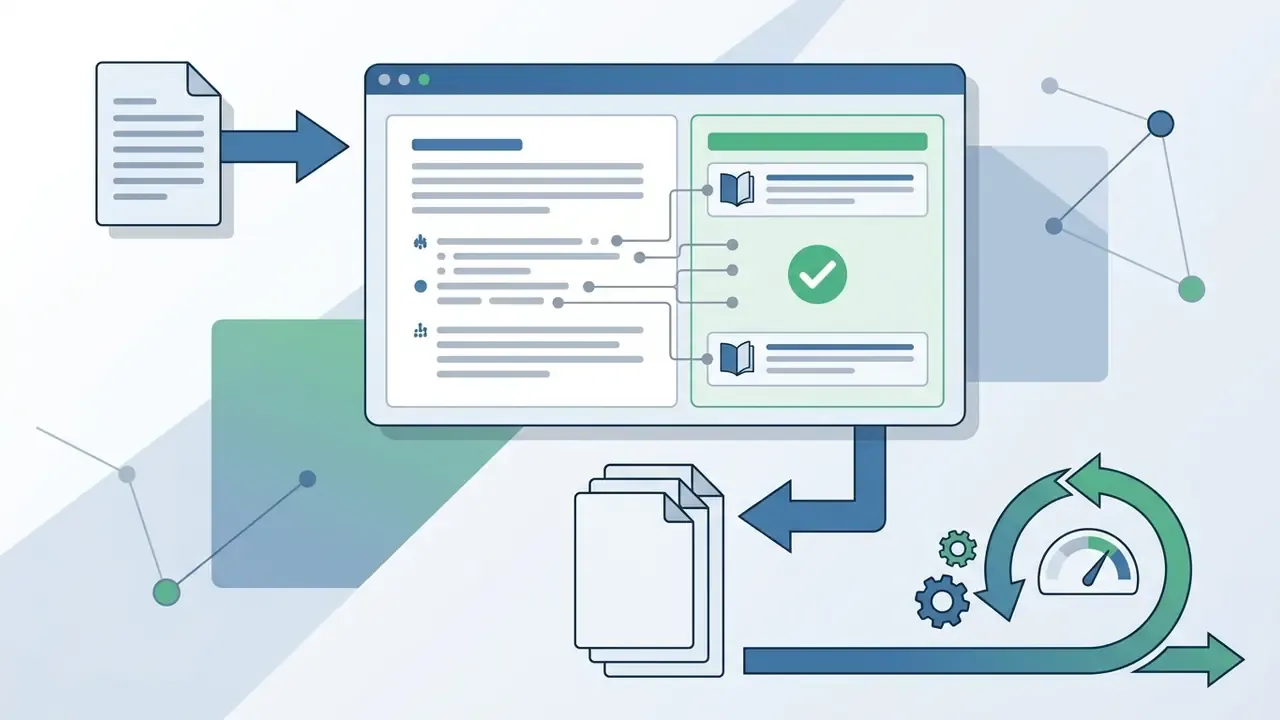
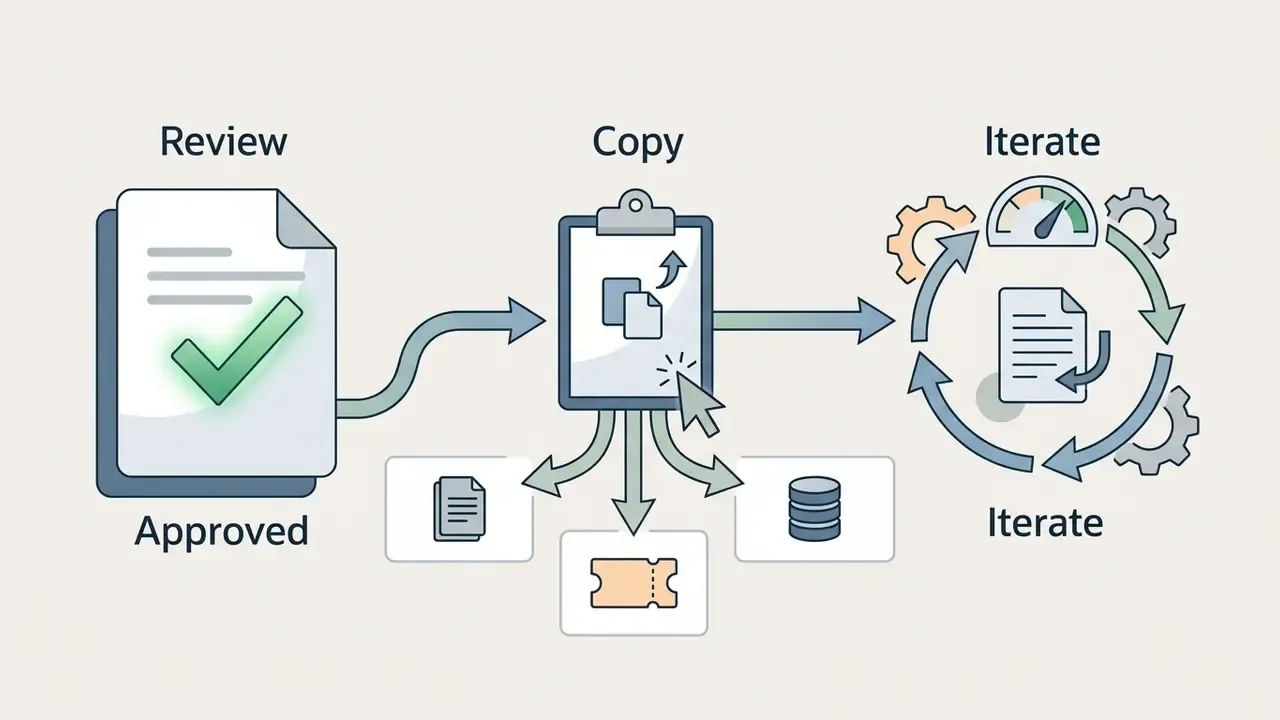
Once configuration parameters are finalized, a single click initiates processing to generate real-time responses. The reviewed workflow is short and repeatable:
Changing one variable per iteration keeps the cause of quality changes observable. That matters later, when the workflow has to be documented for internal audit and somebody asks why the March answer differs from the January one.
How Accurate Is AI Answer Generator and Why Fact-Checking Is Mandatory
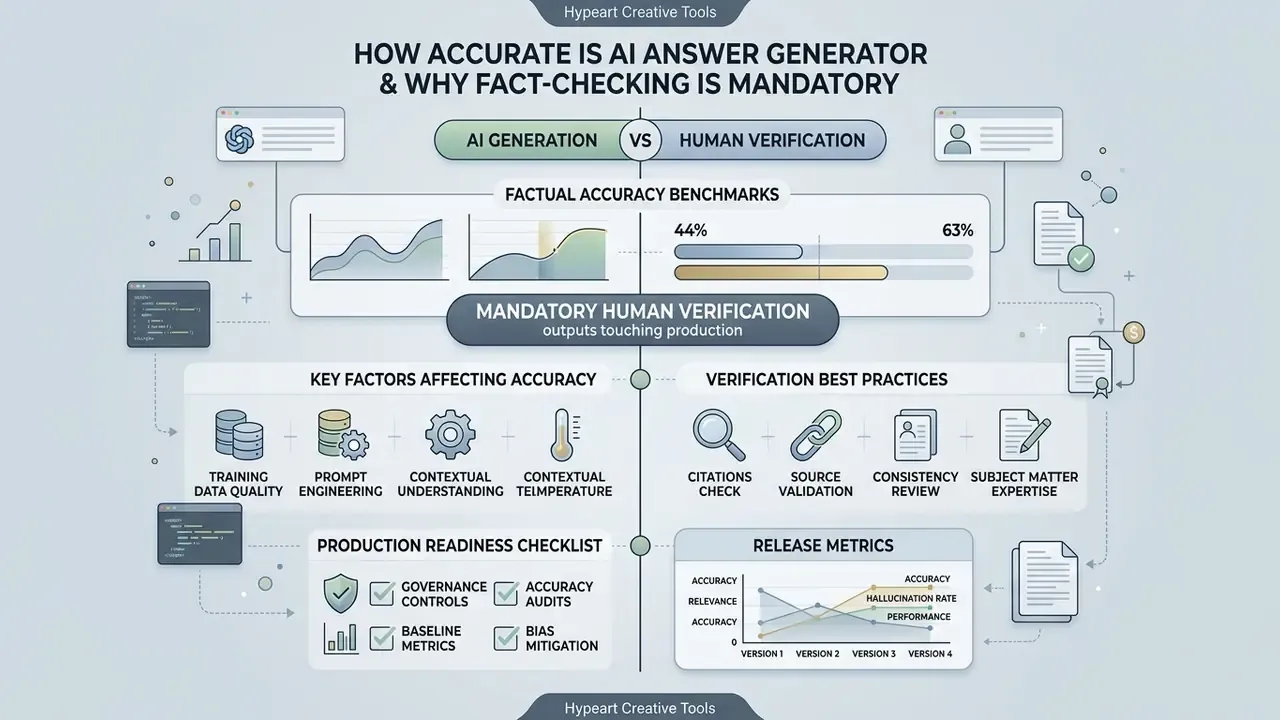
AI answer generators achieve roughly 44% to 63% factual accuracy on complex open-domain benchmarks, which makes rigorous human fact-checking mandatory before outputs touch operational or regulatory decisions. Even advanced RAG architectures suffer from hallucinations, context misinterpretation, and retrieval omissions.
An accurate ai answer generator depends on the quality of its underlying reference documents and prompt constraints. Empirical evaluations across open-domain definitive-answer datasets show factual hallucination rates reaching well over 60% in ungrounded general-purpose LLMs when queried for precise temporal or numeric facts.
«Prompt-misalignment rates range from 6% to 95%, and average answer consistency across repeated queries is only 21–61%.»
Treat automated outputs as preliminary hypotheses, not settled truth. The consistency finding is the one most often missed: the same question asked twice may not return the same answer. That breaks reproducibility assumptions in audit and reporting workflows unless temperature is pinned low and outputs are archived with their retrieved context.
Key Factors Affecting Answer Accuracy and Relevance
Response accuracy depends on context completeness, query clarity, retriever precision, and the temporal stability of the source data. Vague prompts or incomplete file context force the model to fall back on parametric memory, which raises the probability of plausible but fabricated statements.
RAGBench separates context relevance, answer relevance, completeness, and groundedness as distinct metrics. Long-tail entity queries and rapidly changing facts show the highest error rates, which is exactly the profile of most regulatory questions.
«RAGBench comprises 100,000 examples across five industry domains, with TRACe evaluation showing fine-tuned RoBERTa judges outperforming LLM-based evaluators.»
«CRAG reveals substantially lower accuracy on questions with high dynamism, low entity popularity, or high complexity.» CRAG Benchmark, Yang et al., NeurIPS 2024. https://arxiv.org/abs/2406.04744
Comprehensive background context and precise query parameters improve response relevance directly. Choosing low creativity for factual retrieval also cuts speculative filler, which is the cheapest quality control available.
Verification and Fact-Checking Best Practices
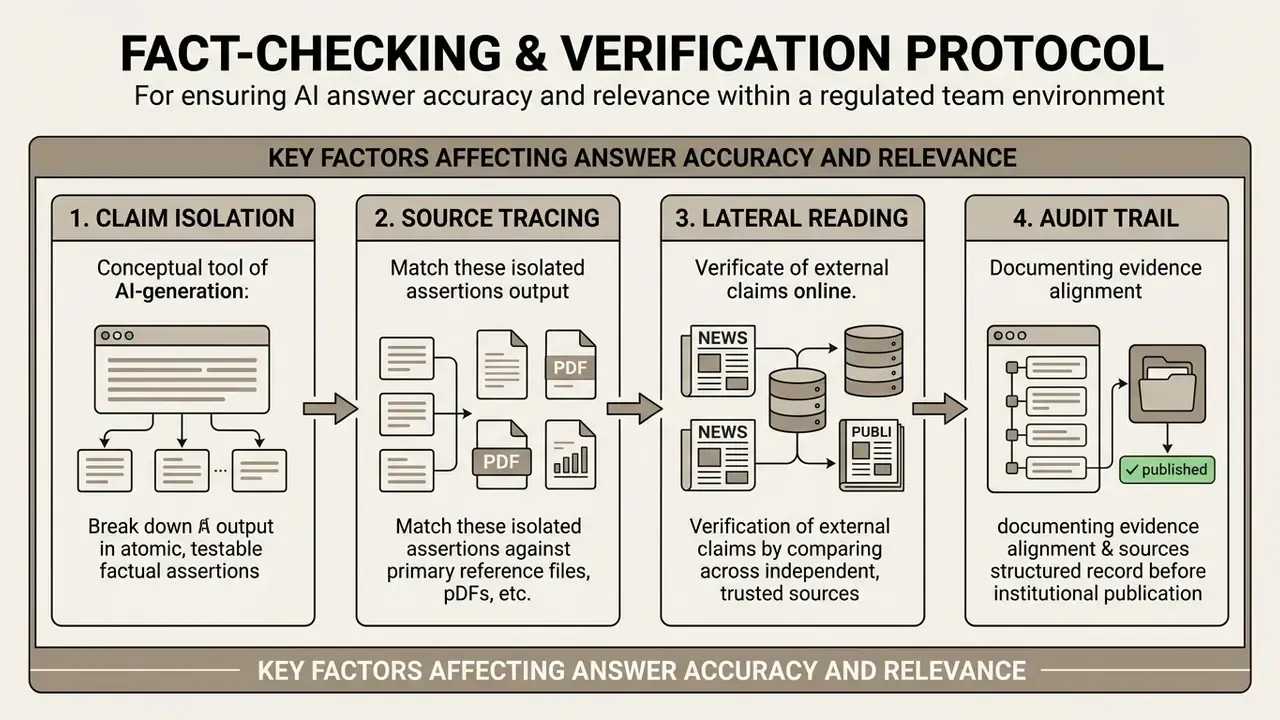
Operators must verify generated outputs by isolating individual factual claims and matching them against primary source documentation. Lateral reading, meaning checking assertions in external authoritative databases opened in separate tabs outside the AI interface, prevents the quiet propagation of model hallucinations.
«Tools such as FactScore, Factool and FactCheck-GPT decompose a response into atomic claims and verify each against retrieved evidence; the share of supported claims expresses factual precision.»
A workable four-step method, consistent with academic library guidance on AI fact-checking, mirrors the protocol above: fractionate the claims, read laterally, test the assumptions embedded in the claim, then make an explicit judgement call and record it. Under the NIST AI Risk Management Framework: Generative AI Profile (NIST AI 600-1, 2024), public-facing or regulated materials must undergo claim-by-claim verification and be filtered for misinformation and harmful content before release. Teams verifying mixed media alongside text can extend the same discipline with AI-generated content detectors and AI reverse-image-search tooling for provenance checks on supporting visuals. Where output quality has already caused a dispute, the AI Litigation and enforcement tracker gives useful context on how such claims are argued.
Production Readiness Checklist for a RAG Answer Generator
Before an answer generator supports any decision of consequence, confirm every line below:
Checklist0 / 10
Enterprise Risk Controls: Shadow AI, PII, and Governance Alignment
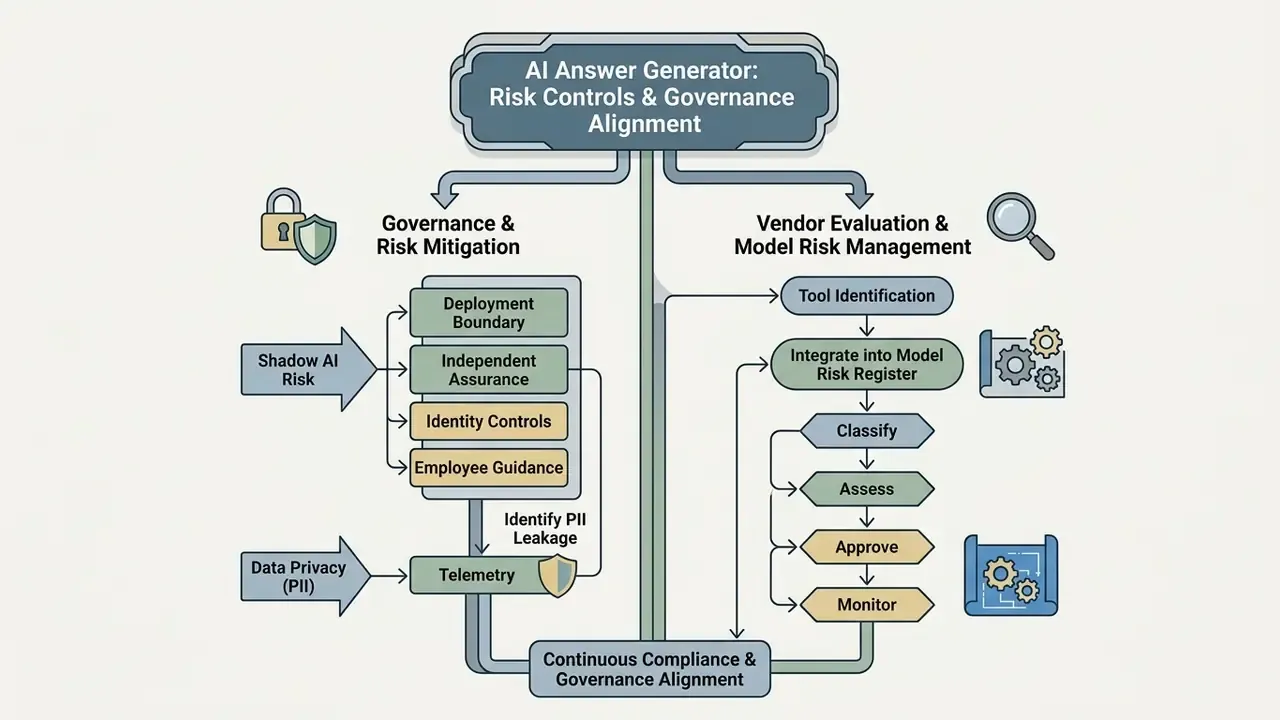
The largest realized risk with answer generators is rarely a wrong answer. It is an unauthorized upload. When staff paste customer records, loan files, or internal policy documents into a consumer-grade tool, the organization can lose control of regulated data before any accuracy question even arises.
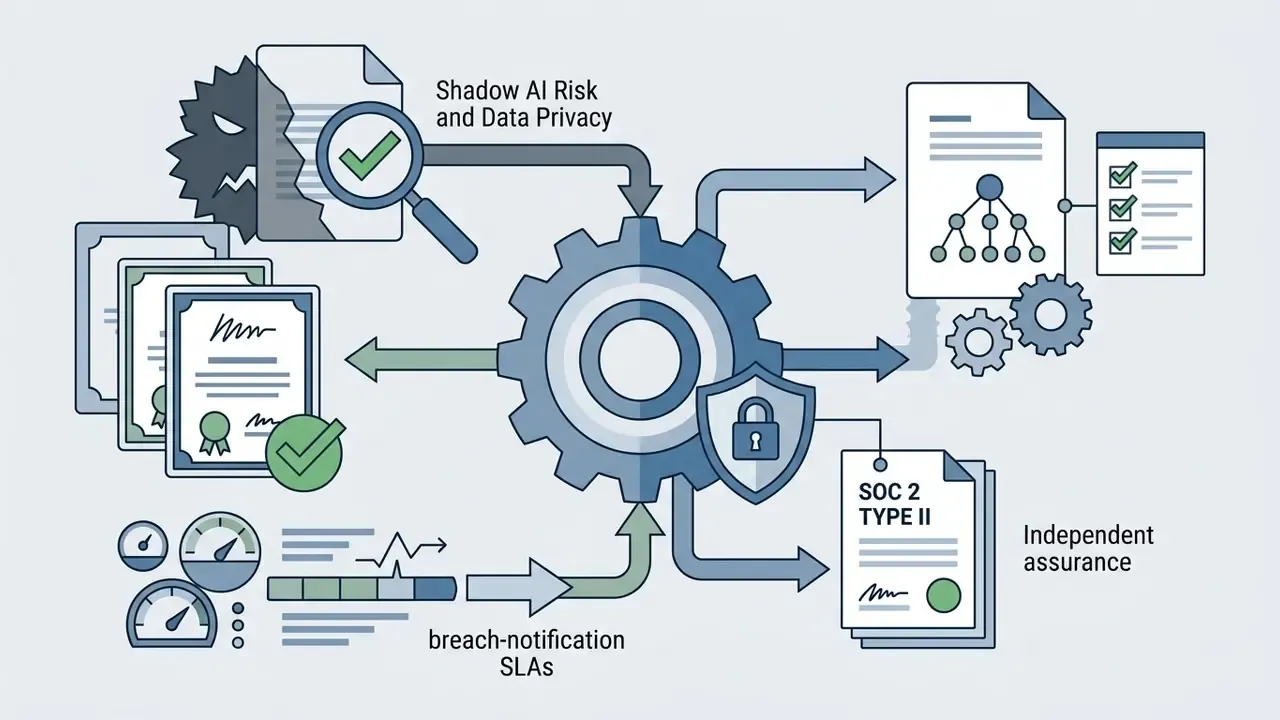
Shadow AI Risk and Data Privacy
What happens to a free-tier upload. Consumer tiers commonly reserve the right to use submitted queries and files for model improvement, retain content for abuse monitoring, and process data in undisclosed jurisdictions. A single PDF containing account numbers or health information can therefore create a reportable event under privacy and sector rules such as GLBA, HIPAA, or GDPR, whether or not the generated answer was correct.
Minimum controls before any regulated document touches an answer generator:
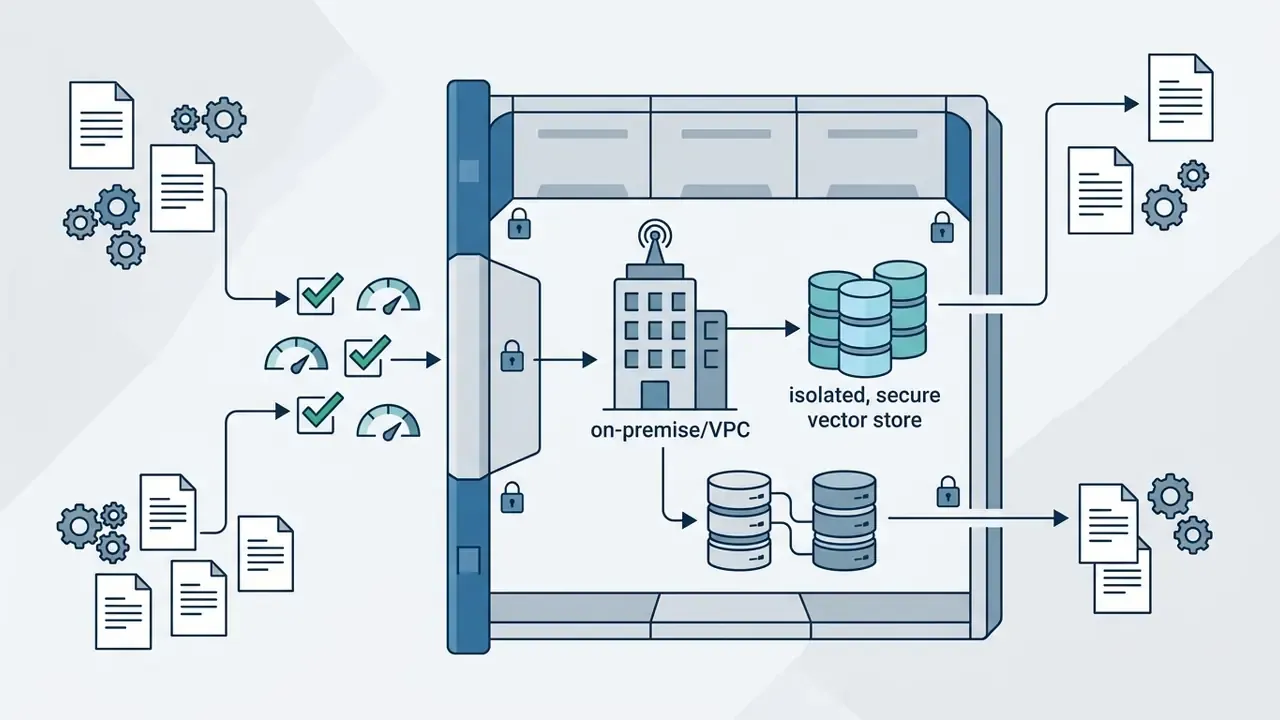
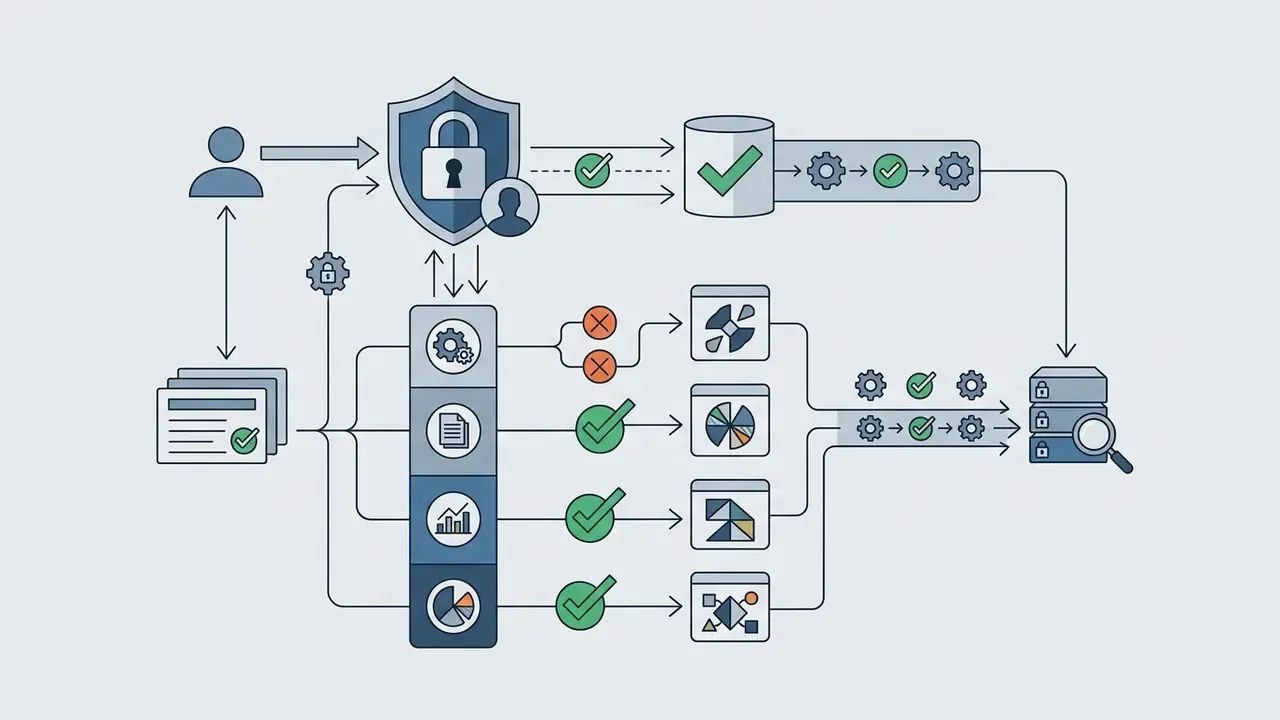
- Allow-list, not block-list. Approve specific tools for specific data classifications; block general-purpose endpoints at the network layer for regulated data classes.
- Automated PII/PHI redaction before text is embedded. Mask names, account identifiers, national IDs, and free-text notes at ingestion, not after retrieval.
- Zero-data-retention configuration confirmed contractually, including exclusion from training and from human review queues.
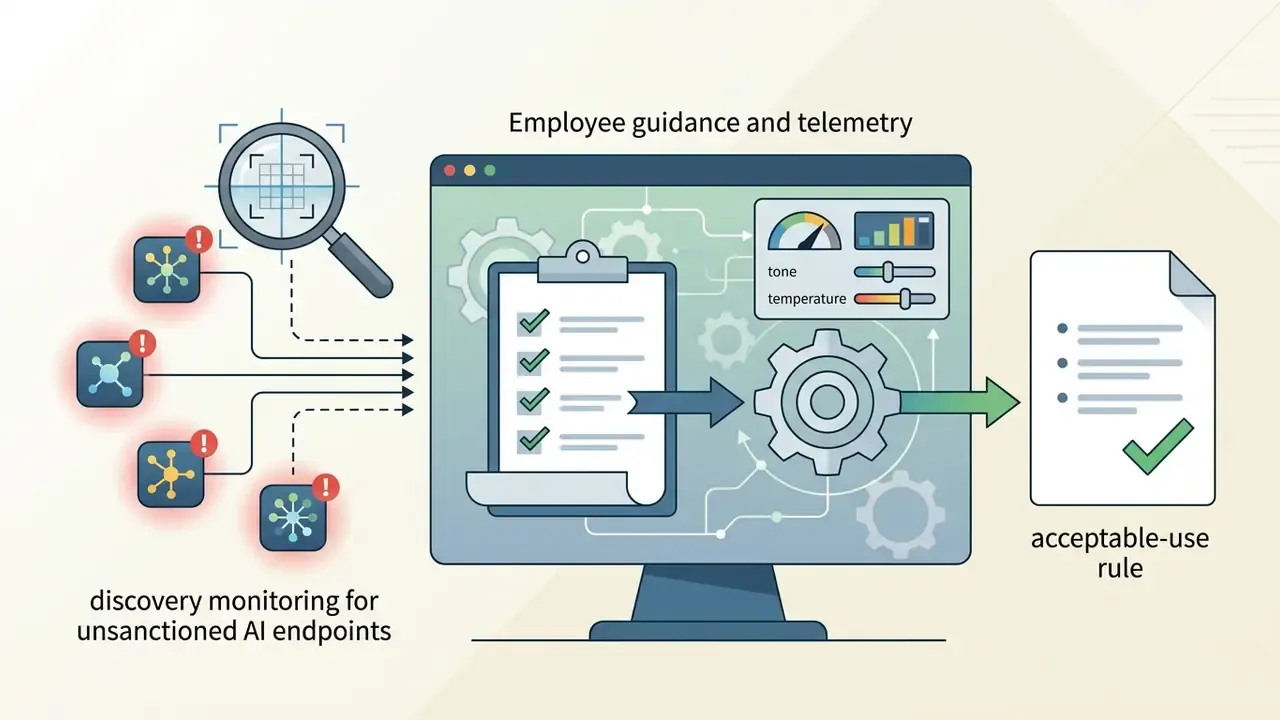
One detail from practice, illustrative rather than audited: the fastest wins usually come from telemetry, not training decks. When a bank can see which unsanctioned endpoints receive traffic, the policy conversation stops being theoretical.
Vendor Evaluation and Integration with Model Risk Management
| Evaluation Criterion | What to Require | Why It Matters for Model Risk |
|---|---|---|
| LLM-provider independence | Ability to swap or pin model versions | Prevents silent behavioral drift from upstream upgrades |
| Grounding enforcement | Citation-per-claim, refusal on missing evidence | Converts hallucination risk into a measurable refusal rate |
| Audit trail | Query, retrieved chunks, parameters, output, reviewer | Required for effective challenge and internal audit |
| Confidence & escalation | Support scores plus documented escalation thresholds | Defines the human-in-the-loop boundary |
| Data governance | Zero retention, redaction, residency, subprocessors | Addresses privacy and outsourcing obligations |
| Evaluation transparency | Vendor benchmark methodology and error analysis | Enables independent validation, not vendor claims |
| Change management | Release notes, deprecation notice, rollback | Supports ongoing monitoring requirements |
Use Cases of AI Answer Generators for Different User Groups
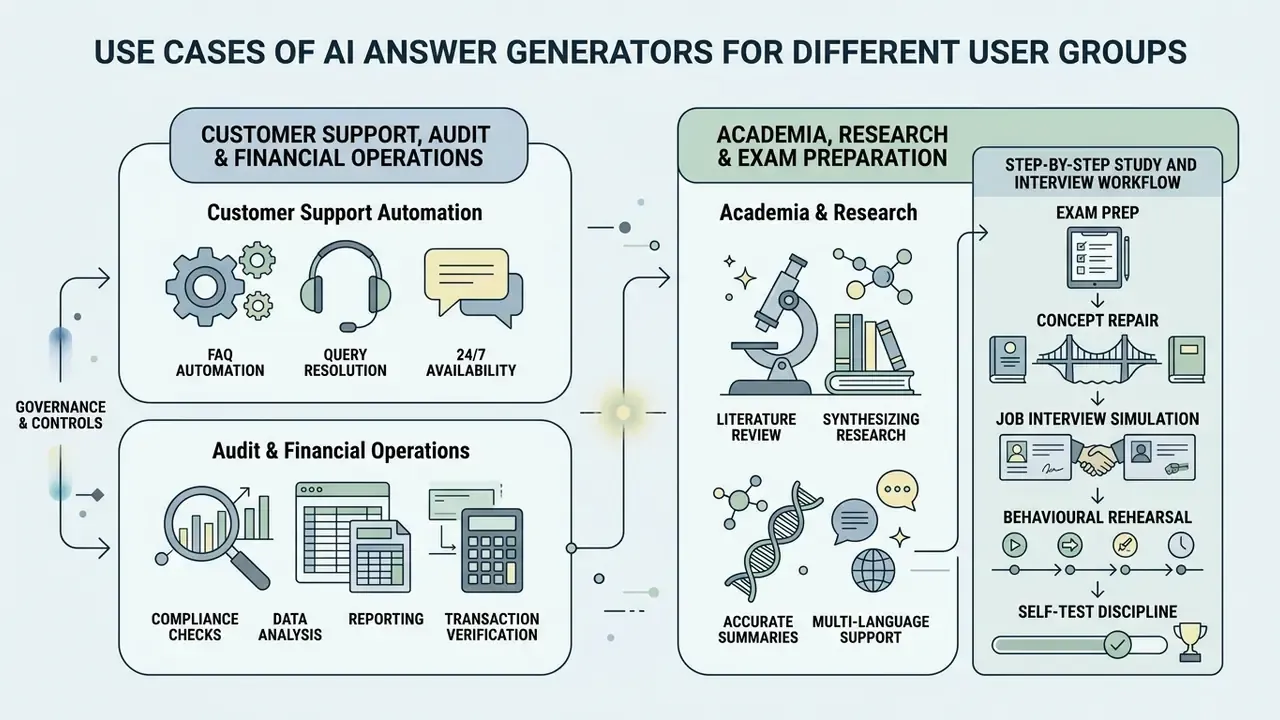
Organizations deploy AI answer generators across customer support automation, audit and financial operations, academic research, HR workflows, sales intelligence, and marketing content creation. Tailoring prompt workflows to specific domain requirements enables rapid data synthesis across departmental roles.
Using an ai answer question generator or ai answer questions generator allows teams to automate repetitive Q&A tasks. Whether the tool supports a student preparing for exams or a support desk handling service tickets, structured answer generation accelerates daily workflows. Educators use the same pattern as an ai answer key generator, producing keyed practice sets from their own materials, while operations teams treat it as an ai auto answer generator for triaging inbound queues.
Customer Support, Audit, and Financial Operations
Enterprise support desks integrate AI answer generators with internal knowledge bases to draft instant, context-grounded responses to recurring service inquiries. Audit and control functions use the same pattern in reverse: instead of drafting outbound replies, they interrogate a fixed evidence set (policies, SOPs, contracts, regulatory correspondence) and demand page-level citations for every extracted claim. HR departments use automated Q&A systems to address employee benefit questions and streamline onboarding documentation.
In finance operations the pattern extends to accounts payable exception handling, reconciliation queries, and close-cycle documentation lookups, where the answer generator locates the governing rule and the human decides. KYC and AML analysts apply it the same way: the tool surfaces the relevant policy paragraph, never the disposition.
Situation: A fintech firm faced high support ticket volumes regarding policy documentation. Action: Integrated an enterprise RAG answer generator tied directly to internal SOPs, with citation enforcement and mandatory agent review before send. Result: First-response drafting time fell sharply (internally reported at roughly two-thirds), and citation enforcement reduced policy-misquote findings. Note: Figures are self-reported deployment metrics, not independently audited; comparable programs should baseline their own pre- and post-metrics.
«RAGBench spans five industry domains, including user manuals and customer-support content, providing a public basis for measuring grounded answer quality in operational settings.» RAGBench, Friel et al. (2024). https://arxiv.org/abs/2407.11005
By linking ai chat answer generator tools to internal GRC and CRM systems, corporate teams keep messaging consistent across channels, provided the knowledge base itself is version-controlled. A grounded generator faithfully reproduces an outdated policy. Corpus hygiene is therefore a control, not housekeeping, and it is the failure mode auditors find first. Front-line teams needing configuration help can compare options in the support library before escalating to vendor engineering.
Academia, Research, and Exam Preparation
Students and academic researchers use AI answer generators to summarize course notes, analyze literature PDFs, and generate practice examination sets. Converting lengthy textbook materials into structured Q&A formats streamlines study workflows and clarifies dense conceptual frameworks. As an ai exam answer generator, the tool is most useful when it produces the questions, not the final submission.
In practice, uploaded lecture notes and course PDFs are used to produce flashcards, study guides, summaries, and multiple-choice quizzes with answer keys. Comparative effectiveness data for these study formats remains thin, and the strongest available evidence is a caution rather than an endorsement.
«Students who revised ChatGPT-generated answers scored on average 28 points lower than students who wrote answers independently, all else equal.»
Step-by-Step Study and Interview Workflow
- Exam prepupload lecture slides (
.pdf), select Academic tone, Low creativity, Long length, then prompt: "Generate 5 multiple-choice practice questions with detailed answer explanations based on Chapter 3, citing the slide number for each." - Concept repairpaste the concept you failed, select Simple tone and Medium length, then prompt: "Explain this in plain language, then give one worked example and one common mistake."
- Job interview simulationpaste the job description, select Professional tone, then prompt: "Extract the top 3 required technical skills and generate likely screening questions with ideal answer outlines."
- Behavioural rehearsalprompt: "Ask me one STAR-format question at a time, then critique my answer against the job description."
- Self-test disciplineanswer from memory first, then compare with the generated answer. The retrieval effort, not the generated text, produces the learning gain.
Content Creation, Marketing, and Draft Generation
Marketing teams use answer generators to produce audience Q&A drafts, refine campaign messaging, and build educational content outlines. Turning raw product specifications into customer-facing explanatory copy shortens production timelines, sometimes dramatically.
Using generative tools for content creation still requires transparent disclosure and real editorial oversight to protect brand accuracy. Search quality guidance holds that AI assistance is acceptable where content remains helpful, reliable, and people-first, while communication research argues for explicit disclosure of AI involvement in brand content. Visual assets follow the same logic; a corporate profile shot produced by an ai headshot generator should carry provenance metadata just like the text beside it.
«57% of surveyed SMEs see more opportunity than risk in generative AI, and 18% adopted such tools less than a year after public release.»
Practical editorial rules for marketing use: keep creativity high only during ideation, drop to low for specification and pricing copy, require every product claim to trace to an approved source document, and log which assets were AI-assisted for future disclosure or legal review.
Free AI Answer Generator: Access Models and Commercial Use
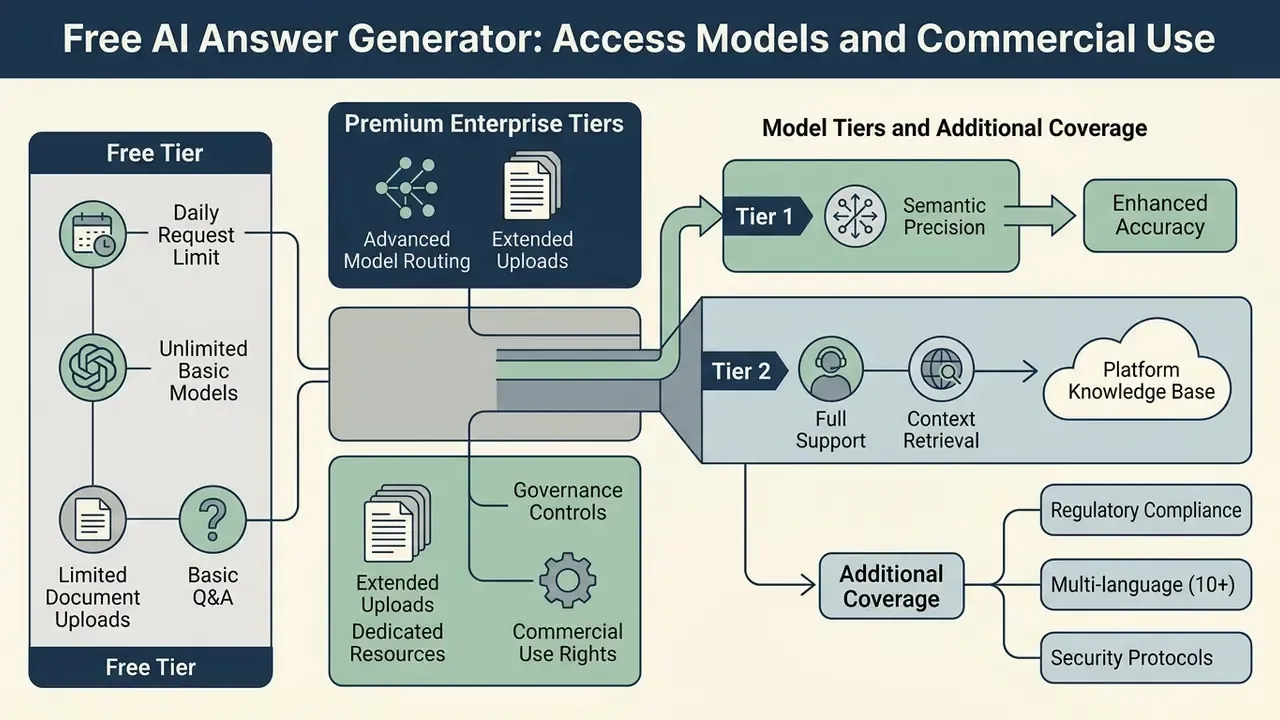
Free AI answer generator online tools offer basic access to Q&A functionality, while premium enterprise tiers provide advanced model routing, larger document upload limits, and formal data security guarantees. Reviewing platform license terms is necessary to stay compliant during commercial deployment.
Evaluating an ai answer generator free, ai answer generator free online, or ai answer generator free tool means assessing functional limits on daily queries and file sizes. Businesses seeking a free ai answer solution must verify whether user-submitted data is excluded from model retraining pipelines. If that answer is vague, treat it as a no.
Features and Limits of Free Online Versions
Free online answer generators typically provide standard base models with daily query caps and context window limits. Advanced capabilities, including multi-page PDF processing, vision-based file parsing, and dedicated API integrations, are generally restricted to paid subscriptions.
Free tier vs unlimited vs enterprise, broken down:
- Daily-limit models. Free tiers commonly grant around 20 free generations per day without user registration, with basic model access and no guaranteed retention controls.
- Unlimited free models. Some platforms advertise unrestricted text querying with no sign-up, yet cap context and attachments, typically 5 MB per PDF and a limited number of pages per upload.
- Enterprise dedicated tiers. These provide zero-data-retention guarantees, high or unlimited query volume, SSO/MFA, audit logging, and commercial copyright indemnification.
Vendor pages disagree with each other. One advertises unlimited questions, another a "reasonable number of requests per day". Treat published limits as marketing claims and confirm them against the terms of service and, for enterprise use, the signed contract.
Supported Languages Grid
Legal and Copyright Aspects of Commercial Use
Commercial exploitation of AI-generated answers requires careful legal evaluation, because purely AI-generated text lacks human authorship protection under US Copyright Office guidance on AI-assisted works: protection extends only to the human-authored contributions. Furthermore, if generated outputs inadvertently reproduce substantial portions of copyrighted training data, commercial users risk infringement liability. US congressional analysis notes that both the AI user and the AI provider may be exposed, while UK and EU materials frame output-stage reproduction of a substantial part of a protected work as infringement regardless of the tool used.
| Feature / Dimension | Free AI Answer Tier | Premium / Enterprise Tier |
|---|---|---|
| Query Allocation | ~20 generations/day, or unlimited text with hard caps | High-volume / unlimited queries with SLA |
| File & PDF Uploads | Restricted file size (commonly ≤ 5 MB) | Extended context & multi-file parsing |
| Registration | Often none required | SSO + MFA mandatory |
| Data Privacy | Queries may be used for retraining | Opt-out / zero-data-retention options |
| Audit & Logging | Not available | Full query and retrieval audit trail |
| Commercial Rights | Permitted under standard terms, no indemnity | Full commercial licensing and indemnification |
Organizations planning commercial implementation should consult the AI Media Commercial-Use Hub for licensing patterns across generative tooling, then validate output-provenance requirements against their own disclosure policy.
FAQ: Common Questions About AI Answer Generators
Is registration required to start using the tool?
Registration requirements depend on the deployment model. Many free online tools allow immediate, anonymous access, while enterprise platforms require verified account credentials. Anonymous access lets users test basic query capabilities without submitting personal data; some conversational-agent platforms document anonymous access explicitly, and consumer AI chat services advertise account-free use. Platforms aligned with NIST SP 800-63-4 digital identity guidance enforce multi-factor authentication for enterprise deployments to protect sensitive organizational knowledge bases. The rule of thumb is simple: anonymous access is acceptable for public information and disposable questions, and unacceptable for anything you would not publish.
Can I ask follow-up questions in the AI chat?
Multi-turn AI chat interfaces support follow-up prompts by maintaining conversational context across successive query turns. Users can request clarification, narrow the focus, or ask the system to reformat prior responses without re-entering background information. Enterprise Q&A implementations additionally support hierarchical follow-ups, where a parent answer branches to linked child answers and context-only responses are returned when prior turns exist. Note that some single-turn generators are built for one question at a time. In those tools, "follow-up" means re-running the prompt with added context rather than continuing a thread. Mixed-initiative systems may also ask you a clarifying question first when the request is ambiguous, and accepting that prompt usually improves the final answer more than rewording the original query.
Does the generator support answers in English and other languages?
AI answer generators natively support English query processing and multilingual generation across major global languages, including Spanish, French, German, Chinese, Japanese, and Korean. Because English-language pre-training corpora dominate, an ai english answer generator setup achieves higher factual precision and semantic consistency in benchmark evaluations such as SeaEval (NAACL 2024) and MEGA, which score multilingual accuracy, F1/EM, and rubric-based factuality separately by language.
«Indic-QA, the largest publicly available QA dataset for 11 Indian languages, confirms that multilingual capability still trails English in coverage and accuracy.» Indic-QA, Doddapaneni et al. (2024). https://arxiv.org/abs/2407.13522 Systems with multilingual LLM backends can process queries in secondary languages while retrieving grounded evidence from English documentation. For high-stakes non-English output, generate in English, translate, then have a native reviewer verify the claims.
How fast are answers generated?
Retrieval plus generation typically completes in 1–3 seconds for short factual queries. Document-grounded Q&A is commonly observed in the 2.5–4 second range, and longer multi-hop or deep-research modes take substantially longer. Speed is not a quality signal. A fast ungrounded answer and a fast grounded answer look identical to the reader, which is precisely why citation enforcement matters more than latency.
Is the output accurate enough for professional or regulated use?
For common study, drafting, and internal-summary tasks, accuracy is generally adequate with review. For specialized, numeric, temporal, or regulated questions, published benchmarks place error rates high enough that unreviewed output should never reach a decision, a client, or a regulator. Apply the four-step verification protocol and the production readiness checklist above, and keep the escalation path named.
Do search variants and misspellings point to the same tool class?
Yes. Query logs show heavy variation around this entity, from ai answer generator gpt and ai answer maker to common misspellings such as ai anwser generator, ai asnwer generator, ai awnser generator, ai anser generator, ai answe generator and ai answer genrator. All of them describe the same grounded question-answering pattern documented here. The naming matters less than the two questions that decide fitness for purpose: where does the evidence come from, and who signs off on the answer?
Appendix A: Editorial Corrections and Source Timestamps
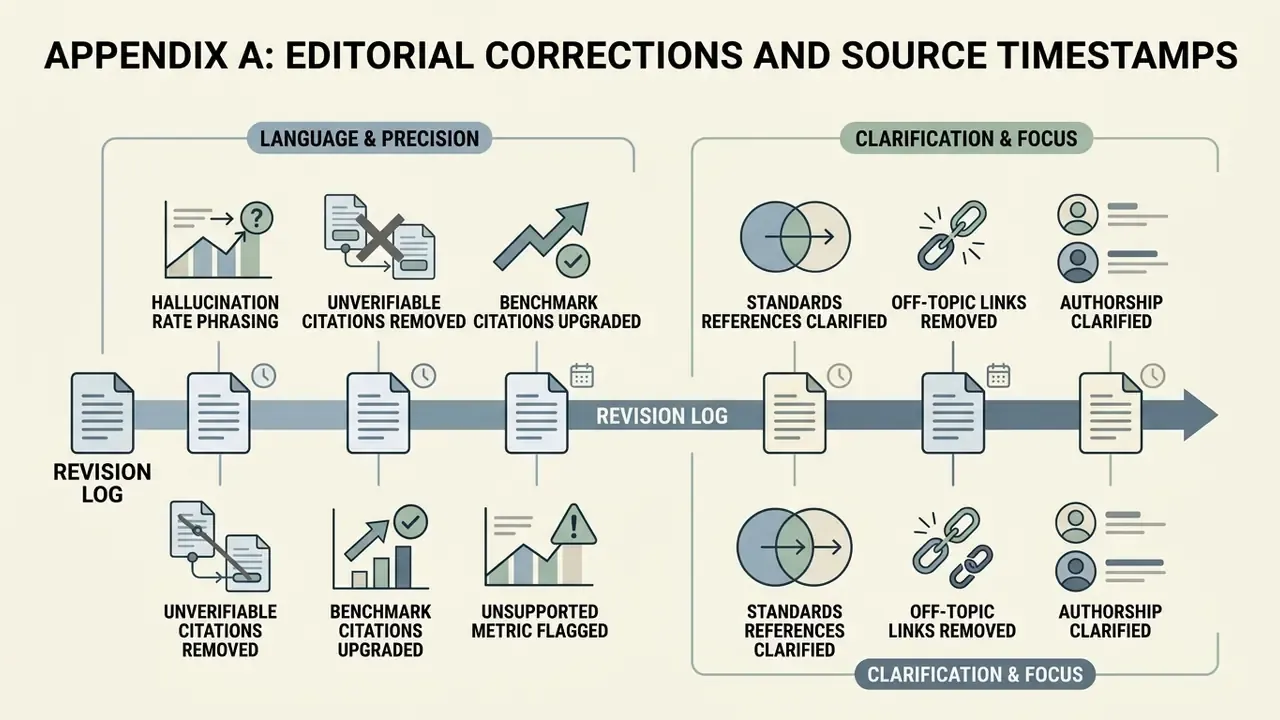
For transparency, the following corrections were applied to earlier versions of this guide:
- Hallucination-rate phrasing. The earlier claim of "59% to 82%" hallucination rates was rephrased to "well over 60% on definitive-answer datasets", with the underlying DefAn methodology (6–95% prompt misalignment, 21–61% consistency) cited directly with URL.
- Unverifiable citations removed. Forward-dated references for Taskade and Google Search Guidance could not be matched to published sources and were removed. Study-material generation is now described as observed vendor functionality without an academic citation, and search guidance is cited as general search-quality principles without a year.
- Benchmark citations upgraded. CRAG, MMLongBench-Doc, RAGBench, and the ChatGPT assignment study now carry quantitative findings and direct URLs rather than bare parenthetical names.
- Unsupported metric flagged. The "64% reduction in first-response time" figure is retained as a self-reported deployment metric, with an explicit note that it is not independently audited.
- Standards references clarified. The ITU-T F.748.52 reference is presented as a requirements specification for structured-data support and retrieval matching, not as a source of quantitative accuracy deltas.
- Off-topic links removed. Consumer and unrelated tool links were removed in favour of contextually relevant references on OCR, AI-content detection, image provenance, voice generation, and commercial-use licensing.
- Authorship clarified. Marcus Hale, author.
A Safe Next Step
Do not start with a platform decision. Start with one bounded pilot: a single corpus, ten named users, citation enforcement switched on, and a golden-question set signed off by a business owner. Run it for a quarter, record refusal and override rates, then decide. If the evidence trail holds, extend the scope. If it does not, you have lost a quarter of pilot time rather than a production incident.
For definitions, adjacent tool guides, and platform documentation, open the hub.