«After evaluating dozens of automated text pipelines, the governance principle stays the same: no evidence, no autonomy. An AI headline generator is a digital assistant for fast iteration, but editorial accountability and audience trust still need a named human at every gate.»
— Marcus Hale, author
Last updated: February 2026. Reviewed for factual accuracy, source verification and editorial governance compliance.
Executive Summary for Decision Makers
- What it is: An AI headline generator turns a topic, keyword set, transcript or full article draft into multiple candidate titles using natural language processing (NLP) and large language models (LLMs). It produces three technically distinct artifacts: the visible on-page H1 headline, the HTML
titletag for search engine results pages (SERPs), and short-form channel variants for email, ads and video. - Where the measurable value sits: Verified experiments report a +23.63% relative lift in item-tap rate for AI-personalized email titles (LLM-based Personalized Email Title Generation for E-commerce, arXiv, 2025), and title tags in the 40 to 60 character range show a 33.3% higher organic click-through rate (Google CTR Study, Backlinko, 2023).
- Where the risk sits: Numerical accuracy remains the weakest link in machine-written headlines (NumHG, arXiv, 2023), and audiences discount AI-labeled headlines when claims look inflated (PNAS Nexus, 2024).
- What a controlled deployment requires: a documented brief, a fixed generation prompt template, a four-stage fact-checking protocol, a named human approver, and a retained audit trail of prompt, source, reviewer and published version.
- What to check before procurement: generation quotas and credit mechanics, brand-voice rule enforcement, zero-data-retention and model-training exemption terms, SOC 2 / ISO 27001 posture, SAML/SSO support, and API access limits.
- Bottom line: treat the generator as a high-velocity drafting layer inside an existing editorial control loop. Never as a publishing authority.
Why should a risk or compliance lead in a US bank care about a title tool at all? Because a headline is a public communication. It carries claims, numbers and implied promises, and it is often the only sentence a customer reads.
What Is an AI Headline Generator and What Is It Used For?
An AI headline generator is an automated software tool powered by natural language processing and large language models that transforms raw text, topic descriptions or keywords into concise, high-impact titles. In modern content creation workflows, digital teams use a headline creator AI to accelerate ideation, test multiple stylistic angles, and optimize titles across search engines, social feeds and advertising channels.
Architecturally, contemporary systems fall into two families. Abstractive sequence-to-sequence models rewrite the source into a new sentence rather than extracting an existing one, an approach traceable back to event-pattern clustering research such as Google's HEADY system, which generated news headlines from entity-pattern distributions using a Noisy-OR Bayesian network. Candidate-ranking systems generate a wide pool of outputs and then filter them heuristically: a 2023 English/Urdu headline system, published in Engineering Applications of Artificial Intelligence, fine-tuned GPT-2 and then filtered generations by the frequent part-of-speech patterns observed in genuine human headlines.
Two configuration parameters matter for enterprise reliability. First, context grounding (prompt conditioning or retrieval-augmented generation) determines whether the model writes from the actual source document or from generic statistical priors. Grounded inputs measurably reduce off-topic and hallucinated claims. Second, decoding temperature governs output variance: low-temperature settings produce conservative, near-extractive titles suited to news and regulated communications, while higher settings expand creative range at the cost of factual drift. That is exactly why creative modes need stricter downstream review, not looser.
Headline, Title and Text: What the Generator Actually Creates
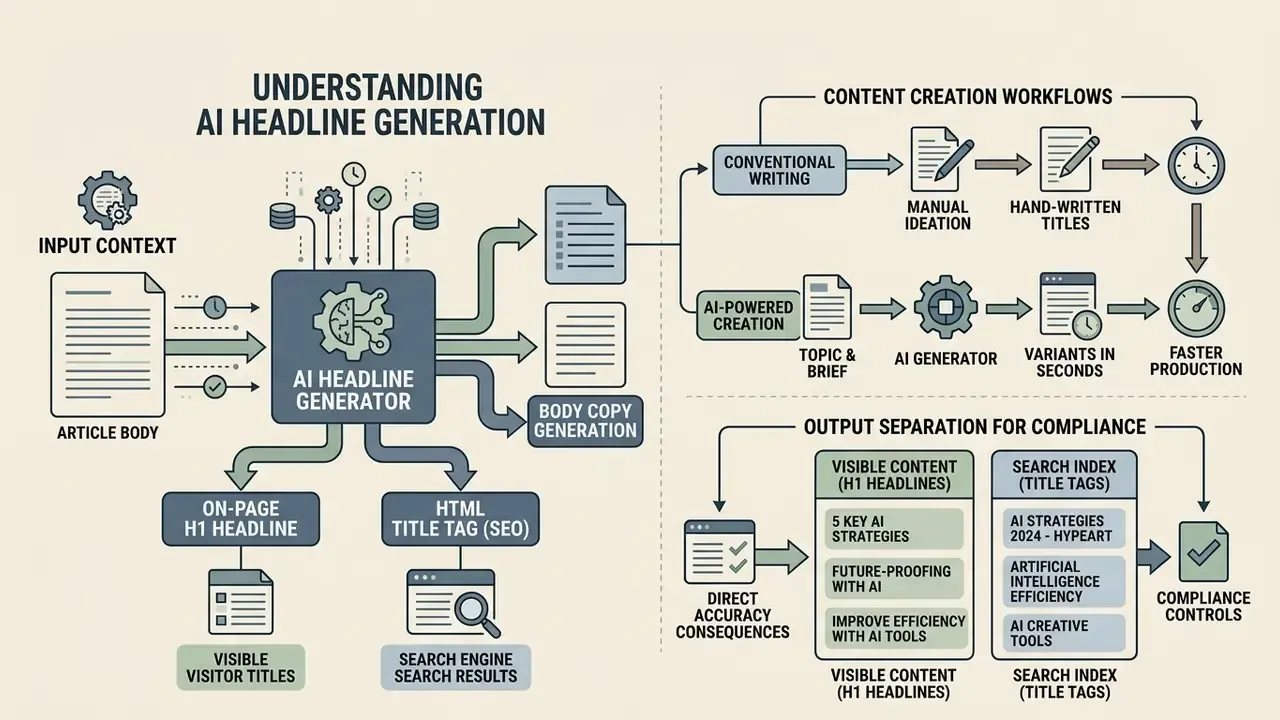
An AI headline generator differentiates between visible on-page H1 headlines, HTML title tags and body copy, because each one fills a separate technical role. The visible headline captures attention inside the page context. An HTML title tag works as an external metadata pointer for search engine results pages and browser tabs. This distinction is not cosmetic: the W3C document model explicitly permits the title element and the first visible heading to differ, because the title has to identify the page out of context, in a search result, a bookmark list or a browser tab, while the H1 operates inside the page where surrounding design and imagery already supply context.
For compliance-sensitive publishers, that separation has direct accuracy consequences. A truncated or over-compressed title can strip a qualifier such as "preliminary", "proposed" or "estimated" that the H1 still carries, which changes the factual weight of a statement on the only surface most users ever read. So any governance policy for machine-generated titles must validate the rendered string at both display widths, not just the source markup.
The underlying model adjusts its decoding mechanics depending on the requested output. For an HTML title tag, the system prioritizes conciseness and keyphrase placement near the front of the string to prevent truncation on mobile and desktop viewports, as highlighted by Purdue University Title Tag Best Practices (2026). For an on-page headline, the generator emphasizes persuasive structure, emotional hooks or curiosity gaps while staying anchored in the body text.
«Models trained on the Mukhyansh corpus (3.39M article-headline pairs, 8 languages) reach an average ROUGE-L of 31.43, confirming that neural systems reproduce the core content of human-written headlines.»
Body text carries the deep contextual narrative, whereas the title generator extracts or abstractively summarizes the primary thesis into a single line. Body copy distributes terminology naturally across headings and the opening paragraph; the title carries a single primary keyphrase near the front. Conflating these roles, pushing body-level keyword density into a 60-character string, is still the most common technical failure in automated title production.
When an AI Headline Generator Saves Time in Content Creation
An AI headline generator cuts ideation time by producing dozens of structured title variants in seconds, which removes the blank-page friction for writers and marketing teams. Instead of spending hours drafting alternative angles, creators review diverse structural patterns immediately: questions, listicles, outcome-driven statements or pain-point solutions.
Verified evidence on scaling without hand-writing every line:
«ChatGPT with rejection sampling delivered a +1% lift in sessions and +0.4% in weekly active users versus a rule-based baseline, without hand-writing each subject line.»
What Types of Headlines Can You Create with AI?
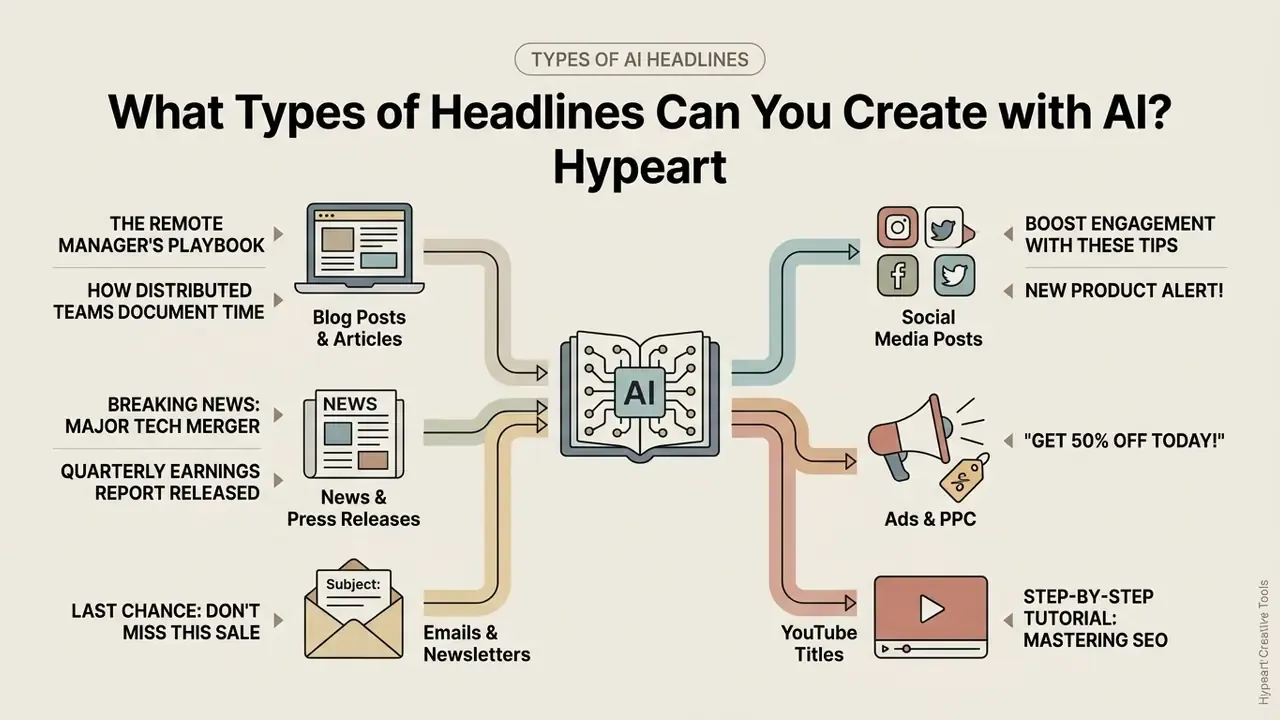
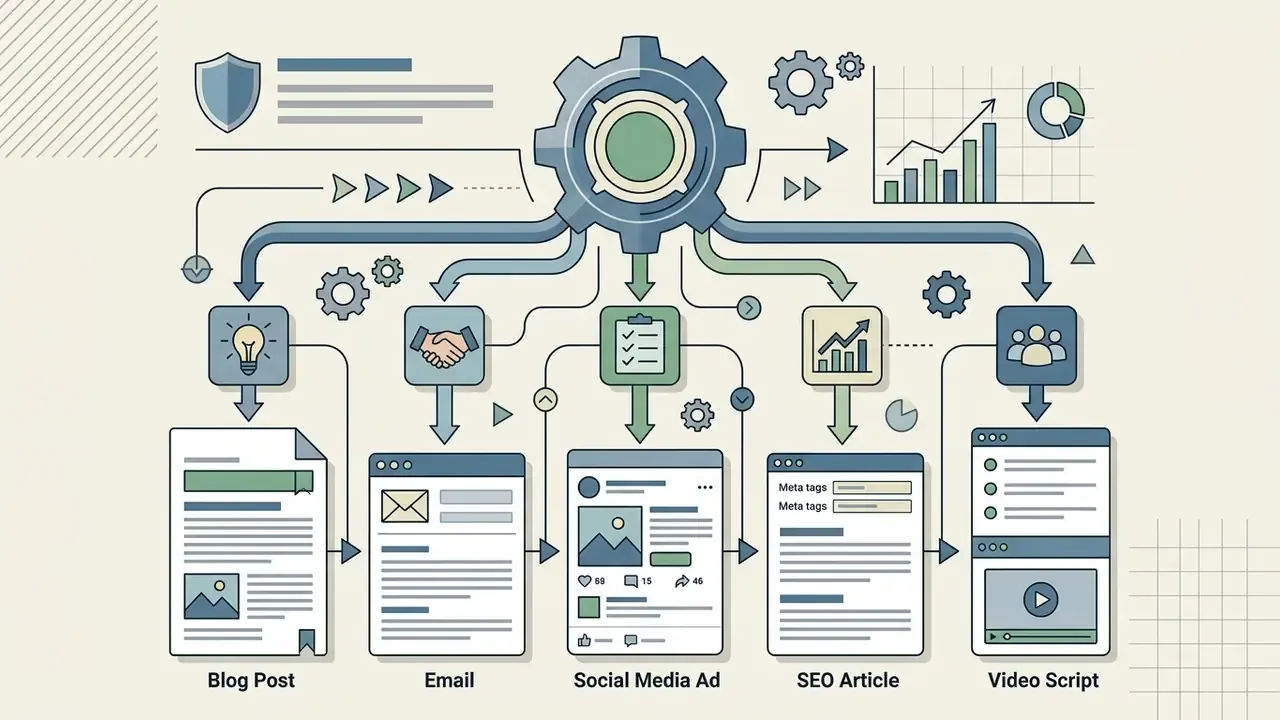
An AI headline creator can generate customized titles across all primary digital media formats: long-form articles, breaking news, marketing emails, social feeds, pay-per-click campaigns and video platforms. Modern generator models adapt sentence length, syntax and emotional weight to platform constraints and audience expectations.
Table: content formats, headline objectives and required AI inputs.
| Format | Headline objective | Key AI inputs |
|---|---|---|
| Blog post / article | Summarize the primary value proposition and match search intent within 40 to 60 characters. | Article outline, primary keywords, target audience segment, editorial tone. |
| News / press release | Convey essential facts (who, what, where) with zero exaggeration or factual distortion. | Full story draft, key entity names, critical dates and numerical data. |
| Email subject line | Drive open rates and inbox visibility without triggering spam filters or misleading readers. | Core offer, audience segment, character limit, call to action. |
| Social media hook | Stop the scroll in feed environments using curiosity gaps or bold benefit statements. | Post transcript, platform type, target emotional response, hashtag rules. |
| Search / display ads | Maximize click-through rate and conversion alignment within strict platform character caps. | Target search query, product features, primary CTA, character constraints. |
| YouTube video title | Encourage clicks via curiosity and visual packaging while supporting video discovery. | Video synopsis, main search term, viewer persona, key takeaway. |
| Landing page | Confirm campaign origin and articulate the core offer to drive conversions. | Value proposition, funnel stage, audience pain points, primary brand message. |
Practical Output Examples by Content Formula
Below are generator outputs built from a single input topic: "Time management for remote teams".
1. Outcome-driven and listicle patterns (high CTR for blogs)
- 10 Proven Time Management Hacks for Distributed Teams in 2026
- 7 Asynchronous Communication Rules That Saved Us 15 Hours a Week
2. Curiosity and question hooks (social and email)
- Is Your Remote Team Secretly Losing 3 Hours a Day to Meeting Fatigue?
- Why Traditional Time-Tracking Fails Remote Engineers (And What Works)
- Your Calendar Is Not a Strategy. Here's What Distributed Teams Do Instead.
3. High-intent direct benefit (PPC ads and landing pages)
- Automate Remote Workflows | Boost Team Output by 40% Today
- Streamline Distributed Projects | Free 14-Day Enterprise Trial
- Remote Time Tracking, Simplified | Set Up in Under 10 Minutes
4. Neutral, regulated-sector wording (news, finance, health)
- Remote Work Hours Rose 12% in 2025, Internal Survey Finds
Notice the deliberate contrast in the fourth group. Identical source material, yet every superlative and implied causal claim is stripped out. In regulated communications the generator must be constrained to attributed, quantified, non-promissory phrasing, because the same curiosity mechanics that lift CTR on a lifestyle blog create disclosure exposure in financial or medical publishing.
Headlines for Blog Posts, Articles and Website Pages
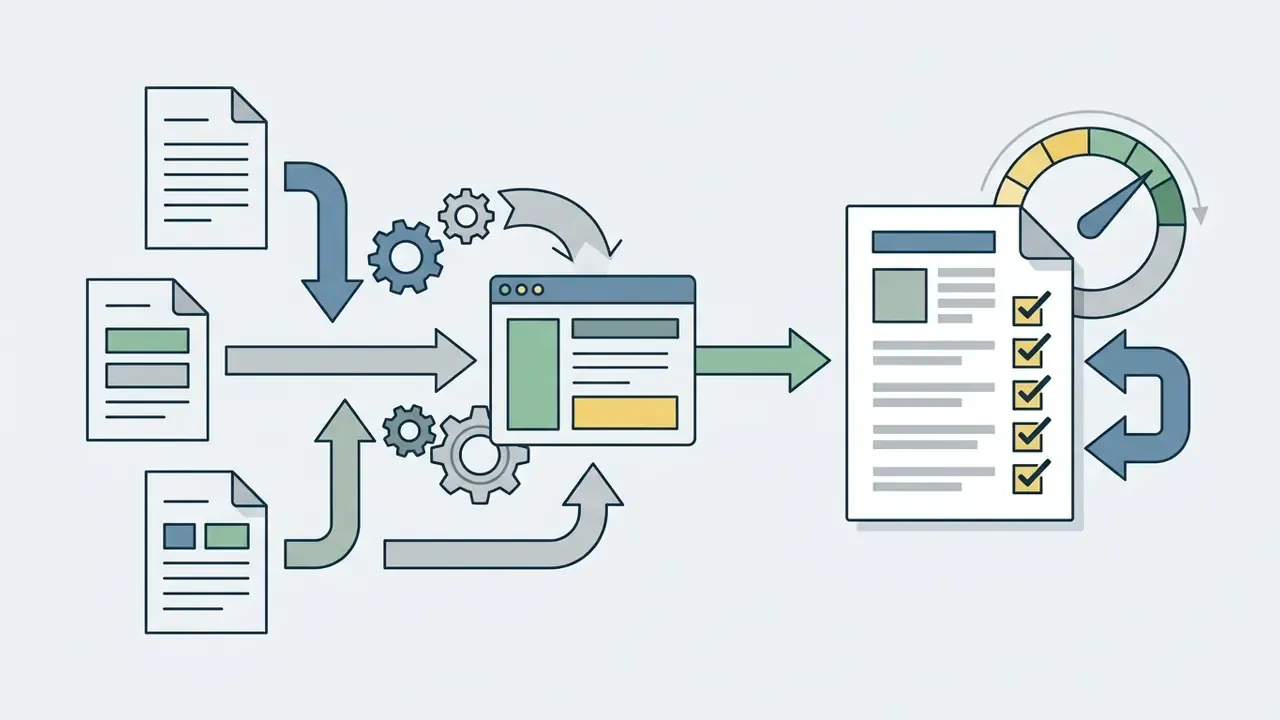
A headline generator AI builds blog and article titles that balance audience engagement with search discovery. To maximize click appeal, the tool structures titles around direct user benefits, strategic question frameworks or clear numerical guides.
When creating titles for website pages, the software makes sure the core value proposition reads instantly out of context. Teams assembling a full visual and textual brand kit alongside their editorial calendar often pair title generation with AI headshot generators for author bylines and contributor pages. For informational content, readers can review curated entries in our AI Media Glossary to see how structured terminology supports topic discovery, including adjacent creative tools such as the ai interior design generator for visual verticals.
Landing-page headlines follow a stricter rule set than blog titles. The hero line has two jobs: confirm the visitor landed in the right place, and give a concrete reason to keep scrolling. Outcome-led phrasing consistently beats product-description phrasing, which is why the generator should receive the funnel stage and campaign source as explicit inputs rather than guessing them.
News and Newspaper Headlines for News and Press Releases
An ai news headline generator creates objective, fact-focused titles for journalism, corporate announcements and press releases. Unlike commercial marketing copy, an ai newspaper headline generator must hold strictly to factual precision, active verb structures and accurate entity attribution.
Journalistic integrity guidelines, such as those in the BBC Editorial Guidelines (2026), require that AI systems never introduce unsupported claims or alter the factual weight of a story. BBC guidance goes further: generative AI should not directly create published news, current affairs or factual journalism unless the use of AI is itself the subject of the coverage, and every AI-assisted output requires active human editorial oversight and named approval. The EBU/BBC News Integrity in AI Assistants Toolkit (2025) adds concrete verification requirements: correct names, numbers, dates and locations, with quotations matching source text exactly. Guidance from Santa Clara University's Guardrails for News Headlining (2025) states that a headline must not contradict the story, set false expectations, imply unsupported cause and effect, or restate debunked claims.
When configuring a news headline generator ai, the system should extract critical facts directly from verified text, never from memory of similar stories.
«NumHG (27,746 news pairs) shows models achieve acceptable readability, but numerical accuracy in headlines remains a weak point even for strong encoder-decoder architectures.»
The practical implication is blunt. Any headline containing a figure, a percentage, a date or a monetary amount needs a mandatory digit-by-digit reconciliation against the source before publication. Treat numerals as the highest-risk token class in the whole output.
How to Use the AI Headline Generator
Using an AI headline generator comes down to a systematic sequence: define the brief, set formatting constraints, generate candidates, then validate with a human editor. A structured input method keeps generated titles relevant, factual and aligned with campaign goals. The U.S. National Institute of Standards and Technology's Quick-Start Guide for Using Artificial Intelligence (2026) defines a six-part prompt structure (context, objective, style, tone, audience, response format) and states that explicit instructions should specify output format and structure. Singapore Government's Prompt Engineering Playbook (2026) adds the closing rule: AI output should never be fully trusted and must be verified against other sources. Together those two official documents describe exactly the input-output contract a production headline workflow needs.
- Formulate the brief.Gather primary keywords, target audience details and a clear summary of the core content.
- Set formatting parameters.Choose the content category (blog, news release, ad copy) and the operational character limits.
- Define tone and voice.Select the brand voice: analytical, authoritative, direct or conversational.
- Execute generation.Run the generator to produce a diverse set of candidate headline families.
- Audit and refine.Verify factual consistency, remove misleading claims, select the title for publication.
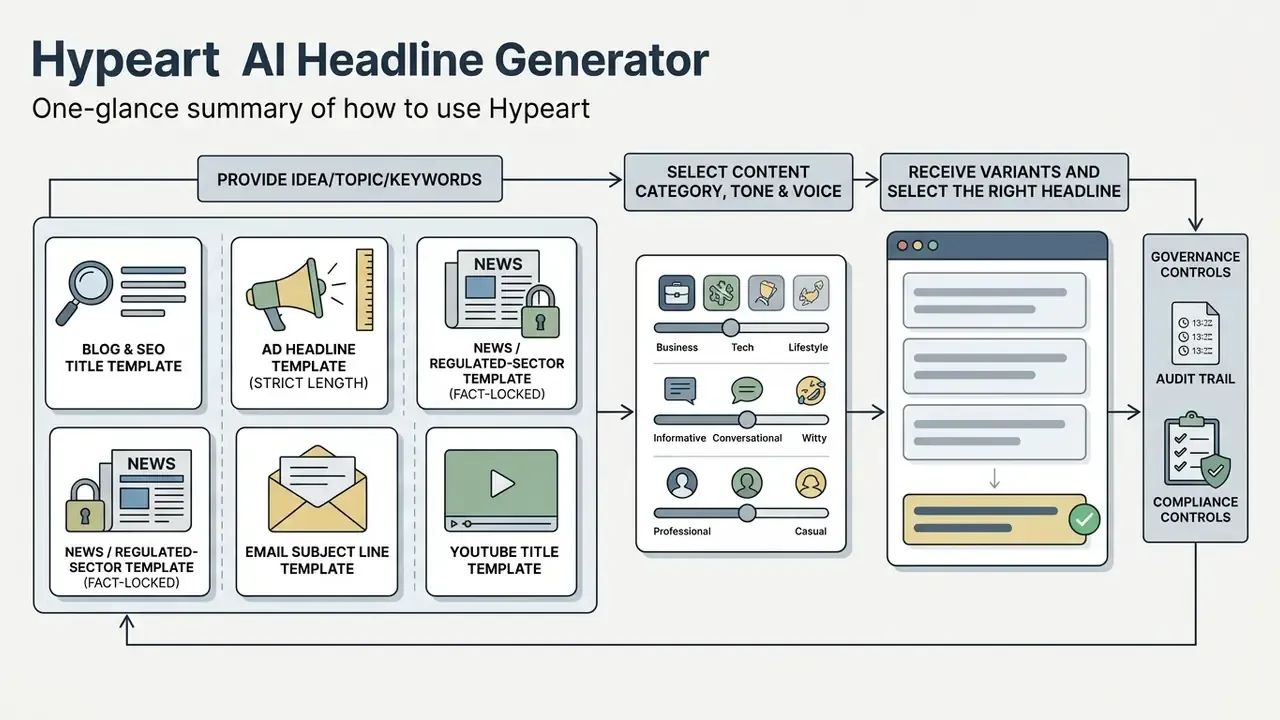
Provide Your Idea, Topic or Keywords
The precision of AI-generated titles depends directly on the quality and depth of the initial input. Vague single-word inputs force the language model to fall back on generic statistical probabilities, and the output turns bland or off-topic almost every time.
Research from EMNLP 2023 shows that conditioning headline generation on rich, grounded source context significantly improves factual consistency and thematic relevance. Earlier ACL work (2020) explains why this matters operationally: headline truthfulness correlated only weakly with surface-overlap metrics such as ROUGE-1, meaning a title can look statistically close to the source and still be factually wrong. Grounding the input is a control, not a nicety.
Copy-paste prompt templates for higher headline quality
Example input: "SEO auditing for SaaS founders, goal to increase organic traffic, format comprehensive step-by-step guide."
Example input: "Headline AI tool, instant headline generation, under 30 chars, Try Free now."
Example input: "Quarterly filing shows 12% revenue growth, source Q4 investor report, dated 2026-01-30, neutral wire-service tone, no forward-looking language."
Example input: "Annual plan discount, existing trial users, max 35 characters, single promise, avoid 'free', 'urgent', 'last chance'."
- Blog and SEO title template
[Topic/Keyword] + [Target Audience] + [Desired Outcome] + [Format: Guide/Listicle] - Ad headline template (strict length)
[Product Name] + [Core Value Prop] + [Character limit: 30 chars] + [CTA] - News / regulated-sector template (fact-locked)
[Verified Fact] + [Named Source] + [Date] + [Neutral tone, no superlatives, no causal claims] - Email subject line template
[Offer] + [Segment] + [Character cap: 24-40] + [One promise only] + [Banned words list] - YouTube title template
[Main search term] + [Viewer persona] + [Key takeaway] + [Thumbnail text to avoid duplicating]
Example input: "Remote onboarding checklist, for HR leads at 50-person startups, takeaway cuts ramp time in half, thumbnail already says '30 DAYS'."
For specialized content workflows, creators can consult our guide on ai instagram post strategies, or the ai invitation maker for event campaigns that need matching headline and asset tone.
Select Content Category, Tone and Voice
Configuring content category and tone of voice steers the model toward the correct stylistic domain. Category selection dictates sentence structure and length rules, separating an email subject line from a long-form article title. Commercial generators typically expose categories such as General, Blog, Video, Slogan, Academic and SEO, because each category changes not only wording but the underlying intent of the headline.
Tone controls adjust word choice and emotional framing. A corporate announcement needs a neutral, analytically confident voice; a social post can lean conversational. Tone selectors commonly include professional, bold, witty and direct. The parameter exists to bind output to a documented brand voice rather than to model defaults. Organizations building complex digital assets can compare options across different media channels before standardizing.
Receive Variants and Select the Right Headline
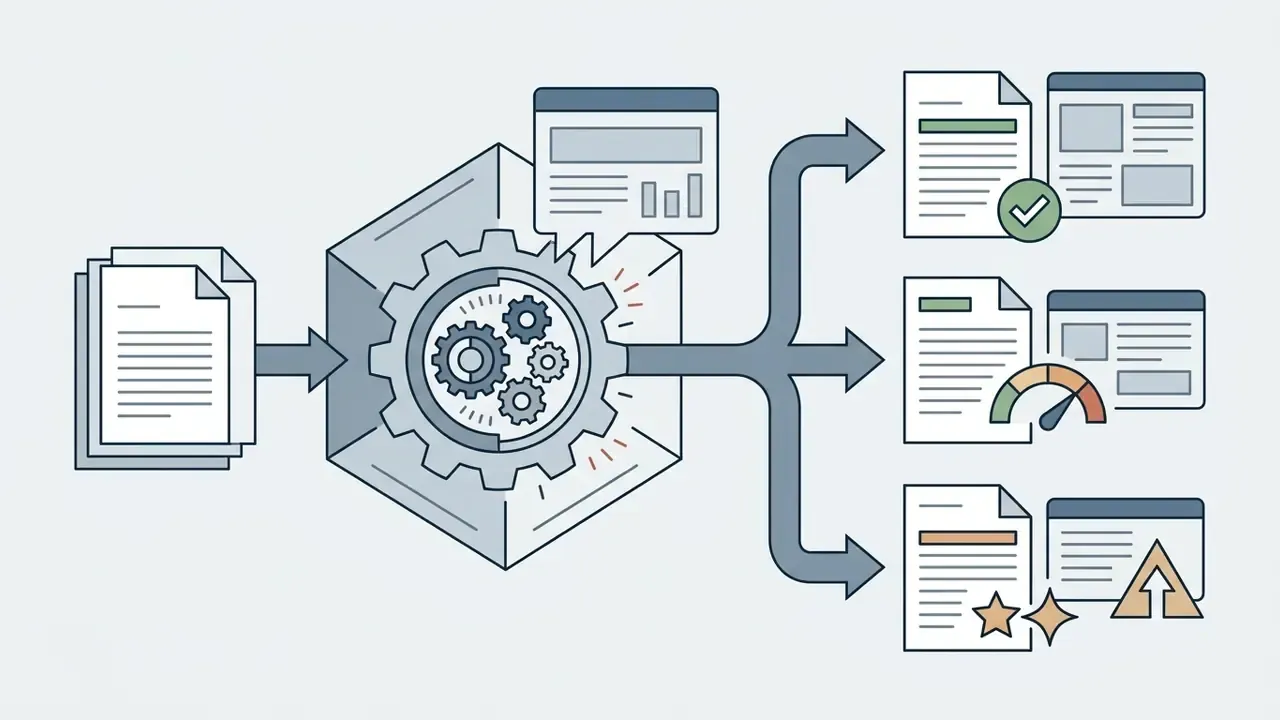
Once parameters are set, the headline ai generator produces multiple candidates representing distinct structural patterns. Reviewing several variants lets content creators weigh analytical, outcome-oriented and curiosity-driven angles side by side.
A defensible selection rubric filters before it ranks. Discard any candidate that contradicts the source, cannot be confirmed by the source, breaks the channel character cap, or drifts off topic. Then compare survivors on four published dimensions: Taste, Attractiveness, Clarity and Truth, the TACT framework used in EMNLP 2023 headline evaluation. A 2025 methodology adds explicit numeric gating: score candidates 0 to 5, discard anything below 2, and accept a headline only when at least two of three independent reviewers agree.
Writers must confirm that the selected title accurately reflects the claims in the body text. An appealing headline that misrepresents the content damages reader trust and inflates bounce rates. Teams managing enterprise workflows can review our AI Media Pricing structure for advanced scaling options.
Embedded Risk Controls: Roles, Approvals and Audit Trail
Controls belong inside the generation workflow, not bolted on afterwards. The responsibility matrix below keeps machine drafting fast while preserving named human accountability, and it also blunts shadow AI, where staff quietly paste internal material into unapproved public tools.
Table: responsibility matrix for AI-assisted headline production (RACI).
| Activity | Responsible | Accountable | Consulted | Informed |
|---|---|---|---|---|
| Brief and prompt construction | Content author | Content lead | SEO specialist | Campaign owner |
| Generation run and variant shortlist | Content author | Content lead | n/a | Editorial ops |
| Factual and numerical verification | Editor / fact-checker | Managing editor | Subject-matter expert | Content lead |
| Regulatory and claims review (regulated sectors) | Compliance reviewer | Chief Compliance Officer | Legal counsel | Marketing lead |
| Publication approval | Managing editor | Managing editor | Compliance (if flagged) | All contributors |
| Audit-trail retention | Editorial ops | Governance owner | Internal audit | Model risk function |
Minimum reproducible audit evidence per published headline: the exact prompt text and template version, the tool and model identifier, the source document reference, all generated candidates (not only the winner), the reviewer's name and timestamp, any compliance escalation record, and the final published string with its rendered pixel width. Newsroom AI policies converging through 2026 consistently require that quartet, prompt, sources, reviewer, final version, plus named approvers for high-risk content categories.
Escalation path: any headline containing a numeric claim, a superlative, a comparative performance statement, a health or financial outcome, or a named third party routes automatically to compliance review before approval. Everything else clears at managing-editor level.
How to Get Engaging and Compelling Headlines
An engaging headline captures attention while staying completely truthful and contextually accurate. High click-through performance comes from balancing psychological triggers with clean keyphrase integration and systematic multi-variant testing.
The recurring trigger set across copywriting literature is narrow and testable: a curiosity gap, a specific promise, or an identified pain point, usually reinforced by a number and one power word. Classic AIDA structuring puts the headline at the attention stage and reserves emotional intensification for the desire stage, which is exactly why loading every trigger into a single title reads as clickbait rather than as a promise.
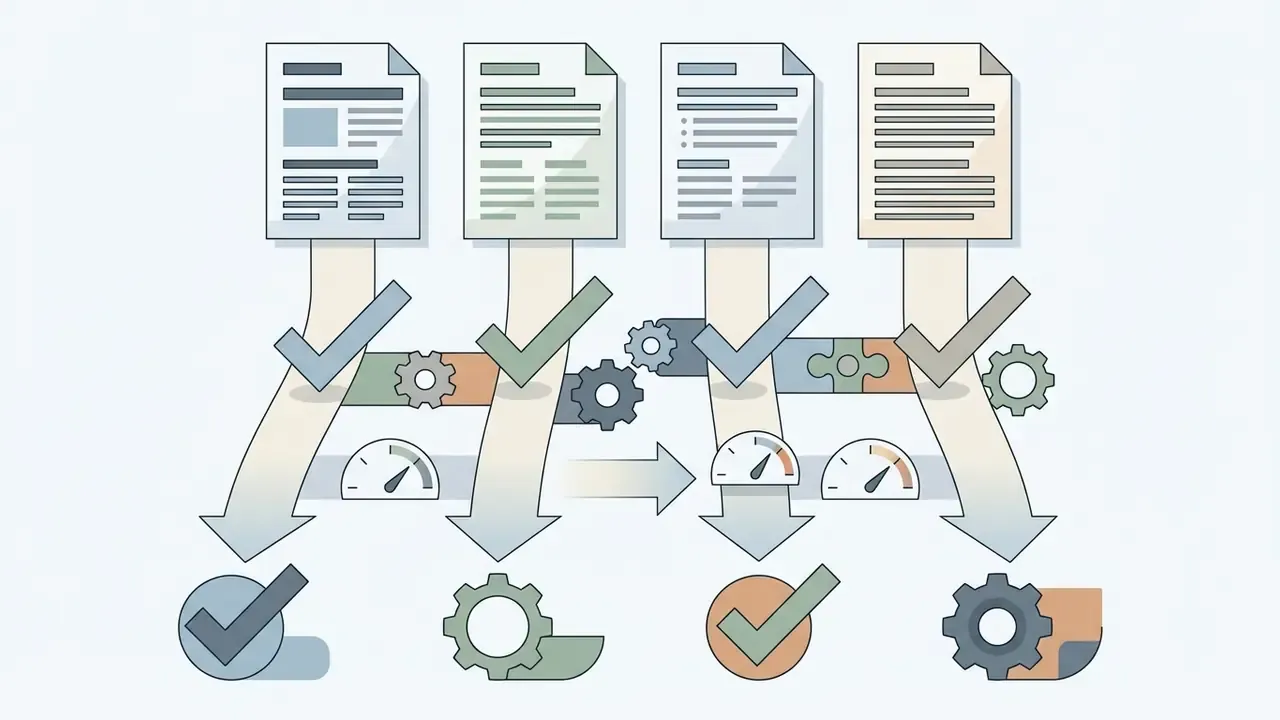
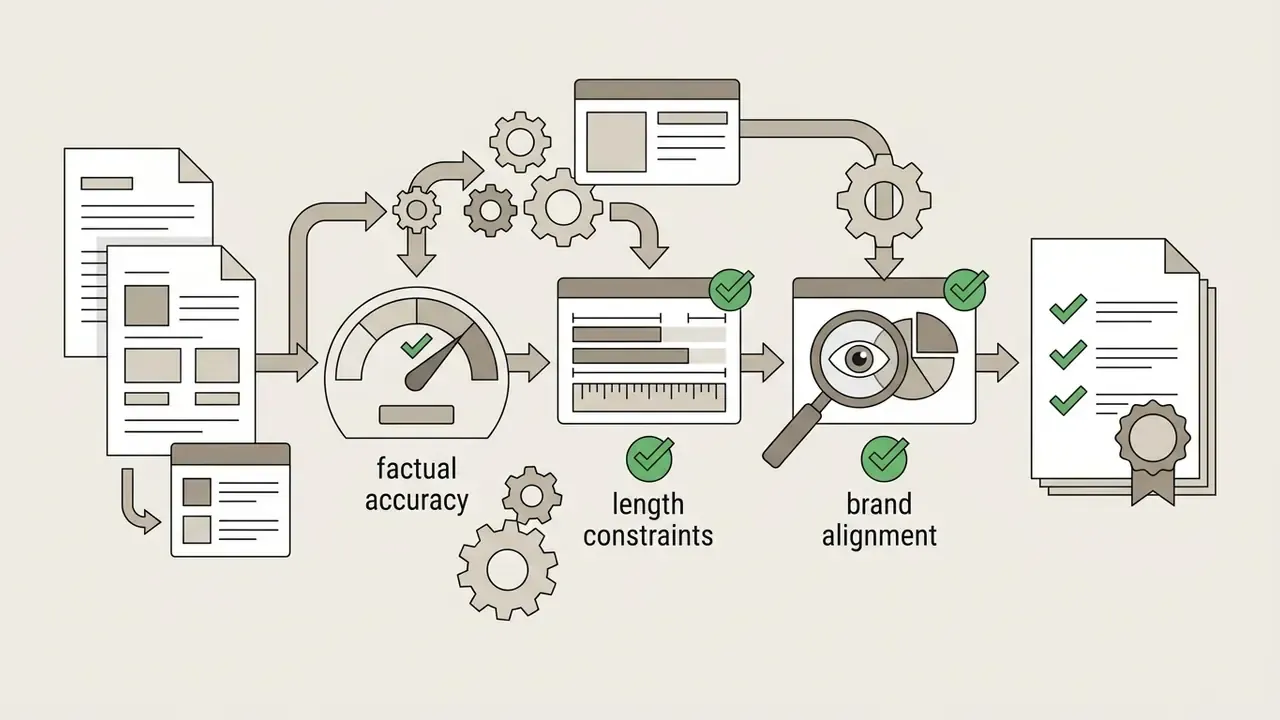
Editorial fact-checking protocol (five mandatory gates)
- Numerical accuracy audit.Verify all numbers, dates and percentages against the source text.
- Claims and entity verification.Confirm no unverified entities or exaggerated promises survive.
- Tone and brand alignment.Check that syntax follows the documented governance rules.
- Technical boundary check.Ensure character and pixel length fit the target SERP or inbox cap.
- Disclosure and record check.Confirm the AI-use labeling policy was applied and the audit trail stored.
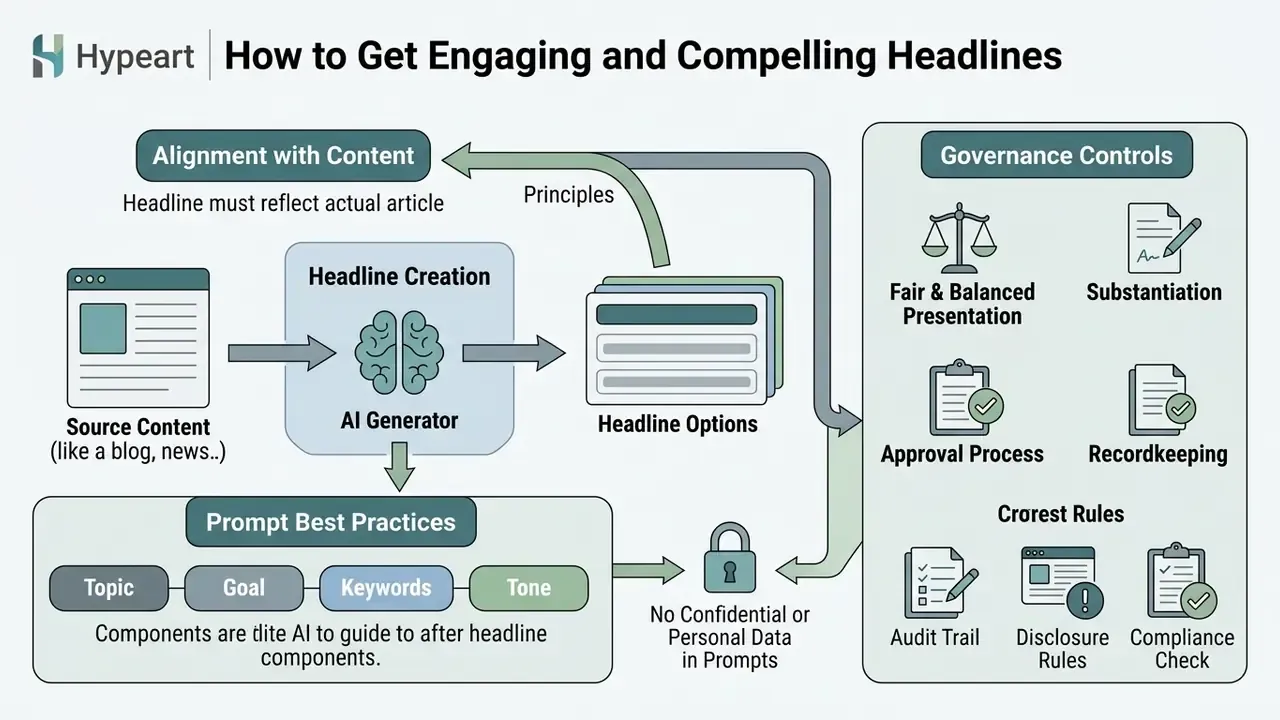
Align the Headline with the Content of the Article or Post
https://academic.oup.com/pnasnexus/article/3/10/pgae403/7795946
«No evidence, no autonomy. An AI headline generator serves as a digital assistant for high-velocity iteration, but editorial accountability and audience trust require human oversight at every step.»
Regulated-Sector Constraints: Financial Services, Health and Advertising Claims
Use Keywords Without Overloading the Headline
Integrating target keywords into titles matters for search indexing, but forcing multiple phrases into one headline destroys readability. Search algorithms penalize keyword stuffing because it degrades user experience and signals low-quality content.
Best practices from Purdue University Title Tag Guidelines (2026) recommend placing the primary keyword near the beginning of the title tag while keeping natural, human-readable phrasing, and they explicitly warn against sacrificing readability for keyword density. One primary keyword plus, at most, one secondary keyword is the working ceiling. U.S. General Services Administration guidance for Search.gov (2022, updated 2025) applies the same rule to document metadata: use a unique, document-specific title with relevant keywords, and avoid stuffing. Secondary keywords earn a place only when they flow naturally without inflating character counts.
Create Different Variants for Testing
A/B tests across marketing campaigns give empirical data on which headline structures resonate with a target audience. Instead of trusting intuition, marketers test two or three distinct AI-generated variants against measurable engagement metrics.
«The HonestBait framework showed headlines using forward references were 11.25% more attractive than human-written ones while remaining faithful, given built-in model self-verification.»
A specific measured experiment, replacing the general journal reference used in the earlier version of this page:
«A randomized experiment with GPT-4o-mini across more than one million users produced a +23.63% relative lift in email item tap rate for personalized AI titles.»
Test discipline matters more than test volume. Change one variable per test (trigger type, number presence, length, promise specificity), split the audience randomly and evenly, hold the send window constant, and judge the winner on the metric the tested element actually influences: opens for subject lines, CTR for titles, conversion for landing hero lines. Standard email testing practice sends variant A to up to half the list and variant B to the remainder, then ships the winner to the holdout after a fixed waiting period. Marketers expanding multi-channel campaigns can compare production tooling in our roundup of AI art generators for accompanying creative assets.
AI Headline Generator for SEO, Marketing and Brand
Integrating an AI headline generator into enterprise content workflows raises throughput while keeping brand messaging consistent. Content marketing, SEO and corporate communications teams rely on centralized generation rules to hold quality at scale.
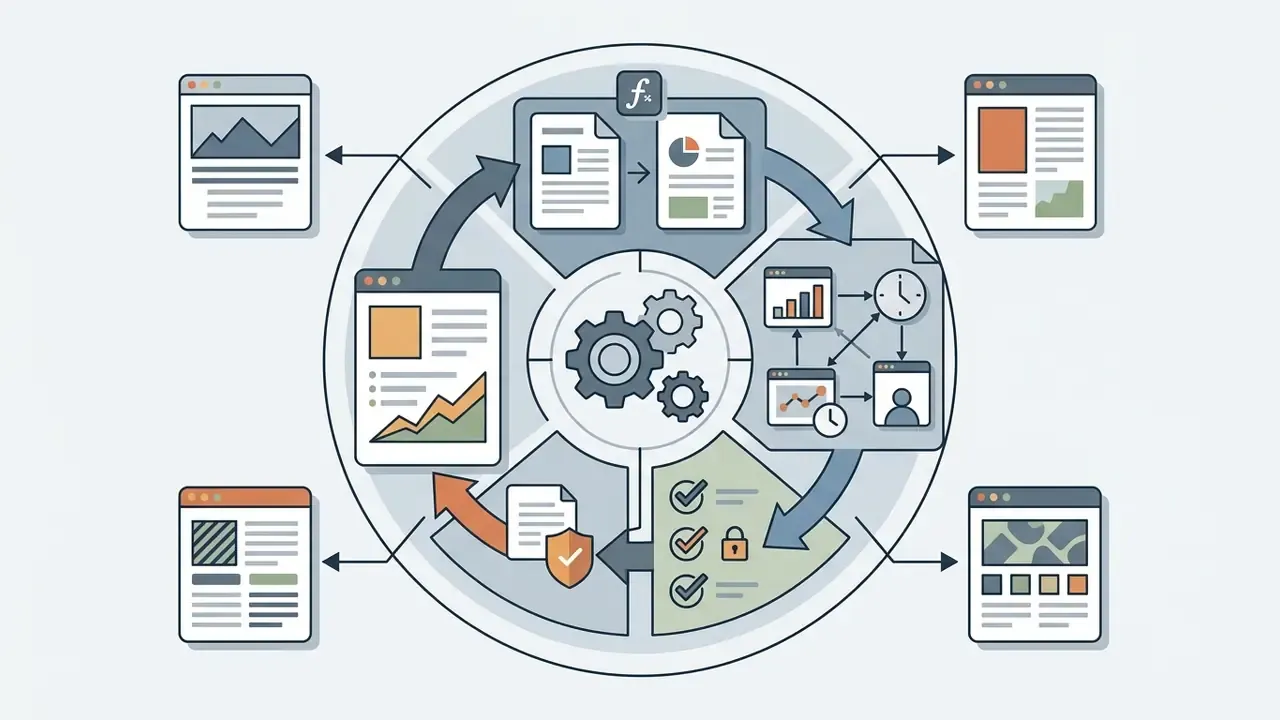
Enterprise governance workflow (linear control path)
- Content brief feeds the AI headline generator.
- The generator returns candidate variants.
- Brand style and risk audit filters them.
- Claim-bearing candidates escalate to compliance or legal review.
- Approved publication follows named sign-off.
- Audit trail and version archive retain prompt, sources, reviewer and final string.
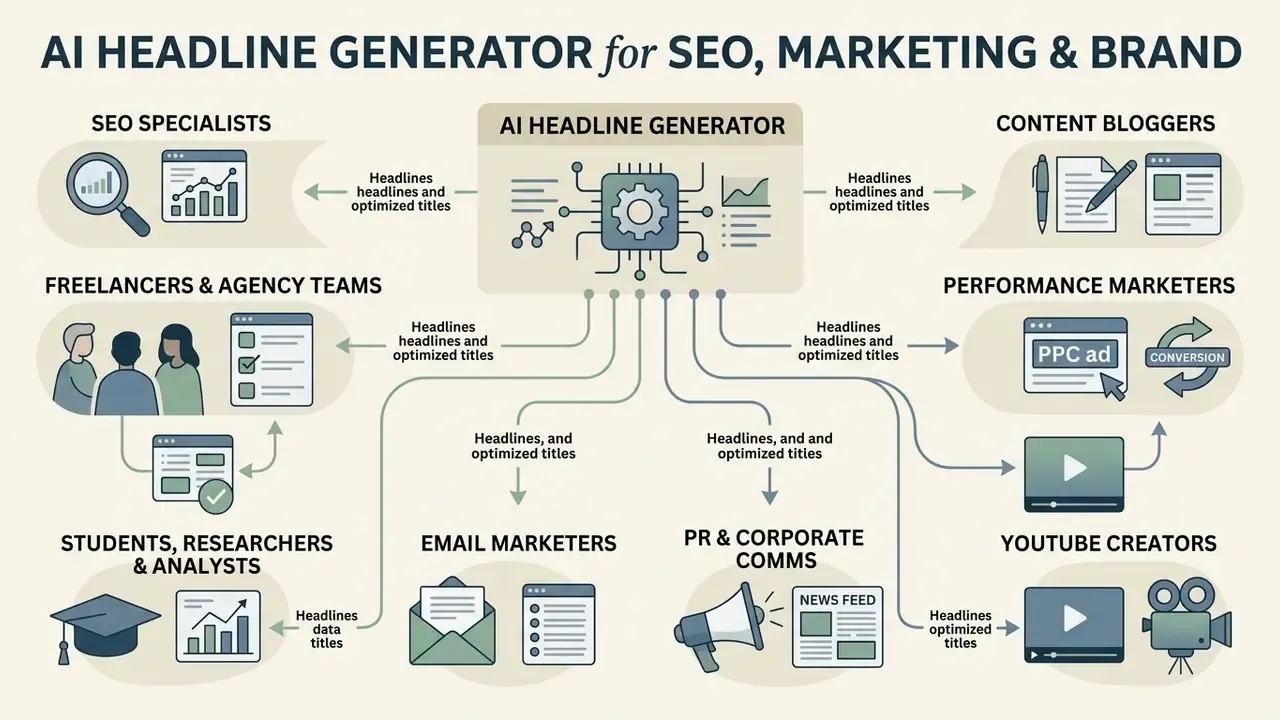
Headlines for SEO Pages, Articles and Landing Pages
Tailored Workflows for Content Professionals
- Content bloggers and SEO specialists. Generate keyword-aligned title tags and H1 headers that respect the 40 to 60 character display limit while maximizing organic CTR.
- Performance marketers and PPC leads. Build batches of ad headlines for Google Responsive Search Ads and Meta campaigns, ready for efficient multi-variant A/B tests.
- YouTube creators and video editors. Craft curiosity-gap video titles that complement thumbnails and support recommendation algorithms.
- PR and corporate communications. Produce neutral, attribution-safe press release headlines that summarize the announcement in one line with an active verb and no promotional framing.
- Email and lifecycle marketers. Generate subject-line batches inside a fixed character cap with one promise per line, ready for randomized split testing on open rate.
- Students, researchers and analysts. Create concise, context-appropriate titles for essays, reports, proposals and presentations, where clarity outweighs click appeal.
- Freelancers and agency teams. Deliver multiple on-brand headline options per client brief, with saved prompt templates enforcing each client's tone and banned-word list.
- Risk, compliance and governance leads. Constrain generation to approved vocabulary, route claim-bearing headlines to review, and retain prompt-to-publication evidence for audit.
Unified Tone of Voice for Business and Content Teams
Holding a unified tone of voice across distributed marketing teams takes clear editorial guidelines and standardized prompt templates. When many writers generate content, centralized style rules prevent brand dilution and tonal drift. A usable style guide fixes voice principles, brand values, allowed and forbidden wording, grammar and punctuation conventions, contraction and capitalization rules, plus worked examples. Then it names the editorial or marketing reviewer who signs off before publication.
Illustrative example (internal, hypothetical, not independently verified). A fintech marketing department deployed an internal AI headline generator configured with strict brand voice parameters. By setting explicit rules for terminology, active voice and prohibited hype words, the team reported more consistent messaging across monthly campaign releases and shorter editorial review cycles, since reviewers spent less time rewriting tone and more time verifying facts. The specific volume and percentage figures cited in an earlier version of this page were internal estimates without documented methodology; they are now framed as directional rather than benchmarked.
«An LLM system for advertising content generates up to 12 headlines per search query and is tested across 10,000 keywords, demonstrating AI scalability under brand constraints.»
Content teams producing multi-format campaigns from a single brief can extend the same governance model to motion assets described in our comparison of free AI video generators.
Free AI Headline Generator, Pricing and Access Models
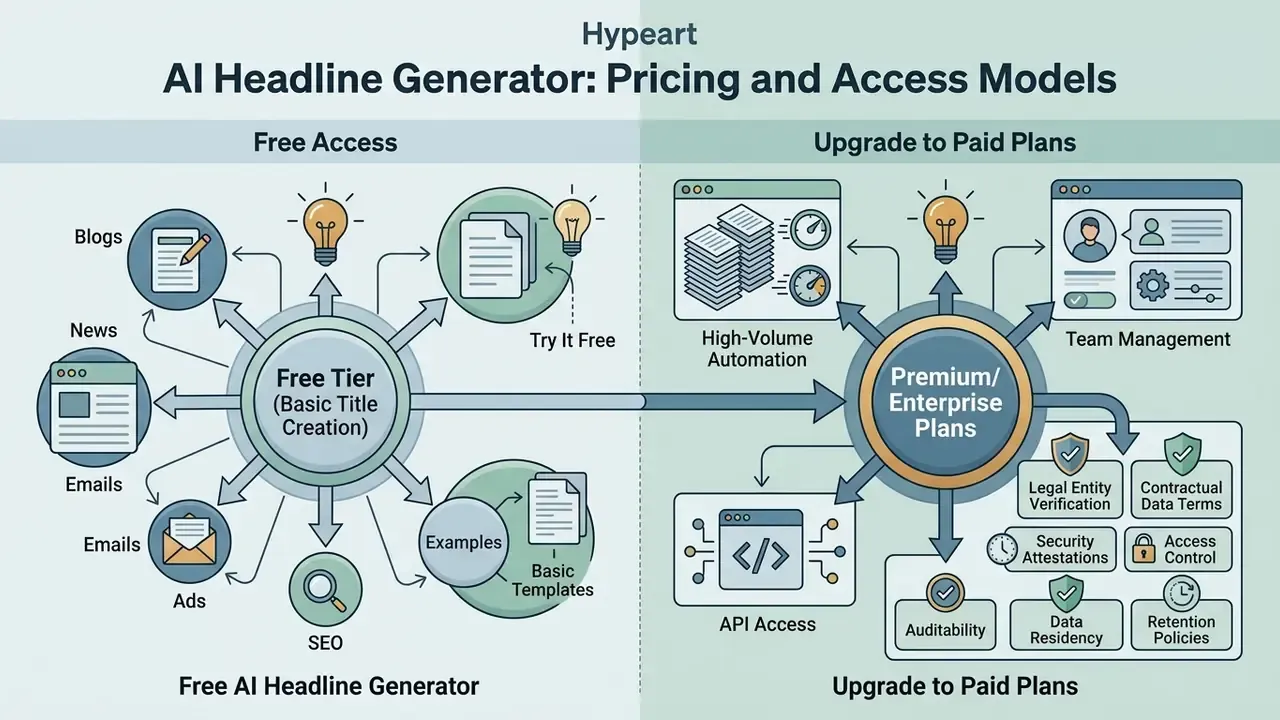
AI headline generation services usually run on freemium access models: basic title creation at no cost, with high-volume automation, team management and API access reserved for paid subscribers. Understanding these tiers helps organizations pick the right tool for their operational scale. Vendor boundaries differ sharply. Some cap free use at a handful of runs per day, some meter a monthly credit balance, and some make the headline tool fully free while monetizing adjacent products.
| Feature category | Free access tier | Premium / enterprise tier |
|---|---|---|
| Generation quota | Daily or monthly generation credits (for example, 5 to 10 runs per day, or a fixed monthly credit balance) | Unlimited or high-volume API credits; usage-based enterprise contracts |
| Channel formats | Standard blog and article headline structures | Full channel coverage (ads, email, YouTube, SEO, press releases, landing pages) |
| Brand voice controls | Basic presets (professional, casual) | Custom brand style guides, banned-word lists, rule enforcement |
| Generation history | Recent session memory or no history storage | Searchable generation archive, version diffing, export |
| Team collaboration | Single-user access | Multi-seat workspaces, roles, approval flows |
| Integration support | Web interface, manual copy-paste | CMS connectors, workflow plugins, REST API |
| Language coverage | Often English-only or a limited subset | 30 to 40+ languages with locale-specific tone control |
| Data privacy and compliance | Standard consumer terms; inputs may be retained | Contractual DPA, SOC 2 / ISO 27001 attestations, GDPR alignment, regional data residency |
| Model training exemption | Frequently absent; inputs may train future models | Contractual zero-data-retention and no-training commitment |
| Access management | Email and password, optional social login | SAML/SSO, SCIM provisioning, role-based permissions |
| Audit and logging | None or session-local | Exportable activity logs, prompt and output records, compliance API access |
| Support and SLA | Community or documentation only | Priority support, named contacts, uptime commitments |
What Is Available in the Free AI Headline Generator
A headline generator ai free tier covers core functionality for independent writers, bloggers and small marketing teams. Users enter keywords or a topic description and receive multiple standard title suggestions with no financial commitment.
Credit accounting differs by vendor and by tool. Some platforms price paraphrasing or humanizing per 10 words while charging a flat credit for an analysis run, and credits usually reset at the start of each billing cycle. Documented free-tier patterns range from a fixed monthly credit pool consumed several credits per generation, to a hard cap of ten generations per day, to output ceilings such as a 500-word limit or a restricted language set. Some tools also gate advanced modes, ad-focused packs or brand-voice packs, behind the paid tier entirely.
Free tools let creators test basic capability, judge output fluency and handle lower-volume content tasks. Independent authors comparing zero-cost options across formats can also review our guide to free photo editors for accompanying imagery. Teams needing troubleshooting or workflow help can visit our support portal.
When to Upgrade to a Plan with Additional Features
Upgrading becomes necessary once content volume exceeds free quota limits, or once enterprise governance controls are mandatory. Advanced tiers unlock high-volume generation, custom brand voice, collaboration workspaces and API integration. Enterprise agreements in the wider LLM market additionally expose compliance APIs with programmatic access to activity logs and chat history, seat-based usage multipliers, connectors to workplace tools, and, on usage-based contracts, removal of plan and seat caps.
Vendor due-diligence checklist before procurement:
Organizations needing automated media creation at scale can see the overview of developer integrations. For corporate licensing terms, teams can also see the overview of commercial usage parameters, including our breakdown of Canva AI Generator commercial licensing.
Estimating Risk-Adjusted ROI Before You Buy
Licence cost is the smallest line in a governed deployment. A defensible business case nets the drafting time recovered against both subscription spend and the control effort the tool creates.
Risk-adjusted ROI, per month
- Gross saving =
H_saved x R_content, whereH_savedis the hours of ideation removed per month andR_contentis the blended hourly cost of content staff. - Control cost =
(H_review x R_review) + (H_compliance x R_compliance), whereH_reviewis added editorial verification hours andH_complianceis added compliance or legal review hours. - Total cost = licence + control cost + onboarding and amortised training.
- Risk adjustment =
P_incident x C_incident, whereP_incidentis the probability of a misleading or inaccurate headline reaching publication andC_incidentis the expected cost per incident (correction, retraction, regulatory exposure, brand impact). - Risk-adjusted ROI =
(Gross saving - Total cost - Risk adjustment) / Total cost.
Two practical notes. First, P_incident is the variable your governance design actually controls: mandatory numeric reconciliation, banned-word enforcement and named approval all push it down, which is why control cost and risk adjustment belong in the same model rather than being traded against each other. Second, run the calculation per channel. A landing-page hero line and a wire-service news headline have wildly different C_incident values, so a single blended ROI figure overstates the case for regulated formats and understates it for low-risk blog content.
An honest caveat: none of the published lift figures in this article were measured inside a US bank under model-risk supervision. Treat them as directional evidence, then re-measure in your own environment before extending the deployment.
FAQ: AI Headline Generator Questions
Do I need to sign up or register to use the free AI headline generator?
Basic headline tools often provide immediate access with no registration or account creation. Saved generation history, custom brand voice templates and expanded credit limits typically do require an account. Registration friction is a documented drop-off point: a 2013 field study of three major web services found users were significantly more likely to abandon sign-up flows unless the perceived service value justified the privacy cost, and Nielsen Norman Group guidance warns that login walls impose a high interaction cost when the user benefit is not obvious. For teams the trade-off inverts, since accounts are exactly what enable roles, approval flows and the audit trail that governed publishing needs.
Can the headline generator work with different languages?
Yes. Modern LLM-powered headline generators process multiple international languages, including English, Spanish, German, French and Indic languages, and commercial tools commonly advertise 30 to 40+ language options. Large-scale benchmarks such as Mukhyansh (2023) show that neural headline generators reach strong summarization quality across diverse Indic language families, with an average ROUGE-L score of 31.43 across 8 languages. Quality is not uniform, though: multilingual benchmarks such as MTG (2022) show that high-resource languages perform better, and that multilingual training can beat monolingual setups, while low-resource languages still need extra pretraining or augmentation to close the gap.
«The Vārta corpus (41.8M articles, 14 Indic languages plus English) showed that pretraining on it improves both language-understanding and generation tasks.» — Vārta: A Large-Scale Headline-Generation Dataset for Indic Languages, arXiv (2023). https://arxiv.org/abs/2305.05858
How do I prevent AI-generated headlines from sounding like clickbait?
Select a professional or analytical tone parameter, and make sure the input brief carries specific, grounded facts from your body text. Ban superlatives, implied causation and forward-looking promises at prompt-template level rather than fixing them in review. Then apply the incongruence test used by media-rating methodologies: extract the article's key claims, confirm the headline neither contradicts them nor promises anything the body does not deliver. A human editorial review still closes the loop.
What is the ideal character length for an SEO headline tag?
An HTML title tag should generally sit between 40 and 60 characters, roughly 550 to 600 pixels wide. Google's documentation states there is no fixed character limit, since truncation depends on rendered width on the user's device, so treat 600 px desktop width as the operational constraint and characters as a proxy. Staying inside that boundary prevents truncation on desktop and mobile viewports. Email subject lines usually need a tighter cap for mobile inboxes, and Google Responsive Search Ads enforce a hard 30-character limit per headline asset.
Should I use the same headline across every channel?
No. Each channel imposes different display limits and rewards different structures. A 30-character ad asset, a mobile-optimised subject line, a 40 to 60 character search title, and a thumbnail-complementary video title are four distinct artifacts derived from the same source. Generate a channel-specific variant per surface, and A/B test within the channel rather than across channels.
Who owns the headlines the AI generates?
Most commercial generators grant the user full rights to use generated titles in their own work, but ownership, licensing and permitted commercial use are set by each vendor's terms of service. Verify the clause in writing before deploying output in paid advertising or trademarked brand assets, and confirm that the grant survives contract termination.
Is my input data safe when I paste an unpublished draft into a headline generator?
Only if the vendor contractually commits to it. Consumer free tiers frequently retain inputs and may use them for model improvement, which makes them unsuitable for confidential material. Never submit personally identifiable information, material non-public information, client records or unpublished research to a public AI platform; governance frameworks for scholarly and biomedical publishing state this prohibition explicitly. Require zero-data-retention terms, a model-training exemption, a Data Processing Agreement, and current SOC 2 or ISO 27001 attestations before enterprise rollout.
What is a credit, and how fast will I use them up?
A credit is the platform's unit of metered usage. Tools consume credits at different rates: a single headline generation run typically costs one credit and returns around five variants, while other operations may be priced by volume of text processed. Plans allocate a monthly credit balance that resets at the start of each billing cycle. To estimate consumption, multiply your monthly content volume by the number of channel variants you generate per asset, then add a buffer for A/B test variants.
Can an AI headline generator be used in news or financial publishing?
It can assist drafting. It cannot publish autonomously. BBC Editorial Guidelines state that generative AI should not directly create published news, current affairs or factual journalism unless AI use is itself the subject of the content, and that all AI use requires active human editorial oversight and approval. In supervised financial communications, headlines are public communications subject to fair-and-balanced presentation, claim substantiation, pre-use approval and recordkeeping. Route every claim-bearing headline through compliance review, and retain the full audit trail.
Appendix A: Editorial Revision Log
This log documents corrections applied to earlier versions of this page, in line with the audit-trail principle recommended above.
| Item | Original assertion | Revision applied | Reason |
|---|---|---|---|
| Time-saving case study | "Reduced initial headline concept time from over two hours to under twenty minutes per campaign." | Reframed as an internal, illustrative estimate; verified experimental evidence added from Let AI Entertain You (arXiv, 2023). | No published methodology or source supported the specific figures. |
| Tone-of-voice case study | "Consistent messaging across 50 monthly campaign releases while reducing editorial review cycles by 40%." | Reframed as a directional internal observation; scalability evidence added from LLMs for Customized Marketing Content Generation (arXiv, 2025). | Anonymous case with precise figures and no verifiable source. |
| A/B testing citation | Reference to a Marketing Science (2024) journal homepage. | Replaced with a specific measured experiment: LLM-based Personalized Email Title Generation for E-commerce (arXiv, 2025), reporting +23.63% relative item tap rate. | A journal-level URL is not a citation of a specific study. |
| Multilingual claim | "Mukhyansh... high translation and summarization quality." | Corrected to "strong summarization quality across diverse Indic language families, average ROUGE-L 31.43." | Mukhyansh is a headline-generation dataset, not a translation benchmark. |
| Vendor verification note | A domain-resolution log for an unrelated third-party organization appeared inside the pricing section. | Removed as an off-topic editorial artifact and replaced with a seven-point vendor due-diligence checklist covering legal entity, data terms, security attestations, access control, auditability, residency and exit terms. | Irrelevant to headline generation and damaging to page integrity; replaced with material of higher reader value. |
| Author attribution | Author quote presented without provenance note. | The quotation is attributed to Marcus Hale, author. | Transparency requirement: no implied real employment, clients or regulatory authority. |
| Internal links | Links pointed to unrelated tool categories. | Re-pointed to editorially relevant hubs on media tooling, licensing and workflow. | Relevance and reader trust. |