Last updated: February 2026 · Editorial review: AI Governance & Model Risk desk · Reading time: ~17 minutes
Executive Summary
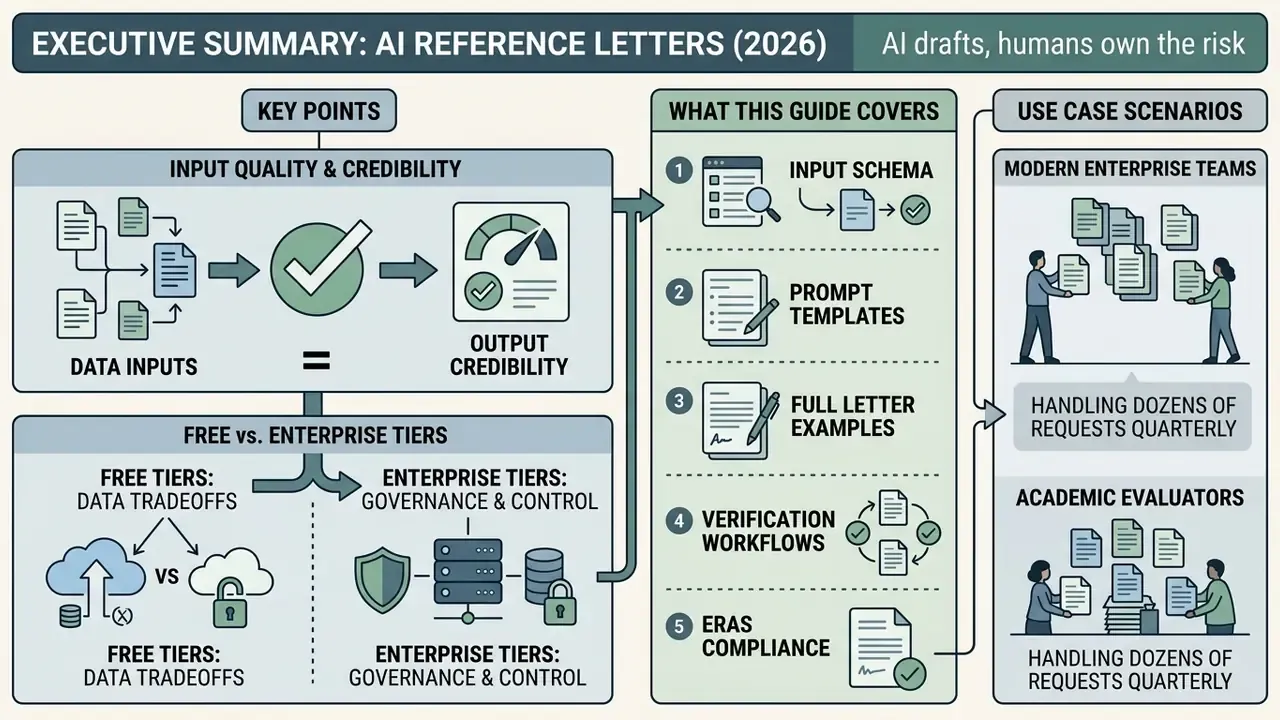
- AI drafts, humans own the risk. An ai reference letter generator compresses drafting time from hours to minutes. Every date, percentage, title and evaluative claim still has to be checked against primary records before signature. In regulated, academic or executive contexts, human-in-the-loop review is not a nice-to-have.
- Input quality decides output credibility. Structured inputs (relationship duration, quantified outcomes, target program or role) separate a persuasive endorsement from polished filler. The copy-paste JSON schema below removes most re-generation cycles.
- Free tiers carry data and governance trade-offs. Public tools may log prompts for model retraining. Enterprise tiers offer zero-data retention, SOC 2 attestation, letterhead PDF export and the auditability that internal AI-use policies and model risk frameworks such as SR 11-7 / OCC 2011-12 expect.
What this guide covers. First, the difference between a reference letter, a letter of recommendation and a formal recommendation. Then the input data an ai letter of recommendation generator actually needs, the four-step workflow, the personalization pass, free versus enterprise limits, domain rules for academia and employment, ethics and disclosure, a governance section for supervised institutions, three full letter examples, an FAQ and a pre-signature checklist. Read it end to end once. After that, the checklist alone is enough.
Modern enterprise teams and academic evaluators handle dozens of recommendation requests every quarter. An ai reference letter generator automates the first drafting phase, turning raw achievements, employment timelines and behavioural notes into structured professional text in seconds. Deploying generative AI for high-stakes endorsements, though, requires strict human oversight: to protect data privacy, to prevent hallucination and to avoid the standardized phrasing that admissions readers now spot in a single glance.
What is an AI Reference Letter Generator and What Letters Can It Create?
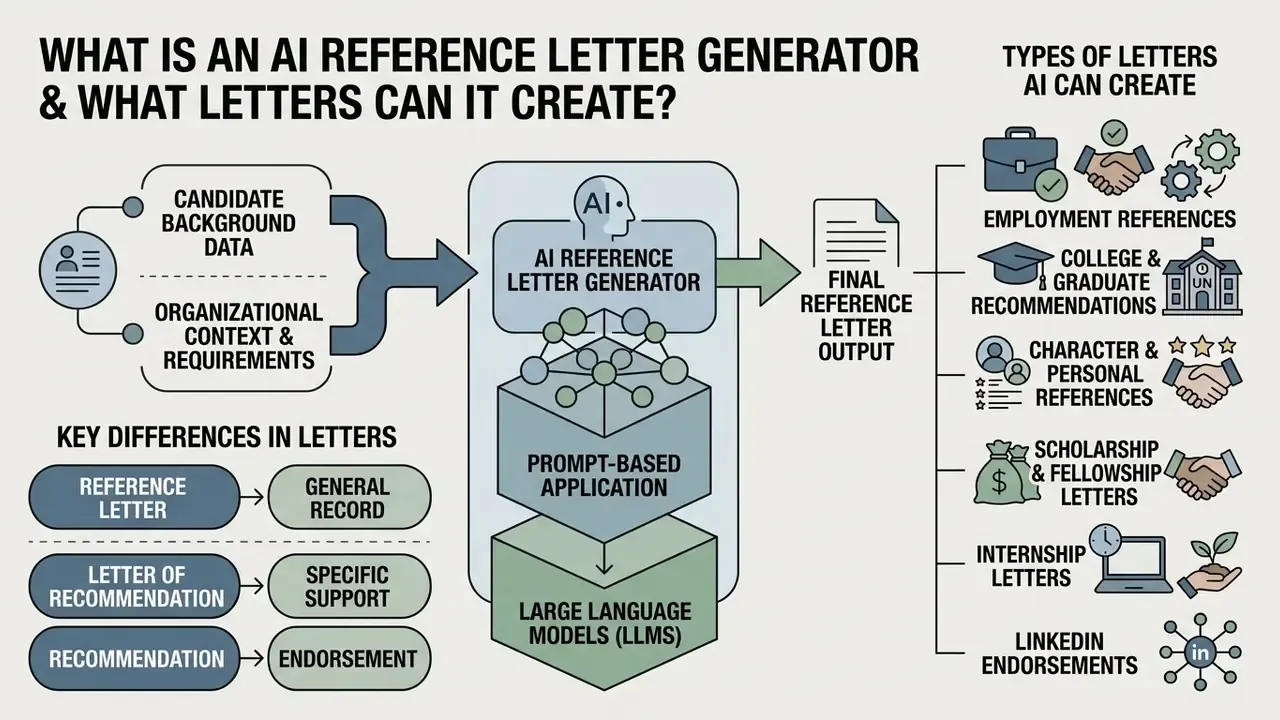
An ai reference letter generator is a prompt-based application that uses large language models (LLMs) to synthesize candidate background data, organizational context and recommender evaluations into customizable endorsement drafts. It does not replace judgement. An ai generator letter of recommendation is closer to a productivity architecture: it cuts drafting time from hours to minutes and standardizes formatting across corporate and academic environments.
«Instruction-tuned models rely far more heavily on nominalizations, passive voice and subordinate constructions than human writers.»
That divergence is exactly why AI output should be treated as a first draft. Readers who process hundreds of letters per admissions or hiring cycle recognize the pattern immediately, and they discount it.
An ai generator for letter of recommendation operates on structured inputs: candidate name, target role or academic program, relationship duration, concrete accomplishments, preferred formality. Modern systems use natural language processing (NLP) to convert bullet points into cohesive narratives aligned with US enterprise and higher-education conventions.
Reference Letter vs. Letter of Recommendation vs. Recommendation: Key Differences
A reference letter is usually broad and written for an unspecified recipient ("To Whom It May Concern") to verify employment dates, core responsibilities and general integrity. A letter of recommendation is targeted: it addresses a specific hiring manager, admissions committee or fellowship board and links the candidate's credentials to that opportunity's selection criteria.
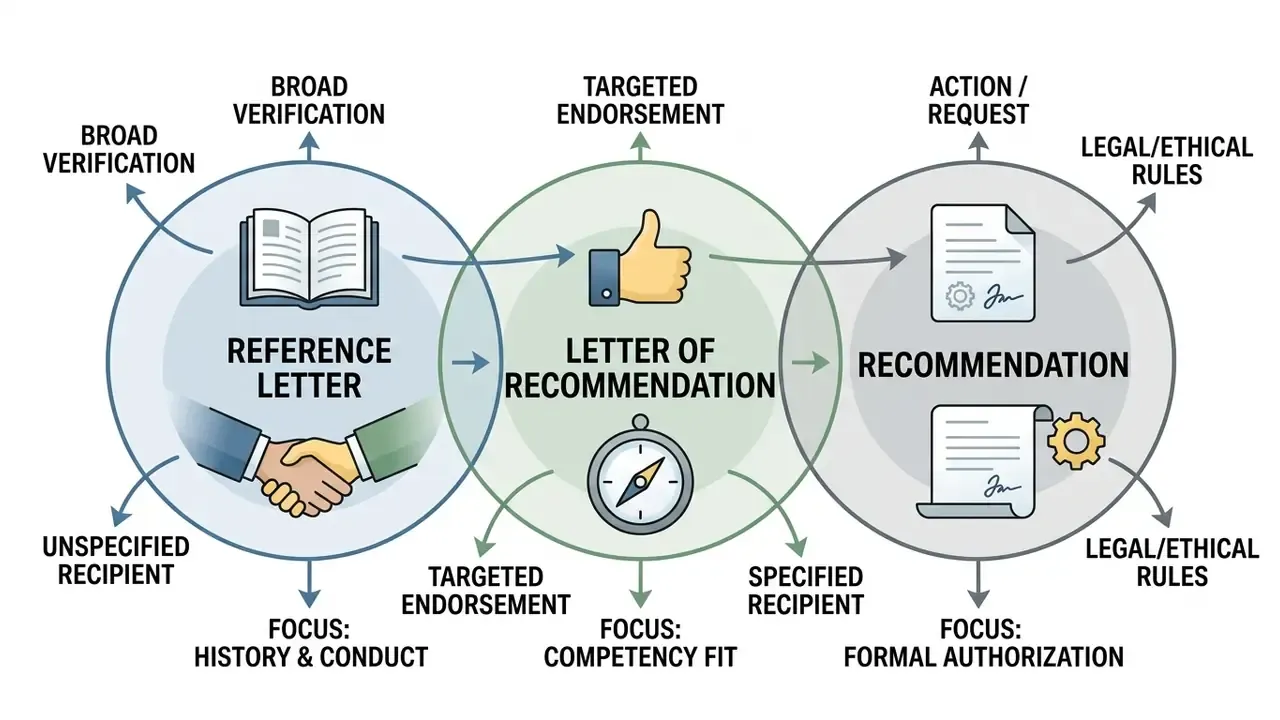
In official US governance contexts, "recommendation" often means the formal endorsement action itself, or the regulatory request. Federal ethics rules, for instance, strictly regulate when officials may endorse someone on agency letterhead. Understanding the distinction matters in practice: it tells you which output schema, disclosures and register to select in an ai recommendation generator.
| Document Type | Audience | Primary Function | Typical Author | Style Register |
|---|---|---|---|---|
| Reference Letter | Unspecified ("To Whom It May Concern") | Verify facts, tenure, conduct | Employer, HR, supervisor | Factual, business-neutral |
| Letter of Recommendation | Named committee, program or hiring manager | Actively advocate for selection | Professor, direct manager, mentor | Persuasive, evidence-led |
| Recommendation (action/request) | Institutional or regulatory | Formal endorsement or authorization | Official with delegated authority | Formal, compliance-bound |
| LinkedIn Endorsement | Public professional network | Short social proof on a profile | Colleague, client, classmate | Warm, peer-level, concise |
Types of Recommendation Letters You Can Generate with AI
An ai recommendation letter generator can produce several distinct formats depending on domain, relationship and evaluation criteria. The underlying model is the same; the parameters are not.

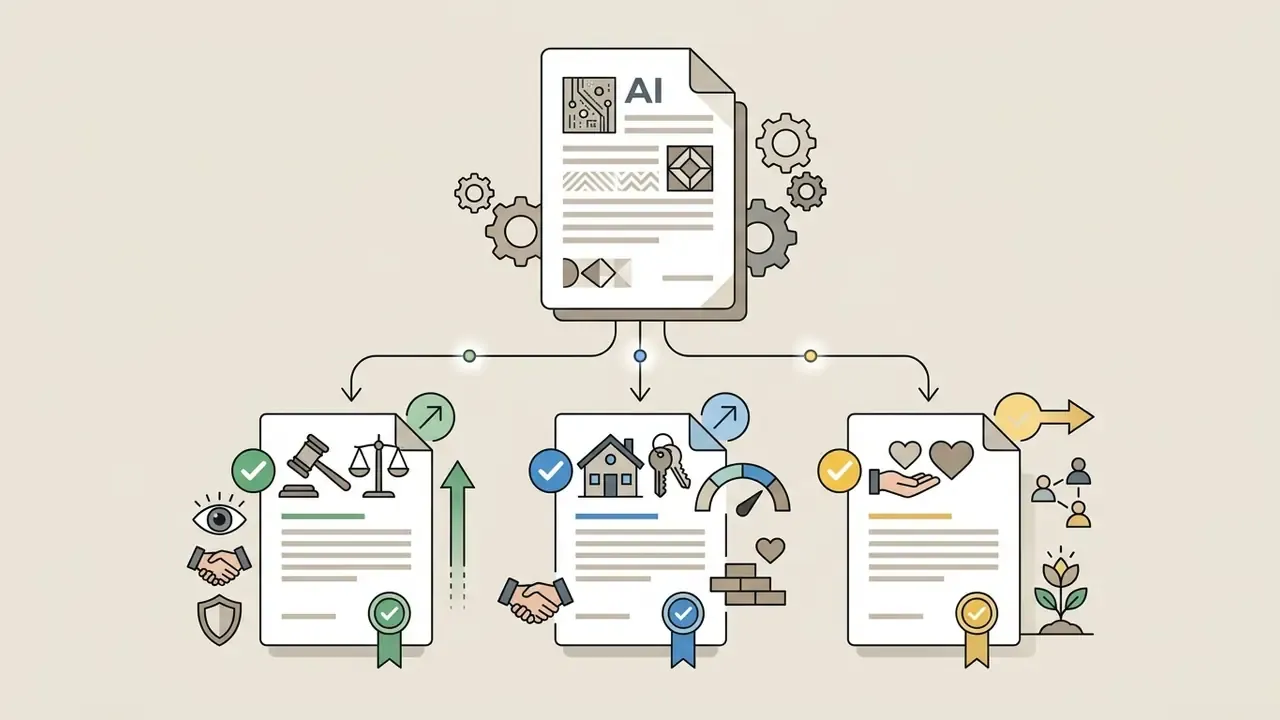
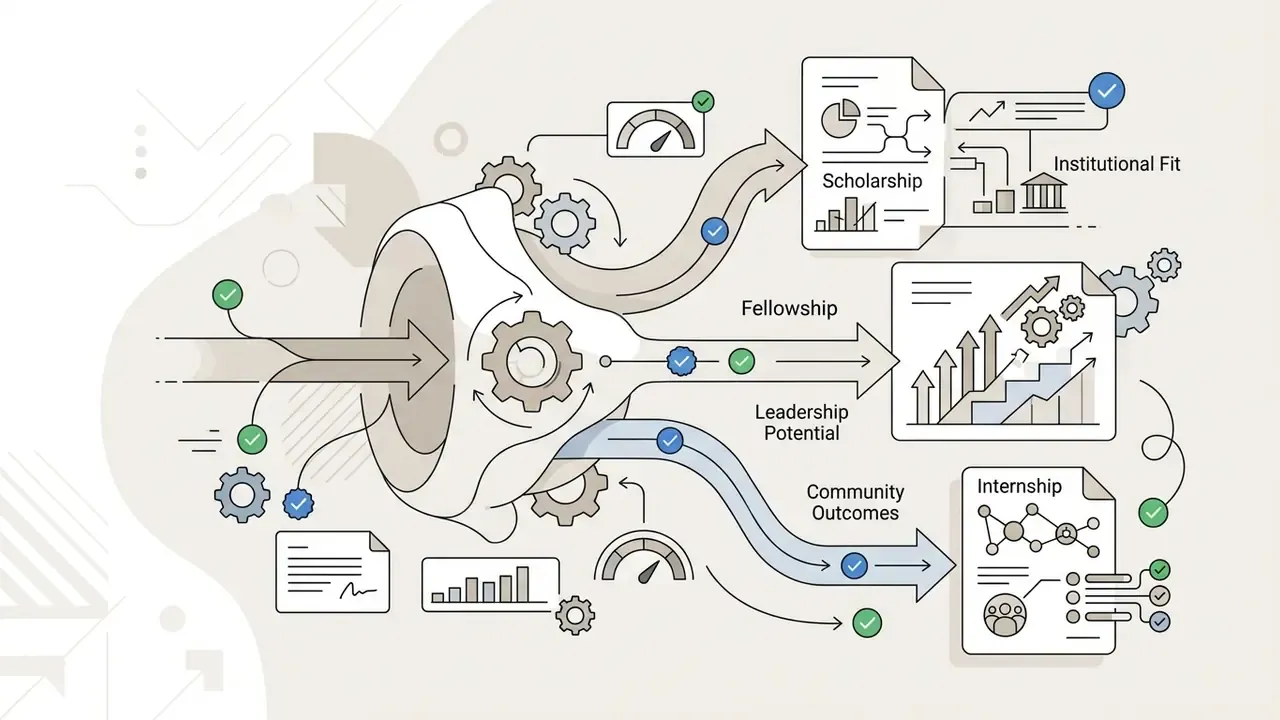
| Letter Type | Primary Target Purpose | Author / Recommender | Essential Input Information | Key Output Focus |
|---|---|---|---|---|
| Employment Reference | Candidate evaluation and background verification | Direct supervisor, manager or HR leader | Employment dates, titles, performance metrics, project scope | Execution, leadership, impact, dependability |
| College Recommendation | Admissions and scholarship evaluation | Professor, department chair, academic advisor | Class rank, research projects, course performance, milestones | Curiosity, analytical rigor, academic growth |
| Character Reference | Legal, housing or community board review | Peer, mentor or community leader | Relationship context, years known, observed conduct | Integrity, ethics, dependability, contribution |
| Scholarship / Fellowship | Funding committee evaluation | Faculty advisor, program director | Academic context, service record, leadership evidence | Fit, potential, stewardship |
| LinkedIn Recommendation | Public digital personal branding | Colleague, client or project partner | Shared project context, collaboration wins, core strengths | Teamwork, soft skills, public credibility |
Before you pick a letter type, know one documented failure mode of generative models in this exact task.
«LLM-generated reference letters reproduce stereotypes: women are described as warm, men as role models.»
Mitigation is cheap. Run the same prompt with the candidate's gender-coded pronouns swapped, compare the two drafts, then delete any adjective that appears in only one version. Trait language should describe observed behaviour ("resolved a production outage in 40 minutes"), not personality archetypes.
Essential Input Data Required for an AI Reference Letter
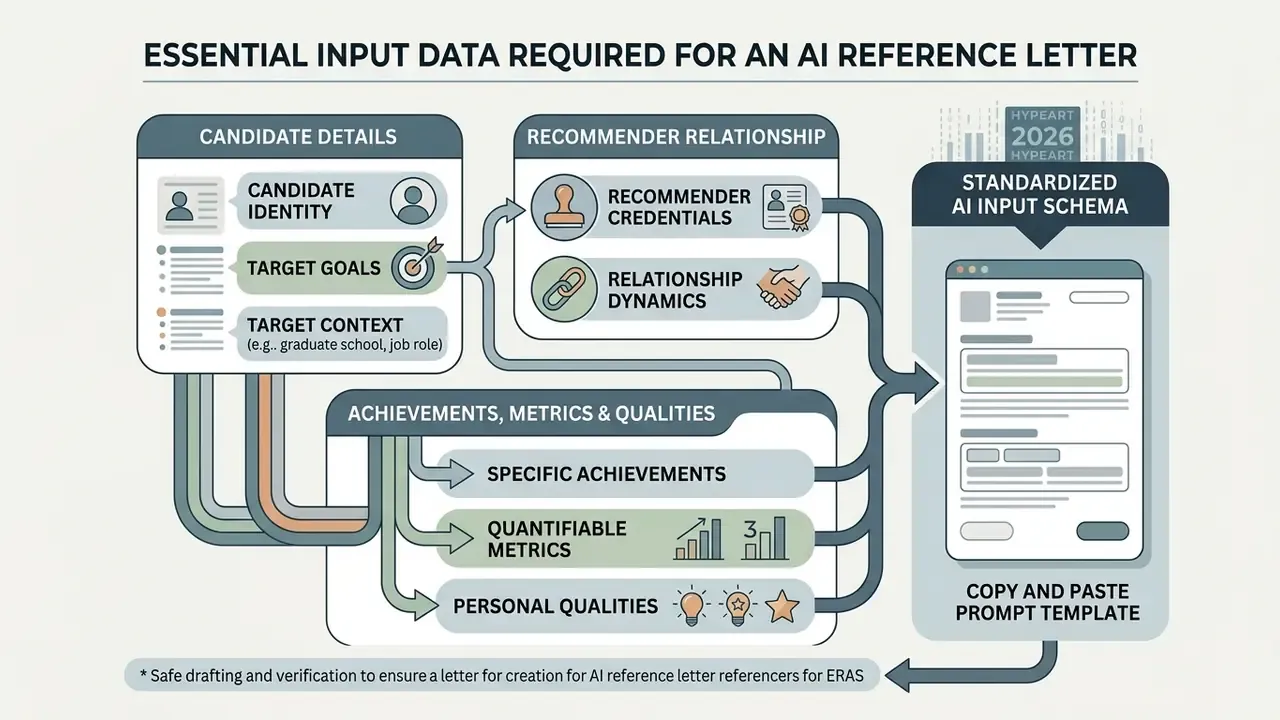
Output quality from an ai letter of recommendation generator depends almost entirely on the specificity of the input information. Large language models are contextual expanders. Feed them "hardworking" and "smart" and they will hand back boilerplate that differentiates nobody.
For a genuinely personalized and professional result, supply three data categories: candidate identity context, recommender authorization status and verified outcome metrics. Thin inputs force the model to fall back on statistical averages, which is where cliches and invented claims come from.
Candidate Details, Target Goals, and Recommender Relationship
The first category sets the objective parameters and the authorization boundaries of the reference. An ai letter generator needs precise structural facts to be credible with admissions boards and corporate talent teams.
- Candidate identity and target context full name, pronouns, current title, target position or program, destination institution.
- Recommender credentials author's full name, title, organization and supervisory authority over the candidate.
- Relationship dynamics the capacity in which the recommender observed the candidate (direct manager, thesis advisor, cross-functional project lead) and the exact duration, for example three years.
Apply data minimization. Include only what the endorsement decision requires. Social Security numbers, home addresses, medical details and compensation data should never be pasted into a public generation tool. Ever.
Specific Achievements, Quantifiable Metrics, and Personal Qualities
The second category is the evidence chain. Field research on application signals suggests that polish alone does not move decisions.
«AI-assisted application letters received higher ratings for formal quality but did not increase interview invitations.»
The implication for recommenders is blunt: evaluators discount generic praise and reward verifiable, quantified accomplishments. Polish is table stakes. Evidence is the differentiator.
- Quantitative results: use Action + Context + Result. "Reduced cloud infrastructure costs by 28% across 14 microservices over six months."
- Behavioral competencies: name observable behaviours such as crisis management, cross-team alignment or technical mentorship.
- Specific projects: cite concrete initiatives, thesis titles or system architectures the candidate delivered.
- Comparative anchors: where defensible, add ranking or peer context ("top 2 of 45 students in Advanced Algorithms").
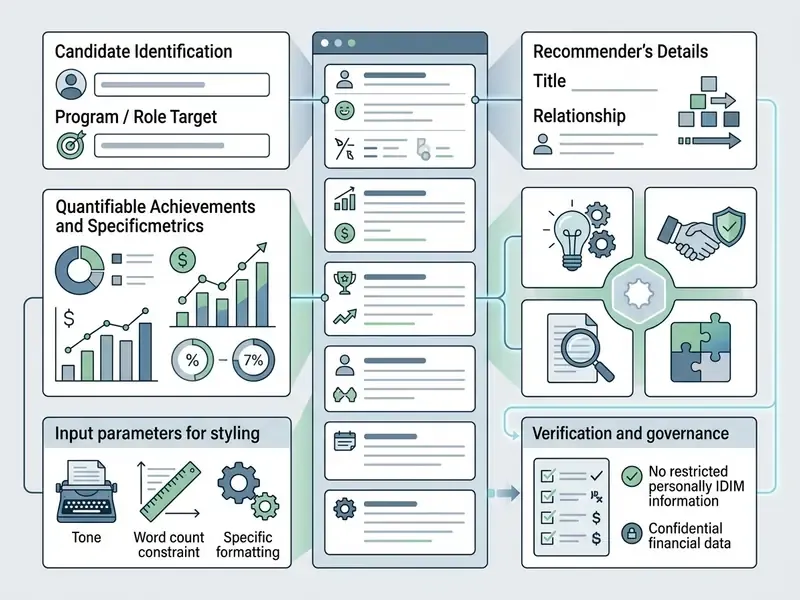
Standardized AI Input Schema (Copy and Paste Prompt Template)
Populate this template before you run the prompt. It is deliberately boring, which is the point.
{
  "candidate_fullname": "Firstname Lastname",
  "candidate_pronouns": "she/her | he/him | they/them",
  "target_opportunity": "Target Role / Program Name & Institution",
  "recommender_title_and_org": "Your Title, Company/University",
  "relationship_context": "Direct Supervisor / Professor / Peer (e.g., 2.5 years)",
  "quantified_achievements": [
    "Achievement 1 with metric (e.g., increased retention by 15%)",
    "Achievement 2 with context (e.g., delivered Project X under budget)"
  ],
  "core_competencies": ["Competency 1 (e.g., analytical rigor)", "Competency 2 (e.g., crisis management)"],
  "must_include_points": ["Explicit endorsement statement", "Offer of follow-up contact"],
  "exclusions": ["No age, family status, health, religion or nationality references"],
  "formatting_rules": "Word count (300-500 words), tone (formal/professional), country standard (US/UK English)"
}
Teams standardizing document workflows can reuse this schema as an internal intake form, so assistants, HR business partners and faculty coordinators collect identical fields before any model is invoked. Small change, large effect: most re-generation loops disappear. The same discipline applies to structured document templating generally, which is why prompt schemas resemble what we describe for an ai blueprint generator: fixed fields first, creative language second.
How to Use an AI Recommendation Letter Generator: Step-by-Step
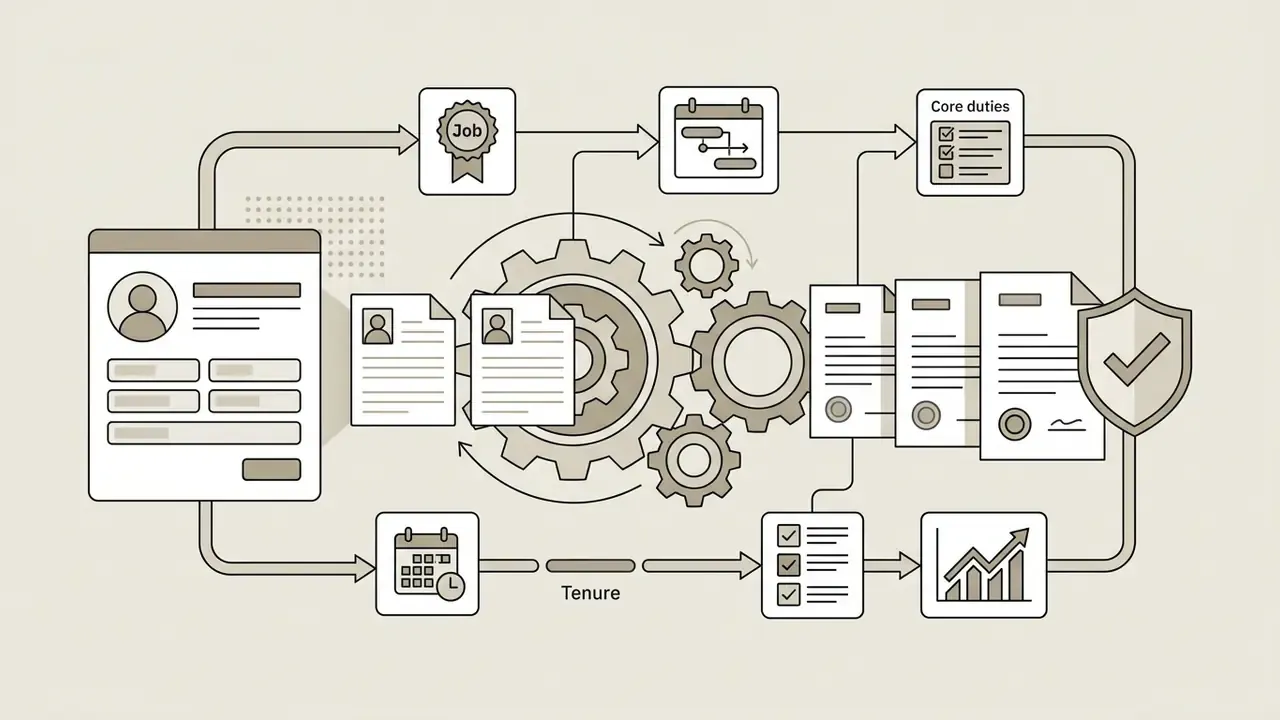
Working with an ai generator for letter of recommendation means running four stages: data ingestion, prompt execution, structural evaluation and human editorial finalization. Follow the lifecycle and unverified AI claims never reach official channels.
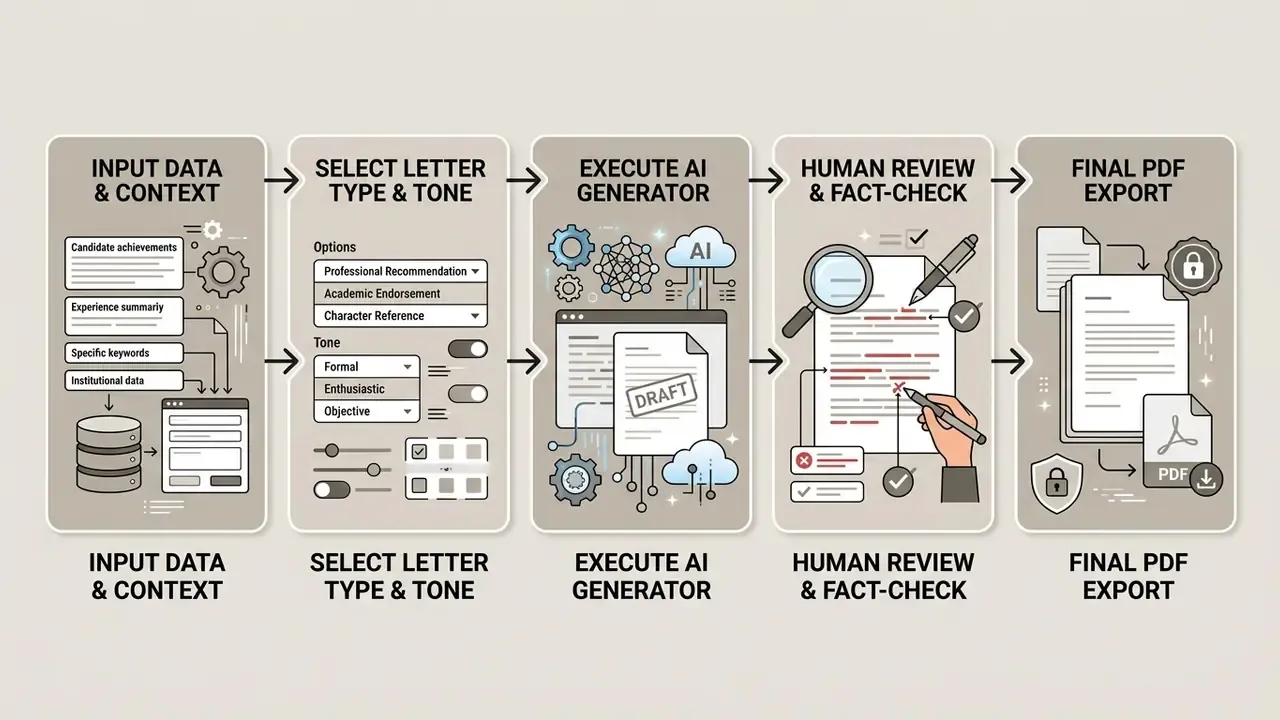
Step 1: Input Candidate Data and Select Document Type
Populate the tool's fields with candidate metrics, choose the document schema and set the formality tier. Precise details entered into a recommendation letter generator ai are what keep filler text out of the draft.
Decide early whether the application is academic admissions, corporate employment or personal character evaluation. That single choice configures the system prompt: US higher-education phrasing for college applications, corporate governance vocabulary for executive job references.
Most commercial interfaces expose the same field set: candidate name, pronouns, institution or employer, relationship and a free-text "key information" box. Treat that box as the highest-leverage field. It is where quantified evidence belongs, and where most users under-invest.
Step 2: Generate Draft and Verify Structural Integrity
Once submitted, the reference letter generator ai processes the parameters and returns an initial draft. A high-performing ai-generated reference letter follows a three-part architecture:
- Opening salutation and relationship disclosurewho the recommender is, their standing, the candidate's name, the nature and duration of the relationship.
- Core body paragraphs (one to three)concrete evidence, named projects and quantified metrics, in descending order of impact.
- Closing synthesis and explicit endorsementthe candidate's strategic value, a clear endorsement and verifiable contact details for follow-up.
At this point the review is structural, not editorial. Published evaluation practice for generative text, including NIST materials that validate outputs for file syntax, schema conformity, topic match and word-count limits before scoring, suggests an analogous pre-check for letters: confirm completeness, syntax, length compliance and logical progression before touching style. Framed as an analogous practice, not as a prescriptive requirement of a specific publication.
The efficiency case for draft-then-verify is documented in adjacent high-stakes writing.
«AI use cut regulatory drafting time from 100 hours to 3.7 hours while mandatory expert review was preserved.»
The lesson transfers cleanly. Time saving comes from the draft. Credibility comes from the reviewer. If you want to model that trade-off in hours and loaded cost for your own team, our AI Media Calculators cover the arithmetic.
Step 3: Edit, Fact-Check, and Export the Final Letter
Now the human works. The recommender reads the draft, adjusts word choices toward their own voice, verifies every number and date, then exports.
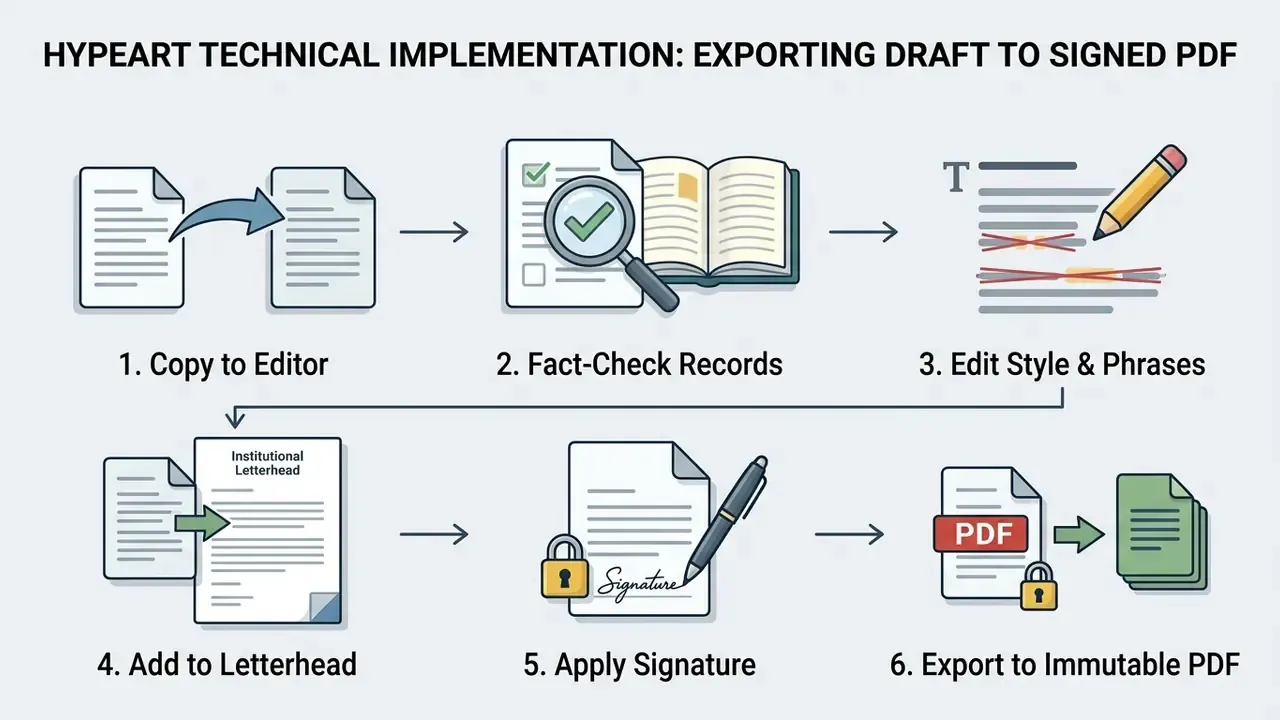
Mail-client workflows achieve the same result natively. Windows users can print the finalized message to PDF via File → Print → Microsoft Print to PDF; macOS Mail supports File → Export as PDF. Preview pagination before saving. A letter that breaks awkwardly across two pages reads as careless to a committee, and that impression is hard to undo. If a specific export or letterhead step fails, the fixes live in AI Media Support and Troubleshooting.
How to Personalize and Professionalize an AI-Generated Reference Letter
The main risk of a recommendation letter ai generator is homogenized text that sounds synthetic. Evaluators reading hundreds of applications notice the tells fast: "testament to", "beacon of", "invaluable asset", plus a drift toward passive constructions. Turning a raw draft into an authoritative document takes stylistic tuning and rigorous fact-checking, in that order? No, actually in reverse: facts first, style second.
The reputational stakes are measurable among professional readers.
«AI authorship is associated with reduced trust and diminished professional accountability.»
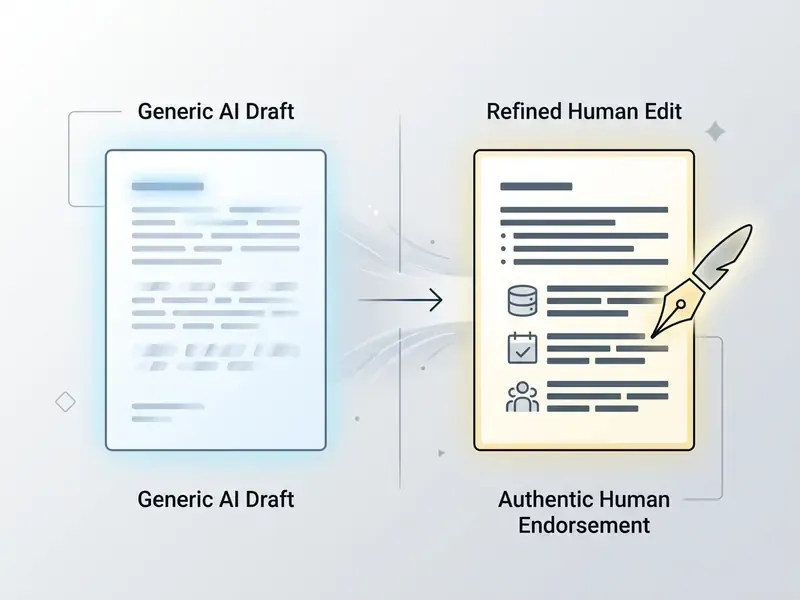
Calibrating Tone, Voice, and Formality Tiers
Tone follows the relationship between recommender and recipient. Established administrative writing standards, including the Australian Government Style Manual and US federal style guides, describe three practical tiers.
- Formal objective and neutral, no contractions, minimal personal pronouns. Legal verifications, judicial character references, senior executive appointments.
- Standard professional clear and direct, selective use of "I" and "we", active voice. Employment references, corporate applications, graduate admissions.
- Conversational or peer warm and specific about shared work. LinkedIn endorsements and peer-level references.
Linguistic analysis explains why manual intervention stays necessary.
«Instruction-tuned models use nominalizations and passive voice significantly more often, and these patterns persist across prompts.»
So replace passive constructions with direct verbs. "The migration was led by the candidate" becomes "she led the migration." Two words shorter, considerably more decisive.
Fact-Checking and Inserting Authentic Details Prior to Signing
An ai-generated draft must never be submitted without line-by-line verification by the human author.
«Human authors remain fully accountable for the truthfulness, accuracy and unbiased nature of any reference letter produced with AI assistance.»
CRITICAL COMPLIANCE NOTICE: HUMAN ACCOUNTABILITY IS NOT DELEGABLE
Free AI Reference Letter Generators: Features to Verify Before Use
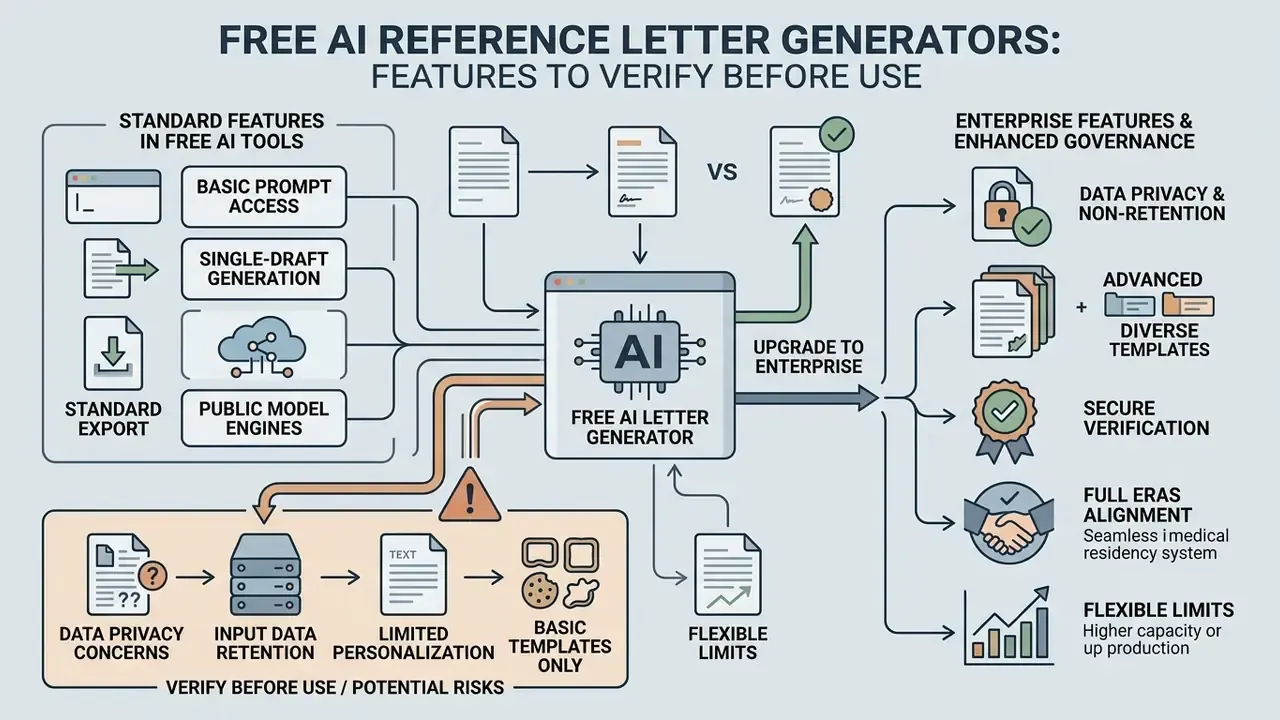
Search for a free ai letter of recommendation generator and you get dozens of options, from open-access web tools to freemium enterprise apps. Free software carries functional constraints, usage quotas and data-handling trade-offs that business leaders and academic administrators should evaluate before the first prompt.
Standard Features in Free AI Reference Letter Tools
Tools marketing a free ai recommendation letter generator or free ai reference letter generator usually offer basic drafting for personal or low-volume use.
- Basic prompt access
- text fields for candidate name, title and bulleted achievements.
- Single-draft generation
- one to three variations per request at no cost.
- Standard export
- copy-to-clipboard or plain text (.TXT) download.
- Public model engines
- base-tier open LLMs or capped model APIs.
QuillBot, for example, offers basic letter of recommendation generator free access without account creation, while GradeWithAI provides unlimited basic drafts with simple PDF export. Other documented ceilings are far tighter: some tools cap generation at one letter per account, and credit-based products such as Accio allocate roughly 500 initial credits, about ten full generations.
| Platform Tier | Daily Free Limit | Data Privacy Guarantee | Native PDF Export | Best For |
|---|---|---|---|---|
| Easy-Peasy.AI | Limited base generation | Public logging possible | Plain text only | Quick casual drafting |
| Brisk Teaching | Free for educators | Educational privacy compliance | Google Docs sync | K-12 and university teachers |
| Knowt | Unlimited free drafts | Standard web privacy | Direct download | College and med applicants |
| QuillBot | No account required | Standard web privacy | Copy-to-clipboard | Fast first drafts |
| Enterprise AI (paid) | Unlimited volume | Zero data retention (SOC 2) | Official letterhead PDF | Executive and legal references |
The pattern mirrors other freemium AI categories. For a comparable breakdown of how free tiers restrict exports, resolution and privacy guarantees, see our analysis of free photo editors and their feature limits, where the same "free until you need to publish" economics apply. Feature-level side-by-sides for other categories sit in our AI Media Comparison Matrices.
When to Upgrade: Enterprise Features, Privacy, and Limits
A best free ai letter of recommendation generator covers basic needs. Enterprise users, department heads and executive recruitment teams typically need paid tiers for volume, security and customization.
- Data privacy and non-retention free tools often reserve the right to log prompts for public model training. Paid enterprise tiers contractually exclude candidate data from training.
- Advanced personalization brand styling, corporate letterhead integration, custom fine-tuned weights.
- Higher quotas free plans cap requests (one generation per day, or credit allocations like Accio's 500 credits); paid tiers lift the ceiling.
- Document management and ATS integration dashboard storage, team collaboration, digital signing and Applicant Tracking System connectors. Integration patterns are covered in our AI Media API Guides.
- Auditability version history and prompt logs you can produce during an internal audit or model-risk review.
| Feature / Capability | Free Tier Access | Premium / Upgrade Plan |
|---|---|---|
| Generation Allowance | Capped (1-5 drafts/day or fixed credits) | Unlimited or high-volume enterprise quota |
| Data Privacy & Logging | Prompts may be logged for retraining | Zero-data retention and SOC 2 compliance |
| Model Intelligence | Base-tier public models | Advanced frontier reasoning models |
| Export Formats | Plain text / copy-paste | Custom PDF on letterhead, DOCX, e-sign |
| Style & Tone Controls | Standard presets (formal, neutral) | Custom tone controls and brand voice |
| Audit & Retention Controls | None | Prompt logs, retention policy, admin console |
Verify current plan conditions on the vendor's own pricing page rather than in a review roundup. Terms in this category change quarterly.
There is also a systemic argument for investing in personalization rather than raw volume.
«Widespread AI use in application materials may reduce hiring match quality by roughly 1% through homogenization of written signals.»
When every letter reads alike, differentiating value shifts entirely to specificity. That is precisely what custom tone controls, internal templates and human editing time buy.
Procurement quick-check for regulated employers: (1) Is prompt data excluded from model training in writing? (2) Is there a SOC 2 Type II report or equivalent attestation? (3) Where is data stored, and for how long? (4) Can admins disable retention org-wide? (5) Does the vendor support SSO and role-based access? (6) Are prompt logs exportable for audit? Any "no" puts the tool in the non-sensitive-use category only.
Domain-Specific Applications: Academia, Employment, and Business
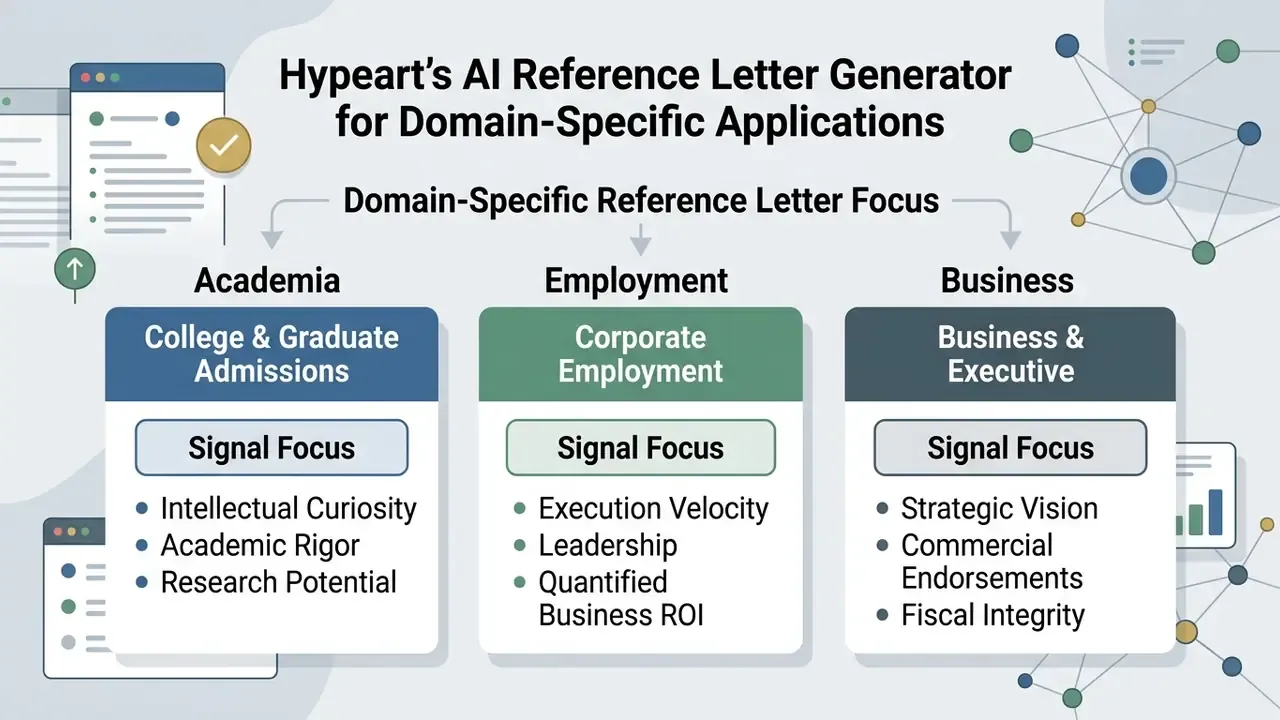
Adapting an ai reference letter generator free tool or an enterprise instance to a professional context means aligning prompt logic with the evaluation metrics of that committee. Admissions readers, corporate recruiters and venture partners look for different signals.
Academic Recommendations: College, Graduate, and Medical Programs
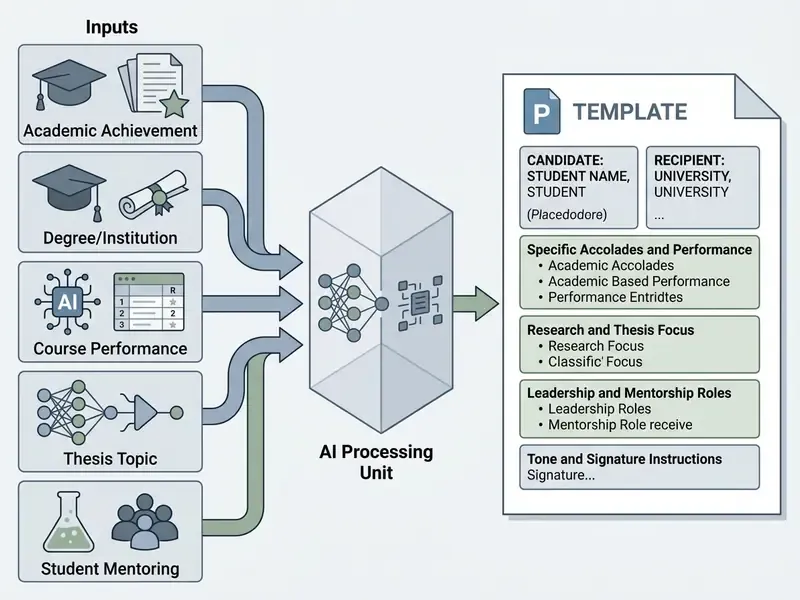
With an ai college letter of recommendation generator, prompt logic must centre on academic trajectory, research methodology and classroom engagement rather than workplace KPIs.
Admissions committees at research universities look for evidence of intellectual curiosity, analytical problem-solving, resilience in demanding coursework and prospective contribution to campus scholarly life. Professors and advisors using an ai lor generator should input seminar paper titles, lab outcomes, presentation performance and class ranking. Letters belong on official letterhead, signed and dated, normally one to two pages.
Institutional expectations on authorship are explicit.
«Deliberately passing AI-generated content off as your own is not acceptable; authors bear full responsibility for accuracy.»
Medical School (ERAS), Law School (LSAC), and Scholarship Recommendations
Specialized professional schools enforce distinct metrics.
- Medical school and residency (ERAS) clinical acumen, patient empathy, ethical judgement, composure under pressure. Prompts must emphasize observed clinical encounters, not grades alone.
- Law school (LSAC) analytical rigor, statutory reasoning, textual interpretation, oral advocacy.
- Scholarship and fellowship boards institutional fit, leadership potential, service outcomes, financial stewardship.
- Internship programs coachability, reliability under supervision, initiative within short engagements.
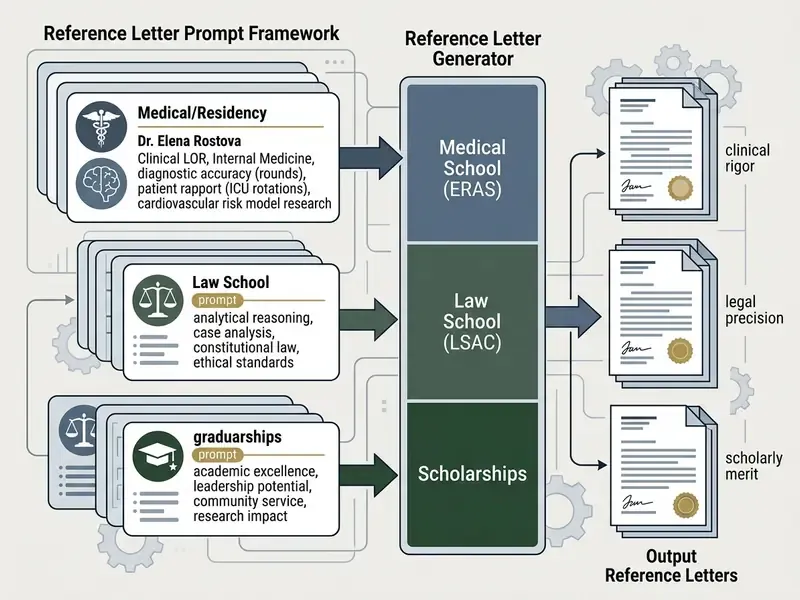
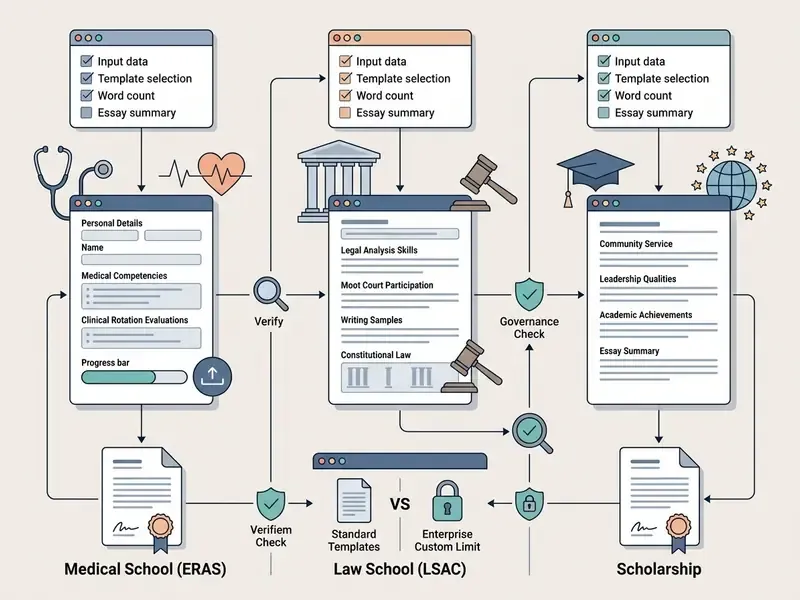
Because clinical and legal letters are read alongside standardized scores, unverifiable superlatives do disproportionate damage. Every clinical observation cited in an ERAS letter should correspond to a rotation the recommender personally supervised. No exceptions.
Professional Job References: Managers, Employers, and Peers
An ai job reference generator should prioritize commercial impact, leadership style, delivery under deadline pressure and technical competency. In corporate hiring, vague testimonials carry almost no weight. Recruiters want verification of operational capability.
Managers drafting an employment reference should structure inputs around measurable outcomes: revenue generated, efficiency gained, systems deployed, costs reduced.
«Reference letters must be factual, fair, accurate and tied directly to documented job duties.»
Practical consequence: state the writer's relationship explicitly, especially if the author is a peer rather than the direct supervisor, and confine performance claims to documented reviews. A minimal defensible employment reference names the applicant, role, employment dates, principal responsibilities and one or two concrete performance examples. That is enough. Padding invites questions you cannot answer.
Digital Profiles, B2B Endorsements, and Character References
Public and specialized formats have their own structural rules and limits.
- LinkedIn recommendations
- short public endorsements, typically 150-250 words, technically capped at 3,000 characters. Name the relationship, one concrete strength, one specific example. Written to be read in twenty seconds.
- Business endorsements
- strategic testimonials for B2B service providers, vendors or consultants. Focus on commercial performance, ROI delivered, SLA compliance and partnership reliability, company outcomes rather than personal character.
- Character references
- statements read by courts, housing boards or adoption agencies. Emphasize ethics, integrity, financial responsibility and community standing, with an explicit statement of how long and in what capacity the writer has known the person.
Ethical and Responsible Use of AI-Generated Letters
Using an ai generator recommendation letter tool touches professional ethics, authenticity and legal accountability at once. Frameworks such as the UNESCO Recommendation on the Ethics of Artificial Intelligence and the EU AI Act require human oversight, transparency and fairness across AI-assisted evaluation. UNESCO's standard applies across the full lifecycle, from design through deployment, monitoring and termination, and lists oversight, transparency, fairness, privacy and accountability among its operating principles.
The Risks of AI Hallucinations in High-Stakes Endorsements
Generative models hallucinate: they produce plausible-sounding but false claims, non-existent project titles and inflated metrics. In reference writing, a hallucinated credential is a shared risk for candidate and recommender alike.
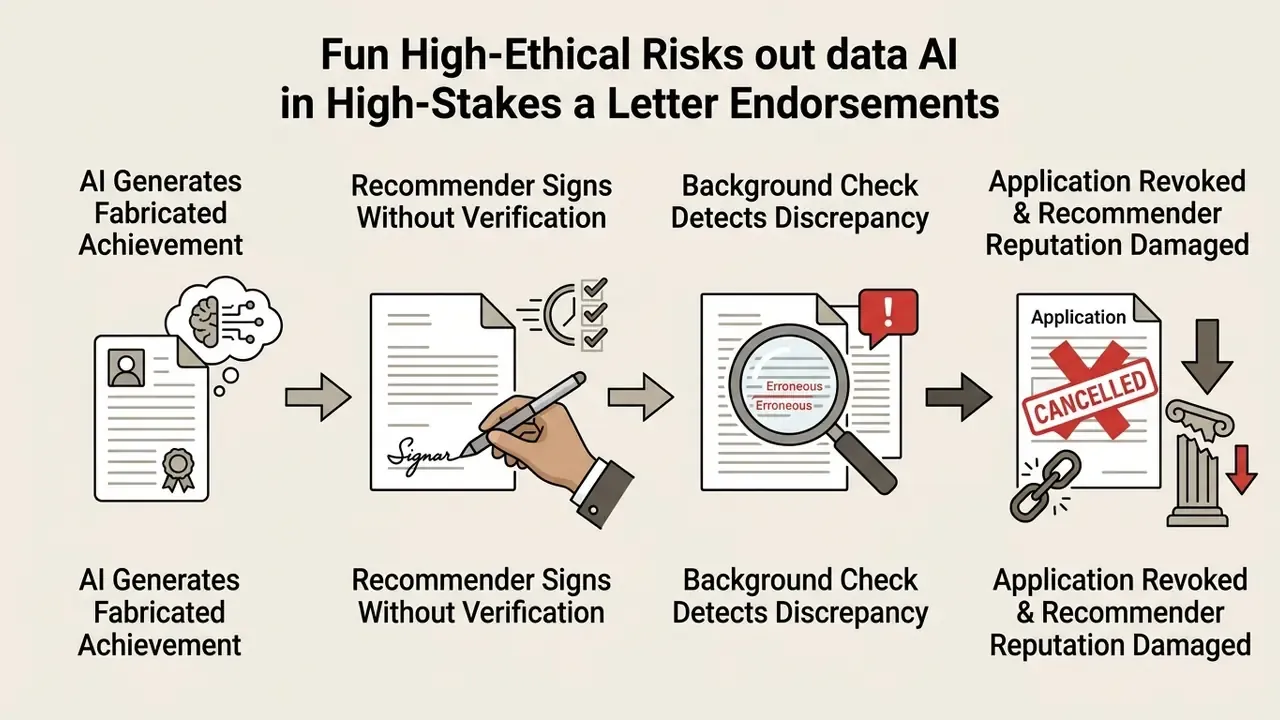
«When LLMs are asked to expand text creatively without strict constraints, adherence to ethical norms drops significantly.»
If a background check or clearance audit shows the candidate never managed the budgets or teams described in an AI-drafted letter, the candidate is disqualified and the recommender faces professional censure, possibly civil exposure for misrepresentation. Recruiters increasingly separate acceptable AI editing from unacceptable AI fabrication: invented percentages and phantom scope are treated as integrity flags, not stylistic quirks. For context on how disputes over generated content have progressed through courts, see our AI Litigation and Case Timelines.
Disclosure Protocols and Institutional AI Policies
Disclosure policy varies widely across academic, corporate and governmental domains. Navigate it deliberately.
- Regulated academic admissions: some institutions prohibit generative AI from authoring core essay or reference content, permit AI only for grammar and formatting, and require explicit disclosure.
«AI-generated substantive content in application letters is prohibited, and any AI assistance must be disclosed.»
- Corporate recruitment and background checks
- formal disclosure is rarely required for routine reference letters, but the recommender must personally review, sign and adopt full ownership. Using AI as an uncredited ghostwriter with no human review breaches basic professional integrity.
- Candidate-facing transparency
- public-sector guidance in Canada and Australia requires candidates be told when and how AI is used in hiring, and EU AI Act transparency provisions require that people know when they interact directly with an AI system. Employers embedding generative drafting into reference workflows should mirror that internally.
- Practical disclosure threshold
- minor editing of spelling, grammar and phrasing needs no formal disclosure. If generative AI drafted the initial narrative, confirm the destination organization's policy first.
Model Risk Management and Governance for Regulated Employers
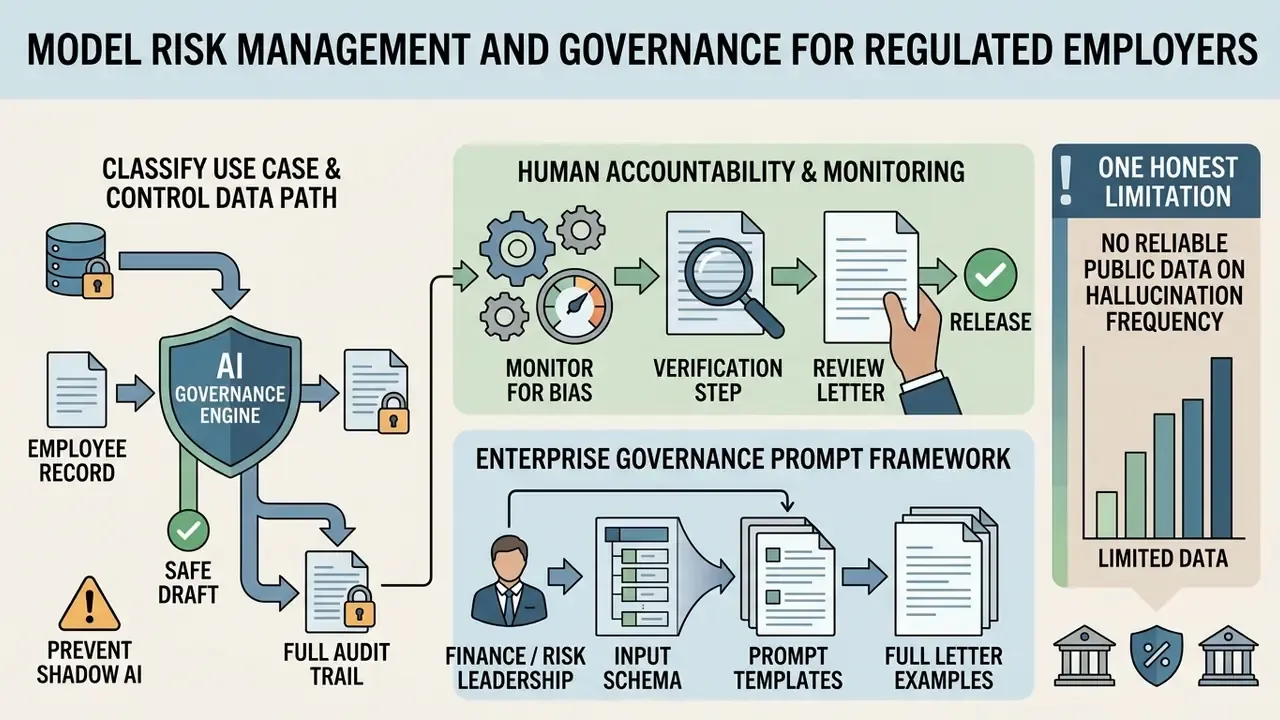
For banks, insurers and other supervised institutions, an AI drafting tool used on employee records is not a neutral productivity app. It touches personnel data, produces externally consumed documents and creates an audit surface. Five controls cover most of the exposure.
1. Classify the use case. Reference-letter drafting is normally a low-materiality, human-decisioned use of generative AI. It does not produce a decision output, so it usually sits outside the strict validation scope of SR 11-7 / OCC 2011-12 model risk management guidance. Inventory it anyway, under the institution's AI and tooling register, with a named owner and an approved-use statement.
2. Control the data path. Prohibit entry of personnel records, compensation data, performance-review verbatims and restricted PII into non-approved public tools. Route drafting through an enterprise instance with contractual zero-data retention.
3. Prevent shadow AI. The dominant real-world risk is not a weak draft. It is a manager pasting an internal performance review into a consumer chatbot at 11 p.m. Publish a one-page internal standard: approved tools, prohibited data classes, mandatory human review, disclosure expectations.
4. Preserve human accountability. Every letter leaves the institution under a named signature. Document that the signer reviewed and validated the content. The same "effective challenge" logic that underpins model governance applies to human-in-the-loop document review.
5. Monitor for bias. Because LLM endorsements are documented to encode gendered trait language, periodic sampling of AI-assisted letters is a reasonable control for organizations issuing references at scale. Quarterly sampling of ten letters is usually enough to spot drift.
One honest limitation: we have no reliable public data on how often reference-letter hallucinations are actually caught in background checks. Treat the control set above as prudent practice, not as an evidence-backed frequency estimate.
[Enterprise Governance Prompt Framework — Finance / Risk Leadership]
"Draft a formal reference letter for Priya Raman, currently Director of Financial Planning & Analysis,
applying for VP of Finance at a mid-market SaaS company. I am her Chief Financial Officer and have
supervised her directly for 4 years. Include: (1) ownership of a $180M annual operating plan;
(2) reduction of month-end close from 9 to 5 business days; (3) leadership of an 11-person FP&A team
through a post-acquisition integration; (4) audit and SOX control remediation with zero material
weaknesses over three cycles. Tone: formal US corporate. Length: 420 words. Exclude any reference to
age, family status, or health. Do not invent metrics beyond those provided. End with an explicit
endorsement and an offer of direct follow-up contact."
Real-World AI Generation Examples: Input vs. Final Output
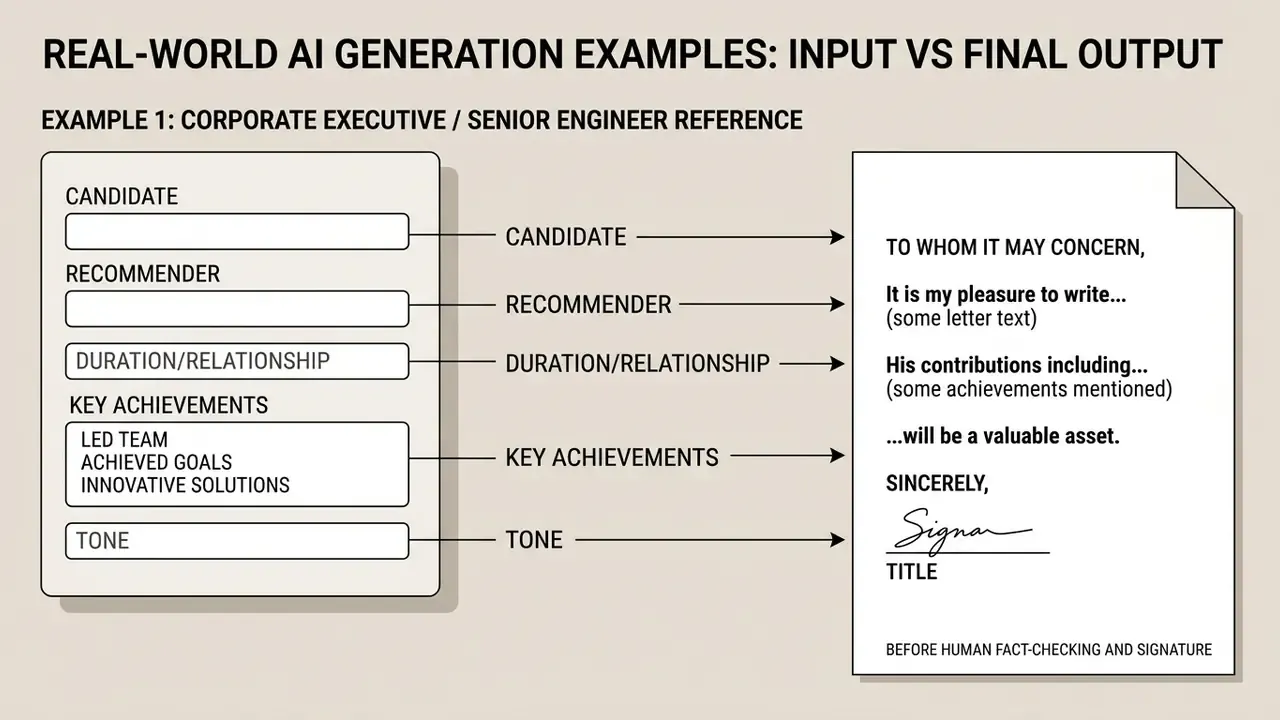
To see how structured input converts into a usable document, compare the parameters supplied with the draft produced, before human fact-checking and signature.
Example 1: Corporate Executive / Senior Engineer Reference
Input Parameters:
- Candidate Alex Mercer (Senior Backend Engineer)
- Recommender David Vance (VP of Engineering, CloudScale Systems)
- Duration/Relationship managed directly for 3 years
- Key achievements reduced database query latency by 42%; led team of 6 engineers during microservices migration without downtime.
- Tone formal corporate US English.
AI-Generated Output Draft:
Human editing pass: verify the 42% figure against monitoring dashboards, confirm headcount in HR records, and swap each residual generic adjective for an observed behaviour.
Example 2: Graduate Admissions / Academic Reference
Input Parameters:
- Candidate Sarah Jenkins (undergraduate, Computer Science)
- Recommender Dr. Helen Ortiz, Associate Professor of Computer Science, Northfield University
- Duration/Relationship course instructor and thesis advisor, 2 years
- Target MS in Data Science, MIT
- Key achievements Grade A in Advanced Algorithms (rank 2 of 45); undergraduate thesis on neural network compression; mentored 4 junior lab students.
- Tone formal academic, 400 words.
AI-Generated Output Draft:
Human editing pass: confirm class rank against registrar data, verify the thesis title, and place the letter on departmental letterhead, signed and dated.
Example 3: Character Reference (Non-Employment Context)
- Purpose: housing board application
AI-Generated Output Draft:
Input Parameters
- Candidate
- Marcus Bell
- Recommender
- Joanne Pierce, neighbour and volunteer coordinator, 7 years' acquaintance
- Key observations
- organized neighbourhood flood-relief response; reliable rent and community dues history; volunteers weekly at a food bank.
- Tone
- formal but warm, 250 words.
FAQ: AI Reference Letter Generator
How many words should an AI-generated recommendation letter be?
Between 300 and 500 words for most professional and academic letters, which fits one page on standard letterhead at 11-12pt. Under 250 words reads lukewarm or rushed. Over 600 words risks losing a committee reader mid-review. Academic letters for research-intensive programs can run to two pages when the research detail genuinely warrants it.
Can I generate letters in multiple languages?
Yes. Most reference letter ai generator platforms built on advanced multilingual models support twenty-plus languages, including English, Spanish, French, German, Chinese and Russian. You can enter parameters in one language and request the draft in another. Verify local formality conventions before sending: address forms and closing formulas differ substantially between US, UK, German and Japanese business correspondence.
Do free AI generators retain confidential candidate data?
Many public free tools log prompts to retrain their models. Never enter Social Security numbers, private phone numbers, home addresses or confidential corporate financial data into a free generation tool. Enterprise platforms offer zero-data retention and SOC 2 compliance. If your organization has an approved tool, use it. Ad-hoc consumer tools are the main source of shadow AI incidents.
How do I stop the letter from sounding like templated AI text?
Give the model specific input: quantified results, exact dates, one real anecdote. During editing, strip overused transitions ("furthermore", "testament to", "invaluable asset"), convert passive phrasing to active verbs, and pull the tone toward how the recommender actually writes.
«Writers describe their co-authorship with AI as "80% me, 20% AI", reflecting a desire to preserve personal voice.» Source: It was 80% me, 20% AI: Seeking Authenticity in Co-Writing with Large Language Models (2023-2024). Useful editorial target, that ratio. If the finished letter contains no sentence only you could have written, it is not finished.
Can a candidate draft their own letter with AI and send it for signature?
Candidates do sometimes draft for a busy supervisor. The recommender must still review, edit, fact-check and approve every statement before signing. Sending an AI-generated letter without the recommender's personal review and explicit authorization is ethical fraud, and it can void an application.
«Professional writers find LLMs most useful for rephrasing and editing rather than generating substantive content from scratch.» Source: Creativity Support in the Age of Large Language Models (2023-2024).
Are AI-generated reference letters detectable, and does that matter?
Detection tools are unreliable enough that no institution should treat their verdict as proof. The real risk is stylistic. Reviewers who read hundreds of letters recognize LLM cadence and quietly discount it, and research on professional readers links AI authorship with reduced trust. The fix is not obfuscation. It is specificity and personal editing.
What should I do if the AI invents an achievement?
Delete it, then treat it as a signal that your input was too thin. Hallucinations appear where the prompt left a gap the model filled statistically. Re-run with explicit constraints ("do not invent metrics beyond those provided") and re-verify the whole draft line by line. Never negotiate with a plausible number you cannot document.
Can AI help with medical school, law school or scholarship letters specifically?
Yes, but the prompt logic changes. ERAS letters need observed clinical encounters, diagnostic reasoning and professionalism under pressure. LSAC letters need analytical and advocacy evidence. Scholarship boards want leadership, service and institutional fit. Use the domain frameworks above, and restrict every claim to encounters the recommender personally supervised.
Does an AI reference letter workflow need to appear in the model inventory?
In a supervised institution, list it. Not as a validated model, but as an inventoried AI tool with an owner, an approved-use statement and a data-handling rule. Auditors rarely object to a low-materiality tool. They object to one nobody can account for.
About This Guide
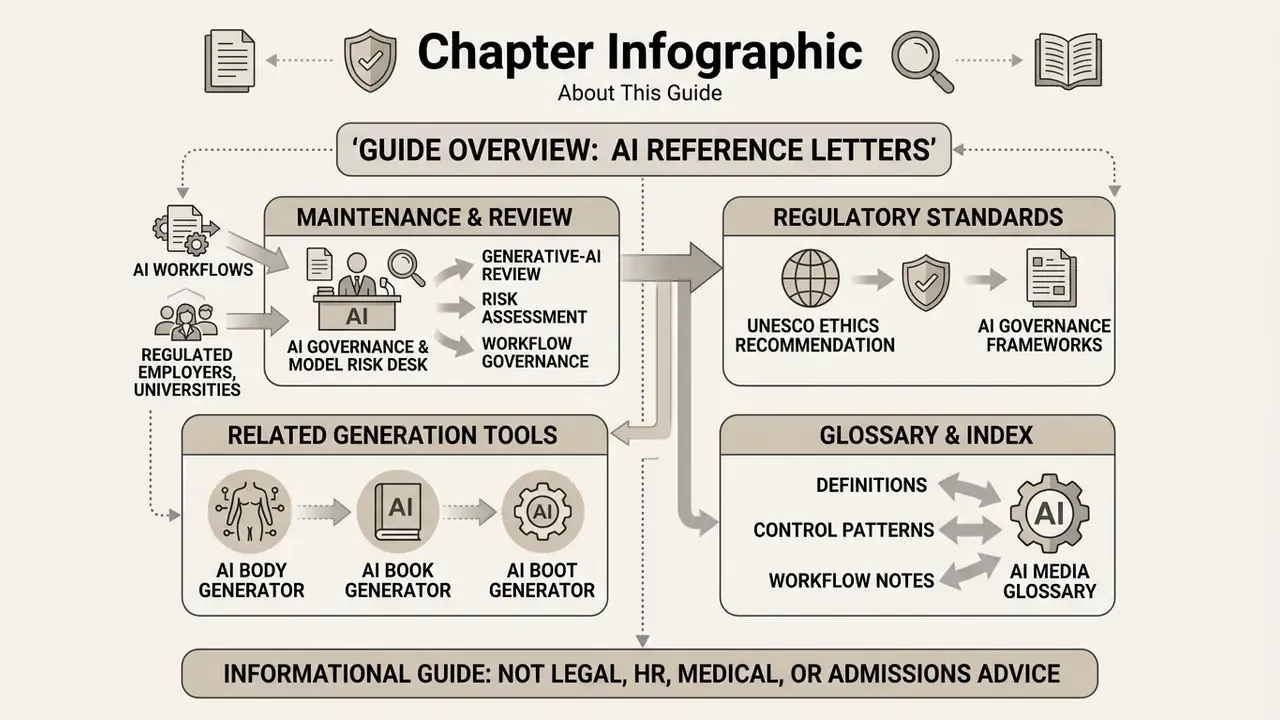
This guide is maintained by our AI Governance & Model Risk editorial desk, which reviews generative-AI workflows for regulated employers, university departments and enterprise HR functions. Editorial lead: Marcus Hale, AI Governance & Model Risk Editorial Lead, the author whose review scope covers model inventory practice, human-in-the-loop controls and data-handling policy for generative drafting tools. No biography, client or credential associated with The author should be read as a real employment history or endorsement.
Regulatory references cited here include the UNESCO Recommendation on the Ethics of Artificial Intelligence, EU AI Act transparency provisions, NIST generative-text evaluation materials and US supervisory model risk guidance (SR 11-7 / OCC 2011-12).
Related glossary entries for adjacent generation workflows: ai body generator, ai book generator, ai book cover generator, ai book illustration and ai book title.
General disclaimer: this article is informational and does not constitute legal, HR, medical or admissions advice. AI-disclosure obligations, employment-reference liability and permissible data handling vary by jurisdiction and institution. Consult qualified counsel or your compliance function before adopting AI drafting tools for official correspondence.
More definitions, control patterns and workflow notes are indexed in the AI Media Glossary.