Generating full-length manuscripts through software has moved from hobbyist scripting into structured document production. Modern long-form pipelines let authors, educators, and enterprise teams travel from a single prompt to an editable outline, multi-chapter text, a formatted cover, a narrated audio track, and an export-ready file. Evaluating an ai book generator properly means looking past the demo: model capabilities, context persistence, structural constraints, data-privacy architecture, credit economics, and the legal questions that surround commercial publication.
That last cluster is where most buyers get surprised.
Key Takeaways for Authors, Marketers, and Enterprise Teams
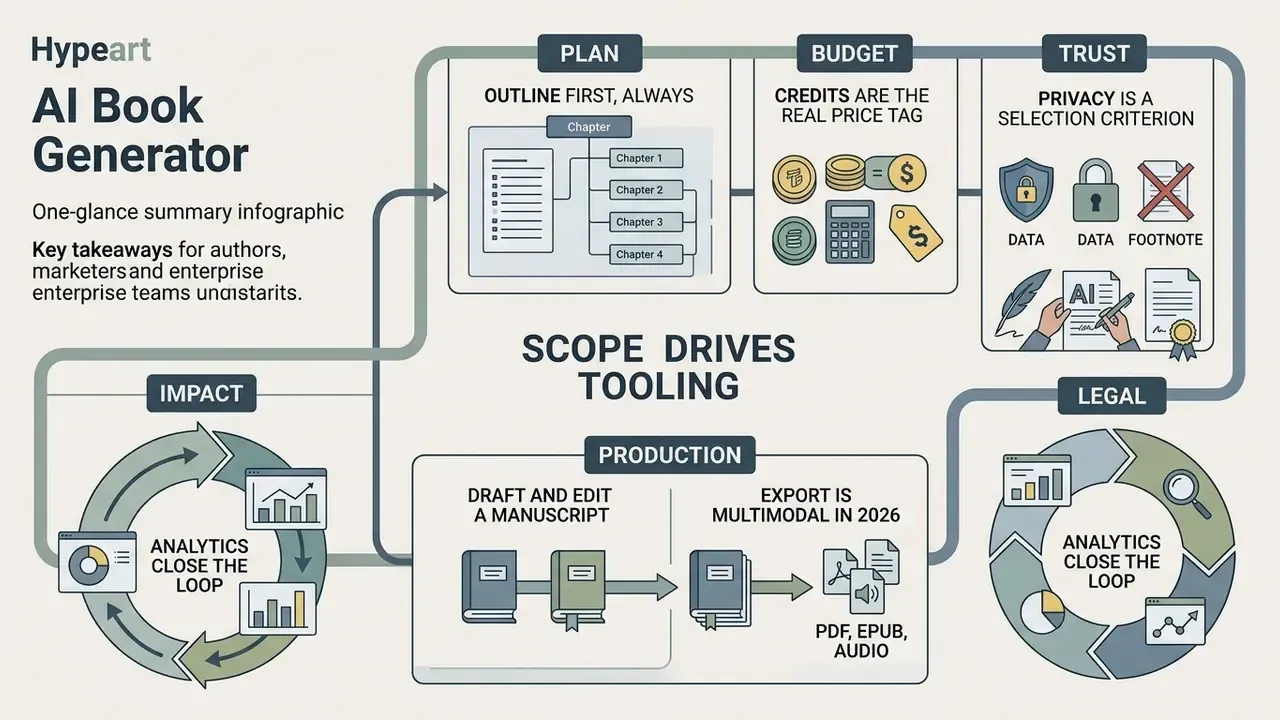
- Scope drives tooling. A 5 to 15 page lead magnet, a 20 to 50 page business guide, and a 100,000-word novel demand fundamentally different context-management strategies. Choose the workflow before you choose the platform.
- Outline first, always. Benchmarks on long-text generation show that plan-based workflows measurably reduce quality collapse. Single-prompt "write me a book" requests degrade sharply past a few thousand words.
- Credits are the real price tag. Generation typically consumes roughly 150 to 200 points per 100 words. A 500-point free tier covers about one short chapter. An 80,000-point plan covers roughly ten 3,000-word ebooks.
- Export is multimodal in 2026. Leading platforms output print-ready PDF, reflowable EPUB, DOCX, interactive flipbooks, and neural text-to-speech audiobooks (.MP3 or .M4B) from a single manuscript source.
- Privacy is a selection criterion, not a footnote. For proprietary research, regulated documentation, or unpublished fiction, verify zero data retention, no-training guarantees, SOC 2 posture, SSO and RBAC, plus offline editing.
- Copyright follows human authorship. Unedited machine output is not protectable in the United States. Substantial human selection, arrangement, and revision are what create ownership.
- Analytics close the loop. Direct-sale storefronts and reader analytics (page dwell time, chapter drop-off, CTA clicks) turn a finished book into a measurable acquisition asset.
How to Read This Guide
The sections below run in decision order rather than feature order. First, what these systems actually are and which book formats they suit. Then the production workflow, from brief to export. After that, the feature checklist, the selection criteria (including privacy and audit controls that matter to regulated teams), the arithmetic behind free and paid tiers, and finally the editing, rights, and distribution work that turns a draft into a product.
If you only have ten minutes, read the length-and-structure table, the credit math, and the pre-publication checklist. Those three carry most of the practical weight.
What is an AI Book Generator and What Books Does It Help Create
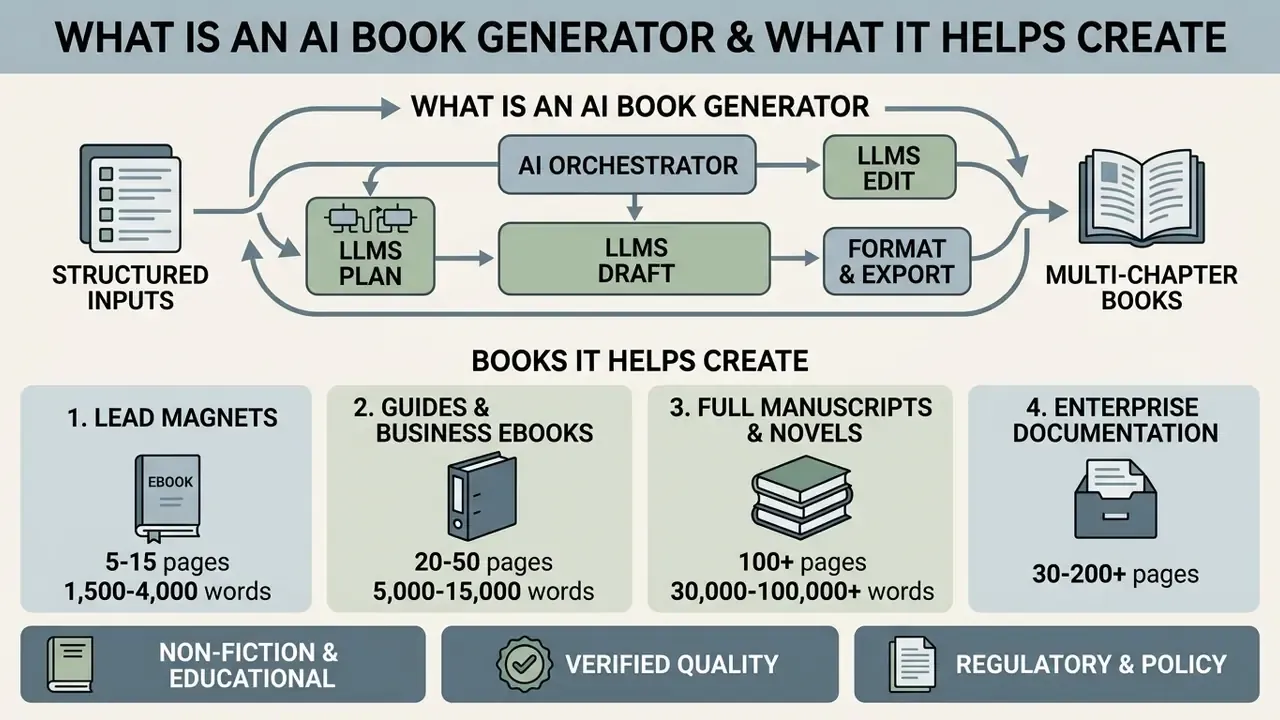
An ai book generator is an integrated platform that orchestrates large language models (LLMs) to plan, draft, edit, and format multi-chapter books from structured inputs. Unlike a generic chat window that returns isolated fragments, an ai book creator maintains continuity across extended contexts, which enables sequential chapter writing and document formatting. These systems function as a comprehensive book generator ai, supporting fiction novels, structured non-fiction, business guides, compliance handbooks, and educational textbooks.
An ai full book generator combines three technical layers: long-context model architecture, an explicit outline planning interface, and a document rendering engine. Open toolchains expose the same architecture in the clear. Public book-generation repositories document compile scripts that render EPUB, PDF, MOBI, AZW3, Markdown, and HTML from one generated manuscript, using dependencies such as Pandoc, a LaTeX distribution, and ImageMagick. Commercial pipelines wrap that stack in a browser interface. Document editors in this category are commonly engineered to handle single files of up to roughly 150,000 words before authors are advised to split a manuscript into multiple linked documents.
Verified benchmark evidence: model stability across a book-length manuscript depends on structured prompting workflows and staged planning far more than on raw token limits.
Complementary benchmark work reports that a compact model tuned specifically for long output can match far larger general models on book-scale writing tasks. Which is precisely why platform architecture, meaning outline enforcement, chapter chunking, and retrieval of prior context, often matters more than the headline model name. A dedicated ai book maker uses these workflows to help creators hold thematic focus across manuscripts ranging from a short ebook to a multi-chapter volume.
Target Page Lengths and Structural Requirements by Publishing Goal
The right workflow depends on manuscript scope and distribution strategy. Free tiers, credit budgets, and continuity requirements all scale with length, so the format decision has to come before the tool decision.
- Lead magnets (5 to 15 pages, 1,500 to 4,000 words). Built for email list growth and fast customer acquisition. Three to five concise chapters focused on a single actionable outcome. Almost every free tier can produce this end to end, since typical free plans allow roughly five generated chapters per month.
- Short guides and business ebooks (20 to 50 pages, 5,000 to 15,000 words). Aimed at authority building or digital storefront sales, for example Gumroad or a branded landing page. Five to eight structured sections with embedded data tables, checklists, and one clear conversion path in the conclusion.
- Full-length manuscripts and novels (100+ pages, 30,000 to 100,000+ words). Built for print-on-demand (Amazon KDP) and trade publishing. Requires deep context tracking, character bibles or entity registries, chapter-by-chapter reverse-outline control, and a paid plan with high monthly credit ceilings.
- Regulated and internal enterprise documentation (30 to 200+ pages). Policy manuals, standard operating procedures, onboarding handbooks, training curricula. Requires source-bound generation, versioning, reviewer sign-off, and an audit trail. See the governance criteria in the audit trail and model validation section below.
In practice, a chapter of 500 to 1,500 words is the reliable generation unit across all four tiers, and a solid ebook usually lands between 7 and 12 chapters. Fewer than seven reads thin. More than twelve dilutes the reader's outcome. Each chapter should deliver exactly one idea; if a chapter is attempting three, split it.
| Publishing goal | Target length | Chapters | Typical free-tier fit | Primary export |
|---|---|---|---|---|
| Lead magnet | 1,500 to 4,000 words | 3 to 5 | Yes | Watermark-free PDF |
| Short guide / business ebook | 5,000 to 15,000 words | 5 to 8 | Partial | PDF + EPUB |
| Full manuscript / novel | 30,000 to 100,000+ words | 15 to 40 | No | KDP interior PDF + EPUB |
| Enterprise / policy handbook | 8,000 to 60,000 words | 6 to 25 | No | DOCX + PDF with version log |
Non-Fiction, Educational, and Business Books
"AI-generated learning resources were rated equivalent to student-generated resources in correctness and helpfulness, but exhibited lower variety in content length and syntax."
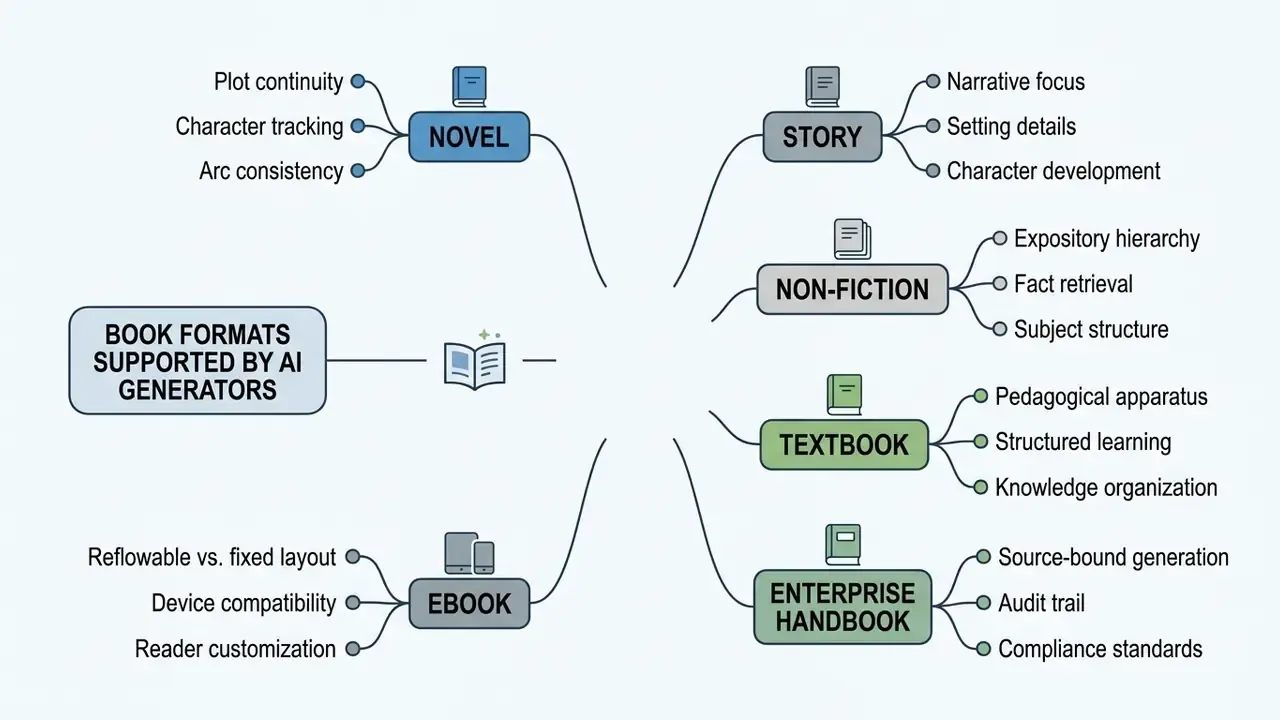
The practical implication is direct. Machine drafts are usable as a factual scaffold, yet they homogenize structure and demand deliberate variation plus source verification. Every factual assertion checked against the original document, every citation confirmed to exist, and the tool name, model version, and generation date recorded alongside the draft. Textbook-grade output needs a pedagogical apparatus on top of that: learning objectives, worked examples, figure and table numbering, footnotes, an index. Which is why fixed-layout PDF frequently beats reflowable EPUB for this format.
Enterprise, Regulatory, and Policy Documentation
Long-form generation is no longer confined to trade publishing. Compliance, risk, and operations teams use the same pipelines to draft standard operating procedures, control narratives, onboarding handbooks, and internal training manuals. Three requirements separate this use case from consumer authoring.
First, source binding. Every normative statement should trace to an internal policy ID, statute, or regulatory citation, which in practice means retrieval-augmented generation over an approved document repository rather than free generation from model memory. Second, reviewer workflow: named subject-matter reviewers, sign-off records, and a change log per section. Third, validation alignment. Model-risk teams working under supervisory guidance for model risk management typically require documented inputs, assumptions, limitations, and testing evidence, so the platform must expose prompts, model versions, temperature settings, and retrieval sources rather than hiding them behind a friendly UI.
For regulated documentation, those failure modes are control failures, not stylistic annoyances. Mitigation is procedural: generate section by section, cap each generation unit at 1,500 words, run an automated completeness check against the approved outline, and require human attestation before a section is marked final. Dull work, admittedly. It is also the difference between a draft an auditor accepts and one that gets sent back.
Fiction Books: Novels, Stories, and Chapters
For creative literature, an ai generator book setup helps authors draft novels, short stories, and individual chapters while managing plot arcs and character detail. Creative writing platforms use context windows, story bibles, and named-entity extraction to track narrative elements across sequential generation steps. Several vendors maintain a rolling three-chapter context window plus a persistent character registry to preserve continuity.
Verified evidence on creative quality gaps:
Independent work reaches the same conclusion from another angle. Models produce fluent surface style more reliably than they hold stable events, characters, and settings, which is exactly why long fiction drifts. So fiction-focused tools need chapter-level controls that enforce character motivations, world rules, timeline order, and plot continuity, plus a human structural pass after every third chapter. Some novelists also stay skeptical about machine-made jacket art for aesthetic reasons; the arguments collected under why ai art is bad are worth reading before you commit a cover style to a series.
How to Create a Book with AI: From Concept to Full Draft
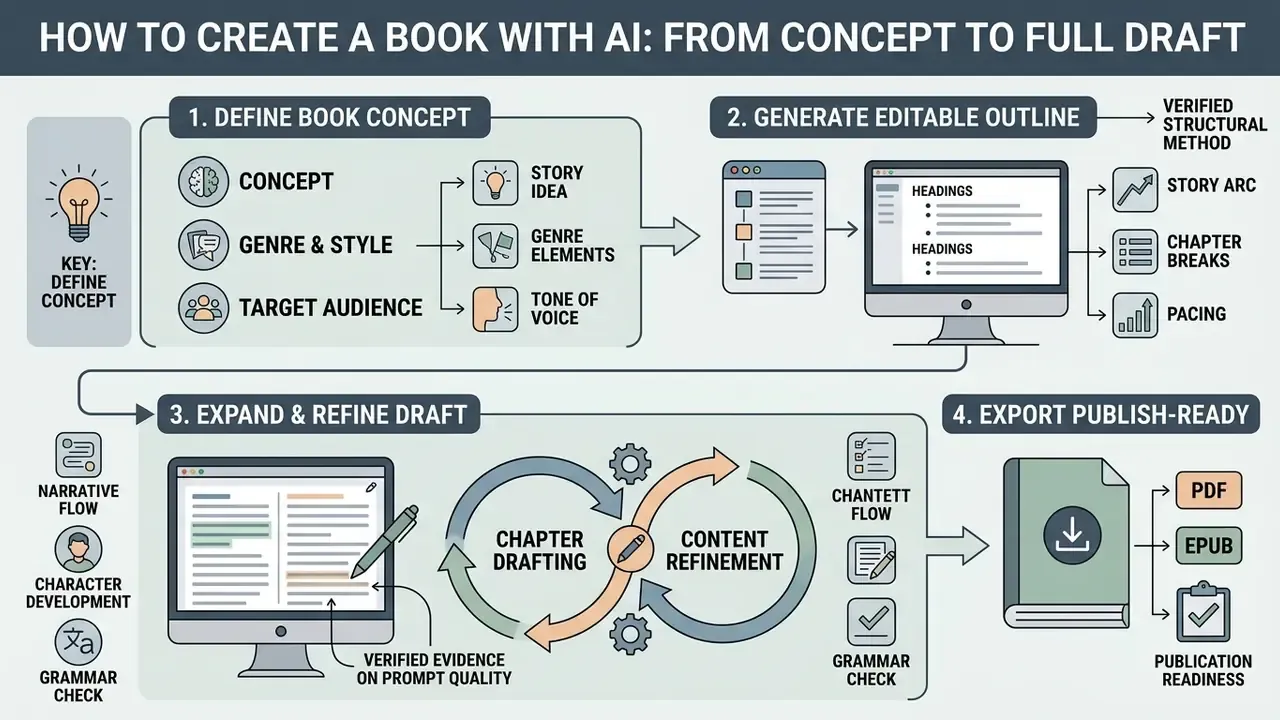
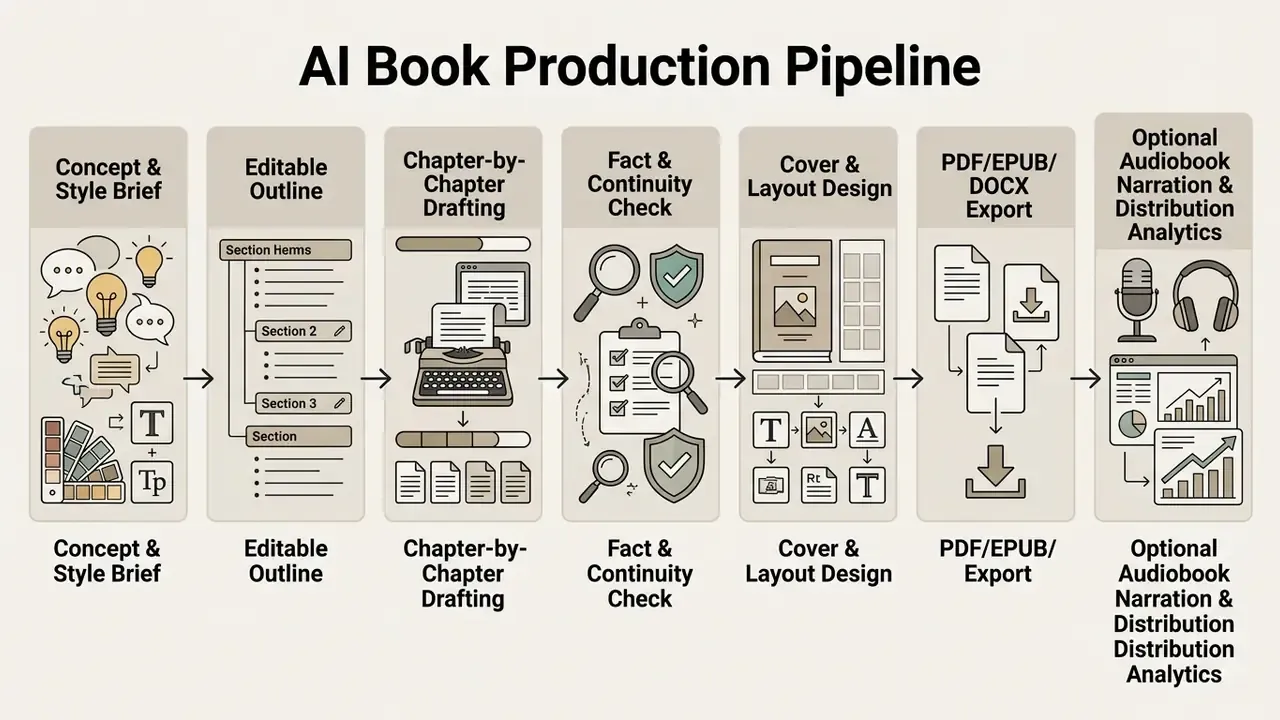
Creating a manuscript with an ai generator for books follows a structured workflow designed to protect quality and coherence. The process moves from concept formulation to outline creation, section drafting, quality checks, and final export. Using an ai book writing generator well requires the author to manage each stage actively rather than trusting a single prompt.
Generate an Editable Outline and Chapter Structure
Before any prose, generate and refine an editable outline that acts as the manuscript's architectural blueprint. Modern platforms present outlines as interactive cards holding chapter titles, plot goals, key arguments, hooks, characters, locations, notes, and target word counts. Authors reorder chapters, expand thin sections, split overloaded ones, and insert foreshadowing or specific citations. Some tools also offer outline styles, whether chapter-by-chapter, parts, or beat sheet, before a word of prose exists.
Establishing logical flow at the outline stage prevents structural drift during expansion. Ten minutes auditing the outline for order, gaps, and one outcome per chapter reliably saves an hour of rewriting later. Sometimes more.
Expand into a Full Draft and Refine Chapter Content
Once the outline is approved, the system generates text chapter by chapter or section by section to build the full draft. Authors expand scenes, deepen explanations, and check each draft chapter against the governing outline.
Verified structural method: enforce a single controlling idea per paragraph and one consistent ordering logic per section, then test coherence with a reverse outline. Read only the first sentence of every paragraph and confirm the sequence still reads as a valid mini-outline. Where a paragraph's opening sentence no longer maps to the chapter's governing claim, either the paragraph is misplaced or the claim has drifted. Applying this pass at draft level, marking each paragraph's function in the margin before rewriting transitions, is the fastest route from machine output to publishable structure.
One illustrative example, drawn from a composite scenario rather than a named client: a legal publishing team needed a 10-chapter guide on regulatory compliance. Using a staged outline-to-chapter workflow with reverse-outline reviews after every generated chapter, the team produced a 25,000-word initial draft in three days while holding citation accuracy across all statutory references. Each statutory reference was verified against the primary text before the chapter was accepted, and the prompt, model version, and generation timestamp were logged per chapter to support later review.
Essential Features in an AI Book Generator Tool
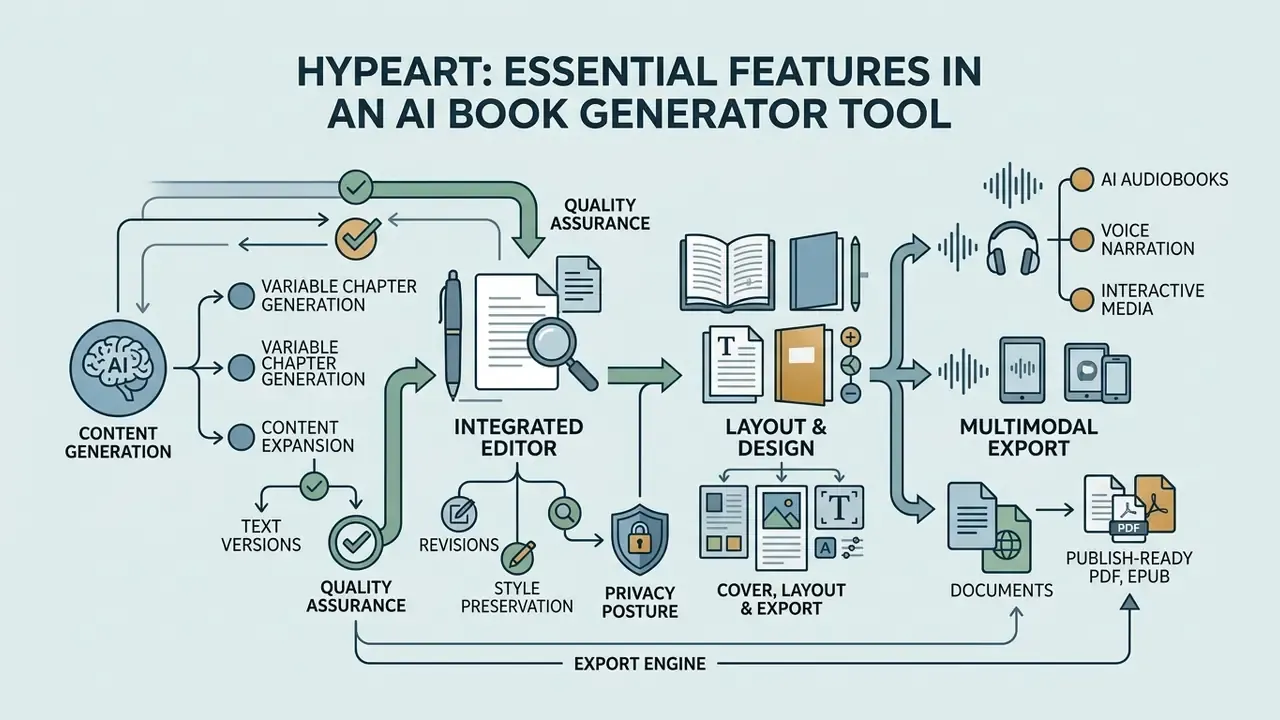
Evaluating an ai book generator tool means analyzing text expansion capability, editing flexibility, layout control, privacy posture, and the export engine. Strong systems combine advanced language processing with traditional manuscript editing, so generated content can be modified, styled, narrated, and exported to professional publishing formats such as pdf, EPUB, DOCX, and audio.
Variable Chapter Generation, Content Expansion, and Text Versions
A core requirement for long-form work is the ability to produce multiple text variations and expand specific scenes on demand. Robust platforms let authors regenerate individual passages, grow brief paragraphs into detailed narrative beats, and pick among alternative chapter versions without breaking continuity. The practical loop: draft the chapter, expand each scene into a longer version, update the outline, then regenerate the opening and closing scenes so the chapter still lands where the plan requires.
Verified evidence on variation and quality:
Variation features therefore serve one specific function. They widen the option space so a human can select and recombine, instead of accepting a single default output that sits below professional quality.
Integrated Editor for Revisions and Style Preservation
An integrated manuscript editor enables editing without erasing the author's style, tone, and formatting rules. It must support both document-wide revision and granular chapter adjustment. Voice-preserving rewrite features analyze sentence rhythm, syntax, vocabulary choices, and deliberate punctuation, keeping automated edits aligned with the author's voice across the whole manuscript. For academic and non-fiction work, the editor should also preserve inline citation formats without silently altering or deleting them, and expose every suggestion for accept or reject review rather than rewriting in place.
"ChatGPT-assisted ideas showed significantly lower semantic diversity at the group level than non-AI tool ideas: mean divergence 0.24 versus 0.28 (p = 0.038)."
Because AI assistance measurably narrows idea diversity, a custom style-rule set covering preferred cadence, banned constructions, and signature idioms is not cosmetic. It is the main defense against a manuscript that reads like every other AI-assisted book in its category. Practical editor requirements: offline capability, version history, keyboard-driven navigation, rich formatting (images, tables, code, math), and per-document writing rules.
Cover, Layout, and Export in PDF
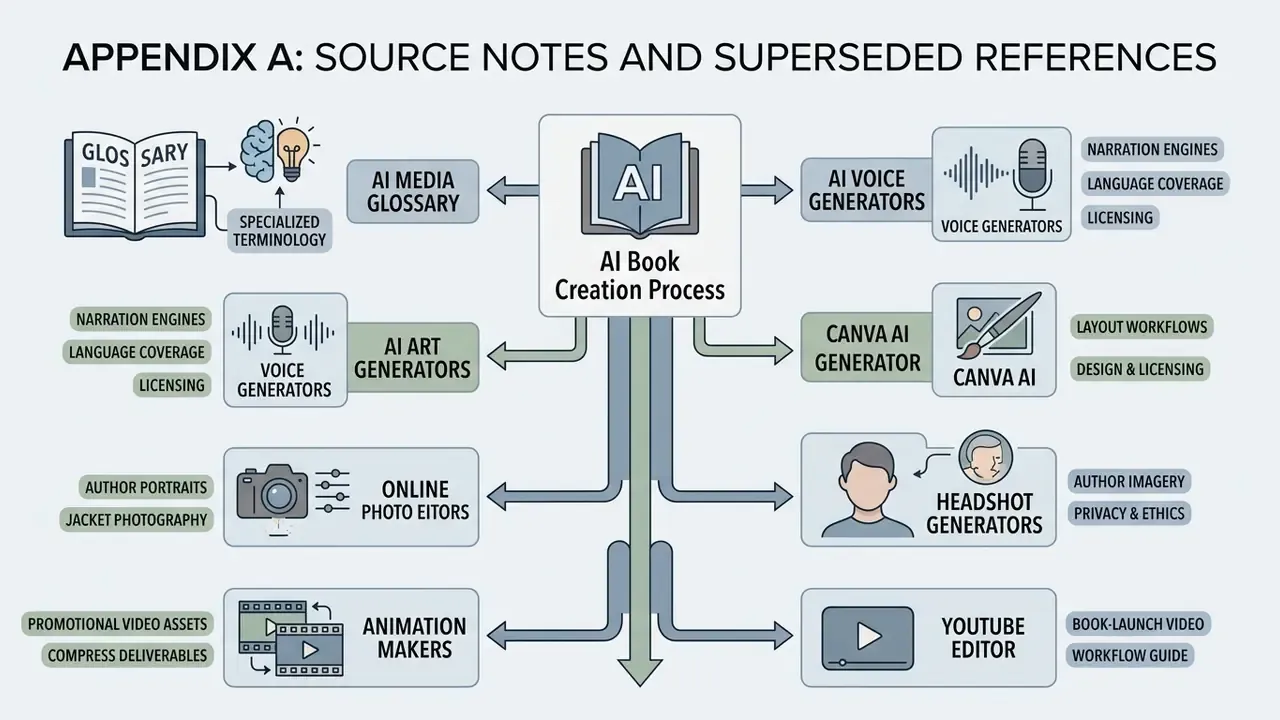
A complete book creation platform includes an automated page layout engine, cover graphic integration, and multi-format export. Cover generation is where most authors reach for adjacent tooling. A bold, thumbnail-legible title, the author or brand name, a clean background, and a professional typeface outperform ornate design every time. Many creators pair a manuscript tool with dedicated AI art generators or design suites such as Canva's AI generator for jacket artwork, then import the file back into the layout engine.
The software applies typographic themes, sets page margins, formats chapter headings, generates running headers, and recognizes chapter structure from imported DOCX, EPUB, PDF, Markdown, TXT, or HTML files. Output engines convert the finalized manuscript into print-ready pdf files or reflowable ePub documents suitable for commercial distribution.
Format selection follows reader behavior, not preference. EPUB is reflowable and suits novels and text-heavy non-fiction. PDF is fixed-layout and suits textbooks, workbooks, and any design-critical interior. For Amazon KDP specifically, the ebook needs a separate marketing cover image for the detail page (RGB, JPEG or TIFF, ideal 1.6:1 height-to-width ratio) in addition to whatever cover sits inside the file. Print covers submitted as PDF need 0.125 in bleed on all sides, 300 DPI imagery, embedded fonts, flattened layers, and no crop marks or hidden objects.
Multimodal Export: AI Audiobooks, Voice Narration, and Interactive Media
Modern publishing pipelines reach well past static print layouts. Advanced AI book creators offer direct multimodal rendering, converting finalized chapter text into audiobooks through neural text-to-speech. Authors select character-specific tone profiles, set pacing and pause controls, mark pronunciation exceptions for proper nouns, and export publish-ready .MP3 or .M4B packages alongside PDF, DOCX, and EPUB. Writers assessing voice quality, language coverage, and licensing terms should review the criteria in our guide to AI voice generators before committing a full manuscript to synthesis.
For digital-first publications, integrated engines allow embedded video demonstrations, audio clips, image galleries, hyperlinks, dynamic charts, lead-capture forms, and interactive Q&A widgets inside the document structure. Interactive flipbook output, with realistic page-turn animation, text search, zoom, fullscreen, and thumbnail navigation, replaces the static PDF that sits unopened in a downloads folder. It can even host a context-aware chatbot trained on the book's own content, so readers get answers without leaving the page.
Publishing text and audio from one source manuscript multiplies distribution surface at near-zero marginal cost. The same 30,000-word guide becomes an EPUB on retail platforms, a gated PDF lead magnet, an embedded flipbook on a landing page, and a narrated audiobook for podcast-adjacent audiences.
| Export target | Format | Best-fit content | Key constraint |
|---|---|---|---|
| Retail ebook | EPUB (reflowable) | Novels, narrative non-fiction | No fixed page design |
| Print-on-demand | PDF (interior + cover) | Textbooks, workbooks, trade print | Bleed, 300 DPI, embedded fonts |
| Corporate / editable | DOCX | Policy manuals, SOPs, reports | Requires style template control |
| Interactive web | Flipbook / HTML | Lead magnets, catalogs, reports | Hosting dependency |
| Audio | .MP3 / .M4B | Guides, memoir, fiction | Pronunciation and pacing QA |
How to Choose the Best AI Book Generator for Your Task
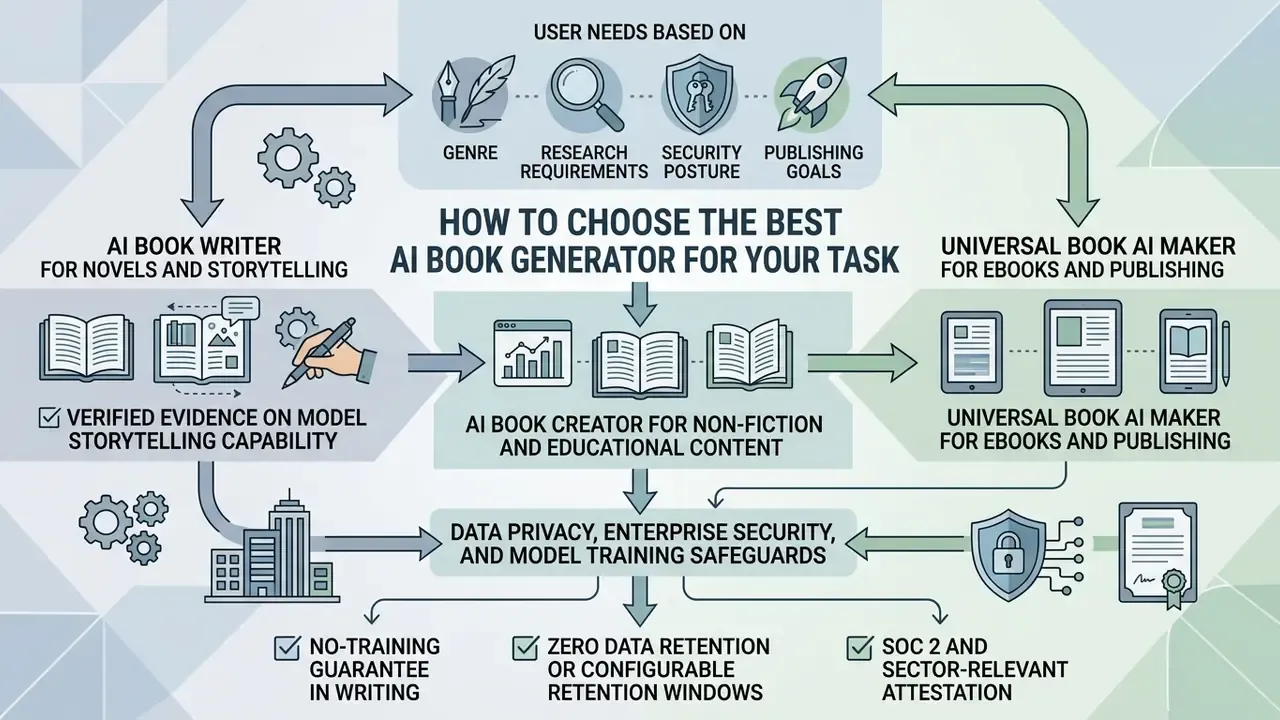
Choosing the best platform depends on genre, research requirements, security posture, and publishing goals. A fiction author needs plot tracking. An academic writer needs citation management and structured non-fiction templates. A compliance team needs audit logging above everything else. Evaluating available tools against the actual manuscript keeps feature lists honest.
Five criteria consistently predict fit: chapter-level continuity control, voice and style control, factual accuracy and source binding, export and formatting coverage, and disclosure, privacy, and licensing compliance.
AI Book Writer for Novels and Storytelling
An ai book writer built for fiction concentrates on narrative coherence, character arc tracking, and stylistic continuity. Tools such as Sudowrite and Squibler provide story bibles, character profiles, and scene expansion features tailored to novelists. Analytical engines, distinct from generative ones, evaluate uploaded manuscripts for plot structure, narrative arcs, character consistency, pacing, dialogue balance, theme, and genre convention adherence, which helps authors spot structural weakness in creative drafts.
Verified evidence on model storytelling capability:
"LLMs generate higher-quality stories than earlier neural generators and can compete with human authors on some dimensions, but tend to replicate real stories."
A pricing note for this category. Sudowrite lists Hobby and Student at $10/month, Professional at $22/month, and Max at $44/month on annual billing, with AI features gated behind paid plans and no formatted file export, so output is raw text needing external formatting. Squibler offers a free limited tier and a Pro plan listed at $29/month, or $16/month annually, with export to PDF, Word, Kindle, and plain text. Reviewers consistently describe Sudowrite as stronger on prose craft and Squibler as stronger on export convenience and full-manuscript management.
AI Book Creator for Non-Fiction and Educational Content
An ai book creator tuned for non-fiction emphasizes source integration, factual accuracy, and structured section hierarchies. Platforms such as Jenni AI and SciSpace support PDF research uploads, reference-manager connections, search across very large paper corpora, data extraction from tables, and automatic citation formatting in styles including APA and IEEE. Structured extraction workflows lean on document cues (Abstract, Methods, Results, Discussion, Conclusion) and enforce discipline by requiring an exact source sentence for each extracted claim, plus an explicit "not reported" where a value is missing. Those features keep technical manuscripts grounded in verified research.
Universal Book AI Maker for Ebooks and Publishing
A universal book ai maker provides flexible templates across genres, pairing draft generation with cover design, page layout, and digital publishing options. These platforms simplify ebook creation: design a custom cover, adjust typography themes, reorder chapters, and export formatted files for distribution on platforms such as Amazon KDP. Kindle workflows typically involve importing an unformatted file, adding front and back matter, styling chapter pages, inserting images and hyperlinks, previewing on device profiles, and exporting for publication.
Data Privacy, Enterprise Security, and Model Training Safeguards
When the input is proprietary research, unpublished fiction, client data, or regulated commercial documentation, privacy becomes a primary selection criterion. Enterprise-grade AI book generators deploy zero data retention (ZDR) architecture through secure API endpoints, so manuscript drafts, private research notes, and custom character bibles are never retained, logged, or used to train public foundation models. The strongest vendor language here is unambiguous: no models are trained on customer data, and all uploads and documents remain private to the account holder.
A verification checklist before anything sensitive leaves your network:
- No-training guarantee in writing. Confirm the contractual clause, not the marketing page, and check whether it binds the underlying model provider as well as the wrapper platform.
- Zero data retention or configurable retention windows. Verify whether prompts and outputs are stored, for how long, and whether logging can be disabled per workspace.
- SOC 2 and sector-relevant attestation. Request the report. For financial or health-adjacent content, confirm alignment with the confidentiality obligations governing your data.
- Tenant isolation and access control. SSO, role-based access control, per-project permissions, and named admin audit visibility.
- Offline and local editing capability. Full offline drafting removes an entire exposure class for the most sensitive chapters.
- Sub-processor transparency. A published list of which model providers and infrastructure vendors touch the text.
- Shadow-AI containment. Where staff would otherwise paste confidential material into unvetted consumer tools, an approved platform with logging is itself a control.
Audit Trail, Reproducibility, and Model Validation Controls
Teams operating under formal model risk management expectations need reproducibility, not just output. The platform should expose and export the exact prompt text per section, the model identifier and version, sampling parameters, retrieval sources used, timestamps, the human reviewer identity, and the accepted-versus-rejected suggestion history. Where retrieval-augmented generation runs over an approved internal repository, hallucination risk drops, because factual claims bind to retrievable documents rather than model memory. The retrieval index then becomes a controlled artifact of its own, requiring version management. Do not skip that part.
Vendor independence matters just as much. A toolchain able to route across multiple providers, for example commercial APIs plus a locally hosted model, avoids single-vendor concentration risk and lets sensitive chapters be generated entirely on-premises while routine chapters use a hosted model. Teams comparing integration paths can compare options for API-level access before signing anything.
| Feature / Criteria | AI Novel Writer | AI Non-Fiction Generator | AI Textbook Generator | Universal Book AI Maker |
|---|---|---|---|---|
| Primary Focus | Fiction, Novels, Stories | Business, Guides, Self-Help | Educational, Academic | Ebooks, Multi-Genre |
| Continuity Control | Character bibles, Scene graphs, rolling context window | Outline hierarchy, Argument tracking | Curriculum alignment, Chapter units | Outline cards, Basic context |
| Source Integration | Minimal (Prompt-based) | High (PDF import, Citations, reference managers) | Very High (Research databases, table extraction) | Moderate (Notes, Outlines) |
| Editing Features | Prose expansion, Beat rewriting | Fact-checking, Summary tools | Section restructuring, Expository pass | Inline editing, Formatting |
| Cover & Layout | Basic cover templates | Standard report layout | Complex tables and figures layout | Automated cover and ePub formatting |
| Export Formats | TXT, DOCX, ePub (some: raw text only) | DOCX, PDF, RTF, Markdown | PDF, LaTeX, DOCX | PDF, ePub, MOBI, KDP PDF, HTML |
| Audiobook / TTS Export | Sometimes (narrated track from draft) | Rare | Rare | Increasingly standard (.MP3/.M4B) |
| Data Privacy Safeguards | Varies; check no-training clause | Critical for unpublished research | Critical for licensed source material | Varies by hosting model |
| Audit Trail & Versioning | Version history | Version history + citation log | Version history + source log | Basic revision history |
| Direct Sales & Reader Analytics | No | Rare | No | Yes (zero-commission storefront, page analytics) |
| Typical Free Tier | Limited words / trial | Limited chapters | Limited pages | 5 chapters or 500 AI points per month |
Free AI Book Generator: Features, Limits, and Paid Upgrades
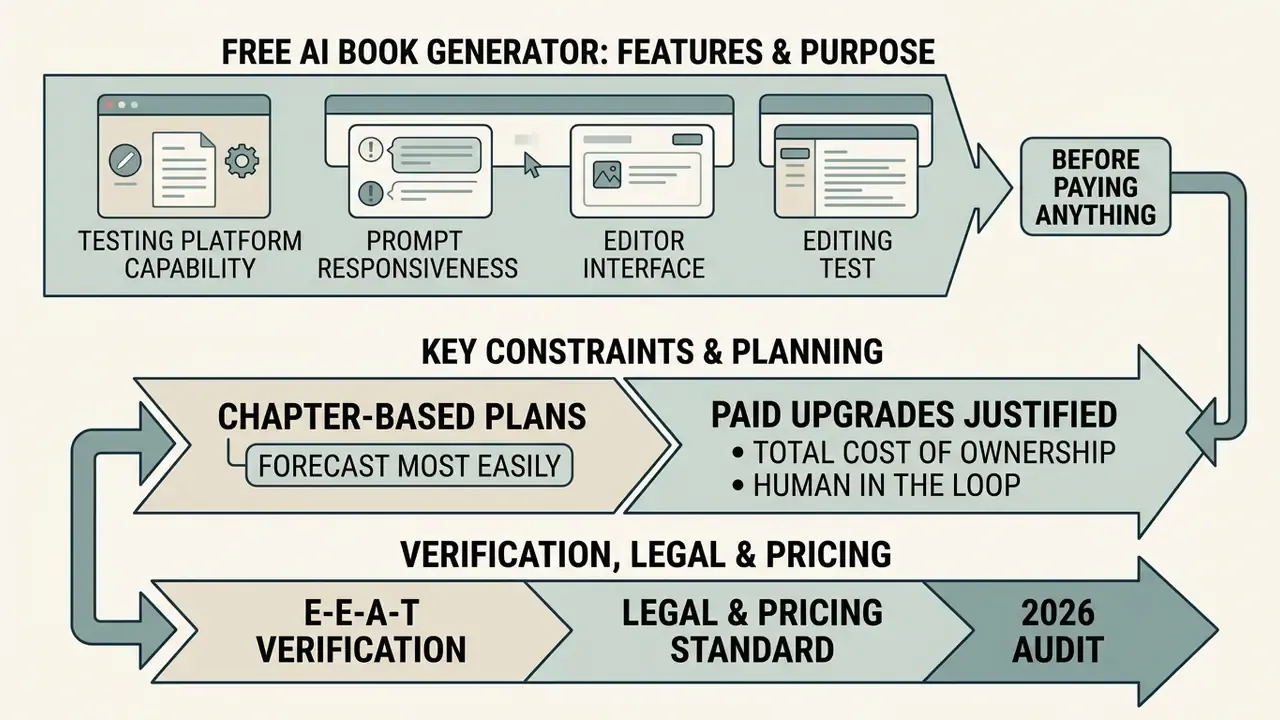
An ai book generator free online service lets authors test platform capability, prompt responsiveness, and the editor interface before paying anything. Platforms offering an ai book generator online free option still impose operational limits to control compute costs. Knowing those boundaries tells you when a paid tier becomes necessary, and when it does not.
A useful mental model splits the market into three categories. Truly no-signup tools need no account but save nothing, so they suit experiments, not books. Light-signup tools ask for an email or a Google login, no credit card, save your work, and permit export within stated caps. Genuine value sits here. Fake-free tools let you write for hours, then lock the export button behind a paywall or charge a card collected "for verification." Read the export policy before you invest drafting time, not after.
Key Constraints in Free AI Book Generator Plans
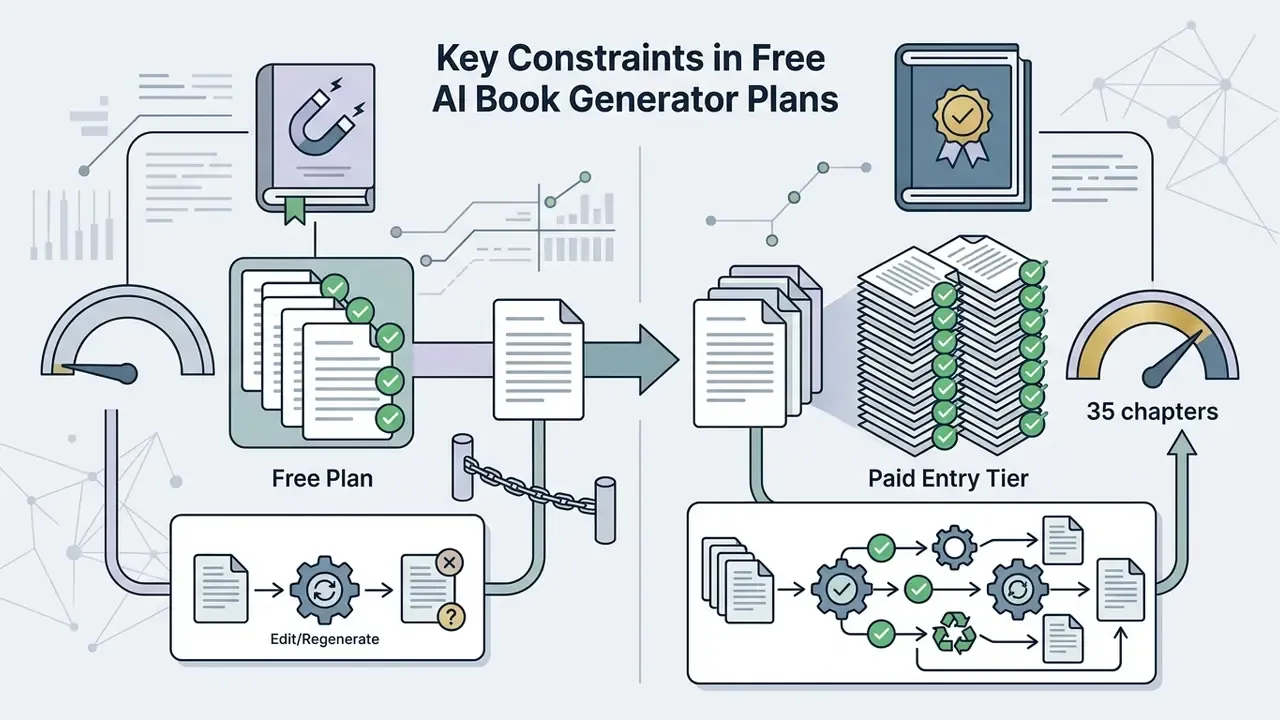
Free access models, whether an ai free book generator or a book ai generator free tier, typically apply monthly credit limits, page caps, or restricted export. Documented examples across vendor pages include 500 AI points per month with no credit card required; 5 generated chapters per month plus PDF export; 50 pages per month for short drafts; 60 AI credits per month where one ebook costs 1 to 3 credits depending on input type; and a 500-word ceiling with watermarks applied to EPUB, KDP print PDF, and DOCX exports. Platforms may also cap free accounts at a fixed number of chapters, stamp watermarks on exported PDFs, or restrict output to PDF only. High-capacity model access, EPUB and DOCX downloads, cover design engines, and full page editors with interactive elements are frequently reserved for subscribers.
Credit and token math, the calculation vendors rarely spell out. Standard generation models consume roughly 150 to 200 AI points per 100 generated words. Working from that ratio:
- A 500-point free plan covers roughly 250 to 330 words, which is one short chapter opening, not a book.
- A 60-credit monthly plan where an ebook costs 1 to 3 credits supports roughly 20 to 60 short ebooks, because credits there price the job rather than the word.
- An 80,000-point professional tier covers roughly 40,000 to 53,000 generated words, or about ten medium ebooks of 3,000 words each.
- Under a per-action credit model, a typical schedule is 3 credits for a chapter outline and 15, 20, or 30 credits for full chapter generation depending on model tier. So a 1,000-credit plan funds roughly 33 to 66 full chapters, and a 5,000-credit plan roughly 165 to 330 chapters.
Budget rule of thumb: multiply target word count by 1.8 points per word, then add 40 to 60% headroom for regenerations, because no chapter survives its first draft. A 30,000-word manuscript therefore needs roughly 54,000 points of raw generation plus 22,000 to 32,000 points of revision capacity. Note that one-time credit top-ups sometimes expire, three months being a common window, while subscription points reset monthly. Verify which applies before pre-purchasing, and if you are modelling several scenarios, open the hub of planning calculators rather than guessing in a spreadsheet.
When Paid Plans Are Justified for Writing and Publishing
Upgrading becomes necessary when an author needs high-volume generation, priority processing, watermark-free commercial export, EPUB or DOCX output, or the full interactive page editor. Paid tiers, generally $10 to $50 per month depending on provider, unlock long-context models, continuous manuscript generation, custom voice training, and direct publishing export pipelines. Documented reference points include an ebook platform at $13/month billed yearly for 80,000 points plus downloads and watermark removal, a chapter-based creator plan at $9.99/month for 35 chapters, and credit plans at $20/month for 1,000 credits or $50/month for 5,000 credits. To sanity-check current tiers, explore the hub of pricing models before committing annually.
At the frontier tier, general-purpose assistant subscriptions run considerably higher: $100/month for a 5x usage multiple, $200/month for a 20x multiple with priority access to newest models. API-level priority or "fast mode" processing has been priced at roughly twice the standard rate for up to about 2.5x faster completion with no change in output quality. Those premiums earn their keep only when latency or throughput is genuinely blocking billable work.
Total cost of ownership, including the human in the loop. Subscription cost is rarely the dominant line item. A defensible estimate:
For a 30,000-word commercial guide, the generation layer might cost $20 to $60 in credits, while 20 to 40 hours of editorial verification at a professional rate dwarfs it. In regulated documentation the multiplier is steeper still, since each factual assertion requires attributable sign-off. The economic case for AI drafting therefore rests on reducing blank-page time and structural rework, not on eliminating expert review. Where review hours do not fall, the subscription is a fixed cost with no output gain. Worth saying out loud in a budget meeting.
E-E-A-T Verification, Legal and Pricing Standard (2026 audit):
Official documentation across leading generation platforms confirms that free plans operate as trial tiers capped at 500 to 1,000 words or limited monthly credits. Commercial use of generated text is governed by platform terms of service, and several vendors state explicitly that customers retain full ownership of content created with AI assistance while the vendor retains ownership of its models and software. Under U.S. Copyright Office registration rules, protection applies strictly to human-authored creative selections and revisions, not to unedited machine output.
"Applicants have a duty to disclose the inclusion of AI-generated material in submissions and must identify and exclude non-human authorship portions from claims." U.S. Copyright Office, AI Initiative and Registration Guidance (2023). https://www.copyright.gov/ai/
Editing, Publishing, and Commercial Use of AI-Generated Books
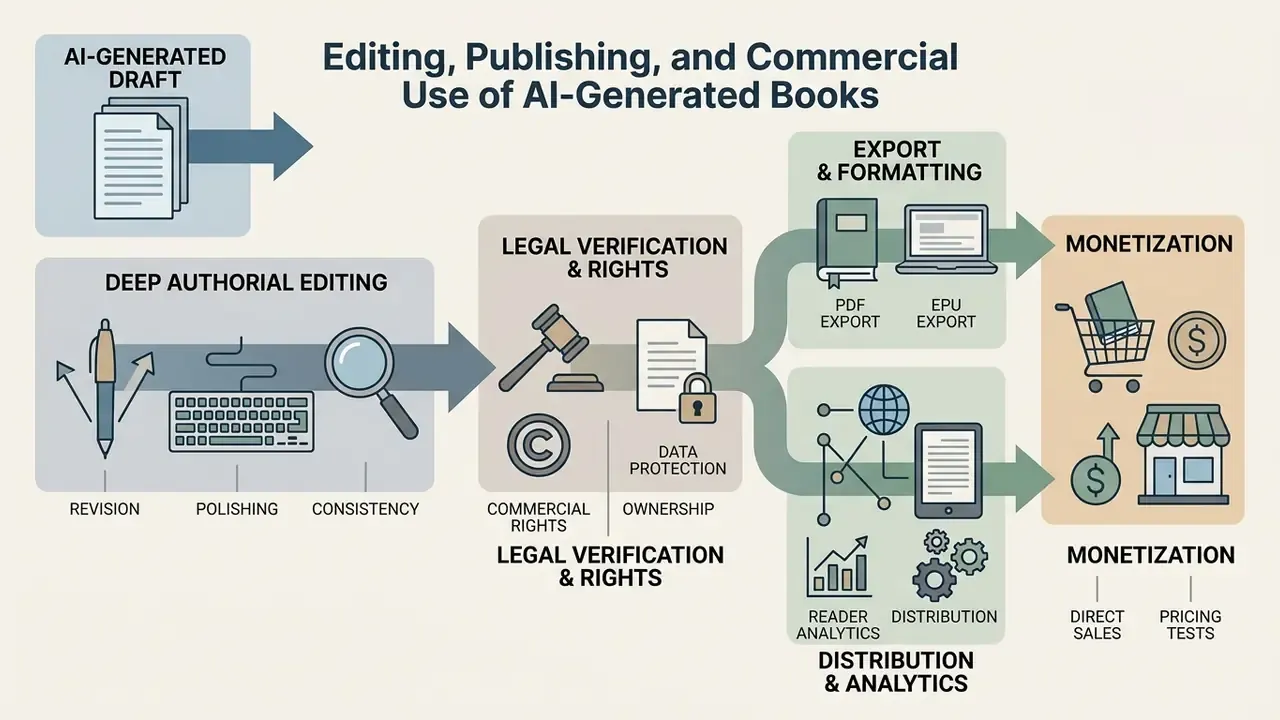
Turning an ai-generated draft into a published book takes authorial revision, legal verification, and careful formatting. Raw machine output rarely clears professional publishing standards or copyright requirements without substantial human intervention.
Clarifying Commercial Rights, Ownership, and PDF Export
This section is general information, not legal advice. Copyright treatment of AI-assisted works differs by jurisdiction and keeps evolving; consult qualified counsel before commercial release.
Commercial rights and copyright eligibility hinge on human creative input. Guidance from the U.S. Copyright Office, updated through 2025 and 2026, specifies that purely machine-generated text lacks protection and that prompts alone are generally insufficient to establish authorship, while human selection, arrangement, and modification can be protected.
"Jurisdictions such as the U.S., Korea and the EU are moving toward divergent standards regarding the copyrightability of AI-assisted works."
That divergence is material for anyone selling internationally. U.S. practice has registered thousands of claims containing AI material only where the AI-generated portions were disclaimed. European Parliament research indicates that purely AI-generated outputs lack copyright protection in the EU and may in principle be freely used, reproduced, or adapted. The United Kingdom, by contrast, retains a computer-generated-works regime granting protection for 50 years from creation where no human author exists, while separately confirming that copying for model training still requires a licence absent an applicable exception. For deeper case-level analysis, view the guide covering current disputes.
To secure ownership, authors must substantially edit, arrange, and transform the generated material, and should document that contribution contemporaneously rather than reconstructing it a year later. Creators should also review platform terms to confirm their tier grants full commercial use of AI-generated content for exported PDF and ePub files, including AI-generated cover artwork, which is frequently governed by a different licence than the text. Marketplace policies remain stricter than statute in several storefronts, so disclosure requirements at upload must be checked separately from copyright analysis. When in doubt, browse the hub of licensing guides.
Digital Distribution, Reader Analytics, and Direct Monetization
Modern AI publishing platforms reach past document creation into distribution and reader engagement analytics. Rather than depending only on third-party retailers, authors can distribute digital flipbooks or interactive PDFs through zero-commission storefronts: set a price, accept payment, deliver the interactive file, no intermediary taking a cut. Shareable links, QR codes, embeddable viewers, and custom domains let one asset run simultaneously as a landing-page lead magnet, an offline-to-online campaign, and a paid product.
Built-in analytics track reader metrics in real time: chapter drop-off rates, average reading time per page, geographic distribution, and click-through on embedded CTA links. That turns editorial revision into an evidence-based exercise instead of a taste argument. Three high-value applications:
Branding controls close the loop: logo placement, brand colour themes, custom cover textures and binding styles, and a custom domain so published URLs carry the publisher's identity rather than the vendor's. For launch promotion, explainer video formats work well alongside a book; the production options in whiteboard animation suit concept-heavy non-fiction, with budget routes covered in whiteboard animation free and outsourced production in whiteboard animation services.
FAQ: Frequently Asked Questions About AI Book Generators
How Long Does It Take to Generate a Book?
Vendor-reported timings, product data rather than independent benchmarks, cluster consistently. Generating individual chapters on modern platforms typically takes 30 to 60 seconds per chapter. A 10-chapter non-fiction book completes generation in roughly 2 to 4 minutes, and a fully formatted ebook with cover in about 3 to 5 minutes end to end. Outline generation is reported at around 5 minutes, full manuscript draft generation at 30 to 60 minutes. One platform reporting on 13,683 books found a median of roughly 2.2 hours from book creation to final chapter generation, because that figure measures the whole authoring session rather than raw compute. The gap between "four minutes" and "2.2 hours" is purely an endpoint definition problem: single chapter, full manuscript, or finished formatted ebook. None of those figures include the decisive stage. Human review, citation fact-checking, and deep editorial revision typically stretch total production to several days or weeks depending on complexity, and for regulated or heavily cited work, review time exceeds generation time by two orders of magnitude.
Can You Create Books in Multiple Languages?
Yes. Advanced platforms support manuscript creation across 30 to 70+ languages, including English, Spanish, German, French, Portuguese, Arabic, and East Asian languages, and one large multilingual evaluation covered 70 typologically diverse languages. Natural language processing benchmarks nonetheless show that fluency, stylistic nuance, and idiomatic accuracy remain materially stronger in high-resource languages than in low-resource targets, particularly those using non-Latin scripts. Two quantified caveats matter for book-length work. A 2025 multilingual generation study reported that translation failure was the terminal failure mode for 65% of language pairs in one open model and 78% in another, meaning the bottleneck is often the translation step rather than generation itself. And while a 2026 benchmark reports strong performance across 61 languages for a leading frontier model, separate evaluation work finds that average quality declines as the number of supported languages increases. Practical guidance: draft in the strongest supported language, then commission human localization review per target market instead of shipping machine output directly.
Can I Generate an Audiobook from My AI-Written Manuscript?
Yes. Several platforms now produce a narrated track straight from the finished draft: choose a voice profile, set pacing, export a high-quality file, commonly .MP3 or .M4B, alongside DOCX and PDF versions. Quality depends on three controls authors must configure rather than accept by default: pronunciation exceptions for proper nouns, invented terms, and non-English names; pause and pacing rules at scene and chapter breaks; and voice consistency where multiple characters or a narrator and dialogue split are used. Convert chapters to audio early rather than at the very end. Doing so exposes phrasing that reads fine on the page and collapses aloud, and it hands you two distribution formats from a single editorial pass. Before publishing commercially, verify the voice licence explicitly permits monetized distribution, since synthesis rights and commercial audiobook rights are frequently priced separately.
Are My Manuscript and Private Research Used to Train AI Models?
It depends entirely on the platform and the tier. The strongest vendors state plainly that no AI models are trained on customer data and that all uploads and documents remain private to the account. Others reserve broader rights in consumer terms while offering no-training guarantees only on business or enterprise plans, and some simply inherit the retention policy of the underlying model provider rather than setting their own. Before uploading an unpublished manuscript, proprietary research, or regulated documentation, verify four things in the contract rather than the marketing page: an explicit no-training clause covering both the platform and its model sub-processors; zero data retention or a configurable retention window with disableable logging; SOC 2 or equivalent attestation available on request; and tenant isolation with SSO and role-based access control. Where the material is highly sensitive, prefer platforms with genuine offline drafting or the option to route generation through a locally hosted model. Vendor questions of this kind usually route through support before procurement gets involved.
Is a Free Plan Enough to Finish a Whole Book?
For a lead magnet or short guide, yes. Free tiers typically allow three to five chapters or a few hundred generated words per month, enough to produce a 5 to 15 page asset, validate the concept, and export a PDF. For a full-length manuscript, no. The arithmetic in the credit section above makes that plain, and the honest strategy is to validate the outline and first chapters on a free tier, then upgrade once the structure holds. The critical pre-commitment check is the export policy: confirm before drafting that your tier permits watermark-free download in the format you actually need.
Can These Tools Be Used for Internal Policy or Compliance Documentation?
Yes, with controls. The mechanics that produce a chapter also produce a procedure section, and staged outline-to-section drafting works well for handbooks and SOPs. The extra requirements are source-bound generation over an approved internal repository, named reviewer sign-off per section, an exportable audit trail of prompts and model versions, and a documented statement of limitations for any model-assisted content feeding a regulated process. Treat the retrieval index as a controlled artifact with its own version history. And never accept an unverified normative statement: an incorrect "must" in a policy manual is a control failure, not a typo.
Should I Use AI-Generated Cover Art for a Commercial Release?
Sometimes, with eyes open. Machine-generated jacket art is fast and cheap, yet licence terms vary by tool and marketplace, and several storefronts require disclosure at upload. Aesthetic objections deserve a hearing too; the critiques summarized in why is ai art bad explain why some genre audiences react badly to obviously synthetic covers. A pragmatic middle path: generate concepts, then commission a designer to finalize typography and composition. If your cover includes an author portrait, standard retouching applies, and small fixes such as whiten teeth in photo are usually enough to make a headshot print-ready.
Appendix A: Source Notes and Superseded References
For transparency, earlier drafts of this guide cited the sources below. Each has been replaced in the main text with a directly verifiable primary reference, and the original attributions are retained here rather than quietly deleted.
| Superseded attribution | Where it appeared | Replaced with |
|---|---|---|
| "ACL 2026 study, Consistency Bugs in Long Story Generation by LLMs" | Fiction Books | Chakrabarty et al., Art or Artifice?, ACL 2023, https://aclanthology.org/2023.acl-long.516 |
| Yale Poorvu Center (2025) and University of Basel (2025) citation guidance | Non-Fiction and Educational Books | Can We Trust AI-Generated Educational Content? (2023), https://dl.acm.org/doi/10.1145/3573051.3593393 |
| Reedsy publishing guidance on genre and naming conventions | Define the Concept | Shanahan and Clarke (2023), https://arxiv.org/abs/2309.00613 |
| CASRAI writing framework (single controlling idea per paragraph) | Expand into a Full Draft | LongGenBench (2024), https://arxiv.org/abs/2409.02076, with the reverse-outline method retained as practice guidance |
| ABScribe co-writing framework | Variable Chapter Generation | Evaluating Creative Short Story Generation in Humans and LLMs (2025), https://arxiv.org/abs/2411.02316 |
| Authors A.I. (2026) manuscript analytics research claim | AI Book Writer for Novels | Xie et al., The Next Chapter (2023), https://arxiv.org/abs/2311.09672 |
| LongEval (2025) and WritingBench (2025) mentioned without metrics | What is an AI Book Generator | On Stable Long-Form Generation (2026), https://arxiv.org/abs/2502.14409, with LongEval retained where a specific finding is quoted |
Claims requiring ongoing verification. Chapter-generation timings and language-count figures in the FAQ are vendor-reported product data, not independent benchmark results. Pricing and credit allowances change frequently and should be confirmed against current vendor documentation before purchase.