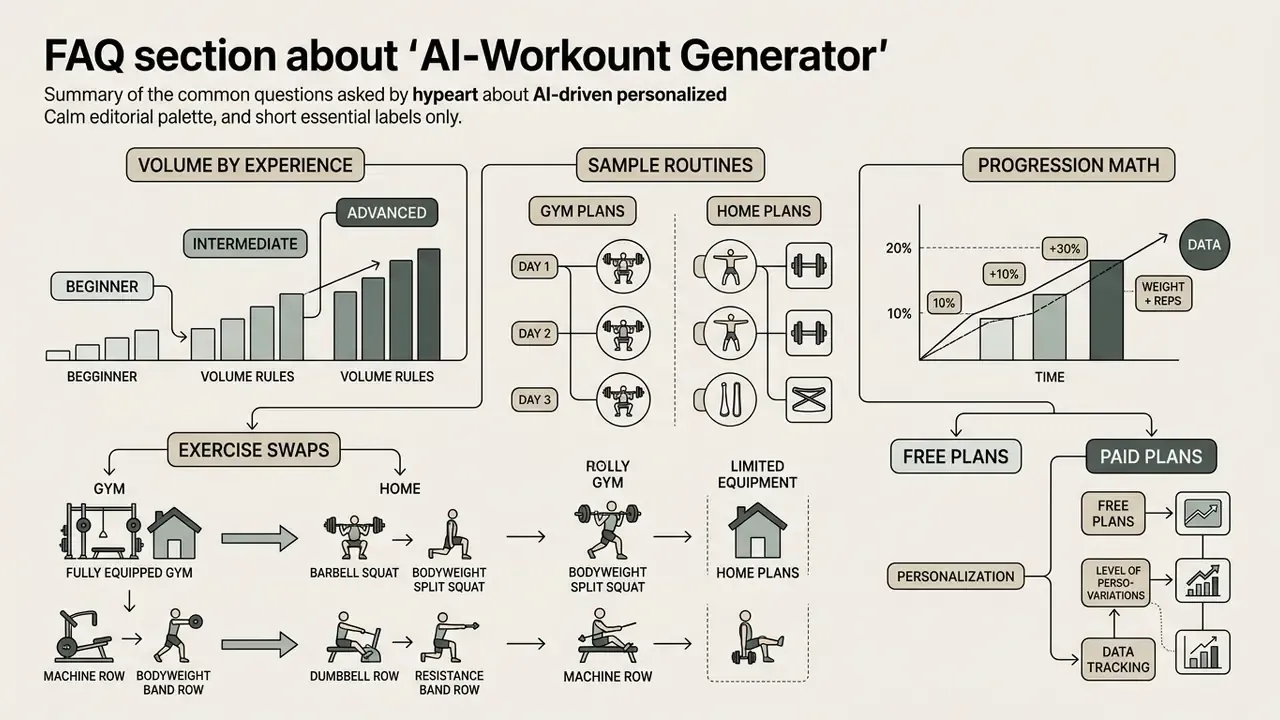
What This Guide Covers
An ai workout generator converts your goal, experience level, available equipment, and weekly schedule into a structured routine with exercises, sets, repetitions, and rest intervals. Free tiers typically deliver one static 4-week plan; paid tiers add adaptive load progression and wearable integration. Peer-reviewed evaluations show these tools follow standard FITT frameworks reasonably well, yet they remain incomplete. ChatGPT supplied only 41% of expected gold-standard programme content in one university evaluation. That is exactly why human review before execution is non-negotiable.
Inside this guide: what the tool is, how the generation pipeline works, volume rules by experience level, three sample routines, splits by training days, gym-to-home substitutions, progression math, free versus premium boundaries, commercial-use checks, a safety protocol, and an FAQ.
An ai workout generator is an automated software tool that processes individual physical profiles, fitness goals, equipment availability, and weekly schedules to produce structured exercise routines. By leveraging algorithmic model logic or natural language models, an ai workout generator free or paid solution translates complex physiological guidelines into specific exercises, sets, repetitions, and recovery periods.
"Evaluating generative fitness tools requires the same analytical rigour as model risk management in enterprise software: without explicit structural boundaries, verifiable evidence, and human accountability, automated decision-making risks delivering superficial or uncalibrated outputs." Marcus Hale, author.
What an AI Workout Generator Is and What It Solves
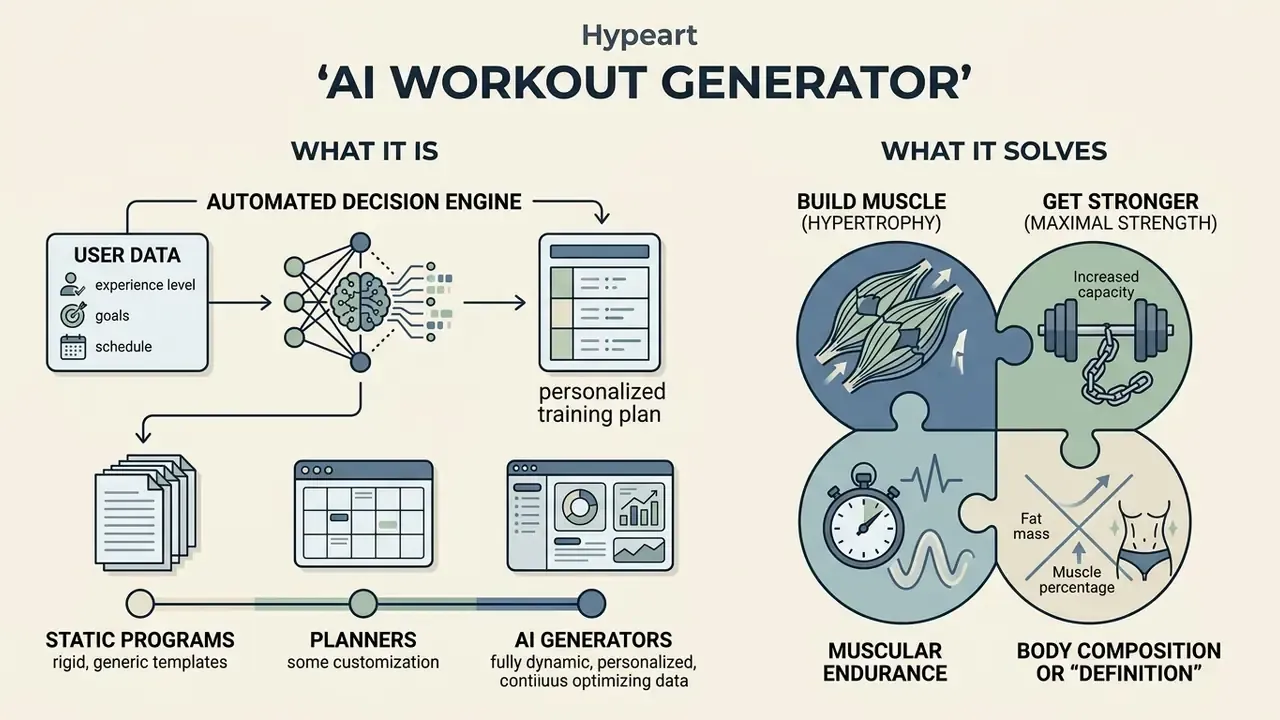
An ai workout generator works as an automated decision-support engine. It synthesizes personal health metrics, training goals, and contextual limits into an executable exercise schedule. Unlike static online templates, an ai fitness generator reconfigures exercise selections whenever inputs change. Consumer adoption data from the ABC Fitness Summer Wellness Watch Report 2025 indicates that 49% of surveyed consumers use an AI-based fitness or wellness app daily and 30% use one weekly. Those figures come from a commercial consumer panel rather than a clinical cohort, so read them as an industry adoption trend, not a clinical prevalence rate. Survey evidence also shows that among people already following structured training plans, roughly 25% have folded AI-generated routines into their weekly schedule. That is a meaningful shift toward automated health planning.
«AI chatbots and virtual assistants produce small-to-moderate improvements in physical activity, with standardised mean differences of 0.20–0.53 versus control groups.»
That effect size matters for calibration. Automated coaching reliably nudges behaviour, but the measured outcome in the literature is activity volume, not hypertrophy or one-rep-max strength. Worth holding on to before anyone promises body recomposition.
Personalization Spectrum: Static Programs, Planners, and AI Generators
| Approach | Who designs the logic | Adapts to equipment change | Adapts to logged performance | Typical output |
|---|---|---|---|---|
| Static pre-made program | Author, once | No, manual edits required | No | Fixed PDF or printed sheet |
| Traditional workout planner | The user | Only if the user rewrites it | Only manually | Calendar or logbook layout |
| AI workout generator | Algorithm plus rule constraints | Yes, filters exercise database by equipment tags | Yes on paid tiers (load, volume, substitutions) | Day-by-day plan with sets, reps, rest, RPE |
An ai exercise generator differs fundamentally from traditional workout planners and static pre-made programs in its underlying logic and adaptability. A static program delivers a fixed sequence of exercises with unyielding volume and intensity; when equipment or recovery needs change, the user rewrites it by hand. A traditional workout planner acts primarily as a digital logbook or schedule layout, relying entirely on human input to design the training logic. In contrast, a workout generator ai algorithmically evaluates variables such as training experience, available equipment, and time availability to create personalized workout plans instantly, bridging the gap between passive logging and expert program design. Many tools also export the result to PDF or a shareable link, which is why coaches treat an ai workout routine generator as a first-draft engine rather than a final deliverable.
What Tasks a Personalized Workout Plan Solves
A tailored workout plan created by a workout ai generator addresses multi-variable training tasks: muscle hypertrophy, maximal strength development, and cardiovascular endurance. According to resistance training guidance from the American College of Sports Medicine, including the long-standing ACSM Position Stand Progression Models in Resistance Training for Healthy Adults and the ACSM Resistance Training Guidelines Update (2026, acsm.org/resistance-training-guidelines-update-2026/), achieving specific adaptations requires precise manipulation of volume, loading, and rest. Note that the 2026 update is the newer reference layer over the 2009 position stand; where the two differ, the difference is publication date and evidence base, not contradiction.
By balancing these variables, a personalized workout system manages the ratio of stress to recovery, which limits non-functional overreaching while keeping physical progression steady.
- Build Muscle (Hypertrophy)
- Requires higher weekly volume, targeting roughly 10 sets per major muscle group per week, paired with moderate rep ranges (6–12 reps) and 1–2 minutes of rest.
- Get Stronger (Maximal Strength)
- Demands heavier loading at or above 80% of 1-repetition maximum (1RM), low rep ranges (2–6 reps), 2–3 sets per exercise, and extended rest intervals of 2–3 minutes to maximize force output.
- Muscular Endurance
- Uses lighter to moderate loads (40–60% 1RM), high repetition ranges (15+ reps), and shortened rest periods under 60 seconds.
- Body Composition or "Definition"
- Not a distinct physiological category in ACSM documentation. It is operationalized through the same variables, meaning volume, load, and exercise selection, combined with an energy-balance strategy that sits outside the training plan itself.
In practice, the generator is a structuring tool that applies published loading templates. It is not a validated intervention with proven hypertrophy outcomes. That distinction is the entire honesty test for this product category.
How an AI Workout Generator Builds a Training Plan
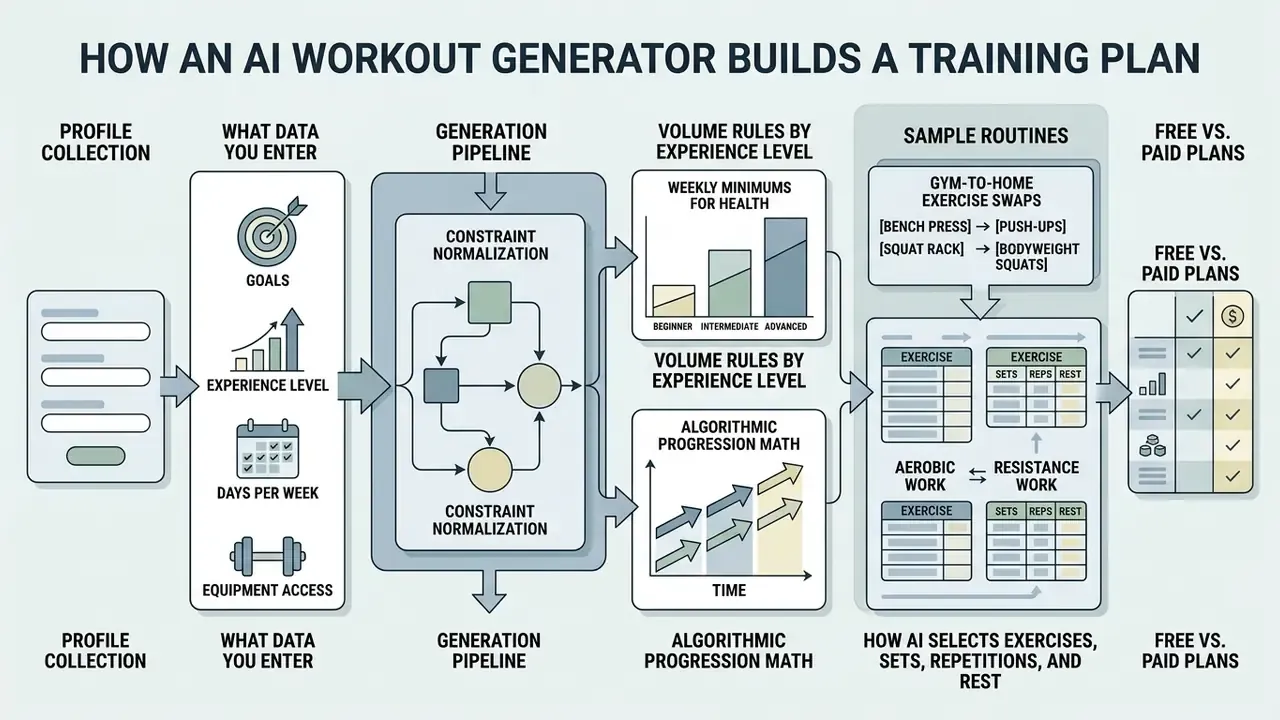
An ai workout program generator constructs a regimen through a multi-stage pipeline: profile collection, constraint normalization, exercise selection, and algorithmic distribution across training days. By evaluating parameters such as training experience, available time, and targeted physical outcomes, an ai training plan generator outputs structured routines complete with assigned sets, repetitions, and rest intervals.
Output stability, though, is a real engineering constraint. Large language models follow standard FITT (Frequency, Intensity, Time, Type) structures well enough, yet they wobble on numbers across repeated generations unless bound by strict rule-based limits.
«GPT-4.1 reaches 0.955 semantic similarity across repeated generations, yet returns 100% unique texts; numerical load parameters vary even at zero temperature.»
The practical implication for anyone auditing such a tool: a pure prompt-based generator is non-deterministic on numbers. Hybrid architectures are the safer pattern. A deterministic rule engine fixes sets, reps, rest and load percentages, while the model handles exercise naming, ordering, and explanatory copy. A minimal constraint prompt for a hybrid setup looks like this:
SYSTEM CONSTRAINTS (hard, non-negotiable):
- Rep ranges permitted: strength 2–6 | hypertrophy 6–12 | endurance 15+
- Sets per exercise: 2–4 (beginner) | 3–5 (advanced)
- Rest: 120–180 s compound heavy | 60–90 s isolation
- Load: never prescribe an absolute kg/lb value; output % of 1RM or RIR target only
- Never prescribe spinal loading (deadlift, barbell row) if user flagged disc/hernia history
- Always append preparticipation medical clearance notice
TASK: select exercises matching {equipment_tags} and {movement_patterns}; order compound → isolation.
The Generation Pipeline, Step by Step
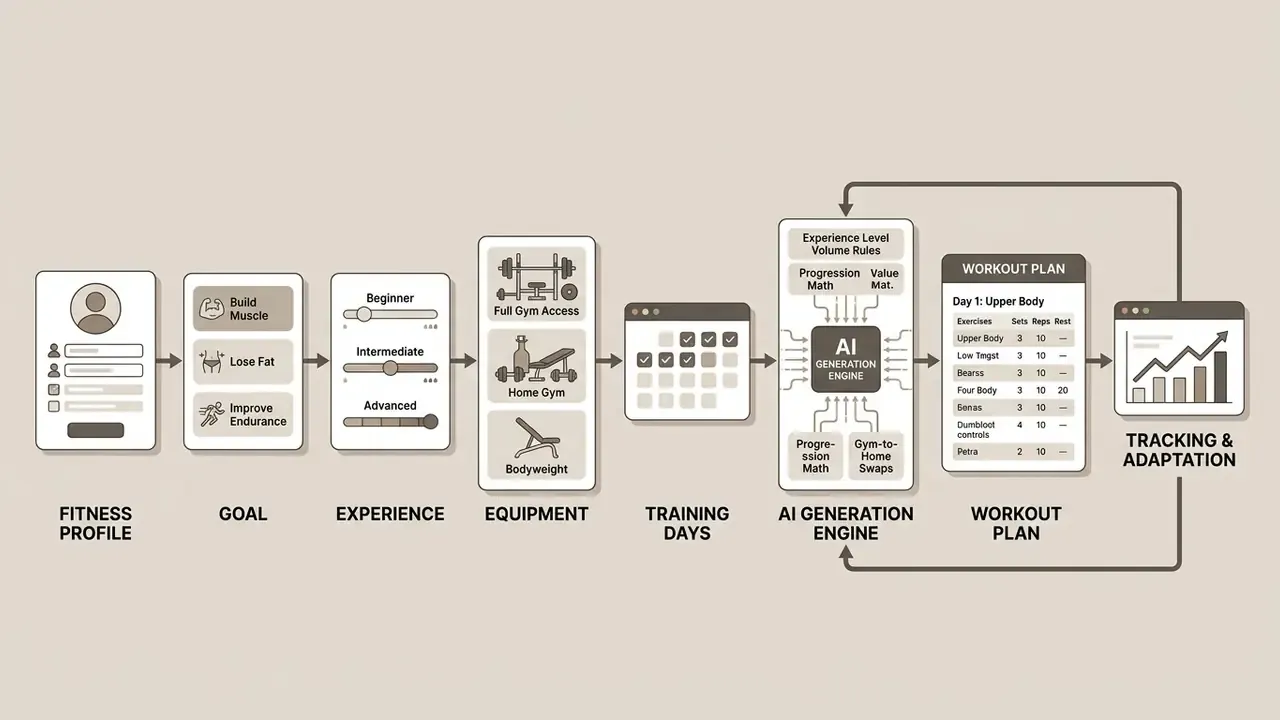
| Stage | What happens | Data used |
|---|---|---|
| 1. Fitness profile intake | Age, height, weight, sex, experience, injury and joint flags | User form |
| 2. Goal selection | Build muscle, get stronger, lose fat, general fitness, mobility | User form |
| 3. Resource assessment | Location (home or gym), equipment list, training days per week, session length | User form |
| 4. Algorithmic processing | Exercise database filtered by equipment tags and movement patterns; volume distributed; sets, reps, rest and RPE assigned | Rule engine plus model |
| 5. Plan output | Daily and weekly schedule with warm-ups, substitutions, rest timing | Generated |
| 6. Tracking and adaptation | Completed sets, weights and RPE logged; next mesocycle auto-corrected | User logs |
What Data You Enter: Goals, Experience, Days, and Equipment
To generate an effective personalized workout, an ai fitness plan generator needs specific baseline parameters at intake. Users enter demographic details (age, height, weight), primary fitness goals, subjective experience level (beginner, intermediate, advanced), and environmental factors such as home versus gym access. The system also collects training frequency limits, for example 3 to 5 days per week, so that muscle groups receive at least 48 hours of recovery between sessions. That constraint conforms to ACSM recovery standards and to ACPICR (2023) standards, which specify a minimum 48-hour gap between resistance-training bouts for the same muscle group.
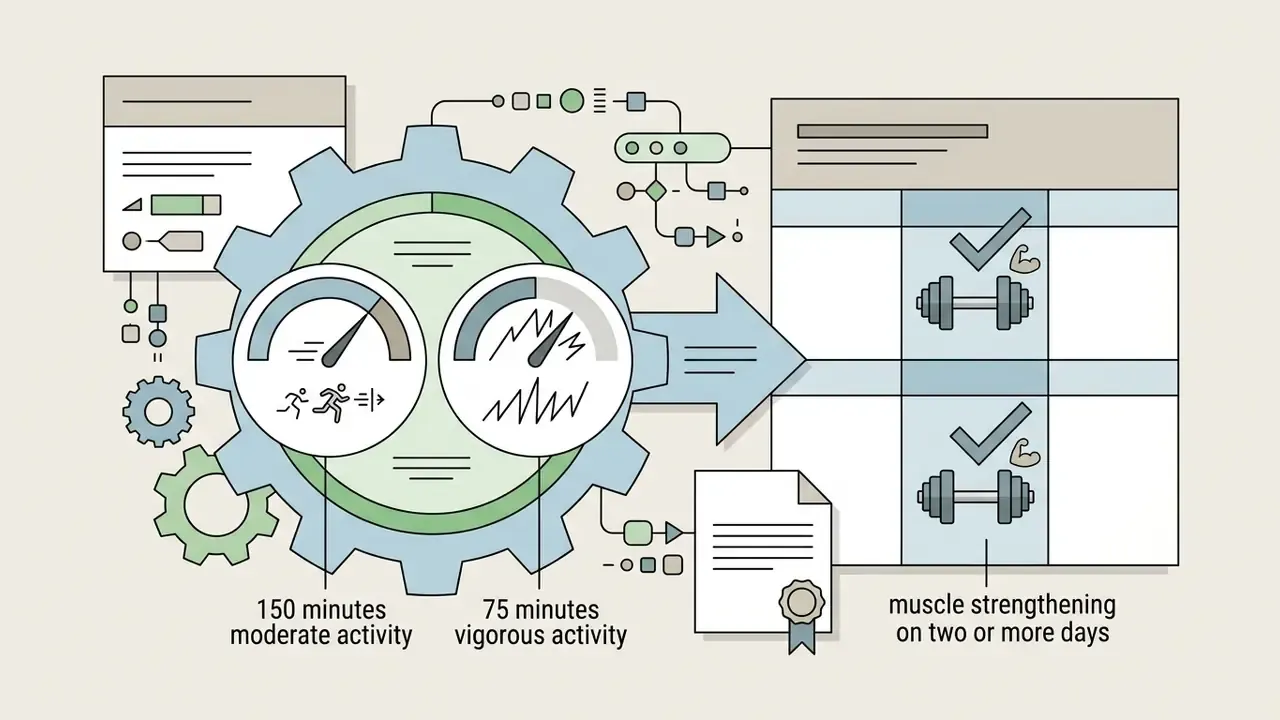
Public-health frequency anchors that well-built generators respect:
How AI Selects Exercises, Sets, Repetitions, and Rest
The generative model matches user constraints against exercise databases categorized by movement patterns (push, pull, hinge, squat, carry) and by equipment tags. When an ai workout generator generates workout recommendations, it orders the session by placing heavy multi-joint compound lifts first, then isolation movements. Coaches who need movement demonstrations for clients usually pair the plan with visual assets; our reference on AI video generators covers how those demonstration clips are produced.
Sets and repetitions follow target intensity. Published evaluations of GPT-driven exercise prescription report 2–4 sets per exercise and 4–8 repetitions in earlier model versions, expanding to 3–5 sets and 5–12 repetitions in newer variants, with rest intervals between 60 and 180 seconds depending on movement complexity, and up to 300 seconds for heavy low-rep phases. Official prescription guides converge on similar numbers: 8–12 reps with 1–2 minutes of rest for general health, and 2–3 minutes between sets for heavy multi-joint strength work (AUSactive, 2022).
High precision, low completeness. That asymmetry is the single most important fact for anyone using a generator unsupervised. What the tool says is usually defensible; what it omits, such as medical clearance, warm-up specificity, and contraindication screening, is where the risk lives.
Volume Rules by Experience Level
Transparent generators state their volume logic openly instead of hiding it behind the phrase "AI personalization." The table below reflects the rule structure used by leading tools, matched to ACSM progression models.
| Experience | Exercises per session | Sets per exercise | Weekly sets per major muscle | Structural logic |
|---|---|---|---|---|
| Beginner (under 1 year) | 4–5 | 3 | 9–12 | Full-body patterns, motor learning priority, machine and bodyweight bias |
| Intermediate (1–3 years) | 5–6 | 3–4 | 12–16 | Upper/lower split, one primary compound per session |
| Advanced (3+ years) | 6–7 | 4 | 10–14 per split day, higher weekly total | Anchor strength lift first, then accessory and isolation work |
Applied rules that follow from this table:
- A beginner never receives an "anchor lift plus six accessories" session. Complexity is capped so technique can stabilize.
- An advanced lifter receives one heavy anchor movement per session on top of the standard exercise block.
- Session duration lands between 45 and 75 minutes including warm-up. If time is short, cut the final accessory exercise, never the primary compound lift. The main lift drives most of the adaptation.
Quick Split Selector (Decision Tree)
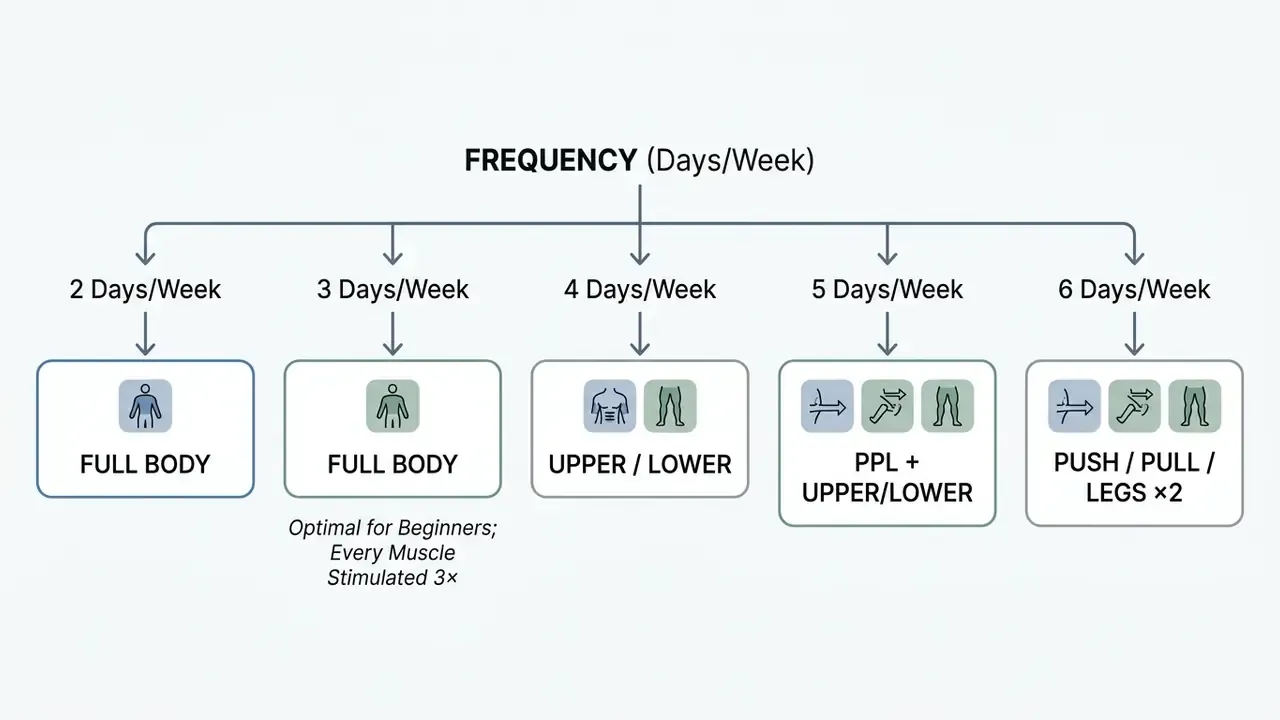
Six-day structures are only worth running with 8 hours of sleep, adequate caloric intake, and no accumulated fatigue. If any of those three are unstable, four or five days will produce more progress. I have yet to see a generator that asks about sleep before recommending six sessions, which is a small design gap with large downstream effects.
Sample AI-Generated Routines
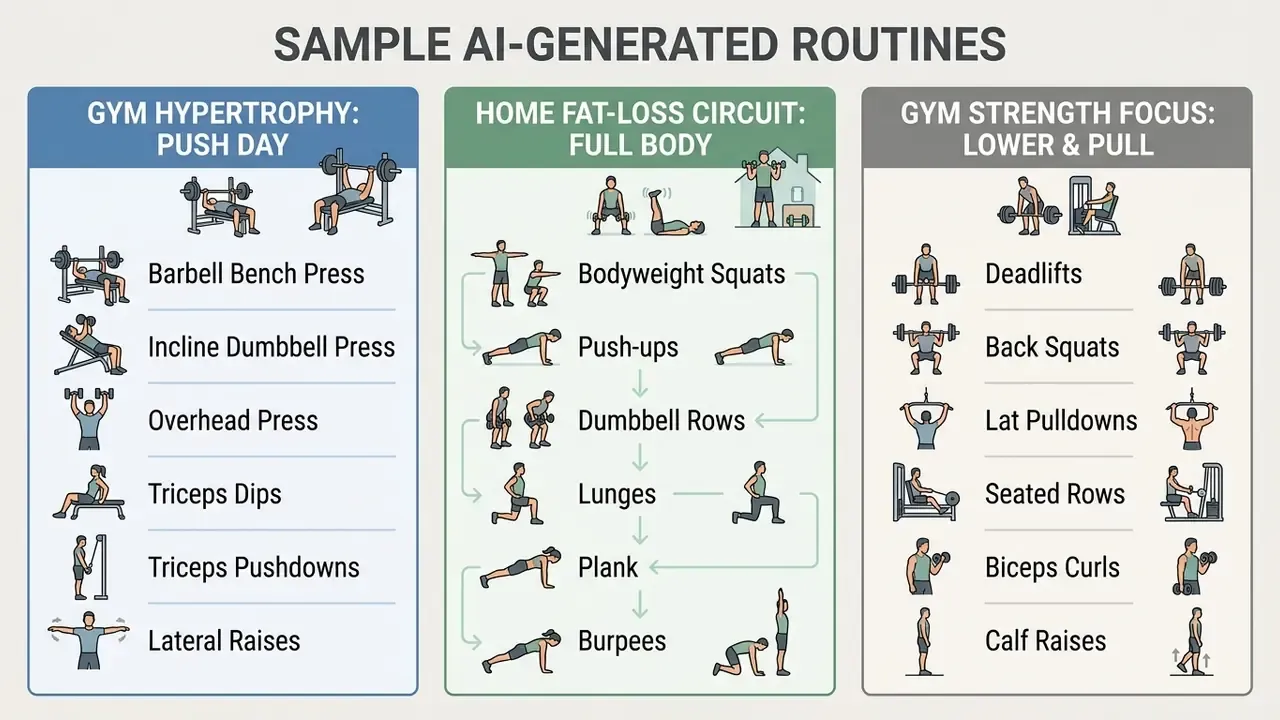
The routines below are representative outputs of a properly constrained generator. They illustrate format, volume, and rest logic. They are not a personal prescription.
Sample 1: Gym Hypertrophy, Push Day
Level: Intermediate | Duration: 50 min | Equipment: Full gym | Goal: Build muscle
| # | Exercise | Sets × Reps | Rest | Intensity target |
|---|---|---|---|---|
| 1 | Barbell bench press | 4 × 8–10 | 120 s | 70–80% 1RM, RIR 2 |
| 2 | Incline dumbbell press | 3 × 10–12 | 90 s | RIR 2 |
| 3 | Seated overhead press | 3 × 8–10 | 120 s | RIR 2 |
| 4 | Cable lateral raise | 4 × 12–15 | 60 s | RIR 1 |
| 5 | Triceps rope pushdown | 3 × 12–15 | 60 s | RIR 1 |
Sample 2: Home Fat-Loss Circuit, Full Body
Level: Beginner | Duration: 30 min | Equipment: None (bodyweight) | Goal: Lose fat
| # | Exercise | Sets × Reps/Time | Rest | Note |
|---|---|---|---|---|
| 1 | Chair squats moving to jump squats | 3 × 15 | 45 s | Regress to chair squats if knees complain |
| 2 | Push-ups (wall, knee, full) | 3 × 12 | 45 s | Pick the hardest variant you can control |
| 3 | Mountain climbers | 3 × 30 s | 45 s | Keep hips level |
| 4 | Reverse lunges | 3 × 10 per leg | 45 s | Stair step-ups as an alternative |
| 5 | Plank hold | 3 × 45 s | 45 s | Stop at form breakdown, not at the timer |
Sample 3: Gym Strength Focus, Lower and Pull Emphasis
Level: Advanced | Duration: 60 min | Equipment: Full gym | Goal: Get stronger
| # | Exercise | Sets × Reps | Rest | Intensity target |
|---|---|---|---|---|
| 1 | Barbell back squat (anchor lift) | 5 × 5 | 180 s | 80% 1RM or more, RIR 1–2 |
| 2 | Romanian deadlift | 4 × 6 | 150 s | RIR 2 |
| 3 | Barbell row | 4 × 6–8 | 120 s | RIR 2 |
| 4 | Weighted pull-ups | 4 × 5–8 | 120 s | RIR 1–2 |
| 5 | Leg press | 3 × 8–10 | 90 s | RIR 2 |
Note: these are sample structures only. Adjust for individual needs and raise load gradually. Read the progression section and the safety checklist below before executing any of them.
Choosing a Goal and Workout Split for an AI Plan
Selecting a training structure inside an ai fitness generator depends on weekly availability, recovery capacity, and the overall goal. Whether the target is to build muscle, add maximal strength, or hold general health, the split decides how training volume spreads across the week. For readers mapping the wider toolset, our overview in the AI Media Glossary provides additional context on algorithmic system classifications.
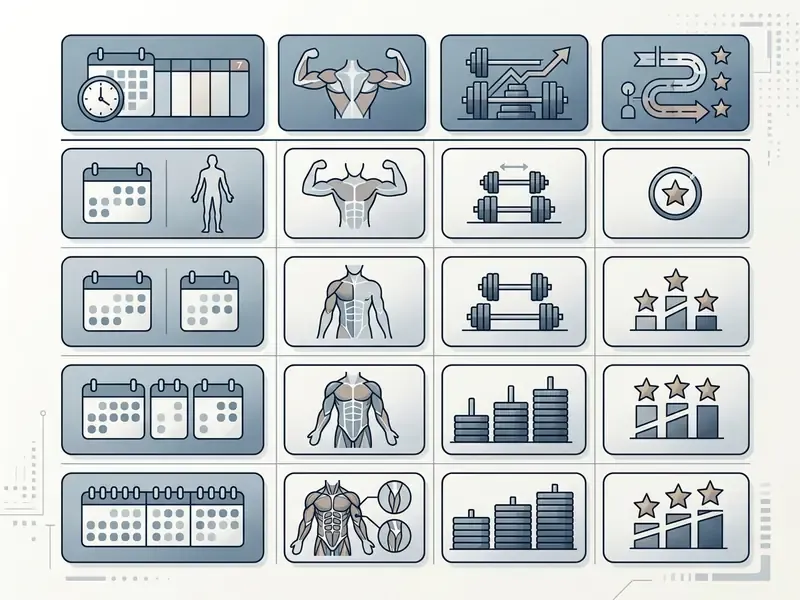
| Workout Split | Days per week | Target groups and structure | Weekly sets per muscle group | Suitable level |
|---|---|---|---|---|
| Full Body | 3–4 days | All major muscle groups in one session | 9–12 sets | Beginner / Intermediate |
| Upper / Lower | 4 days | Alternating upper body and lower body | 12–16 sets | Intermediate / Advanced |
| Push / Pull / Legs (PPL) | 5–6 days | Pushing, pulling, legs | 10–14 sets | Advanced |
Reference anchors: the ACE Workout Builder (American Council on Exercise, 2026) places full-body work at 3–4 days per week for beginners, while 2026 split templates document roughly 12–16 weekly sets per muscle on upper/lower and 9–11 direct sets per major muscle group on PPL rotations.
Programming for Build Muscle, Get Stronger, and General Fitness
Programming logic shifts noticeably with the selected primary outcome:
- Build MuscleEmphasizes mechanical tension and metabolic stress. Models assign 3–4 sets per exercise in a 6–12 repetition range at 65–80% 1RM, ensuring total weekly volume per muscle group reaches or exceeds 10 sets. The older ACSM position stand supports a 1–12 RM band with emphasis on 6–12 RM and 1–2 minutes of rest, favouring multi-set programmes.
- Get StrongerPrioritizes neural adaptation. The system selects multi-joint compound lifts (squat, bench press, deadlift), prescribing 3–5 sets of 2–6 repetitions at heavy loads (80% 1RM and above) with 2–3 minute rest intervals. Trained individuals additionally need periodization of volume and intensity rather than linear addition.
- General FitnessAligns with public health guidance from the UK NHS or the US CDC, balancing 2–3 non-consecutive days of resistance training with moderate aerobic activity, targeting 8–12 repetitions per set across all major muscle groups: legs, hips, back, chest, abdomen, shoulders, arms.
Full Body, Upper/Lower, and PPL by Training Days
When total weekly training volume is equated, different workout splits yield comparable hypertrophy and strength gains. That finding comes from volume-equated systematic reviews and meta-analyses of split versus full-body routines. Older evidence adds one caveat that still holds: training a major muscle group twice per week beats once per week for hypertrophy, while three times weekly has not been shown superior to twice.
So split selection in an ai workout generator is mostly a scheduling tool, not an independent driver of adaptation. A 2–3 day schedule defaults to Full Body so major muscle groups are stimulated at least twice per week. A 4-day frequency uses an Upper/Lower division, while a 5–6 day commitment leans on Push/Pull/Legs to distribute volume without swamping recovery capacity.
AI Gym Workout Generator for Gym and Home Training
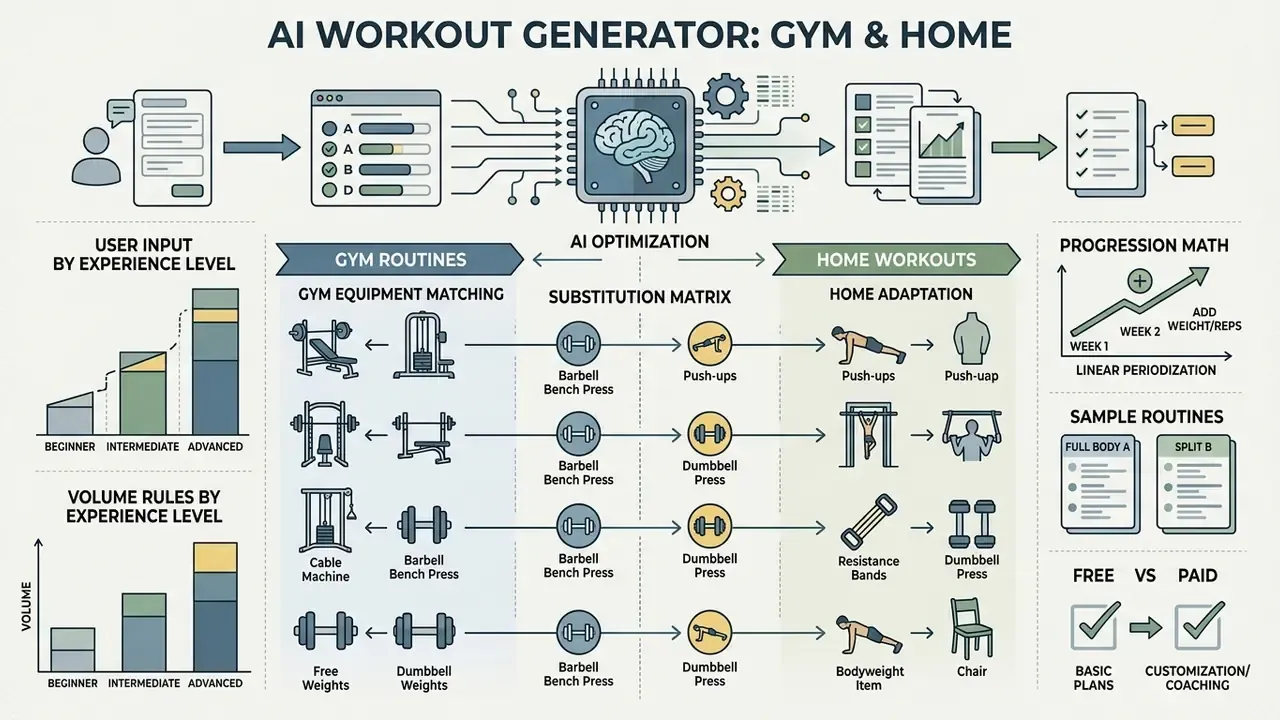
An ai gym workout generator or ai home workout generator adapts exercise selection to available equipment, from a full commercial gym down to bare bodyweight. Vendor documentation from 2025–2026 consistently exposes equipment modes covering machines, barbells, dumbbells, cables, resistance bands, and bodyweight only.
«No peer-reviewed trials quantitatively comparing AI-generator effectiveness in gym versus home settings on objective outcomes were identified for 2023–2026.»
One clinical signal deserves mention despite that gap. A 2026 publication on smartphone-based resistance training reported that an AI-driven intervention stayed workable for participants with limited access to traditional exercise facilities. Constrained equipment does not automatically block results, provided the movement patterns survive the substitution.
In institutional technology evaluations, assessing platform functionality means examining integration options; software operators often consult our AI Media API Guides when reviewing API-driven architecture.
Gym vs. Home Exercise Substitution Matrix
| Gym exercise | Home equivalent | Transferred pattern |
|---|---|---|
| Machine leg press | Bulgarian split squat with dumbbells, or weighted step-ups on stairs | Knee-dominant / quadriceps |
| Lat pulldown | Pull-ups on a bar, or banded lat pulldown anchored overhead | Vertical pull / lats |
| Seated cable row | Single-arm dumbbell row, or banded row around a fixed post | Horizontal pull / mid-back |
| Barbell bench press | Dumbbell floor press, or push-up variations (wall, knee, full, deficit) | Horizontal push / chest |
| Cable triceps pushdown | Banded pushdown, bench dips, diamond push-ups | Elbow extension / triceps |
| Leg extension machine | Reverse Nordic curl, or heels-elevated goblet squat | Quadriceps isolation |
| Barbell hip thrust | Single-leg glute bridge, or banded hip thrust off a sofa | Hip extension / glutes |
| Shoulder press machine | Pike push-ups, or dumbbell overhead press seated on a chair | Vertical push / shoulders |
| Lying leg curl | Nordic hamstring curl (assisted), or sliding leg curl on towels | Knee flexion / hamstrings |
| Cable lateral raise | Banded lateral raise, dumbbell lateral raise, water-bottle raise | Shoulder abduction / lateral delts |
How Exercises Are Matched to Gym Equipment
An ai gym workout generator free tier or an enterprise system with full gym access can use cable crossover machines, plate-loaded stations, and barbells. The selection algorithm follows the sequence documented in CSCS resistance-training design materials: needs analysis, then match movement pattern and target muscle, then rank by execution complexity, athlete experience and equipment availability, then substitute across modalities where access is limited. It prioritizes high-complexity compound exercises such as barbell back squats and cable rows for primary sets, using commercial machines to provide fixed movement trajectories that isolate targeted muscles safely during secondary work.
How to Adapt a Plan for Home Workouts
When configured as a free ai gym workout generator adapted for home settings, the algorithm filters out specialized machinery. It substitutes cable or machine exercises with biomechanically equivalent movements using bodyweight, resistance bands, or dumbbells. A leg press becomes Bulgarian split squats or weighted step-ups, which keeps the structural movement intact while respecting the floor space of a small apartment.
Institutional home-training protocols supply the loading rules a good generator mirrors. The University of Pennsylvania Home Strength Training Program specifies flat bands, stairs, dumbbells or weighted household items, 2–3 sessions per week, 48 hours between sessions, and increasing band tension every few weeks. Extension-service materials use 8–12 reps for strength, 10–15 for older beginners, 15–20 for endurance, with 2–4 sets and at least 48 hours of recovery. US HHS consumer guidance lists concrete household substitutions: wall push-ups, chair squats, lunges, resistance-band curls, arm curls with cans, and stair step-ups.
Progression, Volume, and Adaptation in AI Workout Plans
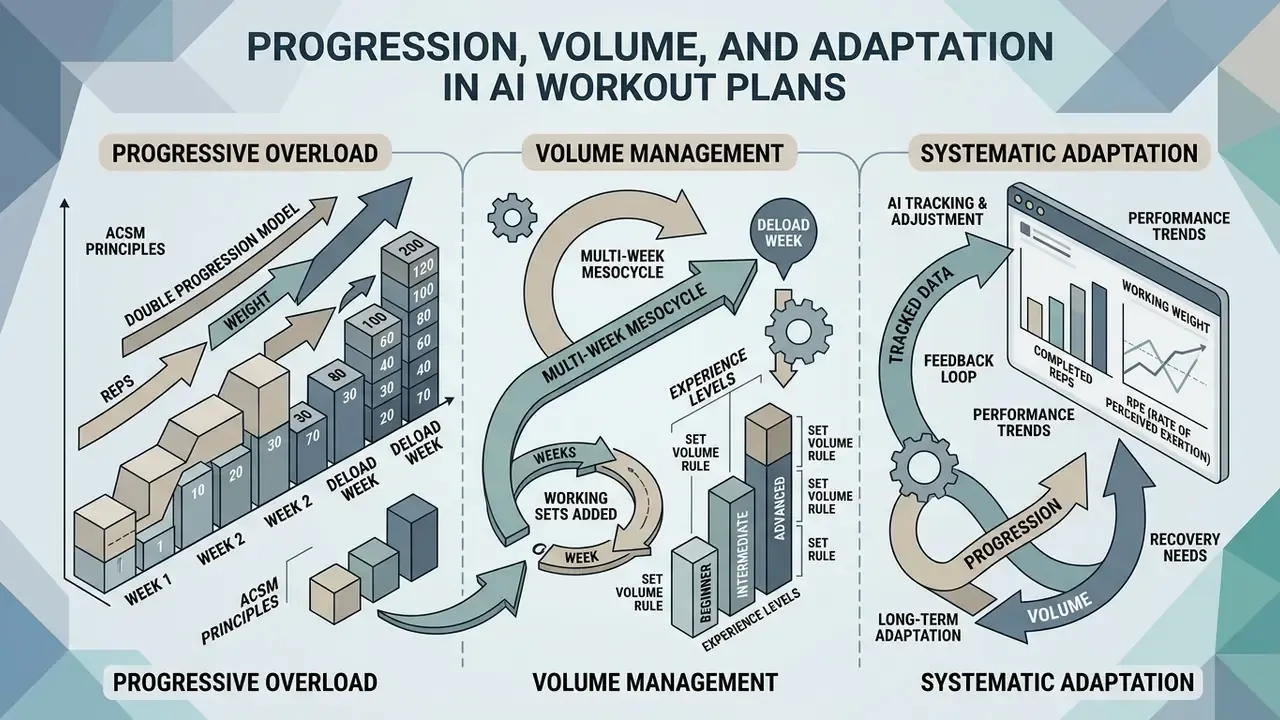
Long-term adaptation needs progressive overload, systematic volume management, and enough recovery. An advanced workout generator ai watches performance data over time and raises resistance or repetition targets as the user adapts. Current prescription frameworks formalize this as FITT-VP, meaning Frequency, Intensity, Time, Type, Volume, Progression, with volume defined as the product of frequency, intensity, and time (International Cardiac Rehabilitation Guidelines, 2025; CSANZ position statement, 2023; ACSM's Guidelines for Exercise Testing and Prescription, 12th edition, 2025).
In corporate software evaluations, reviewing cost structures early saves rework later; teams can consult our AI Media Pricing Guides for standard software tier benchmarks.
How Weight, Reps, Sets, and Volume Change
AI systems commonly implement a double progression model. The user holds the working weight constant until they can complete the upper repetition threshold, say 12 reps, across all prescribed sets. Once that happens, the algorithm raises load by 2.5% to 5% for the next session and resets the repetition target to the lower bound, say 8 reps.
This operationalizes the three load-progression schemes named in the ACSM position stand Progression Models in Resistance Training for Healthy Adults: progression by percentage of 1RM, by absolute load after hitting a target repetition count, or by loading within a repetition zone such as 8–12 RM. ACSM also specifies the trigger. When the current workload is exceeded by 1–2 reps on two consecutive sessions, raise the load by 2–10%. Volume progression is described separately, by adding repetitions, sets, or total training volume in increments of roughly 2.5–5%.
Volume is then adjusted across multi-week mesocycles by adding working sets before a planned deload week. A worked four-week hypertrophy mesocycle for an intermediate lifter looks like this:
| Week | Sets per muscle group | Average RIR target | Load handling |
|---|---|---|---|
| Week 1 (accumulation) | 12 | RIR 3 | Baseline working weights |
| Week 2 | 14 | RIR 2 | Plus 2.5% on lifts where top reps were reached |
| Week 3 (peak) | 16 | RIR 1 | Plus 2.5–5% where top reps were reached again |
| Week 4 (deload) | 8 | RIR 4 | 60–70% of Week 3 load |
«AI chatbots increased MVPA by an average of 103 minutes per week and 735 steps per day, though long-term training habits changed only marginally.»
The honest reading: automated progression prompts move short-term output well, while habit durability still depends on the human accountability structures around the app. A push notification is not a coach.
How to Track Performance, Recovery, and Progress
Adaptive workout software tracks completed reps, working weight, and Rate of Perceived Exertion (RPE). If a user logs RPE above 9 on introductory sets, or reports systemic fatigue, the system triggers recovery protocols by cutting volume or extending rest days.
Professional monitoring platforms show what a mature dashboard layer looks like. Firstbeat Sports presents team performance status with flags for elevated injury and overtraining risk, plus a 24-hour stress and recovery balance and an overnight Recovery Index with sleep duration. AthleteMonitoring outputs individual progress charts, individual and team performance reports, and time-based team progress tables. Consumer generators replicate a simplified version: set, rep and weight logs, RPE entry, strength history, and an activity calendar. For administrative questions and technical query routing, users can visit our support portal.
Free AI Workout Generator vs. Paid Features
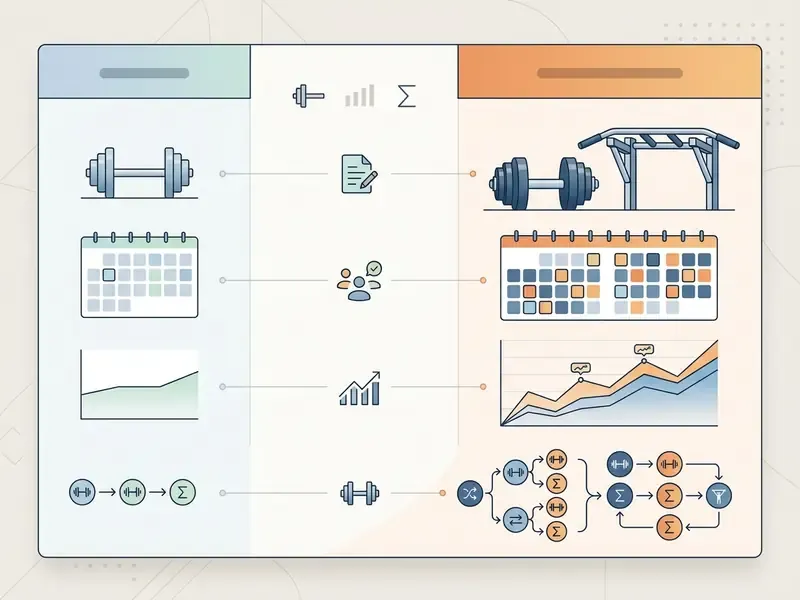
The line between an ai workout generator free tier and a premium subscription decides whether the plan keeps evolving after week four. Basic generation is widely available at no cost, the same pattern seen in adjacent categories such as free AI video generators, while continuous adaptation and detailed telemetry usually sit behind an upgrade.
| Functional block | Free tier | Premium tier |
|---|---|---|
| Plan generation | 1–3 basic 4-week plans; some tools cap at one generation per day | Unlimited plans |
| Exercise library | Basic media instructions | HD video plus substitution variants (350+ clips on some platforms) |
| Progress tracking | 30 days of history | Full analytics plus CSV and PDF export |
| Automatic load adaptation | Static progression | Real-time AI coaching, AI weight suggestions, weekly programme adjustment |
| Wearable integration | None | Heart rate, HRV, and sleep synchronisation |
| Indicative price | $0 | Roughly $3 to $20 per month for consumer apps (around $2.99 monthly or $29.99 yearly at the low end, near $19.99 monthly at the branded professional end). B2B API and white-label licensing is quoted per seat or per generation and usually requires a sales contract |
Pricing is indicative and drawn from publicly listed 2026 vendor tiers. Verify current rates on the provider's own pricing page before committing.
What a Free AI Workout Generator Typically Includes
A free ai workout generator or ai fitness plan generator free option typically offers a single generated 4-week workout routine, exercise instructions, basic set and rep prescriptions, and a static PDF download. Tools marketed as a free ai workout creator give immediate access to entry-level routines yet lack dynamic multi-week adjustment. Documented free-tier boundaries include: one plan of four weeks plus 30 days of history on one platform; one generation per client per day and ten per coach per day on a coach-facing platform; and a single PDF plan with exercise instructions, sets, reps, and rest times on another. Some free tiers are unexpectedly generous, offering offline mode, a large HD video library, and set, rep and weight tracking, while gating the coaching intelligence itself.
When Extended Plans, Tracking, and Adaptation Are Needed
Paying becomes rational when you need continuous load adjustment, biometric integration such as Apple Health or Garmin telemetry, and automated recovery modeling. Premium features recalculate working weights after every logged session, so training strain tracks real-time physiological readiness rather than a printed schedule.
The technical reason paid tiers exist is infrastructural. Real-time biometric streams demand secure, scalable collection, ETL, and an analytics platform able to combine live and historical data, a requirement documented in enterprise wearable-analytics solution briefs. Continuous-mode collection and live streaming simply cost more to serve than a one-off PDF. Readers who want to model those unit costs can explore our AI Media Calculators section.
Using an AI Fitness Program Generator for Trainers and Business
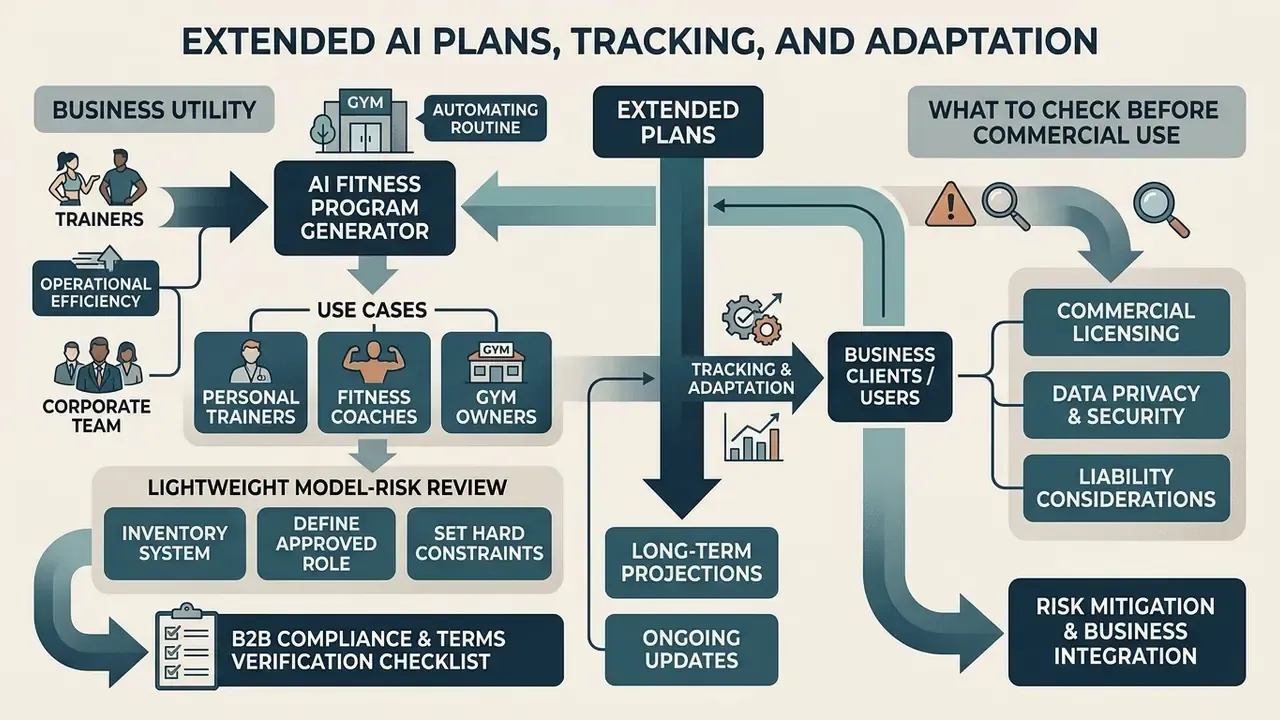
Use Cases for Personal Trainers, Fitness Coaches, and Gym Owners
Trainers and gym operators use an ai workout program generator to draft initial client routines in seconds, which trims administrative overhead. Vendor workflows document plan creation from a single intake form, PDF export with coach branding, progress tracking that captures completed sets, weights, RPE, measurements, photos and daily check-ins, plus client-count tiers, for example up to 10 clients on an entry plan. Club-facing workflows emphasise branded delivery through an app, embedded exercise demonstrations, and mandatory trainer review before release to the member.
«ChatGPT outperformed nine professional trainers on six of nine training questions for scientific correctness and clarity of response.»
Read that result narrowly. It measures answer quality on isolated questions, not programme outcomes across a mesocycle. Still, it explains why the tool has become a credible first-draft engine rather than a novelty. NASM's The Future is Human: The State of the Personal Trainer 2026 frames systematic programming and administrative follow-up as the two core trainer workloads, which is precisely the surface AI automates. ABC Fitness's 2025 wellness report similarly positions AI in fitness businesses as a lever for cutting operational workload and improving member loyalty.
The workflow lets coaches spend their attention on technical form and client motivation while automated tools establish baseline set and volume structures. Trainers who also produce their own marketing collateral often pair the generator with AI image generators for marketing to keep visual output consistent. For client-facing text, many operators consult our guide on ai writing generator systems, while coaches who hand out printable habit trackers and nutrition logs borrow patterns from our ai worksheet generator overview. Studios handling staff photo assets frequently check our notes on online photo editors and AI headshot generators for coach profiles.
What to Check Before Commercial Use
Before embedding AI-generated plans into a paid offering, run legal and technical due diligence. Skipping it is the fastest way to inherit somebody else's liability.
B2B compliance and terms verification checklist:
| Check | What to verify | Why it matters |
|---|---|---|
| Commercial redistribution rights | Do the Terms of Use permit reselling generated plans to clients? | Consumer terms of major AI providers prohibit modifying, copying, leasing, selling, or distributing the service; specialised B2B platforms require a separate business licence. Verified examples: Forge AI Fitness limits content to personal, non-commercial use absent express prior written permission; Fitny explicitly prohibits selling, reselling, or commercially using its services or content; Staminity, by contrast, issues a separate author licence that permits publishing and selling training plans through the platform, with pricing set by the author. |
| Contract type match | Are you on consumer Terms of Use or a business, enterprise, or developer agreement? | Providers separate these contracts, and the wrong one voids commercial protection. |
| Data privacy: HIPAA and GDPR | How is client biometric data processed, stored, and retained under the Privacy Policy? | Generative systems raise privacy risk and are often trained on large data volumes. The NIST AI Risk Management Framework 1.0 (2023) makes privacy and data governance an explicit deployment-review step, and the NIST Privacy Framework supplies the risk-identification layer. |
| Reverse engineering and ML-training limits | Are you barred from using outputs to train a competing model? | Major vendor terms prohibit both reverse engineering and competitive model training. |
| Liability and hold-harmless clauses | Does the licence disclaim all liability for user sports injuries? | Injury liability does not disappear because a machine wrote the plan. Teams tracking how these disputes actually resolve can follow our AI Litigation and enforcement tracker. |
| Information security standard | Is there ISO/IEC 27001 certification, SOC 2 attestation, or a documented equivalent? | Biometric and health data storage requires an auditable control baseline. |
| Human review gate | Is a qualified trainer or clinician required to approve plans before release? | AMA policy requires specified qualified human intervention points where AI influences health decisions, plus disclosure and documentation of AI involvement. |
«A hybrid model in which the therapist designs the plan and an LLM translates it into software delivered 99.7% of instructions correctly, with 88.4% accuracy in monitoring execution.»
That figure is the practical reliability benchmark for commercial deployment. The machine is highly dependable as a delivery and monitoring layer under human authorship, and considerably less so as an autonomous prescriber. The international FUTURE-AI consensus reinforces the point, identifying misuse from insufficient user training and use outside the intended population as core risks that demand formal risk management.
Organizations reviewing enterprise AI policies and licensing terms can consult our AI Media Commercial-Use Hub. For broader software comparison, decision-makers use our AI Media Comparison Matrices.
A Lightweight Model-Risk Review for a Fitness AI Tool
Borrowed from financial-services model governance, and deliberately small enough that a studio owner can actually complete it:
- Inventory the system.Record vendor, model family, version, and who inside your business owns the output.
- Define the approved role.Draft generator only, or also client-facing coach? Write the boundary down.
- Set hard constraints.Rep ranges, rest windows, banned movements for flagged conditions.
- Name the reviewer.One certified trainer signs each plan before release, with the sign-off logged.
- Keep evidence.Store the intake form, generated plan, and reviewer notes for every client.
- Set an escalation path.Any pain report above the amber threshold routes to a named human, same day.
- Re-test quarterly.Regenerate five archived intakes and check whether outputs drifted after a model update.
No evidence, no autonomy. That principle travels well from credit models to squat racks.
Safety of AI-Generated Workouts and How to Verify a Plan
Medical disclaimer and expert review notice: this material is informational only. It is not medical advice or a clinical prescription. An AI workout generator does not replace qualified medical diagnosis, physiotherapy, or in-person supervision by a certified trainer (NASM/ACSM). Before beginning any training programme, particularly with chronic conditions, obtain preparticipation medical clearance.
Safety in automated workout generation deserves scrutiny. According to systematic reviews of LLM-generated exercise prescription, language models unconstrained by hard algorithmic rules do make errors. Outputs adhered broadly to basic FITT guidelines, yet safety or contraindication errors appeared in 14 of 24 analyzed studies, that is 58%, especially for users with pre-existing joint conditions or cardiovascular risk factors. Models occasionally recommended contraindicated exercises for clinical populations. A parallel 2025 scoping review characterised the whole evaluation field as fragmented and methodologically weak, calling for multidimensional validation with human-centred review, which means the 58% figure should be read as directional rather than precise.
A related finding from the same body of work: the single most common omission in AI-generated exercise advice concerns the need for preparticipation medical clearance. The tool quietly assumes you are healthy.
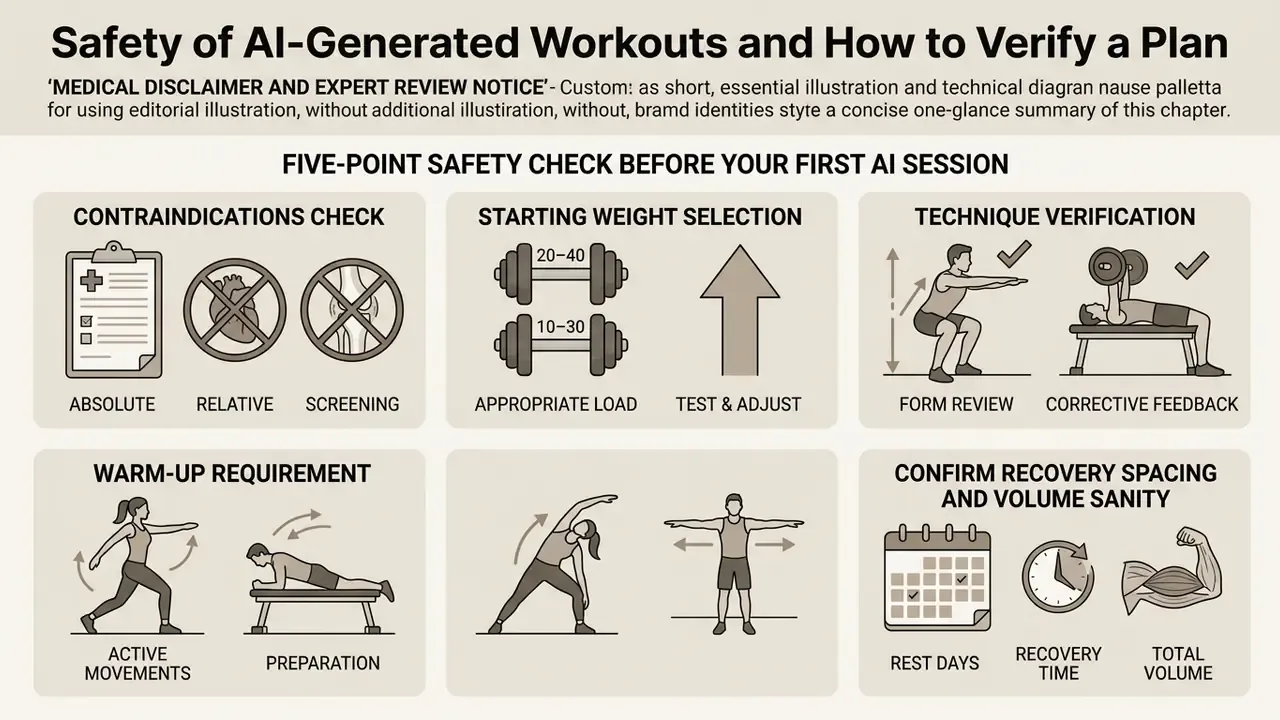
Five-Point Safety Check Before Your First AI Session
Before executing a routine from a workout generator ai, run this verification.
- Screen for absolute and relative contraindications.Delay or avoid resistance training with uncontrolled hypertension, hernia, unrepaired aortic aneurysm, unstable angina, uncontrolled arrhythmias, or recent or untreated heart failure. If any apply, get clearance first. The generator did not ask.
- Starting weight selection.Begin upper-body exercises at 30–40% of estimated 1RM and lower-body exercises at 50–60% 1RM. If 1RM is unknown, pick a weight that allows 12 comfortable repetitions with 3–4 reps in reserve (RIR 3–4), and progress only after 12 reps feel easy.
- Technique verification.Exhale during the hard phase, inhale during the easy phase, keep joints slightly bent rather than locked out, control the descent, and never hold your breath.
- Warm-up requirement.Complete 5–10 minutes of light dynamic warming up before the first working set.
- Confirm recovery spacing and volume sanity.Check that the plan leaves at least 48 hours between sessions loading the same muscle group, and that weekly set totals per muscle group sit inside the ranges in the volume table above. If the plan prescribes an absolute weight in kilograms without knowing your strength history, treat that number as unsafe and recalculate from RIR.
When to Modify Exercises or Consult a Specialist
Stop and revise the plan when specific physiological signals appear. The traffic-light framework below follows NHS musculoskeletal pain-threshold guidance (St George's University Hospitals NHS Foundation Trust, 2025).
- Green Zone (Pain 0–3/10) Mild, familiar discomfort that settles quickly. Continue as programmed.
- Amber Zone (Moderate Pain 4–6/10) Discomfort that subsides within 2 to 6 hours after exercise calls for movement regression or an exercise alternative, for example swapping barbell bench press for a dumbbell floor press. Continue only with that adaptation in place.
- Red Zone (Severe Pain 7–10/10, dizziness, shortness of breath) Stop immediately. Severe or new pain, swelling, inability to bear weight, symptoms that intensify during or after exercise, chest or upper-body discomfort, faintness, or acute sharp joint pain all require professional medical evaluation.
Additional non-pain markers of over-reaching that should trigger a plan adjustment: inability to complete prescribed sets, chronic fatigue, and tiredness that lingers all day. The correct response is reducing intensity or duration, not pushing through.
FAQ: Common Questions About AI Workout Generators
Is an AI workout generator really free?
Many are free at entry level with no credit card required. Typical free scope is one 4-week plan, exercise instructions, basic sets, reps and rest, PDF export, and around 30 days of tracking history. Unlimited generation, real-time load adaptation, CSV export, and wearable sync sit behind paid tiers.
How does the AI choose my split?
From training days per week and experience level. Two to three days maps to full body, four days to upper/lower, five days to PPL plus an extra upper and lower day, and six days to PPL run twice. Since volume-equated research shows split format itself does not change adaptation, this mapping is a scheduling decision.
Can AI generate workout plans for beginners?
Yes, and beginner logic is deliberately conservative: 4–5 exercises per session, 3 sets each, 9–12 weekly sets per muscle group, and a bias toward machines and bodyweight patterns while technique stabilizes. Beginners should still complete the five-point safety check above.
Does the AI adapt workouts over time?
On paid tiers, yes. Plans recalculate from logged sets, weights, and RPE, usually with double progression at 2.5–5% load increments and a scheduled deload. Free tiers mostly deliver static progression that you advance by hand.
What equipment do I need?
Nothing strictly. Well-built generators expose three modes, meaning full gym, dumbbells only, and bodyweight, and they swap exercises while preserving the movement pattern. The substitution matrix above shows how each gym machine maps to a home equivalent.
How long should each session take?
Most plans land between 45 and 75 minutes including warm-up. If time is short, cut the last accessory exercise rather than the primary compound lift.
Is the plan genuinely personalized if I'm not logged in?
It is personalized to your stated goal, days, equipment, and experience, but not to your individual lifts or recovery status, because the tool has no performance history to work from. Genuine week-to-week adaptation requires logged data.
Can I sell AI-generated plans to my clients?
Only after verifying the licence. Several fitness AI services restrict output to personal, non-commercial use, some explicitly prohibit resale, and a minority issue a separate author licence permitting paid plan distribution. Work through the commercial-use checklist above before monetising.
How does the tool handle injuries or limitations?
Only what you declare. Models do not infer contraindications, drug and exercise interactions, or clinical history from silence. State every relevant condition explicitly, and have a clinician or certified trainer review the output. Footer Navigation: AI Media Glossary | AI Media Commercial-Use Hub | AI Media Pricing Guides | AI Media Comparison Matrices
Appendix A: Superseded Passages (Change Log)