An AI agent is an autonomous software system that senses its environment, plans multi-step tasks, invokes external tools, and executes actions toward a defined operational goal with limited human intervention. Building an enterprise-grade agent means moving past clever chat prompts toward structured model risk management, permission-bounded orchestration, and deterministic audit trails. The gap between a weekend prototype and a production agent is mostly control design, not model quality.
Last updated: February 2026 · Reviewed for: model risk, validation, and agentic security controls
Executive Summary
- Agents are not assistants.An assistant answers; an agent decides, calls tools, and changes system state. Only the second category introduces action risk, and only the second category demands action-level controls.
- Scope before stack.The strongest first deployments constrain one bounded, high-frequency process, state in-scope and out-of-scope tasks explicitly, and issue least-privilege credentials per tool. Tooling choice comes later, and it matters less than people expect.
- Controls belong in the build, not in the backlog.Immutable audit logs, human-in-the-loop approval thresholds, sandbox isolation, prompt-injection filtering, and a tested kill switch must exist before the agent touches production data.
- Validation must map to frameworks you already run.Agentic systems fall under conventional model risk expectations: Federal Reserve SR 11-7 and OCC Bulletin 2011-12 for US banking institutions, plus NIST AI RMF 1.0 and NIST AI 600-1 for generative-specific risk. Evidence has to be reproducible, versioned, and auditable.
What Is an AI Agent and When Should You Build One?
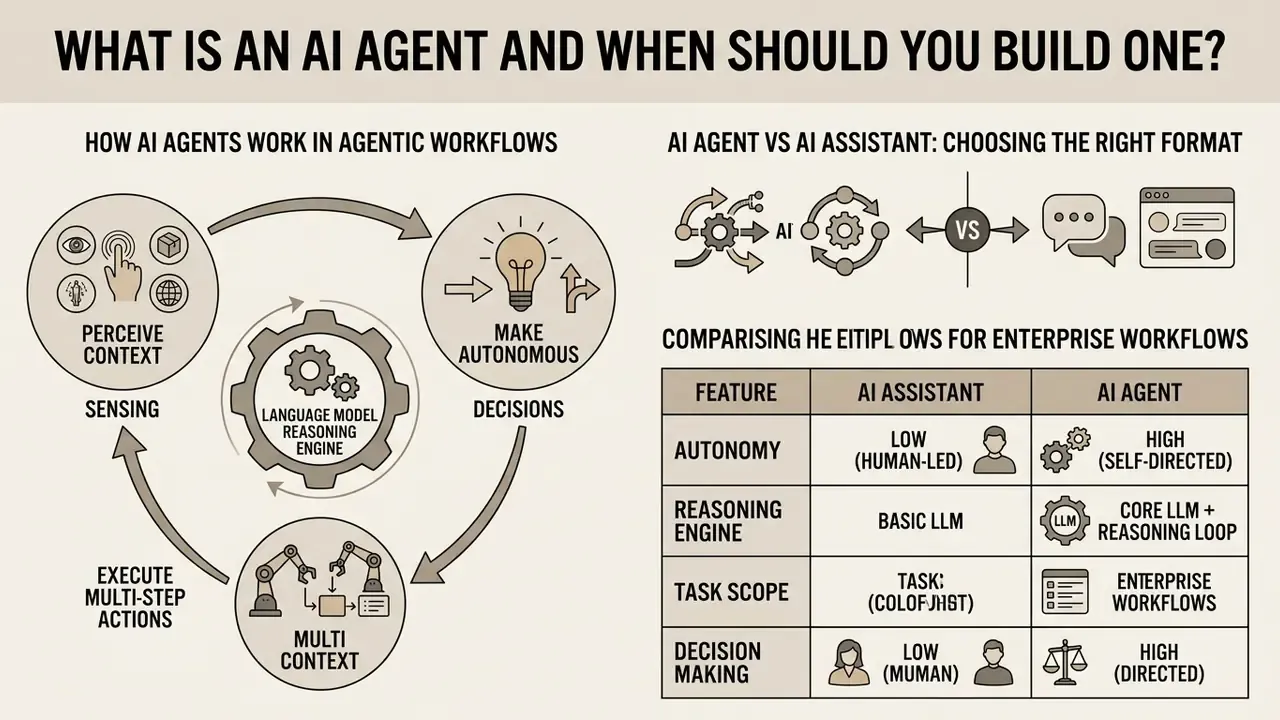
An AI agent is an automated system that uses a language model as its core reasoning engine to perceive context, make autonomous decisions, and execute multi-step agentic workflows through external tools. Build one when the business task requires multi-system coordination, persistent state tracking, and adaptive decision-making beyond simple prompt-and-response exchange.
A useful filter before anyone writes code: if a deterministic script plus a rules table already solves the task, an agent adds cost and risk without adding value. Agents earn their keep where inputs are messy, paths branch, and the next step depends on what the previous tool returned.
How AI Agents Work in Agentic Workflows
An AI agent operates inside an agentic workflow by running an iterative Reasoning + Acting (ReAct) loop that alternates between internal evaluation, tool selection, and state updates. Research on ReAct control loops (Yao et al., 2023) describes how the underlying language model processes task instructions, picks external APIs or data sources, observes execution results, then adjusts the following steps until the objective is met.
Enterprise agentic workflows extend this paradigm by enforcing least-privilege API access, role-based controls, and structured schemas that block unmanaged system calls. The practical consequence matters more than the theory: every loop iteration should produce three auditable artifacts, namely the reasoning step, the tool invocation payload, and the observed environment response. Three artifacts, one record, no gaps.
AI Agent vs AI Assistant: Choosing the Right Format
An AI assistant delivers single-turn or guided multi-turn responses with low autonomy and human-led execution. An AI agent plans, selects tools, and executes actions across systems on its own initiative. Reading ISO/IEC 22989:2022 terminology alongside current enterprise deployment practice, assistants fit informational retrieval, while agents are required for end-to-end task execution that modifies system state.
That measured autonomy ceiling is the core governance argument. An agent that finishes roughly a third of consequential long-horizon tasks unaided should be deployed with escalation paths, not blind trust. Worth repeating in a credit committee, probably twice.
Table: Comparison of AI Agents and AI Assistants in Enterprise Workflows
| Evaluation criterion | AI assistant | AI agent |
|---|---|---|
| Operational autonomy | Low autonomy; relies on direct user prompts to guide every step. | High autonomy; plans tasks and executes multi-step workflows. |
| Tool and API integration | Static context injection or limited single-turn tool invocation. | Dynamic tool selection, external API calls, real-time database updates. |
| Workflow execution | Single-turn text generation or basic conversational search. | Multi-step agentic workflows maintaining state across asynchronous events. |
| Primary enterprise use cases | Drafting text, answering policy queries, assisting code completion. | Transaction triage, multi-system reconciliation, incident response. |
| Risk classification | Content risk: inaccuracy, tone, disclosure. | Action risk: unauthorized writes, privilege creep, cascading tool failures. |
No matching rows Clear one or more filters to restore the matrix.
Structural differences between single-prompt AI assistants and autonomous AI agents in regulated operational environments.
The distinction holds outside finance too. In creative production pipelines, an assistant suggests a caption, while an agent renders, compresses, and publishes an asset end to end. Teams benchmarking that class of autonomous media tooling can consult our AI Media Comparison Matrices and the narrower evaluation of AI video generators to see how output quality and licensing terms shape tool selection.
Define the Purpose and Scope of Your AI Agent
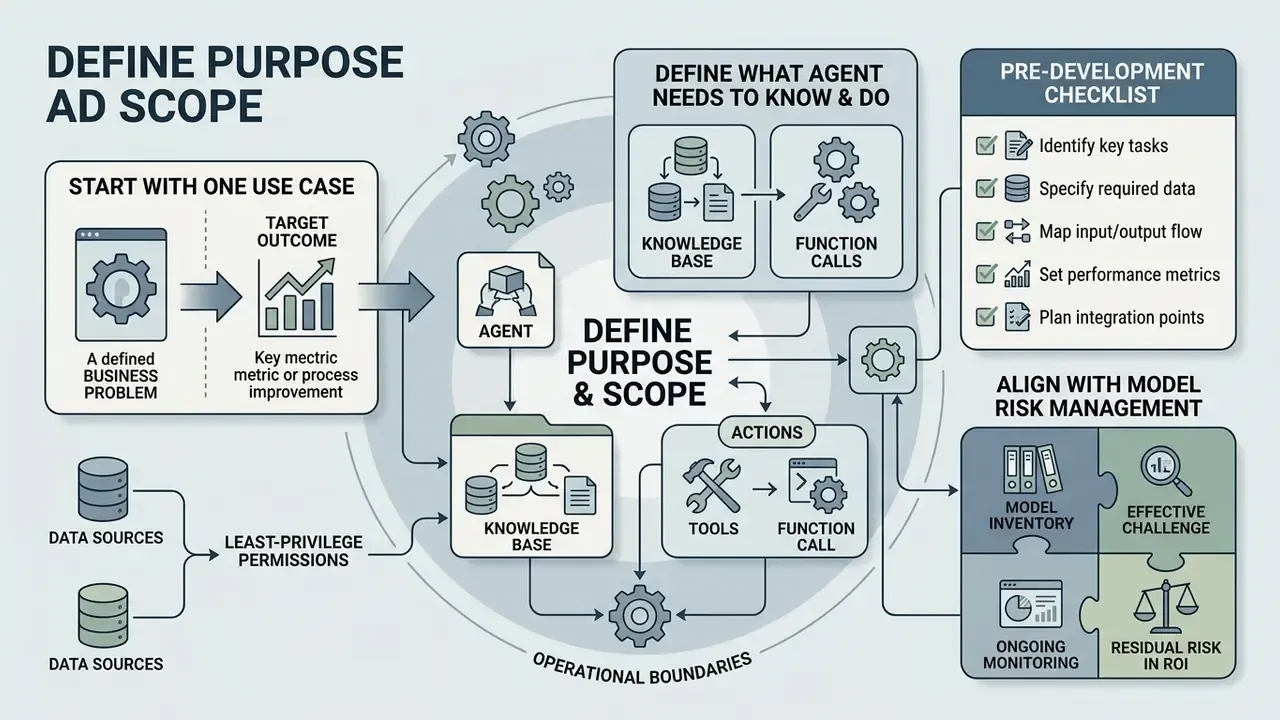
Defining purpose and scope means setting explicit operational boundaries, naming target business outcomes, and granting least-privilege permissions to specific data sources. The AI agent creation process should start by constraining the action space, because scope creep in an agent is not a product problem. It is a risk event waiting for an audit finding.
Start with One Real-World Use Case
A successful first deployment usually picks a single high-frequency, tightly bounded business process where tasks are quantifiable and failure can be caught by human oversight. In customer support automation, a typical bounded implementation verifies user entitlements, retrieves transactional records, and drafts a candidate response, while payment, refund, and account-modification actions stay behind human approval. That pattern recurs across vendor implementation briefs, though it should be validated against your own baseline metrics rather than accepted as a benchmark.
Focusing the initial build on one narrow process establishes baseline performance before scaling into complex, multi-departmental workflows. An illustrative target pair for a first bounded deployment: task success above 92% on a frozen evaluation set, and erroneous tool invocations below 1% of total calls. Both measured on traced runs, not on self-reported model confidence. Self-reported confidence is a feeling, not a metric.
Define What Your Agent Needs to Know and Do
An agent needs explicitly mapped data sources, input and output schemas, and boundary rules that block unauthorized tool invocation. Emerging cloud-native agentic specifications (CNCF, 2026) point to schema validation via JSON Schema or OpenAPI, so incoming payload context stays inside pre-approved operational thresholds.
Pre-Development AI Agent Planning Checklist
Treating the loop as a formal sequential decision process pays off during validation, since each state transition becomes a testable unit with defined preconditions, permitted actions, and postconditions.
### Pre-Development AI Agent Planning Checklist
- [ ] **1. Business Use Case Definition**
  - [ ] Define the specific operational bottleneck (e.g., invoice reconciliation, support ticket triage).
  - [ ] Establish explicit in-scope tasks and out-of-scope boundaries.
- [ ] **2. Target Outcome & Success Metrics**
  - [ ] Define quantitative KPIs (e.g., task success rate > 92%, execution latency < 3s).
  - [ ] Establish human-in-the-loop escalation triggers for low-confidence decisions.
- [ ] **3. Data Sources & API Mapping**
  - [ ] Identify authoritative data sources and verify API schema readiness.
  - [ ] Implement least-privilege access credentials for read/write operations.
  - [ ] Confirm PII/PHI masking rules before any context leaves the trust boundary.
- [ ] **4. Language Model & Infrastructure Selection**
  - [ ] Select a foundational language model based on context window, latency, and reasoning capabilities.
  - [ ] Establish sandboxed execution environments for tool execution.
- [ ] **5. Governance & Audit Logging**
  - [ ] Configure immutable logging for every reasoning step, tool call, and system output.
  - [ ] Define emergency kill-switch mechanisms for real-time operation halt.
- [ ] **6. Model Risk Documentation**
  - [ ] Record model inventory entry, owner, validator, and challenger analysis.
  - [ ] Map controls to SR 11-7 / OCC 2011-12 validation expectations and NIST AI RMF functions.
Multimodal agents widen the schema surface, because image, audio, and video payloads carry metadata that also needs validation and stripping. Teams designing that layer often start by auditing export and metadata behavior in the underlying tooling, for example a photo editor for mac sitting inside an automated asset pipeline, where EXIF fields can quietly carry location data into a model context.
Align the Agent with Model Risk Management Expectations
For a regulated institution, an AI agent is a model plus an action layer, and both parts sit inside existing supervisory expectations. SR 11-7 and OCC Bulletin 2011-12 call for conceptual soundness review, ongoing monitoring, and independent validation with effective challenge. Applied to agents, that means validators must reproduce a decision from logged inputs, prompt versions, retrieved context, and tool responses. NIST AI RMF 1.0 supplies the Govern, Map, Measure, Manage structure, while NIST AI 600-1 enumerates generative-specific risks such as confabulation and prompt injection, which have to be tested explicitly rather than assumed away.
Practical implications for the build:
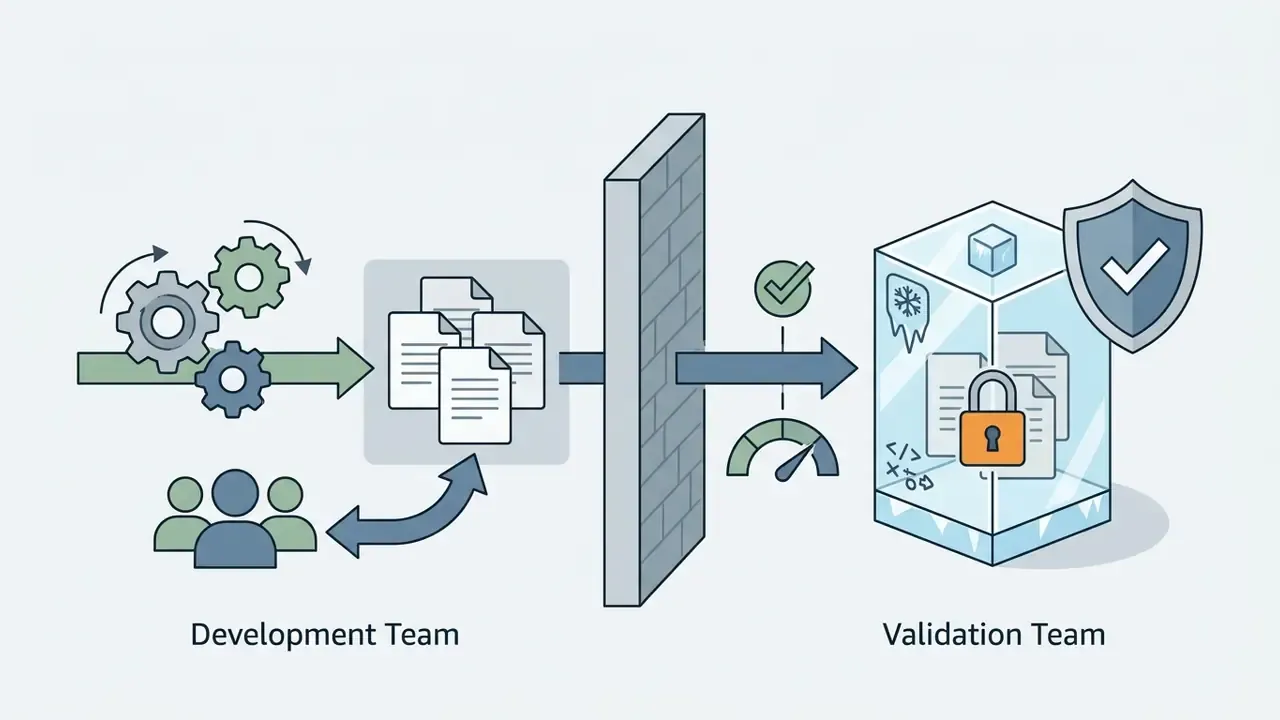
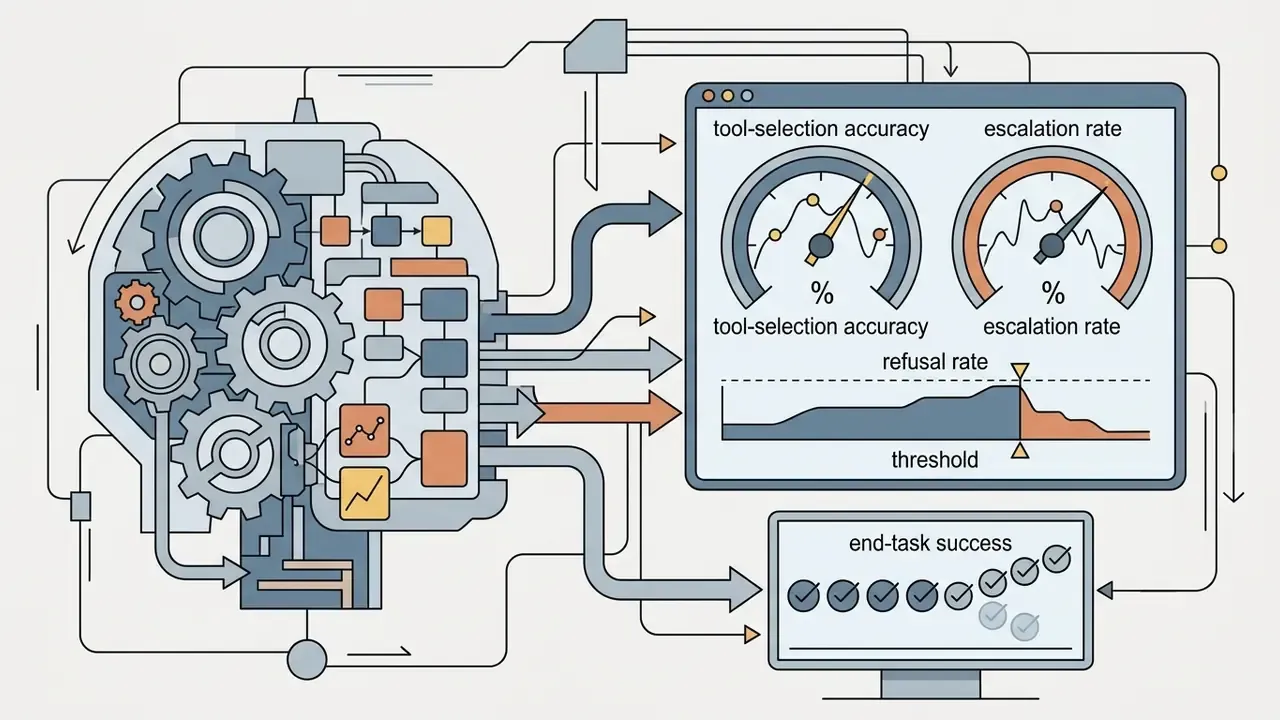
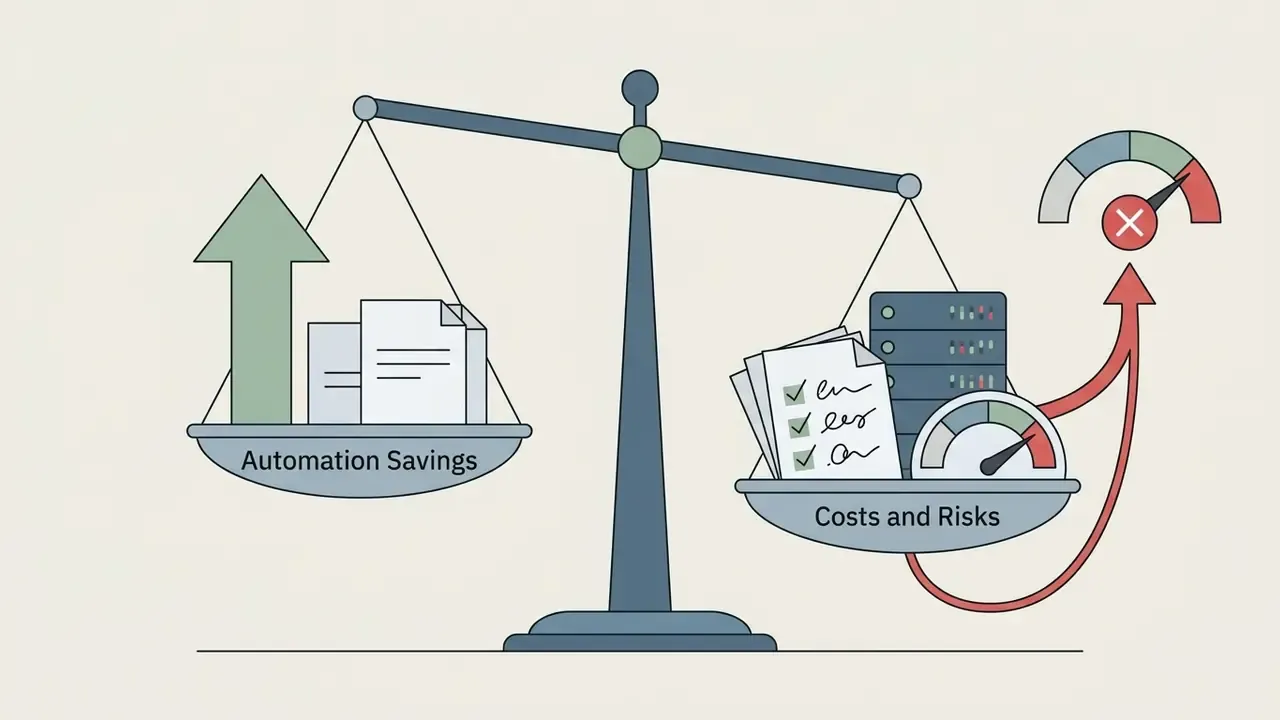
Table: Cost lines commonly missing from agent ROI models
| Cost line | Why it is often omitted | Effect on risk-adjusted ROI |
|---|---|---|
| Reviewer capacity for escalations | Treated as existing headcount | Understates marginal operating cost |
| Trace storage and retention | Charged to platform, not project | Understates multi-year run rate |
| Frozen evaluation reruns per release | Owned by validation budget | Understates change-management cost |
| Incident response and rollback drills | Modelled as an exception | Ignores expected-loss component |
Illustrative cost taxonomy for building a defensible business case; figures must come from your own baselines.
If you are assembling that business case, unit-economics modelling helps more than vendor slides. Our public calculators show the general shape of per-run and per-asset cost stacking, and the same logic transfers to agent workloads.
Choose the Best Way to Create AI Agents
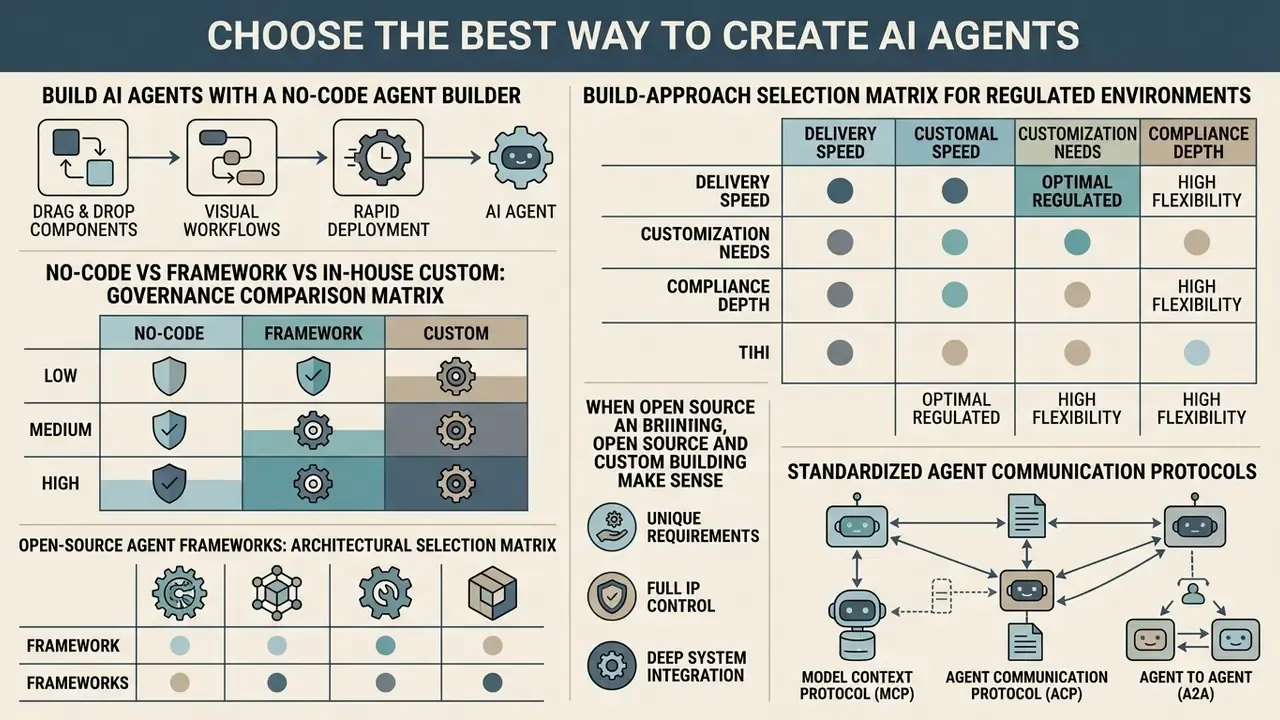
The best way to create AI agents depends on required governance depth, customization needs, and delivery speed, spanning visual no code builders through custom open source frameworks. The trade is rapid prototyping against long-term needs for data sovereignty, custom security gates, and auditability.
Build AI Agents with a No-Code Agent Builder
Visual no code platforms let teams create agents fast by assembling pre built components, prompt nodes, and API connectors without writing infrastructure code. Tools such as Flowise and Coze offer drag-and-drop configuration of function calling and retrieval-augmented generation loops. That speed is real. So are the limits: many no code solutions restrict custom security controls, granular log access, and self-hosted model isolation, which is exactly where regulated validation evidence tends to break.
An honest use for an ai agent builder in a bank: prove the workflow hypothesis in a week with synthetic data, then rebuild the survivor in a controlled environment.
No-Code vs Framework vs In-House Custom: Governance Comparison Matrix
Table: Build-approach selection matrix for regulated environments
| Criterion | No code / low-code platform | Open source framework | In-house custom code |
|---|---|---|---|
| Time to MVP | Hours to days | Days to weeks | Weeks to months |
| Data sovereignty | Vendor-dependent; often multi-tenant | Self-hostable | Full control |
| Audit log access | Platform-defined exports | Full trace access via callbacks | Custom immutable schema |
| Custom guardrails | Limited to available nodes | Extensible middleware | Deny-by-default policy engine |
| Vendor lock-in risk | High | Low to moderate | Minimal |
| Validation effort | Low build, high documentation gap | Moderate | High build, lowest evidence gap |
Selecting a build approach based on speed versus auditability, isolation, and control requirements.
When Open Source and Custom Building Make Sense
Custom development on open source orchestration frameworks, or straight code, gives full control over execution logic, prompt-injection defenses, and data lineage. Secure-development guidance in NIST SP 800-218A covers generative-AI software practices such as hardened environments, parameter integrity, and behavior monitoring. Agent-specific risk framing comes from NIST AI RMF 1.0 and NIST AI 600-1, which expect adversarial testing and documented risk mapping. Together they support custom agentic builds where engineers implement hard policy gates, deny-by-default execution paths, and memory management that third-party no code tools cannot enforce.
Open-Source Agent Frameworks: Architectural Selection Matrix
When deterministic low-code workflows fall short, the choice of open source orchestration framework drives model isolation and execution efficiency.
| Framework | Architecture type | Execution logic | Best for | Key limitation |
|---|---|---|---|---|
| LangChain | Directed acyclic chains | Linear step-by-step execution | Simple sequential tool pipelines | Hard to manage state loops |
| LangGraph | Cyclic graph | Stateful multi-actor graph flows | Complex ReAct loops and human-in-the-loop | Steeper learning curve |
| CrewAI | Role-based multi-agent | Autonomous task delegation | Collaborative role-playing agents | High API token consumption |
| Microsoft AutoGen | Multi-agent conversation | Event-driven agent messaging | Complex enterprise simulations | Requires strict execution sandboxes |
| BeeAI | Modular agentic core | Governed polyglot workflows | Enterprise-grade tool orchestration | Evolving ecosystem |
| MetaGPT | Software-company simulation | Standard Operating Procedure (SOP) | Automated code generation | Rigid execution paths |
| LlamaIndex | Retrieval-centric | Index-driven agentic RAG | Document-heavy knowledge agents | Less suited to long action chains |
Standardized Agent Communication Protocols (MCP, ACP, A2A)
Production agents must reach external databases and peer agents without bespoke glue code for every system. Three standardized protocols now carry most of that weight:
For model risk teams, protocol adoption is a control decision as much as an engineering one. Standardized message envelopes make cross-agent handoffs loggable, replayable, and attributable to a named owner. Without that, "the other agent did it" becomes an unanswerable audit question.
### Key Technical Frameworks & Official Governance Documentation
1. **OpenAI Developer Documentation & APIs**
   - Reference: OpenAI Responses API & Developer Documentation (2026)
   - Scope: Migration from legacy Assistants API (sunset 2026) to structured Responses API and tool execution frameworks.
2. **LangChain Documentation**
   - Reference: LangChain Agent Architecture & Expression Language Docs (docs.langchain.com)
   - Scope: Multi-step orchestration, custom tool binding, and stateful memory management.
3. **CrewAI Framework Documentation**
   - Reference: CrewAI Multi-Agent Orchestration Guide (docs.crewai.com)
   - Scope: Role-based agent delegation, task execution sequences, and collaborative workflows.
4. **LlamaIndex Documentation**
   - Reference: LlamaIndex Data Framework & Agentic RAG Guides (docs.llamaindex.ai)
   - Scope: Structured data source ingestion, vector index retrieval, and context optimization.
5. **Microsoft Agent Framework & AutoGen**
   - Reference: Microsoft Learn & AutoGen Repository (microsoft.github.io/autogen)
   - Scope: Enterprise multi-agent design, graph-based workflows, and human-in-the-loop controls.
6. **NIST AI Risk Management Framework (AI RMF 1.0 / NIST AI 600-1)**
   - Reference: National Institute of Standards and Technology AI Governance Guidelines
   - Scope: Risk identification, trustworthiness metrics, and secure generative AI deployment practices.
7. **Banking Model Risk Guidance (SR 11-7 / OCC Bulletin 2011-12)**
   - Reference: Federal Reserve and OCC supervisory guidance on model risk management
   - Scope: Conceptual soundness, independent validation, effective challenge, and ongoing monitoring.
- Model Context Protocol (MCP)an open standard for exposing local and remote data sources, enterprise tools, and prompt templates to AI models without hardcoded integration layers.
- Agent Communication Protocol (ACP)a structured messaging standard providing consistent message formatting, status reporting, and state transport between heterogeneous execution environments.
- Agent2Agent Protocol (A2A)an enterprise peer-to-peer delegation protocol letting agents built on different frameworks, say AutoGen handing off to CrewAI, delegate tasks, request peer verification, and share contextual memory safely.
Choose AI Models and Data Sources for Your Agent
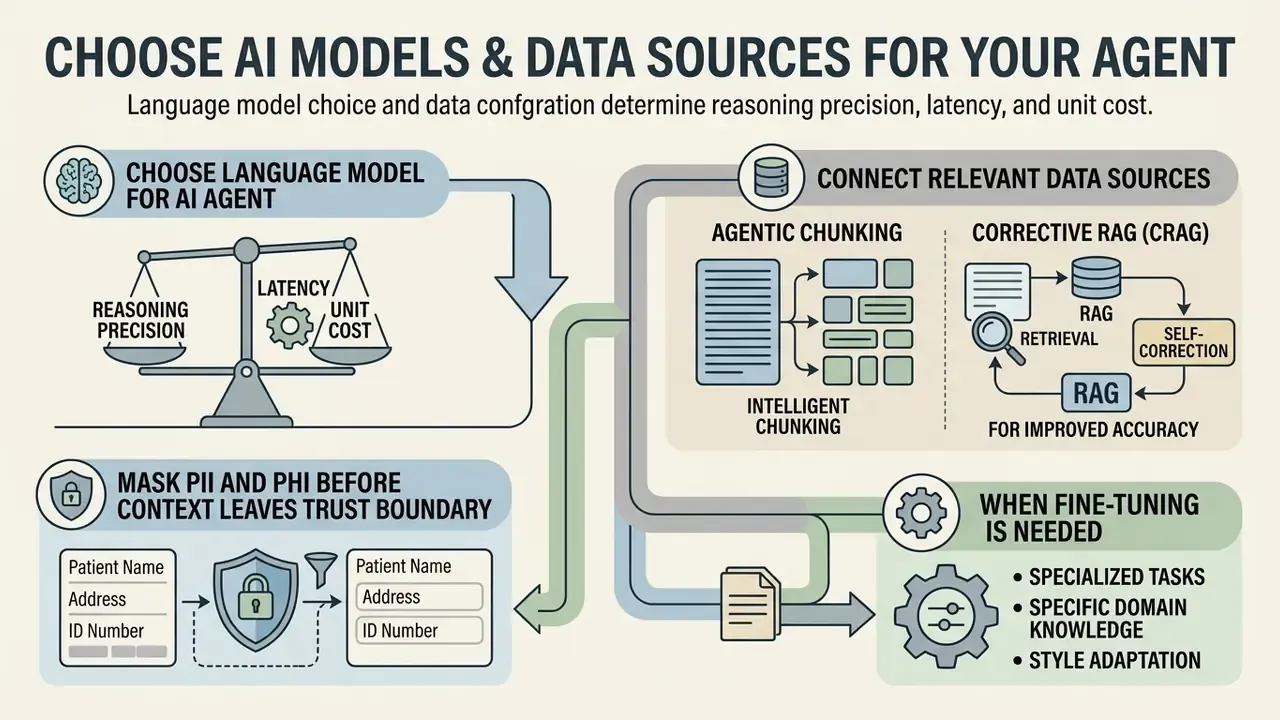
The language model and the retrieval configuration together determine reasoning precision, latency, and unit cost. Strong agentic systems pair a capable reasoning model with tight context retrieval, keeping accuracy high without flooding the processing window.
How to Choose a Language Model for an AI Agent
Evaluating ai models for agent creation means balancing context window capacity, function-calling accuracy, reasoning throughput, and per-token cost. Models tuned for agentic workloads, including current low-latency reasoning APIs from OpenAI and Anthropic's Claude family, provide structured tool calling and high instruction-following fidelity. Ask a blunt question per task: does this step genuinely need expensive multi-step reasoning, or will a cheaper low-latency model handle deterministic tool invocation just as well?
Cost modelling should also cover non-text modalities, where per-second or per-asset pricing dominates token pricing. Our AI Media API Guides and the specific Google Veo API implementation guide show how generation limits and quotas reshape unit economics in agentic media pipelines. Licensing deserves the same scrutiny: if generated assets enter a client-facing channel, check the commercial use terms before the agent ships anything.
Connect Relevant Data Sources: Agentic Chunking and Corrective RAG
Connecting data sources through vector databases, RAG pipelines, or API integrations extends an agent's knowledge. Stuffing context does the opposite: costs climb with context-window utilization and answer quality degrades. Sparse RAG or dynamic chunk retrieval keeps the payload high-relevance. Passing trimmed, schema-validated JSON to the model reduces clutter and limits hallucination.
Basic semantic retrieval often fails in complex agentic workflows, mostly because of arbitrary text splitting and lost contextual dependencies. Two advanced patterns handle that:
- Agentic chunking
- rather than splitting documents by fixed token counts, a language model reads the semantic structure and cuts text at logical concept boundaries, keeping complete functional context inside each chunk.
- Corrective RAG (CRAG)
- an evaluator model scores retrieved document relevance before context reaches the agent. If confidence falls below the threshold, the agent triggers a secondary search vector or external API to fill the gap, which prevents hallucinated tool inputs.
Mask PII and PHI Before Context Leaves the Trust Boundary
Agents in financial services touch account numbers, tax identifiers, transaction narratives, and customer contact data, much of which may not leave an internal environment at all. A production-safe retrieval path therefore adds a pre-model redaction stage: deterministic pattern detection plus entity recognition swaps sensitive values for reversible tokens, the model reasons over tokenized context, and the orchestration layer re-hydrates values only inside the internal execution environment.
Log records should store hashes and token references instead of raw values. Otherwise audit reproducibility creates a second data-leakage surface, and the control designed to satisfy examiners becomes the finding itself.
When Fine-Tuning Is Needed
Fine tuning a language model makes sense when an agent needs persistent behavior changes, strict formatting compliance, or deep domain nomenclature that prompt instructions cannot hold consistently. Otherwise prompt engineering, in-context learning, and RAG usually suffice, since the model already has the reasoning skill and only needs fresh external context at runtime.
A workable decision threshold: attempt fine tuning only after prompt iteration and retrieval tuning have both failed on a frozen, representative test set. Specialized component models follow the same rule. Voice-facing agents, for instance, usually gain more from constrained prompting and controlled vocabularies than from weight updates, as the capability comparison in our guide to AI voice generators shows.
Create Your First AI Agent Step by Step
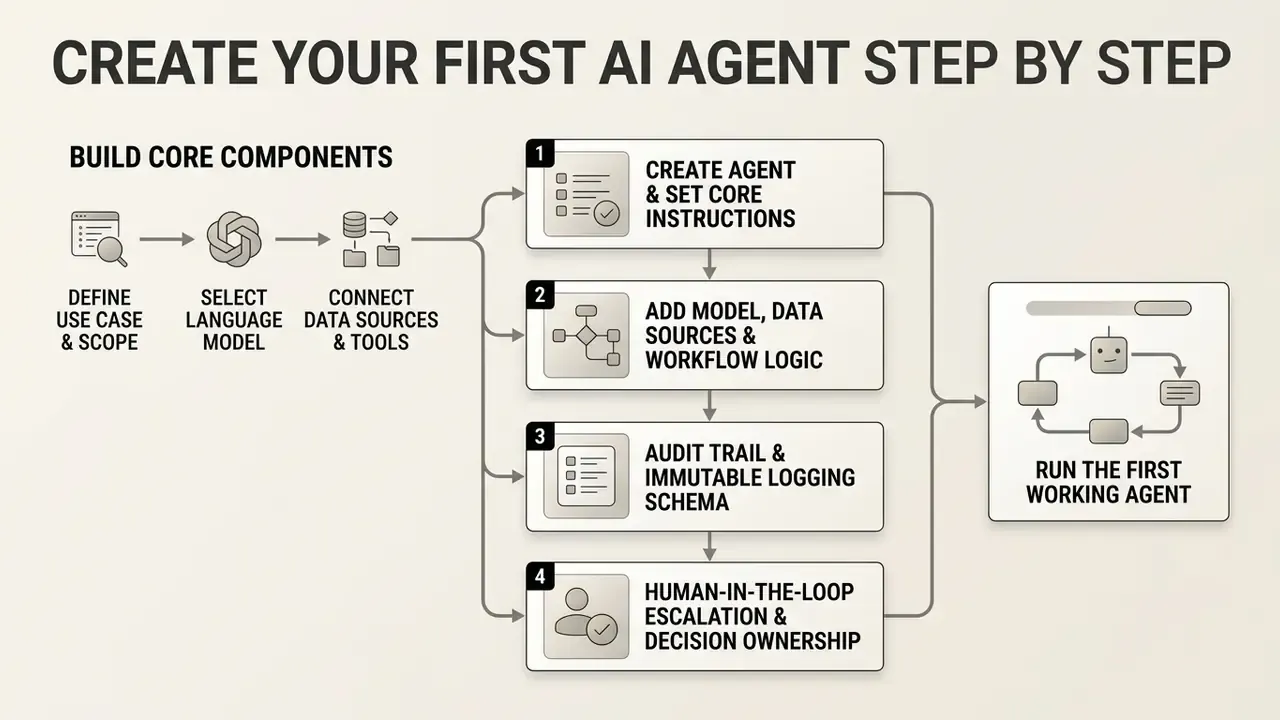
Building a functional agent comes down to three things: core system instructions, a model bound to external tool APIs, and a controlled initial run loop. Follow this tutorial to configure a working agent from system instructions through output evaluation.
Create the Agent and Set Its Core Instructions
System instructions, sometimes called persona definitions, form the operational contract of an AI agent. They define role, allowable tools, decision logic, and hard output boundaries. Process them before any user input, and include explicit negative constraints naming what the agent must never do. Positive instructions alone tend to drift.
SYSTEM INSTRUCTION / PERSONA DEFINITION:
Role: Financial Reconciliation Agent
Objective: Validate incoming invoice line items against purchase orders in the internal ERP database.
Capabilities: Search ERP records, calculate line-item variances, draft discrepancy reports.
Constraints:
1. Read-only access to PO records. Do NOT execute ledger transfers or approve payments.
2. If variance exceeds $500.00, escalate to human manager immediately.
3. Never infer a vendor identity that is not returned by the ERP lookup tool.
4. Output format must strictly conform to JSON schema: {"status": string, "variance": float, "flagged": boolean}.
Instruction craft is its own discipline, and the habits transfer across modalities. Practitioners who have written structured prompts for ai generation tools will recognize the same pattern: precise role, bounded output, explicit prohibitions.
Add the Model, Data Sources, and Workflow Logic
Technical binding means passing tool schemas into the model's function-calling interface and writing an execution loop that acts on model decisions. The control loop sends conversation history and tool definitions to the language model, captures generated tool calls, executes them against internal APIs, feeds results back, and repeats until a final output emerges. Production loops add three things conceptual versions skip: exception handling for tool failures, a hard iteration ceiling, and an audit write on every step. Teams standardising this layer often start from a reference scaffold such as our Starter API Workflow before hardening it for regulated data.
# Conceptual implementation of an auditable agentic ReAct loop
import json, time, uuid
def run_agent_loop(user_query, system_instruction, tools_schema, model_client, audit_log):
    run_id = str(uuid.uuid4())
    messages = [
        {"role": "system", "content": system_instruction},
        {"role": "user", "content": user_query}
    ]
    max_turns = 5  # hard ceiling prevents runaway loops and cost overruns
    for turn in range(max_turns):
        started = time.time()
        response = model_client.generate(messages=messages, tools=tools_schema)
        if response.has_tool_calls():
            for tool_call in response.tool_calls:
                try:
                    tool_result = execute_system_tool(tool_call.name, tool_call.arguments)
                    status = "success"
                except Exception as err:                      # tool failure is a state, not a crash
                    tool_result = {"error": str(err)}
                    status = "tool_error"
                audit_log.write({
                    "run_id": run_id,
                    "turn": turn,
                    "tool_name": tool_call.name,
                    "tool_status": status,
                    "latency_ms": int((time.time() - started) * 1000)
                })
                messages.append({"role": "assistant", "tool_calls": tool_call})
                messages.append({"role": "tool", "name": tool_call.name,
                                 "content": json.dumps(tool_result)})
        else:
            audit_log.write({"run_id": run_id, "turn": turn, "event": "final_output"})
            return response.text
    raise TimeoutError("Agent exceeded maximum execution turns without reaching resolution.")
Audit Trail and Immutable Logging Schema
Validation teams cannot review what was never recorded. Each loop iteration should emit one append-only record carrying enough fields to reconstruct the decision without replaying the model.
{
  "run_id": "8f1c2d4e-77ab-4f10-9c62-0d5a1b7e3c44",
  "turn_index": 2,
  "timestamp_utc": "2026-02-11T09:42:17.482Z",
  "agent_id": "fin-reconciliation-agent",
  "agent_version": "1.4.2",
  "prompt_hash": "sha256:9c1a...e37b",
  "model_id": "reasoning-api-v3",
  "retrieved_doc_ids": ["po-2026-00841", "inv-2026-11723"],
  "tool_call_id": "call_7Kq2",
  "tool_name": "erp_purchase_order_lookup",
  "tool_arguments_hash": "sha256:44de...01ff",
  "tool_status": "success",
  "execution_time_ms": 412,
  "token_usage": {"input": 3184, "output": 216},
  "confidence_score": 0.88,
  "policy_checks": {"pii_masked": true, "write_scope_allowed": false},
  "human_approval_flag": false,
  "escalation_target": null,
  "final_decision": "variance_within_threshold"
}
Write records to append-only storage with hash chaining, so any later modification becomes detectable. That is the practical mechanism behind "immutable audit trail" as a control statement, rather than as a slogan on a governance slide.
Human-in-the-Loop Escalation and Decision Ownership
An escalation rule is incomplete until it names the owner of the resulting decision. Production agents should route above-threshold cases into an existing work-management system, a ServiceNow or Jira ticket, a Slack approval card, or a queue inside the ERP, carrying the proposed action, the evidence relied upon, and the run identifier. The approving human's identity, timestamp, and decision then get written back to the same run record through the human_approval_flag and escalation_target fields.
Two failure modes deserve explicit design attention. Silent timeouts, where an unanswered escalation quietly expires and the case vanishes. And approval laundering, where a reviewer confirms an action without the underlying evidence ever being visible on screen. The second one is harder to detect and far more damaging in an examination.
Run the First Working Agent
The first test run is simple in shape: submit a known input query, capture the full execution trace, then verify that tool invocations and final text outputs match expectations. Reading the thought trace lets developers inspect intermediate reasoning, catch malformed parameters, and confirm that guardrails actually fire before anything moves toward deployment.
Sequential implementation flowchart illustrating the six-stage lifecycle for building, testing, and deploying custom AI agents.
- Define use case and scopedocument operational intent, boundaries, and expected KPIs.
- Select language modelmatch reasoning capacity, latency, and context limits to task needs.
- Connect data sources and toolsimplement schema-validated API interfaces and retrieval pipelines.
- Configure workflow logicset system instructions, negative constraints, and the ReAct execution loop.
- Sandbox testing and trace evaluationrun standard suites and edge cases while logging every trace.
- Governed production deploymentship through API or webhook channels with active human oversight and kill switches.
Test, Deploy, and Improve Your AI Agent
Test Your Agent with Real Inputs and Edge Cases
Testing an AI agent means evaluating behavior across standard inputs, malformed queries, unavailable tools, and adversarial prompt-injection attempts. Evaluation frameworks such as Google's Agent Eval and Braintrust recommend comparing execution traces against ground-truth trajectories, confirming that the agent picks correct tools, passes proper parameters, and refuses unauthorized commands.
A minimum viable test suite holds four families: happy-path cases with reference trajectories, ambiguous or incomplete inputs, tool-failure and timeout simulations, and adversarial payloads with instructions embedded inside documents, emails, or file metadata. For methodology on building repeatable evidence sets, see our approach in AI Media Benchmarks and Review Proof, where the same discipline of frozen inputs and published deltas applies.
Deploy the Agent Where It Will Be Used
Deployment connects the execution engine to operational channels: Slack, Microsoft Teams, enterprise web widgets, or internal ERP systems through secure webhooks and APIs. Production rollouts should carry continuous monitoring, identity-bound access tokens, and automated rollback triggered when output error rates cross agreed thresholds.
Table: AI agent integration and channel execution architecture
| Layer | Technology / protocol | Operational role |
|---|---|---|
| Ingress channels | Webhooks, webchat widgets, Slack API, MS Teams API, email intake | Captures asynchronous user requests and triggers workflow events. |
| Control and logic | ReAct loop / LangGraph state graph | Evaluates step context, enforces negative constraints, routes execution. |
| Integration hub | Model Context Protocol (MCP), REST APIs, OpenAPI schemas | Passes structured payloads securely to internal ERP, CRM, or databases. |
| Guardrails and safety | Human-in-the-loop gate, token rate limiter, kill switch | Intercepts high-risk actions, for example transfers above $500, for manual approval. |
| Observability | Append-only trace store, metric thresholds, alerting | Provides reproducible evidence for validation and incident review. |
End-to-end integration schema showing event entry, control-loop execution, and safe tool invocation.
Common webhook-triggered patterns: a new CRM lead prompting the agent to score and assign it; a support ticket triggering categorization and escalation; an order-status change generating a shipping notification; a security alert prompting analysis and routing to the on-call IT team. Media-operations teams reuse the same trigger model in publishing pipelines, where a content-ready event starts rendering, compression, and metadata tagging. The step sequence documented in our guide to YouTube video editing workflows maps closely onto this event-driven structure, and narrower utilities such as an outro maker or a video compressor for discord slot in as bounded tools with predictable inputs and outputs.
Improve the Agent Through Iteration
Continuous improvement runs on logged execution traces, classified user feedback, tool failure analysis, and targeted revisions to system prompts or knowledge base chunks.
So the loop is: log, classify failures by type and frequency, change one variable (prompt version, retrieval configuration, or tool schema), re-run the frozen evaluation set, promote only when the measured delta is positive. One variable at a time. Bundled changes make regression analysis guesswork, and guesswork does not survive effective challenge. Deterministic compilation of frequent tool sequences lifts task completion while trimming runtime latency and API spend.
Common Mistakes When Building AI Agents
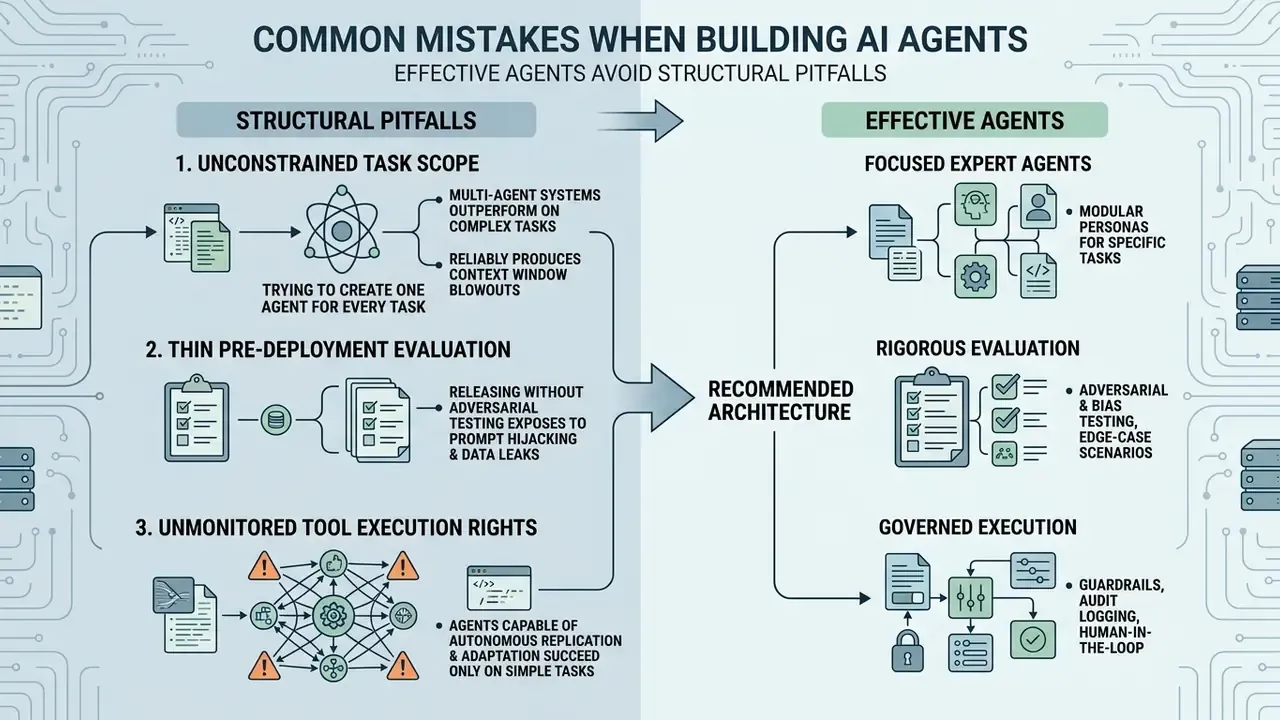
Effective agents avoid a short list of structural pitfalls: unconstrained task scope, thin pre-deployment evaluation, and unmonitored tool execution rights. Microsoft's Taxonomy of Failure Modes in Agentic AI Systems (2026) reports that unmanaged autonomy tends to produce action abuse, resource exhaustion, and security vulnerabilities, alongside memory poisoning, human-in-the-loop bypass, incorrect permissions, and loss of data provenance.
Trying to Create One Agent for Every Task
Attempting to create my own universal agent for all business operations reliably produces context window overflow, prompt dilution, tool selection errors, and looping. It is the most common design error we see described in practitioner write-ups.
The implication is architectural rather than ideological. Complex environments call for modular multi-agent systems, where specialized sub-agents own distinct tasks under a coordinator. Simple bounded tasks should stay with one constrained agent instead of being escalated into a committee of models that bills tokens for agreement.
Deploying Without Enough Testing and Refinement
Releasing an agent without adversarial testing exposes the institution to prompt hijacking, data exfiltration, and erroneous system updates. NIST AI 600-1 documents how agents lacking execution boundaries can be manipulated through indirect prompt injection hidden inside external documents or email payloads, and NIST's applied work on agent hijacking shows the same attack class triggering harmful unintended actions.
Limitations and Open Questions
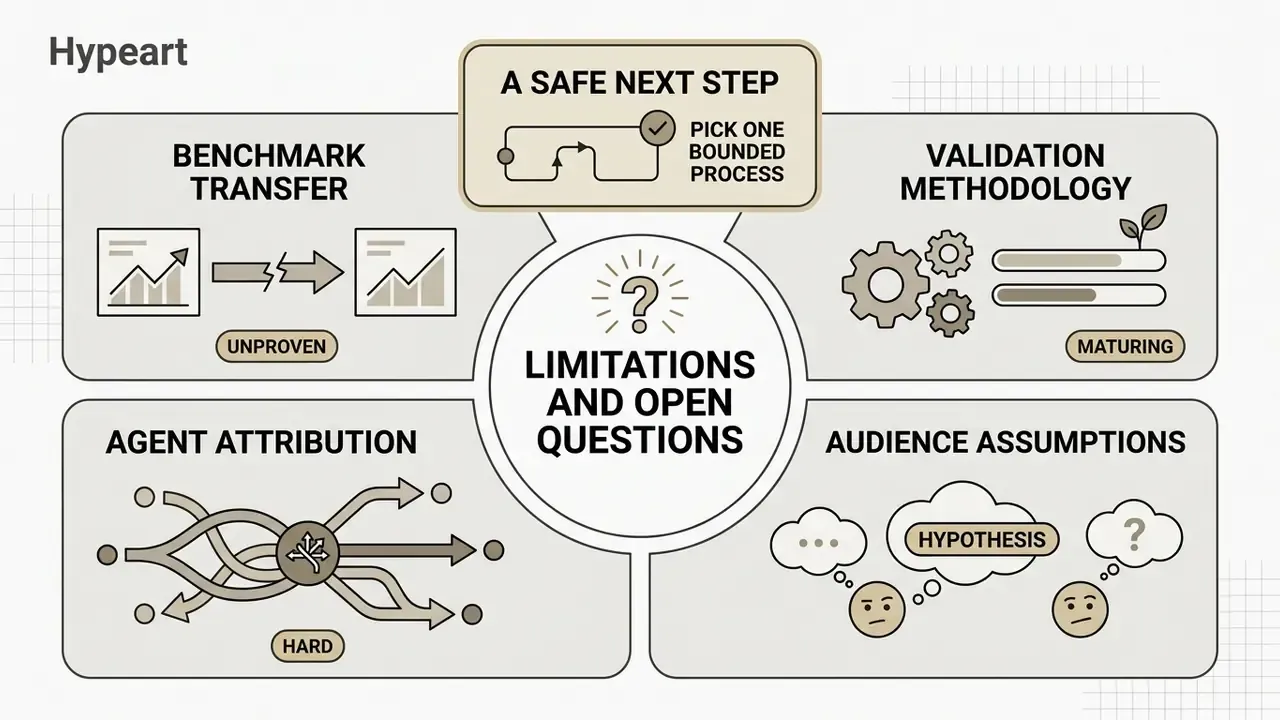
A few things remain genuinely unsettled, and pretending otherwise would be dishonest.
- Benchmark transfer is unproven. Published agent benchmarks use public tools and synthetic environments. How those results map to a bank's ERP, core, and case-management stack is still an open empirical question.
- Validation methodology is maturing. Conventional model validation assumes a stable input-output mapping. Agentic behavior shifts with tool availability and retrieved context, so validators are still converging on acceptable evidence for non-determinism.
- Audience assumptions stay hypotheses. Statements about what CROs and heads of model risk prioritise should be treated as hypotheses until confirmed by interviews, analytics, or CRM evidence.
- Attribution across agents is hard. With A2A delegation, responsibility allocation between a delegating and a receiving agent is a governance question with no settled market answer.
A Safe Next Step
Pick one bounded process. Register it in the model inventory before the first line of code. Build the trace schema and escalation path alongside the loop, then run four weeks in shadow mode with humans deciding and the agent only proposing. Compare proposals against human decisions, publish the delta, and let that number, not enthusiasm, decide whether autonomy expands.
FAQ: Frequently Asked Questions
What is the main difference between an AI agent and an AI chatbot?
An AI chatbot follows pre-defined rules or generates conversational text from single-turn prompts. An AI agent uses a language model as an autonomous reasoning engine to make multi-step decisions, call external tool APIs, maintain state, and complete end-to-end tasks with minimal human intervention.
How can I create an AI agent without writing code?
Start with a visual no code agent builder and pre built connectors, using synthetic or masked data only. Define the use case, attach read-only data sources, and test the loop. Before production in a regulated setting, confirm whether the platform can export full execution traces, isolate your data, and support least-privilege credentials. If it cannot, rebuild the workflow on an open source framework or in house.
Can I combine multiple LLMs in a single agentic workflow?
Yes. Modern multi-agent architectures routinely route tasks to specialized models. A cheaper low-latency model can handle tool selection and JSON parsing, while a stronger reasoning model handles multi-step synthesis, provided each model version is separately inventoried and evaluated.
How do I control API costs and prevent runaway loops in production agents?
Set strict loop limits, for instance a maximum of five ReAct iterations. Pre-filter inputs with deterministic code, cache vector retrieval outputs, compile recurring tool sequences into deterministic meta-tools, and enforce execution timeouts plus token rate limits inside the control engine.
When should I fine-tune a model instead of using RAG for my AI agent?
Use retrieval-augmented generation when the agent needs dynamic, frequently updated enterprise data. Use fine tuning only when the agent must consistently hold complex output formatting, specialized industry jargon, or behavioral constraints that prompt instructions repeatedly fail to maintain on a representative test set.
What evidence do model validators typically expect for an agentic system?
Usually a model inventory entry, documented conceptual soundness, a frozen adversarial evaluation set owned independently of the build team, reproducible run traces linking inputs, prompt versions, retrieved context and tool calls, plus ongoing monitoring thresholds and escalation records consistent with SR 11-7 and OCC 2011-12 expectations.
Revision Notes (Editorial Transparency)
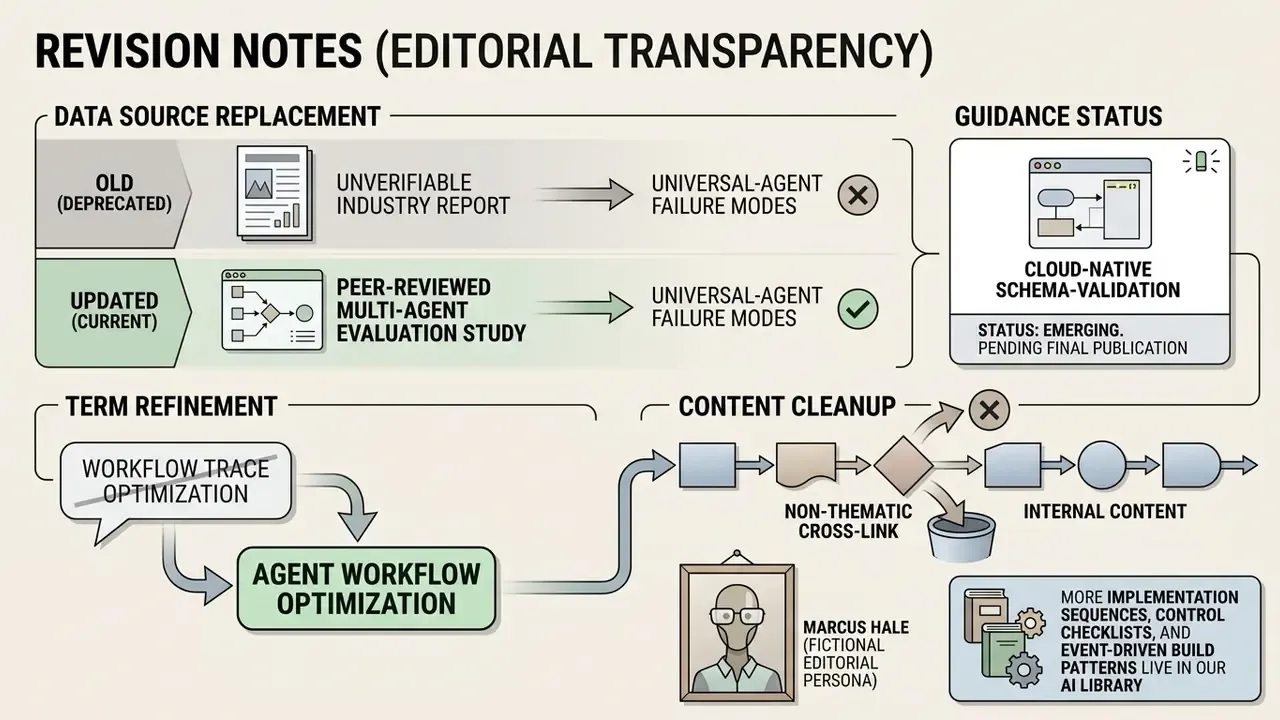
- The earlier attribution of universal-agent failure modes to an unverifiable 2026 industry report has been replaced with a peer-reviewed multi-agent evaluation study reporting comparative task outcomes.
- The earlier unquantified reference to workflow trace optimization now carries the full term Agent Workflow Optimization (AWO) and its reported metrics.
- Cloud-native schema-validation guidance is described as emerging, pending final publication.
- Non-thematic cross-links previously appended to the safety section have been removed; remaining internal references appear only where contextually relevant.
- Marcus Hale, author. No biography, client work, or regulatory authority should be inferred from the commentary attributed to him.
More implementation sequences, control checklists, and event-driven build patterns live in our library of AI Media Workflows.