Why should a risk or compliance leader care about plotter drawings from 1965? Because the attribution problem in early AI art is the same problem that shows up in a model inventory today: who decided, what was recorded, and can anyone reproduce the result.
Last updated: March 2026 | Author: Marcus Hale, AI Governance and Model Risk Advisor | Review focus: historical attribution, model architecture, commercial compliance
Author note: Marcus Hale writes about AI governance and model risk for this publication.
Executive Summary for Decision-Makers
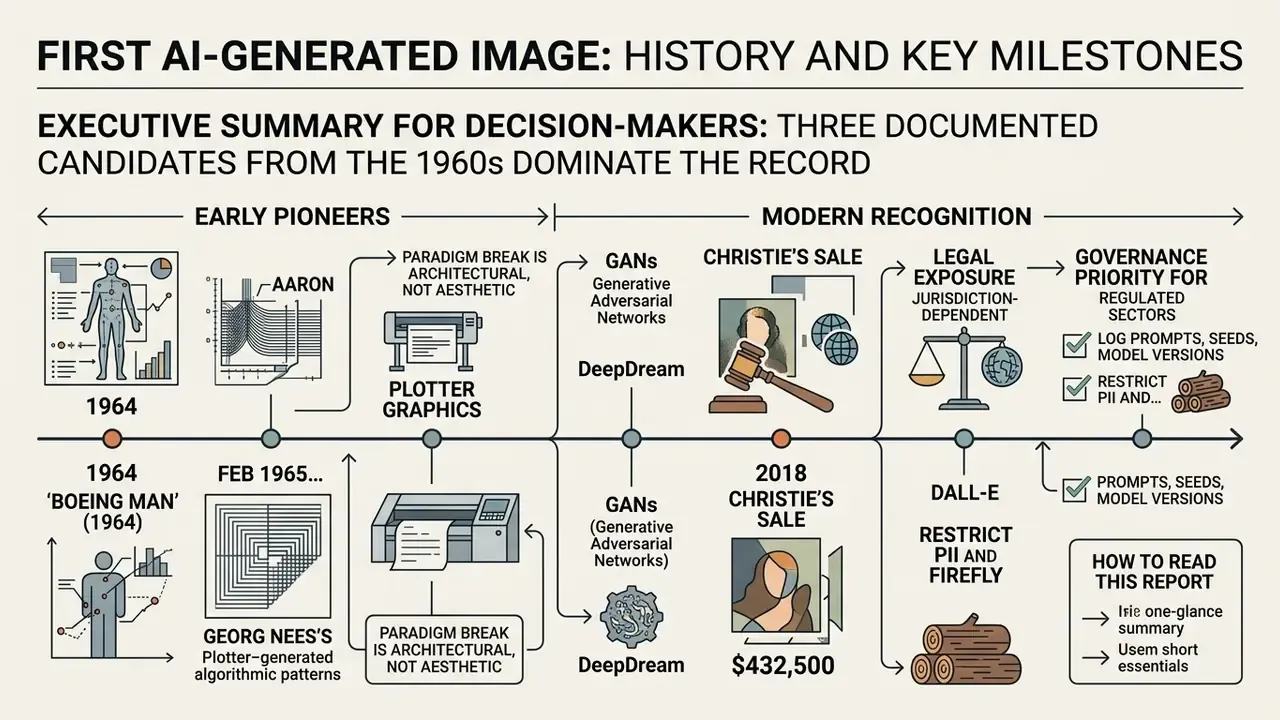
- There is no single "first" AI image. Attribution depends on definition: algorithmic plotter graphics (1964–1966), autonomous rule-based systems such as Harold Cohen's AARON (early 1970s), or statistical neural synthesis (GANs 2014, diffusion 2021 to present).
- Three documented candidates dominate the 1960s record: Boeing Man (1964), Georg Nees's February 1965 Stuttgart exhibition using a Zuse Graphomat Z64 plotter, and Bell Labs' Studies in Perception I (1966) by Kenneth Knowlton and Leon Harmon.
- The paradigm break is architectural, not aesthetic. Early systems executed hand-coded rules with zero learning; modern systems learn probability distributions in latent space, which changes how model risk, reproducibility, and validation must be governed.
- Market recognition arrived in 2018, when Christie's New York sold Portrait of Edmond de Belamy for $432,500, roughly 45 times its high estimate.
- Legal exposure is jurisdiction-dependent. In the United States, Thaler v. Perlmutter (2023) confirmed that human authorship is a prerequisite for copyright; the EU AI Act mandates synthetic-media disclosure; Chinese courts have granted protection where human prompt iteration was substantial.
- Governance priority for regulated sectors: log prompts, seeds, and model versions; restrict PII and confidential data from public generator APIs; clear trademark and reference-image rights before publication.
How to read this report. The first half is historical and reconstructs the disputed timeline of early AI images, from plotter code to symbolic rule engines. The second half is operational and maps that history onto three questions a bank or fintech buyer actually has to answer. First, is a generated visual asset a model output that belongs in the AI inventory? Our working view is yes, because output variance is stochastic and cannot be certified by code review alone. Second, what evidence proves a published asset was produced under approved controls? Prompt, seed, sampler, guidance scale, checkpoint version, reference-image licence, and a named reviewer. Third, where does the residual risk sit after the licence is signed? Usually in three places: input data leaving the perimeter, third-party marks appearing inside a generated frame, and representation bias in the final creative. The historical sections explain why those three exposures exist at all.
Defining the First AI Generated Image
There is no single universally acknowledged first AI generated image because the definitions of artificial intelligence and machine generation have shifted dramatically. Early algorithmic graphics relied on pre-programmed instructions executed on pen plotters, whereas modern generative AI synthesizes new visuals by learning statistical patterns from massive datasets.
Institutional guidance reflects the same split. Commonwealth University's 2026 AI Image Guidance defines AI-generated images as those whose primary composition or key visual elements are determined by AI software rather than manual human effort, while the Hong Kong Digital Policy Office's 2026 generative AI guideline describes image generation specifically through GANs and diffusion models that map text semantics to vectors and decode images in latent space. Under the first definition, a 1965 plotter drawing qualifies. Under the second, it does not.
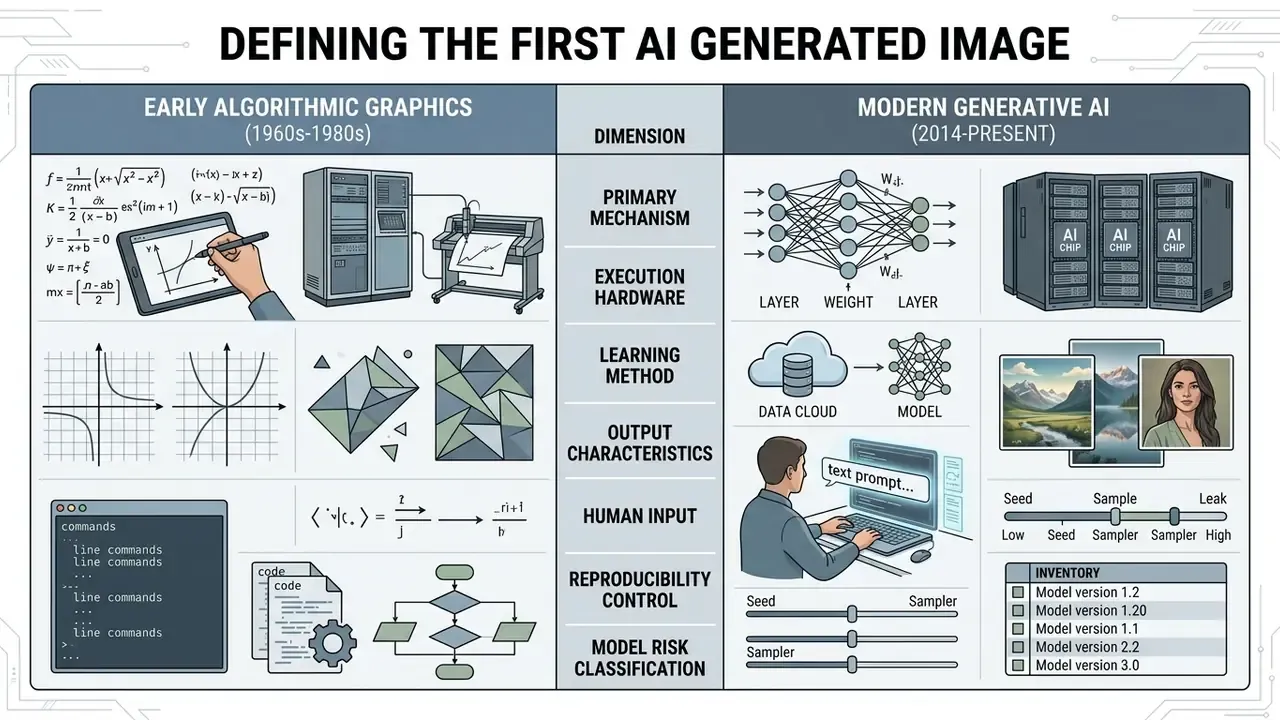
For model risk taxonomies, the final two rows matter most. A deterministic 1960s plotter program could be validated by reading its source code. A diffusion model can only be validated statistically, through output sampling, artifact auditing, and reproducibility logging of seeds, guidance scales, and checkpoint versions. That is a different validation discipline, not a harder version of the old one.
Early Candidates: Georg Nees, Frieder Nake, and A. Michael Noll
The primary candidates for creating the earliest algorithmic images are European and American computing pioneers who displayed machine-drawn art in 1965. German mathematician Georg Nees held the earliest documented public computer art exhibition, Computer-Grafik, 4 to 19 February 1965, at the Studiengalerie der TH Stuttgart, using a digital computer at Siemens paired with a Zuse Graphomat Z64 plotter. Readers who want to see how far the toolchain has travelled since then can compare contemporary AI image generators against those first plotter workflows.
Frieder Nake produced his first works in 1963 and exhibited plotter drawings at Galerie Wendelin Niedlich in Stuttgart from 5 to 26 November 1965; his 1966 drawings were generated by the ALGOL 60 program Walk-through-Raster and plotted on the same Zuse Graphomat Z64 hardware. A. Michael Noll opened Computer-Generated Pictures at the Howard Wise Gallery in New York on 8 April 1965, running to 24 April 1965, which he described as the first major U.S. exhibit of computer art. Noll's interest began at Bell Labs in the early 1960s after a colleague's plotter error produced an unexpectedly interesting pattern, prompting his exploration of pseudorandomness. A machine fault, in other words, seeded a genre. Priority remains contested: some histories note Joan Shogren's 1963 San Jose show as an earlier candidate, so any claim about the first AI generated image ever should be stated with its definition attached.
Chronology of Early AI Image Generation: From the 1960s to AARON
The evolution of early AI image generation spans four major technical phases: 1960s vector plotting, 1970s to 1980s rule-based autonomous systems, 1990s evolutionary and interactive computation, and 2010s statistical neural synthesis. Each epoch expanded the machine's role from executing explicit geometric tasks to making autonomous compositional choices.
1960s AI Art: Algorithms, Plotters, and Early Images
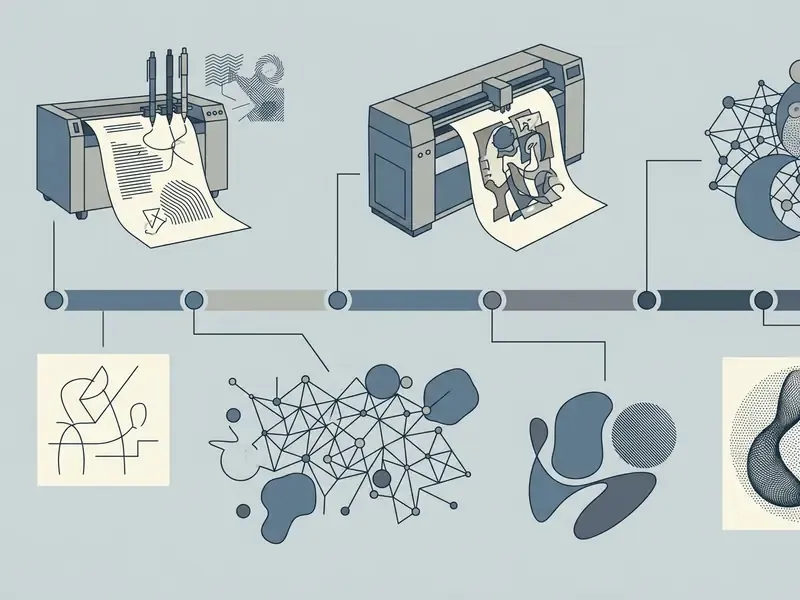
Early 1960s computer graphics relied on mainframe computers processing punched cards to feed coordinates into mechanical vector plotters. Program decks and image data were batch-processed; pseudorandom-number subroutines with defined probability distributions selected geometric elements, line frequencies, and drawing commands. Artists like Frieder Nake used mathematical subroutines in ALGOL 60 to generate complex geometric lines, establishing the foundations of machine visual creation. No screen, no preview, no undo.
"Molnár wrote code on a machine without a screen, waited hours for the plotter's result, and iteratively revised the program, investigating painterly problems by computational means."
That workflow explains the visual grammar of the period: constrained shape libraries, visible repetition, symmetry, and parameterized variation, all produced through iterative human-machine feedback measured in hours rather than seconds. It also explains why these early AI pictures are so easy to authenticate. The code and the plot are both artefacts, and both survive.
AARON and the Transition from Geometric Works to Autonomous Drawing
(Updated) Harold Cohen conceived AARON at UC San Diego in the late 1960s; documented development work occurred in the early 1970s, with the system named AARON in 1973 and refined during a 1973 to 1975 residency at the Stanford AI Lab. Sources diverge on the origin date because "1968" refers to conception and "1972-1973" to first exhibition and operational deployment. Unlike modern statistical systems, AARON operated on hand-coded knowledge rules that enabled it to construct organic human figures and botanical forms without learning from training images. If you want a candidate for the first AI art generator in the strict sense of an autonomous drawing agent, this is it.
"AARON is a symbolic AI system trained on rules rather than large datasets; each new capability had to be hand-coded by Cohen."
Technically, AARON drew using a branching structure of rules, stored knowledge about subject matter, and feedback paths from marks it had already made. Early output was monochrome line work that Cohen coloured by hand; by the mid-1980s the system chose and applied colour itself and produced freehand figures in garden-like settings with rudimentary perspective. Development continued in phases until Cohen's death in 2016, and the system has not been updated since. Its downside was structural: every plausible scenario had to be anticipated and encoded in advance. Governance teams will recognise the trade-off immediately. Full explainability, almost no generalisation.
Evolutionary Computation and Interactive Art (1990s)
During the late 1980s and 1990s, artists shifted from fixed rule-based drawing engines to evolutionary algorithms in which selection pressure, not authored geometry, determined the image. Karl Sims, artist-in-residence at Thinking Machines from 1990 to 1996 and winner of the Golden Nica at Ars Electronica in both 1991 and 1992, introduced interactive artificial evolution in his 1997 installation Galápagos at the Tokyo InterCommunication Center, where visitors selected visually appealing 3D animated forms and evolved increasingly complex genetic shapes across generations.
In 1999, Scott Draves and a team of engineers launched Electric Sheep, a distributed computing project that used genetic algorithms to continuously generate and morph fractal animations based on voting feedback from millions of networked screensaver users worldwide. Draves received the Fundación Telefónica Life 4.0 prize for the project in 2001. Both works matter historically because they relocated authorship from the programmer's rule set to a population-level selection process, an intermediate step between AARON's symbolic logic and the learned distributions of neural models. Authorship became distributed before the models did.
How Technology Reshaped AI Image Generator History
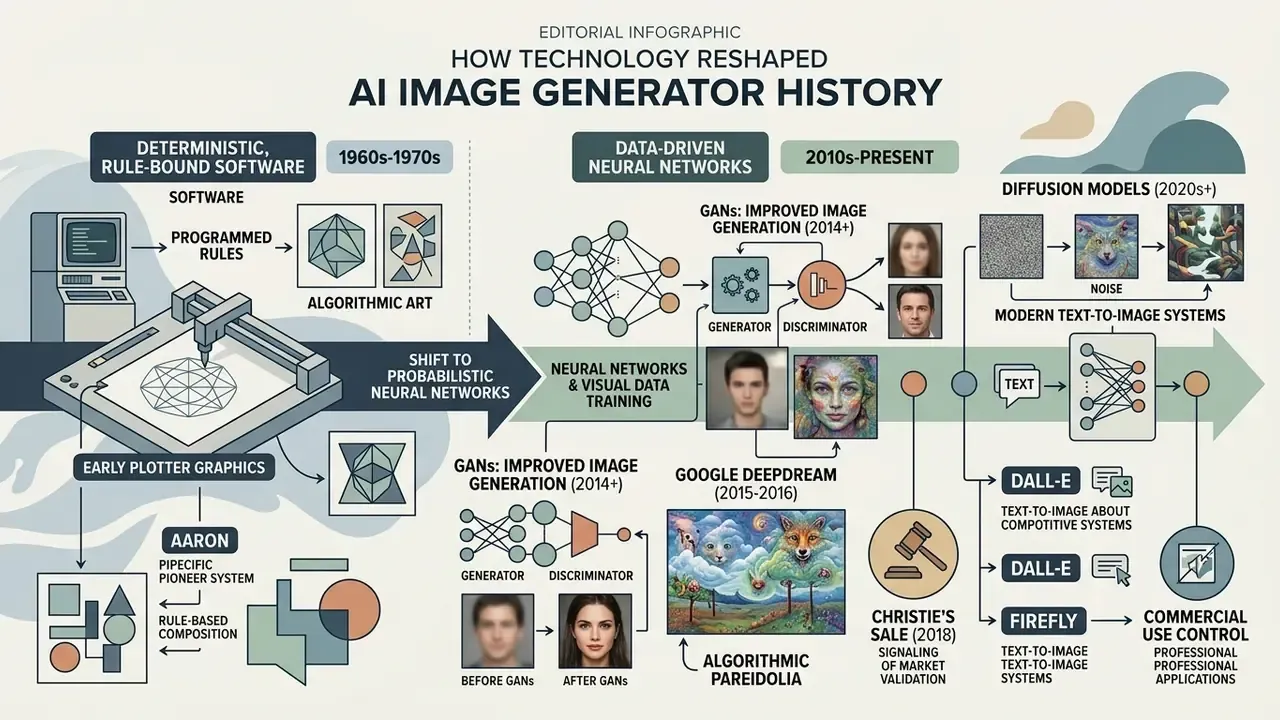
Technological progress shifted AI image generator history from deterministic, rule-bound software to data-driven probabilistic neural networks. This transition replaced manual coding of visual structures with automated pattern learning across billions of digital images. Teams benchmarking today's options can review comparative evaluations of the best AI image generators alongside this architectural history.
Neural Networks and Training on Visual Data
Neural networks generate new images by learning abstract visual representations from vast training datasets rather than executing explicit drawing commands. The model compresses pixel relationships into a lower-dimensional latent space, where visual concepts like style, lighting, and anatomy map to mathematical vectors. Latent diffusion architectures formalize this in two stages: an autoencoder is trained first, and the generative model is then learned inside the autoencoder's compressed latent space instead of raw pixel space, so that similar images occupy nearby coordinates and can be interpolated smoothly.
One practical consequence for validators: the training corpus, not the code, now carries most of the risk. Provenance of the data is a control question, not a research detail.
GANs: How Generative Adversarial Networks Improved the Generated Image
Ian Goodfellow introduced Generative Adversarial Networks in 2014, fundamentally improving synthetic image realism through a competitive two-network architecture. The generator network creates synthetic visual samples, while the discriminator network learns to distinguish fake images from authentic training data, driving continuous visual refinement.
"The discriminator's ability to separate fake data from real forces the generator to produce increasingly realistic samples through iterative updates of both networks."
The original formulation is a two-player zero-sum game in which the generator minimizes and the discriminator maximizes the same value function:
Goodfellow et al., "Generative Adversarial Nets," NeurIPS (2014). https://arxiv.org/abs/1406.2661
(Updated) For regulated environments, the governance lesson from the GAN era is procedural rather than numerical. Because adversarial training optimizes a moving target, output quality cannot be certified by inspecting code; it must be sampled, scored, and logged. Risk functions that treat image generators as part of the model inventory typically implement three controls: discriminator-style anomaly review of structural defects before release, retention of seeds and model checkpoints so any published asset can be regenerated for audit, and documented human sign-off on the final selection. NIST's AI RMF: Generative Artificial Intelligence Profile (2024) frames the same requirements as governance, content provenance, pre-deployment testing, and incident disclosure. https://www.nist.gov/itl/ai-risk-management-framework
Google DeepDream and Algorithmic Pareidolia (2015-2016)
Before text-conditioned diffusion models emerged, Google released DeepDream in July 2015, introducing a method for visualizing the internal representations of deep convolutional neural networks. Engineered by Alexander Mordvintsev, DeepDream inverted the classification objective: instead of labelling an image, the network amplified the features it detected in raw visual input through gradient ascent.
The process produced hallucinated visual patterns characterized by repeated eye motifs, architectural geometries, and organic textures, a phenomenon described as algorithmic pareidolia, with a dream-like appearance reminiscent of psychedelic imagery. DeepDream demonstrated that trained neural classifiers already contained internal visual features capable of synthesizing original imagery, and it seeded the aesthetic vocabulary of early neural art. The same period produced the first caption-to-image experiments and, by 2021, VQGAN+CLIP workflows on platforms such as NightCafe, which coupled a discrete visual codebook with CLIP guidance and became the first widely accessible prompt-driven art pipeline before diffusion models displaced it. For many users, that pipeline was effectively the first AI generator they ever touched.
Diffusion Models and Modern Text-to-Image Systems
Diffusion models replaced GANs as the leading paradigm for image generation by learning to reverse a step-by-step Gaussian noise process. Modern systems utilize cross-attention mechanisms to map text prompt semantics directly into latent denoising steps, yielding photorealistic images aligned with complex human descriptions. Language models sit on the front end of this pipeline, encoding the prompt before a single pixel is touched.
"Diffusion probabilistic models are trained with variational inference to reverse a noising process in order to generate image samples."
In the canonical DDPM formulation, the forward process is fixed and adds Gaussian noise according to a schedule , while the learned reverse chain reconstructs data from noise. This differs from GAN training in two governance-relevant ways: the objective is likelihood-based rather than adversarial, and sampling is iterative, which makes the number of denoising steps, the sampler, and the guidance scale auditable parameters. Imagen's multi-stage pipeline, a 64x64 base model followed by 256x256 and 1024x1024 super-resolution stages, illustrates how high-resolution fidelity is assembled rather than generated in one pass.
How Modern AI Image Generation Works
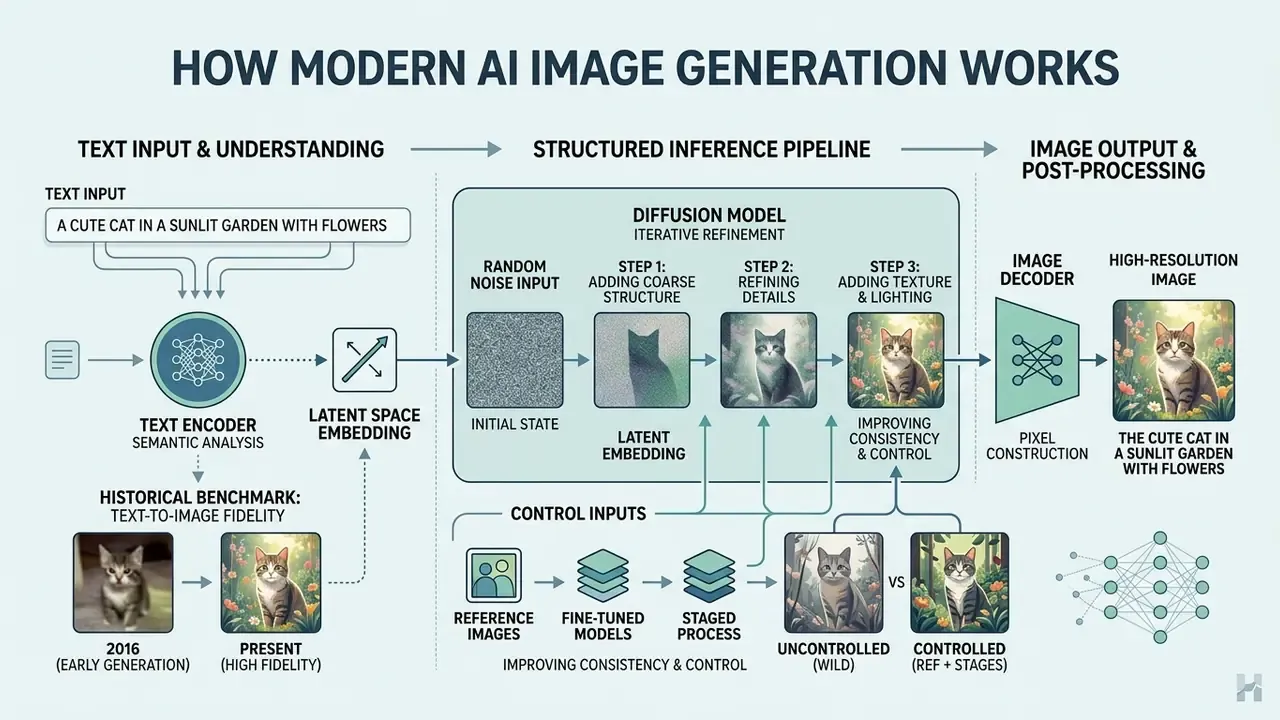
Modern text-to-image systems convert textual descriptions into pixels through a structured multi-stage inference pipeline. The process aligns linguistic semantics with visual representations inside compressed mathematical spaces.
"Trustworthy text-to-image research identifies six core properties: robustness, fairness, safety, privacy, factuality, and explainability."
How Text Prompts Influence the Created Image
Text prompt engineering dictates visual composition by providing explicit instructions regarding subject matter, artistic style, camera angle, and lighting conditions. Research shows that structured prompts containing specific stylistic keywords and descriptive parameters yield higher visual coherence and stronger semantic alignment. A 2021 study on prompt design for text-to-image models found that prompts organized around subject plus style keywords produced more coherent outputs ("Design Guidelines for Prompt Engineering Text-to-Image Generative Models," arXiv, 2021, https://arxiv.org/abs/2109.06977), while a large prompt-log analysis reported that quality correlated with prompt length and the presence of subject, form, and intent terms. Adobe's own guidance confirms that adding style, camera angle, lighting, colour palette, and atmosphere improves control over composition, realism, and mood.
Style tokens do a lot of work here. Ask for an oil painting and you get impasto texture and canvas weave; ask for a 35mm photograph and you get depth of field and lens falloff. Same model, same seed, entirely different risk profile for a regulated campaign, since photorealistic output is far more likely to be mistaken for documentary evidence.
"Prompts alone generally do not provide sufficient control over expressive elements to make the user an author of the resulting work."
Historical Benchmark Case: Text-to-Image Fidelity (2016 vs. Present)
To measure resolution and semantic-alignment progress, researchers reuse standardized text benchmarks across model generations. In 2016, early caption-to-image models processed the prompt "a stop sign is flying in blue skies" and produced low-resolution (roughly 32x32 pixel) blurred red shapes with severe noise artifacts, in which the octagonal geometry of the sign was not recoverable.
Modern diffusion transformers processing the identical prompt render exact octagonal geometry, reflective paint micro-textures, physical motion blur, and photorealistic atmospheric lighting in seconds, a single-prompt demonstration of a decade of architectural progress. The same prompt therefore functions as a practical regression test: if a newer model degrades on it, the failure is architectural rather than stylistic. Cheap test, useful signal.
Why Fine Tune, Reference Inputs, and Staged Generation Matter
Enterprise workflows rely on fine tuning and reference image conditioning to maintain brand consistency across generated outputs. Techniques like LoRA (Low-Rank Adaptation) and mask-based inpainting allow creators to modify localized image regions without altering surrounding composition. Published methods show how little data this requires: DreamCom fine-tunes a text-guided inpainting model on three to five reference images of the same object, FaithFill uses a single reference image with LoRA fine-tuning of the U-Net and text encoder, and RealFill fine-tunes a pretrained inpainting diffusion model on reference photos that may differ in viewpoint, lighting, aperture, and style.
(Updated) To evaluate media production workflows, a regulated-industry media team ran an illustrative test of multi-reference image conditioning across automated asset creation tasks. The team implemented reference-guided diffusion pipelines to maintain visual brand identity across global marketing campaigns, and paired them with an approval register capturing the reference source, its licence, and the responsible reviewer. This approach eliminated manual retouching cycles, cutting production turnaround time from three days to under four hours while maintaining style consistency and a defensible rights trail for every reference asset. Campaign formats that require aspect-ratio changes are handled with AI outpainting and image expansion tools rather than re-generation, which preserves the approved composition. Repeatable pipelines of this kind are documented in the AI production workflows library, where each step carries an owner and a logging requirement.
From Early AI Pictures to DALL-E, Firefly, and Modern Models
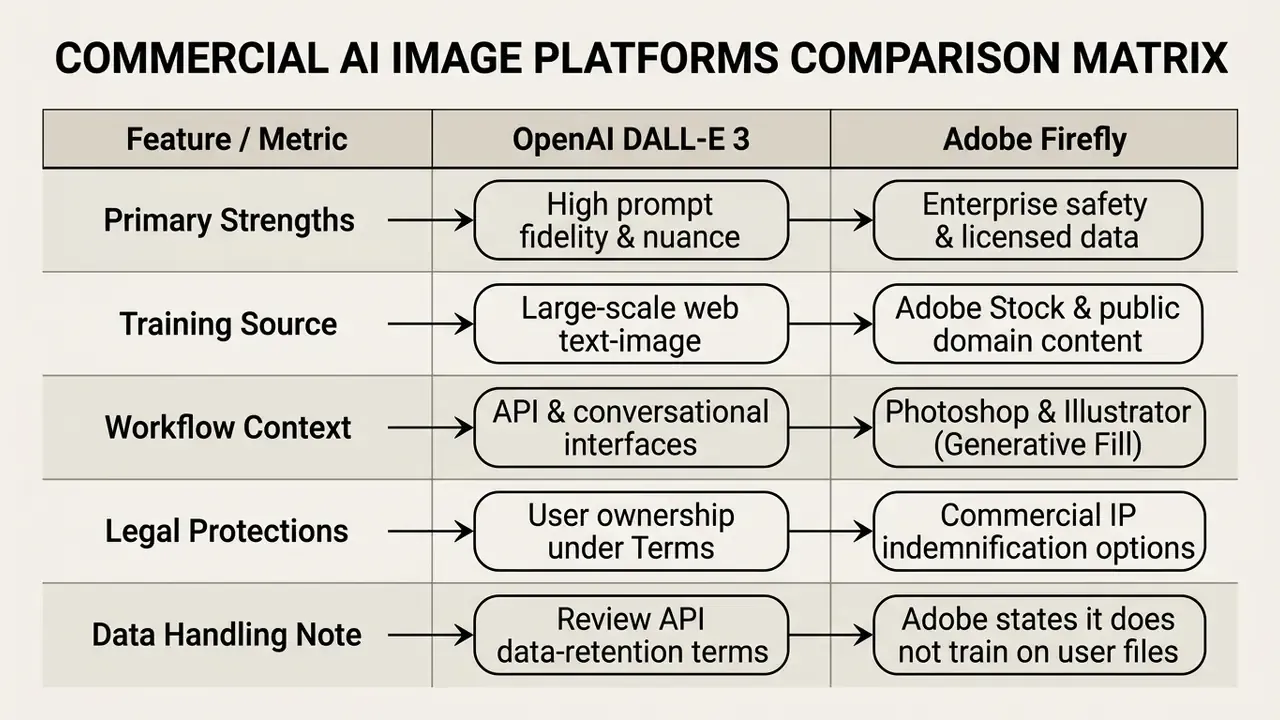
The transition from academic research models to commercial production platforms transformed AI image tools into enterprise creative software. Modern services integrate text conditioning, safety controls, and native editing features directly into design applications. Buyers mapping the current landscape can navigate the category through curated overviews of AI art generators and their licensing models, or start from the broader AI creation reference set.
The 2018 Auction Landmark: Edmond de Belamy and Commercial Art Market Recognition
In October 2018, commercial recognition of AI-generated art reached a historical milestone when Christie's auction house in New York sold Portrait of Edmond de Belamy for $432,500, nearly 45 times its high estimate of $10,000 (the published estimate range was US$7,000 to 10,000). Created by the Paris-based collective Obvious, the portrait was generated with a Generative Adversarial Network trained on a dataset of roughly 15,000 portraits painted between the 14th and 20th centuries, and the printed signature on the canvas reproduced the adversarial loss function itself. A signature made of maths. Hard to beat as a symbol.
The sale marked the transition of synthetic visual media from computer-science laboratories into high-value institutional art markets, and it triggered the first mainstream debate over creative authorship and algorithmic ownership, the same debate that US and EU regulators would formalize five years later. It also established the market template that later controversies followed, including the 2022 Colorado State Fair digital-art win by Théâtre d'Opéra Spatial and the 2023 "first AI-generated award-winning photograph" published by Australian company Absolutely AI, both of which forced competition organizers to introduce explicit synthetic-media disclosure rules.
DALL-E and the Mass Adoption of AI Generated Images
OpenAI launched DALL-E on 5 January 2021, demonstrating that transformer architectures, in this case a 12-billion-parameter model trained on text and image pairs, could synthesize coherent visuals directly from natural language prompts. DALL-E 2 followed on 6 April 2022 with more realistic output at four times the resolution; the waitlist was removed on 28 September 2022, when OpenAI reported that over 1.5 million active users were producing more than 2 million images daily. The API entered public beta on 3 November 2022, and DALL-E 3 was announced on 20 September 2023 with a system card published on 3 October 2023, explicitly targeting caption fidelity for longer, more nuanced prompts. Procurement teams comparing this lineage against Midjourney and competing platforms should weigh licence tiers as carefully as output quality.
Competition since then has been relentless. Google's Gemini-based image model, widely known by its Nano Banana nickname, pushed conversational editing and character consistency into mainstream use during 2025, and the practical effect for buyers is that any platform comparison ages within a quarter or two. Re-verify, do not archive.
"Integrating DALL-E 3 into a style-transfer pipeline increased output diversity and artistic quality while reducing total processing time by roughly 2.5 seconds."
Adobe Firefly and Image Generation for Creative Tasks
How to Distinguish Early AI Images from Modern AI-Generated Visuals
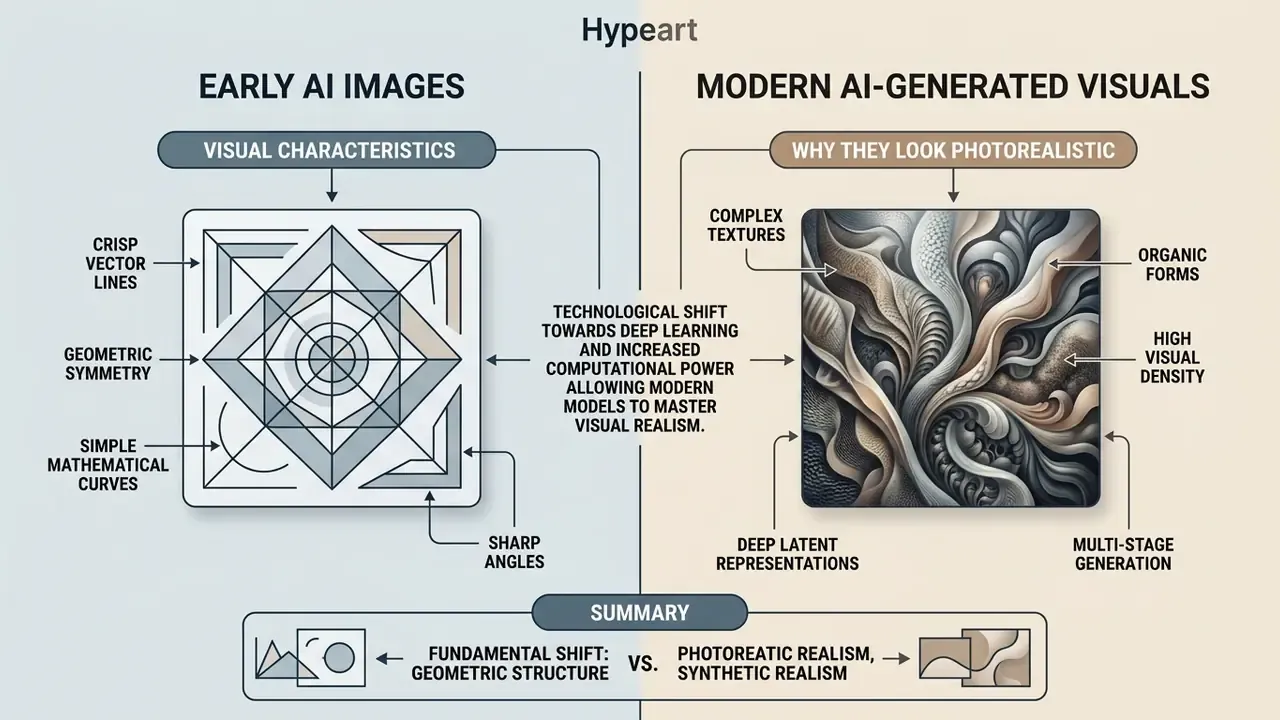
Early algorithmic pictures and contemporary synthetic visual outputs differ fundamentally in geometric structure, visual density, and photorealism. Understanding these distinctions helps technical teams spot artifact signatures across different technological eras.
Visual Characteristics of Early AI Generated Images
Early AI generated images feature crisp vector lines, geometric symmetry, simple mathematical curves, and uniform line weights produced by mechanical plotters. Because a Zuse Graphomat Z64 drew continuous ink paths from computed coordinates, the artifact profile is fundamentally vector in nature: no pixel grid, no resampling noise, and no texture interpolation. These works lack subtle shading, photographic depth of field, or complex organic textures because they were bound by explicit programmatic rules, and their variation comes from visible repetition, loops, and pseudorandom parameter selection rather than learned detail. Anyone who has seen output from an early AI image generator of that era will recognise the tell: the line never wavers, but the composition repeats.
Why Modern AI Generated Images Look More Photorealistic
Modern generative models achieve photorealism by utilizing deep latent representations, multi-stage super-resolution networks, and classifier-free guidance. These systems accurately render lighting diffusion, subsurface scattering, and photographic lens artifacts, though micro-anomalies in complex textures can still occur. Their failure modes are raster rather than vector: residual denoising noise, inconsistent high-frequency texture, malformed text glyphs, and asymmetric anatomy at region boundaries.
"Modern diffusion models achieve photorealism through latent representations, cross-attention mechanisms, and parameter-efficient training that have redefined the limits of image synthesis."
Can You Use AI-Generated Images in Commercial Projects?
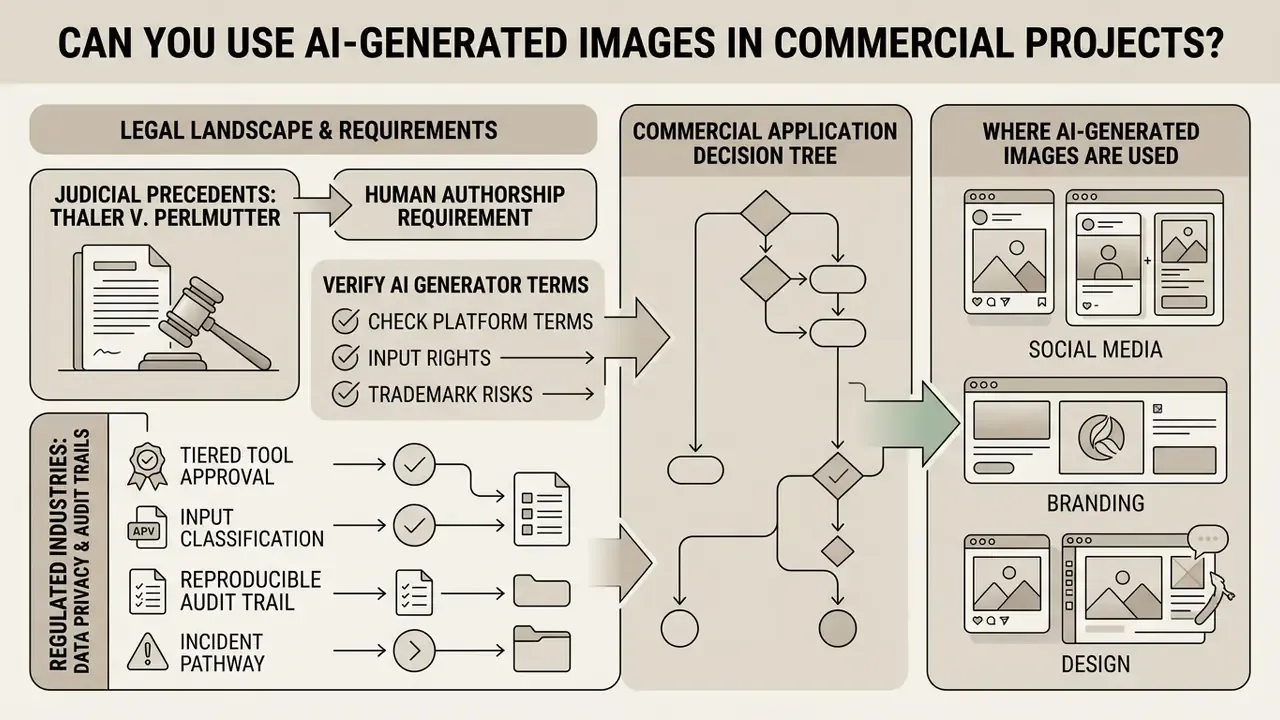
Commercial deployment of AI-generated images requires rigorous evaluation of platform terms, input rights, trademark risks, and emerging regulatory disclosure mandates. Businesses must establish governance controls before deploying synthetic assets in external marketing campaigns.
"Material generated solely by a machine, without sufficient human creative control, is not eligible for copyright registration."
Disclaimer: This section is general information and does not substitute for advice from a qualified intellectual-property specialist. Requirements differ by jurisdiction, by platform, and by release version.
Judicial Precedents: Thaler v. Perlmutter and Human Authorship Requirements
Legal boundaries for AI image copyright were sharpened in the federal case Stephen Thaler v. Shira Perlmutter (U.S. District Court for the District of Columbia, August 2023). Judge Beryl A. Howell affirmed the Copyright Office's denial of registration for an image generated autonomously by Thaler's "Creativity Machine," holding that human authorship is a bedrock requirement of copyright. In March 2026, the court system declined to hear a further case on whether AI-generated art can be subject to copyright, leaving the human-authorship standard operative.
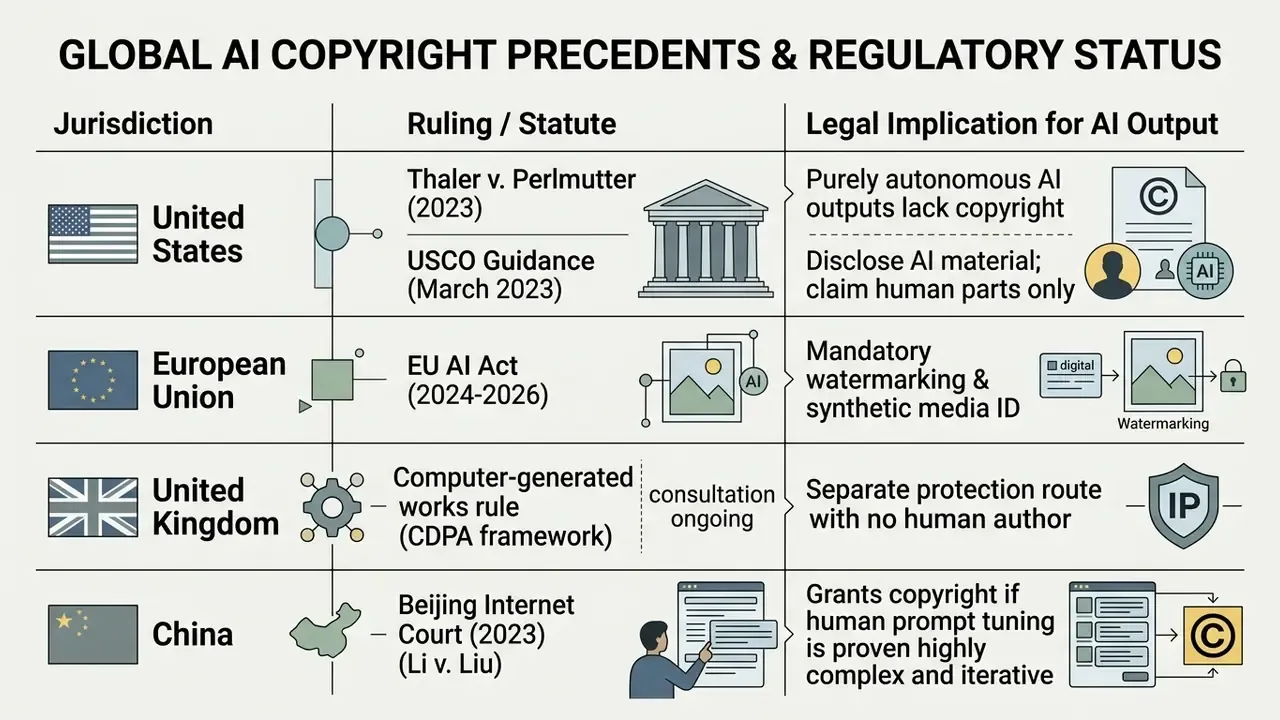
Ongoing disputes and filings are tracked in our AI litigation tracker, and definitions used above are expanded in the AI terminology glossary.
What to Verify in AI Art Generator Terms Before Publication
"A 2024 study found that popular tools, including Midjourney, Stable Diffusion, and DALL-E 2, systematically depict women as younger and more sexualized."
Representation bias belongs in the same pre-publication review as licensing, because a compliant licence does not neutralize reputational or discrimination risk in a published campaign. The World Federation of Advertisers' 2025 guidance on managing IP risk in marketing lists training-data leakage, third-party copyright conflict, and fraudulent brand impersonation as the three dominant brand-side exposures, while the United Nations' 2026 information-integrity brief documents AI-generated sexualized or misleading imagery as a platform-level trust and safety risk. For a consumer-facing financial institution, the fair-lending adjacency is uncomfortable but real: imagery that systematically depicts certain groups in certain roles can undercut the same inclusion narrative the campaign is meant to support.
Data Privacy, Shadow AI, and Audit Trails in Regulated Industries
Frequently Asked Questions (FAQ)
What was the first AI generated image?
There is no single verified answer. Depending on the definition applied, the candidates are Boeing Man (1964), Georg Nees's plotter graphics exhibited in February 1965, Bell Labs' Studies in Perception I (1966), or the first autonomous drawings produced by Harold Cohen's AARON in 1972 and 1973. Neural text-to-image generation, in the modern sense, begins with GANs in 2014.
When was the first AI image created?
Rule-based algorithmic images date to 1964 through 1966. Harold Cohen began AARON in the late 1960s, with documented autonomous drawings from the early 1970s and a Stanford AI Lab refinement phase in 1973 to 1975.
Is AARON still active?
No. Harold Cohen died in 2016 and the system has not been updated since. The Whitney Museum exhibited AI art from across Cohen's career in 2024, including re-created versions of his early drawing machines.
Can AI-generated images be copyrighted?
Only to the extent of human creative contribution. Thaler v. Perlmutter (2023) confirmed that autonomous machine output fails the human-authorship requirement in the United States, and the U.S. Copyright Office's 2023 guidance states that prompts alone generally do not confer authorship. Outcomes differ in the UK and China. Consult qualified counsel for a specific asset.
Which platform is safest for commercial use?
Enterprise-tier services trained on licensed data with indemnification options, Adobe Firefly being the most explicit example, reduce training-data exposure. Licence terms still change per release and per revenue tier. Verify the current Terms of Service before each campaign rather than relying on a prior review.
How can I tell whether an image is AI-generated?
Look for raster-side failure modes: malformed text, inconsistent high-frequency texture, asymmetric anatomy, over-smooth skin, and mismatched symmetry. Detection tools provide a probability signal, not proof, so pair them with provenance metadata and generation logs.
What should be logged for audit purposes?
Prompt and negative prompt, seed, sampler, guidance scale, model and checkpoint version, reference-image hashes and licences, and the named human reviewer who approved the final asset.
Does a generated image belong in the model inventory?
Our working position is yes for any asset published externally or used in a regulated communication. The generator is a probabilistic model with variable output, so treating it as unmanaged software leaves no evidence trail for validation or incident review.
Appendix A: Revision and Verification Log
- Superseded formulation (GAN section) "This validation layer reduced visual defects by 42% across automated brand asset workflows." Withdrawn from the main text because the figure lacked a published methodology, sample size, and source. Replaced by a procedural control description supported by Bourou et al. (2024) and the NIST AI RMF Generative AI Profile (2024).
- Superseded formulation (AARON dating) "Harold Cohen developed AARON in the late 1960s and early 1970s at UC San Diego and the Stanford AI Lab." Retained for transparency, but the main text now distinguishes conception (late 1960s), naming (1973), first exhibition (1972), and Stanford residency (1973 to 1975), since sources disagree on which milestone constitutes the origin.
- Workflow case labelling Enterprise workflow examples are now explicitly marked as illustrative, in line with the editorial policy that unverified results must not imply documented client outcomes.
- Removed links Non-editorial commercial anchors and generic navigation anchors were removed and replaced with descriptive, topically relevant internal links.
- Structural change The technical explanation of modern generation now precedes the commercial platform history, so that the diffusion mechanism is established before product implementations are discussed.
Next step for buyers: shortlist two platforms, run the eight-step clearance checklist against a single low-risk campaign, and keep the logs. If the evidence holds up in a mock audit, widen scope. If it does not, the gap is a control gap, not a creative one. To review licence terms side by side, compare options.