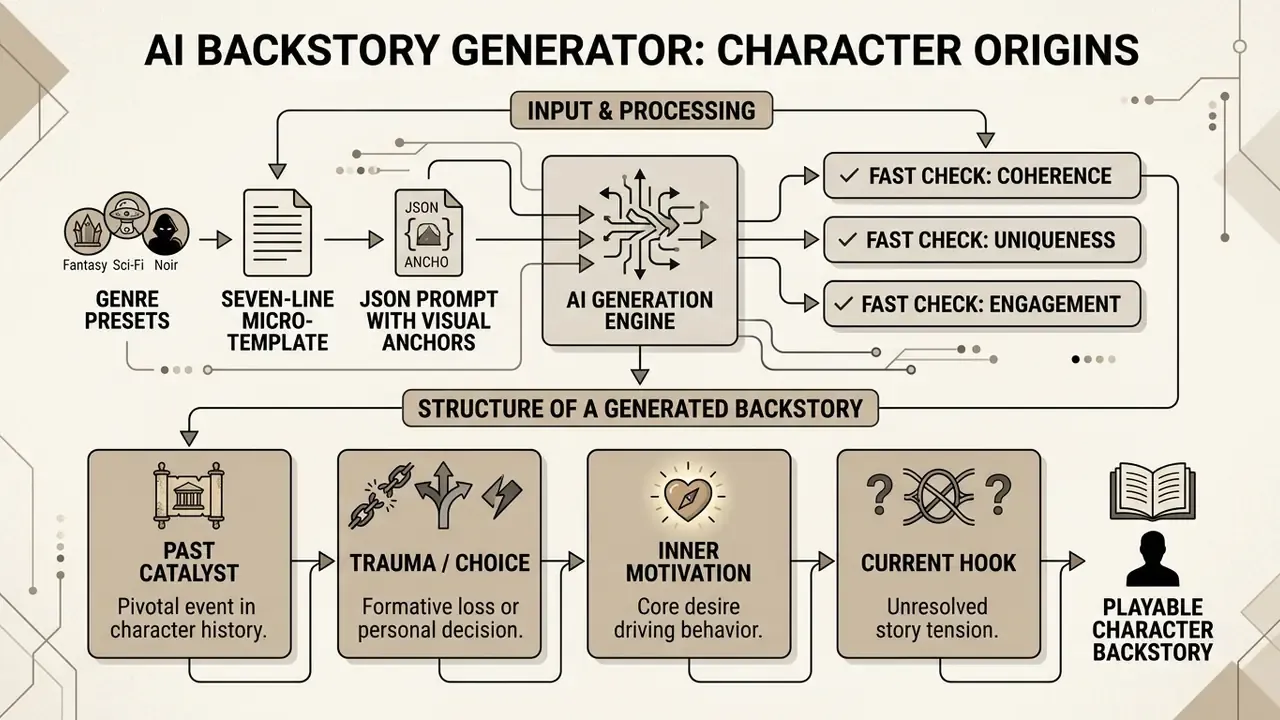
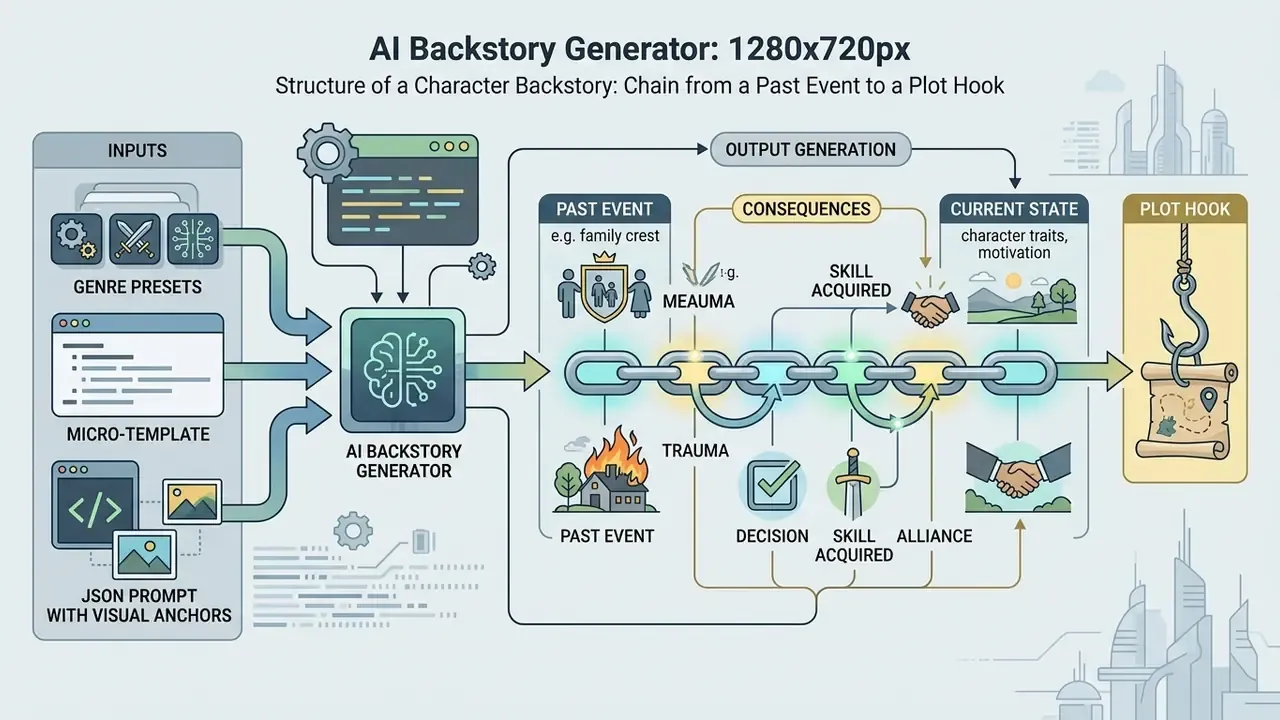
An AI backstory generator uses generative artificial intelligence to turn basic character details into a structured origin narrative. It establishes causal past events, core motivations, internal conflicts and plot hooks for tabletop role-playing games, creative writing and digital media workflows. The useful part is not the prose. It is the causal chain.
Three ideas that carry this guide
- Playability beats word count.A working backstory follows the formula
role + rupture + pressure + goal + visual anchorand fits into seven lines you can fill in two minutes before a session. - Output quality equals constraint quality.Genre presets, negative constraints (
prohibitions) and a structured JSON prompt cut clichés far more reliably than any "epic" phrasing in the request. - The human stays editor and rights holder.Purely machine-written text is not protected by copyright, and confidential material does not belong in a public generator. Both points have a table and a checklist below.
What an AI Backstory Generator Is and What Kind of Story It Produces
Short answer: it is a tool that converts a handful of input fields (name, role, setting, tone) into a coherent origin story. Unlike a static description, it builds a cause-and-effect line between the past and current behaviour.
An ai backstory generator is a computational tool designed to synthesise character traits, settings and narrative parameters into a coherent origin story. Unlike basic character tools that produce static descriptions, an ai generator backstory builds causal relationships between past choices, psychological traits and present circumstances.
Static descriptions detail what a character looks like or what abilities they possess right now. A narrative backstory explains why the character makes specific decisions and holds particular beliefs. Research on generative agents shows that recording causal memory streams substantially improves character believability.
«Agents with observation, planning and reflection memory show significantly more believable behaviour than agents without those components.»
Writers, Dungeon Masters and game designers use a backstory generator ai to draft initial concepts, establish campaign lore and create rich NPC histories. The tool takes basic inputs such as name, role and setting, then outputs multi-paragraph narratives containing turning points, secrets and world connections.
How the model holds the story together: long context versus retrieval. For short generations of 300 to 500 words, one context window is enough, because every input and world rule fits in the prompt. For a long campaign or a series of chapters, it is safer to move the canon into external memory: character cards, a relationship graph, a lore file, with only relevant fragments pulled back in. That way the model invents fewer nonexistent factions and stops rewriting facts you already approved. A practical warning sign that you need external memory: the model starts contradicting events it described two or three generations ago.
What Makes a Character Backstory Convincing
A compelling character backstory needs five interconnected elements: a causal past event, an internal need, a visible goal, a present conflict and an unresolved hook. The causal event establishes the origin of the character's core flaw or fear.
«A character's internal needs follow directly from formative wounds suffered before the main plot begins.»
The visible goal drives external action, while the internal need creates emotional depth and friction. In dramaturgical terms: the want is visible to everyone at the table, the need is known only to the player, and the conflict flag goes up exactly where the two diverge.
Plot hooks act as immediate entry points into a campaign or a story. A well-designed hook gives the writer or Dungeon Master actionable threats, debts or secrets that demand resolution in the present narrative. One hook is usually enough. Three competing hooks in a single origin story tend to cancel each other out.
Which Characters the Generator Suits: Hero, Villain, NPC and Rival
An ai character backstory generator adapts its structural output to the archetype assigned in the prompt. Protagonists need multi-layered arcs with growth potential, whereas secondary characters need focused functional backgrounds.
An antagonist's backstory centres on conflicting motives, past justifications and rivalries that explain the current opposition to the hero. A mentor's past establishes credibility, specialised expertise and clear historical reasons for offering guidance. A rival works differently again: their history mirrors the protagonist's path and supplies comparative pressure rather than transformation.
For non-player characters (npc), short histories built around one or two clear motivations are the most effective option.
«RoleBench, a dataset of 168,093 samples, shows that compact role profiles let models reproduce character style consistently.»
If the text needs a portrait afterwards, it helps to compare visual engines in our review of AI art generators. One visual anchor on a portrait sticks in memory better than a page of lore.
How to Use an AI Character Backstory Generator
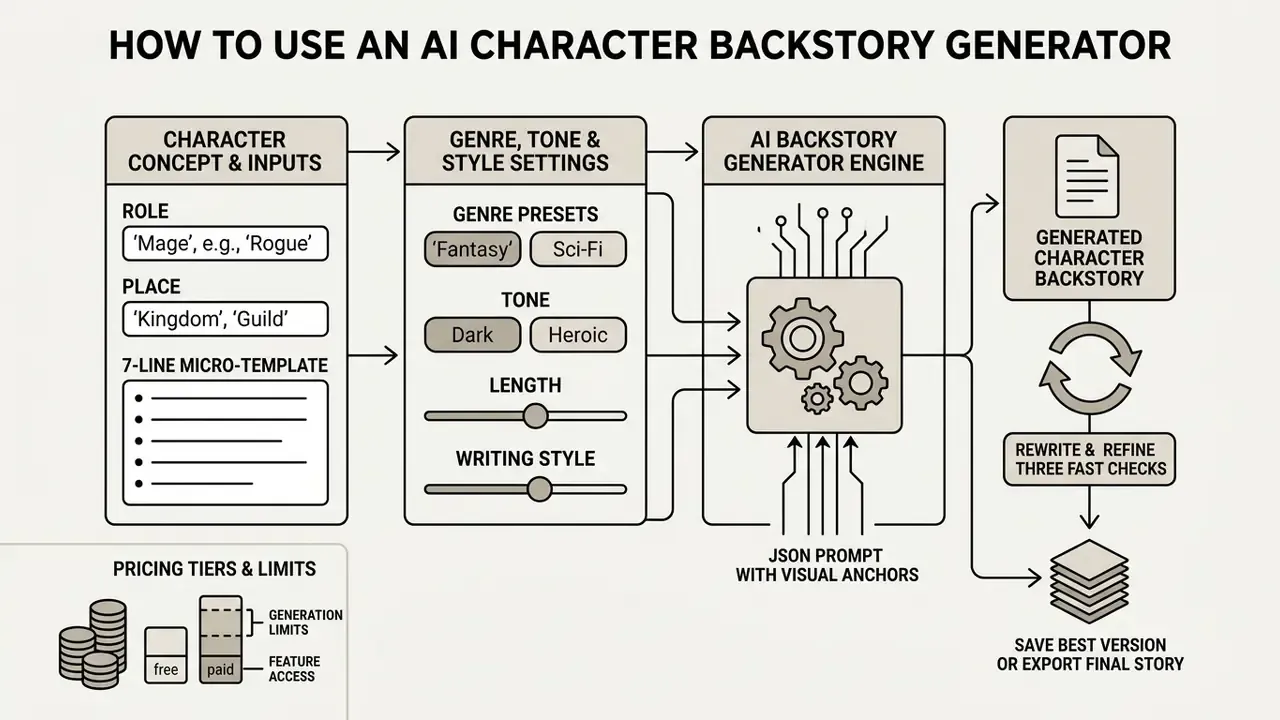
Short answer: the working cycle has six steps: identity input, parameter setup, generation, canon check, iteration, export. Automation speeds up the draft. Human editing decides the quality.
Using a character background generator ai involves a structured workflow: entering initial identity traits, configuring tone and length parameters, generating drafts, then refining the text. The process balances drafting speed against editorial control.
In practice, a user enters baseline attributes such as character name, class, setting and core dilemma. The model processes these parameters against narrative patterns and returns an editable origin text.
Once generated, the text is evaluated against existing world lore, edited for tone consistency and exported to a character sheet, a novel outline or a campaign note database.
- Enter core detailssupply the character's name, role, setting and key formative incident.
- Configure generation parametersselect genre, emotional tone, narrative style and output length.
- Execute the first generationrun the dnd backstory generator ai to produce a preliminary draft.
- Review and verify continuitycheck the output for logical contradictions, lore alignment and mechanical validity.
- Iterate and refineadjust prompt constraints or regenerate single paragraphs to remove clichéd tropes.
- Export and integratesave the final text to your campaign notes, character sheet or manuscript (DOCX, PDF, Markdown, plain text).
Describe the Character's Role and Place in the World
The quality of a generated backstory depends directly on how specific the initial identity parameters are. Inputs should include social standing, organisational ties, cultural origin and primary occupation.
Placing a character inside established factions or geographic regions gives the language model concrete anchors for plausible events. An isolated character history usually produces generic output. That single omission causes more bland drafts than any model limitation.
When configuring world details, name key allies, institutional rivalries and environmental conditions. Research on agent systems shows that explicit world-state constraints improve narrative coherence noticeably.
«Bidirectional communication between the story engine and the knowledge graph markedly improves narrative quality in kinetic scenarios.»
Choose Genre, Tone, Length and Style of the Story
Controllable text generation requires explicit specifications for genre, emotional tone, target length and perspective. Setting these parameters keeps the model from defaulting to familiar fantasy or science-fiction clichés.
Genre parameters dictate atmospheric rules and vocabulary, whether high fantasy, grimdark, space opera or xianxia. Tone settings adjust the emotional weight, from sombre and reflective to heroic or comic.
Length constraints should match the character's narrative role. A short paragraph is enough for a minor shopkeeper NPC, while a major protagonist needs a multi-section narrative covering childhood, turning points and present dilemmas.
To avoid inventing phrasing from scratch, use ready-made presets: copy the modifiers into your prompt and drop in your own character name.
| Genre / mood | Key constraints for the AI (prompt modifiers) | Sample ready-made hook |
|---|---|---|
| Grimdark / dark fantasy | Tone: somber, brutal. Include: moral ambiguity, physical scar, irreparable failure. Avoid: redemption granted for free. | A former inquisitor who burned a village on a false accusation and now seeks atonement in battle. |
| High / heroic fantasy | Tone: hopeful, mythic. Include: sworn oath, mentor debt, public reputation to defend. | A squire of a fallen house, sworn to return the banner to the city that exiled him. |
| Xianxia / wuxia | Tone: philosophical, ambitious. Include: broken meridian, dishonored sect, internal qi balance. | An expelled disciple hiding a shattered spirit core behind the identity of a merchant. |
| Sci-fi / cyberpunk | Tone: cynical, fast-paced. Include: corporate debt, malfunctioning cyberware, ghost AI contact. | A former corporate hacker whose memory was encrypted and sold on the black market. |
| Modern urban / mystery | Tone: restrained, procedural. Include: hidden evidence, professional licence at risk, one witness who lied. | A city watch investigator who hid evidence for a sister and waits to be exposed. |
| Tragic (any setting) | Tone: tragic but grounded. Limit to one or two defining losses. No pile-up of catastrophes. | A temple courier who kept a letter proving forgery inside her own order. |
The rule behind the presets: one dominant emotion, one moral constraint, one prohibition. Three parameters give the model a frame and still leave room for an unexpected detail.
Generate, Rewrite and Save the Best Version
Iterative refinement is essential with generative outputs. A single prompt run rarely delivers a complete, publication-ready backstory on the first attempt.
The systematic loop looks like this: generate a draft, mark the strong and weak elements, move your preferences into the prompt as explicit constraints, regenerate, then edit by hand.
«Even one-line prompt changes can significantly affect the accuracy and logical validity of generated game commands.»
Which Details to Add to the Prompt for a Unique Backstory
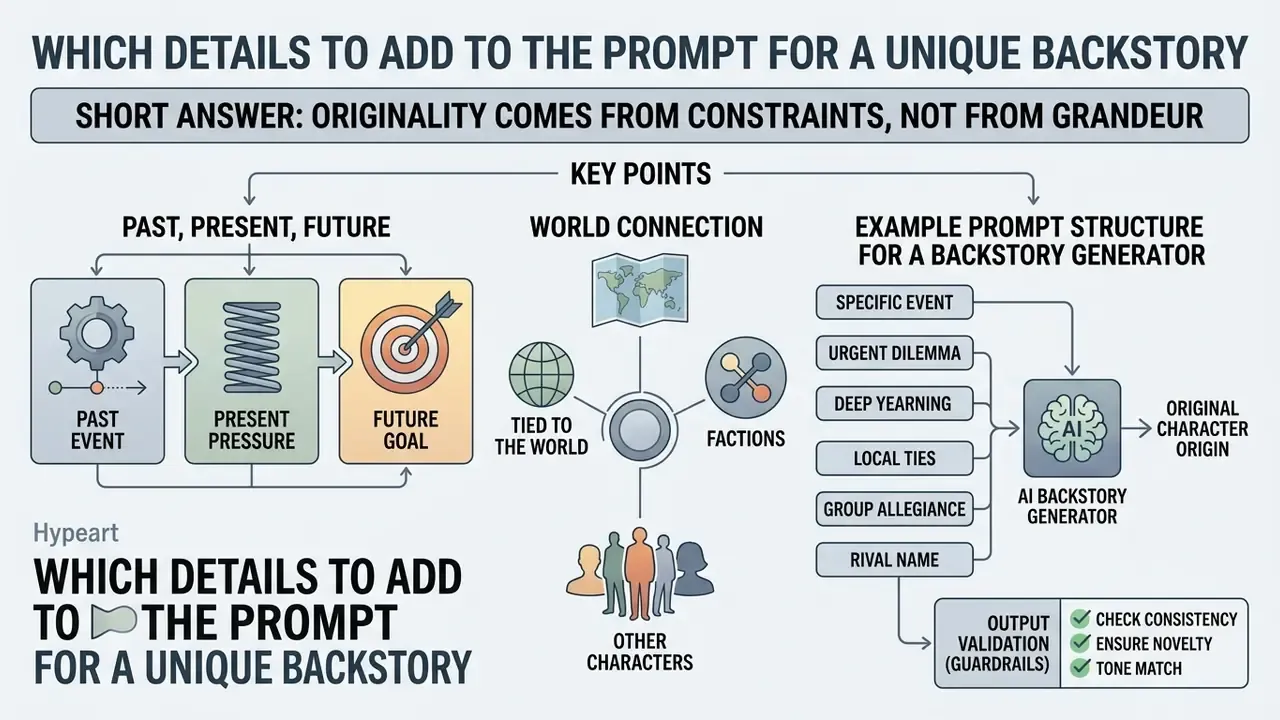
Short answer: originality comes from constraints, not from grandeur. Concrete events, banned tropes and deliberate trade-offs pull the model away from the high-probability patterns in its training data.
To produce original character origins, a prompt for an ai background story generator must combine specific constraints, behavioural boundaries and deliberate narrative trade-offs. Vague prompts push models toward high-probability patterns.
A well-structured prompt avoids boilerplate requests such as "write an epic backstory". It supplies concrete historical turning points, personal secrets and strict stylistic prohibitions instead.
Recent studies on model creativity suggest that combining explicit structural constraints with persona framing increases narrative originality and the level of detail.
«LLMs consistently trail humans on novelty, surprise and diversity, despite higher linguistic complexity.»
Past Event, Present Pressure and Future Goal
«An agent architecture with memory, reflection and planning produces a causal chain: past event, motivation, future action.»
Ties to the World, Factions and Other Characters
Writing explicit organisational relationships into the prompt keeps the character from looking detached from the story world. Specify affiliations with guilds, religious orders, political factions or military units.
Define interpersonal ties by including at least one mentor, one rival and one loyal ally in the input parameters. Naming specific party members creates immediate dynamics at the game table.
In multi-stage narrative generation, passing structured JSON context from world-building steps into character creation ensures that characters inherit political rules and historical events accurately.
«A knowledge graph linking characters, locations and organisations lets the story engine stay consistent when any node is edited.»
Example Prompt Structure for a Backstory Generator
{
  "character_name": "Valerius Vance",
  "role": "Disgraced Inquisitor",
  "setting": "Low-fantasy urban city state",
  "factions": ["The Solar Synod", "The Guild of Weavers"],
  "past_event": "Uncovered financial corruption within his order but was framed for treason before reporting it.",
  "present_pressure": "Living under an assumed identity while hunted by former colleagues.",
  "future_goal": "Expose the Grand Vicar and regain access to the order's restricted archive.",
  "visual_anchor": "Damaged bronze pauldron with a scratched insignia",
  "stress_habit": "Absentmindedly rubs the scar on his left wrist when questioned about his past",
  "tone": "Suspenseful, analytical, cynical",
  "length": "300-400 words",
  "prohibitions": ["No tragic orphan tropes", "No ancient prophesied destiny"]
}
The visual_anchor and stress_habit fields are not decoration. They are what makes a character recognisable at the table. A dented pauldron, or the habit of counting doorways, works as an instant trigger for the DM and the other players.
Output validation (guardrails). If the generator sits inside a pipeline rather than a manual workflow, describe the expected response with a JSON Schema and validate it automatically: required fields, value types, allowed enumerations (factions only from the canon list), a character limit per field. A simple post-check filters out roughly half of the hallucinated lore before it reaches the campaign. It also helps to keep a small evaluation set: 10 to 15 reference inputs against which you compare new prompt versions on three metrics, canon compliance, presence of a hook, absence of banned tropes. Teams that already work with model documentation will recognise the pattern from validation practice in regulated environments; the same logic that keeps a credit model auditable keeps a lore file consistent.
AI D&D Backstory Generator for Players and Dungeon Masters
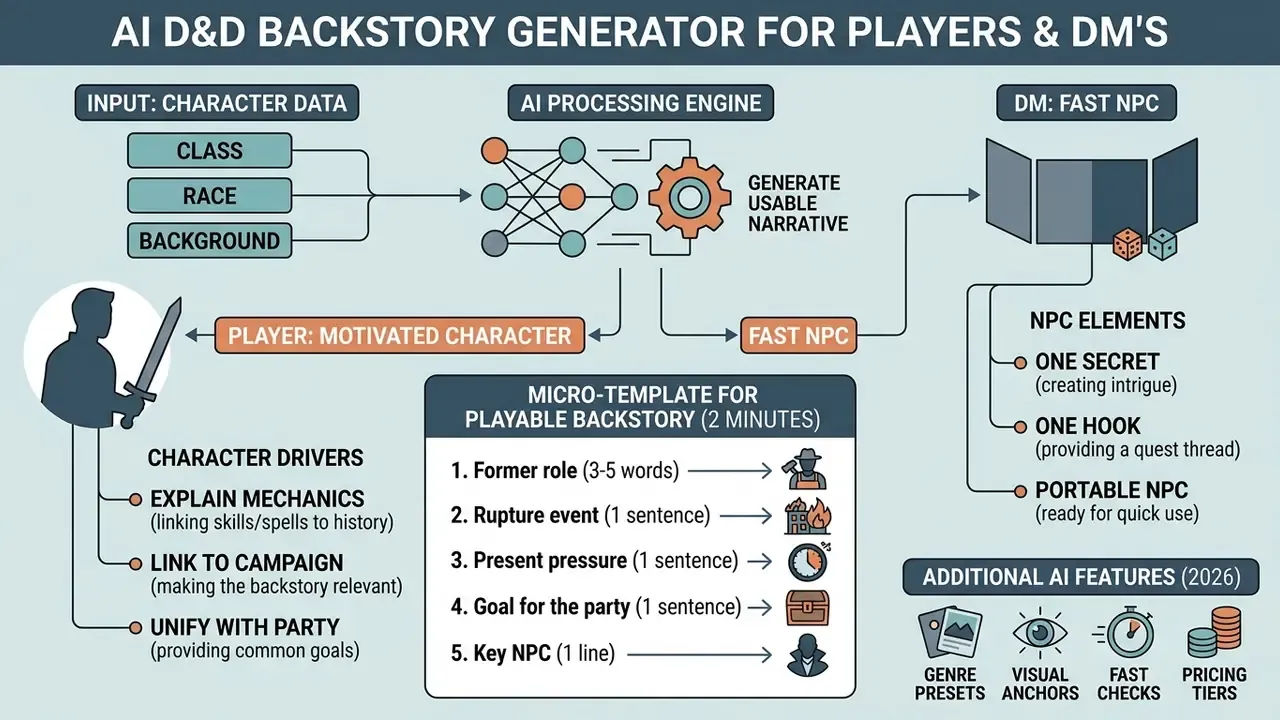
Short answer: a player needs motivation that explains the character's mechanics; a DM needs a fast NPC with one secret and one hook. Two different prompts, two different word counts.
An ai backstory generator dnd helps tabletop players and Dungeon Masters align narrative origins with official game mechanics. It turns mechanical selections such as race, class and background into cohesive roleplaying context.
Player intent (PC). You need one coherent text that explains where the skill proficiencies, starting gear and first spell came from, and that gives a reason to travel with the party. Length limit: one page. Mandatory elements: an open problem, one living NPC, one keepsake.
DM intent (NPC). You need dozens of short profiles of two to four lines each: role in town, visible manner, hidden motive, one hook. Plus a small contingency in case the players come back to that NPC five sessions later. An ai dnd character backstory generator is genuinely useful here, because volume matters more than polish.
While generative tools produce fluent origin text quickly, empirical evaluations show that models often struggle with precise game rules.
«RPGBench shows that models create engaging content but frequently break state mechanics in long or complex scenarios.»
DMs therefore have to verify that generated histories fit the campaign setting restrictions.
| Backstory element | Verification criterion | Campaign implementation |
|---|---|---|
| Class and race integration | Matches starting mechanical proficiencies and ancestral lore. | Explains the origin of abilities, spells and cultural background. |
| Background (one per character) | Only one background is allowed; features, proficiencies, tools and languages fit the setting. | Defines the occupation and location before the first adventure. |
| Personal goal | Leaves open conflicts accessible for DM intervention. | Drives personal side quests and long-term motivation. |
| NPC connections | Contains one or two named contacts with clear motives. | Gives the DM immediate quest-givers or informants. |
| Plot hook / secret | Involves unresolved debts, threats or hidden knowledge. | Feeds directly into the overarching campaign arc. |
| Visual anchor / habit | One detail you can describe aloud in five seconds. | Gives other players a reason to ask an in-character question. |
Campaigns that turn backstories into content, session recaps, art, short clips, run more smoothly with a prepared toolkit; adjacent options are collected in our comparison of free AI video generators, and recap formats are covered in our notes on video templates.
Linking Class, Race and Background to the Hero's Past
In fifth-edition systems, race represents ancestry, class defines active capabilities, and background represents the pre-adventuring occupation. A dnd ai backstory generator has to weave all three choices into one logical narrative.
Take a Fighter with the Noble background. The origin has to explain military instruction inside an aristocratic household, then describe the specific events that pushed the character away from court life and onto the adventuring path.
«Background anchors a character in the world before the first adventure, defining skills and social ties.»
The generated backstory should also account for starting skill proficiencies and tool kits. A practical trick: ask the model to return a separate paragraph titled "where each proficiency came from". Contradictions with the character sheet become visible immediately.
Making a D&D Backstory Usable for the Campaign and the Party
A campaign-ready backstory stays concise and open-ended. Overly complex origins that resolve every personal conflict before level one limit the DM's ability to fold the hero into the ongoing narrative.
Keep the text to roughly one page, 300 to 500 words. Use short bullet points for key life events, one or two sentences each, so the DM can check a fact mid-session without reading an essay (D&D Beyond Guide, 2024).
Make sure the backstory gives the character a compelling reason to cooperate with a group. Lone-rogue tropes tend to disrupt party dynamics and slow the pacing. A good hook contains four elements: a personal trigger, a complication, a choice for the whole party and a consequence. Then the scene belongs to the table rather than to one player.
Micro-Template for a Playable Backstory (Fill It in Two Minutes)
To make a backstory work at the table, and usable by the DM in the very first session, cut it down to seven fields. The formula: role + rupture + pressure + goal + visual anchor.
- Former role (three to five words) Former guard of the city archive.
- Rupture event (one sentence) Took the blame for a noble's escape to pay for his sister's treatment.
- Present pressure (one sentence) Owes the smugglers' guild 200 gold for that escape.
- Goal for the party (one sentence) Find proof that the rescued heir is still alive.
- Key NPC (one line) A younger sister working at the city hall.
- Visual anchor (one detail) A cracked seal of a lost house on his ring.
- Stress habit (one detail) Counts doorways before entering a room.
Compare two versions of the same hero. The literary one: "Once a proud knight of a fallen house, wandering the north for years after a betrayal, now searching for meaning while wrestling with loss." The playable one: "Disgraced house guard. Took the blame for a failed escape. Owes the smugglers who got him out. Wants to prove the heir is alive. Wears a ring with a cracked stone." The second is shorter, and it hands the DM three ready scenes.
Backstories for Novels, Fanfiction, OCs and Creative Projects
Short answer: in prose, a backstory matters less as a reference sheet and more as the source of the hero's decisions. AI is most useful when turning ideas into text and when reviewing drafts, not at the conception stage.
In creative writing, an ai story background generator helps authors build original characters (OCs), structure fanfiction lore and outline novel casts. The tool assists during prewriting and exploratory drafting.
«Writers benefit most from AI when translating ideas into text and reviewing drafts, not during high-level planning.»
Writers treat generated backstories as speculative scaffolds. They test alternative historical choices for a protagonist before committing those events to the permanent outline. OC authors who also want a visual likeness will find the round-up of AI art generators useful, including the analysis of free-plan limits.
Turning a Generated Backstory into the Basis of a Plot
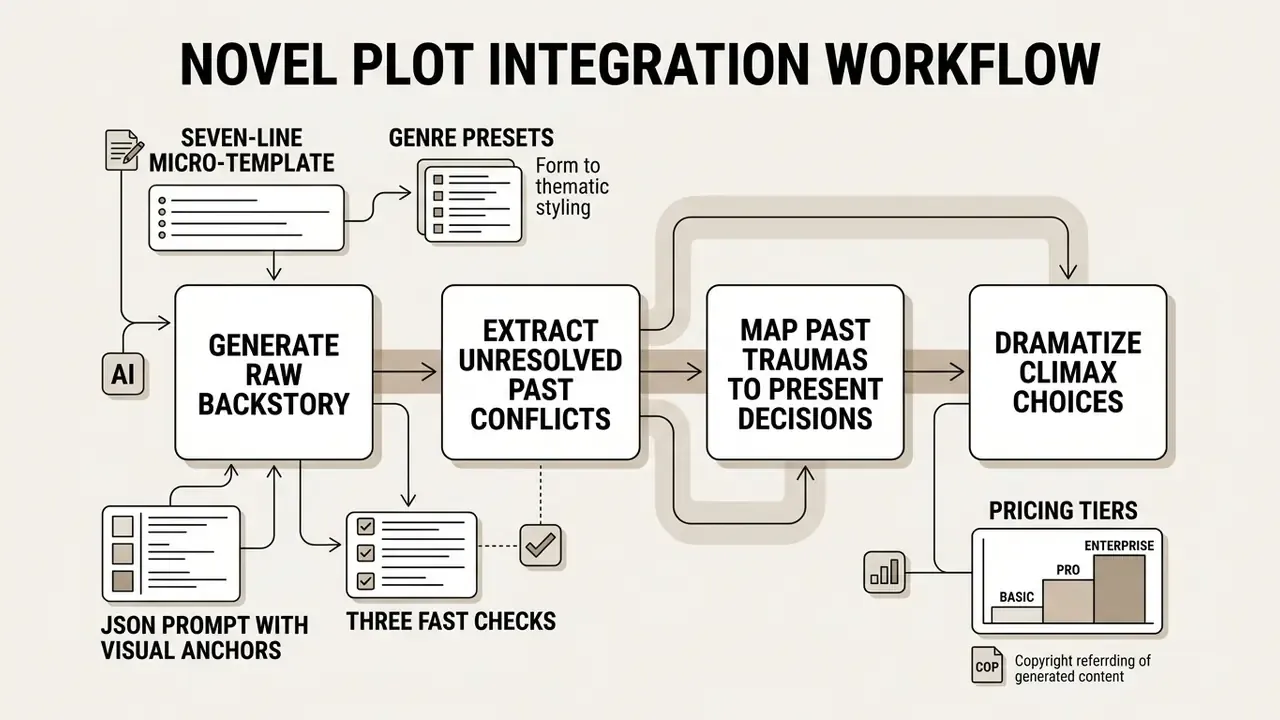
To convert an ai generator backstory into plot momentum, extract the unresolved past events and reintroduce them as active present obstacles. A past betrayal by an ally becomes a political conflict in chapter three.
Backstory should surface gradually through choices, dialogue and present action rather than through long expository blocks.
«Backstory should be revealed through character choices and dialogue, not through exposition dumps.»
Pacing improves when historical detail appears only where it touches a current decision. When the past forces a character to choose between internal need and external goal, tension rises. The generated backstory supplies the psychological justification for that choice.
Short, Standard or Detailed Backstory
The depth of an origin narrative should match the character's structural role. Generating an exhaustive history for a minor character adds cognitive load without narrative value.
For minor background characters, a two-sentence summary covering occupation and immediate motive is enough. That much keeps them from looking like scenery, and not so much that they pull focus.
Major protagonists and central antagonists need detailed, multi-page backstories. Their past choices drive the central conflict, which justifies exploring childhood, formative training and key relationships. A rough guide: a secondary character gets two or three sentences, a significant character 300 to 500 words, a protagonist or principal antagonist several sections with dates and relationships. The criterion is not genre. It is how heavily the plot leans on that specific past.
How to Improve an AI-Generated Backstory and Avoid Formula Plots
Short answer: the model's draft is raw material. Three fast checks and an editorial checklist turn it into text that survives a session or a chapter.
Unassisted output from a backstory ai generator often suffers from predictable tropes, formulaic language and repetitive structure. Language models naturally favour high-probability word sequences from their training corpora.
To produce distinctive origins, writers have to review, edit and restructure the draft themselves.
«Across 60 LLMs and 60 human writers, models consistently trail humans on novelty, surprise and diversity.»
Three Fast Checks Before the Session
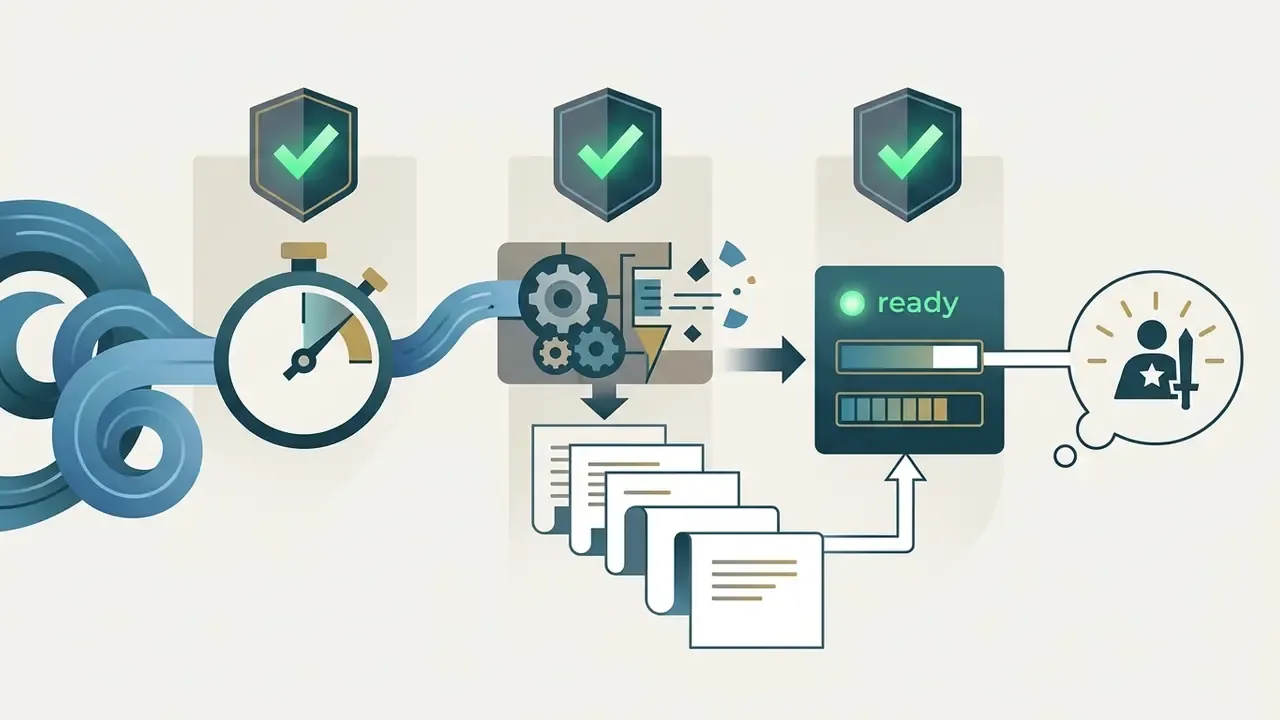
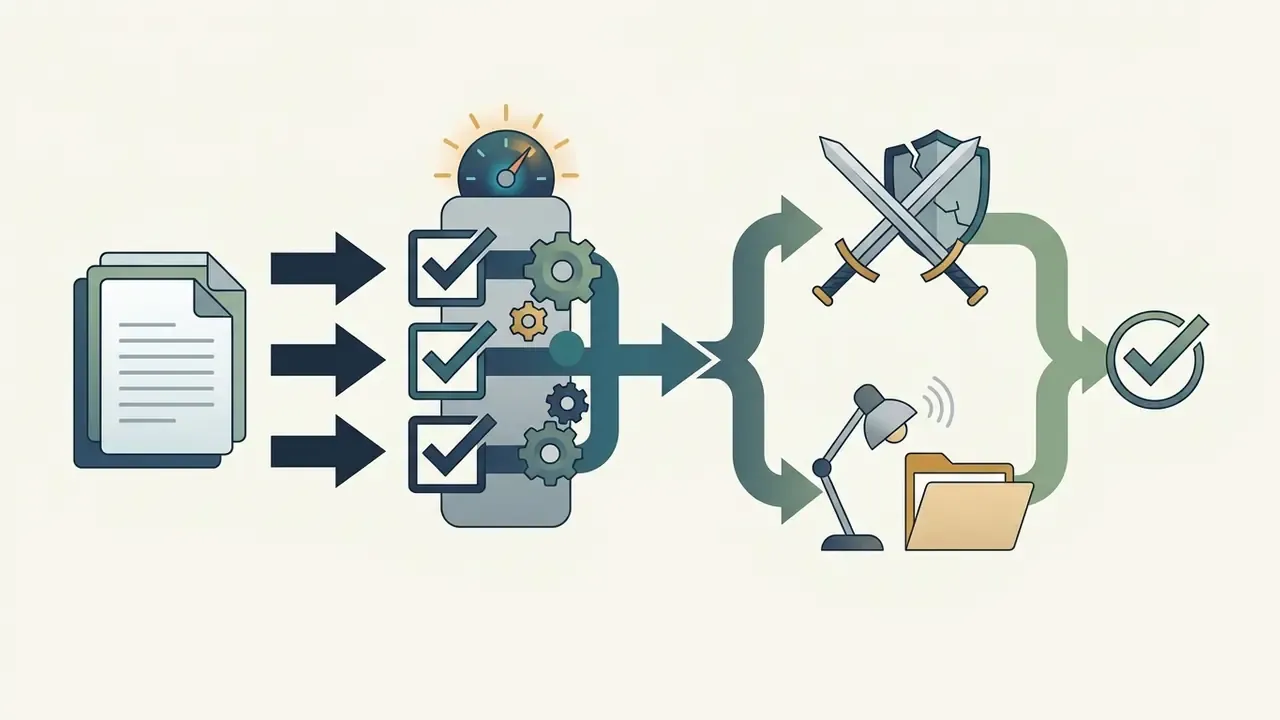
Before you hand a generated text to a DM or paste it into a manuscript, test it against three criteria.
Failing any of the three does not mean "rewrite everything". It means "add specifics": a name, a debt, an object, a date.

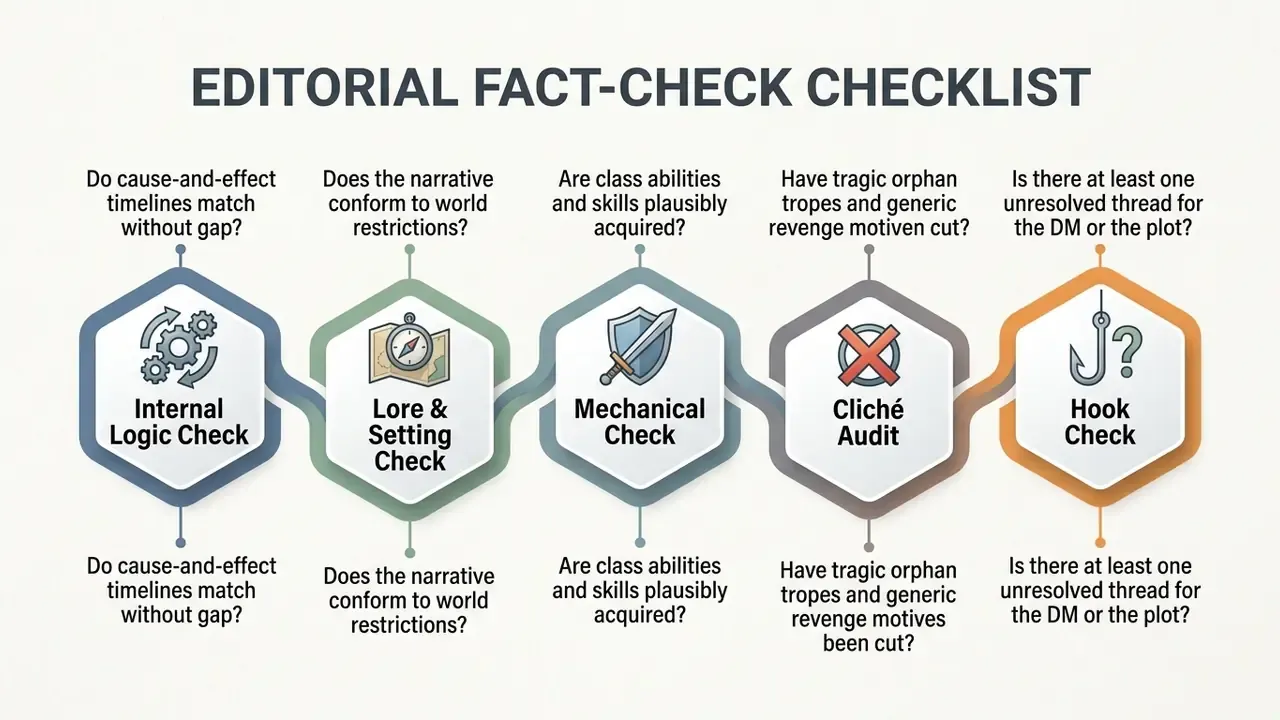
Editorial Fact Check and Content Verification Policy
AI-generated backstory drafts should pass human editorial verification before publication or campaign deployment. Authors and Dungeon Masters need to confirm that generated histories contain no logical contradictions, no hallucinated lore and no impossible mechanical combinations. Generative tools serve as ideation assistants, not autonomous creative authorities.
A practical accountability matrix: the author or player owns facts and canon, the DM or editor owns compatibility with the world and the rules, the platform owns model availability only. An error in generated text cannot be blamed on the model. A human signs the page.
Hale's point applies to the table and to production pipelines alike: every generated fact about a character is a hypothesis until a human checks it against the canon.
Mistakes That Make a Backstory Sound Unnatural
Common defects in AI narrative output include isolated-hero syndrome, excessive trauma, flat dialogue and arcs that finish before the story starts. A character whose personal conflict is fully resolved in the backstory has no reason to adventure.
The clichés worth banning explicitly in the prompt: "orphan from a burned village", "the one prophesied chosen", "last heir of a fallen empire", "revenge for a murdered mentor with no other motive", "secret royal blood". None of them is bad in itself. Each is bad as the only load-bearing wall.
Studies of model narrative output show a strong pull toward tidy, linear arcs with little genuine suspense.
«LLMs gravitate toward familiar narrative templates from training data, producing less original and less surprising stories.»
Characters often arrive flawlessly good or irredeemably evil, with no grey motives in between. Another frequent defect is lexical monotony: the same dramatic adjectives and transitional phrases repeating. Swapping generic descriptors for concrete sensory detail restores an authentic voice.
A separate category is trauma overload. If the parents die, the village burns and the mentor betrays the hero all within one paragraph, the character arrives spent before the campaign starts. Working rule: one or two defining losses, everything else is consequence.
How to Edit While Keeping the AI's Ideas
When you edit an AI draft, treat the generated text as structural clay. Keep the useful core concepts, an unusual alliance, a distinctive historical setting, and rewrite the prose in your own voice.
Vary sentence length and rhythm across paragraphs. Cut formulaic openings such as "In a world torn by war..." and start in media res with an active decision. Remove filler connectives ("moreover", "ultimately") and replace abstractions with specifics: not "an ancient artefact", but "a copper key engraved with a trading house sigil".
Make sure every claim about the past is backed by evidence inside the story world. If the character says he served in the garrison, he needs a commander's name, a city and a reason for leaving. Editors preparing visual material alongside the text may find our breakdown of photo editors helpful; it also covers export limits on free plans.
Free AI Backstory Generator, Pricing Tiers, Commercial Use and Privacy
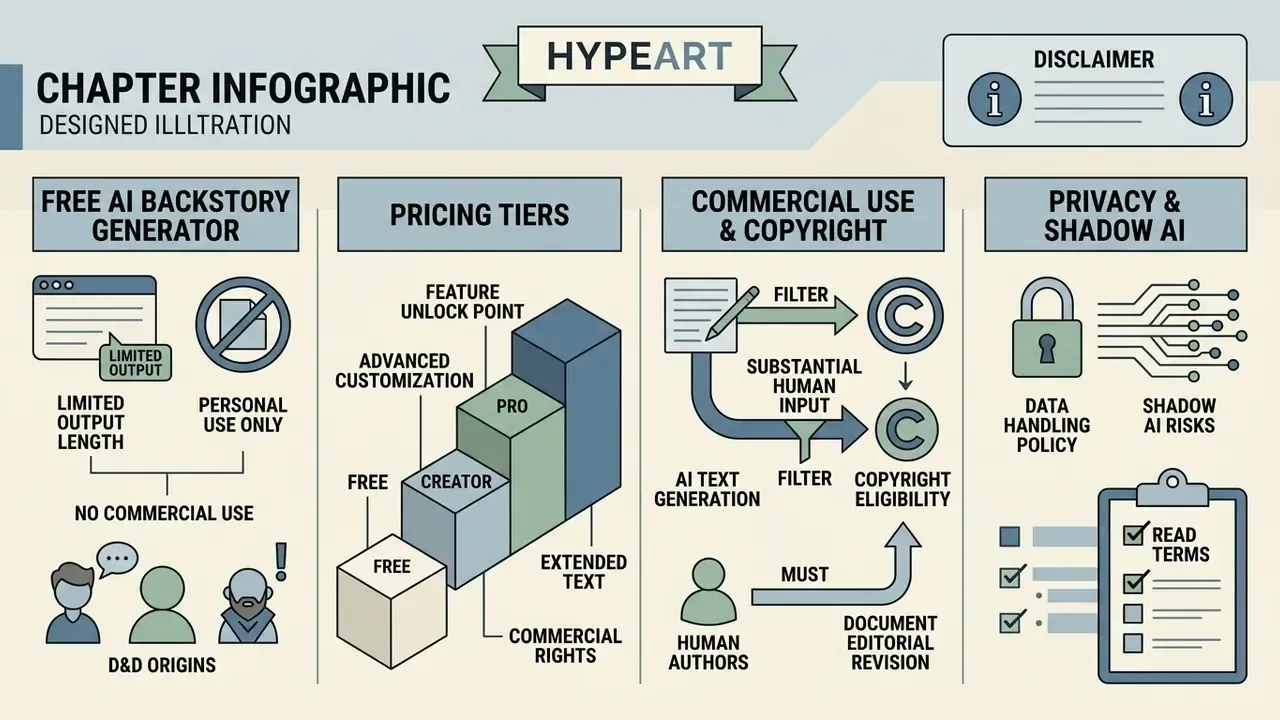
Short answer: free tiers usually cap length and permit personal use only; commercial rights depend on the platform's terms of service, and copyright protects the human contribution alone.
Access models vary widely between vendors. Most platforms offer a freemium tier with daily generation limits alongside paid plans for high-volume creative production. Searches for a dnd backstory generator ai free usually land on exactly that tier.
Free tiers typically restrict output length, limit advanced prompt customisation and enforce non-commercial licences. Anyone planning to publish generated text in a commercial novel, a game sourcebook or monetised media should read the specific platform terms. Check the amendment date separately: several services have revised free-plan licences retroactively, keeping commercial rights only for content created before the change.
Under US copyright registration practice, purely AI-generated text without substantial human creative input is not eligible for protection.
«The US Copyright Office confirmed that purely machine-generated text without substantial human creative input is not protected.»
Authors using AI tools should document their selection, arrangement and editorial revision. Keep drafts, prompts and revision versions. A prompt on its own does not create protectable authorship. Adjacent licensing examples appear in our piece on commercial use of AI image generators, and disputes over training data are tracked in our litigation coverage.
| Access tier | Typical features and limits | Commercial usage rights |
|---|---|---|
| Free tier | Limited daily generations, standard context window, basic templates. | Personal, non-commercial use only (home TTRPG games, practice). |
| Paid creator plan | Higher usage limits, custom context windows, PDF/DOCX/TXT export. | Commercial rights granted subject to the platform terms of service. |
| Enterprise / API tier | Uncapped programmatic access, custom fine-tuning, team workspaces, audit logs. | Full commercial licensing, data-protection guarantees, possible indemnity commitments. |
Privacy and Shadow AI Checklist Before You Use a Generator
A public backstory generator is an external service that receives your text. For a home campaign that hardly matters. For a studio, a publisher or an internal project it matters a great deal.
Checklist0 / 7
To examine subscription structures and licensing options across tools, browse the hub in our pricing directory. Technical integration details sit in our API documentation, model cost comparisons in the breakdown of video generation via API, and budget modelling in our calculators. If something in a workflow breaks, see the overview in the support section.
FAQ About AI Backstory Generators
Can I create a backstory in another language?
Yes. Modern multilingual models generate character backstories in English, Russian, Spanish, French, German and more. Quality depends on how well the language is represented in the training data.
«Multilingual generation quality depends on how well the language is represented in the model's training data.» Multilingual LLM Capabilities Survey (2025). Preprint; identifier pending verification. Prompting in the target language yields more culturally accurate phrasing than automated post-translation. For fantasy terminology and technical jargon, set a glossary inside the prompt: five to ten term pairs noticeably reduce calques.
What is the difference between a character background and a backstory?
A character background is a brief, functional summary of origin, occupation and static traits. A backstory is a full causal narrative covering formative events, internal conflict, secrets and live plot hooks. In D&D terms, background is one field on the sheet, and the backstory explains why that field reads the way it does.
Can I copyright a backstory generated by AI?
Under current US Copyright Office guidance, purely machine-generated text cannot be copyrighted. Human authors who substantially rewrite, edit, select and arrange the drafts can register their own creative contribution. Registration requires disclosing which parts were AI-generated and describing the human input.
How do I stop the generator from producing clichéd fantasy stories?
Add explicit negative constraints to the prompt. Prohibit orphaned-hero origins, prophesied destinies and generic revenge motives, and supply concrete, unusual setting details instead. Then add one trade-off: what the character lost in exchange for their power.
Can I export generated backstories straight to character sheets?
Many specialised tools export to PDF, DOCX, Markdown or plain text, which makes pasting into digital character sheets or campaign managers straightforward. For API workflows it is easier to store the result as JSON and render the target format on your side.
Is it safe to enter unpublished project material into a generator?
That depends on the tier and the retention policy. On free plans, prompts may well be used to improve the service. For work projects, use corporate access with training disabled, a fixed retention window and access logs. Run the shadow AI checklist above before sending anything sensitive.
How many versions of a backstory should I keep?
At least three: the model's first draft, the edited version, and the final text agreed with the DM or editor. Save the prompt, the date and the session identifier. That is both a change history and evidence of human contribution.
Appendix A. Wording From the Previous Edition (Kept for Comparison)
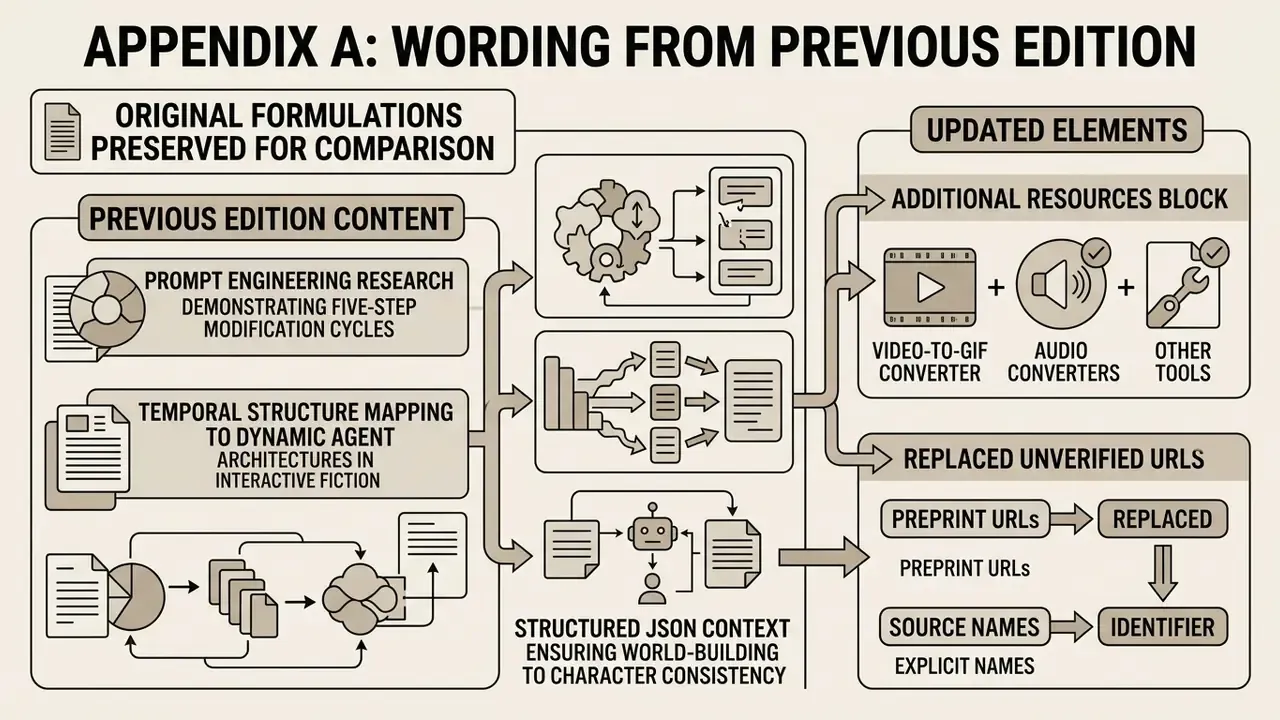
The original formulations updated in the main text are preserved below, so a reader who saved the earlier version can see exactly what changed:
- "Prompt engineering research demonstrates that systematic five-step modification cycles, evaluating drafts, updating constraints, and re-prompting, consistently yield superior narrative quality (IBM Prompt Engineering Guide, 2025)." Replaced with the FIREBALL / DnD prompt engineering study (2025).
- "This temporal structure maps directly to dynamic agent architectures used in modern interactive storytelling (AWS Prescriptive Guidance, 2026)." Replaced with Generative Agents, Park et al. (2023).
- "Passing structured JSON context from world-building steps to character creation steps ensures that characters inherit political rules and historical events accurately (arXiv, 2026)." Replaced with the Knowledge-Graph-Guided Storytelling Pipeline (2025).
- The "Additional Resources and Navigation" block, which linked to video-to-GIF converters, audio converters and a legal section, was removed as irrelevant to the article intent and replaced with domain-relevant material plus the privacy checklist.
- Several preprint URLs that could not be verified were replaced with source names and an explicit "identifier pending verification" label, rather than left as citations that look authoritative but resolve to nothing.
Conclusion
An ai backstory generator is a genuinely useful asset for writers, game designers and tabletop players who want causally grounded character origins. Combined with explicit prompt constraints, disciplined fact-checking and real editing, generative AI turns raw ideas into campaign-ready narratives. An ai character background generator shortens the draft. It does not shorten the judgement.
No tool produces a perfect text in one click. The value shows up on the second or third prompt run and in the manual pass afterwards. Start with the seven lines of the micro-template, run the text through the three fast checks, save the version, and the character is ready for the first session or the first chapter.
To see our full collection of creative design guides and AI documentation, visit the main directory and explore the hub for further reference.