If you sit in compliance, risk, or marketing governance at a bank or a mature fintech, the interesting question is not "can it write?" It is "who signs off, and what evidence survives an audit?"
Author note: Marcus Hale writes this analysis.
Last updated in 2026 and reviewed against current Google Search Essentials spam policies, NIST AI Risk Management Framework guidance, and peer-reviewed productivity research published between 2023 and 2026.
Executive Summary: What Matters Before You Buy
What Is an AI Blog Post Generator and Why Do You Need It?
An ai blog post generator is a software application that uses advanced natural language processing to produce structured long-form copy from prompts, keywords, and target guidelines. It removes blank-page paralysis, speeds up initial research, and assembles SEO-aligned article drafts in minutes rather than hours.
That last point deserves a caveat. Minutes to a draft does not mean minutes to publication. The review layer is where the real cost sits, and we price it later in this guide.
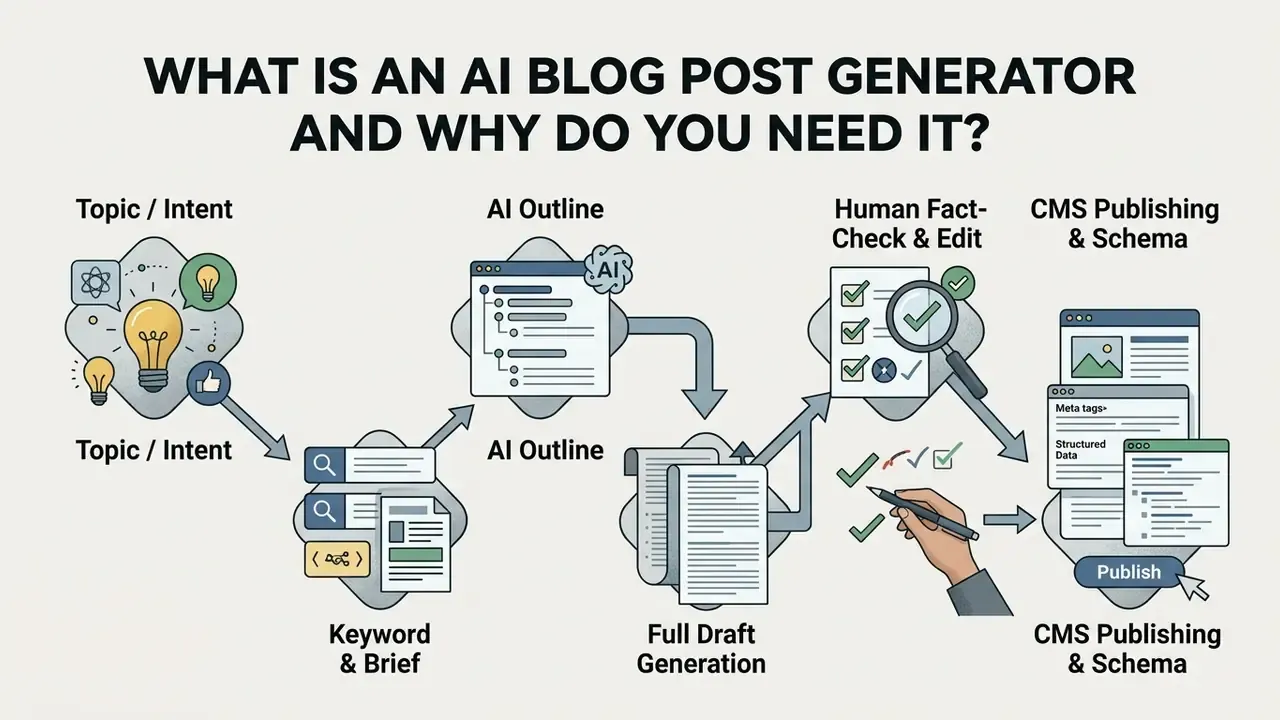
Key Operational Tasks Solved by AI Blog Content Generators
An ai blog content generator automates repetitive drafting work, produces structured blog content, and widens keyword coverage across a publishing pipeline.
"Professionals working with an AI assistant completed tasks 40% faster, and independent graders rated output quality 18% higher."
Attribution matters here. The 40% and 18% figures come from a randomized controlled experiment with 453 college-educated professionals, not from vendor benchmarking. That is exactly why the numbers survive a board-level business case. The main operational tasks solved include:



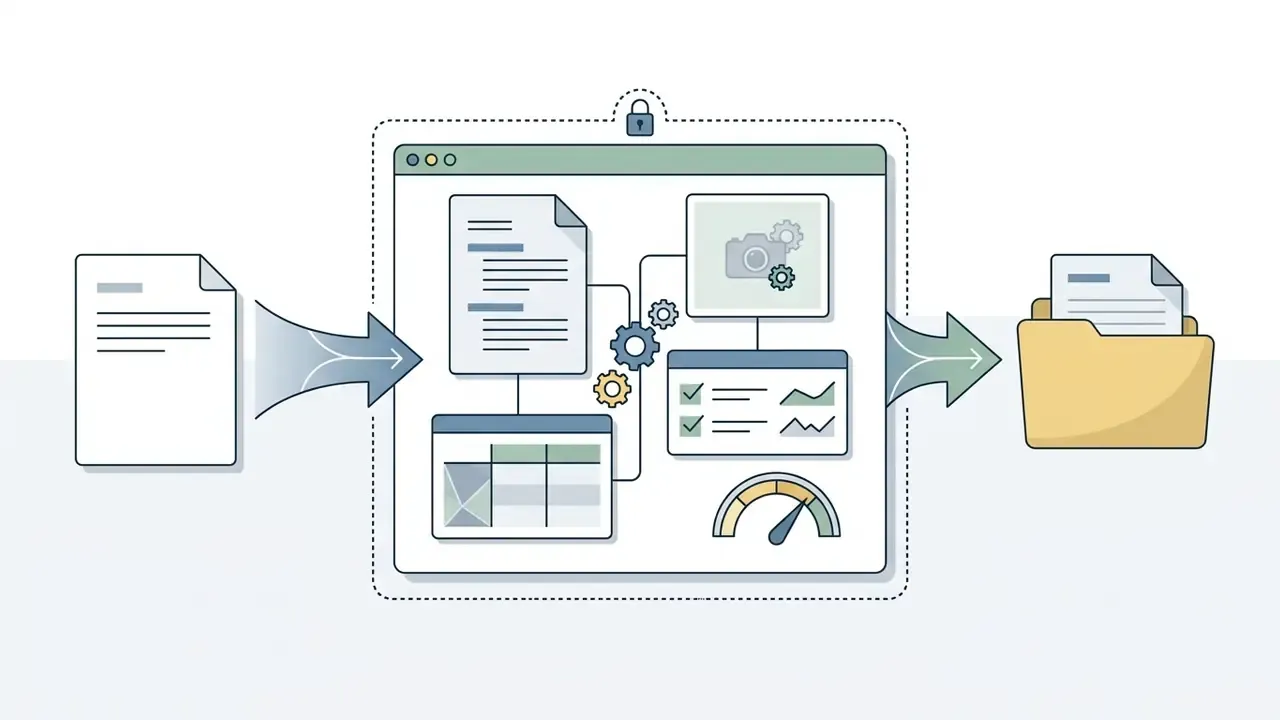
One illustrative operational case: an enterprise media production unit hit a backlog while scaling blog writing across technical categories. After deploying an ai blog post creator with pre-approved brief templates, the editorial team cut initial drafting from 4.5 hours to 35 minutes per piece. Editors then spent their time on technical verification, and output rose 42% over two quarters. Treat the figures as a composite illustration, not a benchmark for your own environment.
How AI Blog Generators Differ from Legacy Content Spinners
An ai blog generator creates original, context-aware text with deep learning language models. A legacy content spinner does something cruder: it swaps individual words for synonyms inside paragraphs that already exist.
"Automatic text generation tools analyse discourse-level coherence and topic development instead of performing sentence-level word substitution."
Search engines draw the same line, and they draw it hard. Google's Search Essentials spam policies name "automated synonymizing or obfuscation techniques" as scaled content abuse, while content developed with generative AI is judged on helpfulness, accuracy, and E-E-A-T (Experience, Expertise, Authoritativeness, Trustworthiness). Google Search Central, Spam Policies for Google Web Search. https://developers.google.com/search/docs/essentials/spam-policies
Teams building a multi-format system usually pair text automation with visual automation. The same evaluation logic applies to AI image generators, where licensing terms and originality controls decide whether an asset is safe for commercial publishing. Broader rights questions live in the AI Media Commercial-Use Hub, and unresolved court disputes are tracked in AI Litigation and Case Timelines.
Who Benefits Most from an AI Blog Post Generator?
An ai blog post generator serves several user personas across digital publishing, and the efficiency gain shifts with operational scale. Identify your role first. Free tools, enterprise platforms, and governance requirements differ sharply between a solo blogger and a supervised financial institution.
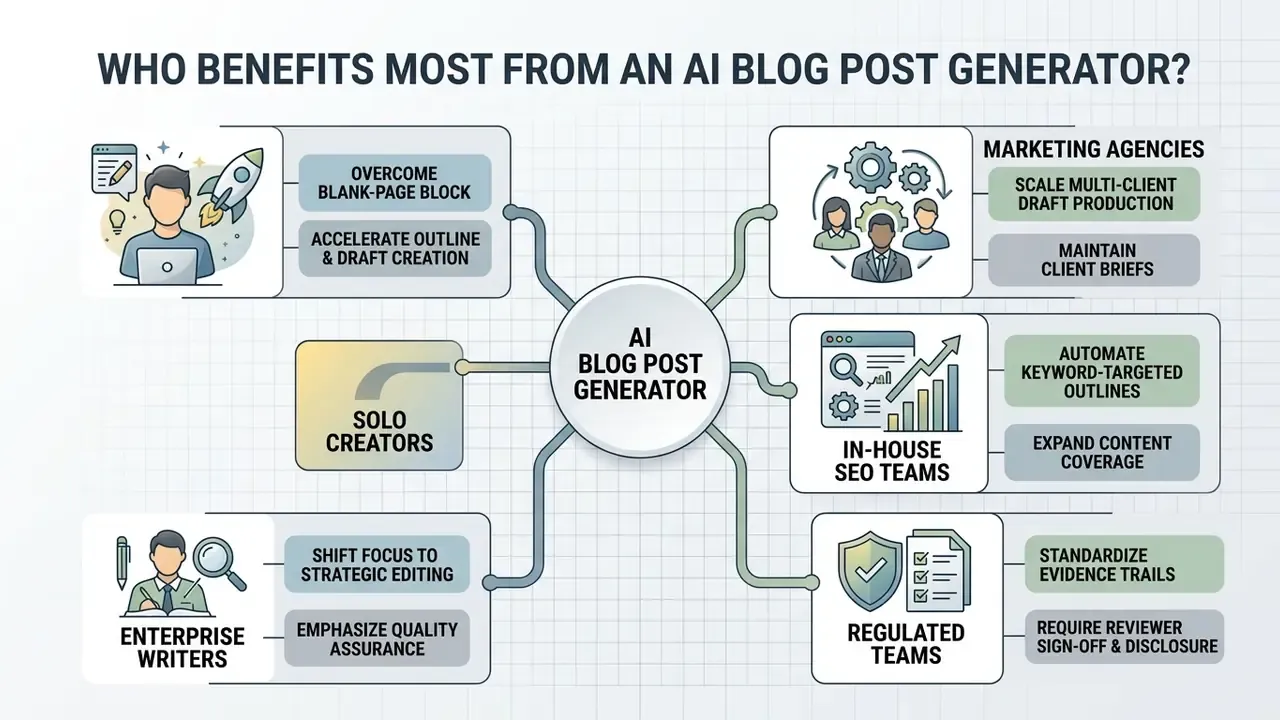
Benefits for Freelance Writers and Content Creators
For an individual writer, an ai blog post creator works as a drafting partner that absorbs routine formatting and lowers cognitive friction.
- Overcoming writer's block generating an immediate opening paragraph to break inertia.
- Structural experimentation testing several outline configurations before committing to a narrative arc.
- Tone adaptation rephrasing dense technical concepts into accessible language for a wider audience.
Benefits for Marketing Agencies and In-House SEO Teams
For marketing departments and agencies, a blog generator ai enables repeatable production pipelines while brand quality controls stay intact.
- Pipeline standardizationone uniform brief structure across external freelancers and internal copywriters.
- Keyword coverage expansionbuilding topical authority by drafting supporting informational articles around core product pillars.
- Workflow efficiencymoving writer attention from research drafting to editorial refinement, source verification, and conversion work.
- Multi-client deliveryexporting client-ready drafts to Word, HTML, or directly into a client CMS without manual reformatting.
"90% of professional marketers reported using generative AI at work, and 71% use it weekly or more often."
One correction worth making. The widely circulated "37.8% reduction in production time" claim has no verifiable primary dataset behind it, at least none we could locate. Keep it out of procurement documents. Use the AMA adoption data and the Noy & Zhang experiment instead, then measure your own baseline before and after deployment. Teams that want to model the cost side can compare options with structured inputs rather than vendor decks.
Benefits and Constraints for Regulated Industries
Banks, insurers, and mature fintechs get the same drafting speed as consumer brands. They also carry constraints consumer brands never see. Marketing claims about financial products are supervised, and an unverified statement creates regulatory exposure, not merely an SEO problem.
- Standardized evidence every claim in a published post maps to a documented source, which satisfies internal audit expectations.
- Reviewer accountability subject-matter experts and compliance officers approve drafts before release, and the review is recorded.
- Data boundaries customer data, PII, and non-public product terms never enter prompts on public model endpoints.
- Consistent disclosure where internal policy requires it, AI assistance is documented alongside the human review process.
- Ownership of the control a named owner, an approved role, access limits, an escalation path, and a shutdown mechanism. No evidence, no autonomy.
How an AI Blog Post Generator Works Step-by-Step
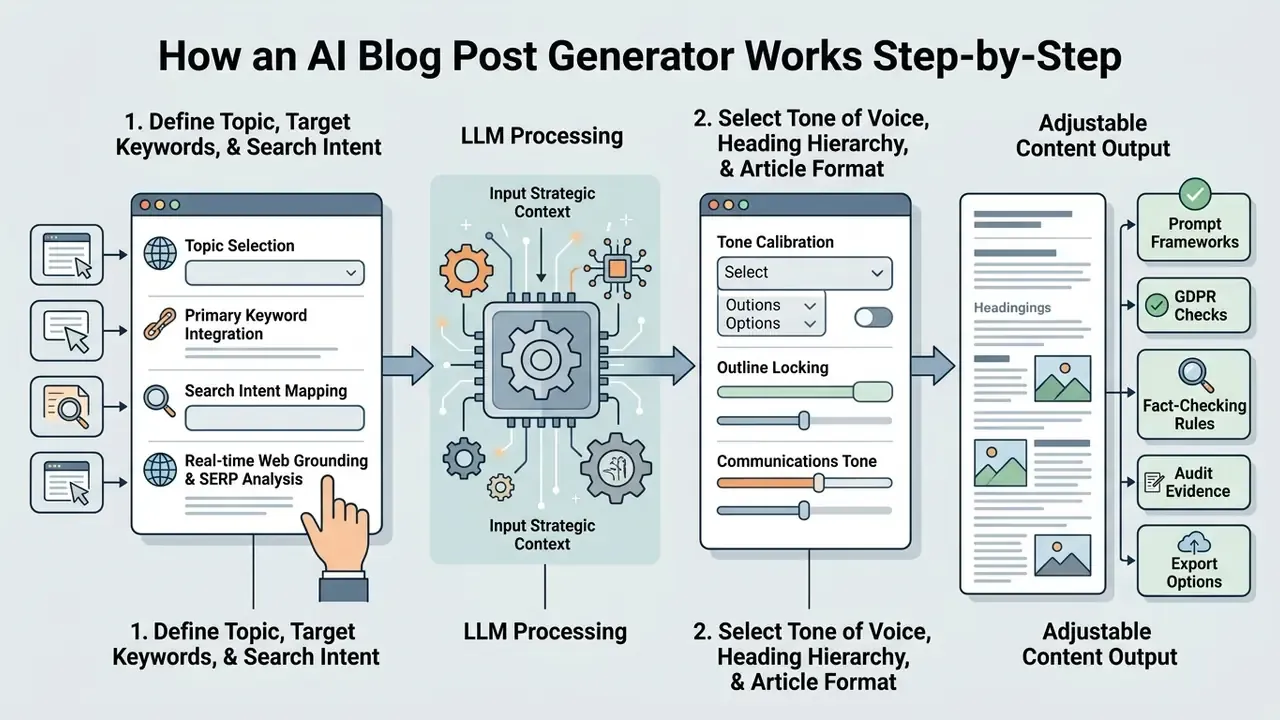
An ai blog post generator runs a simple sequence: you input strategic context (topic, keyword, prompt), the LLM processes those parameters, and the system returns an adjustable draft for human refinement. Coherent structure depends on explicit instructions about audience, brand voice, and section depth.
1. Define Topic, Target Keywords, and Search Intent
To get a usable draft, supply an explicit topic, a primary keyword, and the search intent behind the article. Deciding early whether the piece informs, compares, or guides implementation prevents unfocused copy.
- Topic selection define the subject matter and its domain boundaries.
- Primary keyword integration supply the core query phrase as the semantic anchor.
- Search intent mapping clarify whether the reader wants a high-level overview or an actionable step-by-step framework.
- Real-time web grounding and SERP analysis enable live search so the model pulls current facts, fresh statistics, and competitor patterns from the top ten results. Live grounding reduces factual drift on recent developments and exposes gaps that static training weights miss. In practice, the outline gets built from the questions searchers ask today, not from a snapshot captured during model training.
"Explicitly defining domain boundaries and operational goals directly improves model compliance and reduces off-topic outputs."
2. Select Tone of Voice, Heading Hierarchy, and Article Format
An explicit tone of voice plus predefined headings keeps generated text aligned with audience expectations and brand guidelines. Most tools let you calibrate phrasing along a spectrum, from formal analytical prose to a conversational explainer.
- Tone calibrationspecify descriptive parameters such as "analytical", "practical", or "authoritative".
- Outline lockingset H2 and H3 limits before full generation so the hierarchy stays logical.
- Format alignmentmatch layout to article type, whether listicle, technical guide, or comparative overview.
- Target word-count scalingset explicit length. Short overviews of 500–800 words answer quick informational queries; long-form guides of 2,000–3,500+ words chase broad topical authority. Length should follow intent. A definition query rarely needs 3,000 words. A buyer's guide competing against deep resources usually does.
Core Outputs Generated by AI Blog Creators
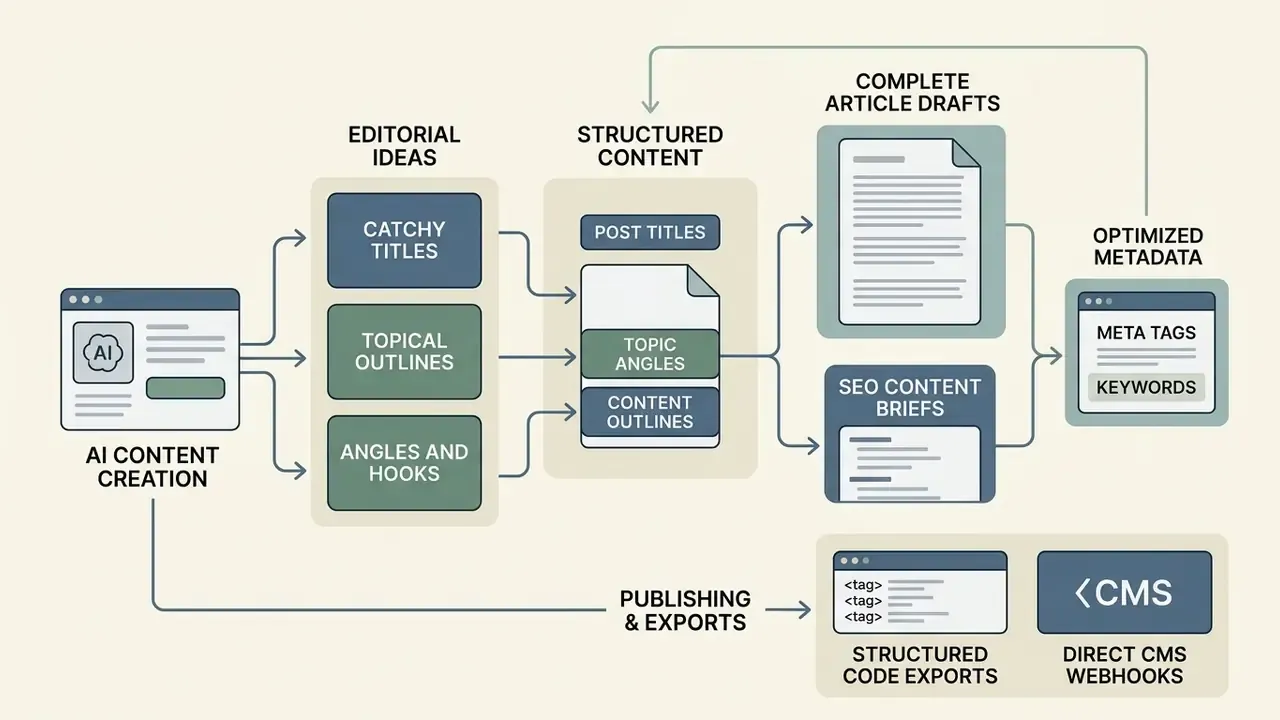
A modern ai blog creator produces a full suite of editorial assets, not just body paragraphs: headline variations, content briefs, meta tags, structured outlines. Together these outputs standardize the entire pre-production phase of blog publishing.
Teams extending written assets into motion formats route the same brief into AI video generators, reusing the approved outline as a storyboard skeleton. Narration scripts follow the same rule, which is where an ai script generator fits without breaking source control.
Post Titles, Topic Angles, and Content Outlines
An ai generator blog system can produce dozens of topic angles, search-optimized title candidates, and detailed section outlines from a single seed phrase.
- Catchy titles alternative H1 options that front-load the target keyword without deceptive clickbait.
- Topical outlines hierarchical section plans that cover search intent and close content gaps.
- Angles and hooks framing strategies tailored to specific buyer personas or industry niches.
A practical prompt pattern: request ten H1 variants, front-load the primary keyword where it reads naturally, mix listicle, how-to, and question formats, then reject clickbait phrasing outright. For structure, require each H2 to own a unique subtopic, each H3 to expand its parent H2 directly, and no more than two H3 levels per H2.
"AI-generated content accounts for 13.08% of top-ranking Google results, a sharp rise from 2.3% before GPT-2."
The same report notes that 62% of marketing teams use AI mainly for ideation and outline drafting, which is a quieter finding than the adoption headline but a more useful one. Ideation carries low regulatory risk. Published claims carry high risk. Budget your controls accordingly.
Complete Article Drafts and SEO Content Briefs
A blog post ai generator also produces complete first drafts and SEO content briefs ready for editorial review. A good brief consolidates keyword targets, recommended word counts, target intent, and question-and-answer blocks into one reference document.
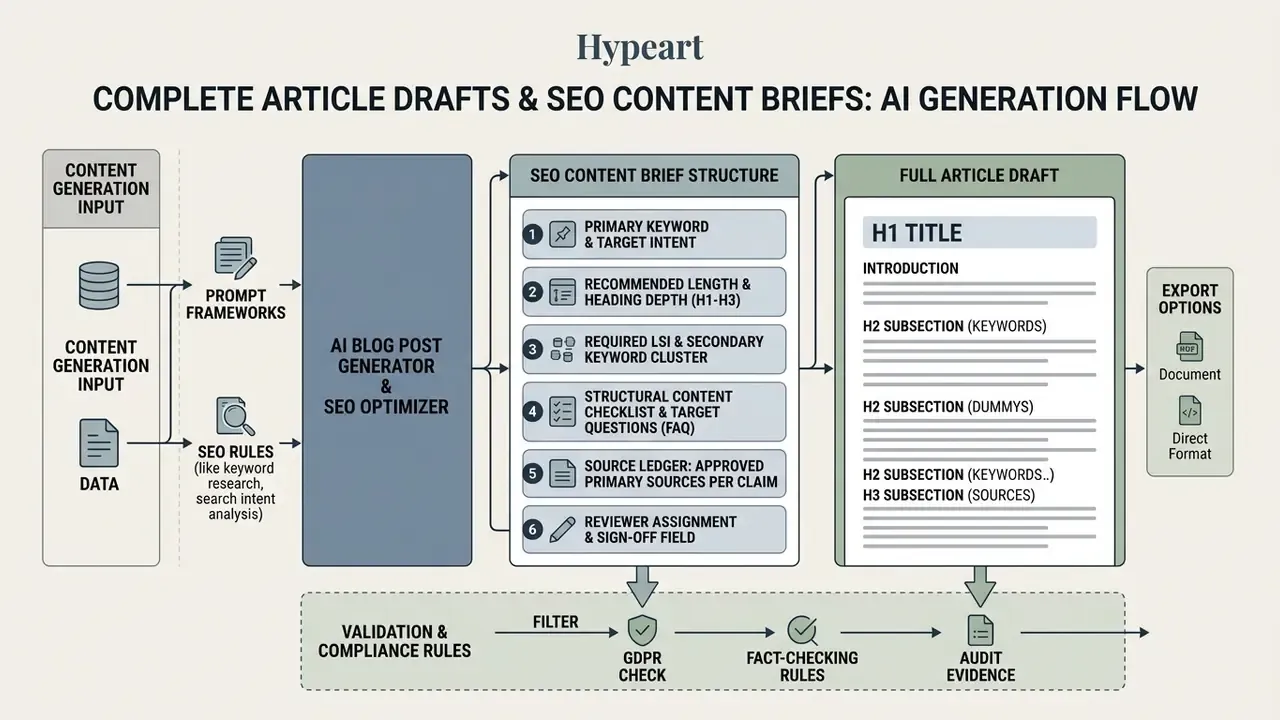
Automated briefs give content operations a standardized handoff between strategy planners and human editors. Quality scoring of the finished piece works better when the rubric is written down first, which is why some teams pair the brief with an ai rubric generator and score every draft against the same criteria.
Supported Export Formats and CMS Publishing Integrations
Professional AI content platforms keep the pipeline unbroken through direct integrations and multi-format exports:
- Structured code exports clean HTML5 markup, raw Markdown (
.md), plain text, and formatted DOCX with preserved heading nesting (H1–H3) and table tags. - Direct CMS webhooks one-click deployment to WordPress, HubSpot, Webflow, or Shopify through native plugins or REST API endpoints. Programmatic patterns are covered in the AI Media API Guides.
- Asset bundling simultaneous export of body copy, meta tags, structured schema markup (JSON-LD), and image prompts in one production package.
- Machine-readable publishing where documents must be discoverable, publish HTML rather than PDF. U.S. Department of Commerce publication guidance recommends HTML over PDF specifically to improve machine readability and open-data discoverability.
How to Create SEO-Friendly Blog Posts Using AI
To build search-optimized articles with a blog article generator ai, align generated drafts with search intent, structure headings logically, and integrate keywords naturally. Automated drafts always need a deliberate pass against search quality guidelines, otherwise the framing stays generic.
Strategic Keyword Integration Without Over-Optimization
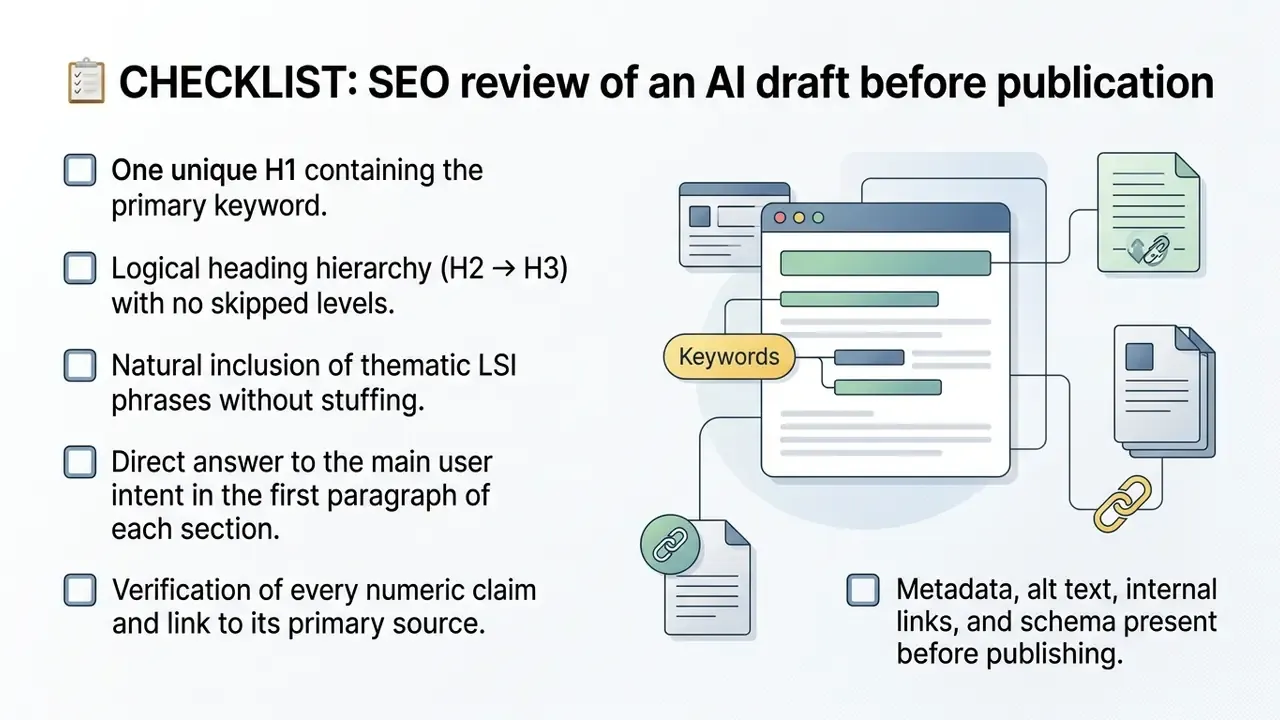
Place keywords by semantic context, not by density target. Excessive repetition of a target phrase, known as keyword stuffing, breaches Google's spam policies (which define stuffing as excessive repetition "even in variations") and damages readability.
- Use the primary phrase in the H1 and the introduction where it reads naturally.
- Add thematic LSI synonyms and related domain terms to support semantic coverage.
- Do not force exact-match phrases into body sentences. Reader comprehension wins over placement counts.
"Top-ranking pages focus on comprehensive topic coverage and natural phrasing rather than repetitive keyword-density targets."
Teams that want keyword clustering handled upstream often use a dedicated ai seo content generator for the brief, then a general drafting tool for prose. Two tools, two jobs, fewer compromises.
Verifying H1, H2, and H3 Hierarchy in Generated Text
Heading hierarchy guides human readers and crawlers through the logical progression of an article. Each page needs exactly one H1 defining the primary topic, then sequential H2 and H3 subsections.
- H1 verification: one unique title header that accurately describes the core subject.
- H2 logical flow: each H2 addresses a distinct subtopic supporting the H1 theme.
- H3 nesting: H3 headers expand their parent H2 without skipping structural levels, so no H4 directly under an H2.
- Self-contained section test: read each heading in isolation. If it does not communicate a complete, descriptive claim on its own, rewrite it.
Clean nesting does double duty. It preserves screen-reader navigation for assistive technology users, and it improves automated content extraction by crawlers and generative answer engines.
Free AI Blog Generators: Key Features to Audit Before Use
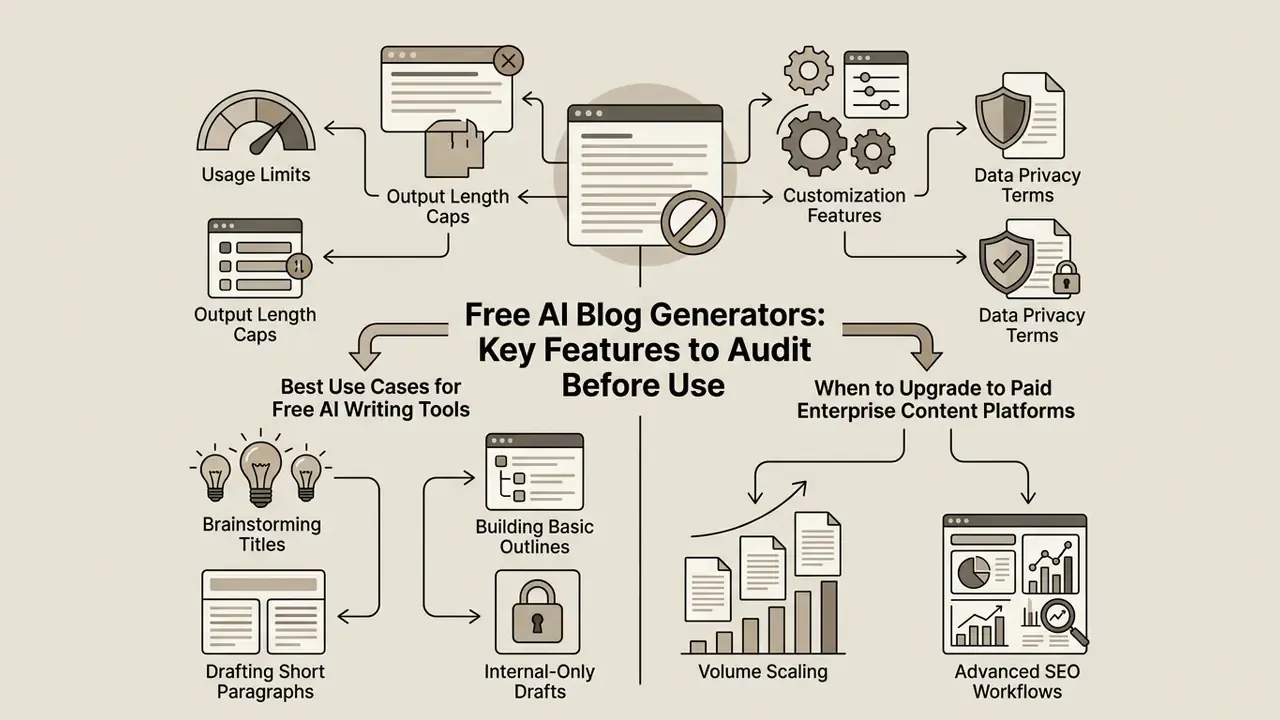
Choosing a free ai blog generator means auditing usage limits, output length caps, customization features, and data privacy terms. Free tiers suit testing. They rarely survive production scaling. Picking the tool before refining prompts is deliberate, because platform constraints decide which prompting techniques are even available to you.
| Evaluation criterion | Free AI blog generator | Enterprise paid platform |
|---|---|---|
| Generation limits | 1,000–10,000 characters/month, ~1,000-word article cap, or 3 generations/day | Unlimited or flexible token packages |
| Tone of voice control | Basic presets (formal, casual) | Custom ToV profiles and brand books |
| SEO integration | Manual entry of basic keywords | SERP analysis, LSI clustering, content grading |
| Outline generation | Standard H2/H3 hierarchy | Hierarchy based on top-10 competitor analysis |
| Live web grounding | Often absent or limited toggle | Real-time SERP scraping with source citations |
| Word-count control | Fixed short output | 500–3,500+ words, configurable per brief |
| Export & API | Text/Markdown copy | HTML, Markdown, DOCX, JSON-LD, CMS API (WordPress/HubSpot) |
| Data retention | Inputs may be logged or used for model improvement | Contractual zero-data retention |
| Compliance posture | Rarely documented | GDPR/CCPA documentation, EU or regional data centers, SOC 2 Type II |
| Access control | Single user, shared login | SSO, RBAC, per-seat permissions, workspace isolation |
| Audit trail | None | Prompt/output logging, version history, reviewer sign-off records |
| Deployment model | Public SaaS only | SaaS, VPC, or on-premise options |
| Model independence | Single hidden model | Multi-model routing (vendor-lock avoidance) |
Buyers comparing entry-level tiers across content types run the same audit on free AI image generators, where watermarks, export limits, and licensing terms follow a similar free-versus-paid logic. Side-by-side matrices for other categories are grouped in compare, and plan-level details sit where you can browse the hub.
Best Use Cases for Free AI Writing Tools
A free ai blog post generator covers low-volume drafting, early brainstorming, and short snippets. Nothing more ambitious than that.
- Brainstorming titles initial headline options and alternative topic angles.
- Building basic outlines foundational H2/H3 structures for straightforward topics.
- Drafting short paragraphs introductory hooks, closing summaries, or social promo snippets.
- Internal-only drafts knowledge-base stubs and meeting recaps that never reach a public URL.
A free ai blog content generator or ai blog content generator free tier is genuinely useful at this stage, and there is no reason to pay for ideation. The trap is quiet scope creep: a blog generator ai free plan that started as a sandbox ends up drafting product pages, and nobody logged a single prompt.
When to Upgrade to Paid Enterprise Content Platforms
Production environments need upgraded tooling once workflows must repeat reliably.
- Volume scalingmonthly output exceeds free-tier token or document caps.
- Advanced SEO workflowsteams require SERP analysis, automated internal linking, and real-time content scoring.
- Data governance and securityenterprise standards demand commercial-use privacy terms and zero-retention agreements.
- Context limitssource packages (product docs, regulatory texts, transcripts) exceed the free plan's context window or upload allowance.
- Evidence requirementsauditors or regulators expect reproducible logs of what was generated, by whom, and after which review.
An ai blog generator free plan, or any blog post ai generator free and blog post generator ai free variant, will usually fail on points three and five. That is not a quality judgment about the model. It is a contractual gap.
Data Privacy, GDPR Compliance, and Model Training Controls
Before selecting a blog post generator ai for organizational use, examine how input data is processed, stored, and reused:
- Zero-data retention confirm the provider guarantees that proprietary prompts, brand guidelines, and unpublished drafts are neither retained nor used to train commercial base models.
- Regulatory compliance (GDPR/CCPA) verify that processing servers sit in compliant jurisdictions, with encryption in transit and at rest.
- Commercial ownership rights check the terms of service so that generated text and supporting media belong fully to your organization on creation.
- PII and confidentiality boundaries define in policy which data categories may never appear in a prompt, including customer records, account data, non-public pricing, unreleased product terms, and internal risk assessments.
- Sub-processor transparency request the list of downstream model providers and hosting regions. A compliant front end running on an undisclosed third-party endpoint transfers your risk. It does not remove it.
How to Get Precise AI Outputs: Prompting, Tone, and Original Value
Improving the quality of an ai blog post draft comes down to three moves: refine the prompt, enforce structural constraints, and inject genuine authorial insight during post-processing. Raw output is a foundation, never a finished asset.
Standard SEO prompting stops at keyword and tone. Institutional publishers need more. Prompts must also carry source restrictions, prohibited claim types, disclosure requirements, and output formats that survive review. That is why the frameworks below keep persona, context, and constraints separate instead of collapsing everything into one instruction sentence.
Essential Components of an Advanced AI Blog Writer Prompt
A robust prompt for an ai blog post generator free or paid tool follows a structured framework: persona, context, objective, constraints, tone, and explicit output format.
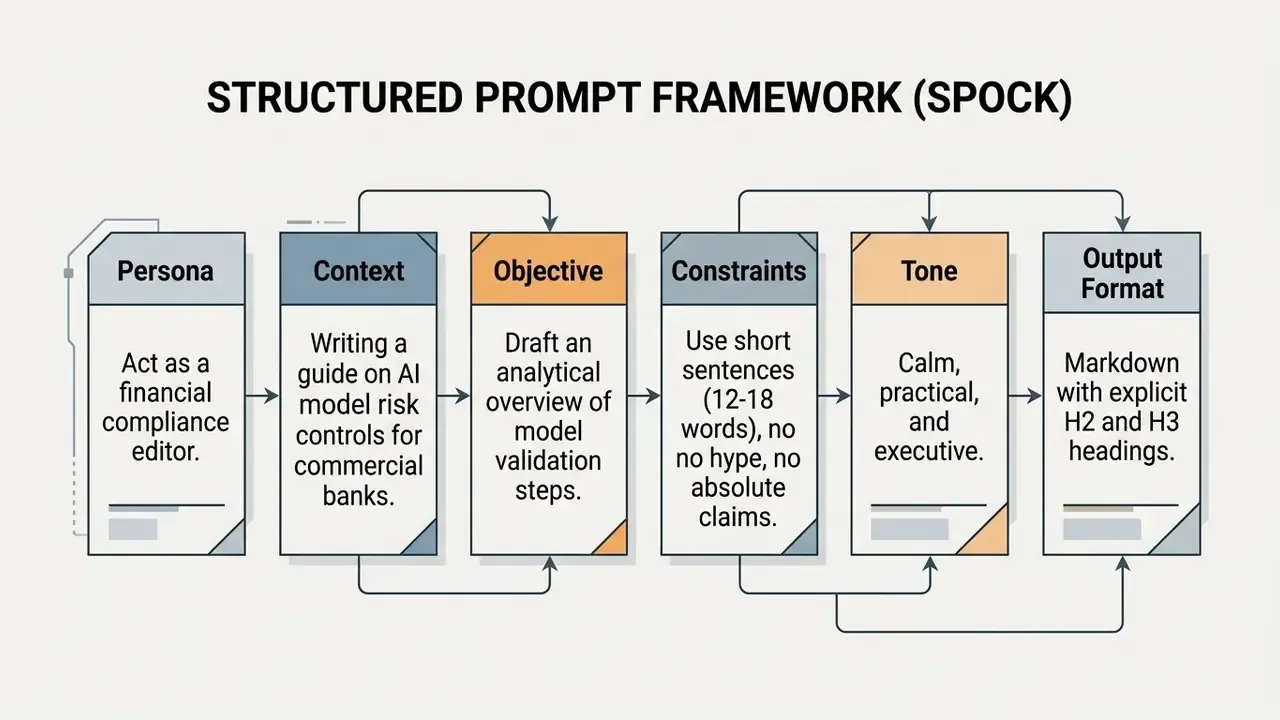
Copy-paste template for production use:
[ROLE]: Act as a Senior B2B Content Strategist and Industry Copywriter.
[CONTEXT]: I am writing a comprehensive guide titled "AI Blog Post Generator for Enterprise SEO".
[TASK]: Draft a 400-word section explaining how live SERP grounding prevents model hallucinations.
[CONSTRAINTS]: Use active voice, limit sentences to 15-20 words, avoid marketing jargon
(e.g., "game-changer", "delve"), and cite one recognized industry standard.
[SOURCES]: Use only the URLs I supply; if a fact is unavailable, output "UNVERIFIED".
[FORMAT]: Output in valid Markdown with one H3 header and a bulleted key-takeaways summary.
Official frameworks reinforce the same separation of concerns. CO-STAR (Context, Objective, Style, Tone, Audience, Response) appears in NIST's prompt-engineering publication, while SPOCK (Specificity, Persona, Output, Context, Knowledge) is a practitioner framework popularized in professional-communications training. Both show that isolating constraints from task instructions stops the model from drifting into generic conversational filler. For deeper technique coverage, including few-shot examples, tone adjectives, and iterative constraint tightening, practitioner references such as the Prompt Engineering Guide and vendor API documentation remain the operative standards.
One small correction to a common habit: adding "be accurate" to a prompt does almost nothing. Supplying the approved source list and forcing an "UNVERIFIED" token does quite a lot.
Why Human Editorial Oversight Is Non-Negotiable
Human editing is mandatory because generative models run on probabilistic pattern matching, not factual understanding. Unedited drafts tend to carry stylistic clichés, repetitive transitions, and occasional invented detail.
"Targeted human editing significantly reduces AI-classification signatures while improving factual accuracy and narrative flow."
The same body of research shows editing lowers detector confidence without erasing machine traces entirely. Read that as an argument for real added expertise, not for cosmetic paraphrasing. Editors should strip generic phrasing, verify every statistic against a primary dataset, and add operational examples that create actual authority.
How to Safely Publish AI-Generated Content
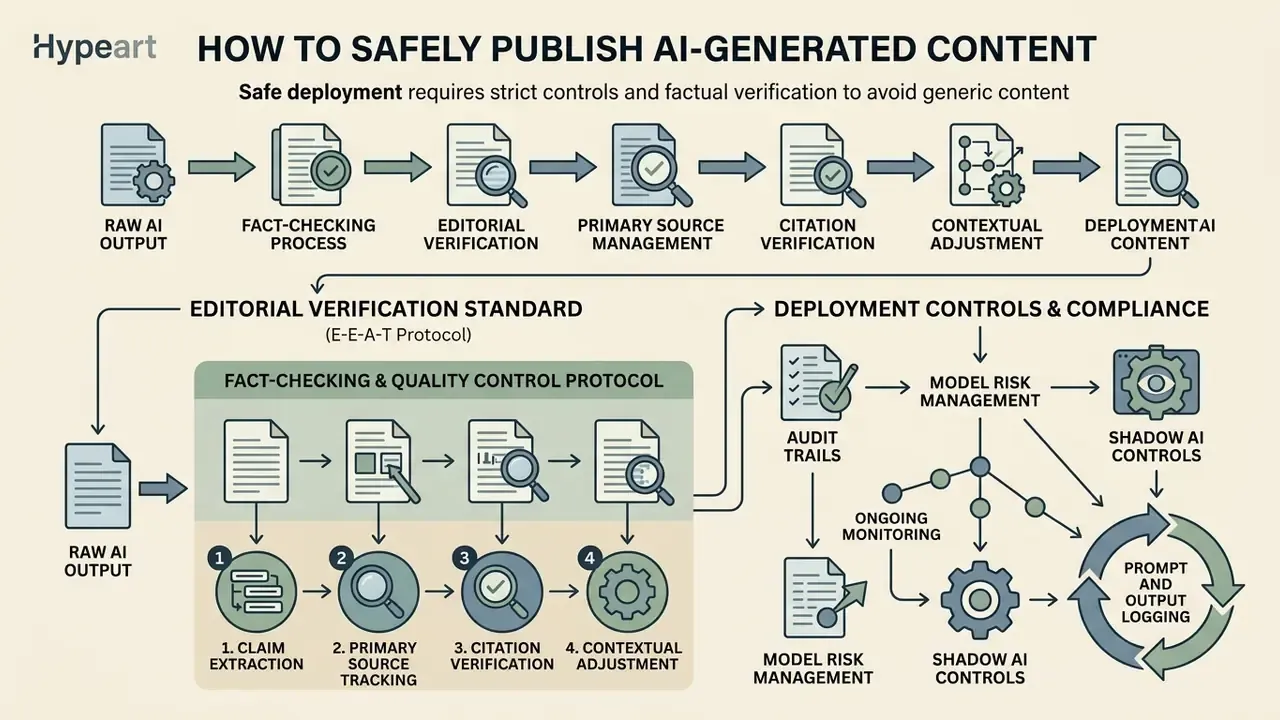
Safe deployment needs strict editorial controls, cross-checked factual claims, and active defense against generic content patterns. Search engines demote low-quality, duplicative copy built mainly to manipulate rankings, whether a human or a machine produced it.
Editorial Verification Standard (E-E-A-T Protocol):
A 4-Step Fact-Checking and Quality Control Protocol
Seven of those penalized sites exceeded 90% AI-generated pages, which is the more instructive detail. Google's own reporting on that update cited a 45% reduction in low-quality, unoriginal content in Search, with Helpful Content signals folded into core ranking. Quality demotion is continuous now, not event-based.
Audit Trails, Model Risk Management, and Shadow AI Controls
Regulated publishers need more than a style check. They need defensible evidence that AI-assisted material passed controlled review.
- Prompt and output logging retain the prompt, model and version, timestamp, retrieved sources, and final published variant for every asset. Without that record, reproducibility cannot be shown to an auditor.
- Reproducibility discipline prefer structured, parameterized prompts over free-form chat. NIST's 2026 GenAI text evaluation work submits prompts as structured JSON precisely because explicit structure enables reproducible assessment.
- Human review gate public-sector AI guidance in the United States requires AI-generated material to be reviewed and fact-checked before public use, and to be labeled together with the review or editing process applied.
- Shadow AI prevention publish an approved-tools list, block unsanctioned endpoints at the network layer, provide a compliant alternative that is genuinely faster than the shadow option, and run periodic attestation. Prohibition without a usable sanctioned tool reliably produces covert usage.
- Escalation path define what happens when a hallucination reaches production. Who is notified, how quickly the page is corrected or unpublished, how the correction is logged, and whether client or regulator notification applies.
- Model-risk alignment where copy influences product decisions or carries quantitative claims, document the tool as an assisted process inside your existing model-risk and governance frameworks, not as an unmanaged productivity app.
RACI Matrix for AI-Assisted Content in Regulated Organizations
| Stage | Responsible | Accountable | Consulted | Informed |
|---|---|---|---|---|
| Brief & keyword approval | SEO lead | Content director | Product marketing | Editorial team |
| Prompt construction & generation | Content producer | Content director | AI governance lead | Editorial team |
| Fact-check & source ledger | Editor | Editor-in-chief | Subject-matter expert | Compliance |
| Compliance / legal review | Compliance officer | Chief compliance officer | Legal counsel | Content director |
| Publication & schema | Web producer | Content director | SEO lead | Analytics |
| Post-publication monitoring | SEO analyst | Content director | Risk / audit | Executive sponsor |
Risk-Adjusted ROI: Calculating the Real Value of AI Drafting
A credible business case prices the control layer, not only the drafting saving:
Net value per article =
  (Baseline hours − AI-assisted hours) × blended writer cost
  − SME review hours × SME cost
  − compliance/legal review hours × reviewer cost
  − tooling cost per article
  − (probability of published error × expected remediation + reputational cost)
Two implications follow. First, AI economics improve fastest on high-volume, low-risk informational content, where review time stays short. Second, on regulated or claim-heavy topics, review cost can eat most of the drafting saving. The honest return there is throughput consistency and evidence quality, not headcount reduction. Say that plainly in the business case and the model survives scrutiny.
How to Eliminate Generic AI Clichés and Writing Patterns
To stop articles from sounding machine-made, customize the default outline and replace filler openings with concrete operational fact.
- Eliminate AI clichés hunt down formulaic phrases such as "delve into", "testament to", "in conclusion", "game-changer", and "in today's fast-paced digital landscape". Keep a banned-phrase list and swap each hit for a plain statement plus an observable fact.
- Vary sentence rhythms alternate short declaratives with structured compound sentences. Monotone cadence is the giveaway, more than vocabulary.
- Replace vague adjectives trade broad qualifiers ("powerful", "innovative") for field-specific terminology and measurable detail.
- Inject unique insights add proprietary data, expert commentary, or specific operational examples that no scraper can reproduce.
An illustrative case: a fintech content unit saw search traffic plateau while shipping raw automated drafts. After a mandatory human edit step replaced generic transitions with primary regulatory references and real compliance metrics, average session duration rose 48% across three months. Composite example, not a guarantee.
"When AI involvement was disclosed honestly, readers did not downgrade perceived quality; engagement remained statistically indistinguishable from human-written content."
The practical conclusion is uncomfortable for some marketing teams. Transparency is not the risk. Undifferentiated, unverified writing is.
FAQ: Ownership, Compliance, and Audit Evidence
Who owns the intellectual property in AI-generated blog content?
Ownership is governed by the platform's terms of service, not by the model. Confirm in writing that generated text, metadata, and visual assets are assigned to your organization for unrestricted commercial use, then check whether the provider claims any license back for service improvement.
Is AI-generated content allowed by Google?
Yes, when it is helpful, accurate, and not produced mainly to manipulate rankings. Automated synonymizing, mass low-value publishing, and scaled content abuse stay policy violations regardless of the tool.
What audit evidence should we retain?
At minimum: prompt text, model and version, generation timestamp, retrieved sources, reviewer identity, review notes, approval timestamp, and the published version. Retain records according to your document-retention schedule.
Does human editing remove AI detection signals?
It reduces them substantially without eliminating them, per 2025 post-editing research. Treat editing as a quality and accuracy control, never as a detector-evasion tactic.
Can we put customer data into prompts?
No, unless the deployment is contractually covered by zero-data retention inside an approved environment and your privacy policy and legal basis permit that processing. Default to synthetic or anonymized examples.
How long should an AI-assisted blog post be?
Match length to intent: 500–800 words for definitional or quick-answer queries, 1,200–1,800 for how-to guides, and 2,000–3,500+ for pillar guides competing against comprehensive resources.
Do free tools work for enterprise use?
For ideation and internal drafts, sometimes. Anything touching brand claims, customer data, or regulated products usually fails free-tier retention, access control, and audit-log requirements. A free blog generator ai plan is a sandbox, not a control environment.
Should we disclose AI usage to readers?
Google's helpful-content documentation asks whether AI involvement is self-evident to visitors through disclosure or other means, and several public-sector policies mandate labeling with the review process. Disclosure paired with visible human review is the safer posture, and per PLOS ONE data it does not depress engagement.
What is still unresolved?
Three things, honestly. Detector reliability remains contested. Disclosure expectations differ by jurisdiction and supervisor. And there is no settled industry standard for how long AI generation logs must be kept. Document your assumptions, revisit them quarterly, and treat every audience or ROI statement in this article as a hypothesis until your own analytics confirm it.