An ai seo content generator is a specialized software system that combines large language models with real-time search engine result page (SERP) data to produce search-optimized digital text. Unlike basic writing tools, an ai content generator for seo evaluates keyword density, user search intent, competitor content structures, and semantic entity coverage before drafting articles.
If you own model risk, marketing compliance, or brand claims at a bank or a mature fintech, the question is not whether the drafting works. It usually does. The question is whether you can prove, months later, who approved a number that appeared in a public article.
Executive Summary
- What it is A pipeline, not a chatbot. An ai seo content generator chains keyword discovery, live SERP scraping, brief and outline synthesis, drafting, on-page scoring, and CMS publishing.
- What search engines allow Google's published guidance (2023, restated for generative AI features in 2026) permits AI assistance but prohibits automation used primarily to manipulate rankings. Quality is judged by helpfulness, originality, and E-E-A-T signals, not by authorship.
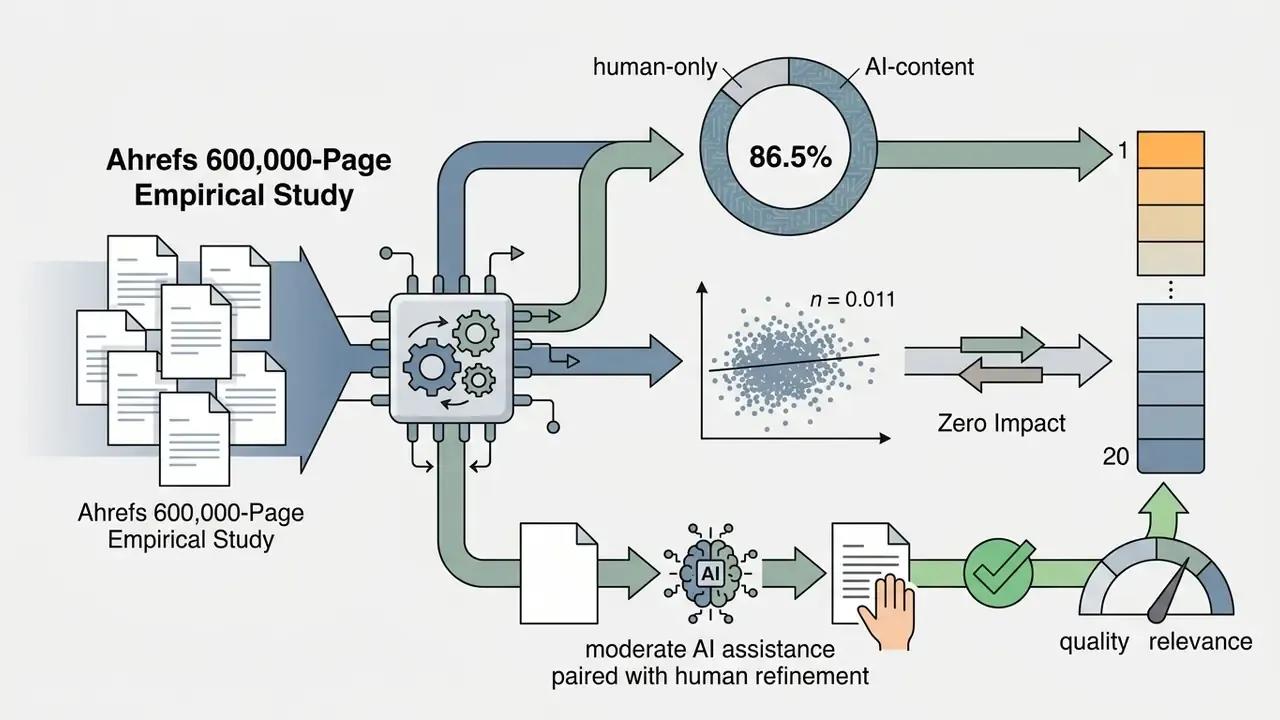
- What the data shows Pages with moderate AI assistance plus human refinement earn materially more impressions than fully automated pages, while the raw share of AI text correlates with position at roughly 0.011, which is effectively zero (Ahrefs, 2025).
- What breaks without humans Hallucinated statistics, Grade 13 to 14 readability, keyword-density distortion, and absent experiential authority. Roughly 93% of organizations using AI for content review outputs before publishing (Semrush, 2025).
- What to add in 2026 Generative Engine Optimization (GEO) formatting for ChatGPT, Perplexity, Claude, and Gemini; documented audit evidence trails; risk-adjusted ROI modeling; vendor due diligence on SOC 2 and data-retention policy.
- Who this is for Content leads, SEO strategists, and risk or compliance owners evaluating automation for regulated or high-volume publishing environments.
Scope, Audience, and What Changed Since 2025
This guide is written for two overlapping buyers. The first is the content lead who needs more published assets per quarter without a proportional headcount increase. The second is the governance owner who has to sign off on the workflow, and who tends to ask a colder set of questions: where does the data go, who verifies the numbers, what happens when a claim is wrong.
Three things shifted between 2025 and 2026, and they change the evaluation criteria.
One honest caveat before the mechanics. Almost every published benchmark in this space comes from tool vendors or practitioner testing, not peer-reviewed replication. Treat the numbers as directional. Re-measure on your own prompts.

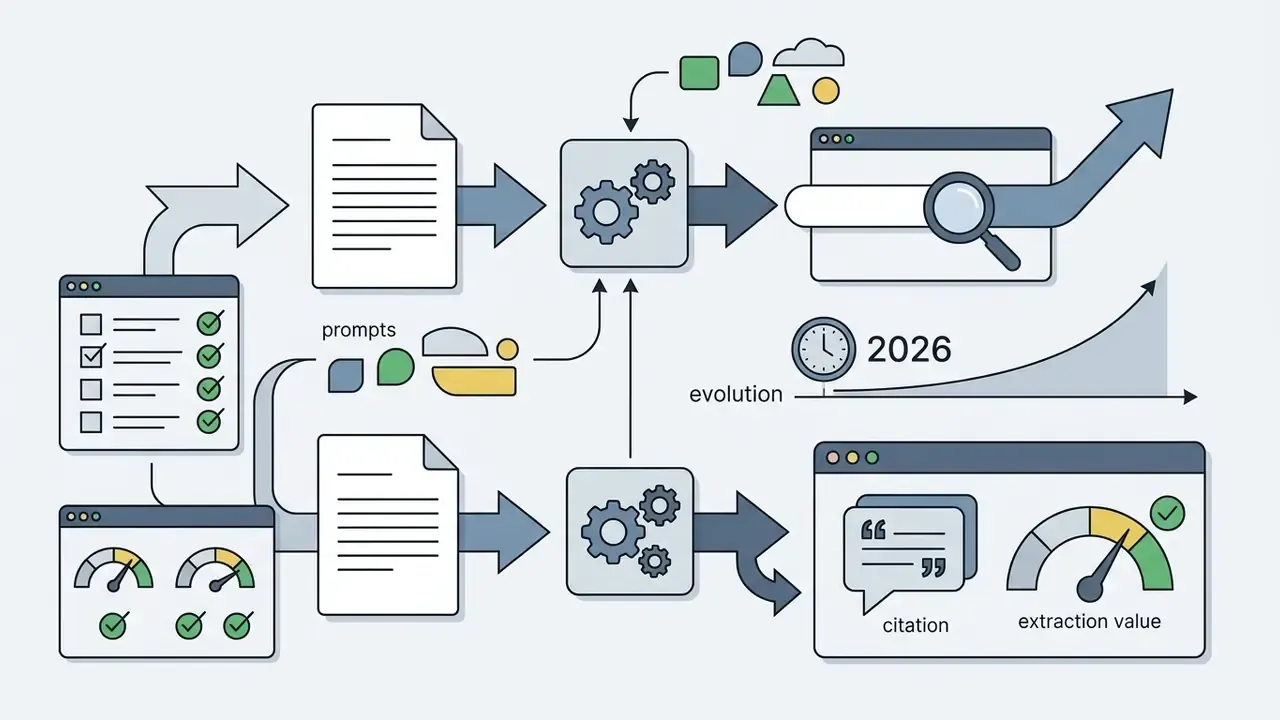
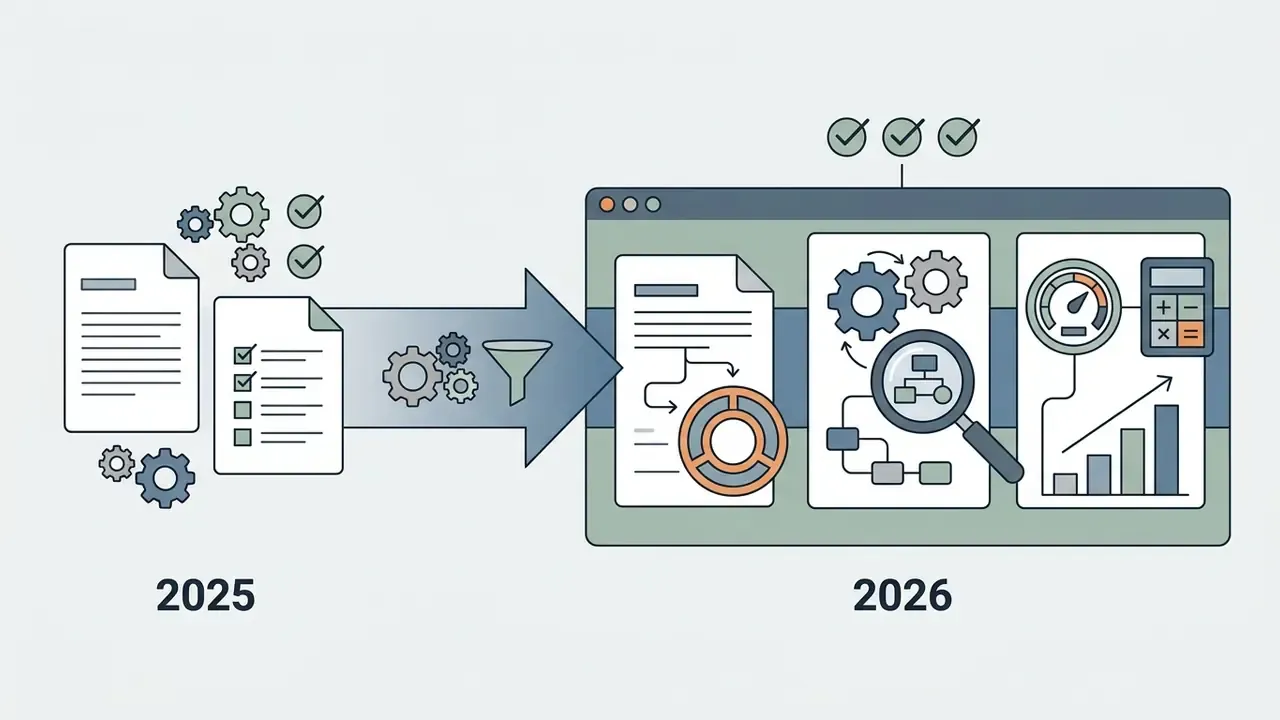
What an AI SEO Content Generator Is and How It Differs From a Generic AI Writer
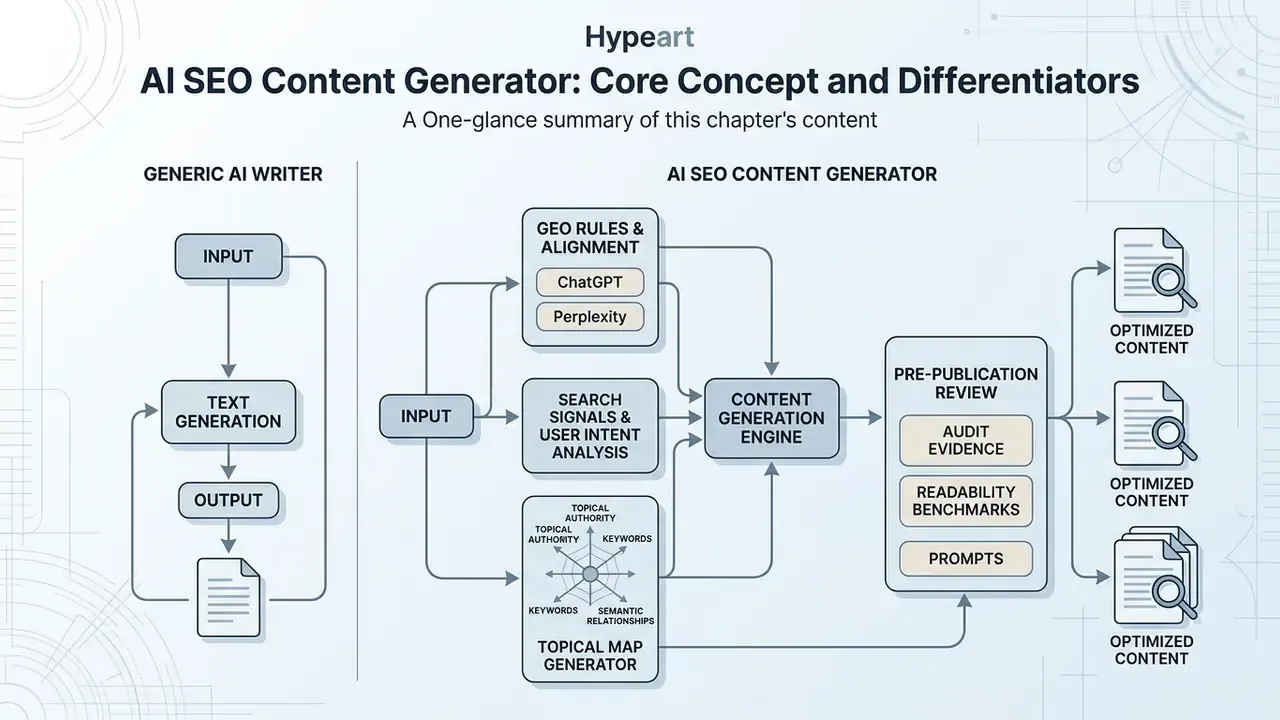
An ai seo content generator is an automated writing platform designed to align generated text with search engine ranking signals and user intent. Generic AI writers focus on language fluency and narrative coherence, whereas a dedicated seo ai content generator integrates SERP scraping, semantic keyword analysis, and structural scoring to optimize organic visibility. Readers building a broader automation stack often evaluate this category alongside AI image generators, since visual assets and text assets share the same publishing pipeline.
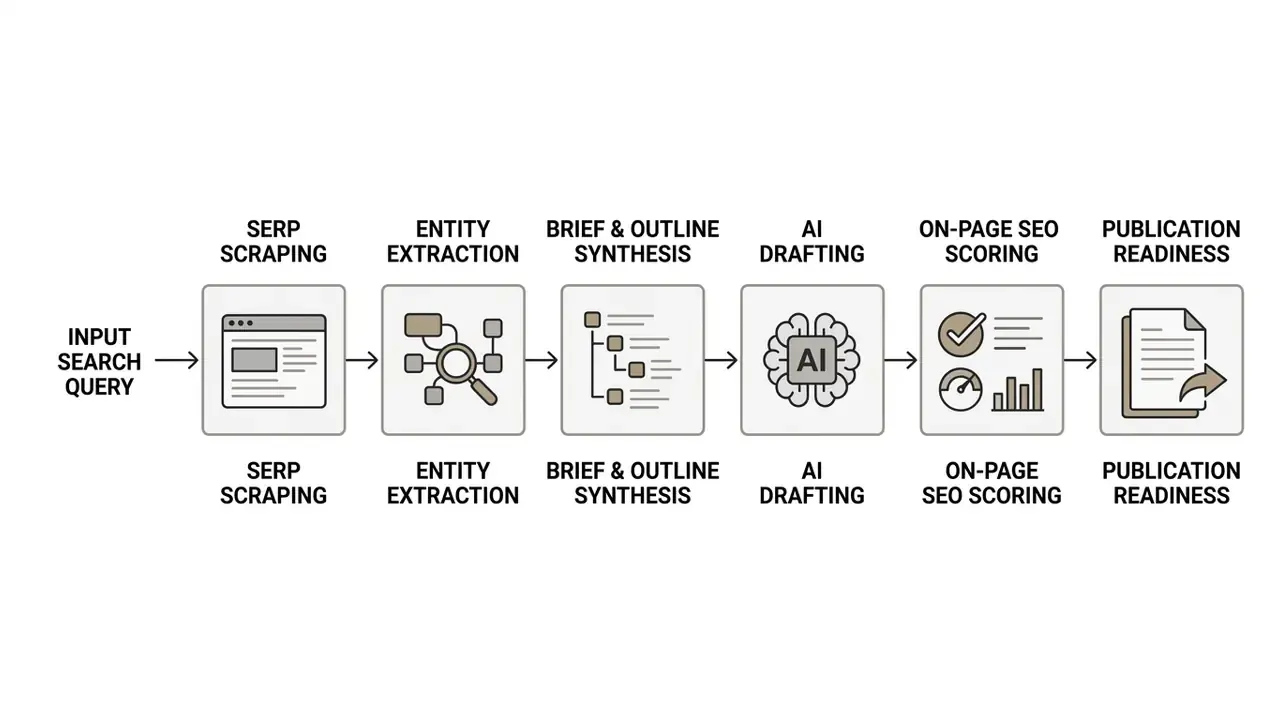
The practical distinction is architectural. A general model such as ChatGPT, Claude, or Gemini predicts fluent language from training data. A dedicated platform runs five or six discrete stages before a single article goes live: keyword prioritization, competitor structure extraction, brief synthesis, constrained drafting, on-page optimization, and publication. It is the difference between a single tool and an assembled production line.
What Tasks an AI SEO Article Generator Solves
An ai seo article generator automates data extraction, content structuring, and initial text drafting across the entire editorial pipeline. The system processes target key phrases to perform competitive SERP analysis, extract recurring subtopics, and build structured outlines with targeted heading hierarchies.
The primary operational tasks performed by an ai seo content generator tool include:
- Generating search-aligned content briefs containing target word counts, primary keywords, and LSI entities.
- Constructing logical H1, H2, and H3 outline hierarchies derived from top-ranking organic competitors.
- Drafting section-by-section text populated with semantically relevant terms and secondary search queries.
- Synthesizing meta title tags and meta descriptions formatted to character limits and search intent.
- Formatting structured elements such as summary tables, bulleted lists, and FAQ sections for feature eligibility.
A small observation from reviewing these outputs at volume: the topical map is usually the most valuable artifact and the least trusted one. Teams accept the draft article and ignore the roadmap, then wonder why coverage stays shallow.

Why Generic AI Writing Does Not Replace SEO Optimization
Generic AI writing models predict subsequent tokens based on training data without evaluating real-time search engine demand or competitor positioning. Unassisted language models do not analyze search volume, keyword difficulty, or primary search intent, which often leads to topical drift and generic prose.
«Pages with moderate AI usage receive two to three times more organic impressions than pages with a high share of AI-generated content.»
How an AI SEO Content Generator Produces Search-Optimized Content
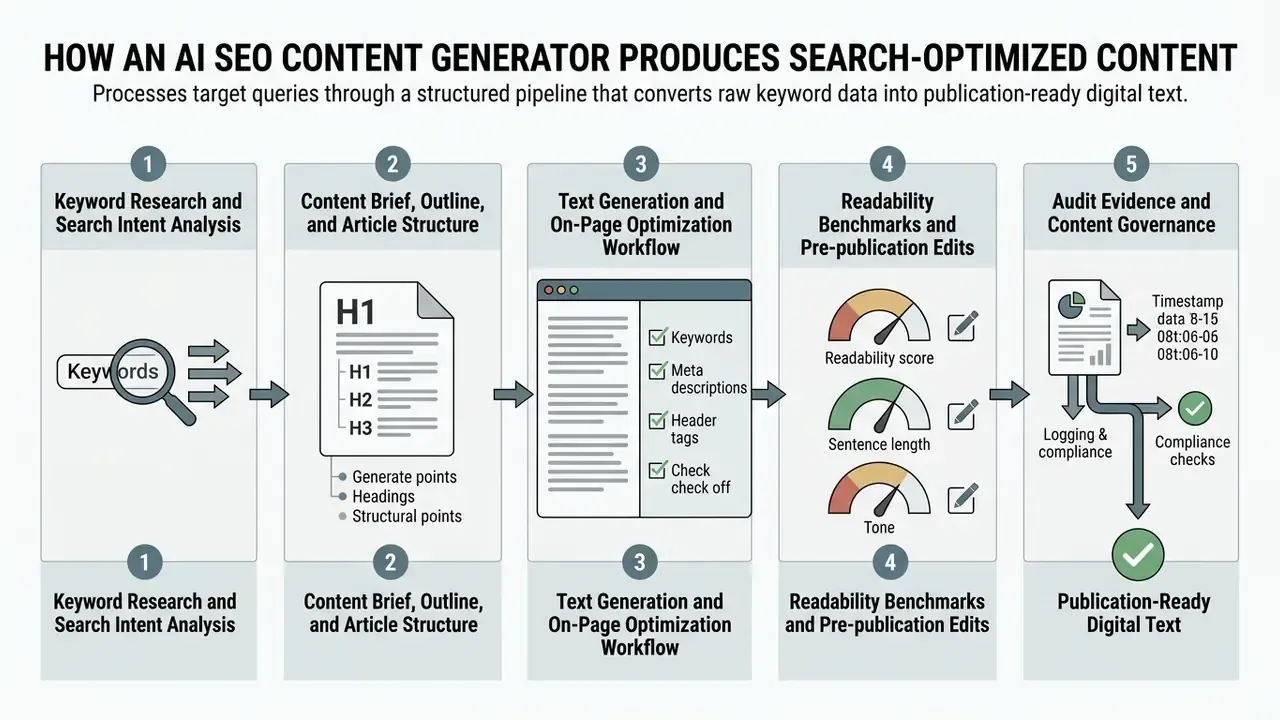
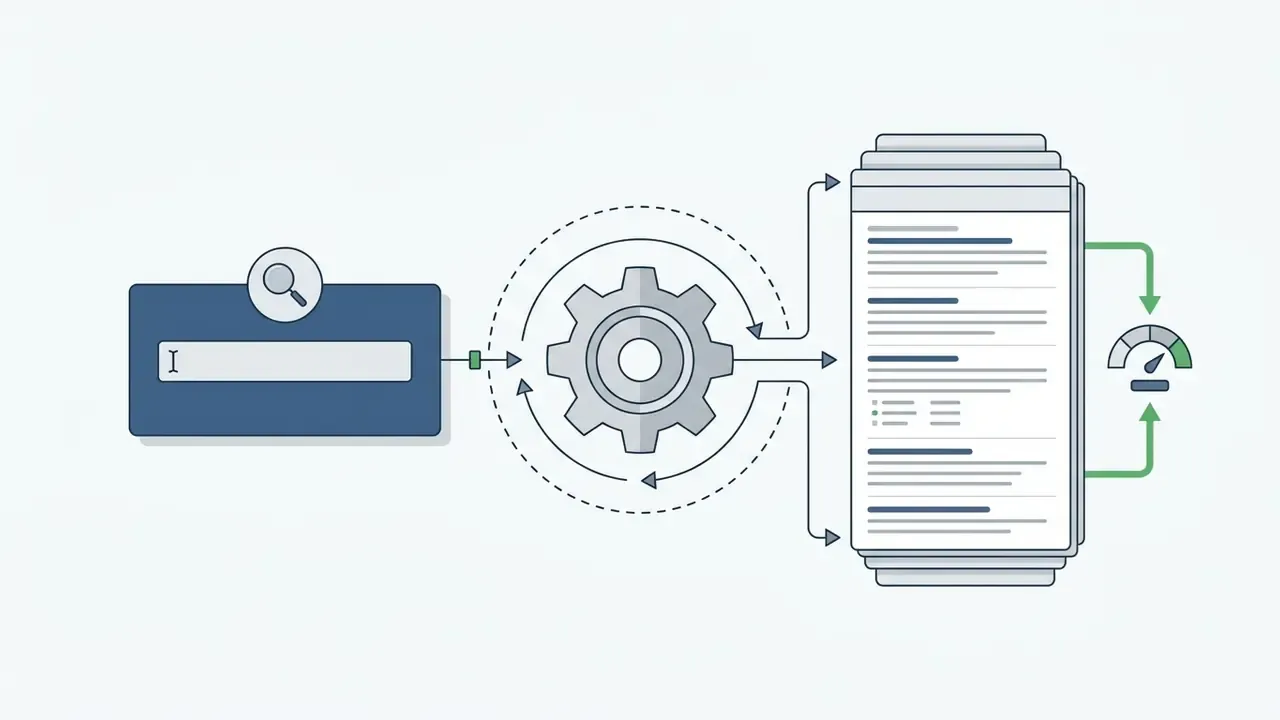
An ai seo generator processes target queries through a structured pipeline that converts raw keyword data into publication-ready digital text. The system moves systematically from real-time SERP scraping to semantic entity extraction, outline synthesis, draft generation, and on-page technical optimization.
Keyword Research and Search Intent Analysis
Modern ai content generator seo systems combine vector embeddings, keyword matching, and intent classification models to analyze search queries. The algorithm determines whether a search query is informational, commercial, transactional, or navigational by examining top-ranking domain profiles and user interaction patterns.
«Hybrid retrieval combines keyword matching, semantic vector embeddings, and LLM-generated structured queries to capture both explicit and implicit user intent.»
Hybrid semantic search methods use semantic vector spaces alongside structured entity extraction to map primary keywords against related secondary queries. This process ensures the generated text addresses core informational requirements while incorporating long-tail search variations naturally across the body copy. Mature systems additionally weigh competitor content gaps, topical clusters, and the current authority profile of the publishing domain before assigning a keyword to the production queue.
Content Brief, Outline, and Article Structure
Automated content brief creation begins by fetching live search engine results for the primary search query and scraping the top ten ranking pages. The platform identifies structural commonalities, heading frequency, average word counts, and recurring questions from search engine feature panels.
The ai seo text generator synthesizes this competitor data to build a comprehensive H2 and H3 outline. The synthesized brief establishes structural coverage targets, specifies required LSI entities, and highlights content gaps missed by current SERP competitors. Vendor documentation differs on scope. Some platforms analyze the top 5 pages, others the top 10 or top 20, so buyers should confirm the sampling depth, because it directly determines how defensible the resulting outline is.
Text Generation and On-Page Optimization
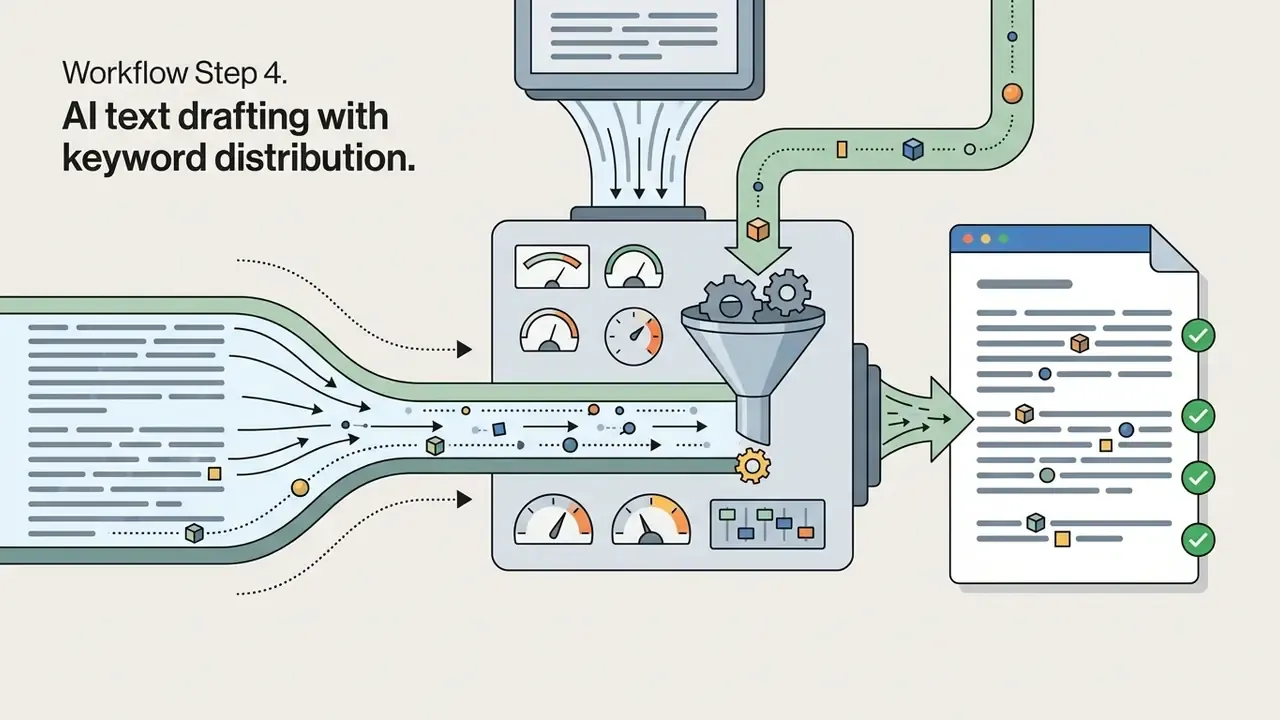
Text generation occurs sequentially by passing structured outline sections and semantic entity instructions into the underlying language model. The ai content generator with seo optimization places targeted primary keywords into critical HTML elements, including heading tags, introductory paragraphs, and concluding summaries.
On-page optimization rules maintain natural phrase variations while preventing keyword stuffing violations flagged by search quality algorithms. Google's spam policies define keyword stuffing as filling a page with keywords or numbers to manipulate rankings, so density calibration is a compliance control rather than a stylistic preference. The system validates readability scores, structures short paragraphs, and prepares metadata tags prior to final editorial review. Institutional SEO guidance also expects the primary keyword in the URL, H1, meta description, and image alt attributes, with unique keyword targeting per page.
Teams wiring these stages together programmatically will find the request patterns and rate-limit notes in the AI Media API Guides more useful than a UI walkthrough.



What Content Types an AI SEO Generator Can Create
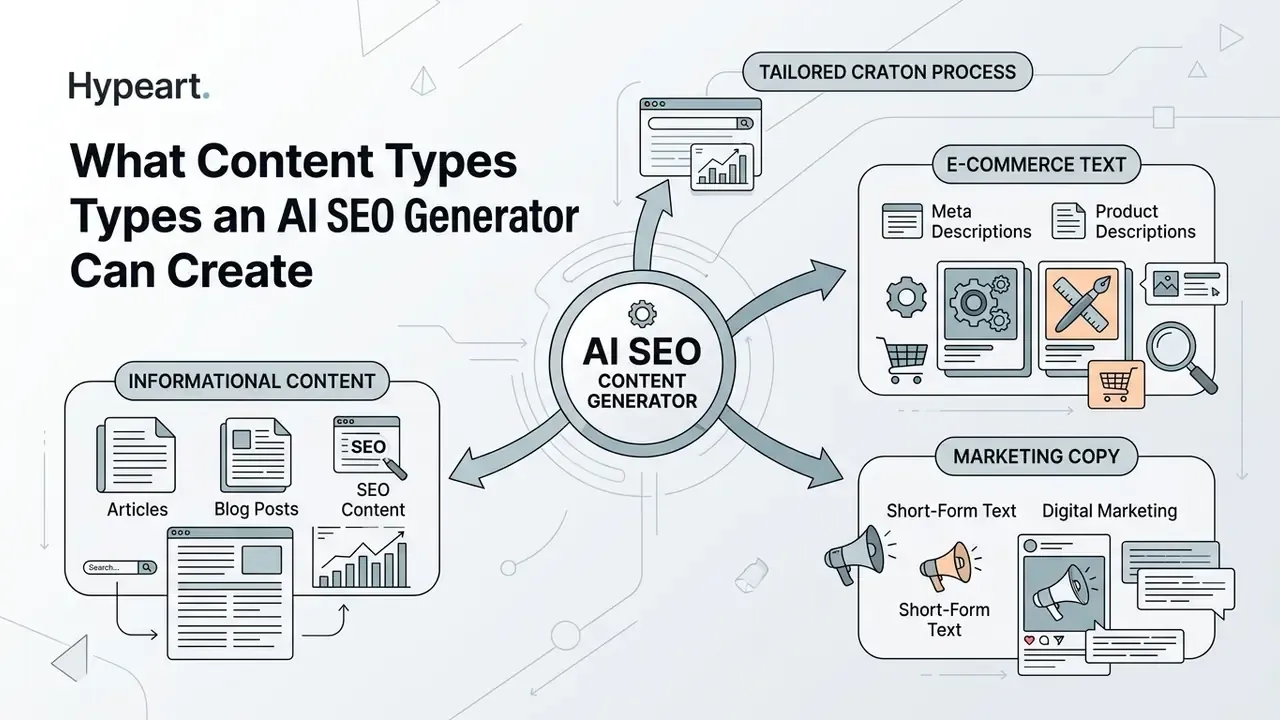
An ai content generator seo platform produces structured written formats tailored for search discovery, e-commerce conversion, and digital marketing. Organizations deploy automated writing tools to scale long-form informational articles, product catalog descriptions, and structured page metadata. Teams extending the same strategy into visuals typically pair these workflows with AI art generators for on-page imagery and thumbnails, or with a magic studio ai art generator when the requirement is fast template-driven graphics rather than bespoke illustration.
Metadata and structured page elements are the strongest technical fit for automation. Public-sector web standards require every page to carry an HTML title and a unique meta description, and require documents such as PDFs to carry title, subject, and keyword properties. Those are mechanical, rule-bound tasks where language models perform reliably. Machine-readable HTML, Markdown, or CSV with semantically tagged headings further improves how AI crawlers parse a page, which is why structured blog content outperforms unstructured prose in both classic and generative search.
Articles, Blog Posts, and Informational SEO Content
Long-form blog posts and informational articles represent primary use cases for an ai article seo generator. The software structures comprehensive guides around user search intent, answering high-volume questions with organized heading hierarchies and explanatory sections.
To rank effectively, informational articles generated by AI must provide clear structure and reliable information. Incorporating empirical data, expert citations, and concise explanations helps automated articles meet search engine expectations for helpful content. Documented production controls from academic workflow research include three recurring safeguards: keyword research before drafting, reusable prompt libraries for each page element, and pre-publication plagiarism and AI-detection checks (Aalto University, 2026).
Adjacent formats follow the same discipline. A page targeting a lyric video generator query needs the same direct-answer opener and the same fact-checked specification table as a page about credit modeling. Only the subject changes.
Meta Descriptions, Product Descriptions, and Short-Form Text
Short-form text generation requires concise phrasing focused on user conversion and query relevance. Automated generators produce meta descriptions under 160 characters that summarize page copy while featuring primary keyword targets near the beginning of the text string. Institutional standards commonly specify 50 to 160 characters in plain language with key information first. Some style guides tighten this to 150 characters, so the operative limit is a local policy decision rather than a universal constant.
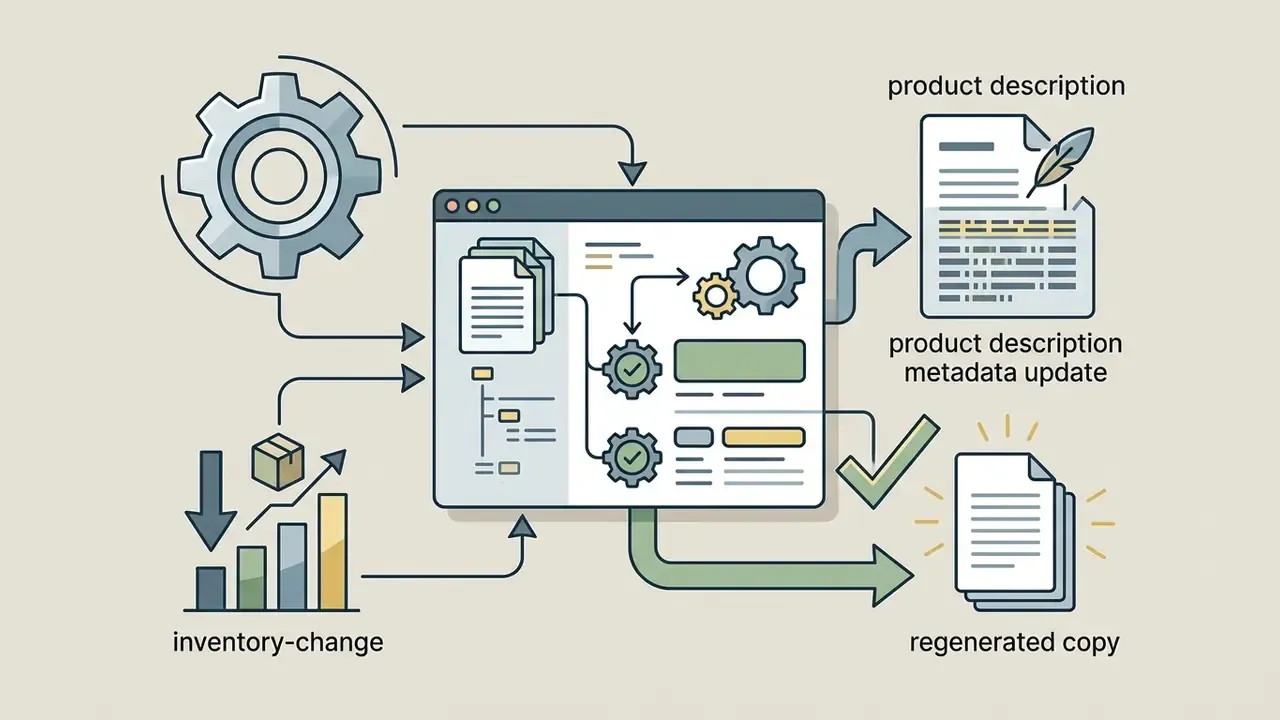
For e-commerce platforms, AI generators write product descriptions that detail specifications, key features, and functional benefits.
«ChatGPT-4 outperformed weaker models on readability, persuasiveness, and SEO effectiveness; Gemma 2B and GPT-2 produced incoherent sentences lacking contextual relevance.»
How to Choose an AI SEO Content Generator Tool: Features, Pricing, and Limits
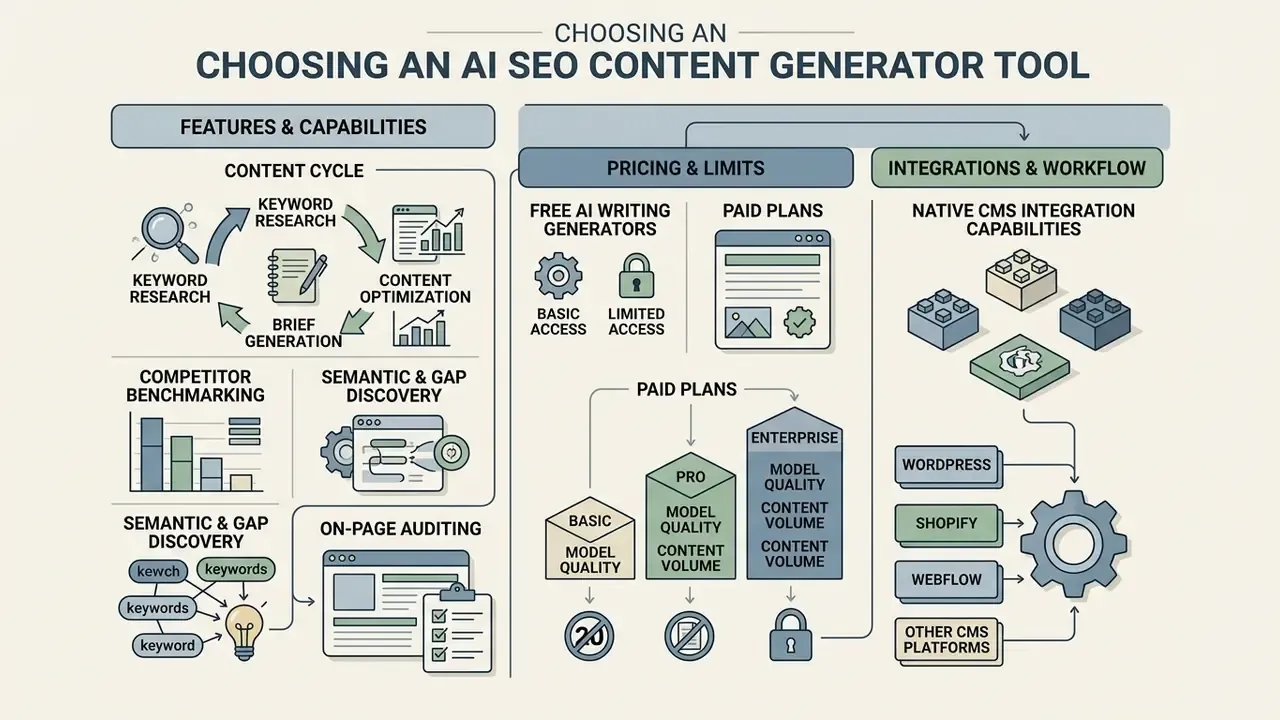
Selecting an ai seo content generator tool requires assessing feature completeness, model quality, pricing structures, and native CMS integration capabilities. Enterprise buyers must evaluate whether a tool offers real-time SERP auditing, custom prompt engineering, governance controls, and, critically for regulated industries, a documented security posture and data-retention policy.
| Tool | Keyword & SERP Analysis | Brief & Scoring | Native CMS Integrations | Pricing | Free Access | Enterprise Security / Compliance | Customer-Data Retention Policy |
|---|---|---|---|---|---|---|---|
| Surfer SEO | Real-time top-20 SERP analysis with 500+ signals | Live Content Score, SEO Score, AI Search Score | WordPress, Webflow, Google Docs, Jasper | From $49/month (Discovery) | 7-day Pro trial | Verify SOC 2 / GDPR status with vendor before procurement | Confirm whether prompts are excluded from model training |
| Frase | Competitor outline scraping & topic extraction | Combined SEO + GEO optimization scoring | Contentful, Jasper, Google Docs | From ~$15/month | Limited free tier / trial | Request current DPA and subprocessor list | Request written zero-retention option |
| Jasper | Third-party integrations for keyword data | Brand voice templates, plagiarism checks | Webflow, WordPress, Zapier | Tiered enterprise seat pricing | No permanent free tier | Enterprise tier typically required for security review | Enterprise contract clause required |
| Writesonic | Real-time web search integration | On-page SEO optimization scoring | WordPress, Shopify, Webflow | Trial + paid tiers | ~10,000 words trial | Verify with vendor | Verify with vendor |
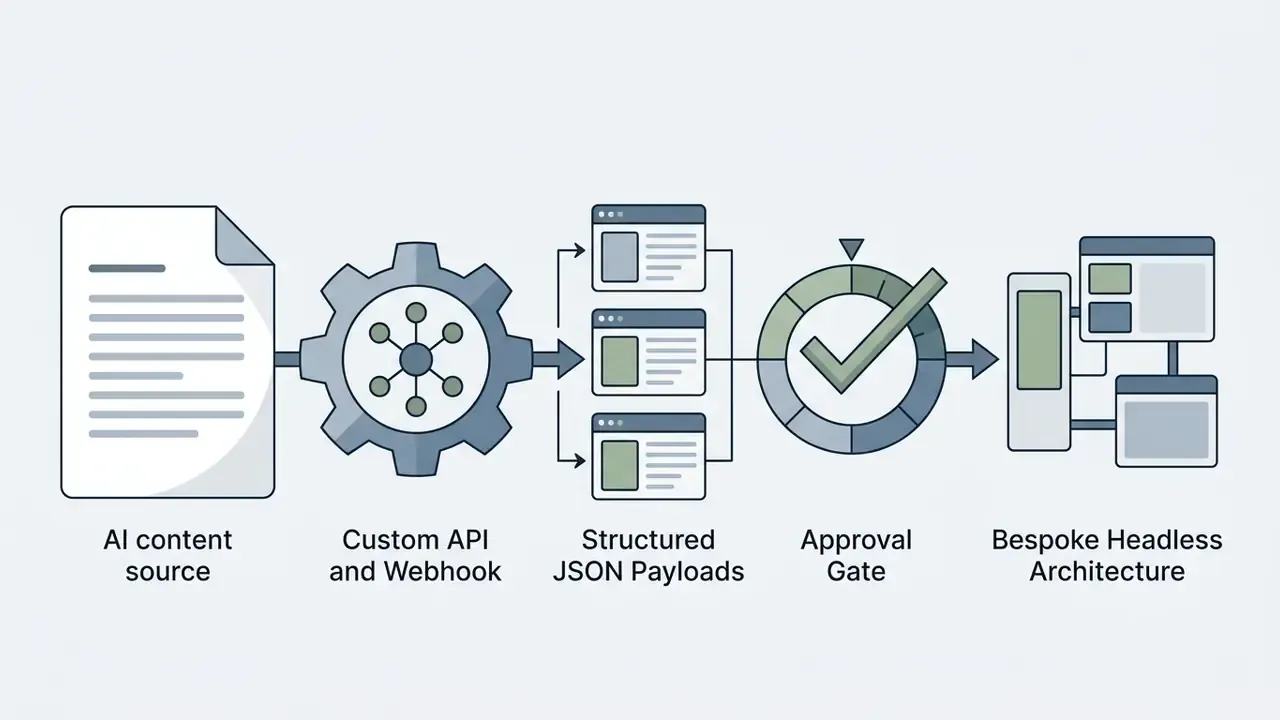
| MarketMuse | Deep semantic topic modeling & gap analysis | Content briefs, difficulty metrics | Custom API, webhooks | Tiered enterprise pricing | Limited free tier | API-first deployments simplify data-boundary control | Negotiable at enterprise tier |
Security and retention columns are procurement checklists, not vendor claims. Always obtain current SOC 2 reports, DPAs, and training-exclusion language in writing before onboarding regulated content.
Read the table as three decisions rather than five products: depth of SERP sampling, whether scoring covers both classic SEO and GEO, and whether publishing is native or bolted on. Side-by-side breakdowns of adjacent categories live in the AI Media Comparison Matrices.
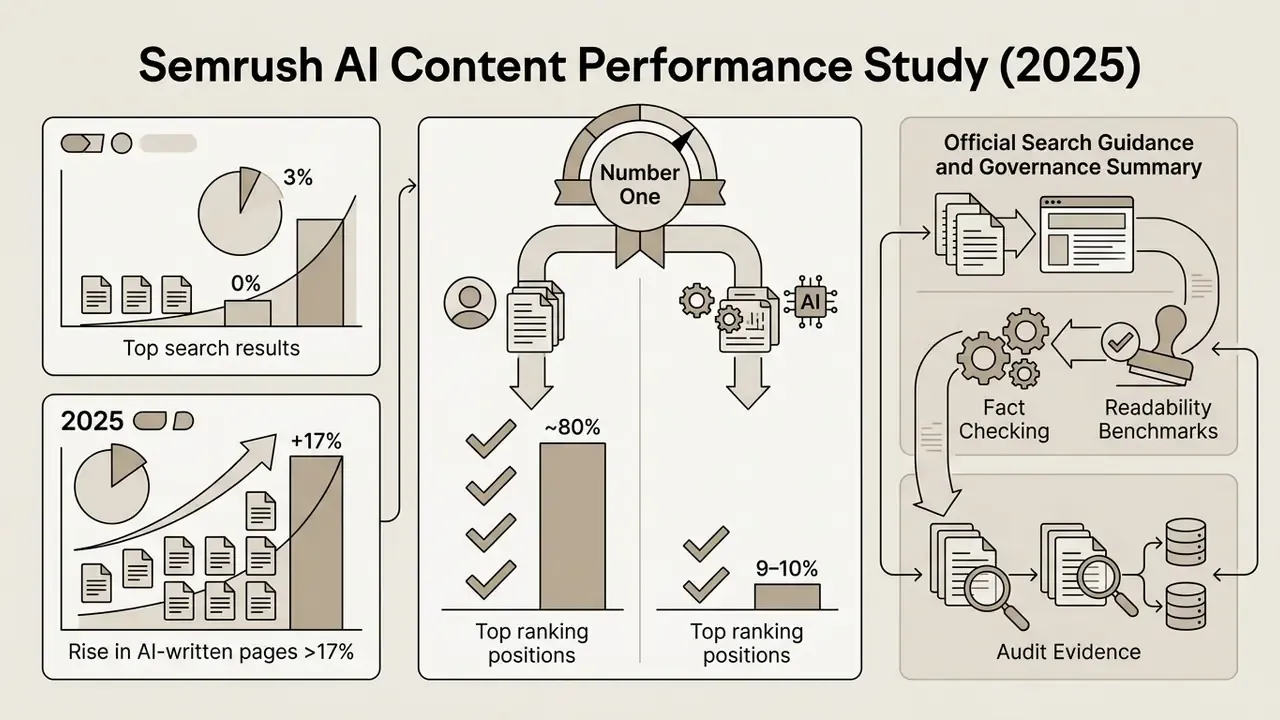
«The share of AI-written pages in Google's top results grew from 2.27% in 2019 to more than 17% in 2025.»
Selecting an enterprise seo ai generator depends on balancing technical analysis features against monthly generation limits. Tools providing real-time SERP scoring and direct CMS publishing offer higher operational efficiency for content teams operating at scale. Market entry points in 2026 range from $0 free tiers with credit and domain caps, through $50 to $69 per month self-serve plans, up to $149-plus platforms and managed agency services.
Features for Keyword Research, Briefs, and Content Optimization
Advanced seo generator ai platforms include built-in modules for semantic keyword research, competitor gap identification, and real-time page scoring. These features evaluate draft text against top-ranking organic competitors to ensure comprehensive topic coverage.
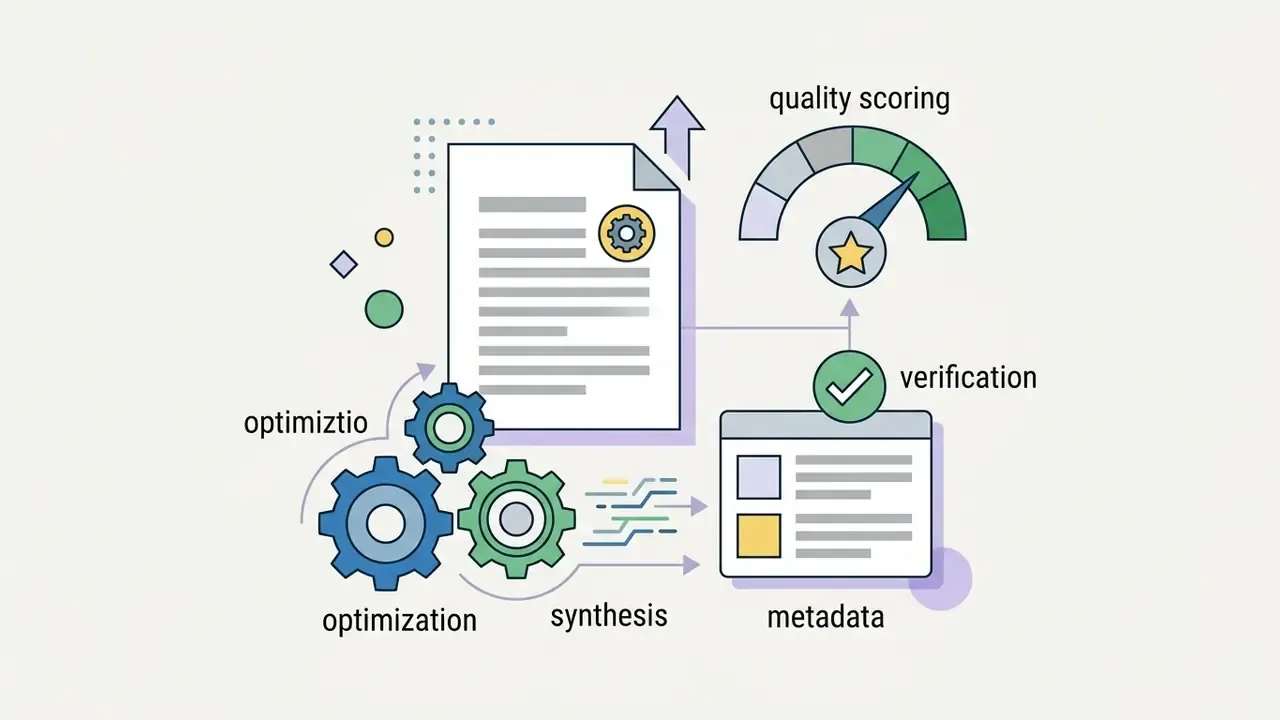
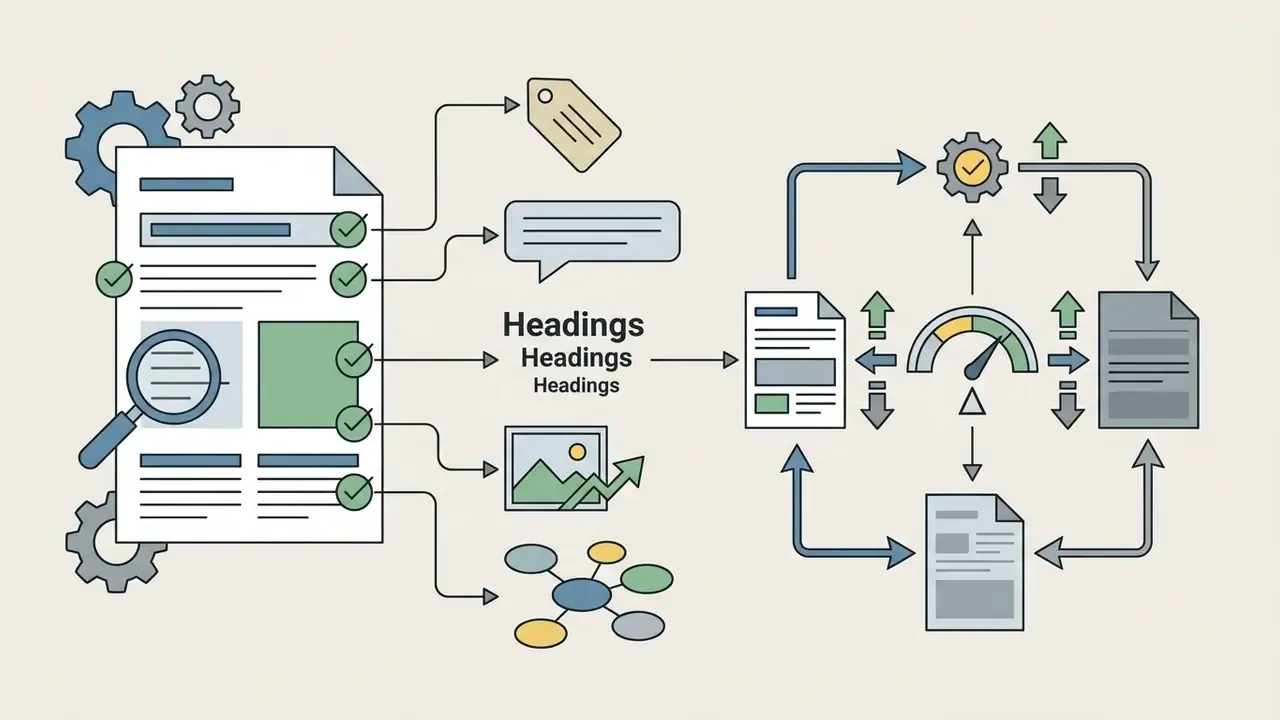
Top-tier tools offer real-time scoring metrics that monitor keyword placement, term frequencies, readability levels, and heading structures. Content strategists use these scores to refine drafts before scheduling publication. Three functional groups matter most in evaluation:
One caution. A high on-page score is not a quality signal; it is a similarity signal. It tells you the draft resembles what already ranks. That is useful, and it is not the same as being right.


Free AI Writing Generators vs. Paid Plans
Free AI writing generators offer basic text generation capabilities but impose word count caps, model access limits, and restricted SEO scoring features. Free access tiers generally provide 5,000 to 10,000 words per month using legacy language models, a pattern familiar to anyone who has compared free AI image generators against their paid counterparts.
Paid subscriptions unlock advanced models, real-time SERP scraping, unlimited briefs, and team collaboration features. Commercial organizations require paid tiers to support high-volume publishing and maintain access to updated search data. Typical thresholds in 2025 and 2026: free tiers cap at roughly five generation actions or about 10,000 words per month with restricted models; paid tiers move to 200,000 or even 5,000,000 words per month, or unlimited generation, and expose frontier models. Because vendors meter in different units (words, credits, requests, tokens), cross-service comparison is never one-to-one, and procurement should normalize costs to "published article" rather than "words generated."
Integrations With WordPress, Shopify, and Other CMS Platforms
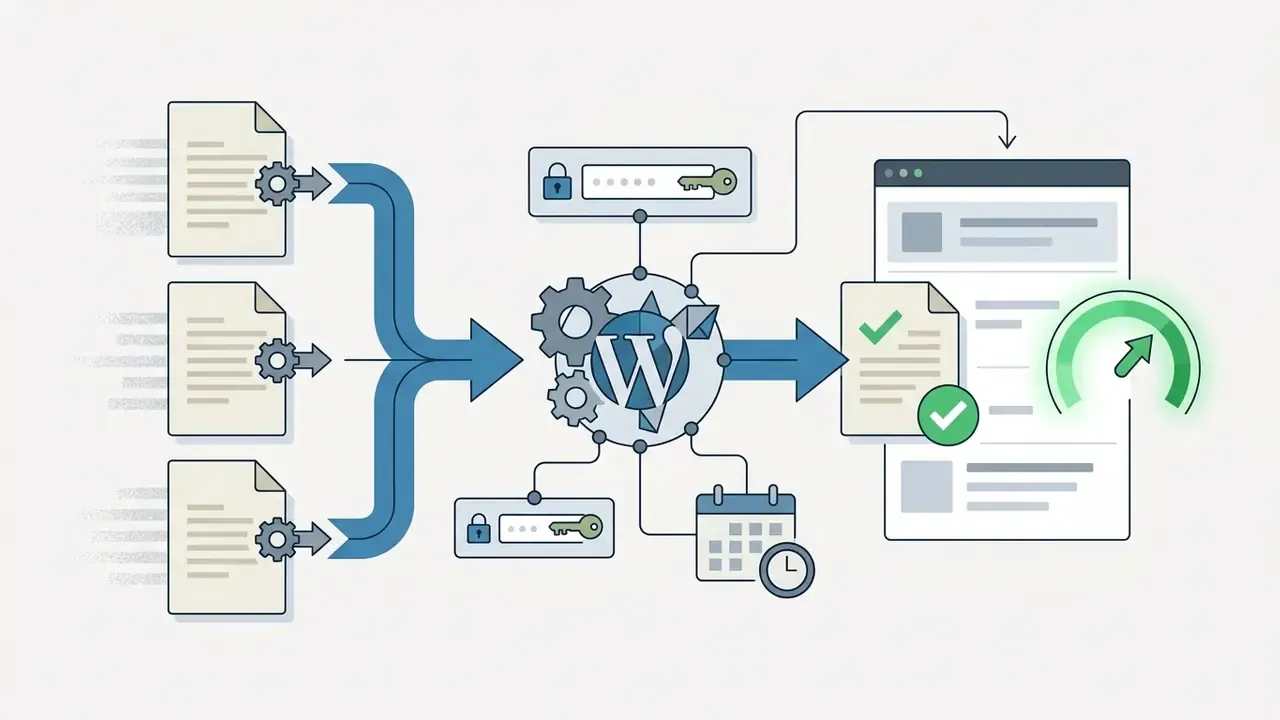
Native CMS integration allows an ai seo content generator to push structured content directly into web content management systems. Integration connectors map generated headings, body paragraphs, images, and meta tags into corresponding database fields automatically. Publishing friction is one of the most common reasons content programs stall, and articles that sit in drafts generate zero impressions.
Popular publishing platforms support automated publishing through dedicated interfaces:
When a connector silently drops alt text or truncates a meta description, the fastest path is usually the vendor's changelog plus AI Media Support and Troubleshooting notes, not a rebuild of the integration.



How to Use an AI Content Generator for SEO Inside a Real Workflow
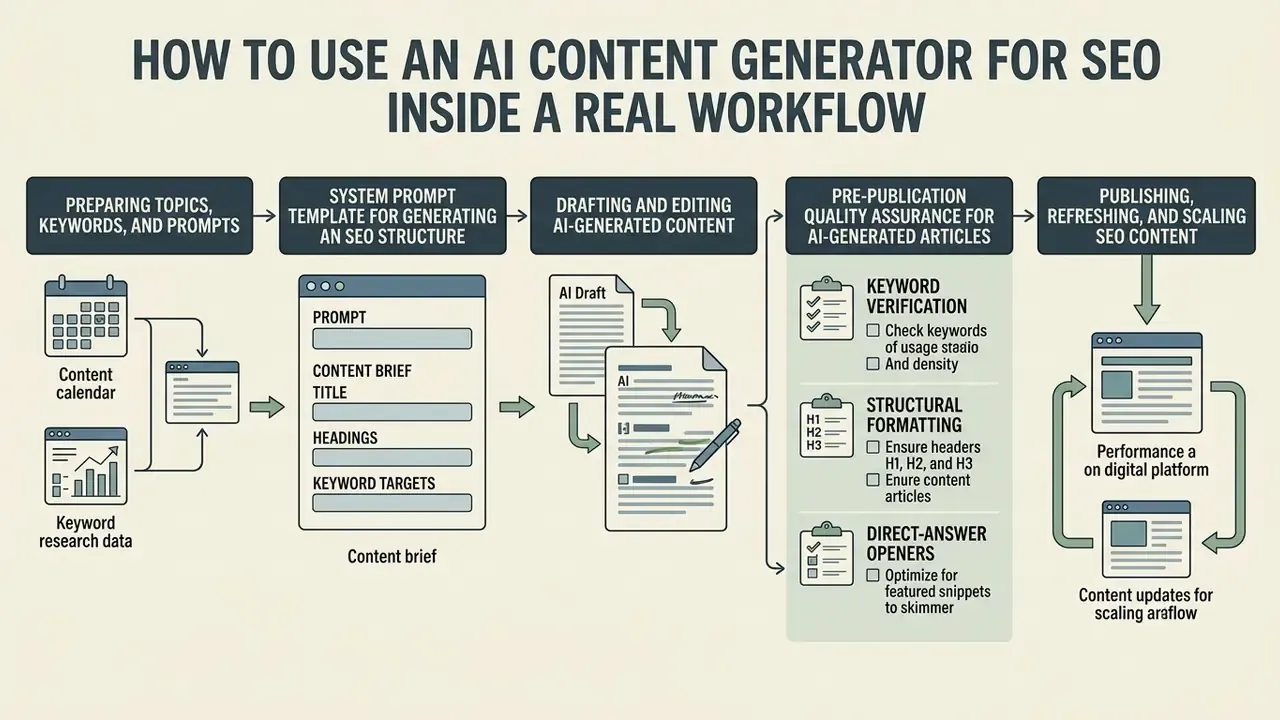
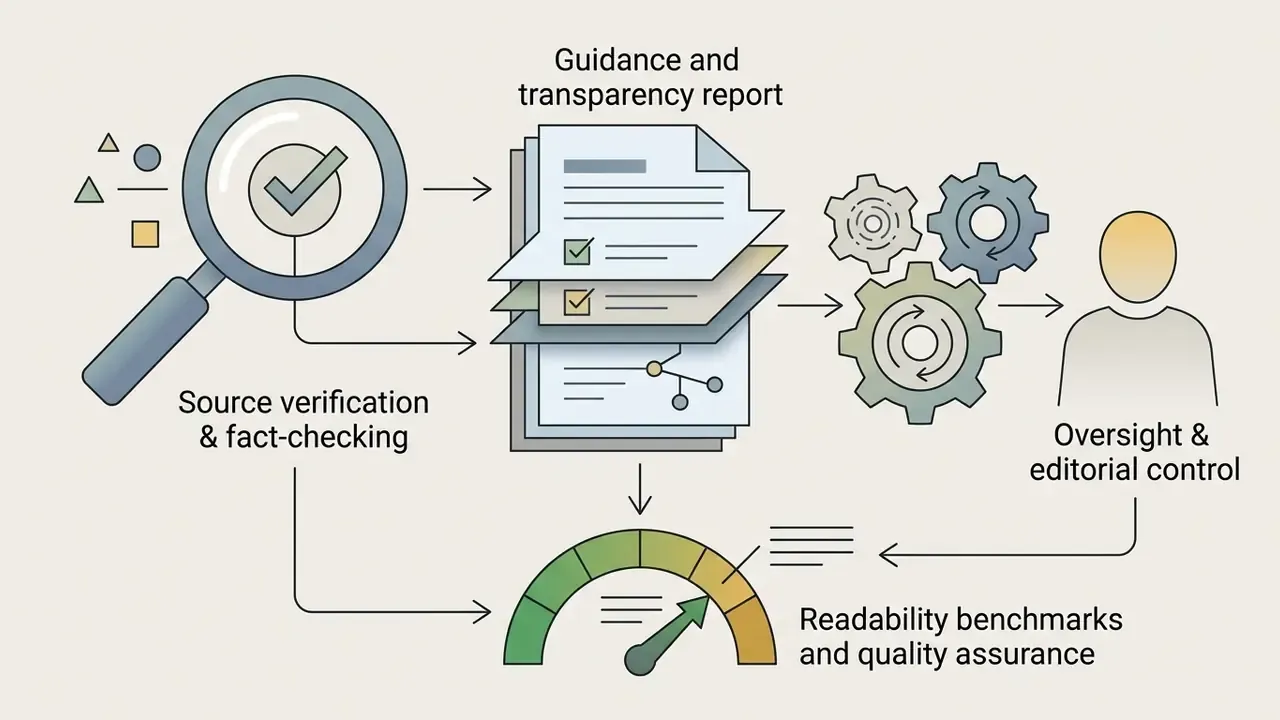
Integrating an ai content generator with seo optimization into an editorial team requires a defined operational playbook. Structured controls ensure AI-assisted drafts meet quality standards, factual accuracy requirements, and search engine guidelines. Governance frameworks describe this as a stage-gated chain: brief approval, source pack, AI outline, human outline review, AI draft, editorial review, fact-check, SEO and internal-link review, risk-based approval, publish, post-publication monitoring.
Preparing Topics, Keywords, and Prompts
The workflow begins with keyword research, search intent mapping, and prompt engineering. Content strategists must compile target keywords, primary search questions, competitor URLs, and desired brand voice guidelines before prompting the AI system.
Effective prompts provide explicit context, target output formats, structural constraints, and explicit operational roles. Specifying target word counts, mandatory LSI terms, and prohibited phrases prevents generic output and reduces editorial editing time. Public-sector prompt playbooks converge on four inputs: a specific task, minimal necessary context, an explicit output format, and a defined tone or persona. The PRSA framework formalizes the same idea as S-P-O-C-K: Specificity, Persona, Output, Context, Knowledge.
System Prompt Template for Generating an SEO Structure
[ROLE]: You are a lead SEO strategist and technical editor.
[TASK]: Build a detailed H2/H3 outline for an article on "{TOPIC}" targeting the primary keyword "{PRIMARY_KEYWORD}".
[INPUT DATA]:
- Secondary keywords / LSI: {LSI_KEYWORDS}
- Target length: {WORD_COUNT} words
- Top-3 competitor analysis: {COMPETITOR_URLS_OR_OUTLINES}
- Audience and tone: {AUDIENCE}, {TONE_OF_VOICE}
[RULES]:
1. Produce an H1 containing the primary keyword within the first third of the phrase.
2. Split the structure into 4-6 H2 blocks. Each H2 must resolve one concrete user intent.
3. For every H2 specify: 2-3 H3 subheadings, mandatory LSI terms, and the block format (table, list, FAQ, checklist).
4. Open each H2 with a 2-sentence direct answer suitable for extraction by AI search engines.
5. Ban filler openers ("In today's digital landscape", "Delve into", "It is important to note").
6. Flag every claim that requires a verifiable primary source with [SOURCE NEEDED].
A second prompt should govern drafting. It inherits the approved outline, forbids invented statistics, and requires that any numeric claim be tagged for fact-checking rather than asserted. Version both prompts. When an article is questioned nine months later, "which prompt produced this" is the first question you will be asked.
Drafting and Editing AI-Generated Content
Once the system generates an initial text draft, human editors conduct comprehensive quality assurance. The human review process verifies factual assertions, removes redundant language, checks brand voice alignment, and eliminates potential model hallucinations.
«93% of companies using AI for content review AI-generated material before publication.»
Editors verify cited statistics, test linked references, and ensure the text addresses the searcher's core business problem. Unedited AI drafts risk publishing inaccurate claims or generic summaries that harm brand authority and organic search visibility. Broadcast editorial guidance is blunt about the mechanism: generative outputs can be hallucinations or fabrications with no factual basis, which is precisely the failure class human review exists to intercept. Practical review protocols cross-reference output against an approved brand style guide, validate statistics and source legitimacy, confirm voice alignment, and route unresolved items to a named escalation reviewer.
Named, not "the team." Shared ownership of a factual claim is the same as no ownership.
Publishing, Refreshing, and Scaling SEO Content
Scaling content creation requires systematic publishing schedules and regular performance monitoring. Published assets must be tracked using search analytics software to evaluate keyword rankings, click-through rates, and organic impression growth. Programs scaling beyond text typically add AI video generators to the same editorial calendar, since multimedia assets extend dwell time on long-form pages. Production teams working on desktop often standardize on one mac video editor for finishing, and route repetitive social cutdowns through a lyric video maker or a make ai video from photo workflow instead of briefing them individually.
Search Console's Performance report can be filtered by page and compared across date ranges to isolate articles losing clicks. Its API and BigQuery bulk export make those audits repeatable at scale rather than manual.
Underperforming or outdated articles should be refreshed periodically by updating statistics, expanding thin sections, and re-optimizing target keywords.
«After Google's March 2024 core update, the share of AI content in top results declined noticeably. The algorithm deliberately demoted low-quality, unoriginal content.»
Pre-Publication Quality Assurance for AI-Generated Articles
That event is the clearest available argument for continuous maintenance rather than one-time publication. Content maintenance preserves search visibility, protects against core-update volatility, and keeps long-term topical relevance intact.
Checklist0 / 10
Audit Evidence and Escalation Path
Enterprise Case Models, Audit Evidence, and Risk-Adjusted ROI
Risk-Adjusted ROI Model
Content automation ROI is routinely overstated because reviewers' time is excluded from the cost side. Use the following formula:
Risk-Adjusted ROI (%) =
  [ (Baseline cost per published asset - AI-assisted cost per published asset)
    x Assets published per period ]
  / (Tool subscription + Prompt engineering + SME review + Compliance review + Remediation reserve)
  x 100
AI-assisted cost per asset =
  Tool cost allocation
  + (Prompt/brief time x Strategist hourly rate)
  + (Edit time x Editor hourly rate)
  + (Verification time x SME hourly rate)
  + (Compliance time x Compliance hourly rate)
  + Remediation reserve
| Cost component | Traditional outsourced content | AI-assisted with governance | Notes |
|---|---|---|---|
| Drafting | Full agency/freelance fee per asset | Tool allocation + strategist prompt time | Largest savings line |
| Editing | Light copy edit | Heavier structural edit and simplification | Grade-13 output requires real rewriting |
| Fact verification | Partial, writer-dependent | Mandatory SME pass on every numeric claim | Do not model as zero |
| Compliance review | Same as baseline | Same as baseline | Not compressible in regulated niches |
| Remediation reserve | Low | 5 to 10% of program cost | Covers corrections, retractions, re-optimization |
The honest conclusion: automation compresses drafting cost dramatically, compresses editing cost modestly, and compresses verification cost not at all. Programs that model all three as savings tend to discover the difference during a core update.
Does AI-Generated Content Affect Google Rankings and Site Quality?
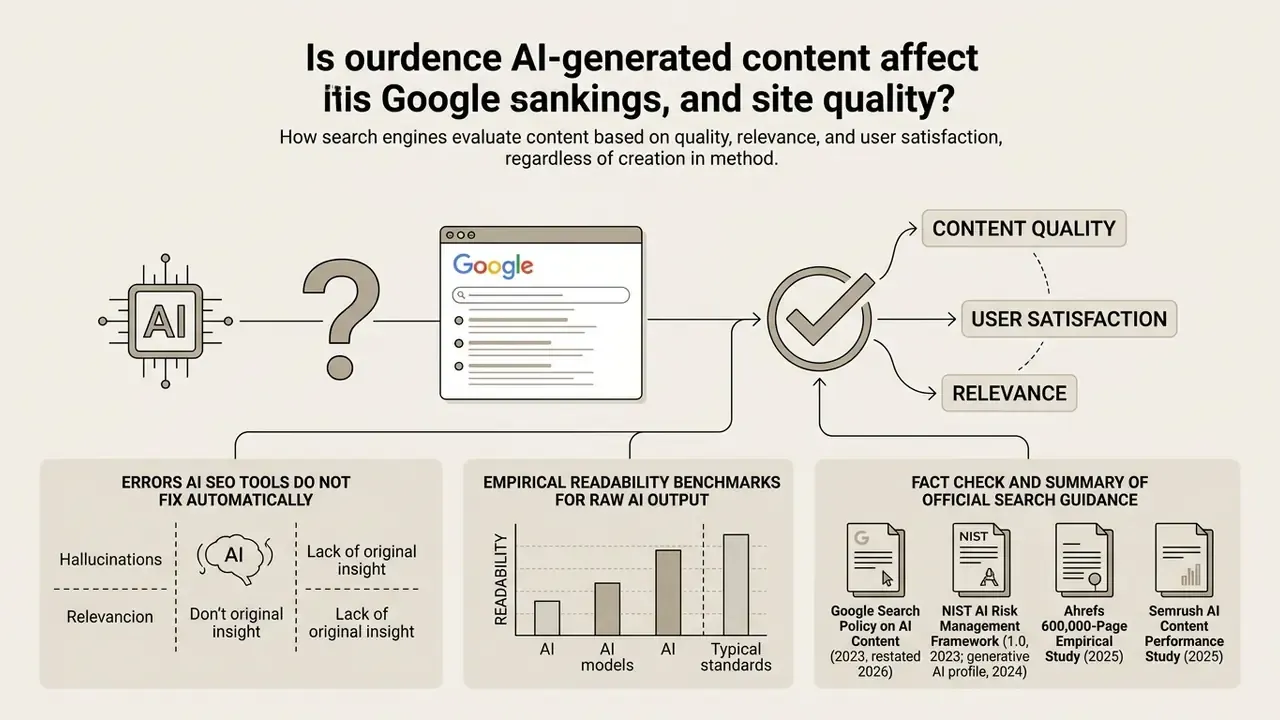
Search engines evaluate digital content based on quality, relevance, and user satisfaction rather than the technology used to produce it. AI generated content can rank highly in search engine results provided it offers accurate information, aligns with search intent, and satisfies E-E-A-T criteria. Teams verifying provenance across formats often pair text QA with AI image detectors to confirm asset originality before publication.
Can AI Content Rank in Google?
«Fully human-written pages take position one in roughly 80% of cases, while purely AI-generated pages do so in only about 9 to 10%.»
Read alongside the Ahrefs finding that AI share correlates with position at about 0.011, the picture is consistent rather than contradictory. AI text is not penalized as a category, but pages that ship without substantive human contribution rarely win the top slot in competitive queries. Pages featuring meaningful human editing, original data, and expert review consistently outperform unedited AI content in competitive SERP environments.
What Errors AI SEO Tools Do Not Fix Automatically
«Strategically embedded text sequences on product pages significantly increase the likelihood of a product appearing in top LLM recommendations.»
That finding is a warning, not a tactic. Adversarial text injection is the generative-search equivalent of keyword stuffing: it may work briefly, it is invisible to your own optimization score, and it is precisely the behavior anti-spam systems are built to detect. No AI SEO tool will flag it for you, because most tools optimize toward visibility rather than legitimacy.
Empirical Readability Benchmarks for Raw AI Output
Academic readability measurements of unedited AI content (Hemingway Editor scale) reveal a systemic problem across base language models, namely excessive syntactic complexity:
| Model / Tool | Average Hemingway Grade | Share of complex sentences | Baseline SEO score (unedited) | Required remediation |
|---|---|---|---|---|
| ChatGPT (GPT-4o) | 13 to 14 (high difficulty) | ~42% | 75 to 77% | Deep rewrite, sentence simplification |
| Gemini 1.5 Pro | 14 (critical difficulty) | ~48% | 72 to 74% | Paragraph splitting, condensation |
| Perplexity (default) | 14 ("poor") | ~45% | ~73 to 74% | Rewrite; watch keyword over-density |
| SE Ranking AI Writer | 9 (acceptable) | ~20% | 85 to 88% | Light copy edit |
| Rytr | 9 ("good") | ~22% | ~77 to 78% | Light copy edit |
| Target standard (Human + AI) | 6 to 8 (optimal) | under 15% | 92 to 95% | Publication-ready |
Fact Check and Official Search Guidance Summary


Generative Engine Optimization (GEO): Earning Citations in ChatGPT, Perplexity, and Claude
Content optimization in 2026 extends beyond the traditional Google SERP. AI search systems, including Perplexity, ChatGPT Search, Claude, and Google's AI features, assemble answers by extracting structured passages from top organic sources. AI assistants largely draw recommendations from web search results, so pages that rank well in Google also surface when users ask an assistant for options. To be cited rather than merely crawled, an article should follow three GEO principles:
- Direct answer syntax: The first two to three sentences under every H2 or H3 must contain a complete, self-contained definition with no preamble. AI agents extract these blocks as direct quotations, and hedged or narrative openers get skipped.
- Citation-ready data: Precise figures, named standards, dated studies, and primary-source attribution materially increase the probability of a page entering an LLM's context window. Practitioner testing places the uplift near 40% versus unsourced prose.
- Structured entity schema: JSON-LD markup (TechArticle, FAQPage, Product, Organization) lets retrieval systems bind brand entities unambiguously to a topical cluster, reducing the chance your content is paraphrased without attribution.
«Generative search engines behave differently across query phrasings and languages, which requires semantically diverse content coverage.»
Two operational consequences follow. First, a single canonical phrasing per subtopic is insufficient. The same intent must be addressed with varied surface forms, because generative retrieval is sensitive to phrasing. Second, GEO and classic SEO are not competing budgets: several platforms now score both dimensions separately (Surfer's AI Search Score, Frase's combined SEO and GEO scoring), which is a practical signal that the market treats them as one workflow with two scoreboards.
«AI-search visitors are on average 4.4 times more valuable by conversion than visitors from traditional organic search.»
Lower volume, higher intent. That asymmetry is why GEO formatting deserves budget even when AI referrals are a small share of sessions.
FAQ: AI SEO Content Generators
Addressing technical questions about platform selection, model capabilities, and multilingual optimization helps clarify operational best practices for AI adoption.
Can ChatGPT, Claude, or Gemini Be Used as an SEO Generator?
General-purpose language models like ChatGPT, Claude, and Gemini can generate SEO text when guided by specialized prompt frameworks and external search data. Vendor documentation positions them accordingly: Claude's model cards emphasize everyday tasks and writing; Gemini exposes content generation through its API; OpenAI publishes a general model catalog rather than SEO-specific tooling. None is marketed as a search-optimization system. However, generic models lack real-time competitor SERP scraping, automatic keyword scoring, and built-in CMS integration connectors found in dedicated SEO tools. To use general models effectively for SEO, content creators must manually supply keyword metrics, target word counts, competitor heading structures, and explicit entity lists within the prompt context. That is viable for a handful of pages per month and unmanageable at portfolio scale.
Is an AI SEO Content Generator Suitable for Multilingual Content?
Automated content generators support multilingual content creation and translation across diverse global markets. Effective multilingual SEO requires localizing target search intent, adapting cultural terminology, and setting locale-specific URL structures. Search engine guidelines mandate dedicated hreflang tags, localized meta titles, and regional keyword variations rather than literal machine translation across target geographic markets. Google's documentation specifies that each language version must reference itself and every other version with absolute URLs, using ISO 639-1 language codes plus optional ISO 3166-1 Alpha-2 region codes and x-default for unmatched locales. For non-HTML files such as PDFs, hreflang must be delivered via HTTP headers. Enterprise localization guidance adds the editorial half: title tags and meta descriptions should be rewritten for the local market, and keyword semantics should follow local search behavior rather than translated phrasing.
Is AI-Generated SEO Content Permitted by Google Search Guidelines?
Yes. Google evaluates content based on helpfulness, accuracy, and user relevance rather than authorship. Using AI to generate content is permitted as long as the material is accurate, provides value, and is not designed primarily to manipulate search engine rankings. Google also asks publishers to consider whether AI involvement is self-evident and worth explaining to readers.
What Is the Difference Between ChatGPT and a Dedicated AI SEO Content Generator?
ChatGPT is a general-purpose language model that requires manual prompt engineering and external keyword inputs. Dedicated AI SEO generators include live SERP scraping, real-time keyword scoring, competitor gap analysis, topical map construction, and native CMS connectors within a unified platform.
How Do AI Content Generators Perform for Multilingual Search Optimization?
AI generators can draft multilingual content, but literal machine translation is insufficient for competitive SEO. Multilingual optimization requires adapting local search intent, identifying region-specific keywords, rewriting titles and descriptions for the local market, and configuring proper hreflang tags for target geographic markets.
What Are the Main Risks of Publishing Unedited AI-Generated Text?
Unedited AI text risks containing factual errors, outdated statistics, robotic phrasing, grade 13-plus readability, and generic explanations. Publishing unedited drafts can harm brand reputation, fail quality evaluation benchmarks, and lead to ranking demotions during search core updates, as observed after the March 2024 core update.
How Should an AI SEO Tool Be Tested Before Deployment?
Run use-case-specific safety and quality testing before production: generate a fixed sample set, measure hallucination rate against verified sources, record Hemingway grade and SEO score distributions, and document known limitations. NIST's generative AI profile requires risk identification, testing, and documentation for public-facing AI systems.
What Is the Safest Way to Use an AI SEO Generator in a Regulated Industry?
Keep automation upstream of approval. Restrict generation to pre-approved claim libraries, require subject-matter expert verification of every factual assertion, retain prompt and edit provenance for audit, and confirm the vendor's data-retention and training-exclusion terms in writing before onboarding regulated content.
Do Free AI SEO Tools Produce Publishable Content?
Free tiers suit testing and occasional use. They typically cap output at 5,000 to 10,000 words or a few generation actions per month, restrict access to older models, and limit SEO scoring depth. Production programs generally require paid tiers for live SERP data, higher volume, and CMS publishing. Adjacent free tools follow the same pattern, whether you make photo animation for a blog header or draft ten meta descriptions. Next Steps: A 30-Day Implementation Path
- Days 1 to 5, baseline. Measure current cost per published asset, average time to publish, and existing organic performance by page. Without a baseline, ROI claims are unfalsifiable.
- Days 6 to 10, vendor due diligence. Shortlist two platforms. Request SOC 2 status, DPA, subprocessor list, and written training-exclusion terms. Confirm SERP sampling depth and CMS connector coverage.
- Days 11 to 18, controlled pilot. Produce ten assets under the stage-gated workflow. Log prompt versions, raw output, edit diffs, and fact-check records for every one.
- Days 19 to 24, quality measurement. Score each asset on Hemingway grade, on-page SEO score, hallucination count per 1,000 words, and editor hours consumed.
- Days 25 to 30, decision. Compute risk-adjusted ROI using the formula above, then either scale with documented controls or revise prompts and re-pilot. Do not scale a workflow whose verification cost you have not yet measured. Licensing questions surface at step five more often than teams expect. The AI Media Commercial-Use Hub collects the usage-rights questions worth resolving before, not after, a campaign ships.
Limitations and Open Questions
Three gaps in the current evidence base deserve explicit acknowledgment.
Attribution is weak. Correlational studies cannot separate AI drafting from the editorial resources that usually accompany it. A page with moderate AI assistance often also has a better editor. We cannot yet isolate which variable earns the impressions.
Detection is unreliable in both directions. AI-detection scores produce false positives on formal human writing and false negatives on lightly edited machine text. Using them as a publishing gate creates its own error class.
GEO measurement is immature. Assistant citation share is not consistently reported, sampling is opaque, and results shift with model updates. Uplift figures quoted here come from practitioner testing rather than controlled experiments. Plan for revision.
Appendix A: Correction Log and Superseded Statements
Retained for transparency and auditability. Each entry lists the original formulation and the reason it was revised in the body text above.
| # | Superseded formulation | Status | Correction applied |
|---|---|---|---|
| 1 | "According to research from the Ahrefs 600,000-Page Study (2025), search performance correlates with content helpfulness and query satisfaction rather than raw text generation." | Replaced | Lacked figures and methodology. Now cites the 2 to 3 times impression differential for moderate AI usage and the 0.011 position correlation, with source URL. |
| 2 | "A study comparing AI and human product descriptions published in empirical literature (2024) indicates that advanced language models like GPT-4 can match human performance..." | Replaced | No publication name or model detail. Now names the 2024 benchmarking study and specifies which models succeeded and which failed. |
| 3 | "Data from the Semrush AI Content Performance Study (2025) demonstrates that AI-assisted pages appear across top-ranking organic positions." | Replaced | No measurable data. Now includes the 80% versus 9 to 10% position-one split and the 2.27% to 17% growth figure. |
| 4 | "Google Search Central official guidance (2026) confirms that automated content generation does not violate search policies..." | Reformulated | The 2026 date alone was not verifiable as the policy origin. Now attributed to the 2023 policy as restated in 2026 generative-AI documentation. |
| 5 | "A regional commercial bank evaluated automated content workflows... reduced initial content drafting timelines by 60%... across 45 published assets." | Reformulated | Unnamed, unaudited organization. Reframed as an illustrative operating model with a planning-benchmark caveat and a compliance disclaimer. |
| 6 | "A fintech firm deployed an automated seo optimized ai content generator... achieved a 35% increase in organic search traffic within three months." | Reformulated | Unnamed, unverified case. Reframed as an illustrative operating model with attribution of the outcome to velocity plus expert verification. |
| 7 | "Ahrefs... Pages with moderate AI assistance paired with human refinement received two to three times more impressions than fully automated pages." (fact-check block) | Replaced | Imprecise scope. Now specifies 86.5% of top-20 pages contain some AI text and the 0.011 correlation alongside the impression differential. |
| 8 | Russian-language headings over English body copy | Corrected | All headings normalized to the language of the body text to remove the bilingual reading break flagged in editorial review. |
| 9 | Anchor-linked table of contents | Replaced | Replaced with a scope and audience section plus a 2025 to 2026 change summary, which serves the same orientation purpose without fragment navigation. |
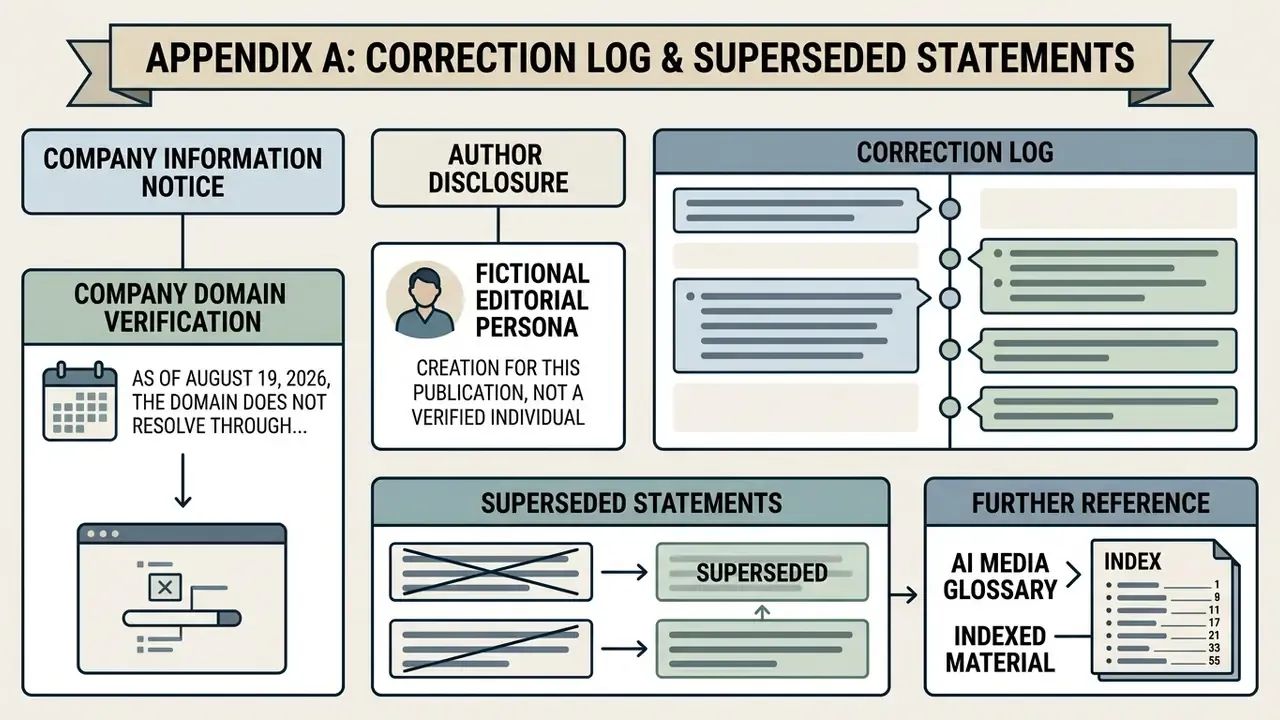
Company Information Notice
Company domain verification status: As of August 19, 2026, the domain hypeart.ai does not resolve through DNS lookup. No verified information is available regarding commercial products, services, pricing models, or operational capabilities. All enterprise implementation frameworks and case models presented here remain hypothetical illustrative constructions and should not be read as vendor claims. No unique selling proposition is asserted, because none has been independently verified.