If you sit in risk, compliance, or finance operations at a US bank or a mature fintech, the interesting question is not whether these tools work. It is whether they work inside your control environment, with evidence an examiner will accept.
"No evidence, no autonomy. Deploying conversational AI requires verified data grounding, defined decision boundaries, explicit risk limits, and verifiable audit trails before any automated worker is granted operational access."
Last updated: Q1 2026.
Executive Summary for Risk, Service, and Revenue Owners
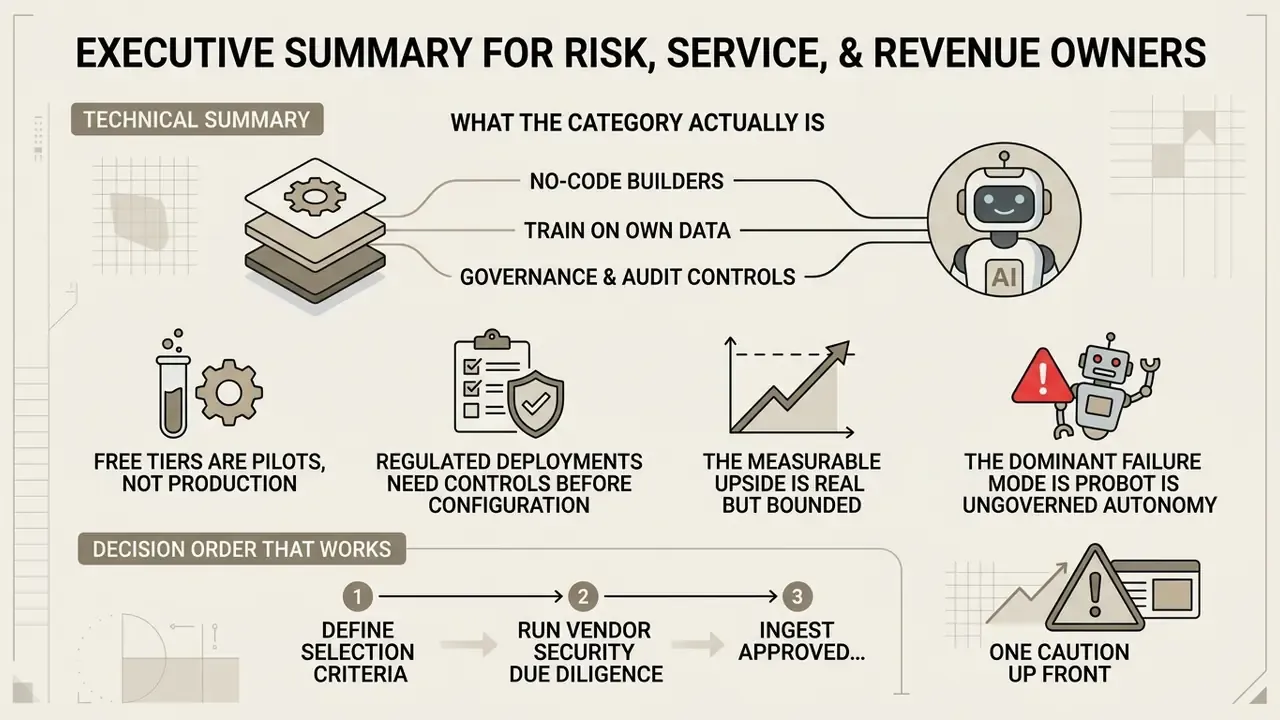
- What the category actually is. An ai bot maker packages three components into a visual builder: a retrieval layer over your approved documents, a frontier language model, and a deployment surface (web widget, WhatsApp, Teams, ticketing). The differentiator versus a legacy chatbot builder is grounding, not scripting.
- Free tiers are pilots, not production. Perpetual free plans typically cap usage at 50 to 200 messages per month, restrict ingestion to one URL or roughly 10 MB of documents, force vendor watermarks, and exclude CRM webhooks, audit logs, and human handoff routing.
- Regulated deployments need controls before configuration. Zero data retention (ZDR) contract language, SOC 2 Type II attestation, RBAC, SSO/SAML, tenant-isolated vector indexes, and reproducible audit trails are procurement prerequisites, not post-launch improvements. Model-risk practice in US banking (Federal Reserve and OCC SR 11-7) and the NIST AI Risk Management Framework 1.0 both require documented validation, monitoring, and named ownership.
- The measurable upside is real but bounded. Field and randomized evidence shows double-digit gains in conversion, agent throughput, and deflection for routine, utilitarian queries. It also shows persistent user preference for humans in complaints and high-stakes decisions.
- The dominant failure mode is ungoverned autonomy. Hallucination, prompt injection, PII leakage into public tools, and "Shadow AI" (business units launching bots outside IT and security review) cause most production incidents. Model quality is rarely the culprit.
- Decision order that works: define selection criteria, run vendor security due diligence, ingest approved data, red-team and set confidence thresholds, publish with human handoff, log everything for audit, then measure risk-adjusted ROI.
One caution up front. Most of the audience assumptions in this guide should be treated as hypotheses until your own analytics, interviews, and CRM data confirm them.
What is an AI Bot Maker and What Business Problems Does an AI Chatbot Solve?
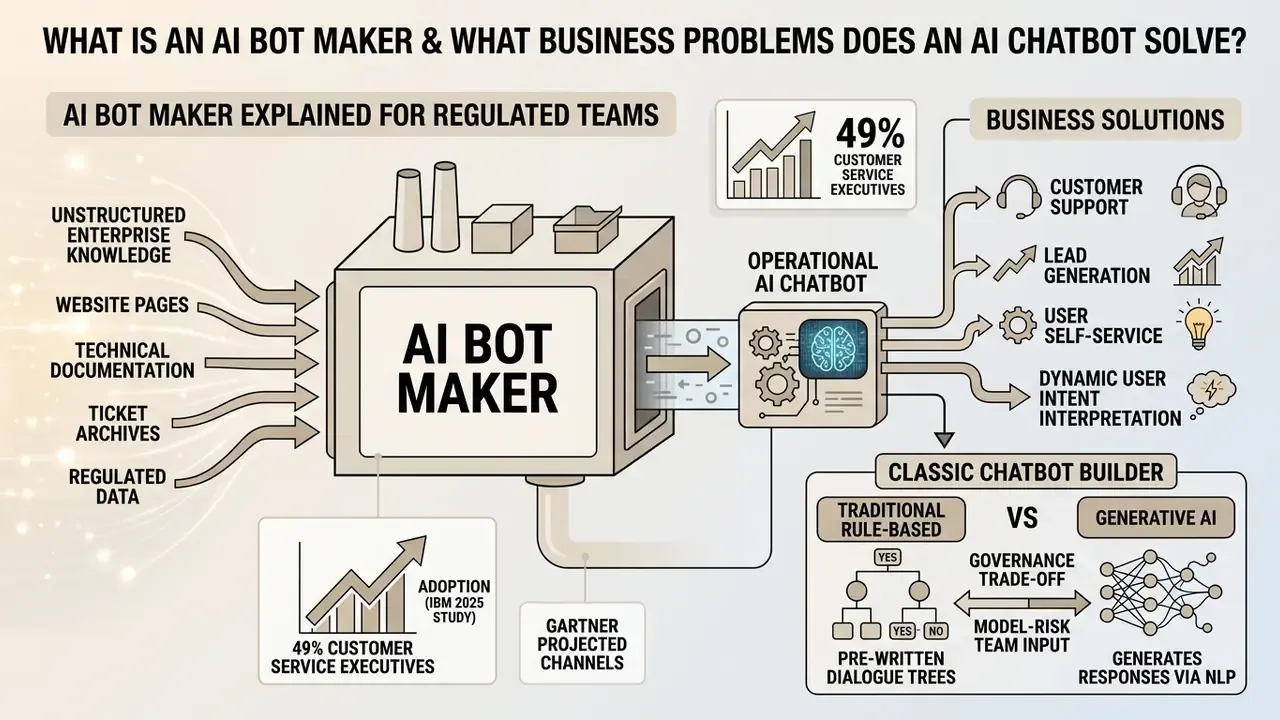
An ai bot maker is an enterprise tool that translates unstructured enterprise knowledge, such as website pages, technical documentation, and ticket archives, into operational conversational agents. Modern ai chatbots address severe operational bottlenecks: instant automated customer support, shorter ticket queues, lead capture around the clock, and personalized product guidance across web and messaging channels. Readers who want precise definitions of the underlying components can consult our AI terminology glossary for foundational entries on models, retrieval, and licensing.
According to a 2025 customer service study published by IBM, 49% of customer service executives have already implemented partial automation for support inquiries, while 71% target touchless support workflows by 2027. (Note: this figure is reproduced from a vendor report; verify the underlying sample independently before citing it in board or regulatory materials.) Market sizing points the same direction.
"The global chatbot market was valued at $9,560.7 million in 2025 and is projected to reach $41,244.2 million by 2033."
"Gartner projects that chatbots will become the primary customer service channel for roughly a quarter of global enterprises by 2027." Source: Gartner projection, cited in Freshworks chatbot builder research (2026).
Empirical findings by Peng et al. also showed that deploying generative ai chatbots in real-world information retrieval environments produced statistically significant increases in user satisfaction and query resolution efficiency compared with legacy rule-based engines.
"A GPT-powered bot significantly outperformed a classic Power Virtual Agents deployment on user satisfaction and complex query handling in a randomized controlled experiment."
How an AI Chatbot Differs from a Classic Chatbot Builder
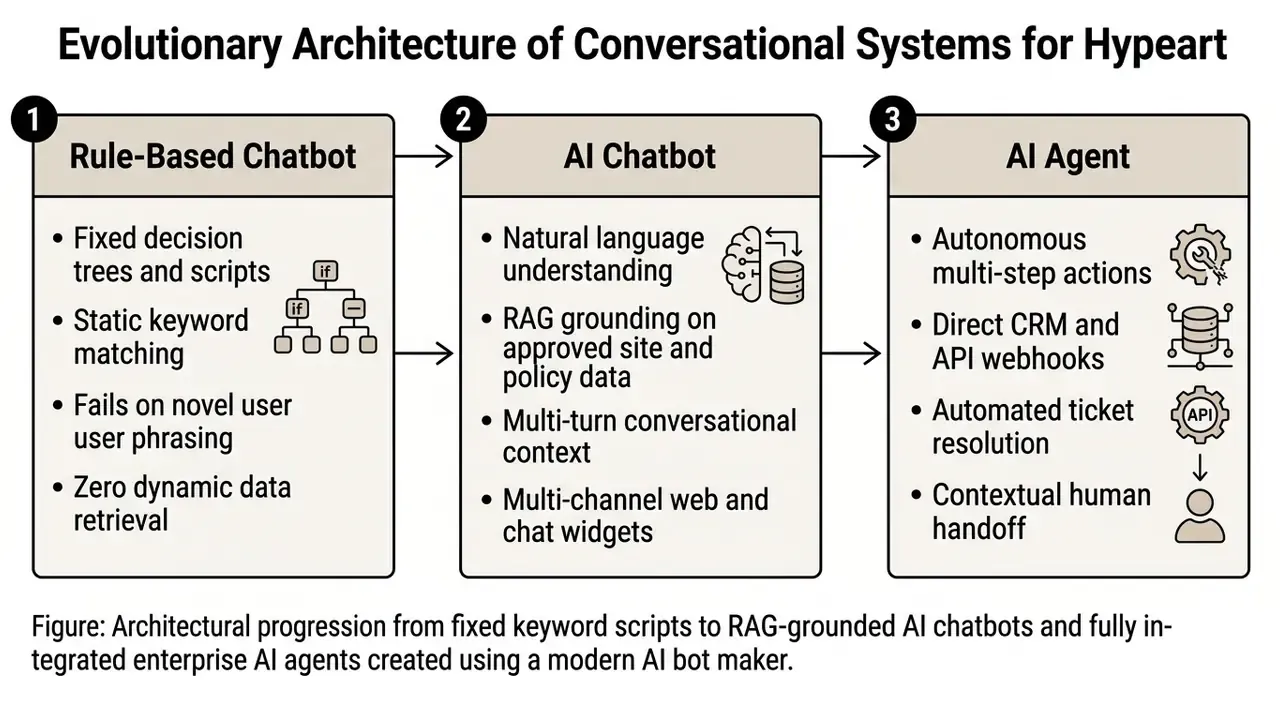
An ai chatbot interprets user intent dynamically through natural language processing (NLP) and generates contextually accurate responses from ingested knowledge bases. A classic chatbot builder relies on deterministic, hard-coded decision trees and keyword matching.
While a traditional rule-based chatbot is constrained to pre-written dialogue trees, generative architectures evaluate unstructured queries, handle multi-turn conversations, and retrieve real-time context. Research on chatbot pipeline architectures indicates that combining transformer-based intent recognition with models like GPT-4 or Claude clearly outperforms static decision trees on complex customer queries.
"BERT delivered the strongest intent-recognition results, DDQN outperformed DQN in dialogue management, and GPT-2 exceeded DialoGPT on BLEU, METEOR, and ROUGE."
There is a governance trade-off buried in that comparison, and model-risk teams should state it explicitly in validation memos. Rule-based logic is static, transparent, deterministic: same input, same branch, trivially auditable. LLM-based logic is probabilistic and adaptive. It covers unseen phrasing and multi-turn context, but its reasoning path is opaque and needs compensating controls: temperature limits, source-grounding mandates, confidence thresholds, refusal behavior, and output filtering. So enterprise deployments rarely choose one architecture. They layer deterministic guardrails on top of generative capability.
Customer Support, Lead Generation, and User Self-Service
An ai-powered chatbot works as a continuous digital workforce. It resolves routine customer service inquiries, collects qualification data, and walks users through complex self-service workflows.
In pre-sale e-commerce contexts, empirical research on generative AI applications (arXiv:2510.12049 v4-v5, 2025-2026) found that integrating generative AI into pre-sale customer service workflows increased overall sales by 16.3% and conversion rates by 21.7% compared with no-service controls.
"In a randomized field experiment with roughly 44,000 consumers, generative AI responses raised sales by 16.3% and conversion by 21.7% versus a no-service control group."
For lead generation, automated chatbot s qualify visitors by asking targeted questions, gathering contact details, and routing qualified leads straight into CRM systems. The productivity effect on human teams is equally well documented.
"Across 5,172 call-center agents, an AI assistant increased issues resolved per hour by 15%, with the largest gains among less experienced staff."
How to Choose a Custom AI Chatbot Maker for Your Website and Business
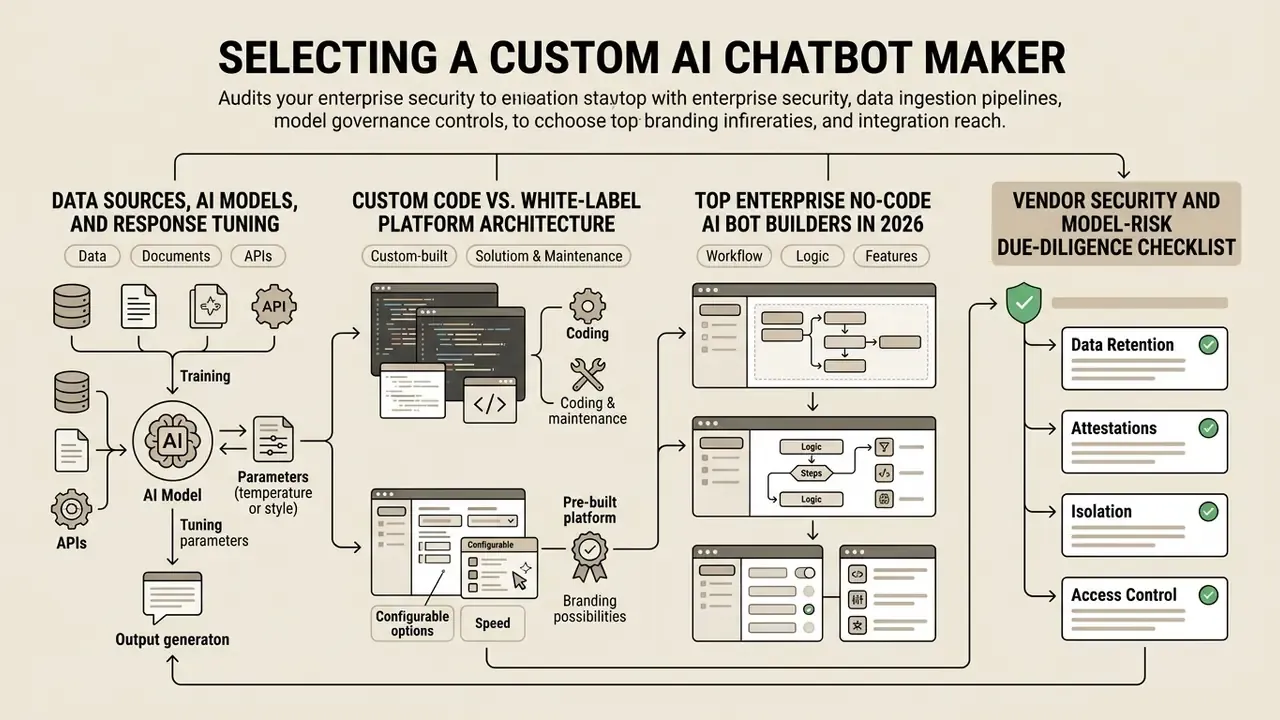
Selecting a custom ai chatbot maker means auditing enterprise security requirements, supported data ingestion pipelines, model governance controls, and integration reach across corporate communication platforms. Define these criteria before comparing price tiers. Otherwise the pricing page quietly sets your control environment for you.
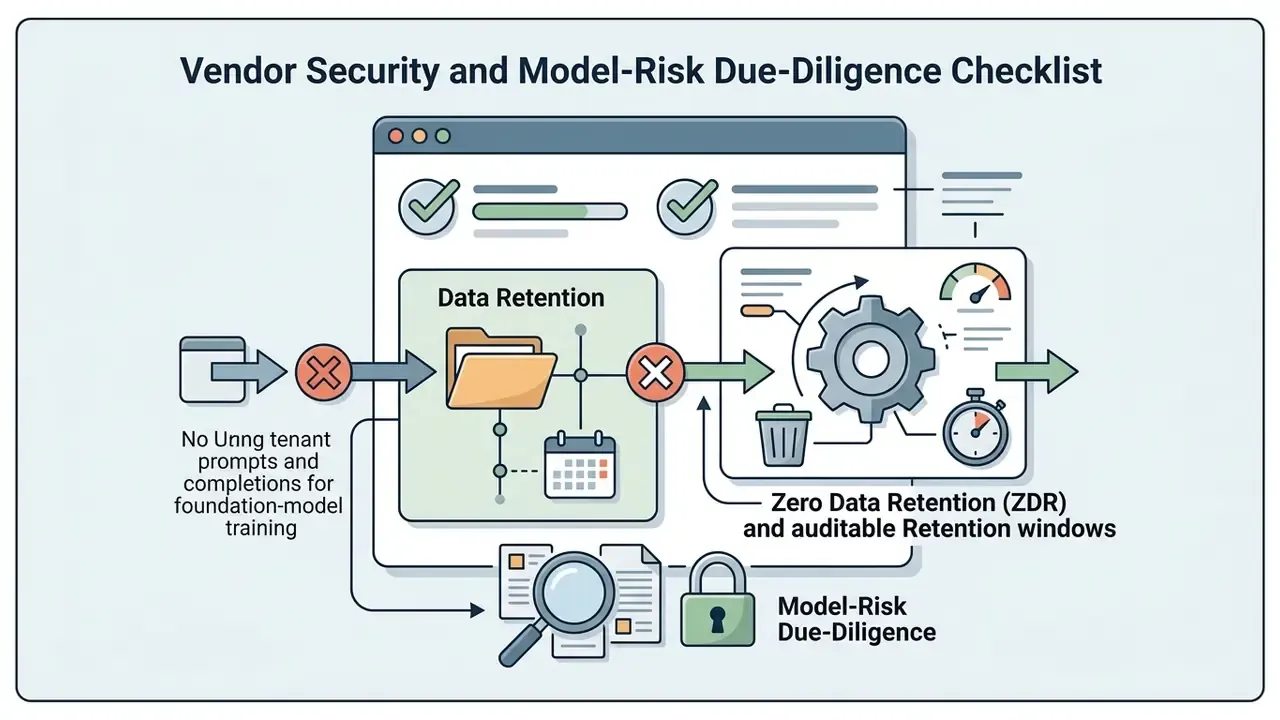
When evaluating a chatbot builder for corporate use, decision-makers should prioritize vendors that enforce encryption in transit and at rest, support Role-Based Access Control (RBAC), publish explicit data retention policies, and guarantee that enterprise query data never feeds foundation model re-training. Teams comparing shortlists side by side can explore the hub of platform comparisons before booking demos.
Data Sources, AI Models, and Response Tuning
A corporate ai chatbot creator must handle diverse knowledge ingestion formats, including web crawling, PDF and DOCX parsing, Notion databases, and direct REST APIs, while letting administrators tune temperature parameters and system prompts.
Under the hood, modern platforms combine vector databases such as Pinecone or Qdrant with hybrid keyword-dense retrieval to locate the exact policy clause before passing retrieved context to models like GPT-4o, Claude 3.5 Sonnet, or Gemini 1.5 Pro. Response tuning means writing system instructions that define persona, forbid speculation, and set explicit fallback boundaries when confidence scores fall below preset thresholds. Teams that also standardize brand-facing assets, such as widget avatars, voice prompts, and agent identities, often align chatbot styling with existing asset pipelines like AI headshot generators for consistent representative imagery.
Custom Code vs. White-Label Platform Architecture
When deploying conversational AI, engineering teams must decide whether to assemble custom RAG pipelines or use white-label no-code platforms. Building custom bots on frameworks like IBM watsonx Assistant, Azure AI Bot Service, Amazon Lex, or Wit.ai gives complete architectural control over vector indexing, embedding models, chunking strategy, and model orchestration. The cost is real: you manage raw vector databases, API gateways, prompt-injection filters, and custom UI widgets, which stretches deployment from hours to months and shifts the entire monitoring burden in-house. Enterprise white-label platforms, by contrast, package retrieval pipelines, pre-built compliance artifacts, and visual dialog builders into a turn-key product, at the price of vendor dependency and thinner control over retrieval internals.
Cost modeling differs sharply between the two paths. Custom builds are dominated by engineering time plus per-token inference and vector-storage charges. Platform builds are dominated by seat and message licensing. Teams benchmarking per-request inference economics can compare methodology with our API cost and implementation guides, or open the hub for the full set of endpoint pricing breakdowns.
| Dimension | Build from Scratch (watsonx, Azure AI Bot Service, Amazon Lex, Wit.ai) | White-Label / No-Code Platform |
|---|---|---|
| Time to first production bot | Weeks to months | Hours to days |
| Retrieval control | Full: chunking, embeddings, re-ranking, hybrid search weights | Partial: vendor-tuned defaults, limited overrides |
| Compliance artifacts | Must be produced internally | Often pre-packaged (SOC 2, DPA, ZDR options) |
| Ongoing ownership | Internal platform team required | Vendor-managed with configuration ownership |
| Best fit | Regulated data residency, proprietary retrieval IP, deep system integration | Speed to value, distributed business ownership, standard support and lead-gen use cases |
Top Enterprise No-Code AI Bot Builders in 2026
| Platform | Primary Use Case | Key Strength | Free Tier Limits | Integration Ecosystem |
|---|---|---|---|---|
| HubSpot Chatbot Builder | CRM lead qualification | Deep Smart CRM synchronization, if/then branching, automated meeting booking | Free with basic CRM; mandatory HubSpot branding | Native HubSpot Suite, Salesforce, Zapier |
| Freshchat (Freshworks) | Omnichannel support | Generative AI-assisted flow building, intent detection, reported 48% query deflection | 14-day trial; scalable enterprise tier | WhatsApp, Apple Business Chat, Facebook Messenger, Zendesk |
| Intercom (Fin AI) | SaaS customer service | Automated help-center resolution and diagnostic ticket handoff | Usage-based pricing per resolution | Jira, Stripe, Salesforce, Slack |
| Drift | B2B conversational sales | Real-time buyer intent scoring, A/B bot testing, pipeline acceleration | Commercial tiers only | Marketo, Salesforce, HubSpot |
| Landbot | SMB and WhatsApp chatbots | Visual drag-and-drop flow builder with WhatsApp API support | Sandbox tier at zero cost without AI chats; handoff from Starter | Webhooks, Google Sheets, Zapier |
| Chatfuel | Social commerce (Facebook and Instagram) | Templates for sales and support, triggered messages | Limited free entry tier | Meta channels, Shopify, Zapier |
Visual-builder mechanics matter more than marketing copy. A production-grade builder should expose if/then branching on collected variables, CRM field mapping that writes directly to contact, company, and deal properties, form validation rules (email regex, phone formats, required fields), conditional routing by segment or geography, and variable-based personalization that pulls existing CRM data into the greeting instead of re-asking known facts. Where those primitives are missing, teams inevitably rebuild them with brittle Zapier chains. I have yet to see that end well at scale.
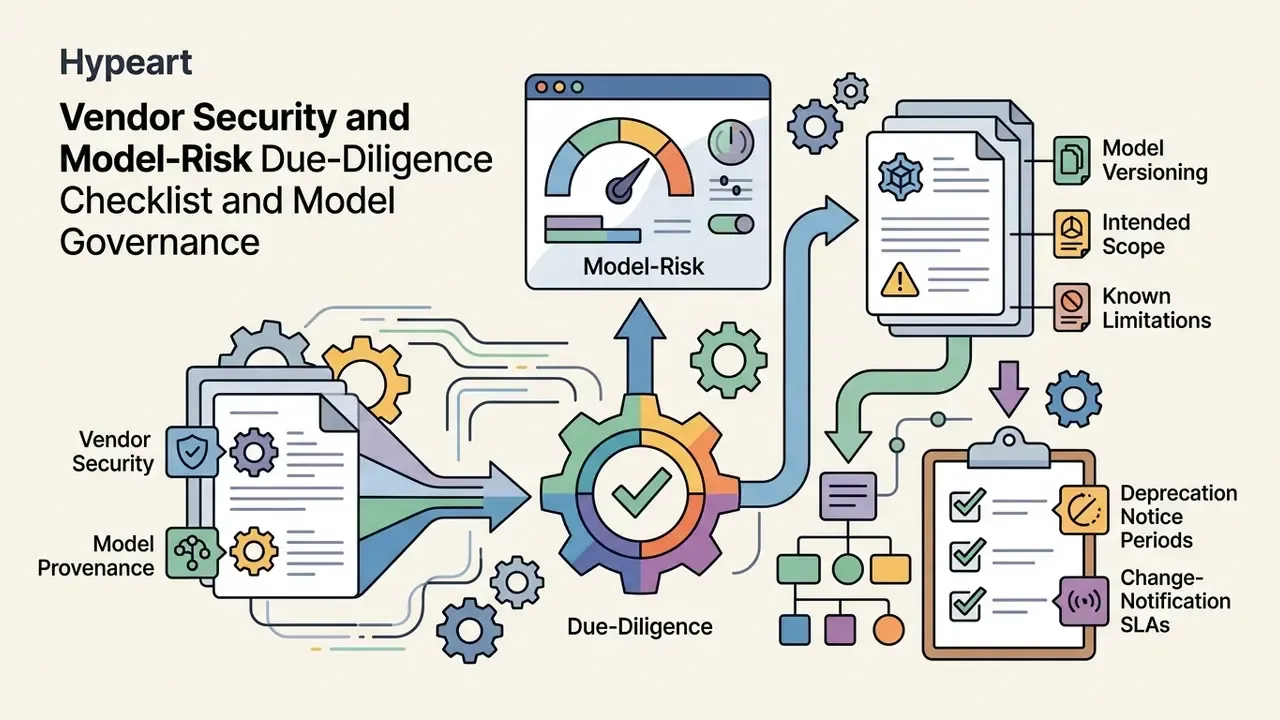
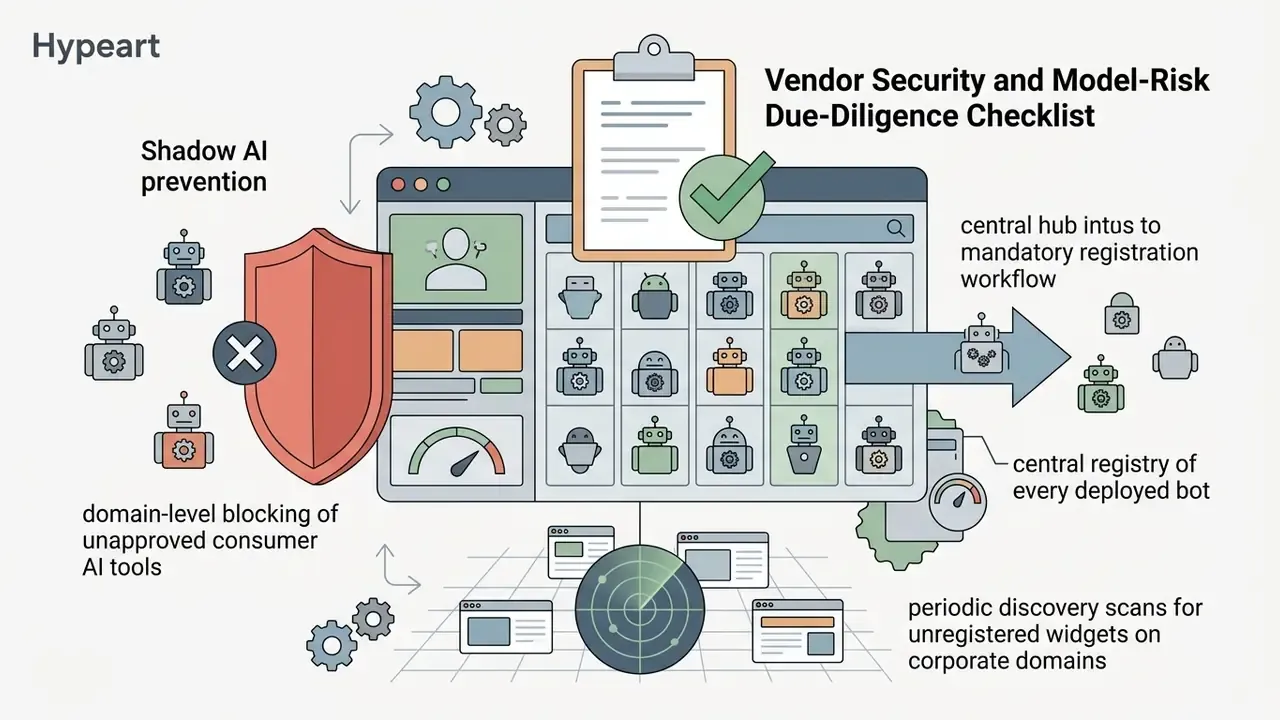
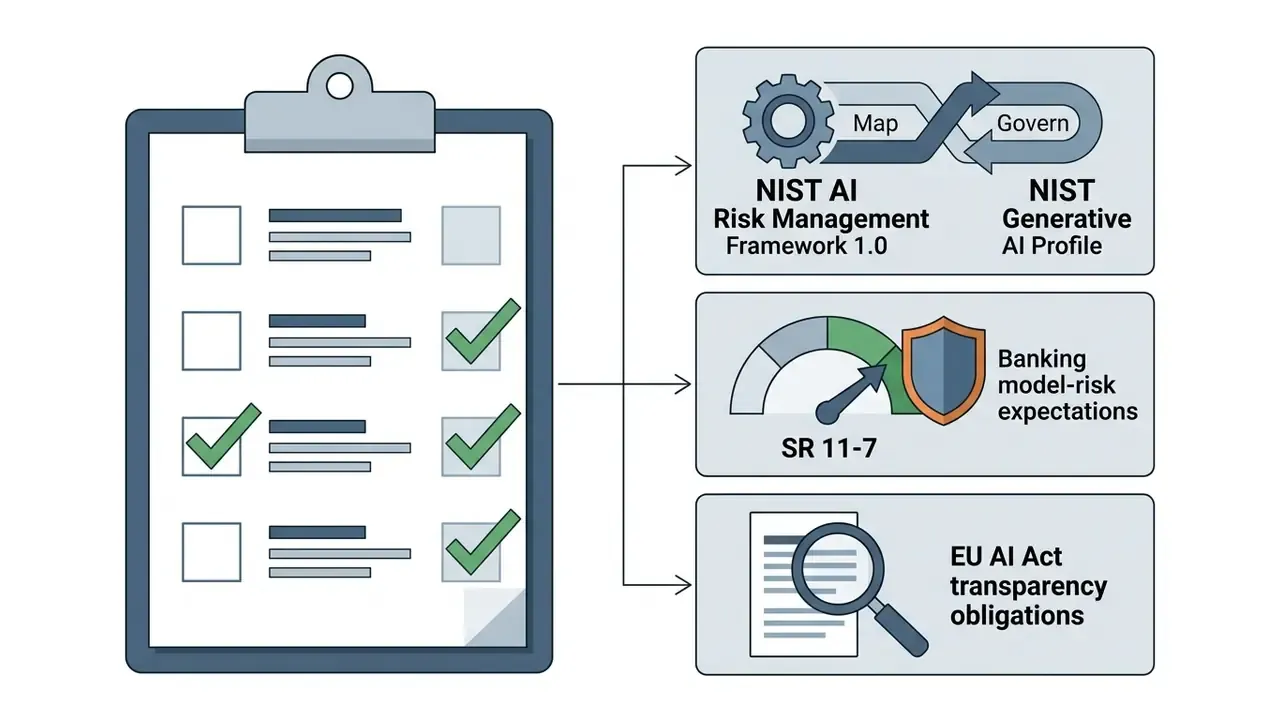
Vendor Security and Model-Risk Due-Diligence Checklist
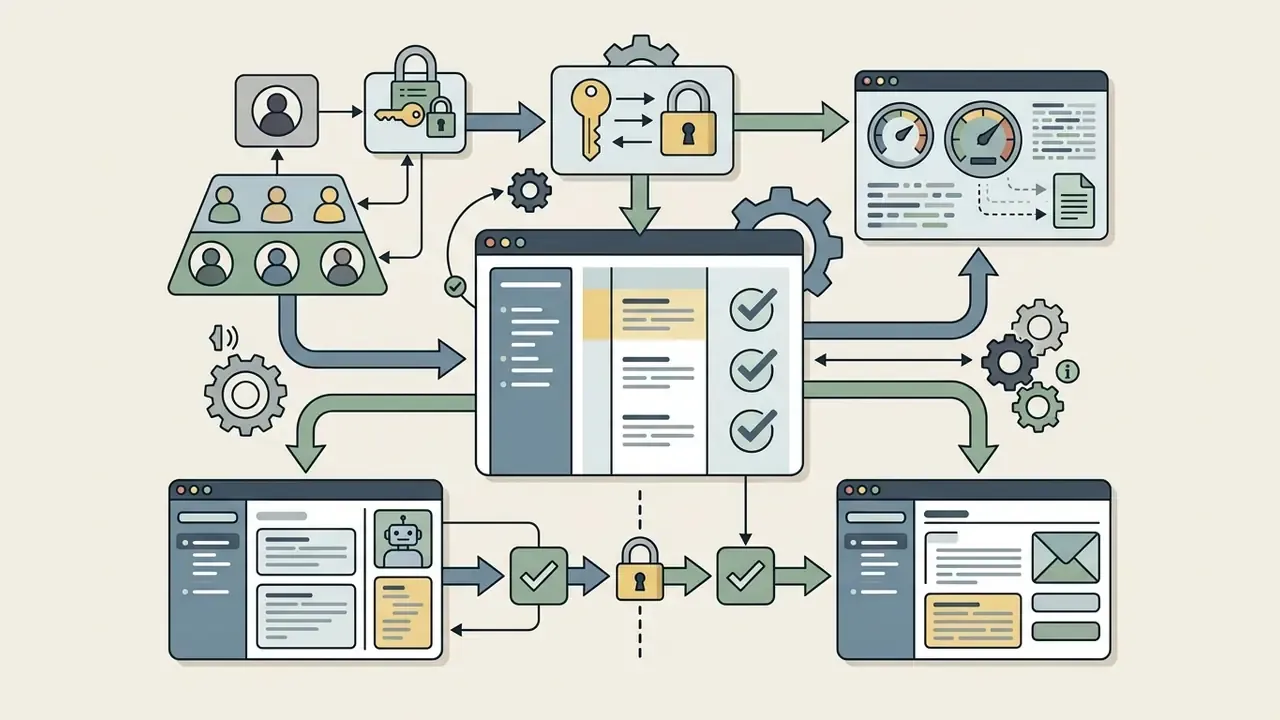
Procurement and second-line risk should require documented answers to each item before any pilot touches customer data:
Channels, Integrations, and Seamless Human Handoff
An enterprise ai bot maker must support multi-channel deployment across website chat widgets, WhatsApp, Telegram, Microsoft Teams, and ticketing systems, backed by automatic session transfer to human operators when a query exceeds automated boundaries.
Seamless human handoff depends on real-time event triggers. When a user asks for a human representative, or sentiment analysis detects frustration, the chatbot stops generating and passes the full transcript, extracted metadata, and confidence score to platforms like Zendesk, LiveChat, or Salesforce Service Cloud. Vendor documentation for channel-native handoff, for example on WhatsApp or SMS threads, shows the pattern clearly: the AI stops replying inside the same thread, and a human continues in the identical channel without forcing the customer to restart.
| Target Business Task | Mandatory Data and Model Features | Required Channels and Integrations | Handoff and Governance Controls |
|---|---|---|---|
| Customer Support | RAG grounding on knowledge base, policy docs, ticket history | Web widget, email ticketing, WhatsApp, Zendesk | Automatic escalation on low confidence; transcript context pass |
| Lead Generation | Interactive form parsing, qualification prompts, intent scoring | Web widget, landing pages, HubSpot, Salesforce CRM | Immediate routing of high-value leads to live sales reps |
| E-Commerce Pre-Sale | Real-time inventory sync, SKU search, recommendation logic | Storefront widget, Messenger, Shopify, WooCommerce APIs | Agent takeover during checkout friction or high cart values |
| SaaS Self-Service | Technical API documentation indexing, code snippet rendering | In-app widget, Slack, Intercom, Jira Service Desk | Tier-2 technical handoff with system diagnostic logs |
| Regulated Financial Servicing | Read-only account APIs, versioned product-terms corpus, refusal rules | Authenticated portal widget, secure messaging, GRC/MRM log sink | Mandatory handoff on disputes, hardship, and advice-adjacent queries |
Can You Create an AI Bot Free and What is Included in a Free Plan?
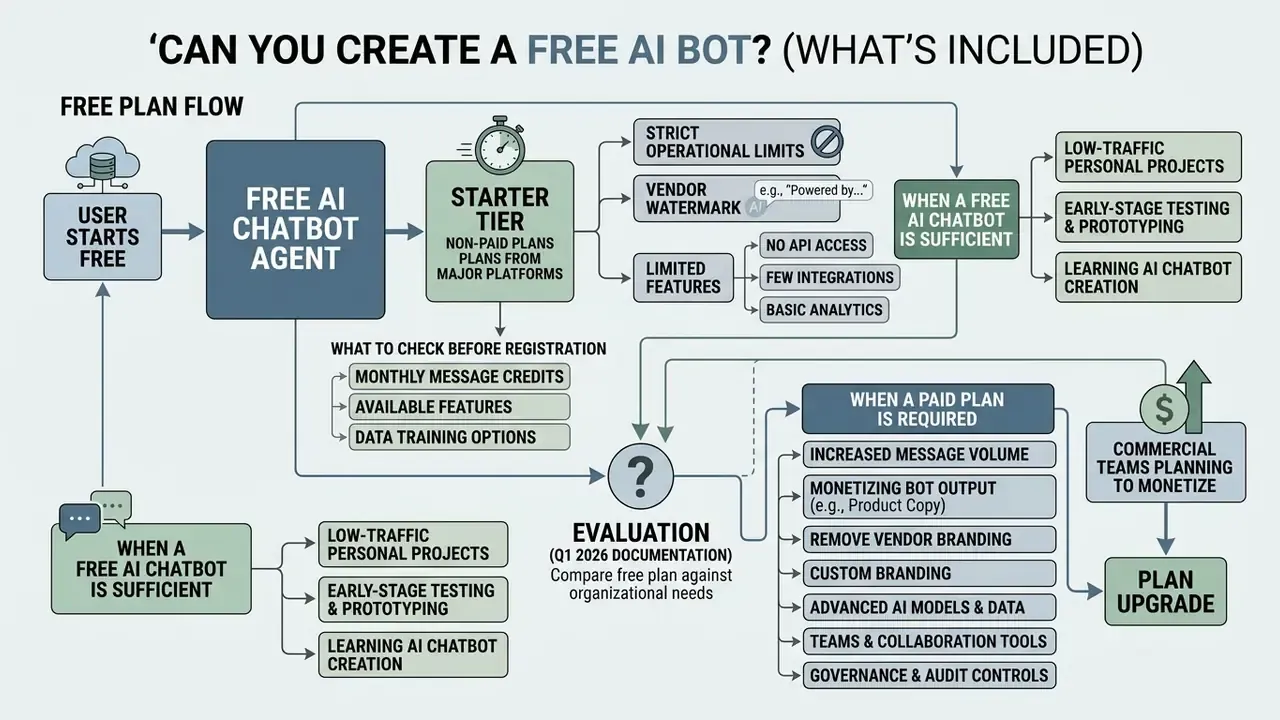
Yes, you can create an ai bot for free using non-paid starter tiers from most major chatbot builder platforms, but those plans carry strict operational limits on conversation volume, dataset ingestion, and branding. A free ai chatbot creator is best understood as a proof-of-concept environment for testing or low-volume personal sites, not high-concurrency corporate support.
Organizations evaluating a free ai bot creator or a free ai chatbot generator should first separate perpetual free tiers from temporary trial accounts. A perpetual free chatbot tier stays available indefinitely with restricted monthly message caps, often 50 to 200 credits. Free trials grant temporary access to advanced enterprise controls before a credit card or contract migration is required.
What to Check Before Registration: Limits, Branding, and Available Features
Before choosing a free ai chatbot maker, evaluate five technical parameters: total monthly message credits, data token storage allowance, vendor branding removal, model tier access, and supported deployment channels.
Most platforms that let you create free ai chatbot agents enforce a vendor watermark, typically "Powered by Platform", on the website widget. Free tiers also tend to restrict model choice to standard LLMs rather than reasoning-optimized frontier models, limit training data to a single website URL or a 10 MB document cap, and allow only one web widget channel. Published examples in the market range from 15 one-time credits and 200 messages per month at the low end, up to roughly 3 bots, 500 subscribers, and 10,000 messages per month at the more generous end. That is why the message ceiling, not the feature list, usually dictates your upgrade date.
When a Free AI Chatbot is Sufficient vs. When a Paid Plan is Required
A create your own ai chatbot free approach is enough for low-traffic personal projects, early-stage testing, and simple FAQ automation where volume stays below about 100 queries per month. Anything past that changes the math. Growing businesses need paid tiers as soon as support volume scales, custom CRM webhooks are required, or compliance demands white-label widgets, audit logging, and encryption controls. To weigh commercial licensing across tiers, review AI Media Pricing and our platform pricing and licensing options; to sanity-check cost per resolved conversation, see the overview of usage calculators.
| Operational Feature | Free Plan (Perpetual) | Trial Tier (14 Days) | Paid Enterprise Tier |
|---|---|---|---|
| Monthly Query Limit | 50 to 200 messages | 500 to 2,000 messages | 5,000 to unlimited |
| Knowledge Base Size | 1 URL or up to 10 MB PDF | 5 URLs / 50 MB files | Unlimited URLs, S3, and database connectors |
| Custom Branding | Vendor logo required | Partial customization | Fully white-labeled with custom CSS |
| Supported Channels | 1 web widget | Web widget plus 1 messenger | Omnichannel (WhatsApp, web, SMS, CRM) |
| CRM and Webhooks | Excluded | Basic Zapier / webhooks | Native Salesforce, HubSpot, REST API |
| Human Handoff | Manual notification | Basic queue assignment | Live agent routing and transcript transfer |
| Analytics and Audit | Basic query counter | Trend reporting | Full audit logs, latency and accuracy metrics |
| Security Controls | Shared infrastructure, standard retention | Limited admin controls | ZDR options, SSO/SAML, RBAC, private networking |
Commercial teams planning to monetize bot output, for example generated product copy or media, should confirm license scope; open the hub for commercial-use terms by vendor.
How to Create an AI Chatbot for Free Without Coding: Step-by-Step Process
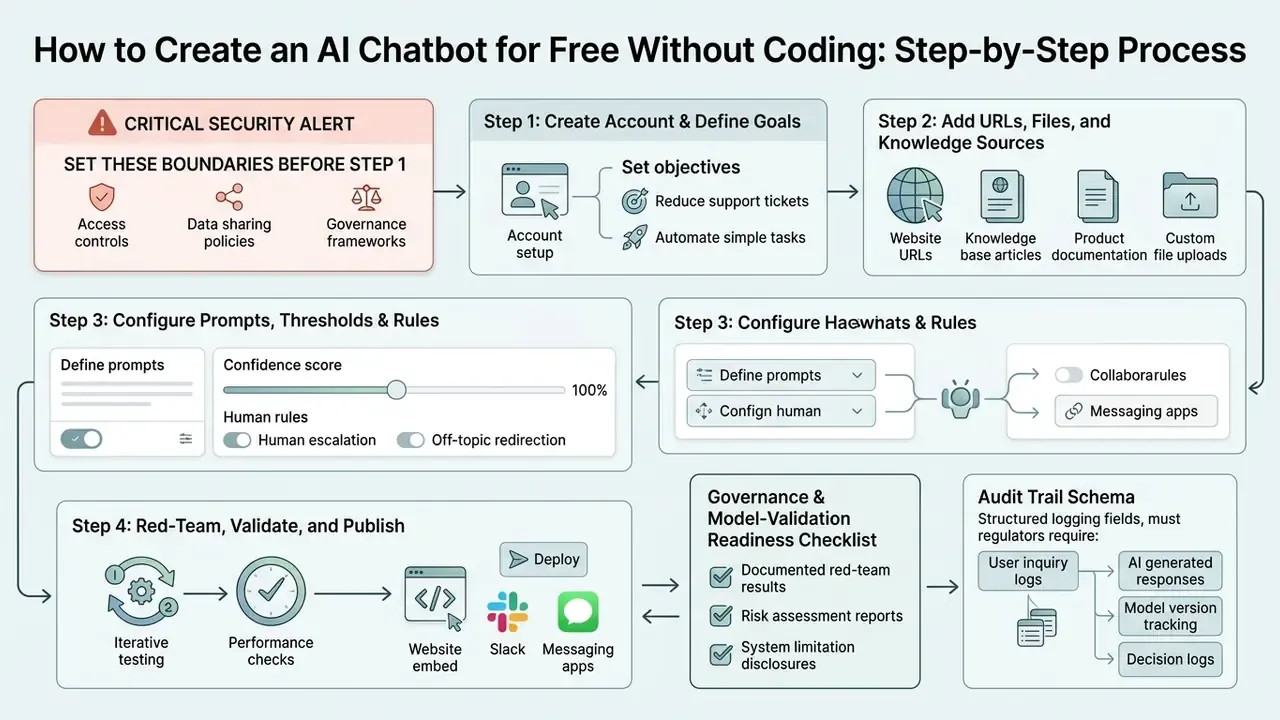
Learning how to create ai chatbot for free comes down to a repeatable lifecycle: set security boundaries, define operational scope, ingest enterprise knowledge, validate outputs in a sandbox, then embed the widget code on your website. The same sequence answers "how to create an ai bot for free" and "how to create your own ai chatbot for free" without any change in order.
CRITICAL SECURITY ALERT: SET THESE BOUNDARIES BEFORE STEP 1
Using a no-code chatbot builder, non-technical staff can configure a working agent in minutes. Which is precisely why the governance gates must exist first.
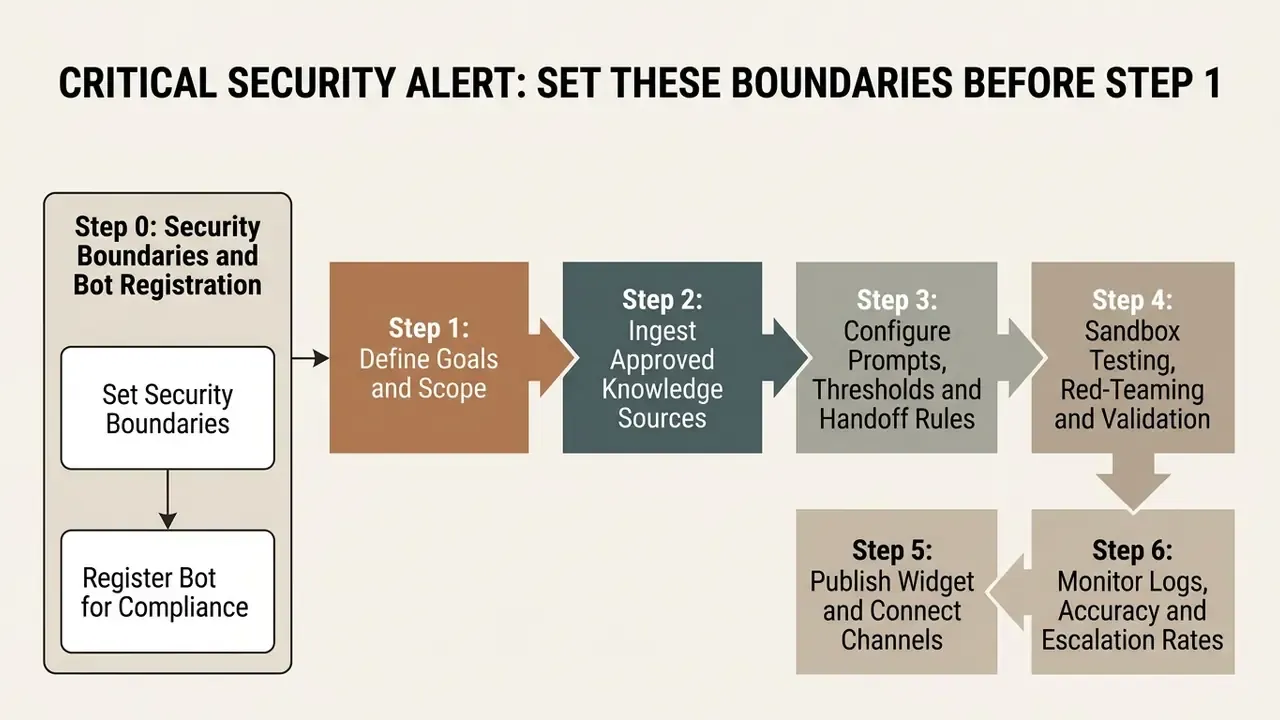
Step 1: Create an Account and Define Your AI Bot's Goals
Register on a platform that lets you create an ai bot for free, open the agent creation dashboard, and state the primary business objective of this digital worker.
During setup, decide whether the bot's job is tier-1 customer support, lead qualification, or internal documentation search. Explicit goals prevent scope creep and dictate the style of system instructions you will write later. Document intended scope, prohibited topics, target user population, and the named business owner. That page becomes the first page of the validation file.
Step 2: Add Website URLs, Files, and Knowledge Sources for Training
To train your ai chatbot on your data, open the knowledge source manager and add your primary website URL, sitemap XML link, or uploaded policy documents in PDF, DOCX, or CSV.
The platform crawls the designated pages, chunks text into semantic vectors, and builds a searchable index. Exclude private customer data, internal credentials, and unverified draft pages from the crawl scope. Record source URLs, document owners, ingestion timestamps, and version identifiers, because a retrieval answer without a traceable source document is unusable in an audit.
Step 3: Configure Prompts, Confidence Thresholds, and Escalation Rules
Step 4: Red-Team, Validate, and Publish on Required Channels
Before public deployment, use the preview sandbox to test your ai chatbot against edge cases, verify citation accuracy, and adjust temperature if answers drift from policy. For regulated deployments, extend testing into structured validation: adversarial prompt-injection attempts, jailbreaks, out-of-scope probing, contradictory-document handling, and counterfactual prompts drawn from the NIST Generative AI Profile control set. Define an accepted error budget, for example a maximum tolerated ungrounded-answer rate on a labeled test set, and have the model owner sign it off.
Once verified, copy the generated JavaScript widget snippet from the publishing console and paste it into the header or footer of your CMS (WordPress, Webflow, Shopify, Wix). Enterprise deployments may embed via iframe, tag manager, or CMS plugin instead, and should route logs into the organization's SIEM or GRC platform. Refresh the live page, confirm the widget renders, and run a real conversation end to end. If anything breaks at this stage, our support documentation covers embed and channel troubleshooting.
Governance and Model-Validation Readiness Checklist
Checklist0 / 11
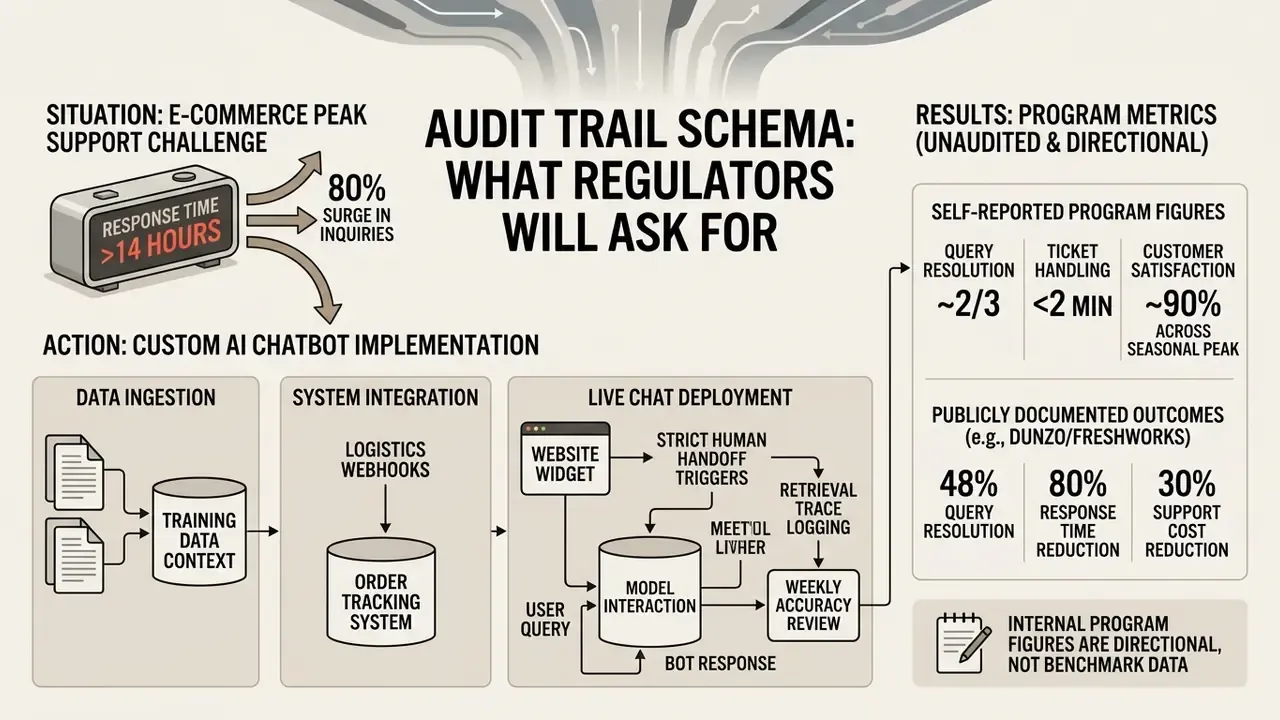
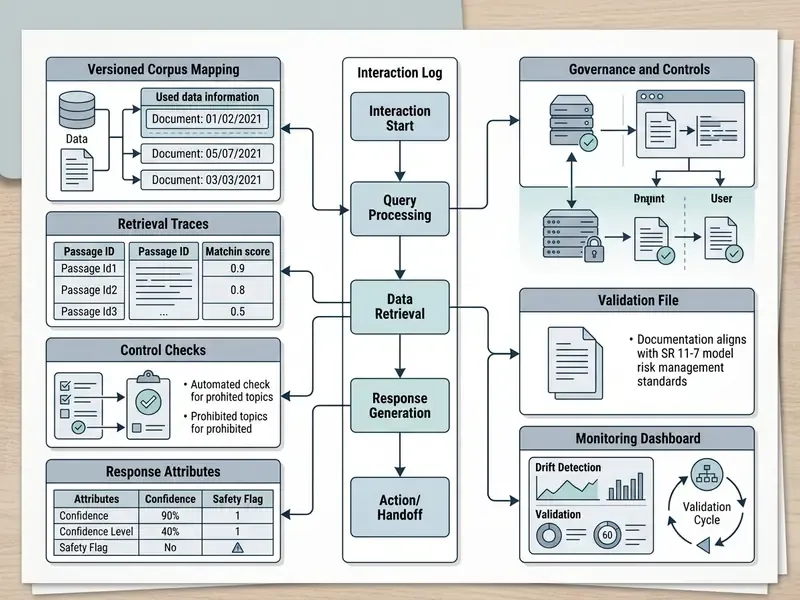
Audit Trail Schema: What Regulators Will Ask For
{
  "conversation_id": "uuid",
  "timestamp_utc": "ISO-8601",
  "channel": "web_widget | whatsapp | teams | sms",
  "user_reference": "pseudonymized_id",
  "user_message_redacted": "string",
  "retrieved_chunks": [
    {"doc_id": "string", "doc_version": "string", "chunk_id": "string", "similarity_score": 0.00}
  ],
  "model": {"name": "string", "version": "string", "temperature": 0.0},
  "prompt_template_version": "string",
  "response_text": "string",
  "citations": ["doc_id#chunk_id"],
  "confidence_score": 0.00,
  "guardrail_events": ["pii_redaction", "topic_block", "injection_flag"],
  "escalation": {"triggered": true, "reason": "low_confidence | user_request | prohibited_topic", "agent_id": "string"},
  "retention_policy_id": "string"
}
How to Train an AI Chatbot on Corporate Data and Control Its Behavior
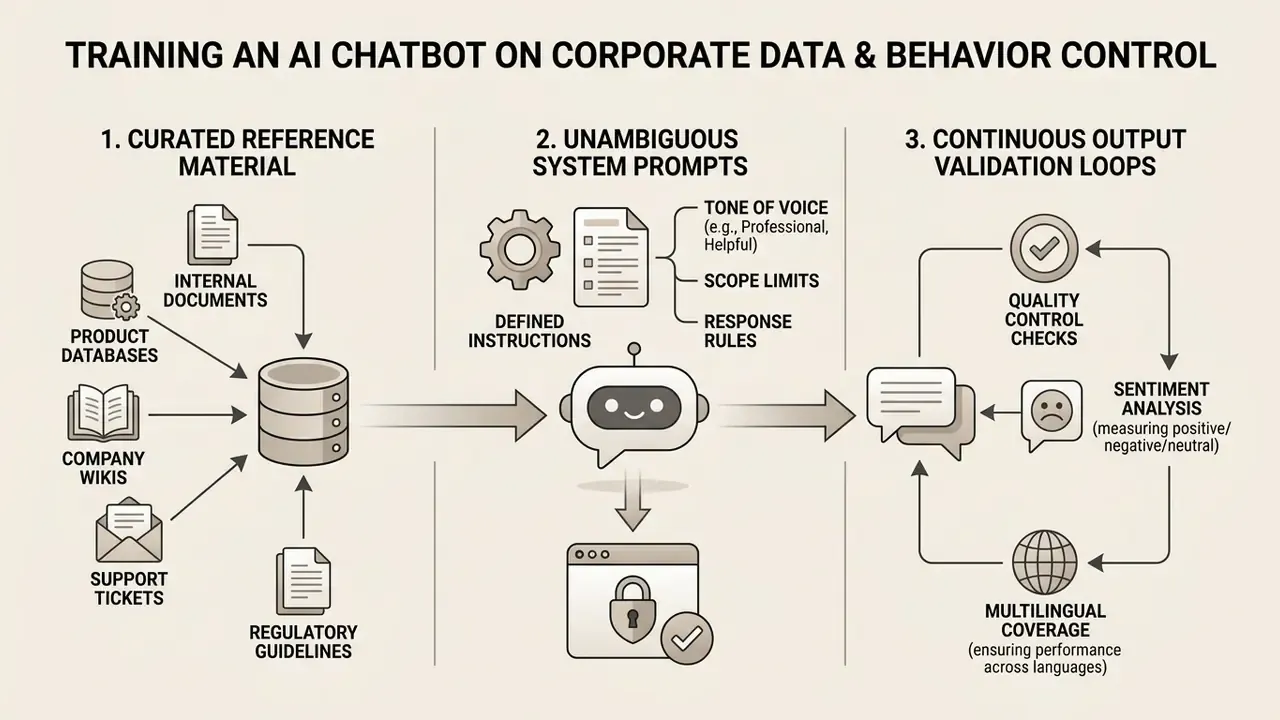
Grounding an ai chatbot in enterprise data requires three things: curated reference material, unambiguous system prompts, and continuous output validation loops.
Without formal governance, probabilistic models will produce hallucinated output or quote policy that expired two versions ago. NIST guidance is blunt about the operating discipline: use only approved AI tools, ingest only approved organizational artifacts, choose a prompt format that fits the organization, and continuously review and refine both inputs and outputs.
"Confabulation is the generation of confidently stated but erroneous content; mitigations include prompt engineering, counterfactual prompts, and periodic monitoring for sensitive-data exposure."
"Specifying tone, for example 'objective' or 'authoritative', helps align output with the target audience." Source: NIST SP 1353, Quick-Start Guide for Using Artificial Intelligence (initial public draft, 2026). https://csrc.nist.gov/
For banking and insurance, layer these controls onto machinery you already run. The NIST AI Risk Management Framework 1.0 supplies the governance vocabulary. Federal Reserve and OCC SR 11-7 supplies the validation, documentation, and independent-review expectations examiners already apply to models.
Which Information Sources to Use for Training a Chatbot
The most effective knowledge sources for training an ai chatbot include official FAQ pages, standard operating procedures, verified help-center documentation, legal terms of service, regulatory disclosures, and structured product catalogs.
Structured CSV or JSON files with explicit attributes, such as SKU numbers, exact dimensions, pricing structures, and effective dates, yield higher retrieval precision than raw narrative text. Treat policy and regulation documents as single sources of truth and give them retrieval priority over marketing pages, which drift and contradict.
"The CSC framework defines five conversation stages and twelve strategies; fine-tuning GPT-4o on the RoleCS dataset reached BLEU-2 of 8.13 and ROUGE-L of 4.12 on real support dialogues."
A practical ingestion note. A single URL can bootstrap a bot quickly, but crawl coverage is bounded by robots rules, non-HTML assets, paywalled documentation, and text-and-data-mining reservation signals. A bot trained from one URL should never be treated as complete without broader vetted sources.
Instructions, Tone of Voice, and Quality Control
System instructions must define tone of voice, operational boundaries, permitted linguistic style, and forbidden output behaviors. Explicitly. Not by implication.
Empirical studies on chatbot anthropomorphism show that autonomous signals of competence drive satisfaction in utilitarian service settings, while excessive emotional anthropomorphism, think artificial empathy and emoji clusters, erodes perceived professional competence.
"Autonomous anthropomorphism uniquely raises satisfaction via perceived competence; pairing it with high emotional anthropomorphism weakens that effect in utilitarian service settings."
Instructions should mandate objective, concise phrasing and require the bot to cite the exact source document for every claim. Large-scale field evidence also warns against confusing perceived improvement with resolved outcomes.
"In a field experiment with 5,940 new agents and roughly 2.56 million chats, a generative AI assistant accelerated problem diagnosis and raised subjective ratings, but did not change the objective repeat-contact rate."
Sentiment analysis and multilingual coverage. Modern enterprise AI bot makers include real-time sentiment analysis and dynamic multilingual processing across 90+ languages. By reading sentiment tokens for frustration, urgency, or satisfaction, the platform can adjust response temperature, suppress upsell logic, or trigger immediate escalation before brand damage occurs. Aggregated sentiment trends double as a quality-control dashboard: rising negative sentiment on one intent usually signals a stale document rather than an angry customer base. Multilingual RAG pipelines translate the query into the index language, retrieve context vectors, and respond in the user's dialect without duplicate localized documentation. Regulated disclosures, though, should still be served from human-reviewed localized source text, not machine translation. Organizations extending the same conversational layer into voice channels should review capability and licensing constraints in our guide to AI voice generators before enabling spoken output. Teams producing supporting visual explainers for internal training can also reuse an ai infographic generator workflow for the same knowledge base.
Integrations, Automation, and Deploying an AI Chatbot Across Customer Channels
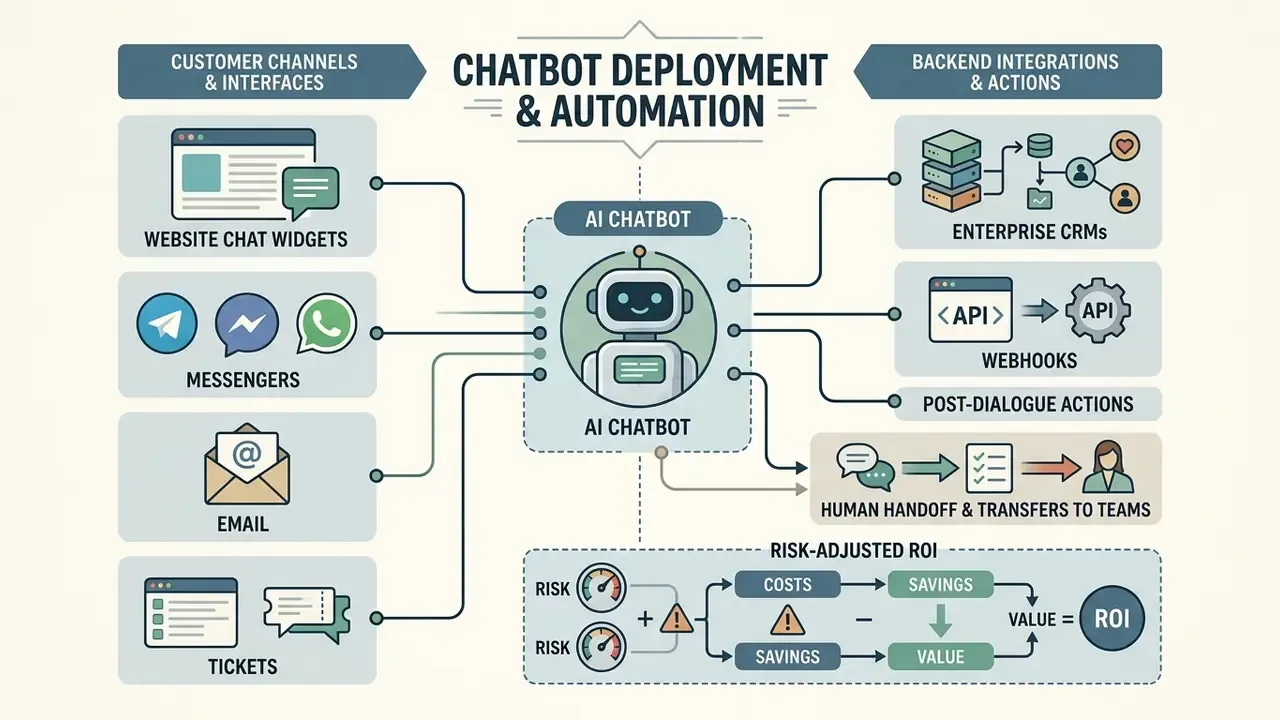
To deliver operational value, an ai chatbot must integrate into existing customer communication tools, enterprise CRMs, and backend automation webhooks.
An isolated widget that only outputs text delivers minimal ROI. Real transformation starts when conversational agents trigger backend actions: updating customer records, issuing support tickets, booking calendar slots. In regulated environments, every such action needs an explicit decision-ownership model. Which actions may the agent take autonomously? Which require human confirmation? Which are permanently prohibited? Answer those three questions in writing, or your validation file will not survive review.
Website Chat Widgets, Messengers, Email, and Tickets
Deploying an ai chatbot across channels means unifying widget JavaScript snippets, iframe or CMS-plugin embeds, social messaging APIs (WhatsApp, Facebook Messenger, Telegram), and inbound email ticket parsers into a centralized inbox.
Multi-channel synchronization ensures a conversation that starts on a mobile web widget continues via SMS or email without losing session state or transcript history. Channel mechanics differ in practice: WhatsApp entry points typically use wa.me or api.whatsapp.com deep links plus the Business API for threaded conversations, Telegram uses a t.me bot handle, Messenger uses a Meta-provided snippet for the chat bubble, and email appears as one selectable contact channel inside the widget rather than a separate protocol.
CRM, Webhooks, and Post-Dialogue Action Automation
Post-dialogue automation relies on event-driven webhooks that transmit structured JSON payloads from the chatbot builder to platforms like HubSpot, Salesforce, amoCRM, Bitrix24, or custom REST APIs.
After a lead qualification dialogue completes, the bot builds a payload with visitor details, intent tags, and a conversation summary. That posts automatically to /crm/leads, triggering downstream email workflows or assigning tasks to regional account managers. HubSpot exposes webhook actions inside workflows and agents. amoCRM emits event webhooks from digital-pipeline triggers such as form fill, chat, call, or stage change. Bitrix24 supports inbound and outbound webhooks alongside REST lead creation and update methods. For risk-managed programs, the same event bus should fan out a copy of every decision event to the GRC or model-risk log store, so automated actions stay reconstructable independently of the vendor console.
Human Handoff and Rules for Transferring Conversations to Teams
Explicit handoff rules guarantee that high-friction, complex, or sensitive interactions move cleanly from automated agents to human specialists.
Handoff logic evaluates three core triggers: explicit user requests ("speak to a human"), consecutive low-confidence scores from the RAG engine, or sentiment flags indicating escalation. The handoff payload must carry complete conversation history, extracted contact fields, sentiment scores, what the bot already attempted, and the precise failure cause, so the human agent never asks the customer to repeat themselves.
"Transparency about which query types the bot handles, an emphasis on reliability, and fast access to a live agent after failure significantly increase users' willingness to use a chatbot."
"Across three experiments (N=200, N=75, N=300), consumers preferred human agents for complaint resolution even after a chatbot resolved the issue; faster responses significantly increased chatbot acceptance." Source: Chatbot or Human? Rethinking Complaint Handling in Customer Service, Journal of Consumer Behaviour. https://onlinelibrary.wiley.com/journal/10991158
Risk-Adjusted ROI: The Formula Executives Should Actually Use
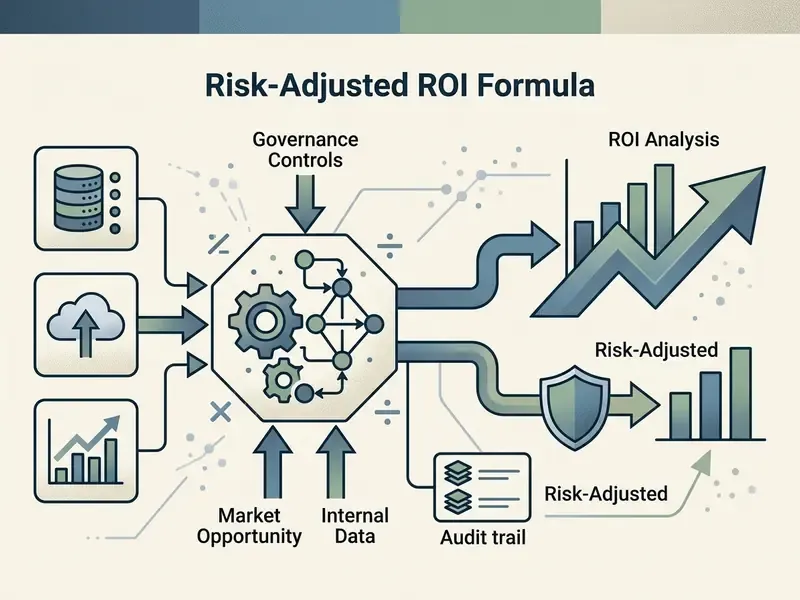
Deflection-rate ROI models systematically overstate value, because they ignore control costs and residual risk. A defensible calculation looks like this:
Risk-Adjusted ROI =
  ( Deflected_contacts x Fully_loaded_cost_per_contact
  + Incremental_revenue_from_conversion_lift
  + Agent_productivity_gain x Loaded_agent_hour )
  minus
  ( Platform_licensing + Inference_and_vector_storage
  + Build_and_integration_effort
  + Ongoing_monitoring_and_transcript_QA_FTE
  + Validation_and_independent_review_cost
  + Expected_residual_risk_loss )
  divided by Total_program_cost
Where Expected_residual_risk_loss = sum of (probability of incident x estimated impact) across defined scenarios: ungrounded regulated answer, PII exposure, prompt-injection data leakage, channel outage. Benchmarks such as an 80% response-time reduction or 30% support-cost reduction (Freshworks and Dunzo case material) belong in the numerator. Validation, monitoring, and residual-risk provisions belong in the denominator. A program that clears the bar on both sides is defensible to a board and to an examiner. One that only clears the numerator is a press release.
Business Use Cases for an AI Bot Maker Across Different Sectors
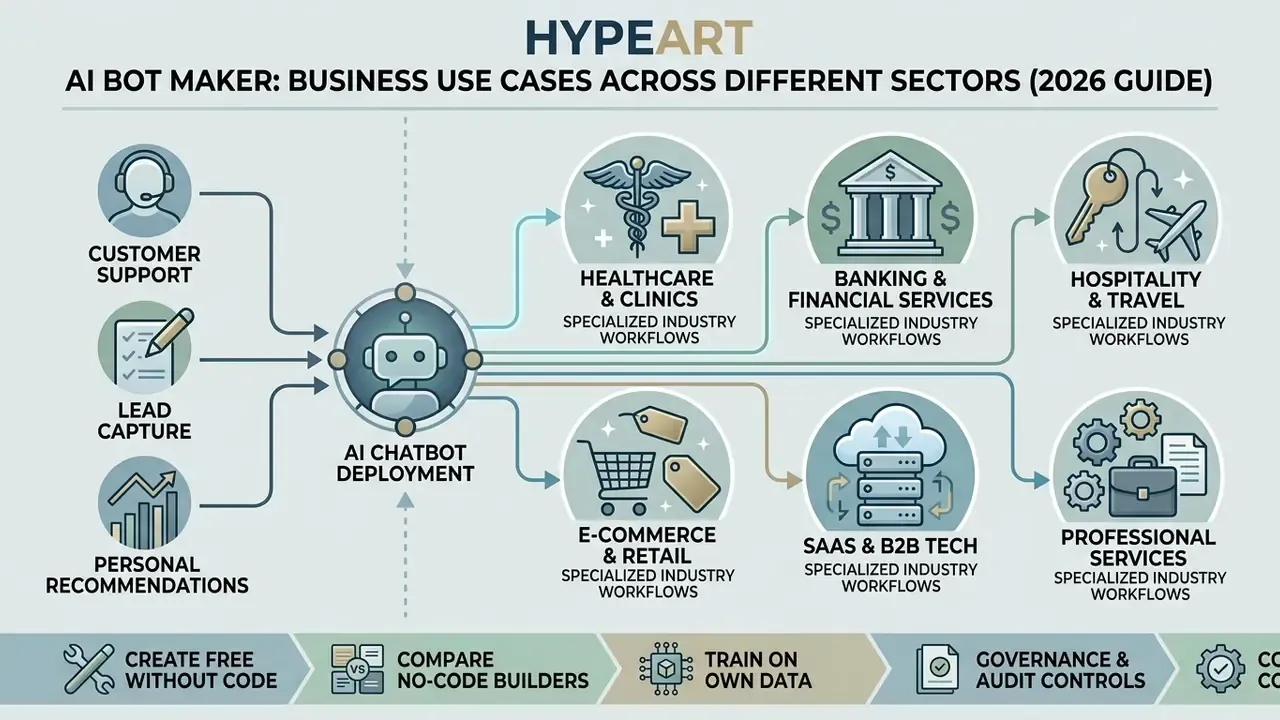
Organizations across e-commerce, SaaS, financial services, hospitality, and healthcare deploy ai chatbots to scale operational capacity, remove response lag, and keep service available at 3 a.m.
In e-commerce, bots assist with product discovery, cart recovery, and shipping queries. In SaaS, they guide onboarding, explain feature configuration, and triage bug reports. In B2B commerce, they handle RFQ intake and product-fitment search, writing structured records straight into CRM.
Customer Support, Lead Capture, and Personal Recommendations
Round-the-clock support lets businesses answer instantly outside office hours while holding service quality steady. Reported case-study outcomes in 2024-2026 cluster around three effects: higher lead conversion, roughly 30% in several documented programs, fewer abandoned chats, up to a 60% reduction, and higher average order value, about 20%, when recommendations draw on live catalog data rather than generic copy. Marketing teams often pair the same knowledge base with content tooling such as an ai instagram caption workflow so promotional messaging stays aligned with what the bot actually tells customers.
Specialized Industry Workflows
- Healthcare and Clinics:
- 24/7 patient triage and appointment scheduling via EHR/EMR webhooks.
- Automated insurance verification, claims status updates, HIPAA-compliant patient intake.
- Medication and follow-up reminders, post-treatment surveys, feedback collection.
- Banking and Financial Services:
- Real-time account balance inquiries and transaction categorization.
- Automated loan and credit-card pre-qualification forms, fraud alert notifications, secure KYC document parsing with AML screening handoff to analysts.
- Product-terms explanation grounded on versioned disclosures, with mandatory escalation on advice, disputes, and hardship.
- Hospitality and Travel:
- Automated room, table, and spa reservation management with personalized dining or amenity upsells.
- Multilingual guest concierge handling check-in FAQs, local recommendations, loyalty enrollment, instant Wi-Fi credential delivery.
- E-Commerce and Retail:
- Real-time SKU and stock tracking, personalized cross-selling, cart-abandonment recovery via WhatsApp.
- Store locator, opening hours, returns policy, loyalty-program support.
- SaaS and B2B Tech:
- Interactive API documentation search, diagnostic log parsing, automatic Jira ticket creation.
- Onboarding walkthroughs, feature explanation, demo scheduling with CRM enrichment.
- Professional Services:
- Intake qualification, document checklist delivery, appointment routing, consultation triage with clear scope-of-advice boundaries.
FAQ: AI Chatbot Creator and AI Bot Maker Questions
Can You Create an AI Bot Starting Only from a Website URL?
Yes. Most modern ai bot maker platforms let you create a bot by using your website URL. The system scans the sitemap, crawls readable HTML pages, extracts text, and builds a vector index within minutes. Relying only on a public URL has limits, though. Web pages rarely contain deep technical SOPs, internal edge-case documentation, or behind-the-login policy guidance needed for complex handling. Crawl coverage is further constrained by robots directives, non-HTML assets, and text-and-data-mining reservation signals expressed in HTTP headers, well-known files, or HTML metadata. Best practice is to augment URL crawls with uploaded internal documentation, curated FAQ spreadsheets, and explicit system prompt rules.
How Does AI Chatbot Performance Compare to Human Support Agents?
In routine pre-sale inquiries and information retrieval, empirical studies (arXiv:2510.12049, 2025-2026) show generative AI chatbots matching human agents on conversion and sales performance while responding far faster. For complex complaint resolution, high-stakes financial transactions, or emotionally charged scenarios, users still prefer humans, sometimes strongly.
"A meta-analysis of 16 effect sizes found robotic service slightly reduces positive emotions (d = -0.35), yet outperforms humans in embarrassing and utilitarian service contexts." Source: The Robot-Human Paradox: A Meta-Analysis of Customer Service Encounters, Wiley. https://onlinelibrary.wiley.com/ Optimal enterprise architectures are therefore hybrid: AI handles routine tier-1 queries instantly, humans handle escalated, high-value, and conduct-sensitive interactions.
Are Free AI Chatbots Safe for Processing Sensitive Customer Data?
Perpetual free plans from public chatbot creators usually run on shared infrastructure and may lack SOC 2 Type II attestation, HIPAA controls, or explicit guarantees against data re-training. Organizations handling regulated customer data, financial metrics, or personal health information should keep free tiers out of production entirely. Deploy dedicated paid instances with zero data retention, end-to-end encryption, tenant isolation, and strict RBAC with SSO/SAML.
"Utilitarian and technological motives significantly increase chatbot engagement, while perceived privacy risk reduces it (PLS-SEM, N = 179 users)." Source: Enhancing Customer Experience Through AI-Powered Marketing, Concurrency and Computation: Practice and Experience (2026). https://onlinelibrary.wiley.com/journal/15320634 Public-environment use materially raises leakage risk. US federal AI guidance recommends minimizing sensitive data in prompts, applying runtime redaction and output filtering, requesting references, and validating responses against independent sources. This information is general in nature and does not substitute for advice from a qualified information security, data protection, or legal professional.
What are the Most Common Reasons an AI Chatbot Fails in Production?
The usual suspects: incomplete training data, overly broad system prompts, missing confidence thresholds, absent human handoff, and unmanaged "Shadow AI" launched outside security review. When an agent is forced to answer outside its ingested knowledge domain without a fallback, hallucination rates climb. Rigid RAG retrieval boundaries, regular transcript audits, and prompt testing against edge cases cut failure rates noticeably. Not to zero, and any vendor promising zero deserves a follow-up question.
"A systematic review of 64 papers (48 with quantitative data) confirms that perceived usefulness, ease of use, trust, and satisfaction consistently predict chatbot acceptance across industries." Source: Consumer Acceptance of Conversational Bots: Systematic Literature Review and Meta-Analysis, Journal of Consumer Behaviour (2024). https://onlinelibrary.wiley.com/journal/10991158
What Evidence Will a Regulator or Internal Auditor Expect?
Expect requests for the bot inventory entry, intended-use documentation, a data-source catalogue with versions, system-prompt version history, red-team and validation results, monitoring reports with drift and escalation metrics, incident records, and reproducible conversation logs with retrieval traces. The audit-trail schema earlier in this guide covers the minimum log fields needed to reconstruct any single answer after the fact.
Should We Build from Scratch or Buy a White-Label Platform?
Build from scratch when data residency, proprietary retrieval logic, or deep core-system integration is non-negotiable, and when you have a standing platform team to own monitoring. Choose a white-label or no-code platform when time-to-value, distributed business ownership, and packaged compliance artifacts matter more than retrieval-level control. Many enterprises run both: a governed platform for business-owned support and lead bots, plus a custom pipeline for regulated or differentiated workflows.
How Many Languages Should an Enterprise Bot Support?
Leading platforms advertise 90+ languages through dynamic translation over a single index. Support the languages your traffic actually uses. Serve regulated disclosures from human-reviewed localized source documents rather than machine translation, and monitor answer quality per language separately, since retrieval precision often degrades on low-resource languages even when fluency looks fine.
Limitations, Open Questions, and a Safe Next Step
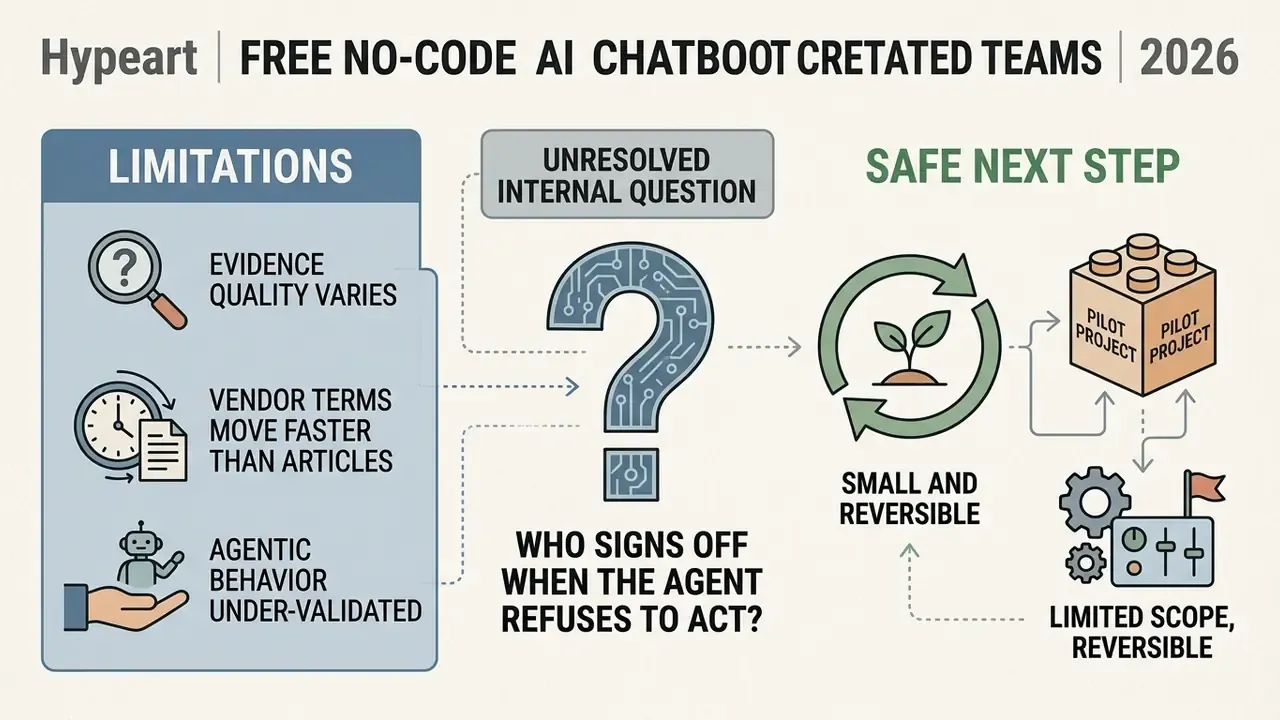
A few things this guide cannot settle for you, and pretending otherwise would be dishonest.
Evidence quality varies. The randomized field results cited here come from retail and contact-center settings, not from regulated lending or servicing. Directional? Yes. Transferable one-for-one to a KYC or credit workflow? No.
Vendor terms move faster than articles. Free-tier caps, retention language, and model versions changed at least twice at several vendors during 2025. Re-verify before signing, and put change-notification SLAs in the contract.
Agentic behavior is still under-validated. Traditional validation techniques assume a stable input-output mapping. Multi-step agents that call tools break that assumption, and the industry has no settled validation standard yet. Treat any agent with write access to core systems as high risk until proven otherwise.
Unresolved question worth owning internally: who signs off when the agent refuses to act? Escalation paths for refusals are far less mapped than escalation paths for errors.
A reasonable next step is small and reversible. Pick one bounded, low-conduct-risk workflow, such as documentation search or order status. Register it in the AI inventory. Ground it on a versioned corpus. Instrument the logs described above. Run it for one quarter, then compare the risk-adjusted ROI formula against the deflection number your vendor quotes. If the two disagree sharply, the gap is your control cost, and it is better to learn that at pilot scale.
Disclaimer
This article is provided for general informational purposes only. It does not constitute legal, regulatory, compliance, financial, or medical advice, and it is not a substitute for consultation with qualified counsel, an information-security specialist, or your firm's model-risk and compliance functions. References to frameworks such as the NIST AI Risk Management Framework, SR 11-7, HIPAA, SOC 2, or the EU AI Act are illustrative summaries, not compliance determinations. Marcus Hale, author. Vendor limits, pricing, and features change frequently; verify all figures against current official documentation before making procurement or deployment decisions.
Appendix A: Editorial Revision Log (Archived Fragments)
Retained for transparency; superseded in the main text.
- Archived citation format"(arXiv:2510.12049, 2026)" was updated to "(arXiv:2510.12049 v4-v5, 2025-2026)", because the arXiv prefix
2510indicates an October 2025 submission with later revisions. - Archived reference"As noted in NIST guidelines (NIST SP 1353, 2026), enterprise AI deployment mandates using only approved organizational artifacts…" was updated to cite both NIST SP 1353 (initial public draft) and the NIST AI Risk Management Framework 1.0 / NIST AI 600-1 Generative AI Profile, with linked sources.
- Archived case metrics"resolved 64% of incoming queries… 92% customer satisfaction rating across 15,000 seasonal chats" and "qualified 380 weekend leads… 41 immediate calendar demos… under 30 seconds" were replaced with directional, clearly labelled self-reported program figures plus publicly documented comparators, because the original numbers carried no verifiable source.
- Archived statisticIBM 2025 adoption figures (49% and 71%) retained in text with an explicit verification caveat pending access to the primary report methodology.
- Archived link placementscontextual links to consumer media generators were partly relocated into the Related Tools block below, preserving access without breaking the enterprise reading context.
- Archived heading labelthe executive summary heading previously carried a technical abbreviation in parentheses; removed for publication.
Related Tools
Adjacent AI tooling references, kept separate from the main guide for readers exploring broader content and media automation:
Internal Links Summary Checklist
- Body contextual:
- "platform pricing and licensing options" and "AI Media Pricing" to /pricing/
- "API cost and implementation guides" to /api-guides/google-veo-ai-video-generator/
- "open the hub" to /api-guides/
- "see the overview" to /calculators/
- "explore the hub" to /compare/
- "explore the hub" to /litigation/
- "open the hub" to /commercial-use/
- "support" to /support/
- "AI headshot generators" to /glossary/ai-headshot-generator/
- "AI voice generators" to /glossary/ai-voice-generator/
To explore full glossaries, pricing comparisons, and enterprise AI governance frameworks, browse the hub.