An AI Instagram post generator is a specialized software workflow that uses generative artificial intelligence models to convert text prompts, raw product data, or media assets into ready-to-publish Instagram posts. These platforms combine large language models (LLMs) for caption writing with diffusion models for image generation, so marketing teams can produce platform-tailored visual assets and copy at scale. According to a 2026 report on social media marketing automation, AI tools now support every stage of social media production: ideation, visual rendering, caption drafting, and format adaptation [Sociality.io, 2026].
Why should a bank, broker-dealer, or fintech marketing lead care about a consumer-grade design tool? Because the moment a generated image carries a claim about a product, the workflow stops being creative and starts being regulated communication.
«Generative AI rapidly and inexpensively converts user prompts into high-quality visual outputs, reducing the marginal cost of producing social media content.»
Executive Summary: The Decision in Brief
For readers who need the decision, not the tour:
- What it is: A multi-modal pipeline. Prompt or product data goes in, a platform-sized image plus caption comes out, with an editor in the middle for brand assets and human correction.
- What it actually saves: A 2025 University of Padua thesis measured weekly content drafting at 2.73 hours with AI tools vs. 10.24 hours without, and CMO-level data shows AI adoption in marketing lowering departmental overhead by 10.8% while lifting sales productivity by 8.6%.
- What it costs in control, not credits: Free tiers cap output at roughly 5 posts/day (Buffer), 25 AI credits/month (Adobe Express), or 15 AI posts/month (Predis.ai), and often withhold commercial licensing. Real total cost of ownership includes human-in-the-loop review time, fact-checking, and audit-log retention.
- Where the veto sits: In the United States, purely AI-generated images without meaningful human authorship cannot be registered for copyright (U.S. Copyright Office). In the EU, transparency marking and labelling obligations for AI-generated content apply from 2 August 2026 under the AI Act. Regulated industries such as banking, insurance, and brokerage must additionally treat social posts as advertising subject to FINRA Rule 2210 and the SEC Marketing Rule, with retained records.
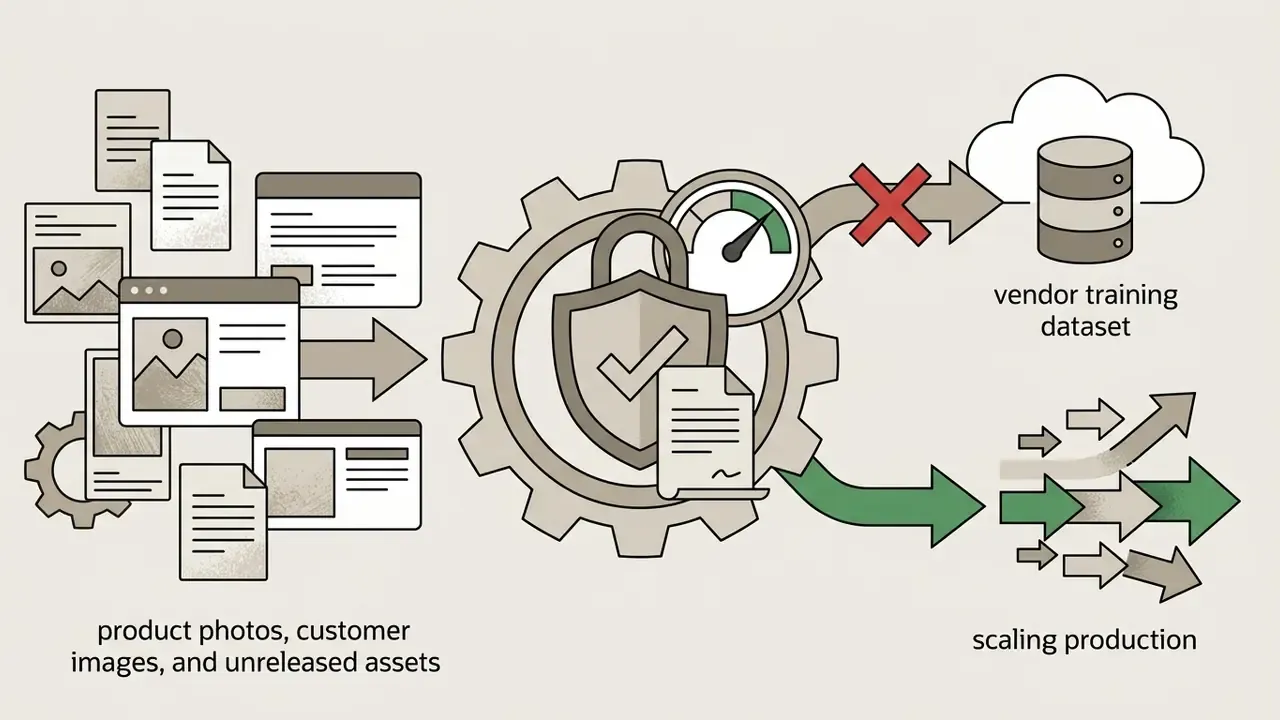
- What buyers should demand from a vendor: documented commercial-use rights, contractual exclusion of your uploads from public training datasets, SOC 2 attestation, SSO/RBAC, and exportable prompt/version/seed logs for audit reproducibility.
- The non-negotiable workflow rule: generate fast, but publish only after a human has verified claims, contrast, disclosure labels, and platform dimensions.
Article map: definitions and model selection, business case, step-by-step workflow, compliance gate, formats, prompt engineering playbook, free vs. paid economics, legal and commercial use, FAQ, appendices.
What Is an AI Instagram Post Generator?
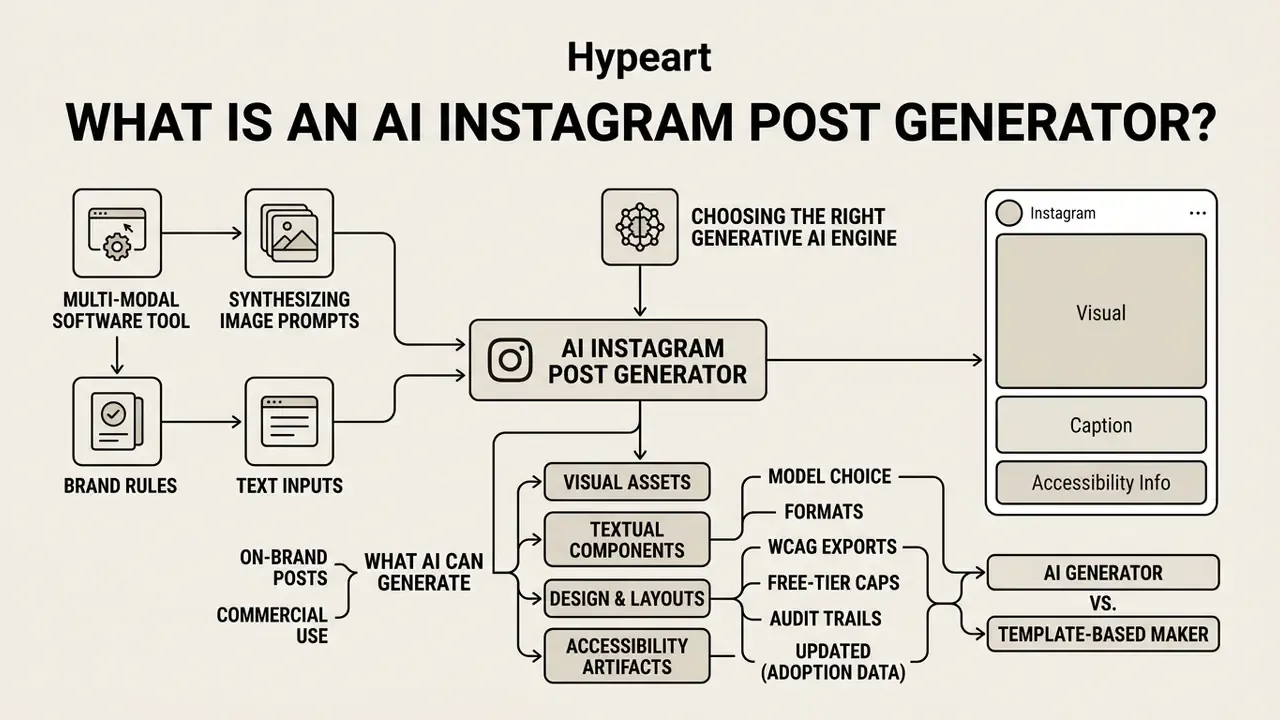
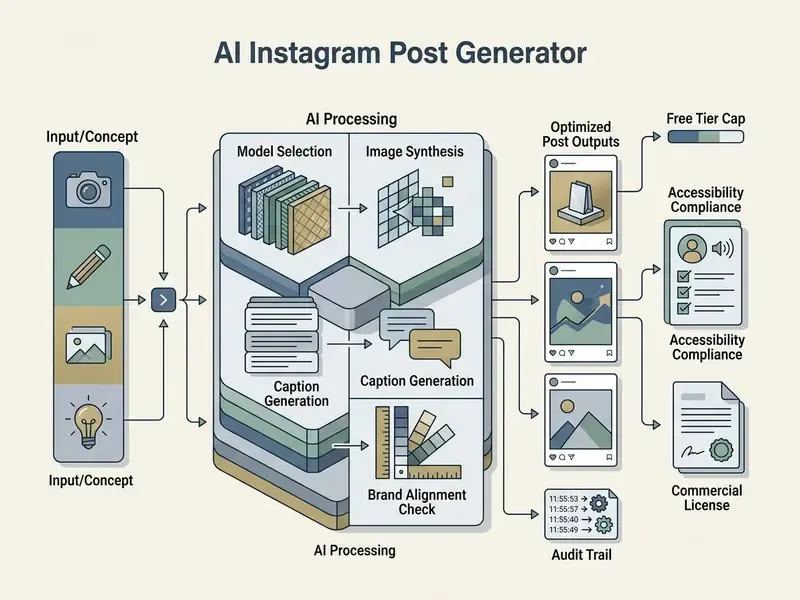
An AI Instagram post generator is a multi-modal software tool designed to synthesize image prompts, brand rules, and text inputs into complete Instagram content units. By integrating specialized visual tools such as an ai instagram post generator, teams can construct complete posts containing graphics, captions, and layout formatting within a single interface.
Rather than operating as a standalone text or image utility, an ai content generator for instagram bridges media creation and social distribution. An ai instagram content creator streamlines asset production by applying automated visual design and copywriting models to one creative direction. In practice, the tool class covers three integrated jobs: turning a brief into a visual concept, turning that concept into platform-sized files, and turning the same brief into caption and hashtag variants that match each placement.
One small clarification, because the naming is genuinely messy. An ai instagram content generator, an ai instagram post creator, an ai ig post generator, and an ai generator instagram post are marketing labels for broadly the same pipeline. What separates them is not the model, but the controls wrapped around it.
Choosing the Right Generative AI Engine for Instagram Content
Not all generators behave the same way. Photorealistic product photography, typographic promo banners, and multi-slide infographics each reward a different underlying model. Selecting the engine before writing the prompt removes most iteration waste, which in a busy content calendar is the difference between two review cycles and six.
| AI Model / Engine | Strengths for Instagram Assets | Best Format Use Case | Text Overlay Quality |
|---|---|---|---|
| FLUX.1 / FLUX Kontext | Hyper-realistic textures, precise hand and attribute rendering, context-aware editing | Photorealistic product shots, lifestyle portraits | High (renders clear typography) |
| Imagen 3 / 4 | Sharp visual fidelity, vibrant lighting, clean vector-style output | Promotional banners, graphic overlays | Moderate |
| Stable Diffusion XL / SD3 | Deep customization via ControlNet, inpainting, and outpainting (composition locking) | Exact layout matching, brand visual alignment | Moderate (requires post-editing) |
| GPT-4o Image / GPT-Image / DALL·E 3 | High prompt adherence, rapid conceptual ideation, literal quoted text | Illustrative carousels, quick infographics | Excellent |
| Gemini 2.5 / 3.0 (multimodal) | Reference-image conditioning, iterative conversational edits | Brand-kit-constrained variants, batch restyling | Moderate to high |
Teams that want a side-by-side technical view of output quality, licensing, and controls can compare leading AI image generators before standardizing a stack. For stylistic experimentation beyond commercial product shots, review how AI art generators handle aesthetic direction, how a stylised pixar ai generator treats character rendering, and how a Canva AI generator workflow differs from a pure diffusion pipeline.
What AI Can Generate for an Instagram Post
Modern generative platforms produce full-spectrum post elements: photo-style images, background graphic elements, promotional overlays, descriptive captions, and targeted hashtag groups.
- Visual Assets High-resolution pictures, synthetic photo backgrounds, product mockups, and stylized illustration vectors.
- Textual Components Conversational captions, structured bullet points, headlines, calls-to-action (CTAs), and relevant hashtag groups.
- Design & Layouts Formatted multi-slide carousels, text-on-image graphics, and brand-aligned visual frames.
- Accessibility Artifacts Alt-text descriptions, image captions, and UI labels, which the European Commission explicitly treats as AI-generated content types subject to transparency rules.
«Less than a year after public release, 18% of SMEs were already using generative AI, the single most-adopted AI application among respondents.»
Under European Union AI governance guidelines, generated media types including images, captions, alt-text, and UI labels are formally classified as synthetic content requiring explicit metadata provenance [European Commission, Code of Practice on marking and labelling AI-generated content, 2026].
AI Generator vs. Template-Based Instagram Post Maker
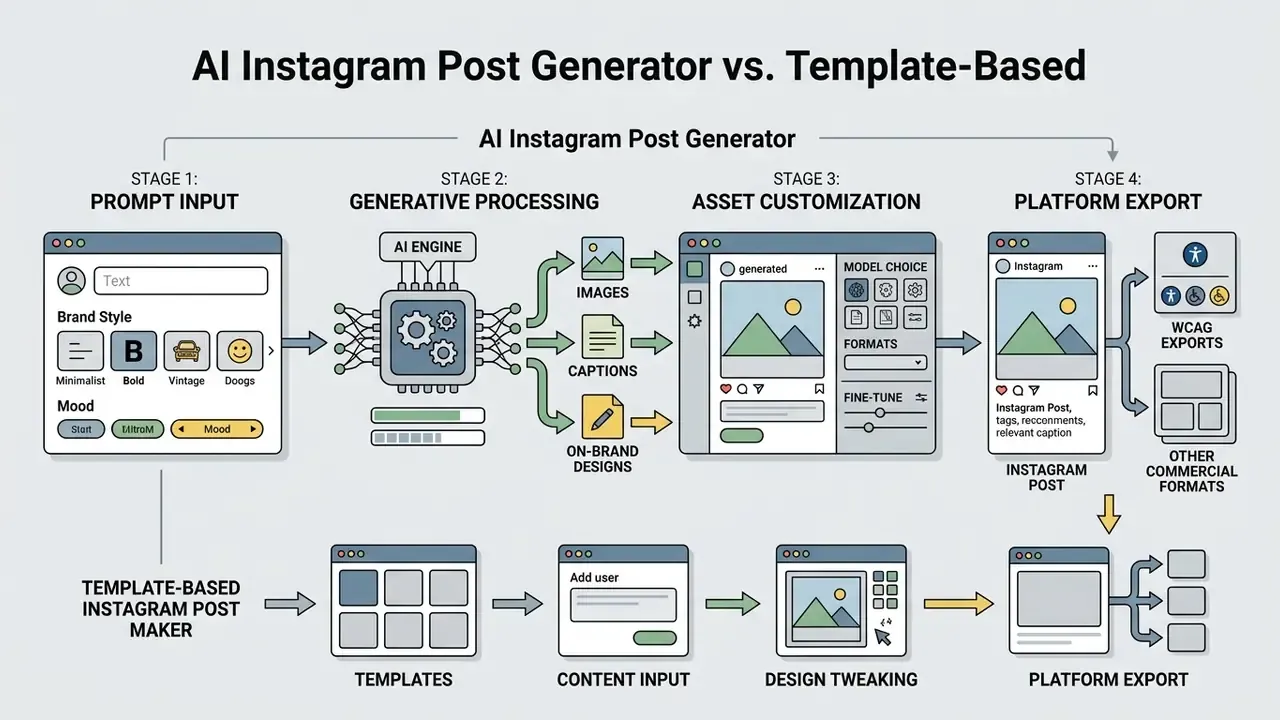
Traditional template-based post makers rely on fixed layouts with static drop-zones, whereas an AI instagram post generator composes unique visuals and custom text directly from natural language prompts.
| Feature / Dimension | Template-Based Post Maker | AI Instagram Post Generator |
|---|---|---|
| Asset Generation | Requires pre-existing stock photos or uploaded media | Generates original visual assets dynamically from prompts |
| Customization Flexibility | Restricted to fixed layout layers and static grids | Reconfigures elements, layouts, and styles on demand |
| Drafting Speed | Fast for pre-approved repetitive layouts | Fast for generating new creative concepts from scratch |
| Brand Consistency | Maintained manually by enforcing strict asset lockouts | Maintained programmatically via embedded style rules |
| Reproducibility (audit view) | Deterministic: the same template yields the same frame | Probabilistic: requires storing model version, prompt, and seed to reproduce |
| Governance Fit | Native approval trail through fixed assets | Needs explicit prompt logging and human sign-off |
While traditional post editors offer predictable layout boundaries, AI generators provide higher creative variation and faster first-draft turnaround [NIM Report, 2024]. Mature teams therefore run hybrid pipelines: AI for first-draft concepts and variant volume, locked templates for recurring formats that already cleared legal review. If your bottleneck is retouching rather than ideation, evaluate AI photo editors, the browser-based pixlr photo editor, and conventional online photo editors alongside generators.
Why Use AI to Create Instagram Posts?
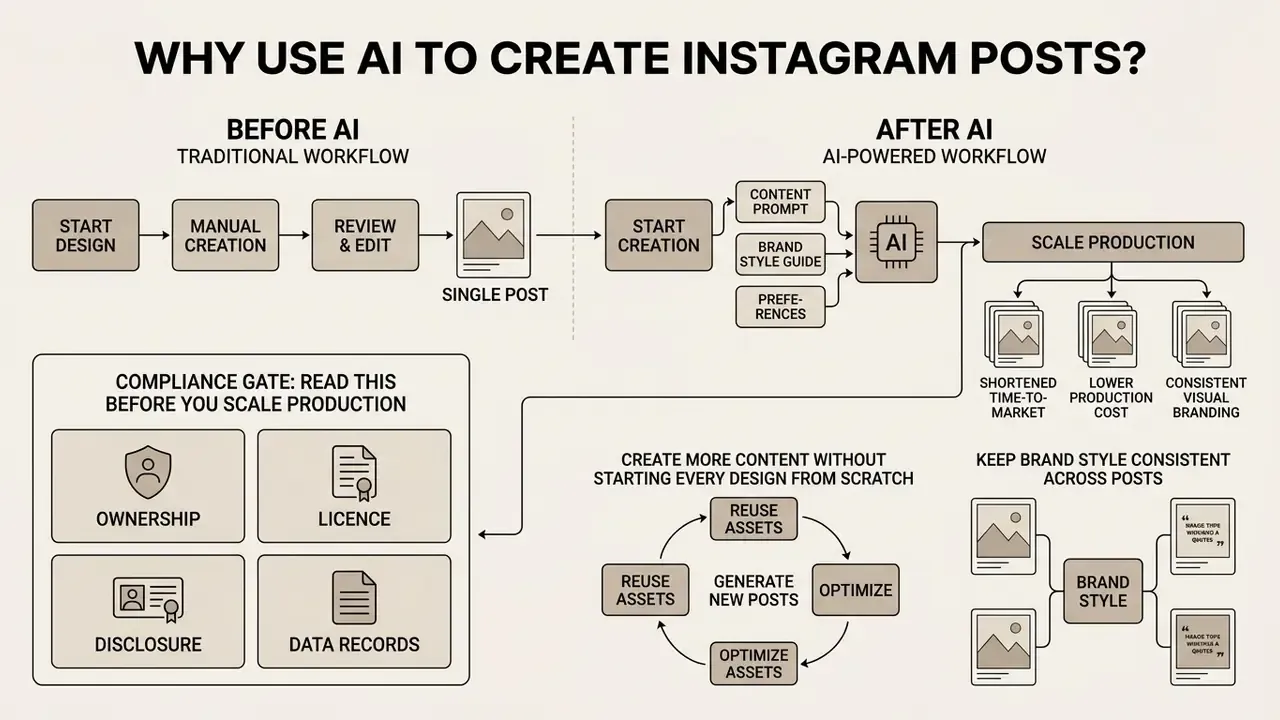
Using AI to ai create instagram post assets shortens time-to-market, lowers per-unit graphic production cost, and supports consistent visual branding across high-frequency posting schedules.
Enterprise research shows that adopting AI tools in marketing workflows lowers departmental overhead costs by 10.8% while increasing overall sales productivity by 8.6% [The CMO Survey, 2025]. Automated generation lets teams create instagram posts faster without exhausting design capacity. Anyone modelling creative scaling should check the AI Media Pricing Guides to understand infrastructure and credit limits before promising volume to stakeholders.
«By the 34th edition of the survey, marketing AI usage had roughly doubled to 17.2% of activities, with a three-year projection of 44.2%.»
Engagement outcomes, however, are not uniformly positive, and honest planning should account for that. A 2025 study published in Oeconomica Jadertina (University of Zadar) compared AI-generated and human-made Instagram posts and found AI posts achieved a 5.96% engagement rate versus 6.73% for human posts, while simultaneously reaching more non-followers and generating more profile visits. A reach-versus-depth trade-off, then, rather than a straight win.
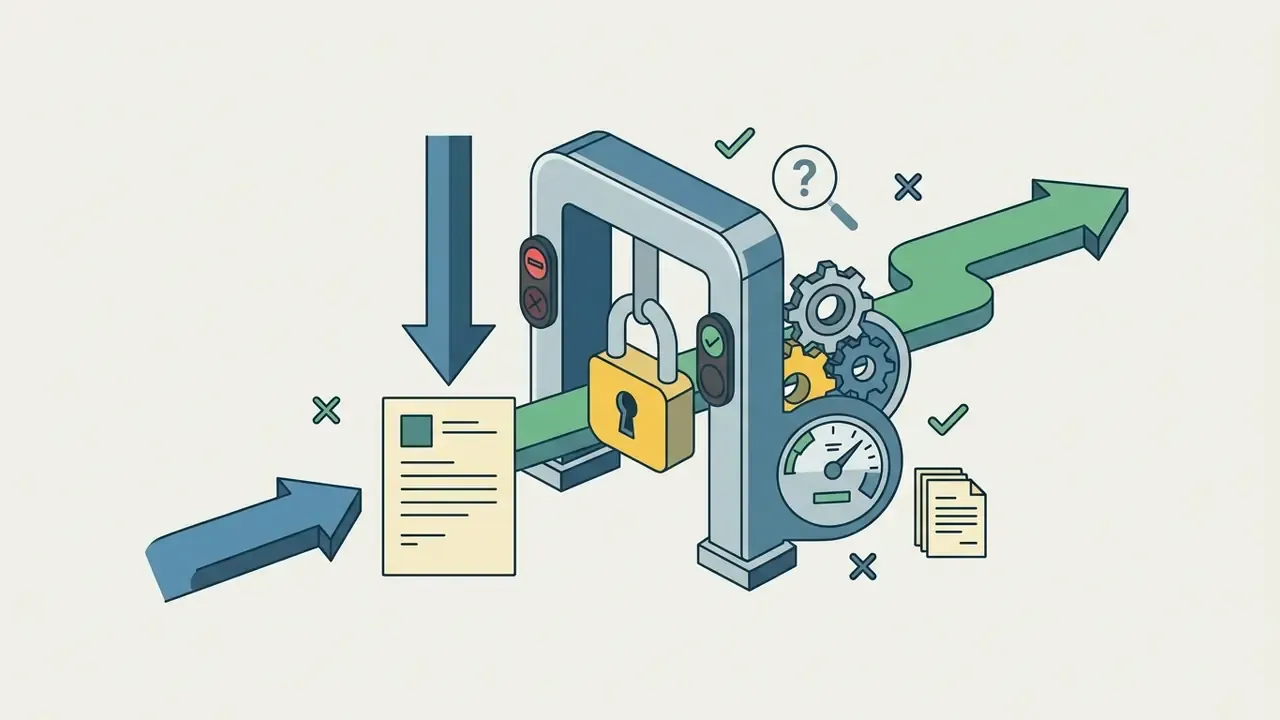
Compliance Gate: Read This Before You Scale Production
Because legal status is a veto criterion for institutional publishers, resolve five questions before the first campaign, then read the full legal analysis further down this page.
If any answer is "unclear," treat the tool as pilot-only and keep it outside regulated advertising workflows until documented. That is the whole rule. No evidence, no autonomy.


Create More Content Without Starting Every Design From Scratch
An AI system lets creators turn a single campaign brief into dozens of visual and textual variants tuned for different audience segments.
Instead of starting from a blank canvas, marketers enter one topic description and receive multiple complete post layouts. Production studies indicate that content automation cuts weekly drafting time from 10.24 hours to 2.73 hours.
«Weekly production time was 2.73 hours with AI tools versus 10.24 hours without them, and 51% of companies spent $0 producing the specific content piece.»
«Personalized generative-AI video advertisements increased engagement by 6 to 9 percentage points compared with baseline formats.» SSRN working paper, field experiment with a direct-to-consumer brand (2024). https://ssrn.com/
The shift lets teams spend attention on strategic positioning and review protocols rather than manual layout nudging. Practically, one brief becomes a matrix: three visual directions by two caption angles by three placements, from which humans select and refine rather than invent. Teams extending the same brief into motion often pair the still pipeline with a pika labs ai video workflow for Reels cutdowns.
Keep Brand Style Consistent Across Posts
AI generators protect visual brand integrity by locking core parameters, including colour palettes, typography specs, and logo placement rules, into the generative prompt itself.
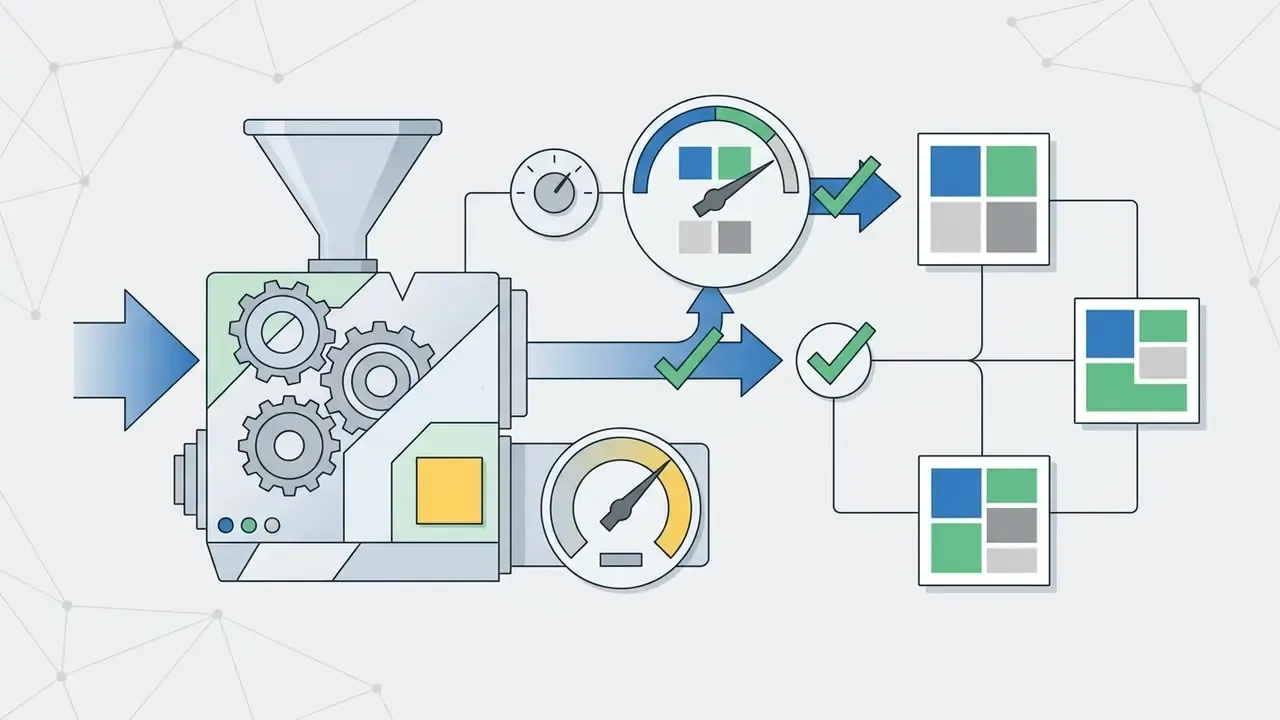
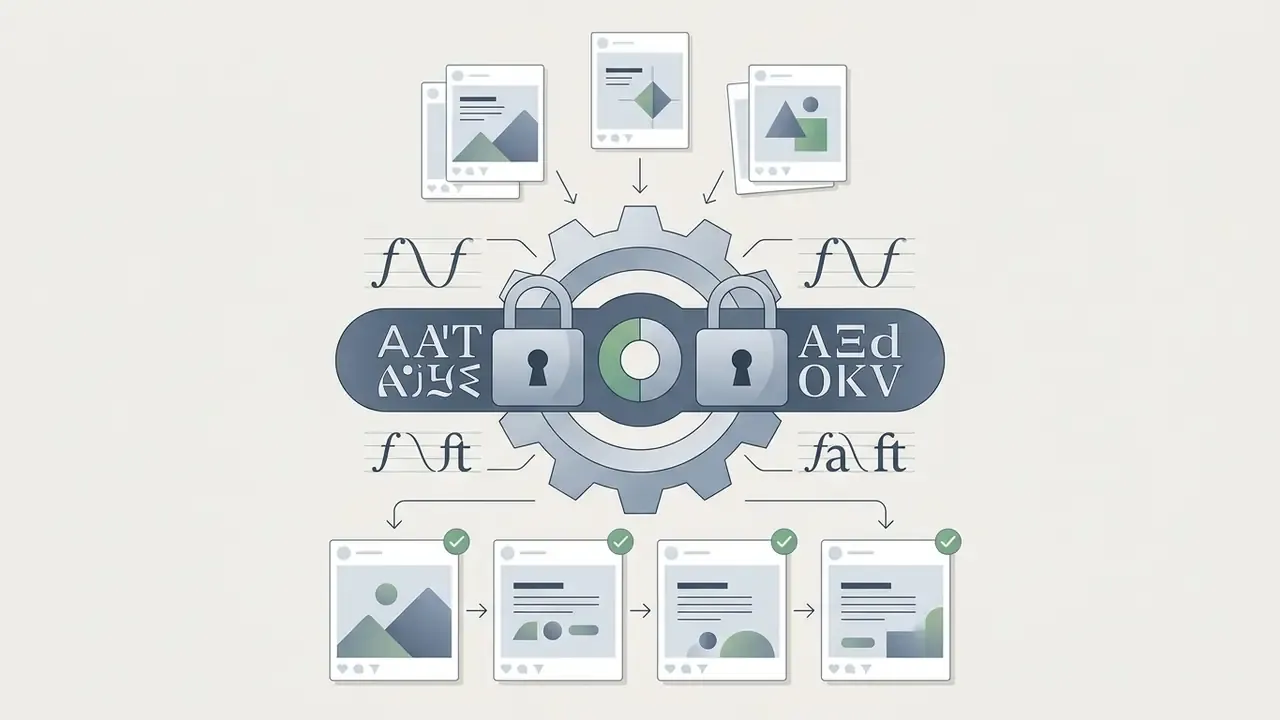
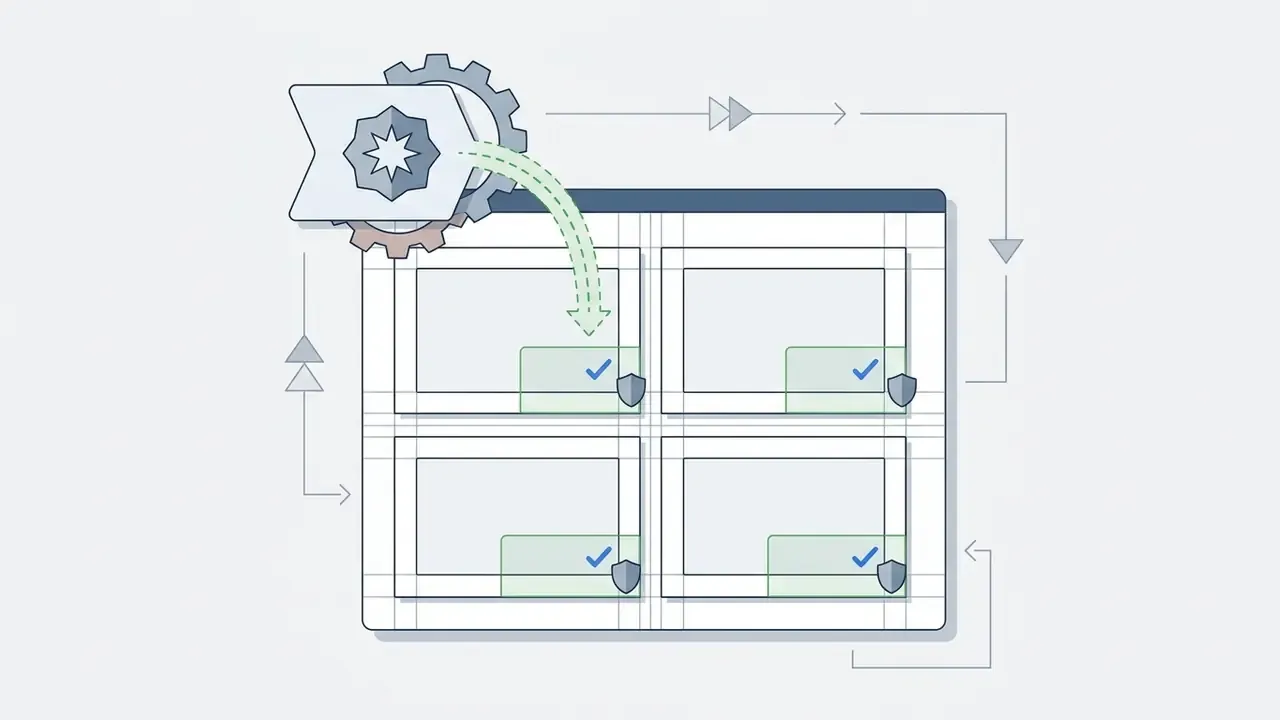
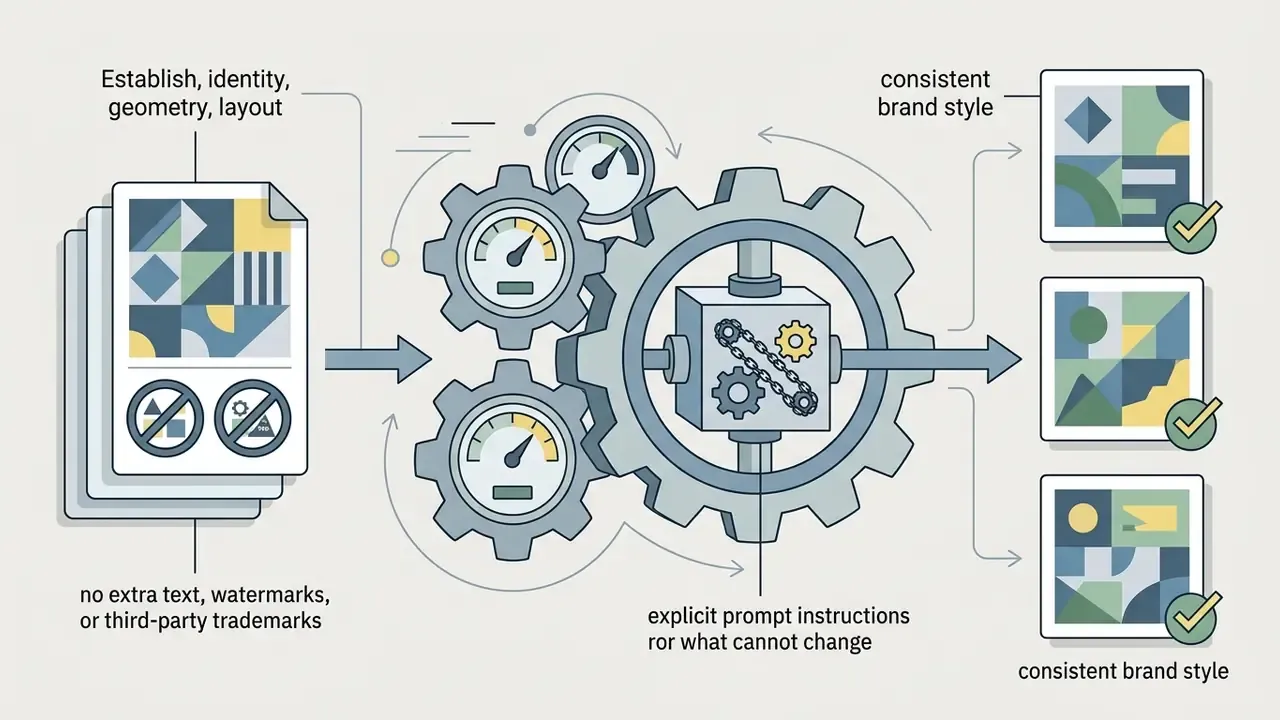
Centralized asset management tools such as Adobe GenStudio let teams upload up to five brand guideline files (500 MB total) to enforce brand compliance across generated marketing assets [Adobe, 2026]. Formal brand systems increasingly extend their rules to the tooling itself: DZNE's published AI brand guidelines state that they apply to generative AI systems, creative tools, and automated workflows, tying model output to a single documented standard. For downstream retouching that must respect those same rules, standardize on approved AI photo editors rather than ad hoc consumer apps.
A caution worth stating plainly. Style locks constrain appearance, not accuracy. A perfectly on-brand post can still carry an invented interest rate.
Turn Product Updates and Promotions Into Visual Posts
Generative tools reformat text-heavy collateral, such as release notes, press announcements, or product catalogues, into visual posts for social feeds.
When a product update ships, an AI tool extracts key features from raw release documentation, generates promotional product imagery, and drafts marketing copy. Institutional guidance requires human verification for all AI-assisted promotional assets to prevent product misrepresentation: Stanford University's 2026 marketing and communications AI guidance permits AI assistance but requires human review and prohibits distorting the context or integrity of images, and Iowa State University's 2026 guidance states that marketing materials cannot be created solely by generative AI. The International Chamber of Commerce's 2026 responsible-AI marketing guide adds disclosure, IP checks, and formal approval processes.
«AI-created content is perceived as requiring less brand effort, yet it signals higher innovation capability of the company.»
Human-in-the-loop oversight keeps rapid generation accurate and compliant. It is also the exact point where hallucinated specifications, invented discounts, or non-existent product features get caught before they reach an audience.
How to Create an Instagram Post With AI
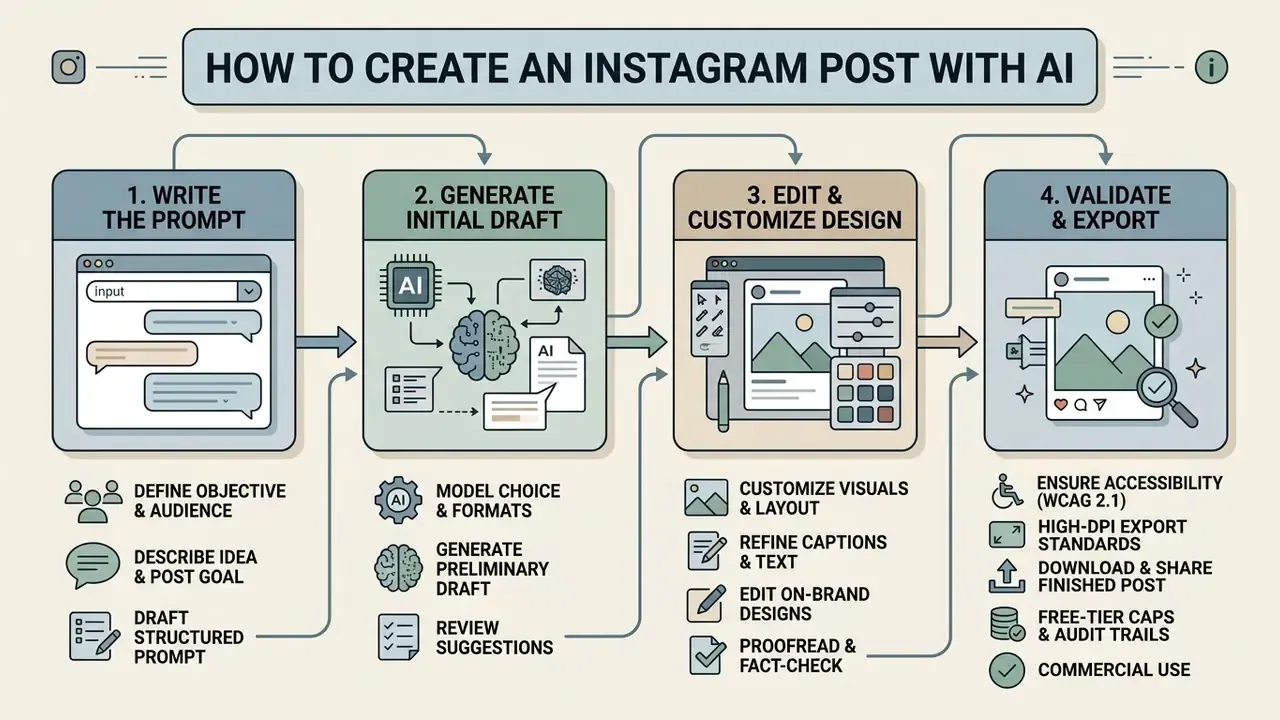
Creating an Instagram post with an ai generator for instagram post follows a structured sequence: write the prompt, generate the preliminary draft, edit the design, then validate the asset for publication.
An ai post maker for instagram standardizes creative production through a repeatable, multi-step pipeline. Following the same operational order keeps quality steady across campaigns, and it makes review predictable for the person signing off.
Describe Your Idea, Audience, and Post Goal in a Prompt
Effective generation begins with a clear prompt specifying the post's core message, target audience, brand context, and intended visual aesthetic.
A complete prompt gives context, not generic keywords. Naming the target demographic, business objective, visual framing, and communication tone lets the model produce a usable output on the first pass.
«Clear, detailed prompts that name the intended audience, aim, and structure allow the model to produce accurate results on the first iteration.»
A useful checklist here is the COSTAR frame: Context, Objective, Style, Tone, Audience, Response format. Naming the response format ("4:5 vertical feed image, headline under 6 words, caption under 120 characters") removes most of the guesswork that produces unusable drafts.
Generate, Edit, and Customize the Design
Once the AI returns initial design concepts, creators customize the assets by adjusting text alignment, swapping visual layers, or modifying background parameters.
Generative design interfaces let users insert or remove specific visual elements through text-driven commands. Designers refine generated imagery, update background elements, align text blocks, and place corporate logos without leaving the editor [Adobe Express, 2026]. Typical documented operations include prompt-based object insert and replace with keep-or-discard confirmation, background replacement, typography formatting, and logo variant generation followed by colour and font overrides. When a generated frame needs more canvas for a different placement, AI outpainting tools for expanding images extend the background without redrawing the subject.
Instagram Post Formats AI Can Create
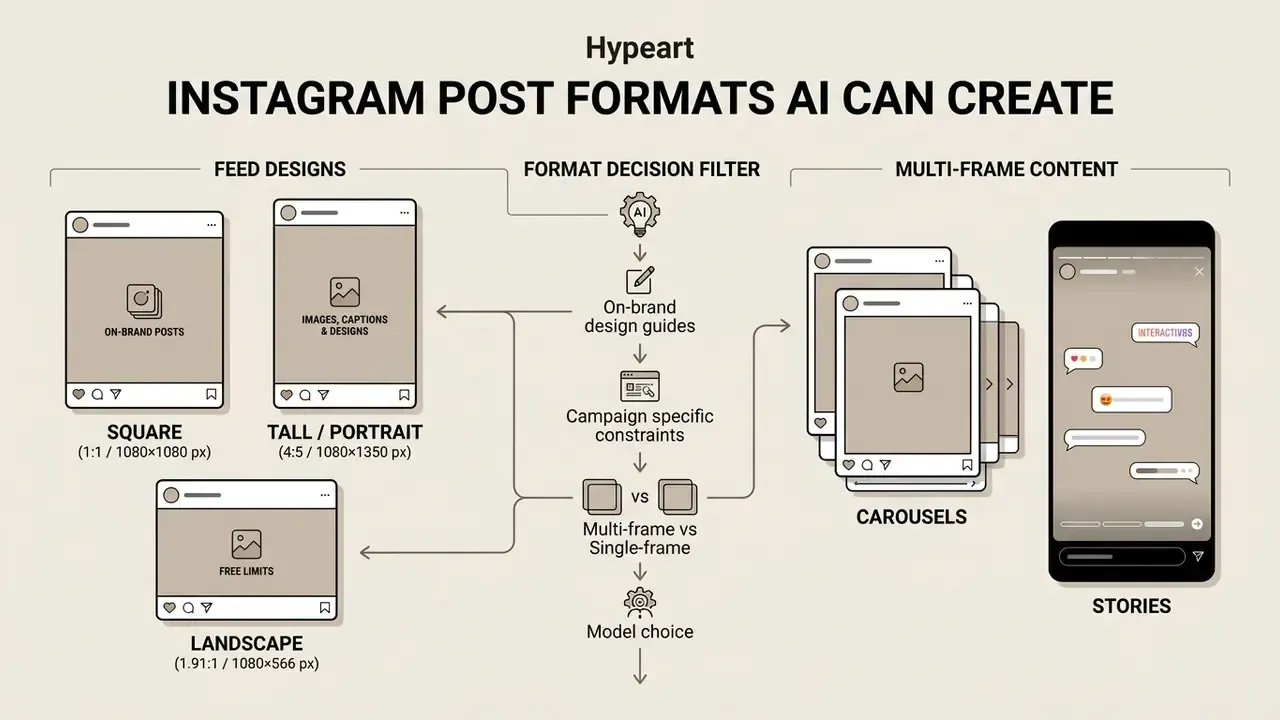
Modern generative social engines support every standard Instagram display format: square feed images, vertical tall posts, landscape banners, carousels, and Stories.
Each feed format serves a distinct viewing pattern. The right layout depends on whether content is meant for quick grid browsing, deep swipe-through engagement, or full-screen immersive viewing. Stylistic range matters as much as dimensions, so review how different AI art generators treat composition and colour before locking a format standard.
Square, Tall, and Landscape Feed Designs
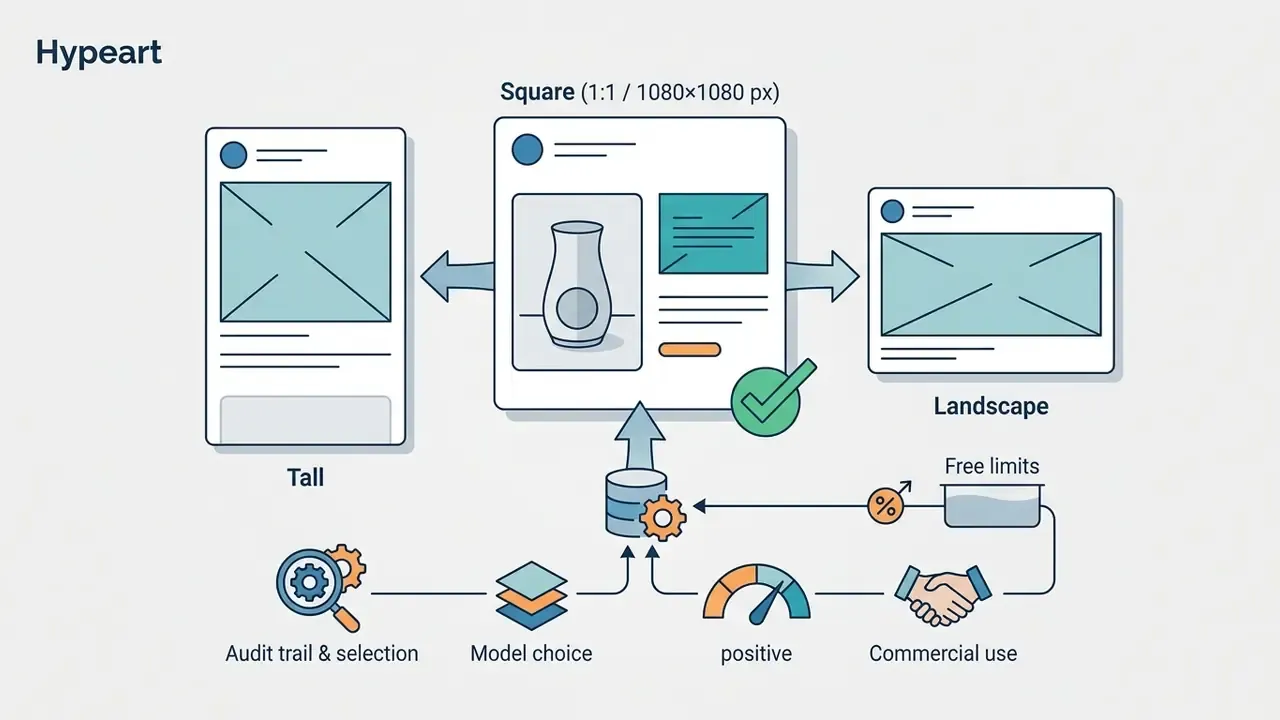
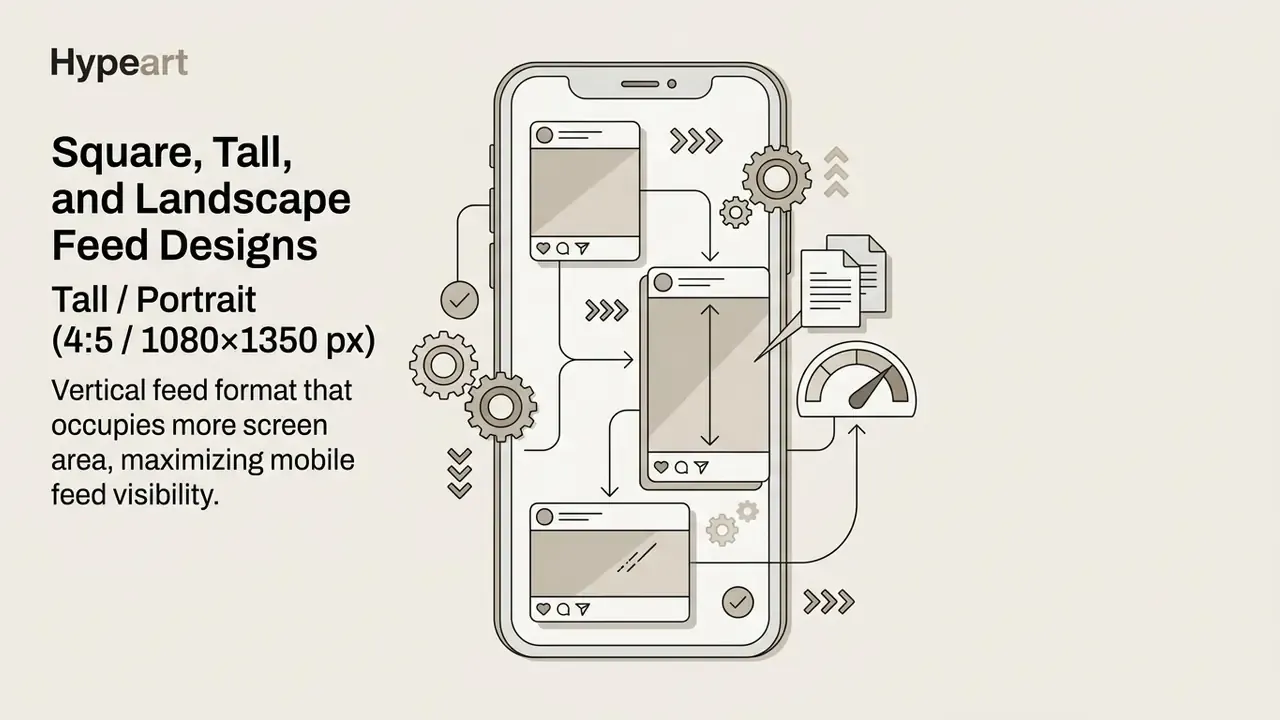
Static feed posts require precise aspect ratio matching to hold display quality across desktop and mobile screens.

Carousels and Stories for Multi-Frame Content
Multi-frame formats such as carousels and Stories enable step-by-step storytelling, educational breakdowns, and multi-product showcases.
Carousels let users swipe through 2 to 10 sequential items, with the caption attached to the parent container rather than individual slides. Current production guidance converges on a familiar pattern: 8 to 10 slides, slide 1 as hook, slides 2 to 8 as value, final slide as CTA. Vertical Stories (9:16 / 1080×1920 px) deliver full-screen immersive experiences built for mobile; Stories stay accessible for 24 hours and surface at the top of followers' feeds [Stellar, 2025]. Stories accept a single image or video per card and do not take captions through the publishing API. For motion-first Stories and Reels, a pika labs ai generation step can extend a static hero frame into a short vertical clip.
«For virtual influencers, narrative and environment matter more than appearance: they enable more sophisticated and sustainable digital marketing strategies.»
Format decision filter (run top to bottom):
- If the goal is maximum feed reach → select Tall 4:5 (1080×1350).
- If the goal is educational or multi-product explanation → select Carousel (1080×1080 or 1080×1350, 2 to 10 slides).
- If the goal is an immediate, time-sensitive promotion → select Story 9:16 (1080×1920) and keep critical elements inside the central safe zone.
- If the asset is a panoramic photo or press image → select Landscape 1.91:1 and accept reduced mobile screen share.
- If the asset must be reused across a profile grid → select Square 1:1 for predictable cropping.
| Format Name | Aspect Ratio | Resolution (px) | Primary Strategic Use Case |
|---|---|---|---|
| Square | 1:1 | 1080 × 1080 | Standard feed posts, product shots, grid layouts |
| Tall / Portrait | 4:5 | 1080 × 1350 | High-impact mobile feed posts, vertical product graphics |
| Landscape | 1.91:1 | 1080 × 566 | Wide banner shots, horizontal photos, event announcements |
| Carousel Slide | 1:1 or 4:5 | 1080 × 1080 / 1350 | Multi-page educational guides, sequential product features |
| Instagram Story | 9:16 | 1080 × 1920 | Full-screen vertical posts, temporary promotions, interactive polls |
A note on sourcing reference material for these formats: pulling competitor clips through a pinterest video downloader or similar utility may be technically simple, yet the rights position is often unclear. Use such material for internal mood boards only, never as an input to a published commercial asset.
How to Write Prompts for Better AI-Generated Instagram Posts
Writing high-quality prompts for an ai image generator for instagram post graphics requires logical description order, explicit visual style constraints, and iterative refinement.
Advanced prompt engineering leans on systematic input structure. A standardized prompt formula produces consistent visual assets across campaigns [OpenAI Prompting Framework, 2026].
Include Product, Style, and Brand Details
To generate accurate images, structure prompts in a clear order: background scene, primary subject, key attributes, visual style, explicit exclusions.
Effective prompts use concrete description rather than vague qualitative adjectives. Instead of requesting a "nice product photo," describe the materials, studio lighting setup, backdrop texture, and target colour scheme [Google Vertex AI Image Prompt Guide, 2026]. OpenAI's image-prompting guidance recommends naming the intended use first, then ordering the prompt as background and scene, subject, key details, constraints, while stating preservation rules explicitly (identity, geometry, layout) alongside prohibitions on extra text, watermarks, or third-party logos.
«Describing a visual as "created by AI" raised willingness to pay through savoring, the pleasure of contemplating the product, while "generated by AI" produced no such effect.»
Ask for a Clear Message and Caption Direction
«Text-to-image models exhibit a "brilliance bias": prompts associated with exceptional intelligence disproportionately render men.»
Refine Generated Results Instead of Using the First Version
High-quality post production depends on iterative refinement: generate an initial concept, review output quality, issue corrective prompts. First drafts are raw material.
Iterative generation follows a continuous feedback loop of generate, evaluate, adjust, re-generate. Updated (source correction): the canonical description of this loop is the Self-Refine framework (Madaan et al.), which defines three repeating steps, initial generation, self-feedback on that output, then revision, explicitly treating the first draft as a starting point rather than a deliverable. A 2024 ACL paper on iterative refinement applies the same generate-and-verify cycle to code, repeating until no error is identified. Both describe repeated refinement; neither publishes a universal quality-gain percentage for social imagery, so teams should measure their own accept-rate improvement across iterations.
Expert Prompt Engineering Playbook (E-E-A-T Case Library):
Free AI Instagram Post Generator: Limits, Watermarks, and Pricing
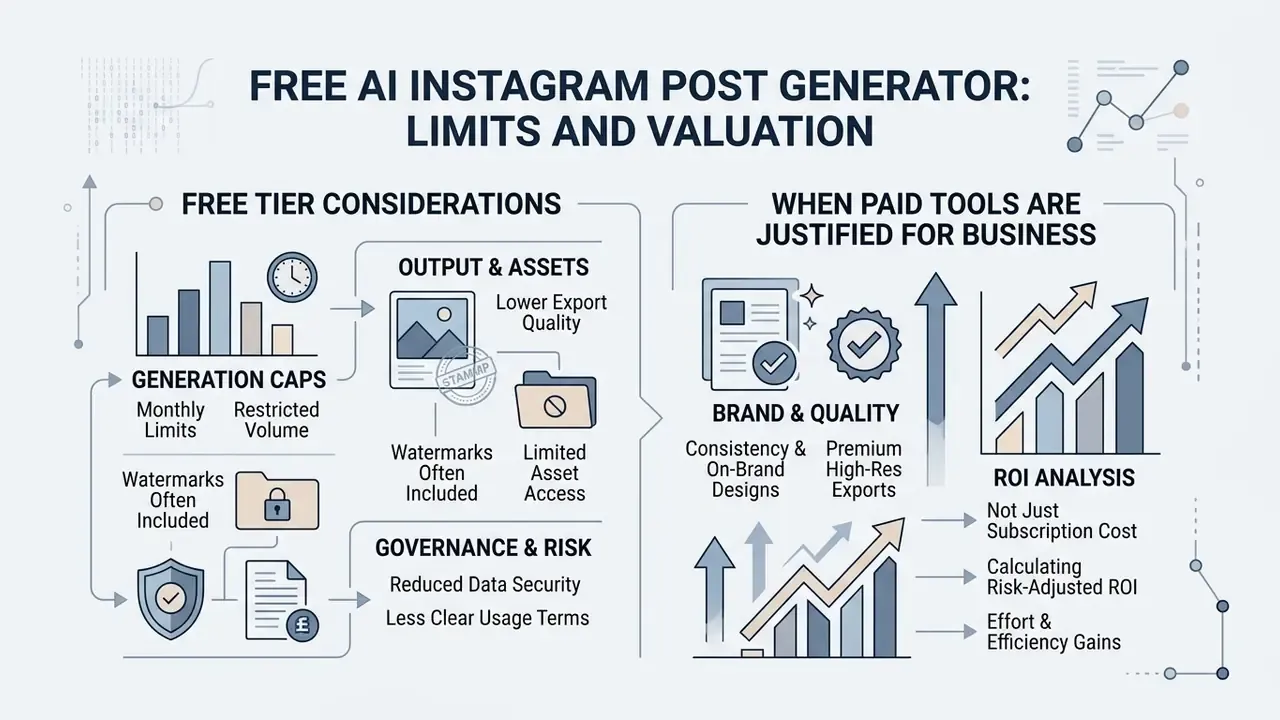
Many providers market an ai instagram post generator free tier or an ai instagram post maker free trial. In practice, free plans enforce strict generation limits, add watermarks, and withhold advanced editing capability.
Businesses evaluating a free ai instagram generator should read the service terms first, specifically the usage caps and licence scope. For broader tool evaluations, explore the hub to analyse software features across leading creative platforms, and compare free AI image generators as well as free AI art generators on quality, caps, and licensing before committing a brand account to any of them.
What to Check Before Choosing a Free AI Post Generator
Before wiring a post generator free tier into marketing operations, evaluate generation caps, watermark policy, resolution limits, and commercial usage rights.
- Generation Caps Free tiers are commonly capped at 5 posts per day (Buffer's free social post creator, where retries, expansions, shortenings, and tone changes all count against the limit), 25 AI credits per month (Adobe Express), 15 AI-generated posts per month (Predis.ai), 5,000 AI words plus 3 social accounts (Simplified), or 30 AI generations per month on one brand (Publer).
- Watermarks Free exports may carry provider branding or logo watermarks unless upgraded to a paid subscription. In some ecosystems the watermark appears only when the design uses premium elements, and clears on licence purchase or subscription.
- Export Quality Free tiers typically restrict image exports to standard web resolutions (720p or 1080p), reserving 4K output for paid tiers.
- Asset Access Free plans often limit custom brand kits, team collaboration, and automated resizing.
- Enterprise Security Terms Free tiers rarely offer SSO, role-based access control, data-residency choice, or contractual exclusion of your uploads from model training. Those are exactly the controls a security review will demand.
When Paid Tools May Be Worth It for Business Content
A paid subscription usually becomes necessary once a commercial social account needs high-resolution exports, custom brand kits, batch creation, and verified commercial usage rights.
Enterprise subscriptions unlock centralized Brand Kits that enforce visual consistency across team accounts [Adobe Express Pricing, 2026]. Paid plans also enable batch generation, up to 20 post variants per request, and export resolutions up to 4K (4096×4096 px), which supports multi-channel distribution beyond social. Where a paid tier caps resolution below print or out-of-home requirements, evaluate dedicated AI image upscalers as a separate pipeline step.
«57% of surveyed SMEs see more opportunities than risks in generative AI, citing the low skill and cost barrier to entry as a decisive factor.»
| Evaluation Feature | Free Tier AI Generator | Paid / Pro Business Plan |
|---|---|---|
| Monthly Generation Limit | 5 to 25 credits per month (or about 5 posts/day) | Unlimited or high volume (1,000+ credits/mo) |
| Watermark Removal | Provider branding often included | Watermark-free clean exports |
| Export Resolution | Standard web resolution (1080×1080 px max) | High-definition and 4K exports (up to 4096×4096 px) |
| Brand Asset Controls | Manual asset uploads per generation | Centralized Brand Kits (logos, fonts, palettes) |
| Commercial Rights | Restricted or non-commercial licensing | Verified commercial licensing rights included |
| Batch Generation | Single-asset generation only | Multi-asset batch processing (up to 20 per request) |
| Security Attestations | Typically none published | SOC 2 Type II / ISO 27001 attestation available |
| Access Control | Single shared login | SSO, SAML, role-based access control (RBAC) |
| Training-Data Exclusion | Uploads may be retained or reused | Contractual exclusion of customer assets from model training |
| Audit Log / Prompt History | Not retained or not exportable | Exportable prompt, model-version, and approval history |
| Accessibility Tooling | Manual contrast checks | Built-in WCAG 2.1 AA checker and alt-text generation |
Calculating Risk-Adjusted ROI (Not Just Subscription Cost)
Subscription price is the smallest line in the budget. A defensible total cost of ownership model for regulated or brand-sensitive publishers includes:
- Licence costseats plus credit overages at expected monthly volume.
- Human-in-the-loop reviewminutes per asset for fact-checking, contrast checks, and disclosure labelling, multiplied by publishing cadence and loaded hourly cost.
- Legal and compliance reviewpre-approval of claim templates, plus periodic sampling of published assets.
- Records retentionstorage and retrieval of prompts, seeds, model versions, and approvals for the retention period your regulator requires.
- Rework riskexpected share of assets rejected at review, which is the single biggest driver of effective cost per usable post.
- Residual riskpotential cost of a mislabelled, misleading, or non-owned asset reaching production.
Divide the fully loaded cost by usable, approved posts rather than generated images. That one change usually reverses the naive conclusion that a free tier is cheaper. Teams that want to model the arithmetic against their own cadence can open the hub and run the credit and review-time inputs before committing to a plan.
Can You Use AI-Generated Instagram Posts for Commercial Content?
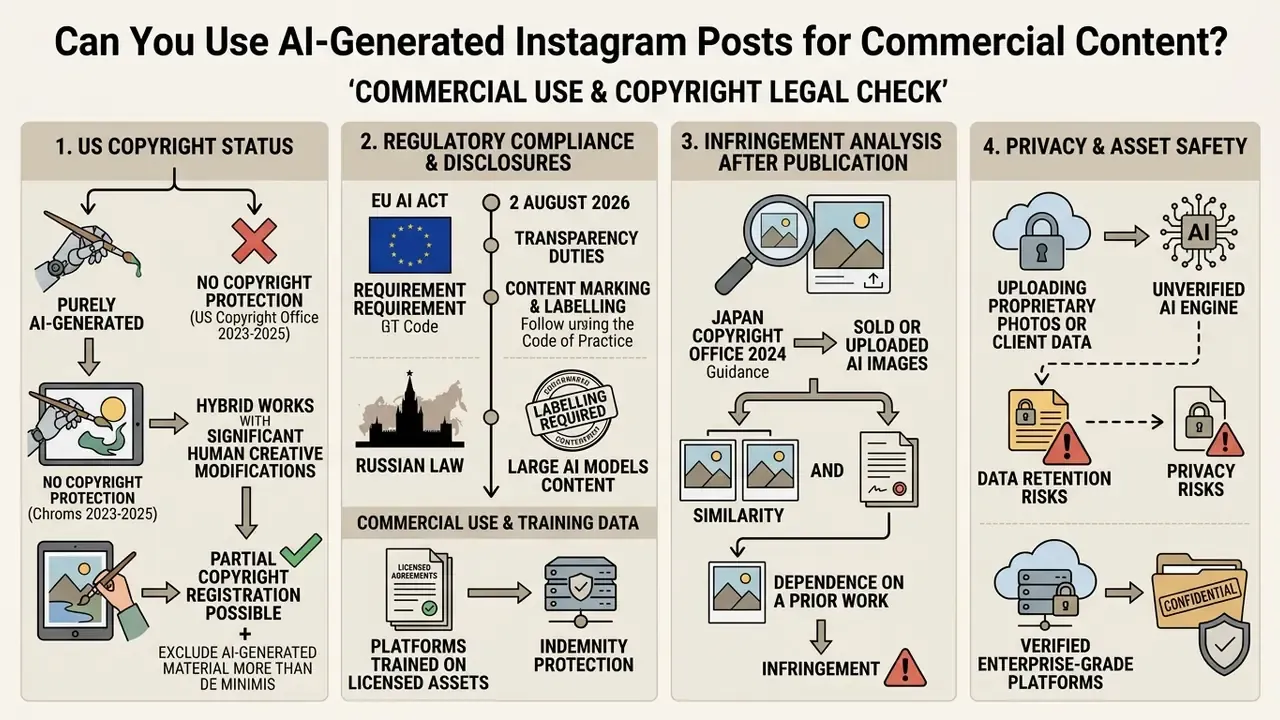
Deciding whether ai generated instagram post images can carry commercial marketing requires verifying provider licensing terms, establishing human editorial oversight, and understanding the relevant copyright frameworks.
«Using copyrighted material to train commercial AI models requires permission from rights holders unless fair use applies.»
Regulated Industries: Advertising Rules, Audit Trail, and Model Governance
FAQ About AI Instagram Post Generators
Can an AI Generator Create Realistic Instagram Photos?
Yes. Modern diffusion models produce imagery realistic enough for Instagram feeds, though careful prompt engineering is still required to avoid synthetic artifacts. Updated (source correction): recent academic benchmarks show that a majority of synthetic images still carry subtle lighting or geometric inconsistencies under scrutiny. A 2025 CHI study found that although diffusion models generate highly realistic images, most still contain visible artifacts, with only about 17% of generated images misclassified as real under controlled conditions. A separate 2024 evaluation of DALL·E 2, DALL·E 3, GLIDE, and Stable Diffusion reported that camera-captured photographs still outperformed generated images on photorealism and text-image alignment, while other 2024 work notes that untrained viewers frequently cannot distinguish outputs from Midjourney, Stable Diffusion, or Firefly from real photographs. Realism is high, detectability is uneven, and the gap depends heavily on how closely someone is looking.
«Realistic-looking AI images are more often judged authentic, but with lower confidence; users rely on detection tools when realism is high.» AI & Society, experiment with 292 UK participants (2025). https://doi.org/10.1007/s00146-025-00000-0 Natural photorealism comes from specifying real-world lighting conditions, believable textures, camera lens specs, and slightly imperfect environments in the prompt. Before publishing a synthetic "photo" of a real place, person, or product, verify authenticity claims with AI image detectors, and never present a render as an unretouched photograph. «Labelling content as AI-generated reduces affective and behavioural engagement, especially for emotional content; earlier labelling strengthens the effect.» Seeger, Wessel & Lehrer, Electronic Markets, two experiments (n=325, n=371) (2026). https://link.springer.com/article/10.1007/s12525-026-00883-2
Do I Own the Copyright to Posts Created by an AI Post Generator?
Under US law, purely AI-generated outputs created without significant human creative modification cannot be copyrighted, and AI-generated material that is more than de minimis must be excluded from a registration claim [US Copyright Office, 2023 to 2025 guidance]. Creators do retain ownership of human-authored elements: custom text layouts, original uploaded photography, edited graphic arrangements inside the final post. Consumer perception is not neutral either. Research indicates that skepticism toward AI content converts into ambivalence more strongly for commercial advertising than for non-commercial AI art [Journal of Consumer Behaviour, 2024, https://doi.org/10.1002/cb].
Is It Safe to Upload Proprietary Brand Photos to an AI Post Generator?
Uploading proprietary or confidential images to unverified free tools carries privacy risk if the vendor retains user assets for model training [OAIC Privacy Report, 2024]. Enterprise users should ensure the software agreement explicitly states that uploaded assets remain confidential and excluded from model training datasets, then confirm deletion timelines, data residency, and sub-processor lists. Customer photographs and any personal data require a lawful basis for processing before upload. If the vendor cannot answer those questions in writing, that is your answer.
Does Instagram Penalize Content Generated by AI Tools?
Instagram does not algorithmically penalize posts simply for containing AI-generated assets, provided the content complies with community guidelines. Platform terms and international regulation do require clear transparency labels, such as "AI Info" tags, on synthetic media [European Commission, Code of Practice on marking and labelling AI-generated content, 2026; AI Act transparency duties from 2 August 2026]. Disclosure quality matters: research finds that a high level of transparency about the AI's role increases perceived authenticity of the advertising creation process and produces a more positive attitude toward the ad [Psychology & Marketing, 2026, https://doi.org/10.1002/mar]. Disclose deliberately and early, not after being asked.
Do AI-Generated Instagram Graphics Need to Meet WCAG Accessibility Standards?
For commercial and public-sector publishers, yes in practice. Text overlays should hold a minimum contrast ratio of 4.5:1 against the generated background to satisfy WCAG 2.1 Level AA (3:1 is permitted for large display text), and every published image should carry descriptive alt-text. Automated accessibility checkers audit generated graphics for Level AA compliance, flag failing colour pairs, suggest alt-text, and simulate visual impairments. Because diffusion models often produce busy, high-variance backgrounds, the safest pattern is to request a flat or blurred text zone in the prompt rather than layering copy over detailed texture.
Should I Export Instagram Posts as PNG or JPG?
Use PNG (24-bit) for any graphic containing text overlays, logos, or vector shapes. It preserves 300 DPI-equivalent clarity and sharp typographic edges without the compression artifacts and colour bleeding that JPG introduces around lettering. Use high-quality JPG (85 to 90%) only for pure photorealistic imagery with no text, where the smaller file helps you stay within Instagram's 8 MB image limit. For Stories video, export MP4 or MOV with H.264 video and AAC audio at 1080×1920 px.
What Audit Records Should a Regulated Firm Keep for AI-Generated Social Posts?
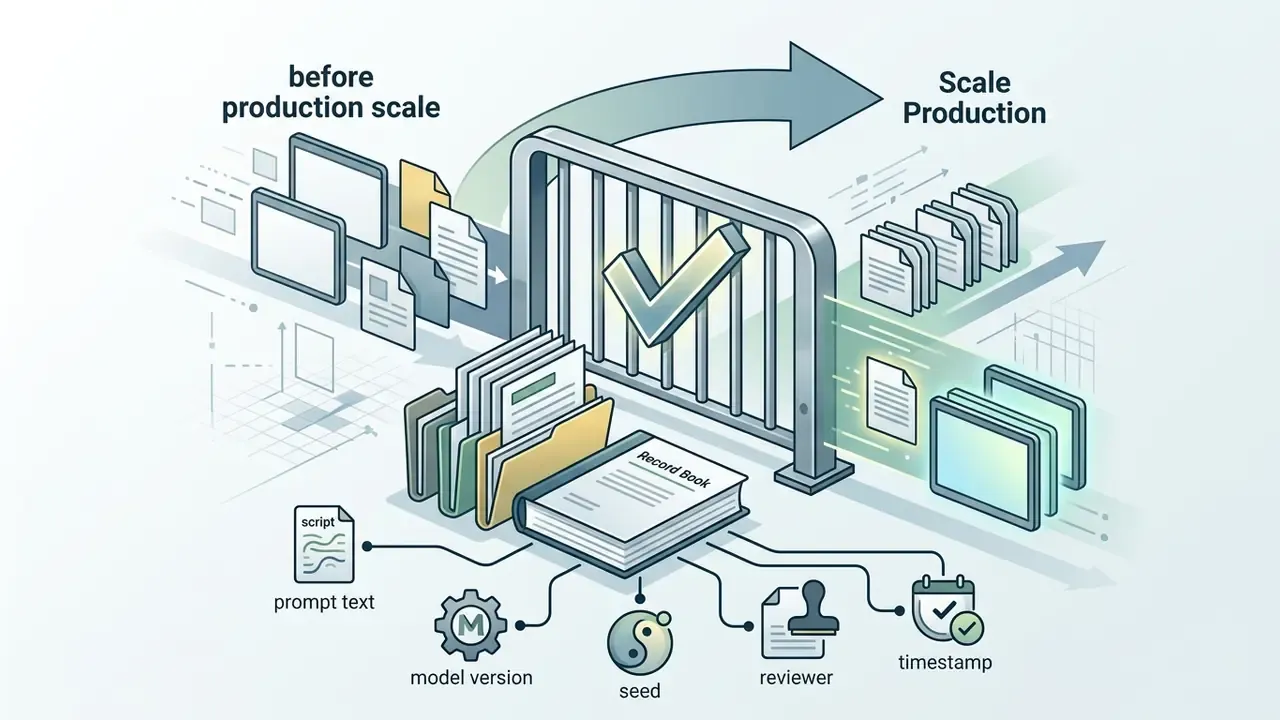
Retain the full prompt and constraints, the model name and version, the seed if available, all reference uploads with their rights basis, the human editor and approving reviewer, the disclosure label applied, and timestamps, stored for the retention period your regulator requires. Broker-dealers should map this to FINRA Rule 2210 approval and recordkeeping obligations, investment advisers to the SEC Marketing Rule, and firms with formal model governance should document the tool under model-risk expectations such as SR 11-7. The practical test is reproducibility: can you regenerate and explain the asset a year later, in front of an examiner?
How Do I Choose the Best AI Instagram Post Generator App for My Business?
Select an ai instagram post generator app on its support for custom brand kits, batch asset generation, export resolution standards, clear commercial usage licensing, accessibility checking, exportable audit logs, and clean integration with your publishing pipeline. You can explore the hub to compare dedicated software side by side, or go straight to our ranking of the best AI image generators for output-quality and licensing detail.
Can I Mix AI Generation With My Own Product Photography?
Yes, and for e-commerce this hybrid is usually the strongest option. Real product photography preserves accuracy and material truth, while AI handles backgrounds, seasonal environments, canvas extension, and variant volume. Upload proprietary high-resolution photography into the editor, keep the product pixels intact, and generate only the surrounding scene. Retouching and portrait workflows can be standardized with dedicated tools such as an AI headshot generator for team and founder imagery.
Appendix A: Claims Log and Source Corrections
For transparency, the following original phrasings were revised in this edition. Both versions are recorded so readers can trace the change.
| Original phrasing | Status | Updated phrasing in this article |
|---|---|---|
| "generative AI tools are used to produce up to 54% of social content across enterprise marketing teams [Capterra, 2024]" | Needs external verification | Reframed as self-reported survey projection (48% UK / 54% Canada by 2026), with OECD SME adoption data added for context |
| "83% of synthetic images still exhibit subtle lighting or geometric inconsistencies [CHI Conference Research, 2025]" | Imprecise | "A majority of synthetic images still exhibit visible artifacts; only about 17% were misclassified as real in a 2025 CHI study" |
| "vertical 4:5 graphics yield higher mobile engagement [Google Ads Specs, 2026]" | Unsupported as stated | Replaced with verifiable platform asset specs (Google Ads Demand Gen 1200×1200 / 960×1200; LinkedIn 360×360 to 4320×4320) and a note to validate uplift on first-party data |
| "multi-step refinement loops significantly improve final output quality [Self-Refine Framework, ACL 2024]" | Mis-attributed | Described as the Self-Refine generate, self-feedback, revise loop (Madaan et al.) plus a 2024 ACL generate-and-verify study, without an invented quality percentage |
| "limiting social captions to one main point [CDC Communication Standards, 2025]" / "CTAs should use direct action verbs [HHS Guidelines, 2025]" | Domain mismatch | Reframed as general clarity and interface-label benchmarks (one main message at the top; Title-case CTA of 20 characters or fewer; avoid vague "learn more"), applied to commercial copy |
| Four consecutive links to adjacent tools (video generation, stylised art, web photo editor, video downloader) clustered inside the legal section | Relocated | Redistributed into the sections where each tool is actually used (editing, formats, motion assets, reference sourcing), and the legal section now carries the regulated-industry compliance, audit-trail, and model-governance subsection |
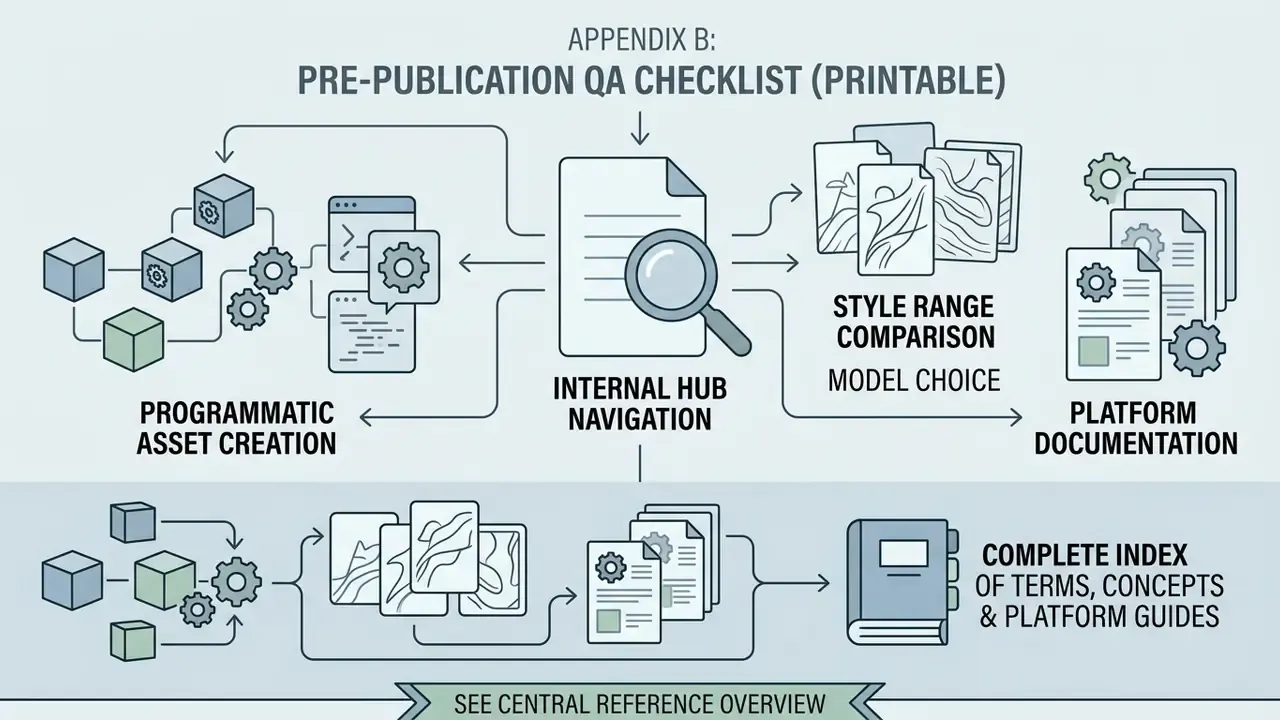
Appendix B: Pre-Publication QA Checklist (Printable)
- Claim substantiationevery number, price, date, and product capability traced to source documentation.
- No fabricated social prooftestimonials verbatim, attributed, and consented.
- Contrasttext overlays at 4.5:1 or better (3:1 or better for large display text).
- Alt-textdescriptive, entity-rich, under 125 characters where the platform truncates.
- Safe zonesnothing critical in the top or bottom UI bands for 9:16 Stories.
- Dimensions1080×1080, 1080×1350, 1080×566/608, or 1080×1920 as selected.
- File formatPNG for text-bearing graphics, JPG at 85 to 90% for pure photography, under 8 MB.
- DisclosureAI label applied where platform terms or law require it.
- Brandapproved hex codes, licensed fonts, logo in a designated safe zone, no third-party marks.
- Rightscommercial licence confirmed for the plan in use, reference uploads cleared.
- Audit recordprompt, model version, seed, editor, reviewer, timestamp stored.
- Human sign-offnamed approver before scheduling, never after publication.