Reviewed for licensing, governance and audit accuracy: editorial review pass covering U.S. Copyright Office guidance (2023–2026), Mechanical Licensing Collective correspondence, platform terms of service, and peer-reviewed generative-audio literature. Last updated: 2026. Statements about audience behaviour and adoption motives are labelled as hypotheses where empirical data is unavailable.
Executive summary for decision-makers
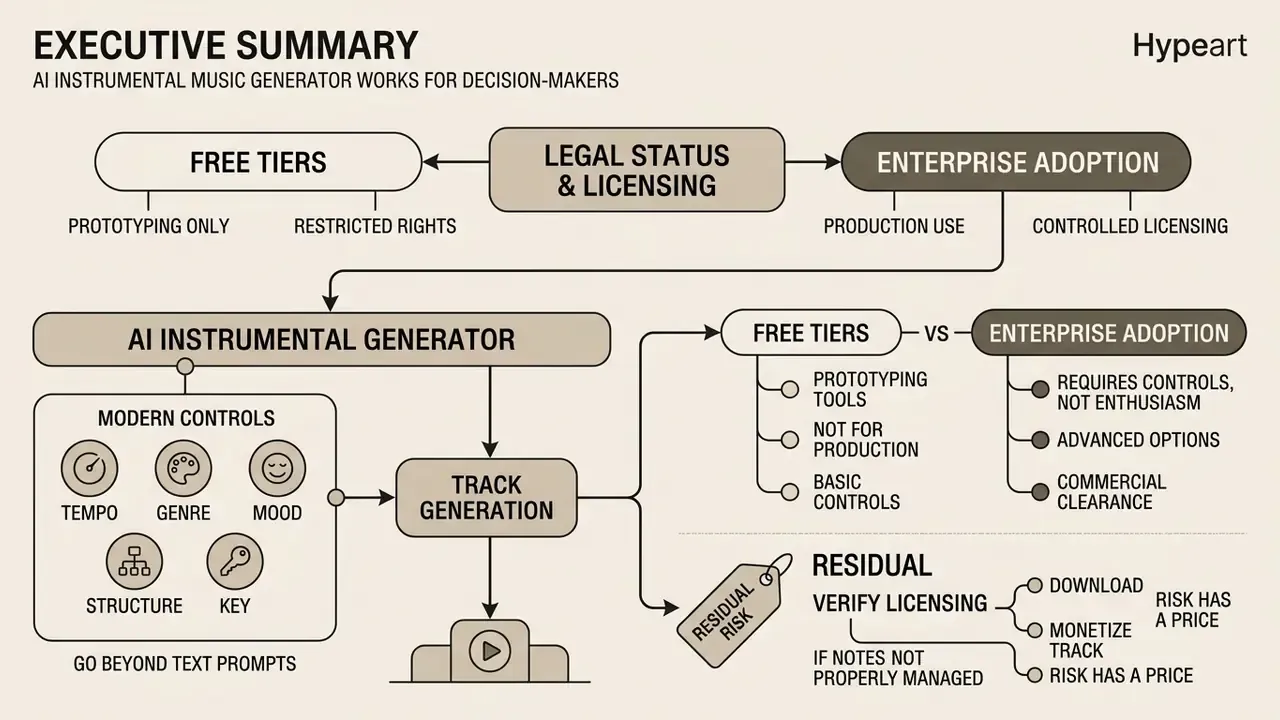
- Legal status first, features second. Purely machine-generated audio without meaningful human authorship is not registrable with the U.S. Copyright Office and is not eligible for Section 115 blanket mechanical royalties. "Royalty-free" is a payment model, not a copyright transfer.
- Free tiers are prototyping tools, not production tools. Free plans typically restrict commercial use, cap credits, watermark or downgrade exports, and block stem or WAV downloads. Paid and enterprise tiers unlock uncompressed masters, stems, and contractual commercial clearance.
- Enterprise adoption requires controls, not enthusiasm. Vendor onboarding should verify IP indemnification scope, training-data provenance disclosures, prompt-data retention policy, generation logs with provenance metadata, SOC 2 posture, SLA, and isolated or on-premise deployment options. Uncontrolled personal accounts create Shadow AI exposure inside the media supply chain.
- Modern generators go far beyond text prompts. Production-grade workflows now include image-to-music conditioning, YouTube and audio reference matching, audio-to-MIDI extraction, neural stem separation, and infinite real-time streaming via API. Each mode carries a distinct risk and cost profile.
- Residual risk has a price. Risk-adjusted ROI must include control costs: pre-clearance fingerprint checks, licence archiving, human-edit documentation, and legal review of vendor terms at the generation timestamp.
How to use this article
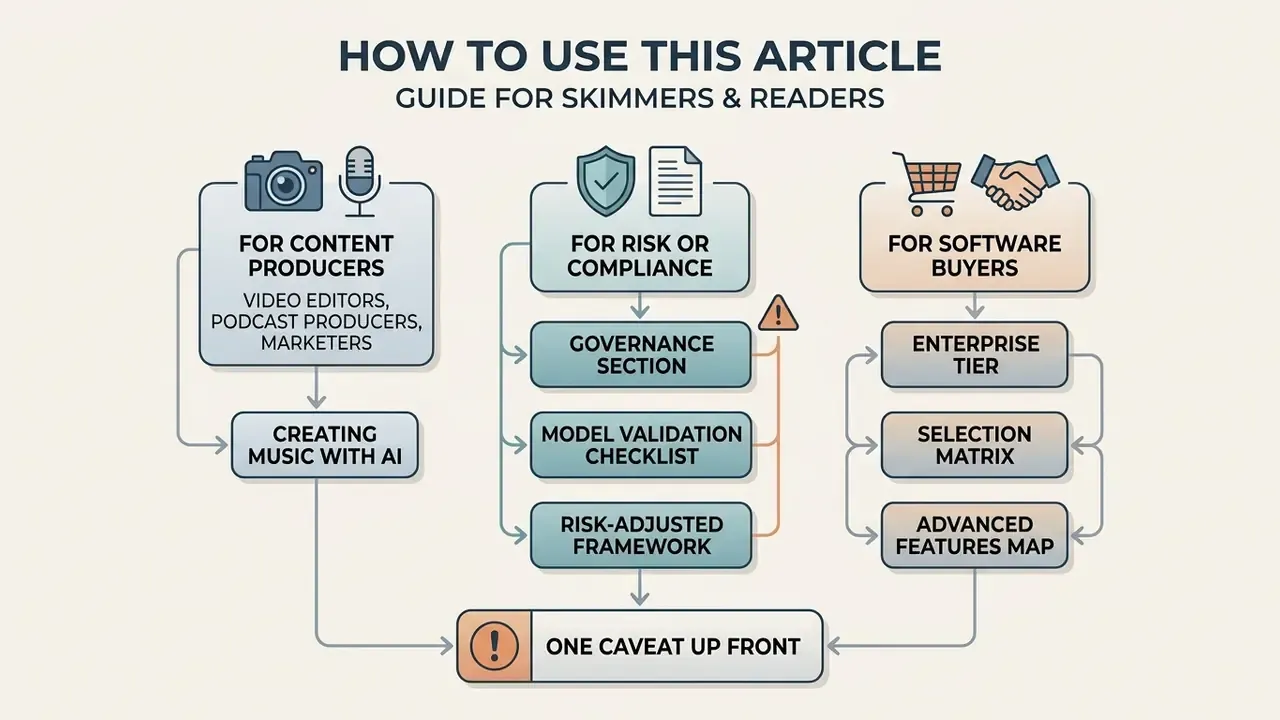
This is a long read, so pick a path rather than reading front to back.
- If you produce content (video editor, podcast producer, marketer): read the sections on creating music with AI, the controls, and free tiers. Skim the licensing checklist before your first monetized upload.
- If you own risk or compliance: the governance section, the model validation checklist, and the risk-adjusted ROI formula are written for you. The Appendix documents what was withdrawn from earlier revisions and why.
- If you buy software: the enterprise tier section, the selection matrix, and the advanced features matrix map capabilities to contractual artefacts. Cost questions? You can see the overview of estimation tools and view the guide on plan structures before you talk to a vendor.
One caveat up front. Vendor terms change quietly and often, sometimes within a single quarter. Every number, quota, and carve-out below should be re-verified on the vendor's own page at the moment of onboarding, not assumed from an article.
What is an AI instrumental generator and what can it create?
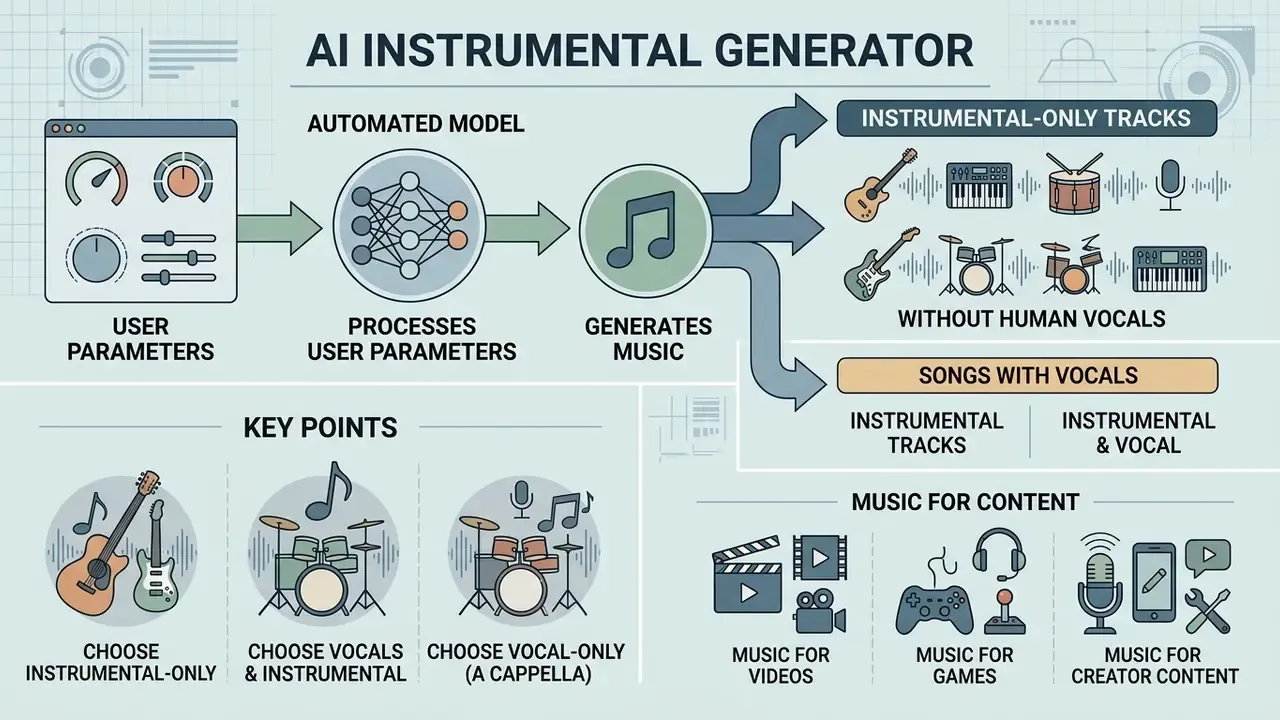
An ai instrumental generator is an automated model that processes user parameters to produce generated music without human vocal performances. These systems output high-fidelity audio streams or symbolic notation such as MIDI, tailored for background audio in corporate media, educational platforms, regulated marketing communications, and digital content creation.
According to a study on text-to-music systems published in arXiv (MusicLM: Generating Music From Text, 2023), hierarchical sequence-to-sequence models synthesize 24 kHz audio over multi-minute durations while adhering to user-defined instrumentation and stylistic constraints.
«The model generates 24 kHz audio over multi-minute durations while remaining faithful to the prescribed instrumentation and stylistic constraints.»
Output formats fall into two technical families. Symbolic output (MIDI, ABC notation) encodes note events and is editable inside a DAW piano roll. Waveform output (WAV, MP3, FLAC) encodes rendered audio, either as a single mixed file or as separated multi-source stems: piano, drums, bass, guitar, mixed downstream. Research on multi-source latent diffusion shows that individual instrument sources can be generated independently and then combined, which is the technical basis for stem-level editing in commercial products.
When evaluating platforms with no verifiable corporate footprint, no published entity registration, and no independently tested commercial offering, no verified information is available regarding proprietary infrastructure or contractual reliability. So operational teams should judge model capability on published empirical benchmarks, documented output specifications, and written contractual terms rather than marketing claims. The same evidence discipline applied to comparing AI art generators applies to audio vendors: capability claims without measurable output specifications remain unverified.
Instrumental-only tracks versus songs with vocals
Music for videos, games and creator content
Digital media creators, video editors, and game developers use an ai instrumental music generator to produce customizable, royalty-free audio that matches scene dynamics and pacing. Synthetic instrumental tracks give teams scalable audio assets for software applications, background scores, streaming broadcasts, e-learning modules, and marketing presentations. Teams that already build visuals with free AI video generators or with animation makers usually need matching audio beds produced at the same cadence and under the same licence. Studios working with an open source ai video generator face the same question one layer down: who guarantees the licence on the audio bed you shipped last quarter?
In digital gaming and multimedia storytelling, backing tracks must adapt to variable scene durations and interaction states. Academic research from San Jose State University (AI Tools for Research, Discovery & Creation, 2024) notes that customizable background music models let creators without formal musical training assemble balanced audio beds. These assets satisfy production requirements for videos, games, and podcasts while reducing the licensing friction attached to commercial music catalogues.
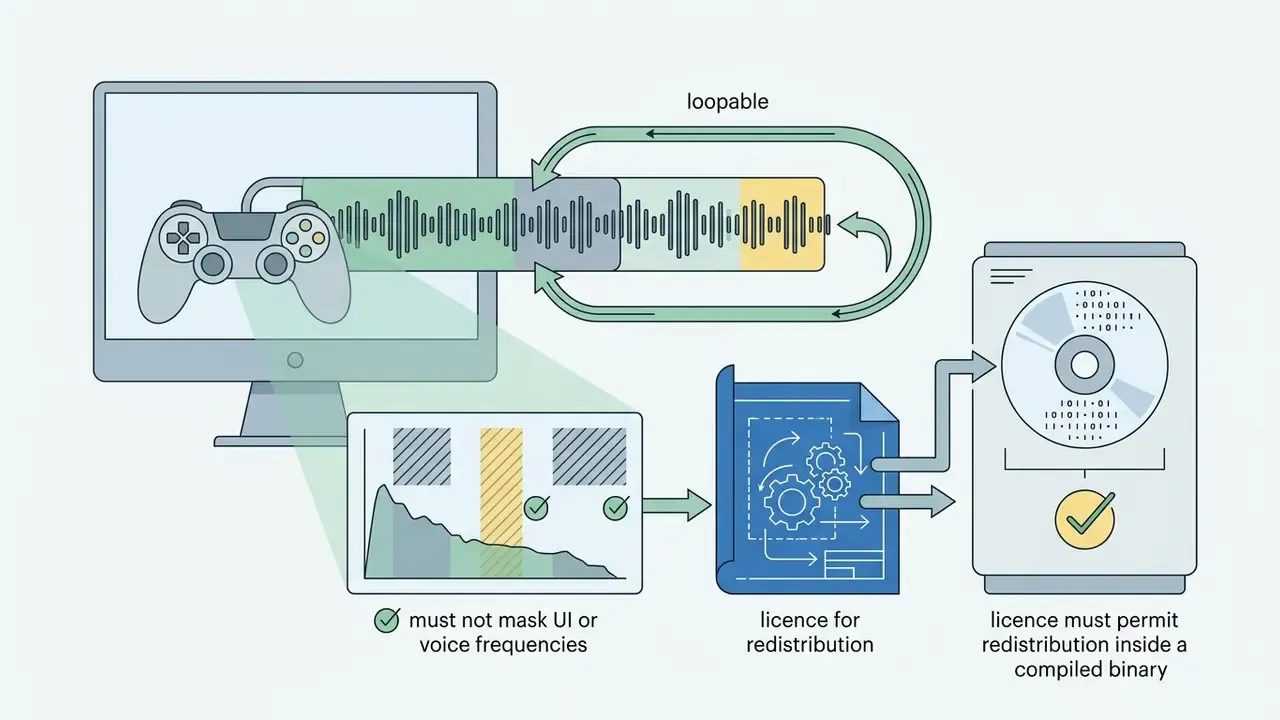
Requirements differ by channel:
Real-time infinite audio streaming for live broadcasts
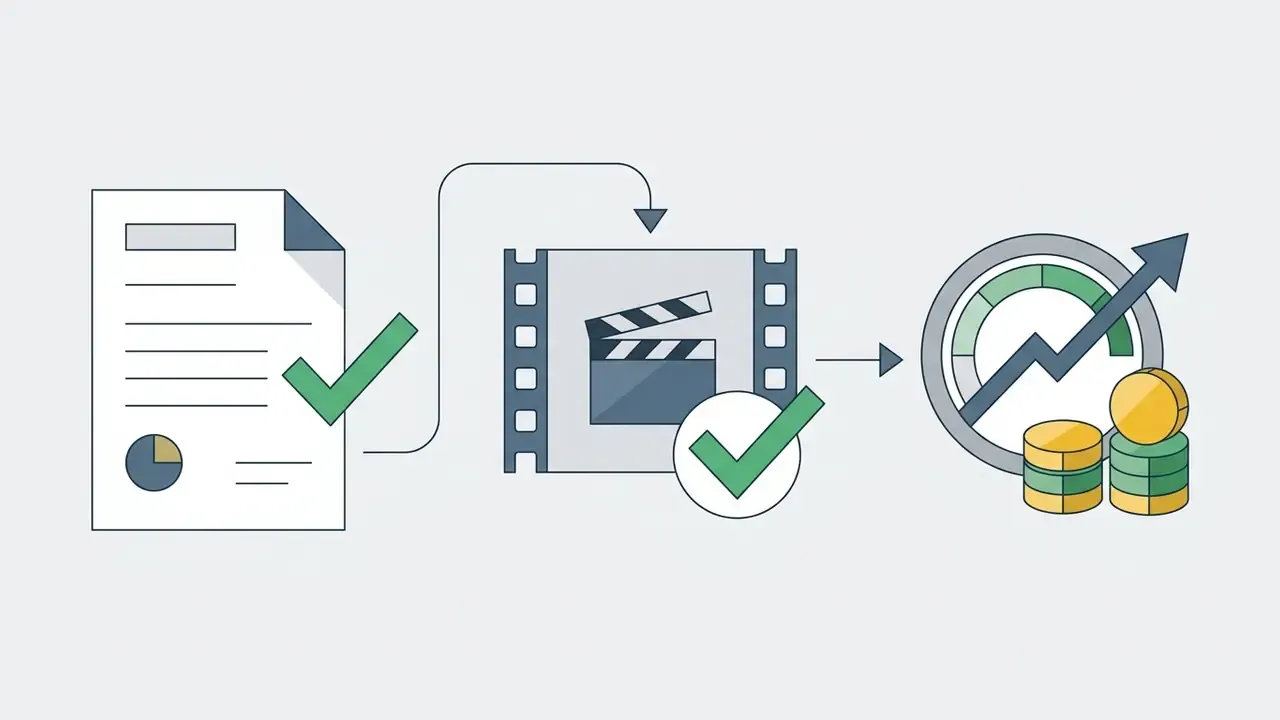
For continuous digital environments (24/7 Twitch and IRL streams, Discord voice channels, retail and hospitality ambience, open-world video games) AI instrumental engines offer real-time infinite stream generation through web APIs. Instead of rendering static audio files of fixed length, continuous generative models synthesize un-ending audio streams from persistent parameter states: mood, theme, intensity, instrumentation.
This architecture solves four problems that static files cannot:
- Loop fatigue elimination.Listeners never hear the same 90-second bed repeat for eight hours, because the stream is generated rather than looped.
- No dynamic drops during extended broadcasts.Parameter state persists across hours, keeping density and brightness inside a defined envelope.
- Claim-safe live audio.Continuous synthetic streams are designed to avoid fingerprint matches against commercial catalogues, which reduces DMCA and automated-claim exposure for live operations where takedowns cannot be fixed in post.
- State-reactive scoring.Game engines and stream overlays can push intensity parameters in real time (combat, exploration, chat spike) without pre-rendering every variation.
Operationally, infinite streaming is an integration project, not a download. It needs API key management, latency budgeting, fallback audio if the stream drops, and contractual clarity that streaming rights differ from file-download rights. Teams that have already modelled video-generation API costs and limits will recognise the same cost drivers: concurrency, minutes streamed, and per-session overhead. For the wider set of integration patterns, browse the hub.
Comparison of AI-generated music output types, operational workflows, and licensing scope
| Track type | Composition of the track | Typical use cases | Editing and control possibilities | Licensing and practical considerations |
|---|---|---|---|---|
| Instrumental-only | Pure instrumental arrangement (rhythm, bass, harmony, lead lines); complete absence of vocal tracks. | Background music for video productions, corporate presentations, digital gaming, podcasts, advertising beds. | High controllability over tempo, key, chord progressions, genre tags, and instrument stem isolation. | Standardized royalty-free licensing on commercial tiers; subject to platform distribution terms and human authorship disclosures. |
| Vocal-only (a cappella) | Isolated synthetic vocal lines, sung phrases, or vocal harmonies without instrumental backing. | Specialized vocal processing, music production sampling, remixing, vocal arrangement testing. | Requires precise lyric text alignment, pitch curve controls, and synthetic voice model selection. | Licensing restricted by synthetic voice dataset permissions and publicity rights regulations. |
| Vocals-and-instrumental | Integrated mix combining lead synthetic vocals, backing harmonies, and full instrumental arrangements. | Standalone commercial songs, artist demo production, promotional tracks, foreground media cues. | Requires dual-domain management of lyric inputs alongside musical arrangement controls. | Commercial deployment requires explicit review of lyric originality, vocal rights, and streaming service policies. |
| Infinite generative stream | Continuously synthesized instrumental audio with no fixed end point; state-driven rather than file-based. | 24/7 live streams, gaming ambience, retail and venue audio, always-on digital environments. | Parameter-state control (mood, theme, intensity); no discrete file to edit or master. | Streaming licence differs from download licence; verify whether recording or re-broadcast of the stream is permitted. |
In short: the further right you move in that table, the less the deliverable looks like a file and the more it looks like a service contract.
Commercial use, royalty-free music and licensing
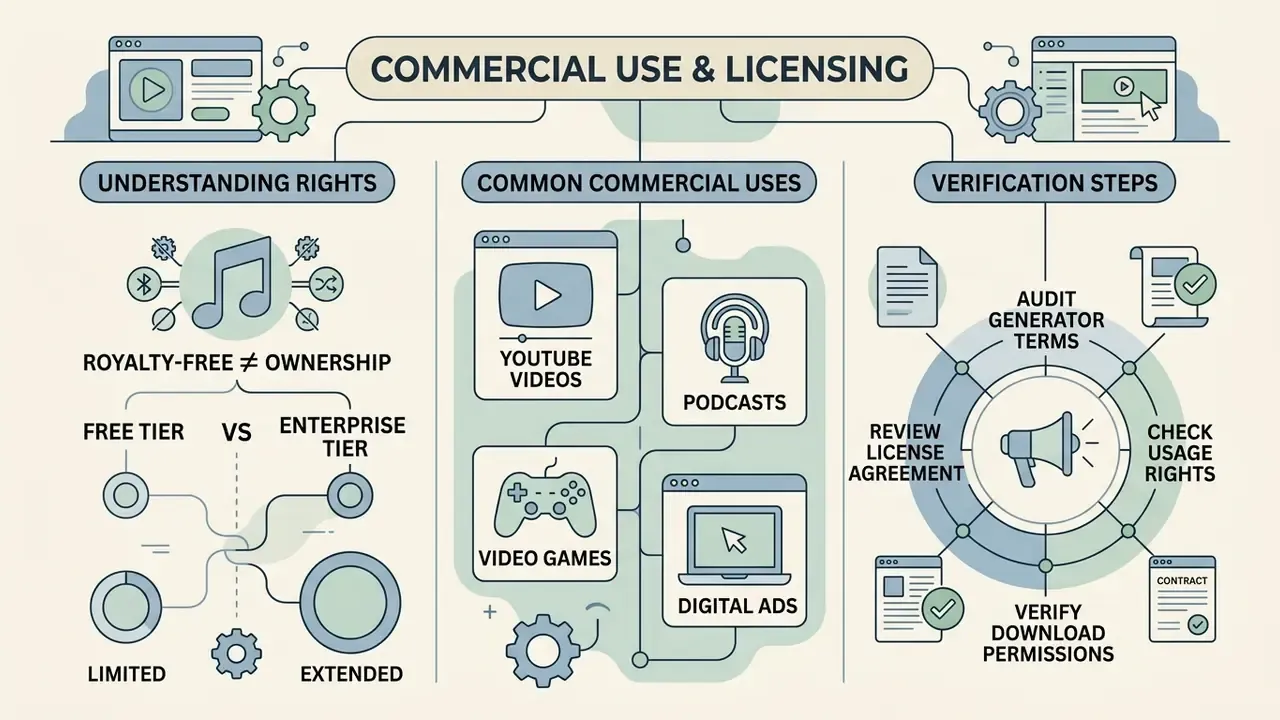
Deploying AI-generated audio in commercial media requires verifying specific contractual permissions, platform monetization policies, and copyright office registration standards. A track labelled "royalty-free" does not automatically grant total copyright ownership or legal immunity against infringement claims. That distinction mirrors the licensing structure documented for commercial use of AI-generated image assets; to see how the pattern repeats across asset types, explore the hub.
Official guidance from the U.S. Copyright Office (Copyright Registration Guidance for Works Containing AI-Generated Material, 2023–2026) establishes that purely machine-generated audio lacking sufficient human authorship cannot be registered for federal copyright protection. Applicants must disclose more than de minimis AI-generated content and exclude non-human-authored material from the claim. The Office also confirmed to the Mechanical Licensing Collective (MLC) that purely synthetic music is ineligible for Section 115 compulsory blanket mechanical royalties, and that royalties should not be disbursed for such works.
Two structural gaps matter for risk owners. First, no academic study published between 2023 and 2025 systematically measures commercial licensing outcomes for AI-generated tracks. The absence of empirical litigation and monetization data is itself a risk factor, not a clean bill of health. Second, jurisdictional divergence is real: a 2025 European Parliament study states that purely AI-generated outputs without substantial human intervention are not protected by copyright in the EU, while UK guidance on copyright and AI (2025) confirms that temporary-copying and text-and-data-mining exceptions do not create blanket permission for commercial reuse of copyrighted musical material. Teams tracking active disputes in this area can compare options for monitoring case developments.
Royalty-free does not always mean full ownership
Three legal constructs are routinely conflated in vendor marketing:
| Construct | What it actually means | What it does not give you |
|---|---|---|
| Royalty-free | No recurring per-play, per-broadcast, or mechanical royalty is owed to the licensor. | Does not transfer copyright; does not remove third-party infringement exposure. |
| Commercial licence | Permission to use the asset in revenue-generating activity, within scope limits (channels, territories, media types, duration). | Does not make you the author or owner; scope carve-outs (film, TV, large studio games) are common. |
| Full ownership / assignment | Copyright is assigned to you in writing; you become the rights holder for the assigned elements. | Cannot cure the absence of human authorship. You cannot be assigned a right that never vested. |
Legal analysis of vendor terms shows the tension plainly. Suno's downloads policy update (2026) states that "songs downloaded from Suno on paid plans remain yours to use commercially or personally," while its Terms of Service separately restrict exploitation of service output for commercial purposes unless expressly authorized. ElevenLabs Music documents that self-serve commercial use excludes film, TV, and Studio Games, with full commercial coverage available only under Enterprise terms. SOUNDRAW permits distribution to streaming services only after the user modifies the generated beats. Distinguishing a non-exclusive commercial usage licence from a full copyright assignment is vital for organizations managing corporate IP catalogues, and it is the same diligence pattern applied when evaluating design-platform AI licensing terms or when comparing vendor rights grants across generative tools.
Using instrumentals for YouTube, podcasts, games and ads
Publishing AI instrumental tracks on platforms like YouTube means living with automated copyright management systems, Content ID included. If a generated track inadvertently reproduces protected training fragments, automated systems may issue monetization claims, mute the audio, restrict territories, or make the video unavailable. The rights holder's chosen policy determines the outcome, and it applies regardless of how the audio was produced. Teams operating at scale should fold this check into their YouTube publishing and editing workflow instead of treating it as a post-upload surprise.
YouTube publishing documentation (2024–2026) states that uploaders remain fully liable for copyright compliance whether media was composed by a human or produced by generative software. Distributors and DSPs are tightening policy too. TIDAL's 2026 policy blocks monetization, royalties, and direct-to-fan sales for tracks identified as 100% AI-generated and applies an AI label, while several distributors exclude AI-generated elements from Content ID registration entirely. Human-made tracks that merely used AI for mixing or mastering are generally treated differently from prompt-only outputs.
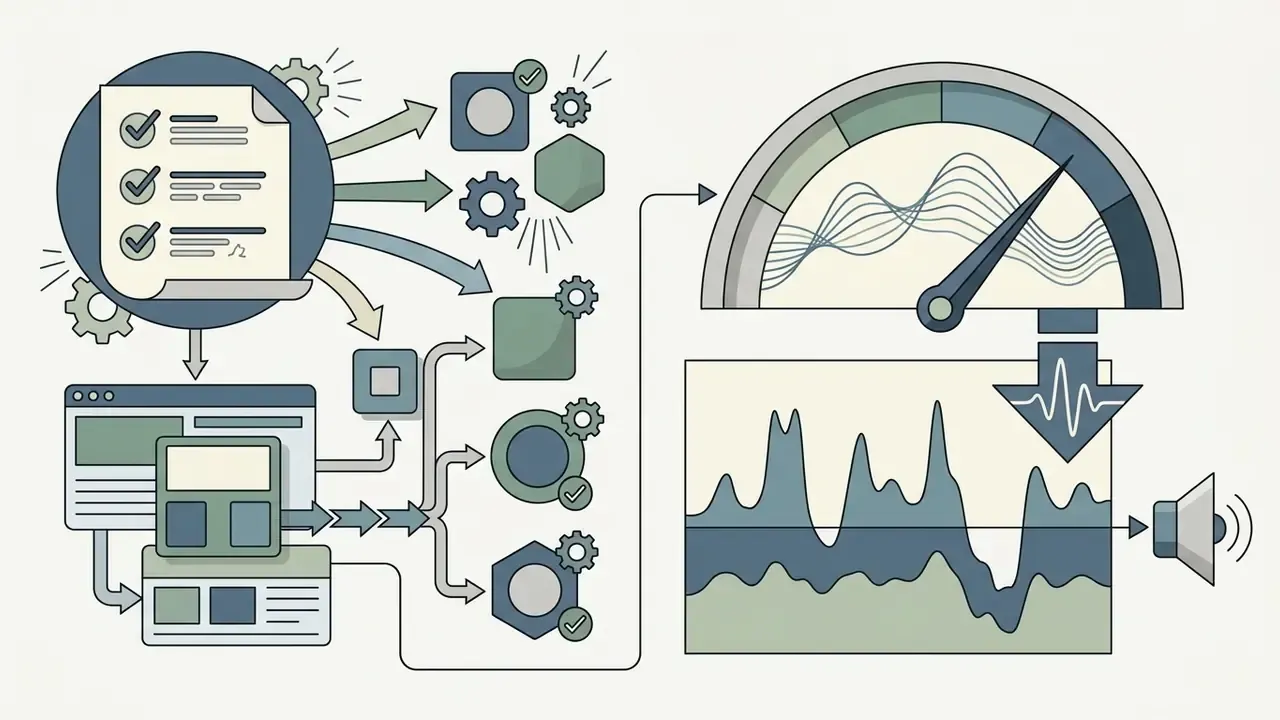
Channel-specific constraints:
What to verify before publishing or monetizing a track
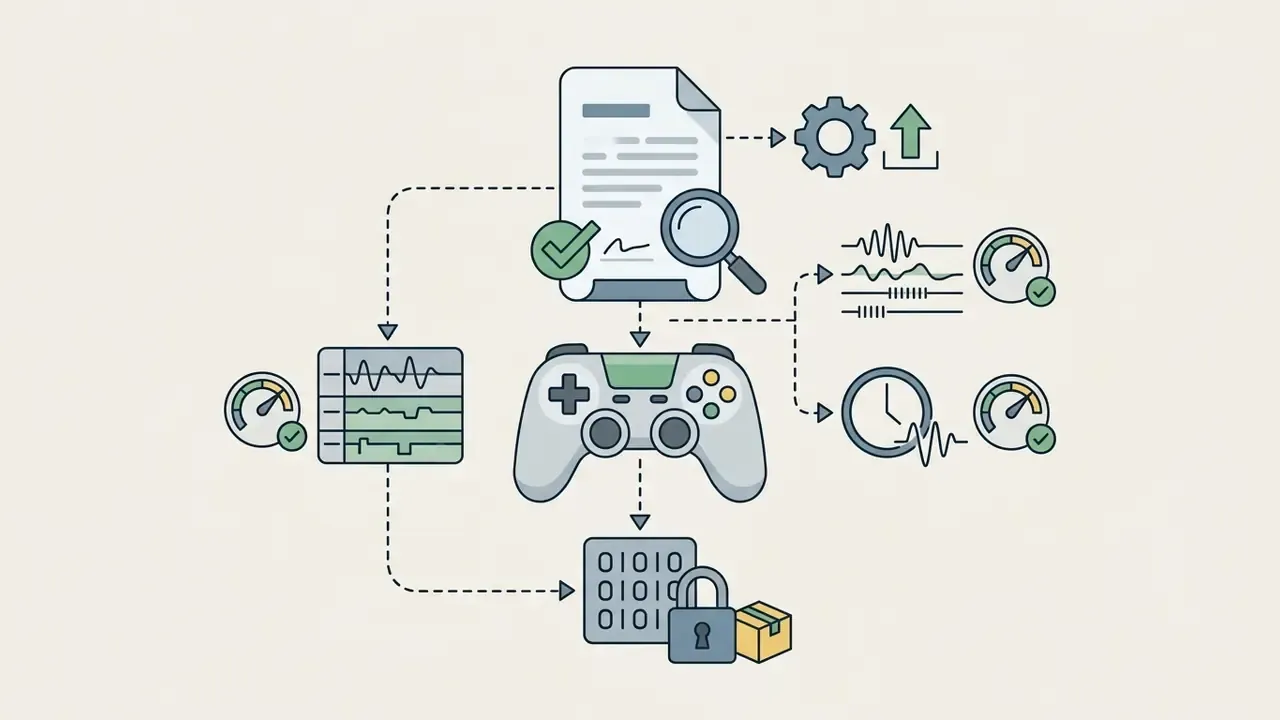
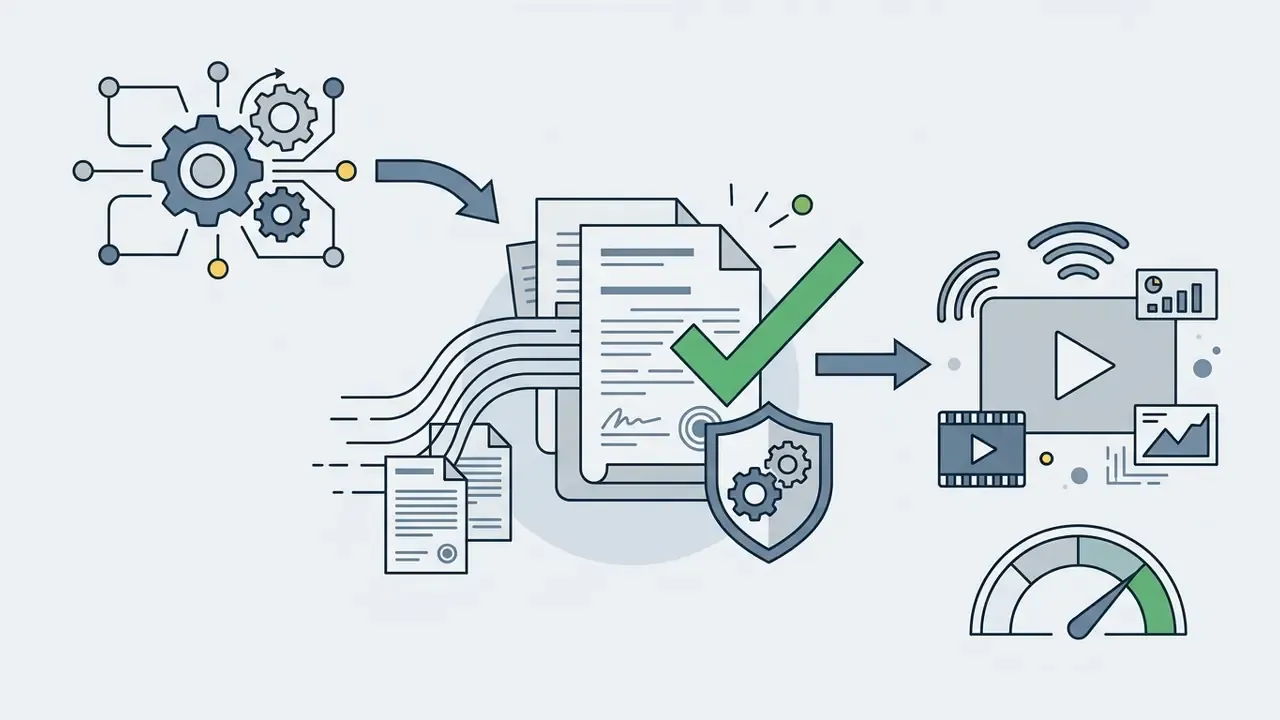
Before monetizing or broadcasting synthetic instrumental tracks, production teams should run a structured audit of licence terms, platform requirements, and human edit documentation. Verifying these parameters reduces the risk of sudden takedown notices or lost monetization.
- Audit generator terms verify that the subscription tier explicitly grants commercial monetization rights for the exact download timestamp, and capture a dated copy of the terms in force at that moment.
- Confirm human authorship contribution ensure human operators provided creative direction (prompt engineering, stem editing, arrangement adjustments, mix decisions) to support legal copyright claims and registration disclosures.
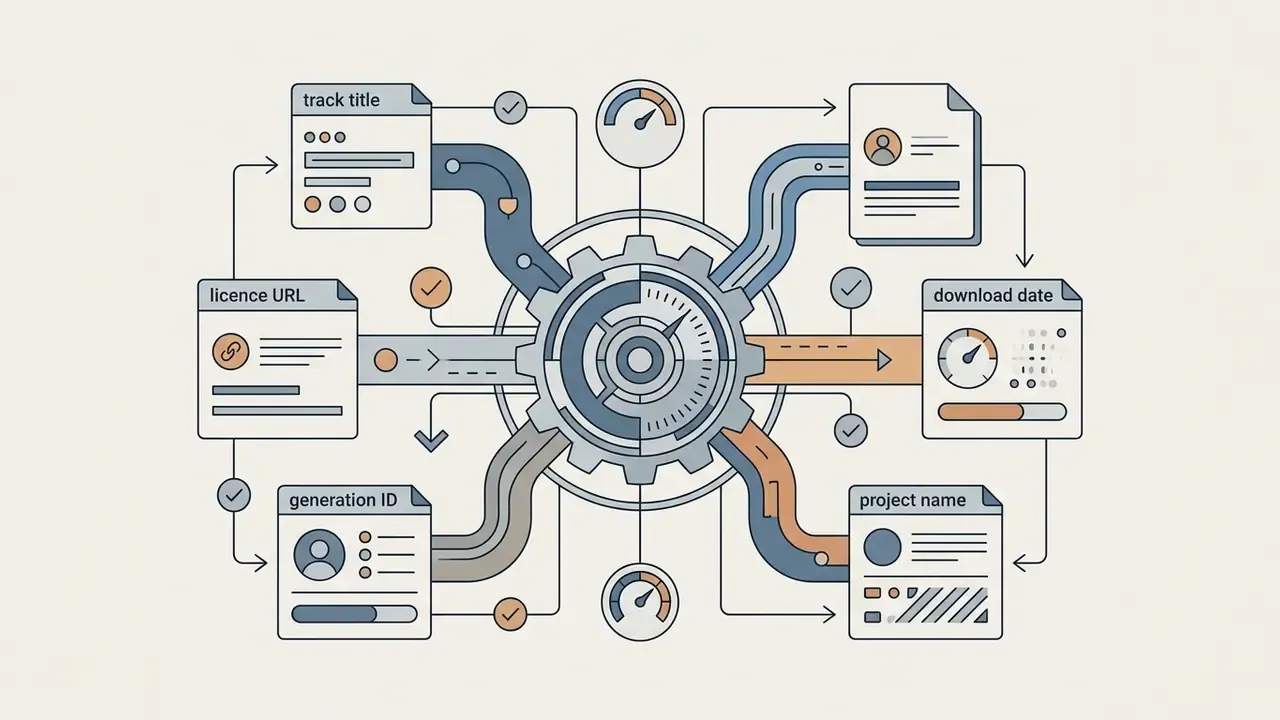
- Archive licensing documentation retain records of track generation IDs, licence terms, download receipts, invoices, and platform usage certificates in an immutable store.
- Run Content ID pre-clearance audition candidate tracks through digital fingerprinting systems to identify potential melody matches before video release or campaign launch.
- Check scope carve-outs confirm whether film, broadcast TV, large-studio games, or paid advertising are excluded from the self-serve tier.
- Record the human-edit trail save project files, stem edits, and version history as evidence of creative contribution.
Source discipline note: cite the vendor licence page, the platform policy page, and the U.S. Copyright Office guidance directly, with retrieval dates. A screenshot without a date is not evidence. If your counsel later asks what the terms said on the day you downloaded the file, the archived copy is the only answer that holds.
Enterprise IP risk, data protection and AI governance
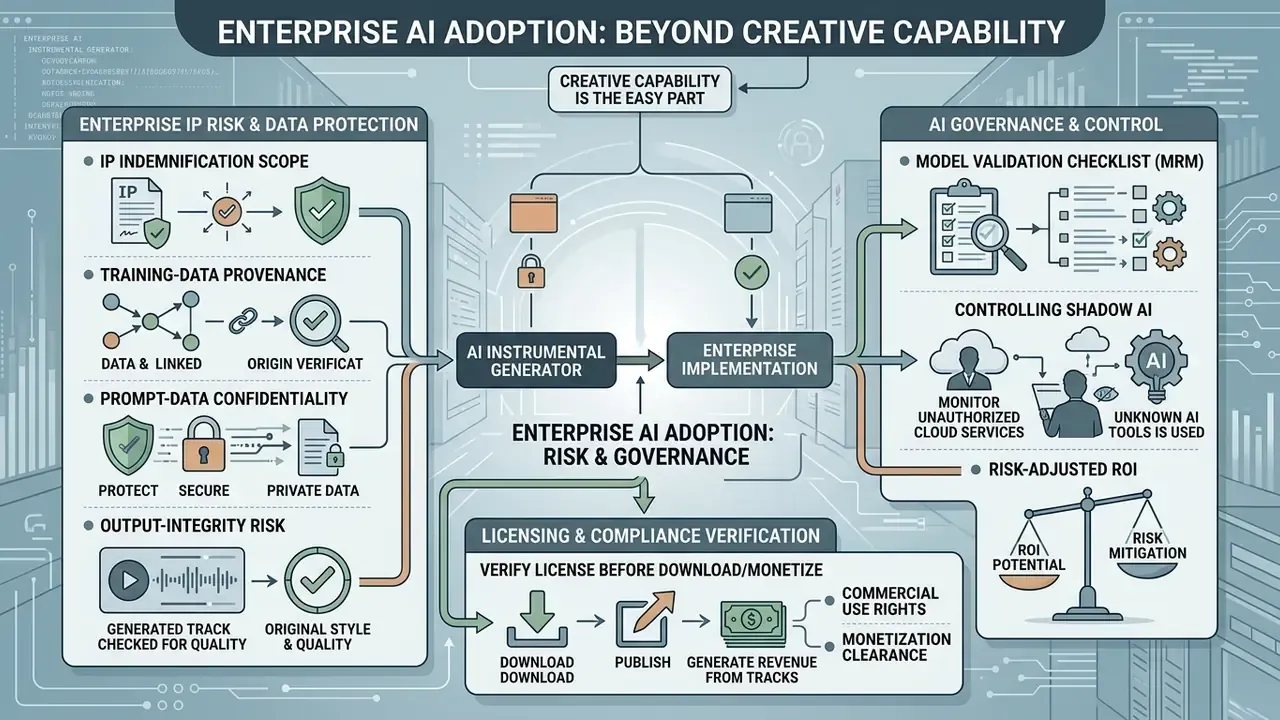
Creative capability is the easy part of adoption. For a Chief Risk Officer, Head of Model Risk, or AI Governance lead, an instrumental generator is a third-party model embedded in a content supply chain. It must be inventoried, validated, and monitored like any other vendor model.
Enterprise IP risk and data protection
Four exposures dominate:
Shadow tooling makes all four worse. A marketer experimenting with open art ai style tools for visuals and a free audio generator for the bed can create two undocumented licence positions in one afternoon, without any bad intent.
Model validation checklist for Model Risk Management (MRM)
Use this checklist during vendor onboarding and at each annual re-validation:
Checklist0 / 11
Vendor onboarding questions that need answering, and support paths that need testing, are worth rehearsing before signature. View the guide on escalation and response expectations if you have no internal baseline.
Controlling Shadow AI in media workflows
Hypothesis (requires internal validation): in organisations without a sanctioned audio-generation tool, individual marketers and video editors are likely to use personal free accounts, producing assets whose licence terms, retention posture, and provenance cannot be evidenced later. Practical controls: publish an approved-tool list, block unsanctioned domains at the egress layer, require generation IDs in the asset-management system before an audio file can be attached to a campaign, and sample published content against the licence archive on a schedule.
One more nuance. Bans rarely work here, because the underlying need (fast, cheap, on-brief audio) is real. A sanctioned tool with an evidence workflow beats a prohibition nobody enforces.
Risk-adjusted ROI: including control costs
Naïve ROI compares subscription cost against agency composition fees. A defensible model includes controls:
Risk-Adjusted ROI =
  (Baseline Sourcing Cost Avoided + Cycle-Time Value)
  − (Subscription/API Cost
     + Pre-Clearance & Fingerprint Checking Cost
     + License Archiving & Evidence Retention Cost
     + Legal Review Cost per Term Change
     + Expected Residual Loss)
Expected Residual Loss =
  P(claim or takedown) × (Remediation Cost + Lost Monetization + Reputational Cost)
Because no verified industry dataset currently quantifies P(claim or takedown) for AI instrumental tracks, that probability must be estimated internally from your own claim history and revisited as evidence accumulates. Documenting the estimate, rather than omitting it, is what makes the ROI case auditable. An unstated probability is not a zero probability.
How to create instrumental music with AI
Describe the genre, mood and sound in a prompt
Writing an effective generation prompt means specifying explicit musical parameters: sub-genre tags, emotional valence, beats per minute (BPM), and primary instruments. Detailed descriptors let the ai create instrumental music engine align harmonic progressions with the creative brief.
Industry documentation from AI music research guides (Udio Prompting Guide, 2025; MakeBestMusic Guide, 2026) recommends a structured prompt sequence:
[Genre/Style] + [Mood] + [Tempo/BPM] + [Lead Instruments] + [Production Texture]
For example, "Cinematic ambient, reflective mood, 80 BPM, soft grand piano, analog synth pads, sub-bass, studio mastering" gives unambiguous directional tokens. Practical constraints that improve hit rate:
- Put the primary genre and mood first; models weight early tokens heavily.
- Limit lead instruments to two or three. More instruments increase frequency clutter.
- State BPM numerically rather than descriptively ("80 BPM" beats "slow").
- Name the production era or texture ("analog tape saturation", "modern loudness-normalized master") to control timbre.
- Change one parameter at a time between iterations so cause and effect stay traceable.
This structure guides the model toward focused generated music without unwanted acoustic artifacts. It also, incidentally, produces a readable prompt history, which is useful when you later need to demonstrate authorship.
Image-based and reference-driven audio synthesis
Modern multimodal instrumental generators accept visual inputs (images, storyboard frames, mood boards) and reference audio URLs, including YouTube links or uploaded sound files, to steer musical parameter selection. These modes help most when a brief exists visually but not verbally.
Risk note: reference-driven modes increase similarity risk by design. Any output generated from a copyrighted reference should be treated as higher risk and routed through fingerprint pre-clearance before publication. Uploading a third party's audio raises a separate question too: does your licence even permit you to submit that file to a vendor's servers?
- Photo-to-music conditioning.
- The engine extracts visual features (colour temperature, spatial density, contrast, subject motion, emotional valence) and translates them into acoustic tokens. A dark, rain-soaked urban photograph maps to a roughly 70 BPM lo-fi bed with acoustic piano, muted drums, and vinyl crackle; a high-key sunlit product shot maps to bright major-key plucks at 110–120 BPM. Art directors can drive audio from the same visual reference already feeding the visual asset pipeline, whether those frames came from openart ai style boards or from a stylized pass such as an openart studio ghibli filter.
- Audio and YouTube reference matching.
- By uploading a reference audio file (typically up to about 30 seconds as a style guide) or inserting a media link, the model performs spectral and rhythmic analysis, extracting tempo, temporal key progressions, drum patterns, dynamic envelopes, and instrumentation profiles. The output is an original composition sharing the structural and harmonic character of the source, not a reproduction of its protected melody.
- Storyboard-frame batching.
- For sequential media, frames can be submitted per scene so the generated cue set follows the visual arc, then stitched with matched keys and tempos.
Generate, listen and refine the track
After initial generation, the operator evaluates candidate audio for harmonic stability, structural transitions, and frequency balance, then applies targeted updates to the prompt or the parameter sliders. Iterative refinement tools let creators edit specific sections, extend duration, or remix instrumental layers.
Technical documentation for systems such as ElevenLabs Music (2026) and Vocuno (2026) highlights iterative editing: style guide conditioning, section-level regeneration, source-adherence sliders, and tempo shifting. MusicGPT's API documentation adds pitch and speed manipulation plus inpainting as programmatic operations. When a draft lacks energy, the user can adjust specific parameters, swapping percussion elements, altering the harmonic key, reducing density, and re-run synthesis. Generating two to four candidates per brief and auditioning them against the actual video timeline, not in isolation, is the most reliable evaluation method. Controlled iteration gives creators precision over the final arrangement and, at the same time, produces the human-authorship trail that copyright registration requires.
Download the finished instrumental for your project
The final operational step is a download request that exports the synthesized track in a production-ready format, uncompressed WAV or compressed MP3. Exported assets are then imported into non-linear video editors, digital audio workstations (DAWs), or media asset management systems, and where delivery bandwidth matters, passed through the same optimisation stage as video compression. Post-production teams standardised on an open source video editor should confirm sample-rate handling on import; mismatches surface as pitch drift, not as an error message.
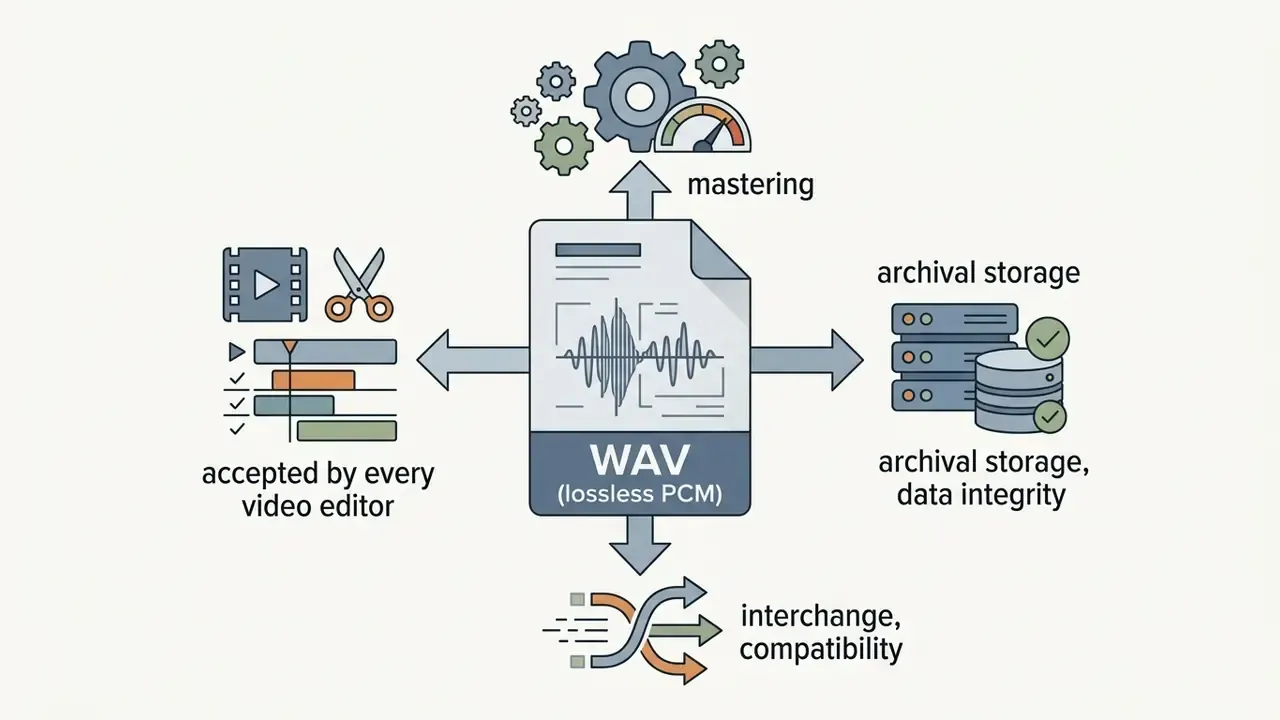
According to digital preservation specifications from the U.S. National Archives and the Library of Congress, WAV files (LPCM) serve as the standard format for high-fidelity master storage and editing, while MP3 (ISO/IEC 11172-3) provides a lightweight delivery format for online distribution. State guidance on audiovisual preservation recommends WAV or AIFF for maximum flexibility and 192 kbps or higher for acceptable compressed delivery. Practical targets:
Exporting high-resolution files keeps tracks with enough dynamic headroom for downstream mixing, equalization, and broadcast leveling.
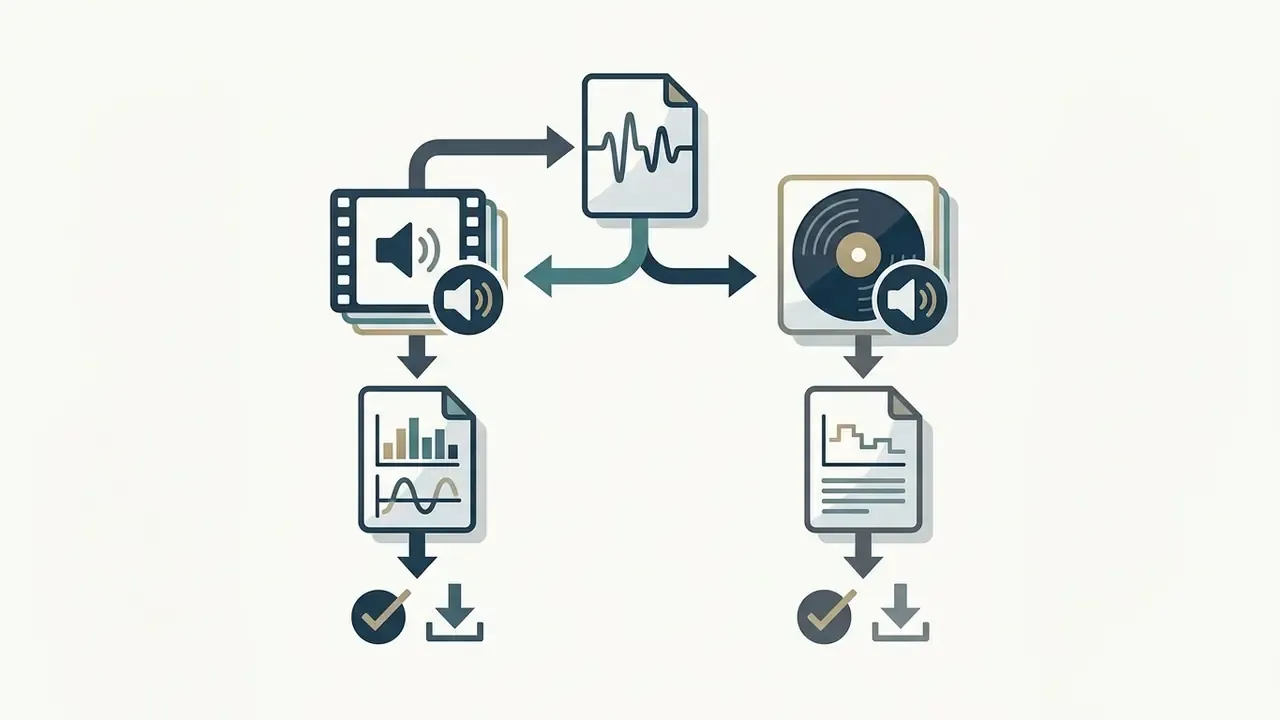
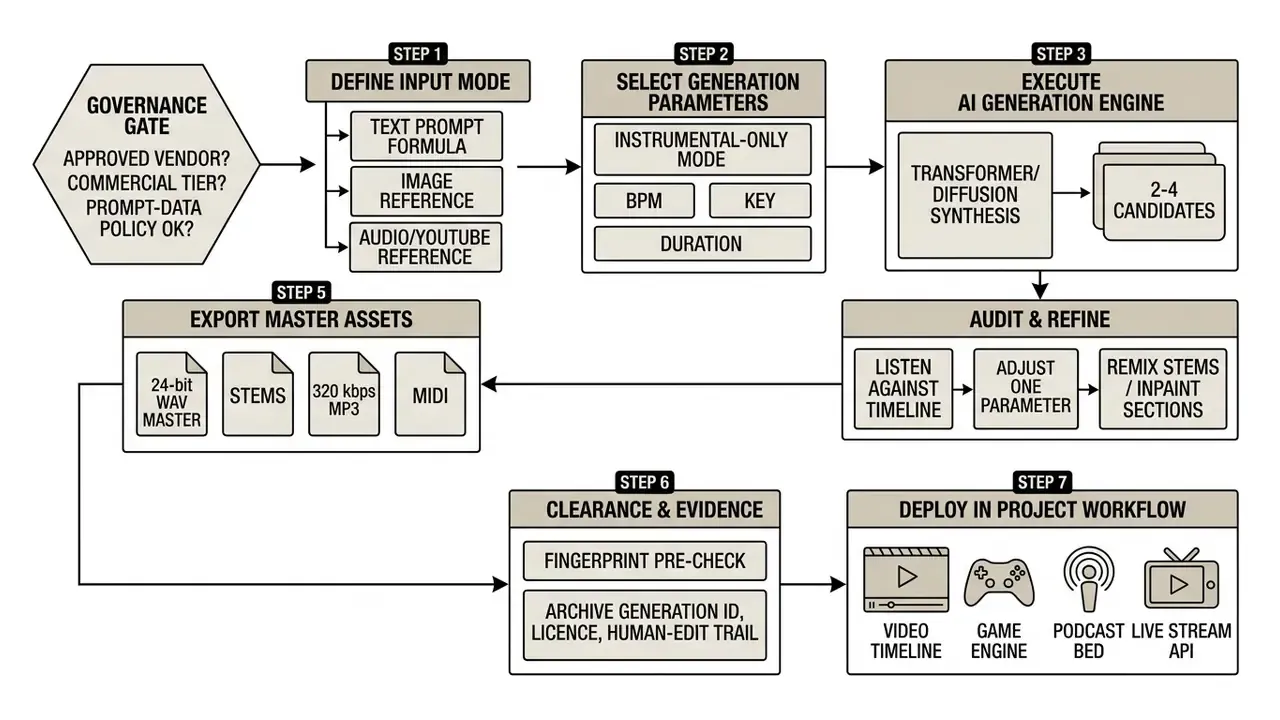
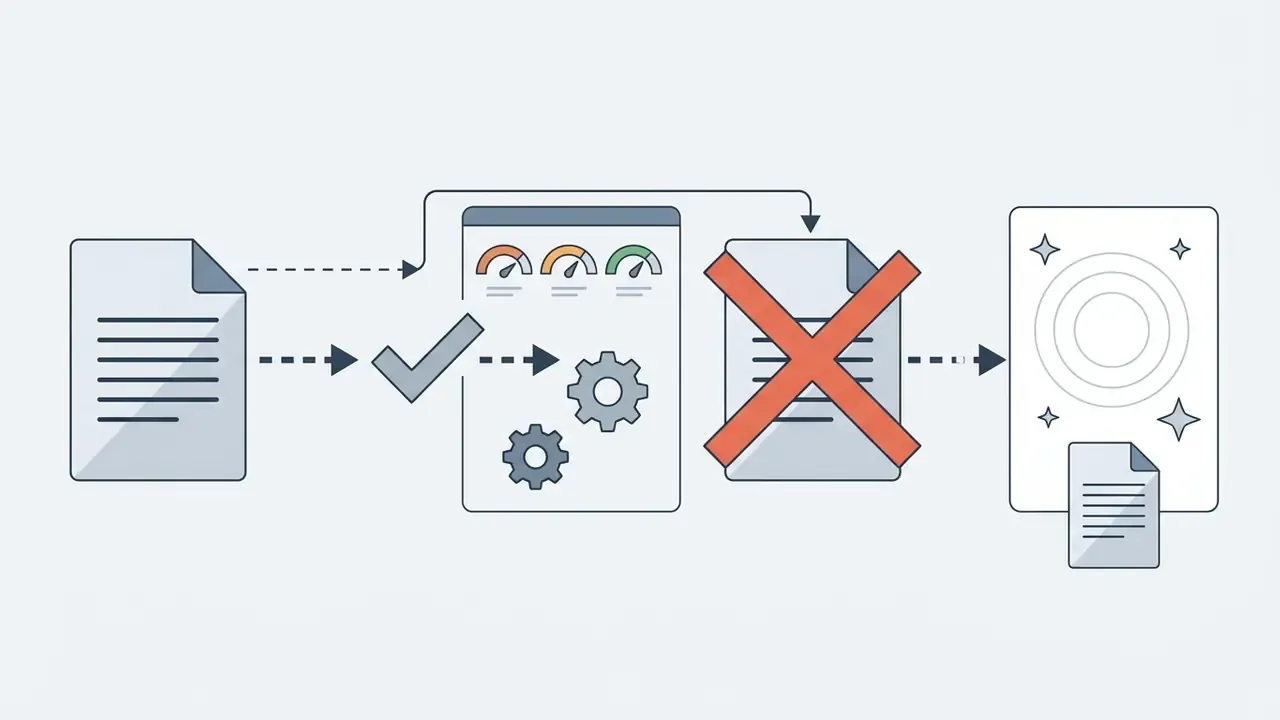
Text alternative to the diagram, in order: governance gate, input mode, parameters, generation, audit and refine, export, clearance and evidence, deployment. Skip step 0 or step 6 and you still have a track, just not a defensible one.
Which controls affect an AI-generated instrumental track?
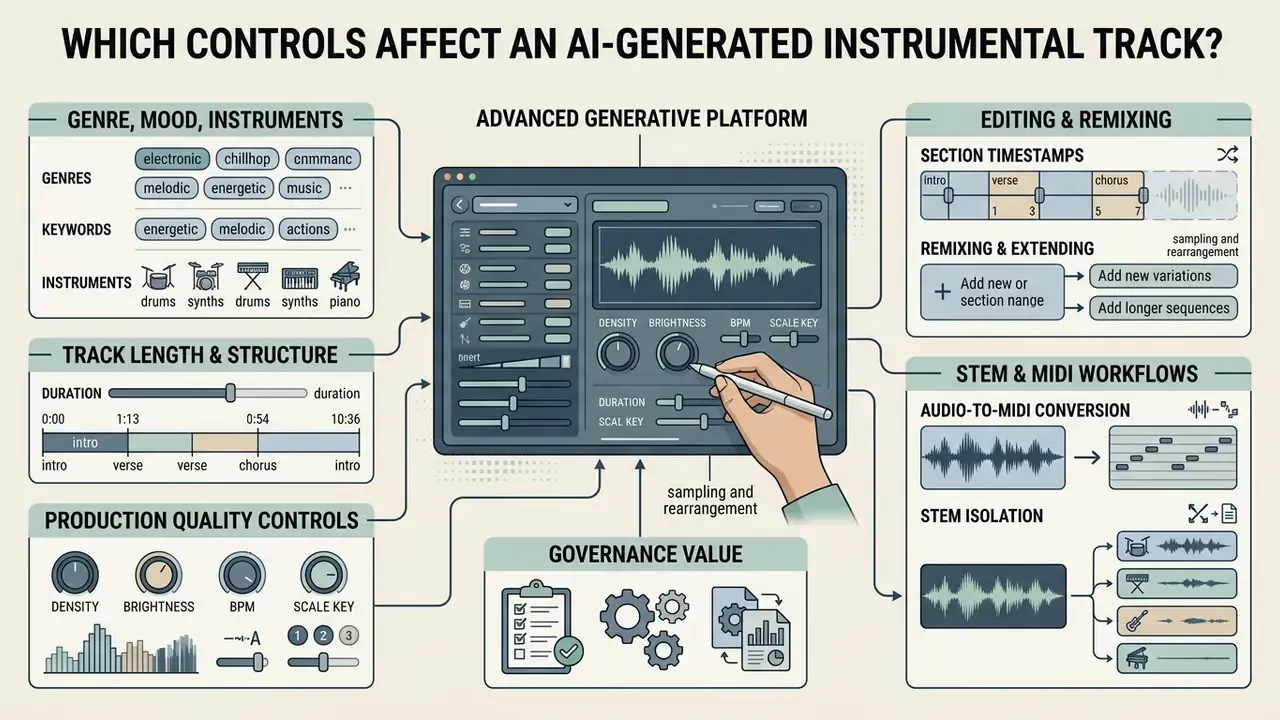
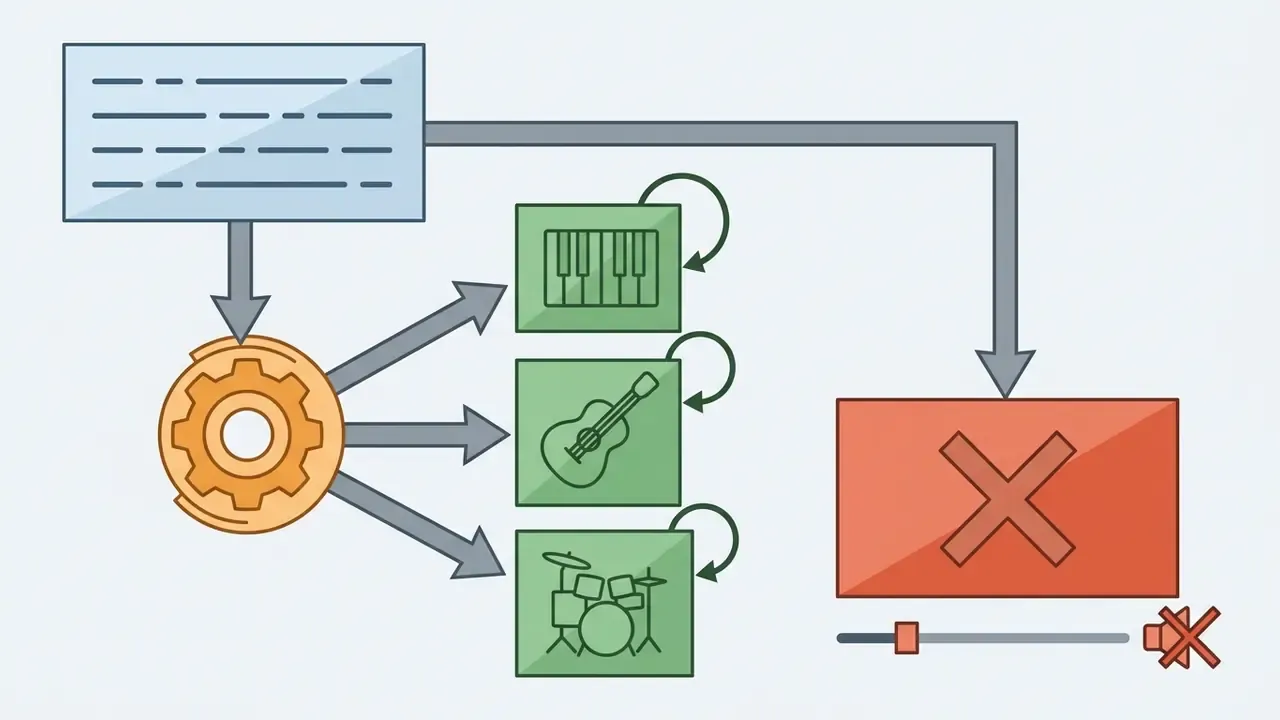
Advanced generative platforms expose specific control parameters, including BPM, scale key, section timestamps, density, brightness, and instrument mutes, which let operators govern track structure and audio fidelity. A flexible ai music instrument generator keeps synthesized outputs inside precise technical and aesthetic criteria.
Research on controllable music models (MUSIC ControlNet, arXiv 2023; Google Lyria 3 API Docs, 2026) shows that time-varying conditioning signals, such as melody tracking, dynamic envelopes, and key constraints, allow operators to shape output progression, with each control specifiable fully or partially over time.
«Temporal conditioning on chords and rhythm gives operators precise control over a track's progression and dynamics.»
Controlling these underlying variables turns a basic ai instrument generator from a random sound sample source into a predictable production utility. Documented control surfaces in current products include sample rate, bitrate, audio format, BPM, key, density, brightness, mute_bass, mute_drums, only_bass_and_drums, and generation mode. Anyone searching for an instrument generator ai with real parameter depth should test these fields before signing, not after.
Genre, mood and instrument selection
Explicit selectors for genre, mood, and primary instruments establish the sonic palette of the synthesized piece. An ai instrument maker maps those selection inputs against internal training embeddings to organize harmonic density and rhythmic patterns.
Developer documentation for Google Cloud Lyria and ElevenLabs Music (2026) lists dedicated selection fields for styles like lo-fi hip hop, cinematic orchestral, jazz fusion, and EDM, plus instrumentation toggles for Fender Rhodes piano, slide guitar, acoustic guitar, TR-808 drum machine, electronic drums, synthesizers, and orchestral strings.
«Mustango is trained on MusicBench, a dataset of over 52,000 examples enriched with music-theoretic descriptions of chords, tempo, and key.»
Choosing specific instrument combinations prevents frequency clutter and leaves spectral space for voiceovers or primary sound effects. A practical rule for dialogue-heavy content: keep the 1–4 kHz band sparse, avoid lead instruments sharing the voice's fundamental range, and prefer sustained pads over busy mid-range arpeggios.
Track length, structure and production quality
Managing track duration, section markers (intro, verse, chorus, outro), and sample rate parameters keeps synthesized audio inside commercial broadcast standards. Professional generators provide timeline controls to structure build-ups and clean fades; ElevenLabs Music documentation describes fixed-length or Auto duration modes plus progressive section assembly, starting with a 30-second intro and adding sections in sequence.
Technical evaluation papers (ACE-Step Technical Report, 2026; MiniMax Music 2.6 Docs, 2026) show that model output quality is measured across waveform reconstruction fidelity, style alignment, lyric alignment, aesthetic quality, dynamic range, and musical coherence. Production quality is a multi-metric property, not a single score.
«MusicEval contains 2,748 clips from 31 systems and 13,740 expert ratings across 384 prompts, the first benchmark of this scale for text-to-music evaluation.»
Systems offering explicit sample rate (44.1 kHz or 48 kHz) and bitrate choices (320 kbps MP3 or 24-bit WAV) deliver audio suitable for immediate placement in broadcast media. Note the gap between research scope and product constraints: research systems have demonstrated timing-conditioned coherence beyond four minutes, while several 2026 consumer products cap single generations at shorter presets and rely on extend operations for longer arrangements.
Editing, remixing and extending generated music
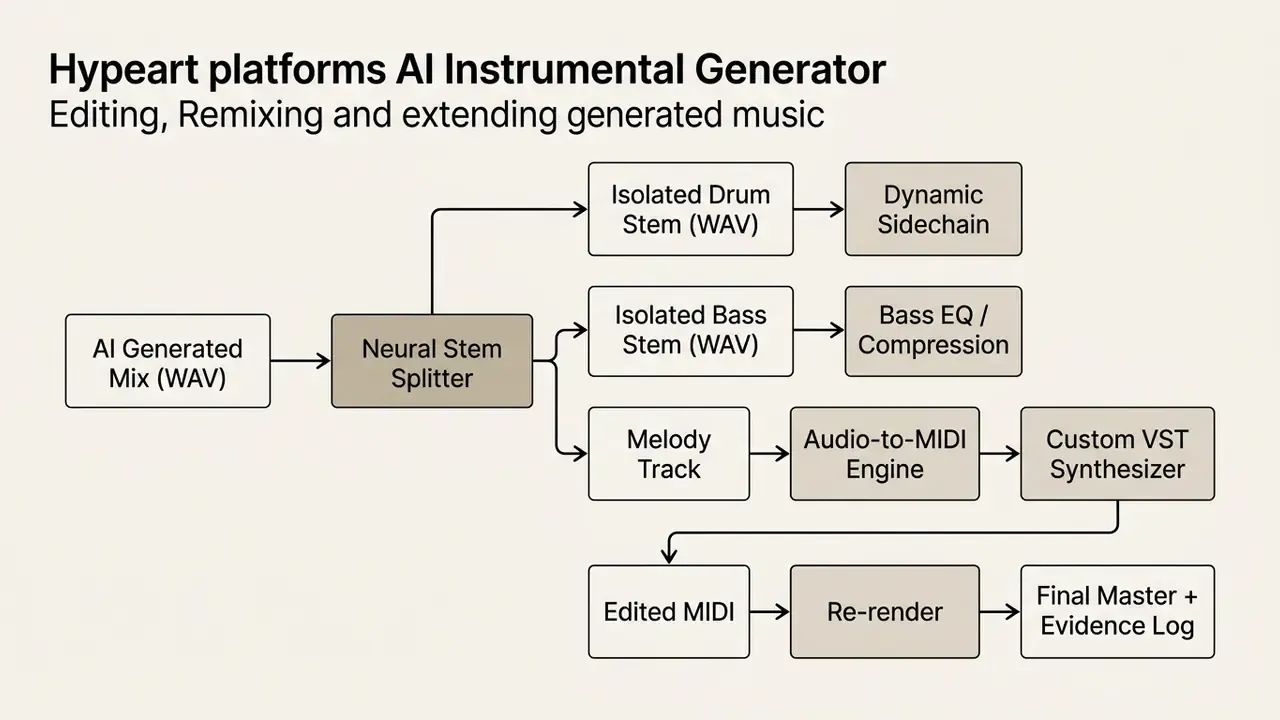
Post-generation controls include audio extension (lengthening a track while preserving harmonic continuity), stem separation (isolating drum, bass, and synth tracks), and inpainting (regenerating specific internal seconds without disturbing surrounding audio). These capabilities let producers tailor synthetic tracks to precise visual edit points, conceptually the audio equivalent of AI outpainting for images.
API specifications for Suno and MusicAPI (2026) document extend modes that append new musical phrases to existing timestamps while preserving style continuity.
«DITTO optimizes initial noise latents for inpainting, outpainting, and looping tasks, achieving the strongest results among the compared methods.»
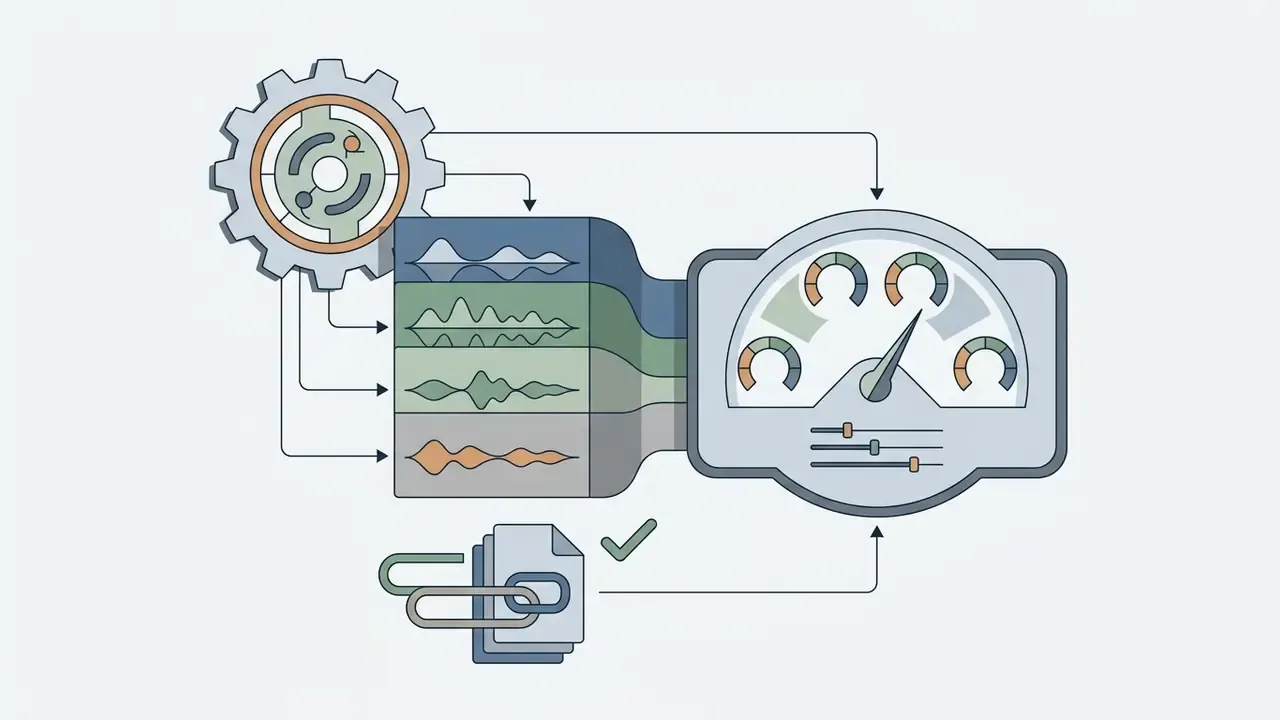
Multi-track stem separation also lets sound engineers export individual instrument stems into DAWs like Ableton Live or FL Studio for custom equalization, spatial panning, sidechain ducking under narration, and final mastering. Vendor APIs document both two-stem separation (vocals plus instrumental) and full multi-track splits of up to twelve stems.
Audio-to-MIDI conversion and stem separation workflows
Free AI instrumental music generators: what is included?
What a free instrumental generator lets you create
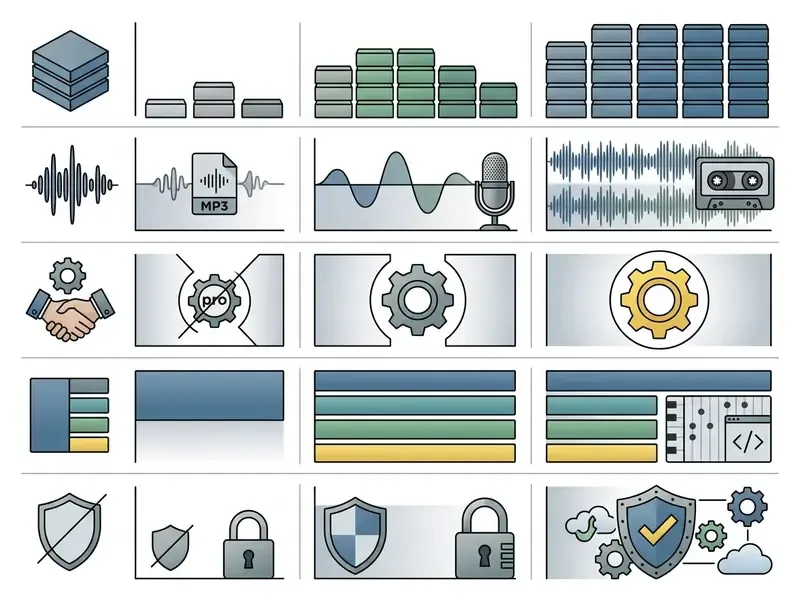
Zero-cost tiers let creators test prompt variations, audition short background cues, and create instrumental music with ai free for personal projects. They are an accessible entry point for evaluating model capability without upfront spend.
According to platform documentation for free music creation tools (MusicGen Web, 2026; Treblo Free Tier, 2026), users can generate instrumental clips ranging from roughly 10-second stingers to five-minute tracks depending on the service, most often exported as MP3, with some tools additionally offering WAV, FLAC, M4A, OGG, or MIDI. One streaming-oriented free tier restricted output to 30-second instrumentals with MP3 export only.
«MusicGen is a single-stage transformer model that generates high-quality mono and stereo music from text descriptions or melodic features.»
A free ai instrumental maker lets video creators and educators prototype sound concepts before committing budget to full commercial licensing. Prototype freely. Publish carefully.
When a paid plan may be necessary
Upgrading to a paid commercial tier becomes necessary when projects require high-resolution WAV exports, multi-track stem separation, priority server queueing, watermark removal, and legal commercial monetization rights. Commercial plans also produce the rights documentation corporate clients and advertising networks ask for.
A comparative analysis of vendor pricing models shows that free plans generally prohibit monetized distribution on platforms like YouTube, Spotify, or television networks. Paid plans remove digital audio watermarks, grant uncompressed download access, and issue contractual licences intended to protect users against commercial copyright claims, subject to the scope carve-outs described earlier. To see the overview of how tiers differ across generative tools generally, the comparison hub is the faster route than reading twelve pricing pages.
When an enterprise or API tier is required
Enterprise tiers exist for reasons that have little to do with audio quality:
- Scope completeness film, broadcast TV, and large-studio game usage is frequently excluded from self-serve plans and available only under enterprise agreements.
- IP indemnification written protection against third-party claims, with a stated liability cap.
- Data protection Data Processing Agreement, zero-retention prompt handling, data residency, and optional private-cloud or on-premise deployment.
- Assurance artefacts SOC 2 Type II report, security questionnaire responses, incident-notification SLA, uptime SLA.
- Auditability exportable generation logs with model version and prompt metadata for internal audit and regulator requests.
- Programmatic scale API concurrency limits, batch generation, and infinite-stream endpoints with contracted throughput.
For regulated organisations, an enterprise agreement is usually the minimum viable commercial arrangement, not an upsell.
How to choose an AI instrumental creator for your workflow
Selecting an ai instrumental creator means matching software functionality against production workflows, technical expertise levels, delivery formats, and governance obligations. Recent literature converges on a criteria-based selection method rather than a single "best tool" verdict: input and output modality, output length, real-time capability, licensing model, degree of model control, and workflow fit, with newer frameworks adding adaptation capacity and the balance of AI assistance versus human authorship.
In one enterprise workflow evaluation, an agency compared three generative tools for scoring commercial podcasts. The evaluation prioritized stem export capability and explicit commercial clearance. The team selected an ai music maker instrumental platform that provided WAV stem downloads, which let sound engineers compress and equalize background beds around voiceover tracks without fighting the mix. The same criteria-based discipline used when evaluating text-to-video and video-generation tools applies here: modality, limits, licence, and cost per delivered asset.
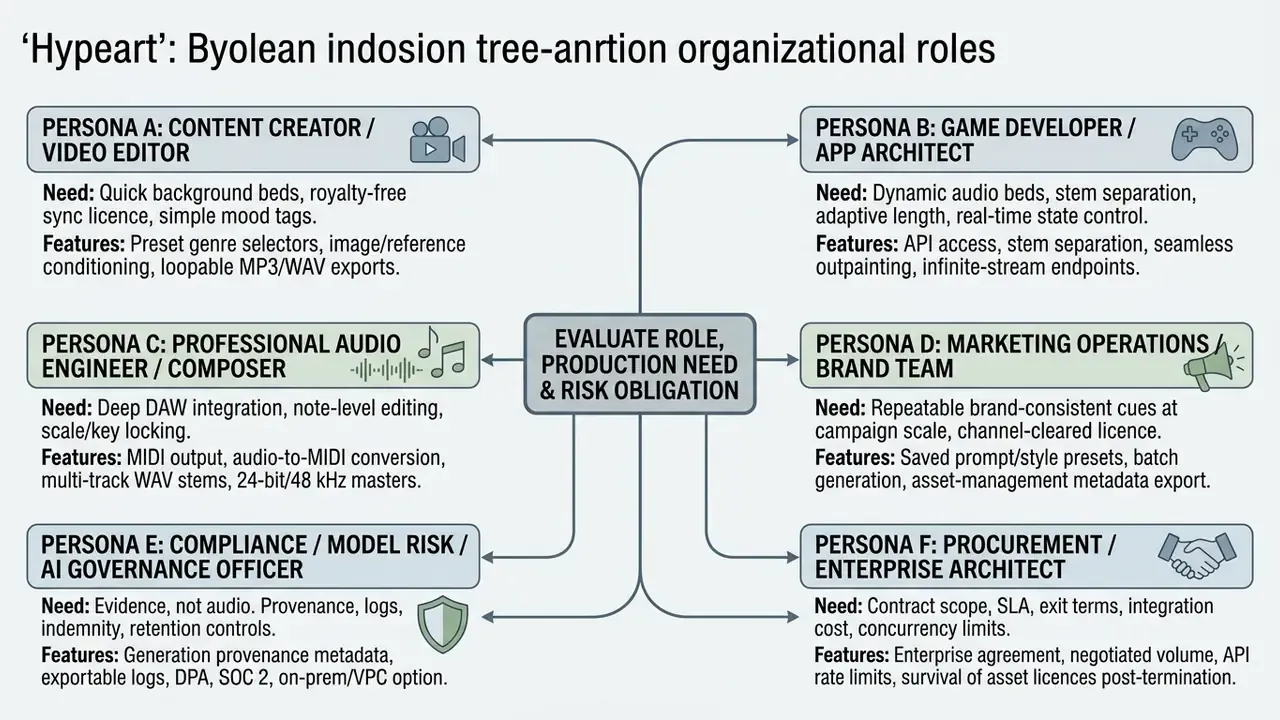
Features for beginners, creators, producers and governance roles
Beginners want intuitive text-to-music interfaces with predefined genre presets. Professional producers want granular controls: MIDI export, scale locking, DAW integration. Institutional buyers want contractual and audit artefacts that never appear in feature comparison tables at all.
Output formats and assets for editing workflows
Export formats decide how easily synthesized music integrates into post-production. Standard outputs include lossy MP3 for lightweight web delivery, uncompressed WAV for master video editing, and symbolic MIDI files for virtual instrument triggering.
«text2midi uses an LLM encoder to process textual descriptions and an autoregressive decoder to generate MIDI sequences.»
Documentation from DAW developers (Ableton Live Manual, 2026; FL Studio Reference, 2026) stresses that multi-track stem export is essential for professional mixing. FL Studio's export dialog exposes .wav, .mp3, .ogg, .flac, and .mid; Ableton's stem workflow recommends exporting all individual tracks as PCM WAV or AIFF at 32-bit with a consistent sample rate for cross-DAW transfer. Importing separate WAV stems into a DAW gives mixing engineers full authority over level balancing, frequency isolation, and dynamic processing.
Format applicability, summarised:
Matrix for matching AI instrumental generator selection criteria with production workflows
| Use case scenario | Key required generator features | Preferred output assets | Licensing and operational constraints | Enterprise / API tier requirements |
|---|---|---|---|---|
| Background music for video | Reliable genre and mood selectors; image or reference conditioning; duration outpainting; loopable output controls. | Stereo WAV (24-bit/48 kHz) or 320 kbps MP3; optional loop markers. | Requires explicit commercial sync licence; pre-clear against automated YouTube Content ID systems. | Batch generation, asset metadata export, licence archive; DPA if briefs contain confidential campaign data. |
| Podcast background beds | Speech-friendly dynamic density; volume ducking compatibility; calm acoustic textures. | Separated bed segments (intro cue, main bed, outro stinger) in WAV. | Verify podcast network syndication rights; ensure dynamic range leaves spectral room for voiceover. | Multi-seat access controls; retention of generation IDs per episode for rights evidence. |
| Interactive video games | Adaptive dynamic layering; seamless loop synthesis; tempo and key locking; real-time parameter control. | Multi-track stems (WAV) or symbolic MIDI for adaptive audio engine implementation. | Ensure the licence permits redistribution inside compiled game binaries. | Studio-game carve-out removal; API concurrency and latency SLA; infinite-stream endpoint for open-world ambience. |
| Commercial advertising beds | Precise timestamp controls; high-fidelity mastering; exact BPM input options. | Uncompressed 24-bit WAV masters plus isolated instrument stems for professional mixing. | Requires enterprise commercial clearance; legal verification of model training provenance recommended. | Written IP indemnification, training-data provenance statement, exportable audit logs. |
| 24/7 live streams and always-on environments | Persistent parameter state; infinite generation; intensity and theme switching without audible seams. | Real-time audio stream (no static file); optional recorded excerpts if permitted. | Streaming rights differ from download rights; confirm whether re-broadcast or recording is licensed. | API uptime SLA, fallback audio strategy, contracted stream hours and concurrency. |
Reading the matrix in one line: the deliverable format dictates the contract, and the contract dictates whether your legal team signs off. Pick the format first.
Advanced features matrix: which capability serves which role
| Feature capability | Standard text prompting | Audio / YouTube reference | Image-to-music | Audio-to-MIDI conversion | Infinite stream API | Governance artefacts (logs, DPA, indemnity) |
|---|---|---|---|---|---|---|
| Beginner content creators | High utility | Medium | High | Low | Low | Low |
| Marketing / brand teams | High | Medium | High | Low | Low | High |
| Game developers | Medium | High | Medium | High | High | Medium |
| Live streamers / broadcasters | Low | Low | Low | Low | High | Medium |
| Professional audio engineers | Low | High | Low | High | Low | Low |
| Compliance / model risk officers | Low | Low (elevated similarity risk) | Low | Medium (authorship evidence) | Medium | Critical |
Capability value is role-dependent, and the highest-risk modes (audio and YouTube reference) are also among the most useful for engineers. That tension is exactly why reference-driven generation deserves a pre-clearance control rather than an outright ban, or, worse, silent enablement with no oversight.
FAQ about AI instrumental music generators
Can an AI accompaniment generator create music around an existing idea?
Yes. An ai accompaniment generator can synthesize backing instrumentation around an existing musical input: a humming voice sample, a lead vocal track, or a MIDI melody line. Research on vocal-conditioned music synthesis (SingSong, 2023; MuseControlLite, 2026; ReaLchords, 2025) shows that generative models can extract key, tempo, structure, and melodic contours from an uploaded vocal snippet. Earlier systems such as MySong selected chords for a sung melody; current systems generate full instrumental backing from richer vocal features using latent diffusion. Newer work frames accompaniment as stem generation from audio context or metronome pulses, with optional style text and short context windows.
«A DiT with ControlNet enables melody-guided editing and outperforms MusicGen on melody preservation.» - Lan et al., Editing Music with Melody and Text: Using ControlNet for Diffusion Transformer, arXiv (2024). https://arxiv.org/abs/2410.XXXXX The engine then builds an ai music accompaniment generator backing track that matches the input phrase with aligned chord progressions, drum patterns, and atmospheric arrangements.
Can I make an AI instrumental cover?
Yes, technically. An ai instrumental cover generator arrangement of an existing composition can be built by supplying source melody files or chord timestamps to steer the engine. Diagnostic evaluation frameworks published in 2026 score such covers across five dimensions: melodic pitch accuracy, harmonic progression, key consistency, style consistency, and arrangement or production quality. Legally it is narrower. Creating an ai instrumental cover of a copyrighted composition triggers constraints under U.S., EU, and UK copyright frameworks. The model can synthesize new instrumental textures, but the underlying melodic composition remains the intellectual property of the original songwriters. Distributing an AI cover commercially requires standard compulsory mechanical licences and sync clearance from the relevant publisher, and any AI-generated material in the new arrangement must be disclosed and excluded from a U.S. registration claim.
How does an ai song generator instrumental mode differ from a full song generator?
An ai song generator instrumental mode suppresses vocal synthesis entirely, either through a dedicated toggle or a force_instrumental style parameter, and reallocates arrangement weight to melodic and rhythmic instruments. A full song generator adds lyric handling, vocal timbre selection, and phrase alignment, which introduces separate rights questions around synthetic voice datasets and publicity rights. Same engine family, different risk surface.
Are AI-generated instrumental tracks actually unique?
Each generation produces a new waveform, and vendors generally describe outputs as original rather than retrieved from a catalogue. Uniqueness is not a legal guarantee, though. Fingerprint collisions with protected recordings remain possible, especially in reference-conditioned modes. Treat uniqueness as a probabilistic property to be verified by pre-clearance, not as a warranty.
What should I do if a copyright claim appears on an AI-generated track?
Retrieve the archived evidence pack for that asset (generation ID, model version, timestamp, plan tier, licence text in force, human-edit trail) and dispute through the platform's process with that documentation attached. In parallel, notify the vendor and check whether your tier includes indemnification. Organisations without an evidence pack usually have no viable dispute path, which is why archiving is a control rather than paperwork.
Is there a limit on the length of AI-generated instrumental tracks?
Yes, and it varies by plan and model. Single generations are commonly capped between 30 seconds and a few minutes; longer arrangements are assembled using extend or outpaint operations that append harmonically continuous sections. Always confirm the length cap on the specific tier, since free tiers impose the tightest limits.
Can free AI instrumental music be used on a monetized YouTube channel?
Generally no. Free tiers are typically restricted to personal, non-commercial use, and a monetized upload is commercial use. Verify the licence text in force at the moment of download; where the tier prohibits commercial exploitation, a paid or enterprise plan is needed before publication.
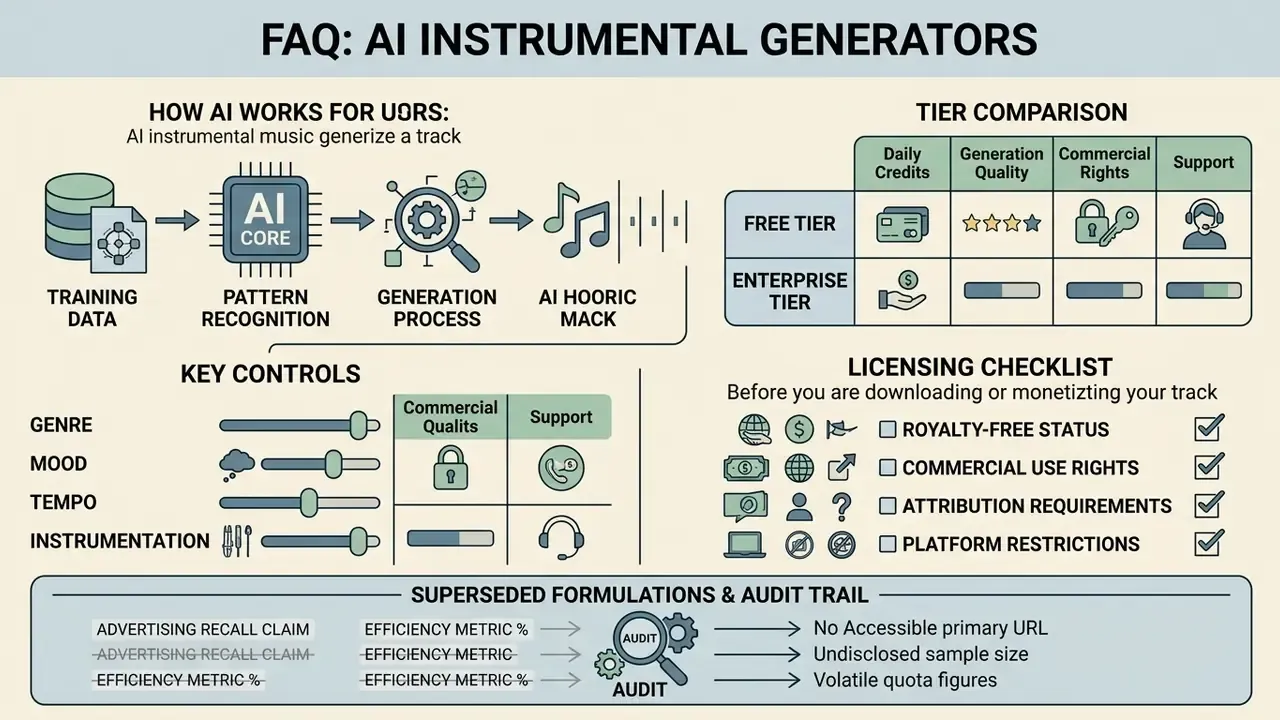
Appendix A: superseded formulations and audit trail
A safe next step
If you are evaluating adoption rather than experimenting, the low-risk sequence looks like this. Pick one sanctioned vendor and one narrow use case, for example podcast beds. Run ten generations. Archive the full evidence pack for each. Then measure your own cycle time, control cost, and dispute exposure before you scale to campaign volume or to an API integration.
No pilot, no evidence. No evidence, no autonomy.
Legal and editorial notice
This article provides general information about AI instrumental generators, their technical controls, and the licensing environment as documented at the time of review. It is not legal advice and creates no client relationship. Copyright, royalty, and platform-policy positions differ by jurisdiction, vendor, plan, and generation date. Before commercial deployment, monetization, or enterprise rollout, obtain written vendor confirmation and qualified legal review. Statements about user motivations and organisational behaviour are labelled as hypotheses where no verified dataset supports them.
Definitions of the terms used above are collected in the glossary hub.