Executive Summary
- What it is an AI influencer generator is a multi-model production stack (text-to-image diffusion, image-to-video synthesis, neural TTS, lip-sync) that creates and maintains one persistent synthetic persona across posts, videos, and campaigns.
- What makes it work identity consistency. Reference conditioning, LoRA adapters, ArcFace-style identity losses, and training-free methods such as ConsiStory or CoDi separate a reusable brand asset from a face that drifts every generation.
- What makes it scale motion transfer (pose-driven animation from a reference video), product placement workflows (inpainting, depth-aware blending, IP-Adapter), and batch generation for A/B testing 20 to 100 creative variations per run.
- What makes it defensible institutional controls. Synthetic personas belong in the model inventory, with logged prompts, versioned weights, fixed seeds, human-in-the-loop sign-off, and disclosure metadata. That is the same evidentiary logic that Federal Reserve/OCC SR 11-7 applies to model risk, and that NIST AI 600-1 (Generative AI Profile, July 2024) organizes as Govern, Map, Measure, Manage.
- What creates liability undisclosed synthetic endorsement (FTC, EU AI Act Article 50, ASCI), unlicensed likeness cloning (state right-of-publicity law), uncontrolled uploads of biometric or customer data into consumer-grade tools (GLBA, SOC 2 scope gaps), and Shadow AI usage by marketing teams outside approved vendor channels.
This guide moves from definitions to the creation workflow, then governance and model risk, identity consistency, image versus video (including motion transfer), tool selection with enterprise criteria, pricing, commercial use and ownership, limitations, and a verification log.
Regulatory and legal material here is general information, not legal advice, and does not replace counsel qualified in your jurisdiction.
What Is an AI Influencer Generator?
An AI influencer generator is a software platform or framework that combines generative models, including text-to-image diffusion, image-to-video synthesis, and neural speech engines, to create and maintain a consistent synthetic social-media persona. Unlike a one-off avatar creator, an AI influencer creation platform manages an enduring digital identity across sequential posts, videos, and multi-channel campaigns. Vendors market the same category under several labels: ai influencer maker, ai influencer model generator, ai influencer generator app, or simply an ai influencer generator website with a browser interface and no local GPU.
That framing matters commercially, not only philosophically. Once a synthetic persona speaks for a regulated institution, it becomes a communication channel with owners, controls, and audit expectations. Not a creative experiment.
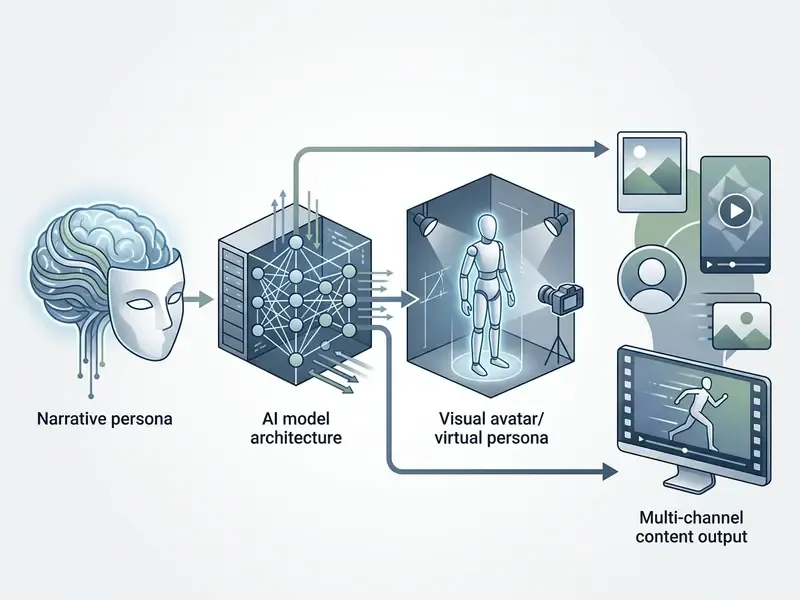
AI influencer, virtual avatar, and AI model: key differences
An AI influencer is a synthetic social-media entity with a defined visual identity, a distinct voice, and a structured posting strategy managed by a brand or creative team. A virtual avatar is the rendered visual layer of that persona. The AI model is the underlying neural engine, for example a fine-tuned diffusion model or a large language model (LLM), that computes pixel distributions, speech patterns, and text outputs.
In enterprise marketing and brand governance, the persona is the character layer above all of it: a named identity with a consistent backstory, demographic profile, and tone of voice. Research on virtual influencer marketing suggests this layer produces a measurable trade-off rather than a uniform uplift.
"Virtual influencers generate significantly higher perceived novelty, but underperform human influencers on credibility, brand attitude, and behavioural intention."
Broader "digital influencers" may include human digital clones built from a real person's likeness. An AI influencer is typically a fully synthetic entity designed to operate without a physical double. That distinction is legally material: cloning a real face or voice triggers consent and right-of-publicity obligations that a imaginary persona does not.
What an AI influencer creation platform can generate
Modern platforms synthesize static images, animated video clips, audio tracks, and contextual post captions. They support text-based generation (a persona built from written prompts) and image-based workflows (a persona built from uploaded reference photographs).
Core outputs include:
- High-resolution portraits static images in varied outfits, settings, and lighting, the same output class covered in our overview of AI art generators.
- Talking characters clips with synchronized lip motion driven by synthetic speech or uploaded audio.
- Motion assets short-form reels in 9:16 for Instagram Reels, TikTok, and YouTube Shorts.
- Pose-driven animation movement copied from a reference video onto the locked character (motion transfer).
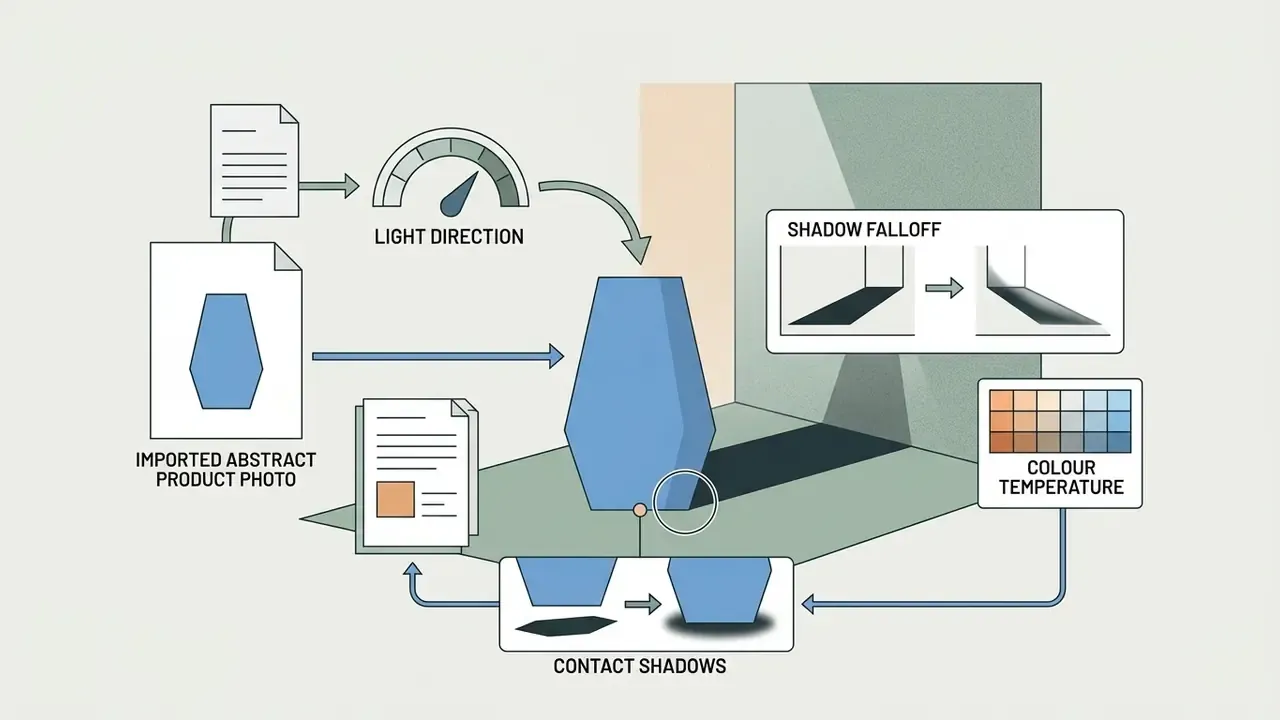
- Product-integrated scenes frames where a real SKU, package, or prop is composited into the character's hands with matched lighting.
- Multilingual dialogue synthetic voice tracks localized into several languages while preserving character pitch and accent.
- Stylized and game-adjacent assets low-fidelity or engine-styled variants, the territory shared with a minecraft pixel art generator when a persona needs a non-photoreal alter ego.
Governance First: Risk Tiering, Model Risk Management, and Shadow AI Controls
Before any prompt is written, an enterprise deployment needs an ownership model. Synthetic influencers are generative models producing public-facing statements. In banking, insurance, and fintech environments they touch model risk management, marketing compliance, vendor risk, and data protection simultaneously.
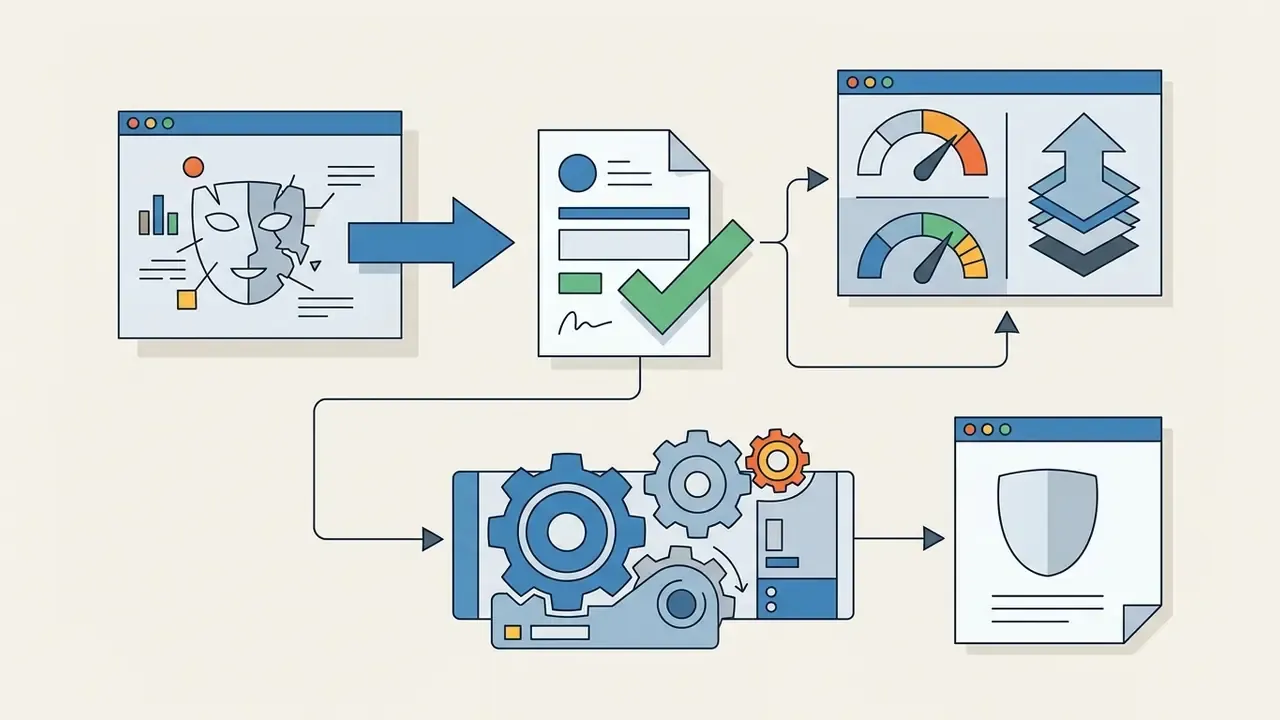
Framework alignment. NIST's Generative AI Profile (NIST AI 600-1, July 2024) organizes generative-AI risk into four functions, Govern, Map, Measure, Manage, across twelve GAI risk categories and the full lifecycle from development to decommissioning. Supervisory expectations under SR 11-7 add a second layer: documented development records, independent validation, ongoing monitoring, and a complete model inventory. A synthetic persona pipeline satisfies both when its artifacts are reproducible. Not when the output "looks approved."
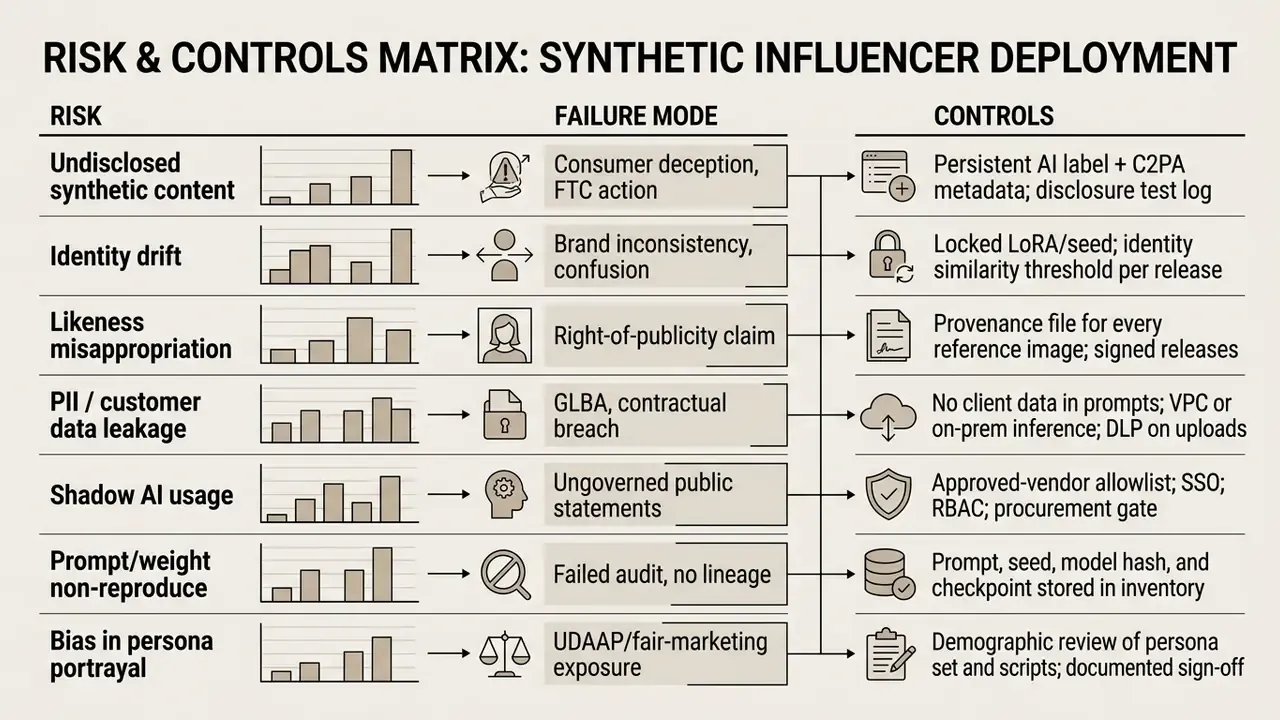
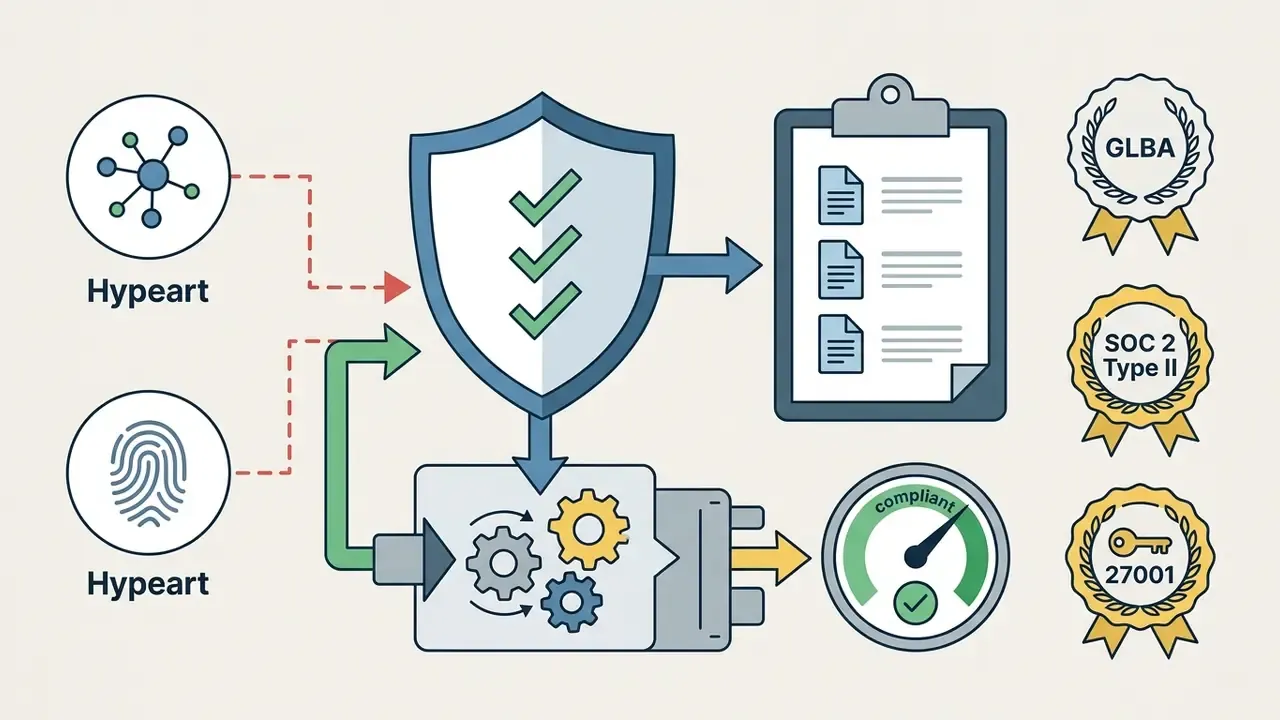
Shadow AI is the most common failure in practice. A marketing sub-team uploads employee or client photographs into a consumer tool with no data-processing agreement, no retention limit, and terms permitting model training on submitted content. An allowlist plus SSO-gated access converts that exposure into a controlled procurement decision. Cheap fix, oddly hard to sell internally.
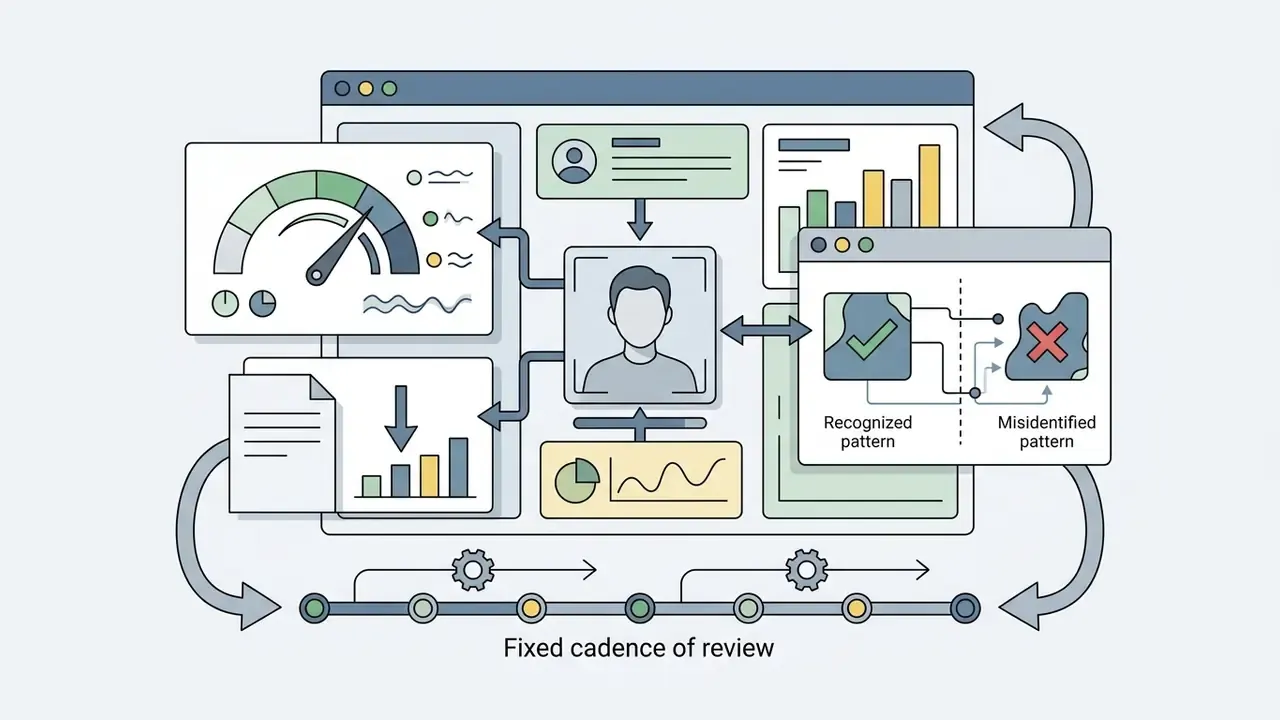
One more governance nuance that teams underestimate: escalation ownership. If a synthetic persona posts an unapproved product claim on a Friday evening, who can pull it down within an hour? Write that name into the persona sheet, with a phone number, not a mailbox.


How to Create an AI Influencer Step by Step
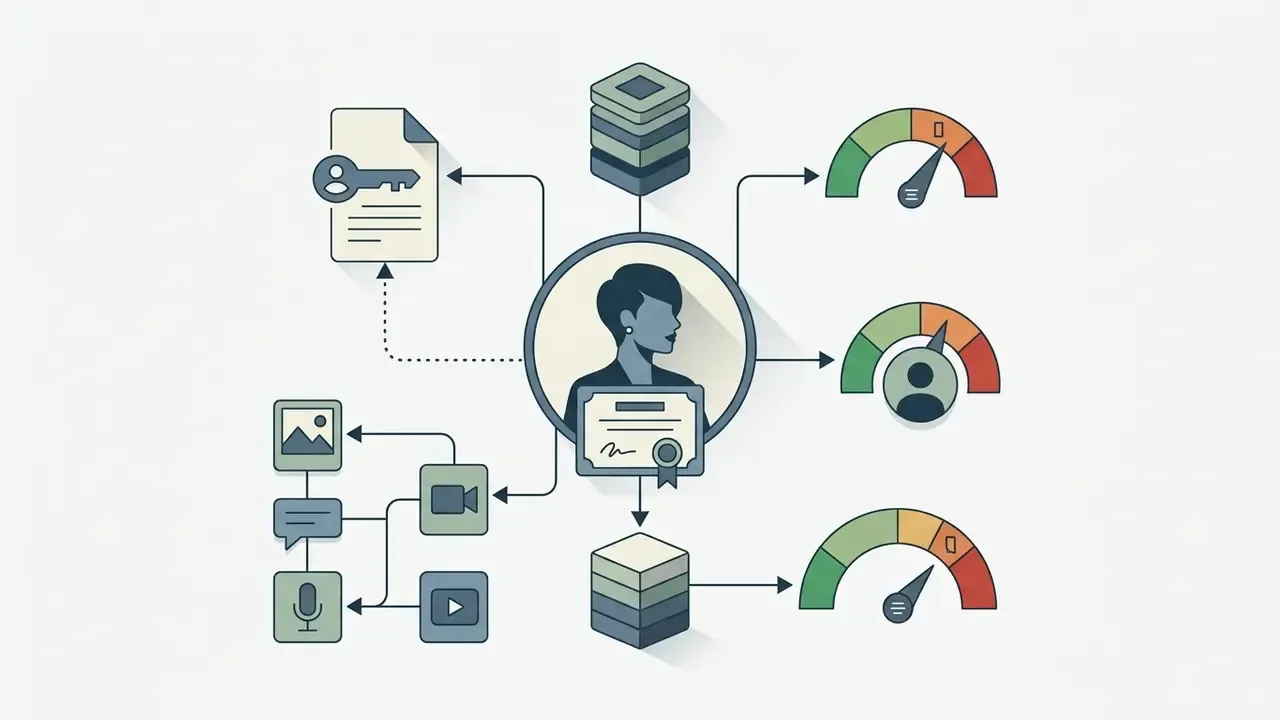
An ai influencer creation workflow is sequential: define persona traits, engineer targeted prompts, generate candidates, refine visual parameters, then store model checkpoints for future deployment.
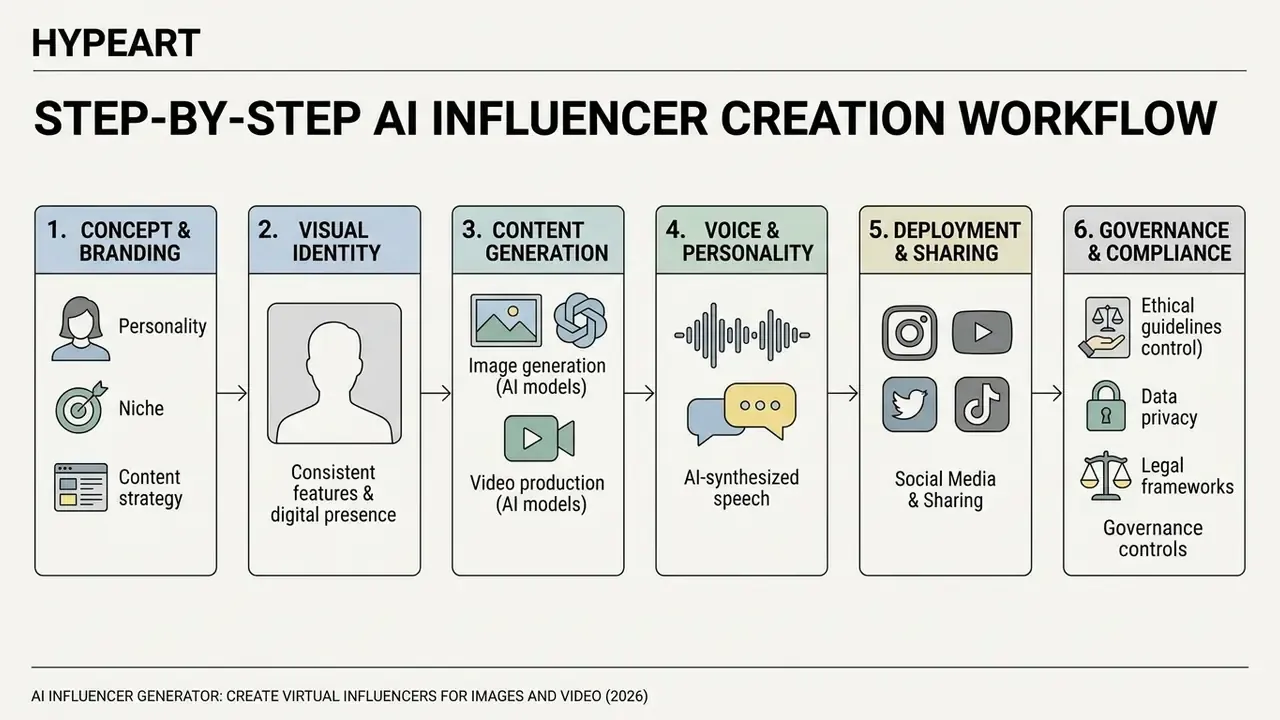
- Persona definition
- demographic parameters, vocal characteristics, visual style, compliance boundaries.
- Visual system design
- generate or upload canonical reference images to lock facial geometry.
- Prompt engineering
- structured prompts specifying subject, pose, environment, technical parameters.
- Iterative generation
- multiple candidates through diffusion or image-to-video pipelines.
- Quality assurance
- inspect outputs for identity drift, anatomical artifacts, disclosure compliance.
- Asset export and archiving
- save final media, export model state or LoRA weights for reuse.
Define the persona, face, and character traits
Consistency starts before the first render. Outline the persona's age, styling, emotional register, tone of voice, and brand positioning, then freeze that sheet.
Academic work on virtual influencer perception indicates that facial attractiveness, emotional expressiveness, and skin distinctiveness shape audience response and downstream intent.
"Perceived attractiveness of a virtual influencer influences purchase intention through trust and aesthetic appeal mechanisms."
To avoid audience fatigue, balance photorealism with clear artistic choices. Defining traits early prevents visual drift across future runs and gives compliance reviewers a fixed reference for what "on-persona" means. For institutional deployments, the persona sheet should also record what the character will never do: no financial advice, no product claims outside approved copy, no political commentary. Write the prohibitions first. They are easier to audit than aspirations.
Write prompts for appearance, scenes, and actions
Effective prompts use modular structures that separate subject appearance, environment, camera framing, lighting, and camera movement. Standardized prompt blocks improve model compliance across batch generations, which is exactly what an ai influencer prompt generator library is for.
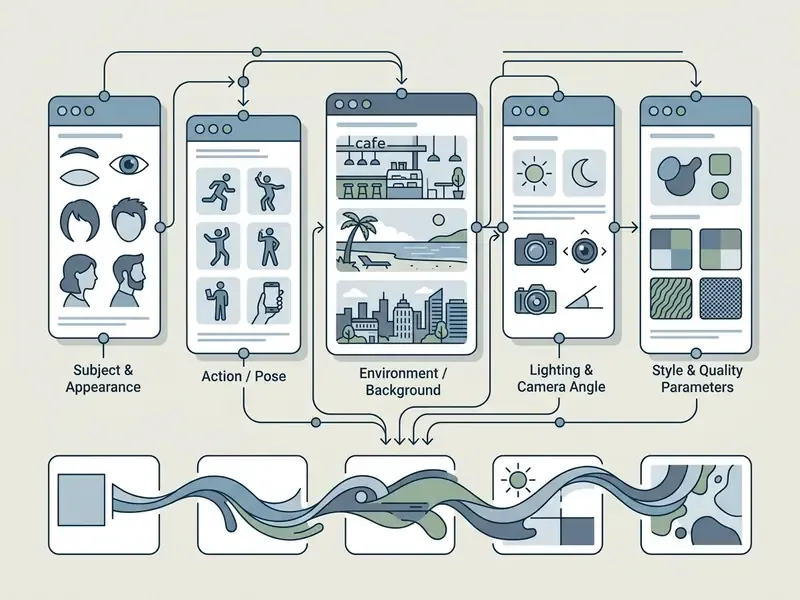
For imagery, a prompt such as "photorealistic portrait of [persona_id] standing in a brightly lit modern architecture studio, wearing a dark navy blazer, medium close-up shot, 85mm lens, natural daylight, subtle bokeh" yields predictable lighting and composition.
Micro-detail tuning to avoid the uncanny valley. Plastic, over-smoothed skin is the fastest way to lose viewer trust. In the [Style & Quality Parameters] block, add texture-level modifiers:
subtle skin pores, natural skin imperfections, fine vellus hair, visible skin texture, realistic mole detail, asymmetrical facial expression, slight under-eye shadow, raw photography, shot on 35mm film
Avoid tokens that push models toward glossy renders: smooth skin, flawless, perfect face, unreal engine, hyper-detailed, photorealistic 8k. Emotional micro-states follow the same logic. A tear line, a scar, a shifted posture, or a half-smile carries more narrative weight than a generic "happy" descriptor. Keep an approved modifier library so every operator reproduces the same skin and lighting signature for the persona.
Generate, refine, and save the first content
The first generation pass produces candidates for one master reference portrait. Evaluate them against target parameters and filter out anatomical distortions, inconsistent lighting, or identity artifacts.
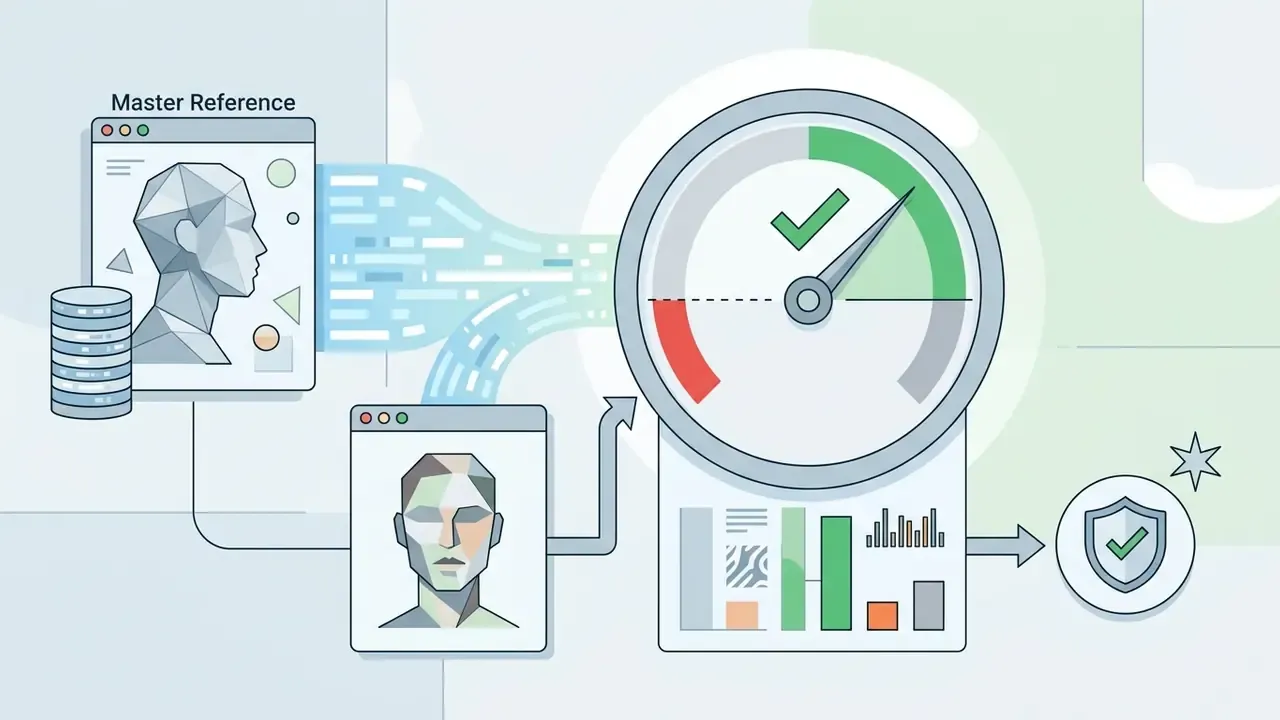
Once the master image is approved, it becomes ground truth for every later generation. Archive custom weights, LoRA adapters, and seed values to maintain consistency and, in a regulated environment, to make each published asset reproducible on demand. Before publishing, apply post-processing: colour grading, resolution upscaling, watermarking where required. For video-specific implementation, teams can review the Google Veo API implementation guide covering capabilities, quotas, and developer costs, or view the guide hub for adjacent model endpoints. Motion-model options such as a minimax ai video generator are worth benchmarking in the same pilot window.
Scale with batch generation and A/B-tested scripts
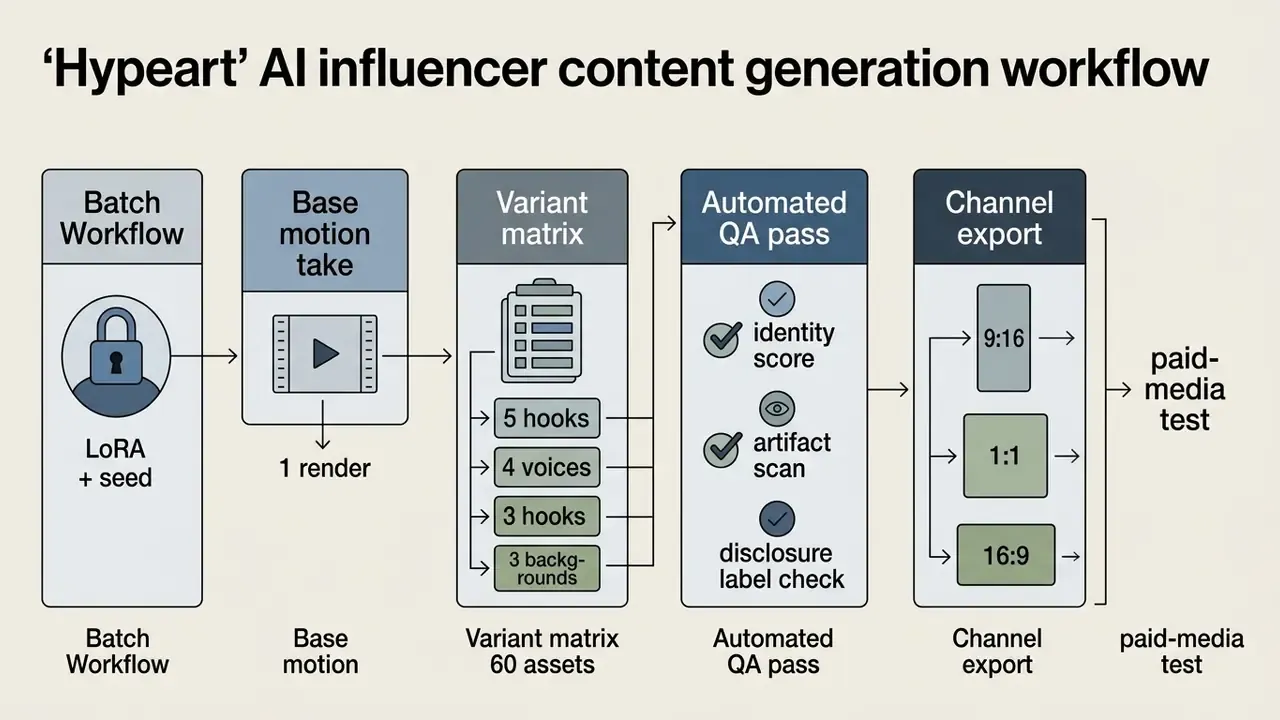
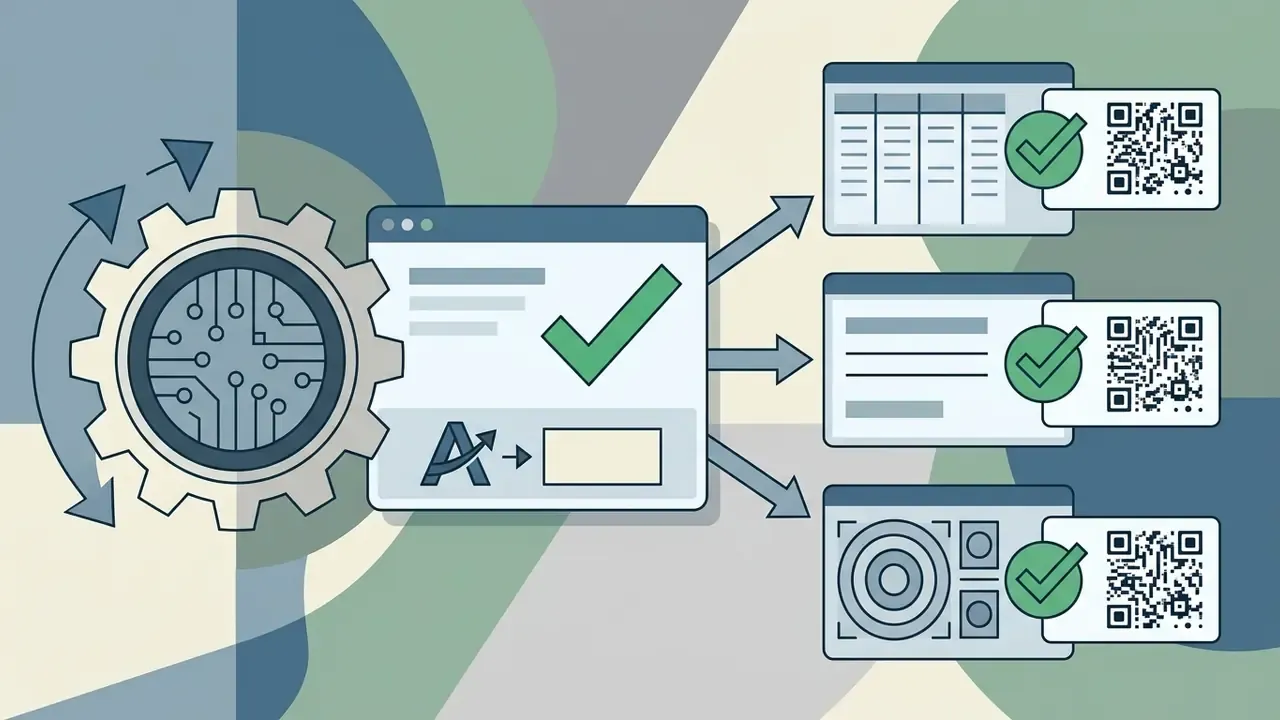
A single run of 20 to 50 variations isolates which opening line, voice timbre, or setting drives conversion in TikTok Ads or Reels, instead of guessing from one creative. Two governance requirements apply at this volume. Every variant must inherit the disclosure label automatically, and the batch manifest (prompt, seed, script version, reviewer) must be stored as one audit record rather than fifty loose files. Teams assembling and compressing large variant batches for delivery can review workflow options in the video compressor guide; lighter editing stacks are covered in the movie maker free overview.
How to Create One Consistent AI Influencer Across Content
Facial consistency across generation cycles requires locking geometry, skin texture, and core features through reference conditioning, fine-tuned sub-models, or face-embedding losses. This is the core capability that separates a serious ai influencer creation tool from a novelty app.
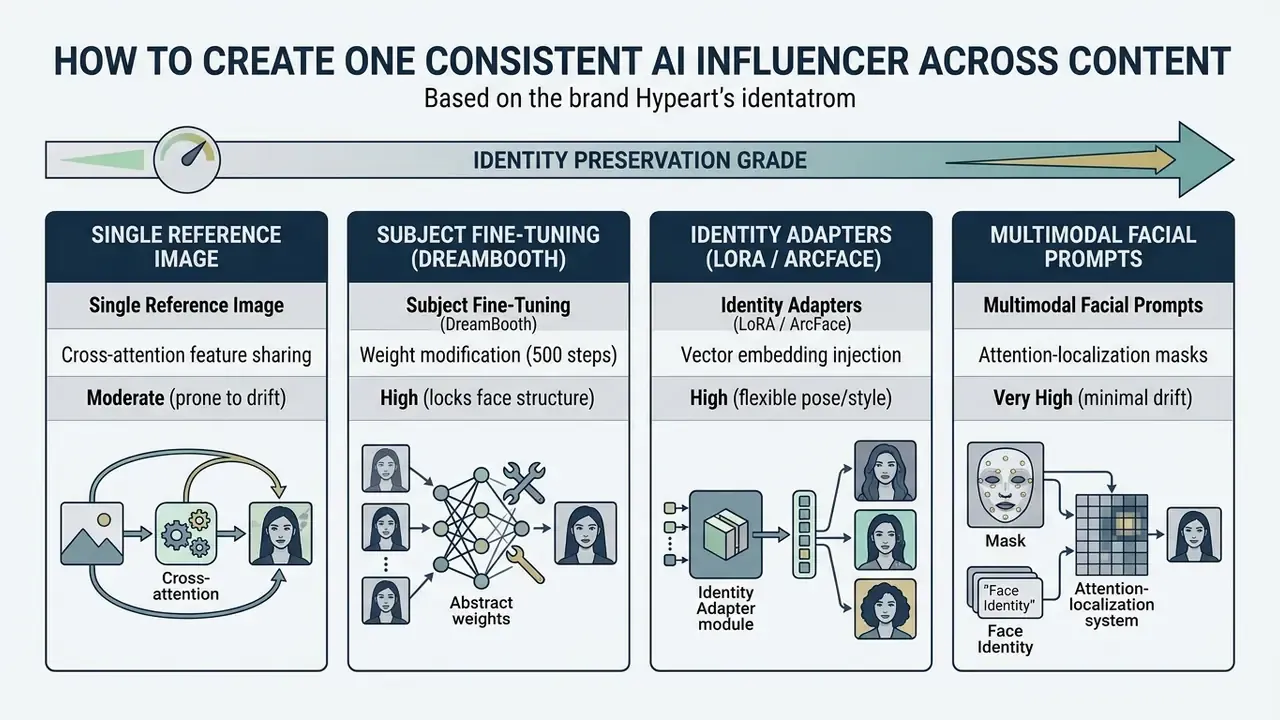
Verify these capabilities per platform. Marketing pages describe "consistent characters" loosely; what matters is whether the tool exposes seed control, reference slots, and adapter export.
Multi-subject scenes, a character holding a product or two personas in frame, are a separate technical problem from single-face consistency.
Lock the face, style, and core persona traits
Facial drift happens because text-to-image diffusion models use stochastic noise and random sampling seeds. Without explicit conditioning, the same prompt returns a visually different face.
To lock features, platforms use identity-preservation frameworks such as ArcFace loss functions, face-parsing attention masks, or ConsistentID blocks (arXiv: ConsistentID, 2024). These compute facial vector embeddings during generation and force alignment across poses, lighting conditions, and camera angles.
"CoDi achieves state-of-the-art results on CLIP-I, DINO-v2 and DreamSim metrics while preserving pose diversity at high subject-identity stability."
For audit purposes, record the identity threshold you accept. A documented embedding-similarity floor turns "the face looks right" into a testable control. That single line converts a creative preference into evidence.
Use reference images and trained models for consistency
Reference image sets and fine-tuned Low-Rank Adaptation (LoRA) models give more identity stability than text prompts alone. Training a custom LoRA on 10 to 20 reference images locks face geometry into the model's latent space, and personalization research reports that instruction-following fine-tuning improves both fidelity and controllability.
With a fine-tuned model, operators can vary background scenery or clothing while the target face stays constant. Training-free alternatives transfer subject features across image batches during sampling, which cuts setup time for new characters.
AI Influencer Image Generator vs Video Generator
An ai influencer image generator produces high-resolution static portraits for feed posts and product placements. A video generator adds temporal animation, speech synthesis, lip-sync, and body movement. Teams evaluating the static side can start from our comparison of free AI art generators and scale up.
| Metric / Parameter | AI Influencer Image Generator | AI Influencer Video Generator |
|---|---|---|
| Primary Inputs | Text prompts, single reference photos | Reference images, audio files, text scripts, reference videos |
| Primary Outputs | PNG/JPEG static images | MP4 vertical videos (9:16) |
| Identity Stability | Very high (LoRA / ArcFace) | High (needs motion consistency models) |
| Lip-Sync & Audio | Not applicable | Supported (viseme-guided rendering) |
| Motion Control | Pose reference only | Full motion transfer from reference video |
| Generation Time | 2 to 10 seconds per image | 1 to 15 minutes per clip |
| Primary Use Cases | Editorial posts, lookbooks, banners | TikTok, Reels, Shorts, video explainers |
Read the table as a cost curve, not a quality ranking. Images cost cents and minutes; video costs credits and review time.
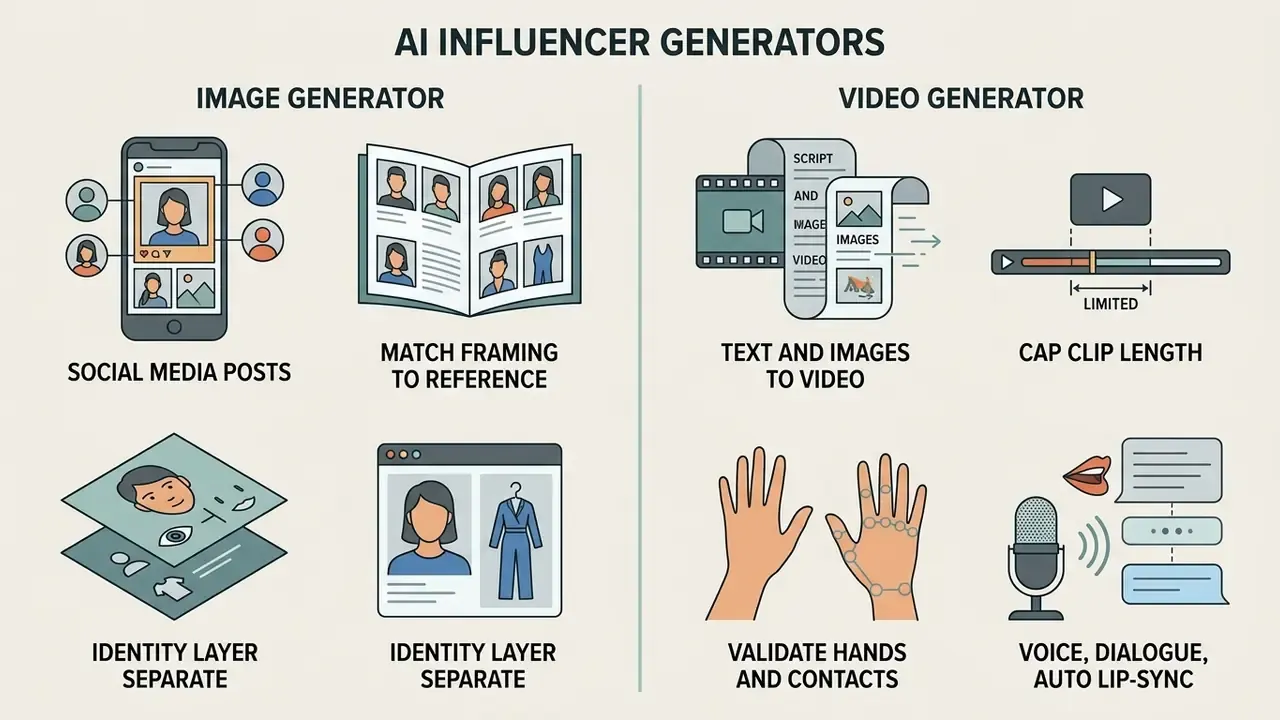
Turn text and images into AI influencer videos
Image-to-video and text-to-video engines turn static influencer assets into motion. Advanced models use explicit motion modeling and first-frame conditioning to suppress temporal flickering and hold subject identity frame by frame. NVIDIA's Motion-I2V (2024) and CVPR 2024's Animate Anyone both target consistent, controllable character animation, while 2024 benchmark work scores image-to-video on subject consistency, background consistency, temporal flickering, motion smoothness, and dynamic degree.
These tools animate facial expressions, add subtle body motion, or change background scenery while the character's core features survive.
Motion transfer (pose-driven generation). To make an AI influencer reproduce a specific movement, a trending dance, a walk cycle, a gesture sequence, use a video reference instead of text. Pose-extraction pipelines such as ControlNet OpenPose, AnimateDiff motion modules, and the motion-control features in models like Kling extract a skeletal mesh from the uploaded clip and map it onto your locked character. Practical rules:
This is the fastest route to trend participation: the choreography is copied, not learned, and the persona stays visually identical across every trend cycle. Loop-based formats behave similarly; the mechanics overlap with a minecraft parkour video generator, where motion templates carry the format and the character rides on top. Final assembly, captioning, and channel delivery then run through a standard editing pipeline such as the one in our YouTube video editor workflow guide.
Add voice, dialogue, and automatic lip-sync
Audio for synthetic video means coupling neural text-to-speech (TTS) with viseme-aligned lip-sync models. Research systems illustrate two dominant paths. Speech2Lip (ICCV 2023) drives lip motion from speech audio through a decomposition, synthesis, composition framework with a contrastive sync loss. Text2Lip (2025) generates lip-synced talking faces directly from text via viseme-guided rendering in audio-free and audio-present modes. AV-Flow (2025) extends this to text-only animation of photorealistic 4D talking avatars, including expression and head pose.
"Synthetic voice engines allow virtual influencers to preserve character timbre and accent while localizing content into multiple languages."
Multilingual voice cloning therefore lets one persona present content in several languages while keeping vocal identity. Accuracy still varies by language set and architecture, so per-language QA remains necessary. Sibilants and tonal languages tend to expose the weakest lip-sync. Teams selecting a speech layer can compare capabilities, language coverage, and licensing in the AI voice generator guide.
How to Choose the Best AI Influencer Generator Tool
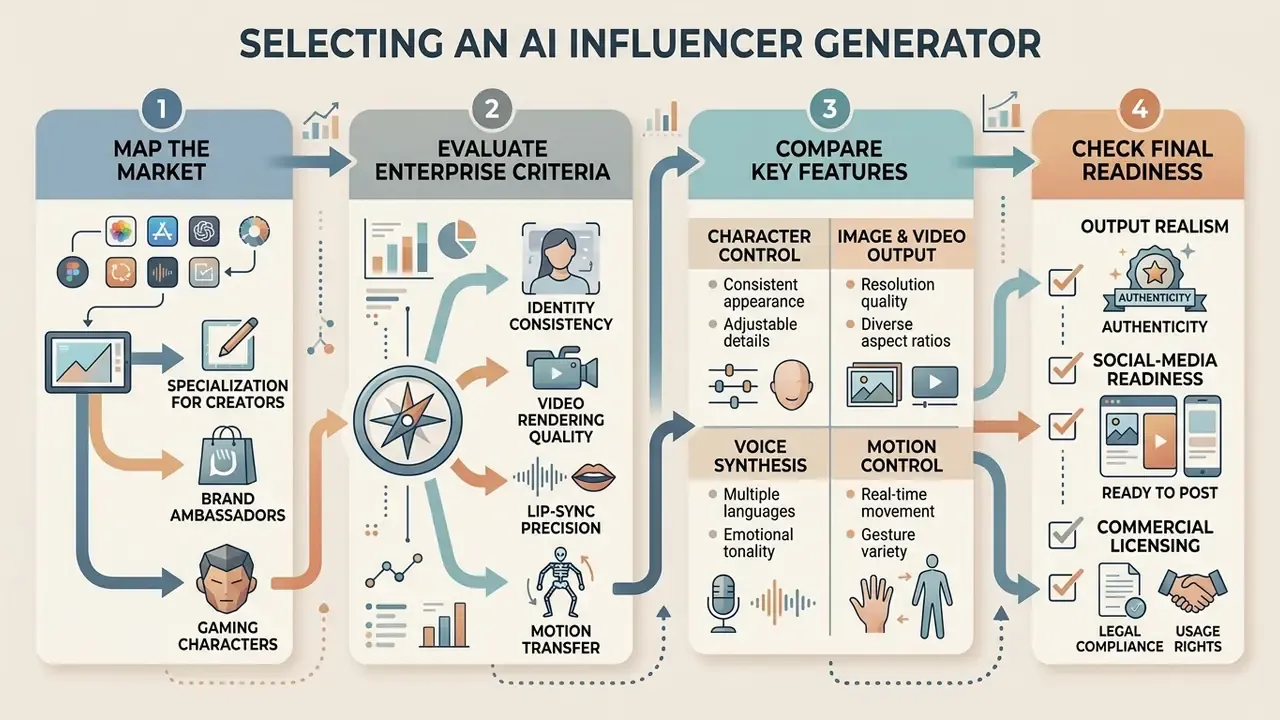
Selecting an ai influencer creation platform means testing identity consistency mechanisms, video rendering quality, lip-sync precision, motion control, commercial licensing rights, and API support. Budget-constrained teams can also review the free AI video generator comparison for duration limits, credits, and watermark policies.
| Business Goal | Recommended Feature Set | Key Platform Evaluation Metrics |
|---|---|---|
| Social content creation | Static image batching, pose control | High identity consistency, flexible styling |
| Short-form video (Reels/TikTok) | Lip-sync, 9:16 output, TTS | Render speed, natural motion, voice alignment |
| Brand marketing and ads | High-res export, custom LoRA support | Commercial usage rights, clear licensing |
| Gaming and virtual characters | Reference motion transfer, 3D asset support | Pose flexibility, multi-scene stability |
Map the market by specialization
Generic feature lists hide the fact that platforms optimize for different jobs. Use task categories instead of brand rankings.
| Task category | Representative platforms | Defining capability |
|---|---|---|
| Motion transfer and viral reels | Higgsfield, Kling AI | Transfers movement from a reference video onto a locked character |
| Performance video ads at scale | Creatify, JoggAI | Ad creative from a product URL or script, with A/B variants |
| Enterprise and multilingual video | Synthesia, HeyGen | 120+ languages, consent-gated avatars, corporate templates, API access |
| All-in-one persona control | ZenCreator, Fotor | Face generation, batch variants, face swap, lip-sync in one interface |
| Talking-head from a still image | D-ID, Veed Fabric, VisionStory | Photo plus audio to speaking video, lowest input requirement |
Documented input requirements differ in ways that affect procurement. Synthesia builds personal avatars from a single photo or video with a stated 24-hour turnaround and requires four videos for studio avatars. HeyGen creates avatars from footage, a single photo, or a text prompt, with consent flows required for digital twins but not for prompt-generated characters. ElevenLabs recommends 3 to 5 reference images for reusable avatar identities. Azure AI Speech outputs avatar video at 1920x1080 and 25 FPS for batch and real-time synthesis. Verify each figure on the vendor's current documentation before it enters a business case.
Enterprise evaluation criteria beyond output quality
For regulated buyers, the vendor questionnaire matters more than the demo reel.
| Criterion | Consumer tools | Enterprise requirement |
|---|---|---|
| Data use | Submitted content may train shared models | Contractual no-training commitment on customer data |
| Deployment | Multi-tenant SaaS only | VPC, private endpoint, or on-premises option |
| Certifications | Often none published | SOC 2 Type II, ISO 27001, penetration-test summary |
| Access control | Single shared login | SSO, SCIM provisioning, RBAC, per-project isolation |
| Retention | Indefinite or unclear | Configurable retention and verified deletion |
| IP protection | Broad disclaimers | Written commercial licence and IP indemnification |
| Auditability | No export of parameters | Prompt, seed, and version logs exportable for validation |
| Provenance | Optional watermark | C2PA-compatible metadata and persistent labeling |
Independence from a single AI platform belongs on that list too. If the persona's identity lives only inside one vendor's proprietary avatar format, a pricing change becomes a brand continuity problem. Exportable adapters and archived reference sets reduce that lock-in.
Features to compare: character control, image, video, and voice
When evaluating options, technical teams should test how reliably a system holds identity across hostile prompts. Check reference-slot capacity, multi-angle camera handling, voice cloning, motion-reference duration limits, upload size caps, and export resolution.
Documented constraints vary widely. Some lip-sync APIs cap uploads at 20 MB and accept video or image plus audio or text. Some motion-reference features accept 3 to 8 second character clips. Some lip-sync engines take a 2 to 10 second source video with up to 60 seconds of audio and report roughly 12 minutes of processing per job. Platforms with granular controls, adjustable guidance scales, facial attention masks, seed control, and typed reference slots for subject versus background, give creators more influence over output. To benchmark categories side by side, review our AI Media Comparison overview.
Choose a tool for creators, brands, and gaming characters
Individual creators optimize for generation speed and low running costs. Enterprise brands need security controls, data privacy protection, and clear commercial licensing. Different questionnaires entirely.
Interactive and character-driven use cases add a constraint: pose flexibility and motion transfer must survive scene changes without identity loss. That is the core requirement in ai gaming influencer creation, where a mascot appears across cinematics, stream overlays, and stylized assets. Photo-first tools such as a momo ai photo generator cover the portrait layer but not sustained multi-scene motion, so most gaming teams end up combining two stacks.
"Consistent character generation is critical for advertising, game development and asset design; users struggle to produce visually stable characters in standard diffusion models."
For financial-services communications specifically, the highest-value scenarios are not trend content. They are controlled explainers: product onboarding walkthroughs, multilingual customer education, internal policy training, and branch-staff enablement video, where the persona cuts reshoot costs and keeps scripted claims identical across languages. Measurable, boring, defensible.
Check output quality, realism, and social-media readiness
Output must meet platform specifications: vertical 9:16, minimal compression artifacts, fluid movement, and 1080x1920 minimum resolution for short-form channels.
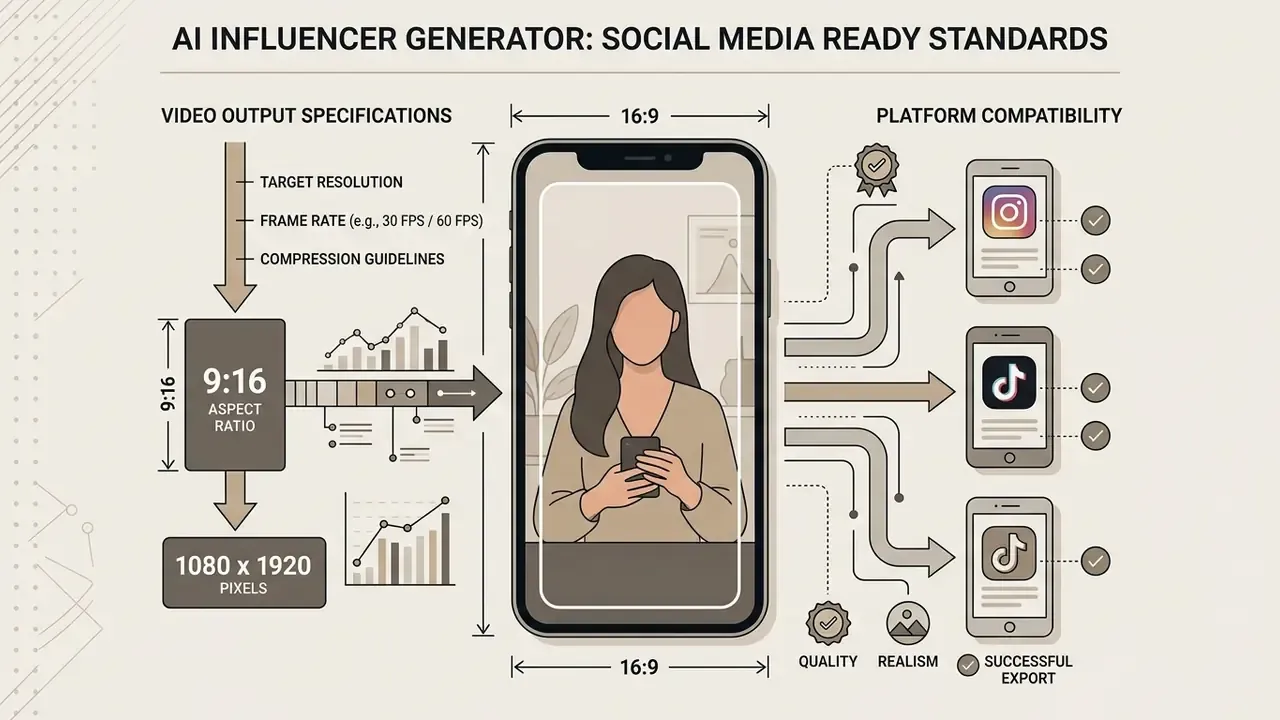
Visual distortion, irregular limbs, or floating objects kill engagement fast. Realism is judged on natural motion, colour, and light, and on the absence of visible artefact patterns on a mobile screen at arm's length. Portrait-grade benchmarks are covered in our AI headshot generator guide, and before deploying at scale, audit output against industry benchmarks or open the hub for commercial-use guidelines.
Free AI Influencer Generators, Pricing, and Credits
Most platforms run freemium or credit-based tiers. A free plan lets you evaluate; paid subscriptions unlock high-resolution export, custom model training, and commercial usage rights. An ai influencer creator free tier is a test environment, not a launch platform.
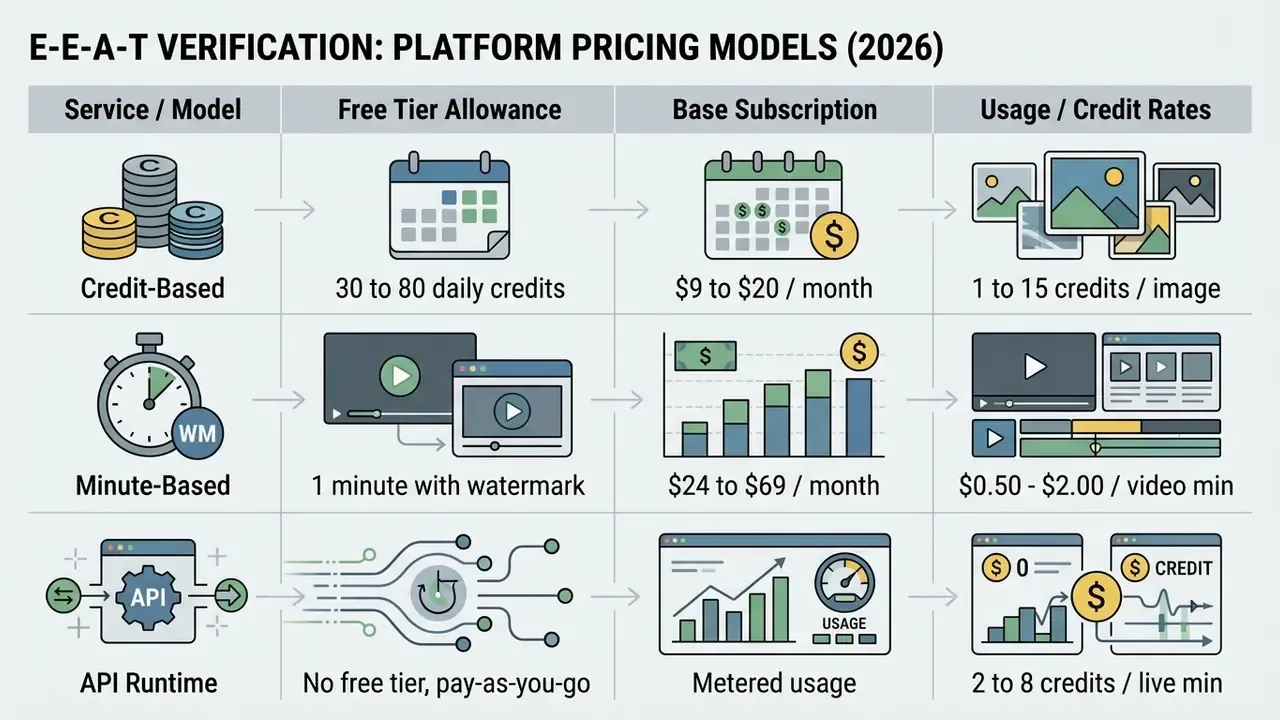
Pricing, credits, free limits, and watermark conditions above reflect published vendor pages reviewed in January 2026. Check the tariff page before payment; this category changes monthly.
Published examples show the spread. One platform advertises 80 free credits per day with paid tiers at $9, $20, and $99+ per month. Another offers 30 free credits with no credit card and paid plans from about $20 per month. A third publishes 500 free monthly credits. On the video side, one vendor's free tier includes 1 watermarked minute per month, with a $24 per month annual creator tier at 15 watermark-free minutes and a $69 per month team tier at 30 minutes. Video-model credit burn is a separate variable: one engine bills 12 credits per generated second, and live avatar runtimes bill 2 to 8 credits per minute depending on model class.
What a free AI influencer generator usually includes
Free tiers typically provide limited trial credits, restricted access to advanced models, lower export resolution, and mandatory watermarks on exported images or videos.
They also usually restrict commercial monetization, retain non-exclusive rights to generated output, and impose queue delays at peak load. Watermark policy is not uniform. Some vendors mark every free export, a minority advertise watermark-free free tiers, so verify per platform rather than assuming a market standard. To model tier costs and feature gaps, compare options with online tools.
Compare pricing by credits, minutes, and generation features
Paid plans bill on monthly credit allocations, processed video minutes, or API calls. Image generation consumes fewer credits per unit than video synthesis or voice lip-syncing.
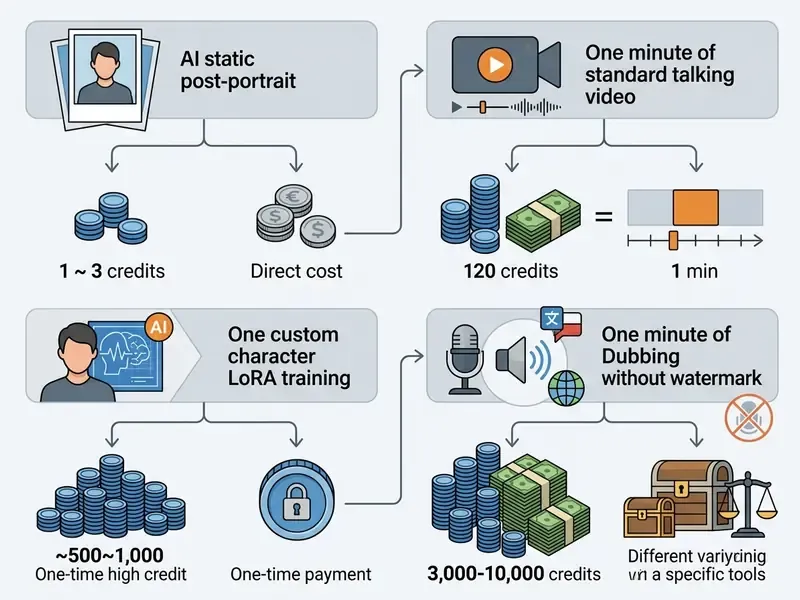
When evaluating tiers, review total cost of ownership: fine-tuning fees, storage, API egress, and the hidden cost of rejected generations in a batch workflow, which can add 20% to 40% to effective credit burn. Control costs belong in the same model. Reviewer hours, disclosure QA, and log retention are real line items that most ROI decks omit. To review pricing structures across categories, open the hub.
Commercial Use, Brand Safety, and Ownership of AI Influencer Content
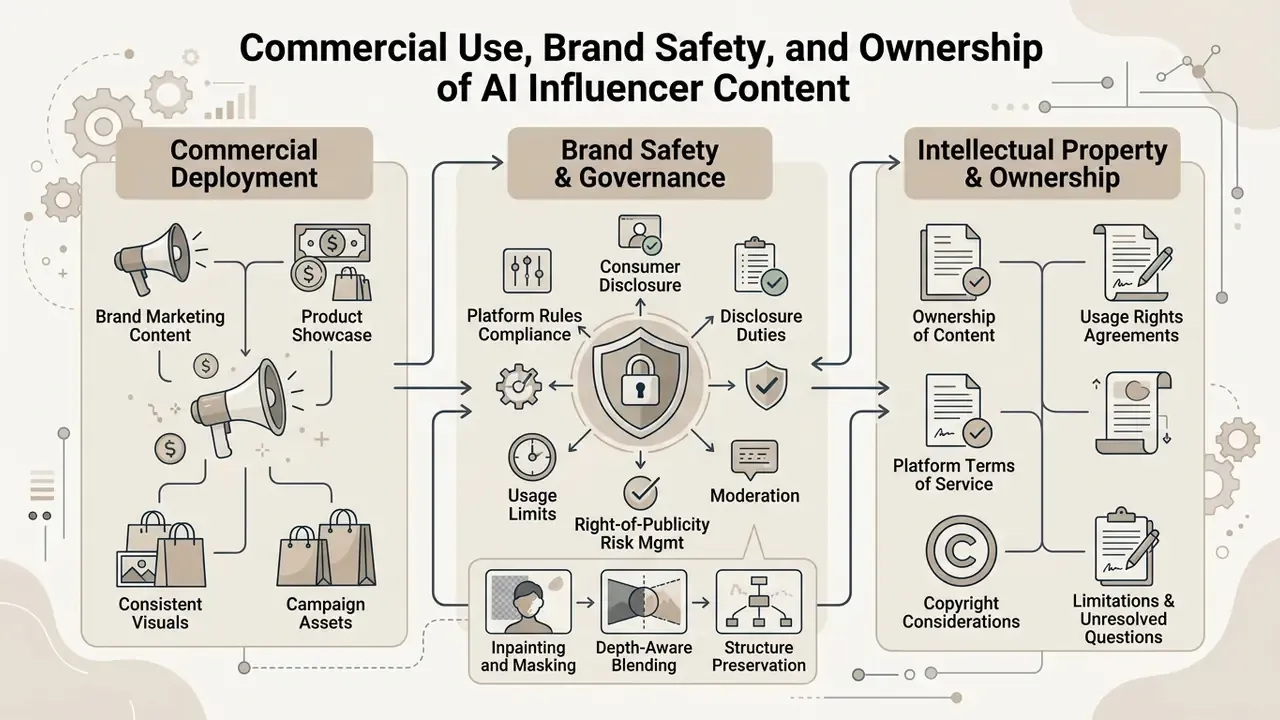
Deploying synthetic influencers commercially means managing intellectual property rights, platform terms, right-of-publicity risk, and consumer disclosure duties at once.
Use AI influencers for brand marketing and product content
Synthetic influencers let brands run scalable, tightly controlled campaigns without scheduling conflicts or personal-conduct risk from human endorsers (Encyclopedia of Artificial Intelligence in Marketing, 2025).
The evidence on effectiveness is mixed, and should be planned for rather than assumed.
"Virtual influencers are as effective as humans at driving engagement, but significantly less effective at shaping behavioural intention, brand attitude and perceived credibility."
A 2024 mixed-method study in the International Journal of Advertising reached a similar conclusion: human influencers produced higher Instagram engagement, while virtual personas performed better when the objective was brand or product awareness. Disclosure adds a second trade-off.
"Disclosing a virtual influencer's non-human nature negatively affects perceived anthropomorphism, which reduces influencer trust and brand trust."
The operative conclusion is not to hide the disclosure. That option is not legally available. Compensate instead: hold brand values consistent, prioritize informational and educational formats over parasocial claims, pair synthetic content with real human ambassadors, and measure credibility separately from reach.
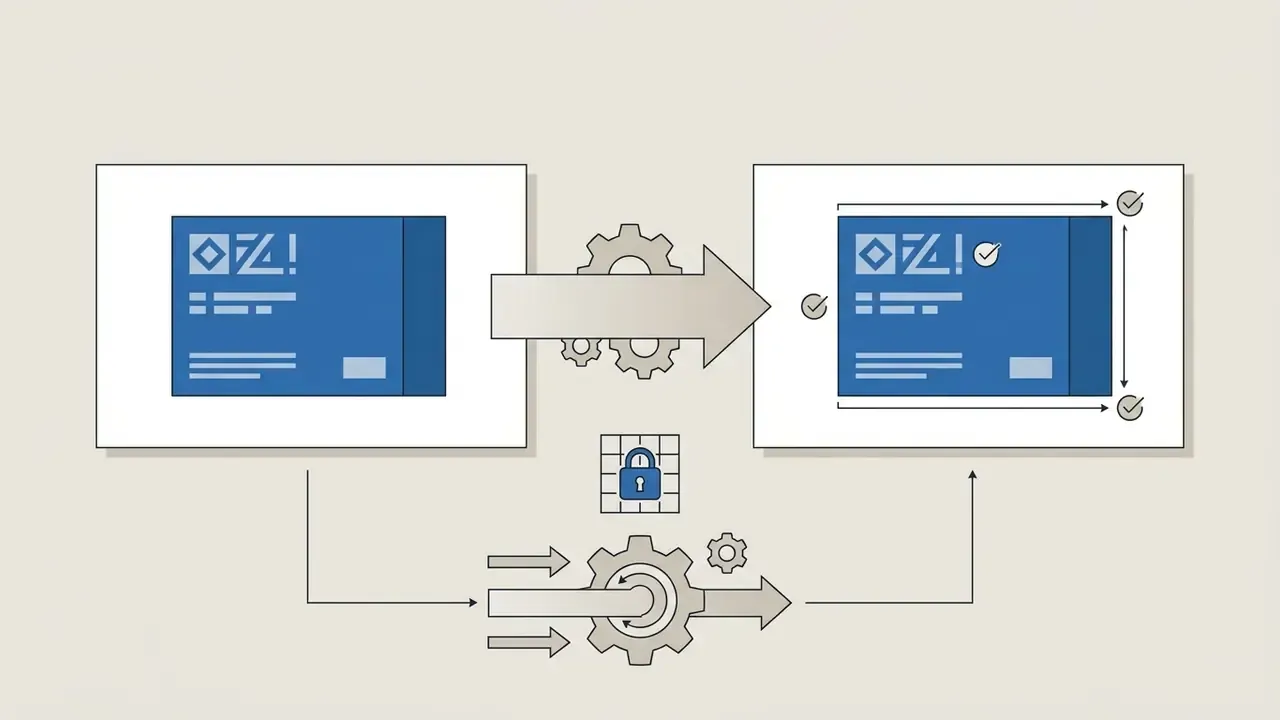
Product placement and brand collaborations, technical workflow. Putting a real SKU into a generated hand is a compositing problem, not a prompting problem. A reliable pipeline has three stages.
Every placement asset should carry a rights record: product imagery licence, brand approval of the composite, and the disclosure label required for paid or instructed posts. Under industry codes such as the ISBA Influencer Marketing Code of Conduct (2024), AI use must be disclosed, virtual influencers must be explicitly labelled, and replicating a real influencer's likeness, voice, or image without consent is prohibited. Stock-platform rules align: commercial licensing requires all necessary rights plus a model release for any identifiable person.
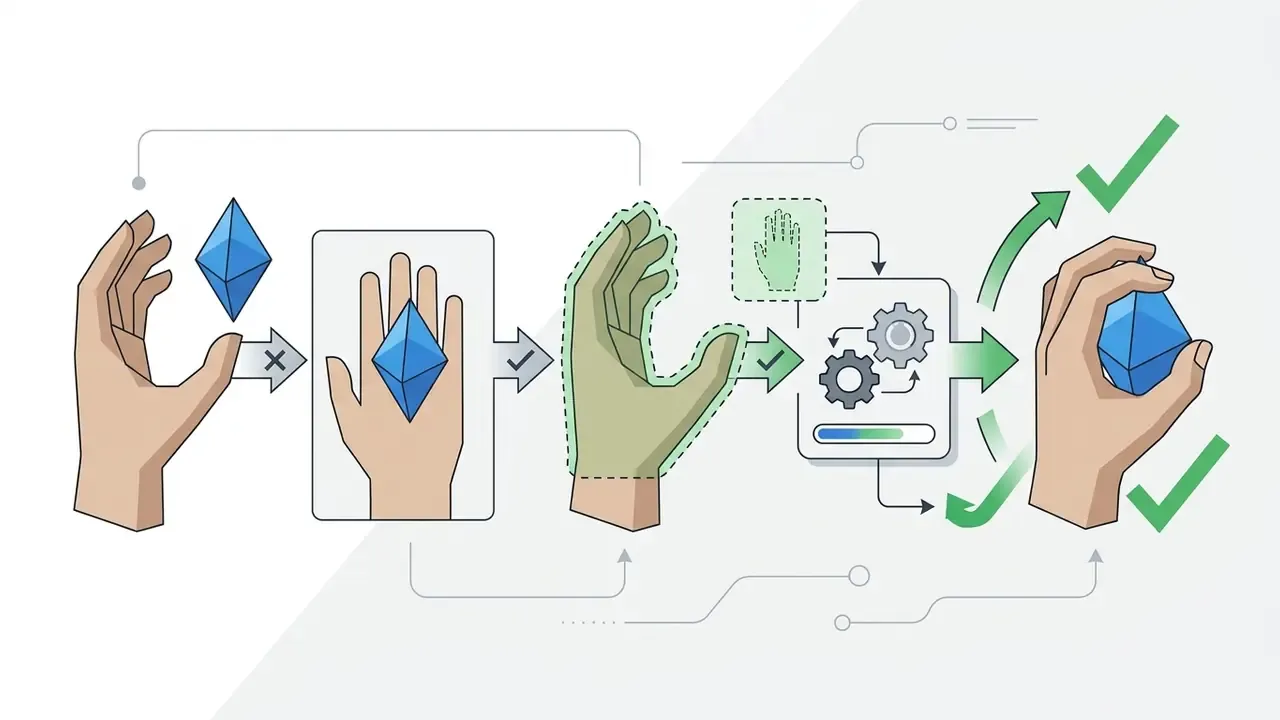
Check platform rules before using faces, uploads, and generated content commercially
Before monetizing AI influencer assets, review platform terms on commercial usage rights, face swap permissions, and input photo privacy.
In the United States, commercializing an individual's likeness without explicit consent triggers right-of-publicity liability and statutory or compensatory damages under state law, for example New York Civil Rights Law sections 50 to 51, with exposure determined by jurisdiction, proven harm, and the court. Updated: New York's 2025 legislative package adds two distinct obligations, disclosure when a "synthetic performer" appears in commercial advertising, and prior consent for commercial use of a deceased person's name, voice, image, or likeness, with civil penalties for disclosure violations set at $1,000 for a first offence and $5,000 for subsequent offences. Congressional Research Service analysis notes the right of publicity broadly blocks unauthorized commercial use of a person's name, image, likeness, or voice, which is the core legal risk in synthetic-persona monetization.
Trust also has an audience-side dimension worth designing for.
"The presence of social ties in virtual influencer imagery increases anthropomorphism and trust, which raises engagement and brand-choice intention."
Platform terms may also restrict uploading third-party images for face swapping or model fine-tuning, and China's deep-synthesis rules require informing the individual and obtaining specific consent for face or voice editing. Verification tooling helps: reverse-image workflows described in our AI reverse image search comparison can confirm whether a "synthetic" reference is actually a real person's photograph before it enters a training set.
This section is general information and does not replace advice from a qualified legal professional on right-of-publicity, copyright, data-protection, and platform-compliance obligations.
For regulatory updates you can browse the hub, and for account or contract questions browse the hub.
Limitations and unresolved questions
Three things are genuinely unsettled, and pretending otherwise would be dishonest.
First, effect size. The published evidence on virtual influencer performance is heterogeneous, mostly experimental, and rarely drawn from regulated financial products. Treat every uplift claim, including the composite example above, as a hypothesis to test with your own analytics, interviews, and CRM data.
Second, provenance durability. C2PA metadata survives some platform pipelines and is stripped by others. Visible labels remain the only reliably persistent disclosure, which is why the disclosure test should run per channel, not once at export.
Third, supervisory interpretation. It is not yet settled how examiners will scope a synthetic marketing persona: as a model under SR 11-7, as a third-party arrangement, as an advertising control, or as some combination. Documenting the persona as all three costs little and ages well.
FAQ
How do I create an AI influencer?
Generate a persona with a text-to-image model, select one master image, lock that identity with a LoRA adapter or reference conditioning, then animate it with image-to-video, lip-sync, or motion transfer. Archive prompts, seeds, and weights so the character stays reproducible.
How do I keep the face consistent in every video?
Anchor every generation to the same master image or trained adapter, hold seed and sampler settings fixed for the campaign, and test each output with a face-embedding similarity check before publishing.
Can I control the character's movement with my own video?
Yes. Pose-extraction and motion-control features, including ControlNet OpenPose, AnimateDiff motion modules, and motion control in models such as Kling, transfer skeletal movement from a reference clip while identity conditioning preserves the face.
Do I own the copyright to my AI influencer?
Ownership is not automatic. US Copyright Office guidance holds that material whose expressive elements are determined by AI is not the product of human authorship; only human-authored contributions are registrable. Platform terms govern your commercial licence, so read them alongside copyright law.
Do I have to disclose that the influencer is AI?
In many markets, yes. EU AI Act Article 50 requires machine-readable marking and disclosure of synthetic and deepfake content, with obligations applying from 2 August 2026. ASCI requires prominent upfront disclosure that a virtual influencer is not human. FTC endorsement rules require disclosure of material connections whether or not the endorser is synthetic.
Can a regulated institution use a synthetic influencer?
Yes, with controls. Register the persona in the model inventory, assign a risk tier, keep customer data out of third-party prompts, require human sign-off on every script, and preserve reproducible generation records for validation and audit.
Is a free plan enough to launch?
Free tiers are for evaluation. They usually watermark exports, cap resolution, limit credits, and restrict commercial monetization, none of which suits a branded campaign.
Which ai influencer creation software should a bank shortlist first?
Shortlist by control surface, not output flair. Require exportable prompt and seed logs, a no-training commitment, SSO with RBAC, configurable retention, and written IP indemnification. Then compare render quality among the vendors that clear those gates.
Company Verification Statement
Next Steps for Enterprise Implementation
Start with one persona, one channel, one quarter. Then decide.
- Audit compliance requirements.Review regional disclosure mandates (FTC, EU AI Act Article 50, ASCI, AGCOM) and secure likeness permissions and model releases for every reference asset.
- Establish identity governance.Implement LoRA weights or identity-adapter pipelines with documented similarity thresholds, and store weights, seeds, and prompts in the model inventory.
- Close the Shadow AI gap.Publish an approved-vendor allowlist, route access through SSO with RBAC, and prohibit uploads of customer, employee, or biometric data into unvetted tools.
- Select production stacks.Benchmark platforms with pilot credit allocations, and score vendors on SOC 2 Type II, VPC or on-prem options, no-training commitments, IP indemnification, and log exportability before committing.
- Instrument scale.Build the batch-generation manifest before the first campaign so A/B variants inherit disclosure labels and audit records automatically.
- Deploy monitoring and controls.Establish human-in-the-loop approval paths, complaint and misidentification monitoring, and an incident procedure for impersonation or persona misuse.
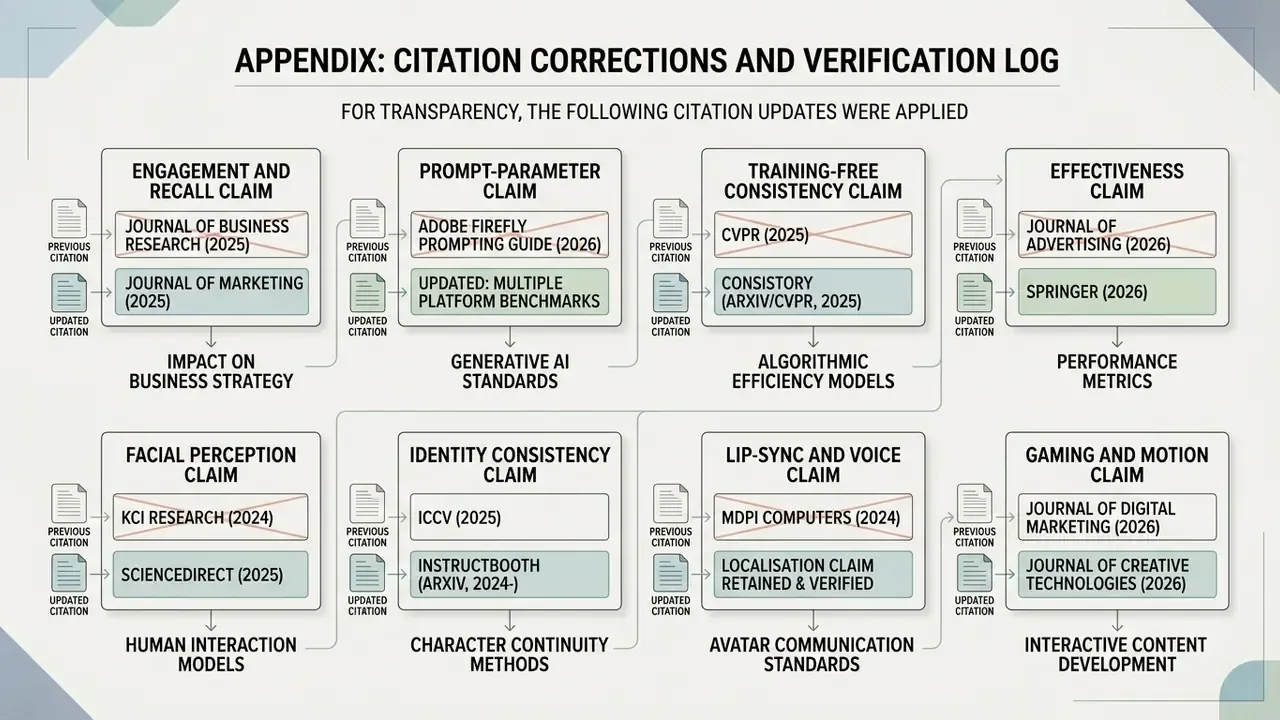
Appendix: Citation Corrections and Verification Log