An AI Instagram caption generator is an automated software tool powered by large language models (LLMs) and computer vision systems that creates textual content, including main body copy, hooks, calls to action (CTAs), and hashtags, for Instagram feed posts, Reels, Stories, and photos. Creators, brand managers, and enterprise marketing teams use an ai instagram caption generator to speed up copywriting, hold brand voice steady, and test what actually earns attention across channels.
Automated systems produce usable copy in seconds. That is the easy part. Operational safety and marketing effectiveness both depend on treating outputs as structured first drafts, not finished assets. Organizations that pair algorithmic text generation with systematic human review get repeatable output while avoiding brand drift, factual hallucinations, and regulatory trouble.
Executive Summary
For readers who need the decision, not the tutorial:
- What the tool is: A two-stage pipeline. A vision-language model (VLM) interprets the image or video context, then an LLM converts that interpretation into branded copy with hooks, CTAs, and hashtags.
- Where the measurable value sits: Draft speed and ideation volume, not autonomous publishing. Survey data attributes the primary operational benefit to time savings, while comparative studies show engagement outcomes depend on human refinement and disclosure practices.
- The single most important length rule: Instagram permits 2,200 characters, but the mobile engagement sweet spot sits between 138 and 150 characters, and text truncates behind a "more" button at roughly 120 to 125 visible characters.
- Non-negotiable controls: PII and confidentiality scrubbing before prompt submission, human-in-the-loop editing before approval, an immutable audit trail (prompt, model, output, approver), and ad-disclosure placement at the start of sponsored captions.
- Free vs paid: Free tiers are acceptable for ideation. Regulated or brand-critical publishing requires enterprise controls: no-train data handling, SOC 2 Type II or ISO 27001 attestation, SSO/SAML, retention configuration, and explicit commercial licensing.
- Bottom line for approvers: Treat the generator as an unvalidated drafting utility inside a documented review workflow, not as an autonomous publishing agent. Copy that carries product, pricing, performance, or financial claims must pass legal and compliance review before publication.
Who Owns Which Decision in This Workflow
Most caption incidents are not model failures. They are ownership failures: nobody could say, after the fact, who approved the sentence. Before you evaluate tools, fix the decision map.
| Role | Owns | Does not own |
|---|---|---|
| Content creator / social manager | Prompt quality, draft selection, tone fit, line breaks | Claim substantiation, disclosure wording |
| Brand lead | Voice rules, vocabulary bans, template library | Regulatory interpretation |
| Compliance / legal reviewer | Disclosures, claim substantiation, prohibited language | Creative preference |
| Model risk / AI governance | Inventory entry, risk tier, control design, periodic review | Day-to-day copy approval |
| Internal audit | Evidence testing, sampling, findings | Content production |
| Security and third-party risk | Vendor data handling, retention, access controls | Editorial calendar |
One rule keeps this simple. Every published caption has exactly one named approver, and that name is retrievable from the log twelve months later.
What Is an AI Instagram Caption Generator?
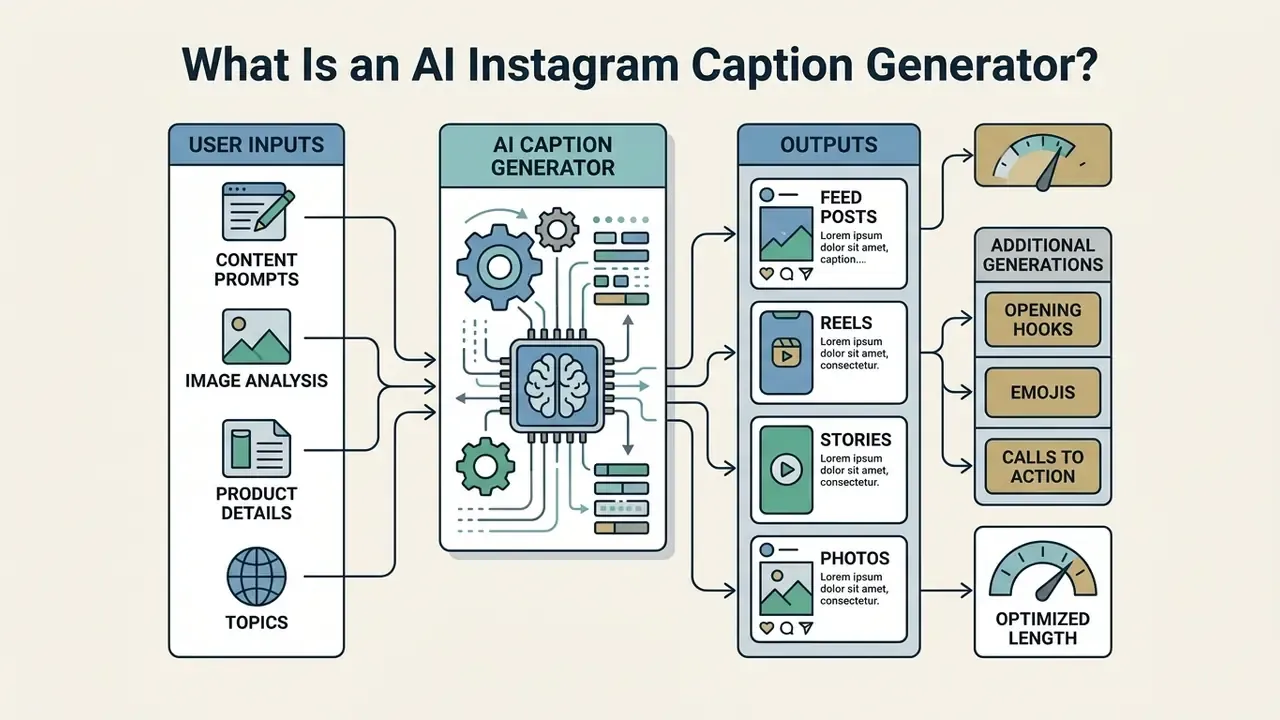
An ai caption generator instagram tool is a specialized natural language processing application that transforms user inputs, such as image upload data, product details, topic keywords, or target tone instructions, into platform-tailored Instagram copy. Unlike generic text editors, an ai instagram text generator is engineered around Instagram's specific user experience constraints, formatting norms, and algorithmic discovery parameters.
The tool ingests raw contextual metadata and outputs multi-part copy packages consisting of primary captions, visual descriptions, thematic hashtags, and audience conversion prompts. Specialized systems combine vision-language models (VLMs) with large language models to analyze visual inputs directly, producing contextually accurate copy without long manual briefs.
«A two-stage pipeline, a vision-language model describes the image, then an LLM converts that description into a branded caption, delivers flexibility without large training datasets.»
The practical implication of that architecture is that output quality has two independent failure points: visual misinterpretation, where the VLM misreads the scene, product, or context, and stylistic drift, where the LLM applies a generic influencer register instead of the brand voice. Both need human verification. Both should be logged when the workflow runs inside a regulated organization.
Captions for Instagram Posts, Reels, Stories, and Photos
An ai generator instagram caption tool creates tailored copy variants for specific Instagram formats, accounting for display aspect ratios, preview truncation limits, and viewing behavior.
- Feed Posts Feed copy requires structured narrative blocks with clear value propositions, formatted for mobile displays where text truncates between roughly 120 and 125 visible characters depending on word length and device width. Feed assets are typically produced at 1080x1350 px (4:5), which shortens the effective visible caption area even further.
- Reels An ai reel caption generator produces short, high-impact text snippets designed to support vertical 9:16 video playback (1080x1920 px), prioritizing immediate visual hooks and scannable context for users watching without audio.
- Stories Story captions function as brief screen overlays or interactive stickers (0 to 20 words) that drive tap-throughs and poll interactions inside 15-second frames, with key text kept in the center safe area to avoid interface overlap.
- Photos Image-based posts lean on descriptive, emotive copy that bridges visual aesthetics with broader campaign positioning. Teams that pair generated copy with retouching workflows often standardize the visual stage first using an online photo editor before captioning.
What AI Generates Besides the Main Caption
Beyond primary copy, a caption generator ai for instagram produces auxiliary post assets that widen reach and support conversion.
- Opening Hooks Attention-grabbing first lines designed to stop the scroll and prompt a "more" tap.
- An AI Instagram Description Generator Component Contextual summaries that describe complex visual elements, background settings, or product specifications.
- Hashtag Sets Categorized groups of 3 to 5 niche and topical hashtags selected to improve search discoverability without tripping spam filters. Research prototypes typically output 5 to 7 focused tags per post, which teams then trim by relevance.
- An AI Quote Generator for Instagram Post Assets Contextual, industry-specific quotes or inspirational statements formatted for visual carousels and brand highlights.
- Calls to Action (CTAs) Direct response prompts encouraging saves, shares, comments, or profile link clicks. Current platform guidance recommends specifying the exact CTA type inside the prompt rather than letting the model pick one.
Why Use AI to Generate Instagram Captions?
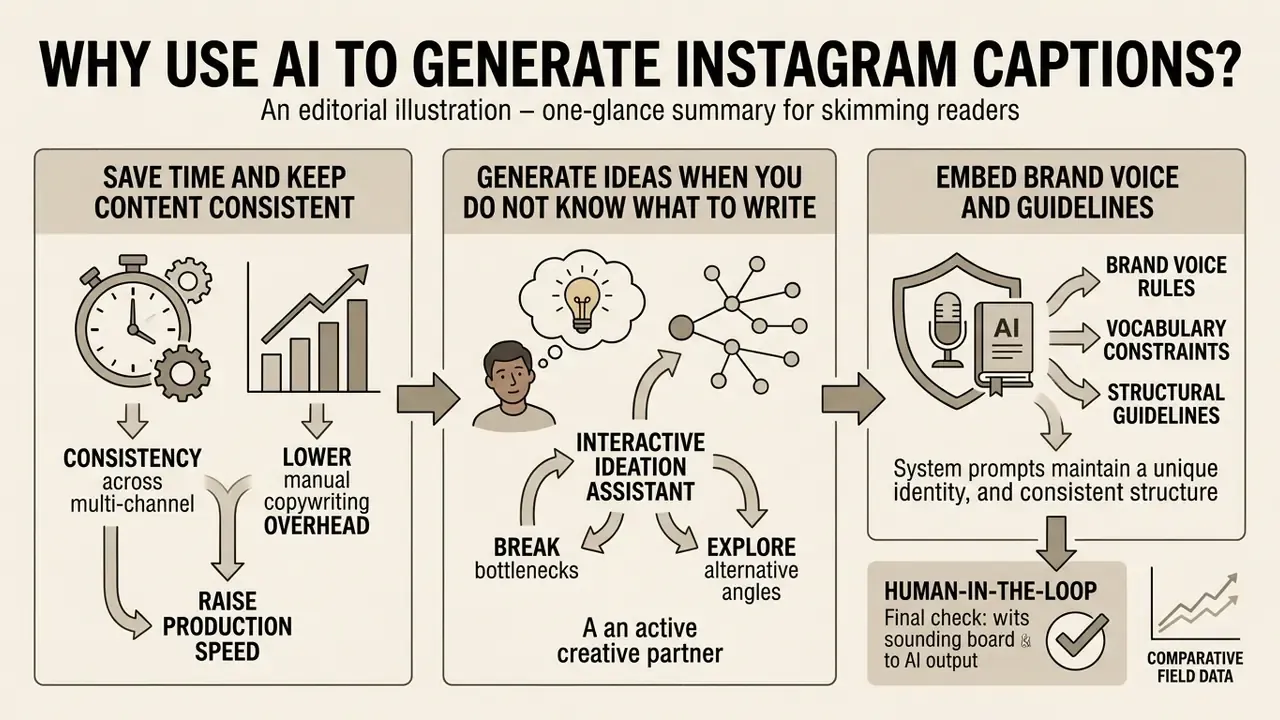
Marketing teams use an ai caption generator for instagram mainly to clear creative bottlenecks, raise production speed, and keep structure consistent across multi-channel calendars. According to a 2026 industry survey on social media marketing workflows, 71.1% of marketing teams cite direct time savings as the primary operational benefit of generative AI tools, and 47.4% report producing more content in the same period (AI in Social Media Marketing Report, Sociality.io, 2026). Verification note: this survey is a vendor-published report; sample size and sampling methodology are not disclosed in the public summary, so treat the figure as directional rather than as a validated benchmark.
Independent evaluations qualify the benefit. Empirical work shows automated tools must be deployed with intent: models excel at structural drafting and ideation, while engagement metrics depend heavily on human oversight, visual alignment, and authentic brand voice.
«Labelling content as fully AI-generated reduces affective and behavioural engagement; the effect is fully mediated by users' emotional responses.»
Comparative field data points the same way without condemning the technology. One Instagram comparison reported human-created posts at a 6.73% engagement rate versus 5.96% for AI-generated posts, while attributing 64% of engagement to visuals and only about 10% to caption text. A separate cross-platform experiment with 892 participants found AI-generated content was preferred over human content on Facebook and rated comparably on Instagram (Using ChatGPT in Content Marketing, ACM Hypertext 2024, https://dl.acm.org/doi/10.1145/3648188.3675141). So the caption is not the primary engagement driver. It is, however, the primary compliance and brand-voice risk surface.
Save Time and Keep Content Consistent
Using an ai ig caption generator cuts manual copywriting overhead sharply, letting teams generate initial draft variants in seconds rather than hours.
By embedding brand voice rules, vocabulary constraints, and structural guidelines into system prompts, organizations keep generated captions inside brand identity guidelines across distributed teams and dense posting schedules. Public-sector extension guidance is explicit that consistency comes from supplying business context, core messaging, content themes, and a posting schedule, not from the model itself (Marketing Your Business Using AI, Mississippi State University Extension, 2026). Teams holding brand consistency across digital channels usually standardize the visual layer in parallel, whether through AI photo editing tools or a fixed template library.
Generate Ideas When You Do Not Know What to Write
An ai generator caption for instagram works as an interactive ideation assistant, helping creators break writer's block by proposing alternative angles, rhetorical hooks, and narrative structures.
When applied in a "sounding board" capacity, where the human creator asks for alternative angles rather than accepting raw output uncritically, generative tools help non-expert writers reach quality comparable to experienced copywriters.
«Using an LLM as an advisor helps non-experts create ad content with click-through performance comparable to expert level; the author role yields no significant advantage.»
This collaborative approach lets creators explore playful, professional, or educational variations for products, photos, and video assets. Established ideation frameworks documented in university prompting guides, including CLEAR (Concise, Logical, Explicit, Adaptive, Reflective), BRIEF-F (Background, Role, Intent, Expectations, Feel, Follow-up), C.R.E.A.T.E. (Context, Role, Examples, Action, Tone, Experiment), and CRAFT (Context, Role, Action, Format, Tone, Steps, Constraints), transfer directly to caption ideation and force structured variation instead of repetitive output.
Governance, Audit Trail, and Model Risk Controls for Marketing LLMs
Marketing generative AI enters the enterprise perimeter the moment a caption references a product, a price, a rate, a performance figure, or a customer outcome. For risk, compliance, and model-governance functions, the caption generator is a low-complexity, high-visibility AI use case: limited quantitative impact, significant reputational and regulatory exposure.
Minimum control set for regulated publishers:
Shadow AI is the dominant failure mode. When an approved enterprise path does not exist, distributed social teams default to public free tools, pasting unreleased product details or customer anecdotes into consumer-grade interfaces with training-on-input defaults. Prohibition alone rarely fixes this. The mitigation is a sanctioned, logged, reasonably fast alternative that people actually prefer using.
How to Use an AI Caption Generator for Instagram
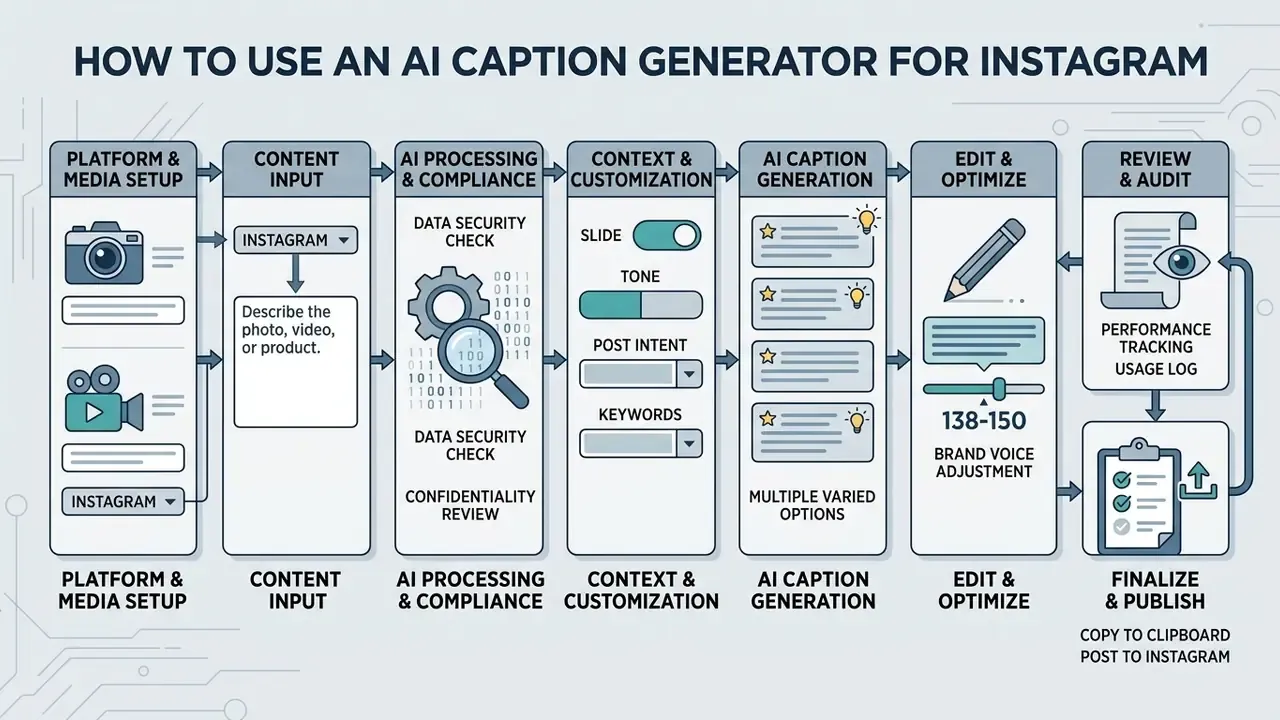
Operating an ai instagram caption generator tool well takes a structured, step-by-step process that translates operational context into precise model instructions.
Step-by-step execution workflow
- Select network and format
- Choose "Instagram" and specify the target placement (Feed Post, Reel, or Story) to apply the correct character limits and preview constraints.
- Input contextual source data
- Enter a brief description of the photo, video, or product, along with mandatory keywords and campaign goals.
- Run the data guardrails check (PII and sensitivity scrubbing)
- Before submitting the prompt, remove customer identifiers, unreleased financial figures, internal pricing logic, and confidential roadmap details. Confirm that the destination tool's terms prohibit training on submitted inputs. This step is mandatory in regulated environments and takes seconds once templated.
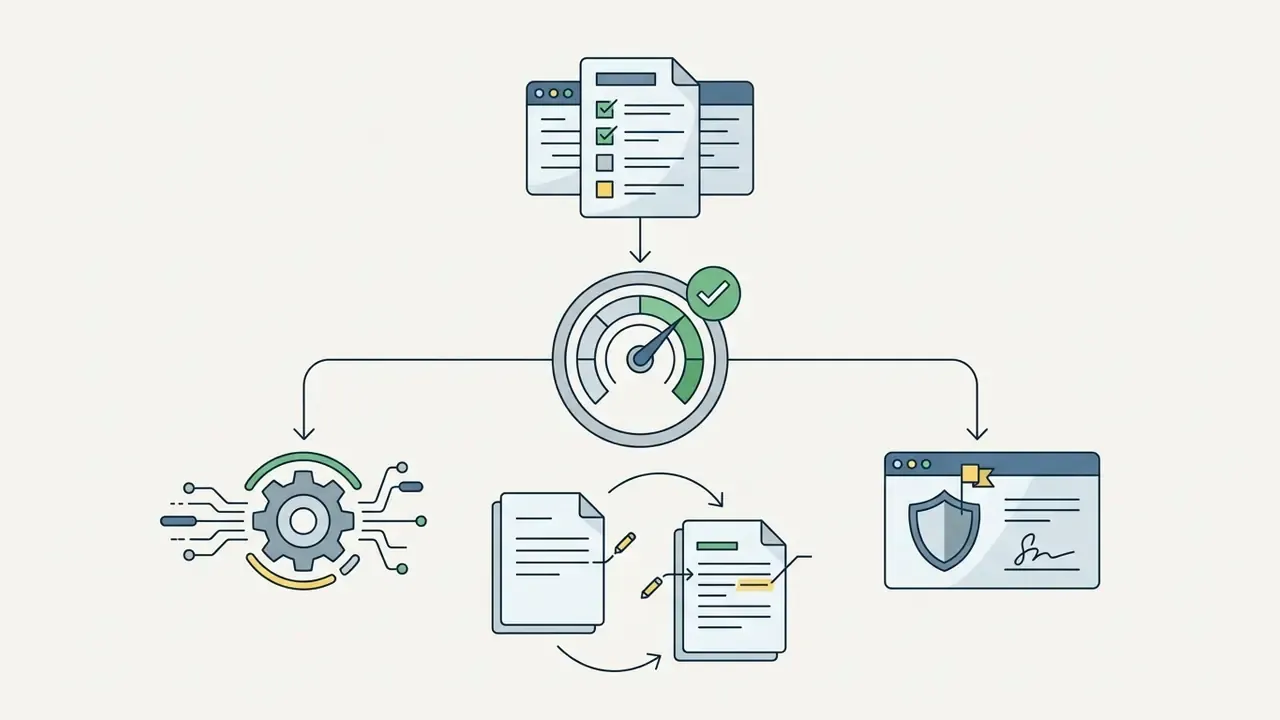
- Configure tone, intent, and parameters
- Set brand personality, language, target audience profile, emoji density, and the functional post intent:
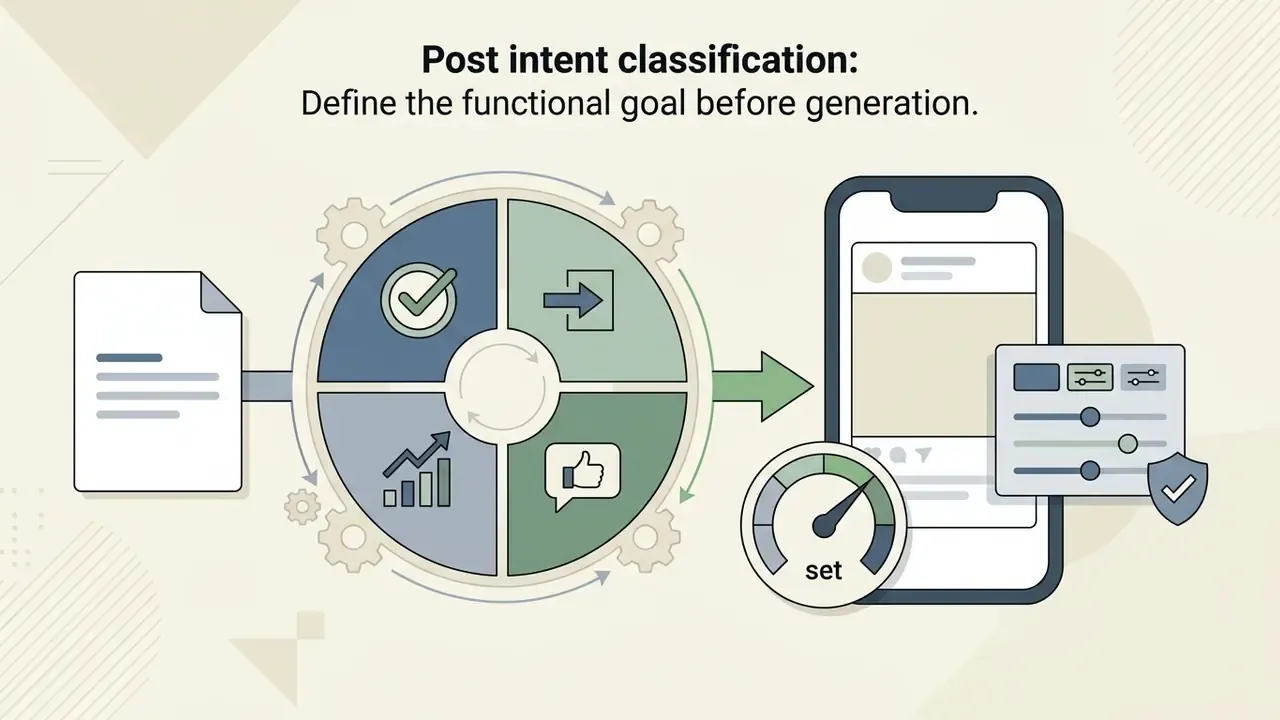
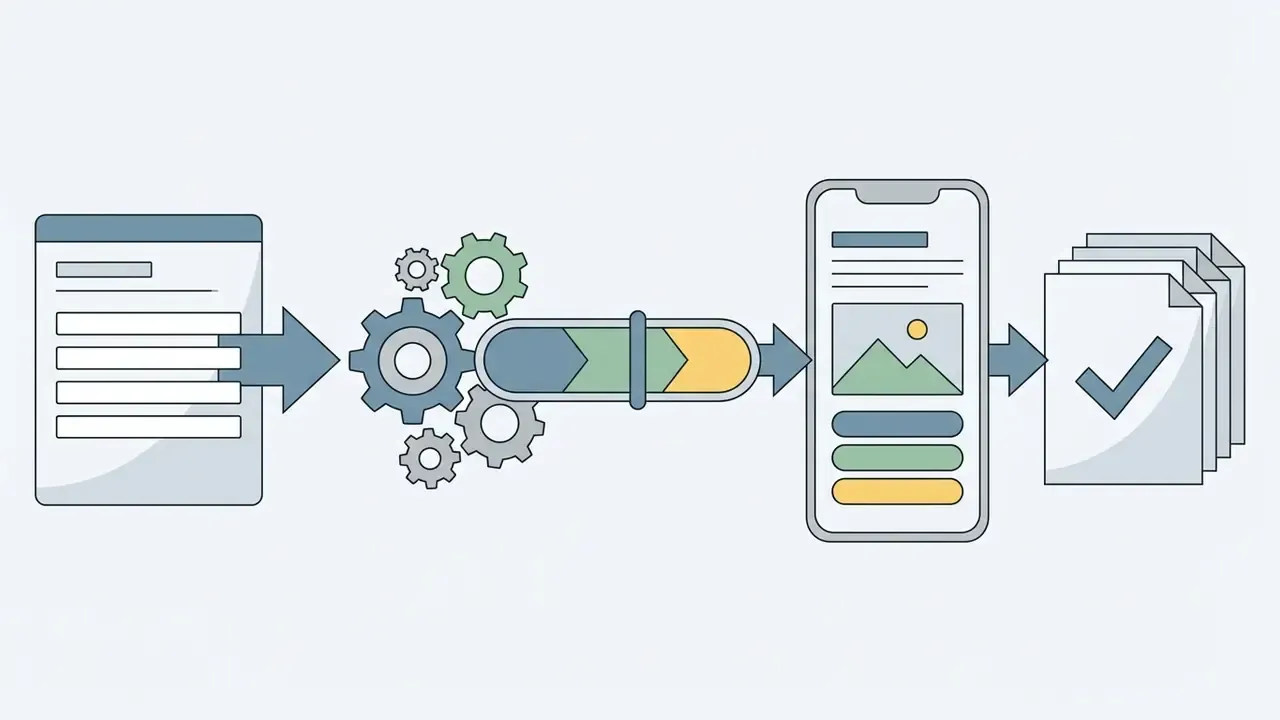



Selecting intent before style prevents the most common defect in AI captions: a well-written sentence that serves no marketing objective.
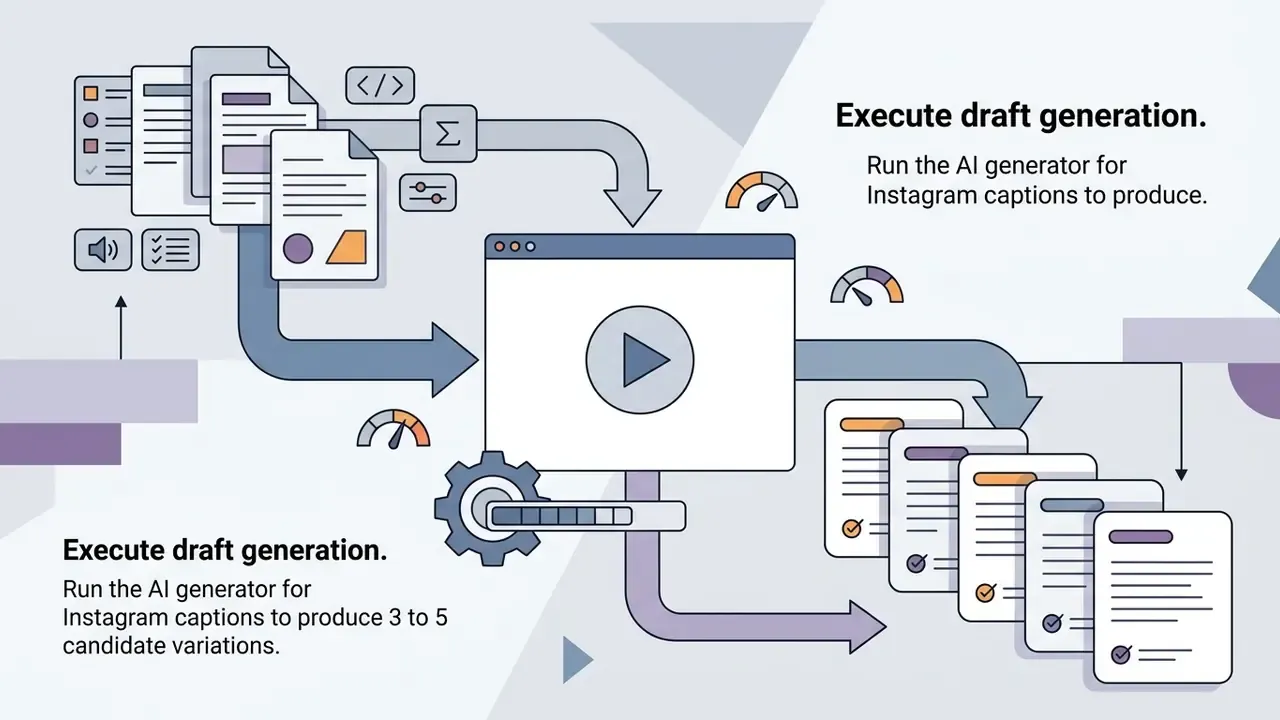
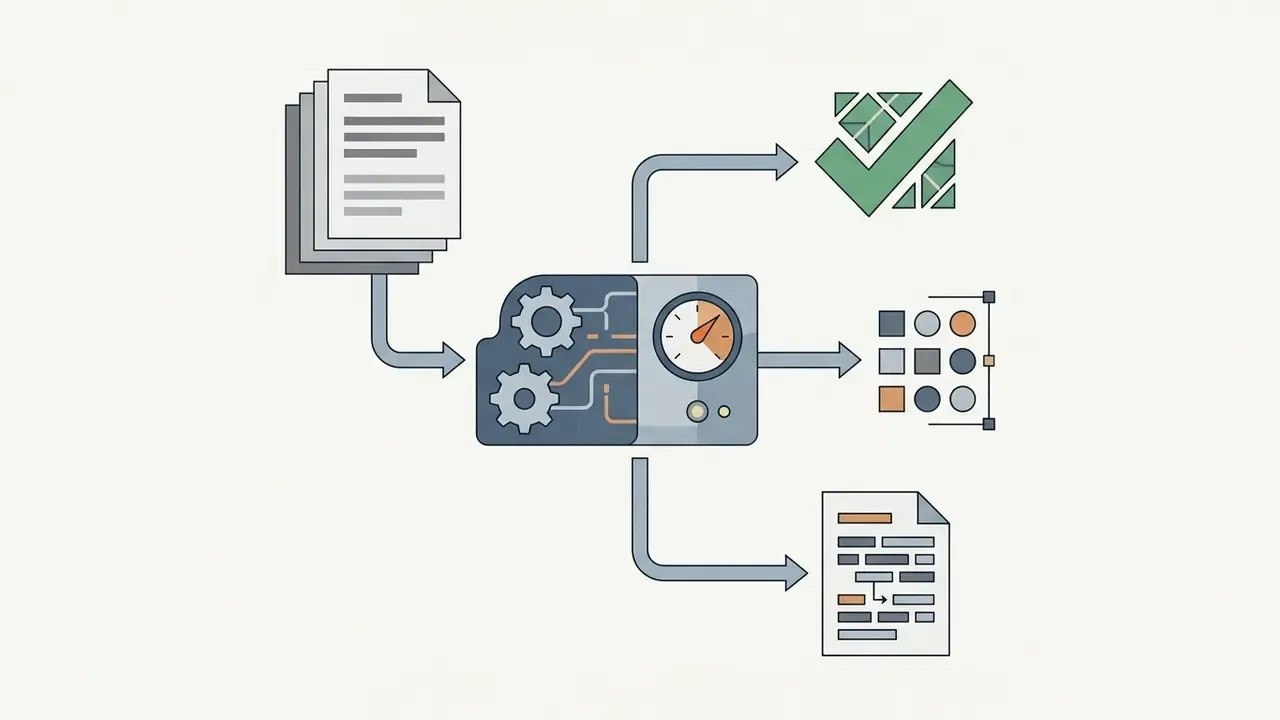

Add a Description, Keywords, and Post Context
Output quality from an ai generator instagram caption tracks the specificity of the input context. High-performing prompts carry four core inputs: task definition, situational context, target audience characteristics, and structural constraints (Google Prompting Guide, 2024). OpenAI's own guidance adds outcome, length, format, and style as explicit fields, and recommends visually separating instruction from context.
Specific inputs, such as product features, visual setting details, target demographics, and the primary campaign objective, keep the model from falling back on generic influencer cliches.
«When prompts include real brand caption examples, hashtags and content structure, ChatGPT produces synthetic captions with markedly higher fidelity than generic requests.»
Choose Tone, Style, and Language Before Generating
«AI-generated content showed higher preference and CTA effectiveness on Facebook, while Instagram results were comparable to human-written content.»
Separating language configuration from tone selection prevents translation errors in multilingual campaigns (Gorgias Technical Docs, 2024). For teams producing multilingual video assets, the same separation logic applies to narration workflows built with an AI voice generator.
Edit the Generated Caption Before You Post
Human editing is an operational requirement, not a nicety. Raw outputs regularly carry repetitive phrasing, misplaced emojis, or subtle factual slips.
«Over ten weeks the fully automated account gained 0 Instagram followers, while the human-in-the-loop account reached 375 followers and active interaction.»
Generate Captions for Instagram Posts, Reels, and Photos
AI Instagram Post Caption Generator for Feed Content
Updated. An ai instagram post caption generator creates structured feed content for single-image posts, carousels, partnerships, employee spotlights, and community updates. Instagram permits up to 2,200 characters per post, yet the engagement sweet spot for mobile feed copy sits between 138 and 150 characters (Hootsuite digital benchmarks, 2026). And because text truncates behind a "more" button after roughly 120 to 125 visible characters, the critical value proposition or hook has to be front-loaded into the first line.
Feed copy generated for product announcements, sponsored partnerships, or corporate news should follow clear formatting: hook in line 1, narrative value in lines 2 to 4, a single CTA, and clean line breaks before hashtag blocks. For dense information posts, break the body with line breaks rather than compressing everything into one paragraph. Readers scan. They rarely read.
AI Reel Caption Generator for Video Content
An ai caption generator for instagram reel produces concise text overlays and supporting descriptions built for full-screen 9:16 playback.
Because a large share of mobile users watch short-form video with audio muted, Reel captions need concise contextual summaries plus on-screen hooks inside the first 1 to 3 seconds.
«Practical demonstrations, product comparisons and trending hashtags are consistently associated with higher Reels views, likes, comments and shares.»
Reel captions should also carry open-caption subtitles for spoken audio to meet web accessibility guidelines and hold retention (Instagram Creator Standards, 2026); Instagram exposes this through the "Show Captions" control in advanced settings. A workable Reel caption structure is three-part: one hook line, one short context or value line, one CTA, then 3 to 5 precise hashtags. Creators building the video layer itself often combine captioning with an ai video generator app, a free AI video generator, or a dedicated animation maker for motion titles.
AI Instagram Caption Generator From Photo
An ai instagram caption generator from photo uses vision-language models to read image content, identifying objects, color palettes, emotional tone, and setting, and then construct relevant copy. Recent surveys frame the pipeline as visual encoding, language generation, training strategy, and evaluation, with newer work adding style-aware and mood-aware captioning for specialized scenes.
Advanced multimodal architectures encode visual information into semantic tokens, letting the text model produce "abstractive" captions that convey mood, storytelling, or product utility instead of simply listing objects.
«GPT-4o and Claude 3.5 Sonnet with coherence-relation-based prompting outperformed baseline methods in seven of eight social-media caption generation tasks.»
In practice, a creator can upload an unedited photograph and get contextually accurate copy suggestions almost instantly. Teams sourcing visuals synthetically rather than photographically should verify licensing before captioning, which is where a comparison of the best AI art generators becomes part of the same workflow decision.
How to Get Better AI Instagram Captions
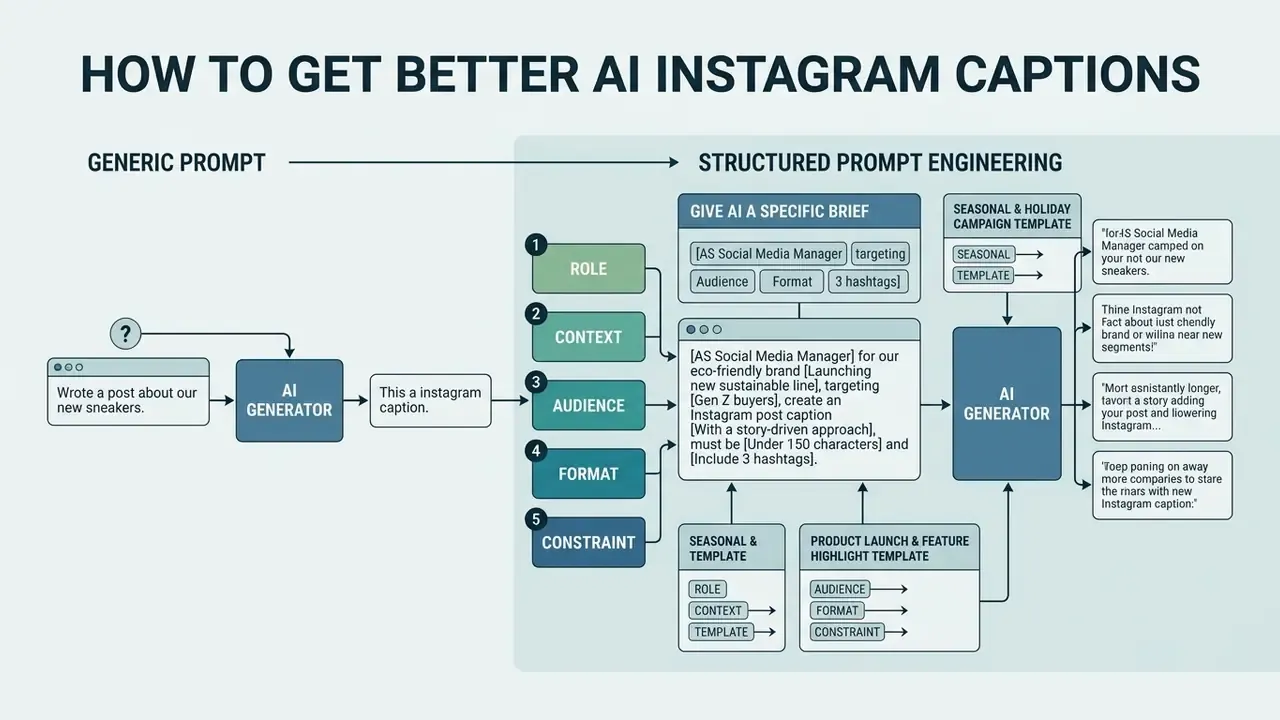
Getting more out of an ai caption generator for instagram post workflow means moving from single-line queries to structured prompt engineering.
Empirical testing shows multi-tier prompts containing explicit instructions, brand context, and negative constraints consistently beat basic template prompts. In the caption study underlying this pattern, prompt tiers that added an instructional sentence and then question-and-answer refinement produced substantially more engaging captions than template-only prompts. Any human effort in the prompt outperformed zero-effort prompting.
«A branded caption pipeline showed annotators consistently recognized the intended brand persona in captions generated with explicit tone attributes and hashtags.»
Give AI a Specific Brief Instead of a Generic Prompt
To generate captions that perform, prompt inputs should mimic a professional creative brief. Replace generic queries like "Write an Instagram caption for coffee" with structured briefs:
- Role Act as a senior social media copywriter for an artisanal coffee brand.
- Context Launching a new cold brew product made from ethically sourced beans.
- Audience Urban professionals aged 25 to 40 seeking premium morning energy.
- Format Opening hook under 100 characters, 2 sentences on flavor profile, 1 clear CTA to visit the website, and 3 niche hashtags.
- Constraint Avoid hype words like "game-changer" or excessive punctuation.
Ready-to-Use AI Caption Prompt Templates
Match the Caption to Your Brand Voice and Audience
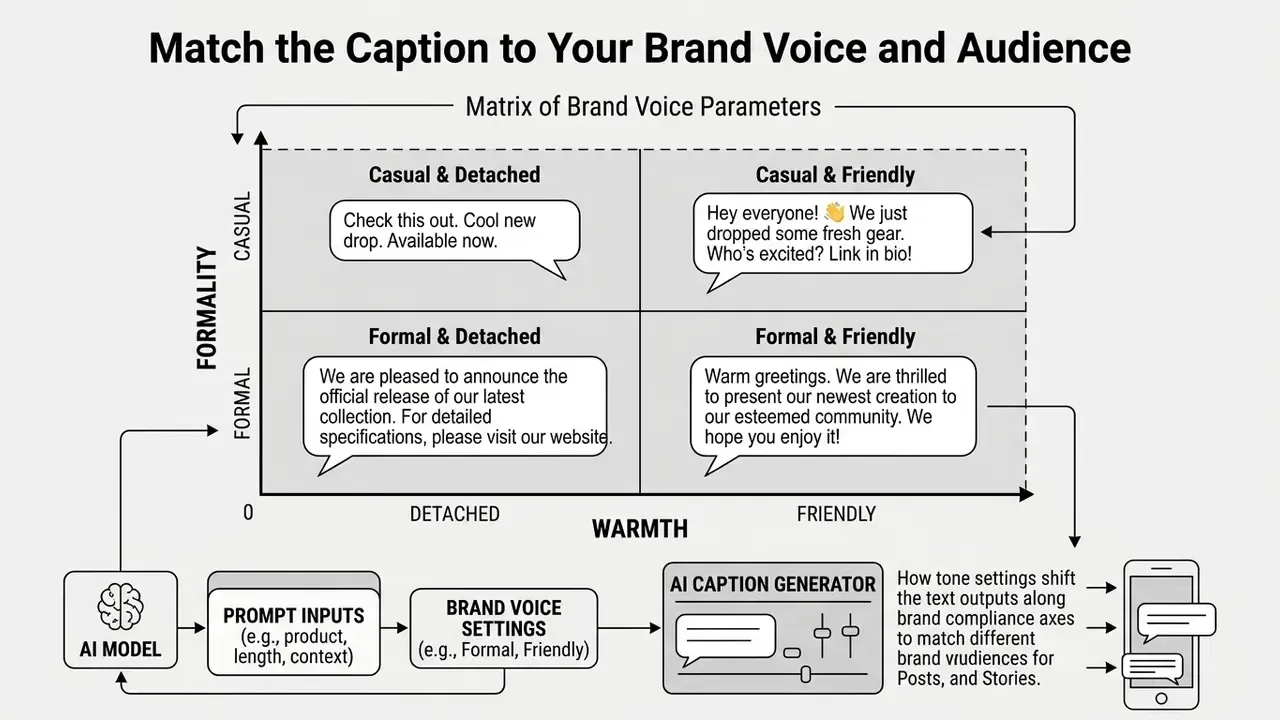
Holding brand identity means constraining the model with explicit voice guidelines (UBC Voice and Tone Guide, 2024). Define rules for vocabulary, formality, direct address pronouns ("you" and "we"), and permitted punctuation. Operational tone templates go further and fix exclamation-mark policy, emoji policy, contractions, tense, capitalization, paragraph style, and number formatting, all of which are enforceable inside a system prompt.
Instagram Caption Examples by Tone, Intent, and Content Type
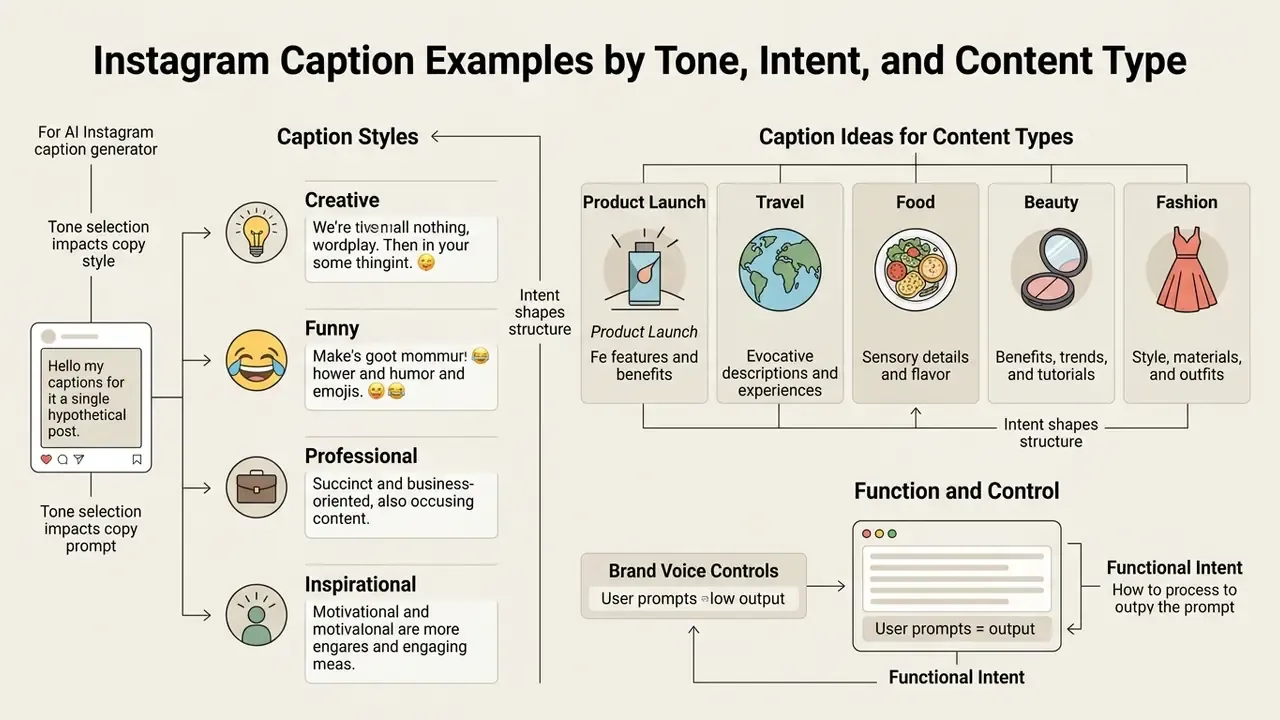
AI caption generators produce very different copy depending on requested style, functional intent, and niche. Below are comparative structural examples across major marketing categories.
Creative, Funny, Professional, and Inspirational Caption Styles
- Creative "Shadows, light, and a second cup of espresso. Framing Monday from a fresh perspective. What visual detail caught your eye today?"
- Funny "My ability to turn a 5-minute task into a 3-hour research project remains completely unmatched. Swipe to see the exact moment focus left the building. ☕"
- Professional "Efficient operations require clear documentation. Our latest operational guide breaks down framework implementation into five actionable steps. Read the full analysis at the link in bio."
- Inspirational "Progress rarely happens in leaps; it is built through daily consistency. Keep refining the process."
The Same Post, Four Intents
Style answers "how does this sound?" Intent answers "what should this post achieve?" The pairing matters more than either setting alone.
| Intent | Example caption for one product photo | Primary metric |
|---|---|---|
| Actionable | "Three settings to change before your next export. Save this for your next edit session." | Saves |
| Promotional | "New release: waterproof recycled shell, dedicated 16-inch laptop sleeve. Available now via profile link." | Link clicks |
| Inspiring | "Two years ago this was a sketch on a napkin. Today it ships to eleven countries." | Shares |
| Introspective | "We scrapped the first three prototypes. Here is what the failures taught us about durability." | Comments |
Caption Ideas for Product, Travel, Food, Beauty, and Fashion Posts
- Product launch "Designed for durability, built for daily utility. The new Minimalist Pack features waterproof recycled fabric and dedicated laptop sleeve storage. Available now via profile link."
- Travel "Morning fog over the valley. 📍 Point Reyes, California. Save this post for your next coastal trail itinerary."
- Food and beverage "Slow-fermented dough, crisp crust, and fresh basil. The secret to sourdough pizza lies in temperature control. Full recipe and bake schedule in bio."
- Beauty and skincare "Hydration without the heavy finish. Formulated with 2% hyaluronic acid and botanical squalane. Tap to explore ingredients."
- Fashion "Structured tailoring meets daily comfort. Pairing neutral linen layers for late-summer transitions. Details tagged above."
Caption Patterns for B2B, SaaS, and Regulated Sectors
Consumer-lifestyle examples do not transfer cleanly to enterprise or regulated accounts, where every sentence may be an advertising record. These patterns are written to survive legal review.
Note the structural difference from consumer copy: intent appears in the first clause, superlatives are absent, and every quantitative claim is either substantiated or replaced with a verifiable placeholder.





Free AI Instagram Caption Generator vs Paid Tools for Commercial Content
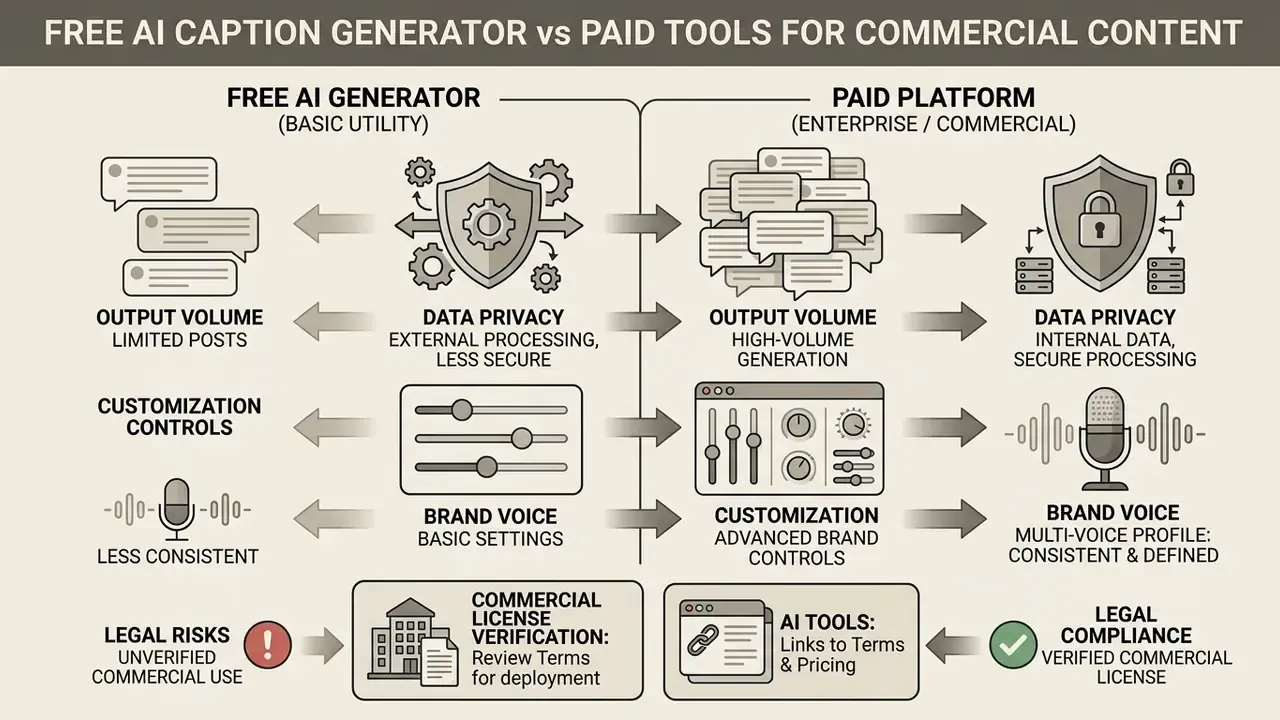
Choosing between an ai instagram caption generator free utility and an enterprise paid platform means trading off output volume, data privacy, customization controls, and commercial licensing rights. The same trade-off structure shows up in adjacent categories, from free AI video generators to design suites documented in our review of Canva AI commercial terms. Buyers comparing tiers usually start with a pricing overview and a category-level comparison hub before shortlisting.
| Evaluation Dimension | Free AI Instagram Caption Tools | Paid / Enterprise AI Tools |
|---|---|---|
| Generation Limits | Capped queries (5 to 10 drafts per day; some suites cap at 50 lifetime queries) | Unlimited or high volume allocations (500 uses per month per seat and above) |
| Model Sophistication | Base language models (GPT-3.5 class) | Advanced models (GPT-4o, Claude 3.5) |
| Brand Voice Customization | Generic tone presets ("Happy", "Formal") | Reusable custom brand voice profiles |
| Multimodal Vision Input | Rarely supported or text-prompt only | Native vision-language image analysis |
| Language Support | Often a fixed set (EN, ES, IT, FR, DE) | Broad multilingual coverage with glossary control |
| Data Privacy & Logging | Prompts may be logged for model training | Enterprise data privacy, no training on inputs |
| Security Attestation | Rarely published | SOC 2 Type II, ISO 27001, penetration test summaries |
| Identity & Access | Email or social sign-in only | SSO/SAML, SCIM provisioning, role-based permissions |
| Data Retention Controls | Vendor default, usually non-configurable | Configurable retention, zero-data-retention options, regional hosting |
| Audit Logging / GRC Integration | Absent | Exportable prompt and output logs, API access for GRC and archiving systems |
| Platform Independence | Single-model dependency | Multi-model routing, reducing single-vendor concentration risk |
| Commercial Usage Rights | Often restricted or ambiguous terms | Explicit commercial licensing SLAs |
| Support & SLA | Community forums | Contractual uptime SLA, named support, breach notification terms, documented support resources |
Reading the table: free tiers are appropriate for ideation, internal brainstorming, and non-branded experimentation. Paid and enterprise tiers become necessary the moment output touches a regulated claim, customer data, or an advertising record that must be retained and reproducible for audit.
Free AI Instagram caption generator versus paid tool across caption generation, tone and style customization, language coverage, copy options, usage limits, enterprise security, and suitability for brand or product content.
What to Check Before Using Generated Captions for a Brand
Before publishing an ai instagram caption generator free tool draft on a corporate or commercial account, brand managers should run these checks:
- Copyright and authorship: Ensure sufficient human editing and arrangement have been applied to establish creative ownership (US Copyright Office Guidance, 2023).
«Labelling content as fully AI-generated reduced behavioural engagement versus human-created content, with an estimated drop of 14.22 percentage points.» Seeger, Wessel & Lehrer, Electronic Markets (2024). https://doi.org/10.1007/s12525-024-00720-4
Substantive human editing therefore does double duty: it establishes authorship for copyright purposes and it strips the machine-register signals that depress audience response.
- Product claim substantiation: Verify that every performance, pricing, or capability claim in the caption is factually accurate and defensible under FTC guidelines (FTC Deceptive Advertising Standards). Advertising authorities have been explicit that brands must not claim AI capabilities that do not exist or overstate measured performance. Where images are involved, confirm rights and terms as covered in our overview of commercial-use conditions for AI generators.
- Usage terms compliance: Confirm the license explicitly grants commercial exploitation rights for business accounts, and that no attribution requirement (for example, "powered by" credit lines in some captioning APIs) applies to your placement.
- Mandatory ad labeling: Ensure sponsored, affiliate, or gifted product posts carry clear, prominent disclosures (
#ad,#sponsored) at the very start of the caption text (FTC Endorsement Guides). Disclosure obligations trigger on any financial, employment, personal, or family relationship with the brand. UK and EU guidance similarly requires that commercial content be immediately identifiable as advertising, and some jurisdictions require formal identifiers alongside the word "Advertising."
- Data handling verificationConfirm that prompts are not used for model training, that retention is configurable, and that the hosting region matches your data residency obligations.
- Record retentionConfirm the workflow preserves prompts, outputs, approvals, and published versions for the period required by your advertising records policy.
Risk-Adjusted ROI: Costing the Control Layer
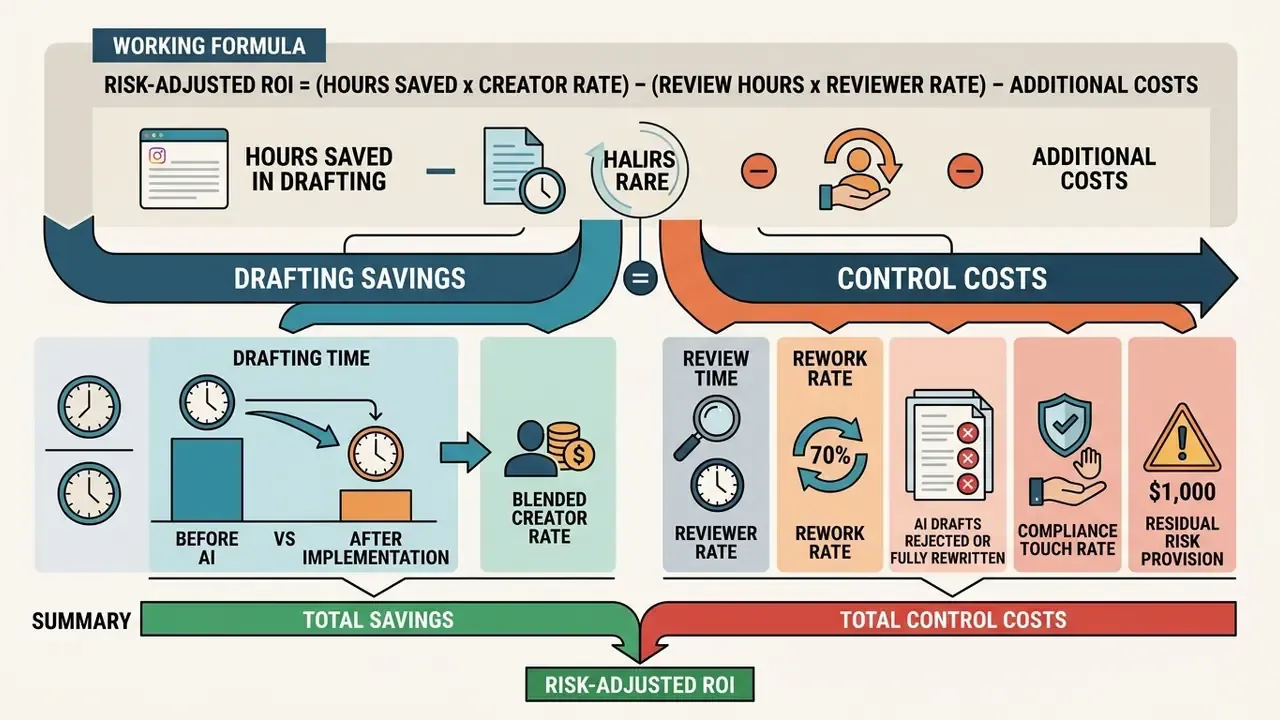
Time-savings statistics describe the drafting stage only. A defensible business case for a caption generator in a regulated organization prices the review layer too.
Working formula:
Risk-Adjusted ROI = (Hours saved in drafting x blended creator rate) - (Review hours x reviewer rate) - (Compliance or legal review hours x counsel rate) - (Tooling and licensing cost) - (Residual risk provision)
Inputs to gather before approval:
- Baseline drafting time per post before AI, and drafting time after implementation.
- Review time delta. AI drafts can increase review time when brand parameters are unstandardized; the same drafts reduce review time once a fixed system prompt and template library exist. Measure both states.
- Rework rate. Share of AI drafts rejected or fully rewritten. A rework rate above roughly one third usually signals a prompt-quality problem, not a model problem.
- Compliance touch rate. Share of posts requiring legal or compliance sign-off, multiplied by average counsel time.
- Residual risk provision. A conservative allowance for correcting, deleting, or remediating a non-compliant post, including customer notification where applicable.
- Avoided cost of shadow AI. The value of moving unsanctioned tool usage onto a logged, contract-covered path.
Teams that prefer to model this in a spreadsheet before an approval meeting can start from our ROI and cost calculators and swap in local rates.
Practical reading: for unregulated consumer brands, the drafting saving usually dominates and ROI is straightforwardly positive. For financial services and other regulated sectors, ROI comes less from faster drafting and more from two levers: standardization that shortens compliance review, and elimination of unlogged tool usage. Present the case on those two levers, not on raw generation speed.
AI Instagram Caption Generator FAQ
Q1: What is the best ai instagram caption generator available in 2026?
The optimal tool depends on the workflow. Platforms like Canva, Hootsuite, Planable, Grammarly, QuillBot, and Meta AI offer integrated AI captioning inside design or scheduling ecosystems, while tools built on advanced models such as GPT-4o give stronger tone customization and multimodal image understanding.
«In a cross-platform study with 892 participants, GPT-4 produced content users preferred over human copy on Facebook and rated comparably on Instagram.» Aldous et al., ACM Hypertext (2024). https://dl.acm.org/doi/10.1145/3648188.3675141 For enterprise buyers, output quality is rarely the deciding factor. Data retention terms, security attestations, SSO, audit logging, and explicit commercial licensing usually determine the shortlist.
Q2: Can an ai caption generator free for instagram generate content in multiple languages?
Yes. Major tools support multilingual generation. Some publish an explicit list, for example English, Spanish, Italian, French, and German, while others generate in whatever language the input uses. Localized human review is still recommended so that regional idioms, cultural context, and disclosure wording land correctly. Disclosure phrasing in particular is jurisdiction-specific and should not be machine-translated without review.
Q3: How do I fix a bad or generic caption generated by AI?
Use an iterative prompting approach, the "sounding board" method. Instead of restarting, instruct the tool to "Rewrite with a stronger hook," "Shorten to under 150 characters," or "Add specific product details about [Feature X]." Most interfaces expose Rewrite, Shorten, and Lengthen actions that apply to a highlighted segment rather than the whole caption. If three iterations fail, the defect is almost always missing context in the brief, whether audience, intent, or constraint, and not model capability.
Q4: Can I use an ai instagram description generator for other platforms like TikTok or LinkedIn?
Yes. Instagram captions emphasize visual hooks and hashtags, but the core text adapts for TikTok (short trend hooks) or LinkedIn (professional context and industry analysis). Length targets differ substantially:
| Platform | Max Character Limit | Recommended Sweet Spot | Key Structural Focus |
|---|---|---|---|
| Instagram Feed | 2,200 characters | 138 to 150 characters | Hook in first 125 chars; 3 to 5 niche hashtags |
| Instagram Reels | 2,200 characters | 50 to 100 characters | On-screen audio context plus strong visual hook |
| Instagram Stories | Overlay text | 0 to 20 words per frame | One line per screen; stickers, polls, tap sequencing |
| TikTok | 2,200 characters | Under 150 characters | Trending keywords plus fast scannability |
| 3,000 characters | 25 to 50 words | Professional context plus clear line breaks | |
| 33,000 characters | 40 to 80 words organic; 5 to 19 words paid | Front-loaded value, minimal hashtags | |
| X / Twitter | 280 characters (10,000 for subscribers) | 71 to 100 characters | Single idea plus one link or CTA |
| 500 characters (plus 100 title) | Title under 40 chars, description under 50 chars | Search-oriented keywords in title |
Q5: Is Hypeart.ai a verified provider for Instagram AI caption tools?
No verified information is available. As of the February 2026 review, the domain does not resolve through public DNS, and no official corporate registry entry or product catalog has been verified. Any commercial positioning should be treated as hypothetical until confirmed.
Q6: Should AI-generated Instagram captions be labeled as AI-generated?
Labeling obligations depend on jurisdiction, platform policy, and the nature of the content. Peer-reviewed evidence indicates that explicit "AI-generated" labels reduce behavioural engagement, with one study estimating a 14.22 percentage-point drop versus human-created content (Seeger, Wessel & Lehrer, Electronic Markets, 2024, https://doi.org/10.1007/s12525-024-00720-4). That is an argument for substantive human authorship and editing, not for concealment. Advertising disclosures (#ad, #sponsored) remain mandatory regardless of how the copy was drafted. Consult counsel on platform and jurisdictional labeling rules.
Q7: What records should we keep when a caption is AI-assisted?
At minimum: the prompt, the tool and model version, the raw output, all human edits, the substantiation source for each factual claim, the named approver, the approval timestamp, and the published version with its publication date. In regulated sectors, retain these records according to your advertising records retention schedule and keep them exportable for internal audit and examiner requests.
Q8: Can we let the tool publish automatically?
Not for brand or regulated accounts. The field evidence is blunt: over ten weeks, a fully automated account gained zero Instagram followers while a human-in-the-loop account reached 375 followers and active interaction (Issues in Information Systems, 2025). Autonomous publishing also removes the approval control that makes advertising records defensible in the first place.
Limitations, Open Questions, and a Safe Next Step
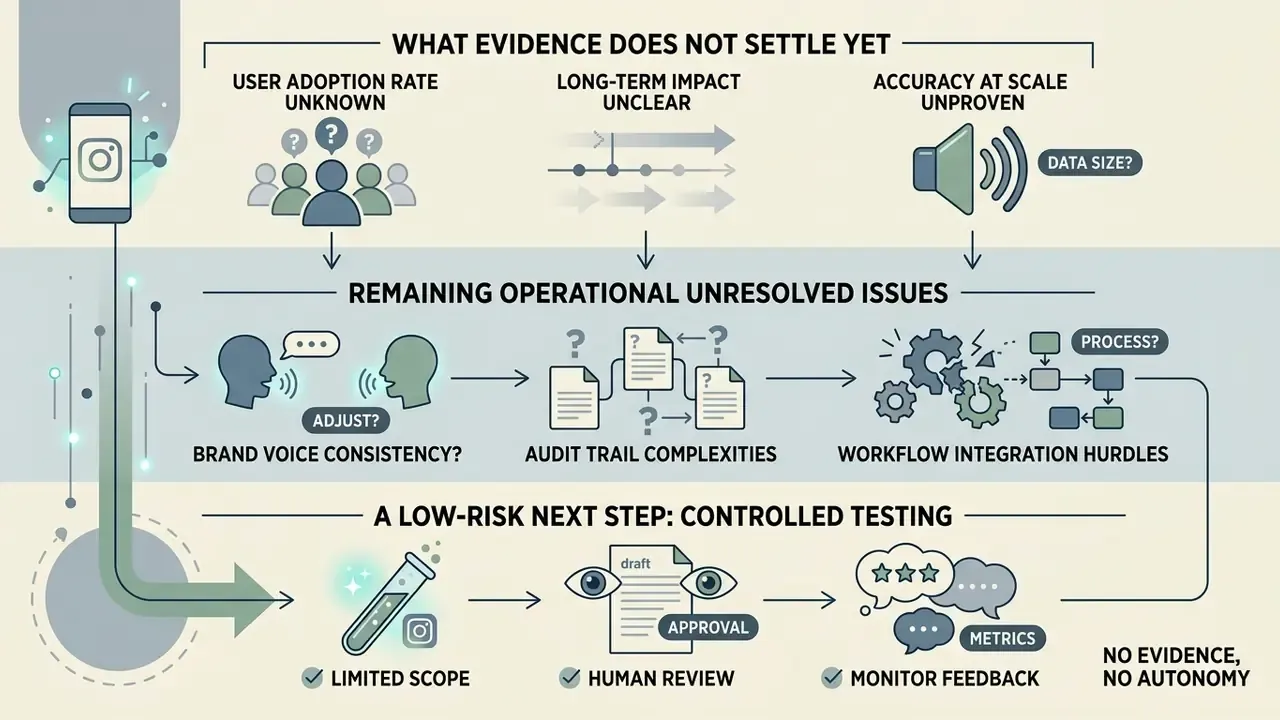
Honest caveats matter more than confident claims here, because much of the public evidence base is thin.
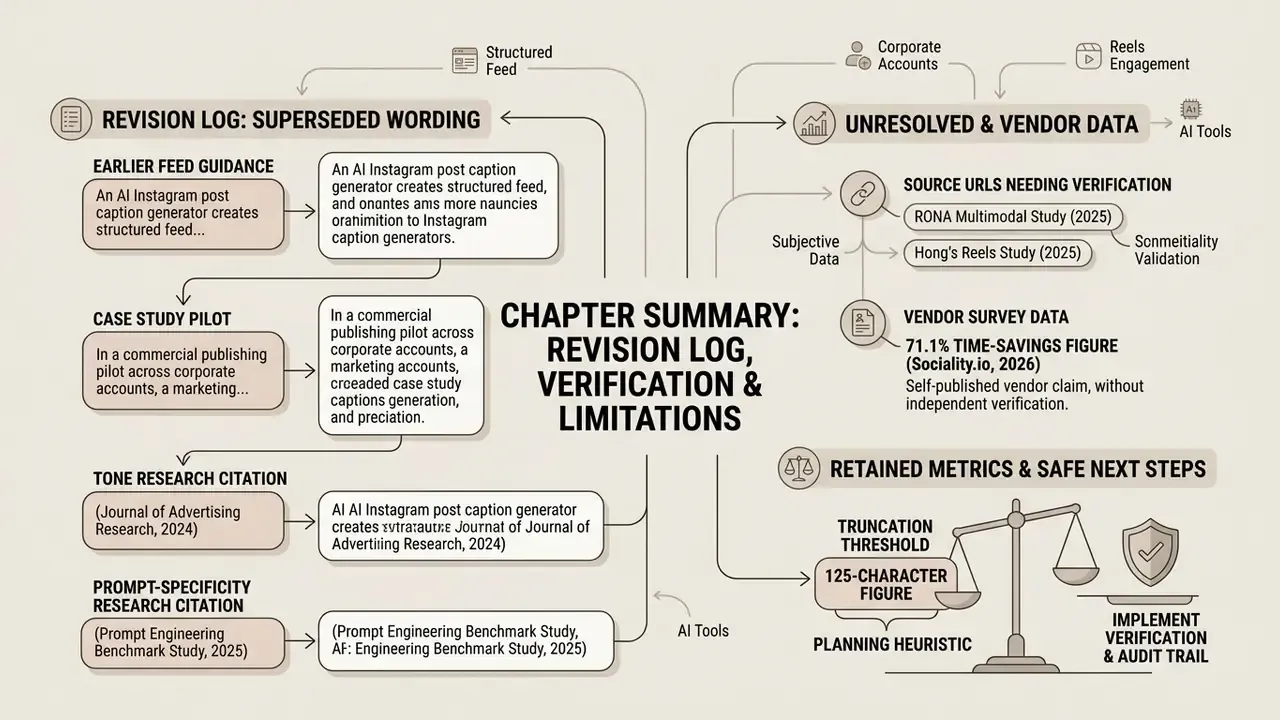
What the evidence does not settle yet. Truncation thresholds shift with device and language, so the 125-character figure is a heuristic. Engagement studies disagree on effect direction by platform. Several of the sources cited above lack stable public URLs. Vendor surveys report attractive time savings without disclosing sampling. Treat all of it as directional.
What remains unresolved operationally. Nobody has published a defensible benchmark for how much human editing is enough to establish authorship. Rework-rate targets vary widely by vertical. Agentic scheduling, where a tool drafts, schedules, and posts without a per-item approval, has no widely accepted control pattern for regulated advertising records.
A low-risk next step. Pick one account and one 30-day window. Register the tool in the AI inventory, fix a system prompt with brand voice and prohibited-language rules, require a named approver, and log every prompt and output. Then measure three numbers: drafting time saved, review time delta, and rework rate. If the review layer eats the drafting saving, the fix is usually the prompt library, not the model.
No evidence, no autonomy. That order rarely disappoints anyone.
Appendix A: Revision and Verification Log
Appendix B: MRM Audit Checklist for Marketing AI Output
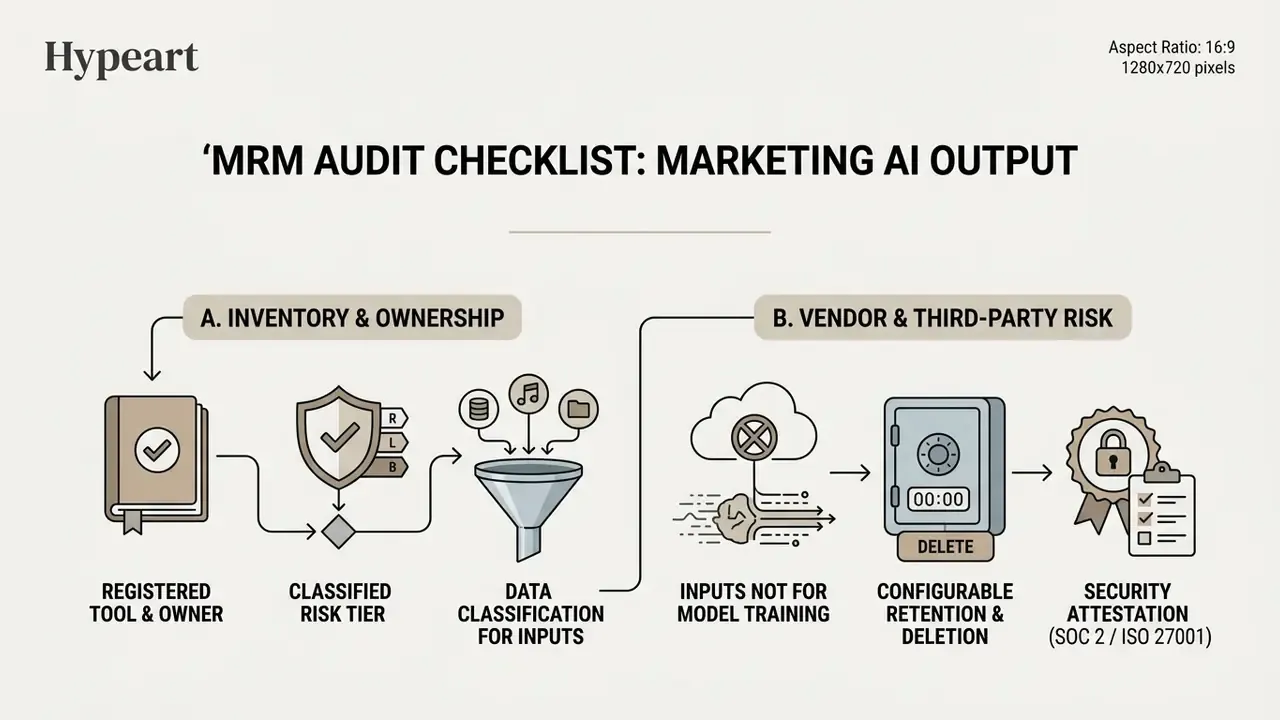
A copy-ready control checklist for risk, compliance, and internal audit functions reviewing an AI caption workflow.
A. Inventory and ownership
[ ]Tool registered in the AI or model inventory with a named business owner.[ ]Use case classified by risk tier, with documented rationale for the tier.[ ]Data classification recorded for all permitted prompt inputs.
B. Vendor and third-party risk
[ ]Contract states inputs are not used for model training.[ ]Retention period configurable and documented; deletion mechanism verified.[ ]Security attestation on file (SOC 2 Type II and/or ISO 27001), current within the audit period.[ ]Hosting region satisfies data residency requirements.[ ]Sub-processor list reviewed; breach notification terms acceptable.[ ]Exit and data-portability provisions documented.[ ]Commercial licensing of output confirmed in writing; attribution obligations identified.
C. Access and identity
[ ]SSO/SAML enforced; no shared credentials.[ ]Role-based permissions distinguish drafters from approvers.[ ]Joiner, mover, and leaver processes cover tool access.
D. Input controls
[ ]Documented prohibition on customer PII, account data, unpublished financials, and confidential roadmap content in prompts.[ ]Automated or procedural scrubbing step evidenced in the workflow.[ ]Training completed by all users with tool access.
E. Output controls
[ ]No publication without a named human approver.[ ]Claim substantiation register maintained and linked to each published caption.[ ]Disclosure placement verified for sponsored, affiliate, and gifted content.[ ]Sector-specific review (for example, financial promotions review) evidenced where applicable.[ ]Prohibited-content list (guarantees, superlatives, forward-looking statements) embedded in the system prompt.
F. Audit trail and monitoring
[ ]Prompt, model version, raw output, edits, approver, and timestamp logged immutably.[ ]Logs exportable to the archiving or GRC platform.[ ]Retention aligned with advertising records policy.[ ]Periodic quality review samples published captions against brand and compliance standards.[ ]Rework-rate and rejection-rate metrics tracked and reported to the owner.[ ]Incident and remediation procedure defined for non-compliant published content.
G. Shadow AI detection
[ ]Network or endpoint monitoring identifies unsanctioned generative-AI usage by marketing teams.[ ]A sanctioned, adequately fast alternative is available to all content contributors.[ ]Escalation path defined for discovered unsanctioned usage.
Definitions for the AI terms used above, from vision-language models to agentic workflows, are collected in our glossary.