That sounds harmless. It usually is, right up to the moment a risk officer discovers that a published policy memo, a credit committee summary, or a graded assignment quietly borrowed three references that never existed.
Last updated: 2026 · Reviewed by: Marcus Hale, AI Governance & Model Risk Editorial Specialist (illustrative background: model validation review in a Tier-1 banking context)
Key takeaways
- What it does converts a topic, notes, a URL, a video transcript, or an uploaded PDF into a structured draft with introduction, body paragraphs, and conclusion.
- How good it is GPT-4 physics essays scored 65.7 versus 66.9 for humans, a statistically insignificant gap (p = 0.107). On GRE analytical writing, Gemini averaged 4.78 and GPT-4o 4.67 out of 6.
- Where it fails citation fabrication, low claim originality (rarity score 0.037 versus 0.170 for human writers), and structural homogenization (70 to 78 % lower variance in transitional architecture).
- What you must control academic level, citation style (APA, MLA, Harvard, Chicago, IEEE), target length, language, and, critically, a manual six-step citation verification pass.
- Governance rule never paste personally identifiable information (PII), student records, client data, or material non-public information (MNPI) into a public free-tier generator.
- Time and quality effect in a graduate-level experiment at Carnegie Mellon's Heinz College, generative AI cut writing time by 65 % and lifted average grades from B+ to A, but only with structured instruction and human editing.
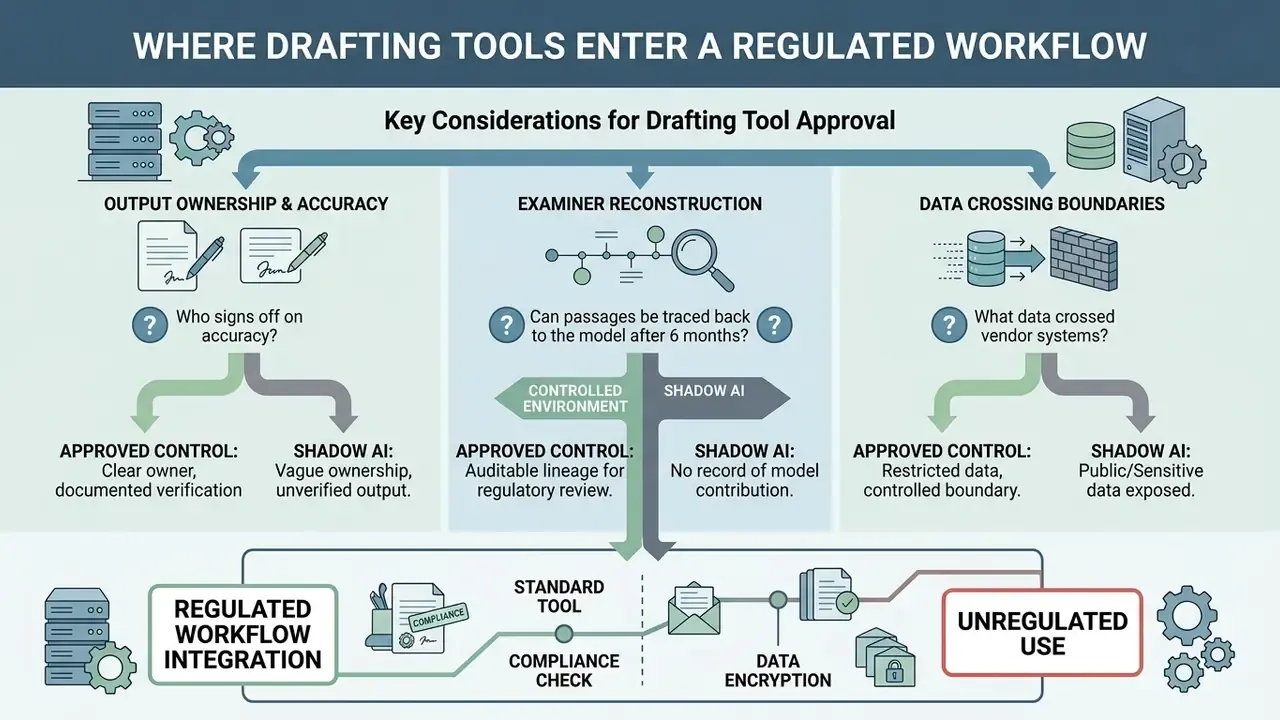
Where drafting tools enter a regulated workflow
Essay generation looks like a student topic. In practice it is the same control problem that model risk teams already know.
A US bank rarely buys an "essay generator" by name. It buys, or tolerates, a general-purpose writing assistant that ends up drafting credit narratives, KYC file summaries, AML alert dispositions, vendor questionnaires, board memos, and training material. The text genre changes; the failure modes do not. Fabricated citations in an academic paper and fabricated regulatory references in an internal memo come from the same statistical mechanism.
Three questions decide whether a drafting tool belongs in a controlled environment:
- Who owns the output, by name, and signs off on its accuracy?
- Can you reconstruct which passages a model produced, six months later, for an examiner?
- What data crossed the boundary into the vendor's systems?
If any answer is vague, you have shadow AI rather than an approved control. The rest of this guide works through capability, controls, cost, and open questions, in that order. Readers who prefer to compare tool categories side by side can start with our AI Media Comparison Matrices and come back.
What is an AI essay generator and what can it create?
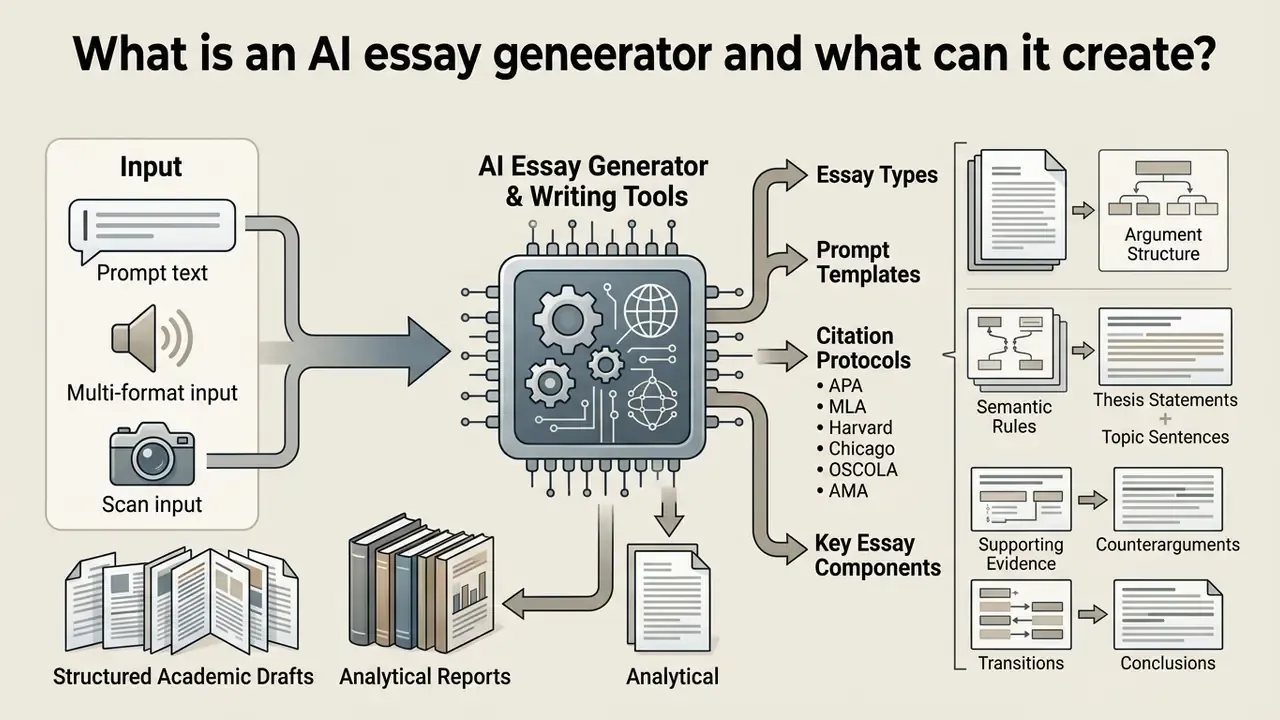
An ai essay generator is a specialized software tool designed to transform user prompts into structured academic or analytical drafts. It automates text drafting by predicting logical word sequences based on underlying language models.
Modern systems evaluate topic context, generate thesis statements, and construct supporting paragraphs. Organizations and students use an ai essay maker or ai essay creator to overcome initial drafting friction and establish clear structural outlines. The same generative principles that power text drafting also drive adjacent creative categories, and readers comparing output consistency across modalities can review our reference guide to AI art generators for a parallel view of how prompt controls influence machine output.
AI essay generator, essay writer and AI writing tools
An ai essay generator specifically focuses on generating complete, structured multi-paragraph essays from a single prompt or topic. In contrast, an ai essay writer or general ai writing tools cover broader tasks, including paraphrasing, grammar correction, and text summarization.
The functional hierarchy is three-tiered: AI writing tools is the umbrella category covering correction, evaluation, structural editing, and derivative content; AI essay writer denotes a prompt-to-draft generative system; AI essay generator is the narrowest subtype that outputs a complete essay in a defined academic genre. Vendors blur these labels constantly, so read the feature list rather than the product name.
Research by the HEPI-Kortext Student Generative AI Survey (2025) indicates that 64 % of surveyed students use generative AI explicitly to produce text, while 88 % use AI capabilities across broader assessment workflows.
«By 2025, the share of students using AI in at least one form rose from 66 % in 2024 to 92 %.»
A general ai essay writing generator creates entire text blocks, whereas basic grammar checkers assist with micro-level sentence editing. This distinction matters for institutional policy: several university frameworks exempt spelling, grammar, and style correction from mandatory disclosure, while any AI-influenced content generation requires stating the purpose, the affected passages, and the model used. Enterprise policy tends to mirror that split, which is why a single blanket rule ("no AI") usually collapses within a quarter.
What an AI-generated essay usually includes
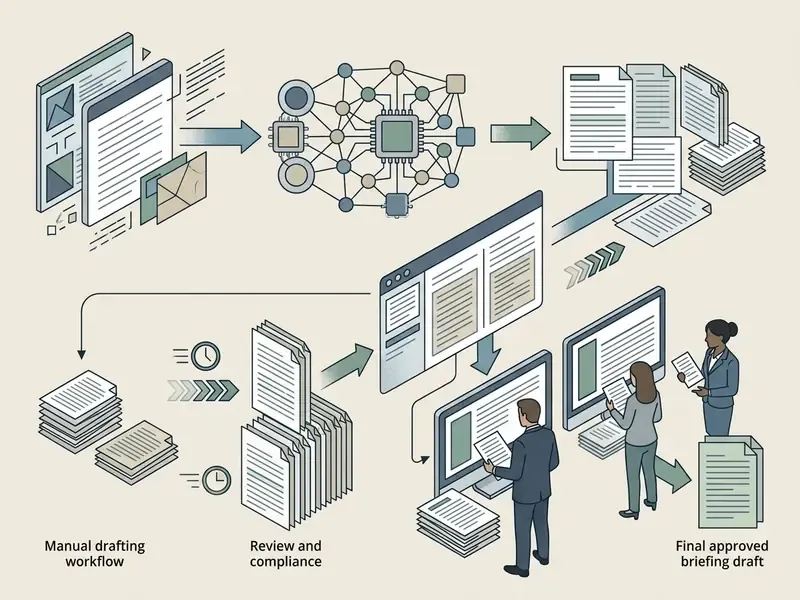
An ai generated essay typically features a three-part structural framework consisting of an introduction, body paragraphs, and a conclusion. It opens with background context, establishes a clear thesis, and outlines core arguments. University writing guides define the mandatory elements of each stage: the introduction must state topic, thesis, purpose, and roadmap; each body paragraph must carry one main idea supported by evidence; the conclusion must restate the thesis and synthesize the main points rather than merely repeat them.
Empirical research by Clough et al. (2024) demonstrated that GPT-4 generated physics essays achieved average scores of 65.7, closely matching human scores of 66.9.
«The score gap between GPT-4 essays (65.7) and student essays (66.9) is statistically insignificant: p = 0.107 at α = 0.05.»
The study confirmed that an ai generator essay naturally replicates human document length, formatting, and structural progression when provided with standard assessment prompts. Worth noting: matching a score band is not the same as matching reasoning quality. The grader saw competent structure, not novel thought.
In testing conducted by Zhang et al. (2024) on GRE analytical writing tasks, leading models like GPT-4o scored 4.67 out of 6.
«Gemini averaged 4.78 and GPT-4o 4.67 out of 6, both consistent with the GRE band for "thoughtful, well-developed analysis".»
The output contained clear issue analysis, logical transitions, and structured conclusions.
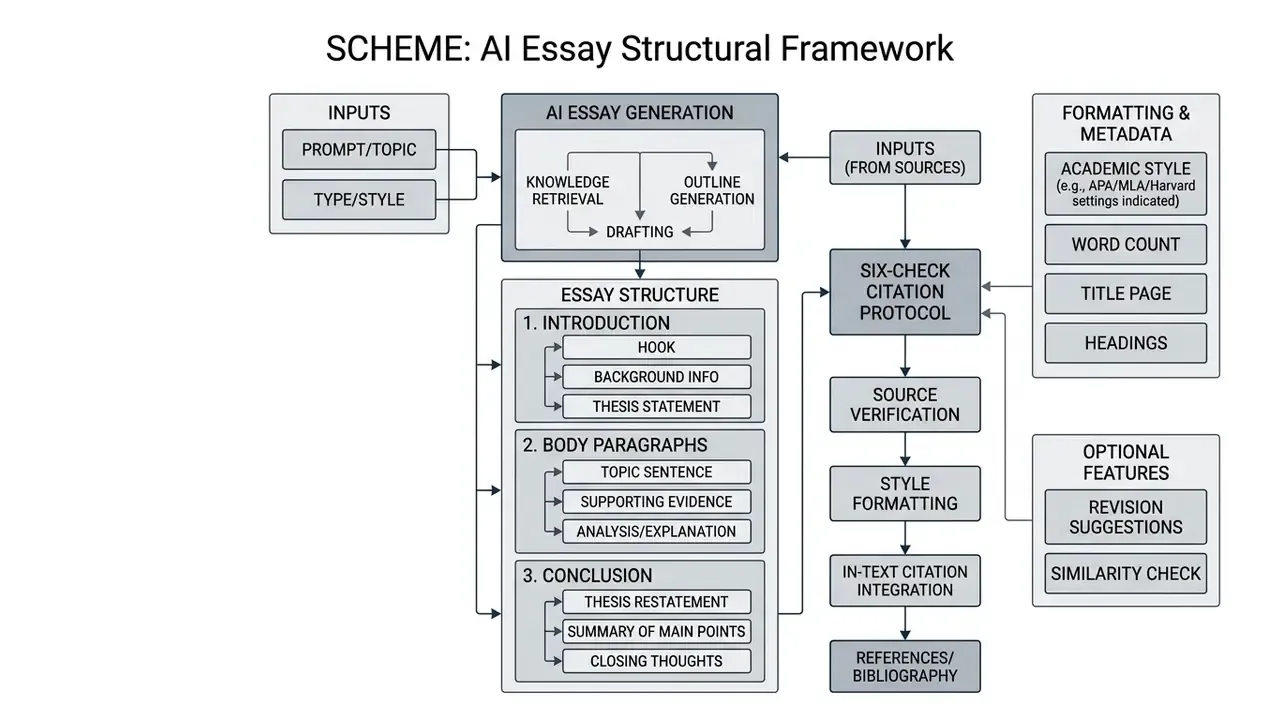
- Semantic Rules: Executed as an SVG diagram with text equivalents in the DOM;
alttext includes the key phrase "ai essay generator".
How to use an AI essay generator online
To use an ai essay generator online, you input a defined topic or source file, select structural settings, click generate, and review the draft. The process relies on clear prompt parameters to yield relevant text.
Modern web tools allow users to ai create essay drafts without complex software installations. Following a systematic sequence ensures the generated text aligns with your specific analytical objectives.
Enter a topic and define the essay task
Effective generation begins with a precise topic description and clear task constraints. Inputting specific assignment criteria directly controls the quality of the resulting ai generator text essay.
University prompting frameworks, including public guidance published by Georgetown, Rutgers, Purdue OWL, and Oxford writing services, converge on the same recommendation: specify the target audience, essay length, academic level, thesis, and desired tone, then refine iteratively after each draft. A reproducible pattern used in these materials reads: "I'm writing a [length] [type] essay on [topic] for my [course]. My thesis is [thesis]. Evaluate the thesis, brainstorm evidence, identify counterarguments, and suggest an organization." A well-constructed prompt prevents generic outputs by establishing strict boundary conditions before generation begins. Note that these institutional prompting frameworks are advisory documents rather than peer-reviewed studies; their effectiveness has not been benchmarked in controlled trials, so treat them as best practice rather than measured outcomes.

Supported input sources for essay generation
Modern AI essay generators accept multiple input formats to ground the output in verified context rather than model memory alone:
Grounding generation in your own uploads is the single most effective defence against fabricated content: when the model works from supplied text, it summarizes and restructures rather than inventing substance. Guidance for AI-assisted drafting is explicit on this point. A bare topic with no supporting notes invites invented evidence and phantom references.
- Topic prompt and text notes
- input raw bullet points, assignment prompts, lecture notes, or a skeleton outline; the model organizes the material into coherent paragraphs while keeping your original research at the centre.
- Websites and URLs
- paste article links so the system extracts arguments, positions, and key findings, then synthesizes them into a structured discussion.
- YouTube video transcripts
- convert recorded lectures, conference talks, and educational videos directly into a structured draft essay, useful when the primary source is spoken rather than written. Teams working the other direction, from text to visuals, will find the mechanics familiar in our notes on the kapwing ai video generator.
- Document and file uploads
- upload research PDFs, slide decks, or text files to generate contextual analysis grounded in cited facts from the supplied corpus.
Field-tested prompt templates for high-quality generation
To achieve optimal output from an ai essay maker, use structured prompts that specify every controllable parameter. The templates below are copy-ready.
1. Argumentative essay prompt template
[Topic]: Should renewable energy subsidies be mandatory for industrial sectors?
[Academic Level]: College / Undergraduate
[Format & Length]: APA 7th style, 4 body paragraphs (~1,200 words)
[Key Points to Cover]: 1. Long-term economic impacts. 2. Carbon reduction metrics.
3. Counterargument regarding short-term implementation costs.
[Instruction]: Generate a thesis-driven essay with counterargument rebuttals and
academic citations. Flag any claim you cannot support with a verifiable source.
2. Analytical essay prompt template
[Topic]: The impact of artificial intelligence on modern supply chain risk management.
[Academic Level]: Master's / Graduate
[Format & Length]: Harvard style, 5 body paragraphs (~1,500 words)
[Key Points to Cover]: 1. Predictive maintenance models. 2. Single-point-of-failure
vulnerabilities. 3. Regulatory oversight frameworks.
[Instruction]: Provide an objective analysis supported by named risk frameworks.
Separate established findings from interpretation.
3. Compare and contrast essay prompt template
[Topic]: Rule-based fraud detection versus machine-learning fraud detection in retail banking.
[Academic Level]: Bachelor's
[Format & Length]: IEEE style, 4 body paragraphs (~1,000 words)
[Key Points to Cover]: 1. Detection accuracy. 2. Explainability and audit trails.
3. Implementation cost. 4. Regulatory acceptance.
[Instruction]: Use a point-by-point comparative structure, not block structure.
Conclude with conditions under which each approach is preferable.
4. Scholarship essay prompt template
[Topic]: How this scholarship will help me achieve my career goals in environmental engineering.
[Academic Level]: High School / Bachelor's
[Format & Length]: No citations, 3 paragraphs (~700 words)
[Key Points to Cover]: 1. Academic record and relevant projects. 2. Alignment with the
funder's stated mission. 3. Concrete five-year plan.
[Instruction]: Write in first person, avoid generic superlatives, and keep the tone
specific and evidence-based.
Generate an essay draft with AI
Clicking the generation control activates the underlying LLM to draft the text based on your prompt parameters. An ai free essay generator or commercial ai generator paper tool processes the instructions and outputs a complete draft within seconds.
A study by Kizilcec et al. (IZA, 2024) analyzing over one million academic abstracts revealed that AI tools significantly enhance lexical sophistication and structural readability.
«By November 2024, the lexical diversity index of non-native English authors converged with that of native speakers, for the first time on record.»
The research demonstrated that automated text generation helps non-native writers achieve sentence complexity comparable to native authors. For multinational teams, that is a genuine equity gain, not a cosmetic one.
Review, edit and finalize the generated essay
Reviewing an ai generator essays output requires verifying factual accuracy, checking logical coherence, and editing style. Automated generation serves as an initial draft rather than a final product. Practical university workflows separate two distinct passes: revision addresses content, argument, and structure, while editing addresses grammar, punctuation, formatting, and citation style. Reverse-outlining the AI draft, meaning you list the actual claim of each paragraph, exposes repetition and orphaned paragraphs faster than linear rereading.
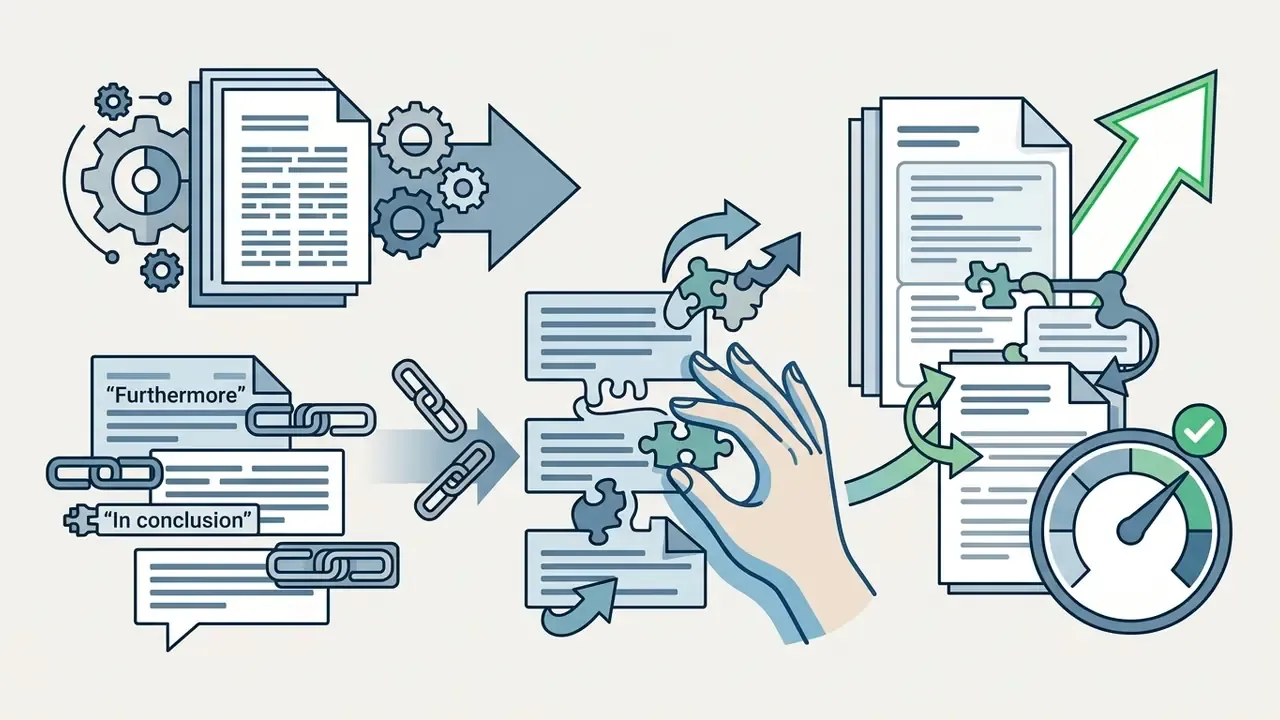
Research on structural homogenization (Does AI Homogenize Student Thinking? A Multi-Dimensional Analysis of AI-Assisted Writing, arXiv:2603.21228v1, 2026) notes that while AI drafting improves structural quality (d > 3.7), it reduces variance in transitional phrasing by 70 to 78 %.
«The homogenization effect is dimension-specific: variance in cohesion architecture drops by 70-78 %, while perspective diversity and abstract-to-concrete transitions increase.»
Human editors must manually adjust paragraph connections and refine arguments to preserve individual voice. In other words, the seams are where the machine shows.
- Semantic Rules: An ordered list duplicates the flowchart steps in the DOM for full accessibility.
Essay types and customization options
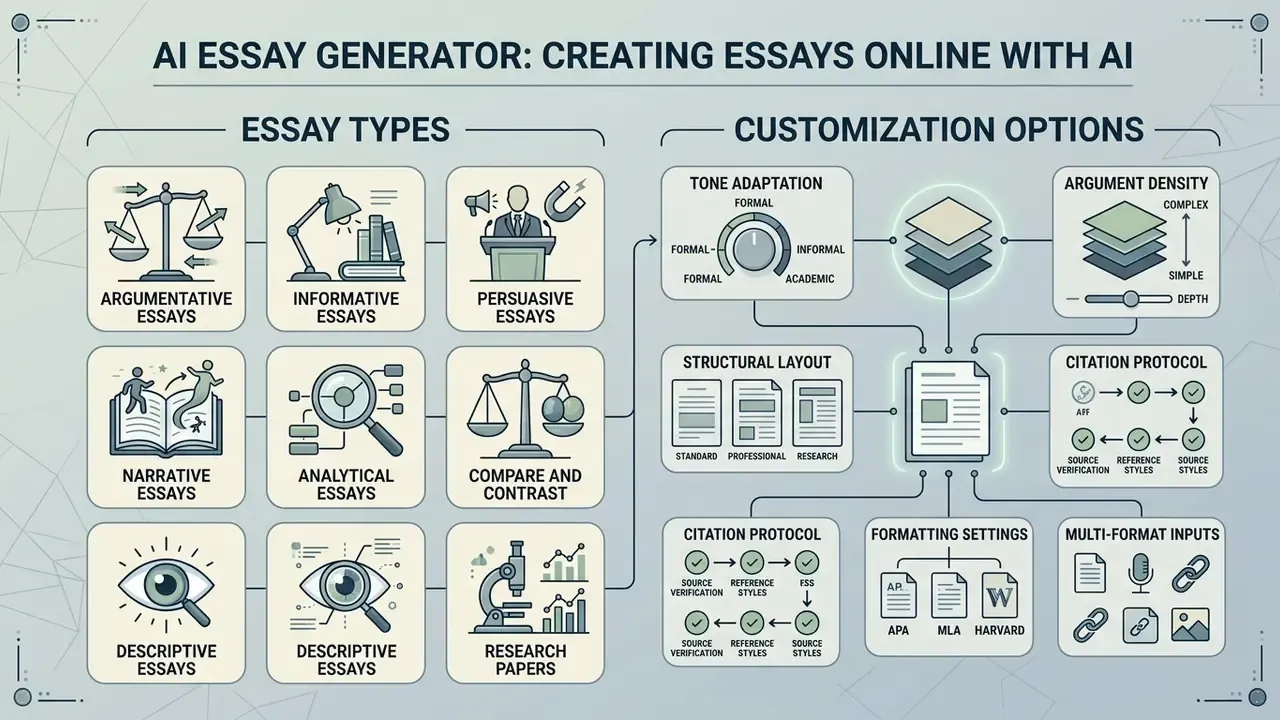
An ai composition generator supports multiple academic and professional text formats by adapting tone, argument density, and structural layout. Users can configure settings to generate argumentative, analytical, comparative, informative, persuasive, narrative, descriptive, or scholarship compositions.
Customization parameters allow users to align generated content with institutional requirements or executive communication standards. Selecting the appropriate format ensures the ai essay writing generator produces relevant content structure.
Argumentative, informative, persuasive and narrative essay types
Different writing tasks require distinct logical structures, argument styles, and evidence layouts. An ai essay writer adapts its generation pattern based on the selected essay category.
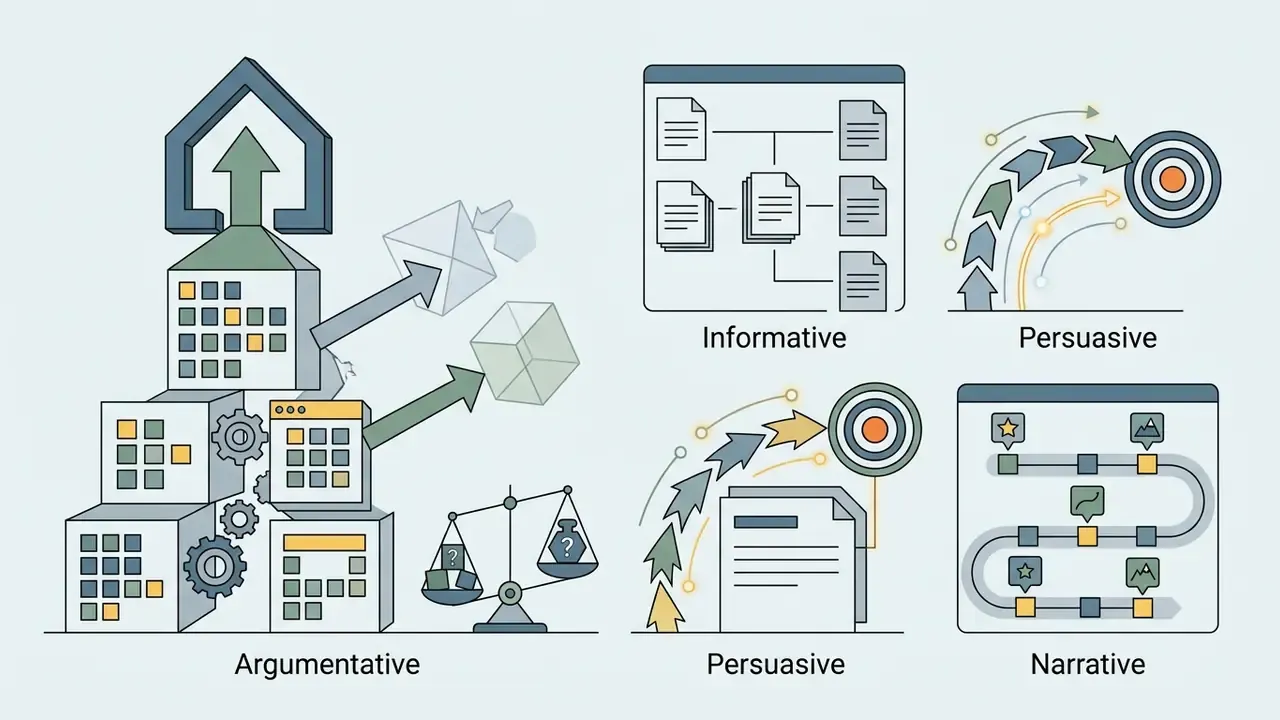
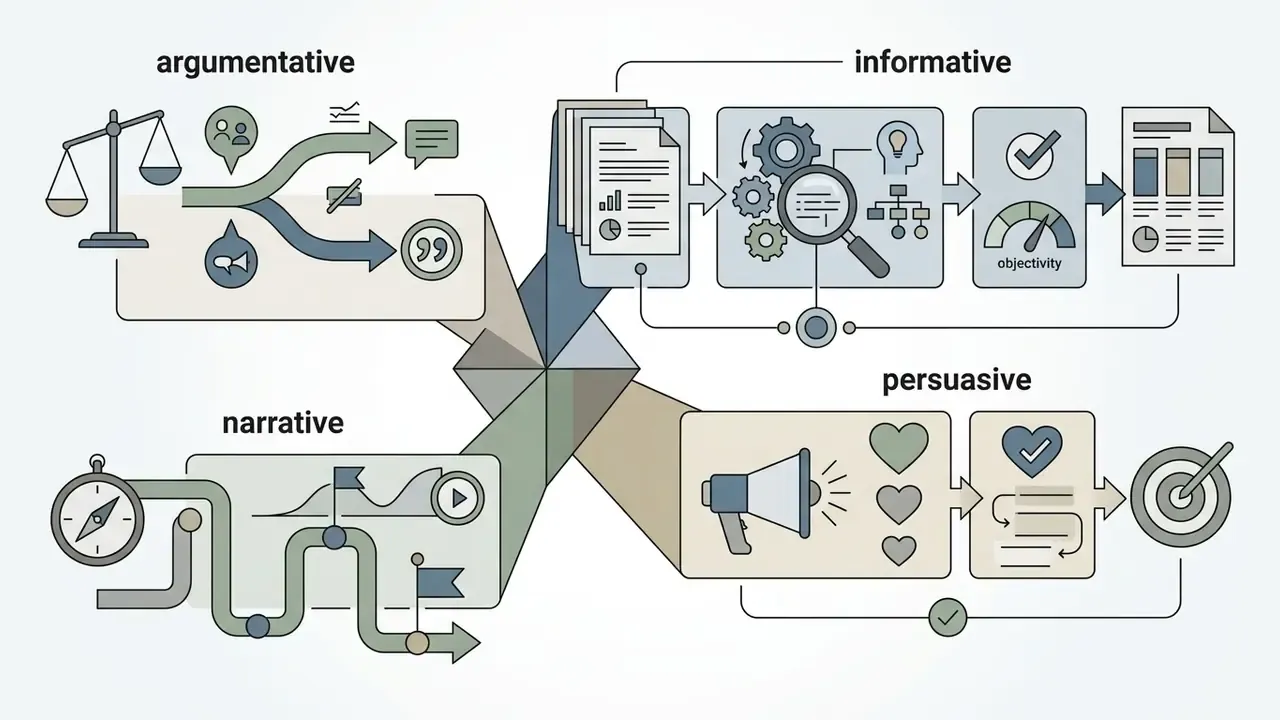
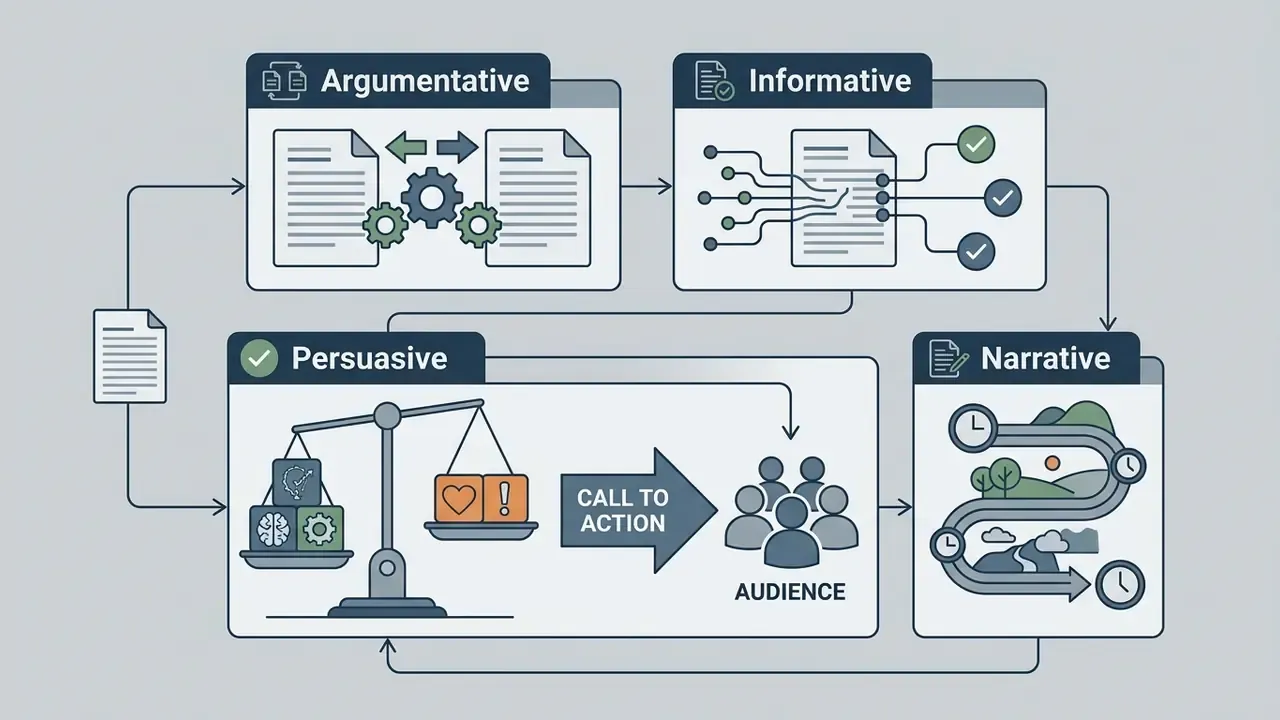
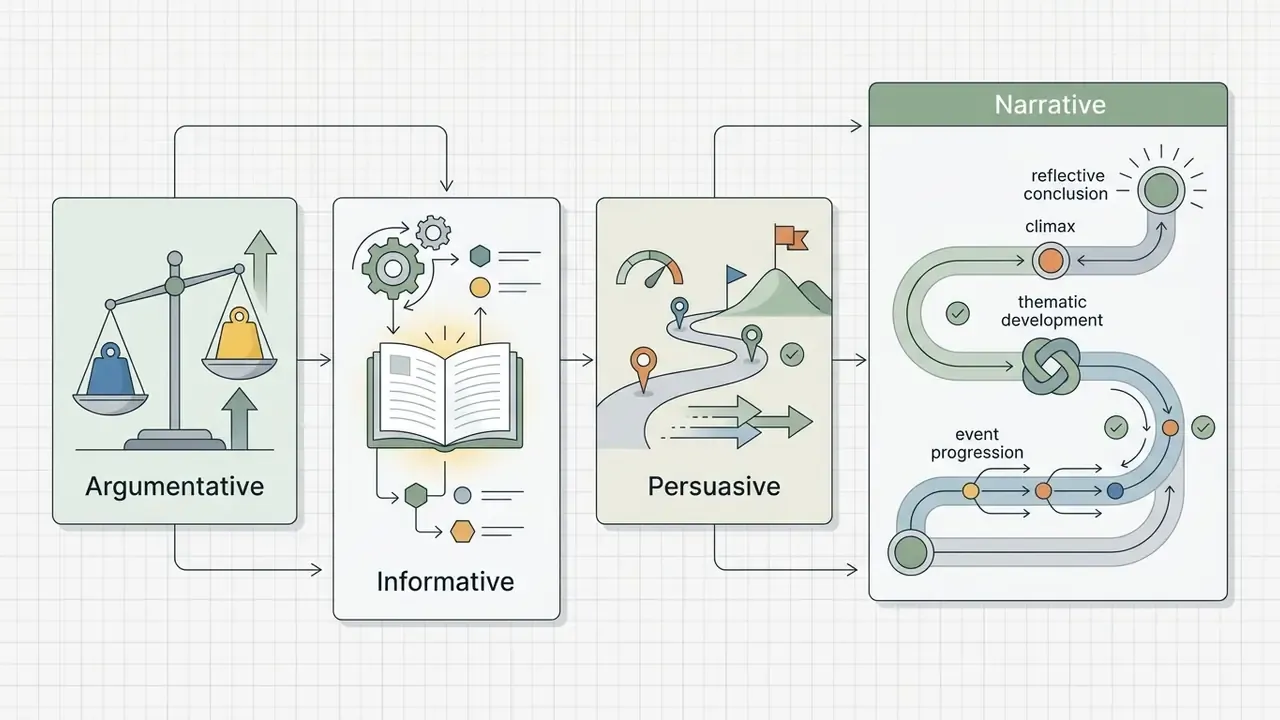


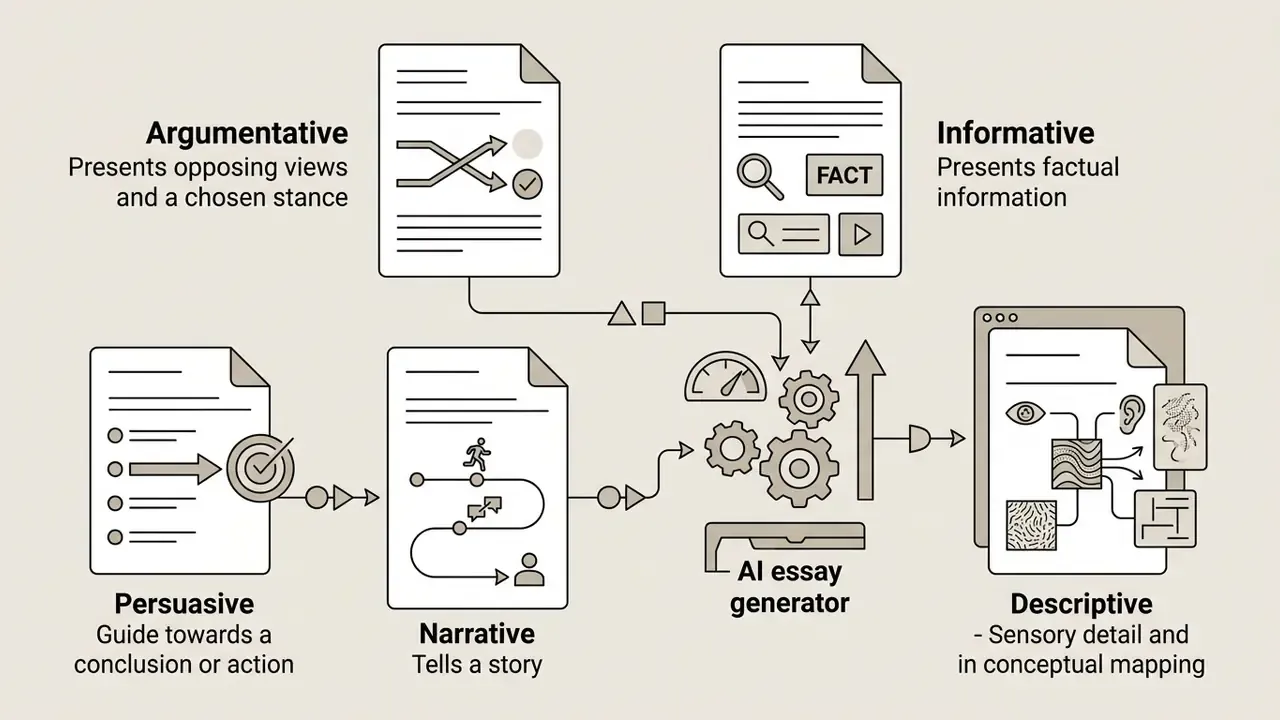
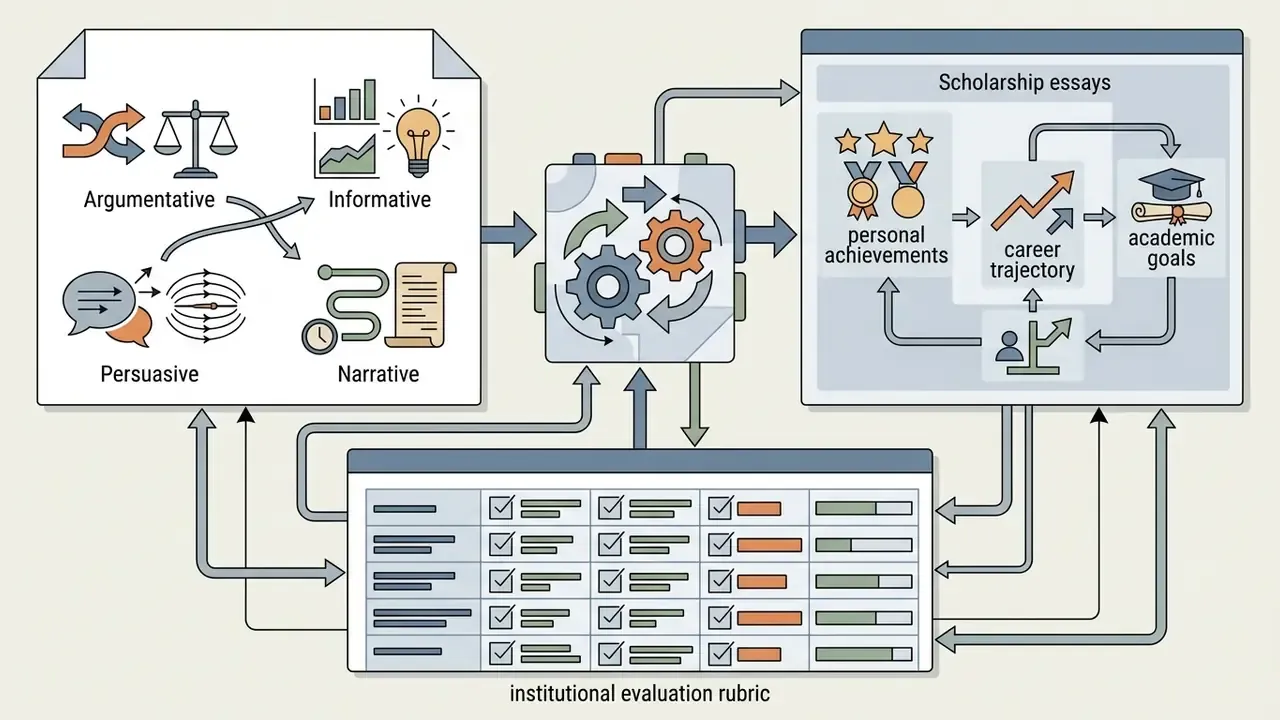
| Essay Type | Primary Objective | Key Structural Elements | Academic Level Focus | Prompt Instruction Focus |
|---|---|---|---|---|
| Argumentative | Prove a specific claim using evidence | Thesis, counterargument rebuttal, evidence blocks | High School / College | "Include opposing viewpoints and empirical evidence." |
| Analytical | Deconstruct complex topics or text | Component breakdown, causal links, objective evaluation | College / Bachelor's | "Break down core mechanics and evaluate underlying patterns." |
| Compare & Contrast | Evaluate similarities and differences | Dual-subject analysis, point-by-point comparative matrix | High School / College | "Highlight structural overlaps and critical distinctions." |
| Informative | Explain a topic objectively | Background context, conceptual analysis, summary | Middle / High School | "Maintain neutral tone and explain core mechanics." |
| Persuasive | Convince reader via logic and rhetoric | Logic and ethics appeals, call to action, rhetoric | High School / College | "Focus on logical justification and strategic benefits." |
| Narrative | Relate a sequence of events | Chronological order, central conflict, reflection | Middle / High School | "Use sequential structure and analytical takeaways." |
| Descriptive | Illustrate characteristics in detail | Sensory descriptions, spatial logic, subject focus | Middle School | "Incorporate precise descriptive details and imagery." |
| Scholarship | Demonstrate qualification and vision | Background, merit alignment, future goals | High School / Bachelor's | "Focus on personal achievements and institutional alignment." |
Generator parameters: academic level, citation style, length and language
Beyond genre selection, mature platforms expose a control panel that materially changes the output. Configure these parameters before generation rather than editing afterwards. Retrofitting a citation style onto a finished draft is where most rework hides.
| Parameter Category | Selectable Options | Functional Impact on Output |
|---|---|---|
| Academic Level | Middle School, High School, College, Bachelor's, Master's, Doctorate | Adjusts vocabulary complexity, sentence length, and theoretical depth. |
| Citation Style | APA 7th, MLA 9th, Harvard, Chicago, IEEE | Formats in-text citations and reference list entries accordingly. |
| Target Word Count | Short (~700 w), Medium (~1,500 w), Long (~2,500 w), Extensive (~4,000 w) | Controls paragraph density and argument development scope. |
| Output Language | 25+ languages (English, Spanish, German, French, Portuguese, Polish, Turkish, and more) | Enables cross-lingual drafting via multilingual LLM foundations. |
| Reference Handling | None, auto-generated list, user-supplied sources | Determines whether the model must ground claims in supplied material. |
| Essay Genre | 8+ documented types (see table above) | Selects the structural template and argument logic. |
Style, tone and structure of AI-generated essays
Customizing style parameters in an ai generator for essays ensures the output matches required academic or corporate registers. Users can adjust parameters including sentence length, formality, and vocabulary complexity.
Institutional writing-centre guidance, including the AI guidelines published by the University of Maryland Writing Center (2025), emphasizes that style adjustments must preserve readability, human oversight, and transparency; those guidelines are policy documents rather than empirical studies, so they describe expected practice rather than measured effects. Adjusting tone controls prevents the model from defaulting to overly generic or repetitive phrasing. Plain-language standards reinforce the same targets: common words, sentences under roughly 20 words, main point in the opening paragraph, and active voice.
«Students report using generative AI primarily for idea generation, structural improvement, and raising the formality of language, while retaining final editorial control.»
How to improve quality and academic value of an AI-generated essay
To enhance the academic value of an ai generated essay, users must verify all claims, insert validated citations, and integrate independent human analysis. Relying solely on raw AI output increases the risk of factual errors and semantic unoriginality.
Empirical studies show that unedited AI text often relies on common, high-frequency claims. Incorporating human oversight transforms a basic draft into a rigorous, well-defended paper.
Use AI to explore ideas and build an essay structure
Using AI during the preliminary brainstorming phase helps writers map complex topics and organize key arguments before drafting full text. An ai essay maker free or commercial assistant excels at generating outline variants.
Institutional guidance published by Northwestern IT (2024) recommends a three-pass outline approach: generate broad themes, extract core arguments, and construct a logical section hierarchy; this recommendation is practitioner guidance without published sample size or methodology. A parallel workflow from San José State University's writing-with-AI materials asks students to generate two or three perspectives, then related subtopics, then two or three candidate outlines. Research on idea variance shows that a two-pass method, requesting many short ideas first and then instructing the model to make them bolder and more distinct, measurably increases diversity. This scaffolding method keeps human reasoning central to the writing process.
Check sources, citations and references
Verifying citations generated by an ai writing tool is mandatory, as language models can construct plausible but non-existent bibliographic references. Every cited source must be manually cross-checked against primary databases.
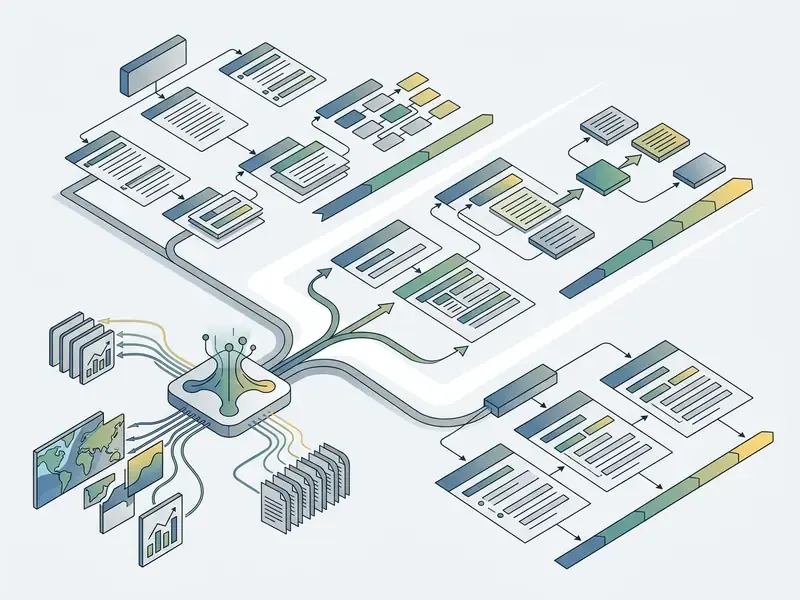
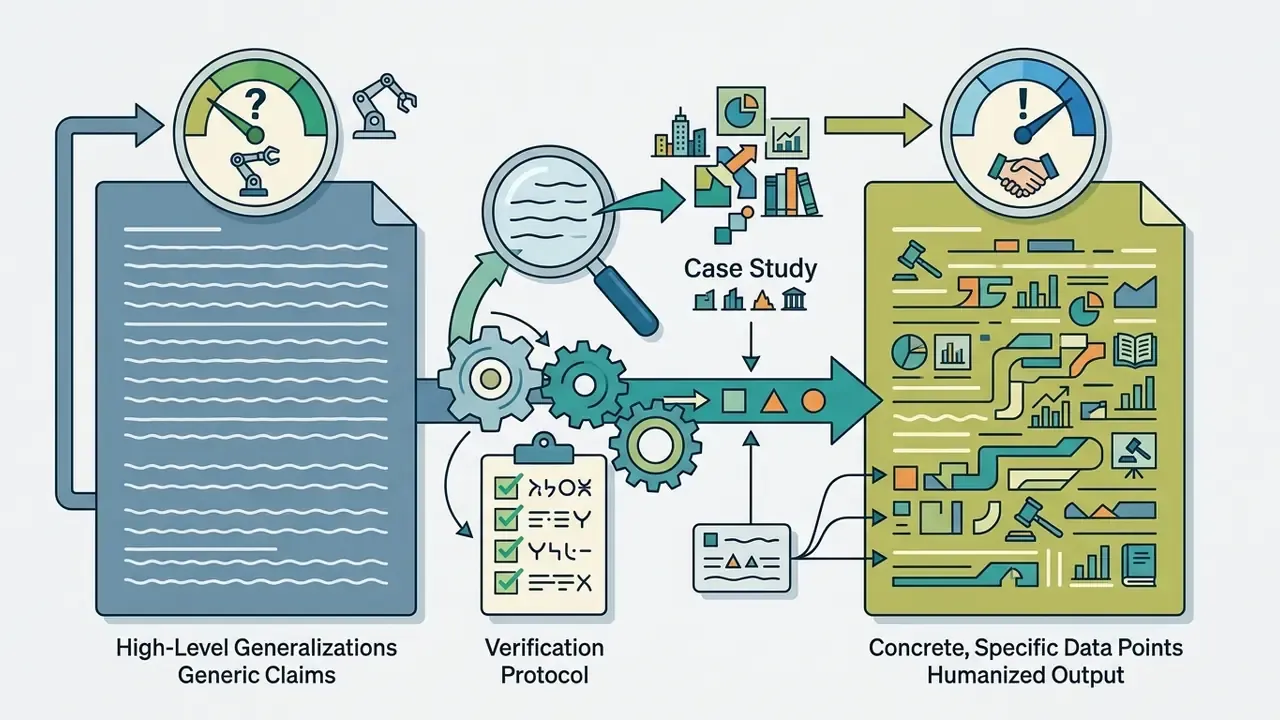
Recent technical work on citation integrity (arXiv:2603.21228v1, 2026) decomposes citation validation into six verifiable checks:
Citation hallucination has three distinct failure modes that must be checked separately: a source that does not exist, a real source with mismatched metadata, and a real source that does not actually support the claim attached to it. That third mode is the sneakiest, because everything resolves and nothing is true. Unverified citations violate academic integrity and compliance standards regardless of which failure mode caused them.
- DOI resolution
- the digital object identifier must resolve to a live record.
- Title existence
- the exact title must appear in an indexed bibliographic database.
- Author verification
- the listed authors must match the indexed record.
- Publication venue validation
- the journal, conference, or publisher must exist and must be the correct venue for that record.
- Metadata completeness
- year, volume, issue, and pages must be present and internally consistent.
- Cross-database agreement
- the record should appear consistently across Crossref, Semantic Scholar, OpenAlex, PubMed, or JSTOR; a reference found in only one database is treated as suspicious.
Make the essay reflect your own thinking
Personalizing an ai generator essay requires injecting your own analytical perspective, unique examples, and contextual reasoning. Editors must revise generic statements to reflect specific institutional or personal viewpoints.
Research using the AROA Framework (2026) showed that while AI essays score high on surface coherence (Q = 0.998), their claim rarity score is only 0.037, roughly one-fifth that of human writers (0.170).
«The correlation between text quality and claim rarity is r = −0.67: the higher the coherence, the more typical the arguments.»
Human editing is necessary to introduce original claims and elevate cognitive depth, and the payoff is measurable.
«Graduate students cut writing time by 65 %, while average grades rose from B+ to A when generative AI was used with proper instruction.»
Humanizing AI output and removing robotic phrasing
While raw LLM outputs exhibit structural predictability, authors can refine AI drafts to achieve a natural voice that passes quality and originality checks without misrepresenting authorship:
A caution for anyone treating "detection-proofing" as the goal: purpose-built classifiers are now highly accurate.
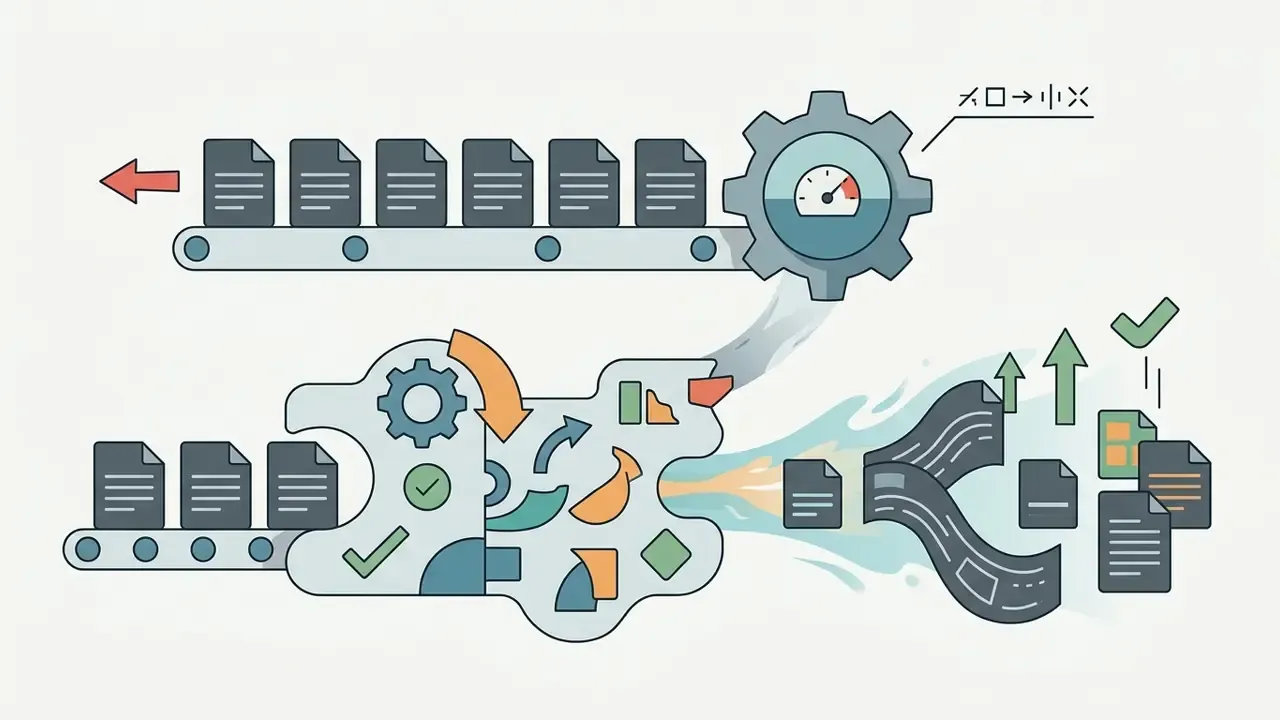
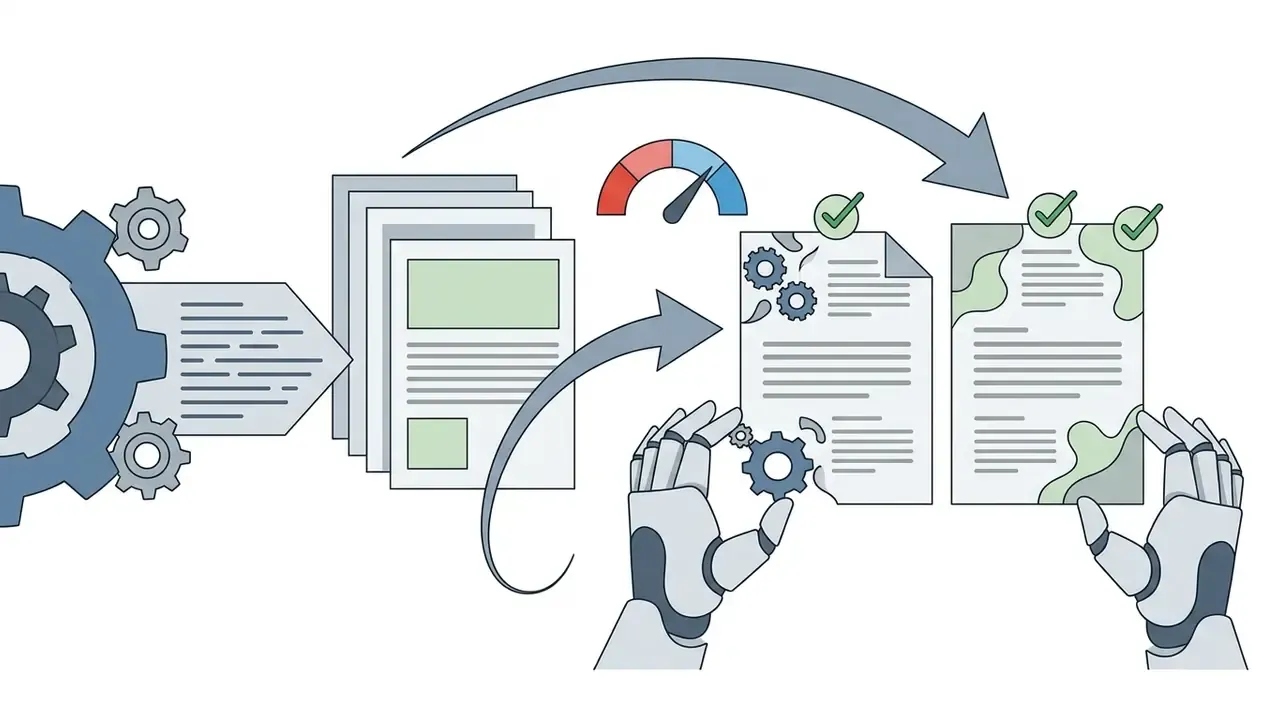
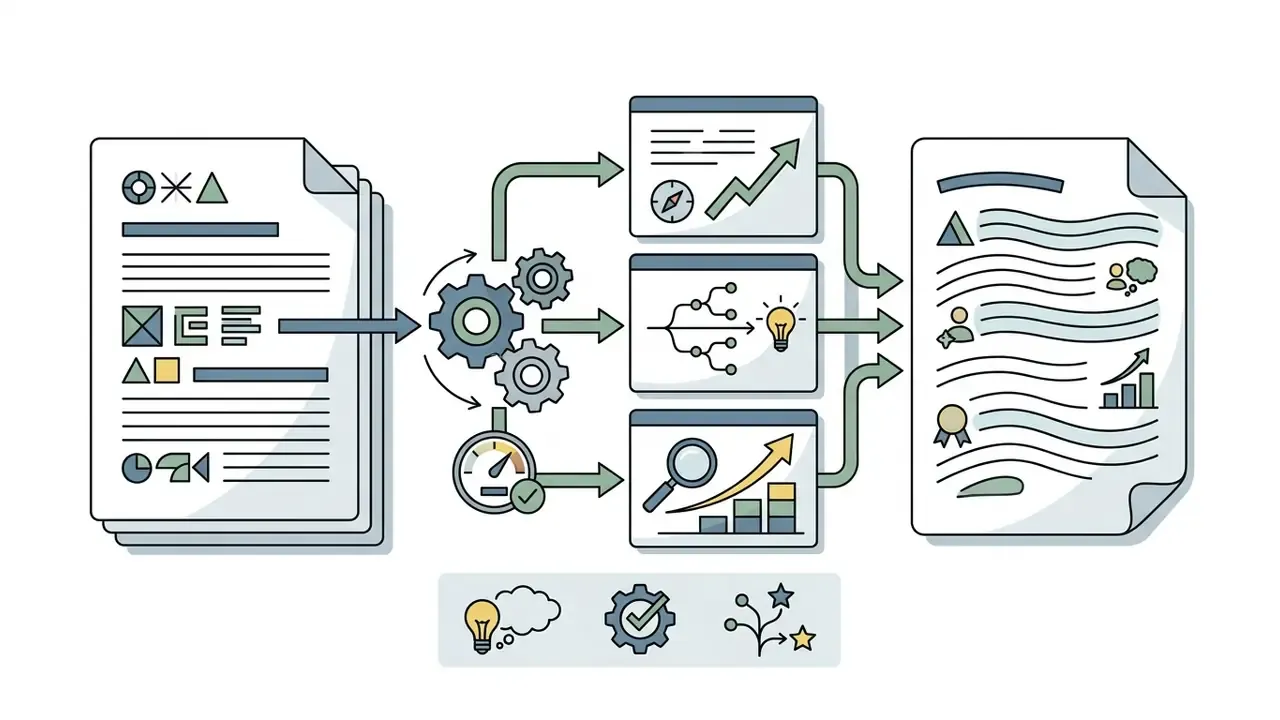
«Ghostbuster achieves F1 = 99.0 in detecting AI-written text across three domains, outperforming the best prior models by 5.9 F1 points.»
The defensible strategy is therefore genuine authorship plus disclosure, not evasion. Editing for a human voice is legitimate when the substance, evidence, and reasoning are yours.
Validation checklist for reviewers and auditors
Organizations extending model risk management practice to text generation can adapt classic validation principles, namely conceptual soundness, outcomes analysis, and ongoing monitoring, to AI-drafted documents. The checklist below is reproducible for internal audit and academic review alike.
| # | Control | Pass criterion | Evidence to retain |
|---|---|---|---|
| 1 | Prompt log | Full prompt, model name and version, and date recorded | Prompt archive entry |
| 2 | Input provenance | All uploaded sources identified and authorized for use | Source manifest |
| 3 | Claim verification | Every factual statement traced to a primary source | Annotated draft |
| 4 | Citation integrity | Six-check protocol passed for each reference | Verification sheet with DOIs |
| 5 | Originality | Human-authored claims present; generic assertions replaced | Redline comparison of draft versus final |
| 6 | Data handling | No PII, MNPI, student records, or client data submitted | Data classification sign-off |
| 7 | Disclosure | AI use declared per institutional or publisher policy | Disclosure statement |
| 8 | Human accountability | Named human reviewer accepts responsibility for accuracy | Reviewer attestation |
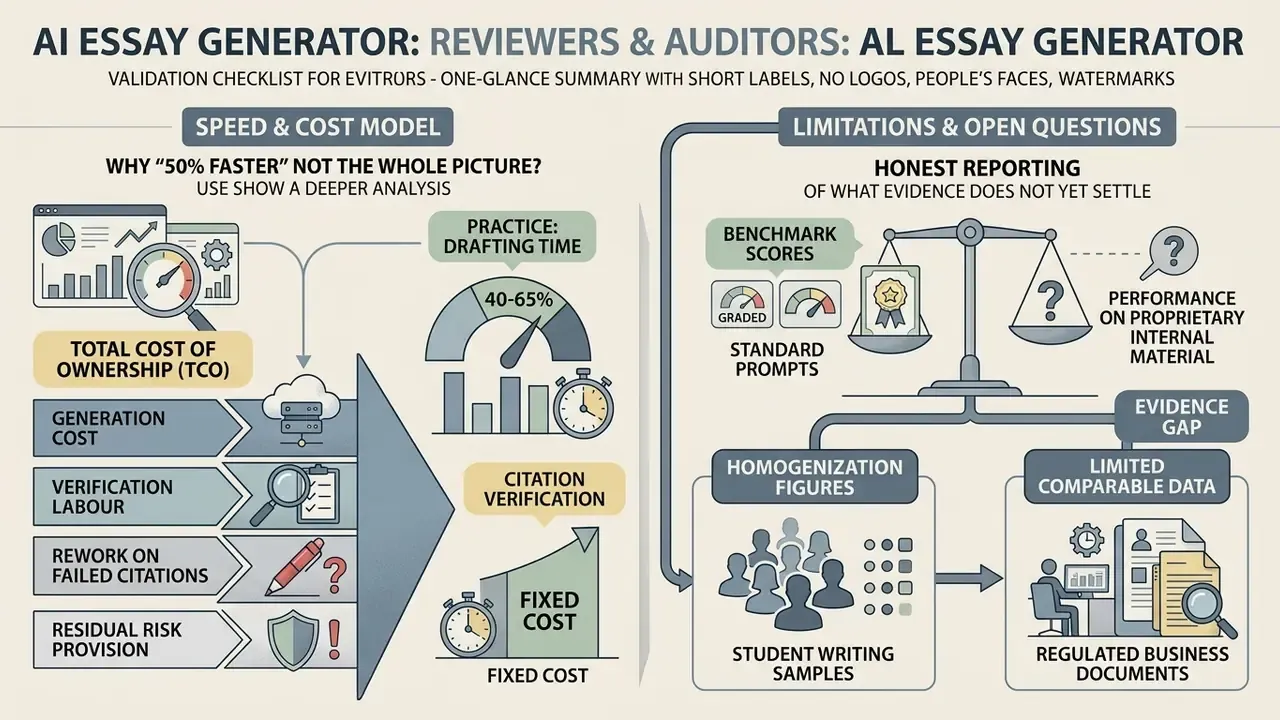
Cost model: why "50 % faster" is not the whole number
Speed gains are real but partial. A defensible total cost of ownership calculation for AI-assisted drafting includes four components:
TCO = generation cost + verification labour + rework on failed citations + residual risk provision
In practice, drafting time may fall 40 to 65 %, while citation verification adds a fixed cost that scales with the number of references rather than with word count. A 1,500-word essay with 12 references can require 45 to 90 minutes of verification against bibliographic databases. Teams that skip step 4 of the checklist above convert a time saving into a reputational liability; teams that budget for it retain most of the productivity gain with controlled residual risk. If you want to model that trade-off with your own hourly rates and reference volumes, our calculators are a reasonable starting point, though every institution should sanity-check the assumptions against its own review logs.
Limitations and open questions
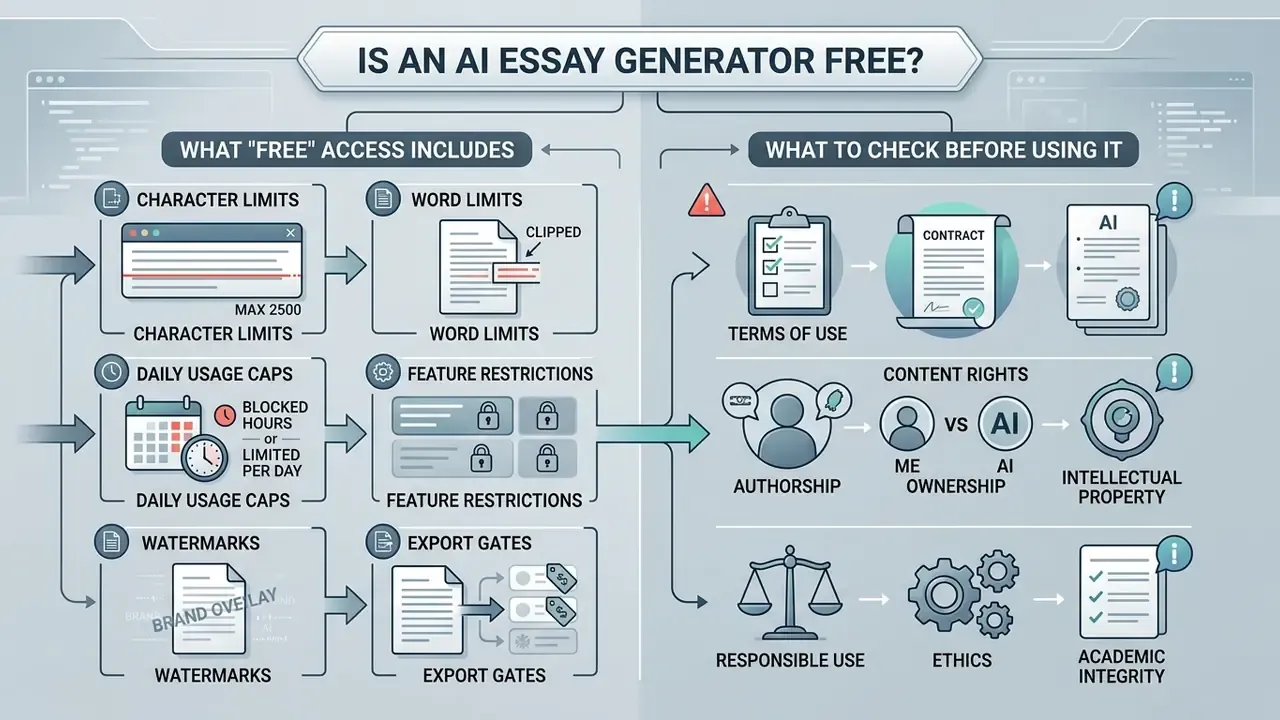
Is an AI essay generator free, and what should you check before using it?
Information in this section is general in nature and does not replace consultation with a qualified legal or compliance specialist.
An ai essay generator free tier typically provides basic drafting functionality with limits on usage frequency, word count, and advanced customization options. Paid subscriptions expand volume caps and unlock advanced models.
Before using any ai generator essay free service, users must review data privacy terms and usage restrictions. Understanding service conditions prevents accidental disclosure of confidential information.
What "free" access to an AI essay maker can include
Free access models for an ai free essay generator vary by platform provider and account status. Most free tiers impose operational constraints to manage server compute costs. Documented vendor limits illustrate the range: some services cap requests at 500 characters with five launches per day for anonymous users; others allow 1,000 to 2,000 characters per day; several give three free generations to guests and up to about 1,500 words per generation once an account exists. Paid plans in this category commonly run from roughly $4 per week to $79 per year with word-volume allocations attached.
- Character and word limits
- free generations are often capped between 500 and 1,500 words per request.
- Daily usage caps
- platforms may limit guest or free accounts to three to five generations per 24-hour period; token-based tools may allocate around 2,500 tokens per day to guests versus 5,000 to registered free users.
- Feature restrictions
- advanced settings such as custom citation styles, export formats, document history, or access to top-tier LLM models are typically reserved for paid tiers.
- Watermarks and export gates
- some platforms permit export of premium-template designs only with a watermark until the plan is upgraded.
| Operational Feature | Free Access Tier | Premium Subscription Tier |
|---|---|---|
| Generation Volume | 1 to 3 drafts per day / ~1,000 words | Unlimited or high monthly credit allocation |
| Model Access | Standard base language models | Advanced reasoning and top-tier LLM models |
| Customization | Basic tone and length options | Granular tone, style, citation-style, and outline controls |
| Source Integration | Manual text paste only | PDF upload, URL and video ingestion, database search, citation tools |
| Export Formats | Plain text / copy to clipboard | PDF, DOCX, and formatted academic exports |
| History & Versions | Not retained | Saved history and multiple output variants |
| Data Controls | Inputs may be used to improve services | Zero-retention options, admin controls, compliance attestations |
Plan terms change frequently; verify current limits and data-handling clauses directly with the vendor before institutional deployment. To weigh tiers against expected volume, compare options and match them to your review capacity, not just your word count.
Terms, content rights and responsible use
«Protection arises only where a human made a substantial creative contribution to the selection, coordination, or arrangement of the material.»
European Parliament research reaches a parallel conclusion for the EU: outputs produced without substantial human intervention are not eligible for copyright and may fall into the public domain. UK Department for Education guidance adds that copyrighted teaching materials and students' original work may be used for model training only with permission or a statutory exception.
Vendor usage policies require clear disclosure when sharing generated text and prohibit harmful, deceptive, or NSFW content; many rely on third-party model APIs, which means output is not fully within the platform's control. Organizations evaluating AI drafting tools must review vendor privacy policies to ensure personal or proprietary data is not used for model training without consent, and should document licensing conclusions the same way they would for any other content pipeline. For the standard questions to put to a vendor, view the guide on commercial usage rights; for the litigation landscape shaping those answers, view the guide on active AI copyright disputes.
Enterprise data security and Shadow AI risks
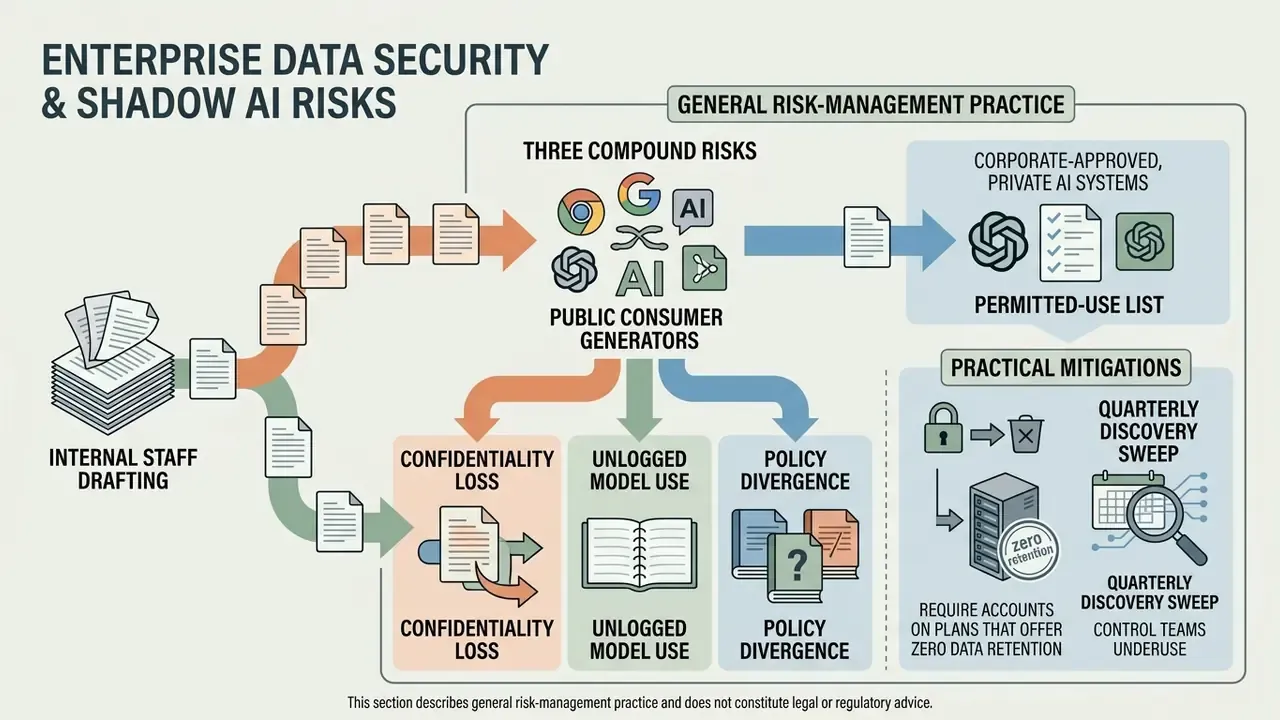
The largest governance exposure is not poor writing quality. It is unmanaged tool use.
When staff route internal drafting through public consumer generators, three risks compound simultaneously.
- Confidentiality loss. Prompts submitted to free tiers may be retained and used to improve services. Never input PII, customer records, health data, student records, salary data, or material non-public information into a public generator.
- Unlogged model use. Without a prompt log, an organization cannot reconstruct which claims in a published document originated from a model, which breaks any subsequent audit trail.
- Policy divergence. Institutional rules differ sharply: some universities forbid AI proofreading of assessed work entirely, others permit assistance with mandatory disclosure. Enterprise policy must name the permitted tools, the permitted tasks, and the disclosure format.
Practical mitigations for a permitted-use list: require accounts on plans that offer zero data retention and administrative controls; block consumer endpoints at the network layer where regulated data is processed; classify drafting tasks by data sensitivity and allow public tools only for the lowest tier; and require a named human reviewer to attest accuracy before any AI-assisted document is published or submitted.
One more control that teams underuse: a quarterly discovery sweep. Expense reports, browser telemetry, and SSO logs reveal shadow AI faster than any policy memo. Engineering teams wiring generative APIs into internal drafting pipelines should agree on rate limits and logging before launch; see the overview for the integration patterns, and route unresolved access questions through support rather than a private workaround.
This section describes general risk-management practice and does not constitute legal or regulatory advice.
FAQ about AI essay generators
Can an AI essay generator write essays in different languages?
Yes. Modern AI essay generators built on multilingual LLMs understand and generate text across dozens of languages, and mainstream tools advertise 25 or more output languages including Spanish, German, French, Portuguese, Polish, Turkish, and Japanese. Cross-lingual evaluations published at LREC 2024 demonstrate that major models can produce coherent essays in English, French, Spanish, and other high-resource languages. Quality is uneven, however: a 2025 study of multilingual LLM judges reported average inter-judge agreement around Fleiss' Kappa 0.3 across 25 languages, with weaker consistency in low-resource languages. Lower-resource output therefore requires closer human editorial review.
Can AI-generated text be detected?
Frequently, yes. Purpose-built classifiers reach very high accuracy, with Ghostbuster reporting F1 = 99.0 across three domains, beating prior best systems by 5.9 F1 points. Structural signals help detectors: AI drafts show markedly reduced variance in transitional phrasing and lower claim rarity than human writing. The reliable approach is authentic authorship with disclosure rather than attempted evasion.
Do I need an account to use an AI essay generator online?
Account requirements depend on the provider. Many platforms offer anonymous guest tiers with daily character or token caps (commonly 500 to 2,500 units), while others require registration via email or single sign-on even for basic features. Free registration typically raises daily limits and unlocks document history. Some services state explicitly that guest input is processed anonymously and not stored after the session ends; verify that claim in the privacy policy rather than in marketing copy.
Can I use my own notes or draft in an AI essay writer?
Yes, and this is the highest-quality workflow. Paste bullet points, upload an outline, or import a rough draft, then instruct the tool to organize the material into a coherent structure. Documented vendor workflows include three variants: upload notes to build an outline, import an existing draft and expand it section by section, or supply key points and let the model construct the argument scaffold. Grounding generation in your own material keeps the output anchored to your research and substantially reduces fabricated evidence.
Is AI-generated essay content plagiarism-free?
Output is generated rather than copied, but originality is not guaranteed. Claim rarity in unedited AI text measures roughly one-fifth of human levels, meaning arguments tend to be typical rather than novel, and fabricated citations breach integrity rules even when AI use is disclosed. Run the final version through a plagiarism check, verify every reference, and add your own analysis before submission.
Is submitting an AI-generated essay allowed?
Institutional rules vary and must be checked directly. Policies published between 2023 and 2026 commonly permit brainstorming, outlining, summarizing literature, grammar editing, and translation with disclosure, while prohibiting submission of wholly or partly AI-written assessed work; several explicitly forbid generating the full text of an essay, or any part of it, without further authorial work. Generative AI cannot be credited as an author, and human accountability for accuracy is non-negotiable. Consult your institution's honour code before use.
What does an AI essay generator cost in practice?
Free tiers cover light drafting. Paid tiers in this category commonly range from about $4 weekly to roughly $79 annually with word-volume allocations, while enterprise deployments add per-seat or per-token pricing plus administrative controls. Budget separately for verification labour: reference checking scales with the number of citations, not with word count, and skipping it is the most common source of downstream rework.
A safe next step
Do not start with a platform decision. Start with an inventory. List every drafting task in your organization that currently touches a generative tool, tag each one by data sensitivity, and name an accountable reviewer. Then run the eight-control checklist above on a single low-risk document type for one month. Small scope, real evidence, documented outcome. That is a defensible foundation for the larger conversation about controlled agentic AI, and it costs almost nothing to attempt.