Last updated: August 2026 · Review cycle: semi-annual
Executive Summary: What Actually Governs Jesus AI Art
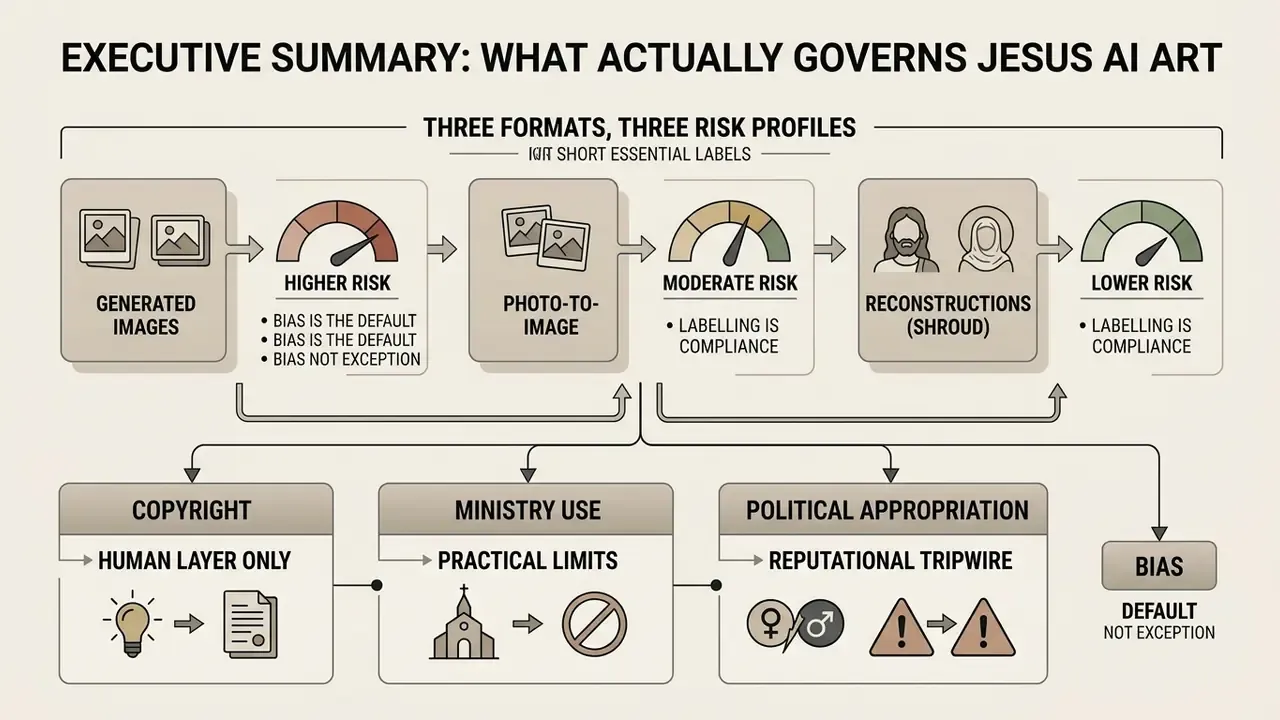
- Three formats, three risk profiles. Jesus AI art divides into digital illustration, classical painterly interpretation, and photorealistic portraiture. Photorealism carries the highest deception risk, because viewers cannot reliably separate synthetic images from camera photographs.
- Bias is the default, not the exception. Peer-reviewed work on AI biblical visualisation shows diffusion models drift toward Western European features and Renaissance lighting even when prompts specify other cultural or liturgical contexts.
- Labelling is now a compliance item. Visible on-image disclosure plus tamper-evident C2PA provenance metadata is the emerging baseline across NIST guidance, several U.S. state statutes, and EU platform-integrity guidelines.
- Copyright protects only the human layer. Purely AI-generated visual output is not registrable in the United States. Only human-authored edits, selections and arrangements are.
- Ministry use has practical limits. Slide decks, Sunday-school handouts and small prints are broadly workable. Mass-media video production, redistribution and resale generally are not.
- Political appropriation is the reputational tripwire. Fusing Christological iconography with political self-presentation reliably triggers blasphemy and sacrilege accusations across denominations.
How to Use This Guide (Ownership, Gates, Evidence)
This is not a prompt-tips article. It is written as a control document, so each section maps to a decision someone has to sign.
A workable division of labour looks like this. The creator owns prompt hygiene, artefact review and metadata scrubbing. The communications lead owns caption text, alt text and channel choice. The licence owner, often a finance or procurement contact, confirms the platform tier permits the intended distribution. And a doctrinal reviewer, a pastor, a chaplain, a curriculum editor, owns the question nobody in the tooling can answer: is this respectful and non-deceptive?
Three evidence artefacts should exist for every published asset: the prompt record with seed and model version, the licence snapshot on the date of reliance, and the approval sign-off. Three files. That is the whole audit trail, and it takes about four minutes per image once the habit forms.
One more framing note. Sacred imagery is a high-sensitivity use case, not a high-volume one, so the cost of controls is small relative to the exposure. Compare that with automated financial reporting, where control cost scales with transaction count. Here, the constraint is judgement, not throughput.
1. What Is Jesus AI Art and What Types of AI Images of Jesus Exist
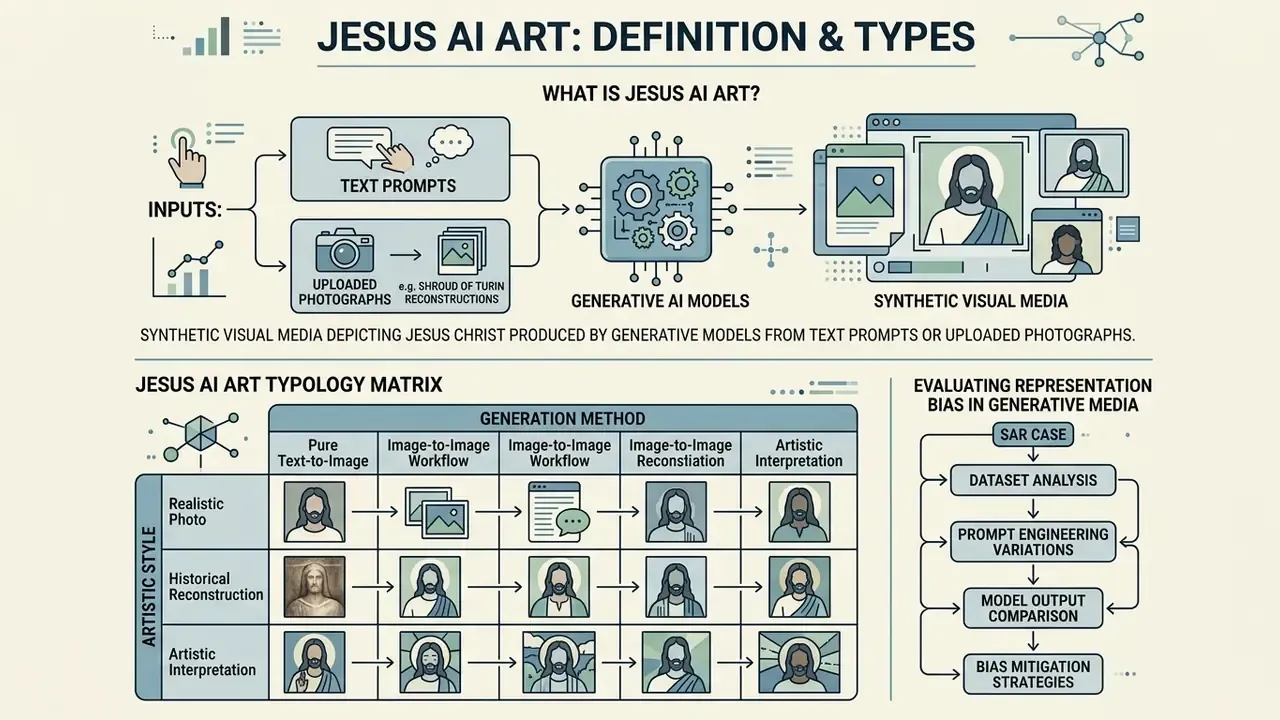
In two sentences: Jesus AI art is synthetic visual media depicting Jesus Christ produced by generative models from text prompts or uploaded photographs. It clusters into three aesthetic families, digital illustration, classical fine-art interpretation, and photorealistic portraiture, each with distinct artefact signatures and distinct governance obligations.
Jesus AI Art refers to synthetic visual media depicting Jesus Christ generated by artificial intelligence models from text prompts or input photos. These generated assets span three primary aesthetic categories: digital illustrations, classical fine-art interpretations, and photorealistic portraits. People search for all three under the same shorthand, which is part of the confusion: "ai art jesus" returns cartoon avatars and pseudo-photographs on the same results page.
Generative neural networks synthesize these visual assets by processing statistical associations between text tokens and visual training datasets. Research on generative religious imagery shows that models frequently default to Western Christian art conventions.
«Even with prompts referencing specific Catholic symbolism, models reproduced Western facial features and Western architectural styles.»
The same body of research documents a second effect the literature calls religious exnomination: explicit Christian markers such as crosses and halos are frequently omitted even when prompts name biblical figures, so the model normalises a culturally specific, symbol-poor default over historical or liturgical accuracy (Barthes, 1957; Alfano et al., Religions, 2024). A 2025 evaluation of biblical-art generation reached a comparable conclusion, reporting that DALL·E captured religious context least reliably, while Stable Diffusion recognised biblical context better yet still reproduced Western bias and historical inaccuracy (arXiv preprint on biblical art generation, 2025. https://arxiv.org/html/2504.16974v1).
Jesus AI Art Typology Matrix
| Format category | Visual characteristics | Common artefact risks |
|---|---|---|
| AI illustration | Clean lines, warm palettes, modern minimalist compositions | Oversimplified geometry, flat background textures |
| Classical AI art | Chiaroscuro lighting, painterly brushstrokes, formal halos | Unnatural oil textures, loss of anatomical coherence |
| Photorealistic AI | Detailed skin texture, soft camera focus, natural sunlight | Waxy skin, finger glitches, lighting inconsistencies |
Figure 1. Comparative style board for jesus ai art: digital illustration, classical painterly interpretation, and photorealistic AI images of Jesus Christ, each annotated with its typical artefact class. Alt text should carry the descriptive phrases "jesus ai art style comparison" and "ai images of jesus christ artefact annotation".
When organizations evaluate AI-generated Jesus images for devotional or media distribution, risk owners must recognise these visual constraints. Automated outputs reflect statistical training data rather than historical or theological documentation. That distinction is the whole basis of the governance case: an image can be devotionally useful and, at the same time, evidentially worthless. Reviewers who want a vocabulary for describing style drift will find the working terms defined in the AI Media Glossary and in the entry on the ai art critic role.
SAR Case: Evaluating Representation Bias in Generative Media
2. AI Jesus Image, Art, and Photo: How to Interpret Image Formats
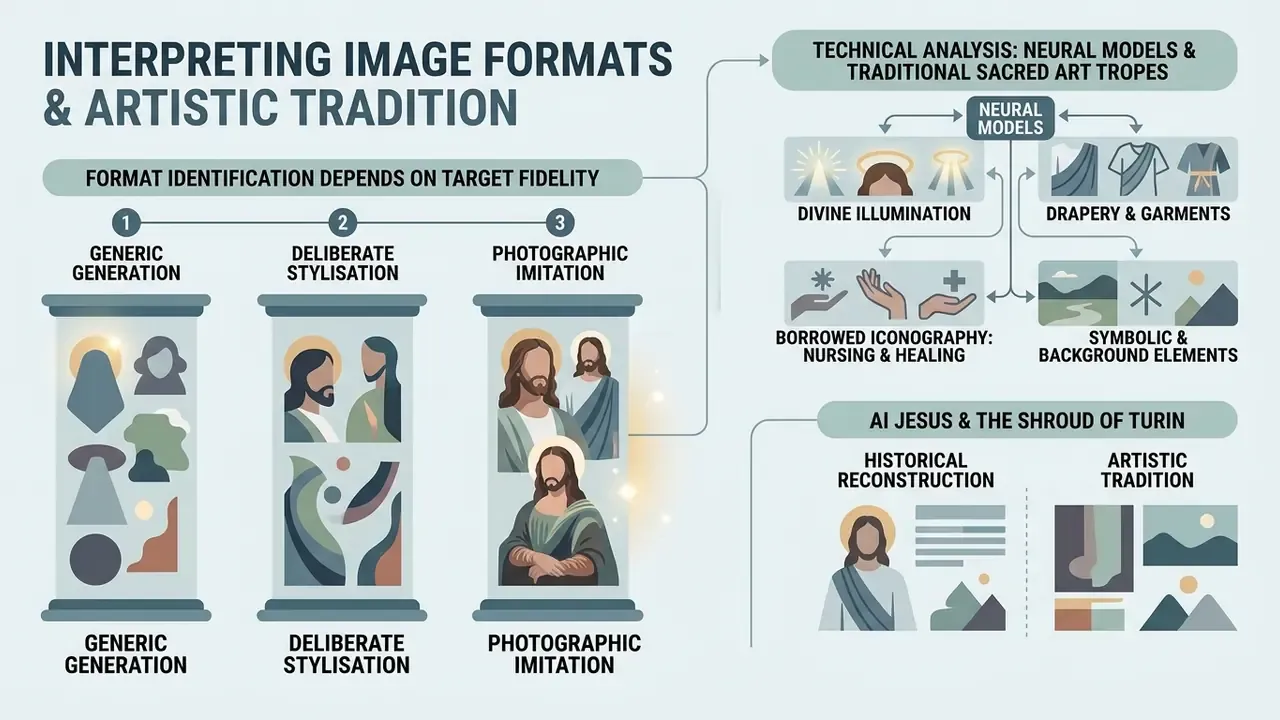
In two sentences: Format identification depends on target fidelity: generic generation, deliberate stylisation, or photographic imitation. Each mode leaves a different artefact fingerprint, and photorealism is the mode that must never be presented as documentary evidence.
Interpreting the format of an AI Jesus image requires analyzing specific visual markers that separate basic generative drafts, stylized art, and photographic simulations.
A basic jesus ai image typically presents generic compositions that may contain structural anomalies in background elements or symmetry: distorted eyes, extra or fused fingers, warped limbs, and anachronistic props. Stylized ai jesus art deliberately emphasises non-photographic textures, such as canvas patterns, visible brushwork or watercolour gradients, to signal artistic interpretation. Here the tell-tale defects are hyperreal texture, loss of structural coherence, and stylised anatomical errors. An ai jesus picture formatted as a photograph, by contrast, aims for high-fidelity realism with plausible focal depth and dense facial detail.
«Participants correctly identified authorship in only 53.51% of cases, barely above the 50% chance baseline.»
Near-chance accuracy. That is the core risk argument for photorealistic sacred imagery: an audience cannot self-defend against misattribution, so the burden falls entirely on the publisher. Technical inspection still reveals recurring diffusion artefacts, including plastic skin sheen, mismatched irises, over-soft hair, malformed lettering, and impossible physics in drapery folds. Evaluating those cues is necessary when reviewing assets inside an ai art generator or when editing files in an online photo editor. Teams working on tight budgets can run the same inspection pass in a free photo editor before escalating to paid tooling, and mobile-first volunteers often review on an ai art app instead of a desktop screen. Zoom to 100% either way.
Technical Analysis: Neural Models and Traditional Sacred Art Tropes
Diffusion models do not "understand" theology. They synthesise statistical tropes pulled from historic visual corpuses. Recognising those tropes lets reviewers explain why an output looks devotional even when it is doctrinally empty.
- Divine illumination. Generators replicate the high-contrast chiaroscuro popularised by Rembrandt in works such as The Ascension (1636), where the light source directs the viewer's eye to the inclined face and to the wounds in the hands. Models frequently mishandle this convention by treating the central subject itself as an unshaded, self-luminous body, a physically impossible light budget that reads as "holy" to the eye and as an artefact to the auditor.
- Drapery and garments. Prompts requesting "biblical clothing" default to first-century Judean tunics combined with Roman-style scarlet cloaks, an echo of the robe placed on Jesus by soldiers before the crucifixion (Matthew 27:28). Diffusion grids then introduce geometrically impossible folds where the cloak meets the shoulder line.
- Borrowed nursing and healing iconography. The gesture of a glowing hand laid on a reclining figure's brow does not come only from Gospel healing narratives. It also mirrors nineteenth-century humanitarian painting such as Henrietta Rae's The Lady with the Lamp (1891), in which Florence Nightingale carries an intense circle of lamplight. Training corpuses fuse the two lineages, which is why "healer" prompts so often produce a hand-held orb of light.
- Symbolic and background elements. When rendering crowds or architecture, algorithms mix historical Jerusalem masonry with contemporary or patriotic iconography, flags, eagles, monumental staircases, producing surreal misattributions whenever safety and style prompts are left unconditioned.
AI Jesus and the Shroud of Turin: Historical Reconstruction vs. Artistic Tradition
A prominent trend in synthetic religious imagery involves processing high-resolution scans of the Shroud of Turin through diffusion and upscaling models. Algorithms extrapolate facial topography from the shroud's faint pigment gradients, yielding lengthened facial geometry, high cheekbones, and sunken cheeks. Widely circulated results present a gaunt, bearded man whose proportions differ noticeably from mainstream devotional art, and, importantly, are the product of algorithmic inference rather than measurement.
Compare that with traditional iconography, for instance Del Parson's Red Robe Christ, commissioned through the correlation review process of The Church of Jesus Christ of Latter-day Saints. Parson has described receiving explicit art-direction notes on his sketches: "more intensity, more love, older looking, more Jewish-looking, no forked beard, wider shoulders." Commercial and ecclesiastical artists therefore widen shoulders and soften facial contours on purpose, to convey warmth and strength. Raw algorithmic processing of the Turin artifact does the opposite: it emphasises anatomical trauma, narrower facial ratios and historic Middle Eastern features.
Observers comparing the two side by side typically report strong resemblance in the beard, hair parting and frontal gaze, with the AI face reading as longer, higher-cheekboned and more hollowed. The governance conclusion is narrow and important. A shroud-derived output is an interpretation conditioned by training data, not a photograph and not a forensic reconstruction. It must never be captioned as "what Jesus looked like." Where organisations want to trace how such an image has spread or been re-captioned online, an AI reverse-image-search tool is the appropriate verification step.
3. How to Create a Jesus AI Picture from a Text Description or Photo
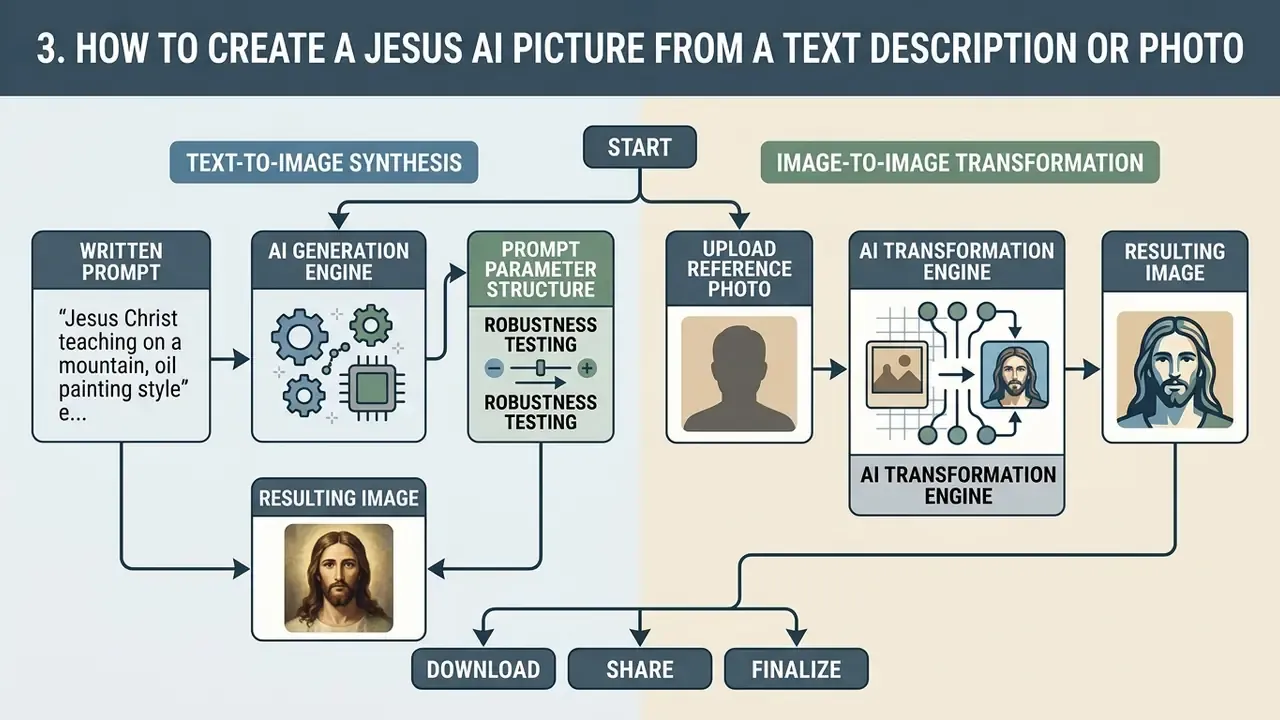
In two sentences: Creation follows one of two pipelines, text-to-image synthesis from a written prompt, or image-to-image transformation from an uploaded reference. Both are gated by vendor safety filters applied to prompts and to uploaded files before rendering.
Creating a jesus ai picture involves either text-to-image synthesis from descriptive prompts or image-to-image transformation using a reference photograph.
Text-to-image workflows rely on natural language processing to convert descriptive text into spatial representations. Rather than leaning on a single forward-dated system card, note the verifiable vendor documentation position: Google Cloud's Imagen documentation states that both text prompts and uploaded or generated images pass safety filters covering violent, sexual, derogatory and toxic content before output is returned, and OpenAI's image API documents text-based generations alongside edits that modify an existing image. Image-to-image workflows let users submit an initial file, applying structural encoding and conditioned diffusion to produce a fresh ai jesus image.
«Explicit Christian references are often omitted; crosses or halos are frequently absent even when prompts name biblical figures.»
Researchers in that study generated four AI depictions of the Baptism and the Last Supper, systematically comparing generic prompts against detailed prompts loaded with Catholic symbolism, and found the Western default persisted through both conditions. The practical takeaway for prompt engineers: symbolic precision must be enforced, not politely requested.
Text-to-Image vs Image-to-Image Workflow
| Workflow type | Operational steps |
|---|---|
| Text-to-image | Input prompt → safety filter → neural sampling → generated image |
| Image-to-image | Upload source → encode structure → apply prompt → edited image |
Prompt Parameter Structure for Robustness Testing
Governance teams should log prompt parameters as test artefacts, not as creative notes. A minimal, auditable prompt schema looks like this:
[SUBJECT]        first-century Judean man, historically plausible features
[SCENE]          named scriptural episode + geographic setting
[STYLE]          illustration | oil painting | photographic (declare explicitly)
[LIGHT]          directional light source named and externalised
[SYMBOLS]        required iconographic elements listed individually
[NEGATIVE]       no political insignia, no modern flags, no living public figures,
                 no self-luminous subject, no documentary/photojournalism framing
[SEED / SAMPLER] recorded for reproducibility
Run each prompt at fixed seed across at least three models, then review the negative-prompt block for leakage. Adversarial variants, inserting a political figure's name, or requesting "authentic photograph, 1st century, archival", should be tested deliberately to confirm the filter refuses them. Refusals belong in the model-risk log as evidence of control effectiveness. A small point that trips people up: a negative prompt is a preference, not a guarantee, so visual review still happens after the filter passes.
When selecting tools for image synthesis, operators can consult the AI Media Comparison Matrices and the dedicated review of the best AI art generators to weigh model governance features, licensing terms and style control. Enterprise users frequently test workflows via Bing AI image generation, the broader Microsoft AI image generator stack, or Google's AI image generator terms. Where output quality is the constraint rather than policy, side-by-side evaluations such as Midjourney versus competing generators and ChatGPT image generation versus alternatives narrow the shortlist quickly. Volunteers who need a simpler front end can start with a general-purpose ai art maker and graduate later.
4. How to Responsibly Publish AI Images of Jesus Christ
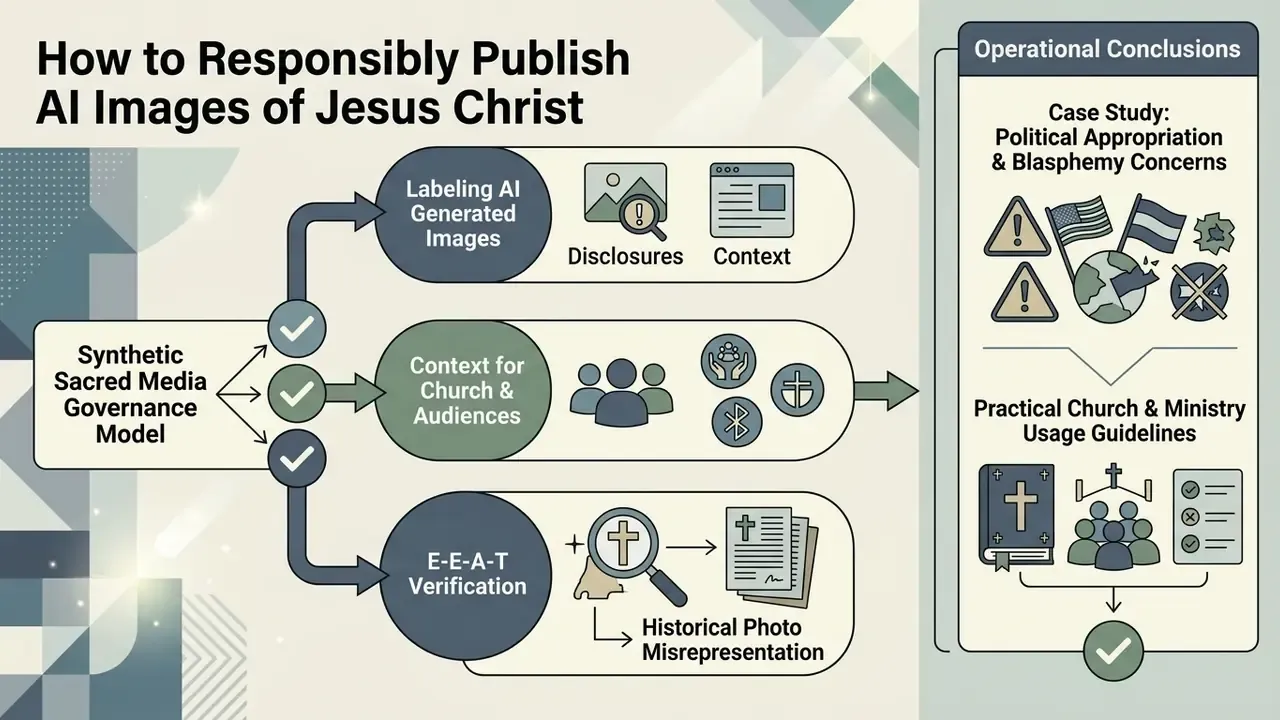
In two sentences: Responsible publication rests on origin disclosure, context verification and respect for faith-community standards. The controlling principle across every source reviewed here is the same: synthetic sacred media must never be allowed to function as historical evidence.
Responsible publication of ai images of jesus requires clear origin disclosure, context verification, and respect for faith community standards.
Religious authorities emphasise that synthetic media must not deceive viewers about historical or physical reality. The Church of Jesus Christ of Latter-day Saints' published Principles for Church Use of Artificial Intelligence requires attribution whenever authorship or authenticity could be misunderstood or misleading, commits the institution to safeguarding sacred information, and states that the Church will not use AI-generated images representing Jesus Christ in its own materials. Catholic commentators similarly urge "caution and discernment" when using synthetic sacred art (Word on Fire, 2024), placing AI religious imagery under stricter moral review than ordinary content. A 2024 academic study from Edinburgh linking AI, liturgy and ethics through the imago Dei framework lands in a comparable place: algorithmic output remains secondary to human theological interpretation in religious settings.
«Platforms should ensure AI-generated content is detectable through watermarking and metadata, and clearly label synthetic depictions of real persons.»
Synthetic Sacred Media Governance Model
| Governance layer | Required operational control | Institutional standard |
|---|---|---|
| Transparency | Visible on-image disclosure text | NIST AI 100-4 |
| Provenance | Tamper-evident C2PA metadata | Utah Code 20A-11-1104 (see scope note) |
| Platform duty | Detectability plus synthetic labels | EU DSA Guidelines (2024) |
| Theological audit | Review for doctrinal compliance | Faith-community review |
| Consent control | Releases for identifiable persons | Vendor ToS plus privacy law |
Scope note: Utah's synthetic-media disclosure provisions apply principally to election communications and political advertising. Cite them as a labelling model for public-facing media, not as a general-purpose rule for devotional artwork.
When publishing ai generated jesus ai art, organizations must set visual boundaries in advance. Explicit labeling prevents synthetic portraits from being read as authentic historical artifacts. Media teams should also monitor downstream re-use: once an unlabelled devotional image escapes into circulation, correction is effectively impossible, which is why detection and reverse-image verification belong in the post-publication monitoring plan rather than the pre-publication one.
Labeling AI Generated Images and Context for Church and Christian Audiences
Transparent labeling for an ai generated image requires both visible text overlays and embedded technical metadata. Either one alone fails, because overlays survive screenshots while metadata survives cropping.
Federal and state regulatory standards push toward clear labeling of synthetic media. NIST guidance recommends combining visible watermarks with embedded provenance metadata (NIST AI 100-4, Reducing Risks Posed by Synthetic Content, 2024). Legislation such as Utah Code 20A-11-1104 requires legible on-content disclaimers stating "This image generated by AI" for synthetic visual media, together with embedded tamper-evident provenance for online digital visual communications, a requirement written primarily for political and public-facing contexts. U.S. Executive Order 14110 (2023) similarly directs federal agencies to develop standards for authenticating content, tracking provenance and labelling synthetic output. Practitioner guidance from public-health communicators adds a useful operational detail: AI-produced visuals should carry a visible watermark or label plus an accessible caption, alt text or transcript, and the disclosure should name the tool, the version and the human oversight applied.
«Participants rated biblical AI images significantly lower when informed of their artificial origin, although gaze patterns remained identical.»
That result matters for ministry communications. Disclosure carries a measurable perception cost but no measurable change in how the image is actually looked at. Labelling therefore reduces trust in the artefact without reducing its devotional legibility, which is the correct trade-off for an institution whose credibility depends on truthfulness.
E-E-A-T verification: historical photo misrepresentation
For church websites and social platforms, pair every jesus christ ai image with a clear caption placed adjacent to the image, not buried in a footer. Teams creating custom graphics can compare production tooling in the AI art generators comparison, evaluate zero-cost options through the free AI art generator comparison, or assemble slide-ready layouts with Canva's AI generator.
Case Study: Political Appropriation and Blasphemy Concerns in Generative Media
Deploying synthetic sacred images outside devotional contexts, generating AI media that depicts political figures alongside, or as, Jesus Christ, has drawn intense critique across Christian denominations.
In April 2026, a social-media post from a sitting U.S. president showed an AI-generated figure in white robes and a red sash, one hand holding a ball of light and the other laid on the brow of a reclining patient, surrounded by praying onlookers, soldiers, eagles and fighter jets. The post carried no caption. Reaction was immediate and cross-denominational: a former Republican representative who identifies as an orthodox Christian called it "sacrilege"; a conservative writer called it "OUTRAGEOUS blasphemy"; a conservative activist wrote, "This is gross blasphemy. Faith is not a prop." A Fox News co-host, hardly a hostile source, described the picture as "looney tunes." The post was deleted within roughly 48 hours.
Two analytical points follow, and both transfer to any organisation weighing sacred imagery in promotional media.
First, the visual grammar did the theological work. As Danielle Terceiro argued in ABC Religion & Ethics (15 April 2026), the image inverts the Christian devotional formula. Where Mother Teresa's daily prayer asks that observers "look up and see no longer me, but only Jesus," the composition invites viewers to look at the politician, and to do so with awe. The scarlet cloak echoes Matthew 27:28. The radiating light above the central figure echoes the divine approval of the baptism narrative (Matthew 3:17), with eagles and jets substituted for the dove. The image also carries what she calls plausible deniability, "this is Trump-as-Jesus; this is not Trump-as-Jesus", which is precisely what makes it effective propaganda and indefensible communications practice.
Second, the artefact signature was visible to anyone looking: the wrong number of stars on the flag, nonsense text, and an incongruous mash-up of patriotic props including fireworks and the Statue of Liberty. Low-quality synthesis did not blunt the offence. It amplified it.
Operational conclusion. Using Christological iconography for political or personal branding produces near-certain audience alienation, including among the constituency the image is aimed at. For risk owners, the control is categorical rather than case-by-case: prohibit generation of sacred iconography in combination with named living public figures, political insignia or campaign assets, and enforce that prohibition at the negative-prompt and review-gate level. Emerging enforcement and litigation patterns around synthetic depictions of real people make this a legal exposure as well as a reputational one, and the running record is tracked in AI Litigation and Case Timelines.
Practical Church and Ministry Usage Guideline
Abstract copyright doctrine does not answer the questions pastors, Sunday-school leaders and volunteer media teams actually ask. Can we print a poster? Can we put it on the sanctuary screen? Can we publish a video? The matrix below converts the legal and licence layer into operating permissions. It reflects the conservative end of what typical ministry-image licences and generative-platform terms allow. Always reconcile it against the specific licence you hold.
| Application mode | Operational permission | Technical or legal rule |
|---|---|---|
| Sunday school and Bible study | Allowed for digital slides and local educational handouts | Print formats restricted to standard paper, up to about 12x16 in |
| Sanctuary screens and projection | Allowed as background or slide show for worship and concerts | Display only; no export as a standalone product |
| Social media content | Allowed for devotional commentary and non-commercial posts | Must retain on-image AI disclosure watermark |
| Online teaching (livestream) | Allowed: lesson delivered with images shown in presentation | Presentation software is fine; a narrated film is not |
| Video production (YouTube, TV) | Restricted or prohibited on mass-media platforms | Generating full AI movies violates standard model and image-library terms |
| Books, tracts, flyers, posters | Prohibited without a separate commercial or print licence | Print and publishing rights are licensed separately |
| Redistribution and resale | Prohibited: no re-hosting, resale or monetisation of files | Files may not be shared by any method or channel |
Reading notes for volunteers. "Movies" in most ministry-image licences means animated films, storytelling films, voice-over films, animatics, stop-motion and any motion-graphics production. An online Bible lesson delivered through presentation software sits in a different category and is generally permitted. High-quality large-format posters normally have to be purchased from the licensor rather than printed locally. Ministries planning a channel strategy around permitted formats can review publishing mechanics in the YouTube video editor workflow guide.
5. Commercial Use of Jesus AI Art: What to Verify Before Publication
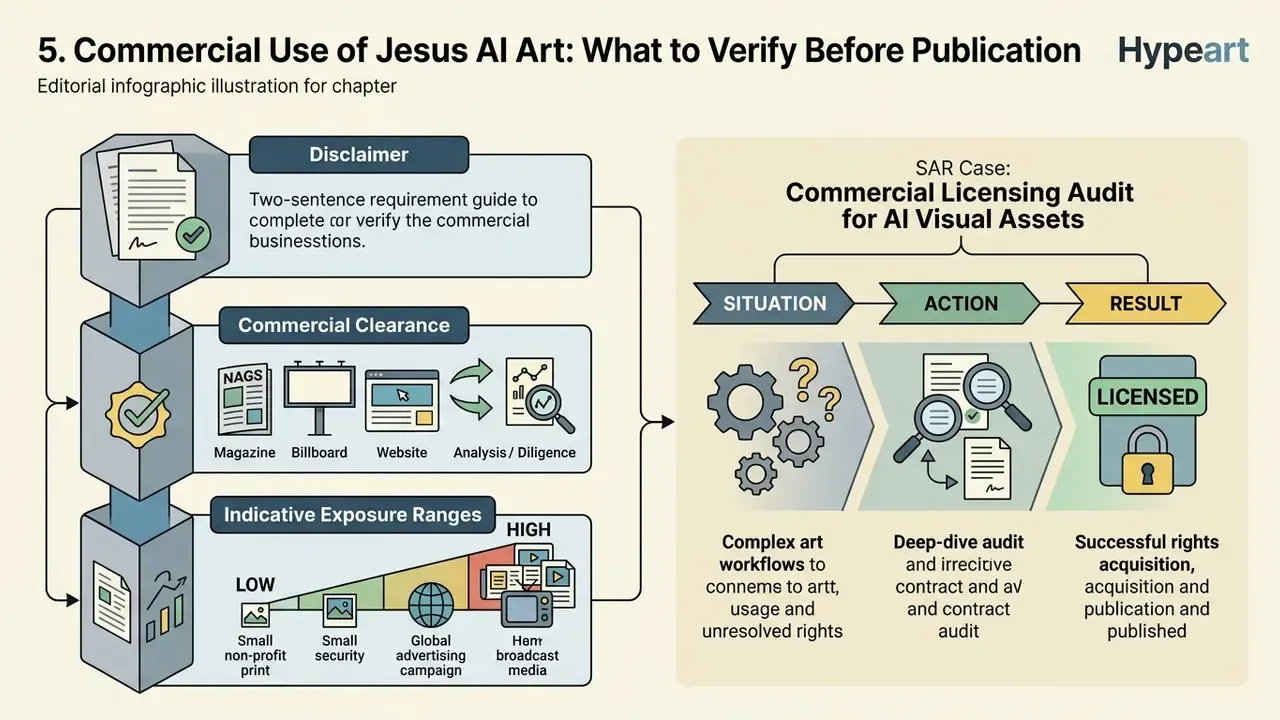
In two sentences: Commercial deployment turns on three independent checks, platform licence tier, source-photo rights, and copyright eligibility of the output. Failing any one of them can void the campaign regardless of image quality.
Commercial deployment of jesus ai images requires auditing platform license agreements, verifying source photo rights, and confirming copyright eligibility.
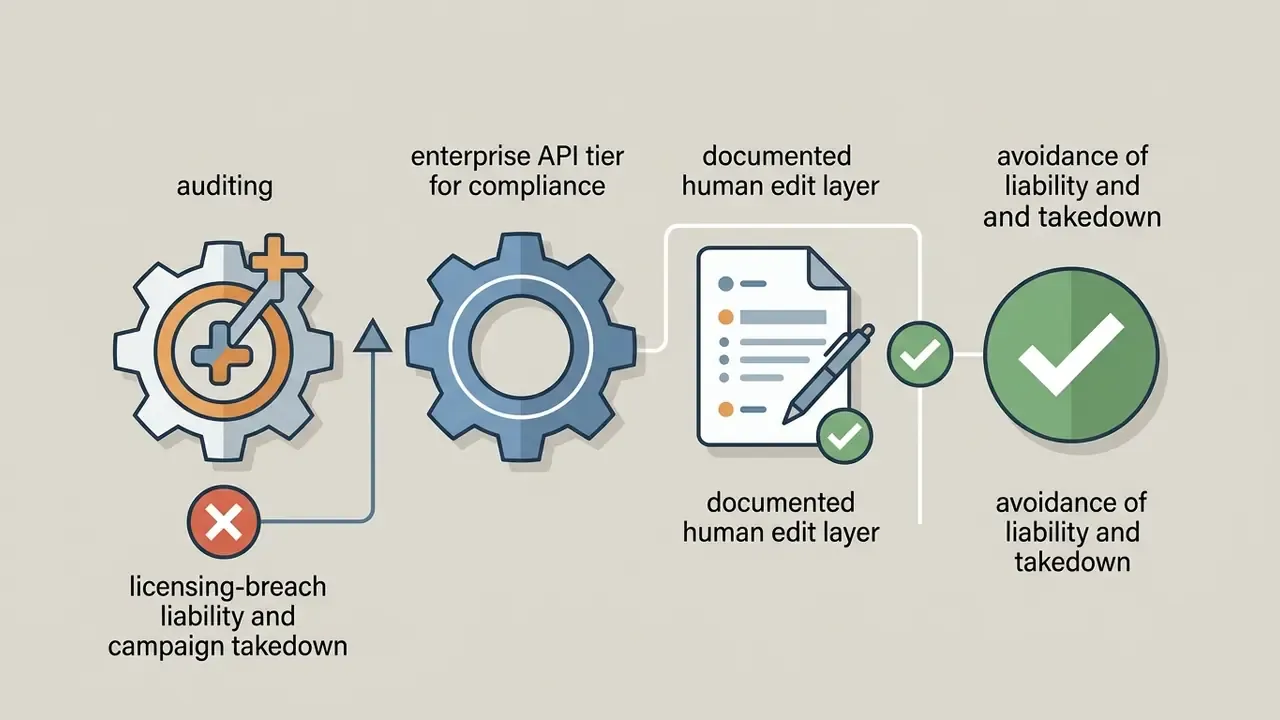
Under United States copyright law, purely AI-generated visual outputs are not eligible for copyright protection without substantial human creative input (U.S. Copyright Office, Copyright and Artificial Intelligence). Prompts alone do not create authorship. Registrants must identify and disclaim AI-generated components in mixed works. Commercial operators can only claim copyright over human-authored modifications, selections or arrangements, which in practice means the defensible asset is your edit layer, not the render.
«Style is sometimes protected by copyright, and courts face particular difficulty assessing similarity in visual works produced by generative models.»
Using copyrighted source photos as reference material can also trigger infringement claims when the output remains substantially similar to the original. Photographs are protected where the photographer made creative choices in composition, lighting and arrangement, a bar most professional religious photography clears easily.
Commercial Clearance Due Diligence
| Review area | Verification requirement | Risk level |
|---|---|---|
| Platform terms | Paid commercial usage licence in force | High (breach of contract) |
| Source photo | Signed model and property releases | Critical (infringement) |
| Copyright status | Disclaim AI-only components on registration | High (registration failure) |
| Disclosure | Visible label plus C2PA metadata | Medium (regulatory) |
| Doctrinal review | Faith-community sign-off | Medium (reputational) |
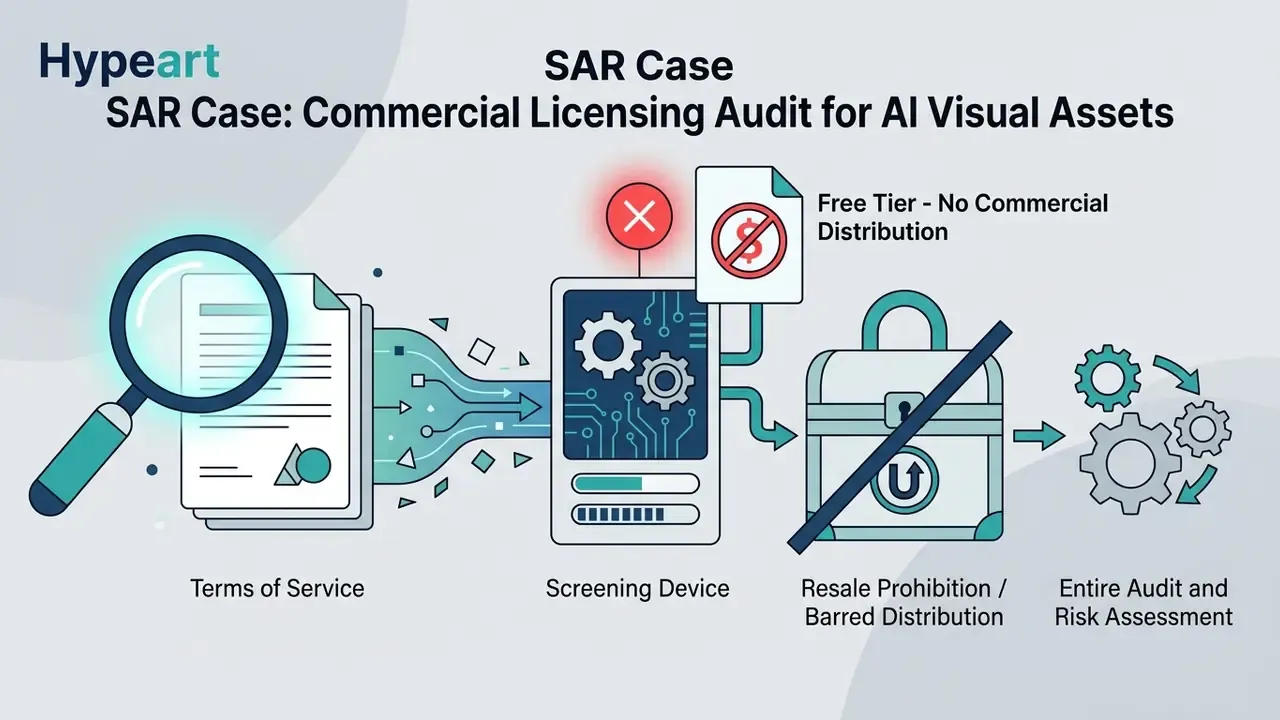
Indicative exposure ranges. Quantifying downside helps prioritise these checks. U.S. statutory damages for copyright infringement of a registered work run to roughly $750 to $30,000 per work, rising to as much as $150,000 per work where infringement is found willful (17 U.S.C. §504), before attorney's fees. Contractual exposure is separate and often faster-moving: breaching a generator's free-tier prohibition on commercial use typically triggers account termination, retroactive licence invoicing and takedown of every derivative asset already in market. For a campaign mid-flight, that is usually the larger real cost. Regulatory disclosure penalties vary by jurisdiction and are generally assessed per publication. Treat these as orientation figures, not a forecast, and confirm exposure with counsel.
Before deploying commercial campaigns, organizations should model software subscription costs using the financial calculators and audit licensing terms on the vendor's pricing page. Broader vendor-by-vendor comparisons live in the AI Media Commercial-Use Hub, including Google's AI image generator terms and the Microsoft AI image generator overview.
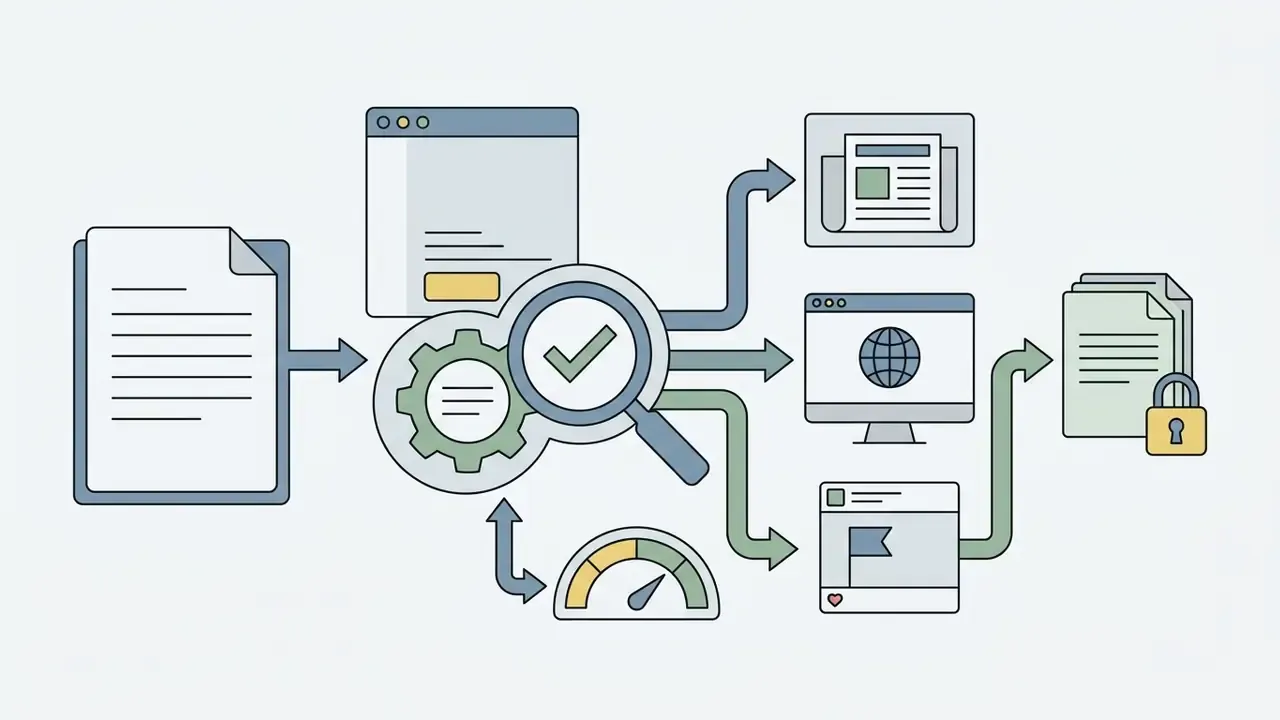
SAR Case: Commercial Licensing Audit for AI Visual Assets
6. Pre-Publication Checklist
- Service licensing.Is the output generated under a paid commercial platform tier that permits publication, derivative works and the required distribution channels?
- Source rights.Are all uploaded reference photos fully cleared, with signed model and property releases and documented consent for devotional context?
- Metadata hygiene.Was EXIF data (GPS, device serial, timestamps) stripped from every source file before upload?
- Disclosure and provenance.Is the asset marked "Generated by AI" in a visible, legible position, with embedded C2PA Content Credentials naming tool, version and human oversight?
- Accessibility.Does the asset carry alt text and a caption that state both the subject and the synthetic origin?
- Artefact review.Have hands, eyes, lettering, drapery physics and light sources been inspected at 100% zoom?
- Iconographic and doctrinal review.Has a qualified reviewer confirmed respectful, non-deceptive presentation and correct symbolic attributes?
- Prohibited combinations.Is the image free of living public figures, political insignia, campaign branding and any documentary or archival framing?
- Channel permission.Does the intended use (print size, slide, social, video) fall inside the ministry usage matrix and the vendor licence?
- Monitoring plan.Is a reverse-image-search or detection check scheduled after publication to track re-use and re-captioning?
Print the list, keep it beside the review queue, and record the answers rather than remembering them. Developers integrating automated generation workflows can explore implementation specifications through the AI Media API Guides and the Google Veo implementation guide.
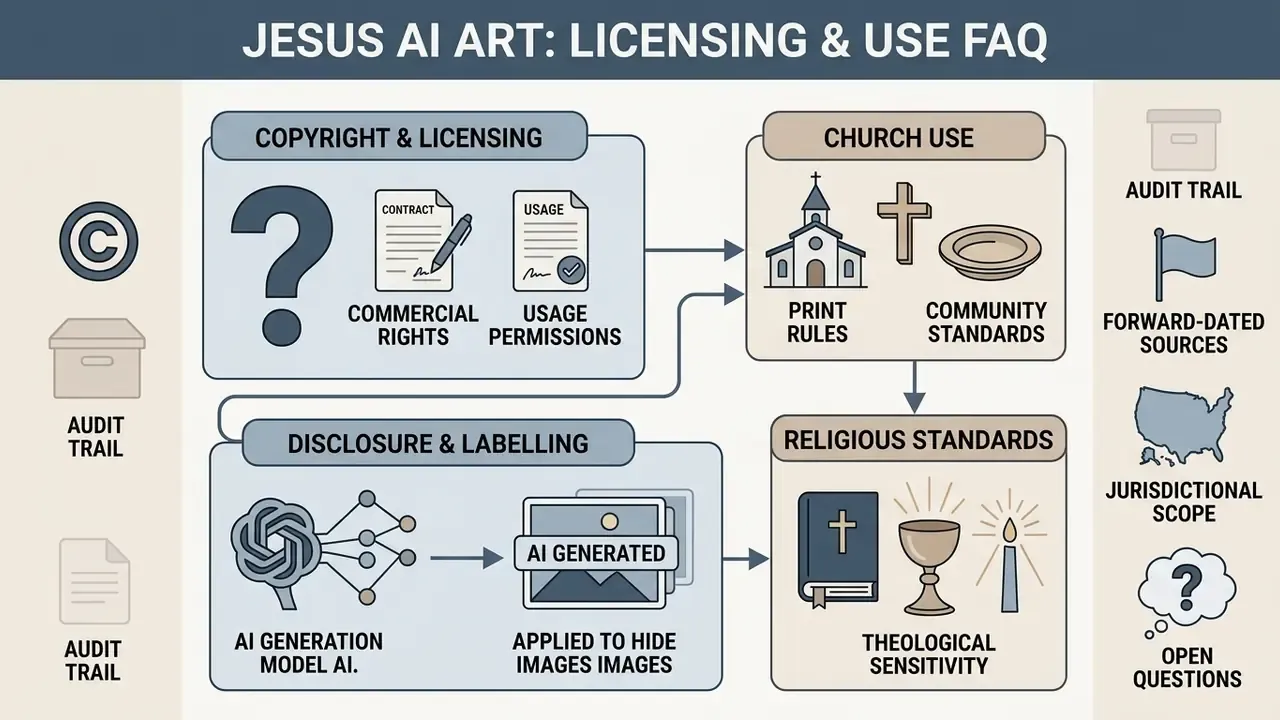
7. FAQ: Jesus AI Art, Licensing and Church Use
Is Jesus AI Art protected by copyright in the US?
Purely AI-generated images are not copyrightable under U.S. law, because they lack human authorship. Protection applies only to human-created elements, edits, or complex creative arrangements, and AI-generated components must be disclaimed on registration (U.S. Copyright Office, Copyright and Artificial Intelligence).
Can I upload a photo of a person to generate an AI Jesus picture?
Yes, image-to-image workflows accept photo inputs. But you must obtain explicit written consent from the individual, avoid third-party subjects such as children, and strip EXIF metadata before processing (NIST AI 100-4, 2024).
How should churches label AI images of Jesus Christ?
Include a visible caption or watermark such as "AI-Generated Image" adjacent to the visual, add alt text stating the synthetic origin, and preserve embedded C2PA provenance metadata for public transparency (NIST AI 100-4; Utah Code 20A-11-1104, in its public-media disclosure context).
Can I print AI Jesus images for Sunday school or church decoration?
Under typical ministry-image licences, yes for classroom teaching and for decorating a church, Christian school, classroom or ministry office, with printing generally limited to standard paper up to about 12x16 inches. Large-format display posters, books, tracts and flyers normally require a separate print or commercial licence.
Can I use AI Jesus images in a YouTube video?
Teaching a lesson online while displaying images through presentation software is generally permitted. Producing an animated, voice-over, animatic, stop-motion or motion-graphics film using the images or characters is generally prohibited on YouTube and other mass-media platforms under standard image-library and model terms.
Is the Shroud of Turin AI reconstruction an accurate portrait of Jesus?
No. It is an algorithmic extrapolation from faint pigment gradients on a textile, conditioned by the model's training data. It resembles traditional devotional art such as Del Parson's Red Robe Christ in beard, hair and frontal gaze, but with a longer face, higher cheekbones and hollowed cheeks. It should never be captioned as a photograph or a forensic reconstruction.
Why do AI Jesus images almost always look European?
Because the training corpora are dominated by Western Christian art. Peer-reviewed research documents persistent Eurocentric facial structure and Renaissance lighting even under prompts specifying other cultural contexts, along with omission of explicit Christian symbols (From Verse to Vision, Religions, 2024). Correcting that requires explicit prompt constraints, reference boards and multi-cultural review, not a single "diverse" keyword.
Is it acceptable to depict a politician or public figure as Jesus using AI?
It reliably provokes accusations of blasphemy and sacrilege across denominations, as the April 2026 case showed, and it may also breach platform rules on inflammatory imagery of public figures plus emerging synthetic-media laws. Prohibit the combination at the prompt and review-gate level.
Do viewers trust AI religious art less when it is labelled?
Yes, measurably. Eye-tracking research found participants rated biblical AI images significantly lower when informed of artificial origin, though gaze patterns were unchanged (Visual Cognition, 2025). Disclosure costs perceived value and protects institutional credibility, an acceptable trade for any ministry whose authority rests on truthfulness.
Where do jesus ai pictures fit in a wider AI governance inventory?
Treat them as a low-volume, high-sensitivity content class inside the same AI inventory that covers credit, KYC and AML models. Same three questions apply: who owns the output, what evidence exists, and how is it withdrawn if it goes wrong.
Appendix A: Superseded Source Notes and Methodology
General Disclaimer
This article addresses copyright, licensing, disclosure regulation and religious-community standards. It is provided for general informational purposes only and does not constitute legal, financial or theological advice. Verify all statutory requirements, vendor terms and denominational guidance with qualified professionals in your jurisdiction and tradition before publication or commercial deployment.