Author: Marcus Hale, AI Governance & Model Risk Editorial Analyst, AI Media Editorial Desk. Marcus Hale, author.
Last updated: February 2026 | Review cycle: quarterly, aligned to model-risk validation calendars
Automating website customer interactions through generative artificial intelligence means balancing response speed against operational control. Modern AI chatbots ingest an internal knowledge base to deliver grounded answers while cutting manual support overhead. That is the upside. The exposure sits in the parts nobody demos: retrieval boundaries, logging, and the moment the model guesses.
Key takeaways before you build
- The dominant 2026 architecture is RAG on your own documents. NIST describes a secure internal chatbot built on Retrieval-Augmented Generation that indexes owned publications and retrieves context before prompting the model. It is the closest thing to a public reference architecture for website bots.
- Three system classes, three risk profiles. Rule-based bots execute static trees, AI chatbots retrieve and synthesise grounded answers, and AI agents execute actions through tools. The last class requires identity, authorization, and action-scoping controls that plain retrieval bots do not.
- Build vs. buy is a governance decision, not only a cost decision. No-code SaaS launches in 30 minutes to two hours. Custom pro-code builds start around $5,000 and reach $80,000+ for regulated deployments, but they return full data sovereignty and audit control.
- Measurable business effects are real but conditional. Controlled studies show 22% faster message response times and roughly 15% more issues resolved per hour, while disclosing machine identity too early cut purchase probability by 79.7% in a randomized field experiment.
- Market context. The global chatbot market was valued at $9,560.7 million in 2025 and is projected to reach $41,244.2 million by 2033 — Grand View Research, Chatbot Market Report (2026). https://www.grandviewresearch.com/industry-analysis/chatbot-market
Who this guide is written for
Three reader profiles, three different exit points. Support and revenue owners want the fastest safe route to a website chatbot that deflects tier-one tickets. Model risk and compliance leads need the control framework and the artifacts that survive effective challenge. Finance leaders want a cost model that includes guardrails instead of pretending they are free.
All three should read the same architecture section, then diverge. If you only have ten minutes, read the pre-launch governance checklist and the risk-adjusted ROI formula. Those two blocks carry most of the decision weight.
What an AI chatbot can do for customers and your team
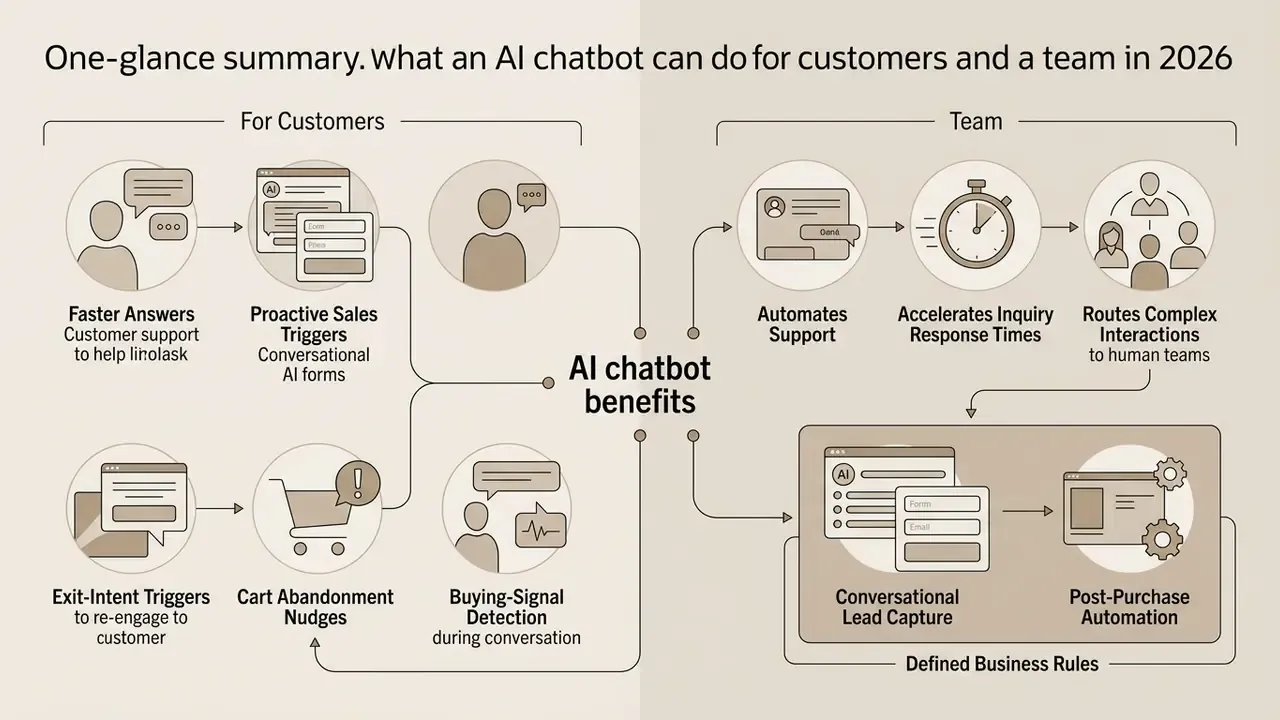
An AI chatbot automates customer support, accelerates inquiry response times, and routes complex interactions to human teams while operating under defined business rules. It pairs natural language understanding with internal knowledge retrieval to resolve routine tasks continuously.
Customer support, sales and faster answers
AI-powered chatbots resolve recurring customer questions instantly, pulling initial response times from minutes down to seconds and holding service availability around the clock. They capture qualified sales leads and offer solution-oriented guidance across high-volume customer journeys.
Large-scale operational studies show measurable efficiency gains across support workflows. In a controlled customer support evaluation, AI-assisted workflows reduced average message response times by 22%, with higher empathy scores and better solution accuracy.
«AI-assisted agents replied 22% faster, sent more messages, and displayed measurably higher empathy and problem-solving orientation.»
Updated (verified replacement for the earlier "15 minutes to 23 seconds / 98% reduction" claim): large field research on generative AI in support operations reports that assisted workers resolved approximately 15% more issues per hour on average, with the biggest gains concentrated among less-experienced agents. Single-vendor "98% faster first response" figures circulate widely but lack published methodology, sample definitions, and independent verification. Treat them as marketing claims, not benchmarks. The original unverified sentence is preserved verbatim in Appendix A for transparency.
In sales workflows, conversation framing dictates financial outcomes. Unassisted machine interactions can match experienced human conversion rates in structured dialogues, yet disclosing automated identity before the conversation starts produced a 79.7% drop in conversion probability.
«Disclosing machine identity before the conversation began reduced purchase probability from 23.7% to 4.8%, a 79.7% decline (p<0.01).»
Deliver value first. Then handle identity disclosures and forms, transparently, inside the interface rather than as a gate in front of it.
Proactive sales triggers and conversational AI forms
Modern AI chatbots move past reactive Q&A. They initiate interactions based on user behaviour and replace static web forms with dynamic conversational inputs:
- Exit-intent and hesitation triggers detect when a visitor spends more than 45 seconds on a pricing page, scrolls repeatedly between plan tiers, or moves the cursor toward the browser close control, then fire a targeted assistance prompt or offer.
- Cart abandonment nudges engage shoppers who leave items in the basket with clarifications on shipping cost, delivery windows, return policy, or bulk pricing, which are the objections that most often stall checkout.
- Buying-signal detection mid-conversation bulk quantity questions, competitor comparisons, and checkout hesitation are classified as commercial intent, letting the bot surface a relevant product, an upgrade path, or a time-limited discount code at the moment of decision.
- Conversational lead capture (AI forms) instead of a multi-field web form, the bot collects lead attributes (name, email, budget, company size, timeline) step by step through natural dialogue, validates input formats in real time, and writes structured records into the CRM.
- Post-purchase automation order tracking, feedback collection, and loyalty enrolment run as scripted follow-up skills, converting service touchpoints into retention events.
One caution from regulated deployments: proactive triggers on a pricing page are marketing. Proactive triggers on an account page are potentially a suitability question. Scope them separately.
Industry-specific AI chatbot applications
Different sectors deploy AI chatbots to automate domain-specific workflows, respect regulatory boundaries, and process distinct transaction types. Scoping the retrieval base and the action layer by vertical is what separates a demo bot from a production system.
| Industry | Primary use cases | Key data integrations | Operational benefit |
|---|---|---|---|
| E-commerce & retail | Abandoned cart recovery, personalized product recommendations, order tracking, returns windows, store hours and locations, loyalty rewards | Shopify, WooCommerce, ERP inventory databases, shipping carrier APIs | Increases conversion by engaging hesitant shoppers mid-session and deflecting order-status tickets |
| Healthcare | Symptom triage, appointment booking, insurance verification and claims assistance, medication reminders, post-treatment surveys | EHR systems, HL7/FHIR-compliant databases, scheduling APIs | Deflects tier-one administrative calls while adhering to HIPAA/GDPR privacy rules and clinician escalation rules |
| Financial services & banking | Balance and account lookups, fraud alert verification, card blocking, loan and credit application guidance, satisfaction surveys | Core banking APIs, CRM systems, KYC/AML verification flows | Delivers 24/7 account support with tokenized authentication and full audit trails |
| SaaS & B2B enterprise | Interactive lead qualification, onboarding walkthroughs, feature explanation, documentation search, demo scheduling | HubSpot, Salesforce, Stripe billing APIs, product analytics | Qualifies inbound leads automatically and books sales demos through calendar tools |
| Hospitality & travel | Reservation changes, concierge and amenity recommendations, automated check-in/out, loyalty programme automation | Property Management Systems (PMS), reservation engines, POS | Removes front-desk queues and cross-sells room, dining, and spa upgrades in real time |
| Real estate | Listing qualification, viewing scheduling, mortgage pre-screening questions, neighbourhood data answers | MLS/listing databases, calendar APIs, CRM pipelines | Filters unqualified enquiries before agent time is consumed |
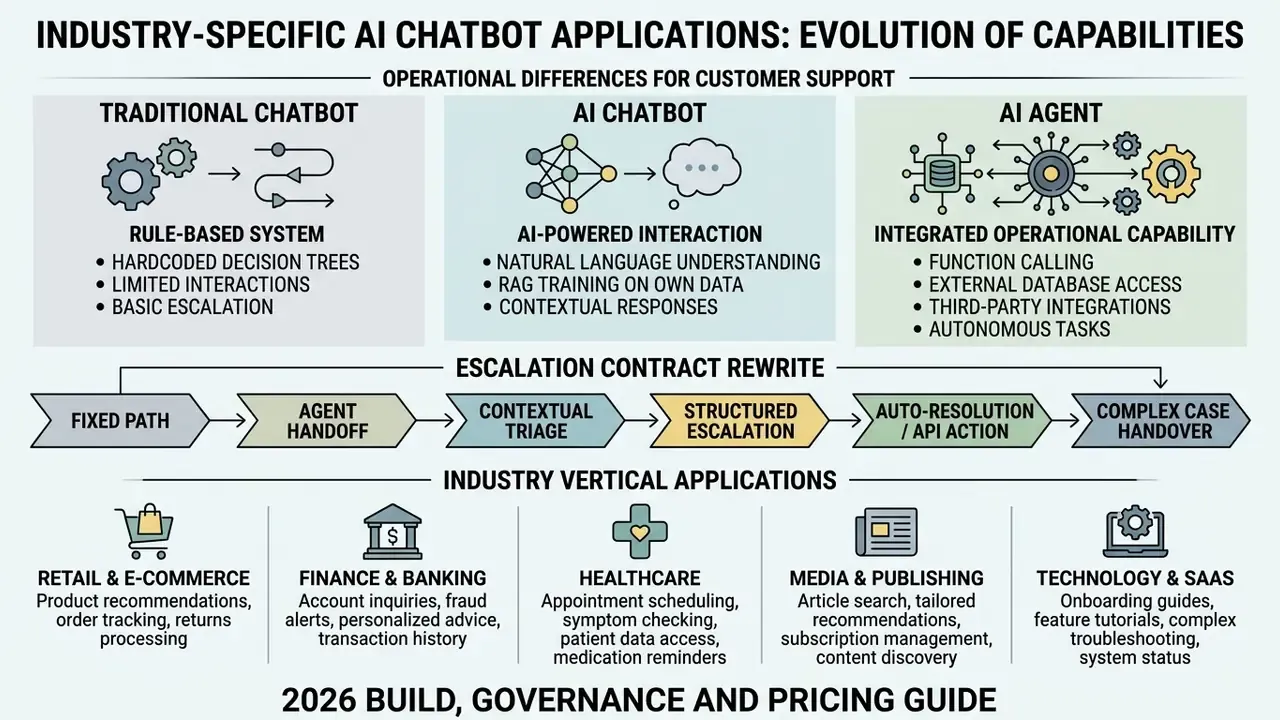
Each vertical also rewrites the escalation contract. In healthcare and banking, the confidence threshold that triggers human handoff must be set conservatively, and any answer touching diagnosis, eligibility, or account-level financial advice belongs with a licensed human rather than a language model. In banking specifically, a KYC or AML question is a hard stop for automation: the bot may explain what documents are needed, never whether a case clears.
AI chatbot, chatbot and AI agent: what is the difference
The primary difference is operational capability. Rule-based chatbots execute static decision trees, AI chatbots retrieve and synthesise answers from a knowledge base, and AI agents autonomously perform multi-step actions in external software systems.
Traditional rule-based systems run hardcoded decision trees. If a user query drifts away from the specified intent keywords, the rule-based bot fails, sometimes loudly. Retrieval-Augmented Generation (RAG) frameworks let AI chatbots pull answers from unstructured documents dynamically. NIST IR 8579 (2025) documents exactly this pattern, indexing publications into JSONL and retrieving context before prompting the model. https://nvlpubs.nist.gov/nistpubs/ir/2025/NIST.IR.8579.ipd.pdf
«Knowledge-graph-based RAG improved Mean Reciprocal Rank by 77.6% and cut median issue-resolution time by 28.6% versus baseline text search.»
AI agents extend that architecture with function calling to interact with external databases and third-party web services. NIST's 2026 concept paper on software and AI agent identity signals that agentic bots need tighter identity, authorization, and action-scoping controls than plain retrieval chatbots. For model-risk classification, that distinction is the whole ballgame.
Comparison of traditional chatbot, AI chatbot, and AI agent for website customer support
| Dimension | Rule-based chatbot | AI chatbot (LLM-powered) | AI agent (LLM + tools) |
|---|---|---|---|
| Primary knowledge source | Predefined scripts, FAQs, static decision trees | Large language models grounded in website content and vector knowledge bases | Vector databases, structured knowledge graphs, live tool API outputs |
| Language flexibility | Requires exact keyword matches; breaks on unexpected phrasing | Understands open-ended natural language and multi-turn context | Processes natural language while reasoning over multi-step action plans |
| Action capability | Triggers static links or rigid menu options | Generates text answers and suggests relevant documentation links | Executes external API calls, updates databases, modifies system states |
| Escalation handling | Transfers to a human operator only on explicit script failure | Evaluates confidence scores and sentiment to trigger human handoff | Assesses task completion status and tool execution errors before handoff |
| Governance burden | Change management on authored flows | Retrieval boundary validation, hallucination testing, PII scrubbing | All of the above plus agent identity, authorization scoping, action approval gates |
In short: a rule-based bot answers what you wrote, an AI chatbot answers what you indexed, and an AI agent does what you authorised. The third one needs a named owner.
Choose how to create an AI chatbot
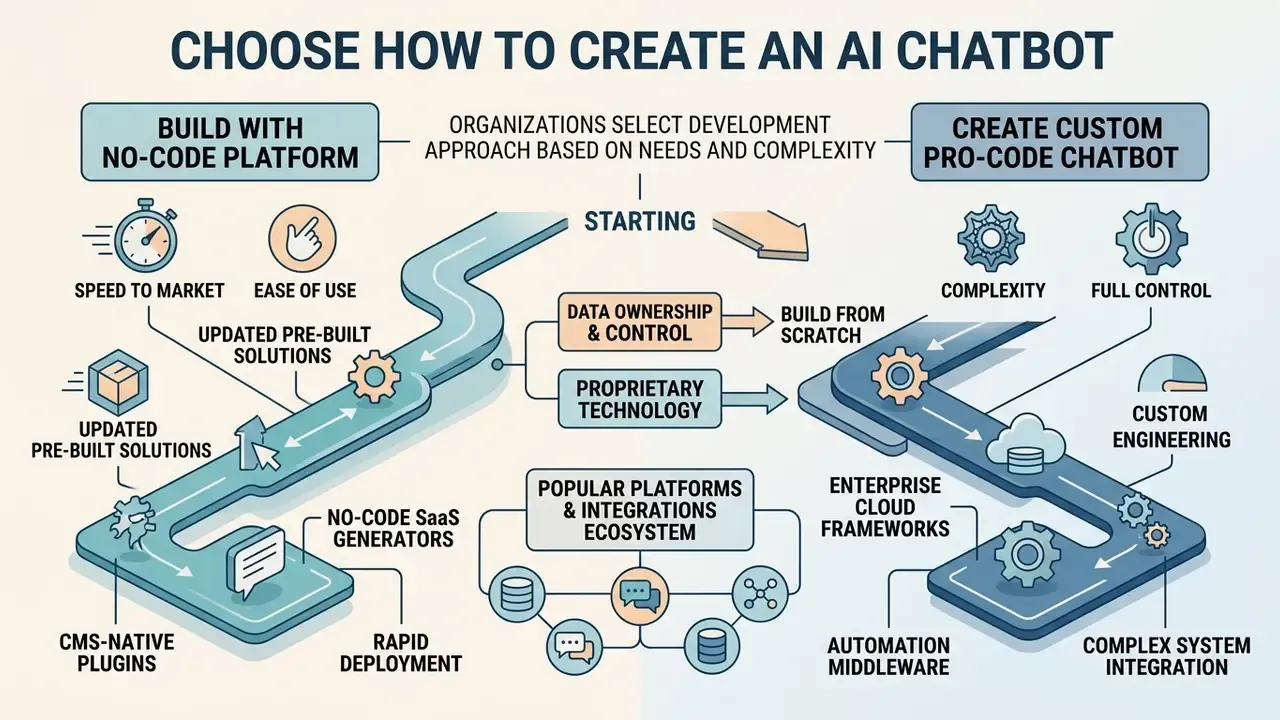
Organizations choose between visual no-code platforms for rapid deployment and custom pro-code engineering for complex system integration, strict data ownership, and proprietary workflows. Both routes can produce a competent website chatbot. They produce very different audit trails.
Build an AI chatbot using a no-code platform
Create a custom AI chatbot from scratch
Building a custom AI chatbot means assembling a stack: LLM APIs, a vector database, an orchestration framework such as LangChain or LlamaIndex, and dedicated backend logic.
Pro-code architectures give complete control over model selection, embedding models, and data storage. Developers construct custom ingestion pipelines using orchestration frameworks. LangChain's documented pattern covers indexing, vector-store synchronization, LCEL retrieval chains, evaluation, deployment, and monitoring, while LlamaIndex positions itself as the data interface layer over external content. In practice, many production teams split the stack: LlamaIndex for ingestion and retrieval, LangChain for agent and tool orchestration.
Choose custom engineering when you integrate with sensitive internal databases, run private self-hosted models, or need proprietary routing algorithms exposed through internal api endpoints. For most US banks, that description fits the moment a bot touches account-level data.
Popular platforms and integrations ecosystem
Depending on engineering budget and compliance posture, teams select from four established layers:
- CMS-native plugins Shopify and WordPress offer one-click installation scripts that synchronize product catalogs, help centers, and blog pages into the bot's knowledge base with no snippet editing.
- No-code SaaS generators platforms such as ChatBot.com, Thinkstack, DocsBot, and Voiceflow handle vector embedding management, multi-channel deployment, skills configuration, and visual dialog design without code. Knowledge sources typically include URLs, files, CSVs, Q&A pairs, and workspace exports such as Notion.
- Enterprise cloud frameworks pro-code teams build on Amazon Lex, Microsoft Azure AI Bot Service, IBM watsonx Assistant, Google Gemini Enterprise, or open-source libraries (LangChain, LlamaIndex, Rasa, Wit.ai).
- Automation middleware Zapier, Make, or Pabbly Connect webhooks pass extracted conversation outputs into CRMs, Google Sheets, ticketing tools, and email marketing platforms. Slack, Help Scout, and MCP connectors extend the same pattern to internal systems.
A useful selection heuristic: if the bot only answers questions from public content, start with a CMS plugin or no-code SaaS. If it must read or write regulated records, plan for an enterprise framework or a custom build from day one. Retrofitting data sovereignty into a multi-tenant SaaS deployment is rarely possible, and never cheap.
Plan your chatbot before you build it
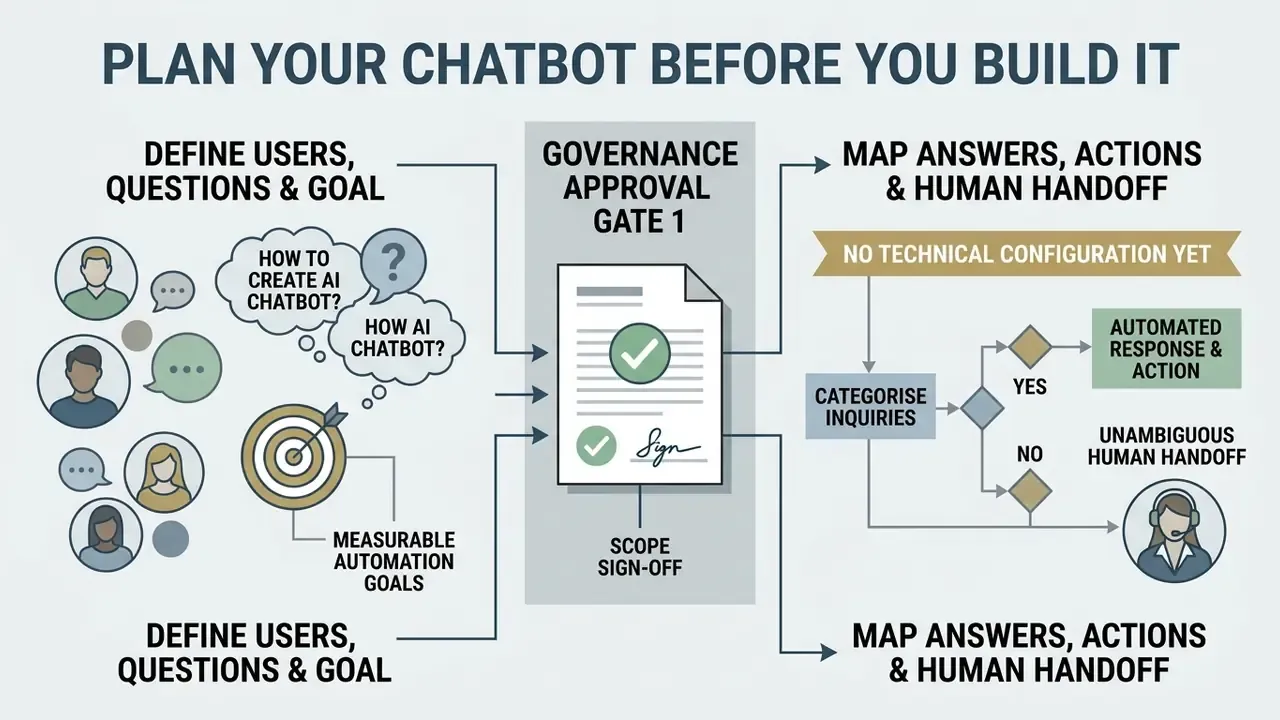
Effective planning means categorising user inquiries, setting measurable automation goals, and designing unambiguous human handoff protocols before any technical configuration. Skip this and you will discover your scope from incident reports instead.
Define users, questions and the chatbot's goal
Defining chatbot goals starts with auditing historic support transcripts, grouping frequent questions by intent, and aligning bot behaviour with lead generation or support deflection targets.
Conversational design begins with empirical inquiry analysis. Support logs reveal recurring ticket categories: billing terms, technical troubleshooting, product pricing. Categorising those questions establishes the core retrieval scope.
«Analysis of real support dialogues exposes the distribution of request types, conversation length, and complexity, signals that authored scripts never surface.»
Design frameworks published between 2024 and 2026 place the same activity first: problem identification, audience analysis, and persona development covering goals, needs, pain points, and preferred communication style, all before a flow is drawn. Segmentation then serves two business goals in parallel: support deflection for repetitive queries, and lead capture with qualification fields for prospects who should reach sales.
A financial services team analysed six months of incoming support logs to identify ticket drivers. By sorting 12,000 inquiry transcripts into distinct intent buckets, the institution built a targeted retrieval base for account inquiries. Structured scoping deflected 34% of routine tier-one tickets within 30 days. (Practitioner case reported to the editorial desk; figures are self-reported and not independently audited. Treat the method as transferable and the percentage as indicative only.)
Planning tools such as the AI Media Calculators help teams project ticket deflection rates and operational cost savings before deployment, which is also the moment to sanity-check whether the business case survives control costs.
Governance approval gate 1, scope sign-off: before ingestion begins, document the intended use case, in-scope intents, out-of-scope topics, data classifications the bot may touch, and the named business owner. For regulated institutions, this artifact is the entry point into model inventory registration.
Map answers, actions and human handoff
Mapping conversation flows means defining triggers for automated answers, specifying system actions, and establishing fallback conditions that transfer the interaction to live personnel with full context.
Fallback patterns analyse unrecognised user inputs to prevent repetitive conversational loops. Platform documentation for fallback analysis clusters unrecognised queries into buckets so missing topics get enriched rather than silently failed. When model confidence drops below the threshold, the chatbot runs a structured handoff.
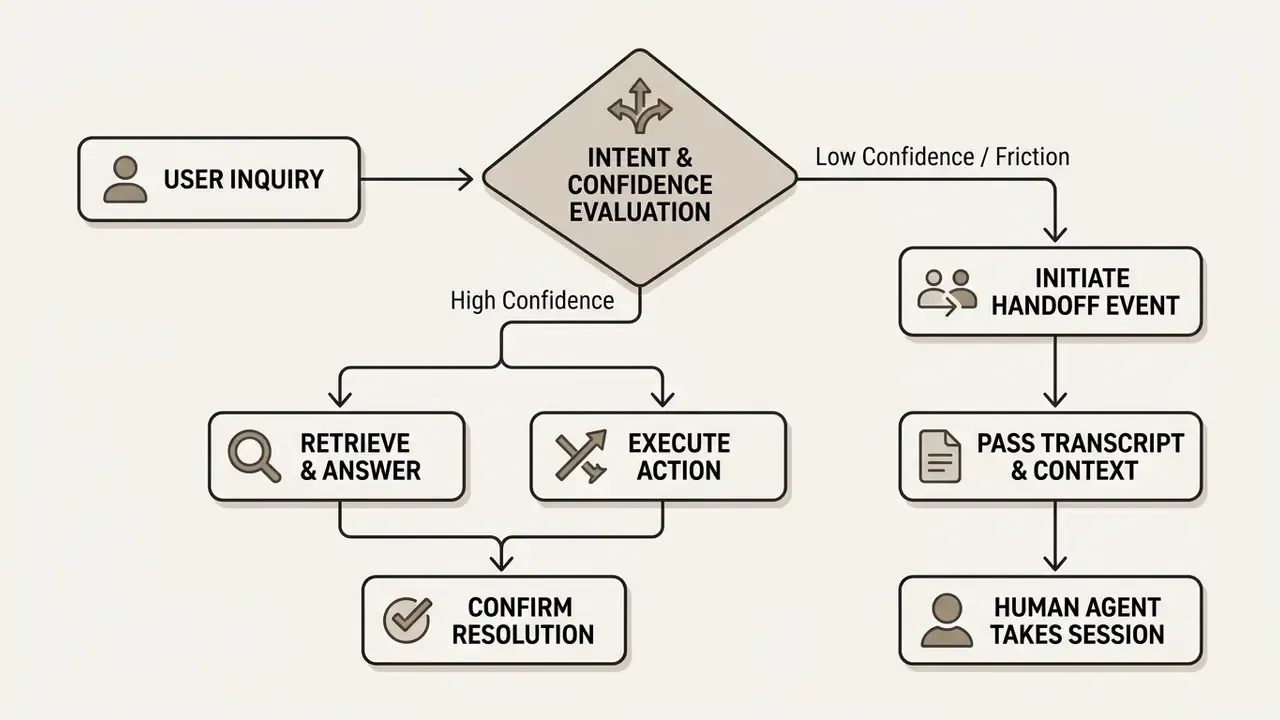
The handoff payload carries user identity, sentiment state, interaction transcript, and extracted entity fields straight into the customer service portal. A compact, auditable payload contains five elements: identity, detected intent, evidence quoted from the transcript, session context, and recommended next action. Live agents accept the conversation without forcing the customer to repeat anything.
«A poor chatbot experience depresses satisfaction even after transfer to a human agent, particularly when reply speed mimics automation.»
That spillover is the strongest argument for conservative escalation thresholds. A bot that guesses damages the human interaction that follows it.
Train your AI chatbot on website and knowledge data
Training an AI chatbot means parsing clean text from website pages, PDFs, and internal databases into structured chunks indexed inside a vector knowledge base. Garbage in, confidently worded garbage out.
Add website pages and knowledge sources
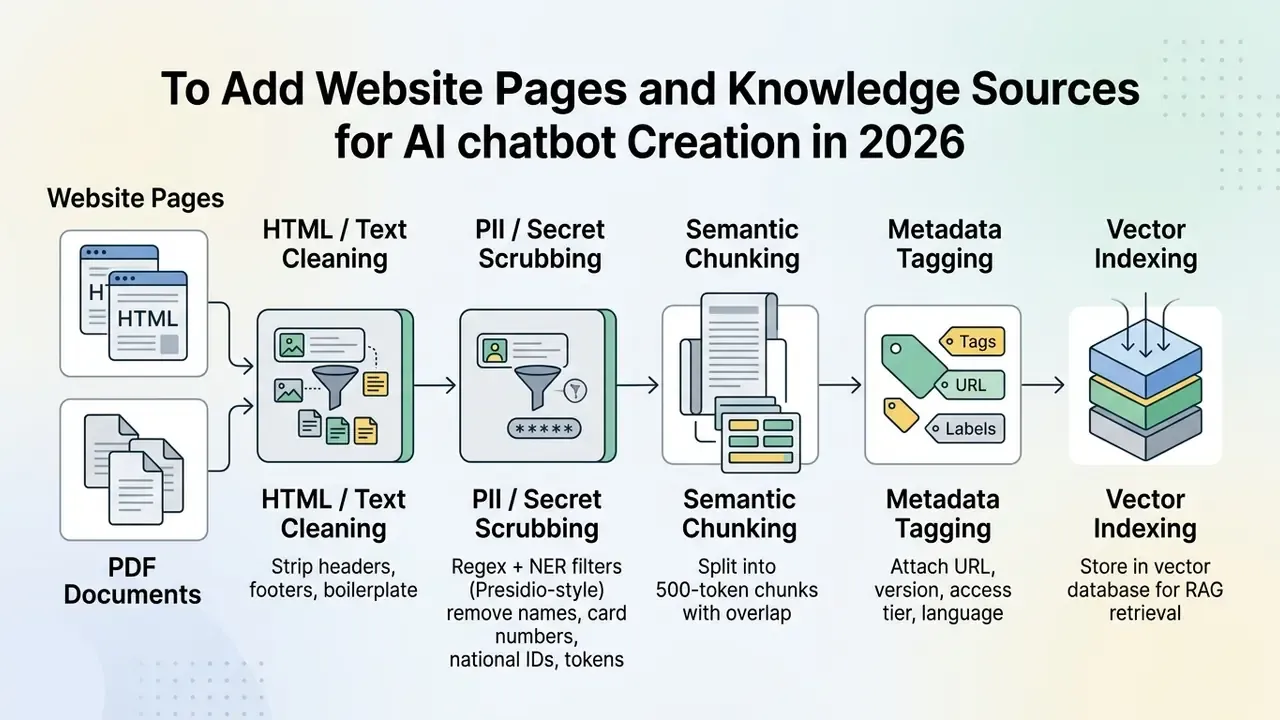
Knowledge ingestion involves crawling public website URLs, parsing structured documents, stripping formatting noise, and attaching metadata so retrieval augmented generation stays accurate.
Raw web content carries navigation menus, footer links, and legal disclaimers that degrade retrieval quality. Parsing pipelines remove boilerplate HTML before chunking text into semantic segments. IBM's Data Prep Kit guidance (2025) and Databricks' RAG guide both state that raw documents must be parsed into text and split into chunks before retrieval performs correctly. Each chunk receives structural metadata: source URL, document version, publication date, access classification. Scanned images without OCR yield no usable text and must be either processed or excluded.
«Structuring content into logical segments with metadata (issue type, product version) improves retrieval precision compared with flat text splitting.»
Set instructions for tone, language and answers
System instructions establish the chatbot's persona, enforce language boundaries, set tone of voice, and impose strict negative constraints against off-topic generation.
System prompts operate at a higher priority level than user inputs. Enterprise platform documentation notes that instructions passed before user input can dictate style, tone, and what the model may or may not discuss. Effective instruction sets specify identity and persona, scope and boundaries, tool-usage rules, escalation criteria, and response format. Language control must be explicit: if the bot should answer only in English, say so and forbid alternatives.
{
  "role": "system",
  "identity": "Official website assistant",
  "grounding": { "sources_only": true, "cite_sources": true },
  "language": { "allowed": ["en"], "fallback_message": "I can assist in English." },
  "tone": { "register": "professional", "max_answer_tokens": 220 },
  "prohibited_topics": ["legal advice", "medical diagnosis", "investment advice"],
  "escalation": {
    "confidence_threshold": 0.62,
    "explicit_triggers": ["speak to a human", "complaint", "refund", "fraud"]
  },
  "privacy": { "mask_pii_in_logs": true, "reject_secrets_in_input": true }
}
«Chatbot reliability, responsiveness, interactivity, and empathy have statistically significant effects on customer experience and loyalty in the banking sector.»
Tone configuration, then, is not cosmetic. Empathy and responsiveness are measurable drivers of satisfaction, which means instruction-layer wording belongs in the change-controlled artifact set, versioned like code and re-tested like code.
System safety, hallucination prevention and data security
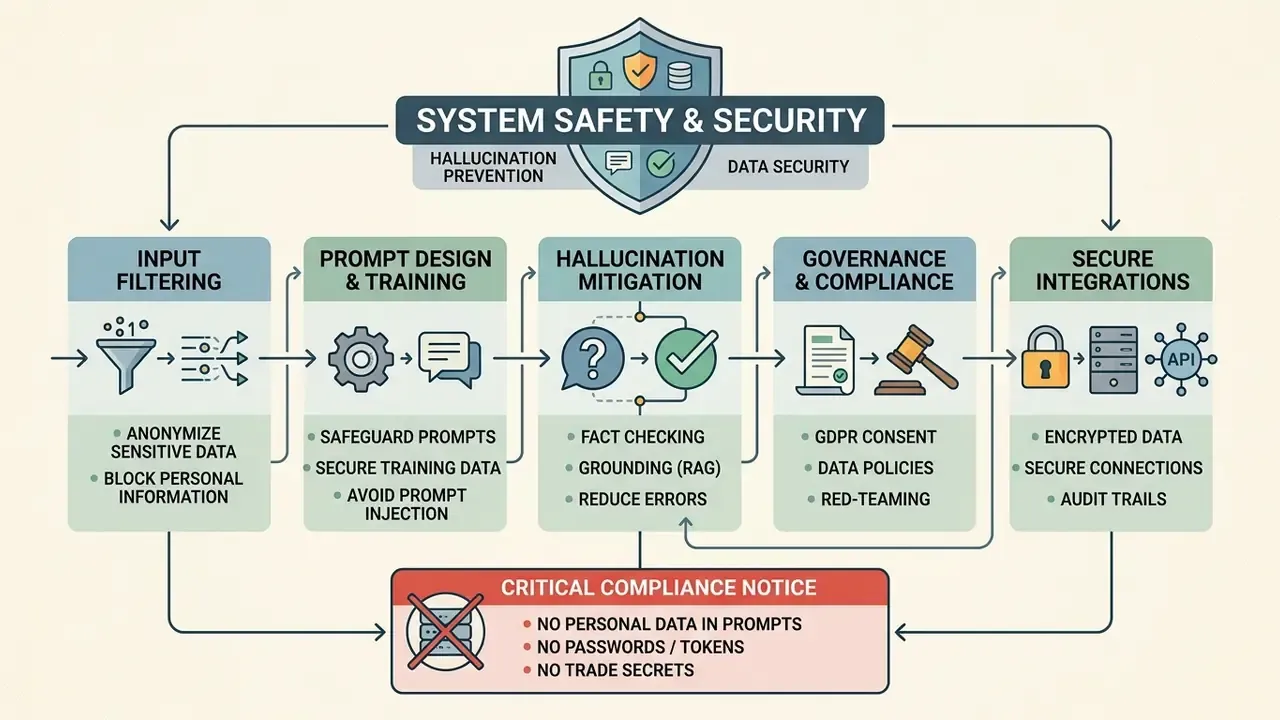
This section addresses information security, personal data, and regulatory compliance. It is general in nature and does not replace advice from a qualified information security, data protection, or legal compliance professional.
Instruction design and data security are two halves of one control. Once persona and boundaries are set, the remaining question is what happens when a user, deliberately or by accident, pushes the model outside them.
Operational controls that follow directly from those documents:
- Do not place personal data, passwords, tokens, or trade secrets into prompts. EMA states this explicitly and pairs it with a defined escalation route to security and the data protection officer.
- Detect, anonymize, or block sensitive information before processing or logging. EDPS frames this as privacy-by-design plus data minimization, not an optional filter.
- Review every output for veracity, reliability, and fairness, and cross-check against other sources. In practice, EMA's review requirement translates into mandatory source citations in bot answers so reviewers can verify grounding.
- Keep test data independent. Evaluation sets must be representative, stratified, access-controlled, and isolated from training, validation, and retrieval indices.
For US financial institutions, map the same controls to supervisory model-risk expectations. Federal Reserve SR 11-7 and OCC Bulletin 2011-12 (Supervisory Guidance on Model Risk Management) require model inventory registration, documented development evidence, ongoing monitoring, and, critically, effective challenge through independent model validation performed by parties not responsible for development. A website RAG chatbot that influences customer decisions or handles account-level inquiries sits inside that perimeter.
Practical implications: register the bot in the model inventory, document the retrieval and prompt configuration as model design, retain adversarial test results as validation evidence, and schedule periodic revalidation whenever the model version, embeddings, or knowledge base materially change. Shadow deployments, a team spinning up a bot on a marketing subdomain without telling risk, are the failure mode worth naming out loud in policy.
Configure integrations, skills and automated actions
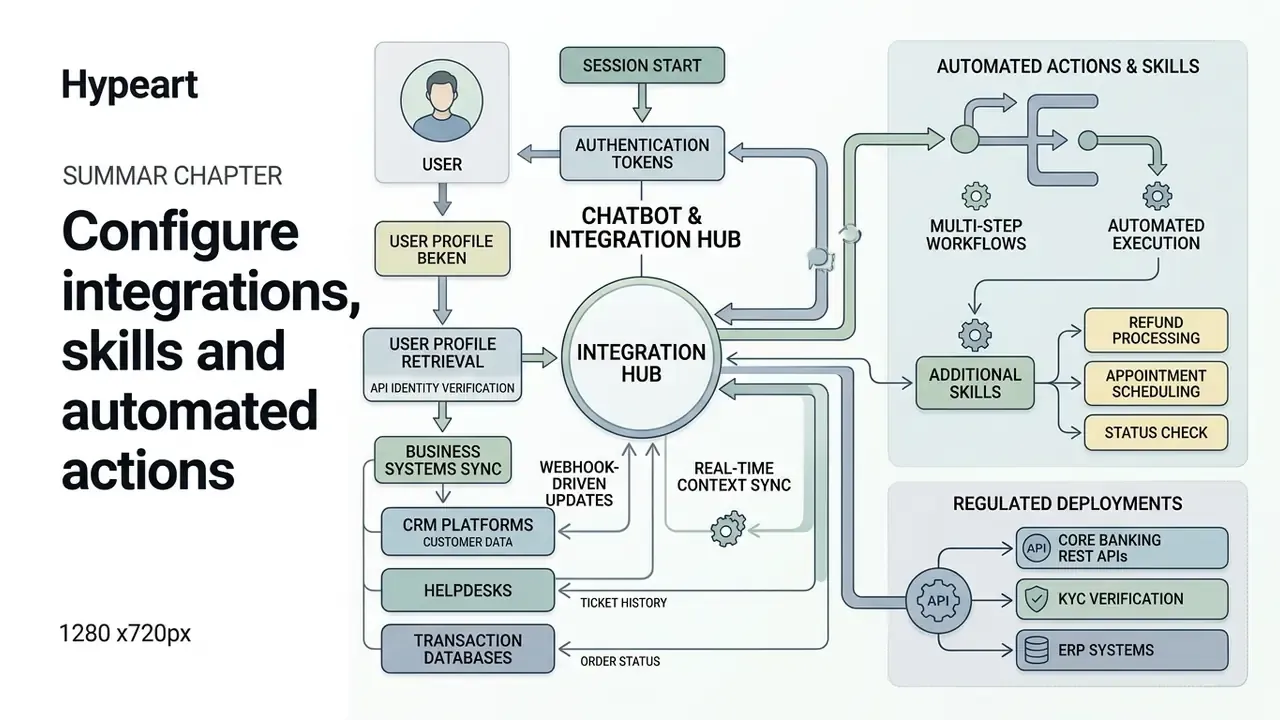
Integrations connect the AI chatbot to CRM platforms, helpdesks, and transaction databases, enabling real-time context synchronization and automated workflow execution.
Connect business systems and customer data
Connecting business tools requires API-based identity verification at session initiation and webhook-driven transcript writebacks that record user interactions inside helpdesk software.
At session start, the chat widget passes authentication tokens to retrieve user profile parameters through GET requests. The standard four-step synchronization flow: identify the user by email, phone, or session token; read account or ticket context via GET; route or resolve the request; then write back conversation logs, tags, and ticket updates via POST or PATCH webhooks. On completion, the chatbot writes conversation summaries, intent tags, and updated contact fields back to CRM platforms such as Salesforce or HubSpot.
Regulated deployments extend the same pattern to core banking REST APIs, KYC verification services, and ERP inventory systems, with per-endpoint authorization scoping so the bot can read balances without holding write permissions on transactions. Least privilege is not a nice-to-have here; it is what keeps a prompt-injection incident from becoming a money-movement incident. Teams that also automate media production alongside support workflows can compare capability tiers in the AI Media guide to the best AI video generators.
Add skills for multi-step customer actions
Multi-step skills rely on model function calling, where the AI outputs structured JSON payloads to execute external tasks such as booking appointments or resetting account details.
Function calling loops follow a four-part execution sequence documented across OpenAI and Azure agent references:
- The application sends tool schema definitions (JSON specifications) alongside the user prompt.
- The LLM detects an action intent and returns a structured
function_callpayload. - The local application backend executes the API call against internal servers.
- The API response returns to the LLM, which formats a final natural language response, repeating the loop for multi-turn orchestration.
{
  "name": "get_order_status",
  "description": "Return shipping status for an order belonging to the authenticated user.",
  "parameters": {
    "type": "object",
    "properties": {
      "order_id": { "type": "string", "pattern": "^[A-Z0-9-]{6,20}$" },
      "user_token": { "type": "string" }
    },
    "required": ["order_id", "user_token"]
  },
  "authorization_scope": "orders:read",
  "human_approval_required": false
}
Any tool that writes data, moves money, or changes entitlements should carry human_approval_required: true until adversarial testing demonstrates stable behaviour. Built-in skill libraries in mainstream platforms already cover welcome messages, ticket creation, contact collection, conversation transfer, and discount code issuance. Custom skills extend the set to business-specific workflows such as language-based routing or high-value lead tagging.
A corporate fintech team configured an automated identity verification skill inside their orchestration framework. The AI agent processed multi-turn inputs, generated structured JSON payloads to validate user credentials against external databases, and issued password reset tokens under scope. The implementation handled 4,000 monthly account requests with zero security policy overrides. (Illustrative composite case; not independently audited.)
Governance approval gate 3, action sign-off: enumerate every callable tool, its authorization scope, its blast radius if misused, and whether a human must approve execution. Agentic capability without an approval matrix is the single most common cause of unaccountable automation risk.
Test, govern and launch the AI chatbot
Launching an AI chatbot requires adversarial quality assurance testing, visual widget customization, and embedding a secure JavaScript snippet in website template footers.
Test answers, edge cases and customer questions
Chatbot QA testing evaluates system resilience through red-teaming, multi-turn edge case simulations, and prompt injection (jailbreak) defense verification.
Adversarial testing measures Attack Success Rate (ASR) and robust refusal capability before public release. HarmBench and JailbreakBench (2024) standardised these metrics alongside automated red-teaming pipelines. Red teams execute prompt injection attacks to force model compliance outside safety boundaries, scoring outcomes as failed, partial, or full success. Multi-turn studies chain prompts across several turns, because single-shot testing under-reports real risk.
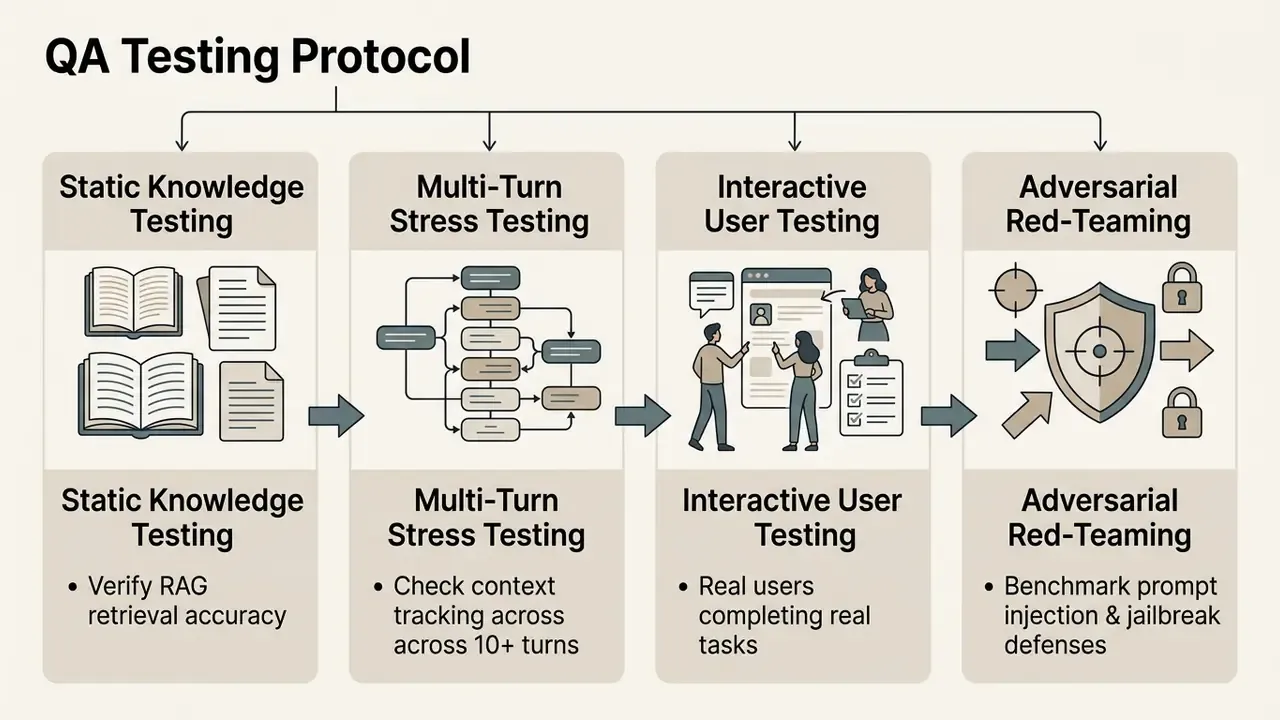
«Static-question accuracy does not predict interactive accuracy: in mathematics and physics, user–AI performance falls significantly below AI-alone scores.»
That is why static QA suites alone are not sign-off evidence. A bot can score well on isolated questions and still collapse when a real customer phrases the problem imprecisely across several turns.
NIST guidelines mandate independent, stratified test sets isolated from training or retrieval indices.
«Independent, stratified test sets isolated from training data are required to validate attack resilience and multi-turn behavior.»
«Eight-dimension evaluation (coherence, engagement, empathy and others) with pairwise dialogue comparison yields a fuller quality picture than single-metric scoring.» — ChatEvaluationPlatform, Deriu et al., 400 dialogues and 40 ratings per conversation (2023–2024).
Testing protocols must evaluate multi-turn context retention across complex user journeys, and the eight-dimension approach gives reviewers a defensible scoring rubric instead of a subjective pass or fail.
Pre-launch model governance checklist
Checklist0 / 13
That last line deserves emphasis. If nobody can name the person who flips the switch, the bot is not ready.
Customize the chat widget and publish it
Widget customization aligns chat interface styling, welcome messages, and avatar branding with enterprise identity before deployment through a tag manager or a direct script tag.
Visual setup uses CSS custom properties or dashboard controls for brand alignment. Vendor documentation exposes colors, fonts, widget width and height, chat title, corner radius, spacing, launcher icon, and bubble styling, and runtime APIs allow colour and customization updates after the widget has loaded. The initialization snippet attaches to the main DOM document before the closing body tag.
<!-- Enterprise Chat Widget Deployment Snippet -->
<script>
  window.ChatbotConfig = {
    appId: "ENV_PROD_9942",
    theme: { primaryColor: "#0F172A", position: "right" },
    userContext: { token: getAuthToken() }
  };
</script>
<script src="https://cdn.platform.com/widget.js" async defer></script>
Alternative deployment uses Google Tag Manager to inject script execution rules without touching core codebase deployment files. Creative platforms that ship unique assets, such as ai pixel art or custom avatar graphics, manage asset paths inside widget styling parameters.
«The wording of AI-identity disclosure and the presence of an explicit switch-to-human control affect trust and conversion, especially in financial and commercial contexts.»
Practical consequence: disclose that the assistant is automated, and do it inside the interface, as a persistent label plus an always-visible "talk to a person" control, rather than as a pre-conversation gate that stops the user before any value arrives.
Implementing legal and privacy controls in the chat UI
Multi-channel deployment beyond website widgets
A chatbot confined to the website leaves critical customer touchpoints unautomated. Modern architectures use a unified orchestration engine serving multiple channels through API webhooks, so one knowledge base and one instruction set drive every surface.
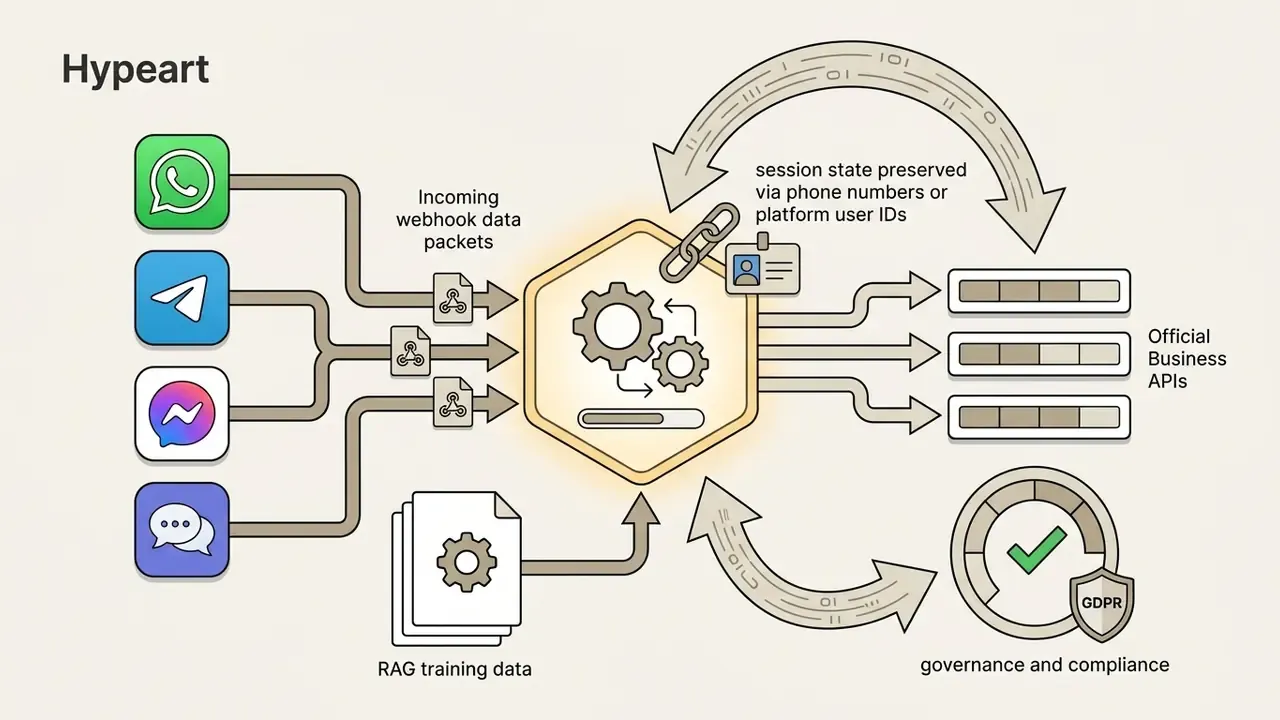
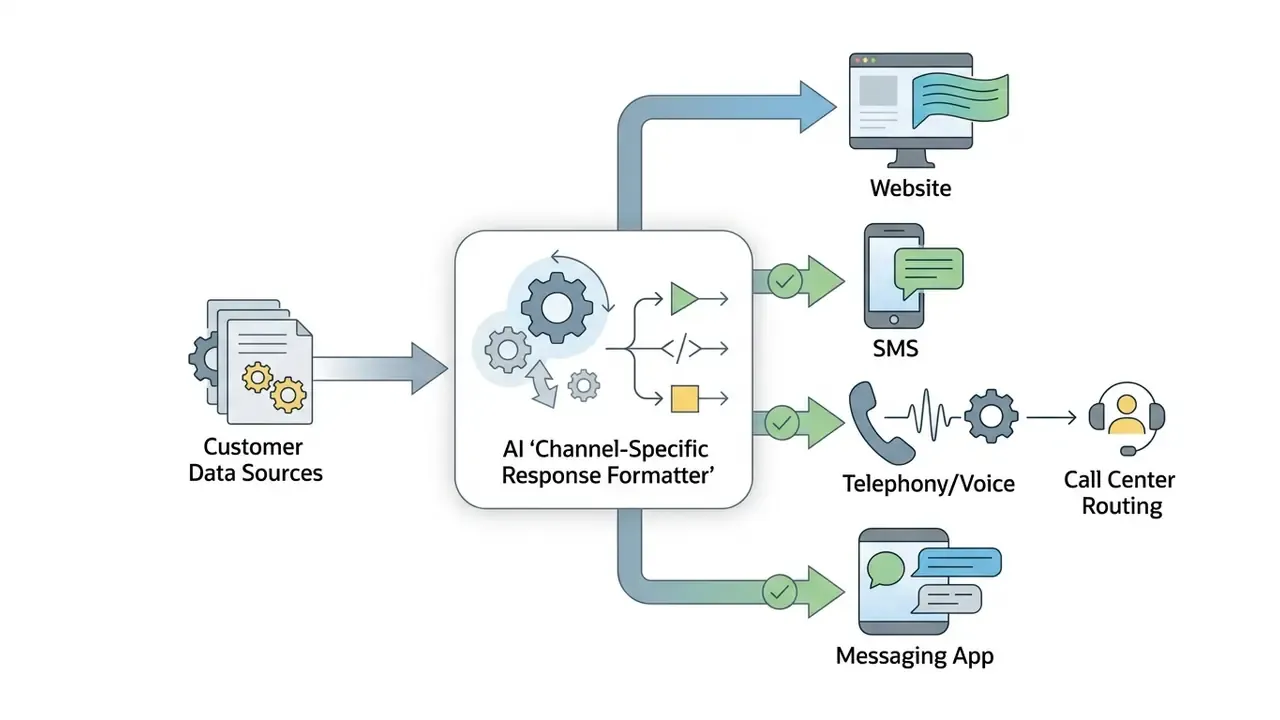
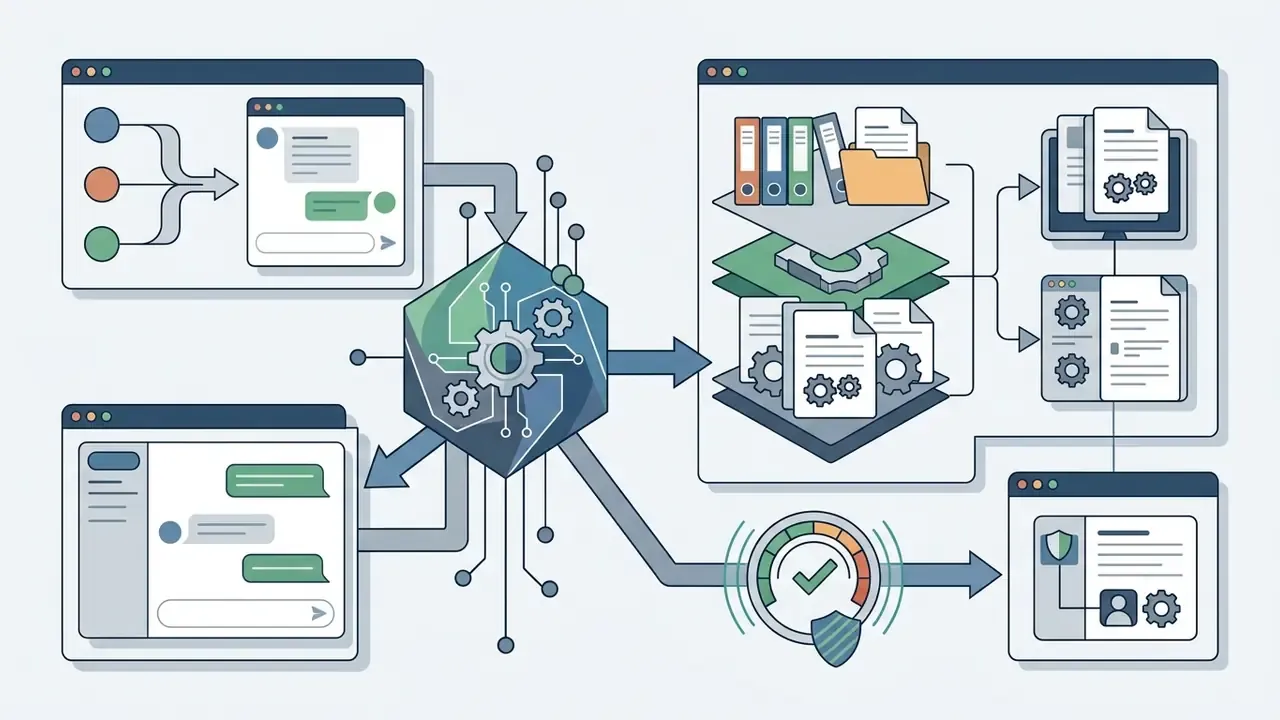
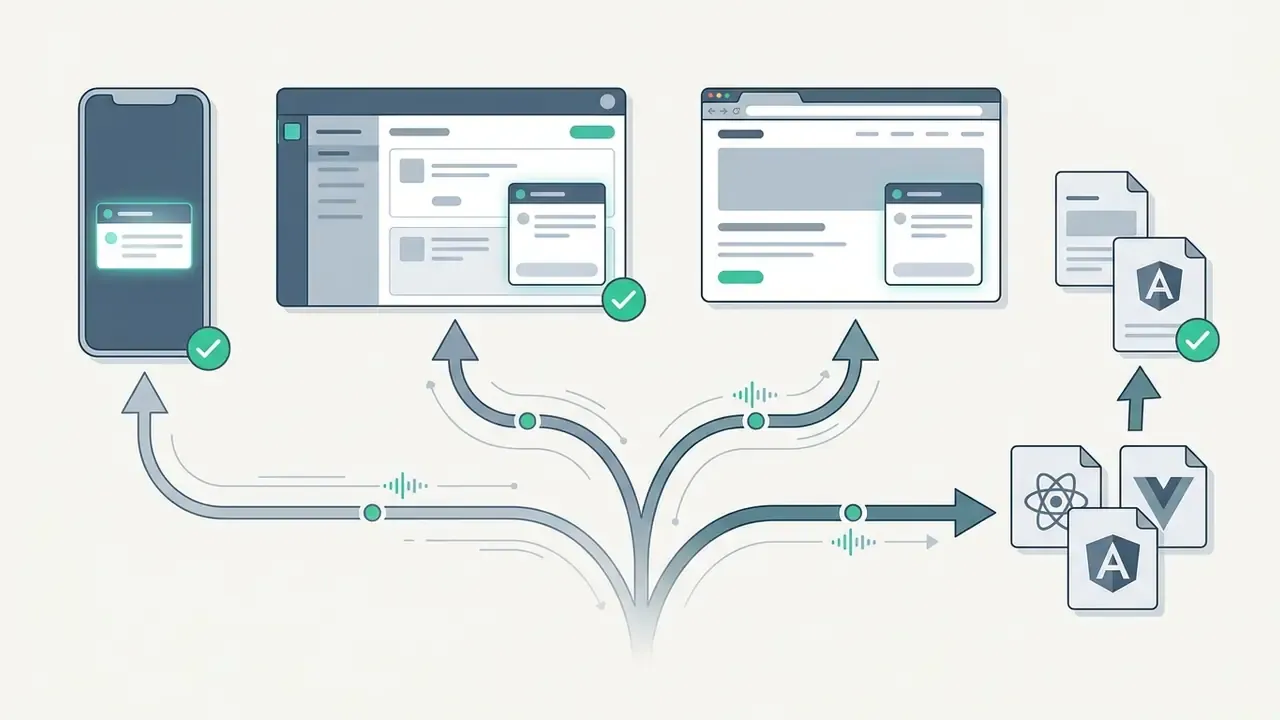
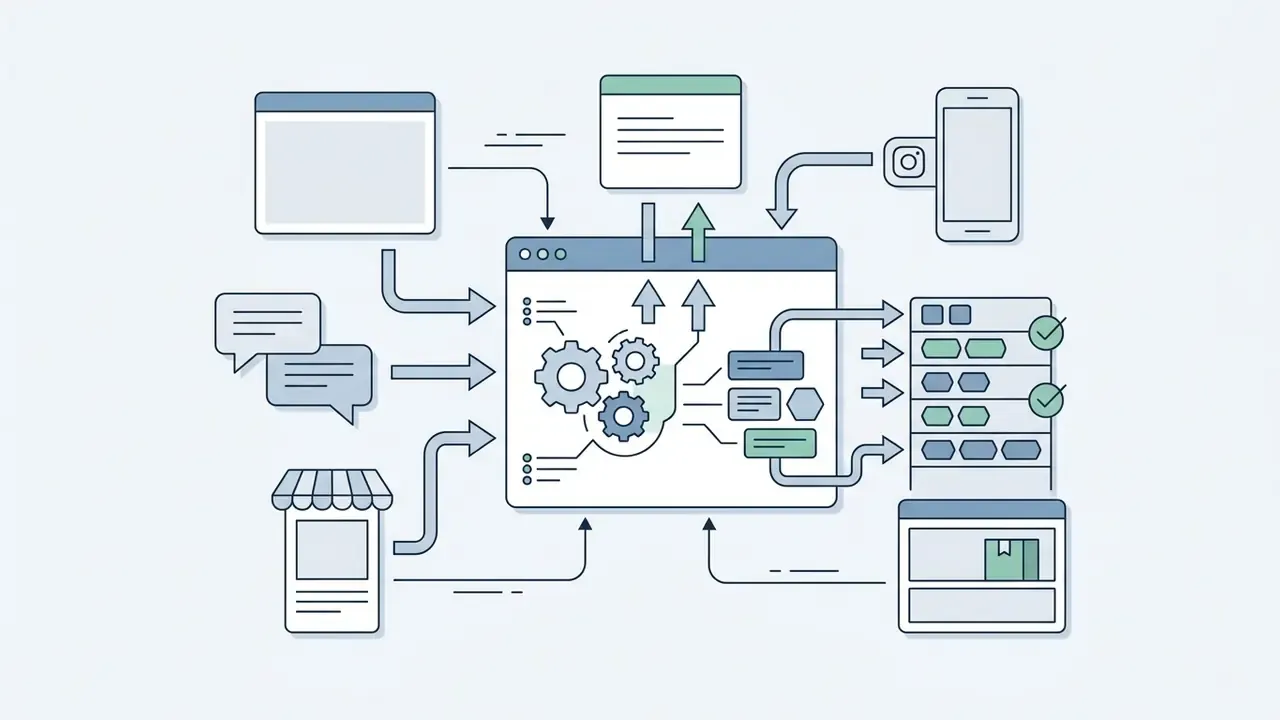
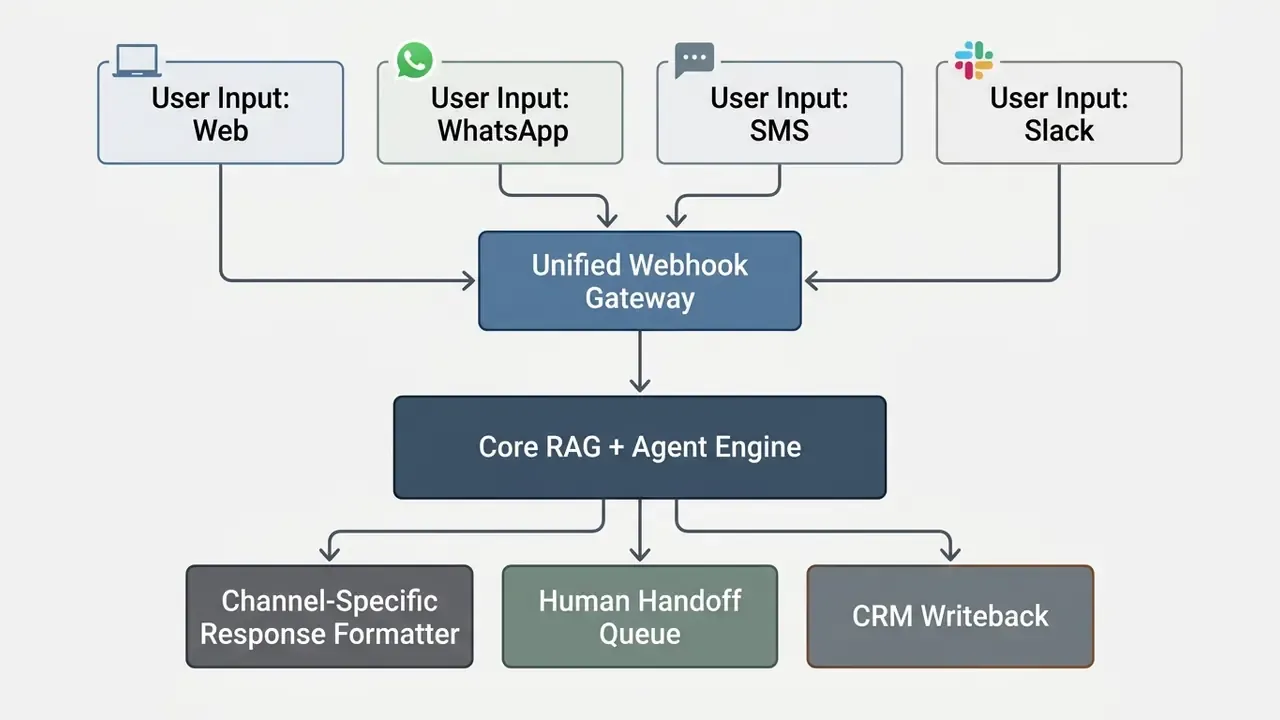
Two governance notes apply to multi-channel rollouts. First, consent and disclosure requirements differ per channel; messaging platforms impose their own opt-in and template rules on top of GDPR obligations. Second, identity assurance is weaker on phone-number-based channels, so any action requiring authentication must fall back to step-up verification rather than trusting the channel identifier.
Free plans, pricing and commercial-use requirements
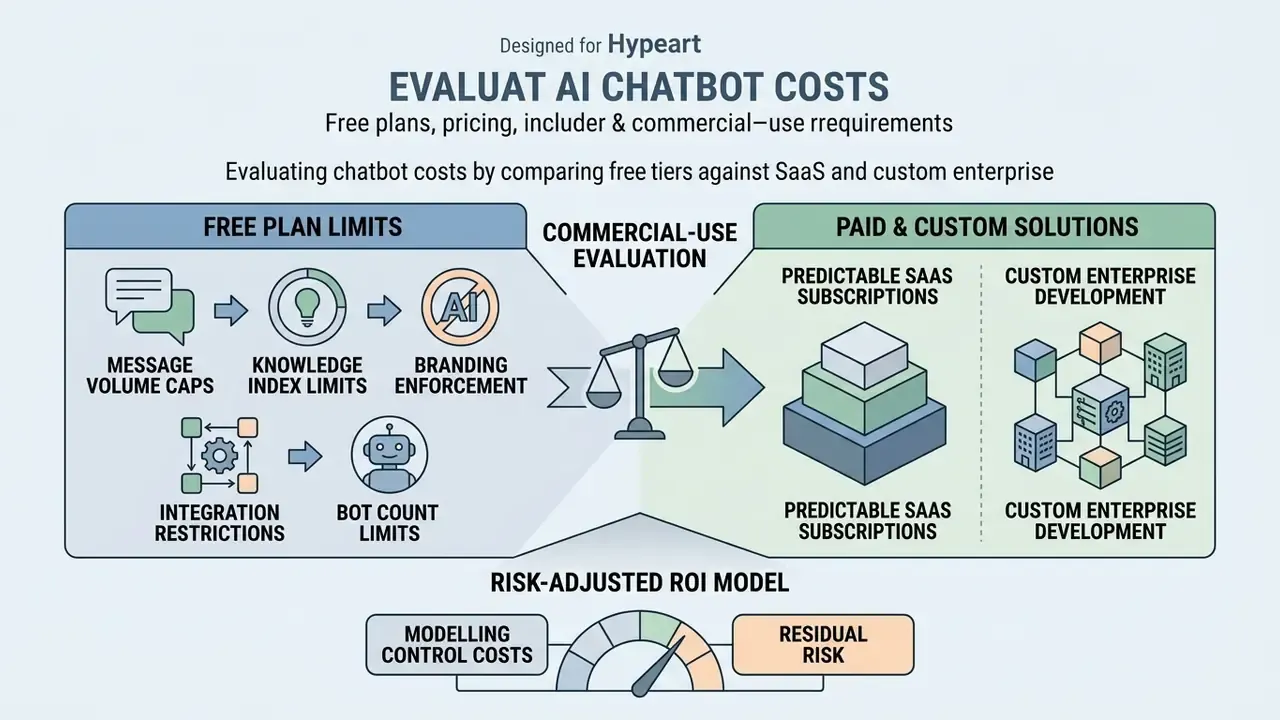
Evaluating AI chatbot costs means comparing message volume limits on free tiers against predictable recurring SaaS subscriptions and custom enterprise development expenditure.
What to compare in a free AI chatbot plan
Free AI chatbot plans typically offer basic feature access capped by message allowances (say 50 messages per day), limited URL crawling, and mandatory vendor branding.
Free platforms let you prototype without financial commitment. Restrictions surface fast:
Comparative breakdowns sit in AI Media Pricing Guides and AI Media Comparison Matrices. Adjacent free-tier mechanics are dissected in the comparison of free AI image generators, where the same limit patterns of watermarks, credit caps, and licence restrictions show up in a different product category.
When a business needs a paid or custom solution
Organizations need paid or custom AI chatbots when usage exhausts free quotas, when enterprise security policies demand data protection SLAs, or when multi-system actions are required. Reliable triggers: repeatedly hitting usage limits, opening extra free accounts as a workaround, needing unified branding and repeatable templates across multiple users, and clients demanding SLA or documented commercial data-handling terms.
A growing commerce platform outgrew basic-tier daily volume limits and hit service lockouts during peak sales hours. The team migrated to an enterprise SaaS model with SOC 2 compliance, custom SLA guarantees, and dedicated database connectors. Moving to dedicated infrastructure restored full uptime reliability across 45,000 monthly user sessions. (Self-reported practitioner case; uptime and session figures were not independently audited and should be read as directional.)
Migration decisions also carry an internal change-management dimension that budget models routinely ignore.
«65% of contact-center employees believe expanded use of chatbots and voice bots will likely lead to staff reductions within two years.»
Framing the deflection target as capacity reallocation, with explicit role changes for tier-one staff, measurably reduces adoption friction during rollout. Commercial deployments operating under strict intellectual property or privacy requirements should also review AI litigation and policy summaries before signing.
Risk-adjusted ROI: modelling control costs and residual risk
Naive ROI models compare licence cost against deflected ticket cost and stop. A defensible model for regulated deployments adds the cost of controls and the expected cost of incidents:
Risk-Adjusted ROI =
   ( Deflected_tickets × Cost_per_ticket
   + Incremental_revenue_from_conversion )
 − ( Platform_and_API_cost
   + Build_and_integration_cost
   + Guardrail_and_validation_cost        ← red-teaming, independent validation, monitoring
   + Human_review_and_handoff_cost
   + Σ ( Incident_probability × Incident_impact ) )   ← residual risk
 ─────────────────────────────────────────────────────────────────────
   ( Total_cost_of_ownership )
Populate the residual-risk term with concrete scenarios, not a generic contingency: an incorrect pricing or policy answer requiring remediation, a personal-data exposure triggering notification obligations, a prompt-injection incident leaking system instructions, an availability failure during a peak sales window. Each gets a probability band and an impact estimate reviewed with risk and legal. In practice that term, not the licence fee, decides build versus buy for banks, because multi-tenant hosting raises incident impact while lowering upfront cost.
AI chatbot deployment and pricing selection matrix
| Selection criteria | Free SaaS plan | Paid SaaS subscription | Custom pro-code build |
|---|---|---|---|
| Monthly base cost | $0 per month | $19 to $400 per month | $5,000 to $50,000+ upfront CAPEX (regulated builds $80,000+) |
| Capacity and limits | Capped (e.g. 50 messages/day, 10 URLs, 1 bot per channel) | Scaled tier allowances (1,000 to 50,000+ messages) | Unlimited, metered directly by API usage |
| Data security and privacy | Multi-tenant; no data processing SLA | Dedicated tenant; SOC 2 and GDPR compliance options | Full data sovereignty; private VPC or on-prem hosting |
| System integrations | None or basic webhook limits | Pre-built connectors (Zapier, HubSpot, Zendesk, Shopify) | Bespoke API connectors and custom function calling |
| Customization level | Fixed templates; vendor branding forced | Configurable CSS, colours, custom avatars | Full-code UI and logic ownership |
| Channels supported | Website widget only | Web, Messenger, WhatsApp, SMS, Slack via connectors | Any channel with an API; custom telephony and in-app surfaces |
| Audit and validation evidence | Minimal; vendor-controlled logs | Exportable logs, DPA, compliance attestations | Full artifact control: prompts, indexes, test sets, versioning |
Read the last row first if you sit in the second line of defence. It is the row that determines whether validation is possible at all.
Measure chatbot performance and improve responses
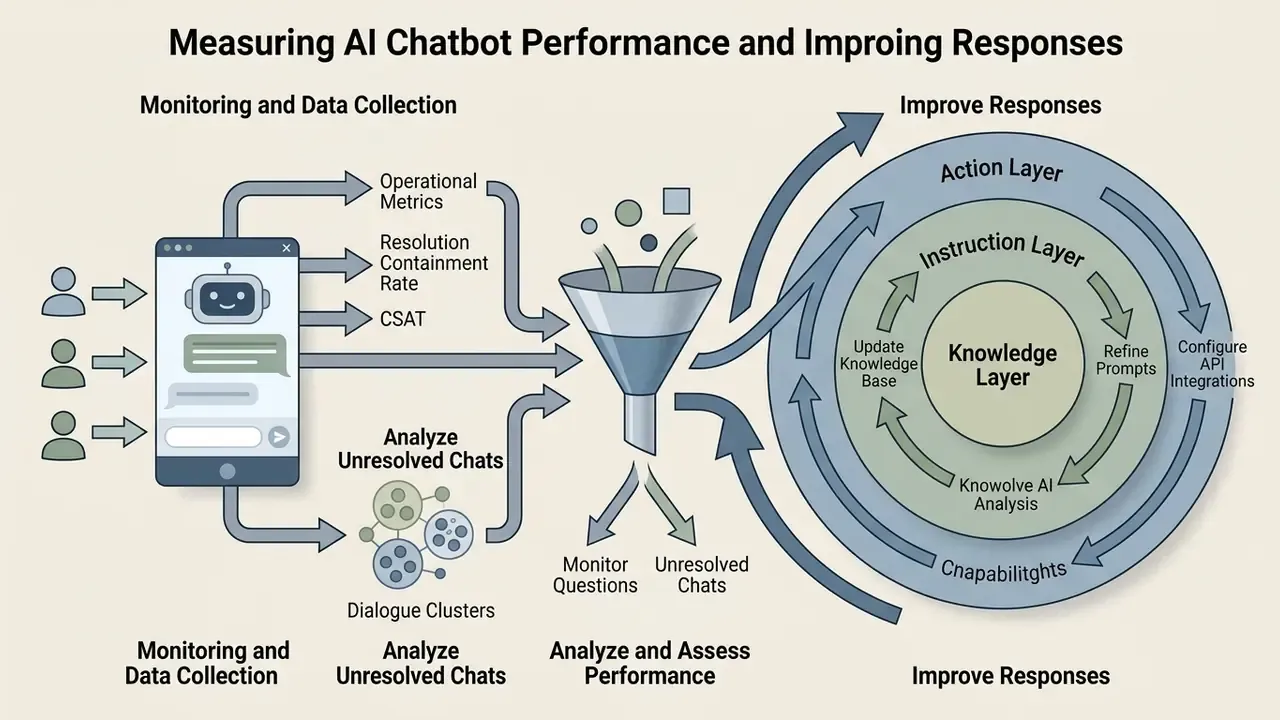
Post-launch chatbot management rests on tracking operational metrics: resolution containment rate, customer satisfaction scores (CSAT), and unresolved dialogue cluster analysis.
Monitor customer questions and unresolved chats
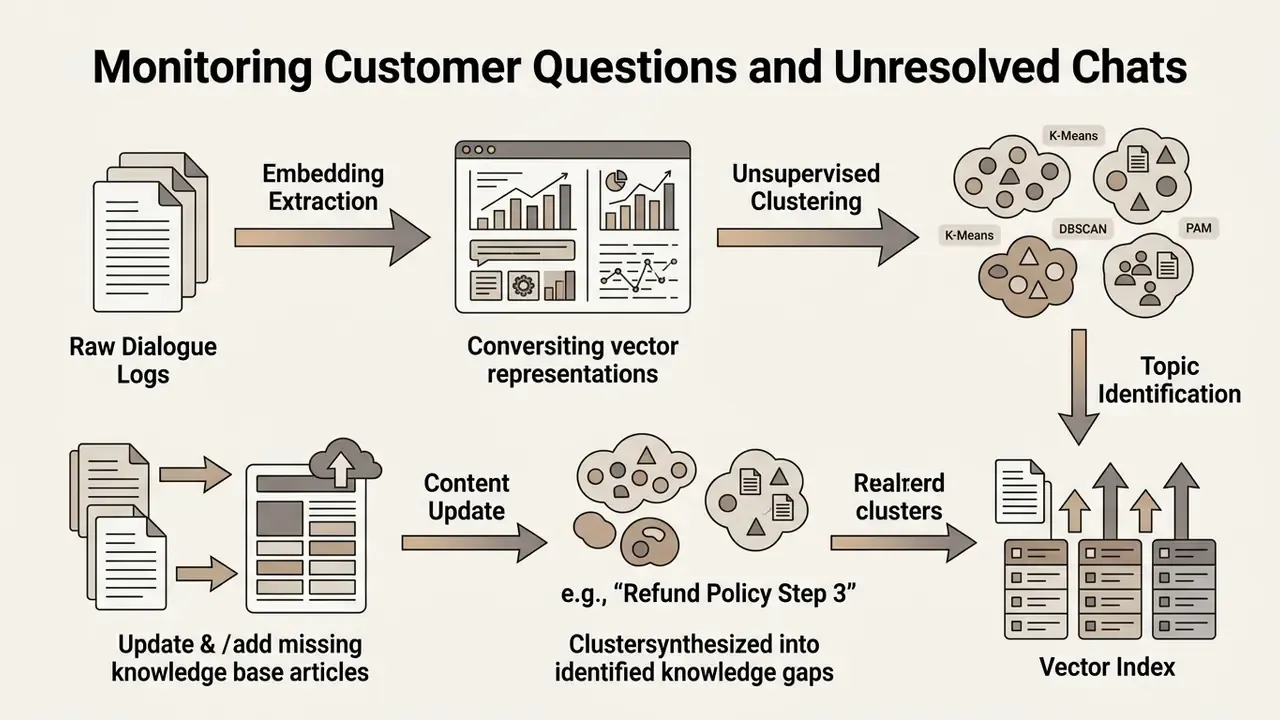
Monitoring unresolved interactions uses unsupervised AI clustering, such as K-means or DBSCAN, to discover knowledge base gaps hidden in unhandled customer queries.
«Evaluation systems must track task success, efficiency (average number of turns), request coverage, and user satisfaction as interdependent metrics.»
Fix operational definitions before the first dashboard is built. CSAT comes from post-interaction surveys and reflects subjective satisfaction. Containment or successful resolution rate is the share of conversations completed without human escalation. Unresolved-chat share is its complement, covering escalated and abandoned sessions. Vendors use "containment", "resolution percentage", and "deflection" for the same underlying outcome, so normalise the vocabulary internally and trend lines stay comparable across platform migrations. Operators then analyse unresolved dialogue logs to identify missing documentation topics.
«First-person evaluations (users who interact and rate) and third-person evaluations (independent raters) diverge, particularly on subtle qualities such as empathy.»
That divergence is a warning about offline monitoring. Log-based clustering finds coverage gaps efficiently, but it cannot substitute for live satisfaction capture. Run both, and treat disagreement between them as a signal, not noise.
Unsupervised clustering groups unhandled customer utterances into intent clusters. Published dialogue-analysis methods use K-means, K-medoids/PAM, and DBSCAN over conversation embeddings for topic discovery and automatic summarization. If several users express confusion about a specific checkout step, analytics flag that cluster for a knowledge base addition.
Improve knowledge, instructions and chatbot actions
Continuous improvement means a systematic cycle: update vector knowledge chunks, refine system prompts based on failure logs, and re-validate tool execution pathways.
Model risk management standards specify recurring evaluation loops. NIST AI 600-1 (2024) frames governance around monitoring, measurement, and controlled post-deployment updates, while NIST IR 8579 (2025) documents reviewing user interactions as an improvement input. UK Government guidance on evaluating AI interventions adds the cadence rule: rapid evaluation during rollout, then comprehensive reviews repeated at intervals proportional to how much the system and its context change.
«Task Success Rate, average turn count, clarification-question rejection rate, and overall user satisfaction form a balanced agent metric set.»
Limitations, open questions and a safe next step
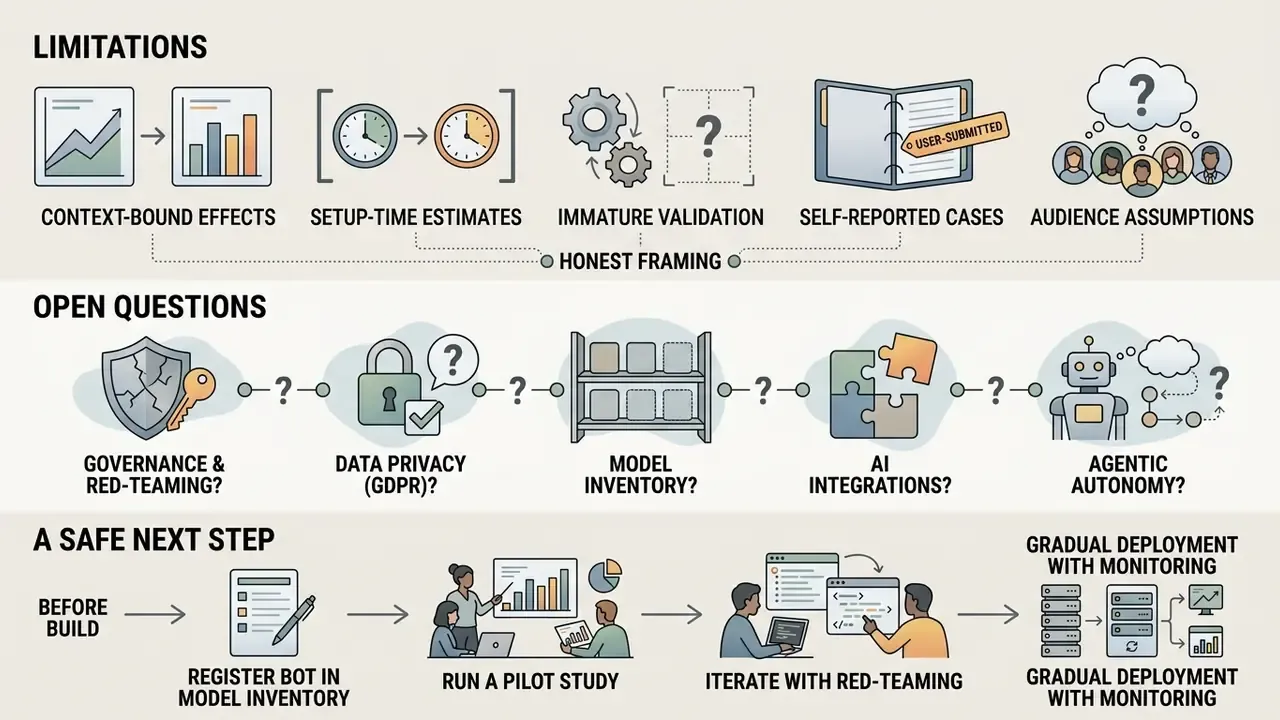
Honest framing matters more than confident framing. Several parts of this playbook rest on evidence that is thinner than the vendor decks suggest.
- Effect sizes are context-bound. The 22% response-time gain and the roughly 15% productivity lift come from support environments with high query repetition. Complex, judgement-heavy queues may show smaller or no gains.
- Setup-time ranges are operational estimates. The 30 minutes to two hours figure describes public-content bots on hosted platforms. Access-tiered knowledge, SSO, and validation add days or weeks.
- Agentic validation methods are immature. Traditional model validation assumes stable inputs and outputs. Tool-using agents change state, so validation must cover action sequences, not just answer quality. Standards here are still forming.
- Practitioner cases in this article are self-reported. Deflection rates, uptime, and request volumes were not independently audited. Read the methods, discount the percentages.
- Audience assumptions are hypotheses. Statements about what risk and finance leaders prioritise should be treated as untested until confirmed by interviews, CRM data, or analytics.
A safe next step, in order: register the intended bot in your model inventory before you build it, run a single-intent pilot on public content only, and require an independent review of red-team results before the widget goes live on any authenticated page. Small scope, full evidence trail. Expand from there.
FAQ
Do I need technical skills to create an AI chatbot?
Not for a standard website support bot. Paste a website URL into a no-code platform, let it build the knowledge base, then copy one snippet before the closing tag. Shopify and WordPress offer direct integrations that skip the snippet entirely. Custom builds require Python or Node.js engineering plus vector-store operations.
How long does setup take?
Typical no-code deployment runs 30 minutes to two hours for a single-channel website bot on public content. Add days to weeks for access-tiered knowledge bases, CRM writebacks, function calling, adversarial testing, and, in regulated sectors, independent validation.
Can a chatbot actually increase sales?
Yes, when it is wired to detect commercial intent. Hesitation at checkout, bulk quantity questions, and product comparisons are buying signals that can trigger recommendations or discount codes. Note the counter-evidence: disclosing machine identity before delivering value cut purchase probability by 79.7% in a randomized field experiment, so disclosure design matters as much as trigger design.
What is the difference between an AI chatbot and an AI agent?
An AI chatbot retrieves and synthesises grounded answers. An AI agent additionally executes actions through tools, booking, resetting, updating records, which introduces identity, authorization, and approval requirements that a retrieval-only bot does not have.
How do I keep the chatbot GDPR-compliant?
Collect explicit consent in the widget before processing interaction data, link the Privacy Policy in the widget header, anonymize IPs where consent is absent, scrub personal data client-side before it reaches the model, set explicit transcript retention periods, and provide a route for access and deletion requests.
What happens when the bot does not know the answer?
It should refuse with a fixed message, then escalate. The handoff must carry identity, intent, transcript evidence, session context, and recommended next action so the customer never repeats themselves. Poor handoffs depress satisfaction even after a human takes over.
Which metrics prove the deployment works?
Containment or resolution rate, unresolved-chat share, CSAT, average turns to resolution, escalation reason distribution, and, for agents, tool execution success rate. Track cost per resolved conversation against the risk-adjusted ROI model rather than licence cost alone.
Can one bot serve website, WhatsApp, and Slack?
Yes, through a unified webhook gateway feeding a single RAG engine with channel-specific response formatting. Consent rules, message templates, and identity assurance differ per channel and must be configured separately.
Does a website chatbot count as a model under SR 11-7?
If it influences customer decisions or handles account-level inquiries, assume yes and register it. The safer test is functional, not technical: does an output change what a customer or an employee does next? If so, expect inventory registration, documentation, monitoring, and independent validation.
Technical appendix and regulatory references
- NIST IR 8579 (2025)Developing the NCCoE Chatbot, Retrieval-Augmented Generation with Cyber Security Frameworks. National Institute of Standards and Technology. https://nvlpubs.nist.gov/nistpubs/ir/2025/NIST.IR.8579.ipd.pdf
- NIST AI 600-1 (2024)Artificial Intelligence Risk Management Framework: Generative AI Profile. https://nvlpubs.nist.gov/nistpubs/ai/NIST.AI.600-1.pdf
- NIST SP 800-53 Rev. 5 (2020)Security and Privacy Controls for Information Systems and Organizations. https://nvlpubs.nist.gov/nistpubs/SpecialPublications/NIST.SP.800-53r5.pdf
- EU Artificial Intelligence Act (2025)Regulation (EU) 2024/1689 on Harmonised Rules on Artificial Intelligence. European Union Official Journal.
- EMA Guiding Principles (2025)Principles for Safe and Responsible Use of Large Language Models in Regulatory Science. European Medicines Agency.
- EDPS Guidelines (2025)AI Privacy Risks and Mitigations in Large Language Models. European Data Protection Supervisor.
- Federal Reserve SR 11-7 / OCC Bulletin 2011-12 (2011)Supervisory Guidance on Model Risk Management, covering model inventory, documentation, ongoing monitoring, and independent validation requirements applicable to US banking institutions.
- HarmBench / JailbreakBench (2024)standardized adversarial evaluation with attack success rate and robust refusal metrics.
- Grand View Research (2026)Chatbot Market Size & Share Report, $9,560.7M (2025) to $41,244.2M (2033). https://www.grandviewresearch.com/industry-analysis/chatbot-market
- UK Government (2024)Guidance on the Impact Evaluation of AI Interventions, rapid evaluation during rollout, repeated comprehensive review post-launch.
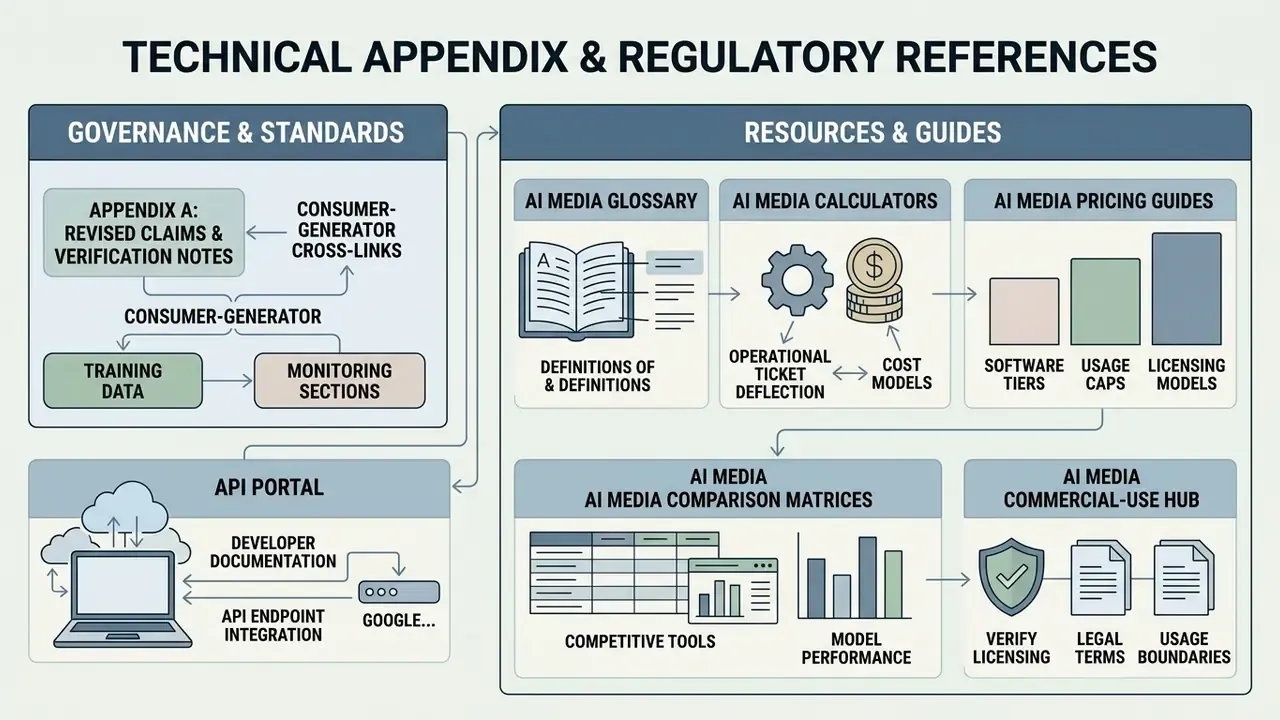
Appendix A: revised claims and verification notes
Retained for transparency, as originally published, with the reason for revision:
- "Enterprise field implementations report first-response times dropping from 15 minutes to 23 seconds, representing a 98% reduction in initial customer wait times." — Withdrawn from the main text. No published methodology, sample definition, or independent verification was available. Replaced by the peer-reviewed field-study figure of approximately 15% more issues resolved per hour under AI assistance.
- "Production setup typically takes between 30 minutes and two hours (Vendor Benchmarks, 2026)." — Citation removed. The referenced aggregate benchmark could not be located as a discrete publication; the estimate is now presented as a vendor-documentation-derived operational range.
- Practitioner cases (12,000 transcripts / 34% deflection; 45,000 sessions / restored uptime; 4,000 monthly verification requests). — Retained as self-reported or composite implementation reports with explicit caveats. Methods are transferable; the specific percentages are not independently audited.