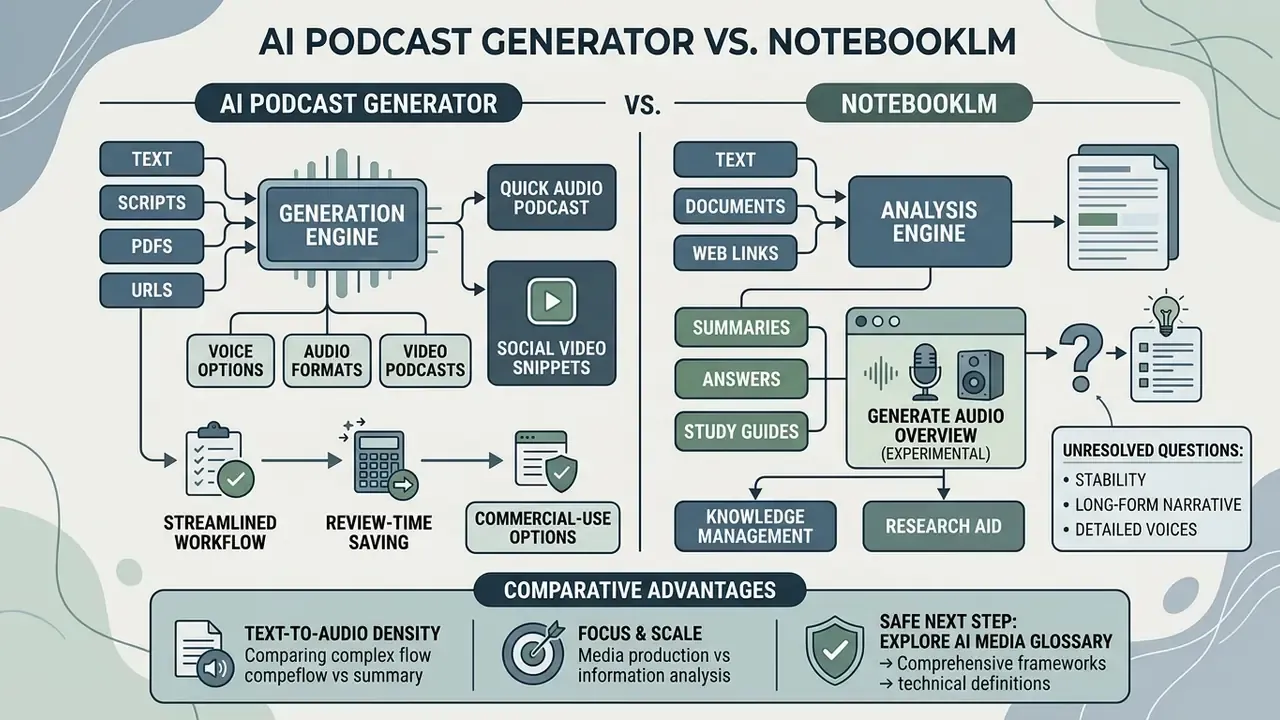
An AI podcast generator is a software platform that pairs large language models for script synthesis with neural text-to-speech engines. The result: unstructured text, scripts, PDFs, and web pages become multi-speaker conversational audio episodes. Executive leaders and media operations teams use these tools to scale educational content, internal communications, and compliance briefing material without a studio, a producer's calendar, or a manual editing pipeline.
Why should a risk or compliance leader care? Because the moment a policy PDF leaves your perimeter to be turned into audio, it becomes a data-handling decision, not a marketing one.
Key Takeaways (Executive Summary)
What Is an AI Podcast Generator?
An AI podcast generator is an end-to-end media automation platform. It ingests source materials, generates a structured dialogue script, and synthesizes multi-host spoken audio. Instead of reading single paragraphs aloud, the system models conversational turn-taking, interjections, and contextual pacing across several synthetic voices.
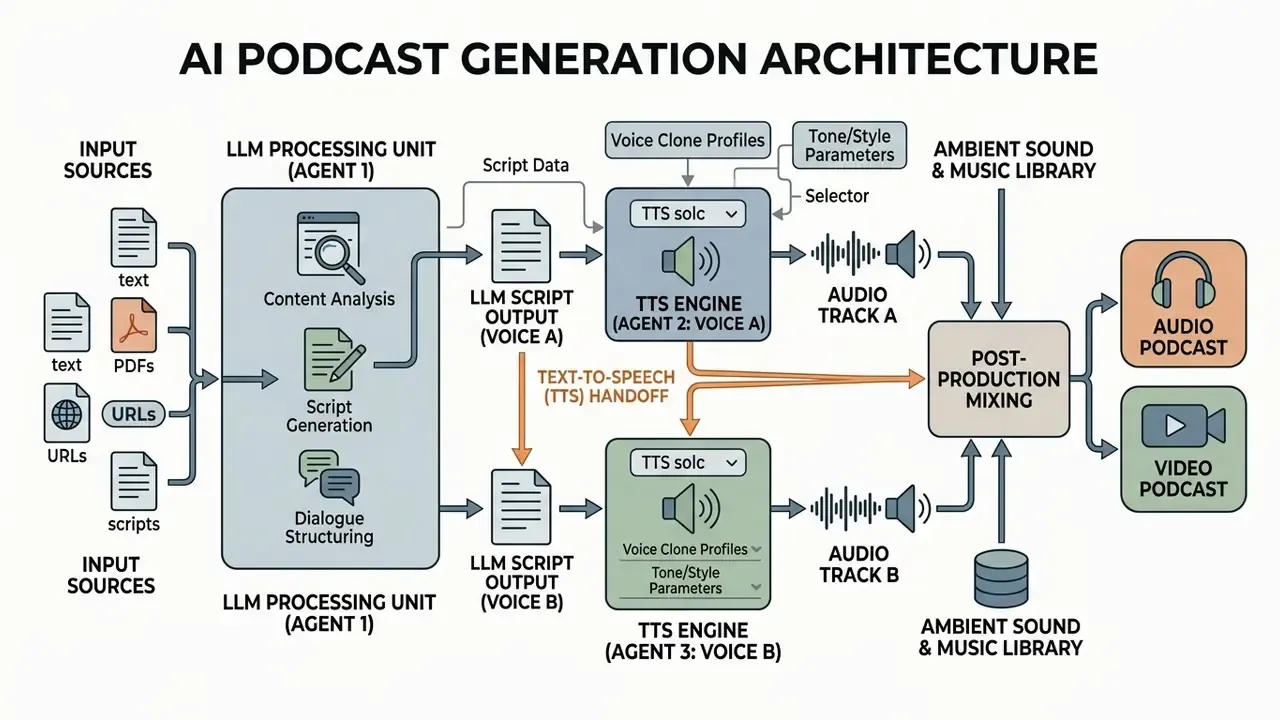
Modern architectures rely on a multi-stage pipeline: content extraction, LLM-based dialogue orchestration, per-speaker neural speech synthesis, and post-processing audio assembly. Four stages, four separate failure points, which matters when you write the control narrative.
«MoonCast synthesizes podcast-style spontaneous speech from plain text, PDF, and web URL inputs with zero-shot voices for unseen speakers.»
Research systems such as MoonCast demonstrate zero-shot synthesis from TXT, PDF, and URL inputs while maintaining context-aware prosody and stable speaker identity across long interactions. Multi-agent frameworks like PodAgent go further: they deploy dedicated host, guest, and writer personas so that topic coverage and logical progression are not left to a single prompt.
«PodAgent outperformed direct GPT-4 generation on dialogue quality and reached 87.4% accuracy in matching voices to podcast roles.»
This distinction matters operationally. A single-model prompt produces a monologue summary. A role-partitioned agent system produces a defensible, structured episode where each speaker turn traces back to an assigned function: host framing, expert elaboration, writer-level fact grounding. That traceability is what an auditor will ask about.
When evaluating automated speech tools, executive leaders should separate single-voice speech utilities from structured dialogue engines. Teams researching audio automation often review the broader range of voice tools in the AI Media Comparison Matrices and the technical breakdown of AI voice generators before setting internal deployment standards.
AI Podcast Generator vs. Text-to-Speech
Conventional text-to-speech renders provided text verbatim into continuous monologue audio. An ai podcast generator rewrites raw input into structured, back-and-forth dialogue across multiple distinct voices. Classic TTS engines optimize line-level intelligibility for screen readers or short notifications, and they cap multi-speaker capability at basic voice tags: Gemini's API exposes two speakers, while VibeVoice-TTS targets up to four.
Dedicated ai podcast creation tool systems analyze complex documents, extract key arguments, generate dynamic host-guest exchanges, and manage turn transitions. Systems such as Sarvam's podcast engine and Wondercraft assemble per-speaker audio segments into a synchronized master timeline with natural pauses and contextual inflection (Sarvam API Docs, 2026). This script-to-conversation transformation removes both manual scriptwriting and studio capture from the critical path.
An ai podcast generator text to speech stack therefore includes TTS, but TTS alone is not the product. Comparative data shows plain speech tools still require a human-written script plus external editing, while podcast engines automate dialogue synthesis directly from source files. Independent benchmarks now formalize the gap by measuring dimensions TTS metrics were never designed to expose.
«PodEval provides an open-source evaluation framework for podcasts, separating text, speech, and audio quality: dimensions traditional TTS metrics do not measure.»
Traditional studio recording still delivers unmatched human spontaneity. It also imposes scheduling limits, travel, and post-production overhead that few compliance teams can absorb monthly.
Audio Podcast or Video Podcast
An ai audio podcast generator outputs high-fidelity MP3 or WAV files suitable for RSS syndication. An AI video podcast generator adds lip-synced avatars, dynamic lower-thirds, captions, and automated B-roll framing inside an MP4 container. Audio-first workflows concentrate on voice naturalness, spectral normalization, and distribution to Spotify and Apple Podcasts.
Video-first workflows split into two delivery shapes: landscape 16:9 for YouTube, LinkedIn, and corporate learning portals, and vertical 9:16 for TikTok, Instagram Reels, and YouTube Shorts. Teams repurposing a single 40-minute episode typically render one 16:9 master plus five to ten vertical clips.
Advanced video engines also render non-human presenters: corporate mascots, animated brand avatars, cartoon characters, animals, and custom 2D or 3D personas. Realism comes from frame-by-frame lip-sync driven by neural phoneme mapping, matching articulation with facial expression changes and near-zero-lag viseme transitions, while emotion tracks follow the contour of the synthesized speech. Integrated canvas editors add lower-thirds, auto-highlighted captions, animated waveforms, and context-aware B-roll straight into the final MP4.
Two-speaker visual interviews suit YouTube or an internal training portal; teams comparing rendering engines frequently consult reference material on AI video generators before signing with a vendor. The IAB Tech Lab 2026 podcast measurement standards confirm that open RSS measurement and server-side metrics apply across both audio and video channels (IAB Tech Lab, 2026). Organizations evaluating visual agents alongside audio tools often reference components like an ai character generator and its lighter-weight variants, including a free ai character generator, when writing brand presentation guidelines.
| Parameter | Conventional Text-to-Speech | AI Podcast Generator | Traditional Podcast Recording |
|---|---|---|---|
| Primary Input | Single sentences or plain text blocks | Documents, PDFs, URLs, scripts, notes (70+ formats) | Live human voice capture from microphones |
| Speaker Architecture | Typically single voice; monologue emphasis (2 to 4 tagged voices max) | Multi-host, multi-speaker zero-shot voices (up to 5 hosts) | Human hosts and guests in studio |
| Dialogue Modeling | Linear reading without conversational turns | LLM script generation with host/guest roles and turn-taking | Organic human conversation and pacing |
| Output Formats | WAV / MP3 short audio clips | Long-form MP3/WAV audio, SRT/VTT transcripts, 16:9 & 9:16 MP4 | Recorded audio/video master files |
| Studio & Editing Overhead | No studio required; no editing tools | Fully automated assembly; optional script edits | High studio capture and manual DAW post-production |
| Distribution Layer | None (raw file output) | Built-in RSS 2.0 feed, hosted episode page, platform push | External hosting subscription required |
Read the table one row at a time and the decision usually resolves itself. If your input is a document and your output must be a subscribable episode, plain TTS is the wrong lane.
What Content Can You Turn into an AI Podcast?
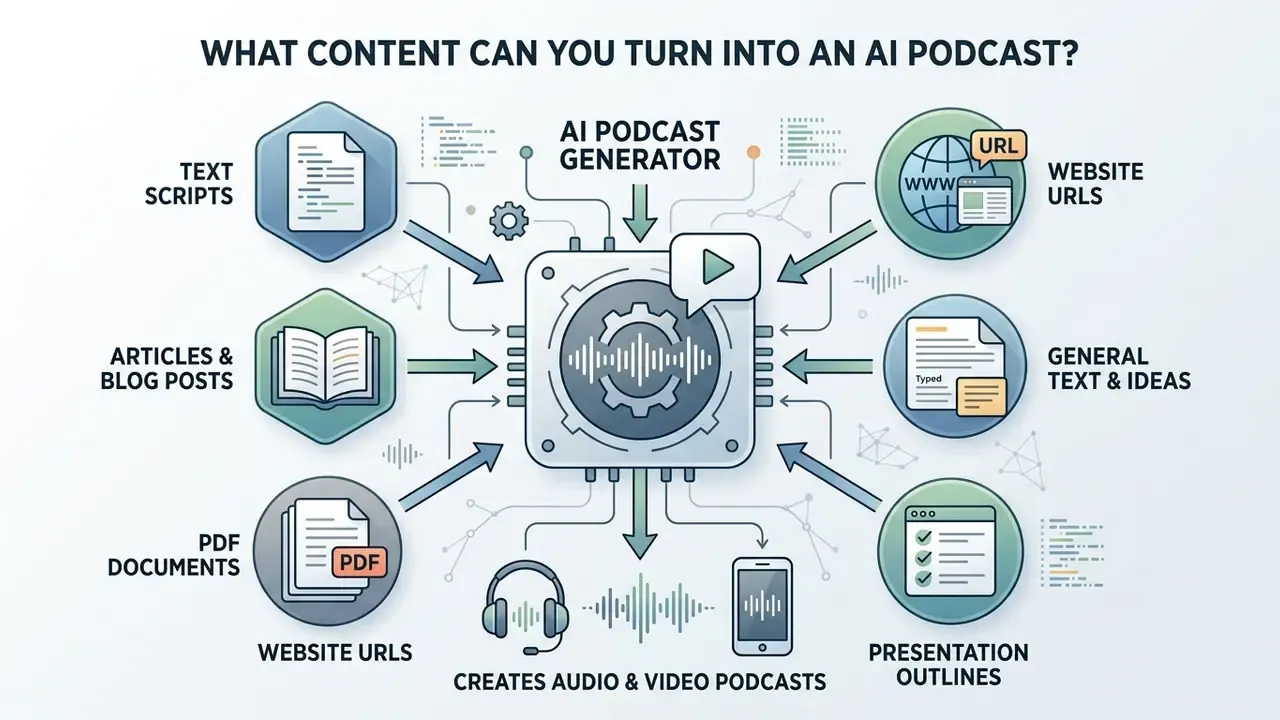
An ai podcast generator from text can process almost anything readable: raw bullet points, corporate memos, structured whitepapers, or a bare web address. The ingestion layer parses, cleans, and converts static text into an outline, then passes structured facts to the script model.
«A PAIGE study with 180 students found personalized AI podcasts generated from textbooks significantly improved learning outcomes versus traditional reading.»
Enterprise teams often lean on supplementary data models during content preparation: an ai chart generator to turn tabular financial metrics into verbal summary points, and image-to-text and OCR tooling to recover text from scanned annexes or screenshot appendices before script generation.
Create a Podcast from Text, Scripts and Notes
To generate podcast episodes from plain text or messy meeting notes, the platform sorts unstructured points into logical topic clusters. When users supply their own script, an ai podcast generator from script preserves exact phrasing while assigning speaker labels and prosodic cues to distinct AI hosts. Research pipelines formalize this by requiring the script as structured JSON with explicit speaker roles instead of free-form prose.
Evaluation benchmarks show that grounding scripts strictly in source text prevents factual drift. PodBench requires that every fact originate in the supplied materials, prohibits external knowledge injection, and scores whether transitions between turns remain listenable.
«PodBench, an 800-sample benchmark with inputs up to 21,000 tokens, formalizes grounded, role-specific podcast dialogue generation from supplied documents.»
Convert PDFs, Documents, URLs and Videos into Podcasts
Modern enterprise engines ingest over 70 structural formats, among them PDF, DOCX, PPTX, EPUB, HTML, TXT, e-books, and image files with embedded text, handling payloads up to roughly 50 MB or 100,000 characters per single run. Direct uploads cover formal documentation. Yet platform telemetry shows raw pasted text and pasted URLs represent up to 60% of all creation workflows, which lets users process research notes, Slack exports, and rough outlines without pre-formatting.
An ai podcast generator from document parses PDF, DOCX, and PPT files by stripping formatting artifacts, extracting main arguments, and feeding chunks into the dialogue model. Open-source pipelines expose the same stages explicitly: PyPDF2-based text extraction for PDFs, paragraph-level extraction for DOCX, then cleaning, chunking, script generation, and TTS rendering. Platforms like Adobe Acrobat AI and Jellypod accept web URLs and YouTube links, pulling transcripts automatically to build episodes (Adobe Acrobat Help, 2026).
"Direct document ingestion transforms passive research repositories into active internal audio feeds." Marcus Hale
When importing external articles, systems use web-scraping pipelines that isolate body text from navigation, page chrome, and advertising modules. Platforms converting YouTube videos extract caption tracks, assess semantic density, and generate host-led summaries for faster consumption. Scanned or image-only PDFs need an OCR pass first. Without it, ingestion returns an empty payload and the generator quietly produces generic filler dialogue. That failure mode is worth reproducing on purpose during vendor evaluation, because nobody advertises it.
How to Create a Podcast with AI
Creating a professional episode with an ai podcast maker follows a four-stage operational pipeline: source ingestion, dialogue configuration, audio generation, post-production export.
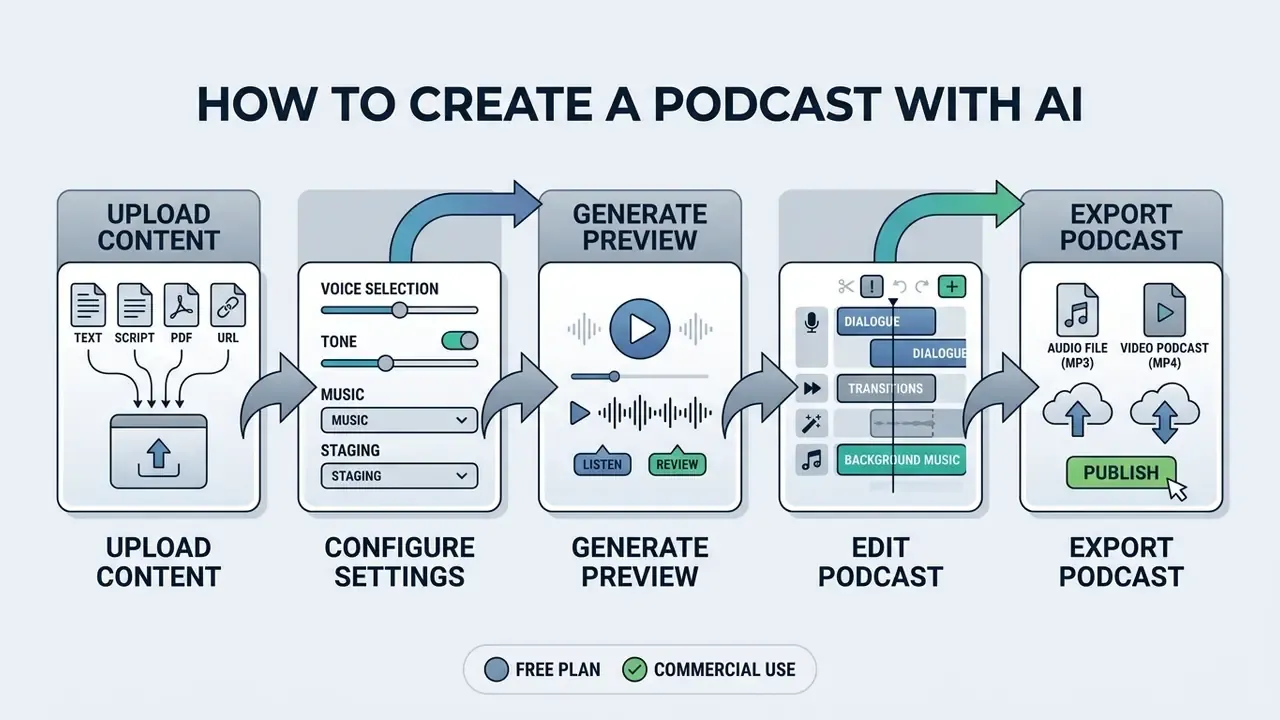
Followed in order, this workflow keeps content auditable and grounded in primary source documents at every step. Long-form capacity, by the way, is no longer the constraint it was in 2024.
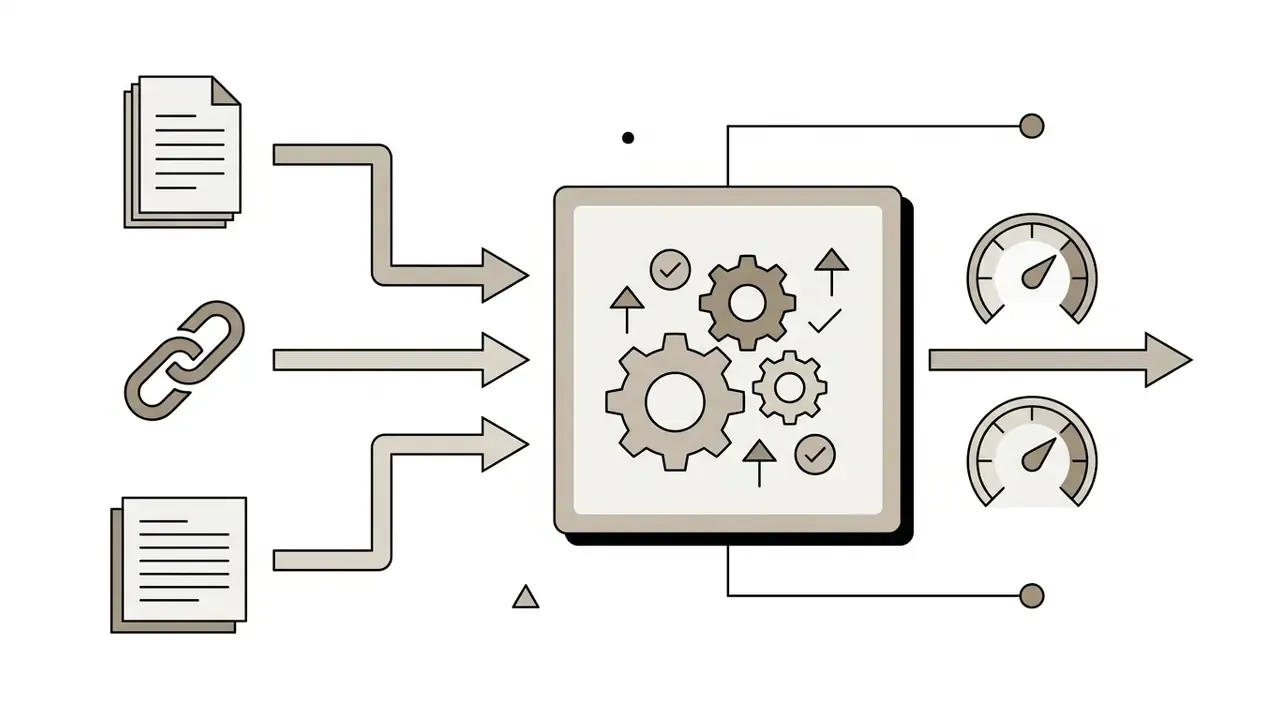
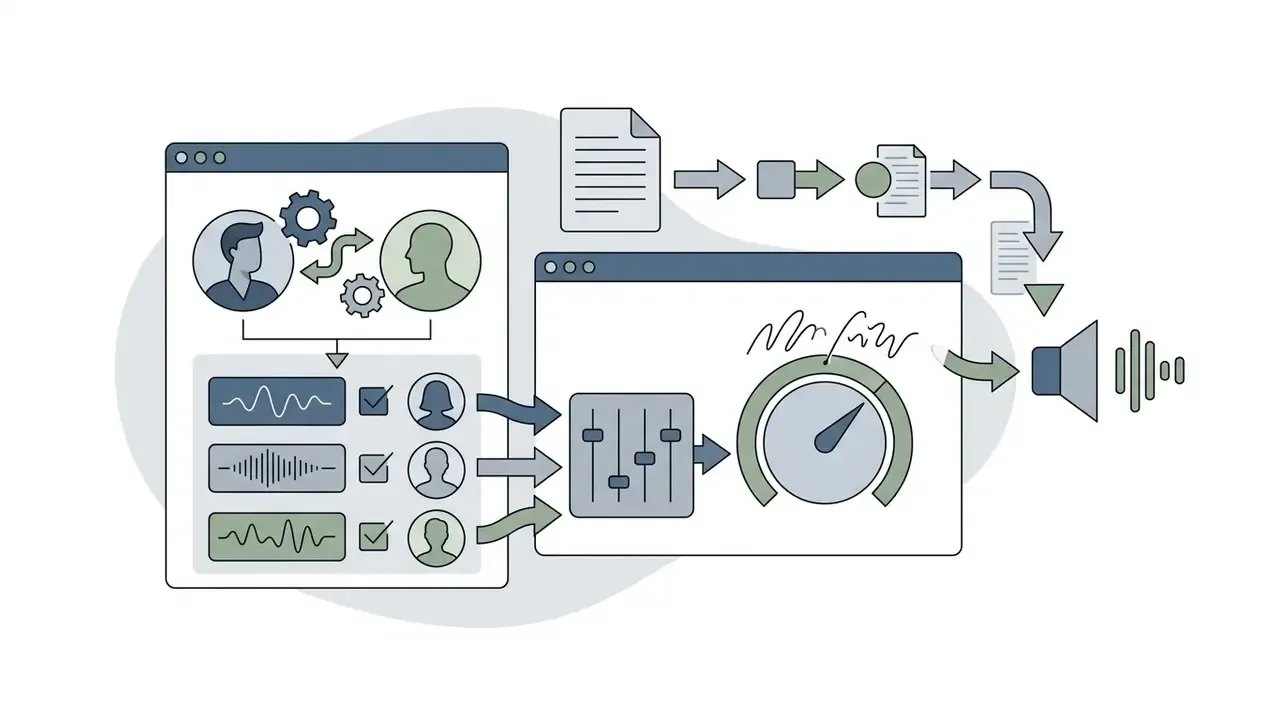
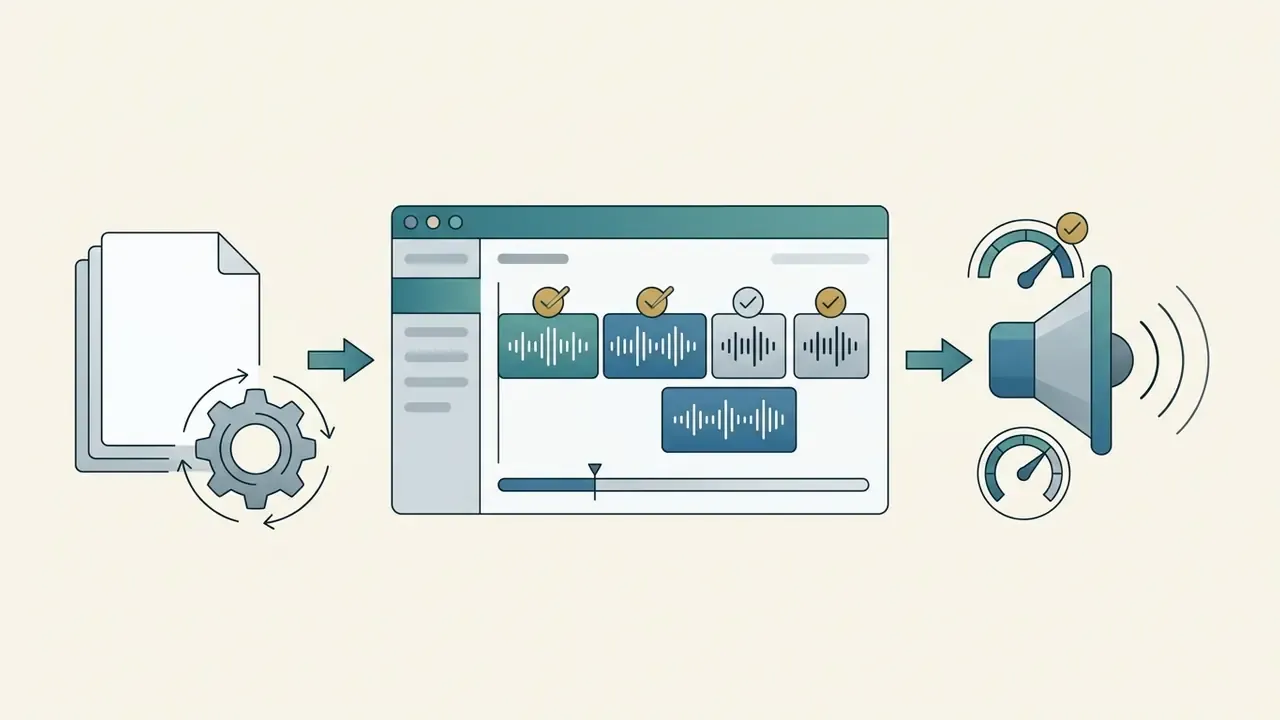
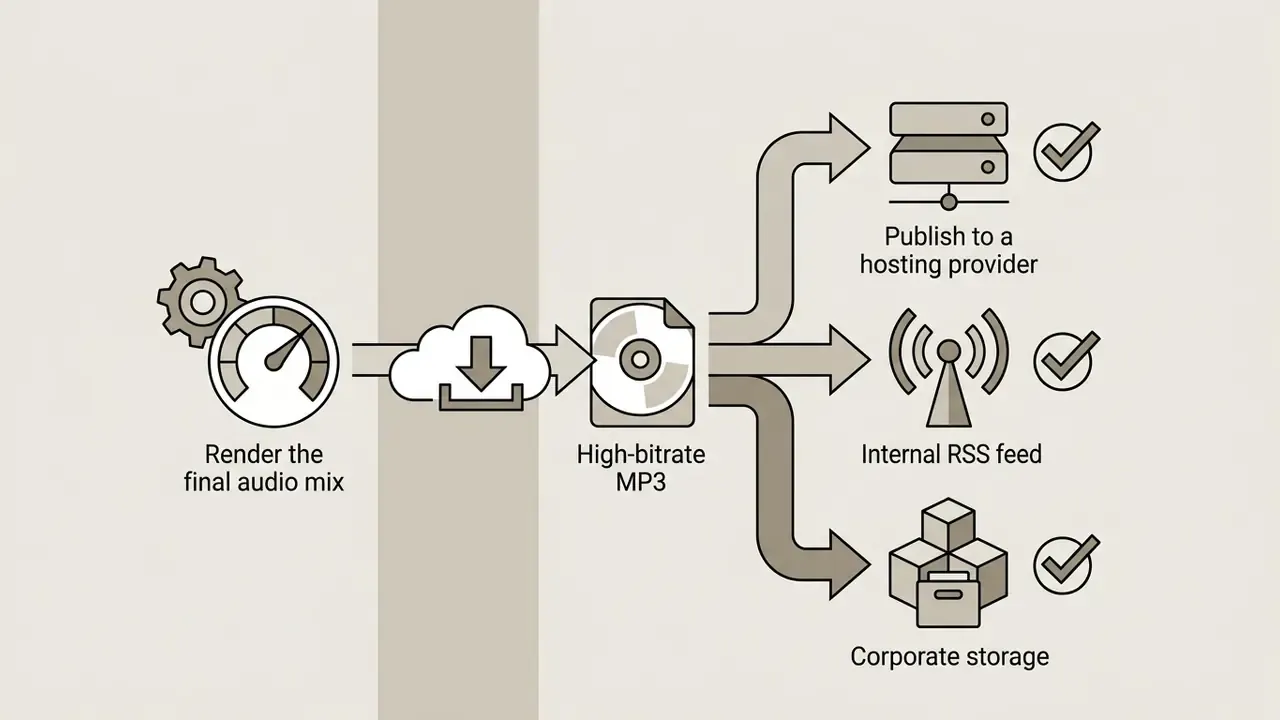
«SoulX-Podcast generates continuous dialogue exceeding 90 minutes with stable speaker timbre and smooth turn transitions.»
Add Content and Choose a Podcast Style
Creation starts inside an ai podcast creation tool by defining episode parameters and host dynamics. Users pick the number of speakers, assign voice timbres, and set the conversational register: formal analytical, educational, or executive briefing.
System controls apply accent and pacing parameters across the whole session to keep acoustic characteristics consistent. In most implementations, style and accent instructions govern the full conversation rather than individual speakers, which is a limitation worth noting if you need one host to sound regional and the other neutral. Alternating line assignment keeps speaker engagement balanced across the episode.
Tooling tip: teams establishing a new show identity can use prompt-based naming utilities inside the platform workspace to check title availability across active RSS directories and domain registries before setup. Lock the show name before episode one. Feed migrations are cheap in theory and painful in practice.
Generate, Review, Download and Publish the Episode
Once generation completes, the platform offers a side-by-side text and audio editor for previewing each speech turn. Users can rewrite script lines, insert pauses, adjust inflection, and regenerate a single turn before final rendering.
Final compilation merges independent voice tracks, applies loudness normalization (EBU R128 / -14 LUFS is the common target), removes residual noise, applies compression, and exports a master MP3 at 192 kbps or higher (TRUETECH, 2026). Teams producing the video variant usually finish assembly in a dedicated YouTube video editor before upload, then see the overview of export quality tiers and API automation limits. An ai podcast audio generator that cannot export a WAV master will eventually block your archival policy, so test that early.
Features to Look for in an AI Podcast Generator Platform
Selecting an enterprise ai podcast generator platform means evaluating speech synthesis quality, multi-speaker stability, language coverage, data-handling guarantees, and metadata governance. Mature platforms deliver deterministic audio rendering and verifiable watermarking aligned with digital provenance standards.
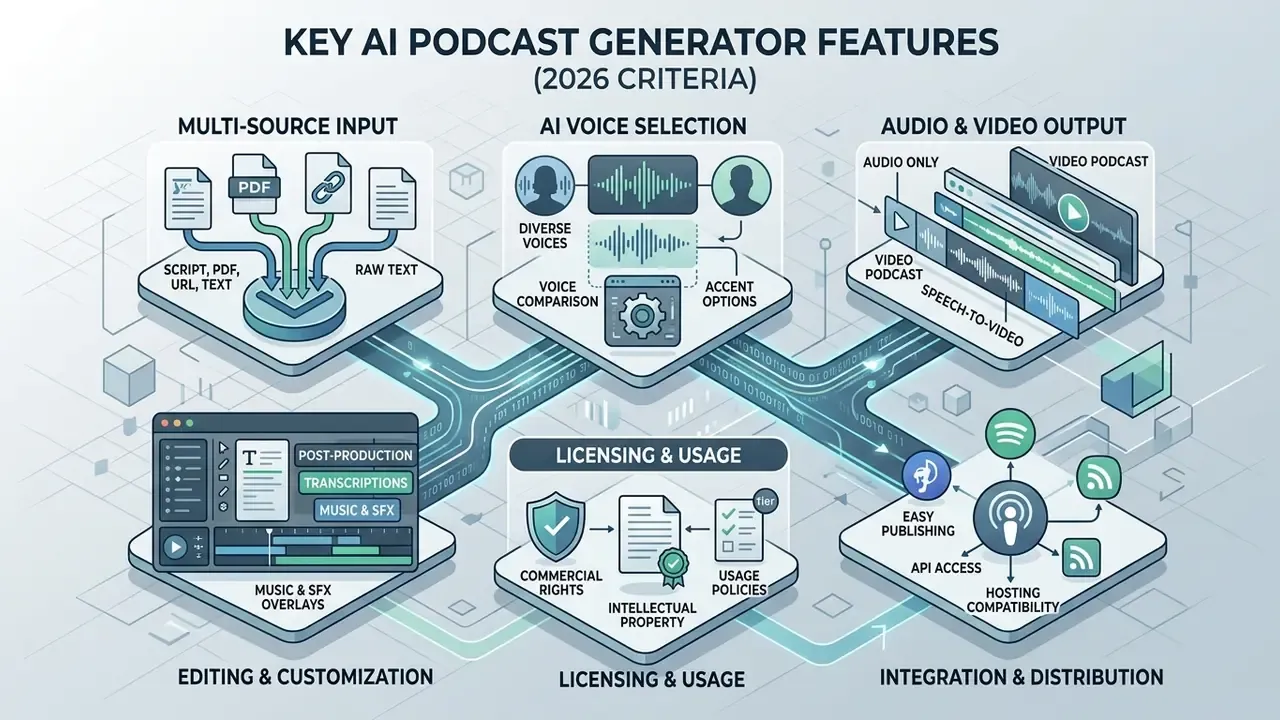
Advanced platforms embed inaudible audio watermarking, such as SynthID-style integration, enabling cryptographic verification of synthetic speech through a public verification tool (OpenAI Provenance, 2026). Organizations testing automated chat interfaces alongside voice systems can explore the hub to review REST and WebSocket integration patterns.
AI Voices, Voice Cloning and Multi-Host Conversations
High-quality ai voices depend on neural audio architectures that hold vocal timbre across extended multi-speaker interactions. Systems like NVIDIA's Personaplex and MOSS-TTSD support multi-speaker contextual dialogue, managing turn-taking for up to five hosts across training contexts reaching 3,600 seconds while suppressing voice drift (NVIDIA PERSONAPLEX, 2026). Buyers comparing synthesis engines in isolation should also scan the wider category of AI voice generators to benchmark language coverage and licensing terms side by side.
Zero-shot cloning lets an operator replicate an executive's voice from a short reference clip. Convenient. Also the single largest governance exposure in this product category.
«Participants misidentified AI voices as human in 79.8% of trials for clips under 20 seconds; detection accuracy showed no demographic dependence.»
Listeners accept short clones as authentic human speech in up to 79.8% of identity-matching tests. That alone justifies strict access controls and written consent protocols. The same research documents a second, less obvious risk vector.
«Cloned voices were perceived as significantly warmer, more authoritative, and more human than the originals; listeners disclosed personal information more readily to them.»
Languages, Tone, Pauses and Sound
Enterprise platforms generate speech across dozens of languages. Vendor documentation commonly cites 28 to 70+ locales, controlled through W3C Speech Synthesis Markup Language (SSML). Standardized tags such as <break time="500ms"/> give precise control over timing between dense technical points, and IBM's SSML implementation exposes both strength and absolute time values for pause calibration.
"Precise pause insertion and acoustic normalization separate amateur voiceovers from executive-grade audio reports." Marcus Hale
Timeline editors let creators insert intro and outro music, balance bed levels against dialogue stems, and trigger subtle sound effects at structural transitions. Multi-track control supports royalty-free music with automated audio ducking, lowering the bed during spoken turns and restoring it between segments. Global speech parameters are adjustable too: pitch roughly from −20% to +20% and reading speed from 0.5× to 2.0×, with contextual SFX (a transition whoosh, a chapter sting, a reaction cue) placed at specific dialogue markers to hold attention. One caveat: in most engines SSML <break> tags affect speech delivery only. Frame-accurate silence across music and SFX layers is built on the timeline, not in markup.
MP3, Transcript, Audio and Video Export
Leading ai podcast generator tools export high-bitrate MP3 (192 kbps or higher) alongside automated time-stamped transcripts in SRT and WebVTT. Synchronized transcripts serve accessibility standards, feed show-notes automation, and make episodes searchable inside internal knowledge bases.
For visual distribution, platforms export 16:9 or 9:16 MP4 files with synchronized avatars, animated waveforms, or burned-in subtitles tuned for YouTube and LinkedIn. Mature export stacks also emit WAV masters for archival, AAC for bandwidth-constrained delivery, and a JSON manifest of speaker turns for downstream analytics. That manifest is underrated: it turns audio into structured evidence.
How to Choose the Best AI Podcast Generator Tool
Choosing ai podcast generator software comes down to five checks: source content compatibility, required output formats, licensing terms, security posture, and operational workflow fit. Align capabilities with corporate publishing requirements first, feature lists second.
Use the interactive selector below to narrow the shortlist before booking demos. Four questions about source material, output format, volume, and data sensitivity map directly onto the three market lanes: document-to-podcast generators, voice-first studios, and editing or hosting suites.
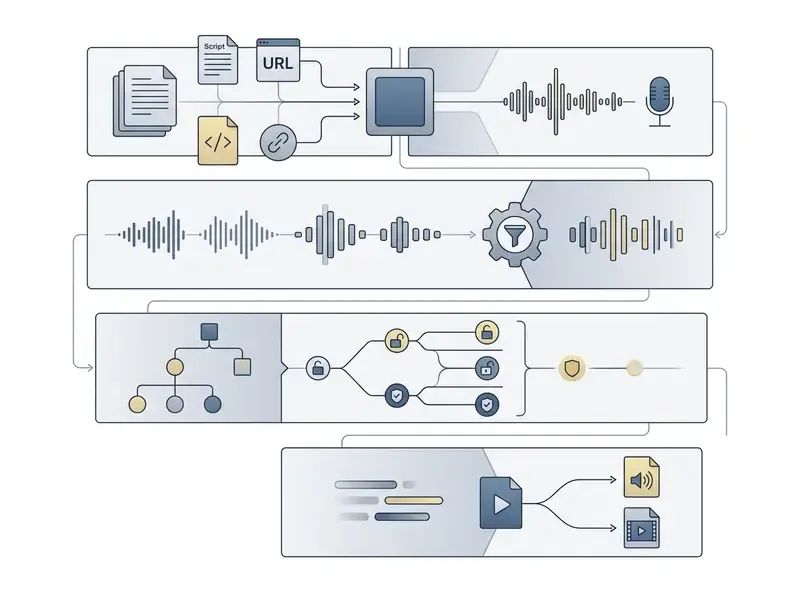
When evaluating multi-modal platforms, technical architects often review guides for adjacent media tools, such as an ai character generator from photo or an ai voice generator, to keep vendor standards unified across the stack. An ai generator podcast shortlist built without those adjacent checks tends to fragment procurement later.
Match the Tool to Your Content Source and Podcast Format
Organizations processing dense regulatory documents or academic whitepapers need retrieval-augmented tools that prioritize script accuracy and source grounding. A useful acceptance test comes straight from benchmark methodology.
«PodBench formalizes the task as R = f(Inst, Doc): given an instruction and a document set, the model must produce a role-assigned dialogue episode.»
Run a miniature version of that test during procurement. Submit one representative document plus a fixed instruction to every shortlisted vendor, then score outputs on factual grounding, role consistency, and transition quality. Platforms tuned for short marketing summaries optimize speed and background audio, and they will visibly fail a grounding-heavy prompt. You will see it in the first sixty seconds.
When video engagement matters for internal portals or YouTube, an ai podcast creator with native MP4 avatar rendering removes the need for secondary editing software. Comparative reviews of the best AI video generators help confirm whether the bundled renderer matches standalone quality, or merely approximates it.
Check Voices, Languages, Publishing and Support Options
Operational evaluation must verify that voice libraries include natural accents matching target regional demographics. API connectivity and direct integration with hosting feeds streamline publishing to Spotify and Apple Podcasts, and a poorly documented API is a quiet cost centre.
"An enterprise audio platform must guarantee content licensing rights, data privacy compliance, and verifiable export pipelines." Marcus Hale
Enterprise buyers should read vendor terms for dedicated technical support, contractual uptime, incident response commitments, and isolated privacy environments for sensitive documents. Ask who answers at 2 a.m. when a feed breaks mid-campaign.
Verify Data Security, Retention and Model Isolation
Because generation begins with a document upload, the security question is identical to any document-processing vendor review. Before the first confidential PDF enters a queue, confirm in writing:
- SOC 2 Type II attestation (or ISO/IEC 27001 equivalent) covering the inference and storage environment, with a current report available under NDA.
- Zero data retention (ZDR) configuration: source files, generated scripts, and audio artifacts purged on a defined schedule rather than kept indefinitely for "quality improvement".
- Non-training guarantees contractual language stating that uploaded documents, cloned voice samples, and generated transcripts never train shared or public models.
- Isolated vs. shared inference whether prompts traverse a multi-tenant public endpoint or a dedicated regional deployment, and where processing physically occurs for data-residency purposes.
- Access and audit controls SSO/SAML, role-based permissions on cloning, and exportable logs showing who generated which episode from which source file.
In an illustrative fintech compliance initiative, an internal audit team ran a structured selection workflow across four media automation vendors. Two consumer-focused platforms turned out to process audio through public shared models with no explicit data guarantee. By choosing an enterprise platform with isolated processing, cryptographic watermarking, and verifiable commercial licensing, the institution removed an unauthorized-disclosure pathway while automating weekly compliance audio updates. The example is composite and illustrative, not a documented client result.
When comparing architectures, managers frequently consult analysis guides in the AI Media Glossary to standardize technical vocabulary across risk, security, and marketing teams. Shared vocabulary shortens approval cycles more than any feature does.
Enterprise AI Governance Checklist for Synthetic Audio
Use this five-point checklist as the internal approval artifact before a synthetic-audio program goes live:
- Source lineage: every published episode links to the exact source document version and generation timestamp; scripts are archived alongside audio for audit reconstruction.
- Consent register: each cloned or licensed voice has signed authorization on file, with defined scope (internal only, marketing, client-facing) and a revocation trigger.
- Disclosure mapping: episode metadata, show descriptions, and platform upload flags carry synthetic-content labels consistent with Apple, Spotify, YouTube, the EU AI Act, and applicable state rules.
- Data handling sign-off: SOC 2 report reviewed, zero-retention setting enabled, non-training clause executed, processing region confirmed.
- Human review gate: a named reviewer approves the script and listens to the master before publication; regulated content additionally routes through legal or compliance sign-off.
One honest limitation: none of these five controls detects a subtly wrong number inside a correctly grounded script. That is still a human job.
Free AI Podcast Generator Plans and Commercial Use
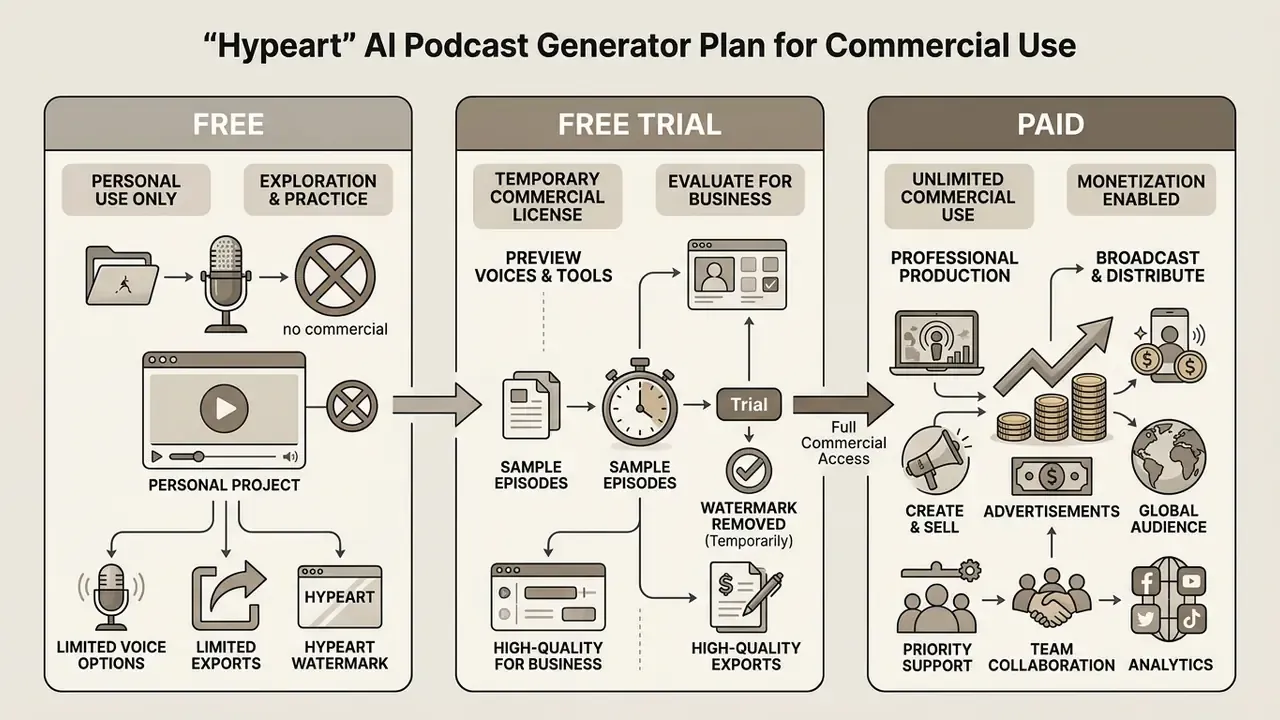
Organizations planning commercial deployment should compare options across licensing frameworks and also compare options for rights clearance, including how commercial use of AI image generators is licensed. The same rights logic governs synthetic audio, so treat an ai free podcast generator as a sandbox until the paperwork says otherwise.
What "Free" and "No Sign Up" Usually Include
Platforms offering an ai podcast generator free no sign up or ai podcast generator no sign up utility typically cap generation at 30 to 60 second previews. These no-registration tools let users test voice quality directly inside an ai podcast generator website without an account; some limit usage per device, for example ten generations, before requesting an email.
Permanent free plans usually require registration and enforce monthly character quotas (10,000 characters per month is a common figure), restrict access to basic voice libraries, insert visual or acoustic watermarks, and explicitly prohibit commercial usage (ElevenLabs Pricing, 2026). An ai podcast creator free tier can still be genuinely useful for internal drafting. Credit-based models add nuance: drafting, script editing, and voice auditioning may be free, while credits are consumed only at publish, download, or render. Read that trigger point carefully. Budgets die there.
Commercial Use of AI-Generated Podcasts
Using synthetic audio commercially, whether for corporate marketing, monetized YouTube channels, paid training, or client-facing media, requires an explicit commercial license. Free tier output is generally restricted to personal, non-commercial evaluation.
"Deploying synthetic voice assets in commercial communications without explicit licensing creates severe legal and brand exposure." Marcus Hale
Federal frameworks, including FCC rules and state publicity laws such as California SB 1050, require clear disclosure when synthetic voices or artificial performers appear in commercial audio broadcasts or marketing (FCC AI Voice Ruling, 2024). The FCC confirmed in July 2024 that AI-generated artificial or prerecorded voice messages fall under TCPA rules and need prior express consent. The U.S. Copyright Office's 2025 digital replicas report clarified that copyright does not authorize unauthorized duplication of a person's voice, which leaves state publicity-right claims fully available.
| Feature / Rights | Free Tier (No Payment) | Free Trial (Time-Limited) | Paid Commercial Tier |
|---|---|---|---|
| Account Requirement | Optional or basic signup | Account creation required | Formal agreement & payment |
| Generation Quota | 30 to 60 sec preview or 10k chars/mo | Limited credit package | High or unlimited monthly hours |
| Voice Library Access | Standard / basic voices only | Full access during trial | Complete library + voice cloning |
| Export Formats | Low-bitrate MP3 / watermarked | MP3 / WAV download | High-bitrate MP3, WAV, SRT, MP4 |
| Commercial Rights | Strictly Prohibited (Personal only) | Restricted during trial | Full Commercial Rights Granted |
| Data Retention Controls | Shared models, retention likely | Limited configuration | ZDR options, isolated inference, SOC 2 evidence |
| Synthetic Disclosure | Required per platform terms | Mandatory trial disclaimer | Mandatory legal labeling |
The matrix makes the pattern plain: commercial rights, high-bitrate export, and cloning sit behind paid enterprise subscriptions (ElevenLabs Terms, 2026). Every cell should be re-verified against the vendor's live pricing and terms pages before signature, since tiers shift quarterly. Publishing free-tier audio in a commercial campaign breaches terms of service and invites licensing enforcement.
Organizations deploying interactive assistants alongside podcast generation should check compliance across related tools, referencing frameworks like an ai chat generator, the risk profile of an ai chat no filter service, and the commercial-terms analysis of the Canva AI generator to keep licensing standards consistent across the creative stack.
AI Podcast Generator FAQ
Is an AI Podcast Maker Useful for Studying?
Yes. An ai podcast maker for studying turns static textbooks, lecture notes, and research PDFs into structured conversational overviews. PAIGE data shows college students found AI-generated educational podcasts significantly more enjoyable than reading textbook chapters, with personalized audio producing measurable gains in recall and comprehension.
«In PAIGE's 3×3 experimental design with 180 students, personalized AI podcasts from textbooks proved significantly more enjoyable and improved learning outcomes across several subjects.» PAIGE Study (2025). https://arxiv.org/abs/2504.07952 Students routinely load lecture slides into NotebookLM or NoteGPT to generate host-led Q&A for hands-free study during commutes. The persuasive power carries a cognitive caution that should be taught alongside the tool. «Users who listened to an AI podcast before viewing search results showed significantly greater attitude change (β = −0.376, p = 0.034).» NotebookLM attitude change study (2025). https://arxiv.org/abs/2504.07952
Can I Publish an AI Podcast on Spotify, Apple Podcasts and YouTube?
Yes. Creators can publish AI-generated episodes across major platforms via standard RSS feeds or direct upload. Platforms do enforce metadata and disclosure rules:
- Apple Podcasts: requires prominent disclosure in episode metadata and descriptions whenever synthetic audio or cloned voices are used (Apple Podcasts Guidelines, 2026).
- Spotify: prohibits deceptive cloning or unauthorized impersonation of real individuals, and removes shows that replicate a creator's likeness without permission (Spotify Creator Terms, 2026).
- YouTube: mandates synthetic content labels for realistic altered or AI-generated audio and visual media at upload, while exempting ideation, scriptwriting help, and audio cleanup. Teams testing distribution economics often benchmark this against the labeling rules faced by free AI video generators before locking a publishing cadence.
How Long Can an AI-Generated Podcast Episode Be?
Duration depends on source text volume and platform processing limits. Standard API endpoints generate short clips, while specialized long-form engines synthesize continuous multi-speaker conversation lasting 15 to 90 minutes (SoulX-Podcast, 2026).
«VibeVoice synthesizes up to 90 minutes of speech for four speakers within a 64K-token context window, outperforming open and proprietary dialogue models in listener tests.» VibeVoice (2026). https://arxiv.org/abs/2506.05090 As a baseline, a 10,000-word document yields a host-led episode of roughly 30 to 45 minutes. No major platform imposes a mandatory minimum or maximum length. The practical ceiling is the synthesis engine's context window and your audience's attention span, and the second one binds first.
How Is an AI Podcast Generator Different from NotebookLM?
Google NotebookLM is a document-grounded research assistant that produces two-host "Audio Overviews" derived strictly from uploaded sources, now available in 80+ output languages with interactive mode limited to English. Quality is high. Control is not: prompt-level editing of script, voice selection, pacing, and export format is limited, and third-party guides report download output with no built-in post-generation audio editor. Specialized commercial generators, sometimes searched as an ai podcast creater, add studio control: line-level script editing, host voice assignment and cloning, multi-language translation, SFX mixing, background music with ducking, watermark provenance, and direct RSS syndication with analytics. For regulated communications, the deciding factor is usually not audio quality but whether the platform can produce an audit trail on demand.
Appendix A: Corrections and Methodology Notes