Creating a functional artificial intelligence system requires four things: an appropriate deployment path, domain-specific data, quantifiable evaluation metrics, and operational controls that survive an audit. Organizations and individual developers can build custom AI solutions through no-code platforms, cloud API orchestration, open-source fine-tuning, or code-first development. The path matters less than the evidence you can produce afterwards.
Executive Summary
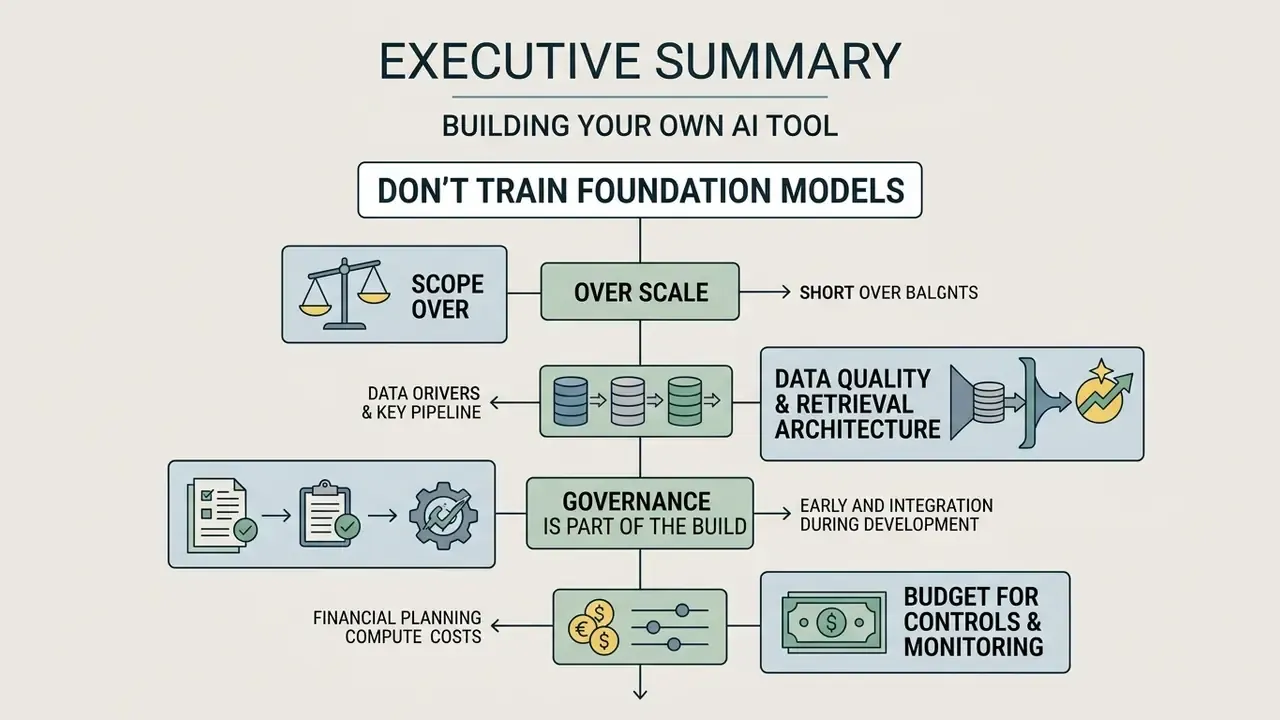
- You almost never train a foundation model. Four practical paths exist: no-code and agent platforms, hosted APIs, open-source fine-tuning, and custom code. The choice is driven by data sensitivity, control requirements, and validation burden, not by ambition.
- Scope beats scale. Single-task AI systems with deterministic inputs, structured data outputs, and measurable thresholds (precision, recall, latency, escalation rate) succeed far more often than broad "AI transformation" mandates.
- Data quality and retrieval architecture decide outcomes. Retrieval-Augmented Generation (RAG) handles dynamic knowledge without touching model weights. Fine tuning encodes behavior, format, and domain reasoning into parameters.
- Governance is part of the build, not a post-launch add-on. Audit logging, prompt and version capture, sandbox red-teaming, human-in-the-loop triggers, and drift monitoring must exist before production traffic, especially in regulated environments governed by model risk management expectations such as the Federal Reserve's SR 11-7 and OCC 2011-12.
- Budget for controls, not just compute. Risk-adjusted return on investment must include reviewer time, monitoring, evaluation cycles, and residual risk. Otherwise pilot economics collapse at scale.
Can You Create Your Own AI?
Can you create your own AI? Yes, and across a wide range of skill levels, provided the technical approach matches project complexity and operational risk tolerance. Modern development options let non-technical teams assemble functional workflows from pre built models and visual platforms, while specialized engineering teams build custom architectures in Python.
The honest caveat: "can i create an ai" and "can i create an AI that a regulator will accept in production" are two very different questions. The first takes an afternoon. The second takes a control framework.
What "Creating an AI" Means in Practice
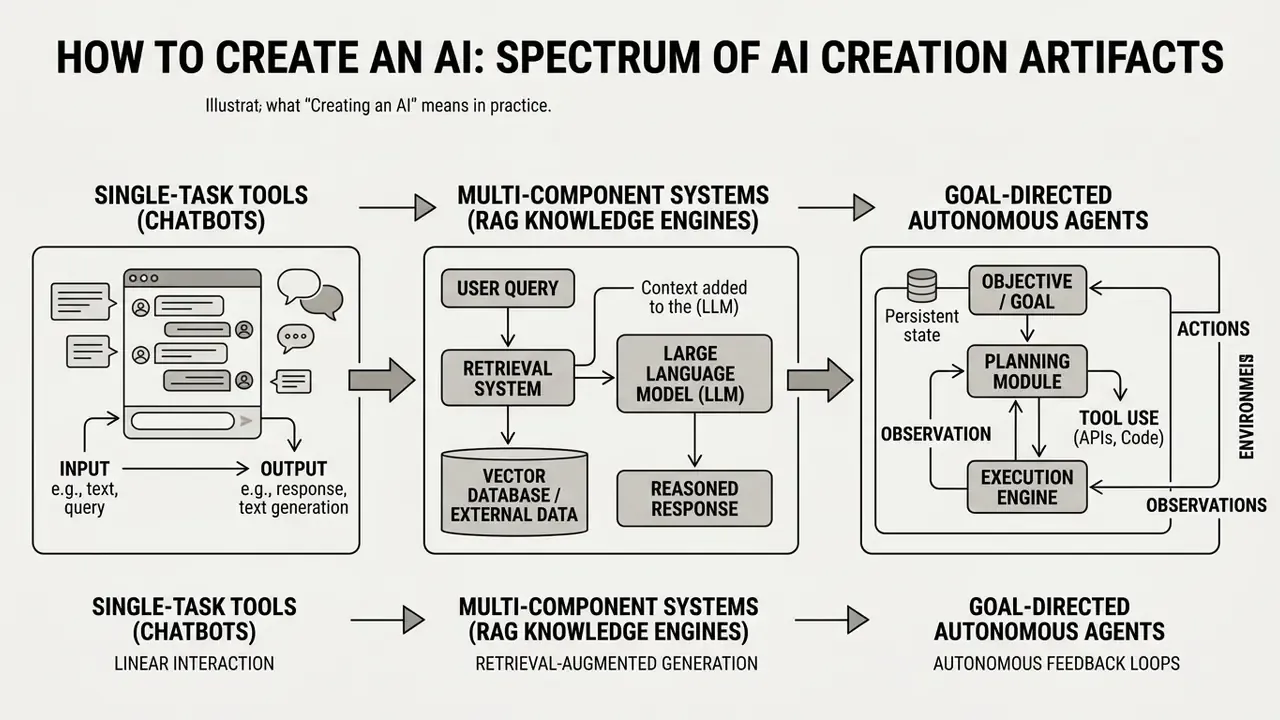
Creating an AI means configuring, orchestrating, or training software to perform specific tasks such as text generation, predictive classification, document analysis, or autonomous decision-making. In practical applications, an AI artifact generally falls into one of three structural categories: single-task tools, multi-component knowledge systems, or goal-directed autonomous agents.
According to research in software engineering benchmarks like DevEval, building AI involves orchestrating multiple stages of system design, environment configuration, component integration, and unit testing rather than writing single prompts.
«DevEval decomposes software development into staged phases: software design, environment setup, implementation, acceptance testing, and unit testing, all initiated from a requirements document.»
In business operations, an enterprise AI project typically integrates pre-trained foundational models with internal data repositories, application programming interfaces (APIs), and human oversight checkpoints to clear a specific operational bottleneck. The end product is usually one of four recognizable artifacts: a customer self-service ai chatbot, an internal ai assistant for HR, procurement, or sales tasks, an autonomous agent that plans and executes multi-step work, or a narrow automation tool that processes invoices, statements, and sales orders.
Problem solving is the common thread. The artifact is secondary.
Prerequisites for Building an AI
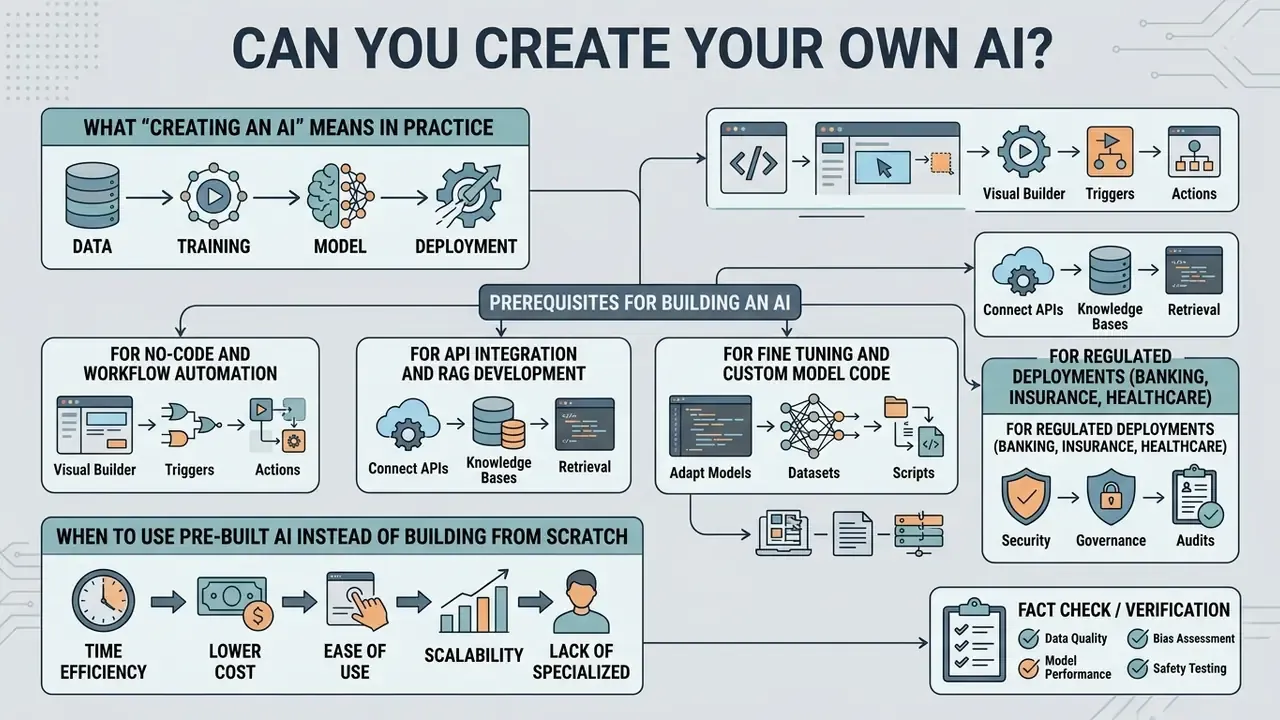
Before starting technical implementation, weigh your project requirements against the real skill thresholds. They differ sharply by path, and mismatched staffing is the most common reason pilots stall before validation.
- For no code and workflow automation domain expertise, process mapping skills, and a basic grasp of data structures (JSON, CSV) and API webhooks. No programming experience required.
- For API integration and RAG development foundational programming knowledge (Python or JavaScript), familiarity with REST APIs, JSON parsing, basic database indexing, and prompt engineering principles.
- For fine tuning and custom model code intermediate to advanced Python, machine learning statistics (linear algebra, probability, loss functions), deep learning frameworks (PyTorch or TensorFlow), and GPU infrastructure management.
- For regulated deployments (banking, insurance, healthcare) additional competency in model validation documentation, data lineage, de-identification of sensitive fields, and independent review procedures mandated by internal model risk policy.
Two cross-cutting prerequisites apply to every path: basic statistical literacy (distribution, significance, regression, likelihood) and adaptability, because evaluation tooling and model capabilities shift on a roughly quarterly cadence. Teams without in-house statistical review capacity should assign an independent reviewer before the first production release, not after it.
When to Use Pre-Built AI Instead of Building from Scratch
Pre built AI models should be selected when project goals require standard capabilities: general text processing, basic image generation, or conversational interfaces. Developing a foundational model from scratch demands millions of dollars in compute infrastructure, petabytes of curated data, and specialized machine learning engineering teams. Few institutions need that. Almost none need it twice.
US federal procurement guidelines from the Office of Management and Budget specify that organizations should evaluate existing solutions for cost, security, trustworthiness, and vendor control before committing to custom development.
«Procurement should evaluate available solutions under reasonably expected conditions of use for performance, cost, safety, security, and trustworthiness.»
Complementary NIST procurement guidance adds two checks that matter for institutional buyers: run a data assessment before purchase, and confirm intellectual-property ownership and lock-in exposure. Using pre built models through APIs or open source weights lets teams concentrate on domain data integration, custom orchestration, and governance logic. That shortens time-to-production and lowers technical debt.
«By 2025, more than 70% of new enterprise applications will use low-code or no-code technologies, a significant share of them with embedded AI capabilities (Gartner).»
Fact Check / Verification:
Choose the Right Way to Create an AI
How do you create an AI that fits your constraints rather than someone else's demo? Start with four variables: required system control, team technical expertise, deployment timeline, and data privacy obligations. The four primary implementation paths are visual no code platforms, cloud API integration, open source model fine tuning, and custom code from scratch. Before comparing them, look at the target architecture every path must eventually satisfy.
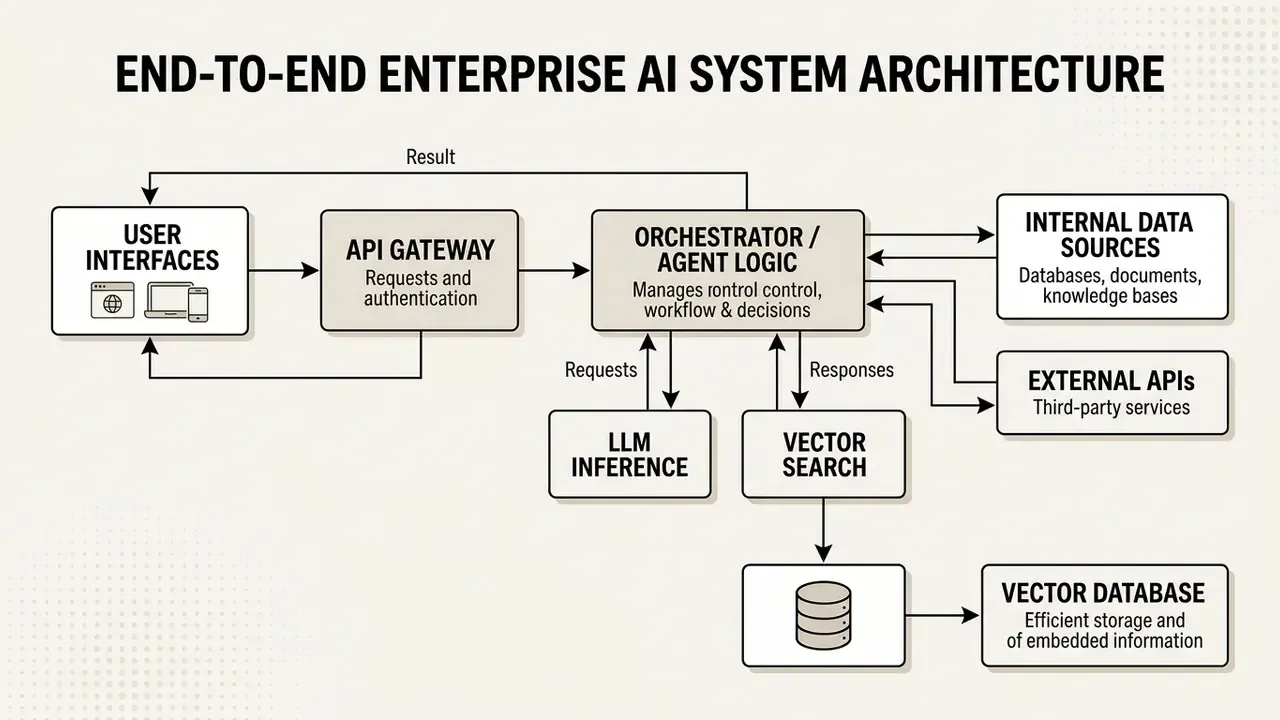
Architectural overview: user requests enter through the presentation layer, where inputs are sanitized. The orchestration layer evaluates intent, executes vector retrieval against connected knowledge bases, routes prompts to foundation models, executes required tool calls through secure API interfaces, and formats output for client rendering. Cloud reference architectures implement the tool layer through standardized connectors, for example Model Context Protocol servers that expose relational databases, internal applications, and external systems to the orchestrator under explicit permissions.
Understanding AI Methodologies: From Symbolic Rules to Deep Learning
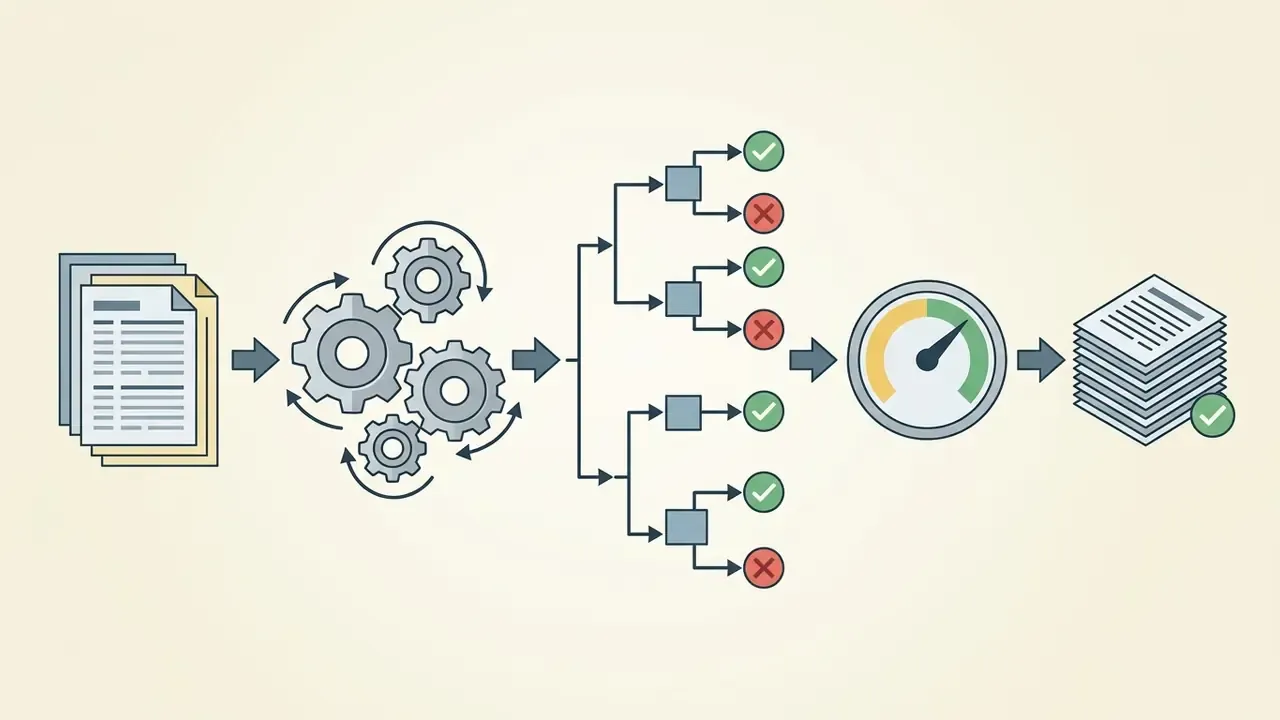
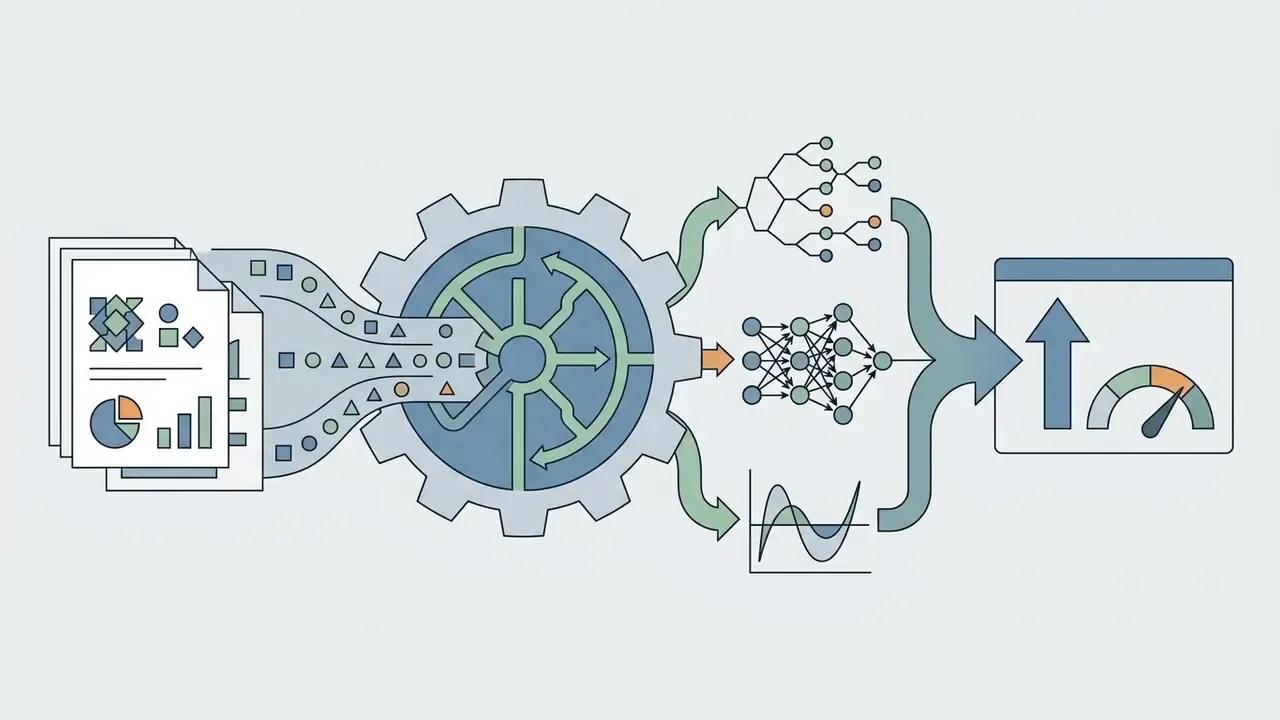
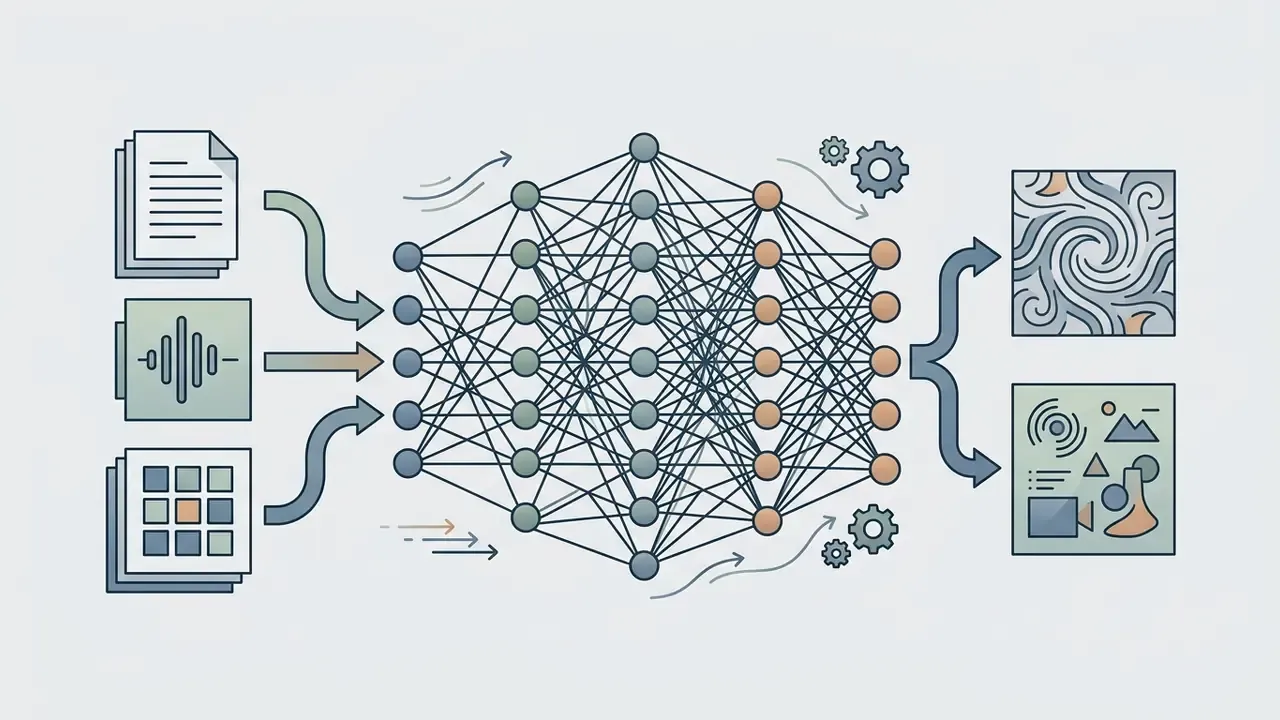
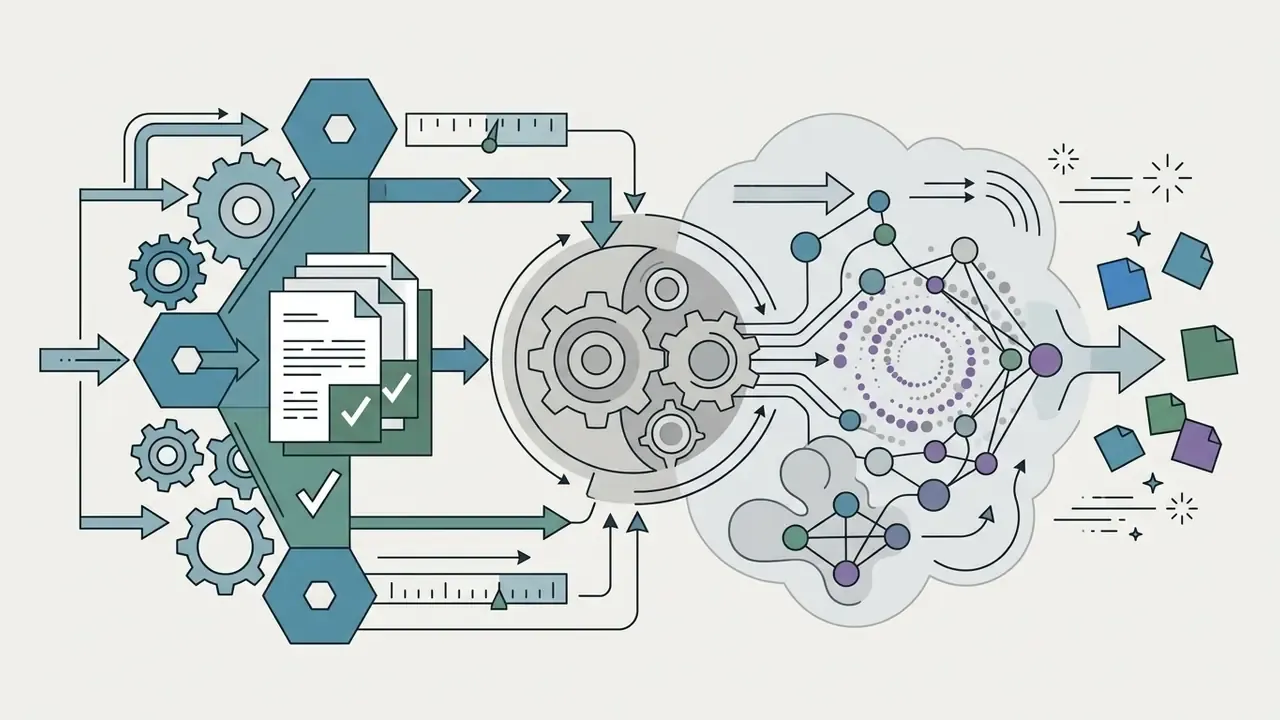
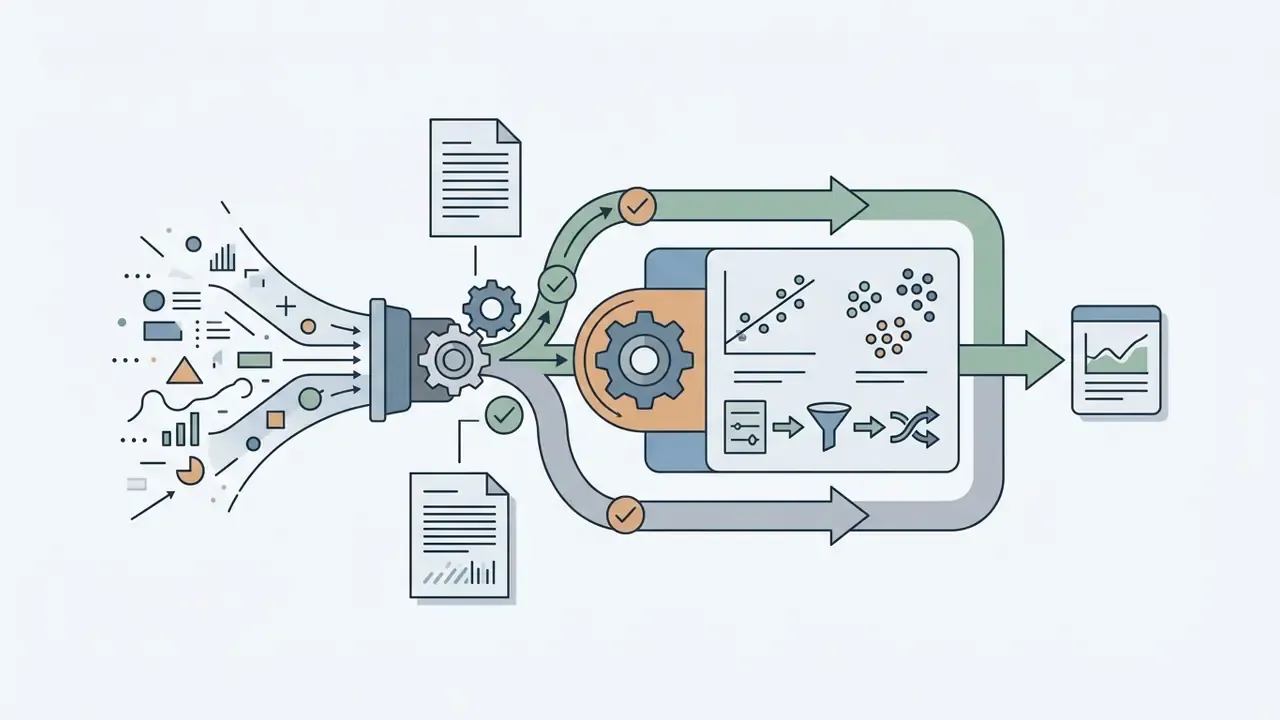
When planning an AI project, decide which core methodology fits your operational logic. Data science sits at the top of this hierarchy, with artificial intelligence, machine learning, and deep learning nested inside it as progressively more specialized layers.
Training strategy is a second, independent decision. Supervised learning pairs every input with a known output and suits classification, scoring, and extraction tasks. Unsupervised learning works on unlabeled data to surface clusters and anomalies. Semi-supervised learning labels only a fraction of the corpus and shows up whenever annotation cost is the binding constraint. Agentic ai is not a fifth methodology. It is an application layer that sits on top of machine learning and deep learning and adds planning, tool use, and autonomy.
| Development Approach | Required Technical Skills | Time-to-Market | System & Data Control | Data Pipeline Requirements | Primary Business Use Cases |
|---|---|---|---|---|---|
| No code & agent platforms | Domain knowledge; visual workflow design | Hours to days | Low to moderate (platform-dependent) | Structured documents; direct database connectors | Internal support bots, visual task automation, rapid prototyping |
| APIs & hosted models | Basic Python/JS; REST API integration; prompt engineering | Days to weeks | Moderate (hosted infrastructure guardrails) | Vector indexes, relational databases, REST payloads | Enterprise search, dynamic content generation, customer service tools |
| Open source fine tuning | Intermediate ML; PyTorch; MLOps pipeline management | Weeks to months | High (self-hosted weights and data) | Curated, labeled domain datasets; validation splits | Privacy-sensitive workflows, specialized medical or legal NLP, offline tasks |
| Custom code from scratch | Advanced deep learning; data science; distributed systems | Months to years | Complete (full control of neural architecture) | Extensive multi-terabyte datasets; rigorous cleaning pipelines | Novel model research, proprietary prediction engines, specialized hardware tasks |
Table takeaway in plain text: no code and agent platforms win on speed and lose on control. Hosted APIs sit in the middle: fast to ship, moderate control, strong capability. Open source fine tuning buys data sovereignty at the cost of MLOps overhead. Writing code from scratch gives total architectural freedom and takes the longest to validate.
Each path carries a different validation burden. Hosted APIs shift infrastructure risk to the vendor but concentrate risk in contractual controls, data residency, and certification evidence such as SOC 2 Type II attestations and, where applicable, GLBA or HIPAA safeguards. Self-hosted and custom paths retain full data control but require internal evidence of training data lineage, reproducible builds, and independent model validation.
Build an AI with No-Code and Agent Platforms
No code and agentic platforms let teams assemble AI workflows from drag-and-drop interfaces, pre-configured tool connectors, and visual logic builders. Platforms such as n8n, AgenticFlow, and Microsoft Copilot Studio wire together natural language processing nodes, database queries, and notification systems without traditional code. Published platform documentation now lists libraries exceeding 190 workflow nodes plus multi-agent "workforce" features, which makes process coverage, not coding ability, the practical limiting factor.
These platforms rely on autonomous agent harnesses that execute tool-calling sequences to solve structured operational tasks. A non-technical team can build an automated customer service routing agent that reads incoming tickets, queries an internal knowledge base, and posts draft responses straight into a CRM system. One operational caveat deserves emphasis: platform-hosted logic is harder to version, debug, and evidence for auditors than code-first pipelines. So any no code build aimed at a regulated process should export configuration snapshots on every change.
Create an AI Tool with APIs and Existing Models
API-driven development connects your application code to state-of-the-art foundation models hosted on cloud infrastructure. Providers like OpenAI, Google Cloud Vertex AI, and Anthropic expose endpoints for text generation, multimodal document understanding, and vector embeddings through plain HTTP requests. Vertex AI's retrieval APIs, for instance, define a six-step grounded-answer workflow: import documents, parse layout, create embeddings, index in vector search, rank chunks, generate the response. Teams evaluating hosted generative endpoints for media pipelines can review implementation economics in the Google Veo API implementation guide.
Below is a minimal Python example showing how to open an API connection to a hosted foundation model with explicit JSON output constraints:
import os
from openai import OpenAI
# Initialize client with API key
client = OpenAI(api_key=os.environ.get("OPENAI_API_KEY"))
# Execute a structured request to a hosted foundation model
response = client.chat.completions.create(
    model="gpt-4o-mini",
    messages=[
        {"role": "system", "content": "You are a customer support triage assistant. Output only JSON containing 'category' and 'urgency' keys."},
        {"role": "user", "content": "My account was charged twice for order #8492!"}
    ],
    temperature=0.0
)
print(response.choices[0].message.content)
Setting temperature=0.0 and constraining the output schema are deliberate control choices. Deterministic decoding and typed outputs are what make downstream validation, regression testing, and audit replay possible at all.
Developers can inspect pre-built benchmark evaluations in AI Media Benchmarks and Review Proof to select hosted ai models for specific latency and accuracy constraints.
«GPT-4 fails to complete the full software development cycle: models struggle to maintain consistency across design, implementation, and testing stages.»
Using APIs lets software teams build sophisticated tools, such as automated document summary platforms or real time analytics engines, by combining cloud inference with custom frontend interfaces and secure backend logic. The DevEval finding is the warning attached to this path: hosted language models are strong components and weak architects. Orchestration, the test harness, and human checkpoints stay your engineering responsibility.
Fine-Tune Open-Source Models for Domain Control
Open source and open-weight models, including Apache-2.0 licensed releases and widely used Llama-family weights, support self-hosted inference and parameter fine tuning. Pick this path when data cannot leave a controlled environment, when offline inference is mandatory, or when domain terminology and output formatting must be encoded into the model rather than repeated in every prompt.
Fine tuning needs a curated labeled dataset with explicit training, validation, and test splits, plus MLOps capability for versioning weights, tracking experiments, and reproducing results. Regulated institutions should treat each fine-tuned checkpoint as a distinct model version subject to independent validation, with documented training data provenance and a performance comparison against the prior release. Skip that and you have a black box with no birth certificate.
Create AI from Scratch with Custom Code
Choosing to create ai from scratch with Python, deep learning frameworks, and custom code delivers maximum architectural control and independence from external model providers. This code-first route means building explicit data processing pipelines, defining neural networks, and managing training loops in PyTorch or TensorFlow. It is also how you create your own ai program when no existing model fits the constraint.
Custom predictive models remain common in specialized financial modeling, fraud detection, and hardware-constrained environments where off-the-shelf large language models are inefficient or simply too slow.
«Agent-as-a-Judge substantially outperforms LLM-as-a-Judge in reliability and approaches human evaluation across 55 realistic AI development tasks.»
Developers designing custom pipelines or narrow utilities can consult the AI Media API Guides for architectural inspiration when structuring endpoint integrations and processing pipelines.
Align Every Path with Model Risk Validation Standards
For banks and other supervised institutions, the development path determines how validation evidence gets produced, not whether it is required. Supervisory guidance on model risk management, the Federal Reserve's SR 11-7 and the OCC's 2011-12 bulletin, expects conceptual soundness review, ongoing monitoring, and outcomes analysis for every model in use, vendor-supplied components included.
Translate that into three control points per path: documented conceptual soundness, including why a probabilistic model is appropriate for the task; independent validation by someone outside the build team, with challenger benchmarks where feasible; ongoing monitoring with predefined thresholds and named escalation owners. Non-deterministic agent behavior adds a fourth requirement, explicit decision ownership, so every automated action maps to an accountable human role and a documented escalation path.
Define One Problem and Success Criteria Before Building AI
Successful AI deployment starts with isolating one highly specific operational problem and defining quantifiable performance metrics before development begins. Vague goals like "implement AI in customer support" produce unconstrained scope, high hallucination rates, and unquantifiable return on investment. Business problems come first; model selection is downstream.
| Poorly Defined Goal | Audit-Ready Performance Target | Target Evaluation Metric |
|---|---|---|
| "Use AI to handle customer emails." | "Automate triage for billing emails with zero incorrect account flags." | Precision ≥ 98%, Recall ≥ 95% |
| "Add a knowledge bot for staff." | "Answer internal HR policy questions grounded exclusively in the employee handbook." | Hallucination rate < 0.5%, Latency < 1.5s |
| "Implement AI lead scoring." | "Predict high-value sales leads based on historic CRM activity tables." | ROC-AUC score ≥ 0.87 |
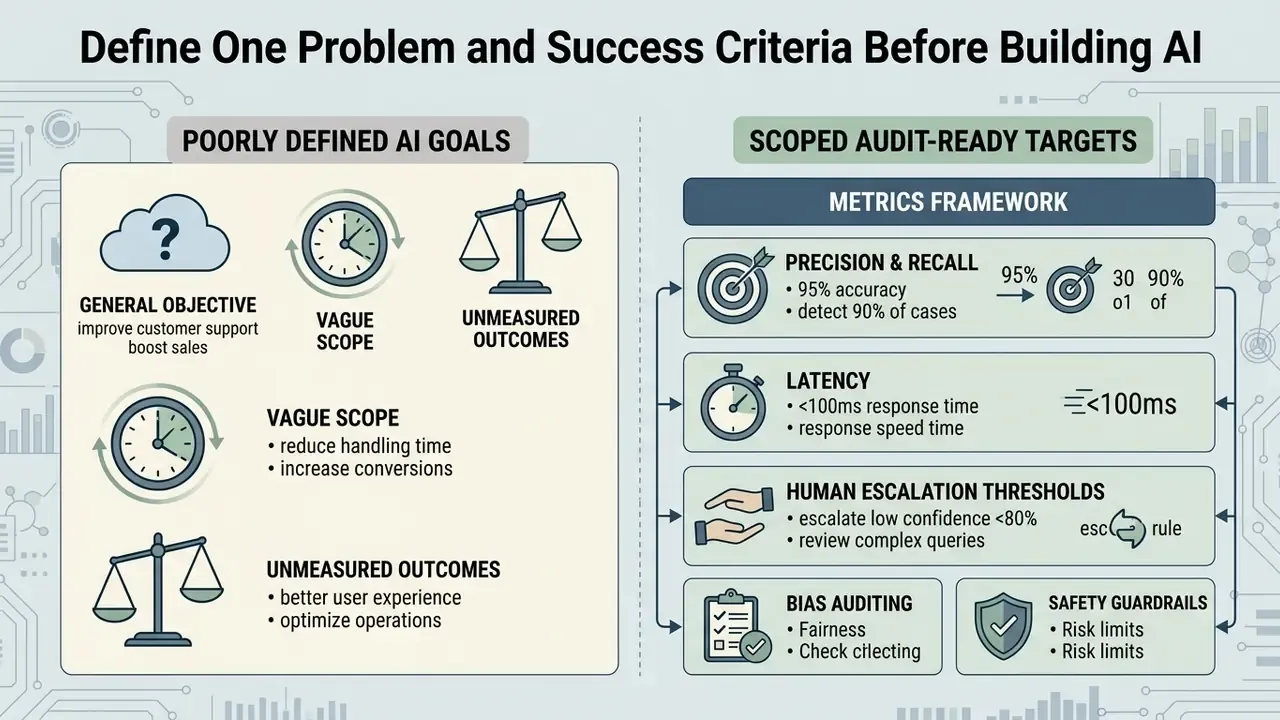
Select a Focused Use Case for Your AI Project
A strong first AI project targets a well-defined task with clear inputs, structured rules, and deterministic evaluation criteria. Focused use cases include extracting citations from legal filings, screening inbound vendor invoices, or generating first-pass support responses for recurring product queries.
«DevAI contains 55 realistic AI development tasks with 365 hierarchical user requirements, each combining functional requirements, non-functional constraints, and user preferences.»
That hierarchy doubles as a scoping template: write the functional requirement, the non-functional constraint (latency, cost, privacy), and the preference layer separately, so evaluation criteria stay testable.
For instance, the National Institutes of Health implemented a specialized machine learning pipeline dedicated strictly to mining citations from full-text scientific articles, converting PDFs to XML and classifying reference text.
«Machine learning pipeline for mining citations from full-text scientific articles.»
By limiting scope to document parsing and text classification, the system reached high precision without taking on the operational risks of broad conversational AI. Comparable narrow-scope wins appear elsewhere in the public sector: an LLM-based extraction project for wind-energy siting ordinances reported 85 to 90% accuracy on legal document fields, and a cold-case review program used text analytics purely to flag physical evidence for advanced testing.
Define What a Useful AI Output Looks Like
A useful AI output must meet defined standards of accuracy, response latency, structural formatting, and factual grounding. Rather than leaning on framework language alone, define output quality operationally before the first build sprint.
This operational recipe complements NIST guidance, which requires output quality to be assessed against known ground truth and evaluated for confabulation, semantic drift, and adherence to safety constraints, with human oversight and automated evaluation used together (NIST AI 600-1, Generative AI Profile, 2024, https://nvlpubs.nist.gov/nistpubs/ai/NIST.AI.600-1.pdf).
For text-generating systems, key indicators include exact-match accuracy, semantic relevance scores, and median response latency, reported at both median and P99 to expose tail behavior. For agentic systems taking real time actions, quality parameters include task completion pass rates, tool-execution correctness, and zero unauthorized system calls. Teams evaluating software across commercial creation hubs can review structured operational models in the AI Media Commercial-Use Hub.
Calculate Risk-Adjusted ROI Before Committing Budget
Standard ROI models understate AI cost because they count inference spend and ignore control spend. A defensible risk-adjusted calculation includes four cost layers beyond licensing: human review time at the expected escalation rate, monitoring and evaluation cycles, incident remediation reserves, and the residual risk of an incorrect automated decision multiplied by its expected frequency.
A workable formula: (annual process savings − control and monitoring cost − expected residual loss) ÷ total implementation and run cost. Model it at two escalation rates, the pilot rate and a stressed rate double that level, because human-in-the-loop volume, not GPU spend, is usually what breaks the business case. Deployment cost estimates and resource forecasts can be modeled with the technical calculators hub before capital approval.
Prepare Data and Knowledge Sources for Your AI
Data preparation dictates performance, safety, and reliability across any custom AI system. High-quality inputs suppress hallucinations, reduce output bias, and keep the build inside enterprise data governance frameworks. A data driven approach here is not optional decoration; it is the difference between a demo and a deployable tool.
Choose Data Sources That Match the Use Case
Data sources must correspond directly to the functional requirements of the target use case. Structured data in tabular form is required for predictive machine learning, unstructured text documents power retrieval-augmented support assistants, and labeled media assets for vision-based automation drive image classification and visual quality-control systems.
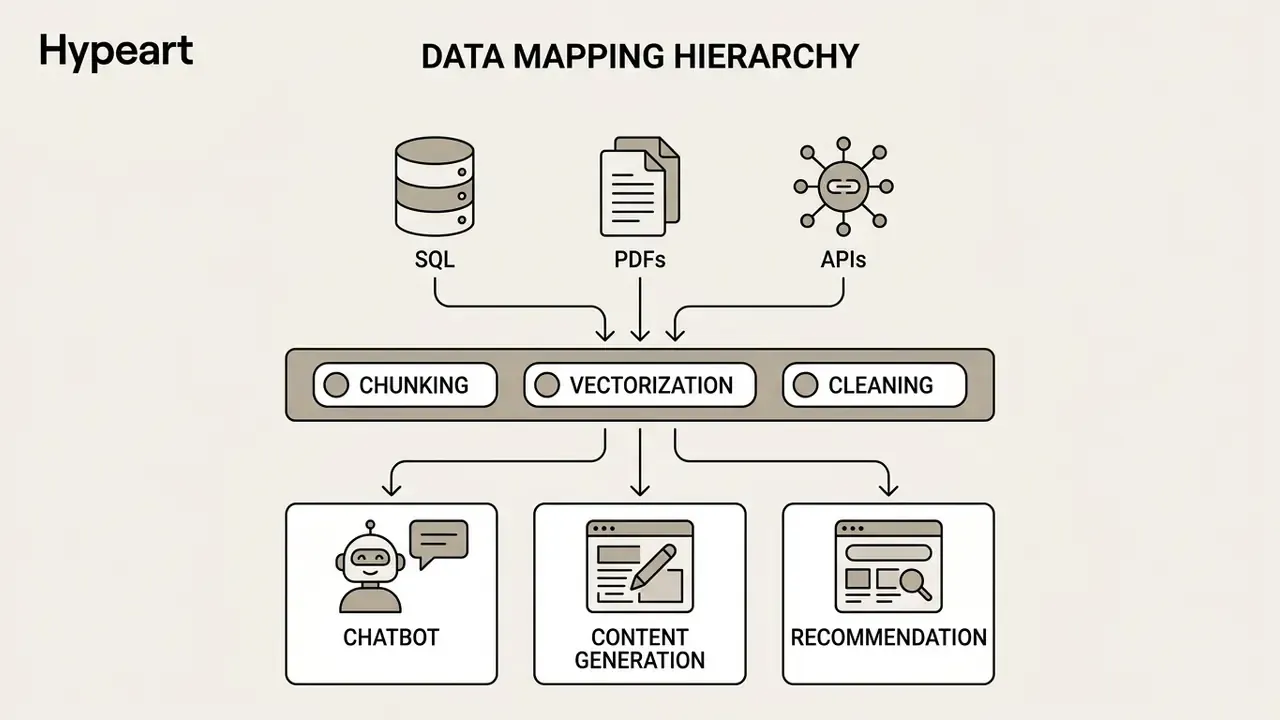
Selecting representative domain data means evaluating accessibility, metadata structure, and regulatory constraints together. NIST's Research Data Framework organizes these decisions around use case, stakeholders, governance, and lifecycle rather than prescribing one best source. Practical consequence: the same document repository can be appropriate for one task and disqualified for another on access-control grounds alone. Teams assembling multimodal production systems should also document synthetic-asset provenance and licensing terms. Reference material on voice and speech inputs sits in the guide to AI voice generators, which covers language coverage and commercial licensing constraints relevant to audio training data.
Clean, Organize, and Validate Training Data
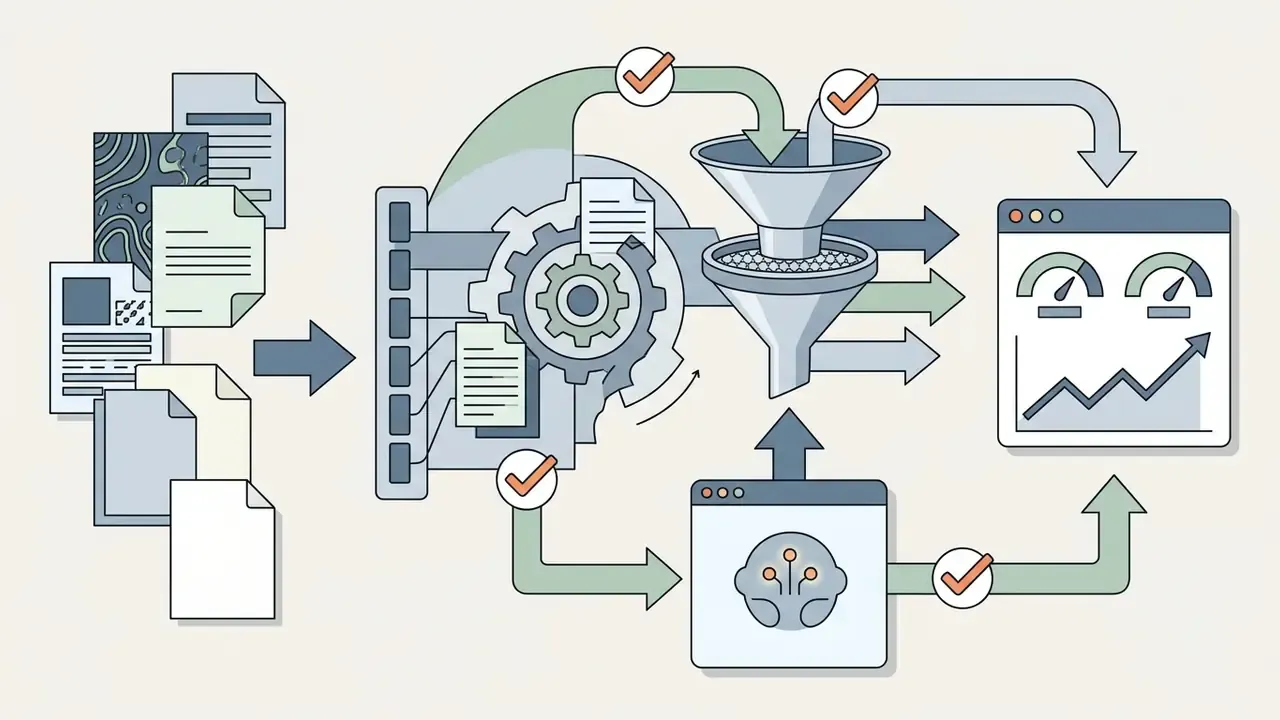
Data preparation requires a systematic pipeline for cleaning, format standardization, de-identification, and validation. International standard ISO/IEC 5259-4:2024 requires that AI training and evaluation datasets pass through acquisition, composition, preparation, labeling, evaluation, and quality verification steps (ISO, 2024, https://www.iso.org/standard/81093.html).
«Even when platforms automate cleaning, the quality and organization of training data materially determine AI performance and safety.»
A practical six-operation sequence covers most enterprise cases: cleaning (correct or remove incomplete, incorrect, and irrelevant records), format standardization, normalization and concept mapping to controlled ontologies, imputation of missing values, de-identification of protected fields, and encoding. Annotation adds two more steps drawn from published research practice: a pilot labeling round before full-scale annotation, and inter-annotator agreement checks after each batch to refine guidelines.
In one financial customer support initiative, a commercial bank needed lower response latency without ungrounded outputs. The team integrated a hosted LLM through secure APIs and connected it to an indexed vector database of vetted policy documents under strict retrieval-augmented generation constraints. Based on internal implementation testing with a fixed evaluation set, this architecture reduced measured hallucination rates to under 0.5% and cut agent average handling time by roughly 42%. These figures reflect a single controlled deployment, not an independently audited benchmark, and should be reproduced against your own ground-truth set before anyone puts them in a business case. Worth repeating, since numbers like these travel fast.
Decide Whether You Need Training Data or Retrieval
Choosing between Retrieval-Augmented Generation and model fine tuning depends on whether the system needs dynamic external knowledge or specialized task-specific behavior. RAG injects non-parametric knowledge into prompts at inference time without altering weights, which makes it ideal for enterprise documentation that changes weekly.
«A RAG-based e-commerce assistant retrieves from catalogs, FAQs, and reviews to generate context-relevant answers without modifying model weights, simplifying deployment and knowledge updates.»
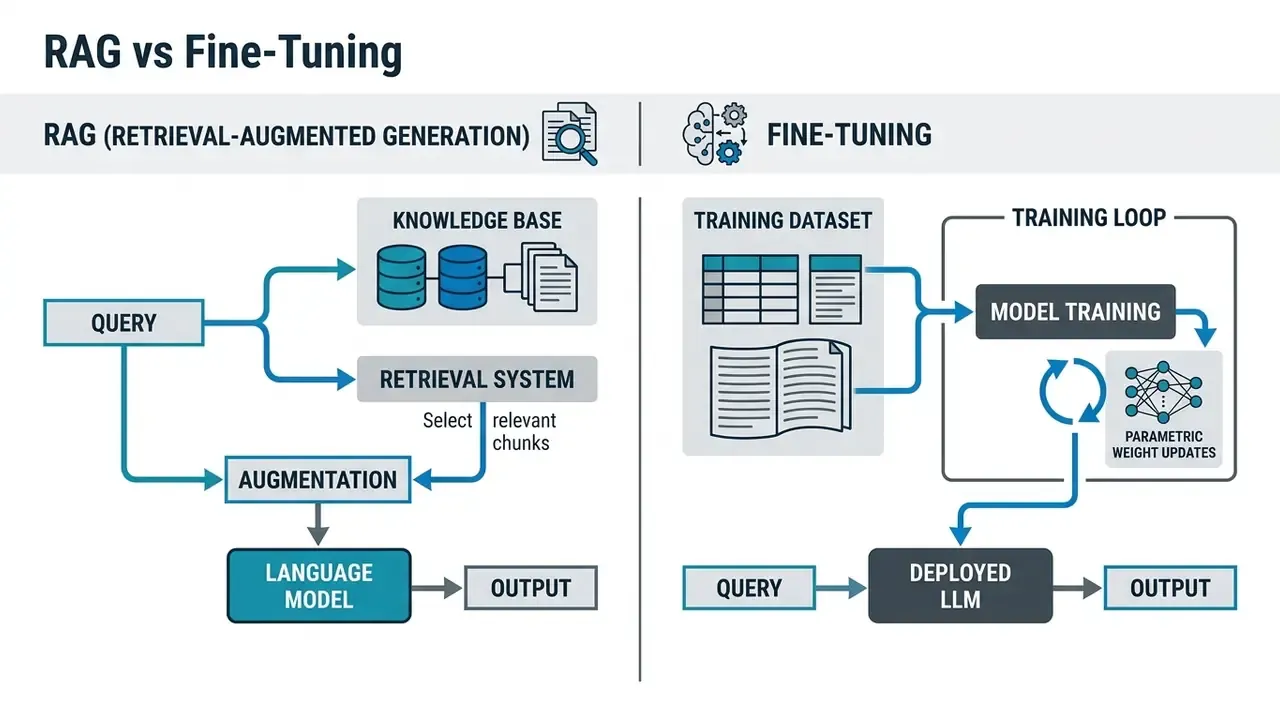
Fine tuning updates internal parameters to enforce formatting styles, domain terminology, or specialized reasoning patterns. For most knowledge-retrieval applications, RAG is significantly cheaper and easier to audit, while fine tuning is reserved for domain adaptation where retrieval context alone misses the accuracy target. For sensitive data, retrieval carries a governance advantage too: a corpus can be redacted, re-indexed, or revoked, whereas information absorbed into weights cannot be selectively removed without retraining.
Choose AI Models, Frameworks, and Development Tools
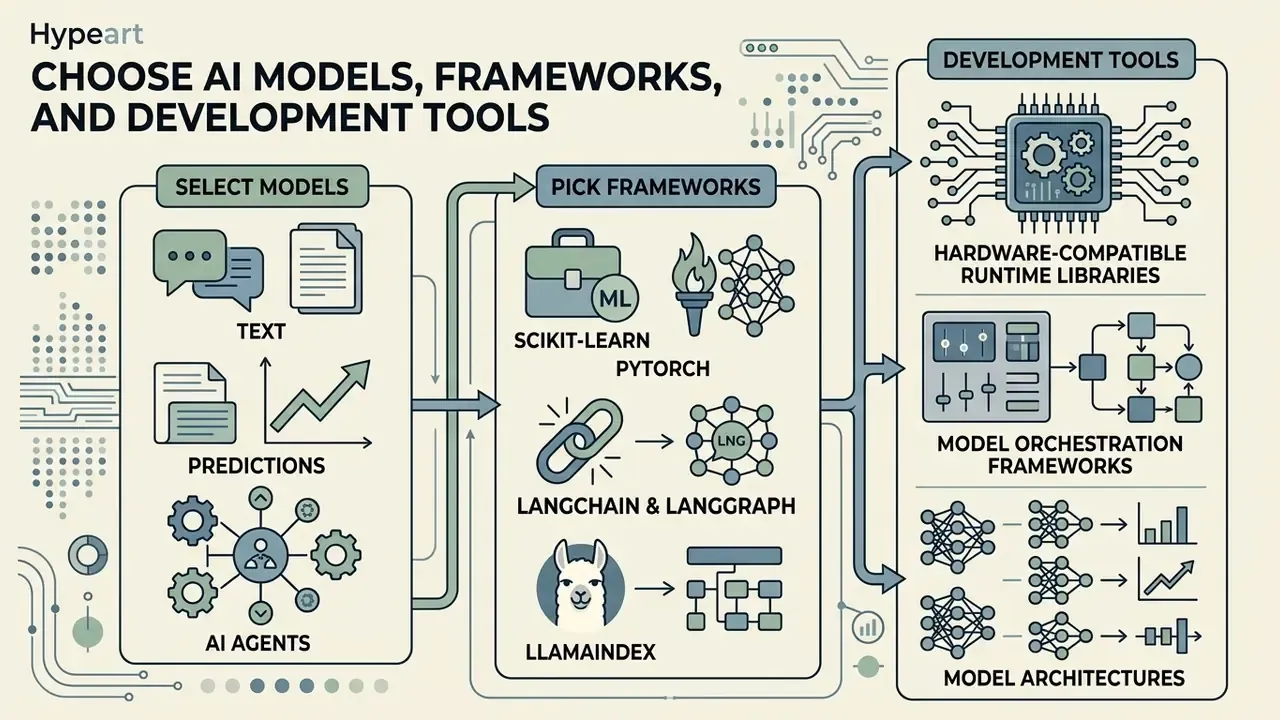
Building a resilient AI system means selecting hardware-compatible runtime libraries, model orchestration frameworks, and model architectures matched to the task. Tooling decisions are reversible. Architecture decisions rarely are.
Select Models for Text, Predictions, and AI Agents
Model selection follows task complexity, context window requirements, inference latency, and deployment budget. Text-centric reasoning and conversational tools benefit from modern large language models, while structured numerical forecasting still relies on classical supervised machine learning.
«AgentBench evaluated LLMs across 8 interactive environments: top commercial models showed strong agentic capability, while open-source models up to 70B parameters lagged significantly due to weaker long-horizon reasoning.»
Pick Frameworks for a Custom AI Program
Custom development relies on established frameworks to manage data flow, model state, and component integration. Python remains the primary language across the AI ecosystem thanks to its library depth.
Key development frameworks include:
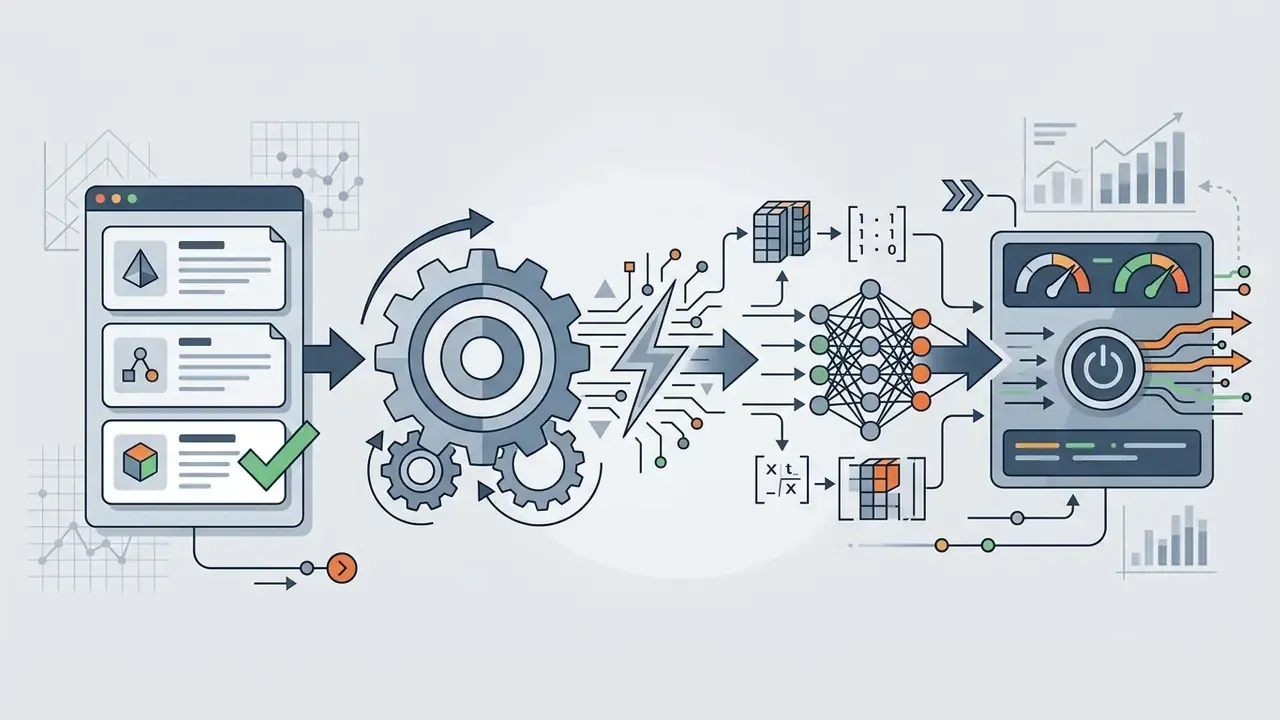
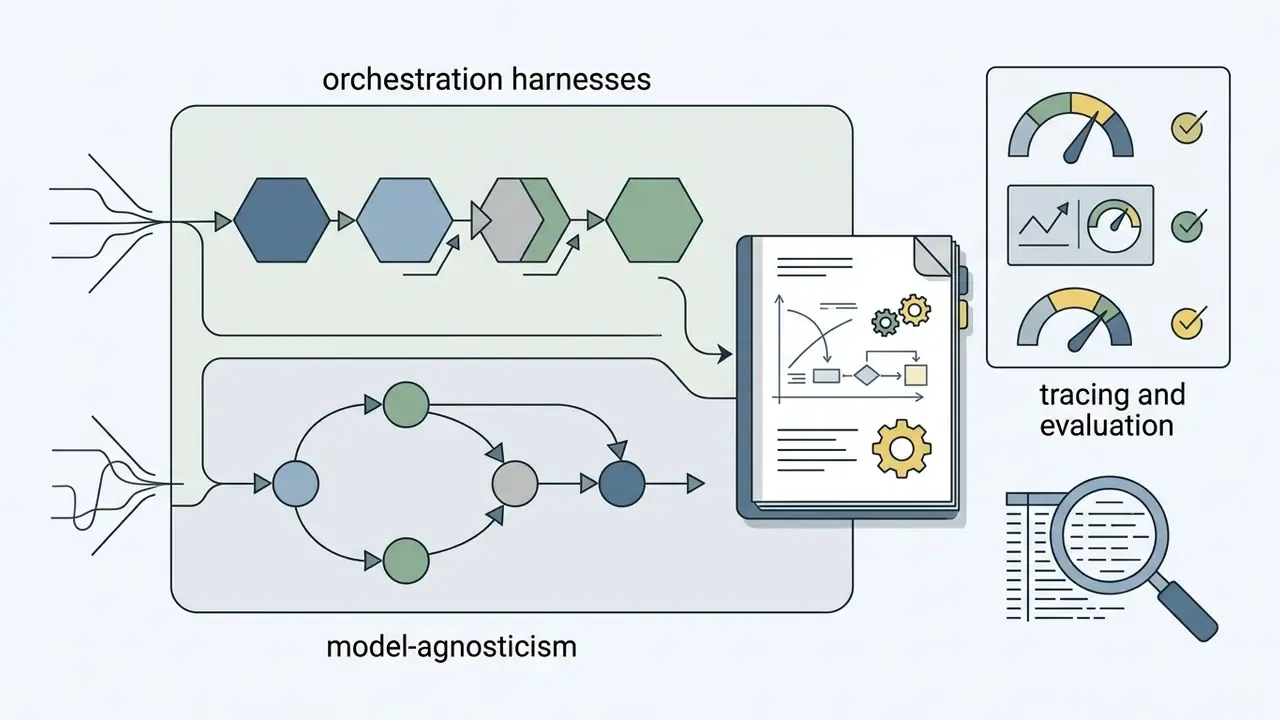
Framework choice should follow the benchmark profile of your task. Stateless single-call tasks rarely justify a graph orchestrator, while multi-step planning with tool use and recovery paths almost always does.
Build a Simple AI Prototype
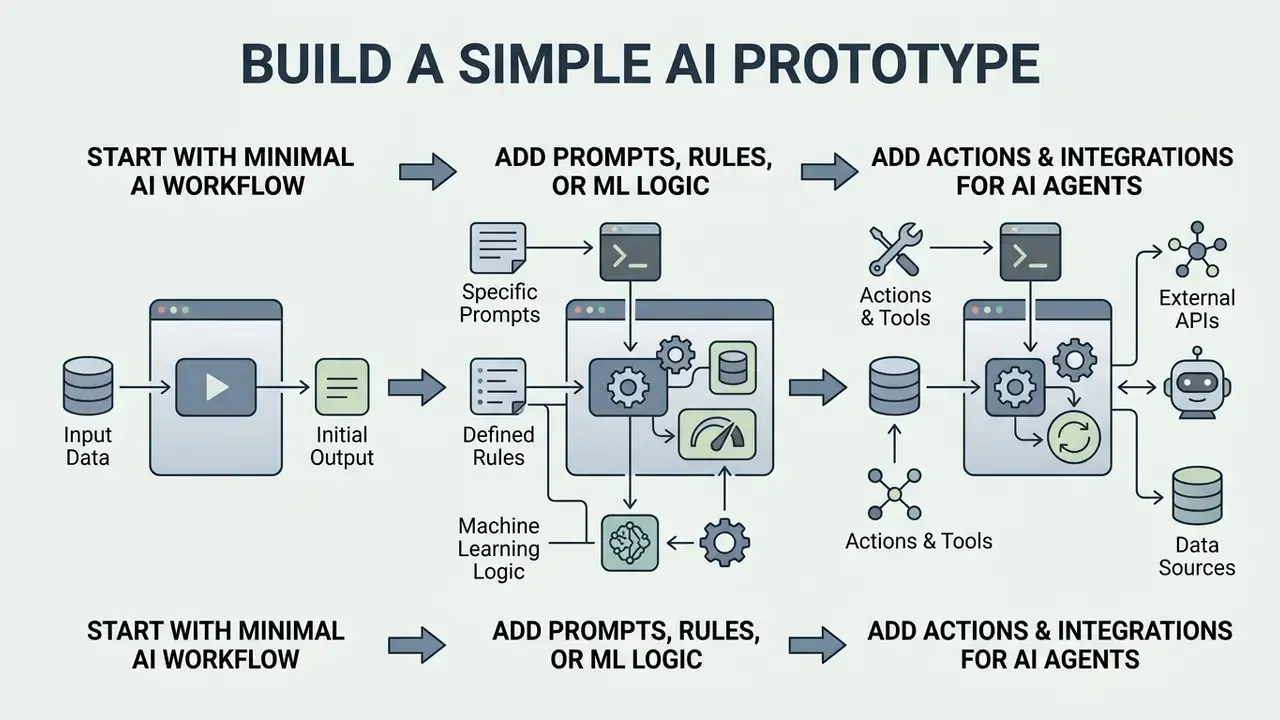
Development should proceed incrementally, starting with a minimal viable prototype before adding complex tools or autonomous multi-agent loops. The NIST AI RMF cycle, Govern, Map, Measure, Manage, supplies the control scaffolding for this phase: define ownership and policy first, then map the use case, then measure, then manage residual risk. That order looks bureaucratic until the first incident.
Start with a Minimal AI Workflow
To create simple ai that actually works, use one input scenario, a deterministic system prompt or model function, and one structured output format. Limiting early complexity lets developers isolate prompt logic, establish baseline latency, and verify output consistency.
«Choose a dataset, formulate a specific question, draft prompts, and compare AI output with manual analysis, spot-checking random data points for hallucinations.»
Add Prompts, Rules, or Machine Learning Logic
Once the basic input-output flow is verified, refine behavior by layering structured prompt templates, business rule guardrails, and programmatic logic. System prompts should state the AI's identity, operational boundaries, required output schemas (JSON, for example), and fallback instructions for ambiguous queries. Public-sector prompt guidance converges on a consistent structure, Task, Role, Guidelines, Reference Context, delivered as a single tagged block with explicit injection-detection instructions.
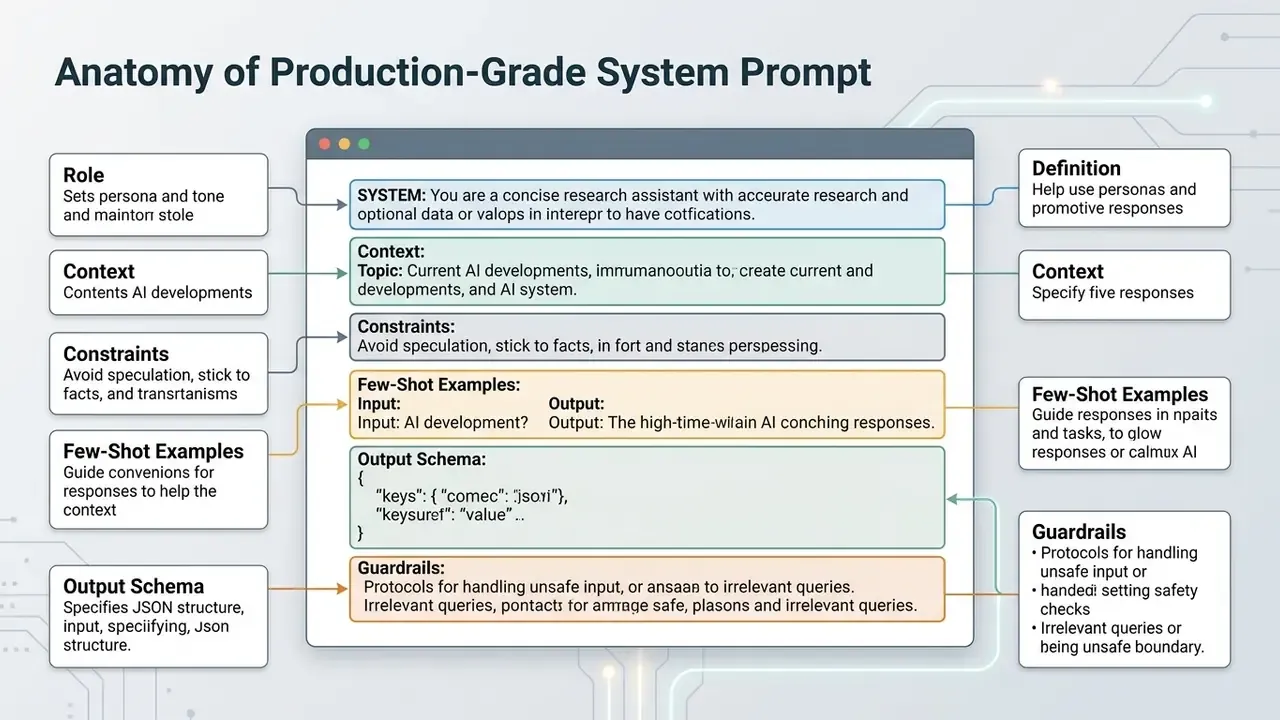
During the review of an automated credit-evaluation assistant (illustrative composite, not a named institution), risk leaders found inconsistent outputs driven by unvalidated training files. The model governance group introduced standardized cleaning pipelines, schema validation, and automated inter-annotator agreement checks across all ingested datasets. The revised validation workflow removed the data-drift errors and closed the documentation gaps before production release.
Add Actions and Integrations for AI Agents
Turning a basic model into an active ai assistant means connecting it to external functions, APIs, and execution environments through tool calling. Tool calling lets the model emit structured JSON commands that application code executes to read databases, send notifications, or run web searches.
Vendor documentation from OpenAI, Microsoft, and AWS describes the same five-step loop: send the request with tool definitions, receive a typed tool call, execute the function in application code, return the tool output to the model, generate the final response. Two controls belong in that loop from day one: an allowlist of callable functions with scoped credentials, and a human approval gate for any write action touching customer records, payments, or production systems. Teams automating structured media production can attach the same pattern to generative endpoints documented in the AI Media Workflows hub, so ai agents produce assets programmatically while every external call stays logged and permissioned. Even low-stakes pipelines benefit: a youtube intro maker chain that renders, reviews, and publishes without a gate will eventually publish something you did not approve.
Model Risk Governance and Audit Logging
Audit readiness is an engineering requirement, not paperwork produced after launch. Regulators and internal validators ask one blunt question: can you reproduce a specific past decision exactly? That means capturing, at minimum, the following artifacts for every inference that influences a business outcome:
- Request and response payloads: , including the full system prompt, retrieved context chunks, and model output, with sensitive fields tokenized rather than dropped.
- Version identifiers: for the model, prompt template, retrieval index, embedding model, and orchestration code, stored as an immutable tuple per request.
- Parameter snapshots: temperature, top-p, max tokens, retrieval top-k, and reranker configuration, because output variance is meaningless without them.
- Tool-call ledger: every function invoked, arguments passed, authorization scope used, result returned, and whether a human approved the action.
- Human intervention records: escalation triggers, reviewer identity, override decisions, final disposition.
- Evaluation lineage: which test set version the release passed, on which metrics, at which thresholds, and who signed off.
NIST's AI RMF Measure guidance requires documenting pre- versus post-deployment performance and monitoring production metrics against pre-deployment testing metrics, which is only possible if these artifacts are versioned together (NIST, AI RMF Playbook). Retain logs for the period your record-retention policy specifies for the underlying business process, not for the shorter default window offered by a vendor dashboard. That mismatch quietly defeats a lot of otherwise solid control designs.
Test, Improve, and Deploy AI into a Real Workflow
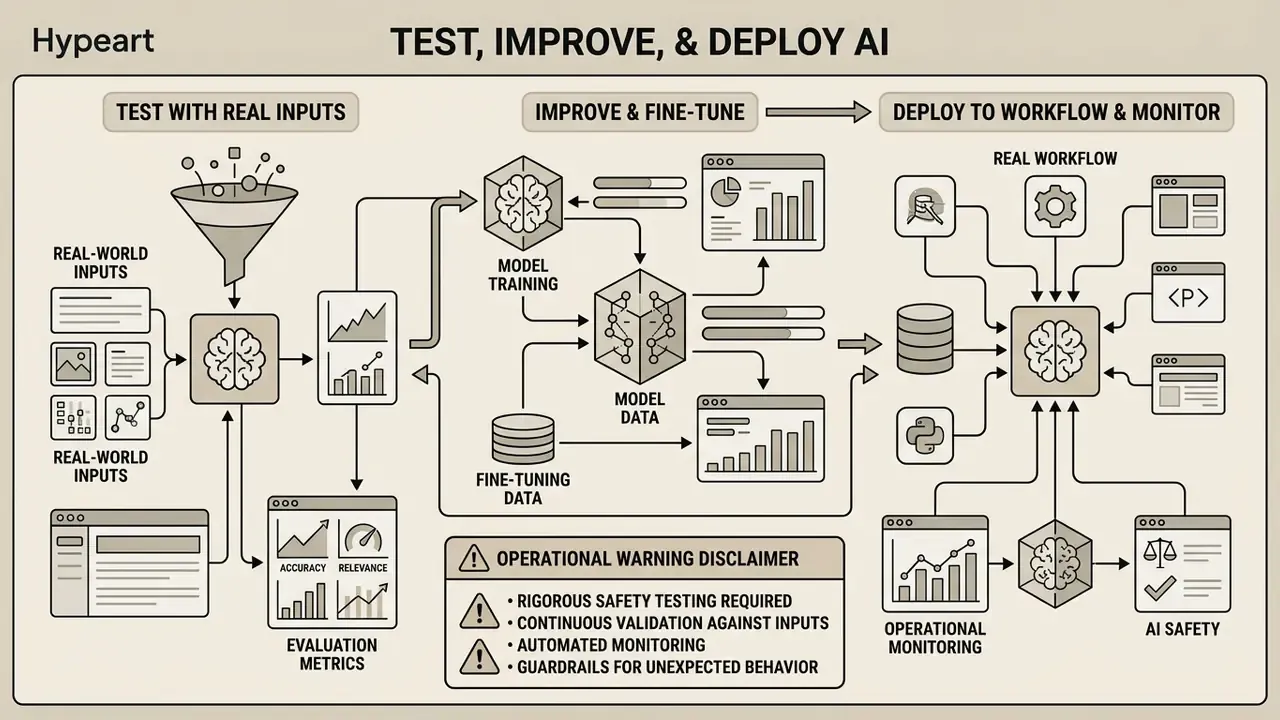
Moving an AI system into production takes continuous validation against real-world inputs, rigorous safety testing, and automated operational monitoring. To deploy ai responsibly, treat launch as the start of measurement rather than the end of the project.
Evaluate AI Results with Real Inputs
Validating performance requires testing against a representative dataset of real user queries rather than synthetic cases. Evaluation must measure response accuracy, safety boundary enforcement, and resilience against adversarial inputs. Robustness testing should cover three input classes explicitly: repeated identical inputs (stability), semantically similar inputs (consistency), and perturbed or adversarial inputs (resilience).
Testing tools like Ragas evaluate RAG retrieval precision and hallucination rates, while adversarial frameworks like Garak probe models for prompt injection vulnerabilities.
Quantitative cost management and resource estimation can be modeled with the technical calculators during pre-deployment planning, and licensing exposure for generated assets should be verified against terms documented in the commercial-use hub before any output reaches customers. For media-heavy pipelines, production dependencies matter as much as model choice: teams standardizing on desktop tooling often start from a video editor for Mac baseline, then automate only the repetitive stages such as a youtube outro template render or a standardized youtube intro sequence.
Deploy AI Safely and Improve It Over Time
Safe deployment means launching inside restricted environments under continuous human oversight before widening production access. Secure-deployment guidance from national cybersecurity agencies adds two requirements: protect the model and its data continuously in operation, and distribute updates through secure, modular procedures with automated updates enabled by default.
«A bank's GPT-4 RAG chatbot was planned as a three-month proof of concept but encountered unexpected difficulty in domain knowledge management and production operations.»
Post-deployment monitoring must track operational latency, error rates, user feedback, and model drift over time. NIST's deployed-system monitoring taxonomy covers functionality, operations, human factors, security, compliance, and large-scale impacts. Each needs a named owner and a threshold that triggers rollback, not a dashboard nobody reads. Feedback loops should be explicit: affected users must be able to question, challenge, and appeal an automated decision, and those challenges should feed the next evaluation set. Organizations that want to pilot generative capabilities with limited operational exposure can begin with lower-risk internal workflows documented in the AI Media Workflows hub before extending automation to customer-facing channels.
A regional financial institution (composite example) tried to deploy an autonomous agentic workflow for loan documentation pre-screening without sandbox testing. Initial runs generated unauthorized API tool calls to non-production endpoints and tripped security alerts. The risk team halted deployment, stood up an isolated staging environment with red-teaming protocols, and added human-on-the-loop review triggers before final release. Two weeks of delay, versus an incident report. Easy trade.
Important Operational Warning:
Production Readiness Checklist
Use this checklist as the final gate between pilot and production. Every item needs a named owner and dated evidence.
- Scope lockedone documented use case, one input type, one output schema, with out-of-scope behavior defined and tested.
- Metrics and thresholds approvedaccuracy, precision and recall, hallucination rate, median and P99 latency, and maximum acceptable escalation rate, signed off by the process owner.
- Ground truth established100 to 500 labeled evaluation examples versioned in source control, with a regression suite executed on every release.
- Data controls verifiedlineage documented, sensitive fields de-identified or tokenized, retention policy applied, vendor certifications (SOC 2 Type II, for example) on file.
- Guardrails implementedtool allowlist, scoped credentials, injection detection, deterministic decoding settings, fail-safe fallback responses.
- Audit trail liveprompts, retrieved context, versions, parameters, tool calls, and human overrides logged and queryable.
- Oversight and rollback definedhuman-in-the-loop triggers, escalation owners, monitoring thresholds, tested kill switch, rehearsed rollback procedure.
Limitations and Open Questions
A few things remain genuinely unsettled, and pretending otherwise would be dishonest.
Validation methodology for agentic AI is still immature. Traditional model validation assumes a stable input-output mapping; an agent that plans, retries, and calls tools produces trajectories, not single predictions, and the industry has no settled standard for validating a trajectory. Second, benchmark results rarely transfer. AgentBench and DevAI scores tell you something about relative capability and almost nothing about performance on your KYC alerts or your reconciliation exceptions. Third, vendor evidence is uneven: certification attestations cover infrastructure controls, not model behavior under your data distribution.
Treat every audience assumption and performance figure in this guide as a hypothesis until you have analytics, interviews, or internal test results of your own. That is not hedging. It is how model risk work is supposed to read.
Frequently Asked Questions (FAQs) About Creating AI
Can I create an AI for free?
Yes, you can build a basic model for free with open source tools and public platforms. Python, scikit learn, and PyTorch are fully open source. You can use free compute on Google Colab, pull open-weights foundation models from Hugging Face, or work inside free API tiers from hosted inference providers. Scaling an ai tool for enterprise production, though, brings infrastructure, vector storage, and compute costs. "Free" also means constrained compute, data limits, and your own time: fine for learning, insufficient for reliability targets.
How do you create an AI model like ChatGPT?
Building a large language model like ChatGPT from scratch means training a Transformer architecture on petabytes of text across massive GPU clusters, costing millions and requiring a dedicated team of ML researchers and infrastructure engineers. In practice, organizations build ChatGPT-like tools by integrating pre-trained foundation models (through APIs such as OpenAI, or hosted open source models like Llama 3) with custom Retrieval-Augmented Generation pipelines and proprietary knowledge bases.
Do I need to know how to code to create an AI?
No. Non-technical users can build custom tools on visual no code platforms such as n8n, AgenticFlow, or Microsoft Copilot Studio. These platforms connect data sources, set reasoning rules, and integrate AI capabilities into business tools through drag-and-drop interfaces. Building proprietary algorithms, custom neural networks, or deep MLOps pipelines does require Python and machine learning frameworks. So the honest answer to "how can i create an ai without writing code" is: for workflow automation, yes; for novel modeling, no.
How do you build an AI chatbot from scratch?
Define exactly what the chatbot must do, answer a fixed FAQ set, handle bookings, triage tickets, then choose an architecture. Open source conversational frameworks provide intent routing, while an LLM plus RAG handles open-ended knowledge questions. You will need conversation data, intent definitions, and a curated knowledge corpus. Rather than training a language model yourself, connect an existing model through an API and spend your effort on retrieval quality, guardrails, and testing with real users.
Can I create my own AI for a regulated process without a data science team?
Partly. A small team can create an ai tool for document triage or internal search using hosted models and no code orchestration. What you cannot outsource is independent validation, documented decision ownership, and monitoring. In supervised institutions, those responsibilities sit with named roles, so plan for reviewer capacity before the build, not after the pilot demo lands well.
How long does it take to build a working AI tool?
No code workflows and API prototypes typically reach a demonstrable state in hours to weeks. Fine-tuned open source deployments run weeks to months once data curation and MLOps are counted. Custom architectures from scratch take months to years. In regulated environments, add validation and independent review time to every estimate. It is frequently the longest single phase.
What does it cost to maintain an AI tool after launch?
Ongoing cost breaks into five recurring lines: inference or hosting, vector storage and re-indexing, evaluation and monitoring tooling, human review time at the observed escalation rate, and periodic revalidation of the model and its data sources. Teams that budget only for inference usually underestimate total run cost by a wide margin.
Who owns the intellectual property in a custom AI tool?
Ownership depends on the contract and the components used. Your prompts, orchestration code, curated datasets, and fine-tuned artifacts are usually yours, subject to the base model's license. Some open-weight models ship under permissive licenses such as Apache 2.0, while hosted APIs grant usage rights rather than model ownership. NIST procurement guidance advises checking intellectual-property ownership and vendor lock-in before purchase, and generated-output rights should be verified against each provider's commercial terms.
Which approach is safest for sensitive or regulated data?
Self-hosted open source models and RAG over an internal, access-controlled corpus give the strongest data control, because sensitive content never leaves your boundary and the corpus can be redacted or revoked. Hosted APIs can be acceptable when contractual controls, data-residency terms, no-training commitments, and certification evidence are documented and reviewed by your compliance function.
Navigation & Resource Hubs
- Central Resource Hub: AI Media Workflows
- Model and Tool Comparisons: AI Media Comparison Matrices
- Implementation and Cost Guides: AI Media API Guides
- Evaluation Evidence: AI Media Benchmarks and Review Proof
- Licensing and Commercial Terms: AI Media Commercial-Use Hub
- Budget Modeling: Technical Calculators