Executive summary for decision-makers
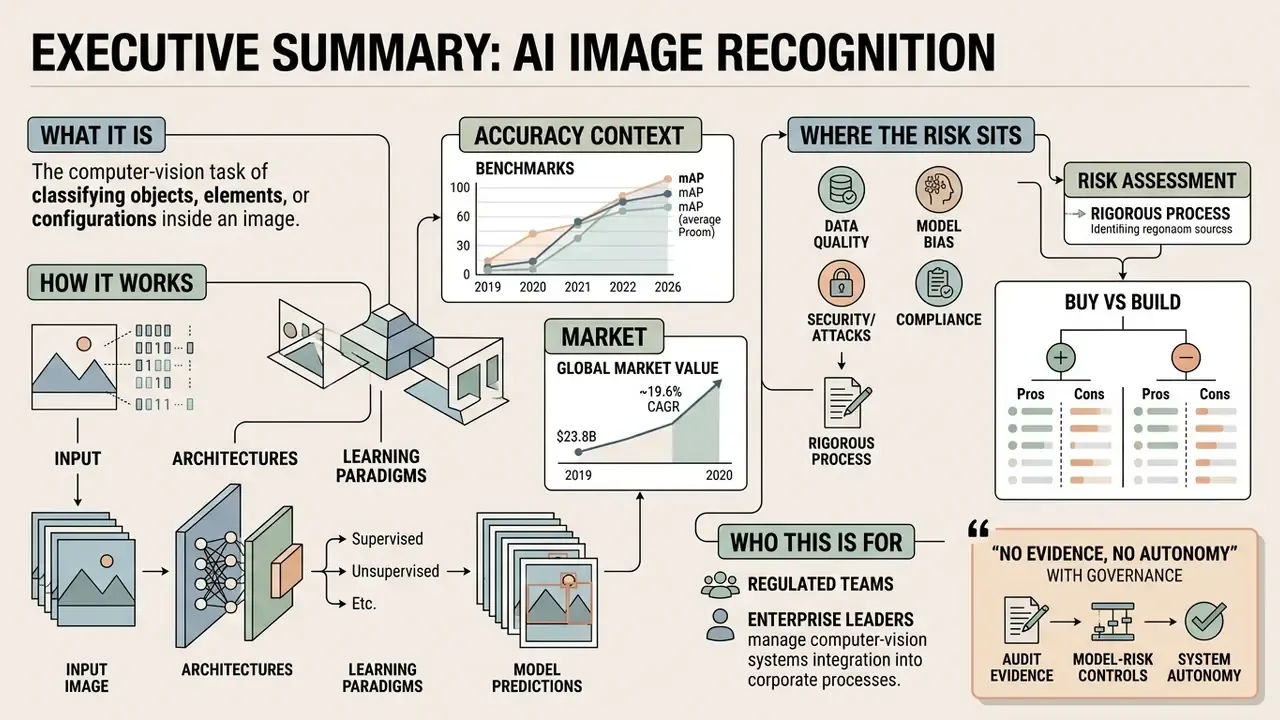
- What it is. AI image recognition is the computer-vision task of classifying objects, elements, or configurations inside an image, as formally defined by ISO/IEC 22989:2022 and its national adoption GOST R 71476-2024. It belongs to artificial intelligence because the decision rules are learned from data, not hand-coded by an engineer.
- How it works. Decode, then preprocess (Gaussian denoising, resize, normalize), then convolution plus activation, pooling, flattening, fully connected layers, and finally Softmax or Sigmoid. For detection tasks, add Non-Maximum Suppression and an Intersection-over-Union threshold.
- Accuracy context. Andrej Karpathy's manual ImageNet labeling experiment established a 5.1% human top-5 error reference point. Modern deep architectures have pushed top-5 error below roughly 1.2% on that benchmark, while still degrading sharply under domain shift and image corruption.
- Market. Global image-recognition technology was valued at $23.8B in 2019 and has been tracked at a 17.6% CAGR by Fortune Business Insights, driven by healthcare, retail, financial back-office automation, and autonomous mobility.
- Where the risk sits. Dataset representativeness, capture conditions, domain shift, adversarial and presentation attacks, and unlogged inference. Regulated deployments require documented audit evidence, human-in-the-loop escalation, and risk-adjusted ROI rather than accuracy alone.
- Buy vs build. Off-the-shelf APIs win on time-to-market and generic objects. Custom models and fine-tuning win on niche objects, sub-10ms edge latency, and data-residency constraints. Production fine-tuning typically needs 500+ labeled examples per class.
Who this material is written for. Model-risk leads, chief compliance officers, and operations executives who already have a vision pilot somewhere in the estate and now need it inventoried, validated, and defensible. If you are still deciding whether image recognition in AI is real enough to budget for, the sections on benchmarks and limitations will matter most. If you are past that point, skip ahead to model risk, audit evidence, and the ROI arithmetic.
Integrating computer-vision systems into corporate processes requires rigorous risk assessment, a transparent data architecture, and measurable accuracy controls. As regulatory expectations for AI tighten, operational leaders and model-risk specialists treat AI image recognition algorithms not as an abstract technology but as a digital instrument with clearly bounded responsibility. Ownership, access limits, escalation, audit trail, shutdown. That is the frame.
Historically, the reference point for machine vision surpassing human perception is 2014 to 2015. In a widely cited experiment, researcher Andrej Karpathy trained himself on 500 ImageNet images and manually labeled 1,500 more, producing a human baseline error rate of 5.1%, a figure that became the de facto human benchmark for image classification. Modern deep architectures (ResNet families, Vision Transformers) have driven top-5 error below 1.2%, which is precisely why automated visual inspection now outperforms manual review in high-volume, repetitive tasks. Quantitatively, the commercial consequence shows up in market data: the global image recognition market was valued at $23.8 billion in 2019 and has expanded at a 17.6% compound annual growth rate, with medical diagnostics, retail, financial document processing, and autonomous driving as the principal growth drivers.
What AI image recognition is, and whether it counts as artificial intelligence
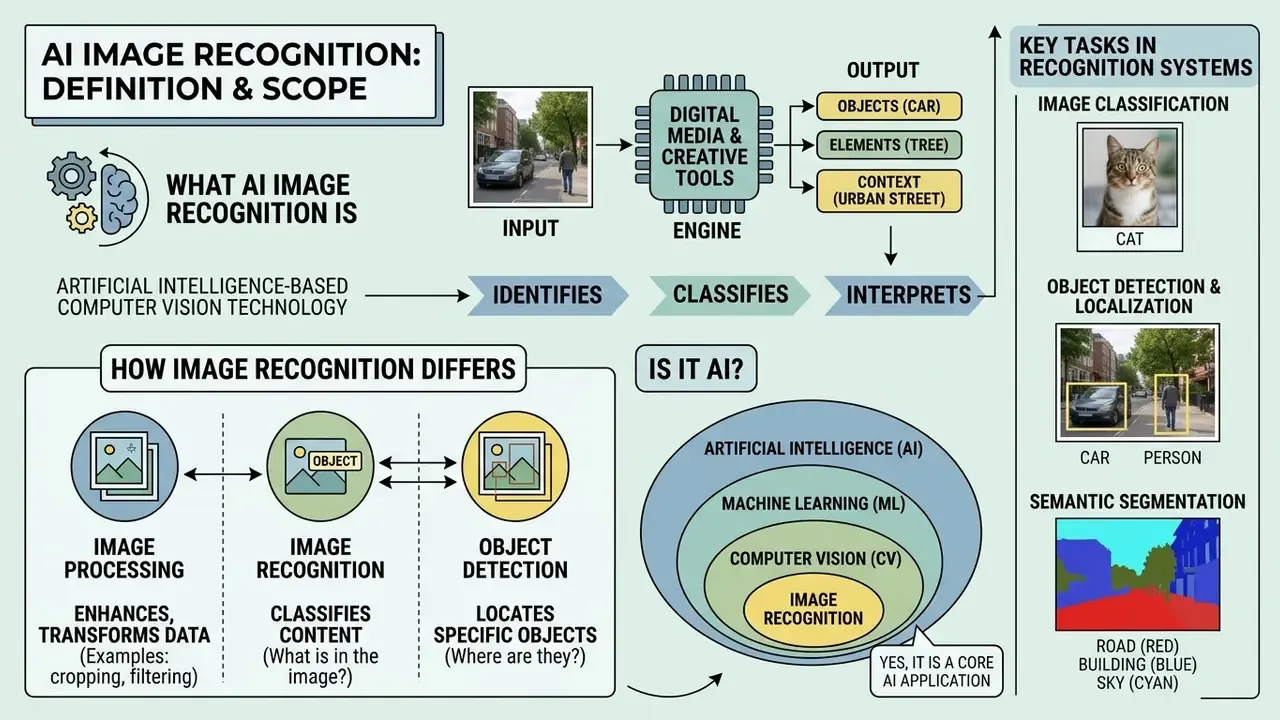
AI image recognition is an artificial-intelligence-based computer-vision technology that automatically identifies, classifies, and interprets objects, elements, or context in digital images. Under ISO/IEC 22989:2022 and GOST R 71476-2024, image recognition is defined as a subset of computer-vision tasks that assigns an object, or its configuration, to a given class through statistical analysis of visual data. The same standards define computer vision as the ability of a system to acquire, process, and interpret image data.
So, is image recognition an AI technology? Yes, and for a specific reason: it relies on machine learning and deep learning rather than hard-coded rules. Unlike deterministic filtering algorithms, AI systems build internal feature representations automatically by training on representative datasets. The U.S. National Science Foundation and NIST both describe image recognition as a core computer-vision task in which software learns visual patterns from large image collections in order to identify objects, places, people, writing, and actions.
Vocabulary hierarchy, in one line: artificial intelligence is the broad field; computer vision is the visual-data subfield; machine learning is the learning method; image recognition is the specific task; deep learning is the dominant implementation.
How image recognition differs from image processing and object detection
Image processing performs deterministic pixel-level transformations without analyzing semantic meaning: resizing, noise filtering, contrast correction, grayscale conversion, and brightness thresholding. Its purpose is to prepare input data, nothing more.
Image recognition assigns a categorical label to an entire image or a crop, answering whether a specific object class is present. It does not locate the object unless combined with detection.
Object detection extends the task: the algorithm determines both the object class and its precise spatial coordinates, producing bounding boxes. The output is per-instance, not per-image, which is why detection requires spatial annotations (boxes, masks, region features) rather than whole-image labels.
A practical consequence for procurement teams: if a vendor demo shows tidy boxes around every item on a shelf, you are buying detection, and detection needs annotation budgets that whole-image classification does not.
What tasks image recognition systems solve
Image recognition systems automate a broad spectrum of visual tasks in enterprise infrastructure. It helps to group them by output granularity: image level, object level, pixel level, plus document and reasoning tasks.
- Image classification assigning categorical labels to the whole image.
- Object detection and localization finding multiple instances and generating bounding boxes.
- Image segmentation pixel-wise delineation of object boundaries (semantic and instance segmentation).
- Optical Character Recognition (OCR) detecting and reading printed or handwritten text, tables, forms, and formulas.
- Facial recognition biometric comparison of facial descriptors for verification and access control.
- Video-level tasks object tracking, pose estimation, loitering and anomaly detection.
- Visual document understanding document, table, and chart parsing, visual question answering, and information extraction from forms and screenshots. Automated captioning belongs here too, which is why ai image description workflows increasingly sit next to OCR pipelines.
Glossary of core terms
- Image recognition is the automated interpretation of visual data to identify and classify objects using trained AI models.
- Computer vision is the AI field concerned with acquiring, processing, and interpreting digital images and video streams.
- Image classification assigns one or more categorical labels to an entire image without specifying spatial coordinates.
- Object detection detects objects in an image while simultaneously determining their categories and spatial coordinates as bounding boxes.
- Image segmentation partitions a digital image into segments or pixels with a class assigned to every pixel of the frame.
- OCR (Optical Character Recognition) is the specialized computer-vision task of detecting, recognizing, and converting text in images into machine-readable format.
- Facial recognition is biometric identification or verification of a person based on individual geometric and textural facial features.
- Model inventory is the governed register of all models in use, with owner, purpose, risk tier, validation status, and monitoring plan. It is the baseline artifact for model-risk management.
Which algorithms and models are used for AI image recognition
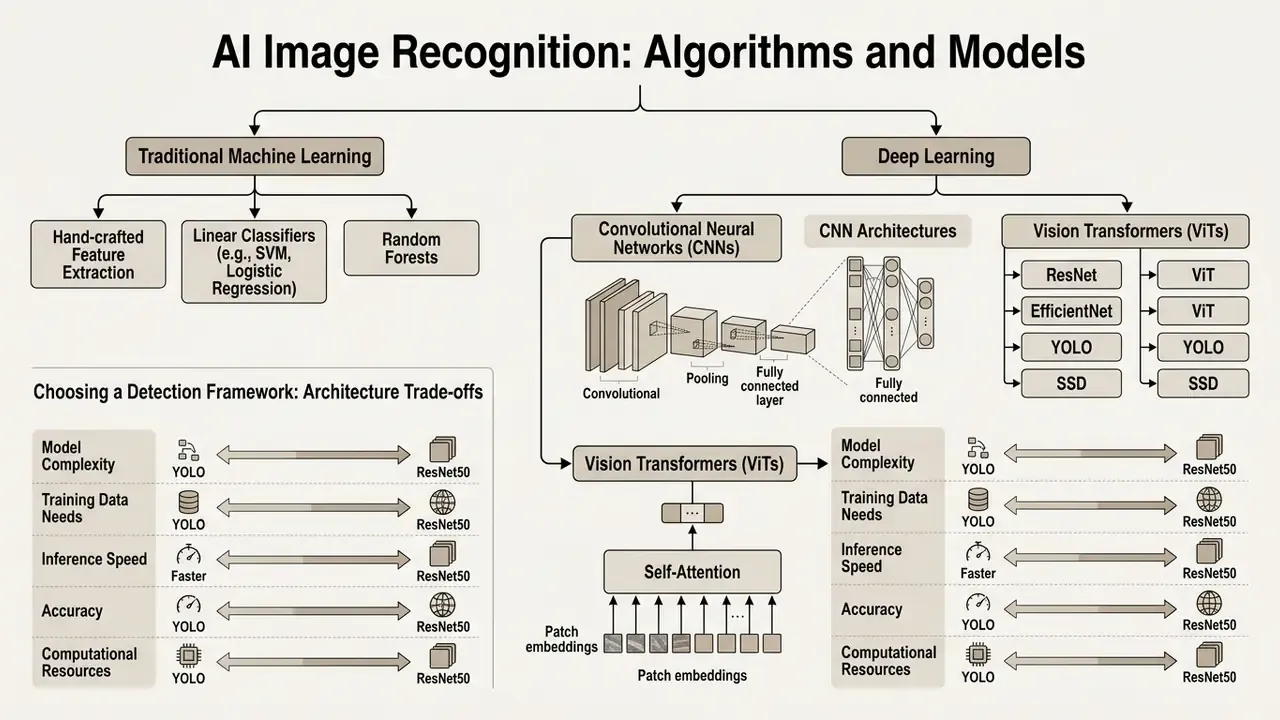
AI image recognition algorithms come in two broad families: classical machine-learning methods and deep neural architectures. The choice is driven by available data volume, latency budget, and compute constraints. Classical algorithms require manual feature engineering, whereas deep learning extracts patterns directly from raw pixels.
Comparative evidence is fairly consistent. On small, well-engineered datasets of structured images, classical algorithms retain an advantage in training speed and CPU footprint. On large datasets with complex visual structure, convolutional neural networks and transformers dominate on accuracy.
| Comparison parameter | Traditional machine learning (SVM, Random Forest) | Deep learning (CNN, Vision Transformers) |
|---|---|---|
| Training-data requirements | Highly effective on small datasets given correct feature engineering. | Requires large amounts of labeled images or pre-trained backbones. |
| Feature extraction | Manual descriptor design (HOG, SIFT, color, shape). | Automatic hierarchical feature learning from raw pixels. |
| Task complexity | Simple frame classification, basic detection on fixed backgrounds. | Complex segmentation, open-vocabulary detection, OCR in unstructured documents, moderation. |
| Real-time applicability | Minimal CPU consumption, fast on weak devices. | Needs hardware acceleration (GPU, TPU, NPU) or quantization. |
| Robustness to data shift | Low robustness to changes in lighting and viewing angle. | Strong generalization when trained on diverse datasets with augmentation. |
| Reported accuracy pattern | SVM 0.86 vs CNN 0.83 on small COREL1000-style sets. | SVM 0.88 vs CNN 0.98 on MNIST-scale data. |
Traditional machine learning for image recognition
Classical computer vision combines hand-crafted feature extraction with classifiers such as Support Vector Machines and Random Forest. Visual features are encoded with Histograms of Oriented Gradients (HOG) and the Scale-Invariant Feature Transform (SIFT).
Experimental work from 2024 on the GTSRB traffic-sign dataset confirms that HOG plus SVM reaches 95.2% accuracy, ahead of HOG plus Random Forest at 89.0%. In a 2025 clothing-attribute study the ranking inverted: Random Forest reached 80.60% versus SVM at 72.27%. Which demonstrates that the feature-classifier interaction is task-dependent, not universally ordered. Lightweight classical pipelines therefore remain relevant in embedded and autonomous systems with constrained resources, and as explainable challenger models in validation exercises. Validators like them for exactly that reason: a HOG plus SVM baseline is easy to interrogate line by line.
Deep learning, convolutional neural networks, and Vision Transformers
Deep convolutional neural networks (CNNs) and Vision Transformers (ViT) form the backbone of contemporary computer vision. CNNs apply local convolutional kernels, encoding locality and translation equivariance. That inductive bias makes neural networks CNNs data-efficient on mid-sized datasets.
Vision Transformers split the image into patches and use self-attention to model global relationships across the entire frame. When trained on very large corpora (for example JFT-3B), ViT models surpass conventional convolutional networks on complex-scene classification. One scaling study reports a 2B-parameter ViT reaching 90.45% top-1 on ImageNet. Conversely, reviews from 2023 to 2025 confirm CNNs remain competitive in low-data regimes precisely because of their stronger inductive bias.
«Grounding DINO 1.5 Pro achieves 54.3 AP on COCO and 55.7 AP on LVIS-minival under zero-shot transfer, setting a new record for open-set object detection.»
Choosing a detection framework: architecture trade-offs
Table. Detection architecture selection matrix for real-time versus high-precision workloads
| Architecture family | Typical strength | Latency / FPS profile | Accuracy profile | Best fit |
|---|---|---|---|---|
| YOLOv8 / YOLOv10 (one-stage) | Single forward pass, box plus class jointly | Highest FPS; runs on edge GPU or NPU | Strong mAP at moderate VRAM | Conveyor inspection, shelf audits, CCTV streams |
| Faster R-CNN (two-stage) | Region proposals then refinement | Lower FPS, heavier compute | High localization precision on small objects | Defectoscopy, medical pre-screening, forensic review |
| DETR / Deformable DETR (transformer) | End-to-end set prediction, no hand-tuned NMS | Moderate; longer training schedules | Strong on cluttered scenes | Dense retail scenes, crowded document layouts |
| Open-vocabulary (Grounding DINO, DE-ViT) | Text-prompted and few-shot detection | Moderate-to-high VRAM | 54.3 AP COCO zero-shot (Grounding DINO 1.5 Pro) | Long-tail classes, rapid pilot scoping without full labeling |
| SSD MobileNet (lightweight) | Minimal footprint, low power draw | Highest energy efficiency on Raspberry Pi or Jetson | Lower mAP | Battery-powered sensors, high-density camera fleets |
How AI image recognition works: from image to result
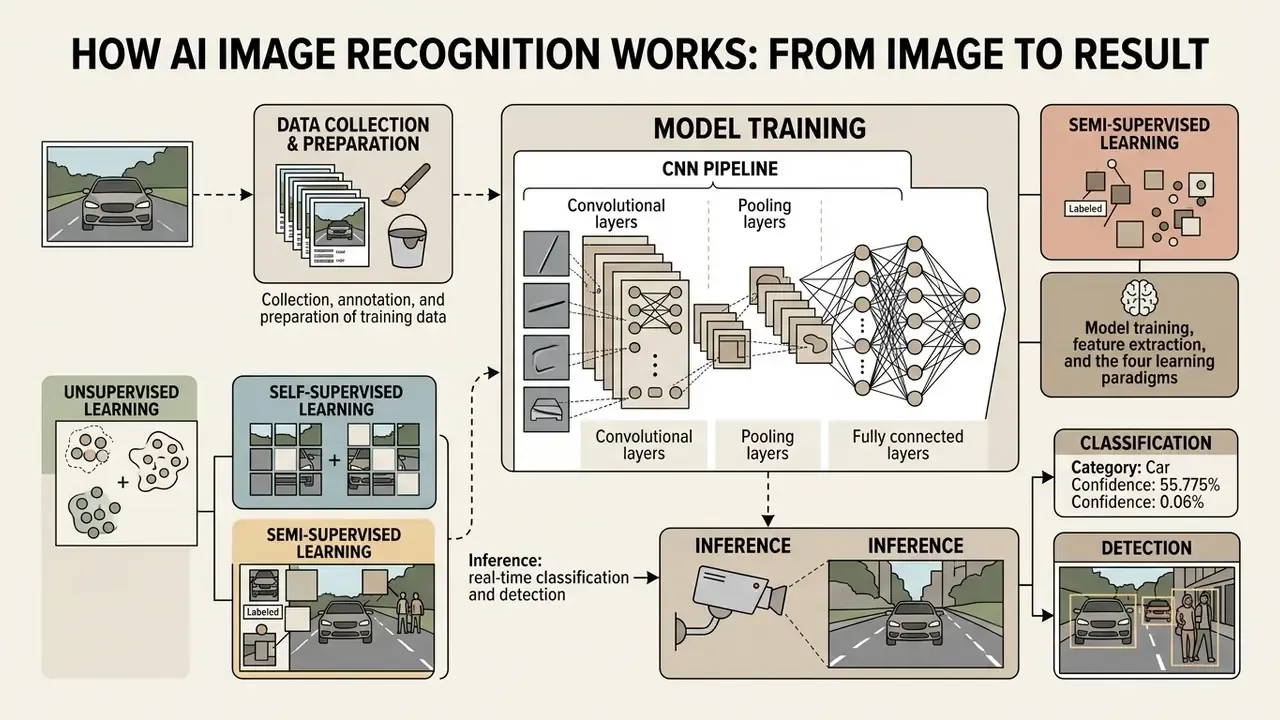
How does AI recognize images in practice? Through a sequential pipeline: frame decoding, pixel normalization, automatic feature extraction by the network, and generation of the final prediction at inference. The pipeline converts an unstructured pixel array into structured class probabilities and spatial coordinates.
The process begins by decoding a compressed graphics file into a numerical float32 matrix. The image data then undergoes a standardized mathematical transformation that brings color-channel values into a single range matching the statistics of the training dataset. Miss that step and accuracy collapses for reasons that look nothing like a model defect.
Figure 1. AI image recognition pipeline: from input data to decision.
Input image → data collection and annotation → preprocessing (Gaussian denoising, resize, normalization, augmentation) → neural network training (feature extraction) → real-time inference → final output (class label, bounding boxes, or OCR text) → human-in-the-loop review for high-risk decisions. Alt-text for publication: «How AI image recognition works: from image to recognized objects».
The CNN pipeline stage by stage
The convolutional architecture transforms the input matrix through the following key stages:
- Preprocessing: pixel-noise reduction via Gaussian filtering (Gaussian blur), grayscale conversion where color is irrelevant, resizing, center cropping, and normalization of pixel values to the 0 to 1 or the minus 1 to 1 range.
- Input layer: raw pixel intensities are treated as a numerical grid and passed forward for pattern extraction.
- Convolution layer: small kernels slide across the image to generate feature maps of local patterns such as edges and textures, followed by a non-linear activation function (ReLU) that lets stacked layers learn complex shapes.
- Pooling layer: downsampling via Max Pooling or Average Pooling reduces spatial resolution, cutting computational cost and adding invariance to slight shifts and rotations.
- Flattening: the multi-dimensional feature tensor is converted into a one-dimensional feature vector.
- Fully connected layers: learned patterns are integrated to model complex relationships across the whole frame.
- Output layer: final classification through Softmax (mutually exclusive classes) or Sigmoid (multi-label), compared with the annotated ground truth to compute error and update weights.
In modern architectures, narrow bottleneck layers compress the dimensionality of the feature space, which allows the resulting feature vectors to be fed into classical classifiers or specialized classification heads. Banks use that pattern often, because an explainable, auditable final decision layer on top of a deep feature extractor is much easier to validate than an end-to-end black box.
Collection, annotation, and preparation of training data
The performance of the final model depends entirely on the representativeness of the training dataset. Preparation involves collecting diverse images, systematically distributing them across classes, and verifying annotation consistency.
To prevent model skew, label-density limits are applied. In line with CVPR annotation guidance, crowded scenes should have every target annotated individually where feasible, while dataset policies such as Open Images cap the recommendation at roughly 15 bounding boxes per category per image to keep training stable. ITU-T FG-AI4H data-annotation guidance adds that bias is reduced by grouping and cross-checking annotations to resolve inconsistencies. Data augmentation (horizontal flips, 90 degree rotations, shifts, cropping, color normalization) artificially expands sample diversity and prevents overfitting. High resolution capture helps, though only up to the point where the sensor, not the model, becomes the limit.
«Re-annotating thousands of COCO-2017 masks showed that models predicting sharper object boundaries earn higher AP, and training on refined annotations speeds up convergence.»
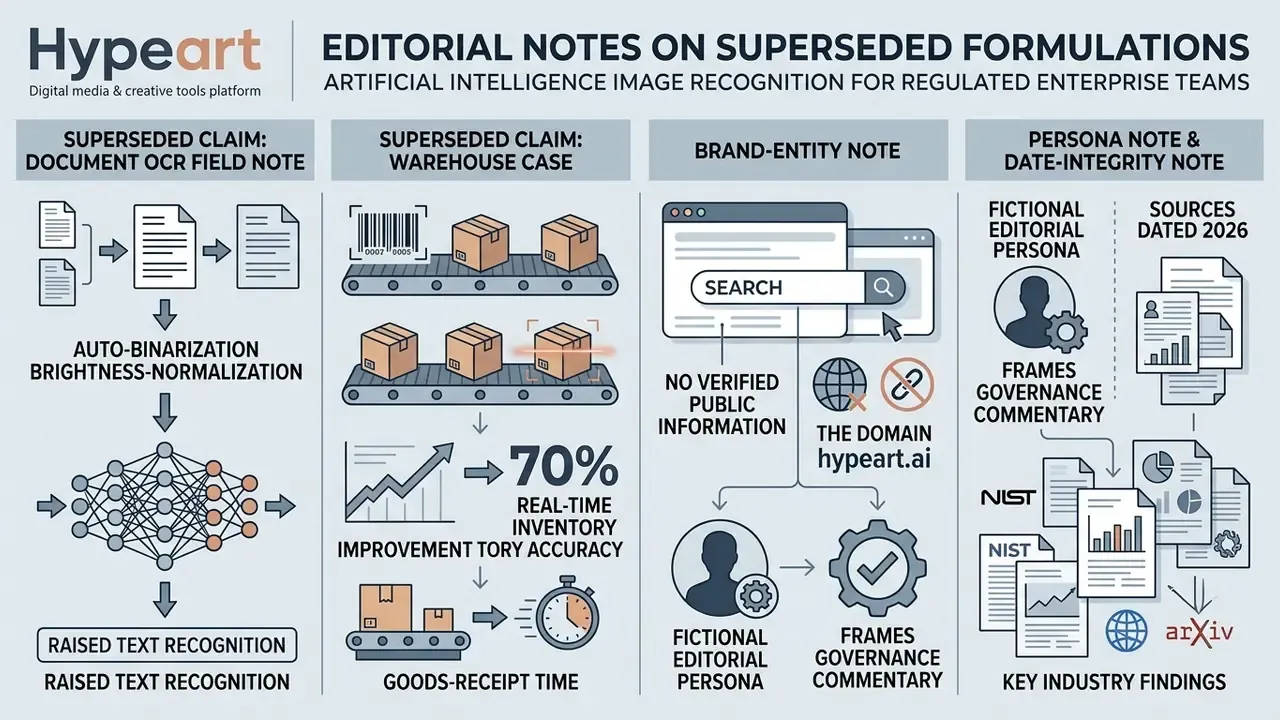
Updated (field note). During robustness testing of document-processing models in an operational-risk audit, reviewers found recurring failures on low-contrast scanned receipts. Adding an automatic binarization and brightness-normalization step before the frame reaches the network materially reduced text-recognition errors without retraining the primary classifier. The exact uplift is workload-specific and must be re-measured per document corpus, sample size, and scanner fleet. A single headline percentage should not be carried between environments, tempting as that is in a business case. For adjacent approaches to structuring visual content automatically, see the thematic ai image describer material, and for raising input quality before inference, review AI-based image enhancement.
Model training, feature extraction, and the four learning paradigms
Training image recognition models optimizes a loss function through backpropagation. Deep convolutional layers build a multi-level feature hierarchy: early layers capture brightness gradients and edges, mid-level layers capture simple shapes and textures, and deep layers form abstract representations of whole objects.
Beyond standard supervised learning on labeled images, industrial computer vision uses three further paradigms:
- Unsupervised learning.Clustering algorithms (k-means, t-SNE embeddings) group images by shared characteristics to surface anomalies and manufacturing defects without predefined class labels. Useful for fraud detection, quality control, and pattern analysis when labels are unavailable.
- Self-supervised learning.The model masks random fragments of an image and learns to reconstruct their structure, for example restoring a partially obscured face with Masked Autoencoders, producing robust descriptors without annotator involvement.
- Semi-supervised learning.The model trains on a small labeled subset, often around 10%, generates pseudo-labels across a large pool of raw images, then retrains on the expanded corpus. The pragmatic option when labeling budgets are capped.
For model-risk purposes these paradigms are not interchangeable. Label provenance, pseudo-label error propagation, and the absence of ground truth in unsupervised setups each create distinct validation obligations. Validators should ask which paradigm produced the weights before asking about accuracy.
Inference: real-time classification and detection
At inference, the trained model processes a new frame in a single forward pass and computes an array of class probabilities. For detection tasks, the prediction grid simultaneously produces coordinates x, y, width, and height for each candidate bounding box, alongside a confidence score reflecting both object presence and box accuracy.
Real-time operation is achieved through post-processing algorithms such as Non-Maximum Suppression (NMS). NMS computes the Intersection over Union (IoU) overlap ratio, discards duplicate boxes with lower confidence, and retains the single most accurate prediction. YOLO-family detectors, for example, evaluate the network once per frame and emit boxes plus per-box class probabilities, which is what makes frame-rate throughput possible and what lets vision systems enable real time decisions on a moving conveyor.
AI image recognition capabilities: what a system can actually recognize
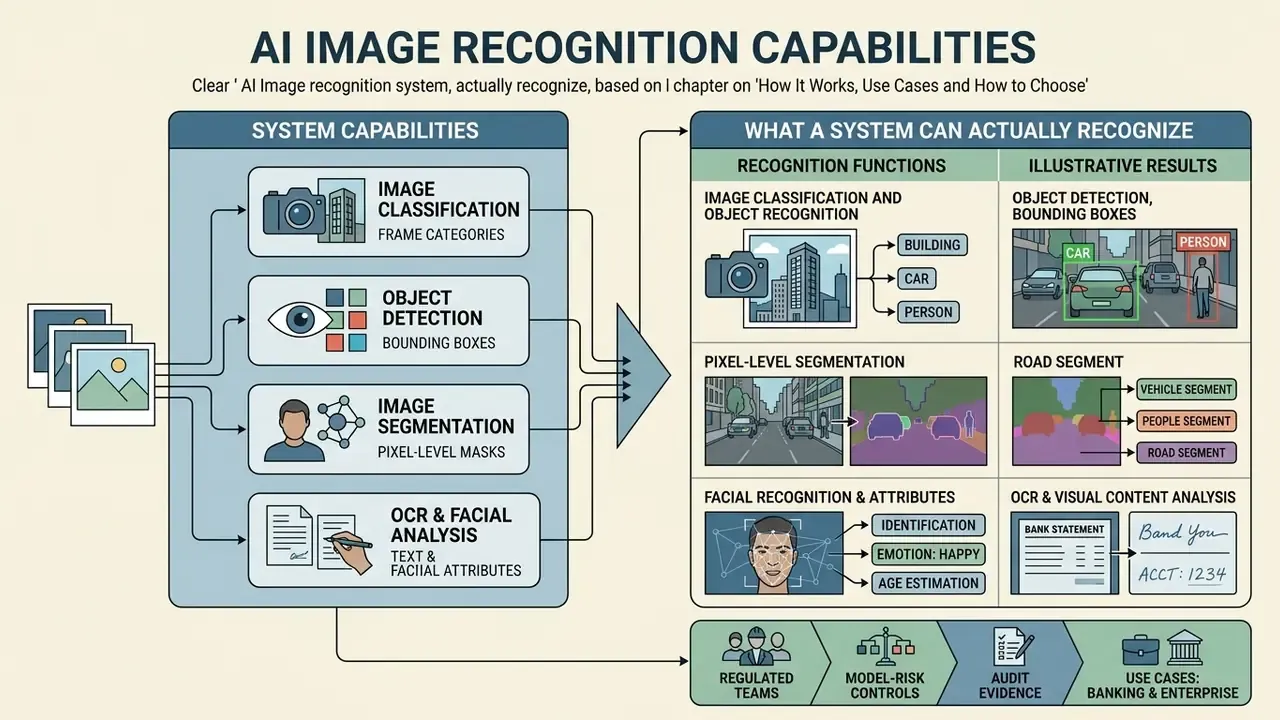
Modern AI driven image recognition systems can classify frame categories, locate multiple objects, build pixel-level segmentation masks, read printed and handwritten text, and match biometric parameters. Recognition completeness depends on network architecture and on the spatial granularity of the training annotations.
Functional capabilities split into three levels (image level, object level, pixel level) supplemented by specialized contextual-reading modules.
Image classification and object recognition
Image classification assigns one or more labels to the whole frame without spatial localization, based on holistic pattern analysis. It is the right tool for a first-pass sort of graphic content.
Object recognition works at both category and instance level. Open-vocabulary models such as Grounding DINO 1.5 jointly train visual and textual embeddings, enabling the system to recognize arbitrary specific objects from a text description without retraining, which drastically shortens pilot scoping when the class taxonomy is still unstable. Classification models are also central to AI-generated content detection, an increasingly common control in document-authenticity and media-verification workflows; the tooling landscape is covered in our ai image detector review.
«An optimized DenseNet model reaches 97.74% accuracy on the CIFAKE dataset, outperforming traditional methods at recognizing synthetic images.»
Object detection, bounding boxes, and image segmentation
Object detection computes the spatial coordinates of detected objects, wrapping each one in a bounding box. This allows precise counting and tracking of objects across a video stream. Boxes may be modal, covering only visible parts, or amodal, covering the object's full inferred extent. That distinction matters heavily in occlusion-prone environments such as warehouse aisles and crowded retail floors.
Figure 2. Detection versus pixel-level segmentation. Bounding boxes (x, y, width, height) drawn around objects, compared with per-pixel instance masks that follow exact object contours. Alt-text for publication: «Comparison of object detection and instance segmentation».
Image segmentation moves the analysis to individual pixels. Semantic segmentation assigns a class to every pixel, for example "road", "pedestrian", "sky", but does not separate instances of the same class. Instance segmentation adds a distinct mask per object, separating overlapping items of identical class.
Facial recognition, OCR, and visual content analysis
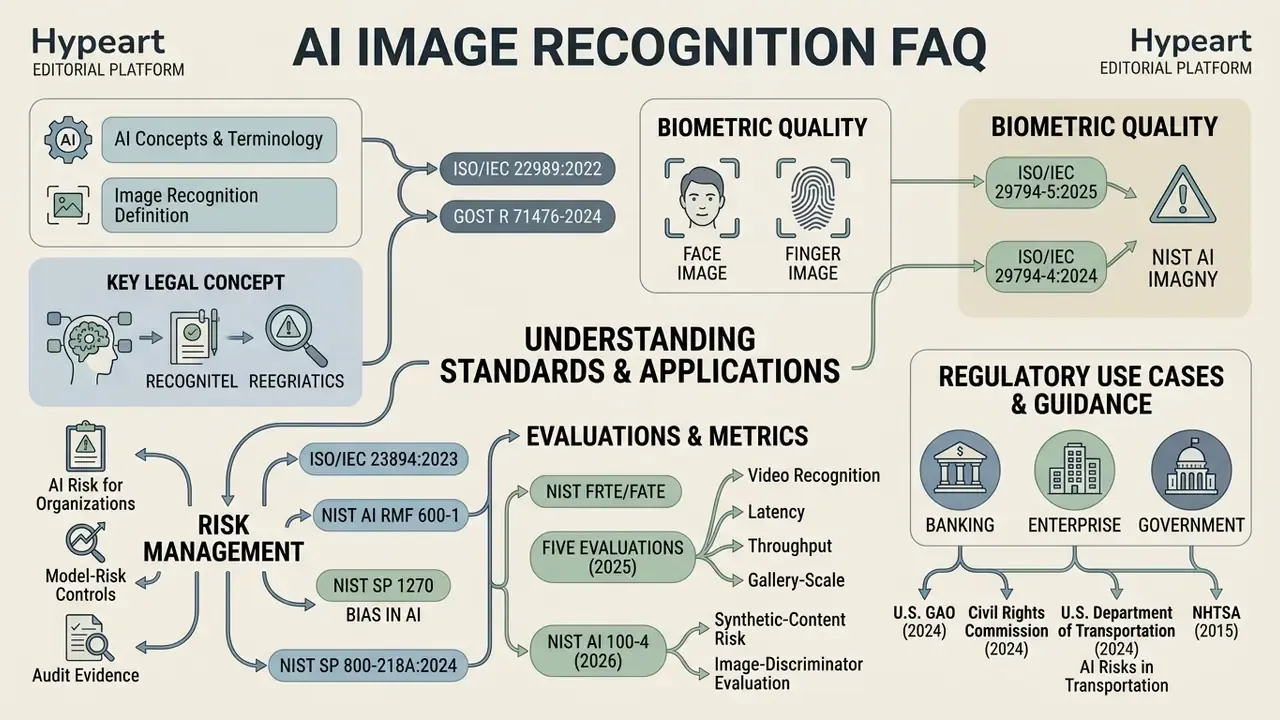
Facial recognition matches biometric facial features against reference templates in a database. ISO/IEC 29794-5:2025 standardizes face-image sample quality, with ISO/IEC 29794-4:2024 covering finger-image quality, and this underpins accuracy when a system must identify individuals under varying illumination and head pose. NIST's current evaluation tracks, renamed FRTE for technology evaluation and FATE for analysis of facial attributes, measure enrollment and search performance on video with CPU-only execution and large galleries. That makes latency, throughput, and gallery scalability first-class selection criteria alongside accuracy.
Optical character recognition and intelligent document analysis rely on specialized architectures. Benchmark results for the Qianfan-OCR model, 880 points on OCRBench together with results on CC-OCR, confirm the ability of AI to read multilingual text, formulas, and table structures inside complex spatial layouts.
«Qianfan-OCR ranks first on OmniDocBench v1.5 (93.12 points) and OLMOCRBench (79.8), confirming accurate multilingual document parsing.»
For automated visual moderation, contemporary systems combine CLIP-style multimodal encoders, OCR text extraction, and attention-based fusion. NIST's synthetic-content guidance ties moderation directly to detecting manipulated or generated imagery. Definitions for adjacent terms are collected in the glossary, and repeatable process patterns in workflows.
AI image recognition examples in business and the real world
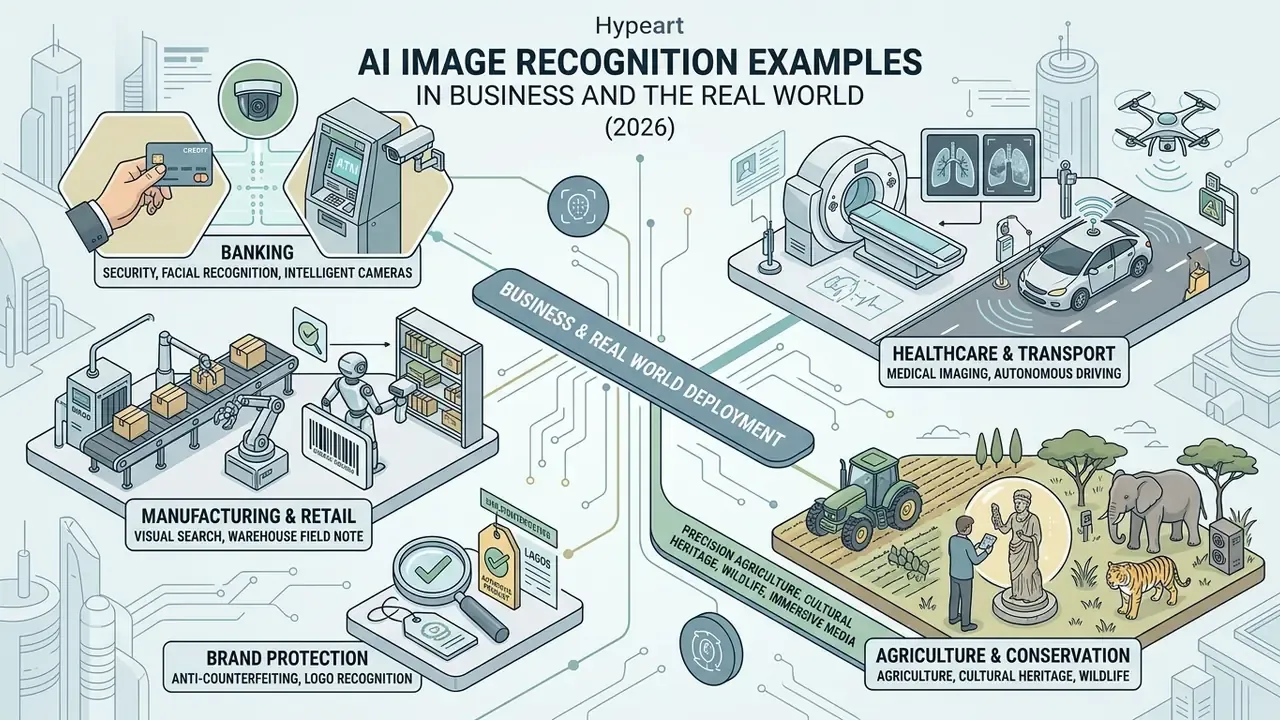
AI image recognition is deployed across banking, retail, manufacturing, healthcare, agriculture, transport, and conservation. Computer-vision technologies convert manual visual checks into automated, continuous processes. The leading commercial implementations are now documented at brand level, which makes benchmarking far easier than it was five years ago.
Embedding recognition algorithms into the operational perimeter still requires rigorous independent model validation, both to meet corporate safety standards and to prevent financial loss.
Security, facial recognition, and intelligent cameras
Manufacturing, retail, and visual search
In industrial production, YOLO-based defectoscopy algorithms analyze the conveyor video stream, locating cracks, chips, and geometric deviations. Peer-reviewed 2024 work applied YOLO to real-time detection and classification of defective products across multiple industrial datasets, and a PHM Society paper documented deep-learning defect detection from thermographic images in an aluminium die-casting foundry. Panasonic's 2024 industry analysis lists defect detection, out-of-stock detection, sorting, and repair or service analytics as active computer-vision workloads, while NIST's 2026 roadmap for AI and ML in smart manufacturing formally places machine vision inside industrial inspection workflows. Automated quality control reduces scrap volume and removes human-factor variance in high-speed assembly.
In retail, computer vision automates shelf audits, monitoring price-tag presence and planogram compliance. Google Cloud cites Febrafar reviewing product images from more than 18,000 stores with 97% accuracy. The technological benchmark for autonomous retail is the Amazon Go "Just Walk Out" architecture, which combines ceiling-camera instance segmentation with shelf weight sensors to attribute items to shoppers without checkout. Visual search lets customers find catalogue items from an uploaded photograph: Pinterest Lens and ASOS Visual Search match embedding vectors of the uploaded photo against the product catalogue in tens of milliseconds. Comparable consumer-facing retrieval behaviour is covered in our review of AI reverse image search tools.
Updated (warehouse field note). In a retail-chain warehouse optimization project, a model was deployed to count boxes on pallets from forklift-mounted video. Custom annotation of narrow pallet seams plus illumination normalization delivered high real-time inventory accuracy and materially compressed goods-receipt time versus manual counting. The measured accuracy figure applied to that specific site, camera geometry, and SKU mix. Treat it as an internal benchmark requiring re-measurement, including drift re-measurement over time, rather than a transferable guarantee. For adjacent image-handling techniques see ai image combiner and current industry developments in ai image editing news.
Brand protection and anti-counterfeiting (logo recognition)
Large e-commerce platforms apply specialized logo recognition algorithms to scan product listings automatically. The systems locate altered, distorted, or partially occluded brand logos in low-quality images, flagging counterfeit goods and copyright violations before a listing goes live. When a fake is confirmed, the item is removed and the seller is warned. Attribute-generation models complement this by populating product metadata automatically, which improves catalogue search quality while simultaneously creating an audit trail for intellectual-property enforcement. Related legal considerations are collected on the litigation page.
Medical imaging and autonomous driving
In medical diagnostics, computer-vision algorithms analyze CT scans, MRI, and X-ray studies. Under GOST R 71738-2024, which specifically covers AI systems in X-ray diagnostics for DICOM images and evaluates robustness, functional-correctness differences, and reliability under heterogeneous data, and according to a Frontiers in Radiology review (published 2025, DOI 10.3389/fradi.2025.1733003), AI systems help radiologists detect pneumonia foci, small tumours, pulmonary nodules, intracranial haemorrhage, tuberculosis, and occult fractures at earlier stages. A 2024 peer-reviewed medical-imaging review reports the same application set across X-ray, CT, and MRI, including lesion segmentation. Commercially, Google DeepMind health AI analyzes retinal scans for diabetic retinopathy and macular degeneration, while Zebra Medical Vision flags abnormalities in X-ray, CT, and MRI studies to support radiologist workflow. The Stanford AI Index 2025 records medical-imaging use cases among those successfully implemented in production, and Google Cloud cites Kyoto University Hospital automating referral and discharge letters and Fairtility analyzing embryo images to improve IVF outcomes.
In autonomous driving, networks process multispectral camera and LiDAR streams. Tesla Autopilot recognizes vehicles, pedestrians, and traffic signs for navigation. An IEEE ICAC 2024 study reports YOLOv8-based traffic-sign recognition at 94% mAP and pedestrian detection precision of 90.67% in complex urban traffic. Self-driving stacks illustrate the general rule rather well: perception accuracy is necessary, and still not sufficient without fallback behaviour.
«A transformer-based multimodal model for 3D detection on nuScenes delivers competitive accuracy while significantly improving operational efficiency for real-time systems.»
Agriculture, cultural heritage, wildlife, and immersive media
- Precision agriculture. Computer vision on multispectral drone cameras, exemplified by Blue River Technology (identifying weeds among crops for selective herbicide application, sharply cutting chemical usage) and Peat's Plantix (diagnosing crop disease from smartphone photos), supports millimetre-level targeting. NITI Aayog documents image recognition for soil-health monitoring and vision-guided weed spraying, and companies analyze crop imagery from drones, satellites, or aircraft to collect yield data, detect weed growth, and identify nutrient deficiencies.
- Cultural heritage. AI platforms such as Google Arts & Culture detect micro-cracking (craquelure) to plan painting restoration and reconstruct lost fragments of ancient manuscripts. Recognition services are also used in museums to identify artifacts and generate catalogue metadata.
- Wildlife conservation. Wildbook identifies individual animals, whale sharks and zebras among them, from unique natural markings, while SMART (Spatial Monitoring and Reporting Tool) camera networks alert authorities to poaching activity.
- Content moderation. Facebook and Instagram scan uploaded images for nudity, violence, and hate symbols, and YouTube flags inappropriate video frames automatically. Social media platforms remain the largest operational proving ground for moderation models.
- Gaming, AR and VR. NVIDIA Omniverse uses recognition and processing pipelines for lifelike environment rendering, and Pokémon GO identifies real-world surfaces and objects to overlay virtual elements. Machine learning also lets AR recognition adapt to changes in lighting, angle, distance, and occlusion, updating its reference database from new data and feedback.
Verifiable regulatory and technical sources (E-E-A-T)
- NHTSA (2015) The Potential for Adaptive Safety Through In-Vehicle Biomedical and Biometric Monitoring, driver biometric monitoring framework.
- U.S. Department of Transportation (2024) Understanding AI Risks in Transportation Whitepaper, official DOT report on AI risk in autonomous and connected transport.
- NIST AI 100-4 (2026) Reducing Risks Posed by Synthetic Content / GenAI pilot evaluation of image discriminators, reliability and robustness evaluation for image detectors. https://nvlpubs.nist.gov/nistpubs/ai/NIST.AI.100-4.pdf
- U.S. GAO (2024) Biometric Identification Technologies report, accuracy gaps from non-diverse training data and capture conditions. https://www.gao.gov/assets/d24106293.pdf
- WHO (2023) Regulatory considerations on artificial intelligence for health, international validation requirements for medical AI.
Financial services: KYC, document processing, collateral, and fraud
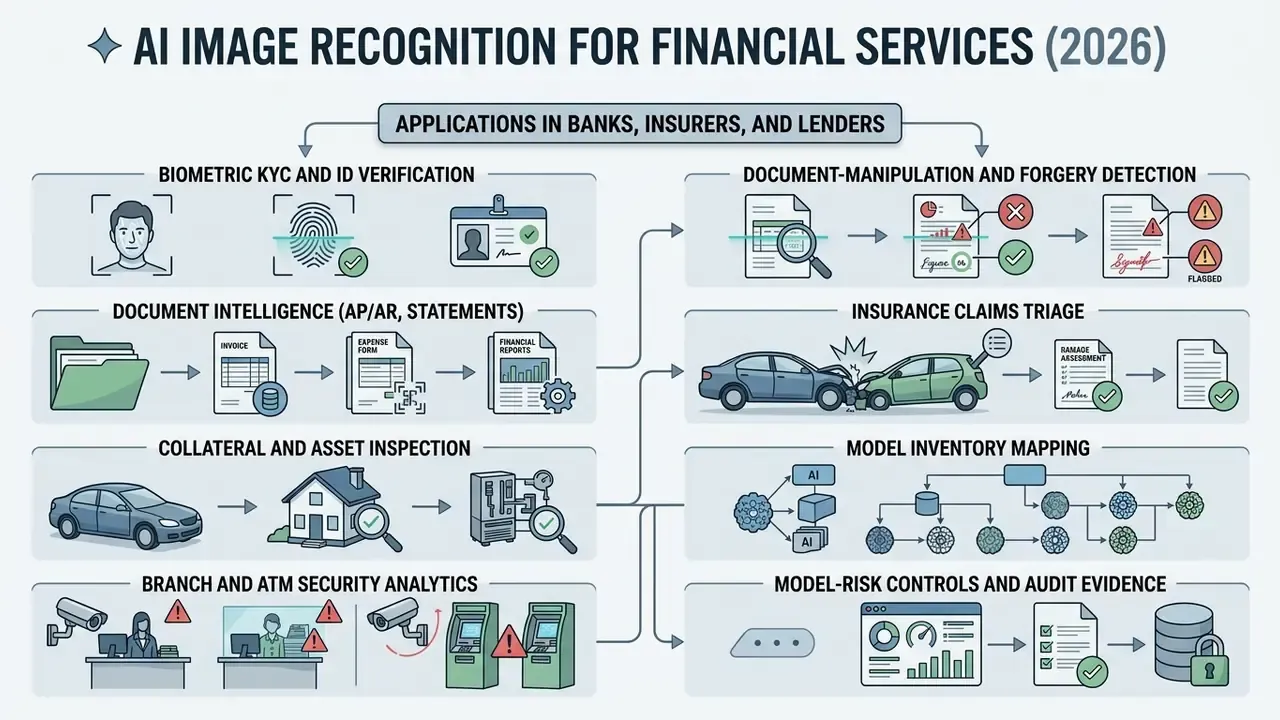
For banks, insurers, and lenders, image recognition using AI is not an exotic capability. It sits directly inside customer onboarding, back-office throughput, and fraud loss. The scenarios below map most cleanly onto existing model-risk and control frameworks.
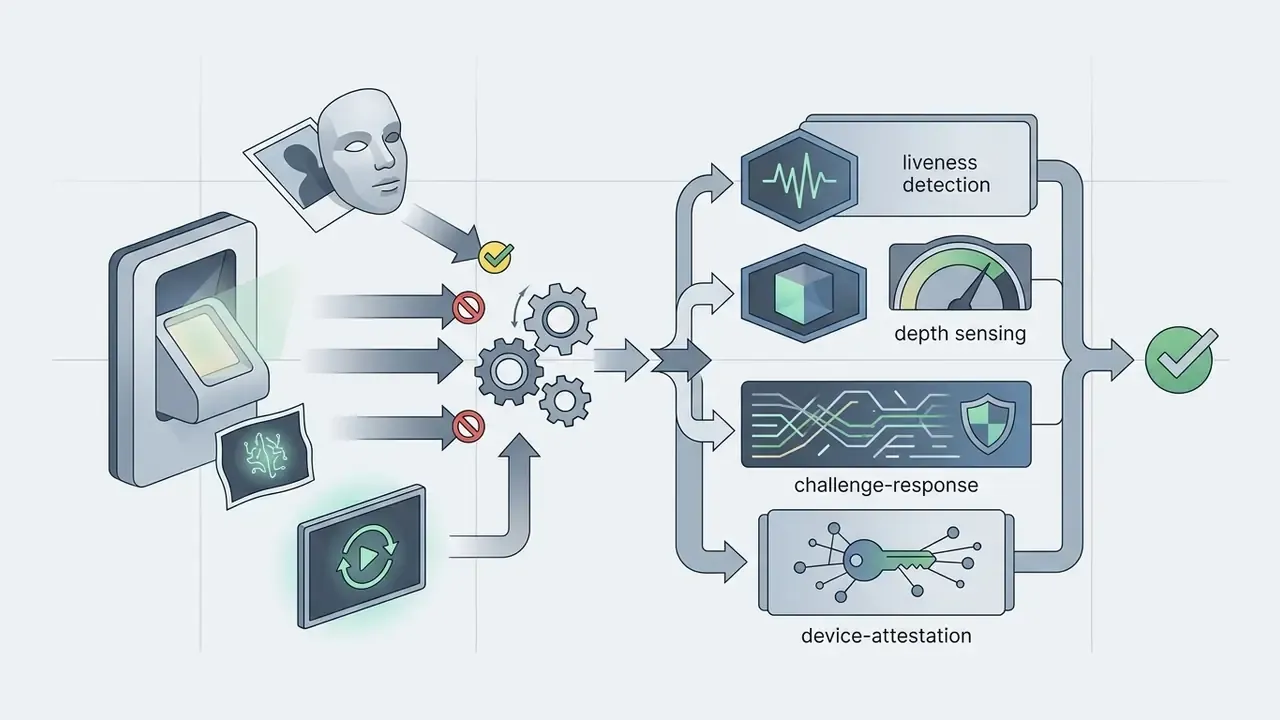
- Biometric KYC and identity verification. Document-liveness and face-match pipelines compare a selfie against the photograph on an identity document. The controlling metrics are false match rate (FMR) and false non-match rate (FNMR) measured per demographic segment, plus presentation-attack detection (PAD) rates against printed photos, masks, replay attacks, and injected deepfakes. AWS AI Service Cards explicitly scope face matching to human faces and to use cases such as identity verification and media search.
- Document intelligence for AP and AR and financial statements. OCR plus layout models extract totals, tax identifiers, line items, IBANs, and signature blocks from invoices, receipts, statements, and financial reports. Key controls: field-level confidence thresholds, mandatory human review below threshold, reconciliation against ledger records, and exception-rate monitoring.
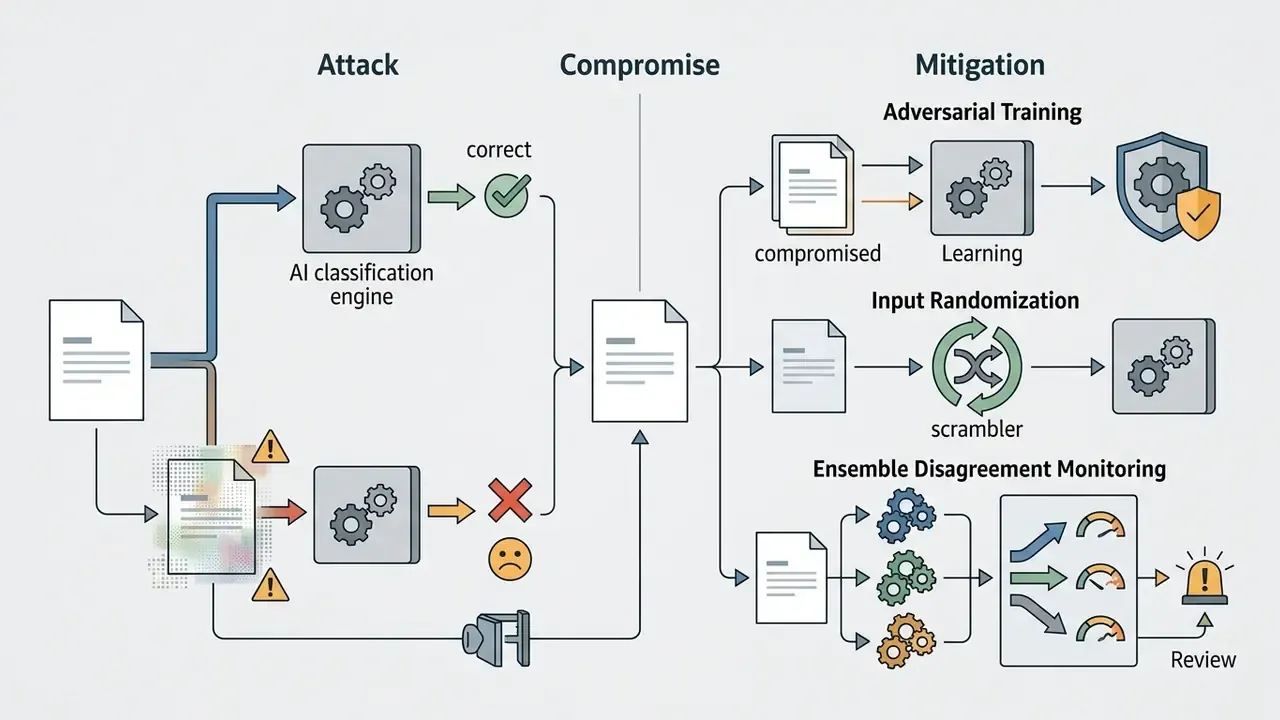
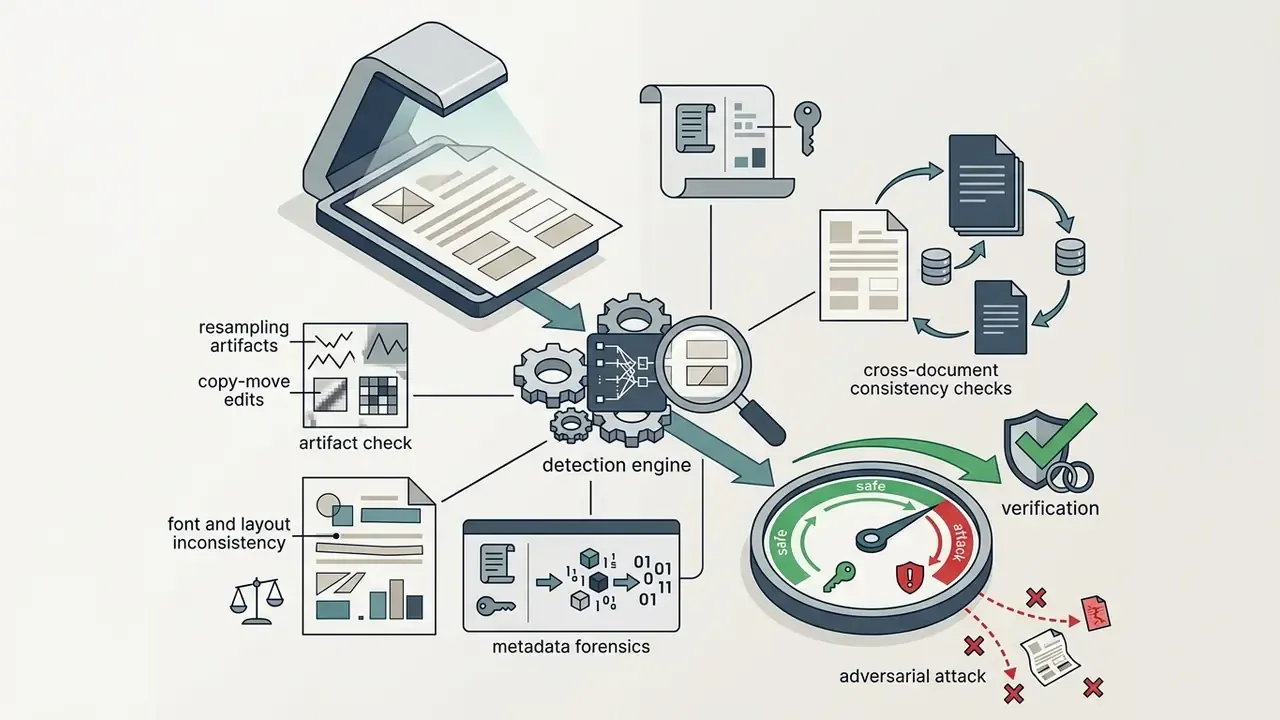
- Document-manipulation and forgery detection. Classifiers detect copy-move edits, font inconsistency, resampling artifacts, metadata mismatch, and synthetic generation in scanned documents, a direct control against application fraud. Synthetic-content detectors, however, degrade sharply across unfamiliar generators and after compression, so they must be positioned as risk indicators feeding investigation, not as automated rejection triggers.
- Collateral and asset inspection. Property, vehicle, and equipment photographs are assessed for condition, damage, and consistency with declared attributes, with geolocation and timestamp cross-checks to detect reused imagery.
- Insurance claims triage. Damage-severity classification and part-level detection route claims between fast-track settlement and manual adjuster review.
- Branch and ATM security analytics. Anomaly detection on camera streams flags tampering, skimming devices, loitering, and after-hours presence.
Model inventory mapping. The table below supports classification of vision models in a bank's model register and the corresponding validation emphasis, consistent with the expectations of Federal Reserve and OCC SR 11-7 model risk management guidance and the FFIEC IT Examination Handbook.
| Task type | Typical financial-sector use | Indicative risk tier | Validation emphasis |
|---|---|---|---|
| Image classification | Document-type routing, content moderation | Low to Medium | Class balance, confusion matrix, threshold calibration |
| OCR and document extraction | AP and AR, statement spreading, KYC document capture | Medium to High | Field-level accuracy, character and word error rate, exception handling, reconciliation |
| Object detection | Collateral damage localization, tamper detection | Medium | mAP and IoU by object size, occlusion robustness, NMS threshold sensitivity |
| Segmentation | Damage-area quantification, signature isolation | Medium | Mask IoU, boundary precision, annotator agreement |
| Face biometrics | KYC verification, branch access control | High | FMR and FNMR by demographic segment, PAD, gallery-scale latency, privacy impact assessment |
| Synthetic and forgery detection | Application-fraud screening | High | Cross-generator generalization, post-processing robustness, false-positive cost |
Limitations and challenges in image recognition
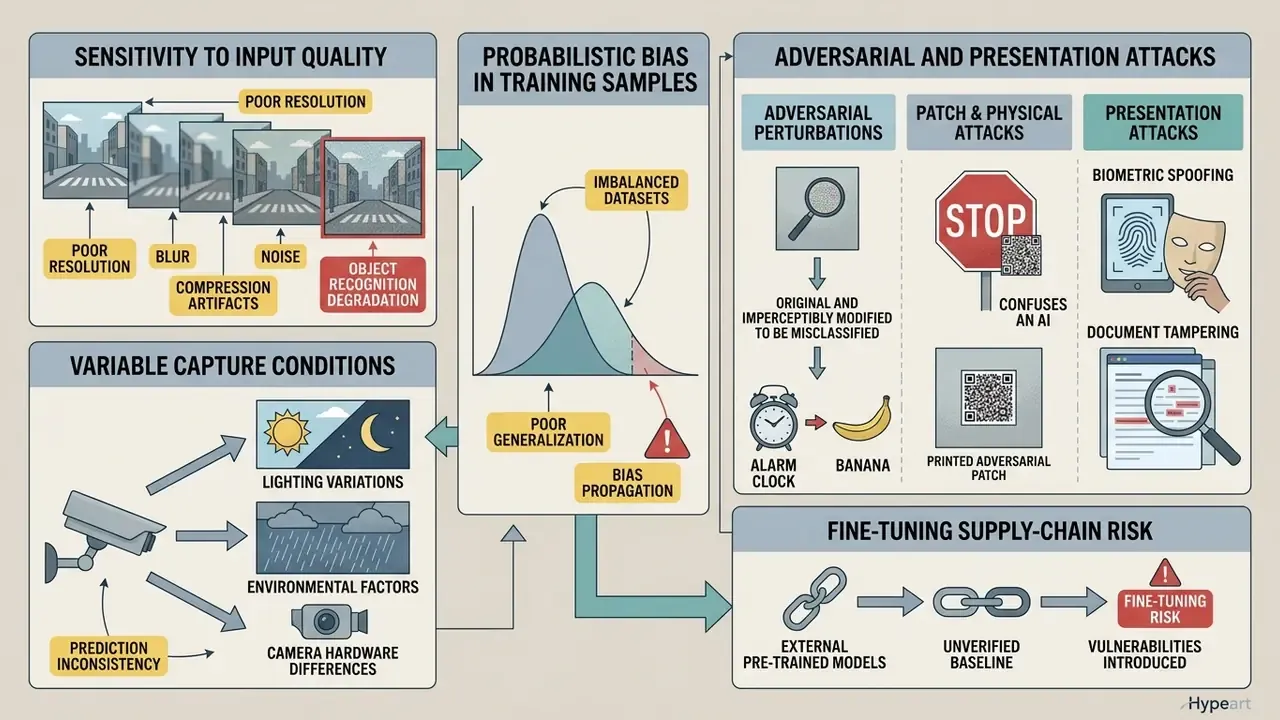
The reliability of AI based image recognition systems is bounded by sensitivity to input quality, changes in capture conditions, and probabilistic bias in training samples. In production, a model's operational accuracy can differ substantially from the figures obtained on laboratory benchmarks. Sometimes by a lot.
Reports from the U.S. Government Accountability Office (2024) and NIST evaluations indicate that domain shift and frame post-processing can reduce detection accuracy for synthetic and natural imagery to 50 to 62%, with AUC ranging from 53 to 91% across conditions.
«On the COCO-O benchmark, detectors lose a significant share of AP when moving from natural photographs to abstract domains such as sketches and tattoos.»
How image quality affects recognition work
Physical capture conditions directly affect the mathematical stability of feature extraction. The key accuracy-degradation factors are:
- Insufficient or excessive illumination (overexposure or underexposure), and flickering light.
- Cluttered or obscured images, including partial occlusion of target objects. NIST quality work computes an explicit occlusion ratio from the covered face area, treating occlusion as a measurable quality variable.
- Extreme angle and perspective variations, motion blur, low sensor resolution, object size and proximity effects, and operator or interpreter variance.
NIST's video-quality research found that in dark conditions with flashing lights, recognition performance did not exceed 80%, even where available bitrate could have supported better results. Illumination, not compute, was the binding constraint (Video Quality Tests for Object Recognition Applications, NIST, 2016). NIST's earlier work on lighting and focus, and the FRVT reports on illumination and resolution, point in the same direction.
«COCO-C comprises 15 corruption subsets covering noise, blur, and compression, and shows that high mAP under clean conditions does not guarantee robustness to real-world degradation.»
Why the training dataset determines model quality
Systematic bias arises when the training set does not reflect the real diversity of operating conditions. Imbalanced datasets cause a sharp accuracy collapse when the model encounters rare classes or non-standard backgrounds. NIST SP 1270 notes that systemic bias can emerge from improperly used protected attributes and from culturally or contextually skewed data. The U.S. Commission on Civil Rights (2024) reports that facial-recognition errors are more prevalent for brown-skinned individuals, women, and elderly subjects.
Overfitting makes the network memorize the specific noise of the training sample instead of learning fundamental patterns. To prevent this, NIST AI RMF 600-1 requires documented data sources, review and measurement of bias in training and in test-evaluation-verification-validation data, and cross-validation on independent external samples.
«Detectors trained on the refined COCO-ReM masks converge faster and reach higher AP than those trained on original COCO-2017 with imprecise annotations.»
Adversarial and presentation attacks
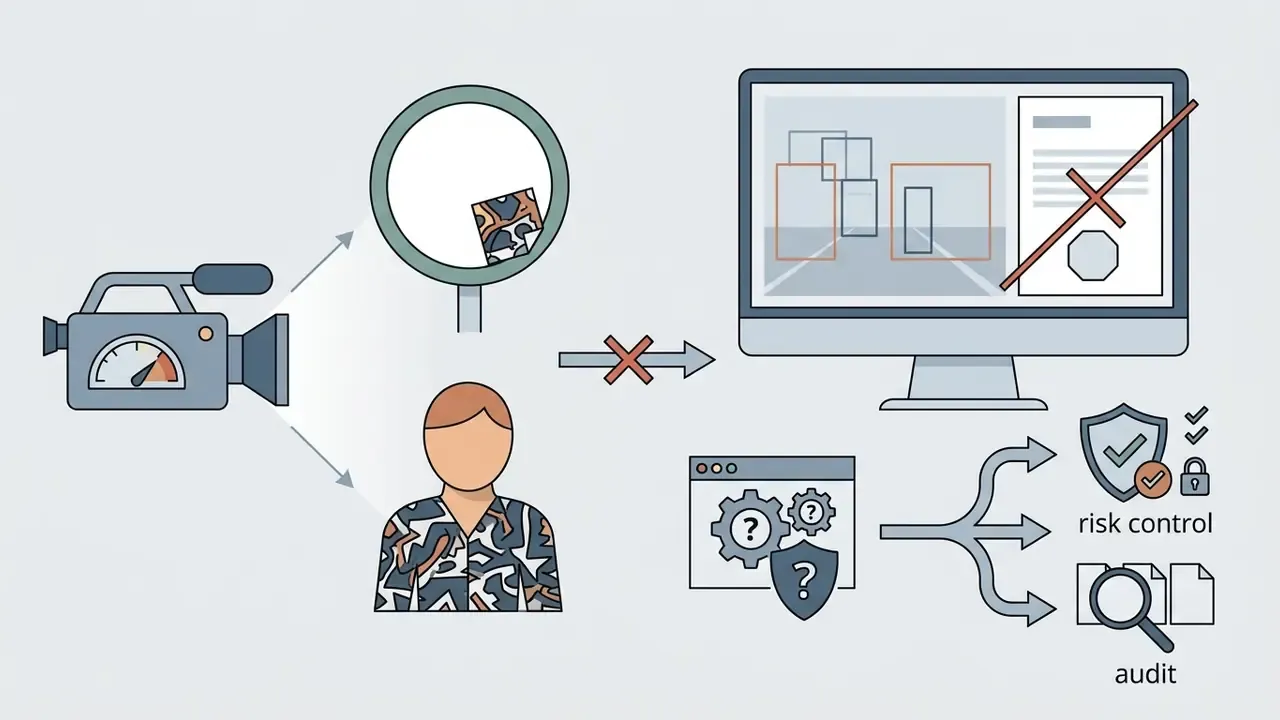
Beyond natural degradation, vision models face deliberate manipulation:
Detection metrics to monitor: attack presentation classification error rate (APCER), bona fide presentation classification error rate (BPCER), out-of-distribution scores, confidence-distribution drift, and override rates by human reviewers.

Model risk, audit evidence, and governance
For regulated institutions, a vision model becomes deployable only when it is reproducibly evidenced. The checklist below consolidates the artifacts that internal validators and external examiners typically request, aligned with SR 11-7 model risk management expectations, ISO/IEC 23894:2023 AI risk management, NIST AI RMF, and NIST SP 800-218A (2024), which extends secure-development practices to model producers, AI-system producers, and acquirers.
Checklist0 / 13
One blunt observation from audit practice: the item that fails most often is not robustness testing. It is inference logging. Models get deployed behind a queue that keeps no record of what the model saw, what it scored, or who overrode it, and the evidence file becomes unreconstructable after the fact.
How to choose image recognition software for commercial use
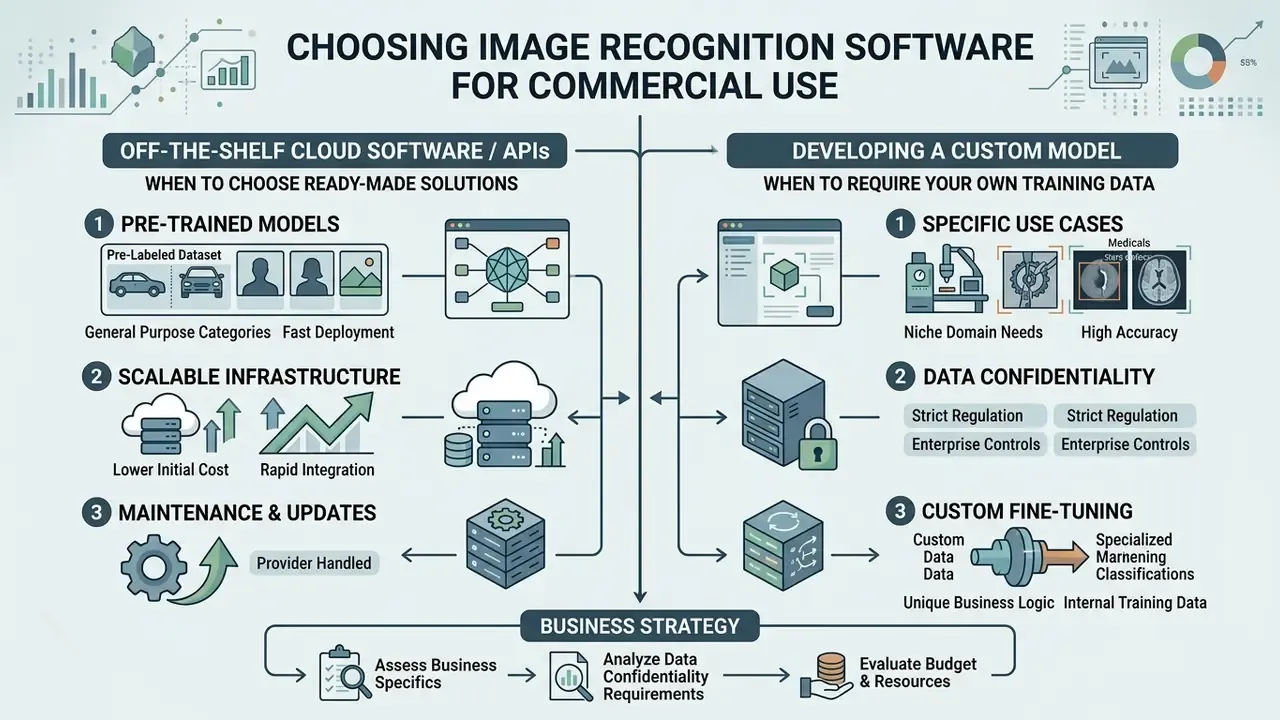
The choice between purchasing ready-made cloud software or APIs and developing a custom model is determined by business specifics, data-confidentiality requirements, and the acceptable latency budget. Following the CMS AI Playbook and ISO/IEC 23894:2023, the organization must weigh total cost of ownership, long-term maintenance burden, integration effort, privacy constraints, on-premise options, and vendor lock-in risk.
When evaluating architectural options, it is critical to analyze internal requirements for protecting trade secrets and regulated personal data. NIST SP 800-239 (draft, 2026) frames confidentiality as protecting authorized restrictions on access to and disclosure of proprietary data, which is the decisive criterion for many custom-model decisions.
When to choose off-the-shelf image recognition software
Managed, AI powered cloud services (AWS Rekognition, Google Cloud Vision API) are optimal for standard, general-purpose recognition tasks. They are the right choice when:
- A fast time-to-market is required without investing in a proprietary dataset.
- The task is limited to recognizing common objects, readable text (OCR), landmarks, product matching, or content moderation.
- There are no hard requirements to keep visual data inside a local perimeter.
Off-the-shelf API limits are set by vendor policy. AWS guidance publicly prohibits using Rekognition for sustained surveillance or for autonomous decisions that require human review, and AWS AI Service Cards restrict face matching to human faces and to opt-in verification or media-search scenarios. NIST SP 800-228 additionally recommends encoding maximum latency and timeouts directly in the API contract, and notes that gateway or WAF placement affects both latency and compute cost, a practical control for procurement teams. For simpler graphics tasks, see the ai image editor; to benchmark ready-made options against each other, open the hub and review our tool comparisons.
When you need your own training data and a custom model
Building a model from scratch or fine-tuning an existing backbone becomes necessary when production requirements are unique:
- Work with narrowly specialized objects (rolled-metal defects, SAR imagery analysis, CT and MRI studies, bank-specific document templates).
- A requirement to process video with minimal latency, under 10 ms, on edge devices.
- Trade-secret or data-residency obligations that prohibit sending frames to external clouds.
- Task-specific output formats or decision behaviour that general-purpose models cannot express.
Azure AI Foundry guidance indicates that 50 to 100 examples suffice for early testing, scaling to 500+ high-quality labeled examples per target class for production fine-tuning of specialized vision models. AWS SageMaker documents domain-adaptation fine-tuning explicitly for specialized business datasets, and Oracle's generative-AI documentation frames custom models around dedicated fine-tuning workflows and hosted endpoints.
Where edge deployment is planned, input quality and resolution handling matter as much as the model: see image upscaling for edge devices. For a wider view of adjacent tooling, browse the hub.
| Evaluation criterion | Off-the-shelf software or cloud API (AWS, Google) | Custom model or fine-tuning |
|---|---|---|
| Training-data availability | No data required; the vendor's pre-trained base models are used. | Requires a proprietary labeled dataset, 500+ examples per class. |
| Object specificity | Standard object categories, generic text, faces, public brands. | Narrow specialized objects, unique defects, bespoke document templates. |
| Latency | Depends on network stability and shared API load. | Minimal latency when deployed on local GPU or NPU hardware. |
| Security and confidentiality | Data leaves for an external cloud; legal and residency risks apply. | Full data control inside a local or private isolated perimeter. |
| Budget and launch | Low entry threshold; pay-as-you-go per request. | High capital expenditure on data collection, annotation, and training infrastructure. |
| Auditability | Vendor-controlled model versioning; evidence depends on vendor disclosure. | Full reproducibility of weights, datasets, and inference logs. |
| Vendor lock-in | High: proprietary APIs, formats, and pricing changes. | Low: portable weights, but a higher internal maintenance burden. |
Read the table as a decision rule, not a scorecard. Choose the managed API when objects are generic, latency is forgiving, and no residency clause blocks the transfer. Choose a custom model when the objects are yours alone, the frames cannot leave the perimeter, or the audit file must be reproducible down to the seed.
«On Raspberry Pi and Jetson Orin Nano, low-mAP models such as SSD MobileNet V1 are more energy-efficient, whereas YOLOv8 Medium consumes more resources at higher accuracy.»
Risk-adjusted ROI: costing a vision deployment properly
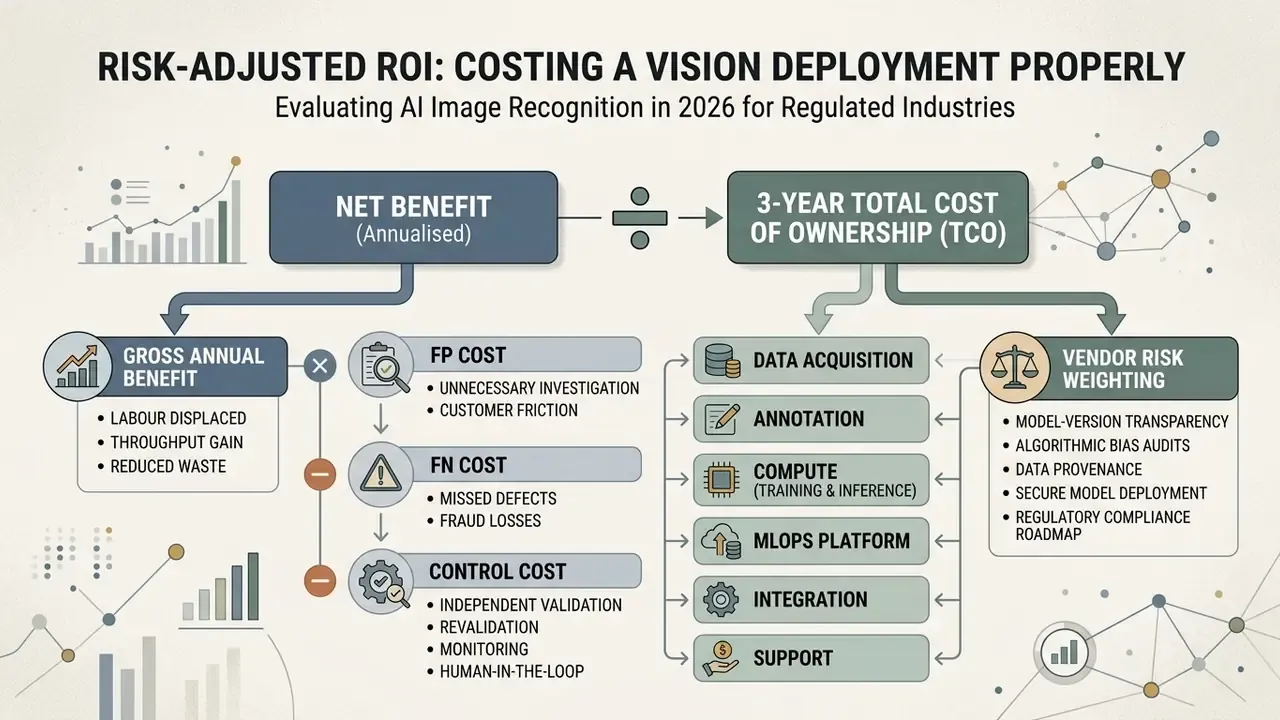
Accuracy alone does not justify a deployment. A defensible business case prices the cost of being wrong and the cost of being controlled:
Risk-Adjusted ROI = (Gross annual benefit − FP cost − FN cost − Control cost) ÷ 3-year TCO
Where:
- Gross annual benefit equals labour hours displaced times loaded hourly rate, plus throughput gain times unit margin, plus avoided loss from fraud, scrap, and penalties.
- FP cost equals false-positive volume times cost per unnecessary investigation, customer-friction event, or halted production run.
- FN cost equals false-negative volume times expected loss per missed defect, missed fraud, or missed compliance breach.
- Control cost covers independent validation, annual revalidation, monitoring tooling, human-in-the-loop review FTE, privacy and legal review, and incident handling.
- 3-year TCO covers data acquisition and annotation, compute for training and inference, MLOps platform, integration, vendor fees, retraining cycles, and decommissioning.
Vendor assessment criteria to include in the risk weighting of the denominator: model-version transparency, data-residency options, subprocessor disclosure, independence from a single mono-platform stack, export and portability of embeddings and weights, contractual latency and uptime commitments, notification windows for breaking model changes, and third-party security attestations.
A practical rule: if the modelled FP and FN costs exceed the gross benefit at the accuracy level achievable on your own validation set, the correct decision is a narrower scope with mandatory human review. Not a larger model.
FAQ
Is image recognition the same thing as computer vision?
No. Computer vision is the broader field of acquiring, processing, and interpreting visual data; image recognition is one core task inside it, focused on identifying and classifying content.
Can AI recognize images without human oversight?
Technically yes, and in low-stakes workflows that is routine. In regulated decisions it is a governance question, not a technical one. Autonomy should follow evidence: documented accuracy by segment, logged inference, a written escalation path, and an owner who can switch the system off. Absent those artifacts, keep a qualified reviewer in the loop.
What accuracy should we expect in production?
Expect lower numbers than benchmarks suggest. Published detectors that score well on clean COCO-style data lose substantial AP under corruption (COCO-C) and domain shift (COCO-O), and synthetic-image detectors can fall to 50 to 62% accuracy after cross-generator transfer and post-processing. Always measure on your own representative hold-out set.
How much labeled data do we need?
50 to 100 examples per class is enough for an early feasibility test. Production fine-tuning of specialized vision models generally starts at 500+ high-quality labeled examples per class. Few-shot open-vocabulary models such as DE-ViT can reduce this, but they still require validation on in-domain data.
Can we run recognition without sending images to a cloud?
Yes. Edge deployment on local GPU or NPU hardware supports sub-10ms latency and keeps frames inside the perimeter. The trade-off is model size, with lightweight architectures like SSD MobileNet consuming far less power than YOLOv8 Medium at lower mAP.
What are the main legal constraints on facial recognition?
Biometric processing is high-risk. EDPB Guidelines 05/2022 and Council of Europe guidance require a lawful basis, purpose limitation, notice near monitored areas stating purpose, controller, duration, and perimeter, and strict retention limits on templates. ISO/IEC 29794-5:2025 governs face-image sample quality.
How do we detect when the model has degraded?
Monitor confidence-distribution drift, segment-level accuracy on periodic labeled samples, human override rates, exception volumes, and out-of-distribution scores, with pre-agreed thresholds that trigger retraining or fallback to manual processing.
Can image recognition flag AI-generated or tampered images?
Partially. Optimized classifiers reach high accuracy on curated benchmarks, for example 97.74% on CIFAKE, but generalization across unfamiliar generators and after compression remains weak. Detectors should feed investigation workflows rather than automated rejection. Next steps
- Scope one narrow decision. Pick a single high-volume visual decision (document field extraction, shelf gap, damage triage) with a measurable error cost.
- Build a representative hold-out set first. 300 to 500 real production frames per class, captured on the actual devices, before any vendor demo.
- Run a two-track pilot. Benchmark an off-the-shelf API against one fine-tuned custom model on the same hold-out set, recording accuracy, latency, and cost per 1,000 inferences.
- Price the errors. Populate the risk-adjusted ROI formula with your own FP and FN costs and control costs before requesting budget.
- Register the model. Create the model-inventory entry, assign a risk tier, and complete the audit-evidence checklist before any production traffic.
- Define the human escalation path. Fix confidence thresholds, reviewer qualification, SLA, and override reporting in writing.
Verifiable sources
- ISO/IEC 22989:2022, AI concepts and terminology; GOST R 71476-2024, national adoption defining image recognition and computer vision.
- ISO/IEC 29794-5:2025 (face image sample quality); ISO/IEC 29794-4:2024 (finger image quality); ISO/IEC AWI 24940 (computer-vision terminology).
- ISO/IEC 23894:2023, AI risk management for organizations developing, producing, deploying, or using AI systems.
- NIST AI RMF 600-1; NIST SP 1270 (bias in AI); NIST SP 800-218A:2024; NIST SP 800-228 (API protection, including latency contracts); NIST SP 800-239 (draft, 2026, AI data-center security).
- NIST AI 100-4 (2026), synthetic-content risk and image-discriminator evaluation. https://nvlpubs.nist.gov/nistpubs/ai/NIST.AI.100-4.pdf
- NIST FRTE/FATE and FIVE evaluations (2025), face recognition on video, gallery-scale latency and throughput.
- U.S. GAO (2024), biometric identification technologies. https://www.gao.gov/assets/d24106293.pdf
- U.S. Commission on Civil Rights (2024), civil rights implications of facial recognition technology. https://www.usccr.gov/files/2024-09/civil-rights-implications-of-frt_0.pdf
- U.S. Department of Transportation (2024), Understanding AI Risks in Transportation Whitepaper; NHTSA (2015), in-vehicle biomedical and biometric monitoring.
- WHO (2023), Regulatory considerations on artificial intelligence for health.
- EDPB Guidelines 05/2022 on facial recognition in law enforcement; Council of Europe guidelines on facial recognition.
- Federal Reserve and OCC SR 11-7, Supervisory Guidance on Model Risk Management; FFIEC IT Examination Handbook.
- GOST R 71738-2024, AI systems in X-ray diagnostics (DICOM).
- Frontiers in Radiology review (2025), DOI 10.3389/fradi.2025.1733003.
- Grounding DINO 1.5, arXiv:2405.10300. https://arxiv.org/abs/2405.10300
- Chhipa et al. (2024), robustness of open-vocabulary detectors, COCO-O and COCO-C, arXiv:2405.14874. https://arxiv.org/abs/2405.14874
- Edge object-detection benchmarking and transformer multimodal 3D detection, arXiv:2409.16808. https://arxiv.org/abs/2409.16808
- Qianfan-OCR, arXiv:2603.13398. https://arxiv.org/abs/2603.13398
- Fortune Business Insights, global image recognition market size ($23.8B, 2019; 17.6% CAGR).
- Stanford HAI (2024), safety risks of customizing foundation models by fine-tuning. https://hai.stanford.edu/policy/policy-brief-safety-risks-customizing-foundation-models-fine-tuning
- CMS AI Playbook, buy-vs-build guidance for AI systems.
Related materials: Optical Character Recognition (OCR) tools · AI image detector · AI image enhancer · AI image upscaler · AI reverse image search · AI image describer · AI image description · AI image combiner · AI image editing news · Photo editor guide · Tool comparisons · Workflows · Glossary · Commercial use of AI vision tools: see the overview · Main hub
- DE-ViT
- Detect Everything with Few Examples, arXiv:2309.12969 (CoRL 2024). https://arxiv.org/abs/2309.12969
Appendix A: editorial notes on superseded formulations