Why should a risk or compliance leader care about a joke tool? Because this is where unsanctioned AI usage usually starts. Nobody files a change request to make a meme. Somebody screenshots a dashboard on a Friday afternoon, drops it into a free web generator, and a regulated institution has just shipped internal data to an unassessed processor. The humor is harmless. The upload is not.
«Evaluating AI meme generators requires balancing visual automation, copyright exposure, and brand integrity. In enterprise workflows, no digital content goes live without defined human accountability and clear risk boundaries.»
Source: Marcus Hale, author
Executive Summary
For readers evaluating photo-to-meme tooling at an organizational level, three decisions matter far more than caption quality:
- Data security first. Every uploaded photo leaves your perimeter. Before any team touches a consumer meme generator, confirm retention terms, training-data opt-outs, and whether screenshots containing customer data, internal dashboards, or NDA-covered interiors are categorically banned from upload. Unmanaged use of free generators is a textbook Shadow AI exposure, and it rarely shows up in any AI inventory.
- Likeness and copyright risk exceed copyright reward. Under U.S. Copyright Office guidance, purely AI-generated elements lack copyright protection, while unauthorized use of a recognizable face can trigger right-of-publicity claims. The asset you cannot own can still be the asset you get sued over.
- Framework selection is a policy decision, not a taste decision. Choose between custom-photo generation, licensed template libraries, and text-to-image synthesis based on IP exposure, audit readiness, and brand-safety controls. Then write that choice into an AI Acceptable Use Policy before marketing starts shipping ai memes images at volume.
Everything below covers both layers: the practical mechanics of producing a readable, funny meme from a photo, and the governance guardrails that keep that meme publishable.
What Is an AI Meme Generator From Image and What Memes Does It Create
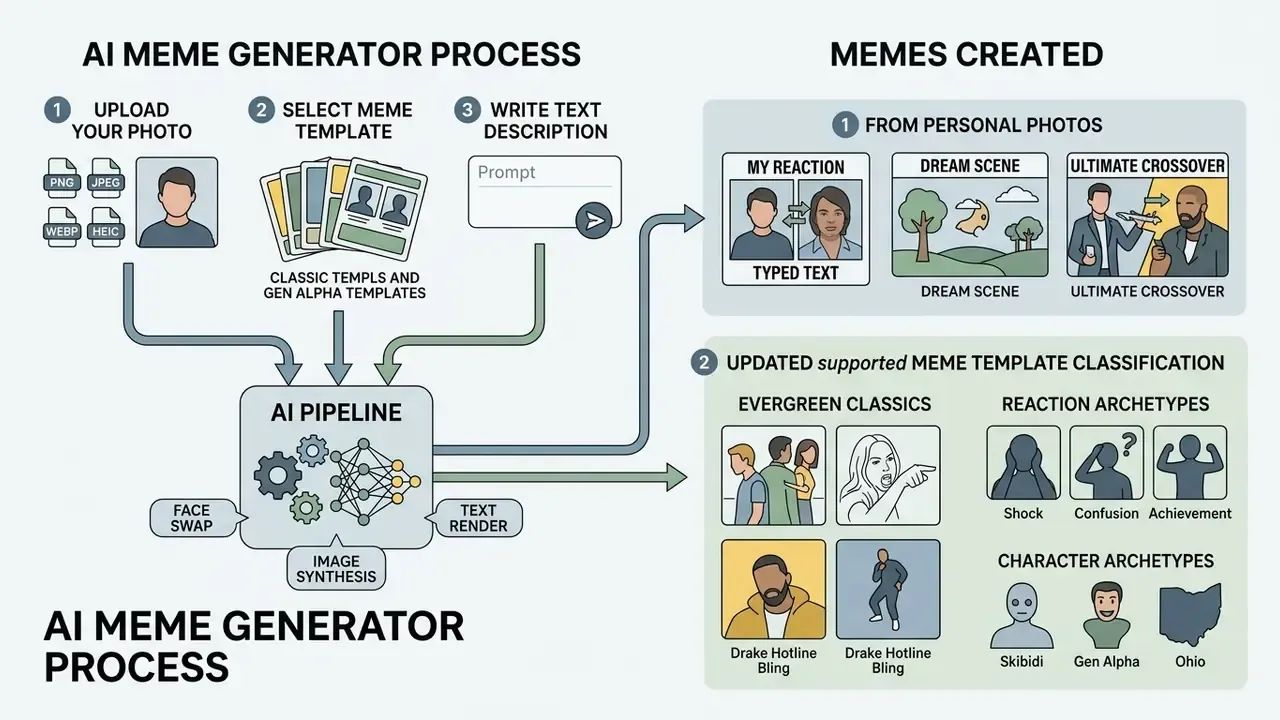
An ai meme generator from image is a multimodal software pipeline. It processes a source photo and produces a complete ai meme image with synchronized captions and formatting. The system evaluates the visual input, extracts semantic context, and generates overlay text tuned for social media channels or workplace group chats.
Modern tools do not simply stamp static text on a picture. They run an ai powered vision-language architecture that converts unstructured visual input into structured visual descriptions, so a language model can aim the humor at something specific. That pipeline yields standardized ai generated meme photos, single-frame reaction visuals, and multi-panel ai generated meme pictures for very different audiences. Teams that want to understand the underlying image-synthesis layer can review how general-purpose AI image generators handle prompts, rights, and output licensing before committing to a meme-specific vendor.
Academic work confirms the architecture is a chain, not a single model. A 2024 ICCC paper on computational creativity in meme generation describes discrete stages: visual understanding, image description, concept generation, then image-to-image synthesis with Stable Diffusion 1.5 plus ControlNet, with LLaVA 1.5 drafting captions from the input image and the generated concept. Earlier work such as memeBot framed automatic meme generation as a translation task: select a template image from a candidate pool, then generate the caption with an encoder-decoder model.
Why does that matter to a buyer? Because a chain of four models is four places where behavior can drift, four logging surfaces, and four sets of terms to read.
Meme From Your Own Photo, a Template, or a Text Description
Creating a custom meme usually follows one of three operational paths: upload a personal photo, pick an established template, or synthesize a visual base from a text prompt.
- Personal photo upload Maximum personalization, because the base asset is yours. Output quality tracks the source photo's clarity and emotional legibility (Zsky AI Blog, 2026). Originality is medium-to-high, but success hinges on whether the emotion in the frame reads instantly.
- Meme templates Universally recognized formats. Instant audience recognition, lower visual distinction, since the same structure circulates across millions of posts.
- Text prompt synthesis Builds a synthetic image from scratch using current vision-language and diffusion architectures such as Flux, Nano Banana 2, and gpt image models. Highest novelty, least predictable meme-fit. The model may miss the exact format or cultural reference you had in mind.
Supported Meme Template Classification: From Classics to Gen Alpha
Modern AI engines sort visual meme frameworks into cultural tiers, and the tier you pick determines both recognition and legal exposure:
- Evergreen classics High-recognition formats including Drake Hotline Bling, Distracted Boyfriend, Galaxy Brain, Two Buttons, Expanding Brain, Change My Mind, Success Kid, Waiting Skeleton, and Woman Yelling at a Cat.
- Reaction and character archetypes Crying Wojak vs Gigachad, Pepe the Frog, Surprised Pikachu, Huh Cat, This Is Fine, and Dogecoin (Doge).
- Subculture and Gen Alpha trends (2026) Fast-moving phenomena including Brainrot aesthetics, Ohio Sigma Skibidi, Sheesh Pointing, Amogus Sus, and animated "six-seven" formats. These decay fastest. A trending template can read as dated within six weeks, which makes it a poor base for a quarterly campaign.
- Corporate and tech tropes Developer roasts ("Works on my machine"), DevOps incident postmortems, sprint-planning jokes, and Slack or Discord group-chat reactions.
How AI Selects the Joke, Style, and Caption
A meme engine infers humor mechanisms by detecting visual cues (facial affect, object relationships, environmental setting) and mapping them to a meme idea.
Research on multimodal captioning shows that models like XMeCap optimize global and local image-text alignment using reinforcement learning, and the reported gains are measurable rather than anecdotal.
The system looks for incongruity inside the scene, then composes speech bubbles or overlay text that lands on that gap. Whether you want a niche inside joke or accessible public commentary, the model tries to align caption style with visual tone.
Comparable benchmarks show why quality swings so widely across inputs. MemeCap (EMNLP 2023) reported BLEU-4 of 17.07, ROUGE-L of 30.16, and BERT-F1 of 65.09 in a zero-shot meme captioning setup. A 2026 study on the ClassicMemes-50-templates set reported text-to-meme retrieval Recall@1 of 0.780 with fine-tuned CLIP. Read together: template matching is now reliable, while end-to-end joke synthesis remains the weaker link. Plan your review step accordingly.
Contextual recognition sits underneath all of it. A 2024 Frontiers paper on contextual emotion recognition reported mAP between 78.39% and 79.60% on tested models. A 2026 PLoS One study combining object detection, scene graphs, positional embeddings, and a generative transformer reached 93% expert-evaluation accuracy for contextual captioning. Impressive, though "expert-evaluated" is not the same as "audience-approved", and the gap is where brand incidents live.
How Multilingual Humor Matching Actually Works
Multilingual humor processing relies on dense vector spaces, not literal translation. The tool maps your prompt into a multilingual semantic embedding space covering 110+ languages. A retrieval engine then compares that vector against a curated index of meme concepts, matching idioms or slang in Spanish, German, Hindi, Japanese, or Russian to the emotional equivalent of a visual template.
In practice the pipeline runs in four stages: encode the full query, search a semantic template index, retrieve the nearest template meanings, and only then write captions for those formats. That is why you never need to know a template's name to use it.
Compliance Frame: What You Must Settle Before the First Upload
Shadow AI and Data Leakage Risk in Photo-Based Generation
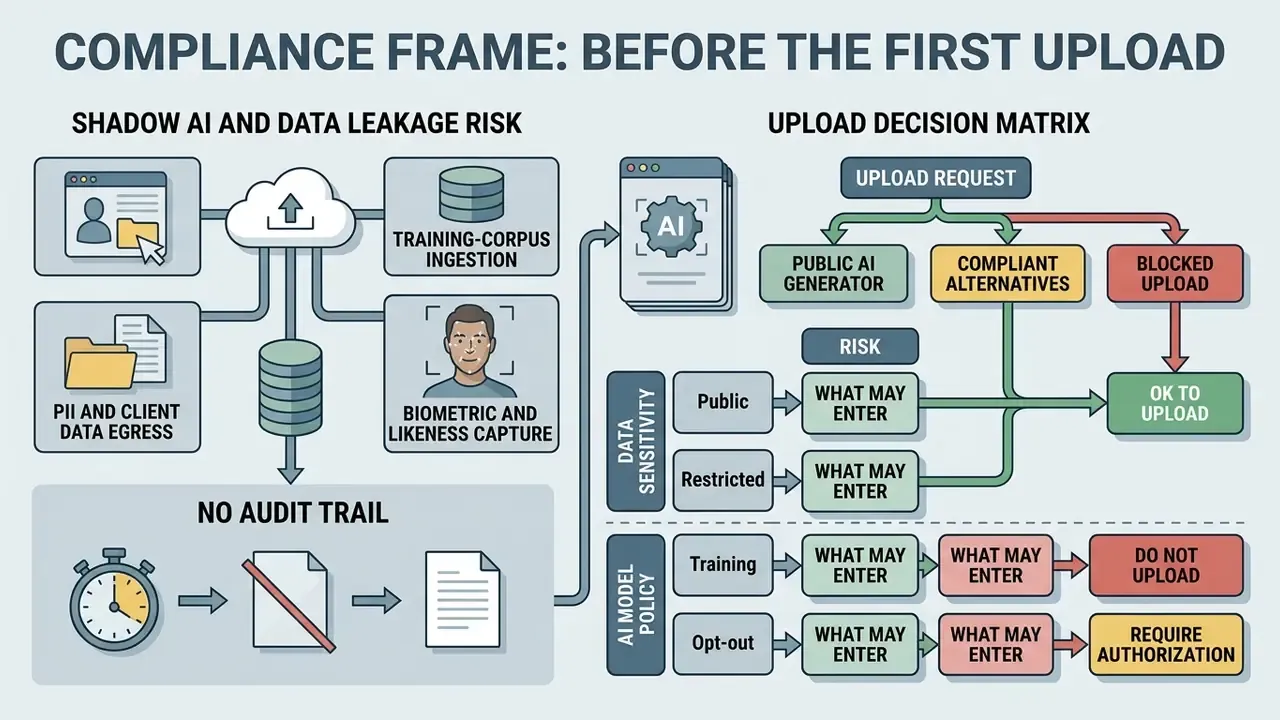
Photo-based meme generation is the most common vector for informal Shadow AI usage, precisely because it feels harmless. An employee wanting a Friday joke uploads whatever is on screen: a CRM record, a partially visible customer file, a slide from an unreleased roadmap, a photo of a colleague, or a shot of a secured office floor.
Four exposures follow from that single upload:
- PII and client data egress uploaded raster images are not redacted. Names, account numbers, ticket IDs, and email threads visible in a screenshot leave the perimeter intact.
- Training-corpus ingestion if the free tier's terms permit model training on inputs, your internal visual asset becomes a non-retractable training signal.
- Biometric and likeness capture employee and customer faces uploaded without documented consent create both privacy and publicity-rights exposure.
- No audit trail consumer tools rarely provide user-level logging, so incident reconstruction after a leak is guesswork rather than evidence.
Upload decision matrix: what may enter a public AI generator
| Image category | Public free tool | Enterprise tool (ZDR + SSO) | Never upload |
|---|---|---|---|
| Stock or licensed template art | Yes | Yes | - |
| Own face, own device, personal use | Yes | Yes | - |
| Colleague's face, written consent on file | Consent required | Yes | - |
| Colleague's face, no consent | No | No | Yes |
| Screenshots of internal dashboards / CRM | No | Policy-dependent | Yes, if client data visible |
| Customer photos, KYC documents, contracts | No | No | Yes |
| NDA-covered interiors, prototypes, unreleased UI | No | Policy-dependent | Yes |
The control that actually works is dull: publish a one-page allowlist, route sanctioned meme production through a single approved tool, name an owner for that tool, and treat every other generator as an unapproved data processor. One page, one owner, one escalation path. That is the whole framework.
How to Create an AI Meme From a Photo: Step-by-Step
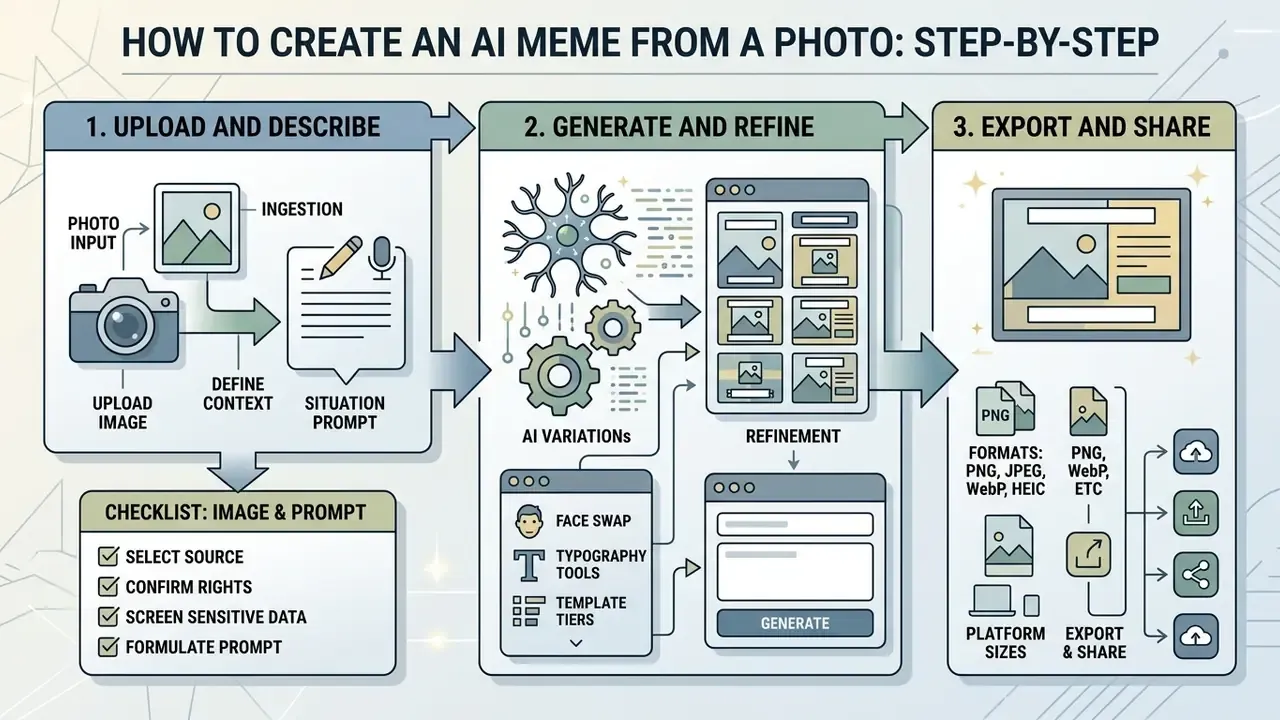
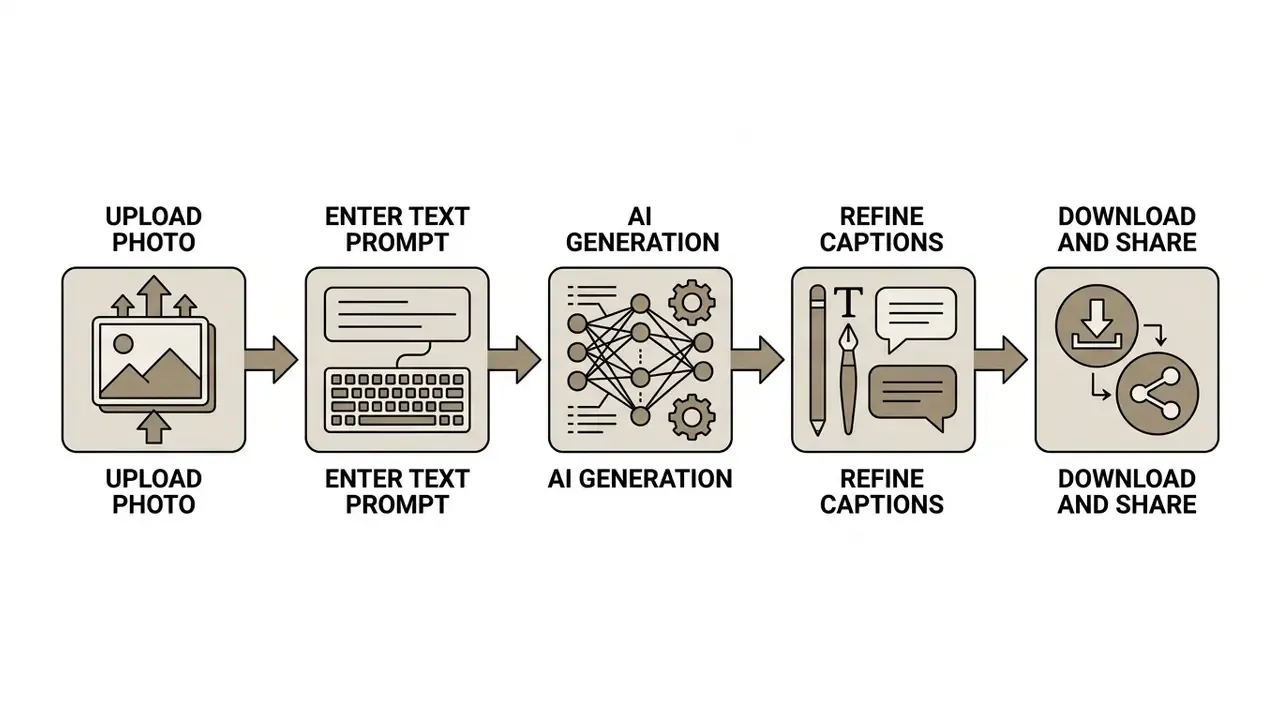
Deploying an ai meme generator with photo capability involves a structured sequence from image ingestion to file export. A standardized workflow reduces formatting errors and keeps the visual readable.
Using an ai photo meme generator lets teams produce consistent media quickly. Authors then refine the result in an ai meme maker with photo interface, adjusting typography, alignment, and contextual nuance before distribution. Adobe's current Photoshop and Firefly documentation describes the same six beats: choose a photo, open or import it, generate or edit with AI, add text, review the layout, export as JPG or PNG. So the workflow is consistent across professional and consumer tooling.
Upload the Photo and Describe the Situation in a Text Prompt
Generate Variants and Refine the Meme Text
Once inputs are submitted, the system returns multiple generated meme options. Evaluate the candidates, then adjust the meme text directly in the editor.
Editing controls handle font size, border contrast, secondary speech bubbles, and element positioning. In one marketing asset sprint (illustrative internal example), a team uploaded product-team photos, reviewed three automated outputs, nudged caption positioning for mobile clarity, and approved a final asset in about two minutes. The approval step took longer than the generation. That is normal, and it is also the part auditors will ask about.
How to Write a Prompt for a Meme That Is Funny and Clear
Drafting an effective prompt for an ai generated meme is mostly about supplying situational constraints instead of asking for "something funny". Models execute comedy mechanisms best when the setup is explicit.
A well-built prompt steers the model toward recognizable viral memes or targeted workplace commentary. Structure prevents generic output and keeps the visual aimed at its intended audience.
The Prompt Formula: Situation, Character, Emotion, and Punchline
A reliable structure combines four elements: Situation + Character Traits + Expressed Emotion + Punchline Target.
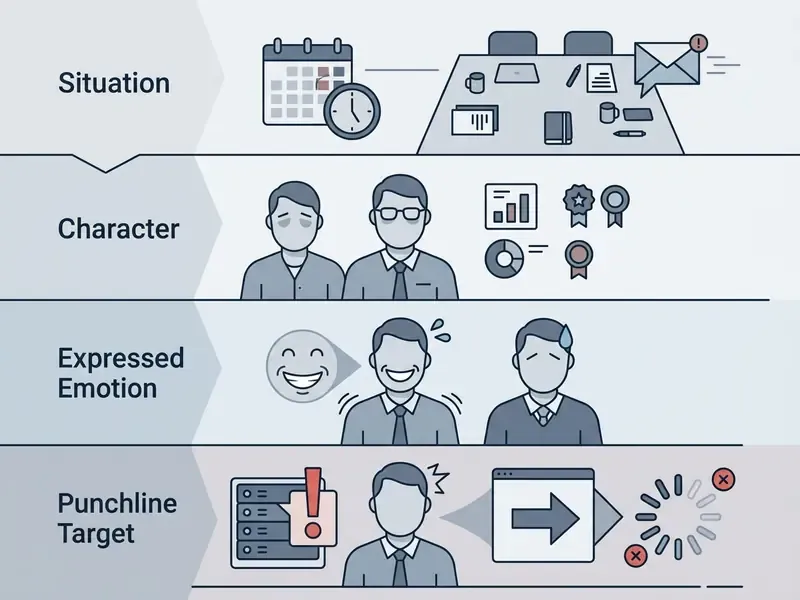
Contrast between the character's emotion and the situation is what drives the comedy: the setup is the ordinary situation, the punchline is the unexpected reaction.
Which Tools You Need: AI, Templates, and the Editor
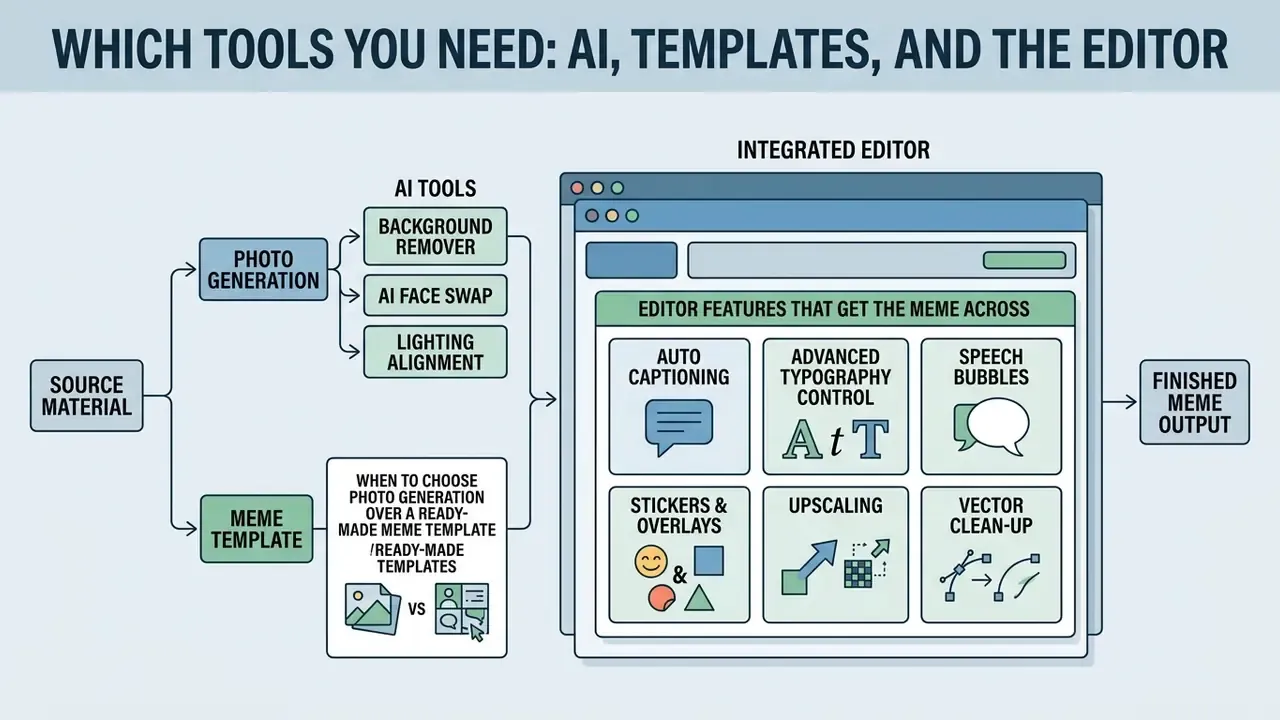
Modern image tools fold generative model layers, legacy meme templates, and web canvas editors into one operational interface.
An ai image tool to create memes combines computer vision with a graphic editing canvas. That integration enables real-time background processing, automated layout adjustment, and precise typography control. In practice, 2026-era services bundle four functions into a single workflow: AI meme creation, template editing, background removal, and video or GIF export.
When to Choose Photo Generation Over a Ready-Made Meme Template
Choosing custom photo processing over a stock meme generator library depends on how much visual originality and brand specificity you need.
Custom uploads yield unique reaction visuals, which suits internal team messaging and proprietary brand campaigns. Standard templates deliver instant recognition for broad cultural references. Teams weighing output fidelity against licensing terms can compare the best AI image generators before standardizing on one engine for custom work, and teams working strictly from existing assets may prefer a dedicated ai image generator that takes a photo as its base input. For rapid prototyping without installation, creators frequently evaluate an ai image generator pipeline first, then migrate approved workflows into a managed tool.
Editor Features That Get the Meme Across the Finish Line
Post-generation refinement depends on a handful of specific features:
- Auto captioning Places generated text blocks along optimized baseline grids, positioning text top, bottom, or on-subject without manual layout work.
- Background remover Isolates subjects using edge-detection models for clean layer compositing, and exports transparent PNG cut-outs for multi-panel builds. Teams already running a general AI photo editor can chain these steps into an existing post-production pass.
- AI face swap and lighting alignment Swaps uploaded faces onto canonical templates, then harmonizes facial lighting, skin tone, and camera angle so the face reads as native to the frame rather than pasted on. Powerful, and the single feature most likely to need a consent check.
- Advanced typography control Meme font stacks (Impact, bubble, heavy sans-serif) with customizable top and bottom baselines, adjustable size, color and alignment, multi-color drop shadows, and high-contrast strokes to prevent clipping against busy backgrounds.
- Upscaling and vector clean-up Integrated upscalers sharpen low-resolution source photos before captions render, avoiding soft edges in HD export.
- Speech bubbles, stickers and overlays Bubble elements with even padding and tails aimed at the speaker's mouth, plus stickers, emoji, and label layers composited without destroying the base visual.
- Meme effects Filters and adjustment layers that raise background contrast so overlay text stays legible.
| Feature category | AI meme generator from image | Ready-made meme templates | Text-to-meme synthesis |
|---|---|---|---|
| Primary input | User photo + text prompt | Selected preset + user text | Pure text description |
| Accepted formats | PNG, JPEG, WebP, HEIC/HEIF | Library asset (no upload) | None (text only) |
| Visual originality | High (proprietary source photo) | Low (shared public visual) | Very high (synthetic visual) |
| Generation speed | Fast (5-15 seconds) | Instant (under 5 seconds) | Moderate (10-30 seconds) |
| Predictability | Medium (depends on input clarity) | High (fixed visual framework) | Variable (model diffusion variance) |
| IP risk | Low to medium (you control the source, but third parties in frame matter) | Medium to high (stills, characters, licensed stock photography) | Low to medium (no human copyright in purely AI output) |
| Likeness / publicity risk | High without written consent | High if the template face is identifiable | Low, unless output resembles a real person |
| Audit evidence readiness | Strong (source file plus prompt log retained) | Weak (template provenance often undocumented) | Medium (prompt log only, no source asset) |
| Best use case | Personalized or branded memes | Standard internet jokes | Abstract concepts, no source photo |
Read the table bottom-up if you are buying rather than creating. The audit-evidence row is the one that decides whether a workflow survives an internal review, and it quietly favors photo-based generation with retained prompts over template libraries with unknown provenance.
How to Choose a Free AI Meme Generator for Personal and Commercial Use
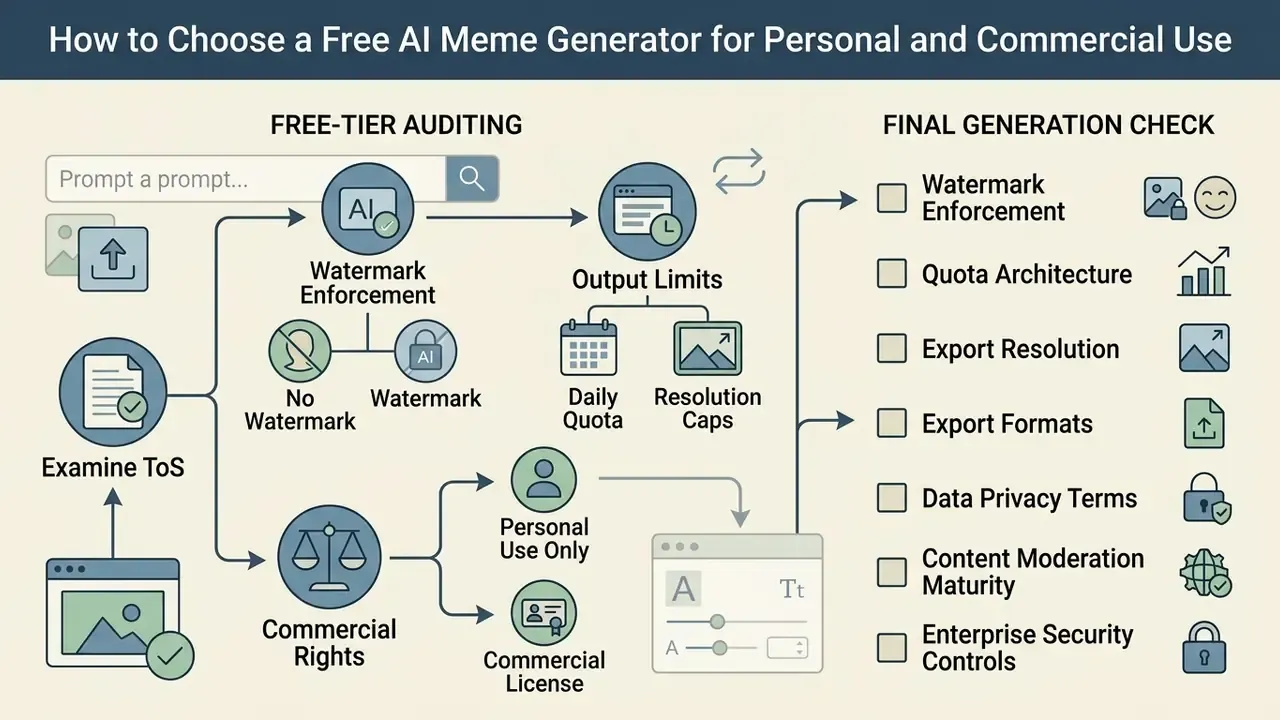
Selecting an ai meme generator from image free tier means auditing terms of service, output limits, and watermark policy before anyone deploys it.
A free ai meme app is fine for testing. Enterprise teams still have to verify whether free-plan output carries commercial usage rights. Organizations that need fewer content filters for sandbox experimentation sometimes evaluate an ai image generator no restrictions architecture, ideally in an isolated environment with no production data.
That concentration has a commercial edge. A small set of high-reach accounts decides whether your synthetic visual becomes a brand asset or a brand incident.
Licensing terms diverge sharply across vendors. Canva's AI product terms state users own input and output while granting Canva hosting rights. Kittl says users retain rights to uploaded photos but grant a broad license when sharing publicly. PicLumen permits commercial use of self-created images but not of other users' public images. Fotor states AI-generated images may be used commercially with no Fotor copyright claim. Getty's AI test terms reserve a broad royalty-free license for service and business purposes. Free tiers differ just as much: one major meme platform grants 10 credits per month with a small watermark on free downloads, while others advertise a perpetual commercial license on a limited number of free generations. Read the tier you will actually use, not the marketing page.
What to Verify in a Free Generator Before Creating a Meme
Before a free platform enters an operational workflow, check these parameters:
- Watermark enforcementDetermine whether free exports inject visible branding or artifacts, and test the free tier itself rather than trusting a "no watermark" headline. Buyers screening entry-level options can start with free AI image generators without sign-up to compare export terms side by side.
- Quota architectureMonthly credit caps, daily generation limits, weekly export ceilings, or project counts.
- Export resolutionMaximum pixel dimensions, for example a 720p or 1080p cap versus full native resolution.
- Export formatsWhich containers are available: PNG, JPEG, WebP for stills; GIF, MP4, or WebM for motion.
- Data privacy termsWhether uploaded photos are deleted post-processing or ingested into training corpora.
- Content moderation maturityAsk what blocks hateful or harassing output. Detection research is now dataset-driven, and a vendor without moderation tooling is pushing that liability onto you.
- Enterprise security controls (B2B requirement)SOC 2 Type II attestation, a contractual Zero Data Retention (ZDR) option, SSO/SAML with role-based access, per-user action logging for incident reconstruction, and a documented subprocessor list. A tool that cannot answer these questions is a consumer toy, not a business system.
Using AI Memes for Marketing and Brand Publishing
Putting generative memes into commercial campaigns requires strict alignment with compliance and brand guidelines. Not aspirational alignment. Written policy.
Institutional guidelines, such as those published by the Harvard John A. Paulson School of Engineering and Applied Sciences, require explicit labeling: a "Created using AI" tag in the lower-right corner of AI-generated images, plus defined tone and style for brand consistency. Note on verification: that is an institutional style rule, not a statute. Treat it as an internal-policy benchmark. Comparable transparency standards in the IAB Framework for AI Transparency and Disclosure call for consumer-facing disclosure of synthetic humans, digital twins, images, video, audio, and AI chatbots, permitting badges, watermarks, or adjacent placement. The EU's icon guidance for labelling AI-generated content adds a timing requirement: the marker must be clearly perceivable at first exposure.
The takeaway is practical: labeling is not an engagement tax. Detailed disclosure raises trust and leaves performance roughly intact, which removes the most common internal objection to marking synthetic brand visuals. If your marketing team still resists, the argument is no longer about data.
Legal alert box: compliance and copyright notice
Enterprise Capabilities: Brand Kits and API Automation
How to Make an AI-Generated Meme That Reads Well and Is Publishable
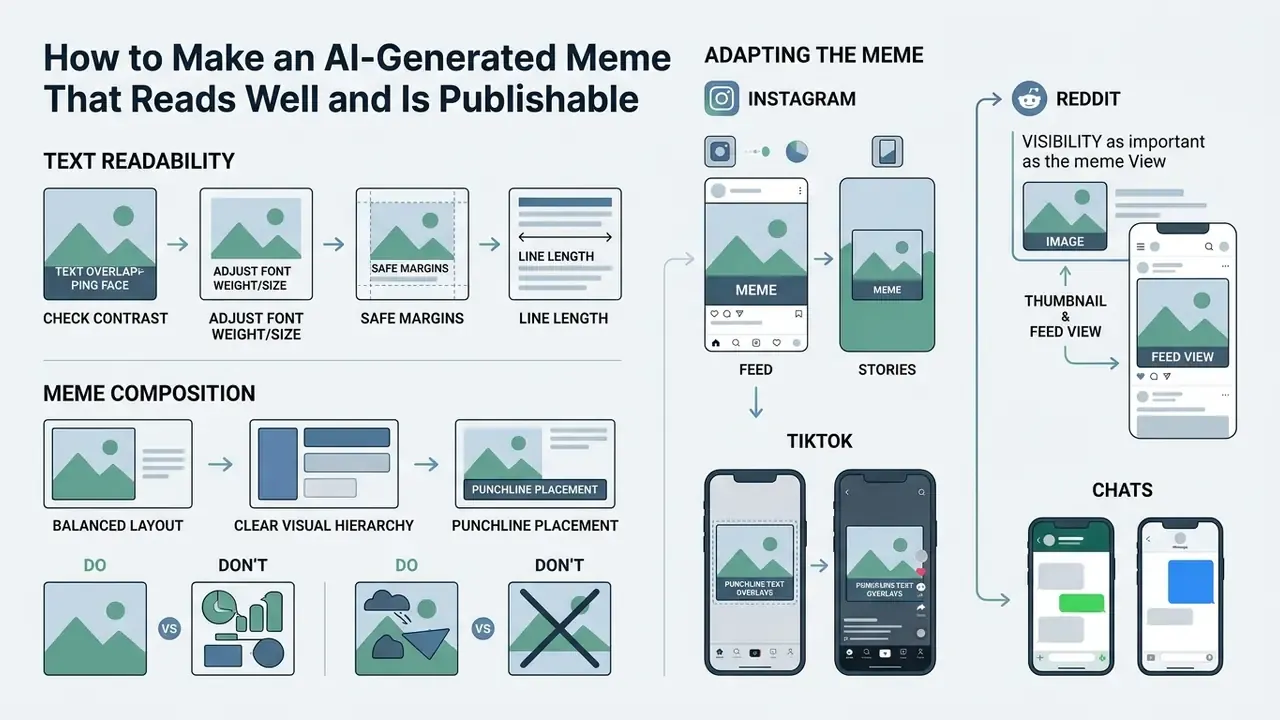
An ai image memes asset has to stay legible on a phone and on a desktop. Poor contrast or a crowded layout kills engagement and buries the message.
Optimizing ai meme pictures means balancing composition against text length. High-contrast typography keeps captions readable in a fast mobile feed, where most of your audience will see them.
Checking Text Readability, Composition, and the Joke
To maximize readability, follow standard digital design practice:
- Text contrast White text with a solid black outline stays visible against complex backgrounds; keep small text at a contrast ratio of at least 4.5:1 (Digital.gov, 2018). WCAG 2.2 readability guidance requires that all information needed for comprehension be available to users, which includes the caption that carries the joke.
- Font weight and size Avoid light weights on small screens. Apple's Human Interface Guidelines set a 17 pt default body size with an 11 pt floor, and the US Web Design System treats 16 px as the effective body minimum.
- Safe margins Keep key text within the central 70-80% of the frame height to avoid platform interface overlays.
- Line length Restrict captions to short phrases of 45-75 characters for fast comprehension; avoid all caps and keep text left-aligned where the format allows (Harvard Digital Accessibility Services, 2026).
- Punchline placement Group the payoff in one attention zone where the eye lands first. A payoff split across three lines loses the reader.
Adapting the Meme for Instagram, TikTok, Reddit, and Chats
Each publishing environment wants specific ratios and formats, and every export doubles as a brand-safety checkpoint. Resizing can crop a face, clip a caption, or strip an AI-disclosure badge, so each ratio needs a final visual review before it ships.
- Instagram feed Square (1:1, 1080x1080 px) or vertical (4:5, 1080x1350 px); landscape 1080x566 px where needed.
- TikTok, Reels and Stories Vertical full-screen (9:16, 1080x1920 px), which is also the cover-image size.
- Reddit posts Native landscape or card formats (1200x675 px recommended); the feed does not strictly enforce a ratio.
- Telegram and messaging apps Square stickers (512x512 px), channel photos at 512x512 px with neither axis over 1280 px, or optimized mobile web images.
- WhatsApp Photos are recompressed on send. Attach as a document to preserve the original file and keep text sharp.
When generating stylized art rather than photo-based reactions, teams often evaluate a ghibli ai image generator for specific thematic aesthetics, though stylistic imitation of a living studio's look carries its own reputational questions.
FAQ About AI Meme Generators From Image
Can AI create a meme from text alone, without a photo?
Yes. An ai image generator from text meme pipeline can synthesize an original visual background using text-to-image diffusion models. You describe the scene, and the system produces both the artwork and the matching caption overlay without any uploaded source photo. Quality caveats persist: human evaluation in "One does not simply produce funny memes!" found fully automatic memes trailing human-made ones on coherence, suitability, surprise, and humor, so a review step remains necessary.
Do you need design skills to create a meme with AI?
No graphic design skill is required to operate an AI meme generator. Modern tools automate subject isolation, text alignment, contrast adjustment, and layout structure, letting users produce formatted assets from simple prompts; vendor documentation states plainly that no templates, layers, or editing software are needed. Automation is high at the generation stage and only medium at the finishing stage. Caption placement, font tweaks, and export still benefit from a human pass.
Can you make GIFs and video memes with AI?
Yes. Current platforms support short video and animated GIF generation from a static input photo. Extending a still into motion uses diffusion-based image-to-video models such as Google Veo, Grok Video, or Kling AI. The pipeline identifies key structural points on the source photo and applies temporal motion vectors per the prompt, producing roughly 5-second GIF loops or MP4 video memes with synced animated captions, formatted for TikTok, Reels, and Shorts. Veo-style image-to-video workflows use one or more input images as the initial frame, with the prompt specifying subject, action, style, and camera motion, and they expose aspect ratio, length, and one to four output variants. The ECCV 2024 paper Pix2Gif formalizes image-to-GIF generation as text- and motion-magnitude-guided image translation. Implementation details and cost structure are covered in our Google Veo implementation guide, and creators comparing engines can review available image-to-video AI tools.
«Synthetic media shows disproportionately high virality, while AI-image detector accuracy declines as generative models advance.» Source: CONVEX dataset study, The Synthetic Media Shift (2024-2025)
Open Questions and Limitations
A few things this guide cannot settle, and it is better to say so.
- Humor evaluation is unstable. Benchmarks disagree, and self-reported humor ratings are noisy. Treat any vendor's "funnier output" claim as an untested hypothesis until you run a blind comparison on your own audience.
- Detector reliability is declining. As generators improve, AI-image detection accuracy drops, so pre-publication screening flags probability, not proof.
- Template provenance is largely undocumented. Most libraries do not expose the original rights chain for classic formats, which leaves residual IP risk you can reduce but not eliminate.
- Audience assumptions remain hypotheses. Statements about what your customers find funny, or tolerable, should be labeled as such until interviews, analytics, or CRM evidence support them. A safe next step for a regulated institution is modest: pick one approved tool, name its owner, publish the upload allowlist, and review the first month of logs before widening access.
Appendix A: Revision Log and Superseded Wording
For transparency, earlier phrasing retained for the record and superseded in the body above:
- "using diffusion models" replaced with the named model families (Flux, Nano Banana 2, GPT-Image architectures).
- "standard web formats like PNG or JPEG" expanded to PNG, JPEG, WebP, and HEIC/HEIF mobile uploads.
- "Empirical prompting studies show that providing explicit constraints regarding output length and tone significantly improves humor quality (EMNLP, 2025)." replaced with the verified co-creativity finding from "One Does Not Simply Meme Alone", with EMNLP 2025 few-shot and chain-of-thought work cited as adjacent support.
- "Prompts should remain focused, ideally under 75 words, to prevent model confusion (CVPR Supplement, 2025)." retained as an operational heuristic; the specific citation could not be verified.
- "Harvard SEAS, 2026" and "IAB Disclosure Framework, 2026" retained as institutional-policy benchmarks with an explicit verification note rather than as legal mandates.
- "Google Veo Documentation, 2026" supplemented with verifiable image-to-video capability descriptions and the ECCV 2024 Pix2Gif paper.