Executive Summary: What Matters Before You Name Anything
- What it is: An AI band name generator conditions a language model on your genre, vibe, keywords, and structural rules, then returns batches of candidates. It is an ideation engine, not a branding decision engine. That distinction carries all the risk.
- How to get good output: Feed the model subgenre + mood + instrumentation + project format (solo, duo, full band), plus explicit structural constraints such as word count, banned words, and required patterns. Use the ready-made Copy-Paste Master Prompt below.
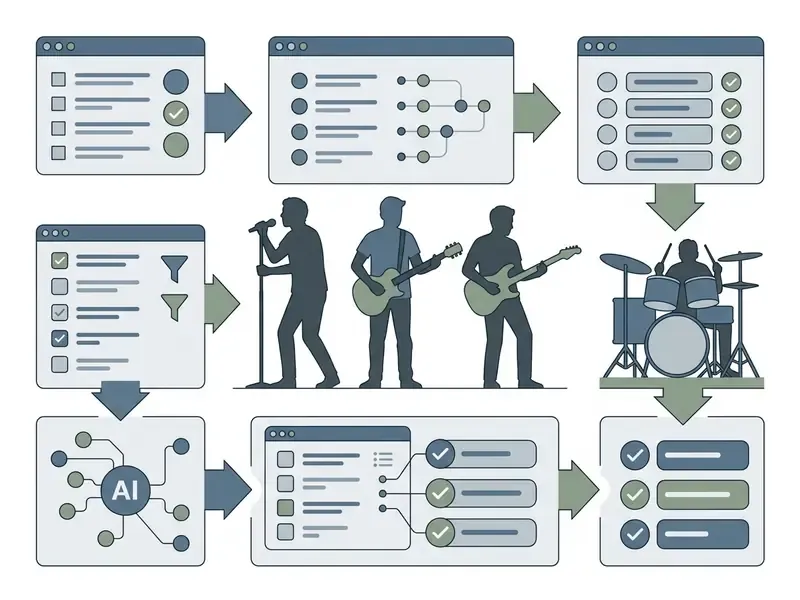
- How to choose: Apply the 50-to-3 Elimination Protocol. Generate 50 to 200 raw candidates, blind-shortlist to 10, filter to 3 with a spelling and pronunciation test, then run availability checks before the binding band vote.
- The legal reality: "Unique" in an AI interface means "generated in this session." It does not mean trademark-clear. Conflict is decided by likelihood of confusion across sight, sound, and meaning, not by exact-string matching (see USPTO trademark search guidance, 2024, https://www.uspto.gov/trademarks/search).
- The security reality: Free browser generators may retain prompts for model training. Never paste unreleased project names, signed-artist details, or NDA-covered campaign data into a consumer tool without checking its retention and opt-out policy.
Who This Guide Is Written For
Three readers, three different pressures. A garage four-piece needs a name by Friday and cares about the chant test. A solo producer needs an alias that survives a Bandcamp search and a domain check. A label or agency team needs something else entirely: a documented decision trail, a sanctioned tool, and no confidential titles leaking into a public prompt box.
The workflow below serves all three, but the emphasis shifts. Bands live in the shortlisting sections. Labels live in the screening and data-handling sections. If you are somewhere in between, read both and skip nothing about trademarks.
What Is an AI Band Name Generator and How Does It Work?
An ai band name generator is a software system that uses natural language processing (NLP) or large language models (LLMs) to produce naming candidates from user-defined parameters. The band name generator ai maps conditional inputs, such as genre, aesthetic, and keywords, against learned linguistic patterns to output lists of potential names.
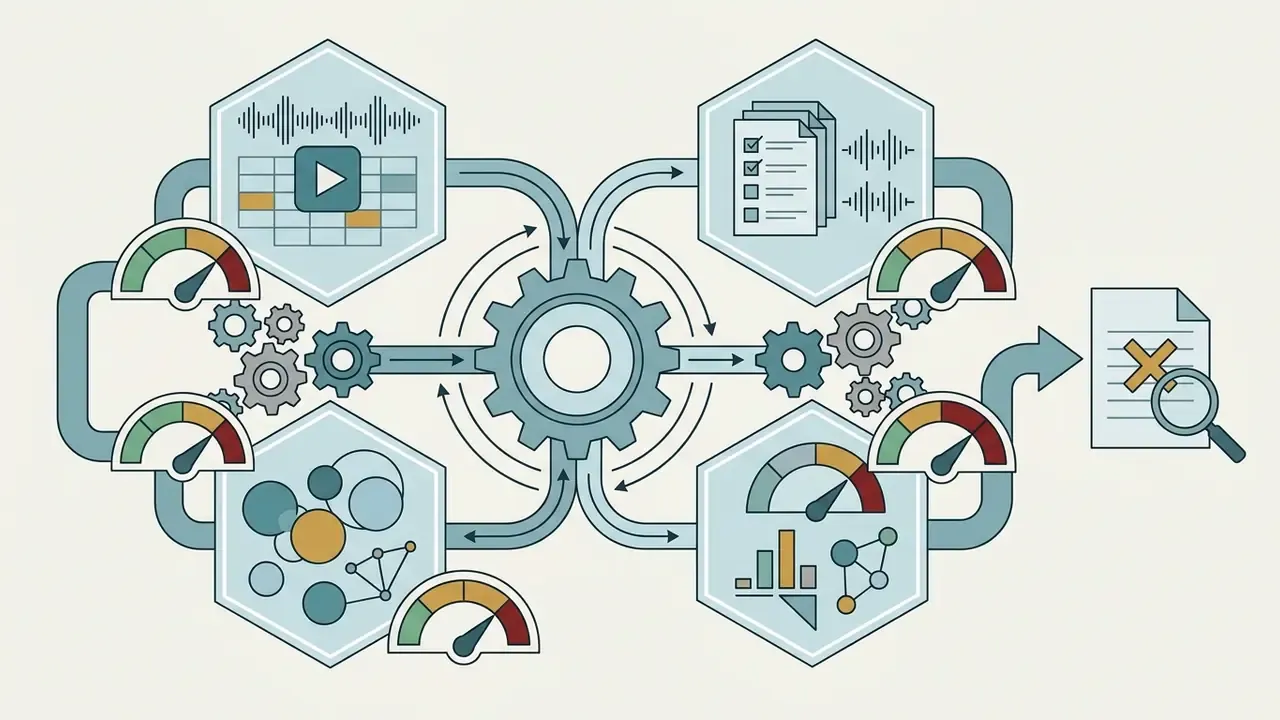
The core technology relies on conditional sequence modeling. When a user inputs a target genre like post-punk or synthwave, the model samples words from its probability distribution that frequently co-occur with those stylistic concepts. Advanced systems add prompt filtering and post-generation ranking to strip duplicates and unpronounceable strings (NIST Generative AI Profile, 2024).
«LLM systems excel at combinational and exploratory creativity, but struggle with transformational creativity, the kind that changes the base rules of a conceptual space.»
That distinction matters practically. A generator will reliably recombine existing rock, metal, and synth vocabularies into fresh pairs. It will rarely invent a genuinely new naming paradigm the way a scene-defining band once did. Earlier research prototypes made the pipeline explicit: one 2020 experiment trained a character-level LSTM on 85,153 real band names and sampled new strings letter by letter, while a 2017 naming framework scored candidates for readability, pronounceability, memorability, and uniqueness before ranking them. Modern LLM tools compress those stages into a single prompt-and-filter loop.
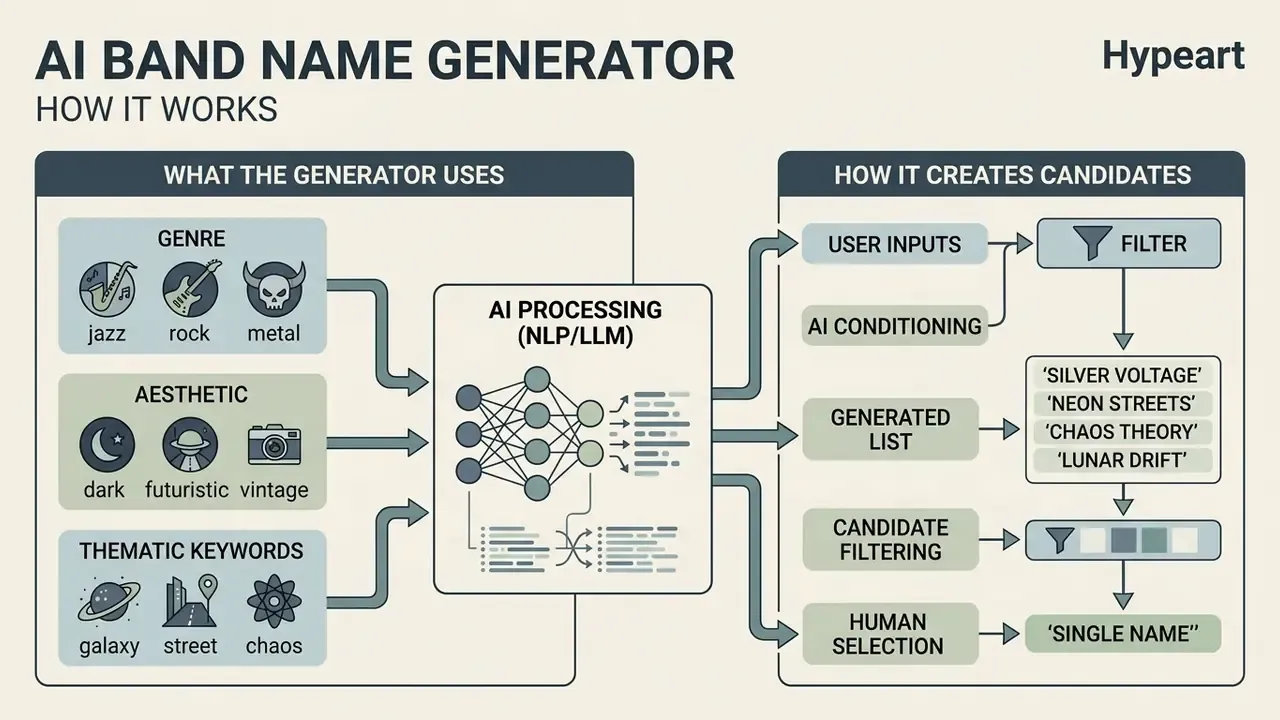
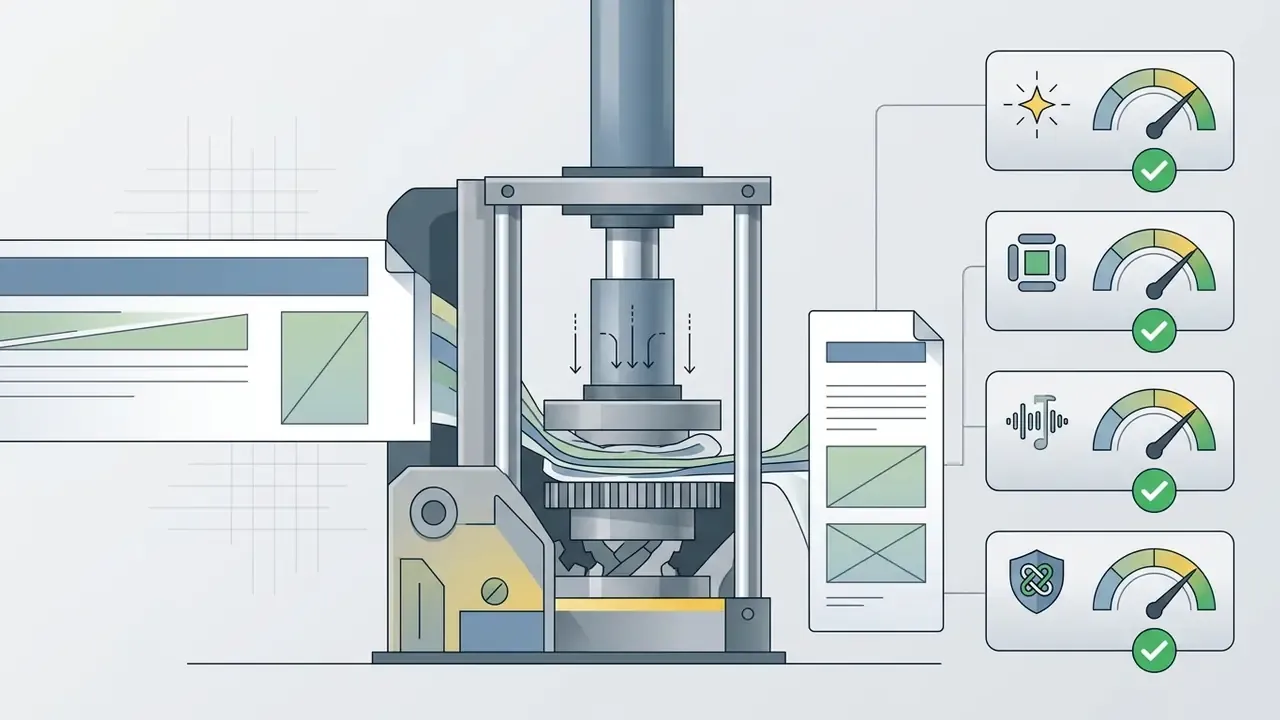
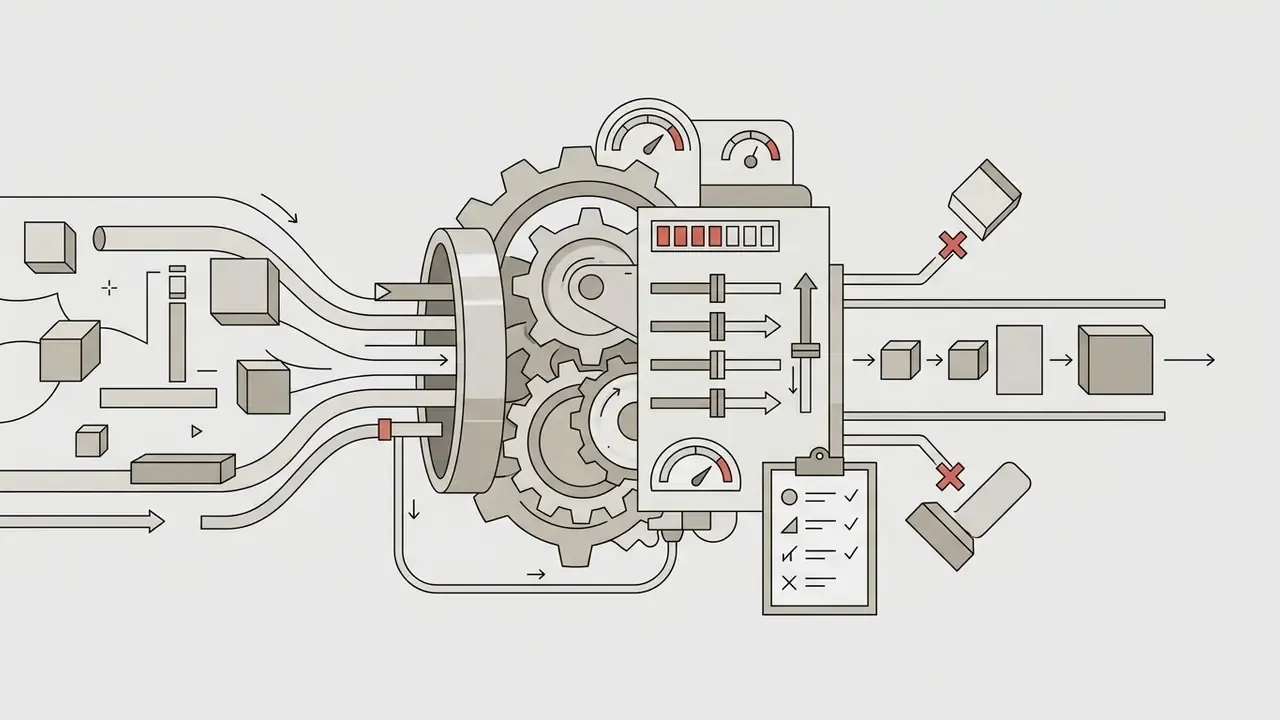
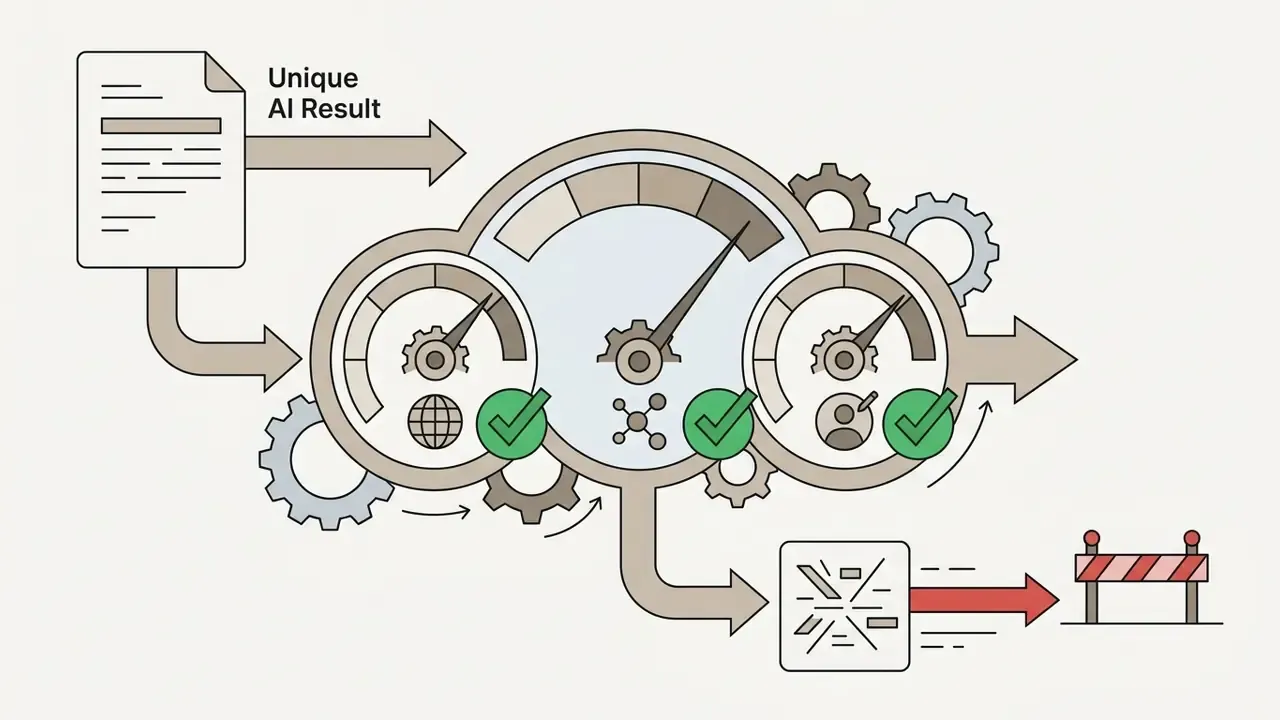
Steps shown in the diagram:
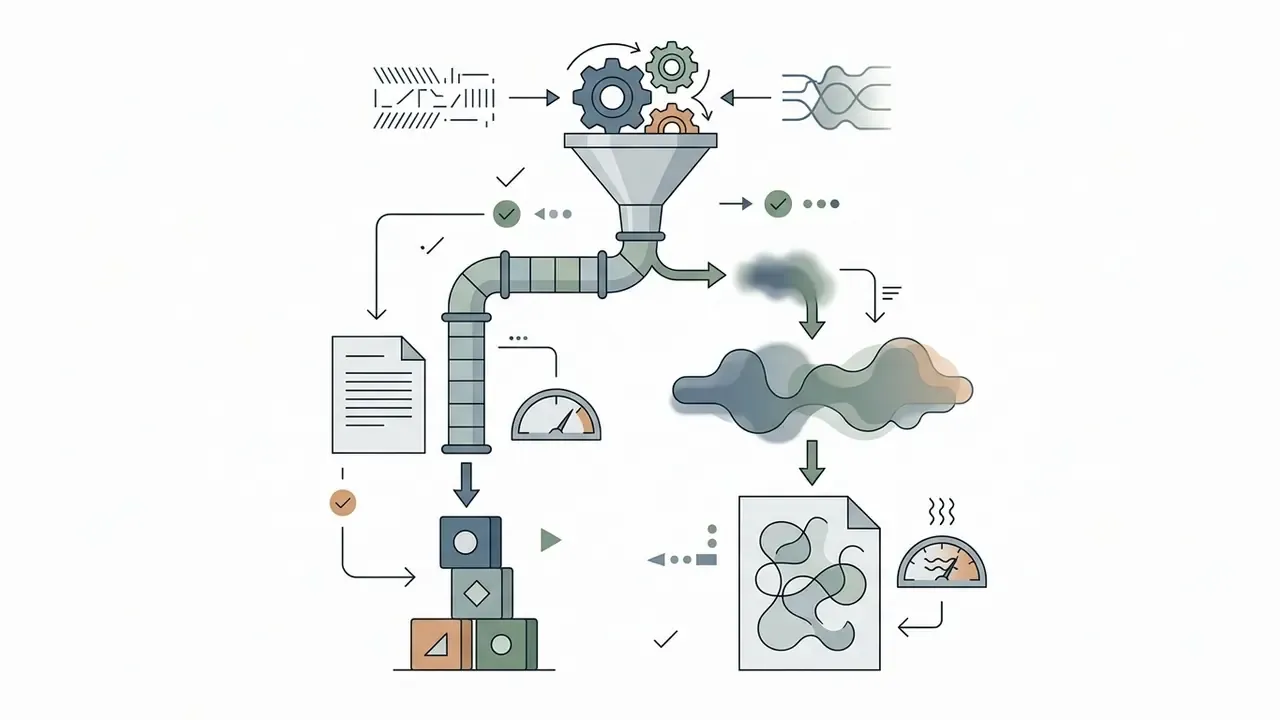
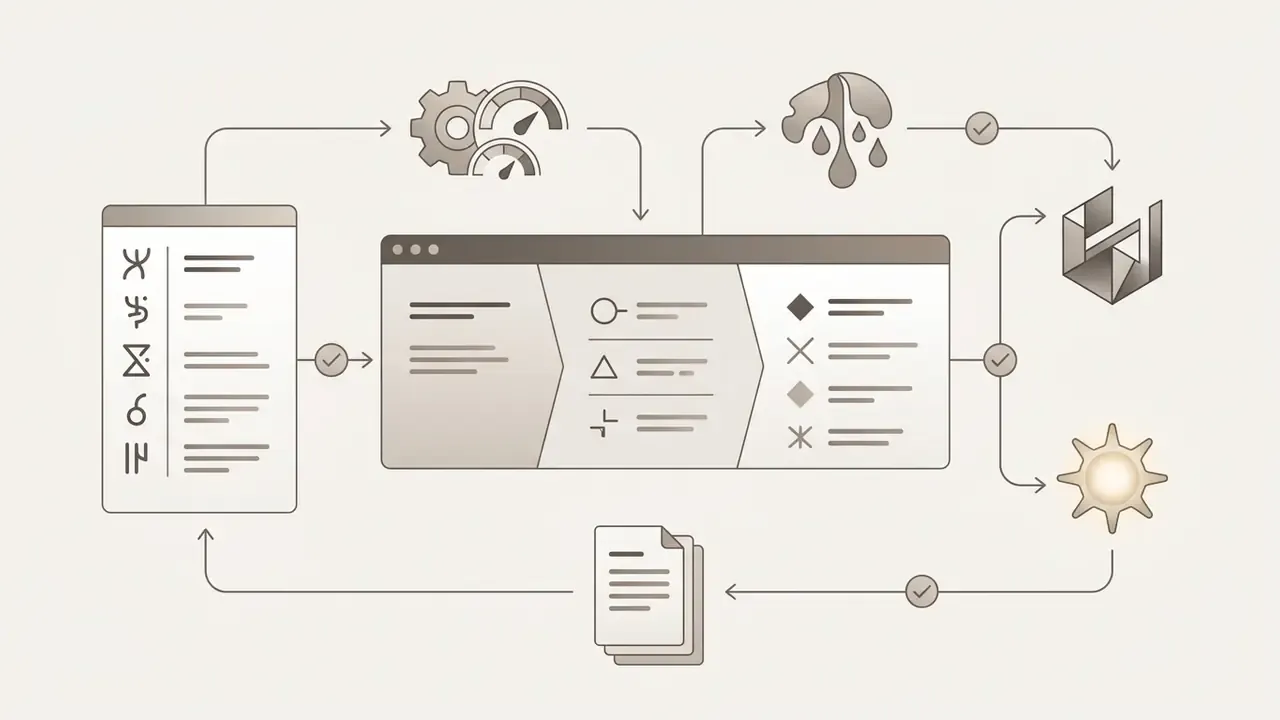
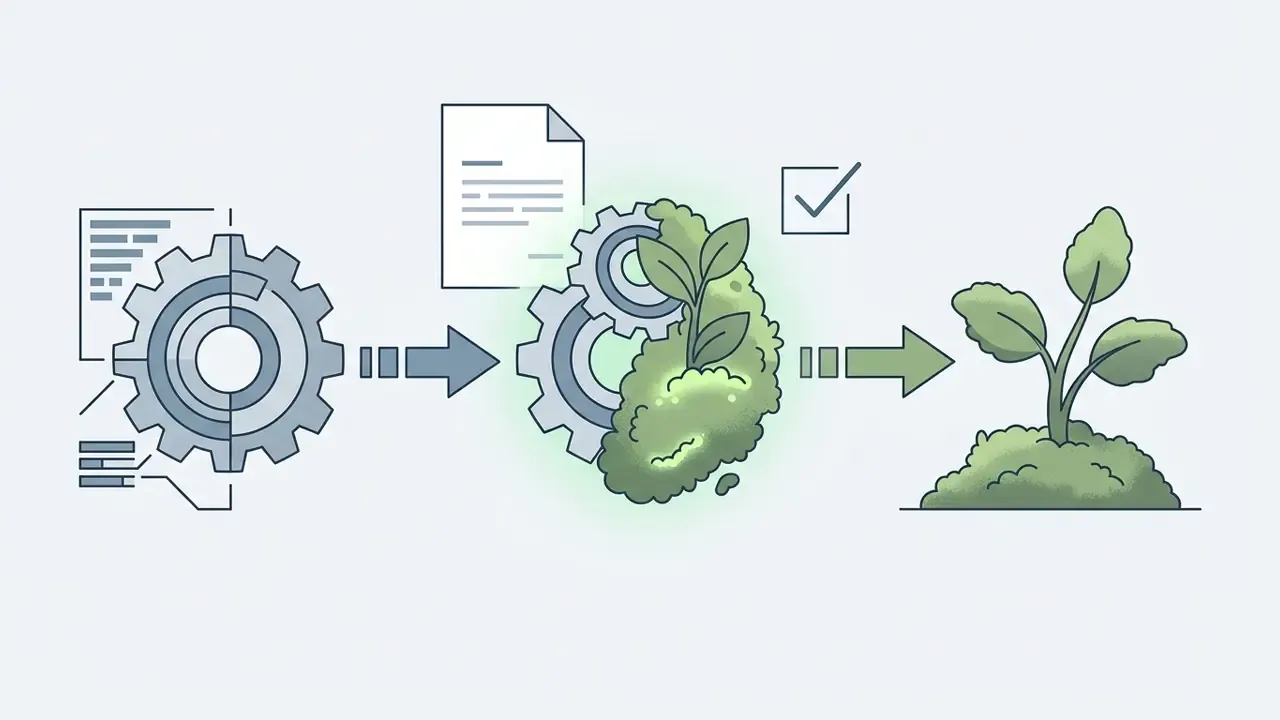
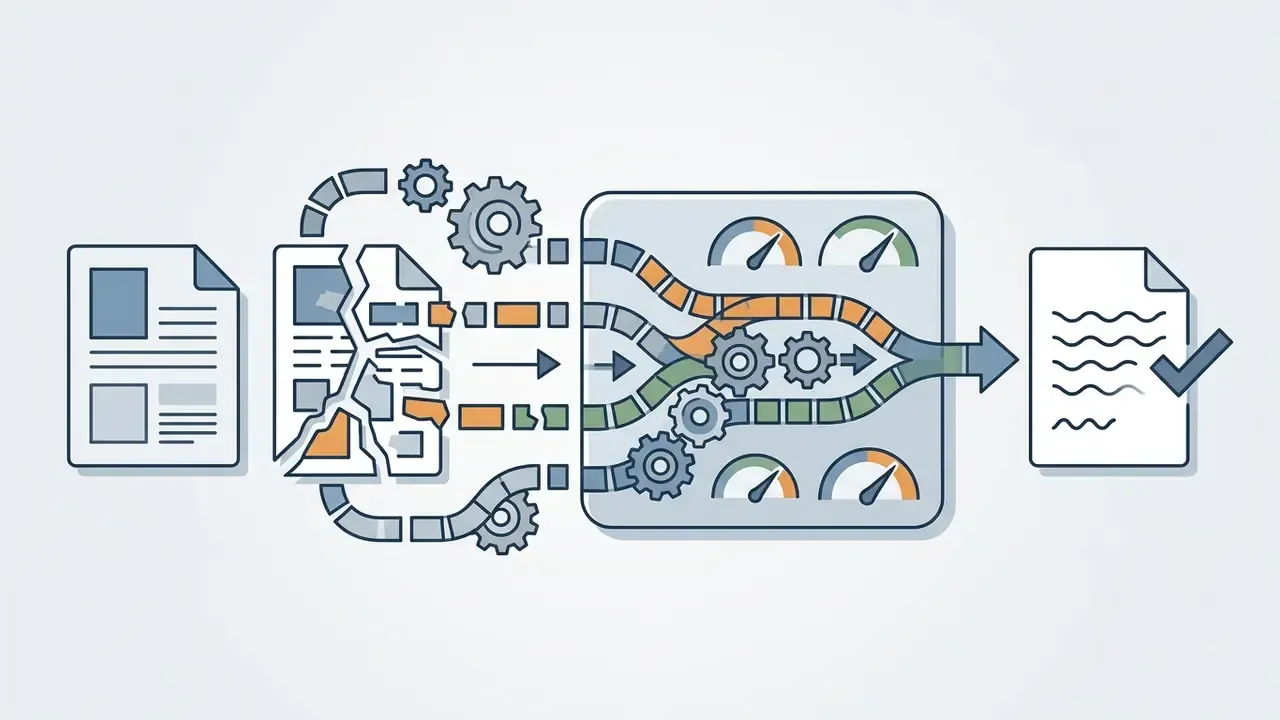
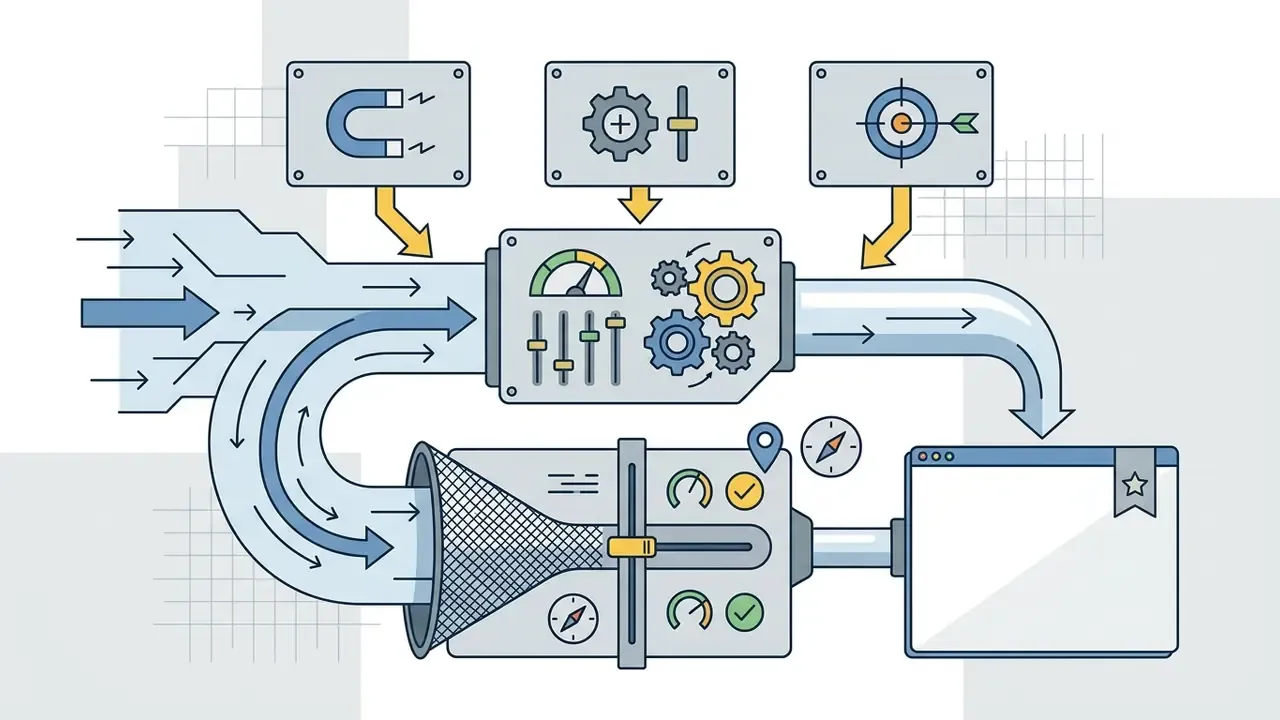
Workflow summary: The process begins when the user submits structured brief parameters, meaning genre, mood, instrumentation, and project format. Next, the underlying neural engine conditions its generation pipeline to sample semantically relevant terms. Candidate outputs then pass through post-processing rules that enforce word count, filter taboo terms, and remove exact duplicates. Finally, the user evaluates the list for brand resonance and legal availability. That last stage, where trademark screening, streaming-catalog checks, and handle availability decide survival, is the only one that carries consequences.
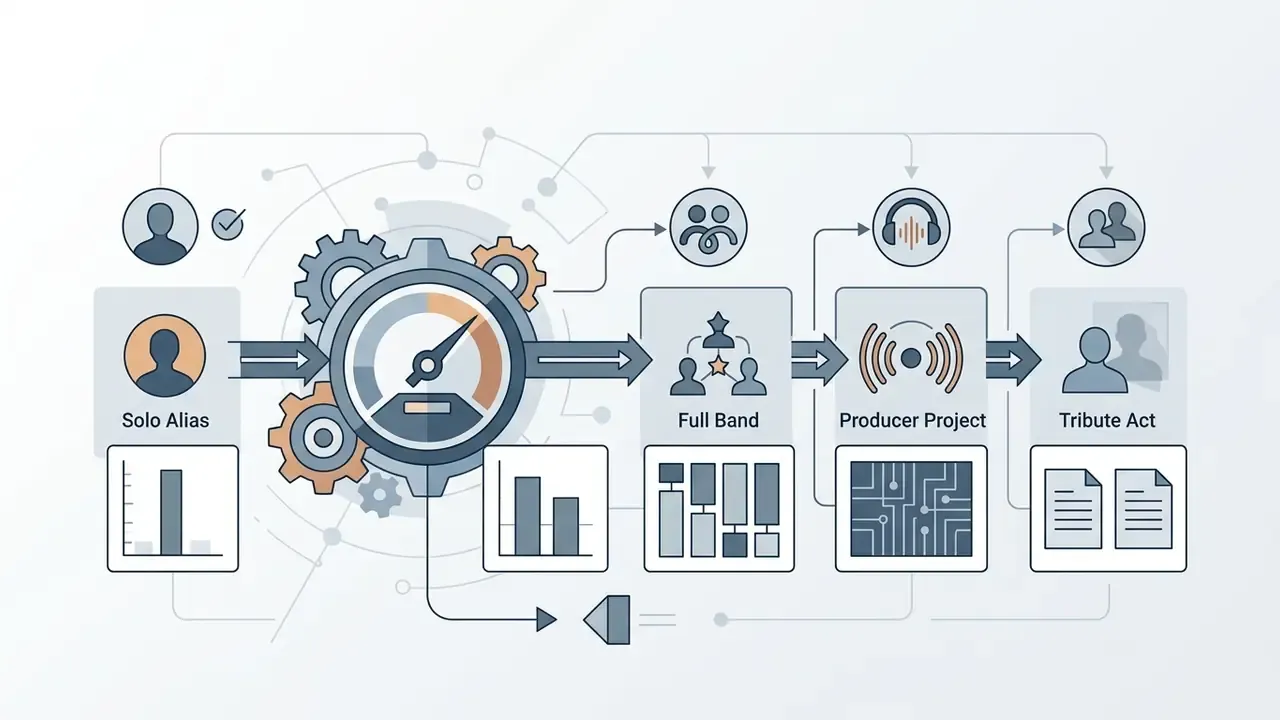
What the Generator Uses to Create Band Names
An AI generator relies on contextual descriptors, including musical genre, emotional vibe, acoustic character, and imagery keywords, to narrow its semantic search space. By combining these variables, the model produces tailored band names aligned with a specific sound profile.
Modern ai generator band names engines use multi-prompt schemas that resemble music production briefs, structured the way music-generation prompt guides structure a track description: genre and style, mood, instrumentation, tempo, and vocal character (Google DeepMind Lyria model prompting guidance, 2024–2025). [Updated: date corrected from an erroneous 2026 citation.] Key input variables include:
Why AI Results Are Ideas, Not a Final Decision
AI-generated naming candidates are raw conceptual drafts, not finished branding solutions. Human evaluation stays mandatory to verify cultural appropriateness, emotional authenticity, and market distinctiveness.
Empirical studies on artificial intelligence in creative writing show that while LLMs excel at combinational fluency, their outputs often slide into cliché and lack real transformational novelty.
«LLM-written stories pass creativity tests in only 9–30% of cases, while readers preferred expert New Yorker texts in 89% of comparisons.»
There is another blind spot. AI models cannot judge whether a generated name carries negative slang connotations in your city, or collides with an existing act on streaming platforms. Human review is the essential quality gate, ensuring the chosen name fits the band's identity and its longer strategy (NIST AI Risk Management Framework, 2024). Governance frameworks describe the same requirement in process terms: generative output must be assessed for accuracy, quality, and authenticity through a mix of human oversight and automated checks before anyone treats it as a final artifact.
Human-in-the-Loop Responsibility Matrix
For bands, labels, and marketing teams that need an auditable decision trail, assign the four validation duties explicitly instead of voting informally over drinks.
| Validation Task | Responsible | Accountable | Consulted | Informed |
|---|---|---|---|---|
| Prompt brief and generation runs | Creative lead / band member | Band manager | All members | Label A&R |
| Phonetic and spelling usability test | Any two members | Band manager | Booking agent | — |
| Trademark and DSP conflict screening | Manager or paralegal | Legal counsel | Distributor | Whole band |
| Final name lock and metadata freeze | Band manager | All members (vote) | Legal counsel | Distributor, PR |
Escalation rule: if screening surfaces an identical or confusingly similar mark in a related class, the candidate is frozen immediately and returned to the shortlist stage. Never "launched pending clarification." That phrase is where naming disputes are born.
How to Generate a Band Name That Fits Your Sound
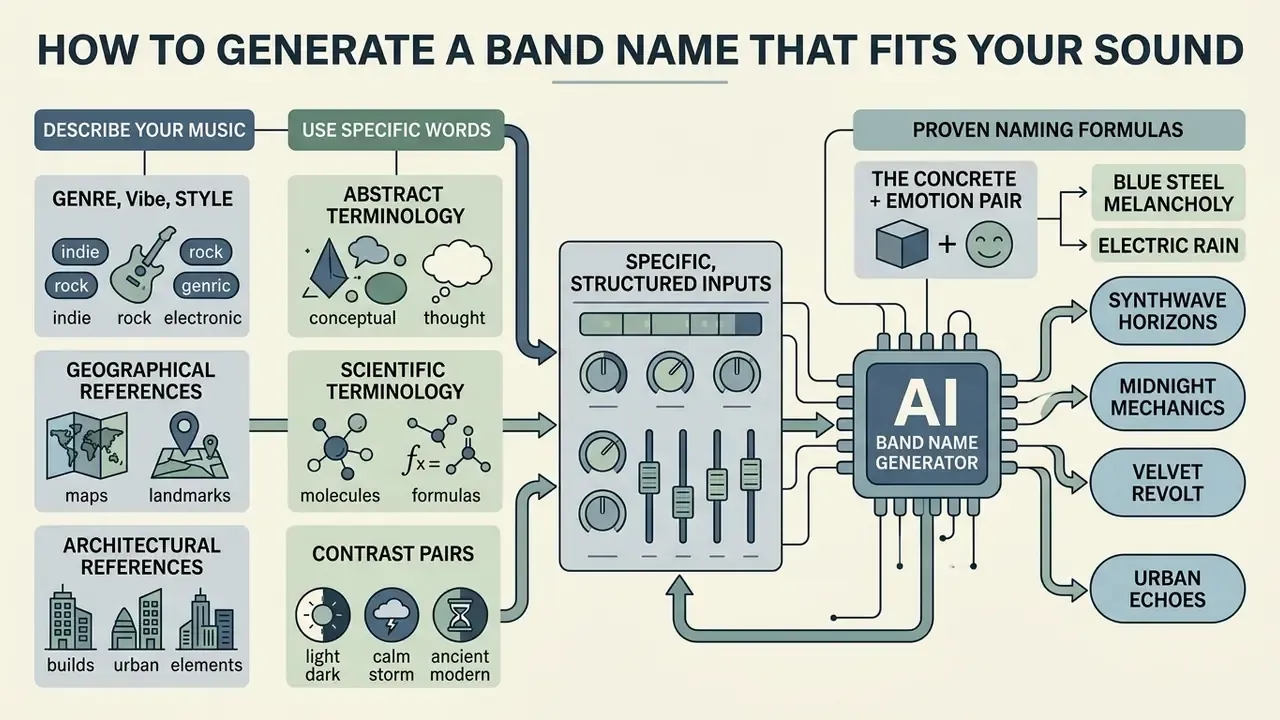
To generate a name that actually reflects your musical project, you have to give the ai band generator specific, structured inputs. A systematic prompt framework is what makes the generator create step produce distinct, relevant results rather than filler.
Describe Your Genre, Vibe and Music Style
A precise combination of genre, emotional mood, and production texture lets the band name ai generator align its lexical output with your real sound.
Instead of typing generic terms like "rock" or "pop," specify subgenres and sonic qualities. Describing your project as "analog 1980s synthwave with dark, cinematic arrangements" gives the algorithm boundaries it can work inside.
«Users who specify genre, tone, and audience inside the prompt receive markedly more relevant AI responses than those issuing broad requests.»
A practical formula used across prompt guides is [Texture] + [Mood] + [Genre] + [Format]. For example: "tape-saturated, melancholic, slowcore, three-piece." Texture controls the consonant weight of the output. Mood controls the emotional lexicon. Genre sets the naming convention. Format decides whether the model returns a group name or a solo alias.
Use Specific Words to Get Better Name Ideas
Feed specific imagery, rare vocabulary, or thematic concepts into your prompt to push the generator generate step away from common clichés.
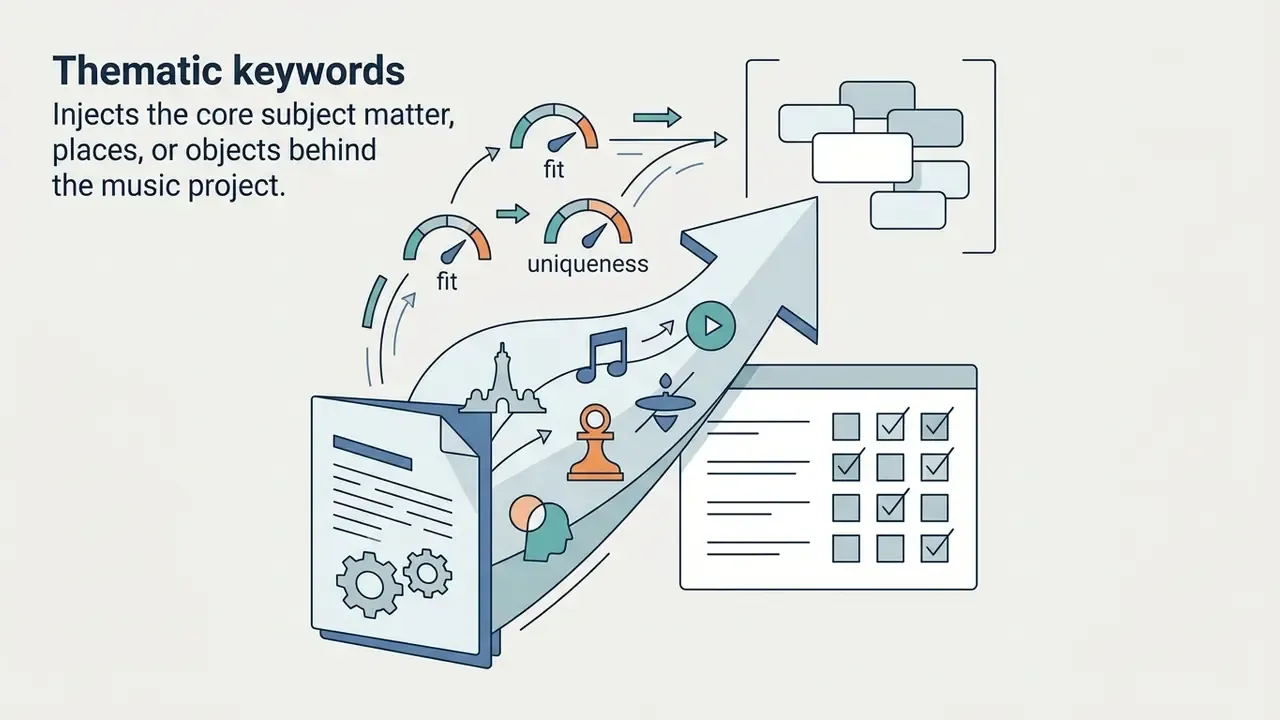
When users rely on broad keywords, language models default to high-probability associations. To unlock unique and creative ideas, include concrete anchors such as:
- Geographical or architectural references "rust," "concrete," "canyon."
- Abstract or scientific terminology "half-life," "refraction," "stasis."
- Contrast pairs combining opposite themes "decaying neon," "velvet noise."
- Personal vocabulary lyric fragments, hometown slang, inside jokes, film references. Generic inputs produce generic outputs. One unusual word can carry an entire name.
Limiting synonym sets and skipping overused buzzwords helps the underlying model produce distinct sequences. Semantic-layer guidance recommends keeping synonym lists to roughly three to five loosely related terms so the model does not drift into noise (Denodo, Building an AI-ready Semantic Layer, 2025). [Updated: date corrected from an erroneous 2026 citation.]
Proven Naming Formulas for AI Generation
To force the LLM into structural variety, rather than five versions of the same idea, hand your prompt one of these five morphological patterns explicitly.
- Formula:
[Tactile Noun] + [Emotional Adjective] - Examples: Velvet Tension, Concrete Melancholy, Glass Anxiety, Velvet Restless, Chrome Ember.
- Formula:
[Scientific Term] + [Numeric/Code Accent] - Examples: Stasis-808, Vector Echo, Half-Life Protocol.
- Formula:
[High-Energy Term] + [Low-Energy/Soft Term] - Examples: Violent Silence, Soft Armor, Static Bloom.
- Formula:
The + [Atmospheric Descriptor] + [Plural Noun] - Examples: The Midnight Curators, The Electric Pines.
- Formula:
[Word Starting with Letter X] + [Word Starting with Letter X] - Examples: Cobalt Crown, Rust Resonance, Phase Phantom.
- The Concrete + Emotion Pair— combines a tangible object with an abstract psychological state.
- Alphanumeric and technical blends(best for electronic, industrial, and producer projects)
- Contrast pairs (oxymorons)Contrast pairs (oxymorons)
- The structural classic ("The [Adjective] [Noun]")The structural classic ("The [Adjective] [Noun]")
- Alliterative anchorsAlliterative anchors
Two supporting patterns deserve a place in the rotation: one-word brandables, which are short, ownable, and easy to trademark-check, and place plus symbol constructions that tie the project to a real geography. Rotate one variable at a time. Hold the emotional word constant and swap the concrete noun, then invert the exercise.
Generate Several Variations Before Choosing One
Running multiple generation cycles with small prompt adjustments lets you explore different lexical styles before you commit.
«Writers working with LLMs regularly refine prompts, adjusting tone, style, and constraints, to move output closer to their intent.»
Rather than accepting the first results, adjust individual variables, for instance shifting the mood parameter from "aggressive" to "melancholic," and compare the resulting batches side by side. Change one element per run so you can credit the improvement to a specific edit instead of to randomness.
The 50-to-3 Elimination Protocol for Bandmates
AI Band Name Generation Checklist
Checklist0 / 8
AI Band Name Ideas by Genre and Style
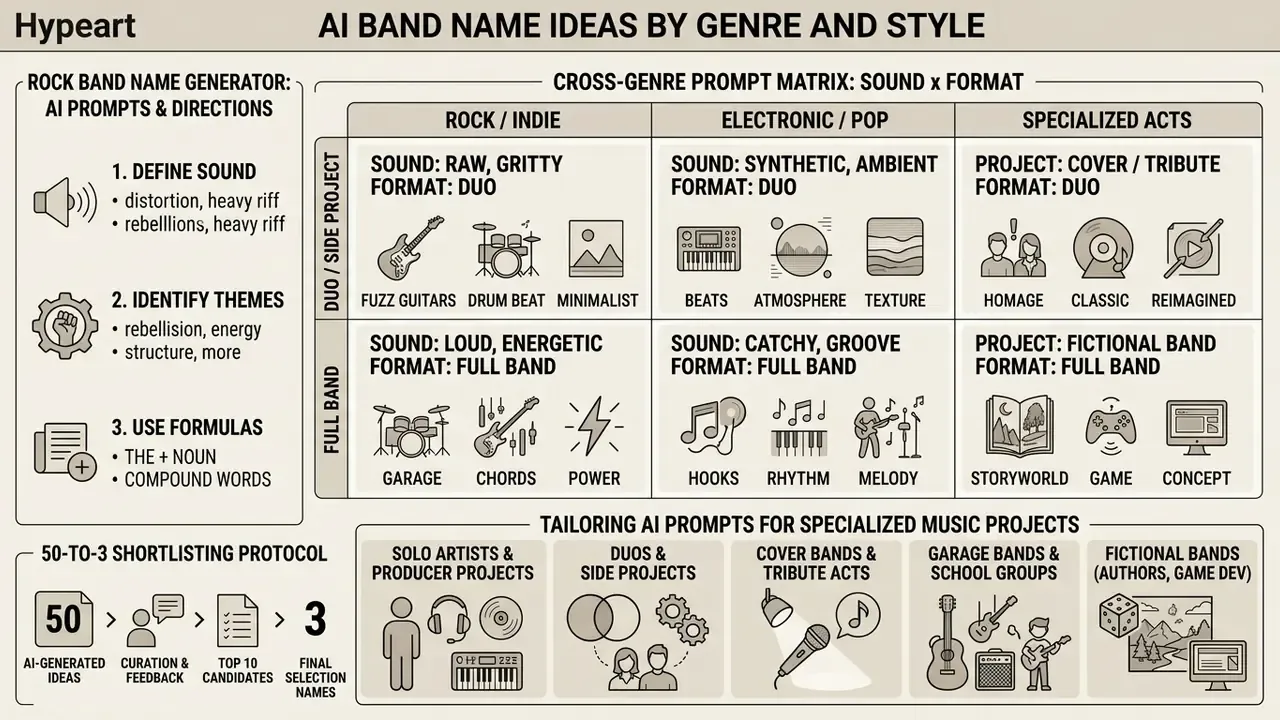
Different musical genres lean on distinct naming conventions, sound symbolism, and morphological structures. A genre-aware approach keeps the ai band name inside the aesthetics your listeners already expect.
Rock Band Name Generator AI Prompts and Directions
A rock band name generator ai prompt should focus on raw textures, energetic imagery, and thematic contrast to produce effective band names.
Onomasiological analysis of rock and heavy metal naming patterns reports that roughly 4.73% of band names encode explicit negative emotional states, while only about 1.35% include an overt genre label. The tradition leans symbolic, dark, and connotative rather than descriptive (onomasiological study of rock and heavy metal group names, 2024). Shoegaze behaves differently again, using sound-symbolic phonesthemes that echo fuzz, blur, and drone.
«Genre acts as the primary organizer of music-semantic space: pop generators output short, bright vocabulary, while metal leans on hard consonants and dark imagery.»
To configure a prompt for a rock project, build the brief around specific subgenre directions:
| Subgenre | Semantic Focus | Prompt Keyword Examples |
|---|---|---|
| Indie Rock | Nostalgic, abstract, poetic | "cassette noise, empty apartment, autumn rain, indirect metaphors" |
| Alternative Rock | Dynamic contrast, urban grit | "rust, distorted feedback, streetlights, velvet, static" |
| Heavy Metal | Mythological, epic, harsh phonetics | "iron, serpent, obsidian, thunder, void, eclipse" |
| Punk Rock | Concise, irreverent, direct | "short, two-word, riot, voltage, concrete, fast" |
| Shoegaze / Dream Rock | Blurred, textural, sound-symbolic | "fuzz, haze, drone, slowed film, bloom, whisper" |
Cross-Genre Prompt Matrix by Sound and Project Format
Genre alone is not enough. A five-piece metal band and a solo synth producer need structurally different names. Use this matrix to combine aesthetic direction with project format:
| Genre & Format | Target Vibe & Aesthetic | Structural Formula | AI Keyword Input Examples |
|---|---|---|---|
| Indie / Alt (Full Band) | Nostalgic, poetic, understated | Abstract / phrase | "lo-fi cassette, empty room, rain, indirect metaphors, soft verbs" |
| Hard Rock / Metal (Full Band) | Mythological, harsh phonetics, heavy | Heavy nouns + hard consonants | "iron, obsidian, void, eclipse, distorted feedback, thunder" |
| Electronic / Synth (Solo or Duo) | Futuristic, cinematic, mechanical | Alphanumeric / one-word | "analog 1980s, neon, pulse, vector, grid, stasis, 404" |
| Hip-Hop / Urban (Solo or Producer) | Swagger, punchy, luxury meets grit | Short / brandable | "midnight, chrome, bass, royalty, streetlights, concrete" |
| Pop / Dream Pop (Duo or Group) | Bright, polished, euphoric | Color + emotion noun | "velvet, golden, echo, neon, summer, high-gloss, sugar" |
| Folk / Americana (Acoustic Duo) | Earthy, rustic, narrative | Place + natural element | "canyon, pine, timber, hollow, river, rust, October" |
| Country (Full Band) | Rugged, story-driven, place-anchored | Name + place, or "The [Noun] [Noun]" | "dust road, whiskey, county line, freight, chapel, gravel" |
| Jazz / Neo-Soul (Ensemble) | Smooth, lyrical, sophisticated | Article + abstract noun, or trio format | "blue hour, brass, smoke, quartet, velvet room, after-hours" |
Tailoring AI Prompts for Specialized Music Projects
Not every naming task follows standard group dynamics. Adjust prompt parameters to your project's distribution model and audience.
- Solo artists and producer projects Aim for abstract aliases or stylized real-name hybrids rather than group-oriented names. Prompt directive: "Generate 1-word stylized artist aliases derived from ambient and architectural vocabulary, suitable for a solo electronic producer releasing on Bandcamp."
- Duos and side projects Duo nouns and paired imagery read as intentional rather than incomplete. Prompt directive: "Generate punchy two-noun duo names for a guitar-and-drums project, no articles, max 2 words."
- Cover bands and tribute acts Use linguistic homage, puns, or era nods without copying a protected mark. Prompt directive: "Generate tribute act names referencing 70s disco aesthetics using wordplay on heat and dance, avoiding any exact artist or song title."
- Garage bands and school groups Speed and consensus outweigh nuance here. Generate a large batch, then run the 50-to-3 protocol inside one rehearsal. Prompt directive: "Generate 40 short, easy-to-chant names for a teenage four-piece rock band, no profanity, max 2 words."
- Imaginary bands (for authors and game developers) These need world-building integration, not commercial availability. Prompt directive: "Generate cyberpunk in-game band names fitting a dystopian underground club scene, with a one-line lore note for each."
- Studio and one-off collaborations Aim for names memorable enough to build a following around, even if the project releases once. Prompt directive: "Generate collaborative studio project names that sound like a label imprint rather than a permanent band."
How Genre Changes the Style of Generated Names
Musical genre reshapes word selection, phonetic harshness, and grammatical structure across every batch of candidates.
Pop-oriented generators tend to output short, polished, bright vocabulary: "Neon Hearts," "Golden Echo." Metal prompts pull hard consonants and dark imagery: "Iron Serpents," "Broken Crown." Electronic projects often drop articles entirely or adopt alphanumeric codes such as "Vector 09," while folk and Americana reach for geography and natural materials. Quantitative analysis of extreme-metal titling shows a clear preference for dense, morphologically compact, heavily marked constructions, which is exactly what a well-conditioned prompt should reproduce. Understanding these differences helps artists pick a perfect name that signals genre before a single track plays.
What Makes a Good, Unique and Searchable Band Name?
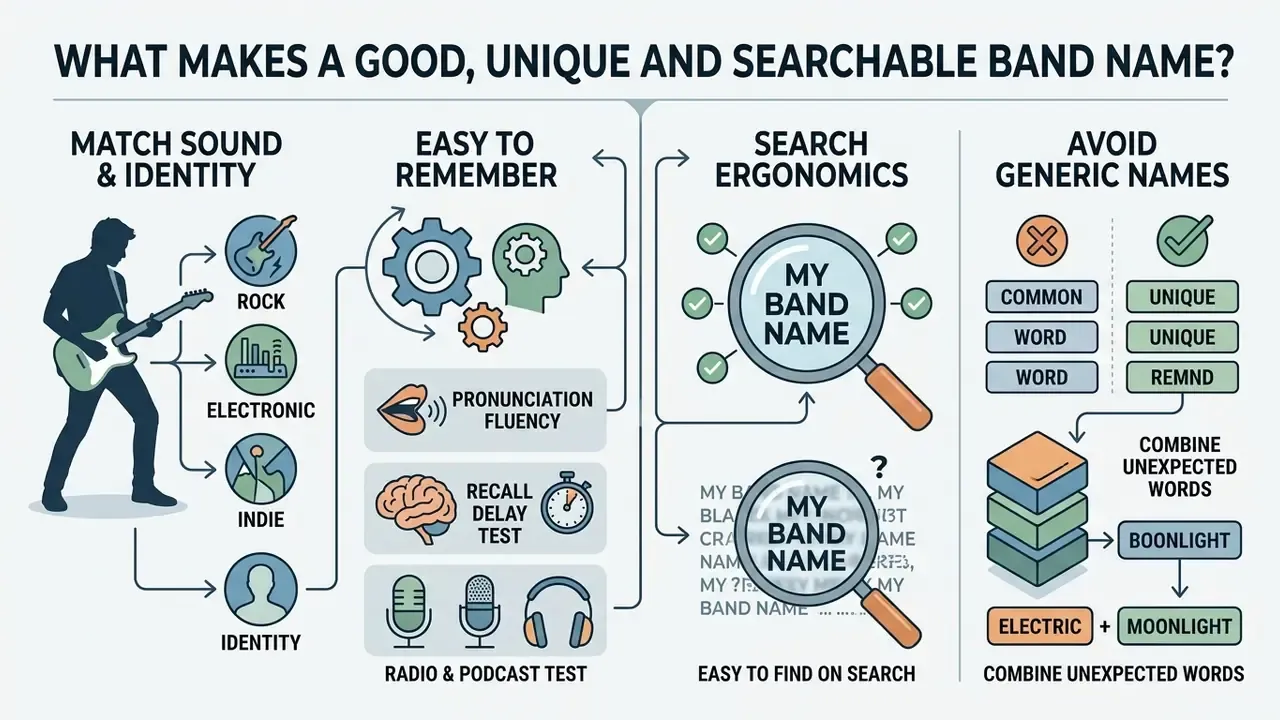
A good band name balances creative expression against practical discoverability. It has to represent your sound, stay easy to pronounce, and behave well in digital search.
Match the Name to Your Band's Sound and Identity
Your band name is the primary touchpoint of the artist brand. It needs to align with the project's acoustic texture and visual positioning.
Brand evaluation frameworks emphasize that meaningful, context-aligned names achieve higher recall and consumer preference than arbitrary words (ISO 20671:2019, Brand evaluation, principles and fundamentals). If an ambient acoustic duo picks a harsh, aggressive-sounding name, first-time listeners on streaming platforms hit cognitive dissonance before the second bar. A useful test: describe the name to someone who has never heard your music and ask what genre they expect. If the guess is wrong by two genres, the name is fighting your record.
Test Whether the Name Is Easy to Remember and Use
A successful band name is phonetically clear, spellable, and simple to say out loud in a loud room.
To test practical usability, run candidates through standard linguistic checks:
- Pronunciation fluencyCan a listener spell the name correctly after hearing it spoken once in a noisy environment?
- Search ergonomicsIs the name free from non-standard spelling that search autocorrect will fight?
- Radio and podcast testCan an announcer say the name clearly without clarifying punctuation or spacing?
- Recall delay testAsk three people to repeat the name 24 hours later. Naming research uses recognition and recall trials for exactly this purpose, typically requiring 70 to 90% accuracy before a name counts as functionally usable.
«Brand recognition correlates with familiarity: r = 0.53 between brand familiarity and memory, β = 0.48, p < 0.001.»
For creators weighing visual editing capabilities alongside branding, test a photo editor to see how naming concepts translate into cover assets, and review AI photo editors for automated cover-art workflows.
Avoid Names That Sound Too Generic
Overly generic names make search visibility nearly impossible and disappear inside streaming recommendations.
Single common nouns, "Breathe" or "Glass," force your band to compete against dictionary definitions, geographic locations, and established businesses in search results. Search guidelines are blunt about it: web entities need distinct naming identifiers to build clear metadata structures and unique titles per page (Google Search Essentials, 2025).
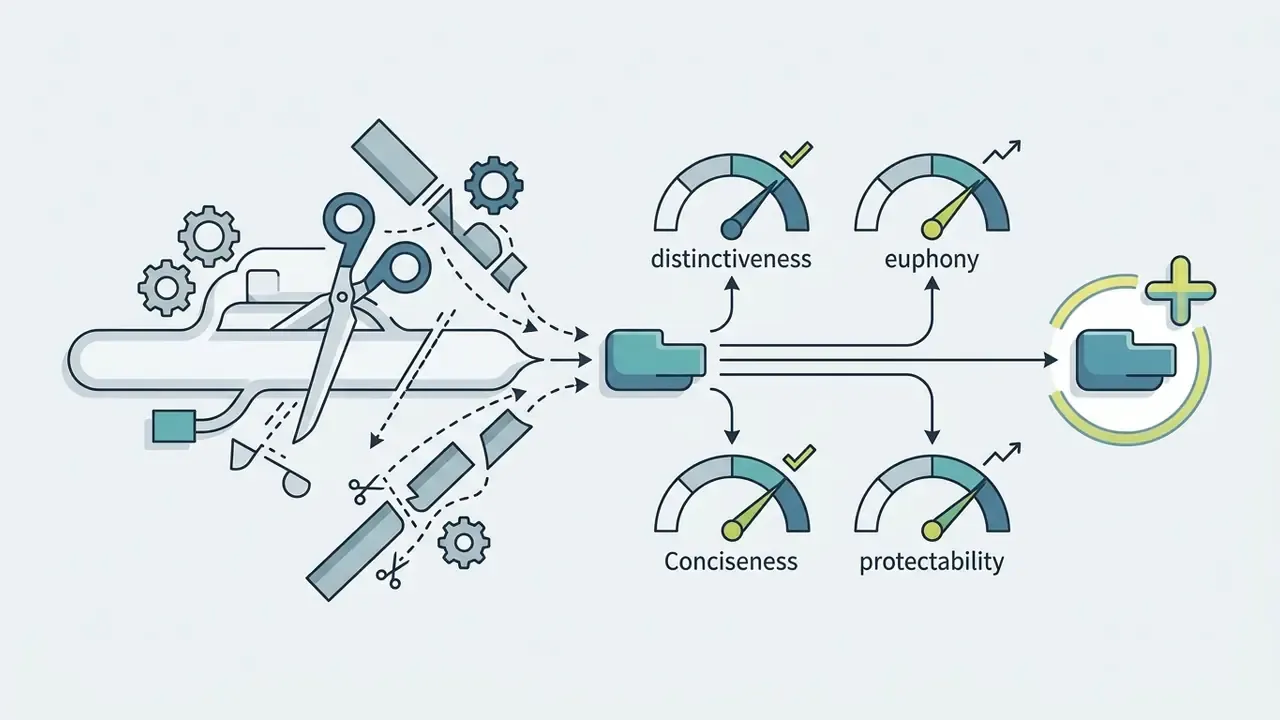
To fix generic AI outputs, apply a few modification techniques:
Check Availability Before You Use a Generated Band Name
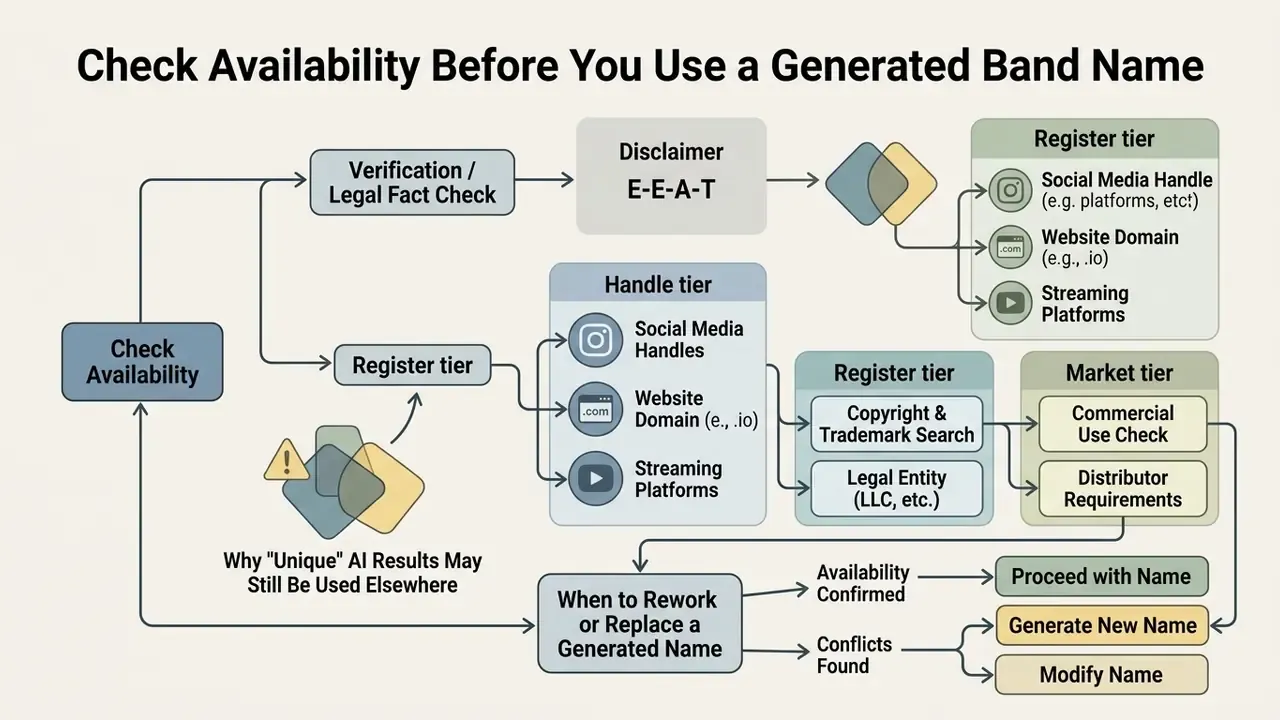
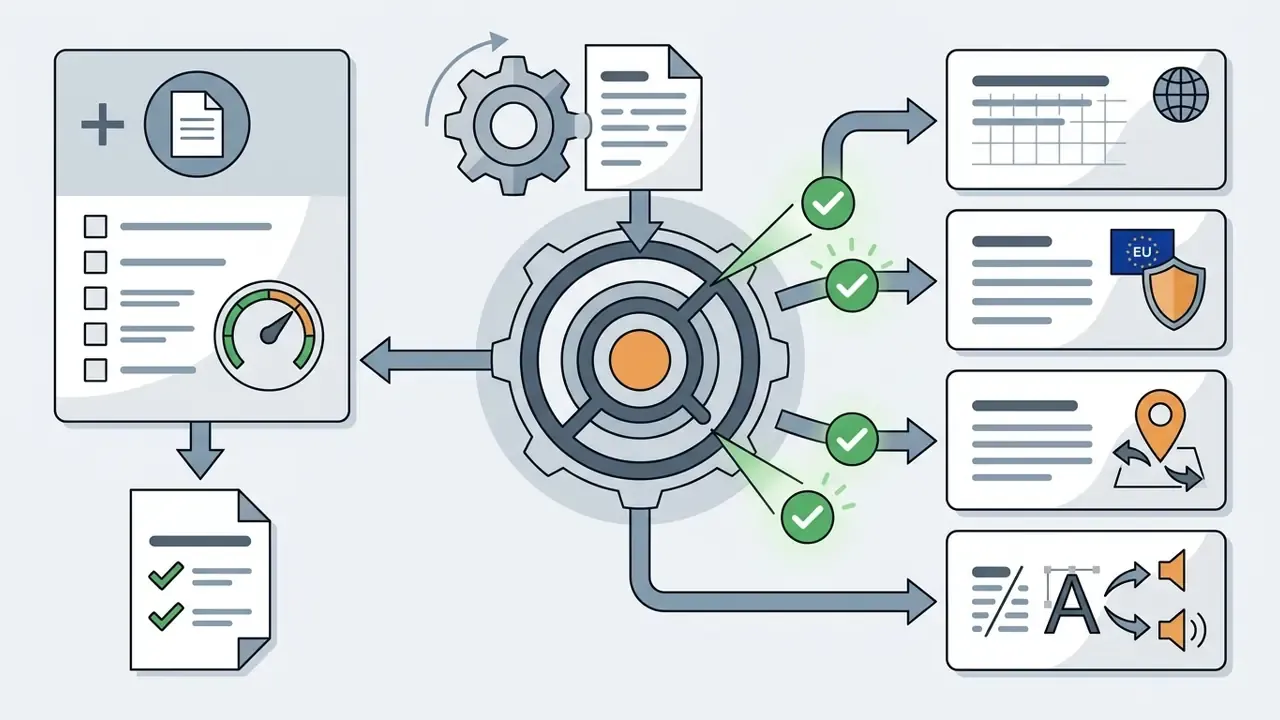
Before you commit to a generated name, run the legal and platform checks. An AI generator produces linguistic combinations. It cannot read trademark registries or streaming catalogs.
E-E-A-T Verification / Legal Fact Check:
«Marks are treated as conflicting when they are similar in sight, sound, or meaning and cover related goods or services, regardless of exact string matching.»
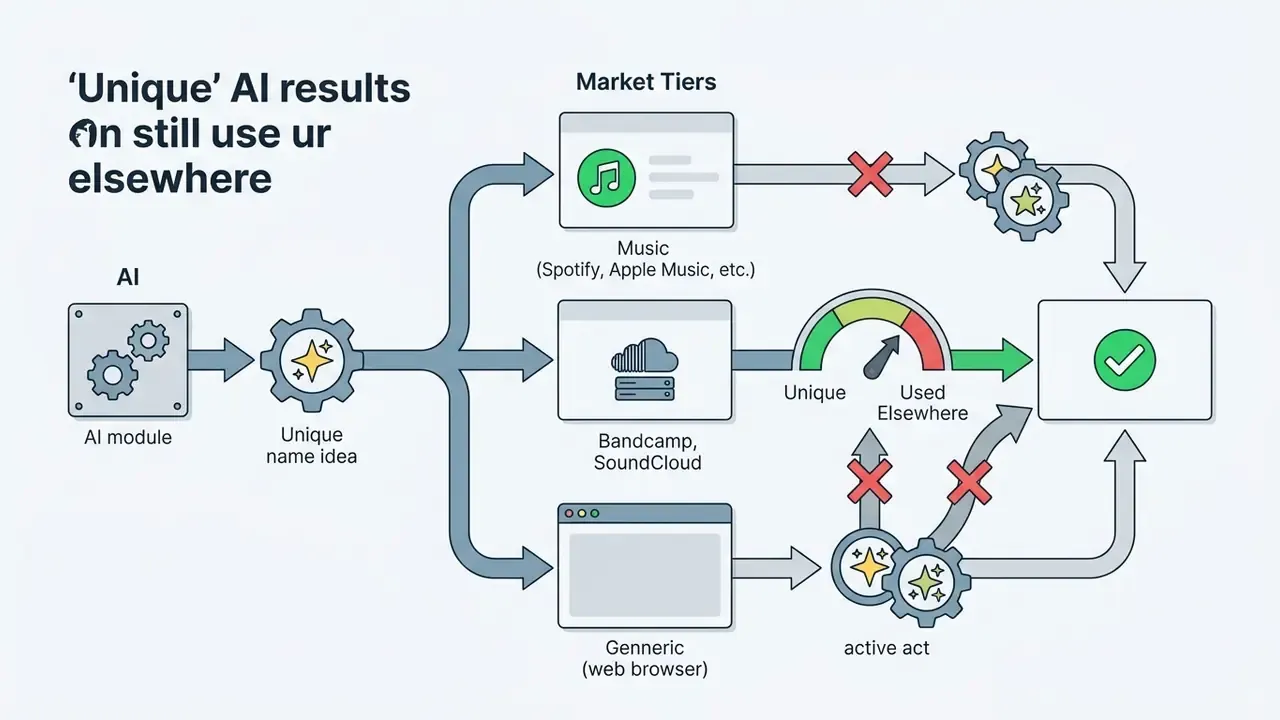
Why "Unique" AI Results May Still Be Used Elsewhere
AI-generated names collide with existing artists and registered trademarks more often than people expect, because LLMs train on historical internet data stuffed with established brand names.
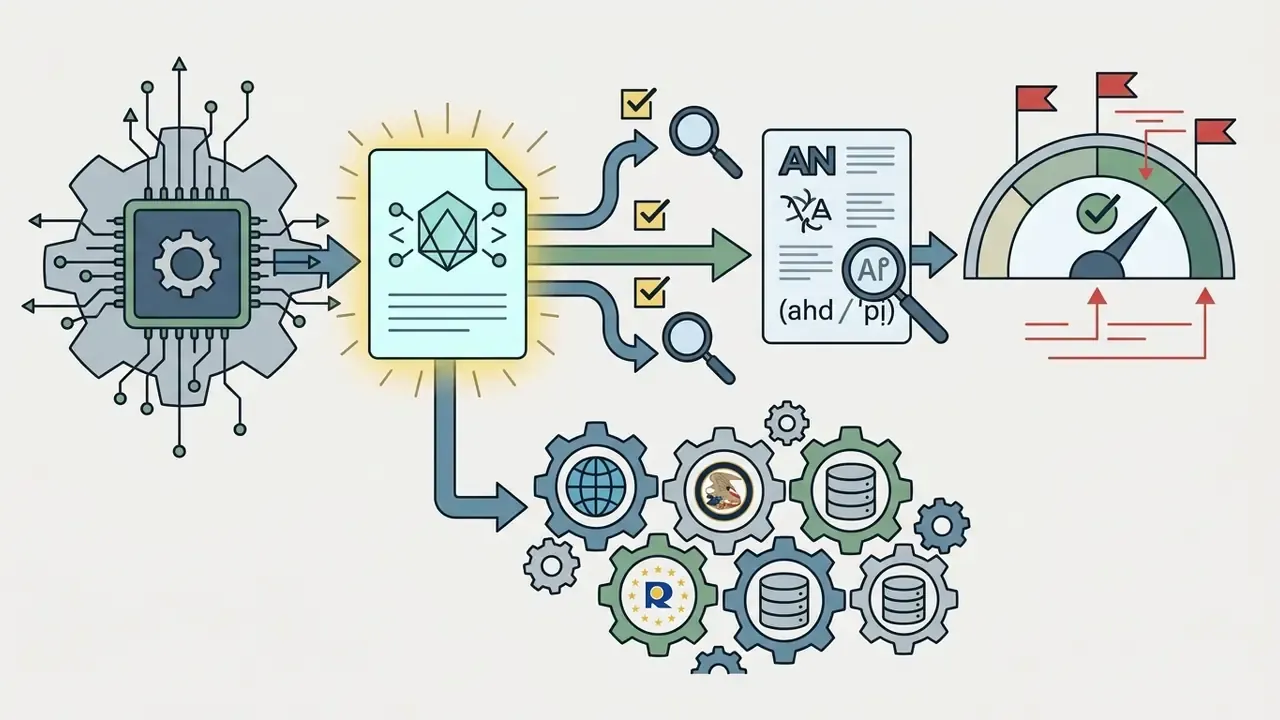
Trademark law evaluates conflicts on likelihood of confusion, not exact string matches. A conflict exists if two names sound alike, look alike, or operate in related commercial categories, such as live music performance and audio recordings. A generator has no idea who filed what, in which class, in which country. It also cannot see a mark that is in use but unregistered, which is the quiet half of the problem.
If a candidate survives all three tiers, document the search date and the exact queries used. That record is what turns an informal band decision into a defensible one, and it costs ten minutes.
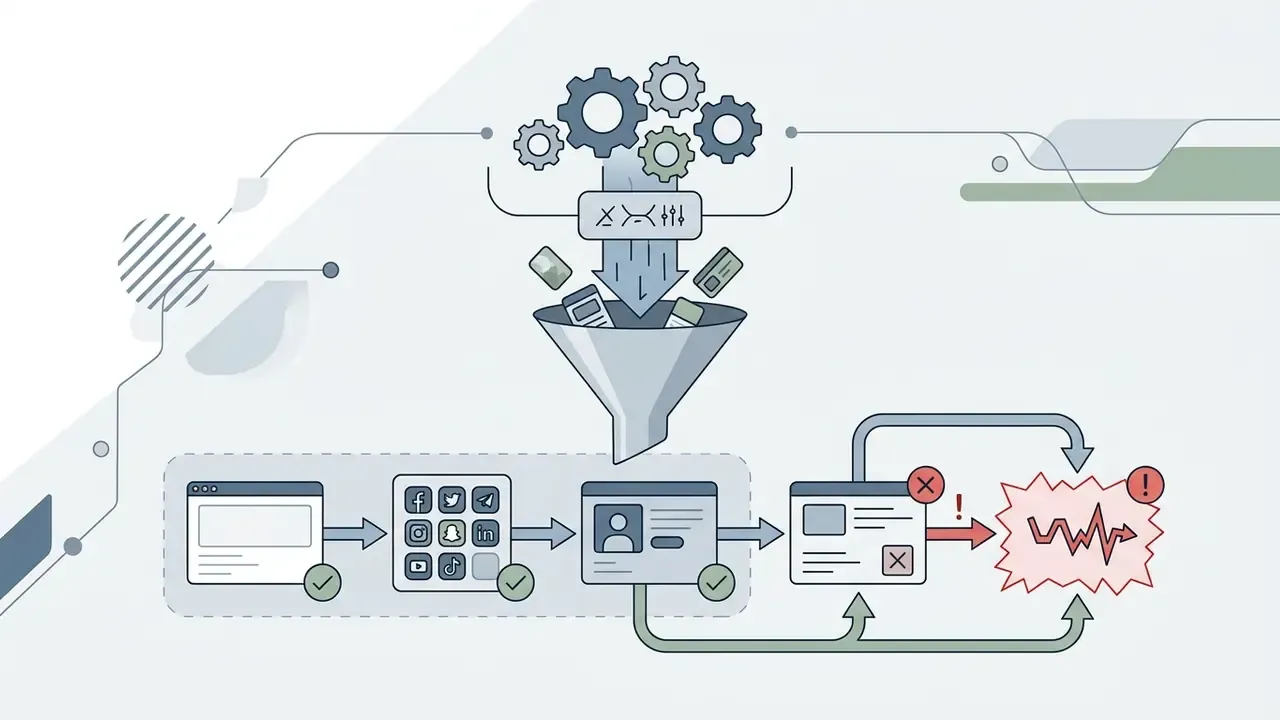
.com domain, primary social handles, and DSP artist-profile availability as one bundle. Partial availability that pushes you toward a creative misspelling is a red flag, not a workaround.When to Rework or Replace a Generated Name
Modify or replace an AI-generated name whenever legal, platform, or search checks surface a conflict.
Rework the candidate immediately if:
- An active federal trademark registration covers live entertainment or music recordings in your target region (USPTO Class 009 for sound recordings, Class 041 for live performance services).
- An active artist on Spotify or Apple Music releases music in the same or an adjacent genre under the identical name.
- The primary
.comdomain and unified social handles are entirely unavailable, forcing convoluted spellings. - The name includes restricted characters (
<,>,&) or puts aliases and translations in the artist-name field, which breaks streaming metadata style guides (Spotify Music Metadata Style Guide, 2025). [Updated: date corrected from an erroneous 2026 citation.] - The name uses a living person's name without written consent, which trademark practice requires for registration.
- Audience testing reveals a negative slang reading, an unintended second meaning, or a mispronunciation you would be correcting at every single show.
There is also a perception dimension that purely technical screening misses.
«AI-designed products from brands with long histories are perceived as poorly compatible with brand heritage, reducing perceived authenticity and prestige.»
The practical takeaway for artists is disclosure discipline. A name generated with AI assistance is perfectly legitimate, but leaning on "our AI picked it" as the origin story can dent perceived authenticity with heritage-sensitive audiences. Let the name stand on its own meaning instead.
Is an AI Band Name Generator Free to Use?
Most ai band name generator free web tools handle standard generation at no cost, while advanced platforms monetise brand identity tools, vector exports, and batch processing. Typical free tiers return 3 to 10 ideas per run, sometimes capped daily, and expose only coarse controls such as tone, style, category, or language.
| Feature / Capability | Free AI Naming Tools | Paid / Extended AI Platforms |
|---|---|---|
| Candidate Generation | Basic text lists (3–10 names per run), daily caps | Unlimited or high-volume generation batches |
| Genre & Vibe Controls | Basic drop-down options | Granular prompt controls and custom model tuning |
| Brand Assets | Text outputs only | Logo generation, brand style guides, album cover art |
| Export Formats | Plain text, copy to clipboard | Vector files (SVG, PDF), transparent PNGs, print-ready packs |
| Availability Checks | None (manual check required) | Integrated domain and automated trademark screening |
| Data Retention & Training | Prompts may be retained and used for model improvement | Contractual no-training options, retention windows, deletion controls |
| Access Controls & Compliance | Public URL, no accounts or roles | SSO/SAML, role permissions, SOC 2 / ISO 27001 / GDPR posture, DPAs |
| Audit Trail | None | Run history, exportable logs, version-controlled brand assets |
The short version of that table: free tiers buy you ideas, paid tiers buy you evidence and file formats.
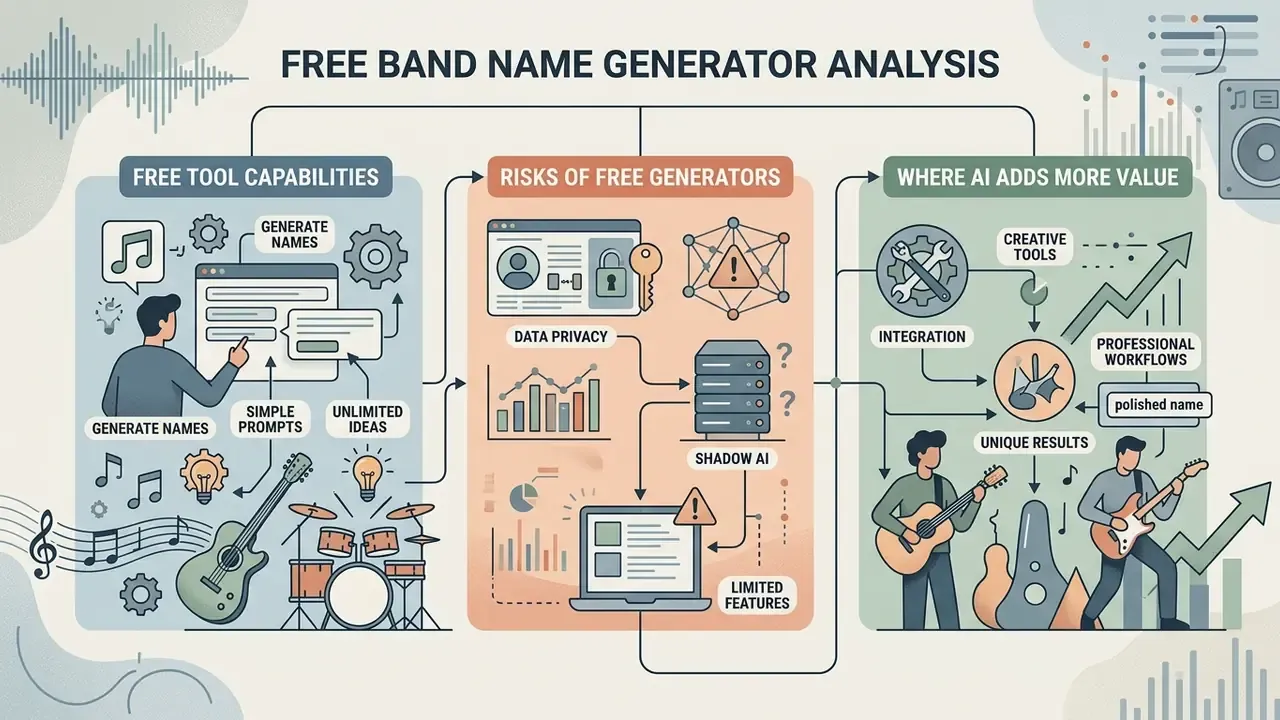
What You Can Do with a Free Band Name Generator
Free AI naming engines earn their keep during the first brainstorming pass, working as automated lexical engines.
With a free tool, musicians can enter basic style descriptions, get instant word combinations, and break through the blank-page stall. You can test dozens of conceptual directions at zero cost, which is exactly the right use of a free tier.
«AI tools function as accelerators for prepared users, shortening the path from idea to execution without replacing professional judgment.»
Data Privacy and Shadow AI Risks in Free Generators
Free browser generators are convenient precisely because they ask for nothing: no account, no contract, no data processing agreement. That is also the risk. Before pasting a brief into a consumer tool, run this checklist:
Checklist0 / 6
One mitigation covers most cases: anonymize the brief. Describe the sound, mood, and imagery without naming the artist, the release, or the client. Output quality barely changes, and the confidentiality exposure disappears.
When AI-Powered Tools Can Add More Value
Paid platforms start paying off when artists need integrated branding suites that reach well past raw text generation.
Moving from a name to a commercial release, comprehensive platforms generate matching visual identity packages, including high-resolution logos, typography rules, and social kits, plus availability research and exportable brand documentation. The monetized layer is rarely naming itself. It is branding execution and governance: file formats, usage rights, brand-guideline generation, and IP research.
For creators exploring broader AI creation workflows, compare options across generative software suites or review AI art generators for cover and poster production. If you need technical documentation on developer tools, open the hub to inspect API structures, rate limits, and cost models before committing to batch generation at scale.
Turn Your Band Name into a Music Brand
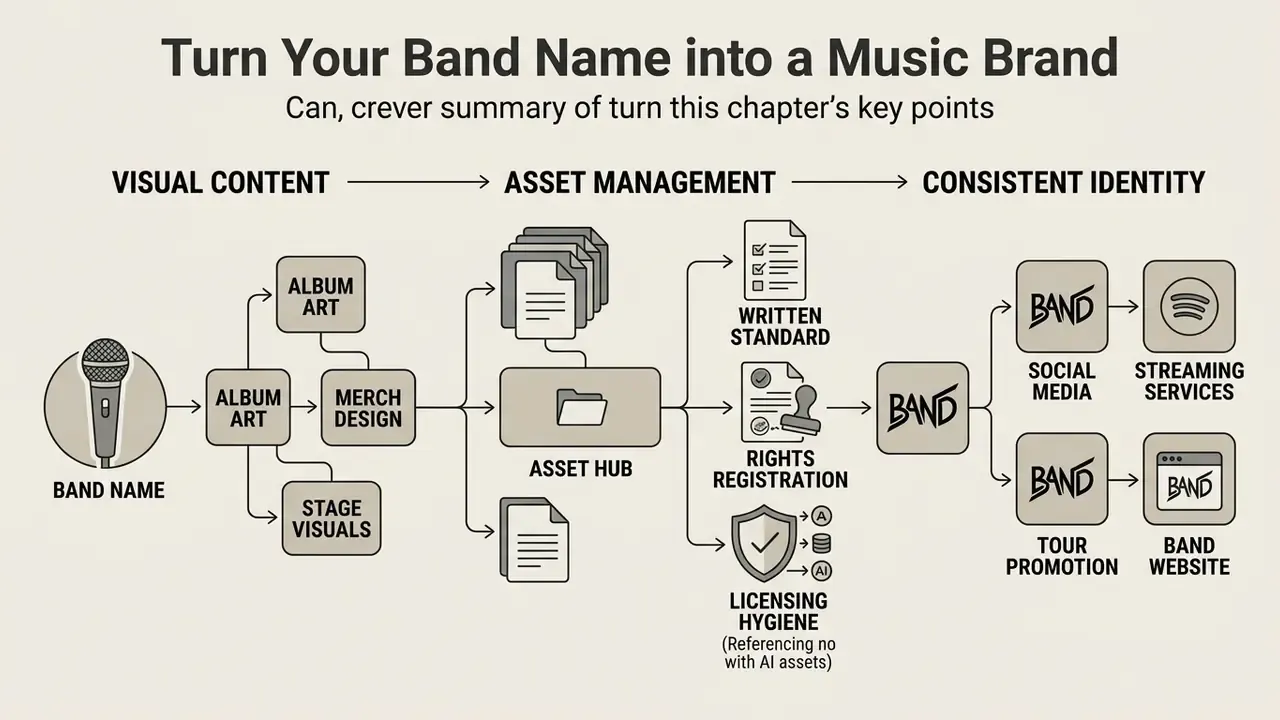
Choosing a name is step one. Turning it into a coherent music brand takes consistent visual identity, disciplined metadata, protected rights, and cross-platform alignment. Brand development in music tends to run in a fixed order: research, strategy, naming, identity design, trademark protection, then launch with written standards.
Create Visual Content Around Your New Band Name
Once the band name is final, build matching visual assets, meaning logos, album artwork, and merch designs that echo the semantic tone of the name.
Generative design workflows let artists input the finalized band name alongside stylistic prompts to produce vector logos and release art. Current brand-guideline generators turn a single reference input into rules for color, typography, layout, imagery, and voice, then export logos as transparent PNG or print-ready PDF (Figma AI brand-guidelines generation and Adobe Express logo workflows, 2025). [Updated: date corrected from an erroneous 2026 citation.]
«AI audio and design tools accelerate content creation and streamline workflows, but require human judgment for interpretation and quality control.»
To explore related visual transformations, creators often stack specialized media tools inside the same identity system:
- Build the core mark and lockup with an AI logo generator.
- Convert press photos into stylized graphics using photo to cartoon ai for zines, stickers, and merch line art.
- Transform band portraits into painted aesthetics via photo to painting ai for single artwork variants.
- Generate hand-drawn concept sketches with photo to sketch ai during the moodboard stage.
- Create motion graphics for track teasers using photo to video.
- Adjust release graphic dimensions fast with a photo size editor to hit DSP and social specs.
Brand Asset Management and Rights Protection After Launch
Generating assets is the easy half. Keeping them coherent is the half that decides whether the name still reads as a brand in two years. Four controls:
- A single source of truth.One shared folder or brand workspace holds the approved name spelling, logo files (vector plus transparent PNG), color values, typefaces, and artwork masters. Versioned, with a changelog.
- A one-page written standard.Minimum logo size, clear space, approved and forbidden color pairings, and the exact artist-name string for metadata. Send it to your distributor, PR contact, promoters, and merch printer.
- Rights registration.File the mark in the classes that match what you actually sell, with sound recordings and live performance services being the two usual suspects, and keep dated evidence of use in commerce.
- Licensing hygiene for AI assets.Record which tool produced which asset, under which plan and license, and whether commercial use and merch resale are permitted. Ambiguous provenance becomes a real problem the first time a design gets licensed for sync or print.
Keep the Name Consistent Across Your Band Identity
Identical spelling, capitalization, and punctuation across every digital streaming platform (DSP) and social channel is not a stylistic preference. It is catalog hygiene.
Streaming metadata style guides mandate artist-name uniformity: use the standard full artist name, apply the same spelling to every release, and never place aliases or translations in the artist-name field (Spotify Music Metadata Style Guide and Spotify Support metadata formatting guidelines, 2025). Spelling drift, say "The Neon Sound" on Spotify against "Neon Sound" on Apple Music, splits artist profiles, breaks algorithmic recommendations, and complicates royalty accounting.
«Brand familiarity is a strong predictor of memory (r = 0.53); consistent use of the name across platforms is critical for long-term recognition.»
Your band name should also appear in page titles and meta descriptions on your own site, with unique titles per page. The same discipline that makes a name searchable on Google makes it findable on a DSP.
FAQ: Frequently Asked Questions About AI Band Name Generators
Can I legally trademark a band name created by AI?
Yes. Trademark protection in the United States depends on using the name in commerce to identify goods or services, such as live musical performances or sound recordings, not on whether a human or an AI model first suggested the word combination (USPTO guidance, 2024). What governs registrability is distinctiveness, lawful use, and the absence of likelihood of confusion with prior marks. One nuance worth remembering: pure AI output without human creative contribution is not protected by copyright. Trademark and copyright answer different questions here.
«Many consumers do not regard AI as a true author and attribute primary creative responsibility to the human co-author.» — Can ChatGPT be an author? Generative AI creative writing assistance and perceptions of authorship (2025). https://doi.org/10.1016/j.chb.2024.108390
Are AI-generated band names 100% unique?
No. AI models sample learned language patterns from existing internet text, and reviews of generative AI in creative contexts confirm that outputs recombine training-data patterns rather than guaranteeing novelty (Generative AI in Creative Contexts, Management Review Quarterly, 2024, https://doi.org/10.1007/s11301-024-00432-3). No generator can promise that an output is unused by another artist or unprotected by an active registration. Treat every candidate as unverified until you finish register, market, and handle checks. Once the name is locked, tools such as AI photo editors handle the next stage: turning the name into cover and press assets.
How specific should my prompt be in an AI band generator?
Include subgenre, emotional mood, key instruments, production characteristics, and project format. Specific inputs such as "dark 90s shoegaze, fuzzy guitars, reverb, melancholic, four-piece" return far more targeted names than "rock band." Add structural constraints too, meaning maximum word count, banned words, and required patterns, because constraints are what stop the model from defaulting to its most probable clichés.
What should I do if my favorite AI-generated name is already taken on Spotify?
If another active artist uses the exact name in your genre, change the candidate. Add a distinct modifier, alter the structure (one word instead of two), or rerun the generator with negative constraints excluding the conflicting term. Do not settle for an unusual spelling of the same spoken name: phonetic similarity is precisely what likelihood-of-confusion analysis catches, and it splits your search traffic on top of that.
How many names should I generate before choosing one?
Aim for 50 to 200 raw candidates across several runs. The first batch is almost always the most generic, because the model is still working from broad associations. The strong ideas usually surface after you refine your seed words two or three times. Then apply the 50-to-3 Elimination Protocol above instead of voting on the raw list.
Can I use an AI-generated band name commercially?
The name is yours to adopt, but adoption is not clearance. Before commercial use, search for existing bands with the same or a similar name, check trademark databases in your target markets, and confirm domain and social handle availability. A name can be freshly AI-generated and still be in active use by another act.
Is it safe to paste our unreleased project details into a free generator?
Only if you have confirmed the tool's retention and training policy. Free consumer generators often reserve the right to store prompts and use them for model improvement. For unreleased titles, signed-artist information, or anything under NDA, either use a sanctioned tool with a data processing agreement and a no-training option, or anonymize the brief so it describes the sound without identifying the project.
Does a generator work for a solo artist or a fictional band in a novel?
Yes, but say so in the prompt. State the format explicitly, whether solo alias, duo, producer project, tribute act, or fictional in-world band, because group-oriented and alias-oriented names follow different structural conventions. For imaginary bands, ask for a one-line lore note alongside each name so you can check it against your world's internal logic.
Appendix A: Source Notes and Editorial Corrections
For transparency, this article was revised to strengthen verifiability. The changes below are recorded rather than silently applied.
| Original citation as first published | Issue identified | Current treatment |
|---|---|---|
| Management Review Quarterly, 2026 (creative-writing cliché claim) | Forward-dated, no metrics or URL | Replaced with Art or Artifice?, CHI 2024, including pass-rate figures and DOI |
| Google Cloud Lyria Prompting Guide, 2026 | Forward-dated | Generalized to Google DeepMind Lyria model prompting guidance, 2024–2025 |
| Denodo AI Semantic Layer Guidelines, 2026 | Forward-dated | Corrected to 2025 semantic-layer guidance, with the 3–5 synonym rule stated explicitly |
| Spotify Music Metadata Style Guide, 2026 | Forward-dated | Corrected to the 2025 Spotify metadata style guide and support guidelines |
| Figma AI Design Guidelines, 2026 | Forward-dated | Corrected to 2025 brand-guideline generation workflows (Figma, Adobe Express) |
| Journal of Product & Brand Management, 2024 (prompt-detail claim) | No URL, no figures | Supplemented with Creativity Support in the Age of LLMs, arXiv 2024 (n=30 writers) |
| Journal of Product & Brand Management, 2024 (recall claim) | No URL, no figures | Replaced with BRAND database study, Behavior Research Methods 2024 (r=0.53; β=0.48) |
| Systematic Survey of Prompting Techniques, 2024 | No URL or data | Replaced with arXiv 2024 empirical study of iterative prompt refinement |
| Behavior Research Methods, 2024 (free-tool claim) | Source not topically relevant | Replaced with Lindenwood University study on AI tools as creative accelerators |
| "2025 branding audit of 200 AI-generated names, 34% overlap" | No named source or methodology | Removed and replaced with USPTO likelihood-of-confusion guidance and a documented three-tier screening workflow |
Primary standards and official sources referenced: NIST AI Risk Management Framework and Generative AI Profile (2024); USPTO trademark search and AI-assistance guidance (2024); ISO 20671:2019 brand evaluation; Google Search Essentials (2025); Spotify Music Metadata Style Guide (2025).
Legal and compliance disclaimer: This article provides general information about naming workflows and is not legal advice. Trademark availability, registrability, and infringement risk depend on jurisdiction, class, and factual use. Consult a qualified intellectual property attorney before commercial launch, and check your organization's information-security policy before entering confidential material into any third-party AI tool.