Last updated: February 2026 · Reviewed by: editorial standards and AI governance desk · Platform neutrality: this guide is vendor-agnostic; no platform sponsors this evaluation.
Executive Summary
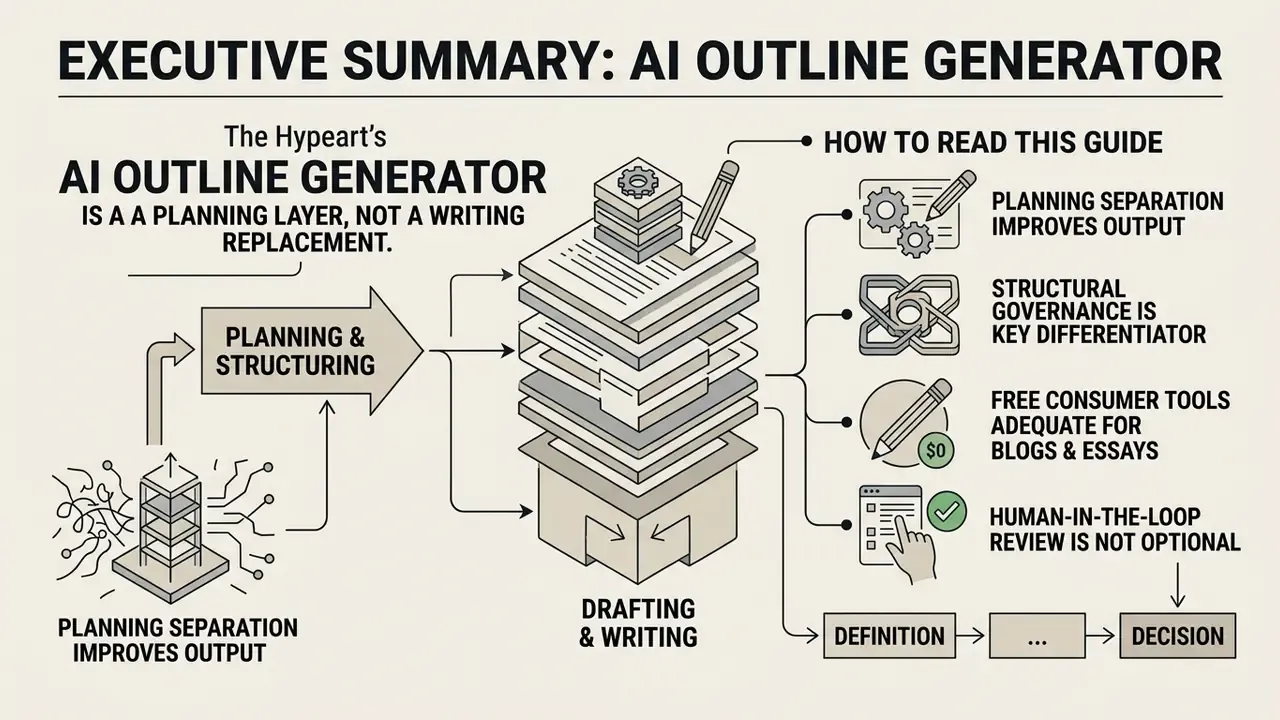
- An ai outline generator is a planning layer, not a writing replacement. It produces a nested H2/H3/H4 blueprint from a topic, keyword set, audience definition, and purpose parameter.
- Separating planning from drafting measurably improves output quality. Outline-first workflows reduce narrative drift, widen topic coverage, and correlate with stronger search performance than unedited AI prose.
- Structural governance is the real differentiator. The outline is the cheapest place to catch coverage gaps, duplicate sections, and compliance omissions, long before thousands of words inherit the mistake.
- Free consumer tools are adequate for blogs and essays. Regulated environments (banking, model risk, internal audit) need enterprise controls: no training on customer data, tenant isolation, retention limits, and reproducible audit evidence.
- Human-in-the-loop review is not optional. Post-editing standards (ISO 18587), heading accessibility rules (W3C), and search engine heading guidance (Google) together define what a validated outline must satisfy.
How to Read This Guide
The material moves from definition to decision. First, what the tool actually does and how it differs from manual outlining. Then the business case, expressed as risk-adjusted ROI rather than raw speed. After that come the operating instructions: inputs, master prompts, post-editing, and the structural schemas that different document types demand. The final third is written for buyers in financial services: regulatory documentation blocks, Shadow AI exposure, vendor approval checks, export formats, and licensing terms for commercial publication. If you only have five minutes, read the ROI model and the security checklist; those two sections carry the decisions that cost money.
Free AI Outline Generator Studio
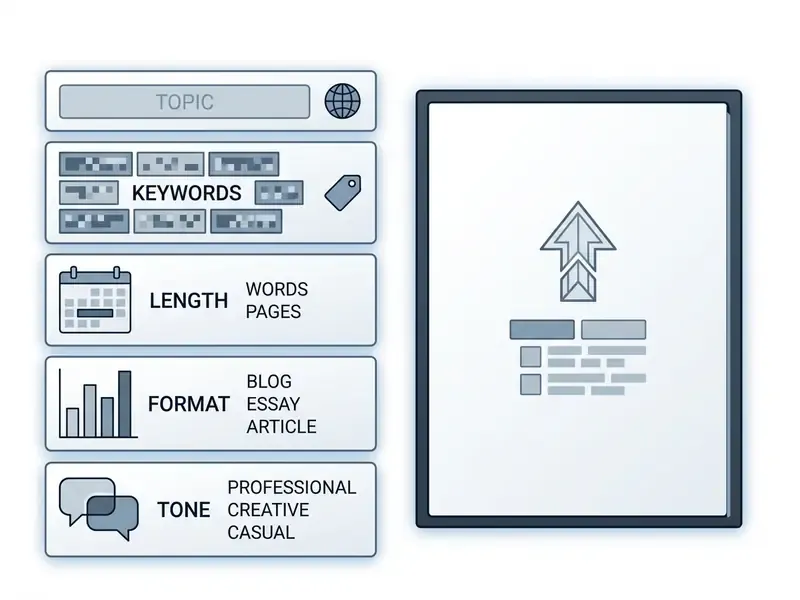
The configuration panel above mirrors the five parameters that every credible outline maker ai exposes: document format, section depth, tone, length target, and topic. Whichever tool you use, these five inputs shape the result more than the underlying model does. Change the purpose from "blog post" to "validation report" and the architecture changes completely, even with identical topic text.
What Is an AI Outline Generator?
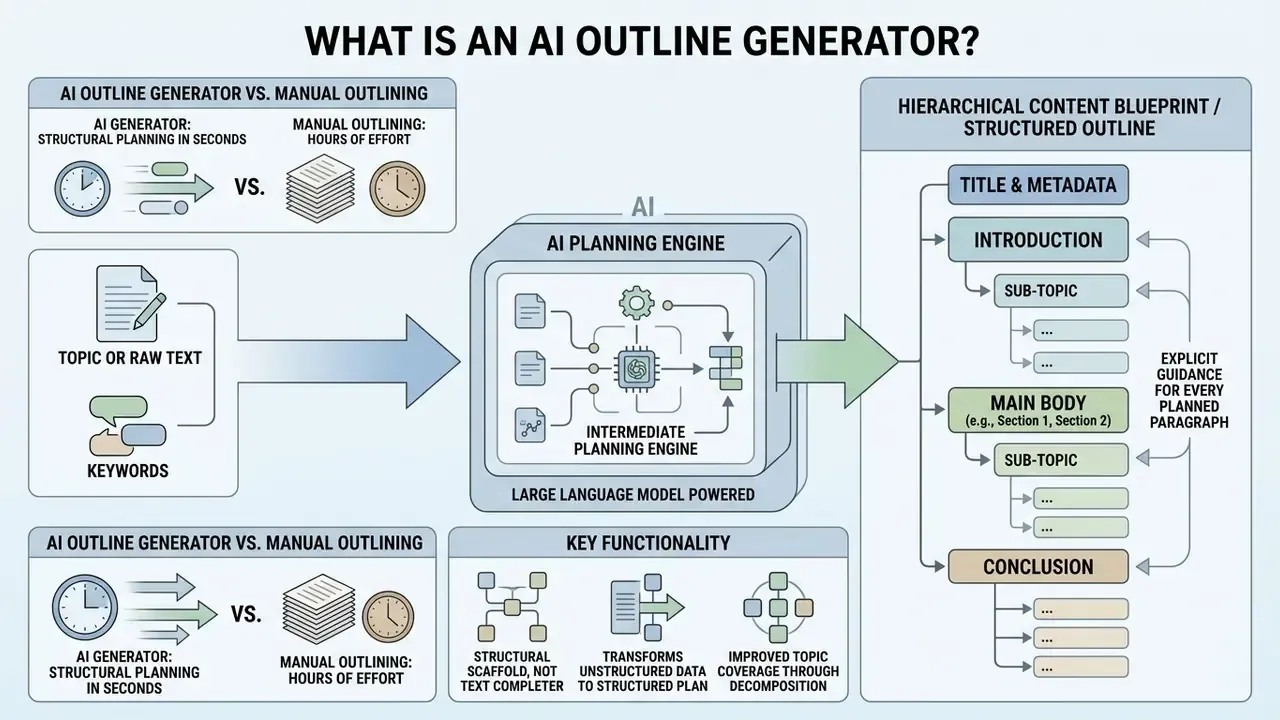
An ai outline generator is an intermediate planning engine powered by large language models that transforms raw topics or unstructured text into a hierarchical content blueprint. It reads the user inputs, primary concepts, target search intent, formatting rules, and returns nested headings (H2, H3, H4) that govern the flow and scope of the future document. Readers mapping the wider tool landscape can also review our overview of AI video generators for adjacent generation workflows.
Modern systems work as structural scaffolds, not as text completers. According to research on the STORM framework for long-form content generation (Stanford STORM Research, 2024), separating the pre-writing planning phase from prose drafting enhances information coverage, reduces narrative drift, and improves topical coherence across long documents.
From a Topic to a Structured Content Outline
An outline ai generator turns a single concept into a complete content outline by decomposing broad ideas into distinct thematic sub-questions. When a user submits a working topic, the system evaluates semantic relationships, identifies core subtopics, and arranges them in a logical hierarchy. The generator creates the skeleton; the author still supplies the muscle.
In advanced frameworks such as Writing Path (NAACL Industry, 2025), the transformation runs across defined stages:
- Metadata preparation (defining purpose, audience, and keywords)
- Initial title and high-level section creation
- Search or retrieval augmentation
- Detailed subheading generation with context integration
- Section-by-section writing against the approved structure
This multi-step decomposition means the final generated outline carries explicit guidance for every planned paragraph before writing begins.
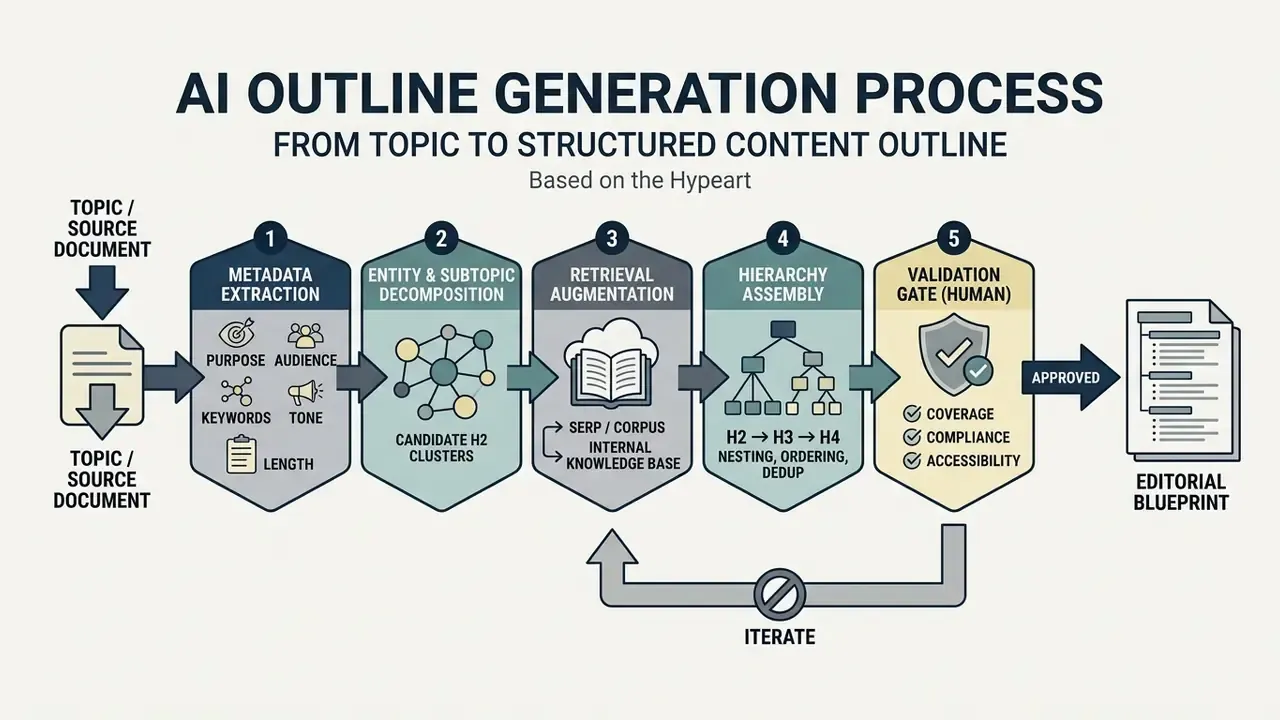
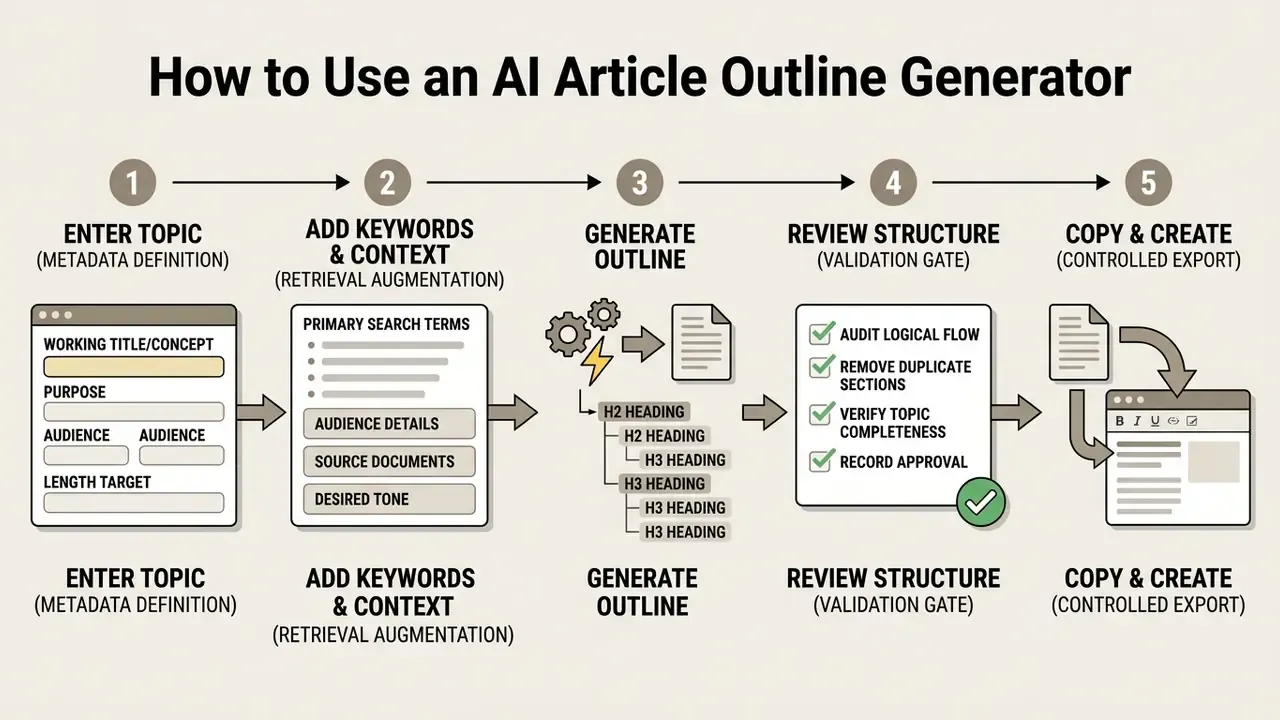
Data flow from a raw topic to a hierarchical structure: how an AI outline generator converts unstructured input into H2/H3 sections and passes through a human validation gate.
AI Outline Generator vs. Manual Outlining
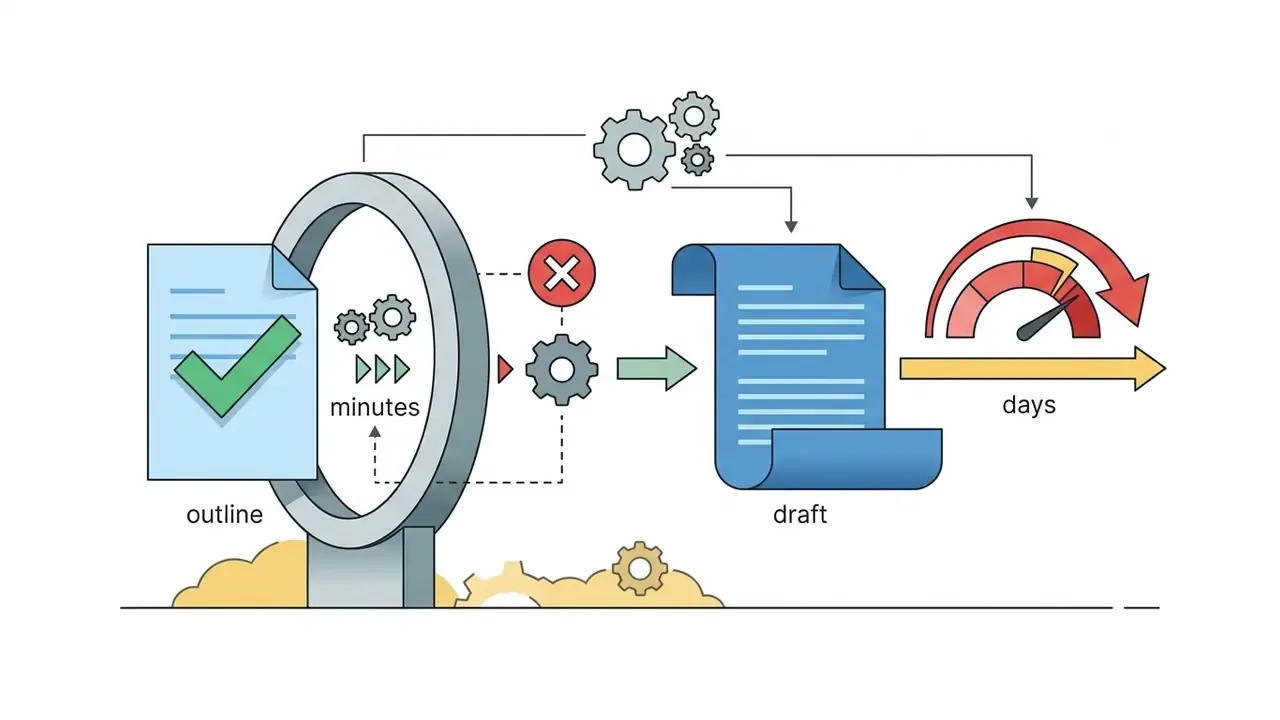
An ai outline creator compresses structural planning from hours into seconds, whereas manual outlining is labour-intensive and leans entirely on human memory plus manual SERP research. But speed is not the whole story. An outline maker ai excels at rapid ideation and broad keyword coverage; manual planning still gives tighter control over nuanced editorial logic and institutional policy.
| Dimension | Manual Outlining | AI Outline Generator |
|---|---|---|
| Speed | 30–90 minutes per plan | 5–15 seconds |
| Topic Coverage | Limited to human research scope | Broad, systematic entity extraction |
| Structural Flexibility | Fully customized, manual adjustment | Rapid multi-variant generation |
| Risk of Repetition | Very low | Requires human post-editing to remove formulaic sections |
| Compliance Sensitivity | High, author applies policy knowledge | Low by default, must be enforced by prompt and review |
| Auditability | Implicit (author notes) | Explicit if prompts, versions, and approvals are logged |
Empirical benchmarks on outline generation models show that systems fine-tuned for structural planning, such as Qwen2-7b-Scribe tested on the DeFine dataset (DeFine Research, 2025), gain 4.3% to 14.4% in heading soft recall and up to 27.1% in heading entity recall against standard baselines.
«Qwen2-7b-Scribe, trained on the DeFine dataset, improved heading entity recall by 5.9–27.1% over baseline models.»
Benchmark note (verification pending): these figures come from a single academic benchmark on the DeFine dataset and have not been independently reproduced on other corpora. Treat them as directional evidence for outline-specialised fine-tuning, not as a universal guarantee. Even with those gains, human review still prevents structural duplication and keeps output aligned with institutional standards.
Why Use an AI Outline Maker Before Writing?
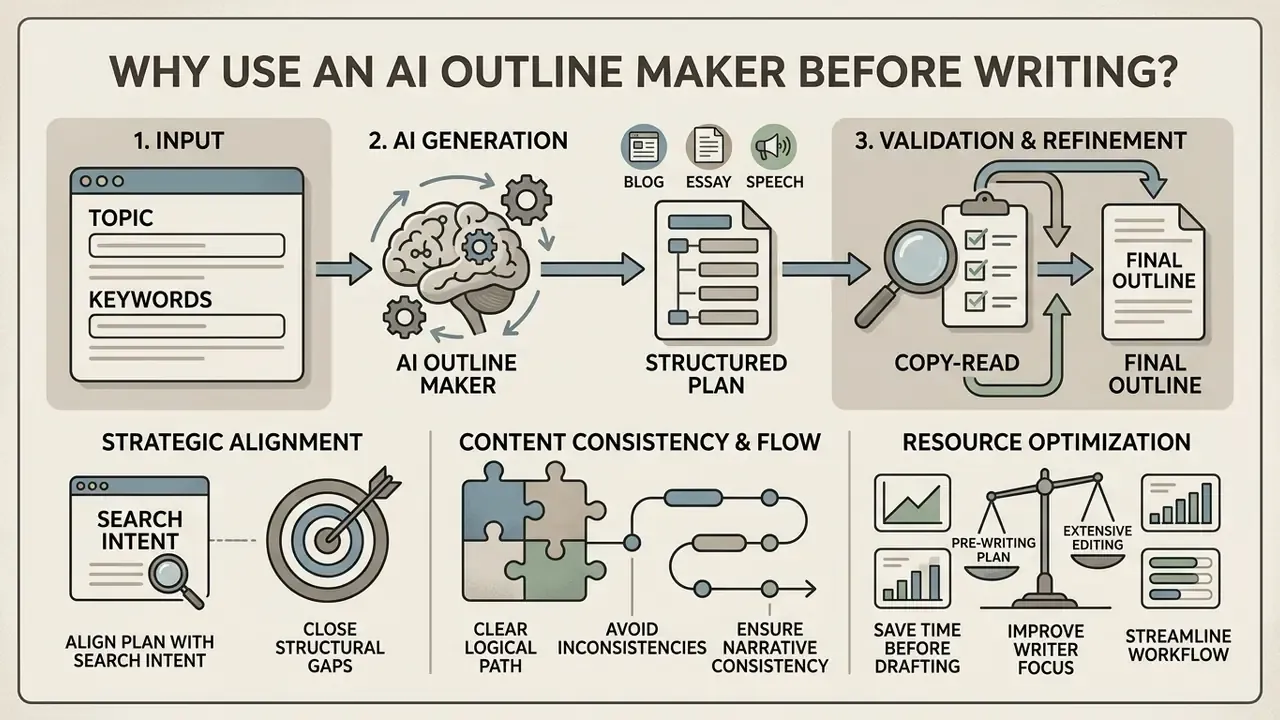
Running an ai outline maker before drafting keeps long-form content on a clear logical path, closes structural gaps, and aligns the plan with search intent before anyone invests time in sentence-level writing. An outline structured around explicit objectives blocks off-topic tangents and cuts editing time later. Teams comparing zero-cost tiers across categories can also review our breakdown of free AI video generators to see how usage limits typically scale.
«AI-generated content initially ranks around 35% better through keyword optimisation, then loses 48% of positions because of a 68% bounce rate.»
Structural planning has a downstream effect on performance. A 16-month longitudinal industry benchmark tracking 4,200 web articles (DigitalApplied SEO & AI Content Ranking Study, 2026) reported that AI content published without structural planning and editorial review ranked, on average, 23% lower than comparable human-written content in the same sample.
«Pure AI content without editing ranked on average 23% lower than human content; AI-assisted content with editing trailed by only 4%.»
AI-assisted content that used structured planning plus substantive human editing landed within 4% of fully human-written content on median ranking positions. Since this is a vendor-published longitudinal benchmark rather than a peer-reviewed trial, read the percentages as an industry signal and confirm source availability before citing them in formal documentation.
In one internal enterprise document workflow evaluation, a technical writing team fought inconsistent section depth and duplicated compliance arguments across product manuals. After mandating an ai blog outline generator workflow, where editors approved the blog post outlines before drafting, the team reported 40% fewer structural revision cycles and removed duplicate sub-sections across 120 published guides. (Figures are self-reported from a single organisation's internal audit and are not independently verified; use them as a directional case, not a benchmark.) Writers optimising multi-format visual workflows can also review our guide on 2d animation ai for related automation strategies.
Editors preach the same sequencing discipline. Contentful's 2024 editorial guidance recommends requesting "an outline, subheads, or a message summary before you ask for full sections," which puts structural control ahead of prose. Microsoft's 2025 writing guidance adds a reverse check: after drafting, outline the piece again to test flow. Practitioner checklists go further, telling editors to "check the flow, gaps, and repetition" and to "validate the outline against real facts and brand voice" before a single body paragraph exists.
Risk-Adjusted ROI of Outline Automation
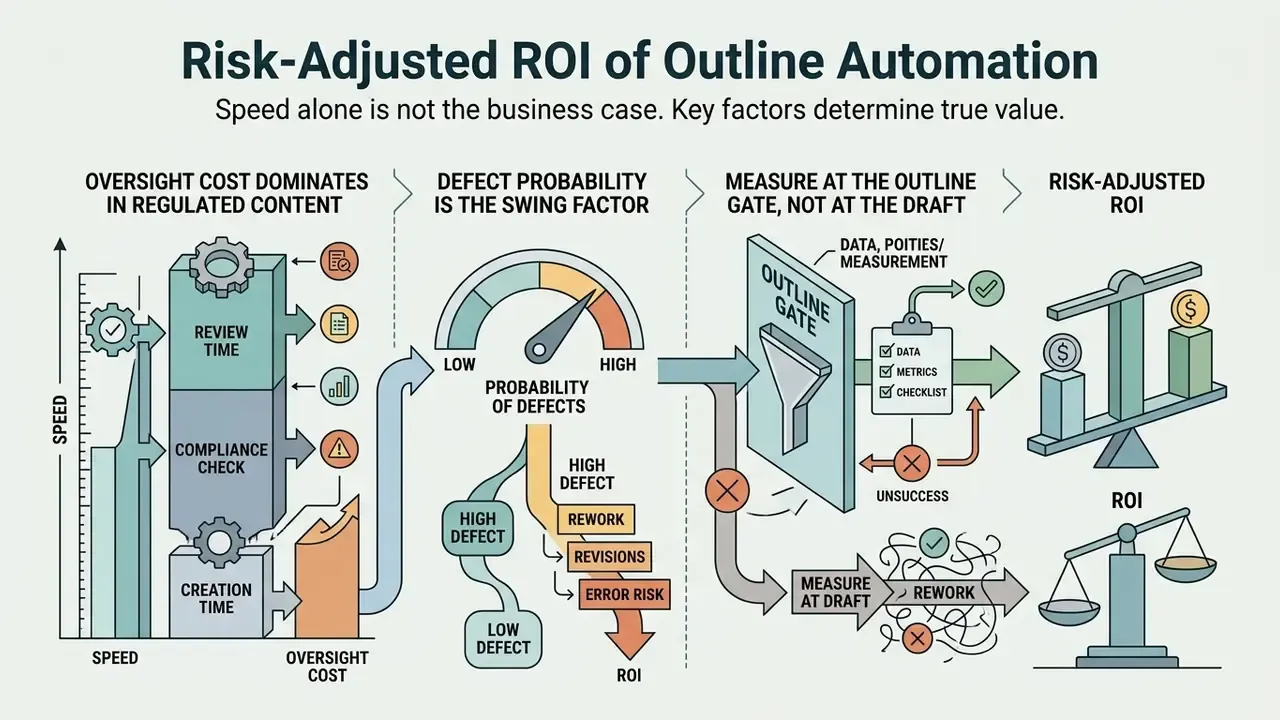
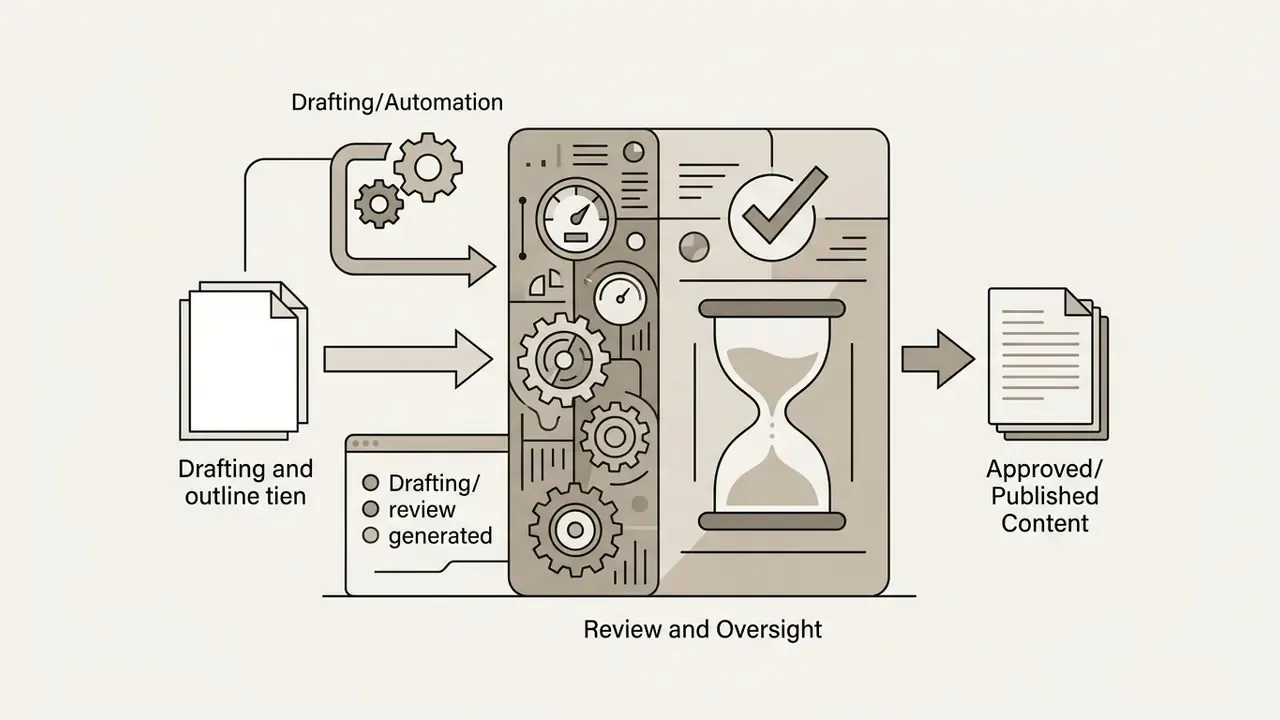
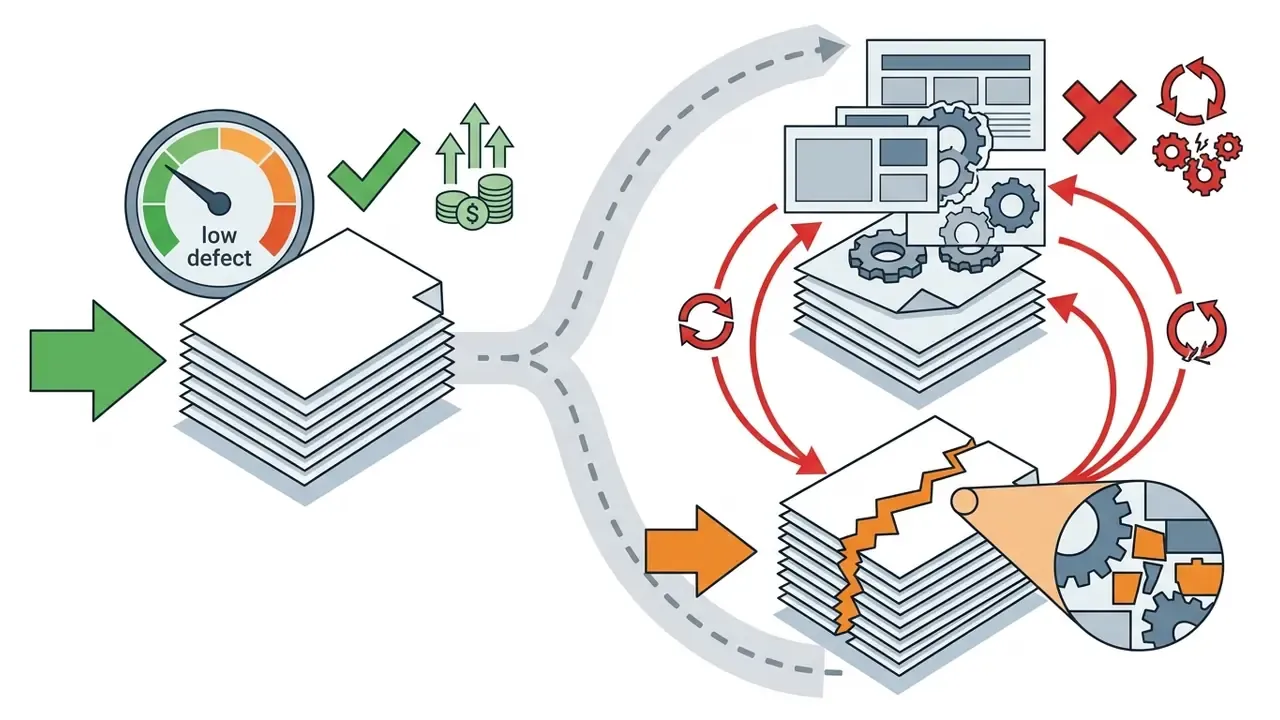
Speed alone is not the business case. The defensible metric is risk-adjusted ROI, which nets automation savings against the cost of mandatory human oversight and the expected cost of residual errors.
A practical model:
Gross Saving      = (T_manual − T_ai) × N_documents × Blended_hourly_rate
Oversight Cost    = T_review × N_documents × Reviewer_hourly_rate
Rework Cost       = P_defect × N_documents × Cost_per_rework
Tooling Cost      = License + Integration + Security_review (amortised)
Risk-Adjusted ROI = (Gross Saving − Oversight Cost − Rework Cost − Tooling Cost)
                    ─────────────────────────────────────────────────────────────
                              (Oversight Cost + Tooling Cost)
Where:
| Variable | Definition | How to measure |
|---|---|---|
| T_manual | Hours to build a structure manually | Time-tracking baseline over 10–20 documents |
| T_ai | Hours to generate and configure the outline | Tool telemetry or stopwatch sampling |
| T_review | Hours of qualified review per outline | Reviewer timesheets, split by seniority |
| P_defect | Share of outlines needing structural rework after approval | Post-publication defect log |
| Cost_per_rework | Average cost of a late structural correction | Revision cycles × rate, plus delay cost |
Three rules fall out of this model:
Two proxy metrics make this measurable without bespoke instrumentation. Heading entity recall asks whether the outline surfaced every required entity and mandatory section. Redundancy rate measures the share of sections whose semantic similarity to another section exceeds your threshold. Both can be tracked per document and trended per quarter, which is usually enough for an executive dashboard. To sanity-check assumptions before committing budget, teams can view the guide on our interactive calculator portal.
How to Use an AI Article Outline Generator
To produce an actionable plan with an ai article outline generator, users follow a five-step sequence: enter the main subject, insert target search phrases, initiate generation, audit the output for structural logic, then copy the finalised draft into their editor. In governed environments each step maps to a systems stage: metadata definition → retrieval augmentation → generation → validation gate → controlled export.
Enter a Topic or Working Title
The first step in operating an outline generator ai is supplying a descriptive working title or a concise topic prompt. Clear parameters stop the generator from producing generic or misaligned headings.
Prompt engineering guidance from major technology institutions (Harvard UIT Prompting Guidelines, 2025) stresses that prompts should state goals, scope boundaries, and format expectations.
«Input prompts should state clear goals, scope boundaries, and the expected output format, which reduces the risk of irrelevant headings.»
Instead of typing a single word like "Banking," a structured prompt such as "AI governance controls for US commercial banks" gives the system enough context to build targeted section headings. Complementary frameworks say the same thing under different labels: Notre Dame's CRAFT model (Context, Role, Action, Format, Tone) and the CARE structure (Context, Ask, Rules, Examples) both pair the topic with an explicit role and deliverable rather than a bare title.
Add Keywords and Content Context
Adding target keywords and search context at the input stage makes the free ai outline generator build headings that match user intent and SEO specifications. Supplying primary and secondary keywords lets the system assign terms to appropriate sub-sections automatically. Best practice is one primary keyword plus at most one or two genuinely co-equal secondary terms. Longer comma-separated lists dilute focus, and most generators cannot weave them all into a coherent hierarchy anyway.
U.S. Department of Energy web guidance (DOE SEO Best Practices, 2026) recommends placing core keywords in descriptive headings, opening paragraphs, and metadata without stuffing.
«Keywords should be placed in descriptive headings and opening paragraphs without stuffing, which improves indexing without penalties.»
Adding context, such as intent type (informational versus commercial) or audience seniority, pushes the generator tools toward sections tailored to a specific reader. For document assets the same principle applies to metadata: a descriptive file name, title, subject, keyword set, and declared language remain the baseline for discoverability.
Ready-to-Use Master Prompts for AI Outlining
If you use general-purpose LLMs (ChatGPT, Claude, Gemini) instead of a dedicated outline generator interface, copy and adapt the engineered master prompts below.
1. SEO blog post master prompt
2. Academic research paper prompt
3. Persuasive speech and presentation prompt
4. Compare and contrast essay prompt
5. Regulated document / model risk report prompt
Generate, Copy and Edit the Outline
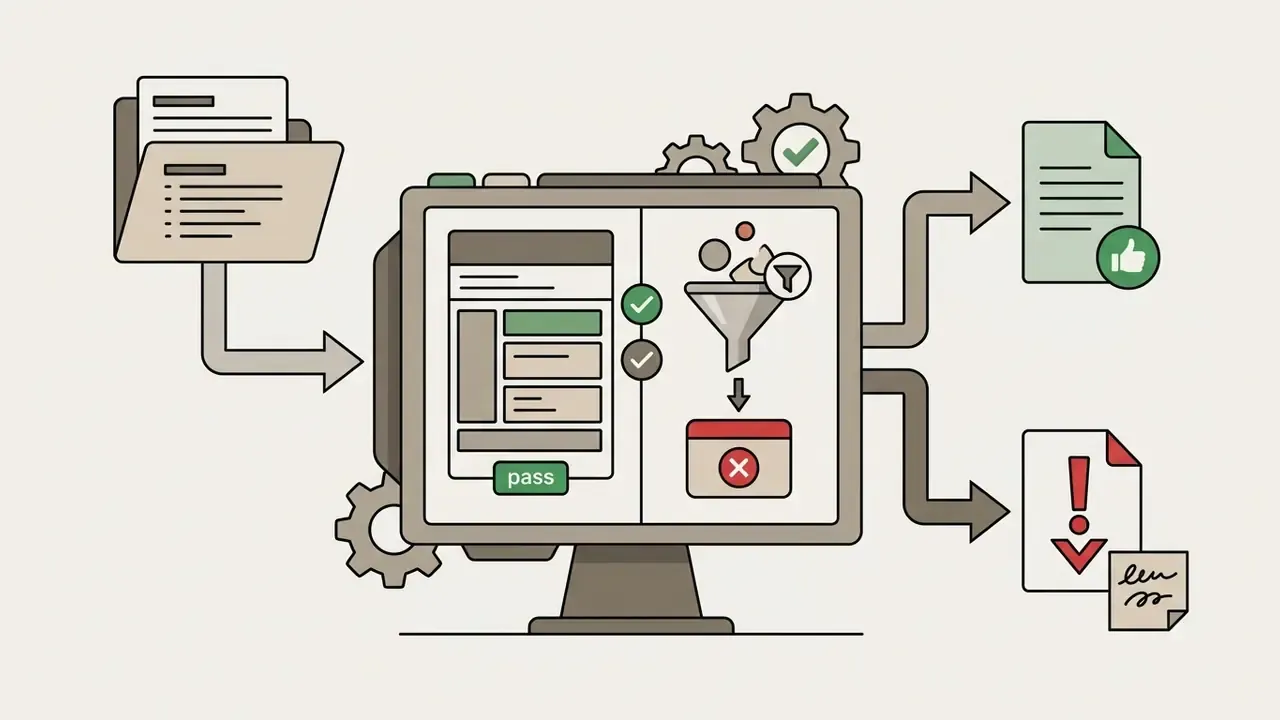
Once the generator generate sequence completes, post-editing refines the structure before prose begins. Standard post-editing workflows defined by ISO 18587 ( (https://www.iso.org/standard/66353.html)) split verification into two phases: structural checking and content correction.

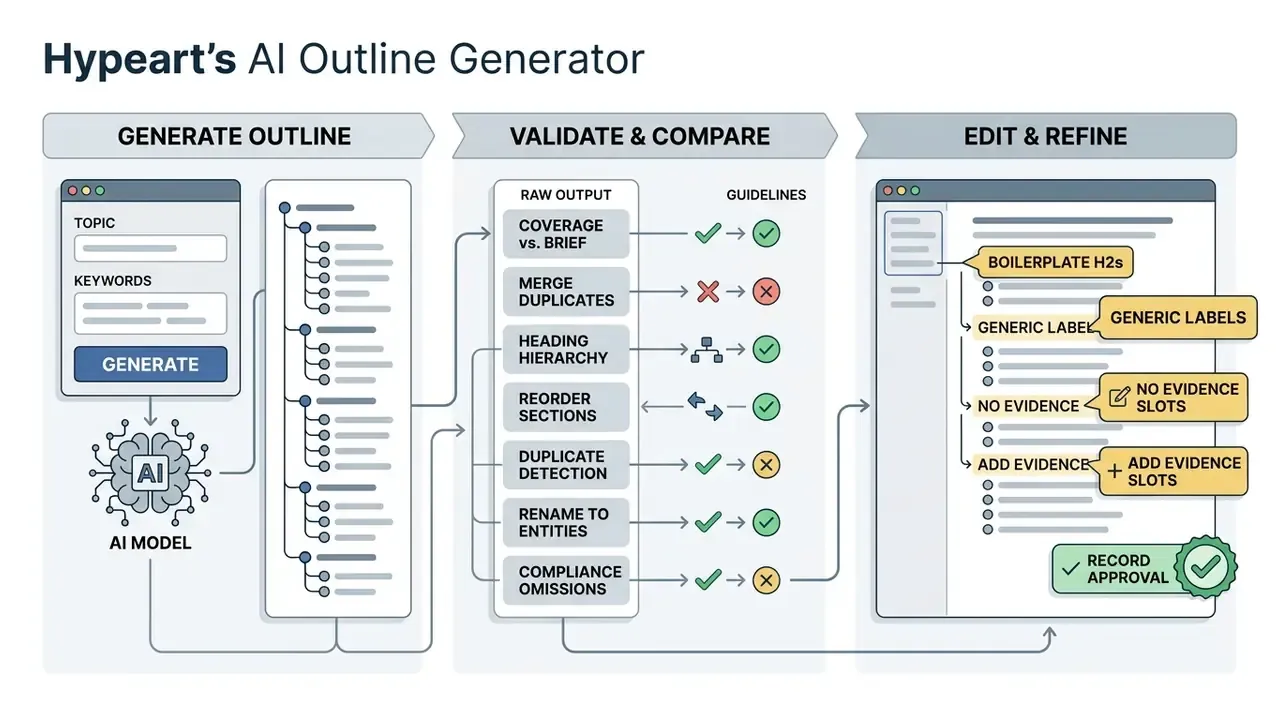
Stages of post-editing an AI outline: assembly, verification, correction. The diagram shows the difference between a raw generation and an approved editorial plan.
At this stage editors review heading hierarchy, delete repetitive sub-points, and reorder sections for logical progression. Light post-editing keeps as much generated structure as possible and fixes only gross errors. Full post-editing also corrects terminology, section granularity, and ordering against your quality threshold. Once verified, users copy the text into their workspace or export it to Markdown, DOCX, or Google Docs. For short-form visual content, specialised editing tools such as 2short ai can streamline production planning further.
What Inputs and Sections Should a Generated Outline Include?
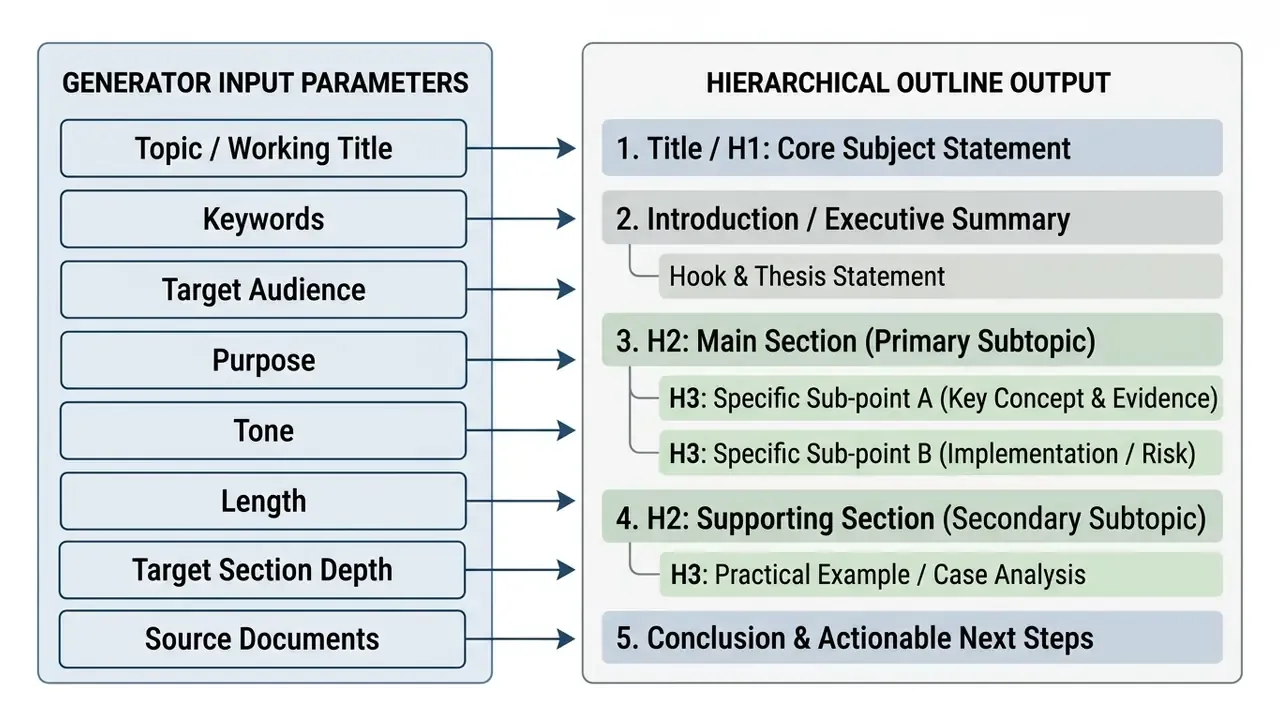
A comprehensive generated outline needs explicit inputs (topic, target audience, keywords, writing purpose) and must return a standardised hierarchy: an introduction, structured body sections with H2/H3 headings, and a clear conclusion.
Topic, Keywords and Writing Purpose
Output quality from an ai outline generator free tool depends on the clarity of three inputs: the core topic, the specified search keywords, and the overarching writing purpose. Change the purpose parameter and the architecture changes with it, even when the topic stays identical.
Scholarly genre analysis (Swales Academic Genre Theory, 2024) shows that communicative purpose dictates document architecture:
- Informational blog posts: high scannability, direct question-answering, modular H2/H3 breakdowns.
- Academic papers: formal structural blocks following IMRaD conventions (Introduction, Methods, Results, Discussion).
- Business reports: executive summaries, risk analyses, actionable decision frameworks.
- Speeches: blocks shaped by audience, occasion, and delivery mode, closing on a call to action.
«Communicative purpose determines document architecture: informational posts need modular H2/H3, academic work needs IMRaD.»
Tone Alignment and Heading Style Mapping
Modern LLMs adjust heading syntax to the specified tone:
- Formal / academic nominalised, objective titles, for example "Evaluation of Risk Mitigation Frameworks".
- Conversational / blog action-oriented or question-based headings, for example "How to Secure Your Data in 3 Easy Steps".
- Persuasive / sales benefit-driven framing, for example "Unlocking 40% Efficiency Gains with Automation".
- Analytical / objective neutral comparative labels, for example "Cost, Latency and Accuracy Trade-offs".
- Narrative chronological or scene-based markers, for example "The Week Everything Changed".
- Instructional numbered imperative steps, for example "Step 3: Configure Retention Policies".
| Tone Setting | Heading Grammar | Typical Use | Risk if Mismatched |
|---|---|---|---|
| Formal / Academic | Noun phrases, no contractions | Papers, filings, validation reports | Reads as evasive in consumer content |
| Conversational | Questions, second person | Blogs, help centres | Undermines credibility in regulated docs |
| Persuasive | Benefit plus number | Landing pages, speeches | Triggers unsupported-claim reviews |
| Analytical | Comparative, criteria-based | Vendor evaluations, briefings | Feels dry for narrative formats |
| Narrative | Temporal or scene markers | Personal essays, case studies | Obscures scannability for SEO |
Tone and language settings matter operationally too. Mature platforms expose dozens of tone presets and 100+ output languages, and multilingual outlining requires heading grammar to be adapted rather than translated word-for-word.
Headings, Paragraphs and Conclusion
A balanced content outline enforces strict heading hierarchy (H1 → H2 → H3 → H4) without skipping levels, maps each section to planned paragraph units, and ends in an explicit conclusion.
W3C Web Accessibility Guidelines (W3C Heading Accessibility, 2025) require heading ranks to be nested sequentially so that readability and screen-reader navigation hold up.
«W3C requires sequential heading nesting (H1→H2→H3) so screen readers can navigate and the document structure stays valid.»
Jumping from an H2 straight to an H4 breaks document architecture. An H2 may be followed by another H2 or an H3; an H3 by another H3 or an H4. Every complete outline should also carry a closing section that synthesises findings and states next steps or a call to action. Academic style guidance adds two useful constraints: cap nesting at roughly three levels, and attach a short explanatory sentence to each outline node so reviewers can judge intent instead of guessing at a bare heading.
AI Outline Generator Use Cases
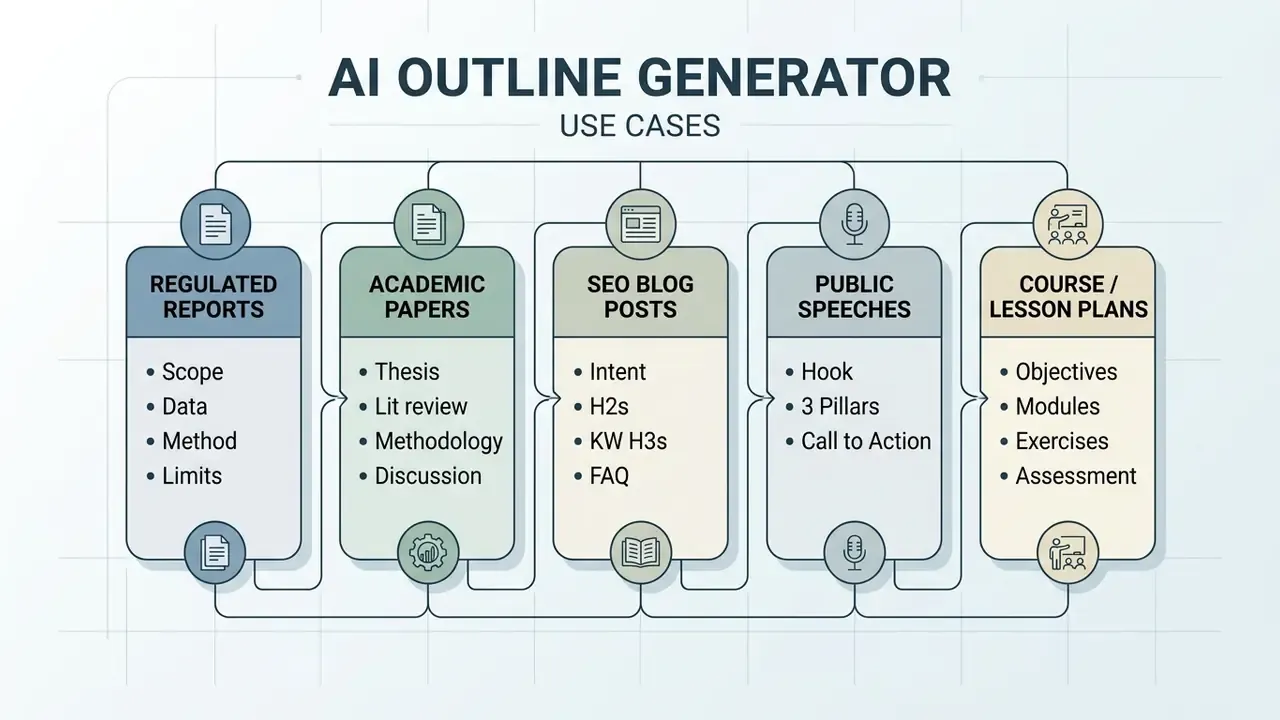
An ai outline generator adapts its structural output across disciplines: regulated business documentation, academic essays, research papers, SEO blog content, lesson plans, and public speeches.
Essay and Research Paper Outline Generator
An ai paper outline generator builds academic frameworks around a core thesis statement, organising major arguments into evidence-backed Roman numeral or decimal hierarchies. When it produces an essay outline, each major claim should carry planned sub-points reserved for citations and empirical data. One numeral, one paragraph or section. Every sub-point gets a slot for evidence.
Academic writing standards (MIT Writing Process Guide, 2026) specify that research outlines must separate background literature, methodology, empirical findings, and critical discussion.
«Research outlines must separate literature review, methodology, results and discussion, which prevents narrative drift.»
That thesis-led structure holds logical rigour across multi-page documents. Higher-education essay outlines usually extend the pattern with a literature review, three argument sections, a complications-and-qualifications section, and a closing discussion of broader implications.
Business Reports and Analytical Briefings
For workplace writing, expository and analytical outline modes produce sequences built for decisions: executive summary, situation analysis, options with trade-offs, risk assessment, recommendation, implementation steps. Business readers scan for the decision, not the narrative, so put the recommendation early and push supporting analysis into nested H3 blocks. A briefing that hides its recommendation on page four will be read backwards, if at all.
Regulatory Filings, MRM Documentation and Audit Evidence
| Mandatory Block | What the Outline Must Reserve | Why Regulators Expect It |
|---|---|---|
| Scope and intended use | Model purpose, boundaries, prohibited uses | Prevents scope creep and off-label deployment |
| Data lineage and quality | Sources, transformations, exclusions | Establishes reproducibility of inputs |
| Methodology and assumptions | Technique, hyperparameters, key assumptions | Enables independent challenge |
| Performance and stability testing | Metrics, benchmarks, back-testing windows | Demonstrates fitness for purpose |
| Limitations and compensating controls | Known weaknesses, overlays, thresholds | Shows risk is understood, not hidden |
| Monitoring and triggers | KPIs, escalation paths, revalidation cadence | Proves ongoing oversight |
| Approvals and version history | Roles, dates, sign-off evidence | Provides the audit trail |
Human-in-the-loop gatekeeping workflow. Assign three distinct roles and record every hand-off:
Reproducible audit evidence checklist. To show an examiner that the structure was validated rather than accepted blindly, retain for each document: (a) the exact prompt and parameter set, (b) the tool and model version, (c) the raw generated outline, (d) the approved outline with a visible diff, (e) reviewer identity, timestamp and disposition, (f) the mandatory-block coverage checklist with pass or fail per block, and (g) the exception log with rationale for any omitted block. That artefact set is what converts "we used AI" into "we controlled our use of AI."
Public-sector guidance points the same way. NIST's 2026 material on public-facing AI documentation and generative-AI evaluation stresses documented scope, traceability, and testable output quality, which are the same three properties an approved outline should make explicit. Applied to agentic workflows the principle tightens further: no evidence, no autonomy.


AI Blog Outline Generator for SEO Content
An ai blog outline generator creates structures tuned for search visibility by reading search intent and mapping primary and LSI keywords into nested headings. A dedicated blog outline generator makes sure the resulting blog post outlines cover the subtopics needed to satisfy a query. The practical sequence: identify the dominant intent (informational, commercial, transactional, navigational), pull three to five subtopics from SERP analysis, then build H1, H2, and H3 layers around them.
Large-scale search engine analysis across 600,000 published pages (Ahrefs / eMarketer Search Study, 2025) found that 86.5% of top-ranking pages contained AI-assisted structural elements, with 81.9% using a hybrid workflow that combines AI generation with human editorial oversight.
«86.5% of top-ranking pages contained AI elements, but only 4.6% were fully AI-generated; 81.9% used a hybrid approach.»
Building posts around explicit question-based headings also improves eligibility for featured snippets and AI answer blocks. Editorial teams pairing written content with visuals can review our overview of AI art generators, and organisations producing multi-dimensional media assets can evaluate our analysis of 3d animation maker software for workflow planning.
AI Speech Outline Generator for Presentations
An ai speech outline generator builds oral presentation plans on classical rhetorical structures: an attention-grabbing introduction (10–15% of duration), a structured body (75–85%), and a persuasive conclusion (5–10%).
Public speaking methodologies (National Communication Association Guidelines, 2025) stress that persuasive speech outlines must end in an explicit, actionable call to action.
«Persuasive speech outlines must close with an explicit call to action, a core requirement for audience retention.»
The tool sequences main points to reinforce listener memory without drowning the audience in text-heavy slides. The recommended workflow runs audience analysis → purpose and topic selection → thesis → main points → working outline → speaking outline. The conclusion should restate the central idea, recap the main points, and finish on a concise, specific, achievable clincher. No new information at the end.
Specialized Outline Architecture Framework
Different disciplines demand fundamentally different topologies. The table below sets out structural requirements across specialised document types.
| Document Type | Structural Architecture | Mandatory Section Components | Key Optimization Objective |
|---|---|---|---|
| Compare & Contrast Essay | Block structure or point-by-point alternation | Subject A thesis, Subject B thesis, direct factor matrix, synthesised verdict | Eliminates structural bias between subjects |
| Narrative / Fiction Story | Freytag's Pyramid or Hero's Journey | Exposition, inciting incident, rising action, climax, resolution, reflection | Governs pacing and character arcs |
| Course / Lesson Plan | Bloom's Taxonomy hierarchy | Learning objectives, prerequisites, module breakdowns, exercises, assessment criteria | Ensures pedagogical progression |
| College Application Essay | Personal narrative arc | Hook statement, core challenge, growth evidence, institutional fit conclusion | Demonstrates alignment and authenticity |
| Argumentative Essay | Claim → evidence → counter-argument → rebuttal | Thesis, body claims, mandatory counter-argument, rebuttal, conclusion | Pre-empts objections before they surface |
| Analytical Essay | Element-by-element dissection | Named analytical element per section, evidence selection, interpretation | Prevents generic topic labels |
| Case Study | Situation → intervention → result | Context, problem statement, approach, metrics, lessons learned | Makes outcomes verifiable |
| Cover Letter | Fit-driven persuasion | Role hook, achievement evidence, cultural fit, closing ask | Aligns candidate proof to job criteria |
| Literature Review | Thematic or chronological clustering | Scope and method, theme clusters, contradictions, research gap | Surfaces the gap the study will fill |
| Compliance / Validation Report | Control-narrative sequence | Scope, data, method, testing, limitations, monitoring, approvals | Produces audit-ready evidence |
Choosing between point-by-point and block structure. Decide before generating. Point-by-point alternates between subjects across each comparison criterion and suits short pieces with tightly coupled factors. Block covers each subject completely before moving on and suits longer pieces where a subject needs sustained explanation. Mixing the two mid-document is the most common structural defect in AI-generated comparison essays, and reviewers spot it instantly.
Enterprise Security, Shadow AI and PII Risk
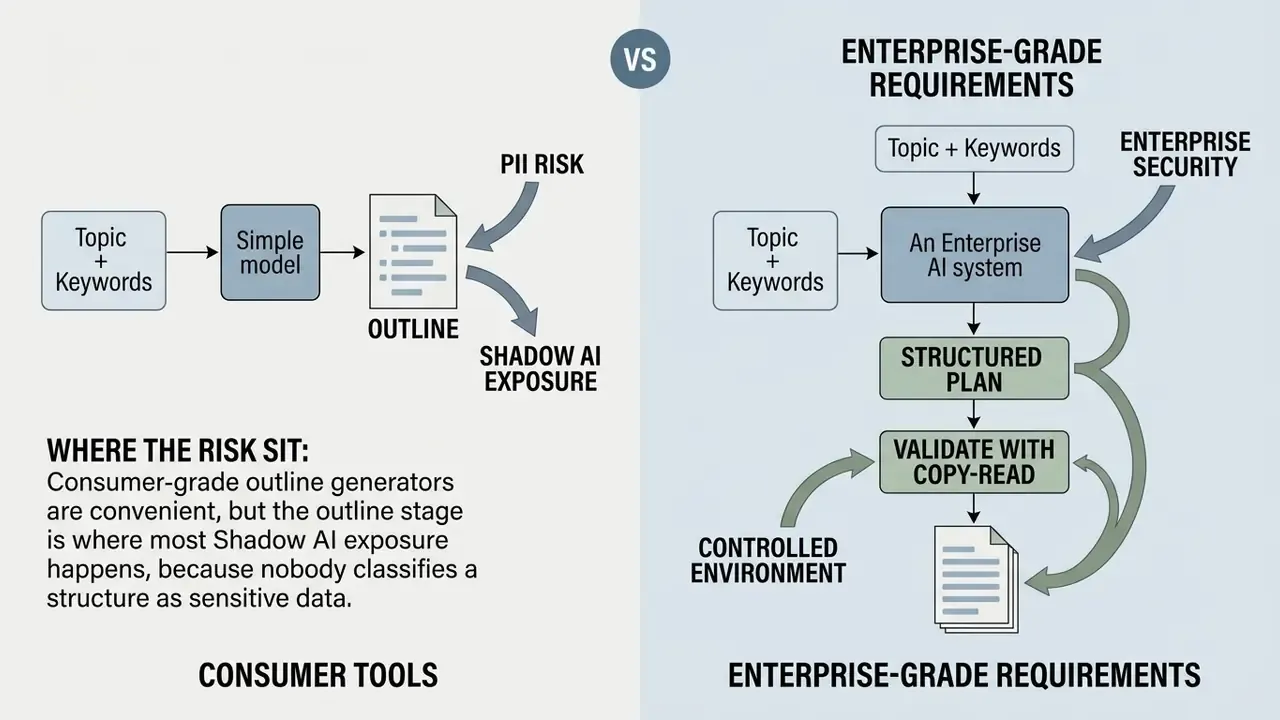
Free, consumer-grade outline generators are convenient. In regulated environments they are also, frequently, non-compliant. Because outlining feels like a low-stakes planning task, staff paste sensitive source material into public tools: draft filings, model documentation, customer complaints, exception logs. That is the classic Shadow AI exposure pattern. Unsanctioned tools, unlogged prompts, and data crossing the control boundary without a record.
Where the Risk Actually Sits
| Risk Vector | How It Materialises in Outlining | Control |
|---|---|---|
| PII / NPI leakage | Source drafts pasted into a public tool contain customer or employee data | Redaction rules; enterprise tenant with no third-party training; DLP on paste |
| Training on submitted data | Vendor terms grant rights to use inputs and outputs for model improvement | Contractual opt-out; documented data-use clause review |
| Shadow AI adoption | Teams use unsanctioned free tools because sanctioned ones feel slower | Approved-tool catalogue; SSO-gated access; usage telemetry |
| Retention and residency | Prompts stored indefinitely or in unapproved jurisdictions | Configurable retention; region pinning; deletion SLAs |
| IP and licensing ambiguity | Ownership of generated structures unclear for commercial publication | Terms review before rollout; attribution and disclosure policy |
| Vendor lock-in | Outlines trapped in a proprietary format with no clean export | Require Markdown, DOCX, or JSON export before adoption |
| Prompt injection via source documents | Uploaded drafts contain instructions that steer the model | Treat uploads as untrusted input; review outputs, never auto-publish |
Consumer Tools vs. Enterprise-Grade Requirements
| Dimension | Public / Consumer Tool | Enterprise-Grade Requirement |
|---|---|---|
| Authentication | Email sign-up, often none | SSO/SAML, role-based access, provisioning and de-provisioning |
| Data use | Inputs may improve models | Contractual no-training commitment |
| Isolation | Shared multi-tenant | Logical or dedicated tenant isolation |
| Logging | None visible to the user | Immutable prompt and output logs exportable to GRC systems |
| Certifications | Rarely published | Independent security attestations (for example SOC 2 Type II), ISO 27001 alignment |
| Retention | Undisclosed | Configurable retention and verified deletion |
| Integration | Copy-paste only | API access, GRC and DMS connectors, versioned export |
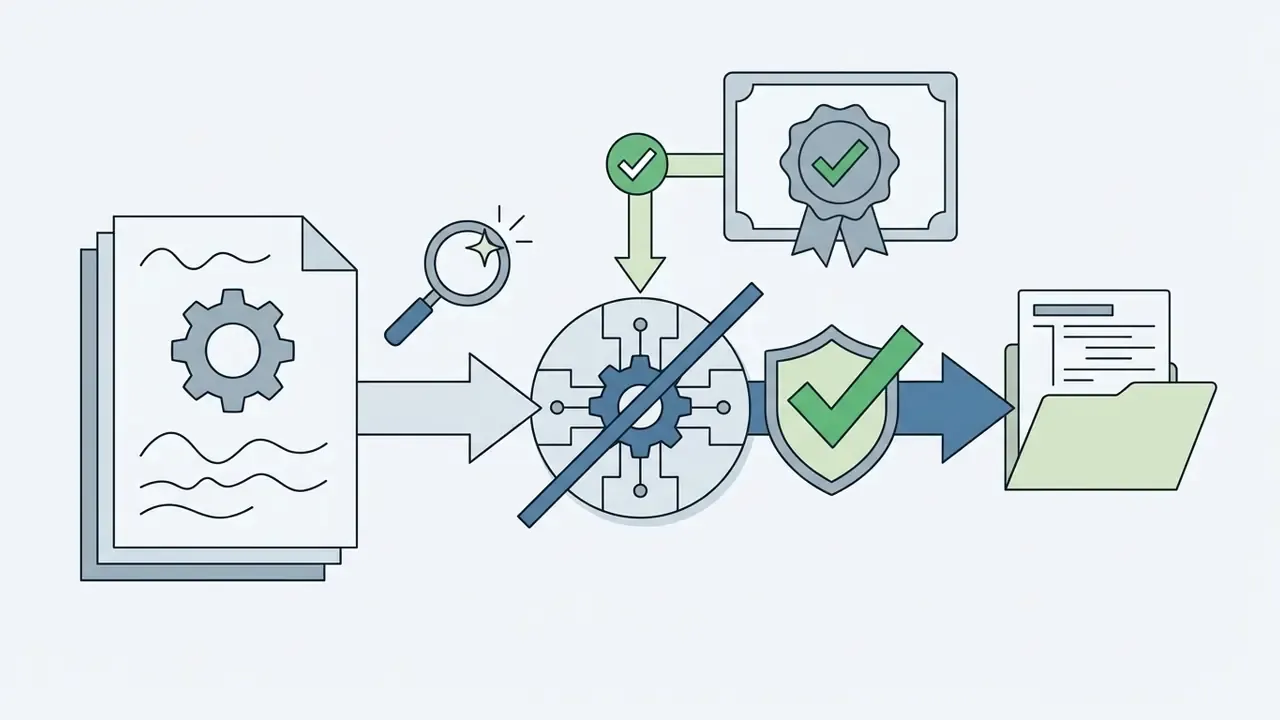
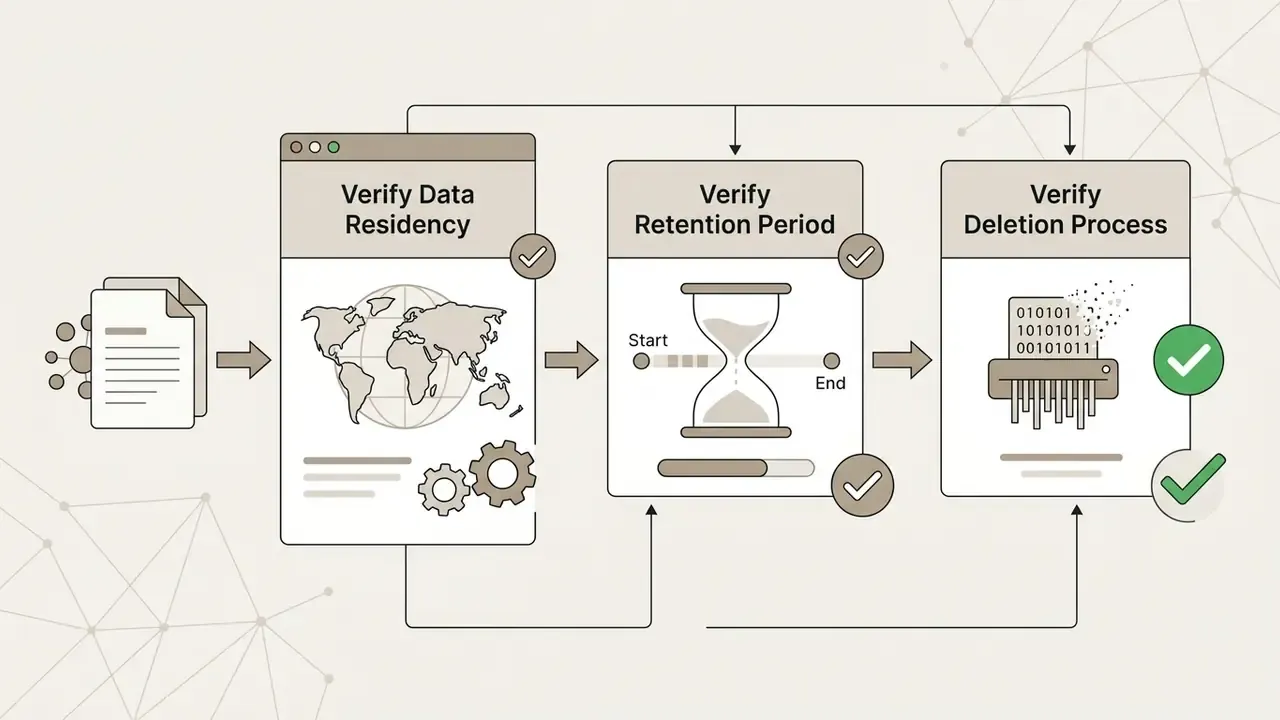

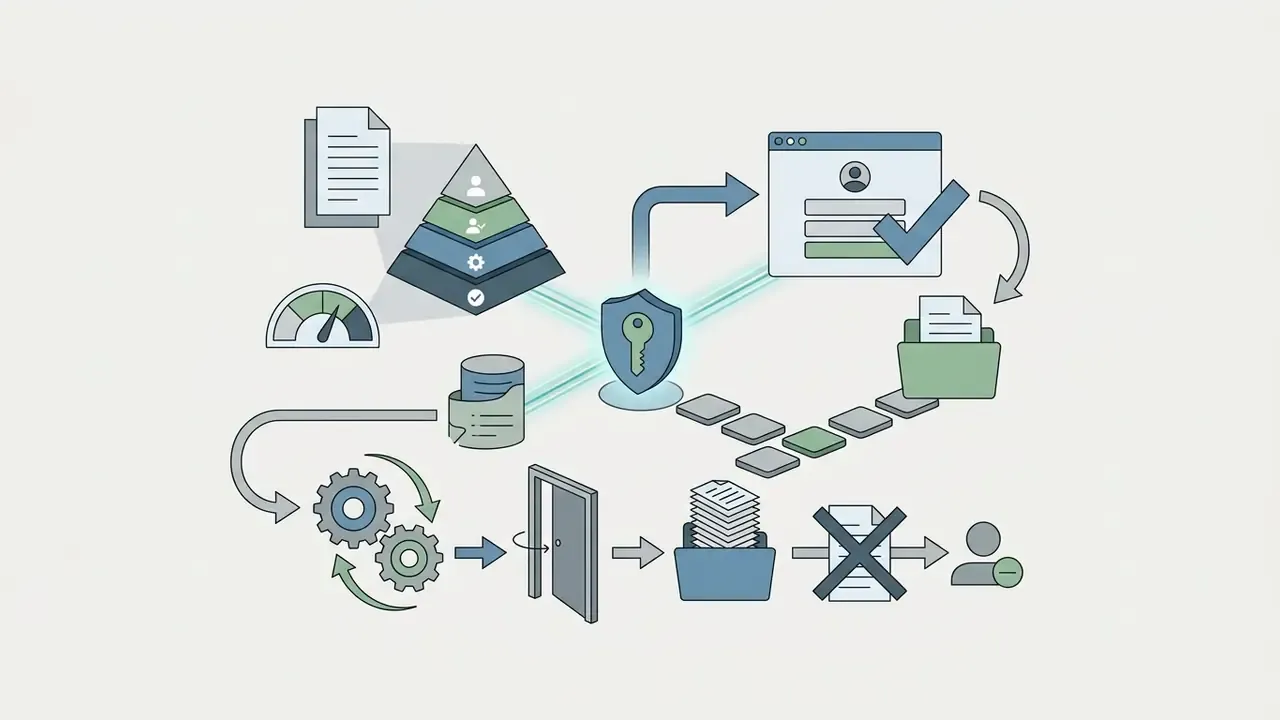
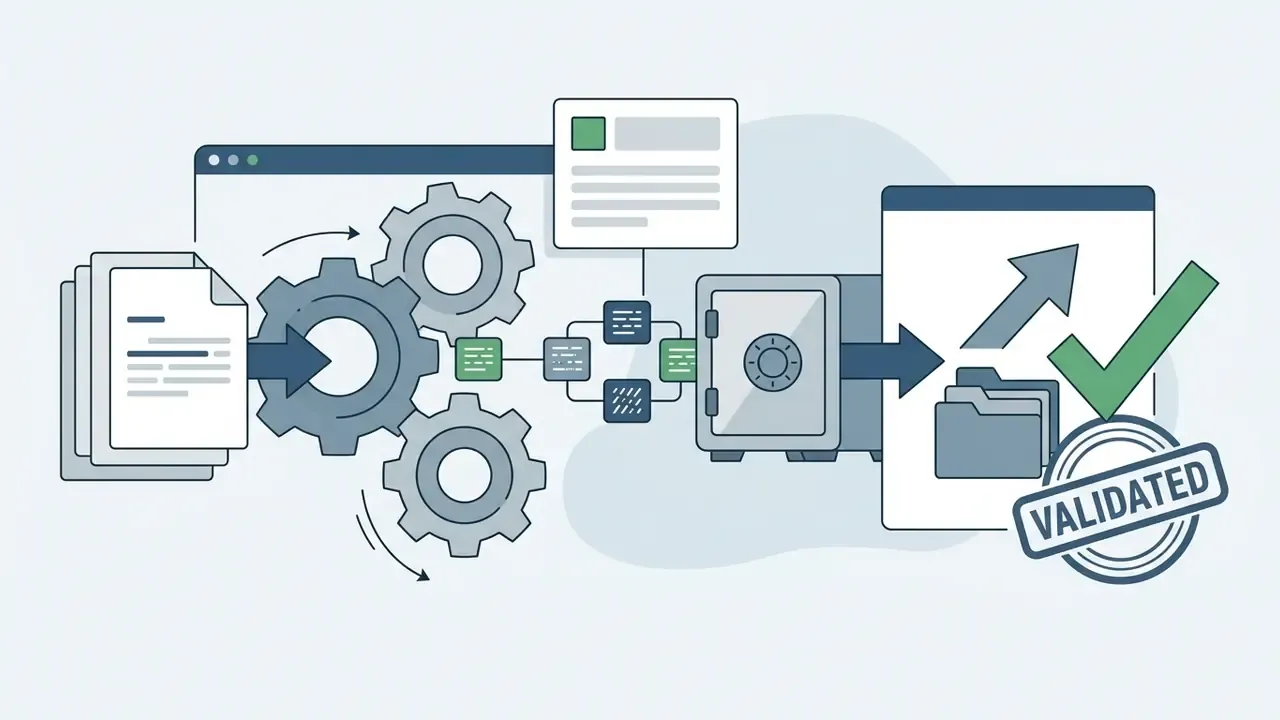
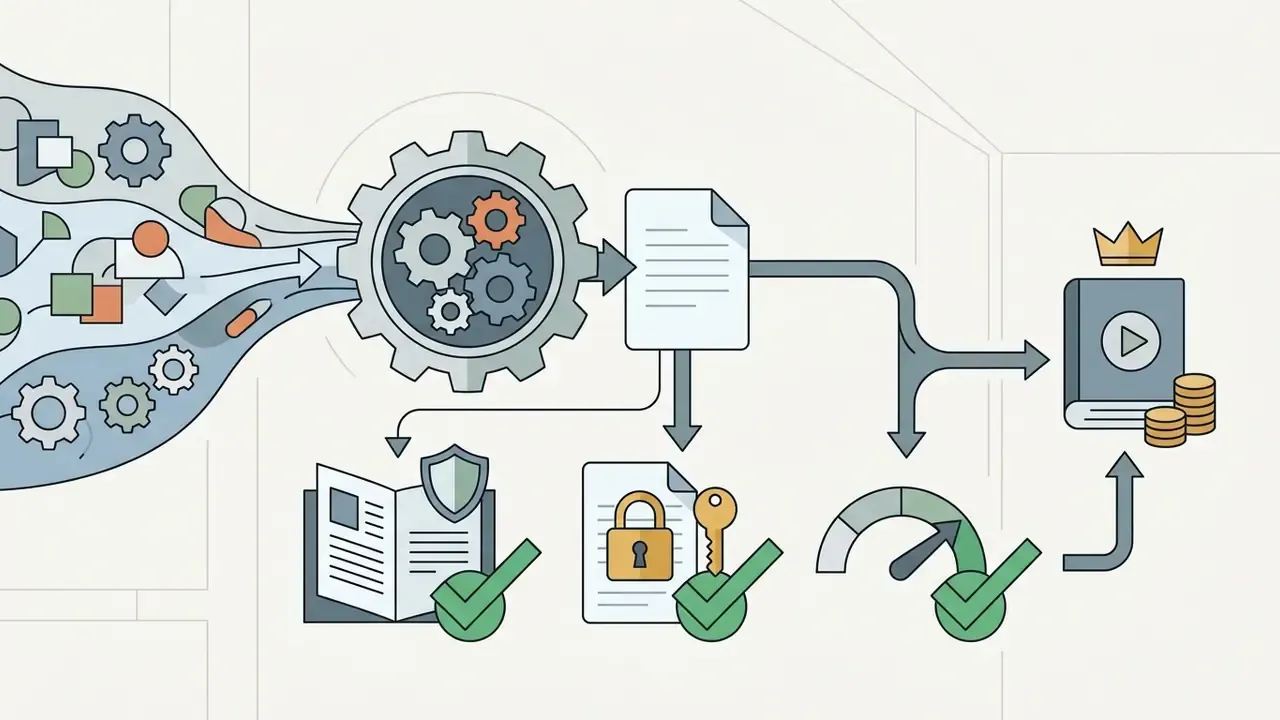
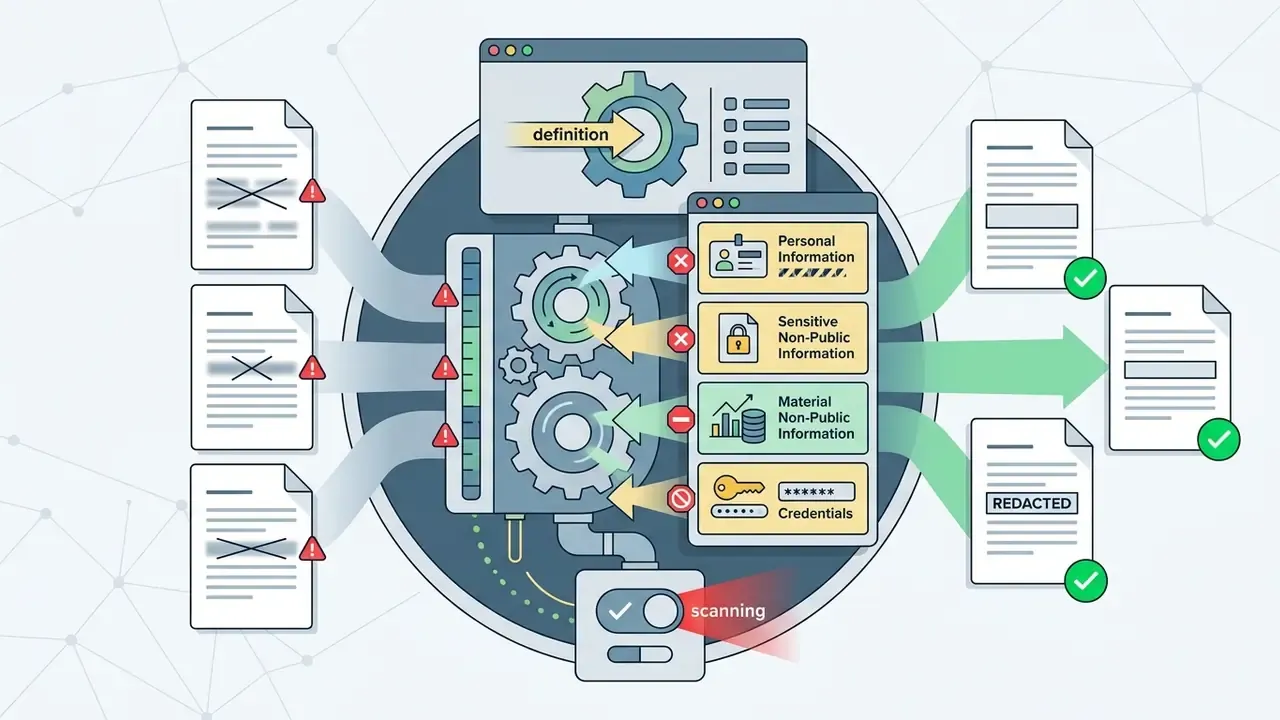
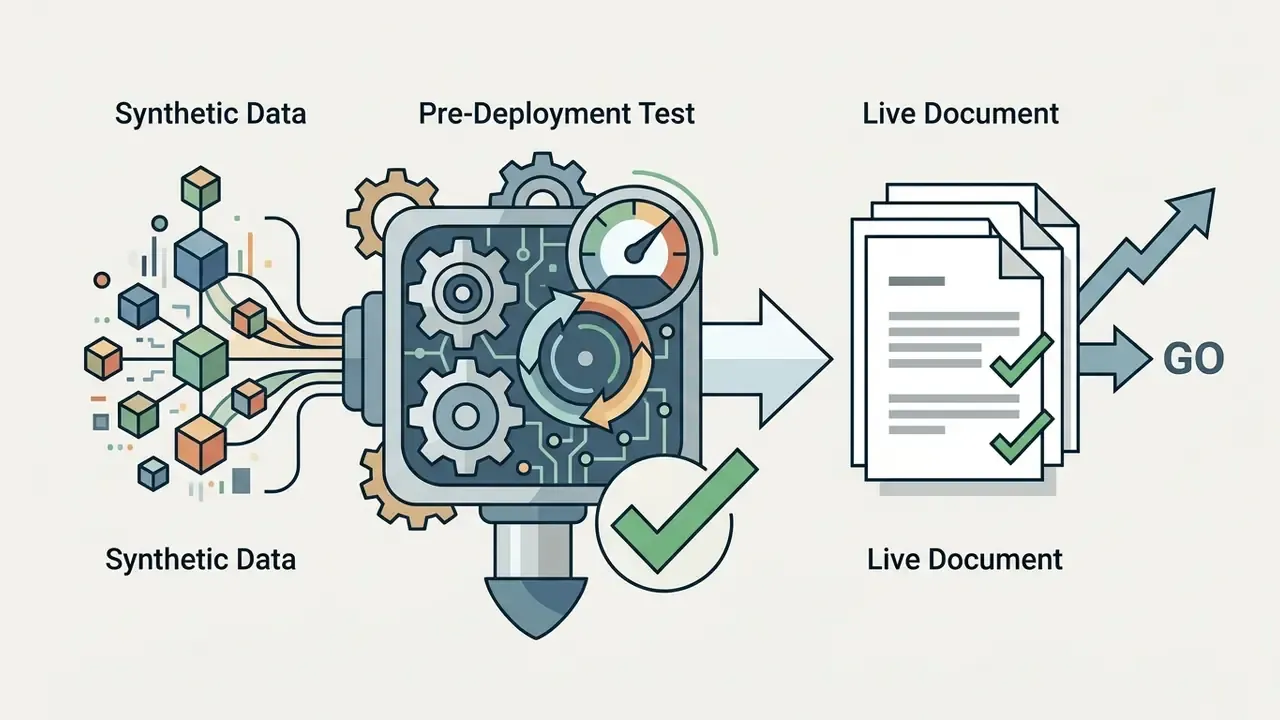

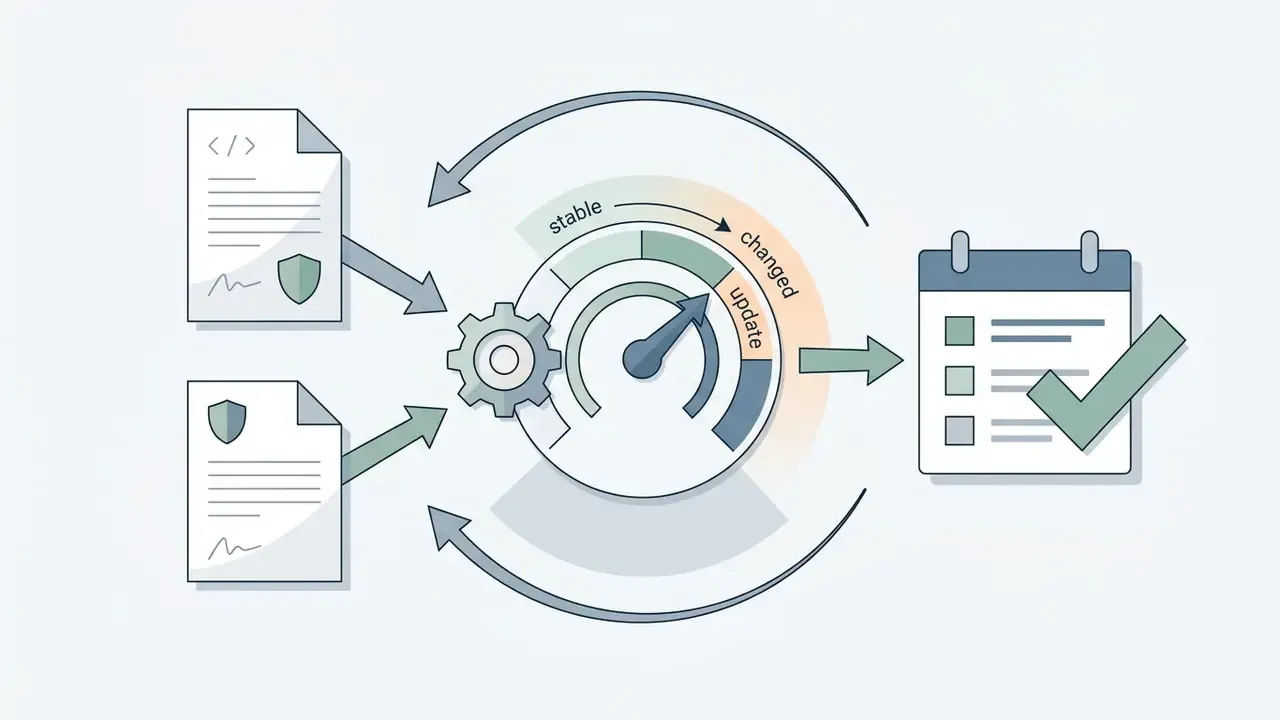
One more practical detail. Access control should follow the same logic you apply to any digital worker: a named owner, an approved role, defined access limits, an escalation path, an audit trail, and a shutdown mechanism. An outline generator rarely needs write access to anything. Keep it that way.
How to Improve an AI-Generated Outline for SEO
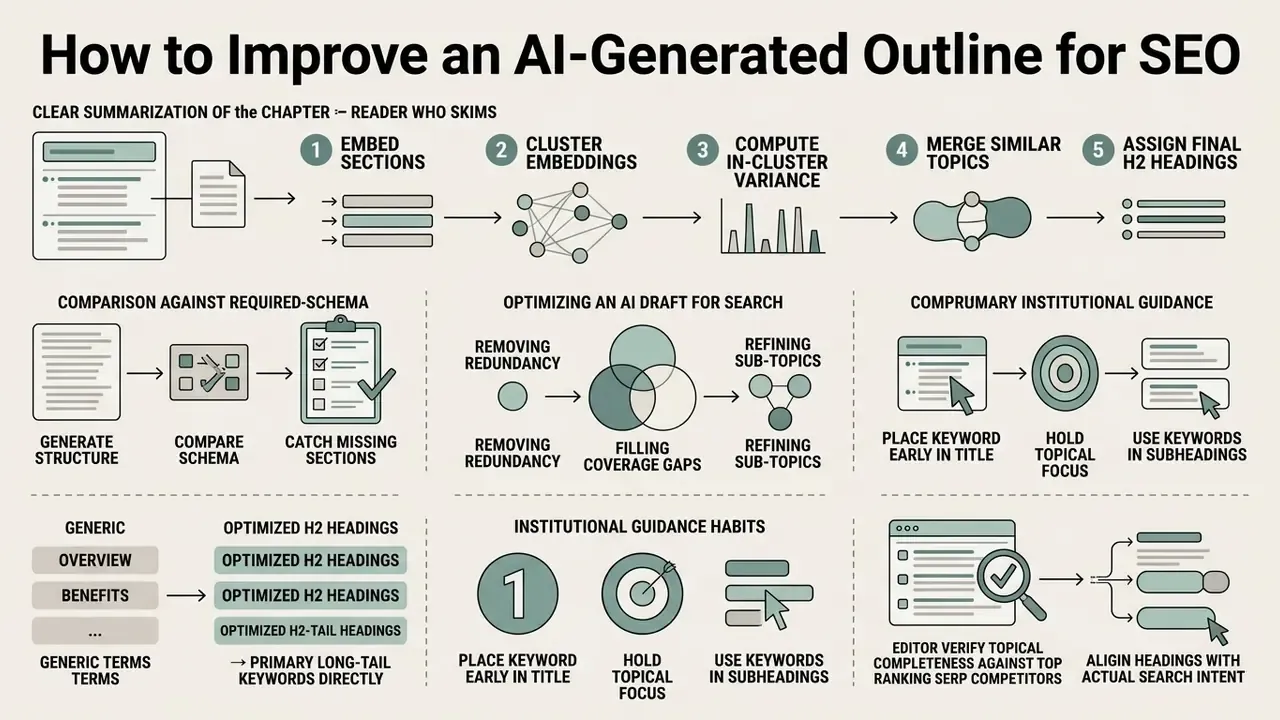
To optimise an AI-generated plan for search, editors verify topical completeness against top-ranking SERP competitors, align headings with actual search intent, remove redundant sections, and place target keywords naturally rather than mechanically.
Checklist0 / 8
Match Headings to Topic and Keywords
Optimising an outline maker ai draft for search means mapping primary long-tail keywords directly onto H2 and H3 headings. Google Search Central guidance (Google Title & Heading Best Practices, 2025) states that headings should be concise, descriptive, and accurate to the block of content that follows.
«Google recommends keeping headings concise, descriptive, and accurate to the content of the block that follows.»
Complementary institutional guidance adds three habits: place the primary keyword early in the title, hold headline length in the 50–60 character range (80 as an absolute maximum), and make the title describe the page's topic or purpose so assistive technology and search engines read it the same way.
An enterprise SEO team auditing informational finance content found that generic AI headings ("Overview," "Details," "More Information") produced weak click-through rates. After re-engineering their outline ai generator prompts to output query-based headings containing target entities, organic impressions for the revised section hub rose 32% over two quarters. (Client-side analytics reported by the team; figures are unaudited and specific to one property, so treat them as illustrative rather than benchmarked.)
Remove Repetition and Add Missing Content Sections
Removing semantic redundancy and filling coverage gaps are the two decisive post-editing steps when refining outlines. Standard NLP deduplication workflows use vector embeddings and cosine similarity scoring to detect and merge overlapping sections (NVIDIA NeMo Curator Framework, 2025).
«Vector embeddings and cosine similarity allow semantically duplicated outline sections to be detected and merged automatically.»
The operational sequence has five steps: embed each section, cluster the embeddings, compute in-cluster cosine similarity, mark pairs above a threshold as duplicates, keep a single representative section. Duplication comes in two flavours, full-content duplicates and partial overlaps inside otherwise distinct sections, so detection has to handle both.
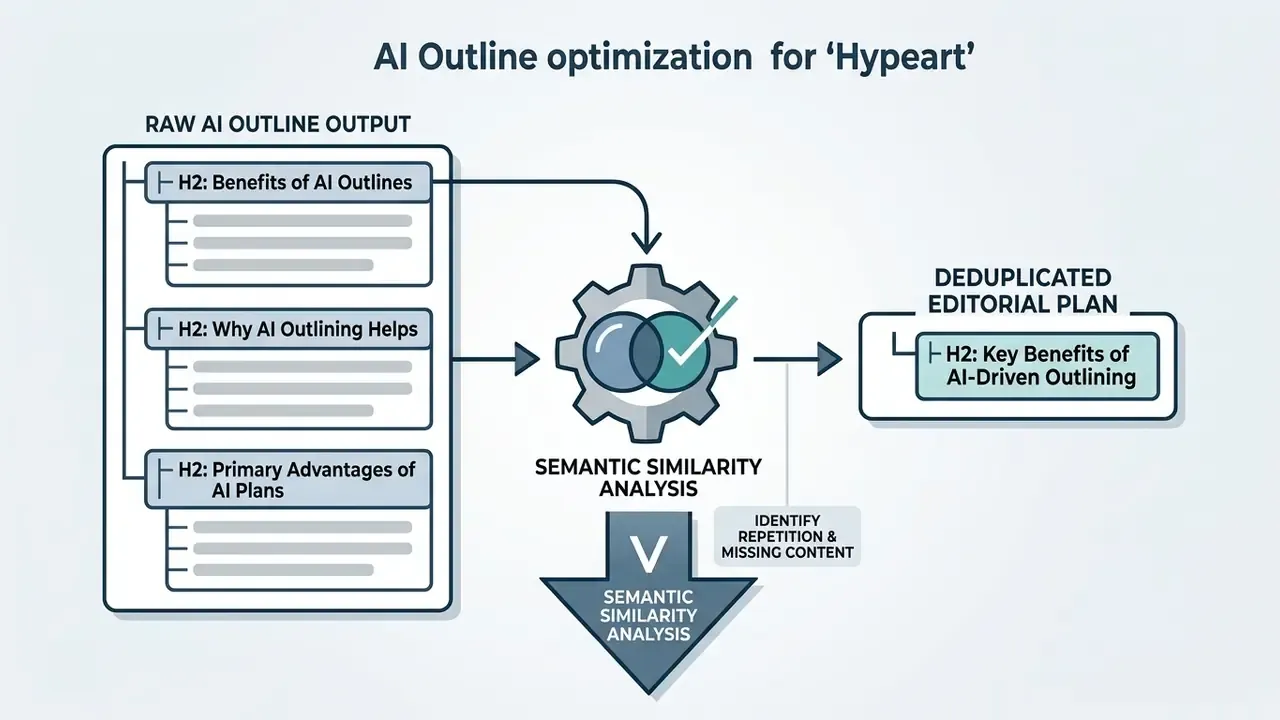
Comparing the generated structure against a required-schema checklist catches missing mandatory sections, whether that is a regulatory compliance note, a limitations block, or a direct FAQ. This schema-gap check is the mirror image of deduplication: deduplication removes what is redundant, the schema check adds what is absent. Teams working with high-resolution visual assets or video media can reference our technical guide on 4k video enhancer or our review of 4k video upscaler technology.
How to Choose a Free AI Outline Generator
Choosing the right free ai outline generator means weighing supported document types, keyword input capabilities, editing flexibility, export options, and clear commercial usage terms. Readers who prefer side-by-side scoring can study the methodology in our comparison of the best AI image generators, which applies the same selection pattern to a different category.
Typical free-tier and paid-tier limits observed across the category in 2026: free tiers commonly cap output at 3–10 generations per day or a shared monthly word allowance, often somewhere around 2,000–5,000 words across a tool suite. Hourly rate limits are common on no-signup tools. Export to Word, PDF, or Google Docs is frequently reserved for paid plans, with entry tiers typically starting in the $8–$16 per month range and unlocking 150,000+ words plus faster generation. Verify current limits on the vendor's own pricing page before you standardise a workflow around a free tier; these numbers move quarterly.
Two evaluation lanes, not one. Consumer tools should be judged on speed, format breadth, and export convenience. Enterprise deployments must be judged first on the security and governance criteria in the previous section, and only then on features. A tool that ranks first on usability and last on data-use terms is not a candidate for regulated documentation. That trade-off is where most procurement arguments actually happen.
Features That Matter for Outline Generation
When evaluating outline generators, the technical metrics defined by software quality standards (ISO/IEC 25010 Quality Model, 2025) include functional suitability, usability, generation speed, and structural recall accuracy.
«ISO/IEC 25010 defines functional suitability, usability, and accuracy among the core quality metrics for software tools.»
The standard's eight product characteristics (functional suitability, performance efficiency, compatibility, usability, reliability, security, maintainability, portability) and its quality-in-use dimensions (effectiveness, efficiency, satisfaction, freedom from risk, context coverage) give you a ready-made scoring rubric. High-performing generator tools support multi-level heading generation, real-time section reordering, and clean export options (Markdown, DOCX, or direct clipboard copy). Content teams building brand systems alongside editorial workflows can also reference our guide to AI logo generators.
To review pricing options across complementary content and media tools, view the guide on our pricing page or compare options in our support centre.
Export Formats and Workflow Integration Parameters
When selecting a generator, check how structural outputs travel into your publishing workflow.
| Export Format | Best Use Case | Preserved Metadata | Native Compatibility |
|---|---|---|---|
| Markdown (.md) | Technical blogs, static site generators (Hugo, Gatsby), Notion | Heading ranks (H1–H4), bullet hierarchies, inline links | VS Code, Obsidian, GitHub, Notion |
| DOCX / Google Docs | Corporate briefings, collaborative editorial editing | Rich text styling, comment anchors, header spacing | MS Word, Google Workspace |
| PDF document | Client deliverables, archived academic blueprints | Read-only layout, embedded diagram schemas | Adobe Acrobat, web browsers |
| CSV / JSON data | Bulk content operations, programmatic SEO pipelines | Entity-tagged section arrays, keyword mapping attributes | Custom API endpoints, Python, Excel |
| PNG / SVG outline map | Stakeholder review decks, workshop artefacts | Visual hierarchy only, no machine-readable ranks | Slides, Figma, browsers |
| Live shareable link | Async review with comments and analytics | Version history, viewer analytics | Vendor web app |
For regulated workflows, prefer formats that preserve machine-readable structure (Markdown, DOCX, JSON), because they support automated coverage checks and clean version diffing. Image-only exports are handy for review meetings but destroy the heading semantics an auditor may later need.
Free Access and Commercial Content Use
Licensing terms matter as much as features when you use a free outline generator for business or web publishing. Corporate technology guidelines (Japan METI Generative AI Guidelines, 2025) stress that enterprise users must verify data-training policies, IP ownership, and commercial redistribution rights before deploying AI-generated assets publicly.
«Corporate users must verify data-training policy, IP rights, and commercial distribution terms for AI-generated content.»
The checks that recur across vendor terms are consistent: whether commercial use is permitted at all; who owns the output; whether attribution or an AI-disclosure statement is required at publication; whether submitted inputs may be used for training; confidentiality obligations; prohibited outputs; indemnities; and governing law. Some platforms allow publication of AI-assisted written content only if it is attributed to the user or company and the AI's role is disclosed to readers. Others reserve broad downstream rights over material submitted to public galleries.
Search algorithms judge content on quality rather than production method (Ahrefs Study, 2025), yet platform terms of service still vary on commercial monetisation. Organisations seeking detailed licensing policy can read our AI Media Commercial-Use analysis, review the category rules for commercial use of AI image generators, or check our litigation resource hub and compare options there. Creators working with media integration workflows can also reference our tutorial on how to add image to video.
Limitations, Open Questions and a Safe Next Step
Three things remain genuinely unsettled. First, no independent, reproducible benchmark measures outline quality across regulated document types; the academic evidence covers open-web and encyclopaedic corpora. Second, the cost of oversight in a mature model risk function is poorly documented in public research, which makes ROI claims fragile. Third, the treatment of generated structure under copyright and disclosure rules differs by jurisdiction and is still moving.
A conservative next step, then. Run a 30-day pilot on one templated document family, with synthetic or fully redacted inputs, three named roles, and the seven-part evidence set retained for every outline. Measure two things only: heading entity recall against your mandatory-block schema, and reviewer hours per document. If review time does not fall, the tool is not paying for itself, whatever the drafting speed says.
AI Outline Generator FAQ
Can I Generate an Outline Without a Final Title?
Yes. An ai outline creator can build a full hierarchical plan from a broad concept, a topic description, or a set of raw keywords, with no finalised title required.
Frameworks like Writing Path (NAACL Industry, 2025) show that working titles and initial outlines are generated together during early planning. The system reads the core topic metadata, proposes several candidate titles alongside the section headings, and lets users pick or refine the title after the structure is approved. One evidentiary nuance: peer-reviewed pipelines still reconstruct a title as an explicit step, while vendor tools advertise topic-only input, so expect slightly weaker structural precision when no working title is supplied.
Can I Use an Outline Generator for an Existing Draft?
Yes. An outline generator is effective for reverse-outlining existing drafts, which lets you analyse structural flow, spot missing subtopics, and cut repetitive paragraphs.
Paste an existing draft into an outline maker ai and the model parses the text to extract the underlying heading hierarchy and sub-points. Research on multi-framework long-form generation (EMNLP Research, 2026) confirms that backward outline extraction helps editors diagnose narrative gaps, streamline disorganised sections, and optimise structure for readability and search intent.
«Backward outline extraction lets editors diagnose narrative gaps and optimise draft structure for search intent.» - Multi-Framework Comparison of Outline Stages in Long-Form Generation with LLMs, EMNLP 2026. https://aclanthology.org/2026.emnlp-main.40/
Practical caveat: uploading a confidential draft to a public tool is a data-transfer event, not a formatting operation. Redact first, or use a sanctioned enterprise instance.
Is It Safe to Paste Confidential or Customer Data into a Free Outline Generator?
No, not without contractual and technical controls. Free tools commonly reserve the right to process inputs for service improvement, retain prompts indefinitely, and store data in undisclosed regions. For anything containing personal information, non-public information, or unpublished regulatory content, use only approved tools with a written no-training commitment, tenant isolation, configurable retention, and exportable logs. Publish a prohibited-data list and enforce it with redaction rules and data-loss-prevention policies at the paste boundary.
How Do I Produce Reproducible Audit Evidence for an AI-Generated Outline?
Keep a seven-part artefact set per document: the exact prompt and parameters; the tool and model version; the raw generated outline; the approved outline with a visible diff; the reviewer's identity, timestamp, and disposition; the mandatory-block coverage checklist with pass or fail results; and an exception log explaining any omitted block. Store these in your document management or GRC system next to the final deliverable, so the structure's provenance and review can be reconstructed independently.
Does an Outline Generator Write the Full Document for Me?
No. It produces a plan: a title, section headings, sub-points, and, in academic modes, a thesis statement. You still supply substance, evidence, and expert judgement. Tools that chain outlining straight into full drafting exist, but the outline should stay a separate, reviewed artefact so structural errors are caught before thousands of words inherit them.
What Are the Known Limitations of AI Outline Generators?
Four recur across vendor documentation and institutional guidance. Outputs may be inaccurate or non-unique and should never be copied straight into official documents. Input and output length limits can truncate an outline mid-section. Knowledge cut-offs mean recent developments may be missing entirely. And generated structures skew formulaic, repeating similar section patterns across unrelated topics. Each of these is a review task, not a reason to avoid the category.
How Many Sections Should an Outline Have?
Depth should follow length, not preference. As a rule of thumb: three sections for a brief or executive summary, five for a standard 1,000–1,500 word article or essay, eight to ten for comprehensive long-form content or a research paper. Past three heading levels most readers, and most reviewers, lose the thread. Academic style guides generally cap nesting at the third level for the same reason.
Which Outline Structure Should I Use for a Compare-and-Contrast Piece?
Choose before generating. Use point-by-point when the comparison criteria are tightly coupled and the piece is short. Use block structure when each subject needs sustained standalone explanation. Either way, allocate equal depth to each subject and close with a synthesised verdict rather than a restatement. Asymmetric depth is the clearest signal of structural bias.
Technical Glossary and Resource Hub
For complete technical definitions, API documentation, and media production guides, view the guide in our main glossary directory or browse the hub for developer integrations. Teams estimating project resource costs can use our interactive calculator portal, or compare alternative toolsets across the site. Related reference material includes our guides to online photo editors and video compressors for teams standardising multi-format publishing workflows.