An AI resume generator is an automated software application that uses natural language processing and machine learning models to read job requirements, turn raw career history into structured documents, and help candidates draft tailored application materials. By combining candidate data with role specifications, an ai resume builder speeds up resume writing, improves keyword alignment for automated screening, and removes the worst part of the job: the blank page.
«Controlled automation in talent workflows runs on one governing principle: no evidence, no autonomy. Generative tools give real operational leverage when drafting resumes and cover letters, but human accountability and a manual audit trail stay mandatory at every decision point.» Marcus Hale, author.
«Recruitment teams filter out candidates who lean on unverified AI buzzwords almost instantly. Every generated bullet point must be backed by a concrete metric you can defend live in a technical interview.» Marta Říhová, Senior Technical Recruiter and HR Consultant, 10+ years in IT recruitment.
What this guide covers: the mechanics of AI-assisted resume creation, a four-stage workflow from data ingestion to export, two copy-paste tailoring prompts with an anti-hallucination clause, ATS formatting rules and the anatomy of an algorithmic resume score, feature checklists for evaluating an ai cv maker tool, the real differences between free and paid tiers, privacy due diligence, and the published evidence behind each claim. Where evidence is thin, the text says so plainly instead of rounding it up.
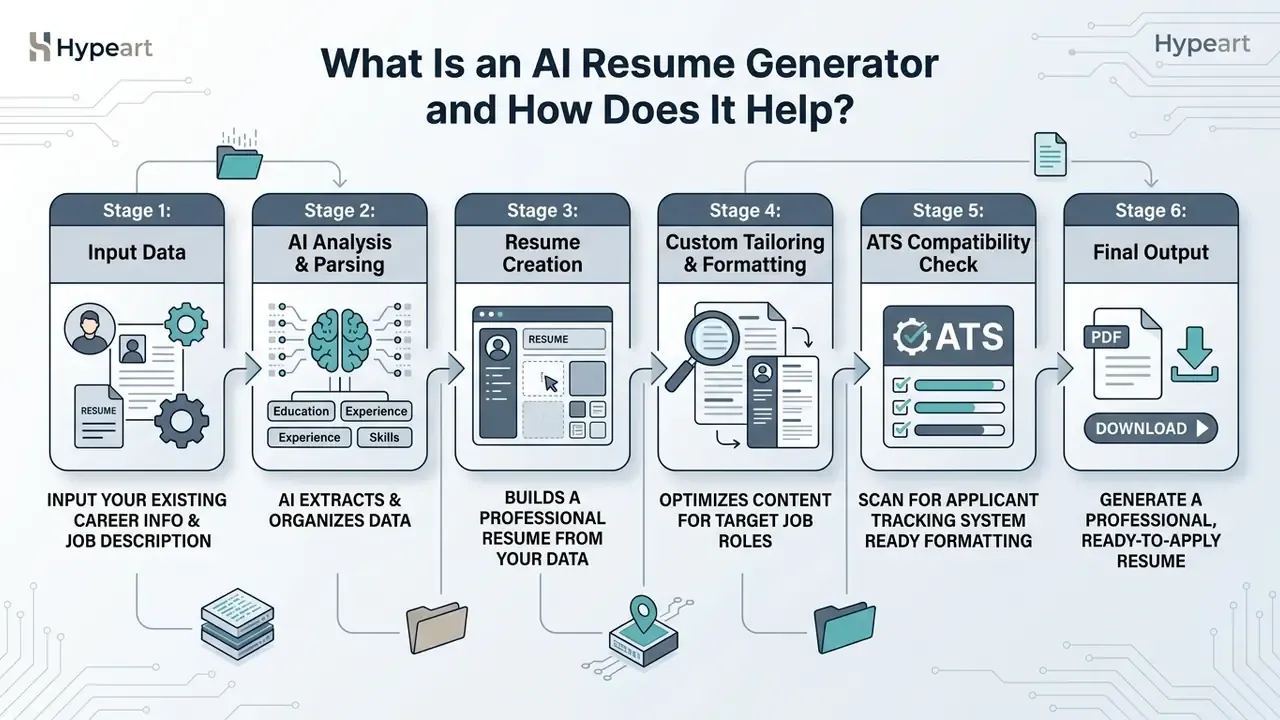
What Is an AI Resume Generator and How Does It Help?
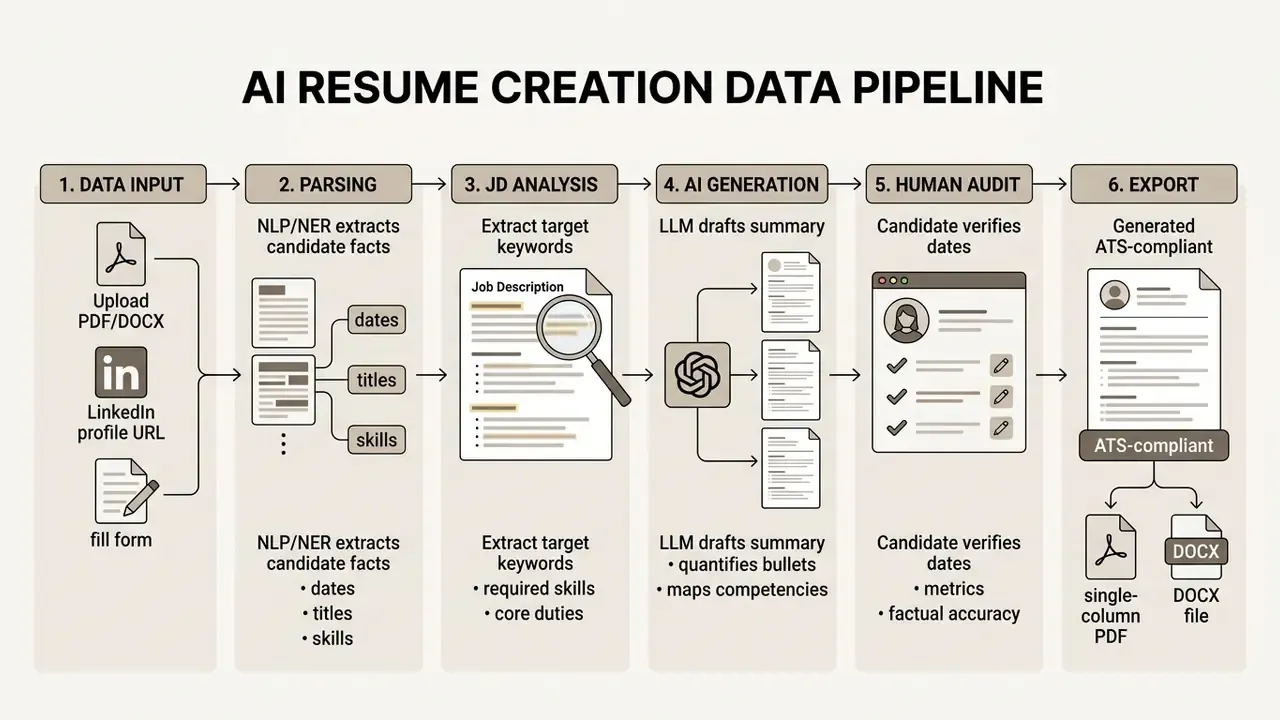
An ai resume generator is an intelligent software tool that automates the drafting, structuring, and optimization of a curriculum vitae or resume using natural language processing. It helps job seekers convert messy work history into clear, achievement-oriented text, and it aligns qualifications with the requirements of a target position.
Traditional resume builders act as static layout editors. You compose every sentence yourself, then pour it into a rigid template. An ai resume generator tool works differently: it behaves like a content engine plus an analytical assistant. It reads job postings, extracts core competencies, proposes impact-focused bullet points, and drafts summary statements aimed at one role rather than twenty.
«Algorithmic writing assistance increased hiring probability by 8% and starting wages by 10%, mainly by reducing errors and improving readability.»
That randomized field experiment is still the strongest causal evidence in the category. The mechanism matters more than the headline number: automated writing help works mainly by fixing grammatical errors and raising legibility, so evaluators can judge competence with less cognitive friction. AI does not manufacture qualifications. It clears the noise that hides the ones you already have.
Who Can Use an AI Resume Builder?
An ai resume builder serves candidates at every career stage because it adapts tone, structure, and emphasis to the profile in front of it. Entry-level applicant, mid-career specialist, executive: the structural guidance changes, the underlying method does not.
«Job seekers with weaker writing skills benefit most: each additional resume error reduces hiring probability by roughly 1.4%.»
That differential is the honest argument for AI assistance. Marginal value peaks for non-native writers, for technical specialists who write documents twice a decade, and for applicants who have never had a single editorial comment on a resume in their lives.
- Students and early-career applicants. Candidates with almost no formal employment can use an ai cv maker free plan or a paid tool to translate coursework, group projects, volunteer work, and student societies into professional competencies. Anyone who also needs a clean professional portrait for LinkedIn or a portfolio page can compare options among AI headshot generators before locking the profile assets.
- Career changers. Professionals crossing industries use an ai generator for resume customization to reframe transferable skills and foreground cross-functional relevance instead of sector jargon nobody in the new field recognizes.
- Experienced managers and executives. Senior leaders use an ai cv generator to compress a long career into a concise leadership narrative built on quantifiable business outcomes, headcount, budget scope, and operational metrics.
What AI Can Generate for a Resume
Modern ai for resume creation platforms produce modular sections that map onto standard recruitment expectations while leaving full editorial control with the user.
- Professional summary.A tailored opening paragraph that combines total experience, core expertise, and the value proposition relevant to this specific role.
- Experience bullet points.Action-first statements built on STAR (Situation, Task, Action, Result) or PAR (Problem, Action, Result), each pointing at a measurable accomplishment.
- Skills taxonomies.Technical, industry-specific, and behavioural skills grouped and normalized against occupational taxonomies such as ESCO or O*NET.
- Targeted cover letters.Application letters that connect two or three concrete resume achievements to requirements lifted straight from the posting.
The boundary between automation and human authority is fixed. The model writes the first draft. The candidate keeps editing, regeneration, deletion, tone selection, and final factual approval. U.S. Department of Labor VETS resume guidance frames the summary the same way, as one short introductory paragraph, and asks that accomplishment statements follow STAR with quantified results wherever the numbers exist.
How to Create a Resume with AI Step by Step
An ai create a resume workflow has four stages: data ingestion, automated drafting, role-specific tailoring, and export verification. Nothing exotic. The discipline sits in stage four.
Following the sequence keeps factual accuracy intact while maximizing relevance for both hiring managers and tracking software. Treat every generated line as a baseline draft that requires explicit human review before it leaves your machine.
Start from Scratch, an Existing Resume or a LinkedIn Profile
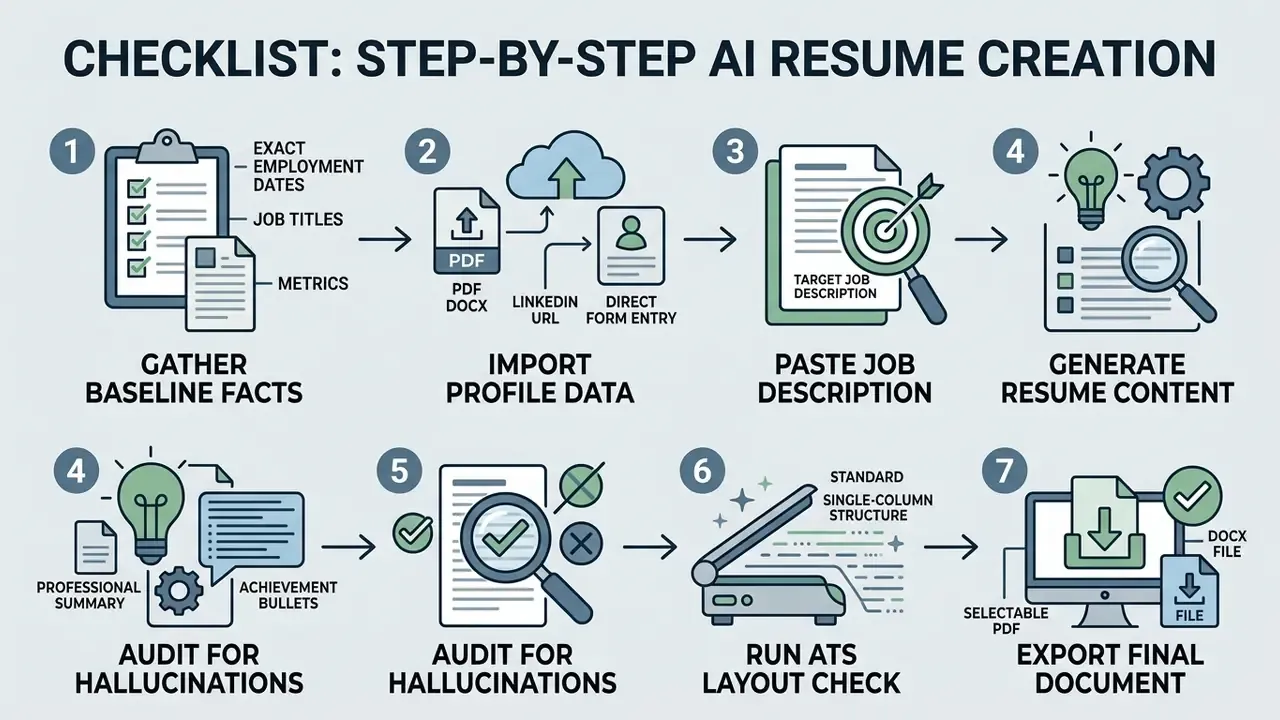
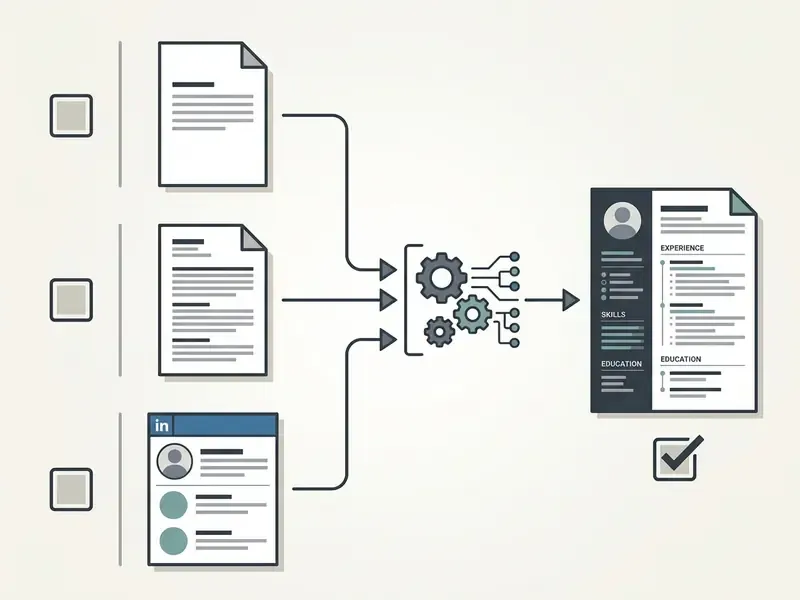
To ai create my resume, applicants supply baseline career data through one of three ingestion routes.
- Existing resume upload. Uploading a current PDF or DOCX lets the parser extract work history, education, certifications, and contact details. Enterprise-grade parsers also accept plain text and scanned PDFs, running OCR before entity extraction.
- LinkedIn profile parsing. Importing public profile data or a PDF profile export populates structured fields with no manual typing. Extraction usually returns name, title, employment history, education, skills, and certifications without field mapping.
- Direct ingestion form. When users ask a tool to ai create a resume for me from scratch, a guided form collects raw facts: job titles, dates, primary responsibilities, credentials.
Add Experience, Skills and a Professional Summary
Once the baseline facts are in, the ai create resume engine helps draft the core sections. You prompt it to rewrite generic duties as quantified achievements, then you argue with the output.
A short example of the transformation. "Responsible for managing customer service calls" becomes "Managed high-volume client inquiries, improving first-call resolution rate by 18% over six months." The National Archives federal resume guide recommends the same underlying template: Accomplished [X] as measured by [Y], by doing [Z], where Y is the success metric and Z is the concrete action. One rule has no exceptions. Verify every generated metric, date, and organizational title against primary records before submission.
Edit, Customize and Download the Final Resume
The last stage of an ai create me a resume workflow is where human editorial control earns its keep. Read the draft for tone, strip filler phrasing, pick a layout that will survive a parser.
- Layout selection. Choose simple, professional templates that respect single-column parsing standards.
- Typography controls. Set clean, web-safe fonts (Calibri, Arial, Helvetica, Georgia, Times New Roman) at 10-12 pt for body text, headings at 12-16 pt.
- Multi-format export. Download the finished file as a text-selectable PDF or an editable DOCX, depending on the employer's instructions. When a portal specifies a format, that instruction overrides every personal preference you have.
How to Tailor an AI Resume to a Job Description
Tailoring to a specific vacancy remains the single biggest lever on screening outcomes. An ai create resume from job description feature reads the posting to identify essential skills, required experience levels, and the organization's own vocabulary.
Using large language models for that alignment puts target keywords into the summary, skills block, and experience section without the phrasing turning robotic. A 2025 comparative study on LLM-based resume optimization showed that automated matching reliably surfaces missing skill domains and restructures candidate experience to reflect role expectations (Automating Resume Tailoring Using Large Language Models: A Comparative Study of Model Performance, 2025).
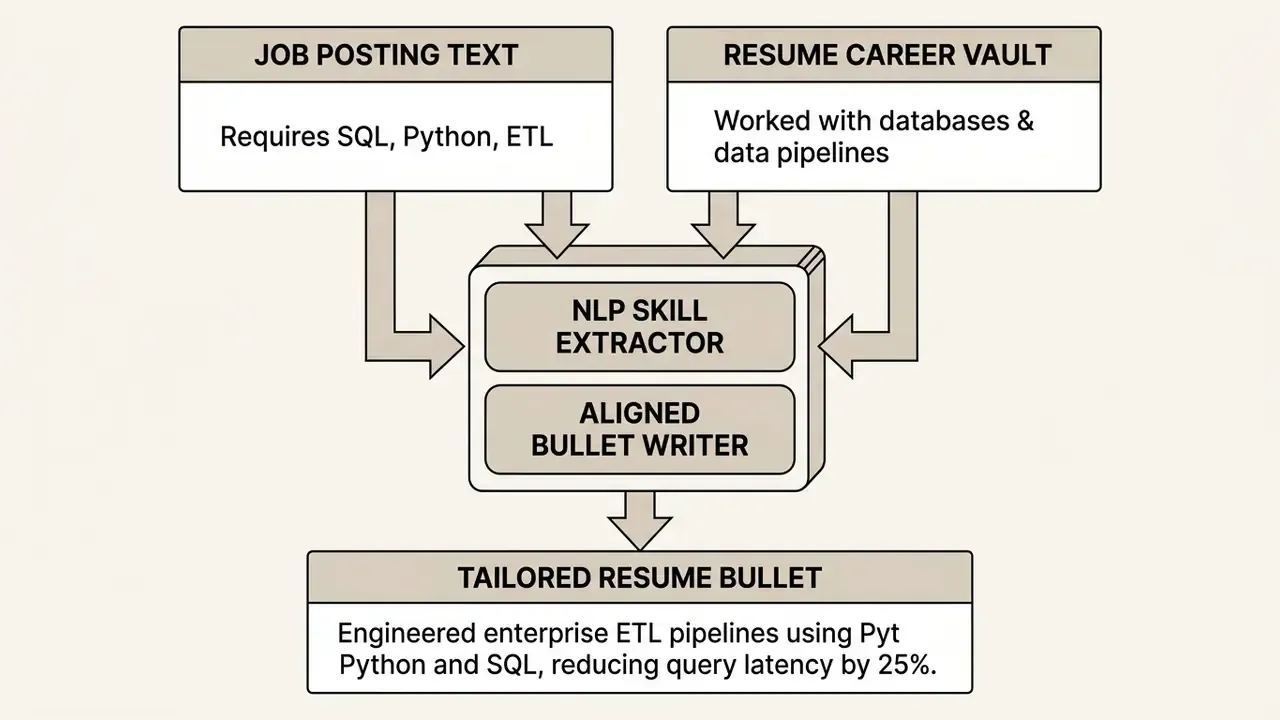
Copy-Paste Prompt Frameworks for Tailoring
Generic prompts produce generic output. The two frameworks below can be pasted into a general-purpose assistant or into the free-form prompt field of a dedicated builder. Both forbid the invention of facts, which is the most common failure mode in AI resume drafting by a wide margin.
Prompt 1. Requirement extraction and gap mapping
Prompt 2. Constrained rewriting with an anti-hallucination clause
The placeholder is deliberate. [METRIC NEEDED] forces you to supply a verifiable number instead of quietly accepting a fabricated one, and that is precisely the control recruiters probe in interviews.
Extract Relevant Skills and Keywords from the Job Posting
An ai generator for resume tools uses named entity recognition and natural language understanding to isolate the critical keywords in a posting.
- Hard skills extraction.Identifies software, technical frameworks, regulatory certifications, and named methodologies stated in the vacancy.
- Soft skill contextualization.Isolates desired behaviours, cross-functional leadership or stakeholder management for instance, then maps them to real historical achievements rather than adjectives.
- Keyword normalization.Aligns your vocabulary with industry standards, converting synonyms ("client management" to "account management") so employer scoring picks them up. Research-grade matching systems do this against shared taxonomies such as ESCO, then score exact-string overlap and semantic similarity separately from experience evidence. Which is exactly why keyword stuffing without supporting context never raises real match quality. It only raises suspicion.
Rewrite Resume Summary and Experience Bullet Points for the Role
With keywords extracted, an ai generator for resumes rewrites experience using behavioural frameworks like STAR, matching stated requirements against a longitudinal record of what you actually did.
«Adding a career vault raised ATS-style job-fit scores by an average of 7.8 points when candidate background overlapped the target role.»
In practice the leverage comes from retrieval, not rhetoric. The more structured raw material the system can draw on, old project notes, performance reviews, internal dashboards, the less it needs to guess. Candidates who keep a running achievements file beat candidates who reconstruct three years of work from memory on a Sunday evening. Every time.
Create a Matching AI Cover Letter
Generative platforms extend tailoring into cover letters that echo the resume rather than contradict it. In an empirical evaluation published by Cui, Dias and Ye (Signaling in the Age of AI, arXiv, 2025), deploying generative cover-letter tools increased textual alignment with postings and raised callback rates by 3.56 percentage points among active users.
«After the AI tool was introduced, the correlation between cover-letter tailoring and interview invitations fell by roughly 51%, pushing employers toward alternative signals.»
So hiring managers now lean harder on signals that are expensive to fake: performance history, referrals, portfolio artifacts, verifiable credentials. Job seekers should make sure a cover letter carries at least one specific anecdote with a date and a number attached. Harvard FAS guidance from 2023 codifies a workable pattern: paste the full job description, extract the top required skills, map two or three concrete resume examples to those skills, then confirm the letter still sounds like a person you would recognize.
CRITICAL E-E-A-T AUDIT NOTICE: VERIFY AI-GENERATED CONTENT
How AI Resume Builders Improve ATS Compatibility
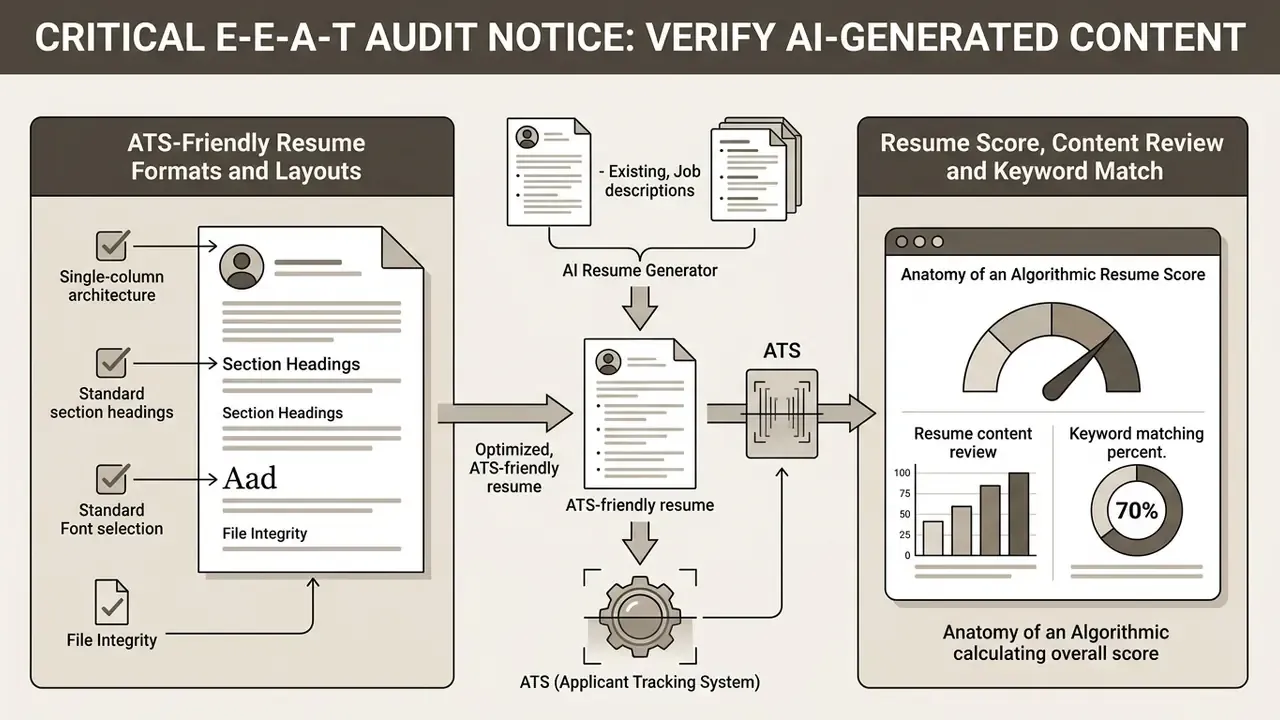
«Comparing three LLMs with three expert recruiters revealed statistically significant scoring divergence across all contexts (p < 0.01), questioning algorithmic substitution for humans.»
For candidates the implication is narrow but useful. An optimized document raises the odds of being parsed and surfaced correctly. It does not promise that a machine's reading of your profile matches how an experienced recruiter would rate you.
ATS-Friendly Resume Formats and Layouts
Tracking systems convert every submitted document into a plain-text database record. Graphic elements, floating text boxes, multi-column tables, and embedded images regularly break that conversion, and the information you lose is invisible to you.
- Single-column architecture. Top-to-bottom flow keeps sentences intact instead of fragmenting them across artificial column boundaries.
- Standard section headings. Write "Work Experience", "Education", "Skills", "Professional Summary". Not "My Journey".
- Standard font selection. Clean sans-serif or serif typefaces (Arial, Calibri, Times New Roman, Georgia, Garamond, Verdana) at 10-12 pt for body text.
- File integrity. Submit DOCX or a text-selectable PDF. Scanned, image-based PDFs get dropped or scrambled because there is no extractable text layer to read.
| Evaluation Parameter | ATS-Friendly Resume Layout | Visually Complex Resume Layout |
|---|---|---|
| Column structure | Single-column, left-aligned standard flow. | Multi-column, split-pane, or grid layout. |
| Graphic elements | Text bullet points, zero icons or graphics. | Visual skill bars, icons, profile photos. |
| Parsing accuracy | Above 95% accurate extraction across systems. | Frequent missing sections or merged fields. |
| Keyword detection | Direct contextual indexing in standard sections. | High risk of text dropped inside graphic boxes. |
| File format choice | Text-selectable PDF or standard DOCX file. | Scanned image PDF or custom design formats. |
| Human scan speed | High readability for a rapid top-to-bottom scan. | Distracting hierarchy, hard to evaluate quickly. |
Read the table as a single instruction: design for the parser first, then make it pleasant for the human who spends six seconds on the top third of page one.
Resume Score, Content Review and Keyword Match
An ai cv generator tool often bundles a real-time resume checker that scores your draft against a job description before you submit anything.
These validation modules assess section completeness, calculate keyword density (the usual recommendation sits between 1% and 3%, with each priority keyword appearing in at least two sections), and flag missing skill requirements. The feedback is most valuable when it is boring: fix the structural defect, then move on.
«An audit of GPT-3.5 found that generated resumes reproduced stereotypes: documents for Asian and Hispanic candidates contained immigrant-origin markers absent from any prompt.»
That finding is a direct instruction for reviewers, not a footnote. Read generated text for accuracy and for unrequested demographic inference. Delete anything the model added about origin, nationality, family status, or language background that you did not supply. For readers tracking how these disputes escalate into formal proceedings, our AI litigation and case timelines coverage follows the enforcement side of algorithmic hiring.
Anatomy of an Algorithmic Resume Score
Automated scoring engines evaluate documents across four diagnostic dimensions before any recruiter sees them. Understanding the sub-scores converts an opaque number, say 58 out of 100, into a concrete repair list.
| Diagnostic Pillar | Audit Parameters and Verification Logic | Target Benchmark |
|---|---|---|
| 1. Content integrity | Quantified outcomes (percentages, currency, volumes), active-verb openings, absence of duty-only phrasing and buzzwords. | Above 90% action-verb ratio |
| 2. Formatting and parsing | Single-column flow, standard header naming, no tables or text boxes, web-safe fonts. | 100% parsing accuracy |
| 3. Keyword optimization | Semantic match, exact-string frequency, hard-skill extraction against the target job description. | 1%-3% keyword density |
| 4. Best-practices compliance | Document length, contact-info validity, bullet length (10-25 words), date consistency, mechanical accuracy. | Zero mechanical errors |
A weak score in pillar 2 is the most damaging and the cheapest to repair. Layout defects silently suppress strong candidates, while pillar 3 gaps merely lower your ranking. Fix the plumbing before you polish the prose.
AI Resume Builder Features: Templates, Writing Tools and Export
Evaluating an ai cv maker tool means reviewing five functional modules: template control, embedded writing tools, export flexibility, ecosystem integrations, and data privacy safeguards. Feature lists vary by vendor, so treat the categories below as a comparison grid rather than a spec sheet.
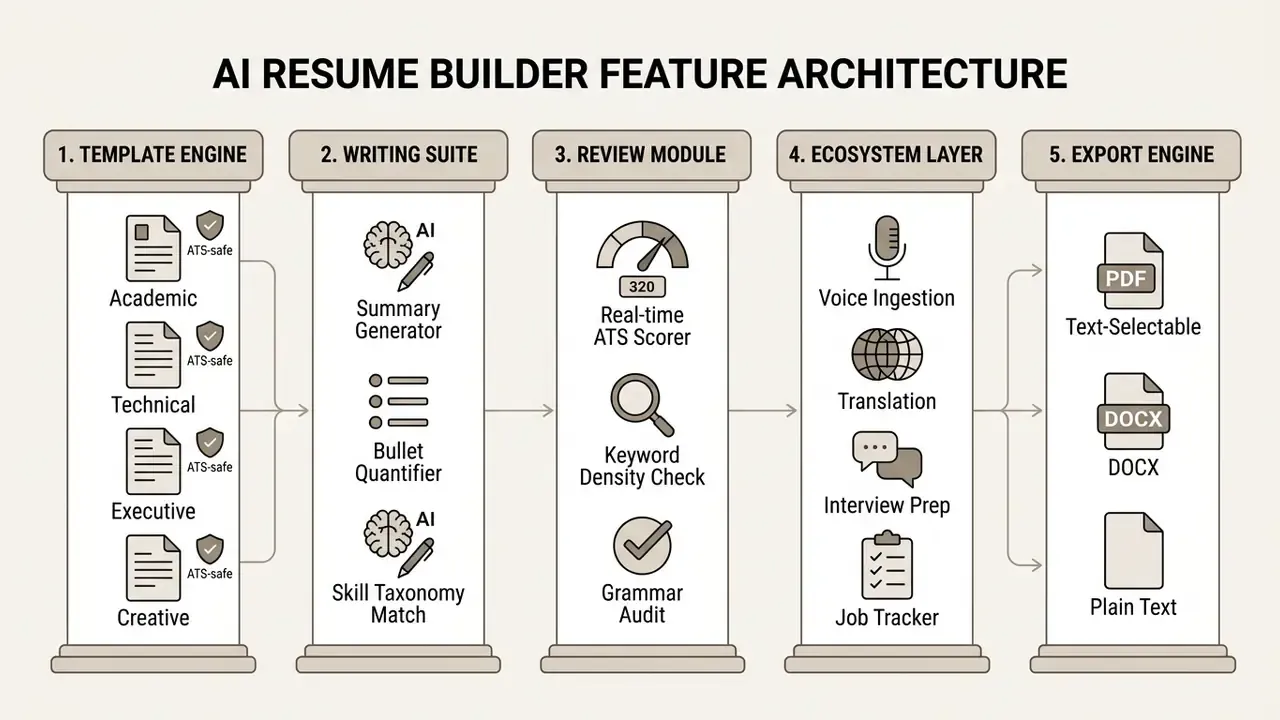
Resume Templates and Professional Design Controls
An ai cv maker offers template families matched to industry norms and career stage. Visual presentation should agree with what your target sector already expects. Design-adjacent professionals building a personal brand alongside the resume can also review AI logo generators for portfolio and personal-site assets.
Choose by industrial standard, not by aesthetic label.
- Academic and junior (Harvard standard). Education-first, ultra-clean, single-column. Built for students, researchers, and early-career applicants aiming at finance, consulting, legal, and academic tracks. Education sits above experience, and honors and coursework carry real weight.
- High-density technical (Overleaf / LaTeX style). The maximum-real-estate single-column design popularized by the endlessly copied "Jake's Resume" LaTeX template. Suited to software engineers, data scientists, and DevOps candidates who must list large stacks and multiple projects without clutter.
- Executive compact. Dense typography that condenses 10+ years of managerial history, P&L ownership, headcount, and leadership outcomes into a disciplined one-page narrative. Standard expectation for consultants, lawyers, and senior management roles.
- Two-column ATS (conditional use). A parser-tested variant where the sidebar carries only non-critical metadata such as languages and tools, never core experience text. Use it only when the platform explicitly certifies parsing behaviour.
- Creative and modern accent. Subtle typographic hierarchy with minimalist dividers for digital marketing, product design, media, and content roles. Vetted for parser compatibility rather than decorated for its own sake. Candidates presenting motion or media work can extend the portfolio with animation maker tools and publish reels using established YouTube video editing workflows.
- Minimalist conservative. Whitespace-heavy, ornament-free layouts for banking, compliance, insurance, and government administration, where a decorative flourish reads as a risk signal all by itself.
AI Writing Tools for Summary, Experience and Skills
Integrated writing modules cover every major component of the document:
For professionals building media or technical portfolios, comparing tool capabilities is worth the hour. Practitioners can review comparative benchmarks for best AI video generators and evaluate stylistic output across the best AI art generators when assembling supporting work samples.
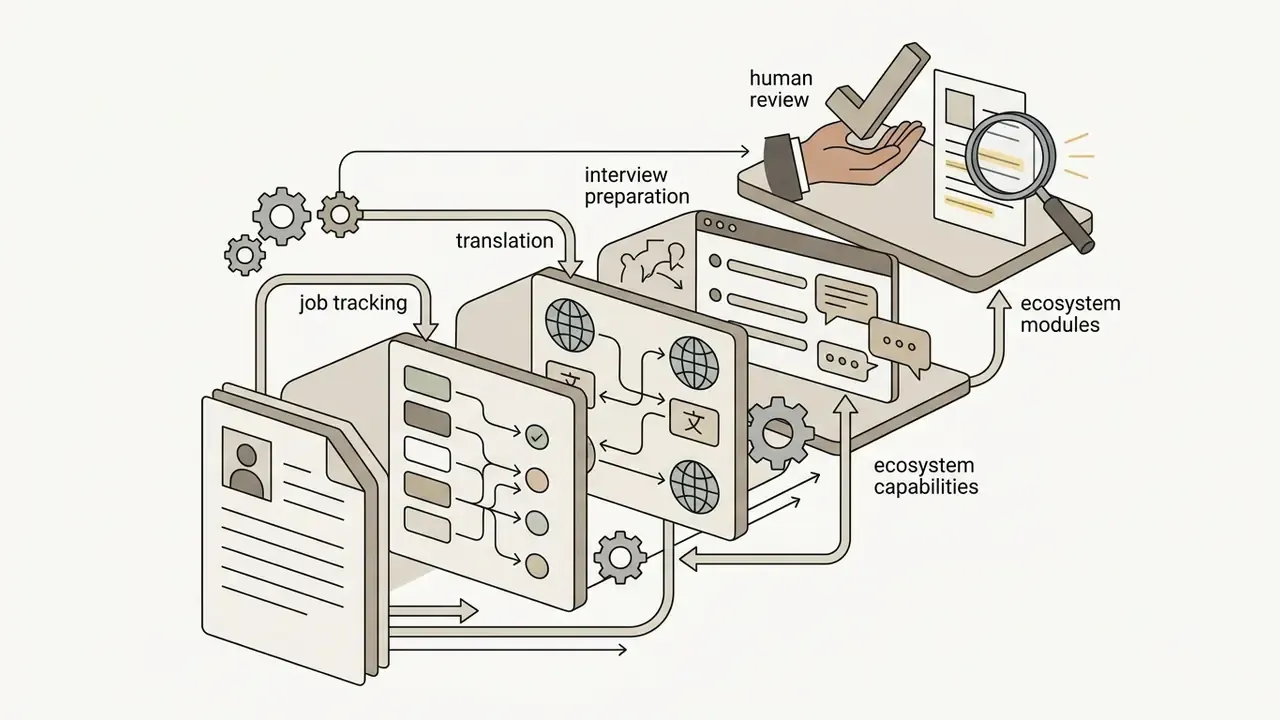
Advanced AI Ecosystem Capabilities: Voice Ingestion, Translation, and Interview Prep
Beyond text generation, newer platforms bundle end-to-end application tooling. This is where the competitive gap between a basic generator and a full career suite actually sits.
- Voice-to-text drafting. Multi-modal speech recognition lets candidates dictate raw achievements. The system strips filler, repairs grammar, and restructures spoken narrative into quantified STAR bullets. Much faster for senior candidates who explain their work better out loud than on paper. Readers curious about the underlying speech technology can review how modern AI voice generators handle language coverage and output quality.
- Automated multi-language translation. Neural machine translation converts complete resume structures into eight or more major languages, Spanish, German, French, Portuguese and Mandarin among them, while preserving formatting and industry terminology. It removes the third-party round trip that historically destroyed layout integrity.
- AI interview and STAR story preparation. Once the resume is final, integrated agents extract achievements to generate likely behavioural questions, suggested STAR frameworks, questions to ask the interviewer, public-source research on the company's interview process, and a condensed company brief covering values, recent news, and industry context.
- Salary benchmarking. Some suites append market-rate analysis so you enter negotiation with a defensible range rather than a guess. Teams modelling cost per application or per hire can cross-check assumptions with our AI Media Calculators.
Platform integration matters here. Where a builder exposes programmatic access for parsing or bulk generation, review the implementation constraints first; our AI Media API Guides cover the recurring authentication and rate-limit patterns.
PDF, DOCX and Other Resume Download Options
Flexible export keeps you compatible with whatever portal appears next. Text-selectable PDF remains the default for preserving visual fidelity across devices, while DOCX is preferred when employers request editable attachments, with the caveat that DOCX rendering shifts between Word versions and operating systems more often than people expect.
Advanced platforms support multi-version management, letting you save resume variants for distinct application tracks in cloud storage. Version history matters more than it sounds: after an aggressive tailoring pass, being able to restore last week's cleaner draft saves an evening. Candidates managing digital assets and content production workflows should also confirm licensing terms. For portfolio imagery, see how rights are handled by AI image generators for commercial use and by design suites such as the Canva AI generator, with broader licensing patterns collected in the AI Media Commercial-Use Hub.
Post-creation workflow integration. Resume platforms increasingly connect to application management. Integrated job trackers log statuses, attach the exact resume variant sent to each target URL, store recruiter notes and follow-up tasks, and return weekly search analytics. A further tier uses agentic scripts and browser extensions to auto-fill repetitive forms across external job boards, while recruiter-matching services push a parsed profile to hiring desks with open roles. These features shorten the gap between "document finished" and "application submitted", which is precisely the stage where most job searches quietly stall.
Free vs Paid AI Resume Generator: What to Compare Before Choosing
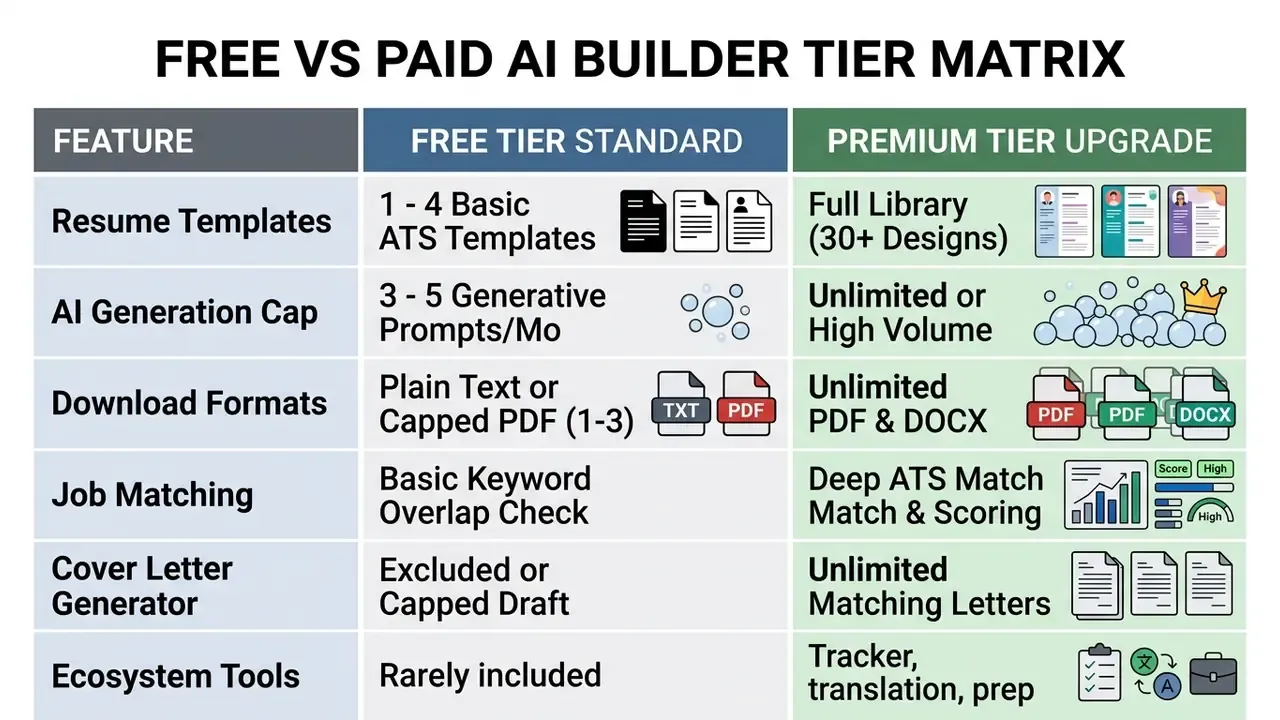
What a Free AI CV Generator Usually Includes
An ai cv maker free or ai curriculum vitae generator free plan gives you a functional baseline for simple applications.
- Basic template access. One to four standard single-column, ATS-friendly designs.
- Capped AI prompts. Limited generation credits, typically three to five requests per month or a small fixed pool, for summaries and bullet points.
- Standard export. Plain-text output or restricted PDF downloads, often capped at one to three files.
- Basic scoring. A simple keyword-overlap indicator rather than a four-pillar diagnostic audit.
Published free tiers illustrate the pattern. One major builder offers $0 per month with a single resume and three PDF downloads. Another provides four templates with unlimited downloads but restricted AI usage. A third grants one master profile, three AI-tailored resumes monthly, one ATS-safe template, and basic scoring. The trade-off never changes: vendors cap generation volume, template variety, or export count. Pick which constraint hurts you least.
When Premium Resume Tools May Be Worth It
Paying makes sense during an active, high-volume search that demands heavy customization.
- Unlimited tailoring. Uncapped generation for adapting resumes and cover letters to dozens of job descriptions.
«As AI lowers the cost of producing tailored text, the signaling value of basic resume-to-vacancy alignment falls by roughly 51%, and employers shift to verifiable alternative signals.»
Unlimited tailoring therefore has diminishing returns as a differentiator. The rational use of a premium plan is to buy back the hours spent on mechanical alignment and reinvest them in signals that still carry weight: portfolio artifacts, referrals, certifications, documented outcomes.
| Feature Category | Free AI Resume Tier | Premium AI Resume Tier | Selection Criteria |
|---|---|---|---|
| Document limit | One active master resume. | Unlimited variants and versions. | Active search across multiple job titles. |
| AI writing prompts | Three to five credits monthly. | Unlimited or high monthly allocation. | Need for extensive rewriting. |
| ATS checker depth | Basic keyword count. | Parsing audit and density metrics. | High-competition corporate applications. |
| Cover letter tools | Absent or basic template. | Automated, job-matched letters. | Requirement for tailored cover letters. |
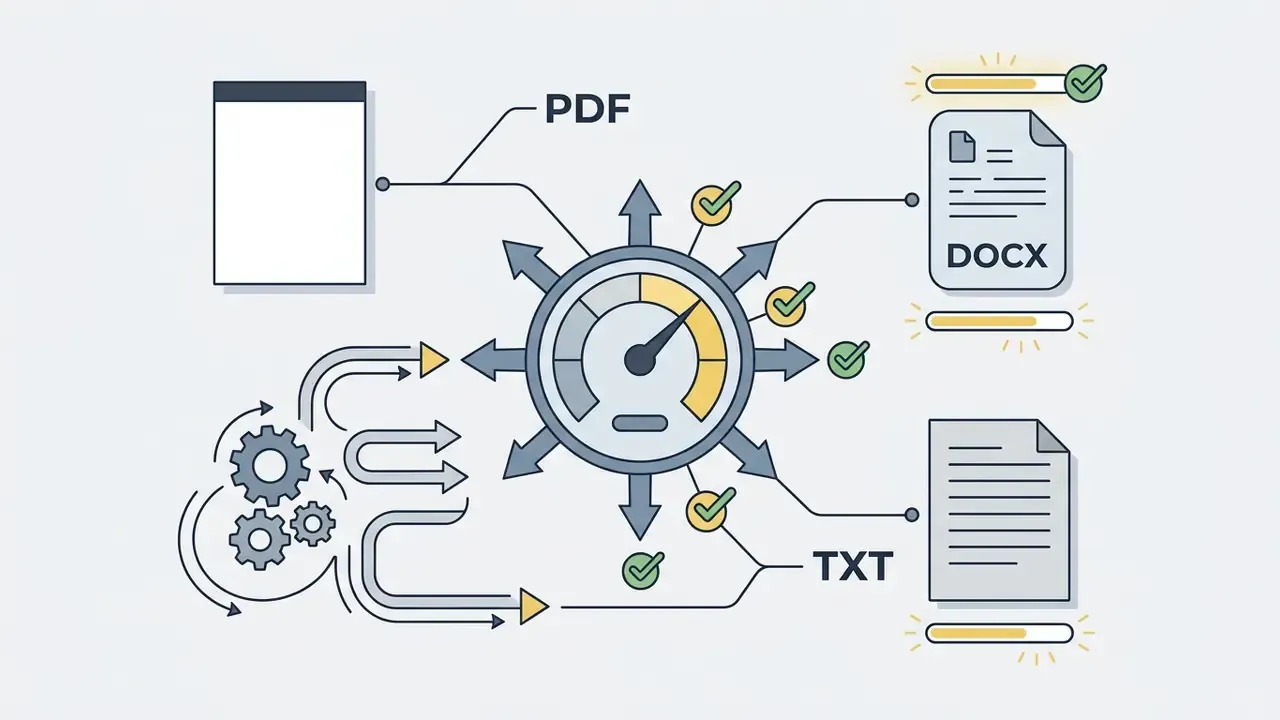
| Export options | Plain text or capped PDF. | Unlimited PDF, DOCX, cloud export. | Employer requests editable formats. |
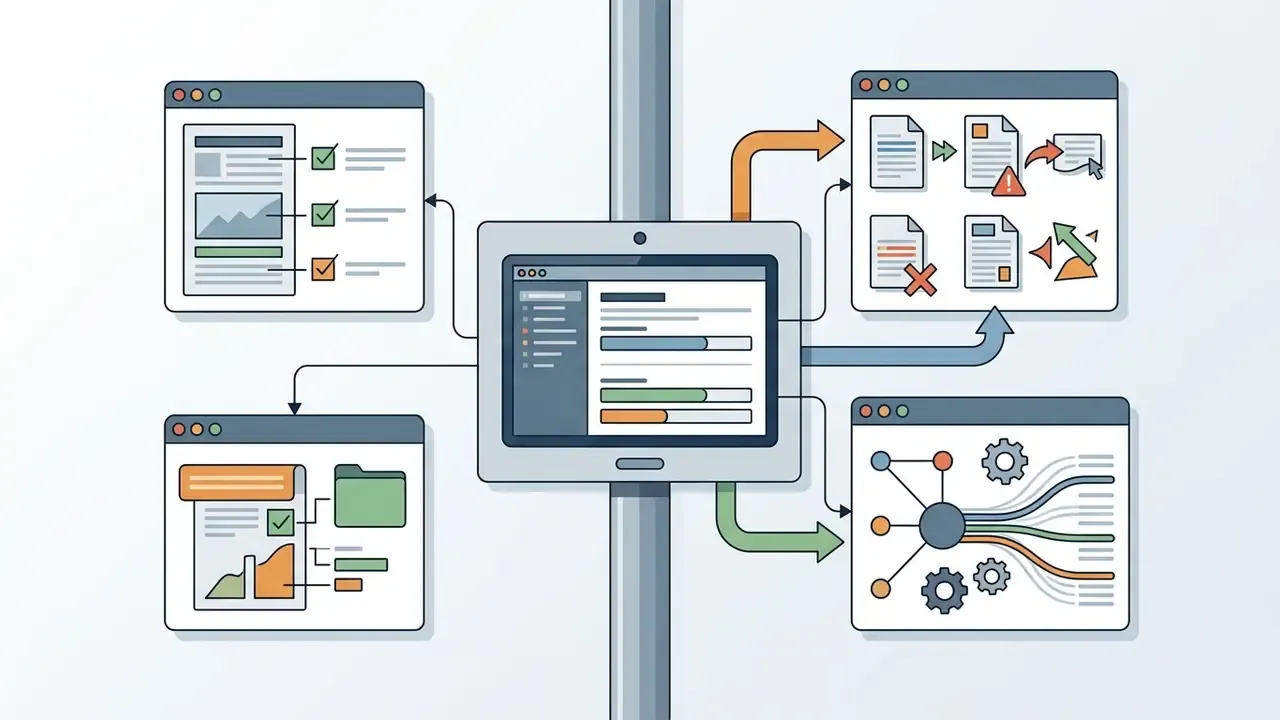
| Ecosystem modules | Generally absent. | Tracker, translation, prep, salary data. | Multi-month, multi-market job search. |
One practical rule of thumb, offered with appropriate uncertainty: if you apply to fewer than five roles a month, a free tier plus a general-purpose assistant usually suffices. Above roughly fifteen applications a month, the version management alone tends to justify a subscription. Vendors would say the threshold is lower. They would.
AI Resume Generator FAQ
Is It Safe to Use an AI Resume Generator with Personal Data?
General information only. This is not advice from a qualified data-protection specialist or legal counsel, and personal-data requirements vary by jurisdiction. Data security depends on the platform's privacy policy, retention schedule, and model-training consent settings. When using an ai cv generator website, verify how the vendor handles obligations under regimes such as GDPR and CCPA before you upload anything. An empirical investigation into chatbot privacy by Priyanshu et al. found that unconstrained retention of input data produced verbatim reproduction of personally identifiable information in 57.4% of output test cases, with leakage frequency distributed unevenly across demographic groups (Priyanshu et al., Are Chatbots Ready for Privacy-Sensitive Applications?, arXiv, 2024, https://arxiv.org/abs/2403.09572). The same study showed that explicit privacy-aware prompting significantly reduced that regurgitation. Practical conclusion: keep unnecessary sensitive identifiers, Social Security numbers, full home addresses, financial details, out of online resume generators entirely.
«LLMs show self-preference bias: models favored AI-written resumes over human-written ones in 67-82% of comparisons.» Source: Self-preference bias in algorithmic hiring, arXiv (2025). https://arxiv.org/abs/2501.18479 That risk cuts both ways. Candidates who write everything themselves may be systematically down-ranked by AI screeners, while employers running LLM screening may be selecting for machine-generated phrasing instead of competence. Another argument for a human in the loop on both sides of the transaction. Due-diligence checklist before uploading a document:
- Confirm the retention window in writing. Published policies currently range from deletion within 30 days of account closure to 90-day storage of generated resumes, with third-party model providers holding prompts for up to 30 days for abuse monitoring.
- Check whether an opt-out from model training exists, and whether it is enabled by default.
- Verify deletion and export rights: GDPR access and erasure, CCPA rights to know, delete, opt out of sale, and non-discrimination.
- Disable chat history where the platform exposes that control.
- Redact street address, national ID numbers, date of birth, and any client name covered by an NDA. If a vendor's documentation cannot answer those five points, that answer is itself informative. For platform-specific account, deletion, and troubleshooting questions, our AI Media Support and Troubleshooting resources collect the recurring cases.
Can AI Create a Professional CV Without Work Experience?
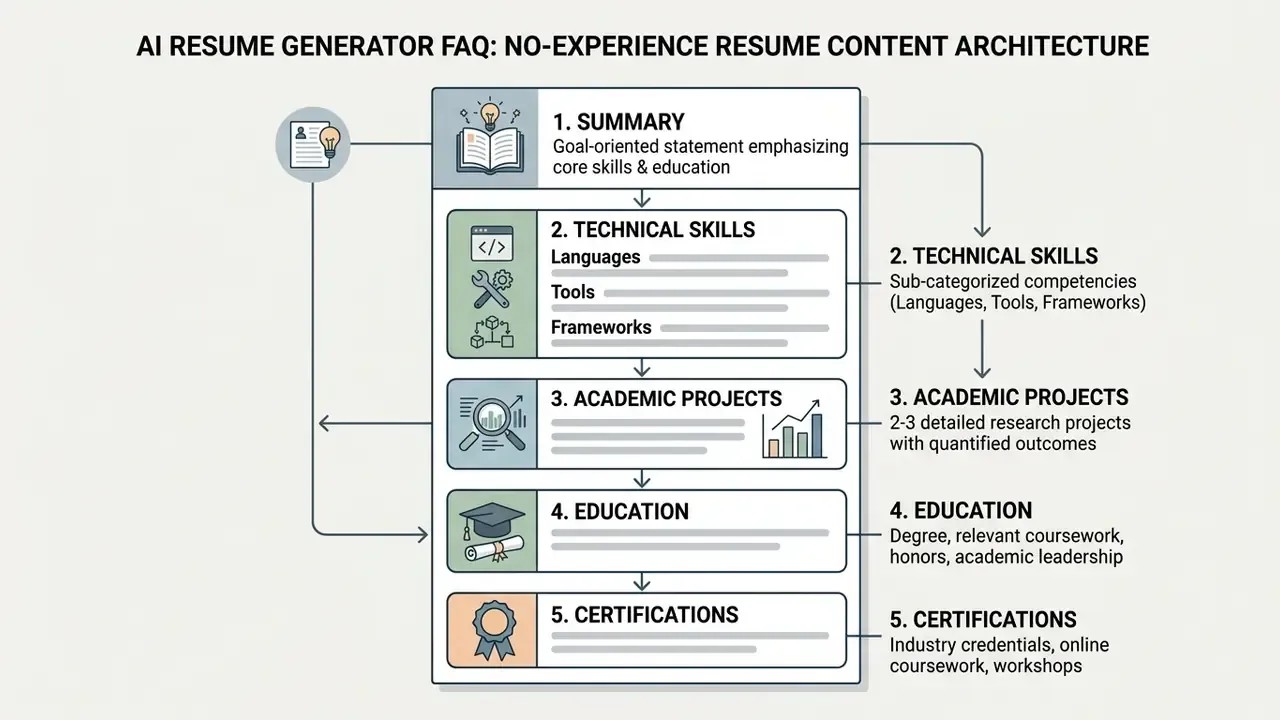
Yes. An ai create cv tool can build an effective functional or hybrid resume for students, graduates, and career changers without formal employment history. When experience is thin, the AI foregrounds academic projects, relevant coursework, technical proficiencies, volunteer achievements, and transferable skills. Updated: university career-services guidance converges on a fairly concrete formula. Carnegie Mellon's resume guide recommends listing field-specific skills, sub-categorizing them by domain, ranking them by proficiency, and keeping generic soft-skill labels out of the skills block. University of Phoenix career guidance recommends selecting three to five of the most relevant courses plus three to five research or student projects with described activities. University of Houston-Downtown's no-experience template weaves keywords such as communication and flexibility into evidence-based accomplishment statements rather than bare claims. Because the Carnegie Mellon guide circulates as a departmental PDF without a stable public citation URL, retrieve the current version from the university's career-services site before quoting it.
Will Recruiters Know My Resume Was Written with AI?
Recruiters rarely detect the tool. They detect the pattern. The recognizable signature is unquantified superlatives, identical phrasing across candidates, buzzword clusters with no supporting metric, and dates that do not reconcile. Documents that survive scrutiny share one property: every claim can be defended in conversation. Where an employer explicitly restricts AI use in application materials, follow that instruction. Harvard FAS guidance makes verification of employer rules an explicit step, and ignoring it is an avoidable own goal.
Which Export Format Should I Submit?
Submit what the employer asks for. With no instruction, use a text-selectable PDF to lock formatting across devices and keep a DOCX master for portals that demand editable uploads or reject PDF outright. Never submit a scanned or image-based PDF. There is no extractable text layer, and parsers discard it without telling anyone.
Does a Higher Resume Score Mean I Will Get the Interview?
No. A score measures machine readability and keyword alignment, not competence or fit. As the arXiv screening evaluation showed, LLM ratings diverge significantly from expert recruiter judgment. Treat the score as a defect detector: fix parsing and content gaps, then stop optimizing and spend the remaining time on verifiable evidence and direct outreach.
How Many Tailored Versions Should I Actually Maintain?
Fewer than most tools encourage. Three to five role-family variants, each with its own keyword set and summary, cover most searches. Beyond that, maintenance cost rises and consistency drops, and inconsistency across versions is exactly what a recruiter notices when your LinkedIn and your PDF disagree about a start date.
Editorial Verification and Author Credentials
Appendix A: Correction and Source-Verification Log
Maintained for transparency. Each entry records a superseded formulation and the reason for revision.
- Wiles, Munyikwa and Horton citation year. An earlier version cited Management Science, 2026. Corrected to reflect online publication ahead of print (2025), per the INFORMS DOI record: https://pubsonline.informs.org/doi/10.1287/mnsc.2023.01980
More definitions, comparisons, and workflow references are collected in the AI Media Glossary.
- "ATS fit scores increase by 20% to 25%"
- originally appeared without qualification. Now attributed to a simulated-scoring experimental paper and explicitly labeled directional, pending replication on live enterprise ATS instances.
- ExpressPros (86%) and Robert Half (67%) figures
- were originally presented as settled fact. Now labeled as vendor-commissioned survey data with self-selected panels, plus a reader instruction to verify at the publisher.
- "No empirical study proves that paid subscriptions guarantee higher job placement rates"
- was reformulated to state precisely what is absent from the literature rather than asserting a universal negative.
- Carnegie Mellon career-guidance citation
- was originally cited without URL or edition. Now framed alongside two additional university sources, with a note that the primary PDF lacks a stable public citation URL.
- Non-topical internal links removed.
- Animation coursework and degree pages, online casino and telehealth glossary entries, and live-video pages were withdrawn as semantically unrelated to resume creation. Retained hub links use descriptive anchors and appear only where the subject matter overlaps.
- Page metadata and the anchor-based navigation list
- previously rendered inside the article body. Metadata now sits in the document front matter, and the in-body anchor list was replaced with a plain-text scope summary.
- Keyword phrases were unbolded
- throughout the body text. Visual emphasis on search phrases served no reader purpose and made the copy read as machine-optimized.
- Wiles, Munyikwa and Horton citation year. An earlier version cited Management Science, 2026. Corrected to reflect online publication ahead of print (2025), per the INFORMS DOI record