Last updated: 2026. This guide is written for operations, content, risk, and governance teams that must justify tool selection to internal reviewers.
Executive Summary (30-Second Read)
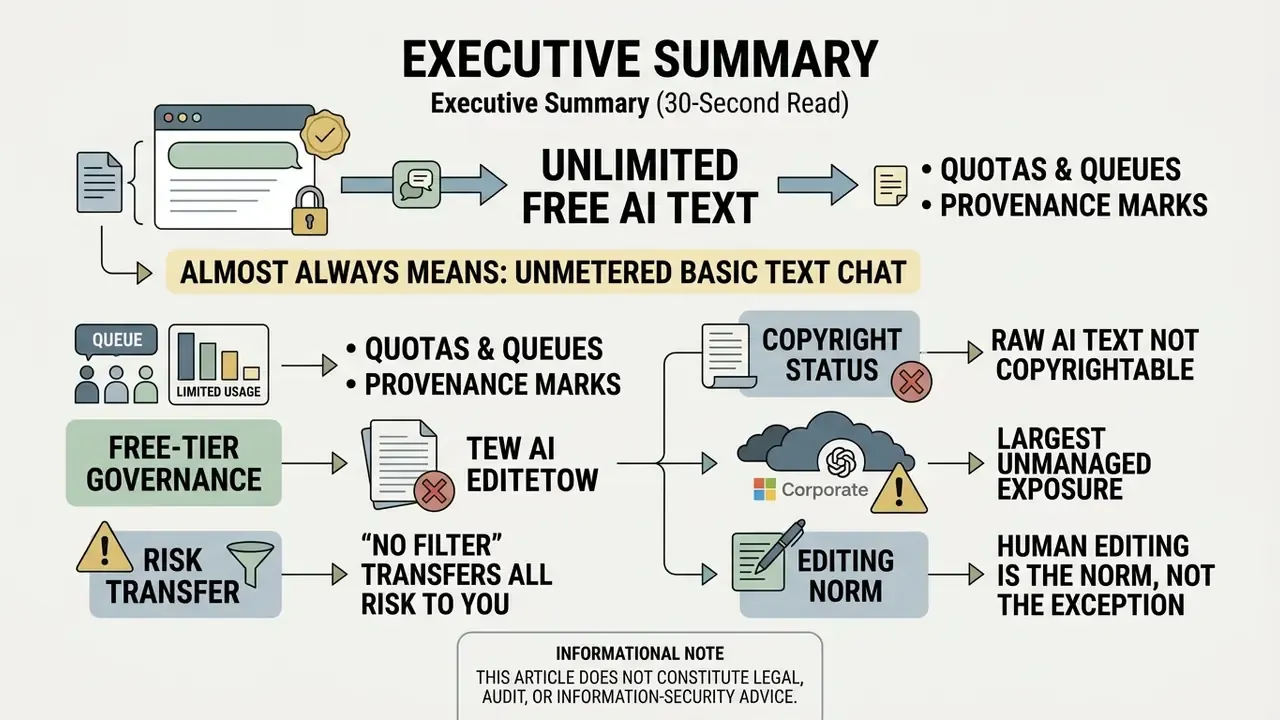
- "Unlimited" almost always means unmetered basic text chat. OpenAI removed text-message caps for Free and Go users in August 2026, yet limits remain on file uploads, image generation, and other tools (OpenAI Pricing, 2026). Context windows differ by mode: 27K tokens for the instant model versus 256K for manually selected reasoning mode.
- Free tiers are governed by quotas, queues, and provenance marks. Google's Gemini API documents a free tier with batch-enqueued token limits (Google AI for Developers, 2026), and free Gemini image output carries invisible SynthID watermarks.
- Raw AI text is not copyrightable. The U.S. Copyright Office states that material lacking sufficient human authorship cannot be registered; only human-authored selection, arrangement, and revision receive protection (copyright.gov, 2026).
- "No filter" transfers all risk to you. Adversarial audits of minimally guarded models report defect rates near 100% with zero refusals, an unacceptable profile for regulated communications.
- Shadow AI is the largest unmanaged exposure. Prompts submitted to consumer free tiers may be retained and used for model training, which conflicts with GLBA safeguards, contractual confidentiality, and internal model-risk policy (see SR 11-7 and OCC 2011-12 expectations).
- Human editing is the norm, not the exception. In a survey of 879 marketers, 97% of teams edit and review AI content before publishing; only 4% publish untouched output (Ahrefs AI Content Survey, 2024-2025).
This article is informational and does not constitute legal, audit, or information-security advice. Validate any tooling decision with your compliance, privacy, and model-risk functions.
What Does "AI Text Generator Free Unlimited" Mean?
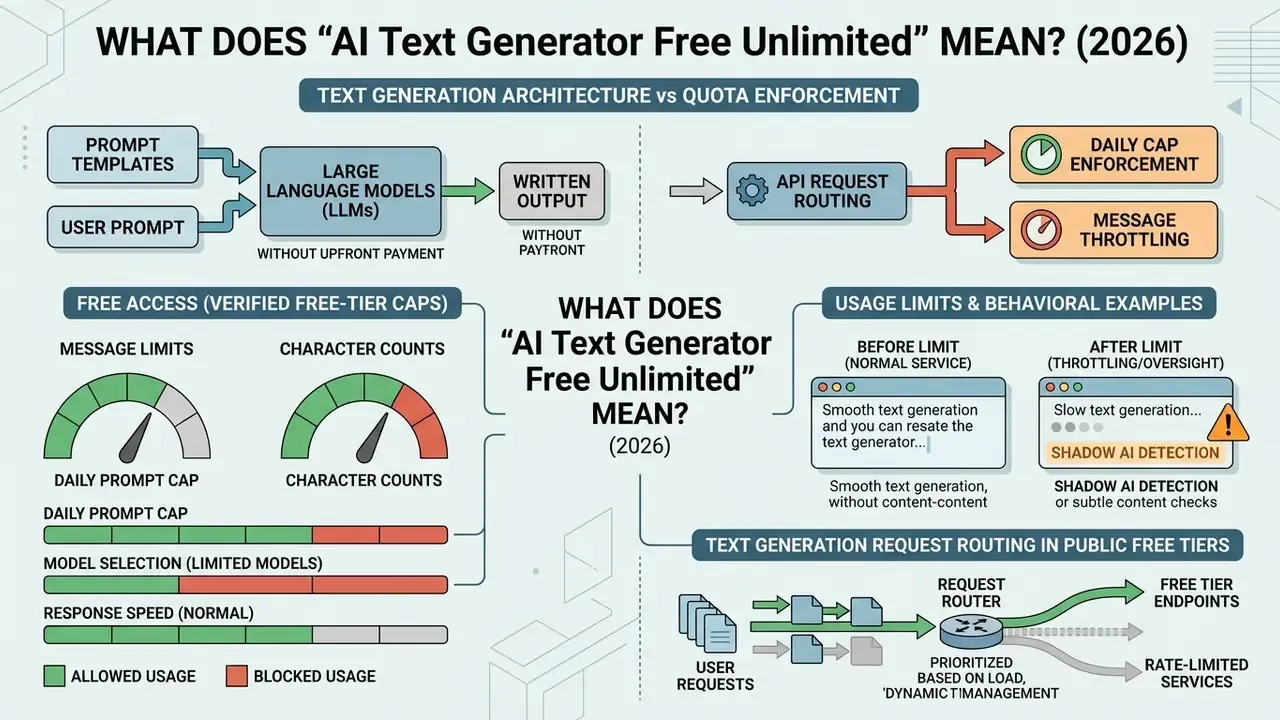
An ai text generator free unlimited is a web-based application powered by large language models (LLMs) that turns text prompts into written output without upfront payment. A large language model, in plain terms, predicts the next stretch of text based on patterns in its training data. In practice, the word "unlimited" usually describes unmetered basic text chat, while advanced features, multi-modal capabilities, and peak-time processing stay subject to throttling and daily caps.
Text Generation Architecture vs. Quota Enforcement
Marketing pages describe capability. Engineering documentation describes constraints. The table below maps the promise against the mechanism that actually governs your session.
| Marketing Promise | Underlying Mechanism | Practical Consequence |
|---|---|---|
| "Unlimited messages" | Unmetered basic chat; separate caps on uploads, images, and tool calls | Text drafting flows; multimodal work stops mid-project |
| "No sign-up needed" | Anti-abuse rate limits keyed to IP or browser fingerprint | Bursty, high-volume drafting triggers cooldowns |
| "Full-length documents" | Context window ceilings (for example, 27K vs. 256K tokens by mode) | Long documents get truncated, causing invented details |
| "Instant results" | Bandwidth-and-availability-based response times on free plans | Latency spikes and fallback to lighter models at peak hours |
| "Private and secure" | Prompt logging defaults on consumer tiers | Confidential text may enter training or review pipelines |
Free Access, Usage Limits, and Text Generation
Free access tiers let users run an ai text generator to draft short passages, brainstorm concepts, or rewrite paragraphs. Published documentation, though, shows that public zero-cost tiers enforce real operational boundaries. According to OpenAI's pricing pages and release notes, the free plan describes response times as "limited by bandwidth and availability," lists a 27K total context window for the instant model, and reaches 256K tokens only when a reasoning mode is selected manually (OpenAI Pricing; OpenAI Help Center Release Notes, 2026). The observable free-tier metric in official documentation is messages and context, not characters per day.
When system traffic peaks, free platforms protect stability by queuing requests or falling back to lighter models. So a free unlimited ai text generator will happily produce routine drafts, while extended context windows and complex reasoning modes stay governed by rolling time windows. Knowing the ceiling in advance saves an afternoon of guessing.
Access limits also change how people write, not only how much:
Request Routing in Public LLM Free Tiers
A free-tier prompt passes through five stages before you see text: input moderation, quota accounting (token bucket or rolling window), model routing (priority queue versus standard queue), generation with context-window truncation, and output classification plus provenance marking. Each stage can degrade the result. Quota accounting delays it, routing downgrades the model, truncation drops earlier context, and output classification may block or soften phrasing. Knowing which stage failed tells you whether to shorten the prompt, split the task, or move to a paid tier. That diagnosis takes seconds and prevents a lot of superstition about "the model got worse today."
Shadow AI, Data Retention, and Confidentiality Exposure
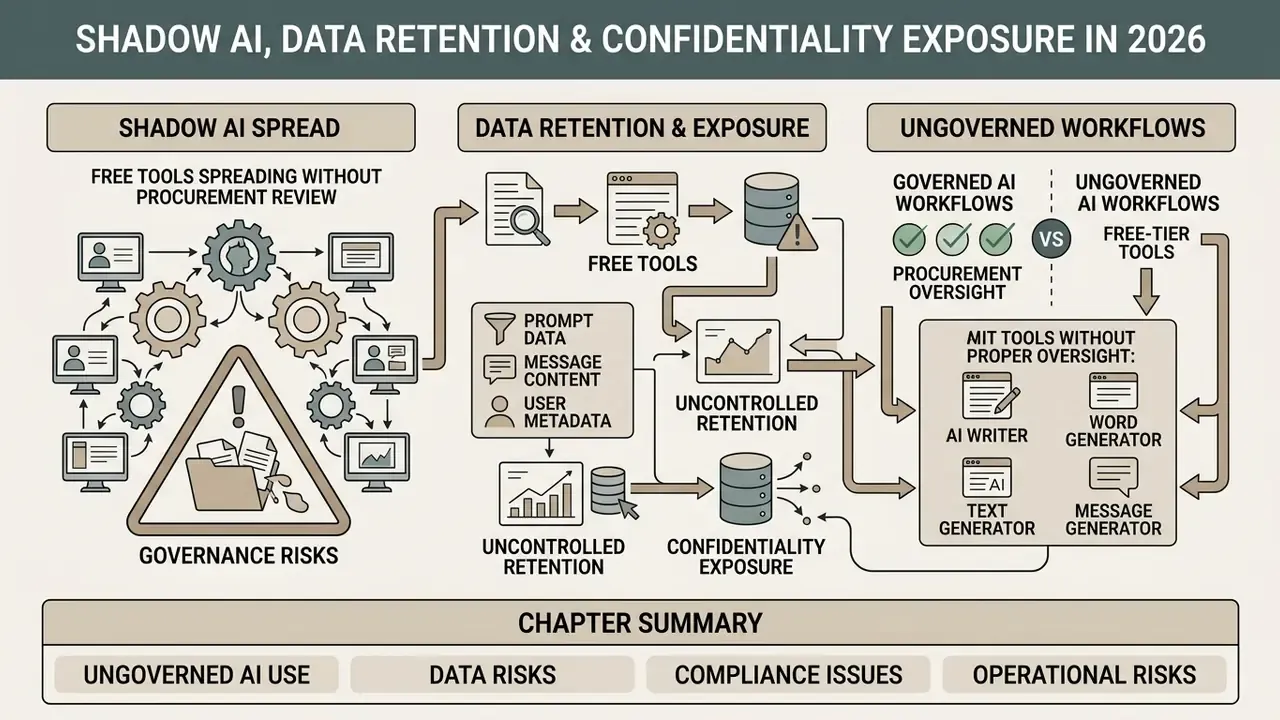
Free tools spread through organizations without procurement review. That pattern, Shadow AI, is where most regulated firms quietly accumulate risk, because exposure is created by ordinary employees pasting real data into consumer endpoints.
What actually leaves the building. On consumer tiers, prompts and attachments may be retained and used to improve models unless the account holder opts out. OpenAI's terms describe opt-out controls in account settings, and its moderation practices combine algorithmic and human intervention, with the ability to restrict access or suspend accounts for violations (OpenAI Terms of Use). The Office of the Australian Information Commissioner frames the essential verification question plainly: determine whether service terms permit the provider to access data an organization inputs or generates.
Why banks and fintechs treat this as a control gap. Customer identifiers, loan file details, dispute narratives, KYC review notes, and vendor contract language get pasted into free assistants for "quick cleanup." One paste can implicate Gramm-Leach-Bliley Act safeguards, contractual confidentiality clauses, SOC 2 commitments, and, where EU data subjects are involved, GDPR transfer and purpose-limitation duties. From August 2, 2026, transparency obligations for generative AI content under Article 50 of the EU AI Act also apply, reinforcing labeling and disclosure expectations (European Commission Code of Practice on Transparency of AI-generated Content, 2025).
Minimum viable controls before allowing free-tier use:
- Discovery: inventory outbound traffic to consumer AI domains; survey teams about actual tool usage rather than approved usage.
- Data classification gate: prohibit any confidential, non-public personal, or material non-public information in unmanaged endpoints.
- Tiered permission: allow free tools only for synthetic, public, or already-published content; route regulated drafting to enterprise agreements with training opt-out and defined retention.
- Training and attestation: annual attestation that employees understand the retention default on free tiers.
- Logging: require that any AI-assisted text entering a controlled process carries an audit record (template provided later in this guide).
An honest caveat: we cannot quantify how much of a given institution's Shadow AI traffic is truly sensitive without network telemetry and interviews. Treat internal estimates as hypotheses until the discovery step produces data.
AI Writer, Word Generator, and Text Generator Differences
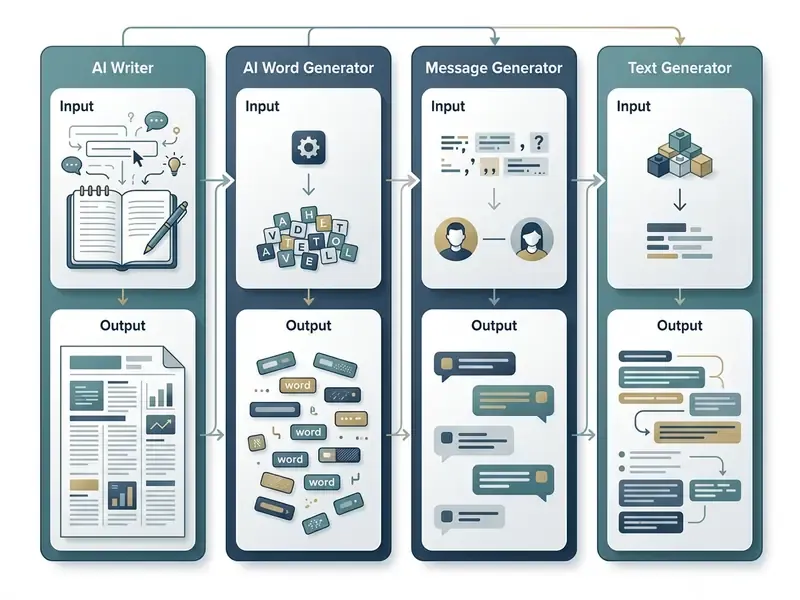
Different writing tasks need different configurations, from single-prompt completions to full document composition. An ai writer is built for structured long-form drafting, summarization, and multi-paragraph editing. An ai free word generator does something narrower: lexical ideation, producing lists of synonyms, titles, or standalone terms under stated constraints.
An ai writer text generator sits in the middle as a general-purpose completion tool for short and medium prompts. Sorting out these distinctions prevents workflow friction when you pick a free ai word generator for quick brainstorming instead of deploying an ai text generator for structured messaging.
- AI Writer
- accepts multi-layered instructions and reference documents; produces structured articles, long-form drafts, and comprehensive summaries.
- AI Word Generator
- accepts single keywords or topic constraints; produces targeted word lists, brand name ideas, and synonym variants.
- Message Generator
- accepts recipient context and desired tone; produces short emails, social replies, and direct chat messages.
- AI Text Generator
- accepts open-ended prompts; produces standalone paragraphs, creative continuations, and general textual answers.
| Tool Class | Typical Input | Typical Output | Best-Fit Scenario |
|---|---|---|---|
| AI Writer | Prompt plus reference files or links | Multi-section document, insertable into a word processor | Policy drafts, article skeletons, summaries of long source material |
| AI Word Generator | Keyword or single constraint | Word and phrase lists, naming candidates | Naming, taxonomy work, vocabulary substitution |
| Message Generator | Received message plus tone target | One short reply or thread response | Customer replies, internal notices, follow-ups |
| AI Text Generator (single-completion API) | One prompt, no conversation state | One standalone completion | Batch copy generation, templated snippets |
The distinction is behavioral as well as functional:
When comparing platform options across content types, operators often reference AI Media Comparison Matrices to analyze feature sets and access rules. Teams that also assess visual tooling under the same criteria can review the parallel breakdown of free AI art generators, where quotas, watermarks, and licensing follow a familiar pattern.
How to Use a Free AI Text Generator Online
Using a free ai text platform well comes down to structured prompt construction and systematic review. Vague queries produce vague prose. Operators get consistent quality by naming the target role, background context, tone, and structural format before generation starts.
The five-step loop: (1) define the task, (2) specify the output type and format, (3) generate a draft, (4) review against sources and style rules, (5) refine the prompt and regenerate. Public prompt-engineering guidance from OpenAI, Stanford, and the Singapore Government Developer Portal all describe this iterative structure rather than single-shot generation.
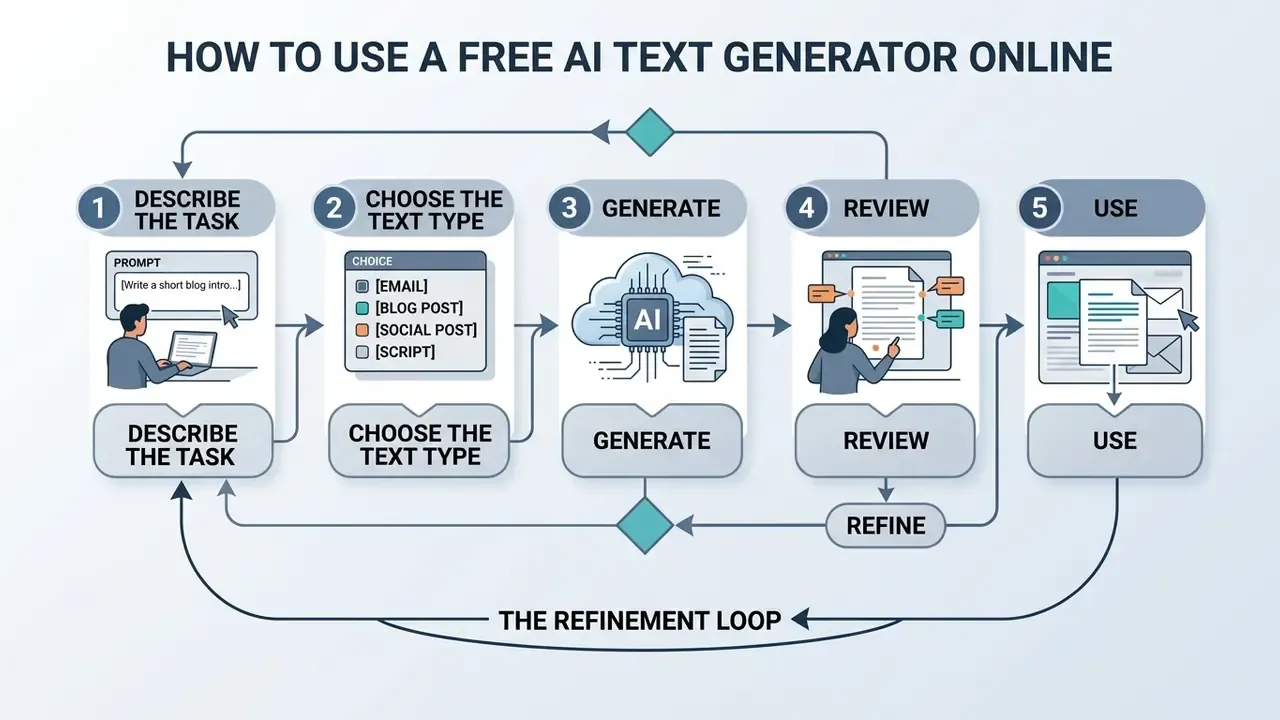
Describe the Text You Need Before You Generate
To get precise drafts, set strict prompt boundaries before you run any ai tool. Prompt frameworks converge on one habit: separate instructions from supporting context with clear structural markers. NIST's draft guidance structures prompts as Context, Style, Audience, and Response (NIST SP 1353 ipd, 2026), while the U.S. Department of Energy's Generative AI Reference Guide v2 (2024) names "clear and specific instructions" as the first principle. Notre Dame's CRAFT framework (2026) uses Context, Role, Action, Format, and Tone as the five required elements.
- Define the specific taskstate whether the objective is a blog outline, a customer service reply, or a list of creative terms.
- Establish content constraintsspecify word count ranges, target audience profile, and required reading level.
- Set editorial toneindicate formal corporate standards, persuasive copy conventions, or casual conversational style.
- Define formatting rulesrequest bullet points, Markdown headers, or structured tables.
Explicit instructions prevent generic responses and cut down on repeated generations. The effect is measurable:
Generate, Review, and Refine the Draft
Once an ai generator words free system returns its first response, human review decides whether the text is usable. Academic work on AI-assisted editorial workflows (QRAFT, ACL Anthology, 2026) splits production into first-draft compilation and simulated editorial review, showing that iterative refinement produces significantly higher coherence than single-pass generation.
Industry practice matches the research:
When reviewing drafts, verify claims against primary sources and cut repetitive phrasing. Rather than leaning on an anonymous productivity figure, apply a documented review protocol: replace unverified automated statements with citations to the governing policy, standard, or filing; record which claims were checked and against which source; require named sign-off before the text leaves the drafting environment. Traceability guidance for authors and editors (SciELO/EDUR, 2026) recommends recording the tool and version, timestamp, task, and prompts, then manually reviewing for factual accuracy, hallucinated citations, and plagiarism.
Audit Trail Template for AI-Assisted Text
Regulated environments need evidence, not assurances. Store the following fields for any AI-assisted text that enters a controlled process.
| Field | Example Value | Why Auditors Ask For It |
|---|---|---|
| Record ID | AITXT-2026-0417 | Links the artifact to the review file |
| Tool and version / model ID | Vendor X, model variant, mode | Establishes which system produced the text |
| Prompt log | Full prompt plus attachments list | Demonstrates no confidential data was submitted |
| Data classification of inputs | Public / Internal / Confidential | Evidences data-handling policy compliance |
| Draft output stored | Yes, immutable copy | Allows comparison of machine vs. human contribution |
| Human edits summary | Sections rewritten, facts corrected | Supports copyright authorship and quality claims |
| Source verification list | Primary sources checked per claim | Addresses confabulation risk |
| Reviewer sign-off | Name, role, date | Assigns accountability |
| Risk rating and disposition | Low / Medium / High; approved for use | Ties output to risk appetite |
| Provenance markers | Watermark or metadata noted | Documents synthetic-content disclosure |
One field does most of the work in practice: the prompt log. It is the only artifact that proves what data did not leave your perimeter.
What Can an AI Text and Word Generator Create?
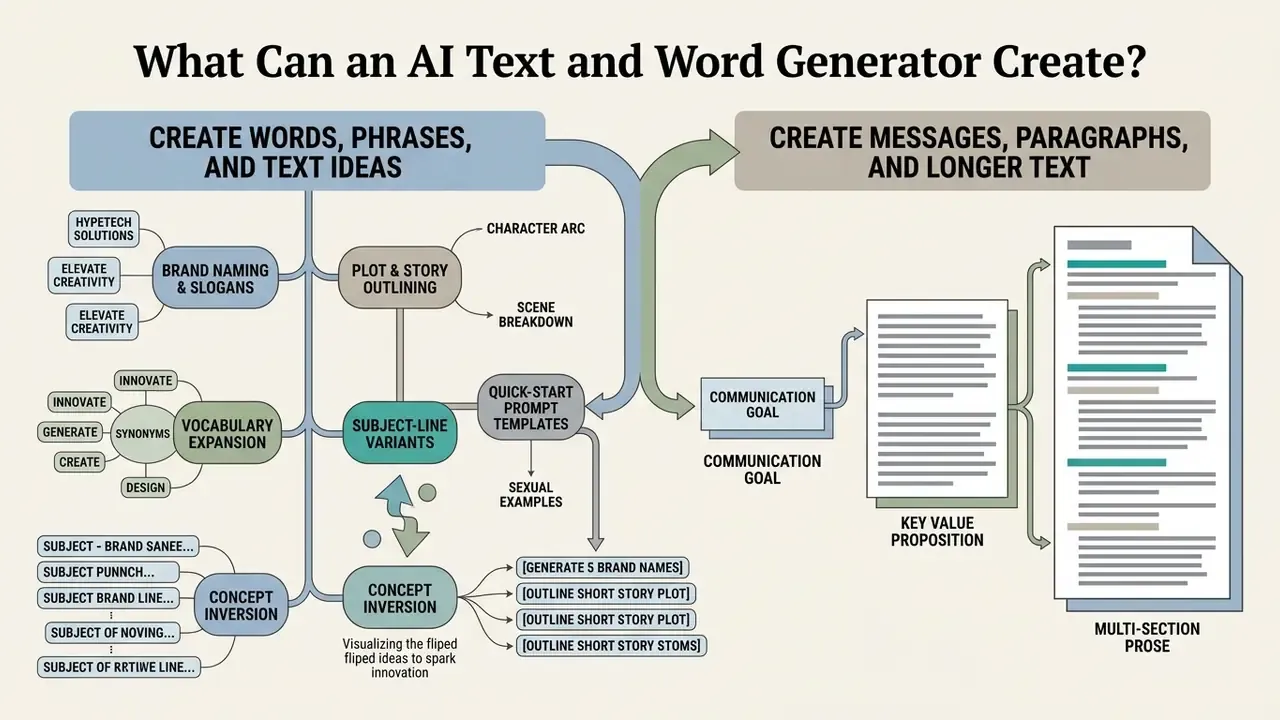
Modern language models cover a wide span of textual tasks, from micro-copy ideation to multi-section prose. By varying input parameters such as temperature and system instructions, users can steer an ai word generator free online toward creative brainstorming or tight documentation.
Output spectrum: single words and naming candidates, then phrases, slogans, and subject lines, then single paragraphs and short replies, then structured messages and templated notices, then multi-section documents, summaries, and outlines, and finally constrained formats such as tables and JSON. NIST's Text-to-Text Generators specification (2024) illustrates the constrained end with a summarization task capped at 250 words, while vendor API documentation describes generation of prose, structured JSON, code, and equations.
Generate Words, Phrases, and Text Ideas
An ai word generator free helps writers break through blank-page paralysis by expanding vocabulary and surfacing thematic concepts. Submit targeted keywords and you get lists of industry terminology, campaign slogans, or stylistic alternatives.
Research by Göldi et al. (CHI 2024) shows that structured AI support during ideation increases time spent exploring variations, which helps writers find non-obvious phrasing:
Short titles, regional idioms, product names: automated word generators work best as rapid brainstorming assistants, not as arbiters of taste.
Quick-Start Prompt Templates for Creative and Word Generation
Copy these directly and adjust the bracketed variables.
- Brand naming and slogans
"Generate 10 punchy, two-word brand name concepts for a sustainable supply chain platform targeting enterprise logistics managers. Avoid coined words that are hard to pronounce. Return a table with name, rationale, and risk of trademark conflict." - Plot and story outlining
"Draft a three-act plot outline for a speculative fiction story where credit scores dictate access to clean water, focusing on a morally grey protagonist. Give each act a turning point and a cost the protagonist pays." - Vocabulary expansion
"List 15 precise industry verbs to replace generic terms like 'improve', 'manage', and 'facilitate' in a corporate performance review. Group them by whether they imply measurement, delegation, or repair." - Subject-line variants
"Write 8 subject lines under 45 characters for a renewal reminder to small-business account holders. Half should lead with the deadline, half with the benefit." - Concept inversion for stuck teams
"Generate 20 different approaches to [problem]. Then show how each approach changes if [current constraint] disappeared."
Create Messages, Paragraphs, and Longer Text
For everyday communication and professional writing, an ai text generator builds structured paragraphs, email responses, and formal notices. A randomized workplace experiment covering 121 employees and 16,880 emails quantified the tone effect:
Long-form output is harder. Benchmarks on long-text generation (LongGenBench, 2024) show model coherence declining as target output length grows across all ten tested models, even where long-context comprehension scores were strong. Generation quality also differs sharply between model versions:
The fix is unglamorous: build outline-guided prompts section by section instead of asking for a comprehensive article in one shot. Retrieval-augmented and outline-guided planning improves coherence in multi-section output (RAPID, ACL Findings 2025). For projects involving visual storytelling scripts, creators frequently review the tools detailed in the script generator ai directory, and teams converting written scripts into narrated media often pair them with an AI voice generator that documents its own commercial-licensing terms.
Use Cases for Free AI Writing Tools
Free text generation software supports work across content marketing, customer engagement, regulated back-office drafting, and routine office administration. Matching the use case to the tool is what keeps automated writing tools from breaking an existing editorial pipeline.
| Use Case Category | Primary Task | Key AI Functional Benefit | Human Oversight Focus |
|---|---|---|---|
| Content Marketing | Draft blog posts, meta descriptions, outlines | Accelerates initial research and structural drafting | Fact-checking, brand voice, SEO strategy |
| Business Messaging | Draft emails, client replies, internal notes | Standardizes tone and reduces drafting time | Nuance verification, personal context |
| Creative Ideation | Generate slogans, titles, topic lists | Expands vocabulary and phrase options | Selection, relevance, uniqueness |
| Documentation | Summarize transcripts, format meeting notes | Extracts key action items quickly | Accuracy verification against raw audio |
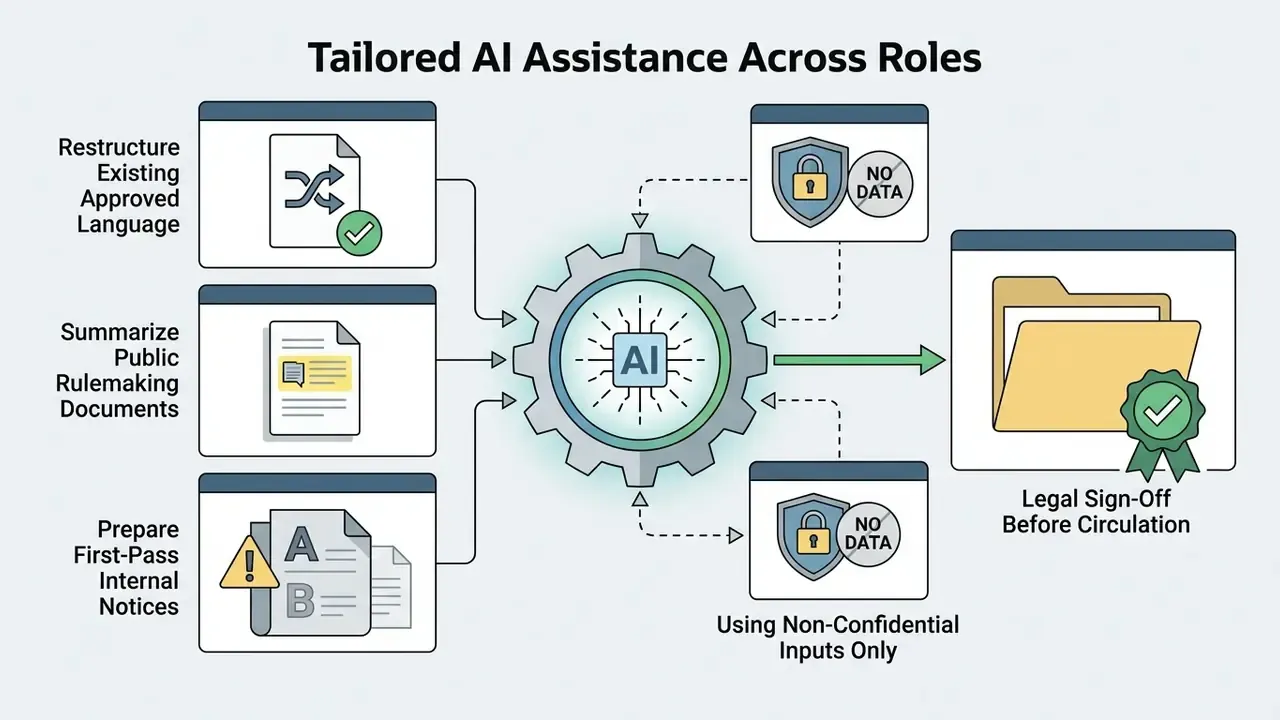
| Regulated Back Office | Draft internal policy skeletons, restructure procedure text, summarize published regulatory notices | Reduces blank-page time on structured documents | Citation to governing rule, legal review, no confidential inputs |
| Customer Operations | Standardize dispute and inquiry response templates | Consistent tone across agents and channels | Disclosure accuracy, complaint-handling requirements |
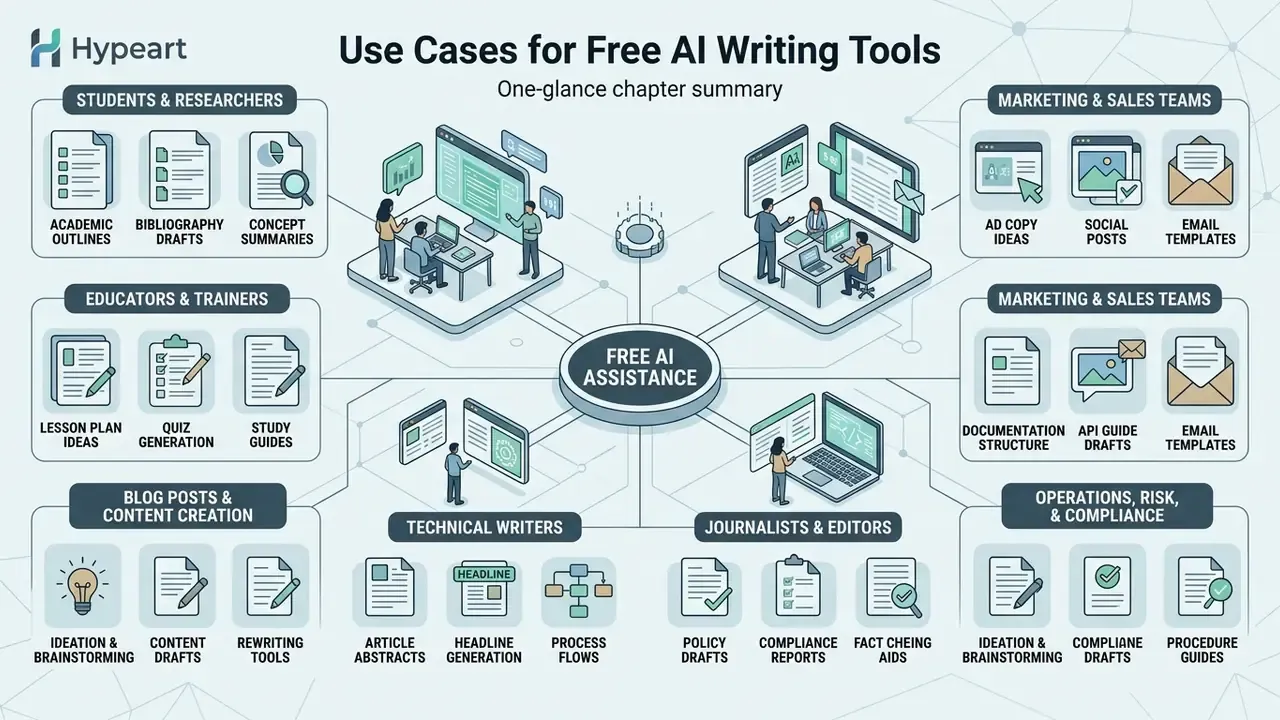
Tailored AI Assistance Across Roles
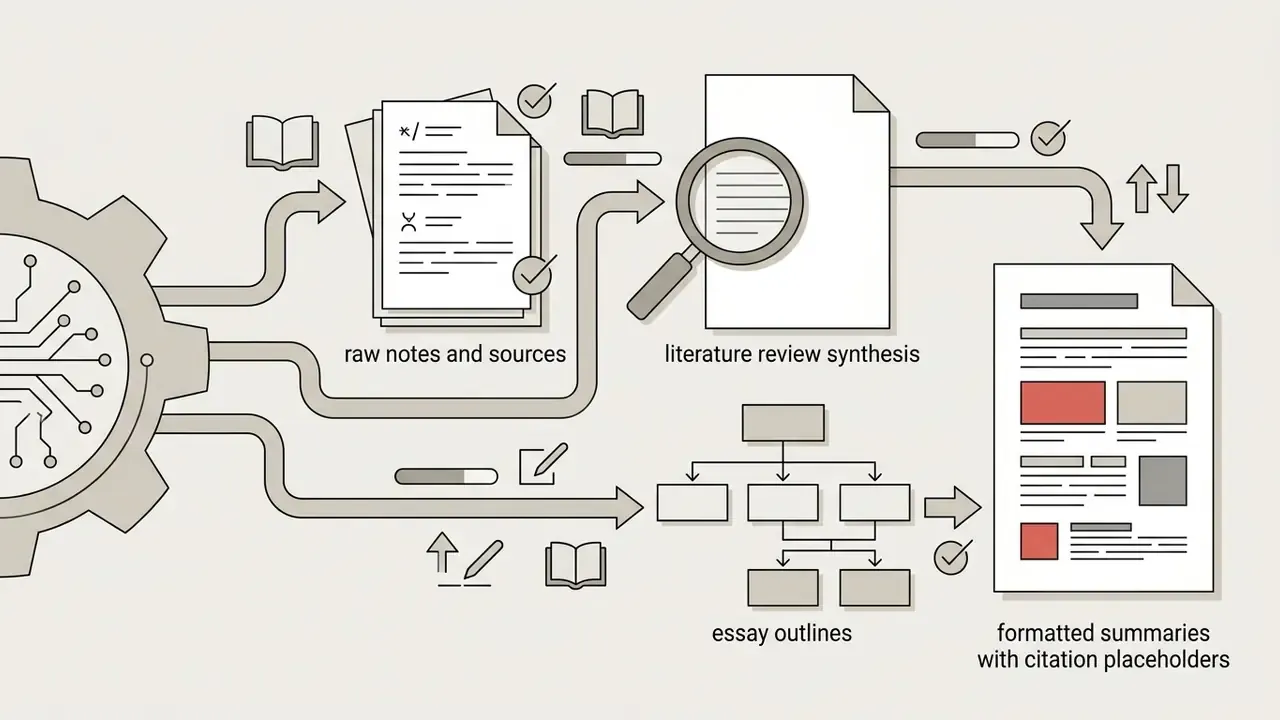

Blog Posts and Content Creation
Content marketers use an ai writer to build article outlines, generate meta descriptions, and write initial drafts for blog posts. The Ahrefs survey of 879 marketers (2024-2025) reports that 87% of respondents use generative tools for content production, that AI-enabled teams publish a median of 17 articles per month versus 12 for teams without AI, and that 44% of surveyed marketers use ChatGPT specifically.
| Metric | Teams Using AI | Teams Not Using AI |
|---|---|---|
| Median articles published per month | 17 | 12 |
| Share of respondents using generative tools | 87% | Not applicable |
| Content edited or reviewed before publishing | 97% | Manual by default |
| Content published with no human changes | 4% | 0% |
Search engines judge content on utility, originality, and user value regardless of how it was produced. Google's guidance on generative AI content says AI-assisted content is acceptable when it helps users and is not used to produce low-value, scaled content, and it names title elements, meta descriptions, structured data, and alt text as search-visible metadata (Google Search Central). Large-scale data points the same way:
Marketers routinely pull guidance from the AI Media Commercial-Use Hub to stay aligned across commercial publishing campaigns, and teams working across formats often cross-reference licensing terms in the review of Canva AI Generator commercial licensing.
Messages and Everyday Writing Tasks
In daily operations, an ai writer text generator helps with routine correspondence, client follow-ups, and promotional messages. Feed it bullet points plus recipient context and you get a serviceable draft in seconds.
A more precise claim than "automation simplifies high-volume inquiries": message refiners standardize tone and length across agents working from the same approved facts, which reduces variance in customer-facing wording. Accuracy of the underlying facts stays a human responsibility. Nothing about a fluent sentence makes the rate, date, or fee inside it correct.
Real-World Message Refinement Examples
| Optimization Goal | Original Input (Raw Draft) | AI-Optimized Output |
|---|---|---|
| Formalize tone | "we are open from 9-5 send us an email if needed" | "Thank you for reaching out. Our business hours are 9:00 a.m. to 5:00 p.m. Please email us if you need further assistance." |
| Shorten and direct | "To ensure a seamless delivery, go to your online portal and confirm your delivery address is complete and up-to-date, including any door codes or unit numbers our team may need." | "Please confirm your delivery address and entry codes in the customer portal before your scheduled delivery." |
| Expand and empathize | "Fill out the form and wait for response." | "Please complete the form at your earliest convenience. Once it is submitted, our team will review your details and respond within 24 hours." |
| Casualize | "Thank you for contacting us in regard to this issue. I would be happy to assist you." | "Hi there! Thanks for getting in touch, happy to help." |
| De-risk a regulated notice | "Your rate might change soon." | "Your rate may change on [date] in accordance with the terms in Section [X] of your agreement. See the enclosed notice for details." |
When handling specialized media queries or dynamic content workflows, operations teams reference technical documentation in the AI Media API Guides to coordinate system integrations.
No Filter, Unfiltered, and Unrestricted AI Text Generation
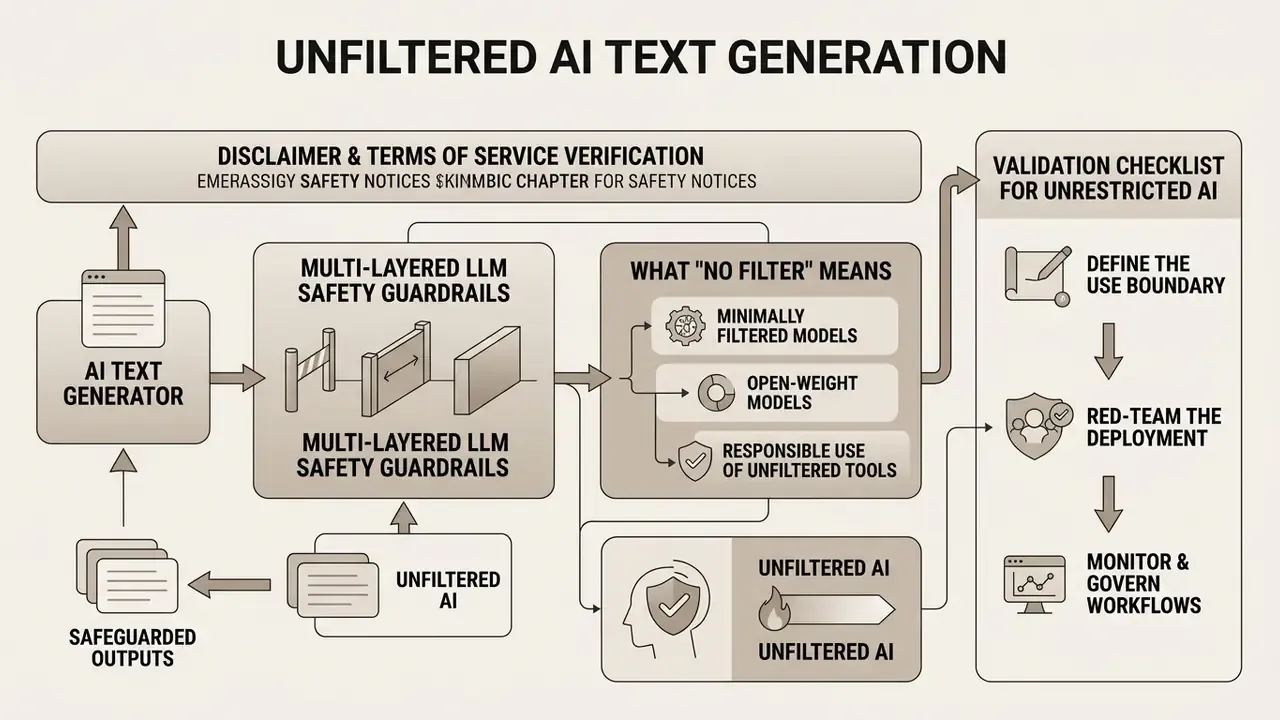
Some platforms advertise themselves as an ai text generator no filter or an unfiltered ai text generator, claiming to run without standard safety guardrails or topic restrictions. Evaluating them means examining moderation layers, platform security, and regulatory exposure rather than the landing-page copy.
Multi-Layered LLM Safety Guardrails
Safety in language-model deployments is architectural, not a single switch:
Runtime guardrails run input and output checks for prompt injection, jailbreak attempts, PII leakage, toxic output, and malicious code generation. NIST describes content detection and moderation as components surrounding deployment rather than properties of the base model (NIST, 2024). Google documents five configurable safety-filter categories plus non-configurable filters that block child sexual abuse material and PII (Google AI for Developers), and Microsoft's Azure AI Content Safety documents explicit text limits such as 10,000 characters per text analysis call.
What "No Filter" Means for an AI Text Generator
Terms of Service Verification and Safety Notice:
Responsible Use of Unfiltered AI Writing Tools
Is a Free Unlimited AI Text Generator Suitable for Commercial Content?
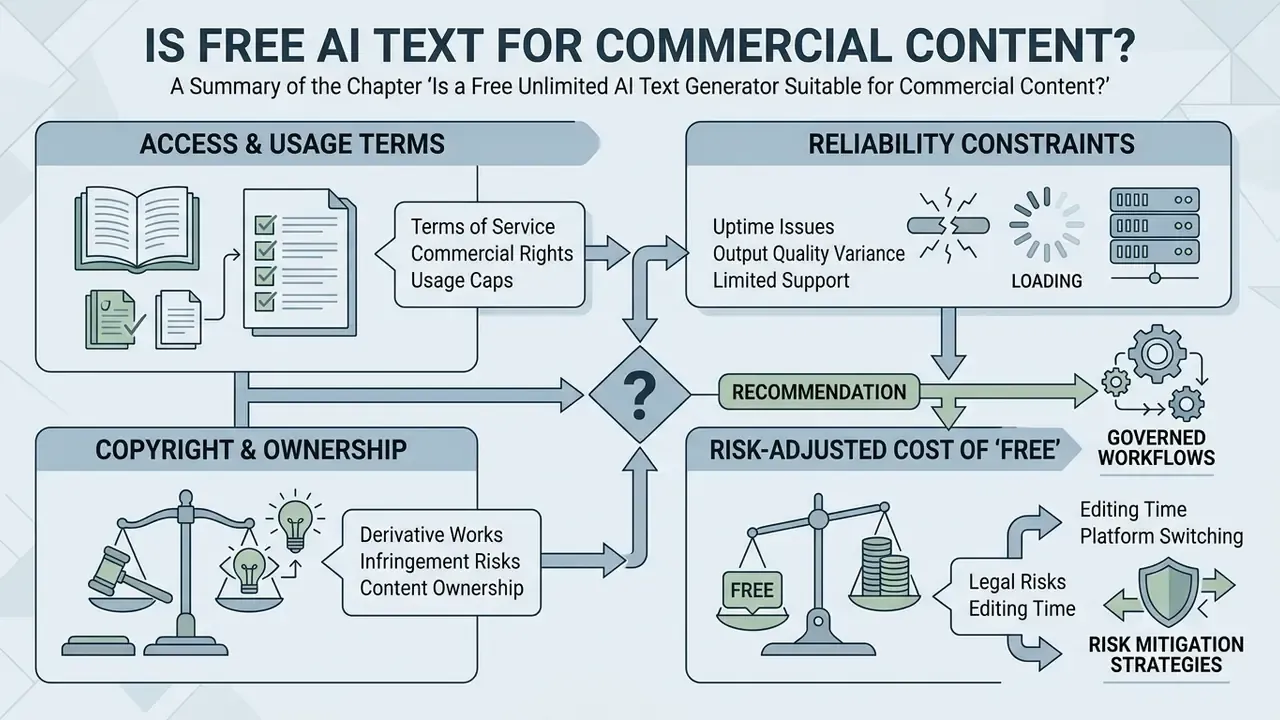
Deciding whether a free unlimited ai text generator fits commercial publishing means reading the terms of service, the copyright position, and the reliability constraints together.
Commercial-use decision sequence: Do the terms grant output rights on the free tier? Is the input data classification permitted on that endpoint? Is human authorship substantial enough for protection? Are provenance and disclosure obligations handled? Is throughput reliable enough for the publishing calendar? A "no" at any step routes the work to a paid or enterprise tier.
Check Access and Usage Terms Before Publishing AI Text
Before publishing AI-generated material for business purposes, review the user agreement. Major platform terms generally assign output rights to the user (OpenAI's terms state that, to the extent permitted by law, the user owns the output), yet commercial permissions vary between free and paid tiers, and carve-outs exist. Voice output restricted to non-commercial use is a common example.
Copyright is a separate question from ownership of a file. Guidance from the U.S. Copyright Office clarifies that raw, unedited AI text generated solely from prompts cannot be registered, and that applicants must disclose non-de-minimis AI-generated content while not being required to disclose the model or its training sources (copyright.gov/ai, 2026). To secure protection, commercial content must carry substantial human selection, arrangement, and creative revision. A distinct exposure surrounds unauthorized commercial use of AI-generated digital replicas of voice or likeness, which US policy documents flag for federal treatment. Organizations facing complex ownership questions regularly track developments in AI Litigation and regulatory updates.
When Free AI Writing Tools May Have Practical Limits
Free tiers introduce constraints that bite at scale. Server throttling, automated rate limits, and invisible watermarking all affect high-volume publishing. Two published examples: Google reCAPTCHA Essentials is free up to 10,000 assessments per calendar month, with overages requiring billing; Gemini free-tier image output embeds SynthID during generation, designed to survive common edits.
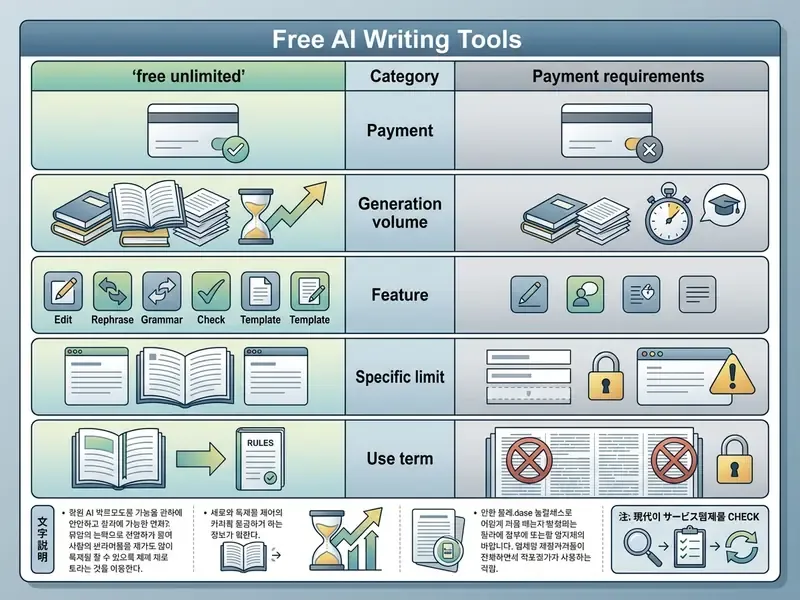
| Service Metric | Free Access Tier | Professional Subscription Tier | Operational Impact on Commercial Use |
|---|---|---|---|
| Generation Limits | Daily message caps, rolling quotas | High throughput, priority queue access | Free tiers risk unexpected downtime during peak hours |
| Model Quality | Standard or lighter model variants | Access to high-reasoning advanced models | Free outputs may require heavier editorial polishing |
| Data Privacy | Prompts may be logged for model training | Enterprise data opt-out defaults | Free tiers may expose sensitive business information |
| Watermarking | Invisible metadata (for example, SynthID) | Clean export options | System watermarks identify synthetic provenance |
| Concurrency | One active generation, cooldowns after burst use | Parallel jobs and relaxed queues | Batch publishing stalls mid-run |
| Auditability | Limited or no exportable logs | Admin logs, retention controls | Weak evidence base for internal audit |
Risk-Adjusted Cost of "Free"
The sticker price is zero. The total cost is not. Model these lines before declaring savings.
| Cost Line | How to Estimate | Typical Direction |
|---|---|---|
| Human editing time | Hours per 1,000 words times loaded hourly rate; 97% of teams edit before publishing | Rises with lighter free-tier models |
| Rework from confabulation | Share of drafts with unverifiable claims times correction time | Rises sharply without guardrails |
| Confidentiality exposure | Probability of regulated data entering an unmanaged endpoint times remediation and notification cost | Dominates in regulated firms |
| Rights and disclosure risk | Cost of unregistrable content, licensing review, or forced re-creation | Fixed but non-trivial |
| Offsetting revenue effect | Measured lift from AI-assisted copy in controlled tests | Small but positive in field data |
Measured commercial effects are real yet modest, which is exactly why the cost side deserves attention:
To project operational costs when scaling production, engineering teams use AI Media Calculators to model throughput expenses, and reviewers comparing entry-level access conditions can cross-check the analysis of free photo editor feature limits and export restrictions, where the same free-tier trade-offs appear in a different medium.
How to Get Better Results from an AI Text Generator
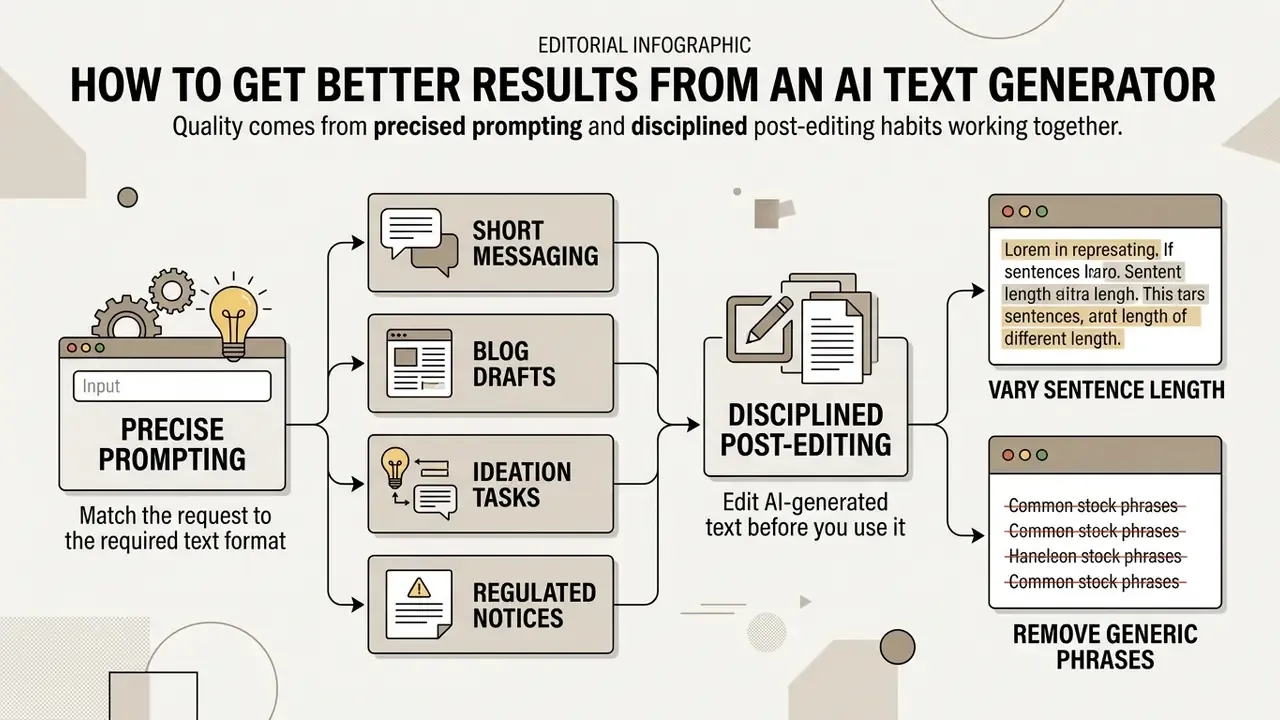
Quality comes from two habits working together: precise prompting and disciplined post-editing. Treat an ai typewriter generator as a first-draft assistant and results improve immediately; expect publication-ready prose on the first pass and you will be disappointed on a deadline.
Optimization loop: design the prompt (role, task, constraints, format), generate, score the output against explicit criteria, rewrite the prompt or the text, regenerate only the failing section. AWS prescriptive guidance defines prompt engineering as crafting and optimizing inputs iteratively rather than once, and research on automated prompt optimization describes the same feedback-driven rewrite cycle.
Match the Request to the Required Text Format
Aligning prompt structure with the target format is the cheapest quality upgrade available. Models perform better with explicit role definitions, target lengths, and structural templates. Stanford's prompting workshop material recommends setting persona, output format, and task rules globally, plus three to five diverse few-shot examples.
- For short messaging specify recipient persona, primary goal, and strict sentence limits.
- For blog drafts provide a section-by-section outline, target keywords, and heading formats.
- For ideation tasks request numbered tables with separate columns for concept name, description, and target audience.
- For regulated notices supply the approved source language and instruct the model to restructure only, without introducing new facts.
When working across multi-modal video production pipelines, writers adapt narrative scripts using dedicated guides such as script to video ai to keep formats consistent, and visual teams often benchmark stylistic engines like sea art ai under the same access-and-licensing questions.
Edit AI-Generated Text Before You Use It
Unedited AI text carries predictable tells: repetitive transitions, over-formal syntax, passive voice everywhere. Systematic post-editing turns a generic draft into something a reader finishes. Layer the work: structure and logic first, sentence rhythm second, word-level voice last, then read the whole thing aloud to expose repeated openings.
- Vary sentence lengthmix short, direct statements with longer compound sentences. The Australian Government Style Manual recommends an average of 15 words per sentence and a maximum of 25.
- Remove generic phrasescut stock filler such as "in today's digital landscape," "delve into," or "a testament to," along with clichés and unnecessary metaphors.
- Verify factual statementscross-check dates, statistics, and historical claims against authoritative primary sources, and confirm each cited source actually exists.
- Restore your own voicestyle imitation is where models are weakest, so personal cadence must be reinstated by hand.
Teams handling mixed-media assets alongside text often apply the same review discipline described in the guide to online photo editors and commercial workflows.
4-Step Self-Assessment: Is Your AI Text Ready to Publish?
- Factual accuracy verificationhave all dates, statistics, and named entities been cross-checked against primary sources, and does every citation resolve to a real document?
- Brand voice and style checkhave repetitive filler phrases been removed, and does the text match your published style guide for tone and terminology?
- Rhythm and sentence structurehave sentence lengths been varied to eliminate monotone pacing, and does the text survive a read-aloud test?
- Legal and rights compliancehas the text undergone human editing substantial enough to support commercial use and copyright registration, and are AI-content disclosure and provenance obligations addressed?
Three or fewer "yes" answers and the draft goes back to editing, not to publication.
For budget planning on advanced editing software, content leads frequently review the AI Media Pricing Guides for current licensing breakdowns.
Choosing the Right Free AI Text Generator
Selecting a text generation tool means balancing task complexity, access requirements, safety filters, and operational quotas. The UK Government AI Playbook ties tool selection to intended use, capabilities, limitations, and risks assessed before adoption, while France Num's official guide lists objectives, data confidentiality and security, provider reliability, user skill level, and pricing as explicit decision criteria.
Decision path: single words or names, use a word generator; one short reply, use a message generator; a standalone paragraph or snippet, use a single-completion text generator; a multi-section document with references, use an AI writer; regulated or confidential content, use a managed enterprise tier only.
Selection Checklist: Text Type, Access, Filters, and Limits
When assessing an ai word generator free online or a full writing platform, work through these criteria:
Teams hitting operational issues or unexpected access limits can consult the AI Media Support and Troubleshooting portal for resolution steps. Teams benchmarking adjacent free-tier tooling can also review the comparison of free AI video generators by quality, limits, and watermarks to see how quotas and export rules get disclosed elsewhere.
Limitations and Open Questions
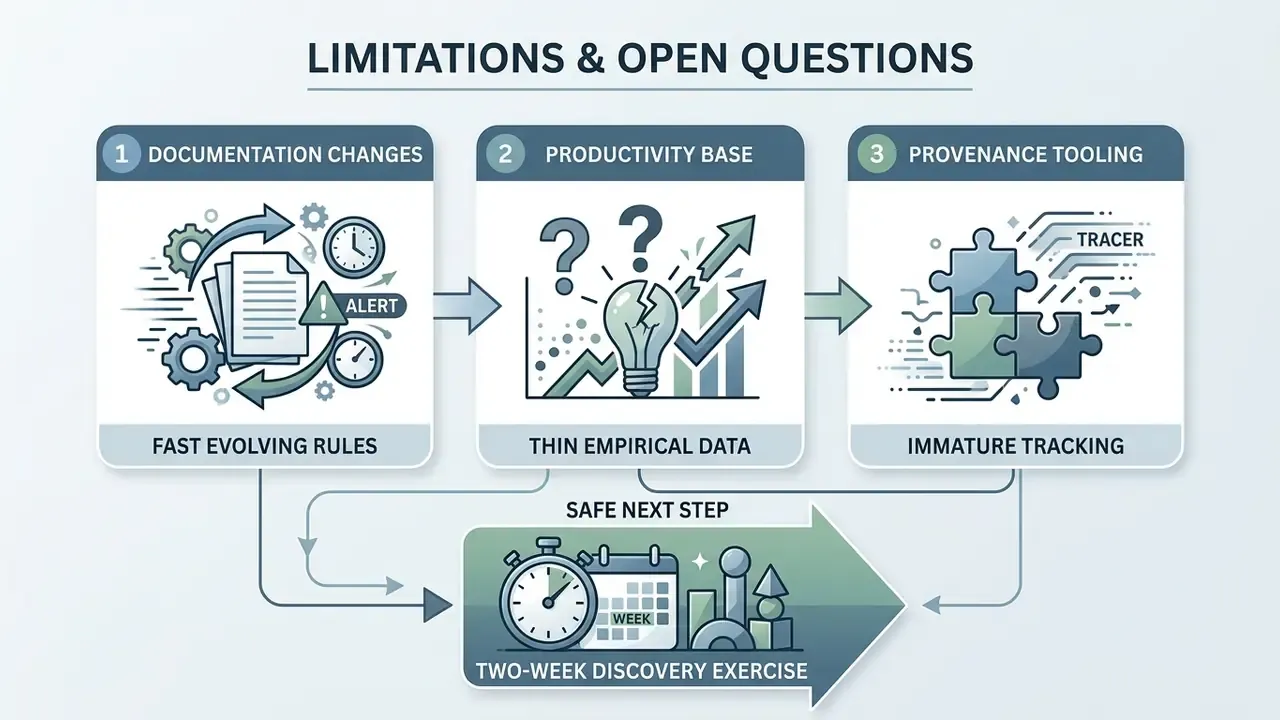
Three honest gaps remain, and pretending otherwise would be a disservice.
First, free-tier documentation changes faster than any published guide. The figures cited here reflect vendor pages and release notes available in 2026; re-verify before you cite them in a committee paper.
Second, the empirical base on productivity is thin. Field experiments show small positive commercial effects, and survey data shows heavy editing, but we still lack strong evidence on error rates inside regulated drafting specifically.
Third, provenance tooling is immature. Invisible watermarks signal synthetic origin, yet they say nothing about accuracy or authorship. Any framework built on watermark detection alone will age badly.
A safe next step: run a two-week discovery exercise. Inventory which AI writing tools your teams actually use, classify the data those tools receive, and pick one controlled workflow to instrument with the audit trail template above. No procurement decision required, and you will end up with evidence rather than assumptions.
FAQ: Free Unlimited AI Text Generators
Is any AI text generator genuinely unlimited?
Basic text chat can be unmetered on some plans, but non-text features, context windows, and processing priority stay capped. Read "unlimited" as "unmetered for one narrow function."
Can we use a free generator to draft internal policies or procedures?
Only with non-confidential inputs, documented human authorship, and legal or compliance sign-off before circulation. Approved source language should be restructured, never invented.
Does AI-assisted content hurt search rankings?
Available large-scale data says no, not by itself: 86.5% of top-ranking pages contain some AI content, with a near-zero correlation between AI share and position (Ahrefs, 2023). Low-value, scaled content is the actual risk.
Is an invisible watermark such as SynthID proof of authorship?
No. Provenance markers indicate synthetic origin; they do not establish human authorship or copyright. Registration depends on documented human creative contribution.
What is the single most common failure mode?
Confabulated facts and citations delivered in confident prose. Verification against primary sources is non-negotiable.
Do free tiers train on our prompts?
Frequently, unless an opt-out is enabled or an enterprise agreement applies. Verify the current terms and the retention window rather than assuming last year's policy still holds.
Key Summary Checklist for AI Text Generation
- Verify usage limits: confirm daily message quotas, concurrency rules, and context window sizes before starting large writing projects.
- Structure prompts clearly: include context, target role, tone, and formatting constraints in every initial prompt.
- Enforce human editing: review every generated draft to fix repetitive phrasing, verify facts, and restore brand voice.
- Inspect terms of service: confirm that commercial publishing rights are explicitly permitted under the free usage tier.
- Contain Shadow AI: classify data before it reaches any unmanaged endpoint, and route regulated text to approved tiers only.
- Keep an audit trail: log tool version, prompts, edits, source verification, and named sign-off for every AI-assisted document entering a controlled process.
Appendix A: Superseded Wording Retained for Transparency
- Earlier version of the free-tier claim "According to OpenAI pricing and release notes (2026), free user tiers operate under dynamic daily message caps, context window constraints, and response speeds dictated by server bandwidth and system availability." Superseded by the mode-specific figures cited above (27K instant context, 256K in manually selected reasoning mode, response times limited by bandwidth and availability).
- Earlier version of the productivity claim "In a compliance-driven document overhaul for a regional institution, an operations team replaced unverified automated statements with documented policy references, reducing factual discrepancies while accelerating draft preparation time by 35%." Retained here for transparency; the 35% figure is unsourced and has been replaced in the main text by a documented review protocol and the audit trail template.
- Earlier version of the messaging claim "Automated texting tools simplify high-volume customer inquiries by standardizing response templates." Reformulated in the main text to specify that standardization applies to tone and length, not to factual accuracy.
- Earlier version of the tone-research sentence "Field research on workplace email communication (2025) indicates that using LLMs for tone modification allows writers to consistently adjust message positivity and professional formality." Replaced with the randomized-experiment coefficients from the 2025 email study.
For broader contextual research on digital tooling, the site glossary collects related term definitions and implementation frameworks.