A rule 34 ai generator is a specialized text-to-image or text-to-video software tool designed to synthesize sexually explicit or adult-themed media from textual prompts. These platforms lean on deep learning diffusion models, and in older builds on generative adversarial networks (GANs), trained across very large image datasets to produce explicit character artwork, stylized visuals, or realistic imagery on demand.
Why should a risk officer care about a meme-derived art category at all? Because the tooling is identical to the tooling already inside the enterprise. For risk managers, legal officers, and technology evaluators, understanding the mechanics, boundary limits, and regulatory exposure of an ai generator rule 34 system is a practical governance exercise, not a curiosity. High-risk generative pipelines demand strict ownership, content filters, and compliance verification to prevent non-consensual image generation, copyright infringement, and regulatory penalties. The same control gates that protect a credit model registry protect an image checkpoint registry.
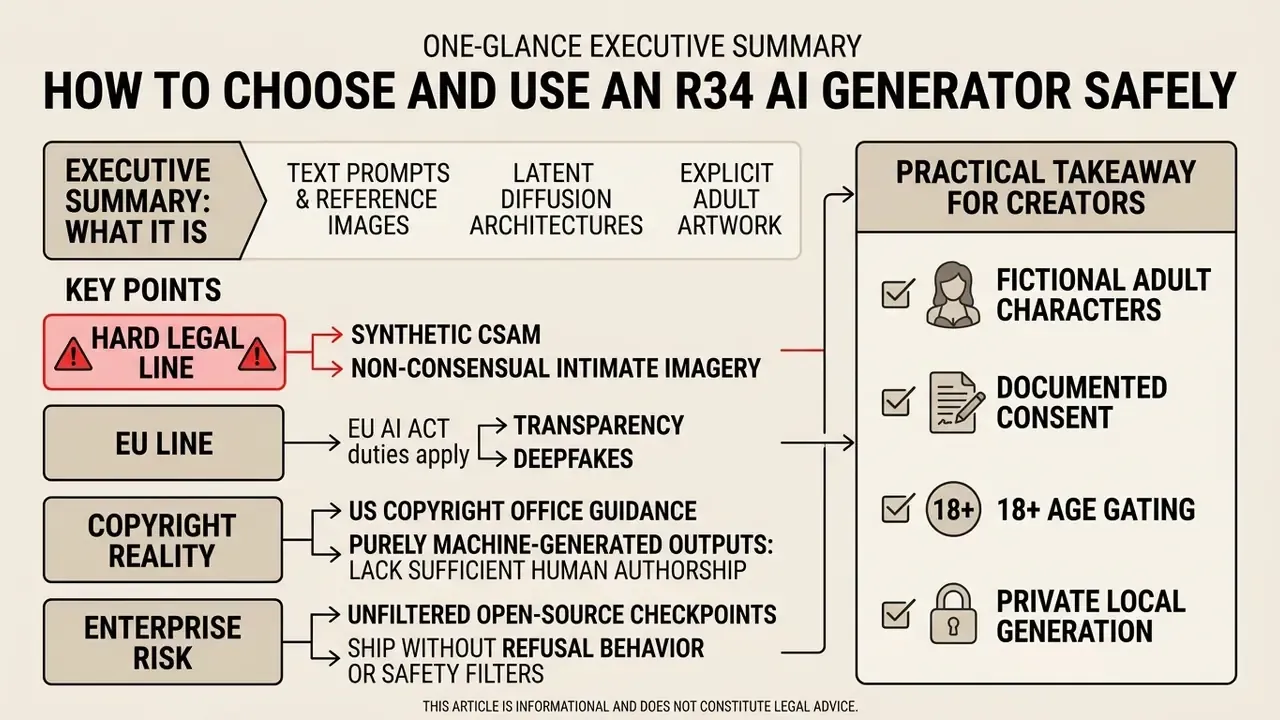
Executive Summary
What Is a Rule 34 AI Generator and What Is It Used For
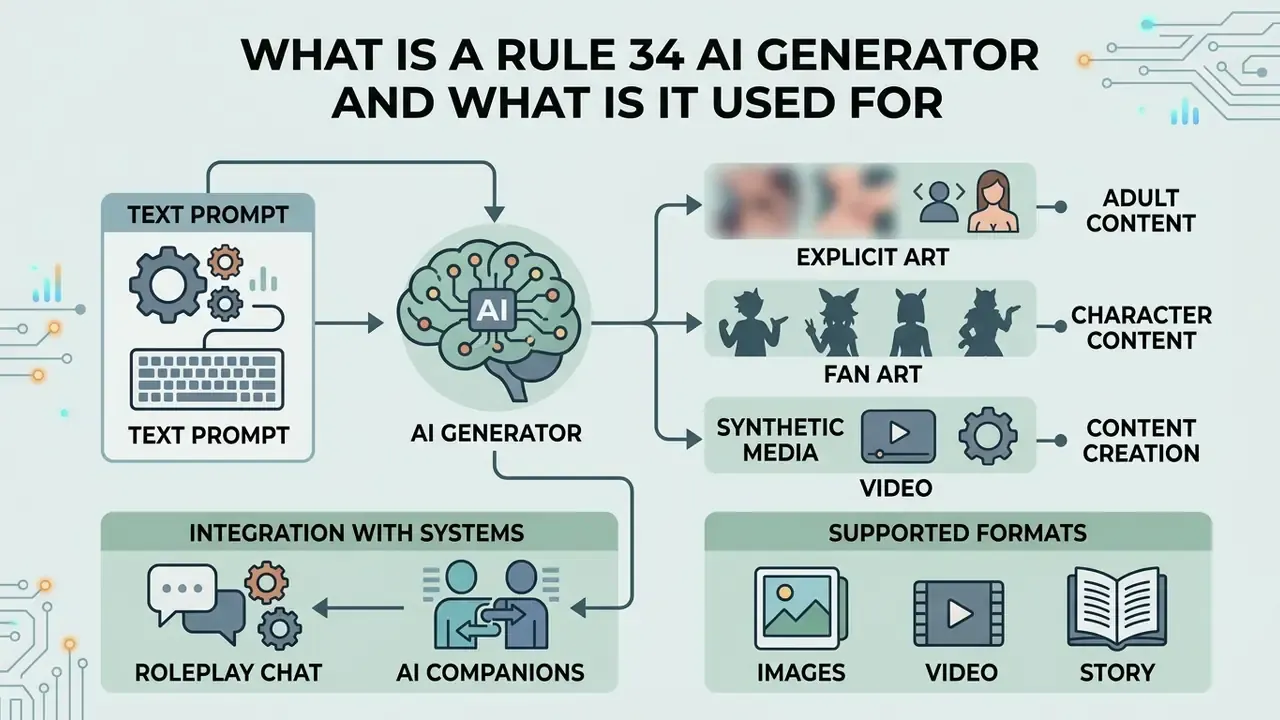
A rule 34 ai generator is a generative artificial intelligence application that turns descriptive text prompts into explicit adult art, fan art, or synthetic media, following the internet adage that explicit content exists for any subject imaginable. Users reach for these tools to produce custom digital artwork, explore niche visual styles, and generate personalized character media without manual illustration skills.
From a model governance perspective, an ai image generator rule 34 sits at the intersection of open-source diffusion models, custom weight adapters such as LoRA, and real-time moderation pipelines. Mainstream platforms enforce hard boundary controls that block sexually explicit material outright, while unconstrained or self-hosted systems let users generate uncensored ai generated images rule 34 content with no refusal layer in the path. Risk teams evaluating synthetic media tools must separate three very different categories: benign creative generation, lawful adult content creation, and illegal non-consensual material. Conflating them produces bad policy in both directions. Readers who want the broader terminology map behind this category can start with our explainer on how people create ai porn with diffusion tooling.
«AI pornography spans both synthetic imagery of non-existent people and deepfake material depicting real individuals created without their consent.»
That distinction is not academic. Mainstream vendors draw the line explicitly. Adobe's Generative AI User Guidelines prohibit pornographic material, explicit nudity, and any depiction of minors in sexual contexts. Google's Generative AI Prohibited Use Policy bans sexually explicit content produced for pornography or sexual gratification, as well as non-consensual intimate imagery. Permissive commercial products do exist: reporting on xAI's Grok Imagine described a "spicy mode" that allows limited explicit output inside moderation constraints. Still the exception, not the norm, among general-purpose platforms. Evaluators benchmarking output quality across compliant tools can start with our comparison of the best AI art generators.
How an AI Image Generator Creates R34 Art from Text
An ai image generator rule 34 builds synthetic artwork from text using text-to-image diffusion models guided by vision-language encoders such as CLIP. The prompt is translated into mathematical vector embeddings, and those embeddings steer the iterative denoising of random latent noise into a structured visual output.
During the process the user specifies character attributes, lighting, rendering style (anime, photorealism, painterly), and composition. The base model cross-references prompt embeddings against its trained visual concepts to render the final pixels. Fine-tuned checkpoints and Low-Rank Adaptation (LoRA) modules then modify the model's internal attention layers, which lets users inject a specific artistic style or hold a subject consistent across a series of generations.
«Diffusion-based text-to-image models generate high-quality images from arbitrary text, yet remain vulnerable to adversarial prompts encoding unsafe intent.»
The adapter layer is also where NSFW escalation happens fastest. Community analysis of the Civiverse dataset found that the share of NSFW content hosted on CivitAI rose from 56% in October 2023 to 73% in April 2024, driven largely by user-uploaded LoRA adapters ("Perpetuating Misogyny with Generative AI", Civiverse dataset analysis, 2024). For a model risk function the implication is blunt: the checkpoint registry, not the base model, is the primary control surface. To understand how foundational text and image models operate across wider digital pipelines, explore our comprehensive guide to create ai workflows, and for tooling comparisons across cost tiers see the review of free AI art generators.
Which Formats R34 AI Tools Support
Modern r34 ai generator platforms support both static image synthesis and short-form video generation. Static outputs arrive as high-resolution PNG or JPEG renders, while advanced generative tools use frame-to-frame interpolation and motion models to produce animated clips.
Static images require single-frame inference, so compute cost stays relatively low and execution is fast. Generative video is a different animal: it demands temporal stability across sequential frames to avoid flickering and anatomical distortion. As platforms expand into synthetic video, model risk frameworks have to evaluate static image safety filters and dynamic video moderation controls as two separate assurance problems.
«By 2023, dedicated deepfake sites hosted 95,820 videos, with deepfake pornography production increasing 464% year over year.»
Video also multiplies the moderation surface. A single prompt now conditions dozens of frames plus, on some platforms, native audio. Vendor documentation reflects that asymmetry: image endpoints typically cap output at 1024x1024 or 1536x1024 with file limits under 50 MB, whereas video endpoints price by the second (OpenAI lists Sora 2 and Sora 2 Pro between $0.10 and $0.70 per second depending on model and resolution). Organizations auditing dynamic synthetic tools can consult our AI Media Comparison Matrices, the Google Veo implementation guide for API-level cost and quota mechanics, and the roundup of free AI video generators for tier-limit benchmarks. Typography-heavy outputs behave differently again, since text rendering remains a weak axis for most diffusion models; our notes on how to create word art cover that gap in more detail.
Integration with AI Companions and Roleplay Chat Systems
A growing share of ai rule 34 generator traffic no longer starts in a standalone image UI. Companion platforms such as Kupid AI or HeraHaven connect large language model roleplay chats to an image endpoint through an API, so a scene described in text can be visualized mid-conversation. The user first builds a persistent character, then issues an image request that inherits appearance tokens, wardrobe, and setting from the chat context. Services that invite users to create your ai companion follow exactly this pattern.
For creators, that delivers character continuity across dozens of renders without rebuilding a prompt every time. For governance teams it creates a second, far less visible generation pathway. The explicit output is produced inside a chat session, is often stored in conversation history, and may slip past image-specific DLP rules that only inspect uploads to known image-generation domains. Any Shadow AI inventory should therefore enumerate companion-chat services alongside dedicated generators. The same logic applies when employees create your own assistant on top of a general model and quietly wire it to an image API.
How to Choose the Best R34 AI Generator for Your Use Case
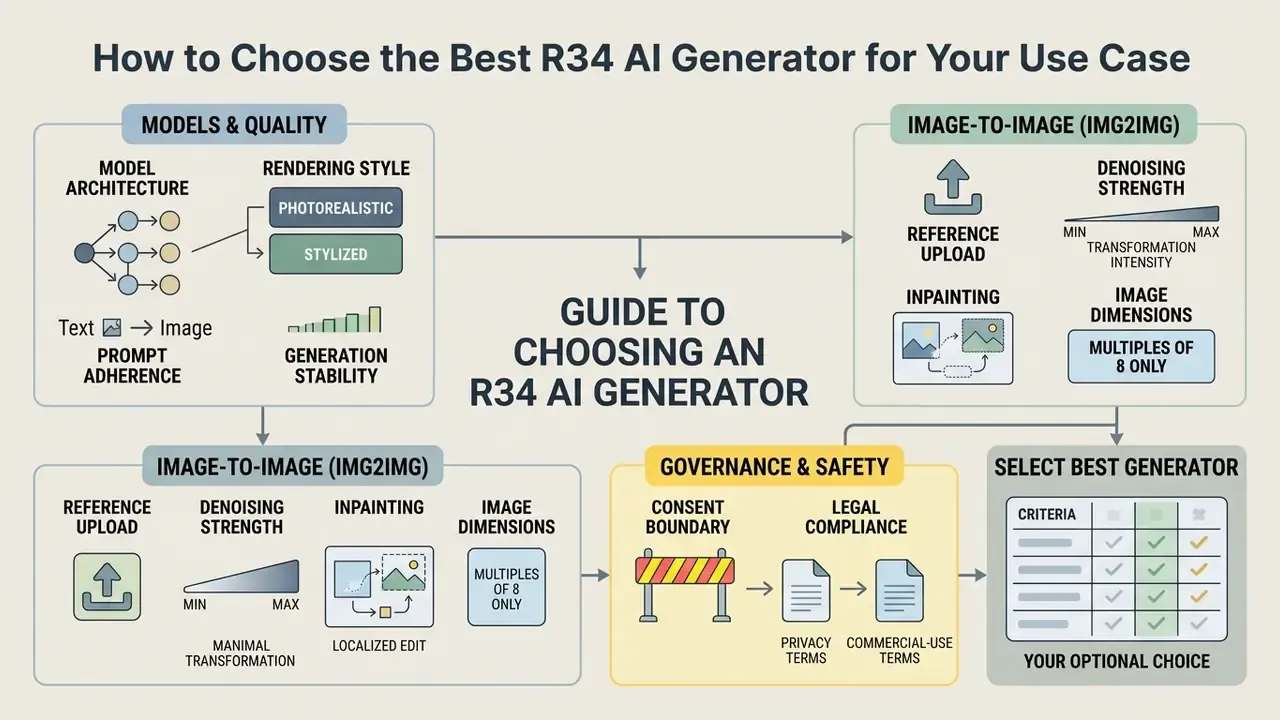
Choosing the best r34 ai generator means analyzing model architecture, photorealistic versus stylized rendering capability, prompt adherence, generation stability, and data privacy terms. Decision-makers have to judge whether a tool meets a quality standard while staying inside the applicable legal framework.
Evaluating an ai r34 generator comes down to four primary criteria: prompt fidelity, resolution upscaling, character retention, and platform security. Strong platforms expose granular control over seed values, guidance scales, and negative prompts, which produces reproducible output quality instead of a lottery of rendering failures. Independent 2026 benchmark comparisons score image models on five axes (visual quality, prompt adherence, run-to-run consistency, text rendering, speed) and consistently show that no single model leads every category. Photoreal detail, stylistic range, and editing reliability tend to belong to different architectures. Stability should be measured across repeated identical prompts and failure-rate patterns such as anatomy breaks, perspective collapse, and composition drift. Never from a single hero image.
Models, Styles, and Quality of AI Generated Images
«An analysis of ten Stable Diffusion variants found a complete absence of refusal behaviour or built-in safety measures when processing harmful prompts.»
That single finding is the most important input for anyone assessing self-hosted or community checkpoints. Safety is not inherited from the base architecture. It has to be added as an external layer, tested, and re-tested per version. Evaluators comparing rendering pipelines across compliant commercial tools can review our analysis of Midjourney versus competing image generators for style-control and licensing benchmarks.
| Checkpoint / Model | Style Orientation | Key quality prompt tags |
|---|---|---|
| Pony Diffusion V6 (SDXL) | 2D anime, stylized illustration | score_9, score_8_up, rating_explicit, masterpiece, detailed lineart |
| CyberRealistic NSFW | Photorealism, 3D render | photorealistic, RAW photo, 8k uhd, soft lighting, skin pores, DSLR |
| Anything V5 / NovelAI-style | Classic anime and manga | masterpiece, best quality, highly detailed, vibrant colors, expressive eyes |
| Realistic_Vision V5.1 | Skin texture, cinematic lighting | RAW photo, film grain, subsurface scattering, 85mm lens, natural light |
| Counterfeit V2.5 | Flat-shaded 2D, high colour saturation | best quality, clean lineart, cel shading, dynamic angle |
| SDXL Uncensored variants | General-purpose, adapter-driven | high detail, sharp focus, coherent anatomy plus task-specific LoRA |
Governance note: the checkpoints above are widely distributed community weights. Their licences vary (CreativeML Open RAIL-M derivatives, custom non-commercial terms, or nothing specified at all), several were trained on scraped datasets of unverified provenance, and per the Schneider & Hagendorff finding most ship without refusal behaviour. Enterprise or commercial deployment requires independent licence review plus an added moderation layer. All outputs must depict fictional adults only.
How to Use Image-to-Image (Img2Img) to Transform R34 Art
Image-to-Image lets you upload an existing sketch, an original character design, or your own illustration, then re-render it in a different style on the same diffusion backbone. One dominant parameter governs how far the transformation travels.
0.3 to 0.5: preserves original composition, pose, and layout, changing only rendering style, lighting, or costume detail.0.6 to 0.8: deep re-interpretation. Pose, anatomy, and background get substantially redrawn according to the prompt.0.85 and above: the reference acts only as a colour and composition hint. Expect near-total replacement.
- Reference uploadplace the source file in the Source Image / Img2Img field. Confirm file type and dimensions match endpoint requirements; most APIs require matching image and mask formats plus an alpha-channel mask for masked edits.
- Denoising Strength (transformation intensity)Denoising Strength (transformation intensity):
- Inpainting (localized edits)to change one element, a costume, a hand, a facial expression, mask that region with the inpaint brush and supply a local prompt. Unmasked pixels stay untouched, which is exactly why inpainting is the correct tool for anatomy correction rather than full regeneration.
- Keep width and height as multiples of 8and re-test any prompt after switching checkpoints. NIST's 2024 prompt-engineering publication notes that changing a model or a model configuration requires re-validating previously used prompts.
For legitimate, consent-clear image-transformation workflows such as canvas expansion, background regeneration, or portrait retouching, see our comparisons of AI outpainting and image-expansion tools and AI headshot generators.
Creating R34 Video Clips: From Static Frames to Motion (Image-to-Video)
Turning a static ai r34 image generator output into a two to five second clip relies on temporal motion models (Stable Video Diffusion class architectures and motion LoRAs) that condition every frame on the same source image.
- Step 1, select the base frame. Generate a high-quality still with clean anatomy first. Any defect in the source frame gets amplified and set in motion. Motion models cannot repair a broken hand; they animate it.
- Step 2, set Motion Bucket ID (motion intensity). Values of
127 to 200produce pronounced movement and camera travel.40 to 80yields gentle sway, breathing, cloth motion, micro-expression only. High motion values on complex anatomy are the primary cause of limb morphing. - Step 3, control frame rate. 16 to 24 FPS with frame interpolation suppresses flickering in skin and fabric texture. Lower frame counts cut cost but raise temporal jitter.
- Step 4, validate temporal stability. Review the clip frame by frame for identity drift (the face changing across frames), background boiling, and anatomical distortion. Pose-conditioned animation research such as Animate Anyone demonstrates that appearance consistency and temporal stability are separate quality axes, evaluated with metrics including FID, SSIM, and identity cosine similarity.
- Step 5, log the output. Under EU AI Act transparency provisions applying from August 2026, AI-generated image and video outputs must be marked in machine-readable form and be detectable as synthetic. Article 50 also requires labelling of deepfakes, with technical marking such as watermarking where feasible. Build this into export, not into post-production.
Creators comparing motion tooling and export options can review our animation maker guide.
Generator Features: Character, Image Sizes, and Video
Advanced ai r34 image generator platforms provide specialized features: multi-aspect ratio rendering, face swapping, inpainting, and character consistency across sequential outputs.
Holding character identity across multiple prompts requires reference image embedding or IP-Adapter techniques that lock facial features and costume elements. Modern tools also let users scale output from a standard square canvas (1024x1024) to widescreen or portrait ratios, or extend a static image into a short video loop with motion diffusion modules. Watch the hard endpoint constraints vendors publish, for example a maximum edge below 3840 px and aspect ratios no wider than 3:1 on some current image models, because they decide whether upscaling happens inside or outside the generation call. Teams assessing advanced API integrations for automated media handling can reference our api documentation.
| Criteria | Basic Free Tier | Advanced / Paid Tier | Enterprise / Local Deployment |
|---|---|---|---|
| Primary Models | Standard open diffusion | Fine-tuned SDXL / Flux variants | Custom fine-tuned checkpoints |
| Style Flexibility | Generic presets | Multi-LoRA composition | Direct weight and LoRA injection |
| Output Formats | Static images (up to 1024px) | Static 2K plus short video | Custom resolutions, RAW sequence |
| Character Consistency | Low (random seed mapping) | High (IP-Adapter / reference lock) | Full control via reference embeddings |
| Img2Img / Inpainting | Often disabled or capped | Full denoising-strength control | Unrestricted, plus custom masks |
| Image-to-Video | Unavailable | Motion bucket plus FPS control | Custom temporal models |
| Privacy & Logging | Shared public queues | Private generation mode | Zero-log local execution |
| Commercial Rights | Personal, non-commercial only | Commercial use allowed | Unlimited commercial ownership |
Free Rule 34 AI Generator: What Is Free and What You Pay For
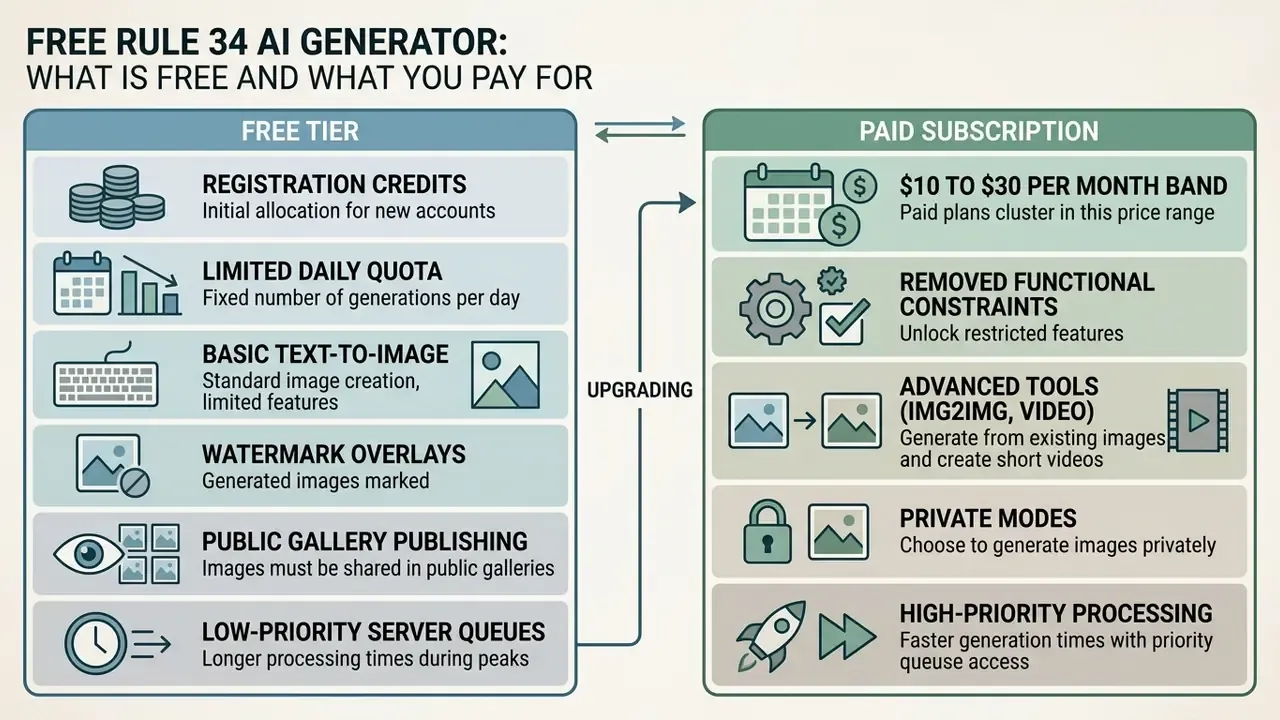
A free rule 34 ai generator usually runs on a freemium model, offering registration credits or a limited daily quota for basic text-to-image synthesis. Paid subscriptions or pay-as-you-go credit packs unlock priority rendering queues, higher resolutions, advanced models, and commercial licensing rights.
When testing a r34 ai generator free tier, users hit familiar functional constraints: watermark overlays, slow queues, limited aspect ratios, restricted access to fine-tuned checkpoints. Understanding these tier structures before payment keeps budget planning realistic.
«Image "nudification" applications recorded 705 million downloads, indicating mass free access to NSFW tooling.»
That download volume is precisely why "free" is a governance category, not just a pricing category. Zero-friction access removes the payment trail that normally provides an audit signal, and a missing audit signal is the whole problem.
Free Credits, Limits, and Generation Availability
Paid Features and Verifying Cost Before Payment
| Plan Tier | Price Range | Daily / Monthly Credits | Key Features Included | Usage Rights |
|---|---|---|---|---|
| Free Tier | $0 | roughly 10 to 50 daily credits (vendor-dependent) | Basic models, public queue, standard resolution | Personal, non-commercial |
| Lite Paid | $10 to $15 / mo | 150 to 500 credits / mo | Fast generation, private mode, 2K upscaling | Limited commercial |
| Pro Paid | $25 to $30 / mo | 1,000+ credits / mo | Priority queue, video generation, custom LoRAs | Full commercial license |
| Pay-As-You-Go | $15+ one-time | Fixed credit bundle | No recurring fees, access to pro features | Tier-dependent |
Pricing observed from public vendor listings in February 2026 and subject to change; verify current terms directly on the provider's pricing page.
How to Make R34 AI Art: Model Selection and Working with Prompts
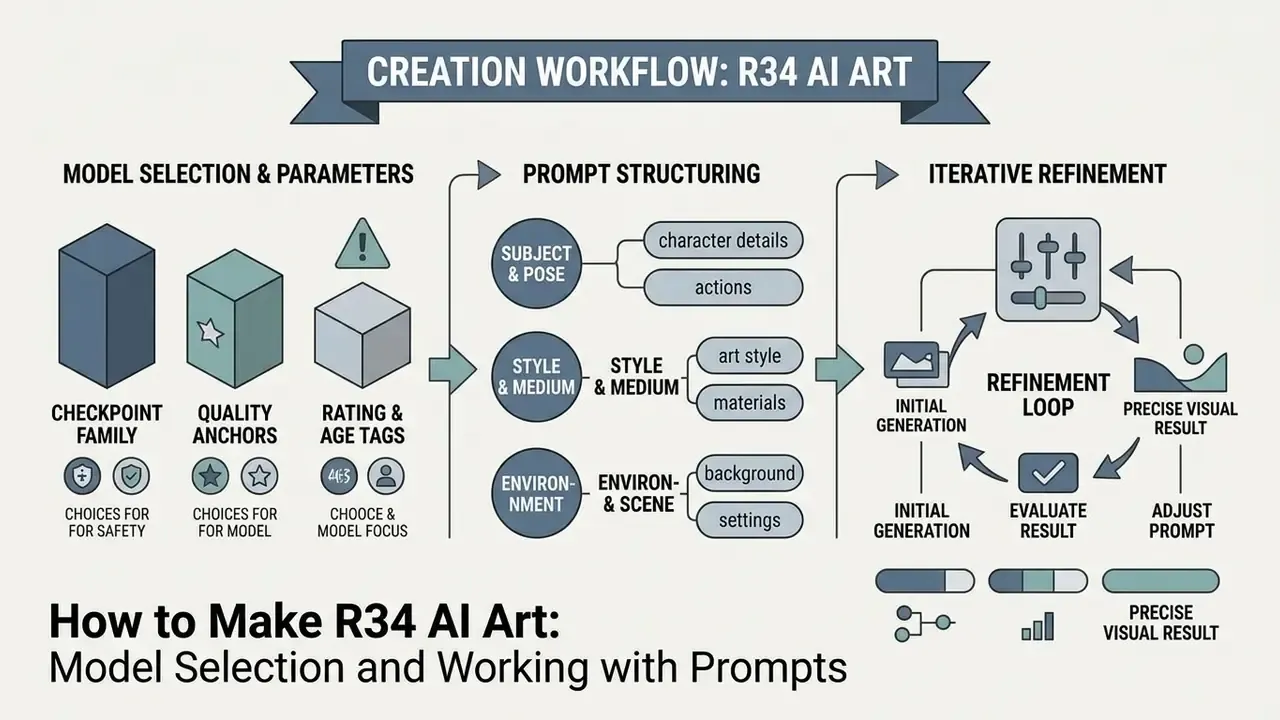
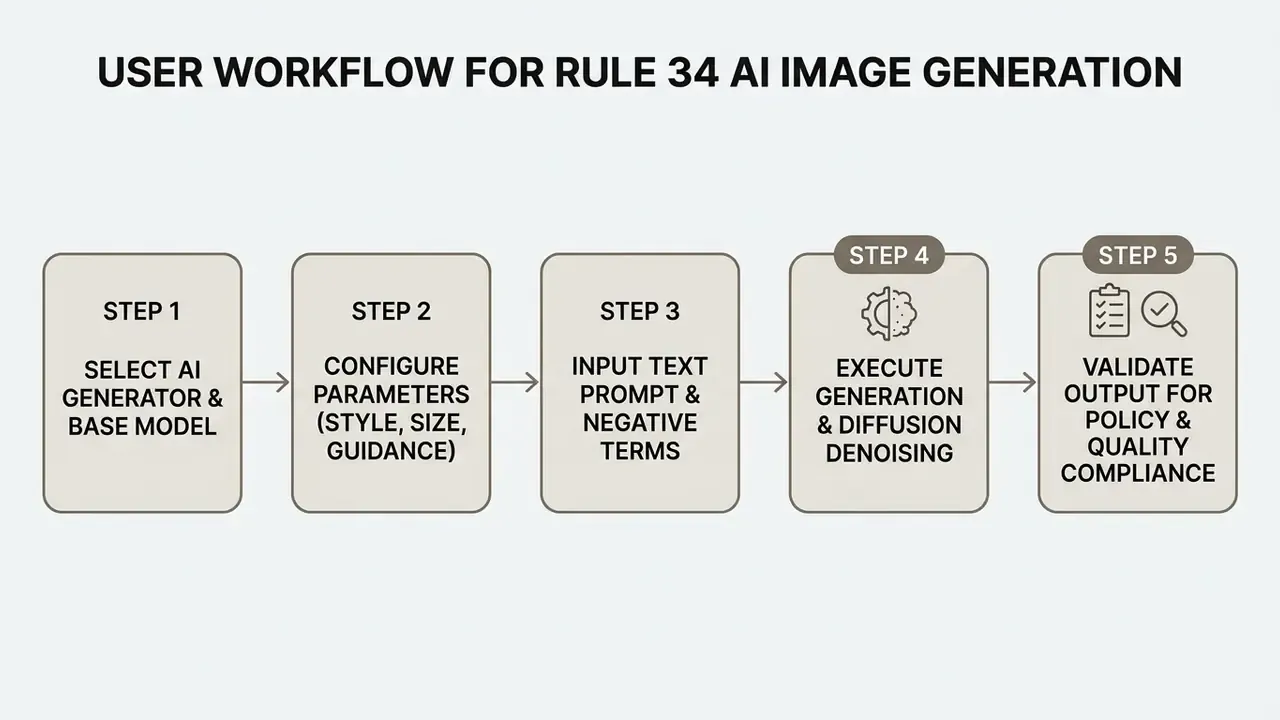
Learning how to make r34 ai art means structuring detailed text prompts, selecting sane model parameters, and applying iterative refinement until the visual result is precise instead of accidental.
A successful text-to-image run combines positive subject description with negative prompt exclusions. By defining camera angle, lighting, rendering medium, and anatomical detail, creators steer the model away from artifacts and toward high prompt fidelity.
How to Describe Character, Style, and Composition in a Prompt
An effective prompt for a rule 34 ai creator tool follows a fairly standard syntax: background environment, main subject, specific attributes, lighting and composition, then style modifiers. OpenAI's 2026 image-prompting guidance recommends that same ordering (background and scene, subject, key details, constraints) and advises stating photorealistic explicitly when realism is the goal, naming the medium when style control matters, and raising quality settings for close-up portraits or dense detail.

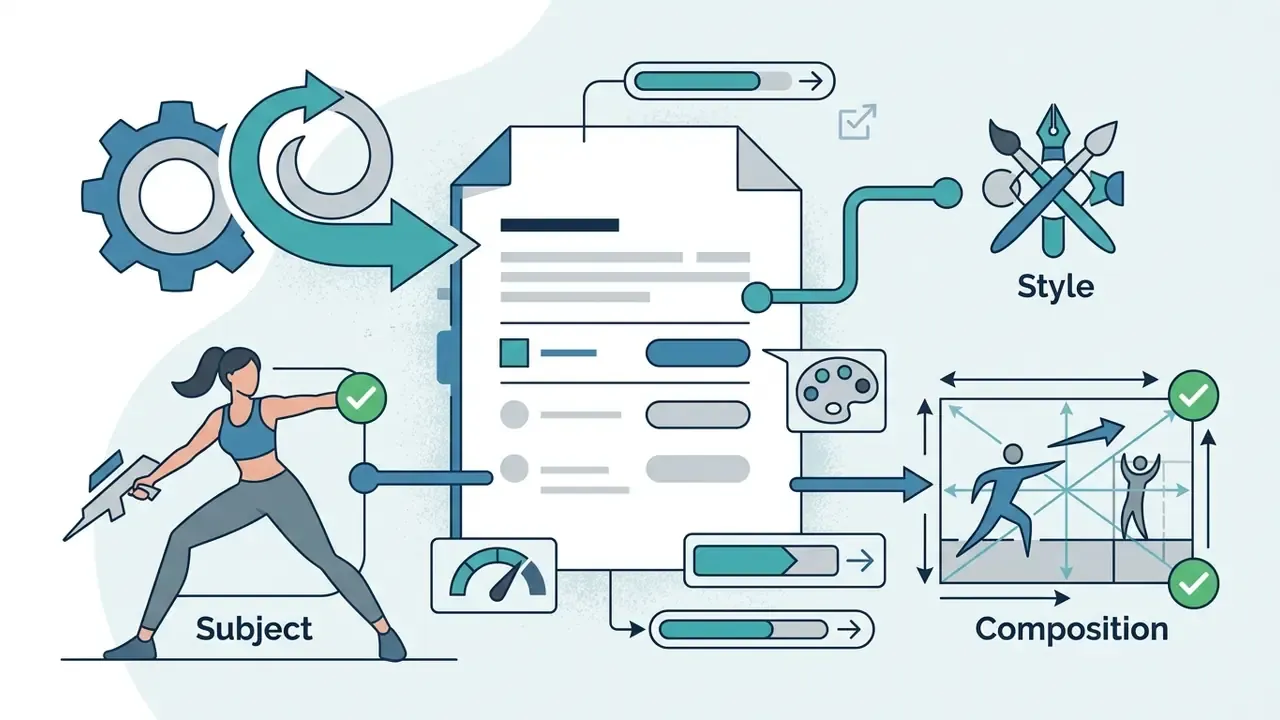

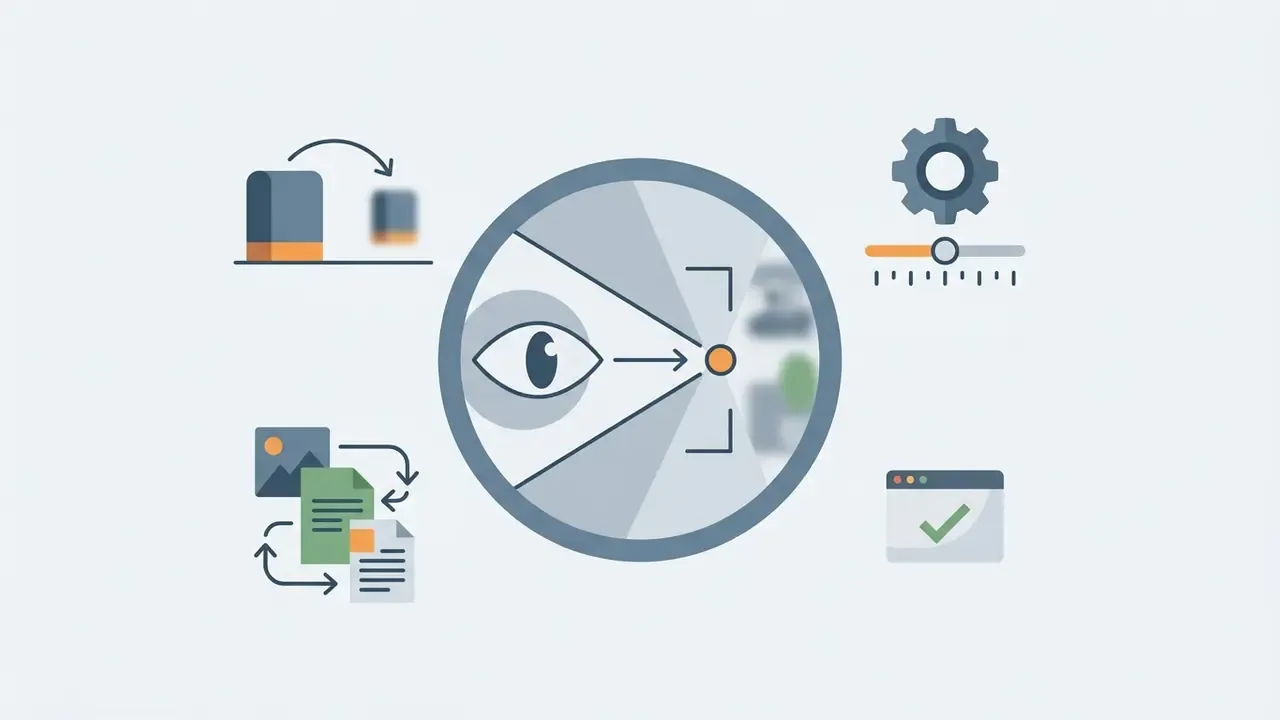

masterpiece, best quality, detailed lineart, cel shading; photoreal checkpoints respond to RAW photo, DSLR, 85mm, skin pores, soft window light; Pony-derived SDXL checkpoints need score tags such as score_9, score_8_up to reach their trained quality band.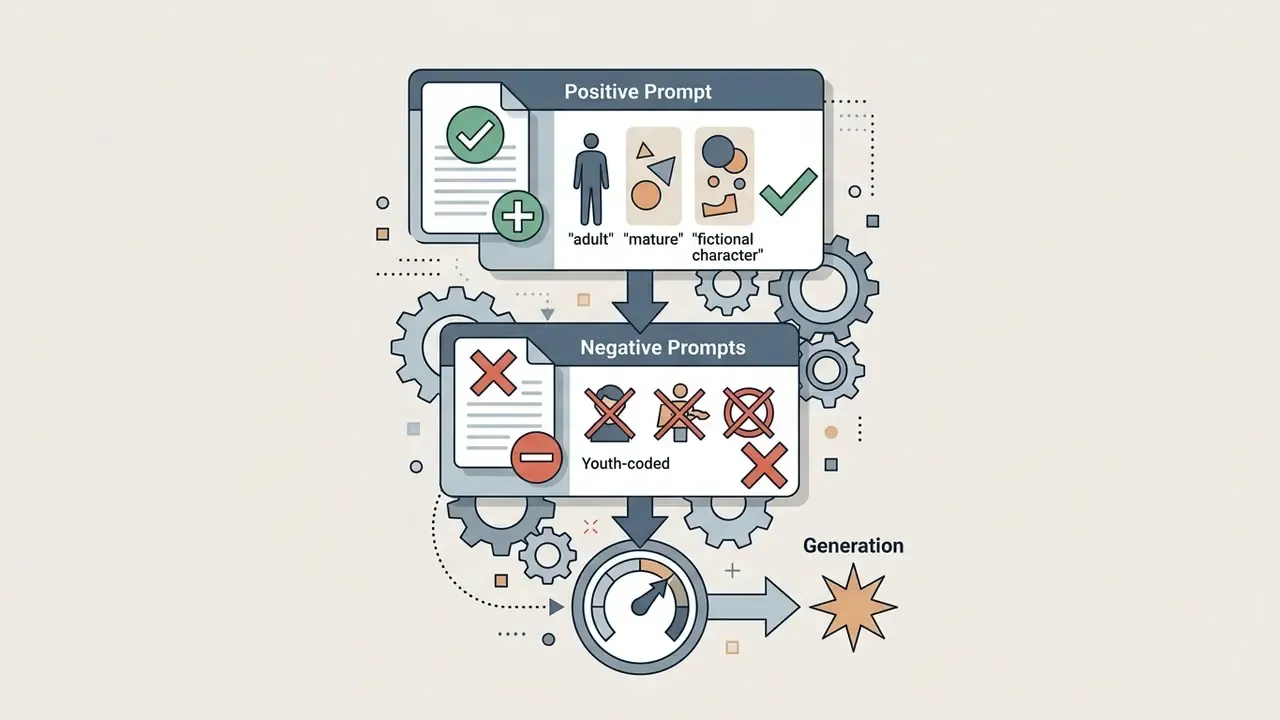
adult, mature, fictional character in the positive prompt, while placing every youth-coded word in the negative prompt. This is a hard safety requirement, not a stylistic preference.«SafeGen achieves 99.4% effectiveness in removing sexual content while preserving high-quality benign image generation.»
That figure matters to platform evaluators for the inverse of the reason it matters to researchers. A mitigation with near-total suppression on a benchmark still leaves a measurable residual, so any tool marketed as "fully filtered" deserves empirical testing rather than trust in documentation. For specialized character-consistency and portrait workflows in compliant commercial environments, explore our Ghibli-style AI image generator comparison for style-accuracy and usage-rights benchmarking.
How to Improve Results Through Iterative Generation
Iterative quality improvement in a rule 34 ai art generator rests on four controls: negative prompts, seed lock, inpainting, and model swapping.
- Negative prompts suppress unwanted artifacts, for example "deformed fingers, extra limbs, blurry, low resolution, distorted anatomy, watermark, oversaturated, pixelated". Negative prompting is a separate conditioning channel that pushes the sampler away from named concepts.
- Seed management fixing the random seed lets you make subtle prompt adjustments while keeping composition stable. Leaving the seed field empty randomizes it on every call.
- Inpainting mask specific regions such as hands or faces and re-render isolated detail without touching the surrounding background.
- Model switching moving a base render into a specialized inpainting model or upscaler refines fine texture and sharpens overall clarity. Inpainting endpoints commonly support SD 1.5, SDXL inpainting variants, and Flux Fill weights, each producing materially different edges and skin rendering.
«ShieldDiff attains 97.8% sexual-content removal on the I2P dataset using reinforcement learning with a nudity-detector-based reward function.»
Guardrail Bypass and Adversarial Prompting: What Risk Teams Must Test
For a model risk or AI governance function the operative question is not how to write a better prompt. It is how easily a deployed safety layer can be defeated. Published evidence gives four concrete test vectors.
- Absent refusal behaviour in community weights.The Schneider & Hagendorff analysis of ten Stable Diffusion variants found no refusal behaviour and no built-in safety measures at all. Any control assumption inherited from a base architecture is invalid for fine-tuned derivatives, so validation must be re-run per checkpoint version.
- Adversarial and paraphrase prompting.SafeGen's threat model explicitly covers adversarial prompts that encode unsafe intent while avoiding blocklisted vocabulary. Blocklist-only input filters therefore fail in predictable ways. Validation needs paraphrase, transliteration, token-splitting, and multilingual test suites.
- Adapter-layer escalation.With NSFW content on a major model registry rising from 56% to 73% of hosted assets in six months, an approved base model plus an unapproved LoRA is a materially different system. Controls belong at the weight-loading step: signed checkpoint allowlists, hash verification, blocked outbound access to model hubs.
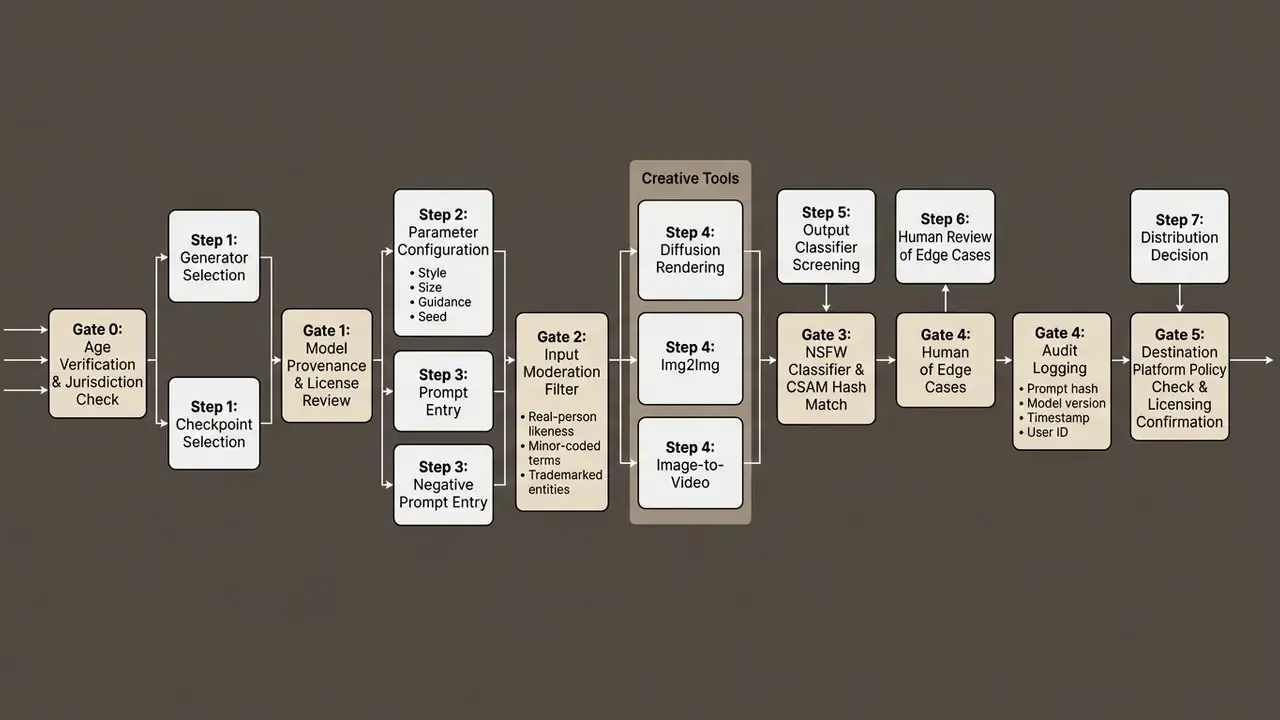
- Output-side residual rate.SafeGen reports 99.4% and ShieldDiff 97.8% removal effectiveness on their respective benchmarks. Neither is 100%. Any pipeline handling this content class needs output classification plus CSAM hash matching plus a human escalation path. One classifier is not a control environment.
Governance baselines to map these controls against: NIST AI RMF for risk function structure, NIST SP 800-218A (July 2024) for secure development practices covering generative AI and dual-use foundation models, and SR 11-7 for model validation discipline in regulated financial institutions. DHS guidance (2024) adds that platforms should scan both inputs and outputs for CSAM and AI-generated CSAM, flag suspect content, and report it to authorities where policy or law requires.
Privacy, Consent, and Prohibited Content When Using an AI R34 Generator
Real People, Private Images, and Consent
Generating explicit synthetic content depicting real individuals without affirmative, voluntary, documented consent is illegal under US law. No nuance to add there.
The TAKE IT DOWN Act (Public Law 119-12) criminalizes non-consensual publication of digital forgeries and intimate visual depictions. Federal law requires online platforms to run robust notice-and-removal mechanisms so non-consensual deepfake content comes down promptly after notification. The statute defines consent as affirmative, conscious, and voluntary authorization free from force, fraud, duress, misrepresentation, or coercion, a definition that excludes silence, a prior relationship, or the public availability of source photographs. The law was enacted on 19 May 2025, and covered platforms were given one year to stand up notice-and-removal systems, with the compliance deadline falling on 19 May 2026.
Federal Bureau of Investigation guidance confirms that synthetic or AI-generated Child Sexual Abuse Material (CSAM) is fully illegal under federal law and carries severe criminal penalties, regardless of whether a real individual was directly depicted. Federal prohibitions cover production, distribution, receipt, sale, access with intent to view, and possession, including realistic computer-generated imagery.
«AI CSAM is used to produce synthetic imagery, re-victimise survivors, and facilitate grooming, even where no real child was filmed.»
«The January 2024 Taylor Swift incident showed synthetic sexual images built from public photographs accumulating hundreds of millions of views within hours.» Non-Consensual Intimate Imagery: The Generative AI Harm Frontier, case study (2024).
State legislatures have moved further and faster than federal law on consent mechanics. Utah's 2026 bill defines consent as express, voluntary, and specific, obtained before generation, and bars distribution of counterfeit intimate images without verified consent. Colorado legislative analysis requires online platforms to explain takedown procedures clearly and remove non-consensual intimate images within 48 hours, with reasonable efforts to locate duplicates. Internationally, China's deep synthesis rules (in force since 2022) require providers offering face or voice editing to notify the edited person and obtain separate consent, while the EU AI Act layers transparency duties from August 2026 and prohibitions on AI systems generating non-consensual sexual and intimate content from December 2026.
How to Check Platform Rules and NSFW Content Restrictions
Mainstream AI platforms including Google, Adobe, and Microsoft explicitly prohibit sexually explicit material, adult nudity, and non-consensual content in their terms of service. Anyone operating third-party or open-source tools has to audit moderation policy themselves.
Legitimate platforms implement automated input and output moderation filters, age gates requiring 18+ verification, and geo-blocking where local law prohibits adult content generation. Documented policy patterns are consistent across large services: hard prohibitions on CSAM, terrorism, extreme gore, and NCII; access to 18+ categories only after an affirmative age check; and geographic restriction where local law demands it. One major competitor page in this niche simply returns "this content is not available in your region", which is a compliance signal rather than a defect. Vendor-side rules differ on adult content specifically: some NSFW-oriented services permit explicit generation of fictional adults for users aged 18+ under stated commercial terms, while general-purpose platforms prohibit it outright.
«The UK Online Safety Act 2023 has been criticised: its "systems and processes" approach is insufficient to counter non-consensual deepfake intimate imagery.»
The practical implication: platform filters are necessary but not sufficient. Assume residual leakage and verify independently. Teams that need to trace whether a synthetic or source image already exists in the wild can review our comparison of AI reverse-image-search tools. Evaluators reviewing technical support frameworks and platform security standards can visit our AI Media Support and Troubleshooting portal.
E-E-A-T Alert: Legal Compliance & Content Safety
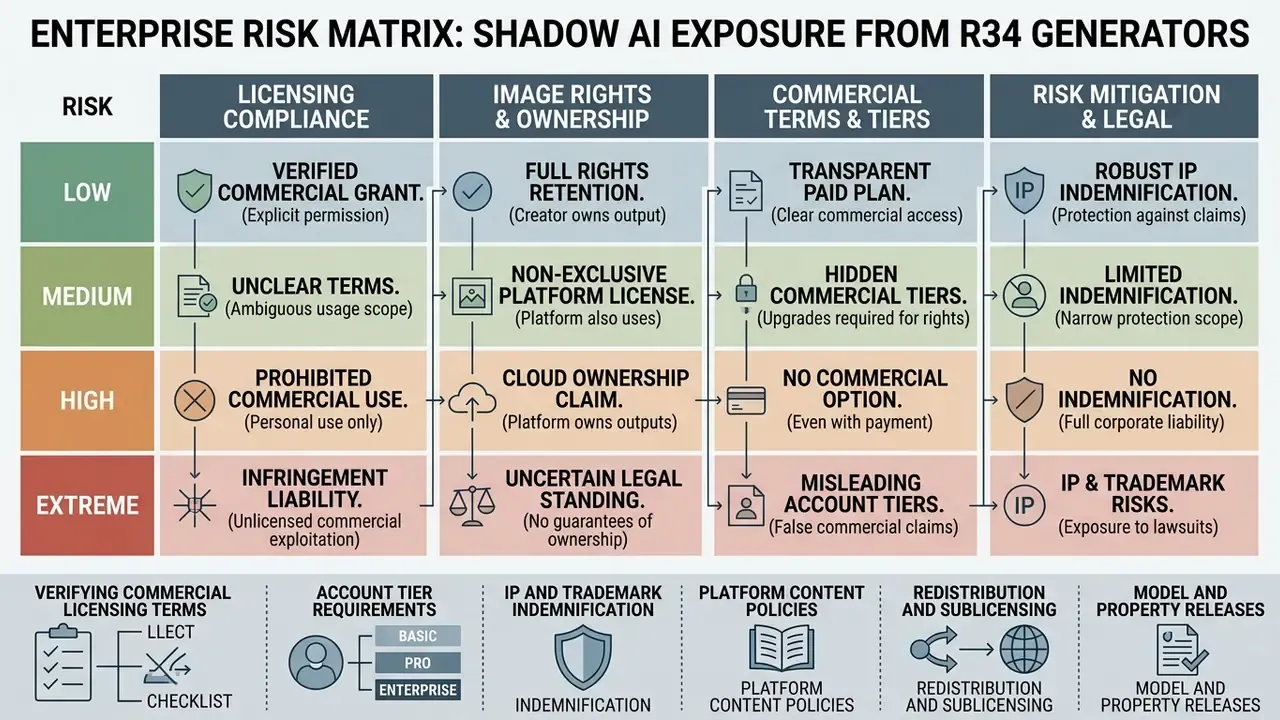
Enterprise Risk Matrix: Shadow AI Exposure from R34 Generators
| Risk domain | Exposure vector | Severity | Primary control |
|---|---|---|---|
| Criminal liability | Employee generates CSAM or NCII on corporate devices or networks | Critical | Network category blocking, hash matching, mandatory reporting path, documented escalation to Legal |
| Data leakage | Uploading internal photos, client imagery, or ID documents to third-party Img2Img endpoints | High | DLP inspection of image uploads; block unapproved generation and companion-chat domains |
| Regulatory / transparency | Synthetic media published without machine-readable marking after August 2026 (EU AI Act) | High | Provenance metadata and watermarking at export; content-marking policy |
| Copyright & IP | Outputs depicting trademarked characters; models trained on scraped protected works | Medium to High | Prompt-entity blocklist, licence review, IP indemnification clauses in vendor contracts |
| Reputational | Corporate IP ranges appearing in NSFW platform logs or breach disclosures | High | Egress filtering, monitored alerting, acceptable-use policy acknowledgement |
| Vendor / third-party | No SOC 2 or ISO 27001 assurance; unverifiable "zero-log" claims; unclear sub-processors | Medium | Vendor due diligence, retention terms in writing, right-to-audit clauses |
| Model risk | Unapproved LoRA or checkpoint changes the safety behaviour of an approved base model | Medium to High | Signed weight allowlist, hash verification, re-validation on version change (SR 11-7 discipline) |
| HR / conduct | Workplace harassment claims arising from generated imagery of colleagues | Critical | Explicit conduct policy, consent-evidence requirement, HR escalation matrix |
Commercial Use of AI Generated Images: What to Verify Before Publishing
«Reddit users already discuss the economics of selling AI pornography, yet platform licence terms frequently restrict commercial exploitation of synthetic material.»
The gap between what a generator's marketing claims and what its licence actually grants is the most common commercial error in this niche. One competing service in this category states outright that its R34 outputs can be used "without any copyright issues", including for commercial transactions. That claim cannot survive contact with either US authorship doctrine or third-party trademark rights when the depicted character originates from an existing anime, game, or film franchise. A vendor can grant you rights in its own output. It cannot grant you rights in someone else's intellectual property.
License, Rights on Generated Images, and Paid Plan Terms
Platform terms of service determine commercial usage rights. Free accounts often restrict output to personal, non-commercial use, whereas paid subscriptions typically grant monetization rights for original synthetic assets. Some services invert the structure entirely, offering only one-time credit packs with tier-dependent rights, so the account tier rather than the tool decides your licence position.
Commercial rights granted by an AI vendor do not override legal restrictions on trademarked characters, intellectual property, or likeness rights. Creators monetizing AI art must confirm that depicted subjects do not infringe existing third-party copyright or brand trademarks. To explore commercial compliance rules across enterprise generative tools, review our guide to AI Media Commercial-Use and the platform-specific breakdown of Google AI Image Generator usage rights.
E-E-A-T Fact Check: Verifying Commercial Licensing Terms
Limitations, Open Questions, and a Safe Next Step
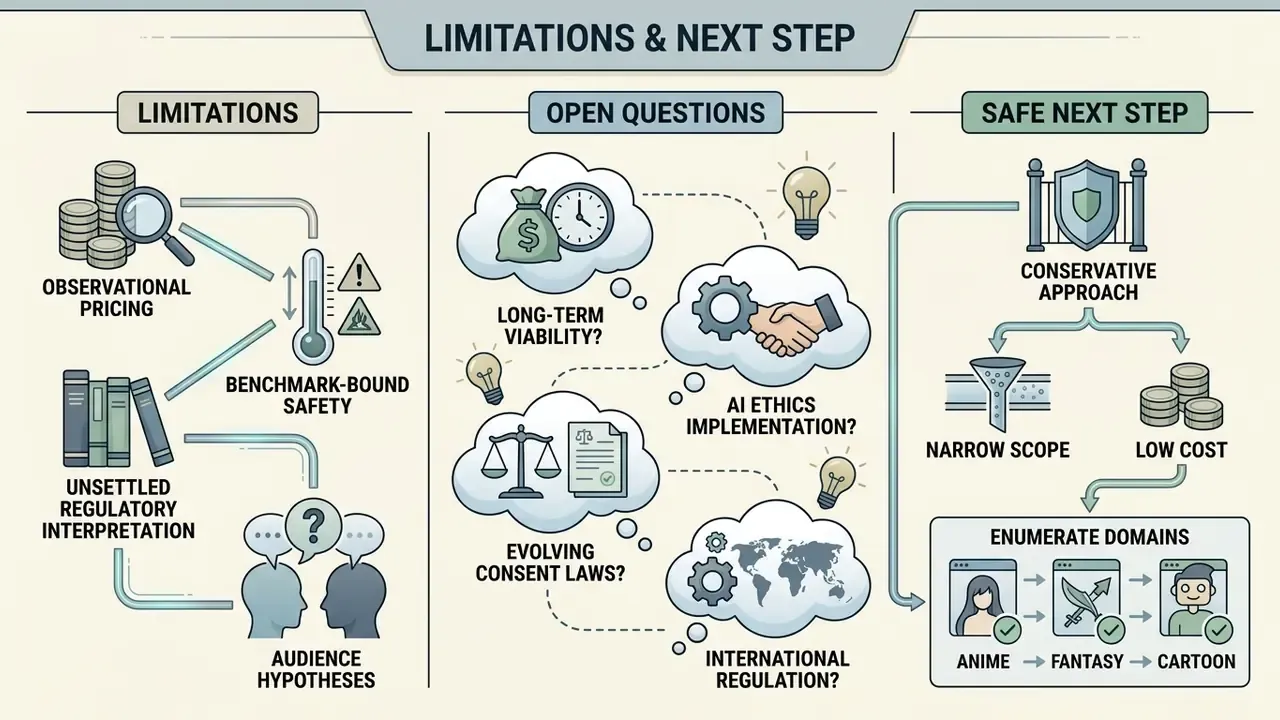
Some of the evidence in this guide is stronger than the rest, and pretending otherwise would be poor governance practice.
- Pricing figures are observational. Credit allowances and subscription bands above come from public vendor listings rather than an audited market survey. They move month to month. Re-verify before any budget approval.
- Safety benchmarks are benchmark-bound. SafeGen's 99.4% and ShieldDiff's 97.8% removal rates were measured on specific datasets. Neither result transfers automatically to a fine-tuned NSFW checkpoint running in production with adapters loaded.
- Regulatory interpretation is unsettled. How EU AI Act marking duties will be enforced in practice from August 2026, and how state consent statutes will interact with federal notice-and-removal duties, remains open. Watch enforcement actions, not press releases.
- Audience assumptions remain hypotheses. Statements about how CROs, CCOs, and model risk heads evaluate these tools should be treated as working hypotheses until confirmed through interviews, analytics, or documented customer research.
A conservative next step for a regulated institution is narrow and cheap: enumerate NSFW generation domains, companion-chat services, and public model hubs in the Shadow AI register, confirm that DLP inspects chat-based image endpoints, and document one escalation path with named owners. No procurement decision required. Just evidence, ownership, and a route for the awkward incident nobody plans for.
FAQ: Compliance Officers and Creators
We detected blocked outbound traffic to R34 generation domains in network logs. What now?
Treat it as a policy and conduct incident, not a firewall event. Preserve the log entries, identify the device and user, confirm whether any upload occurred using DLP records, then route to the defined HR, Legal, and Security escalation matrix. If there is any indication that CSAM or imagery of an identifiable colleague was involved, escalate immediately under your mandatory-reporting procedure and do not attempt local review of the content.
Is generating explicit imagery of purely fictional adult characters legal?
In most jurisdictions, explicit depictions of fictional adults are lawful for adult users, and several NSFW-oriented services state this permission expressly in their terms for users 18 and over. It is not lawful where the depiction is youth-coded, where it reproduces a real identifiable person without consent, or where local law prohibits adult content entirely. Platform terms and geographic restrictions apply independently of criminal law.
Can I use an Img2Img or "outfit removal" feature on a photo of someone I know?
No, not without their affirmative, documented, voluntary consent obtained before generation. Without it the output is non-consensual intimate imagery, unlawful under the TAKE IT DOWN Act and numerous state statutes, with 48-hour removal duties already legislated in some states. If the subject is a minor, this is CSAM and a serious federal crime.
Do we need to watermark AI-generated adult content?
If you serve EU users, plan for it. EU AI Act transparency provisions applying from August 2026 require AI-generated image and video output to be marked in machine-readable form, and Article 50 requires deepfake labelling with technical marking such as watermarks where feasible. Building marking into export now avoids an expensive retrofit later.
Can I copyright and sell R34 AI images?
Purely machine-generated output is not protected by US copyright, and mixed works must disclaim their AI-generated portions at registration. Separately, most large stock libraries and general marketplaces prohibit explicit AI content outright. Selling therefore depends on your provider's licence grant plus your destination channel's policy, and neither one cures third-party trademark exposure from franchise characters.
Is a self-hosted deployment safer than a SaaS generator?
For confidentiality, usually yes. Zero-log local execution keeps prompts and outputs off third-party infrastructure. For content safety, usually no: analysis of ten Stable Diffusion variants found no refusal behaviour and no built-in safety measures, so a local deployment inherits none of a hosted service's moderation layer. Local hosting shifts the entire moderation, logging, and audit-trail burden onto you.
What single control gives the highest risk reduction?
Provenance control at the weight-loading step. An approved base model plus an unapproved LoRA is a different system with different safety behaviour, and adapter uploads are the mechanism behind the documented rise of NSFW assets from 56% to 73% of hosted content on a major registry inside six months.
For further exploration of generative tools, interactive estimators, and compliance guides, visit our central AI Media Glossary.