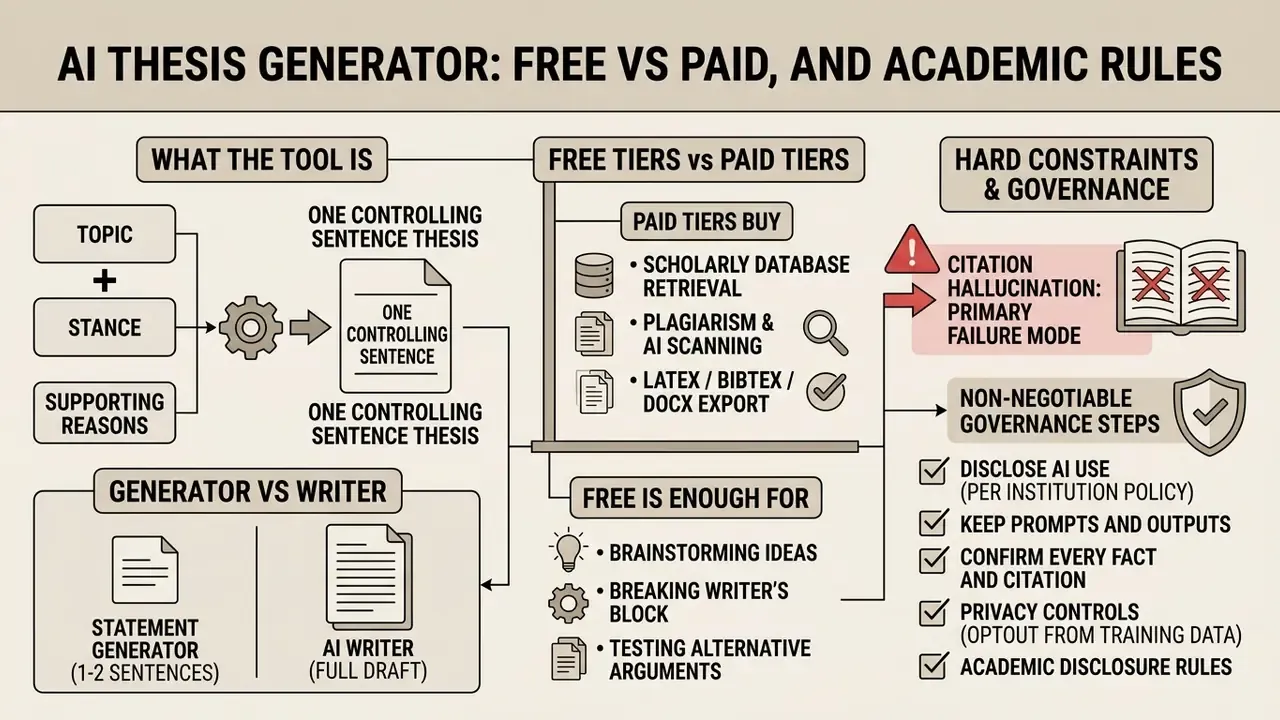
An ai thesis generator is an automated natural language processing tool that turns a research topic, a stated position, and supporting arguments into a concise, debatable claim of one or two sentences. In practical academic workflows, these systems act as preliminary structuring frameworks: they speed up drafting, sharpen argument boundaries, and set the logical direction of essays, term papers, and dissertations.
Executive Summary
Who this guide is for and how to read it
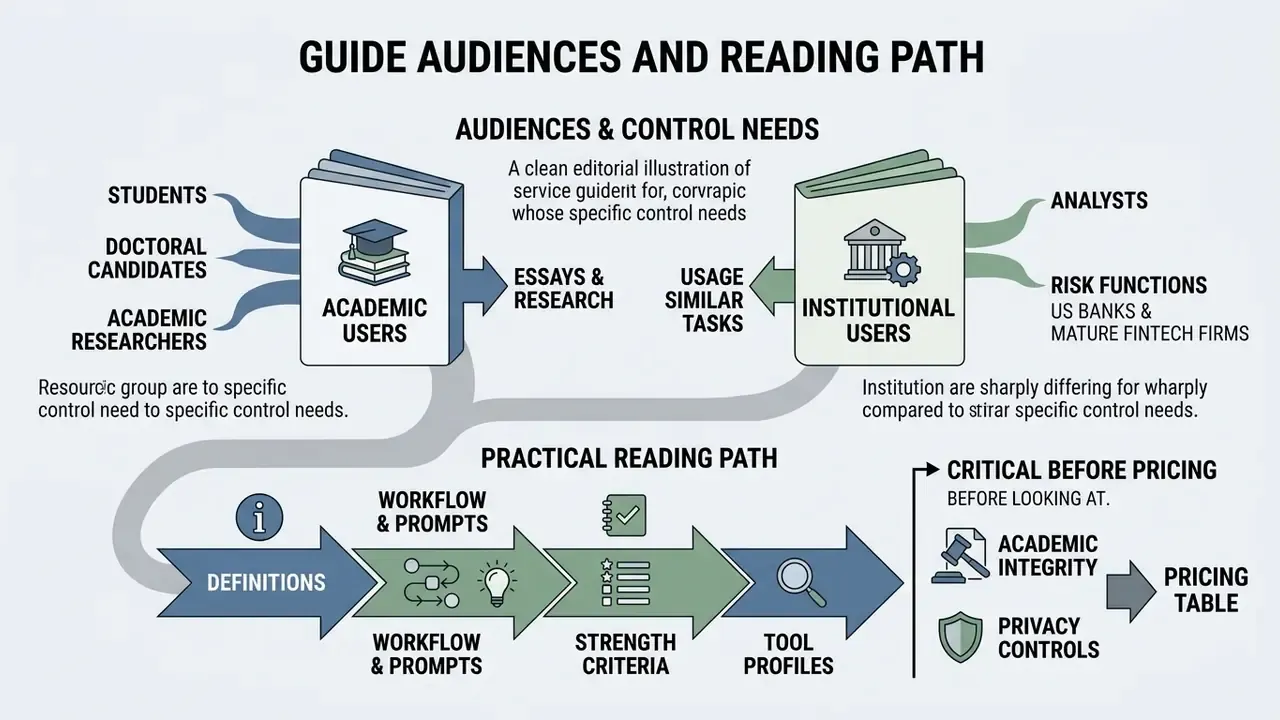
This guide is written for two groups whose control needs differ sharply.
The first group is students, doctoral candidates, and academic researchers producing essays, research papers, theses, and dissertations in English. All prompt templates, thesis examples, and structural blueprints below are given in English academic register, so they can be pasted straight into a generator or a governed enterprise workspace.
The second group is analysts and risk functions inside US banks and mature fintech firms, who use the same tool class for internal memos, policy briefs, and model or credit reviews. For them the question is not grades but evidence: who owns the use case, what enters the prompt, and what a validation reviewer can reproduce later.
Read the academic-integrity and privacy sections before the pricing table. A cheap tier that ingests your inputs into public training data is not a saving. It is a deferred cost.
Practical reading path: definitions, then the workflow and prompts, then the strength criteria, then tool comparison, then data handling, then money, then disclosure rules. Nine sections. Roughly one coffee.
What an AI thesis generator is and what it is for
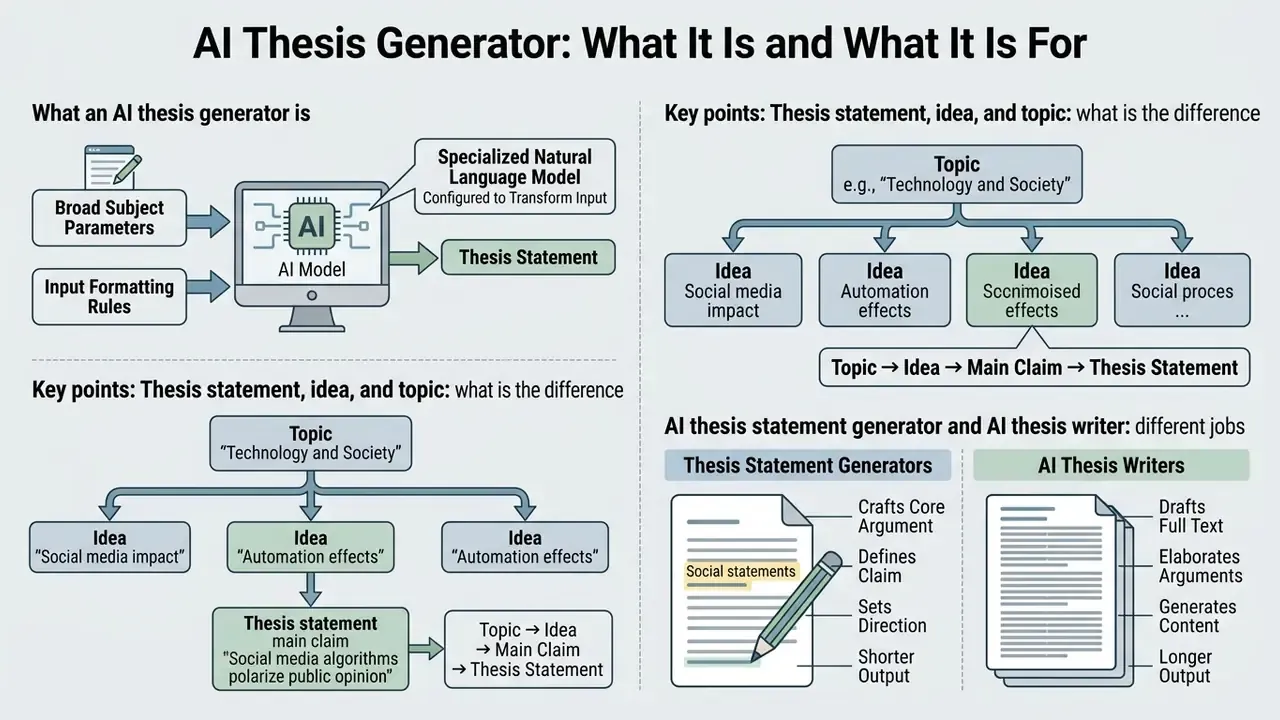
An ai thesis generator is a specialized natural language model configured to transform broad subject parameters into a structured, debatable thesis statement for academic papers. Its main job is unglamorous but real: it solves the cold-start problem in scholarly writing by converting a raw topic into a testable claim that anchors the narrative arc of an essay or research paper.
The thesis statement is the foundational core of academic composition. Placed, in most conventions, at the end of the introductory paragraph, it defines the paper's primary argument, fixes the writer's position, and previews the supporting evidence. Rather than acting as a surrogate author, an ai thesis statement generator functions as an analytical partner. It lets a researcher test three or four rhetorical angles before committing forty hours to a full draft.
Recent empirical literature shows how quickly these platforms entered student and researcher workflows.
«By 2024, 71.4% of high school students reported using generative AI for schoolwork, up from 43.7% in 2023.»
A corpus study analyzing 14 million PubMed abstracts from 2010 to 2024 found that at least 10% of 2024 biomedical abstracts used large language models for text processing and structural refinement.
«The impact of LLMs on scientific writing style is unprecedented in scale and speed, exceeding even the COVID-19 pandemic.»
The same evaluation logic applies across specialized generative categories, from an ai headline generator to an ai hashtag generator or an ai headshot generator. Different outputs, identical requirement: structural control and contextual precision.
Thesis statement, idea, and topic: what is the difference
In academic writing, a topic names the broad subject area, an idea narrows the analytical angle, a main claim takes a stance, and a thesis statement formalizes that stance into a controlling argument of one or two sentences. Confusion among these four elements is the most common cause of unfocused essays and weak research designs. It is also the easiest to fix.
To illustrate the transition in research design:
A second, non-clinical progression shows the same funnel in the social sciences: social media → social media use among teenagers → teen social media use harms sleep → "Teen social media use harms sleep quality because it delays bedtime, increases pre-sleep physiological arousal, and displaces study time."
A thesis creator ai automates this progression: it takes user inputs at the topic or idea stage and prompts the underlying language engine to output a formalized, higher-order thesis statement. The funnel does not change. Only the drafting speed does.
AI thesis statement generator and AI thesis writer: different jobs
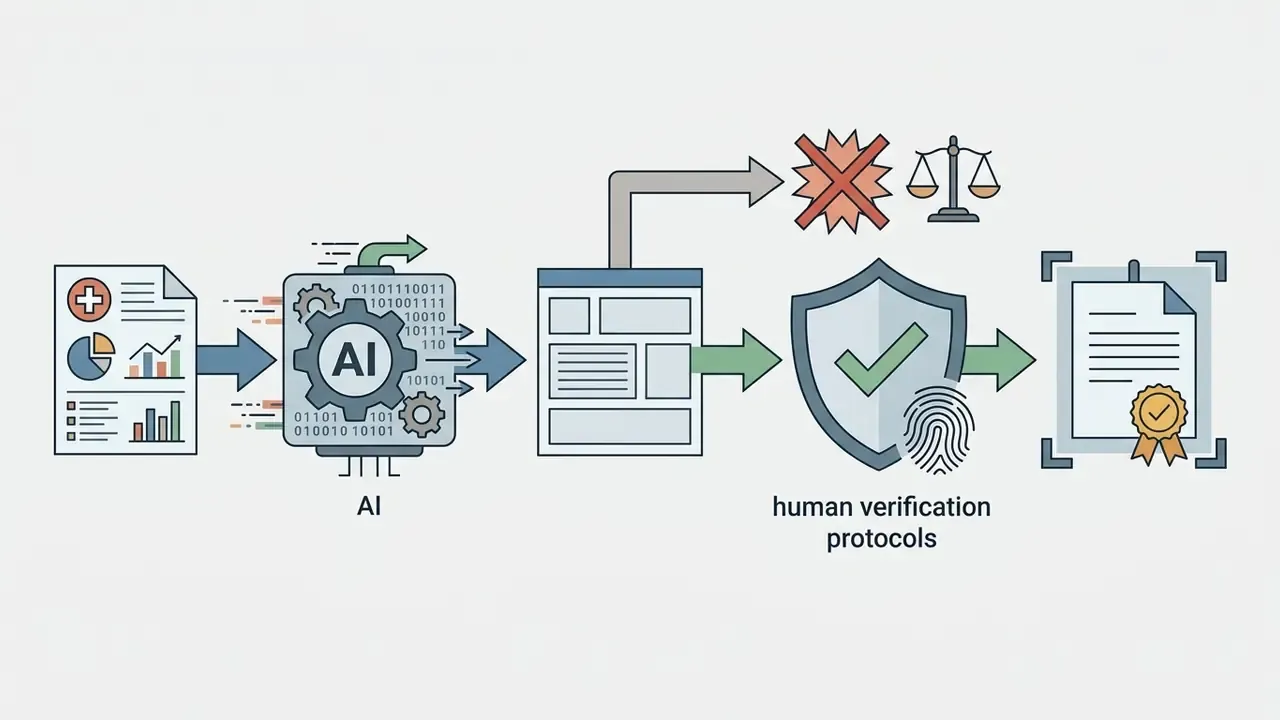
An ai thesis statement generator focuses exclusively on drafting a single, controlled claim. An ai thesis writer is a multi-step assistant designed to produce chapter outlines, literature reviews, citations, and full text drafts.
Understanding that functional boundary is critical for academic integrity. University policies across the United States and Europe explicitly separate structural assistance from text generation.
«AI tool use in academic writing was positively associated with critical thinking and academic integrity when mediated by self-regulated learning.»
Permitted-use envelopes therefore converge on four activities: proofreading, grammar and clarity adjustment, formatting and equation support, and idea-stage brainstorming with disclosure. When reviewing complex software categories, including comparative reviews of AI art generators and other generative engines, clear operational boundaries prevent misuse and preserve output validity.
- Thesis statement generators
- scoped to single-sentence output. They refine research scope without producing substantive body content.
- AI thesis writers
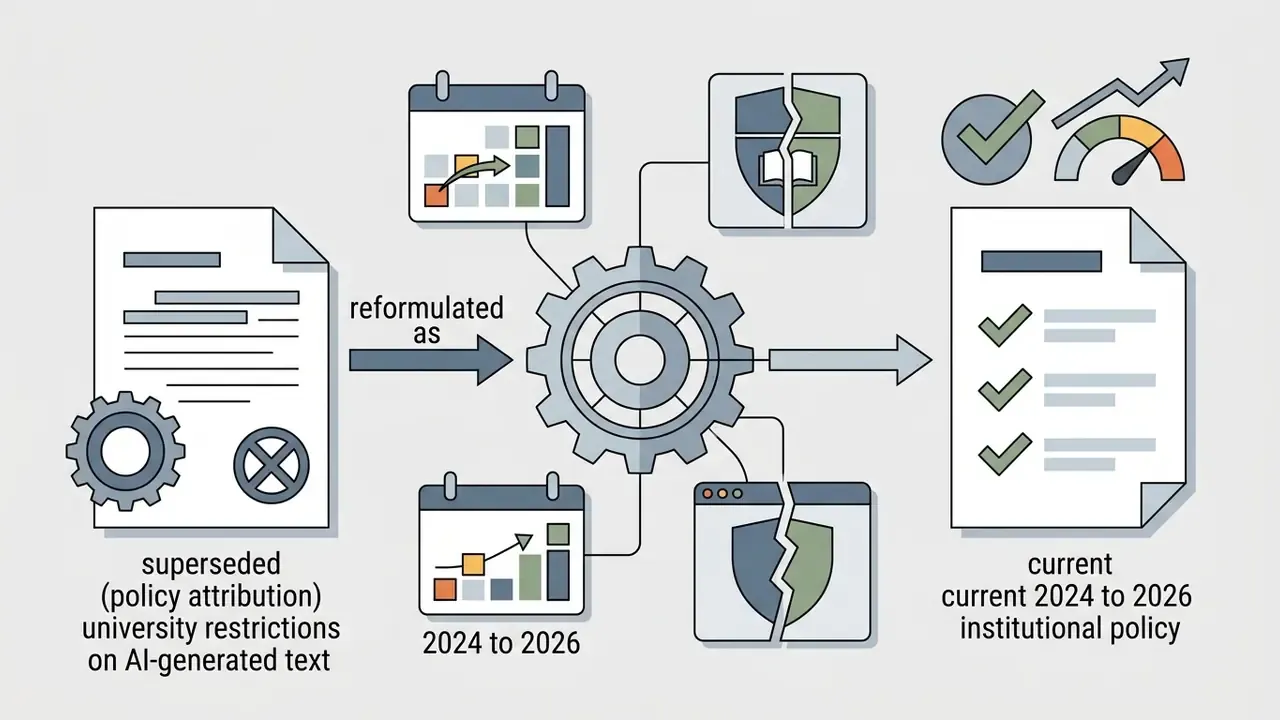
- generate multi-page text blocks. (Updated) Current 2024 to 2026 institutional policies restrict or prohibit the submission of AI-generated body text. TU Berlin's thesis guidance of 11 September 2024 requires declaration of every AI tool used, proofing of all AI output, and treatment of verbatim AI text as a quoted source. The University of Adelaide prohibits generating thesis text for inclusion, allowing only short, properly cited AI passages accompanied by a use-of-AI statement. The University of Bristol limits permitted use to typo and grammar checks rather than text insertion. The University of Toronto requires prior supervisor approval for any generative AI use in thesis research or writing.
Academic use case vs. enterprise research use case
The same tool class serves two audiences with materially different control requirements. Separating them prevents the common mistake of applying student-grade tooling to regulated corporate analysis. I have seen that mistake surface in a governance review as an "unregistered analytical tool" finding, which is an expensive way to save $12 a month.
| Dimension | Academic use (student / researcher) | Enterprise research use (analyst / risk function) |
|---|---|---|
| Primary artifact | Essay, term paper, thesis, dissertation | Analytical memo, ESG or risk report, policy brief, credit or model review |
| Governing rules | Institutional academic integrity policy, disclosure statements, supervisor approval | Internal model risk management policy, model inventory, SR 11-7 and OCC 2011-12 validation expectations, NIST AI RMF |
| Failure cost | Misconduct finding, grade penalty, retraction | Regulatory finding, misinformed credit or capital decision, IP leakage |
| Accepted AI role | Brainstorming, structuring, proofreading, disclosed | Hypothesis framing, document mapping, drafting scaffolds, logged and reviewed |
| Required evidence trail | Saved prompts, drafts, AI declaration form | Prompt and output logs, source attribution, human sign-off in the workflow record |
| Tooling requirement | Free or low-cost tier is often sufficient | SSO, SOC 2 report, tenant isolation or dedicated VPC, training opt-out contract terms |
For enterprise readers, treat a thesis generator exactly as you would treat any non-material analytical tool. Register the use case, define the human-in-the-loop checkpoint, and forbid ingestion of confidential or PII-bearing material into consumer tiers. These statements about audience behaviour remain hypotheses until validated by interviews, analytics, or CRM evidence.
How to create a thesis statement with AI
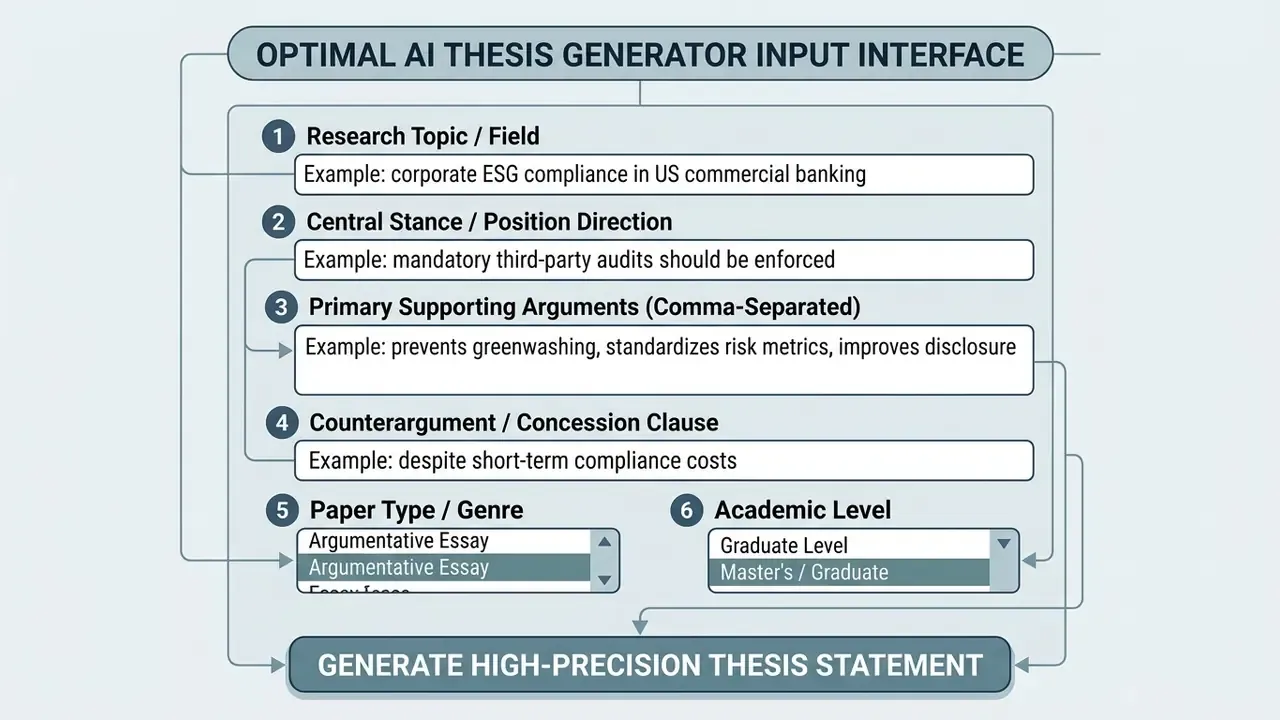
To create a thesis statement ai workflows require a structured four-input sequence: enter the core subject, define the primary stance, outline the supporting arguments, and specify the target academic genre. Specific inputs produce tailored, logically sound, argumentatively robust output. Vague inputs produce boilerplate.
Standardized engines rely on prompt constraints to map those inputs into established rhetorical templates, for example counter-argument plus main claim plus supporting reasons. Using a thesis generator ai well means iterative refinement, not single-click submission. Two or three passes is normal.
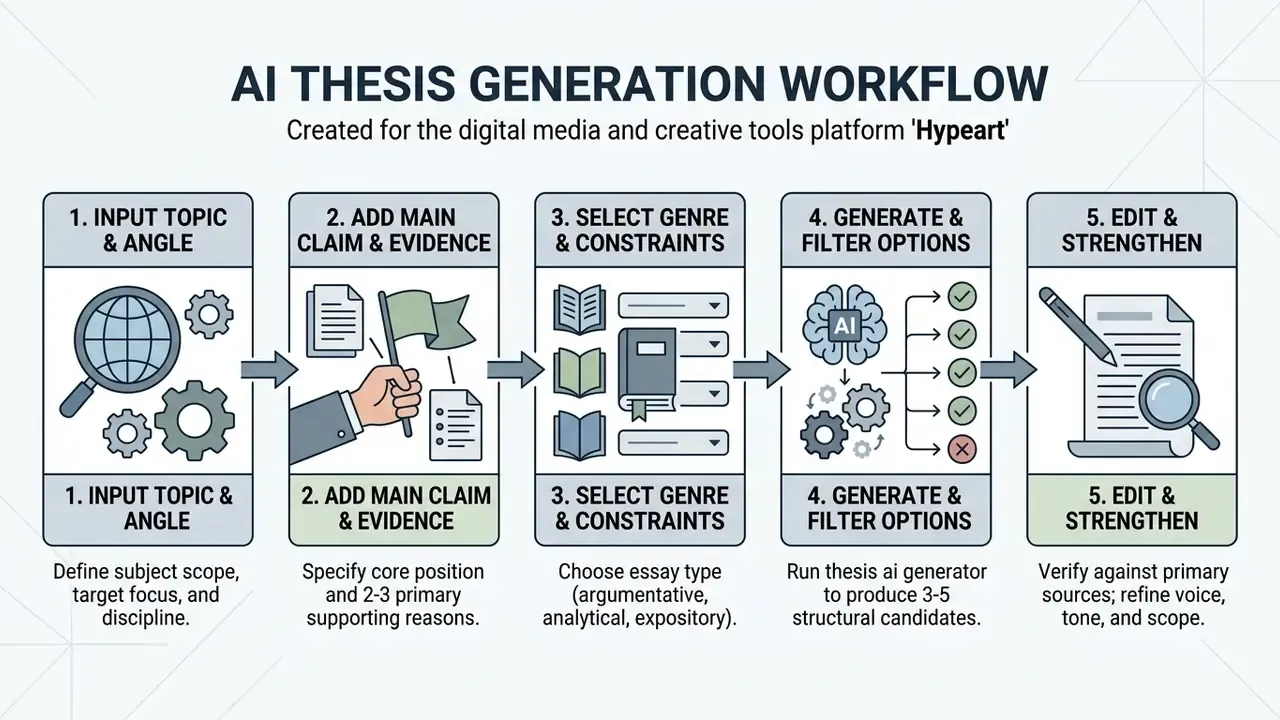
What data to enter: topic, main idea, and supporting reasons
A thesis statement generator ai needs four data points to produce a high-precision claim: a specific topic, a main stance, supporting reasons, and an optional counterargument. Incomplete inputs force the model back onto generic filler.
- Topicthe precise domain under investigation, for example "corporate carbon offsets in US banking".
- Main idea or claimthe arguable position, for example "carbon offset programs require mandatory third-party audits".
- Supporting reasonstwo or three evidence points, for example "prevent greenwashing, ensure accurate balance-sheet disclosure, standardize residual risk metrics".
- Opposing viewpointthe primary counterargument, for example "despite initial compliance costs".
Fed into an ai generator thesis statement pipeline, those parameters yield a workable claim: "Despite initial compliance costs, US banking institutions must implement mandatory third-party audits for carbon offset programs to prevent greenwashing, ensure accurate balance-sheet disclosure, and standardize residual risk metrics."
Ready-to-use AI prompts and generated output examples
Copy these templates into a dedicated generator, a general-purpose chat model, or a governed enterprise LLM workspace. Replace the bracketed variables, then evaluate candidates against the audit protocol further down.
Prompt Template 1, argumentative essay
Act as an academic writing expert. Draft 3 contestable thesis statements for an argumentative essay on [TOPIC]. Stance: [POSITION]. Primary evidence: [REASON 1] and [REASON 2]. Include a counterargument clause using "Although" or "Despite". Max 2 sentences each. Discipline: [FIELD].
- Generated output example: "Although automated algorithmic trading enhances market liquidity, financial regulators must enforce mandatory circuit-breaker protocols to prevent systemic flash crashes and to mitigate algorithmic collusion risk."
Prompt Template 2, analytical research paper
Generate an analytical thesis statement examining the relationship between [VARIABLE A] and [VARIABLE B] in [CONTEXT/INDUSTRY]. Avoid taking a political stance; focus on structural interaction and mechanism. Discipline: [FIELD]. Max 45 words.
- Generated output example: "An analysis of cross-border data privacy frameworks reveals that compliance requirements force mid-sized fintechs to re-architect data lineage systems, simultaneously increasing operational overhead and lowering residual breach exposure."
Prompt Template 3, expository or explanatory paper
Write 3 neutral, non-persuasive thesis statements that explain how [PROCESS OR MECHANISM] operates in [CONTEXT]. No advocacy language, no evaluative adjectives. Preview 3 explanatory sub-sections. Discipline: [FIELD].
- Generated output example: "Municipal water pricing operates through three interacting mechanisms: volumetric tariffs, fixed infrastructure levies, and drought surcharges, each of which allocates scarcity costs to a different consumer segment."
Prompt Template 4, idea generation before a claim exists
Give me 5 candidate angles for a thesis statement on [BROAD TOPIC]. For each angle, name the arguable claim, the two strongest supporting reasons, and the most credible objection. Rank angles by feasibility for a [WORD COUNT]-word paper.
- Generated output example, one of five: "Angle: anchoring bias in negotiated pricing. Claim: first-offer anchoring systematically distorts B2B contract pricing. Support: experimental negotiation data; observed price dispersion in procurement records. Objection: professional buyers may be trained to discount anchors."
Prompt Template 5, governed enterprise or analyst variant
You are drafting a hypothesis for an internal analytical memo. Topic: [TOPIC]. Draft 3 falsifiable hypotheses with the data source required to test each. Do not cite literature, do not invent statistics, and flag any claim that would require external verification. Output as a table.
- Generated output example, one row: "Hypothesis: unmonitored model drift concentrates in models deployed outside the central inventory. Required data: inventory coverage rate vs. drift incident log, 24 months. Verification flag: incident classification consistency."
Note the constraint in Template 5. Instructing a model not to cite is the cheapest control available against fabricated references at the hypothesis stage. Cheap, and oddly underused.
How to choose the essay or research paper type
To yield valid results, an ai thesis maker must be calibrated to the academic genre of the paper, because persuasive, analytical, and expository frameworks follow different structural rules.
- Argumentative essay demands a contestable stance supported by empirical evidence, plus a counterargument that addresses opposing views.
- Analytical paper breaks a complex issue into component parts and evaluates how those components interact, for example dissecting overlapping regulatory frameworks.
- Expository essay explains a topic neutrally using factual evidence, without an overt political or ideological stance.
- Research paper establishes a research question, a hypothesis, and a methodology roadmap tied directly to the academic literature.
Extended matrix of supported academic genres
When configuring an ai thesis statement generator, align the prompt parameters with the assignment structure. Each genre below imposes a different claim shape.
- Cause and effect names specific triggers and downstream consequences. "Urban heat-island expansion accelerates municipal water strain by raising peak irrigation demand and reducing reservoir yield."
- Compare and contrast evaluates structural similarities and divergences between two entities, and states which difference matters most and why.
- Rhetorical analysis examines how an author deploys ethos, pathos, and logos to move a specific audience; the claim identifies the dominant appeal and its effect.
- Problem and solution identifies a systemic failure and proposes a viable, evidence-backed intervention with stated feasibility conditions.
- Historical analysis contextualizes past events through historiographical or socio-economic frameworks, taking a position on causation or periodization.
- Persuasive essay advocates a course of action for a named audience, combining value premises with evidence rather than pure data analysis.
- Definition essay argues for a contested boundary of a term, for example what counts as "greenwashing", and defends the criteria used.
- Evaluation essay judges a work, policy, or product against explicit criteria stated inside the thesis itself.
- Narrative essay anchors a reflective claim in lived experience; the thesis states the interpretive lesson, not the plot.
- Speech or oral presentation compresses the claim into one memorable, spoken-register sentence with a signposted three-part roadmap.
- Expository or informative report explains a mechanism or dataset neutrally, previewing the explanatory sections without advocacy.
- Literary analysis advances an interpretation of a text supported by close reading of specific passages and formal devices.
- Policy paper states a recommendation, the decision-maker addressed, the implementation path, and the trade-off accepted.
- Systematic or literature review declares the synthesis claim across a corpus: what the evidence collectively shows and where it conflicts.
- Rhetorical question format converts the research question into a query, then answers it directly in the next sentence as the thesis proper.
- Summary or quotation-based assignment builds the claim as a response to a given source, stating agreement, qualification, or rebuttal.
- Explanatory or process paper maps sequential stages and argues which stage is decisive for the outcome.
- Specialized, discipline-specific formats such as lab report, case study, grant abstract, credit or risk memo: each requires a hypothesis or recommendation statement rather than a persuasive claim, plus explicit methodology framing.
For cross-category tool evaluations, including free AI art generators and adjacent categories such as an ai hairstyle generator or ai home design tools, genre alignment is what keeps the algorithm inside user expectations and functional constraints.
Why the output must be edited and strengthened
Raw outputs from a free ai thesis generator need manual editing because generative models routinely introduce vague phrasing, overgeneralized claims, or unsupported assumptions.
The methodological implication is direct. Generative feedback reliably improves surface mechanics, meaning grammar, lexical variety, and sentence flow. Higher-order content development, argument depth, and evidentiary reasoning improve only when human review is layered on top of the model output.
A short SAR scenario (Situation, Action, Result), illustrative rather than a client case, shows why editing is not optional. A research team evaluated a generative model's output for an ESG compliance review paper. The model produced a broad, unfocused claim about corporate sustainability. Action: the team narrowed the thesis to US banking regulations, introduced quantitative metrics, added a concession clause, and aligned the scope with current SEC filings. Result: the paper gained a clear analytical outline and passed peer review without structural revisions.
A working editing sequence for any generated claim: first, delete every adjective that carries no measurable meaning. Second, replace abstract nouns with named actors and mechanisms. Third, verify that each supporting reason maps to exactly one body section. Fourth, confirm the claim is still contestable after narrowing. Fifth, record the prompt and the final edited version in your AI-use log. That last step takes thirty seconds and saves whole conversations later.
What a strong thesis statement must look like
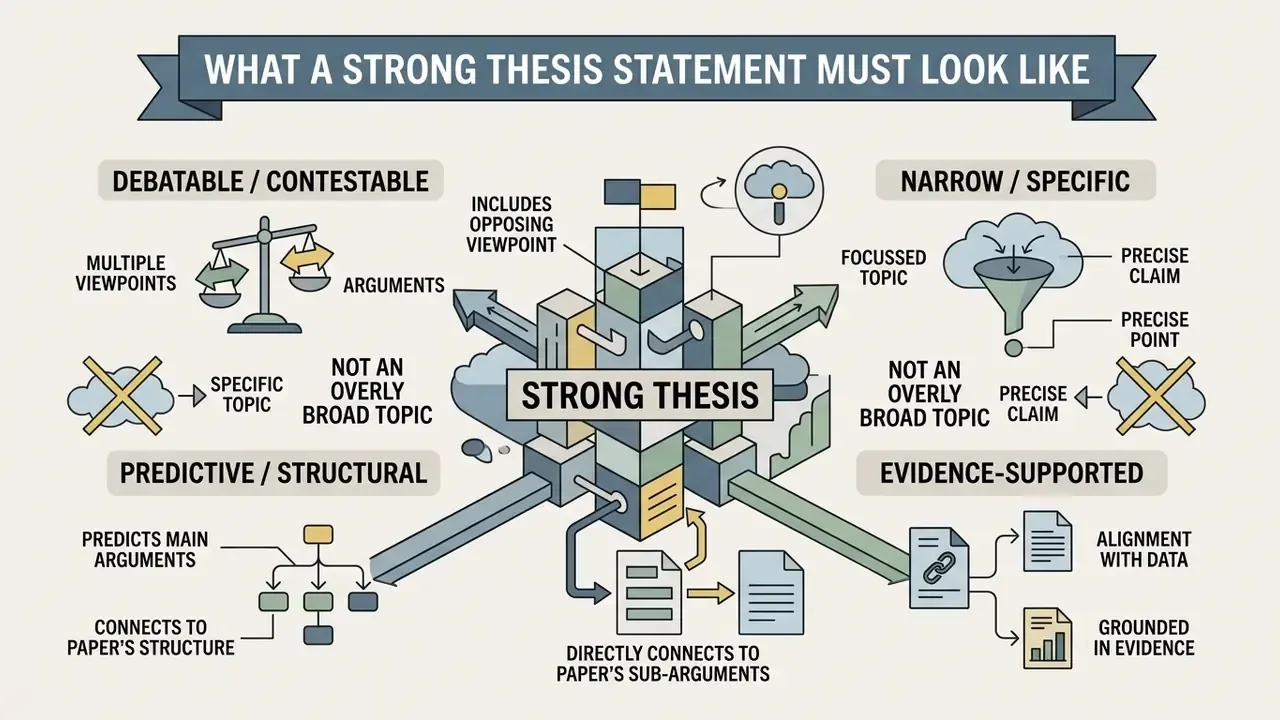
A strong academic thesis statement must be debatable, narrow, evidence-supported, and structurally predictive of the paper's main arguments. It should never present an undisputed fact or a broad summary of a general topic.
«Across 300 physics essays, mean AI-generated scores (65.73) did not differ statistically from human scores (66.86; p = 0.107).»
That parity is exactly why human evaluation of the claim itself matters. Fluent, average-scoring prose can rest on a thesis that is unfalsifiable or unsupported. Score is not evidence.
In formal evaluation rubrics, high-scoring thesis statements meet four criteria:
A precise claim instead of an overly broad topic
A weak thesis statement restates a broad topic. A strong thesis asserts a precise claim that answers a specific research question.
| Weak (broad topic or fact) | Strong (specific, debatable thesis) | What changed |
|---|---|---|
| Generative AI is changing banking risk operations. | Generative AI adoption in commercial banking risk operations requires centralized inventory governance to limit unmonitored model drift and shadow IT deployment. | Named mechanism plus named remedy plus two measurable failure modes |
| Remote work impacts employee productivity. | Hybrid work models in financial services enhance long-term retention only when organizations establish clear asynchronous communication guidelines and objective evaluation metrics. | Sector scope plus conditional clause ("only when") plus two conditions |
| Data privacy laws affect online businesses. | Compliance with cross-border data privacy frameworks forces mid-sized fintechs to restructure data lineage architectures, increasing operational overhead while lowering residual breach risk. | Firm-size scope plus directional trade-off |
| Social media affects teenagers. | Teen social media use degrades sleep quality because it delays bedtime, elevates pre-sleep arousal, and displaces study time. | Single outcome variable plus three testable pathways |
Arguments and the opposing viewpoint inside the thesis
Building a counterargument into a thesis statement strengthens the paper twice over: it demonstrates critical thinking, and it defines the boundaries of the main claim.
According to composition frameworks from the Purdue Online Writing Lab (OWL), an argument must contain both a claim and a counterclaim, the opposing position must be presented in an unbiased way, and the thesis must be debatable, that is, a claim reasonable readers could reject (Purdue OWL, Writing Lab guidance on thesis statements and argumentative papers, accessed 2026. https://owl.purdue.edu/owl/general_writing/the_writing_process/thesis_statement_tips.html). Brandeis University's writing programme describes counterargument as a two-step move: challenge your own argument, then turn back and reaffirm it. That move is what determines paragraph sequencing later in the paper.
Structural clauses such as "Although [opposing viewpoint], [main claim] because [reason 1] and [reason 2]" signal that the paper will engage objections seriously. Two further usable frames: "While [common assumption] holds in [context A], it fails in [context B] because…" and "Unlike [alternative explanation], [your claim] accounts for [anomaly]."
How to connect the thesis statement to the paper's structure
The thesis statement is the structural blueprint for the whole paper. Every body paragraph must support a component of the central claim, and the conclusion restates the thesis in paraphrased form.
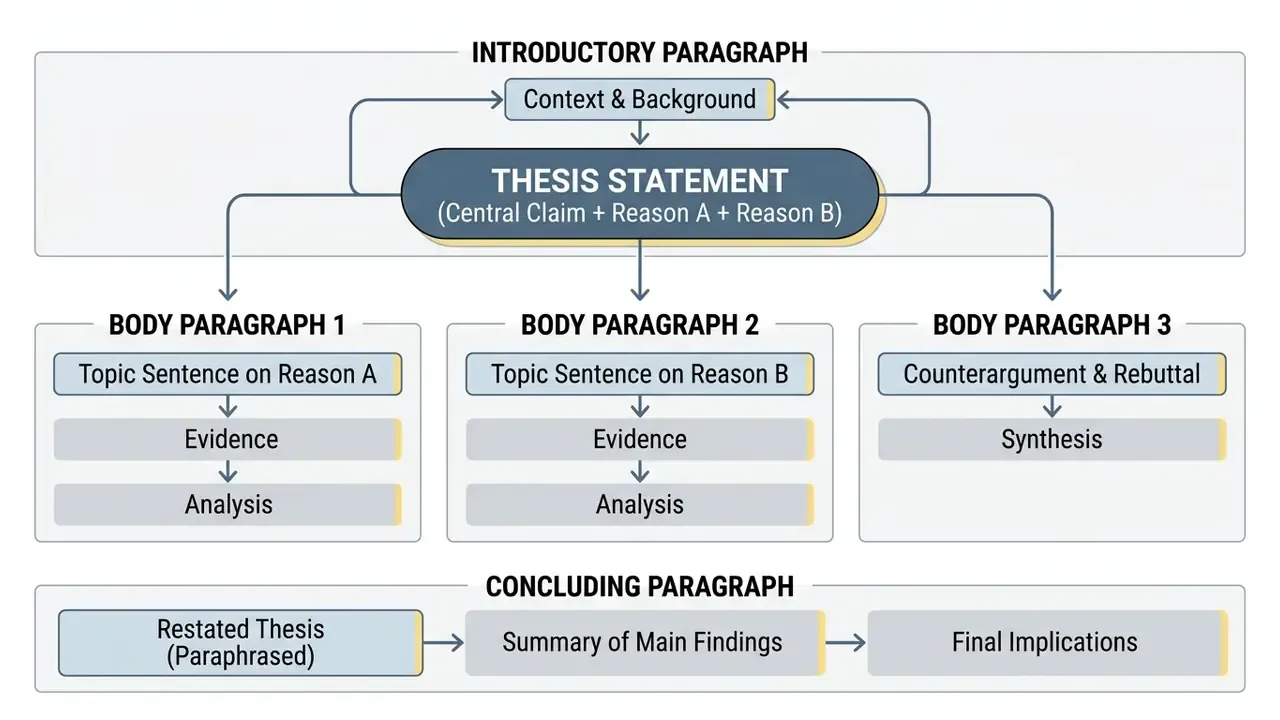
In academic research, this logical chain keeps the introduction, topic sentences, evidence, and conclusion unified without tangential detours. Practical test: extract every topic sentence into a list. If that list does not reconstruct the thesis, the structure is broken, not the wording.
Best AI thesis statement generators: what to compare before choosing
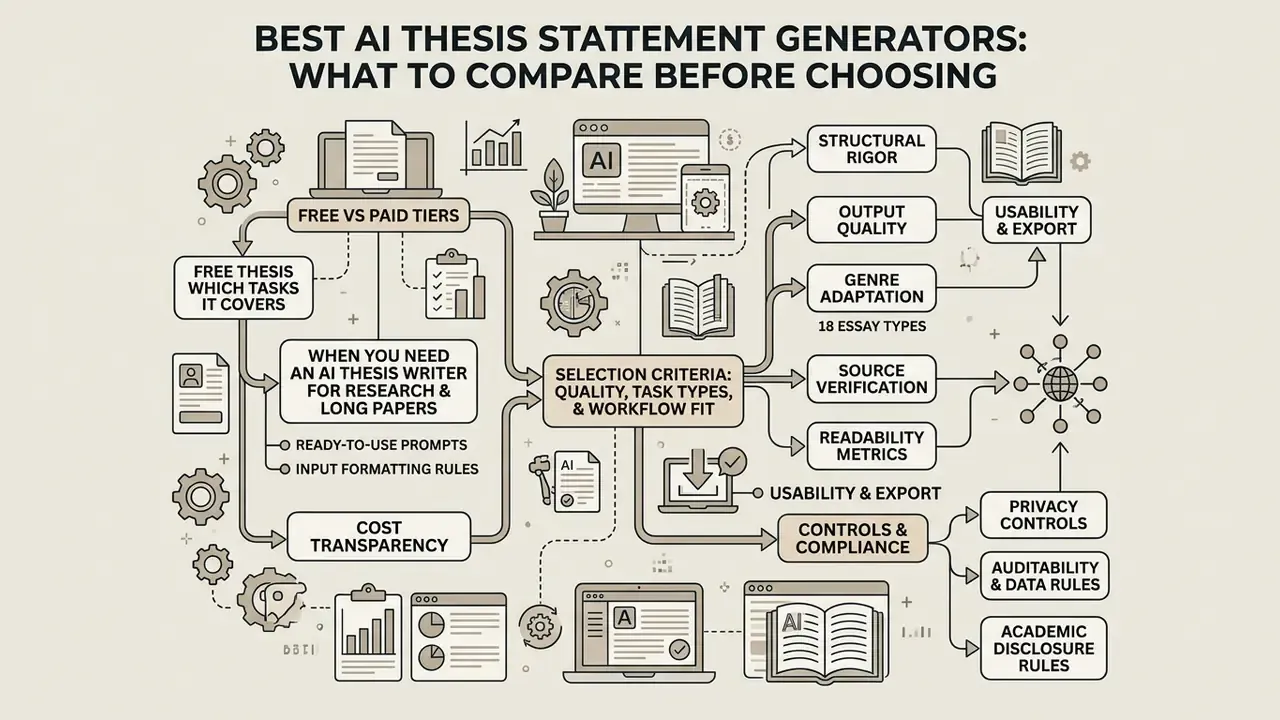
Choosing the best ai thesis generator means evaluating tools on output quality, essay genre support, source verification, and cost transparency. In that order, usually.
To analyze the options systematically, categorize platforms by architecture: basic single-prompt statement makers, comprehensive academic writing assistants, and general-purpose LLM suites. The same discipline applies when benchmarking any generative category, from thesis engines to the best ai image generator tier lists.
| Feature / criteria | Dedicated thesis statement generator | Academic AI writing assistant | Universal AI writing suite |
|---|---|---|---|
| Primary scope | Single thesis statement generation | Full workflow: outlines, citations, drafting | General content creation across domains |
| Output specificity | High focus on thesis structure | High focus on academic prose and structure | Variable; needs precise prompt engineering |
| Genre customization | Presets for essay and paper types | Presets for research papers, thesis, grants | General tone sliders (formal, creative) |
| Citation / fact check | None; requires external check | Integrated reference search and DOI lookup | High risk of hallucinated citations |
| Free access limits | Free or minimal daily cap | Freemium with credit caps or page limits | Free tiers with usage caps |
| Enterprise controls | Rarely available | SSO and SOC 2 on higher tiers; verify per vendor | Enterprise tiers with tenant isolation |
| Typical pricing | Free or low-cost add-on | $12 to $29 per month | $10 to $30 per month |
When running an AI Media Comparison, prioritize platforms with clear data handling terms and verifiable references over raw output speed. For organizational procurement, add three screening questions no student-focused review covers: does the vendor publish a SOC 2 Type II report, does the plan support SSO and role-based access, and is there a contractual training opt-out or dedicated tenancy option?
Free thesis maker ai: which tasks it covers
A thesis maker ai free tool is enough for initial brainstorming, breaking writer's block, and testing alternative argumentative structures in early research stages.
Free generators are good at turning simple prompts into grammatically clean sentence templates. But empirical work shows that general language models without literature retrieval engines hallucinate citations at high rates.
«No tested model exceeded 47.5% verifiable citations; between 36% and 61% of references were unrecognized or fabricated.»
When you need an AI thesis writer for research and long papers
A full-featured thesis ai generator or writing assistant becomes necessary on multi-chapter research papers, master's theses, and dissertations that demand literature synthesis, citation management, and outline alignment.
Advanced platforms such as SciSpace, Jenni AI, or Paperguide integrate vector search over scholarly repositories, for example Crossref and PubMed, to anchor generated text in peer-reviewed sources. These tools help organize complex literature reviews, map evidence across chapters, and format bibliographies to APA, MLA, or Chicago standards. In structured review workflows, AI is typically deployed at five points: planning, paper search, backward citation search, data extraction, and thematic grouping. Core synthesis stays researcher-led.
Verification tooling belongs in the same workflow. Teams auditing mixed human and AI deliverables often pair text checks with provenance tools such as AI image detectors for accompanying figures and visual assets.
Selection criteria: quality, task types, and workflow fit
Evaluating an ai thesis generator comes down to screening against structural rigor, operational safety, and task flexibility.
«The dominant motives for using AI writing tools are speeding up writing, overcoming writer's block, and improving text quality.»
Tools that meet these standards can be reviewed through resource hubs such as the AI Media Commercial-Use Hub and checked against AI Media Pricing Guides for procurement and compliance sign-off.
Privacy and data security in a thesis generator ai
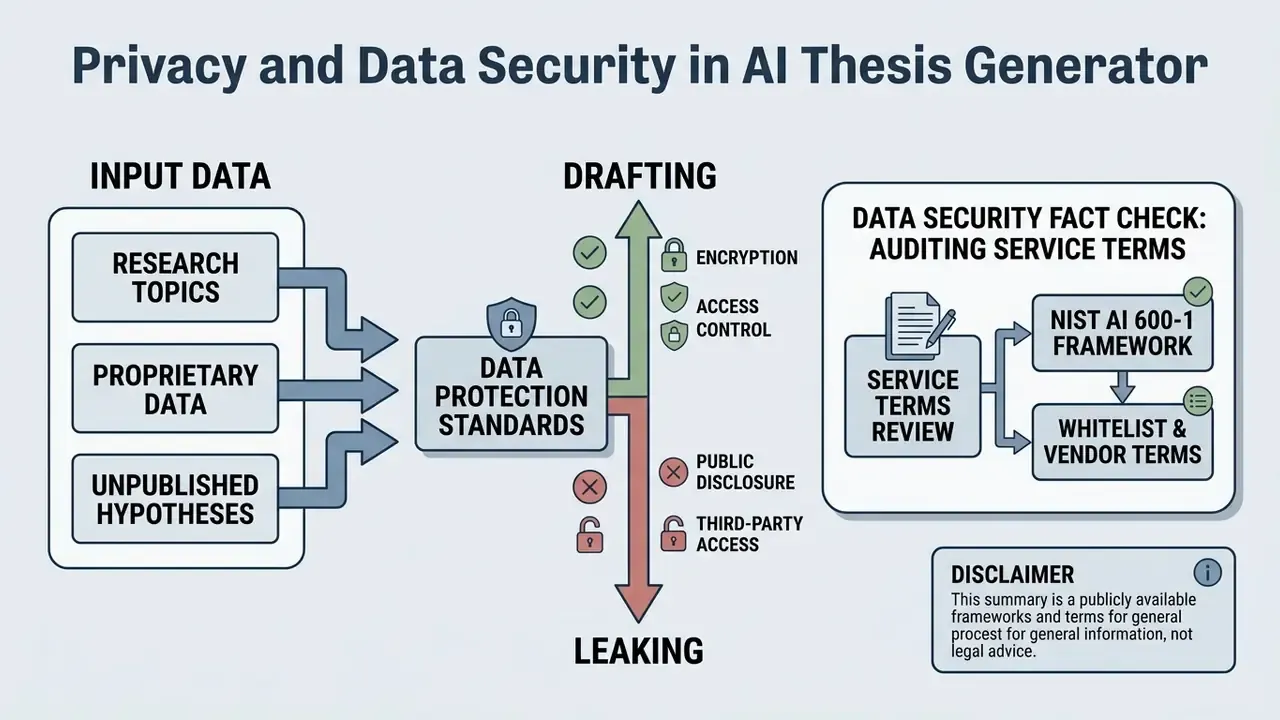
When you submit research topics, proprietary data, or unpublished hypotheses into a thesis generator ai, data protection standards decide whether you are drafting or leaking. For regulated organizations this section precedes any pricing decision.
The National Institute of Standards and Technology (NIST AI 600-1, Generative AI Risk Management Framework, 2024) stresses that generative AI deployments introduce specific data privacy risks: unexpected PII disclosure, unauthorized training ingestion, de-anonymization of personal data, and loss of confidentiality over code, training data, and model weights. The associated control set is conventional and testable. Encryption in transit and at rest, MFA, role-based access control, data-loss prevention, privacy-enhancing technologies, output monitoring for PII, and a defined breach-response path.
DATA SECURITY FACT CHECK: AUDITING SERVICE TERMS
Before entering sensitive research data into any AI generator, verify these platform parameters:
- Data ingestion: does the privacy policy explicitly opt your inputs out of future model training cycles?
- Retention policy: how long are input prompts stored in server logs before automatic purge, 30 days or indefinitely?
- Account deletion: does deleting the account permanently remove all associated inputs and output histories?
- Encryption standards: are transfers secured via TLS 1.3 in transit and AES-256 at rest?
- Rights over input: do the terms claim any licence over the text you submit, and do they prohibit prompting for infringing output?
- Jurisdiction and subprocessors: where is data stored, and which subprocessors receive prompt content?
«Most students believed AI does not protect personal data, yet 29 respondents still shared such information with generative models.» Examining the ethics of generative artificial intelligence within… (2024). https://link.springer.com/article/10.1007/s12528-026-09499-z
AI thesis generator free and paid tiers: how to assess cost
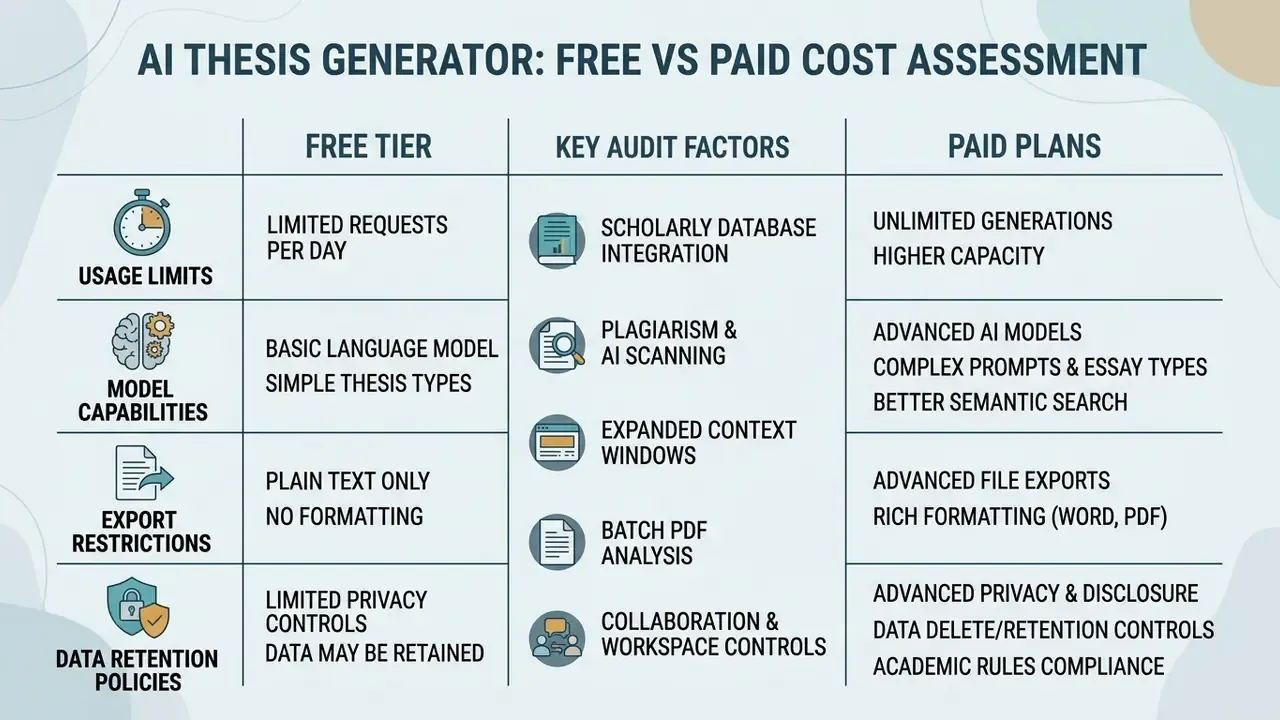
Evaluating an ai thesis generator free offer against paid plans means auditing four things: usage limits, model capabilities, export restrictions, and data retention policies.
Most academic AI platforms run a freemium model, as do adjacent categories such as free AI video generators. Basic thesis generation is frequently free. Extended features, meaning deep research generation, plagiarism scanning, and unlimited export, sit behind recurring tiers. A minority of thesis-specific services skip subscriptions and monetize at export instead.
| Platform / tier | Cost (billed) | Monthly AI or page limits | Core features included | Citation and export options |
|---|---|---|---|---|
| Jenni AI (Free) | $0 / month | 500 AI words / day | Basic thesis drafting, autocompletion | Standard formatting |
| Jenni AI (Plus) | $12 / month | 5,000 autocompletes, 500 AI edits/chat, 10 reviews | Unlimited PDF uploads, literature search | PDF / BibTeX export |
| Jenni AI (Pro) | $29 / month | Unlimited autocompletes, edits, chat, reviews | Advanced AI chat, full assistant suite | PDF / BibTeX export |
| ThesisAI (Standard) | $18 / month | Max 50 pages / doc | Thesis drafting, section outlines | DOCX export |
| ThesisAI (Pro) | $28 / month | Max 80 pages / doc | Advanced literature synthesis | DOCX / LaTeX export |
| Paperguide (Free) | $0 / month | 20 AI searches, 1,000 credits, 2 AI Writer docs | Chat with PDF, reference manager | Basic citation output |
| Paperguide (Plus) | $12 / month | 12,500 AI credits, 10 deep research reports | Plagiarism checker, systematic review up to 1,000 papers | Full citation reports, BibTeX / LaTeX / Word |
| SciSpace AI Writer | $12 / $20 / $25 per month | Tier-dependent generation caps | AI writing and AI editing, research features | Standard academic exports |
| Paperpal Prime | $25 / month or $144 / year | Full toolkit access | Unlimited citation generation (10,000+ styles), Chat PDF | Journal-style formatting |
| Grammarly (Free / Pro) | $0 / $30 per month | Pro: 2,000 AI prompts / month | Thesis idea generation, grammar, tone, plagiarism (Pro) | Citation generator |
| Rewind AI Thesis Writer | $0 (no signup) | 2,500 tokens/day anonymous; 5,000/day with account | Draft generation, 24-hour token reset | Basic text export |
| StudyTexter (per project) | $129 to $249 per export | Brief, outline, first chapter free | Full-thesis draft generation | Paid full-document export |
Note: pricing and tier data verified as of August 2026.
Disclaimer: pricing and feature information is provided for reference only and may be changed by the platforms at any time. Verify current terms, limits, and licence conditions on the official vendor site before purchasing. Nothing here constitutes financial or procurement advice.
What is typically included in a free AI thesis generator
A thesis generator ai free plan usually includes basic single-sentence generation, short summaries, outline creation, translation, and a limited number of drafting attempts per 24-hour cycle.
Public models and anonymous tiers often cap usage at 2,500 to 5,000 tokens daily. Other vendors restrict output to a fixed count, such as 20 AI searches, 1,000 monthly credits, or one generation per day. These allowances are fine for a student who needs three or four candidate thesis statements for a short essay. They are insufficient for full thesis drafting or deep literature mapping.
Typical free-tier limitations to expect: no fact-checking layer, weaker or older base models, no access to the newest features, reduced or watermarked export, demo-only partial output, and, most importantly, no guarantee that prompts are excluded from training. TU Berlin's guidance puts the underlying point plainly: generative AI can structure topics, build outlines, summarize, translate, and produce tables, but it is not a knowledge base and it can invent facts.
Which features you pay for in AI writing tools
Paid tiers in academic AI suites unlock higher-order functions built for complex research workflows.
- Scholarly database integration direct querying of indexed academic literature such as Semantic Scholar, Crossref, and PubMed.
- Plagiarism and AI scanning integrated similarity checks that catch accidental verbatim matches.
- Advanced file exports formatted downloads in LaTeX, BibTeX, or Microsoft Word, plus full citation reports.
- Expanded context windows processing long documents, including full PDFs and thesis chapters, without truncation.
- Batch PDF analysis and semantic search screening dozens of sources at once and grouping them by theme or method.
- Collaboration and workspace controls shared projects, version history, and on enterprise tiers SSO plus administrative audit logs.
For cost estimation across complex media and writing platforms, benchmark spend with AI Media Calculators before committing to an annual plan.
How to check the tier terms before paying
Before paying for a thesis maker ai, verify recurring billing frequency, auto-renewal triggers, refund terms, and data retention policies.
Under US Federal Trade Commission guidelines and standard consumer protection frameworks, digital service providers must disclose:
- The exact recurring charge and billing frequency after any trial period, plus the initial charge.
- Trial length and the fact that the plan converts automatically unless cancelled.
- Cancellation procedures, which must be as accessible as sign-up.
- Data usage terms, specifically whether inputs are deleted on cancellation or retained for model training.
- Hidden usage caps: token, page, document, or credit limits that gate the feature you are actually buying.
Verification order before payment: price, then billing frequency, then trial length and conversion trigger, then auto-renewal, then cancellation route, then usage caps, then retention and deletion policy. If any step is unclear on the vendor site, that is data too. If you get stuck mid-purchase, the AI Media Support and Troubleshooting hub documents the common billing and access failure modes.
Can you use an AI thesis generator in academic work?
ACADEMIC INTEGRITY ALERT: DISCLOSURE AND HUMAN ACCOUNTABILITY
(Updated) Generative AI platforms must never be cited as original authors or as sole sources of academic claims. Current 2024 to 2026 institutional policies converge on transparency plus personal accountability. Florida International University's Graduate School requires an AI Use Disclosure in thesis and dissertation preliminary pages. George Washington University's generative AI guidelines prohibit use unless the instructor grants explicit advance permission in writing. American University's Office of Academic Integrity requires students to disclose which tools were used, for what purpose, and how. RCSI treats undisclosed generative AI use as an integrity breach and asks for prompts and outputs in appendices. Cornell's guidance instructs students to retain drafts and chat logs and to verify all AI-supplied facts and citations. Undisclosed use of AI-generated text in a thesis or dissertation may constitute academic misconduct, plagiarism, fabrication, or research falsification.
«23.8% of AI-generated submissions received passing grades, while the AI-text detector flagged them at only 0 to 14%.» Can Artificial Intelligence Complete My Assessment? A Student Led…, HEAD conference (2024). http://archive.headconf.org/head24/wp-content/uploads/pdfs/inpress/17143.pdf
Read that finding in both directions. Detection is unreliable as an enforcement mechanism, and relying on non-detection is a poor risk strategy. Disclosure remains the only defensible position.
Why a generated thesis statement should never be submitted unverified
A generated thesis statement must never go in unrevised, because large language models operate on statistical probability rather than factual truth. That makes them prone to logical fallacies, fabricated references, and hallucinated evidence.
In other words, machine output can land near the human mean while still lacking the contextual depth, interpretive risk, and verifiable secondary literature that graders expect at higher bands. Institutional guidance says the same thing in compliance language. FIU warns that confabulations produce false content and that unacknowledged AI work can amount to plagiarism and research misconduct. Georgia Tech (2025) requires review and verification because output may contain misleading content or material from other authors. The University of Washington (2026) notes that substantive generative AI assistance in a dissertation may constitute cheating, and that AI responses are not guaranteed free of verbatim passages from existing sources.
How to verify an AI result before using it in a paper
Verifying an AI-generated thesis statement takes a three-step audit before the claim enters an academic draft.
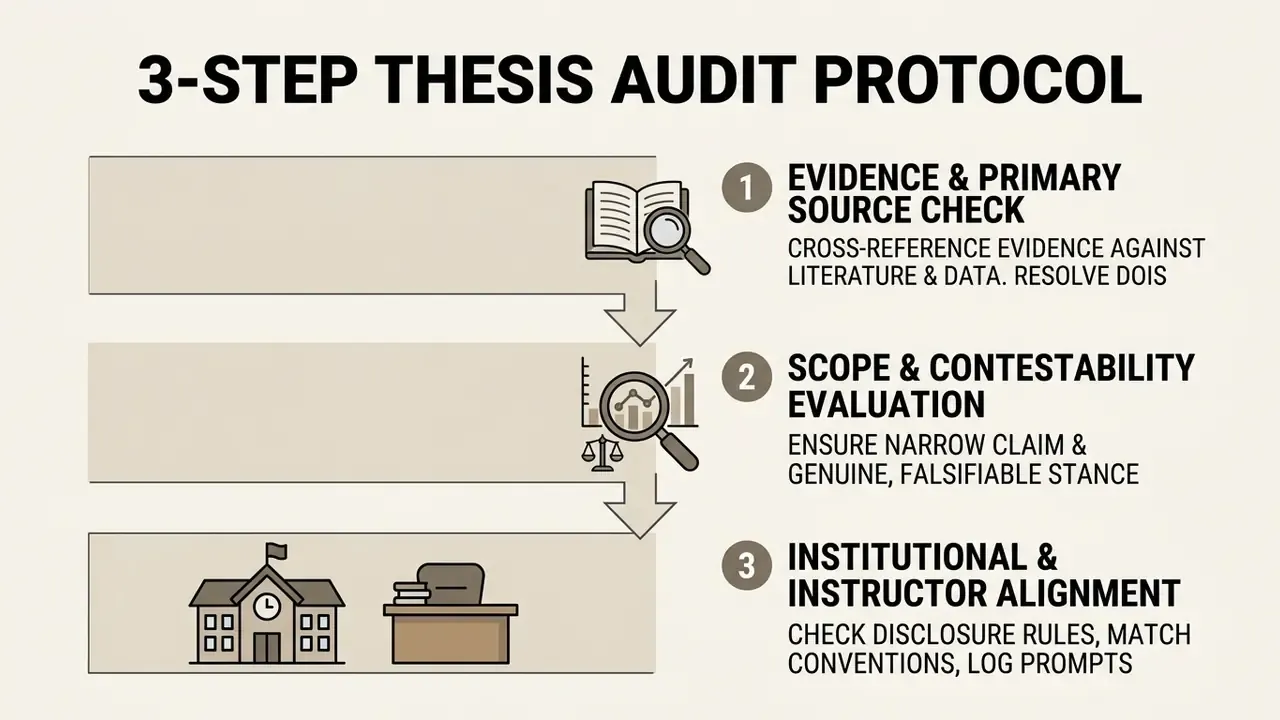
In specialized domains, whether policy research, regulated financial analysis, or the audit of automated text engines, rigorous content filtering and provenance logging keep you aligned with both legal standards and institutional governance. Method-level guidance holds constant across all of them: the methodology must match the research question, the data collection, and the analysis, so a reader can independently evaluate validity and reliability.
FAQ about AI thesis statement generators
Can I use a free ai thesis generator for all types of academic essays?
Yes, most free AI thesis generators support multiple essay types, including argumentative, analytical, expository, comparative, cause-and-effect, rhetorical, narrative, and policy papers. You must state the genre explicitly in the input prompt so the tool formats the claim appropriately. Then review and edit the output so it matches your paper's actual evidence and scope.
Will using an ai thesis statement generator be detected by plagiarism software?
Thesis statement generators produce original word combinations that rarely match existing texts in traditional plagiarism databases. Advanced AI writing detectors analyze stylistic metrics to flag machine-generated text, imperfectly. One 2024 study found detectors flagged AI submissions at only 0 to 14%, while human markers identified AI authorship correctly in roughly 79 to 80% of cases. Low detection rates are not permission: undisclosed use may violate your institution's academic integrity policy regardless of detector scores.
What is the difference between a thesis generator and an AI thesis writer?
A thesis generator creates only a single controlling claim of one or two sentences. An AI thesis writer is a broader tool that helps build outlines, literature reviews, body paragraphs, and citations. Most university guidelines permit thesis generators for early brainstorming with disclosure, but strictly regulate or prohibit AI thesis writers from drafting full paper content.
How do I know if an AI-generated thesis statement is strong enough?
A strong thesis statement must be contestable, meaning someone could reasonably disagree, specific, meaning focused on a clear scope, and predictive, meaning it outlines the main supporting points. Apply one extra test: could a dataset or a source falsify it? If your generated thesis merely states an obvious fact or a broad topic, keep editing to narrow the focus and strengthen the central claim.
Are my research ideas safe when I enter them into a free AI thesis tool?
Not always. Free consumer AI tools may log inputs and use them to train future models unless you explicitly opt out or work in an enterprise platform with strict privacy controls. NIST AI 600-1 identifies unauthorized training ingestion and unexpected PII disclosure as core generative-AI privacy risks. Avoid entering confidential data, unpublished hypotheses, proprietary datasets, or personal information into unverified free generators.
How exactly should I format my input so the generator does not return generic text?
Enter phrase fragments rather than full sentences, separate supporting reasons with commas and no conjunctions, omit trailing punctuation and quotation marks, name the discipline in brackets, keep one idea per field, and state a length ceiling such as "max 2 sentences". Those six constraints remove most vague or truncated outputs.
Can analysts in regulated organizations use these tools for internal research memos?
Only inside a governed workflow. Register the use case, restrict input to non-confidential material unless the contract guarantees tenant isolation and a training opt-out, log prompts and outputs, and require documented human sign-off before any generated hypothesis informs a decision. Align the control set with your model risk management policy and the NIST AI Risk Management Framework, and retain the evidence trail a validation review would request under SR 11-7 and OCC 2011-12 expectations.
How do I disclose AI use in a thesis?
Follow your institution's template. Common requirements include a dedicated AI use statement in the preliminary pages, the name and version of each tool, the purpose of use such as brainstorming, proofreading, or formatting, the prompts issued, sample outputs in an appendix, and a confirmation that all facts and citations were independently verified. Save drafts and chat logs as supporting evidence.
Is a paid plan worth it for a single essay?
Rarely. For one short paper, a free tier plus manual verification is normally sufficient. Paid plans become economically rational when you need literature retrieval, long-context PDF processing, plagiarism scanning, or LaTeX and BibTeX export across a multi-chapter project, or when per-project export pricing of $129 to $249 beats several months of subscription.
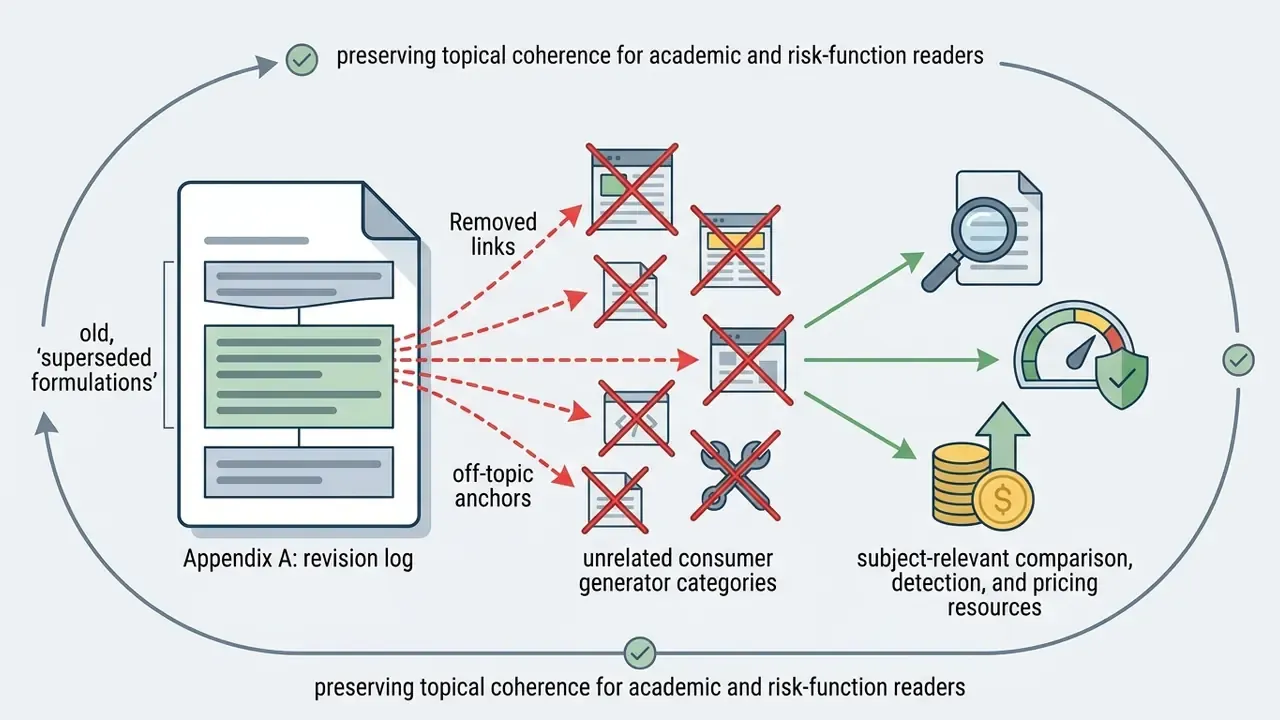
Appendix A: revision log of superseded formulations
Retained for transparency. The main text above carries the updated, evidence-anchored versions.
Limitations, open questions, and a safe next step
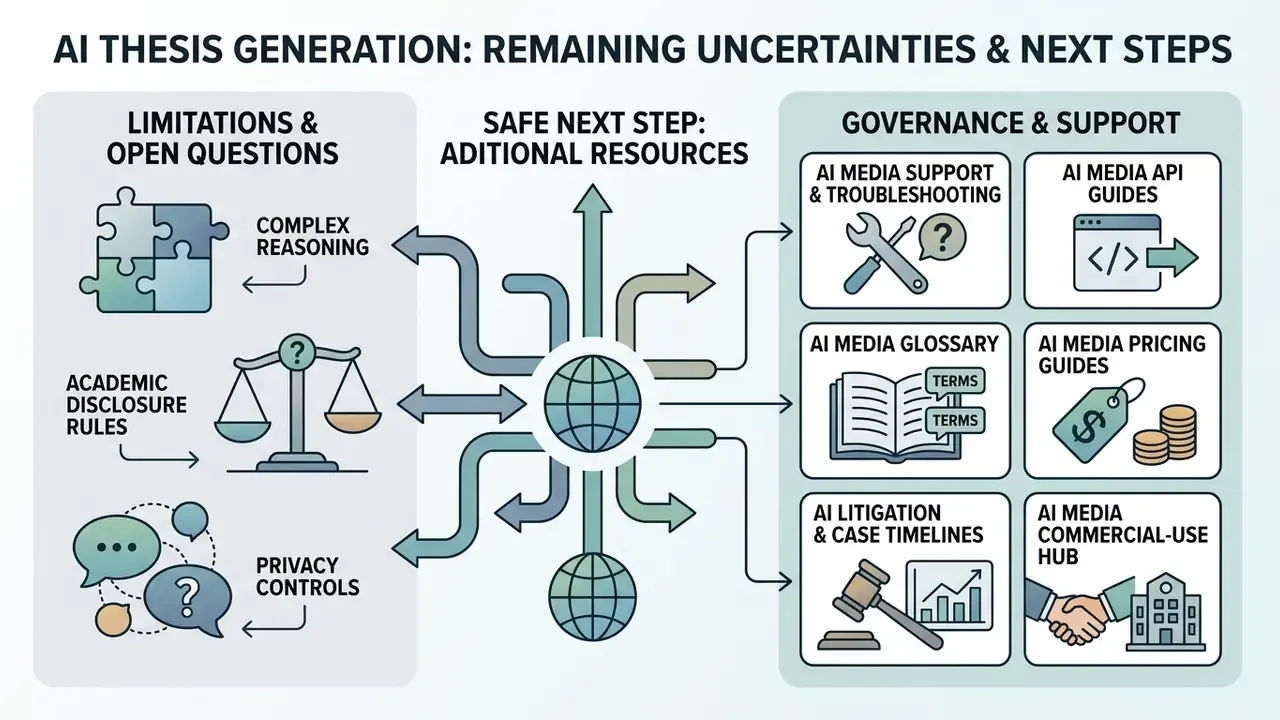
Three things in this guide remain uncertain, and pretending otherwise would be dishonest.
First, citation-hallucination rates move with model releases. The 47.5% ceiling reported in 2026 may improve, but no institution should build a workflow on the assumption that it will.
Second, detector reliability is contested. Studies report both false negatives near zero detection and false positives against non-native writers, which is why disclosure, not detection, carries the governance weight.
Third, vendor data terms change quietly. A training opt-out present in a 2026 policy page is not a contractual guarantee unless it is in your agreement.
A safe next step, whether you are a doctoral candidate or a risk officer: run one pilot claim end to end. Generate three candidates, verify every reference by DOI, log the prompts, and record the human edit. If that loop takes longer than writing the thesis yourself, you have learned something useful about the tool. If it does not, you now have a documented, repeatable process rather than an anecdote.
Additional resources and governance
For operational frameworks, legal guidance, and implementation notes across generative tool categories: