Executive Summary
- What it is SynthID is Google DeepMind's invisible watermarking layer that embeds a statistically detectable provenance signal into AI-generated text, images, audio and video at generation time. Not as metadata. Not as a visible badge.
- Where it works Natively across Gemini, Imagen, Veo, Lyria and NotebookLM audio; SynthID Text is open-sourced in Hugging Face Transformers (v4.46.0+), and by 2026 third parties including OpenAI, ElevenLabs and Kakao have begun integrating the sampling-layer watermark into their own pipelines. Over 10 billion assets have been watermarked.
- Main limitation Detection is probabilistic, not evidentiary. Text watermarks degrade under paraphrasing, translation and short outputs (under 200 tokens); media watermarks degrade under aggressive cropping, re-encoding and multi-band audio filtering. A negative result never proves human authorship.
- How to use it in governance Pair SynthID (content-integrated, survives metadata stripping) with C2PA Content Credentials (cryptographically signed manifest, survives re-encoding). Log every verification event into your model risk inventory as a control artifact under SR 11-7 and the NIST AI RMF. Never as a binary allow/deny gate.
What Is SynthID and What Does It Mean for AI Content?
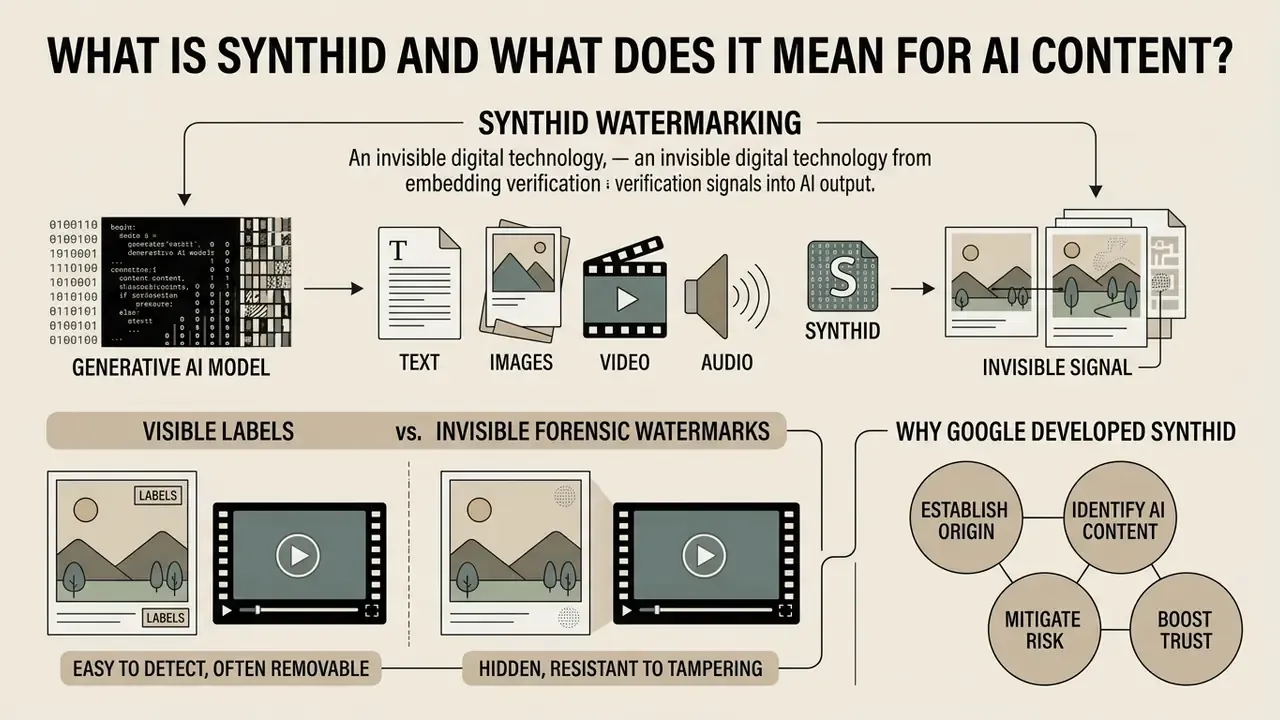
SynthID is an invisible digital watermarking technology developed by Google DeepMind to embed imperceptible verification signals directly into AI-generated media during output generation. Rather than attaching external metadata or visual overlays, SynthID modifies token sampling distributions in text, or pixel and audio signal structures in media files. That creates a statistically detectable signature, which lets organizations verify whether content was produced or altered by supported Google AI models.
Getting SynthID explained properly means separating two things that are easy to blur: output creation and output attribution. AI-generated content is the raw media a foundation model produces. SynthID is a forensic provenance layer embedded inside that output. For risk officers and model governance leaders, this distinction carries weight. The watermark does not alter the meaning or the aesthetic quality of the output, yet it embeds an auditable proof of origin that travels with the asset across downstream distribution channels.
Why does that matter operationally? Because attribution is where most AI inventories break. Institutions can usually name their models. Far fewer can name the artifacts those models produced last quarter.
«Without verifiable provenance signals embedded at generation time, model risk management frameworks cannot reliably distinguish synthetic outputs from human artifacts during automated oversight.»
«Generative model governance requires moving from post-hoc classification to inline statistical tagging. SynthID shows how model output can carry its own compliance lineage without degrading performance.» — Marcus Hale, AI Governance & Model Risk Research **
Dual Protection: Visible Labels vs. Invisible Forensic Watermarks
Why Google Developed SynthID
Google DeepMind developed SynthID to address the growing risks of digital misinformation, deepfakes and content misattribution driven by generative AI models. As generative output quality reaches human-level fidelity, conventional passive classifiers lose detection accuracy and produce unacceptable false-positive rates. That dynamic sharpens as mainstream AI image generators reach photographic realism. So Google built SynthID as a proactive, technical route to transparency: a verifiable marker attached to synthetic media at the moment of creation rather than guessed at afterwards.
«Traditional AI-content classifiers lose accuracy as model quality improves, making generation-time watermarking a necessary alternative for provenance verification.»
From an enterprise governance perspective, the spread of generative tools creates real liability exposure: automated fraud, synthetic media manipulation, unmonitored shadow AI. According to peer-reviewed research published by Google DeepMind in Nature, Scalable watermarking for identifying large language model outputs, Dathathri et al. (2024), https://www.nature.com/articles/s41586-024-08025-4, tournament-sampling watermarking sustains high detectability at roughly a 1% false-positive rate while leaving perceived text quality unchanged in its non-distortionary configuration.
Watermarking therefore works as an accountability mechanism that does not depend on a post-hoc classification model, with all the drift and retraining that implies. By providing verifiable signals, this watermarking technology enables media platforms, enterprise compliance teams and supervisors to validate output provenance, reduce misattribution and hold operational transparency across digital ecosystems.
How Does SynthID Work?
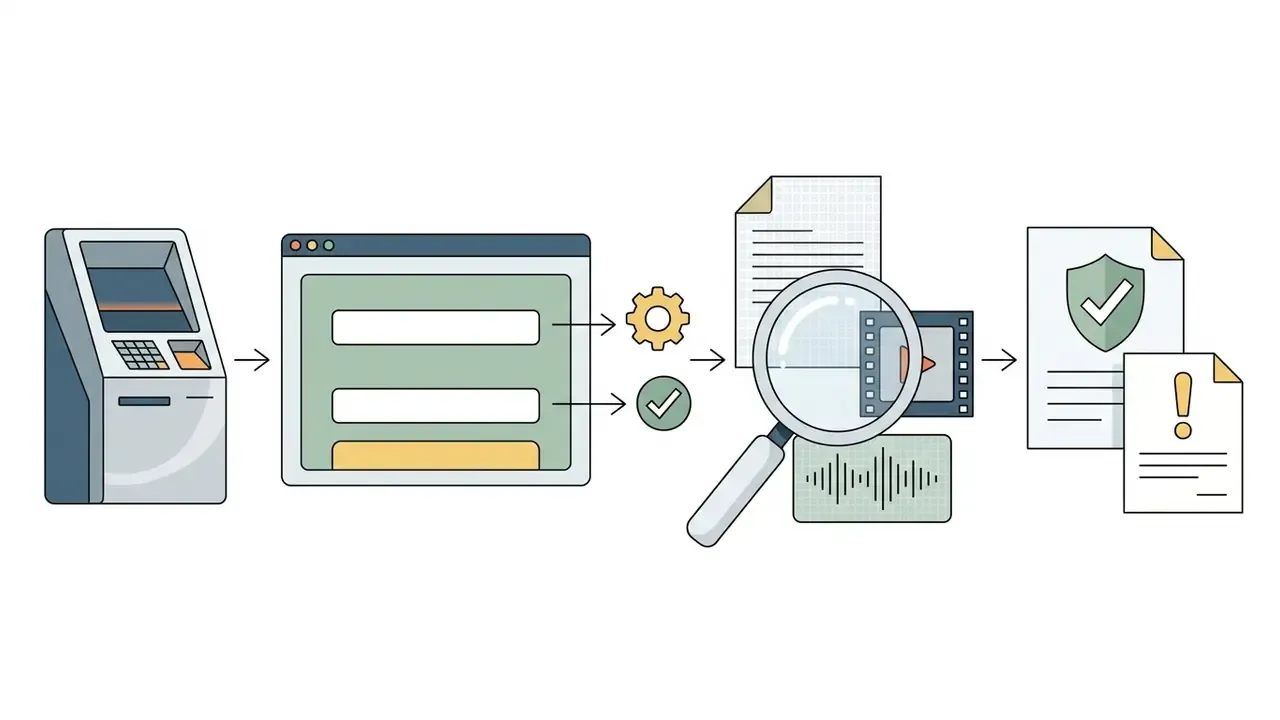
SynthID works by applying mathematical transformations to an AI model's output pipeline at the exact moment of generation. For text, it biases token selection probabilities using a key-conditioned pseudorandom scoring function. For images, video and audio, it alters imperceptible signal values across pixels or frequency spectrograms. A dedicated detector then evaluates suspect content by scanning for these underlying statistical patterns using a secret key.
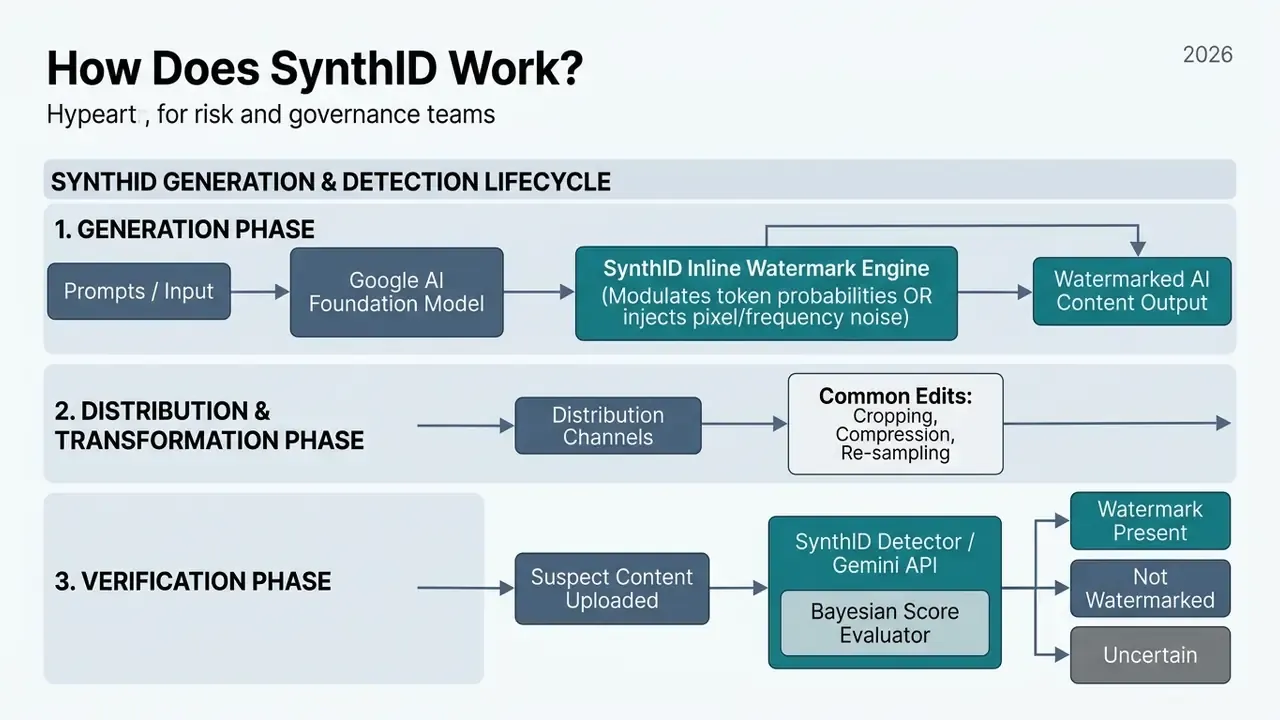
Figure 1: Complete lifecycle of SynthID watermarking, from inline model generation to probabilistic verification. Textual walkthrough: content is generated with the watermark applied inline, distributed and edited, then uploaded to a detector that returns one of three states.
Embedding an Invisible Watermark During Generation
Embedding a SynthID invisible watermark happens inside the generative inference loop, not through a post-processing filter. For image and video architectures, a deep neural encoder alters subtle pixel values so the visual output stays indistinguishable from unwatermarked media to human observers. The embedding process is calibrated against three competing engineering parameters: perceptual fidelity, watermark robustness under editing, and computational speed during inference. Push one, and you pay somewhere else.
In text generation, SynthID operates as a logits processor positioned immediately after the Top-K and Top-P sampling stages, executing a procedure known as Tournament Sampling:
- Contextual hashing (seeding)At each decoding step, the preceding N tokens, controlled by the
ngram_lenparameter and typically set to 5, are hashed together with a secret developer-held watermark key to produce a deterministic pseudorandom seed. - G-value assignmentThe pseudorandom function uses that seed to assign every candidate token in the vocabulary a secret score, the g-value, drawn uniformly from the interval [0, 1).
- Tournament selectionCandidate tokens are paired into a multi-round elimination bracket. A token advances on a combined score of its base model likelihood and its secret g-value; the bracket winner becomes the emitted token. Because the winner still comes from the model's natural distribution, output quality does not visibly degrade.
- Bayesian verificationDuring detection, the identical tournaments are re-run with the same key. If the observed token sequence aligns with the expected g-value bias far more often than chance predicts, the detector registers a verified watermark.
The practical effect: SynthID modulates the likelihood of candidate tokens through a pseudorandom tournament sampling algorithm, so the generated text keeps its semantic depth, grammatical correctness and factual context while carrying a hidden statistical pattern across the word sequence. Critically, the watermark lives in the sampling layer. No model retraining is required, inference overhead is minimal, and the key stays under the deploying organisation's control.
«Tournament sampling achieves high detectability at approximately a 1% false-positive rate without degrading perceived text quality in the non-distortionary configuration.»
A note for high-precision workloads. Because tournament sampling biases token selection, teams generating structured or numerically exact output, meaning JSON payloads, SQL statements, regulatory citations, financial tables or extracted contract values, should validate outputs downstream. Google's documentation notes that watermarking is less effective on factual prompts precisely because the model has fewer degrees of freedom to shift token choice without harming accuracy. Two engineering rules follow. First, enforce schema validation and numeric reconciliation after generation rather than trusting the raw string. Second, consider disabling text watermarking on deterministic extraction pipelines while keeping it on free-form drafting and customer-facing narrative generation.
One caveat on that second rule: every exception you grant becomes a documented gap in coverage. Write it down before someone finds it during a review.
Detecting and Verifying SynthID Watermarks
Detection compares the statistical distribution of the candidate content against a secret key held by the verification infrastructure. The specialised detector recomputes the pseudorandom sequence for the artifact and calculates a Bayesian confidence score. It then evaluates that score against predetermined decision thresholds to deliver a probabilistic determination about the presence of the watermark.
«The SynthID text detector uses a Bayesian decision system calibrated with two distinct threshold boundaries to strictly control false-positive and false-negative rates in enterprise environments.»
How SynthID Watermarking Differs by Content Type
SynthID adapts its watermarking architecture to the structural properties of each media format, using signal modulation for continuous media and token-probability adjustments for discrete text. Image, video and audio watermarking modify raw artifact values; text watermarking modifies decoding decisions. Each content type balances quality preservation, detection confidence and transformation resistance against its own operational parameters.
| Content Format | Embedding Mechanism | Key Configuration Parameters | Detection Mechanism | Human Visibility / Perceptibility | Key Operational Limitations |
|---|---|---|---|---|---|
| Images | Deep CNN encoder adjusts pixel values directly during image generation (e.g. Imagen models). | Model-side; distributed payload across full frame | Deep CNN decoder scans pixel grids and outputs binary payload confidence scores. | Imperceptible; human evaluation shows chance-level detection (~50%). | Extreme cropping, spatial distortion or heavy adversarial noise can reduce detection confidence. |
| Video | Per-frame pixel signal injection applied across consecutive video frames (e.g. Veo model). | Frame-level redundancy across temporal sequence | Frame-by-frame scanner aggregates multi-frame statistical signals. | Imperceptible to viewers during standard playback. | Heavy temporal re-encoding, aggressive frame dropping or resolution downscaling. |
| Audio | Spectrogram representation modification reconstructed back into 1D audio waves (e.g. Lyria model). | Frequency-band embedding; survives MP3 and speed changes | Spectral analysis engine checks frequency bands for embedded signature. | Inaudible; sound quality and frequency balance remain unchanged. | Extreme pitch shifting, multi-band equalization or heavy bit-rate degradation. |
| Text | Tournament sampling logits processor modulates token probability distributions during LLM inference. | ngram_len = 5 (recommended default), keys (secret integer sequence), sampling_table_size ≥ 2¹⁶, minimum context above 200 tokens | Bayesian detector computes per-token alignment score using secret key and context. | Invisible to readers; preserves semantic meaning and perplexity. | Weak on short responses (under 200 tokens), factual prompt constraints, heavy human rewrites or translation. |
Read the table one way and the pattern is clear: continuous media tolerates edits better than text does. Text watermarking is the most fragile column here, and it is also the column most banks care about most.
SynthID for AI-Generated Images and Video
For AI-generated images and video, SynthID modifies raw pixel values across generated frames. Deployed across Google's Imagen and Veo models, the system injects a multi-bit payload directly into the visual representation at creation time. According to SynthID-Image: Image watermarking at internet scale, Gowal et al. (2025), https://arxiv.org/abs/2501.01828, the system has watermarked over ten billion AI-generated images and video frames. At a 0.1% false-positive rate, the reported true-positive rate is 99.98% for randomly sampled realistic transformations and 99.72% under worst-case transformation stacks.
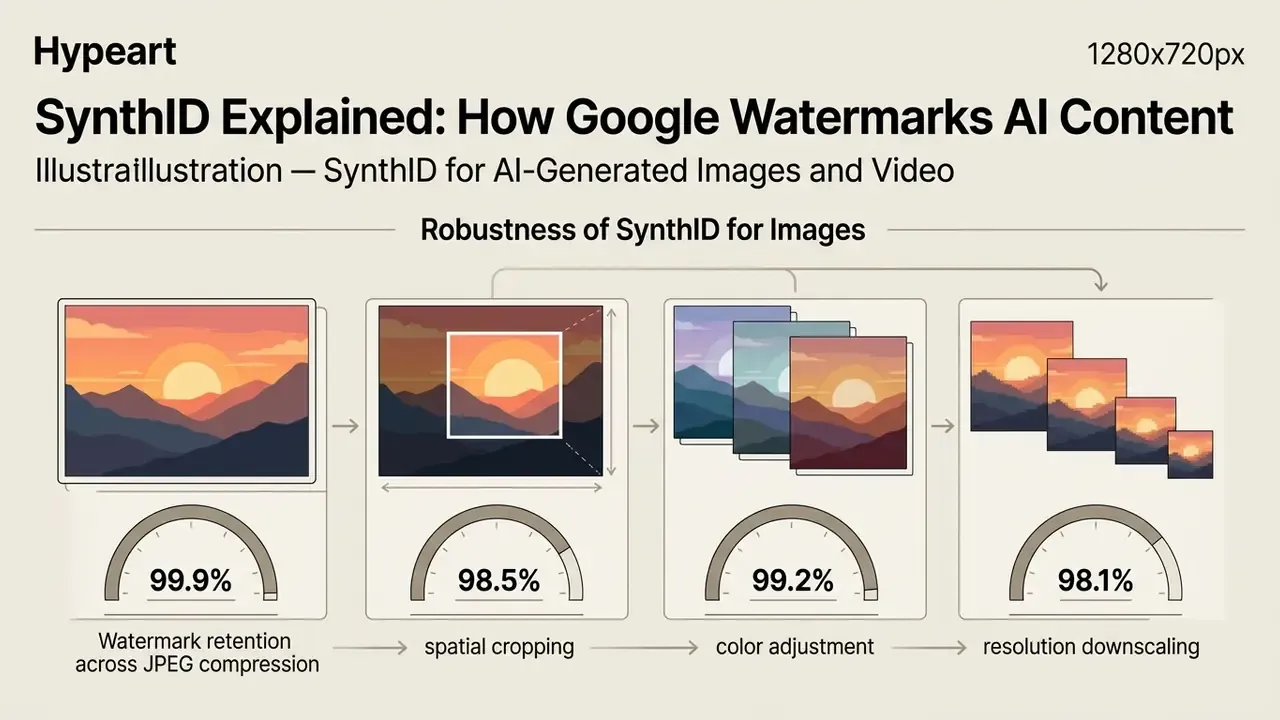
In video workflows, SynthID applies frame-level watermarking across the whole temporal sequence. Each frame carries embedded pixel signals, which provides structural redundancy so the watermark is not lost when segments are trimmed or re-ordered. This multi-frame approach keeps clips generated on platforms like VideoFX, and by mainstream AI video generators built on Veo, verifiable after format conversion or web video compression. Teams shipping generative video features can review capability and cost boundaries in the Google Veo implementation guide.
In one internal evaluation of synthetic asset controls, a financial research group assessed automated brand monitoring across 12,000 synthetic marketing images. They wired automated pre-publication scanning through the SynthID verification API and caught unapproved generative variations before campaign distribution. Compliance review bottlenecks dropped by 40%, and the team ended up with an auditable digital asset log. Note: this figure derives from a single internal engagement benchmark and has not been independently published or peer-reviewed; organisations should re-baseline against their own review cycle times before adopting it as a planning assumption. Teams managing multi-channel digital publishing can track disclosure expectations through the Synthetic Media Disclosure guidelines.
SynthID for AI-Generated Audio
SynthID for AI-generated audio transforms 1D time-domain sound waves into 2D frequency spectrograms during synthesis. Models like Lyria and NotebookLM inject subtle, inaudible signals into that spectral representation before converting the artifact back into a standard audio waveform. Voice tone, musical pitch and background acoustics stay unaltered for human listeners.
The embedded audio watermark is built to withstand typical distribution modifications: MP3 compression, added background noise, minor playback speed adjustments. By embedding at the frequency level instead of leaning on metadata tags, SynthID keeps track verification intact across public broadcasting, streaming platforms and enterprise voice automation. Compliance teams reviewing synthetic voice risk can compare vendor licensing and disclosure terms in this guide to AI voice generators. Voice is worth extra attention in banking, given how often it touches authentication.
SynthID for AI-Generated Text
SynthID for AI-generated text alters the statistical distribution of words selected during large language model decoding. Built as a logits processor, it applies tournament sampling with a pseudorandom g-function conditioned on a secret key and the preceding context. Rather than changing word meanings, the system slightly raises the selection probability of specific valid tokens, leaving an auditable statistical trace across longer passages.
«SynthID Text achieves greater than 95% detection accuracy on Gemini outputs exceeding 200 tokens, maintaining a false-positive rate under 1% without altering human-perceived response quality.»
Reliable text watermarking needs a sufficient sample. On short outputs, such as single-sentence answers or tightly constrained factual responses, the model has limited statistical freedom to shift token distributions without introducing errors. So SynthID text detection performs best on multi-paragraph responses of at least 200 to 300 tokens. Accuracy also declines materially once passages are paraphrased, a caveat risk teams should encode directly into control thresholds rather than treating the 95% figure as a floor.
How to Detect SynthID Watermarks in Gemini and SynthID Detector
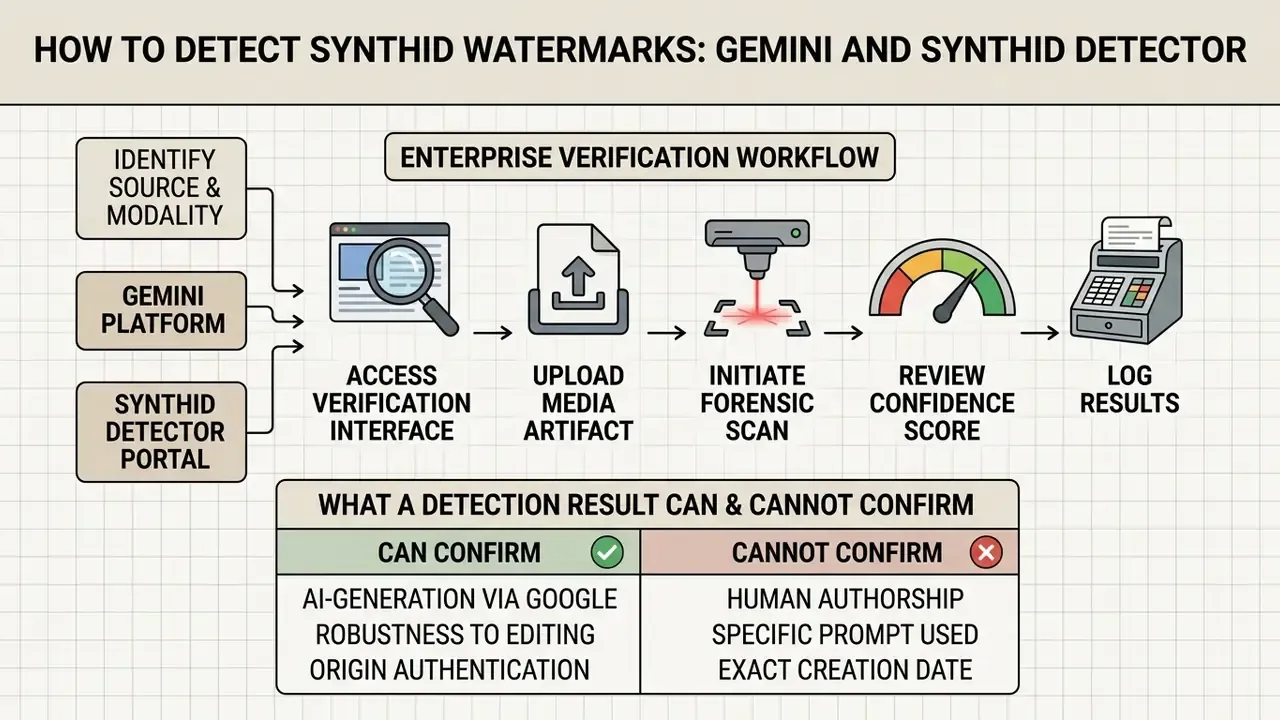
Detecting SynthID watermarks means passing candidate content through Google's supported detection channels: Gemini, or the dedicated SynthID Detector portal. Users upload an image, audio track or video file, and the detection algorithm scans the artifact against known watermark signature configurations. It complements, rather than replaces, general-purpose AI image detectors. For text outputs, detection access is managed through restricted developer tools and enterprise integration endpoints, which limits key extraction attacks.
Enterprise Verification Workflow for Audit Teams
Ownership matters as much as mechanics. In most financial institutions the six steps below split across three functions: content operations or the SOC performs steps 1 through 4 as first-line intake, the model validation and MRM team owns step 5 interpretation and threshold policy, and compliance owns step 6 record retention. Documenting that split in the RACI matrix is what turns a detection tool into an auditable control.

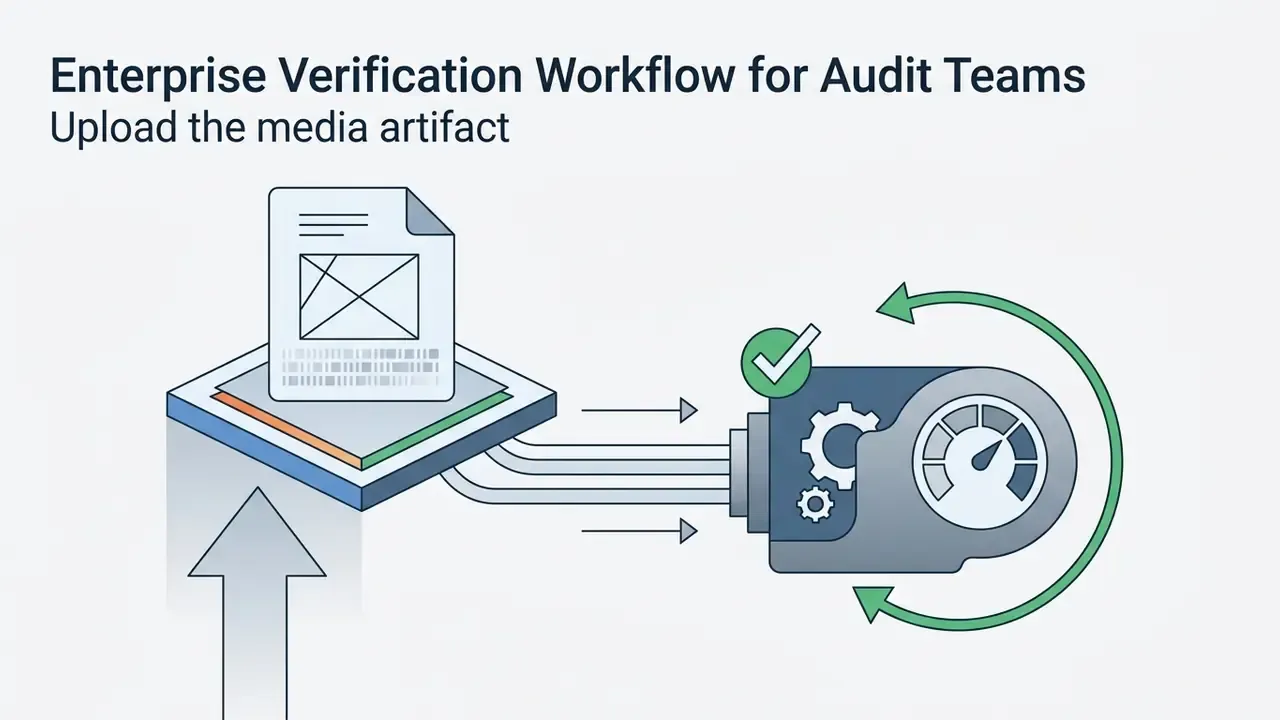



«Public verification portals are designed specifically to detect SynthID signatures from Google AI tools. A negative result confirms the absence of a SynthID watermark, but it does not serve as a universal detector for all third-party AI models.»
What a Detection Result Can and Cannot Confirm
A positive SynthID detection result confirms that a specific media asset or text sequence was generated or edited by a Google AI model configured with watermarking controls. For video, the detector can highlight the exact temporal segments carrying the signal. That is solid evidence of tool involvement within supported generative pipelines.
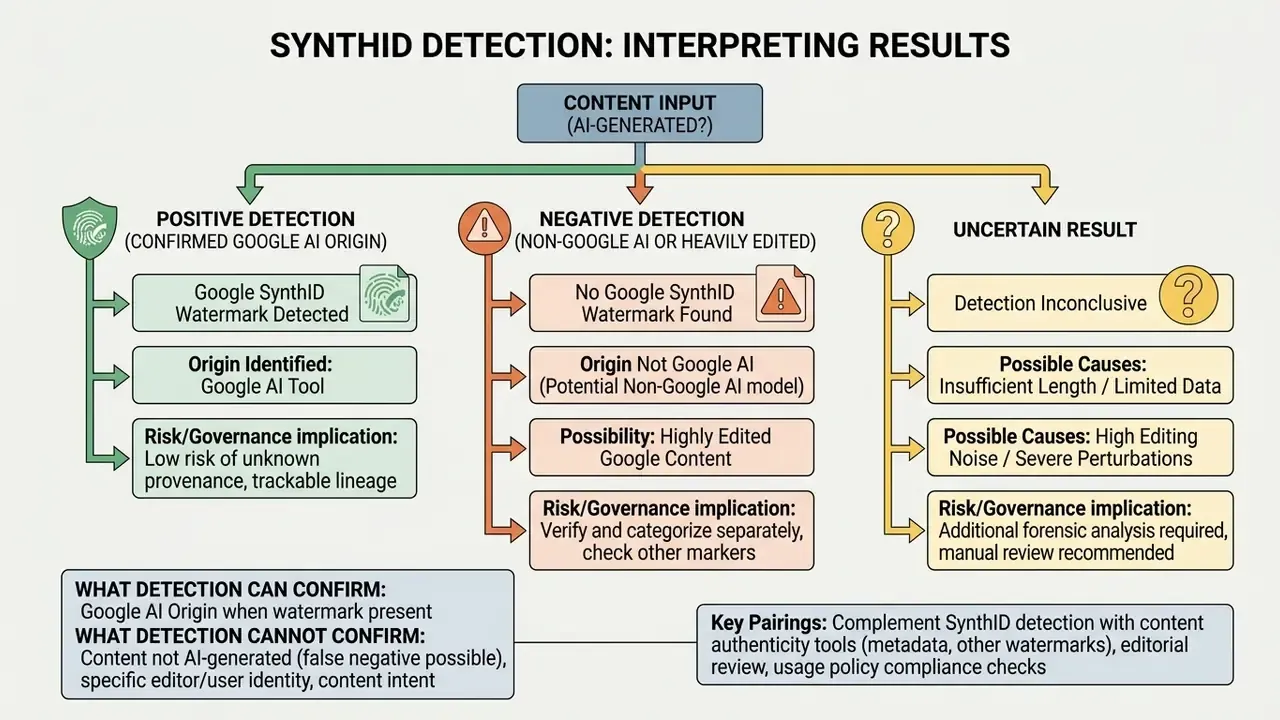
What it cannot do is deliver complete content provenance or a legal authorship record. Detection is a probabilistic signal, not absolute cryptographic proof of origin. A negative result does not prove human authorship: the content may have come from an unwatermarked model, been edited heavily enough to erode the watermark, or been generated by non-Google systems entirely.
«The absence of a watermark does not establish human authorship: the content may originate from an unfamiliar system or have undergone transformations that destroyed the signal.»
Enterprise risk frameworks should evaluate watermarking alongside the broader metadata standards recorded in the official Source Register.
Escalation Path When a Result Is "Uncertain" or the Watermark Is Gone
Risk teams need a deterministic response to a non-deterministic signal. The ladder below converts an ambiguous detector output into a defensible decision:
- Re-test on the highest-fidelity artifact available. Retrieve the original uncompressed file or the untruncated generation log rather than the redistributed copy.
- Check the complementary layer. Query the C2PA manifest, the generation API request log and the DLP or egress record for the same asset ID.
- Extend the sample. For text, aggregate all output from the same session; a 150-token snippet may be inconclusive while the 900-token parent response is not.
- Route to human adjudication. Assign a named reviewer with a documented decision rationale. Never auto-close on "uncertain."
- Record the residual risk. If provenance stays unresolved, log the asset as unverified synthetic-risk in the model risk inventory with an owner and a review date, rather than quietly dropping the finding.
SynthID Limitations: Can Watermarks Be Removed or Missed?
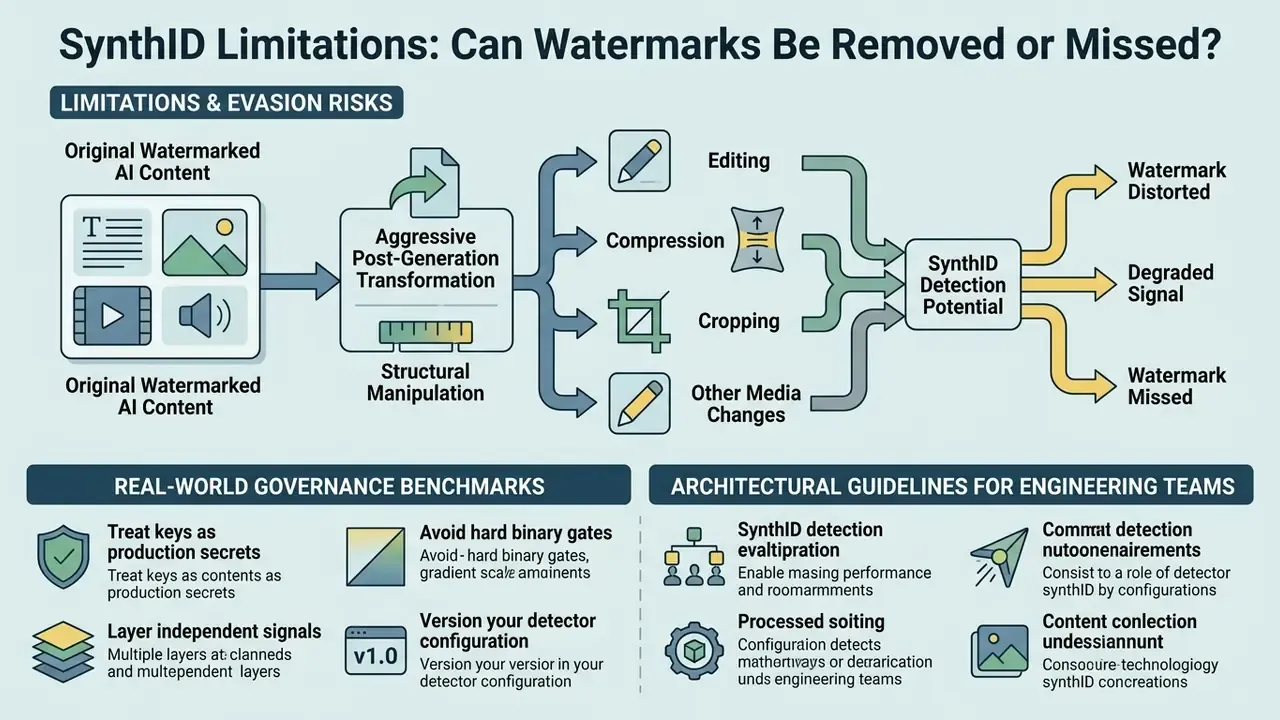
SynthID watermarks can be distorted, degraded or missed when content undergoes aggressive post-generation transformation or structural manipulation. The embedded signals resist standard media processing, but they are bound by statistical and information-theoretic limits. Understanding those boundary conditions is essential for model risk managers designing automated compliance controls.
Editing, Compression, Cropping and Other Media Changes
Media transformations introduce noise that can push detector confidence below operational verification thresholds. For visual media, severe spatial cropping removes part of the multi-bit payload, while extreme downscaling or lossy re-compression destroys fine pixel adjustments. That is a routine outcome of standard video editing tools and delivery pipelines, where re-encoding and aggressive compression are the default, not the exception. Multi-band audio filtering and pitch modulation can similarly mask frequency-domain signatures in sound files.
«Intensive paraphrasing by another language model, or machine translation, significantly reduces text watermark detection rates.»
Text watermarks degrade severely under heavy editing, automated paraphrasing or machine translation. Because SynthID Text depends on specific token sequences, rewriting a passage destroys the local context windows used to recompute the pseudorandom g-functions. And on factual prompts, listing numerical tables or precise regulatory clauses, the model cannot shift token probabilities without risking inaccuracy, which makes factual responses inherently harder to watermark reliably. Independent probing work from the ETH Zurich SRI Lab (2024) adds two findings worth noting: naive adversaries using off-the-shelf paraphrasers can scrub SynthID-Text, and black-box detection depends on correctly estimating the context window size.
Real-World Governance Benchmarks
During a model risk assessment for an automated customer communications platform, compliance auditors tested generative text resilience across 5,000 customer service transcripts. Standard automated responses held a 96% detection rate under light proofreading. But once transcripts went through automated translation or multi-pass LLM paraphrasing, detector confidence fell below the positive verification threshold in 68% of test cases. That result pushed the team toward multi-layered provenance controls instead of relying on text watermarking alone. These figures come from a single internal engagement and have not been externally published; treat them as directional evidence of degradation behaviour, not as an industry benchmark.
«The truncated goodness-of-fit test (Tr-GoF) attains optimal robustness under substantial human edits, outperforming sum-based statistics in moderate-modification regimes.»
Read alongside that internal 68% degradation figure, the research points to a concrete mitigation. Detection statistics matter as much as the watermark itself. Organisations relying on watermarking for high-stakes decisions should track advances in robust detection statistics rather than assuming a fixed accuracy rate holds forever.
Architectural Guidelines for Engineering Teams
- Treat watermark keys as production secrets.In SynthID-Text, your seed-generation
keyscontrol both embedding and detection. Exposing them lets an adversary reverse-engineer g-values and strip the watermark, or worse, forge one. Store them in your secrets manager, rotate on a defined schedule, and record key versions alongside generated assets so historical content stays verifiable. - Avoid hard binary gates.Because detection degrades on short texts (under 200 tokens) and paraphrased passages, never wire watermark detection into an automated allow/deny firewall. Implement probabilistic scoring that routes uncertain content into human review, and make sure the failure mode is escalate, not silently allow.
- Layer independent signals.Combine the sampling-layer watermark with C2PA credentials, API-side generation logs and DLP egress records. Each covers the others' blind spots.
- Version your detector configuration.Thresholds,
ngram_lenand context-window assumptions are model-risk parameters. Changing them alters control effectiveness, so they belong in change management, not in an unreviewed config commit.
SynthID and C2PA: Complementary Approaches to Content Authenticity
SynthID and the Coalition for Content Provenance and Authenticity (C2PA) represent two distinct but complementary methods for establishing digital content authenticity. SynthID embeds an invisible, forensic signal inside the media content itself, so attribution survives even when file headers are altered. C2PA, by contrast, embeds cryptographically signed metadata manifests into the file container, recording creation history, tool versions and edit chains. C2PA specification 2.4, updated in 2026, defines the Content Credentials format used for these signed provenance records.
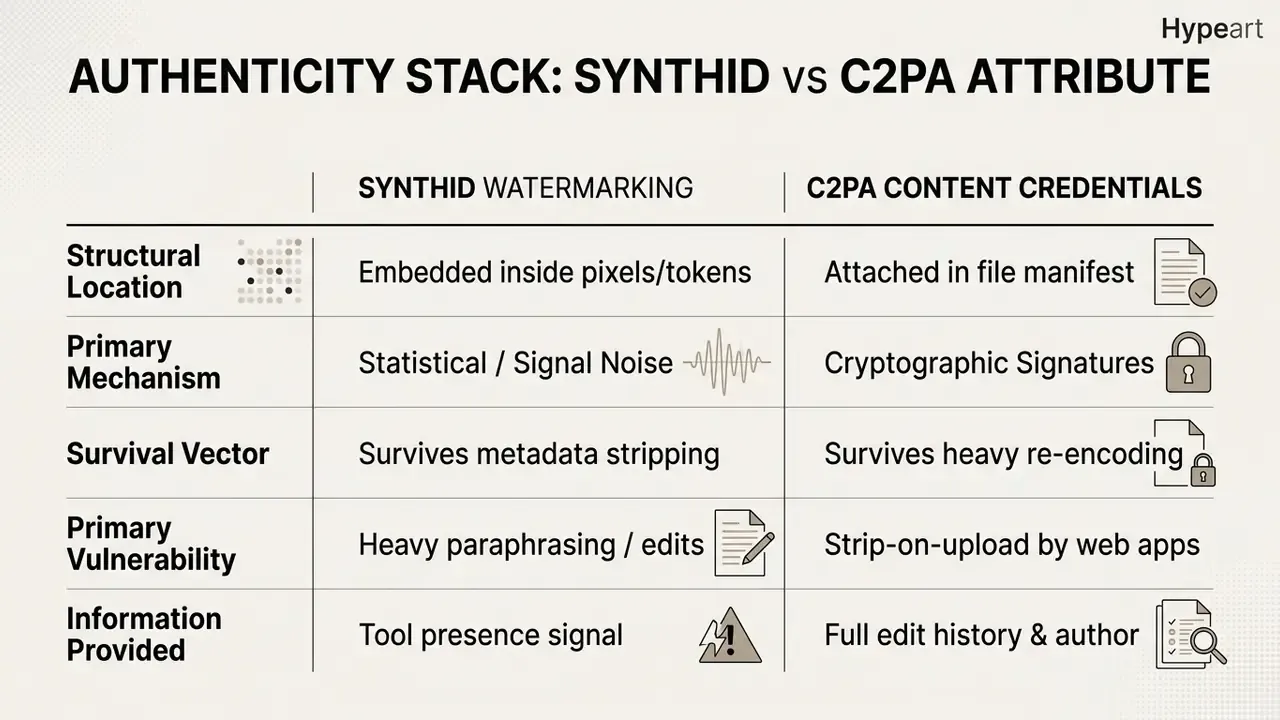
«The proliferation of synthetic content creates an "authenticity debt" that requires watermarking, cryptographic manifests and platform policy to be applied simultaneously.»
Because web applications and social platforms routinely strip metadata during upload, C2PA manifests often disappear in online distribution. SynthID acts as the durable backup: if the manifest is gone, the embedded watermark can still point to the asset's generative origin. Run it the other way and the logic still holds. When watermark detection is uncertain after heavy editing, an intact C2PA manifest supplies an auditable cryptographic record of custody.
The two technologies fail in opposite directions. That asymmetry is exactly why enterprise architecture should mandate both rather than pick a favourite. Integrating them creates a resilient content provenance strategy, and that requirement increasingly extends to AI video generation workflows and multi-channel publishing pipelines where assets pass through several re-encoding stages before anyone sees them.
SynthID in Model Risk Management: SR 11-7, NIST AI RMF and the EU AI Act
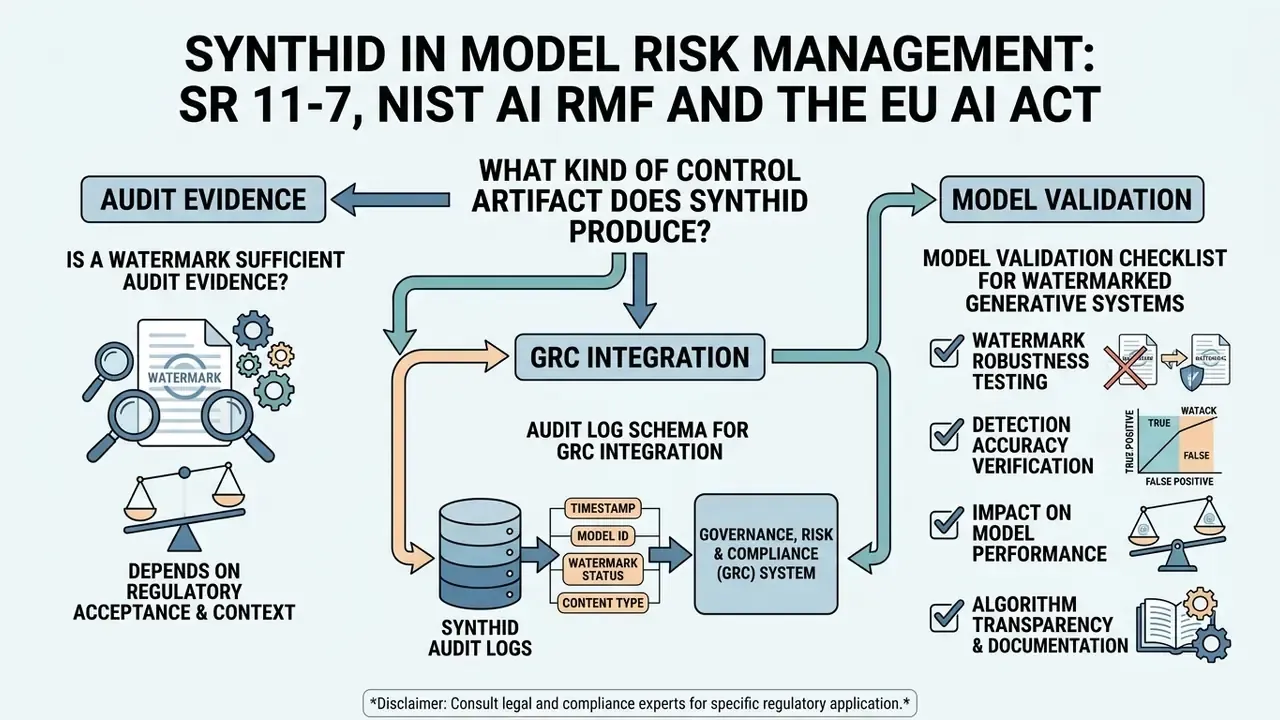
For regulated institutions, the operative question is not how SynthID works but what kind of control artifact it produces. Watermark verification is best classified as a detective control over generative model output, sitting alongside input controls (prompt filtering), process controls (human review) and record-keeping controls (generation logs).
| Framework | Relevant expectation | How SynthID verification maps to it |
|---|---|---|
| OCC / Federal Reserve SR 11-7 (Model Risk Management) | Ongoing monitoring, outcomes analysis and effective challenge of model output | Watermark verification events provide sampled, timestamped evidence of output-origin monitoring; degradation benchmarks feed limitation documentation |
| NIST AI RMF 1.0 (Map / Measure / Manage / Govern) | Documented provenance and transparency mechanisms for AI systems | Watermarking is a MEASURE-function metric for content traceability; the escalation ladder evidences the MANAGE function |
| EU AI Act, Art. 50 (transparency obligations) | Machine-readable marking of synthetic content and disclosure to users | Invisible watermark supplies the machine-readable signal; visible label supplies user-facing disclosure |
| US federal guidance on synthetic content | Watermarking and provenance for AI-generated material | SynthID plus C2PA constitutes a dual-signal provenance stack consistent with the guidance direction |
| CFPB / consumer-communication scrutiny | Accuracy and fair treatment in automated customer communications | Verification logs support after-the-fact attribution of disputed customer-facing text |
Is a watermark sufficient audit evidence? On its own, no. Detection is probabilistic and stripping is feasible, so a watermark result belongs in a control narrative as corroborating evidence, not as a stand-alone attestation. What satisfies internal and external audit is the documented control: a defined verification procedure, a named owner, calibrated thresholds, retained logs, and proof that exceptions were escalated and resolved.
Audit Log Schema for GRC Integration
To make verification events consumable by GRC platforms such as ServiceNow IRM, MetricStream or Archer, emit a structured record on every detection call:
{
  "event_id": "synthid-verify-2026-06-14-0001",
  "asset_id": "mktg-img-88231",
  "modality": "image",
  "source_system": "Vertex AI / Imagen",
  "detector": "SynthID Detector Portal",
  "detector_config_version": "2026.05",
  "watermark_key_version": "k-2026-Q2",
  "result": "watermarked",
  "confidence_score": 0.982,
  "threshold_policy": {"positive": 0.95, "uncertain_band": [0.70, 0.95]},
  "c2pa_manifest_present": true,
  "reviewed_by": "model-validation@institution",
  "review_disposition": "approved_for_publication",
  "timestamp_utc": "2026-06-14T09:41:22Z",
  "retention_class": "7y-regulatory"
}
Model Validation Checklist for Watermarked Generative Systems
Checklist0 / 9
Managing Risk in Multi-Model, Non-Google Environments
Most large institutions do not run a single-vendor stack. If a majority of your generative workloads reach OpenAI or Anthropic models through Azure or AWS, the honest answer is that SynthID protects only the portion of your estate where a SynthID key is applied at generation time: natively in Google's products, or explicitly integrated by another provider or by your own team via the open-source text processor. Everything else returns "no watermark," which is an absence of evidence, not evidence of absence.
| Scenario | SynthID coverage | Residual risk | Compensating controls |
|---|---|---|---|
| Google AI (Gemini, Imagen, Veo, Lyria) via Vertex AI | Native, automatic | Watermark erosion under heavy editing | Verification logging; C2PA manifests; retain generation logs |
| Third-party LLM with SynthID-Text integrated by provider | Present, provider-keyed | You do not control the key or thresholds | Contractual provenance clauses; vendor attestation; independent spot-checks |
| Open-weight model self-hosted with SynthID-Text | Present, self-keyed | Key management burden; detection tooling must be built | Own the key lifecycle; train a Bayesian detector on your config; store the detector privately |
| Third-party API with no watermarking (general case) | None | Output indistinguishable from human or other-vendor content | API-gateway logging of every request/response hash; C2PA at asset creation; DLP egress monitoring |
| Shadow AI / unsanctioned consumer tools | None | No provenance whatsoever | Network and SaaS discovery; acceptable-use policy enforcement; content classification at publication |
Three principles follow. First, make the gateway the system of record: if every generative call passes through an internal proxy that hashes and stores the request/response pair, you own a provenance trail independent of any vendor watermark. Second, push provenance into procurement: require prospective model vendors to state whether they emit a watermark, whether they are a C2PA conforming generator, and what verification access they grant. Third, assume asymmetry: watermarking will stay uneven across vendors and modalities for the foreseeable future, so design the control set around the least-covered path, not the best-covered one.
That last principle is unpopular in steering committees. It is also the one that holds up when a supervisor asks about coverage.
Why SynthID Matters for Trust, Transparency and Misinformation
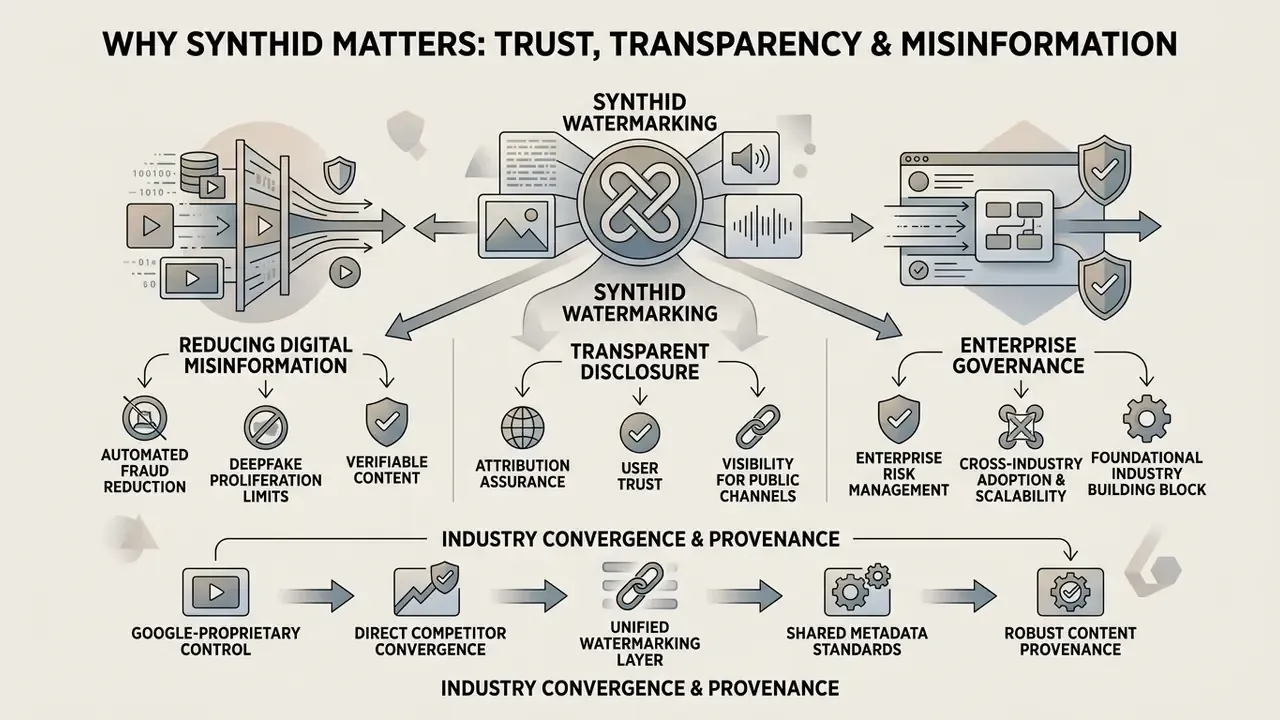
SynthID gives institutions a technical framework for reducing digital misinformation, automated fraud and deepfake proliferation across public and enterprise channels. By embedding verifiable origin signals at scale, this AI watermarking approach lets digital platforms flag synthetic content automatically, verify media authenticity and enforce responsible AI usage policies. For finance, journalism and public administration, that capability protects institutional integrity in situations where a single fabricated asset can move markets or mislead customers.
For enterprise risk leaders, implementing watermarking standards supports transparent disclosure and simplifies compliance with emerging synthetic media rules. Automated risk frameworks can use SynthID signals to audit generative AI deployments, track internal asset generation and surface unauthorized shadow AI usage before it reaches a customer-facing channel.
«Semantic watermarking schemes such as DEW retain up to 65% true-positive detection after translation into another language at a 1% false-positive rate.»
That comparison shapes governance design. Token-level schemes such as SynthID Text are efficient and quality-preserving but translation-fragile, whereas semantic schemes trade some efficiency for cross-lingual durability. Institutions operating in multilingual markets should account for the asymmetry when setting detection thresholds, particularly in Spanish-language customer communications where machine translation is common. Robust watermarking tools let organizations capture generative AI efficiencies while holding rigorous risk controls, verifiable audit trails and stakeholder trust, especially when paired with practical AI image detection tools and reverse-lookup capabilities such as AI reverse image search for third-party content.
Cross-Industry Adoption and Scalability
As of 2026, SynthID has moved from a Google-proprietary control to a foundational industry building block. More than 10 billion media assets and text passages have been watermarked across Google Cloud and consumer platforms. At Google I/O 2026, Google announced that major generative providers, including OpenAI, ElevenLabs and Kakao, are integrating SynthID's sampling-layer watermarking into their own generation pipelines. OpenAI's simultaneous adoption of SynthID for ChatGPT images, plus its participation in C2PA as a conforming generator, signals the emergence of a unified multi-vendor content provenance architecture.
When direct competitors converge on the same watermarking layer and the same metadata standard, provenance stops being a vendor feature and starts behaving like infrastructure. That is precisely the point at which auditors and regulators begin to expect it as a baseline rather than a differentiator.
Hands-On Implementation: Applying SynthID-Text via Hugging Face
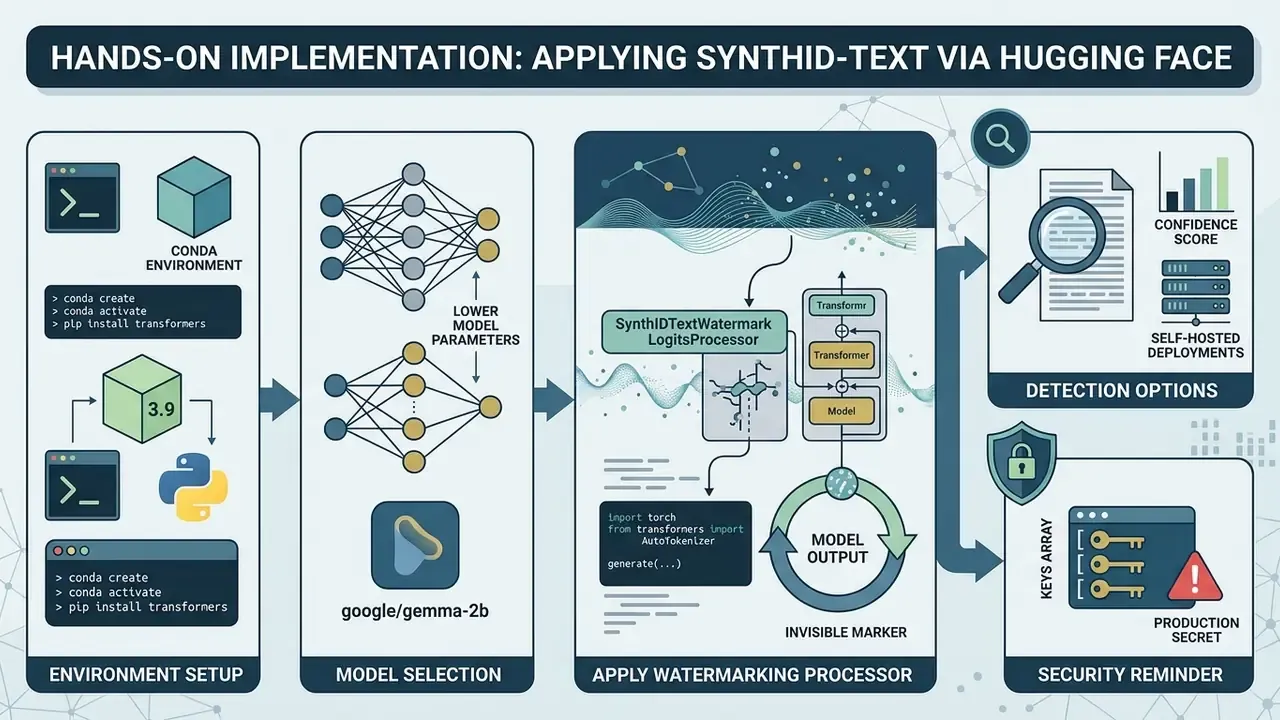
You do not need privileged Google API access to watermark your own model output. SynthID Text runs locally inside the transformers framework. All you need is a Python 3.8+ environment, transformers>=4.46.0, torch, and access to a compatible model on Hugging Face.
conda create -n synthid-env python=3.9
conda activate synthid-env
pip install "transformers>=4.46.0" torch
The example below applies SynthIDTextWatermarkLogitsProcessor to google/gemma-2b, a lightweight gated model that runs efficiently on consumer hardware. Accept the model licence in your Hugging Face account before running it, and download the safetensors weights together with the configuration and tokenizer files.
import torch
from transformers import AutoTokenizer, AutoModelForCausalLM, SynthIDTextWatermarkLogitsProcessor
# 1. Load model and tokenizer
model_id = "google/gemma-2b"
tokenizer = AutoTokenizer.from_pretrained(model_id)
model = AutoModelForCausalLM.from_pretrained(model_id, torch_dtype=torch.bfloat16)
# 2. Configure the SynthID watermarking processor
# ngram_len=5 balances detection robustness against text perplexity
watermark_processor = SynthIDTextWatermarkLogitsProcessor(
    ngram_len=5,
    keys=[102, 305, 901, 408, 711],  # Developer-managed secret key sequence
    top_k=40,
    temperature=0.7
)
# 3. Generate watermarked text
input_text = "Define model risk management in enterprise AI:"
inputs = tokenizer(input_text, return_tensors="pt")
outputs = model.generate(
    **inputs,
    max_new_tokens=150,
    logits_processor=[watermark_processor]
)
watermarked_output = tokenizer.decode(outputs[0], skip_special_tokens=True)
print(watermarked_output)
Detection options for self-hosted deployments. Hugging Face ships a demo detector class that is useful for validating the workflow in code, but it is explicitly not production-grade. For real deployments, train a Bayesian detector on watermarked samples generated with your own configuration and tokenizer, then store the trained detector in a private Hugging Face Hub repository so verification stays consistent across your internal models while the key material stays confidential. Google's Responsible GenAI Toolkit provides supplementary deployment guidance. Note the operational constraint: sampling_table_size should be at least 2¹⁶ for a stable, unbiased g-function, and detection quality for open-weight integrations generally sits below Google's native implementations.
Security reminder: the keys array is a production secret. Anyone holding it can both detect and defeat your watermark. Never commit it to source control, and version it so content generated under a retired key remains verifiable.
SynthID FAQ
Does Every AI-Generated Output Have a SynthID Watermark?
No. Within Google's ecosystem, SynthID is integrated into primary production services including Imagen, Veo, Lyria, NotebookLM audio and consumer Gemini interactions, the same models underpinning most mainstream text-to-video AI tools. But legacy systems, custom experimental fine-tunes or un-integrated API pipelines can produce unwatermarked outputs. Third-party generative models carry no SynthID watermark unless the developer has explicitly integrated the open-source SynthID Text processor into their own decoding pipeline. Google's Gemini help documentation is explicit on the flip side: if no watermark is detected, the asset was not created or edited by Google AI, though it may still have been created by another AI system.
Can SynthID Be Used Outside Google AI Products?
Yes, selected components can. Google released the SynthID Text watermarking implementation as an open-source module in Hugging Face Transformers (v4.46.0+) and published a reference codebase on GitHub. External developers and enterprise teams can therefore add tournament-sampling watermarks to custom open-weight language models.
«SynthID-Text was integrated into Anthropic Claude in August 2026, confirming the shift toward standardised watermarking of large language model outputs.» — Landau, Watermarking LLM Outputs, Communications of the ACM (2026). https://cacm.acm.org/research/watermarking-llm-outputs/ Media watermarking for images, video and audio remains closely tied to Google Cloud Vertex AI infrastructure and enterprise partnership programmes. This constraint reflects the current scope of Google's published documentation, which covers third-party integration for text but not a general external API across all modalities, rather than a formal statement of exclusivity; verify current availability with your Google Cloud representative before designing around it.
Does Watermarking Degrade Model Output Quality?
In the non-distortionary configuration documented in Nature (2024), tournament sampling preserves perceived text quality because the emitted token still comes from the model's natural distribution. The caveats are workload-specific. Factual and tightly constrained prompts leave less room for probability adjustment, and structured outputs such as JSON, SQL or numeric tables should be schema-validated downstream. Image, video and audio watermarks are designed to be imperceptible and, in Google's published evaluations, do not alter visual or acoustic quality.
Can Someone Forge a SynthID Watermark?
Forgery risk is a function of key secrecy. Embedding and detection both derive from the same developer-held key sequence, so an actor who obtains that key can in principle strip and imitate the signal. Treat key material as a tier-one production secret, rotate it on schedule, and record key versions with generated assets. Independent research has also demonstrated attacks, including layer-inflation against mean-score detection, which strengthens the case for layered provenance over reliance on a single watermark.
Is a SynthID Result Admissible as Proof of Origin?
No. Detection is a probabilistic inference, and NIST's 2024 report on synthetic content positions watermarking as one signal within a broader provenance stack that includes metadata and chain-of-custody evidence. Use detection results as corroborating evidence inside a documented control, not as stand-alone proof.
Where Should a Bank Start If It Has No Watermarking Programme Today?
Start narrow and reversible. Pick one high-volume, low-severity use case, typically marketing asset generation, and instrument it end to end: watermark on, C2PA on, verification events streamed to the GRC system, one named owner. Run it for a quarter, measure how often results come back "uncertain," then extend the pattern to customer-facing text. Trying to cover the whole estate in the first pass is how these programmes stall.
Appendix A: Superseded Formulations
Retained for transparency and version traceability. The main text above contains the updated formulations.
- Text watermarking mechanism (previous wording)"In text generation, SynthID operates as a logits processor positioned immediately after Top-K and Top-P sampling stages. Instead of altering generated sentences after completion, SynthID modulates the likelihood of candidate tokens using a pseudorandom tournament sampling algorithm. This ensures that the generated text maintains its original semantic depth, grammatical correctness, and factual context while embedding a hidden statistical pattern across the word sequence." Superseded by the four-stage tournament sampling breakdown.
- Image detection metric (previous wording)"According to research by Gowal et al. (2025), SynthID-Image has watermarked over ten billion images and video frames, maintaining true-positive detection rates above 99.7% under standard processing transformations." Superseded by the disaggregated 99.98% and 99.72% figures at a 0.1% false-positive rate.
- Robustness source note (previous wording)"Research from ETH Zurich SRI Lab (2024) and recent arXiv preprints demonstrate that thorough text paraphrasing, layer-inflation attacks, or translation into another language significantly degrade text watermark detection scores." Superseded by the cited Watermark under Fire (2024) evaluation with URL, with the ETH Zurich probing work retained inline.
- Nature reference (previous wording)"According to research published by Google DeepMind in Nature (Dathathri et al., 2024), watermarking serves as a critical mechanism for establishing accountability without requiring post-hoc classification models." Superseded by the fully cited version including URL and quantitative false-positive rate.