Last updated and reviewed for compliance: April 2026 · Reviewed by: Marcus Hale, author.
Executive Summary
- A celebrity ai image generator turns a text prompt or an uploaded selfie into a synthetic portrait, selfie, or scene featuring a recognizable public figure or a celebrity-style persona. Under the hood: diffusion models, GANs, LoRA adapters, and face-fusion pipelines.
- Two prompt archetypes dominate. One is the polished red carpet or studio template. The other is the viral accidental iPhone selfie template that deliberately adds motion blur, uneven street lighting, and awkward framing for TikTok-style authenticity.
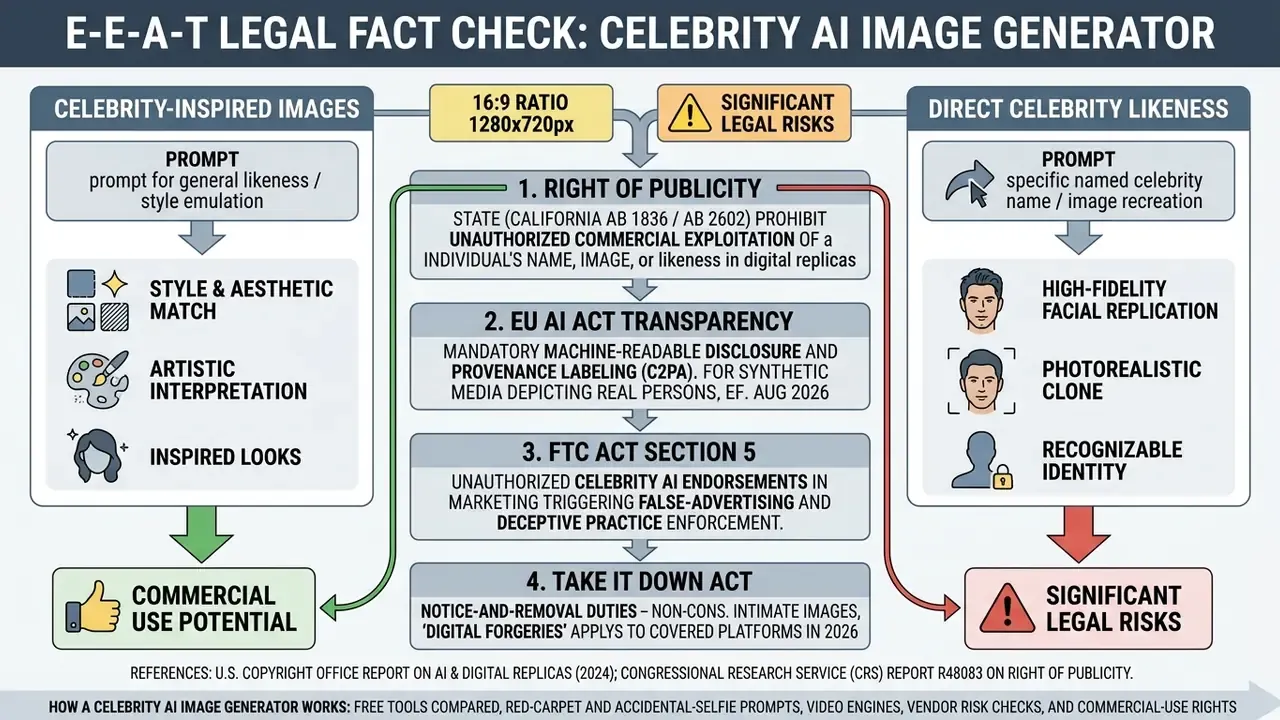
- Legal exposure scales with direct likeness. State right of publicity statutes (California AB 1836 and AB 2602), FTC Act Section 5 enforcement against implied endorsement, the EU AI Act transparency obligations (August 2026), and biometric frameworks such as Illinois BIPA and the GDPR all apply.
Key Terms Used in This Guide
Before the how-to sections, a quick shared vocabulary. Most disagreements between creative and compliance teams start as definitional confusion, not as a policy dispute.
| Term | Working definition | Why a risk owner cares |
|---|---|---|
| Diffusion model | A generative model that denoises random noise into an image, guided by text or image conditioning | Determines output fidelity and the practical limits of moderation filters |
| GAN | Generative adversarial network, an older architecture still used in face-swap pipelines | Legacy tooling often sits outside the sanctioned model inventory |
| LoRA adapter | Small fine-tuned weight set that teaches a base model one identity or style | Identity-specific LoRAs are the mechanism behind most unauthorized digital replicas |
| Face fusion | Blending an uploaded face with a target image while preserving identity cues | Involves biometric templates, which triggers BIPA and GDPR duties |
| Digital replica | A highly realistic electronic depiction of an identifiable real person | The category regulators are actively legislating around |
| Right of publicity | State-level protection of name, image, likeness, and voice from commercial exploitation | Applies even when the image is entirely synthetic |
| C2PA | Signed provenance metadata attached at the moment of generation | Your cheapest, most durable audit artifact |
| Shadow AI | Unapproved tools used inside business teams without inventory or review | The default state of most creative departments, unfortunately |
Generative artificial intelligence now allows users to synthesize high-resolution portraits, personal selfies, and custom visual scenarios alongside public figures. A celebrity ai image generator uses deep neural networks, such as diffusion architectures and generative adversarial networks, to map text prompts or reference face uploads into novel visual outputs. The creative upside is real: digital storytelling, fan art, concept design. So are the governance problems around publicity rights, data privacy, and synthetic media authenticity.
[🖼️ INFOGRAPHIC: Comparison of generation formats
What Is a Celebrity AI Image Generator?
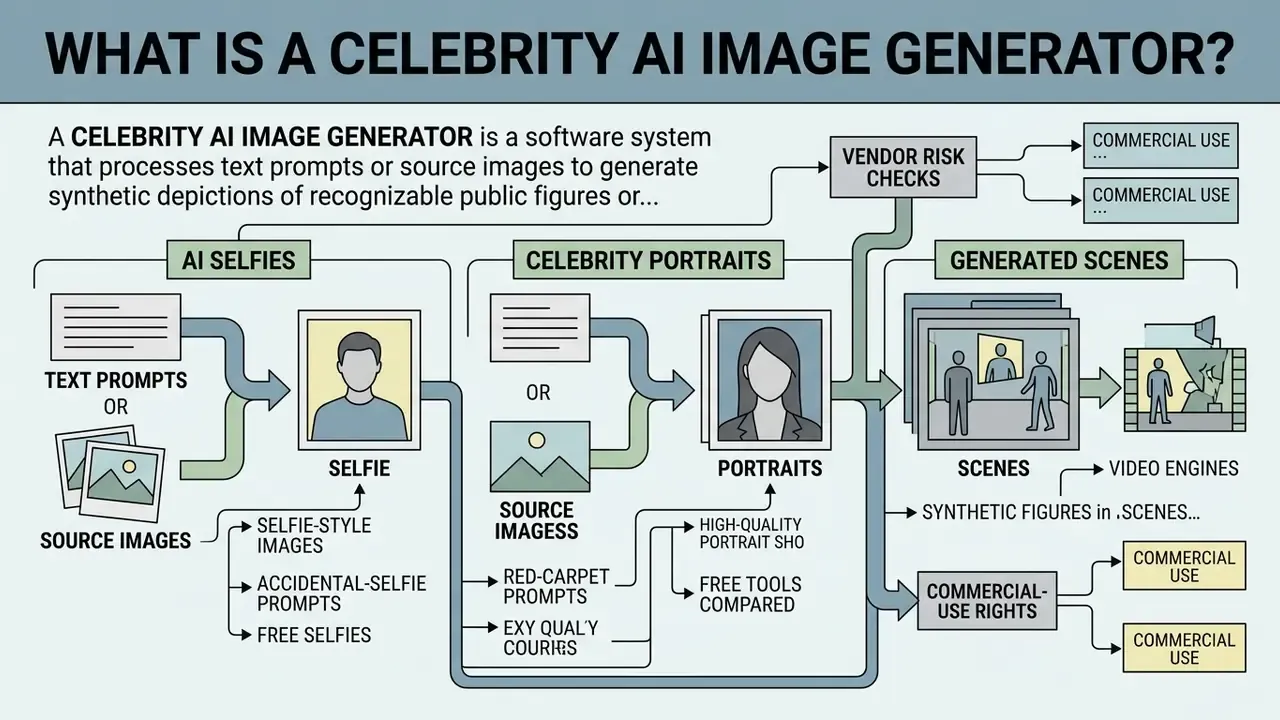
A celebrity ai image generator is a software system that processes text prompts or source images to generate synthetic depictions of recognizable public figures or celebrity-style personas. These platforms rely on face fusion pipelines, latent space manipulation, and multimodal conditioning to synthesize realistic headshots, studio portraits, and casual selfies.
An ai celebrity image generator works by parsing prompt parameters (facial expression, camera angle, lighting condition, environment detail) against very large datasets of face images. Benchmark work presented at CVPR 2025 shows how this fidelity is now measured at scale.
The dataset's real value for practitioners is its annotation layer: demographic attributes plus generation method. That lets a team test whether a face-generation or face-detection pipeline behaves consistently across skin tones, age groups, and synthesis techniques, instead of reporting one aggregate realism score. Aggregate scores hide the failures that matter.
Enterprise teams evaluating these tools must separate casual creative apps from enterprise-grade models governed by risk management standards. A structured comparison of AI image generators for commercial use helps split consumer novelty apps from platforms with documented licensing.
AI selfies, celebrity portraits, and generated scenes
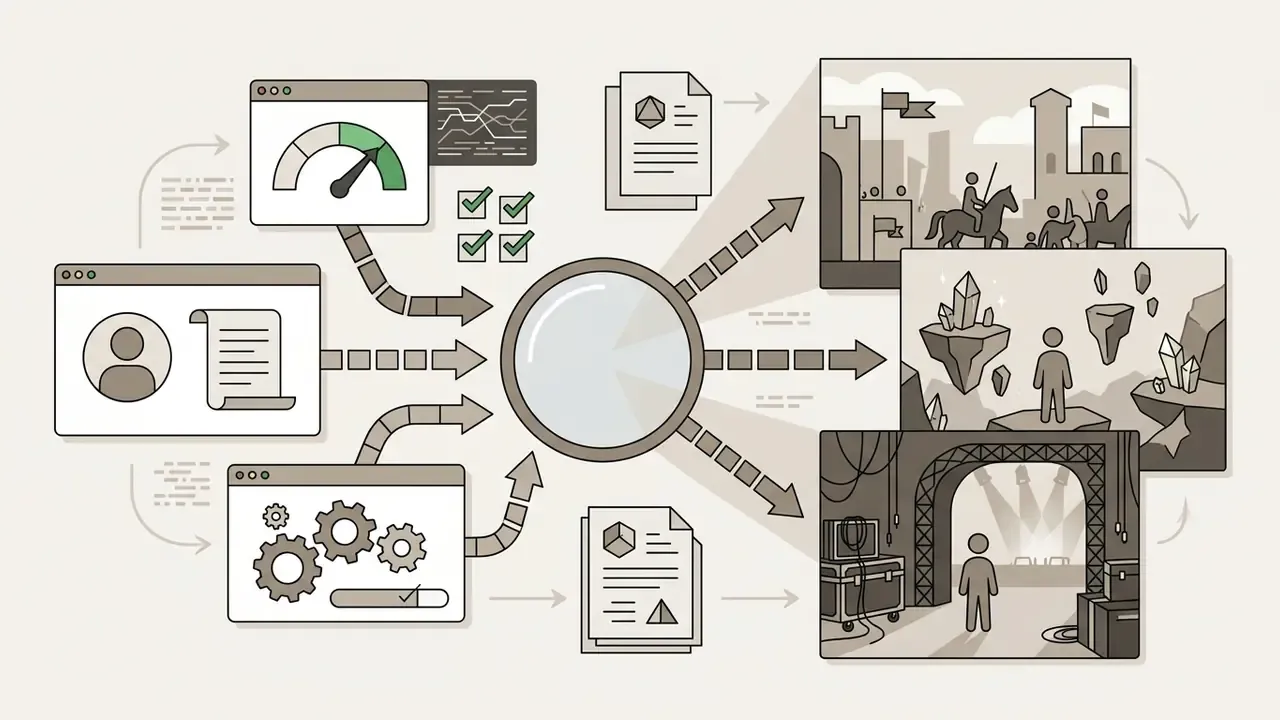
An ai celebrity photo generator typically supports three output formats: intimate casual selfies, studio celebrity portraits, and multi-person generated scenes. Each format needs distinct rendering parameters and input conditioning to look convincing.
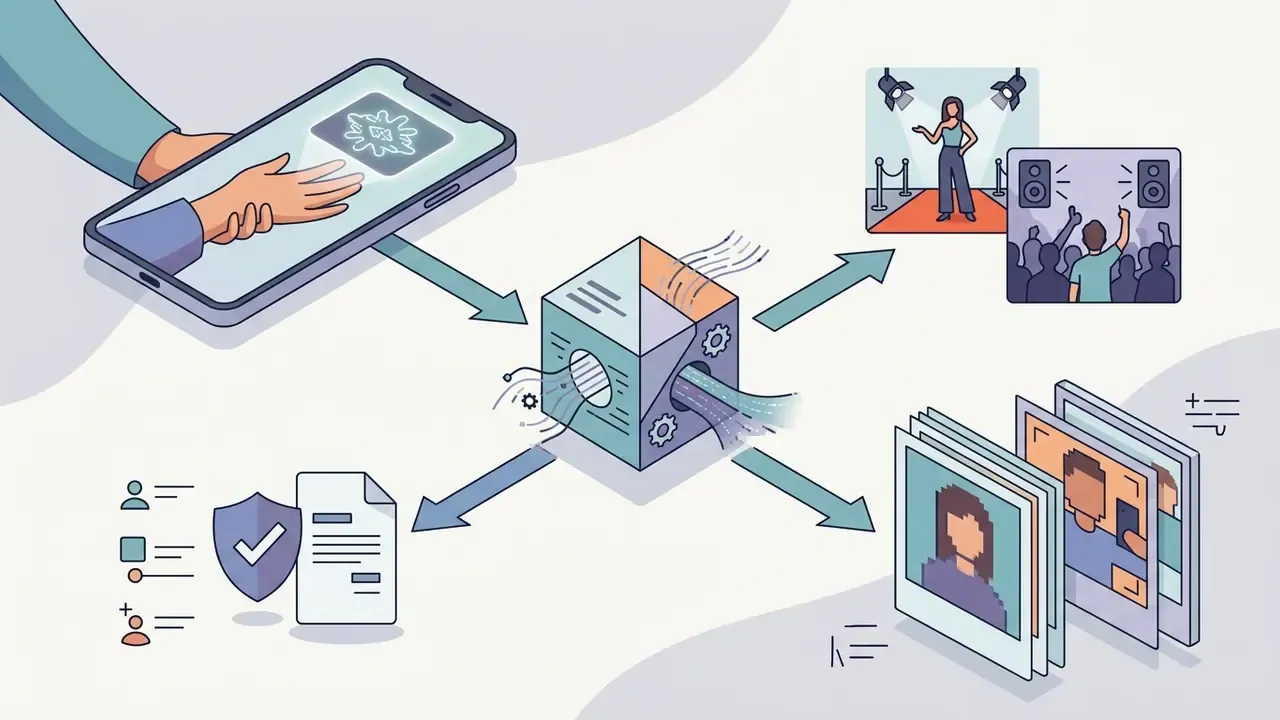
An ai celebrity picture generator uses image-to-image conditioning to blend user-submitted faces with reference identities. In one illustrative governance assessment (composite and hypothetical, not a client engagement), an enterprise evaluating media production tools found that unmonitored face-swapping software had spread across creative teams as classic shadow AI. After building an inventory of approved generative models and restricting unlicensed face fusion tools, policy violations stopped without killing creative flexibility. Readers who want broader context on creative media toolsets can explore the hub or see the overview of standardized visual workflows.
Some platforms now bundle a character generator alongside the celebrity presets, which lets a team build a reusable synthetic persona instead of borrowing a real face. Keep that option in mind. It resolves most of the legal questions below.
Legal Boundaries at a Glance
Celebrity-inspired images versus direct celebrity likeness
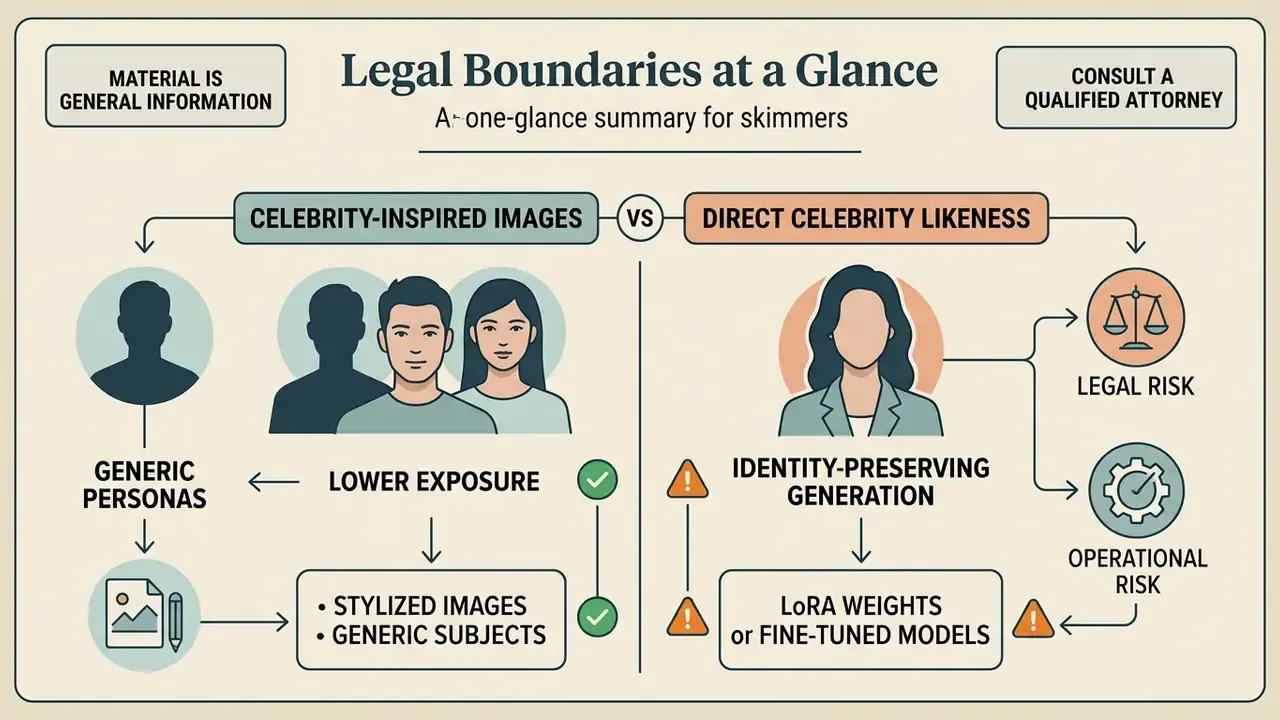
The legal and operational risk of an ai generator celebrity image depends heavily on one distinction: direct celebrity likeness, or celebrity-inspired aesthetic. Direct likeness that replicates a real public figure triggers strict scrutiny under U.S. right of publicity statutes.
Direct likeness relies on identity-preserving generation, usually specialized LoRA weights or fine-tuned diffusion layers. According to the U.S. Copyright Office's 2024 report on Digital Replicas, highly realistic electronic representations of identifiable individuals count as high-risk digital replicas when produced without explicit consent.
«The report recommends that Congress enact federal legislation protecting all individuals from the distribution of unauthorized digital replicas made without consent.»
Celebrity-inspired images work differently. They capture stylistic cues, classic Hollywood lighting, vintage color grading, high-fashion wardrobe, without copying the facial structure of a real individual. The practical test in publicity-rights case law is whether the subject is readily identifiable. In several states, liability can attach not only to a face, but to a name, a voice, a distinctive appearance, or signature mannerisms.
Creators lower exposure by generating generic, stylized personas rather than real public figures. Tools offering stylistic transformations can be assessed alongside adobe ai image systems and other commercial platforms to stay inside risk appetite. Readers comparing engines for identity-safe output can review the best AI image generators by control depth and licensing terms.
How to Create an AI Picture With a Celebrity
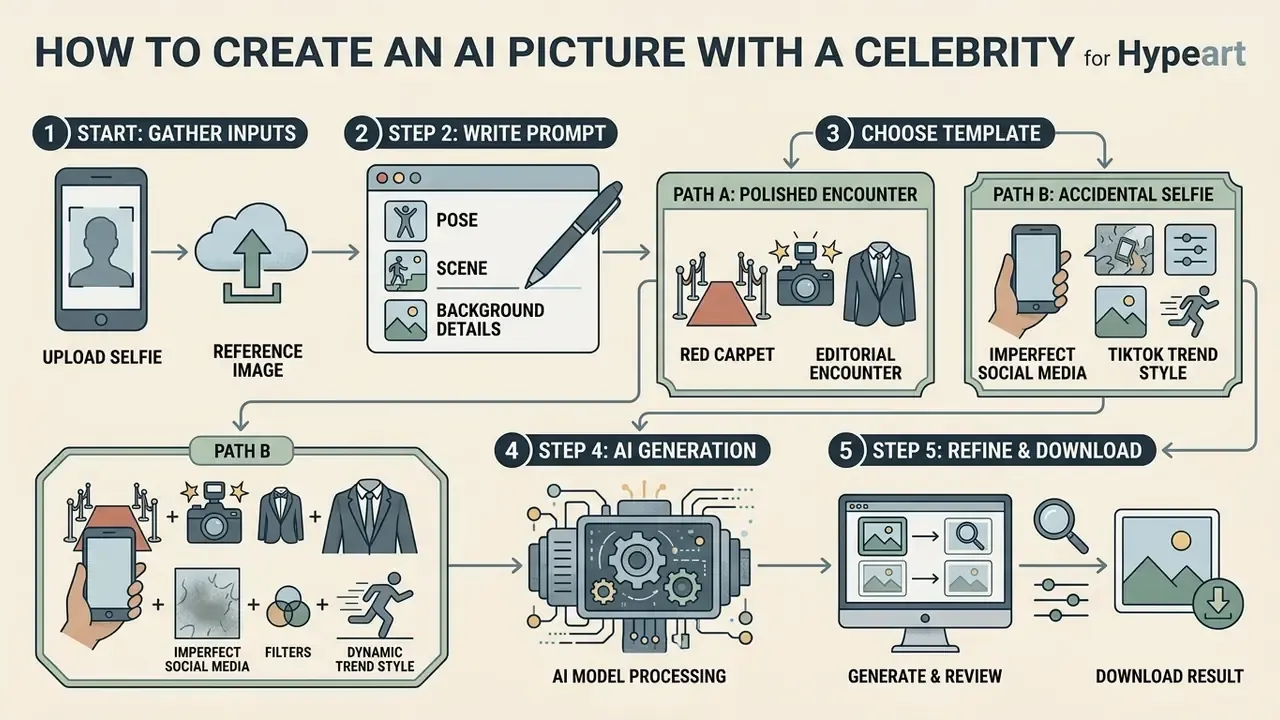
To generate a high-quality picture with a celebrity using an ai image celebrity generator, you need four things: accurate input data, a detailed text prompt, sensible model settings, and post-processing refinement.
Modern platforms compress this into a web interface or a mobile app. Simply upload a face, describe the scene, generate. The structured process below outlines how to move from raw inputs to a finished high-resolution picture without the usual artifacts.
[📋 CHECKLIST: Step sequence for creating an AI photo with a celebrity
Upload a selfie or reference image
The accuracy of an ai image generator celebrities workflow depends heavily on the quality of the uploaded selfie or reference photo. Input images need clear lighting, unobstructed facial geometry, and enough pixel resolution between the eye centers.
When using an ai image generator celebrity tool that supports face fusion, supplying multiple reference angles noticeably improves identity preservation across dynamic poses. Two or three angles are usually enough.
- Pick a clear, high-resolution frontal photograph where the face is fully visible, with no sunglasses, heavy shadow, or motion blur. Forensic standards such as ISO/IEC 19794-5 recommend a minimum of 60 pixels between eye centers for accurate facial feature alignment, with eyes, nose, and mouth visible in a frontal view.
- Verify the platform's data retention policy before you hand over biometric data. Confirm that facial embeddings are deleted after processing rather than stored indefinitely for model training. Published vendor windows range from immediate template deletion to retention for 7, 31, or 365 days. Ask for the number in writing.
- Match the reference image to the target lighting conditions of the intended scene, otherwise face blending produces awkward shading artifacts. Keep the camera at eye level, with the camera-to-face line horizontal within roughly ±5°, as recommended in ICAO portrait-quality guidance.
Write prompts for pose, scene, and background
Effective text prompts steer an ai image generator free celebrity pipeline by naming the subject pose, the background elements, the camera lens parameters, and the lighting. Vague prompts produce vague faces.
A structured prompting template prevents generic or distorted generations. Combining subject details, camera specifications, and atmosphere gives far more consistency across a batch.
Template A: Polished red carpet or editorial encounter
Template B: Accidental or imperfect social media selfie (TikTok trend style)
To simulate an unedited encounter on a phone camera, build the prompt around minor photographic imperfections. Counterintuitively, flaws are what make the frame read as real. Platform trends reward the look of a snapshot taken absentmindedly while pulling the phone out of a pocket.
[Style]: An unpolished, spontaneous iPhone selfie taken absentmindedly in low light,
         no clear composition, deliberately mediocre framing.
[Subject & Pose]: [Uploaded User Face] standing next to [Celebrity Name or celebrity-style persona],
         both captured in a casual, imperfect, laughing moment.
[Camera Artifacts]: Slight motion blur, uneven street lamp illumination, mild overexposure
         from background neon signs, awkward arm-length angle, messy framing.
[Environment]: A crowded, bustling city street at night with blurry pedestrians,
         traffic lights and neon reflections in the background.
Other poses that read as authentic: mirror selfies, slightly off-center group shots, backstage corridor snapshots, and "accidental meet-up" framing where one subject is partially cropped out of frame.
When adjusting text parameters, creators often reach for tools that let them add text to image compositions or rework spatial layouts. Describing camera position and lighting explicitly removes most of the familiar failures, distorted hands and misaligned eyes among them.
Generate, refine, and download the result
Once the prompt parameters are set, an ai image generator of celebrities synthesizes candidate images that you then refine, upscale, and export in production-ready formats.
- Generation and selection: Run the model to produce several candidate variations. Keep outputs that hold facial geometry and natural proportion with no visible blending seam.
- Refinement and inpainting: Use targeted inpainting or localized face editing to fix small flaws in eyes, teeth, or hairline. Check face shape, eyes, nose, hairline, skin tone, hands, light reflections, and background coherence before export.
- Upscaling: Push the final selection through an AI image upscaler to reach 4K resolution without adding artificial noise. Documented platforms distinguish "crisp" upscaling, which preserves detail, from "creative" upscaling, which invents it. The second option can silently change facial features, so it is a poor fit for anything that needs an audit trail.
- Exporting: Download uncompressed PNG or TIFF for high-quality print, or compressed JPEG and WEBP for web publishing. Keep provenance metadata intact instead of stripping it on export.
Styles and Customization for Celebrity AI Images
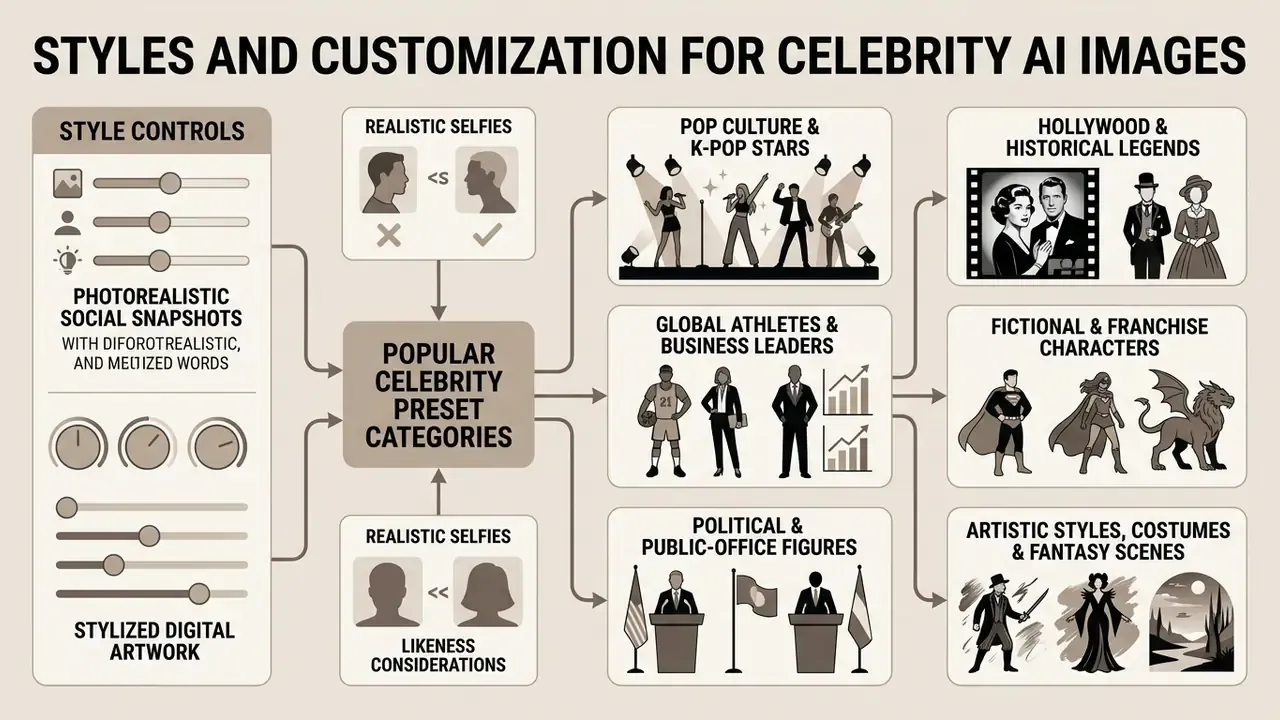
Style controls let users adapt an ai image generator with celebrities output for very different purposes, from photorealistic social snapshots to stylized digital artwork.
Choosing the right controls keeps the generated content aligned with both the aesthetic requirement and the distribution channel. A hyper realistic frame and a cartoon frame carry different levels of legal risk, which is worth saying out loud.
Realistic and natural-looking celebrity selfies
Achieving a realistic result with an ai image generator with celebrity tool means mimicking real camera flaws, skin imperfections, and natural environmental lighting.
Realism depends on avoiding over-polished, synthetic skin. Real photographs show subtle asymmetry, micro-wrinkles, flyaway hair, and reflections inside the pupil. Prompts should include technical photographic terms such as "subtle skin pores," "natural depth of field," "candid facial expression," and "raw photography style." A realistic ai selfie almost always contains something slightly wrong.
«Participants could not reliably distinguish AI portraits of celebrities from real photographs, even when given additional reference images of the same person.»
That finding explains why realism cues matter so much, and why disclosure matters even more. If trained observers holding reference photos cannot separate synthetic from authentic, a scrolling audience has no chance. Which is precisely the premise behind mandatory labeling regimes.
Popular Celebrity Preset Categories and Likeness Considerations
Generators get used across several public-figure categories. Each has its own prompt physics, and its own risk profile, since all of them involve readily identifiable real people.
- Pop culture and K-pop stars Backstage moments with icons like BLACKPINK or Taylor Swift need high-energy concert lighting, stage haze, LED-wall lens flare, and candid stage framing.
- Hollywood and historical legends Vintage aesthetics with stars such as Audrey Hepburn or Marilyn Monroe demand classic 35mm monochrome prompts, vintage grain, soft key light, and period-accurate wardrobe.
- Global athletes and business leaders Candid encounters with figures like Cristiano Ronaldo, LeBron James, or Elon Musk rely on contextual environments: sports arenas, locker-room corridors, tech summits, press-conference backdrops.
- Fictional and franchise characters Trend-driven challenges also place users beside costumed characters and animated figures. That shifts the risk category from publicity rights toward trademark and copyright exposure.
- Political and public-office figures Depictions of officeholders carry the highest deception risk. This is the category most often blocked by commercial moderation filters, and the one most often covered by election-integrity and synthetic-media disclosure rules.
Likeness note: for every category above, the safer production path is a celebrity-style persona with altered facial geometry, or a licensed likeness backed by a documented consent form covering purpose, data types, scope, duration, and a right to withdraw.
Artistic styles, costumes, and fantasy scenes
An ai photo generator celebrities model can convert celebrity depictions into artistic genres: oil painting, cyberpunk illustration, vintage poster, anime.
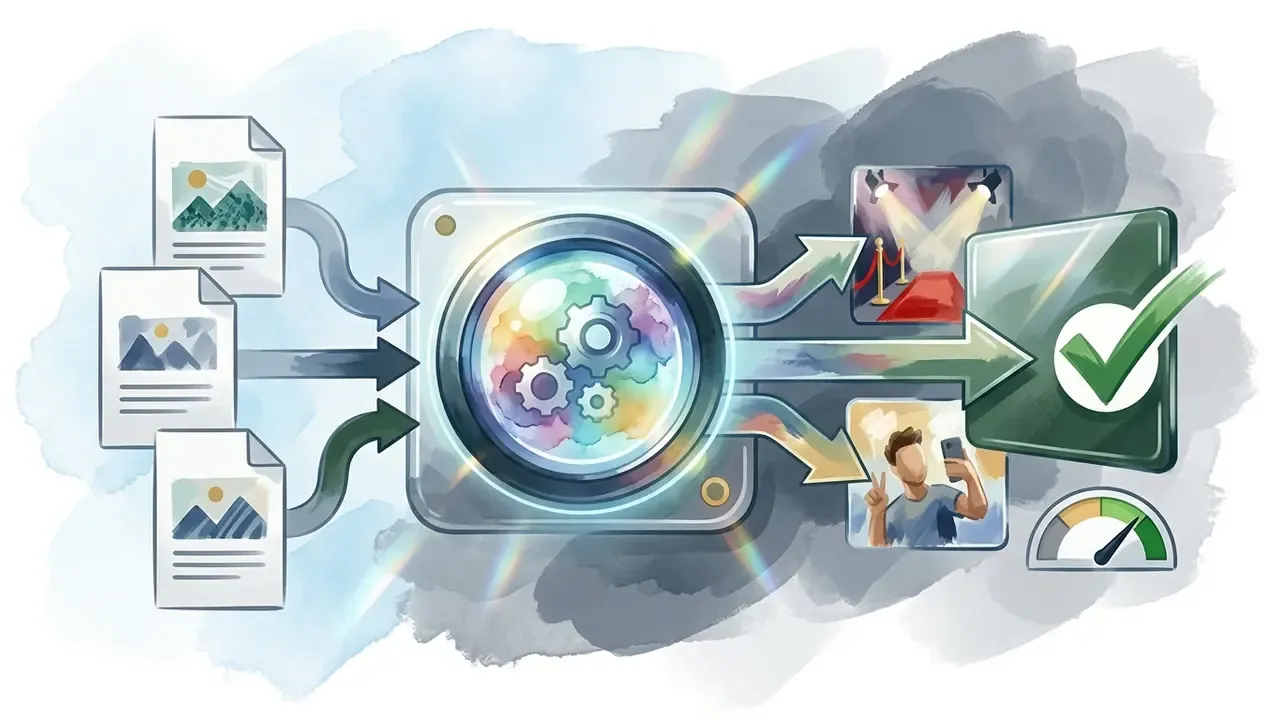
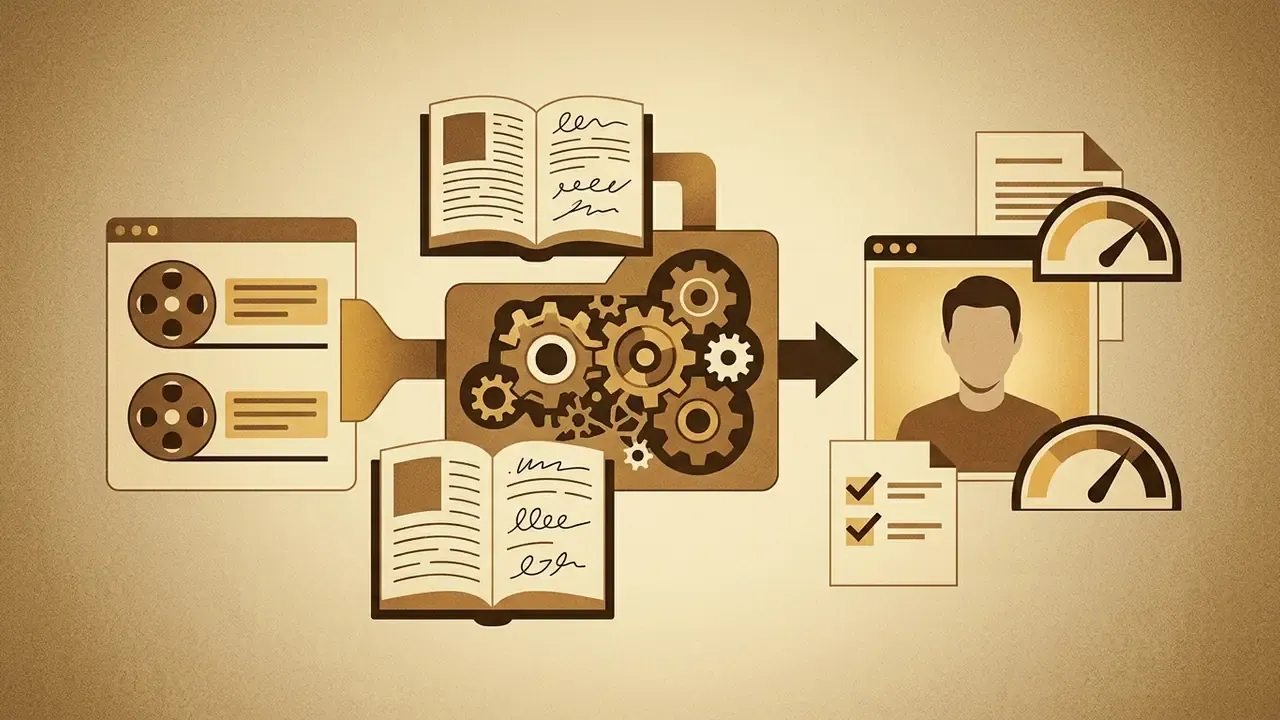
Shifting away from photorealism toward artistic expression produces engaging visual media while reducing the risk of misleading a viewer. Artistic styles use style-transfer diffusion conditioning to reinterpret facial features through a different medium. Any competent ai art generator offers several of them:
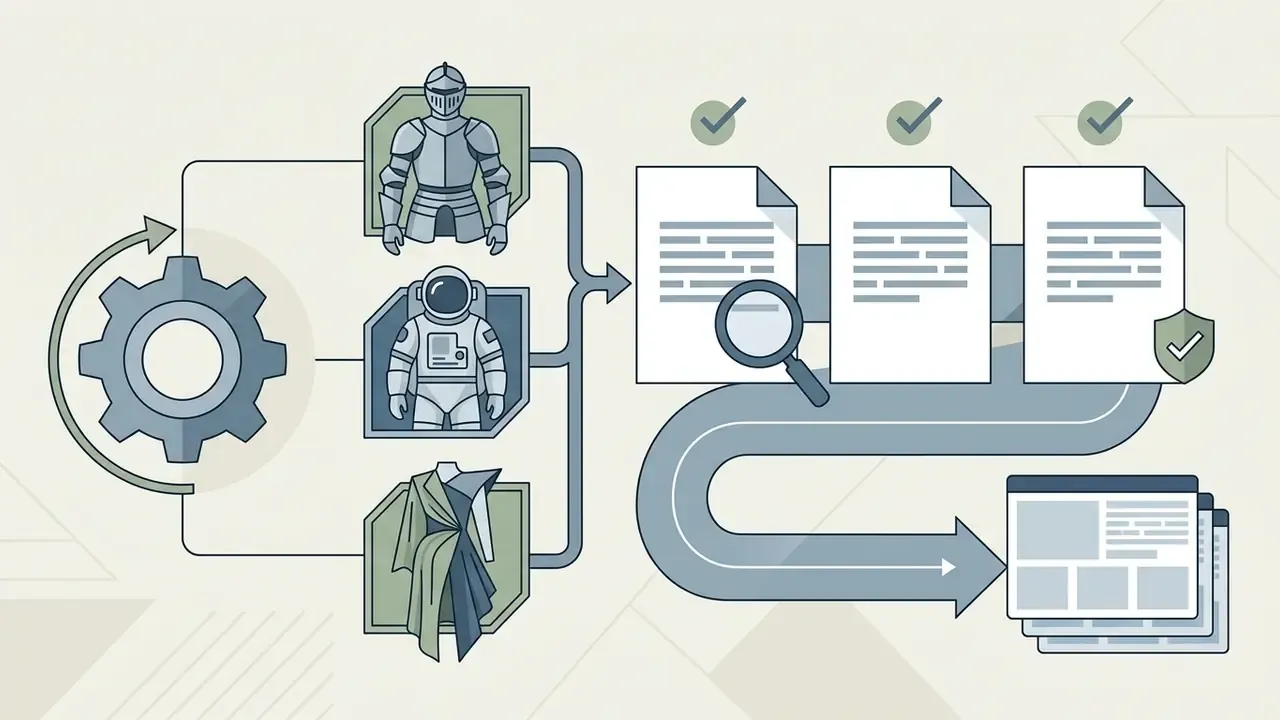

One caution. Several major stock and creative platforms explicitly prohibit prompts that name celebrities or invoke "in the style of" and "inspired by" references for generative submissions. The U.S. Copyright Office has also declined to recommend style itself as protected subject matter under federal digital-replica proposals. So style transfer lowers publicity-rights risk without eliminating platform policy risk.
Creators interested in specialized artistic tools can browse the hub to evaluate dedicated style engines, or review the best AI art generators by style control and licensing.
How to Choose a Free Celebrity AI Image Generator
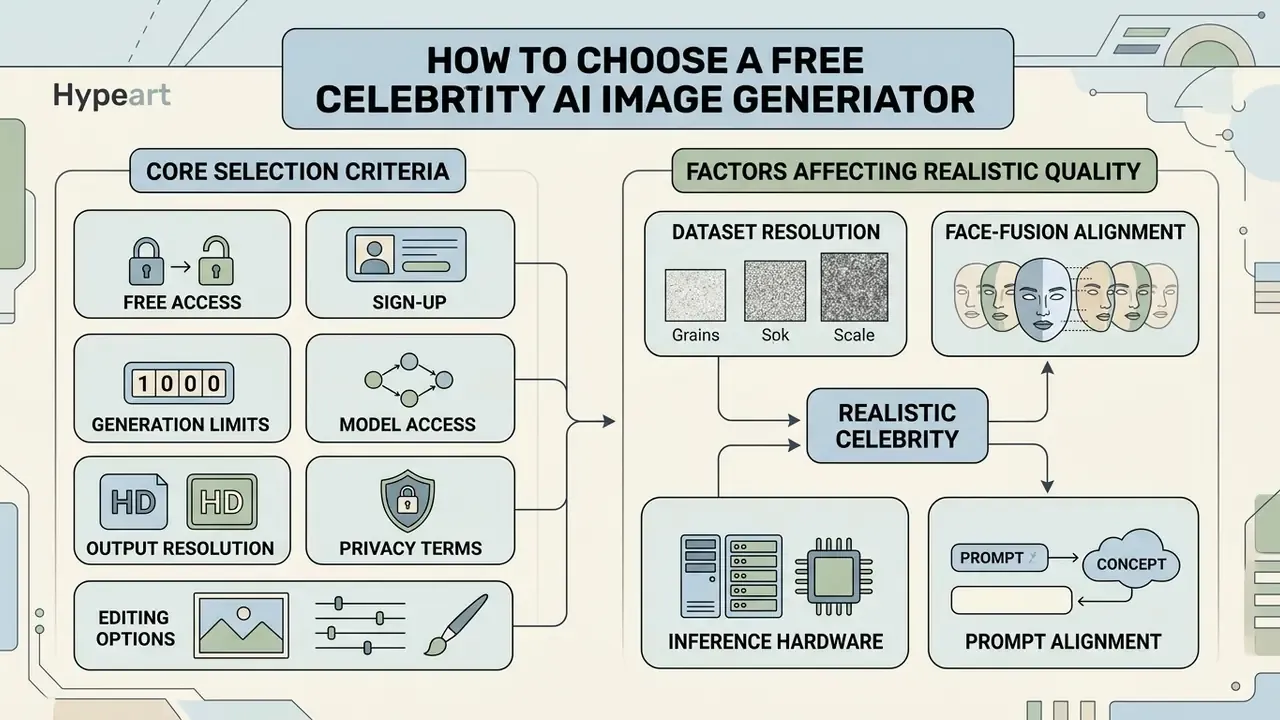
Selecting an ai photo generator with celebrities platform comes down to credit limits, model access, output resolution, privacy terms, and editing capability. Why choose one over another? Usually it is the data terms, not the pixels.
Organizations and independent creators have to balance free-tier availability against operational constraints, watermarking, and data processing rights. Advanced ai features mean very little if uploads feed a public training set by default.
Free access, sign-up, and generation limits
Evaluating an ai photo generator with celebrity platform involves checking daily credit allowances, subscription requirements, and trial constraints. Market patterns fall into three buckets: account-based credit grants (typically 10 to 40 credits on signup), guest trial credits (3 to 10 generations with no account), and no-signup unlimited access restricted to lower-tier models. Readers who specifically want to skip account creation can compare free AI image generators without sign-up before uploading any biometric data.
| Feature / Criteria | Free / Guest Tier | Registered Freemium Tier | Paid Subscription Tier |
|---|---|---|---|
| Sign-up requirement | No registration required | Email or social sign-up | Paid subscription account |
| Daily credit limits | 3 to 10 low-priority credits | 20 to 50 daily credits | Unlimited, high-priority queue |
| Face fusion / uploads | Basic selfie upload | Advanced multi-face fusion | Full control over reference embeddings |
| Export quality | Standard resolution (720p/1080p) | HD export with watermark | 4K uncompressed PNG, watermark-free |
| Commercial license | Personal, non-commercial only | Personal, non-commercial only | Full commercial use rights |
| Policy restrictions | Strict celebrity name blocking | Moderate public figure filtering | Enterprise compliance filtering |
| Data retention disclosure | Rarely documented | Policy page, opt-out often manual | Contractual DPA, documented retention window |
| Provenance / C2PA metadata | Usually absent | Partial or visible watermark only | Signed C2PA manifest at creation |
No matching rows Clear one or more filters to restore the matrix.
For a broader shortlist of zero-cost options with documented limits, see our comparison of the best free AI image generators by output quality, watermarks, and export rights.
AI models, output quality, and editing options
An ai picture generator celebrity service depends on its base models, FLUX.1, Midjourney, or fine-tuned Stable Diffusion checkpoints, to govern rendering quality.
Multi-model platforms let users switch architectures per prompt. FLUX.1 models handle prompt adherence and realistic hands well, while Stable Diffusion variants offer deeper inpainting and control-net capability, including outpainting extensions of up to 2,000 pixels in any direction. Integrated editors, face repair, background removal, generative outpainting, allow corrections without leaving the interface. Teams that prefer lighter retouching outside the generator can consult our guide to online photo editors for feature and pricing context.
What affects realistic celebrity image quality
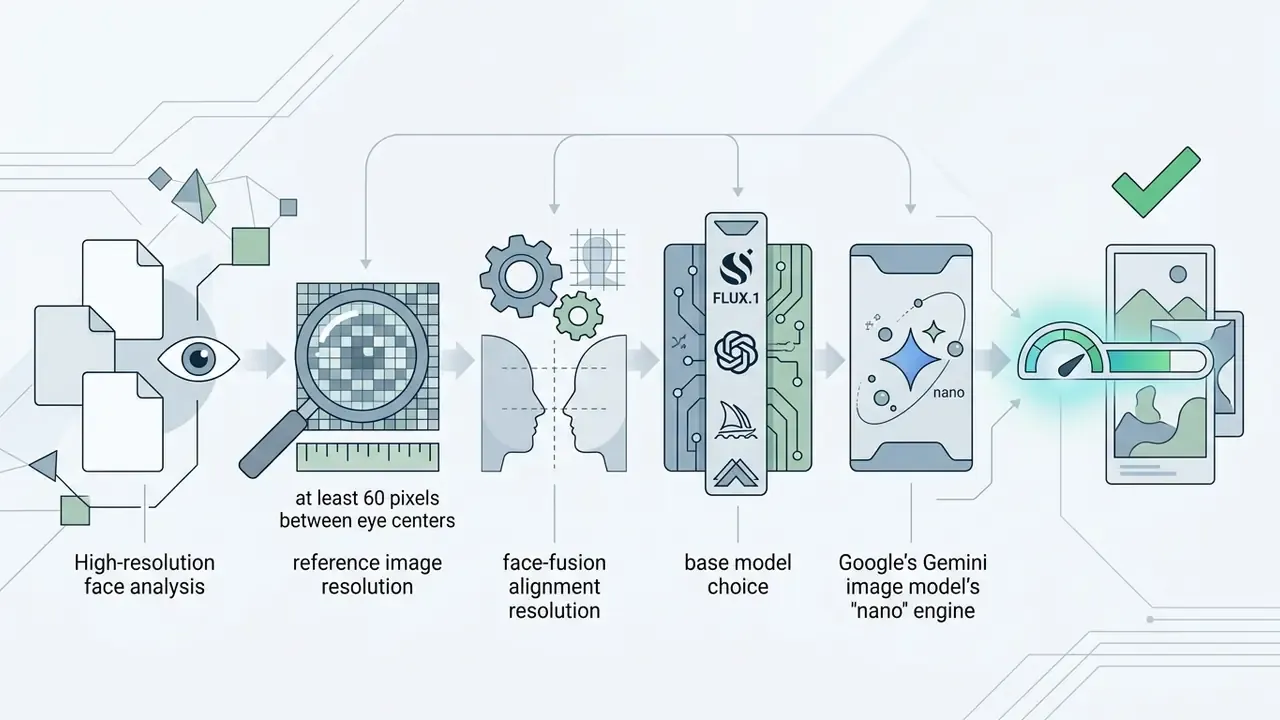
The quality of a celeb ai image generator output is set by base model training data, face-fusion resolution, processing speed, and prompt-alignment accuracy.
- Dataset resolutionBase models trained on high-resolution, uncompressed face datasets produce cleaner lighting and skin detail.
- Face-fusion alignmentAdvanced face-swapping processors align source and target feature points at resolutions above 512×512 pixels to avoid blur. Research consistently notes that the swapped face's pixel resolution should match the target frame. A high-resolution face pasted into a low-resolution scene gives you the classic "sticker" artifact.
- Inference hardwareHigh-performance GPUs allow multi-step diffusion sampling without wrecking generation speed. Published face-swap systems report throughput between roughly 7 and 24 frames per second on specified GPUs, with about 15 FPS commonly treated as the real-time threshold.
- Prompt alignmentExplicit composition, gaze, framing, lighting, and lens instructions measurably improve adherence. Lighting can also be handled as a separate conditioning channel in recent diffusion research.
Higher realism cuts both ways. The same fidelity that makes a selfie convincing also defeats automated verification.
«On in-the-wild 2024 deepfakes, the accuracy of leading detectors dropped by 45 to 50% compared with earlier benchmark results.»
For teams verifying inbound or outbound assets, AI image detectors and reverse-search workflows such as AI reverse image search belong in the evidence file as supporting signals. Never as conclusive proof.
Enterprise Vendor Risk Assessment for Face-Fusion Tools
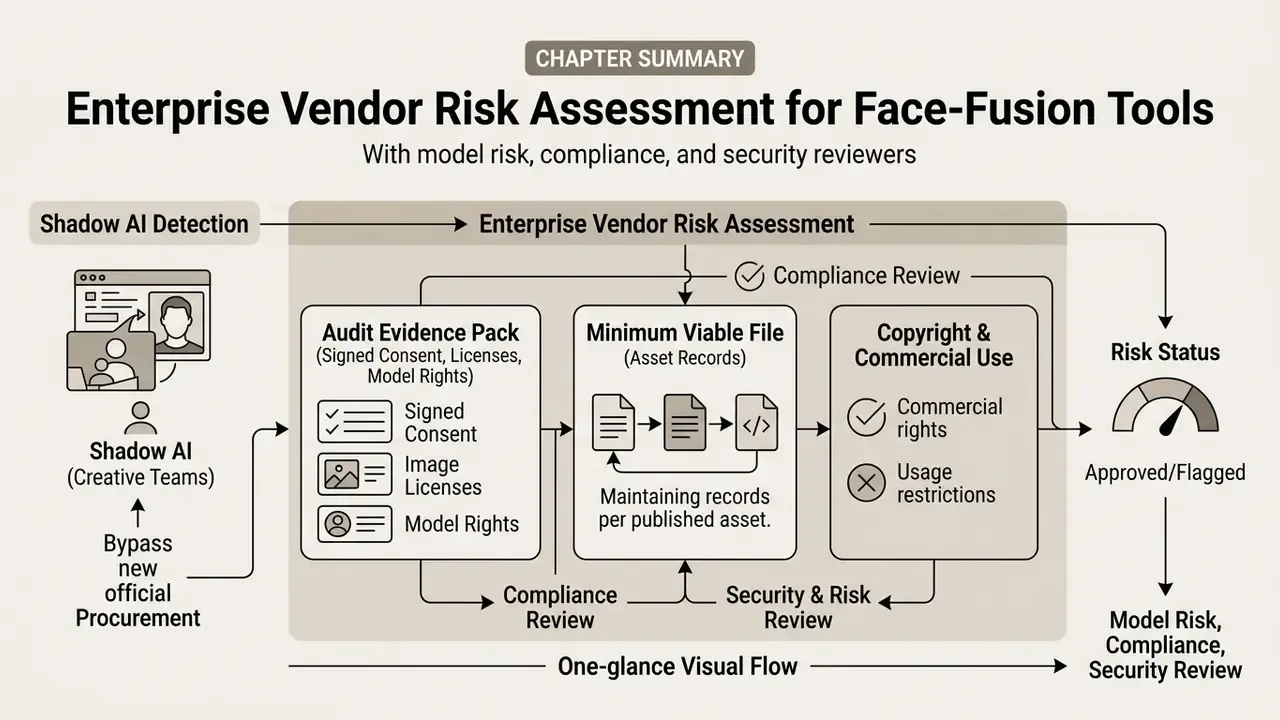
Written for model risk, compliance, and security reviewers evaluating consumer-grade generators that employees may already be using.
Shadow AI in creative teams rarely begins with a procurement request. It begins with a free celebrity-selfie tool and a lunch break. Use the checklist below to classify a vendor as approved, restricted, or prohibited in the model inventory.
| Assessment Domain | Evidence to Request | Prohibited Signal |
|---|---|---|
| Biometric data handling | Written retention window for images and face templates; deletion confirmation API or log | "Retained as long as necessary" with no number |
| Training opt-out | Account-level and contractual opt-out from training on uploaded faces; default setting documented | Opt-out only by email request, or absent |
| Jurisdiction and transfers | Processing region, sub-processor list, DPA with GDPR transfer mechanism | Unknown processing location |
| Biometric statute coverage | BIPA-specific consent language, written release workflow, deletion schedule | No biometric-specific notice |
| Model isolation | Confirmation that customer uploads never enter shared checkpoints or public LoRAs | Community model marketplace with user-uploaded identity weights |
| Moderation controls | Documented blocking of named public figures, minors, and intimate content; appeal process | Marketing that advertises "no filters" on real people |
| Provenance | C2PA or equivalent signed manifest applied at generation; metadata survives export | Metadata stripped on download |
| Security attestations | SOC 2 Type II or ISO 27001 scope covering the generation service | Attestation covers only the corporate website |
| Commercial licensing | Explicit grant of commercial rights in the output, plus indemnity scope | License silent on publicity-rights liability |
| Incident and takedown | Named contact, SLA for takedown of misused likeness, notice-and-removal process | No published process |
The scale of unmanaged tooling justifies this level of scrutiny.
«Researchers identified more than 34,000 downloadable deepfake model variants designed to generate images of identifiable individuals.»
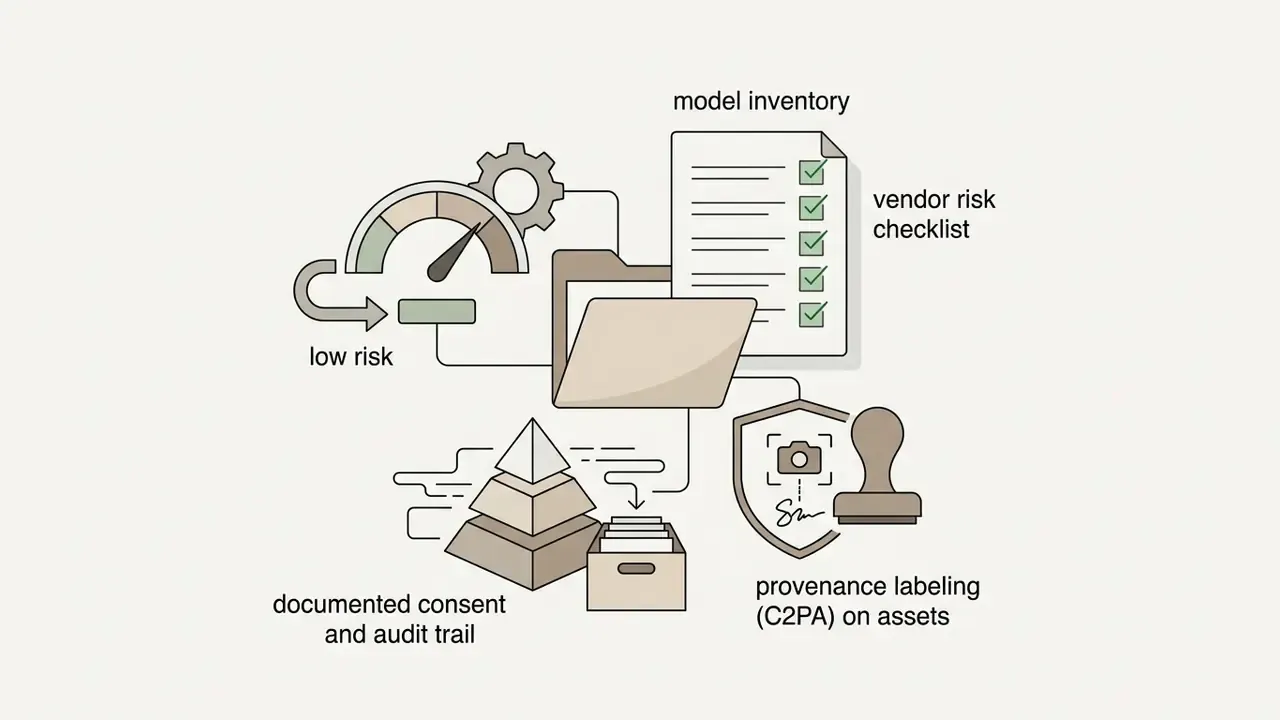
Audit evidence pack, minimum viable file per published asset: (1) signed consent or licence covering purpose, data types, scope and duration, with withdrawal rights; (2) the exact prompt, model name and version, and seed; (3) reference-image provenance and upload authorization; (4) the moderation decision log; (5) the disclosure label and C2PA manifest as published; (6) named approver and approval date. Store them together. Reconstructing that file after a complaint costs far more than capturing it at generation time.
One practical note on ownership. If no single person is named as accountable for a published synthetic asset, escalation stalls exactly when speed matters. Assign the owner before the campaign, not during the incident.
Use Cases for AI Celebrity Images
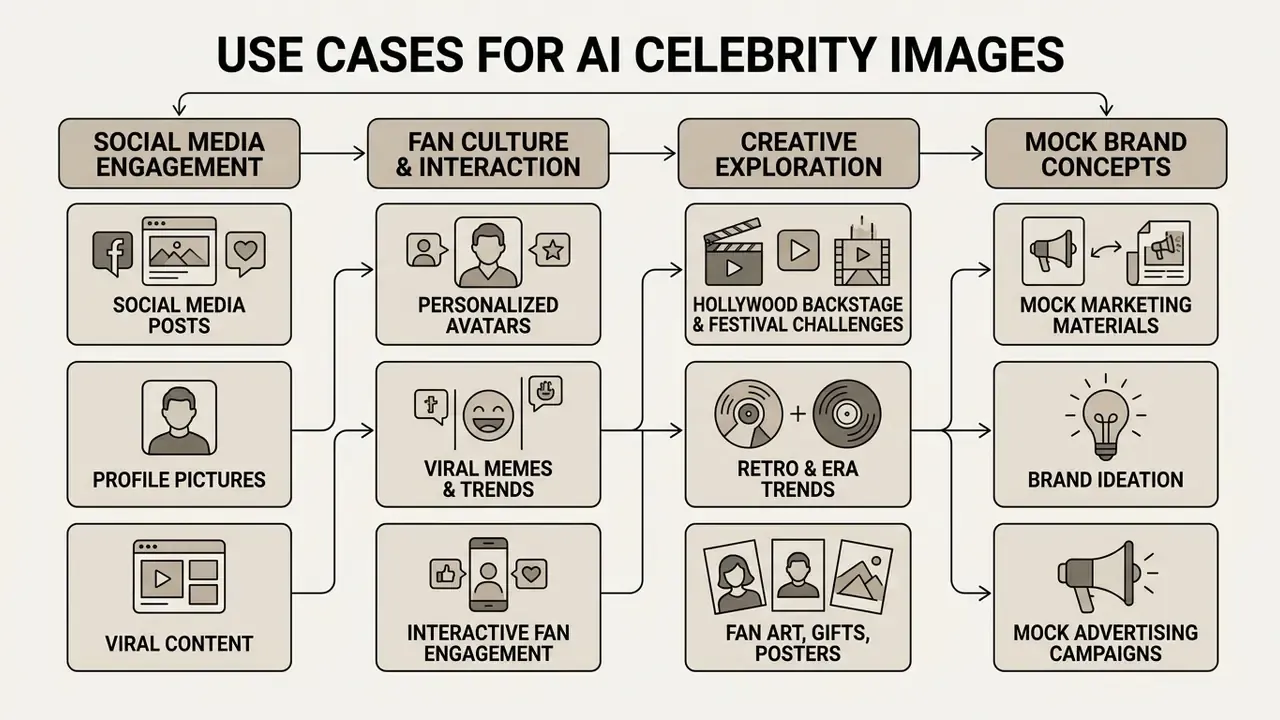
A celebrities ai image generator shows up across several creative domains: social media engagement, fan culture, personal gifts, mock brand concepts.
Understanding the realistic use cases helps creators pick effective applications and stay inside ethical and platform boundaries.
Fan art, gifts, posters, and creative projects
A celebrity ai generator photo tool lets fan communities design custom merchandise, commemorative posters, digital greeting cards, and personal art projects.
Fans use these tools to visualize dream film cast pairings, sketch album art concepts, and make digital gifts. Image-to-image AI generators are the usual starting point when a reference photo drives the composition. Printing a high-resolution generation on canvas is a cheap way to create custom room decor, and print-ready exports are typically offered as PNG, TIFF, JPG, and PDF. Creators evaluating workflow automation across creative media projects can reference our AI Media Workflows hub for structured operational advice.
One caveat worth repeating for fan communities: non-commercial intent does not neutralize publicity-rights exposure once an item is sold. Selling printed merchandise featuring a real person's likeness is the single most common way a fan project crosses into commercial use.
Brand concepts and marketing materials
Marketing teams and agencies use AI celebrity images for internal pitch decks, mood boards, and speculative collaboration concepts.
- Speculative mood boards Visualizing potential brand ambassador partnerships during early campaign planning.
- Design mockups Testing celebrity-style aesthetics inside ad layouts before any sponsorship rights exist.
- Editorial concepts Prototype magazine layouts and promotional artwork for creative review.
- Synthetic ambassadors Building an owned virtual persona instead of licensing a real celebrity, which removes publicity-rights dependency altogether.
«Anthropomorphism and interactivity of virtual influencers positively affect parasocial relationships, increasing brand trust and electronic word-of-mouth.»
That evidence base matters commercially. An owned synthetic persona can deliver comparable engagement mechanics with no digital-replica licence attached, and it is the option most often recommended when legal review blocks a celebrity concept. Where disclosure rules apply, including state-level requirements for advertising that features AI-generated "synthetic performers", the persona still has to be labeled as synthetic.
Restricted content categories, including adult and age-gated generators, are handled separately in Appendix B rather than in this commercial section, to keep enterprise guidance and adult-content compliance distinct.
Commercial Use, Privacy, and Rights for Celebrity AI Images
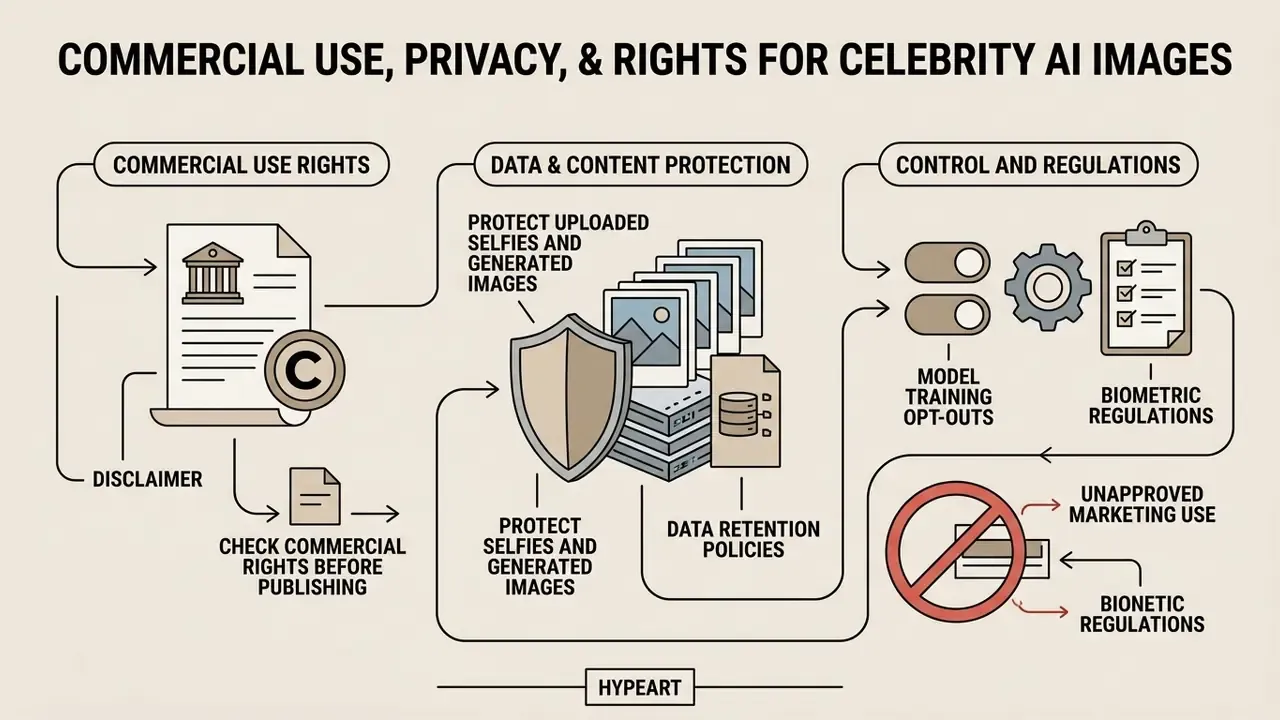
Commercial deployment of synthetic celebrity images runs into hard constraints: right of publicity, commercial licensing, platform terms of service, and data privacy law.
Before publishing or monetizing AI-generated content, creators and enterprise teams must verify permissions to avoid civil liability and brand damage. The scale of available tooling, tens of thousands of downloadable identity-specific model variants as documented by Oxford's research archive above, means moderation cannot be assumed. It has to be verified per vendor.
Check commercial rights before publishing or marketing use
Using synthetic celebrity images in marketing, product packaging, or monetization requires explicit commercial rights licensing and publicity permissions.
Generating an image on a paid AI plan does not grant authorization to exploit a real person's identity for commercial gain. That confusion is common and expensive. U.S. state right of publicity laws protect individuals from non-consensual commercial exploitation of name, image, likeness, or voice, and the Congressional Research Service notes that current federal law does not comprehensively protect publicity rights, which means the applicable standard depends on state law and contract terms. The Federal Trade Commission also enforces against deceptive advertising when synthetic media implies an unsanctioned endorsement, and false-endorsement exposure under the Lanham Act can run in parallel. Verification tooling such as AI image detectors helps document a pre-publication check, though detection results should be filed as one input, never as legal clearance.
For broader analysis of legal disputes, risk executives can browse the hub of case coverage. To review base terms for commercial deployment, visit our main commercial use overview.
Protect uploaded selfies and generated images
Protecting privacy means scrutinizing how a platform collects, stores, and processes uploaded facial selfies and biometric metadata. Not the marketing page. The policy text.
- Data retention policies Confirm whether uploaded selfies are deleted immediately after processing or kept on server infrastructure. Published windows in the market range from immediate template deletion to 7 days, 31 days, 12 months, or a vague "limited period" after account termination.
- Model training opt-outs Make sure platform settings keep user-submitted face uploads out of public AI training datasets. Privacy regulators have advised that developers should seek consent or offer an opt-out where generative training falls outside users' reasonable expectations.
- Biometric regulations Verify compliance with biometric privacy frameworks such as Illinois BIPA or GDPR provisions governing facial template storage.
Public attitudes add reputational pressure on top of legal duty.
«90% of respondents considered creating synthetic media unacceptable, yet only 53% condemned consuming it, survey of 315 US adults.»
That asymmetry is the practical warning for brands. The same audience that happily shares a celebrity AI selfie may still judge the creator harshly. Disclosure and consent documentation protect reputation at least as much as they protect against litigation.
FAQ About Celebrity AI Image Generators
Can an AI generator create a group photo with a celebrity?
Yes. Advanced generators can synthesize multi-person group photos featuring both the user and a public figure in one frame.
Platforms do this with multi-reference face fusion or multi-subject diffusion models (architectures such as WithEveryone or AddMe). Recent research demonstrates identity-grounded group generation with as many as ten reference identities in a single composition. You just upload one reference photograph per person, assign spatial placement prompts, and let the model blend lighting, shadow, and perspective across all subjects. Group photos that insert individuals into historical or sensitive real-world events without consent create privacy and accuracy risk. Public-sector guidance warns specifically against generating "complete" event photos that add absent colleagues, because the output is a false record.
Can a celebrity AI image become an AI video?
Yes, a static AI celebrity photo can be animated into a motion clip with image-to-video diffusion tools. Readers new to the category can start with our overview of image-to-video AI tools and then compare the best AI video generators by duration limits, resolution, and licensing.
To convert a synthetic celebrity photo into motion, creators use an ai video generator that supports start-end frame mode or a standard image-to-video pipeline. Platforms such as Pixverse V5, Veo 3.1, Seedance Pro, Hailuo (MiniMax), and Kling O1 let users anchor the generated celebrity selfie as the initial frame, then animate movement, facial expression, and camera motion. Implementation details and API economics for one major engine are covered in our Google Veo implementation guide. Major commercial engines enforce strict automated moderation, including C2PA provenance detection, face-detection rejection on input images, and watermarking of shared clips, which restricts unauthorized deepfake animation of living public figures. OpenAI's video generation API, for example, rejects input images containing real people, public figures, and human faces outright.
Detection difficulty also rises once motion and partial edits enter the pipeline.
«Partial manipulations reduce human deepfake-detection accuracy by more than 30% compared with traditional full-face swaps.» "FakeParts: a New Family of AI-Generated DeepFakes", FakePartsBench (2025). https://arxiv.org
Is a free celebrity AI image generator safe to use with my own selfie?
Only if the retention and training terms are explicit. Before uploading, confirm three things: the deletion window for both the image and the derived face template, whether uploads feed model training by default, and where processing physically occurs. Guest tiers with no account are convenient, but they usually provide the least documentation. That is the opposite of what a biometric upload deserves.
Do I need to label an AI celebrity image when I post it?
For realistic depictions, yes in most current regimes. Major platforms require disclosure of realistic synthetic media involving public figures. The EU AI Act's transparency obligations for deepfakes apply from 2 August 2026 with machine-readable disclosure, and several U.S. states impose advertising disclosure duties for AI-generated synthetic performers. The workable standard is a visible label plus embedded C2PA provenance metadata.
Can I sell prints or merchandise made with a celebrity AI image generator?
Not without a licence. Selling posters, apparel, or digital products featuring a readily identifiable real person is exactly the commercial exploitation that state right of publicity statutes target, and a paid subscription grants no rights in a third party's identity. Safer commercial routes: celebrity-inspired stylized personas, fully synthetic owned characters, or a documented likeness licence.
Which uploads produce the best identity match?
Frontal or near-frontal framing, flat even lighting, both eyes visible, no occlusion from sunglasses or masks, a neutral or mild expression, a large face in frame, and at least 60 pixels between eye centers. Supplying two or three angles of the same person improves identity preservation when the target pose is dynamic.
Next Steps for Risk, Compliance, and Creative Teams
- Inventory every image and video generation tool currently used by marketing, social, and design teams, including free and guest-tier services.
- Classify each tool as approved, restricted, or prohibited using the vendor risk table above, and record the biometric retention window for each approved vendor.
- Publish a prompt policy that separates celebrity-inspired stylization (permitted) from direct likeness of real public figures (licence plus legal sign-off).
- Enable provenance by default: C2PA manifests at generation, visible labels at publication, metadata preserved through export and CMS upload.
- Stand up the audit evidence pack described above, so any published asset can be reconstructed on request.
- Schedule quarterly review against moving deadlines: EU AI Act transparency obligations (August 2026), platform synthetic-media policies, and new state digital-replica statutes.
Start with step one. An inventory you can actually read beats a policy nobody can enforce.
Appendix A: Superseded Passages
Appendix B: Restricted Content Categories
Age-gated and adult-oriented generation sits outside enterprise brand workflows and carries separate compliance obligations, including age verification, non-consensual intimate imagery prohibitions, and notice-and-removal duties under the U.S. TAKE IT DOWN Act. Creators who need to understand the regulatory parameters around these restricted media tools, such as an unrestricted ai image generator, an 18 ai generator, or an adult ai art system, should review those requirements before generating anything, and should never apply such tools to a real, identifiable person's likeness. Generating intimate or sexualized depictions of identifiable individuals without consent is unlawful in numerous jurisdictions, regardless of what a platform's terms allow.
Metadata Summary
- SEO title Celebrity AI Image Generator: Free Selfies, Prompts & Rights
- Meta description Use a celebrity AI image generator the right way: free tools compared, red-carpet and accidental-selfie prompts, video engines, and commercial-use rights checks.
Social media, profile pictures, and viral content
Users lean on a celebrity ai generator image to build viral posts, creative avatars, and trending short-form content.
Before publishing, creators should review guidance covering unfiltered ai image generator tools and platform-specific synthetic media labels. Major platforms now define public figures to include celebrities, require disclosure of realistic synthetic media, and specifically restrict public-figure synthetic media used to imply endorsement. Undisclosed synthetic personas can face reduced distribution, which is a quiet penalty most teams discover too late.